


Abstract
Community preparedness requires translating wildfire knowledge into protective action, but evidence from rural Pakistan remains limited. This study evaluated community-based fire-safety training in forest-adjacent communities of Swat and Lower Dir, Khyber Pakhtunkhwa. A controlled quasi-experimental design enrolled 360 households across twelve communities, with six training and six comparison communities. Training comprised three two-hour Pashto sessions addressing risk recognition, household prevention, evacuation planning, and emergency communication. Surveys and structured observations assessed knowledge, self-efficacy, and verified protective actions at baseline and twelve weeks after training. Adjusted linear mixed-effects difference-in-differences models accounted for household characteristics, community variation, and repeated measurements. Training communities demonstrated greater improvements than comparison communities: 4.51 points in knowledge, 1.10 points in self-efficacy, and 28.43 percentage points in verified protective actions (all p < 0.001). Knowledge and self-efficacy associations remained significant after Holm adjustment. The findings indicated that training-associated improvements extended beyond knowledge and confidence to observable household preparedness.
1. Introduction
1.1. Wildfire Risk and Community Preparedness
Wildfire preparedness has become an increasingly important concern as extreme fire activity intensifies across multiple regions [1,2]. Using satellite observations covering 2003–2023, Cunningham, Williamson [3] identified a 2.2-fold increase in the frequency of energetically extreme wildfires globally. This finding concerns the most extreme events rather than all fires, but underscores the importance of strengthening preparedness alongside fire monitoring and suppression. Community preparedness refers to the knowledge, skills, plans, and coordinated arrangements that households and local groups develop before a wildfire to anticipate danger and take timely protective action. It encompasses both household readiness and collective capabilities, including communication, coordination, and assistance for people who require additional support. For forest-adjacent populations, preparedness requires recognition of hazards, understanding of warnings, and practical arrangements that support timely protective action [4]. These arrangements include identifying evacuation routes and safe meeting points, establishing household communication plans, preparing essential supplies, and clarifying responsibilities during an emergency. Preparedness therefore extends beyond awareness of wildfire risk to the ability to act on that awareness through advance planning and coordinated responses. Consequently, evaluating community capabilities is essential to understanding how risk information translates into household protection.
Pakistan illustrates the need to connect environmental risk assessment with community preparedness [5]. Shahzad, Mehmood [6], analyzing satellite observations from 2001 to 2023, identified northern Pakistan, particularly Khyber Pakhtunkhwa and Gilgit-Baltistan, as areas experiencing high fire intensity and associated losses in ecosystem productivity. Their findings establish the ecological significance of forest fires but do not evaluate household training. At the provincial level, the National Disaster Management Authority identified Swat and Dir among the areas at highest forest-fire risk in its 2025 assessment [7]. This geographical evidence supports examining preparedness in forest-adjacent communities of Swat and Lower Dir, where the present study investigated household responses to community-based training.
Focusing on these districts also connected the evaluation to an operational preparedness concern: whether households in identified risk areas could convert training content into observable arrangements. Within this broader concept of community preparedness, the present study focused on household preparedness as a component of community capacity. The analysis therefore addressed community capacity alongside the environmental assessments that identify where fire exposure occurs.
1.2. Community-Based Fire-Safety Training
Community-based fire-safety training provides a practical setting for connecting risk information with locally relevant preparedness tasks. Existing approaches include organizational train-the-trainer models, face-to-face community education, and instruction on the use of fire early warning systems. Lehna et al. [8] described a community-based participatory approach that trained organizational personnel to deliver and adapt home-fire-safety education for the populations they served. More recently, Ringo and Msangi [9] documented a substantial gap between warning-system availability and training participation in Tanzanian urban markets: although 77.2% of surveyed traders reported the presence of fire early warning systems, only 35.6% had received formal training in their use. Training was associated with operational competence, highlighting the importance of developing users’ practical capabilities alongside providing warning infrastructure.
Its educational value depends on whether participants understand recommended measures and can apply them within their household circumstances. International intervention evidence supports this approach while demonstrating that learning outcomes and sustained preparedness require separate assessment. Joffe, Potts [10] evaluated a face-to-face intervention addressing earthquake and home-fire preparedness in the United States and Turkey. Their controlled study, incorporating twelve-month follow-up, documented increased multi-hazard preparedness in both settings. However, these findings do not establish effectiveness for wildfire preparedness in rural Pakistan.
Evidence from rural China further demonstrates the importance of distinguishing immediate learning from sustained protection [11,12]. Chan, Lam [13] reported that community education increased correct recall of the fire-service emergency number from 40.4% to 77.2%. Nevertheless, 65.5% of the 29 participants reassessed seventeen months after receiving training reported no longer retaining the fire blanket provided. These findings concern household fire safety but illustrate why educational success cannot be inferred solely from knowledge gains. The cited evidence identifies training participation, practical competence, and maintenance of protective measures as distinct concerns in community fire-safety education.
Building on this evidence, the present intervention addressed wildfire risk recognition, household prevention, evacuation planning, and emergency communication. To connect instruction with local circumstances, training comprised three two-hour sessions delivered in Pashto by a Forest Department officer and a Rescue 1122 instructor, supported by a research facilitator. Instruction combined discussion, demonstrations, and scenario-based exercises with household planning worksheets and preparedness checklists. Its evaluation examined whether training-related changes extended beyond survey responses to observable household preparedness measures.
1.3. Knowledge, Self-Efficacy, and Protective Actions
Knowledge, self-efficacy, and protective actions represent related but distinct dimensions of preparedness [14]. Knowledge concerns accurate understanding of wildfire hazards and appropriate responses [15]. Self-efficacy concerns confidence in performing particular preparedness tasks. Bandura [16] explains how efficacy expectations influence the initiation of action, effort, and persistence when difficulties arise. Applied to wildfire preparedness, this perspective provides a rationale for practical training that develops both understanding and confidence. It does not imply that confidence automatically produces protective behavior or that improvements in separate outcomes establish a causal mediation pathway.
Protective action additionally depends on opportunities to implement recommended measures. Resources, physical access, household responsibilities, and coordination requirements therefore constitute relevant conditions when interpreting preparedness. A knowledgeable respondent can describe an evacuation plan without having organized household arrangements; similarly, high confidence does not demonstrate that vegetation management or route preparation has occurred. Evaluating these outcomes separately prevents conceptual overlap and identifies whether educational gains accompany practical change.
The literature reviewed leaves a specific contextual and methodological gap. Pakistani research cited here documents ecological exposure, while international interventions establish educational potential in different hazard and institutional settings. The contextual gap concerns the absence, within the studies reviewed here, of an evaluation establishing whether locally delivered wildfire training improves household preparedness in forest-adjacent communities of Swat and Lower Dir. Evidence from earthquake, home-fire, and urban-market settings does not establish how training translates into protective arrangements under these communities’ particular environmental, linguistic, and emergency-service conditions. The methodological gap concerns the lack of evidence in these communities combining baseline and follow-up assessments, a comparison group, and direct observational verification of household protective actions. Knowledge gains and reported confidence alone cannot establish that households have implemented preparedness measures, while changes observed without a comparison group cannot distinguish training-associated improvements from changes occurring over the same period without the intervention. These studies do not answer whether community-based wildfire training improves independently verified household preparedness in Swat and Lower Dir.
The novelty of this study lies in combining a local intervention evaluation, a comparison group, and observational verification of protective actions. Repeated assessments distinguished baseline preparedness from subsequent change. Verification strengthened behavioral measurement, while the quasi-experimental comparison assessed improvements relative to changes in communities receiving no study training, without eliminating the limitations of nonrandom allocation addressed changes occurring without training. These features supported a more informative evaluation than knowledge assessment alone.
1.4. Research Objectives and Hypotheses
This study evaluated whether community-based fire-safety training improved wildfire knowledge, preparedness self-efficacy, and verified household protective actions in forest-adjacent communities of Swat and Lower Dir. Communities receiving training were compared with communities receiving no study training during the observation period. Baseline and follow-up household surveys were combined with structured observational checklists. Difference-in-differences analysis estimated relative changes, adjusting for baseline characteristics and accounting for community clustering. Three hypotheses guided the evaluation:
H1.
Training communities would demonstrate greater improvement in wildfire knowledge than comparison communities;
H2.
Training communities would demonstrate greater improvement in preparedness self-efficacy than comparison communities;
H3.
Training communities would demonstrate greater improvement in verified household protective actions than comparison communities.
The study examined whether improvements across these outcomes coincided, without presuming a sequential psychological mechanism. Its contribution concerns the relationship between community education and measurable preparedness, with interpretation bounded by nonrandom allocation and the assumptions underlying the analytical design.
2. Materials and Methods
2.1. Study Design
A controlled, quasi-experimental design evaluated changes in wildfire knowledge, preparedness self-efficacy, and verified household protective actions following community-based fire-safety training. Communities constituted the intervention allocation units, while households constituted the outcome measurement units. Training communities were compared with communities that received no study training during the observation period.
Baseline assessments were conducted in March 2026, training was delivered in April 2026, and follow-up assessments occurred twelve weeks after training, in July 2026. This interval allowed households time to implement protective measures and enabled assessment beyond immediate knowledge retention. The same households and respondents were followed across both assessments. When the original respondent was unavailable, fieldworkers arranged up to three repeat visits; unresolved cases were recorded as missing follow-up observations rather than replaced with another respondent. Assessments followed comparable schedules across groups. The nonrandomized design required consideration of allocation procedures, baseline differences, and alternative explanations for observed changes, consistent with the reporting priorities of the Transparent Reporting of Evaluations with Nonrandomized Designs statement [17,18].
2.2. Study Setting and Site Selection
The study was conducted in forest-adjacent communities in Swat and Lower Dir, Khyber Pakhtunkhwa, Pakistan. The geographical focus was supported by the National Disaster Management Authority’s identification of Swat and Dir among areas with substantial forest-fire vulnerability [19]. Regional vulnerability classifications were distinguished from community-specific exposure, which was assessed using district Forest Department incident records, satellite-derived active-fire detections, and field verification. Satellite detections were cross-checked against incident records to distinguish forest fires from agricultural burning.
Communities were purposively selected based on at least one documented wildfire within their surrounding forest landscape during 2021–2025, residential proximity within one kilometer of the forest edge, and accessibility for repeated field visits. Site assessments documented settlement characteristics, forest-settlement interfaces, road access, communication coverage, and travel time to emergency services. Twelve communities were included: six in Swat and six in Lower Dir.
Within each district, three communities received training and three served as comparison communities, producing six communities per study condition. Including both conditions within each district reduced the overlap between district location and intervention status. Accessibility facilitated training delivery and follow-up but underrepresented remote settlements without reliable road access. Consequently, the sample represented the selected study communities rather than all forest-adjacent settlements in Pakistan.
2.3. Population, Sampling, and Sample Size
The target population comprised households residing in the selected communities. Eligibility required at least twelve months of residence and a respondent aged 18 years or older who participated in household safety decisions or emergency arrangements. No upper age limit was specified; eligibility therefore encompassed adult household decision-makers across age groups. This approach reflected the household-based target population rather than restricting participation to a particular adult age category. Temporary visitors, institutional residences, and households planning to relocate before follow-up were excluded. Where several adults met the eligibility criteria, one was randomly selected using a household roster. The selected respondent was retained for subsequent assessment. Age was included as a covariate in the adjusted analyses to account for age-related differences in the measured outcomes.
Household sampling frames were obtained from village administrative records and updated through door-to-door listing. Within each community, 30 households were selected through simple random sampling. Recruitment involved explaining study procedures, confirming eligibility, and obtaining informed consent. Refusals and unsuccessful contacts were documented, with replacements drawn from a randomly ordered reserve list before baseline assessment. Each enrolled household received a unique identifier linking survey responses, observational assessments, and follow-up records.
Sample-size planning used the verified protective-action score as the primary outcome. A normal-approximation calculation for comparing changes between two equally sized groups assumed a standardized difference of 0.40 baseline standard deviations, a two-sided significance level of 0.05, 80% power, and a baseline-follow-up correlation of 0.50. The standardized difference of 0.40 represented the targeted between-group difference in change for planning purposes, rather than an established minimum important difference. A two-sided significance level of 0.05 allowed detection of differences in either direction, while 80% power specified an 80% probability of detecting the assumed effect under the calculation’s assumptions. The correlation of 0.50 represented a moderate assumed relationship between repeated measurements from the same household and accounted for this relationship when estimating the variance of change scores. These assumptions produced an initial requirement of approximately 197 households before adjustment for clustering and attrition.
Assuming an intra-class correlation of 0.02 and 24 retained households per community, the design effect was 1.46. The intra-class correlation represented a low but nonzero assumed similarity in outcomes among households within the same community. The design effect was calculated as 1 + (24 − 1) × 0.02. Allowing 20% attrition provided a buffer for loss to follow-up, with 30 recruited households per community expected to yield 24 retained households. Applying this adjustment to the unrounded estimate and allowing 20% attrition produced a recruitment requirement of approximately 359 households, rounded to 360 (sample size). The sample therefore comprised 30 households in each of the twelve communities, with 180 households per study condition.
At the twelve-week follow-up, 324 households completed assessment, comprising 162 households per condition. Overall retention was therefore 90.0%, corresponding to 10.0% loss to follow-up, which was lower than the 20% allowance used in sample-size planning.
2.4. Community Allocation and Comparison Condition
Community allocation was nonrandom and was determined by the research team in consultation with district Forest Department representatives and community leaders. Allocation followed household recruitment and baseline assessment and considered training-delivery feasibility, venue availability, and scheduling arrangements. The research team therefore made allocation decisions with input from local stakeholders, rather than assigning communities through a random sequence. Within each district, three communities received training and three served as comparison communities, producing six communities per condition. The principal investigator and field coordinator reviewed community profiles and made the final allocation decisions. District Forest Department representatives advised on wildfire exposure and emergency-service access, while community leaders provided information on venues and scheduling. The selection criteria and allocation decisions were recorded in a community allocation log.
Comparison communities were selected through within-district matching based on documented wildfire exposure, forest proximity, settlement size, socioeconomic characteristics, emergency-service access, and baseline preparedness scores. Communities were compared within each district using documented wildfire incidents during 2021–2025, mean residential distance from the forest edge, settlement size, mean adult education, the proportion of households in the lowest economic category, travel time to emergency services, and the mean baseline verified protective-action score. The research team manually reviewed these profiles to identify three intervention comparison pairs per district; no automated matching algorithm or numerical calipers were applied. Training feasibility, venue availability, and scheduling informed allocation within the pairs.
Because baseline preparedness was an outcome measure, its inclusion in matching made community selection partly dependent on initial outcome values. This introduced concern about regression to the mean, whereby unusually high or low baseline measurements can move toward more typical values at follow-up without an intervention effect. These characteristics informed the selection of broadly comparable communities, although nonrandom allocation remained a potential source of selection bias. The allocation procedure was therefore interpreted as a nonrandom comparison informed by baseline outcomes, rather than as randomization or matching restricted to characteristics independent of the outcomes.
Comparison communities retained access to routine public warnings, Forest Department information, and emergency assistance but received no study-organized training during follow-up. Additional preparedness activities were documented through community-leader contact logs and household follow-up questions.
Potential contamination was assessed by recording external training attendance, receipt of intervention materials, and preparedness-related information exchange with trained communities. Geographic separation was documented using distances between community centers, while household questions recorded regular social contacts across study communities. Baseline comparability was assessed using descriptive statistics and standardized differences. Table 1 summarizes the matching variables across the six communities in each condition. Standardized differences were calculated as the training-group mean minus the comparison-group mean, divided by the pooled between-community standard deviation. Absolute standardized differences ranged from 0.00 to 0.16. These comparisons describe measured balance after allocation; they do not establish that outcome-informed selection or regression to the mean has been eliminated. Similarity on measured characteristics was not interpreted as evidence that allocation bias or unmeasured confounding had been eliminated.
Table 1.
Community-level balance in matching variables.
2.5. Fire-Safety Training Intervention
The intervention addressed wildfire risk recognition, household prevention, evacuation planning, and emergency communication. Training comprised three two-hour sessions delivered over three consecutive weeks in April 2026. Sessions were conducted in Pashto by a Forest Department officer and Rescue 1122 instructor, supported by a research facilitator. Materials included a facilitator manual, posters, planning worksheets, and a household checklist. Documentation followed the TIDieR framework [20,21].
The first session covered ignition hazards, warnings, and conditions influencing fire spread. The second addressed dry vegetation, combustible materials, firewood storage, and unobstructed exits, using recommendations reviewed by forestry and emergency personnel. The third covered evacuation responsibilities, routes, meeting points, assistance arrangements, and emergency communication. Training emphasized early protective action and adherence to official instructions.
Instruction combined explanations, discussion, demonstrations, and scenario-based exercises. Participants identified hazards, completed preparedness checklists, and rehearsed evacuation and communication decisions. No live-fire exercises were conducted.
Training attendance was recorded using participant registers and session-completion logs. Of the 180 households assigned to intervention communities, 164 (91.1%) attended at least one training session, while 148 (90.2% of attendees) completed the full six-hour training program. The remaining 16 attendees participated partially. Intervention fidelity was assessed using a standardized checklist covering curriculum delivery, wildfire-risk information, prevention practices, evacuation planning, emergency communication, practical demonstrations, and participant engagement. In addition, 22 of 24 assessed delivery components (91.7%) were completed across the six intervention communities, indicating generally consistent implementation of the training package.
2.6. Outcome Measures and Observation
Observation household protective actions constituted the primary outcome; wildfire knowledge and preparedness self-efficacy were secondary outcomes. Study-specific instruments were administered at baseline and twelve-week follow-up using identical scoring procedures. The term “observed” denotes actions documented during household visits and does not imply blinded or independent verification.
Knowledge was measured using 20 multiple-choice questions, equally distributed across risk recognition, prevention, evacuation, and communication. Items reflected the training curriculum and locally reviewed recommendations. Five experts assessed relevance, clarity, and coverage. The panel included a forestry officer, emergency-response instructor, disaster-management researcher, sociologist, and measurement specialist. Correct responses scored one; incorrect and “do not know” responses scored zero, producing totals of 0–20. Unanswered questions remained missing, and complete totals required all items. Cognitive interviews involved eight adults, while pilot testing involved 30 households outside the study communities. These sample sizes served instrument-development and feasibility purposes rather than hypothesis testing and were therefore not determined through statistical power calculations. The eight cognitive interviews provided a small, manageable sample for detailed examination of participants’ interpretation of questions and response options, with the aim of identifying comprehension and wording problems rather than estimating their prevalence in the population. The 30-household pilot provided a broader trial of questionnaire administration and scoring while keeping preliminary testing feasible before the main study. Neither sample was intended to establish population representativeness or definitive psychometric validity.
Pilot assessment additionally examined administration time, item difficulty, and response patterns, while technical review established locally appropriate criteria for vegetation management and safe storage of household combustible materials. Wording was revised before baseline assessment. Internal consistency was assessed using Kuder–Richardson Formula 20 at both assessments.
Self-efficacy comprised eight task-specific confidence items developed for this study to assess participants’ perceived capability to perform wildfire-preparedness tasks, drawing on Bandura’s guidance for constructing domain-specific self-efficacy scales [22]. The wildfire-specific content concerned confidence in risk recognition, household prevention, evacuation planning, and emergency communication. Responses ranged from one, “not at all confident,” to five, “completely confident.” Mean scores required at least seven completed items; otherwise, the composite was missing. Expert review, cognitive interviews, and pilot testing assessed conceptual alignment and comprehension. Cronbach’s alpha evaluated internal consistency at both assessments, without establishing construct validity.
Observations assessed eight indicators: dry-vegetation management, combustible-material storage, unobstructed exits, accessible household departure paths, emergency-contact lists, evacuation plans, household responsibilities and assistance arrangements, and emergency kits. Predefined criteria specified acceptable evidence. Written or pictorial plans accommodated differing literacy levels. Documented preparation was distinguished from demonstrated emergency performance. These indicators overlapped with the preparedness measures taught during training. Consequently, the outcome assessed implementation of the targeted household arrangements rather than transfer to untrained tasks or performance during an actual wildfire. Familiarity with the checklist also introduced the possibility that trained households prepared specifically for the assessment.
Actions directly observed to meet the predefined criteria scored one; absent, incomplete, or verbally reported but unverified actions scored zero. Baseline actions were recorded to distinguish maintenance from subsequent implementation. Shared infrastructure was excluded from household scores. Applicability was determined at baseline and retained unless circumstances changed. Scores equaled observed actions meeting the criteria divided by applicable indicators, multiplied by 100. Inaccessible observations remained missing; complete scores required assessment of every applicable indicator.
The eight indicators were equally weighted to provide a transparent summary of the proportion of applicable preparedness actions completed. Equal weighting defines the index as a measure of implementation breadth; it does not imply that the actions have equivalent practical importance, implementation costs, or contributions to wildfire safety. The composite score therefore measures completion of targeted household arrangements rather than risk reduction.
Two assessors independently evaluated 36 households, representing 10% of the baseline sample. Cohen’s kappa and percentage agreement assessed item-level agreement; an absolute-agreement intra-class correlation coefficient assessed composite-score agreement. Independent ratings preceded discussion of discrepancies. Here, “independently” refers to assessors recording their ratings separately, not to blinding to community allocation. Fieldworkers knew which communities had received training; an independent blinded assessment team was not used. No blinding check was conducted because allocation was known to the assessors. No photographs were collected; assessment relied on direct observation and standardized records. A retrospective blinded photographic audit was therefore not possible. Standardized criteria and duplicate ratings supported consistency but did not eliminate observer-expectancy bias. Inter-rater agreement was interpreted as evidence of rating consistency rather than evidence that the assessments were unbiased.
2.7. Data Collection and Quality Assurance
Data were collected by six fieldworkers holding bachelor’s or master’s degrees in sociology and related social sciences and possessing household-survey experience. Interviewer-administered questionnaires were combined with structured household observations. Instruments were translated from English into Pashto, independently back-translated, and reviewed by bilingual researchers to resolve discrepancies. Pilot testing involved 30 households outside the analytical sample and informed revisions to ambiguous wording, response instructions, and observational criteria.
Assessors completed two days of training covering standardized interviewing, consent, observation procedures, and data recording. They did not deliver the intervention but were not blinded to community allocation. Standardized scripts and verification criteria were used to limit assessor discretion. Equivalent procedures were applied across groups during March 2026 baseline assessments and July 2026 follow-up visits. Intervening fires, public warnings, and preparedness campaigns were documented through Forest Department records, community-leader logs, and household interviews.
Quality assurance included daily completeness checks, range and consistency checks, and supervisor review of discrepancies. Paper records were independently double-entered and reconciled against original forms. Identifying information was stored separately from coded analytical records, with access restricted to the principal investigator and data manager. Follow-up completion, repeat visits, and reasons for nonparticipation were documented for each household.
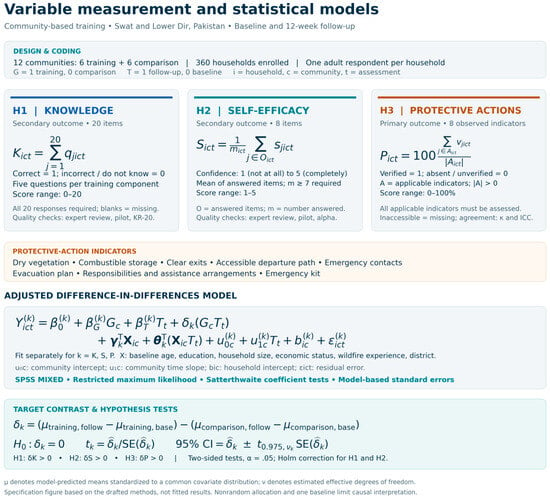
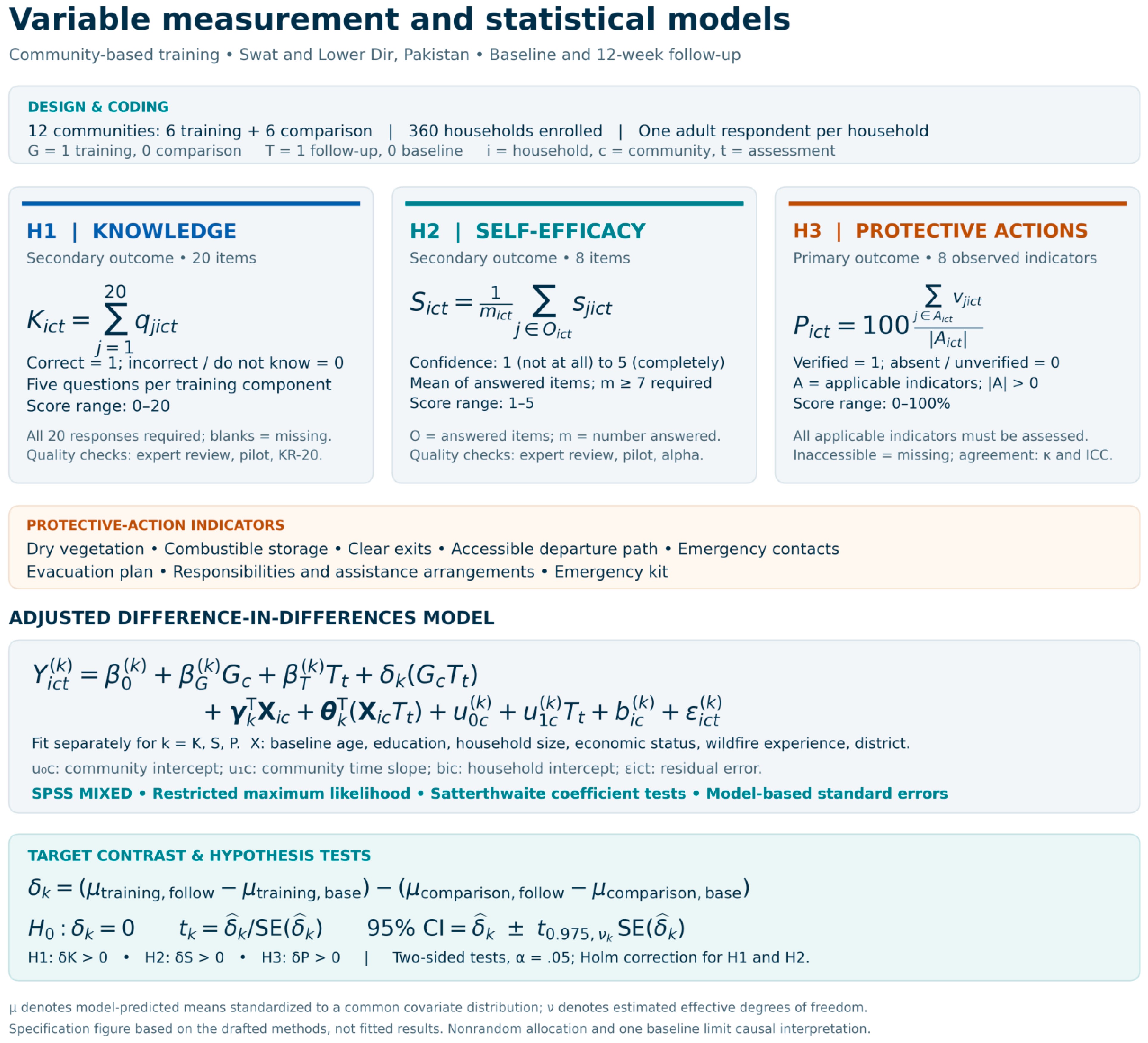
Figure 1 summarizes variable measurement and hypothesis testing in the wildfire-preparedness study conducted in Swat and Lower Dir. Wildfire knowledge was measured using 20 questions, self-efficacy using eight confidence items, and protective actions through eight observational indicators. Separate adjusted difference-in-differences mixed-effects models compared changes between training and comparison communities while accounting for household characteristics, community clustering, and repeated measurements. The group × time interaction tested H1-H3 by estimating the additional improvement associated with training. Protective actions constituted the primary outcome, while Holm adjustment addressed multiple testing across the two secondary outcomes (see Figure 1).
Figure 1.
Variable measurements and statistical models.
2.8. Statistical Analysis
Data were analyzed using IBM SPSS Statistics version 26. Descriptive statistics included means, standard deviations, and mean changes for study outcomes, alongside frequencies and percentages for categorical characteristics. H1 was tested using a linear mixed-effects difference-in-differences model for wildfire knowledge. H2 was tested using the same model for preparedness self-efficacy, while H3 evaluated verified protective actions. Each hypothesis was assessed through a two-sided t-test of the group × time interaction, using Satterthwaite degrees of freedom. Models adjusted for baseline age, education, household size, economic status, wildfire experience, district, and covariate-by-time interactions. Community random intercepts and time slopes represented community trajectories; household random intercepts accounted for repeated measurements. Restricted maximum likelihood estimated model parameters. Unstandardized coefficients, standard errors, and 95% confidence intervals were reported. Significance was assessed at 05, with Holm adjustment for H1 and H2. H3 remained primary. Nonrandom allocation and untested parallel trends limited direct causal interpretation [23].
2.9. Ethical Considerations
Ethical approval was obtained from the Ethics Review Committee, Department of Sociology, University of Malakand, under reference No ERC/SOC/2026/11, dated 15 February 2026. Participants provided written informed consent after receiving explanations in Pashto regarding study activities, confidentiality, voluntary participation, and withdrawal without penalty. For participants unable to read, information was read aloud, and consent was documented through a thumbprint witnessed by an independent adult. Separate permission was obtained for household observations; no photographs were collected. Community authorization did not replace individual consent. Analytical records were de-identified, and identifying information was stored separately in locked cabinets and password-protected files accessible only to the principal investigator and data manager. Records were scheduled for secure destruction five years after study completion. Participation did not affect access to routine emergency services.
3. Results
3.1. Participant Flow, Attrition, and Missing Data
Of the 360 households enrolled at baseline, 324 completed the twelve-week follow-up assessment, representing an overall retention rate of 90.0%. Retention was comparable between intervention and comparison communities, with 162 of 180 households (90.0%) retained in each group. The remaining 36 households were lost to follow-up because of respondent unavailability, withdrawal, relocation, or incomplete follow-up assessments. No replacement households were introduced after baseline.
Table 2 presents reliability estimates for the study instruments. Knowledge-scale internal consistency was KR-20 = 0.76 (95% CI: 0.70–0.81) at baseline and 0.82 (95% CI: 0.77–0.86) at follow-up. Self-efficacy internal consistency was Cronbach’s α = 0.84 (95% CI: 0.80–0.88) and 0.88 (95% CI: 0.84–0.91), respectively. For protective-action scores, separate ratings by two assessors in 36 baseline households yielded an absolute-agreement ICC of 0.87 (95% CI: 0.76–0.93). These coefficients support internal consistency of the questionnaire scales and inter-rater agreement for the observational composite.
Table 2.
Reliability statistics.
Table 3 presents baseline and follow-up scores for wildfire knowledge, preparedness self-efficacy, and verified household protective actions. Baseline means were similar across groups, providing descriptive evidence of comparable initial preparedness on these measures. All three outcomes increased in both groups, with larger improvements among households in training communities.
Table 3.
Descriptive statistics of study outcomes at baseline and follow-up.
Wildfire knowledge increased from 10.84 ± 2.71 to 16.42 ± 2.18 in the training group, compared with an increase from 10.76 ± 2.65 to 11.84 ± 2.59 in the comparison group. The respective gains of 5.58 and 1.08 points yielded an unadjusted difference in change of 4.50 points. This pattern was consistent with H1 and the intervention’s emphasis on understanding wildfire hazards, prevention, evacuation, and emergency communication.
Preparedness self-efficacy increased from 2.71 ± 0.63 to 4.08 ± 0.52 among trained households, compared with 2.69 ± 0.65 to 2.96 ± 0.64 among comparison households. The difference between the respective gains of 1.37 and 0.27 points was 1.10 points. This descriptive pattern aligned with H2, indicating greater improvement in confidence in performing preparedness tasks among households receiving training.
Verified protective-action scores increased from 34.67 ± 15.21 to 71.83 ± 14.36 in the training group and from 35.21 ± 15.48 to 43.76 ± 15.27 in the comparison group. These changes represented gains of 37.16 and 8.55 percentage points, respectively, producing an unadjusted difference in change of 28.61 percentage points. Consistent with H3, the pattern indicated that improvements extended beyond knowledge and confidence to observed household preparedness (see Table 3).
3.2. Intervening Fires, Warnings, Campaigns, and Seasonal Influences
Between March and July 2026, this scenario includes two wildfire incidents near training communities and three near comparison communities. Both conditions received two shared public warning episodes and one shared preparedness campaign outside the study intervention. Seasonal clean-up activities were recorded in two communities per condition (Table 4).
Table 4.
Intervening exposures between baseline and follow-up.
The comparison group’s reported improvement of 8.55 percentage points could reflect seasonal clean-up, heightened awareness during the fire season, or exposure to warnings and campaigns. Vegetation clearance, safer combustible-material storage, and cleared departure paths could increase observed preparedness scores without study training. Event counts alone do not establish equivalent exposure intensity or household participation.
Table 5 presents the adjusted difference-in-differences analysis of wildfire knowledge. The training-group coefficient was small and statistically non-significant (β = 0.08, p = 0.801), indicating no statistically detectable baseline knowledge difference between training and comparison communities after adjustment. This finding did not establish equivalence between groups. The follow-up coefficient was positive (β = 1.07, p = 0.004), indicating improved knowledge in comparison communities over time at the reference covariate values. Accounting for this background change helped distinguish the additional improvement associated with training.
Table 5.
Adjusted difference-in-differences analysis of wildfire knowledge (H1).
The training × follow-up interaction was positive and statistically significant (β = 4.51, SE = 0.48, t = 9.40, p < 0.001). Wildfire knowledge therefore increased by an estimated 4.51 points more in training communities than in comparison communities on the 0–20 scale, after covariate adjustment. The association remained significant following Holm adjustment (p < 0.001). This result aligned with the intervention’s educational emphasis on wildfire risk recognition, household prevention, evacuation planning, and emergency communication.
Education (β = 0.18, p = 0.021) and economic status (β = 0.29, p = 0.029) were positively associated with baseline knowledge under the specified model containing covariate-by-period interactions. These coefficients described differences in initial knowledge rather than differences in responsiveness to training. Age (β = 0.03, p = 0.149), household size (β = −0.04, p = 0.437), previous wildfire experience (β = 0.36, p = 0.086), and district (β = −0.21, p = 0.470) showed no statistically significant baseline associations. Their non-significance did not demonstrate that these characteristics were irrelevant to preparedness. The positive adjusted interaction supported H1: households in training communities demonstrated greater improvement in wildfire knowledge than households in comparison communities.
Table 6 presents the adjusted difference-in-differences analysis of preparedness self-efficacy. The training-group coefficient was small and statistically non-significant (β = 0.02, p = 0.777), indicating no statistically detectable baseline difference in preparedness confidence between training and comparison communities after adjustment. The follow-up coefficient was positive and significant (β = 0.26, p = 0.001), indicating increased self-efficacy in comparison communities at the reference covariate values. This background improvement was accounted for when estimating the additional change associated with training.
Table 6.
Adjusted difference-in-differences analysis of preparedness self-efficacy (H2).
The training × follow-up interaction was positive and statistically significant (β = 1.10, SE = 0.11, t = 10.00, p < 0.001), remaining significant after Holm adjustment (p < 0.001). Thus, households in training communities demonstrated an adjusted improvement in self-efficacy that exceeded the improvement in comparison communities by 1.10 points on the five-point scale. This finding aligned with the intervention’s emphasis on practical exercises, household planning, and rehearsed emergency decisions. It indicated increased confidence in performing preparedness tasks, although confidence alone did not establish successful performance during an actual wildfire.
Education (β = 0.05, p = 0.024) and economic status (β = 0.08, p = 0.018) were positively associated with baseline self-efficacy under the specified model containing covariate-by-period interactions. These associations concerned initial confidence rather than differential training effects. Age (β = 0.01, p = 0.280), household size (β = −0.01, p = 0.377), previous wildfire experience (β = 0.07, p = 0.109), and district (β = −0.04, p = 0.519) showed no statistically significant baseline associations with self-efficacy. The results supported H2: households in training communities demonstrated greater improvement in preparedness self-efficacy than households in comparison communities.
Table 7 presents the adjusted difference-in-differences analysis of verified household protective actions, the study’s primary outcome. The training-group coefficient was statistically non-significant (β = −0.54, p = 0.773), indicating no statistically detectable baseline difference in verified preparedness between training and comparison communities after adjustment. The positive follow-up coefficient (β = 8.31) indicated an increase in protective-action scores in comparison communities at the reference covariate values. Accounting for this background improvement distinguished the additional change associated with community-based training.
Table 7.
Adjusted difference-in-differences analysis of verified household protective actions (H3).
The training × follow-up interaction was positive and statistically significant (β = 28.43, SE = 2.74, t = 10.38, p < 0.001). Training communities therefore demonstrated an adjusted improvement exceeding that of comparison communities by 28.43 percentage points on the protective-action index. This result connected the intervention to observable household preparedness, assessed through vegetation management, combustible-material storage, accessible exits, evacuation arrangements, emergency contacts, and emergency kits. However, the composite estimate did not establish that every individual action improved or that wildfire losses declined.
Education (β = 1.16, p = 0.026) and economic status (β = 2.07, p = 0.024) were positively associated with baseline protective-action scores under the specified model containing covariate-by-period interactions. These coefficients described initial preparedness differences rather than variation in training effectiveness. Age (β = 0.21, p = 0.155) and household size (β = −0.38, p = 0.237) showed no statistically significant baseline associations. Previous wildfire experience was positively associated with protective actions, but the reported p-value did not meet the 0.05 threshold (β = 2.84, p = 0.061). The district coefficient was also non-significant (β = −1.91, p = 0.380), indicating no statistically detectable adjusted baseline difference between districts. Therefore, the significant positive interaction supported H3: households in training communities demonstrated greater improvement in verified protective actions than households in comparison communities (see Table 7).
4. Discussion
4.1. Principal Findings
The reported findings supported all three hypotheses: households in training communities demonstrated greater improvements in wildfire knowledge, preparedness self-efficacy, and verified protective actions than households in comparison communities. Adjusted differences in change were 4.51 knowledge points, 1.10 self-efficacy points, and 28.43 percentage points on the protective-action index. These estimates represented different measurement scales and therefore did not establish which outcome responded most strongly. The principal contribution concerned the extension of training-associated improvements beyond understanding and confidence to observable household preparedness. Nevertheless, nonrandom community allocation restricted causal interpretation. The results indicated intervention-associated changes over twelve weeks rather than demonstrated reductions in wildfire occurrence, injuries, or property losses. Improvements in comparison communities also underscored the importance of evaluating training against background changes in preparedness.
The estimated differences in change concern the complete training package: six hours of instruction, printed materials, and contact with Forest Department and Rescue 1122 personnel, compared with routine information and services without study-organized training. The findings therefore represent improvements associated with receiving this package and cannot isolate the contribution of instructional content, materials, professional attention, or their combination.
4.2. Interpretation of Knowledge and Self-Efficacy Findings
The knowledge findings aligned with the intervention’s structured coverage of risk recognition, prevention, evacuation, and communication. The explanations and practical examples connected preparedness information with household decisions. Although these components provided a plausible explanation for improvement, the study did not isolate their individual contributions. Joffe, Perez-Fuentes [24] similarly documented increased preparedness following face-to-face workshops in the United States and Turkey. Their intervention concerned earthquakes and household fires, so the comparison supports the relevance of practical education without establishing equivalent effectiveness across hazards or settings [25,26].
Greater self-efficacy improvement indicated increased confidence in performing preparedness tasks. This finding was consistent with Bandura’s account of efficacy beliefs as influences on effort and persistence [27]. Demonstrations and rehearsed decisions offered opportunities to practice tasks, but the study did not directly test mastery experiences as an explanatory mechanism. Confidence therefore remained analytically distinct from competence under emergency conditions.
Chan, Ho [28] reported improvements in fire-related knowledge and selected confidence measures following community education in rural China, providing a relevant comparison for culturally adapted instruction. In the present analysis, education and economic status were positively associated with baseline outcomes. These coefficients did not demonstrate that better-educated or wealthier households benefited more from training; such conclusions required explicit tests of differential intervention responses.
4.3. Interpretation of Verified Protective Actions
The protective-action findings addressed the study’s central question: whether educational improvements accompanied observable preparedness changes. The positive interaction indicated greater improvement in the proportion of applicable actions verified among trained households. Observation strengthened the distinction between reported intentions and documented arrangements involving household surroundings, exits, emergency contacts, evacuation plans, responsibilities, and supplies. However, the composite result did not establish improvement in every indicator, and equal weighting did not imply that all actions provided equivalent protection.
This distinction is important when comparing the findings with earlier educational interventions. Chan, Guo [29] found that knowledge retention coexisted with substantial non-retention of distributed fire blankets at seventeen-month follow-up [30]. Their findings illustrate why information acquisition and sustained material preparedness require separate assessment. The present study extended evaluation to observed actions, although its shorter follow-up did not establish long-term maintenance.
Knowledge, self-efficacy, and protective actions represent related but distinct dimensions of preparedness. Knowledge provides an understanding of appropriate responses, while self-efficacy concerns confidence in carrying them out, consistent with Bandura’s theoretical account. Neither necessarily translates into action: implementation also depends on household resources, practical opportunities, and coordination. Their concurrent improvement therefore does not establish a causal sequence from knowledge to self-efficacy to protective action. With only baseline and follow-up measurements and no mediation analysis, the study could not establish temporal ordering or distinguish this proposed pathway from parallel responses to the training package. Furthermore, the twelve-week assessment documents short-term preparedness rather than sustained maintenance across fire seasons. Earlier evidence of declining retention of protective resources reinforces this distinction. Observed plans and arrangements demonstrate preparation, not successful performance during an emergency; their effects on evacuation, injuries, or property losses remain untested.
4.4. Practical Implications
The findings support further evaluation of locally delivered training that combines accessible information with concrete household tasks. Forest Department personnel, Rescue 1122 instructors, and community facilitators could coordinate delivery while maintaining clear responsibilities for technical guidance, emergency communication, and participant support. Pashto instruction, pictorial materials, and practical exercises offer an implementation approach consistent with the intervention evaluated here.
Program monitoring should record completed protective actions alongside attendance and knowledge scores. Follow-up visits could identify incomplete arrangements and distinguish household responsibilities from infrastructure requiring collective or institutional action. Positive baseline associations with education and economic status also justify assessing whether participation requirements or implementation costs exclude disadvantaged households. They do not establish which assistance would produce the greatest benefit.
Expansion should proceed through monitored implementation that records costs, reach, fidelity, and sustained action. The study did not identify the most effective session component or demonstrate cost-effectiveness. Training should complement reliable warnings, accessible evacuation arrangements, and emergency services rather than transfer institutional responsibilities to households.
4.5. Strengths and Limitations
The study combined a comparison condition, repeated household assessments, covariate adjustment, and direct observation of its primary outcome. These features provided a stronger assessment of preparedness change than an uncontrolled survey of participant satisfaction or intentions. Separating knowledge, confidence, and verified action also reduced conceptual ambiguity.
Several limitations constrained interpretation. Community allocation was nonrandom: as detailed in Section 2.4, communities were manually matched within districts on wildfire exposure, forest proximity, settlement size, socioeconomic characteristics, emergency-service access, and baseline preparedness, without numerical matching calipers. Allocation within pairs reflected training feasibility, venue availability, and scheduling, potentially favoring communities with greater organizational readiness. Matching on baseline preparedness also raised concerns about regression to the mean. Neither baseline balance nor covariate adjustment eliminates selection bias or establishes parallel trends the assumption that, without training, both groups would have experienced comparable outcome changes. The March 2026 baseline and July 2026 follow-up provided only one before–after contrast surrounding the April intervention, preventing assessment of pre-intervention trajectories, consistent with the methodological concerns discussed by Wing et al. [23]. Differential underlying trends or concurrent events could therefore partly or wholly explain the estimated differences in change. Accordingly, the findings indicate training-associated improvements rather than definitive causal effects. Future evaluations should collect multiple prospective pre-intervention measurements; retrospective recall would not provide equivalent evidence.
A formal negative-control outcome analysis was not conducted because no outcome meeting the required criteria was identified in the available study documentation. Such an outcome should be unaffected by the training package but exposed to relevant sources of confounding or measurement bias. Wildfire knowledge and self-efficacy are unsuitable negative controls because both were directly targeted by the intervention. Consequently, the findings remain conditional on the untested parallel-trends assumption and cannot exclude differential background changes. Future evaluations should collect multiple pre-intervention observations and a justified negative-control outcome at each wave, enabling assessment of pre-intervention trajectories and a supplementary falsification test. Intervening fires, warnings, or campaigns also represented alternative explanations if exposure differed between groups.
Only twelve communities contributed independent allocation units, limiting precision and the stability of complex random-effects estimates. Nonblinded assessors introduced potential observer bias despite standardized criteria. Repeated interviewing also created opportunities for recall and socially desirable responses. Information sharing between communities complicated interpretation of the comparison condition.
Attrition required explicit reporting: recruitment totals alone did not establish how many households contributed follow-up observations. Missing-at-random analyses depended on assumptions about nonresponse and required sensitivity assessment. Study-specific instruments also required stronger validation beyond internal consistency. Finally, purposive selection and accessibility criteria restricted generalizability to remote settlements and other regions. Twelve-week follow-up assessed relatively short-term preparedness rather than durability across successive fire seasons.
The comparison condition did not match the intervention’s contact time, printed materials, or professional attention. Consequently, additional attention and engagement could have contributed to the observed differences. The design cannot attribute improvements specifically to fire-safety instruction or establish which package components were necessary.
4.6. Future Research
Future studies should recruit more communities, use randomized allocation where feasible, and collect multiple pre-intervention observations. Longer follow-up should examine maintenance of individual protective actions and changes across fire seasons. Additional assessments should test whether knowledge and self-efficacy precede subsequent behavior rather than simply change concurrently. Independent blinded verification, cost-effectiveness analysis, and evaluation of participation barriers would strengthen implementation evidence. Where adequate event data exist, researchers should examine evacuation performance and wildfire losses separately from preparedness scores, without assuming that improvements in intermediate outcomes establish reductions in harm.
Future studies should include an active comparison condition with comparable contact time, delivery format, printed materials, and professional attention, but without the wildfire-preparedness content being evaluated. This would help distinguish the contribution of that content from general attention and engagement. A multi-arm or factorial design could additionally examine the separate contributions of instruction, materials, and professional contact.
5. Conclusions
This study examined community-based fire-safety training and wildfire preparedness among households in forest-adjacent communities of Swat and Lower Dir, Pakistan. The reported analyses supported all three hypotheses: training communities demonstrated greater improvements in wildfire knowledge, preparedness self-efficacy, and verified household protective actions than comparison communities. Adjusted differences in change were 4.51 knowledge points, 1.10 self-efficacy points, and 28.43 percentage points on the protective-action index. These findings represent short-term training-associated improvements over twelve weeks; nonrandom allocation and the unverified parallel-trends assumption limit causal interpretation. Longer follow-up and evaluation of emergency outcomes are needed to determine whether preparedness measures are maintained and translate into meaningful protection.
The principal contribution was the assessment of observable preparedness alongside knowledge and confidence. Training-associated improvements extended to verified household arrangements, demonstrating the importance of evaluating practical action rather than relying exclusively on self-reported understanding or intentions. The findings support continued evaluation of locally accessible training integrating risk recognition, household prevention, evacuation planning, and emergency communication. Coordination among forestry personnel, emergency-service instructors, and community facilitators should combine practical instruction with monitoring of completed actions. Implementation should address accessibility and household resource constraints while maintaining institutional responsibility for warnings, evacuation infrastructure, and emergency response. Program expansion requires evidence on delivery costs, equitable participation, and sustained preparedness.
In sum, wildfire preparedness depends not on what households know, but on what they are enabled to do before a fire occurs. This study shows that locally adapted, practice-oriented training can convert risk awareness and confidence into verified protective action, providing a scalable foundation for strengthening resilience in forest-adjacent communities. Its wider impact, however, will depend on sustained institutional commitment, equitable access, reliable warning and evacuation systems, and continued monitoring across fire seasons. Community training should therefore be embedded within—rather than substituted for a coordinated public strategy that equips households, emergency services, and local authorities to act decisively before wildfire risk becomes disaster.
Author Contributions
Conceptualization and methodology, U.D. and Š.B.; investigation, data curation, formal analysis, and writing —original draft, U.D.; supervision and writing—review and editing, Š.B. All authors have read and agreed to the published version of the manuscript.
Funding
This research received no external funding.
Institutional Review Board Statement
The study was approved by the Ethics Review Committee, Department of Sociology, University of Malakand (ERC/SOC/2026/11; 15 February 2026).
Informed Consent Statement
Informed consent was obtained from all participants through written signatures. Separate permission was obtained for household observations.
Data Availability Statement
De-identified data are available from the corresponding author upon reasonable request, subject to ethical approval and participant confidentiality requirements.
Acknowledgments
The authors acknowledge the University of Malakand, participating households, community leaders, Forest Department personnel, Rescue 1122 instructors, and fieldworkers for their support and cooperation.
Conflicts of Interest
The authors declare no conflicts of interest.
References
- Daraz, U.; Bojnec, Š.; Khan, Y. Governance Failure and Wildfire Escalation: A Multi-Level Analysis of Institutional Preparedness, Corruption, and Emergency Response. Fire 2026, 9, 93. [Google Scholar] [CrossRef] [Scilit]
- Cullen, A.C.; Prichard, S.J.; Abatzoglou, J.T.; Dolk, A.; Kessenich, L.; Bloem, S.; Bukovsky, M.S.; Humphrey, R.; McGinnis, S.; Skinner, H.; et al. Growing convergence research: Coproducing climate projections to inform proactive decisions for managing simultaneous wildfire risk. Risk Anal. 2023, 43, 2262–2279. [Google Scholar] [CrossRef] [Scilit] [PubMed]
- Cunningham, C.X.; Williamson, G.J.; Bowman, D.M.J.S. Increasing frequency and intensity of the most extreme wildfires on Earth. Nat. Ecol. Evol. 2024, 8, 1420–1425. [Google Scholar] [CrossRef] [Scilit] [PubMed]
- Jones, M.W.; Kelley, D.I.; Burton, C.A.; Di Giuseppe, F.; Barbosa, M.L.F.; Brambleby, E.; Hartley, A.J.; Lombardi, A.; Mataveli, G.; McNorton, J.R.; et al. State of wildfires 2023–2024. Earth Syst. Sci. Data 2024, 16, 3601–3685. [Google Scholar] [CrossRef] [Scilit]
- Daraz, U.; Bojnec, Š.; Khan, Y. Socio-economic determinants of human negligence in wildfire incidence: A case study from Pakistan’s peri-urban and rural areas. Fire 2024, 7, 377. [Google Scholar] [CrossRef] [Scilit]
- Shahzad, F.; Mehmood, K.; Anees, S.A.; Adnan, M.; Haidar, I.; Jabbarov, U.; Yaxshimuratov, M.; Oliveira, M. Remote sensing analysis of forest fire impacts on ecosystem productivity, greenhouse gas emissions, and fire risk in Pakistan. Carbon Balanc. Manag. 2026, 21, 54. [Google Scholar] [CrossRef] [Scilit] [PubMed]
- Haris, M.; Keshtkar, S.; Anjum, A.; Syed, M.H.; Kojima, H.; Ahmad, R. Disaster management technology and approaches: A focus on heterogeneous systems. Environ. Syst. Decis. 2026, 46, 33. [Google Scholar] [CrossRef] [Scilit]
- Lehna, C.; Twyman, S.; Fahey, E.; Coty, M.-B.; Williams, J.; Scrivener, D.; Wishnia, G.; Myers, J. An organizational process for promoting home fire safety in two community settings. Burns 2017, 43, 162–168. [Google Scholar] [CrossRef] [Scilit] [PubMed]
- Ringo, J.; Msangi, L. Community preparedness and fire early warning systems in Tanzanian market places: Lessons for urban fire resilience in low-income settings. Prog. Disaster Sci. 2026, 31, 100665. [Google Scholar] [CrossRef] [Scilit]
- Joffe, H.; Potts, H.W.W.; Rossetto, T.; Doğulu, C.; Gul, E.; Perez-Fuentes, G. The Fix-it face-to-face intervention increases multihazard household preparedness cross-culturally. Nat. Hum. Behav. 2019, 3, 453–461. [Google Scholar] [CrossRef] [Scilit] [PubMed]
- Xu, W.; Zhou, Q.; Ma, W.; Liu, F.; Li, L. Research on Grassland Fire Prevention Capabilities and Influencing Factors in Qinghai Province, China. Earth 2025, 6, 101. [Google Scholar] [CrossRef] [Scilit]
- Xu, W.; Zhou, Q.; Ma, W.; Liu, F.; Niu, B.; Li, L. Study on Qinghai Province Residents’ Perception of Grassland Fire Risk and Influencing Factors. Fire 2025, 8, 371. [Google Scholar] [CrossRef] [Scilit]
- Chan, E.Y.Y.; Lam, H.C.Y.; Chung, P.P.W.; Huang, Z.; Yung, T.K.C.; Ling, K.W.K.; Chan, G.K.W.; Chiu, C.P. Risk Perception and Knowledge in Fire Risk Reduction in a Dong Minority Rural Village in China: A Health-EDRM Education Intervention Study: Chan et al. Education Intervention for Fire Risk Reduction. Int. J. Disaster Risk Sci. 2018, 9, 306–318. [Google Scholar] [CrossRef] [Scilit]
- McCaffrey, S. Community wildfire preparedness: A global state-of-the-knowledge summary of social science research. Curr. For. Rep. 2015, 1, 81–90. [Google Scholar] [CrossRef] [Scilit]
- Martin, I.M.; Bender, H.; Raish, C. What motivates individuals to protect themselves from risks: The case of wildland fires. Risk Anal. 2007, 27, 887–900. [Google Scholar] [CrossRef] [Scilit] [PubMed]
- Bandura, A. Self-efficacy: Toward a unifying theory of behavioral change. Psychol. Rev. 1977, 84, 191. [Google Scholar] [CrossRef] [Scilit] [PubMed]
- Des Jarlais, D.C.; Lyles, C.; Crepaz, N.; The TREND Group. Improving the reporting quality of nonrandomized evaluations of behavioral and public health interventions: The TREND statement. Am. J. Public Health 2004, 94, 361–366. [Google Scholar] [CrossRef] [Scilit] [PubMed]
- Cashin, A.G.; Hansford, H.J.; Hernán, M.A.; Swanson, S.A.; Lee, H.; Jones, M.D.; Dahabreh, I.J.; Dickerman, B.A.; Egger, M.; Garcia-Albeniz, X.; et al. Transparent reporting of observational studies emulating a target trial—The TARGET statement. JAMA 2025, 334, 1084–1093. [Google Scholar] [CrossRef] [Scilit] [PubMed]
- Daraz, U.; Bojnec, Š. Wildfires, Land Markets, and Agrarian Inequality in Northern Pakistan. Fire 2026, 9, 346. [Google Scholar] [CrossRef] [Scilit]
- Hoffmann, T.C.; Glasziou, P.P.; Boutron, I.; Milne, R.; Perera, R.; Moher, D.; Altman, D.G.; Barbour, V.; Macdonald, H.; Johnston, M.; et al. Better reporting of interventions: Template for intervention description and replication (TIDieR) checklist and guide. BMJ 2014, 348, g1687. [Google Scholar] [CrossRef] [Scilit] [PubMed]
- Dijkers, P.M.P. Overview of reviews using the template for intervention description and replication (TIDieR) as a measure of trial intervention reporting quality. Arch. Phys. Med. Rehabil. 2021, 102, 1623–1632. [Google Scholar] [CrossRef] [Scilit] [PubMed]
- Bandura, A. Guide for constructing self-efficacy scales. In Self-Efficacy Beliefs of Adolescents; Pajares, F., Urdan, T., Eds.; Information Age Publishing: Greenwich, CT, USA, 2006; pp. 307–337. [Google Scholar]
- Wing, C.; Simon, K.; Bello-Gomez, R.A. Designing difference in difference studies: Best practices for public health policy research. Annu. Rev. Public Health 2018, 39, 453–469. [Google Scholar] [CrossRef] [Scilit] [PubMed]
- Joffe, H.; Perez-Fuentes, G.; Potts, H.W.W.; Rossetto, T. How to increase earthquake and home fire preparedness: The fix-it intervention. Nat. Hazards 2016, 84, 1943–1965. [Google Scholar] [CrossRef] [Scilit]
- Miao, Q.; Zhang, F. Drivers of household preparedness for natural hazards: The mediating role of perceived coping efficacy. Nat. Hazards Rev. 2023, 24, 04023010. [Google Scholar] [CrossRef] [Scilit]
- Perez-Fuentes, G.; Verrucci, E.; Joffe, H. A review of current earthquake and fire preparedness campaigns: What works? In Proceedings of the International Conference on Dynamics of Disasters, Kalamata, Greece, 29 June–2 July 2016. [Google Scholar]
- Bandura, A. Self-efficacy mechanism in human agency. Am. Psychol. 1982, 37, 122–147. [Google Scholar] [CrossRef] [Scilit]
- Chan, E.Y.Y.; Ho, J.Y.E.; Huang, Z.; Kim, J.H.; Lam, H.C.Y.; Chung, P.P.W.; Wong, C.K.P.; Liu, S.; Chow, S. Long-Term and Immediate Impacts of Health Emergency and Disaster Risk Management (Health-EDRM) Education Interventions in a Rural Chinese Earthquake-Prone Transitional Village: Chan et al. Education Intervention in a Chinese Earthquake-Prone Village. Int. J. Disaster Risk Sci. 2018, 9, 319–330. [Google Scholar] [CrossRef] [Scilit]
- Chan, E.Y.Y.; Guo, C.; Lee, P.; Liu, S.; Mark, C.K.M. Health Emergency and Disaster Risk Management (Health-EDRM) in remote ethnic minority areas of rural China: The case of a flood-prone village in Sichuan. Int. J. Disaster Risk Sci. 2017, 8, 156–163. [Google Scholar] [CrossRef] [Scilit]
- Li, T.; Wang, Q.; Xie, Z. Disaster response knowledge and its social determinants: A cross-sectional study in Beijing, China. PLoS ONE 2019, 14, e0214367. [Google Scholar] [CrossRef] [Scilit] [PubMed]

Disclaimer/Publisher’s Note: The statements, opinions and data contained in all publications are solely those of the individual author(s) and contributor(s) and not of MDPI and/or the editor(s). MDPI and/or the editor(s) disclaim responsibility for any injury to people or property resulting from any ideas, methods, instructions or products referred to in the content. |
© 2026 by the authors. Licensee MDPI, Basel, Switzerland. This article is an open access article distributed under the terms and conditions of the Creative Commons Attribution (CC BY) license.