


Abstract
Ammonia (NH3) is a zero-carbon fuel and an attractive hydrogen (H2) carrier for gas turbine power generation due to its high energy density, ease of storage, and transportation. This study numerically investigates NH3/air combustion using a hybrid Well-Stirred Reactor (WSR) and Plug Flow Reactor (PFR) model in Cantera at pressures of 1–20 atm, temperatures of 1850–2150 K, and equivalence ratios (ϕ) of 0.7–1.2. The effects of pressure, equivalence ratio, and temperature on NH3 conversion and NO formation are examined. Results show that NH3 exhibits a non-monotonic conversion curve with pressure after the WSR, reaching a minimum near 5 atm, whereas NO formation decreases monotonically from 1 to 20 atm. Equivalence ratio sweeps show that NO decreases steeply as ϕ increases from 0.7 to ~1.1 as nitrogen is redirected toward N2 and oxidizer availability declines; residual NH3 increases rapidly for ϕ > 1.0, especially at high pressure. Increasing temperature accelerates NH3 oxidation and raises NO formation, most strongly at low pressure where thermal and NH/OH pathways are least inhibited. These results indicate that co-tuning pressure and equivalence ratio near rich operation enables low-NOx ammonia combustion suitable for advanced gas turbine applications.
1. Introduction
The escalating impacts of climate change underscore the urgent need to transition away from carbon-based fuels [1]. Decarbonizing energy systems with alternative fuels is critical to reducing carbon dioxide emissions, a major greenhouse gas, and to mitigating irreversible environmental damage and health consequences [2]. Among various alternatives, ammonia has emerged as a promising carbon-free energy carrier, particularly suitable for combustion-based gas turbine power generation [3].
Ammonia (NH3) can be synthesized from renewable hydrogen and atmospheric nitrogen, enabling a fully carbon-free fuel cycle [4]. Ammonia’s viability as a fuel stems from its high hydrogen content and its ability to release energy through combustion while producing no carbon-based emissions. Although hydrogen itself is a clean-burning fuel that primarily yields water as a combustion product, it presents significant challenges in storage and transportation due to its high reactivity and low energy density [3]. Ammonia addresses these limitations, offering a more practical medium for hydrogen storage and energy utilization. Furthermore, ammonia is already widely produced and distributed globally, primarily for use as a fertilizer, which facilitates its integration into existing infrastructure [5].
Gas turbines, widely used for power generation and aviation, are an attractive platform for the adoption of ammonia fuel [3]. Transitioning gas turbines to ammonia-based fuels offers the potential for significant reductions in carbon emissions, contributing meaningfully to national and global decarbonization goals. Ammonia-fueled gas turbines were first explored in the 1960s; however, low flammability and combustion instability hindered practical adoption [6,7]. Recent advancements have renewed interest in ammonia as a turbine fuel. For instance, the Fukushima Renewable Energy Institute demonstrated operation of a 50 kW micro gas turbine using liquid ammonia blended with kerosene [8]. Other studies have achieved stable NH3/air combustion in similar small-scale turbine systems, highlighting the feasibility of ammonia integration [8,9]. Despite these advances, significant technical challenges remain.
Valera-Medina et al. [3] and Kobayashi et al. [8] comprehensively reviewed the combustion properties of ammonia, noting its low flame speed and narrow flammability limits, which necessitate advanced burner designs and enhanced ignition strategies. Okafor et al. [9,10] and Kurata et al. [7,11] demonstrated various burner configurations and rich–lean combustion strategies to improve flame stability and minimize nitrogen oxides (NOx) emissions in micro gas turbines. Gubbi et al. [12] highlighted air-quality concerns surrounding NH3 use and explored the minimum achievable NOx levels using current technology. Experimental studies by Hayakawa et al. [11], Khateeb et al. [13,14,15], and Ditaranto and Saanum [16] provided valuable insights into the effects of pressure, equivalence ratio, and hydrogen enrichment on flame stability and pollutant formation. Recent system-level analysis of ammonia-fueled combined-cycle concepts further underscores the practical motivation for hydrogen-enriched ammonia combustion: Pashchenko [17] proposed solar-driven ammonia decomposition to produce a hydrogen-rich fuel for the gas turbine and reported thermal-efficiency gains up to ~3.5% relative to direct ammonia firing.
Recent investigations into swirl-stabilized combustors (e.g., Ávila et al. [18], Wang et al. [19], Pugh et al. [20,21,22]) emphasize the role of turbulence and staging in mitigating NOx while preserving combustion efficiency. Several studies also suggest the effectiveness of steam dilution [20] and secondary air injection [19] in reducing emissions. A primary barrier to widespread adoption of ammonia combustion is its propensity to form NOx, which are harmful pollutants with environmental and health implications [23]. Due to the inherent nitrogen content of the NH3 molecule, ammonia combustion can result in high NOx emissions [24,25]. NO formation is primarily driven by oxidation of NH2 and NH radicals through reactions with O, H, and OH species, often proceeding via the HNO intermediate. Achieving NOx emissions below ~200 ppm is necessary for compliance with emissions regulations. Afterwards, selective catalytic reduction (SCR) systems can reduce NOx further with ~95% reduction efficiency [9]. Developing efficient, low-emission NH3 combustors for gas turbines is therefore a critical research area. Several strategies are under investigation to enable ammonia as a flexible turbine fuel; however, controlling emissions remains a major technical hurdle [9]. Overcoming these limitations requires deeper insight into NH3 combustion and NOx-formation chemistry under gas turbine–relevant conditions.
This study investigates ammonia combustion under gas turbine-relevant conditions using a combined WSR–PFR modeling framework. The investigation focuses on the influence of key operating parameters—including pressure, equivalence ratio, and temperature—on combustion performance and emissions characteristics. The insights gained are intended to support the development of optimized combustion strategies that enable stable, efficient, and low-NOx ammonia combustion in practical gas turbine systems.
The remainder of this paper is organized as follows: Section 2 outlines the simulation methodology, including the combined WSR–PFR framework and the rationale behind the selected operating conditions. Section 3 presents and discusses the simulation results, focusing on the effects of pressure, equivalence ratio, and temperature on NH3 conversion and NO formation, along with a sensitivity analysis and reaction-pathway investigation. Section 4 summarizes the key findings and suggests directions for future experimental validation and continued research.
2. Materials and Methods
This section outlines the numerical modeling approach used to investigate ammonia combustion. Reactor network model, numerical implementations, and simulation parameters are detailed in the following subsections.
2.1. Reactor Network Model
A hybrid reactor configuration combining a Well-Stirred Reactor (WSR) and a Plug Flow Reactor (PFR) was implemented to capture the ignition, flame stabilization, and downstream emissions typical of staged gas turbine combustors. The WSR was used to represent the near-field primary zone, where ideal mixing conditions approximate flame stabilization and ignition chemistry, while the PFR represented the post-flame region, where species evolve under unidirectional flow with finite residence time. In this way, the reactor network captured both the immediate stabilization of the ammonia flame and the gradual development of emissions in the exhaust region. The WSR and PFR were directly coupled, with the WSR outlet serving as the PFR inlet without modification, thereby replicating the transition from flame stabilization to post-flame evolution observed in practical combustors. This approach has been employed successfully in previous ammonia-fuel studies [26].
2.2. Numerical Implementation
All simulations were conducted in Cantera 3.2 [27] using Python 3.12 scripting. The chemical kinetic model was the updated NH3/syngas mechanism of Mei et al. [28], which was converted from CHEMKIN to Cantera YAML format prior to use. This mechanism includes detailed high-temperature nitrogen chemistry and pressure-dependent reactions, and has been validated against ignition delays, laminar flame speeds, flame structures, and NO formation trends for NH3/H2/N2/air flames up to 10 atm. Its demonstrated ability to reproduce a broad set of experimental observations reinforces its suitability for modeling ammonia combustion under turbine-relevant conditions.
Reaction sensitivity analysis was performed to identify the rate-controlling steps governing both NH3 decomposition and NO formation. Sensitivities were quantified using
where is the mole fraction of species and is the rate parameter. Sensitivity calculations were carried out for NH3 and NO at temperatures of 1850 K and 2075 K across the four simulated pressures, and the fifteen most influential reactions were identified at each condition. Transport properties are computed using mixture-averaged diffusion, which simplifies the numerical treatment without significantly affecting accuracy for the purpose of zero-dimensional kinetic modeling. Assuming dry air (O2 + 3.76N2), the stoichiometric with-air reaction on a per-mole basis is,
For premixed NH3/air feeds at equivalence ratio ϕ ∈ {0.7, 0.8, …, 1.2}, the inlet mole fractions are specified as,
The model tracked the mole fractions of major species, including NH3, NO, NO2, N2O, H2, and NH2. NO2 and N2O concentrations were consistently negligible in the examined temperature range, so the analysis focused primarily on NO as the pollutant of concern. Species and energy conservation equations were solved with adaptive time-stepping, and convergence criteria were set at 0.1% for major species such as H2O, N2, NH3, and NO, and at 1% for minor intermediates. These criteria ensured accurate representation of reaction kinetics while maintaining computational efficiency.
2.3. Simulation Parameters
The WSR residence time was set to 3 ms, while the PFR residence time was 17 ms, yielding a total residence time consistent with the primary zone of small-scale gas turbine combustors. The operating conditions spanned a range of practical turbine environments, with pressures of 1, 5, 10, and 20 atm and temperatures between 1850 and 2150 K, distributed across thirteen evenly spaced values. Equivalence ratios from 0.7 to 1.2 were simulated, with particular attention given to ϕ = 1.2. Prior experimental work has demonstrated that moderately fuel-rich operation near this equivalence ratio promotes stable combustion while limiting both NO and residual NH3 to near 200 ppm, a level that represents a practical target for advanced combustors [21,29,30].
The feed mixture was specified as premixed ammonia and dry air, the latter represented as oxygen with a nitrogen dilution factor of 3.76. The stoichiometric combustion of one mole of NH3 requires 0.75 moles of O2 and 2.82 moles of N2, yielding products of 1.5 moles of H2O and 3.32 moles of N2. For equivalence ratios between 0.7 and 1.2, the corresponding inlet mole fractions of NH3, O2, and N2 were scaled directly from this stoichiometric balance.
Several simplifying assumptions were made to maintain consistency and computational feasibility. Heat transfer through the reactor walls was neglected by assuming adiabatic and non-catalytic boundaries, and surface reactions were not considered. The WSR was treated as ideally mixed, such that uniform temperature and composition were maintained, and the PFR inlet composition was taken directly from the WSR outlet without modification. Mixture-averaged diffusion coefficients were applied for transport properties, which is a common simplification in zero-dimensional kinetic simulations.
These assumptions are intended to isolate the chemical–kinetic contribution to NOx formation in a staged WSR–PFR surrogate. In practical gas-turbine combustors, finite-rate mixing, turbulence–chemistry interaction, and heat losses can alter local temperature and equivalence-ratio distributions and therefore shift absolute emission levels. However, because the present work focuses on the kinetics and relative trends with pressure/ϕ/temperature, the mechanistic conclusions (dominant pathways and controlling reactions for NO formation) remain qualitatively applicable as kinetic guidance rather than a full combustor-performance prediction. Table 1 summarizes the reactor network configuration and the range of operating conditions examined.
Table 1.
Reactor Configuration and Operating Conditions.
2.4. Mechanism Validation
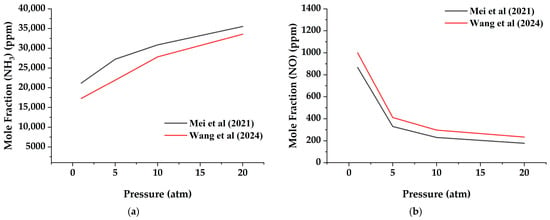
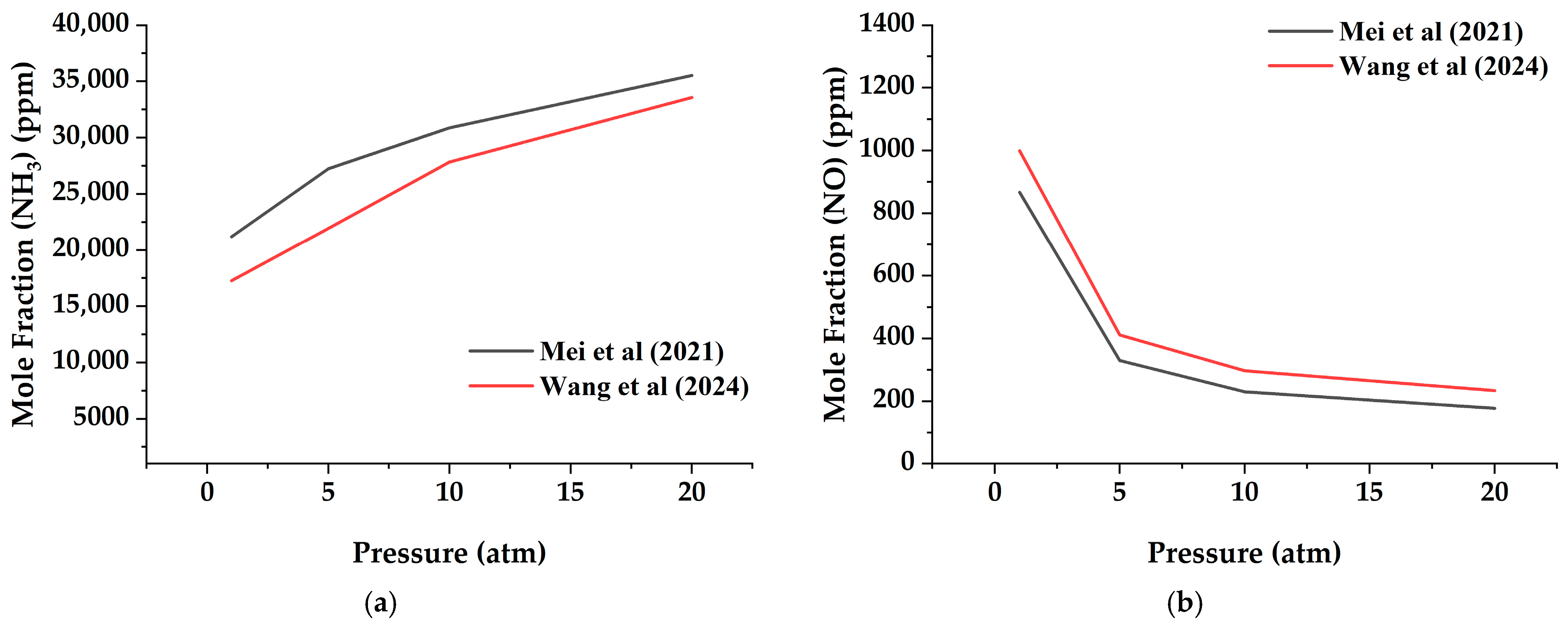
A mechanism-uncertainty check was conducted to reduce reliance on a single kinetic mechanism by repeating the key pressure sweep at T = 1850 K, ϕ = 1.2, and P = 1, 5, 10, and 20 atm, reporting species immediately downstream of the WSR. In addition to the baseline mechanism, the simulations were repeated using the high-pressure NH3 oxidation mechanism reported by Wang et al. [31]. Figure 1 shows the corresponding NH3 and NO mole fractions immediately downstream of the WSR. Both mechanisms reproduced the same qualitative pressure trends (NH3 increases with pressure and NO decreases with pressure), and the average differences between mechanisms across 1–20 atm remained within approximately 5–15% for both NH3 and NO. High-pressure experimental datasets directly comparable to the present staged WSR–PFR conditions were not found; therefore, further experimental validation is identified as future work.
Figure 1.
Comparison of kinetic mechanisms at the WSR outlet (T = 1850 K, ϕ = 1.2). (a) NH3 mole fraction (ppm) (b) NO mole fraction (ppm) versus pressure [28,31].
3. Results and Discussion
This section presents the simulation outcomes, focusing on the effects of pressure, equivalence ratio, and temperature on ammonia combustion in the WSR–PFR hybrid reactor system. Results are analyzed in terms of mole fraction trends, sensitivity coefficients, and reaction pathways. Each subsection isolates one physical parameter and evaluates its influence on NH3 conversion and NO formation.
3.1. Pressure Effects
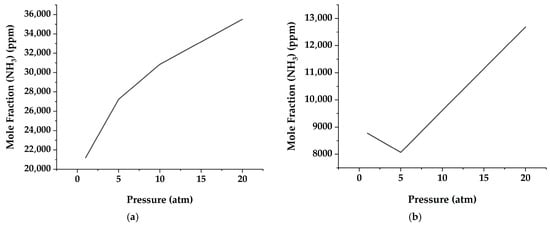
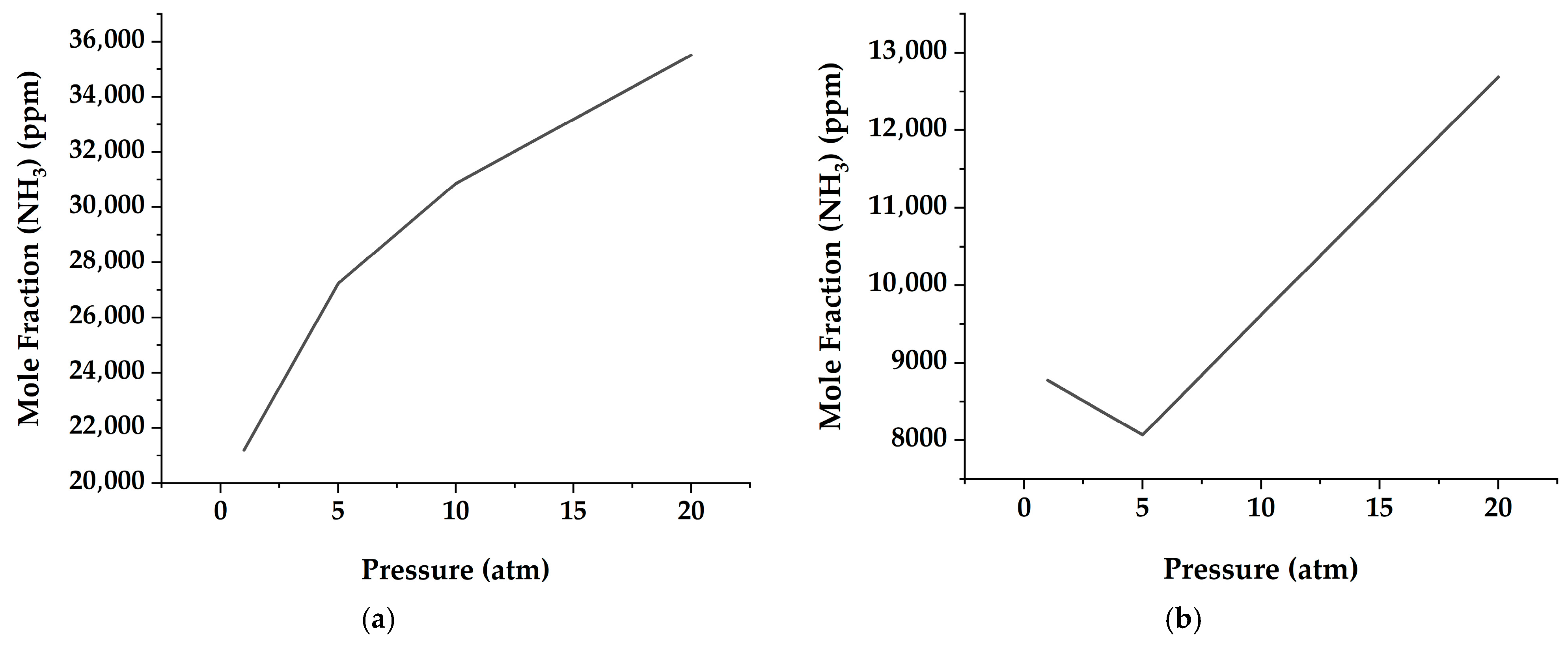
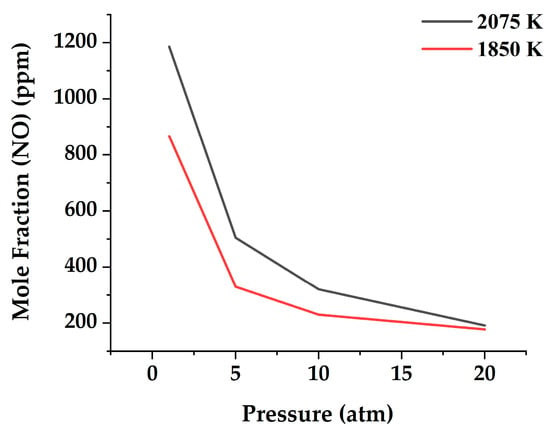
The influence of pressure on ammonia combustion was investigated in WSR simulations at 1, 5, 10, and 20 atm under constant inlet conditions (ϕ = 1.2; T = 1850 K and 2075 K). Figure 2 and Figure 3 show the corresponding NH3 and NO mole fractions immediately downstream of the WSR. Unless otherwise noted, all species mole-fraction results reported in Section 3.1 correspond to conditions immediately downstream of the WSR (i.e., the WSR outlet), prior to post-flame evolution in the PFR.
Figure 2.
Pressure evolutions of NH3 mole fraction right after WSR at (a) 1850 and (b) 2075 K.
Figure 3.
Pressure evolutions of NO mole fraction right after WSR.
At 1850 K (Figure 2a), NH3 increases monotonically with pressure, with the steepest rise between 1 and 5 atm and smaller increments at higher pressures. At this lower temperature, the system is conversion-limited: pressure promotes third-body stabilization and recombination, but H-abstraction remains slow. Fuel-side recycling through channels such as NH + NH2 ⇌ N2H3, NH2 + NH3 ⇌ H2 + N2H3 and NH2 + H + M ⇌ NH3 + M at fuel rich condition suppresses net NH3 removal during the short WSR residence time. Consequently, higher pressures leave more NH3 unconverted at the outlet.
At 2075 K (Figure 2b), NH3 exhibits a non-monotonic pressure trend: mole fraction decreases from 1 atm to a minimum near 5 atm, then rises again at 10–20 atm. The initial decline reflects accelerated radical production via chain-branching reactions at higher temperature (e.g., H + O2 ⇌ O + OH, NH2 + NO ⇌ NNH + OH). These pathways dominate at 5 atm, driving enhanced decomposition relative to 1 atm. Beyond 5 atm, however, radical-terminating channels become competitive. Reactions such as H + O2 + M ⇌ HO2 + M and H + N2H2 ⇌ H2 + NNH sequester radicals, limiting sustained decomposition. Recycling through NH + NH2 ⇌ N2H3, NH2 + NH3 ⇌ H2 + N2H3 and NH2 + H + M ⇌ NH3 + M becomes increasingly prominent, steering nitrogen back toward NH3. This mechanistic shift explains the rebound in NH3 mole fraction at 10–20 atm despite higher collision frequencies.
NO mole fractions (Figure 3) decrease monotonically with pressure at both temperatures. The steepest reduction occurs between 1 and 5 atm, followed by a more gradual decline at higher pressures. At 2075 K, NO decreases from over 1100 ppm at 1 atm to under 200 ppm at 20 atm, while at 1850 K it decreases from ~900 ppm to ~200 ppm. Elevated pressures promote N-atom closure to N2 via sequences such as NH2 → N2H2 → NNH → N2. Simultaneously, radicals drawdown via OH + H + M → H2O + M and H + O2 + M → HO2 + M reduce OH availability, further suppressing NO formation.
Together, these results demonstrate that pressure exerts a dual effect. At moderate levels (~5 atm), increased collision frequency accelerates NH3 decomposition and NO formation. At higher pressures (≥10 atm), termination and recycling pathways start playing a role, resulting in incomplete NH3 conversion and significant suppression of NO. This balance between radical production and termination is central to the design of ammonia-fueled combustors: higher pressure favors low-NO operation, but risks elevated residual NH3.
3.2. Equivalence Ratio Effects
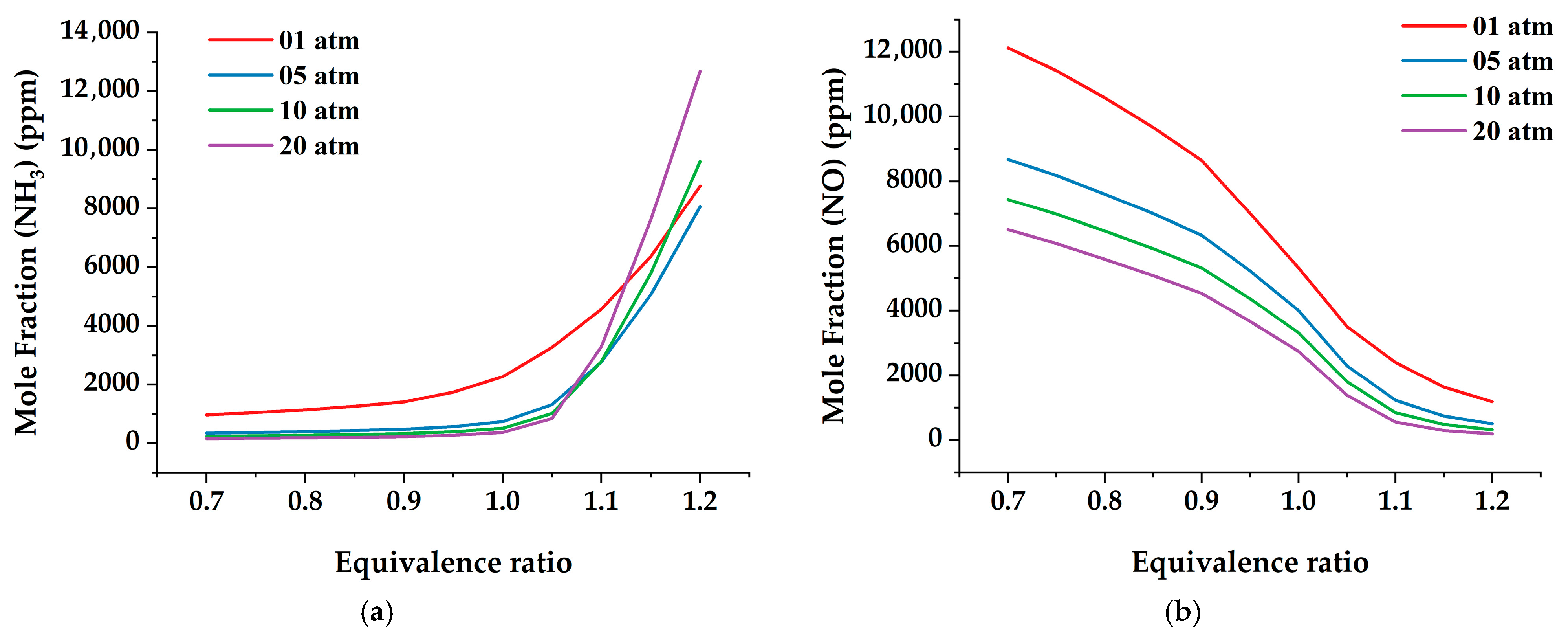
Figure 4 shows the variation of NH3 and NO mole fractions with equivalence ratio (ϕ = 0.7–1.2) at 2075 K for 1, 5, 10, and 20 atm, plotted as (a) NH3 and (b) NO mole fractions immediately downstream of the WSR. The results illustrate how fuel richness and pressure interact to govern combustion completeness and emissions.
Figure 4.
Equivalence ratio evolutions of (a) NH3 and (b) NO mole fraction for different pressures at 2075 K after WSR.
In Figure 4a, NH3 mole fractions exhibit strong pressure dependence, especially under fuel-rich conditions. For lean to stoichiometric mixtures (ϕ ≤ 1.0), NH3 concentrations remain low at all pressures due to efficient conversion. The slightly higher residual at 1 atm reflects slower collisional activation and weaker H-abstraction pathways. At 5–20 atm, enhanced third-body stabilization and ample oxidizer drive nearly complete fuel consumption, leaving negligible NH3 downstream. As equivalence ratio exceeds unity, however, NH3 mole fractions increase sharply due to higher fuel loading and reduced O2 availability. A notable feature is the crossing of pressure curves beyond ϕ ≈ 1.1: NH3 at 20 atm surpasses that at 1 atm, while the 10 atm curve overtakes the 5 atm case, and eventually even 1 atm at ϕ > 1.15. This reversal arises from the same mechanisms described in Section 3.1. Under oxygen-limited conditions, pressure amplifies fuel-side recycling through loops such as NH + NH2 ⇌ N2H3, NH2 + NH3 ⇌ H2 + N2H3, and NH2 + H + M → NH3 + M, while simultaneous OH removal via OH + H + M → H2O + M suppresses oxidation. The combined effect is higher residual NH3 at elevated pressure despite greater collisional frequency.
In Figure 4b, NO mole fractions decrease monotonically with equivalence ratio at all pressures. The steepest decline occurs from ϕ = 0.7 to 1.1, reflecting the transition from oxidizer-rich to oxygen-limited conditions. At lean and near-stoichiometric operation, nitrogen fragments such as NH2 are efficiently routed toward NO through NH2 → NH → HNO → NO. Furthermore, O2 is abundant to sustain thermal-Zeldovich pathways (N + O2 ⇌ NO + O and N + OH ⇌ NO + H). As the mixture becomes richer, nitrogen closure shifts toward N2-forming pathways (NH2 → N2H2 → NNH → N2). Furthermore, O2 scarcity inhibits both N + O2 and NO-propagating channels. Pressure further suppresses NO by depleting OH through OH + H + M → H2O + M, mirroring the behavior observed in Section 3.1. Across the full equivalence ratio range, NO consistently ranks highest at 1 atm and lowest at 20 atm.
The interaction of richness and pressure is most apparent at ϕ = 1.2. At this condition, enrichment suppresses NO but produces substantial unburned NH3 at high pressure, as recycling and oxygen depletion become dominant. These nonlinear interactions highlight the trade-off between fuel conversion and emissions: moderate enrichment reduces NO, but very rich mixtures (ϕ > 1.1) yield diminishing NO benefits while sharply increasing NH3 slip, especially under elevated pressures. For turbine applications, this underscores the need for precise tuning of equivalence ratio in conjunction with operating pressure to achieve an optimal balance between NO suppression and fuel utilization.
3.3. Temperature Effects
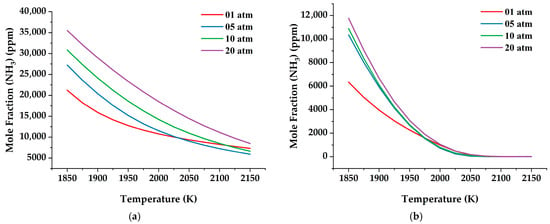
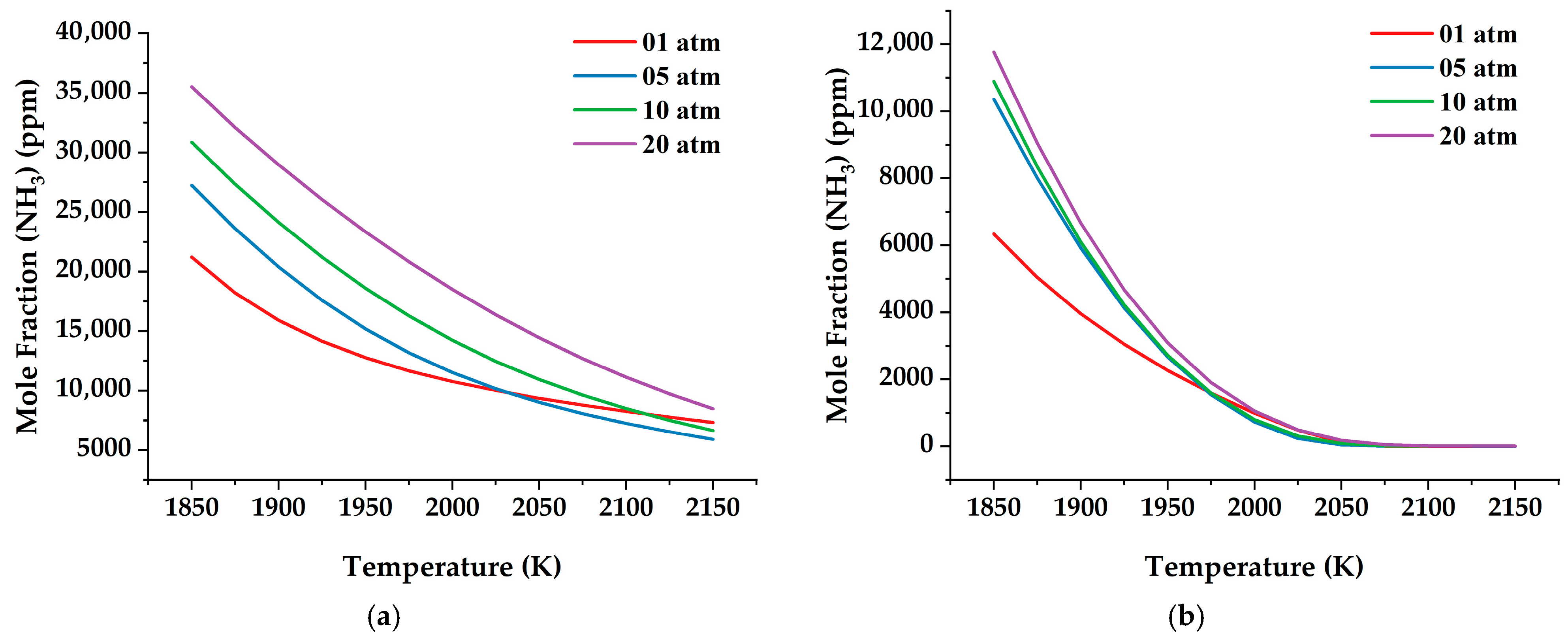
The impact of temperature on NH3 conversion and NO formation is a central focus of this study. At ϕ = 1.2, simulations were performed across a temperature range of 1850–2150 K at pressures of 1, 5, 10, and 20 atm. Figure 5a illustrates the variation of NH3 mole fraction with temperature after the WSR, while Figure 5b presents the corresponding results after the PFR. In both reactors, NH3 mole fraction decreases consistently with increasing temperature, reflecting the strong thermal sensitivity of the relevant elementary rate coefficients. As the temperature rises, the key NH3-consuming steps proceed further within the available residence time, yielding greater overall conversion.
Figure 5.
Temperature evolutions of NH3 mole fraction (a) after WSR and (b) after PFR.
In the WSR (Figure 5a), pressure-dependent kinetics become more apparent due to the shorter residence time. As the temperature increases, the pressure-ordered conversion curves separate and occasionally cross near 2025–2050 K, with the 1 atm case bending upward relative to higher-pressure cases. This behavior arises from the same mechanisms discussed in Section 3.1 on pressure effects. The effects of pressure-promoted NH3 recycling at fuel rich conditions and temperature-accelerated routes explain both the curve crossings and the upward bending of the 1 atm line at high temperature.
Closer inspection reveals three distinct regimes within the WSR. At low temperatures (≈1850–1950 K), NH3 consumption is activation-limited. Higher pressures (5–20 atm) remove more NH3 within the short residence time because increased collision frequency accelerates early abstraction and decomposition steps, while 1 atm lags. At intermediate temperatures (≈1975–2050 K), consumption accelerates across all cases, but high pressure increasingly channels species into recycling and oxidizer-sequestering routes. This slows net NH3 removal at 10–20 atm, whereas at 1 atm, faster abstraction reactions continue to drive significant consumption. This divergence leads to curve separation and occasional crossings. At high temperatures (>2050 K), the chemistry is rapid but the WSR residence time limits further reduction. The 1 atm line remains elevated due to insufficient third-body support, while the high-pressure lines approach a floor set by oxidizer drawdown and fuel-side recombination.
The PFR result in Figure 5b highlights the importance of longer residence time. Here, NH3 conversion is much stronger, and the mole fraction decreases more rapidly at all pressures. At lower temperatures (≈1850–1950 K), the 1 atm case retains some residual NH3 because collisional pathways are slower and third-body support is limited, while the 5–20 atm cases show greater early-tube abstraction and decomposition, producing lower outlet NH3. In the mid-range (≈1975–2050 K), NH3 falls steeply for all pressures, and pressure ordering weakens because the extended residence time allows sequential consumption reactions to progress nearly to completion. As a result, the PFR smooths out the non-monotonic behavior observed in the WSR. At high temperatures (>2050 K), the characteristic chemical time becomes much shorter than the flow residence time, leading to nearly complete NH3 conversion early in the reactor. Under these conditions, the curves converge, as pressure-promoted recycling and oxidizer drawdown have little influence in the face of overwhelming consumption.
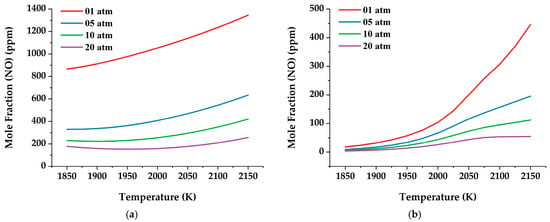
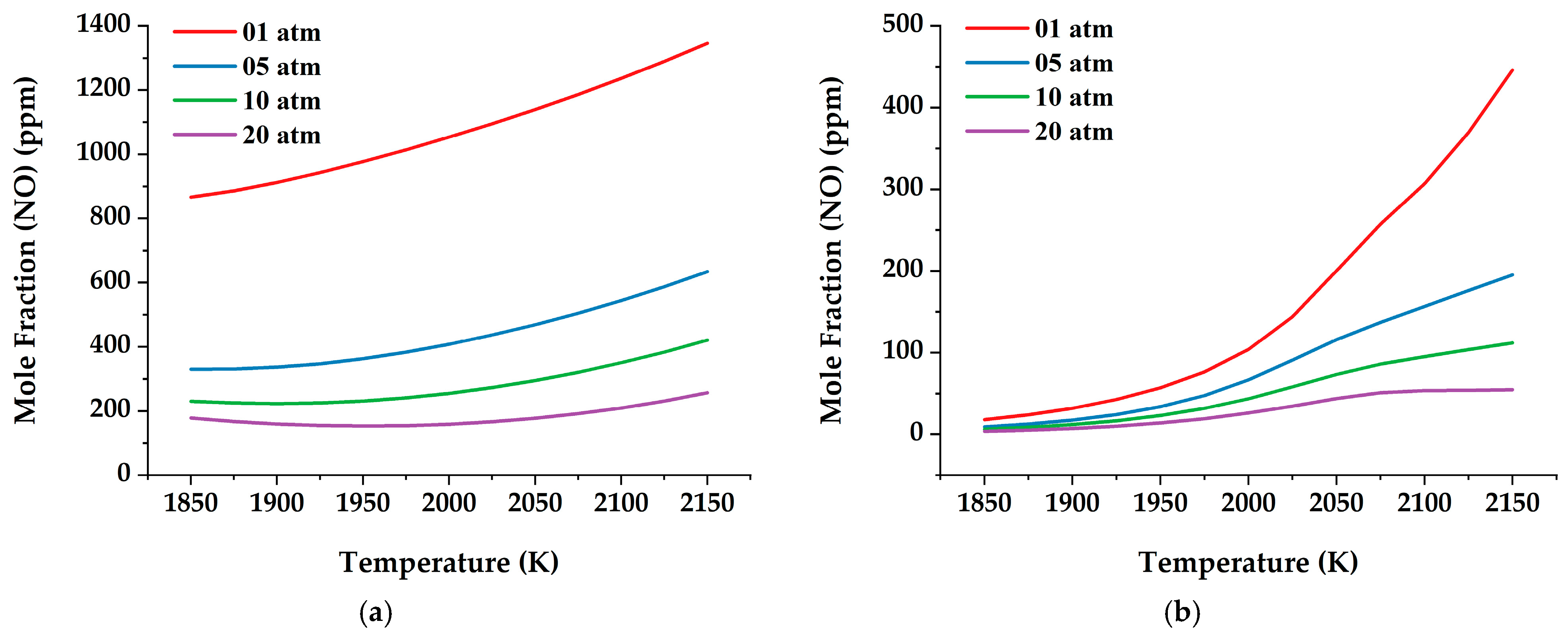
The corresponding NO formation behavior is shown in Figure 6. In the WSR (Figure 6a), NO generally increases with temperature at all pressures, consistent with faster thermal production routes. However, the 20 atm case exhibits a temporary dip at intermediate temperatures before resuming its upward trend. This suppression is attributed to high-pressure promotion of NO-removal channels. These effects reduce the oxidizing pool that sustains NO production, delaying its rise despite ongoing NH3 conversion. At higher temperatures, however, radical generation overwhelms these sinks, and the NO concentration resumes its upward trajectory.
Figure 6.
Temperature evolutions of NO mole fraction (a) after WSR and (b) after PFR.
In the PFR (Figure 6b), NO grows slowly at low temperatures because NH3 conversion is incomplete, and nitrogen fragments are scarce. As temperature increases, NH3 decomposes more extensively, and NO rises sharply, particularly at 1 atm where oxidizing reactions such as N + O2 ⇌ NO + O, and N + OH ⇌ NO + H, and NH + OH ⇌ H + HNO → NO face the least inhibition. At higher pressures, NO growth is muted because the same recombination and oxidizer-sequestering pathways that suppress NO in the WSR also operate throughout the flow. The result is a persistent ordering of NO with pressure, such that NO is consistently higher at 1 atm than at 5, 10, or 20 atm, with the curves flattening at the highest temperatures.
For completeness, the temperature dependence of minor NOx species (NO2 and N2O) was also examined at ϕ = 1.2 over T = 1850–2150 K for P = 1, 5, 10, and 20 atm (WSR outlet). N2O exhibits its highest values at the lowest temperature and decreases with increasing temperature across all pressures, remaining negligible at the upper end of the temperature range. NO2 shows a stronger pressure effect at low temperature but decreases rapidly as temperature increases, consistent with thermal conversion favoring NO over NO2. The corresponding NO2 (Figure S1) and N2O (Figure S2) temperature sweeps for each pressure are included in the Supplementary Materials.
Overall, these findings highlight the dual role of temperature and pressure in controlling NO formation during ammonia combustion. High temperatures strongly accelerate NO production through radical chemistry, while high pressures moderate this trend by favoring radical recombination and recycling. The interplay between these factors is critical for the design of low-NOx combustors operating under elevated-pressure conditions. At the most favorable condition identified in this study—20 atm and 2075 K—the reactor network achieved an outlet NH3 concentration of 48.5 ppm and NO concentration of 51 ppm after 3 ms in the WSR and 17 ms in the PFR. These results demonstrate both high conversion efficiency and relatively low NO emissions under rich combustion conditions. When compared with prior literature, the present values are competitive. Okafor et al. [32], for instance, achieved approximately 49 ppm NOx emissions at 3 atm using a two-stage burner in a rich-quench-lean configuration. Notably, the study relied on aggressive quenching or lean staging strategies, whereas the present work achieves similar emissions performance without such measures.
3.4. Sensitivity Analysis
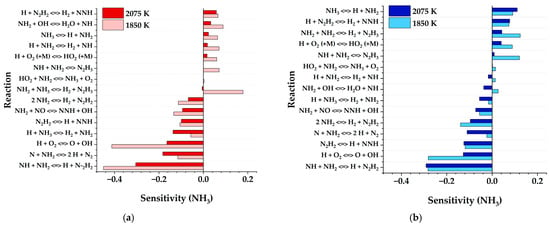
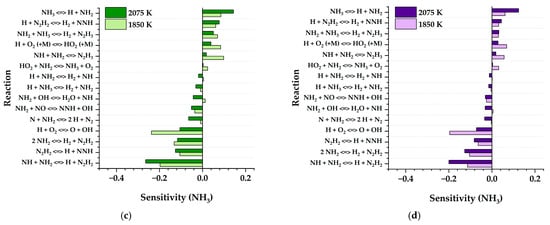
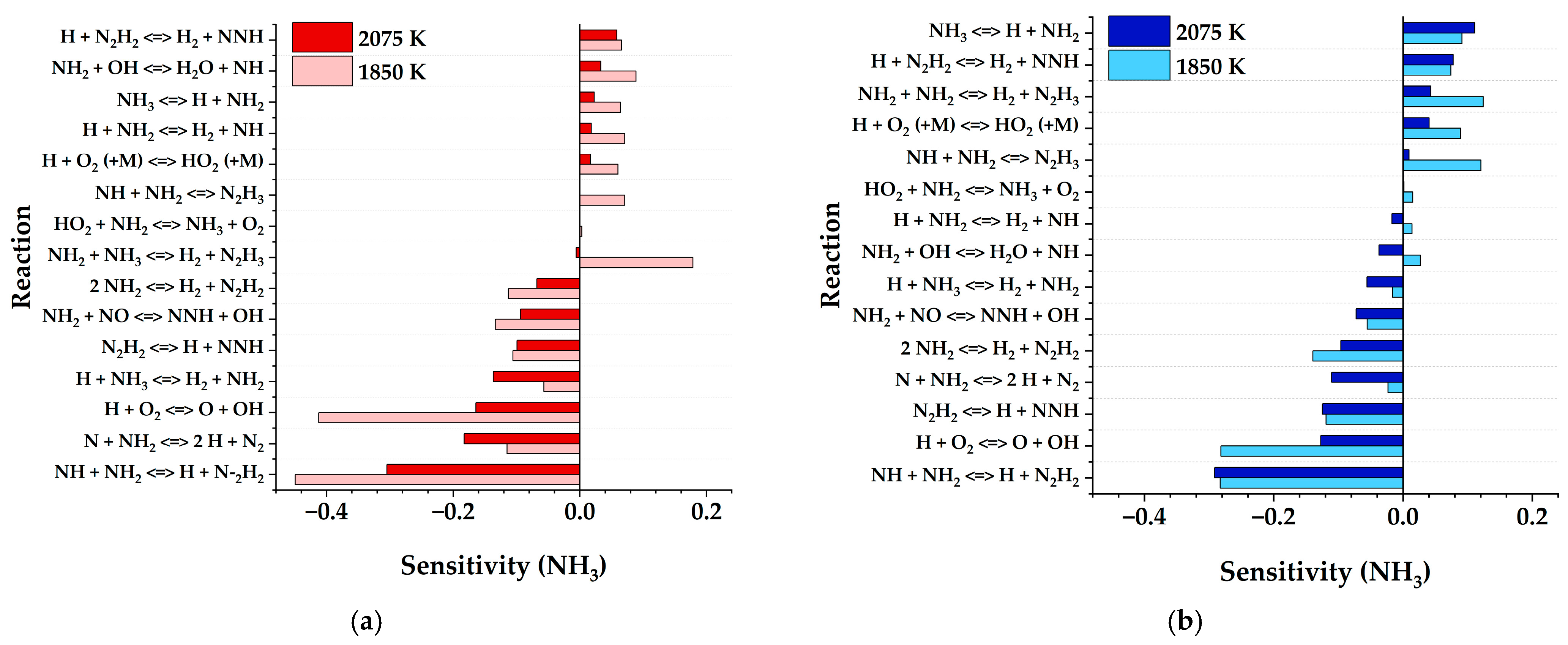
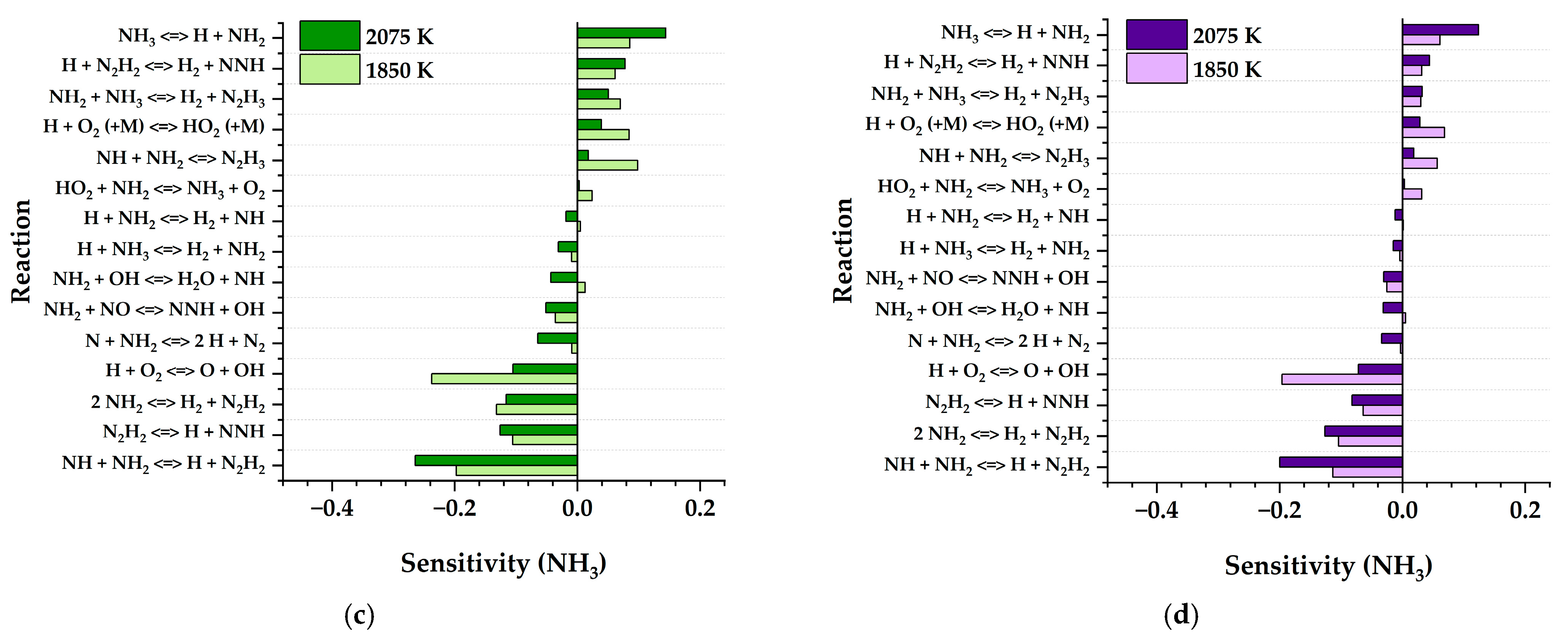
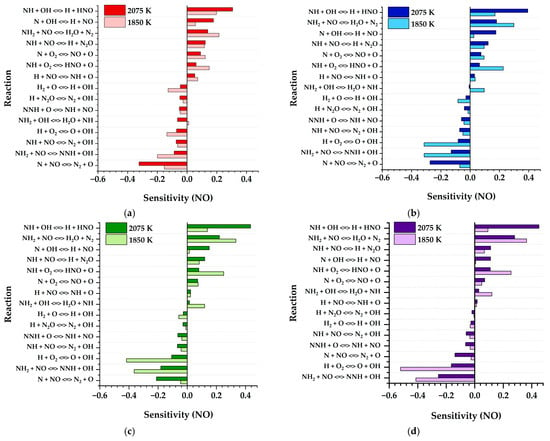
Figure 7 and Figure 8 present normalized first-order reaction-rate sensitivity coefficients for the WSR at 1850 K and 2075 K across pressures of 1, 5, 10, and 20 atm at ϕ = 1.2. The coefficients are reported with respect to multiplicative perturbations of reaction rates, providing a direct measure of which pathways most strongly enhance or inhibit NH3 conversion and NO formation under different conditions.
Figure 7.
Sensitivity analysis of NH3 in WSR at (a) 1 atm, (b) 5 atm, (c) 10 atm and (d) 20 atm.
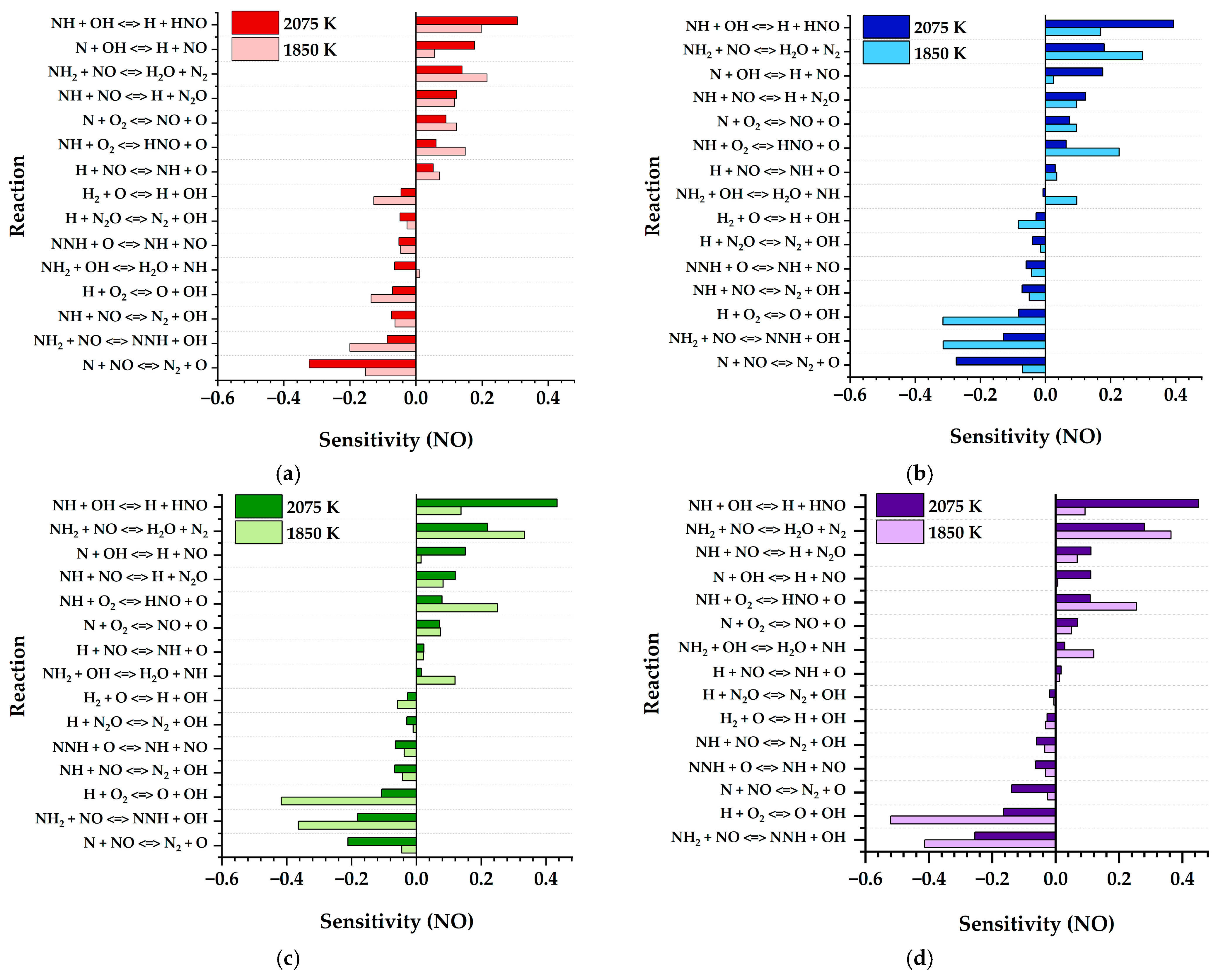
Figure 8.
Sensitivity analysis of NO in WSR at (a) 1 atm, (b) 5 atm, (c) 10 atm and (d) 20 atm.
Figure 7 illustrates how the NH3 sensitivity pattern shifts with pressure, where panels (a–d) correspond to 1, 5, 10, and 20 atm, and darker and lighter bars indicate the results at 2075 K and 1850 K, respectively. At 1 atm, NH3 removal is driven primarily by abstraction and initiation reactions, most notably NH + NH2 ⇌ H + N2H2, N2H2 ⇌ H + NNH, and H + O2 ⇌ O + OH, which carry the strongest negative sensitivities. In contrast, the most positive sensitivities arise from fuel-side reforming and termination routes, including H + N2H2 ⇌ H2 + NNH and NH2 + NH3 ⇌ H2 + N2H3. This balance is consistent with the trends described in Section 3.1., as pressure increases from 1 to 5 atm, the abstraction terms strengthen relative to the recycling terms, explaining the significant drop in NH3 concentration at 5 atm observed in Figure 1.
At 10 atm, the balance begins to shift. Recycling pathways such as NH2 + NH3 ⇌ H2 + N2H3, N2H3 → NH3, and the third-body recombination NH2 + H + M → NH3 + M become increasingly influential, while oxidizer drawdown via OH + H + M → H2O + M weakens the OH-driven destruction pathways. By 20 atm, the spectrum is dominated by these pressure-assisted recycling terms, consistent with the non-monotonic rebound of NH3 at high pressure shown in Figure 2 and the curve crossings seen in the WSR temperature sweep of Figure 5a. The effect of temperature is also clear: across all pressures, the lower-temperature (1850 K) sensitivities are generally larger in magnitude than those at 2075 K, indicating that when chemistry proceeds more slowly, individual reactions exert greater leverage. This observation also rationalizes why, in the PFR, pressure differences in NH3 diminish at high temperatures (Figure 4b): once the positive abstraction channels dominate strongly, the recycling mechanisms lose influence over the final outcome. Under fuel-rich conditions (Figure 4a, ϕ > 1.1), the growing negative weight of the NH2/N2H3 recycling sequence at 10–20 atm explains why the high-pressure curves eventually surpass the low-pressure ones, leaving higher residual NH3 at ϕ = 1.2.
The NO sensitivities shown in Figure 8, reveal a complementary picture. At 1 atm, NO formation is strongly promoted by oxidizing pathways such as N + OH ⇌ H + NO and NH + OH ⇌ H + HNO, while the strongest negative sensitivities belong to NO-consuming or closure reactions, including NH2 + NO ⇌ NNH + OH, NH + NO ⇌ N2 + OH, and N + NO ⇌ N2 + O, which contributes net negative at these conditions. This balance explains why NO concentrations are highest at 1 atm in Section 3.1. and why NO increases steeply with temperature at low pressure in Figure 6.
At 5 atm, the relative importance of the oxidizing routes decreases, while the closure reactions gain weight, consistent with the sharp NO reduction observed between 1 and 5 atm in Figure 3 and the more gradual rise with temperature in Figure 6b. At 10 and 20 atm, in parallel, OH radicals are increasingly consumed via OH + H + M → H2O + M, weakening the N + OH ⇌ H + NO driver. These changes account for both the monotonic decline of NO with pressure and the temporary dip of the 20 atm curve with temperature in Figure 6a, before NO resumes its upward climb at higher temperatures.
The effect of temperature on NO sensitivities follows the same pattern as for NH3: the coefficients are generally larger at 1850 K than at 2075 K, reflecting stronger relative leverage at lower temperatures, but the overall sign structure of formation versus consumption remains unchanged. As a result, the pressure ordering of NO concentrations (1 atm > 5 atm > 10 atm > 20 atm) persists across the examined range. Under fuel-rich conditions (Section 3.2.), the influence of oxidizing drivers diminishes as O2 and OH become depleted, while the closure pathways involving NH2, N2H2, and NNH gain importance. This shift explains the flattening of NO production beyond ϕ ≈ 1.1 and the preservation of pressure ordering in Figure 4b.
In summary, the sensitivity analysis provides quantitative support for the mechanistic explanations discussed in the previous sections. At low pressures, abstraction-driven chemistry dominates, leading to greater NH3 conversion but also higher NO formation. At high pressures, recombination and closure pathways gain control, limiting NH3 conversion and suppressing NO. These trends reconcile the non-monotonic NH3 behavior and the monotonic decline of NO with pressure observed in the WSR simulations.
3.5. Reaction Pathway Analysis
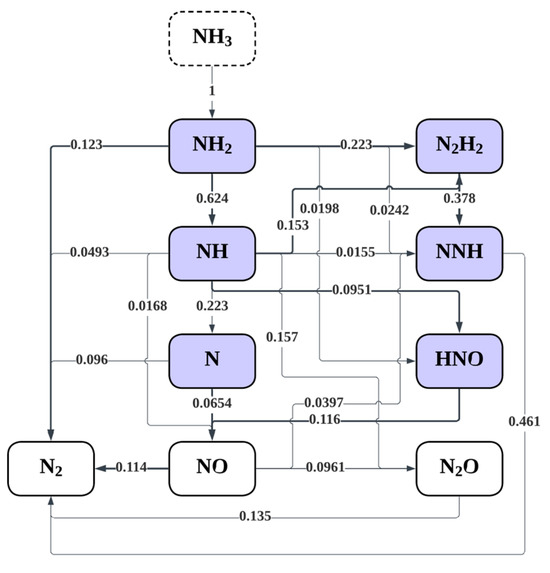
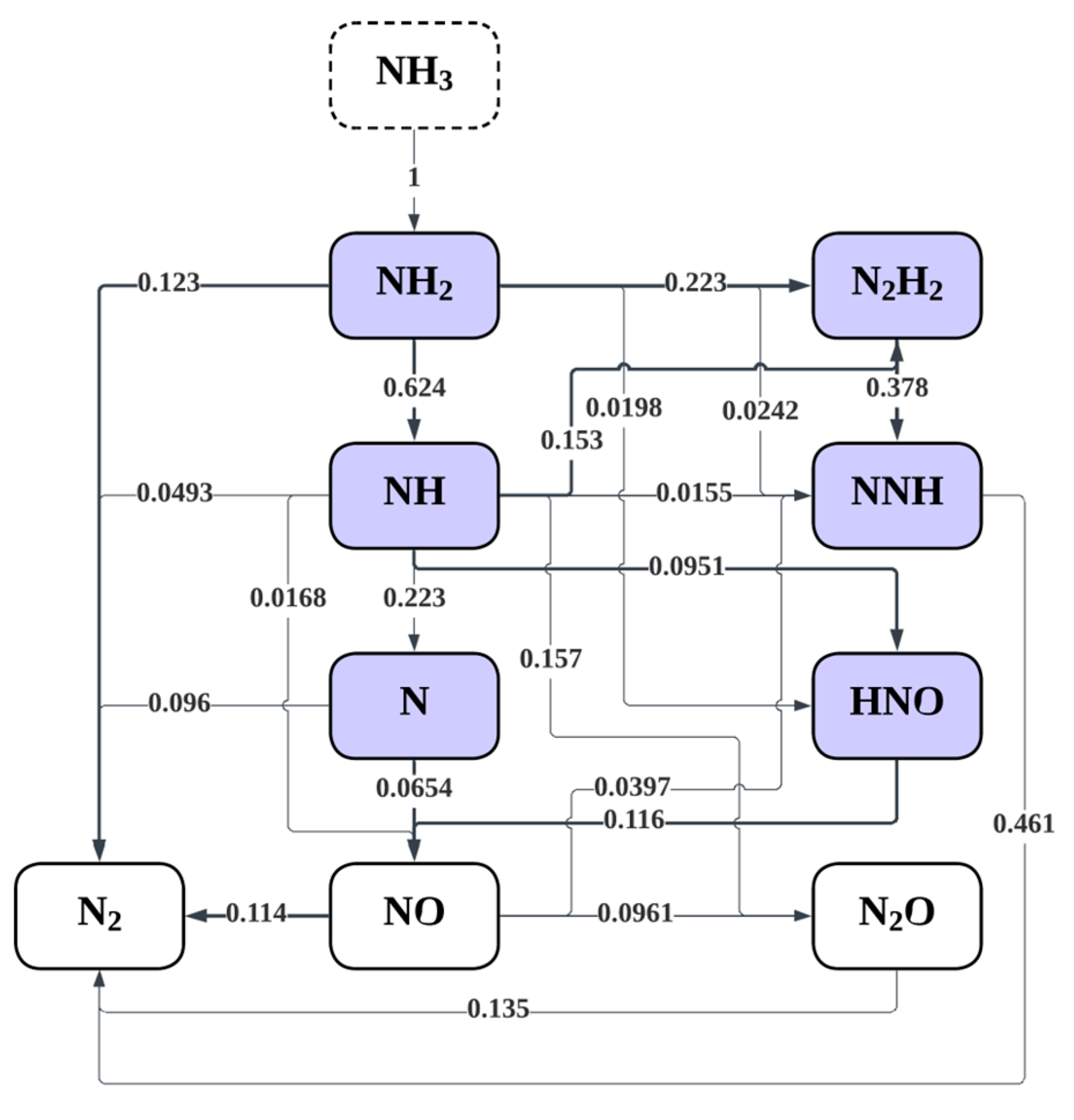
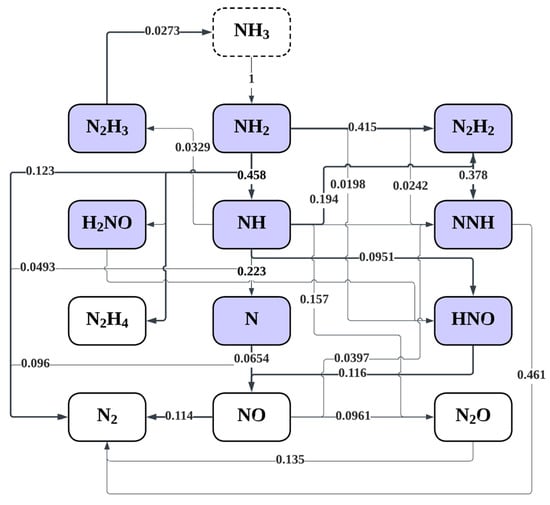
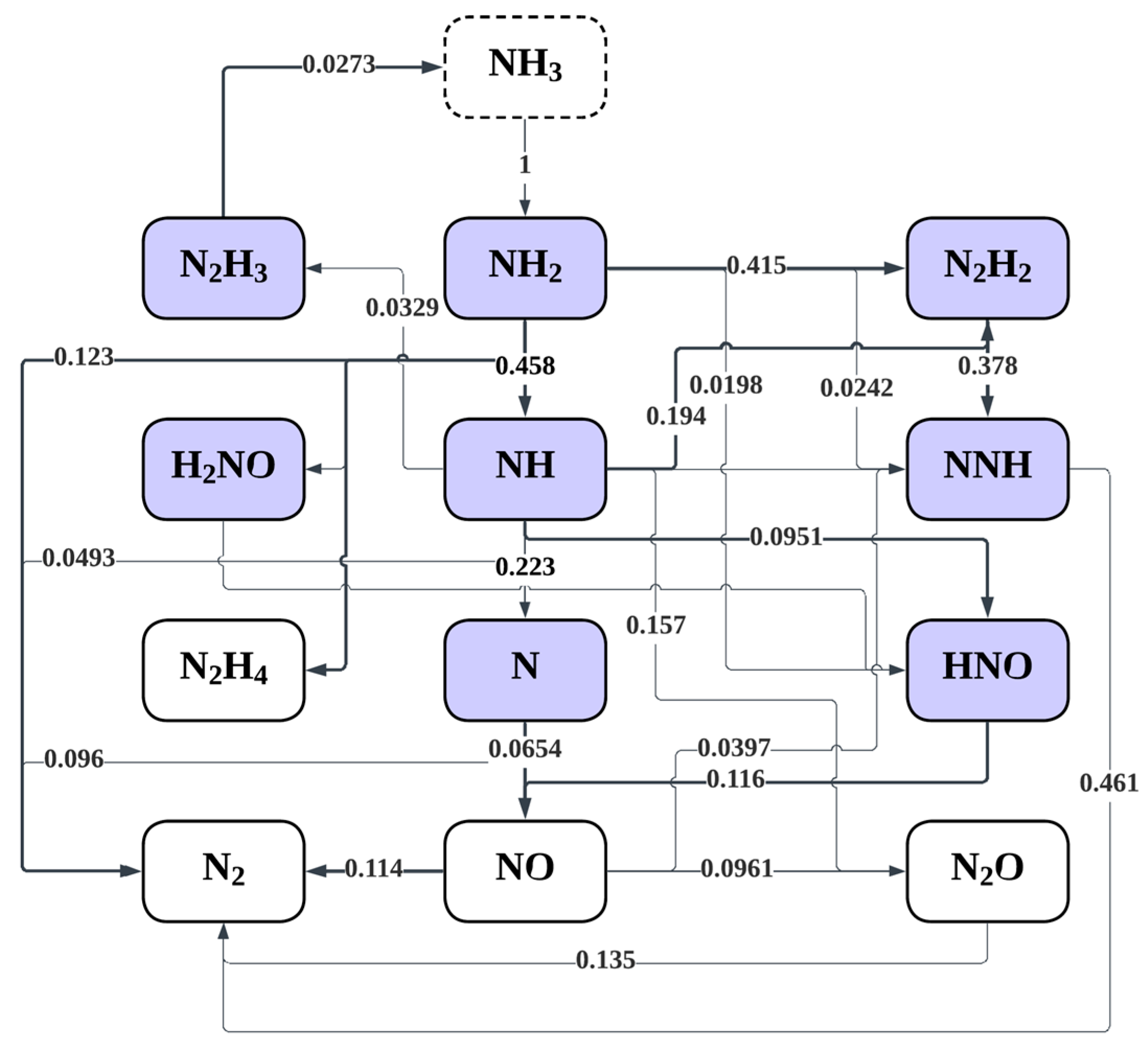
To complement the sensitivity studies and provide deeper insight into nitrogen transformation during ammonia combustion, reaction pathway analyses were performed at 2075 K for two representative pressures: 1 atm and 20 atm at ϕ = 1.2 (Figure 9 and Figure 10). These diagrams trace the distribution of nitrogen flux through intermediate species, highlighting how pressure influences the competition between NO formation and N2 closure.
Figure 9.
Reaction pathways of NH3 at 1 atm.
Figure 10.
Reaction pathways of NH3 at 20 atm.
At 1 atm (Figure 9), NH3 decomposition proceeds primarily through NH2, which then branches into three major channels. The dominant path is NH2 → NH, carrying approximately 62% of the tracked nitrogen flux. A secondary branch, NH2 → N2H2, contributes about 22%, while a smaller direct channel NH2 → N2 accounts for roughly 12%. The NH branch supports a radical-rich network, as NH undergoes successive hydrogen abstraction steps to yield species such as N, NNH, and HNO, all of which provide strong feeds into NO production. The NNH and HNO intermediates, in particular, are central conduits toward NO, and the presence of multiple parallel NO-forming routes ensures that low-pressure combustion sustains appreciable NO levels. Although sinks exist—for example, NO → N2 (≈11%) and NO → N2O (≈10%)—the comparable strength of multiple NO-producing branches counteracts these losses, leaving NO accumulation relatively high at 1 atm.
At 20 atm (Figure 10), the nitrogen flux shifts markedly toward N2 formation. High pressure enhances chain-terminating reactions and strengthens closure sequences, resulting in greater diversion of reactive nitrogen away from NO. The NH2 → N2H2 pathway becomes more prominent, increasing to about 42% of the nitrogen flux, while NH2 → NH decreases to 46%. A pressure-activated NH3 ⇌ N2H3 ⇌ NH2 recycling loop also emerges, with fluxes of about 3% in each direction. Downstream, the N2H2 → NNH transfer strengthens to nearly 38%, reinforcing N2 production channels. At the same time, oxidizing branches through NH are suppressed; for example, the NH → N2H2 contribution feeding into NO pathways drops to about 19%. Oxidation routes such as NH + OH ⇌ HNO weaken, while NO-consuming sinks remain active. The HNO → N2O branch grows to about 12%, with N2O subsequently converting to N2, further shifting the network toward benign closure.
Taking them together, these pathway analyses underscore the role of pressure in reshaping nitrogen chemistry. At low pressure, radical-driven routes sustain strong NO formation, with multiple branches converging on NO-producing intermediates. At high pressure, however, nitrogen is increasingly funneled through the NH2 → N2H2 → NNH chain and through NO-to-N2O/N2 sinks, biasing the outcome toward molecular nitrogen. This transition mirrors the pressure trends observed in the simulations: higher pressure consistently suppresses NO, while also enhancing recycling that can, under rich conditions, increase residual NH3.
4. Conclusions
This study presents a comprehensive numerical investigation of ammonia combustion using a hybrid WSR followed by a PFR configuration, aimed at emulating the behavior of first-stage gas turbine combustors operating under fuel-rich conditions. Simulations were conducted over a wide range of operating parameters, including temperatures from 1850 to 2150 K and pressures between 1 and 20 atm, with equivalence ratios of 0.7–1.2. The following conclusions are drawn:
- NH3 shows a non-monotonic response to pressure with a minimum near 5 atm at 2075 K. Conversion from 1 to 5 atm improves due to more effective collisional activation within the short WSR residence time, while at 10–20 atm, pressure-promoted NH3 recycling at fuel rich condition slow further removal. NO decreases monotonically from 1 to 20 atm, with the sharpest drop occurring between 1 and 5 atm and diminishing returns thereafter.
- Enrichment from ϕ = 0.7 to ~1.1 strongly suppresses NO across all pressures, whereas for ϕ > 1.0, residual NH3 rises rapidly, particularly at high pressure. Beyond ϕ ≈ 1.1, the NO decrease flattens, and pressure-amplified recycling causes the high-pressure NH3 curves to surpass the low-pressure ones, illustrating a clear trade-off at ϕ ≈ 1.2.
- Temperature is the dominant accelerator of chemistry: NH3 decreases with increasing temperature in both reactors, while NO generally increases. In the WSR, pressure-dependent curve crossings appear around 2025–2050 K, with the 1 atm curve bending upward at high temperatures. In the PFR, extended residence time drives near-complete conversion, so pressure effects diminish above ~2050 K.
- Sensitivity rankings show that at low pressure, NH3 removal and NO formation are driven by H-abstraction and oxidizing routes; at high pressure, association/recycling reactions together with oxidizer drawdown (OH + H + M → H2O + M) limit NH3 conversion and suppress NO. Reaction pathway maps corroborate a shift from radical-rich NO branches at 1 atm to nitrogen-closure sequences (NH2 → N2H2 → NNH → N2) and the high-pressure NH3–N2H3 recycle.
In the present study, the most favorable combined outcome occurred at 20 atm and 2075 K, where the WSR–PFR network produced 48.5 ppm NH3 and 51 ppm NO after 3 ms in the WSR and 17 ms in the PFR, indicating high conversion with low NO under rich conditions. For rich, first-stage gas-turbine operation, an operational window of ~10 atm with mildly rich mixtures (ϕ ≈ 1.1–1.2) provides a practical compromise—substantially suppressing NO while avoiding the sharp increase in NH3 slip observed at higher pressures and richer mixtures. Operation above ~10 atm and/or at ϕ > ~1.2 yields diminishing NO benefits but can increase residual NH3 due to pressure-amplified recycling and oxidizer-radical drawdown.
In conclusion, this study affirms the viability of rich ammonia combustion in gas turbine environments, particularly under elevated pressures and carefully managed temperatures. Future work will focus on experimental evaluation of the same pressure–temperature–equivalence-ratio trends. A mixing system and burner hardware are currently under development to reproduce WSR-like stabilization and residence-time conditions, after which NH3 slip and NOx will be quantified at representative turbine pressures and temperatures. These measurements will be used to further assess mechanism-dependent uncertainty at elevated pressures and to guide extensions beyond idealized reactor assumptions toward more realistic combustor-relevant mixing and flow environments.
Supplementary Materials
The following supporting information can be downloaded at: https://www.mdpi.com/article/10.3390/fire9010038/s1, Figure S1: NO2 mole fraction (ppm) versus temperature at the WSR outlet for ϕ = 1.2 and P = 1, 5, 10, and 20 atm; Figure S2: N2O mole fraction (ppm) versus temperature at the WSR outlet for ϕ = 1.2 and P = 1, 5, 10, and 20 atm.
Author Contributions
Conceptualization, K.A. and Z.W.; methodology, K.A. and Z.W.; investigation, K.A. and B.W.; writing—original draft preparation, K.A.; writing—review and editing, B.W. and Z.W.; supervision, Z.W.; funding acquisition, Z.W. All authors have read and agreed to the published version of the manuscript.
Funding
This research was funded by the Utah State University start-up funds and the ORAU Ralph E. Powe Junior Faculty Enhancement Award.
Institutional Review Board Statement
Not applicable.
Informed Consent Statement
Not applicable.
Data Availability Statement
The data that support the findings of this study are available from the corresponding author upon reasonable request.
Conflicts of Interest
The authors declare no conflicts of interest.
References
- Climate Working Group. A Critical Review of Impacts of Greenhouse Gas Emissions on the U.S. Climate; Department of Energy: Washington, DC, USA, 2025; p. 151. [Google Scholar]
- Craig, M.T.; Jaramillo, P.; Hodge, B.-M. Carbon Dioxide Emissions Effects of Grid-Scale Electricity Storage in a Decarbonizing Power System. Environ. Res. Lett. 2018, 13, 014004. [Google Scholar] [CrossRef] [Scilit]
- Valera-Medina, A.; Xiao, H.; Owen-Jones, M.; David, W.I.F.; Bowen, P.J. Ammonia for Power. Prog. Energy Combust. Sci. 2018, 69, 63–102. [Google Scholar] [CrossRef] [Scilit]
- Kumar, L.; Sleiti, A.K. Systematic Review on Ammonia as a Sustainable Fuel for Combustion. Renew. Sustain. Energy Rev. 2024, 202, 114699. [Google Scholar] [CrossRef] [Scilit]
- Ghavam, S.; Vahdati, M.; Wilson, I.A.G.; Styring, P. Sustainable Ammonia Production Processes. Front. Energy Res. 2021, 9, 580808. [Google Scholar] [CrossRef] [Scilit]
- Yamashita, H.; Hayakawa, A.; Okafor, E.C.; Colson, S.; Somarathne, K.D.K.A.; Tsujimura, T.; Ito, S.; Uchida, M.; Kudo, T.; Kobayashi, H. Optimum Primary Equivalence Ratio for Rich-Lean Two-Stage Combustion of Non-Premixed Ammonia/Methane/Air and Ammonia/Hydrogen/Air Flames in a Swirling Flow. Fuel 2024, 368, 131598. [Google Scholar] [CrossRef] [Scilit]
- Kurata, O.; Iki, N.; Matsunuma, T.; Inoue, T.; Tsujimura, T.; Furutani, H.; Kobayashi, H.; Hayakawa, A. Performances and Emission Characteristics of NH3–Air and NH3–CH4–Air Combustion Gas-Turbine Power Generations. Proc. Combust. Inst. 2017, 36, 3351–3359. [Google Scholar] [CrossRef] [Scilit]
- Kobayashi, H.; Hayakawa, A.; Somarathne, K.D.K.A.; Okafor, E.C. Science and Technology of Ammonia Combustion. Proc. Combust. Inst. 2019, 37, 109–133. [Google Scholar] [CrossRef] [Scilit]
- Okafor, E.C.; Somarathne, K.D.K.A.; Hayakawa, A.; Kudo, T.; Kurata, O.; Iki, N.; Kobayashi, H. Towards the Development of an Efficient Low-NOx Ammonia Combustor for a Micro Gas Turbine. Proc. Combust. Inst. 2019, 37, 4597–4606. [Google Scholar] [CrossRef] [Scilit]
- Okafor, E.C.; Somarathne, K.D.K.A.; Ratthanan, R.; Hayakawa, A.; Kudo, T.; Kurata, O.; Iki, N.; Tsujimura, T.; Furutani, H.; Kobayashi, H. Control of NOx and Other Emissions in Micro Gas Turbine Combustors Fuelled with Mixtures of Methane and Ammonia. Combust. Flame 2020, 211, 406–416. [Google Scholar] [CrossRef] [Scilit]
- Kurata, O.; Iki, N.; Inoue, T.; Matsunuma, T.; Tsujimura, T.; Furutani, H.; Kawano, M.; Arai, K.; Okafor, E.C.; Hayakawa, A.; et al. Development of a Wide Range-Operable, Rich-Lean Low-NOx Combustor for NH3 Fuel Gas-Turbine Power Generation. Proc. Combust. Inst. 2019, 37, 4587–4595. [Google Scholar] [CrossRef] [Scilit]
- Gubbi, S.; Cole, R.; Emerson, B.; Noble, D.; Steele, R.; Sun, W.; Lieuwen, T. Air Quality Implications of Using Ammonia as a Renewable Fuel: How Low Can NOx Emissions Go? ACS Energy Lett. 2023, 8, 4421–4426. [Google Scholar] [CrossRef] [Scilit]
- Khateeb, A.A.; Guiberti, T.F.; Wang, G.; Boyette, W.R.; Younes, M.; Jamal, A.; Roberts, W.L. Stability Limits and NO Emissions of Premixed Swirl Ammonia-Air Flames Enriched with Hydrogen or Methane at Elevated Pressures. Int. J. Hydrogen Energy 2021, 46, 11969–11981. [Google Scholar] [CrossRef] [Scilit]
- Khateeb, A.A.; Guiberti, T.F.; Zhu, X.; Younes, M.; Jamal, A.; Roberts, W.L. Stability Limits and Exhaust NO Performances of Ammonia-Methane-Air Swirl Flames. Exp. Therm. Fluid Sci. 2020, 114, 110058. [Google Scholar] [CrossRef] [Scilit]
- Khateeb, A.A.; Guiberti, T.F.; Zhu, X.; Younes, M.; Jamal, A.; Roberts, W.L. Stability Limits and NO Emissions of Technically-Premixed Ammonia-Hydrogen-Nitrogen-Air Swirl Flames. Int. J. Hydrogen Energy 2020, 45, 22008–22018. [Google Scholar] [CrossRef] [Scilit]
- Ditaranto, M.; Saanum, I. Experimental Study on the Effect of Pressure on Single and Two Stage Combustion of Decomposed Ammonia (NH3-H2-N2) Blends over a Swirl Stabilized Burner. Combust. Flame 2024, 262, 113368. [Google Scholar] [CrossRef] [Scilit]
- Pashchenko, D. Ammonia-Fueled Solar Combined Cycle Power System: Thermal and Combustion Efficiency Enhancement via Solar-Driven Ammonia Decomposition. Int. J. Hydrogen Energy 2025, 142, 232–243. [Google Scholar] [CrossRef] [Scilit]
- Ávila, C.D.; Cardona, S.; Abdullah, M.; Younes, M.; Jamal, A.; Guiberti, T.F.; Roberts, W.L. Experimental Assessment of the Performance of a Commercial Micro Gas Turbine Fueled by Ammonia-Methane Blends. Appl. Energy Combust. Sci. 2023, 13, 100104. [Google Scholar] [CrossRef] [Scilit]
- Wang, G.; Guiberti, T.F.; Cardona, S.; Jimenez, C.A.; Roberts, W.L. Effects of Residence Time on the NOx Emissions of Premixed Ammonia-Methane-Air Swirling Flames at Elevated Pressure. Proc. Combust. Inst. 2023, 39, 4277–4288. [Google Scholar] [CrossRef] [Scilit]
- Pugh, D.; Bowen, P.; Valera-Medina, A.; Giles, A.; Runyon, J.; Marsh, R. Influence of Steam Addition and Elevated Ambient Conditions on NOx Reduction in a Staged Premixed Swirling NH3/H2 Flame. Proc. Combust. Inst. 2019, 37, 5401–5409. [Google Scholar] [CrossRef] [Scilit]
- Pugh, D.; Runyon, J.; Bowen, P.; Giles, A.; Valera-Medina, A.; Marsh, R.; Goktepe, B.; Hewlett, S. An Investigation of Ammonia Primary Flame Combustor Concepts for Emissions Reduction with OH*, NH2* and NH* Chemiluminescence at Elevated Conditions. Proc. Combust. Inst. 2021, 38, 6451–6459. [Google Scholar] [CrossRef] [Scilit]
- Pugh, D.; Bowen, P.; Navaratne, R.; Goktepe, B.; Giles, A.; Valera Medina, A.; Morris, S.; Vivoli, R. Influence of Variable Swirl on Emissions in a Non-Premixed Fuel-Flexible Burner at Elevated Ambient Conditions. J. Eng. Gas Turbines Power 2024, 146, 061006. [Google Scholar] [CrossRef] [Scilit]
- U.S. Global Change Research Program. Global Climate Change Impacts in the United States: A State of Knowledge Report; Cambridge University Press: Cambridge, UK, 2009; ISBN 978-0-521-14407-0.
- Wendt, J.O.L.; Sternling, C.V. Effect of Ammonia in Gaseous Fuels On Nitrogen Oxide Emissions. J. Air Pollut. Control Assoc. 1974, 24, 1055–1058. [Google Scholar] [CrossRef] [Scilit]
- Leng, Y.; Dai, L.; Wang, Q.; Lu, J.; Yu, O.; Simms, N.J. Numerical Study on the Combustion and Emissions Characteristics of Liquid Ammonia Spray Ignited by Dimethyl Ether Spray. Fire 2024, 8, 14. [Google Scholar] [CrossRef] [Scilit]
- Zhang, M.; An, Z.; Wei, X.; Wang, J.; Huang, Z.; Tan, H. Emission Analysis of the CH4/NH3/Air Co-Firing Fuels in a Model Combustor. Fuel 2021, 291, 120135. [Google Scholar] [CrossRef] [Scilit]
- Goodwin, D.G.; Moffat, H.K.; Schoegl, I.; Speth, R.L.; Weber, B.W. Cantera: An Object-Oriented Software Toolkit for Chemical Kinetics, Thermodynamics, and Transport Processes; European Organization for Nuclear Research: Geneva, Switzerland, 2024. [Google Scholar]
- Mei, B.; Zhang, J.; Shi, X.; Xi, Z.; Li, Y. Enhancement of Ammonia Combustion with Partial Fuel Cracking Strategy: Laminar Flame Propagation and Kinetic Modeling Investigation of NH3/H2/N2/Air Mixtures up to 10 Atm. Combust. Flame 2021, 231, 111472. [Google Scholar] [CrossRef] [Scilit]
- Somarathne, K.D.K.A.; Hatakeyama, S.; Hayakawa, A.; Kobayashi, H. Numerical Study of a Low Emission Gas Turbine like Combustor for Turbulent Ammonia/Air Premixed Swirl Flames with a Secondary Air Injection at High Pressure. Int. J. Hydrogen Energy 2017, 42, 27388–27399. [Google Scholar] [CrossRef] [Scilit]
- Valera-Medina, A.; Marsh, R.; Runyon, J.; Pugh, D.; Beasley, P.; Hughes, T.; Bowen, P. Ammonia–Methane Combustion in Tangential Swirl Burners for Gas Turbine Power Generation. Appl. Energy 2017, 185, 1362–1371. [Google Scholar] [CrossRef] [Scilit]
- Wang, Z.; Mei, B.; Liu, N.; Thawko, A.; Mao, X.; Zhao, H.; Glarborg, P.; Klippenstein, S.J.; Ju, Y. High Pressure Ammonia/Methanol Oxidation up to 100 Atm. Proc. Combust. Inst. 2024, 40, 105489. [Google Scholar] [CrossRef] [Scilit]
- Okafor, E.C.; Kurata, O.; Yamashita, H.; Inoue, T.; Tsujimura, T.; Iki, N.; Hayakawa, A.; Ito, S.; Uchida, M.; Kobayashi, H. Liquid Ammonia Spray Combustion in Two-Stage Micro Gas Turbine Combustors at 0.25 MPa; Relevance of Combustion Enhancement to Flame Stability and NOx Control. Appl. Energy Combust. Sci. 2021, 7, 100038. [Google Scholar] [CrossRef] [Scilit]

Disclaimer/Publisher’s Note: The statements, opinions and data contained in all publications are solely those of the individual author(s) and contributor(s) and not of MDPI and/or the editor(s). MDPI and/or the editor(s) disclaim responsibility for any injury to people or property resulting from any ideas, methods, instructions or products referred to in the content. |
© 2026 by the authors. Licensee MDPI, Basel, Switzerland. This article is an open access article distributed under the terms and conditions of the Creative Commons Attribution (CC BY) license.