


Abstract
The widespread use of mezzanine racks in modern logistics warehouses has significantly increased fire hazards owing to the dense storage of combustibles. However, systematic full-scale studies examining the influence of shelf spacing on radiative ignition between adjacent racks are lacking. In this study, we investigate the effect of shelf spacing on radiative flame spread using full-scale fire tests and cone calorimeter experiments. The decrease in radiative heat flux with an increase in the distance was consistent with the inverse square law. Adjacent shelf ignition was prevented when the spacing was at least 5 m. Cone calorimeter tests identified a critical radiant heat flux of approximately 8 kW/m2, and the ignition time decreased nonlinearly from 207.8 to 69.6 s as the radiant flux increased from 10 to 16 kW/m2. These findings were cross-validated with the full-scale results, which indicated that a minimum spacing of 5 m serves as a radiative flame-spread barrier under similar storage and ventilation conditions. This study provides practical guidance for the fire-safety design of mezzanine rack warehouses. The effects of storage geometry, surface reflectivity, ventilation, active protection systems, and varying storage densities may be considered in future work to ensure broader applicability.
1. Introduction
The rapid growth of the modern logistics industry has resulted in a considerable increase in the number of large-scale warehouses, accompanied by a corresponding increase in fire risk. High-density storage and multi-level configurations are major factors that contribute to the likelihood of fire spread [1]. In recent years, mezzanine racks have been widely adopted to maximize spatial efficiency and accommodate automation systems. A mezzanine rack refers to an intermediate floor installed within a high-ceiling single-story warehouse, utilizing only part of the total floor area. These racks often incorporate low-profile, lightweight shelves that store fragile or light goods packed in plastic wrapping or corrugated cardboard boxes.
In recent years, warehouse fires in Korea have become larger and more complex, leading to severe social and economic damage. The 2020 Icheon logistics warehouse fire caused 38 fatalities, and the 2022 Coupang Deokpyeong logistics center fire required over six days for complete suppression [2]. A single fire in such facilities can easily spread throughout the building owing to the coexistence of massive storage volumes and combustible packaging materials, leading to extensive property losses and disruptions in the logistics network.
According to national building permit statistics (Seumteo data), the total floor area of logistics facilities in Korea increased by an average of 18.44% annually between 2013 and 2022. This growth is directly associated with a proportional increase in fire risk, highlighting that the rapid expansion of large-scale logistics centers poses an emerging challenge for the nation’s fire safety management system.
Fires occurring within mezzanine structures can rapidly spread because flames and radiation can reach the ceiling, similar to compartment fires [3]. The open geometry ensures oxygen supply from all directions, leading to rapid fire growth and making initial suppression difficult [4]. Despite these risks, installation standards and fire safety measures for mezzanine racks remain insufficient. According to a joint government report by the Ministry of Land, Infrastructure and Transport, the Ministry of Trade, Industry and Energy, the National Fire Agency, and the Ministry of the Interior and Safety, current fire safety design standards do not adequately consider the specific characteristics of logistics warehouses [5].
Fire propagation in rack structures commonly used in domestic warehouses has been investigated in previous studies via numerical simulations [6], and heat release and temperature characteristics have been derived from full-scale rack fire experiments [7]. Lee et al. evaluated detector performance in warehouse fires under different fire growth rates and ignition locations [8]. However, most previous studies have focused on individual racks, and the influence of spacing between storage racks on fire risk has not been extensively investigated.
The recent widespread adoption of automated guided vehicles and autonomous mobile robots equipped with lithium batteries has reduced rack spacing in automated facilities, consequently increasing the potential for lithium battery fires to escalate into large-scale conflagrations [9]. Choi and Choi conducted full-scale experiments to evaluate the suppression performance of sprinkler systems in rack-type warehouses, but did not address radiative ignition between adjacent racks or establish spacing criteria [10]. Autiero et al. analyzed the deformation and collapse behavior of steel rack-supported warehouse structures under fire exposure through experiments and simulations, but did not consider the effects of flame spread and radiative heat transfer from stored commodities [11]. Lee et al. proposed a minimum safe spacing of 3.2 m for mezzanine rack fires [12]; however, full-scale testing was limited to 2.0 m, indicating the need for additional experimental validation.
Against this backdrop, this study investigates the influence of shelf spacing in mezzanine racks on fire spread mechanisms. The radiative heat flux was measured at various separation distances, and full-scale fire tests were conducted to determine the ignition times of adjacent shelves to analyze the radiative flame propagation behavior. Furthermore, cone calorimeter experiments were performed to quantify the critical radiant heat flux (CRHF) required for ignition of the corrugated cardboard packaging material. The data on the ignition heat flux, ignition time, and charring behavior of the material, obtained from these experiments, can serve as fundamental input for defining radiative boundary conditions in mezzanine rack fire analysis. This experimental approach complements previous full-scale fire test results and enables a quantitative evaluation of the relationship between radiative heat flux and ignition behavior.
2. Fire Spread Mechanism Governed by Radiative Heat Transfer
Fire spreads via three primary heat transfer mechanisms: conduction, convection, and radiation. Sacadura identified radiation as the dominant mode of heat transfer in medium- and large-scale fires [13]. Filkov et al. comprehensively reviewed fire propagation mechanisms in storage facilities and compartment fires and reported that the rate of flame spread increases sharply when radiative exposure is coupled with secondary ignition through flame impingement [14].
In particular, the open structure beneath mezzanine racks allows unobstructed oxygen flow from all directions, and radiative heat is reflected and accumulated by the ceiling and nearby components. Consequently, flame spread progresses more rapidly than in confined spaces. This characteristic complicates early-stage fire suppression and underscores the importance of ensuring minimum safe spacing between adjacent shelves. Thus, establishing the correlation between radiative heat flux and spacing distance is crucial for ensuring the fire safety of mezzanine rack structures.
Flame spread between adjacent mezzanine shelves occurs when radiation from a burning shelf continuously impinges on the neighboring shelf, maintaining a heat flux above the CRHF for a duration sufficient to ignite the stored materials. The efficiency of radiative heat transfer depends on the surface temperature and emissivity of the burning shelf as well as the spacing between shelves. Flame propagation is suppressed when the heat flux at the target shelf remains below the critical threshold. The radiative heat flux emitted from the burning shelf is calculated as follows:
: Emissivity.
: Stefan–Boltzmann constant ( W/m2·K4).
: Absolute temperature of the flame or hot surface (K).
The radiative heat flux at the adjacent shelf as a function of shelf separation distance is calculated as follows:
: Distance between the flame center and the ignition target.
This relationship indicates that radiative energy transfer is inversely proportional to the square of the shelf spacing. Consequently, the time required for ignition increases with distance, and if the radiant heat flux at the adjacent surface does not reach the critical threshold, flame spread does not occur.
The ignition mechanism induced by radiation is a process in which the surface of adjacent combustibles absorbs radiant energy over time, increasing the surface temperature until it reaches the ignition point. When the radiant heat flux remains above the critical value, thermal decomposition of the surface occurs, releasing combustible gases that react with oxygen to produce ignition. This process is strongly influenced by the thermal properties of the material, such as density, specific heat, and thermal conductivity, as well as its surface emissivity. When the radiant heat flux remains below the critical threshold, the insufficient pyrolysis rate hinders the accumulation of reaction heat required for ignition, consequently suppressing flame spread [15].
When the radiative heat flux approaches the critical level, ignition may or may not occur depending on the exposure duration. This time-dependent ignition behavior was quantitatively verified via cone calorimeter tests on the corrugated cardboard packaging material used in the storage racks. The experiments were performed under radiative heat flux conditions ranging from 8 to 16 kW/m2, and the ignition time for each flux level was recorded. Additional tests at 10 kW/m2 were used to compare the degree of surface charring after exposure for 30–180 s. The resulting correlations between radiant heat flux and ignition time and between radiant heat flux and charred area were used to experimentally validate the radiation-induced ignition mechanism and guide the interpretation of radiative heat conditions in the full-scale fire experiments.
3. Experimental Overview and Methods
3.1. Selection of Combustible Materials
A field survey of domestic logistics warehouses revealed that most stored goods are packed in corrugated cardboard boxes. However, selecting a single representative combustible was challenging because the types of stored materials varied widely. Therefore, cartoned expanded plastic (CEP) category—identified by FM Global as the most fire-hazardous class among commodities stored in corrugated boxes—was examined in this study. The characteristics of CEP are summarized in Table 1 [16]. Among expanded plastics classified as CEP, expanded polystyrene (EPS) was selected as the representative combustible for the experiment because it can be readily mass-produced. The EPS samples were enclosed in corrugated cardboard boxes, and additional corrugated partitions were used to enhance rack storage efficiency.
Table 1.
FM Global classification of combustible grades of logistics facilities [16].
3.2. Evaluation of Radiative Ignition Characteristics of Corrugated Cardboard (Cone Calorimeter Test)
The radiative ignition mechanism in the full-scale fire tests was quantitatively evaluated via cone calorimeter experiments. The objective was to determine the CRHF of the corrugated cardboard packaging and measure variations in the ignition time under different radiative heat conditions to supplement the full-scale test results. Test specimens were fabricated from the same corrugated cardboard material used in the full-scale experiments; the density of the material was 200.9 kg/m3 and the dimensions of the specimens were 100 mm × 100 mm × 3 mm. The radiative heat flux conditions were set to 8, 10, 12, 14, and 16 kW/m2, and tests were conducted five times for each condition. The ignition time was recorded as the moment when a visible flame appeared from the igniter. Tests were terminated if ignition did not occur within 900 s. Additional tests were performed to compare the degree of surface charring under a constant radiant flux of 10 kW/m2 at exposure durations of 30, 60, 90, 120, 150, and 180 s. All cone calorimeter tests were conducted using a standard electric spark igniter; that is, ignition was pilot-assisted rather than via self-ignition by radiation alone. This ensured that the ignition process was consistent and did not depend solely on radiative heating.
The results showed that the ignition time decreased nonlinearly with an increase in the radiative heat flux. Ignition did not occur at 8 kW/m2. The average ignition times for each condition are summarized in Table 2. The results obtained are consistent with the experimental results reported by Khan et al., which indicate that the minimum radiant heat flux required to ignite corrugated cardboard is 8.5 kW/m2 [15].
Table 2.
Ignition time of corrugated cardboard for different radiant heat flux values.
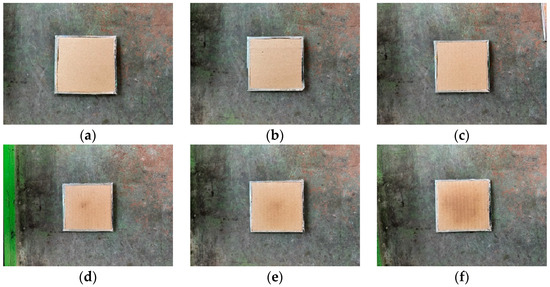
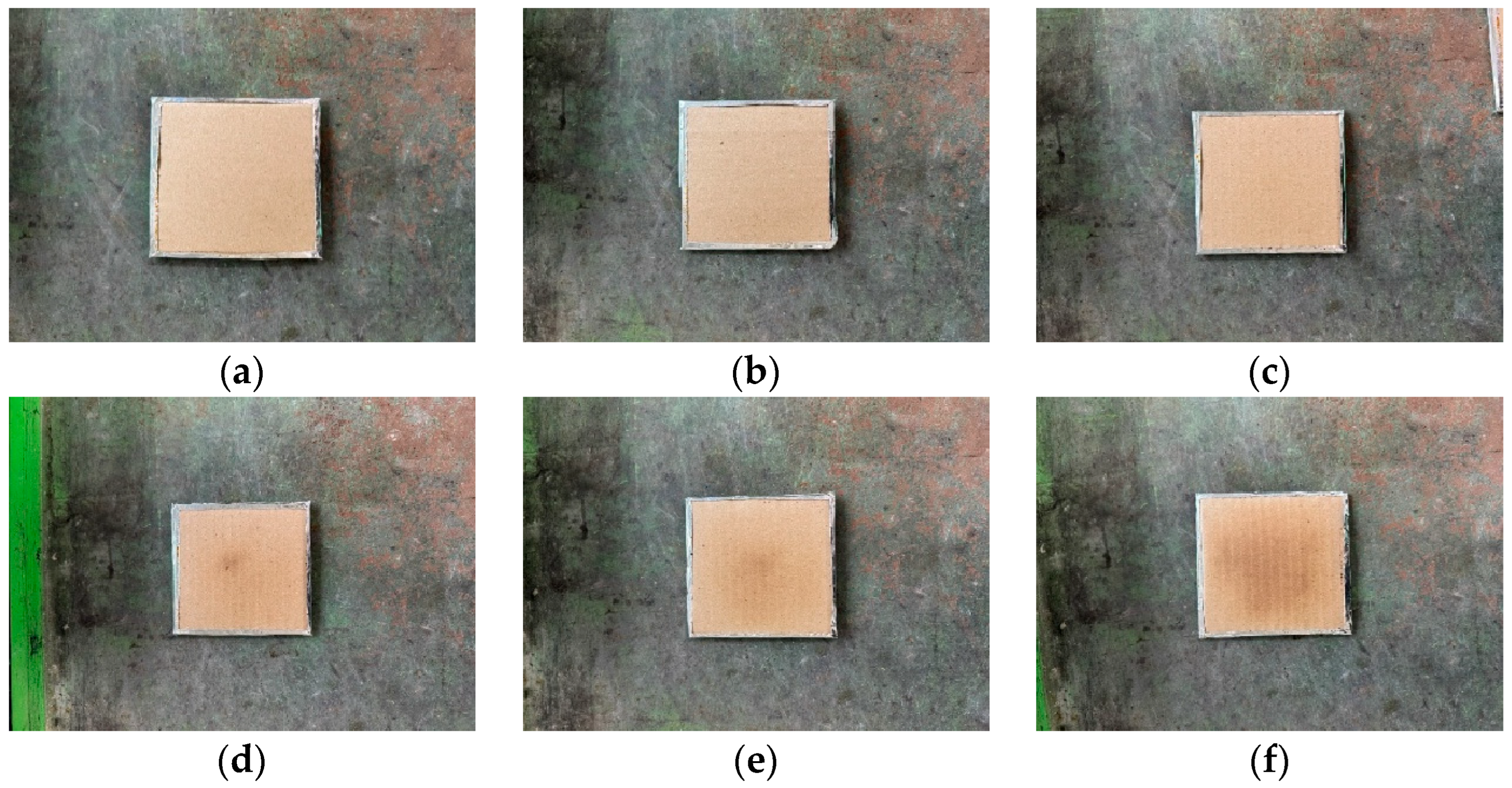
The results of the exposure tests at 10 kW/m2 are shown in Figure 1. No visible surface change was observed between 30 and 90 s of exposure, whereas slight browning appeared at the center after 120 s. Carbonization initiated near the center after 150 s and spread across most of the surface by 180 s.
Figure 1.
Images of corrugated cardboard after exposure to 10 kW/ radiant heat flux for different durations: (a) 30 s, (b) 60 s, (c) 90 s, (d) 120 s, (e) 150 s, and (f) 180 s.
3.3. Experimental Setup
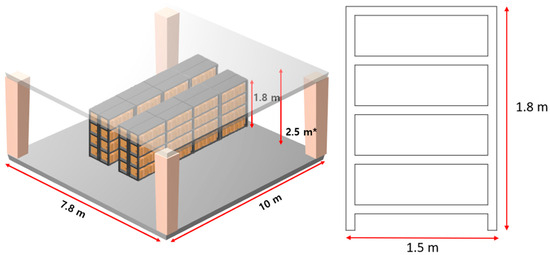
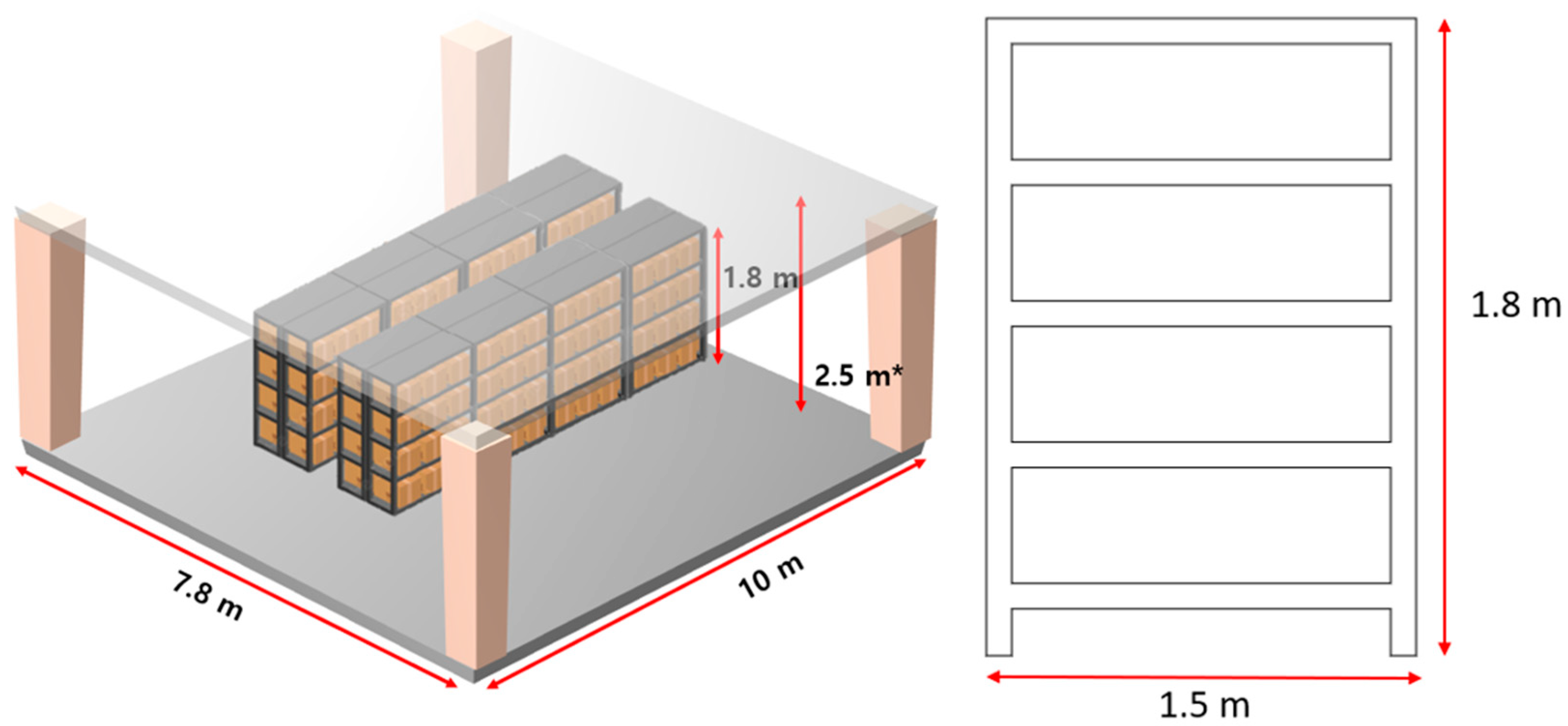
This experiment was conducted to determine the timing of flame spread between adjacent shelves and the effect of spacing within mezzanine structures during fire conditions. A test structure replicating the mezzanine configuration commonly found in logistics warehouses was fabricated. The width, depth, and height of the structure were 5, 7.8, and 2.6 m, respectively, and the floor-to-ceiling distance was 2.5 m. Two identical structures were connected to form the full experimental setup. The width, depth, and height of each rack used in the experiment were 1.5, 0.45, and 1.8 m, respectively. As shown in Figure 2, four rack rows were installed for each spacing condition. Each rack row consisted of four connected shelves forming a single-row configuration, and two adjacent rows formed a double-row rack arrangement. An identical pair of double-row racks was placed at varying separation distances to evaluate the effects of spacing. Each shelf contained 12 EPS commodity cartons, and 192 cartons were used per test (4 rows × 4 shelves/row × 12 cartons). The ignition source was placed at the lower central portion of the first shelf level of the fuel rack to ensure consistent and controlled ignition during each experiment. The experiments were conducted under natural ventilation conditions in a large-scale fire test hall. All openings in the test facility were closed to minimize the intrusion of outdoor airflow, and no forced ventilation was applied during testing. The average air velocity near the test area remained below 0.3 m/s.
Figure 2.
Mezzanine rack structures and racks used in the experiment.
3.4. Scenario Design
Four experimental scenarios, summarized in Table 3, were considered to analyze radiative heat-driven flame spread as a function of mezzanine shelf spacing. Radiative heat flux was first measured at separation distances ranging from 1 to 6 m, and full-scale flame propagation tests were conducted for each spacing condition. The measured data and observed results were then compared and analyzed to determine the relationship between rack spacing and fire spread behavior.
Table 3.
Scenarios used for radiative heat flux measurements and full-scale fire tests.
4. Variation in Flame Spread with Separation Distance
4.1. Measurement of Radiative Heat Flux
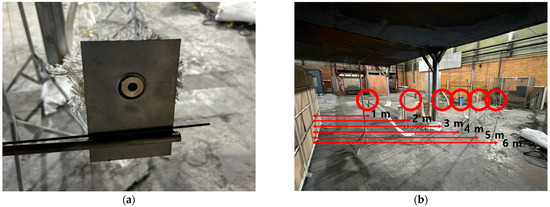
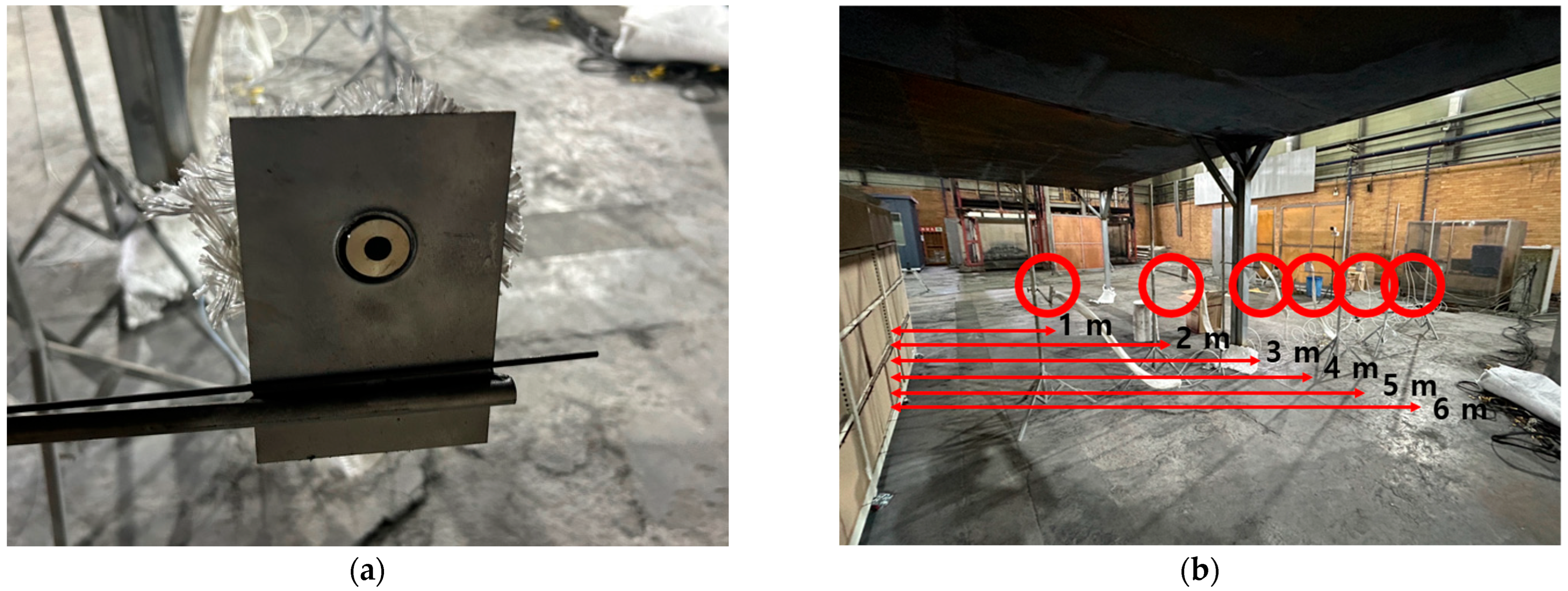
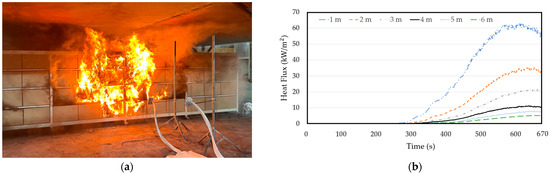
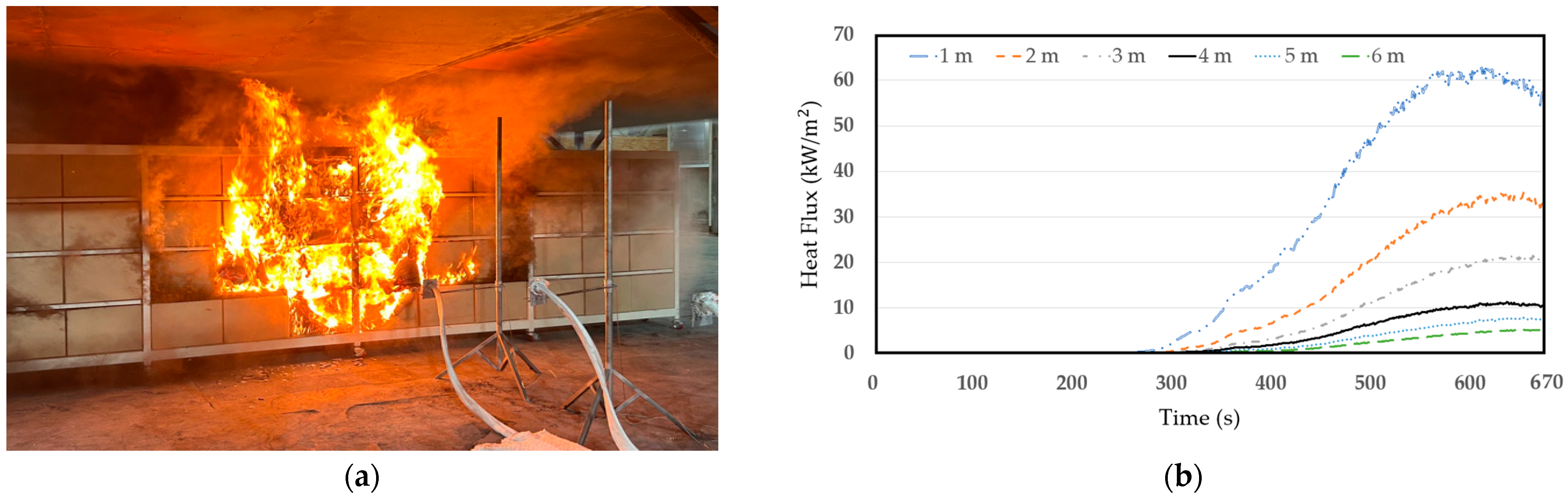
The radiative heat flux at various separation distances was measured using six water-cooled heat flux meters (Hukseflux SBG01-050, Delft, The Netherlands, Serial Nos. 15079, 15085, 15086, 15670, 15669, and 15668). The individual calibration sensitivities ranged from 0.272 to 0.373 × 10⁻⁶ V/(W/m2) with expanded uncertainties of ±0.015 to ±0.021 × 10⁻⁶ V/(W/m2) (coverage factor k = 2, 95% confidence level); all values were provided at the reference heat flux of 50 × 103 W/m2. The calibration specifications for each sensor are summarized in Table 4. The heat flux meters were mounted on a fixed jig and spaced at 1 m intervals, as shown in Figure 3, to measure the radiative heat flux at different locations. Approximately 120 s after the start of the test, a small piece of degreased cotton soaked in heptane was used as a pilot ignition source and placed at the lower central portion of the rack. The heptane-soaked cotton was ignited using an electrical spark igniter to ensure controlled and consistent ignition during each test. The fire was manually extinguished at approximately 670 s to prevent overflow and ensure safety. Figure 4a shows the experimental setup, and Figure 4b presents the recorded radiative heat flux results. The maximum radiative heat flux values were 63.3, 35.5, 21.7, 11.3, 7.8, and 5.2 kW/m2 at separation distances of 1, 2, 3, 4, 5, and 6 m, respectively, and occurred between 613 and 651 s. The slightly earlier peak at 613 s for the 1 m spacing is attributed to the complete combustion of combustibles located directly in front of the heat flux meter, after which the flame source diminished, inducing a subsequent decrease in the measured flux. During the test, the combustible gases accumulated between the burning rack and the ceiling ignited momentarily, resulting in a short-duration flame plume directed upward. This localized vertical flame temporarily increased the radiative heat flux as measured by the sensors located in the upper parts (2–6 m positions). The sensor at 1 m was positioned nearly perpendicular (≈90°) to the plume direction, and hence, the effect of the momentary ignition on this sensor was smaller. Consequently, the peak heat flux at 1 m appeared earlier with a different temporal profile compared to those at greater distances.
Table 4.
Heat flux sensors (Hukesflux SBG01-050) used in this study.
Figure 3.
Radiative heat flux measurement: (a) heat flux meter installed at the measurement position; (b) Arrangement of heat flux meters at different separation distances (1–6 m), where the red circles indicate the locations of the heat flux meters.
Figure 4.
Photographs and results of the radiant heat flux measurement: (a) photograph showing flame behavior during the test; (b) heat flux variation according to rack separation distance (1–6 m).
4.2. Adjacent Rack Flame Propagation Test
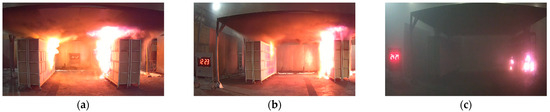
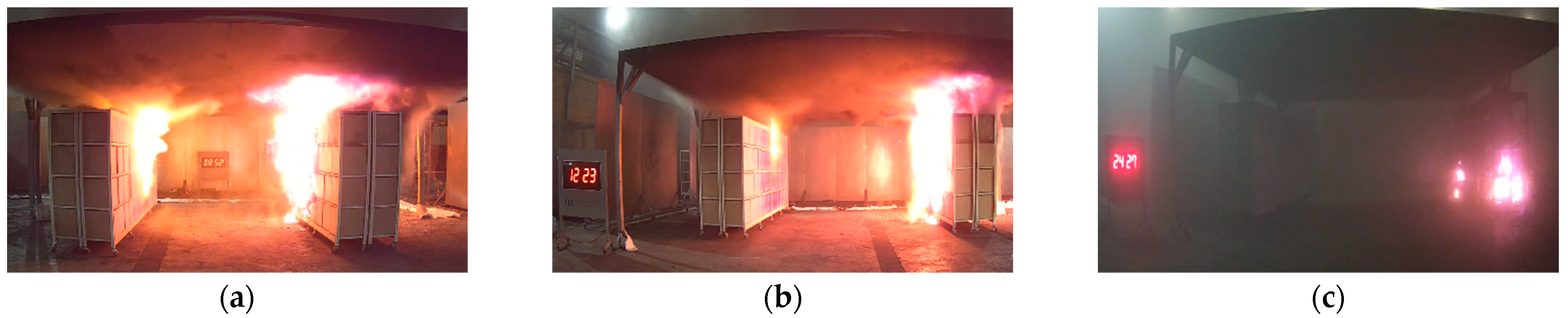
The separation distances for flame propagation tests between adjacent racks were set to 3, 4, and 5 m. Approximately 120 s after the start of each test, ignition was initiated using a small piece of degreased cotton soaked in heptane, placed at the lower central portion of the rack. The ignition time of the adjacent rack was defined as the moment when visible flames appeared on its stored materials, and these ignition times are presented in Figure 5. Ignition occurred at 532 s at 3 m spacing and at 743 s at 4 m spacing, whereas no ignition occurred at 5 m spacing. At 3 and 4 m separations, charring and the gradual release of flammable gases from the corrugated boxes placed in the adjacent rack were observed before ignition occurred after a delay. However, at 5 m, charring and gas release were minimal, and ignition did not occur throughout the combustion period of the fuel rack.
Figure 5.
Photographs of flame propagation according to rack separation distance: (a) 3 m, (b) 4 m, and (c) 5 m. No ignition occurred until the end of the test for the separation distance of 5 m.
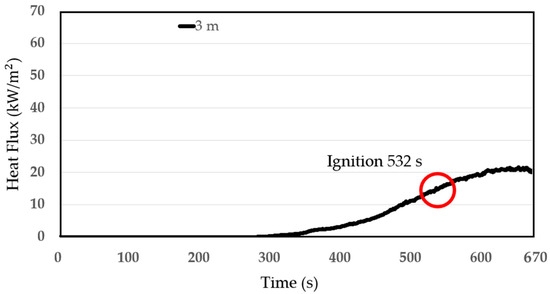
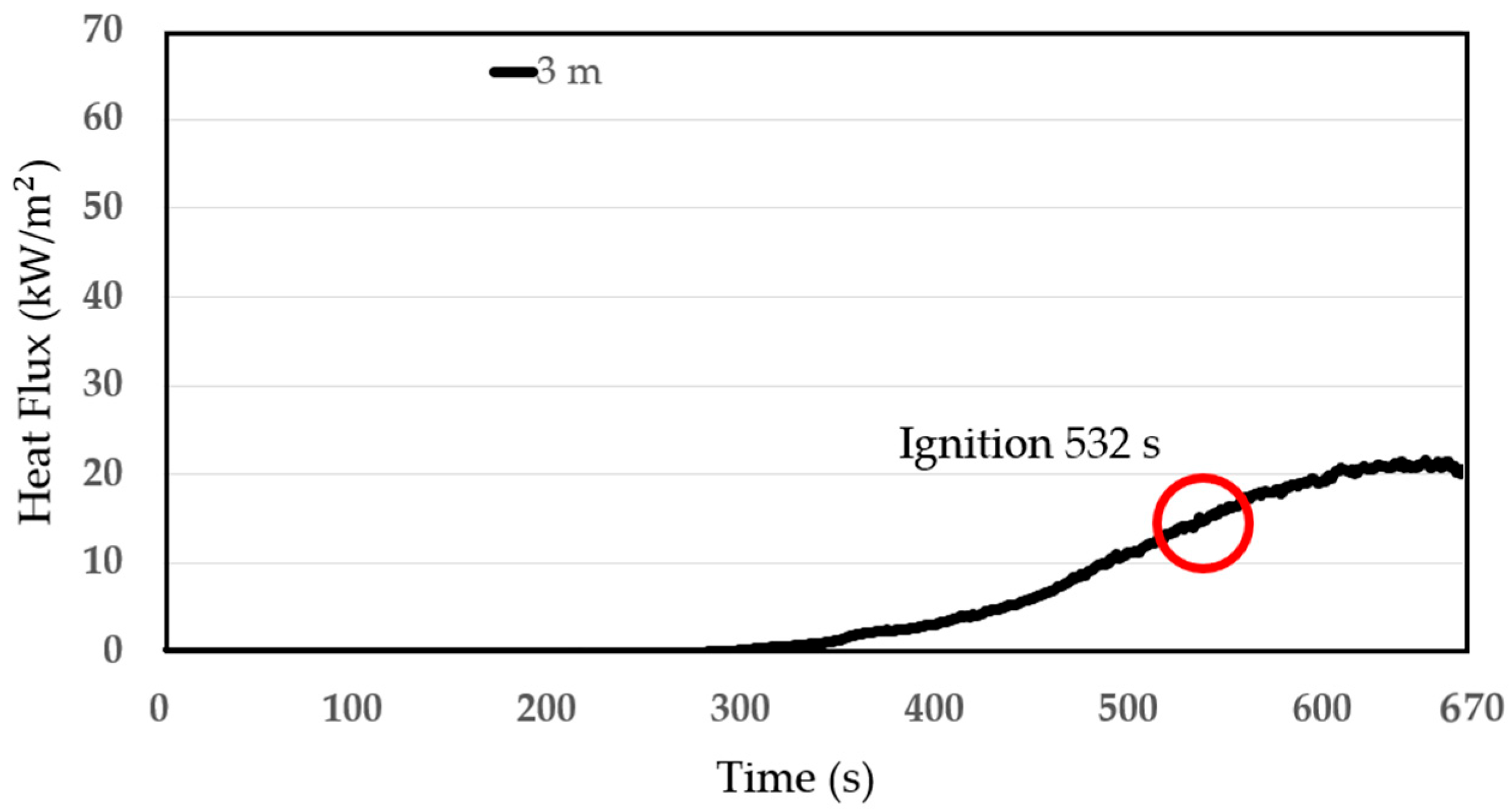
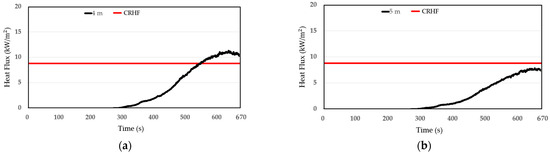
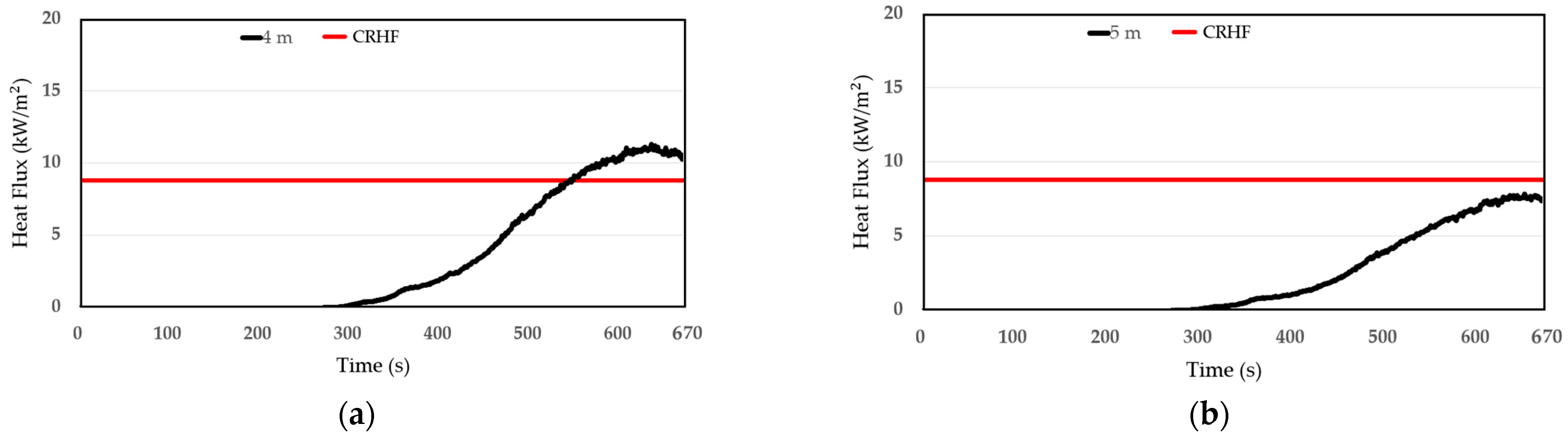
To compare flame propagation times with radiative heat flux, Figure 6 shows the radiative heat flux curve for the 3 m spacing, wherein the ignition time for the adjacent rack is marked. For the 4 and 5 m separations, flame spread occurred after the heat flux measurement test or did not occur at all; Figure 7 shows the results for these separations and includes a reference line indicating the CRHF of the corrugated cardboard for comparison. At 3 m spacing, ignition occurred 56 s after the radiative heat flux reached the CRHF, corresponding to a flux level of 14.0 kW/m2. At 4 m, ignition occurred during the decay phase after the heat flux had reached its maximum value of 11.3 kW/m2, approximately 200 s after reaching the CRHF. This trend is consistent with the cone calorimeter results, wherein ignition occurred at approximately 200 s under a 10 kW/m2 heat flux condition. For the 5 m spacing, the maximum radiative heat flux was 7.8 kW/m2, and no ignition was observed. These results align with results reported in previous studies as well as with the cone calorimeter test results, which reported a minimum ignition threshold of approximately 8.5 kW/m2 for corrugated cardboard [15]. As summarized in Table 5, ignition occurred only when the radiative heat flux exceeded the lower bound of pyrolysis-driven ignition and was sustained for a sufficient duration. These comparisons verify that a separation distance of at least 5 m can suppress radiative ignition under the tested warehouse conditions.
Figure 6.
Heat flux profile at 3 m separation showing ignition at 532 s.
Figure 7.
Radiant heat flux profiles at rack separation distances of (a) 4 m and (b) 5 m, with the CRHF indicated in red.
Table 5.
Radiative heat flux and ignition behavior according to rack spacing.
5. Conclusions
In this study, we addressed the limitations of previous numerical and single-rack studies via full-scale experiments to quantitatively determine the correlations among shelf spacing, radiative heat flux, and ignition time beneath mezzanine racks. In particular, the radiative flame-spread characteristics were experimentally verified via a combination of cone calorimeter tests to determine the CRHF and full-scale fire experiments. The following conclusions were drawn.
- Radiative Heat Flux Characteristics:
The radiative heat flux decreased nonlinearly with an increase in the shelf spacing. The maximum measured fluxes at distances of 1, 2, 3, 4, 5, and 6 m were 63.3, 35.5, 21.7, 11.3, 7.8, and 5.2 kW/m2, respectively, consistent with the inverse-square relationship between radiative heat transfer and separation distance.
- Ignition Behavior and Comparison with Critical Radiant Heat Flux:
In the adjacent rack flame propagation tests, ignition occurred at 532 s at 3 m spacing, corresponding to a heat flux of 14.0 kW/m2. At 4 m spacing, ignition occurred at 743 s with a maximum heat flux of 11.3 kW/m2. At 5 m spacing, ignition did not occur because the maximum heat flux of 7.8 kW/m2 was below the CRHF of corrugated cardboard (≈8.5 kW/m2).
- Flame Spread Mechanism:
At 3 and 4 m separations, radiative heat from the burning shelf induced charring and the generation of combustible gases on the surfaces of the adjacent corrugated boxes, causing ignition after a time delay. At 5 m or greater, the radiative heat intensity was insufficient to increase the surface temperature to the ignition threshold, and neither charring nor flame spread was observed. These results were obtained under idealized natural ventilation, as the test structures were connected and all openings were closed during the experiment. Therefore, stronger ventilation or external airflow in real-world warehouse environments may promote faster flame spread.
- Implications for Fire Safety Design:
The findings demonstrate the importance of establishing a minimum spacing standard between shelves in mezzanine configurations to prevent radiative flame spread. Our results suggest a minimum shelf spacing of 5 m as a fire-safety design requirement for mezzanine rack warehouses to prevent radiative flame spread. For high-risk commodities such as corrugated cardboard and EPS, a spacing of at least 5 m can effectively inhibit flame propagation. The quantified relationship between radiative heat flux and shelf spacing presented in this study provides valuable baseline data for developing fire-safety design guidelines for mezzanine rack structures. Future research should extend the analysis to various combustible combinations, storage densities, and ventilation conditions, and consider the effects of automation systems and sprinkler operation to further enhance the applicability of these results to real-world warehouse environments.
Author Contributions
Conceptualization, J.M.; Methodology, I.K.K.; Investigation, N.J.; Writing—original draft, B.L.; Writing—review & editing, J.M. All authors have read and agreed to the published version of the manuscript.
Funding
This work was supported by the Korea Agency for Infrastructure Technology Advancement (KAIA) grant funded by the Ministry of Land, Infrastructure and Transport (Grant RS–2022–00156237).
Institutional Review Board Statement
Not applicable.
Informed Consent Statement
Not applicable.
Data Availability Statement
The original contributions presented in the study are included in the article; further inquiries can be directed to the corresponding author.
Conflicts of Interest
The authors declare no conflicts of interest. The funders had no role in the design of the study; in the collection, analysis, or interpretation of data; in the writing of the manuscript; or in the decision to publish the results.
Abbreviations
The following abbreviations are used in this manuscript:
| CEP | cartoned expanded plastic |
| CRHF | critical radiant heat flux |
| EPS | expanded polystyrene |
References
- Bošković, G.; Todorović, M.; Ubavin, D.; Stepanov, B.; Mihajlović, V.; Perović, M.; Čepić, Z. A New Method for the Determination of Fire Risk Zones in High–Bay Warehouses. Fire 2024, 7, 149. [Google Scholar] [CrossRef] [Scilit]
- Annual Report on Fire Statistics in the Republic of Korea 2023; National Fire Agency: Seoul, Republic of Korea, 2023.
- Lönnermark, A.; Ingason, H. Fire Spread in Large Industrial Premises and Warehouses; SP Report 2005:21; SP Fire Technology, Swedish National Testing and Research Institute: Borås, Sweden, 2005.
- Ingason, H. An Experimental Study of Rack Storage Fires; SP Report 2001:19; SP Fire Technology, Swedish National Testing and Research Institute: Borås, Sweden, 2001.
- Joint Report of the Korean Government. Analysis on the Cause of Fire in the Warehouse and Measures to Prevent Recurrence; Ministry of Land, Infrastructure and Transport: Sejong City, Republic of Korea; National Fire Agency: New Taipei City, Republic of Korea; Ministry of the Interior and Safety: Sejong City, Republic of Korea; Ministry of Trade, Industry and Energy: Seoul, Republic of Korea, 2022.
- Cho, G.H.; Yun, H.S. Analytical Study on the Settings and Fire Spreading Characteristics of Representative Rack Structures in Korean Logistics Facilities. J. Korean Soc. Hazard Mitig. 2024, 24, 123–129. [Google Scholar] [CrossRef] [Scilit]
- Cho, G.H.; Yeo, I.H. Evaluation on Fire Spread Speed of Standard Rack in Korea for Performance–Based Fire Extinguishing System. Fire Sci. Eng. 2016, 30, 84–91. [Google Scholar] [CrossRef] [Scilit]
- Lee, S.B.; Kim, M.S.; Min, S.H. A Study on the Comparison of Aspirating Smoke Detector and General Smoke Detector Detection Time according to the Fire Speed and Location of Logistics Warehouse through FDS. J. Soc. Disaster Inf. 2023, 19, 608–623. [Google Scholar] [CrossRef]
- Kubasakova, I.; Kubanova, J.; Benco, D.; Kadlecová, D. Implementation of Automated Guided Vehicles for the Automation of Selected Processes and Elimination of Collisions between Handling Equipment and Humans in the Warehouse. Sensors 2024, 24, 1029. [Google Scholar] [CrossRef] [Scilit] [PubMed]
- Choi, K.O.; Choi, D.M. Experimental Study on the Suppression Performance of Sprinkler Systems in Rack–Type Warehouses. Fire Sci. Eng. 2019, 33, 44–50. [Google Scholar] [CrossRef] [Scilit]
- Autiero, M.; De Silva, D.; Alam, N.; Nigro, E. Structural Performance of Steel Automated Rack–Supported Warehouses under Fire. Fire Saf. J. 2025, 156, 104475. [Google Scholar] [CrossRef] [Scilit]
- Lee, B.H.; Jeon, N.; Min, J.K. Full–Scale Fire Experiment on Mezzanine Racks in Logistics Facilities. Fire 2024, 7, 326. [Google Scholar] [CrossRef] [Scilit]
- Sacadura, J.F. Radiative Heat Transfer in Fire Safety Science. J. Quant. Spectrosc. Radiat. Transf. 2005, 93, 5–24. [Google Scholar] [CrossRef] [Scilit]
- Filkov, A.I.; Tihay-Felicelli, V.; Masoudvaziri, N.; Rush, D.; Valencia, A.; Wang, Y.; Blunck, D.L.; Valero, M.M.; Kempna, K.; Smolka, J.; et al. A Review of Thermal Exposure and Fire Spread Mechanisms in Large Outdoor Fires and the Built Environment. Fire Saf. J. 2023, 140, 103871. [Google Scholar] [CrossRef] [Scilit]
- Khan, M.M.; De Ris, J.L.; Ogden, S.D. Effect of Moisture on Ignition Time of Cellulosic Materials. Fire Saf. Sci. 2008, 9, 167–178. [Google Scholar] [CrossRef] [Scilit]
- Global, F.M. FM Global Property Loss Prevention Data Sheets 8–1: Commodity Classification; FM Global: Johnston, RI, USA, 2024. [Google Scholar]

Disclaimer/Publisher’s Note: The statements, opinions and data contained in all publications are solely those of the individual author(s) and contributor(s) and not of MDPI and/or the editor(s). MDPI and/or the editor(s) disclaim responsibility for any injury to people or property resulting from any ideas, methods, instructions or products referred to in the content. |
© 2025 by the authors. Licensee MDPI, Basel, Switzerland. This article is an open access article distributed under the terms and conditions of the Creative Commons Attribution (CC BY) license (https://creativecommons.org/licenses/by/4.0/).