


Abstract
Fully dense monoclinic zirconia ceramics were successfully fabricated by pressureless sintering and/or HIP. Although monoclinic zirconia exhibits unique physicochemical properties, fabrication of fully dense polycrystalline bodies has remained challenging due to catastrophic volume expansion during the tetragonal-to-monoclinic transformation. By introducing a synergistic ternary (Ga2O3-ZnO-TiO2) sintering aid, a relative density exceeding 99.6% with an average grain size of 0.5–2 µm was achieved by sintering under an oxygen atmosphere at 1070 °C for 3–100 h, well below the phase-transition temperature. X-ray diffractometry confirmed a single-phase monoclinic structure. Subsequent hot isostatic pressing at 1080 °C and 180 MPa for 2 h eliminated residual porosity, yielding a 4-point bending strength of 328 MPa, a fracture toughness of 2.7 MPa·m0.5, and a Vickers hardness HV1 of 805. This monoclinic zirconia ceramic exhibited ~30% total transmittance, while in-line transmittance remained below 0.1% due to intrinsic birefringence of the monoclinic lattice. These results established a low-temperature route for densifying phase-sensitive ceramics while achieving long-term stability.
1. Introduction
Zirconia (ZrO2) possesses unique properties, with its crystal structure and physical characteristics significantly altered by the addition of yttrium (Y) or lanthanide rare-earth elements. Partially stabilized zirconia (PSZ), which maintains a tetragonal structure, is widely utilized in engineering applications [1,2,3,4] such as dental prosthetics [5], bearings, and grinding media [6,7,8]. When fully stabilized in a cubic structure, it can be employed as a functional material in oxygen sensors [9,10,11,12,13,14] and fuel cells [15,16,17,18,19,20] due to its high ionic conductivity. Furthermore, its high refractive index, comparable to that of diamond, has led to its use in synthetic gemstones [21,22,23]. However, the synthesis of high-density monoclinic ZrO2 ceramics without such stabilizers remains extremely difficult, and as a result, its detailed physical properties have yet to be fully clarified.
Zirconia exhibits three primary crystal structures—monoclinic, tetragonal, and cubic—which transition sequentially depending on the type and concentration of the stabilizer. While zirconia adopts a monoclinic structure at room temperature, it undergoes a phase transition (monoclinic ↔ tetragonal) at approximately 1170 °C [24,25,26,27,28,29]. Consequently, when sintering zirconia without stabilizers, a volume expansion of approximately 4% occurs during the cooling process, leading to the catastrophic failure (cracking or disintegration) of the sintered body [28]. To address this issue, Eichler et al. [26] attempted to forcefully increase the green density by applying high-pressure cold isostatic pressing (CIP) at 510 MPa, followed by sintering at 1105 °C for 5 h. However, the resulting relative density reached only about 92%, with a bending strength of 220 MPa and a fracture toughness of 2 MPa·m0.5. Skandan et al. [30] synthesized single-nanometer-sized monoclinic ZrO2 powders using a vapor-phase method and compacted the powders under pressures up to 400 MPa. However, even after sintering in air at temperatures between 1050 and 1150 °C, the relative density of the sintered bodies only reached approximately 90–92%. Yoshida et al. [31] reported that commercially available monoclinic ZrO2 powders (without Y2O3 stabilizers) could be densified to a relative density of 99% (5.75 g·cm−3) by capsule hot isostatic pressing (HIP) at 1000 °C under a pressure of 196 MPa using borosilicate glass encapsulation after forming. These results indicate that, even with the application of high compaction pressures or ultrafine powders, the fabrication of highly dense monoclinic zirconia ceramics remains extremely challenging. Because it is difficult to obtain sintered bodies with relatively high density (relative density > 90%) at low temperatures, the synthesis of dense monoclinic zirconia ceramics has been limited to methods relying on capsule HIP, which suffers from significant economic and technical constraints. Cutler et al. [32] achieved densification by sintering zirconia at 2440 °C followed by rapid cooling and subsequent annealing at 1000 °C to reduce oxygen vacancies and induce the phase transformation to the monoclinic phase; however, the resulting ceramics were not single-phase monoclinic zirconia, and extensive microcracking was observed.
Previously, transparent Gd2O3 ceramics with a cubic structure at a low temperature below 1100 °C were successfully fabricated by adding a ternary sintering aid (TiO2-ZnO-Ga2O3 system) to rare-earth oxides with large ionic radii, which face similar processing technical challenges [33]. In this study, this methodology was applied to achieve high-density monoclinic zirconia through pressureless sintering at temperatures below 1100 °C. Furthermore, HIP treatment at 1080 °C was employed to achieve full densification. By utilizing a ternary oxide additive strategy, densification could be achieved at temperatures below the tetragonal–monoclinic phase transition, thereby suppressing catastrophic transformation-induced damage. As a result, a single-phase monoclinic zirconia ceramic with a relative density exceeding 99.9% was obtained. To the best of our knowledge, this study provides one of the first demonstrations of bulk, fully dense monoclinic zirconia ceramics approaching theoretical density. Although the physical properties of monoclinic zirconia ceramics have remained largely unexplored, the successful synthesis and characterization of bulk fully dense monoclinic zirconia reported in this study are expected to open new opportunities for understanding its intrinsic properties and for developing future functional and industrial applications.
2. Experimental Procedures
High-purity zirconia powder (ZrO2 + HfO2 > 99.9%, primary particle size: 90 nm) was used as the starting material. To investigate the sintering behavior, two types of sintering aids were prepared: (1) a TiO2-ZnO-Ga2O3 (TiO2:ZnO:Ga2O3 = 20:60:20 mass % ratio) ternary system added to total concentrations of up to 1.2 wt.%, and (2) a conventional alumina source (alumina sol) added at 0.2–1.0 wt.% as a reference for partially stabilized zirconia additives. The powders were mixed with an acrylic organic binder (2 wt.%) and ethanol as a solvent. The mixture was ball-milled for 20 h using yttria-stabilized zirconia (YTZ) balls. The resulting slurry was dried using a hot stirrer to evaporate the solvent, followed by sieving through a #150 mesh. The granulated powder was then uniaxially pressed at 10 MPa using dies (round (Φ18–80 mm) or rectangular (10 × L120 mm)), and subsequently subjected to CIP at 98 MPa. The green bodies were heated over 10 h up to 600 °C to thermally decompose the organic binder and components, and then they were sintered in an oxygen atmosphere at temperatures ranging from 800 °C to 1500 °C for 1 h to evaluate sintering density (heating and cooling rate: 300 °C/h). To observe microstructural evolution, isothermal sintering was performed at 1070 °C for durations of 3 to 100 h. Pre-sintered bodies (1050 °C, 3 h) were HIP treated at 1080 °C (heating and cooling rate: 600 °C/h) and 180 MPa in an argon (Ar gas) atmosphere for 2 h to achieve full densification.
The crystalline phases of the synthesized ceramics were identified by X-ray diffractometry (XRD: MiniFlex, Rigaku, Tokyo, Japan). Microstructural analysis and elemental mapping were conducted via scanning electron microscopy and energy dispersive spectroscopy (SEM-EDS: X’Pert PRO Alpha-1, PANalytical, Almelo, The Netherlands) on fracture surfaces or mirror-polished surfaces subjected to thermal etching at 950 °C for 10 h. Optical properties, including in-line and total transmittance, were measured using a UV-Vis/NIR spectroscopy (V-670, JASCO, Tokyo, Japan) on samples polished to a mirror finish on both sides. Mechanical properties were evaluated as follows. Four-point bending strength was measured using a universal testing machine (5562, Instron, Tokyo, Japan) according to Japanese industrial standards (JIS R1601), which is equivalent to ASTM C1161. For this measurement, rectangular bar specimens with dimensions of 3 mm × 4 mm × 40 mm were prepared. Fracture toughness (K1C) was determined via the single-edge precracked beam (SEPB) method according to JIS R1607, which is comparable to ASTM C1421. The notch tip radius (R) was approximately 100 μm. Vickers hardness (HV1) was measured using a microhardness tester (HMV-G, Shimadzu, Tokyo, Japan) in accordance with JIS Z2244 (equivalent to ASTM E384).
3. Results and Discussion
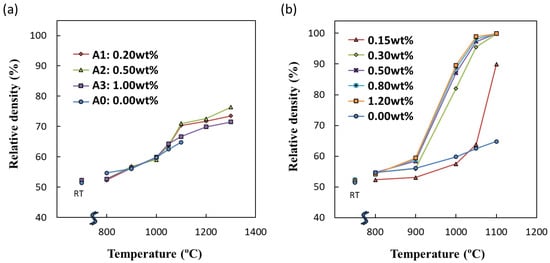
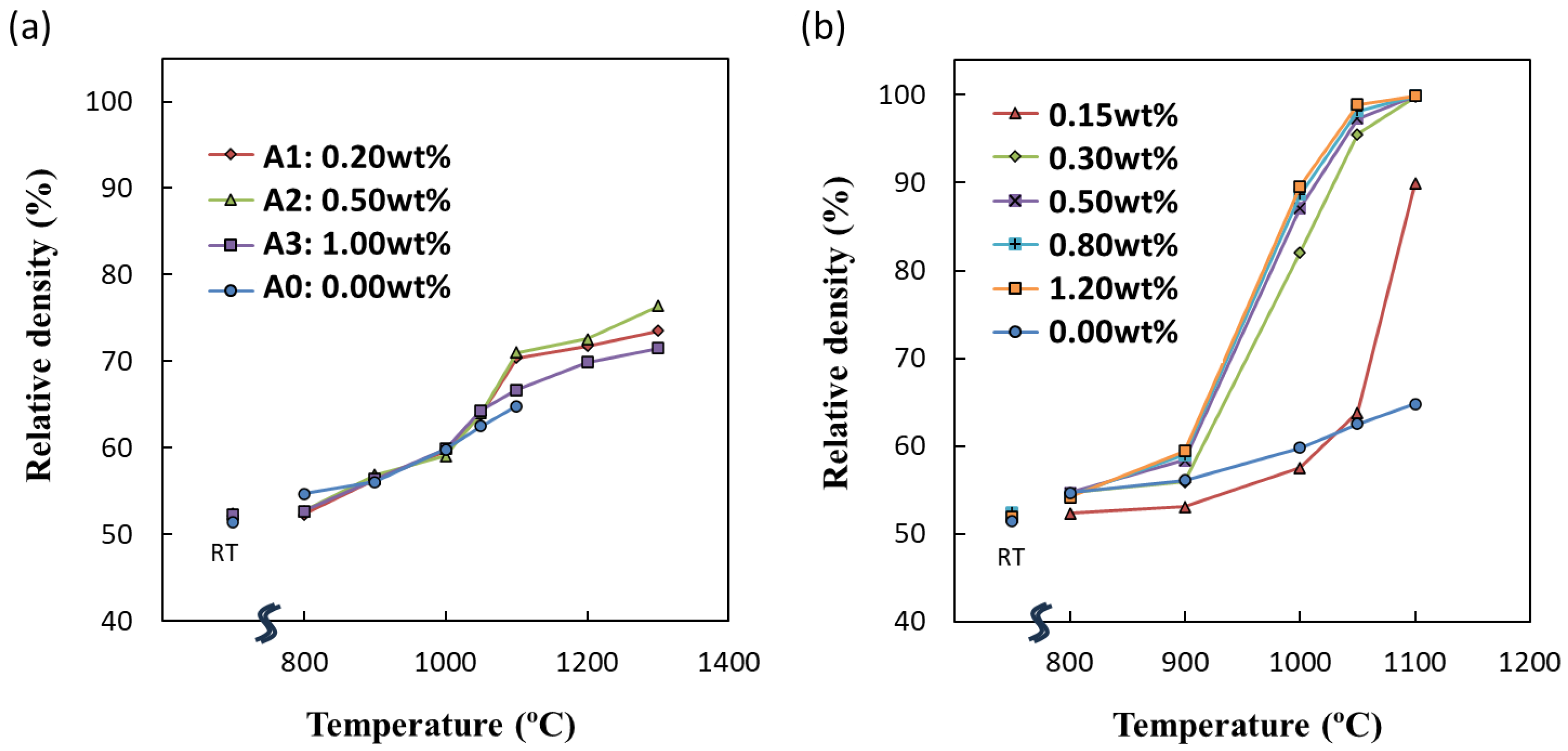
Figure 1a,b illustrate the sintering behavior of zirconia powder compacts sintered for 1 h at various temperatures, comparing the effects of no additives (0.00 wt.%), alumina-based additives, and the proposed ternary sintering aids. In the absence of sintering aids (the 0.00 wt.% sample), densification was extremely limited, reaching a relative density of only 64% even at 1100 °C. While the addition of alumina slightly enhanced densification compared to the sample without sintering aids (0.00 wt.%), the improvement remained marginal. Although alumina-doped specimens could exceed a relative density of 70% at a sintering temperature of 1300 °C, this temperature was already well above the monoclinic-to-tetragonal phase transition point. In stark contrast, samples incorporating the ternary sintering aid exhibited a dramatic onset of densification at temperatures exceeding 900 °C, provided that the additive concentration is at least 0.3 wt.% (Figure 1b). Remarkably, these specimens achieved a relative density exceeding 98% at 1050–1100 °C. This sintering performance far surpassed that of conventional alumina-based sintering aids, enabling full densification at temperatures approximately 100 °C below the critical phase transition threshold.
Figure 1.
Sintering behavior of ZrO2 compacts with (a) Al2O3 additive and (b) ternary additive.
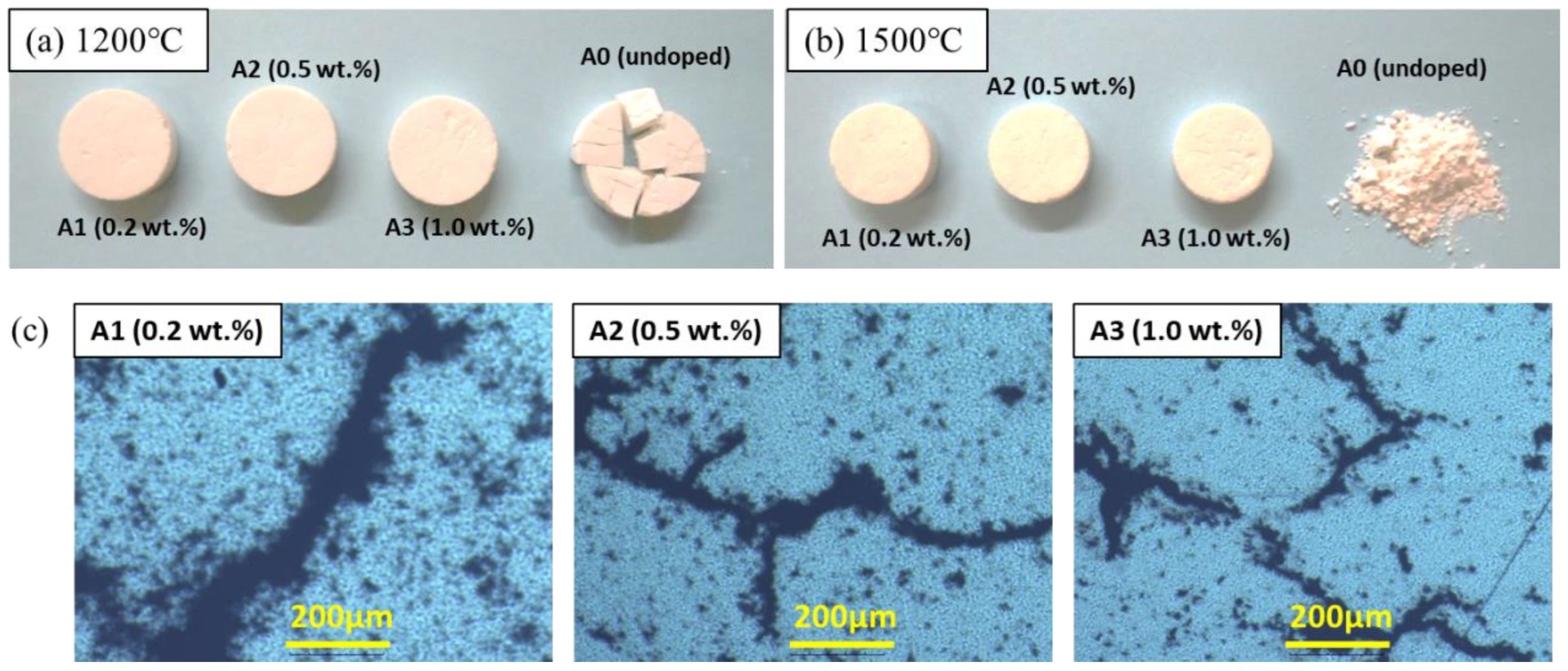
Figure 2a,b show the macroscopic appearance of zirconia specimens without sintering additives and those containing 0.2–1.0 wt% alumina-based additives, sintered at 1200 °C and 1500 °C for 10 h. The extended dwell time was employed to achieve further densification compared with the specimens shown in Figure 1. However, the additive-free specimens underwent severe degradation, resulting in disintegration or complete pulverization after sintering. In contrast, the alumina-doped specimens retained their overall shape and exhibited slightly higher densities than those sintered at the same temperatures in Figure 1a. Microstructural observations performed by reflected-light microscopy on polished cross sections are shown in Figure 2c as representative images of the specimen sintered at 1500 °C. A large number of internal cracks were clearly observed throughout the bulk. Notably, extensive cracking was also detected in specimens sintered at 1200 °C, which is near the monoclinic–tetragonal phase transition temperature. As a result, the relative densities of the alumina-doped specimens remained limited to approximately 73% and 79% for the samples sintered at 1200 °C and 1500 °C, respectively. These results indicated that prolonged high-temperature sintering with conventional alumina additives did not effectively suppress internal stress generation associated with phase transformation, leading to crack formation and limited densification. This behavior underscores the necessity of a low-temperature sintering strategy to achieve structurally stable and highly densified monoclinic zirconia ceramics.
Figure 2.
Appearance of samples after sintering at (a) 1200 °C and (b) 1500 °C, and (c) microstructure by reflection microscopy after sintering at 1500 °C.
The sintering additives used in this study consisted of (1) TiO2, (2) ZnO, and (3) Ga2O3. The ionic radius of Ti4+ (0.68 Å) is approximately 15% smaller than that of Zr4+ (0.80 Å), and according to the ZrO2–TiO2 phase diagram [34], Ti4+ can substitute for Zr4+ in the ZrO2 lattice within a few mol%. TiO2 has therefore been widely used as a sintering additive in the fabrication of transparent cubic zirconia ceramics, as reported in previous studies [35,36,37]. ZnO has long been utilized as a glaze component and a sintering aid in ceramic materials [38,39]. The ionic radius of Zn2+ (0.74 Å) is close to that of Zr4+, allowing for partial substitution in the zirconia lattice. Such substitution is accompanied by the formation of oxygen vacancies, which enhances the diffusion coefficient of O2− ions within zirconia grains and thereby promotes sintering. The ionic radius of Ga3+ is relatively small (0.62 Å), and thus only limited substitution for Zr4+ is expected. Nevertheless, Ga2O3 has been reported to effectively reduce the sintering temperature of ZrO2 ceramics [40]. While the individual effects of these oxide additives on the sintering behavior of zirconia ceramics will be discussed separately, the simultaneous addition of the three sintering aids was intended to exploit their synergistic effects. This combined-additive approach was highly effective for the fabrication of dense monoclinic zirconia ceramics at low sintering temperatures in this work.
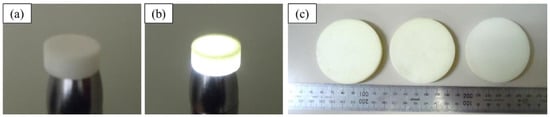
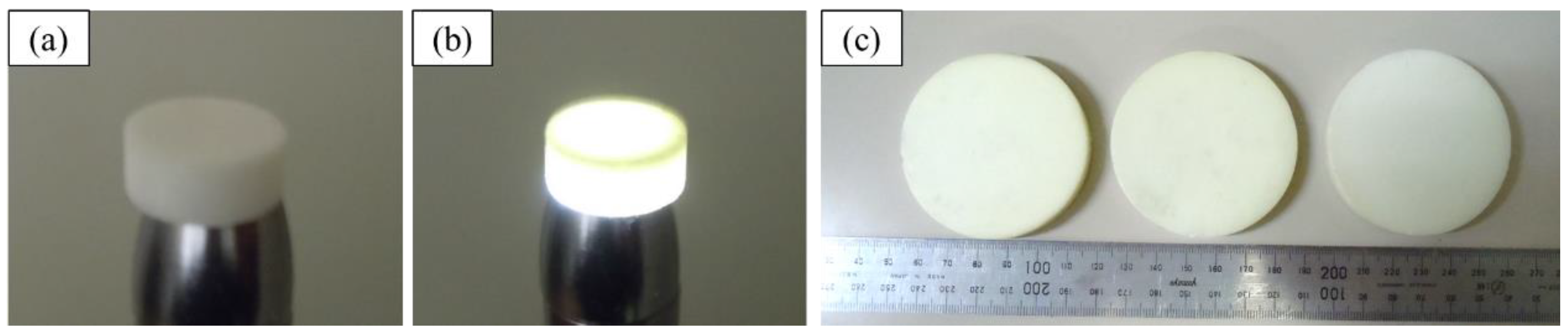
Figure 3a shows a ZrO2 specimen containing 0.8 wt.% ternary additive, sintered at 1070 °C for 5 h. The exceptionally high relative density of the material is visually demonstrated in Figure 3b, where the specimen exhibits significant translucency under white LED irradiation. This light-scattering behavior throughout the bulk was consistent with a pore-free microstructure that minimizes internal reflection. Furthermore, the scalability of this low-temperature sintering route was confirmed by the successful synthesis of large-scale bulk ceramics (up to Φ60 × t10 mm and 9 × 20 × 96 mm) via subsequent HIP treatment (Figure 3c). These fully dense components not only maintained their optical translucency but also exhibited a clear metallic ringing sound upon mechanical impact, providing qualitative yet definitive evidence of superior structural integrity and the absence of internal macro-defects.
Figure 3.
(a) Appearance of monoclinic ZrO2 ceramic sample with Φ15 mm and 7 mm thickness sintered at 1070 °C. (b) The same sample under white-LED irradiation. (c) Large-scale bulk ceramics (Φ60 mm and 10 mm thick) synthesized via HIP treatment at 1080 °C for 3 h.
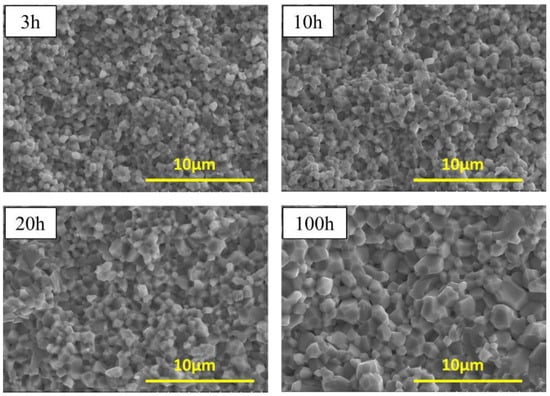
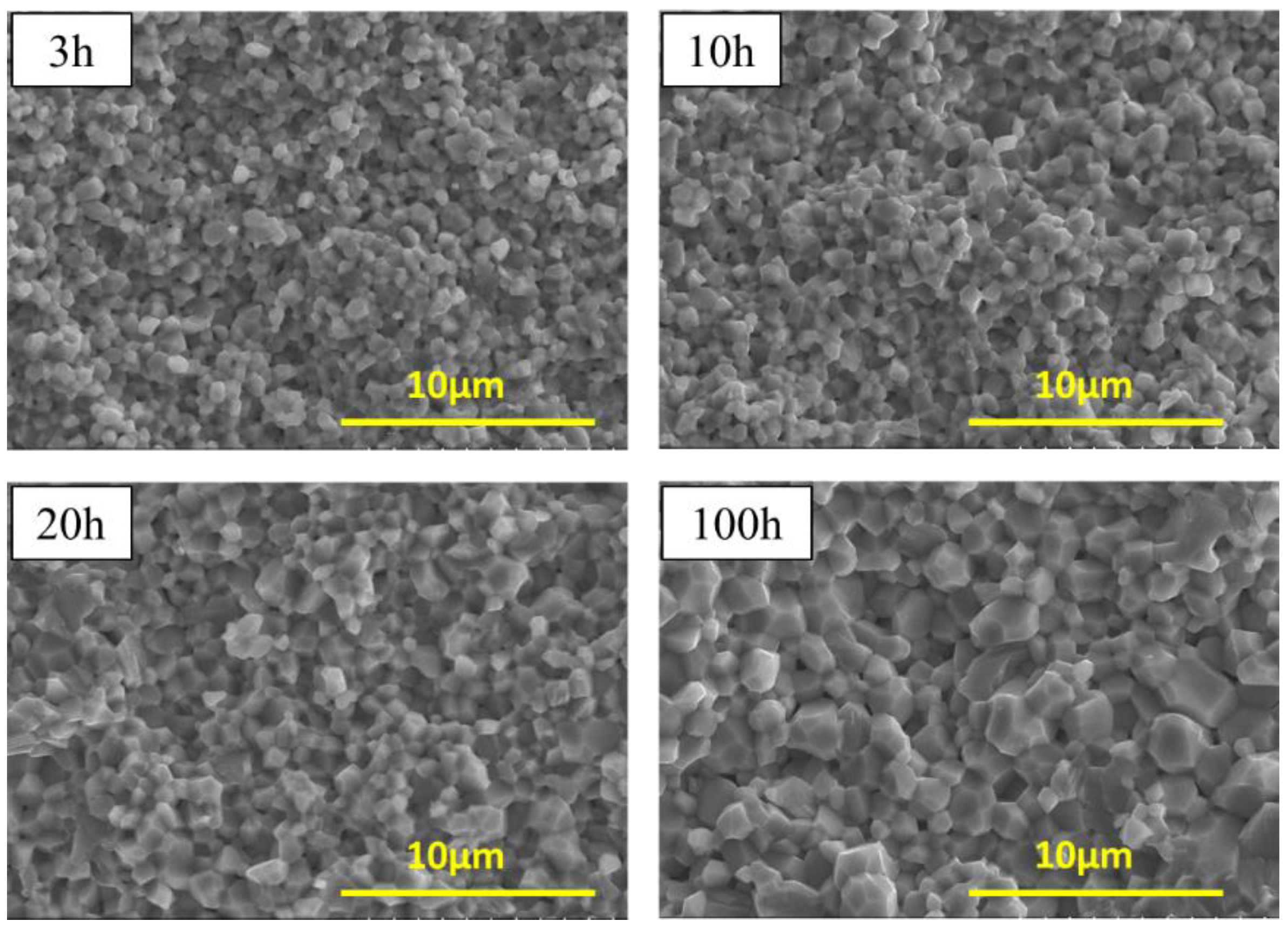
Figure 4 presents the SEM micrographs of fracture surfaces for ZrO2 compacts sintered at 1070 °C in an oxygen atmosphere for durations ranging from 3 to 100 h. After only 3 h of sintering, the specimens exhibited a fine-grained microstructure with an average grain size of approximately 0.5 µm and a relative density of 99.6%. Prolonging the sintering time facilitated further densification accompanied by grain growth; after 100 h, the relative density reached >99.9% with the grain size increasing to approximately 2 µm. Although further densification occurred due to volume diffusion and grain growth during isothermal sintering, no significant grain growth, no abnormal grains were observed. The grain edges were also very sharp, and hence it was assumed that the sintering aids did not form a liquid phase during sintering. Notably, even after extended thermal treatment at 1070 °C, the samples maintained their structural integrity without the micro-cracking which is typically observed during monoclinic zirconia sintering.
Figure 4.
Fracture surfaces of monoclinic ZrO2 ceramics sintered at 1070 °C for 3 to 100 h in an oxygen atmosphere.
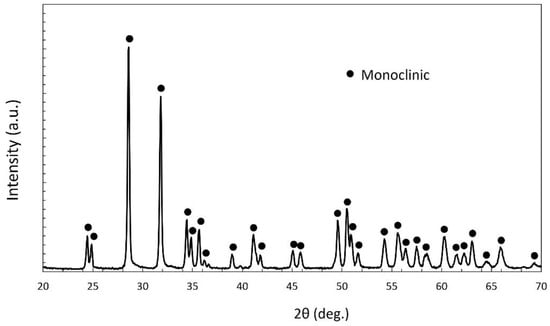
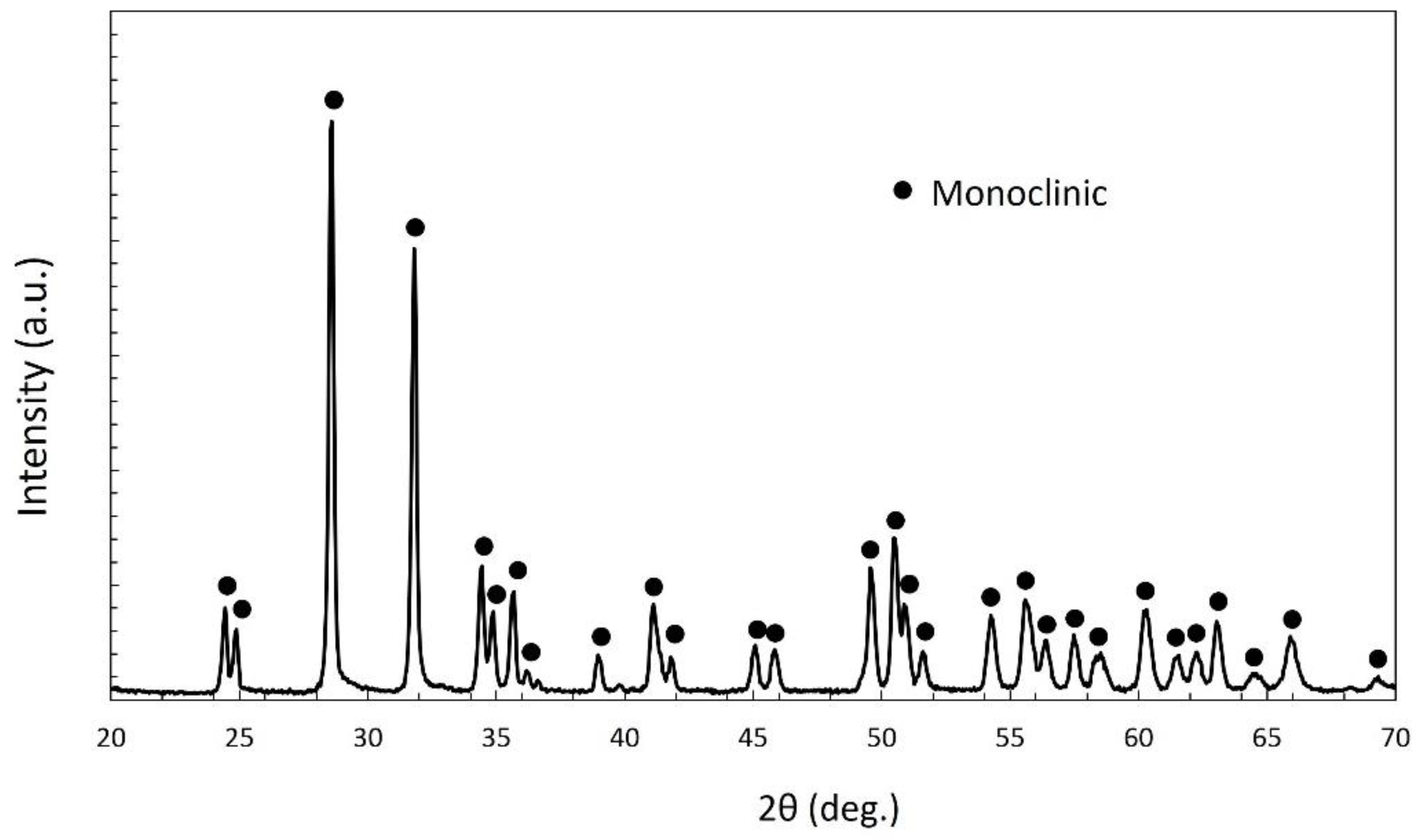
The crystalline phase of the ceramics was examined by X-ray diffractometry (XRD). Figure 5 shows the XRD pattern of a compact containing 0.5 wt.% sintering additives, which was pre-sintered at 1070 °C for 3 h and subsequently subjected to HIP treatment at 1080 °C for 2 h under an Ar gas pressure of 180 MPa. All diffraction peaks were in good agreement with those of monoclinic zirconia (PDF Card No. 00-900-7485). Diffraction peaks corresponding to the tetragonal or cubic phases were not detected, indicating that the sintered body consists of a single monoclinic phase. Zirconia sintered near or above the phase transition temperature undergoes cracking and collapse due to volume expansion caused by the transformation from the residual tetragonal phase to the monoclinic phase, as shown in Figure 2. Sintered monoclinic zirconia is inherently stable as it does not undergo phase transition; however, if any tetragonal phase is formed during the sintering process, it will transform into an unstable material. It is reasonable to assume that the changes in the physical properties of sintered zirconia depend on the amount of residual tetragonal phase, which is governed by the temperature difference between the phase transition point and sintering temperature and the holding time (isothermal sintering time). Taking these factors into account, it can be presumed that zirconia ceramics sintered below 1100 °C contain virtually no tetragonal phase.
Figure 5.
X-ray diffraction pattern of monoclinic ZrO2 ceramics containing 0.5 wt.% additives, pre-sintered at 1070 °C for 3 h and subjected to HIP at 1080 °C for 2 h under 180 MPa Ar gas pressure.
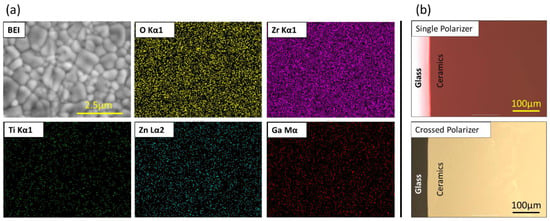
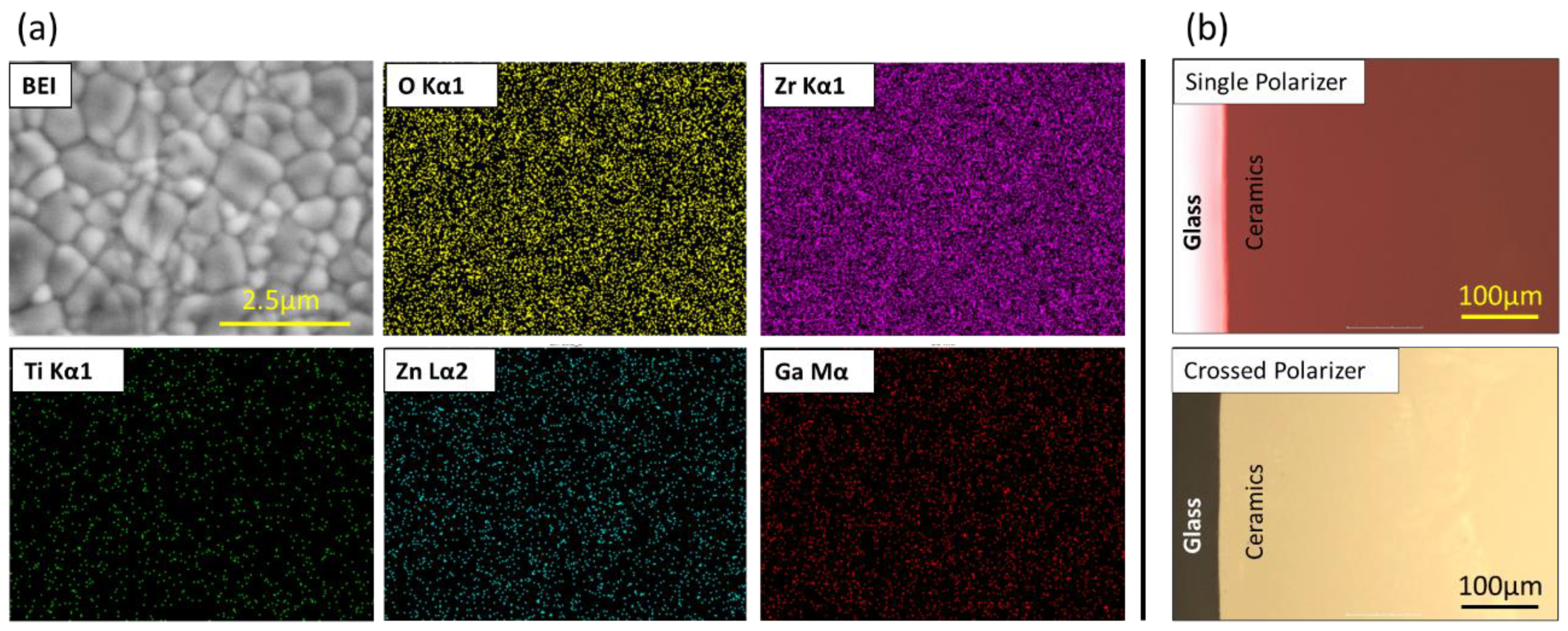
Figure 6a shows the SEM–EDS analysis of the specimen presented in Figure 5. The sintered body consisted of relatively fine and homogeneous grains with sizes of approximately 0.3–1 μm. Zirconium (Zr) and oxygen (O) are the principal constituent elements, while the added Ti, Zn, and Ga were uniformly distributed throughout the microstructure, as seen in the EDS elemental mapping, without detectable segregation at grain boundaries or triple junctions. Transmission optical microscopy images obtained using visible light are shown in Figure 6b. Internal optical stress was examined using a single polarizer, while birefringence-induced light leakage was detected under crossed polarizer. Glass was used as a reference material. Although the optical transmittance of the zirconia ceramics was significantly lower than that of glass, strong birefringence was observed within the material, which is characteristic of optically anisotropic crystals. Under crossed polarizer, the glass reference exhibited a dark field with no detectable light leakage, indicating its optical isotropy. In contrast, the monoclinic zirconia ceramic, which possess an optically anisotropic crystal structure, exhibited intense light leakage due to birefringence. These observations strongly suggested the absence of residual pores within the material, indicating that the bulk density was close to the theoretical limit.
Figure 6.
(a) Backscattered electron image and EDS elemental mapping, and (b) transmission polarized optical microscopy images of monoclinic ZrO2 ceramics subjected to HIP at 1080 °C for 2 h (180 MPa, Ar gas pressure).
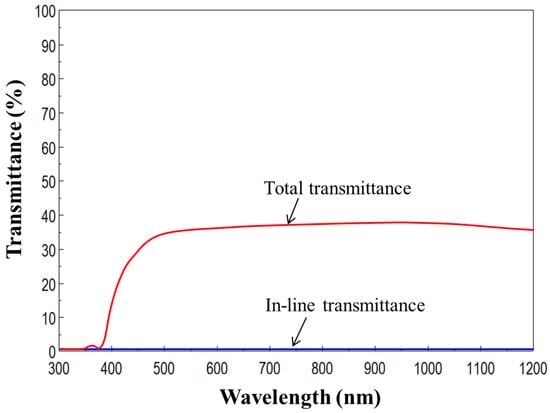
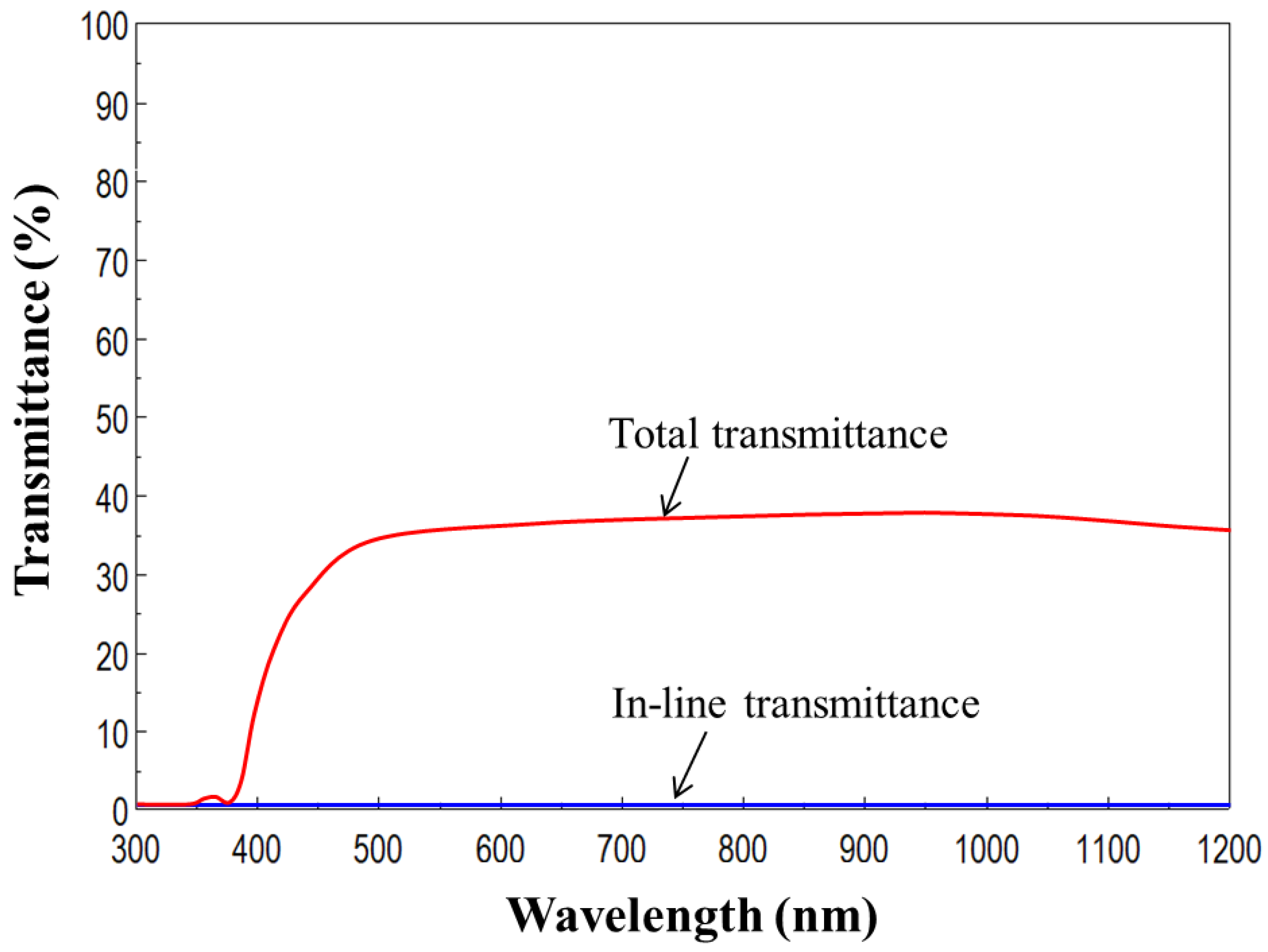
Figure 7 presents the optical transmission spectra for the HIP-processed monoclinic ZrO2 ceramic, polished to a thickness of 0.5 mm. The material exhibited a total transmittance of approximately 30–35% across the visible and near-infrared regions, while the in-line transmittance remains negligible (<0.1%) throughout the entire wavelength range. This significant difference between total and in-line transmittance was not attributed to residual porosity but originated from the intrinsic birefringence of the monoclinic lattice. As light propagates through the polycrystalline body, it undergoes multiple scattering events at grain boundaries due to the refractive index mismatch between adjacent misoriented grains. Consequently, nearly all transmitted light is converted into diffuse components, resulting in the observed translucency rather than transparency. This definitive optical signature confirms the synthesis of a fully dense yet optically anisotropic monoclinic zirconia ceramic.
Figure 7.
Total and in-line transmittance of monoclinic ZrO2 ceramics after HIP treatment.
The mechanical properties of the monoclinic ZrO2 ceramics are summarized in Table 1. The HIP-treated specimens achieved a bending strength of 328 MPa and a fracture toughness of 2.7 MPa·m0.5. While these values are lower than those typically reported for yttria-stabilized tetragonal zirconia (Y-TZP), they represent a significant advancement for single-phase monoclinic ceramics. Notably, the properties obtained in this study surpass those reported by Eichler et al. (220 MPa and 2.0 MPa·m0.5) for monoclinic ZrO2 ceramics with lower relative densities [26]. The increase in bending strength from 255 MPa (pressureless) to 328 MPa (HIP) was attributed to the elimination of residual micro-voids and the achievement of full densification. The Vickers hardness (HV1) remained nearly constant at approximately 805, indicating that the intrinsic hardness of the monoclinic phase is achieved once near-theoretical density is reached. The high mechanical strength observed in the present study can be attributed primarily to the absence of residual pores, which are known to act as critical flaws governing fracture in brittle ceramics. In addition, the suppression of metastable tetragonal phases through low-temperature sintering likely contributes to the long-term stability and mechanical reliability by eliminating transformation-induced degradation mechanisms. These results indicate that both densification and phase stability are essential factors controlling the mechanical performance of monoclinic zirconia ceramics.
Table 1.
Mechanical properties of monoclinic ZrO2 ceramics with and without HIP treatment.
Although the present study was originally conducted in 2015, subsequent long-term observations have revealed a strong dependence of structural stability on the sintering and HIP processing temperatures. When the sintering or HIP temperature exceeded 1130 °C, these specimens having relative densities exceeding 99.9% exhibited a gradual degradation in acoustic resonance (metallic sound), indicative of internal crack formation. These specimens eventually disintegrated in approximately 2–3 years of storage at room temperature. In contrast, specimens processed at lower temperatures than the phase transition point showed significantly higher stability. When both the sintering temperature and HIP temperature were kept below 1100 °C, no detectable changes in microstructure or properties have been observed over more than ten years of storage, up to 2026. This result clearly indicated that lower processing temperatures are essential for achieving long-term stability in dense monoclinic zirconia ceramics. The instability observed in specimens processed above 1100 °C may be associated with trace amounts of residual tetragonal zirconia that remain undetectable by conventional X-ray diffractometry. Such minor secondary phases could act as initiation sites for delayed microcracking, leading to progressive degradation over time. This long-term stability over more than ten years provides strong experimental evidence for the effectiveness of low-temperature sintering in suppressing delayed degradation, which is otherwise unavoidable in monoclinic zirconia processed above the phase transition temperature. Further scientific investigation is therefore required to clarify the underlying mechanisms responsible for this long-term instability.
4. Conclusions
This was the first successful synthesis of fully dense monoclinic zirconia ceramics, a task previously considered unattainable due to the catastrophic phase transition. The primary findings are as follows:
- (1)
- The application of ternary sintering aids enabled the densification of ZrO2 at 1050–1100 °C, significantly below the monoclinic-to-tetragonal transition temperature (1170 °C).
- (2)
- Pressureless sintering yielded relative densities up to 99.9%, while subsequent HIP treatment effectively eliminated residual porosity, achieving a pore-free state.
- (3)
- The HIP-processed monoclinic ZrO2 exhibited a 4-point bending strength of 328 MPa, a fracture toughness of 2.7 MPa·m0.5, and a Vickers hardness HV1 of 805. These properties are comparable to those of cubic zirconia [41], representing the intrinsic mechanical baseline of a fully dense monoclinic lattice.
- (4)
- While in-line transmittance of this monoclinic ZrO2 ceramic was negligible due to intrinsic birefringence-induced scattering, it exhibits high total transmittance characterized by diffuse transmission.
Although the presence of trace tetragonal phase below the detection limit of X-ray diffractometry cannot be completely excluded, the absence of cracking or degradation over approximately ten years strongly indicates that any residual tetragonal phase, if present, was negligible and did not result in any detectable structural degradation, further emphasizing the critical importance of low-temperature sintering in achieving long-term stability.
Author Contributions
Conceptualization, A.I.; methodology, A.I. and Y.L.A.; software, A.I. and Y.L.A.; validation, A.I.; formal analysis, A.I. and Y.L.A.; investigation, A.I. and Y.L.A.; resources, A.I.; data curation, A.I. and Y.L.A.; writing—original draft preparation, A.I.; writing—review and editing, A.I. and Y.L.A.; visualization, A.I.; supervision, A.I.; project administration, A.I.; funding acquisition, A.I. All authors have read and agreed to the published version of the manuscript.
Funding
This research received no external funding.
Data Availability Statement
The data presented in this study are available on request from the corresponding author.
Conflicts of Interest
Authors Akio Ikesue and Yan Lin Aung were employed by the company World Lab Co., Ltd. The authors declare that the research was conducted in the absence of any commercial or financial relationships that could be construed as potential conflicts of interest.
References
- Evans, A.G.; Cannon, R.M. Toughening of brittle solids by martensitic transformations. Acta Mater. 1986, 34, 761–800. [Google Scholar] [CrossRef] [Scilit]
- Birkby, I.; Stevens, R. Applications of zirconia ceramics. Key Eng. Mater. 1996, 122, 527–552. [Google Scholar] [CrossRef] [Scilit]
- Piconi, C.; Maccauro, G.; Pilloni, L. On the fracture of a zirconia ball head. J. Mater. Sci. Mater. Med. 2006, 17, 289–300. [Google Scholar] [CrossRef] [Scilit] [PubMed]
- Banik, S.; Iqbal, I.; Nath, R.; Bora, L.; Singh, B.; Mandal, N.; Sankar, M. State of the art on zirconia toughened alumina cutting tools. Mater. Today Proc. 2019, 18, 2632–2641. [Google Scholar] [CrossRef] [Scilit]
- Sulaiman, T.A.; Suliman, A.A.; Abdulmajeed, A.A.; Zhang, Y. Zirconia restoration types, properties, tooth preparation design, and bonding. A narrative review. J. Esthet. Restor. Dent. 2024, 36, 78–84. [Google Scholar]
- Matsui, K.; Yoshida, H.; Ikuhara, Y. Nanocrystalline, ultra-degradation-resistant zirconia: Its grain boundary nanostructure and nanochemistry. Sci. Rep. 2014, 4, 4758. [Google Scholar] [CrossRef] [Scilit] [PubMed]
- Lakusta, M.; Danilenko, I.; Volkova, G.; Loladze, L.; Burchovetskiy, V.; Konstantinova, T. Comparative analyses of the IV group oxides additives influence on the sintering kinetics of zirconia nanopowders. PLoS ONE 2018, 13, e0200869. [Google Scholar] [CrossRef] [Scilit]
- Peampring, C.; Kengtanyakich, S. Surface roughness and translucency of various translucent zirconia ceramics after hydrothermal aging. Eur. J. Dent. 2022, 16, 761–767. [Google Scholar] [CrossRef] [Scilit]
- Can, Z.Y.; Narita, H.; Mizusaki, J.; Tagawa, H. Detection of carbon monoxide by using zirconia oxygen sensor. Solid State Ion. 1995, 79, 344–348. [Google Scholar] [CrossRef] [Scilit]
- Maskell, W.C. Progress in the development of zirconia gas sensors. Solid State Ion. 2000, 134, 43–50. [Google Scholar] [CrossRef] [Scilit]
- Radhakrishnan, J.K.; Kamble, S.S.; Krishnapur, P.P.; Padaki, V.C.; Gnanasekaran, T. Zirconia oxygen sensor for aerospace applications. In 2012 Sixth International Conference on Sensing Technology (ICST); IEEE: Kolkata, India, 2012; pp. 714–717. [Google Scholar]
- Lari, A.; Khodadadi, A.; Mortazavi, Y. Semiconducting metal oxides as electrode material for YSZ-based oxygen sensors. Sens. Actuators B Chem. 2009, 139, 361–368. [Google Scholar]
- Guo, X.; Waser, R. Electrical properties of the grain boundaries of oxygen ion conductors: Acceptor-doped zirconia and ceria. Prog. Mater. Sci. 2006, 51, 151–210. [Google Scholar] [CrossRef] [Scilit]
- Kalita, P.; Saini, S.; Rajput, P.; Jha, S.N.; Bhattacharyya, D.; Ojha, S.; Avasthi, D.K.; Bhattacharya, S.; Ghosh, S. Oxygen vacancy mediated cubic phase stabilization at room temperature in pure nano-crystalline zirconia films: A combined experimental and first-principles based investigation. Phys. Chem. Chem. Phys. 2019, 21, 22482–22490. [Google Scholar] [CrossRef] [Scilit]
- Celik, S.; Timurkutluk, B.; Toros, S.; Timurkutluk, C. Mechanical and electrochemical behavior of novel electrolytes based on partially stabilized zirconia for solid oxide fuel cells. Ceram. Int. 2015, 41, 8785–8790. [Google Scholar] [CrossRef] [Scilit]
- Dwivedi, S. Solid oxide fuel cell: Materials for anode, cathode and electrolyte. Int. J. Hydrogen Energy 2020, 45, 23988–24013. [Google Scholar]
- Vinchhi, P.; Khandla, M.; Chaudhary, K.; Pati, R. Recent advances on electrolyte materials for SOFC. A review. Inorg. Chem. Commun. 2023, 152, 110724. [Google Scholar] [CrossRef] [Scilit]
- Minh, N.Q. Ceramic fuel cells. J. Am. Ceram. Soc. 1993, 76, 563–588. [Google Scholar] [CrossRef] [Scilit]
- Yamada, T.; Kubota, Y.; Makinose, Y.; Suzuki, N.; Nakata, K.; Terashima, C.; Matsushita, N.; Okada, K.; Fujishima, A.; Katsumata, K.-I. Single crystal ZrO2 nanosheets formed by thermal transformation for solid oxide fuel cells and oxygen sensors. ACS Appl. Nano Mater. 2019, 2, 6866–6873. [Google Scholar] [CrossRef] [Scilit]
- Sigwadi, R.; Dhlamini, M.; Mokrani, T.; Nemavhola, F. Preparation of a high surface area zirconium oxide for fuel cell application. Int. J. Mech. Mater. Eng. 2019, 14, 5. [Google Scholar] [CrossRef] [Scilit]
- Nassau, K. A new diamond imitation: Cubic zirconia. Gems Gemol. 1976, 15, 143–144. [Google Scholar]
- Nassau, K.; Nassau, J. The Growth of Synthetic and Imitation Gems; Springer: Berlin/Heidelberg, Germany, 1980. [Google Scholar]
- Karampelas, S.; Kiefert, L.; Bersani, D.; Vandenabeele, P. Gem Treatments, Synthetics and Imitations; Springer International Publishing: Berlin/Heidelberg, Germany, 2020. [Google Scholar]
- Gorelov, V.P.; Belyakov, S.A.; Abdurakhimova, R.K. Phase transitions in monoclinic ZrO2. Phys. Solid State 2023, 65, 461–466. [Google Scholar] [CrossRef] [Scilit]
- Khattab, E.S.R.; El Rehim, S.S.A.; Hassan, W.M.I.; El-Shazly, T.S. Band structure engineering and optical properties of pristine and doped monoclinic zirconia (m-ZrO2): Density functional theory theoretical prospective. ACS Omega 2021, 6, 30061–30068. [Google Scholar]
- Eichler, J.; Eisele, U.; Rodel, J. Mechanical properties of monoclinic zirconia. J. Am. Ceram. Soc. 2004, 87, 1401–1403. [Google Scholar] [CrossRef] [Scilit]
- Sengupta, P.; Bhattacharjee, A.; Maiti, H.S. Zirconia: A unique multifunctional ceramic material. Trans. Indian Inst. Met. 2019, 72, 1981–1998. [Google Scholar] [CrossRef] [Scilit]
- Chevalier, J.; Gremillard, L.; Virkar, A.V.; Clarke, D.R. The tetragonal-monoclinic transformation in zirconia: Lessons learned and future trends. J. Am. Ceram. Soc. 2009, 92, 1901–1920. [Google Scholar] [CrossRef] [Scilit]
- Kisi, E.H.; Howard, C.J. Crystal structures of zirconia phases and their inter-relation. Key Eng. Mater. 1998, 154, 1–36. [Google Scholar] [CrossRef] [Scilit]
- Skandan, G.; Hahn, H.; Roddy, M.; Cannon, W.R. Ultrafine-grained dense monoclinic and tetragonal zirconia. J. Am. Ceram. Soc. 1994, 77, 1706–1710. [Google Scholar] [CrossRef] [Scilit]
- Yoshida, M.; Shinoda, Y.; Akatsu, T.; Wakai, F. Deformation of monoclinic ZrO2 polycrystals and Y2O3-stabilized tetragonal ZrO2 polycrystals below the monoclinic–tetragonal transition temperature. J. Am. Ceram. Soc. 2002, 85, 2834–2836. [Google Scholar] [CrossRef] [Scilit]
- Cutler, R.A.; Reynolds, J.R.; Jones, A. Sintering and characterization of polycrystalline monoclinic, tetragonal, and cubic zirconia. J. Am. Ceram. Soc. 1992, 75, 2173–2183. [Google Scholar] [CrossRef] [Scilit]
- Ikesue, A.; Aung, Y.L. Synthesis and characteristics of transparent Gd2O3 ceramics with cubic structure. J. Adv. Ceram. 2024, 13, 463–468. [Google Scholar] [CrossRef] [Scilit]
- Levin, E.M.; Robbins, C.R.; McMurdie, H.F. Phase Diagrams for Ceramists, Vol. 1; American Ceramic Society: Columbus, OH, USA, 1964; Figure 369. [Google Scholar]
- Tsukuma, K.; Kubota, Y.; Tsukidate, T. Transparent ZrO2–Y2O3–TiO2 ceramics. Adv. Ceram. Sci. Technol. Zirconia 1988, 24, 287. [Google Scholar]
- Tsukuma, K. Transparent titania–yttria–zirconia ceramics. J. Mater. Sci. Lett. 1986, 5, 1143–1144. [Google Scholar] [CrossRef] [Scilit]
- Peuchert, U.; Okano, Y.; Menke, Y.; Reichel, S.; Ikesue, A. Transparent cubic-ZrO2 ceramics for application as optical lenses. J. Eur. Ceram. Soc. 2009, 29, 283–291. [Google Scholar] [CrossRef] [Scilit]
- Sankar, U.; Meenaloshini, S.; Amiriyan, M.; Singh, R.; Teng, W. Sintering and densification behavior of ZnO-doped Y-TZP ceramics. Appl. Mech. Mater. 2011, 83, 197–203. [Google Scholar] [CrossRef] [Scilit]
- Liu, J.; Wang, Z.; Wang, X.; Liu, H.; Ma, Y. Effects of ZnO addition on the sintering behavior and mechanical properties of magnesium aluminate spinel ceramics. Int. J. Ceram. Eng. Sci. 2019, 1, 51–56. [Google Scholar] [CrossRef] [Scilit]
- Nonaka, K.; Teramae, M.; Pezzotti, G. Effect of Ga2O3 dopant on high speed sintered 5 mol% Y2O3 stabilized dental zirconia. Materials 2023, 16, 714. [Google Scholar] [CrossRef] [Scilit] [PubMed]
- Yamashita, I.; Kudo, M.; Tsukuma, K. Development of highly transparent zirconia ceramics. TOSOH Res. Technol. Rev. 2012, 56, 11–16. [Google Scholar]

Disclaimer/Publisher’s Note: The statements, opinions and data contained in all publications are solely those of the individual author(s) and contributor(s) and not of MDPI and/or the editor(s). MDPI and/or the editor(s) disclaim responsibility for any injury to people or property resulting from any ideas, methods, instructions or products referred to in the content. |
© 2026 by the authors. Licensee MDPI, Basel, Switzerland. This article is an open access article distributed under the terms and conditions of the Creative Commons Attribution (CC BY) license.