


Abstract
As generative AI technologies become increasingly embedded in educational cloud platforms, understanding their impact on teacher professional development is essential. Grounded in the stimulus–organism–response (S–O–R) framework, this study investigates how AI-driven stimuli—hedonicity, interactivity, and immersion—influence teachers’ self-regulation and resilience. Using structural equation modeling, data were collected from in-service teachers in Taiwan who actively utilize educational cloud platforms. The results reveal that all three AI-driven stimuli significantly enhance teachers’ self-regulation and resilience, which in turn are significantly associated with perceived value co-creation intentions. Specifically, self-regulation enables teachers to manage goals effectively, while resilience supports their recovery from technical setbacks. The findings indicate that self-regulation positively influences resilience, and both appear to mediate the relationship between perceived AI-driven stimuli and teachers’ value co-creation intentions. This study highlights the potential role of teachers’ psychological adaptability in AI-enhanced environments. Practical implications suggest that platform developers and administrators should prioritize AI features that foster self-directed learning and emotional engagement to promote collaborative willingness and professional alignment within modern educational ecosystems rather than implying proven macro-level transformation.
1. Introduction
With the rapid development of artificial intelligence, generative AI technology plays an increasingly important role in various fields [1]. In teacher education, the strategic integration of generative AI (GenAI) within cloud platforms serves as a vital catalyst for digital professional development, enhancing educators’ technological pedagogical content knowledge readiness and general instructional adaptability [2,3].
The application of generative AI in educational cloud communities has become increasingly popular. For example, platforms use generative AI to assist teachers in creating customized lesson plans, generating instructional materials, and designing automated feedback loops. Rather than merely driving entertainment, these intelligent interactive elements provoke profound teaching enjoyment and professional well-being, motivating educators to actively engage in sustainable digital training [4]. Through immersive and challenge-based absorption within these cloud environments, teachers are intrinsically driven to enhance their critical habits of mind, leading to continuous professional engagement and ecological value co-creation [5,6]. Within this digital landscape, value co-creation explicitly occurs as teachers transcend passive resource consumption to become proactive co-innovators who actively evaluate AI’s pedagogical compatibility and share prompt scripts [7,8]. Engaged in this GenAI-enhanced learning ecosystem, cultivating digital self-regulation becomes a critical adaptive milestone, ensuring that teachers are equipped with high AI literacy to deal with systemic disruptions and adapt to change [9].
Research has indicated that internal psychological states and cognitive appraisals affect individuals’ proactive behaviors [10]. The cognitive appraisal of in-service teachers regarding generative AI applications on educational cloud platforms exerts a profound impact on their digital self-regulation and professional resilience [11,12]. For instance, when teachers cultivate robust teacher artificial intelligence competence self-efficacy, they demonstrate higher strategic motivation to refine their instructional methods and navigate algorithmic risks [8,11]. Given the rapid evolution of GenAI, it is critical to examine the underlying psychological pathways that enhance teachers’ digital self-regulation and systemic resilience through AI applications in cloud-based learning environments.
While prior research has emphasized the importance of self-regulation and resilience in online learning, limited studies have examined how generative AI-driven stimuli affect teachers’ psychological adaptability and value co-creation within contemporary educational ecosystems. This study employs the stimulus–organism–response (S–O–R) model to explore the impact of generative AI applications on teacher behavior. According to the S–O–R framework, AI-driven technological stimuli trigger teachers’ internal cognitive and emotional reactions (organism), which subsequently shape their transformative instructional behaviors (response) [2]. Generative AI-driven stimuli, including hedonicity, interactivity, and immersion, are conceptualized as systemic triggers that evoke high cognitive flow and intrinsic teaching enjoyment [4,6]. This positive organismic transformation—manifested through heightened digital self-regulation—fortifies teachers’ professional resilience against technostress and directly drives collaborative value co-creation behaviors within cloud communities [5,12].
Accordingly, this study addresses the aforementioned gaps to explore the effects of generative AI stimuli (hedonicity, interactivity, and immersion) on self-regulation and resilience, and examines the effects of self-regulation on resilience and value co-creation. This study further considers the mediating roles of self-regulation and resilience. This study provides important contributions: (1) it contributes to value co-creation literature by shifting the paradigm from commercial marketing to teacher professional development ecosystems; (2) it provides insights into self-regulated learning theory regarding the sequential mediating roles of resilience in AI-driven teaching; and (3) it offers insights on how educational ecosystems can support the transition to AI-enhanced sustainable learning.
2. Literature Review
2.1. Generative AI-Driven Stimuli
2.1.1. Hedonicity
Hedonicity refers to the positive emotional experiences of pleasure, enjoyment, and excitement that users obtain during the learning process [13,14]. In digital teacher education, hedonicity transcends mere consumer pleasure, manifesting as foreign language teaching enjoyment and professional well-being derived from technology-enhanced instructional practices [4]. Rather than serving as static content repositories, educational cloud platforms embedded with generative AI (GenAI) provide intellectually stimulating resources, novel pedagogical scenarios, and rich curricular storylines that spark teachers’ intrinsic motivation [2,4].
Advanced cloud platforms featuring engaging and interactive pedagogical content can significantly facilitate educator–platform interactions, thereby strengthening teachers’ intrinsic willingness to actively participate in digital learning communities. Generative AI enhances the sustainability of learning by generating new teaching scenarios, storylines, and resources, ensuring the hedonicity of the experience. This motivates teachers to be enduringly involved with the platform [14]. If teachers have enjoyable feelings, they gain the inspiration to explore further. For example, high-quality visuals and interactive AI elements craft a distinctive experience for professional development. Positive hedonic experiences enable teachers to maintain curiosity and sustain motivation to conquer pedagogical challenges [4]. Participation in enjoyable AI-supported activities improves teachers’ digital self-regulation, task engagement, and technical problem-solving skills [2,14].
H1a.
Hedonicity has a significantly positive effect on the self-regulation of teachers.
H1b.
Hedonicity has a significantly positive effect on the resilience of teachers.
2.1.2. Interactivity
Interactivity in an AI-enhanced learning environment refers to the bi-directional systemic responsiveness that empowers educators to actively modify, prompt, and co-create digital content [2]. GenAI infuses educational platforms with high-level interactive capabilities, including real-time text-to-image synthesis, automated instructional scaffolding, and predictive prompting loops, which elevate educators’ cognitive engagement and platform continuous usage intentions [1,15]. These instantaneous, intuitive dialogic structures significantly enhance teachers’ intelligent technological pedagogical content knowledge readiness [2,3].
Interaction is the nature of co-creation [16]. Within contemporary teacher training ecosystems, interactivity represents a critical perception of being professionally connected to peer educators, which effectively increases the collaborative value and resource sharing within the professional learning community [17,18]. When teachers perceive interactive AI technologies to be highly responsive and adaptive, they experience a greater sense of autonomy over the online environment [12]. This agency encourages them to employ sophisticated self-regulatory strategies, such as precise time management and systemic self-monitoring. Moreover, collaborative interactivity within cloud communities builds a professional network, which cultivates a high degree of perceived trust in artificial intelligence [2,12]. Through collaboration in tackling intricate AI puzzles, teachers enhance resilience by learning to overcome technical obstacles [1].
H2a.
Interactivity has a significantly positive effect on the self-regulation of teachers.
H2b.
Interactivity has a significantly positive effect on the resilience of teachers.
2.1.3. Immersion
Immersion refers to the sensory and cognitive sense of being enveloped by a simulated learning environment [17]. In the educational context, immersion deeply involves dimensions of control, sustained attention, and curiosity [19], making it a key constituent of the user experience that directly affects educator satisfaction and loyalty [17]. Advanced GenAI technologies provide spherical, context-rich presentations that make teachers feel as if they are authentically present in real pedagogical scenes [19].
Being deeply immersed allows teachers to resonate emotionally and cognitively with teaching scenarios inside the virtual reality platform. As validated by Chen and Hsu [20], this sensation of being fully absorbed stimulates teachers to discover new knowledge and autonomously explore innovative pedagogical strategies. To advance this mechanism, recent scholarship aligns GenAI immersion with the cognitive affective model of immersive learning, demonstrating that immersive environments trigger a profound psychological sequence flowing from flow experiences through enhanced learning motivation straight to active self-emotion regulation [6]. Immersion promotes psychological adaptation, self-regulation, and professional resilience by increasing educators’ task persistence, critical habit-of-mind development, and capacity for coping with challenging instructional tasks amidst digital transformation [5,6,17].
H3a.
Immersion has a significantly positive effect on the self-regulation of teachers.
H3b.
Immersion has a significantly positive effect on the resilience of teachers.
2.2. Self-Regulation and Resilience
Based on self-regulated learning theory [10], individuals possess the motivation and autonomy required to determine behaviors and engage in proactive cognitive adaptations [20]. Self-regulation refers to the self-generated thoughts, feelings, and actions cyclically adapted to the attainment of personal goals through structured cognitive and behavioral strategies [21]. Closely related to this regulatory mechanism is resilience, conceptualized within educational ecology as an educator’s capacity to maintain professional well-being, bounce back from technological setbacks, and flexibly adapt to disruptive instructional environments [4]. Recent literature in educational technology emphasizes that in the digital era, an educator’s self-regulatory competence is inherently manifested through their teacher artificial intelligence competence self-efficacy and fundamental AI literacy [9,11].
When applied to digital professional development, self-regulation is essential for concentrating on goal-directed activities and mastering complex technological pedagogical content knowledge [22]. As teachers encounter the intricate and unpredictable nature of integrating GenAI into cloud platforms, self-regulation ceases to be a generic compliance mechanism; instead, it becomes an active strategy through which educators evaluate GenAI’s pedagogical compatibility, manage their cognitive loads, and pursue continuous professional engagement [8]. Highly self-regulated teachers are proficient in establishing clear technological milestones, self-monitoring their proficiency in prompt engineering, and actively mitigating algorithmic risks [8]. This systematic exercise of digital self-regulation directly nurtures a sense of instructional control, shielding teachers from technostress and fostering positive psychological feedback [12]. Consequently, the internal mastery derived from AI-related self-regulation translates into heightened teacher resilience, empowering educators to view technological disruptions not as insurmountable barriers, but as transformative opportunities for pedagogical growth [5]. Accordingly, this study suggests that the self-regulation exercised by teachers within GenAI-enhanced cloud platforms will positively fortify their professional resilience.
H4.
Self-regulation has a significantly positive effect on resilience.
2.3. Self-Regulation, Resilience, and Value Co-Creation
Value co-creation literature emphasizes the central role of users’ active participation, knowledge exchange, and sustained engagement in generating mutual systemic value [16]. In modern digital ecosystems, users successfully transition into prosumers and “co-innovators” who actively reshape their respective professional learning communities [16]. Within an AI-enhanced educational cloud platform, this co-creation process is fundamentally driven by the psychological and technical readiness of educators [2,7]. Specifically, self-regulation reflects the structured cognitive activities and the alignment of pedagogical mental models necessary for teachers to assume professional responsibility over complex, automated tasks [22]. Furthermore, resilience indicates an adaptive psychological capacity that empowers teachers to maintain optimism, process algorithmic uncertainties, and respond positively to the technical disruptions inherent in collaborative digital environments [4]. When educators possess high levels of self-regulation and resilience, they are uniquely equipped to transcend passive resource consumption and become active contributors who jointly generate collaborative pedagogical intentions within and across school boundaries [5,7].
When applied to GenAI integration, highly self-regulated teachers utilize structured goal-directed strategies to navigate systemic complexities, directly boosting their AI learning self-efficacy and behavior intentions [7]. This internal mastery encourages teachers to increase their professional engagement, share customized prompting templates, and actively participate in collaborative lesson-building within cloud communities [8]. Concurrently, teacher resilience acts as a vital protective anchor; as teachers master the interplay between their digital competence and their trust in artificial intelligence, resilience ensures they persist through systemic glitches and ethical dilemmas without experiencing burnout [12]. Resilient and self-regulated educators actively collaborate with platform developers by providing critical feedback on GenAI’s pedagogical compatibility, thereby fostering sustainable system innovation and driving the school’s digital evolution [8,12]. Through this reciprocal exchange, teachers and platforms co-create optimized workflows that enhance learning outcomes and cultivate a perceived cooperative propensity within educational environments [5,7]. Based on these theoretical foundations, this study posits that teachers’ digital self-regulation and psychological resilience are vital antecedents that positively drive teachers’ value co-creation intentions.
H5.
Self-regulation has a significantly positive effect on value co-creation.
H6.
Resilience has a significantly positive effect on value co-creation.
2.4. Mediating Effects of Self-Regulation and Resilience
Within AI-enhanced educational cloud ecosystems, the translation of technological stimuli into collaborative innovation is not an immediate behavioral reflex, but a sophisticated process requiring multi-dimensional psychological and professional mediation [2,5]. Grounded in the S–O–R framework, this study positions digital self-regulation and professional resilience as key organismic mediators that explain how and why AI-driven systemic features catalyze high-level pedagogical co-creation [6].
Regarding the mediating role of self-regulation (H7), high perceptions of GenAI’s hedonicity, interactivity, and immersion do not automatically guarantee that teachers will engage as proactive co-innovators [7]. Instead, these advanced AI stimuli must first activate the teacher’s internal self-management mechanisms, specifically operationalized through their teacher artificial intelligence competence self-efficacy and structured information retrieval [11,22]. Highly self-regulated educators utilize the platform’s responsive prompts to actively assess AI’s pedagogical compatibility, monitor their training schedules, and manage the cognitive loads induced by digital transformation [8]. This internal regulatory mastery empowers teachers to comfortably transition into active contributors who share customized instructional scripts and provide solutions to optimize the educational community [7,8].
Concurrently, professional resilience serves as a critical transformative mediator (H8) that absorbs technostress and converts technology-induced affect into sustainable value co-creation [4,12]. Immersive and interactive GenAI environments envelop teachers in authentic classroom simulations, but these novel technologies inherently bring algorithmic risks, ethical concerns, and potential negative disruptions [5]. Resilient teachers possess the coping confidence, technical tolerance, and risk awareness required to positively adapt to these instructional adversities [5,12]. By bouncing back from system glitches and mastering the triadic nature of AI literacy (AI as a tool, content, and medium), resilient educators confidently participate in collaborative curriculum redesign, testing new AI tools, and advancing the platform’s growth [5,9].
Crucially, this study proposes a sequential, dual-mediating mechanism wherein resilience converts the self-regulation of teachers into favorable value co-creation behaviors (H9). When teachers exercise systematic digital self-regulation, they enhance their subjective perception of instructional control over automated environments, which directly fortifies their long-term professional tenacity and adaptation to change [11,12]. Self-regulation provides the structured goal-setting and engineering proficiency necessary to handle GenAI constructively, yet it is resilience that serves as the ultimate psychological bridge translating this individual competence into collaborative educational innovation [5,9]. Resilient and self-directed educators are better equipped to navigate the complex interplay between their digital competence and artificial intelligence trust, allowing them to collaborate with peers, address ethical dilemmas, and successfully co-create institutional value within the shifting educational landscape [5,12]. Implicitly, the combination of digital self-regulation and resilience forms an adaptive psychological pathway required for sustainable educational evolution in the digital era.
H7.
Self-regulation mediates the relationship between hedonicity, interactivity, immersion, and value co-creation.
H8.
Resilience mediates the relationship between hedonicity, interactivity, immersion, and value co-creation.
H9.
Resilience mediates the relationship between self-regulation and value co-creation.
3. Research Method
3.1. Data Collection and Sample
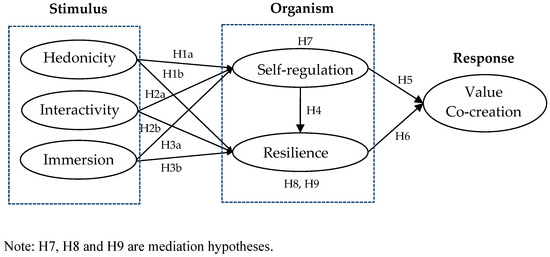
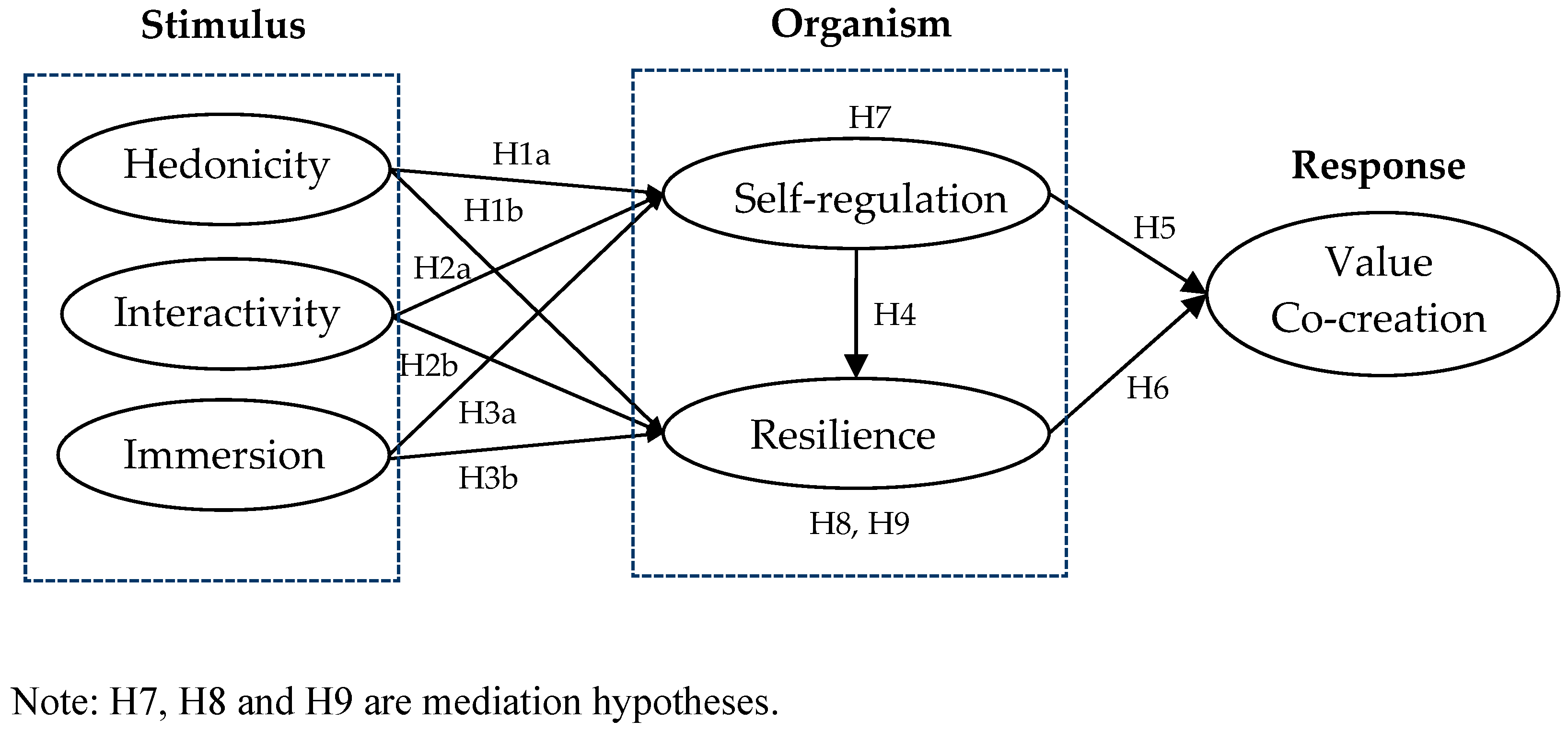
This study utilized the S–O–R model to explain educators’ behaviors in cloud-based learning environments. The stimulus was defined as the cognitive appraisal of generative AI applications, while the organism component encompassed the internal psychological states and adaptive mechanisms, specifically operationalized as educators’ self-regulation and resilience. The response reflected the behavioral outcome of value co-creation. The conceptual framework is shown in Figure 1.
Figure 1.
Conceptual framework.
This study utilized a questionnaire survey method to collect empirical data from junior high school teachers in Taiwan. The sampling frame was derived from the official directory of secondary education institutions provided by the Ministry of Education in Taiwan. To ensure a representative sample across various institutional scales, a stratified random sampling approach was employed, using school size (classified into three strata: small, under 12 classes; medium, 13–24 classes; and large, over 24 classes) as the primary stratification criterion. To establish secure and ethical access to teacher communities, the research team coordinated with school administrations and regional professional learning community (PLC) coordinators. The survey invitations were distributed during regional PLC workshops. Participation was completely voluntary and anonymous, and teachers were explicitly assured that their responses would have no administrative or performance implications. The inclusion criteria for participation required that respondents be full-time, in-service junior high school teachers who had actively utilized generative AI tools (e.g., ChatGPT, Gemini, or specialized educational AI modules) on educational cloud platforms for instructional design or administrative tasks within the past semester. The survey was primarily administered digitally via Google Forms for efficiency within professional teacher communities, supplemented by paper-based questionnaires to ensure a comprehensive and inclusive reach. A total of 900 invitations were distributed across the selected strata. To maintain high data quality, questionnaires were excluded as invalid if they met the following criteria: (a) completion times under 120 s, or (b) straight-lining responses (e.g., rating all items identically). After filtering, 832 responses were verified as valid questionnaires, yielding an effective response rate of 92.44%. This high response rate was achieved because the digital survey was seamlessly integrated into the workshop sessions as a reflective learning activity. To empirically demonstrate the sample’s representativeness, a Chi-square (χ2) goodness-of-fit test was conducted against national secondary teacher statistics from the Ministry of Education. The results revealed no statistically significant differences in gender (Sample = 68.2% Female vs. National = 67.5% Female; χ2 = 0.18, p = 0.671) or geographical region (χ2 = 2.14, p = 0.543), confirming that the sample is highly representative of the target population.
To ensure data integrity and assess potential non-response bias, an extrapolation method was performed following the guidelines of [23]. The first 25% of respondents (early responders) were compared with the last 25% of respondents (late responders, who serve as a proxy for non-responders) using independent sample t-tests on the principal latent constructs of the model (hedonicity, interactivity, immersion, self-regulation, resilience, and value co-creation). The analysis yielded statistically insignificant t-statistics (p > 0.05), indicating that non-response bias does not pose a significant threat to the validity or generalizability of the findings in this study. Furthermore, following the procedural remedies suggested by [24], Harman’s one-factor test was performed to address common method bias. The analysis revealed that no single factor emerged to account for the majority of the variance, indicating that common method bias is unlikely to significantly affect the validity of the results.
3.2. Measures
This study tailored the survey to the online educational community context by adapting established scales and refining the wording, format, and content based on feedback from five experts in educational technology and teacher professional development. To ensure linguistic equivalence and eliminate cultural biases, a rigorous translation and back-translation procedure was executed. The original instruments were first translated into Chinese by two bilingual educational researchers, and subsequently back-translated into English by an independent native English speaker to verify semantic consistency. Minor linguistic adjustments were made to ensure the survey items were clear and relevant to the specific research goals involving generative AI in education. To encourage participation and ensure consistency, a 5-point Likert scale was utilized, with respondents rating their agreement from 1 (strongly disagree) to 5 (strongly agree). Appendix A (Table A1) provides the complete list of the 20 questionnaire items utilized in this study.
Hedonicity reflects the positive pedagogical experiences of pleasure, enjoyment, and excitement that teachers obtain during the learning process, conceptually aligned with the framework of teacher professional well-being and instructional enjoyment [4]. Rather than measuring consumer entertainment, it is assessed using four items adapted from Al-Abdullatif [2] and Yanit et al. [14] that evaluate whether the AI-generated platform’s content is intellectually stimulating and engaging, whether the instructional scenarios are pleasant and relaxing, and the extent to which teachers feel professionally inspired and satisfied when integrating generative AI within the cloud platform [2,4].
Interactivity is measured by four items adapted specifically to the educational context to capture the dialogic responsiveness between educators and intelligent agents [2,3]. Shifted away from commercial customer service, these items assess how teachers interact with real-time automated scaffolding, customize text-to-image lesson materials, and utilize digital prompting loops to refine their technical pedagogical content knowledge [1,2]. Furthermore, the measure evaluates whether teachers feel empowered to choose the timing, content, and sequence of their communication, and whether tools such as discussion forums, chat rooms, and social networking features enable them to share professional experiences and build teacher professional learning communities [12].
Immersion captures the sense of being enveloped by the simulated learning environment, operationalized via the cognitive affective model of immersive learning [6]. Rather than assessing casual gaming mechanics, immersion focuses on the cognitive absorption that facilitates scientific habits of mind [6]. This includes user interface immersion, where the platform’s design seamlessly integrates the teacher into the experience; narrative immersion, which emerges as the teacher progresses through pedagogical content; and challenge immersion, occurring when teachers feel fully absorbed in solving complex pedagogical puzzles or overcoming AI-driven training tasks that align challenge with ability [5,6].
Self-regulation assesses the teachers’ levels of self-management within the online learning context, focusing on how educators manage the heavy cognitive workloads induced by rapid digital transformation [8]. Grounded in teacher learning dynamics [7], this construct is composed of four items adapted from Shi [8] and Younis [9]: goal setting for prompt engineering proficiency, information retrieval and organization, strategy regulation and schedule monitoring, and digital time management efficiency. Resilience is also assessed with four items adapted from the teacher professional well-being scale [4], replacing non-educational paradigms. The items cover educators’ coping confidence under technostress, tenacity and adaptation to algorithmic changes, subjective perception of instructional control, and psychological tolerance of automated risks [4,12].
Value co-creation emphasizes the role of teachers as co-innovators who jointly collaborate during the educational transformation process [16]. Eradicating consumer-behavior or mobile commerce undertones, and adapting the scale from Du et al. [7] and Prilop et al. [5], this study measures value co-creation with four items, focusing on instances where teachers provide constructive platform feedback, share customized prompt scripts to assist peers, engage in collaborative curriculum redesign, and actively contribute solutions to advance the growth of the teacher professional community [5,7].
4. Results
4.1. Measurement Model
Partial least squares structural equation modeling (PLS-SEM) was chosen for data analysis due to its suitability for complex model structures [25] and the primary predictive and exploratory nature of extending the S–O–R framework within emerging educational technology domains. Furthermore, PLS-SEM is a non-parametric method uniquely tailored for causal-predictive analyses without imposing strict multivariate normality assumptions. In this study, the choice of PLS-SEM over covariance-based SEM (CB-SEM) is empirically justified by evaluating data normality. The univariate skewness values for the scale items ranged from −1.14 to −0.45, and kurtosis values ranged from 0.52 to 2.18. Crucially, Mardia’s multivariate skewness (β = 14.82, p < 0.001) and multivariate kurtosis (β = 84.61, p < 0.001) indicated highly significant multivariate non-normality. Since the dataset consists of self-reported behavioral intentions and psychological adaptabilities of in-service teachers, which naturally exhibit non-normal distributions, PLS-SEM provides more statistically stable estimates and avoids the model-fit distortions often encountered in CB-SEM under such empirical conditions.
The measurement model was assessed for reliability, convergent validity, and discriminant validity. The results confirm high internal consistency, with Cronbach’s alpha (0.809–0.893) and composite reliability (0.874–0.926) exceeding the 0.70 threshold. Average Variance Extracted (AVE) values (0.635–0.758) surpassed 0.50, and factor loadings for all latent constructs—hedonicity (0.751–0.889), interactivity (0.732–0.839), immersion (0.775–0.816), self-regulation (0.798–0.902), resilience (0.848–0.891), and value co-creation (0.812–0.865) significantly exceeded 0.60. These results provided compelling evidence for both reliability and convergent validity [25,26].
Table 1 shows the correlation table and discriminant validity. The square roots of all AVEs were above 0.797, substantially greater than any of the cross-correlation scores. Furthermore, the cross-loadings of any item within a construct were consistently lower than the corresponding item loading. These findings demonstrated a satisfactory level of discriminant validity [27].
Table 1.
Correlation table and discriminant validity.
4.2. Structural Model and Hypothesis Testing
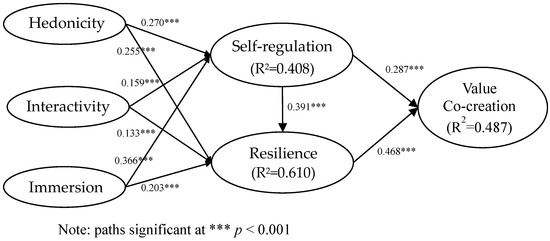
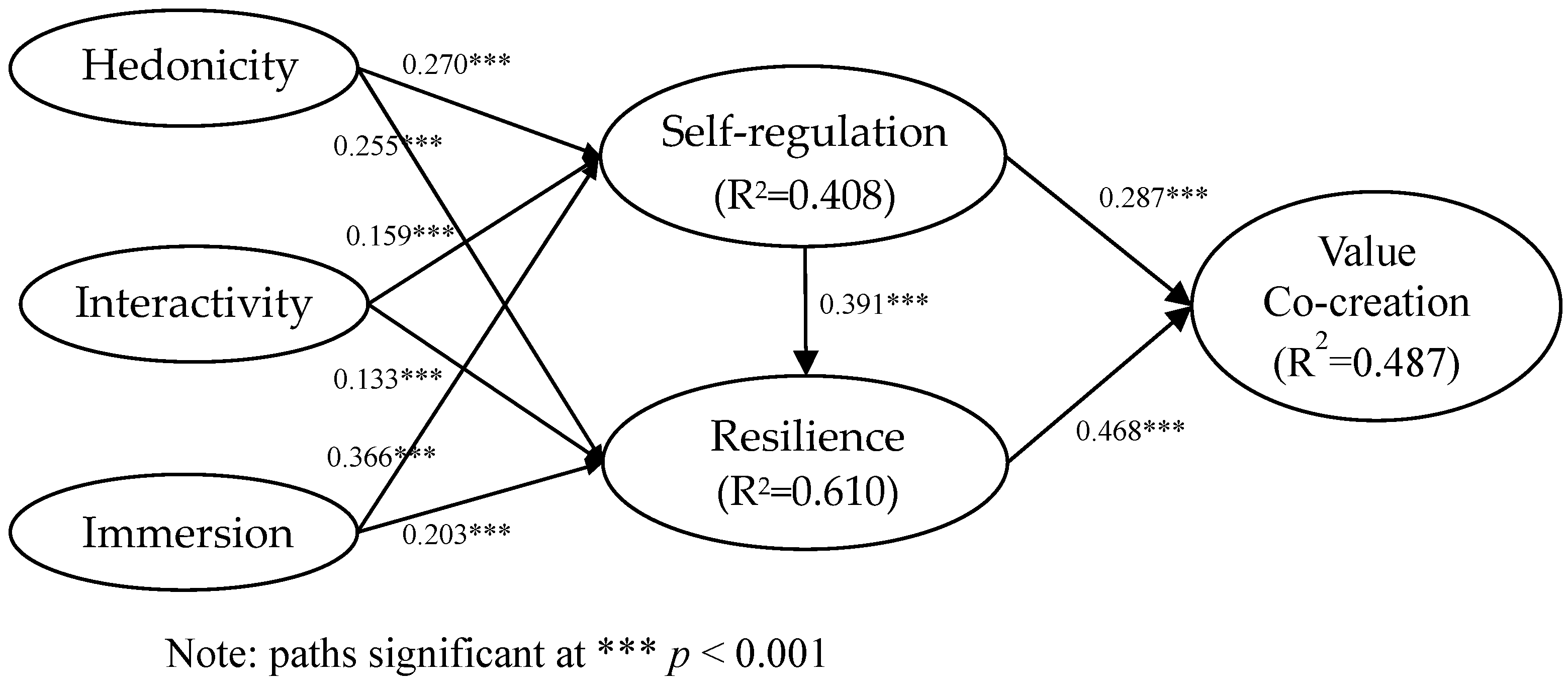
The structural model assessment showed no multicollinearity issues, with all Variance Inflation Factors (VIFs) below 5.06. Model fit was satisfactory, evidenced by an SRMR of 0.052 and an NFI of 0.8557. Figure 2 and Table 2 present the structural model results and path coefficients of the hypothesized relationships. Hypothesis testing confirmed that the generative AI stimuli of hedonicity, interactivity, and immersion significantly and positively influenced both self-regulation (H1a, H2a, H3a) and resilience (H1b, H2b, H3b) (p < 0.001). Furthermore, self-regulation positively impacted resilience (H4) and value co-creation (H5), while resilience significantly enhanced value co-creation (H6) (p < 0.001).
Figure 2.
Results of the structural model.
Table 2.
Results of the structural path model.
Mediation was tested using the bootstrapping method and the Variance Accounted For (VAF) formula [28]. As Table 3 shows, self-regulation and resilience partially mediated the relationship between AI stimuli and value co-creation (H7, H8), with VAF values ranging from 23.84% to 32.60%. Additionally, resilience significantly mediated the link between self-regulation and value co-creation (H9) with a VAF of 28.02%. These findings validate that psychological adaptability is the key mechanism through which AI-driven engagement translates into collaborative educational innovation.
Table 3.
Results of indirect effects testing.
Figure 2 reveals the predictive power of the structural model through the coefficient of determination (R2) values for self-regulation (0.408), resilience (0.610), and value co-creation (0.487). These values suggested that the model explains a meaningful proportion of the variance in the data, with resilience demonstrating the strongest explanatory power [29]. Further insight into the model’s predictive ability comes from the effect size (f2) metric. Cohen [30] classified f2 values above 0.02, 0.15, and 0.35 as small, medium, and large effect sizes. As Table 2 shows, the effect sizes for immersion on self-regulation, self-regulation on resilience, and resilience on value co-creation (f2= 0.165, 0.232, 0.223, respectively) indicated medium effect sizes. In addition, Stone–Geisser’s Q2 value obtained from a blindfolding procedure was used to assess the model’s predictive relevance. The Q2 values for self-regulation, resilience, and value co-creation were 0.213, 0.467, and 0.268, exceeding zero. The results suggested the predictive relevance of the structural model [29].
5. Conclusions and Implications
5.1. Discussion
This study confirms that GenAI-driven stimuli—hedonicity, interactivity, and immersion—significantly enhance teachers’ self-regulation and resilience. This finding aligns with cognitive appraisal theory and recent educational technology frameworks, demonstrating that responsive AI tools act as systemic environmental triggers that activate teachers’ internal psychological states [1,2]. Specifically, the empirical results indicate that the effect of immersion on teachers’ self-regulation was stronger than that of interactivity. This divergence from traditional mobile commerce studies—which often emphasize transactional interactivity [15]—can be interpreted through the lens of the cognitive affective model of immersive learning [6]. Within cloud-based professional development, highly immersive, granular pedagogical simulations completely absorb teachers’ attention, triggering deep cognitive flow and active self-emotion regulation more effectively than multi-directional communication alone [6]. This absorption enhances what educational scholars define as teacher artificial intelligence competence self-efficacy, allowing teachers to transition from passive resource consumers into highly engaged professionals [8,11].
Furthermore, the verification of the sequential mediating path—where digital self-regulation fortifies teacher resilience, which subsequently drives perceived value co-creation (H9)—contributes significantly to the broader academic discourse on teacher agency and AI literacy [5]. While classic self-regulated learning theory emphasizes goal-directed compliance [21], this study contextualizes regulation as an active strategy through which educators evaluate GenAI’s pedagogical compatibility and manage the heavy cognitive workloads induced by digital transformation [8]. By successfully self-monitoring their prompt engineering and balancing digital competence with artificial intelligence, educators build robust professional resilience [12]. This heightened resilience, rather than being a mere coping tool, acts as a critical psychological bridge that translates individual technical literacy into a proactive willingness to collaborate, share customized prompt scripts, and co-innovate within cloud learning communities [5,7].
To ensure a rigorous and balanced interpretation, alternative explanations and systemic tensions underlying these empirical findings must be carefully considered. First, the exceptionally strong effect of immersion on teachers’ self-regulation [6] may partially capture a temporary “novelty effect” or general tech enthusiasm among early adopters, rather than a permanent shift in pedagogical practice. Teachers who are already highly interested in GenAI might self-select into active cloud platform usage, masking variations in baseline motivation. Second, while GenAI-driven stimuli foster digital self-regulation, they inherently introduce critical professional and structural tensions within educational settings. The continuous reliance on automated platforms threatens to increase teacher workload through constant prompt troubleshooting and content vetting, potentially undermining professional autonomy. Furthermore, ethical uncertainties regarding algorithmic bias, data privacy, and intellectual property remain unresolved. The tension between AI-supported self-regulation and an increasing, systemic dependence on corporate digital platform infrastructures could inadvertently trap educators in non-transparent feedback loops. Therefore, school administrators must balance technological enthusiasm with critical AI ethics governance to protect teachers’ professional well-being from technostress and data risks [5,12].
5.2. Conclusions and Implications
This study provides empirical support for how GenAI applications influence teacher behavior through the S–O–R framework. The results indicate that self-regulation has positive effects on resilience and perceived value co-creation intentions, enabling teachers to concentrate on goal-directed activities amidst digital transformation [22]. Furthermore, professional resilience is verified as a critical psychological capacity that allows teachers to maintain well-being and adapt flexibly to ever-changing technological situations [4]. However, instead of validating actual institutional evolution, permanent behavioral changes, or proven transformations at the level of the educational ecosystem, these findings strictly illuminate the localized psychological mechanisms and behavioral intentions of educators within AI-enhanced environments.
Practical implications suggest that platform designers and school leaders should prioritize features that support teachers’ subjective psychological adaptability. Based directly on the tested paths, because immersion and interactivity are vital triggers for self-regulation (H2a, H3a), platform developers should design intuitive, bi-directional automated feedback loops and contextualized scenario simulators rather than generic content repositories. Furthermore, since resilience directly drives perceived value co-creation intentions (H6) and mediates the systemic framework (H8, H9), school administrators should offer collaborative micro-credential training modules focused on GenAI ethical governance and prompt engineering [5]. Rather than introducing arbitrary prescriptive directives or top-down mandates, administrators should foster supportive online professional learning communities where teachers can safely mitigate algorithmic risks, share teaching assets, and naturally align their digital competence with systemic trust, thereby cultivating a cooperative propensity within modern educational settings rather than implying an empirical proof of macro-level ecosystem evolution [8,12].
5.3. Limitations and Future Research
Despite its contributions, several critical methodological limitations must be acknowledged to prevent overstating the robustness and scope of the conclusions. First, because this study relies strictly on cross-sectional, self-reported survey data, definitive causal conclusions cannot be drawn among the latent constructs, and the identified relationships must be interpreted as statistical associations rather than verified directional mechanics. Crucially, value co-creation in this framework was measured exclusively as teachers’ perceived cognitive judgments and behavioral intentions, rather than observed collaboration, documented platform feedback, or jointly deployed curriculum assets. Therefore, these findings do not imply proven behavioral or institutional transformations at the educational ecosystem level. Second, the empirical data were gathered exclusively from a Taiwanese junior high school sample, which introduces distinct contextual, institutional, and cultural specificities. Taiwan’s highly centralized educational infrastructure and specific teacher professional development policies mean that these findings reflect a localized professional ecosystem. Consequently, the reported dynamics cannot be automatically transferred or generalized to other international educational systems, differing school cultures, or distinct AI platform infrastructures. Future studies should employ longitudinal or mixed-method designs to capture actual innovative practices over time and incorporate cross-cultural validations to broaden the generalizability of the model.
Funding
This research received no external funding.
Data Availability Statement
No new data were created.
Acknowledgments
The author thanks the National Science and Technology Council for its support, and the author is solely liable and responsible for this derived work.
Conflicts of Interest
The author declares no conflicts of interest.
Appendix A
Table A1.
The list of measurement items.
References
- Hussain, K.; Khan, L.M.; Malik, A.A. Exploring audience engagement with ChatGPT-related content on YouTube: Implications for content creators and AI tool developers. Digit. Bus. 2024, 4, 100071. [Google Scholar]
- Al-Abdullatif, A.M. Modeling teachers’ acceptance of generative artificial intelligence use in higher education: The role of AI literacy, intelligent TPACK, and perceived trust. Educ. Sci. 2024, 14, 1209. [Google Scholar] [CrossRef] [Scilit]
- Yue, M.; Jong, M.S.Y.; Ng, D.T.K. Understanding K–12 teachers’ technological pedagogical content knowledge readiness and attitudes toward artificial intelligence education. Educ. Inf. Technol. 2024, 29, 19505–19536. [Google Scholar] [CrossRef] [Scilit]
- Zhang, L. Reviewing the effect of teachers’ resilience and wellbeing on their foreign language teaching enjoyment. Front. Psychol. 2023, 14, 1187468. [Google Scholar] [CrossRef] [Scilit] [PubMed]
- Prilop, C.N.; Mah, D.-K.; Jacobsen, L.J.; Hansen, R.R.; Weber, K.E.; Hoya, F. Generative AI in teacher education: Educators’ perceptions of transformative potentials and the triadic nature of AI literacy explored through AI-enhanced methods. Comput. Educ. Artif. Intell. 2025, 7, 100269. [Google Scholar]
- Zeng, F.; Li, Q.; Cai, S.; Xiao, Z.; Chen, X.; Zhu, W.; Li, J. Cancer patients’ acceptance of virtual reality interventions for self-emotion regulation. Sci. Rep. 2025, 15, 95160. [Google Scholar] [CrossRef] [Scilit]
- Du, H.; Sun, Y.; Jiang, H.; Islam, A.Y.M.A.; Gu, X. Exploring the effects of AI literacy in teacher learning: An empirical study. Humanit. Soc. Sci. Commun. 2024, 11, 559. [Google Scholar] [CrossRef] [Scilit]
- Shi, L. Assessing teachers’ generative artificial intelligence competencies: Instrument development and validation. Educ. Inf. Technol. 2025, 30, 23365–23384. [Google Scholar] [CrossRef] [Scilit]
- Younis, B. The artificial intelligence literacy (AIL) scale for teachers: A tool for enhancing AI education. J. Digit. Learn. Teach. Educ. 2025, 41, 37–56. [Google Scholar] [CrossRef] [Scilit]
- Zimmerman, B.J. Investigating self-regulation and motivation: Historical background, methodological developments, and future prospects. Am. Educ. Res. J. 2008, 45, 166–183. [Google Scholar] [CrossRef] [Scilit]
- Chiu, T.K.F.; Ahmad, Z.; Çoban, M. Development and validation of teacher artificial intelligence (AI) competence self-efficacy (TAICS) scale. Educ. Inf. Technol. 2025, 30, 6667–6685. [Google Scholar] [CrossRef] [Scilit]
- Lucas, M.; Zhang, Y.; Bem-haja, P.; Vicente, P.N. The interplay between teachers’ trust in artificial intelligence and digital competence. Educ. Inf. Technol. 2024, 29, 22991–23010. [Google Scholar] [CrossRef] [Scilit]
- Lee, J.; Park, K. The effects of hedonic shopping values on loyalty towards small retailers: The moderating role of trust. J. Retail. Consum. Serv. 2024, 76, 103615. [Google Scholar] [CrossRef] [Scilit]
- Yanit, M.; Yanit, M.; Wan, F. Right agent, wrong level of hedonism: How high (vs low) hedonic values in AI-performed tasks lead to decreased perceptions of humanlikeness, warmth, and less consumer support. Comput. Hum. Behav. 2023, 147, 107870. [Google Scholar] [CrossRef] [Scilit]
- Rahman, M.S.; Bag, S.; Hossain, M.A.; Abdel Fattah, F.A.M.; Gani, M.O.; Rana, N.P. The new wave of AI-powered luxury brands online shopping experience: The role of digital multisensory cues and customers’ engagement. J. Retail. Consum. Serv. 2023, 72, 103273. [Google Scholar] [CrossRef] [Scilit]
- Vargo, S.L.; Lusch, R.F. From repeat patronage to value co-creation in service ecosystems: A transcending conceptualization of relationship. J. Bus. Mark. Manag. 2010, 4, 169–179. [Google Scholar] [CrossRef] [Scilit]
- Hudson, S.; Matson-Barkat, S.; Pallamin, N.; Jegou, G. With or without you? Interaction and immersion in a virtual reality experience. J. Bus. Res. 2019, 100, 459–468. [Google Scholar] [CrossRef] [Scilit]
- Yu, N.; Huang, Y.T. Why do people play games on mobile commerce platforms? An empirical study on the influence of gamification on purchase intention. Comput. Hum. Behav. 2022, 126, 106991. [Google Scholar] [CrossRef] [Scilit]
- Birt, J.; Vasilevski, N. Comparison of single and multiuser immersive mobile virtual reality usability in construction education. Educ. Technol. Soc. 2021, 24, 93–106. [Google Scholar]
- Chen, Y.L.; Hsu, C.C. Self-regulated mobile game-based English learning in a virtual reality environment. Comput. Educ. 2020, 154, 103910. [Google Scholar] [CrossRef] [Scilit]
- Zimmerman, B.J.; Schunk, D.H. Handbook of Self-Regulation of Learning and Performance; Taylor and Francis: New York, NY, USA, 2011. [Google Scholar]
- Yeh, Y.C.; Chu, L.H. The mediating role of self-regulation on harmonious passion, obsessive passion, and knowledge management in e-learning. Educ. Technol. Res. Dev. 2018, 66, 615–637. [Google Scholar]
- Armstrong, J.S.; Overton, T.S. Estimating nonresponse bias in mail surveys. J. Mark. Res. 1977, 14, 396–402. [Google Scholar] [CrossRef] [Scilit]
- Podsakoff, P.M.; MacKenzie, S.B.; Lee, J.-Y.; Podsakoff, N.P. Common method biases in behavioral research: A critical review of the literature and recommended remedies. J. Appl. Psychol. 2003, 88, 879–903. [Google Scholar] [CrossRef] [Scilit] [PubMed]
- Hair, J.F.; Hult, G.T.M.; Ringle, C.M.; Sarstedt, M. A Primer on Partial Least Squares Structural Equation Modeling (PLS-SEM); Sage: Thousand Oaks, CA, USA, 2017. [Google Scholar]
- Barclay, D.W.; Thompson, R.; Higgins, C. The Partial Least Squares (PLS) approach to causal modeling: Personal computer adoption and use an illustration. Technol. Stud. 1995, 2, 285–309. [Google Scholar]
- Fornell, C.; Larcker, D.F. Evaluating structural equation models with unobservable variables and measurement error. J. Mark. Res. 1981, 18, 39–50. [Google Scholar] [CrossRef] [Scilit]
- Nitzl, C.; Roldan, J.L.; Cepeda, G. Mediation analysis in partial least squares path modeling: Helping researchers discuss more sophisticated models. Ind. Manag. Data Syst. 2016, 116, 1849–1864. [Google Scholar] [CrossRef] [Scilit]
- Hair, J.F.; Howard, M.C.; Nitzl, C. Assessing measurement model quality in PLS-SEM using confirmatory composite analysis. J. Bus. Res. 2020, 109, 101–110. [Google Scholar] [CrossRef] [Scilit]
- Cohen, J. Statistical Power Analysis for the Behavioral Sciences, 2nd ed.; Lawrence Erlbaum Associates: Hillsdale, NJ, USA, 1988. [Google Scholar]

Disclaimer/Publisher’s Note: The statements, opinions and data contained in all publications are solely those of the individual author(s) and contributor(s) and not of MDPI and/or the editor(s). MDPI and/or the editor(s) disclaim responsibility for any injury to people or property resulting from any ideas, methods, instructions or products referred to in the content. |
© 2026 by the author. Published by MDPI on behalf of the International Institute of Knowledge Innovation and Invention. Licensee MDPI, Basel, Switzerland. This article is an open access article distributed under the terms and conditions of the Creative Commons Attribution (CC BY) license.