Skip to Content

Quaternary, Volume 8, Issue 1

2025 March - 16 articles

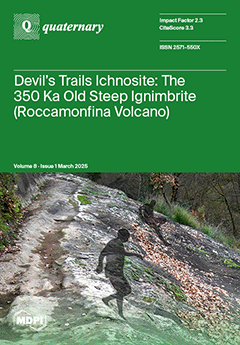
Cover Story: About 350,000 years ago, at the Devil’s Trails ichnosite, four, maybe five, hominins (Homo heidelbergensis s.l.) moved from the pathway at the top of an ignimbrite flow of the Roccamonfina volcano to the sharp slope and left their footprints, zigzagging down its slippery and muddy surface. In an attempt to infer the body size of the trackmakers, with the awareness that the results mainly depend on the technique of footprint measurement, the environmental context (substrate, surface slope, trackmaker gait, etc.), the equation used, and the slight dimensional differences between a fleshy foot and a footprint, we apply different formulas. Based on the best-preserved footprints, the average stature and body mass of each trackmaker approximately range from 152 to 180 cm and from 51 kg to 69 kg, respectively. View this paper
  • Issues are regarded as officially published after their release is announced to the table of contents alert mailing list .
  • You may sign up for email alerts to receive table of contents of newly released issues.
  • PDF is the official format for papers published in both, html and pdf forms. To view the papers in pdf format, click on the "PDF Full-text" link, and use the free Adobe Reader to open them.

Articles (16)

  • Article
  • Open Access
4 Citations
3,705 Views
28 Pages

20 March 2025

The timing, cause, and magnitude of mammalian extinctions during the African Middle Pleistocene remain largely unresolved. The demise of Elephas/Palaeoloxodon recki, a lineage that had a great geographic and temporal span, represents a particula...

  • Article
  • Open Access
1,756 Views
19 Pages

Archaeomagnetic Insights into Pre-Hispanic Mayan Lime Production: Chronological Framework and Evidence of an Apparent 500-Year Hiatus in the Yucatán Peninsula

  • Jocelyne Martínez Landín,
  • Avto Goguitchaichvili,
  • Soledad Ortiz,
  • Oscar de Lucio,
  • Vadim A. Kravchinsky,
  • Rubén Cejudo,
  • Miguel Cervantes,
  • Rafael García-Ruiz,
  • Juan Morales and
  • Carlos Peraza Lope
  • + 4 authors

20 March 2025

The Yucatán Peninsula, a key region of the ancient Maya civilization, has long presented challenges in establishing absolute chronological frameworks for its cultural practices. While the central regions of Mesoamerica have been extensively st...

  • Article
  • Open Access
1 Citations
5,067 Views
41 Pages

18 March 2025

As humans expanded across the globe, the Americas were the last continents to be colonized. While debates persist regarding the timing and mechanisms of this process, it is widely accepted that by the Pleistocene–Holocene transition, the New Wo...

  • Article
  • Open Access
1,964 Views
16 Pages

17 March 2025

Although the Late Pleistocene glaciation history of the Fraser Lowland (BC, Canada) is relatively well studied, little is known about ice-flow directions during the last glaciation (Fraser glaciation). Lidar imagery from the western Fraser Lowland wa...

  • Editorial
  • Open Access
1,335 Views
5 Pages

Introduction: Mammals Biochronology and Paleoecology of the Euro-Mediterranean Quaternary

  • Alessio Iannucci,
  • George E. Konidaris,
  • Dimitris S. Kostopoulos,
  • Joan Madurell-Malapeira and
  • Raffaele Sardella

6 March 2025

The Quaternary is a time of fundamental climatic shifts and environmental changes that highlight the need for a thorough investigation from different perspectives and at multiple scales to disentangle the factors involved in the response of the biota...

  • Article
  • Open Access
2,454 Views
19 Pages

18 February 2025

Based on 88 well-dated and high-resolution paleoclimate records, global and hemispheric stacks of the last deglacial climate were synthesized by utilizing the normalized average method. A sequential relationship between the West Antarctic Ice Sheet D...

  • Article
  • Open Access
1 Citations
1,628 Views
11 Pages

13 February 2025

A first attempt has been made to present a general composition of birds found in Chalcolithic settlements in the plains and lowlands of Bulgaria. Based on data from 21 settlements, 78 bird taxa (including 3 domestic forms) have been identified. Of th...

  • Article
  • Open Access
1 Citations
3,650 Views
22 Pages

Streamflow Reconstruction Using Multi-Taxa Tree-Ring Records from Kullu Valley, Himachal Pradesh, Western Himalaya

  • Asmaul Husna,
  • Santosh K. Shah,
  • Nivedita Mehrotra,
  • Lamginsang Thomte,
  • Deeksha,
  • Tanveer W. Rahman,
  • Uttam Pandey,
  • Nazimul Islam,
  • Narayan P. Gaire and
  • Dharmaveer Singh

8 February 2025

To study the long-term hydroclimate variability in the Satluj Basin, streamflow data was reconstructed using tree-ring width datasets from multiple taxa available from the Kullu Valley, western (Indian) Himalaya. Five ring-width tree-ring chronologie...

  • Reply
  • Open Access
2 Citations
1,771 Views
12 Pages
  • Article
  • Open Access
2 Citations
1,710 Views
16 Pages

5 February 2025

In the North Atlantic region, the transition from the very cold Lateglacial Stadial (GS-1) to the temperate Holocene was abrupt, with a rapid increase in temperature of several degrees, after which the low-stature, cold-tolerant Stadial vegetation wa...

  • Article
  • Open Access
2 Citations
2,546 Views
34 Pages

28 January 2025

This study presents a high-resolution palaeoclimate reconstruction based on a radiocarbon-dated 240 cm deep trench profile from Renuka Lake, Northwestern Himalaya, India. The palynological analysis provides insight into the palaeovegetation and palae...

  • Article
  • Open Access
4,147 Views
82 Pages

21 January 2025

The challenging task of correctly estimating the body size of prehistoric hominins from footprint dimensions has been a matter of long debate, but researchers are still divided about the best methodological approach for obtaining compelling estimates...

  • Article
  • Open Access
2 Citations
7,366 Views
31 Pages

Unveiling the Volcanic History of Ancient Pompeii (Italy): New Insights from the Late Pleistocene to Holocene (Pre-79 CE) Stratigraphy

  • Domenico Sparice,
  • Mauro Antonio Di Vito,
  • Vincenzo Amato,
  • Valeria Amoretti,
  • Alessandro Russo,
  • Pierfrancesco Talamo and
  • Gabriel Zuchtriegel

21 January 2025

Many volcanological and geoarchaeological studies in the ancient city of Pompeii (Italy) have been devoted to the 79 CE Plinian eruption of Vesuvius, which sealed the city under a thick pyroclastic sequence. Only fragmentary information exists regard...

  • Article
  • Open Access
3 Citations
2,817 Views
26 Pages

Paleolimnology and Natural Versus Anthropogenic Influx During the Late Holocene from Vembanad Wetland, Ramsar Site, Kerala, India

  • Pooja Tiwari,
  • Biswajeet Thakur,
  • Purnima Srivastava,
  • Sanjay Kumar Singh Gahlaud,
  • Ravi Bhusan and
  • Rajesh Agnihotri

13 January 2025

A multi-proxy study of diatoms, palynofacies, and grain size was conducted on a 100 cm core from Arookutty, Vembanad wetland, Kerala, India, to reconstruct paleolimnological changes during the late Holocene, with a focus on natural versus anthropogen...

  • Article
  • Open Access
1 Citations
2,422 Views
14 Pages

2 January 2025

Understanding the past dynamics of vegetation in response to climate change is crucial for predicting future ecological outcomes. This study has two primary objectives: (1) to reconstruct the vegetation history of the coastal region around Lake Lilas...

XFacebookLinkedIn
Quaternary - ISSN 2571-550X