


Abstract
Controlling the interfacial behavior is essential for understanding the efficiency of surfactant–nanoparticle systems in practice. In this study, we investigate how silica (SiO2) nanoparticles alter the surface and interfacial properties of sodium dodecyl sulfate (SDS) solutions at water–air and water–hexane interfaces, as well as their impact on the formation and stabilization of foams. While the negatively charged SiO2 nanoparticles alone exhibit negligible surface activity, their combination with SDS leads to the formation of composite interfacial layers with enhanced surface pressure and dilational viscoelasticity. The increase in interfacial pressure reflects a high surface concentration and denser packing of SDS–SiO2 associates. Interfacial rheology measurements show that SDS–SiO2 nanofluids form more elastic interfacial films compared to pure SDS, with a maximum dilational elasticity at intermediate surfactant concentrations. This indicates the formation of mechanically stronger interfacial layers capable of resisting deformation. Foam experiments demonstrate that silica nanoparticles significantly improve foam formation and foam stability. These improvements correlate with increased surface pressure and interfacial elasticity, demonstrating that foam stability is primarily determined by the formation of robust interfacial layers and not solely by a reduction in surface tension. Overall, this study demonstrates how the presence of silica nanoparticles can affect the adsorption of SDS via hydrophobic interaction, leading to the formation of stronger interfacial films, improved foam stability, and expanded potential for applications in industrial processes, such as foam flooding based on nanoparticle/surfactant solutions to enhance oil–gas recovery.
1. Introduction
Interfacial phenomena play an important role in numerous industrial applications, including enhanced oil recovery, pharmaceuticals, food processing, and materials synthesis [1,2,3]. The stability and properties of foams and emulsions are fundamentally governed by interfacial characteristics such as surface and interfacial tension, and the rheological behavior of adsorbed layers at the fluid-fluid interfaces [4]. Understanding and controlling these interfacial properties is essential for optimizing the performance of emulsions and developing novel functional materials. In recent years, the addition of nanoparticles into surfactant systems has emerged as a promising strategy to enhance foam and emulsion stability and tailor interfacial properties, leading to the development of so-called Pickering emulsions stabilized by synergistic nanoparticle–surfactant systems [3,5].
Silicon dioxide (SiO2) nanoparticles are attracting attention as emulsion and foam stabilizers due to their large surface area, controllability of surface chemistry, biocompatibility, and commercial availability [6,7]. Unlike conventional surfactants that stabilize emulsions via the reduction in interfacial tension and formation of a visco-elastic interfacial layer, nanoparticles can adsorb irreversibly at fluid interfaces, forming a rigid mechanical barrier that prevents droplet coalescence [8]. Previous studies have shown that unmodified nanoparticles, such as hydrophilic silica particles, lack surface activity and do not affect surface tension or surface elasticity [9,10]. However, the addition of such particles to a surfactant can significantly affect the surface properties of the solution, as well as the activity or structure of the adsorbed layers [11,12]. For instance, Ravera et al. [10] reported that silica nanoparticle suspensions at concentrations up to 1 wt% exhibited surface tension values comparable to pure water, with no measurable impact on the surface rheology. Similarly, Vatanparast et al. [13] found that pure hydrophilic nanoparticles do not significantly change surface tension and surface elasticity. According to the experimental work by Bojorkergin et al. [14], the maximum effect of unmodified nano-silica on surface tension was about 2 mN/m. The surface quality of silica particles and its ability to control the accumulation of colloidal particles are critical factors [15,16]. Dong and Johnson [17] achieved a reduction in surface tension of about 4 mN/m when using 5–7 wt% charged nanosized silicon dioxide particles.
The combination of surfactants and nanoparticles offers a synergistic approach to emulsion stabilization, where added surfactants can modify the wettability of nanoparticles and facilitate their adsorption at interfaces [9,18,19]. The anionic surfactant sodium dodecyl sulfate (SDS) is widely used in both research and industrial applications. It has been studied in combination with silica nanoparticles, for example, in [20]. At the water–air interface, SDS reduces surface tension and adsorbs so that its hydrophobic tail is oriented toward the air phase, while its hydrophilic sulfate head group is anchored in the aqueous phase. Recent molecular studies have provided valuable insights into the aqueous dispersion and interfacial behavior of SDS in the presence of silica nanoparticles. In [20] it is also demonstrated that SDS enhances nanoparticle adsorption at the water–oil interface, leading to a stronger interfacial modification.
The interfacial rheological properties of adsorbed layers are critical determinants of emulsion and foam stability [21]. Dilational elasticity, which characterizes the resistance of an interfacial layer to area deformation, and dilatational viscosity, which describes the energy dissipation during interfacial expansions and compressions, are key parameters governing the mechanical strength of interfacial films [22]. Amankeldi et al. [23] investigated the dynamic interfacial properties and foamability of cationic surfactant–nanoparticle systems containing 0.1 wt% SiO2 nanoparticles. The study revealed that the addition of silica nanoparticles significantly enhanced foam stability. The surface dilational visco-elasticity measurements at 0.1 Hz demonstrated that mixed DoTAB/SiO2 systems exhibited enhanced interfacial film strength compared to pure surfactant solutions [23]. For SDS films at very low interfacial tensions (<1 mN/m), Ma et al. [8] observed that the dilational modulus approaches zero, indicating mechanically weak films. In contrast, interfacial layers stabilized by other surfactants or jammed nanoparticle assemblies can exhibit substantially higher dilatational moduli. For example, alkyl sulfobetaine (ASB) surfactants reached dilational moduli of approximately 50 mN/m, while extended surfactants exhibited plateau values of around 30 mN/m [8]. Due to the recent detailed discussions by Langevin [24], there are generally three mechanisms, from which we discuss here the most relevant impact of bubble coalescence, i.e., foam film rupture. Following the discussion by Georgieva et al. [25] the stability of foam films is essentially controlled by the dilation surface visco-elasticity.
Recent studies have been actively exploring the practical applications of mixed nanoparticle—surfactant systems for stabilizing emulsions and foams. The synergistic effects of surfactant and nanoparticles were discussed in our work [26], where we investigated hybrid CO2 foam injections using surfactants and nanoparticles to enhance foam stability. Chen et al. [2] reported that hydrophilic SiO2 with anionic surfactant foam dispersions increased oil recovery in laboratory flooding experiments, representing an absolute improvement of 14.92%. The optimal performance was achieved at temperatures around 30 °C and salinities in the range of 7.5 × 10⁴–1.25 × 10⁵ mg/L, demonstrating the importance of thermodynamic conditions and ionic strength in governing the foam stability [2]. In another application, Zhao et al. [27] showed that mixed surfactant/SiO2-stabilized emulsions exhibited superior stability against pH variations, centrifugation, and temperature fluctuations compared to surfactant-only systems. The presence of silica nanoparticles, which were tightly adsorbed on emulsion droplet surfaces, provided physical isolation and made it possible to increase the particle size of the polymer latex [27]. These results demonstrate the applicability of nanoparticle–surfactant systems in various industries.
Despite numerous studies of nanoparticle–surfactant systems, a number of fundamental questions remain. Most previous works have focused on bulk foam properties such as foam half-life, drainage rate, and surface tension [28,29,30,31], but the connection between interfacial film behavior and foam stability needs further clarification. The comparative behavior of these systems at different interfaces—especially at water–air and water–oil interfaces—has not been thoroughly studied. While the water–air interface is characterized by a gas phase with few molecular interactions, the water–oil interface involves complex interactions between surfactant tails, nanoparticle surfaces, and oil molecules, resulting in different adsorption kinetics and interfacial rheology. Furthermore, the influence of nanoparticle concentration, size distribution, and surface charge on interfacial properties requires systematic investigation to develop models for the stabilization of emulsions and foams.
In the present study, we investigate solutions containing the anionic surfactant sodium dodecyl sulfate and negatively charged SiO2 nanoparticles. Unlike previous studies that relied on bulk foam stability metrics, we directly characterize the mechanical properties of composite interfacial adsorption layers through dilational rheology at both water–air and water–hexane interfaces. The main aim is to elucidate how the interactions between SDS and SiO2 govern the formation, structure, and mechanical properties of the respective interfacial adsorption layers. These findings directly address the gaps identified above and provide a basis for the rational design of SDS–SiO2 systems in foam flooding and related applications.
2. Materials and Methods
2.1. Materials
The anionic surfactant sodium dodecyl sulfate (SDS, purity ≥ 99%, MW = 288.38 g mol−1) and hydrophilic fumed silica nanoparticles (SiO2, primary particle size 12–15 nm) were purchased from Sigma-Aldrich (St. Louis, MO, USA) and used without further purification. n-Hexane (purity ≥ 99%) was used as the model oil phase for interfacial tension measurements at the water–oil interface. Distilled water was used for the preparation of all solutions.
SDS stock solutions were prepared in distilled water and subsequently diluted to concentrations from 0.01 to 10 mM. Silica dispersions containing 0.1 wt% SiO2 were prepared by dispersing the required amount of fumed silica in the SDS solutions under magnetic stirring for 1 h followed by ultrasonication for 15 min to ensure homogeneous particle distribution. The prepared dispersions were left for 24 h before measurements to establish adsorption equilibrium between surfactant molecules and nanoparticles. Note that we studied the properties of the mixed surfactant—nanoparticle solutions only at a fixed SiO2 concentration. Studies with other surfactants (see, for example, [23]) have shown that the properties of the interfacial layers at higher or lower SiO2 did not lead to significant changes except a shift along the concentration axis.
For interfacial measurements at the water–hexane interface, a respective aqueous SDS solution or SDS–SiO2 dispersion was used as the lower phase and hexane as the upper phase. All experiments were carried out at (25 ± 1) °C. The surface tension of pure water at the water–air interface was (71.5 ± 0.2) mN m−1, while the interfacial tension of the pure water–hexane interface was (50.1 ± 0.2) mN m−1.
For the foam flooding experiments, a 10,000 ppm brine solution was prepared by dissolving NaCl in distilled water. The nanofluid samples for foam stability and core flooding tests were prepared as follows: 0.4 wt% SDS surfactant was added to the 10,000 ppm brine solution while mixing at 200–250 rpm on a magnetic stirrer (ISOLAB Laborgeräte GmbH, Eschau, Germany). After 40 min of stirring, fumed silica nanoparticles at concentrations of 0.1, 0.2, 0.4, 0.6, and 0.8 wt% were added and the solution was stirred for an additional 40 min. To ensure a homogeneous and stable dispersion of nanoparticles and even distribution of surfactant molecules, the solution was placed into an ultrasonic homogenizer (power 21 W, Bandelin Electronic GmbH, Berlin, Germany) for 15 min.
2.2. Methods
2.2.1. Surface/Interfacial Tensions
Surface and interfacial tension were measured using a PAT-1 drop profile analysis tensiometer (SINTERFACE Technologies, Berlin, Germany). The pendant drop/emerging bubble shape was recorded with a CCD camera (SINTERFACE Technologies, Berlin, Germany) and fitted by the Young-Laplace equation to determine the corresponding surface or interfacial tension. The setup and experimental protocol are described elsewhere in detail [32].
Dynamic surface/interfacial tension was measured as a function of adsorption time until equilibrium values were reached. Depending on the surfactant concentration, the adsorption time ranged from a few seconds to 5000 s.
The surface and interfacial pressure was calculated as:
where is the surface or interfacial tension at the pure water–air/water–oil interface, respectively, and is the measured value in the presence of SDS or SDS–SiO2 solutions.
The Gibbs adsorption equation [33] was used to determine the surface excess concentration:
where R is the ideal gas constant, T is the absolute temperature, and n = 2 for the ionic surfactant SDS. The derivative dγ/dlnC was obtained from the linear part of the equilibrium tension isotherm close to the critical micelle concentration.
2.2.2. Dilational Viscoelasticity
The dilational viscoelastic properties of the adsorption layers were measured using oscillating drop experiments with the PAT-1 tensiometer. After reaching a given adsorption time, sinusoidal oscillations of the droplet surface area were applied. The amplitude of oscillation was approximately 7% of the initial droplet area and the frequency was 0.1 Hz [34]. According to the following basic definition, the dilational surface elasticity, ε, is calculated:
where δγ is the surface tension variation during the droplet surface area oscillation for the applied area amplitude γA.
2.2.3. Zeta Potential and Particle Size Measurements
The zeta potential and hydrodynamic particle size of the SiO2 nanoparticles in the SDS-containing dispersions were measured using the Zetasizer Nano ZS (Software Version 7.13, Malvern Instruments, Malvern, UK). Prior to measurements, the instrument performance was verified using the Malvern zeta potential transfer standard.
For each measurement, freshly prepared SDS–SiO2 dispersions containing 0.1 wt% silica and varying SDS concentrations were transferred into disposable folded capillary cells for zeta potential measurements and into polystyrene cuvettes for the particle size analysis. The measurements were performed at 25 °C. Each value was averaged from at least three independent measurements.
2.2.4. Foamability and Foam Stability Tests
Foaming properties were investigated using a Dynamic Foam Analyzer DFA100 (KRÜSS GmbH, Hamburg, Germany). Aqueous SDS solutions with concentrations from 0.1 to 10 mM were studied both in the absence and presence of 0.1 wt% fumed silica nanoparticles. Ten milliliters of solution were placed in a cylindrical glass column with an inner diameter of 40 mm. The foam was generated by bubbling air through a porous filter (12–25 μm pore size) located at the bottom of the column. The air flow rate was maintained at 0.3 L min−1. During the experiments, the foam height and bottom liquid height were continuously monitored by an optical detection system. The measurements included the foam generation and foam decay regimes. The maximum foam volume, foam half-life time, liquid drainage half-life, expansion ratio (ER), and foam concentration ratio (FC) were determined automatically using the KRÜSS ADVANCE software (version 1.19.2). In addition, foam structure images were analyzed using the ImageJ (Version 1.54) software. The obtained parameters were used to evaluate bubble size uniformity and structural evolution of the foam.
2.2.5. Foam Rheology Measurements
The rheological properties of the nanofluid foams were measured using a rotational rheometer (Anton Paar GmbH, Graz, Austria) in rotational mode, where the lower plate was rotated and the upper plate remained stationary. A total of six samples with different nanoparticle concentrations (0, 0.1, 0.2, 0.4, 0.6, and 0.8 wt%) in 0.4 wt% SDS/10,000 ppm brine were prepared according to the procedure described in Section 2.1. The solution of each concentration was placed onto the rheometer plates, and the apparent viscosity was measured at a constant shear rate of 10 s−1 under ambient temperature conditions (25 °C).
2.2.6. Core Flooding Experiments and Mobility Reduction Factor
Core flooding experiments were conducted using water-wet Bentheimer sandstone cores (predominantly quartz, 92%). Each core plug was cleaned, dried, and saturated with 10,000 ppm brine using a manual saturator (Vinci Technologies, Nanterre, France) at 1100 psi for 24 h. The saturated core was installed in the Core Flooding System (CFS 700, Vinci Technologies, Nanterre, France), which consisted of an injection syringe pump, three accumulators (accumulator A filled with N2 gas, accumulator B with brine solution, and accumulator C with the nanofluid-surfactant solution), a core holder, and a measuring cylinder. As the primary stage, the fully saturated core was subjected to brine flooding at three different flow rates (2, 5, and 8 cc/min) to ensure complete saturation with the formation brine. All tests were conducted at room temperature (25 °C). Pressure drops at each stage were monitored. The mobility reduction factor (MRF) was calculated as follows:
where is the steady-state pressure drop recorded during foam injection and is the pressure drop during the preceding brine injection at the same flow rate.
3. Results
As foams and emulsions are typical metastable dispersions, their properties strongly depend on the dynamic formation of interfacial adsorption layers, including thermodynamic and rheological parameters. Surface pressure is an important indicator of interfacial film formation, since higher values generally reflect stronger surfactant adsorption, larger interfacial coverage, and more resistant viscoelastic films, all of which contribute to improved foam and emulsion stability. In EOR, this translates into better mobility control, reduced gas channeling, and improved sweep efficiency. Surface pressure values of aqueous solutions containing silica nanoparticles are very low and refer to the very low surface activity of the SiO2 particles (Table 1). At all concentrations, the surface pressure is close to zero, as also reported in [10]. It turns out that the capillary forces between particles adsorbed on the surface can even increase the surface tension at concentrations below 200 ppm. Kim et al. observed a similar effect for several nanofluids, including SiO2, where the surface tension even increased at lower particle concentrations [35].
Table 1.
Dependence of surface pressure and zeta potential of SiO2 nanoparticle on the concentration (wt%) for freshly prepared and 3-day aged dispersions.
To define the stability of nanofluids, the zeta- potential of freshly prepared and three days aged solution was measured. As shown in Table 1, the absolute zeta potential values fluctuate steadily between −44.9 and −41.56 mV, with a slight decrease to −42.87 and −39.97 mV observed after a 3-day aging period. This stability indicates that the nanofluids remain stable, confirming their suitability for an intended use in this study.
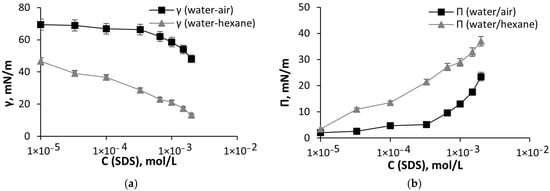
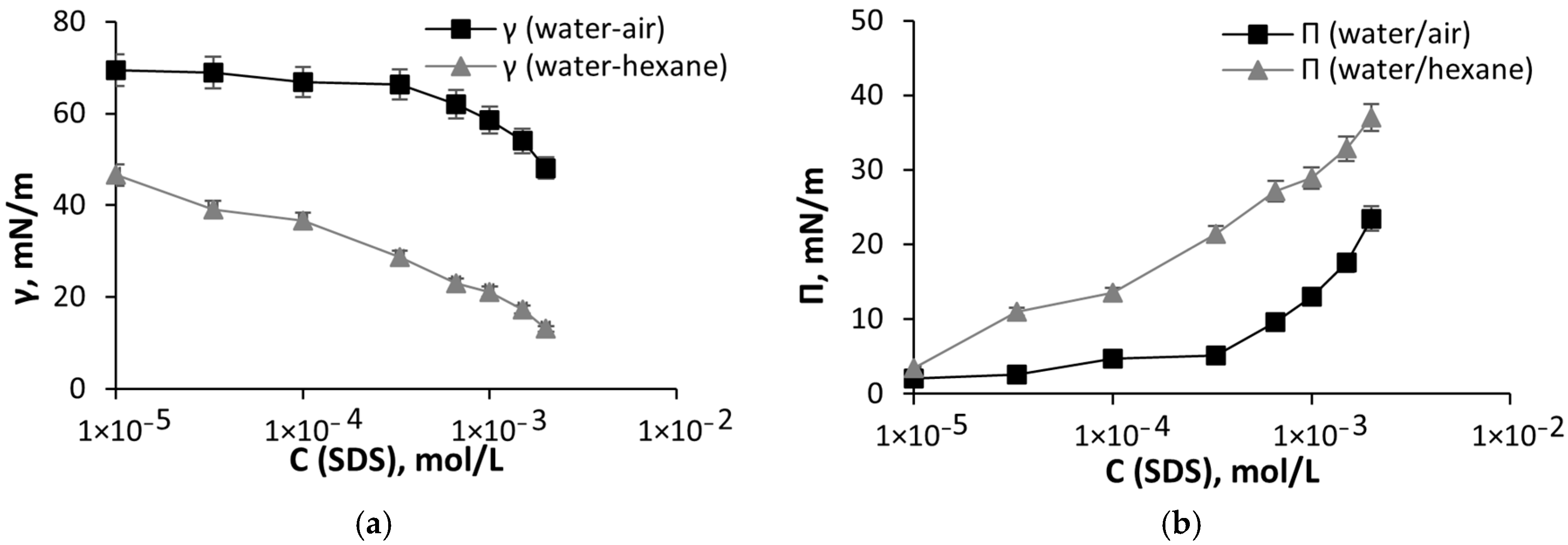
The features of interfacial SDS layers in the presence of SiO2 nanoparticles was studied at the water–air and water–hexane interfaces, including interfacial tension and pressure, adsorption, and interfacial rheology data. In Figure 1a, it is shown that the equilibrium surface tension at the water–air interface decreases from 71.54 to 48.09 mN m−1 with increasing SDS concentration, whereas a much stronger reduction is observed at the water–hexane interface, from 50.06 to 13.05 mN m−1 (Figure 1a). This difference reflects directly the formation of stronger, more ordered mixed interfacial adsorption layers of the SDS–SiO2 system at the liquid–liquid interface, where the reduction in interfacial free energy is more pronounced.
Figure 1.
Surface and interfacial tension (a) and pressure isotherms (b) of SDS-SiO2 (0.1%w) mixtures at the water–air and water–hexane interface.
Note, SDS in aqueous solution is subject to hydrolysis, and the resulting dodecanol as hydrolysis product is very surface active. In our systems, however, it does not play a significant role as dodecanol interacts hydrophobically with the SiO2 nanoparticles, i.e., in the same way like the SDS molecules. Thus, for our studies it is of minor importance and does not need to be considered in a particular way.
The surface and interfacial pressure of the SDS–SiO2 nanofluid increases with increasing SDS concentration at both interfaces (Figure 1b). However, this increase is significantly larger at the water–hexane interface, where Π increases up to approximately 37 mN m−1, while at the water–air interface it increases up to 23 mN m−1 only. Larger Π values for the water–hexane interface indicate a much stronger decrease in the interfacial free energy and, consequently, a higher adsorption efficiency of SDS–SiO2 complexes in the presence of hexane. The sharper increase in Π at the water–hexane interface indicates that the surfactant molecules are more highly oriented and packed at the liquid–liquid interface. The hydrocarbon phase promotes the adsorption of the hydrophobic SDS tails due to a cooperative effect [36], while the silica particles remain located on the aqueous side of the interface, leading to the formation of mixed surfactant–particle adsorption associates. The increase in surface pressure with the SDS concentration reflects the progressive adsorption of surfactant molecules and the formation of an increasingly dense interfacial layer. In the presence of SiO2 nanoparticles, this effect becomes even more pronounced, indicating the formation of mixed SDS–SiO2 adsorption layers with an enhanced packing density. As a result, the interfacial layer becomes more compact and mechanically stronger than at the water–air interface. Although silica nanoparticles alone do not significantly reduce surface tension, their presence alters the organization of the adsorbed surfactant molecules. Apparently, SiO2 particles act as modifiers or matrix of the interfacial layer, facilitating the formation of composite interfaces with increased cohesion and resistance to deformation. This leads to the development of more stable and mechanically robust interfacial films. The adsorption parameters calculated using the Gibbs equation are presented in Table 2.
Table 2.
Adsorption parameters of the SDS–SiO2 system at the water–air and water–hexane interfaces.
At low SDS concentrations, the SDS–SiO2 system adsorbs more densely at the water–hexane interface than at the water–air interface. In the concentration ranges of 0.01–0.1 mM, the surface excess at the water–hexane interface is higher than at the water–air interface. This observation is consistent with the known mechanism of surfactant adsorption at water–oil interfaces [36,37]. The adsorption layer contains both surfactant molecules and hydrocarbon molecules originating from the oil phase. The first SDS molecules to reach the interface interact and cooperate with the hexane molecules. These adsorbed hydrocarbon molecules then facilitate the adsorption of additional surfactant molecules. As a result, SDS, hexane, and SiO2 nanoparticles together form a cooperative mixed adsorption layer. This stronger adsorption at low concentrations leads to a sharper initial drop in surface tension, i.e., it creates a higher interfacial pressure at the water–hexane interface. In the presence of SiO2 nanoparticles, this cooperative effect becomes even stronger. SDS molecules bound to the nanoparticle surface further accumulate at the interface, enhancing the effect. As the SDS concentration increases, the adsorption mechanism at the water–hexane interface undergoes a transition. At low concentrations, hexane cooperatively enhances SDS adsorption. However, as the interfacial layer gets closer packed (≈0.66–1 mM), hexane molecules begin to adsorb at the interphase together with SDS and SiO2 associates. At higher concentrations, hexane partially occupies the interfacial layer, likely due to the solubility of surfactants’ hydrocarbon tails in hexane. It can lead to an increase in the effective area per adsorbed molecule and probably limits further SDS adsorption. As a result, the surface excess (Γ) at the water–hexane interface levels off and becomes lower than that at the water–air interface. In contrast, at the water–air interface, where such competition is absent, Γ continues to increase as the SDS concentration approaches the CMC.
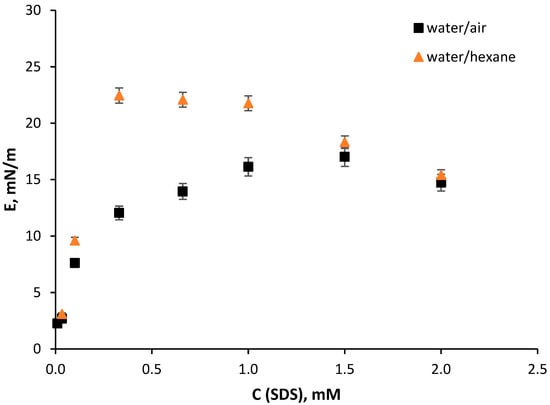
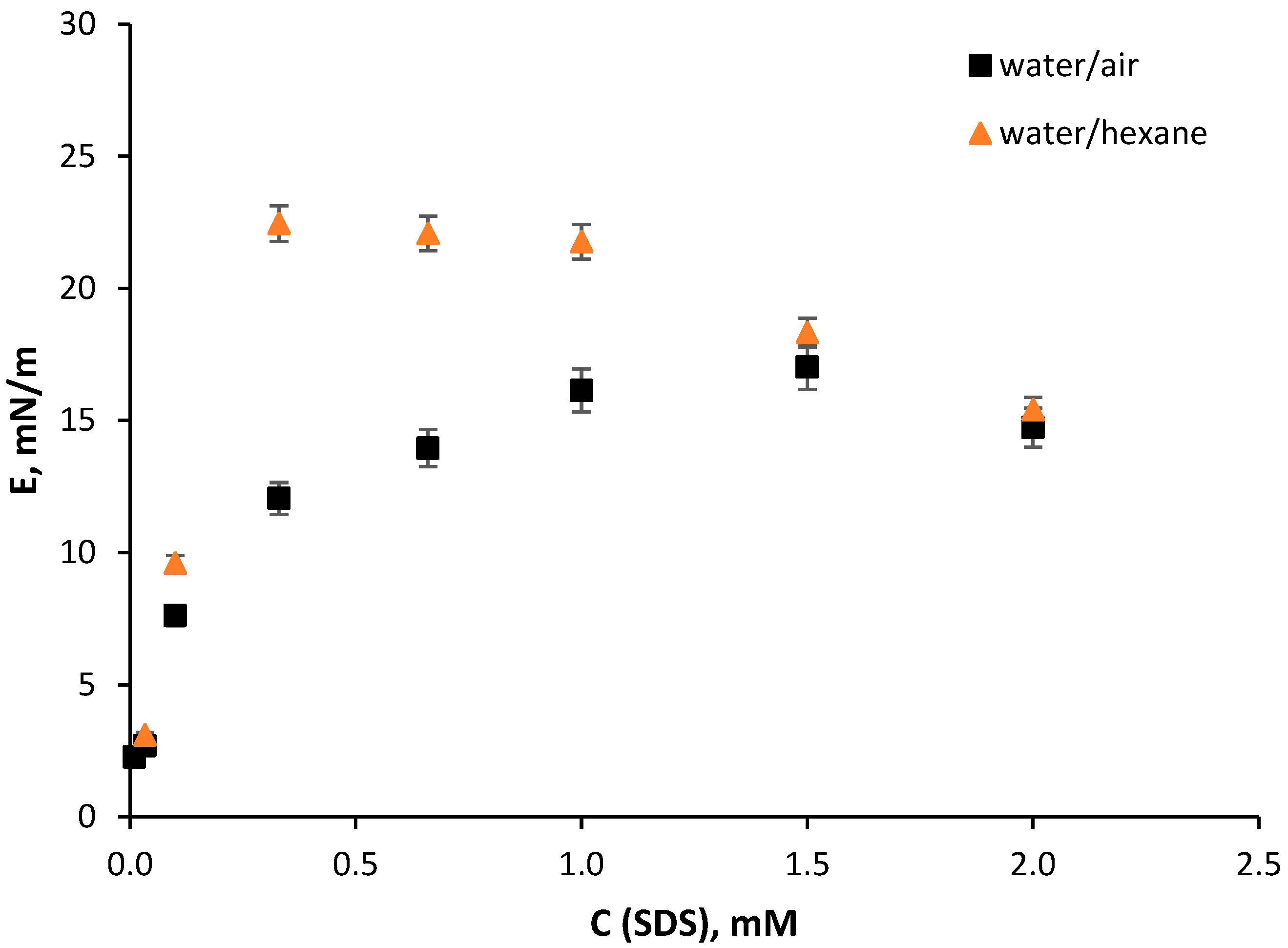
The dilational surface/interfacial elasticity E relates to variations in interfacial coverage and intermolecular interactions caused by the relative interfacial area changes ΔA/A, while the dilational viscosity is directly related to relaxation processes in the surface layer and in the adjacent bulk. The results of the respective measurements shown in Figure 2 were performed at a fixed frequency of 0.1 Hz for both pure SDS solutions and those mixed with SiO2 nanoparticle. A distinct elasticity maximum is observed around an SDS concentration of 1.5 mM for the water/air surface. This maximum refers to the maximum adsorption of the SDS–SiO2 associates and indicates the formation of a most elastic interfacial film.
Figure 2.
Dependence of dilational elasticity at different SDS concentrations and a fixed SiO2 concentration (0.1 wt%) on the frequency of harmonic oscillations at the water–air and water–hexane interfaces, respectively.
The dilational elasticity values at the water–hexane interface are shifted towards lower surfactant concentrations, and a maximum is observed at about 0.5–1 mM. The observed increase in dilatational elasticity for SDS–SiO2 systems indicates the formation of a viscoelastic interfacial layer capable of resisting deformations. The maximum elasticity observed at intermediate SDS concentrations suggests optimal conditions for the formation of structured interfacial networks. These results confirm that the mechanical strength of the interfacial layer is strongly enhanced by the presence of nanoparticles.
The results of the study demonstrate different surface activities of the SDS–SiO2 nanofluid at the water–air and water–hexane interfaces, which are important for understanding the mechanisms of foam stabilization and for applications in enhanced oil recovery processes. The observed decrease in interfacial tension (IFT) at the water–hexane interface was significantly more pronounced compared to the surface tension at the water–air interface, indicating a higher surface activity of the SDS–SiO2 system at the interface with the hexane phase. This phenomenon can be explained by several factors. First, the presence of hexane as an immiscible organic substance creates good conditions for a more efficient orientation of SDS molecules and SiO2 nanoparticles at the oil–water interface. The hydrophobic tails of the SDS molecules can penetrate into the organic phase, while the hydrophilic heads remain in the aqueous phase, creating a tightly packed monolayer. SiO2 nanoparticles modified with adsorbed SDS also concentrate more effectively at this interface, providing an additional reduction in interfacial energy. Thus, the hydrophobic interaction of SDS and SiO2 leads to a more significant reduction in the energy required to create the water–hexane interface compared to the water–air interface.
To understand the properties of SDS–SiO2 mixtures, the bulk properties such as particle size and zeta potential were measured at various surfactant concentrations and a fixed concentration of SiO2 of 0.1 wt% (Table 3). For the SDS–SiO2 system, the zeta potential remains in the range of approximately −30 to −20 mV and changes only slightly with increasing SDS concentration. This indicates that SDS adsorption on silica is relatively weak and occurs probably through intermolecular interactions and the formation of surface aggregates.
Table 3.
Particle size and zeta potential of SDS-SiO2 composite and pH at different SDS concentrations.
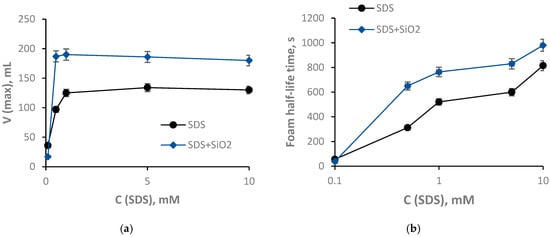
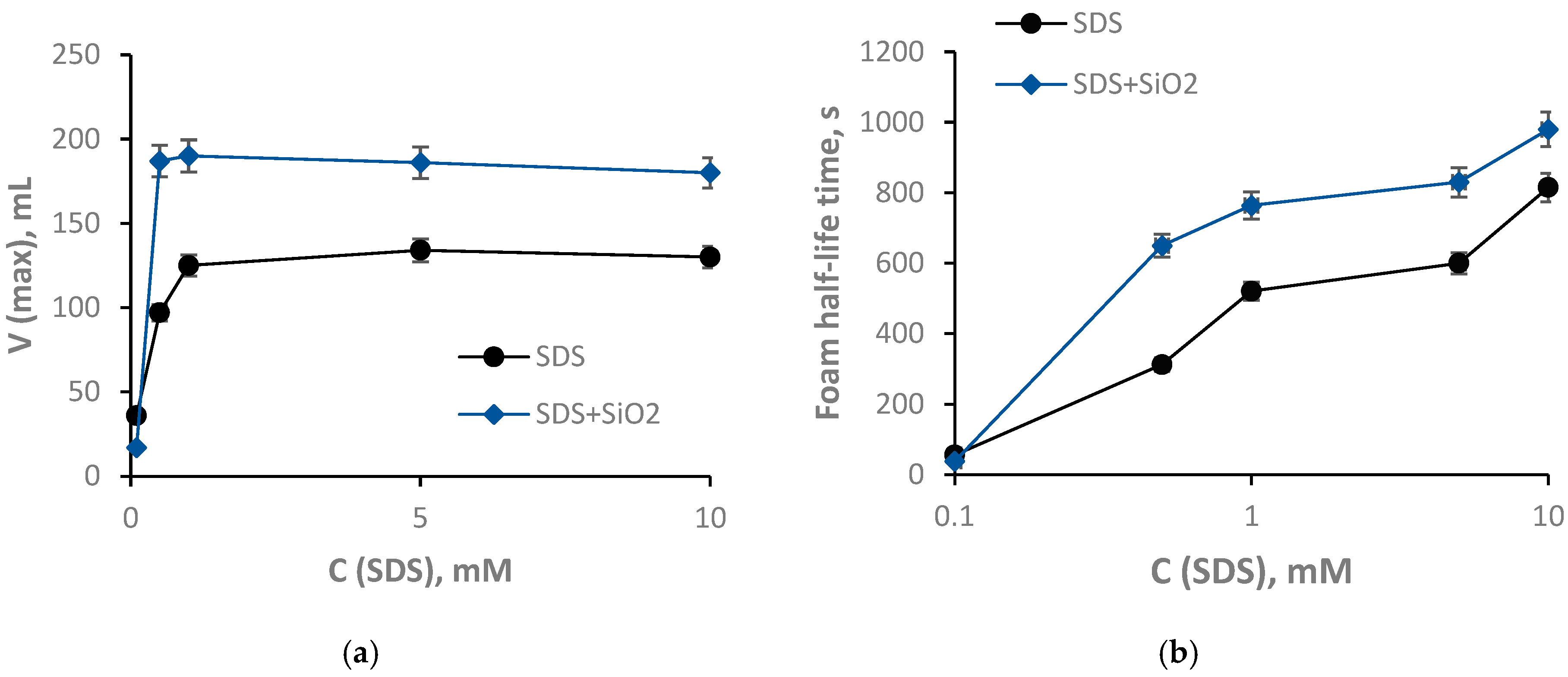
To assess the practical significance of the observed interfacial effects, the foaming behavior of SDS–SiO2 systems was further investigated. Therefore, the maximum foam volume and foam half-life were measured as a function of SDS concentration for systems with and without nanoparticles. Figure 3a shows that the addition of 0.1 wt% SiO2 significantly increases the foaming capacity of SDS solutions over the entire studied concentration range. The maximum foam volume of pure SDS solution increases from 35 mL at 0.1 mM to approximately 130 mL at 5–10 mM, indicating that higher surfactant concentrations promote bubble formation by reducing surface tension. In the presence of silica nanoparticles, the foam volume is significantly higher, reaching 190 mL. The largest differences are observed at low SDS concentrations, where the system containing nanoparticles forms almost twice as much foam as the pure surfactant solution. This behavior indicates that SiO2 particles enhance foam formation by increasing the adsorbed amount and thereby enhancing the stability of newly formed bubbles during the foaming process.
Figure 3.
Effect of SDS concentration on the foaming properties of SDS–SiO2 (fixed amount of 0.1 wt%) systems: (a) maximum foam volume and (b) foam half-life time for SDS solutions with and without SiO2 nanoparticles.
For both systems, the foam half-life time increases with SDS concentration (Figure 3b), reflecting the gradual formation of a more robust adsorption layer on the bubbles’ surfaces. At an SDS concentration of 0.5 mM, the foam half-life time increases from 320 s for pure SDS to approximately 650 s in the presence of nanoparticles. At an SDS concentration of 10 mM, the half-life time reaches almost 1000 s for the SDS–SiO2 nanofluid, compared to 820 s for SDS alone. Thus, the observed increase in foam stability is directly related to the formation of mixed SDS–SiO2 adsorption layers with higher surface pressure due to larger surface excess. Nanoparticles adsorb within the surfactant layer and create an additional steric barrier, preventing film thinning and bubble coalescence. At higher concentrations, the improvement becomes less pronounced, as the interface is nearly saturated by surfactant molecules.
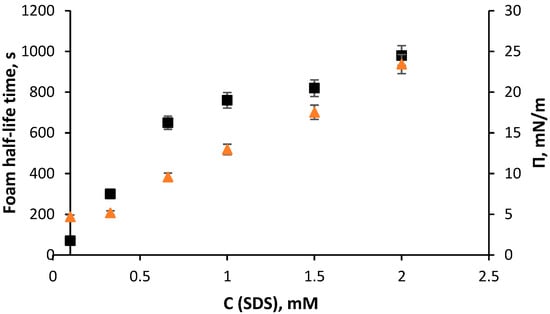
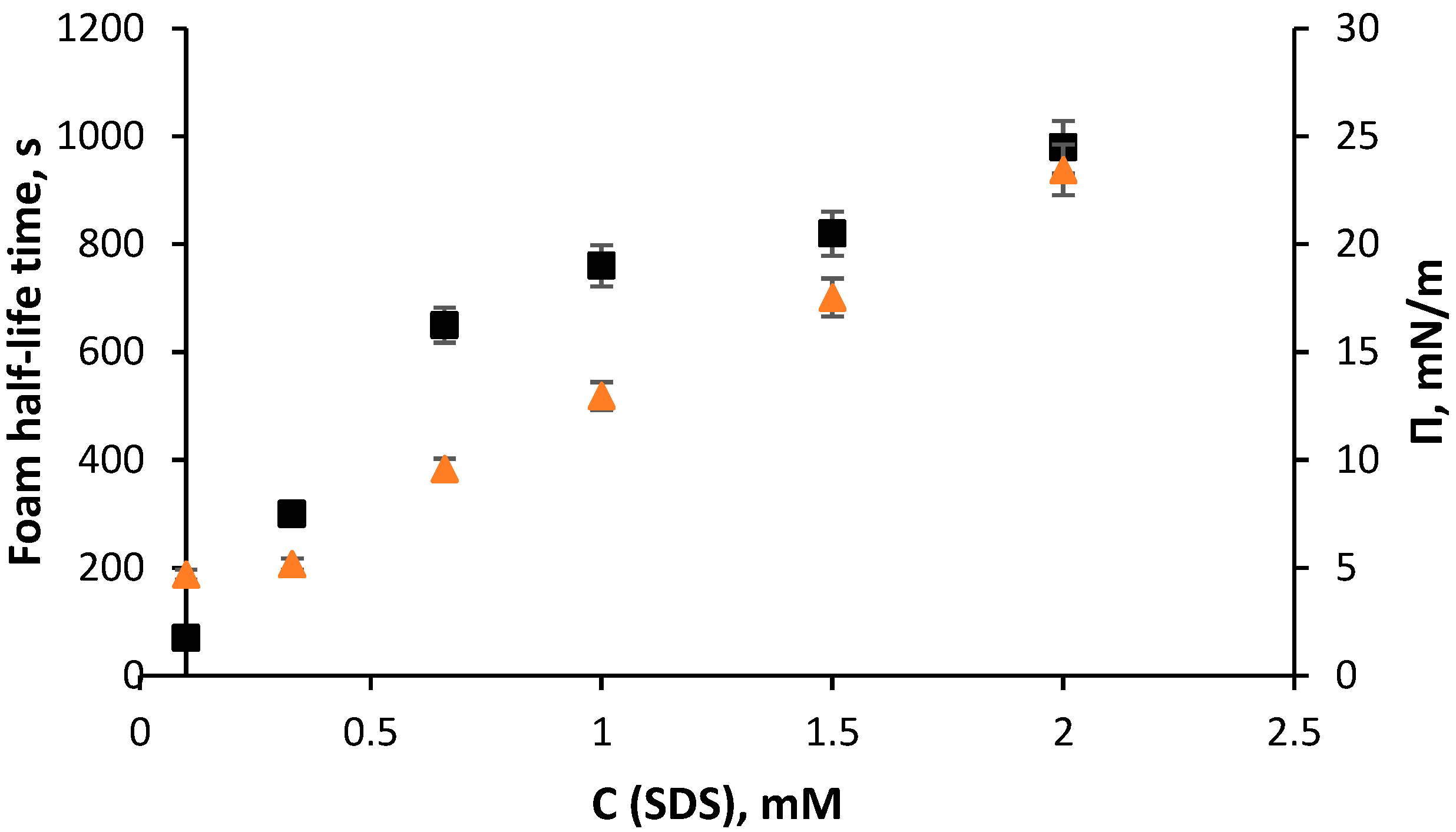
The effect of surface pressure on the macroscopic properties of foam is illustrated in Figure 4, which compares the foam half-life time with the corresponding surface pressure values for the SDS–SiO2 system. Both parameters simultaneously increase with increasing SDS concentration. At low concentrations, when the surface pressure is below 5 mN m−1, foam stability remains relatively low. A noticeable increase in the foam half-life time occurs when the surface pressure reaches 10–15 mN m−1, which corresponds to SDS concentrations of approximately 0.5–1 mM. The observed correlation confirms that foam stabilization is determined mainly by the development of a mechanically strong interfacial layer. The increase in surface pressure reflects a higher adsorption density and stronger intermolecular interactions within the SDS–SiO2 layer, which suppresses film drainage and bubble coalescence.
Figure 4.
Correlation between surface pressure Π ( ) and foam half-life time (
 ) for SDS–SiO2 (0.1 wt%) systems as a function of SDS concentration.
) and foam half-life time ( ) for SDS–SiO2 (0.1 wt%) systems as a function of SDS concentration.
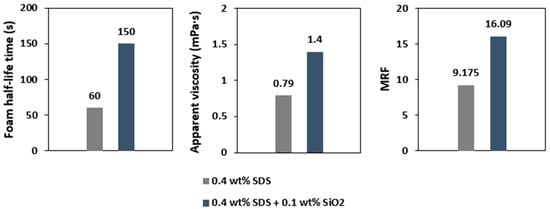
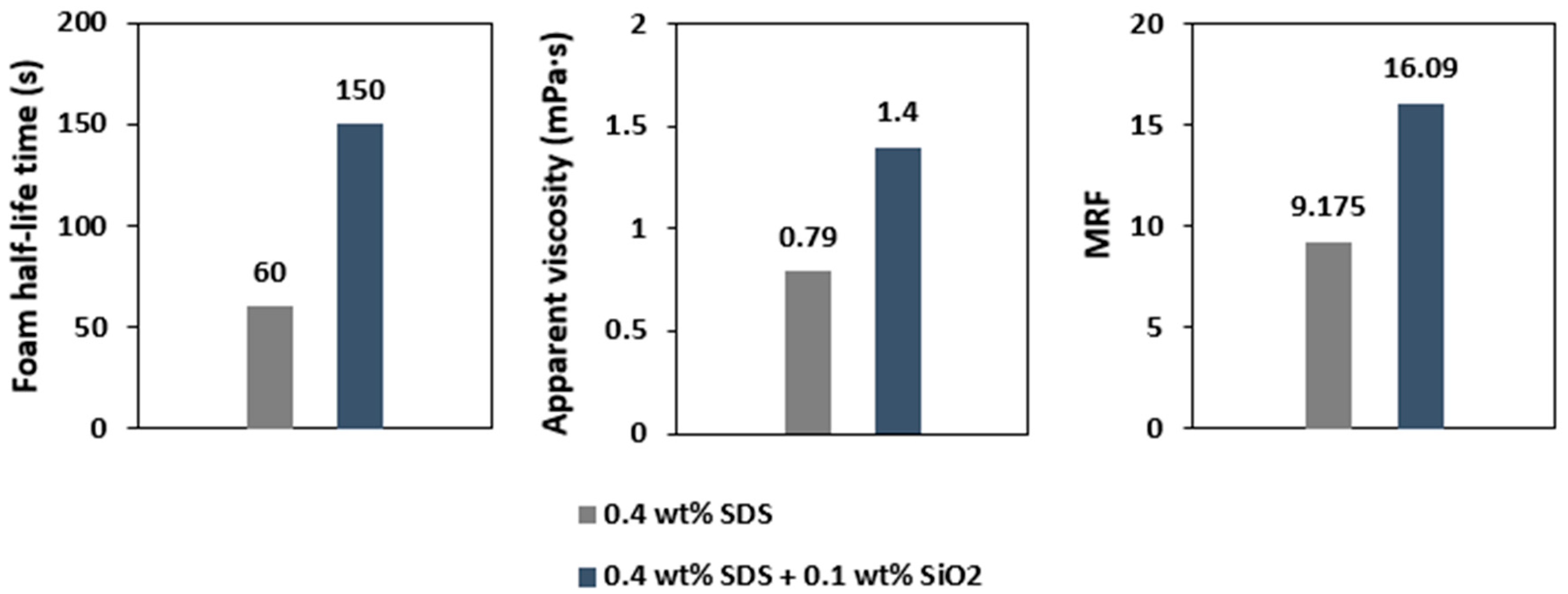
Figure 5 presents the effects of SDS and SDS–SiO2 nanofluids on foam half-life under ambient pressure and temperature conditions in 10,000 ppm brine, as well as on the foam viscosity. These parameters are critically important in foam flooding, because the foam viscosity strongly affects the displacement mobility ratio, while the mobility reduction factor (MRF) reflects the extent to which the foam decreases the fluid mobility and helps to suppress viscous fingering and gravity segregation. The results shown in Figure 5 indicate that the addition of nano-silica to the CMC–surfactant stabilized foam increased the foam half-life from 60 s to 150 s, i.e., to a 150% improvement. In addition, the viscosity of the foam generated by SDS–SiO2 increased by 77% relative to the foam stabilized by SDS only. Based on the pressure-drop data, the MRF was calculated for both core flooding experiments. The results show that the addition of nanoparticles had a positive effect on foam performance by enhancing foam stability and, consequently, improving mobility control. The MRF was 9.2 for the surfactant-based foam and 16.1 for the surfactant–nanoparticle foam, indicating that the addition of nanoparticles increased the MRF by 75%. Other results using different concentration ratios of surfactant to nanoparticles and its effect on the foam stability and MRF were shown in [38].
Figure 5.
Comparison of foam parameters for SDS foam and SDS–SiO2 nanoparticle-stabilized foam.
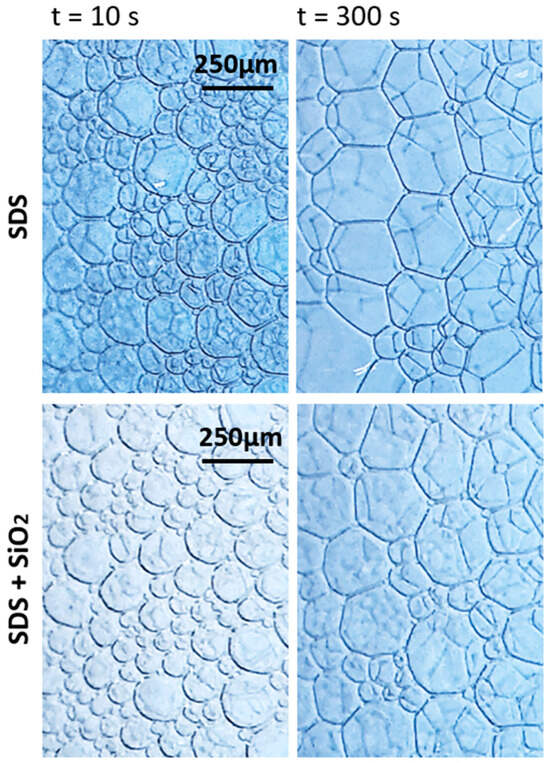
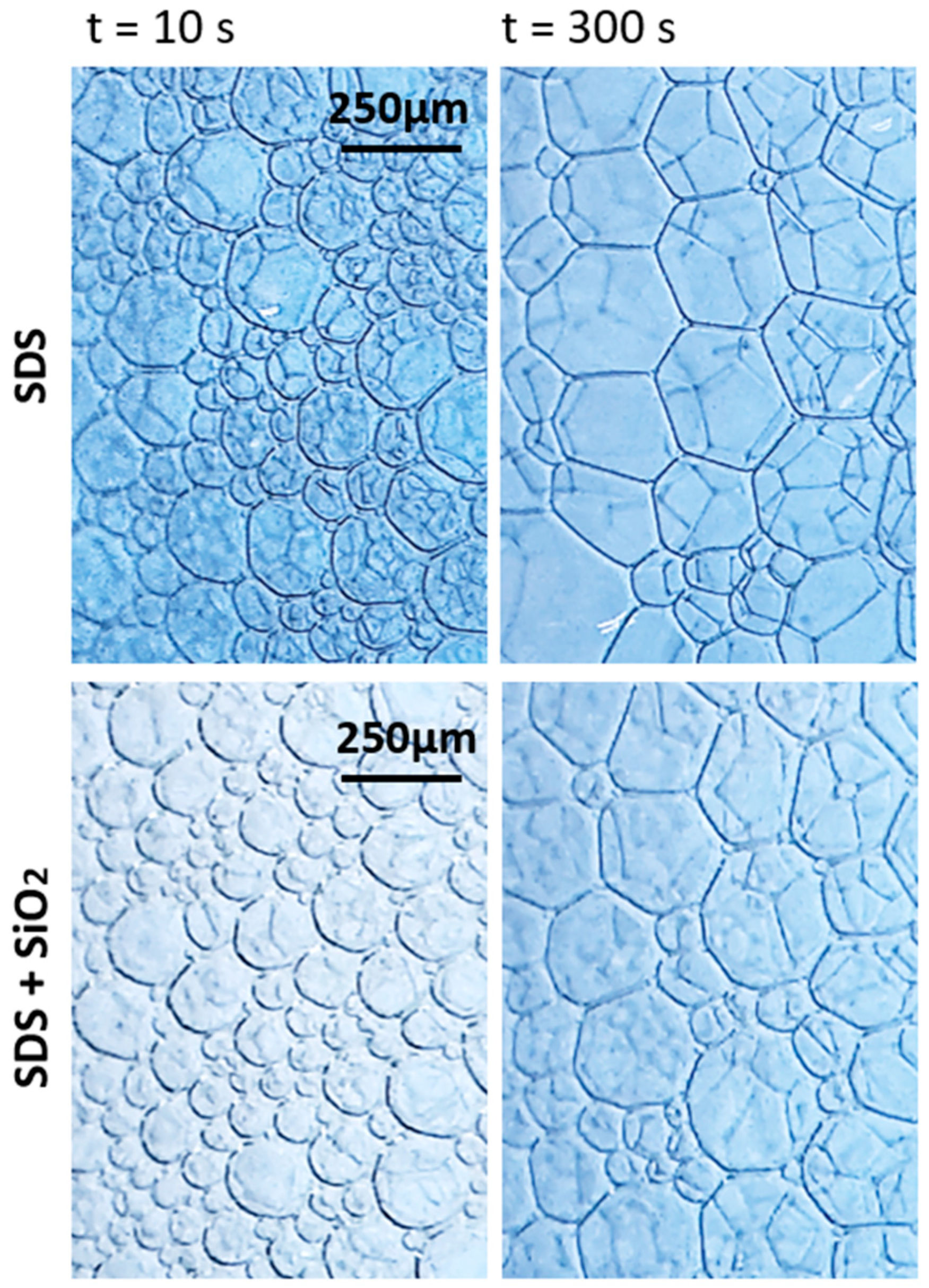
Image analysis using the software ImageJ showed that the SDS–SiO2 system formed foams with smaller and more uniform bubbles with reduced coalescence and slower coarsening dynamics, indicating increased foam stability due to the formation of mechanically stronger interfacial films (Figure 6). A further statistical analysis of the bubble size evolution would be possible but this will not provide more insight into the mechanism of foam stabilization.
Figure 6.
Foam morphology for SDS (0.4 wt%) and SDS (0.4 wt%)–SiO2 (0.6 wt%) systems at different aging times.
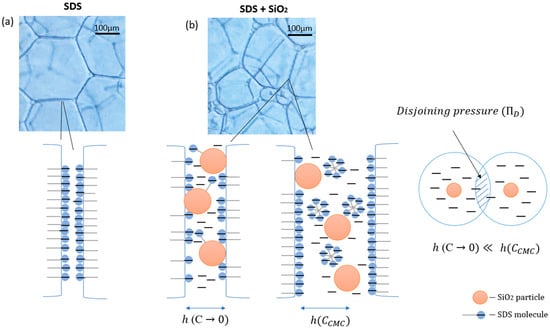
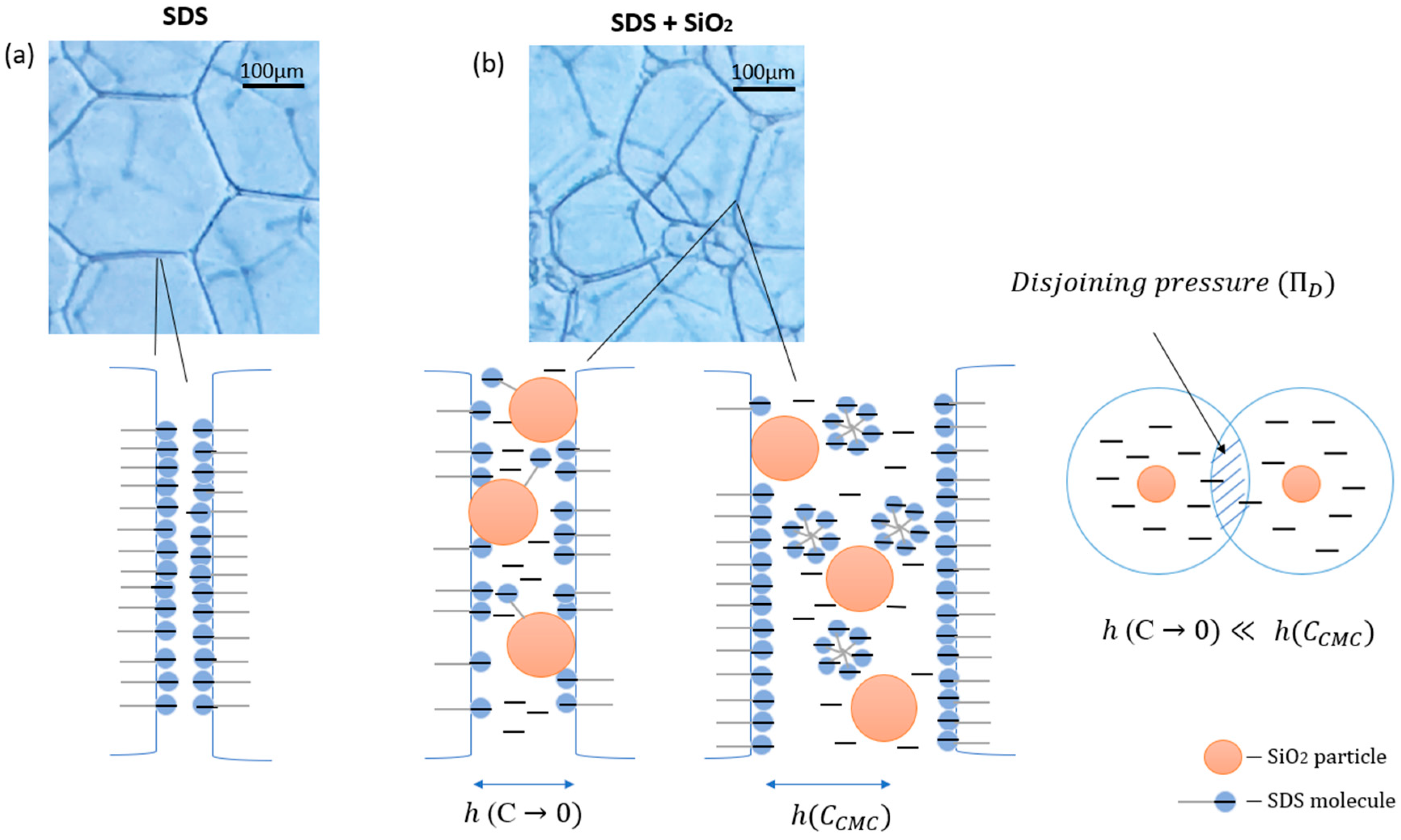
Foam stability in the SDS–SiO2 nanofluid system can be considered within the framework of the DLVO theory as the result of a balance between van der Waals attraction and electrostatic repulsion. In the presence of SDS, surfactant molecules adsorb at the foam film interfaces, forming a charged layer that increases the ζ-potential and enhances the electrostatic repulsion between the thin film surfaces. This leads to an increased disjoining pressure and prevents the interfaces from approaching each other. However, the interaction between the surfactant and nanoparticles is not due to electrostatics. Despite the fact that SDS and SiO2 have the same charge sign, adsorption is possible due to van der Waals forces, as well as hydrophobic interactions between the alkyl chains of SDS and hydrophobic sites on the surface of the particles or of already adsorbed surfactant molecules.
This results in the formation of weakly bound surfactant–nanoparticle associates. Due to the DLVO theory, the introduction of SDS increases the energy barrier between particles, reducing the probability of their aggregation. The structural contribution of the adsorbed layers further enhances steric and electrostatic repulsion. In thin films, this manifests itself as an increase in the total disjoining pressure (ΠD), which slows drainage and suppresses bubble coalescence (Figure 7). Although the presence of a hydrocarbon phase can enhance adsorption, the dominant factor controlling the system’s behavior is the structure and mechanical strength of the interfacial layer. The combined analysis of interfacial pressure, rheology, and foam properties provides a consistent framework for understanding the performance of nanoparticle/surfactant nanofluid systems.
Figure 7.
Foam film structure formed by SDS (a) and SDS–SiO2 (b) aqueous solutions.
4. Conclusions
The SDS–SiO2 nanofluid is characterized by high surface pressure, which is a measure of the reduction in surface tension due to the adsorption of molecules at the interface. High surface pressure indicates the formation of a densely packed and stable film on the surface. It contributes to foam stability by creating a stronger barrier against drainage and coalescence. The adsorption of SDS, as an anionic surfactant, forms an adsorption layer and thereby reduces surface tension, while the SiO2 nanoparticles provide a mechanical barrier and structural support. The SDS–SiO2 composite nanofluids provide higher surface activity at the water–hexane interface due to a more effective reduction in interfacial tension. The mixture effectively reduces both the surface tension at the water–air interface and the interfacial tension at the water–hexane interface. The reduction in surface tension facilitates foam formation by lowering the energy barrier for the creation of a new interface. However, the key factor controlling stability is the structure and mechanical strength of the interfacial layer. The increase in interfacial pressure confirms enhanced adsorption and denser packing of SDS–SiO2 associates, leading to the formation of structured and cohesive interfacial films. The presence of SDS molecules and SiO2 nanoparticles significantly increases the surface elasticity of foam films. High surface elasticity means that the foam films can withstand deformation without rupture. This structural mechanical factor plays a key role in preventing bubble coalescence and ensures long-term foam stability. The synergistic effect of these components creates a more stable interface compared to using each component individually. The combination of SDS and SiO2 nanoparticles significantly enhances the foamability. The foam stabilization by the SDS–SiO2 mixed solutions results from the complex interaction of several physicochemical factors identified during the study. A more general discussion of stabilization mechanisms in foams and emulsions was recently presented by Langevin [24]; however, our studies can only qualitatively conclude that the enhanced stability can be attributed to increased van der Waals and hydrophobic interactions of the anionic SDS with negatively charged SiO2 nanoparticles. These factors determine the increased foaming capacity and long-term foam stability, making the SDS–SiO2 nanofluids promising for use in industrial applications such as foam flooding to enhance oil–gas recovery.
Author Contributions
Investigation (M.I., F.A., A.S. and M.G.), data curation (M.I.), formal analysis (M.I. and F.A.), methodology (F.A. and A.S.), visualization (S.A. and F.A.), validation (R.M.), resources (M.G.), conceptualization (M.G. and S.A.), writing—original draft preparation and revision (M.I. and F.A.); writing—review and editing (A.S., S.A., R.M. and M.G.); supervision (S.A. and R.M.), project administration (A.S.). All authors have read and agreed to the published version of the manuscript.
Funding
This research was funded by Ministry of Science and Higher Education of the Republic of Kazakhstan, grant number AP23488132.
Data Availability Statement
Mendeley Data, V1, doi: 10.17632/p84zb3wfxp.1.
Conflicts of Interest
The authors declare no conflicts of interest.
References
- Tian, Q.; Li, W.; You, Q.; Jin, Z. Molecular-Scale Insights into the Aqueous Dispersion and Water–Oil Interfacial Behavior of Surfactant-Functionalized Silica Nanoparticles. J. Phys. Chem. B 2026, 130, 598–609. [Google Scholar] [CrossRef] [Scilit] [PubMed]
- Chen, Y.; Zaher Adel, A.M.; Wang, Y.; Wang, Y.; Ismoilova, G. Salinity resistance of hydrophilic SiO2/SDS dispersions for foam stability and oil flooding effect: Experiments and dynamics simulations. Pet. Sci. Technol. 2024, 42, 3791–3810. [Google Scholar] [CrossRef] [Scilit]
- Starvaggi, N.C.; Bradford, B.J.; Taylor, C.D.L.; Pentzer, E.B. Wettability-Tuned Silica Particles for Emulsion-Templated Microcapsules. Soft Matter 2023, 19, 7635–7643. [Google Scholar] [CrossRef] [Scilit] [PubMed]
- Langevin, D. Emulsions, Microemulsions and Foams; Soft and Biological Matter; Springer: Cham, Switzerland, 2020; pp. 235–268. [Google Scholar] [CrossRef] [Scilit]
- Zhang, W.; Chen, L.; Chen, J.; Jiang, L.; Su, W.-H.; Yu, K.; Zhang, H. Synergy between Hydrophilic Silica Nanoparticles and Poly(vinylpyrrolidone) for Long-Term Foam Stabilization with Little Energy Input. J. Mol. Liq. 2023, 383, 122049. [Google Scholar] [CrossRef] [Scilit]
- Mirgaloye Bayat, D.; Esfandyari Bayat, A. Enhancing Stability of Nitrogen Foam by PEG-Coated Silica Nanoparticles for Enhanced Oil Recovery Applications. Energy Fuels 2026, 40, 1585–1604. [Google Scholar] [CrossRef] [Scilit]
- Li, L.; Ali, A.M.; Zhao, Z.; Zhang, H. Temperature-sensitive and amphiphilic silica nanoparticle-stabilized Pickering emulsion for water shutoff. Colloids Surf. A Physicochem. Eng. Asp. 2023, 677, 132293. [Google Scholar] [CrossRef] [Scilit]
- Ma, G.; Gong, Q.; Xu, Z.; Jin, Z.; Zhang, L.; Ma, G.; Zhang, L. The Interfacial Dilational Rheology of Surfactant Solutions with Low Interfacial Tension. Molecules 2025, 30, 447. [Google Scholar] [CrossRef] [Scilit] [PubMed]
- Binks, B.P.; Lumsdon, S.O. Influence of Particle Wettability on the Type and Stability of Surfactant-Free Emulsions. Langmuir 2000, 16, 8622–8631. [Google Scholar] [CrossRef] [Scilit]
- Ravera, F.; Santini, E.; Loglio, G.; Ferrari, M.; Liggieri, L. Effect of Nanoparticles on the Interfacial Properties of Liquid/Liquid and Liquid/Air Surface Layers. J. Phys. Chem. B 2006, 110, 19543–19551. [Google Scholar] [CrossRef] [Scilit] [PubMed]
- Zhu, B.; Zhao, W.; Li, J.; Guan, Y.X.; Li, D.D. Thermophysical Properties of Al2O3–Water Nanofluids. Mater. Sci. Forum 2011, 688, 266–271. [Google Scholar] [CrossRef] [Scilit]
- Tanvir, S.; Qiao, L. Surface Tension of Nanofluid-Type Fuels Containing Suspended Nanomaterials. Nanoscale Res. Lett. 2012, 7, 226. [Google Scholar] [CrossRef] [Scilit] [PubMed]
- Vatanparast, H.; Javadi, A.; Bahramian, A. Silica Nanoparticles–Cationic Surfactants Interaction in Water–Oil System. Colloids Surf. A Physicochem. Eng. Asp. 2017, 521, 221–230. [Google Scholar] [CrossRef] [Scilit]
- Björkegren, S.; Evenäs, L.; Törncrona, A.; Persson, M.E.; Palmqvist, A.E. Surface Activity and Flocculation Behavior of Polyethylene Glycol-Functionalized Silica Nanoparticles. J. Colloid Interface Sci. 2015, 452, 215–223. [Google Scholar] [CrossRef] [Scilit] [PubMed]
- Blute, I.; Pugh, R.J.; van de Pas, J.; Callaghan, I. Industrial Manufactured Silica Nanoparticle Sols. 2: Surface Tension, Particle Concentration, Foam Generation and Stability. Colloids Surf. A 2009, 337, 127–135. [Google Scholar] [CrossRef] [Scilit]
- Okubo, T. Surface Tension of Structured Colloidal Suspensions of Polystyrene and Silica Spheres at the Air–Water Interface. J. Colloid Interface Sci. 1995, 171, 55–62. [Google Scholar] [CrossRef] [Scilit]
- Dong, L.; Johnson, D.T. The Study of the Surface Tension of Charge-Stabilized Colloidal Dispersions. J. Dispers. Sci. Technol. 2005, 25, 575–583. [Google Scholar] [CrossRef] [Scilit]
- Whaval, S.P.; Tiwari, A.K. A review on the synergistic effect of various surfactants and silica nanoparticles on Pickering emulsion. J. Dispers. Sci. Technol. 2025, 1–24. [Google Scholar] [CrossRef] [Scilit]
- Maestro, A.; Guzmán, E.; Ortega, F.; Rubio, R.G. Contact Angle of Micro- and Nanoparticles at Fluid Interfaces. Curr. Opin. Colloid Interface Sci. 2014, 19, 355–367. [Google Scholar] [CrossRef] [Scilit]
- Mohammed, S.; Kuzmenko, I.; Gadikota, G. Reversible assembly of silica nanoparticles at water–hydrocarbon interfaces controlled by SDS surfactant. Nanoscale 2022, 14, 127–139. [Google Scholar] [CrossRef] [Scilit] [PubMed]
- Noskov, B.A. Dilational Surface Rheology of Polymer and Polymer/Surfactant Solutions. Curr. Opin. Colloid Interface Sci. 2010, 15, 229–236. [Google Scholar] [CrossRef] [Scilit]
- Sagis, L.M.C.; Fischer, P. Nonlinear Rheology of Complex Fluid–Fluid Interfaces. Curr. Opin. Colloid Interface Sci. 2014, 19, 520–529. [Google Scholar] [CrossRef] [Scilit]
- Amankeldi, F.; Gabdullin, M.; Issakhov, M.; Ospanova, Z.; Sharipova, A.; Aidarova, S.; Miller, R. Dynamic interfacial properties and foamability of DoTAB/SiO2 mixtures. Colloids Interfaces 2024, 8, 19. [Google Scholar] [CrossRef] [Scilit]
- Langevin, D. Recent advances on emulsion and foam stability. Langmuir 2023, 39, 3821–3828. [Google Scholar] [CrossRef] [Scilit] [PubMed]
- Georgieva, D.; Cagna, A.; Langevin, D. Link between surface elasticity and foam stability. Soft Matter 2009, 5, 2063–2071. [Google Scholar] [CrossRef] [Scilit]
- Issakhov, M.; Shakeel, M.; Pourafshary, P.; Aidarova, S.; Sharipova, A. Hybrid surfactant-nanoparticles assisted CO2 foam flooding for improved foam stability: A review of principles and applications. Pet. Res. 2022, 7, 186–203. [Google Scholar] [CrossRef] [Scilit]
- Zhao, L.; Lu, S.; Chen, M.; Wang, Y.; Zhao, S. Agglomerating Agent Emulsions Synergistically Stabilized by Surfactants and SiO2 Nanoparticles: Stability, Mechanism, and Applications for PBL Agglomeration. J. Polym. Sci. 2024, 63, 455–464. [Google Scholar] [CrossRef] [Scilit]
- Wang, Y.; Wang, H.; Zhao, X.; Li, C.; Luo, J.; Sun, S.; Hu, S. Effect of hydrophobically modified SiO2 nanoparticles on the stability of water-based SDS foam. Arab. J. Chem. 2020, 13, 6942–6948. [Google Scholar] [CrossRef] [Scilit]
- Khani, O.; Mohammadi, M.; Khaz’ali, A.R.; Aghdam, M.A. Effect of pH value and zeta potential on the stability of CO2 foam stabilized by SDS surfactant and SiO2, ZnO and Fe2O3 nanoparticles. Sci. Rep. 2025, 15, 10302. [Google Scholar] [CrossRef] [Scilit] [PubMed]
- Wu, X.; Hou, Z.; Wang, H.; Yang, Y.; Liu, X.; Chen, Z.; Cui, Z. Synergistic effects between anionic surfactant SDS and hydrophilic silica nanoparticles in improving foam performance for foam flooding. J. Mol. Liq. 2023, 390, 123156. [Google Scholar] [CrossRef] [Scilit]
- Ahmadi, A.; Saeedi Dehaghani, A.H.; Saviz, S. Experimental Study of SDS Foam Stability in the Presence of Silica Nanoparticle. J. Chem. Pet. Eng. 2022, 56, 203–213. [Google Scholar] [CrossRef]
- Ravera, F.; Loglio, G.; Pandolfini, P.; Santini, E.; Liggieri, L. Determination of the Dilational Viscoelasticity by the Oscillating Drop/Bubble Method in a Capillary Pressure Tensiometer. Colloids Surf. A 2010, 365, 2–13. [Google Scholar] [CrossRef] [Scilit]
- Bae, S.; Haage, K.; Wantke, K.; Motschmann, H. On the Factor in Gibbs Equation for Ionic Surfactants. J. Phys. Chem. B 1999, 103, 1045–1050. [Google Scholar] [CrossRef] [Scilit]
- Jaensson, N.O.; Vermant, J. Tensiometry and rheology of complex interfaces. Curr. Opin. Colloid Interface Sci. 2018, 37, 136–150. [Google Scholar] [CrossRef] [Scilit]
- Kim, S.J.; Bang, I.C.; Buongiorno, J.; Hu, L. Surface Wettability Change during Pool Boiling of Nanofluids and Its Effect on Critical Heat Flux. Int. J. Heat Mass Transf. 2007, 50, 4105–4116. [Google Scholar] [CrossRef] [Scilit]
- Fainerman, V.B.; Aksenenko, E.V.; Kovalchuk, V.I.; Mucic, N.; Javadi, A.; Liggieri, L.; Ravera, F.; Loglio, G.; Makievski, A.; Schneck, E.; et al. New view of the adsorption of surfactants at the water/alkane interface–competitive and cooperative effects of surfactant and alkane molecules. Adv. Colloid Interface Sci. 2020, 279, 102143. [Google Scholar] [CrossRef] [Scilit] [PubMed]
- Amankeldi, F.; Ospanova, Z.; Musabekov, K.; Miller, R.M. History of thermodynamic models for the adsorption of surfactants at liquid interfaces. Eurasian Chem.-Technol. J. 2025, 27, 259–267. [Google Scholar] [CrossRef] [Scilit]
- Khoramian, R.; Issakhov, M.; Pourafshary, P.; Gabdullin, M.; Sharipova, A. Surface modification of nanoparticles for enhanced applicability of nanofluids in harsh reservoir conditions: A comprehensive review for improved oil recovery. Adv. Colloid Interface Sci. 2024, 333, 103296. [Google Scholar] [CrossRef] [Scilit] [PubMed]

Disclaimer/Publisher’s Note: The statements, opinions and data contained in all publications are solely those of the individual author(s) and contributor(s) and not of MDPI and/or the editor(s). MDPI and/or the editor(s) disclaim responsibility for any injury to people or property resulting from any ideas, methods, instructions or products referred to in the content. |
© 2026 by the authors. Licensee MDPI, Basel, Switzerland. This article is an open access article distributed under the terms and conditions of the Creative Commons Attribution (CC BY) license.