Article

Underwater Explosion Analysis on Composite Marine Structures: A Comparison Between CEL and UEL Methods


by
Jacopo Bardiani
1,*,
Giada Kyaw Oo D’Amore
2,
Claudio Sbarufatti
1 and
Andrea Manes
1
1
Department of Mechanical Engineering, Politecnico di Milano, Via G. La Masa 1, 20156 Milano, Italy
2
Department of Engineering and Architecture, University of Trieste, Via A. Valerio 6, 34127 Trieste, Italy
*
Author to whom correspondence should be addressed.
J. Compos. Sci. 2025, 9(4), 177; https://doi.org/10.3390/jcs9040177
Submission received: 21 February 2025 / Revised: 20 March 2025 / Accepted: 2 April 2025 / Published: 5 April 2025

Abstract

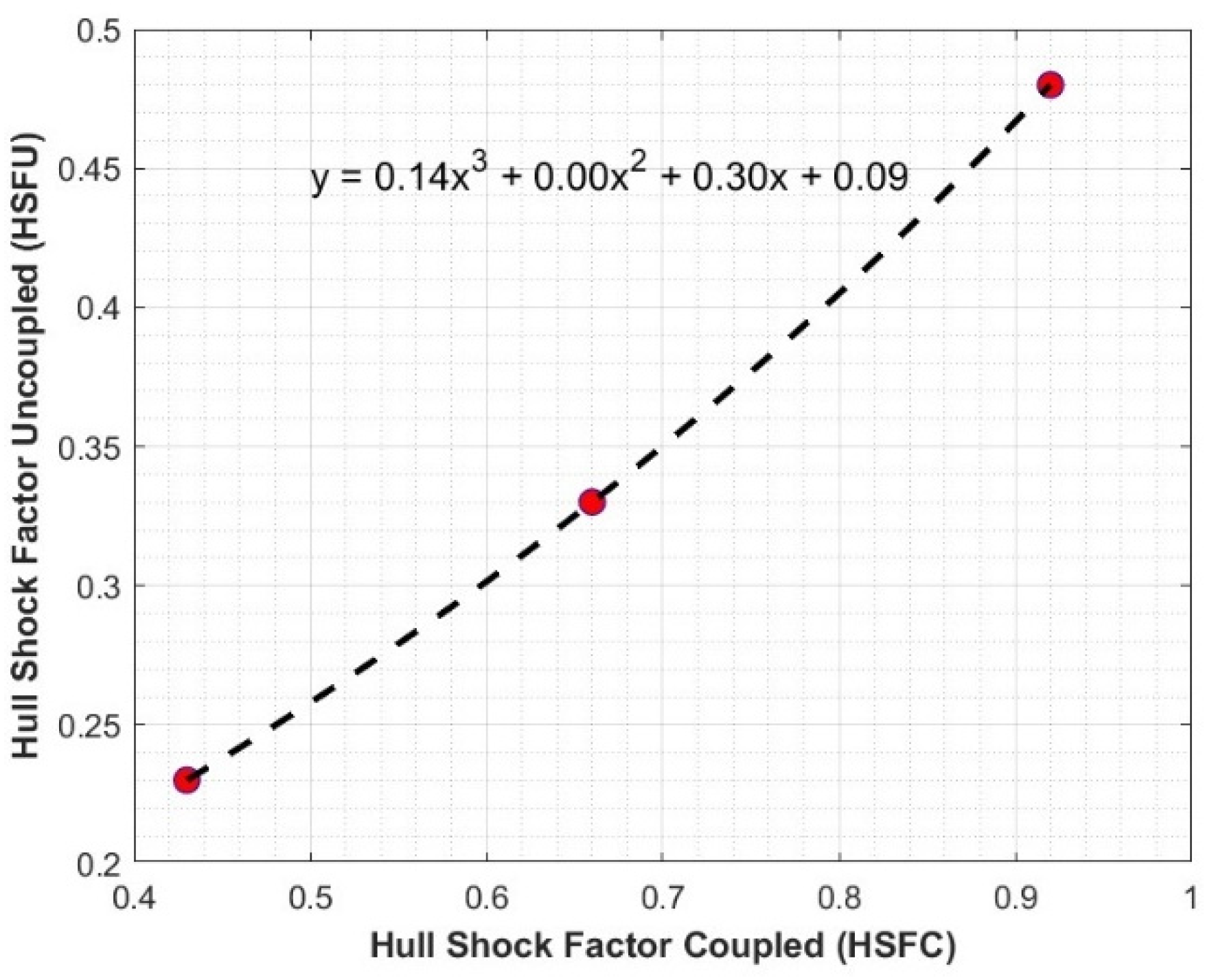
Underwater explosion (UNDEX) problems are typically simulated using numerical coupled techniques, such as the Coupled Eulerian–Lagrangian (CEL) method, to accurately capture fluid–structure interaction (FSI) effects, which are non-negligible in such scenarios. While highly accurate, coupled methods are computationally expensive. Alternatively, uncoupled (or decoupled) techniques, like the Uncoupled Eulerian–Lagrangian (UEL) approach, offer greater computational efficiency by neglecting FSI effects, but at the cost of reduced predictive accuracy. This study provides a qualitative and quantitative evaluation of how far UEL results deviate from the more realistic CEL solutions in UNDEX scenarios. The comparison focuses on the structural response of a floating double-bottom fiber-reinforced composite structure subject to a near-field UNDEX. The numerical results indicate that the UEL approach overestimates structural response by up to 190% compared to CEL when added mass effects are considered, and up to 400% when they are not. However, a correction strategy based on modifying the Hull Shock Factor (HSF) is proposed to bridge the gap between UEL and CEL predictions. This study demonstrates that, with proper calibration, UEL simulations can serve as a computationally efficient alternative for preliminary UNDEX assessments in naval engineering.
Keywords: underwater explosion; Coupled Eulerian–Lagrangian; Uncoupled Eulerian–Lagrangian; fluid–structure interaction; composite structure; computational efficiency underwater explosion; Coupled Eulerian–Lagrangian; Uncoupled Eulerian–Lagrangian; fluid–structure interaction; composite structure; computational efficiency