


Abstract
Intralayer hybridisation provides a powerful strategy for tailoring the stiffness–strength–ductility balance of fibre-reinforced composites through architecture control. This study investigates the flexural behaviour of carbon/glass intralayer hybrid composites with varying carbon-to-glass (C:G) ratios and degrees of dispersion using a finite element modelling framework supported by experimental validation against published flexural test data. Four hybrid ratios (C:G = 2:1, 1:1, 1:2, and 1:4) and multiple dispersion levels were examined under three-point bending to quantify the effects of intralayer architecture on flexural strength, modulus, and strain to failure. The results show that carbon-rich hybrids retain high flexural stiffness and strength while achieving substantial improvements in failure strain and damage tolerance compared with pure carbon laminates. In these systems, flexural strength is strongly influenced by dispersion, with moderate-to-high dispersion improving strain compatibility, delaying tensile-side carbon fibre fracture, and enhancing strength. In contrast, glass-dominated hybrids exhibit flexural behaviour that is largely insensitive to dispersion, with strength and modulus following near rule-of-mixtures trends and failure governed by progressive glass fibre and matrix damage. Across all hybrid ratios, flexural modulus is controlled primarily by fibre volume fraction, whereas flexural strength and failure strain depend sensitively on intralayer architecture when carbon fibres remain the dominant load-bearing phase. These findings clarify the respective roles of hybrid ratio and dispersion in governing flexural performance and extend recent studies by demonstrating a systematic transition from dispersion-dominated to ratio-dominated behaviour as glass content increases. The results provide mechanistic insight and practical design guidance for optimising intralayer hybrid composites for lightweight, damage-tolerant structural applications.
1. Introduction
Hybrid fibre-reinforced polymer composites have attracted increasing attention as an effective means of overcoming the inherent limitations of single-fibre composite systems. By combining two or more fibre types within a common matrix, hybridisation enables the simultaneous tailoring of stiffness, strength, toughness and cost to meet diverse structural requirements. Extensive studies have demonstrated that hybrid composites can exhibit hybrid effects, whereby mechanical properties deviate from simple rule-of-mixtures (RoM) predictions due to interactions between fibres, matrix, and failure statistics [1]. Among the various hybrid systems investigated, carbon/glass fibre combinations are particularly attractive: carbon fibres offer high stiffness and strength but are relatively brittle and expensive, whereas glass fibres are more economical and provide higher strain-to-failure, improved impact resistance, and enhanced damping capacity [1,2].
Intralayer hybridisation—also referred to as intraply or intralaminar hybridisation—places different fibre types within the same layer or fabric architecture rather than stacking discrete plies of each fibre type. This configuration introduces length-scale interactions at the tow and fibre levels that strongly influence load transfer, stress redistribution, and damage evolution. Compared with interlayer hybrids, intralayer architectures provide a richer design space but also present greater complexity, making predictive modelling essential for understanding and optimising their mechanical response [1,2]. Experimental observations indicate that intralayer carbon/glass hybrids can delay catastrophic carbon fibre failure through stress shielding and crack-bridging effects from glass fibres, leading to improved damage tolerance and more progressive failure behaviour [3,4,5,6]. However, the magnitude and even the sign of the hybrid effect depend sensitively on fibre dispersion, tow-level arrangement, and local stiffness contrast—factors that are difficult to isolate experimentally without the support of robust numerical models.
Flexural behaviour is of particular importance for many structural applications, including beams, panels and frames, where bending loads dominate service conditions. Flexural loading simultaneously engages tensile and compressive responses and is therefore highly sensitive to architecture-dependent stress gradients and damage mechanisms. Standardised three- and four-point bending tests in accordance with ASTM D7264 [7] provide essential benchmark data [7], but experimental flexural testing alone offers limited insight into internal stress redistribution, neutral-axis migration and the initiation and growth of damage within complex intralayer hybrid architectures. As a result, modelling plays a critical role in linking observed flexural responses to underlying mechanisms. In carbon/glass hybrids, numerical studies have shown that the placement of carbon-rich regions relative to the neutral axis, as well as the local stiffness mismatch between carbon and glass tows, governs tensile and compressive failure initiation under bending [8,9].
Recent studies have emphasised the importance of combining experimental observations with mechanics-based modelling to understand flexural behaviour in composite systems. Numerical investigations have shown that bending strength and failure modes are strongly influenced by microstructural features and progressive damage mechanisms, particularly interlaminar delamination and matrix cracking [10]. From a structural perspective, enhancing flexural ductility remains a critical challenge. It has been demonstrated that introducing controlled interfacial slip mechanisms can effectively suppress brittle failure and promote deflection hardening behaviour in composite systems [11].
The recent literature increasingly highlights the importance of architecture-resolving models for intralayer hybrids. Tow-level mixing patterns, such as blocked versus alternating arrangements of carbon and glass tows, have been shown experimentally to influence flexural strength and failure strain [3,9,12], while mesoscale finite element models have successfully reproduced these trends by capturing local stress concentrations, interfacial load transfer, and damage clustering [5,12]. Studies on woven, braided, and non-crimp intralayer architectures further demonstrate that modelling is indispensable for interpreting damage delocalisation, crack deflection at carbon/glass interfaces, and the resulting improvements in post-peak flexural behaviour [4,6]. Although flexural modulus often follows near-linear RoM trends, modelling has revealed that flexural strength and failure strain are governed by non-linear interactions between architecture, dispersion, and failure statistics, which cannot be captured by RoM alone [2,5,13].
Despite these advances, predictive understanding of the flexural behaviour of intralayer carbon/glass hybrid composites remains incomplete. In particular, to the author’s knowledge, no previous study has systematically quantified the transition from dispersion-dominated to ratio-dominated flexural behaviour across a broad C:G compositional range under consistent tow-level modelling. There remains a need for integrated experimental–numerical frameworks that can quantify hybrid effects, identify governing damage mechanisms, and provide design-relevant insights for architecture optimisation.
Accordingly, the present study investigates the flexural behaviour of carbon/glass fibre-reinforced intralayer hybrid composites using a modelling-driven approach supported by experimental validation. Finite element models are developed to explicitly represent tow-level arrangements within a single layer, enabling detailed analysis of stress redistribution, neutral-axis effects, and damage initiation under bending. The influence of blocked versus alternating carbon/glass configurations on flexural stiffness, strength, and failure strain is examined at a fixed fibre volume fraction, and hybrid effects relative to RoM predictions are quantified. By coupling modelling with targeted experiments, this work aims to provide a mechanistic understanding and predictive capability for the design and optimisation of high-performance intralayer hybrid composites.
2. Materials and Methods
2.1. Materials
In this study, intralayer-structured carbon/glass hybrid composites are investigated. Each composite specimen has dimensions of 100 mm (length) × 10 mm (width) × 2 mm (thickness) and consists of eight plies of equal thickness. An epoxy resin is used as the matrix material. For the carbon/glass hybrid system, each ply is reinforced by either high-strength carbon fibres or E-glass fibres arranged in an intralayer configuration.
The constituent material properties of the fibres and epoxy resin are summarised in Table 1, based on data reported in the literature [14]. The cost values are converted to a comparable volumetric basis for consistency, which represents approximate material costs per unit volume ($/L). Fibre volume fractions were targeted at 40% for carbon/epoxy plies and 50% for glass/epoxy plies. These values are representative of typical VARTM(Vacuum assisted resin transfer moulding) processing for the areal weights and weave architectures considered and provide a balance between mechanical performance and manufacturability. Carbon fabrics generally achieve lower fibre volume fractions than E-glass fabrics due to tighter tow packing and lower permeability; therefore, a 40% target reduces the likelihood of dry spots and void formation while maintaining high stiffness. In contrast, glass fabrics can be reliably infused to higher fibre volume fractions, making 50% achievable without compromising impregnation quality. The selected fibre volume fractions also result in realistic ply thicknesses and facilitate consistent comparison across different hybrid configurations. If equal fibre volume fractions are used, the absolute values for the flexural properties will change, but the observed trends with hybrid ratio and dispersion are expected to remain consistent.
Table 1.
Constituent material properties.
Based on the constituent properties in Table 1 and the measured fibre volume fractions, lamina elastic properties were determined using micromechanical models. The longitudinal modulus (E11) and shear moduli (G12, G13, and G23) were calculated using Hashin’s Circular Cylinder Model (CCM) [15]. The transverse moduli (E22 and E33) were obtained from stress–strain relationships following established approaches in the literature [16].
The longitudinal tensile and compressive strengths of the composite plies were derived using appropriate strength models [17]. The longitudinal tensile strength was calculated from the fibre failure strain and the longitudinal modulus, given by
where E11 is the longitudinal modulus, and εfu is the failure strain of the fibre.
Under flexural loading, failure is dominated by compressive mechanisms on the compression side of the specimen. Previous experimental studies on both interlayer [18] and intralayer hybrid composites have shown that failure commonly occurs at the compression side of the test specimen in flexure, with typical failure modes being fibre microbuckling [19] and kinking (highly localised fibre buckling [20]).
Accordingly, the Lo–Chim model was adopted to predict the longitudinal compressive strength, in which the strength is governed primarily by the longitudinal–transverse shear modulus (G12), given by
where G12 is the longitudinal-transverse shear modulus. Effects such as fibre waviness, initial imperfections, and detailed microbuckling mechanisms are not explicitly included in the calculation of compressive strength. Since the study focuses on comparative trends across hybrid configurations rather than absolute strength prediction, the simplified model remains appropriate for the present purpose.
The transverse and shear strengths are largely matrix-dominated. Therefore, the transverse tensile strength was assumed to be equal to the tensile strength of the epoxy matrix, the transverse compressive strength was taken as three times the matrix tensile strength, and the in-plane shear strength was assumed to be 1.5 times the matrix tensile strength. These assumptions are consistent with commonly reported experimental data for polymer matrix composites [21].
A stress-based failure criterion was employed to predict damage initiation in each ply. Once failure occurred, stiffness degradation was applied to the affected ply to simulate progressive damage evolution. A degradation factor of 0.99 was adopted to ensure numerical stability while allowing gradual stiffness reduction, consistent with previous studies [22]. This value is adopted from a previous study [23], where good agreement with experimental results was demonstrated.
2.2. FEA-Based Model
Finite element modelling was carried out using Ansys ACP in conjunction with Ansys Mechanical 2025R2. The composite layup was defined ply by ply in Ansys ACP, with each ply assigned orthotropic elastic properties, including Young’s moduli, Poisson’s ratios, and shear moduli. Five strength components were specified for each material system: longitudinal tensile strength, longitudinal compressive strength, transverse tensile strength, transverse compressive strength, and in-plane shear strength. The strength values corresponding to carbon/epoxy and glass/epoxy plies were determined using the models described in Section 2.1.
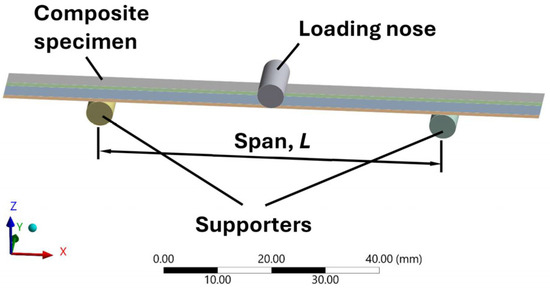
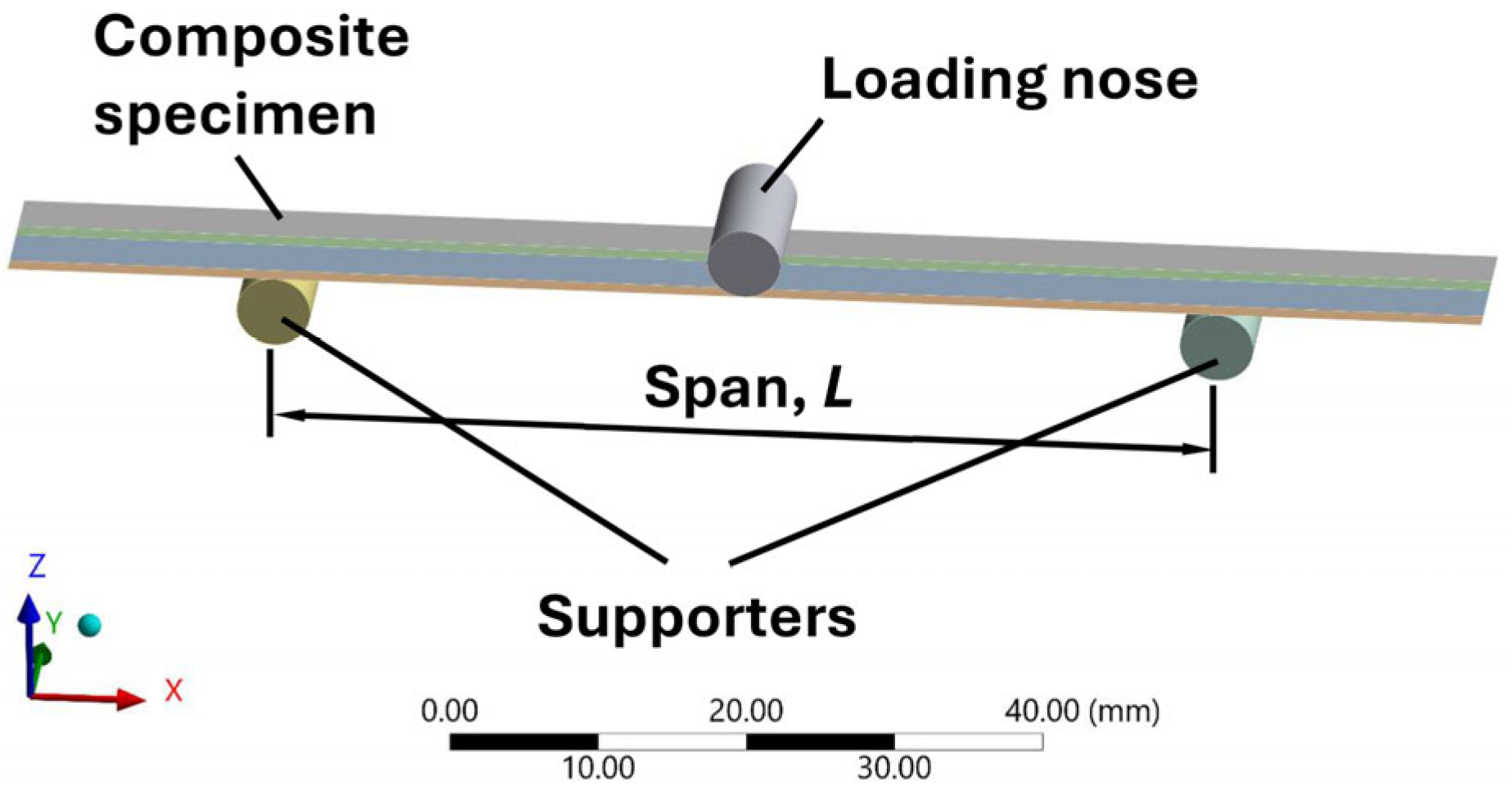
Three-point bending was simulated in accordance with Procedure A of ASTM D7264/D7264M-21 [7]. For computational efficiency, the composite specimen was modelled as a shell (surface body), while the loading and supporting rollers were modelled as rigid cylindrical solids. This modelling strategy has been successfully adopted in previous studies and provides an accurate prediction of flexural response with reduced computational cost [8].
The specimen was supported by two rollers with a span-to-thickness ratio of 32, and a prescribed vertical displacement of 15 mm was applied to the central loading roller, as shown in Figure 1. Fixed boundary conditions were imposed on the supporting rollers. Frictional contact was defined between the rollers and the composite specimen. A nonlinear analysis was conducted to capture contact nonlinearity and progressive damage, and the resulting force–displacement response was extracted from the simulation.
Figure 1.
A composite specimen in three-point bending.
Failure load was identified from the load–displacement curve. Under three-point bending, the maximum tensile and compressive stresses occur only within a thin region near the outer surfaces of the specimen, while the majority of the laminate experiences substantially lower stresses. Because composite failure is flaw-controlled and statistically governed, the effective stressed volume under flexure is significantly smaller than under uniform uniaxial compression. According to Weibull’s statistical size-effect theory, a reduced stressed volume leads to an increase in apparent strength. Consequently, the measured flexural strength is typically 20–35% higher than the corresponding uniaxial compressive strength for fibre-reinforced composites [24]. In the present study, a factor of 1.3 was adopted, consistent with the literature observations. Importantly, this correction was applied uniformly across all configurations and therefore does not influence the comparative trends associated with hybrid ratio or dispersion. Accordingly, the maximum bending load was adjusted to account for this effect.
The flexural strength (SF) and flexural modulus (EF) were then calculated following ASTM D7264/D7264M-21 [7].
where L, b and h are the span, width and depth of the specimen; D is the maximum deflection before failure; Pmax is the maximum load encountered before failure; σF is the flexural stress; and εF is the flexural strain.
2.3. Model Validation
To validate the modelling framework, predicted flexural strength and modulus were compared with the experimental results reported by Chen et al. [10] for four carbon–glass intralayer laminate configurations (CC, C0G90, C90G0, and GG).
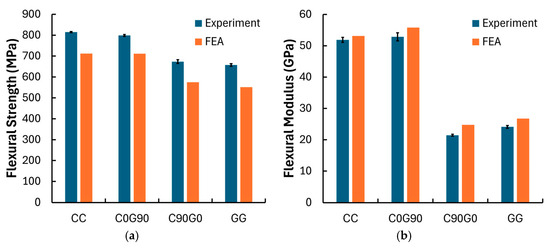
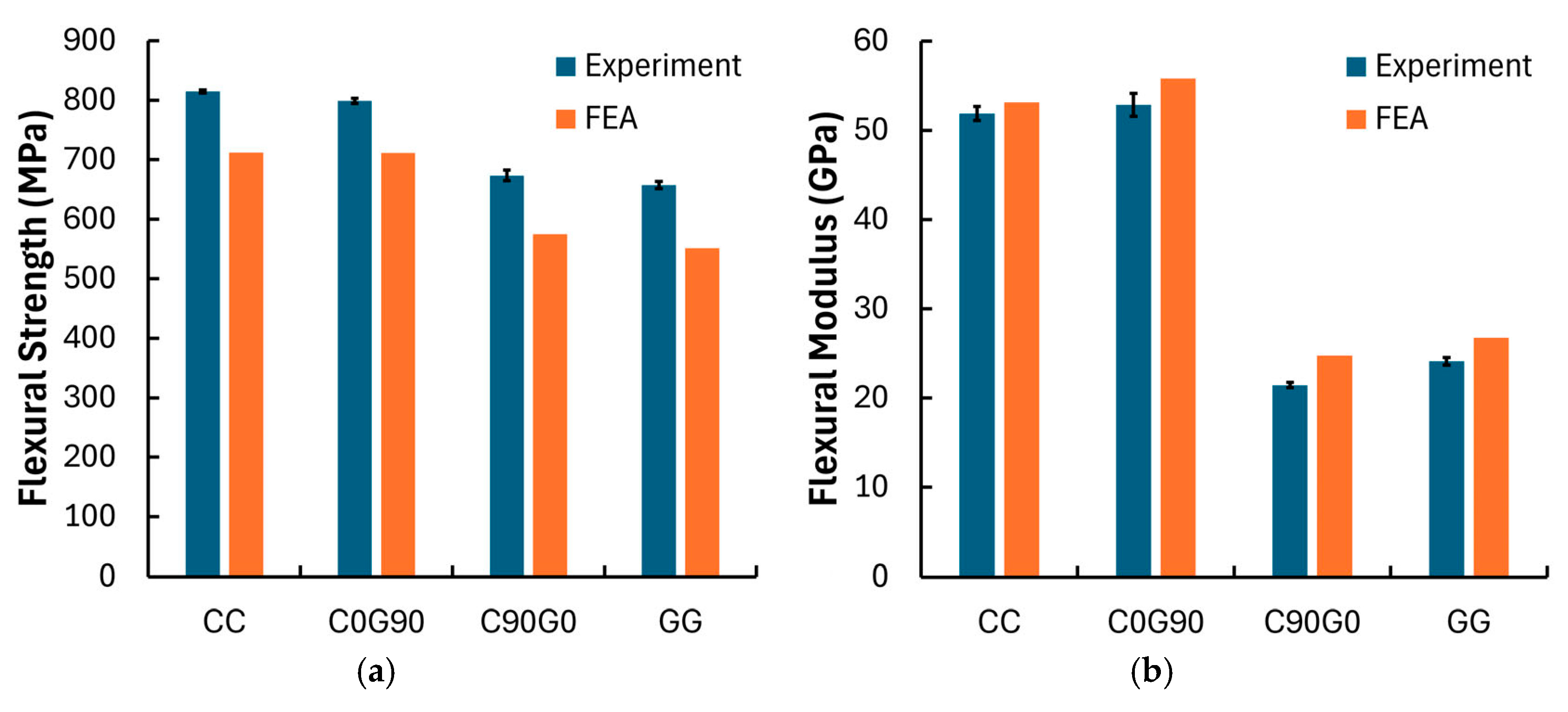
Figure 2 presents the comparison between experimental measurements and FEA predictions for both flexural strength and flexural modulus.
Figure 2.
Experimental–numerical comparison of flexural strength (a) and modulus (b) for CC, C0G90, C90G0, and GG intralayer carbon–glass laminates (data from Chen et al. [10]). The model captures the correct trend across architectures, with strength deviations of 12–16% and modulus deviations below 6% for carbon-rich and below 15% for glass-rich configurations.
A quantitative comparison between the FEA predictions and experimental results reveals that the relative error in flexural strength ranges from approximately 12% to 16%, while the deviation in flexural modulus is within 3% for carbon-dominated laminates (CC and C0G90) and up to 15% for glass-dominated configurations (C90G0 and GG). These discrepancies can be primarily attributed to modelling idealisations, including the assumption of uniform material properties and perfect interfacial bonding, as well as the simplified representation of progressive damage behaviour. In contrast, the experimental specimens may contain manufacturing-induced variability, such as fibre misalignment and local defects, which are not explicitly captured in the numerical model.
Despite these differences, the FEA results accurately reproduce the overall trends and relative ranking among different layups, confirming the validity of the model for predicting the flexural response of intralayer hybrid composites.
Overall, the comparison demonstrates that the proposed modelling framework provides a reliable prediction of flexural stiffness and captures the governing architecture-dependent failure mechanisms. The validated model is therefore considered suitable for subsequent parametric investigation of hybrid ratio and dispersion effects.
The conservative underprediction of flexural strength can be attributed to several modelling simplifications. First, the present implementation employs deterministic ply strength values without incorporating statistical fibre strength distributions or Weibull scaling effects, which are known to elevate apparent flexural strength relative to uniaxial compressive strength due to size effects and stress gradients. Second, the Lo–Chim compressive strength model and stress-based failure criterion do not explicitly account for progressive fibre microbuckling, tow waviness, or local constraint effects that may enhance measured strength in physical specimens. Finally, perfect interfacial bonding and idealised geometry are assumed in the model, whereas experimental specimens may benefit from local load redistribution and damage delocalisation mechanisms not fully captured numerically.
Despite these simplifications, the systematic nature of the strength deviation and the accurate reproduction of architectural trends indicate that the governing mechanics are correctly represented. The model therefore provides robust mechanistic insight while maintaining conservative strength prediction, which is preferable from a structural design perspective.
The deviation magnitude is comparable to previously reported differences between experimental and progressive damage simulations of hybrid laminates in the literature [25].
2.4. Intralayer Configurations
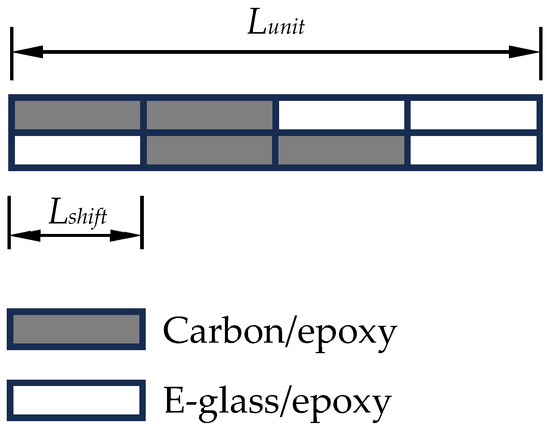
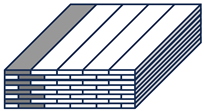
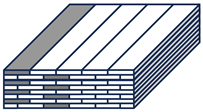
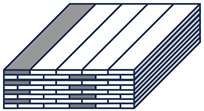
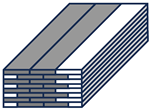
In the intralayer hybrid composites considered in this study, carbon/epoxy and glass/epoxy fibre tows are arranged within the same ply in a repeating pattern, referred to as a unit. Within each unit, the number of carbon and glass sections can be varied to achieve different carbon-to-glass (C:G) ratios. This unit repeats along the width of a ply, and the position of the unit can be shifted from one ply to the next to generate different intralayer dispersion patterns.
The degree of dispersion is characterised by the relative shift between adjacent plies. Let Lunit denote the length of one repeating unit and Lshift denote the shift distance between neighbouring plies. Because the shift can occur in either direction, the smaller value is taken as Lshift, with a maximum possible value of Lunit/2. In reference to Figure 3, the degree of dispersion, DoD, is defined as
Figure 3.
Dispersion of fibre tows in an intralayer hybrid composite.
It is seen that . corresponds to a fully aligned configuration and represents the maximum dispersion.
Four C:G ratios—2:1, 1:1, 1:2, and 1:4—were investigated in this study. These ratios are consistent with those reported in previous experimental and numerical investigations of intralayer hybrid composites. For each C:G ratio, multiple degrees of dispersion were considered to systematically examine the influence of intralayer architecture on flexural behaviour. The detailed configurations, including unit length, shift distance, and dispersion parameter, are summarised in Table 2.
Table 2.
Configurations of intralayer hybrid composites.
3. Results and Discussion
3.1. Flexural Stress–Strain Response and Failure Characteristics
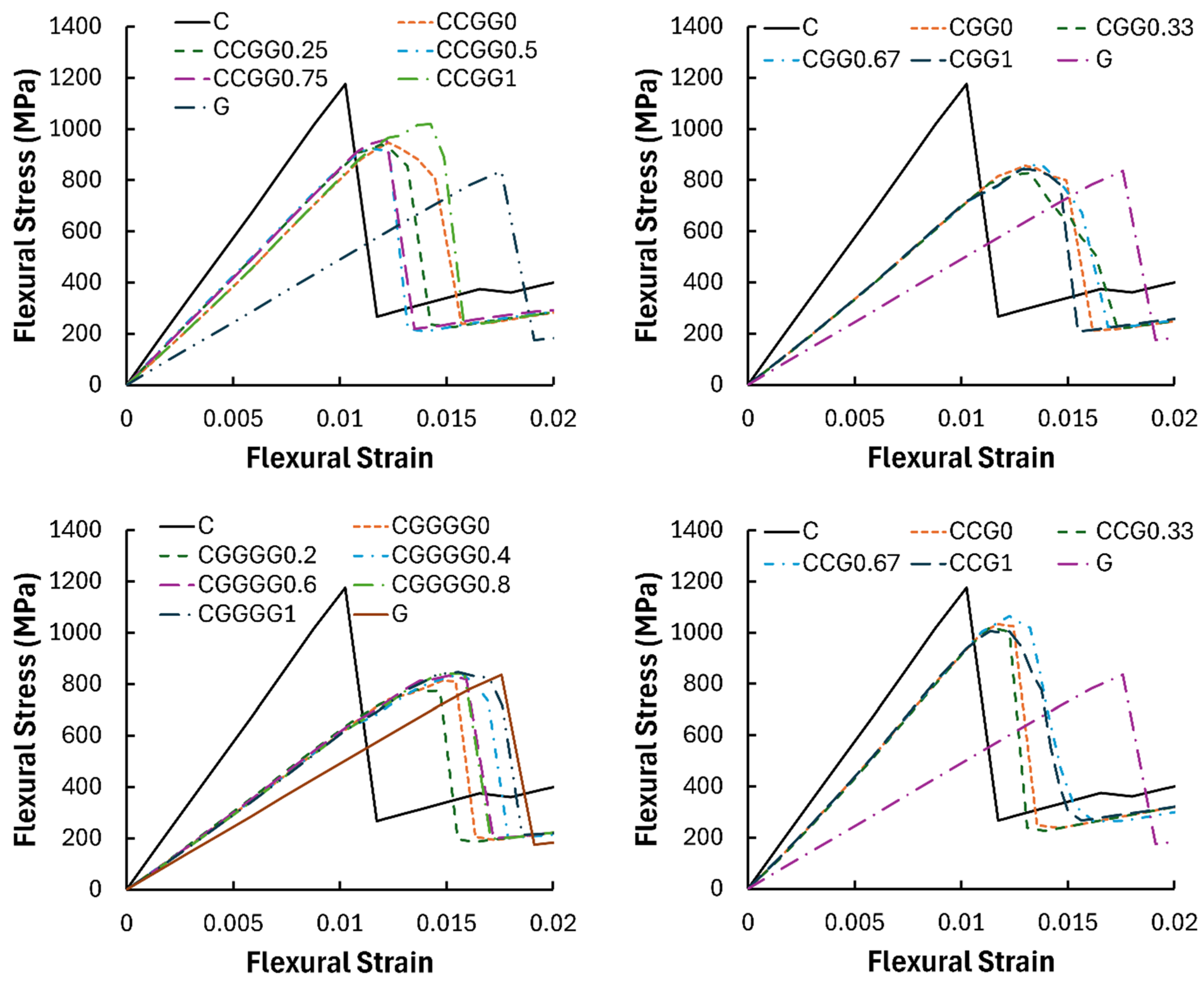
Figure 4 presents the flexural stress–strain responses of the pure and hybrid laminates across different carbon–glass ratios and degrees of dispersion. Clear distinctions are observed between carbon-dominated, glass-dominated, and hybrid systems, reflecting the contrasting stiffness and failure characteristics of the constituent fibres.
Figure 4.
Flexural stress–strain curves.
The pure carbon laminate exhibits a steep initial slope followed by an abrupt load drop, indicative of brittle tensile-side fibre fracture. In contrast, the pure glass laminate shows a more gradual stress increase and extended failure strain, consistent with progressive fibre fracture and matrix cracking. All hybrid configurations display intermediate behaviour, combining relatively high stiffness with improved post-peak deformation.
For carbon-rich hybrids (C:G = 2:1 and 1:1), dispersion strongly influences the shape of the stress–strain curves. Highly dispersed laminates exhibit sharper and more stable peaks and sustain higher stresses prior to failure, whereas low-dispersion configurations show earlier peak stress and more abrupt post-peak drops. This suggests that dispersion improves strain compatibility between carbon and glass fibres, reducing premature carbon fracture caused by local stiffness discontinuities. Moderately dispersed laminates also display steeper elastic slopes, indicating more effective utilisation of carbon fibres in the tensile region.
As the hybrid ratio shifts toward glass dominance (C:G = 1:2 and 1:4), the stress–strain curves cluster more closely regardless of dispersion. These laminates exhibit smoother post-peak softening and greater energy absorption, reflecting a transition to glass-governed, more progressive damage mechanisms. In these systems, layer arrangement plays a secondary role because the lower-modulus glass fibres dominate the flexural response.
Overall, the stress–strain curves corroborate the tabulated results: dispersion primarily modifies failure characteristics and post-peak behaviour, while hybrid ratio governs the overall balance between stiffness and ductility.
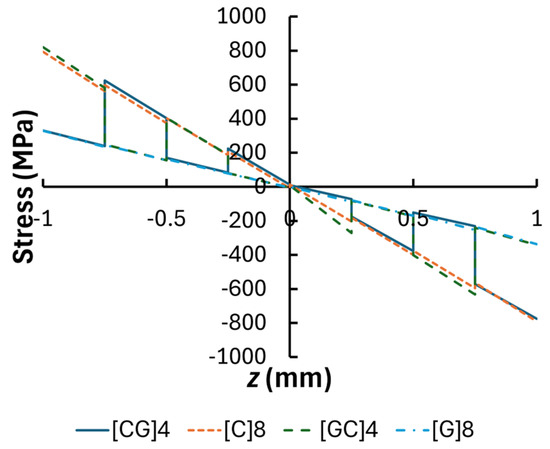
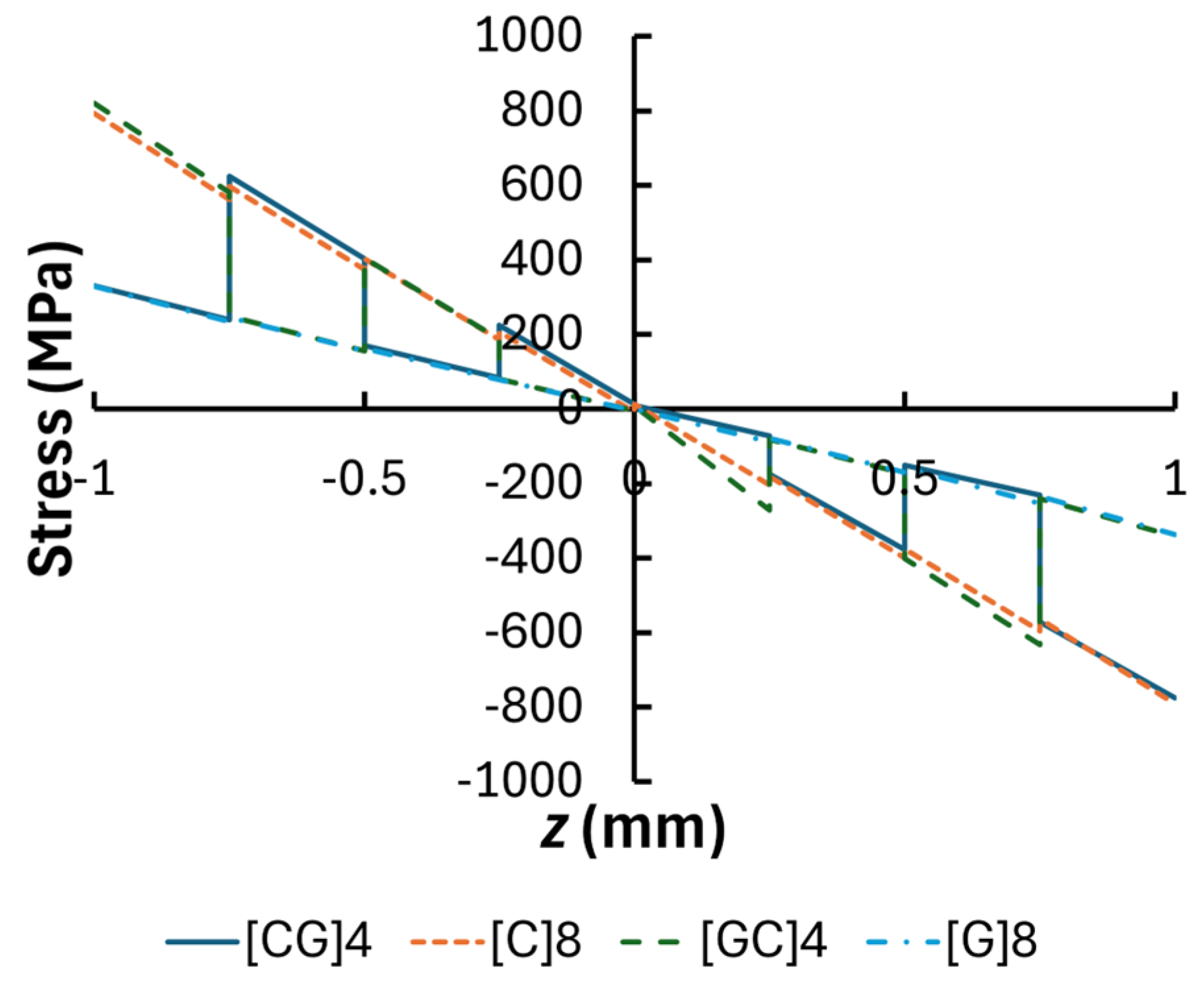
Figure 5 presents the through-thickness stress distribution for the CCGG hybrid laminate with a degree of dispersion (DoD = 0.25), together with the corresponding pure laminate cases. For the pure laminates ([C]8 and [G]8), the stress distribution remains approximately linear, consistent with classical laminate behaviour. In contrast, the hybrid laminate exhibits a stepwise stress profile due to the stiffness mismatch between adjacent carbon and glass plies.
Figure 5.
Through-thickness stress distribution under bending for CCGG laminate configurations with a degree of dispersion DoD = 0.25, compared with pure laminates ([C]8 and [G]8). The stepwise stress variation reflects the discrete ply architecture, while deviations from the linear distribution highlight the influence of partial fibre dispersion and stiffness mismatch between carbon and glass plies.
At DoD = 0.25, the dispersion of carbon plies is limited, resulting in partial clustering of high-stiffness carbon layers. Consequently, carbon-rich regions carry a disproportionately higher share of the applied stress, while glass plies experience reduced stress levels. This leads to local stress discontinuities at material interfaces, which may act as initiation sites for progressive damage.
3.2. Flexural Properties: Combined Effects of Hybrid Ratio and Dispersion
The detailed flexural properties for all laminates are summarised in Table 3. As expected, replacing carbon with glass results in a systematic reduction in flexural strength and modulus, accompanied by a progressive increase in strain to failure. Pure carbon exhibits the highest strength (1175 MPa) and stiffness (88.8 GPa) but the lowest failure strain, whereas pure glass shows the opposite trend.
Table 3.
Detailed flexural properties of all C:G ratios.
Carbon-dominant hybrids (C:G = 2:1 and 1:1) retain relatively high flexural strength (≈950–1070 MPa) and stiffness (≈60–68 GPa), while achieving noticeable improvements in strain to failure compared with pure carbon. In these systems, dispersion plays a clear role: moderate-to-high dispersion generally enhances strength and ductility, whereas very low dispersion can lead to strength reductions due to localised strain concentrations and premature carbon fracture.
In contrast, carbon-lean hybrids (C:G = 1:2 and 1:4) show lower flexural strength and stiffness, converging toward the behaviour of pure glass. Strength variations across dispersion levels are modest (<10%), indicating reduced sensitivity to stacking arrangement. However, strain to failure increases steadily with increasing glass content and shows only minor dependence on dispersion, reflecting a shift from carbon-controlled brittle fracture to glass-dominated progressive failure.
These results demonstrate that dispersion effects on flexural performance are most pronounced in carbon-rich hybrids, while the hybrid ratio primarily governs stiffness and ductility.
3.3. Flexural Modulus: Role of Hybrid Ratio Versus Dispersion
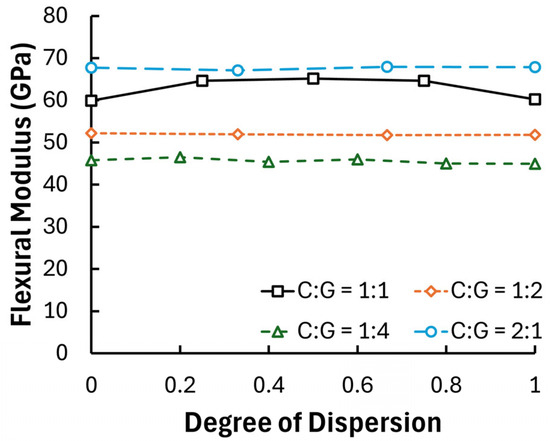
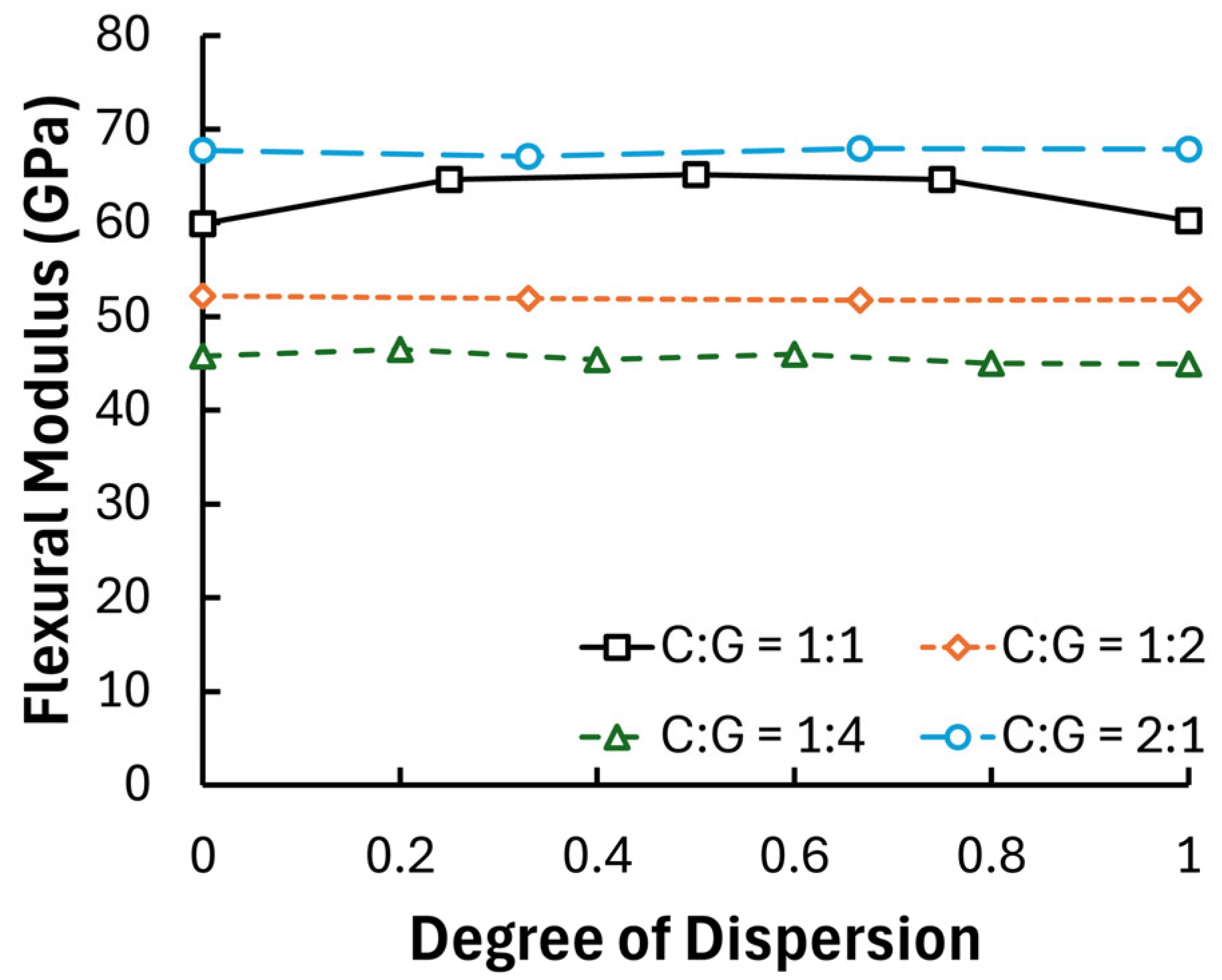
Figure 6 shows the variation in flexural modulus as a function of the degree of dispersion for all C:G ratios. Flexural modulus is governed largely by the effective contribution of carbon fibres to bending stiffness. For the 1:1 hybrid system, a clear peak in modulus is observed at moderate dispersion (DoD ≈ 0.25–0.5), with values reaching approximately 64–65 GPa—significantly higher than those of both the undispersed and fully dispersed configurations. This suggests the existence of an optimal dispersion level where carbon fibres remain sufficiently clustered to dominate tensile stiffness but not so clustered as to create severe strain incompatibilities.
Figure 6.
Flexural modulus vs. degree of dispersion.
At full dispersion, the formation of local carbon-dominated stiffness zones is suppressed, reducing the effective laminate modulus despite improved strain compatibility. This trade-off highlights the competing roles of stiffness localisation and stress redistribution.
For the CGG (1:2) and CGGGG (1:4) systems, flexural modulus remains nearly constant across all dispersion levels. The carbon content in these laminates is insufficient for dispersion-induced clustering to significantly affect global stiffness. Instead, the modulus follows a near rule-of-mixtures trend dictated primarily by fibre volume fraction. Similar behaviour is observed in the carbon-rich CCG (2:1) system, where modulus depends strongly on hybrid ratio but only weakly on dispersion.
Across all hybrid ratios investigated, the flexural modulus follows a near rule-of-mixtures trend and shows only weak dependence on dispersion. This observation is consistent with multiple studies reporting that elastic stiffness in intralayer hybrids is controlled primarily by fibre volume fraction and fibre modulus, rather than stacking sequence or dispersion [3,26,27]. While moderate dispersion can locally enhance stiffness in carbon-rich hybrids by promoting more effective load sharing, excessive dispersion suppresses carbon-dominated stiffness regions, leading to marginal reductions in effective modulus. This trade-off highlights that dispersion plays a secondary role in stiffness optimisation compared with the hybrid ratio.
3.4. Flexural Strength and Degree of Dispersion
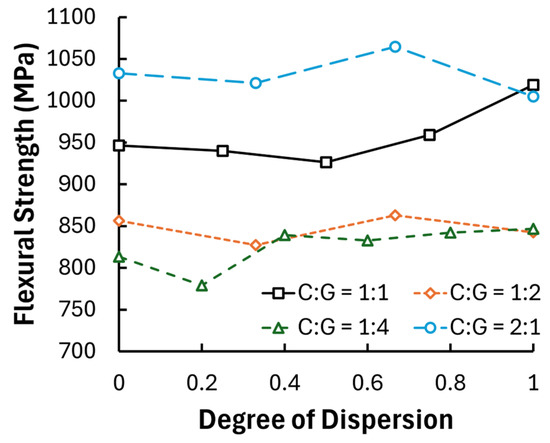
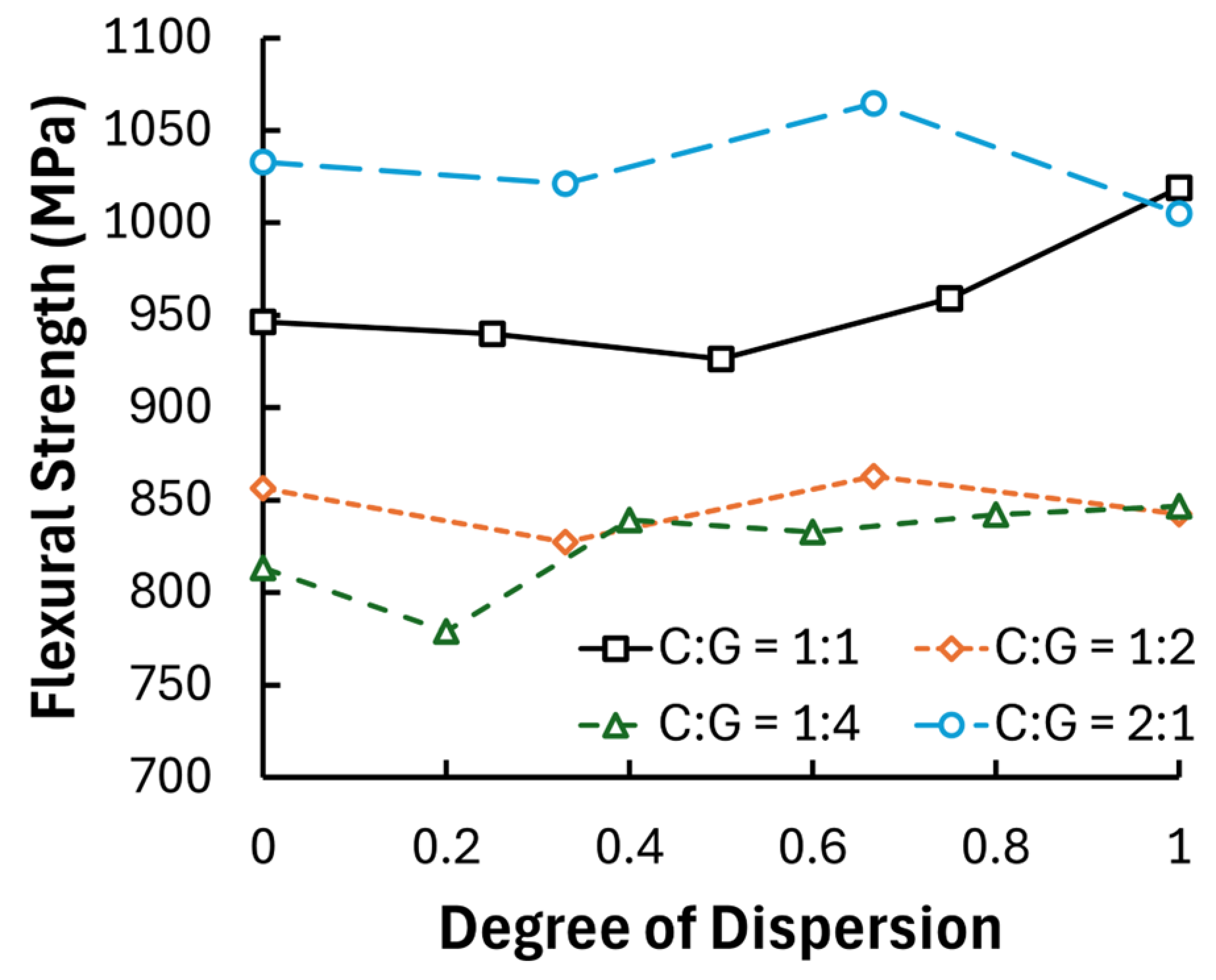
Figure 7 illustrates the variation in flexural strength with degree of dispersion for all C:G ratios. For carbon-dominant hybrids (C:G = 2:1 and 1:1), flexural strength exhibits a shallow minimum at low dispersion followed by a gradual increase, reaching peak values at moderate-to-high dispersion (DoD ≈ 0.6–0.8). The fully dispersed 1:1 laminate achieves a strength of 1019 MPa, representing an ~8% improvement over the least dispersed hybrid and a ~22% increase relative to pure glass. The decrease at high dispersion (e.g., CCG1.5) is attributed to excessive dispersion reducing carbon clustering and thus limiting effective load transfer in the tensile region.
Figure 7.
Flexural strength vs. degree of dispersion.
This trend indicates that low dispersion leads to carbon-rich regions acting as local stiffness discontinuities, promoting early matrix cracking and carbon fibre fracture. Increasing dispersion reduces these gradients, allowing more uniform strain sharing and delaying damage initiation.
In carbon-lean systems (C:G = 1:2 and 1:4), strength variations across dispersion levels are much smaller. The CGG series shows fluctuations of less than ~4%, while the CGGGG series varies by less than ~9%. In these regimes, glass fibres dominate tensile-side behaviour, and dispersion primarily influences damage progression rather than peak strength.
The observed dependence of flexural strength on dispersion and hybrid ratio is consistent with earlier studies on intralayer carbon–glass hybrids. Wu et al. [28] demonstrated that flexural strength is governed primarily by stacking architecture rather than the C/G ratio when carbon remains a dominant load-bearing phase, with higher dispersion generally improving performance. Similar conclusions were reported in earlier experimental studies comparing interlayer and intralayer hybrids, where intralayer configurations exhibited improved stress redistribution and delayed tensile-side failure under bending [26,29]. The present results confirm these findings for carbon-rich hybrids (C:G = 2:1 and 1:1), where moderate-to-high dispersion leads to improved flexural strength by smoothing local stiffness gradients and suppressing premature carbon fibre fracture.
However, as the hybrid ratio shifts toward glass dominance (C:G = 1:2 and 1:4), the influence of dispersion on flexural strength diminishes. This trend extends the observations of Wu et al. [28], who focused primarily on moderate hybrid ratios. In glass-dominant systems, flexural failure becomes governed by glass fibre rupture and matrix cracking rather than carbon-initiated fracture, causing strength levels to converge toward those of pure glass laminates regardless of stacking arrangement. Similar behaviour has been reported in flexural experiments and numerical simulations by Chen et al. [10], where increasing glass content reduced sensitivity to fibre arrangement while enhancing damage tolerance.
3.5. Strain to Failure and Damage Tolerance
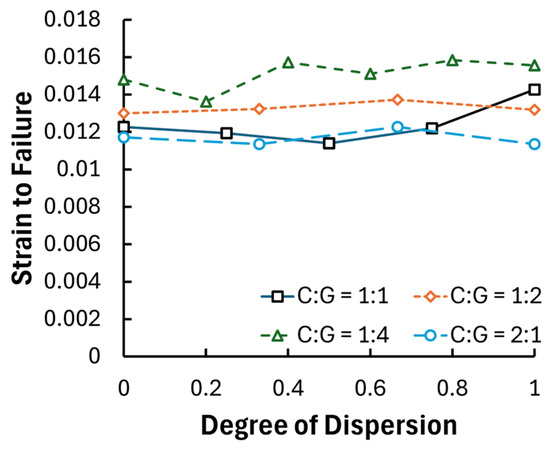
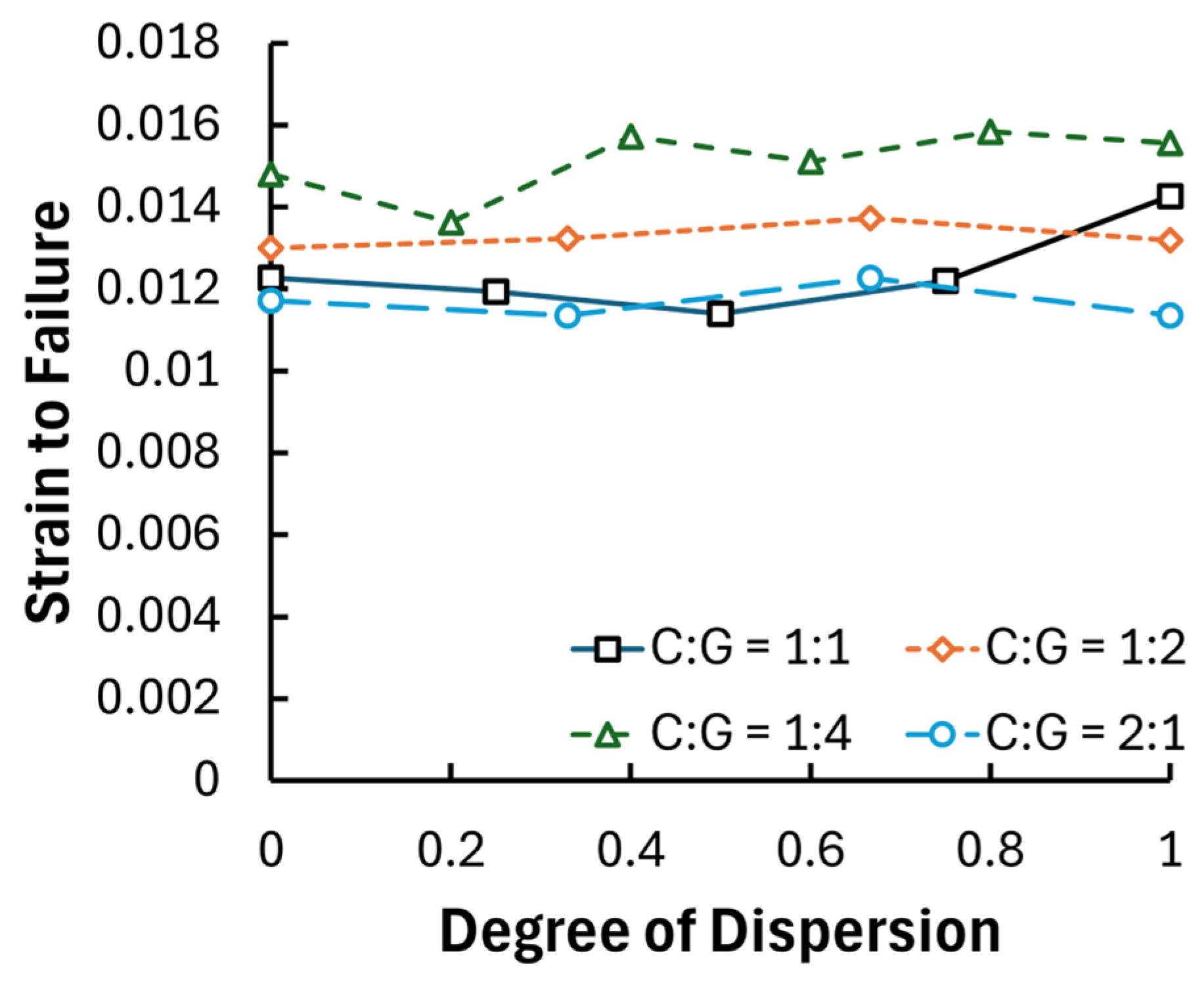
Figure 8 presents the relationship between strain to failure and degree of dispersion across all C:G ratios. Across all hybrid systems, strain to failure increases with increasing glass content and, to a lesser extent, with increasing dispersion. Highly dispersed laminates consistently exhibit higher failure strains and smoother post-peak softening, indicating improved damage tolerance and energy absorption.
Figure 8.
Strain to failure vs. degree of dispersion.
The underlying mechanisms include improved strain sharing between carbon and glass fibres, suppression of carbon-rich failure zones, and more tortuous crack paths. Glass fibres continue to carry load after initial carbon fracture, as evidenced by the extended descending branches in the stress–strain curves. These effects are particularly pronounced in glass-dominated hybrids, where failure becomes increasingly progressive and less sensitive to stacking sequence.
A consistent increase in strain to failure is observed with increasing glass content and, to a lesser extent, with increasing dispersion. This enhanced ductility reflects the progressive damage mechanisms inherent to intralayer hybrids, where glass fibres continue to carry load following carbon fracture, thereby delaying catastrophic failure. Similar improvements in failure strain and post-peak deformation have been widely reported in both tensile and flexural studies of intralayer carbon–glass hybrids [30,31]. In particular, tailored fibre placement and in-layer mixing strategies have been shown to improve strain compatibility and damage tolerance by promoting gradual crack propagation rather than abrupt fibre rupture.
The present results further show that dispersion primarily affects the failure process rather than the elastic response, especially in glass-dominant hybrids. This observation aligns with the hybrid effect theories proposed in [31], where synergistic load sharing enhances ductility, while excessive fragmentation of high-modulus fibres can lead to failure acceleration. The smoother post-peak softening observed in highly dispersed laminates supports this interpretation.
3.6. Hybrid Mechanisms
The observed trends align closely with the mechanisms proposed by Wu et al. [28]. In carbon-dominant hybrids, flexural strength is governed by local stiffness discontinuities and interfacial shear stress concentrations, making stacking architecture and dispersion critical. Moderate dispersion smooths stiffness gradients and delays tensile-side carbon fracture, leading to improved strength.
As the carbon fraction decreases, the governing failure mechanism transitions toward glass fibre fracture and matrix-dominated damage. In this regime, dispersion primarily enhances strain uniformity and ductility rather than peak strength. The present results extend Wu’s findings by demonstrating that dispersion sensitivity decreases systematically as the hybrid system shifts from carbon-dominated to glass-dominated behaviour.
Taken together, the present findings confirm that intralayer hybridisation produces a positive hybrid effect by balancing stiffness, strength, and ductility, as widely reported in the literature [3,26,29]. Importantly, this study extends prior work by systematically demonstrating how the dominance of dispersion over hybrid ratio gradually diminishes as the laminate transitions from carbon-dominated to glass-dominated behaviour. This unified interpretation provides clearer guidance for structural optimisation of intralayer carbon–glass hybrid composites under flexural loading.
Overall, the results confirm that dispersion plays a dominant role in controlling flexural strength and failure mode in carbon-rich intralayer hybrids, while hybrid ratio governs stiffness and ductility across the full compositional range.
Beyond mechanical performance, Wu et al. [28] highlighted the importance of cost efficiency in hybrid composite design, demonstrating that intralayer hybrids with high glass content and controlled dispersion can offer superior strength-to-cost ratios. While the present study focuses on mechanical behaviour, the observed convergence of flexural strength in glass-dominant hybrids, combined with their enhanced strain capacity, suggests that such configurations may be particularly attractive for applications prioritising damage tolerance and economic efficiency. This reinforces the practical relevance of dispersion-controlled intralayer hybridisation as a design strategy.
4. Conclusions
This study systematically investigated the flexural behaviour of carbon/glass intralayer hybrid composites, with particular emphasis on the combined effects of hybrid ratio and degree of dispersion. A modelling-driven framework, validated against published experimental evidence, was employed to elucidate architecture–mechanism–performance relationships under three-point bending.
The results demonstrate that intralayer hybridisation enables an effective balance between stiffness, strength, and ductility. Carbon-rich hybrids (C:G = 2:1 and 1:1) retained a high proportion of the flexural strength and modulus of pure carbon laminates while exhibiting significantly enhanced strain to failure and more progressive post-peak softening. In these systems, the degree of dispersion played a decisive role: moderate-to-high dispersion smoothed local stiffness gradients, improved strain compatibility between carbon and glass fibres, and delayed tensile-side carbon fibre fracture, leading to improved flexural strength and damage tolerance.
As the hybrid ratio shifted toward glass dominance (C:G = 1:2 and 1:4), flexural behaviour became increasingly governed by glass fibre fracture and matrix-dominated damage mechanisms. In this regime, flexural strength and modulus followed near-rule-of-mixtures trends and exhibited only weak sensitivity to dispersion, while strain to failure increased steadily. These findings indicate a clear transition from dispersion-dominated behaviour in carbon-rich hybrids to ratio-dominated behaviour in glass-rich systems.
Across all hybrid ratios investigated, flexural modulus was found to depend primarily on fibre volume fraction and fibre modulus, with dispersion exerting only a secondary influence. In contrast, flexural strength and failure strain were strongly architecture-dependent when carbon fibres remained the dominant load-bearing phase. This distinction highlights the need to treat stiffness and strength optimisation as separate design problems in intralayer hybrid composites.
Overall, the present results confirm and extend recent findings by Wu et al. [25] by demonstrating that flexural strength in intralayer carbon/glass hybrids is governed primarily by stacking architecture and dispersion when carbon dominates but becomes increasingly insensitive to dispersion as glass content increases. The study provides clear mechanistic insight into how intralayer dispersion controls stress redistribution, damage initiation, and failure progression under bending.
From a design perspective, these findings offer practical guidance for tailoring intralayer hybrid architectures: moderate-to-high dispersion is recommended for carbon-rich systems where strength retention is critical, while glass-rich hybrids with controlled dispersion offer attractive combinations of damage tolerance and potential cost efficiency. This study establishes a unified interpretation of intralayer hybrid flexural behaviour, demonstrating that dispersion governs strength in carbon-rich systems, while hybrid ratio dominates in glass-rich systems. The validated modelling framework provides a predictive tool for architecture optimisation across a broad compositional range.
Funding
This research received no external funding.
Data Availability Statement
The original contributions presented in this study are included in the article. Further inquiries can be directed to the corresponding author.
Conflicts of Interest
The author declares no conflicts of interest.
Abbreviations
The following abbreviations are used in this manuscript:
| ASTM | American Society for Testing and Materials |
| CCM | Circular Cylinder Model |
| DoD | Degree of Dispersion |
| RoM | Rule of Mixtures |
References
- Swolfs, Y.; Gorbatikh, L.; Verpoest, I. Fibre hybridisation in polymer composites: A review. Compos. Part A Appl. Sci. Manuf. 2014, 67, 181–200. [Google Scholar] [CrossRef] [Scilit]
- Wisnom, M.; Czél, G.; Swolfs, Y.; Jalalvand, M.; Gorbatikh, L.; Verpoest, I. Hybrid effects in thin ply carbon/glass unidirectional laminates: Accurate experimental determination and prediction. Compos. Part A Appl. Sci. Manuf. 2016, 88, 131–139. [Google Scholar] [CrossRef] [Scilit]
- Rajpurohit, A.; Joannès, S.; Singery, V.; Sanial, P.; Laiarinandrasana, L. Hybrid effect in in-plane loading of carbon/glass fibre based inter- and intraply hybrid composites. J. Compos. Sci. 2020, 4, 6. [Google Scholar] [CrossRef] [Scilit]
- Shi, L.; Yang, H.; Wu, Z.; Peng, L.; Ni, Q.; Li, Q. Effect of fiber layout on low-velocity impact response of intralaminar hybrid carbon/glass fiber braided composite pipes under internal pressure. Thin-Walled Struct. 2024, 198, 111711. [Google Scholar] [CrossRef] [Scilit]
- Swolfs, Y.; McMeeking, R.M.; Verpoest, I.; Gorbatikh, L. The effect of fibre dispersion on initial failure strain and cluster development in unidirectional carbon/glass hybrid composites. Compos. Part A Appl. Sci. Manuf. 2015, 69, 279–287. [Google Scholar] [CrossRef] [Scilit]
- Zhang, C.; Rao, Y.; Li, Z.; Li, W. Low-velocity impact behavior of interlayer/intralayer hybrid composites based on carbon and glass non-crimp fabric. Materials 2018, 11, 2472. [Google Scholar] [CrossRef] [Scilit]
- ASTM D7264/D7264M-21; Standard Test Method for Flexural Properties of Polymer Matrix Composite Materials. ASTM International: West Conshohocken, PA, USA, 2021.
- Dong, C. Flexural properties of symmetric carbon and glass fibre reinforced hybrid composite laminates. Compos. Part C Open Access 2020, 3, 100047. [Google Scholar] [CrossRef] [Scilit]
- Wu, W.; Wang, Q.; Ichenihi, A.; Shen, Y.; Li, W. The effects of hybridization on the flexural performances of carbon/glass interlayer and intralayer composites. Polymers 2018, 10, 549. [Google Scholar] [CrossRef] [Scilit]
- Chao, X.; Qi, L.; Tian, W.; Hou, X.; Ma, W.; Li, H. Numerical evaluation of the influence of porosity on bending properties of 2D carbon/carbon composites. Compos. Part B Eng. 2018, 136, 72–80. [Google Scholar] [CrossRef] [Scilit]
- Liao, Q.; Su, Y.; Li, B.; Yu, J.; Yu, K. Enhancing flexural ductility of GFRP bars reinforced seawater sea-sand engineered cementitious composites beams by utilizing slip-hardening mechanism. Compos. Struct. 2026, 386, 120252. [Google Scholar] [CrossRef] [Scilit]
- Chen, D.; Sun, X.; Xiao, S.; Deng, J.; Yang, G.; Yang, B.; Wang, M. Investigation on Flexural Properties of Intra-layer Hybrid Composite Laminates Reinforced with Carbon and Glass Fibers. Fibers Polym. 2023, 24, 1119–1130. [Google Scholar] [CrossRef] [Scilit]
- Swolfs, Y.; Verpoest, I.; Gorbatikh, L. Maximising the hybrid effect in unidirectional hybrid composites. Mater. Des. 2016, 93, 39–45. [Google Scholar] [CrossRef] [Scilit]
- Kalantari, M.; Dong, C.; Davies, I.J. Multi-objective robust optimisation of unidirectional carbon/glass fibre reinforced hybrid composites under flexural loading. Compos. Struct. 2016, 138, 264–275. [Google Scholar] [CrossRef] [Scilit]
- Chou, T.-W. Microstructural Design of Fiber Composites; Cambridge University Press: Cambridge, UK, 1992. [Google Scholar]
- Hashin, Z. Analysis of composite materials—A survey. J. Appl. Mech. 1983, 50, 481–505. [Google Scholar] [CrossRef] [Scilit]
- Dong, C. Uncertainties in flexural strength of carbon/glass fibre reinforced hybrid epoxy composites. Compos. Part B Eng. 2016, 98, 176–181. [Google Scholar] [CrossRef] [Scilit]
- Subagia, I.D.G.A.; Kim, Y.; Tijing, L.D.; Kim, C.S.; Shon, H.K. Effect of stacking sequence on the flexural properties of hybrid composites reinforced with carbon and basalt fibers. Compos. Part B Eng. 2014, 58, 251–258. [Google Scholar] [CrossRef] [Scilit]
- Lee, S.; Waas, A.M. Compressive response and failure of fiber reinforced unidirectional composites. Int. J. Fract. 1999, 100, 275–306. [Google Scholar] [CrossRef] [Scilit]
- Pandya, K.S.; Veerraju, C.; Naik, N. Hybrid composites made of carbon and glass woven fabrics under quasi-static loading. Mater. Des. 2011, 32, 4094–4099. [Google Scholar] [CrossRef] [Scilit]
- Mallick, P.K. Fiber-Reinforced Composites: Materials, Manufacturing, and Design, 2nd ed.; Marcel Dekker: New York, NY, USA, 1993. [Google Scholar]
- Garnich, M.R.; Akula, V.M.K. Review of degradation models for progressive failure analysis of fiber reinforced polymer composites. Appl. Mech. Rev. 2008, 62, 010801. [Google Scholar] [CrossRef] [Scilit]
- Dong, C. Flexural behaviour of carbon and glass reinforced hybrid composite pipes. Compos. Part C Open Access 2021, 4, 100090. [Google Scholar] [CrossRef] [Scilit]
- Bullock, R. Strength ratios of composite materials in flexure and in tension. J. Compos. Mater. 1974, 8, 200–206. [Google Scholar] [CrossRef] [Scilit]
- Dong, C.; Ranaweera-Jayawardena, H.A.; Davies, I.J. Flexural properties of hybrid composites reinforced by S-2 glass and T700S carbon fibres. Compos. Part B Eng. 2012, 43, 573–581. [Google Scholar] [CrossRef] [Scilit]
- Wu, W.; Wang, Q.; Li, W. Comparison of tensile and compressive properties of carbon/glass interlayer and intralayer hybrid composites. Materials 2018, 11, 1105. [Google Scholar] [CrossRef] [Scilit]
- Wang, Q.; Wu, W.; Li, W. Compression properties of interlayer and intralayer carbon/glass hybrid composites. Polymers 2018, 10, 343. [Google Scholar] [CrossRef] [Scilit] [PubMed]
- Wu, W. Mechanical performance/cost ratio analysis of carbon/glass interlayer and intralayer hybrid composites. Coatings 2024, 14, 810. [Google Scholar] [CrossRef] [Scilit]
- Ikbal, M.H.; Ahmed, A.; Qingtao, W.; Shuai, Z.; Wei, L. Hybrid composites made of unidirectional T600S carbon and E-glass fabrics under quasi-static loading. J. Ind. Text. 2016, 46, 1511–1535. [Google Scholar] [CrossRef] [Scilit]
- Burley, A.; Aitharaju, V. Enhanced ductility in in-layer glass-carbon fiber/epoxy hybrid composites produced via tailored fiber placement. Compos. Part A Appl. Sci. Manuf. 2023, 168, 107488. [Google Scholar] [CrossRef] [Scilit]
- Wu, W. Tensile failure behaviors and theories of carbon/glass hybrid interlayer and intralayer composites. Coatings 2023, 13, 774. [Google Scholar] [CrossRef] [Scilit]











Disclaimer/Publisher’s Note: The statements, opinions and data contained in all publications are solely those of the individual author(s) and contributor(s) and not of MDPI and/or the editor(s). MDPI and/or the editor(s) disclaim responsibility for any injury to people or property resulting from any ideas, methods, instructions or products referred to in the content. |
© 2026 by the author. Licensee MDPI, Basel, Switzerland. This article is an open access article distributed under the terms and conditions of the Creative Commons Attribution (CC BY) license.