


Abstract
This study evaluated the partial and total replacement of zinc oxide (ZnO) with magnesium oxide (MgO) in styrene–butadiene rubber (SBR) composites, as well as the incorporation of ground tire rubber (GTR), aiming to develop more sustainable elastomer formulations. Ten formulations were prepared with varying ZnO/MgO ratios (100/0 to 0/100), with and without 20 phr of GTR. The composites were characterized by particle size distribution, morphology, rheometric behavior, density, crosslink density, mechanical properties, abrasion resistance, compression behavior, and thermo-oxidative aging. The results showed that hybrid ZnO/MgO activation systems exhibited a synergistic effect, enhancing vulcanization kinetics and mechanical performance compared to single-activator systems. Total replacement of ZnO by MgO was less effective, leading to reduced crosslink density and inferior properties. The addition of GTR increased compound viscosity and altered morphology but improved abrasion and compression resistance without significantly affecting tensile strength. Aging tests indicated good thermal stability, with maintenance or improvement of tensile properties due to post-curing effects. Overall, the combination of reduced ZnO content with MgO and GTR represents a viable approach for producing SBR composites with adequate performance and lower environmental impact.
1. Introduction
The elastomer industry plays a fundamental role in several sectors of the economy, including the automotive, footwear, construction, and consumer goods industries, owing to the unique properties of rubbers, such as elasticity, wear resistance, and impact absorption capability [1]. Among synthetic elastomers, styrene–butadiene rubber (SBR) stands out as one of the most widely used, representing an economical and versatile alternative to natural rubber (NR) in various applications [2]. However, for SBR to achieve its desired final properties, it must undergo a vulcanization process, during which crosslinks are formed between the polymer chains, imparting enhanced thermal, mechanical, and chemical resistance to the material [1,3].
The conventional curing system for rubber vulcanization, particularly in sulfur-based formulations, generally involves the use of accelerators and activators [4]. Among these activators, zinc oxide (ZnO) has been widely employed for decades due to its high efficiency in accelerating vulcanization and stabilizing the crosslinked rubber network [5]. However, over the past two decades, the intensive use of ZnO has been increasingly criticized for environmental and regulatory reasons. Several studies have indicated that ZnO, when released into the environment, can be toxic to aquatic organisms and contribute to soil contamination, especially when originating from industrial waste and end-of-life products such as tires [5,6,7,8].
Based on this scenario, the search for environmentally more sustainable alternatives to ZnO has intensified. Magnesium oxide (MgO), for instance, has been investigated as a potential substitute, mainly because it is less toxic and more abundant in nature [9]. Studies indicate that, although MgO alone does not achieve the same efficiency as ZnO under certain conditions, its combination with ZnO in varied proportions can result in effective activation systems with performance comparable to that of the conventional system, while also offering the potential to reduce the overall amount of ZnO in the formulation [10,11,12,13]. For example, the study conducted by Alam, Kumar, and Park [10] on natural rubber showed that a curing activation system with an MgO-to-ZnO ratio of 3:2 could more than double the vulcanization rate. In polybutadiene rubber (PBR), Bhatt et al. [13] found that the inclusion of MgO as a co-activator accelerates the vulcanization rate, and formulations containing 60% MgO may exhibit higher tensile strength, elongation at break, and fracture toughness compared to the conventional use of 100% ZnO.
Sahoo et al. [14] investigated the application of ZnO and MgO nanoparticles in natural rubber and nitrile rubber (NBR). ZnO nanoparticles, with sizes ranging from 30 to 70 nm, exhibited improved dispersion and higher reactivity, resulting in significant enhancements in tensile strength (80% for NR and 70% for NBR) and increased crosslink density compared with conventional-grade ZnO. However, more recent toxicological studies suggest that even nano-ZnO may be more toxic than zinc ions [15]. Nanosized MgO also proved to be effective, with only 1 phr required to achieve a higher vulcanization rate and improved thermal and mechanical properties in natural rubber, compared with 5 phr of conventional ZnO [10].
The study conducted by Chokanandsombat and Sirisinha [] on polychloroprene rubber (CR), which exhibits a distinct vulcanization mechanism due to the presence of chlorine atoms, employed formulations based on metal oxides, such as 4 phr of magnesium oxide (MgO) and 5 phr of zinc oxide (ZnO), which are widely used in industry. This combination provides a favorable balance between mechanical properties—such as hardness, tensile strength, abrasion resistance, and modulus—and processability, with both MgO and ZnO acting as high-modulus fillers and initiators of the crosslinking process. Other approaches to reducing ZnO levels include the use of zinc complexes (such as zinc m-glycerolate) and zinc-containing clays (ZnClay) in S-SBR rubbers, which can reduce zinc concentration by 10 to 20 times while maintaining curing and physical properties [15]. The “green” synthesis of MgO using plant extracts represents another promising route toward cleaner and more environmentally friendly production [9].
In addition to the environmental issues associated with formulation ingredients, rubber waste management also represents a global challenge. End-of-life tires, whose natural degradation may take hundreds of years, are among the most voluminous industrial wastes worldwide [16]. The incorporation of ground tire rubber (GTR) into new composite formulations has proven to be a promising strategy to mitigate this problem, promoting material recycling and reducing dependence on virgin resources [17]. However, the presence of GTR can significantly alter the reactivity of the curing system, the matrix morphology, and the final performance of the composite, thereby requiring careful optimization of the formulation and the selection of vulcanization agents and activators [18].
In this context, the present work aims to investigate the effect of different activation systems on the formulation of vulcanized styrene–butadiene rubber composites, with and without the addition of ground tire rubber. Ten distinct compositions will be formulated by varying the type and proportion of activating oxides: zinc oxide (ZnO), magnesium oxide (MgO), and their combinations at ratios of 75/25, 50/50, and 25/75, with each system being evaluated both in neat formulations and in those incorporating GTR. The resulting composites will be assessed through morphological, structural, and mechanical analyses, in order to elucidate how the partial or total substitution of ZnO, as well as the presence of GTR, affects the final performance of the materials. It is expected that the results will contribute to the development of more sustainable and efficient formulations for the rubber industry, in line with current environmental and technological demands.
2. Methodology
2.1. Materials
The synthetic styrene–butadiene rubber (SBR 1502), characterized by a Mooney viscosity higher than 49.0 (determined at 100 °C) and containing 23.5% styrene incorporated into the polymer chain, was supplied by DLP Indústria e Comércio de Borracha e Artefatos LTDA, located in the state of São Paulo, Poloni, Brazil. The ground rubber derived from end-of-life tires, predominantly composed of particles in the 32–60 mesh range and obtained through mechanical grinding at ambient temperature, was kindly supplied by RECICLANIP, also located in São Paulo. As a natural antioxidant, vegetable tannin extracted from Acacia mearnsii was employed and supplied by Tanac S.A. (Montenegro, Brazil). This material, in the form of a fine powder with a beige color and an anionic nature, exhibits hygroscopic characteristics, a pH of 5.0 (in a 20% w/v aqueous solution), an active matter content higher than 93.5%, and a density of 1.47 g·L−1. Zinc oxide (ZnO) with 99% purity, an amorphous, white, odorless solid with neutral pH (7.0), a melting point of 1975 °C, and a molar mass of 81.38 g·mol−1, was purchased from the chemical reagent supplier Synth (Diadema, Brazil). Magnesium oxide (MgO) with 98% purity, a white, odorless cubic crystalline solid with basic pH (10.3), a high melting point of 2852 °C, and a molar mass of 40.3 g·mol−1, was also acquired from the same supplier. The detailed composition of the materials used in the formulation of the composites is presented in Table 1.
Table 1.
Materials and quantities used in the formulation of the compounds.
In addition to the materials previously mentioned, several commercial reagents were used, including stearic acid (98%, Synth), polyethylene glycol 4000 (99%, Synth), sulfur (99%, Scientific Exotic, Sumaré, Brazil), and the vulcanization accelerators mercaptobenzothiazole disulfide (MBTS, 99%, Basile Química, São Paulo, Brazil) and tetramethylthiuram disulfide (TMTD, 99%, Basile Química, São Paulo, Brazil).
2.2. Preparation of Vulcanized Composites
The preparation of the composites was carried out using an open two-roll mill, supplied by Veiga Sul (Novo Hamburgo, Brazil), following the procedures established in ASTM D3182-21a [19]. During processing, a differential roll speed ratio of 1:1.25 was adopted. Ten distinct formulations were prepared: four employed exclusively zinc oxide or magnesium oxide as vulcanization activators, both in the presence and absence of ground tire rubber; the remaining six compositions consisted of binary mixtures of the two oxides at ratios of 75/25, 50/50, and 25/75, likewise evaluated with and without the addition of the aforementioned filler, as presented in Table 1. The GTR content of 20 phr was selected based on previous studies, in which this concentration demonstrated an adequate balance between mechanical performance and processability [20,21]. However, it is important to emphasize that this value was kept constant throughout the present study in order to isolate the effect of the different ZnO/MgO activation systems. Therefore, the influence of varying GTR content as a function of the activator ratios was not evaluated, and it is not possible to generalize this condition as optimal for all the investigated compositions.
In the first stage of the mixing process, the samples were prepared using a two-roll open mill. Initially, the elastomers were subjected to mastication for approximately 5 min in order to promote adequate plasticization of the matrix. Subsequently, the vulcanization activators (zinc oxide or magnesium oxide, in combination with stearic acid) were incorporated and mixed for about 5 min. Thereafter, the plasticizer (polyethylene glycol 4000) and the antioxidant (tannin) were added and homogenized for approximately 5 min. Finally, ground tire rubber was incorporated into the mixture, and the system was further processed for an additional 15 min until a uniform dispersion was achieved, resulting in a total mixing time of approximately 30 min. After this stage, the compounds were allowed to rest for 24 h at room temperature (22 °C) in order to stabilize the formulation. Following this period, the mixture was reintroduced into the mill for the incorporation of sulfur as the curing agent, along with the accelerators MBTS and TMTD, and was subsequently homogenized for approximately 30 min. Thereafter, the materials were allowed to rest for an additional 1.5 h, also at room temperature, prior to subsequent processing steps.
The curing characteristics were evaluated by means of rheometric analysis, as described in Section 2.5, where the conditions for thermopressing are also detailed. Subsequently, the formulations were molded using a heated press in order to obtain the specimens for the subsequent experimental analyses.
2.3. Particle Size Analysis of Ground Tire Rubber
The particle size distribution analysis of ground tire rubber was performed using an electromechanical sieve shaker (MBL, model AGMAGB, São Paulo, Brazil), operating at 3600 vibrations per minute for 10 min, employing ASTM mesh sieves 32, 60, 80, 115, 200, and 325.
2.4. Scanning Electron Microscopy Study of the Composites and Ground Tire Rubber
The investigation of the morphology of the fractured surfaces of the composites, as well as that of the ground tire rubber, was carried out using scanning electron microscopy (SEM). For this purpose, an EVO LS15 electron microscope (Carl Zeiss Microscopy GmbH, Jena, Germany) was employed, operating at an accelerating voltage of 20 kV. In order to ensure adequate electrical conductivity and to optimize the quality of the acquired images, the samples were previously coated with an ultrathin gold layer using a Quorum Q150R ES sputter coater, via the cathodic deposition (sputtering) process.
2.5. Study of the Rheometric Parameters of the Composites and Preparation of the Test Specimens
The rheological characteristics of the composites were determined through tests performed using an oscillating disk rheometer manufactured by Team Equipamentos (São Paulo, Brazil). The experiments were conducted in accordance with the criteria established by ASTM D2084-17 [22], employing an oscillation arc of 1° and a controlled temperature of 160 °C. After acquisition of the rheometric data, the rubber formulations were subjected to the thermocompression molding process. This step was carried out using a hydraulic press (Mastermac, model Vulcan 400/20-1, São Paulo, Brazil) at a temperature of 160 °C, with a maximum pressure capacity of 210 kgf·cm−2. A mold made of carbon steel (grade 1010/1020), with dimensions of 150 × 150 × 2 mm, was used for this purpose.
2.6. Study of the Relative Density and Evaluation of the Crosslink Density of the Composites
The determination of the density of the composites was carried out in accordance with the methods described in ASTM D297-21 [23], using ethyl alcohol as the immersion liquid, with a density of 0.79 g·cm−3. The density value was calculated by applying Equation (1):
where ρ is the density of the sample (g·cm−3); ρL represents the density of ethanol at the analysis temperature (g·cm−3); mA corresponds to the mass of the sample (g); and mB is the mass of the sample immersed in the liquid (g).
The evaluation of the crosslink density of the composites was carried out using the swelling methodology. For this purpose, samples with an approximate mass of 0.25 ± 0.05 g were prepared and immersed in toluene for a continuous period of five days. After this interval, the samples were carefully removed, superficially dried to eliminate excess adhered solvent, and subsequently weighed. Thereafter, the samples were subjected to complete drying in an oven at 80 °C for 24 h and weighed again at the end of this process. Based on the masses recorded before and after immersion, as well as after drying, it was possible to calculate the volume fraction of rubber in the swollen samples. From this parameter, the crosslink density was estimated using Equation (2), based on the Flory–Rehner model [24]:
where ν represents the crosslink density (mol·cm−3); ρB is the density of the rubber (g·cm−3); VB is the volume fraction of rubber in the swollen sample, determined based on the mass increase due to swelling; V0 is the molar volume of toluene (taken as 106.3 cm3·mol−1); and χ is the Flory–Huggins interaction parameter, for which a value of 0.34 was considered.
The crosslink density was additionally determined via the Mooney–Rivlin approach [25], using data obtained from tensile testing. For the construction of the linear plot and extraction of the network parameters, the semi-empirical Equation (3) was applied [26]:
where F is the force required in the vulcanized material; A0 is the cross-sectional area (mm2); λ is the extension ratio (1 + ɛ) where ɛ is the strain; C1 and C2 are material constants, where C1 is assumed to be the contribution of cross-linking units, and C2 is the Mooney–Rivlin elastic constant, considered as the contribution of trapped entanglements.
The coefficient C1 is used in determining the cross-link densities and can be employed in formulating Equation (4) [27]:
where η is the cross-link density (mol cm−3); R is the universal gas constant; and T is the absolute temperature (K).
2.7. Evaluation of the Hardness and Abrasion Resistance of the Composites
The evaluation of the surface hardness of the composites was carried out in accordance with the procedures described in ASTM D2240-15 [28], using an analog durometer manufactured by Digimess (Brazil). The tests were performed on the Shore A scale, which has a reading range from 0 to 100 units, with an accuracy of 1 Shore A unit.
The determination of abrasion loss was carried out based on Equation (5), in accordance with the criteria established in ASTM D5963-04 [29]. The tests were performed using an apparatus manufactured by MaqTest (São Paulo, Brazil), employing a total sliding distance of 40 m. During the test, a constant load of 5 N was applied to the sample in direct contact with the abrasive drum, thereby promoting controlled wear of the material.
where AL represents the abrasion loss (in mm3/40 m); Δm is the mass loss of the composite (mg); S0 is the theoretical wear index of the abrasive paper on a standard rubber (200 ± 20 mg); S is the actual wear index of the abrasive paper on the standard rubber (mg); and ρ is the density of the composite (mg·mm−3).
2.8. Evaluation of the Tensile and Tear Strength of the Composites
The mechanical tests for tensile and tear strength were conducted using a universal testing machine manufactured by Biopdi (São Paulo, Brazil). The equipment operated at a constant crosshead speed of 500 mm·min−1 and was equipped with a load cell with a maximum capacity of 5 kN, as well as an internal transducer for strain measurement. For the tensile strength analysis, five Type A specimens with a dumbbell-shaped geometry and straight cross-sectional area were used, in accordance with the guidelines of ASTM D412-16 [30]. Tear strength tests were performed using five Type C specimens, characterized by a right-angle notch, following the criteria established in ASTM D624-00 [31].
2.9. Evaluation of the Compressive Strength of the Composites
The compression test of the composites was conducted in accordance with the procedures established in ASTM D575-91 (2024) [32], using Method A, in which a predetermined deflection is applied to the specimens, allowing the corresponding force to be obtained. The analyses were performed using a universal testing machine manufactured by Biopdi (Brazil), equipped with a load cell with a maximum capacity of 5 kN and an internal transducer for accurate strain measurement. The compression speed was maintained constant at 12 mm·min−1. Cylindrical specimens with a diameter of 28.6 mm and a height of 12.5 mm were used, in compliance with standardized dimensional specifications. Prior to testing, the samples were conditioned in a controlled environment for at least 3 h at a temperature of 22 °C and a relative humidity of 60% ASTM D618-21 [33]. During the tests, the specimens were positioned between the machine platens, with fine abrasive paper discs placed between the contact surfaces in order to prevent slipping and to ensure uniform load distribution. Compression was applied until a deflection of 40% of the original specimen height was reached, at which point the force required to achieve this deformation was recorded.
2.10. Evaluation of the Accelerated Aging Process Induced by Thermal Oxidation
The aging of the samples was carried out in strict accordance with the criteria established in ASTM D573-04 [34]. To this end, the specimens were exposed in a climate chamber supplied by SP Labor Equipamentos para Laboratórios (Presidente Prudente, Brazil), with internal air circulation, for a continuous period of 70 h at a constant temperature of 70 °C. Upon completion of this process, the samples were subjected to crosslink density, hardness, and tensile strength tests, in order to compare the results with those obtained for the samples not subjected to aging.
3. Results and Discussion
3.1. Particle Size Analysis of Ground Tire Rubber Particles
Table 2 presents the percentage values of the materials retained on each sieve mesh size.
Table 2.
Results of the particle size analysis tests.
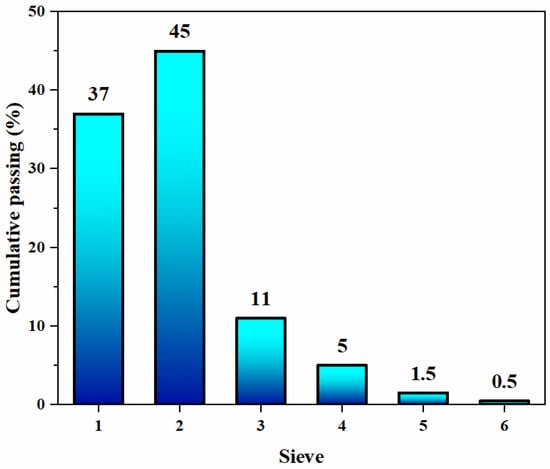
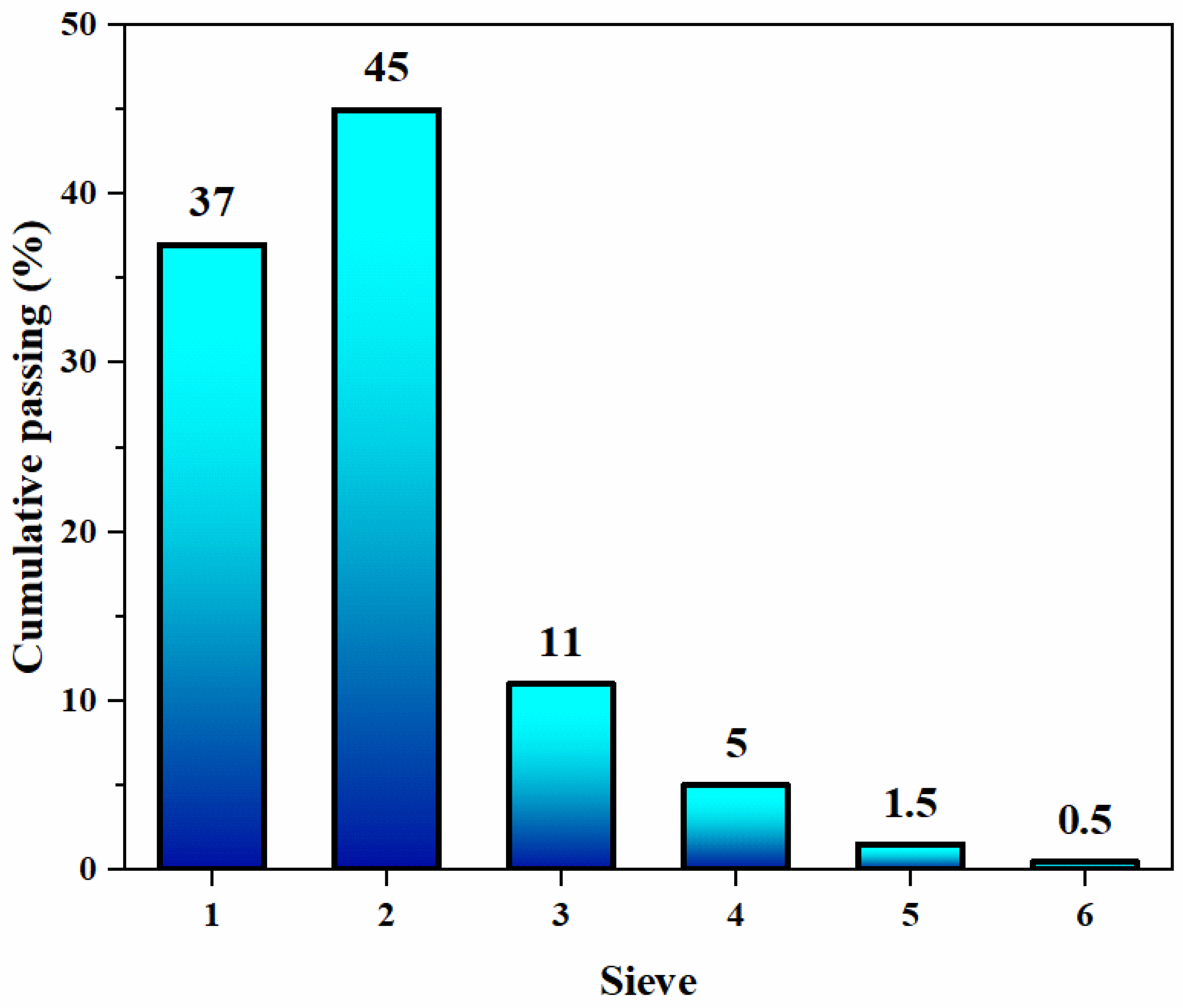
The particle size analysis of the ground tire rubber revealed a distribution predominantly concentrated in intermediate fractions, with 37% of the material retained on ASTM mesh 32 and 45% on mesh 60. Together, these fractions account for approximately 82% of the total mass, indicating that most particles fall within the size range of approximately 250–500 µm. The finer fractions, corresponding to mesh sizes 80, 115, 200, and 325, represent about 18% of the sample, while particles smaller than 75 µm (mesh 200 and 325) account for less than 2%. These results indicate that the material exhibits a particle size distribution mainly composed of intermediate to relatively coarse particles, with a low contribution of fine fractions. Figure 1 illustrates the particle size distributions in the form of a bar chart.
Figure 1.
Bar chart showing the particle size distributions across the respective sieve meshes.
This granulometric profile directly influences the performance of elastomeric composites. The predominance of particles in the 250–500 µm range implies a lower specific surface area, which may limit interfacial interactions between the polymer matrix and the recycled phase. As a result, stress transfer efficiency and mechanical reinforcement may be reduced, particularly at higher filler loadings. Furthermore, the limited fraction of fine particles (≤180 µm) suggests a reduced contribution of high-surface-area material, restricting stronger interactions with the elastomeric matrix. In systems where enhanced mechanical performance is required, finer particle size distributions—with a higher proportion below 100 µm—are generally preferred, as they promote better dispersion and improved interfacial adhesion. Therefore, the results indicate that the material used in this study presents a particle size distribution suitable for applications with moderate mechanical performance requirements.
3.2. Scanning Electron Microscopy Analysis
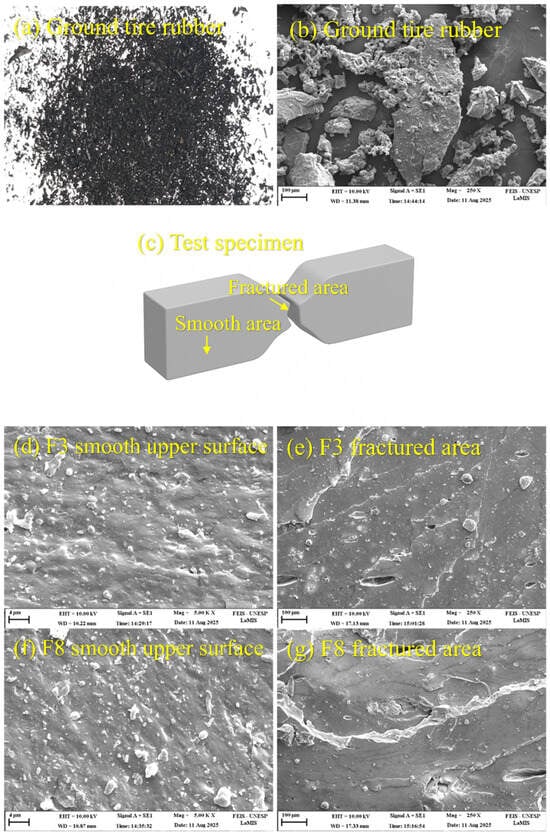
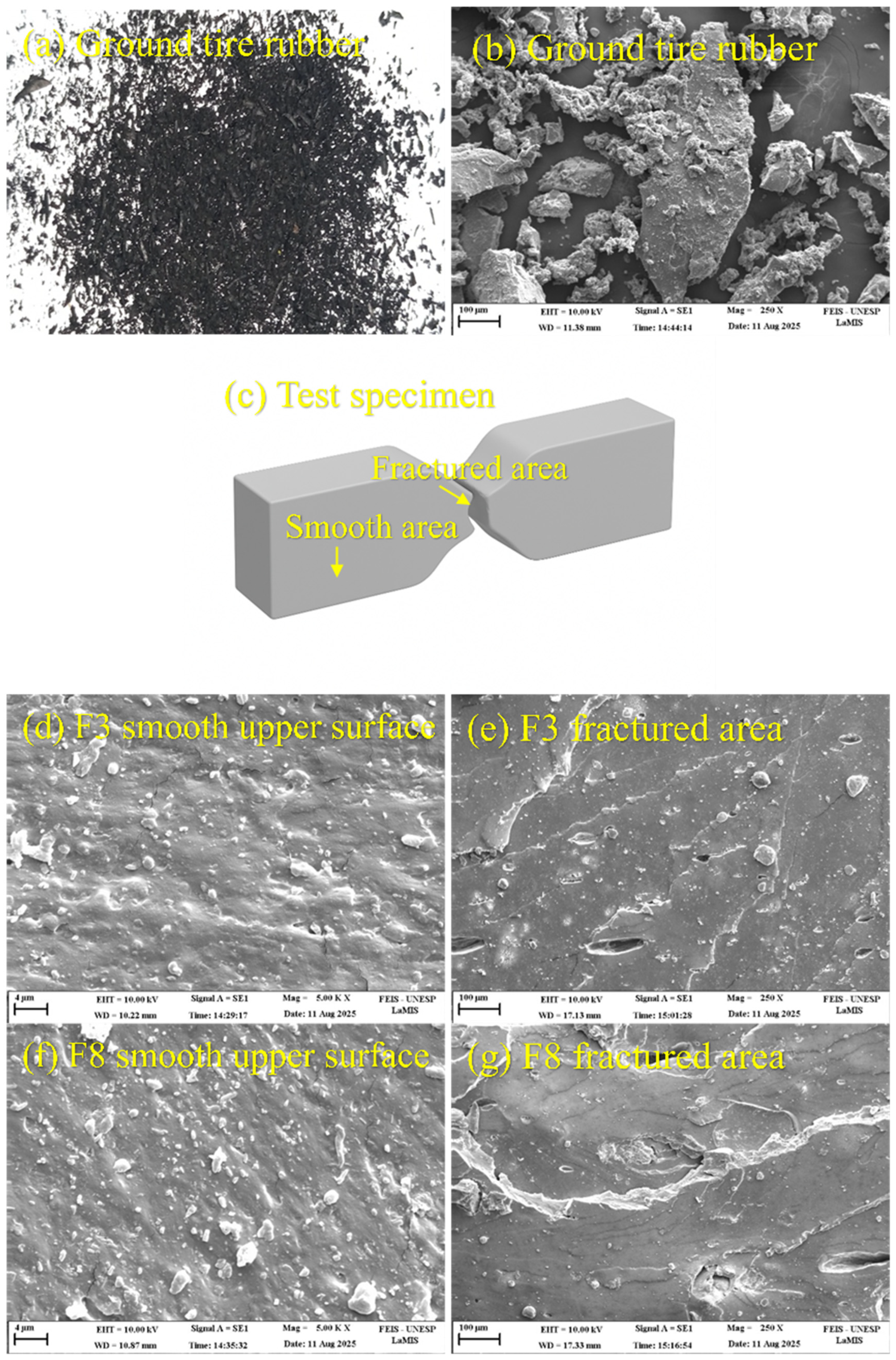
Figure 2a presents a photographic image of the ground tire rubber used in the manufacture of the composite, while Figure 2b shows the scanning electron microscopy (SEM) micrograph of the same rubber, obtained at a scale of 100 µm and a magnification of 250×. Figure 2c illustrates the schematic model of the specimen employed in the tensile strength test, indicating the smooth upper surface area and the fracture area used to acquire the SEM images presented below.
Figure 2.
(a) Photographic image of ground tire rubber and scanning electron microscopy images of (b) ground tire rubber, (c) specimen model, (d) smooth upper surface area of composite F3, (e) fracture surface area of composite F3, (f) smooth upper surface area of composite F8, and (g) fracture surface area of composite F8.
Figure 2d,e refer to formulation F3 containing a 50/50 ZnO/MgO ratio without the addition of ground tire rubber. In the surface region, Figure 2d, a predominantly smooth and homogeneous topography is observed, which is characteristic of good dispersion of the activation agents (ZnO and MgO) within the SBR matrix. The absence of visible agglomerates or defects indicates efficient mixing and adequate compatibility among the components, favoring the formation of a more uniform vulcanization network. This homogeneity also suggests that the balanced oxide proportion contributed to a stable vulcanization process, without the formation of activator-rich or activator-depleted regions. In the fracture region, Figure 2e, the morphology reveals a relatively continuous surface with features of cohesive fracture, typical of materials exhibiting good mechanical strength and a well-developed network structure. The absence of cavities or pronounced separation planes suggests that fracture occurred in a homogeneous manner, without fragile regions associated with dispersion failures or thermal degradation.
Figure 2f,g refer to formulation F8 containing a 50/50 ZnO/MgO ratio with the addition of 20 phr of GTR. In the surface region, Figure 2f, the presence of GTR significantly modifies the morphology. Heterogeneous regions with irregularities and dispersed particles are observed, which are attributed to the incorporation of the rubber residue. Although these particles are reasonably well distributed, some interfaces indicate partial adhesion between the GTR and the SBR matrix, which may impair stress transfer under mechanical loading. This behavior is typical of systems containing secondary elastomeric fillers with lower chemical compatibility with the primary matrix. In the fracture region, Figure 2g, the surface exhibits a rougher and more irregular appearance compared to formulation F3, with the presence of cavities and particle pull-out, indicating a more brittle and heterogeneous fracture behavior. These features are associated with regions of weak interfacial adhesion between the GTR and the SBR, where the energy applied during fracture testing is dissipated primarily through interfacial debonding rather than through plastic deformation of the matrix. Nevertheless, such surface roughness may also be related to a more complex energy dissipation mechanism, potentially imparting some impact resistance, albeit at the expense of structural cohesion.
3.3. Analysis of the Rheometric Parameters of the Composites
Table 3 presents the values of the rheometric parameters obtained from the rheometry tests of the composites. The minimum torque (ML), which is related to the initial viscosity of the compound prior to the onset of vulcanization, showed a progressive increase with increasing MgO content and with the incorporation of GTR into the formulations. Formulations F1 to F5, composed solely of SBR, exhibited ML values ranging from 7.01 to 9.64 dN·m, whereas formulations F6 to F10, which include GTR, displayed higher values, reaching up to 12.39 dN·m for F10. This increase is attributed both to the greater stiffness imparted by MgO and to the presence of GTR, which introduces increased structural complexity into the polymer matrix, thereby hindering its initial flow.
Table 3.
Rheometric Parameters of the Composites.
The maximum torque (MH), which reflects the degree of rubber crosslinking at the end of the curing process, was higher in formulations with balanced combinations of ZnO and MgO, with formulation F8 standing out (39.47 dN·m), as it contained GTR and a 50/50 ratio of activators. The presence of GTR tended to maintain or increase the MH values, with the exception of formulation F6, indicating that the recycled rubber may reinforce the vulcanized structure. However, formulations F5 and F10, composed exclusively of MgO, exhibited slightly reduced values, suggesting that ZnO remains essential for efficient crosslinking of the polymer network.
The scorch time (ts) indicates the available processing window before the onset of crosslinking. Compounds with lower ts values, such as F8 (0.92 min) and F7 (0.98 min), exhibit a faster initiation of curing, which may be problematic in industrial processes that require longer processing times. In general, composites containing GTR showed slightly lower ts values, suggesting that GTR may act as a promoter of the curing reaction, possibly due to residual vulcanizing agents present in the original rubber. The t90 parameter (optimum cure time) defines the point at which curing is essentially complete. Composites without GTR, such as F5 (8.21 min), exhibited higher t90 values, particularly at high MgO contents, reflecting the lower reactivity of MgO compared to ZnO. In contrast, formulations F2 to F4 (ZnO/MgO mixtures) and composites containing GTR (F6–F9) showed t90 values ranging from 2.01 to 3.03 min, suggesting that both the presence of GTR and the combination of oxides can accelerate the curing process. This behavior is consistent with the results reported by Alam et al. [10,11] for natural rubber, in which small additions of MgO (1–2 phr) to ZnO-based systems significantly accelerated curing kinetics and reduced vulcanization temperature without impairing the final rheometric properties. Similarly, in polybutadiene, Bhatt et al. [13] observed that hybrid ZnO/MgO formulations exhibited higher vulcanization rates than systems containing only MgO.
3.4. Analysis of the Results of Composite Density and Crosslink Density Before and After Thermo-Oxidative Aging
Table 4 presents the results of the composite density measurements and crosslink density, before and after thermo-oxidative aging, as determined by the Flory–Rehner method and Mooney–Rivlin method. The composite density ranged from 1.04 to 1.07 g·cm−3, revealing only minor differences among the formulations. It is observed that composites without ground tire rubber (F1–F5) exhibited slightly lower densities, in the range of 1.04–1.05 g·cm−3, whereas formulations containing GTR (F6–F10) showed slightly higher values, around 1.07 g·cm−3. This increase is directly related to the incorporation of GTR, a material with higher relative density compared to the SBR matrix, resulting in a more compact structure and a reduced presence of internal voids. In addition, variations in the proportion of the activator oxides (ZnO and MgO) marginally influenced the density, indicating that the effect of these additives on the specific mass is less pronounced than that of GTR incorporation. The partial or total replacement of ZnO by MgO in the neat formulations (F1–F5) did not promote significant changes, suggesting that both oxides exhibit similar behavior in terms of dispersion and interaction with the polymer matrix for this parameter. However, in formulations containing GTR, the combined presence of ZnO/MgO may have favored improved dispersion of the particulate phase, contributing to slight structural homogenization and an increase in the average density.
Table 4.
Results of composite density and crosslink density tests before and after thermo-oxidative aging.
The crosslink density determined by the Flory–Rehner method (ν) ranged from 1.36 × 10⁻⁴ to 2.35 × 10⁻⁴ mol·cm−3, exhibiting more pronounced differences than those observed for the physical density. Among the formulations without GTR, the highest value (1.88 × 10⁻⁴ mol·cm−3) was observed for F1, which contained ZnO exclusively as the activator. With the gradual replacement of ZnO by MgO (F2–F5), a progressive decrease in ν was noted, reaching a minimum in F5 (1.36 × 10⁻⁴ mol·cm−3). This behavior indicates that ZnO exhibits higher efficiency in promoting sulfur crosslink formation, favoring a polymer network with a higher number of crosslinking points per unit volume, reduced chain mobility, and a shorter average distance between crosslinks. In contrast, MgO, although also acting as an activator, tends to form less reactive complexes with stearic acid and with the accelerators (MBTS and TMTD), resulting in a lower crosslink density. For the formulations containing ground tire rubber (GTR) (F6–F10), an overall increase in crosslink density is observed compared to the unfilled formulations, with formulation F6 (pure ZnO + GTR) exhibiting the highest value (2.35 × 10⁻⁴ mol·cm−3). This behavior cannot be explained solely by the formation of new covalent bonds within the GTR phase, since this material is already previously vulcanized and presents a limited availability of reactive unsaturations. In this context, a more in-depth analysis indicates that the high ν value in F6 results from a synergistic effect between ZnO and GTR, involving multiple physicochemical mechanisms.
GTR contains residual sulfur, partially active accelerator fragments, and polysulfidic linkages remaining from the original vulcanization process. During processing, these species may participate in secondary revulcanization reactions, particularly in the presence of ZnO, which acts as a highly efficient activator. ZnO, through the formation of zinc stearate in the presence of stearic acid, enhances the activation of sulfur-based accelerators, promoting the generation of reactive sulfurating species (Zn–Sx) capable of reacting not only with the SBR matrix but also with unsaturated sites or partially devulcanized regions on the GTR surface. Furthermore, the thermo-mechanical history of GTR may induce partial devulcanization, exposing new reactive sites that facilitate the formation of interfacial chemical bonds between the elastomeric matrix and the dispersed phase.
Thus, the increase in crosslink density observed in F6 can be attributed to a combined effect of (i) the higher catalytic efficiency of ZnO in sulfur vulcanization, (ii) the participation of residual curatives present in GTR in secondary crosslinking reactions, and (iii) the formation of interfacial chemical bridges between the matrix and GTR particles. Additionally, the physical constraints imposed by the dispersed phase contribute to a reduction in solvent uptake during swelling tests, resulting in an increase in the apparent crosslink density determined by the Flory–Rehner model, which incorporates both chemical and physical contributions of the network.
However, a slight decreasing trend in crosslink density is observed with increasing MgO content in formulations F7–F10, analogous to the behavior verified for the unfilled formulations (without GTR). Thus, it becomes evident that ZnO remains the most efficient activator even in the presence of GTR, although the recycled rubber exerts a physical reinforcing effect that contributes to maintaining elevated levels of crosslinking. In vulcanized polybutadiene rubber composites, Bhatt et al. [13] similarly reported that replacing MgO with ZnO tends to increase the crosslink density.
The crosslink density determined by the Flory–Rehner method after thermo-oxidative aging increased for most formulations, ranging from 1.42 × 10⁻⁴ to 3.21 × 10⁻⁴ mol·cm−3, with formulation F6 (pure ZnO + GTR) exhibiting the highest value. This increase is associated with post-curing reactions, chain recombination, and the formation of additional crosslinks during aging. For the unfilled formulations (F1–F5), the increase was moderate, being more pronounced in compositions with higher ZnO content, highlighting its greater catalytic efficiency. In contrast, the formulations containing GTR (F6–F10) showed a more significant increase, due to the participation of residual sulfur and accelerator fragments present in the GTR, which promote secondary crosslinking reactions. Moreover, aging may induce chain scission within the GTR, generating reactive sites that enhance crosslinking, particularly in the presence of ZnO. Physical effects also contribute to the increase in crosslink density, such as the restriction of chain mobility and the reduction in solvent uptake during swelling tests. Finally, formulations with higher MgO content exhibited lower crosslink density values, confirming its lower efficiency compared to ZnO. Overall, thermo-oxidative aging promotes densification of the polymer network, with a more pronounced effect in systems containing ZnO and GTR.
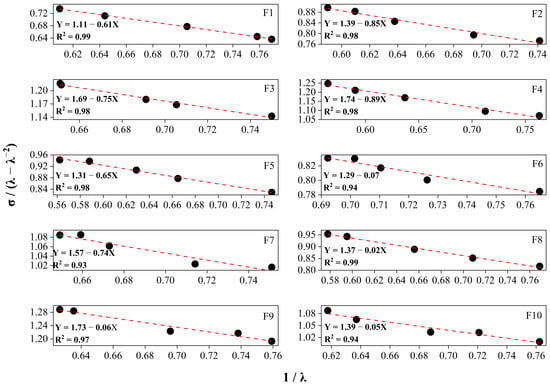
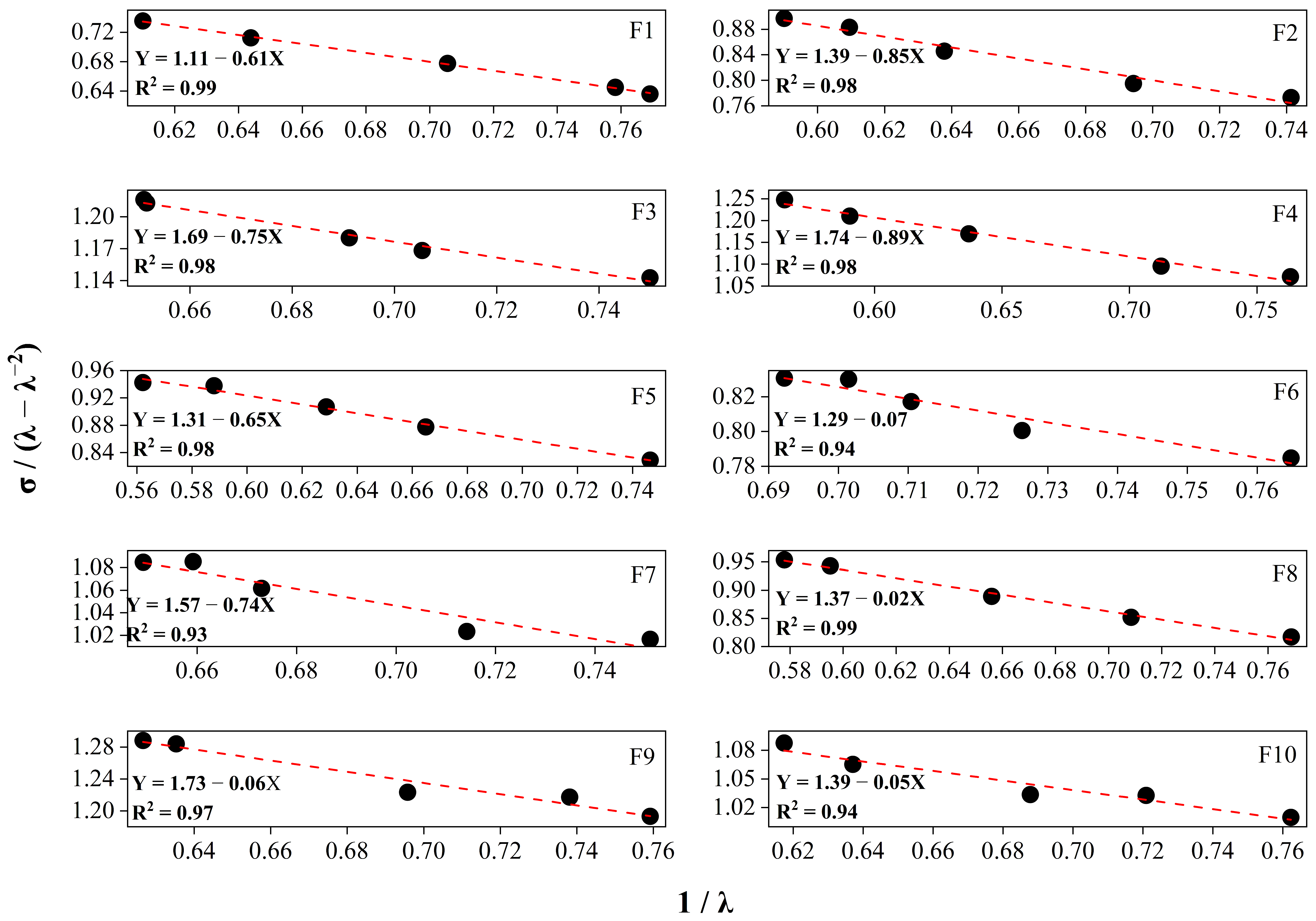
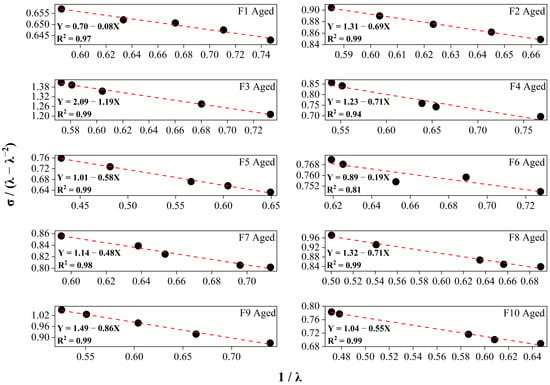
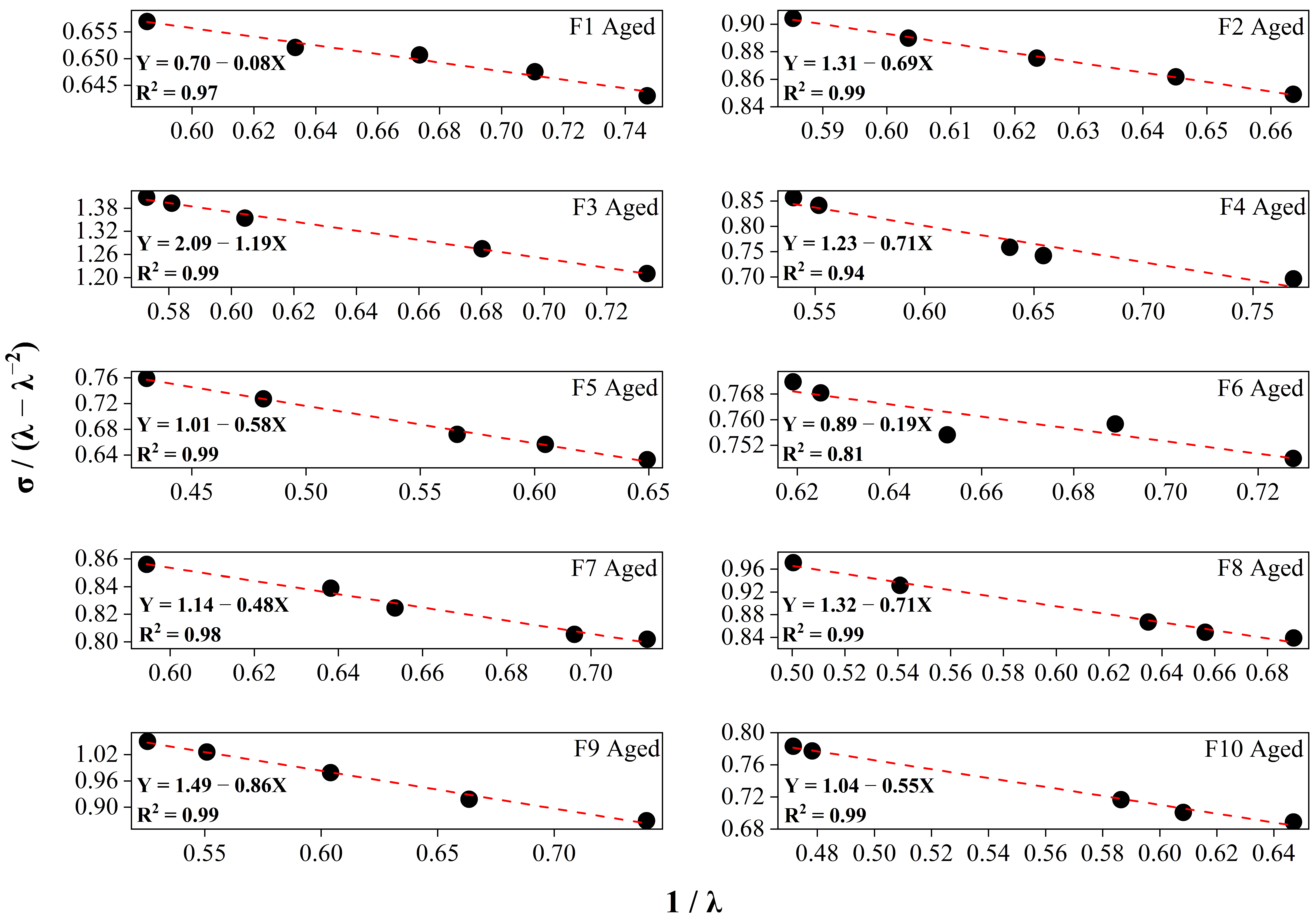
It should be noted that the crosslink density determined using the Flory–Rehner model was obtained without correction for the soluble fraction, which may affect the absolute values reported. In this context, the results were interpreted on a comparative basis among the formulations. Additionally, in order to enhance the reliability of the analysis and account for the mechanical response of the material, the network density was also estimated using the Mooney–Rivlin model, providing a complementary approach for evaluating the elastomeric network structure. The linear regressions in Figure 3 and Figure 4 were obtained from tensile test data in the elastic deformation region, allowing the determination of the intercept, which was used to calculate the crosslink density.
Figure 3.
Linearized Mooney–Rivlin plot of σ/(λ − λ−2) as a function of 1/λ for the investigated composites.
Figure 4.
Linearized Mooney–Rivlin plot of σ/(λ − λ−2) as a function of 1/λ for the investigated aged composites.
The crosslink density determined by the Mooney–Rivlin model showed variations consistent with the nature of the activation system and the presence of ground tire rubber (GTR). Before thermo-oxidative aging, the values ranged from 4.4 × 10⁻⁴ to 7.03 × 10⁻⁴ mol·cm−3 for the unfilled formulations (F1–F5), while for the formulations containing GTR (F6–F10), the values ranged from 5.23 × 10⁻⁴ to 6.96 × 10⁻⁴ mol·cm−3. In general, the GTR-filled formulations exhibited comparable or slightly higher values, which can be attributed to the contribution of the dispersed phase to the mechanical response of the material. Among the unfilled formulations, a trend of increasing crosslink density is observed with the partial substitution of ZnO by MgO up to certain proportions (F3 and F4), indicating that the combination of oxides may enhance the stiffness of the elastomeric network under deformation. However, the formulation containing exclusively MgO (F5) showed a reduction in values, highlighting the lower efficiency of this oxide in forming a mechanically resistant elastomeric network. This behavior suggests that, although MgO may contribute to the network structure, ZnO plays a fundamental role in the formation of more effective crosslinks under mechanical loading.
For the formulations containing GTR, the crosslink density obtained by the Mooney–Rivlin model reflects not only the chemical crosslinking of the matrix but also the contribution of the particulate phase to the elastic response of the material. The presence of GTR promotes physical restrictions on polymer chain mobility and acts as a reinforcing element, increasing resistance to deformation. In this context, higher values observed in formulations such as F9 (6.96 × 10⁻⁴ mol·cm−3) indicate greater effective network stiffness, resulting from the combination of chemical crosslinking and matrix–filler interfacial interactions. On the other hand, formulation F6, despite presenting the highest crosslink density according to the Flory–Rehner method, exhibited moderate values in the Mooney–Rivlin model, highlighting that this method is more sensitive to the mechanical response of the network than to chemical crosslinking alone.
After thermo-oxidative aging, an overall reduction in crosslink density determined by the Mooney–Rivlin model is observed for most formulations. This behavior contrasts with the results obtained from the Flory–Rehner method and can be attributed to the predominance of degradation mechanisms that affect the mechanical integrity of the elastomeric network. Chain scission, degradation of polysulfidic linkages, and the possible formation of shorter and mechanically less effective structures contribute to the reduction in resistance to elastic deformation, resulting in lower apparent network density values. For the unfilled formulations, the reduction was more pronounced in systems with higher ZnO content (such as F1), suggesting that although ZnO promotes higher initial crosslink density, these linkages may be more susceptible to reorganization or degradation under thermo-oxidative conditions. In contrast, for the formulations containing GTR, the presence of the particulate phase partially mitigates the loss of stiffness, although an overall reduction in values is still observed. This effect may be associated with the ability of GTR to act as a physical reinforcing phase, limiting chain mobility even after degradation processes.
Furthermore, it should be considered that the Mooney–Rivlin model is directly related to the mechanical response of the material in the elastic region and is therefore highly sensitive to changes in the structural integrity of the polymer network. Thus, while the Flory–Rehner method may indicate an increase in crosslink density due to additional physical and chemical constraints after aging, the Mooney–Rivlin model primarily reflects the mechanical effectiveness of these crosslinks, highlighting potential losses in structural performance. Overall, the results indicate that thermo-oxidative aging promotes distinct effects depending on the analytical approach: while an apparent increase in crosslink density is observed by the swelling method, a reduction in the effective network density under mechanical deformation is evident, highlighting the complexity of the mechanisms involved in the degradation and restructuring of the elastomeric network.
3.5. Analysis of Hardness, Hardness After Thermo-Oxidative Aging, and Abrasion Resistance Tests of the Composites
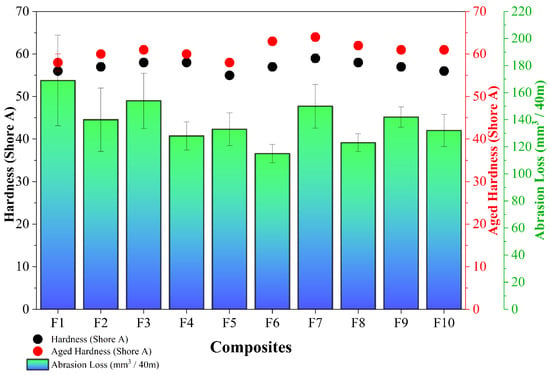
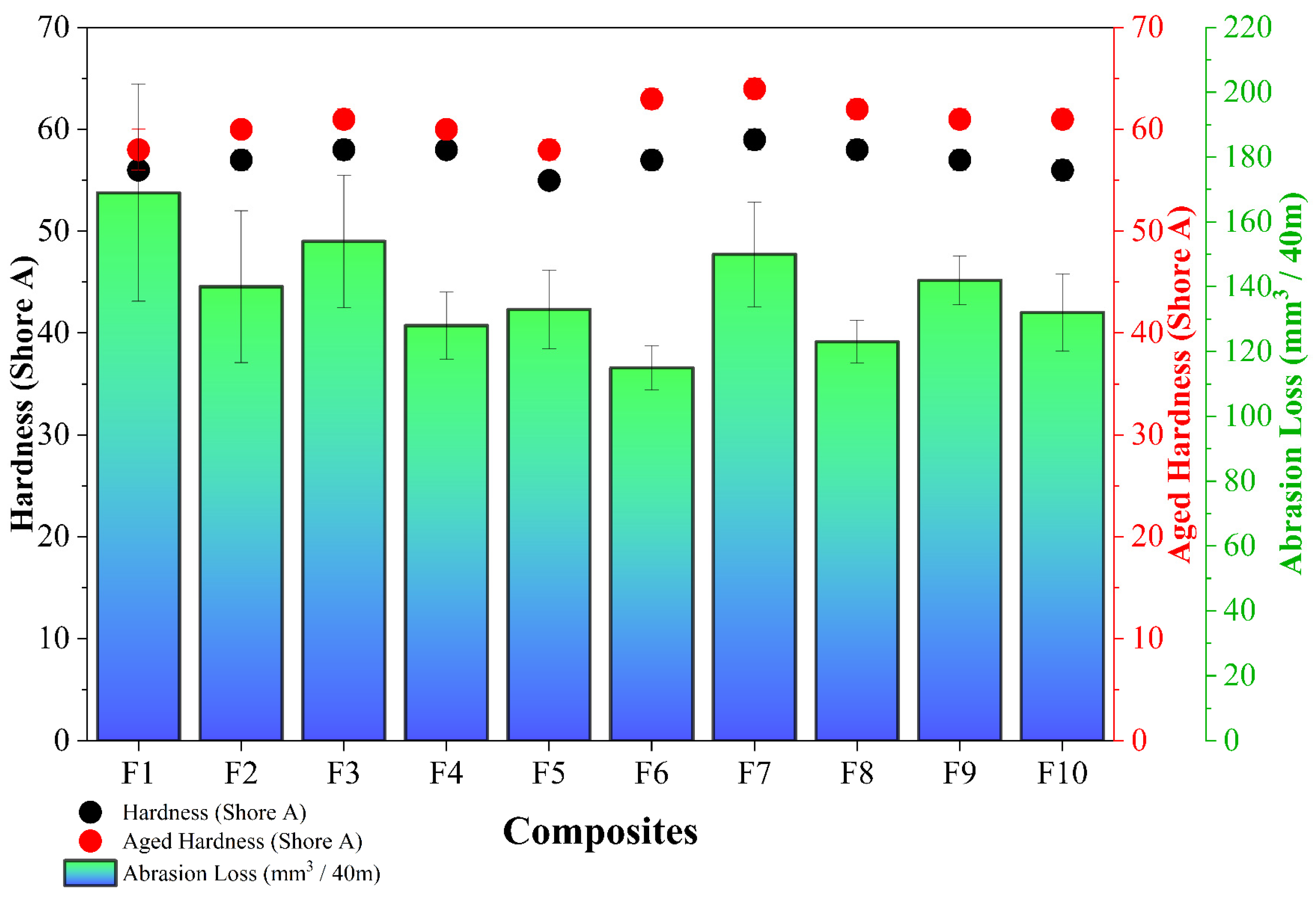
Figure 5 presents the results of the hardness tests, hardness after aging, and abrasion loss of the vulcanized composites. The Shore A hardness results indicate that the studied formulations exhibit relatively similar values, ranging from 55 to 59, suggesting that the gradual replacement of zinc oxide (ZnO) by magnesium oxide (MgO), as well as the incorporation of GTR, did not induce drastic changes in the surface stiffness of the composites. This outcome is consistent with the findings reported by da Silva [9] for nitrile rubber composites. Such stability suggests that, within the evaluated proportions, the activator systems employed were able to promote a comparable crosslink density, maintaining the balance between elasticity and stiffness of the vulcanized SBR. In formulations without GTR (F1–F5), a slight increase in hardness was observed with the partial replacement of ZnO by MgO, reaching maximum values in the intermediate compositions (F3 and F4). This behavior may be associated with a synergistic interaction between the oxides, as MgO, although less efficient than ZnO as a primary activator, can contribute to the formation of more homogeneous crosslinked structures when combined with ZnO. However, formulation F5, containing MgO exclusively as the activator, exhibited a reduction in hardness, indicating that complete replacement of ZnO may limit the efficiency of the vulcanization system.
Figure 5.
Graph of Hardness, Aged Hardness and Abrasion Loss of the Vulcanized Composites.
The addition of GTR (F6–F10) generally resulted in hardness values slightly higher or comparable to the corresponding formulations without residue, particularly in formulation F7, which exhibited the highest hardness value (59). This result suggests that GTR acted as a rigid filler phase, contributing to increased resistance to penetration. Nevertheless, the maintenance of similar values across formulations indicates that the interfacial compatibility between the SBR matrix and GTR was insufficient to promote significant increases in stiffness, possibly due to the pre-vulcanized nature and limited surface reactivity of the recycled rubber.
After thermo-oxidative aging, an overall increase in hardness values is observed for all formulations, indicating stiffening of the elastomeric network. The aged hardness values ranged from 58 to 64 Shore A, which is typical behavior for vulcanized elastomers subjected to thermo-oxidative conditions, where post-curing reactions and additional crosslink formation occur. For the unfilled formulations (F1–F5), the increase in hardness was moderate, with increments between 2 and 3 Shore A units. This behavior can be associated with the continuation of residual vulcanization reactions and the possible formation of additional crosslinks, promoting greater network stiffness. Formulations with higher ZnO content (such as F1–F3) exhibited slightly more pronounced increases, reinforcing the role of ZnO in activating post-curing reactions and stabilizing the crosslinked structure.
For the formulations containing GTR (F6–F10), the increase in hardness was more significant, particularly for formulations F6 and F7, which reached values of 63 and 64 Shore A, respectively. This behavior can be attributed to the combined contribution of chemical and physical factors. From a chemical standpoint, the presence of residual sulfur and accelerator fragments in the GTR may promote additional crosslinking reactions during aging. From a physical standpoint, GTR acts as a reinforcing phase, restricting polymer chain mobility and contributing to increased material stiffness. In addition, thermo-oxidative aging may promote the formation of more rigid structures due to the reorganization of the polymer network, including the conversion of polysulfidic linkages into shorter and more thermally stable bonds, such as disulfidic and monosulfidic linkages. This process contributes to the increase in hardness, although it may, in some cases, be associated with a reduction in material elasticity.
It is also observed that, although all formulations exhibited increased hardness, those with higher MgO content showed slightly lower values compared to ZnO-rich formulations, indicating lower efficiency in promoting post-curing reactions. Nevertheless, the presence of GTR helped mitigate these differences due to its reinforcing effect.
Regarding abrasion loss, the results demonstrate greater sensitivity to formulation variations compared to hardness. In the compositions without GTR, a significant reduction in abrasion loss was observed with increasing MgO content, with formulation F4 exhibiting the best performance (128 mm3/40 m). This result suggests that the partial replacement of ZnO with MgO may enhance wear resistance, possibly due to the formation of a more uniform crosslinked network or improved stress distribution within the elastomeric matrix. Formulation F1, containing exclusively ZnO, showed the highest abrasion loss and a large standard deviation, indicating a less homogeneous response to wear. This outcome supports the hypothesis that the exclusive use of ZnO may generate less uniform crosslinking regions, making the material more susceptible to material removal under abrasive stress (mechanical stresses generated at the rubber–abrasive interface during the abrasion test). A similar observation was reported by da Silva et al. [9].
The incorporation of GTR generally resulted in a further reduction in abrasion loss, with formulation F6 standing out as it exhibited the lowest value among all analyzed samples (115 mm3/40 m). This behavior indicates that, although GTR may act as a potential mechanical discontinuity, its presence contributed to increased wear resistance, possibly by functioning as a particulate filler that dissipates abrasive energy (mechanical energy dissipated during the wear process due to frictional loading). However, this effect was not linear across all formulations, suggesting that the efficiency of GTR is strongly dependent on the activator system composition and the quality of the matrix–residue interface.
3.6. Analysis of Tensile Strength Tests Before and After Thermo-Oxidative Aging
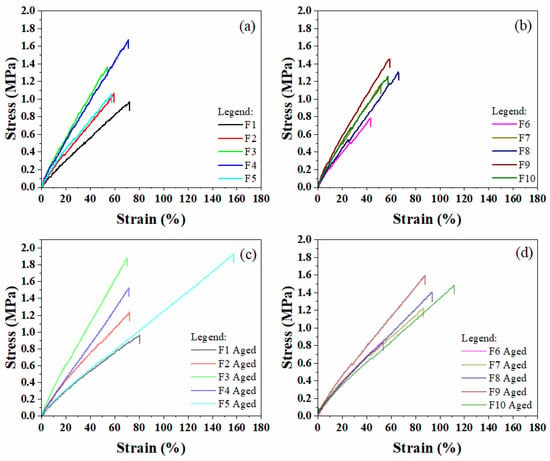
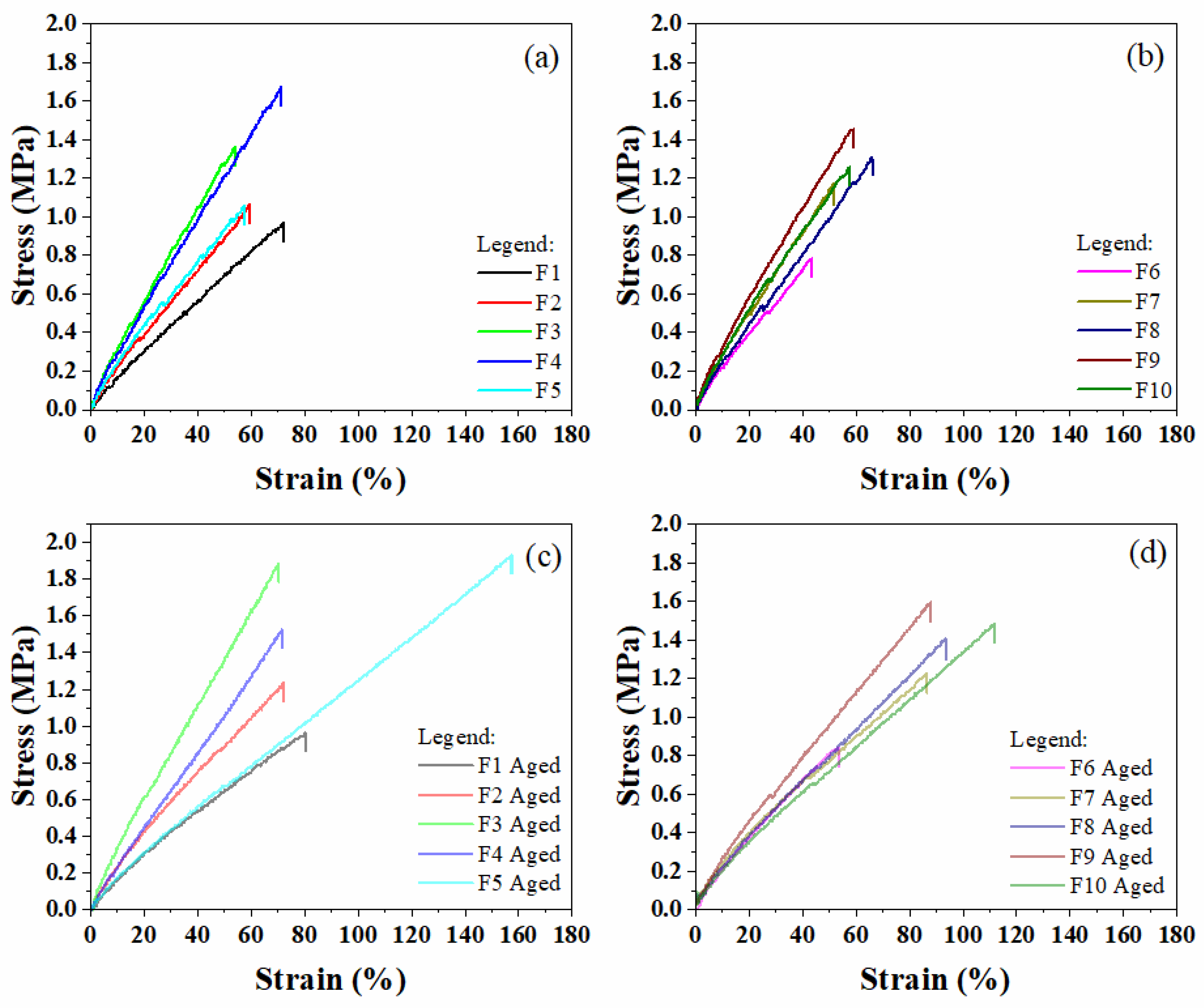
Figure 6 presents the graphs of the tensile strength curves before and after accelerated thermal aging, while Table 5 shows the tensile strength values at rupture, both prior to and following aging. The tensile strength results before aging indicate that formulations with hybrid ZnO/MgO activator systems generally exhibited higher rupture stress values compared to formulations containing only a single type of oxide. This behavior suggests that the combination of activators promotes the formation of a more efficient and homogeneous crosslinked network, directly enhancing the initial mechanical performance of the SBR composites. Similar results have been reported for natural rubber [10] and polybutadiene rubber composites [13]. The presence of ground tire rubber (GTR), however, resulted in slightly lower tensile strength values, which can be attributed to the limited interfacial adhesion between the virgin matrix and the recycled phase.
Figure 6.
Graph of tensile strength of the composites before accelerated aging: (a) without GTR and (b) with GTR; and after accelerated aging: (c) without GTR and (d) with GTR.
Table 5.
Tensile Strength at Rupture of Vulcanized Composites Before and After Accelerated Thermal Aging, with Corresponding Percentage Loss.
After accelerated aging, it was observed that most formulations maintained or even increased their tensile strength, as evidenced by the negative values of percentage loss. This behavior indicates the occurrence of post-curing during thermal aging, a common phenomenon in vulcanized elastomers, in which the continuation of crosslinking reactions outweighs the degradation mechanisms during the early stages of aging, a phenomenon also reported by Chokanandsombat [12]. This effect was particularly pronounced in formulations with higher MgO content, as observed in F3 and F5, suggesting that this oxide may contribute to greater thermal stability of the elastomeric network.
However, the elongation at break exhibited a more sensitive response to aging. In several formulations, particularly those containing GTR, a marked increase in elongation was observed after aging, indicating a combination of polymer network rearrangement and potential localized degradation. This increase may be associated with partial chain scission or the activation of less crosslinked regions within the matrix, resulting in materials that are more ductile but potentially less resistant over the long term.
Formulations F4 and F6 stood out for exhibiting the smallest variations in both tensile stress and elongation at break after aging, indicating greater mechanical stability. This behavior suggests a more favorable balance between crosslink density and network flexibility, possibly resulting from a more efficient proportion of ZnO to MgO and, in the case of F6, the controlled presence of GTR. Overall, the combined analysis of the tabulated data and graphical results demonstrates that accelerated aging did not significantly compromise the tensile strength of the studied composites and, in some cases, even improved this property. However, the changes observed in elongation at break indicate that aging affects the elastomeric network architecture in a more complex manner, highlighting the need for simultaneous evaluation of multiple mechanical parameters.
3.7. Analysis of the Tear Strength Tests of the Composites
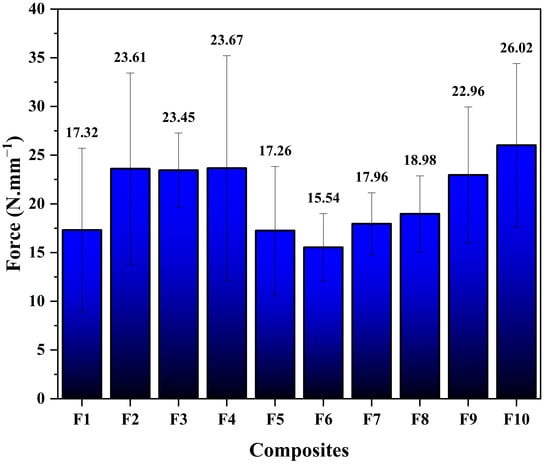
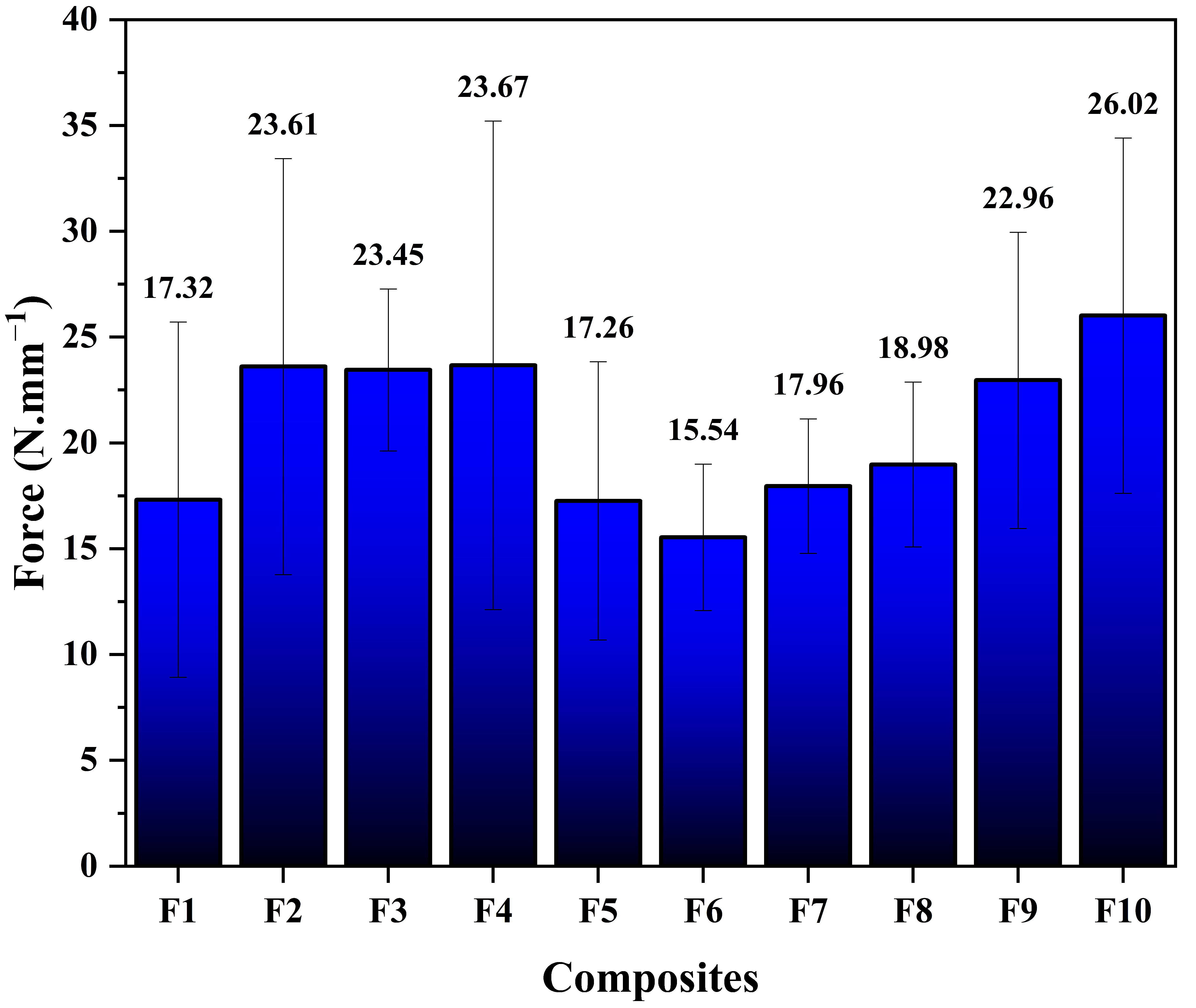
The tear strength results, presented in Figure 7, demonstrate that the mechanical performance of SBR composites is strongly influenced by both the activation system and the incorporation of ground tire rubber (GTR). In general, formulations containing combinations of zinc oxide (ZnO) and magnesium oxide (MgO) exhibited higher tear strength values compared to formulations with single activators, indicating a synergistic effect in resisting crack propagation. For the unfilled formulations (F1–F5), the highest tear strength values were observed in the intermediate compositions (F2–F4), particularly F4. This behavior suggests that balanced ZnO/MgO ratios favor the formation of a more homogeneous crosslinked network, which is more efficient in dissipating energy during tear propagation. In contrast, formulations containing only ZnO (F1) or MgO (F5) showed lower values, indicating that more uniform but excessively rigid (ZnO) or less dense (MgO) networks may be less effective in resisting crack growth.
Figure 7.
Bar chart of tear resistance.
The incorporation of GTR (F6–F10) significantly alters the fracture mechanism of the composites. In general, an initial reduction in tear strength is observed in formulations with higher ZnO content (F6 and F7), which can be attributed to the presence of matrix–residue interfaces acting as stress concentration points, facilitating crack initiation. However, as the MgO content increases (F8–F10), a progressive increase in tear strength is observed, culminating in the highest value for formulation F10 (26.02 N). At first glance, this result may appear contradictory to the lower crosslink density observed in MgO-based systems. However, tear strength is primarily governed by the material’s ability to dissipate energy during crack propagation, rather than solely by crosslink density. In the case of formulation F10, the combination of pure MgO and GTR promotes the formation of a less densely crosslinked but more deformable elastomeric network, capable of redistributing stresses more efficiently.
Furthermore, the presence of GTR contributes to the formation of a more heterogeneous microstructure, in which the particles act as obstacles to crack propagation, promoting mechanisms such as crack deflection, branching, and crack pinning. MgO, in turn, may favor a more compatible interfacial interaction with the GTR surface, possibly due to its lower reactivity compared to ZnO, resulting in a less rigid interface that is more capable of transferring stresses without premature failure. Another relevant aspect is that networks with lower crosslink density tend to exhibit greater polymer chain mobility, allowing for greater localized deformation at the crack tip and, consequently, enhanced energy dissipation. In contrast, highly crosslinked networks, such as those rich in ZnO, may exhibit more brittle behavior, favoring rapid crack propagation.
Thus, the superior performance of formulation F10 does not contradict the crosslink density results but rather highlights that different mechanical properties are governed by distinct mechanisms. While ZnO promotes higher crosslink density and network stiffness, MgO—especially in the presence of GTR—enhances energy dissipation mechanisms and resistance to crack propagation. In summary, the tear strength of the composites is governed by a balance between crosslink density, structural heterogeneity, and interfacial interactions, with less densely crosslinked but more deformable systems exhibiting superior performance under fracture conditions.
3.8. Analysis of the Compression Resistance Tests of the Composites
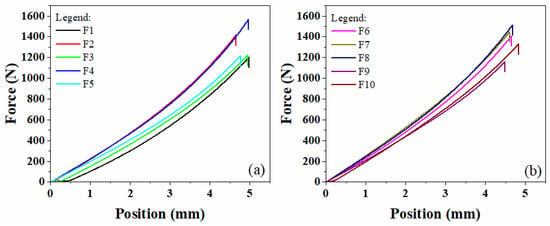
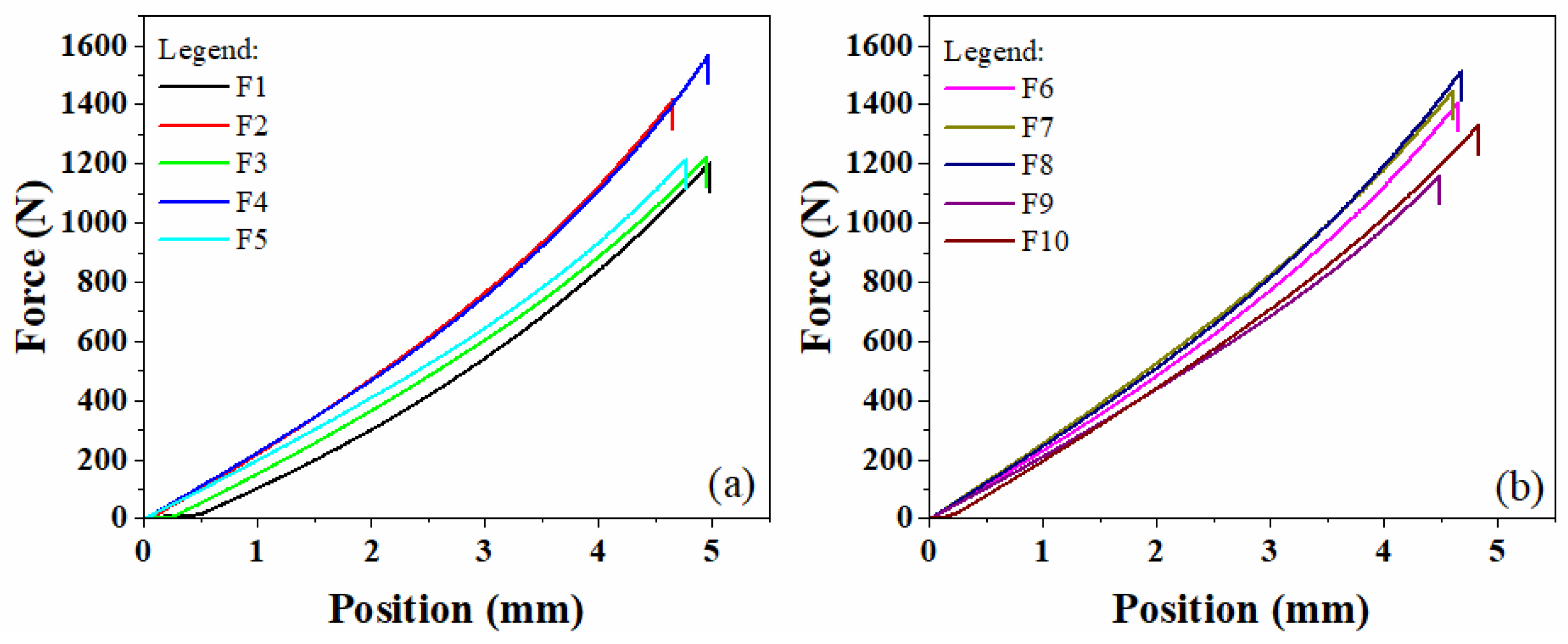
Figure 8 presents the graphs of the compressive strength curves of the vulcanized composites, while Table 6 summarizes the values obtained from the maximum compressive strength tests. The compressive strength results of the vulcanized styrene–butadiene rubber (SBR) composites clearly demonstrate the significant influence of both the ZnO- and MgO-based activation system and the incorporation of GTR on the mechanical performance of the materials. For the composites without GTR (F1–F5), partial substitution of zinc oxide by magnesium oxide leads to relevant variations in compressive stress. Formulation F1, containing ZnO as the sole activator, exhibited stress values consistent with conventional sulfur vulcanization systems, whereas the progressive introduction of MgO resulted, in some cases, in an increase in compressive strength. Notably, formulation F4, with a higher MgO proportion (ZnO/MgO = 25/75), showed the highest compressive stress among the GTR-free composites, suggesting that MgO may contribute to the formation of a stiffer and more efficient crosslinked network under compressive loading [12]. However, the complete replacement of ZnO by MgO, as observed in F5, led to a reduction in compressive stress, indicating that the total absence of ZnO may impair the efficiency of the activation system, possibly due to the lower ability of MgO to form active complexes with the accelerators employed.
Figure 8.
Compressive strength graph of the vulcanized composites. (a) Tear resistance without aging; (b) Tear resistance after aging.
Table 6.
Results of the maximum compressive strength of the vulcanized composites.
The incorporation of 20 phr of GTR into the composites (F6–F10) did not result in a significant loss of compressive strength, demonstrating that the residue can be introduced into the SBR matrix without critically compromising mechanical performance. In some cases, such as formulations F6 and F8, an increase in compressive stress was even observed relative to the corresponding formulations without GTR, which can be attributed to the role of GTR as a semi-reinforcing filler capable of restricting polymer chain mobility and enhancing material stiffness under compressive loading. On the other hand, formulation F9 exhibited the lowest compressive stress among the GTR-containing composites, accompanied by a high standard deviation. This behavior suggests possible heterogeneity in residue dispersion or reduced interfacial compatibility between the polymer matrix and the GTR, particularly in systems with higher MgO content.
The compressive displacement values remained relatively constant for all formulations, ranging approximately from 35 to 37%, indicating that modifications in the activation system and the addition of GTR did not significantly affect the elastic deformation capacity of the composites. This behavior is characteristic of elastomeric materials and suggests that, despite the variations observed in compressive stiffness, the composites retain good elasticity and resilience.
4. Potential Applications of the Developed Composites
The developed composites exhibit mechanical properties suitable for applications requiring moderate mechanical performance, particularly those in which abrasion resistance, compressive strength, and thermal stability are relevant. Among the potential applications, the following stand out:
- •
- Rubber coatings and mats, used in industrial flooring, circulation areas, and impact protection;
- •
- Shoe outsoles and midsoles, especially in technical or lower-cost product lines, where sustainability represents a competitive advantage;
- •
- Molded technical components, such as bumpers, spacers, pads, and elastomeric supports subjected to compressive loads.
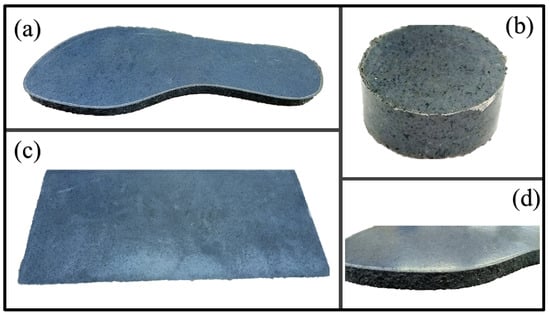
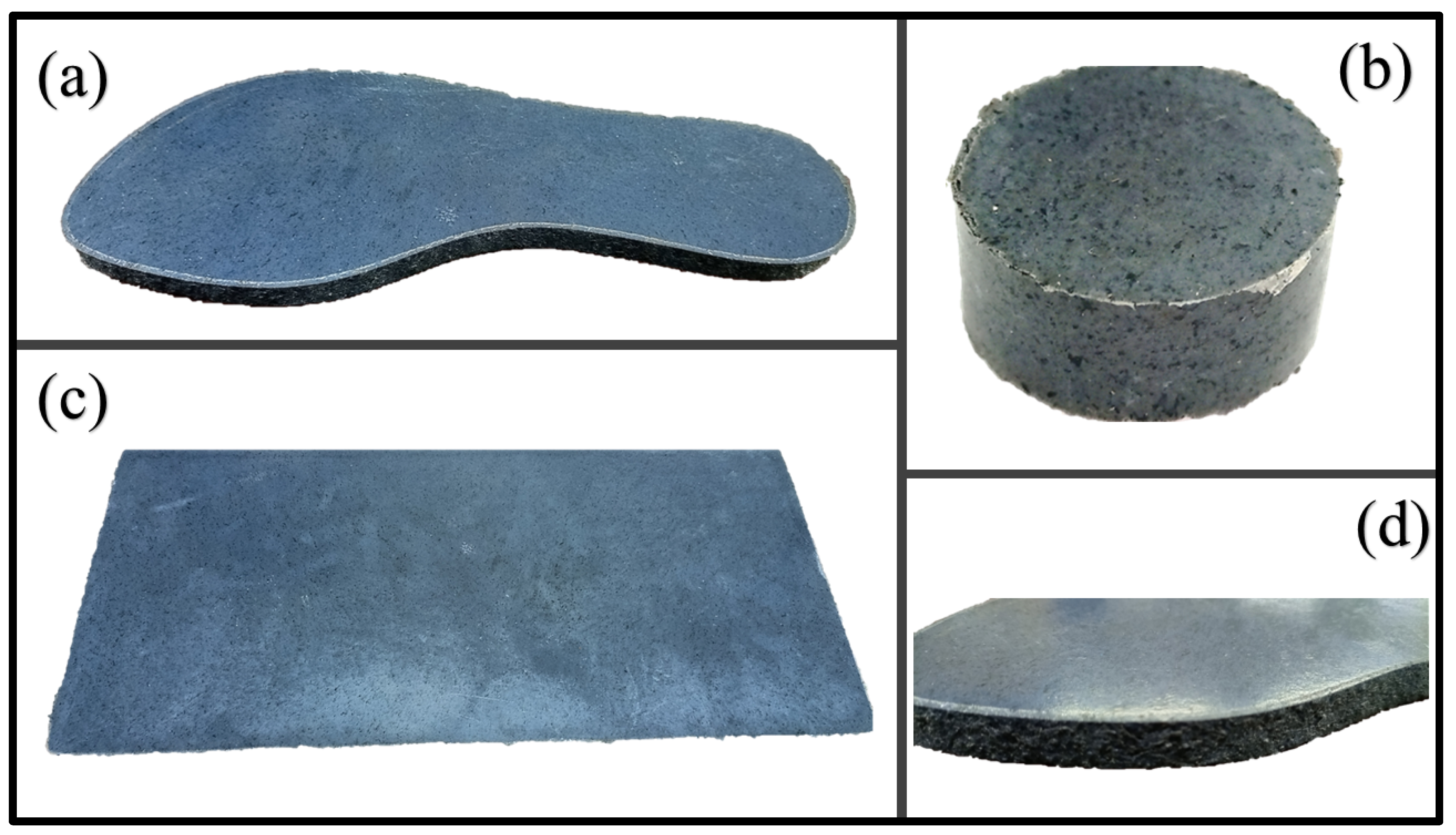
Figure 9 presents images of the composites applied in a shoe outsole, rubber flooring, and bumpers, produced from formulation F8, which employs SBR rubber containing a 50/50 combination of ZnO and MgO, as well as GTR as a reinforcing filler.
Figure 9.
Formulation F8 composites applied in (a) a shoe outsole, (b) bumpers, (c) rubber flooring, and (d) a lateral view of the shoe outsole thickness.
Table 7 presents a comparison of the property results obtained for the F7, F8, and F9 composites in the experimental tests with the industrial technical specifications for rubber flooring, shoe outsoles, and bumpers/pads [35,36,37]. The results obtained for the SBR-based F7, F8, and F9 compounds vulcanized with the ZnO/MgO–GTR system indicate materials with intermediate hardness (57–59 Shore A), compatible with applications that require flexibility and energy absorption, such as bumpers, pads, and rubber flooring. In comparison with typical values reported for SBR shoe outsoles and structural rubber components, the relatively low tensile strength (1.16–1.45 MPa) and elongation at break (56–66%) highlight limitations for applications that demand high deformability or intense tensile loading, such as high-performance shoe outsoles.
Table 7.
Comparative table of the properties obtained for the composites and industrial specifications.
On the other hand, the tear resistance (17.96–22.96 N/mm) and abrasion loss (120–150 mm3/40 m) fall within ranges compatible with technical components subjected to moderate wear, reinforcing the material’s suitability for rubber flooring and cushioning components. Additionally, the compressive strength values (35.46–37.14%) confirm a compressive behavior typical of elastomers used in bumpers and pads. Overall, the data indicate that the developed compounds are more suitable for predominantly compressive and cushioning applications, while exhibiting limited performance for use as shoe outsoles subjected to high mechanical demands.
5. Conclusions
The main findings of this study can be summarized as follows:
- •
- The partial replacement of zinc oxide (ZnO) with magnesium oxide (MgO) in styrene–butadiene rubber (SBR) composites proved to be a technically viable strategy to reduce zinc content while maintaining adequate processing and mechanical performance.
- •
- Hybrid ZnO/MgO activation systems exhibited a synergistic effect, improving vulcanization kinetics, promoting a more homogeneous crosslinked network, and enhancing mechanical properties such as tensile strength, tear resistance, and compression behavior.
- •
- ZnO used alone showed higher efficiency as a vulcanization activator; however, intermediate ZnO/MgO ratios provided a better balance between reactivity, crosslink density, and overall mechanical performance.
- •
- The complete substitution of ZnO by MgO resulted in lower efficiency, reflected in reduced crosslink density and inferior performance in certain properties, highlighting the importance of combining both oxides.
- •
- The incorporation of ground tire rubber (GTR) introduced structural heterogeneity but acted as a semi-reinforcing filler, contributing positively to abrasion resistance, compression properties, and, under specific conditions, tear strength.
- •
- The presence of GTR did not significantly compromise tensile strength and, in some cases, contributed to increased crosslink density, possibly due to residual curing agents and additional physical interactions.
- •
- Thermo-oxidative aging tests indicated good stability of the composites, with maintenance or improvement of tensile strength attributed to post-curing effects, as well as enhanced thermal stability in formulations with higher MgO content.
- •
- Overall, the combination of MgO and GTR represents a promising approach for the development of more sustainable elastomeric composites, enabling the reduction in potentially toxic components and the reuse of industrial waste without compromising performance for moderate-demand applications.
Author Contributions
S.A.K.: Conceptualization, Methodology, Investigation, Data curation, Formal analysis, Writing—original draft. N.C.G.: Investigation, Methodology, Data curation. D.S.d.M.: Investigation, Formal analysis. D.d.S.S.: Investigation, Validation. R.H.d.S.: Investigation, Resources. N.L.C.: Methodology, Writing—original draft. C.L.R.H.: Methodology, Validation. E.M.G.: Formal analysis, Writing—original draft. F.C.C.: Formal analysis, Resources. M.J.d.S.: Formal analysis, Visualization. L.F.P.: Writing—review and editing, Validation. E.A.d.S.: Validation, Formal analysis, Writing—review and editing. C.T.H.: Formal analysis, Writing—review and editing, Supervision. R.J.d.S.: Conceptualization, Supervision, Project administration, Funding acquisition, Writing—review and editing. All authors have read and agreed to the published version of the manuscript.
Funding
This research was funded by the Ministério da Educação e da Cultura (MEC) do Brasil through the Coordenação de Aperfeiçoamento de Pessoal de Nível Superior (CAPES), under Process No. 140831/2025-8. Fundação de Amparo à Pesquisa do Estado de São Paulo (FAPESP), under Process No. 2024/4118-0. Conselho Nacional de Desenvolvimento Científico e Tecnológico (CNPq), under Process No. 306108/2024-0.
Data Availability Statement
The data used and/or analyzed during the present study are available from the corresponding author upon reasonable request.
Conflicts of Interest
The authors declare no conflict of interest.
References
- Wiśniewska, P.; Stand, J.W.; Mathers, M.; Bannister, A.S.; Willcock, H. Towards Developing Fully Sustainable Elastomers: The Role of Chemistry. Green Chem. 2025, 27, 1254–1277. [Google Scholar] [CrossRef] [Scilit]
- Wang, W.; Liao, M.; Wang, L. The Transition Mechanism of Dynamic Mechanical Loss Peaks and Phase Analysis in Binary Block Copolymers of Styrene/Butadiene Rubber. J. Polym. Res. 2024, 31, 167. [Google Scholar] [CrossRef] [Scilit]
- Vázquez-Martínez, Y.; Ávila-Orta, A.; Reyes-Rodríguez, P.Y.; Cruz-Delgado, V.J.; Cabañas-Moreno, J.G.; Ávila-Orta, C.A. Effect of Single-Walled Carbon Nanotubes on the Cross-Linking Process in Natural Rubber Vulcanization. Polymers 2022, 15, 126. [Google Scholar] [CrossRef] [Scilit] [PubMed]
- Cataldo, F. Thermochemistry of Sulfur-Based Vulcanization and of Devulcanized and Recycled Natural Rubber Compounds. Int. J. Mol. Sci. 2023, 24, 2623. [Google Scholar] [CrossRef] [Scilit]
- Alam, M.N.; Kumar, V.; Lee, D.J.; Park, S.S. Boosting Mechanical and Aging Resistance Performances of Filled-Rubber With MgO and ZnO Co-Cure Activators in Diverse Vulcanization Systems. J. Ind. Eng. Chem. 2024, 137, 387–401. [Google Scholar] [CrossRef] [Scilit]
- Magni, S.; Gagné, F.; Della Torre, C.; Bonasoro, S. Ecological Impact of End-of-Life-Tire (ELT)-Derived Rubbers: Acute and Chronic Effects at Organism and Population Levels. Toxics 2022, 10, 201. [Google Scholar] [CrossRef] [Scilit]
- Thakur, A.; Kumar, A. Ecotoxicity Analysis and Risk Assessment of Nanomaterials for the Environmental Remediation. In Macromolecular Symposia; Wiley-VCH: Weinheim, Germany, 2023; p. 2100438. [Google Scholar] [CrossRef] [Scilit]
- Hashamfirooz, M.; Pourzamani, H.R.; Mohammadi, H.; Ebrahimi, A. A Systematic Review of the Environmental and Health Effects of Waste Tires Recycling. Heliyon 2025, 11, e41909. [Google Scholar] [CrossRef] [Scilit]
- da Silva, A.A.; Santos, P.S.M.; Rodríguez-Hernández, J.C.; Teixeira, G.F.; de Sousa, R.R.; Ricardo, N.M.P.S. Magnesium Oxide Synthesized With Alpinia zerumbet Leaf Extracts as a Sustainable Alternative to Zinc Oxide in Nitrile Rubber Compounds: A Comparative Vulcanization Kinetics Investigation. J. Appl. Polym. Sci. 2024, 141, e54945. [Google Scholar] [CrossRef] [Scilit]
- Alam, M.N.; Kumar, V.; Park, S.S. Advances in Rubber Compounds Using ZnO and MgO as Co-Cure Activators. Polymers 2022, 14, 5289. [Google Scholar] [CrossRef] [Scilit]
- Alam, M.N.; Kumar, V.; Lee, D.J.; Choi, W.K.; Park, S.S. Enhancing Rubber Vulcanization Cure Kinetics: Lowering Vulcanization Temperature by Addition of MgO as Co-Cure Activator in ZnO-Based Cure Activator Systems. Polymers 2024, 16, 876. [Google Scholar] [CrossRef] [Scilit]
- Chokanandsombat, Y.; Sirisinha, C. MgO and ZnO as Reinforcing Fillers in Cured Polychloroprene Rubber. J. Appl. Polym. Sci. 2013, 128, 2533–2540. [Google Scholar] [CrossRef] [Scilit]
- Bhatt, G.G.; Yadav, L.D.; Dhakate, S.R.; Singh, B.P. Synergistic Effect of Zinc Oxide and Magnesium Oxide Co-Cure Activators on Polybutadiene Rubber Vulcanization: Mechanical Properties and Thermal Characteristics. J. Res. Updates Polym. Sci. 2025, 14, 5–15. [Google Scholar] [CrossRef] [Scilit]
- Sahoo, S.; Maiti, S.K.; Ganguly, A. Effect of Zinc Oxide Nanoparticles as Cure Activator on the Properties of Natural Rubber and Nitrile Rubber. J. Appl. Polym. Sci. 2007, 105, 2407–2415. [Google Scholar] [CrossRef] [Scilit]
- Heideman, G.; Datta, R.N.; Noordermeer, J.W.M.; Van Baarle, B. Various Ways to Reduce Zinc Oxide Levels in S-SBR Rubber Compounds. In Macromolecular Symposia; Wiley-VCH: Weinheim, Germany, 2006; pp. 657–667. [Google Scholar] [CrossRef] [Scilit]
- Abbas-Abadi, M.S.; Kusenberg, A.; Shirazi, M.R.; Goshayeshi, B.; Van Geem, K.M. Towards Full Recyclability of End-of-Life Tires: Challenges and Opportunities. J. Clean. Prod. 2022, 374, 134036. [Google Scholar] [CrossRef] [Scilit]
- Valentini, F.; Pegoretti, A. End-of-Life Options of Tyres. A Review. Adv. Ind. Eng. Polym. Res. 2022, 5, 203–213. [Google Scholar] [CrossRef] [Scilit]
- Phiri, M.M.; Phiri, M.J.; Linganiso, L.Z.; Hlangothi, K.O.; John, M.P. Grafting and Reactive Extrusion Technologies for Compatibilization of Ground Tyre Rubber Composites: Compounding, Properties, and Applications. J. Clean. Prod. 2022, 369, 133084. [Google Scholar] [CrossRef] [Scilit]
- ASTM D3182-21a; Standard Practice for Rubber—Materials, Equipment, and Procedures for Mixing Standard Compounds and Preparing Standard Vulcanized Sheets. ASTM International: West Conshohocken, PA, USA, 2025.
- Souza, D.S.; Teixeira, G.F.; Junior, H.L.O.; Bertolino, F.; Santana, R.M.C. Recycling of Post-Consumer Silica Gel Desiccants as Reinforcing Filler in Natural Rubber Composites: The Effect of Coupling Agents and Comparison with Commercial Silicas. Recycling 2025, 10, 184. [Google Scholar] [CrossRef] [Scilit]
- Hiranobe, C.T.; de Morais, G.G.; de Oliveira, R.A.; de Sousa Junior, R.R.; Cabrera, F.C.; Job, A.E. Evaluation of the Properties of Natural Rubber Bio Composite and Guava Residue (Psidium guajava L.) as Sustainable Application. Mater. Res. 2023, 26, e20220515. [Google Scholar] [CrossRef] [Scilit]
- ASTM D2084-19a; Standard Test Method for Rubber Property—Vulcanization Using Oscillating Disk Cure Meter. ASTM International: West Conshohocken, PA, USA, 2019.
- ASTM D297-21; Standard Test Methods for Rubber Products—Chemical Analysis. ASTM International: West Conshohocken, PA, USA, 2022.
- Hiranobe, C.T.; Morais, G.G.; Oliveira, R.A.; Junior, R.R.S.; Cabrera, F.C.; Job, A.E. Cross-Linked Density Determination of Natural Rubber Compounds by Different Analytical Techniques. Mater. Res. 2021, 24, e20210041. [Google Scholar] [CrossRef] [Scilit]
- Mooney, M. A theory of large elastic deformation. J. Appl. Phys. 1940, 11, 582–592. [Google Scholar] [CrossRef] [Scilit]
- Gruendken, M.; Koda, D.; Dryzek, J.; Blume, A. Low molecular weight ‘liquid’polymer extended compounds, impact on free volume and crosslink density studied by positron lifetime spectroscopy and stress-strain analysis according to Mooney-Rivlin. Polym. Test. 2021, 100, 107239. [Google Scholar] [CrossRef] [Scilit]
- Sombatsompop, N. Practical use of the Mooney-Rivlin equation for determination of degree of crosslinking of swollen nr vulcanisates. J. Sci. Soc. Thail. 1998, 24, 199–204. [Google Scholar] [CrossRef]
- ASTM D2240-15; Standard Test Method for Rubber Property—Durometer Hardness. ASTM International: West Conshohocken, PA, USA, 2021.
- ASTM D5963-04; Standard Test Method for Rubber Property—Abrasion Resistance (Rotary Drum Abrader). ASTM International: West Conshohocken, PA, USA, 2019.
- ASTM D412-16; Standard Test Methods for Vulcanized Rubber and Thermoplastic Elastomers—Tension. ASTM International: West Conshohocken, PA, USA, 2021.
- ASTM D624-00; Standard Test Method for Tear Strength of Conventional Vulcanized Rubber and Thermoplastic Elastomers. ASTM International: West Conshohocken, PA, USA, 2020.
- ASTM D575-91(2024); Standard Test Methods for Rubber Properties in Compression. ASTM International: West Conshohocken, PA, USA, 2024.
- ASTM D618-21; Standard Practice for Conditioning Plastics for Testing. ASTM International: West Conshohocken, PA, USA, 2021.
- ASTM D573-04(2019); Standard Test Method for Rubber—Deterioration in an Air Oven. ASTM International: West Conshohocken, PA, USA, 2024.
- Ames Rubber Manufacturing. Styrene Butadiene Rubber (SBR). Available online: https://www.amesrubberonline.com/wp-content/uploads/styrene-butadiene-rubber.pdf (accessed on 21 December 2025).
- Robinson Rubber Products Company Inc. Rubber Material Selection Guide SBR or Styrene Butadiene. Available online: https://robinsonrubber.com/wp-content/uploads/2024/02/RRPC-Rubber-Selection-Guide-Styrene-Butadiene-Rubber.pdf (accessed on 21 December 2025).
- STS Rubber Panel Specifications: Styrene Butadiene Rubber (SBR). Available online: https://supertargetsystems.com/wp-content/uploads/2020/07/STS-Rubber-Products-Specs-Rev2.1.pdf (accessed on 21 December 2025).

Disclaimer/Publisher’s Note: The statements, opinions and data contained in all publications are solely those of the individual author(s) and contributor(s) and not of MDPI and/or the editor(s). MDPI and/or the editor(s) disclaim responsibility for any injury to people or property resulting from any ideas, methods, instructions or products referred to in the content. |
© 2026 by the authors. Licensee MDPI, Basel, Switzerland. This article is an open access article distributed under the terms and conditions of the Creative Commons Attribution (CC BY) license.