


Abstract
The removal of toxic trace metals such as cadmium (Cd2+) and lead (Pb2+) from wastewater is critical due to their persistence, bioaccumulation, and adverse health effects. In this study, a novel composite adsorbent was synthesized by integrating activated carbon with nickel–iron-layered double hydroxides (NiFe-LDH) and immobilizing the resulting nanocomposite within Polyether sulfone (PES) beads to improve stability, handling, and recyclability. The material was evaluated under varying pH, initial metal concentration, and contact time conditions. The adsorption behavior was investigated using four isotherm models and two kinetic models. The composite beads exhibited maximum adsorption capacities of 1.784 mg g−1 for Cd2+ and 5.882 mg g−1 for Pb2+. The Cd2+ adsorption followed the Langmuir isotherm model (R2 = 0.995), indicating a homogeneous monolayer adsorption, whereas Pb2+ adsorption was best described by the Freundlich model (R2 = 0.955), suggesting heterogeneous surface interactions and multiple binding sites. The kinetic analysis showed that the adsorption of both metals followed a pseudo-second-order model, supporting chemisorption as the dominant rate-controlling mechanism. The AC@NiFe-LDH/PES beads demonstrated high efficiency, structural integrity, and ease of recovery over multiple cycles, highlighting their potential as a sustainable and environmentally friendly adsorbent for trace metal removal from contaminated water.
1. Introduction
The presence of trace metals such as Cd2+ and Pb2+ in wastewater is a major environmental concern due to their toxic effects on human health and the environment [1,2,3]. These metals can enter wastewater streams through industrial processes, agricultural runoff, and domestic wastewater [4,5]. One of the primary environmental issues is the contamination of water by heavy metals such as Cd2+ and Pb2+ [6,7,8]. This is because these metals are found to be toxic even at very low concentrations [6,7,8]. On the other hand, these trace metals are non-essential and therefore pose significant health risks to humans, even at trace levels, as Cd concentrations exceeding 0.6 µg/L may adversely affect the nervous system, whilst Pb concentrations above 5 µg/L can cause high blood pressure, kidney disease, and memory issues [9,10]. Thus, according to the World Health Organization (WHO) guidelines, the maximum permissible concentration of Cd in drinking water is 3 µg/L, whilst the maximum allowed for lead is 10 µg/L, with the aim of 0 µg/L, which is recognized as safe in drinking water [10]. As a result, numerous researchers have developed various methods to remove these harmful trace metals from the environment [11,12]. These techniques include adsorption [13,14], filtration [15,16,17], and coagulation [18,19]. Adsorption is the most popular technology of the aforementioned techniques since it is less expensive, adaptable, easy to use, and efficient at eliminating trace or heavy metals [20,21]. In addition to environmental remediation, it has been used to remove trace metals and other contaminants in a range of industries, including food, paper, cosmetics, textiles, and pharmaceuticals [22]. The utilization of various adsorbents, including clays, metal–organic frameworks (MOFs), silica gel, activated carbon, zeolites, activated alumina, and polymer adsorbents, is another appealing aspect of the adsorption approach [23,24,25].
Adsorption equilibrium data play a central role in understanding adsorption mechanisms, as they provide insight into how the adsorbent interacts with metal ions in solution at equilibrium conditions [26,27]. The equilibrium stage essentially governs the efficiency of the process, since it reflects the balance between the adsorbent surface and the adsorbate species [28,29]. To enhance this interaction, different adsorbents have been designed with the aim of selectively binding target metal ions, guided by the surface chemistry between the two [30,31,32,33]. Modifying properties such as surface area, availability of active sites, electronic conductivity, and pore structure has proven particularly effective in tailoring adsorbents for improved specificity toward trace metals [34,35,36]. Many adsorbents have been specifically developed to remove Cd2+ and Pb2+, such as metal–organic frameworks [37,38], layered double hydroxides (LDHs) [22,39], and biochar [23,24,25]. Layered double hydroxides (LDHs) have been widely explored in wastewater treatment due to their high surface reactivity, tunable composition, and abundance of surface hydroxyl groups, which enable effective interactions with various aqueous contaminants [26]. However, the difficult separation of conventional LDH powders, especially nanopowders, and secondary pollution of their residues in the wastewater after adsorption have been shown to limit their advanced application [27]. Therefore, the development of an LDH film with an overall structure and the advantage of easy separation after adsorption should be envisaged as an effective way to overcome the limitations of conventional materials. Given the foregoing, NiFe-LDH has exceptional adsorption capabilities; nonetheless, its application in environmental remediation procedures is constrained by metal leaching and poor recyclability [28]. Therefore, NiFe-LDH embedding into self-floating PES microbeads is a promising method that provides diminished metal leaching, good recyclability, and fantastic separation. However, the adsorption capability of NiFe-LDH/PES is reduced when NiFe-LDH is impregnated into PES microbeads because this results in a decrease in surface area and an increase in agglomeration. Therefore, the appropriate way to overcome such flaws is to incorporate it with activated carbon (AC) to form AC@NiFe-LDH/PES microbeads.
The objective of this study was to develop and evaluate AC@NiFe-LDH/PES beads as a new and recyclable adsorbent for removing Cd2+ and Pb2+ from aqueous solutions. The beads were designed to selectively adsorb and retain the target metals while allowing for the passage of clean water. The study found that the fabricated beads showed high efficiency in removing Cd2+ and Pb2+ from wastewater, with removal efficiencies exceeding 90%. These results indicate that AC@NiFe-layered double hydroxides/Polyether sulfone beads have enormous potential for the effective removal of trace metals. The nanocomposite beads’ surface, morphological, and structural properties were characterized using several analytical techniques.
2. Materials and Methods
2.1. Reagents and Materials
Unless otherwise specified, all chemicals used in this study were of analytical reagent grade, and ultrapure water was used in all experiments. Urea (ACE, Johannesburg, South Africa), iron(III) nitrate nonahydrate [Fe(NO3)3·9H2O], nickel(II) nitrate hexahydrate [Ni(NO3)2·6H2O], and ethanol were obtained from Sigma-Aldrich (Johannesburg, South Africa). Ammonia solution (25%) was purchased from Merck (Johannesburg, South Africa). Polyvinylpyrrolidone (K10) was also sourced from Merck and used as received. Deionized water (DI) was prepared using a Millipore Milli-Q purification system (Merck, Darmstadt, Germany). Polyether sulfone (PES) with an average molecular weight of 62,000 g/mol was supplied by Solvay Advanced Polymers (Brussels, Belgium). The single-element standards of 1000 mg L−1 of Cd and Pb purchased from Sigma-Aldrich (Johannesburg, South Africa) were used to freshly prepare a synthetic sample of multi-elemental solutions at a desired concentration daily. All the samples were filtered using the 0.22 µm pore size membrane filters purchased from Sigma-Aldrich (Johannesburg, South Africa), prior to analysis.
2.2. Synthesis of the Materials
2.2.1. Hydrothermal Synthesis of AC@NiFe-LDH Composites
Based on a previously published technique, a modified hydrothermal approach was used to synthesize AC@NiFe-LDH [29]. A standard approach involved dissolving 1.33 g of Fe(NO3)3·9H2O and 3.90 g of Ni(NO3)2·6H2O in 80 mL of deionized water and stirring for 15 min. The nominal molar ratio of Ni2+ to Fe3+ in the precursor solution was 3:1, corresponding to the targeted LDH composition. Separately, 0.11 g of activated carbon was dispersed in 10 mL of deionized water, and then the mixture was sonicated for 5 min to create an activated carbon suspension. The suspension was then added to the metal salt solution and stirred for 30 min. Next, 1.94 g of urea was added, and the solution was stirred for 30 min before being transferred to a Teflon-lined stainless-steel autoclave. The autoclave was kept at 150 °C for 21 h. After cooling to ambient temperature, the product was centrifuged, thoroughly cleaned with deionized water, and dried overnight in an oven at 100 °C. The dried material was then ground into a fine powder for future use.
2.2.2. Fabrication of AC@NiFe-LDH/PES Nanocomposite Beads
To exfoliate the LDH, AC@NiFe-LDH powder was ultrasonically dispersed in N-Methyl-2-pyrrolidone (NMP) solutions with polyvinylpyrrolidone (PVP) (5 wt.% of LDHs’ mass) as a stabilizer. Then, Polyether sulfone (PES) was added, dissolved under stirring, and degassed. The prepared solution was first left to stand at room temperature for 24 h to eliminate air bubbles. It was then transferred into a syringe and carefully dropped, drop by drop, into a coagulation bath containing deionized water, where bead formation occurred. The beads were allowed to remain in the bath for about 1 min, then soaked in fresh deionized water for 24 h to remove residual solvents. Finally, the beads were dried at room temperature. The resultant beads were labeled as B0 to B3, to represent the increase in AC@NiFe LDH loading in the dope solutions (Table 1).
Table 1.
AC@NiFe-LDH/PES bead compositions.
2.3. Instrumentation
The prepared beads were characterized using a variety of analytical methods. Scanning electron microscopy (SEM) was used to investigate element composition, cross-sectional structure, and surface morphology using an Oxford Instruments EDS detector (JEOL JSM-IT300; Tokyo, Japan). For cross-sectional imaging, the beads were freeze-fractured in liquid nitrogen. Before SEM examination, samples were mounted on stubs and gold-coated using a SCD 005 Cool Sputter Coater (Bal-Tec, Amstetten, Germany). The presence and distribution of AC@NiFe LDH nanoparticles (NPs) were investigated further using transmission electron microscopy. The functional groups and bonding properties of the beads were examined using an ATR-FTIR spectrometer (Perkin Elmer, Rodgau, Germany). All metals in the water samples were quantified using an Inductively Coupled Plasma Mass Spectrometer (ICP-MS) (Perkin Elmer Nexion 350 D). The instrument operating conditions used were those recommended by the manufacturer. Cd-114 and Cd-112; Pb-204, Pb-206, Pb-207, and Pb-208 were all measured in calculated specific isotopic ratios.
2.4. Adsorption Procedure
To gain insight into the adsorption mechanism of Cd2+ and Pb2+, equilibrium isotherm models were employed. For this experiment, five AC@NiFe-LDH/PES beads were used for each run. Due to minor variations in bead size, the total mass was not fixed but was approximately in the range of 200–250 mg, with initial concentrations ranging from 2 to 15 μg L−1, and allowed to equilibrate for 30 min. The experimental data obtained from ICP-MS analysis were evaluated using four widely applied isotherm models: Freundlich, Langmuir, Temkin, and Dubinin–Radushkevich (D–R).
Finally, kinetic and isotherm investigations were carried out under optimal conditions for each metal to assess the adsorption reaction properties. Kinetic investigations were conducted with exposure times ranging from 5 to 180 min, and adsorption isotherms were investigated at initial metal concentrations of 50–200 µg L−1. Table S1 sho equations of these models, and they are widely reported in the literature [30,31,32]. All adsorption experiments were conducted in triplicate (n = 3) to ensure reproducibility. The reported values represent the mean of three independent measurements, and variability is expressed as standard deviation where applicable.
2.5. Multivariate Optimization
The adsorption of Cd2+ and Pb2+ was performed by adding an adequate mass of beads into sample bottles containing 50 mL of 500 µg L−1 Cd2+ and Pb2+ solution (pH 3–9-adjusted with 0.01 mol L−1 HCl or NaOH). Ultrasonication was used to allow adsorption for 5–30 min. The ultrasonication parameters included a frequency of 20 kHz and a power of 100 W. The beads were separated from the aqueous solutions. The resultant solution was filtered using the 0.22 µm pore size membrane filters and analyzed by ICP-MS. The adsorption process was optimized by a 2-level 1/2 fractional factorial design. Sample pH and contact time (CT) and sample volume (V) were the most significant experimental variables; their low (−), middle (0), and high (+) levels are listed in Table 2. Moreover, these recoveries were imported into the Minitab 2018 statistics program to study the response of each parameter. The response of each parameter was illustrated by a Pareto chart, and these parameters indicated the critical factors.
Table 2.
Experimental levels and ranges of independent variables.
2.6. Collection and Treatment of Real Environmental Water Samples
Water samples were collected from a variety of sources, including wastewater effluents, a wastewater treatment plant (WWTP), and tap water from a University of South Africa laboratory in Johannesburg. All samples were filtered over a 0.22 μm PVDF membrane and adjusted to a pH of 8 with 0.01 mol/L HCl or NaOH solutions. The optimal adsorption method was then used to remove the target metals from these samples. Each experiment was repeated three times to guarantee reliability and reproducibility.
3. Results and Discussion
3.1. Characterization of the NiFe-LDH Nanocomposite
3.1.1. High-Resolution Transmission Electron Microscopy (HR-TEM)
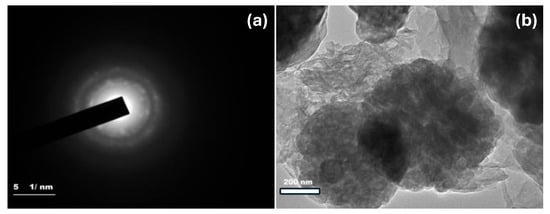
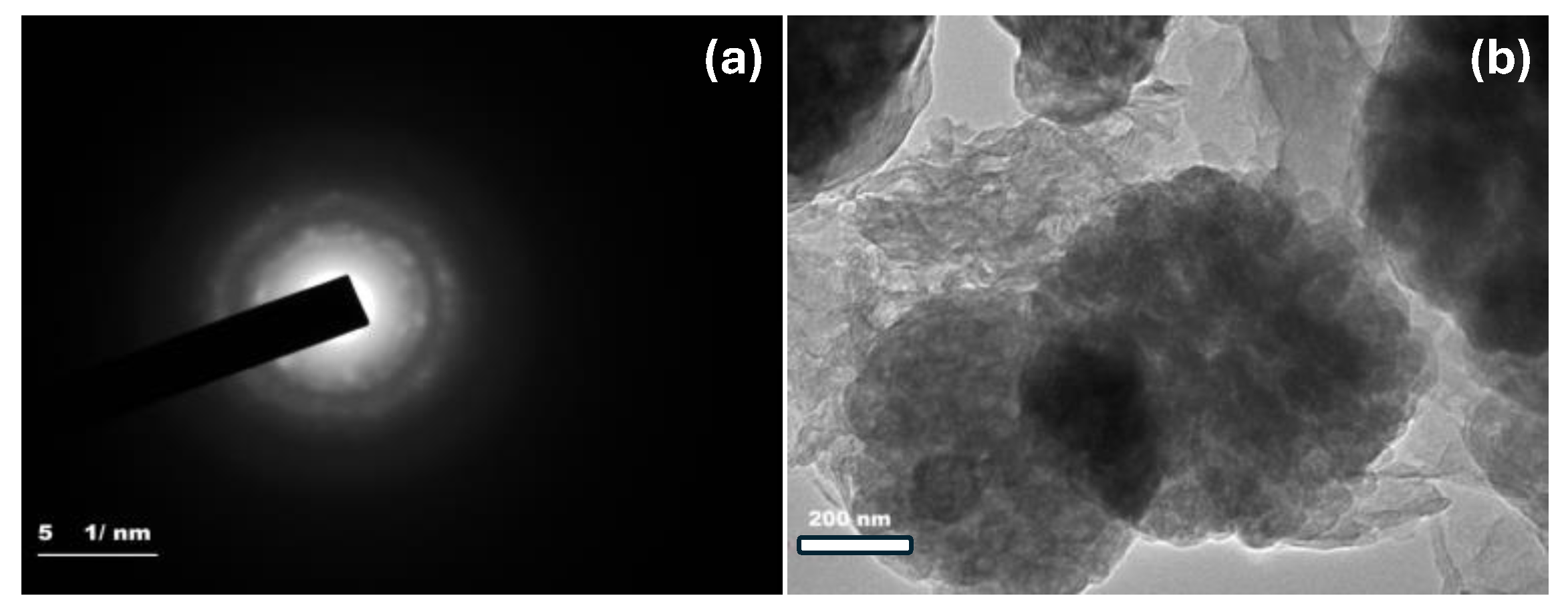
Figure 1 illustrates an HR-TEM image of the synthesized beads. The objective was to understand the structural and morphological characteristics of the NiFe-LDH material when incorporated into a PES matrix, particularly its structural stability. HR-TEM imaging (Figure 1b) revealed that the NiFe-LDH nanosheets, characterized by their layered structure, were observed to be uniformly distributed across the AC surface. AC nanoparticles, appearing as darker regions in the HR-TEM images, were observed to provide a conductive support that facilitates the dispersion of NiFe-LDH nanosheets [33]. The activated carbon appears as a porous structure interspersed between the LDH layers, which likely helps to increase the overall surface area of the nanocomposites and the size of LDH particles. This suggests that the synthesis conditions effectively preserved the layered architecture of the NiFe-LDH during the deposition process. To gain further information on the crystallinity of the NiFe-LDH in the nanocomposites, we employed selected area electron diffraction (SAED) (Figure 1a). The diffraction pattern revealed sharp and diffuse diffraction rings, which correspond to the crystal planes of NiFe-LDH [29,34]. The rings observed in the SAED pattern are associated with the [003], [006], [009], and [015] planes, typical of the hexagonal crystal structure of NiFe-LDH [29,34,35]. These planes confirm the highly crystalline nature of the LDH material despite being incorporated into activated carbon and PES.
Figure 1.
SAED pattern of beads (a). HR-TEM image of beads (b).
3.1.2. Scanning Electron Microscopy (SEM)
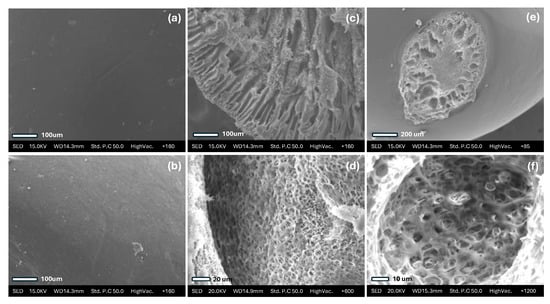
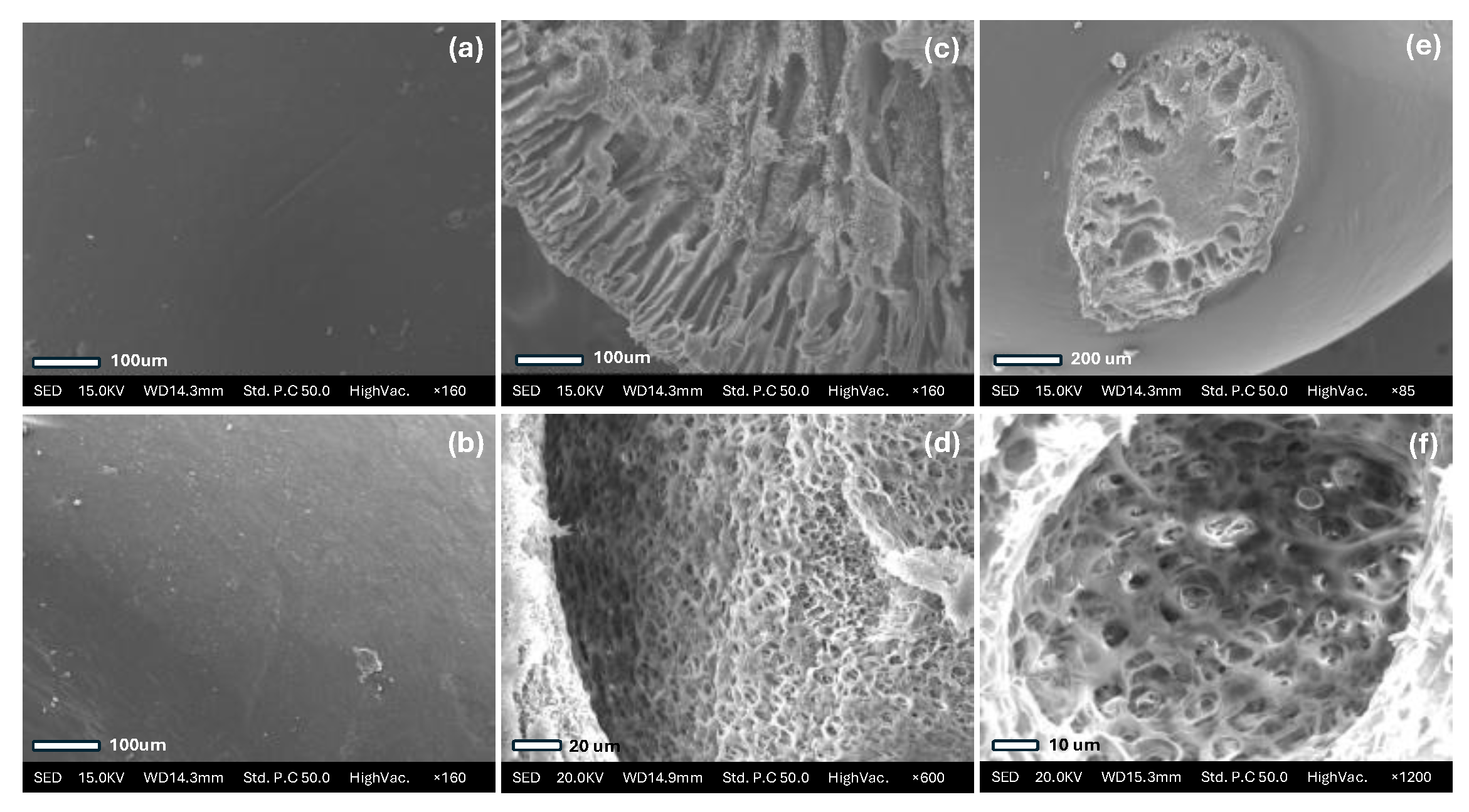
As shown in the SEM images, there are distinct morphological changes for pristine PES beads and AC@NiFe-LDH/PES composites (Figure 2a). The clean PES beads have a comparatively smooth and barren surface, suggesting their compact polymer structure, whereas the AC@NiFe-LDH/PES beads show rougher, non-uniform surface morphology with apparent porous texture and particulate matter entrenchment in the AC@NiFe-LDH loading (Figure 2b). Cross-section micrographs reveal that the introduction of AC and LDH not only alters the surface roughness but also promotes internal porosity, which is beneficial for the diffusion and adsorption of metal ions (Figure 2c,e). The presence of NiFe-LDH exhibits uniform distribution, indicating successful embedding in the PES matrix which would be helpful in improving adsorption performance in the subsequent experiments (Figure 2d,f). The PES matrix plays a crucial supporting role in the adsorption system by immobilizing AC@NiFe-LDH within mechanically stable and recoverable beads. Although PES does not directly participate in chemical adsorption, its phase-inversion-induced porous structure enhances the accessibility of active adsorption sites by promoting efficient mass transfer of metal ions into the bead interior. The preserved morphology of the NiFe-LDH within the beads indicates that active sites remain available for interaction with metal ions, supporting adsorption through electrostatic interactions and ion-exchange processes rather than physical entrapment alone.
Figure 2.
SEM images showing the top surface morphology (PES beads (a), AC@NiFe-LDH/PES beads (b)), the inside of the beads (d,f), and a cross-section of a bead (c,e).
3.2. Optimization Strategy
3.2.1. Selection of Suitable Bead Composition
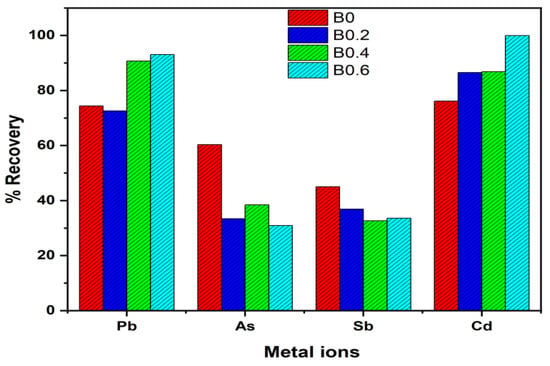
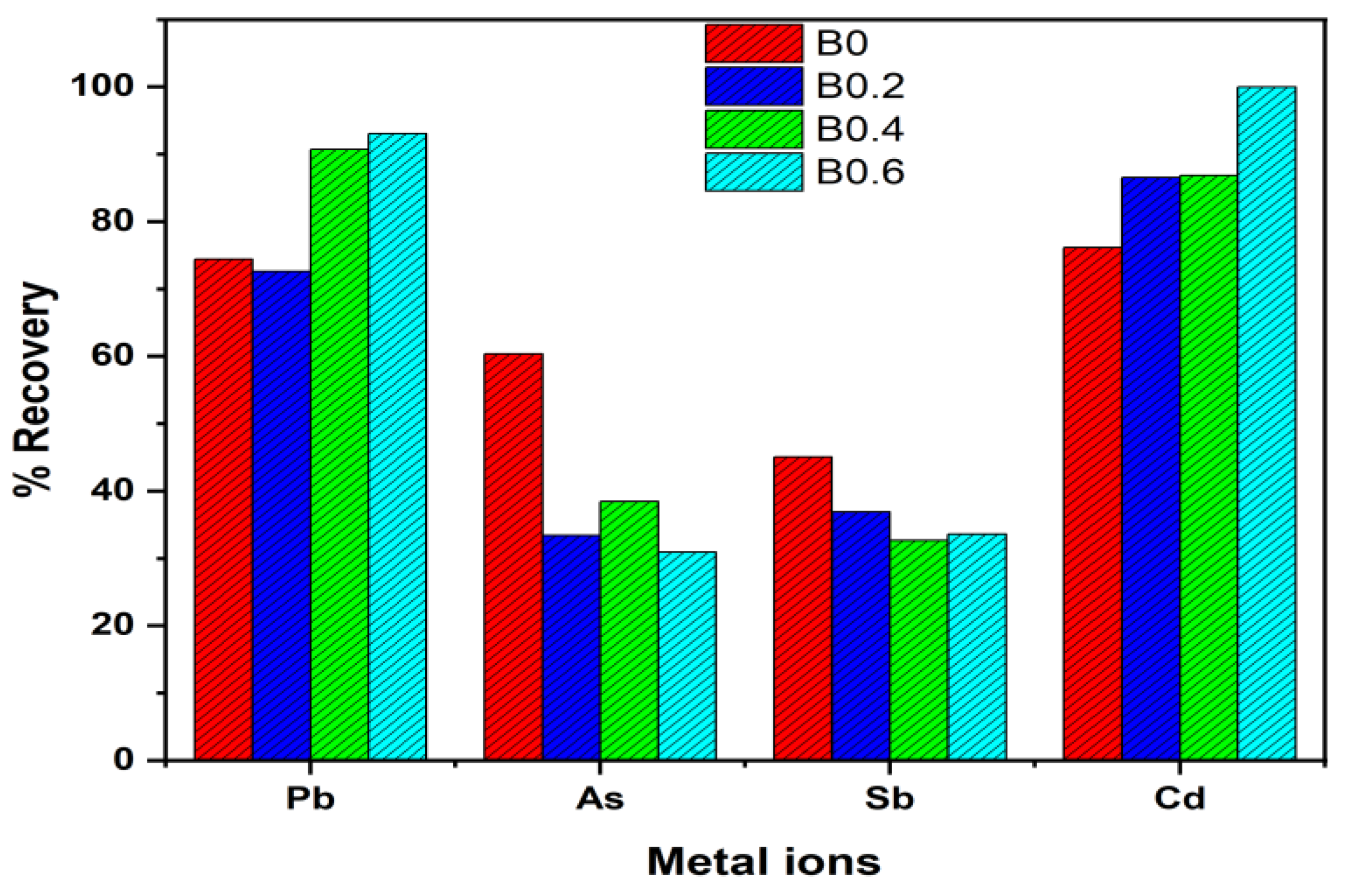
The optimization study initially concentrated on various bead compositions (B0–B3) containing 0–0.6 wt.% AC@NiFe-LDH, as illustrated in Figure 3. The recovery efficiencies of Cd2+ and Pb2+ improved with an increase in the LDH loading. This trend can be attributed to the greater availability of active adsorption sites and larger pore volumes in beads with higher loadings. Among these, B3 (with a loading of 0.6 wt.%) achieved the highest recovery efficiency and was therefore selected for further studies. The improved adsorption performance at higher AC@NiFe-LDH loadings is interpreted as a synergistic contribution of activated carbon and NiFe-LDH, where activated carbon enhances surface area and porosity, while NiFe-LDH provides abundant metal hydroxide active sites. This interpretation is based on adsorption efficiency trends rather than direct synergy quantification. This allows for the target compounds to be readily eluted using the desorption solvent. The incorporation of activated carbon plays a critical role in enhancing the adsorption performance of the composite beads. Activated carbon contributes to a high surface area and porous channels, which facilitate rapid diffusion of metal ions toward active sites.
Figure 3.
Selection of suitable bead compositions: BO: PES beads; B1: 0.2; B2: 0.4; and B3: 0.6. Experimental conditions: pH: 7.5; contact time: 30 min; initial concentration: 100 µg L−1.
3.2.2. Screening of Parameters
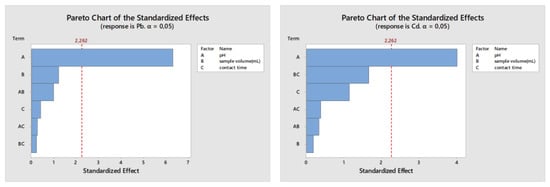
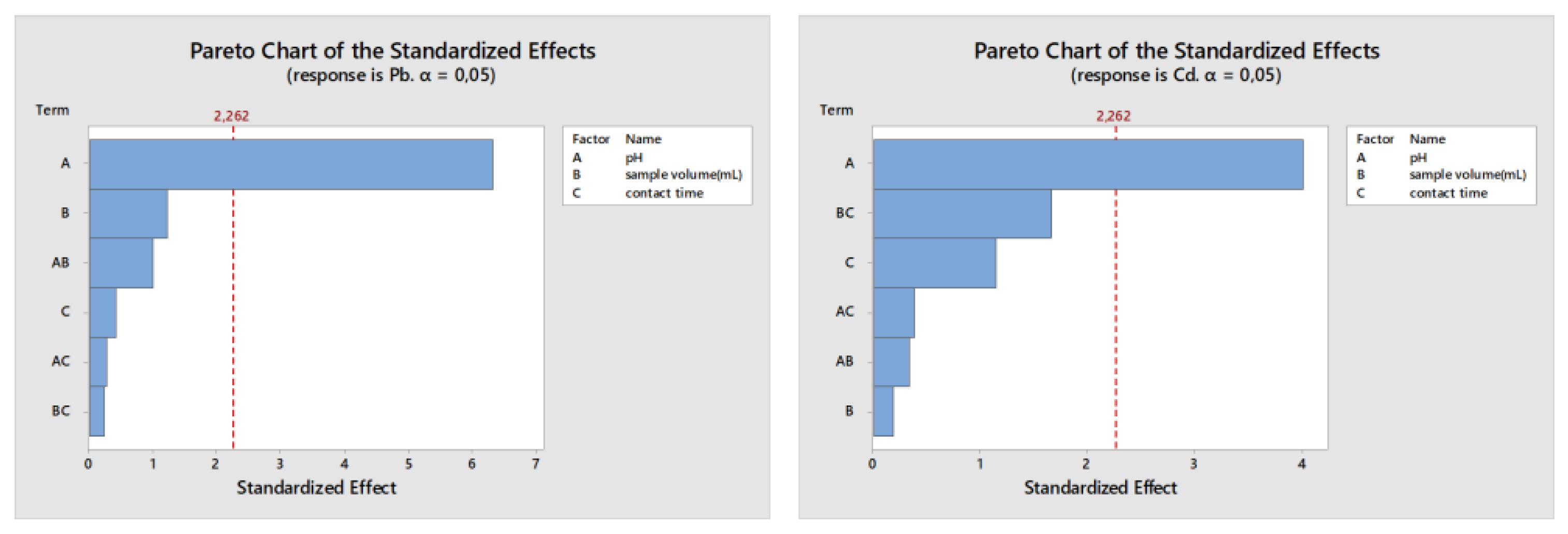
Following the preliminary studies, several parameters that potentially influence adsorption responses, such as solution pH, sample volume (mL), and contact time (min), were first screened using a 2-level 1/2 fractional factorial design. Figure 4 shows the design matrix and analytical response for Cd2+ and Pb2+ analytes in terms of extraction efficiency. The results of the design of experiment (DOE) yielded Pareto charts based on Analysis of Variance (ANOVA). The significant parameters are represented by the blue bars shown in Figure 4 for each factor. The red line indicates the 95% confidence level. All the assessed parameters, with the exception of pH, showed significance at the 95% confidence level. While pH exceeded the threshold, neither contact time nor sample volume did.
Figure 4.
Two-level 1/2 fractional factorial design Pareto chart (n = 3) of Pb2+ and Cd2+ removal for the optimization of contact time, pH, and sample volume at the 95% confidence level.
3.2.3. Response Surface Methodology (RSM) Based on Central Composite Design
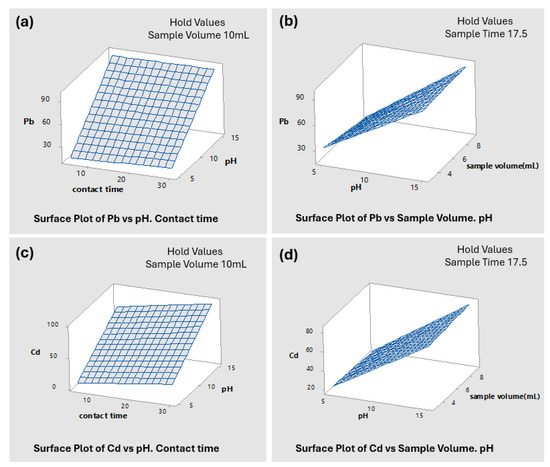
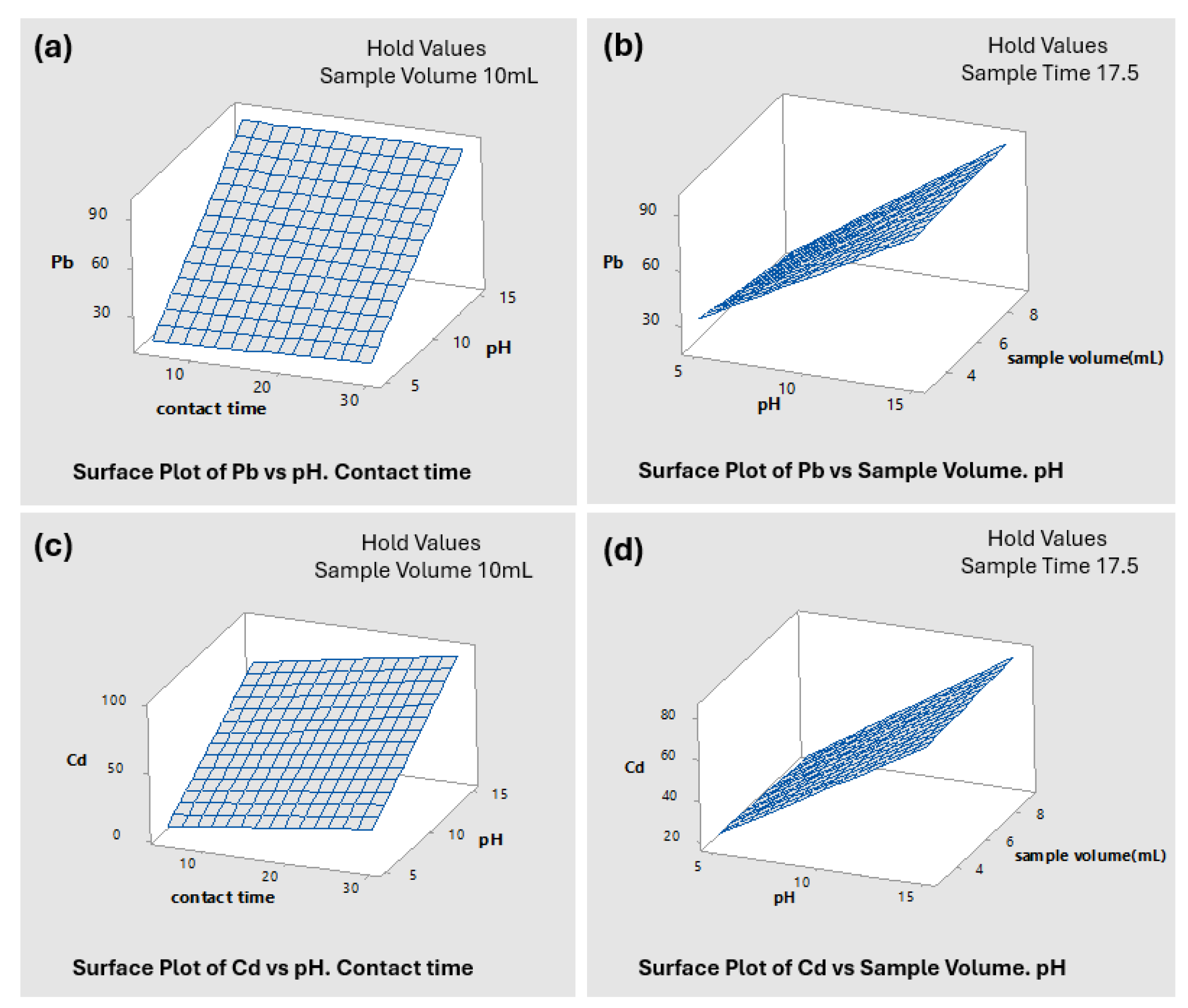
The RSM analysis in Figure 5 gave further insight into the interaction effects between process variables. (A) The Pareto chart of the results of ANOVA showed that pH significantly impacted the removal efficiencies of Cd2+ and Pb2+ beyond the 95% confidence limit. This strong effect can be attributed to the pH-dependent variations in the metal ion speciation and surface charge of AC@NiFe-LDH/PES beads, which exert a direct influence on electrostatic attraction and binding affinity. By contrast, effects of contact time, as well as their interaction, were found to be statistically insignificant within the range examined, suggesting they have lower sensitivity upon pH adjustment. The observations indicate that pH control is the governing operational parameter that maximizes the removal efficiency, consistent with what appears in the literature.
Figure 5.
Response surface methodology (RSM) based on the central composite design. The response (y-axis) represents removal efficiency (%). Surface plots represent: (a) pH vs contact time for Pb; (b) Sample volume vs pH for Pb, (c) pH vs contact time for Cd, (d) Sample volume vs pH for Cd.
3.3. Adsorption Isotherms
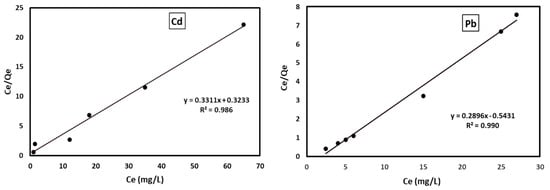
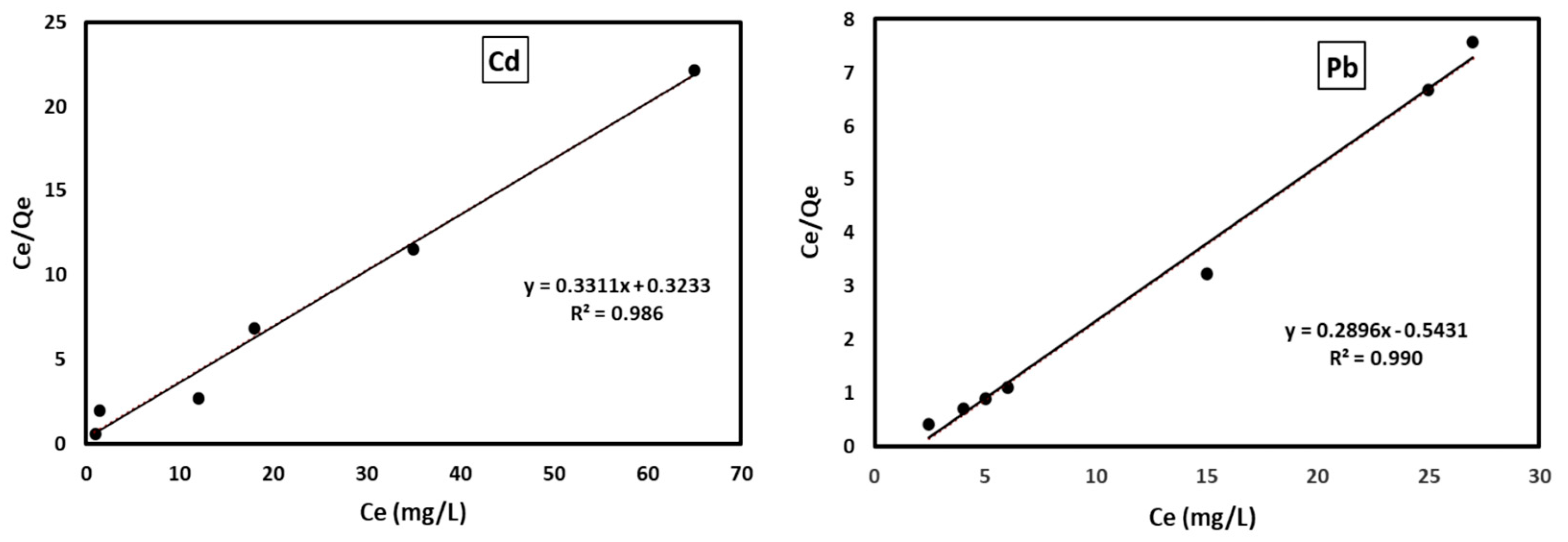
The equilibrium adsorption data were modeled with Langmuir, Freundlich, Temkin, and Dubinin–Radushkevich (D–R) isotherm models to describe the interaction between the AC@NiFe-LDH/PES beads and the target metal ions (Cd2+ and Pb2+). The Langmuir model was found to provide the best fitted isotherm (R2 = 0.991), and the maximum monolayer adsorption capacity (Q max) was 3.02 mg g−1, suggesting that the adsorption process mainly occurred on the monolayer and coverage of the adsorbate on the homogeneous surface containing active sites occurred in a similar way [36]. This indicates that adsorption of Cd2+ (Figure 6a) occurs mainly via specific surface metal ion interactions and not as a result of multilayer deposition, which is in agreement with the large n value from the Freundlich model (n = 7.380) that indicates a favorable adsorption process and that the adsorbent has a strong binding affinity [40].
Figure 6.
Langmuir isotherm model for Cd2+ and Pb2+.
On the other hand, Pb2+ adsorption (Figure 6b) was best described by the Langmuir model (R2 = 0.987), compared to the Freundlich (R2 = 0.9167) and Temkin (R2 = 0.9389) models, indicating predominant monolayer adsorption on relatively homogeneous active sites of the AC@NiFe-LDH/PES beads. Although the composite material inherently contains chemically diverse components, the adsorption behavior within the studied concentration range is dominated by uniform binding sites [41]. As summarized in Table 3, the greater Qmax of the Pb2+ (3.45 mg g−1) as compared to Cd2+ may be attributed to the larger ionic radius of the Pb2+ (1.19 Å) as compared to the Cd2+ (0.95 Å), as well as the oxygen-containing functional groups present on the surface of the ACs and hydroxylated LDH surface [42]. The RL values were found to be between 0 and 1 in Cd2+ and Pb2+ for adsorption, which suggested the process was favorable under the range of studied concentrations. The Temkin constants also demonstrated a lower heat of adsorption of Pb2+ (BT = 2.34 × 10³ J mol−1) than Cd2+ (BT = 3.48 × 10³ J mol−1), evidencing weaker interactions for Pb2+, possibly explaining the better fitting of this metal to heterogeneous surfaces. In the synthesized nickel–iron-layered double hydroxides, the mean adsorption energies (E) estimated by the D–R model were 1.118 kJ mol−1 for Cd2+ and 1.290 kJ mol−1 for Pb2+, also falling within the limit of physisorption (<8 kJ mol−1), which suggests electrostatic forces prevailing over chemisorption. In general, isotherm results reveal that Cd2+ removal by AC@NiFe-LDH/PES is well represented by monolayer adsorption on the homogeneous AC@NiFe-LDH/PES active sites, while Pb2+ sorption is controlled by multi-site adsorption, which may be attributed to the structural and chemical heterogeneity of activated carbon and LDH nanocomposites.
Table 3.
Adsorption isotherm constant values for the Freundlich and Langmuir isotherms.
3.4. Adsorption Kinetics
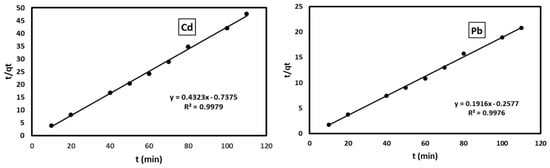
The adsorption kinetics of Cd2+ and Pb2+ on AC@NiFe-LDH/PES beads were modeled by pseudo-first-order and pseudo-second-order equations (Figure 7a,b). According to Table 4, the pseudo-second-order model fitted well for both metals (R2 = 0.997 for Cd2+ and 0.998 for Pb2+), and the Qe values calculated were very close to the experimental values (2.310 mg g−1 for Cd2+ vs. 2.400 mg g−1 experimental value; 5.219 mg g−1 for Pb2+ vs. 5.400 mg g−1 experimental value). This result implies that valence forces are dominant for chemisorption with exchange or sharing of electrons between the metal ions and adsorbent [43]. Although the pseudo-second-order kinetic model suggests that surface complexation plays an important role in the adsorption process, the low mean adsorption energies obtained from the D–R isotherm indicate that electrostatic interactions (physisorption) also contribute significantly. Therefore, the adsorption of Cd2+ and Pb2+ likely involves a combination of electrostatic attraction and surface complexation mechanisms. The R2 value of the pseudo-first-order model was much lower (0.050 for Cd2+ and 0.054 for Pb2+), suggesting it failed to properly describe the adsorption process. The higher value of the rate constant (K2) (0.254 g mg−1 min−1) for Cd2+ than for Pb2+ (0.143 g mg−1 min−1) indicates that the composite beads have the ability to capture Cd2+ ions more quickly, at least in the initial stage, which might be attributed to the factor of the smaller size of the hydrated ionic radius of Cd2+ than that of Pb2+ and the faster diffusion of Cd2+ ions through bead pores [44,45]. The initial kinetics (Table 3 and Table 4) at the same [Ce] levels are consistent with those obtained for other LDH-based and AC-supported adsorbents, where the heavy metal uptake occurs via a fast adsorption step and a slow adsorption phase due to the rise in availability of active sites [46]. The strong agreement with the pseudo-second-order model indicates that the adsorption of Cd2+ and Pb2+ is governed primarily by surface reaction mechanisms, while intraparticle diffusion may contribute but is not the sole rate-limiting step [47].
Figure 7.
Pseudo-second-order model for Cd2+ and Pb2+.
Table 4.
Pseudo-first-order and pseudo-second-order kinetics for the sorption of Cd2+ and Pb2+.
3.5. Application to Real Environmental Samples
The adsorptive removal process developed in this study was further evaluated using real environmental water samples, including effluent, influent, and Unisa tap water, to assess the performance of the AC@NiFe-LDH/PES nanocomposites in the presence of possible interfering species. The results are summarized in Table 5. Since the certified reference materials (CRM) for Cd2+ and Pb2+ were not available, the water samples were spiked with a multielement standard with a concentration level of 5 µg L−1. A spike concentration of 5 µg L−1 was selected to represent elevated contamination levels typical of industrial wastewater, which often exceed regulatory discharge limits and therefore provide a stringent test of adsorbent performance. After adsorption, the AC@NiFe-LDH/PES beads were readily separated from the aqueous solution by simple physical removal (decantation), owing to their macroscopic bead structure, without the need for filtration or centrifugation. The obtained results demonstrated that the nanocomposites maintained high removal efficiencies for both metals even in the presence of co-existing ions and other matrix components. This indicates that the complex water matrices had no significant adverse impact on the adsorption capacity of the AC@NiFe-LDH/PES nanocomposites for Cd2+ and Pb2+.
Table 5.
Adsorptive removal of Cd2+ and Pb2+ in real water samples (mean +/− SD).
3.6. Proposed Mechanism
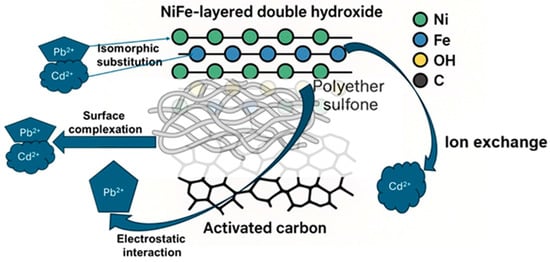
Figure 8 illustrates a proposed mechanism for the adsorption of Pb2+ and Cd2+ onto activated carbon/NiFe–LDH/Polyether sulfone composite beads. Metal ions are captured through several complementary pathways, including substitution within the NiFe–LDH layers, ion exchange with hydroxyl groups, surface complexation, and electrostatic attraction provided by the activated carbon. The Polyether sulfone matrix acts as a supporting framework, ensuring even distribution of LDH and carbon while maintaining the stability and efficiency of the beads. Based on the characterization and adsorption studies, the adsorption of Cd2+ and Pb2+ onto AC@NiFe-LDH/PES beads occurs through a combination of electrostatic attraction, ion exchange, and surface interactions. HR-TEM and SAED analyses confirm that the layered structure and crystallinity of NiFe-LDH are preserved within the composite, indicating that interlayer regions remain accessible for metal ion interaction. These interlayers facilitate ion exchange between metal ions in solution and hydroxyl groups associated with the LDH structure.
Figure 8.
Proposed mechanism for the adsorption of Pb2+ and Cd2+ onto AC@NiFe-LDH/PES nanocomposite beads.
3.7. Reusability Study
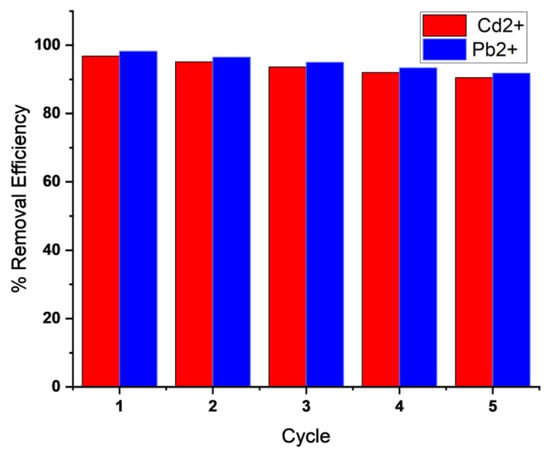
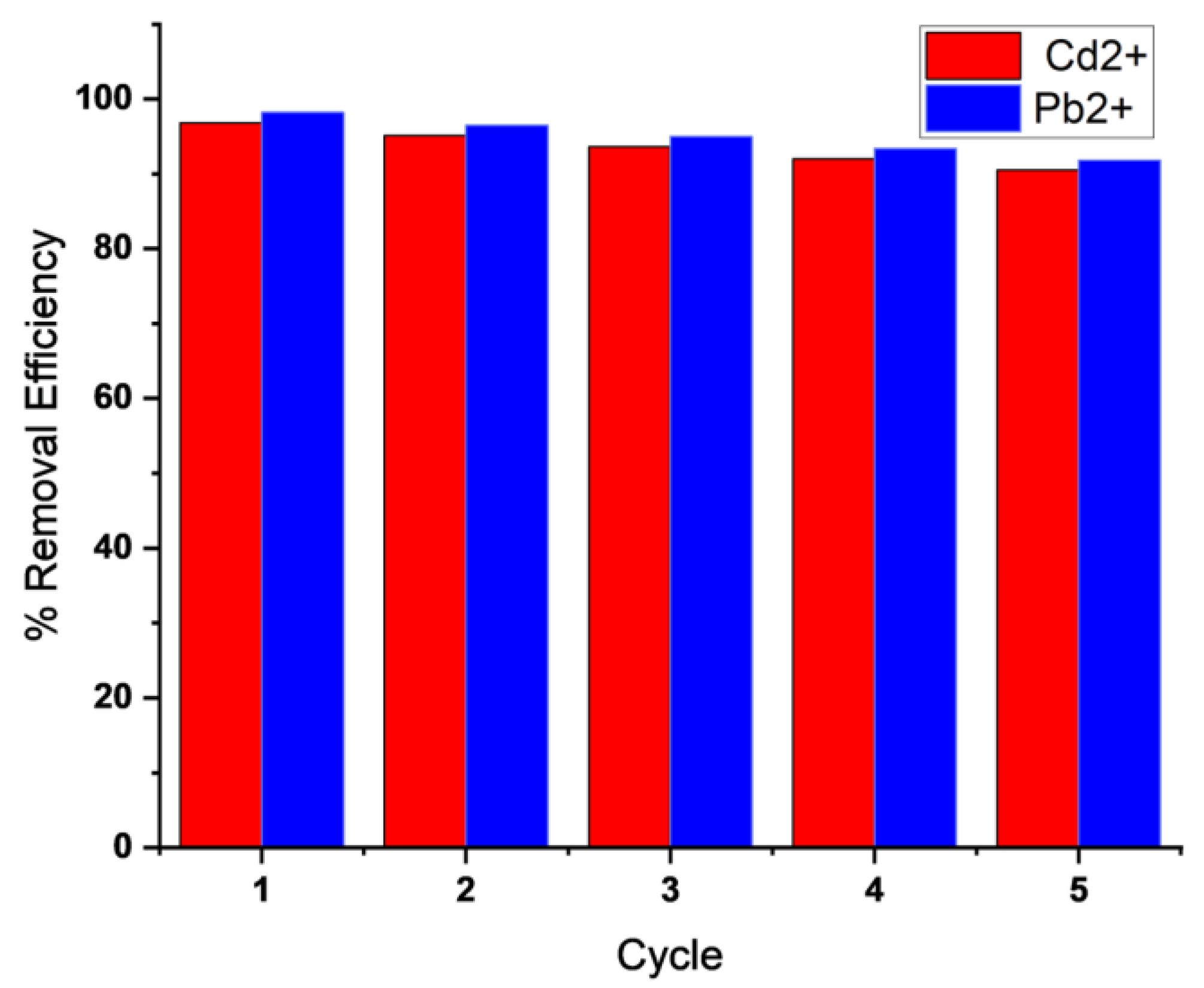
Regeneration experiments were conducted over five consecutive adsorption–desorption cycles. Each adsorption step was performed at optimum conditions. Desorption was achieved using 0.1 mol L−1 HNO3 with 20 min contact time. After each cycle, the beads were thoroughly rinsed with deionized water and dried prior to reuse. Figure 9 shows the removal efficiency decreased by less than 8% from the first to the fifth cycle for both Cd2+ and Pb2+, confirming good reusability. All experiments were conducted in triplicate (n = 3), and the relative standard deviation remained below 5%.
Figure 9.
Reusability performance of AC@NiFe-LDH/PES nanocomposite beads for Pb2+ and Cd2+ removal over 5 cycles.
3.8. Comparison Study
Table 6 shows the comparison of the maximum adsorption capacities (Qmax) of AC@NiFe-LDH/PES beads with other reported adsorbents for Cd2+ and Pb2+ removal. The results indicate that while some materials exhibit higher capacities, the nanocomposites developed in this study demonstrate competitive performance, particularly when considering their structural stability, ease of recovery, and reusability. Notably, their Pb2+ capacity is within the range reported for advanced carbon LDH and biochar nanocomposites [48], and their Cd2+ capacity compares favorably with other LDH-based adsorbents, confirming their suitability for practical wastewater treatment applications.
Table 6.
Comparison of maximum adsorption capacities (Qmax) of AC@NiFe-LDH/PES beads with various reported adsorbents for Cd2+ and Pb2+ removal from aqueous solutions.
4. Conclusions
In conclusion, the AC@NiFe-LDH/PES beads developed in this study represent an effective and sustainable adsorbent for the removal of cadmium (Cd2+) and lead (Pb2+) from aqueous solutions. The nanocomposites exhibited high adsorption capacities, with the process fitting well to the Langmuir isotherm model and following pseudo-second-order kinetics, confirming monolayer chemisorption as the dominant mechanism. The beads demonstrated excellent structural stability, and they can be reused over five adsorption–desorption cycles, retaining their efficiency with minimal loss in performance. Importantly, when applied to real environmental water samples (effluent, influent, and Unisa tap water), the AC@NiFe-LDH/PES nanocomposites maintained high removal efficiencies for both Cd2+ and Pb2+, even in the presence of co-existing ions and complex matrix components. This highlights their strong selectivity and robustness under practical conditions. Overall, the superior adsorption performance, recyclability, and environmental compatibility of the AC@NiFe-LDH/PES beads underscore their potential as a promising solution for the remediation of heavy metal-contaminated waters, contributing to sustainable and eco-friendly wastewater treatment technologies. The present study focused on the adsorption performance and structural integrity of AC@NiFe-LDH/PES beads. Possible leaching of Ni2+ and Fe3+ ions from the LDH phase was not investigated and should be addressed in future studies to fully assess environmental safety.
Supplementary Materials
The following supporting information can be downloaded at https://www.mdpi.com/article/10.3390/jcs10020068/s1: Table S1: The overview of the adsorption isotherm equations of Langmuir, Freundlich, Temkin, and Dubinin–Radushkevich (D-R) used to describe the equilibrium adsorption behaviour.
Author Contributions
R.N.B.: Conceptualization, formal analysis, methodology, investigation, data curation, writing—original draft, and writing—review and editing. D.R.-M.: Investigation, data curation, and writing—review and editing. T.S.M.: Conceptualization, formal analysis, project management, supervision, and writing—review and editing. E.N.N.: Writing—review and editing, validation, supervision, resources, project management, obtaining funding, and conceptualization. All authors have read and agreed to the published version of the manuscript.
Funding
This research was funded by SASOL (Grant No: SASOL791027) and the National Research Foundation of South Africa (Grant No: TTK240405212335).
Data Availability Statement
No new data were generated, and all data included in the article are referenced.
Acknowledgments
The authors wish to thank the Institute for Nanotechnology and Water Sustainability (iNanoWS) of the University of South Africa for their support by providing the facilities used in this study.
Conflicts of Interest
There are no conflicts to declare.
References
- Moukadiri, H.; Noukrati, H.; Youcef, H.B.; Iraola, I.; Trabadelo, V.; Oukarroum, A.; Malka, G.; Barroug, A. Impact and toxicity of heavy metals on human health and latest trends in removal process from aquatic media. Int. J. Environ. Sci. Technol. 2024, 21, 3407–3444. [Google Scholar] [CrossRef] [Scilit]
- Aftab, K.; Iqbal, S.; Khan, M.R.; Busquets, R.; Noreen, R.; Ahmad, N.; Kazimi, S.G.T.; Karami, A.M.; Al Suliman, N.M.S.; Ouladsmane, M. Wastewater-irrigated vegetables are a significant source of heavy metal contaminants: Toxicity and health risks. Molecules 2023, 28, 1371. [Google Scholar] [CrossRef] [Scilit] [PubMed]
- Atta, M.I.; Zehra, S.S.; Dai, D.-Q.; Ali, H.; Naveed, K.; Ali, I.; Sarwar, M.; Ali, B.; Iqbal, R.; Bawazeer, S.; et al. Amassing of heavy metals in soils, vegetables and crop plants irrigated with wastewater: Health risk assessment of heavy metals in Dera Ghazi Khan, Punjab, Pakistan. Front. Plant Sci. 2023, 13, 1080635. [Google Scholar] [CrossRef] [Scilit] [PubMed]
- Khalil, M.M.; Aboueldahab, S.M.; Abdel-Raheem, K.H.M.; Ahmed, M.; Ahmed, M.S.; Abdelhady, A.A. Mixed agricultural, industrial, and domestic drainage water discharge poses a massive strain on freshwater ecosystems: A case from the Nile River in Upper Egypt. Environ. Sci. Pollut. Res. 2023, 30, 122642–122662. [Google Scholar] [CrossRef] [Scilit]
- Tariq, A.; Mushtaq, A. Untreated wastewater reasons and causes: A review of most affected areas and cities. Int. J. Chem. Biochem. Sci. 2023, 23, 121–143. [Google Scholar]
- Ahmed, S.H.; El Sheikh, E.M.; Morsy, A.M.A. Potentiality of uranium biosorption from nitric acid solutions using shrimp shells. J. Environ. Radioact. 2014, 134, 120–127. [Google Scholar] [CrossRef] [Scilit]
- Ghorbani, A.; Emamverdian, A.; Pehlivan, N.; Zargar, M.; Razavi, S.M.; Chen, M. Nano-enabled agrochemicals: Mitigating heavy metal toxicity and enhancing crop adaptability for sustainable crop production. J. Nanobiotechnol. 2024, 22, 91. [Google Scholar] [CrossRef] [Scilit]
- Eidelman, S.; Hayes, K.G.; Olive, K.A.; Aguilar-Benitez, M.; Amsler, C.; Asner, D.; Babu, K.S.; Barnett, R.M.; Beringer, J.; Burchat, P.R.; et al. Review of Particle Physics. Phys. Lett. B 2004, 592, 1–5. [Google Scholar] [CrossRef] [Scilit]
- Ferreira, S.L.C.; Cerda, V.; Cunha, F.A.S.; Lemos, V.A.; Teixeira, L.S.G.; Santos, W.N.L.D.; Coutinho, J.D.J.; de A. Porto, I.S.; de Jesus, R.F. Application of human health risk indices in assessing contamination from chemical elements in food samples. TrAC Trends Anal. Chem. 2023, 167, 117281. [Google Scholar] [CrossRef] [Scilit]
- Durkalec, M.; Mart, M.; Nawrocka, A.; Pareja-Carrera, J.; Smits, J.E.G.; Mateo, R. Factors influencing lead, mercury and other trace element exposure in birds from metal mining areas. Environ. Res. 2022, 212, 113575. [Google Scholar] [CrossRef] [Scilit]
- Fernandez-Rojo, L.; Héry, M.; Le Pape, P.; Braungardt, C.; Desoeuvre, A.; Torres, E.; Tardy, V.; Resongles, E.; Laroche, E.; Delpoux, S.; et al. Biological attenuation of arsenic and iron in a continuous flow bioreactor treating acid mine drainage (AMD). Water Res. 2017, 123, 594–606. [Google Scholar] [CrossRef] [Scilit]
- Maarof, H.I.; Daud, W.M.A.W.; Aroua, M.K. Recent trends in removal and recovery of heavy metals from wastewater by electrochemical technologies. Rev. Chem. Eng. 2017, 33, 359–386. [Google Scholar] [CrossRef] [Scilit]
- Bagdat, S.; Tokay, F.; Demirci, S.; Yilmaz, S.; Sahiner, N. Removal of Cd (II), Co (II), Cr (III), Ni (II), Pb (II) and Zn (II) ions from wastewater using polyethyleneimine (PEI) cryogels. J. Environ. Manag. 2023, 329, 117002. [Google Scholar] [CrossRef] [Scilit]
- Rahman, A.; Yoshida, K.; Islam, M.M.; Kobayashi, G. Investigation of efficient adsorption of toxic heavy metals (chromium, lead, cadmium) from aquatic environment using orange peel cellulose as adsorbent. Sustainability 2023, 15, 4470. [Google Scholar] [CrossRef] [Scilit]
- Peyravi, M.; Rezaei, H. Metals removal by membrane filtration. In Metals in Water; Elsevier: Amsterdam, The Netherlands, 2023; pp. 331–351. [Google Scholar]
- Samejo, S.; Baig, J.A.; Kazi, T.G.; Afridi, H.I.; Hol, A.; Ali, F.I.; Hussain, S.; Akhtar, K.; Perveen, S.; Bhutto, A.A. Green synthesis of iron oxide nanobiocomposite for the adsorptive removal of heavy metals from the drinking water. Mater. Chem. Phys. 2023, 303, 127807. [Google Scholar] [CrossRef] [Scilit]
- Hossain, M.S.; Okino, T. Cyanoremediation of heavy metals (As (v), Cd (ii), Cr (vi), Pb (ii)) by live cyanobacteria (Anabaena variabilis, and Synechocystis sp.): An eco-sustainable technology. RSC Adv. 2024, 14, 10452–10463. [Google Scholar] [CrossRef] [Scilit] [PubMed]
- Kouniba, S.; Benbiyi, A.; Zourif, A.; Guendouzi, M.E.L. Optimization use of Watermelon Rind in the Coagulation-Flocculation Process by Box Behnken Design for Copper, Zinc, and Turbidity Removal. Heliyon 2024, 10, e30823. [Google Scholar] [CrossRef] [Scilit] [PubMed]
- Bansal, J. Removal of heavy metal ions: Chemical precipitation. Int. J. Ed. Res. Stud. 2024, 6, 31–33. [Google Scholar]
- Chakraborty, R.; Asthana, A.; Singh, A.K.; Jain, B.; Susan, A.B.H. Adsorption of heavy metal ions by various low-cost adsorbents: A review. Int. J. Environ. Anal. Chem. 2022, 102, 342–379. [Google Scholar] [CrossRef] [Scilit]
- Raji, Z.; Karim, A.; Karam, A.; Khalloufi, S. Adsorption of heavy metals: Mechanisms, kinetics, and applications of various adsorbents in wastewater remediation—A review. Waste 2023, 1, 775–805. [Google Scholar] [CrossRef] [Scilit]
- Ichou, A.A.; Benhiti, R.; Abali, M.; Dabagh, A.; Carja, G.; Soudani, A.; Chiban, M.; Zerbet, M.; Sinan, F. Characterization and sorption study of Zn2 [FeAl]-CO3 layered double hydroxide for Cu (II) and Pb (II) removal. J. Solid State Chem. 2023, 320, 123869. [Google Scholar] [CrossRef] [Scilit]
- Li, X.; Liu, T.; Han, X.; Li, Y.; Ma, X. Removal of heavy metals lead and ciprofloxacin from farm wastewater using peanut shell biochar. Environ. Technol. Innov. 2023, 30, 103121. [Google Scholar] [CrossRef] [Scilit]
- Chaudhary, H.; Dinakaran, J.; Notup, T.; Vikram, K.; Rao, K.S. Comparison of adsorption performance of biochar derived from urban biowaste materials for removal of heavy metals. Environ. Manag. 2024, 73, 408–424. [Google Scholar] [CrossRef] [Scilit]
- Biswal, B.K.; Balasubramanian, R. Use of biochar as a low-cost adsorbent for removal of heavy metals from water and wastewater: A Review. J. Environ. Chem. Eng. 2023, 11, 110986. [Google Scholar] [CrossRef] [Scilit]
- Wang, P.; Zhang, X.; Zhou, B.; Meng, F.; Wang, Y.; Wen, G. Recent advance of layered double hydroxides materials: Structure, properties, synthesis, modification and applications of wastewater treatment. J. Environ. Chem. Eng. 2023, 11, 111191. [Google Scholar] [CrossRef] [Scilit]
- Sajid, M.; Ihsanullah, I. Magnetic layered double hydroxide-based composites as sustainable adsorbent materials for water treatment applications: Progress, challenges, and outlook. Sci. Total Environ. 2023, 880, 163299. [Google Scholar] [CrossRef] [Scilit]
- Li, C.; Bao, Y.; Liu, E.; Zhao, B.; Sun, T. Recent Advances of Modified Ni (Co, Fe)-Based LDH 2D Materials for Water Splitting. Molecules 2023, 28, 1475. [Google Scholar] [CrossRef] [Scilit]
- Biata, R.N.; Mabhulusa, W.; Mofokeng, L.E.; Ratshiedana, R.; Munonde, T.S.; Nxumalo, E.N. Efficient Photocatalytic Degradation of Metoprolol Using Activated Carbon Supported NiFe-Layered Double Hydroxides (NiFe-LDH/C) under Solar-Driven Simulation. Emerg. Contam. 2025, 11, 100532. [Google Scholar] [CrossRef] [Scilit]
- Ramutshatsha-Makhwedzha, D.; Mavhungu, A.; Moropeng, M.L.; Mbaya, R. Activated carbon derived from waste orange and lemon peels for the adsorption of methyl orange and methylene blue dyes from wastewater. Heliyon 2022, 8, e09930. [Google Scholar] [CrossRef] [Scilit]
- Gugushe, A.S.; Mpupa, A.; Munonde, T.S.; Nyaba, L.; Nomngongo, P.N. Adsorptive removal of Cd, Cu, Ni and Mn from environmental samples using Fe3O4-zro2@ APS nanocomposite: Kinetic and equilibrium isotherm studies. Molecules 2021, 26, 3209. [Google Scholar] [CrossRef] [Scilit]
- Mashile, G.P.; Mpupa, A.; Nomngongo, P.N. Magnetic mesoporous carbon/β-cyclodextrin--chitosan nanocomposite for extraction and preconcentration of multi-class emerging contaminant residues in environmental samples. Nanomaterials 2021, 11, 540. [Google Scholar] [CrossRef] [Scilit]
- Wang, W.-H.; Han, C.-H.; Hong, W.-X.; Chiu, Y.-C.; Tseng, I.-H.; Chang, Y.-H.; Pourzolfaghar, H.; Li, Y.-Y. NiFe layered double hydroxide (LDH) anchored, Fe single atom and nanoparticle embedded on nitrogen-doped carbon-CNT (carbon nanotube) framework as a bifunctional catalyst for rechargeable zinc-air batteries. J. Energy Storage 2024, 85, 111058. [Google Scholar] [CrossRef] [Scilit]
- Shi, H.; Zhu, Y.; Chen, J.; Wang, Z.; Zhan, J.; Li, S.; Han, P.; Guo, X. Reveal the effects of iron content in NiFex-LDH on its morphology, crystallinity, and electronic structure, and their relationship with OER activity. Int. J. Hydrogen Energy 2025, 97, 874–881. [Google Scholar] [CrossRef] [Scilit]
- Bodhankar, P.M.; Sarawade, P.B.; Singh, G.; Vinu, A.; Dhawale, D.S. Recent advances in highly active nanostructured NiFe LDH catalyst for electrochemical water splitting. J. Mater. Chem. A 2021, 9, 3180–3208. [Google Scholar] [CrossRef] [Scilit]
- Yildiz, O.G.; Aydemir, U. Beyond graphene: Hydrogenated borophene as a next-generation adsorbent for ultra-fast water purification. Sep. Purif. Technol. 2025, 377, 134213. [Google Scholar] [CrossRef] [Scilit]
- Wang, H.; Wang, S.; Wang, S.; Fu, L.; Zhang, L. The one-step synthesis of a novel metal–organic frameworks for efficient and selective removal of Cr (VI) and Pb (II) from wastewater: Kinetics, thermodynamics and adsorption mechanisms. J. Colloid Interface Sci. 2023, 640, 230–245. [Google Scholar] [CrossRef] [Scilit]
- Wang, H.; Wang, S.; Wang, S.; Fu, L.; Zhang, L. Efficient metal-organic framework adsorbents for removal of harmful heavy metal Pb (II) from solution: Activation energy and interaction mechanism. J. Environ. Chem. Eng. 2023, 11, 109335. [Google Scholar] [CrossRef] [Scilit]
- de Aquino, R.V.S.; de Lucena, P.G.C.; Arias, S.; Landers, R.; Pacheco, J.G.A.; da Rocha, O.R.S. Influence of terephthalate anion in ZnAl layered double hydroxide on lead ion removal: Adsorption, kinetics, thermodynamics and mechanism. Colloids Surfaces A Physicochem. Eng. Asp. 2024, 686, 133404. [Google Scholar] [CrossRef] [Scilit]
- Fu, Y.; Wang, H.; Zhou, Y.; Zeng, L.; Jiang, F.; Li, X.; Jin, X.; Zhang, L.; Yi, X.; Dang, Z. Heavy metals enhance the deposition of clay colloids on silica surfaces via heterogeneous pathways. Environ. Sci. Nano 2025, 12, 4271–4281. [Google Scholar] [CrossRef] [Scilit]
- Huangfu, Z.; Sun, W.; Liu, R.; Chen, C.; Zhang, C.; Yu, H.; Liu, S. Heterogeneous adsorption of carboxymethyl starch on anisotropic molybdenite and talc surfaces and its effect on flotation. Sep. Purif. Technol. 2025, 363, 131849. [Google Scholar] [CrossRef] [Scilit]
- Zhu, S.; Xu, H.; Khan, M.S.; Xia, M.; Wang, F.; Chen, Y. Enhanced removal of Ni2+ and Co2+ from wastewater using a novel 2-hydroxyphosphonoacetic acid modified Mg/Fe-LDH composite adsorbent. Water Res. 2025, 272, 122997. [Google Scholar] [CrossRef] [Scilit]
- Mengistu, M.E.; Waday, Y.A.; Geleta, W.S.; Bayisa, Y.M.; Mekonnen, D.T. Adsorptive removal of Cr (VI) from wastewater using termite mound blended with chicken eggshell as an adsorbent: Equilibrium and kinetic approaches. Desalin. Water Treat. 2025, 323, 101394. [Google Scholar] [CrossRef] [Scilit]
- Lam, T.H.; Nguyen, Q.N.K.; Quynh, B.T.P. A Comparative Study on the Adsorption Behavior of Heavy Metal Ions on Zeolites 13X and 4A in Neutral Solution. ChemistrySelect 2025, 10, e00924. [Google Scholar] [CrossRef] [Scilit]
- Macena, M.; Pereira, H.; Cruz-Lopes, L.; Grosche, L.; Esteves, B. Competitive adsorption of metal Ions by lignocellulosic materials: A review of applications, mechanisms and influencing factors. Separations 2025, 12, 70. [Google Scholar] [CrossRef] [Scilit]
- Bi, F.; Jiang, Z.; Zhang, Z.; Zhang, Z.; Wang, M.; Fu, L.; Fan, H.; Qu, J.; Zhang, Y. A recyclable magnetic polyethyleneimine-functionalized cellulose aerogel for reducing cadmium (Cd) accumulation in acidic contaminated soil: Stress mitigation and soil improvement mechanisms. Chem. Eng. J. 2025, 520, 166360. [Google Scholar] [CrossRef] [Scilit]
- El-Rayyes, A.; Arogundade, I.; Ofudje, E.A.; Refat, M.S.; Alsuhaibani, A.M.; Akande, J.A.; Sodiya, E.F. Thermodynamic, isotherm and kinetic studies lead ions adsorption onto Manihot esculenta chaff surface. Sci. Rep. 2025, 15, 27672. [Google Scholar] [CrossRef] [Scilit]
- Talaniuk, V.; Godzierz, M.; Sikorska, W.; Adamus, G.; Forys, A.; Szeluga, U. Tailoring the Conductivity and Flexibility of Natural Poly (3-hydroxybutyrate-co-3-hydroxyvalerate)-Based Biocomposites by Introduction of Carbon Nanomaterials and Atactic Poly-3-hydroxybutyrate. Materials 2025, 18, 1585. [Google Scholar] [CrossRef] [Scilit]
- Irawan, C.; Putra, M.D.; Nata, I.F.; Refki, M.F.; Hidayat, R.; Triantoro, A.; Abbas. Synthesis of composite nanostructure natural ZrO2 and magnetite particles (Fe3O4@ ZrO2) and study of its lead ion adsorption efficiency. IOP Conf. Ser. Mater. Sci. Eng. 2022, 1212, 12016. [Google Scholar] [CrossRef] [Scilit]
- Pandey, P.K.; Sharma, S.K.; Sambi, S.S. Removal of lead (II) from waste water on zeolite-NaX. J. Environ. Chem. Eng. 2015, 3, 2604–2610. [Google Scholar] [CrossRef] [Scilit]
- Tan, Y.; Yin, X.; Wang, C.; Sun, H.; Ma, A.; Zhang, G.; Wang, N. Sorption of cadmium onto Mg-Fe layered double hydroxide (LDH)-Kiwi branch biochar. Environ. Pollut. Bioavailab. 2019, 31, 189–197. [Google Scholar] [CrossRef] [Scilit]
- Alnasrawi, F.A.; Mohammed, A.A. Enhancement of Cd2+ removal on CuMgAl-layered double hydroxide/montmorillonite nanocomposite: Kinetic, isotherm, and thermodynamic studies. Arab. J. Chem. 2023, 16, 104471. [Google Scholar] [CrossRef] [Scilit]
- Xue, S.; Hu, Y.; Wan, K.; Miao, Z. Exploring humic acid as an efficient and selective adsorbent for lead removal in multi-metal coexistence systems: A review. Separations 2024, 11, 80. [Google Scholar] [CrossRef] [Scilit]

Disclaimer/Publisher’s Note: The statements, opinions and data contained in all publications are solely those of the individual author(s) and contributor(s) and not of MDPI and/or the editor(s). MDPI and/or the editor(s) disclaim responsibility for any injury to people or property resulting from any ideas, methods, instructions or products referred to in the content. |
© 2026 by the authors. Licensee MDPI, Basel, Switzerland. This article is an open access article distributed under the terms and conditions of the Creative Commons Attribution (CC BY) license.