
Article

Enhancing Lightning Strike Protection of CFRP Laminates Using Nickel-Coated Carbon Fiber Nonwoven Veils

1
Faculty of Science and Engineering, University of Nottingham Ningbo China, 199 Taikang East Road, Ningbo 315100, China
2
State Key Laboratory of Advanced Fiber Materials, College of Materials Science and Engineering, Donghua University, 2999 North Renmin Road, Shanghai 201620, China
3
Yangtze River Delta Carbon Fiber & Composites Innovation Center, 495 Yulong North Rd, Xinbei District, Changzhou 213022, China
4
Shanghai Aircraft Manufacturing Co., Ltd. (SAMC), 3115 Changzhong Road, Shanghai 200436, China
5
AVIC Manufacturing Technology Institute, 1 Chaoyang Road, Chaoyang District, Beijing 100024, China
*
Authors to whom correspondence should be addressed.
J. Compos. Sci. 2026, 10(2), 69; https://doi.org/10.3390/jcs10020069
Submission received: 16 December 2025 / Revised: 15 January 2026 / Accepted: 29 January 2026 / Published: 31 January 2026

Abstract

The lightning strike protection (LSP) performance of nickel-coated carbon fiber nonwoven veils (NiCVs) with varying areal densities, integrated onto the surface of CFRP laminates, was evaluated through simulated lightning strike tests. Post-strike damage was evaluated through visual inspection, non-destructive ultrasonic testing, residual strength measurements, and microstructural examinations. Results indicated that the protection effectiveness improved with increasing NiCV areal density. The laminate with a 68 g/m2 NiCV layer showed substantially reduced damage—its damage volume, damage area, and maximum damage depth decreased to 18%, 40%, and 51% of those of the control laminate—and it retained 95% of the reference compression strength, demonstrating the strong post-strike protection capability of this lightweight veil. A detailed analysis suggested that the NiCV LSP performance may arise from a mechanism involving high electrical conductivity, a thermally stable coated-fiber skeleton, as well as a distributed nonwoven network architecture. These results highlight NiCV as a promising functional approach for enhancing the lightning strike protection of CFRP aerostructures.

1. Introduction

With the increasing focus on reducing carbon emissions and enhancing aircraft fuel efficiency, advanced carbon fiber reinforced plastic (CFRP) laminates are being used more widely to replace conventional metal components in new-generation aircraft. While this transition brings substantial weight-saving and performance benefits, it also introduces new challenges, particularly in relation to lightning strike safety. Commercial airliners are typically struck by lightning approximately once every 1000 flight hours—about once per aircraft per year [1,2]—and the low intrinsic electrical conductivity of polymer composites makes them inherently vulnerable in such events. Unlike metallic alloys, CFRP laminates cannot efficiently diffuse lightning-induced currents, leading to pronounced local Joule heating at the strike attachment point. This localized thermal and electrical concentration can cause severe damage, including matrix ablation, fiber–matrix debonding, embrittlement, delamination, and even structural degradation [3].
To mitigate lightning strike damage, metallic mesh or foil (typically aluminum or copper) is commonly bonded to the outer surface of the composite parts, leading to a weight penalty [2,4] and potential galvanic corrosion issues [5,6]. Various alternative lightning strike protection methods have been investigated to overcome the disadvantages of the existing metallic protection solution. For instance, non-metallic solutions including buckypaper [7,8] and graphene [4,9,10] have been investigated as functional protection layers due to their relatively higher electrical conductivity, lower density, and excellent resistance to oxidation and fatigue. Although such solutions offer a certain level of protection, their electrical conductivity remains far lower than that of lightweight aircraft alloys, and their high cost and complex fabrication processes limit their suitability for large aerostructures.
In order to exploit the high electrical conductivity of metal materials whilst avoiding the weight penalty of monolithic metals, several hybrid systems have been examined. Chakravarthi et al. [11] added nickel-coated single-walled carbon nanotubes (Ni-SWNTs) into the bismaleimide (BMI) composites, which effectively improved their lightning protection. Cauchy et al. [12] coated carbon nanofibers with silver and integrated them in epoxy surfacing film to provide a conductive layer for composite panels. The hybrid protection structure helped to protect the underlying composites without detectable damage via ultrasonic scans. Xia et al. [13] prepared silver-modified carbon nanotube film to enhance the lightning protection of CFRP. The experiments show that the compressive strength of the protected CFRP composites was maintained at 91% after lightning strike testing. The above studies indicate that the metal-modified carbon nanotube lightning strike protection material reduce lightning strike damage significantly when compared with uncoated carbon nanotubes. However, challenges associated with nanoparticle agglomeration and the high cost of implementation still require further investigation.
Compared with the previous hybrid solutions, lightning strike protection schemes based on metallized carbon fiber protection layer appear to offer feasible technological routes. Guo et al. [14] investigated the lightning strike protection effect of nickel-coated carbon fiber nonwoven veils. The results show that the nonwoven veil provided better protection than the commercial expanded copper foil in withstanding two kinds of standardized waveforms. Ming et al. [15] prepared a nickel-coated carbon fiber mesh as an interconnected lightning strike protection layer via 3D printing. The experiments demonstrate that the nickel-coated carbon fiber mesh effectively limited the damage area and depth within the surface layer of CFRP laminate. Zhu et al. [16] bonded a nickel-coated carbon fiber woven fabric to the top surface of a CFRP composite. The protected composite exhibited good lightning strike protection performance, with 92.65% residual strength after the lightning strike test. Jean Langot et al. [17] investigated CFRP panels protected with non-woven nickel-coated carbon fiber veils and found that highly conductive nickel-coated carbon fiber layers can provide a level of lightning strike protection comparable to expanded copper foil, while being simultaneously lighter and more cost-effective. The demonstrable advantages of nickel-coated carbon fiber can be attributed to its lightweight, high conductivity, similar modulus and coefficient of thermal expansion of carbon fiber, good corrosion resistance [18], as well as convenient fabrication process whether via weaving or non-woven assembly.
Although the effectiveness of nickel-coated carbon fiber protection layers has been reported, relatively few studies have examined how their areal density influences LSP performance, particularly in the low-areal-density range. Moreover, to the best of our knowledge, no experimental work has evaluated the protection capability of nickel-coated carbon fiber nonwoven veils under the complete Zone 2A lightning environment—consisting of the standard current waveforms D, B, and C*—despite Zone 2A encompassing the majority of aircraft external surfaces as specified in SAE ARP 5414 [19]. In this study, CFRP laminates incorporating NiCV layers with areal densities of 11 g/m2, 17 g/m2, 34 g/m2, and 68 g/m2 were tested under the Zone 2A lightning environment, and the underlying protection mechanisms were examined in depth.

2. Materials and Methods

2.1. Materials

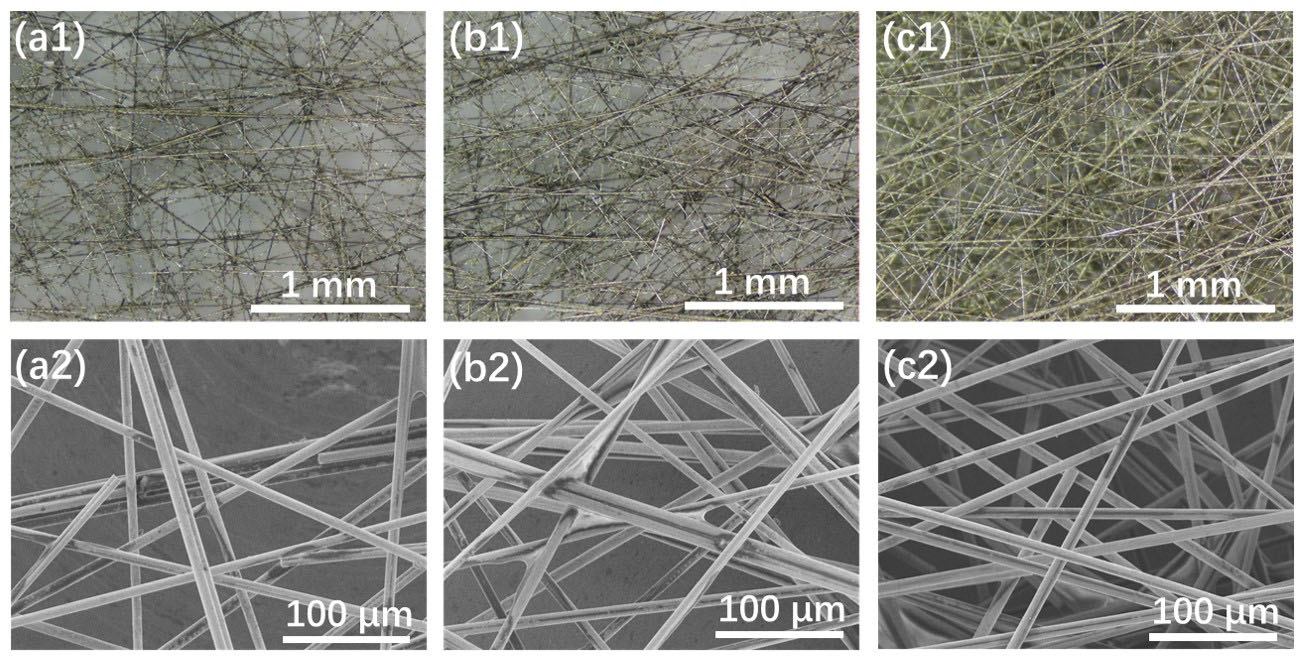
Three kinds of NiCVs supplied by Ningbo N2IC New Materials Co., Ltd., Ningbo, China, were designated as NiCV-11, NiCV-17, and NiCV-34, with the numerical codes indicate their approximate areal densities (11 g/m2, 17 g/m2, and 34 g/m2, respectively). The average thickness of the pure nickel coating layer on carbon fiber was approximately 0.3 μm. Optical microscope images and SEM images of these materials are shown in Figure 1. All NiCVs exhibited a similar nonwoven structure and a high in-plane conductivity of approximately 3.2 × 10⁴ S/m. The in-plane conductivity was determined by measuring the average in-plane resistance of rectangular coupons using a DC resistance meter and by observing the average veil thickness from acrylic-embedded metallographic specimens, followed by conductivity calculation. The NT300-12K-180C unidirectional carbon fiber epoxy resin prepreg were also provided by Ningbo N2IC New Materials Co., Ltd., Ningbo, China.

2.2. CFRP Laminates Manufacturing

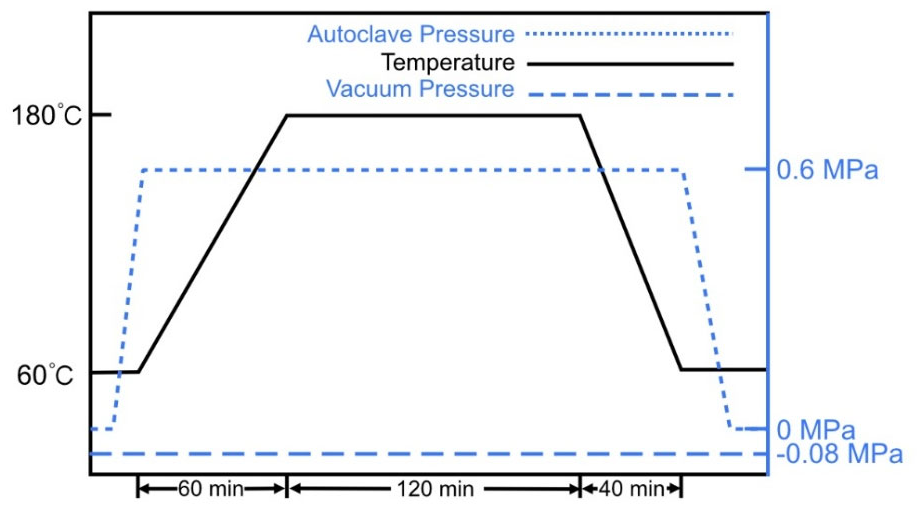
An OLMAR AT–1300/2500 autoclave, OLMAR S.A., Gijón, Spain, was used to manufacture five different CFRP laminates. The curing regime shown in Figure 2 was implemented according to the supplier’s recommendations. Five different 320 × 320 mm2 CFRP laminates were manufactured for lightning strike tests, each with a symmetric quasi-isotropic stacking sequence. Different external NiCV protection layers were incorporated on the incident face of the four protected laminates (S2–S5). Table 1 summarizes the laminate specifications. All laminates were processed using conventional ancillary materials, including breather, a panel caul, bagging film, release film, and sealant tape.

2.3. Characterization of Pristine CFRP Laminates

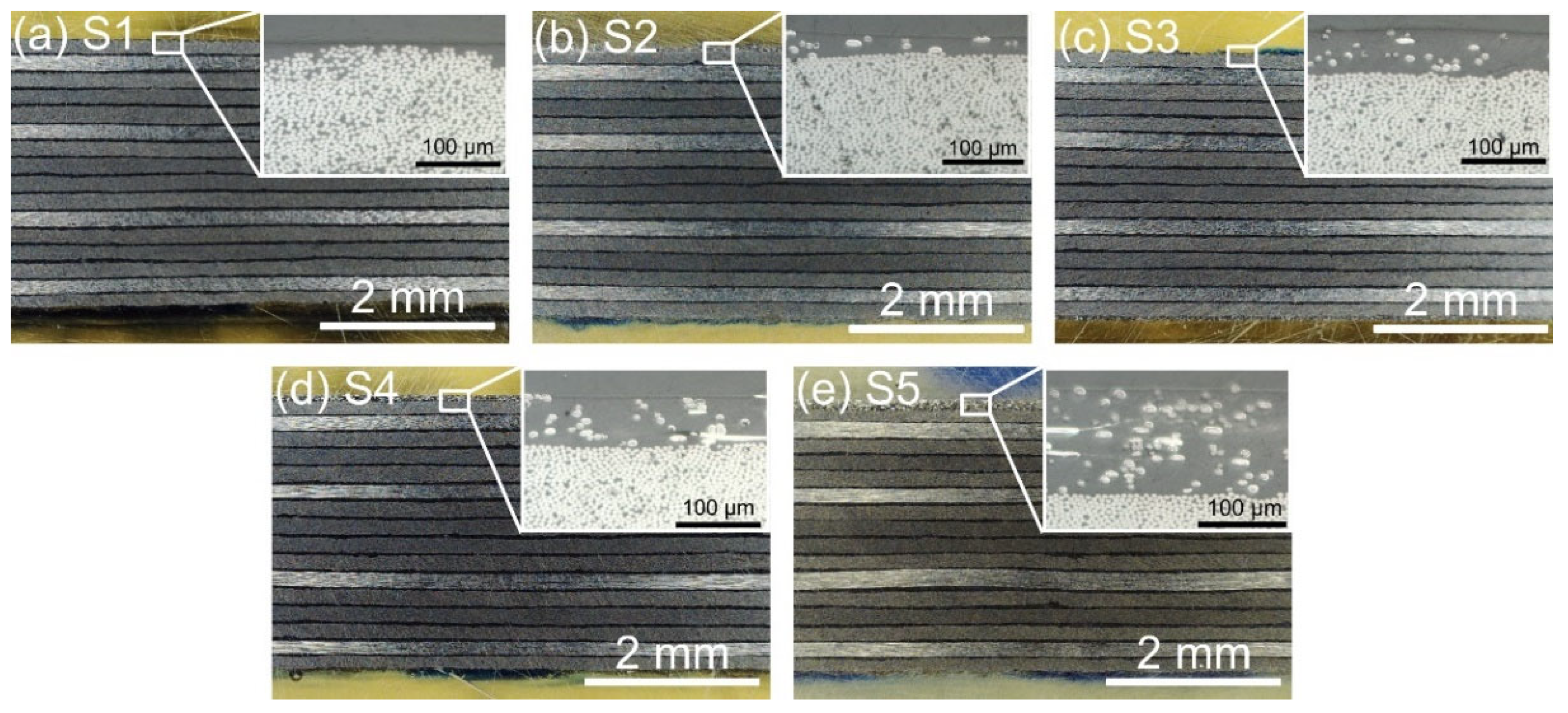
All manufactured laminates exhibited uniform appearances without visible defects. The cross-sectional micrographs of the pristine CFRP laminates are presented in Figure 3, where the individual plies can be identified clearly, accompanied by higher-magnification images that reveal the corresponding microstructures. The thickness of the NiCV LSP layers increased with areal density, measuring approximately 30 μm, 46 μm, 56 μm, and 117 μm, respectively.

2.4. Simulated Lightning Strike Tests

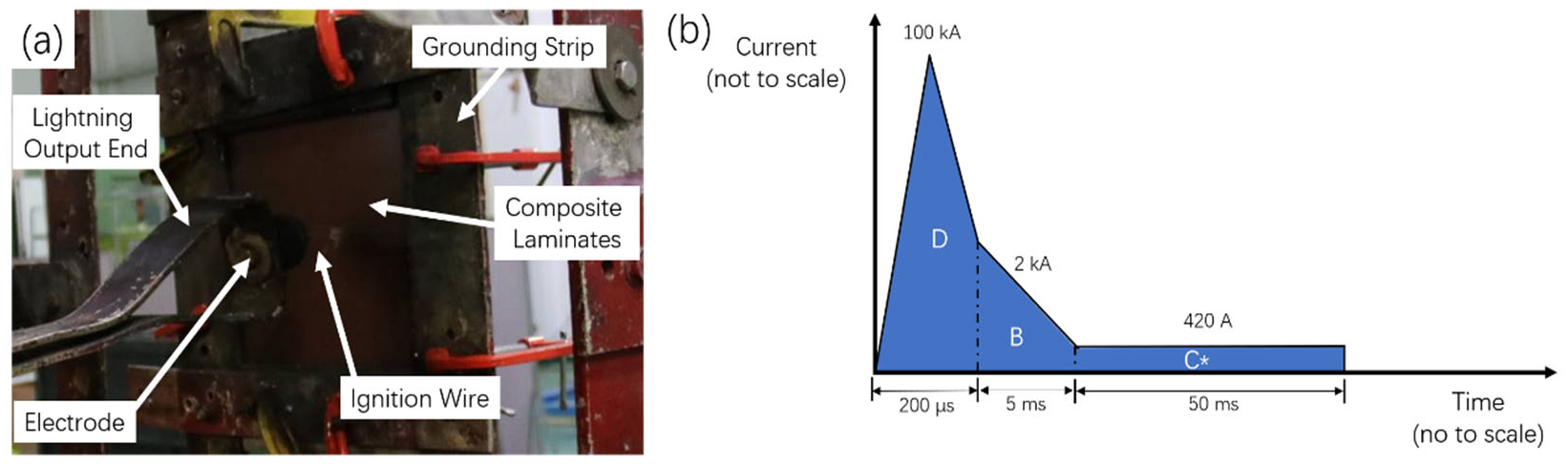
The simulated lightning strike tests were performed using a high-current generation system developed by AVIC Hefei Hangtai Electrophysics Co., Ltd., Hefei, China, in accordance with SAE ARP5412 [20], with one lightning strike test conducted for each composite sample. The setup for the simulated lightning strike tests is shown in Figure 4a. The composite specimen was fixed on insulating supports using aluminum strips and C-clamps to ensure the four edges of the laminate were well grounded. The spherical copper electrode was placed 50 mm higher than the center of the composite specimen, and an ignition wire was used to connect them to guide the charge. In view of potential applications to main fuselage structures, the Zone 2A lightning environment specified in SAE ARP5414 [19] was selected for this test program. Figure 4b shows the simulated lightning waveform, consisting of waveform D (100 kA, 200 μs), waveform B (2 kA, 5 ms), and waveform C* (420 A, 50 ms).

2.5. Compressive Residual Strength (CRS) Tests

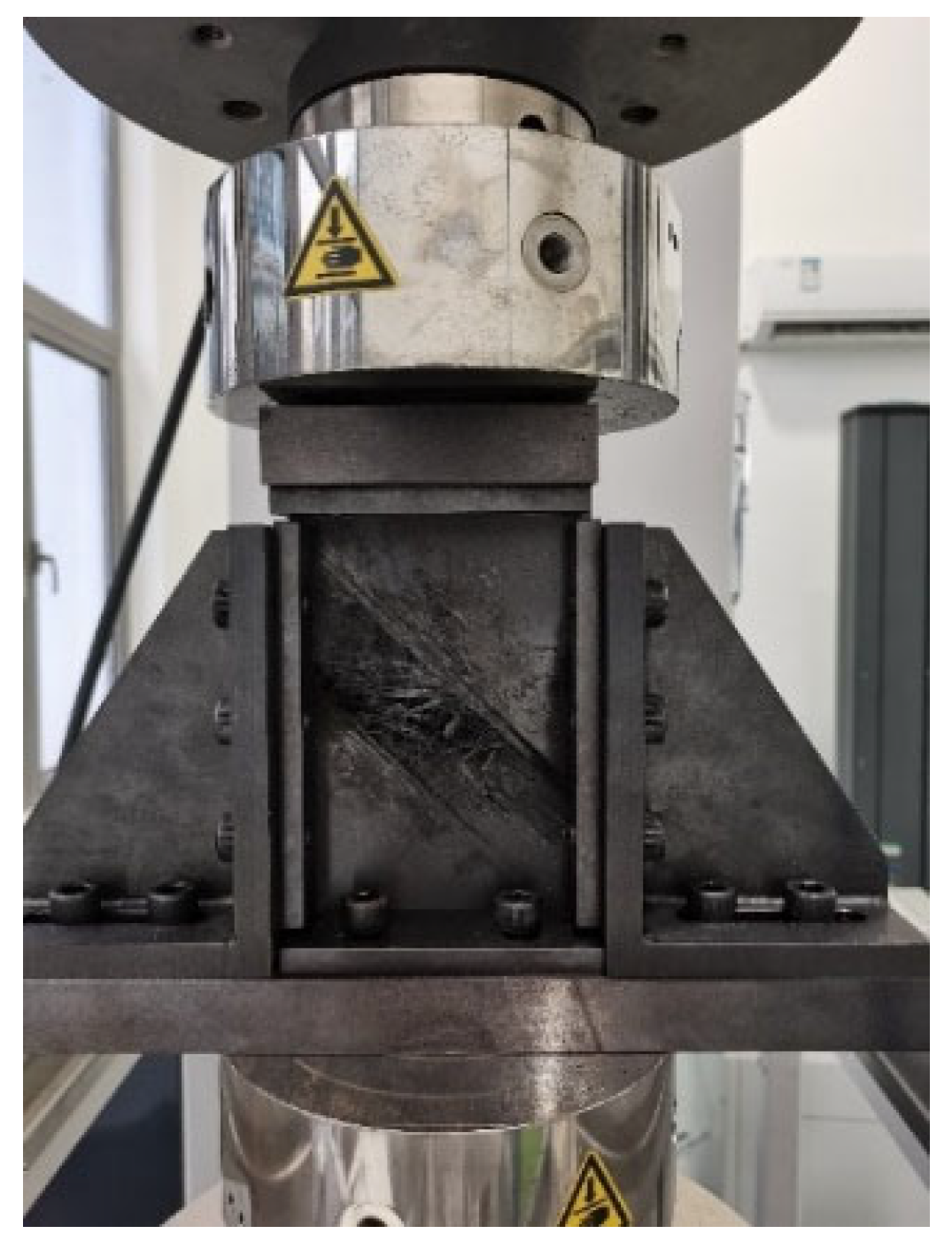
The central damaged regions of each laminate were cut into 100 mm × 150 mm coupons for compressive residual strength (CRS) tests in accordance with ASTM D7137 [21]. An undamaged CFRP laminate (designated Sblank) was also tested to pro-vide a benchmark value. The CRS test setup is shown in Figure 5. Each specimen was mounted in a multi-piece fixture that supported the lower and side edges, while an independent yoke con-strained the top edge to minimize loading eccentricities and suppress buckling.

3. Results and Discussion

3.1. Visual Damage Analysis

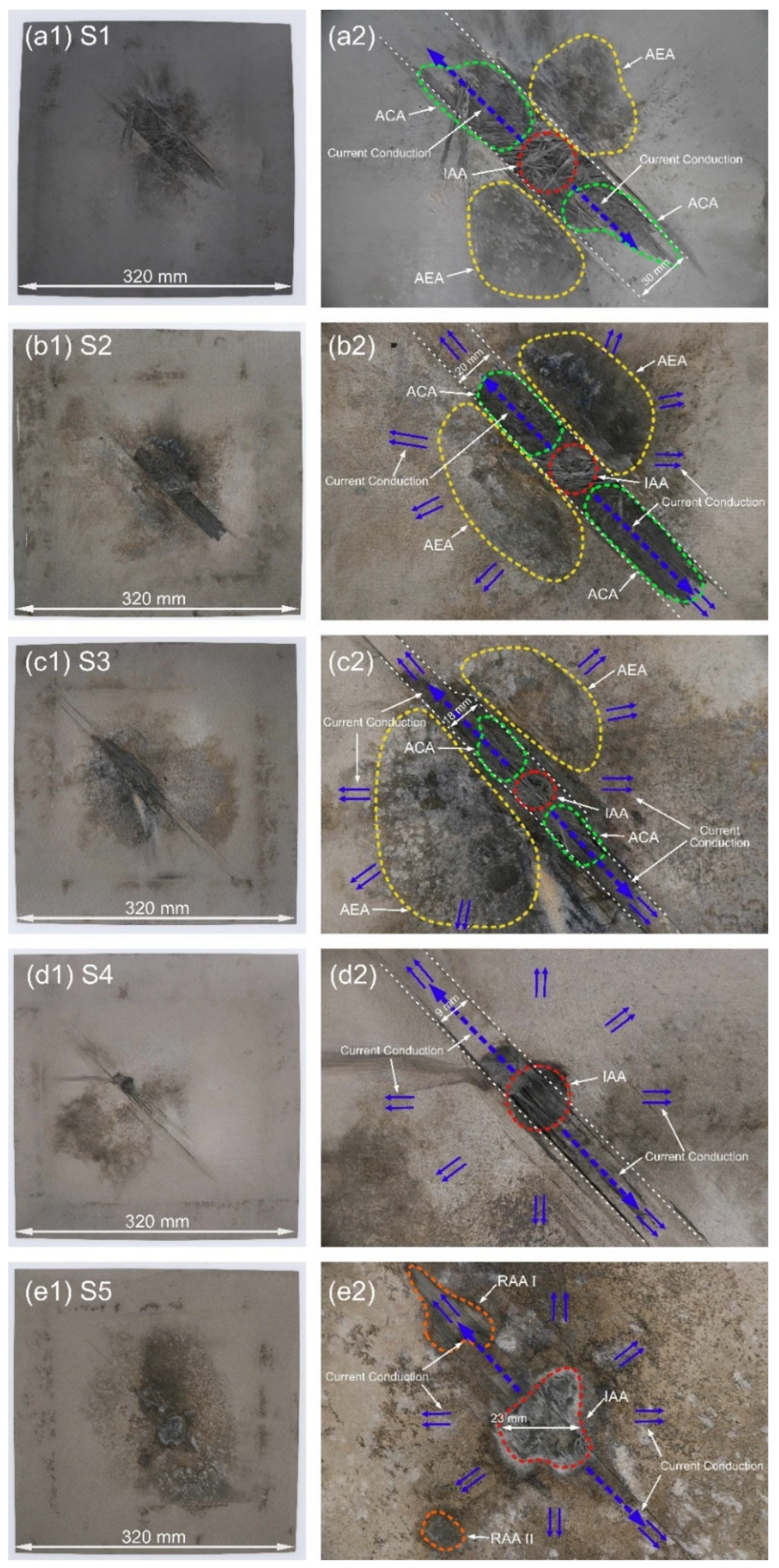
Figure 6 displays the surfaces of the post-strike laminates. The damaged areas can be classified according to their morphological characteristics and designated as the initial attachment area (IAA), attached conduction area (ACA), attached expansion area (AEA), and reattachment area (RAA) [22]. The post-strike control laminate S1 is shown in Figure 6(a1,a2). A pronounced damage zone is visible at the center, featuring an approximately 0.8 mm deep tapered ablation pit (red circle), corresponding to IAA. This severe damage results from the high electrical resistance of the composite, which limits its ability to dissipate the strike current. The resulting concentrated Joule heating during the early formation of the discharge channel caused matrix ablation, as well as carbon-fiber sublimation and rupture, leading to the formation of the pit [23,24].
The remaining damage regions exhibit orthogonal patterns resulting from the orthotropic conductivity of the unidirectional plies. From the IAA, a prominent damage band approximately 160 mm long and 30 mm wide extends along the fiber direction on the surface of the control laminate S1. Within this band, two severe ablation zones, outlined by broken green lines, were identified as the ACA. Owing to their relatively low resistance, these regions conducted most of the strike current, generating substantial Joule heating that induced delamination and fiber tow peeling. Two smaller ablation zones adjacent to the IAA, marked by broken yellow lines, were classified as the AEA. These traces arise from the transverse spread of the discharge channel, which produced subsidiary paths leading to surface ablation, matrix degradation, and substrate carbonization [25].
The laminates S2 and S3, incorporating the lower-areal-density NiCV protection layers, exhibit damage morphologies generally similar to the control laminate S1, as shown in Figure 6(b1–c2). Both display a distinct damage band extending from the IAA (red circle) along the fiber direction in the outermost ply (between the dashed lines). The damage-band width is slightly smaller for laminate S3 at approximately 18 mm, compared with 20 mm for laminate S2. The ACAs are symmetrically distributed along the fiber direction on both sides of the IAA. These regions exhibit pronounced tow peeling, caused by Joule heating dissipated through both the outermost ply (blue dotted arrows) and the NiCV layer (blue solid arrows), leading to severe matrix pyrolysis. Compared with the control laminate S1, laminates S2 and S3 show noticeably smaller damage bands and ACAs, attributable to the NiCV layer providing a more effective current-spreading path, consequently mitigating Joule heating within the CFRP substrate. In contrast, the AEA regions increase progressively from the control laminate to S2 and S3. This expansion is again linked to the relatively conductive NiCV layer, which behaves as a sacrificial surface while shielding the less conductive substrate beneath.
For laminate S4, shown in Figure 6(d1,d2), the damage-band width along the outermost-ply fiber direction (between the broken parallel lines) decreased to 9 mm. The predominant damage mechanism was delamination between the outermost ply and the substrate, which was considerably less severe than the extensive tow peeling observed in laminates S1–S3. This reduction again indicates that a substantial portion of the strike current was dissipated within the NiCV layer rather than entering the carbon ply. No distinct AEA regions were observed; instead, a broad dark ablation zone appeared on the lower left and right sides of the IAA. This ablation is attributed to Joule heating within the NiCV layer, which effectively limits corresponding damage in the CFRP substrate.
Laminate S5, shown in Figure 6(e1,e2), demonstrates that the higher areal density NiCV layer provides markedly improved lightning strike protection. No tow peeling or delamination along the fiber direction is observed, and the IAA contains only a shallow fiber rupture rather than an ablation pit, indicating that damage was confined to the surface of the outermost ply. The relatively large yet shallow IAA further reflects the enhanced capacity of the thicker NiCV layer to dissipate the lightning current. In addition, two RAAs appear on the upper-left and lower-left regions of laminate S5 (outlined by orange dashed lines), a feature absent in the other laminates. In these regions, the surface NiCV layer has disappeared while the underlying carbon ply remains intact. The formation of RAAs suggests that substantial induced charge accumulated on the thicker NiCV layer. As the lightning discharge channel expanded above the surface, the local electric field between the CFRP laminates and the channel reached the breakdown threshold (typically 1–3 kV/mm under atmospheric conditions [25,26]), causing gap breakdown and a secondary attachment on the laminate surface, thereby forming the RAAs [27].

3.2. Non-Destructive Ultrasonic Inspection

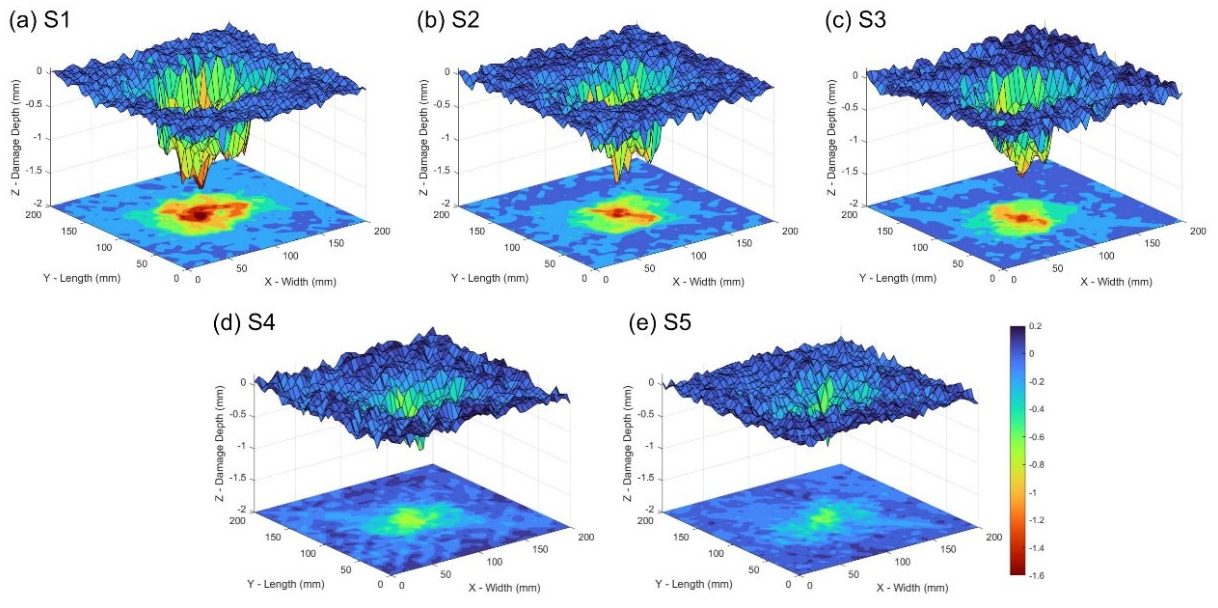
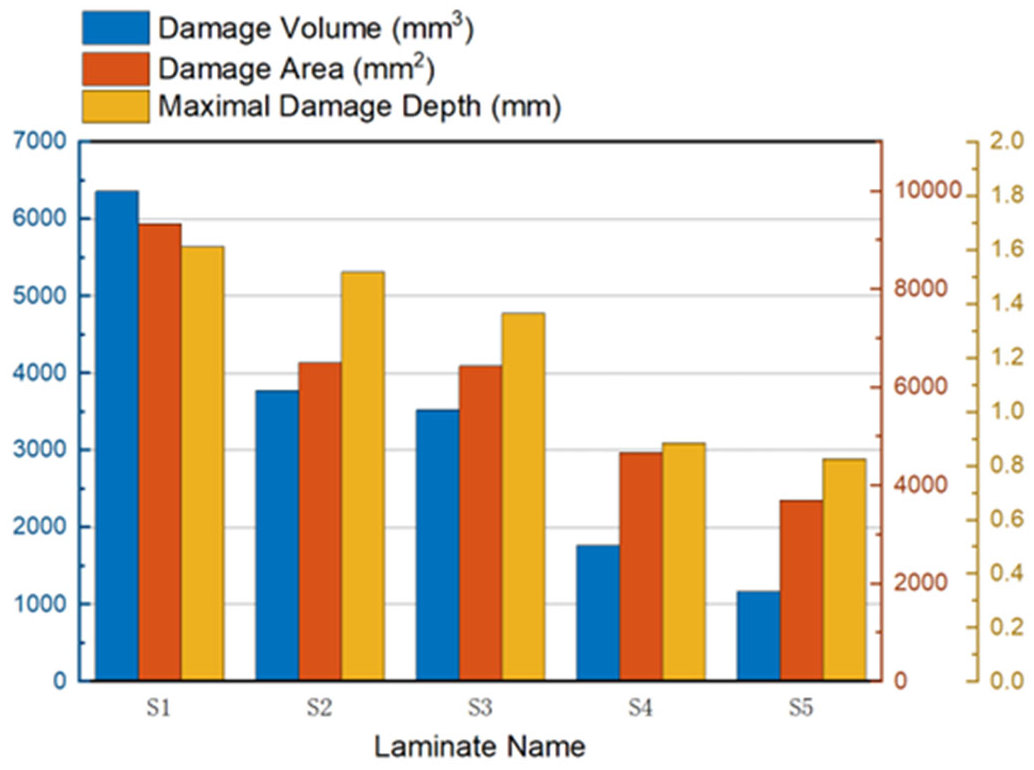
Non-destructive ultrasonic C-scan inspection was performed on each post-strike laminate. Scans were acquired from the undamaged side to map internal damage. The strobing gate was adjusted to capture the bottom-wave signal corresponding to the lower boundary of the undamaged region, enabling reconstruction of the lightning-induced damage morphology, as shown in Figure 7. The damage volume, damage area, and maximum damage depth extracted from the C-scan data are compared in Figure 8.
The C-scan results show a clear, progressive reduction in damage volume, area, and maximum depth with increasing NiCV areal density. The control laminate S1 exhibits the most severe damage across all metrics. Laminates S2 and S3, although protected by the lighter NiCV layers, exhibit substantial reductions in lightning-induced damage. Their damage volumes decrease to 59% and 55% of S1, the damage areas to 70% and 69%, and the maximum damage depths to 94% and 85%, respectively. For the heavier NiCV-protected laminates S4 and S5, the damage volumes decrease to 28% and 18% of S1, the damage areas to 50% and 40%, and the maximum damage depths to 55% and 51%, respectively. In addition, no major damage peak is observed and penetration into the CFRP substrate is minimal, indicating that the heavier NiCV layer confines most of the damage to the laminate surface and effectively protects the CFRP substrate.

3.3. Residual Strength of the Post-Strike Laminates

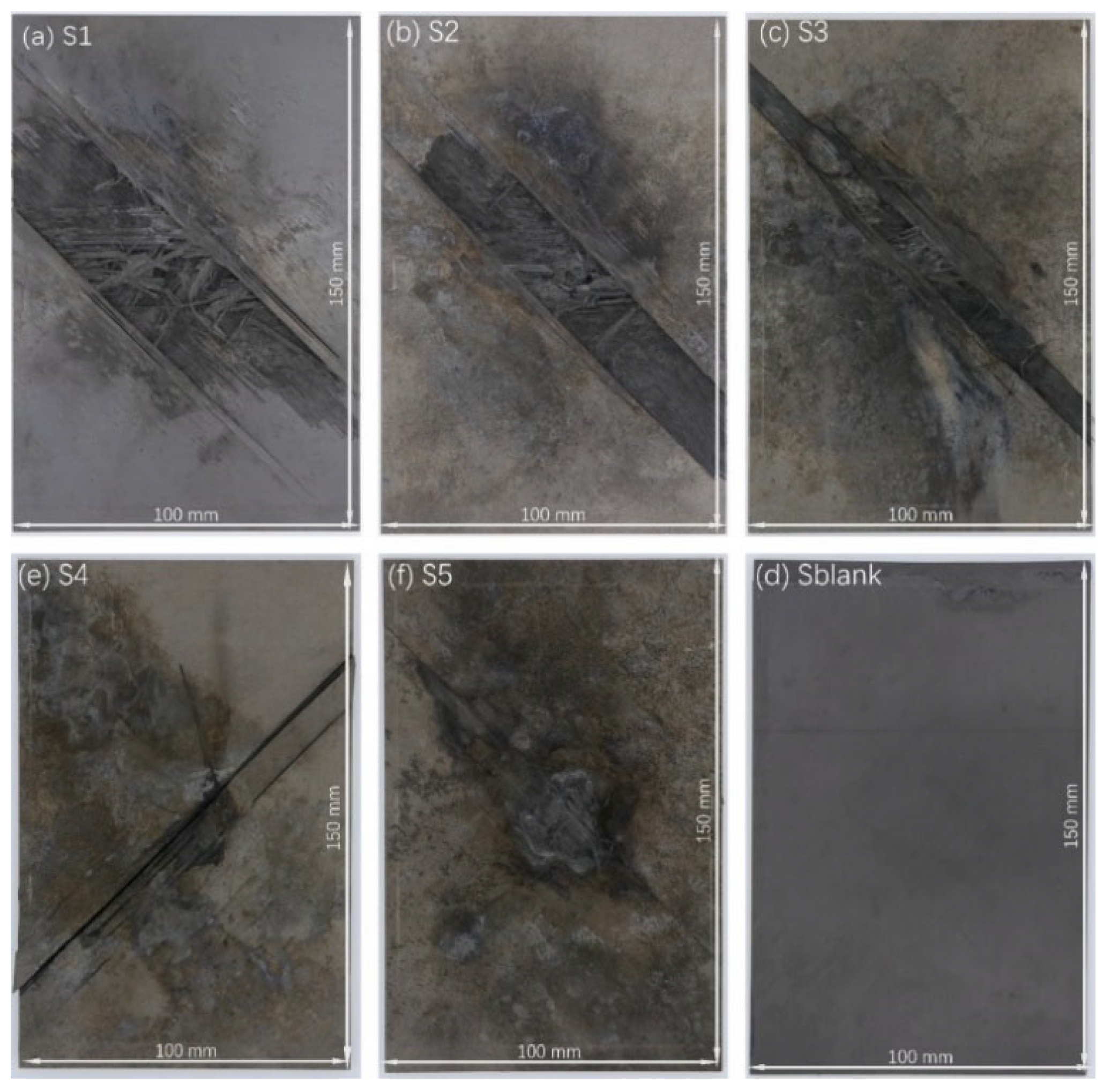
The post-CRS test specimens are presented in Figure 9. All post-strike laminates (S1–S5) failed along a horizontal axis, which is the typical failure mode in CRS testing. In contrast, the reference laminate Sblank failed near its top edge, parallel to its top edge.
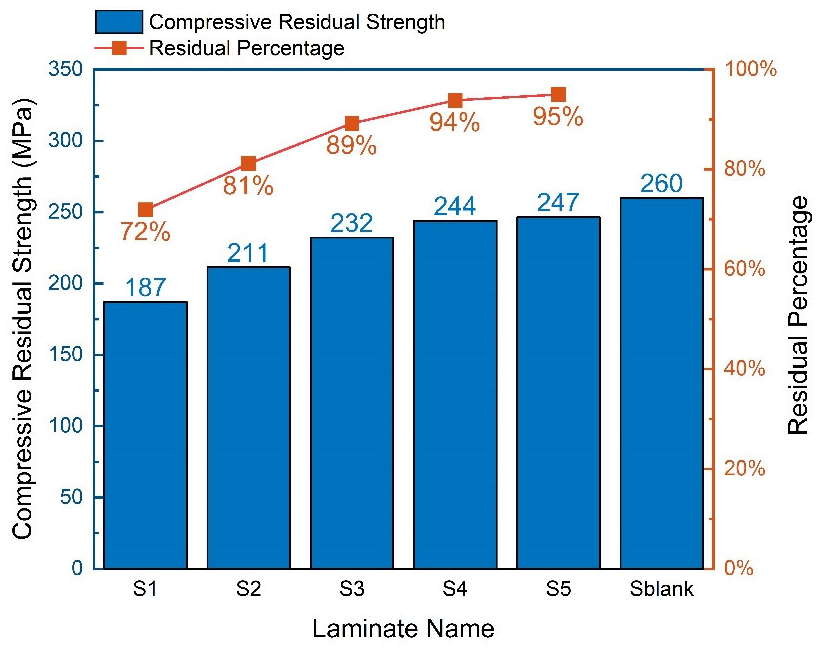
The CRS results are shown in Figure 10. The residual percentage is defined as the ratio of the compressive residual strength to that of the reference laminate Sblank. The data clearly demonstrate that the lightning strike protection provided by the NiCV improves with increasing areal density. The heaviest NiCV-protected laminate, S5, exhibited a CRS value 32% higher than that of the control laminate S1 and retained 95% of the strength of Sblank. These results highlight the strong potential of NiCV as an effective lightweight protection layer for maintaining post-strike structural integrity.

3.4. Microstructure Inspection

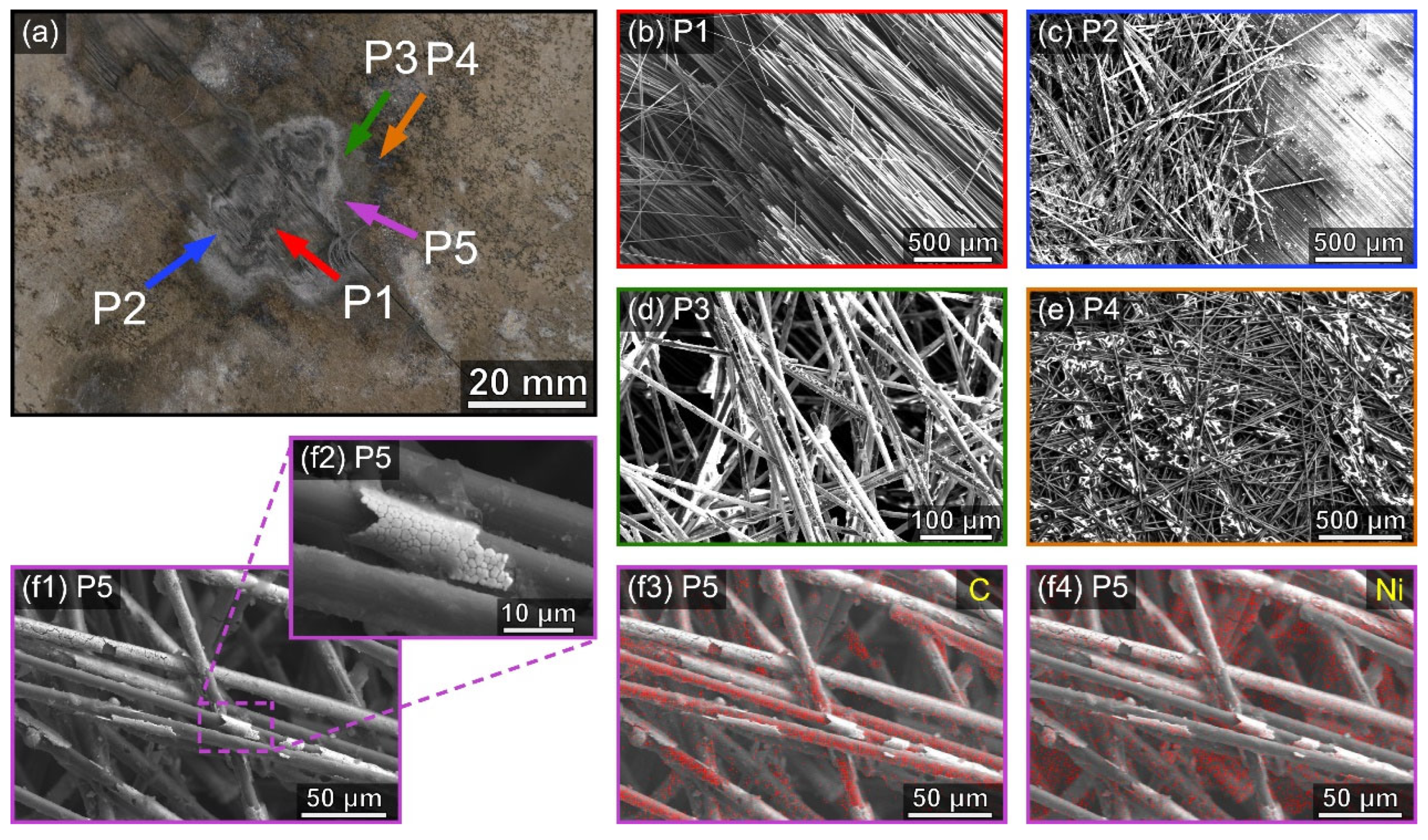
A series of SEM and EDS (Energy Dispersive Spectroscopy) analyses were conducted on the post-strike laminate S5 to elucidate the underlying lightning strike protection (LSP) mechanisms of the NiCV layer, as shown in Figure 11. Five inspection sites, designated P1 to P5, were selected on the laminate surface, as illustrated in Figure 11a.
Site P1 is located near the lightning attachment point, where a slight but noticeable fiber rupture is observed. Tufts of ruptured fibers with smooth surfaces appear in Figure 11b, indicating volatilization of the epoxy resin. The fiber rupture is most likely caused by localized extreme temperatures that induce partial sublimation of the carbon fibers [28]. The presence of smooth fiber surfaces further indicates that, across most of the strike zone—excluding the immediate attachment point—the temperature exceeded the epoxy decomposition temperature (≈400 °C) but remained below the carbon-fiber ablation temperature [29].
Site P2, as shown in Figure 11c, lies at the boundary between the partially damaged NiCV and the fully removed NiCV region, exposing the outermost ply. The exposed carbon fibers remain well ordered and closely packed, with the matrix resin largely intact. Site P3 is located within the remaining NiCV layer, close to the region where the outermost ply was exposed. As shown in Figure 11d, the epoxy matrix in the NiCV layer was completely vaporized, although the non-woven carbon fibers remained intact. While some of the nickel coating was lost in this region, a substantial portion persisted, supported by the strong ablation resistance of the carbon fibers [28]. Site P4, located about 6 mm to the right of P3 (Figure 11e), shows that the NiCV layer remains largely intact, with most of the nickel coating still present. Although much of the epoxy matrix was vaporized, residual resin helped maintain the integrity of the NiCV skeleton. This indicates that the integrity of the protection layer increases markedly with distance from the strike zone.
Site P5, located at the edge of the remaining NiCV layer near the damaged central region, is shown in Figure 11a. The SEM image in Figure 11(f1) reveals no visible epoxy resin, and the nickel coating is largely removed, leaving smooth carbon fiber surfaces. The residual nickel shows cracking, peeling, and other degradation features. An irregular granular structure of exfoliated nickel is also visible in the magnified view in Figure 11(f2), likely arising from the differential thermal expansion between carbon fibers and nickel, combined with the rapid cooling of the latter. EDS results in Figure 11(f3,f4) show the distributions of carbon and nickel, respectively: carbon-rich regions correspond to the darker bare fibers, while nickel peaks align with the brighter fibers where the coating persists. These observations indicate that the NiCV layer undergoes progressive thermal and mechanical degradation near the strike center, ultimately exposing the underlying carbon fibers.

3.5. Lightning Strike Process and Possible LSP Mechanism of NiCV

Lightning strike is a complex process involving multiple interacting physical fields. Joule heating, incident shock waves, and associated electromagnetic forces all contribute to damage formation in CFRP laminates, which manifests as thermal ablation, mechanical failure, and potential electromagnetic effects. However, Joule heating is generally regarded as the dominant damage mechanism [3,22,28].
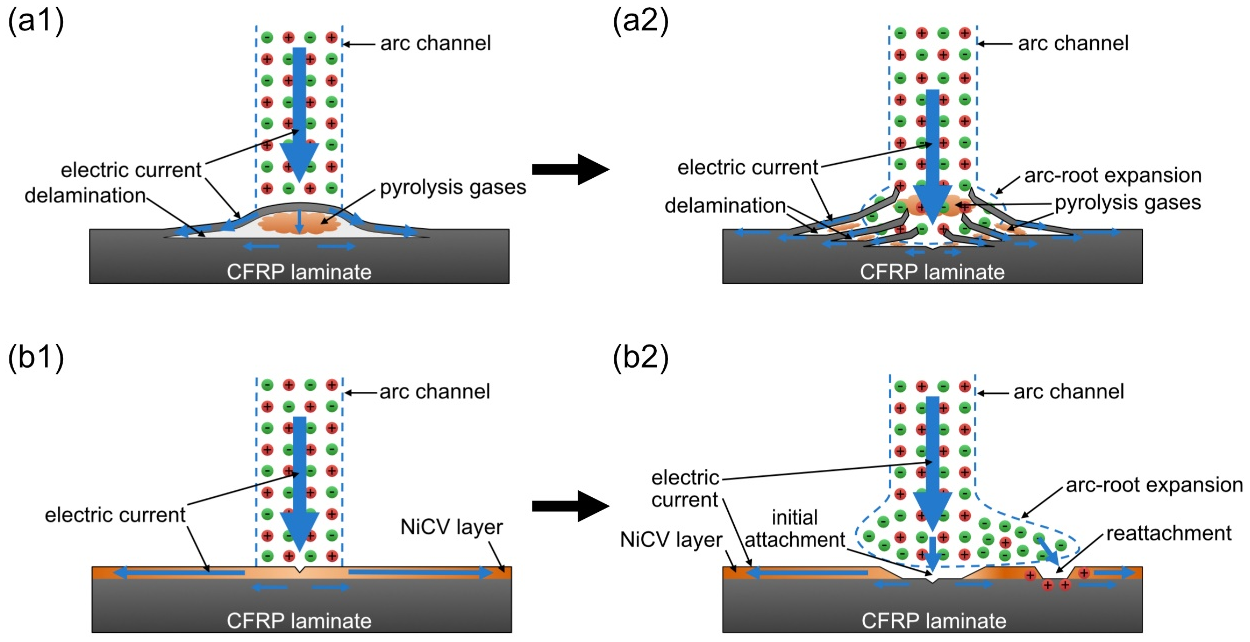
During a lightning strike, the surrounding air breaks down to form a high-temperature plasma channel (arc channel), as illustrated in Figure 12(a1). The rapidly heated air expands and generates a shock wave that impacts the laminate surface [23]. The ensuing current enters the attachment point and, due to the strong anisotropy of carbon fibers, preferentially flows along the fiber direction. The charge also penetrates the interlaminar resin-rich areas, which initially act as dielectric barriers, generating substantial Joule heating that leads to severe resin pyrolysis [28]. The resulting gaseous products generate high internal pressure, driving delamination propagation, as shown in Figure 12(a2).
The protection mechanism of NiCV relies on the higher electrical conductivity of the nickel (c. 1.4 × 10⁷ S/m), compared with the carbon fiber (c. 1.0 × 10⁶ S/m along the fiber axis) [30]. In addition, the nonwoven structure of NiCV provides a three-dimensional conductive network. Hence, the NiCV can dissipate the lightning current efficiently with reduced transmission into the CFRP substrate, as illustrated in Figure 12(b1). Moreover, the carbon fiber skeleton has good ablation resistance due to its high thermal resistance [29] which assists the survivability of the nickel-coating save in the immediate vicinity of the strike point. In addition, the relatively high porosity of the nonwoven NiCV structure likely facilitates rapid venting of pyrolysis gases, thereby reducing delamination between the NiCV layer and the CFRP substrate. In addition, the latent heat consumed during epoxy vaporization removes a significant amount of thermal energy from the laminate, effectively lowering the temperature of the NiCV layer and limiting further damage. Furthermore, other beneficial effects of nickel-coated carbon fiber veils, when used as interleaving layers to enhance through-thickness electrical conductivity and interlaminar fracture toughness, which are both favorable for improving lightning strike protection performance, have been reported in the literature [31].
Meanwhile, the results indicate that NiCV layers with higher areal density have a greater tendency to induce lightning reattachment, as illustrated in Figure 12(b2). This can be attributed to the thicker NiCV layer providing a larger conductive cross-section and producing a rougher scorched surface, as shown in Figure 5 and Figure 11. The damaged surface consists of randomly distributed nickel-coated carbon fibers that create numerous raised tips. A thicker NiCV layer is able to accumulate more charge on these protrusions, and the resulting point effect intensifies the local electric field, thereby increasing the likelihood of lightning reattachment. These reattachments form external discharge channels above the NiCV layer, further reducing the charge transferred into the underlying CFRP substrate.

4. Conclusions

This study demonstrates that lightweight NiCV is an effective lightning strike protection (LSP) layer for CFRP laminates. Damage in the NiCV-protected laminates decreases progressively with increasing NiCV areal density. The laminate protected with a 68 g/m2 NiCV layer exhibits minimal damage, with the damage volume, damage area, and maximum damage depth reduced to 18%, 40%, and 51% of those of the control laminate S1, respectively. Remarkably, despite the NiCV layer being far lighter than conventional expanded copper foils (≥300 g/m2), the laminate retains 95% of the reference compression strength, underscoring the strong capability of lightweight NiCV to preserve post-strike structural performance.
The enhanced protection arises from several synergistic mechanisms. The high electrical conductivity and skin–core coated-fiber structure of the NiCV layer enable efficient dissipation of lightning current. The thermally resistant carbon fibers help maintain the integrity of the nickel coating during the strike, while the resin matrix absorbs heat through pyrolysis and vaporization. In addition, the loose, porous nonwoven structure effectively vents pyrolysis gases, reducing the likelihood of delamination between the NiCV layer and the CFRP substrate. Higher-density NiCV layers can also promote the formation of reattachment discharge channels, further accelerating current dissipation and limiting lightning current penetration into the substrate. Overall, NiCV represents a lightweight, efficient, and scalable protection solution for enhancing the lightning strike protection performance of CFRP aerostructures.

Author Contributions

Conceptualization, M.J., X.L., C.R., G.L., W.L., Z.C. and X.Y.; methodology, M.J.; validation, M.J.; formal analysis, M.J.; investigation, M.J.; resources, X.L. and X.Y.; data curation, M.J.; writing—original draft preparation, M.J.; writing—review and editing, X.L., C.R., G.L., W.L., Z.C. and X.Y.; visualization, M.J.; supervision, X.L., Z.C. and X.Y.; project administration, G.L., W.L. and X.Y.; funding acquisition, X.Y. All authors have read and agreed to the published version of the manuscript.

Funding

This work was funded by the Innovation Fund Project of National Commercial Aircraft Manufacturing Engineering Technology Research Center (COMAC-SFGS-2024-717), and Ningbo Science and Technology Bureau Green Multifunctional Composite Material (Project ID: 2025QL037).

Data Availability Statement

The data presented in this study are available on request from the corresponding author.

Acknowledgments

This work was carried out in ACC-UNNC Joint Laboratory in Sustainable Composite Materials. The authors wish to gratefully acknowledge the support from AVIC Composites Co., Ltd.

Conflicts of Interest

Author Chris Rudd and Xiaosu Yi were employed by Yangtze River Delta Carbon Fiber & Composites Innovation Center. Author Guocai Li and Weiping Liu were employed by Shanghai Aircraft Manufacturing Co., Ltd. (SAMC). Author Zhenghua Cao was employed by AVIC Manufacturing Technology Institute. The remaining authors declare that the research was conducted in the absence of any commercial or financial relationships that could be construed as a potential conflict of interest. The authors declare that this study received funding from AVIC Composites Co., Ltd. The funder was not involved in the study design, collection, analysis, interpretation of data, the writing of this article or the decision to submit it for publication.

Abbreviations

The following abbreviations are used in this manuscript:
LSPlightning strike protection
NiCVnickel-coated carbon fiber nonwoven veil
CFRPcarbon fiber reinforced plastic
IAAinitial attachment area
ACAattached conduction area
AEAattached expansion area
RAAreattachment area
CRScompressive residual strength
ASTMAmerican Society for Testing and Materials
SEMscanning electron microscope
EDSenergy dispersive spectroscopy

References

  1. Larsson, A. The interaction between a lightning flash and an aircraft in flight. Comptes Rendus Phys. 2002, 3, 1423–1444. [Google Scholar] [CrossRef]
  2. Zhao, Z.; Ma, Y.; Yang, Z.; Yu, J.; Wang, J.; Tong, J.; Yi, X.; Moreira, P.; Sguazzo, C. Light weight non-metallic lightning strike protection film for CFRP. Mater. Today Commun. 2020, 25, 101502. [Google Scholar] [CrossRef]
  3. Kumar, V.; Yokozeki, T.; Karch, C.; Hassen, A.A.; Hershey, C.J.; Kim, S.; Lindahl, J.M.; Barnes, A.; Bandari, Y.K.; Kunc, V. Factors affecting direct lightning strike damage to fiber reinforced composites: A review. Compos. Part B Eng. 2020, 183, 107688. [Google Scholar] [CrossRef]
  4. Wang, B.; Duan, Y.; Xin, Z.; Yao, X.; Abliz, D.; Ziegmann, G. Fabrication of an enriched graphene surface protection of carbon fiber/epoxy composites for lightning strike via a percolating-assisted resin film infusion method. Compos. Sci. Technol. 2018, 158, 51–60. [Google Scholar] [CrossRef]
  5. Li, S.; Khan, H.A.; Hihara, L.H.; Cong, H.; Li, J. Corrosion behavior of friction stir blind riveted Al/CFRP and Mg/CFRP joints exposed to a marine environment. Corros. Sci. 2018, 132, 300–309. [Google Scholar] [CrossRef]
  6. Kumar, V.; Yokozeki, T.; Okada, T.; Hirano, Y.; Goto, T.; Takahashi, T.; Hassen, A.A.; Ogasawara, T. Polyaniline-based all-polymeric adhesive layer: An effective lightning strike protection technology for high residual mechanical strength of CFRPs. Compos. Sci. Technol. 2019, 172, 49–57. [Google Scholar] [CrossRef]
  7. Han, J.; Zhang, H.; Chen, M.; Wang, D.; Liu, Q.; Wu, Q.; Zhang, Z. The combination of carbon nanotube buckypaper and insulating adhesive for lightning strike protection of the carbon fiber/epoxy laminates. Carbon 2015, 94, 101–113. [Google Scholar] [CrossRef]
  8. Kumar, V.; Sharma, S.; Pathak, A.; Singh, B.P.; Dhakate, S.R.; Yokozeki, T.; Okada, T.; Ogasawara, T. Interleaved MWCNT buckypaper between CFRP laminates to improve through-thickness electrical conductivity and reducing lightning strike damage. Compos. Struct. 2019, 210, 581–589. [Google Scholar] [CrossRef]
  9. Kumar, S.S.A.; Uddin, M.N.; Rahman, M.M.; Asmatulu, R. Introducing graphene thin films into carbon fiber composite structures for lightning strike protection. Polym. Compos. 2019, 40, E517–E525. [Google Scholar] [CrossRef]
  10. Zhang, B.; Soltani, S.A.; Le, L.N.; Asmatulu, R. Fabrication and assessment of a thin flexible surface coating made of pristine graphene for lightning strike protection. Mater. Sci. Eng. B 2017, 216, 31–40. [Google Scholar] [CrossRef]
  11. Chakravarthi, D.K.; Khabashesku, V.N.; Vaidyanathan, R.; Blaine, J.; Yarlagadda, S.; Roseman, D.; Zeng, Q.; Barrera, E.V. Carbon Fiber–Bismaleimide Composites Filled with Nickel-Coated Single-Walled Carbon Nanotubes for Lightning-Strike Protection. Adv. Funct. Mater. 2011, 21, 2527–2533. [Google Scholar] [CrossRef]
  12. Cauchy, X.; Klemberg-Sapieha, J.-E.; Therriault, D. Hybrid Carbon–Silver Nanofillers for Composite Coatings with Near Metallic Electrical Conductivity. Adv. Eng. Mater. 2018, 20, 1800541. [Google Scholar] [CrossRef]
  13. Xia, Q.; Mei, H.; Zhang, Z.; Liu, Y.; Liu, Y.; Leng, J. Fabrication of the silver modified carbon nanotube film/carbon fiber reinforced polymer composite for the lightning strike protection application. Compos. Part B Eng. 2020, 180, 107563. [Google Scholar] [CrossRef]
  14. Guo, Y.; Xu, Y.; Wang, Q.; Dong, Q.; Yi, X.; Jia, Y. Eliminating lightning strike damage to carbon fiber composite structures in Zone 2 of aircraft by Ni-coated carbon fiber nonwoven veils. Compos. Sci. Technol. 2019, 169, 95–102. [Google Scholar] [CrossRef]
  15. Ming, Y.; Xin, Z.; Zhu, Y.; Zhang, C.; Yao, X.; Sun, J.; Wang, B.; Duan, Y. 3D printed nickel-plated carbon fiber mesh for lightning strike protection. Mater. Lett. 2021, 294, 129809. [Google Scholar] [CrossRef]
  16. Zhu, H.; Chang, L.; Fu, K.; Li, Y. Dual conductive network of nickel-coated carbon fiber woven fabric for indirect and direct lightning strike protection of carbon fiber reinforced polymer composites. Polym. Compos. 2022, 43, 4437–4446. [Google Scholar] [CrossRef]
  17. Langot, J.; Gourcerol, E.; Serbescu, A.; Brassard, D.; Chizari, K.; Lapalme, M.; Desautels, A.; Sirois, F.; Therriault, D. Performance of painted and non-painted non-woven nickel-coated carbon fibers for lightning strike protection of composite aircraft. Compos. Part A Appl. Sci. Manuf. 2023, 175, 107772. [Google Scholar] [CrossRef]
  18. Pierozynski, B.; Smoczynski, L. Electrochemical corrosion behavior of nickel-coated carbon fiber materials in various electrolytic media. J. Electrochem. Soc. 2008, 155, C427. [Google Scholar] [CrossRef]
  19. SAE ARP5414; Aircraft Lightning Zoning, Aerospace Recommended Practice 5414. SAE International: Warrendale, PA, USA, 2005.
  20. SAE AR5412; Aircraft Lightning Environment and Related Test Waveforms, Aerospace Recommended Practice 5412. SAE International: Warrendale, PA, USA, 2005.
  21. ASTM D7137/D7137M; D7137 Standard Test Method for Compressive Residual Strength Properties of Damaged Polymer Matrix Composite Plates. ASTM International: Washington, DC, USA, 2012.
  22. Liu, Z. Analysis of Electro-Magneto-Thermo-Structural Coupling Effects on Composite Laminate in Lightning Environment. Ph.D. Thesis, Northwestern Polytechnical University, Xi’an, China, 2014. [Google Scholar]
  23. Wang, B.; Zhu, Y.; Ming, Y.; Yao, X.; Tian, X.; Ziegmann, G.; Duan, Y.; Sun, J. Understanding lightning strike induced damage mechanism of carbon fiber reinforced polymer composites: An experimental study. Mater. Des. 2020, 192, 108724. [Google Scholar] [CrossRef]
  24. Li, Y.; Sun, J.; Li, S.; Tian, X.; Yao, X.; Wang, B.; Zhu, Y.; Chen, J. Experimental study of the damage behaviour of laminated CFRP composites subjected to impulse lightning current. Compos. Part B Eng. 2022, 239, 109949. [Google Scholar] [CrossRef]
  25. Boushab, D.; Gharghabi, P.; Lee, J.; Lacy, T.E.; Pittman, C.U.; Mazzola, M.S.; Velicki, A. Lightning arc channel effects on surface damage development on a PRSEUS composite panel: An experimental study. Compos. Part B Eng. 2021, 224, 109217. [Google Scholar] [CrossRef]
  26. Chemartin, L.; Lalande, P.; Peyrou, B.; Chazottes, A.; Elias, P.; Delalondre, C.; Cheron, B.G.; Lago, F. Direct effects of lightning on aircraft structure: Analysis of the thermal, electrical and mechanical constraints. Aerospace Lab 2012, 5, 1–15. [Google Scholar]
  27. Larsson, A.; Delannoy, A.; Lalande, P. Voltage drop along a lightning channel during strikes to aircraft. Atmos. Res. 2005, 76, 377–385. [Google Scholar] [CrossRef]
  28. Ogasawara, T.; Hirano, Y.; Yoshimura, A. Coupled thermal–electrical analysis for carbon fiber/epoxy composites exposed to simulated lightning current. Compos. Part A Appl. Sci. Manuf. 2010, 41, 973–981. [Google Scholar] [CrossRef]
  29. Abdelal, G.; Murphy, A. Nonlinear numerical modelling of lightning strike effect on composite panels with temperature dependent material properties. Compos. Struct. 2014, 109, 268–278. [Google Scholar] [CrossRef]
  30. Zhao, Q.; Zhang, K.; Zhu, S.; Xu, H.; Cao, D.; Zhao, L.; Zhang, R.; Yin, W. Review on the electrical resistance/conductivity of carbon fiber reinforced polymer. Appl. Sci. 2019, 9, 2390. [Google Scholar] [CrossRef]
  31. Liu, H.; Guo, Y.; Zhou, Y.; Wan, G.; Chen, Z.; Jia, Y. Multifunctional nickel-coated carbon fiber veil for improving both fracture toughness and electrical performance of carbon fiber/epoxy composite laminates. Polym. Compos. 2021, 42, 5335–5347. [Google Scholar] [CrossRef]
Figure 1. Optical microscope images (first row) and SEM images (second row) of NiCV-11 (a1,a2), NiCV-17 (b1,b2), and NiCV-34 (c1,c2).
Jcs 10 00069 g001
Figure 2. The curing system of autoclave process.
Jcs 10 00069 g002
Figure 3. Cross-sectional micrographs of pristine CFRP laminates.
Jcs 10 00069 g003
Figure 4. (a) The device setup for the lighting strike test, and (b) the waveform components.
Jcs 10 00069 g004
Figure 5. Test setup for the compressive residual strength (CRS) measurement.
Jcs 10 00069 g005
Figure 6. Surface photographs of post-strike CFRP laminates: (a1e1) overall views, (a2e2) damage-zone details.
Jcs 10 00069 g006
Figure 7. C-scan results for the post-strike CFRP laminates.
Jcs 10 00069 g007
Figure 8. Damage volume, damage area, and maximal damage depth of the post-strike CFRP laminates.
Jcs 10 00069 g008
Figure 9. Post-CRS test photographs of the CFRP laminates.
Jcs 10 00069 g009
Figure 10. Compressive residual strength and residual percentage of post-strike and blank composite laminates.
Jcs 10 00069 g010
Figure 11. SEM and EDS images of post-strike laminate S5: (a) SEM and EDS inspection sites on laminate S5, (bf2) SEM images of sites P1–P5, (f3) EDS map of site P5 showing carbon (C), (f4) EDS map of site P5 showing nickel (Ni).
Jcs 10 00069 g011
Figure 12. Schematic illustrations of the lightning strike process for the CFRP laminate (a1,a2) and the NiCV-protected CFRP laminate (b1,b2).
Jcs 10 00069 g012
Table 1. Summary of CFRP laminates.
Laminate NameLSP LayerStacking SequenceSize
S1None[45/0/−45/90]2S320 × 320 mm2
S2NiCV-11[45/0/−45/90]2S320 × 320 mm2
S3NiCV-17[45/0/−45/90]2S320 × 320 mm2
S4NiCV-34[45/0/−45/90]2S320 × 320 mm2
S52 layers of NiCV-34[45/0/−45/90]2S320 × 320 mm2
Disclaimer/Publisher’s Note: The statements, opinions and data contained in all publications are solely those of the individual author(s) and contributor(s) and not of MDPI and/or the editor(s). MDPI and/or the editor(s) disclaim responsibility for any injury to people or property resulting from any ideas, methods, instructions or products referred to in the content.