


Abstract
Sulfate attack causes premature deterioration of reinforced concrete in arid and semi-arid regions through the formation of expansive gypsum and ettringite. This study combines local mineral additions and steel fibers to improve the strength and sulfate durability of materials made with regional resources from Béchar, Algeria. Three concretes were tested: ordinary concrete (BO), high-performance concrete (HPC), and steel-fiber-reinforced HPC (SFHPC), which contains silica fume at 8.1% of the cement mass (34 kg/m3) and 40 kg/m3 of corrugated steel fibers, together with a mortar in which 25% of the cement was replaced by ground industrial slag. The concretes were tested in compression and splitting tension after 28 days in potable water or 10% sodium sulfate solution; the mortar was tested in compression and flexure at 14 and 28 days and after two years of burial in sulfate soil. Sulfate curing lowered compressive strength by 9.32% (BO), 20.76% (HPC), and 10.97% (SFHPC), and splitting tensile strength by 19.81%, 18.19%, and 11.30%, respectively. SFHPC thus lost about half as much compressive strength as HPC and the least tensile strength, although its relative compressive loss slightly exceeded that of BO, whose absolute strength was about three times lower. Visually, SFHPC specimens remained held together by fibers after cracking, while BO failed by brittle spalling. After two years in soil containing 35% sodium sulfate, the mortar had a compressive strength 0.87% above and a flexural strength 14.78% below its 28-day values. Without same-age sulfate-free controls, these changes combine continued hydration and sulfate effects and do not directly measure sulfate resistance. Combining a dense, low water-to-binder matrix with steel-fiber crack control therefore appears promising for limiting early-age strength loss under sulfate exposure. Because the mixtures differ in several parameters, the separate effects of silica fume, water-to-binder ratio, and fibers could not be isolated, and longer exposure is needed to confirm long-term resistance. The approach also uses local and by-product materials for durable, low-clinker infrastructure.
1. Introduction
The durability of reinforced concrete structures subjected to chemically aggressive environments is a major technological, economic, and environmental challenge in civil engineering [1]. In arid and semi-arid regions, the presence of sulfates in soils, groundwater, and certain industrial effluents can cause premature deterioration of foundations, hydraulic structures, sewer networks, and transport infrastructure [2]. External sulfate attack is characterized by the progressive penetration of SO42− ions into the pore network of the cementitious matrix, where they react with certain cement hydration products to form mainly gypsum and secondary ettringite [3]. The accumulation of these expansive phases generates internal tensile stresses, material expansion, progressive microcracking, and severe long-term reductions in mechanical performance [4].
The studies of Neville [1] and Santhanam et al. [2,3], supported by the literature reviews of Whittaker and Black [4], Jabbour et al. [5], and Zhang et al. [6], show that concrete resistance to sulfate attack does not depend solely on the chemical composition of the cement. It is also governed by porosity, pore-network connectivity, and transport properties of the cementitious matrix, as well as crack initiation and propagation [1,2,3,4,5,6,7]. Thus, matrix densification and crack control represent two complementary and inseparable strategies for slowing sulfate-ion penetration and preserving concrete performance during exposure [1,2,3,4,5,6,8,9].
To address this dual challenge, the incorporation of mineral additions and reinforcement with steel fibers represent preferred approaches [7]. Owing to its high fineness and high amorphous silica content, silica fume produces a physical filler effect and promotes the pozzolanic reaction, forming additional cementitious hydrates. These mechanisms contribute to refining the pore structure, densifying the high-performance concrete (HPC) matrix, and reducing its permeability [7,8,9]. On the other hand, although HPC provides a highly compact matrix, the introduction of steel fibers limits crack opening and propagation, which constitute preferential pathways for the penetration of aggressive agents [10,11,12]. The bridging mechanism provided by the fibers enables stress transfer across cracks and improves tensile strength, toughness, ductility, and post-cracking behavior of concrete [10,11,12,13,14,15]. The combination of silica fume and steel fibers therefore aims to combine cementitious-matrix densification with improved crack control in order to preserve durability in a sulfate environment [13,14,15,16,17,18,19]. Recent work on hybrid binders points in the same direction: combining silica fume with nano-silica and Class F fly ash in ternary and quaternary binders was shown to affect fracture toughness and post-peak behavior as well as strength, which underlines that strength and ductility have to be balanced when a mixture is designed [20].
At the same time, the valorization of industrial residues is part of an eco-design and sustainable-development approach for cementitious materials [21]. The use of ground industrial slag from local power plants as a partial cement replacement promotes clinker reduction and limits the amount of waste destined for storage [21,22,23,24]. Its valorization is based on the presence of siliceous and aluminous phases capable of reacting with calcium hydroxide released during cement hydration, progressively improving matrix compactness and mechanical-strength development [23,24]. However, the suitability of these slags for use as a pozzolanic addition must be established from their physical, chemical, and mineralogical characteristics and their reactivity [23,24]. Related evidence comes from alkali-activated concretes, in which nano-sized industrial by-products (nano-fly ash, nano-slag, and nano-bentonite) were reported to improve mechanical performance and resistance to acid, sulfate, and chloride exposure [25]. Because the binder chemistry differs from that of Portland cement, these results are only indicative for the materials studied here.
Despite the progress made in this field, the effects of mineral additions and steel fibers are still frequently investigated separately [7,8,9,10,11,12,13,14,15,16,17,18,19]. In addition, sulfate resistance is generally evaluated over the medium or long term using indicators such as expansion, mass variation, or strength loss, without always providing a sufficiently comprehensive initial characterization of the material [1,2,3,4,5,6,13,14,15,16,17,18,19]. Establishing an initial mechanical reference state is therefore essential for correctly interpreting material evolution after prolonged exposure to a sulfate environment [16,17,18].
The present study directly addresses this issue. The main objective is to experimentally evaluate two distinct cementitious systems incorporating mainly materials and by-products from the Béchar region (southwestern Algeria), following a strategy aimed at valorizing local resources and reducing supply distances:
- A pozzolanic mortar incorporating industrial slag: This first system uses ground industrial slag as a partial replacement for cement. Its characterization, performed in the initial fresh and hardened states, aims to determine the influence of the slag on workability, matrix compactness, and mechanical-strength development [23,24].
- A high-performance concrete (HPC) reinforced with steel fibers: The second system combines silica fume and corrugated steel fibers marketed by GRANITEX (Algiers, Algeria), 50 mm long, incorporated at 40 kg/m3 (~0.51% by volume). Their geometry promotes mechanical anchorage within the matrix and improves post-cracking behavior. The HPC formulation is based on local aggregates and follows the principles of Dreux and Festa [26].
The experimental program includes comprehensive initial characterization of the materials to establish a reference state, followed by evaluation of the physical and mechanical performance and post-cracking behavior of the mortar and HPC under two exposure regimes: 28 days of curing in a 10% sodium sulfate solution, compared with potable water, for the concretes (an early-age comparison of curing environments), and two years of burial in sulfate soil for the mortar. The three concretes are compared as complete mix designs; the program was not designed to isolate the separate contributions of silica fume, water-to-binder ratio, and steel fibers, except for the HPC–SFHPC pair, which differs only in the presence of fibers.
2. Materials and Experimental Program
The Béchar region has a wide range of mineral resources suitable for construction materials. Once extracted, these resources undergo various processing operations (crushing, grinding, sieving, and particle-size classification). These operations produce the different fractions required for concrete and mortar formulation, such as sands and coarse aggregates.
In this study, this local availability is utilized through the use of aggregates from the Béchar region, complemented by two different mineral additions. These are silica fume used in high-performance concrete and ground industrial slag added as a pozzolanic addition in mortars.
This strategy serves a dual purpose. On the one hand, it aims to develop cementitious materials whose mechanical performance and durability are suited to their intended service conditions; on the other hand, it investigates the possibility of valorizing locally available resources and by-products. It also promotes the use of local resources, the valorization of industrial waste, and reduced Portland cement consumption [21,22,23,24]. This approach is consistent with current strategies for developing cementitious materials with lower clinker contents and improved durability [21].
2.1. Origin of the Materials
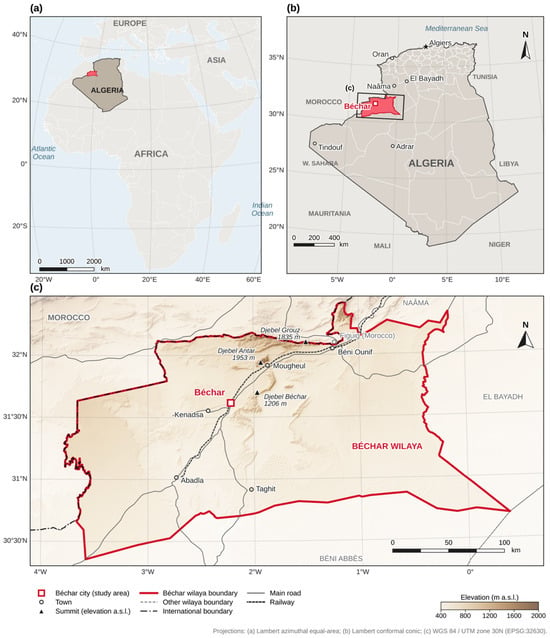
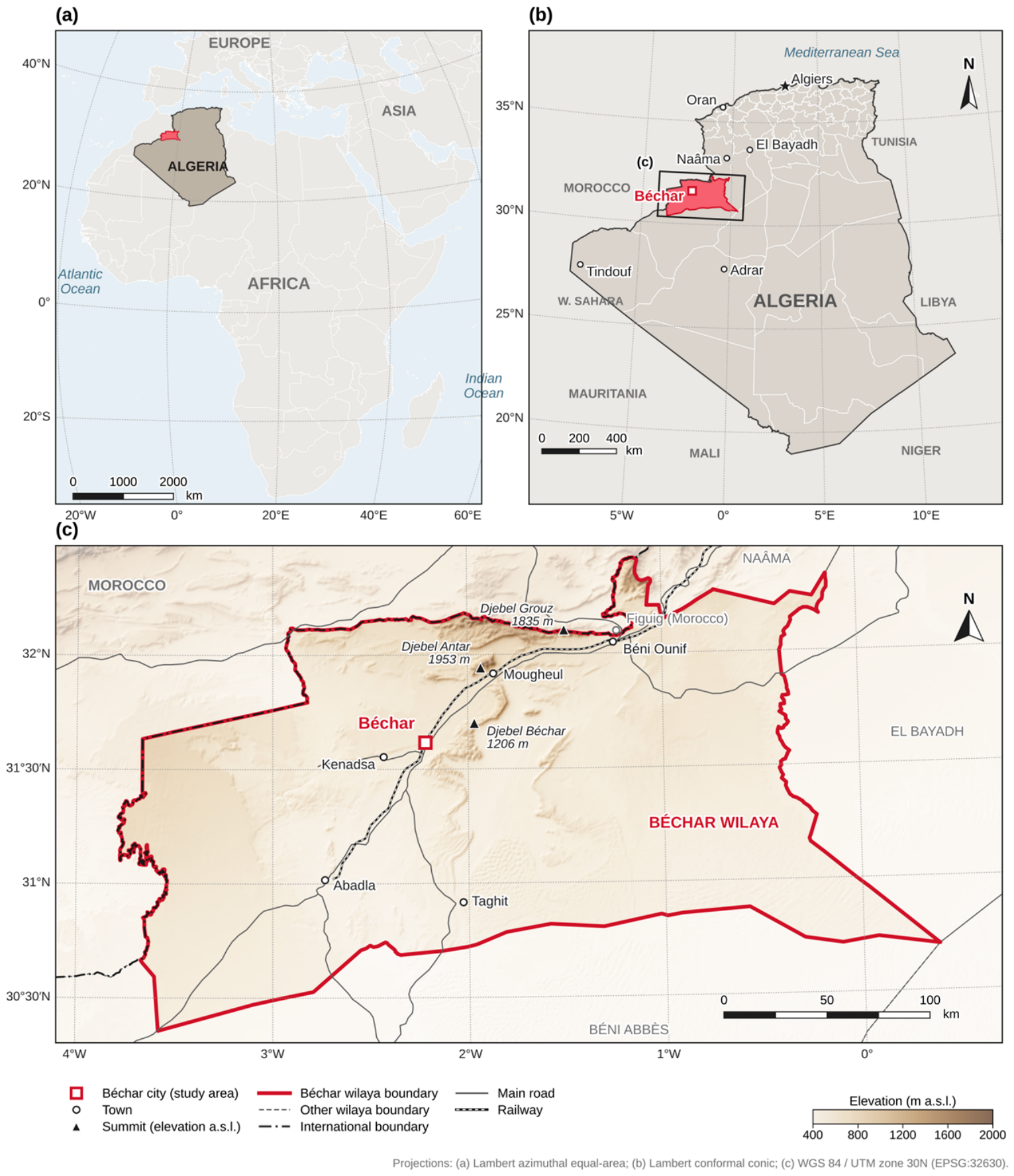
The Béchar wilaya is located in southwestern Algeria, approximately 1150 km from Algiers by road, in a transition zone between the High Plateaus to the north and the Saharan domain to the south (Figure 1a,b). Following the administrative reorganizations of 2019 and 2026, which raised the number of Algerian wilayas to 69, the territory of Béchar was reduced by the creation of the separate wilaya of Béni Abbès. In its current configuration, it borders Morocco to the west and northwest, the wilaya of Naâma to the north, El Bayadh to the east and Béni Abbès to the south (Figure 1c), and covers approximately 49,600 km2. The city of Béchar, capital of the wilaya, lies at about 31°37′ N, 2°13′ W, at the southern foot of a chain of mountains that separates the High Plateaus from the Saharan platform. Its main summits, Djebel Antar, Djebel Grouz and Djebel Béchar, are described below and shown in Figure 1c. Béchar is connected to northern Algeria by the national road network and by the railway that runs through Mougheul and Béni Ounif toward the High Plateaus. Southward, the same corridor continues to Abadla and the Saoura valley, toward the Saharan regions. This position gives the wilaya a strategic role as one of the main access routes to the country’s Saharan regions. It also makes Béchar a regional center for the production and supply of construction materials, which explains the interest of using its local mineral resources in cementitious materials.
Figure 1.
Geographical location of the study area: (a) Algeria in Africa; (b) Béchar wilaya within Algeria’s 69 wilayas; (c) Béchar wilaya, with relief, main summits, settlements and transport network.
Its geological setting is characterized by several mountain ranges, notably Djebel Antar, which reaches 1953 m in elevation, Djebel Grouz, which reaches 1835 m, and Djebel Béchar, whose elevation reaches 1206 m. This geological and geomorphological diversity partly explains the abundance of mineral resources available in the region and their potential for use in construction materials.
2.2. Identification of Constituents
The aggregates, including sand and coarse fractions, used in the present study were selected with priority given to local availability. The coarse aggregates consist of crushed limestone from Djebel Béchar, while the natural sand with a 0/3 mm fraction comes from Oued Hassi 20, located approximately 20 km north of Béchar. These materials form the granular skeleton of the concretes and mortars studied. They generally represent 70–80% of the total concrete volume and have a decisive influence on workability, compactness, mechanical strength, and durability.
Before incorporation, the aggregate constituents were experimentally characterized in terms of their main physical and geometrical properties to verify their suitability for use and ensure reproducible formulations.
The choice of regional resources is also relevant from an environmental perspective. Indeed, using materials available close to production sites can help reduce transport distances and, consequently, part of the impacts associated with raw-material supply. More broadly, this approach is consistent with current strategies aimed at developing more sustainable cementitious materials and reducing clinker consumption [21].
2.2.1. Mineral Additions
Two mineral additions are investigated. The first is silica fume, intended for high-performance concrete; the second is ground industrial slag incorporated into mortars. The functions of these additions are not identical. They are studied separately to evaluate their respective influence on the microstructure and performance of the formulations for which they are intended. Silica fume primarily aims to densify the matrix and reduce transport properties, whereas the slag is investigated as an industrial resource capable of developing pozzolanic activity.
- (a)
- Silica Fume:
Silica fume is an ultrafine by-product of silicon and ferrosilicon-alloy production and is widely used in high-performance concrete. It consists mainly of amorphous silica and exhibits high pozzolanic activity. Physically, its very high fineness gives it a commonly known filler effect, which improves particle packing and reduces pore volume within the cementitious matrix [7,8].
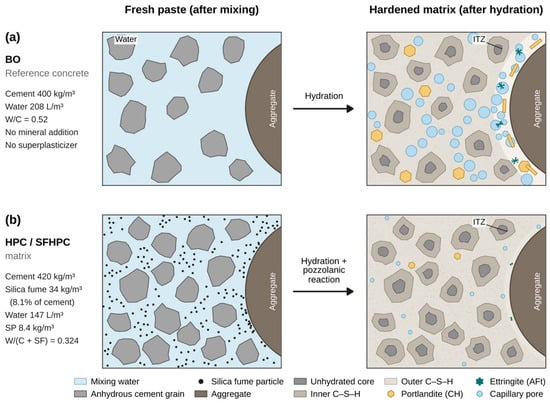
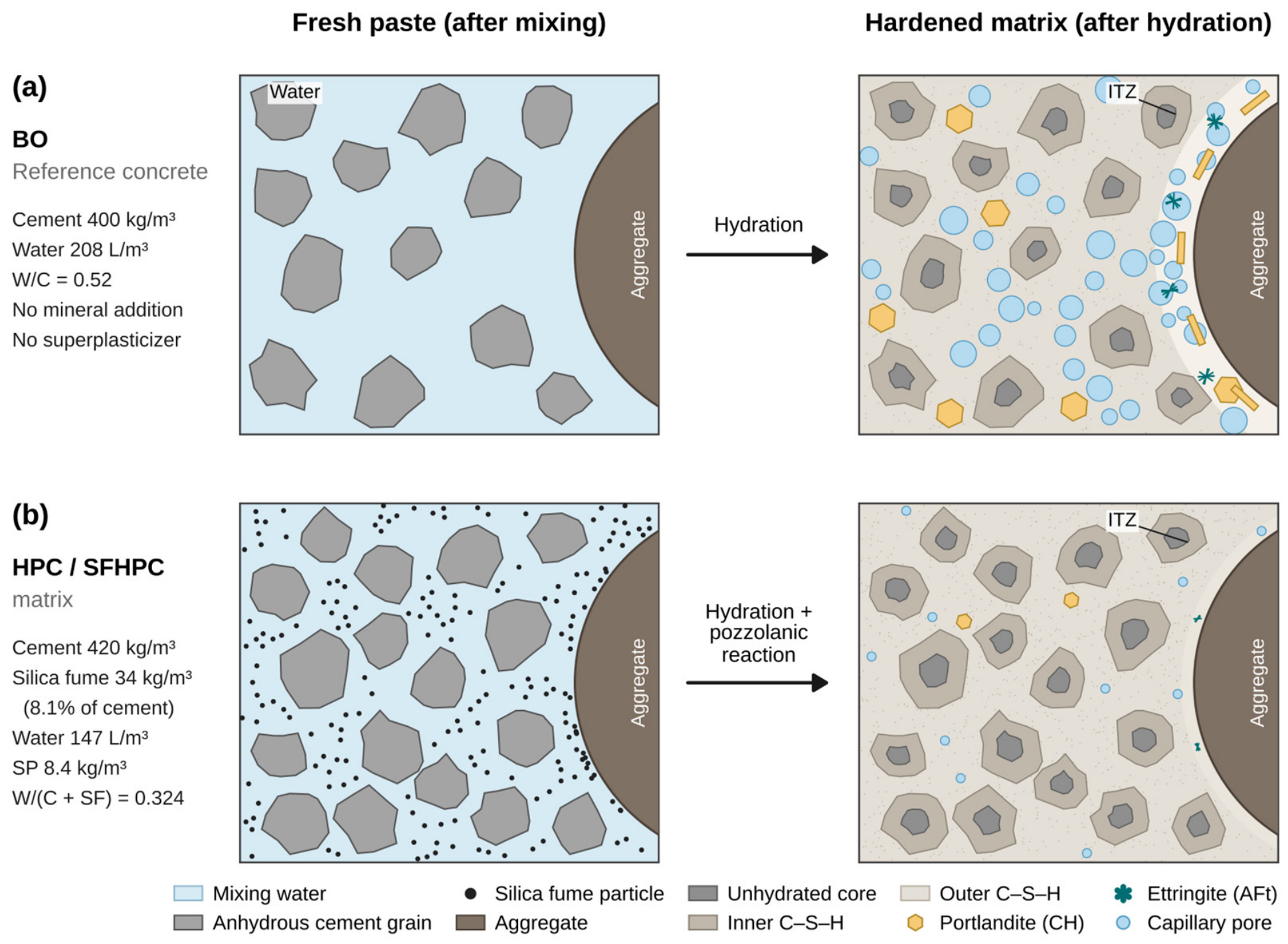
During cement hydration in the presence of water, amorphous silica reacts with the released calcium hydroxide to form additional hydrates, mainly of the C–S–H type (Figure 2). This reaction, combined with the filler effect, leads to refinement of the pore network and improvement of the transition zone between the cement paste and aggregates. Reducing porosity and permeability is particularly beneficial when the material is exposed to aggressive agents, since transport of dissolved species is a determining step in many degradation mechanisms [1,7,8,9].
Figure 2.
Schematic (not to scale) of matrix densification by silica fume: (a) reference concrete BO (W/C = 0.52); (b) HPC/SFHPC matrix with silica fume (W/(C + SF) = 0.324).
The benefits of silica fume for high-performance concrete have been extensively documented. Hooton [7], in particular, demonstrated its influence on physical properties and resistance to sulfate attack. More recent studies confirm that optimizing its content can improve compactness, mechanical strength, and durability, while also emphasizing that excessive dosage may increase water demand and affect workability [8,18,19,27,28,29,30,31]. In the present study, silica fume is used at 34 kg/m3, i.e., 8.1% of the cement mass (7.5% of the total binder), which is below the 10% upper limit adopted in accordance with NF P 18-502.
- (b) Industrial Slag with Pozzolanic Characteristics:
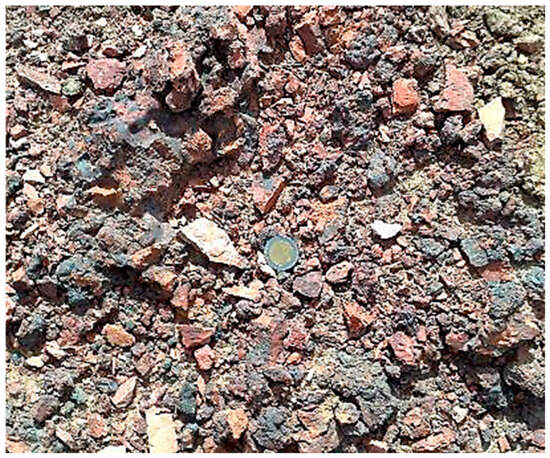
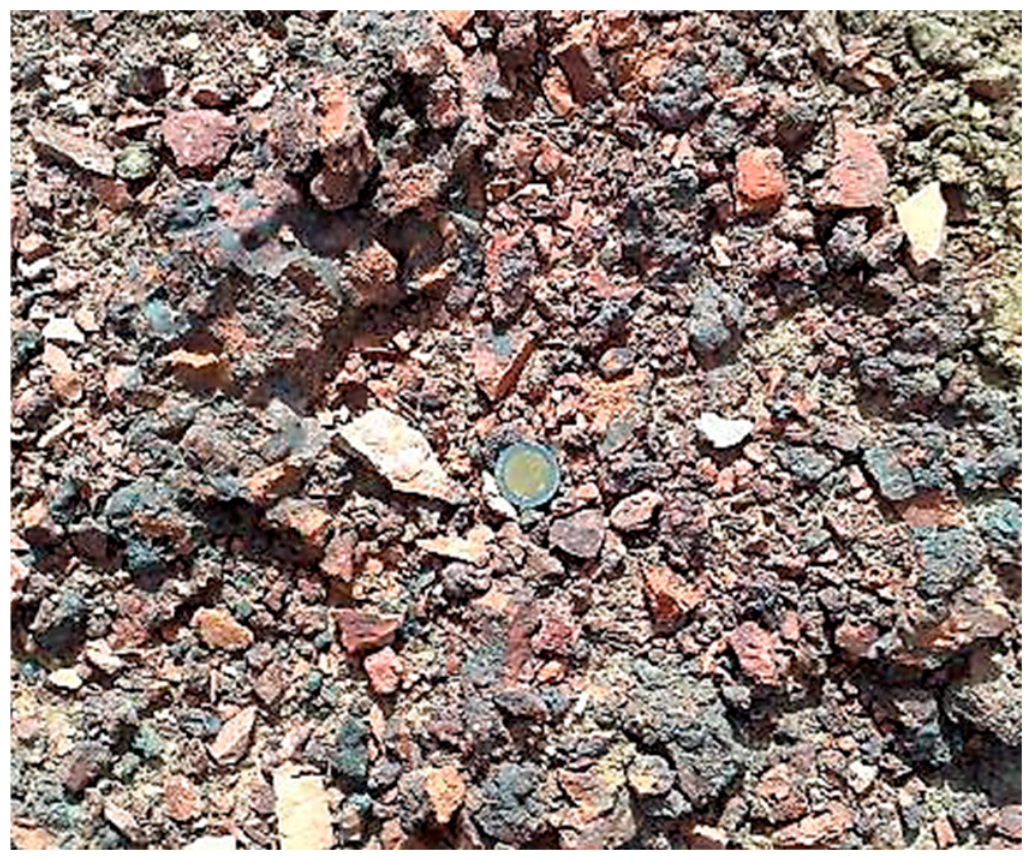
The second mineral addition studied consists of industrial slag from the Béchar thermal power plant. These residues range in color from dark to reddish, as illustrated in Figure 3. Their valorization in cementitious materials is part of a sustainable-development approach aimed at partially reducing Portland cement consumption while limiting the volume of industrial residues destined for storage. The use of such by-products as mineral additions is therefore a relevant pathway for developing cementitious materials with potentially reduced environmental impact [32,33].
Figure 3.
Macroscopic appearance of the ground industrial slag used as a mineral addition in mortars.
Before incorporation into the formulations, the slag was dried, ground, and sieved to obtain a sufficiently fine and homogeneous powder. This preparation can improve its dispersion within the cementitious matrix and increase the specific surface area available for possible reactions with cement hydration products.
Depending on their chemical composition and mineralogical state, potentially reactive siliceous and aluminous phases may participate in pozzolanic reactions with calcium hydroxide [Ca(OH)2] released during cement hydration [33,34]. These reactions may lead to the formation of secondary hydration products, particularly C–S–H-type phases, which can progressively contribute to pore refinement, cementitious-matrix densification, and consequently the development of medium- and long-term mechanical performance [32,33,34,35,36].
However, the industrial origin of the slag alone is not sufficient to establish its pozzolanic activity. This activity depends notably on its chemical composition, mineralogy, fineness, and the preparation treatments applied before incorporation. Its reactivity must therefore be verified experimentally. In this context, the present study first evaluates the influence of the slag on the fresh-state properties of mortars and on their physical and mechanical properties in the hardened state. The mortars produced are then subjected to prolonged exposure in a sulfate environment to document the residual strength of the slag-modified mortar after two years in sulfate soil.
In the absence of a direct reactivity test, the term “pozzolanic” is used in this paper as a working hypothesis: the slag is treated as a mineral addition whose reactivity remains to be confirmed.
2.2.2. Steel Fibers
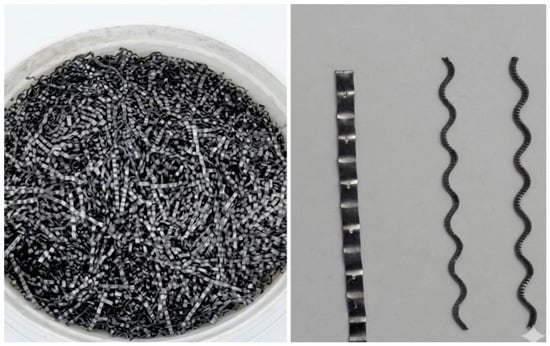
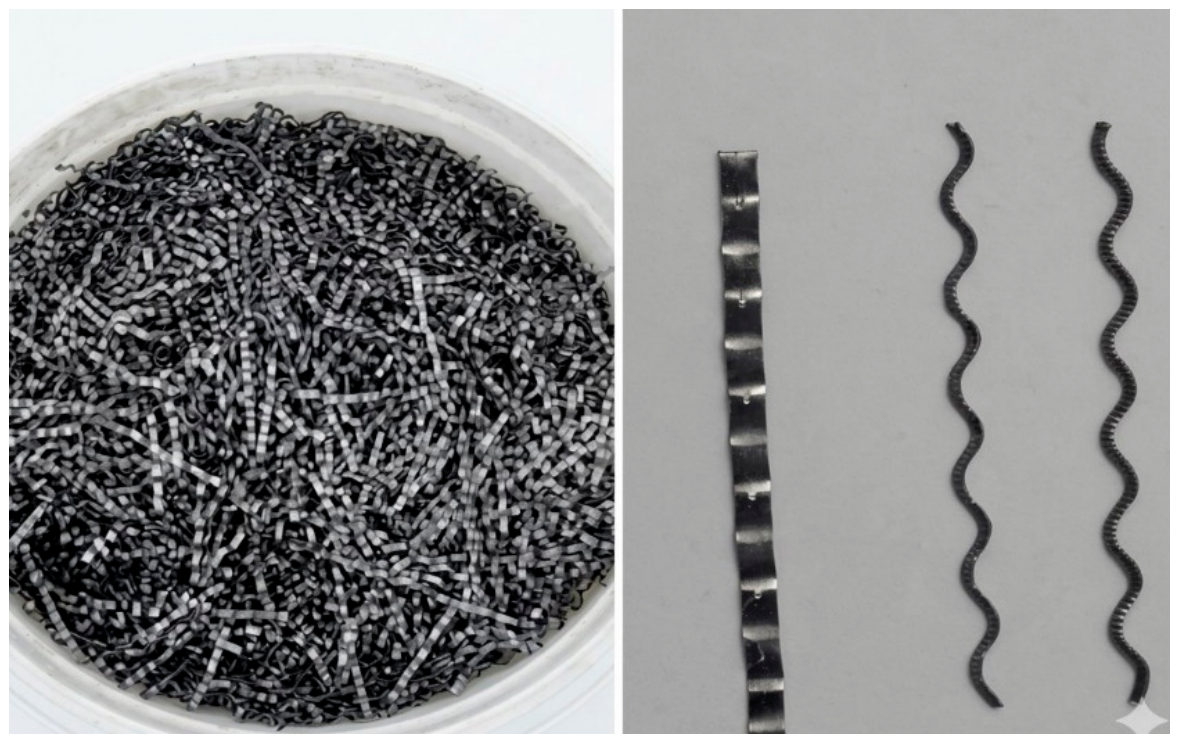
In this work, the high-performance concrete was reinforced with industrial MEDAFAC-type steel fibers supplied by GRANITEX Algiers (Figure 4). The fibers used are corrugated and 50 mm long. Their dosage was set at 40 kg/m3, corresponding to approximately 0.51% of the total concrete volume [36,37].
Figure 4.
General appearance of the MEDAFAC steel fibers used to reinforce high-performance concrete.
According to the manufacturer’s technical data sheet, these fibers are produced by rapid quenching of a molten-metal jet consisting of an iron–carbon alloy, projected onto a water-cooled wheel rotating at high speed. This process produces fibers with geometrical and mechanical characteristics suitable for reinforcing cementitious matrices.
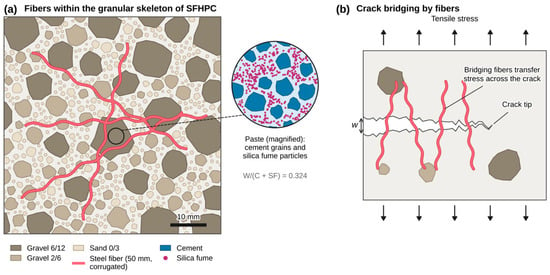
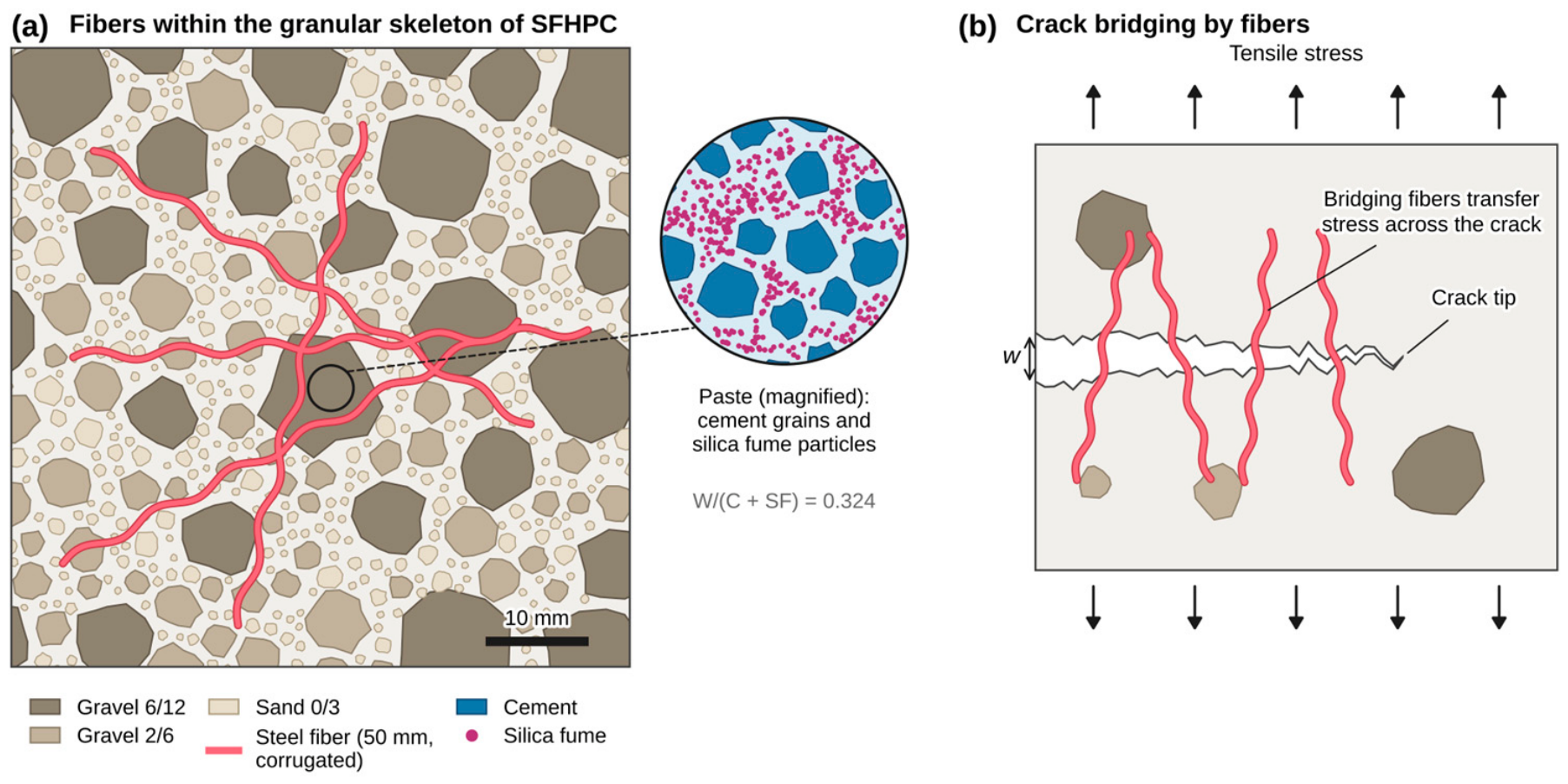
The primary role of the fibers differs from that of silica fume. Whereas the latter acts mainly on the microstructure and transport properties, the fibers primarily affect post-cracking mechanical behavior (Figure 5). The presence of cracks can facilitate the penetration of aggressive species; controlling their opening can therefore indirectly contribute to maintaining material integrity.
Figure 5.
Schematic of the role of steel fibers in SFHPC: (a) 50 mm corrugated steel fibers within the granular skeleton (gravel 6/12 and 2/6, sand 0/3), with a magnified view of the paste containing cement and silica fume (W/(C + SF) = 0.324); (b) crack bridging by fibers, which transfer tensile stress across the crack and limit its opening (w) and propagation [10,11,12,13,14,15]. Fibers are shown in projection; the number of fibers, the paste inset and panel (b) are not to scale.
Thus, steel fibers bridge cracks, limit their opening, and delay their propagation, which can improve tensile strength, toughness, and ductility [10,11,12,13,14,15]. Their effectiveness depends notably on fiber content, geometry, orientation, and the quality of their bond with the cementitious matrix [10,11,12,13,14,15]. This crack-control function is particularly important in the context of sulfate attack.
2.2.3. Superplasticizer
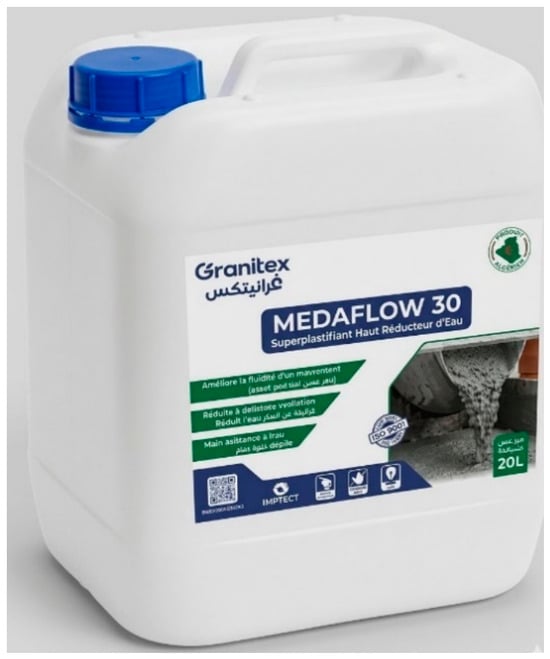
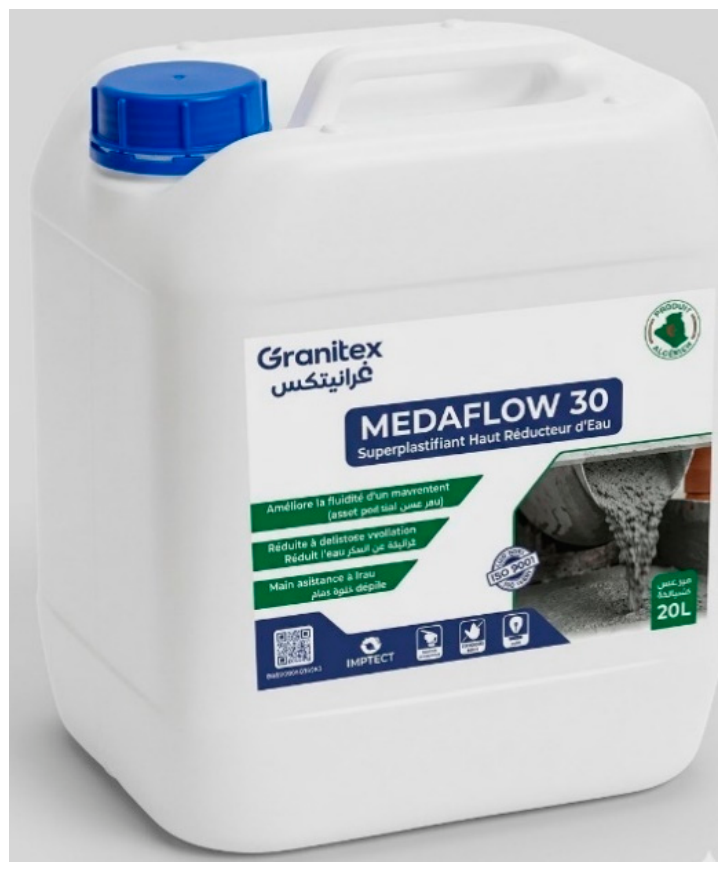
A water-reducing superplasticizer supplied by GRANITEX Algiers was used in the high-performance concrete formulations (Figure 6). Its role is to provide sufficient workability despite the reduction in mixing-water content. Reducing the water-to-binder ratio contributes to the formation of a more compact cementitious matrix and is one of the fundamental principles of high-performance concrete formulation [24,38,39].
Figure 6.
Superplasticizer used (MEDAFLOW 30).
2.2.4. Cement and Water
The cement used for all formulations is CPA–CEM I 42.5 CRS, produced by the Algerian Cement Company (ACC) (Hammam Dalaa, Algeria), in accordance with Algerian Standard NA442 [36,40]. This cement was selected in particular because of its technical characteristics and suitability for use in sulfate-exposed environments. Using the same type of cement for the different formulations facilitates comparison of the results and limits the influence of binder type on performance interpretation.
The mixing water and curing water for the specimens is potable water from the public drinking-water supply network of Béchar. Its chemical composition is reported in [36,40].
2.3. Distribution of Constituents and Experimental Program
The constituents described above are distributed between two families of materials investigated according to complementary experimental objectives:
- High-performance concrete reinforced with steel fibers: This consists of cement, water, natural sand, crushed coarse aggregates, silica fume, superplasticizer, and MEDAFAC steel fibers.
- Industrial-slag-based mortar: This consists of cement, water, natural sand, and ground slag used as a partial replacement for cement.
The experimental program is based on two distinct characterization protocols. The first concerns the initial properties of the mortars and the evolution of their performance after prolonged exposure. The second concerns the mechanical performance of the concretes (Ordinary Concrete, BO; High-Performance Concrete, HPC; and High-Performance Steel-Fiber-Reinforced Concrete, SFHPC) after 28 days of curing either in potable water or in a 10% sodium sulfate solution, in order to compare the effect of the two curing environments at early age. The same cement is used for the mortar and concrete formulations.
2.4. Formulation of Cementitious Materials
2.4.1. Concrete Formulation
Three concrete formulations are considered: reference ordinary concrete (BO), high-performance concrete (HPC), and high-performance steel-fiber-reinforced concrete (SFHPC). This experimental organization makes it possible to progressively distinguish the effect of high-performance formulation from that of fiber reinforcement. BO and the two high-performance concretes differ in cement content, water-to-binder ratio, aggregate proportions, and admixture, so the BO–HPC comparison reflects the complete change in mix design and not the effect of silica fume alone. HPC and SFHPC share the same matrix proportions and differ only in the presence of fibers.
- (a)
- Reference Ordinary Concrete (BO):
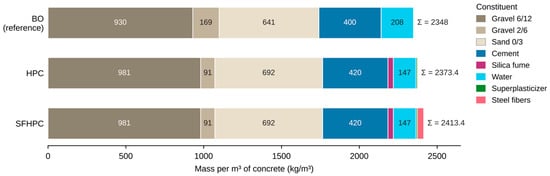
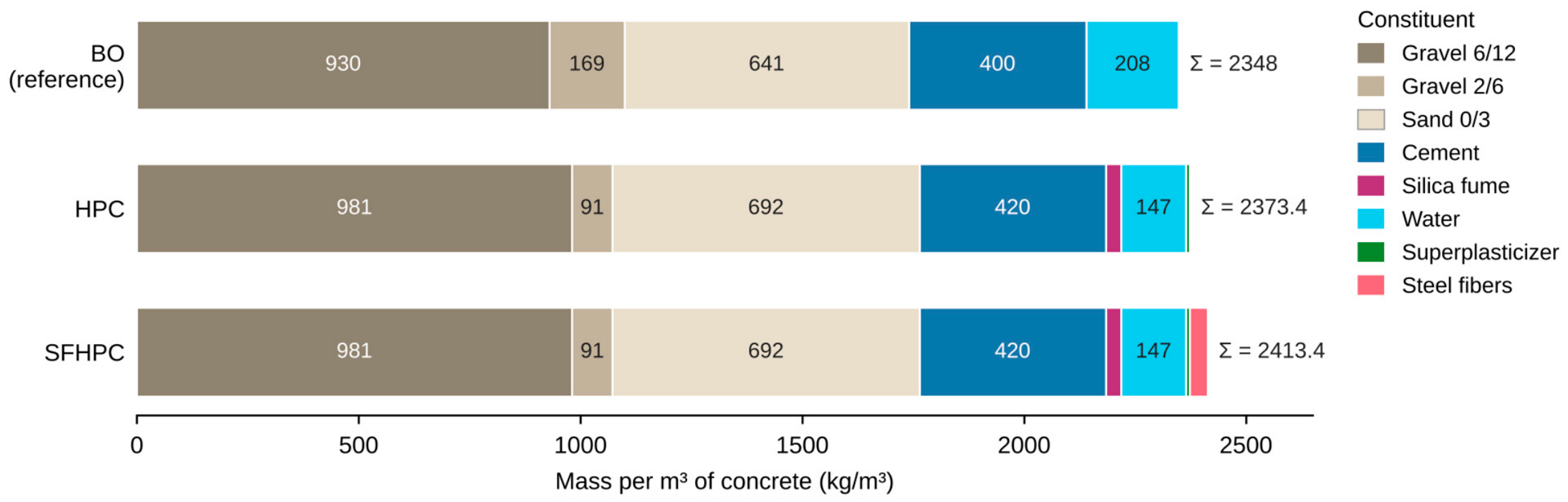
BO constitutes the reference formulation (control concrete). Its composition is determined using the Faury method, which is based on optimization of granular packing [26]. The granular skeleton consists of 0/3 mm sand from Hassi 20 (Béchar) and crushed limestone aggregates in the 2/6 and 6/12 mm fractions from Djebel Béchar. The water-to-cement ratio is fixed at W/C = 0.52. Table 1 and Figure 7 summarize the mass distribution of the constituents of ordinary concrete.
Table 1.
Composition of ordinary concrete (BO).
Figure 7.
Complete mass composition (kg/m3) of the reference concrete (BO), the high-performance concrete (HPC) and the steel-fiber-reinforced high-performance concrete (SFHPC). Σ: Sum of constituent masses.
This formulation serves as the reference for assessing the modifications introduced by silica fume, superplasticizer, and fibers.
- (b) High-Performance Concrete (HPC):
The high-performance concrete, denoted HPC, uses the same aggregate constituents as BO but incorporates silica fume at 34 kg/m3 (8.1% of the cement mass), together with a water-reducing superplasticizer. Silica fume helps improve particle packing, densify the cementitious matrix, and reduce its porosity. The superplasticizer provides the required workability while limiting the amount of water needed for mixing. The objective is to obtain a more compact, less permeable, and mechanically higher-performing matrix without compromising workability. The literature shows that this combination is particularly effective when reducing the water-to-binder ratio is accompanied by proper dispersion of fine particles [24,30,38,39]. Its proportions are those of the SFHPC matrix without fibers and are listed in Table 2.
Table 2.
Composition of high-performance concrete (HPC) and high-performance steel-fiber-reinforced concrete (SFHPC).
- (c) High-Performance Fiber-Reinforced Concrete (SFHPC):
The high-performance steel-fiber-reinforced concrete, denoted SFHPC, corresponds to HPC with MEDAFAC steel fibers added. This formulation is the central material of the study because its behavior makes it possible to jointly evaluate the effect of the high-performance matrix and that of steel reinforcement under mechanical loading and in a sulfate environment.
The fiber dosage is constant for the series studied. The material combines two complementary mechanisms: matrix densification by silica fume and crack control by fibers. Recent studies highlight the importance of this combined approach for improving both the mechanical properties and durability of high-performance fiber-reinforced concretes [13,16,17,18,19,29,31,32].
The formulation of the high-performance steel-fiber-reinforced concrete (SFHPC) was carried out using the Faury method [26]. The same aggregate fractions as those used for the reference concrete are retained to limit the effect of aggregate type when comparing the formulations. The resulting coefficient λ is 24.92 ± 0.46, which is consistent with literature recommendations. The results of the SFHPC formulation are presented in Table 2 and Figure 8.
Figure 8.
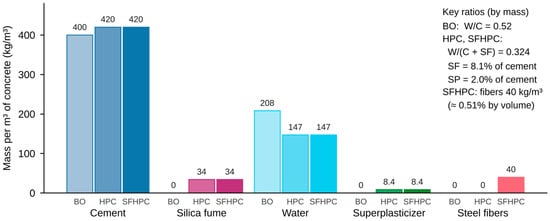
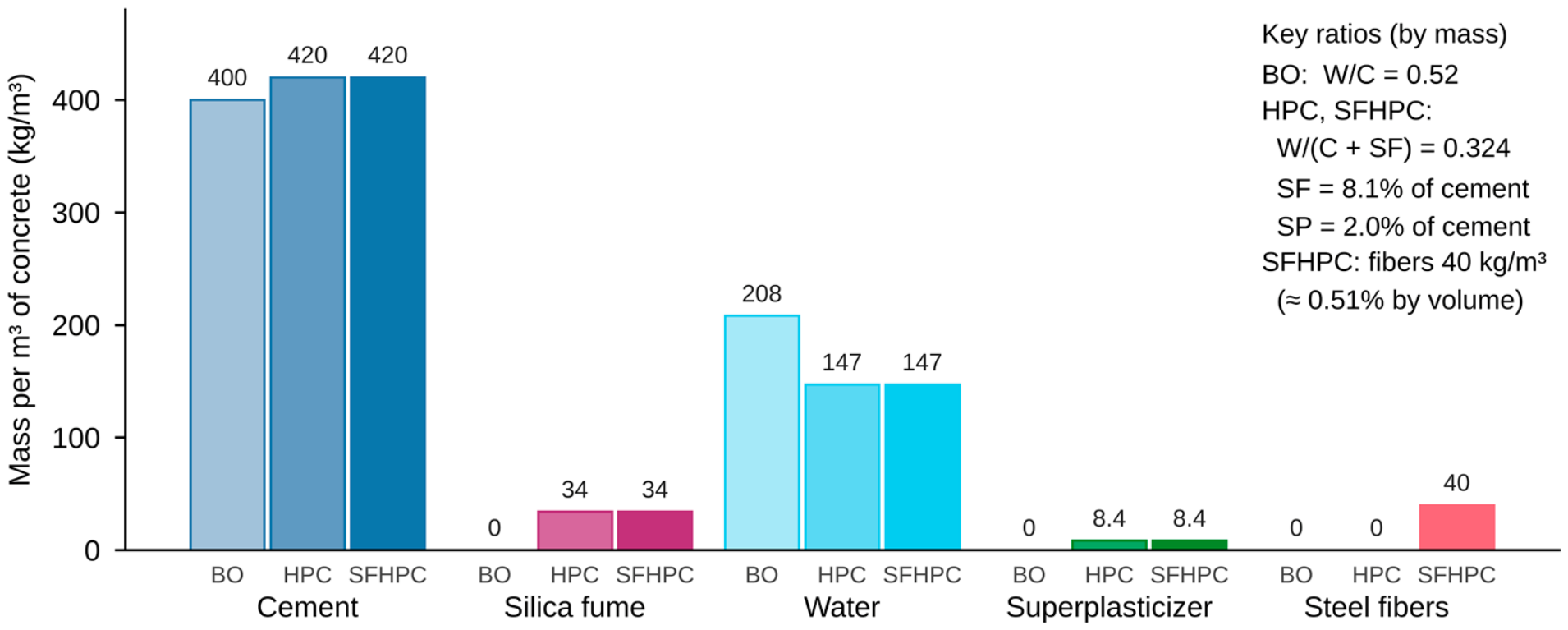
Cement, silica fume, water, superplasticizer and steel fiber contents (kg/m3) of BO, HPC and SFHPC. W/C: Water-to-cement ratio; W/(C + SF): water-to-binder ratio; SF: silica fume; SP: superplasticizer.
The composition of one cubic meter of SFHPC consists mainly of aggregates, representing approximately 73% of the total mass and providing the granular skeleton of the concrete. Cement and silica fume form the binder phase, while the low water content gives a water-to-binder ratio (W/(C + SF)) of 0.324, favorable for obtaining a compact and strong matrix. The superplasticizer, dosed at 2% of the cement mass, maintains good workability despite this low water-to-binder ratio. Finally, the 40 kg/m3 of steel fibers, corresponding to approximately 0.51% by volume, contributes to limiting cracking and improving the ductility and tensile strength of SFHPC.
2.4.2. Mortar Formulation
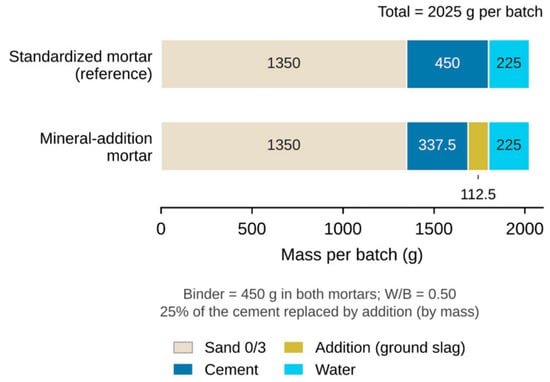
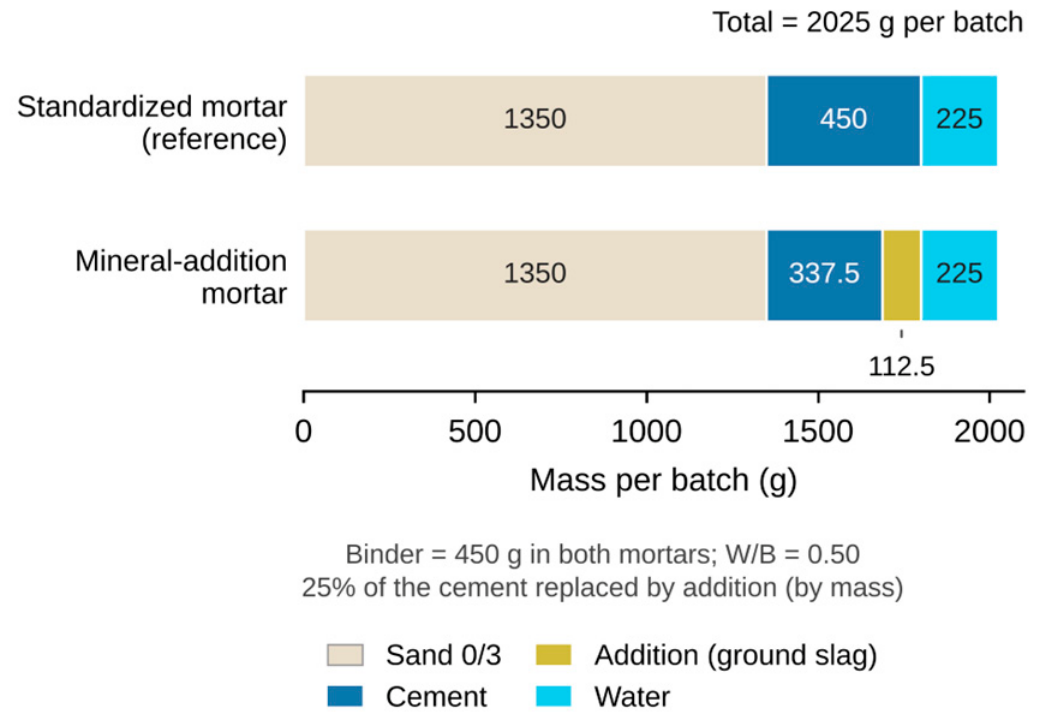
Two mortar formulations are considered: a standardized mortar without addition serving as the reference and a mortar containing a pozzolanic addition. For the latter, 25% of the cement mass was replaced by pozzolan while maintaining a total binder mass of 450 g. The amounts of sand and water remain identical in both formulations, as does the constant water-to-binder ratio of 0.50, allowing a more direct comparison of the effect of the mineral addition. The selected compositions are presented in Table 3 and Figure 9 below.
Table 3.
Composition of mortars.
Figure 9.
Mass composition of the standardized mortar (reference) and the mineral-addition mortar (g per batch). In the mineral-addition mortar, 25% of the cement mass is replaced by ground industrial slag; the binder content (450 g) and the water-to-binder ratio (W/B = 0.50) are the same in both mortars.
This substitution reduces cement consumption while maintaining the same overall mixture proportions. It may also improve mortar compactness and durability, although its effect on mechanical strength must be confirmed experimentally [7,23,24].
2.5. Specimen Preparation
The specimens were prepared separately for each formulation, curing environment, and testing age to enable consistent comparison of mechanical performance.
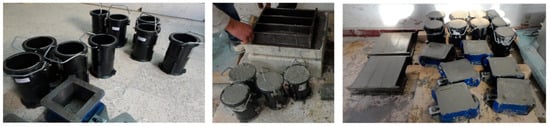
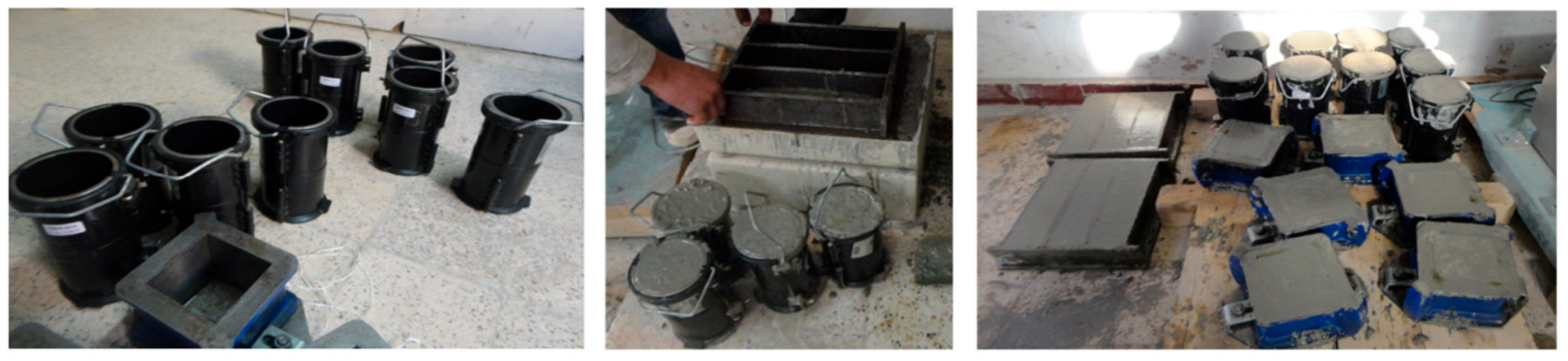
The cylindrical specimens of high-performance steel-fiber-reinforced concrete (SFHPC) had dimensions of 10 × 20 cm (diameter × height), same for high-performance concrete (HPC) cylinders, whereas those of ordinary concrete (BO) had dimensions of 16 × 32 cm, according to NF P18-400. Mortars were characterized using 4 × 4 × 16 cm prisms (Figure 10).
Figure 10.
Preparation and molding of cylindrical and prismatic specimens intended for mechanical tests.
The use of two cylinder sizes introduces an additional variable when the absolute strengths of BO and of the high-performance concretes are compared, because smaller specimens generally give somewhat higher measured strengths; a dependence of strength on specimen size has also been reported for steel-fiber-reinforced concrete [41]. For this reason, the comparison between mixtures in Section 3 relies mainly on the relative change in strength between the two curing environments, which is measured on specimens of the same size within each mixture. In addition, the 50 mm fibers are long relative to the 100 mm mold diameter (length-to-diameter ratio of 0.5). In such a mold the wall restricts fiber rotation, so that fiber orientation is not random and differs from that in larger elements. The splitting tensile strengths of SFHPC reported here are therefore specific to this specimen geometry, and the wall effect probably contributes to their scatter.
Mechanical characterization of the concretes includes compressive strength and splitting tensile strength; flexural tensile strength was measured on the mortar prisms only. The test matrix is given in Table 4. Tests were conducted at 28 days to determine the initial performance of the different formulations. For mortars, strengths were monitored at 14 and 28 days and then after prolonged exposure to a sulfate environment.
Table 4.
Test matrix: specimens tested for each mixture, curing condition, age, and test.
The test methods were associated with the corresponding European standards: EN 12390-3 for compressive strength, EN 12390-6 for splitting tensile strength, and EN 12390-5 for flexural strength [42,43,44,45].
For each concrete, three cylinders were tested per curing medium and per test, 12 cylinders per mixture and 36 in total. The suffixes 1–3 in the specimen codes (BO1–BO3, HPC1–HPC3, SFHPC1–SFHPC3) and the labels “Replicate 1–3” used for the mortar identify these individual specimens. For the mortar, three prisms were tested in flexure at each age, and compression was then measured on the prism halves in accordance with EN 196-1 [45].
2.6. Curing Conditions and Sulfate Exposure
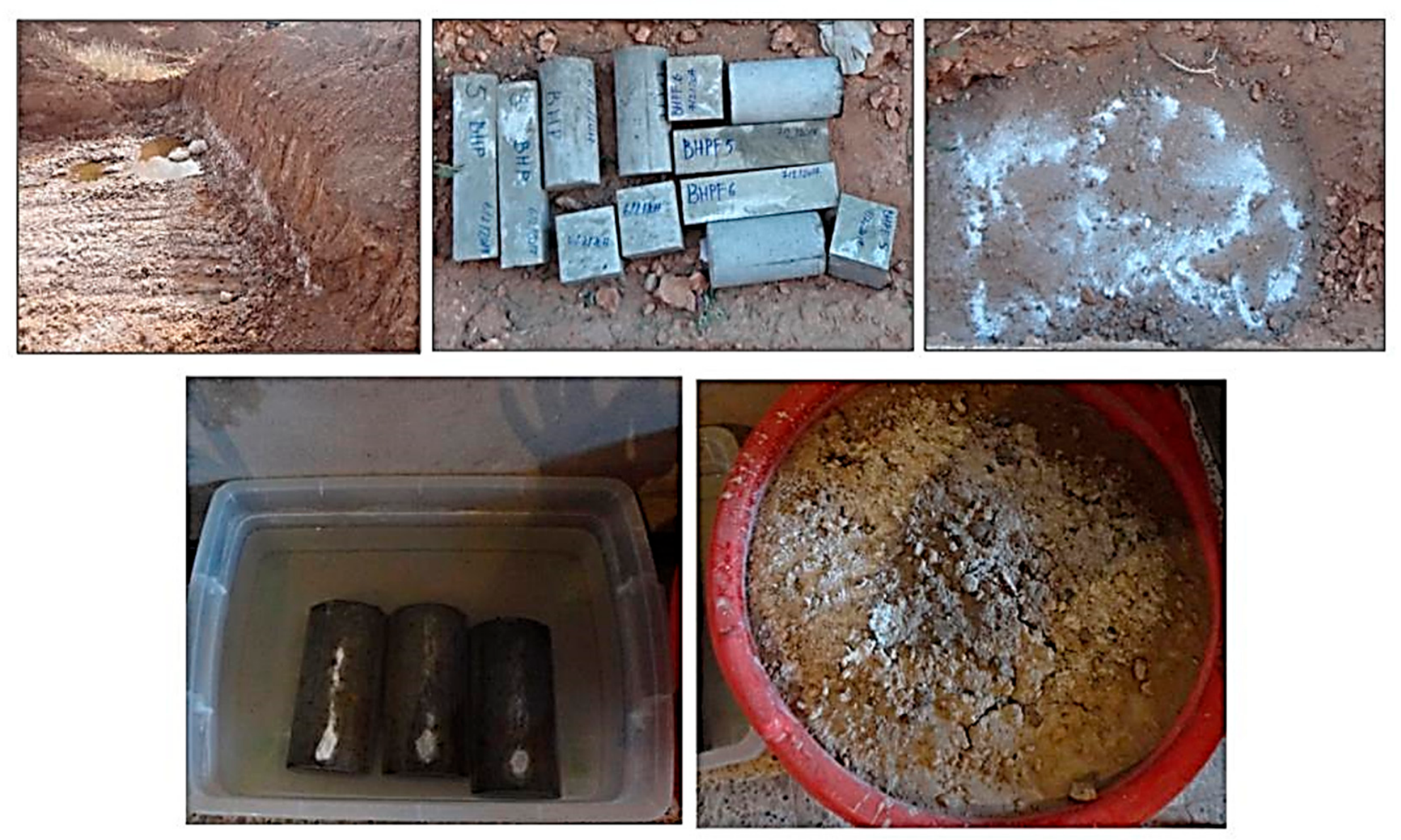
After demolding, the specimens were distributed among the different curing environments. The first series was stored in potable tap water. The second was immersed in a solution prepared with distilled water containing 10% sodium sulfate (Na2SO4). For mortars containing pozzolan, a third series was first stored in potable water for 28 days and then buried for two years in an aggressive sulfate soil containing 35% sodium sulfate.
For the concretes, both series remained in their respective medium from demolding until testing at 28 days, so that the sulfate exposure of the concretes lasted about four weeks and began at early age. The 10% sodium sulfate solution was prepared by dissolving analytical-grade sodium sulfate (Na2SO4) in distilled water. The concrete specimens were fully immersed in the solution in sealed plastic containers at ambient laboratory temperature. The solution was renewed every 7 days to maintain an approximately constant sulfate concentration. For the mortar, the prisms were buried after 28 days of water curing. The sulfate soil used for the two-year exposure contained 35% sodium sulfate (Na2SO4). This value was based on the site characterization report. No mortar prisms of the same age were kept in a sulfate-free environment during the two-year period.
The following Figure 11 illustrates the different curing and exposure conditions of the specimens.
Figure 11.
View of the sulfate soil used as an aggressive medium for specimen exposure.
The choice of these two environments makes it possible to compare material behavior under a reference condition and in a medium highly loaded with sulfates.
In this work, evaluation of mechanical properties before and after exposure is a relevant indicator for assessing material evolution. Strength change alone does not identify the underlying degradation mechanisms; these are discussed in Section 3 as hypotheses consistent with the literature, not as experimentally established findings. The two exposure regimes differ in medium, sulfate concentration, and duration. The concrete tests therefore compare the effect of two curing environments at early age, whereas the mortar results document the residual strength after two years of burial in sulfate-rich soil; they do not provide a direct measure of sulfate resistance.
3. Results and Discussion
This section presents the results of the tests conducted on the formulations studied. Characterization focused on fresh-state concrete properties (workability, density, etc.) and hardened-state mechanical performance. The evolution of properties after sulfate exposure is investigated. The results make it possible to compare the behavior of the reference concrete with that of high-performance steel-fiber-reinforced concrete. The analysis distinguishes between concretes and mortars. The objective is to compare absolute values and also identify trends related to matrix densification, steel-fiber reinforcement, and exposure to the aggressive environment.
3.1. Fresh-State Properties
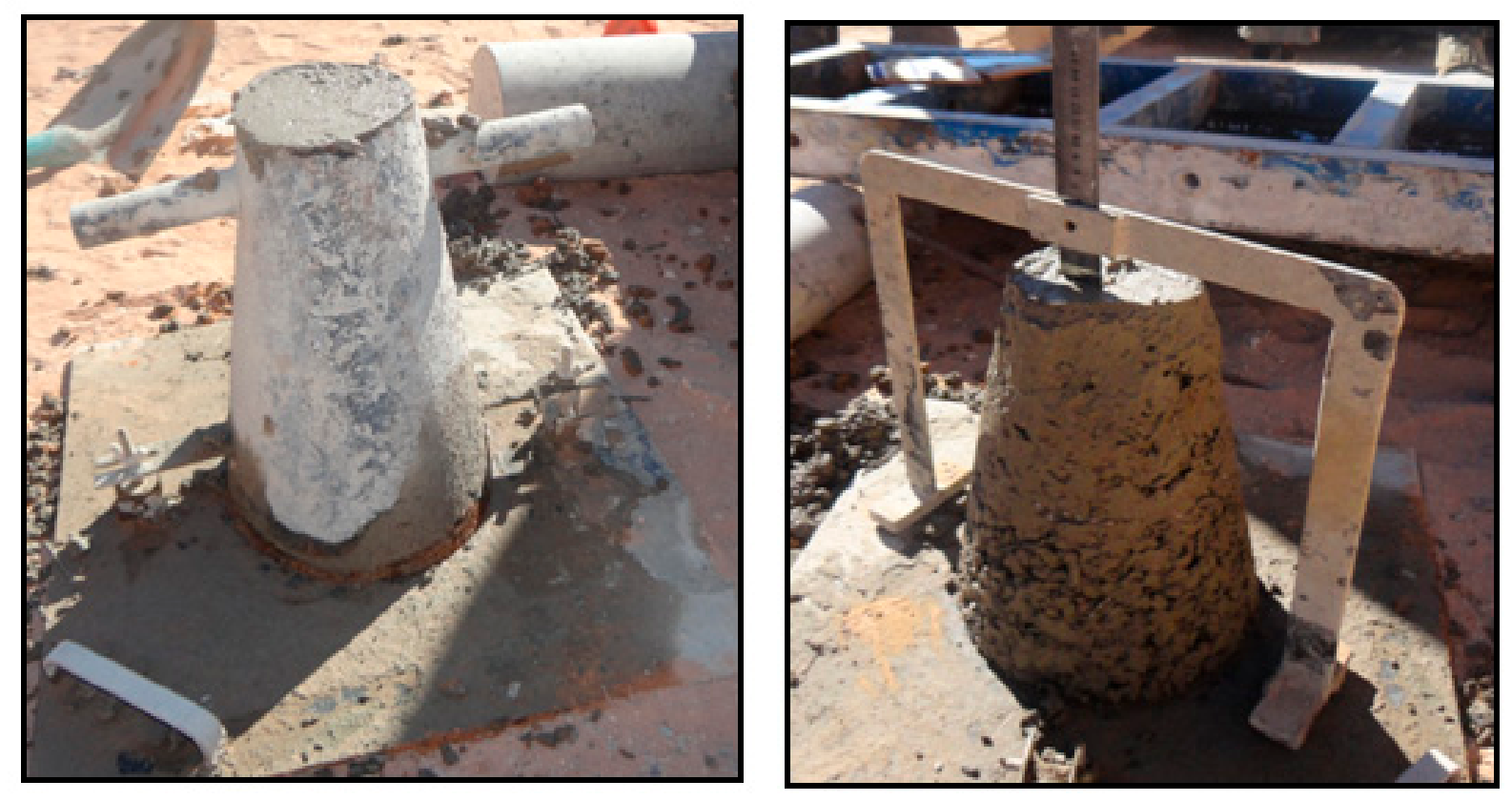
An essential step in evaluating concrete’s suitability for placement before setting begins is to characterize its fresh-state properties. This characterization makes it possible to assess workability, consistency, homogeneity, and resistance to segregation. In this study, the workability of the different formulations was evaluated using the Abrams cone slump test (Figure 12), according to NF EN 12350-2 [46].
Figure 12.
Abrams cone slump test.
This test makes it possible to analyze the influence of concrete composition, water-to-binder ratio, use of superplasticizer, and incorporation of steel fibers on fresh-state behavior. The results obtained from the Abrams cone slump test are presented in Table 5.
Table 5.
Results of the Abrams cone slump test.
The results show an increase in slump, from 4 cm for ordinary concrete to 6 cm for HPC and 8 cm for SFHPC. This evolution indicates improved workability of the high-performance concretes, particularly due to the action of the superplasticizer.
Although adding steel fibers generally tends to reduce workability, the higher slump of SFHPC may be attributed to optimization of its formulation and the superplasticizer dosage [10,27,30].
3.2. Mechanical Performance and Durability
The mechanical properties of the specimens were characterized through compressive-strength, splitting-tensile-strength, and flexural-tensile-strength tests, in accordance with the principles of the standards applicable to concrete and mortar [6,7,8,9].
Mechanical tests were performed at 28 days to evaluate the initial performance of the different formulations. For mortar formulations incorporating industrial slag with pozzolanic characteristics, compressive and flexural tensile strengths were determined at 14 and 28 days. After 28 days of curing in potable water, a batch of specimens was exposed for two years to an aggressive sulfate soil containing 35% sodium sulfate (Na2SO4). The same mechanical tests were then performed to evaluate the long-term evolution of mortar performance.
3.2.1. Compressive Strength of Concrete
Compressive strengths at 28 days were determined on specimens stored in potable water and in the sulfate solution. This characterization makes it possible to evaluate the initial mechanical performance of the different formulations and assess the influence of the curing medium on their compressive behavior. The results are summarized in Table 6.
Table 6.
Results of compressive-strength tests at 28 days on cylindrical specimens stored in potable water and in a sulfate solution.
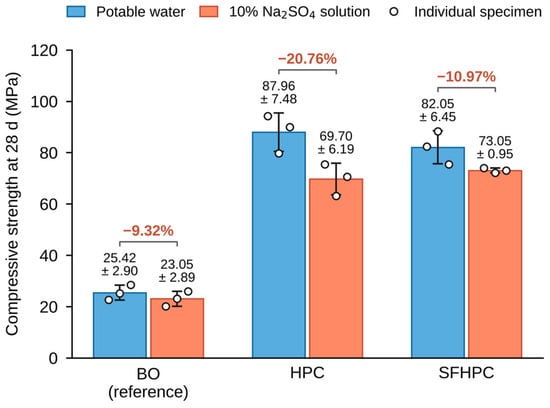
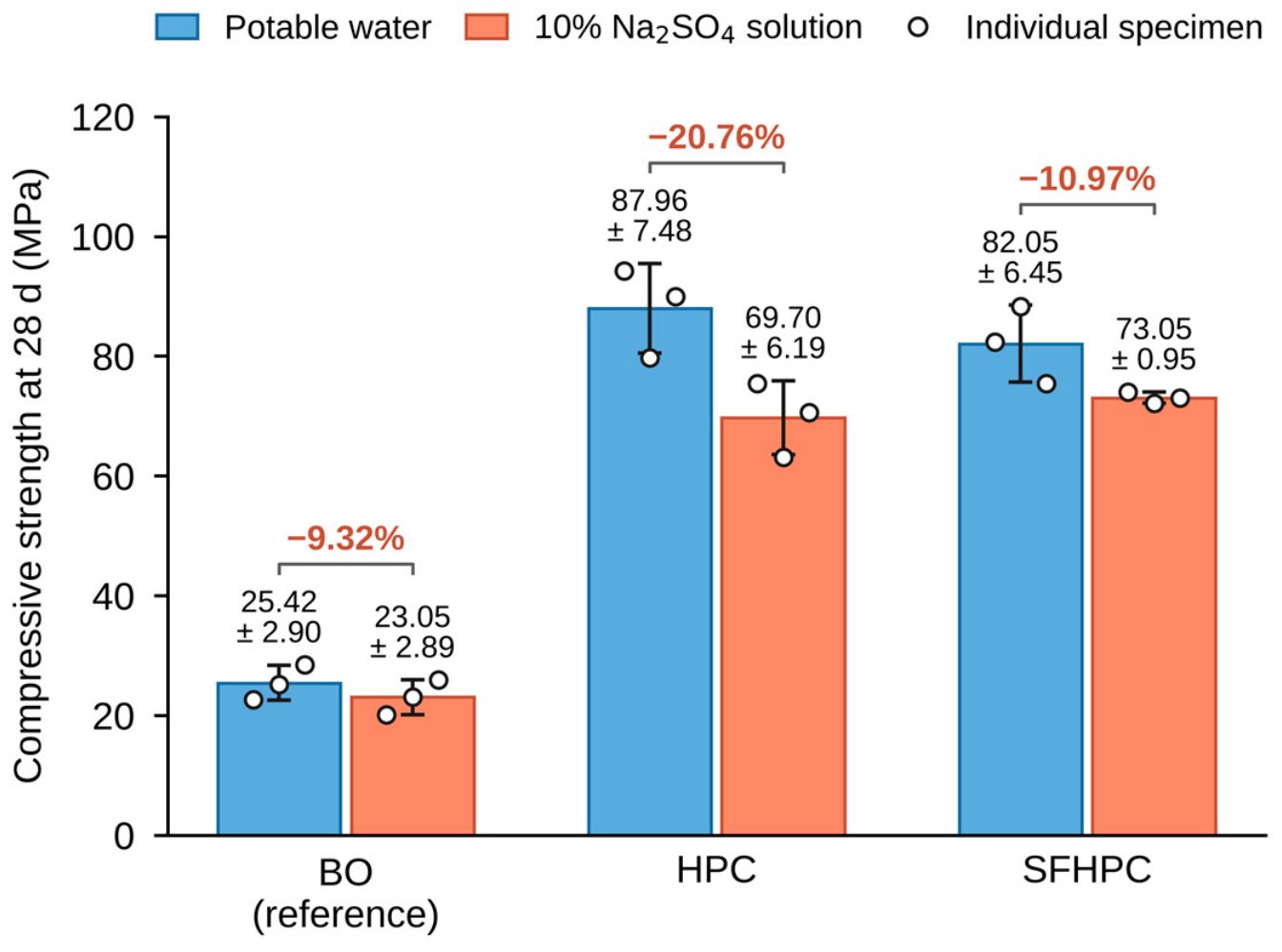
The results show that ordinary concretes (BO) exhibit the lowest strengths, with values ranging from 22.67 to 28.45 MPa in potable water. In contrast, high-performance concretes (HPC) and high-performance steel-fiber-reinforced concretes (SFHPC) reach substantially higher strength levels. Figure 13 shows the mean values with their standard deviations (n = 3) together with the individual results. In potable water, the mean strengths are 25.42 MPa for BO, 87.96 MPa for HPC, and 82.05 MPa for SFHPC; the difference between HPC and SFHPC is smaller than the scatter of either series.
Figure 13.
Mean compressive strengths at 28 days of specimens stored in potable water and in a sulfate solution (error bars: ± one standard deviation, n = 3; circles: individual specimens).
It can readily be observed that storage in the sulfate solution causes a decrease in compressive strength for all formulations studied. Ordinary concretes (BO) show an average decrease of 9.32% and have the lowest strengths. HPC has the highest mean strength in potable water (87.96 MPa) but records the largest average decrease, namely 20.76%, and falls to 69.70 MPa in the sulfate solution. A possible explanation for this, in line with the literature [1,2,3,4,5,6], is the early formation of expansive sulfate products and the associated microcracking; this was not verified here by microstructural analysis. SFHPC shows an average loss of 10.97% and keeps the highest mean strength after sulfate curing (73.05 MPa). Relative and absolute performance must therefore be distinguished. In relative terms, the compressive strength loss ranks BO (9.32%) < SFHPC (10.97%) < HPC (20.76%), so SFHPC does not show the lowest relative loss; in absolute terms, it retains about three times the strength of BO. Since HPC and SFHPC share the same matrix, the smaller loss of SFHPC compared with HPC is consistent with a beneficial effect of the fibers under sulfate curing. With three specimens per series and standard deviations of up to 7.5 MPa, this difference should be read as a trend to be confirmed on a larger number of specimens. Both series were tested at 28 days: the comparison reflects the effect of the curing environment on early-age strength, not long-term sulfate resistance.
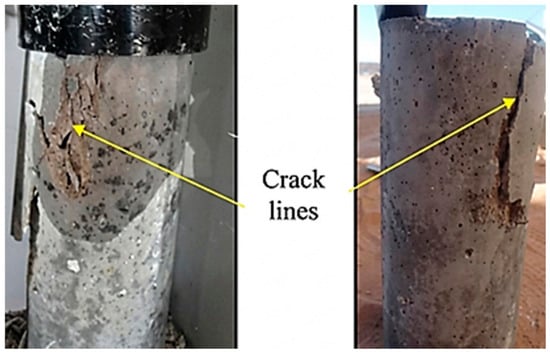
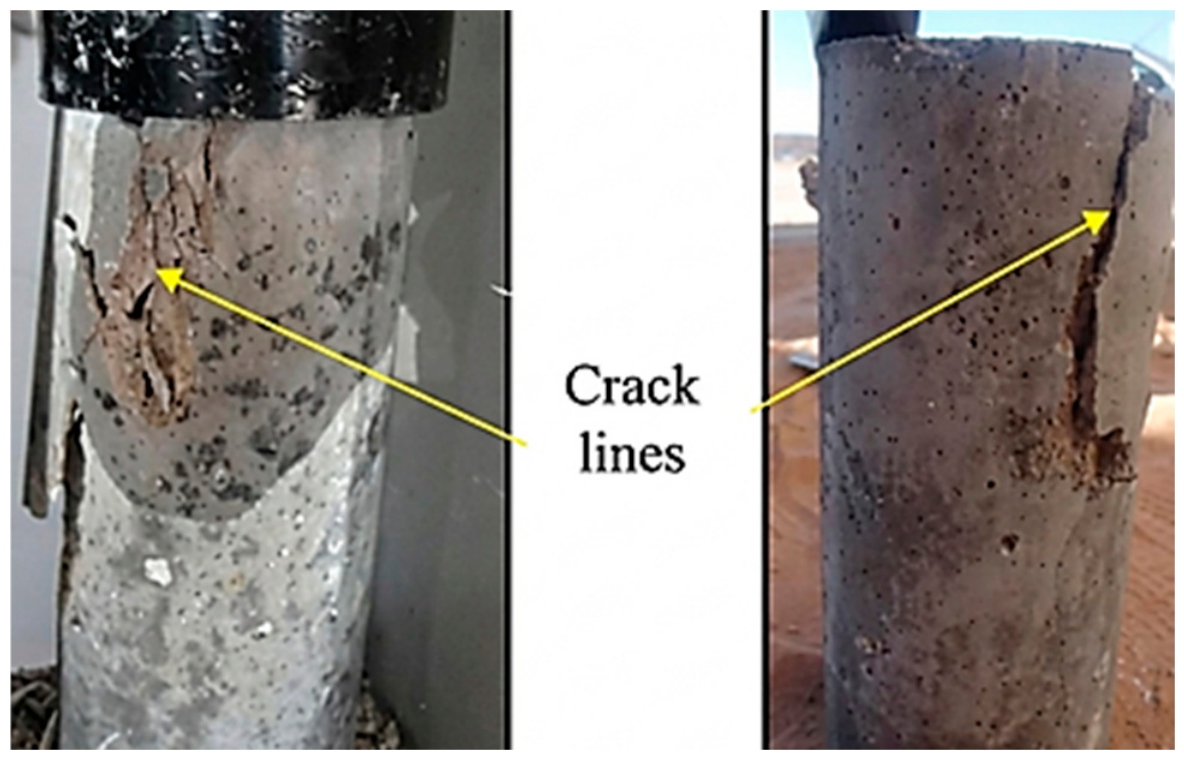
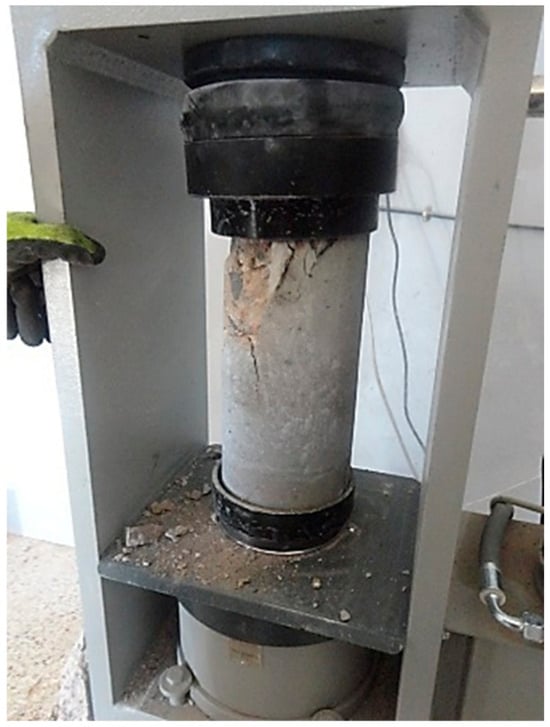
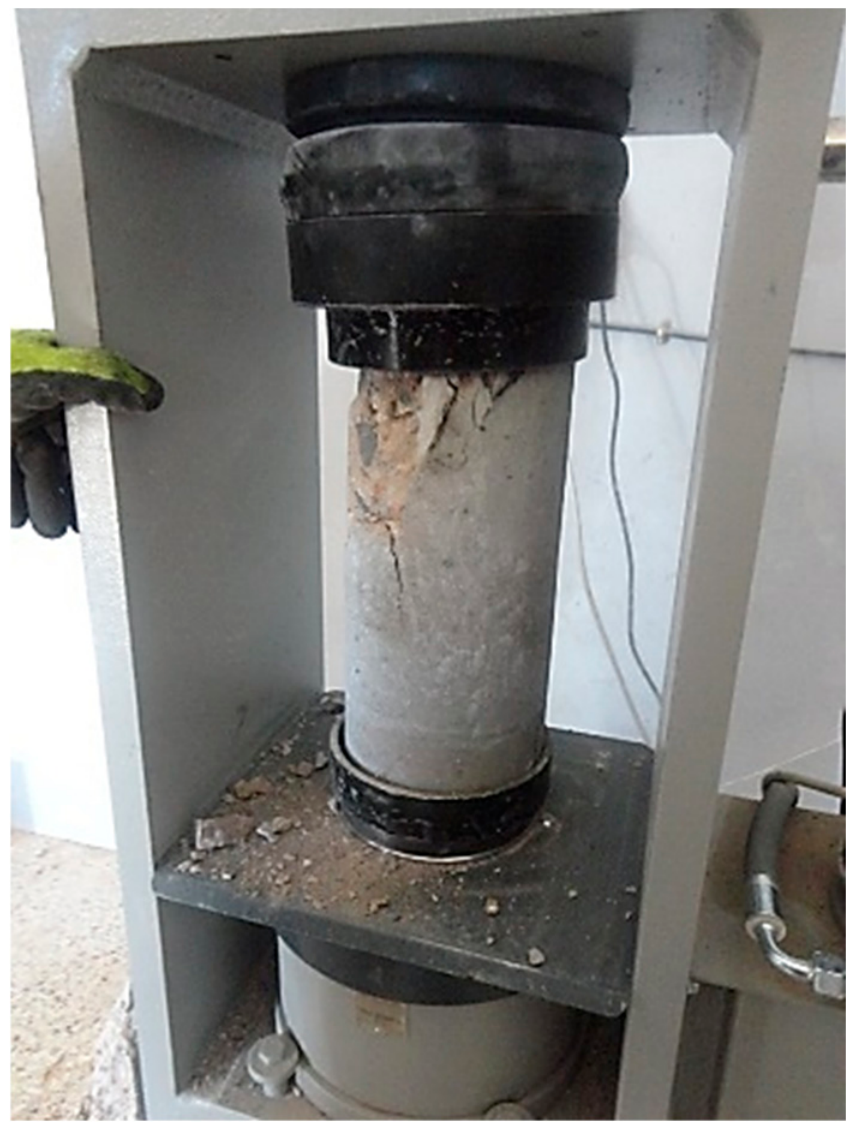
During compression tests, SFHPC specimens develop a network of longitudinal and locally inclined cracks, whose propagation remains more diffuse, progressive, and discontinuous than that observed in ordinary concrete (BO), which is characterized by rapid propagation of vertical cracks and more pronounced spalling during crushing (Figure 14 and Figure 15).
Figure 14.
Compressive failure mode of SFHPC specimens.
Figure 15.
Compressive failure mode of a BO specimen.
Despite cracking, SFHPC specimens retain better internal cohesion and overall shape after the peak load, demonstrating a greater capacity to preserve specimen integrity after cracking. This behavior is mainly explained by the bridging effect of steel fibers: after the first cracks appear, the fibers continue to transfer stresses across cracked zones, thereby limiting crack opening, delaying propagation, and reducing failure localization [10,11,12,13,14,15]. Mineral additions, particularly silica fume, also increase cementitious-matrix density and improve bonding at the paste–aggregate and fiber–matrix interfaces. This combination of a more compact matrix and steel reinforcement therefore makes it possible to control cracking more effectively under compression and improve stress transfer after cracking. The observed failure mode is thus consistent with the complementary effects of matrix densification and fiber bridging reported in the literature, which are expected to help maintain better material stability and cohesion during loading [13,16,17,18,19,29,31,42]. These observations are qualitative: no load–displacement curves, residual strengths, or fracture-energy indices were recorded, so the improvement in post-cracking behavior is not quantified in this study.
3.2.2. Splitting Tensile Strength of Concrete
Characterization of the tensile strength of cementitious materials is a fundamental issue in civil engineering, particularly for structures exposed to aggressive environments.
The present study aims to rigorously and comparatively analyze the splitting tensile behavior (Brazilian test according to NF EN 12390-6) of different concrete formulations, ranging from ordinary concrete (BO) to high-performance fiber-reinforced concrete (SFHPC) [43]. This test indirectly assesses tensile behavior by subjecting standardized cylindrical specimens at 28 days to a diametral compressive load, leading to the formation of a crack along the diametral plane. Two curing conditions were comparatively evaluated: continuous immersion in potable water (reference medium) and immersion in a sulfate solution prepared from distilled water and sodium sulfate (Na2SO4).
Particular attention is paid to durability against chemical attack, especially resistance in a sulfate environment (Na2SO4 solution), as well as characterization of failure modes and post-cracking load-transfer mechanisms.
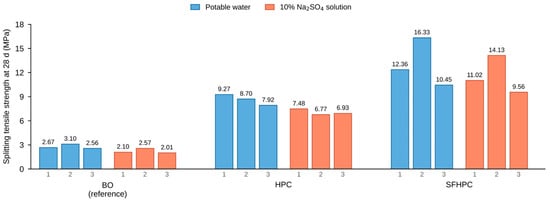
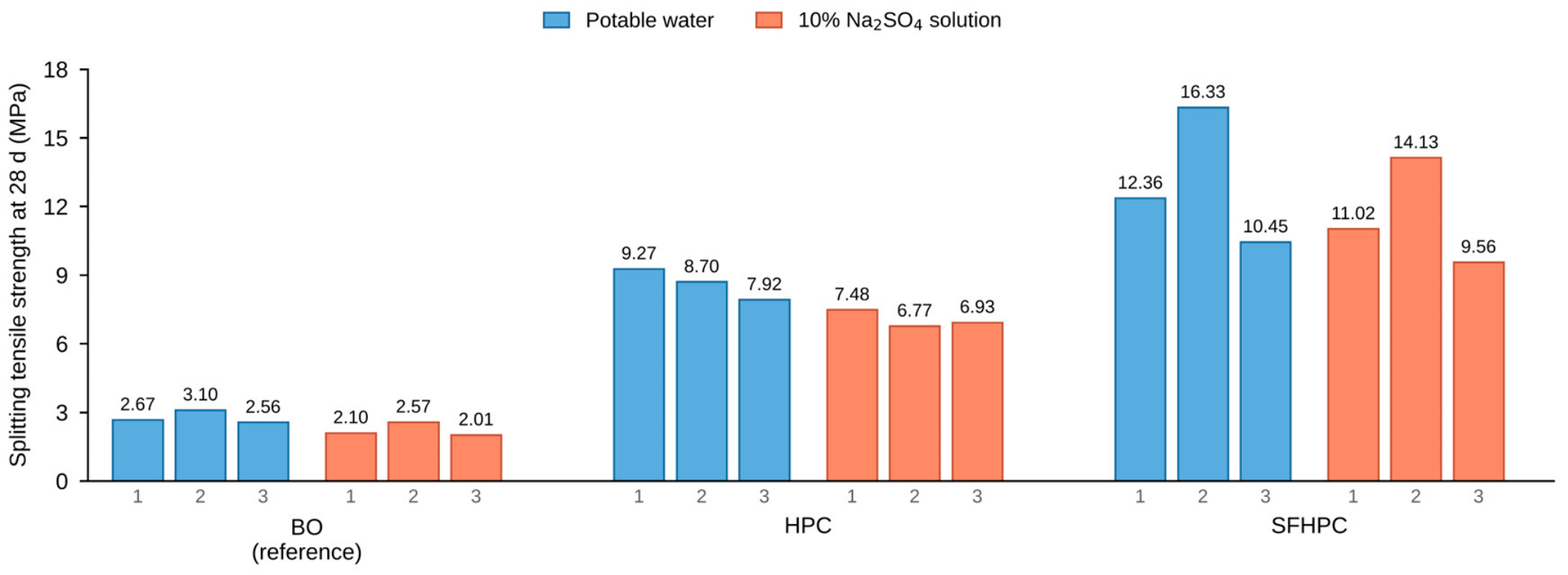
The results measured at 28 days show a significant strength gain from BO to HPC and SFHPC. Figure 16 summarizes all individual and mean data obtained in potable water and in the sulfate environment, with the results compared graphically in the associated figure.
Figure 16.
Splitting tensile strengths at 28 days of test specimens kept in potable water and in a sulfate solution.
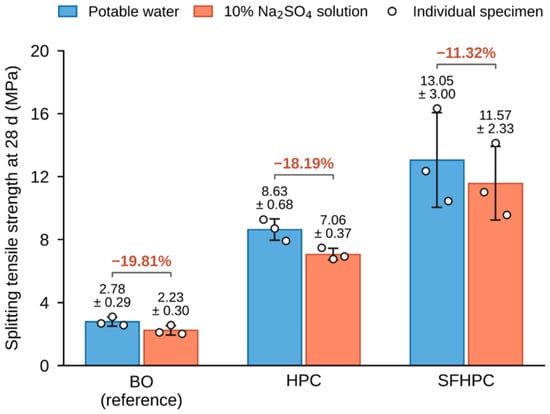
Analysis of the results shows that moving from ordinary concrete (BO: 2.56 to 3.10 MPa in potable water, mean of 2.78 MPa) to high-performance fiber-reinforced concrete (SFHPC: mean of 13.05 MPa) multiplies the mean splitting tensile strength by a factor of about 4.7 (13.05/2.78). Part of this ratio comes from the different mix designs and specimen sizes (Section 2.5); the HPC–SFHPC comparison (8.63 versus 13.05 MPa, i.e., +51%) is the more direct indication of the fiber contribution. Specimen SFHPC2 exhibits the highest strengths in both media, with 16.33 MPa in potable water and 14.13 MPa in the sulfate solution, confirming the contribution of fiber reinforcement to tensile strength. The scatter of the SFHPC results is large (10.45 to 16.33 MPa in potable water), which is consistent with the variable fiber orientation discussed in Section 2.5.
Continuous immersion in the sulfate solution causes degradation of tensile mechanical properties for all matrices. However, the magnitude of the reduction at 28 days differs between mixtures (Figure 17):
Figure 17.
Mean splitting tensile strengths at 28 days of specimens stored in potable water and in a sulfate solution (error bars: ± one standard deviation, n = 3; circles: individual specimens).
Ordinary Concrete (BO): This shows an average strength decrease of 19.81% (from 2.78 MPa to 2.23 MPa), illustrating the vulnerability of unmodified cement paste to sulfate attack.
High-Performance Concrete (HPC): This shows a similar behavior, with an average decrease of 18.19% (from 8.63 MPa to 7.06 MPa). The largest loss is observed for HPC2.
SFHPC: This shows the smallest relative reduction in splitting tensile strength, with a loss of 11.3% (from 13.05 MPa to 11.57 MPa). Specimen SFHPC3 shows the highest relative stability in the aggressive environment. This improved stability is consistent with the role of fibers in controlling crack opening and transferring stresses across discontinuities.
The different results show that the improvement is not limited to an increase in maximum strength. Observations after the splitting tensile test confirm a fundamental change in the failure mode (Figure 18).
Figure 18.
Brittle failure of a BO specimen subjected to splitting tensile loading.
Brittle Failure of Ordinary Concrete (BO): In the absence of fibers, exceeding the ultimate strength results in sudden and complete separation of the cylinder into two distinct blocks, with no visible residual cohesion.
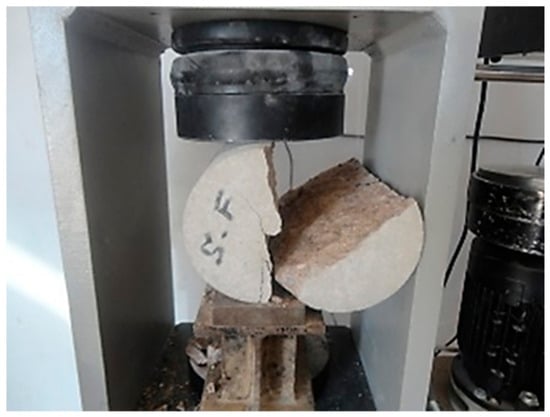
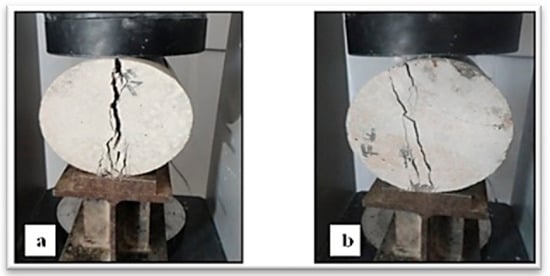
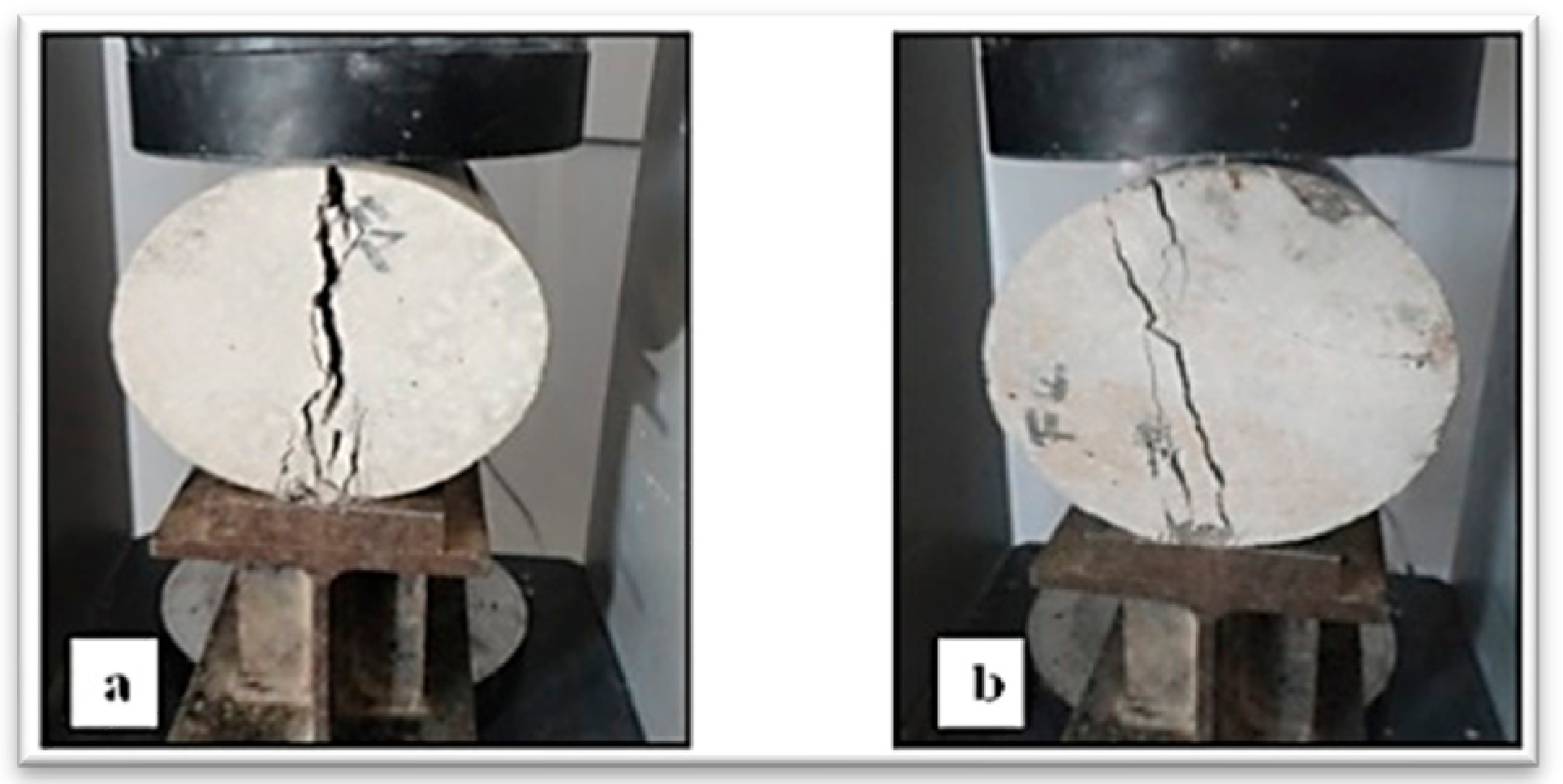
Ductile Failure of SFHPC/FRC: After matrix cracking, the two parts of the specimen remain intimately connected by the fiber network. This behavior reflects the bridging role of steel fibers, which limit crack opening and propagation and thereby contribute to increasing material cohesion and ductility (Figure 19). This is a visual observation; ductility was not measured.
Figure 19.
Splitting tensile failure of SFHPC specimens. (a) vertical splitting crack with visible steel-fiber bridging; (b) inclined splitting crack with the cracked portions remaining connected by steel fibers.
The higher performance of the high-performance concretes (HPC, SFHPC) is attributed to two complementary mechanisms described in the literature, which the present test program does not allow to be separated or quantified.
Matrix densification: The incorporation of ultrafine mineral additions refines the pore structure, reduces permeability, and strengthens the interfacial transition zone (ITZ) between cement paste and aggregates.
Bridging Effect [10,11,12,13,14,15]: When microcracks initiate, steel fibers mobilize shear stresses at the fiber–matrix interface. This load-transfer mechanism delays macroscopic crack propagation and is the likely origin of the cohesive post-cracking behavior observed visually.
3.2.3. Compressive and Tensile Strength of Mortars
To complete the mechanical characterization of the concrete, an evaluation of the performance of pozzolan-based mortars was carried out at 14 and 28 days of age. Series of specimens were subjected to compressive-strength and flexural-tensile-strength tests, allowing the evolution of mortar mechanical performance during potable-water curing to be monitored. The results in Table 7 and Table 8 are those of the slag-modified mortar; as no companion results for the unmodified reference mortar of Table 3 are reported, they describe the behavior of the slag mortar itself and do not quantify the effect of the slag relative to plain cement mortar. In addition, to analyze the long-term durability of the mortars against chemical attack, an additional batch cured for 28 days in water was buried for two years in an aggressive sulfate soil containing 35% sodium sulfate (Na2SO4). At the end of this exposure period, mechanical tests were conducted to evaluate the influence of the sulfate environment on the evolution of the mechanical properties of mortars containing pozzolan. The compression-test results are presented in Table 7 and Figure 20.
Table 7.
Results of compressive-strength tests of mortars at 14 days, 28 days, and after two years of exposure in sulfate soil.
Table 8.
Results of flexural tensile tests of mortars at 14 days, 28 days, and after two years of exposure in sulfate soil.
Figure 20.
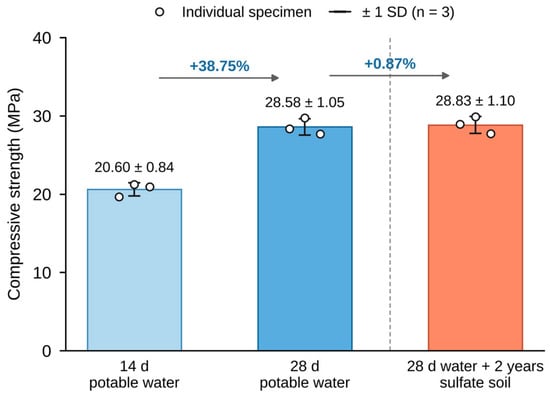
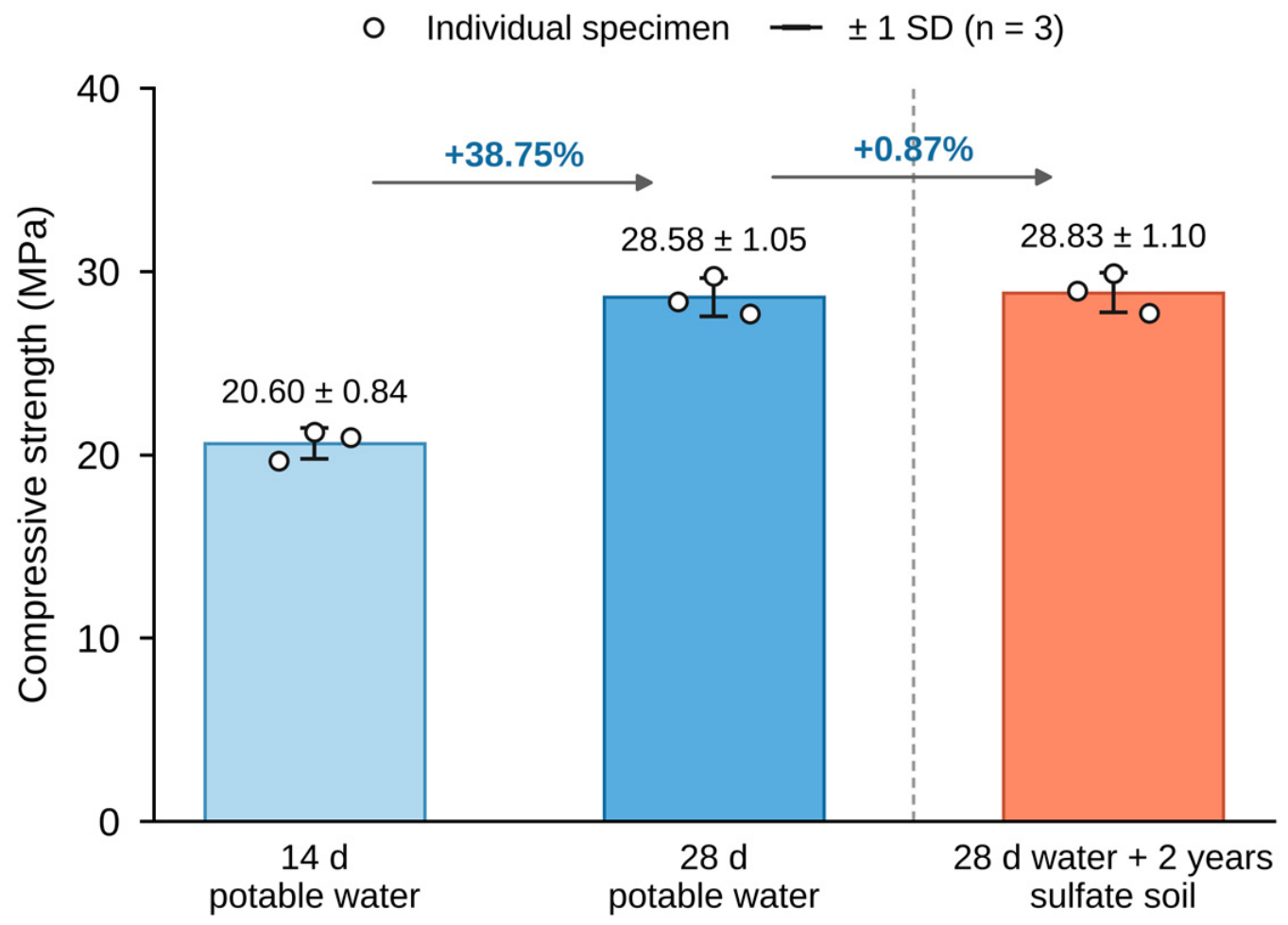
Mean compressive strength of the mortar at 14 days, 28 days, and after two years of exposure in sulfate soil (error bars: ± one standard deviation, n = 3; circles: individual specimens).
Between 14 and 28 days of curing in potable water, the mean compressive strength increases significantly, from 20.60 MPa to 28.58 MPa. This corresponds to a gain of 7.98 MPa, or approximately 38.75%. This trend reflects the continued progress of cement hydration and possibly a contribution of the slag, which cannot be separated without reference-mortar results or a direct reactivity test. After two years of burial in sulfate soil, the mean strength remains at 28.83 MPa. This variation of +0.87% (+0.25 MPa) relative to the 28-day value is well within the scatter of the measurements (standard deviation of about 1 MPa) and must be interpreted with caution. Between 28 days and two years, a mortar of this type would normally continue to gain strength through hydration. Because no specimens of the same age were kept in a sulfate-free environment, the strength gained through continued hydration cannot be separated from any strength lost through sulfate attack. An unchanged compressive strength shows that the mortar had suffered no net loss relative to its 28-day value after two years; it is not, by itself, evidence of high sulfate resistance.
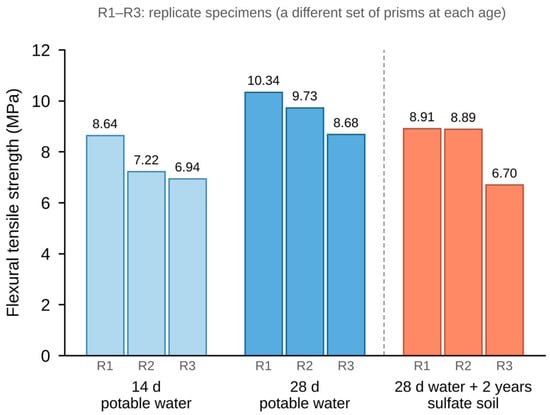
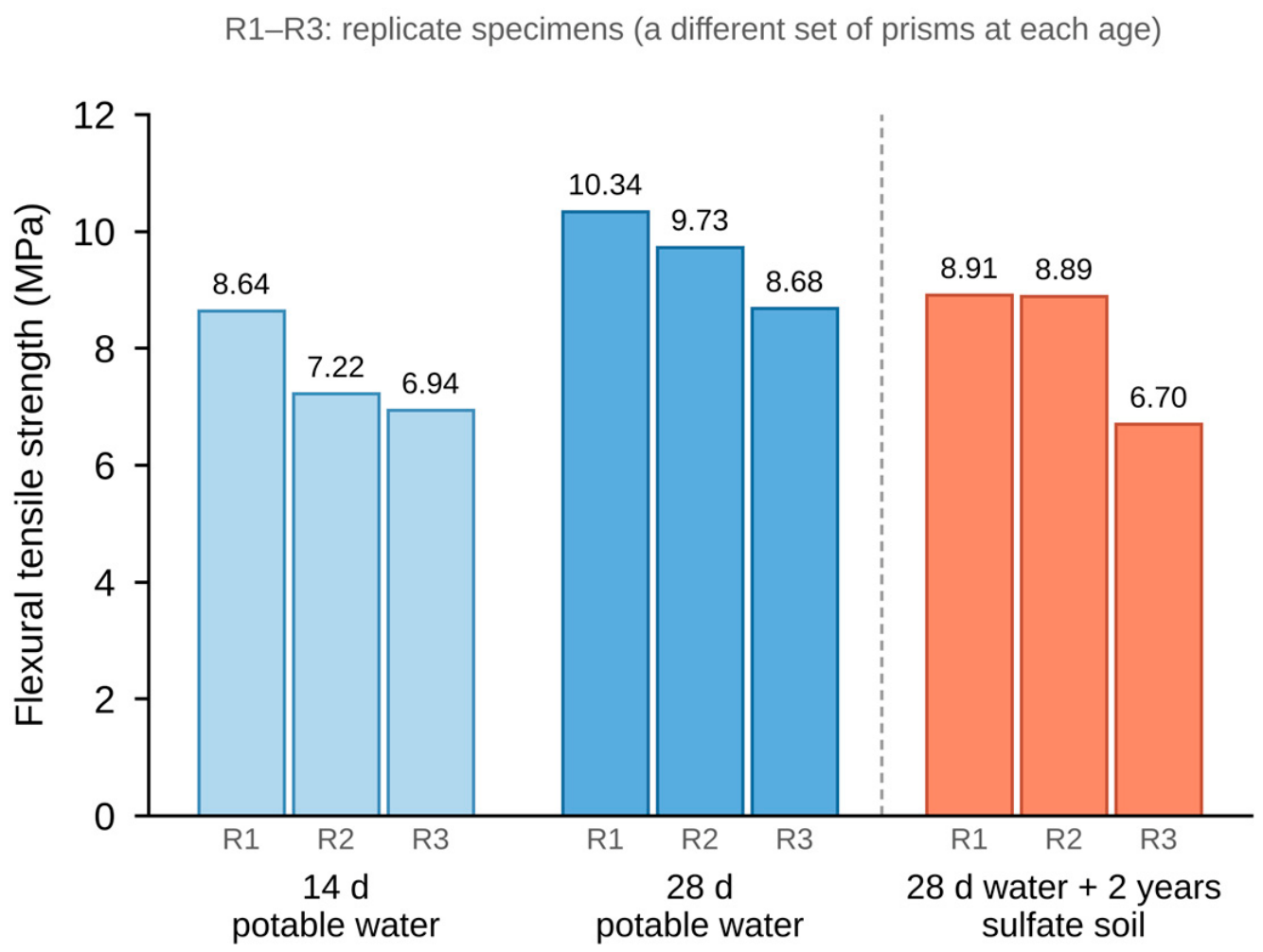
In parallel with the compressive characterization, flexural tensile behavior was evaluated on prismatic specimens subjected to the same curing and exposure conditions. Table 8 and Figure 21 summarize all measurements obtained at 14 days, 28 days, and after two years of exposure to the sulfate environment.
Figure 21.
Flexural tensile strengths of mortar at 14 days, 28 days, and after two years in a sulfate environment.
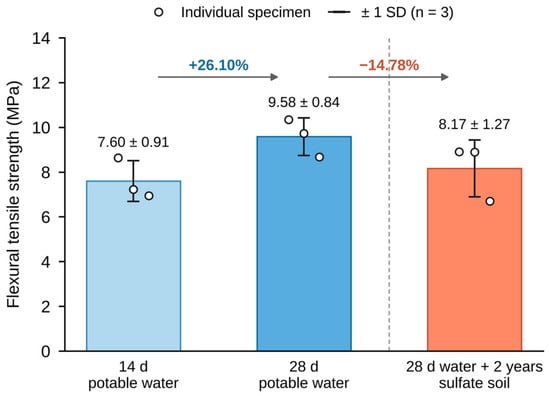
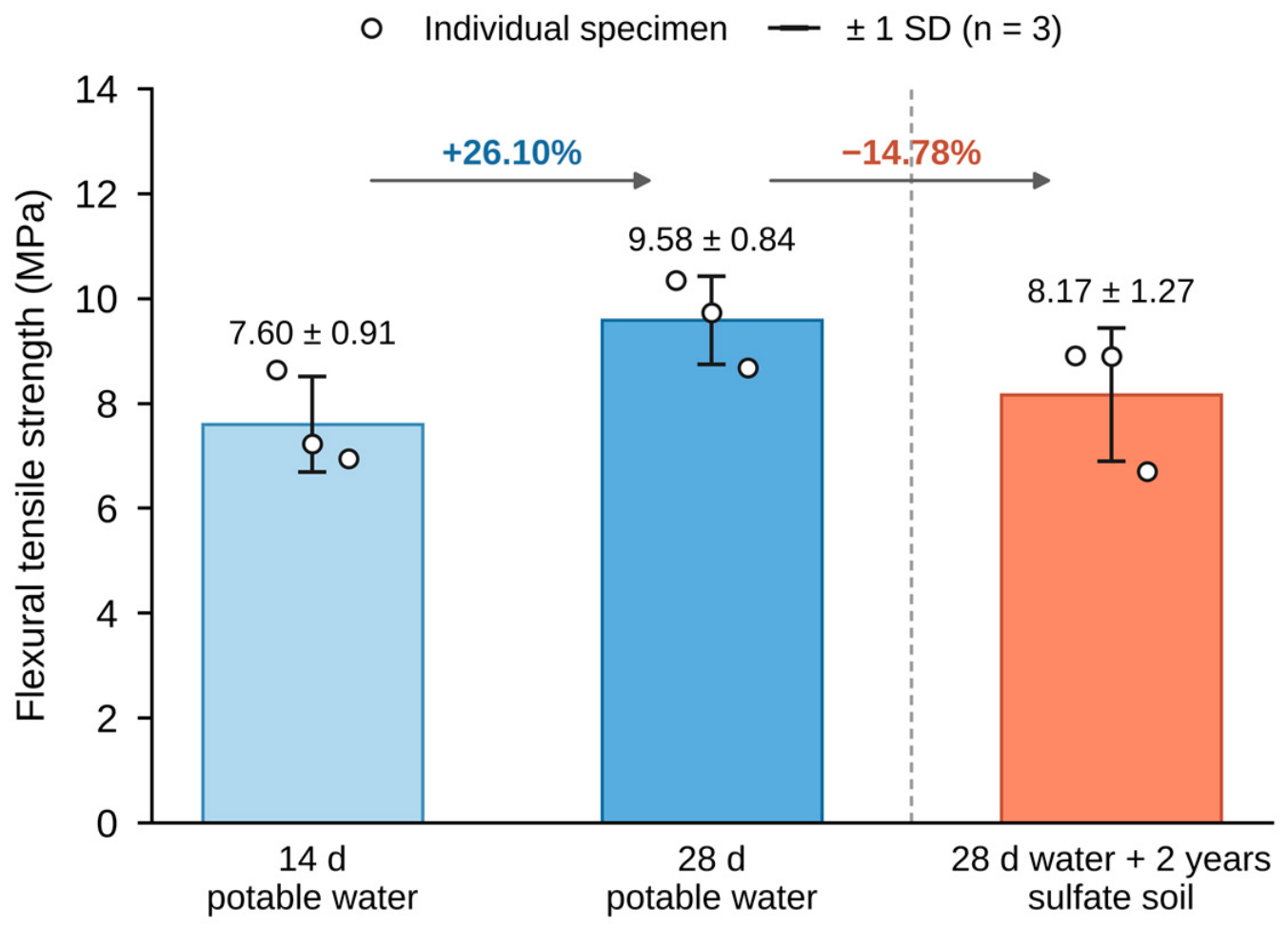
The mean flexural tensile strength increases from 7.60 MPa at 14 days to 9.58 MPa at 28 days in potable water, representing an increase of approximately 26.10% (Figure 22).
Figure 22.
Mean flexural tensile strengths of mortar with standard deviations.
Nevertheless, unlike the compressive behavior, two years of exposure to sulfate soil causes a noticeable decrease in flexural strength, which reaches 8.17 MPa (a 14.78% decrease compared with the 28-day values). This decline, most pronounced for the third specimen (Replicate 3: 6.70 MPa), suggests that flexural strength is more sensitive than compressive strength to the exposure, as would be expected if surface microcracking had developed. However, the difference between the two means (about 1.4 MPa) is of the same order as the standard deviations (0.84 and 1.27 MPa; Figure 22) and, as for compression, the absence of same-age specimens kept in a sulfate-free environment prevents the decrease from being attributed to sulfate attack alone.
4. Limitations of the Study
This study has several limitations that should be considered when interpreting the results. The sulfate exposure conditions differed between the concrete and mortar specimens. Concretes were tested after immersion in a sodium sulfate solution prepared from distilled water, while mortars were exposed to natural sulfate soil over two years. This difference in exposure medium and duration limits direct comparison between the two material families.
The concretes were tested at 28 days in both environments. The results therefore compare the effect of two curing environments on early-age strength and do not establish the long-term sulfate resistance of the concretes. For the mortar, no specimens of the same age were kept in a sulfate-free environment during the two-year burial, and no results are reported for the unmodified reference mortar. The effect of sulfate exposure therefore cannot be separated from that of continued hydration, and the effect of the slag cannot be separated from the behavior of the base mortar.
The three concretes differ in more than one parameter. BO differs from HPC and SFHPC in cement content, water-to-binder ratio, aggregate proportions, superplasticizer, and specimen size, so the individual effect of silica fume cannot be isolated; only the HPC–SFHPC pair, which shares the same matrix, isolates the effect of the fibers. A mixture without silica fume at the same water-to-binder ratio, within a factorial design, would be needed to quantify any synergy between silica fume and fibers. In addition, each result is based on three specimens, and differences smaller than the scatter should be read as trends.
The evaluation relied on strength loss as the main durability indicator. The sulfate content of the burial soil was not determined within this study using a documented analytical procedure; the reported value of 35% Na2SO4 was taken from the site characterization report. The exposure severity of the soil therefore cannot be fully characterized from the available information. No measurements of mass change, expansion, porosity, or sulfate ion penetration depth were made. Without these complementary indicators, the degradation mechanisms can only be inferred indirectly from strength results and visual observation of failure modes.
The microstructural changes associated with sulfate attack, such as the formation of gypsum and ettringite, were not directly confirmed. No X-ray diffraction, scanning electron microscopy, or thermal analysis was performed on the exposed specimens.
Post-cracking behavior was assessed visually from the failure patterns only; load–displacement curves, residual strengths, and fracture energy were not recorded.
The study used a single fiber type, dosage, and geometry (40 kg/m3 of 50 mm corrugated steel fibers), and a single silica fume content (8.1% of cement mass). The findings are therefore specific to these formulations and cannot be generalized to other fiber contents, fiber types, or addition dosages without further testing.
The industrial slag used in the mortar was sourced from a single local plant, and its pozzolanic activity was assessed indirectly through mechanical performance rather than through detailed chemical and mineralogical characterization. Variability in slag composition between batches or sources was not addressed.
Finally, the results are based on laboratory-scale specimens under controlled curing and exposure conditions. Field performance under variable temperature, humidity, wet-dry cycling, and combined chemical attack may differ from the trends observed here.
5. Conclusions and Future Scope
This study examined three concretes (BO, HPC, and SFHPC) and a mortar containing 25% ground industrial slag, all made with resources from the Béchar region, under sulfate exposure. Within the limits stated in Section 4, the main findings are as follows:
- Mix design and strength: In potable water at 28 days, HPC and SFHPC reached mean compressive strengths of 87.96 and 82.05 MPa, against 25.42 MPa for BO. This gain results from the complete change in mix design (lower water-to-binder ratio, superplasticizer, and silica fume) and cannot be assigned to silica fume alone. Adding 40 kg/m3 of corrugated steel fibers did not reduce workability and changed the mean compressive strength by less than the scatter of the results.
- Effect of fibers in tension: Fibers raised the mean splitting tensile strength from 8.63 MPa (HPC) to 13.05 MPa (SFHPC), about 4.7 times the BO value of 2.78 MPa. SFHPC specimens stayed held together by the fibers after cracking, whereas BO specimens split abruptly. This post-cracking improvement was observed visually and was not quantified.
- Concretes after 28 days of sulfate curing: Compared with water curing, 28 days in a 10% Na2SO4 solution reduced compressive strength by 9.32% (BO), 20.76% (HPC), and 10.97% (SFHPC), and splitting tensile strength by 19.81%, 18.19%, and 11.30%. SFHPC had the smallest tensile loss, about half the compressive loss of HPC, and the highest residual strengths; its relative compressive loss was slightly higher than that of BO. These are early-age effects of the curing environment and do not establish long-term sulfate resistance.
- Role of fibers under sulfate curing: Because HPC and SFHPC share the same matrix, the difference between them points to a beneficial effect of fibers on strength retention. The proposed mechanism, crack control limiting sulfate ingress, remains a hypothesis: no transport, expansion, mass, or microstructural measurements were made, and a synergy between silica fume and fibers was not demonstrated quantitatively.
- Slag mortar after two years in sulfate soil: The slag mortar reached 28.58 MPa in compression and 9.58 MPa in flexure at 28 days. After two years in soil containing 35% sodium sulfate, its compressive strength was 28.83 MPa (+0.87%) and its flexural strength 8.17 MPa (−14.78%). Without same-age specimens kept in a sulfate-free environment and without reference-mortar results, these values document the residual strength of the slag mortar; they do not prove sulfate resistance or a benefit of the slag.
- Use of local resources: Aggregates from Djebel Béchar and Oued Hassi 20, combined with silica fume and steel fibers, make it possible to produce high-strength concrete in the region, and replacing 25% of the cement with a local industrial by-product reduces clinker consumption.
- Future work: Priority should be given to same-age control specimens and a reference mortar; longer sulfate exposure of the concretes with monitoring of mass, expansion, and sulfate penetration depth; XRD and SEM analysis of exposed specimens; chemical and mineralogical characterization of the slag; load–displacement measurements to quantify post-cracking behavior; factorial variation in silica fume and fiber contents; and identical specimen sizes for all mixtures.
Author Contributions
Conceptualization, C.B., A.B., Z.R.H. and S.M.A.; methodology, C.B., T.R., N.T. and S.M.A.; validation, C.B., A.B., T.R. and M.C.; formal analysis, T.R., Z.R.H. and F.B.; investigation, C.B., T.R., N.T. and M.C.; resources, A.B., Z.R.H., F.B. and M.B.; data curation, C.B., N.T., M.C. and M.B.; writing—original draft preparation, C.B., A.B., T.R., N.T. and Z.R.H.; writing—review and editing, M.C., F.B., M.B. and S.M.A.; visualization, C.B., N.T., M.C. and S.M.A.; supervision, T.R., Z.R.H. and F.B.; project administration, A.B., Z.R.H. and M.B. All authors have read and agreed to the published version of the manuscript.
Funding
This research received no external funding.
Institutional Review Board Statement
Not applicable.
Informed Consent Statement
Not applicable.
Data Availability Statement
The raw data supporting the conclusions of this article will be made available by the authors on request.
Conflicts of Interest
The authors declare no conflicts of interest.
References
- Neville, A. The Confused World of Sulfate Attack on Concrete. Cem. Concr. Res. 2004, 34, 1275–1296. [Google Scholar] [CrossRef] [Scilit]
- Santhanam, M.; Cohen, M.D.; Olek, J. Mechanism of Sulfate Attack: A Fresh Look: Part 1: Summary of Experimental Results. Cem. Concr. Res. 2002, 32, 915–921. [Google Scholar] [CrossRef] [Scilit]
- Santhanam, M.; Cohen, M.D.; Olek, J. Mechanism of Sulfate Attack: A Fresh Look: Part 2: Proposed Mechanisms. Cem. Concr. Res. 2003, 33, 341–346. [Google Scholar] [CrossRef] [Scilit]
- Whittaker, M.; Black, L. Current Knowledge of External Sulfate Attack. Adv. Cem. Res. 2015, 27, 532–545. [Google Scholar] [CrossRef] [Scilit]
- Jabbour, M.; Metalssi, O.O.; Quiertant, M.; Baroghel-Bouny, V. A Critical Review of Existing Test-Methods for External Sulfate Attack. Materials 2022, 15, 7554. [Google Scholar] [CrossRef] [Scilit] [PubMed]
- Zhang, C.; Li, J.; Yu, M.; Lu, Y.; Liu, S. Mechanism and Performance Control Methods of Sulfate Attack on Concrete: A Review. Materials 2024, 17, 4836. [Google Scholar] [CrossRef] [Scilit] [PubMed]
- Hooton, R.D. Influence of Silica Fume Replacement of Cement on Physical Properties and Resistance to Sulfate Attack, Freezing and Thawing, and Alkali-Silica Reactivity. ACI Mater. J. 1993, 90, 143–151. [Google Scholar] [CrossRef] [Scilit] [PubMed]
- Hamada, H.M.; Abed, F.; Katman, H.Y.B.; Humada, A.M.; Al Jawahery, M.S.; Majdi, A.; Yousif, S.T.; Thomas, B.S. Effect of Silica Fume on the Properties of Sustainable Cement Concrete. J. Mater. Res. Technol. 2023, 24, 8887–8908. [Google Scholar] [CrossRef] [Scilit]
- Elahi, M.M.A.; Shearer, C.R.; Reza, A.N.R.; Saha, A.K.; Khan, M.N.N.; Hossain, M.M.; Sarker, P.K. Improving the Sulfate Attack Resistance of Concrete by Using Supplementary Cementitious Materials (SCMs): A Review. Constr. Build. Mater. 2021, 281, 122628. [Google Scholar] [CrossRef] [Scilit]
- Yoo, D.-Y.; Banthia, N. Mechanical Properties of Ultra-High-Performance Fiber-Reinforced Concrete: A Review. Cem. Concr. Compos. 2016, 73, 267–280. [Google Scholar] [CrossRef] [Scilit]
- Wu, Z.; Shi, C.; Khayat, K.H. Investigation of Mechanical Properties and Shrinkage of Ultra-High-Performance Concrete: Influence of Steel Fiber Content and Shape. Compos. Part B Eng. 2019, 174, 107021. [Google Scholar] [CrossRef] [Scilit]
- Li, X.; Xue, W.; Fu, C.; Yao, Z.; Liu, X. Mechanical Properties of High-Performance Steel-Fibre-Reinforced Concrete and Its Application in Underground Mine Engineering. Materials 2019, 12, 2470. [Google Scholar] [CrossRef] [Scilit] [PubMed]
- Liu, J.; Zang, S.; Yang, F.; Zhang, M.; Li, A. Fracture Mechanical Properties of Steel Fiber Reinforced Self-Compacting Concrete under Dry–Wet Cycle Sulfate Attack. Buildings 2022, 12, 1623. [Google Scholar] [CrossRef] [Scilit]
- Guo, J.-j.; Wang, K.; Qi, C.-g. Determining the Mineral Admixture and Fiber on Mechanics and Fracture Properties of Concrete under Sulfate Attack. J. Mar. Sci. Eng. 2021, 9, 251. [Google Scholar] [CrossRef] [Scilit]
- Rezaei, M.; Delnavaz, A.; Delnavaz, M. Experimental Investigation of Metakaolin Ingredients on Bonding of Steel Fibers to Cement in Paste of Steel Fiber Concrete under Sulfate and Sulfate–Chloride Attack. Appl. Clay Sci. 2024, 260, 107549. [Google Scholar] [CrossRef] [Scilit]
- Sriram, M.; Sidhaarth, K.R.A. Influence of Silica Fume and Metakaolin on Durability Properties of Hybrid Fibers Reinforced High-Strength Concrete. J. Build. Rehabil. 2023, 8, 21. [Google Scholar] [CrossRef] [Scilit]
- Yardım, Y.; Gesoğlu, M.; Nahhab, A.H. Durability of Ultra-High-Performance Fiber-Reinforced Concrete against Internal Sulfate Attack Using Gypsum-Contaminated Aggregates. Constr. Build. Mater. 2025, 498, 144067. [Google Scholar] [CrossRef] [Scilit]
- Wang, R.; Liu, Y.; Li, Y.; Zhuang, X. Performance Degradation Mechanism and Strength Prediction of Silica Fume Concrete under Sulfate Dry–Wet Cycles. Case Stud. Constr. Mater. 2025, 23, e05163. [Google Scholar] [CrossRef] [Scilit]
- Cui, Z.; Oh, T.; Piao, R.; Kim, S.; Banthia, N.; Yoo, D.-Y. Utilization of CaO to Accelerate the Pozzolanic Reaction of Excessive Silica Fume in Ultra-High-Performance Fiber-Reinforced Concrete: Implications for Microstructural and Mechanical Properties. Compos. Part B Eng. 2025, 307, 112949. [Google Scholar] [CrossRef] [Scilit]
- Golewski, G.L. Optimizing Strength and Post-Peak Ductility in Sustainable Concretes: The Synergy of Silica Fume and Nano-Silica with Class F Fly Ash. Materials 2026, 19, 2773. [Google Scholar] [CrossRef] [Scilit] [PubMed]
- Sharma, R.; Jang, J.G.; Bansal, P.P. A Comprehensive Review on Effects of Mineral Admixtures and Fibers on Engineering Properties of Ultra-High-Performance Concrete. J. Build. Eng. 2022, 45, 103314. [Google Scholar] [CrossRef] [Scilit]
- UN Environment; Scrivener, K.L.; John, V.M.; Gartner, E.M. Eco-Efficient Cements: Potential Economically Viable Solutions for a Low-CO2 Cement-Based Materials Industry. Cem. Concr. Res. 2018, 114, 2–26. [Google Scholar] [CrossRef] [Scilit]
- Ye, Q.; Shen, C.-J.; Sun, S.-M.; Chen, R.; Song, H. The Sulfate Corrosion Resistance Behavior of Slag Cement Mortar. Constr. Build. Mater. 2014, 71, 202–209. [Google Scholar] [CrossRef] [Scilit]
- Siddique, R.; Khan, M.I. Supplementary Cementing Materials; Springer: Berlin/Heidelberg, Germany, 2011. [Google Scholar] [CrossRef] [Scilit]
- Samuvel Raj, R.; Prince Arulraj, G.; Anand, N.; Kanagaraj, B.; Lubloy, E.; Vijay, U.P. Enhancing Engineering and Sustainable Properties of Alkali-Activated Concrete with Nanomaterials under Aggressive Environmental Conditions. Hybrid Adv. 2026, 13, 100665. [Google Scholar] [CrossRef] [Scilit]
- Dreux, G.; Festa, J. New Guide to Concrete and Its Constituents, 8th ed.; Eyrolles: Paris, France, 1998. [Google Scholar]
- Aïtcin, P.-C. High-Performance Concrete, 1st ed.; CRC Press: Boca Raton, FL, USA, 1998. [Google Scholar] [CrossRef]
- Liao, G.; Wu, R.; He, M.; Huang, X.; Wu, L. The Effect of Steel Fiber Content on the Workability and Mechanical Properties of Slag-Based/Fly Ash-Based UHPC. Buildings 2025, 15, 2350. [Google Scholar] [CrossRef] [Scilit]
- Ahmadi, M.; Lallotra, B. Experimental Study on the Strength Properties of Concrete Modified with Silica Fume and Steel Fiber. In Proceedings of the 2nd International Conference on Sustainable Nanotechnology and Nanomaterials (ICONN-2023), Chandigarh University, Chandigarh, India, 27–28 July 2023. [Google Scholar]
- Safari Taleghani, S.; Salehi, A.M.; Mehraein, M.; Asadollahfardi, G. The Effect of Different Types of Fibers and Cement Substitutes on High-Performance Concrete Cured in Standard, Thermal, and Sulfate Conditions. Int. J. Concr. Struct. Mater. 2025, 19, 78. [Google Scholar] [CrossRef] [Scilit]
- Peng, G.; Gao, Y.; Tarantino, A.M.; Wang, A.; Kang, S.; Hu, C.; Zeng, H.; Wang, J.; Wu, W.; Yan, X. Durability Enhancement of Ultra-High-Performance Concrete Repair Materials under Chloride, Sulfate, and Freeze–Thaw Conditions through Synergistic Effects of Silica Fume, Nucleating Agents, and Fibers. Constr. Build. Mater. 2025, 504, 144606. [Google Scholar] [CrossRef] [Scilit]
- Derrouiche, Y.; Achoura, D.; Saliba, J.; Cassagnabère, F. Natural Pozzolan as a Sustainable Cement Replacement in High-Performance Concrete: Effects on Mechanical Properties, Durability, and Microstructural Development. Sci. Afr. 2025, 27, e02574. [Google Scholar] [CrossRef] [Scilit]
- Ahmed, A.; Kamau, J.; Pone, J.; Hyndman, F.; Fitriani, H. Chemical Reactions in Pozzolanic Concrete. Mod. Approaches Mater. Sci. 2019, 1, 128–133. [Google Scholar] [CrossRef] [Scilit]
- Merida, A.; Kharchi, F. Pozzolan Concrete Durability on Sulphate Attack. Procedia Eng. 2015, 114, 832–837. [Google Scholar] [CrossRef] [Scilit]
- Farzadnia, N.; Abang Ali, A.A.; Demirboğa, R. Incorporation of Mineral Admixtures in Sustainable High-Performance Concrete. Int. J. Sustain. Constr. Eng. Technol. 2011, 2, 12–25. [Google Scholar]
- Atlaoui, D.; Bouafia, Y.; Khelil, N.; Akkouche, K.; Aliche, A. Experimental Analysis of the Punching Shear Behavior of Concrete Slabs Reinforced with Metal and Polypropylene Fibers. Eur. Proc. Sci. Technol. Eng. Math. 2025, 38, 189–199. [Google Scholar] [CrossRef] [Scilit]
- GRANITEX Algeria. Technical Data Sheet for MEDAFAC Corrugated Steel Fibers. Available online: https://www.granitex.dz/product/511 (accessed on 2 November 2026).
- Shi, C.; Wu, Z.; Xiao, J.; Wang, D.; Huang, Z.; Fang, Z. A Review on Ultra-High-Performance Concrete: Part I. Raw Materials and Mixture Design. Constr. Build. Mater. 2015, 101, 741–751. [Google Scholar] [CrossRef] [Scilit]
- Wang, D.; Shi, C.; Wu, Z.; Xiao, J.; Huang, Z.; Fang, Z. A Review on Ultra-High-Performance Concrete: Part II. Hydration, Microstructure and Properties. Constr. Build. Mater. 2015, 96, 368–377. [Google Scholar] [CrossRef] [Scilit]
- IANOR. NA 442: Composition et Spécifications des Ciments Courants. 2006. Available online: https://www.ianor.dz/en/home-en/ (accessed on 2 November 2026).
- Fayed, S.; Madenci, E.; Özkiliç, Y.O.; Tawfik, T.A. Effect of Block Size on Bearing Strength of Steel Fiber-Reinforced Recycled Aggregate Concrete. Arab. J. Sci. Eng. 2024, 49, 5287–5303. [Google Scholar] [CrossRef] [Scilit]
- CEN. EN 12390-3:2019; Testing Hardened Concrete—Part 3: Compressive Strength of Test Specimens. European Committee for Standardization: Brussels, Belgium, 2019.
- CEN. EN 12390-6:2023; Testing Hardened Concrete—Part 6: Tensile Splitting Strength of Test Specimens. European Committee for Standardization: Brussels, Belgium, 2023.
- CEN. EN 12390-5:2019; Testing Hardened Concrete—Part 5: Flexural Strength of Test Specimens. European Committee for Standardization: Brussels, Belgium, 2019.
- CEN. EN 196-1:2016; Methods of Testing Cement—Part 1: Determination of Strength. European Committee for Standardization: Brussels, Belgium, 2016.
- Ferraris, C.; de Larrard, F. Testing and Modelling of Fresh Concrete Rheology; National Institute of Standards and Technology: Gaithersburg, MD, USA, 1998.

Disclaimer/Publisher’s Note: The statements, opinions and data contained in all publications are solely those of the individual author(s) and contributor(s) and not of MDPI and/or the editor(s). MDPI and/or the editor(s) disclaim responsibility for any injury to people or property resulting from any ideas, methods, instructions or products referred to in the content. |
© 2026 by the authors. Licensee MDPI, Basel, Switzerland. This article is an open access article distributed under the terms and conditions of the Creative Commons Attribution (CC BY) license.