


Abstract
This study presents a theoretical investigation of the thermo-mechanical vibration and stability of functionally graded thermoplastic nanocomposite plates reinforced with graphene nanoplatelets (GNPs), incorporating porosity, nonlocal elasticity, and strain-gradient effects. A polypropylene (PP) matrix reinforced with GNPs is considered, with the nanoparticle distribution through the thickness described by a power-law function and a thickness-dependent porosity distribution included to account for manufacturing-induced voids. The formulation incorporates simultaneous nonlocal and strain-gradient length-scale parameters to capture nanoscale size-dependent behavior. The effective elastic modulus, density, and thermal expansion coefficient are evaluated as functions of thickness, GNP volume fraction, porosity, and temperature. The thermo-mechanical plate equations are formulated using a modal representation, and a computational-compatible numerical integration procedure is developed to evaluate natural frequencies, critical temperature, limiting cases, and convergence. For a reference square PP/GNP plate with a 3% GNP volume fraction, grading index of unity, 1% porosity amplitude, μ/h = 0.1, and ℓ/h = 0.3, the mechanical reference frequency is approximately 168.05 Hz, while the critical temperature rise is 5.8175 K. GNP reinforcement increases the reference frequency by 1.1714%, whereas porosity causes a 0.0106% reduction. Verification against a classical analytical solution yields an error of 0.0001%, and the critical-temperature comparison gives an error of 0.0158%. The results demonstrate the consistency and numerical stability of the proposed framework for analyzing coupled reinforcement, gradation, porosity, thermal, and size-dependent effects in thermoplastic nanocomposite plates.
1. Introduction
Thermoplastic nanocomposites have attracted significant attention for advanced structural applications because they combine the low density, processability, and recyclability of polymeric matrices with the superior mechanical properties of nanoscale reinforcements [1]. Polypropylene (PP) is particularly attractive owing to its low density, ease of processing, chemical resistance, and broad engineering applications. However, its relatively low stiffness and pronounced temperature sensitivity may limit structural performance under dynamic and thermal loading. Graphene nanoplatelets (GNPs) offer an effective means of enhancing the mechanical and dynamic properties of PP-based composites while preserving their lightweight characteristics [2]. At the nanoscale, classical continuum theories may not adequately describe size-dependent mechanical behavior. Nonlocal elasticity, strain-gradient theory, and combined nonlocal strain-gradient formulations have therefore been developed to incorporate nanoscale stiffening and softening through material length-scale parameters [3]. In addition, functionally graded materials (FGMs) provide greater control over stiffness, mass distribution, thermal expansion, and vibration by continuously varying reinforcement concentration through the thickness. Accordingly, the through-thickness distribution of GNPs can be treated as an important design variable in nanocomposite structures [4,5,6,7].
Porosity or voids introduced during manufacturing can significantly alter the effective stiffness, density, and dynamic response of polymeric nanocomposites. In particular, asymmetric porosity distributions may shift the stiffness and mass distributions relative to the plate mid-plane, thereby affecting bending and vibration characteristics. The combined presence of graded nanoparticles and nonuniform porosity consequently produces a more complex material architecture than conventional homogeneous or symmetric FGM plates [8,9,10]. Thermal effects are also important in thermoplastic nanostructures because temperature variations can modify the elastic modulus, thermal expansion, internal stresses, and natural frequencies. Therefore, thermomechanical models should incorporate both temperature-dependent polymer properties and thermal prestress resulting from constrained thermal expansion [11]. Despite extensive studies on FG nanoplates, porous composites, thermoplastic nanocomposites, and size-dependent theories, limited attention has been given to their simultaneous interaction, particularly considering temperature-dependent PP properties, GNP grading, asymmetric porosity, thermal prestress, and competing nonlocal and strain-gradient effects [12,13,14,15]. Recent developments in porous FG composites further demonstrate their potential for lightweight structural applications requiring high stiffness-to-weight ratios, energy absorption, and thermal-management capabilities, including aerospace panels, thermal-protection structures, microsystems, and sensors [16,17,18,19]. GNPs, also referred to as graphene platelets (GPLs), provide efficient reinforcement because of their high in-plane stiffness, specific surface area, and thermal conductivity. Their effectiveness, however, depends on platelet geometry, orientation, agglomeration, interfacial bonding, and through-thickness dispersion; hence, GNP content alone is insufficient to characterize their contribution. Consequently, various uniform, symmetric, asymmetric, linear, and parabolic GNP distributions have been investigated in FG beams, plates, shells, and polymer composites [20,21,22,23,24,25,26]. The interaction between GNP grading and porosity can further modify the stiffness-to-mass ratio and vibration characteristics.
Accordingly, this study develops a theoretical thermomechanical model for a porous functionally graded PP/GNP nanoplate. A power-law function is used to describe the through-thickness GNP distribution, while an asymmetric single-phase porosity function represents nonuniform voids. The temperature dependence of the PP matrix is incorporated through a temperature-dependent elastic modulus, and the effective composite properties are evaluated using the Halpin–Tsai model. A differential nonlocal strain-gradient formulation is employed to capture size-dependent behavior. The proposed model systematically investigates the effects of GNP concentration, grading index, porosity amplitude and asymmetry, temperature, plate geometry, nonlocal length scale, and strain-gradient length scale on the natural frequencies. This framework provides a unified approach for evaluating and tailoring the coupled thermomechanical and size-dependent vibration behavior of lightweight porous thermoplastic nanoplates.
Related studies have demonstrated that porosity coefficient and distribution, GPL distribution, geometry, and boundary conditions significantly influence the vibration response of porous rectangular plates, with symmetric distributions generally producing higher frequencies than uniform ones [27,28,29,30]. These findings indicate that porous nanocomposites should be treated as coupled graded architectures rather than dense composites with simple mass corrections. At the nanoscale, classical plate theories may be inadequate because structural dimensions become comparable with material length scales. Consequently, modified strain-gradient, nonlocal elasticity, nonlocal strain-gradient, couple-stress, and quasi-three-dimensional theories have been employed to capture size-dependent vibration. Their predictions depend on the adopted constitutive assumptions and calibrated length-scale parameters and should therefore be interpreted within the framework of the selected continuum theory. The choice of plate theory and numerical method also affects predicted frequencies. Classical and first-order shear-deformation theories are computationally efficient, whereas refined and quasi-3D theories provide improved descriptions of transverse shear and normal deformation, particularly for moderately thick, porous, and sandwich plates [31,32]. Various analytical and numerical techniques, including Chebyshev spectral methods, generalized differential quadrature, Galerkin, Navier, transfer-function, and finite-element methods, have been used to solve the corresponding vibration and stability problems. Comparisons among published results must therefore consider differences in boundary conditions, plate theories, porosity models, effective-property formulations, and size-dependent theories.
Temperature provides an additional mechanism for controlling vibration and stability. Temperature variations alter material properties and generate thermal strains; under restrained expansion, the resulting thermal membrane forces modify structural stiffness and may lead to thermal buckling. Previous studies of porous GPL-reinforced beams, arches, plates, and shells have shown that natural frequencies are sensitive to temperature gradients, GPL content, porosity, and reinforcement distribution [33,34,35]. Moreover, because GNPs and porosity influence thermal conductivity, the through-thickness temperature field may be nonlinear rather than a prescribed linear gradient. Recent investigations have therefore emphasized the importance of coupling thermal conduction with porosity and GPL distributions when predicting thermally affected vibration [36,37,38]. Thermoplastic matrices introduce additional complexity because their stiffness, damping, and viscoelastic behavior are strongly temperature dependent. Although existing studies have examined GNP-reinforced polymer nanostructures under various thermal, reinforcement, and nonlinear conditions [39,40,41,42,43], the literature remains comparatively limited for porous functionally graded thermoplastic plates incorporating nanoscale size effects. This is important because thermoplastic nanoplates may experience significant thermal softening, temperature-dependent damping, and processing-related variations in porosity and platelet orientation.
Recent research has further demonstrated that thermal prestress, porosity and GPL arrangement, fluid or environmental interactions, and electromechanical effects can substantially modify vibration, stability, and damping characteristics [44,45,46,47]. These developments highlight the need for a unified model that simultaneously considers thermal effects, porosity, functionally graded GNP reinforcement, nanoscale size dependence, and thermoplastic constitutive behavior [48,49].
Several probabilistic techniques have been developed to analyze composite and functionally graded structures. A Monte Carlo simulation coupled with an artificial neural network (ANN) was implemented to efficiently quantify the statistical variation in natural frequencies of GNP-reinforced porous functionally graded plates with reduced computational cost [50]. In another study, a stochastic finite element framework was developed to investigate the free vibration analysis of a power-law-based functionally graded plate wherein the material properties are temperature-dependent and vary along the thickness [51]. Moreover, a generalized polynomial chaos expansion (gPCE) approach to study the free vibration of orthotropic plates in the presence of uncertainties in their elastic properties was studied. The method evaluates the natural frequency and mode shapes of an FG plate by a probabilistic approach and compares the results with experimental data [52]. A finite element framework combined with probability-based analysis was used to quantify the influence of these uncertainties on the characteristics of a CNT-reinforced FG plate [53]. The mechanical modeling of functionally graded nanostructures has increased interest in understanding how material gradation, nanoscale effects, porosity, and thermal conditions influence structural stiffness and vibration behavior. However, recent research has extended the investigation of graphene nanoplatelet (GNP)-reinforced functionally graded materials to complex structural systems and nonlinear dynamic behavior. For example, Xu et al. (2025) investigated the nonlinear dynamics of functionally graded GNP-reinforced multiphase porous composite beams using the differential quadrature (DQ) and incremental harmonic balance (IHB) methods [54]. Their study provides a relevant reference for understanding the dynamic behavior of porous, graded nanocomposite structures [54].
Fuzzy, probabilistic, and mixed uncertainty-propagation approaches were employed to evaluate variations in natural frequencies, mode shapes, and frequency-response characteristics, demonstrating improved computational efficiency and more realistic representation of material uncertainty [55,56]. Recent developments in nonlocal mechanics describe size dependence owing to micro- and nanoscale structures [57,58]. To analyse the behaviour of intrinsic length scales, researchers have applied various nonlocal and strain-gradient models; for example, they investigated the stochastic vibration characteristics of Euler–Bernoulli beams using different gradient-based nonlocal elasticity models [59]. Moreover, stochastic perturbation techniques were implemented to solve the Euler–Bernoulli beam problem. Eringen’s nonlocal elasticity theory can encounter mathematical inconsistencies in finite-domain boundary-value problems, highlighting the need for careful constitutive formulation when modeling nanoscale structures [60,61]. These limitations motivate the development of alternative nonlocal frameworks capable of providing more consistent descriptions of size-dependent mechanical behavior.
Stress-driven and surface stress-driven nonlocal formulations offer alternative routes to incorporating scale effects, particularly when surface contributions and constitutive boundary conditions are important [62,63]. Such approaches broaden the modeling options available for functionally graded nanostructures with nonuniform material distributions.
In the present study, the nonlocal strain-gradient theory is retained because it combines long-range nonlocal interactions with higher-order strain-gradient effects in a unified constitutive framework. This choice is intended to capture complementary small-scale mechanisms without introducing the additional surface constitutive parameters or modeling complexity associated with some alternative approaches and, furthermore, to take two different gradient versions—Eringen’s model and the nonlocal model—and compare their results [64].
Recent studies have applied such formulations to functionally graded plates, while iterative approaches have been proposed to overcome the computational difficulties associated with nonlocal plate equations [65,66,67]. Despite these developments, most existing investigations treat the material properties, porosity characteristics, grading parameters, and length-scale parameters as deterministic quantities. Consequently, the combined influence of material uncertainty, porosity, thermal effects, and nonlocal/strain-gradient parameters on the vibration and stability of porous functionally graded nanoplates remains insufficiently explored. Accordingly, the present study investigates the thermally tunable, size-dependent free vibration of porous functionally graded thermoplastic nanoplates reinforced with GNPs. The formulation considers the coupled effects of GNP distribution, porosity architecture, temperature-dependent thermoplastic properties, thermal membrane forces, and nanoscale length scales on the fundamental and mode-dependent frequencies. The proposed framework also distinguishes direct reinforcement effects from changes associated with mass reduction, thermal softening, thermal prestress, and the adopted size-dependent continuum model, providing a basis for designing lightweight thermoplastic nanoplates with controllable vibration performance.
The main objective of this investigation is to develop a theoretical model capable of predicting the thermomechanical free-vibration behavior of porous functionally graded PP/GNP nanoplates while simultaneously considering material grading, porosity, temperature dependence, and nanoscale effects. The specific objectives are as follows: to develop a functionally graded PP/GNP nanoplate model in which the GNP volume fraction varies continuously through the plate thickness; to introduce an asymmetric single-phase porosity distribution and investigate its influence on the stiffness, mass distribution, and vibration characteristics; to incorporate temperature-dependent properties of the PP matrix, allowing the influence of thermal environments on the dynamic response to be evaluated; to determine the effective mechanical and thermal properties of the porous PP/GNP nanocomposite using an appropriate micromechanical homogenization approach; to incorporate nonlocal and strain-gradient size effects through a differential nonlocal strain-gradient formulation; to investigate the effects of geometric parameters, including plate aspect ratio and thickness, on the natural frequencies; to quantify the influence of the GNP volume fraction and FGM grading index on the dynamic behavior; to examine the effects of porosity amplitude and asymmetry on the vibration response; to investigate the competition between nonlocal softening and strain-gradient stiffening mechanisms; to develop a computational-based numerical framework capable of generating systematic parametric results, figures, and tables for the proposed model; to establish design-oriented relationships between the material architecture and vibration characteristics of thermoplastic nanostructures.
2. Mathematical Formulation
2.1. Geometry and Assumptions
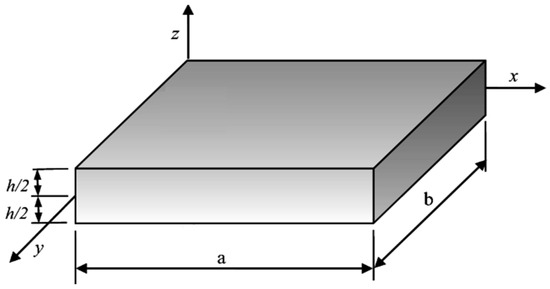
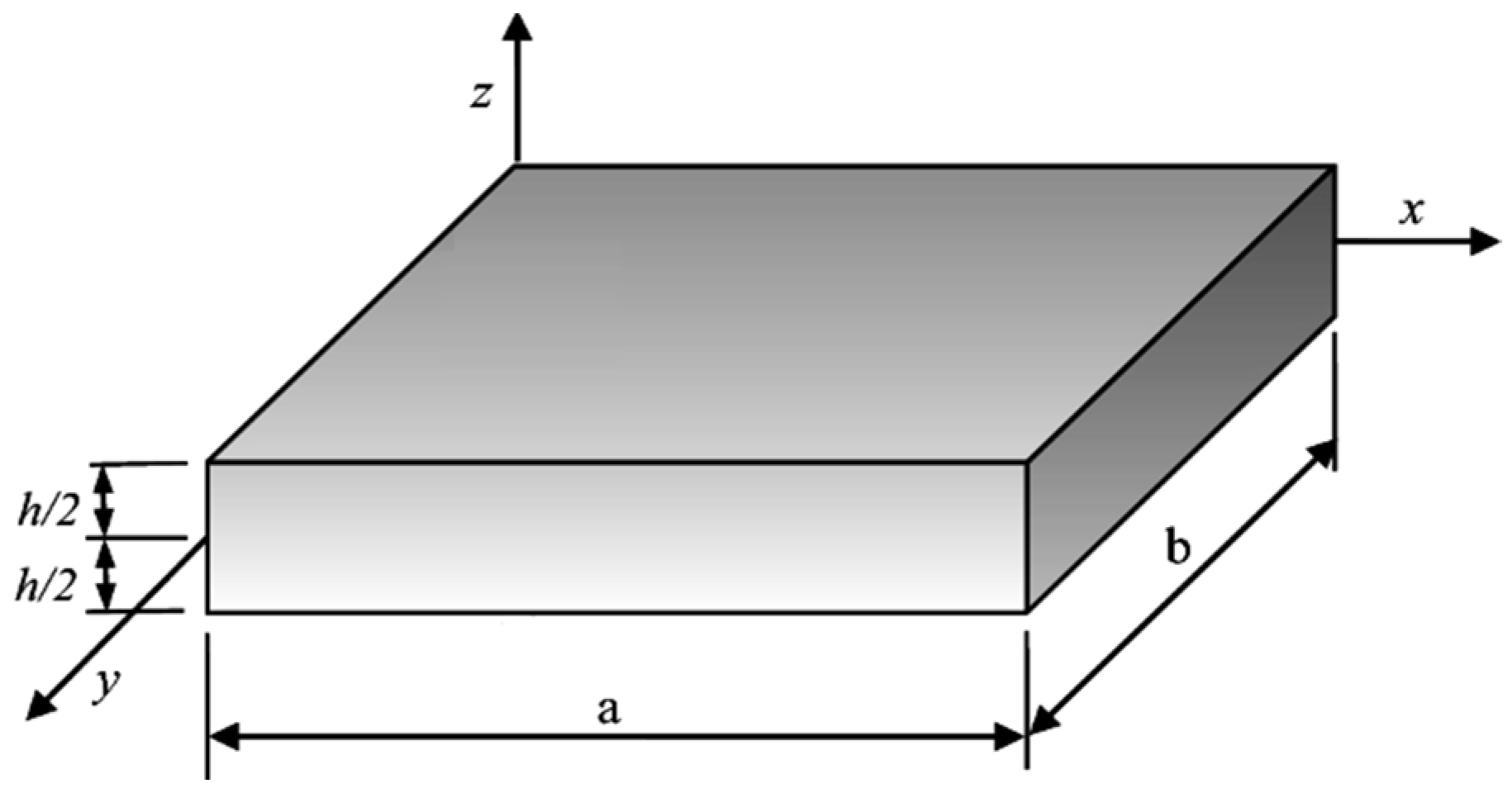
A thin, square functionally graded thermoplastic nanocomposite plate of length a, width b, and thickness h as shown in Figure 1 is considered. The Cartesian coordinates (x, y, z) are defined such that the mid-plane is located at z = 0, with
Figure 1.
The geometry of the model used.
The plate is modeled using classical Kirchhoff–Love kinematics, small deformation and small strain assumptions, isotropic effective material behavior within each infinitesimal thickness layer, and a uniform imposed temperature rise ΔT = T − T0.
The investigated structure is a macroscopic functionally graded PP/GNP nanocomposite plate, in which nanoscale GNPs serve as reinforcement. The adopted dimensionless parameters, (μ/h = 0.1) and (ell/h = 0.3), correspond to effective characteristic lengths of (100) and (300) μm), respectively. These parameters are treated as phenomenological continuum-model inputs, and their effects are systematically evaluated through the existing parametric studies rather than interpreted as measured nanoscale dimensions.
2.2. Functionally Graded GNP Distribution
The GNP volume fraction is assumed to vary continuously along the thickness direction. A power-law distribution is adopted in the form
where Vg0 denotes the maximum GNP volume fraction and k is the FGM grading index. Hence, the distribution satisfies
The single-phase porosity distribution is defined by
where P0 is the porosity amplitude and ηp is the porosity-asymmetry parameter. The matrix fraction is obtained from local volume conservation:
With the physical admissibility condition
2.3. Material Properties
The reinforcement parameter is
and the nonporous PP/GNP effective modulus is
The final model uses a porosity reduction factor of unity, hence
Equivalently,
The effective density is
The final model design implementation uses a stiffness-weighted thermal expansion coefficient, so the formulation must be synchronized accordingly:
2.4. Effective Constitutive Stiffness
For the asymmetric functionally graded architecture, the in-plane extensional, extensional–bending coupling, and bending stiffness matrices are defined through thickness integration as follows [68]:
where (h) is the plate thickness, (z) denotes the thickness coordinate measured from the geometric mid-plane, and Qij(z) represents the effective reduced stiffness coefficients. For an isotropic effective material under plane-stress conditions, these coefficients are expressed as
where E(z) and ν(z) are the effective Young’s modulus and Poisson’s ratio, respectively, which may vary through the thickness.
Because the material properties vary through the thickness, the effective bending rigidity is obtained by thickness integration:
Because the adopted graded architecture is asymmetric about the geometric mid-plane, the extensional–bending coupling stiffnesses (Bij) are generally nonzero. Their neglect in the present dynamic formulation is therefore treated as a modeling approximation rather than an inherent property of the material. Accordingly, the predicted vibration response is interpreted within the adopted reduced-order model, while a fully coupled dynamic formulation incorporating the (Aij), (Bij), and (Dij) stiffness matrices is identified as an important direction for future investigation.
2.5. Classical Kirchhoff–Love Kinematics
The displacement field is
and,
The mid-plane membrane strains are
Accordingly, the through-thickness engineering shear strain is given by
The curvaturer are defined as
Thus,
The thermal strain vector is
The mechanical strain is
And, the stress vector is therefore is
For the present plate, which is restrained in-plane and subjected to a uniform temperature rise, the thermally induced in-plane membrane force resultant is expressed as follows:
For the FGM nanoplate, the thermal force and moment resultants should be defined consistently. Under a uniform temperature increment and the stated isotropic plane-stress assumptions [69,70],
For the isotropic constitutive law
So,
The model treats NT as a destabilizing thermal membrane force in the transverse vibration equation.
2.6. Classical Transverse Equilibrium Equation
For the reduced transverse vibration model, the governing equation before nanoscale effects are introduced is
For the simply supported transverse vibration problem,
where And the fundamental mode corresponds to .
The modal wave number is
For the adopted modal function
2.7. Nonlocal Strain-Gradient Formulation
The adopted nonlocal strain-gradient framework follows established continuum approaches for investigating the vibration behavior of functionally graded plates, incorporating nonclassical effects through characteristic length parameters (Zhu et al., 2021) [71]. In the present study, these parameters are prescribed reference inputs for systematic parametric investigation rather than experimentally calibrated properties of the PP/GNP composite. The size-dependent bending moment-curvature relation is
where μ and l are the nonlocal and strain-gradient characteristic lengths, respectively.
Using the Navier mode gives the following:
Hence,
The effective nanoscale bending rigidity is therefore
Moreover, the corresponding moment–curvature relation becomes
Besides, the characteristic-length limits are
For the final thermomechanical frequency equation, replacing D with DNS in Equation (28) gives
Therefore:
and
The natural frequency in Hz is
2.8. Stability and Critical Temperature
The modal state is stable when
The critical condition is
For a temperature-dependent formulation, the critical temperature is determined implicitly from
The corresponding states are:
For the independent critical-temperature verification performed in the selected model, the temperature sensitivity of the elastic modulus is suppressed (βE = 0) so that the numerical critical temperature can be compared directly with the analytical stability expression. The normalized frequencies are defined using the stable mechanical reference state at zero temperature rise:
2.9. Numerical Solution Procedure
The bending rigidity is evaluated numerically from
The mass per unit area is calculated as
The thermal membrane resultant is as follows:
For each vibration mode (m,n), the modal wave number is evaluated using,
Finally,
Provided that,
Otherwise, the corresponding mode is classified as thermally unstable rather than assigned a nonphysical real frequency.
3. Numerical Solution, Verification, and Validation Methodology
3.1. General Numerical Strategy
The mathematical formulation developed in Section 2 is implemented numerically to evaluate the coupled effects of GNP reinforcement, functional gradation, porosity, temperature, and nanoscale size parameters on the vibration and thermal stability of the thermoplastic nanocomposite plate. The computational procedure evaluates the thickness-dependent effective properties first and subsequently determines the effective bending rigidity, mass per unit area, thermal membrane resultant, nanoscale bending rigidity, and natural frequencies. This sequence follows the computational strategy described in the formulation document.
The final computational implementation is developed in MATLAB 2014a software tools. For every considered parameter set, the plate thickness is discretized, the local material properties are evaluated at each integration point, and the resulting quantities are numerically integrated through the thickness. The procedure can be summarized as follows:
3.2. Thickness Discretization and Numerical Integration
The thickness of plate is discretized into Nz uniformly distributed points according to
This discretization permits the continuous thickness-dependent material properties to be evaluated numerically. At each point zi, the GNP fraction, porosity, matrix fraction, effective modulus, density, and thermal expansion coefficient are calculated before evaluating the constitutive stiffness components. The formulation explicitly adopts this point-wise numerical strategy and recommends Nz = 1001 for the baseline calculations.
3.3. Evaluation of Temperature-Dependent Material Properties
At each temperature level, the PP Young’s modulus is evaluated according to
The temperature increment is defined by .
The source formulation explicitly states that the temperature-dependent constitutive relation should be applied within the temperature range for which the assumed material behavior remains physically appropriate. In the present implementation, the remaining adopted properties are treated as constant, while the temperature-dependent modulus modifies the local composite stiffness and, consequently, the bending rigidity and thermal response.
3.4. Numerical Evaluation of the Effective Reinforced and Porous Modulus
At each thickness coordinate, the Halpin–Tsai relations in Equations (7) and (8) are employed to evaluate the effective material properties. This approach preserves the through-thickness heterogeneity of the FGM structure rather than approximating it using a single homogenized material property. Consistent with the original formulation, the properties are evaluated pointwise through the thickness, followed by numerical integration to determine the corresponding effective structural parameters.
3.5. Calculation of the Nanoscale Bending Rigidity
The classical bending rigidity obtained from Equation (51) is incorporated into the governing vibration equation, which is subsequently extended to account for the combined nonlocal and strain-gradient effects. The source formulation explicitly identifies this as the principal size-dependent correction. For the reference model, μ/h = 0.10, ℓ/h = 0.30. The computational model additionally considers the limiting cases μ = 0, ℓ = 0, as well as the classical condition μ = ℓ = 0. These cases are used later for mathematical verification.
3.6. Modal Natural-Frequency Calculation
After determining DNS, I0, and NT, the natural angular frequency is obtained from
The frequency in hertz is then calculated as
This equation is the principal numerical relation evaluated by the model implementation. The source formulation likewise identifies the size-dependent frequency equation as the central analytical result used for the subsequent numerical investigation.
3.7. Stability Classification and Critical Temperature
For every mode, the computational procedure first evaluates the following:
The modal state is classified according to
Thus, the critical condition is as follows:
For the temperature-dependent model, the critical temperature is obtained numerically by a bounded root-search procedure. The final model design implementation employs a bisection procedure to determine the temperature at which the stability function changes sign. This procedure is important because the fundamental mode may become unstable before higher modes. Accordingly, no artificial real-valued frequency is assigned to a state for which . Instead, the state is explicitly classified as thermally unstable.
3.8. Verification Strategy
A hierarchical verification and analytical validation procedure is employed to establish the reliability of the mathematical implementation. The procedure consists of four complementary levels.
3.8.1. Classical Homogeneous Limit
The generalized model is first reduced to the classical homogeneous plate by setting
The analytical classical frequency is evaluated in dependently from
where
and
The relative discrepancy is calculated according to
3.8.2. Limiting-Case Verification and Numerical Convergence Verification
The following limiting configurations are separately evaluated:
μ = 0, ℓ = 0 for the classical model, ℓ = 0 for the nonlocal-only model, μ = 0 for the strain-gradient-only model, and for the combined nonlocal strain-gradient formulation. In addition, the following material-property limits are examined: Vg0 = 0 for the no-GNP case, and P0 = 0 for the nonporous case. These calculations verify that the generalized formulation can independently recover the corresponding reduced models. The thermal stability calculation is independently checked by temporarily suppressing the temperature dependence of the elastic modulus, βE = 0, so that the analytical critical-temperature expression can be evaluated directly. A through-thickness convergence study is performed using .
The fundamental frequency is recalculated at each discretization level. The relative convergence error is defined with respect to the finest discretization as follows:
3.9. Reference-Normalized Frequency
Because the 10 K reference configuration is thermally unstable in the fundamental mode, the final computational implementation uses the stable mechanical reference state at ΔT = 0.
The reference frequency is therefore and the normalized modal frequency is
This definition avoids division by an undefined fundamental frequency for the unstable 10 K baseline condition and is the normalization used in the final modal output.
The methodology described above is consistent with the numerical workflow specified in the supplied formulation, including the thickness discretization, GNP and porosity evaluation, effective-property calculation, numerical bending rigidity, thermal resultant, modal wave number, nonlocal strain-gradient correction, and final natural-frequency calculation.
4. Results and Discussion
The principal contribution of the study is therefore the development of a unified analytical framework in which material grading, porosity architecture, thermoplastic temperature sensitivity, thermal prestress, and nanoscale size effects are treated simultaneously. The proposed model is implemented numerically using a computerized method, and an extensive parametric study is performed to identify the mechanisms governing the dynamic response. Particular attention is given to the competing softening and stiffening effects associated with nonlocal and strain-gradient parameters and to the possibility of dynamically tuning the thermoplastic nanoplate through its reinforcement and porosity distributions. This section presents the numerical results obtained exclusively from the final model implementation. The results are organized into three main groups: (i) through-thickness effective-property distributions, (ii) parametric investigations of the vibration and thermo-mechanical response, and (iii) verification, convergence, and thermal-stability analyses. All numerical results reported below correspond to the final synchronized formulation described in Section 2 and Section 3.
The reference configuration is a square PP/GNP functionally graded plate with a = b = 0.1 m, h = 0.001 m, Vg0 = 0.03, k = 1, P0 = 0.01, μ/h = 0.10, ℓ/h = 0.30, ΔT = 10 K. For the reference configuration, the final computation gives D11 = 2.57957120 × 10⁻¹ Nm, I0 = 9.15375000 × 10⁻¹ kg/m2 and Eeff,av = 2.54898432 × 10⁹ Pa. The mechanical properties of the PP matrix were selected based on reported values for PP in the literature. A Young’s modulus of 2.5 GPa and Poisson’s ratio of 0.42 were adopted, consistent with reported elastic properties of PP [63].
Table 1 summarizes the PP matrix and GNP material properties adopted in the model. The large stiffness contrast between PP and GNP, with Em = 2.5 GPa and Eg =1000 GPa, provides the principal reinforcement mechanism responsible for the increase in effective stiffness. The GNP density is also higher than that of PP, so the reinforcement modifies not only the bending rigidity but also the inertial term. In addition, the difference between the thermal expansion coefficients of the two phases contributes to the modification of the effective thermoelastic response. Consequently, the selected material-property set establishes the competing stiffness, inertia, and thermal-expansion mechanisms that govern the subsequent results. Appropriate literature references for all adopted material values should be added in the final manuscript.
Table 1.
The material properties used.
Table 2 defines the principal reference geometry and dimensionless model parameters. The square plate geometry gives a/b = 1, while h/a = 0.01 confirms the thin-plate character of the structure. The 3% GNP volume fraction represents the baseline reinforcement level, while k = 1 produces a linear through-thickness grading. The porosity amplitude of 1% provides a low-porosity reference case. The values μ/h = 0.1 and ℓ/h = 0.3 introduce moderate size-dependent effects, and the 10 K reference thermal load deliberately provides a condition above the predicted critical temperature so that the thermal stability boundary can be examined. Table 2 therefore establishes the baseline from which the individual parameter studies are performed.
Table 2.
The model used parameters.
The reference temperature-dependent PP modulus is , where , and the final model implementation uses . The Halpin–Tsai geometry parameter is ξ = 2.0.
4.1. Through-Thickness Distribution of GNP, Porosity, and Effective Properties
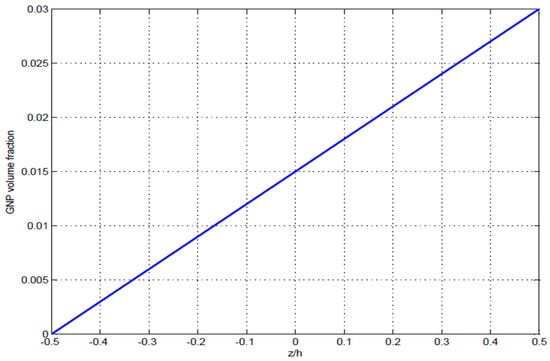
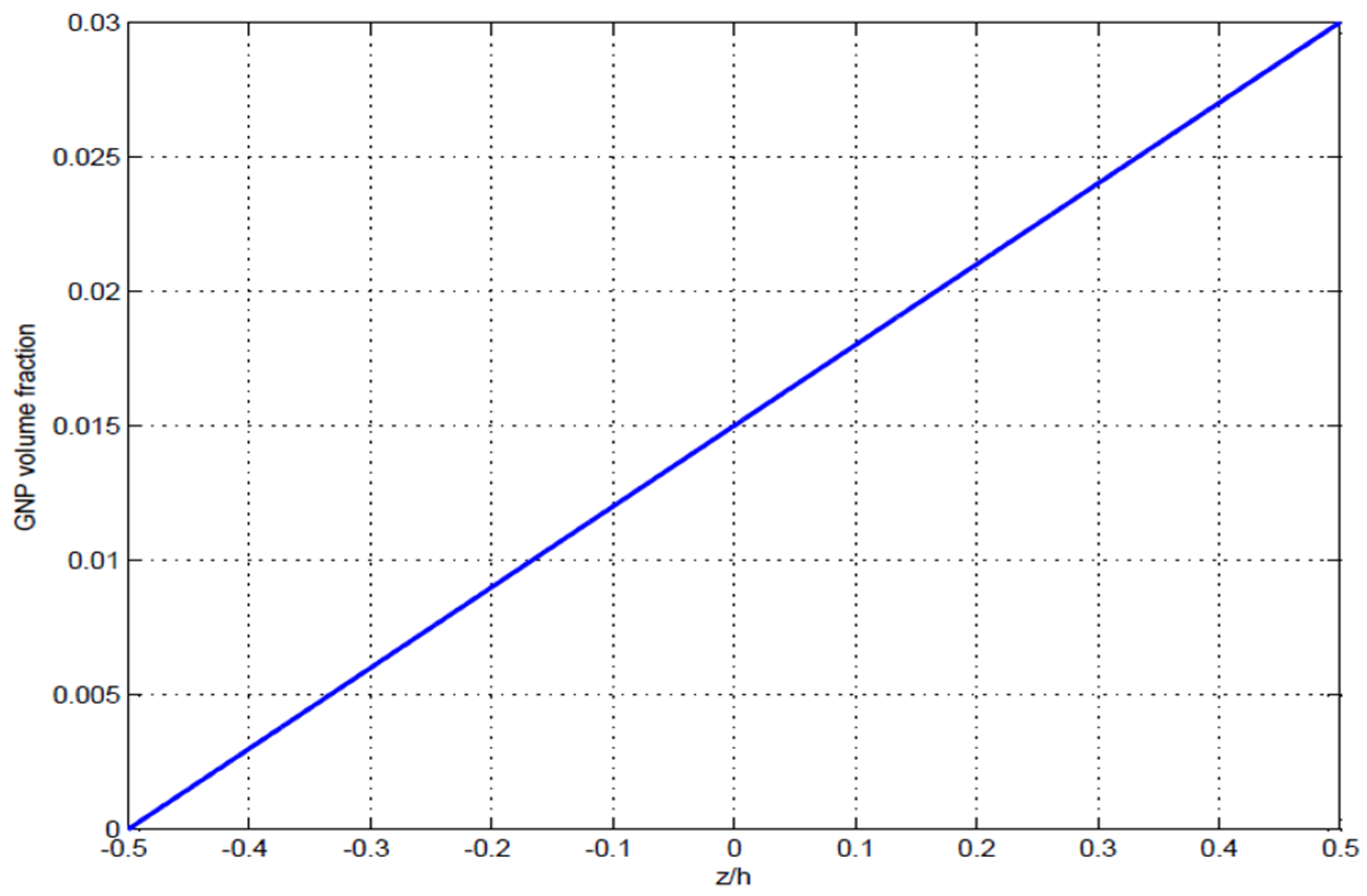
Figure 2 shows the GNP volume fraction across the plate thickness according to the adopted power-law FGM distribution. For the reference grading index k = 1, the GNP content changes continuously from zero at the lower surface to the maximum value of 0.03 at the upper surface. This confirms that the model represents a genuinely graded nanocomposite rather than a homogeneous nanocomposite with a spatially averaged reinforcement content. The graded reinforcement has two simultaneous consequences. First, it produces a spatially varying elastic modulus and density. Second, because the bending rigidity is obtained through a z2-weighted thickness integral, the location of the reinforcement is important in addition to its average amount. Consequently, changing the grading index can alter the bending response even when the maximum GNP volume fraction remains unchanged. This provides the physical basis for the grading-index parametric study presented later.
Figure 2.
Through-thickness GNP distribution.
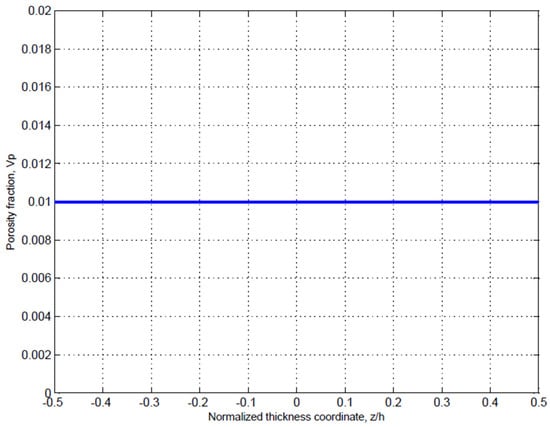
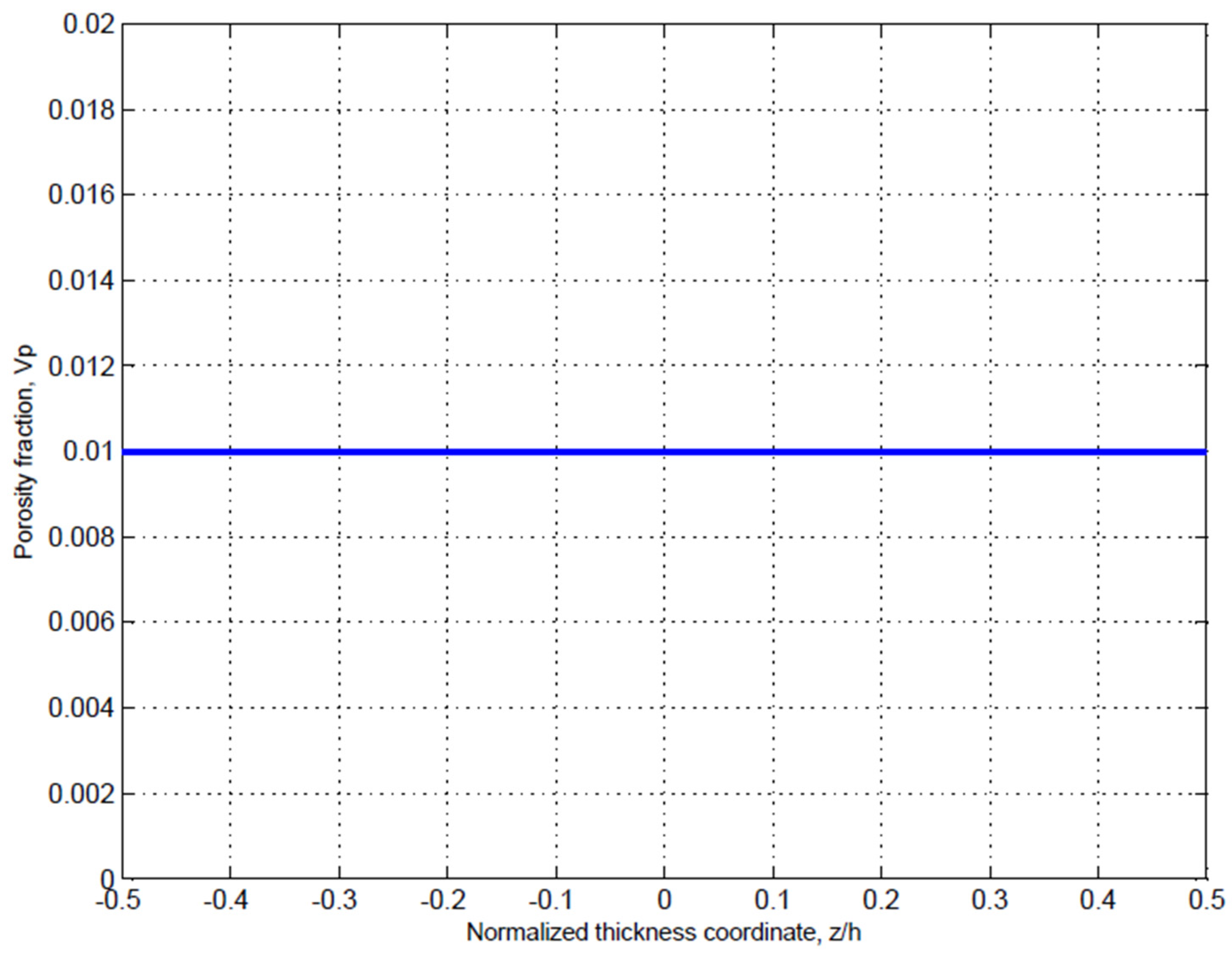
Figure 3 presents the porosity distribution used in the reference configuration. Since ηp = 0, the porosity is uniform through the thickness and remains equal to P0 = 0.01. This agrees with the final computational diagnostic, which gives both the minimum and maximum porosity as 0.010000. Although the reference porosity level is relatively small, it reduces the local matrix fraction and therefore modifies the effective stiffness and density. The small porosity level also provides a useful baseline for assessing the influence of larger porosity amplitudes in the subsequent parametric analysis. The near-uniform reference distribution is particularly useful because it isolates the influence of the porosity magnitude from the asymmetry effect. However, the small baseline porosity effect is primarily attributed to the relatively low porosity coefficient (P0 = 0.01), which produces only a limited reduction in the effective material stiffness and, consequently, a small change in the fundamental frequency. More pronounced effects are expected at higher porosity levels, as examined in the computational parametric study.
Figure 3.
Through-thickness uniform porosity distribution.
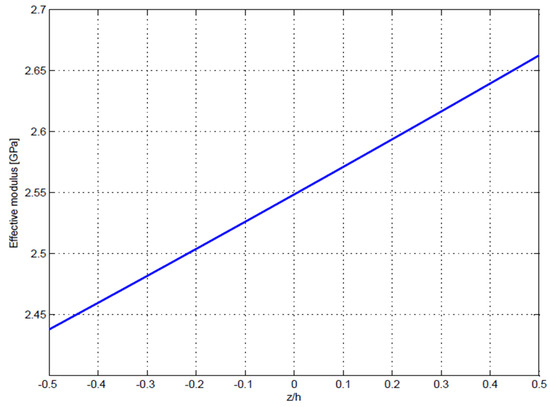
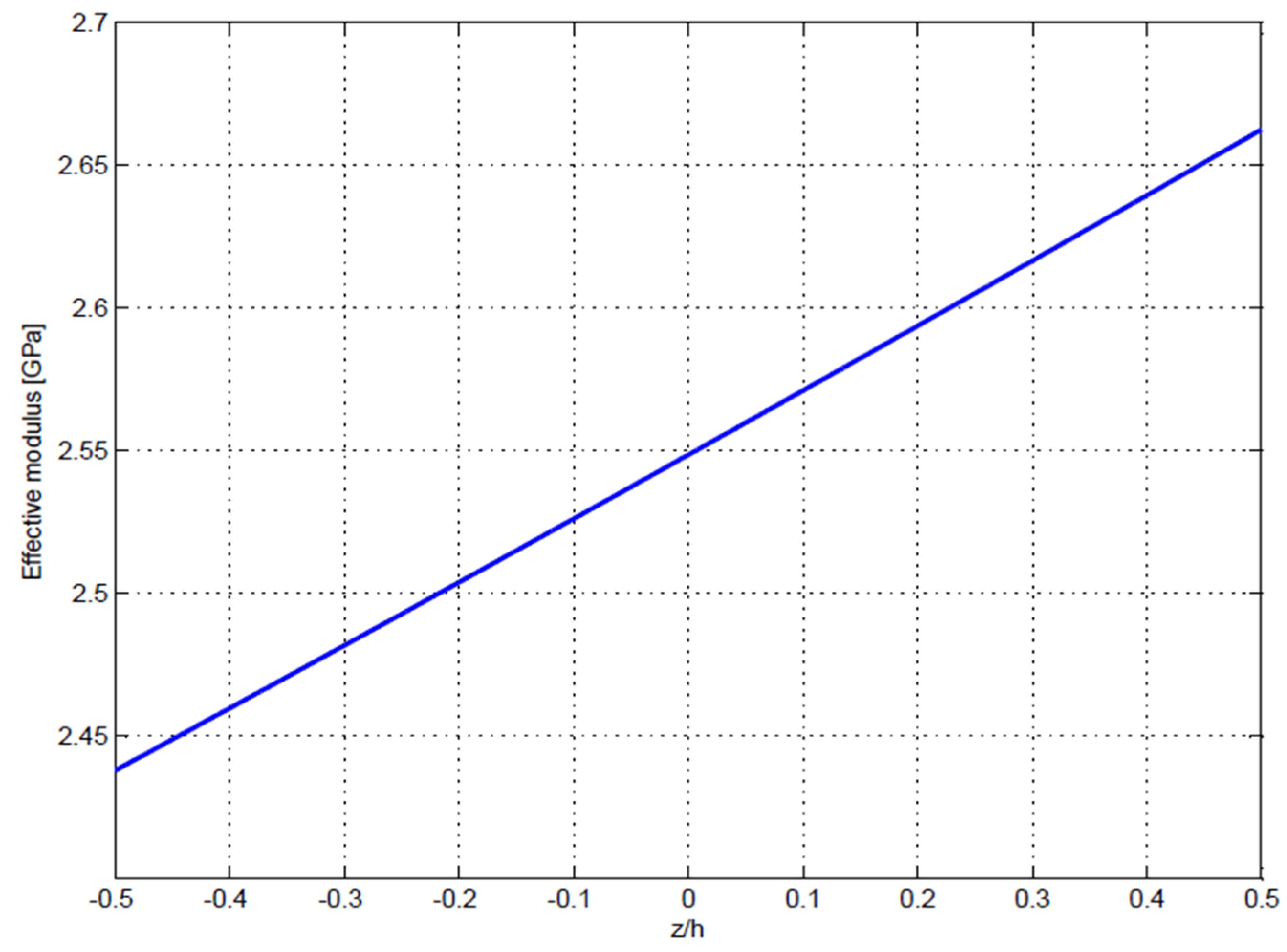
Figure 4 illustrates the resulting effective Young’s modulus through the thickness. The final computation gives an effective modulus ranging approximately from 2.438 GPa to 2.662 GPa, with an average value of 2.549 GPa for the reference configuration. The variation is a direct consequence of the graded GNP distribution combined with the porosity correction. Regions containing a larger fraction of GNP exhibit increased stiffness because the GNP elastic modulus is substantially higher than that of PP. Conversely, the porosity reduces the local effective modulus. The result confirms that the effective material cannot be adequately represented by a single constant modulus when the FGM architecture is considered.
Figure 4.
Effective Elastic Modulus.
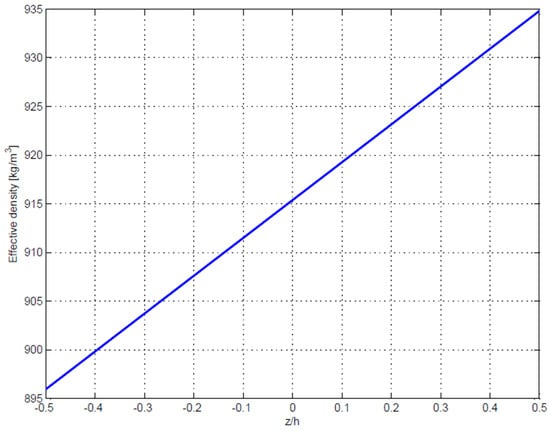
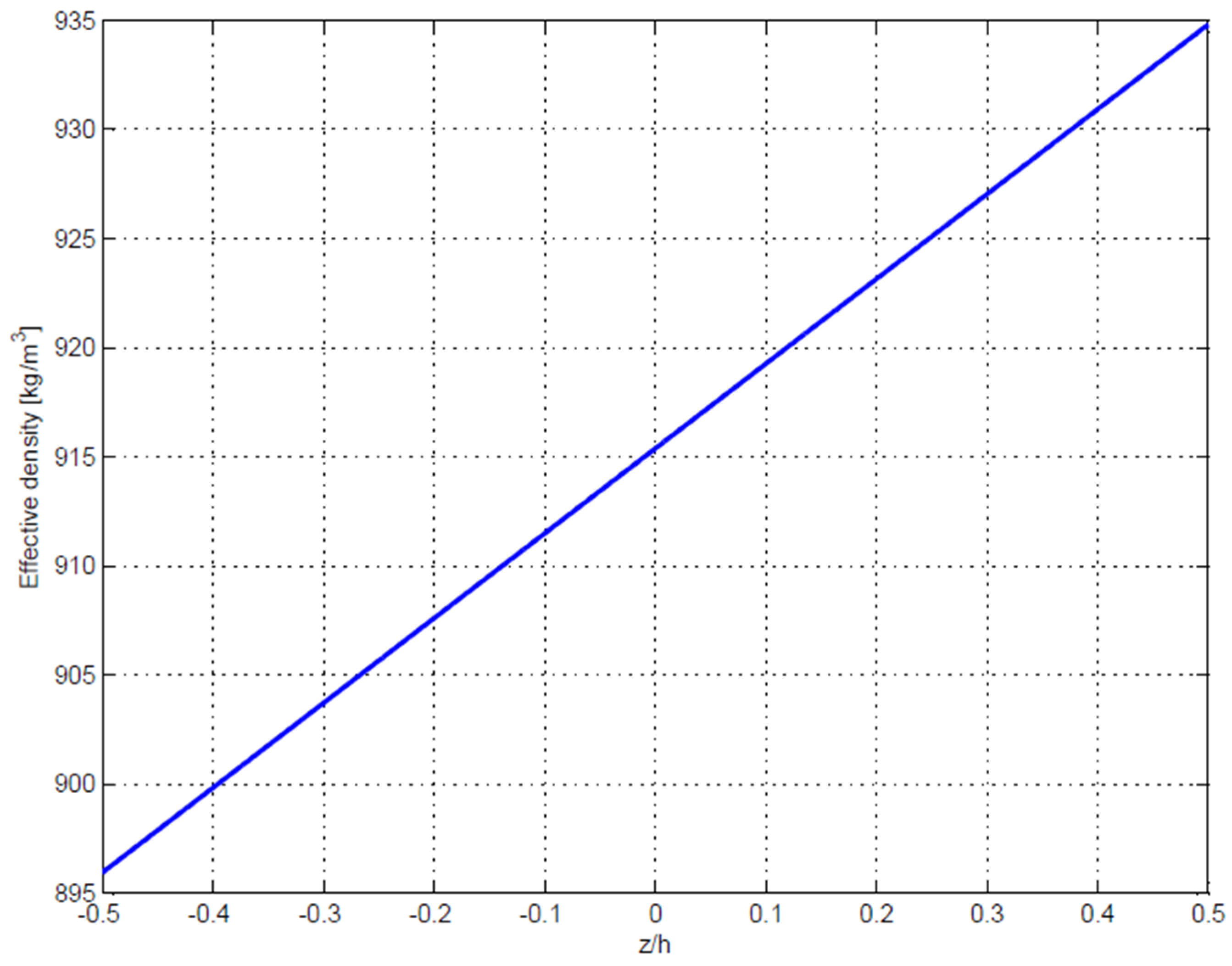
Figure 5 shows the thickness-dependent effective density. The variation results from the competition between the relatively high density of GNP and the reduction in matrix volume caused by porosity. The density distribution contributes directly to the mass-per-unit-area term I0, which appears in the denominator of the natural-frequency equation. The calculated reference value, I0 = 0.916125 kg/m2, demonstrates that the mass effect is explicitly integrated rather than approximated using only the matrix density. This is important because reinforcement and porosity influence both stiffness and inertia, and their effects on frequency therefore depend on the resulting stiffness-to-mass ratio.
Figure 5.
Effective density distribution.
4.2. Effect of GNP Reinforcement
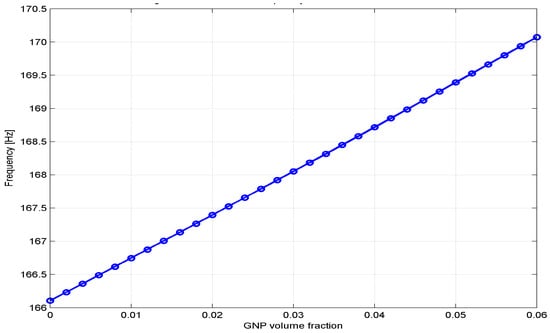
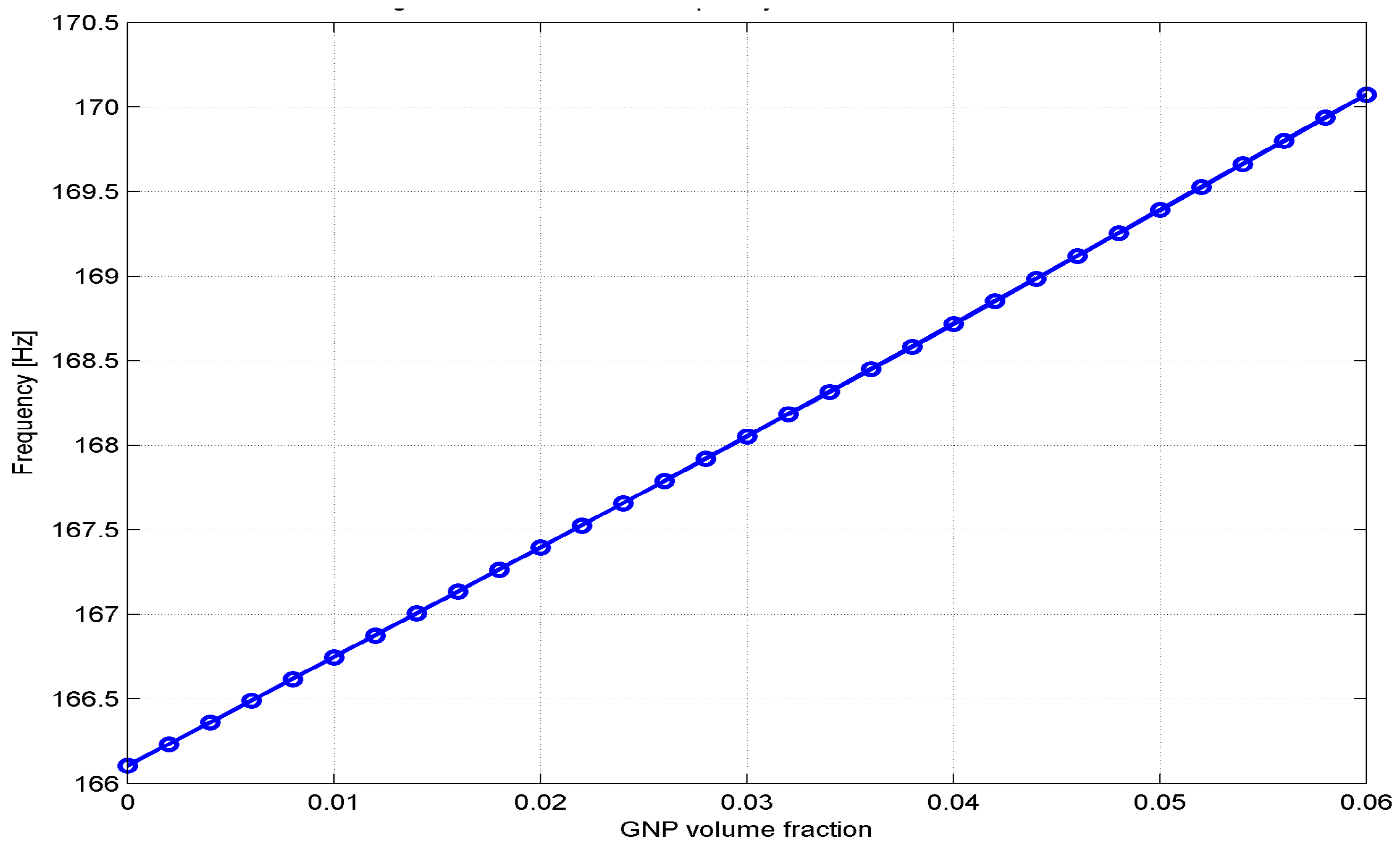
Figure 6 demonstrates the influence of the GNP volume fraction on the fundamental frequency under the mechanical reference condition ΔT = 0. Increasing the GNP fraction generally increases the effective bending rigidity and consequently increases the natural frequency. For the final reference case, the frequency obtained with 3% GNP is f11 = 168.05026 Hz, whereas the corresponding no-GNP case gives f11 = 166.10455 Hz. The relative increase is 1.1714%. Thus, even at the relatively modest reinforcement level of 3%, the GNP phase produces a measurable improvement in the dynamic stiffness of the thermoplastic plate. The magnitude of this effect results from the large stiffness contrast between PP and GNP and from the position-dependent reinforcement distribution.
Figure 6.
Fundamental frequency versus GNP volume fraction.
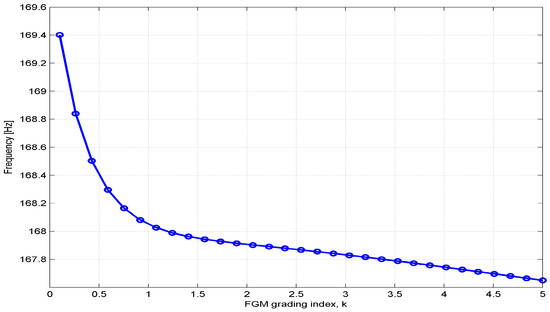
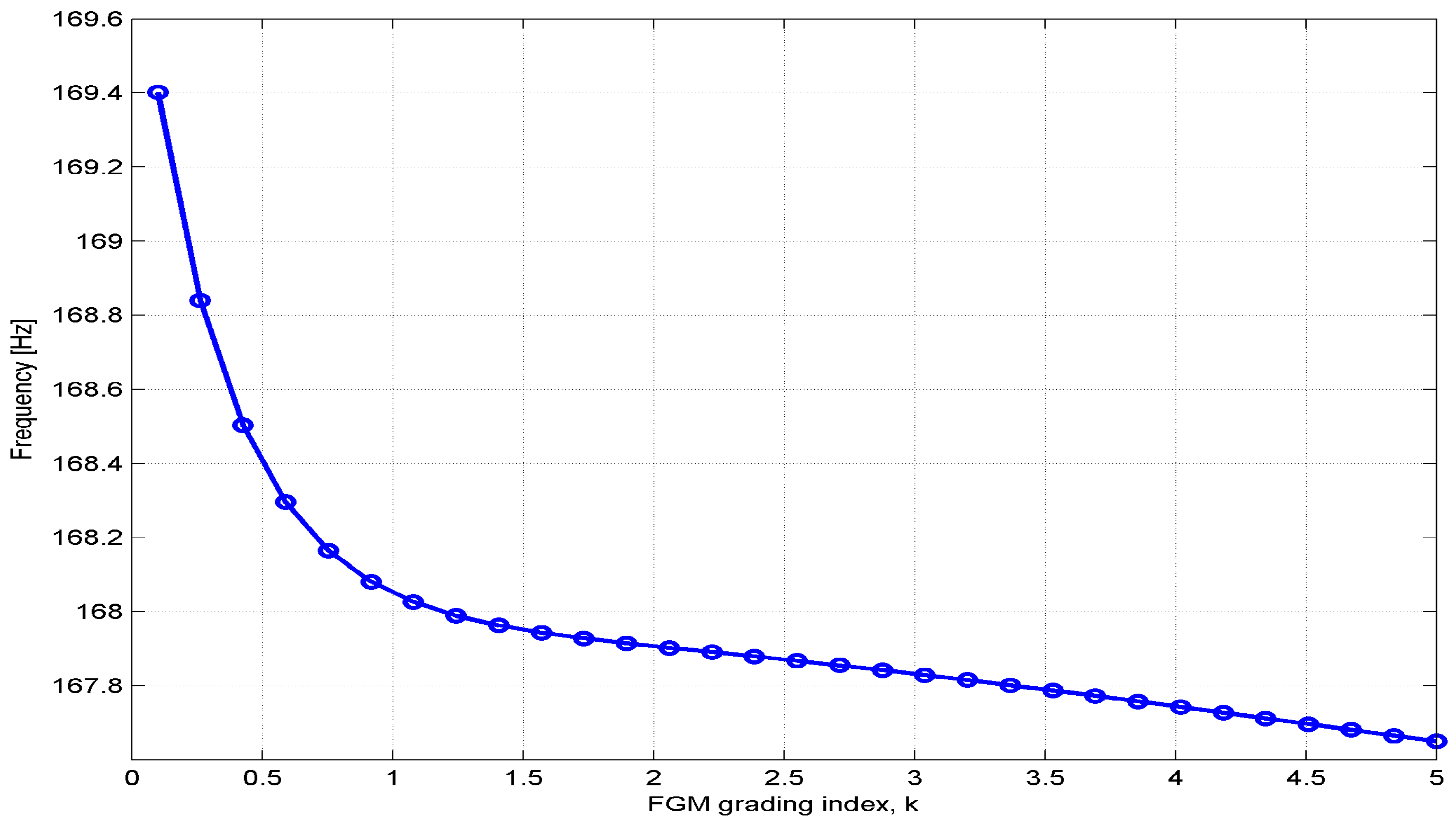
Figure 7 presents the influence of the grading index k. The grading index controls how the available GNP reinforcement is distributed through the plate thickness. Since bending rigidity depends on the second moment of the thickness coordinate, reinforcement placed at different distances from the mid-plane does not contribute equally to the global bending stiffness. The results therefore demonstrate that the FGM grading index is an independent design parameter rather than merely a mathematical descriptor of the reinforcement distribution. Changes in k modify the local stiffness profile and hence the integrated bending rigidity and natural frequency. This behavior supports the use of functional gradation as a means of tailoring the dynamic response of thermoplastic nanostructures.
Figure 7.
Fundamental frequency versus FGM grading index.
4.3. Effect of Porosity
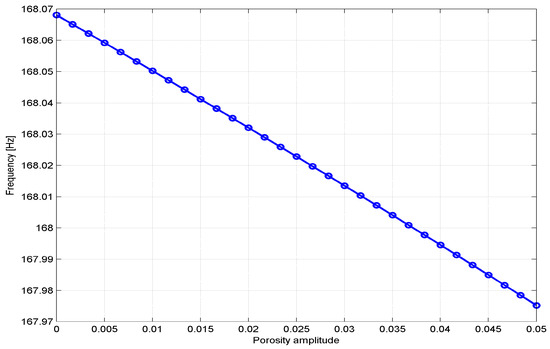
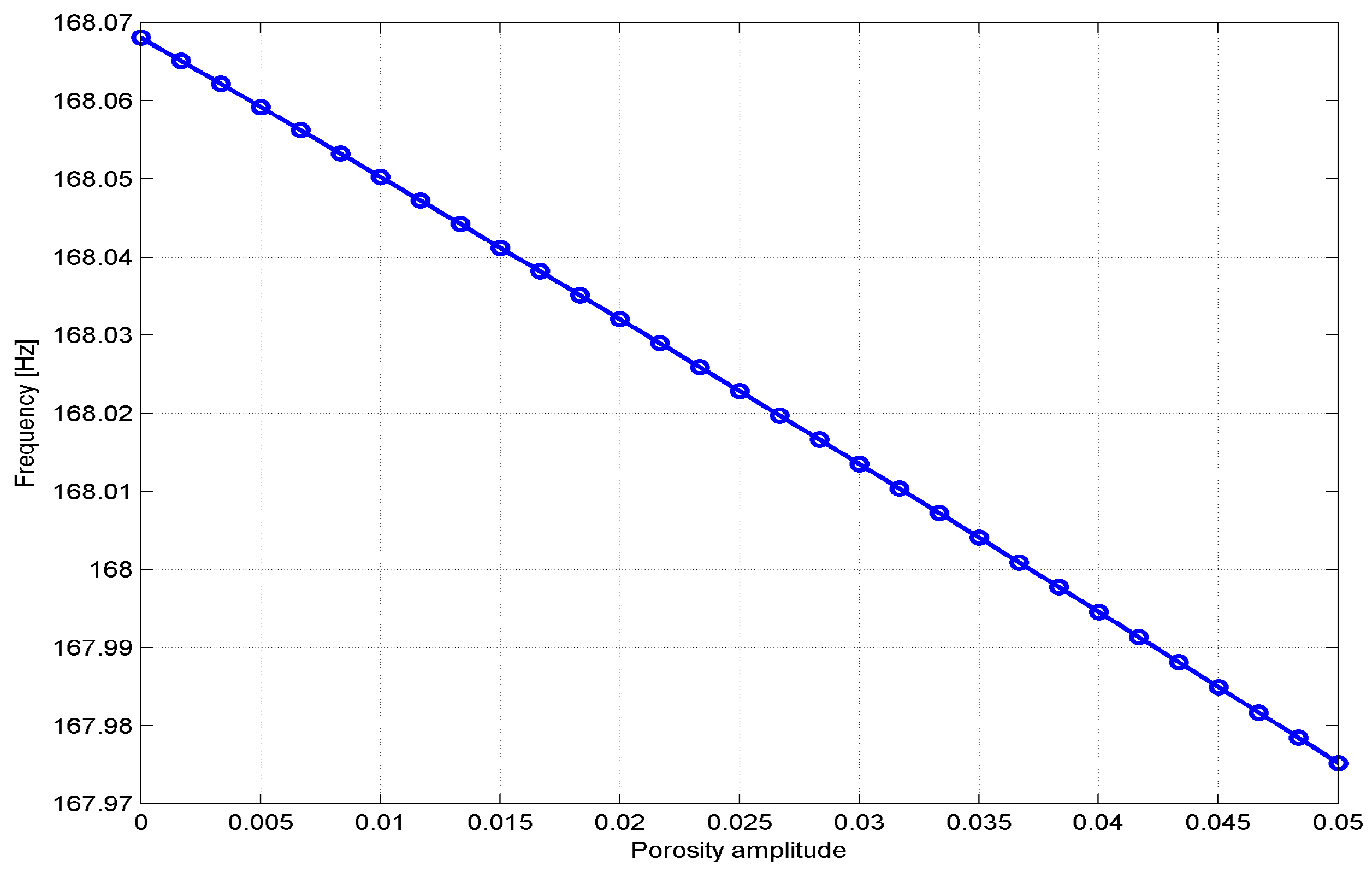
Figure 8 shows the effect of the porosity amplitude P0 on the fundamental frequency. Increasing porosity reduces the effective elastic modulus and consequently tends to reduce the natural frequency. This trend follows directly from the adopted porosity correction in the effective-modulus relation. For the reference configuration, the frequency of the porous plate is approximately 168.05026 Hz, whereas the corresponding nonporous configuration gives 168.06809 Hz. The relative difference is approximately 0.0106%. The small magnitude of this difference is attributable to the relatively low reference porosity of 1%. Nevertheless, the results demonstrate that porosity must be considered when higher void fractions are expected, particularly in lightweight nanocomposite structures where relatively small stiffness changes may influence stability margins.
Figure 8.
Fundamental frequency versus porosity amplitude.
4.4. Thermal Effects and Stability
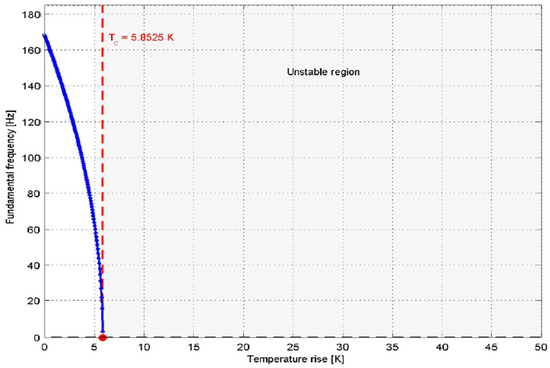
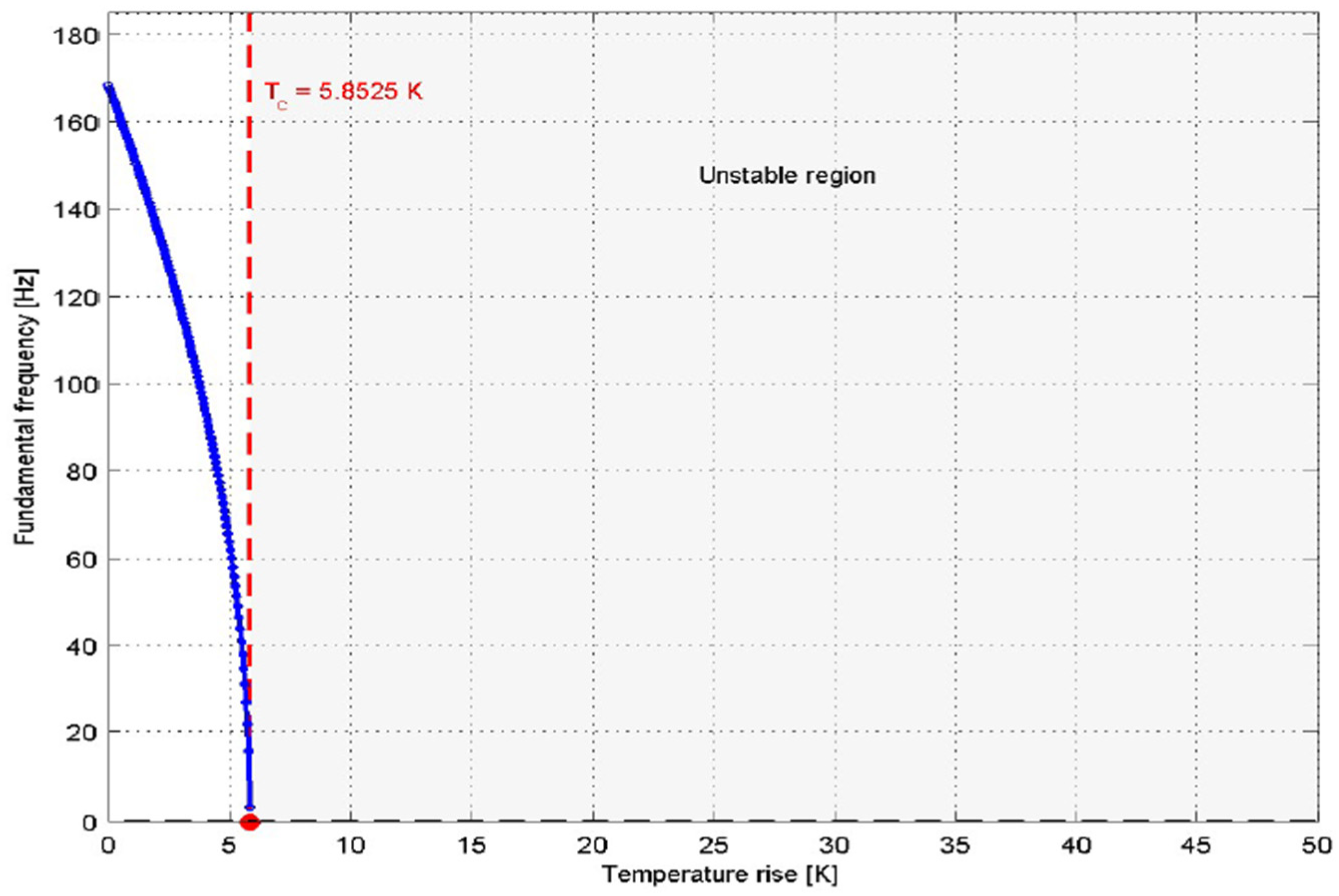
Figure 9 presents the temperature dependence of the fundamental vibration response. The temperature rise influences the response through two mechanisms incorporated in the final formulation: temperature-dependent matrix stiffness and the thermally induced membrane force NT. As the temperature increases, thermal prestress progressively reduces the effective dynamic stiffness. Near the critical condition, the fundamental frequency approaches zero, indicating loss of stability. The final calculation gives ΔTcr = 5.81753 K. Thus, the reference thermal rise ΔT = 10 K. is above the stability threshold. This explains why the (1, 1) mode does not have a real natural frequency in the 10 K reference state. The result should be interpreted as a predicted thermo-mechanical instability rather than as a numerical failure. In addition to the observed frequency variation, the results identify the temperature-dependent stability threshold of the thermoplastic functionally graded material (FGM) nanoplate. This threshold highlights the interplay between thermally induced stiffness changes and destabilizing thermal stresses. The findings establish a physically meaningful criterion for determining the operating temperature range that ensures stable vibration.
Figure 9.
Fundamental frequency versus temperature rise.
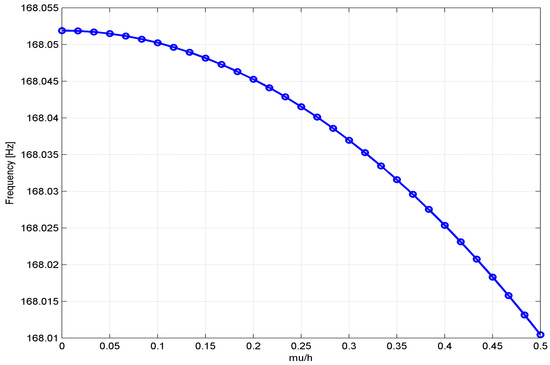
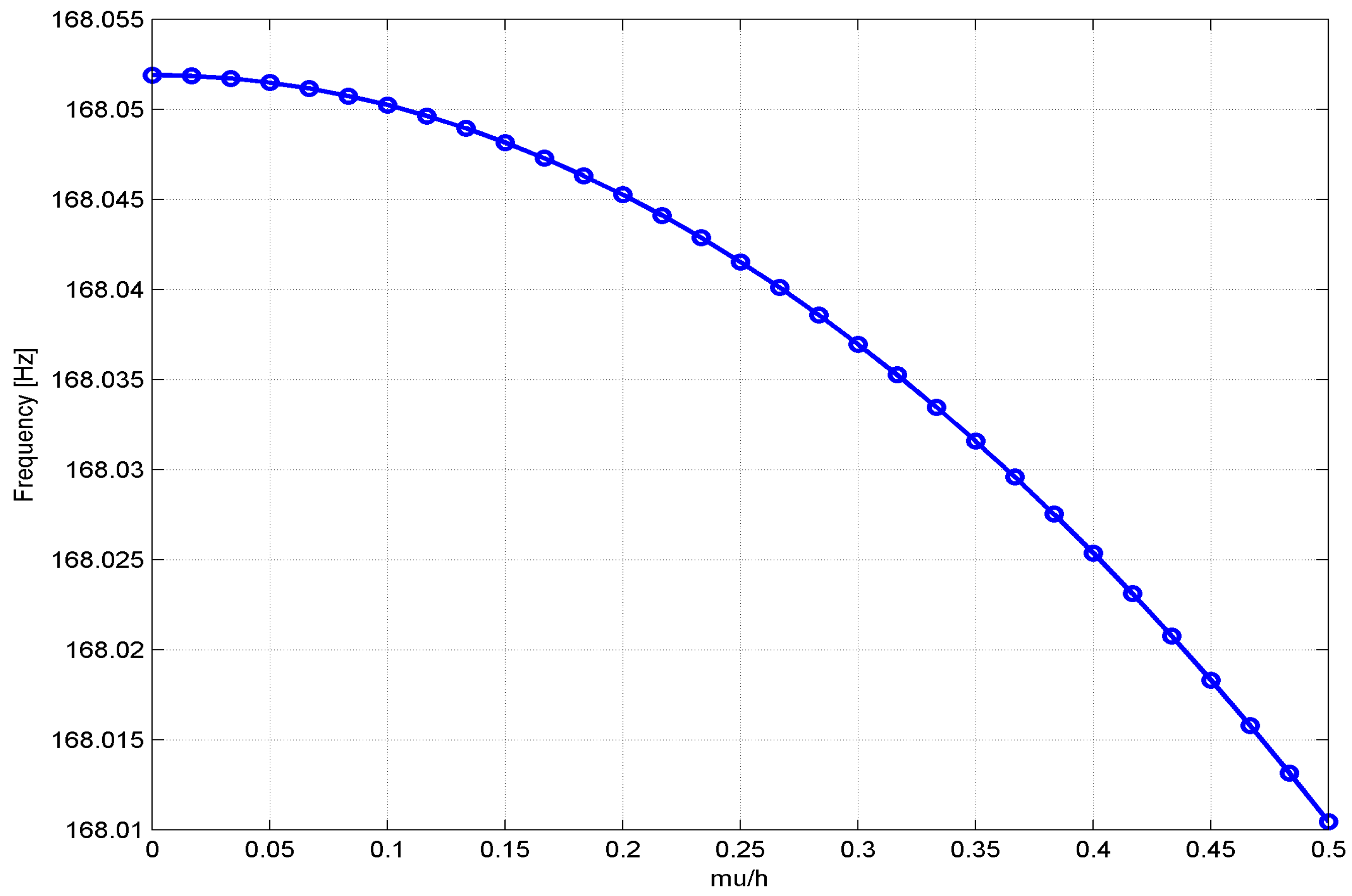
Figure 10 illustrates the effect of the nonlocal parameter μ/h on the fundamental frequency at ΔT = 0. According to the effective rigidity adopted in Equation (38), increasing the nonlocal parameter while keeping the strain-gradient parameter fixed increases the denominator and, therefore, tends to reduce the effective bending rigidity. The magnitude of the predicted variation depends on the dimensionless ratio μ/h, the plate dimensions, and the modal wave number. Consequently, the effect becomes particularly relevant when the structural characteristic dimensions become comparable with the material length scale.
Figure 10.
Effect of the nonlocal parameter.
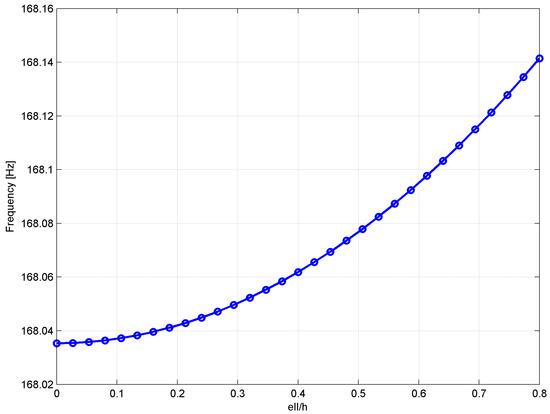
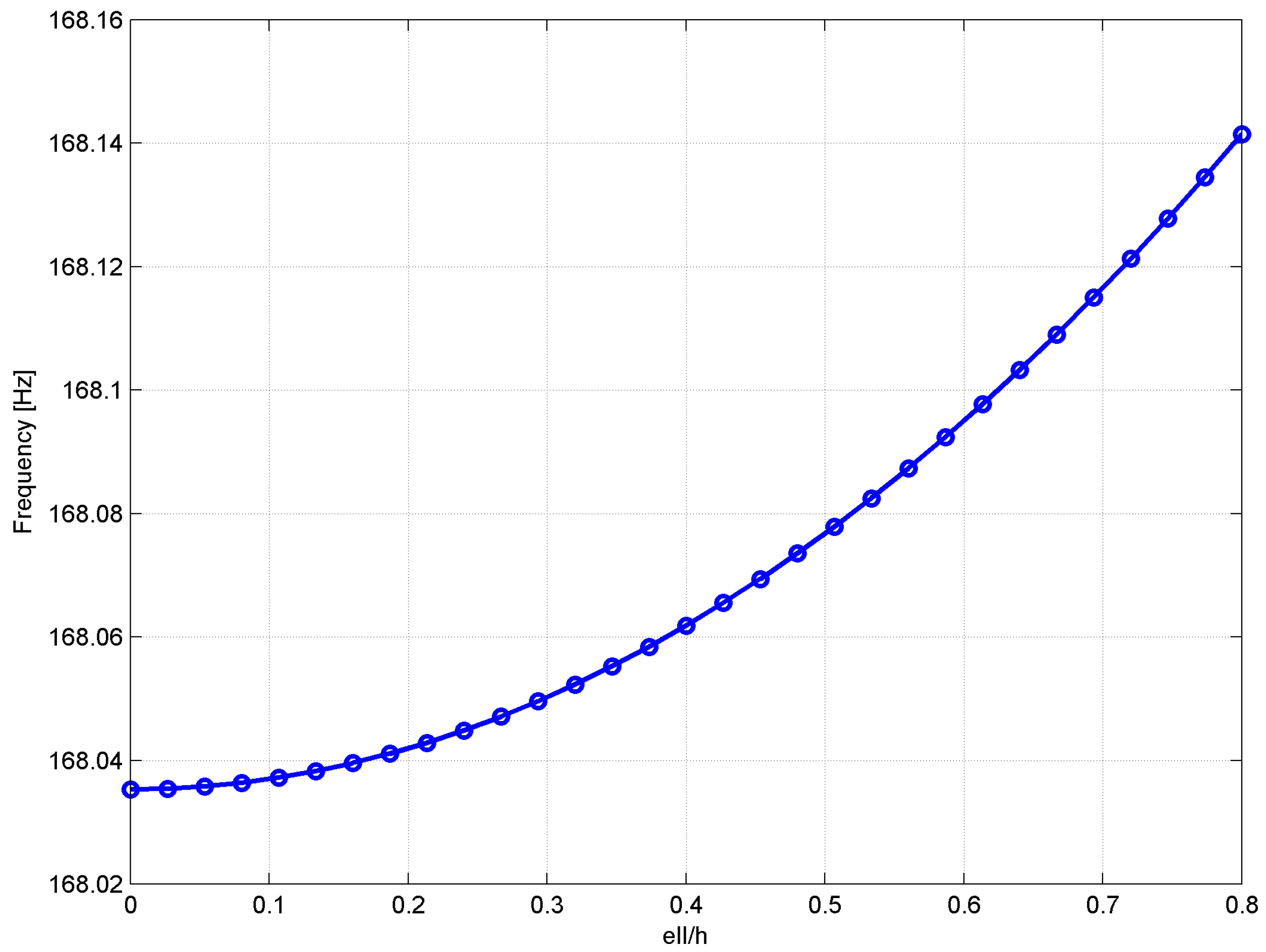
Figure 11 shows the influence of the strain-gradient parameter ℓ/h. In contrast to the nonlocal contribution, the strain-gradient term appears in the numerator of the effective rigidity illustrated in Equation (38) and therefore produces a stiffening tendency when ℓ is increased while the nonlocal parameter remains fixed. The results demonstrate the competing nature of the two characteristic length scales. This is an important feature of the proposed model because the overall size-dependent response cannot be attributed solely to either softening or stiffening; it depends on the relative magnitudes of μ, ℓ, the modal wave number, and the classical bending rigidity.
Figure 11.
Effect of the strain-gradient parameter.
4.5. Coupled Parameter Effects
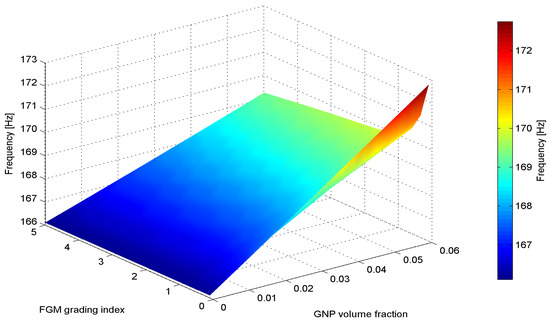
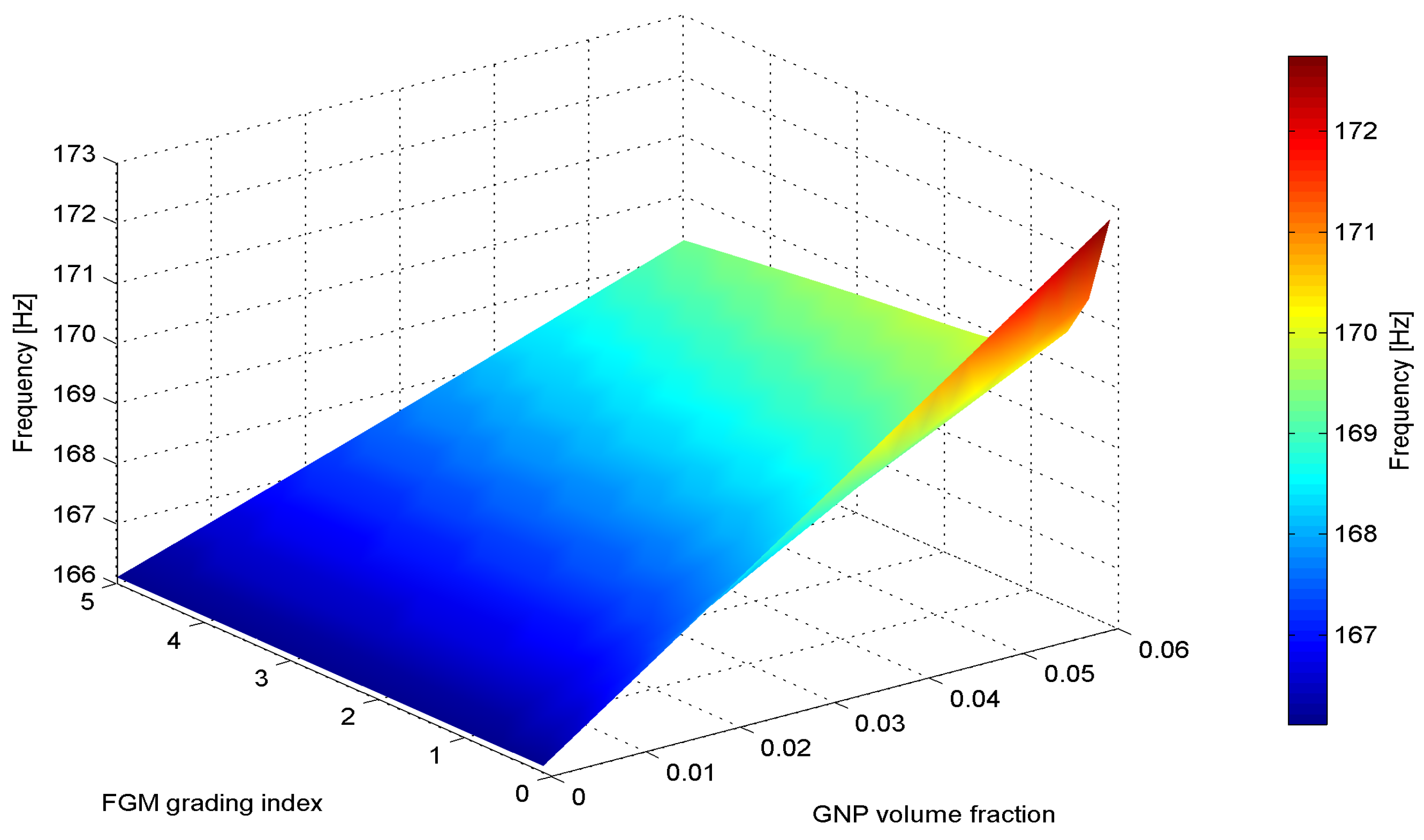
Figure 12 presents the combined influence of GNP volume fraction and FGM grading index on the fundamental frequency. The surface demonstrates that the effect of increasing GNP content is coupled with its thickness-wise distribution. Higher GNP concentrations generally enhance stiffness, while the grading index determines where that reinforcement is located relative to the mid-plane. The combined use of Vg0 and k consequently provides a broader design space than varying the total GNP content alone.
Figure 12.
GNP fraction–grading index interaction.
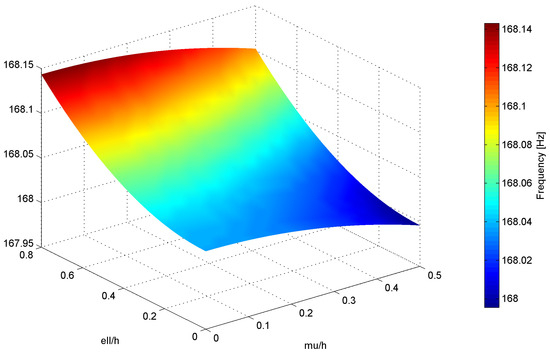
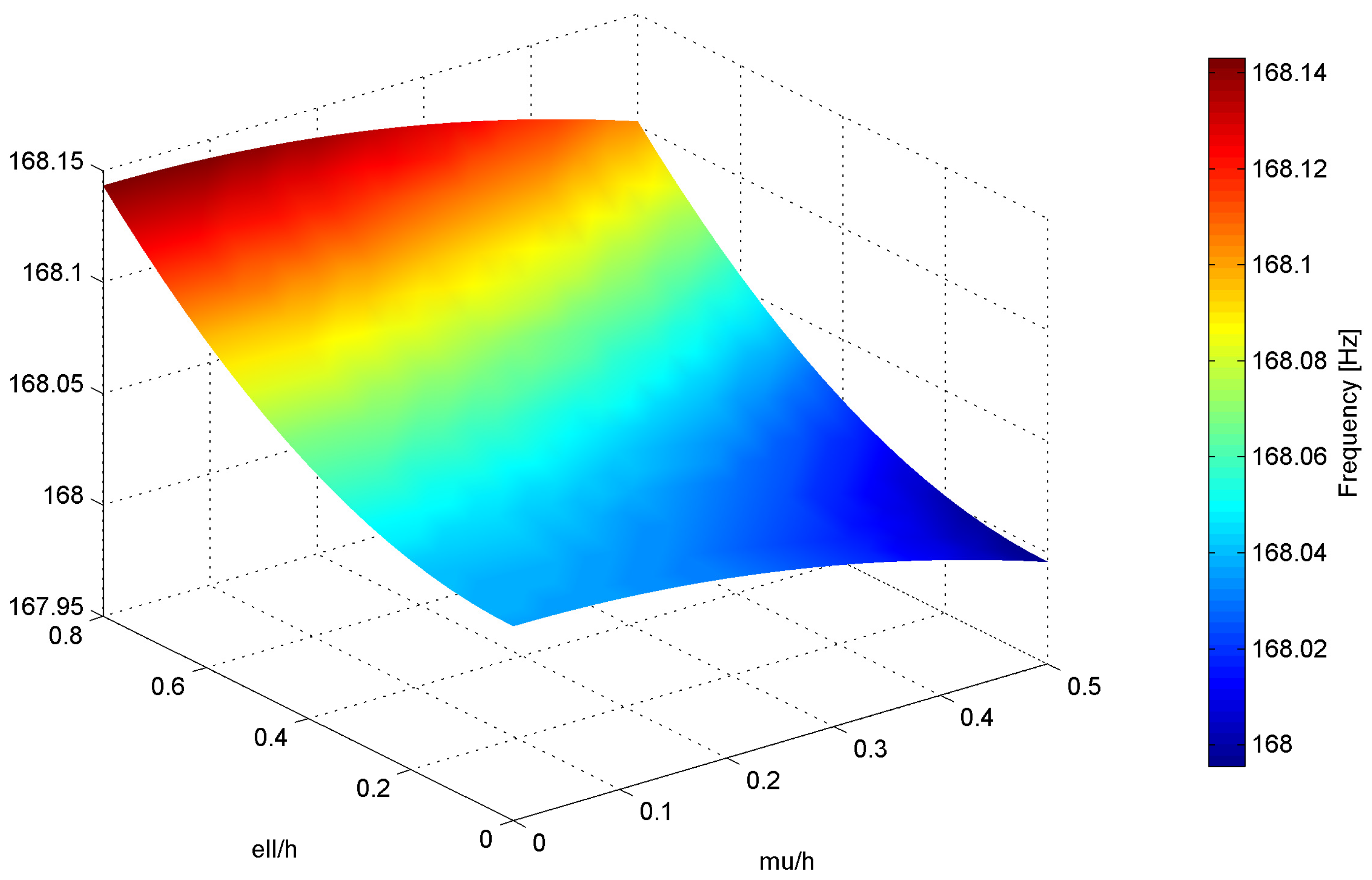
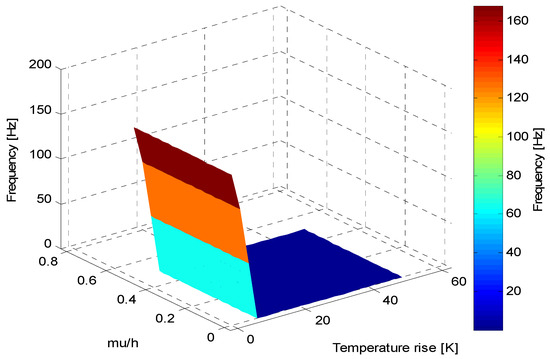
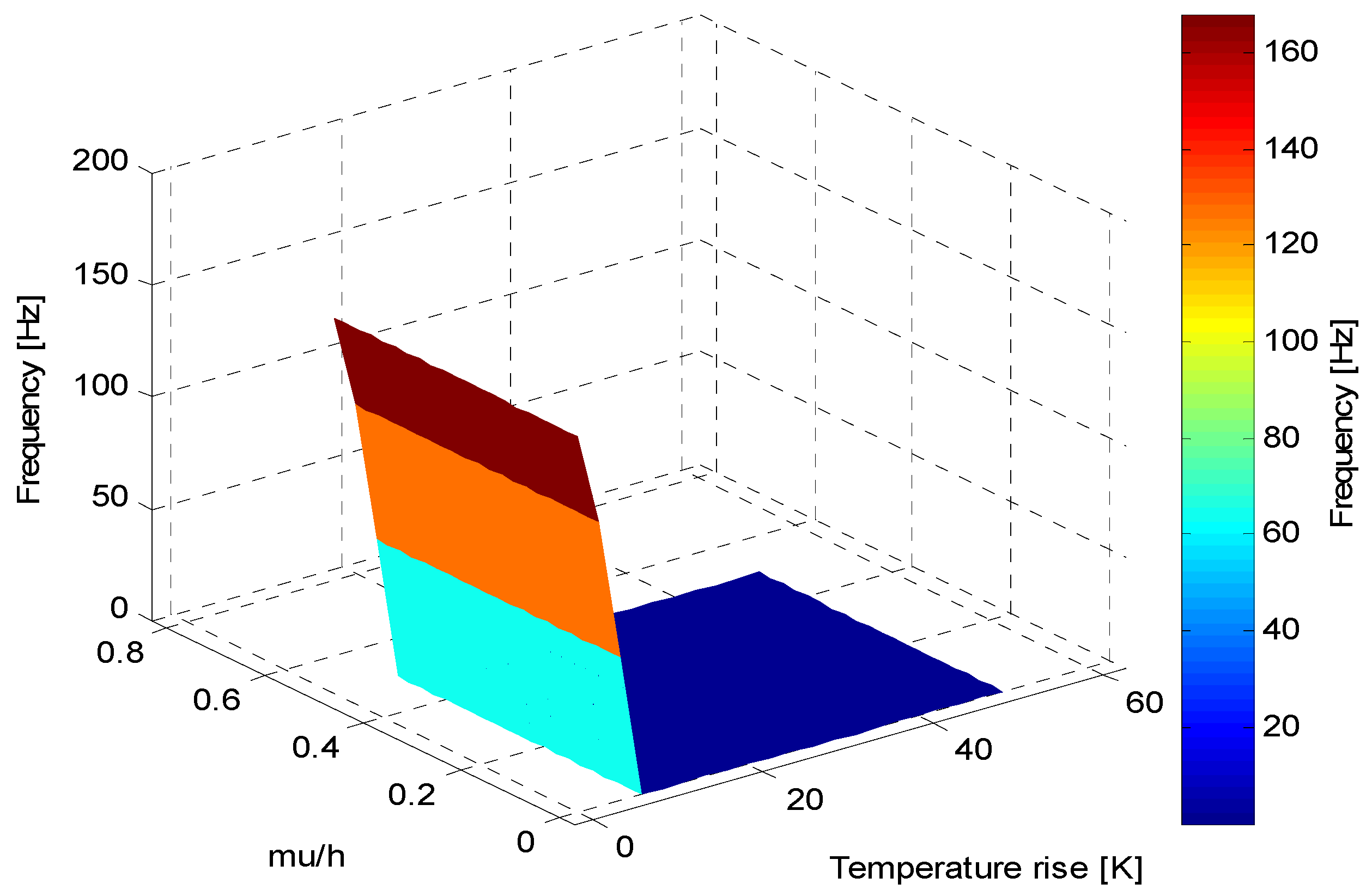
Figure 13 presents the combined influence of the two nanoscale length parameters. The surface originates directly from the following:
Figure 13.
Nonlocal–strain-gradient interaction.
The two length scales therefore act in opposite directions. Larger ℓ/h tends to increase the effective rigidity, while larger μ/h tends to reduce it. When the two characteristic lengths become equal, the numerator and denominator factors cancel and the effective rigidity returns to the classical value.
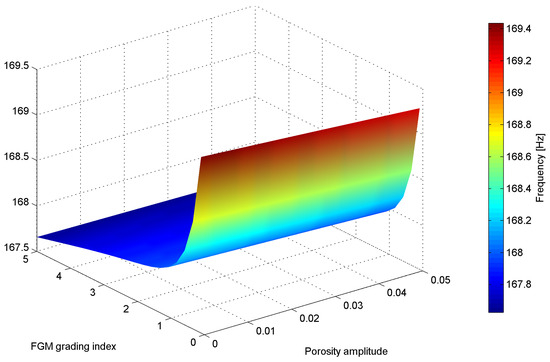
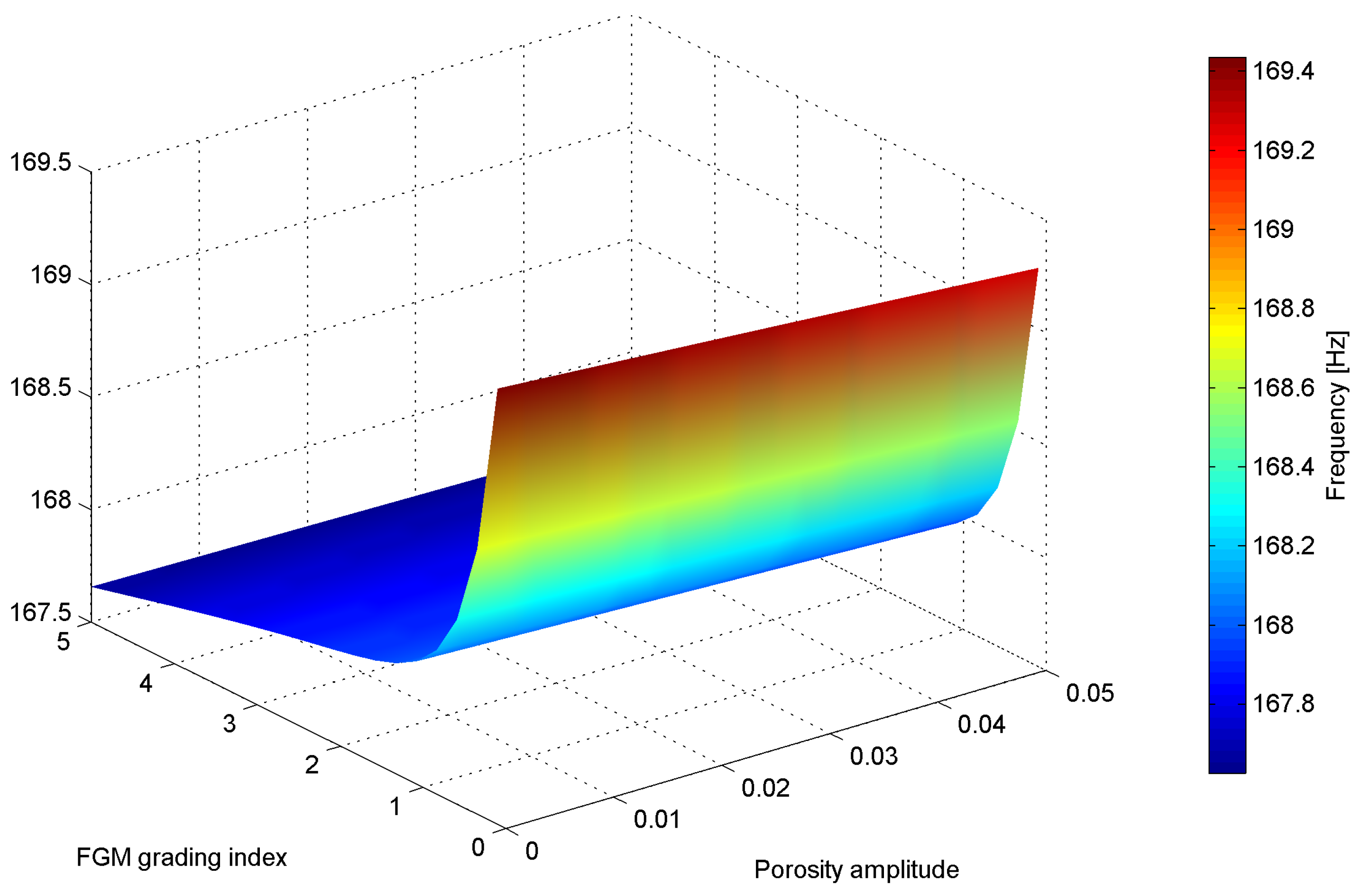
Figure 14 demonstrates that porosity and GNP gradation influence the frequency simultaneously. Increasing porosity tends to decrease the local stiffness, whereas the grading index changes the location of the reinforcement and therefore modifies the bending contribution of the GNP phase. The surface therefore indicates that porosity cannot be interpreted independently of the reinforcement architecture. In practical terms, the effect of a given porosity level depends on how the reinforcing GNP phase is distributed through the thickness.
Figure 14.
Porosity–grading index interaction.
Figure 15 illustrates the coupled effect of temperature rise and the nonlocal parameter. Increasing temperature decreases the available dynamic stiffness through thermal prestress, while the nonlocal parameter introduces an additional size-dependent softening contribution for the adopted formulation. The combined effect is therefore potentially more severe than either mechanism acting independently. This observation is particularly relevant for thermally loaded nanoscale structures, where thermal instability and size effects may interact and reduce the safe operating range.
Figure 15.
Temperature–nonlocal interaction.
4.6. Modal Characteristics
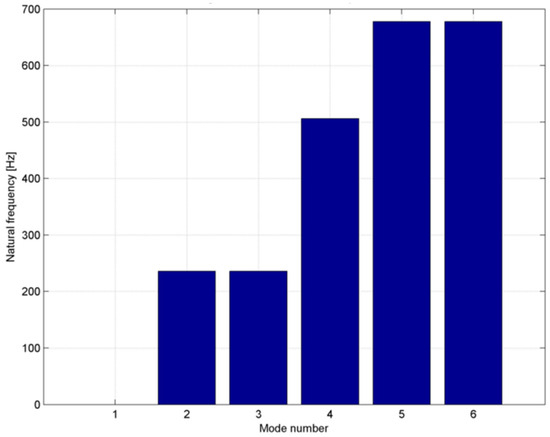
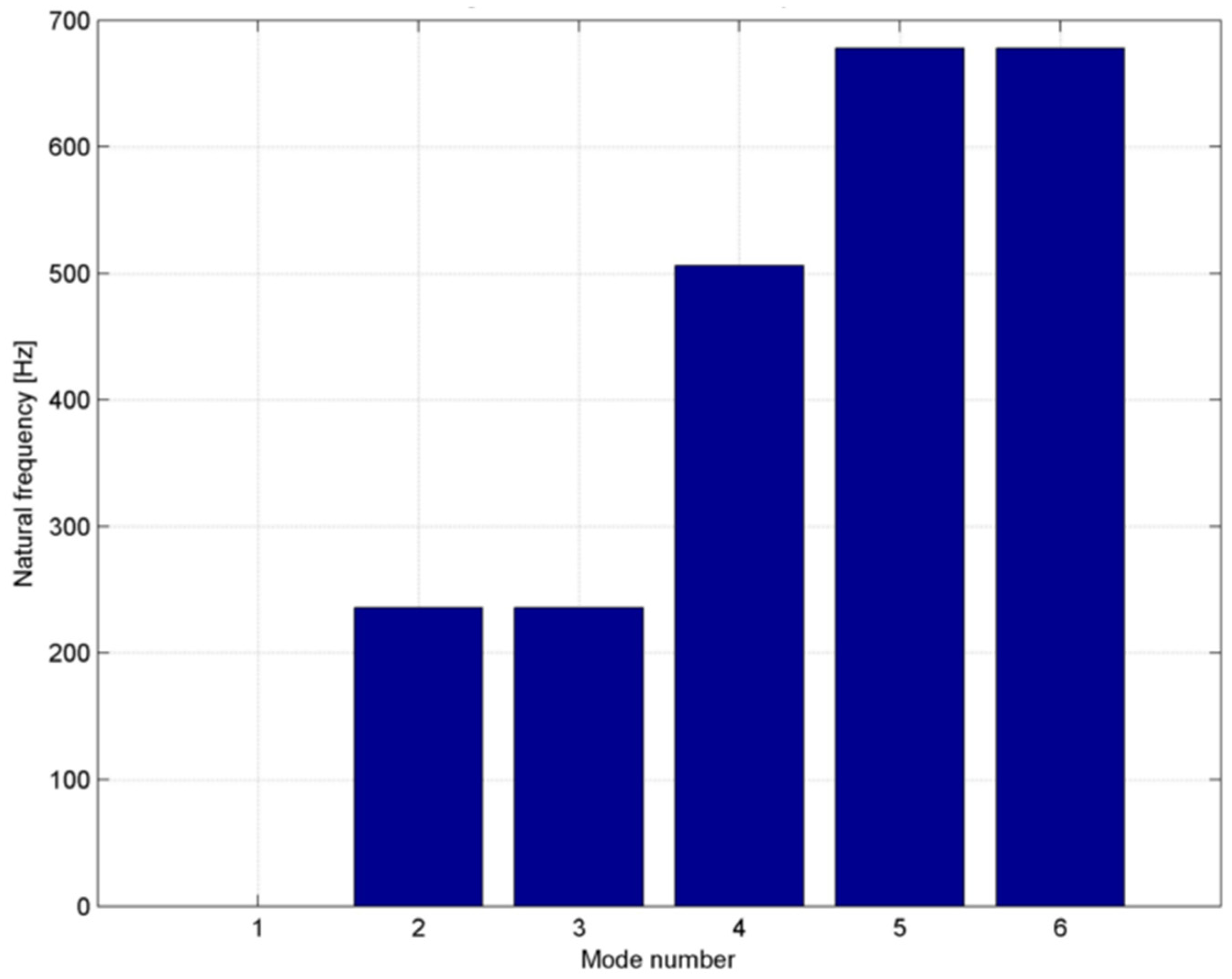
Figure 16 presents the frequencies of the selected vibration modes. The final reference calculation gives approximately and . The equality of the (1, 2) and (2, 1) frequencies, as well as the (1, 3) and (3, 1) frequencies, is consistent with the square geometry a = b. The mode-dependent increase in frequency follows from the growth of the modal wave number K. The fundamental (1, 1) mode is different because the selected 10 K thermal loading exceeds the critical temperature.
Figure 16.
Selected modal frequencies.
4.7. Critical Thermal Stability
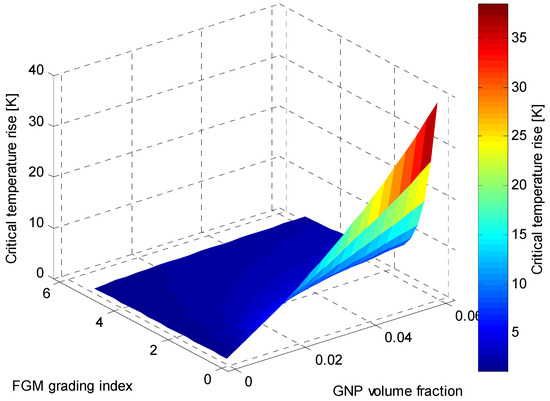
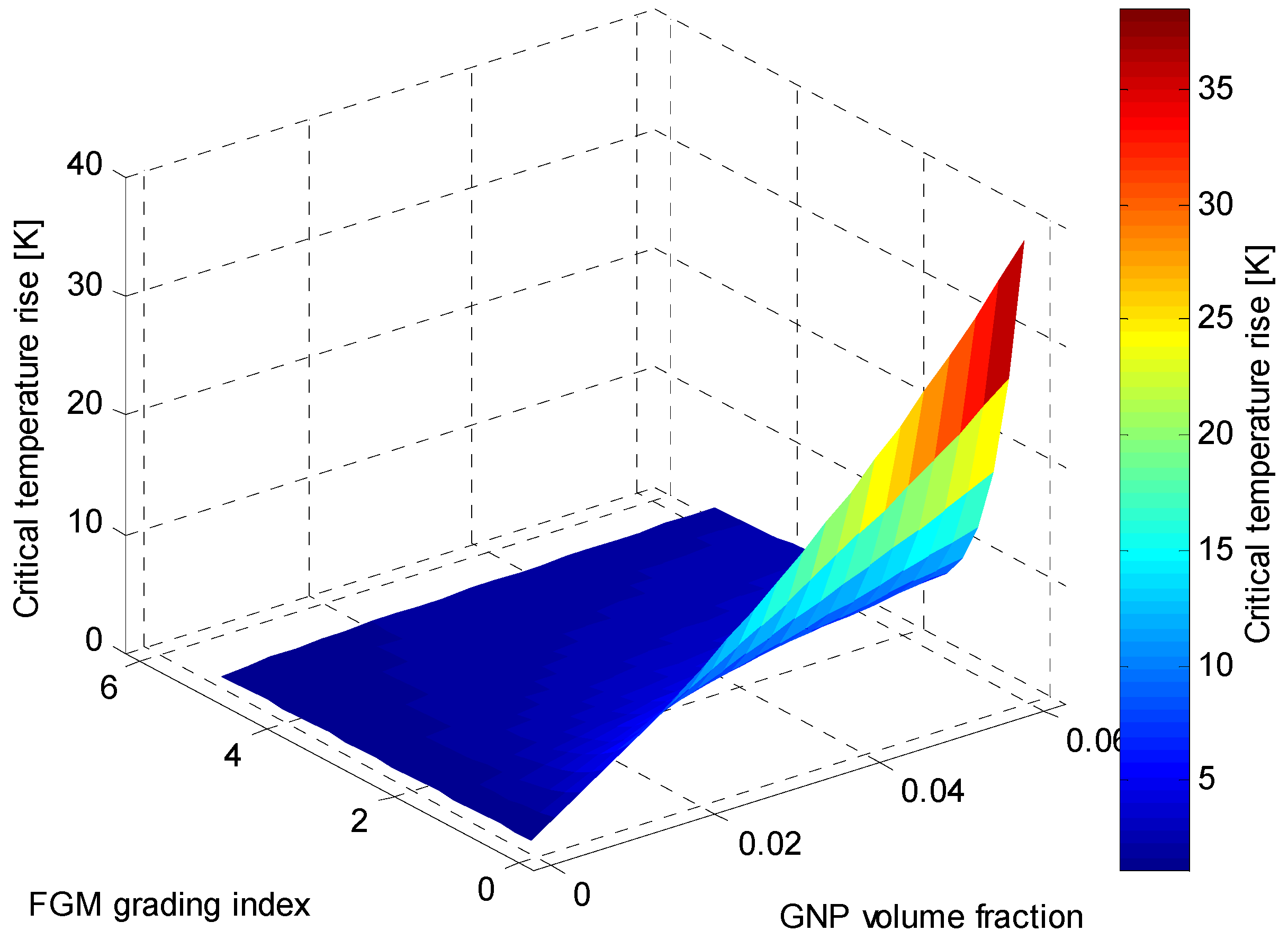
Figure 17 presents the calculated critical temperature as a function of GNP volume fraction and FGM grading index. The critical temperature represents the boundary at which the fundamental mode changes from dynamically stable to unstable. Since GNP reinforcement modifies the effective bending rigidity, changes in GNP concentration and grading can modify the thermal load required to reach the instability condition. For the selected reference configuration, Vg0 = 0.03, k = 1, the critical temperature is . This value provides the principal thermal-stability threshold used throughout the subsequent interpretation.
Figure 17.
Critical temperature surface.
4.8. Numerical Convergence and Verification
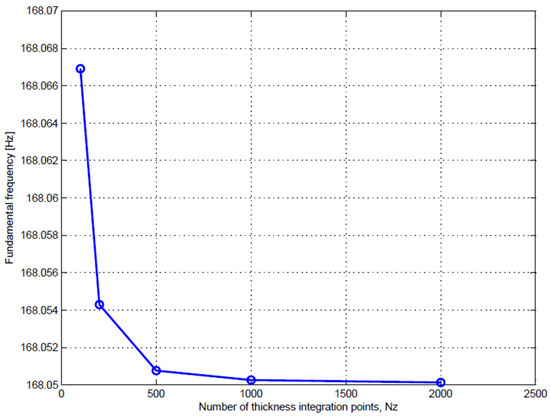
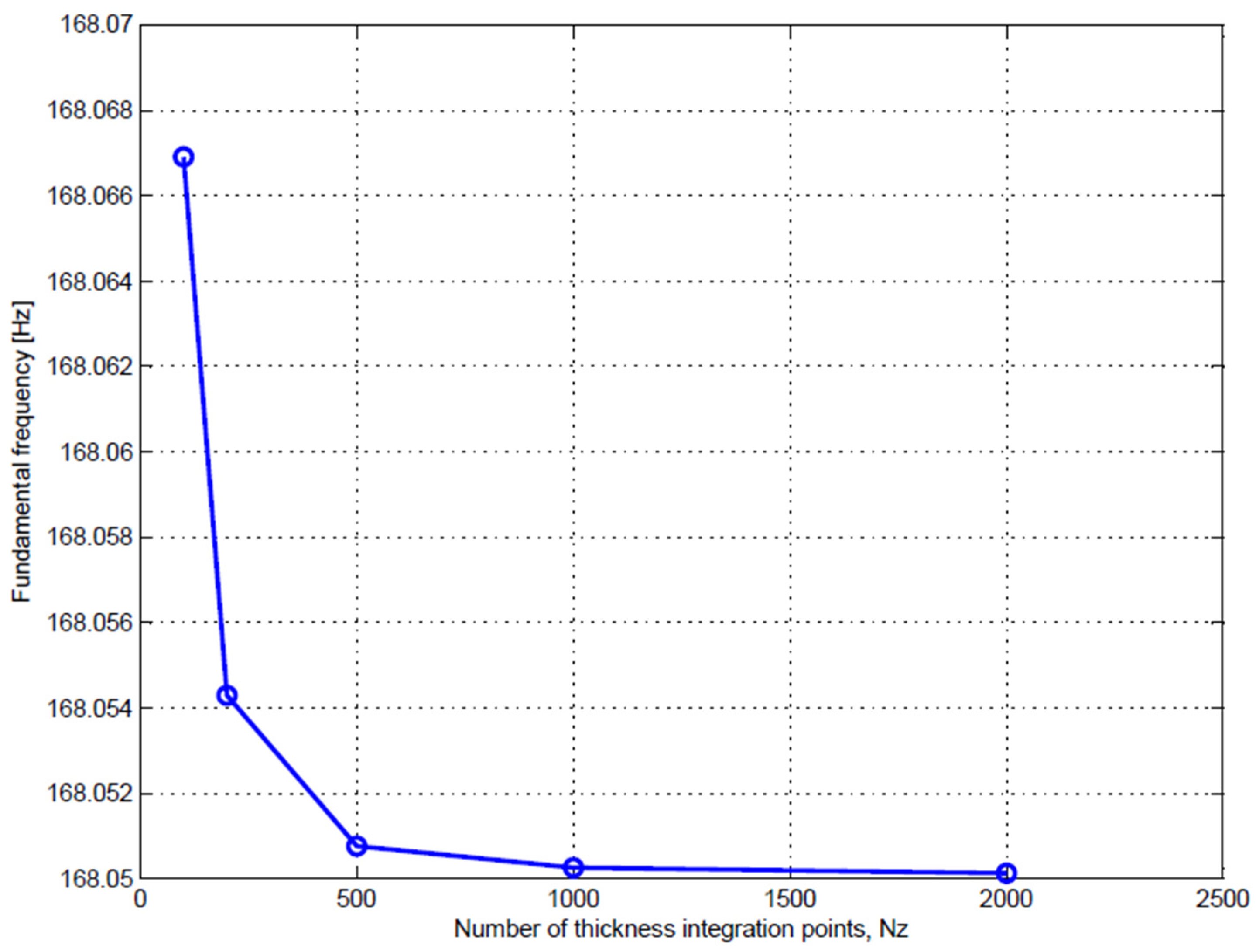
Figure 18 demonstrates the convergence of the through-thickness numerical integration. The calculated fundamental mechanical frequency changes from approximately 168.067 Hz at Nz =101 to 168.05013 Hz at Nz =2001. The rapid reduction in discretization error demonstrates that the numerical integration converges systematically. In particular, the difference between Nz = 1001 and Nz =2001 is only approximately 0.000075%. Therefore, the use of Nz =1001 for the main parametric study provides an appropriate balance between computational efficiency and numerical accuracy. The convergence behavior supports the reliability of all subsequent thickness-integrated quantities.
Figure 18.
Numerical convergence of the fundamental frequency.
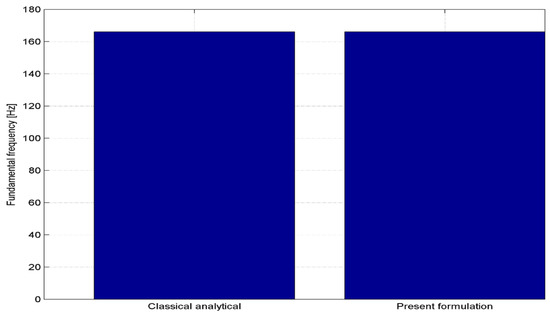
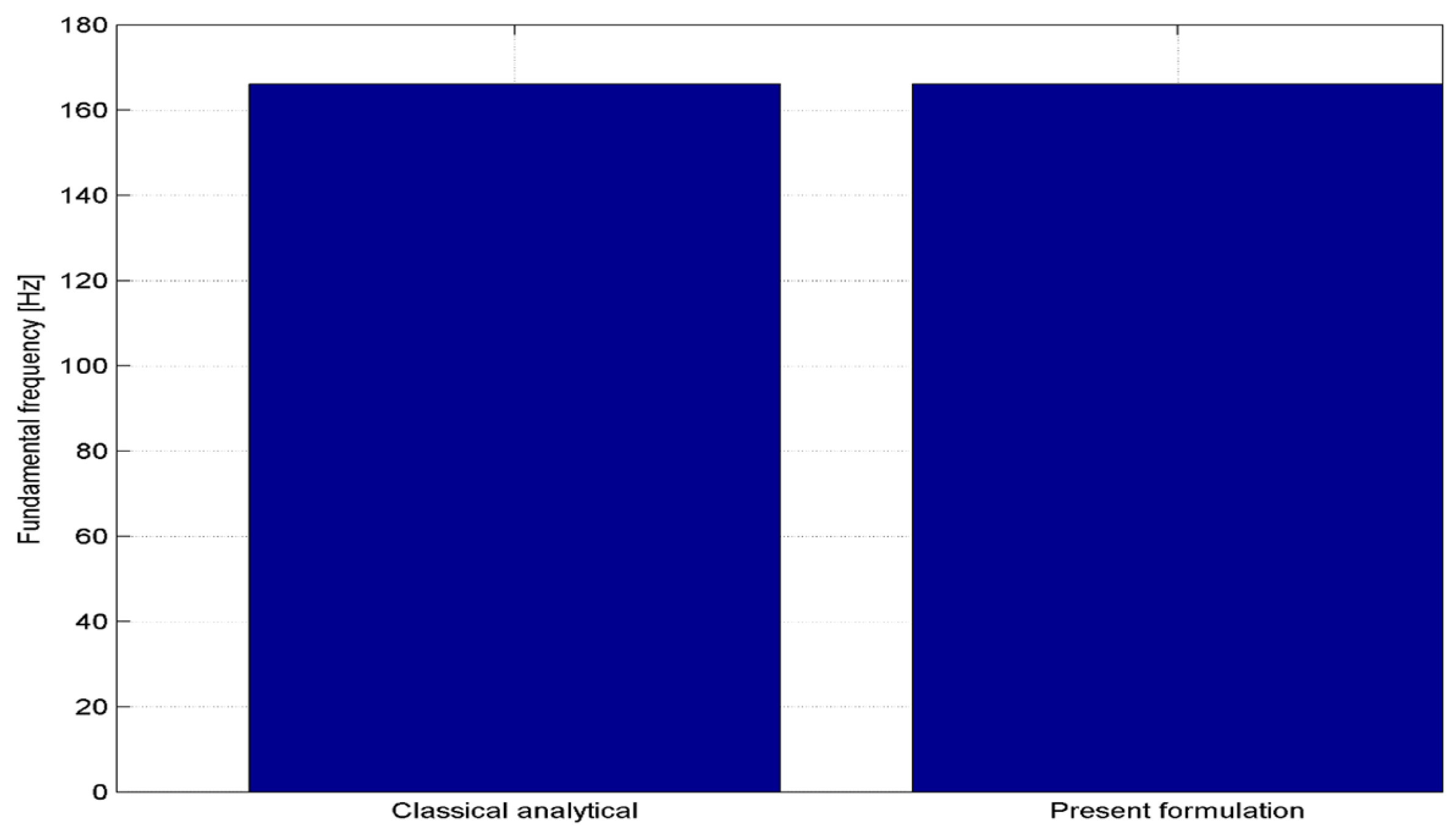
Figure 19 compares the present formulation with the independent classical analytical solution for the homogeneous plate limit. The present formulation predicts f11 = 166.09143209 Hz, while the classical analytical expression gives f11 = 166.09126600 Hz. The resulting discrepancy is only 0.0001%. This excellent agreement confirms that the basic plate stiffness, mass formulation, modal representation, and numerical integration are implemented correctly.
Figure 19.
Classical analytical validation.
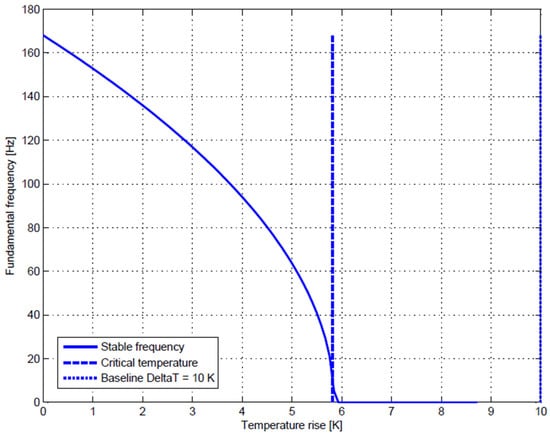
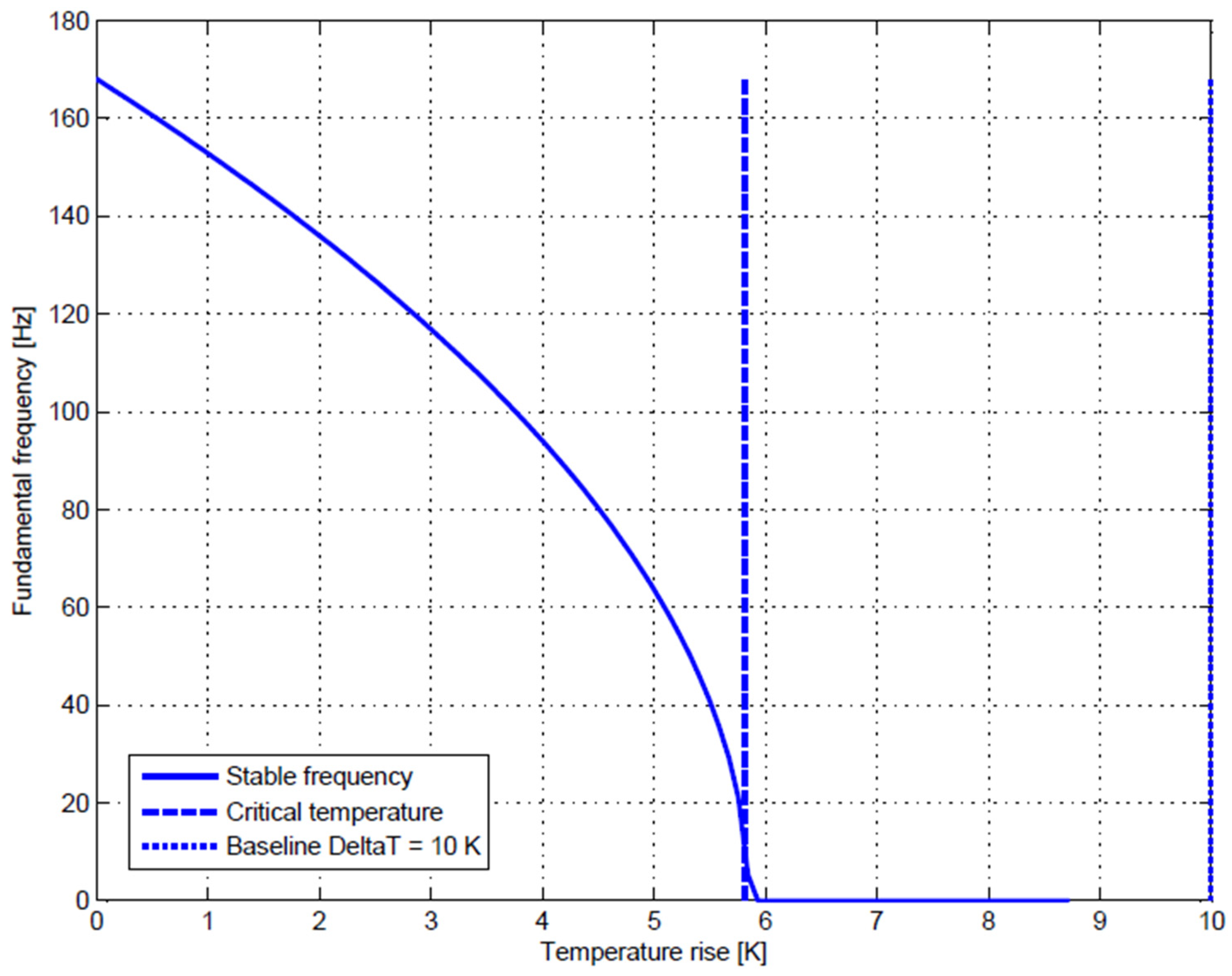
Figure 20 illustrates the variation of the fundamental frequency with temperature rise and identifies the critical thermal threshold. The frequency decreases with increasing temperature as the thermal membrane force progressively reduces the effective modal stiffness. The numerical critical temperature is 5.81753037 K, whereas the independent analytical calculation gives 5.81661186 K. The discrepancy is 0.01579%. This close agreement provides an independent verification of the thermal stability implementation. It also explains the instability observed for the reference temperature rise of 10 K: 10 K > 5.8175 K. Therefore, the fundamental mode is predicted to be unstable under the selected reference thermal condition.
Figure 20.
Thermal stability and critical temperature.
Table 3 confirms that thermal stability is mode dependent. The fundamental (1, 1) mode is unstable at the 10 K reference temperature because the applied temperature rise exceeds ΔTcr. The higher modes remain stable and exhibit increasing frequencies with increasing modal wave number. The (1, 2) and (2, 1) modes are identical at 235.7535 Hz, while the (2, 2), (1, 3), and (3, 1) modes occur at approximately 505.94 and 677.67 Hz, respectively. Their normalized frequencies are approximately 1.403, 3.011, and 4.033 when referenced to the stable mechanical (1, 1) frequency at ΔT = 0. The symmetry of the paired modes confirms the expected behavior of the square plate.
Table 3.
The Modal Results.
- -
- Verification and Validation
Table 4 provides the main evidence supporting the mathematical and numerical reliability of the proposed model. The classical homogeneous benchmark is reproduced with an error of only 0.0001%, which is sufficiently small to demonstrate excellent agreement. The homogeneous limit independently recovers the same classical result. The nonlocal-only, strain-gradient-only, and combined cases confirm the mathematical limiting behavior of the proposed nanoscale formulation. The no-GNP and nonporous cases further demonstrate that the two material modifications can be independently removed. The most important thermo-mechanical verification is the critical-temperature comparison, where the numerical value of 5.81753 K differs from the analytical value by only 0.01579%. The table therefore provides verification through independent analytical comparisons and mathematical limiting cases rather than claiming experimental validation.
Table 4.
Verification and validation of the solution.
- -
- Numerical Convergence
Table 5 demonstrates systematic convergence of the numerical thickness integration. The predicted frequency decreases progressively from 168.06691 Hz at 101 integration points to 168.05013 Hz at 2001 points. The error falls from 0.00998% to 0.000075% at 1001 points. This rapid convergence indicates that the thickness-dependent material properties and their numerical integrals are accurately resolved. Because increasing the discretization from 1001 to 2001 points produces a negligible change in the frequency, Nz =1001 is adopted for the primary parametric calculations. This choice provides adequate numerical accuracy while avoiding unnecessary computational expense.
Table 5.
Numerical convergence.
5. Conclusions
A theoretical thermo-mechanical model has been developed to investigate the vibration and thermal stability of functionally graded thermoplastic nanocomposite plates reinforced with graphene nanoplatelets. The formulation simultaneously considers GNP gradation, porosity, temperature-dependent material behavior, nonlocal elasticity, and strain-gradient effects. A numerical implementation was developed to evaluate the effective material properties, bending rigidity, modal characteristics, thermal stability, limiting cases, and numerical convergence.
The principal conclusions are as follows:
- The proposed formulation successfully reproduces the classical plate solution. The classical analytical benchmark is recovered with an error of only 0.0001%, demonstrating the accuracy of the fundamental modal formulation and numerical integration procedure.
- The mechanical reference frequency at ΔT = 0 is 168.05026 Hz, whereas the 10 K reference configuration is thermally unstable in the fundamental mode because the calculated critical temperature is only approximately 5.8175 K.
- The critical-temperature prediction is highly accurate. The calculated critical temperature rise of 5.8175 K differs from the independent analytical value of 5.8166 K by only 0.0158%.
- GNP reinforcement enhances the dynamic stiffness. For the reference configuration with a 3% GNP volume fraction, the predicted frequency increase relative to the corresponding no-GNP case is approximately 1.1714%.
- Porosity reduces the dynamic response. The 1% porosity amplitude produces approximately a 0.0106% reduction in the predicted reference frequency. Although the influence is small for the selected porosity level, it becomes an important design parameter when higher porosity levels are considered.
- Temperature has a dominant influence on fundamental stability. The predicted critical temperature rise is approximately 5.82 K. Because the reference temperature rise of 10 K exceeds this threshold, the fundamental (1, 1) mode is predicted to become thermally unstable.
- Higher modes remain stable under the reference condition. The (1, 2), (2, 1), (2, 2), (1, 3), and (3, 1) modes retain real positive frequencies, demonstrating that thermal instability initially affects the fundamental mode.
- The thickness-integration study demonstrates numerical convergence of the calculated fundamental frequency. Using 1001 integration points yields a relative difference of approximately (7.5 × 10⁻⁵%) compared with the 2001-point solution, indicating that the numerical result is insensitive to further integration-point refinement within the tested range. This finding establishes numerical convergence, rather than independent validation of the model’s physical predictions.
- The combined theoretical framework is suitable for parametric design studies. The developed model can be used to investigate the effects of geometry, GNP concentration, FGM grading, porosity, temperature, and size-dependent parameters without requiring a separate numerical model for each configuration. Overall, the results indicate that GNP reinforcement, functional gradation, porosity, and nanoscale size effects cannot be considered independently when evaluating the thermo-mechanical behavior of advanced thermoplastic nanostructures. The developed framework provides a consistent theoretical and computational basis for predicting their coupled influence on vibration and thermal stability.
- The adopted characteristic lengths have not been calibrated specifically for the PP/GNP system; therefore, future microstructure-based or experimental calibration is required to establish their material-specific physical values.
Author Contributions
Conceptualization, M.J.J. and E.K.N.; methodology, E.K.N. and A.-H.Z.M.R.; software, E.K.N.; validation, M.J.J., E.Z.G. and A.M.; formal analysis, K.M.A. and A.A.F.O.; investigation, E.Z.G. and A.M.; resources, A.A.F.O.; data curation, E.K.N.; writing—original draft preparation, E.K.N.; writing—review and editing, K.M.A. and A.-H.Z.M.R.; visualization, R.M. and A.A.F.O.; supervision, M.J.J.; project administration, R.M. All authors have read and agreed to the published version of the manuscript.
Funding
This research received no external funding.
Data Availability Statement
The raw data supporting the conclusions of this article will be made available by the authors on request.
Acknowledgments
The authors gratefully acknowledge the institutional and technical support provided by Al-Farahidi University, Jabir ibn Hayyan University for Medical and Pharmaceutical Sciences, the University of Al-Maarif, the University of Kufa, the University of Anbar, Mustansiriyah University, and the Graphic Era (Deemed to be University) throughout the course of this research.
Conflicts of Interest
The authors declare no conflicts of interest. All co-authors have seen and agree with the contents of this manuscript, and there are no financial interests to report.
References
- Dananjaya, V.; Abeykoon, C. Thermo-mechanical and electrical properties of graphene nanoplatelets reinforced recycled polypropylene nanocomposites. Int. J. Lightweight Mater. Manuf. 2025, 8, 374–384. [Google Scholar] [CrossRef] [Scilit]
- Sutar, H.; Mishra, B.; Senapati, P.; Murmu, R.; Sahu, D. Mechanical, thermal, and morphological properties of graphene nanoplatelet-reinforced polypropylene nanocomposites: Effects of nanofiller thickness. J. Compos. Sci. 2021, 5, 24. [Google Scholar] [CrossRef] [Scilit]
- Carneiro, A.A.; Pereira, I.M.; Dias, R.R.; Biron Dda, S.; Ornaghi Júnior, H.L.; Monticeli, F.M.; Romanzini, D.; Zattera, A.J. Exploring the synergistic effect of short aramid fibers and graphene nanoplatelets on the mechanical and dynamic mechanical properties of polypropylene composites prepared via thin-plate injection. Polymers 2025, 17, 374. [Google Scholar] [CrossRef] [Scilit] [PubMed]
- Habib, U.; Ali Mohsin, M.E.; Khan, Z.I.; Mohamad, Z.; Othman, N.; Mousa, S.; Hossain, S.S.; Ali, S.S. Mechanical, thermal, and flammability properties of eco-friendly nanocomposites from recycled PET/PA-11 blends reinforced with graphene nanoplatelets. Polymers 2025, 17, 1038. [Google Scholar] [CrossRef] [Scilit] [PubMed]
- MR, A.H.Z.; Khaleel, H.H. Modeling and evaluation of vibrational behavior in functionally graded ceramicmetal composite beams. Kufa J. Eng. 2025, 16, 35. [Google Scholar] [CrossRef] [Scilit]
- Thai, C.H.; Ferreira, A.J.M.; Nguyen-Xuan, H.; Hung, P.T.; Phung-Van, P. A nonlocal strain gradient isogeometric model for free vibration analysis of magneto-electro-elastic functionally graded nanoplates. Compos. Struct. 2023, 316, 117005. [Google Scholar] [CrossRef] [Scilit]
- Alghanmi, R.A. Nonlocal strain gradient theory for the bending of functionally graded porous nanoplates. Materials 2022, 15, 8601. [Google Scholar] [CrossRef] [Scilit] [PubMed]
- Kadum Njim, E.; Ziadoon Mohammed Rahi, A.H.; Jweeg, M.J.; Sameer Jabbar, M.; H. Al-Maamori, M.; Madan, R. Dynamic analysis of composite plates reinforced with MWCNT nanoparticles: Theoretical and experimental study. Aircr. Eng. Aerosp. Technol. 2026, 98, 1–11. [Google Scholar] [CrossRef] [Scilit]
- Esen, I.; Özmen, R. Thermal vibration and buckling of magneto-electro-elastic functionally graded porous nanoplates using nonlocal strain gradient elasticity. Compos. Struct. 2022, 296, 115878. [Google Scholar] [CrossRef] [Scilit]
- Rahi, Z.M. Nonlinear Vibration Analysis Of Rotating Functionally Graded Cnts-Reinforced Composite Beams: Effects Of Cnts Distribution Profiles And System Parameters. Kufa J. Eng. 2026, 17, 204–230. [Google Scholar] [CrossRef] [Scilit]
- Naveen Kumar, H.S.; Kattimani, S.; Nguyen-Thoi, T. Influence of porosity distribution on nonlinear free vibration and transient responses of porous functionally graded skew plates. Def. Technol. 2021, 17, 1918–1935. [Google Scholar] [CrossRef] [Scilit]
- Saiah, B.; Chiker, Y.; Bachene, M.; Mouloud, G. Vibrational behavior of temperature-dependent piece-wise functionally graded polymeric nanocomposite plates reinforced with monolayer graphene. J. Vib. Eng. Technol. 2023, 12, 3519–3542. [Google Scholar] [CrossRef] [Scilit]
- Ma, R.; Jin, Q. Free vibration analysis of functionally graded graphene-reinforced composite-laminated plates. J. Aerosp. Eng. 2024, 36, 04023016. [Google Scholar] [CrossRef] [Scilit]
- Zhao, T.Y.; Wang, Y.X.; Pan, H.G.; Gao, X.S.; Cai, Y. Analytical solution for vibration characteristics of rotating graphene nanoplatelet-reinforced plates under rub-impact and thermal shock. Adv. Compos. Lett. 2020, 29, 1–15. [Google Scholar] [CrossRef] [Scilit]
- Cheng, Y.; She, G.-L.; Eltaher, M.A. Nonlinear internal resonance of graphene-reinforced metal foam plates with initial geometric imperfection under non-uniform temperature field. Aerosp. Sci. Technol. 2025, 165, 110491. [Google Scholar] [CrossRef] [Scilit]
- Mohd, F.; Talha, M. Effect of graphene platelets reinforcement on vibration behavior of functionally graded porous arches under thermal environment. Mater. Today Proc. 2022, 61, 103–109. [Google Scholar] [CrossRef] [Scilit]
- Yas, M.H.; Rahimi, S. Thermal vibration of functionally graded porous nanocomposite beams reinforced by graphene platelets. Appl. Math. Mech. 2020, 41, 1209–1226. [Google Scholar] [CrossRef] [Scilit]
- Selvamani, R.; Prabhakaran, T.; El Maati, L.A.; Alomar, M. Dynamic behavior of thermally affected porous FG nanobeams via nonlocal strain gradient and memory models. Tribol. Int. 2026, 214, 111252. [Google Scholar] [CrossRef] [Scilit]
- Gao, K.; Gao, W.; Chen, D.; Yang, J. Nonlinear free vibration of functionally graded graphene platelets reinforced porous nanocomposite plates resting on elastic foundation. Compos. Struct. 2018, 204, 831–846. [Google Scholar] [CrossRef] [Scilit]
- Zhou, C.; Zhang, Z.-X.; Zhang, J.; Fang, Y.; Tahouneh, V. Vibration analysis of FG porous rectangular plates reinforced by graphene platelets. Steel Compos. Struct. 2020, 34, 215–226. [Google Scholar] [CrossRef]
- Anamagh, M.R.; Bediz, B. Free vibration and buckling behavior of functionally graded porous plates reinforced by graphene platelets using spectral Chebyshev approach. Compos. Struct. 2020, 253, 112765. [Google Scholar] [CrossRef] [Scilit]
- Radwan, A.F. Quasi-3D integral model for thermomechanical buckling and vibration of FG porous nanoplates embedded in an elastic medium. Int. J. Mech. Sci. 2019, 159, 320–335. [Google Scholar] [CrossRef] [Scilit]
- Sahmani, S.; Aghdam, M.M.; Rabczuk, T. Nonlocal strain gradient plate model for nonlinear large-amplitude vibrations of functionally graded porous micro/nano-plates reinforced with GPLs. Compos. Struct. 2018, 198, 51–62. [Google Scholar] [CrossRef] [Scilit]
- Liang, Y.; Zheng, S.; Chen, D. Isogeometric analysis of graphene-reinforced functionally gradient piezoelectric plates resting on Winkler elastic foundations. Materials 2022, 15, 5727. [Google Scholar] [CrossRef] [Scilit] [PubMed]
- Afshari, H.; Adab, N. Size-dependent buckling and vibration analyses of GNP reinforced microplates based on the quasi-3D sinusoidal shear deformation theory. Mech. Based Des. Struct. Mach. 2022, 50, 184–205. [Google Scholar] [CrossRef] [Scilit]
- Mohammad-Rezaei Bidgoli, E.; Arefi, M. Free vibration analysis of micro plate reinforced with functionally graded graphene nanoplatelets based on modified strain-gradient formulation. J. Sandw. Struct. Mater. 2021, 23, 436–472. [Google Scholar] [CrossRef] [Scilit]
- Thai, C.H.; Ferreira, A.; Phung-Van, P. Size dependent free vibration analysis of multilayer functionally graded GPLRC microplates based on modified strain gradient theory. Compos. Part B Eng. 2019, 169, 174–188. [Google Scholar] [CrossRef] [Scilit]
- Ebrahimi, F.; Barati, M.R. Size-dependent thermally affected wave propagation analysis in nonlocal strain gradient functionally graded nanoplates via a quasi-3D plate theory. J. Mech. Eng. Sci. 2018, 232, 162–173. [Google Scholar] [CrossRef] [Scilit]
- Sobhy, M. A new quasi 3D nonlocal plate theory for vibration and buckling of FGM nanoplates. Int. J. Appl. Mech. 2017, 9, 1750008. [Google Scholar] [CrossRef] [Scilit]
- Khazaei, P.; Mohammadimehr, M. Vibration analysis of porous nanocomposite viscoelastic plate reinforced by FG-SWCNTs based on a nonlocal strain gradient theory. Comput. Concr. 2020, 26, 31–52. [Google Scholar] [CrossRef]
- Barati, M.R.; Zenkour, A.M. Vibration analysis of functionally graded graphene platelet reinforced cylindrical shells with different porosity distributions. Mech. Adv. Mater. Struct. 2019, 26, 1580–1588. [Google Scholar] [CrossRef] [Scilit]
- Mirjavadi, S.S.; Forsat, M.; Hamouda, A.; Barati, M.R. Dynamic response of functionally graded graphene nanoplatelet reinforced shells with porosity distributions under transverse dynamic loads. Mater. Res. Express 2019, 6, 075045. [Google Scholar] [CrossRef] [Scilit]
- Chen, C.; Li, D.; Zhou, X.; Zhou, L. Thermal vibration analysis of functionally graded graphene platelets-reinforced porous beams using the transfer function method. Eng. Struct. 2023, 284, 115963. [Google Scholar] [CrossRef] [Scilit]
- Chen, C.; Li, D.; Zhou, L.; Zeng, C. Effects of nonlinear temperature field on the free vibration of functionally graded graphene platelet-reinforced porous plates. Mech. Based Des. Struct. Mach. 2026, 54. [Google Scholar] [CrossRef] [Scilit]
- Fazzolari, F.A. Elastic buckling and vibration analysis of FG polymer composite plates embedding graphene nanoplatelet reinforcements in thermal environment. Mech. Adv. Mater. Struct. 2020, 27, 391–404. [Google Scholar] [CrossRef] [Scilit]
- Javani, M.; Kiani, Y.; Eslami, M. Thermal buckling of FG graphene platelet reinforced composite annular sector plates. Thin-Walled Struct. 2020, 148, 106589. [Google Scholar] [CrossRef] [Scilit]
- Zhang, Y.F.; Ma, L.; Zhang, W.; Gu, X.J. Nonlinear dynamic responses of functionally graded graphene platelet reinforced composite cantilever rotating warping plate. Appl. Math. Model. 2023, 113, 44–70. [Google Scholar] [CrossRef] [Scilit]
- Fazelzadeh, S.A.; Rahmani, S.; Ghavanloo, E.; Marzocca, P. Thermoelastic vibration of doubly-curved nano-composite shells reinforced by graphene nanoplatelets. J. Therm. Stress. 2019, 42, 1–17. [Google Scholar] [CrossRef] [Scilit]
- Wang, Y.; Liu, Y.F.; Zu, J.W. Size-dependent vibration of circular cylindrical polymeric microshells reinforced with graphene platelets. Int. J. Appl. Mech. 2019, 11, 1950036. [Google Scholar] [CrossRef] [Scilit]
- Azimpour-Shishevan, F.; Mohtadi-Bonab, M.A.; Rahmatinejad, B. Dynamic response and impact performance of carbon nanotube and graphene nanoplatelet modified flax fiber reinforced polymer composites. J. Mater. Res. Technol. 2026, 43, 6087–6103. [Google Scholar] [CrossRef] [Scilit]
- Gao, X.Y.; Wang, Z.Z.; Ma, L.S. Thermal vibration analysis of functionally graded porous plates reinforced by graphene platelets supported by arbitrarily distributed Kerr foundations under a nonlinear temperature profile. J. Vib. Eng. Technol. 2024, 12, 7729–7749. [Google Scholar] [CrossRef] [Scilit]
- Zhao, Z.; Feng, C.; Wang, Y.; Yang, J. Bending and vibration analysis of functionally graded trapezoidal nanocomposite plates reinforced with graphene nanoplatelets (GPLs). Compos. Struct. 2017, 180, 799–808. [Google Scholar] [CrossRef] [Scilit]
- Karami, B.; Shahsavari, D.; Janghorban, M.; Tounsi, A. Resonance behavior of functionally graded polymer composite nanoplates reinforced with graphene nanoplatelets. Int. J. Mech. Sci. 2019, 156, 94–105. [Google Scholar] [CrossRef] [Scilit]
- Zeverdejani, M.K.; Beni, Y.T. Effect of laminate configuration on the free vibration/buckling of FG Graphene/PMMA composites. Adv. Nano Res. 2020, 8, 103–114. [Google Scholar]
- John, B.O.; Hassan, F.U.; George, N.; Chacko, T.; Bhagat, V.; Jeyaraj, P.; Reddy, R.K.K. Thermal buckling and vibro-acoustic behaviour of functionally graded graphene polymer layered composites subjected to in-plane temperature variance. Proc. Inst. Mech. Eng. Part L J. Mater. Des. Appl. 2022, 236, 1541–1556. [Google Scholar] [CrossRef] [Scilit]
- Yıldırım, E.; Esen, I. Effect of the porous structure on the hygrothermal vibration analysis of functional graded nanoplates using nonlocal high-order continuum plate model. Acta Mech. 2024, 235, 5079–5106. [Google Scholar] [CrossRef] [Scilit]
- Arshid, E.; Amir, S. Size-dependent vibration analysis of fluid-infiltrated porous curved microbeams integrated with reinforced functionally graded graphene platelets face sheets considering thickness stretching effect. Proc. Inst. Mech. Eng. Part L J. Mater. Des. Appl. 2021, 235, 1077–1099. [Google Scholar] [CrossRef] [Scilit]
- Chen, Q.; Zheng, S.; Li, Z.; Zeng, C. Size-dependent free vibration analysis of functionally graded porous piezoelectric sandwich nanobeam reinforced with graphene platelets with consideration of flexoelectric effect. Smart Mater. Struct. 2021, 30, 035008. [Google Scholar] [CrossRef] [Scilit]
- Peng, W.; Zenkour, A.M.; Gao, Y.; Zhang, X.; He, T.; Li, Y. Size-dependent thermoelastic damping analysis in functionally graded graphene nanoplatelets reinforced composite microplate resonators based on Moore–Gibson–Thompson thermoelasticity. ZAMM–Z. Angew. Math. Mech. 2024, 104, e202301091. [Google Scholar] [CrossRef] [Scilit]
- Shakir, M.; Talha, M.; Dileep, A.D. Machine learning based probabilistic model for free vibration analysis of functionally graded graphene nanoplatelets reinforced porous plates. Mech. Adv. Mater. Struct. 2024, 31, 6095–6108. [Google Scholar] [CrossRef] [Scilit]
- Talha, M.; Singh, B.N. Stochastic vibration characteristics of finite element modelled functionally gradient plates. Compos. Struct. 2015, 130, 95–106. [Google Scholar] [CrossRef] [Scilit]
- Sepahvand, K.; Marburg, S.; Hardtke, H.-J. Stochastic free vibration of orthotropic plates using generalized polynomial chaos expansion. J. Sound Vib. 2012, 331, 167–179. [Google Scholar] [CrossRef] [Scilit]
- García-Macías, E.; Castro-Triguero, R.; Friswell, M.I.; Adhikari, S.; Sáez, A. Metamodel-based approach for stochastic free vibration analysis of functionally graded carbon nanotube reinforced plates. Compos. Struct. 2016, 152, 183–198. [Google Scholar] [CrossRef] [Scilit]
- Xu, J.; Feng, C.; Ni, Z.; Hang, Z.; Zhang, J. Numerical analysis on nonlinear dynamics of functionally graded graphene nanoplatelet reinforced multiphase porous composite beam with DQ and IHB methods. Mech. Adv. Mater. Struct. 2025, 33, 2477227. [Google Scholar] [CrossRef] [Scilit]
- Do, D.M.; Gao, K.; Yang, W.; Li, C.-Q. Hybrid uncertainty analysis of functionally graded plates via multiple-imprecise-random-field modelling of uncertain material properties. Comput. Methods Appl. Mech. Eng. 2020, 368, 113116. [Google Scholar] [CrossRef] [Scilit]
- Dey, S.; Mukhopadhyay, T.; Khodaparast, H.H.; Adhikari, S. Fuzzy uncertainty propagation in composites using Gram–Schmidt polynomial chaos expansion. Appl. Math. Model. 2016, 40, 4412–4428. [Google Scholar] [CrossRef] [Scilit]
- Zhang, R.; Li, S.; Wu, Z.; Wu, D.; Li, L. A nonlocal mechanics-informed neural network homogenization for variable-density lattice structures. Thin-Walled Struct. 2026, 227, 114957. [Google Scholar] [CrossRef] [Scilit]
- Kamiński, M.; Barretta, R. Higher order uncertainty quantification and probabilistic distance in deformation analysis of some nonlocal elastic beams. Mech. Res. Commun. 2026, 155, 104734. [Google Scholar] [CrossRef] [Scilit]
- Kamiński, M.; Vaccaro, M.S.; Barretta, R. On a stochastic model of nonlocal elastic beams using the generalized perturbation method. Probabilistic Eng. Mech. 2025, 81, 103803. [Google Scholar] [CrossRef] [Scilit]
- Qi, C.; Sun, Y.; Hu, H.-T.; Wang, D.-Z.; Cao, G.-J.; Yang, S. On design of hybrid material double-hat thin-walled beams under lateral impact. Int. J. Mech. Sci. 2016, 118, 21–35. [Google Scholar] [CrossRef] [Scilit]
- Feo, L.; Lovisi, G.; Penna, R. A Comprehensive Integral-Form Framework for the Stress-Driven Non-Local Model: The Role of Convolution Kernel, Regularization and Boundary Effects. Mathematics 2026, 14, 872. [Google Scholar] [CrossRef] [Scilit]
- Zhan, Z.; Hu, W.; Li, B.; Zhang, Y.; Meng, Q.; Guan, Z. Continuum damage mechanics combined with the extended finite element method for the total life prediction of a metallic component. Int. J. Mech. Sci. 2017, 124–125, 48–58. [Google Scholar] [CrossRef] [Scilit]
- Lovisi, G.; Penna, R. A generalized stress-driven approach to anomalous dispersion in peridynamics. Int. J. Eng. Sci. 2026, 229, 104662. [Google Scholar] [CrossRef] [Scilit]
- Śniady, P.; Podwórna, M.; Idzikowski, R. Stochastic vibrations of the Euler–Bernoulli beam based on various versions of the gradient nonlocal elasticity theory. Probabilistic Eng. Mech. 2019, 56, 27–34. [Google Scholar] [CrossRef] [Scilit]
- Jiammeepreecha, W.; Chaidachatorn, K.; Phungpaingam, B.; Klaycham, K.; Chucheepsakul, S. Effective nonlocal finite element formulation for free vibration analysis of S-FGM doubly curved nanoshells based on linear strain–displacement relations using TSDT. Comput. Math. Appl. 2025, 179, 77–102. [Google Scholar] [CrossRef] [Scilit]
- Kenanda, M.A.; Hammadi, F.; Bahai, H.; Belabed, Z. A new efficient nonlocal hyperbolic HSDT for mechanical vibration of porous FGM plates/nanoplates using Navier’s method and artificial neural network prediction. Int. J. Solids Struct. 2026, 325, 113719. [Google Scholar] [CrossRef] [Scilit]
- Sahmani, S.; Kotrasova, K.; Shahzad, M.A.; Valaskova, V.; Zareichian, M.; Safaei, B. Study on nonlinear asymmetric thermomechanical stability of microsize FGM curved beams based on nonlocal couple stress curvature sensitive model. Results Eng. 2025, 25, 104493. [Google Scholar] [CrossRef] [Scilit]
- Cheng, R.; Zheng, S. Nonlocal strain gradient isogeometric buckling analysis of variable-thickness bi-directionally functionally graded GPL-reinforced composite nanoplates with square and circular geometries. Phys. Scr. 2026, 101, 275212. [Google Scholar] [CrossRef] [Scilit]
- Dehrouyeh-Semnani, A.M. On boundary conditions for thermally loaded FG beams. Int. J. Eng. Sci. 2017, 119, 109–127. [Google Scholar] [CrossRef] [Scilit]
- Penna, R.; Lovisi, G.; Feo, L. Dynamic Response of Multilayered Polymer Functionally Graded Carbon Nanotube Reinforced Composite (FG-CNTRC) Nano-Beams in Hygro-Thermal Environment. Polymers 2021, 13, 2340. [Google Scholar] [CrossRef] [Scilit] [PubMed]
- Zhu, C.; Yan, J.; Wang, P.; Li, C. A Nonlocal Strain Gradient Approach for Out-of-Plane Vibration of Axially Moving Functionally Graded Nanoplates in a Hygrothermal Environment. Shock. Vib. 2021, 2021, 8332125. [Google Scholar] [CrossRef] [Scilit]
- Modi, V.; Karttunen, A.J. Molecular dynamics simulations on the elastic properties of polypropylene bionanocomposite reinforced with cellulose nanofibrils. Nanomaterials 2022, 12, 3379. [Google Scholar] [CrossRef] [Scilit] [PubMed]
- He, C.; Ding, J.; Fan, X. Modeling and Simulation of Graphene-Based Transducers in NEMS Accelerometers. Micromachines 2024, 15, 409. [Google Scholar] [CrossRef] [Scilit] [PubMed]
- Zheng, Z.; Shen, H.-S.; Na, B.-W.; Fan, Y.; Chen, X.; Wang, H. Predictions of temperature-dependent material properties and auxeticity of graphene platelets. Mech. Mater. 2025, 205, 105311. [Google Scholar] [CrossRef] [Scilit]

Disclaimer/Publisher’s Note: The statements, opinions and data contained in all publications are solely those of the individual author(s) and contributor(s) and not of MDPI and/or the editor(s). MDPI and/or the editor(s) disclaim responsibility for any injury to people or property resulting from any ideas, methods, instructions or products referred to in the content. |
© 2026 by the authors. Licensee MDPI, Basel, Switzerland. This article is an open access article distributed under the terms and conditions of the Creative Commons Attribution (CC BY) license.