


Abstract
In-space manufacturing is essential for achieving long-term planetary colonization, particularly on Mars, where material transport from Earth is both costly and logistically restrictive. Traditional subtractive manufacturing methods are highly equipment-, energy-, and material-intensive, making additive manufacturing (AM) a more practical and sustainable alternative for extraterrestrial production. Among various AM technologies, laser beam powder bed fusion (PBF-LB) stands out due to its exceptional versatility, precision, and capability to produce dense metallic parts with complex geometries. However, conventional PBF-LB processes rely heavily on inert argon environments to prevent oxidation and ensure high-quality part formation—conditions that are difficult to reproduce on Mars. CO2 makes up over 95% of the Martian atmosphere, meaning printing in a majority-CO2 environment is of great interest for in situ manufacturing in a Martian colonization effort. This study investigates the feasibility of using pure carbon dioxide (CO2) as a potential substitute for argon in PBF-LB manufacturing. Single-track and two-dimensional 316L stainless steel specimens were fabricated under argon, CO2, and ambient air environments with a wide range of laser parameters to evaluate the influence of atmospheric composition on surface morphology, microstructural cohesion, and oxidation behavior. The results reveal that no single parameter controls the overall part quality; rather, a balance of parameters is essential to maintain thermal equilibrium during fabrication. Although parts produced in CO2 exhibited slightly inferior surface finish, cohesion, and oxidation resistance compared to argon, they performed significantly better than those fabricated in ambient air in terms of balling effects and overall cohesion. These findings suggest that CO2-assisted PBF-LB could enable sustainable in situ manufacturing on Mars and may also serve as a cost-effective alternative shielding gas for terrestrial applications.
1. Introduction
Establishing a sustainable human presence on Mars presents immense scientific, engineering, and logistical challenges. Among these, one of the most critical hurdles is to overcome cargo constraints associated with interplanetary transport. Launching materials from Earth is extremely expensive and limited by strict mass and volume restrictions, making it impractical to continuously supply all the tools, components, and replacement parts needed to sustain a long-term mission. To ensure the success and longevity of Martian colonization, it will therefore be essential to develop in situ resource utilization (ISRU) and in situ manufacturing capabilities that allow astronauts to fabricate and repair equipment directly on the Martian surface [1,2]. Traditional subtractive manufacturing methods—such as machining and milling—have proven indispensable on Earth for producing precise and reliable components. However, these processes are energy-intensive, material-wasteful, and dependent on heavy machinery that is impractical to transport to extraterrestrial environments. In contrast, additive manufacturing (AM), commonly referred to as 3D printing, offers an attractive alternative for space applications [2,3]. AM allows the creation of complex geometries directly from digital designs with minimal material waste, reduced energy consumption, and lower system mass—key advantages under the severe logistical constraints of deep-space missions.
Among the various AM technologies, laser beam powder bed fusion (PBF-LB) stands out as one of the most versatile and widely adopted techniques for metal-based fabrication [4,5]. In the PBF-LB process, fine metal powder layers are sequentially melted by a focused laser beam to produce fully dense, near-net-shape components. However, the process is typically conducted within an inert gas environment—most commonly argon—to prevent oxidation and other detrimental chemical reactions that can impair surface finish and degrade mechanical performance. Yet, establishing and maintaining an argon atmosphere on Mars would pose significant challenges, as argon is scarce and would have to be transported from Earth or extracted in small quantities from the Martian atmosphere. Interestingly, carbon dioxide (CO2) constitutes more than 95% of the Martian surface atmosphere [6,7] and is chemically stable under moderate temperature conditions. Although CO2 is not a noble gas, its potential to act as a processing medium under a controlled environment for PBF-LB has been seldom studied. If metal AM could be effectively conducted within a CO2 atmosphere, this would represent a major advancement toward self-sustaining manufacturing infrastructure on Mars, dramatically reducing the need for imported gases and a protected chamber. CO2-based manufacturing may also offer advantages for terrestrial manufacturing, as CO2 is generally more readily available and less expensive than industry-standard argon. In addition, the use of CO2 has potential environmental benefits, since it is a common byproduct of many industrial processes, whereas argon must be separated from air through energy-intensive cryogenic distillation [8]. In other words, if CO2 does not affect the processing, AM can be conducted in its atmospheric condition without dimensional constraints.
In this work, we use a pure CO2 filled chamber to simulate the Mars atmosphere environment [9] for PBF-LB of a widely used metal, 316L stainless steel [10,11,12,13], as an important model material. A pure CO2 environment at room temperature and standard atmospheric pressure was employed to simplify the experimental design, as the primary objective of this study was to understand the effects of CO2 on processing morphology and oxidation. It is acknowledged, however, that the presence of trace atmospheric gases, as well as lower surface temperature, and reduced atmospheric pressure on Mars, would likely affect the PBF-LB manufacturing process [14,15,16]. Through single-track and layer-based fabrication experiments, we systematically examine the influence of atmospheric composition on melting, surface morphology, and oxidation behavior. By comparing results obtained under argon, CO2, and ambient air environments, this study provides fundamental insights into the role of process atmosphere in metal AM and evaluates the potential of CO2-assisted PBF-LB for future extraterrestrial manufacturing. Beyond its relevance for space applications, the findings also have implications for terrestrial manufacturing, where CO2 may offer a more sustainable and cost-effective alternative to traditional inert gases.
2. Materials and Methods
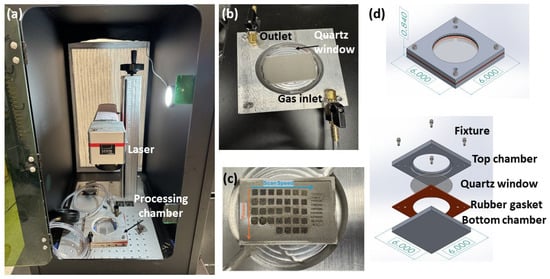
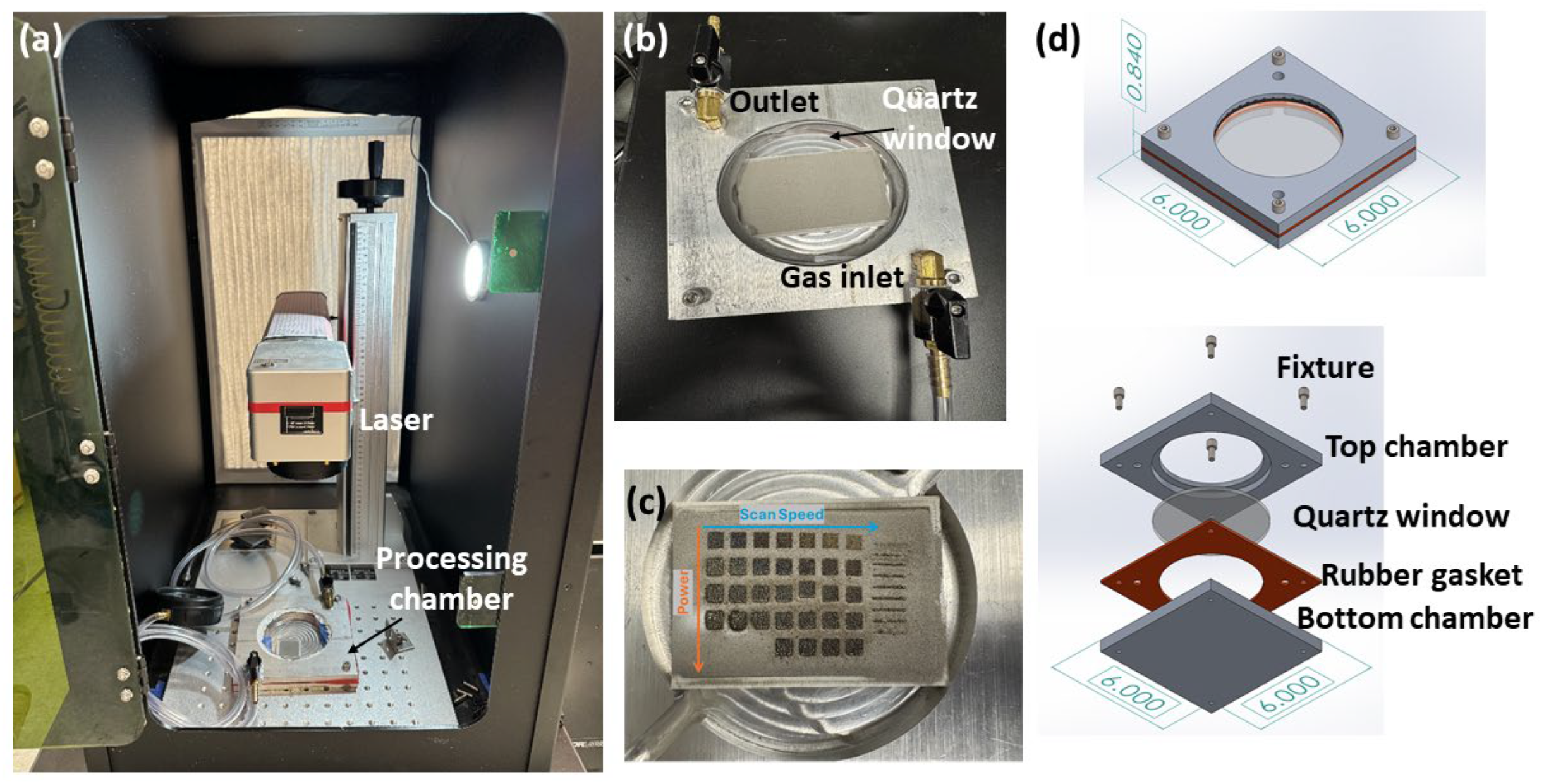
316L steel with an average particle size between 22–28 µm was used as the testing material due to its compliance with PBF-LB requirements, handling simplicity, and applicability for Martian colony needs [17]. The manufacturing system (as shown in Figure 1a) comprises a fiber laser with a wavelength of 1064 nm and a maximum power of 80 W, and a customized power bed (Figure 1b). This customized chamber has a quartz window, a gas inlet and outlet, which allows us to simulate the desired atmosphere environment. The specific components to construct the chamber are shown in Figure 1d. The fabrication chamber was simple to meet the basic requirements for PBF-LB with a controllable gas environment. The main body of the chamber was composed of two aluminum plates that were machined via CNC mill to create an open-top chamber when the two pieces were put together. A quartz glass window was installed for the viewing port through which the laser shone. To create an air-tight seal, a gasket cut to shape from a rubber stamp sheet was implemented between the two aluminum plates. The quartz window was attached to the chamber with an air-tight seal. The atmosphere of the chamber was controlled via two valves installed in the chamber. One valve was used to pump in the desired atmosphere, while the other was used as an exit valve. The two chamber halves were held together via four bolts. The metal powder was contained within the chamber in a small 3D printed powder bed (as shown in Figure 1c).
Figure 1.
(a) Overview of experimental setup for PBF-LB with an artificial environment; (b) Photograph of processing chamber with labeled components; (c) Representative image of fabricated sample; (d) Exploded view of the CAD model illustrating the processing chamber components, dimensions in mm.
Due to the window’s proximity to the metal powder and the high energy being focused onto the powder, small amounts of powder would vaporize and deposit on the window’s inner surface. Therefore, a glass slide was attached to the bottom of the quartz window to protect the window. A new glass slide was used after each manufacturing batch.
A repeatable method for preparing samples was established to achieve optimal project efficiency and ensure repeatability. First, the 316L metal powder was distributed in the powder bed. Then, the powder bed was leveled with a glass slide. The powder bed was then placed into the manufacturing chamber. If an atmosphere other than ambient was tested, one of the chamber vents was then secured with a vacuum gauge to verify a proper chamber seal. The other was attached to a one-stage vacuum pump that was allowed to run for 30 s to ensure proper ambient atmosphere removal. Assuming atmospheric pressure at a testing altitude of 420 m above sea level, the internal pressure within the chamber at this point was approximately 3000 Pa. The vacuum pump was then disconnected, and the chamber was connected to either the CO2 or Ar tank. Before connection, the line between the chamber and the gas tank was ensured to be free of an ambient atmosphere. Once connected, the gas was allowed to slowly fill the chamber until the vacuum gauge was at atmospheric pressure. Assuming a standard atmospheric oxygen content of 20.95% [18], the O2 content within the chamber was roughly 6300 PPM when considering the residual atmosphere that remained post-vacuum. Commercial PBF-LB systems typically operate at a lower O2 concentration of 1000 PPM. Additional spattering or balling effects may have occurred due to higher O2 concentration, as reported previously [19]. However, these effects were consistent between all tests. The chamber was then disconnected and placed below the laser.
Both single-track and two-dimensional (2D) samples were fabricated. Laser parameters were chosen with respect to standard volumetric energy density values for 316L stainless steel. Volumetric energy density (VED) is a simplified parameter analysis metric used widely within the AM field that relates laser power (), hatch spacing (), scan speed (), and layer thickness () as seen in the equivalence expression below:
PBF-LB process quality is a complicated entity that is dependent on a vast number of thermal and physical interactions, meaning VED is both an oversimplified metric and difficult to standardize across manufacturing setups and feedstock materials [20,21,22]. However, the literature finds that a VED value for 316L steel between 78.3–203.1 J/mm3 generally results in optimal print quality [21]. VED values lower than this are subject to lack of fusion effects, prohibiting the formation of a fully developed melt pool. VED values above the threshold result in balling and keyholing effects, which negatively affect porosity and part cohesion [22]. For 2-D sample testing, laser power ranged from 16 W to 40 W at 8 W increments, hatch spacing was tested at 20 µm and 35 µm, scan speed ranged from 50–200 mm/s at 25 mm/s increments, and while not part of the VED equation, laser frequency was set at 500 kHz. Layer height was not directly controlled and was assumed to be the depth of the melt pool as dictated by the Rosenthal model, calculated via the following equation [22]:
where is laser absorptivity, is powder density, is the specific heat of the material, is the melting point of the material, and is the preheated temperature. All other variables have been previously defined. The laser absorptivity for the 1064 nm laser used in this experiment for 316L steel was taken from values measured by Brandau et al. [23]), and the material density of the powder was taken to be the tapped density given by the manufacturer. This parameter sweep resulted in VED variation between 329–104 J/mm3. These parameters are above and on the upper end of the ideal VED range mentioned previously, to overcome the lack of volumetric energy. The aforementioned parameters could not successfully create 1-D samples due to the lack of residual thermal effects from overlapping scans present in 2-D scanning strategies, meaning greater thermal energy output was required for a cohesive sample. Therefore, the parameters were adjusted for the 1-D parameter sweep with power ranging from 16–80 W, scan speed ranging from 10–125 mm/s, and frequencies ranging from 10–4000 kHz.
All optical images were taken via a Tomilov digital microscope. ImageJ software, version 1.54p, was utilized to analyze the dimensions of the manufactured samples. Two-dimensional samples were compared using the solidification percentage to understand the feasibility and accuracy for square sample fabrication. The area of a given sample was measured via ImageJ area measurement tools and was compared to the total target sintering area of the sample. The target sample area was determined by etching a square on wood with the chosen Lightburn size parameter of 5 × 5 mm2. The square was then measured with digital calipers to determine the target area, which was defined as 26.884 mm2.
Part cohesion of 2D was evaluated through an area retention calculation, which was referred to as solidification percentage:
Selected samples were further characterized using a FEI Nova Nanolab 200 Scanning Electron Microscope (SEM) to obtain high-resolution microstructural images and assess surface morphology and quality. Besides, Energy-Dispersive X-ray (EDX) Spectroscopy was employed to evaluate compositional differences and identify oxidation-related byproducts across the tested atmospheres. While the EDX measurements were not intended to provide quantitative elemental compositions, they offered valuable comparative insights into the relative oxygen presence and surface chemistry among samples fabricated under CO2, argon, and ambient conditions.
3. Results and Discussion
3.1. Single-Track Sintering
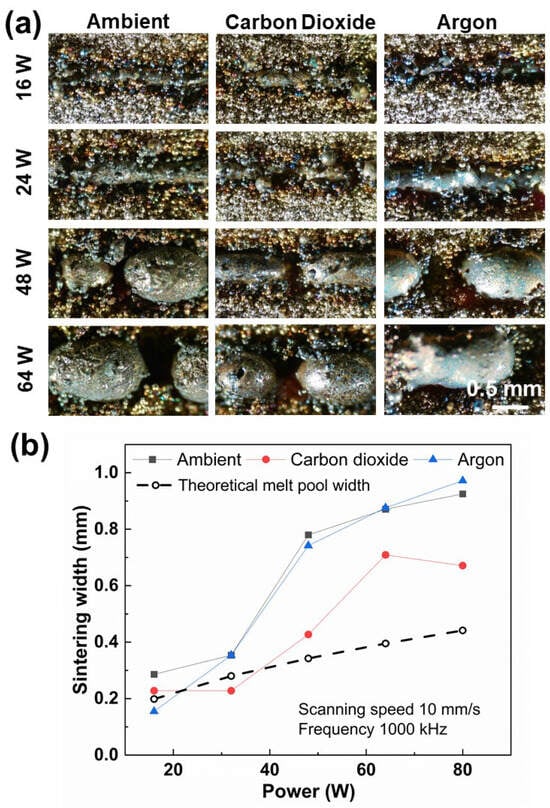
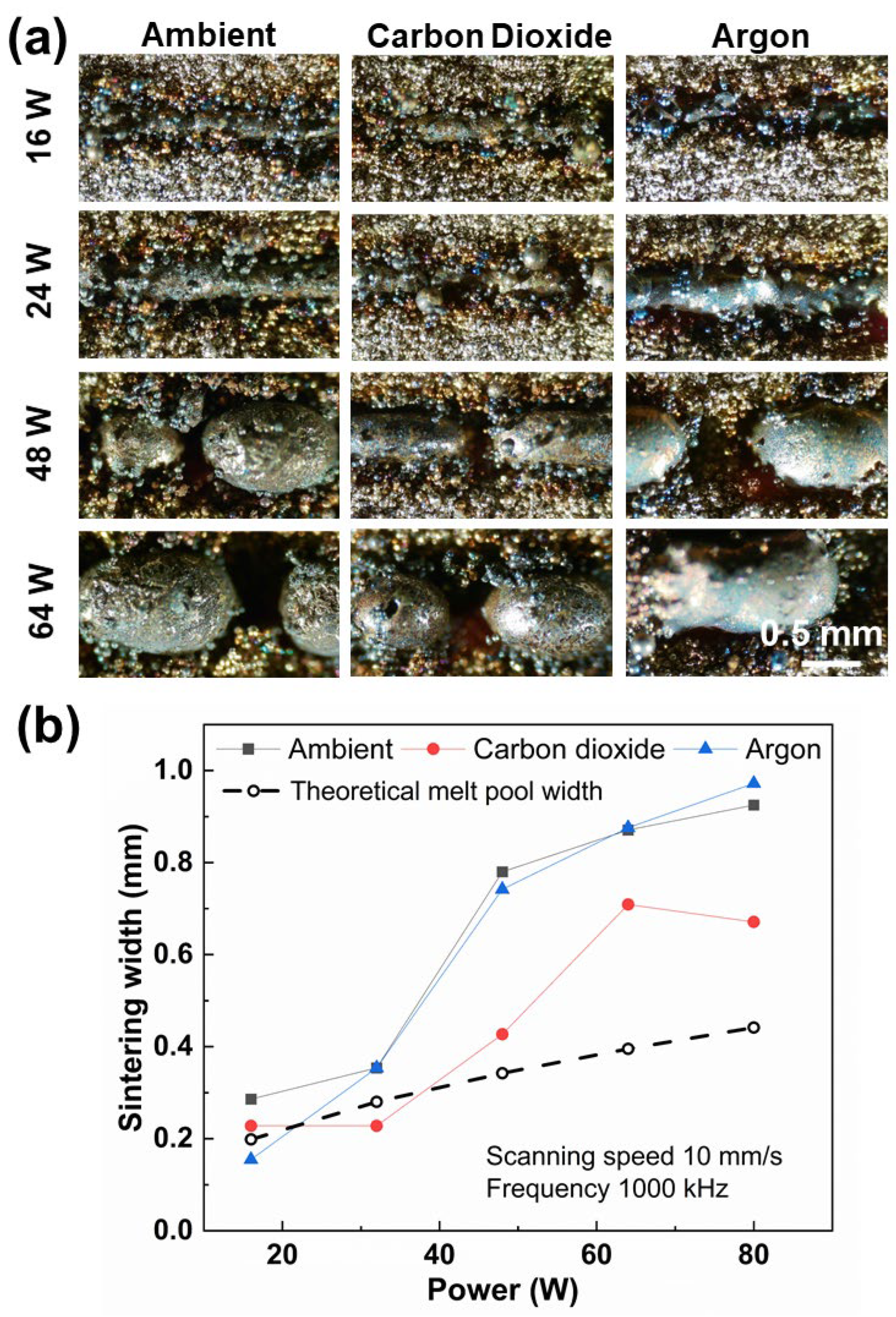
To understand the influence of laser parameters (including power, frequency and scanning speed) on the sintering results, we first conduct single-track scanning of metal powder with three different atmosphere environments (ambient, Martian atmosphere (namely, carbon dioxide), and argon). Morphology changes are obvious with different laser powers (as shown in Figure 2a). Generally, when the power is increased from 16 to 80 W, the line width significantly increases regardless of the processing environment (Figure 2b). With relatively low power, continuous lines can be fabricated; however, with higher powers (≥48 W), the balling effect becomes prominent [24], forming discontinuous, elongated sections. The correlation between laser power and single-track line width is summarized in Figure 2b. The general trend is that line width increases as laser power, or more accurately, linear energy density (LED, defined as P/v, where P denotes the laser power, and v denotes the scanning speed [25]). Compared with samples fabricated in ambient and argon environments, the CO2 environment tends to give the smallest line width, which might be attributed to the reduced interfacial energy between CO2 and molten stainless steel, and accompanied reaction [26,27].
Figure 2.
(a) Laser power effect on single-track sintering (1000 kHz, 10 mm/s); (b) line width change with power.
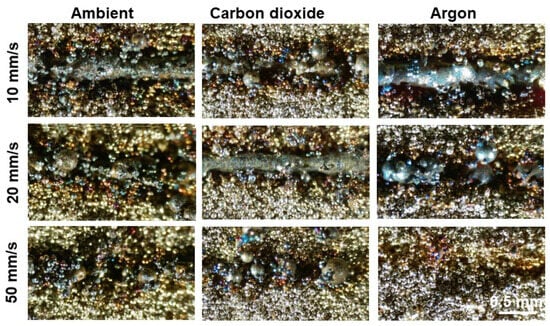
We further studied the influence of scanning speed on the sintered morphology (with a fixed power of 32 W). As shown in Figure 3, with the increase in scanning speed from 10 to 50 mm/s (or decrease in linear energy density), the sintered line becomes discontinuous. In comparison of different processing environments, the argon environment gives the widest continuous line, followed by the ambient environment, and then the CO2 environment. Yet, it is noticed that with the CO2 environment, both 10 mm/s and 20 mm/s can form continuous lines, while the ambient and argon environment only forms continuous lines at 10 mm/s. This suggests that with different processing environments, the molten stainless steel may have different surface tension on the solid powder bed.
Figure 3.
Scanning speed effect on single-track samples (1000 kHz, 32 W).
3.2. Fabrication of 2D Samples
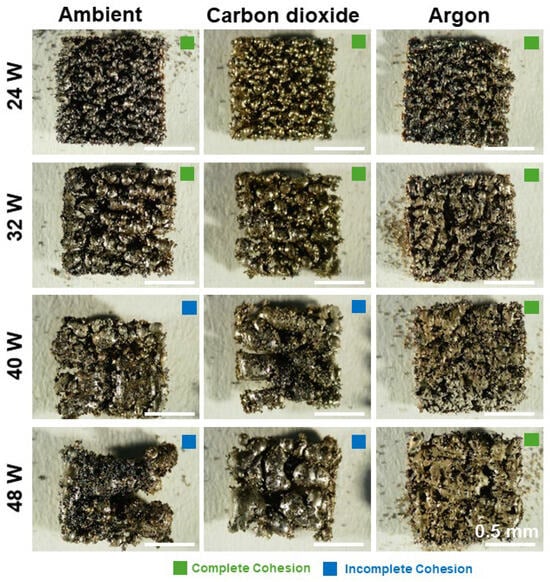
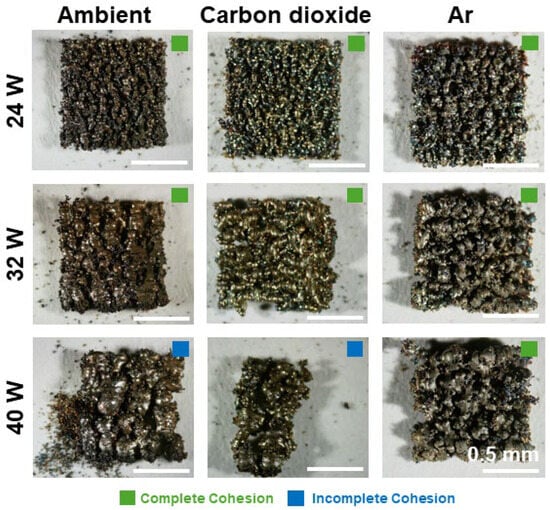
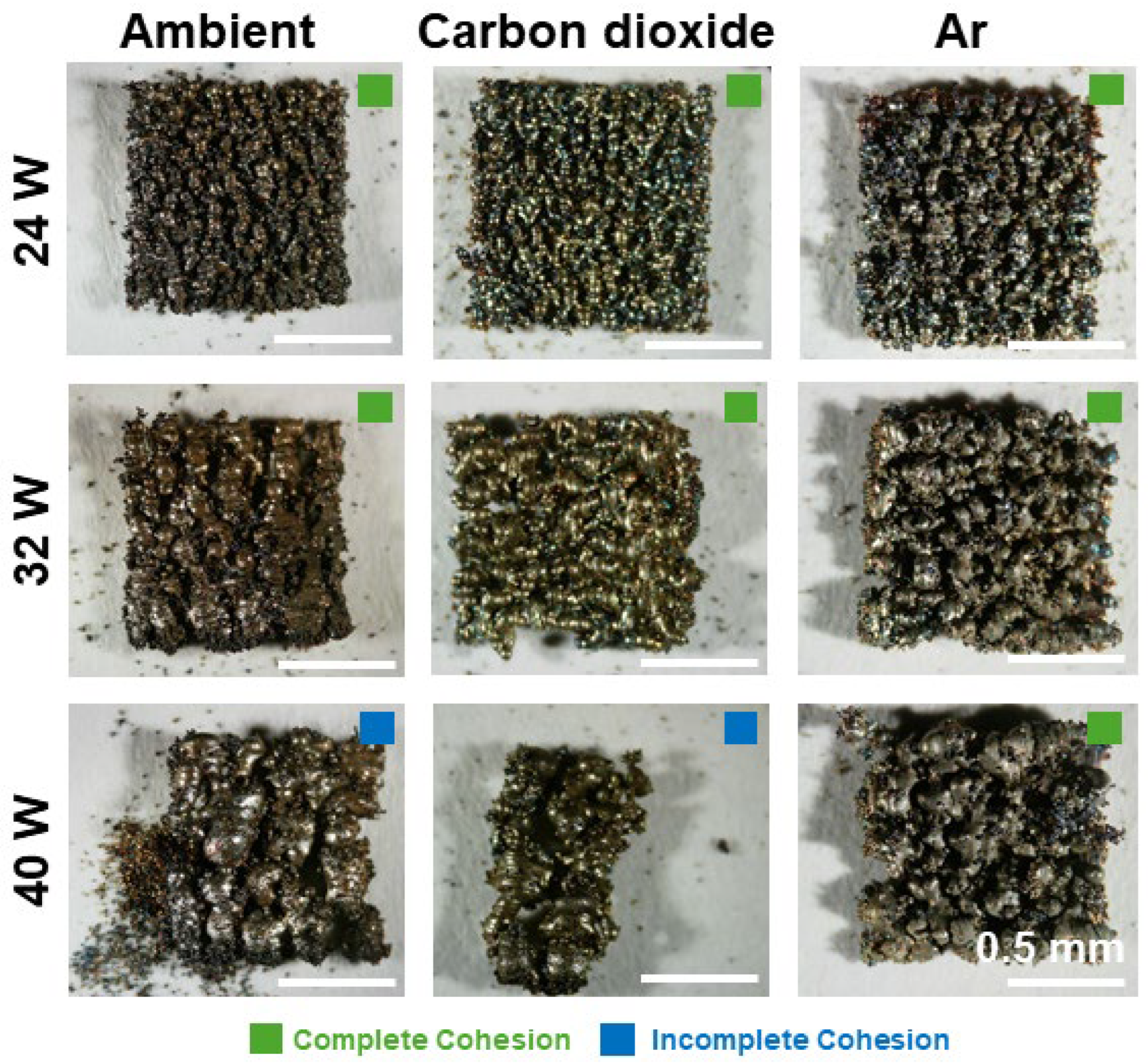
Following single-track sintering, we explored the fabrication of 2D samples in different environments with a variety of parameter combinations. Generally, with the increase in laser power, the balling effect becomes more obvious (as shown in Figure 4), especially for ambient and CO2 environments. Samples fabricated with 24 W contain much smaller beads of melted powder than the ones made with higher powers. By increasing the laser power to 32 W, the melting and coalescence become more evident as the heat accumulates in the powder bed, forming a connected 2D plate, especially the one with argon. Generally, with relatively low power (≤32 W or VED, 325 J/mm3), samples show better shape retention. Clear cracks were observed in the samples fabricated with power ≥ 40 W (or VED ≥ 365 J/mm3) in ambient and CO2 environments, which is caused by overheating and thermal stress. Yet, samples fabricated with an argon environment have better cohesion, which suggests that the oxidation of stainless steel in ambient and CO2 reduces the effective coalescence.
Figure 4.
Laser power effect on fabricated 2D samples (125 mm/s, 20 µm hatch space).
Based on these observations, we further increased the hatch space from 20 µm to 35 µm, using laser power between 24–40 W. Results from this parameter sweep can be seen in Figure 5. It is observed that with a smaller hatch space and larger overlapping area, the sintered structures tend to be more cohesive and have fewer gaps between different tracks. When the hatch space is 35 µm, 40 W laser power, unfortunately, cannot sinter the powders into a whole piece in an ambient and CO2 environment. This failure may be caused by the over-oxidization and insufficient heat to bond the melts together.
Figure 5.
Laser power effect on fabricated 2D samples (125 mm/s, 35 µm hatch space).
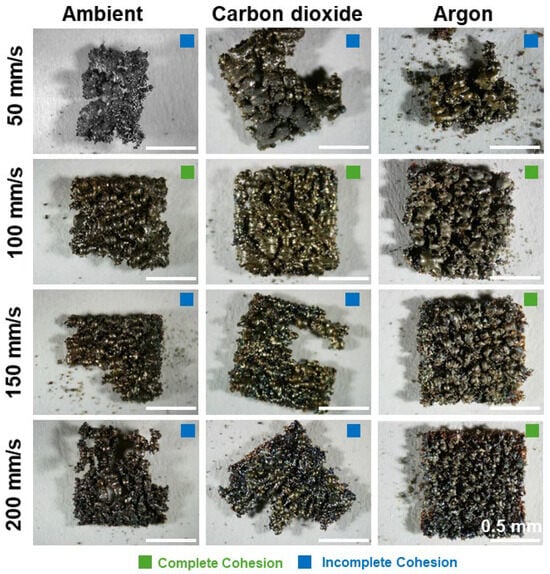
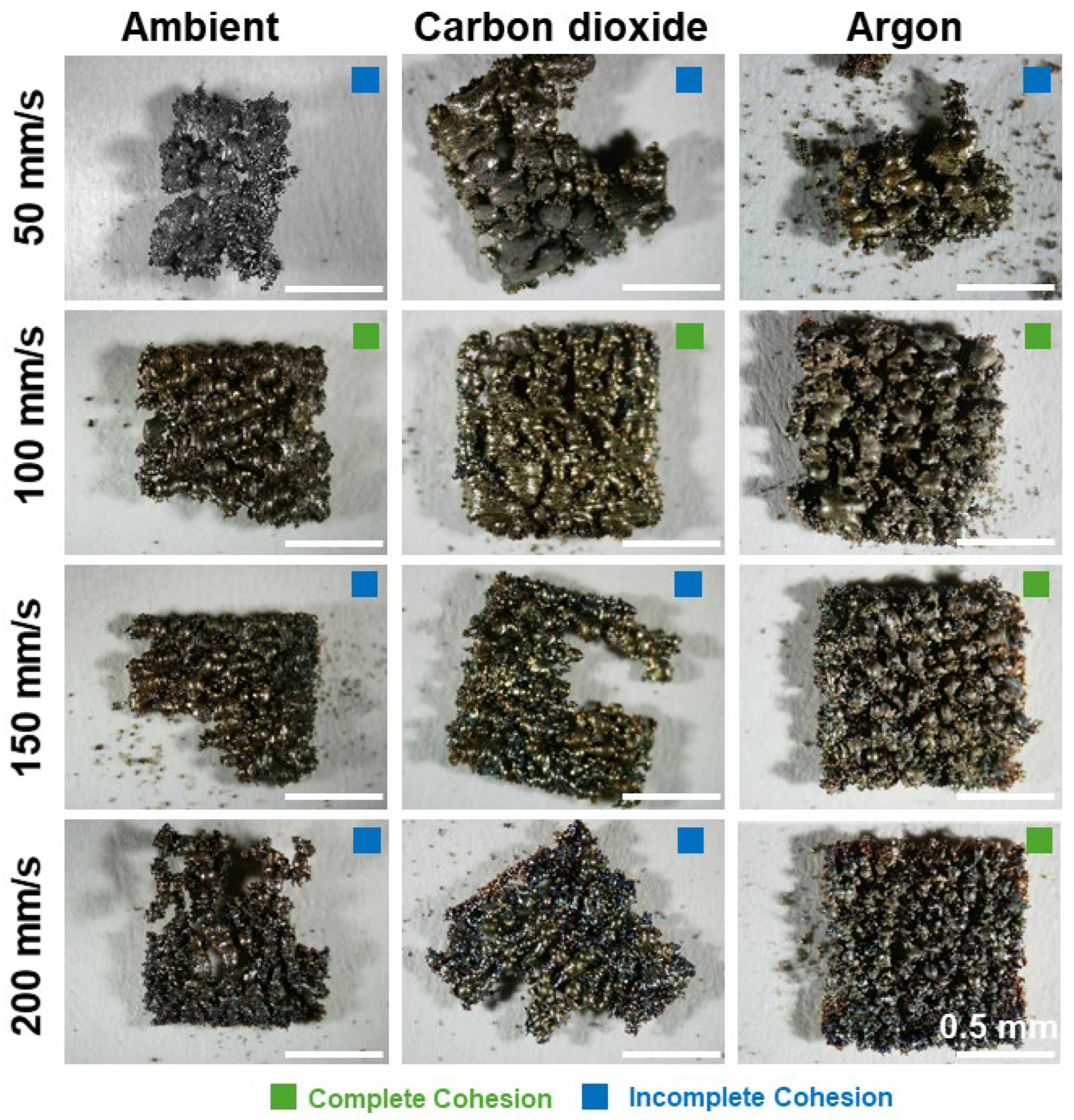
Compared with samples with 20 µm hatch space and 32 W, 35 µm samples exhibited better cohesion and less pronounced balling effects, as seen in Figure 5. Thus, we chose a 35 µm hatch space and fixed the laser power at 32 W to further check the influence of scanning speed on the morphology of 2D samples. As shown in Figure 6, by reducing scanning speed from 125 mm/s to 100 mm/s (or increasing VED to 208 J/mm3), the resulting morphology is similar to the cases in Figure 4 with a power of 40 W. Yet, further decrease in scanning speed to 50 mm/s (or increasing the VED to 294 J/mm3), the designed shape is no longer retained (first row in Figure 6). On the other hand, an increase in scanning speed from 125 mm/s to 150 mm/s and 200 mm/s (corresponding to lower VED of 170 J/mm3 and 147 J/mm3) results in partially sintered pieces in ambient and CO2 environments. However, with argon protection, high speed (or low VED) can still form a well-shaped piece. Overall, the argon environment is suitable for the widest range of scanning speeds, while the CO2 environment works better than the ambient environment for PBF-LB of stainless steel powder.
Figure 6.
Scanning speed effect on 2D samples (32 W, 35 µm hatch space).
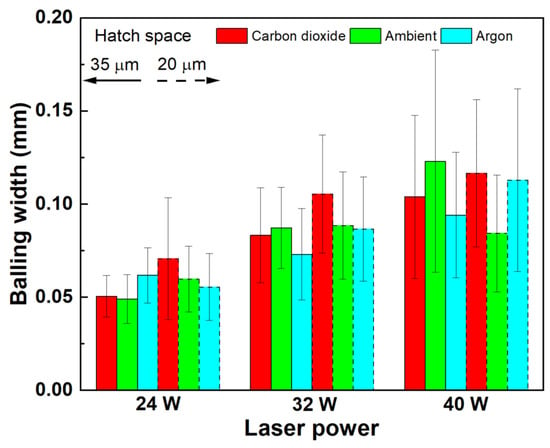
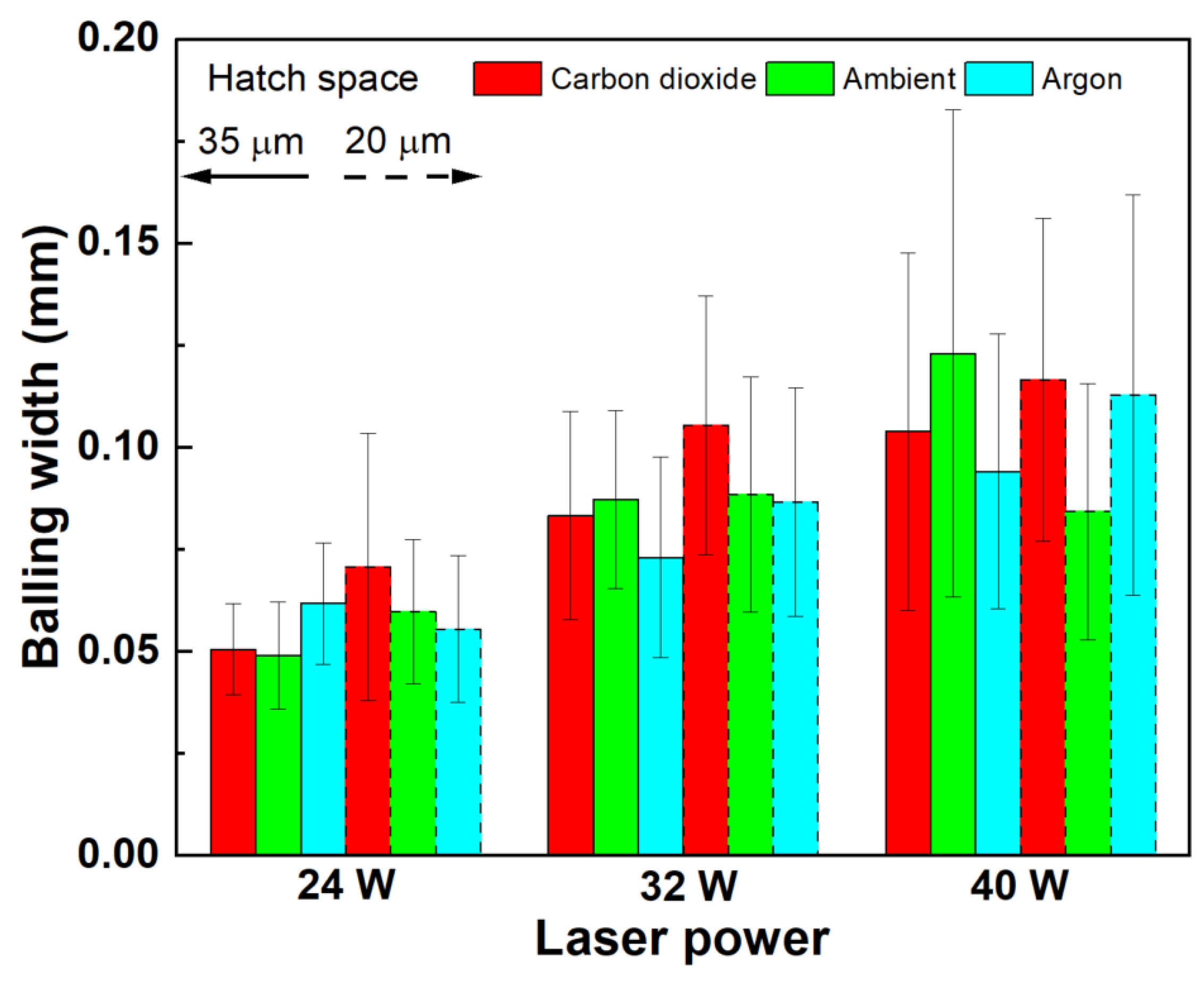
Balling effects were evaluated by visually examining each sample in the hatch spacing variation trial. Up to 20 balling effects were recorded per sample, with results illustrated in Figure 7. In most cases, 35 µm samples resulted in lower balling widths at the same parameters and atmosphere than 20 µm samples, meaning that at these parameters, a larger hatch spacing (and thus smaller VED) was preferred. The significant outlier was the difference in balling size between samples printed in an ambient atmosphere at 40 W. This occurred because so little of the 20 µm sample was successfully printed that few balling effects could be recorded. When considering this, ambient atmosphere proved to be the most volatile and inducive to balling effects, followed closely by CO2. Argon samples consistently contained the least prominent balling effects.
Figure 7.
Average balling width with different hatch spaces.
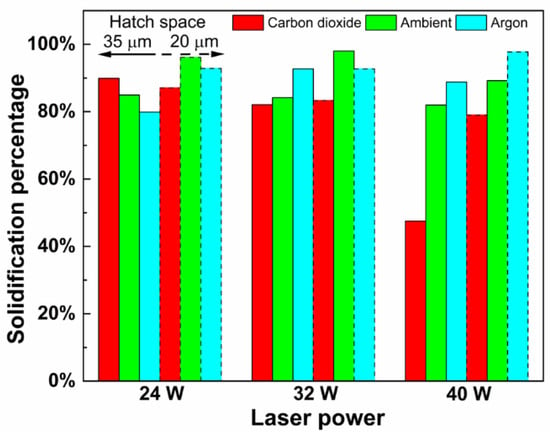
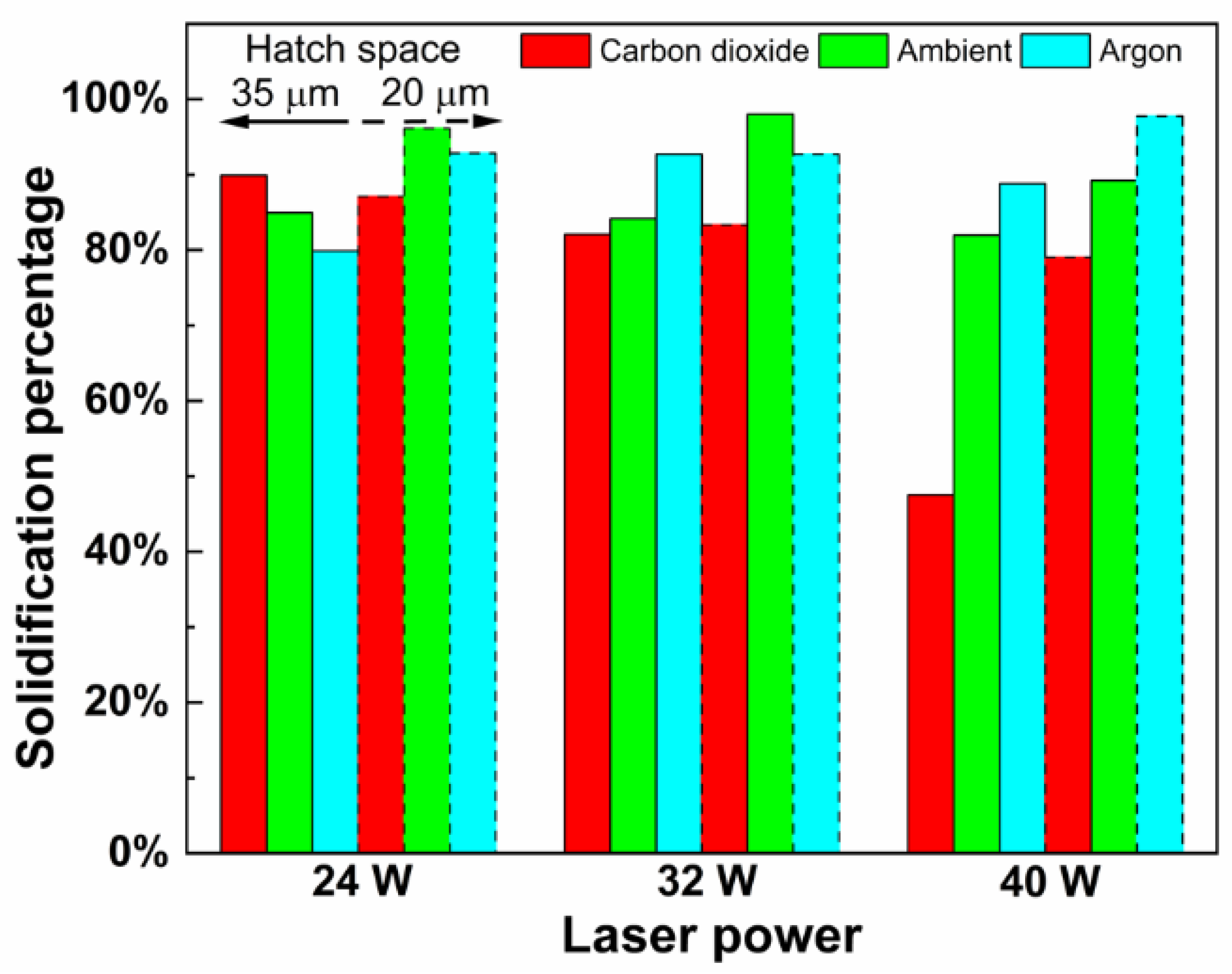
Lastly, we quantified all the samples with solidification percentage and illustrated them in Figure 8. Generally, a balanced linear energy density can lead to a more consistent solidification percentage with the designed shape. The graph shows that a 20 µm hatch spacing retains its area more effectively than a 35 µm spacing across all tested laser powers at a scanning speed of 125 mm/s, indicating that optimized hatch spacing is critical to maintaining the structural integrity of the fabricated part. The inert gas (i.e., argon) seems to be the most suitable (and most widely used) processing environment for stainless steel, followed by a simulated Martian environment (i.e., CO2 gas), and then the ambient. These observations suggest that the Martian atmospheric environment (i.e., CO2 gas) can potentially be used directly for selective laser sintering/melting.
Figure 8.
Solidification percentage with different hatch spaces.
3.3. Atmospheric Effect on Morphology and Oxidation
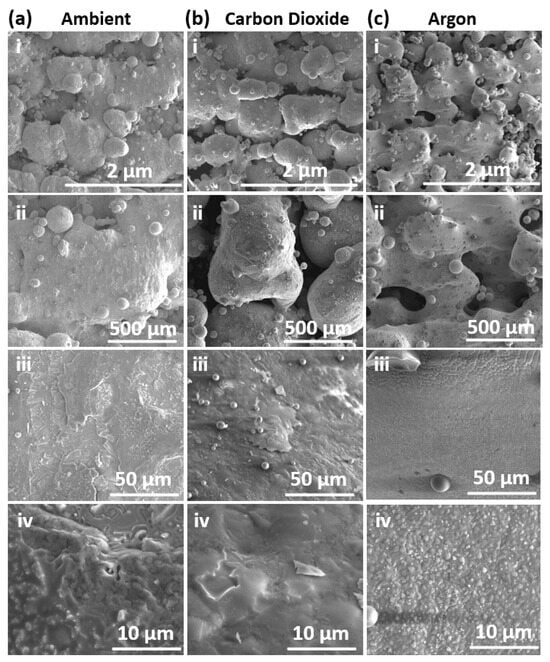
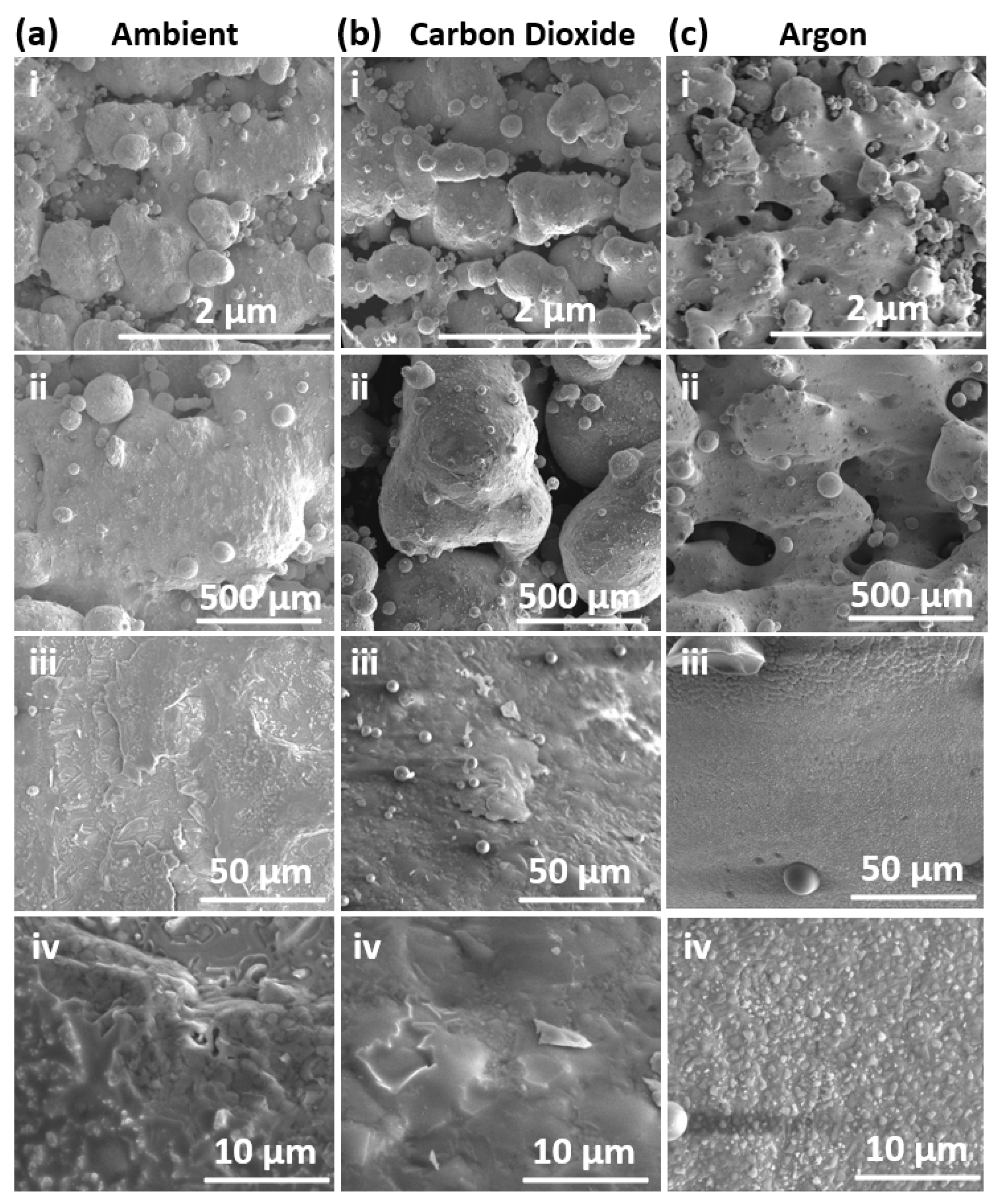
To further assess the potential oxidation effect on the fabricated samples, 2D samples processed under each atmospheric condition were characterized by SEM and EDX. As indicated in Figure 9, consistent with earlier observations, samples processed in an argon environment exhibit the most uniform and dense surfaces (Figure 9c), whereas processing in ambient air (Figure 9a) and CO2 (Figure 9b) leads to progressively higher levels of oxidation-related defects and surface roughness. Across all magnifications, argon-processed samples display significantly smoother and more continuous morphologies (Figure 9c). At low magnification, uniform melt tracks with minimal balling are observed. At higher magnifications, the surface appears dense and fine-textured, with only isolated droplets. The inert argon atmosphere effectively suppresses oxidation during laser processing (indicated in Table 1, with the lowest atomic percentage of oxygen), enabling stable melt pools, improved wetting, and enhanced inter-track fusion.
Figure 9.
SEM image of samples fabricated in three different atmospheres with scanning speed of 125 mm/s, power of 32 W, and hatch space of 35 µm.
Table 1.
EDX analysis of the sample processed in different environments.
In contrast, samples processed in ambient air (Figure 9a) and CO2 (Figure 9b) exhibit pronounced melt instabilities. At low magnification, both environments show a substantial balling effect (Figure 9, row i), characterized by numerous spherical and semi-spherical features, indicating unstable melt flow during laser irradiation. For ambient-air processing, intermediate-magnification images reveal irregular and uneven surfaces with resolidified droplets distributed along the melt tracks. At higher magnification (Figure 9, row iv), rough surface textures and microscale protrusions are evident. The presence of oxygen promotes oxidation during laser melting, enhancing surface-tension gradients and inhibiting smooth melt flow; oxide formation further suppresses wetting, leading to balling and poor inter-track bonding. The high atomic percentage of oxygen in the ambient-processed sample was confirmed by EDX analysis, as shown in Table 1.
Compared to ambient air, CO2 processing results in larger and more agglomerated melt features at low magnification (Figure 9b-i). At intermediate magnification, irregular solidified lumps and partially fused regions are observed, while high-magnification images reveal uneven surfaces with re-solidification ridges and fine microparticles. Although CO2 reduces oxygen availability relative to ambient air, thermal decomposition or residual oxygen still facilitates surface reactions. A lower percentage of oxygen was detected in the sample processed in the simulated Martian atmospheric environment (as shown in Table 1). This may increase the melt viscosity and flow instability, resulting in coarser surface features compared with the sample processed in argon.
4. Conclusions
Single-track and two-dimensional samples were manufactured using PBF-LB with 316L steel in argon, carbon dioxide, and ambient atmospheric environments to investigate the influence of atmosphere on the morphology. It was found that the optimal morphology is less dependent on the atmospheric environment, compared with laser power and scanning speed, as well as hatch space for 2D specimens. If thermal effects are not strong enough, the powder would see insufficient melting and not form a cohesive bond. If thermal effects are too strong, balling effects would occur and create metal spheres as a result of capillary forces. It was found that argon was the superior fabrication atmosphere over either carbon dioxide or ambient. Samples created in argon had consistently better cohesion, area retention, and surface quality. Argon also exhibited lower amounts of oxidation than other atmospheres. However, carbon dioxide did exhibit better performance than the ambient atmosphere in terms of cohesion, which is promising for potential PBF-LB on Mars.
Further work is needed to verify the suitability of a carbon dioxide atmosphere for PBF-LB. Three-dimensional components should be fabricated and tested to quantify how surface quality, adhesion, and oxidation influence mechanical performance. Studies involving other alloys and materials will help clarify how composition affects process outcomes. Future research should also explore integrating CO2-based solar-driven additive manufacturing concepts [28,29] to enable energy-efficient, in situ fabrication on planetary surfaces—an important step toward autonomous manufacturing for space exploration.
Author Contributions
Conceptualization, W.S.; methodology, Z.M. and W.S.; validation, Z.M. and W.S.; formal analysis, Z.M. and W.S.; investigation, Z.M.; resources, W.S.; data curation, Z.M. and W.S.; writing—original draft preparation, W.S. and Z.M.; writing—review and editing, Z.M. and W.S.; visualization, Z.M. and W.S.; supervision, W.S.; project administration, W.S.; funding acquisition, W.S. All authors have read and agreed to the published version of the manuscript.
Funding
This research received no external funding.
Data Availability Statement
The authors confirm that the data that support the findings of this study are available within the article or upon request to the corresponding author.
Acknowledgments
This work was supported by the Honors College Undergraduate Research Grant, The Arkansas Space Grant Consortium NASA Workforce Development Fellowship, and the Startup Package from the University of Arkansas.
Conflicts of Interest
The authors declare no conflicts of interest.
References
- Owens, A.; De Weck, O. Systems analysis of in-space manufacturing applications for the International Space Station and the Evolvable Mars Campaign. In Proceedings of the AIAA SPACE 2016 Conference, Long Beach, CA, USA, 13–16 September 2016. [Google Scholar] [CrossRef] [Scilit]
- Hammond, M.; Good, J.; Gilley, S.; Howard, R. Developing Fabrication Technologies to Provide on Demand Manufacturing for Exploration of the Moon and Mars. In Proceedings of the 44th AIAA Aerospace Sciences Meeting and Exhibit, Reno, Nevada, 9–12 January 2006. [Google Scholar] [CrossRef] [Scilit]
- Owens, A.; Do, S.; Kurtz, A.; De Weck, O.D. Benefits of additive manufacturing for human exploration of Mars. In Proceedings of the 45th International Conference on Environmental Systems, Bellevue, WA, USA, 12–16 July 2015. [Google Scholar]
- Brandt, M. Laser Additive Manufacturing: Materials, Design, Technologies, and Applications; The Textile Institute, Elsevier/Woodhead Publishing: Amsterdam, The Netherlands; Boston, MA, USA, 2017. [Google Scholar]
- Lewandowski, J.J.; Seifi, M. Metal Additive Manufacturing: A Review of Mechanical Properties. Annu. Rev. Mater. Res. 2016, 46, 151–186. [Google Scholar] [CrossRef] [Scilit]
- Franz, H.B.; Trainer, M.G.; Malespin, C.A.; Mahaffy, P.R.; Atreya, S.K.; Becker, R.H.; Benna, M.; Conrad, P.G.; Eigenbrode, J.L.; Freissinet, C.; et al. Initial SAM calibration gas experiments on Mars: Quadrupole mass spectrometer results and implications. Planet. Space Sci. 2017, 138, 44–54. [Google Scholar] [CrossRef] [Scilit]
- Clancy, R.T.; Sandor, B.J. CO2 ice clouds in the upper atmosphere of Mars. Geophys. Res. Lett. 1998, 25, 489–492. [Google Scholar] [CrossRef] [Scilit]
- Nakhla, H.; Shen, J.Y.; Bethea, M. Environmental Impacts of Using Welding Gas. J. Technol. Manag. Appl. Eng. 2012, 28. Available online: https://www.iastatedigitalpress.com/jtmae/article/id/14155/ (accessed on 5 February 2026).
- Hess, S.L.; Henry, R.M.; Leovy, C.B.; Ryan, J.A.; Tillman, J.E. Meteorological results from the surface of Mars: Viking 1 and 2. J. Geophys. Res. 1977, 82, 4559–4574. [Google Scholar] [CrossRef] [Scilit]
- Owen, T.; Biemann, K.; Rushneck, D.R.; Biller, J.E.; Howarth, D.W.; Lafleur, A.L. The composition of the atmosphere at the surface of Mars. J. Geophys. Res. 1977, 82, 4635–4639. [Google Scholar] [CrossRef] [Scilit]
- Dewidar, M.M.; Khalil, K.A.; Lim, J.K. Processing and mechanical properties of porous 316L stainless steel for biomedical applications. Trans. Nonferrous Met. Soc. China 2007, 17, 468–473. [Google Scholar] [CrossRef] [Scilit]
- D’Andrea, D. Additive manufacturing of AISI 316L stainless steel: A review. Metals 2023, 13, 1370. [Google Scholar] [CrossRef] [Scilit]
- Ahmed, N.; Barsoum, I.; Haidemenopoulos, G.; Al-Rub, R.A. Process parameter selection and optimization of laser powder bed fusion for 316L stainless steel: A review. J. Manuf. Process. 2022, 75, 415–434. [Google Scholar] [CrossRef] [Scilit]
- Yim, S.; Wang, H.; Aoyagi, K.; Yamanaka, K.; Chiba, A. Role of gravity magnitude on flowability and powder spreading in the powder bed fusion additive manufacturing process: Towards additive manufacturing in space. Addit. Manuf. 2024, 94, 104441. [Google Scholar] [CrossRef] [Scilit]
- Pauzon, C.; Hryha, E.; Forêt, P.; Nyborg, L. Effect of argon and nitrogen atmospheres on the properties of stainless steel 316 L parts produced by laser-powder bed fusion. Mater. Des. 2019, 179, 107873. [Google Scholar] [CrossRef] [Scilit]
- Bidare, P.; Bitharas, I.; Ward, R.M.; Attallah, M.M.; Moore, A.J. Laser powder bed fusion at sub-atmospheric pressures. Int. J. Mach. Tools Manuf. 2018, 130–131, 65–72. [Google Scholar] [CrossRef] [Scilit]
- Moss, S. Steelmaking on Mars. ResearchGate. 2006. Available online: https://www.researchgate.net/publication/319177738_Steelmaking_on_Mars (accessed on 5 February 2026).
- Ginzburg, A.S.; Vinogradova, A.A.; Fedorova, E.I.; Nikitich, E.V.; Karpov, A.V. Content of oxygen in the atmosphere over large cities and respiratory problems. Izv. Atmos. Ocean. Phys. 2014, 50, 782–792. [Google Scholar] [CrossRef] [Scilit]
- Pauzon, C. Tailored Process Gases for Laser Powder Bed Fusion. Ph.D. Thesis, Chalmers University of Technology, Gothenburg, Sweden, 2021. [Google Scholar]
- Jaskari, M.; Hamada, A.; Allam, T.; Dzieciol, K.; Ghosh, S.; Schwaiger, R.; Karjalainen, P.; Järvenpää, A. Effects of volumetric energy density on defect structure and fatigue behaviour of powder bed fusion manufactured 316L stainless steel. Mater. Sci. Eng. A 2025, 925, 147868. [Google Scholar] [CrossRef] [Scilit]
- Leicht, A.; Rashidi, M.; Klement, U.; Hryha, E. Effect of process parameters on the microstructure, tensile strength and productivity of 316L parts produced by laser powder bed fusion. Mater. Charact. 2020, 159, 110016. [Google Scholar] [CrossRef] [Scilit]
- Smith, C.; Hommer, G.; Keeler, M.; Gockel, J.; Findley, K.; Brice, C.; Clarke, A.; Klemm-Toole, J. Assessing Volumetric Energy Density as a Predictor of Defects in Laser Powder Bed Fusion 316L Stainless Steel. JOM 2024, 77, 737–748. [Google Scholar] [CrossRef] [Scilit]
- Brandau, B.; Da Silva, A.; Wilsnack, C.; Brueckner, F.; Kaplan, A.F.H. Absorbance study of powder conditions for laser additive manufacturing. Mater. Des. 2022, 216, 110591. [Google Scholar] [CrossRef] [Scilit]
- DebRoy, T.; Wei, H.L.; Zuback, J.S.; Mukherjee, T.; Elmer, J.W.; Milewski, J.O.; Beese, A.M.; Wilson-Heid, A.D.; De, A.; Zhang, W. Additive manufacturing of metallic components: Process, structure and properties. Prog. Mater. Sci. 2018, 92, 112–224. [Google Scholar] [CrossRef] [Scilit]
- Deng, Q.; Wang, X.; Lan, Q.; Chang, Z.; Liu, Z.; Su, N.; Wu, Y.; Liu, D.; Peng, L.; Ding, W. Limitations of linear energy density for laser powder bed fusion of Mg-15Gd-1Zn-0.4Zr alloy. Mater. Charact. 2022, 190, 112071. [Google Scholar] [CrossRef] [Scilit]
- Zhou, Y.; Wei, G.; Zhu, R. Theoretical analysis and experimental study of the application of CO₂ in the smelting of 410S stainless steel. J. CO₂ Util. 2022, 60, 102016. [Google Scholar] [CrossRef] [Scilit]
- Klapczynski, V.; Le Maux, D.; Courtois, M.; Bertrand, E.; Paillard, P. Surface tension measurements of liquid pure iron and 304L stainless steel under different gas mixtures. J. Mol. Liq. 2022, 350, 118558. [Google Scholar] [CrossRef] [Scilit]
- Meurisse, A.; Makaya, A.; Willsch, C.; Sperl, M. Solar 3D printing of lunar regolith. Acta Astronaut. 2018, 152, 800–810. [Google Scholar] [CrossRef] [Scilit]
- Fateri, M.; Meurisse, A.; Sperl, M.; Urbina, D.; Madakashira, H.K.; Govindaraj, S.; Gancet, J.; Imhof, B.; Hoheneder, W.; Waclavicek, R.; et al. Solar sintering for lunar additive manufacturing. J. Aerosp. Eng. 2019, 32, 04019101. [Google Scholar] [CrossRef] [Scilit]

Disclaimer/Publisher’s Note: The statements, opinions and data contained in all publications are solely those of the individual author(s) and contributor(s) and not of MDPI and/or the editor(s). MDPI and/or the editor(s) disclaim responsibility for any injury to people or property resulting from any ideas, methods, instructions or products referred to in the content. |
© 2026 by the authors. Licensee MDPI, Basel, Switzerland. This article is an open access article distributed under the terms and conditions of the Creative Commons Attribution (CC BY) license.