


Abstract
Surface finishing of SLM-manufactured AISI 316L aims to reduce recessed features that may retain deposits and create occluded corrosion environments. This study evaluates whether extending ceramic-media tumbling provides electrochemical benefits beyond initial surface smoothing. An as-built reference and specimens tumbled for 30–120 min were characterized using Ra, Rz, Sa, and Sz, confocal microscopy, SEM, metallographic cross-sections, and wettability measurements. Electrochemical impedance spectroscopy and potentiodynamic polarization were performed after 100 h in 0.1 M H2SO4, an abiotic surrogate for acidification associated with sulfur-oxidizing microorganisms. After 120 min, Ra and Rz decreased from 7.2 and 32.2 to 1.9 and 11.0 µm, while Sa and Sz decreased from 21.1 and 216.9 to 8.9 and 102.2 µm, respectively. The Tafel-derived corrosion rate decreased from 9.8 to 2.5 µm year−1, and the Stern–Geary polarization resistance increased from 32 to 68 kΩ cm2. The largest profile roughness reductions occurred during the first 30 min, whereas the polarization results showed limited additional improvement between 90 and 120 min. The impedance modulus at 0.1 Hz varied non-monotonically. The combined assessment reveals different duration-dependent topographical and electrochemical responses, supporting evaluation of finishing duration using both. Effects on microbial colonization require further biological validation.
1. Introduction
AISI 316L stainless steel is widely used in engineering applications requiring a combination of mechanical reliability, manufacturability, and corrosion resistance. D’Andrea [1] reviewed the additive manufacturing of this alloy, identifying the relationships between processing conditions, microstructural defects, surface quality, and component performance. Zaffora et al. [2] examined corrosion in food and pharmaceutical production, emphasizing that the suitability of stainless steel depends on the specific operating environment and preservation of its passive state. Percival et al. [3] investigated biofilm development on 304 and 316 stainless-steel piping in an operating potable-water system, demonstrating the relevance of microbial colonization even in applications employing corrosion-resistant materials. These studies establish the technological importance of 316L while showing that its functional performance must be evaluated for the intended surface condition and exposure environment.
Surface finishing is particularly important for selective laser melting (SLM), also classified as laser powder bed fusion of metals (PBF-LB/M), because the as-built surface contains features that differ substantially from conventional polished surfaces. Melia et al. [4] compared six surface conditions of additively manufactured 316L, including abrasive-media tumbling, and found that lower average roughness generally corresponded to higher breakdown potentials; build angle also influenced the resulting surface condition. Mesicek et al. [5] investigated abrasive finishing of SLM 316L produced from recycled powder and quantified changes in both two-dimensional and three-dimensional roughness. Their work established the effectiveness of abrasive processing for surface modification, with the principal assessment focused on topographical outcomes. Prochaska and Hildreth [6] studied chemically accelerated vibratory finishing and reported improved corrosion behavior together with residual compressive stresses and removal of surface precipitates. These findings indicate that finishing can affect corrosion through several mechanisms; so, the electrochemical response cannot be inferred solely from the reduction in a roughness parameter.
Microbiologically influenced corrosion (MIC) introduces further dependence on the biological community, exposure medium, and local surface geometry. Wakai et al. [7] investigated ten stainless steels during prolonged freshwater exposure and observed severe localized corrosion on martensitic S40300 without enrichment of sulfate-reducing bacteria. Although the most severe attack concerned a different stainless-steel grade, this result demonstrates that MIC cannot be associated exclusively with sulfate reduction. Xu et al. [8] studied 316L in the presence of sulfate-reducing and iron-oxidizing bacteria and observed the highest corrosion rate when both groups were present. Wu et al. [9] demonstrated that crevice width influenced sulfate-reducing-bacteria-induced corrosion of 316L. Together, these investigations show that microbial activity and the geometry of restricted interfacial regions must be considered when interpreting localized attack.
The mechanisms involved also extend beyond the production of corrosive metabolites. Sauer et al. [10] identified distinct developmental stages and associated physiological changes in Pseudomonas aeruginosa biofilms, providing a basis for distinguishing initial attachment from mature biofilm behavior. Tang et al. [11] demonstrated direct electron transfer from stainless steel to Geobacter species, establishing a corrosion pathway that does not require hydrogen to act as an intermediate electron carrier. Enning and Garrelfs [12] distinguished metabolite-mediated and electron-withdrawal pathways in their review of sulfate-reducing-bacteria-induced iron corrosion. Javed et al. [13] showed that test-medium composition strongly affected the crevice corrosion of 304 stainless steel in the presence of sulfate-reducing bacteria. These studies concern different organisms, substrates, and exposure conditions, and therefore caution against treating MIC as a single mechanism that can be reproduced by one universal test solution.
Sulfur oxidation represents a specific pathway through which microorganisms can generate an aggressive acidic environment. Huber et al. [14] characterized sulfur-oxidizing bacteria associated with biogenic sulfuric acid corrosion in sludge digesters. They measured sulfate concentrations of 10–87 mmol L−1 in mixed cultures after 6–21 days, with final pH values of 1–2, and concentrations up to 433 mmol L−1 in pure Acidithiobacillus thiooxidans cultures after 42 days, with final pH below 1. These measurements demonstrate substantial acid production potential, but they were not obtained directly at a stainless-steel–biofilm interface. Consequently, they provide context for selecting an acidic chemical exposure rather than a universal composition for stainless-steel MIC. In the present study, 0.1 M H2SO4 is used as a defined chemical surrogate for the acidification associated with sulfur-oxidizing microorganisms. It does not reproduce the biological activity, transport gradients, or electron-transfer processes of a living biofilm.
The relationship between surface condition and microbial colonization is similarly dependent on the experimental system. Sheng et al. [15] used cell-probe atomic force microscopy to show that ionic strength, nutrients, and pH influence bacterial adhesion forces on stainless steel 316. Hilbert et al. [16] found that smoothing stainless steel over an Ra range of approximately 0.01–0.9 µm did not improve bacterial attachment or removal, although smoother finishes exhibited greater pitting resistance. Rodriguez et al. [17] likewise reported no significant correlation between Ra and Listeria monocytogenes attachment or biofilm formation for the investigated mechanically finished and electropolished surfaces. García et al. [18], however, observed differences in biofilm development and fouling behavior among AISI 316L heat-exchanger tubes with different surface roughness values. These results show that the influence of surface finish depends on the organism, feature geometry, and exposure conditions. Accordingly, roughness and wettability should be evaluated as complementary surface characteristics, while any biological benefit requires direct experimental verification.
Previous corrosion studies also demonstrate the importance of distinguishing manufacturing effects from subsequent finishing effects. Ramezanalizadeh et al. [19] compared rolled and LPBF-manufactured 316L in 0.1 M H2SO4 using electrochemical measurements and surface characterization, reporting higher charge-transfer resistance for the LPBF material and relating its behavior to microstructural and passive-film characteristics. Hlinka et al. [20] investigated the influence of heat treatment on SLM 316L in isotonic and diluted sulfuric acid solutions, demonstrating that processing-induced microstructural changes modify the corrosion response. Li et al. [21] compared SLM-manufactured and wrought 316L during exposure to Desulfovibrio desulfuricans and reported better corrosion resistance for the SLM material under their biological test conditions. These investigations establish that manufacturing route, thermal history, and biological environment affect corrosion, but they do not directly determine the consequences of progressively extending a ceramic-media tumbling treatment.
The relationship between surface finishing and corrosion resistance has been demonstrated for additively manufactured 316L, but the available comparisons address different processing variables and exposure conditions. Melia et al. [4] compared several surface-finishing states, including abrasive-media tumbling, and related surface roughness and build orientation to breakdown behavior. Mesicek et al. [5] established how abrasive finishing modifies two-dimensional and three-dimensional surface roughness, providing a topographical basis for evaluating the treatment. Prochaska and Hildreth [6] demonstrated corrosion improvements following chemically accelerated vibratory finishing, with contributions from residual stresses and changes in surface constituents. Ramezanalizadeh et al. [19] investigated corrosion in 0.1 M H2SO4, but their comparison concerned rolled and LPBF-manufactured materials. These studies provide complementary evidence concerning finishing, surface condition, and acidic corrosion; however, they do not establish the combined duration-dependent response of topography, wettability, and corrosion for the ceramic-media tumbling route examined here.
The unresolved question addressed in the present work is whether extending ceramic-media tumbling beyond the initial removal of prominent surface asperities provides further improvements in acid corrosion resistance. A continued decrease in roughness does not by itself establish a corresponding improvement in the electrochemical response, because finishing can modify several surface characteristics simultaneously. Accordingly, the present investigation evaluates whether topographical, wetting, and electrochemical responses develop consistently or differently across the selected treatment durations. Their coordinated assessment after a defined acidic exposure provides a basis for selecting finishing duration according to the measured functional response, rather than surface smoothing alone.
To address this question, the present study compares an as-built reference with SLM 316L specimens subjected to ceramic-media tumbling for 30–120 min. Profile parameters Ra and Rz and areal parameters Sa and Sz are combined with confocal surface maps, SEM observations, and metallographic cross-sections to characterize surface height variations and residual local features. These measurements and wettability data are evaluated alongside potentiodynamic polarization and EIS after 100 h of exposure to 0.1 M H2SO4. Ariyoshi et al. [22] explain how the frequency dependence of electrochemical impedance provides information on resistive and capacitive contributions to the interfacial response. Following this framework, EIS is used as a complementary measurement, and impedance magnitudes measured at finite frequencies are distinguished from the limiting polarization resistance. The resulting comparison provides an experimental basis for evaluating finishing duration in relation to both surface modification and acid corrosion behavior. Its relevance to MIC concerns the acidification pathway; effects on microbial attachment, biofilm development, and corrosion in living microbial systems remain subjects for subsequent biological validation.
2. Materials and Methods
2.1. Powder Characteristics and Manufacturing Setup
The AISI 316L specimens were additively manufactured from a Renishaw-certified atomized powder with a mean particle size of 45 ± 15 μm. The nominal chemical composition of the feedstock, as specified in the manufacturer’s certificate, is presented in Table 1. The morphology of the powder particles was characterized using an FEI Quanta FEG 450 (FEI, Brno, Czechia) scanning electron microscope (SEM).
Table 1.
Chemical composition of atomised AISI 316L powder according to Renishaw certification.
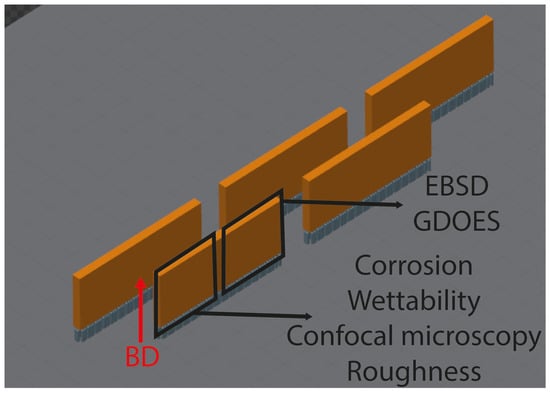
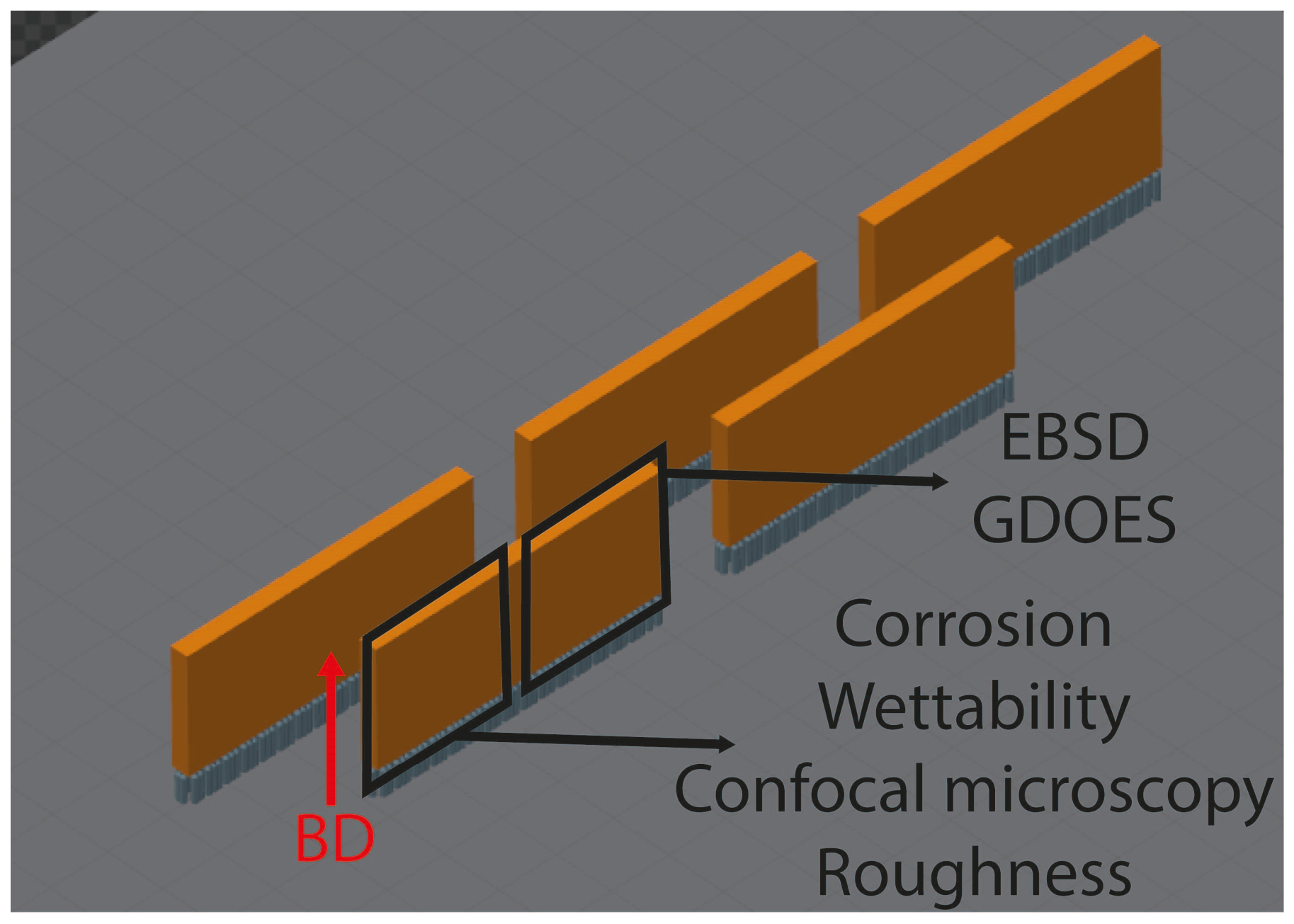
Five rectangular specimens, each measuring 50 × 20 × 3 mm, were fabricated by selective laser melting (SLM) in an argon-filled chamber using a Renishaw AM400 (Renishaw plc, Wotton-under-Edge, UK). system. Figure 1 schematically illustrates the build orientation of the specimens with respect to the build direction (BD), their subsequent sectioning, and the allocation of the resulting sections to individual experimental procedures. The processing parameters employed during fabrication are summarized in Table 2.
Figure 1.
Schematic diagram showing the buildup of samples by SLM.
Table 2.
Parameters of SLM process.
2.2. Surface Treatment by Vibratory Tumbling
Following additive manufacturing, the specimens were subjected to tumbling in an OTEC CF1 32EL (OTEC Präzisionsfinish GmbH, Straubenhardt-Conweiler, Germany). system operated at a rotational speed of 250 rpm. STP 15 × 10 BD (Straight Cut Triangle, aluminium oxide-based) ceramic media supplied by Avalon Machines (Nowa Wieś Lęborska, Poland) were used for the treatment. This study investigated the effect of progressively increasing tumbling time on the resulting surface characteristics. The treatment duration was increased in 30 min increments, with specimens processed for 30, 60, 90, and 120 min. One specimen was retained without tumbling and designated REF, corresponding to a treatment duration of 0 min. This condition was selected as the untreated process control representing the surface state before abrasive finishing. The REF and tumbled specimens were fabricated from the same specified AISI 316L feedstock using the same nominal geometry and SLM processing parameters. The reference surface was characterized using the same microscopic, topographical, and wetting procedures as the treated surfaces. For the electrochemical comparison, REF underwent the same 100 h exposure to 0.1 M H2SO4 and the same measurement protocol. It therefore provided an experimentally characterized baseline for assessing changes associated with tumbling under the investigated conditions. The use of an as-printed comparison condition is also consistent with the surface-finishing investigation reported by Melia et al. [4]. The specimen designations corresponding to the individual tumbling durations are summarized in Table 3. After processing, the specimens were thoroughly rinsed with demineralized water, sectioned into two parts, and prepared for the subsequent experimental procedures according to the scheme presented in Figure 1.
Table 3.
Thumbling duration and sample designation.
2.3. Chemical Composition and Microstructure
For metallographic characterization, the specimens were embedded in conductive carbon-filled PolyFast phenolic resin supplied by Struers (Roztoky, Czech Republic). The mounting material provided sufficient mechanical support and protected the specimens against displacement or damage during grinding and polishing. The actual chemical composition of the consolidated specimens was determined by glow-discharge optical emission spectrometry using a Spectruma GDA 750 (Spectruma Analytik GmbH, Hof, Germany) analyser. During GDOES analysis, the specimen surface is progressively sputtered by plasma generated in a high-intensity electric field, while the characteristic optical emissions of the released atoms are detected and converted into quantitative elemental concentrations. For metallographic examination, the sectioned specimens were mechanically polished using Struers equipment and diamond suspensions. The polished surfaces were subsequently etched for 60 s at 22 °C in a modified Vilella’s reagent [23] composed of 10 parts 35% HCl, 10 parts distilled water, and 1 part 65% HNO3. Microstructural images were acquired and evaluated using an Olympus IX70 inverted metallographic microscope (Olympus Corporation, Tokyo, Japan). Crystallographic characterization was further extended by electron backscatter diffraction performed using a Thermo Fisher Scientific Helios 5 CX DualBeam microscope. The EBSD measurements were used to assess crystallographic orientation, grain-boundary characteristics, and the presence of deformation-related twin boundaries.
2.4. Surface Morphology and Topography Characterization, Wettability
The surface state resulting from the individual tumbling durations was investigated using complementary microscopic and wetting techniques. Surface morphology was documented by secondary-electron imaging using an FEI Quanta FEG 450 scanning electron microscope (Thermo Fisher Scientific, Waltham, MA, USA), while three-dimensional topographical features were examined with an Olympus LEXT 5100 confocal laser scanning microscope (Olympus Corporation, Tokyo, Japan). Areal surface texture was additionally characterized using the arithmetic mean height, Sa, and maximum height, Sz, complementing the line-profile parameters Ra and Rz. Sa describes the mean absolute height deviation over the evaluation area, whereas Sz represents the vertical separation between the highest peak and deepest valley of the evaluated surface. Metallographic cross-sections were examined to assess the surface contour and residual local recesses.
The wetting behaviour and surface free energy of the untreated and tumbled specimens were assessed by the sessile-drop technique using an SEE System instrument (Advex Instruments, Brno, Czech Republic) in accordance with ASTM D7334 [24]. High-purity water droplets with a nominal volume of 2 µL were applied to each investigated surface using a calibrated pipette. The pipette was subject to regular performance verification, and the 2 µL volume setting was used for all contact-angle measurements. The equilibrium contact angle, θ, was obtained by fitting the droplet profile and determining its tangent at the three-phase boundary between the specimen, water, and surrounding atmosphere [25]. The measured contact angle was subsequently used to evaluate the surface free energy. The balance between the relevant interfacial tensions is described by Young’s relationship:
where γSV, γSL, and γLV represent the solid–vapour, solid–liquid, and liquid–vapour interfacial tensions, respectively. The Li–Neumann approach consequently enables γSV to be estimated from measurements performed using a single probe liquid [25].
γSV − γSL = γLV * cos θ
2.5. Corrosion Properties
Owing to the formation of a stable chromium-rich passive film, AISI 316L generally exhibits a low uniform corrosion rate in neutral and moderately aggressive environments. Electrochemical methods were therefore selected to accelerate the material response and reveal differences among the surface conditions investigated within a practical experimental period. All electrochemical measurements were performed using a VoltaLab PGZ 301 potentiostat controlled by VoltaMaster 10 software. During the 100 h exposure period, the open-circuit potential (OCP) was measured at 24 h intervals. The electrochemical protocol used potentiodynamic polarization under application-specific exposure conditions. ASTM G61 [26] served as a methodological reference for the polarization approach; however, the selected electrolyte and exposure conditions do not constitute a standard-compliant ASTM G61 test.
An aqueous 0.1 M H2SO4 solution prepared from analytical-grade sulphuric acid (Sigma-Aldrich, Praque, Czechia) was selected as a chemical surrogate for the local acidification that may develop beneath colonies of sulfur-oxidizing bacteria. Huber et al. [14] demonstrated the substantial sulfuric acid production potential of these microorganisms. The solution was used without inert-gas deaeration to represent oxygen availability in aerated drinking-water systems, including warm-water installations. Thus, the acidic composition represents a possible local microbial microenvironment, while the non-deaerated condition represents the oxygen-containing aqueous exposure context. The model reproduces selected chemical features and does not reproduce the spatial gradients, biological activity, or complete thermal conditions of an operating water system. The use of 0.1 M H2SO4 for electrochemical investigation of LPBF-manufactured 316L also has a literature precedent in the study by Ramezanalizadeh et al. [19]. The experiments were conducted in custom-built HDPP/HDPE cells incorporating a bottom aperture that exposed 0.5 cm2 of the specimen surface to the electrolyte. The bottom-mounted arrangement allowed gas bubbles potentially generated during polarization to detach from the working surface and rise through the electrolyte, thereby minimizing disruption of the measured signal. A conventional three-electrode configuration was employed. The investigated specimen served as the working electrode, and a saturated calomel electrode (SCE; +241 mV versus the standard hydrogen electrode at 25 °C) was used as the reference electrode [27]; therefore, all potentials in this study are expressed relative to it [28]. A high-purity carbon rod acted as the counter electrode in the setup. All measurements were carried out at 25 °C. Before the subsequent electrochemical analyses, the open-circuit potential was monitored as the potential difference between the working and reference electrodes under zero externally applied current. Electrochemical impedance spectroscopy was performed after 100 h of immersion in 0.1 M H2SO4 before potentiodynamic polarization. A sinusoidal potential perturbation with an amplitude of 10 mV was applied about the open-circuit potential. The frequency range was 100 kHz to 0.1 Hz, with 31 frequency points per spectrum. Area-normalized impedance values were expressed in Ω cm2. The spectra were presented as Nyquist plots of the negative imaginary component against the real component and as Bode plots of impedance magnitude and phase angle. The magnitude and phase were calculated from the real and imaginary components of the complex impedance. The modulus at the lowest measured frequency, 0.1 Hz, was used as a descriptive comparison parameter [22]. No equivalent-circuit parameters were extracted for the reported comparison.
The untreated surface, corresponding to 0 min of tumbling, was selected as the reference for assessing the relative effect of surface finishing. A polarization-resistance-based protection efficiency, ηRp, was calculated by subtracting the ratio of the reference polarization resistance to that of the investigated surface from unity and expressing the result as a percentage. The calculation used the Stern–Geary polarization resistances obtained from the Tafel analysis. It did not use the finite-frequency EIS modulus as a substitute for polarization resistance. The potentiodynamic polarization curves recorded after 100 h of exposure were evaluated using Tafel extrapolation in VoltaMaster 10. The polarization resistance (Rp) was calculated from the corrosion current density and the fitted anodic and cathodic Tafel slopes using the Stern–Geary relationship [29]. Current densities were normalized to the exposed geometric electrode area of 0.5 cm2, and the resulting area-normalized polarization resistance values are reported in kΩ cm2.
3. Results
3.1. Powder Characteristics
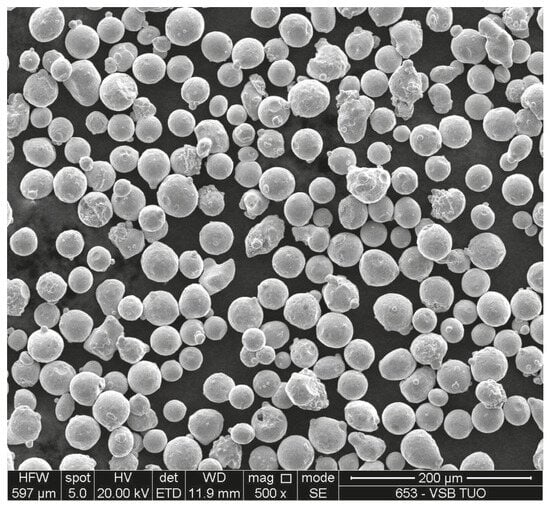
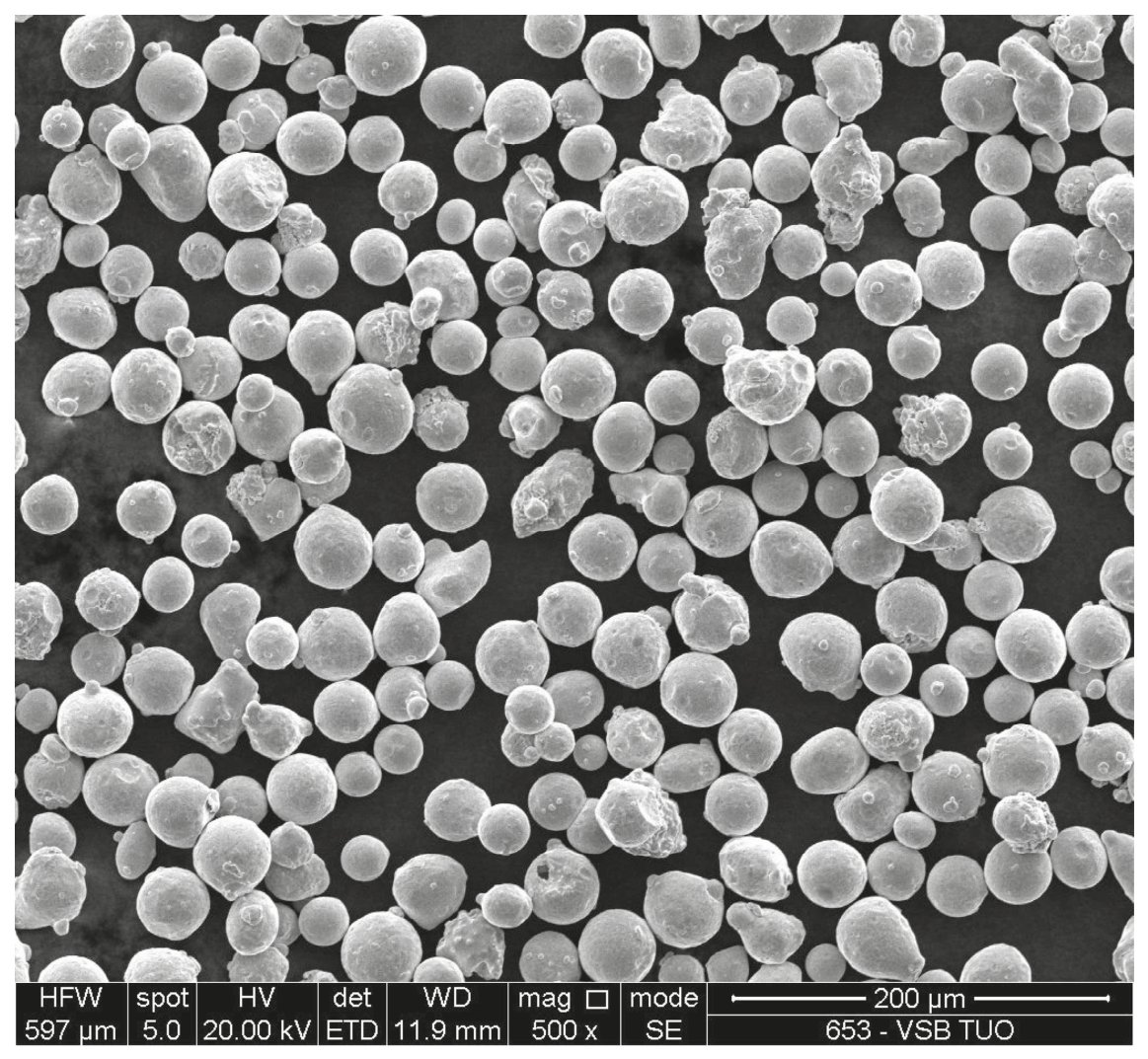
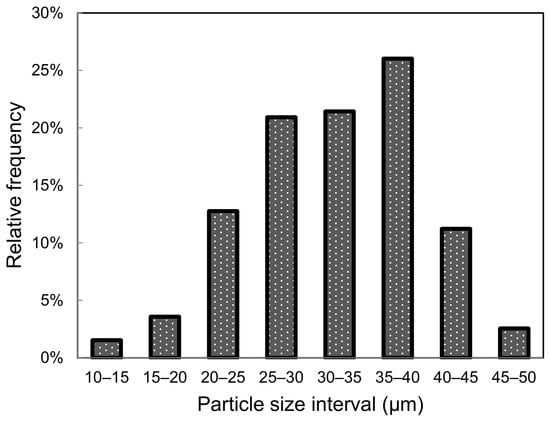
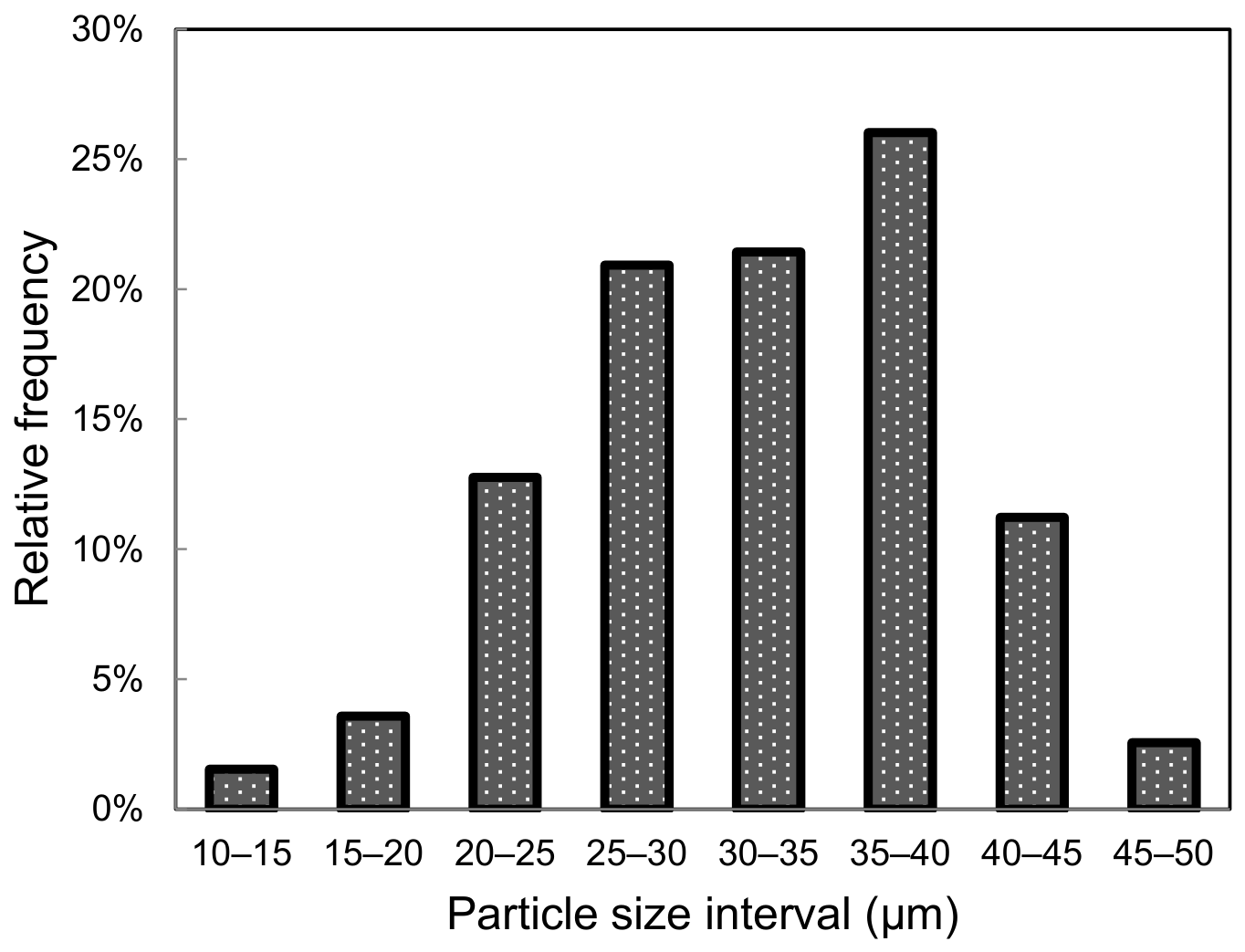
Particles of powder were studied using scanning electron microscopy (SEM) in secondary electron mode (SE). Image analysis (Image J software, version 1.54) of Figure 2 identified 196 particles with equivalent circular diameters ranging from 11.92 to 47.99 µm. Most of the particles were of typical spherical shape typical for atomization process.
Figure 2.
Atomized AISI 316L powder.
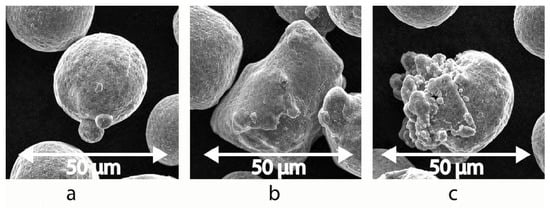
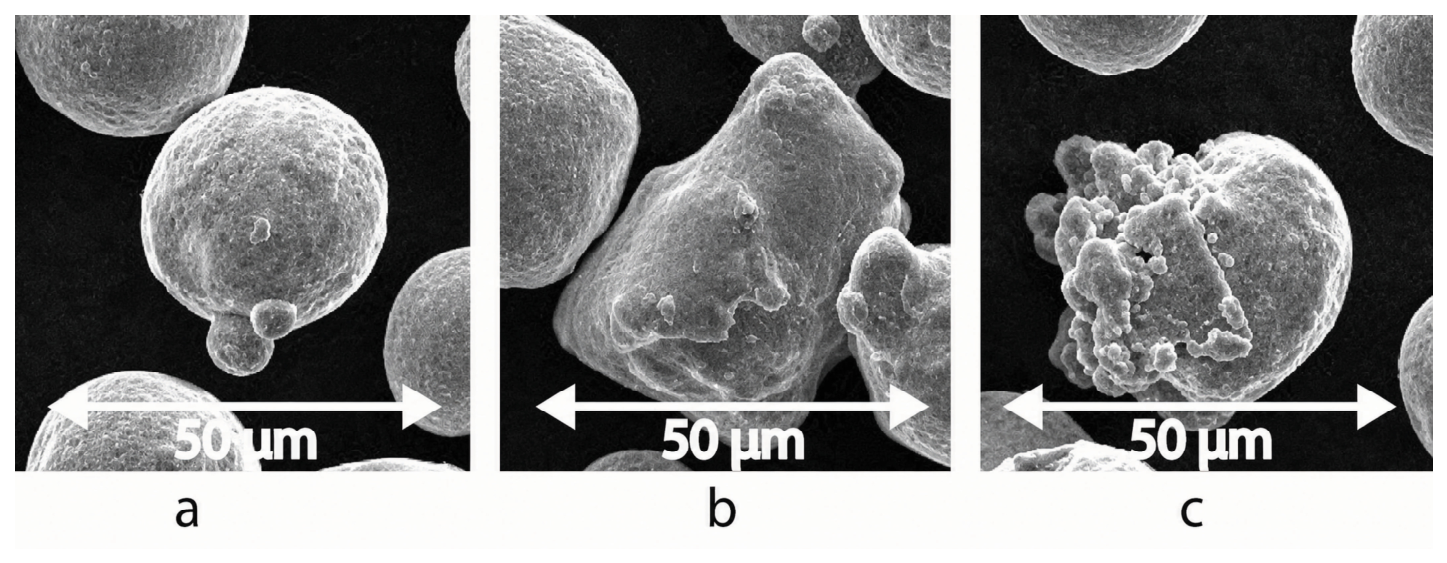
Numerous particles exhibited significantly finer particles attached to their surfaces, commonly referred to as satellites, as illustrated in Figure 3a. Their presence represents an undesirable morphological feature of atomized powders. Detailed examination further revealed considerable deviations from an equiaxed geometry. In addition, irregular and splat cap particles were also identified, as documented in Figure 3b and Figure 3c, respectively.
Figure 3.
Morphological defects of the powder: (a) satellite particle, (b) irregular particle, (c) splat cap particle.
The particle-size distribution exhibited a single dominant maximum in the 35–40 µm interval, which contained 26.0% of all detected particles. The mean particle diameter was 32.02 ± 7.32 µm, while the median value was 31.77 µm. Overall, the measured particle-size distribution was consistent with the values specified in the material data sheet provided by the powder supplier. The histogram in Figure 4 illustrates the relative frequency distribution of powder particles across the investigated size intervals.
Figure 4.
Histogram of particle size distribution.
3.2. Microstructure and Chemical Composition
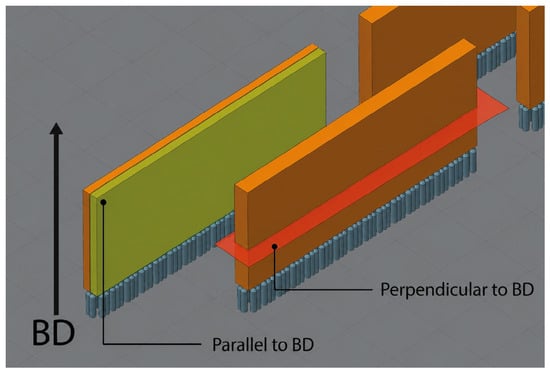
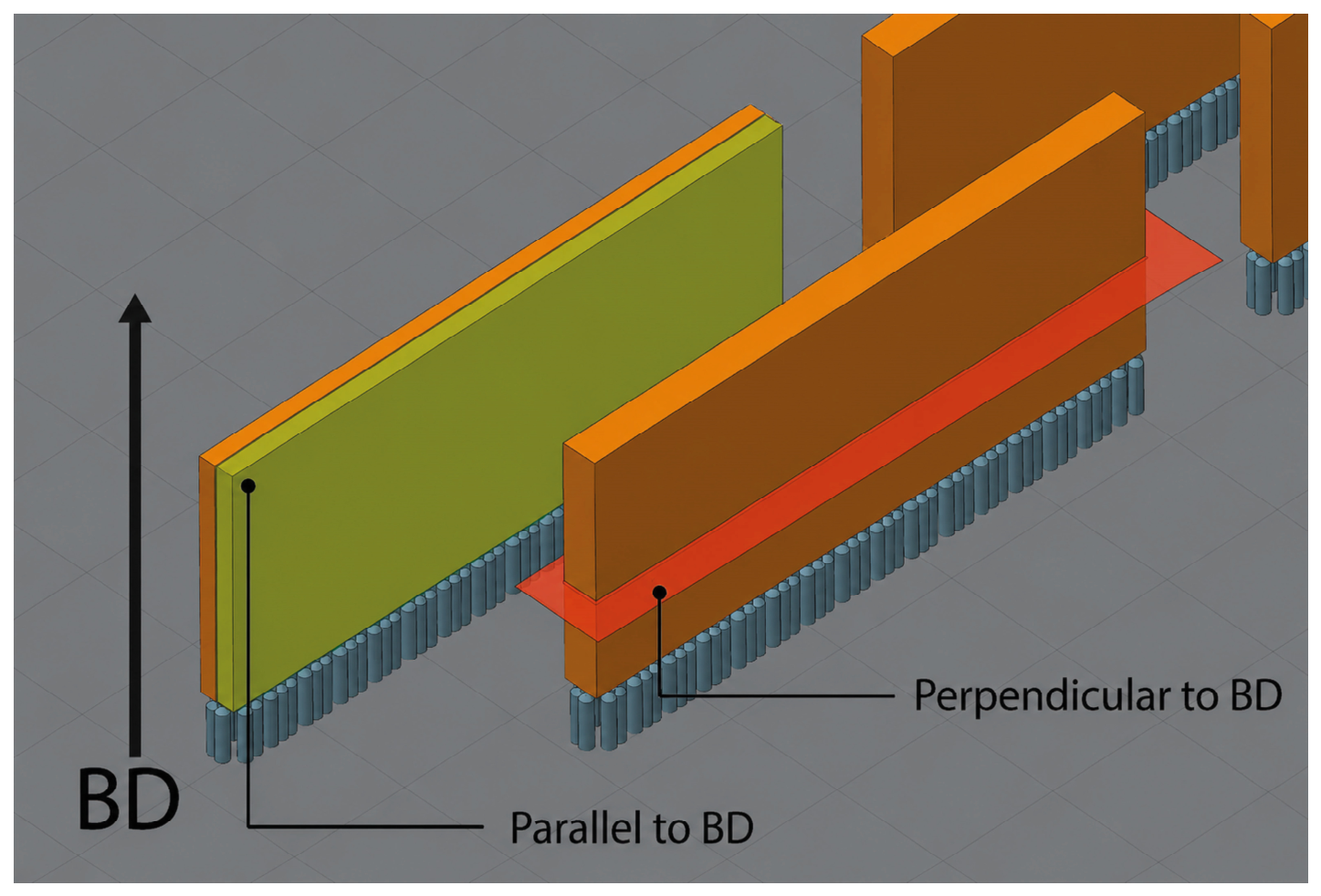
Specimens for microstructural characterization were sectioned in two orientations relative to the build direction (BD). The longitudinal section was oriented parallel to BD, whereas the transverse section was oriented perpendicular to BD, as schematically illustrated in Figure 5. Both sections were subsequently prepared for EBSD analysis using the same metallographic procedure composed of mechanical grinding (Struers diamond suspensions Diaduo 9 µm, 3 µm and 1 µm) and polishing (Struers OP-S).
Figure 5.
Schematic illustration of the orientation of metallographic sections relative to the build direction (BD): longitudinal section parallel to BD and transverse section perpendicular to BD.
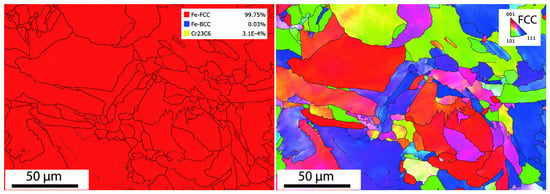
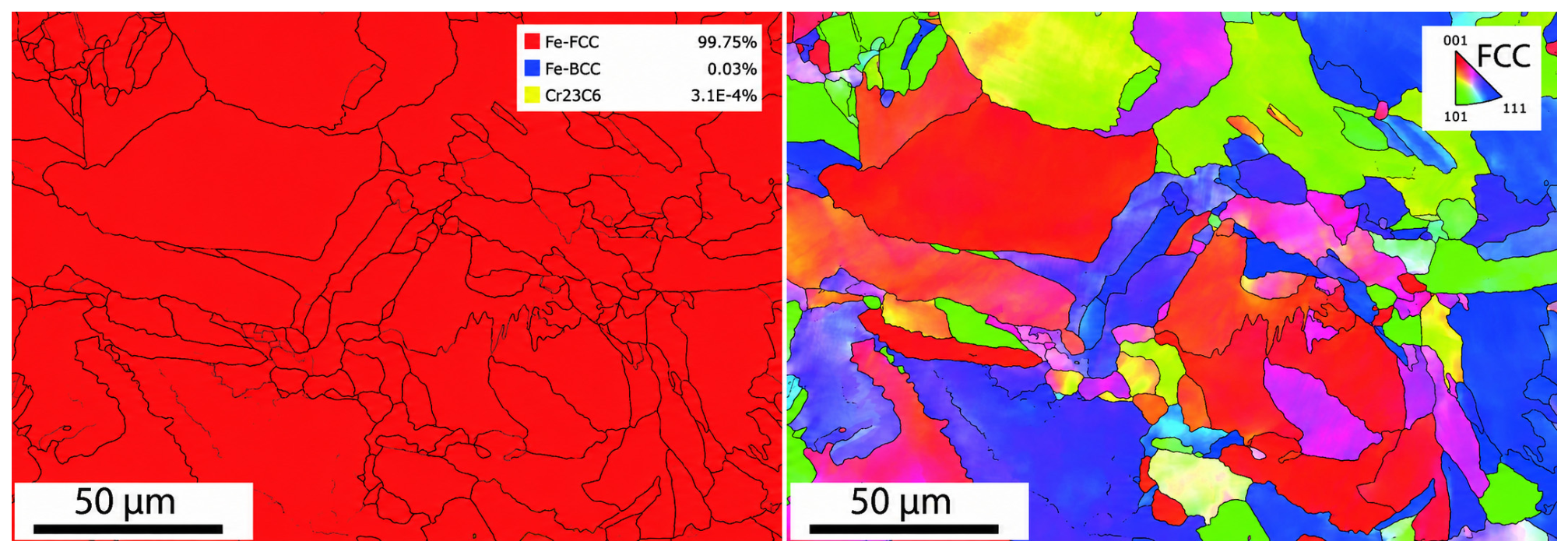
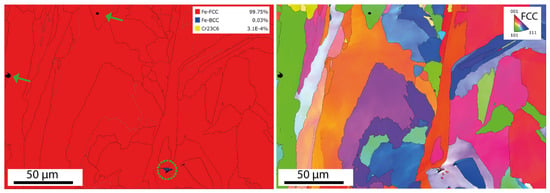
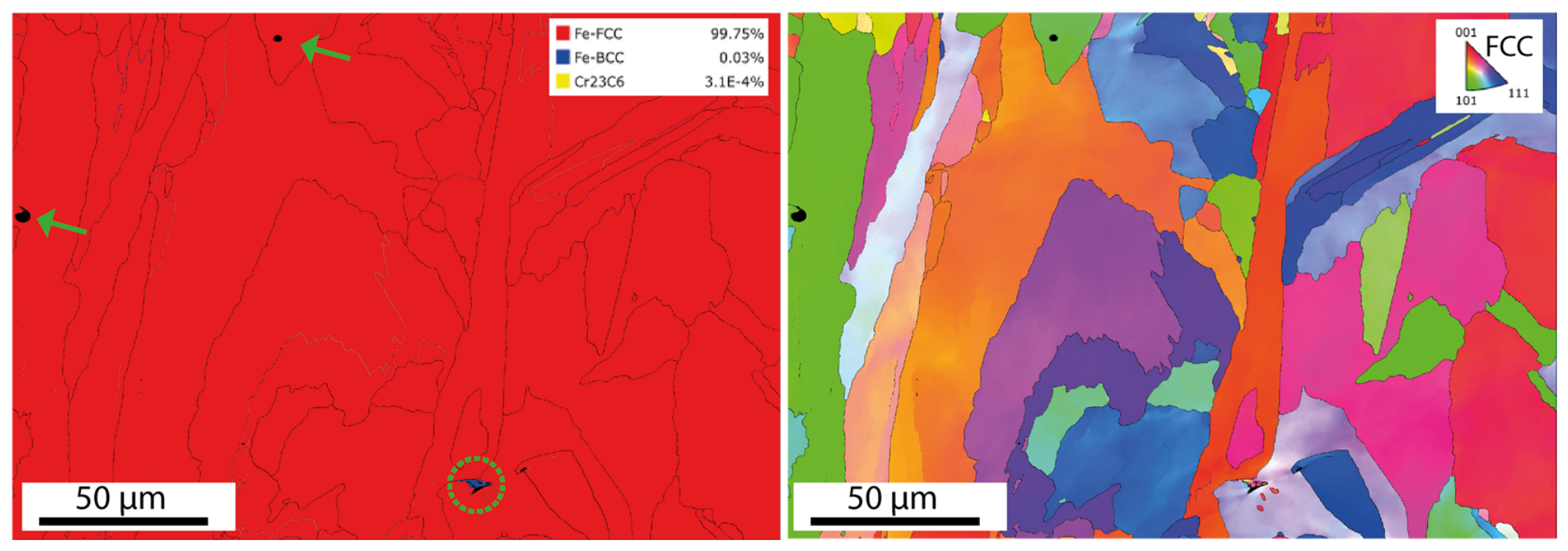
The phase distribution and crystallographic orientation of the additively manufactured AISI 316L steel were evaluated in the longitudinal section parallel to BD (Figure 6) and in the transverse section perpendicular to BD (Figure 7). In both figures, the phase map is presented on the left and the corresponding inverse pole figure (IPF) map on the right. The IPF maps revealed a heterogeneous and direction-dependent grain morphology. The longitudinal section shown in Figure 6 contained irregular grains with a relatively broad range of apparent sizes. Numerous smaller crystallographic domains were present, particularly in the central part of the analyzed area, together with several locally elongated grains.
Figure 6.
EBSD phase distribution map (left) and corresponding inverse pole figure map (right) of the reference additively manufactured AISI 316L steel in the longitudinal section parallel to the build direction. Colors in each image correspond to the legend in the upper right corner.
Figure 7.
EBSD phase distribution map (left) and corresponding inverse pole figure map (right) of the reference additively manufactured AISI 316L steel in the transverse section perpendicular to the build direction. Colors in each image correspond to the legend in the upper right corner.
By comparison, the transverse section in Figure 7 was characterized by a smaller number of relatively coarse and frequently elongated grains, some of which extended across a substantial part of the analyzed area. The wide range of colors in both IPF maps indicates the presence of several crystallographic orientation components. Gradual color changes within some individual grains also suggest local intragranular orientation gradients. Nevertheless, their magnitude and origin cannot be determined without additional local misorientation analysis.
The phase maps confirmed an almost entirely austenitic microstructure in both orientations. The FCC phase accounted for 99.75% of the analyzed area in the longitudinal section and 99.63% in the transverse section. Only trace fractions were indexed as a BCC phase, reaching 0.03% and 0.08% (marked by a yellow circle), respectively. The fractions assigned to Cr23C6 were negligible, corresponding to 3.1 × 10⁻⁴% in the longitudinal section and 2.1 × 10⁻⁴% in the transverse section. Considering these extremely low values, the BCC and Cr23C6 assignments should not be regarded as conclusive evidence of the presence of secondary phases, since isolated misindexing cannot be excluded. No relevant difference in phase composition was therefore identified between the two orientations.
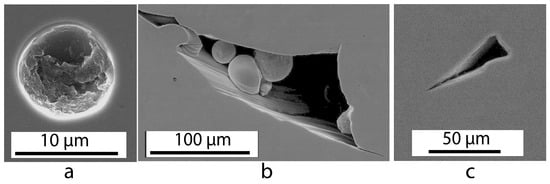
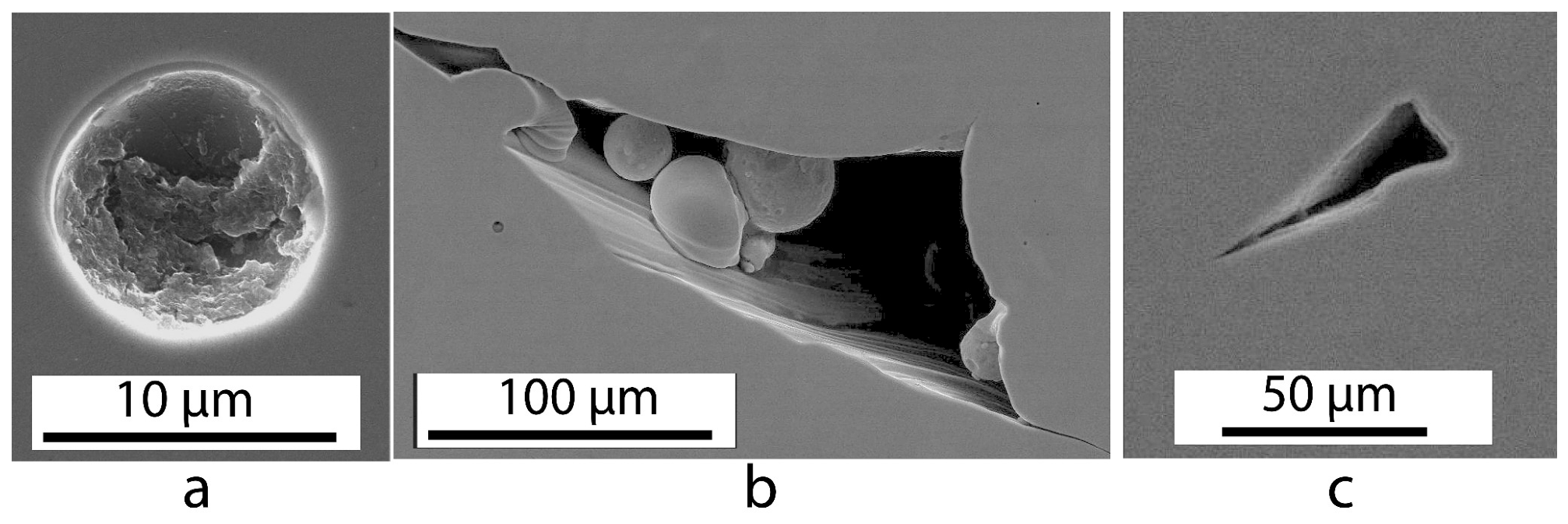
The non-indexed regions indicated by the yellow arrows and dashed circle in Figure 7 were identified as small gas-entrapped pores. Their small dimensions and predominantly rounded morphology are characteristic of gas-induced porosity. Detailed metallographic examination also revealed the occasional presence of other defect types. These included large lack-of-fusion defects and medium-sized keyhole pores, both of which occurred only very rarely within the analyzed microstructure. Representative examples of all three defect types—gas-entrapped pores, lack-of-fusion defects, and keyhole pores—are presented in Figure 8.
Figure 8.
Representative defects observed in the microstructure: (a) gas porosity, (b) lack-of-fusion defect, and (c) keyhole pore.
Although the nominal alloy composition is determined by the feedstock powder, slight compositional deviations may develop during the SLM process. Residual gases and trace organic contaminants present in the build chamber can introduce interstitial elements into the processed material. Their incorporation may promote the formation of secondary phases and consequently impair the surface stability and corrosion resistance of the manufactured components [30]. To determine the chemical composition of the manufactured material, GDOES measurements were performed at five selected locations on the sample section oriented parallel to the build direction (BD). The mean values obtained from these measurements are summarized in Table 4.
Table 4.
Chemical composition of the SLM-manufactured sample determined by GDOES (mean values, n = 5).
Considering the elements quantified by GDOES for which compositional limits are specified, all mean concentrations were within the ranges given for Renishaw SS 316L-powder and for Type 316L in ASTM A276-98B, [31] except for Ni. The mean Ni content reached 15.2 wt.%, exceeding the specified upper limit of 14.0 wt.% by 1.2 percentage points.
3.3. Surface Morphology, Topography and Wettability
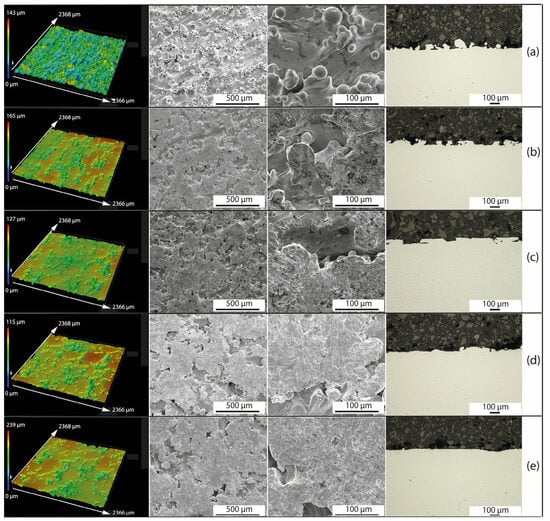
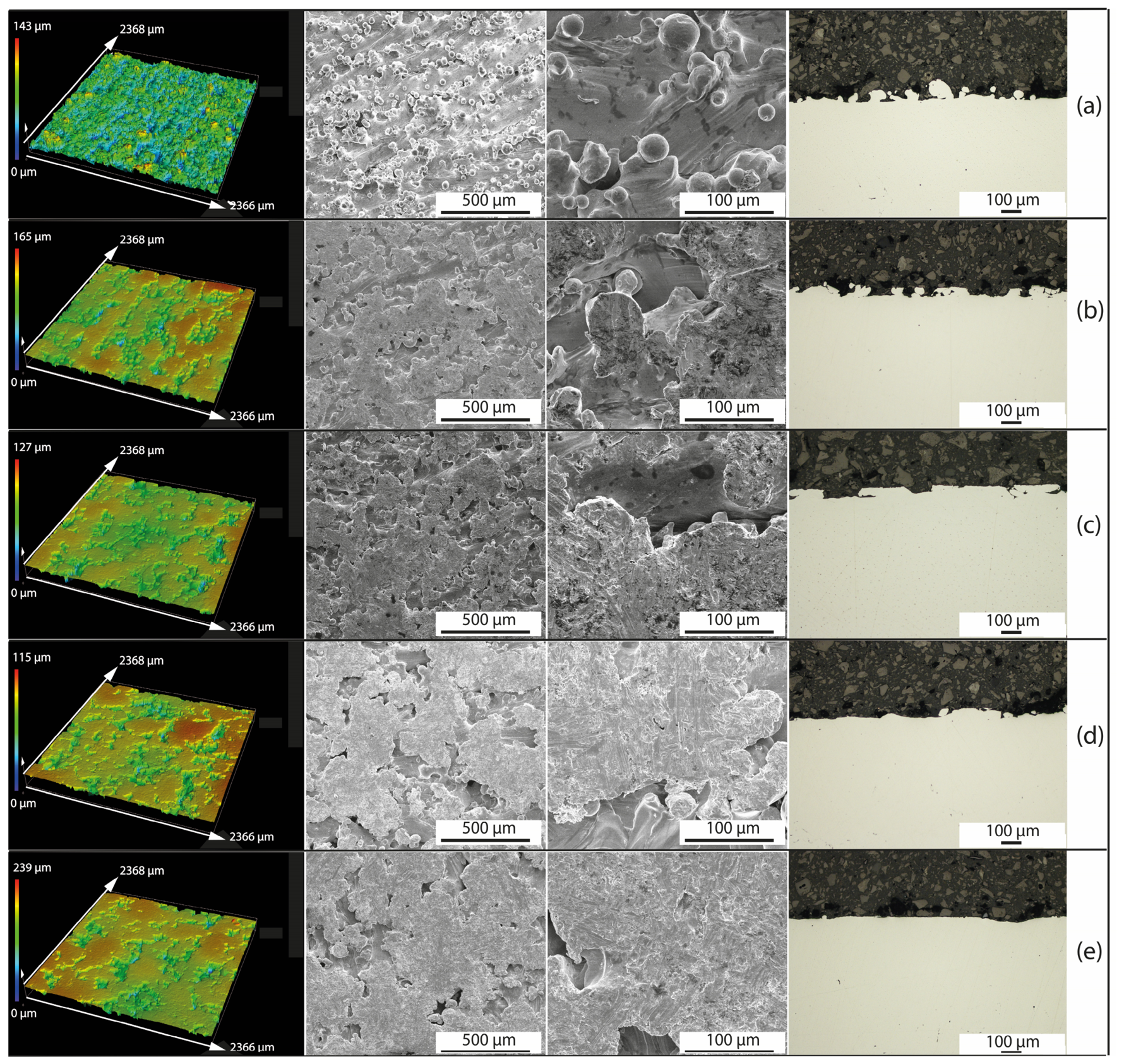
Figure 9 combines confocal surface maps, SEM observations, and metallographic cross-sections to illustrate the surface changes associated with tumbling duration. The untreated reference surface contains numerous protrusions, partially melted powder particles, and local depressions. After 30 min, broader, relatively level regions become apparent, although residual particles and recessed features remain. After 60 and 90 min, flattened regions become increasingly prominent, while localized cavities and irregular depressions are still visible. The surface after 120 min consists predominantly of relatively level, abraded regions, with some residual discontinuities.
Figure 9.
Surface characterization of SLM-manufactured AISI 316L stainless steel after tumbling for (a) 0 min, (b) 30 min, (c) 60 min, (d) 90 min, and (e) 120 min. From left to right: confocal surface maps, SEM images at two magnifications, and optical micrographs of metallographic cross-sections through the investigated surface. Note the different vertical display scales of the confocal maps.
The cross-sectional observations provide complementary evidence of the changes in surface contour. The untreated specimen exhibits pronounced protruding features, whereas the tumbled specimens show a progressively more even outer contour in the sections examined. Local recesses nevertheless remain visible. These observations support preferential modification in exposed surface features without demonstrating complete elimination of surface-connected defects. The quantitative evolution of profile and areal surface texture is presented separately in Figure 10 and Figure 11.
Figure 10.
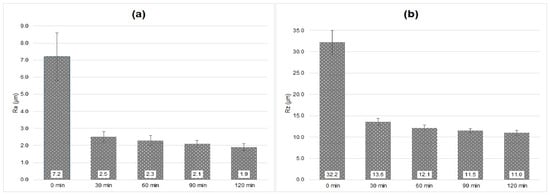
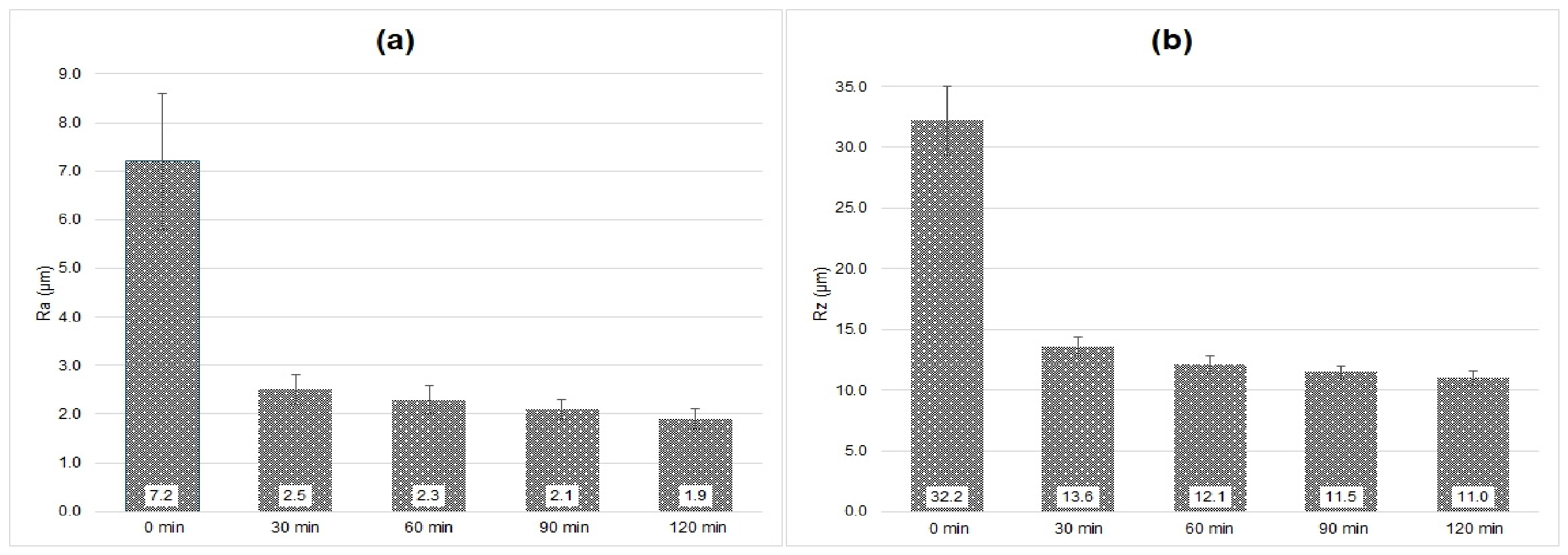
Profile roughness parameters of SLM-manufactured AISI 316L stainless steel as a function of tumbling duration: (a) Ra and (b) Rz. Bars represent mean values, and error bars indicate standard deviations obtained from five profiles per surface condition.
Figure 11.
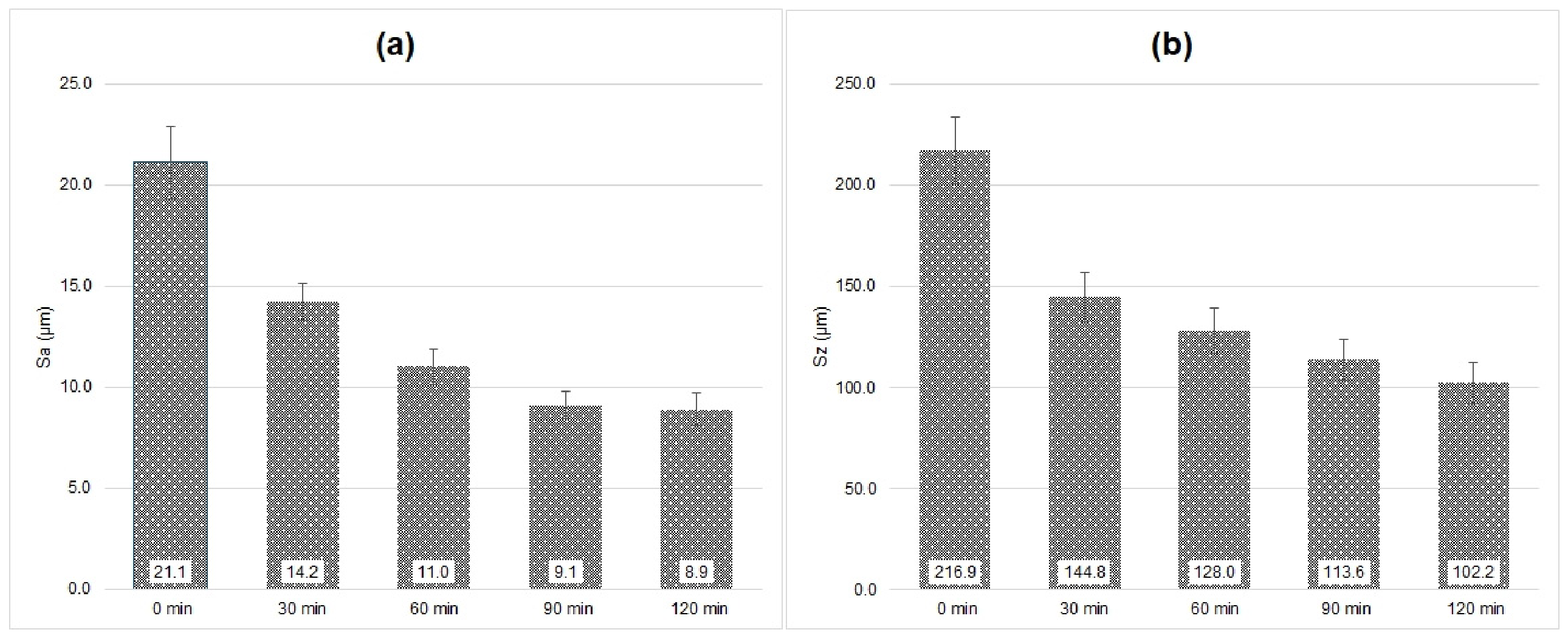
Areal surface texture parameters of SLM-manufactured AISI 316L stainless steel as a function of tumbling duration: (a) arithmetic mean height, Sa, and (b) maximum height, Sz.
To quantify the surface changes observed in the confocal and SEM images presented in Figure 9, the Ra and Rz roughness parameters were determined by contact profilometry. Five profiles were recorded for each surface condition in five different directions, with a tracing length of 10 mm used for each measurement. The measurements were performed using a diamond stylus with a tip radius of 2 µm at a traverse speed of 1 mm s−1. Owing to the finite radius of the stylus, the narrowest and steepest surface depressions could not be fully traced. The results obtained from the five profiles were averaged, and the mean values together with their standard deviations are presented in Figure 10.
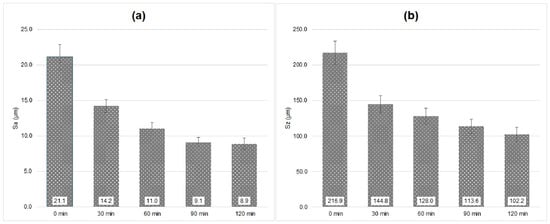
The untreated reference surface exhibited the highest roughness, with Ra and Rz values of 7.2 and 32.2 µm, respectively. After 30 min of tumbling, Ra decreased to 2.5 µm and Rz to 13.6 µm, corresponding to reductions of 65.3% and 57.8%, respectively, relative to the untreated surface. The absolute decreases during this initial interval were 4.7 µm for Ra and 18.6 µm for Rz, exceeding those recorded during any subsequent 30 min interval. Further extension of the tumbling time resulted in a gradual reduction in both parameters. The Ra values decreased to 2.3, 2.1 and 1.9 µm after 60, 90 and 120 min, respectively, while the corresponding Rz values were 12.1, 11.5 and 11.0 µm. Compared with the untreated reference, the values measured after 120 min were approximately 74% lower for Ra and 66% lower for Rz. The decreasing roughness parameters correspond to the increasing proportion of relatively level surface regions visible in the confocal maps. The reference sample also showed the greatest variability among the individual measurements, whereas considerably smaller standard deviations were recorded for all tumbled surfaces. The complementary areal surface texture parameters are presented in Figure 11. Sa decreased from 21.1 µm for the untreated surface to 14.2, 11.0, 9.1, and 8.9 µm after 30, 60, 90, and 120 min, respectively. The corresponding Sz values decreased from 216.9 µm to 144.8, 128.0, 113.6, and 102.2 µm. Both parameters therefore decreased monotonically across the investigated conditions, with the largest absolute reductions occurring during the first 30 min. After 120 min, Sa and Sz were approximately 57.8% and 52.9% lower than the reference values. Between 90 and 120 min, Sa decreased by approximately 2.2%, whereas Sz decreased by approximately 10.0%.
3.4. Wettability
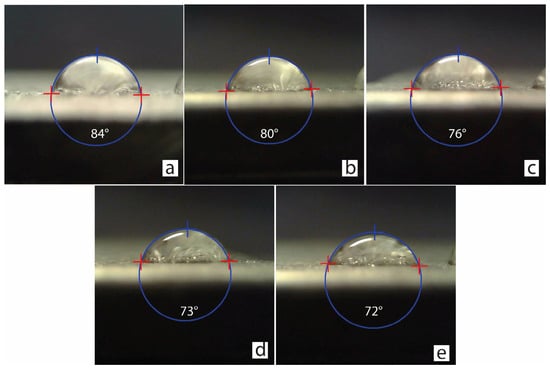
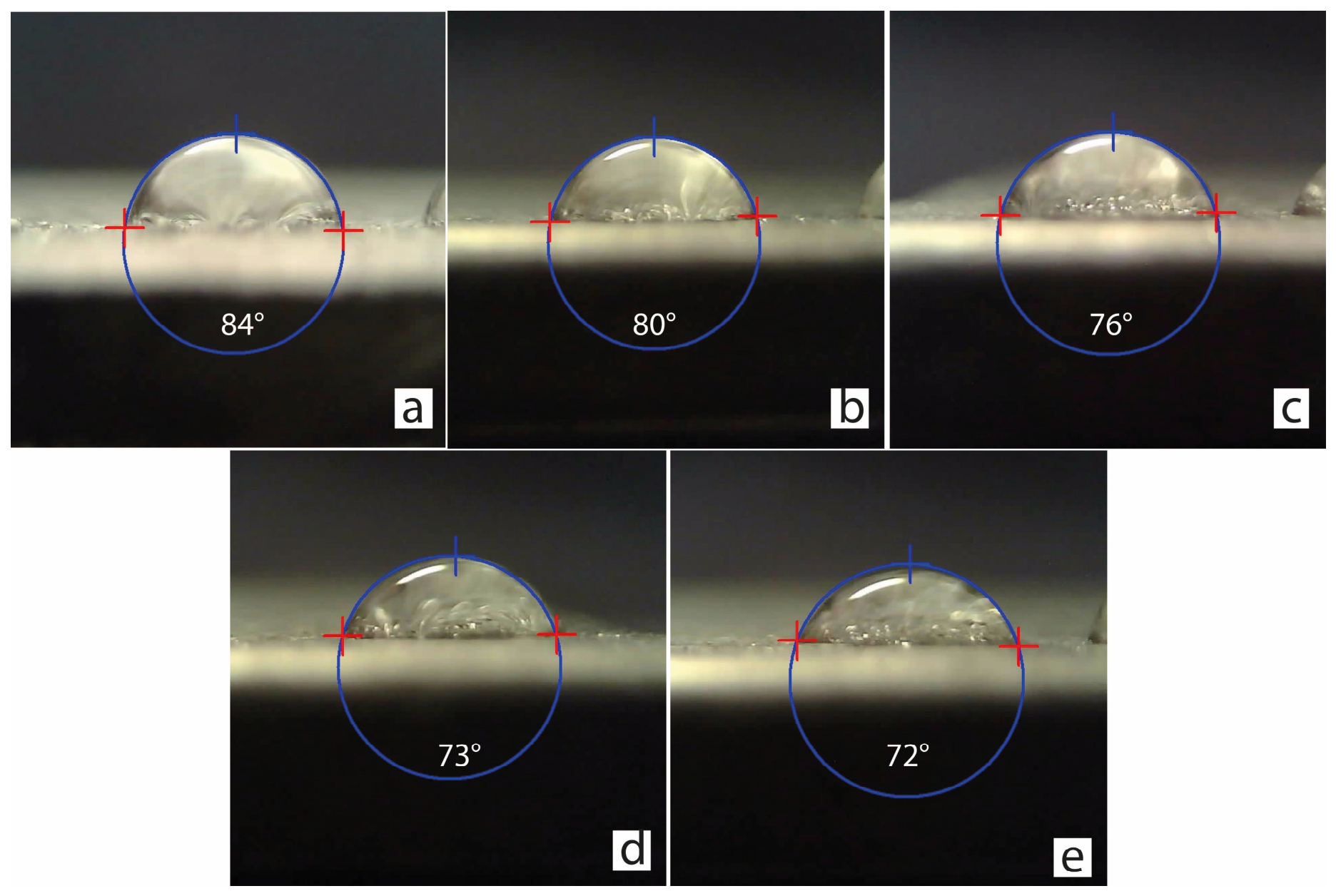
The contact angle and surface free energy values are summarized in Table 5, while representative profiles of sessile water droplets on the individual surfaces are shown in Figure 12. The mean contact angle gradually decreased from 82 ± 9° for the untreated reference specimen to 72 ± 4° after 90 min of tumbling. At the same time, the surface free energy increased from 34 ± 4 to 40 ± 4 mJ m−2. Extending the tumbling time to 120 min produced no further change in the mean values, indicating their stabilization between 90 and 120 min.
Table 5.
Values of contact angle and surface energy for surfaces after different tumbling times.
Figure 12.
Representative sessile water droplets on SLM-manufactured AISI 316L surfaces after different tumbling times: (a) 0 min, (b) 30 min, (c) 60 min, (d) 90 min, and (e) 120 min.
3.5. Corrosion Properties
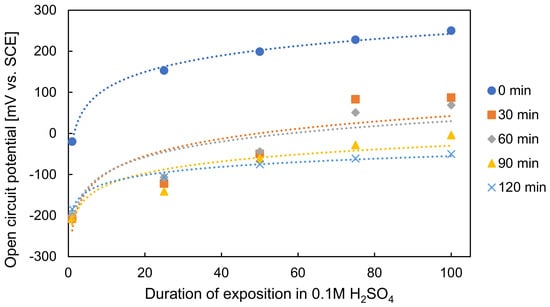
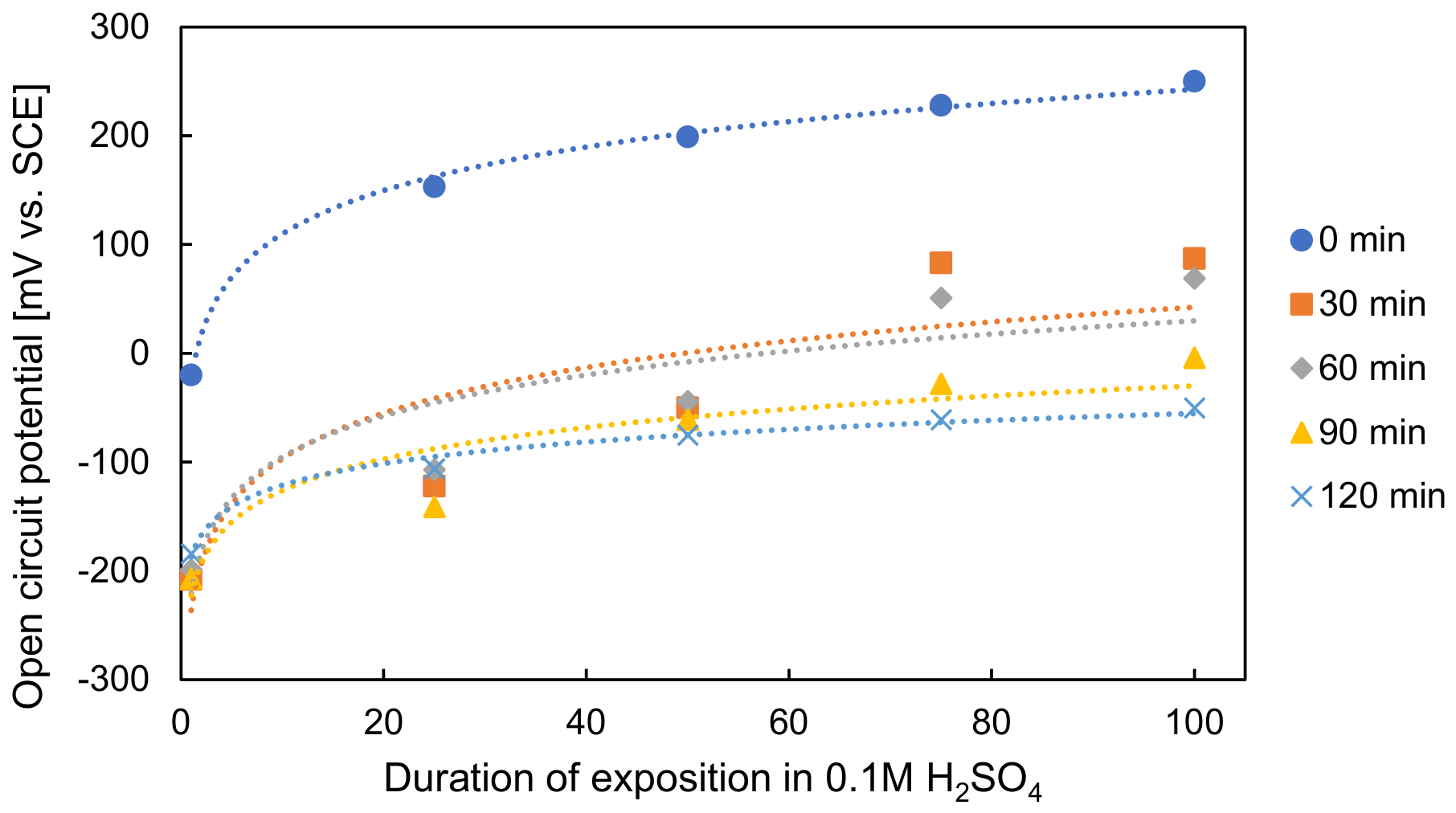
The evolution of the open-circuit potential (OCP) during 100 h of exposure to 0.1 M H2SO4 is shown in Figure 13. All specimens exhibited a gradual shift towards more positive potential values with increasing exposure time. The untreated reference specimen maintained the most positive OCP throughout the entire exposure, increasing from approximately −20 mV vs. SCE at the beginning of the measurement to approximately 250 mV vs. SCE after 100 h. The final OCP decreased with increasing tumbling time, reaching approximately 85, 65, −5, and −50 mV vs. SCE for the specimens tumbled for 30, 60, 90, and 120 min, respectively. Thus, the specimens tumbled for 30 and 60 min reached positive OCP values during exposure, whereas the specimens treated for 90 and 120 min remained close to or below 0 mV vs. SCE.
Figure 13.
OCP evolution during 100 h exposure in 0.1 M H2SO4.
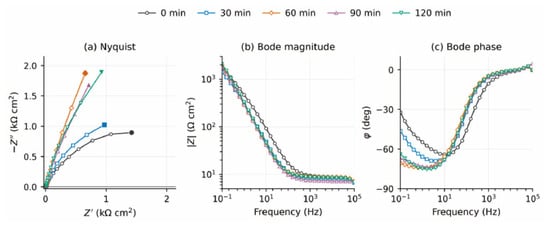
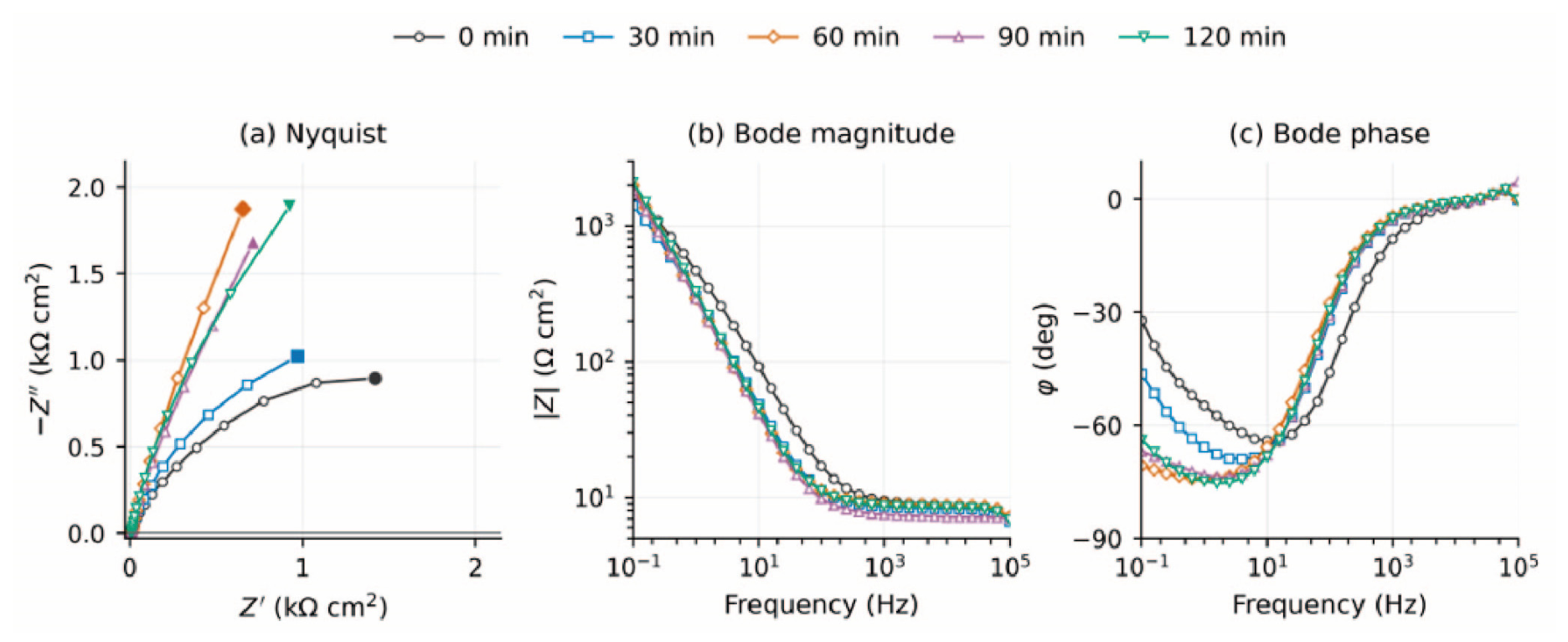
The EIS spectra recorded after 100 h of exposure are presented in Figure 14. At 0.1 Hz, the impedance modulus was 1.677 kΩ cm2 for the untreated surface and 1.411, 1.982, 1.827, and 2.100 kΩ cm2 after 30, 60, 90, and 120 min of tumbling, respectively. The ordering at this frequency was therefore 120 min > 60 min > 90 min > untreated > 30 min. The highest measured value, obtained after 120 min of tumbling, was approximately 25.2% higher than that of the untreated surface.
Figure 14.
Electrochemical impedance spectra after 100 h of immersion in 0.1 M H2SO4 for different ceramic-media tumbling durations: (a) Nyquist plots, (b) Bode impedance-magnitude plots, and (c) Bode phase-angle plots.
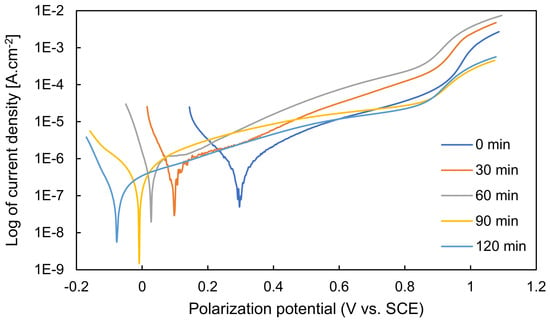
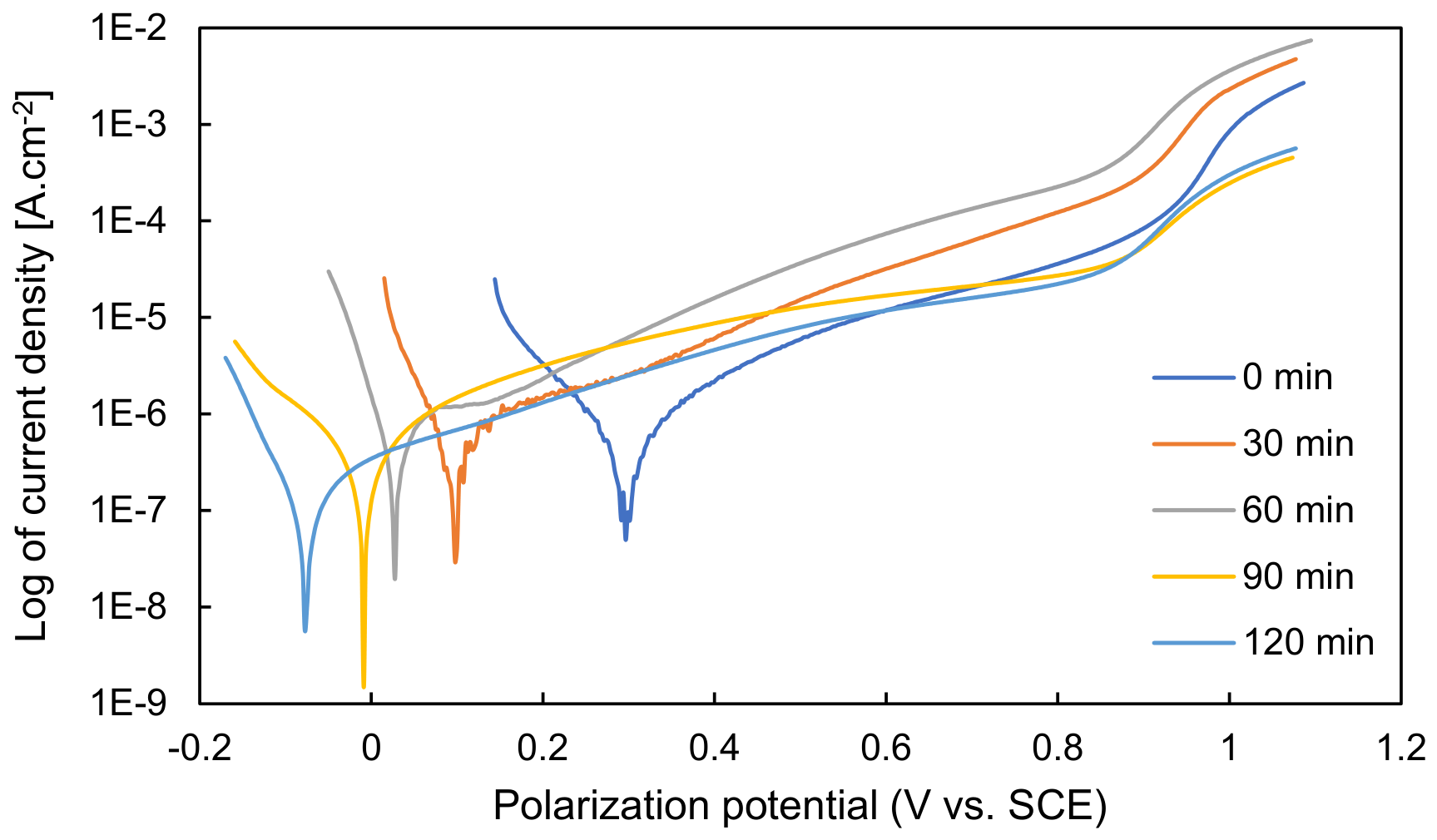
The potentiodynamic polarization curves recorded after the 100 h exposure are presented in Figure 15. The curves were evaluated using Tafel extrapolation, and the corrosion parameters obtained from this analysis are summarized in Table 6. Increasing tumbling time resulted in a continuous decrease in the corrosion rate and a simultaneous increase in the polarization resistance. The untreated reference specimen exhibited the highest corrosion rate of 9.8 µm year−1 and the lowest polarization resistance of 32 kΩ cm2. After 30, 60, and 90 min of tumbling, the corrosion rate decreased to 6.0, 4.1, and 2.7 µm year−1, respectively, while the polarization resistance increased to 42, 53, and 63 kΩ cm2. The specimen tumbled for 120 min exhibited the lowest corrosion rate of 2.5 µm year−1 and the highest polarization resistance of 68 kΩ cm2. Compared with the reference specimen, this corresponds to a reduction of approximately 74% in the corrosion rate and an increase in the polarization resistance of more than twofold. The corrosion potential shifted progressively towards more negative values, from 289 mV vs. SCE for the reference specimen to −71 mV vs. SCE after 120 min of tumbling. Only relatively small differences in corrosion rate and polarization resistance were observed between the specimens tumbled for 90 and 120 min. With the untreated surface as the reference, the polarization-resistance-based protection efficiency was 23.8%, 39.6%, 49.2%, and 52.9% after 30, 60, 90, and 120 min of tumbling, respectively (Table 6). For the 120 min condition, this resistance-based efficiency of 52.9% is distinct from the approximately 74.5% reduction in the Tafel-derived corrosion rate relative to the untreated surface.
Figure 15.
Polarization curves for samples after different duration of tumbling and 100 h exposition in H2SO4.
Table 6.
Corrosion parameters obtained from potentiodynamic polarization and polarization-resistance-based protection efficiency after 100 h of immersion in 0.1 M H2SO4. The untreated surface is the reference for ηRp.
4. Discussion
The investigated SLM-manufactured AISI 316L was almost entirely austenitic in both section orientations. The traces BCC and Cr23C6 fractions detected by EBSD were too small to exclude isolated misindexing, and the slightly elevated Ni content was common to all specimens. Consequently, the systematic changes with tumbling time are attributable mainly to modification of the surface rather than to differences in bulk phase composition. The directional grain morphology, gas pores and rare lack-of-fusion and keyhole defects reflect the layer-wise manufacturing route; tumbling can modify surface-connected features but cannot heal internal defects. The defects identified in the reference material (Figure 8) should also be considered when interpreting wettability and corrosion behavior. Their direct influence depends on whether they intersect the exposed surface. Surface-connected gas pores, lack-of-fusion cavities, and keyhole pores can modify liquid penetration and the effective solid–liquid contact area; partial retention of air within these features may consequently affect the apparent contact angle [32]. When penetrated by the electrolyte, such cavities can increase the electrochemically accessible area and create regions with restricted mass transport, potentially favoring localized corrosion [4]. Accordingly, the response after tumbling reflects the combined effects of asperity removal and changes in the accessibility of pre-existing defects, including the possible exposure of subsurface pores. The individual contributions of the different defect types to wettability and corrosion were not quantified in the present study.
The as-built surface contained partially melted particles, protrusions, narrow valleys and depressions typical of PBF-LB/M components [4]. Ceramic-media finishing initially removed the most exposed particles (satellites) and asperity summits, which explains the particularly large change during the first 30 min. Ra decreased from 7.2 to 2.5 µm and Rz from 32.2 to 13.6 µm, whereas extension to 120 min produced only gradual decreases to 1.9 and 11.0 µm, respectively. These changes correspond to Ra reductions of 65.3% after 30 min and 73.6% after 120 min relative to the untreated surface. Mesicek et al. [5] reported that tumbling reduced Ra from 11.0 to 3.5 µm, approximately 68%, for their meander-scanned condition; extending the ceramic treatment from 120 to 240 min provided only moderate additional reduction. Both studies therefore show diminishing returns in mean roughness with prolonged finishing. However, differences in initial topography, media, and processing sequences prevent a direct comparison of treatment times or absolute attainable roughness.
The areal measurements corroborate the progressive smoothing indicated by the profile roughness results. Both Sa and Sz decrease across the investigated tumbling durations, indicating reductions in the average height deviation and the maximum peak-to-valley separation of the evaluated surfaces. The cross-sectional images provide complementary qualitative evidence of a more even outer contour after finishing. These observations are consistent with preferential abrasion of exposed particles and asperities. Melia et al. [4] similarly observed partial removal and flattening of surface asperities during tumble polishing of PBF 316L, while Mesicek et al. [5] reported removal of peaks with persistence of valleys after abrasive finishing.
The relatively small decrease in Sa between 90 and 120 min indicates a diminishing change in average surface height deviation. Nevertheless, the decrease of approximately 10% in Sz over the same interval shows that the extreme height separation continued to decrease. Residual cavities observed by SEM can therefore coexist with reductions in both average and maximum areal height. Their presence does not establish that prolonged tumbling generated new defects or exposed subsurface pores. The cross-sections sample individual locations and do not track the evolution of the same defect during treatment; consequently, the origin of individual residual cavities cannot be determined from these images alone. The reference surface may additionally have carried high-temperature oxides or Mn- and Si-rich layers generated during laser processing [33]. Their preferential removal together with attached powder offers a plausible explanation for part of the electrochemical response, as the surface of reference sample showed higher (more positive) OCP and corrosion potential values.
For MIC-related service, the increase in accessible, relatively level surface area is more important than the reduction in Ra alone. Particle–substrate gaps and narrow depressions can shelter initially attached cells from shear and cleaning and retain extracellular polymeric substances, nutrients, deposits and acidic metabolites. Their partial removal should improve cleanability and reduce protected sites for biofilm initiation. However, published results show that microbial attachment cannot be predicted from a single roughness parameter. A rougher AISI 316L heat-exchanger surface supported a more persistent biofilm [18], whereas other studies found no simple correlation between Ra and bacterial attachment or removal [16,17]. Feature geometry and spatial scale can produce non-monotonic adhesion responses [34,35]. The present topographical changes therefore indicate fewer protected niches, but do not prove lower bacterial attachment, growth or survival.
Tumbling also produced a moderate wetting angle changes: the mean water contact angle decreased from 82 ± 9° to 72 ± 4° after 90 min, while the calculated surface energy increased from 34 ± 4 to 40 ± 4 mJ m−2; both values then remained unchanged at 120 min. All surfaces were hydrophilic because their mean angles were below 90°. Improved wetting may increase liquid spreading and acid contact, while bacterial adhesion additionally depends on cell properties, water chemistry and the conditioning film. Thus, the principal MIC-related benefit of tumbling is likely the reduction in topographic shelter rather than an inherently antibacterial change in contact angle [36,37].
The 0.1 M H2SO4 solution represents a severe chemical model of local acidification by sulfur-oxidizing microorganisms. Sulfur-oxidizing cultures associated with biogenic sulfuric-acid corrosion can reach pH values of 1 or lower [14]. The experiment therefore compared the resistance of the surface states to an important MIC metabolite, but it does not reproduce a living biofilm, extracellular polymeric substances, local oxygen and pH gradients or microbial electron transfer. Sulfate-reducing bacteria act differently by producing sulfide under anoxic conditions, and their effects depend strongly on deposits, medium composition and crevice geometry [13,38]. The results should consequently be described as MIC-relevant acid-corrosion screening rather than a direct measurement of MIC resistance. After 100 h, increasing tumbling time continuously decreased the Tafel-derived corrosion rate from 9.8 µm year−1 for the reference to 6.0, 4.1, 2.7 and 2.5 µm year−1 after 30, 60, 90 and 120 min, while the polarization resistance increased from 32 to 68 kΩ cm2. The longest treatment therefore reduced the apparent uniform penetration rate by approximately 74% and increased Rp by more than twofold. The improvement can arise from a smaller true electrochemically exposed area, fewer sharp discontinuities and removal of chemically heterogeneous oxide-bearing residues, followed by more uniform repassivation.
Melia et al. [4] compared six surface conditions of PBF 316L in 0.6 M NaCl and found that the smoothest ground and electropolished surfaces reached breakdown potentials near +1.0 V vs. Ag/AgCl, whereas the other conditions exhibited values around +0.3 V vs. Ag/AgCl. In the present study, 120 min of tumbling reduced the Tafel-derived corrosion rate from 9.8 to 2.5 µm year−1, a reduction of approximately 74.5%, and increased the Stern–Geary polarization resistance from 32 to 68 kΩ cm2 after 100 h in 0.1 M H2SO4. These results support the relevance of surface finishing to corrosion performance under different test conditions. However, breakdown potential in chloride solution and Tafel-derived corrosion rate in sulfuric acid characterize different aspects of corrosion and cannot be used to establish a direct performance ranking between the studies.
Prochaska and Hildreth [6] investigated chemically accelerated vibratory finishing of L-PBF 316L in 0.6 M NaCl. They reported an increased breakdown potential and attributed this improvement to compressive residual stresses introduced by finishing, without an obvious change in the bulk microstructure. Their findings support considering effects beyond the reduction in Ra alone. For the present ceramic-media treatment, removal of attached particles and changes in the accessibility of surface defects are plausible contributors to the electrochemical response. Residual stresses and passive-film composition were not determined; so, the mechanism identified for chemically accelerated finishing cannot be assumed to explain the present improvement.
The relevance to microbial corrosion also requires distinction from experiments with living microorganisms. Li et al. [21] compared SLM and wrought 316L exposed to Desulfovibrio desulfuricans and reported sparser biofilm formation and a thicker passive film on the SLM material. Their study links differences in microbial colonization and passive-film properties to the manufacturing route. The present work instead compares finishing durations within SLM 316L and examines resistance to an acidic chemical environment after 100 h. The observed acid-corrosion response therefore complements biological studies, while resistance of the tumbled surfaces to living biofilms remains to be established.
In sulfuric acid, preferential dissolution of Fe species and enrichment of passive films in Cr and Mo can progressively improve protection [39]. Because 316L is a passivating alloy, however, the absolute Tafel-derived rates should primarily be treated as comparative values unless clear linear Tafel regions and replicate reproducibility are demonstrated. The EIS spectra show that tumbling modifies the interfacial response in addition to changing the measured roughness. The more negative low-frequency phase angles of the surfaces treated for 60–120 min indicate a stronger capacitive contribution in the measured frequency window than for the untreated surface. Changes in electrochemically accessible area, defect accessibility, and passive-film condition are plausible contributors. The present spectra do not, however, establish a specific change in film thickness or composition.
The impedance modulus at 0.1 Hz does not reproduce the monotonic trend of the Tafel-derived corrosion rate. In particular, the 30 min surface had a lower modulus than the untreated surface despite its lower Tafel-derived corrosion rate. A finite-frequency modulus contains both resistive and reactive contributions, and its ranking can differ from that of the limiting polarization resistance [22]. Because the low-frequency resistive limit was not resolved, the impedance moduli at 0.1 Hz presented in Figure 14 should not be equated with the polarization resistances in Table 6. Quantitative agreement between the two measurements has therefore not been established.
The protection efficiency ηRp provides a separate, explicitly defined comparison against the untreated surface. Its value of 52.9% for the 120 min condition expresses the normalized polarization resistance comparison and is not interchangeable with the 74.5% reduction in corrosion rate. Both values are derived from the same polarization analysis and do not constitute independent confirmations. Zhuo et al. evaluated corrosion protection for a superhydrophobic Y2O3 coating on stainless steel in 3.5 wt% NaCl [40]. Their work illustrates the use of a reference-based assessment, but its surface chemistry, wetting mechanism, and electrolyte differ from those of the present hydrophilic, uncoated 316L surfaces. Direct ranking of the reported efficiencies across these systems would therefore be inappropriate.
All specimens shifted toward more positive OCP values during exposure, indicating continuing evolution of the metal–film–solution interface. The reference reached approximately +250 mV vs. SCE after 100 h, whereas the final values decreased with tumbling duration to about +85, +65, −5 and −50 mV for 30, 60, 90 and 120 min. Ecor showed the same ranking, shifting from +289 to −71 mV. This negative shift does not indicate poorer protection: the least noble 120 min surface simultaneously exhibited the lowest corrosion rate and highest Rp. In fact, the more positive corrosion potential of the reference sample may be associated with Cr-, Si-, and Mn-rich oxide species formed or redistributed on the as-built surface during melting and solidification of the final powder layer [33,39]. OCP and Ecor express the balance of anodic and cathodic reactions, not the rate of metal loss. This is especially important in MIC, where biofilm-induced ennoblement can accompany changes in cathodic kinetics and localized-corrosion susceptibility [41]. Potential values must therefore be interpreted together with current, Rp and evidence of localized attack.
The results are relevant to additively manufactured fittings, manifolds and heat-exchanger components used in domestic hot-water, district-heating and process-water circuits, where stagnation, deposits, thermal gradients and low-shear zones can promote biofilm development. Sulfate-reducing bacteria have been isolated from district-heating water [42]. For these applications, the functional objective of surface finishing is to limit recessed features that may retain deposits or provide sheltered sites for microbial colonization while maintaining corrosion resistance under relevant exposure conditions. A lower average roughness is therefore one indicator of finishing effectiveness, but the geometry and persistence of individual cavities must also be considered. Melia et al. [4] demonstrated this distinction for PBF 316L: tumble polishing reduced average roughness, while retained tortuous features continued to limit resistance to localized corrosion. Furthermore, Hilbert et al. [16] found that lower roughness did not necessarily improve bacterial removal within their investigated range.
In the present study, the 120 min condition combined lower profile and areal height parameters with a Tafel-derived corrosion rate of 2.5 µm year−1 and a polarization resistance of 68 kΩ cm2 after 100 h in 0.1 M H2SO4, compared with 9.8 µm year−1 and 32 kΩ cm2 for the untreated surface. These associated changes support evaluating finishing duration through both surface characterization and electrochemical performance, rather than through roughness alone. The small additional changes in Sa and polarization-derived corrosion rate between 90 and 120 min identify a processing interval for further optimization. Qualification for a specific water-system component would additionally require direct evaluation of cleaning efficiency, deposit retention, and biofilm development under the intended service conditions. Nevertheless, residual cavities and surface-connected lack-of-fusion or keyhole defects may continue to function as crevices, and ceramic media may not reach every internal channel of a complex component. Tumbling must therefore complement, rather than replace, hygienic design, adequate circulation and cleaning.
The related studies show that surface finishing and the manufacturing route can influence the corrosion response of 316L [4,5,6,21]. The specific contribution of the present work is the comparison of topography and wettability across tumbling durations from 0 to 120 min with polarization and EIS data obtained after 100 h in 0.1 M H2SO4. This comparison revealed substantial initial smoothing, progressively smaller changes in the Tafel-derived corrosion rate, and a non-monotonic impedance modulus at 0.1 Hz (Figure 14). The results illustrate the limitations of selecting a finishing duration from roughness alone. The 90 min condition is a candidate for further process optimization because the additional changes in roughness and polarization-derived corrosion rate up to 120 min were limited. The present measurements do not establish a unique optimum across all electrochemical descriptors or an economic optimum for the process. Only one independently manufactured specimen was allocated to each finishing condition. Consequently, the present comparison does not provide an independent estimate of specimen-to-specimen variability, and the observed differences require confirmation using replicated untreated and tumbled specimens.
5. Conclusions
This study evaluated ceramic-media tumbling as a post-processing method for improving the surface condition and corrosion performance of SLM-manufactured AISI 316L. Based on the processing conditions investigated, the following conclusions can be drawn:
- The SLM material exhibited an almost entirely austenitic microstructure, with an FCC fraction exceeding 99.6% in both investigated section orientations. Gas porosity was the predominant manufacturing defect, while lack-of-fusion defects and keyhole pores occurred only rarely. These defects originate within the additively manufactured material and cannot be eliminated by surface tumbling.
- Tumbling preferentially removed adhered powder particles and exposed asperities, whereas deeper cavities and local height discontinuities remained present even after 120 min. The most significant surface modification occurred during the first 30 min, when Ra decreased from 7.2 to 2.5 µm and Rz from 32.2 to 13.6 µm.
- Extending the treatment to 120 min reduced Ra and Rz to 1.9 and 11.0 µm, respectively. These values correspond to reductions of approximately 74% and 66% relative to the untreated surface. However, the progressively smaller changes recorded after 30 min indicate diminishing effectiveness with increasing processing time.
- The complementary areal parameters decreased from Sa = 21.1 µm and Sz = 216.9 µm for the untreated surface to 8.9 and 102.2 µm after 120 min, corresponding to reductions of approximately 58% and 53%, respectively.
- Tumbling produced only moderate changes in wettability. The water contact angle decreased from 82 ± 9° to 72 ± 4° after 90 min, while the calculated surface energy increased from 34 ± 4 to 40 ± 4 mJ m−2. No further change was observed after 120 min, and all investigated surfaces remained hydrophilic.
- Potentiodynamic polarization indicated a decrease in the Tafel-derived corrosion rate from 9.8 to 2.5 µm year−1 and an increase in the Stern–Geary polarization resistance from 32 to 68 kΩ cm2 between the untreated and 120 min conditions.
- EIS revealed changes in the frequency-dependent interfacial response. The impedance modulus at 0.1 Hz was highest after 120 min of tumbling, reaching 2.100 kΩ cm2 compared with 1.677 kΩ cm2 for the untreated surface, but did not increase monotonically with treatment duration. The polarization-resistance-based protection efficiency, referenced to the untreated surface, reached 52.9% after 120 min; this metric was calculated from the polarization results rather than from the EIS modulus.
- The shift in the corrosion potential towards more negative values should therefore not be interpreted independently as evidence of reduced corrosion resistance, because the kinetic parameters demonstrated the opposite trend.
The 120 min treatment provided the lowest measured roughness and Tafel-derived corrosion rate and the highest measured impedance modulus at 0.1 Hz. The relatively small additional changes in roughness and polarization-derived corrosion rate between 90 and 120 min identify the 90 min condition as a candidate for further process optimization. These observations do not establish a unique optimum across all EIS descriptors. The tests in 0.1 M H2SO4 provide a controlled assessment of the acidic chemical conditions relevant to sulfur-oxidizing microbial activity. Future studies should first confirm the effects of tumbling duration using independently manufactured replicate specimens for each surface condition, allowing specimen-to-specimen variability to be quantified. Biological exposure experiments with sulfur-oxidizing microorganisms and appropriate abiotic controls should then examine whether the observed topographical changes affect microbial colonization, local acidification, and localized corrosion. Such experiments should incorporate controlled water chemistry, temperature, and flow conditions relevant to the intended application, together with direct measurements of deposit retention and cleaning efficiency.
Further electrochemical investigations should extend EIS towards lower frequencies, where sufficient interfacial stability permits, to determine whether a low-frequency resistive limit can be resolved. Correlative surface mapping before and after finishing, combined with cross-sectional observations and surface chemical analysis, could help distinguish asperity removal, changes in cavity accessibility, and modification of surface films. Finally, additional treatment durations around 90–120 min and trials on components containing internal channels could clarify the balance between surface improvement, corrosion performance, processing time, dimensional changes, and accessibility of the abrasive media.
Author Contributions
Conceptualization, J.H. (Josef Hlinka) and M.K.; methodology, J.H. (Josef Hlinka) and R.P.; validation, J.H. (Josef Hlinka), formal analysis, V.V.; investigation, J.H. (Josef Hlinka), R.P., J.V., J.H. (Jiri Hajnys), T.K.; resources, J.M. and P.S.; data curation, N.H.F.; writing—original draft preparation, J.H. (Josef Hlinka); writing—review and editing, J.H. (Josef Hlinka); supervision, V.V.; funding acquisition, J.H. (Josef Hlinka). All authors have read and agreed to the published version of the manuscript.
Funding
This paper was created with the contribution of the following projects: SP2026/053 “Comprehensive evaluation of the influence of production and processing technologies and degradation mechanisms on the properties of structural materials” and No. CZ.02.01.01/00/22_008/0004631 “Materials and technologies for sustainable development” within the Jan Amos Komensky Operational Program financed by the European Union.
Data Availability Statement
The datasets generated and analysed during the current study, including the underlying electrochemical, surface characterization, microhardness, wettability, EBSD, and cell viability data, are available from the corresponding author upon reasonable request. They are also available in the Zenodo repository at https://doi.org/10.5281/zenodo.22851222.
Acknowledgments
The authors acknowledge the role of the project “Innovative Therapeutic Methods of Musculoskeletal System in Accident Surgery” (No. CZ.02.1.01/0.0/0.0/17_049/0008441) in establishing the collaboration that contributed to this study. The project was financed by the European Union and the state budget of the Czech Republic under the Operational Programme Research, Development and Education. This collaboration continued during the project’s sustainability period. No direct financial support for the present study was received from this project.
Conflicts of Interest
Author Petr Sotnar was employed by the company Daikin Device Czech Republic s.r.o. The remaining authors declare that the research was conducted in the absence of any commercial or financial relationships that could be construed as a potential conflict of interest.
References
- D’Andrea, D. Additive Manufacturing of AISI 316L Stainless Steel: A Review. Metals 2023, 13, 1370. [Google Scholar] [CrossRef] [Scilit]
- Zaffora, A.; Di Franco, F.; Santamaria, M. Corrosion of Stainless Steel in Food and Pharmaceutical Industry. Curr. Opin. Electrochem. 2021, 29, 100760. [Google Scholar] [CrossRef] [Scilit]
- Percival, S.L.; Beech, I.B.; Edyvean, R.G.J.; Knapp, J.S.; Wales, D.S. Biofilm Development on 304 and 316 Stainless Steels in a Potable Water System. Water Environ. J. 1997, 11, 289–294. [Google Scholar] [CrossRef] [Scilit]
- Melia, M.A.; Duran, J.G.; Koepke, J.R.; Saiz, D.J.; Jared, B.H.; Schindelholz, E.J. How Build Angle and Post-Processing Impact Roughness and Corrosion of Additively Manufactured 316L Stainless Steel. npj Mater. Degrad. 2020, 4, 21. [Google Scholar] [CrossRef] [Scilit]
- Mesicek, J.; Ma, Q.P.; Hajnys, J.; Zelinka, J.; Pagac, M.; Petru, J.; Mizera, O. Abrasive Surface Finishing on Slm 316l Parts Fabricated with Recycled Powder. Appl. Sci. 2021, 11, 2869. [Google Scholar] [CrossRef] [Scilit]
- Prochaska, S.; Hildreth, O. Effect of Chemically Accelerated Vibratory Finishing on the Corrosion Behavior of Laser Powder Bed Fusion 316L Stainless Steel. J. Mater. Process. Technol. 2022, 305, 117596. [Google Scholar] [CrossRef] [Scilit]
- Wakai, S.; Eno, N.; Mizukami, H.; Sunaba, T.; Miyanaga, K.; Miyano, Y. Microbiologically Influenced Corrosion of Stainless Steel Independent of Sulfate-Reducing Bacteria. Front. Microbiol. 2022, 13, 982047. [Google Scholar] [CrossRef] [Scilit]
- Xu, C.; Zhang, Y.; Cheng, G.; Zhu, W. Localized Corrosion Behavior of 316L Stainless Steel in the Presence of Sulfate-Reducing and Iron-Oxidizing Bacteria. Mater. Sci. Eng. A 2007, 443, 235–241. [Google Scholar] [CrossRef] [Scilit]
- Wu, C.; Wang, Z.; Zhang, Z.; Zhang, B.; Ma, G.; Yao, Q.; Gan, Z.; Wu, J.; Li, X. Influence of Crevice Width on Sulfate-Reducing Bacteria (SRB)-Induced Corrosion of Stainless Steel 316L. Corros. Commun. 2021, 4, 33–44. [Google Scholar] [CrossRef] [Scilit]
- Sauer, K.; Camper, A.K.; Ehrlich, G.D.; Costerton, J.W.; Davies, D.G. Pseudomonas Aeruginosa Displays Multiple Phenotypes during Development as a Biofilm. J. Bacteriol. 2002, 184, 1140–1154. [Google Scholar] [CrossRef] [Scilit]
- Tang, H.Y.; Yang, C.; Ueki, T.; Pittman, C.C.; Xu, D.; Woodard, T.L.; Holmes, D.E.; Gu, T.; Wang, F.; Lovley, D.R. Stainless Steel Corrosion via Direct Iron-to-Microbe Electron Transfer by Geobacter Species. ISME J. 2021, 184, 1140–1154. [Google Scholar] [CrossRef] [Scilit]
- Enning, D.; Garrelfs, J. Corrosion of Iron by Sulfate-Reducing Bacteria: New Views of an Old Problem. Appl. Environ. Microbiol. 2014, 80, 1226–1236. [Google Scholar] [CrossRef] [Scilit]
- Javed, M.A.; Neil, W.C.; Wade, S.A. Effect of Test Media on the Crevice Corrosion of Stainless Steel by Sulfate Reducing Bacteria. npj Mater. Degrad. 2022, 6, 40. [Google Scholar] [CrossRef] [Scilit]
- Huber, B.; Herzog, B.; Drewes, J.E.; Koch, K.; Müller, E. Characterization of Sulfur Oxidizing Bacteria Related to Biogenic Sulfuric Acid Corrosion in Sludge Digesters. BMC Microbiol. 2016, 16, 153. [Google Scholar] [CrossRef] [Scilit]
- Sheng, X.X.; Ting, Y.P.; Pehkonen, S.O. The Influence of Ionic Strength, Nutrients and PH on Bacterial Adhesion to Metals. J. Colloid-Interface Sci. 2008, 321, 256–264. [Google Scholar] [CrossRef] [Scilit]
- Hilbert, L.R.; Bagge-Ravn, D.; Kold, J.; Gram, L. Influence of Surface Roughness of Stainless Steel on Microbial Adhesion and Corrosion Resistance. Int. Biodeterior. Biodegrad. 2003, 52, 175–185. [Google Scholar] [CrossRef] [Scilit]
- Rodriguez, A.; Autio, W.R.; McLandsborough, L.A. Effect of Surface Roughness and Stainless Steel Finish on Listeria Monocytogenes Attachment and Biofilm Formation. J. Food Prot. 2008, 71, 170–175. [Google Scholar] [CrossRef] [Scilit]
- García, S.; Trueba, A.; Vega, L.M.; Madariaga, E. Impact of the Surface Roughness of AISI 316L Stainless Steel on Biofilm Adhesion in a Seawater-Cooled Tubular Heat Exchanger-Condenser. Biofouling 2016, 32, 1185–1193. [Google Scholar] [CrossRef] [Scilit]
- Ramezanalizadeh, H.; Yeganeh, M.; Lari Baghal, S.M.; Rezvani, M.H. A Comparison between the Corrosion Behavior of 316L Stainless Steel Manufactured by Rolling and Laser Powder Bed Fusion in 0.1 M H2SO4 Solution. Int. J. Iron Steel Soc. Iran. 2022, 19, 47–54. [Google Scholar] [CrossRef]
- Hlinka, J.; Kraus, M.; Hajnys, J.; Pagac, M.; Petru, J.; Brytan, Z.; Tanski, T. Complex Corrosion Properties of Aisi 316L Steel Prepared by 3D Printing Technology for Possible Implant Applications. Materials 2020, 13, 1527. [Google Scholar] [CrossRef] [Scilit]
- Li, J.; Chen, L.; Wei, B.; Wei, B.; Xu, J.; Wu, T.; Sun, C. Corrosion Characterization in SLM-Manufactured and Wrought 316 L Stainless Steel Induced by Desulfovibrio Desulfuricans. Constr. Build. Mater. 2025, 470, 140602. [Google Scholar] [CrossRef] [Scilit]
- Ariyoshi, K.; Siroma, Z.; Mineshige, A.; Takeno, M.; Fukutsuka, T.; Abe, T.; Uchida, S. Electrochemical Impedance Spectroscopy Part 1: Fundamentals†. Electrochemistry 2022, 90, 102007. [Google Scholar] [CrossRef] [Scilit]
- Guitar, M.A.; Scheid, A.; Britz, D.; Mücklich, F. Evaluation of the Etching Process for Analysis of Secondary Carbides in HCCI by Optical and Confocal Laser Microscopy. Prakt. Metallogr. Metallogr. 2019, 56, 246–261. [Google Scholar] [CrossRef] [Scilit]
- ASTM D7334; Standard Practice for Surface Wettability of Coatings, Substrates and Pigments by Advancing Contact Angle Measurement. ASTM International: West Conshohocken, PA, USA, 2022.
- Calvimontes, A. The Measurement of the Surface Energy of Solids by Sessile Drop Accelerometry. Microgravity Sci. Technol. 2018, 30, 277–293. [Google Scholar] [CrossRef] [Scilit]
- ASTM G61; Standard Test Method for Conducting Cyclic Potentiodynamic Polarization Measurements for Localized Corrosion Susceptibility of Iron-, Nickel-, or Cobalt-Based Alloys. ASTM International: West Conshohocken, PA, USA, 2018.
- Topoglidis, E.; Cass, A.E.G.; O’Regan, B.; Durrant, J.R. Immobilisation and Bioelectrochemistry of Proteins on Nanoporous TiO2 and ZnO Films. J. Electroanal. Chem. 2001, 517, 20–27. [Google Scholar] [CrossRef] [Scilit]
- Brabec, C.J.; Cravino, A.; Meissner, D.; Serdar Sariciftci, N.; Fromherz, T.; Rispens, M.T.; Sanchez, L.; Hummelen, J.C. Origin of the Open Circuit Voltage of Plastic Solar Cells. Adv. Funtional Mater. 2001, 11, 374–380. [Google Scholar] [CrossRef]
- Stern, M.; Geary, A. Electrochemical Polarization: I. A Theoretical Analysis of the Shape of Polarization Curves. J. Electrochem. Soc. 1957, 104, 751–752. [Google Scholar] [CrossRef] [Scilit]
- Yadollahi, A.; Shamsaei, N.; Thompson, S.M.; Seely, D.W. Effects of Process Time Interval and Heat Treatment on the Mechanical and Microstructural Properties of Direct Laser Deposited 316L Stainless Steel. Mater. Sci. Eng. A 2015, 644, 171–183. [Google Scholar] [CrossRef] [Scilit]
- ASTM A276-98B; Standard Specification for Stainless Steel Bars and Shapes. ASTM International: West Conshohocken, PA, USA, 2017.
- Cassie, A.B.D.; Baxter, S. Wettability of Porous Surfaces. Trans. Faraday Soc. 1944, 40, 546–551. [Google Scholar] [CrossRef] [Scilit]
- Sen-Britain, S.; Cho, S.; Kang, S.Y.; Qi, Z.; Khairallah, S.; Rosas, D.; Som, V.; Li, T.T.; Roger Qiu, S.; Morris Wang, Y.; et al. Critical Role of Slags in Pitting Corrosion of Additively Manufactured Stainless Steel in Simulated Seawater. Nat. Commun. 2024, 15, 867. [Google Scholar] [CrossRef] [Scilit]
- Medilanski, E.; Kaufmann, K.; Wick, L.Y.; Wanner, O.; Harms, H. Influence of the Surface Topography of Stainless Steel on Bacterial Adhesion. Biofouling 2002, 18, 193–203. [Google Scholar] [CrossRef] [Scilit]
- Wu, S.; Altenried, S.; Zogg, A.; Zuber, F.; Maniura-Weber, K.; Ren, Q. Role of the Surface Nanoscale Roughness of Stainless Steel on Bacterial Adhesion and Microcolony Formation. ACS Omega 2018, 3, 6456–6464. [Google Scholar] [CrossRef] [Scilit]
- Li, B.; Logan, B.E. Bacterial Adhesion to Glass and Metal-Oxide Surfaces. Colloids Surf. B Biointerfaces 2004, 36, 81–90. [Google Scholar] [CrossRef] [Scilit]
- Alexander, M.R.; Williams, P. Water Contact Angle Is Not a Good Predictor of Biological Responses to Materials. Biointerphases 2017, 12, 02C201. [Google Scholar] [CrossRef] [Scilit]
- Sheng, X.; Ting, Y.P.; Pehkonen, S.O. The Influence of Sulphate-Reducing Bacteria Biofilm on the Corrosion of Stainless Steel AISI 316. Corros. Sci. 2007, 49, 2159–2176. [Google Scholar] [CrossRef] [Scilit]
- Wang, Z.; Di-Franco, F.; Seyeux, A.; Zanna, S.; Maurice, V.; Marcus, P. Passivation-Induced Physicochemical Alterations of the Native Surface Oxide Film on 316L Austenitic Stainless Steel. J. Electrochem. Soc. 2019, 66, C3376–C3388. [Google Scholar] [CrossRef] [Scilit]
- Zhuo, Z.; Yang, H.; Ren, Z.; Pan, W.; Khan, A.; He, S.; Li, X.; Gao, Y. Atmospheric Plasma Sprayed Y2O3 Self-Healing Superhydrophobic Coating Induced by Self-Adsorption for Multi-Functional Applications. J. Alloys Compd. 2026, 1080, 190903. [Google Scholar] [CrossRef] [Scilit]
- Liao, J.; Fukui, H.; Urakami, T.; Morisaki, H. Effect of Biofilm on Ennoblement and Localized Corrosion of Stainless Steel in Fresh Dam-Water. Corros. Sci. 2010, 52, 1393–1403. [Google Scholar] [CrossRef] [Scilit]
- Abildgaard, L.; Nielsen, M.B.; Kjeldsen, K.U.; Ingvorsen, K. Desulfovibrio Alkalitolerans Sp. Nov., a Novel Alkalitolerant, Sulphate-Reducing Bacterium Isolated from District Heating Water. Int. J. Syst. Evol. Microbiol. 2006, 56, 1019–1024. [Google Scholar] [CrossRef] [Scilit]

Disclaimer/Publisher’s Note: The statements, opinions and data contained in all publications are solely those of the individual author(s) and contributor(s) and not of MDPI and/or the editor(s). MDPI and/or the editor(s) disclaim responsibility for any injury to people or property resulting from any ideas, methods, instructions or products referred to in the content. |
© 2026 by the authors. Licensee MDPI, Basel, Switzerland. This article is an open access article distributed under the terms and conditions of the Creative Commons Attribution (CC BY) license.