


Abstract
The present paper examines the degree of acceptance of eco-schemes by farmers. Specifically, eco-schemes, the new form of direct subsidies under the current Common Agricultural Policy (CAP) 2023–2027, are the focus of investigation regarding the motivations for participation, barriers to inclusion and advisory requirements for their successful implementation. This study was conducted at the regional unit (RU) of Serres (Central Macedonia, Greece) and combines both qualitative and quantitative research on the participation of local producers in eco-schemes during the years 2023 and 2024. Taking into account both statistical data on participation in eco-schemes in the Serres regional unit, as well as the members of the Agricultural Cooperative and the results of a survey conducted through a questionnaire, a variety of motivations and barriers for participation emerge. These include factors related to the personal characteristics of the producers, the structural features of their agricultural enterprises, as well as the type of commitments associated with eco-schemes. Finally, specific training/advice needs have been identified for their successful implementation.
1. Introduction
One of the key components of the so-called “green architecture” of the Common Agricultural Policy (CAP) 2023–2027 have been the eco-schemes, which constitute a newly introduced instrument of direct payments. Eco-schemes are voluntary programs that offer financial incentives to farmers for adopting environmentally friendly agricultural practices. In Greece, ten different eco-schemes, with a variety of actions and commitments, were implemented across three agronomic regions in 2023 and 2024. However, the voluntary nature of eco-schemes makes farmer willingness to participate a critical factor for the success of the schemes and the achievement of the environmental goals of CAP. Therefore, identifying the factors that encourage participation is of particular importance.
This paper aims to explore the factors motivating farmers to participate in eco-schemes, as well as their training and advisory needs for fulfilling these environmental commitments.
According to the literature, participation is influenced by individual farmer characteristics, farm attributes and local contextual factors [1]. The most significant determinant is overall farm size [2,3], the vicinity to protected Natura 2000 areas [4], current farmer practices compared to practices required by the environmental program [5], as well as national policy frameworks [6] and a well-defined regulatory framework accompanied by transparent procedures for participation, implementation and monitoring [7].
The present paper addresses the following research questions:
- What are the key motivating factors for farmers to participate in eco-schemes?
- What factors discourage farmers from enrolling in eco-schemes?
- Are farmers adequately informed, trained and/or advised to meet the requirements of eco-schemes?
The methodology of the study, which combines primary and secondary data, is first presented, followed by the analysis of the results and the formulation of conclusions.
2. Materials and Methods
This study employed a mixed-method approach, utilizing both secondary and primary data sources. Secondary data regarding farmer participation in eco-schemes for the years 2023–2024 were collected by the Greek Payment and Control Agency for Guidance and Guarantee Community Aid (OPEKEPE) and the Agricultural Cooperative “Union of Farmers of Serres.” Primary data were gathered through the administration of a structured questionnaire. The questionnaire comprised the following four sections: farm characteristics, demographic characteristics of the farmers, perceptions of environmental issues and experiences and attitudes towards participation in eco-schemes.
A hundred and ten farmers, all members of the agricultural cooperative, were randomly selected to participate in the survey. Primary data collection was conducted through face-to-face interviews during October and November of 2024. To ensure data reliability, farm-specific information was cross-referenced using Integrated Administration and Control System (IACS) applications for the years 2022–2024. All procedures complied with the General Data Protection Regulation (GDPR) throughout the data collection and processing stages.
3. Results
3.1. Results from Secondary Data
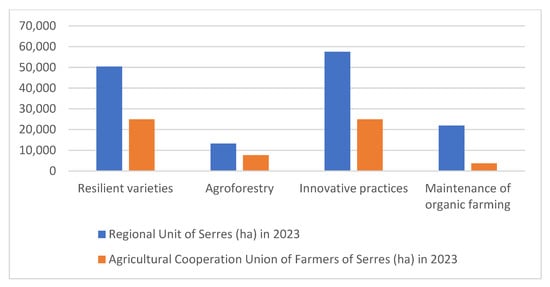
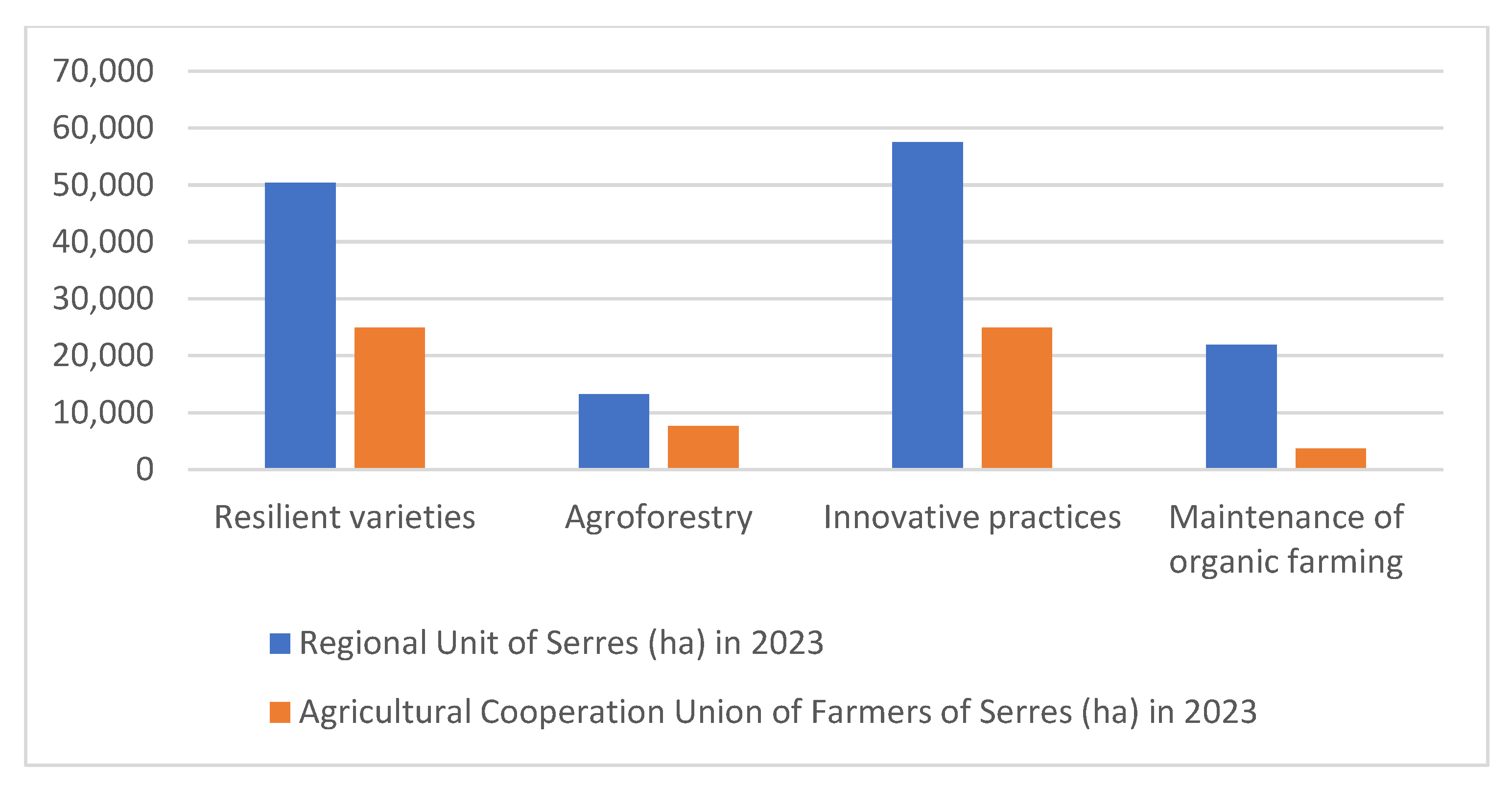
As illustrated in Figure 1, according to secondary data, the eco-schemes which farmers from the Serres RU predominantly preferred were as follows: scheme 31.6 “Support for farmers applying environmentally friendly management practices combined with the use of a digital input management and environmental monitoring application” (57,489.7 ha); scheme 31.1 “Use of resilient and locally adapted species and varieties” (50,394.58 ha); scheme 31.9 “Maintenance of organic crop and livestock production practices” (21,895.9 ha) and scheme 31.5 “Improvement of agroforestry ecosystems rich in landscape features” (13,212.59 ha). The Union of the Farmers of Serres shows a similar pattern of interest to the same eco-schemes.
Figure 1.
Enrolled area per eco-scheme in 2023.
3.2. Results from Primary Data
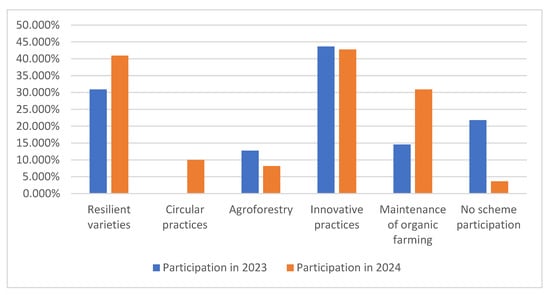
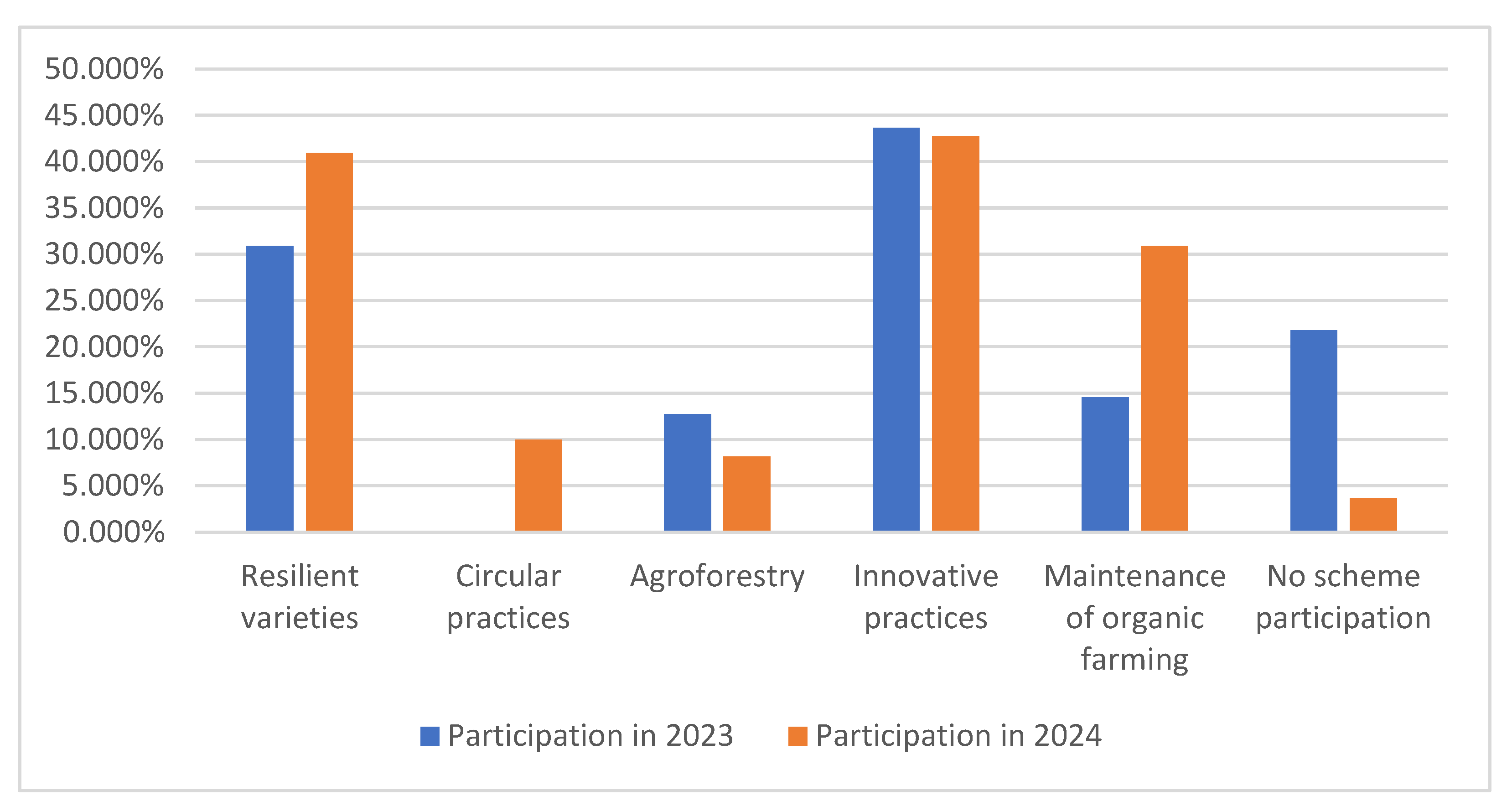
Figure 2 depicts the changes in eco-scheme participation based on the primary data collected. Between 2023 and 2024, participation either remained stable or increased across almost all eco-schemes. The two most impressive results are that a. applications for the maintenance of organic farming scheme have doubled from 2023 to 2024 and b. participation in circular practices scheme which rose to 10% in 2024, even though it was null in 2023. Furthermore, the proportion of producers who did not participate in any eco-scheme decreased significantly.
Figure 2.
Participation rate per eco-scheme.
According to the farmers’ answers, the most frequent reasons for farmer participation as per eco-scheme were:
- for resilient species/varieties scheme (31.1)—the familiarity of scheme requirements with farmers’ pre-existing practices;
- for agroforestry maintenance scheme (31.5)—the absence of participation costs;
- for the application of innovative practices scheme (31.6)—the perceived comparative advantage of the scheme relative to others, particularly organic farming maintenance;
- for the continuation of organic farming scheme (31.9)—the fact that they were already complying with the commitments.
In addition, several problems and challenges associated with participation were identified. Specifically, the implementation of the agroforestry scheme was found to be problematic, due to a particular legislation for the definition of eligible areas selected by the payment authority. In the innovative practices scheme (31.6), a significant proportion of farmers faced difficulties in utilizing the digital tools, while in organic farming maintenance, lack of knowledge regarding the regulations governing organic farming was observed.
Apart from the factors encouraging and discouraging farmers to participate in the schemes, the correlations between farm size and farmer willingness to participate and farmer employment status and their willingness to participate were also examined. Spearman’s rank correlation analysis revealed a moderately strong positive relationship (rho = 0.470) between farm size and participation in eco-schemes in 2023, indicating that the larger the farm the higher the participation rates; moreover, there was a very weak positive correlation (rho = 0.094) between employment status of farmers (full time vs. part time) and participation in 2023.
Finally, results from non-parametric Mann–Whitney U tests conducted on variables related to participation in eco-schemes and variables related to changes in direct payments suggest that the decision regarding the number and type of eco-schemes a farmer would join was not solely based on economic considerations.
4. Discussion
Overall, the findings of the study indicate a strong interest in participating in eco-schemes among agricultural producers, an interest that became even more pronounced in 2024. Respondents demonstrated a clear preference for specific eco-schemes—namely, innovative practices (31.6), resilient varieties (31.1), agroforestry (31.5) and maintenance of organic farming (31.9)—primarily due to the characteristics of the associated commitments, such as easiness and low participation costs. In contrast, more complex schemes or those offering lower levels of per-hectare support were generally avoided, like 31.2 “Extension of the application of ecological focus areas” and 31.3 “Implementation of improved green cover practices, while enhancing biodiversity”.
With regard to the observed positive correlation between farm size and participation in eco-schemes, it is important to note that the classification of farms as either large or small was based on eligibility for complementary redistributive income support for sustainability (CRISS). Consequently, this correlation not only supports the hypothesis that larger agricultural holdings are more likely to participate in agri-environmental programs but also highlights a potential link between the payment of CRISS and the decision to enroll in eco-schemes.
Another noteworthy finding is the very weak correlation between farmer employment status and their participation in eco-schemes, suggesting that both professional farmers and part-time farmers are equally interested in such schemes. Therefore, due to this pattern, excess participation occured, leading to a significant reduction in the per-unit support payments—an issue that may warrant further attention from policymakers.
Finally, the results of the non-parametric Mann–Whitney tests indicate that the changes in direct payments received by producers in 2023 did not influence either their decision to participate or the number of eco-schemes adopted in 2024. This finding underscores the conclusion that participation in eco-schemes is not driven solely by economic incentives but is likely influenced by a broader set of factors.
5. Conclusions
This study identified twelve key motivational categories influencing farmer participation in eco-schemes:
- cost considerations;
- ease of implementing the program;
- scheme similarity with existing practices;
- external advice;
- levels of subsidization;
- perceived environmental benefits;
- comparative evaluation of schemes;
- response to policy changes (e.g., the phase out of “greening”);
- social imitation;
- continuity with previous commitments;
- opportunity for exploitation;
- crop-specific factors.
Statistical analysis further revealed that farm size is positively correlated with eco-scheme participation, while professional status (full-time vs. part-time farmers) showed no significant association. This suggests that eco-schemes attract a broad range of farmers, leading to oversubscription and subsequent reduction in subsidy rates, an issue policymakers should address.
Barriers to participation were categorized into five categories as follows: high participation costs, complexity of commitments, clash with other schemes, lack of knowledge and bureaucratic challenges. Although participation rates increased from 2023 to 2024, it is critical to emphasize that genuine engagement, not merely formal enrollment, is necessary to achieve the intended environmental outcomes. Consequently, the establishment of robust advisory and training networks is essential to support farmers in meeting their commitments.
Moreover, specific training and advisory needs were identified for the innovative practices and organic farming schemes, related to digital application usage and organic farming regulations, respectively. Tailored training programs are recommended to ensure farmers’ full understanding and compliance. Overall, both encouraging and discouraging factors for eco-scheme participation extend beyond purely economic considerations; more specifically, they are influenced by the twelve factors mentioned in the beginning of this section. Effective dissemination of information and targeted training are pivotal for the successful implementation of eco-schemes.
Author Contributions
Conceptualization, G.O. and G.V.; methodology, G.O. and G.V.; formal analysis, G.O.; investigation, G.O.; data curation, G.O.; writing—original draft preparation, G.O.; writing—review and editing, G.O. and G.V. All authors have read and agreed to the published version of the manuscript.
Funding
This research received no external funding.
Institutional Review Board Statement
Not applicable.
Informed Consent Statement
Informed consent was obtained from all subjects involved in the study.
Data Availability Statement
Data were kindly provided by the payment organization in an anonymus form in order to be used for the specific research.
Conflicts of Interest
The authors declare no conflict of interest.
References
- Mcgurk, E.; Hynes, S.; Thorne, F. Participation in agri-environmental schemes: A contingent valuation study of farmers in Ireland. J. Environ. Manag. 2020, 262, 110243. [Google Scholar] [CrossRef] [Scilit] [PubMed]
- Paulus, A.; Hagemann, N.; Baaken, M.; Roilo, S.; Alarcón-Segura, V.; Cord, A.; Beckmann, M. Landscape context and farm characteristics are key to farmers adoption of agri-environmental schemes. Land Use Policy 2022, 121, 106320. [Google Scholar] [CrossRef] [Scilit]
- Unay Gailhard, İ.; Bojnec, S. Farm size and participation in agri-environmental measures: Farm-level evidence from Slovenia. Land Use Policy 2015, 46, 273–282. [Google Scholar] [CrossRef] [Scilit]
- Zimmermann, A.; Britz, W. European farms’ participation in agri-environmental measures. Land Use Policy 2014, 50, 214–228. [Google Scholar] [CrossRef] [Scilit]
- Karali, E.; Brunner, B.; Doherty, R.; Hersperger, A.; Rounsevell, M. Identifying the Factors That Influence Farmer Participation in Environmental Management Practices in Switzerland. Hum. Ecol. 2014, 42, 951–963. [Google Scholar] [CrossRef] [Scilit]
- Pavlis, E.; Terkenli, T.; Kristensen, S.; Busck, A.; Cosor, G. Patterns of agri-environmental scheme participation in Europe: Indicative trends from selected case studies. Land Use Policy 2016, 57, 800–812. [Google Scholar] [CrossRef] [Scilit]
- Sander, A.; Ghazoul, J.; Finger, R.; Schaub, S. Participation in individual and collective agri-environmental schemes: A synthesis using the Theory of Planned Behaviour. J. Rural. Stud. 2024, 107, 103255. [Google Scholar] [CrossRef] [Scilit]
Disclaimer/Publisher’s Note: The statements, opinions and data contained in all publications are solely those of the individual author(s) and contributor(s) and not of MDPI and/or the editor(s). MDPI and/or the editor(s) disclaim responsibility for any injury to people or property resulting from any ideas, methods, instructions or products referred to in the content. |
© 2026 by the authors. Licensee MDPI, Basel, Switzerland. This article is an open access article distributed under the terms and conditions of the Creative Commons Attribution (CC BY) license.