


Abstract
In ultra-relativistic heavy-ion collisions, creation of a novel state of matter, the quark-gluon plasma (QGP), has been observed. Suppressed production of quarkonia, caused by the colour screening of the binding force, has been proposed as a direct evidence of the QGP formation. At RHIC energies, other phenomena such as the regeneration and co-mover absorption, are expected to have a small effect for the bottomonium family, which makes a cleaner probe of the screening effect compared to the meson. In these proceedings, the latest measurements of the production suppression in Au + Au collisions at GeV via the di-muon and di-electron decay channels by the STAR experiment at RHIC are presented and compared with data from the LHC and theoretical calculations. Moreover, production measurements in p + p and p + Au collisions are also reported, providing a baseline and a quantification of the cold nuclear matter effects, respectively.
1. Introduction
Studying the properties of the QGP is experimentally extremely challenging, due to the very short lifetime of the QGP phase (∼fm/c) in ultra-relativistic collisions of heavy-ions. One of the methods to probe the plasma properties has been the measurement of suppressed production of heavy quarkonia (e.g., , ) due to the colour screening[1]. In this mechanism, the quarkonium is expected to dissociate should the Debye radius get smaller than the quarkonium radius . Due to the fact that different quarkonium states have different binding energies and thus radii, this also implies that they dissociate at different temperatures. Such phenomenon is referred to as sequential melting and has been proposed as a QGP “thermometer” [2].
That being said, other competing phenomena could complicate the interpretation of the suppressed production of quarkonia. Primarily, the QGP gives rise to a secondary production mechanism through coalescence of deconfined quarks. This is particularly important for charmonia at LHC energies, due to the abundance of the charm quarks in the medium. Traditionally, the effect of this regeneration has been deemed completely negligible for the much scarcer bottomonia, although this paradigm has been recently challenged to a degree in certain theoretical models [3]. The Cold Nuclear Matter (CNM) effects (nuclear effects unrelated to the hot QGP phase) also modify the quarkonium production. Usually, initial state effects (e.g., nuclear shadowing), nuclear absorption, and final state inelastic interactions with hadrons are considered, although the last has been thought to be negligible for the (1S) at RHIC [4]. Altogether, due to the smaller influence of some of the competing mechanisms, the ’s at RHIC energies are a relatively clean probe of the colour screening effect.
Lastly, it is important to bear in mind that the bottomonium family has a substantial feed-down structure—for example, only of high-(1S) come from the direct production [5]. However, this structure still remains not fully understood.
2. Reconstruction of the Meson with the STAR Experiment
At the Solenoidal Tracker At RHIC (STAR), the mesons can be accessed through the di-electron and the di-muon decay channels. The Time Projection Chamber is an instrumental subsystem, which is used not only for tracking, but also for particle identification (PID) via the specific ionisation energy loss. Its acceptance is in pseudorapidity and in azimuth. Other prominent subdetectors employed are the Barrel Electromagnetic Calorimeter (BEMC), with , and the Muon Telescope Detector (MTD), with . They are used for their triggering and PID capabilities for high-–electrons and muons, respectively. When possible, results from the two channels are combined to increase the statistical precision of the measurement.
3. Results
In all figures presented in these proceedings, statistical uncertainties are shown as vertical bars, systematic uncertainties as open boxes around data points, and global uncertainties as full boxes around unity.
3.1. Production in p + p and p + Au Collisions
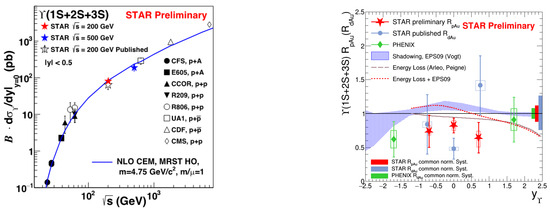
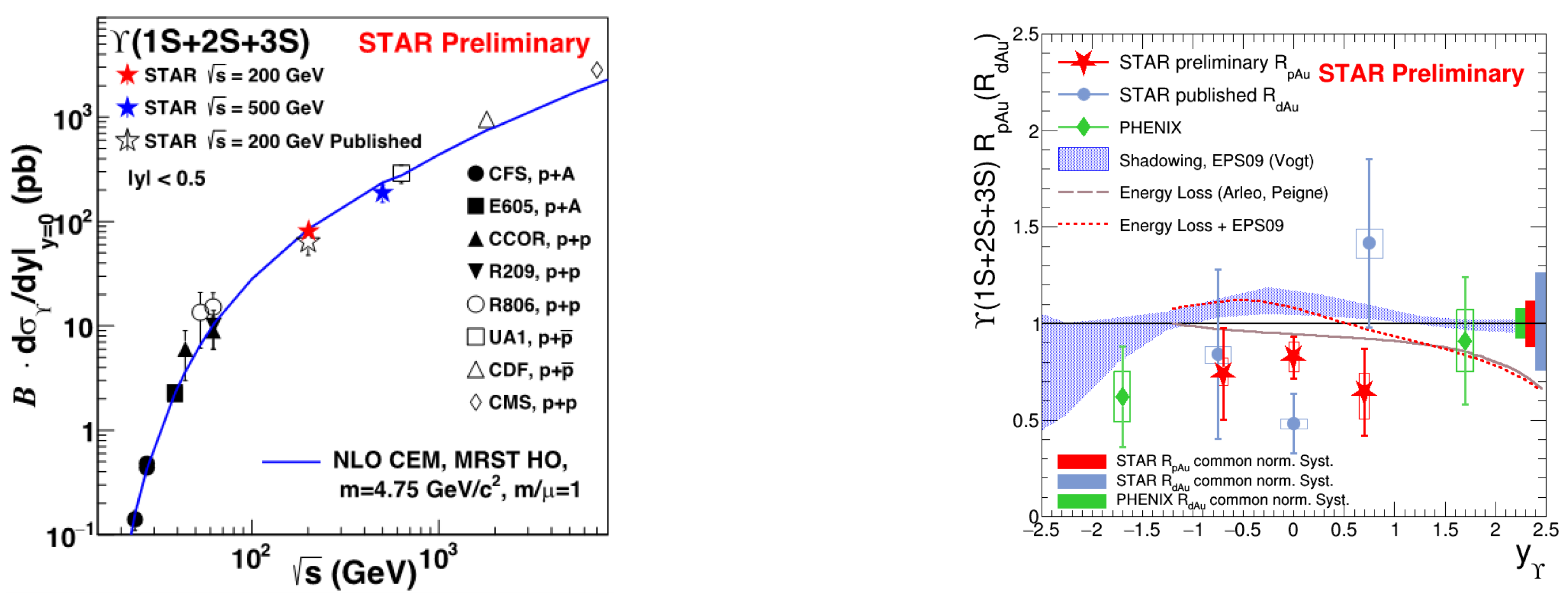
STAR has measured the production of (1S + 2S + 3S) in p+p collisions at GeV using BEMC-triggered data from 2015 via the di-electron channel. The dataset size corresponds to an integrated luminosity of 97 pb. The production cross section was measured to be pb, where B is the averaged (1S + 2S + 3S) branching ratio. This result is shown in Figure 1 left and is compatible with a next-to-leading order colour evaporation model calculation [6]. It is also consistent with the previous STAR results [7], but benefits from a factor of 2 increase in the statistical precision. The main reason for measuring in p + p collisions is to establish a precise baseline for similar measurements in p + A and A + A collisions.
Figure 1.
(left) Production cross-section of the (1S + 2S + 3S) at mid-rapidity in p+p collisions at GeV (red star) compared with world-wide data and NLO CEM calculations [6]. (right) Nuclear modification factor of the (1S + 2S + 3S) in p+Au collisions at GeV (red stars) as a function of the rapidity.
(1S + 2S + 3S) has also been measured in p + Au collisions at GeV at STAR, using the di-electron channel in the BEMC-triggered data collected in 2015 corresponding to an integrated luminosity of 300 nb. The nuclear modification factor at mid-rapidity is . The plotted as a function of the rapidity can be seen in Figure 1 right. It is consistent with previous STAR measurements [7], but has two times smaller uncertainties. The primary purpose of the p + Au study of the is to quantify the CNM effects.
3.2. Production in Au + Au Collisions
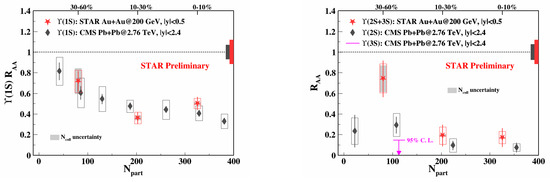
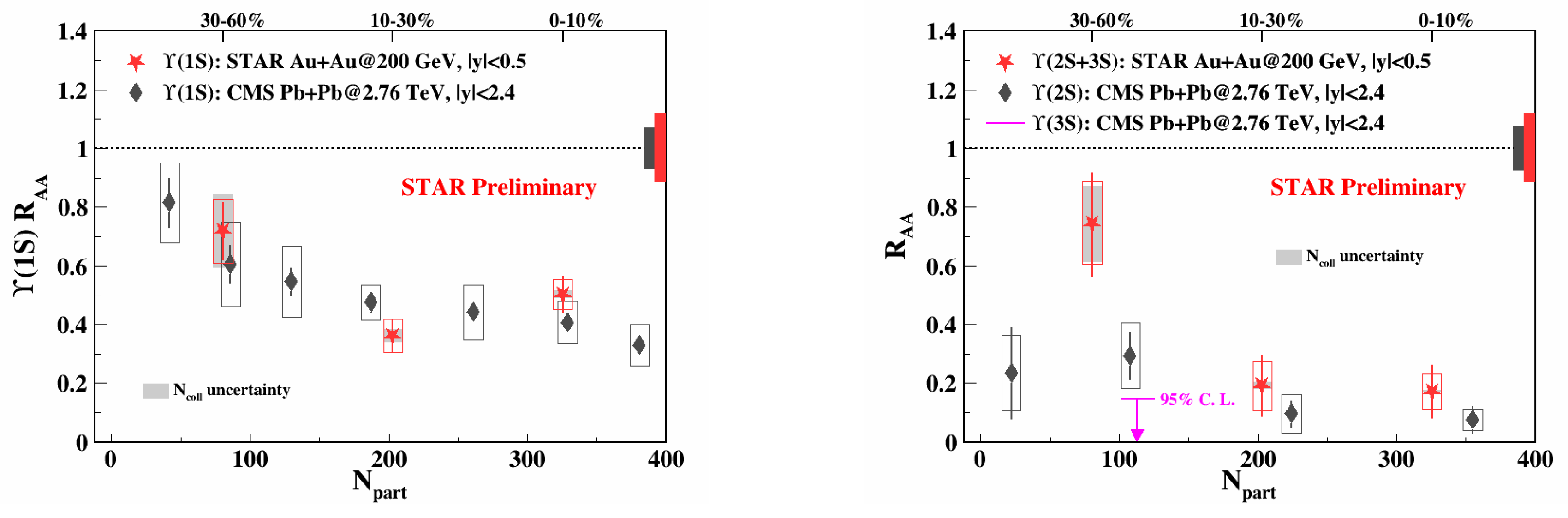
In Au + Au collisions at GeV, STAR has measured the production in both the di-electron (1.1 nb worth of data collected in 2011) and the di-muon channel (27.0 nb worth of data collected in 2014 and 2016). The nuclear modification factors of (1S) and (2S + 3S) at —combined from the two mutually consistent channels—are shown in Figure 2 as a function of the number of participants . Moreover, they are compared with CMS results at from Pb + Pb collisions at TeV [8]. It can be seen that at RHIC, the excited states (2S + 3S) suffer from a greater suppression than the ground state (1S) in central collisions. Comparing with the LHC results, the ground state seems to experience a similar level of suppression across all collision centrality bins, whereas the excited states appear to be less suppressed in peripheral collisions.
Figure 2.
of the (left) (1S) and (right) (2S+3S) at in Au + Au collisions at GeV as a function of (red stars). Shown are also the results from the LHC in Pb + Pb collisions at TeV (grey rhombi, magenta line) [8].
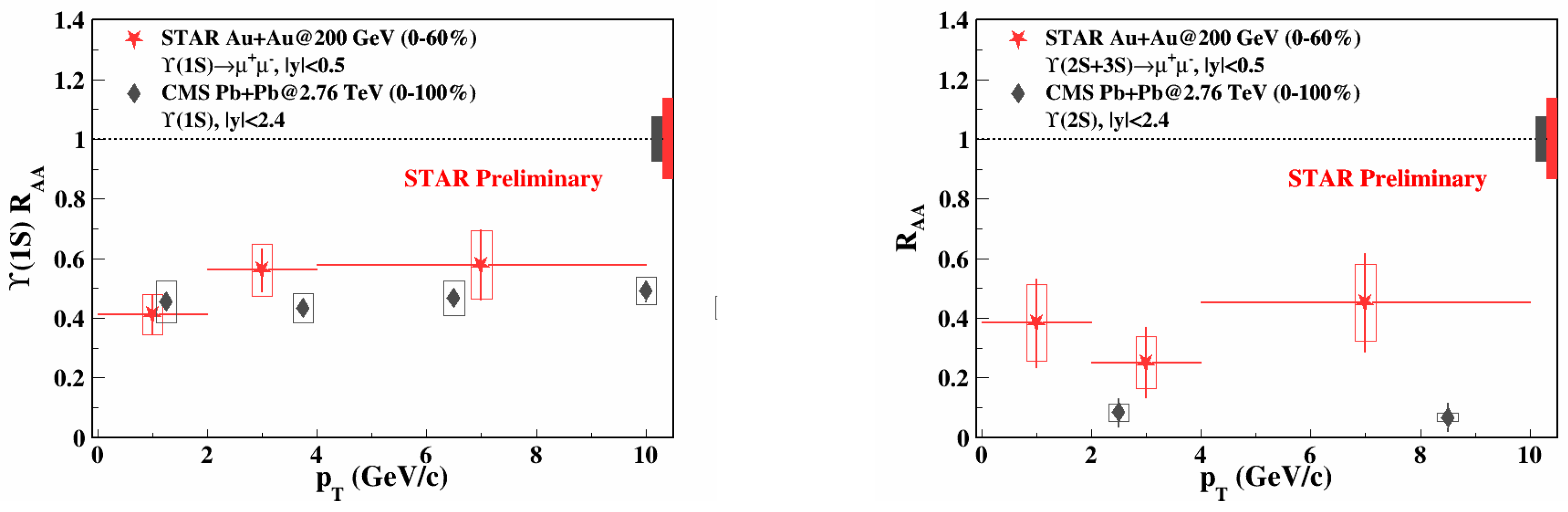
The as a function of transverse momentum is plotted in Figure 3, using only the di-muon channel, and compared with results from CMS [8]. Similarly, a comparable suppression is observed for the (1S), while there are hints that the (2S + 3S) is less suppressed at RHIC than at the LHC.
Figure 3.
of the (left) (1S) and (right) (2S+3S) at in Au + Au collisions at GeV as a function of (red stars). Results from the LHC in Pb+Pb collisions at TeV (grey rhombi) [8] are shown as well.
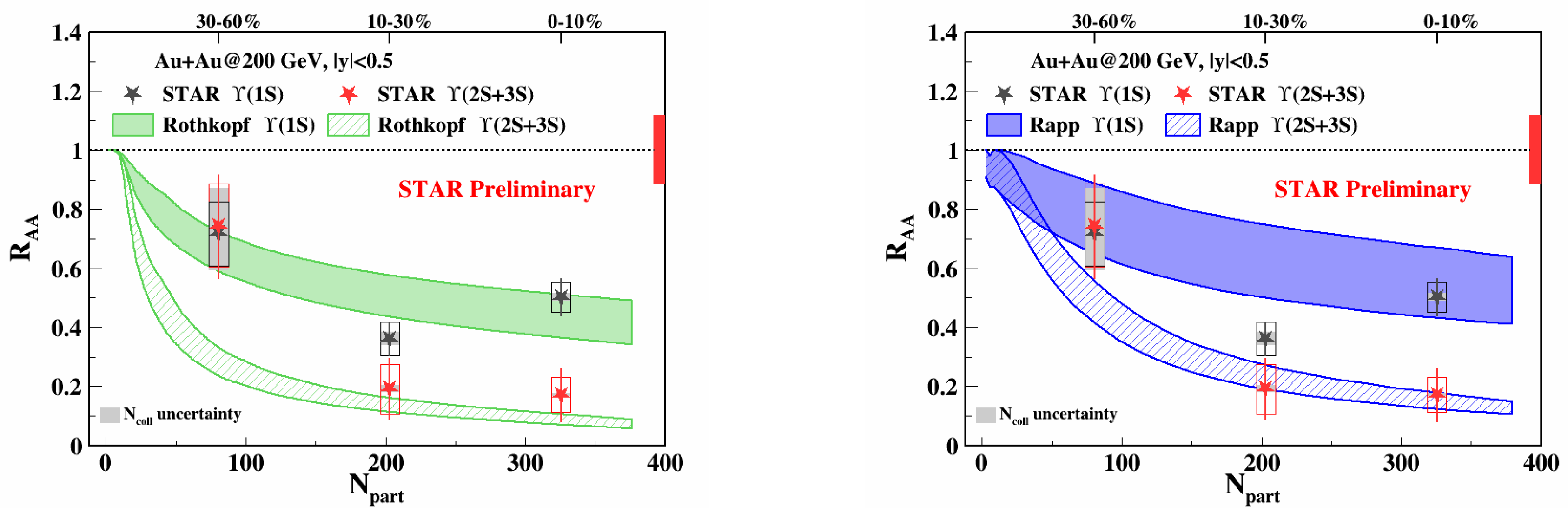
Finally, we present a comparison with recent theoretical calculations in Figure 4. The model by Rothkopf et al. [9] employs a lattice QCD vetted complex potential embedded in a hydrodynamically evolving medium, with the initial QGP temperature of MeV for the most central collisions. We also show a model by Rapp et al. [3], which uses in-medium binding energies predicted by thermodynamic T-matrix calculations with internal energy based potentials, with the initial QGP temperature of MeV in the most central collisions. In contrast with the Rothkopf model, the Rapp model also incorporates a regeneration component thanks to its equilibrium approach using a rate equation. Moreover, it accounts for the CNM effects caused by nuclear shadowing and nuclear absorption, which well describes the (1S + 2S + 3S) suppression observed in p + Au collisions at RHIC. Both models are generally consistent with the STAR data, although for the excited (2S + 3S) states, the Rothkopf model appears to overestimate the suppression in the peripheral collisions.
Figure 4.
Theoretical predictions for of the (1S) (full area) and the (2S+3S) (dashed area) at in Au + Au collisions at GeV as a function of by (left) Krouppa, Rothkopf, Strickland [9] and (right) Du, He, Rapp [3]. STAR results are plotted as grey and red stars.
4. Conclusions
In these proceedings, we present the latest measurements of the meson production at STAR in collisions of p + p, p + Au, and Au + Au at GeV. The first two provide a precise reference and a quantification of the CNM effects. In Au + Au collisions, we show the nuclear modification factor as functions of and for both the (1S) and the (2S + 3S) states, utilising a combination of the di-electron and di-muon channels. The ground state is strongly suppressed in semi-central and central collisions, similarly as at the LHC. Apart from peripheral collisions, the excited states appear to be more suppressed than the ground state—consistent with the idea of sequential melting—but seem to be slightly less suppressed than at the LHC. Better understanding of the bottomonium feed-down structure, the CNM effects, as well as possibly new measurements with a greater discriminatory power are needed to conclusively decide between the different models.
Funding
This research was funded by the project LTT18002 of the Ministry of Education, Youth, and Sport of the Czech Republic and by the Grant Agency of the Czech Technical University in Prague, grant No. SGS16/238/OHK4/3T/14.
References
- Matsui, T.; Satz, H. J/ψ Suppression by Quark-Gluon Plasma Formation. Phys. Lett. B 1986, 178, 416–422. [Google Scholar] [CrossRef] [Scilit]
- Mocsy, A. Potential Models for Quarkonia. Eur. Phys. J. 2009, 61, 705–710. [Google Scholar] [CrossRef] [Scilit]
- Du, X.; He, M.; Rapp, R. Color screening and regeneration of bottomonia in high-energy heavy-ion collisions. Phys. Rev. C 2017, 96, 054901. [Google Scholar] [CrossRef] [Scilit]
- Lin, Z.; Ko, C. Υ absorption in hadronic matter. Phys. Lett. B 2001, 503, 104–112. [Google Scholar] [CrossRef] [Scilit]
- CDF Collaboration. Production of Υ(1S) mesons from χb decays in collisions at = 1.8 TeV. Phys. Rev. Lett. 2000, 84, 2094–2099. [Google Scholar] [CrossRef] [Scilit] [PubMed]
- Frowley, A.; Ullrich, T.; Vogt, R. Heavy flavor in heavy-ion collisions at RHIC and RHIC II. Phys. Rept. 2008, 462, 125–175. [Google Scholar] [CrossRef] [Scilit]
- STAR Collaboration. Suppression of Upsilon Production in d+Au and Au + Au Collisions at = 200 GeV. Phys. Lett. B 2014, 735, 127–137. [Google Scholar] [CrossRef] [Scilit]
- CMS Collaboration. Suppression of Upsilon(1S), Upsilon(2S), and Upsilon(3S) production in PbPb collisions at = 2.76 TeV. Phys. Lett. B 2017, 770, 357–379. [Google Scholar] [CrossRef] [Scilit]
- Krouppa, B.; Rothkopf, A.; Strickland, M. Bottomonium suppression using a lattice QCD vetted potential. Phys. Rev. D 2018, 97, 016017. [Google Scholar] [CrossRef] [Scilit]
Publisher’s Note: MDPI stays neutral with regard to jurisdictional claims in published maps and institutional affiliations. |
© 2019 by the authors. Licensee MDPI, Basel, Switzerland. This article is an open access article distributed under the terms and conditions of the Creative Commons Attribution (CC BY) license (https://creativecommons.org/licenses/by/4.0/).