


Abstract
Symbiotic nitrogen fixation (SNF) in forage legumes is a key biological process that provides nitrogen inputs and enhances soil fertility in agroecosystems. Enhancing SNF efficiency helps reduce dependence on synthetic nitrogen fertilizers and improve nitrogen use efficiency. Humic substances (HS) have been reported to stimulate root development and nutrient acquisition in different crop species. However, their effect on root nodulation and SNF in forage legumes remains poorly understood. This study investigated the effects of a humic acid-based soil amendment (liquid Humalite) on root growth, nodulation, SNF, and plant nitrogen acquisition in red clover. Red clover seedlings were grown in a modified Leonard jar system placed under controlled environmental conditions and treated with 0.1, 0.2, 0.4, and 0.8% (v/v) liquid Humalite. Plant biomass, root morphological traits, nodulation parameters, SNF, and shoot nitrogen accumulation were assessed after 6 weeks. SNF was quantified using the 15N-isotope dilution method. Application of liquid Humalite significantly affected plant growth and SNF responses in red clover. The 0.2% liquid Humalite treatment significantly increased root and total plant biomass by 35% compared to the untreated control. Total root length, surface area, and volume increased by 20–25% at 0.2% liquid Humalite. Nodule number, nodule dry weight, shoot nitrogen concentration, and shoot C:N ratio did not differ among treatments. However, the percent nitrogen derived from the atmosphere (%Ndfa) was significantly higher under the 0.2% liquid Humalite treatment (47%) as compared to the untreated control (28%). Under the 0.2% liquid Humalite, total fixed and accumulated shoot nitrogen increased by 134% and 37%, respectively, compared to the control. Overall, these findings indicate that humic substances may enhance SNF and nitrogen accumulation in red clover, highlighting their potential as a management strategy to improve forage productivity.
1. Introduction
Forage legumes play a key role in sustainable agriculture due to their atmospheric nitrogen-fixing ability through a symbiotic relationship with rhizobia bacteria. This natural process not only reduces the dependence on synthetic nitrogen fertilizers but also helps improve soil fertility and support the production of nitrogen-rich livestock feed [1,2]. Symbiotic nitrogen fixation (SNF) is a complex, multistep interaction between plants and rhizobia bacteria [3,4]. Hence, the efficiency of SNF is highly dependent on multiple factors, including rhizobia strain compatibility, legume species, soil management practices, and environmental conditions [5,6]. Poor nodulation and ineffective SNF can result in reduced forage yields, low-quality feed, and low soil fertility. Therefore, research on environmentally sustainable approaches to improving SNF efficiency is of paramount importance.
In recent years, interest has grown in the use of humic substances as potential enhancers of SNF and plant growth in legumes. Humic substances originate from the decomposition of dead biota and are predominantly abundant in compost, peat, and lignite [7]. Rather than supplying the nutrients required for growth, these substances modulate several metabolic pathways involved in plant growth enhancement [8]. Previous studies suggested that humic substances may enhance SNF by promoting root system development, modulating quorum-sensing mechanisms, stimulating rhizobia growth, enhancing abiotic stress tolerance and survival of both rhizobia and host plants, and upregulating the expression of nodulation-related genes [9,10,11,12,13]. The bioactivity of humic substances can vary significantly depending on the source material, environmental origin, extraction techniques, and underlying molecular structure [14]. As an example, Humalite is a naturally occurring humic substance found in organic-rich deposits in Southern Alberta, Canada. It is commercially available in several formulations, including coarse and fine granular forms and a liquid form [7]. In the present study, the commercial liquid formulation used (liquid Humalite) was produced through the alkaline extraction of raw Humalite material. Due to its formation in a unique freshwater depositional environment, Humalite contains high levels of humic acids and relatively low concentrations of heavy metals [15]. Recent studies have shown that humic-based amendments have enhanced shoot and root development, nodulation, SNF, and seed yield of pea, wheat, and canola [15,16,17].
The plant growth-promoting effects of humic substances have been studied primarily on grain and oilseed legumes, leaving a significant knowledge gap regarding their effects on growth and SNF of forage legumes. Red clover (Trifolium pratense L.) is one of the leading forage legumes in Canada and is grown in around 4 million hectares globally; therefore, it was selected as the forage legume for this study. The objective of this study was to evaluate the effects of a liquid Humalite on plant growth, root development, SNF, and nitrogen acquisition in red clover. We hypothesized that liquid Humalite application would enhance root morphological traits and SNF efficiency, thereby improving plant nitrogen accumulation and biomass production. To test this hypothesis, multiple plant growth and SNF-related parameters were assessed in red clover plants grown in a modified Leonard jar system under a controlled environment with and without the liquid Humalite treatments.
2. Materials and Methods
2.1. Plant Materials and Growth Conditions
Red clover (Trifolium pratense L., variety: Marino) seeds were surface sterilized using 70% ethanol for 2 min and 4% sodium hypochlorite for 3 min, followed by six rinses with sterile distilled water [18]. Surface-sterilized seeds were divided into two groups, where one set of seeds was inoculated with Rhizobium leguminosarum bv. trifolii suspension (OD600 = 0.1) and soaked for 10 min (inoculated seeds). The other set of seeds was not inoculated but soaked in sterile distilled water for 10 min (uninoculated seeds). All seeds were pre-germinated for three days in the dark at room temperature on sterile, moistened filter papers [18]. Following germination, seedlings were transferred to sterile, empty pipette tip boxes containing sterile distilled water and were allowed to grow at 23 °C with a 16 h light/8 h dark cycle and a light intensity of 400 μmol photons m−2s−1 in a growth room [19]. Uniform seedlings were selected for the experiments after 4 days of growth.
2.2. Modified Leonard Jar Setup
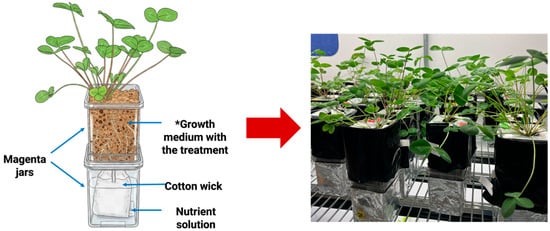
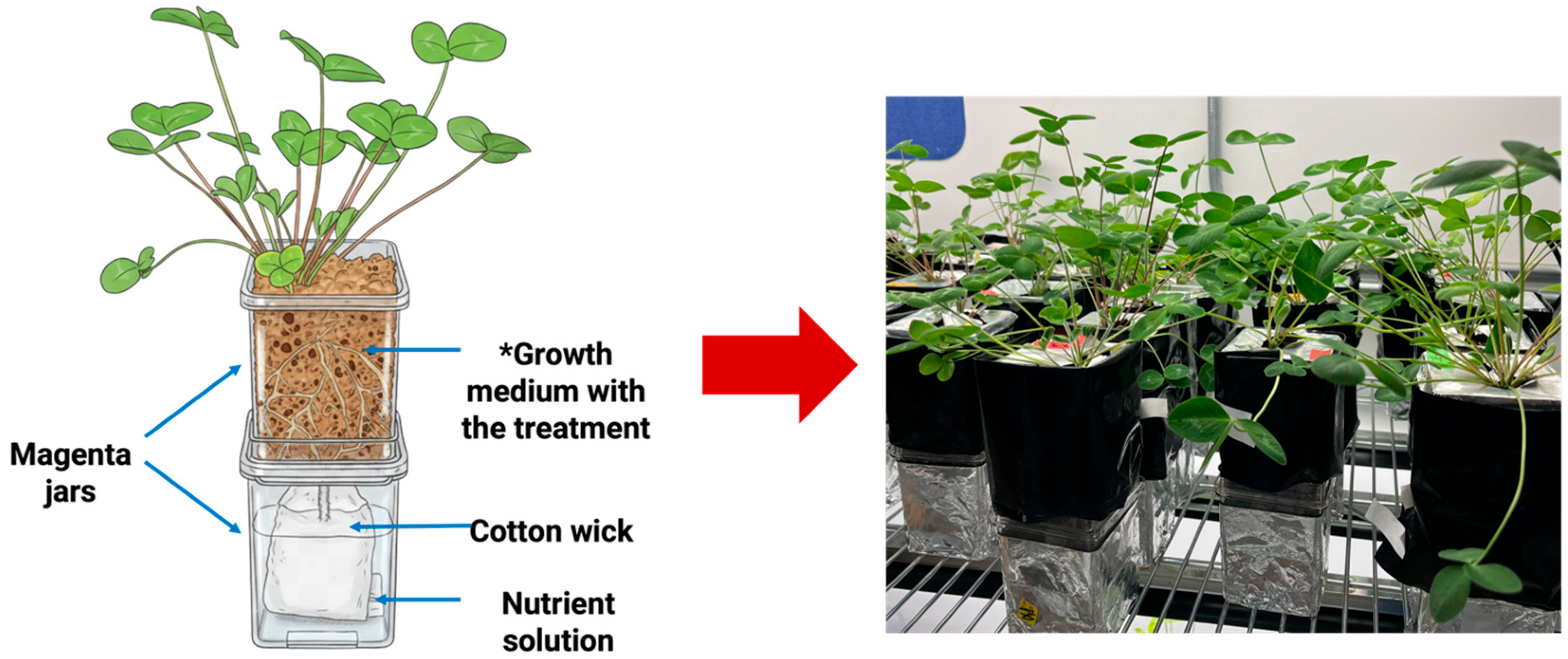
The experiment was conducted in a controlled plant growth room at the University of Alberta using a modified Leonard jar setup. This setup was prepared by stacking two Magenta GA-7 jars (MilliporeSigma, Oakville, ON, Canada, Cat. No. V8505, dimensions: 77 mm × 77 mm × 97 mm) on top of each other (Figure 1). A hole was drilled at the bottom center of the top jar to allow insertion of a cotton wick, which extended into the bottom jar to enable the flow of nutrient solution through capillary action. The top jar was filled with 400 g of a homogenized 3:1 sand (Target Products Ltd., Crippsdale, AB, Canada) and a professional growing mix (Sun Gro Horticultural Canada Ltd., Vilna, AB, Canada). This mixture was selected to minimize the available nitrogen content in the medium and facilitate root growth. Following assembly, the complete modified Leonard jar setup was autoclaved twice (121 °C for 20 min each cycle) to eliminate any native rhizobial populations and ensure sterile conditions.
Figure 1.
The modified Leonard jar setup. *Growth medium: 400 g of homogenized 3:1 sand and a professional growing mix. The cotton wick was inserted through a hole drilled in the top jar. The sides of both top and bottom jars and the top of the setup were covered to minimize light penetration. The figure to the right depicts the plant growth after 6 weeks.
2.3. Liquid Humalite Treatment
Four concentrations of liquid Humalite (Global Humic Products Ltd., Edmonton, AB, Canada) (0.1%, 0.2%, 0.4%, and 0.8% (v/v)) were tested. The concentrations were selected based on Rathor et al. [19] with minor adjustments made for the present experimental conditions. For each treatment, 75 mL of liquid Humalite solution was applied to the top jar of the setup to pre-saturate the sand-soil mix. The bottom jar was filled with 200 mL of quarter-strength nitrogen-free Hoagland solution (HOP03-50LT, Caisson Labs, UT, USA) adjusted to pH 7.0, to ensure a continuous nutrient supply through the wick. There were two experimental controls: an inoculated and an uninoculated control. For the inoculated control, seedlings from inoculated seeds were used, and the bottom jar of the setup was filled with 200 mL of quarter-strength nitrogen-free Hoagland medium adjusted to pH 7.0. For the uninoculated control, seedlings from the uninoculated seeds were used, and the bottom jar of the setup was filled with 200 mL of quarter-strength Hoagland basal medium with nitrogen adjusted to pH 7.0 (HOP03-50LT, Caisson Labs, Smithfield, UT, USA). This uninoculated control was used as the non-nodulating reference to calculate SNF capacity. The inoculated control was used as the “untreated control” to determine treatment effects.
2.4. Experimental Setup
One seedling from the respective group was transferred into the top jar after letting the liquid Humalite treatment saturate for 24 h. Each setup was covered with aluminum foil, with a small central opening on top to allow for shoot development while minimizing moisture loss and maintaining dark conditions for root growth. After seedling transfer, all setups were placed in the growth room (23 °C, 16 h light/8 h dark photoperiod, 200 μmol photons m−2 s−1 light intensity). One week after planting, all red clover plants (excluding the uninoculated control group) were inoculated with 1 mL of Rhizobium leguminosarum bv. trifolii (OD600 = 0.1) to ensure successful nodulation. The nutrient solution (N-free or basal Hoagland) in the bottom jar was replaced during the second and fourth weeks of the experiment. The placement of the jars was randomly changed during these nutrient solution changes to minimize positional biases. In the fourth week, each plant was labeled with 0.5 mM potassium 15N-nitrate solution (10 atom% 15N; Sigma-Aldrich, Oakville, ON, Canada; product no. 348481-25G). The potassium 15N-nitrate solution was applied to the top jar at a rate of 10 mL per day over five consecutive days to a total of 50 mL/plant.
2.5. Determination of Shoot, Root, and Nodule Parameters
After six weeks of growth, plants were harvested, and shoots were separated by cutting at the shoot–root junction. Roots were gently washed under running tap water to remove any sand and peat particles attached. Root nodules were carefully removed and manually counted. After removing the nodules, roots were scanned using a high-resolution root scanner (Expression 12000 XL, Regent Instruments Inc., Québec City, QC, Canada) and root images were analyzed with WinRhizo (version Pro 2022b, 64-Bit) software (Regent Instruments Inc., Québec City, QC, Canada) to determine root parameters such as total root length, surface area, and volume [20]. Shoot, root, and nodule samples were then separately dried in a hot air oven at 60 °C for five days, and dry biomass was recorded.
2.6. Determination of Shoot Nitrogen Content, Nitrogen Fixation, Carbon to Nitrogen Ratio, and Carbon Isotope Discrimination
Dried shoot tissues were initially ground using a coffee grinder and further homogenized into a fine powder with a bead-beater homogenizer (OMNI International, Kennesaw, GA, USA). A 5 mg sub-sample of each finely ground sample was accurately weighed using a microbalance (Sartorius Quintix35-1S, Goettingen, Germany) and placed into small tin capsules (8 mm × 5 mm, D1008, Isomass Scientific Inc., Calgary, AB, Canada). Prepared samples were submitted to the Stable Isotope Facility at Agriculture and Agri-Food Canada, Lethbridge Research and Development Centre, for isotopic analysis as described by Rathor et al. [15]. The analysis included measurements of nitrogen isotope composition (15N), and total nitrogen (%N), carbon isotope composition (13C), and total carbon (%C).
The percentage of nitrogen derived from the atmosphere (%Ndfa) was calculated using the following equation [21]:
The amount of nitrogen fixed in the shoot tissue was calculated using the total nitrogen content in the aboveground biomass and the %Ndfa, using the following formula:
Total N fixed = total shoot nitrogen content × (%Ndfa/100)
Unlike 15N, which was applied as an isotopic tracer, δ13C was determined from natural abundance in plant tissue without isotope enrichment. The difference in carbon isotope composition between the samples and the Pee Dee Belemnite (PDB) reference standard was calculated as below [22].
Rp refers to the isotopic abundance in the plant sample, and Rs refers to the 13C/12C ratio of the standard, with the fossil from the Pee Dee formation (Pee Dee Belemnite, PDB) serving as the reference standard. The carbon isotope discrimination (CID) was then calculated as follows:
δa refers to the isotopic composition of the atmosphere, and δp refers to the isotopic composition of the plant sample [22].
2.7. Statistical Analysis
The experiment followed a completely randomized design, with eight biological replicates per treatment (one plant per jar; n = 8) and the experiment was repeated twice. Normality and homogeneity of the data were confirmed by Shapiro–Wilk and Levene’s tests. Two-way ANOVA was performed using the two independent datasets to assess the interaction effect of the trial factor. Of the 15 parameters analyzed, 14 showed no significant interaction between trials, allowing the datasets to be pooled for further analysis. The combined dataset was re-evaluated for normality and homogeneity of residual variances using the Shapiro–Wilk test, which again confirmed that statistical assumptions were met. A linear model was applied, with treatment as a fixed effect. Significant treatment effects were determined using one-way analysis of variance (ANOVA) at a 95% confidence level. When treatment effects were significant, treatment means were compared by Tukey’s post hoc test at a 5% significance level. Percent changes in treatment effects were calculated relative to the mean values of the untreated control group. All analyses were conducted using GraphPad Prism (v10, GraphPad Software, San Diego, CA, USA).
3. Results
3.1. Effect of Liquid Humalite on Red Clover Shoot and Root Growth and Nodule Parameters
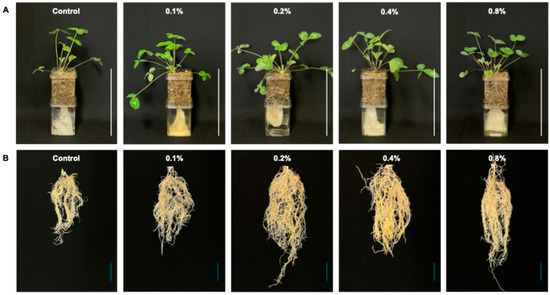
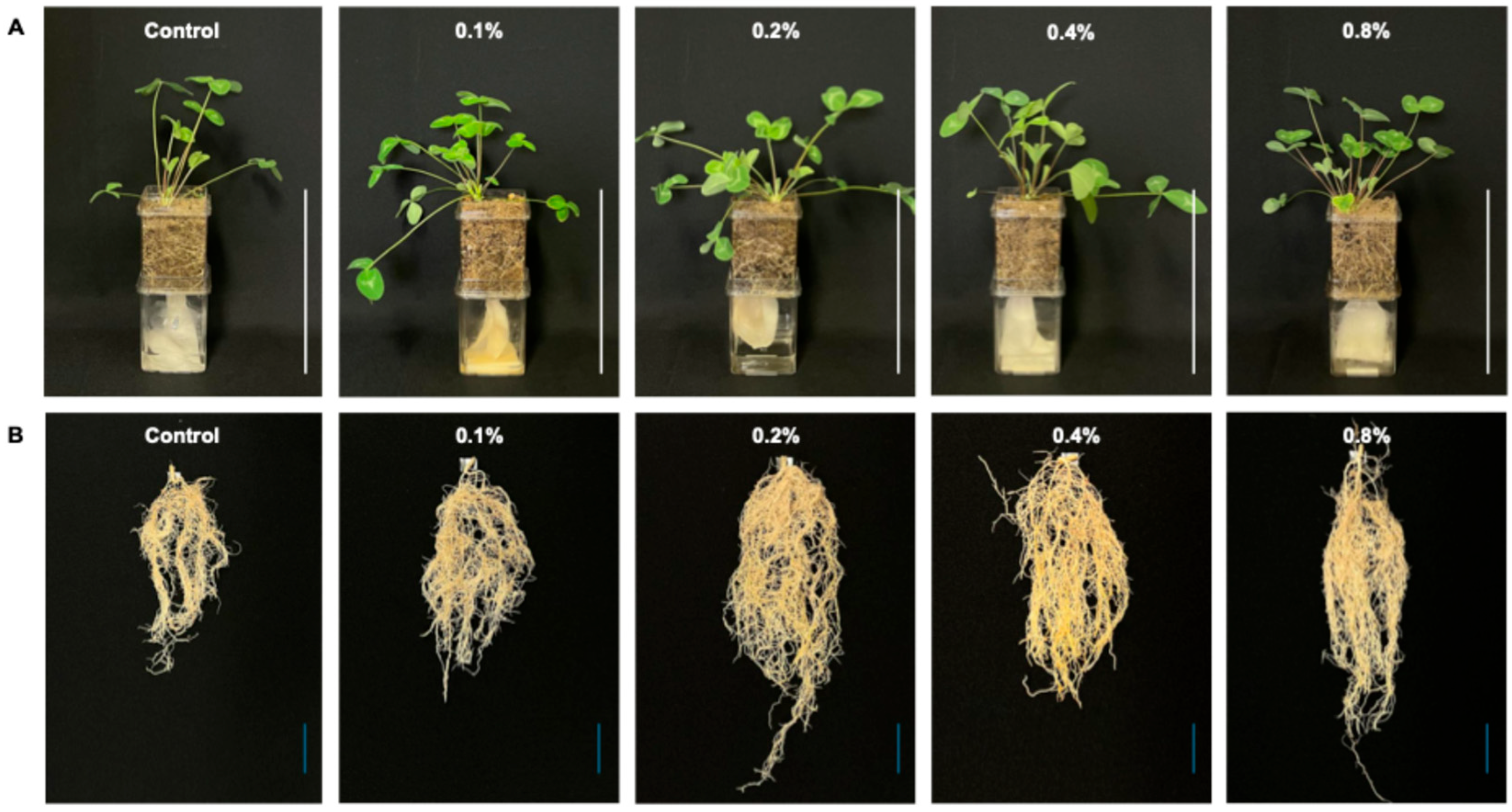
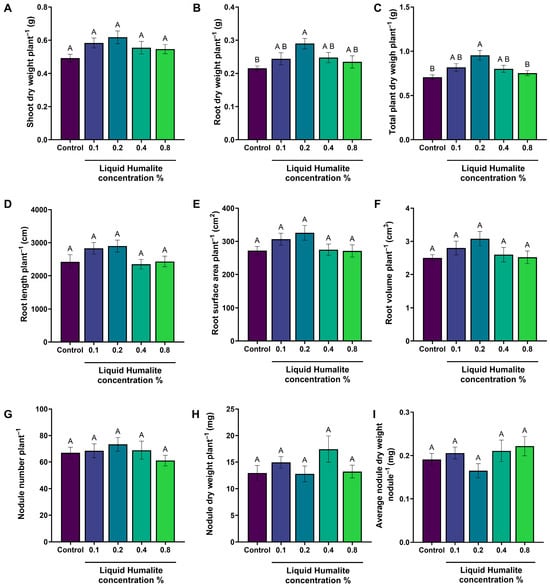
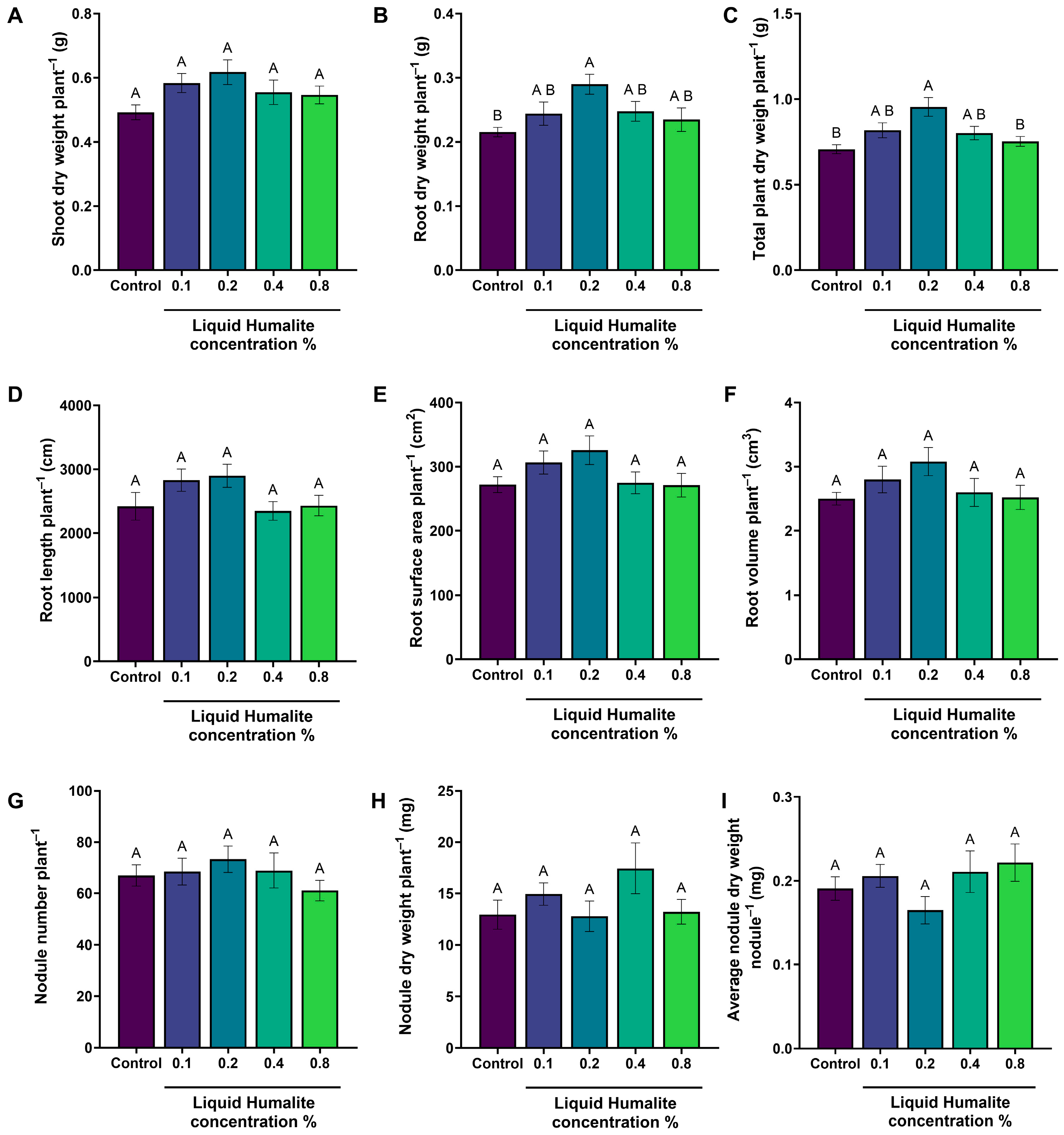
The improved shoot and root growth in the liquid Humalite-treated plants compared to the untreated control was visually evident (Figure 2). A consistent trend was observed across all biomass parameters (root, shoot, and total plant dry weight), where biomass increased at 0.1 and 0.2% liquid Humalite and then decreased at 0.4 and 0.8% liquid Humalite (Figure 3A–C). Although shoot dry weight differences among treatments were not statistically significant, plants treated with 0.2% liquid Humalite trended to have the highest average shoot biomass, with a 25% increase relative to the control (Figure 3A, p = 0.0616 for control vs. 0.2%). Root dry weight and total plant dry weight followed a similar pattern. Root and total plant dry weights were significantly higher at 0.2% liquid Humalite, with increments of 35% and 30%, respectively, as compared to the untreated control (p < 0.05; Figure 3B and p < 0.001; Figure 3C). Dry weights were lower at 0.4% and 0.8% liquid Humalite concentrations, although the reductions were not significant. Root morphological traits showed no statistical significance between the liquid Humalite treatments and the untreated control (p > 0.05); however, the same trend was observed as for the plant biomass (Figure 3A–C). The highest values for the root parameters were consistently observed at 0.2% liquid Humalite concentration, with root length, root surface area, and root volume increasing by 20%, 20%, and 23%, respectively, as compared to the control.
Figure 2.
Photographic images showing shoot (A) and root (B) development of the red clover pla-nts with and without the liquid Humalite treatments and grown for 6 weeks. The scale bars represent 18 cm for shoot images and 5 cm for root images.
Figure 3.
Shoot, root, and nodule parameters of red clover plants treated with and without liquid Humalite and grown for six weeks. Bar graphs illustrating shoot dry weight (A), root dry weight (B), total plant dry weight (C), total root length (D), root surface area (E), root volume (F), nodule number (G), nodule dry weight (H), and average nodule dry weight (I). The values correspond to mean ± standard error (n = 16). All measurements are expressed on a dry weight basis. Different letters above the bars indicate statistically significant differences among treatments based on Tukey’s post hoc test (p ≤ 0.05). Bars with the same letter in a graph are not significantly different.
The nodule parameters tested (nodule number, nodule dry weight, and average nodule dry weight) in the liquid Humalite-treated plants were not significantly different from the untreated control (Figure 3G–I). However, a similar trend towards 0.2% liquid Humalite showing the highest nodule numbers was apparent (Figure 3G). On the contrary, average nodule dry weight was 14% lower at 0.2% liquid Humalite as compared to the control (Figure 3I).
3.2. Effect of Liquid Humalite on Nitrogen Fixation, Shoot Nitrogen Concentration, Shoot C:N Ratio, and Carbon Isotope Discrimination
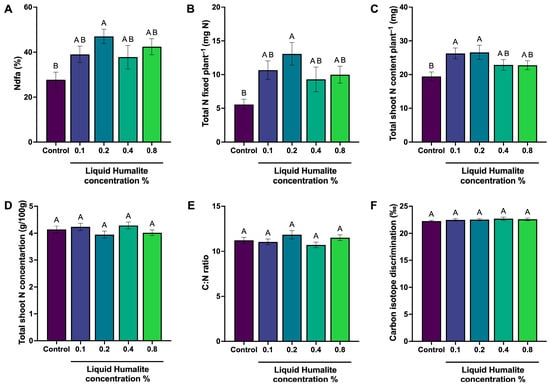
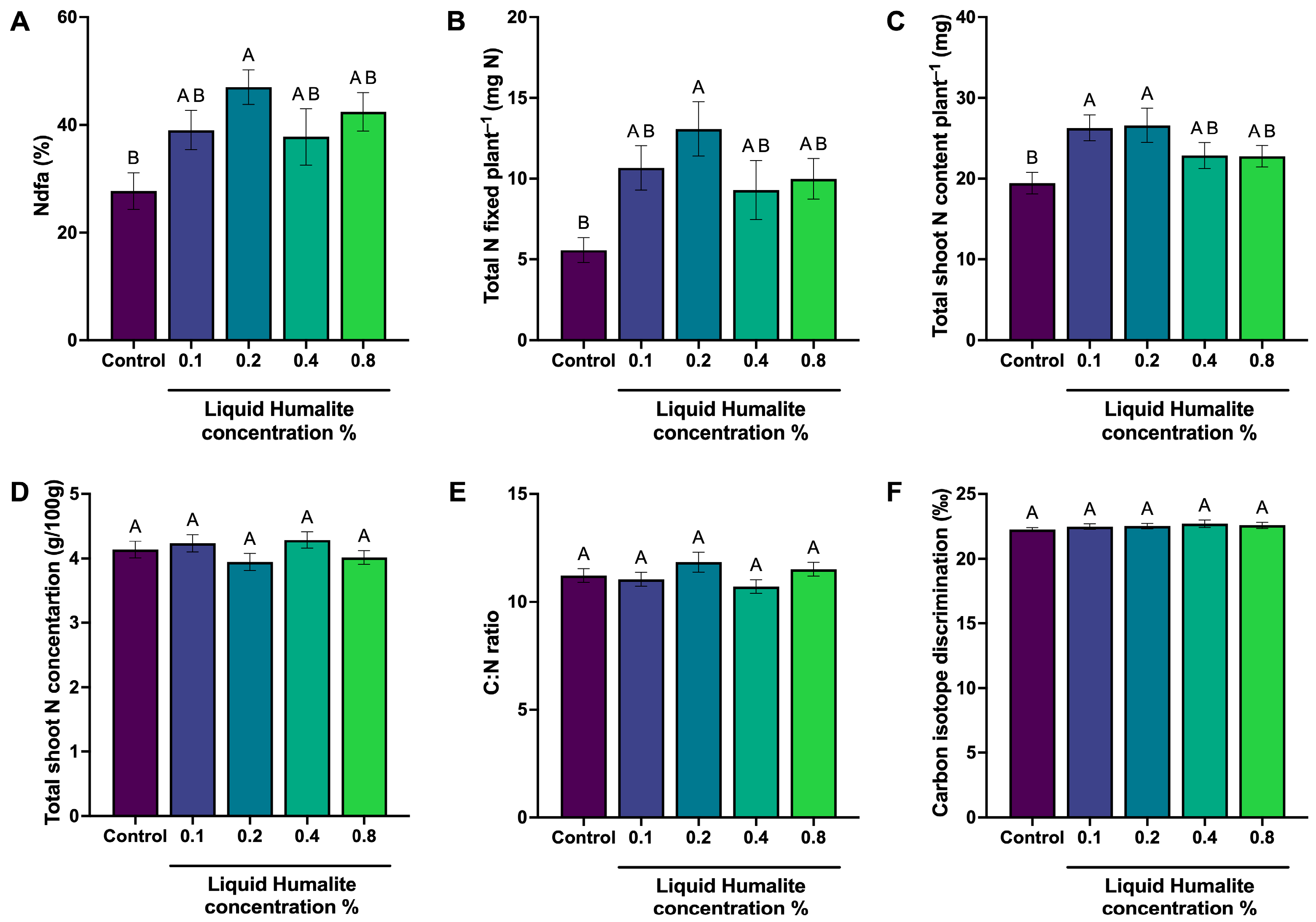
Red clover plants treated with different liquid Humalite concentrations showed overall increases in %Ndfa, total shoot nitrogen fixed, and total shoot nitrogen content as compared to the untreated control (Figure 4A–C). Shoot %Ndfa was significantly higher at 0.2% liquid Humalite (47%) as compared to the untreated control (28%) (p < 0.01, Figure 4A). Total shoot nitrogen fixed (mg N plant−1) increased by 134% at 0.2% liquid Humalite as compared to the untreated control (p < 0.01; Figure 4B). Total shoot nitrogen content was significantly higher at both 0.1% and 0.2% liquid Humalite, showing increases of 35% and 37%, respectively, as compared to the untreated control (p < 0.05; Figure 4C). In contrast, no significant differences were observed among treatments and the untreated control for total shoot nitrogen concentration, CID, and C:N ratio (Figure 4D–F).
Figure 4.
Bar graphs illustrating the symbiotic nitrogen fixation-related parameters in red clover shoots. Percentage of nitrogen derived from the atmosphere (%Ndfa) (A), total shoot nitrogen fixed (B), total shoot nitrogen content (C), shoot nitrogen concentration (D), carbon-to-nitrogen (C:N) ratio (E), and carbon isotope discrimination (CID) (F). Data are represented as mean ± standard error (n = 16). All measurements are expressed on a dry weight basis. Different letters above the bars indicate statistically significant differences among treatments based on Tukey’s post hoc test (p ≤ 0.05). Bars with the same letter in a graph are not significantly different.
4. Discussion
Humic substances are generally known to enhance plant growth, root morphology, and SNF in legumes [12,15,23,24]. The magnitude of the responses can depend on the type of humic substances, the application methods, and the doses. In the present study, liquid Humalite, produced through alkali extraction of the raw Humalite, exhibited its most notable effects at a concentration of 0.2% (v/v). At this concentration, the highest values were observed for total plant biomass and SNF parameters such as %Ndfa, total nitrogen fixed, and total shoot nitrogen content as compared to the untreated control. Although statistically not significant, shoot biomass and root morphological parameters trended towards the highest values at 0.2% liquid Humalite. In contrast, at concentrations above 0.2%, no additional benefits were apparent for the parameters tested. Overall, these findings demonstrate a clear biostimulatory effect of liquid Humalite with mid-range concentrations substantially improving plant growth and nitrogen fixation efficiency. Our findings were consistent with previous studies on plant growth promotion of humic substances, which have commonly reported concentration-dependent responses, with beneficial effects observed up to an optimal concentration beyond which no additional improvements were detected [16,25].
The increase in red clover biomass with the liquid Humalite treatment was consistent with previous findings [15,16,24,26]. Auxin is a key plant hormone that regulates root system development [27,28]. Humic substances are known to exhibit auxin-like activities [29,30]. A recent molecular study reported upregulation of several auxin and cytokinin biosynthesis genes in wheat when treated with liquid Humalite [19]. Enhanced root morphology, i.e., longer and denser roots, improves water and nutrient uptake, which in turn contributes to increased biomass production by the plant [15,16,17,29,30].
In the current study, shoot nitrogen concentration, the C:N ratio, and CID did not differ significantly among treatments. The lack of a significant difference in CID, an indicator of water-use efficiency, was likely due to the consistent well-watered conditions maintained in the Leonard jar setup [15]. Despite the substantial increases in %Ndfa, total nitrogen fixed, and total shoot nitrogen content at 0.2% liquid Humalite-treated red clover, the nodule numbers and the dry weights were similar to the untreated control. This may be due to the potential of liquid Humalite to enhance the functional efficiency of the existing nodules rather than stimulating the formation of new nodules. In two separate studies by Rathor et al. [16,17], granular Humalite increased total chlorophyll content in wheat and enhanced photosynthetic rate in canola, indicating increased photosynthetic capacity. Similarly, Liu et al. [31] reported higher photosynthetic rates in creeping bentgrass treated with humic acids. The increase in carbon assimilation through improved photosynthetic ability and the increase in plant biomass can support rhizobial ATP production and nitrogenase function, leading to improved nitrogen fixation efficiency in liquid Humalite-treated plants. This is consistent with the previously documented positive relationship between legume biomass and nitrogen accumulation reported by Pérez-Fernández et al. [32]. The mechanisms of action that explain the observed biostimulatory effects of liquid Humalite were not investigated in this study. Therefore, further studies on the mechanisms of action are warranted to better understand the biostimulatory effects of liquid Humalite in red clover.
5. Conclusions
Overall, the humic acid-based amendment (liquid Humalite) showed biostimulatory effects on red clover plant growth and SNF under controlled environmental conditions. Among the four concentrations evaluated, the 0.2% (v/v) treatment consistently showed the highest average values for plant growth, symbiotic nitrogen fixation, and nitrogen accumulation as compared to the control and the other treatments. These results indicate that 0.2% (v/v) was the most effective concentration for promoting overall plant performance under experimental conditions. Increasing the concentration beyond this level did not result in any further benefits. These observations of increased nitrogen fixation and accumulation may suggest improved functional activity of existing nodules; however, nodule physiological activity was not directly measured in the present study. Future studies examining photosynthetic performance, nitrogenase activity, and nodule physiological characteristics are needed to better understand the mechanisms underlying liquid Humalite-mediated improvements in plant growth and SNF. It is also important to note that this study was conducted under controlled environmental conditions using a modified Leonard jar setup, which may not fully represent field conditions. Therefore, field-based studies are necessary to validate the agronomic relevance of these results and to establish optimum application strategies for farmers.
Author Contributions
Conceptualization, M.S.T., P.R., and O.P.A.A.; methodology, M.S.T., P.R., and O.P.A.A.; validation, O.P.A.A.; formal analysis, O.P.A.A., P.R. and M.S.T.; investigation, O.P.A.A.; resources, M.S.T., and H.P.P.; data curation, O.P.A.A.; writing—original draft preparation, O.P.A.A.; writing—review and editing, O.P.A.A., P.R., H.P.P., and M.S.T.; visualization, O.P.A.A.; supervision, M.S.T.; project administration, M.S.T.; funding acquisition, M.S.T. All authors have read and agreed to the published version of the manuscript.
Funding
The research was supported by the Natural Sciences and Engineering Research Council (NSERC-Alliance grant #ALLRP 566714-21) and Prairie Mines & Royalty ULC.
Data Availability Statement
All data supporting the findings of this study are available in a public data repository (DOI: https://doi.org/10.7939/84633).
Acknowledgments
The authors would like to thank WestMET Ag for providing the Humalite used in this study and Brett Hill, Agriculture and Agri-Food Canada, Lethbridge, Canada, for assistance with isotope analysis. We also thank Surangi Thilakarathna for editorial assistance (Department of Agricultural, Food and Nutritional Sciences, University of Alberta).
Conflicts of Interest
The authors declare no conflicts of interest.
Abbreviations
The following abbreviations are used in this manuscript:
| SNF | Symbiotic Nitrogen Fixation |
| HS | Humic Substances |
| C:N | Carbon:Nitrogen |
| Ndfa | Nitrogen derived from atmosphere |
| CID | Carbon Isotope Discrimination |
References
- Rochon, J.J.; Doyle, C.J.; Greef, J.M.; Hopkins, A.; Molle, G.; Sitzia, M.; Scholefield, D.; Smith, C.J. Grazing legumes in Europe: A review of their status, management, benefits, research needs and future prospects. Grass Forage Sci. 2004, 59, 197–214. [Google Scholar] [CrossRef] [Scilit]
- Stagnari, F.; Maggio, A.; Galieni, A.; Pisante, M. Multiple benefits of legumes for agriculture sustainability: An overview. Chem. Biol. Technol. Agric. 2017, 4, 2. [Google Scholar] [CrossRef] [Scilit]
- Roy, S.; Liu, W.; Nandety, R.S.; Crook, A.; Mysore, K.S.; Pislariu, C.I.; Frugoli, J.; Dickstein, R.; Udvardi, M.K. Celebrating 20 years of genetic discoveries in legume nodulation and symbiotic nitrogen fixation. Plant Cell 2020, 32, 15–41. [Google Scholar] [CrossRef] [Scilit] [PubMed]
- Yang, J.; Lan, L.; Jin, Y.; Yu, N.; Wang, D.; Wang, E. Mechanisms underlying legume-rhizobium symbioses. J. Integr. Plant Biol. 2022, 64, 244–267. [Google Scholar] [CrossRef] [Scilit] [PubMed]
- Unkovich, M.J.; Pate, J.S. An appraisal of recent field measurements of symbiotic N2 fixation by annual legumes. Field Crops Res. 2000, 65, 211–228. [Google Scholar] [CrossRef] [Scilit]
- Evers, G.W. Forage legumes: Forage quality, fixed nitrogen, or both. Crop Sci. 2011, 51, 403–409. [Google Scholar] [CrossRef] [Scilit]
- Lumactud, R.A.; Gorim, L.Y.; Thilakarathna, M.S. Impacts of humic-based products on the microbial community structure and functions toward sustainable agriculture. Front. Sustain. Food Syst. 2022, 6, 977121. [Google Scholar] [CrossRef] [Scilit]
- Canellas, L.P.; Olivares, F.L.; Aguiar, N.O.; Jones, D.L.; Nebbioso, A.; Mazzei, P.; Piccolo, A. Humic and fulvic acids as biostimulants in horticulture. Sci. Hortic. 2015, 196, 15–27. [Google Scholar] [CrossRef] [Scilit]
- Bogino, P.C.; Nievas, F.L.; Giordano, W. A review: Quorum sensing in Bradyrhizobium. Appl. Soil Ecol. 2015, 94, 49–58. [Google Scholar] [CrossRef] [Scilit]
- García, A.C.; Olaetxea, M.; Santos, L.A.; Mora, V.; Baigorri, R.; Fuentes, M.; Zamarreño, A.M.; Berbara, R.L.L.; Garcia-Mina, J.M. Involvement of hormone- and ROS-signaling pathways in the beneficial action of humic substances on plants growing under normal and stressing conditions. BioMed Res. Int. 2016, 2016, 3747501. [Google Scholar] [CrossRef] [Scilit] [PubMed]
- Olivares, F.L.; Busato, J.G.; De Paula, A.M.; Da Silva Lima, L.; Aguiar, N.O.; Canellas, L.P. Plant growth promoting bacteria and humic substances: Crop promotion and mechanisms of action. Chem. Biol. Technol. Agric. 2017, 4, 30. [Google Scholar] [CrossRef] [Scilit]
- Da Silva, M.S.R.D.A.; Dos Santos, B.D.M.S.; Da Silva, C.S.R.D.A.; Da Silva, C.S.R.D.A.; Antunes, L.F.D.S.; Dos Santos, R.M.; Santos, C.H.B.; Rigobelo, E.C. Humic substances in combination with plant growth-promoting bacteria as an alternative for sustainable agriculture. Front. Microbiol. 2021, 12, 719653. [Google Scholar] [CrossRef] [Scilit] [PubMed]
- Qiu, X.; Wang, W.; Yang, J.; Li, D.; Jiao, J.; Wang, E.; Yuan, H. Fulvic acid promotes legume-rhizobium symbiosis by stimulating endogenous flavonoids synthesis and secretion. J. Agric. Food Chem. 2024, 72, 6133–6142. [Google Scholar] [CrossRef] [Scilit] [PubMed]
- Aguiar, N.O.; Olivares, F.L.; Novotny, E.H.; Dobbss, L.B.; Balmori, D.M.; Santos-Júnior, L.G.; Chagas, J.G.; Façanha, A.R.; Canellas, L.P. Bioactivity of humic acids isolated from vermicomposts at different maturation stages. Plant Soil 2013, 362, 161–174. [Google Scholar] [CrossRef] [Scilit]
- Rathor, P.; Upadhyay, P.; Ullah, A.; Warkentin, T.D.; Gorim, L.Y.; Thilakarathna, M.S. The biostimulatory effect of humic-based soil amendment on plant growth, root nodulation, symbiotic nitrogen fixation and yield of field pea (Pisum sativum L.). J. Sustain. Agric. Environ. 2024, 3, e70001. [Google Scholar] [CrossRef] [Scilit]
- Rathor, P.; Rouleau, V.; Gorim, L.Y.; Chen, G.; Thilakarathna, M.S. Humalite enhances the growth, grain yield, and protein content of wheat by improving soil nitrogen availability and nutrient uptake. J. Plant Nutr. Soil Sci. 2024, 187, 247–259. [Google Scholar] [CrossRef] [Scilit]
- Rathor, P.; Gorim, L.Y.; Chen, G.; Thilakarathna, M.S. The effect of humalite on improving soil nitrogen availability and plant nutrient uptake for higher yield and oil content in canola. Physiol. Plant. 2025, 177, e70201. [Google Scholar] [CrossRef] [Scilit] [PubMed]
- De Silva, C.; Rathor, P.; Poudel, H.P.; Thilakarathna, M.S. Effects of drought stress on red clover-grass mixed stands compared to grass monoculture stands in nitrogen-deficient systems. Nitrogen 2023, 4, 382–396. [Google Scholar] [CrossRef] [Scilit]
- Rathor, P.; Upadhyay, P.; Ullah, A.; Gorim, L.Y.; Thilakarathna, M.S. Humic acid improves wheat growth by modulating auxin and cytokinin biosynthesis pathways. AoB PLANTS 2024, 16, plae018. [Google Scholar] [CrossRef] [Scilit] [PubMed]
- Dollete, D.; Lumactud, R.A.; Carlyle, C.N.; Szczyglowski, K.; Thilakarathna, M.S. Effects of defoliation on root traits, nitrogen fixation, soil nitrogen availability, soil enzyme activities and soil bacterial communities of forage legumes. Plant Soil 2025, 508, 385–400. [Google Scholar] [CrossRef] [Scilit]
- Fried, M.; Middelboe, V. Measurement of amount of nitrogen fixed by a legume crop. Plant Soil 1977, 47, 713–715. [Google Scholar] [CrossRef] [Scilit]
- Farquhar, G.D.; Ehleringer, J.R.; Hubick, K.T. Carbon isotope discrimination and photosynthesis. Annu. Rev. Plant Physiol. Plant Mol. Biol. 1989, 40, 503–537. [Google Scholar] [CrossRef] [Scilit]
- Canellas, L.P.; Balmori, D.M.; Médici, L.O.; Aguiar, N.O.; Campostrini, E.; Rosa, R.C.C.; Façanha, A.R.; Olivares, F.L. A combination of humic substances and Herbaspirillum seropedicae inoculation enhances the growth of maize (Zea mays L.). Plant Soil 2013, 366, 119–132. [Google Scholar] [CrossRef] [Scilit]
- Canellas, L.P.; Olivares, F.L. Physiological responses to humic substances as plant growth promoter. Chem. Biol. Technol. Agric. 2014, 1, 3. [Google Scholar] [CrossRef] [Scilit]
- Verdi, P.; Cano, M.; Liem, E. Low concentrations of humic substances significantly enhanced plant growth. J. Appl. Hortic. 2015, 17, 40–43. [Google Scholar] [CrossRef] [Scilit]
- Canellas, L.P.; Olivares, F.L.; Okorokova-Façanha, A.L.; Façanha, A.R. Humic acids isolated from earthworm compost enhance root elongation, lateral root emergence, and plasma membrane H+-ATPase activity in maize roots. Plant Physiol. 2002, 130, 1951–1957. [Google Scholar] [CrossRef] [Scilit] [PubMed]
- Korver, R.A.; Koevoets, I.T.; Testerink, C. Out of shape during stress: A key role for auxin. Trends Plant Sci. 2018, 23, 783–793. [Google Scholar] [CrossRef] [Scilit] [PubMed]
- Roychoudhry, S.; Kepinski, S. Auxin in root development. Cold Spring Harb. Perspect. Biol. 2021, 17, a039933. [Google Scholar] [CrossRef] [Scilit] [PubMed]
- Muscolo, A.; Cutrupi, S.; Nardi, S. IAA detection in humic substances. Soil Biol. Biochem. 1998, 30, 1199–1202. [Google Scholar] [CrossRef] [Scilit]
- Trevisan, S.; Pizzeghello, D.; Ruperti, B.; Francioso, O.; Sassi, A.; Palme, K.; Quaggiotti, S.; Nardi, S. Humic substances induce lateral root formation and expression of the early auxin-responsive IAA19 gene and DR5 synthetic element in Arabidopsis. Plant Biol. 2009, 12, 604–614. [Google Scholar] [CrossRef] [Scilit] [PubMed]
- Liu, C.; Cooper, R.J.; Bowman, D.C. Humic acid application affects photosynthesis, root development, and nutrient content of creeping bentgrass. HortScience 1998, 33, 1023–1025. [Google Scholar] [CrossRef] [Scilit]
- Pérez-Fernández, M.; De Lara-Del Rey, I.A.; Magadlela, A. Shining a light on symbiosis: N-fixing bacteria boost legume growth under varied light conditions. Agriculture 2024, 14, 164. [Google Scholar] [CrossRef] [Scilit]
Disclaimer/Publisher’s Note: The statements, opinions and data contained in all publications are solely those of the individual author(s) and contributor(s) and not of MDPI and/or the editor(s). MDPI and/or the editor(s) disclaim responsibility for any injury to people or property resulting from any ideas, methods, instructions or products referred to in the content. |
© 2026 by the authors. Licensee MDPI, Basel, Switzerland. This article is an open access article distributed under the terms and conditions of the Creative Commons Attribution (CC BY) license.