


Abstract
Feeds rich in protein are the dominant nitrogen input in intensive aquaculture, yet only part of dietary nitrogen is retained as animal biomass; the remainder enters water and sediment through uneaten feed, feces, dissolved wastes, mucus, sloughed tissue, and branchial ammonia excretion. This review aims to integrate nutritional, physiological, microbial, and disease-related evidence into an evidence-graded framework that positions ammonia nitrogen as a reactive node linking feed, host, water, sediment, and pathogen risk. To assemble this evidence, we conducted a structured narrative search of Web of Science and PubMed for records in English or Chinese published from 2006 to July 2026, with no restriction on publication type, and classified evidence as direct, indirect, or conceptual. The strongest evidence shows that dietary protein supply, amino acid balance, digestibility, and feeding regime regulate nitrogen retention and ammonia output, while microbial ammonification, nitrification, denitrification, dissimilatory nitrate reduction to ammonium, anammox, and assimilation determine whether reactive nitrogen is regenerated, retained, or removed. Experimental studies further show that ammonia impairs oxidative balance, mucosal barriers, immunity, and disease resistance. In contrast, evidence that pathogen infection quantitatively alters nitrogen retention, ammonia excretion, organic nitrogen release, and sedimentary ammonium regeneration remains limited and largely indirect. Accordingly, ammonia nitrogen is framed as a measurable reactive node rather than a unique source or a universally validated causal loop. Practical management should combine precision nutrition with water, biofloc, sediment, and disease surveillance, while future factorial studies and isotope tracer studies should quantify the complete nitrogen budget under pathogen challenge.
1. Introduction
The rapid expansion and intensification of aquaculture have increased reliance on stocking at high densities, formulated feeds, and continuous nutrient inputs [1]. Nitrogen loading is therefore an inherent consequence of production intensification and a major determinant of animal performance and environmental stability. Intensive aquaculture can be viewed as a system of nitrogen flow rather than solely as an animal production system [2,3]. Dietary protein supplies nitrogen for growth, enzyme synthesis, tissue renewal, osmoregulation, and immune function, but not all feed nitrogen is converted into fish or shrimp biomass. The unretained fraction enters the farming environment through uneaten feed, feces, urine and other dissolved compounds, mucus, sloughed epithelial material, and branchial ammonia excretion. Feeding regimes and dietary protein levels influence nitrogen metabolism and ammonia release in common carp (Cyprinus carpio). In tilapia, feed protein intake affects ammonia production, whereas models of shrimp nitrogen dynamics show that feed and feeding parameters shape retained biomass and dissolved nitrogen pools [4,5,6]. Nitrogen and phosphorus budgets in biofloc and recirculating systems further identify animal biomass, microbial biomass, sludge, and dissolved inorganic nitrogen as competing nitrogen sinks [7].
Ammonia nitrogen occupies a central position in this system because it is produced by several host and environmental processes. Sources include amino acid deamination, branchial excretion, organic nitrogen mineralization, sedimentary ammonium regeneration, and imbalances between microbial production and consumption [8,9,10,11,12]. It is therefore both an indicator of water quality and a physiological output of host nitrogen metabolism. It also integrates multiple microbial transformations. Aquaculture reshapes nitrogen cycling and microbial communities in coastal tidal flats, while microorganisms that oxidize ammonia are associated with teleost gills; these findings identify both farm environments and host surfaces as compartments where nitrogen is processed [8,9]. Reviews of ammonia sources, toxicity, and defense mechanisms place these processes within a broader physiological and biogeochemical context [10,11,12,13]. Nitrogen enrichment also connects aquaculture management with eutrophication, harmful algal blooms, and pollution control [14,15,16].
A central limitation of current research is that nutrition, ammonia toxicity, microbial nitrogen cycling, and disease are often studied separately. Feed studies usually emphasize growth, feed conversion, and nitrogen retention; ammonia studies focus on oxidative stress, immune damage, behavior, and tissue pathology; microbial studies describe nitrification, denitrification, dissimilatory nitrate reduction to ammonium (DNRA), anammox, or nitrogen cycle genes; and pathogen studies measure mortality, immune gene expression, microbiota, and metabolomic responses. These compartmentalized study designs make it difficult to evaluate how nitrogen moves across the feed, host, water, and sediment continuum during disease events.
Pathogen infection adds another layer to aquaculture nitrogen flow. Infection can reduce feeding and digestion, reallocate amino acids from growth toward defense and tissue repair, damage gill or intestinal barriers, and disrupt the microbiota. These responses may reduce nitrogen retention or increase organic nitrogen release. However, direct evidence linking infection to quantitative changes in nitrogen retention, ammonia excretion, and environmental nitrogen regeneration remains limited. Infection should therefore be treated as a plausible disturbance to nitrogen flow rather than as a resolved causal chain.
Previous reviews have largely addressed aquaculture nutrition, ammonia toxicology, microbial nitrogen cycling, or probiotic health effects as separate topics [3,10,11,12,17,18]. The unresolved gap is an evidence-graded synthesis that traces nitrogen across feed, host tissues, water, microbiota, and sediment during pathogen challenge while distinguishing measured nitrogen fluxes from inferred links.
This review therefore proposes an evidence-graded nitrogen metabolism and pathogen feedback framework. Its contribution is not a new biochemical pathway, but an integration of established component processes around ammonia nitrogen as a reactive node. Direct evidence is assigned to relationships supported by nitrogen budgets, excretion measurements, process rate assays, or nitrogen-species data; indirect evidence supports biological plausibility; and untested feedback links are explicitly identified as hypotheses.
2. Review Methodology
A structured narrative search was conducted in Web of Science and PubMed. The main search covered the period from 2006 to July 2026, and included records in English or Chinese. No restriction on publication type was applied at retrieval; original articles, reviews, systematic reviews, quantitative evidence syntheses, conference papers, book chapters, and other indexed records were eligible when relevant. Earlier seminal studies identified through backward citation tracking were retained only when they provided foundational evidence on ammonia physiology or nitrogen transformation processes.
Search terms were combined across three concept blocks: (i) aquaculture organisms and systems (aquaculture, fish, shrimp, crustacean, pond, recirculating aquaculture system, RAS, biofloc, and integrated multitrophic aquaculture, IMTA); (ii) nitrogen processes (nitrogen metabolism, nitrogen retention, ammonia, total ammonia nitrogen, ammonification, nitrification, denitrification, dissimilatory nitrate reduction to ammonium, DNRA, and anammox); and (iii) disease and intervention terms (pathogen, infection, disease, immunity, microbiota, probiotic, postbiotic, feed additive, and nutrition). Equivalent Chinese translations of these concepts were also searched.
Records were included when they addressed aquaculture fish or crustaceans and informed at least one component of the framework: dietary nitrogen input or retention, ammonia production or excretion, microbial nitrogen transformation, pathogen-associated metabolic or barrier disturbance, ammonia–pathogen interaction, or nutritional and microecological intervention. Duplicates, non-aquatic studies, and records lacking substantive relevance to nitrogen or disease processes were excluded. Direct evidence quantified connected nitrogen flow components within the same design, indirect evidence supported adjacent components without measuring the complete link, and conceptual evidence denoted biologically plausible but untested connections. Because species, production systems, exposures, and outcomes were heterogeneous, findings were synthesized narratively rather than pooled statistically.
3. Dietary Nitrogen Input, Host Nitrogen Utilization, and Ammonia Nitrogen Excretion
3.1. Dietary Protein Supply and Nitrogen Retention
Dietary protein is the principal nitrogen input in intensive aquaculture, but retention efficiency depends on digestible amino acid availability, energy balance, ingredient quality, feeding status, and environmental conditions. When indispensable amino acids are imbalanced, digestibility is low, energy from nonprotein sources is insufficient, or stress suppresses anabolism, additional protein may increase catabolic nitrogen loss rather than body protein deposition. In yellow catfish (Pelteobagrus fulvidraco), dietary protein level affected growth, digestive enzyme activity, nitrogen retention, and TOR signaling [19]. In Nile tilapia, moderate protein reduction with essential amino acid supplementation maintained growth within the tested range, while dietary lysine altered nitrogen retention, digestibility, and growth efficiency [20,21]. Tryptophan optimization in tilapia and isotope studies specific to individual amino acids further show that nitrogen fate depends on amino acid composition and protein quality, not crude protein alone [22,23].
These studies are not directly interchangeable because species, life stage, salinity, diet composition, and outcome definitions differ. Nevertheless, they consistently indicate that nitrogen management should match digestible protein and amino acid supply to anabolic capacity. The relevant targets are nitrogen retention and ammonia output, rather than a universal ‘high’ or ‘low’ crude protein threshold.
3.2. Protein Source Quality, Digestibility, and Fecal Nitrogen
Protein source quality and digestibility determine how much dietary nitrogen is absorbed and how much is discharged as fecal or dissolved organic nitrogen. The ratio of protein to energy and salinity altered nutrient digestibility and fecal characteristics in rainbow trout (Oncorhynchus mykiss), while exogenous enzymes improved feed utilization and reduced nitrogen and phosphorus excretion in Japanese seabass (Lateolabrax japonicus) [24,25]. Processed soybean ingredients, fermented soybean meal, fermented corn protein, ingredients fermented with lactic acid bacteria, and fermented feeds with low fishmeal content improved growth, intestinal condition, immunity, microbiota, or disease resistance in selected species [26,27,28,29,30,31]. However, excessive replacement or unsuitable processing impaired intestinal condition in some studies. Insect meal and other alternative proteins also altered nutrient assimilation and internal nitrogen turnover [32].
Unabsorbed nitrogen remains within the production system. Particulate and dissolved organic nitrogen can be mineralized to ammonium and thereby contribute to the ammonia burden in culture water. Ingredient assessment should therefore combine growth and feed conversion with digestibility, fecal stability, particulate losses, and microbial degradability. Comparisons among studies remain limited when fecal nitrogen, total ammonia nitrogen (TAN), and complete nitrogen budgets are not measured together.
3.3. Amino Acid Catabolism and Branchial Ammonia Excretion
After dietary protein is digested and absorbed, the released amino acids are first used for body protein deposition, tissue renewal, enzyme and immune related protein synthesis, antioxidant defense, epithelial repair, and osmoregulation. When amino acid supply exceeds the anabolic demand of the host, or when it is mismatched with energy supply and physiological status, excess amino acids are diverted toward catabolic metabolism and ammonia production. Accordingly, ammonia generation and excretion are not isolated waste elimination processes, but important physiological outcomes that reflect dietary nitrogen utilization efficiency and internal nitrogen allocation. Specifically, amino acids that are not deposited as body protein or functional proteins release nitrogenous groups through transamination and deamination, leading to ammonia formation, which is subsequently eliminated mainly through the gills and kidneys. In fish, the gill is the primary organ for ammonia excretion. It also forms a critical interface between internal nitrogen metabolism and the external aquatic environment.
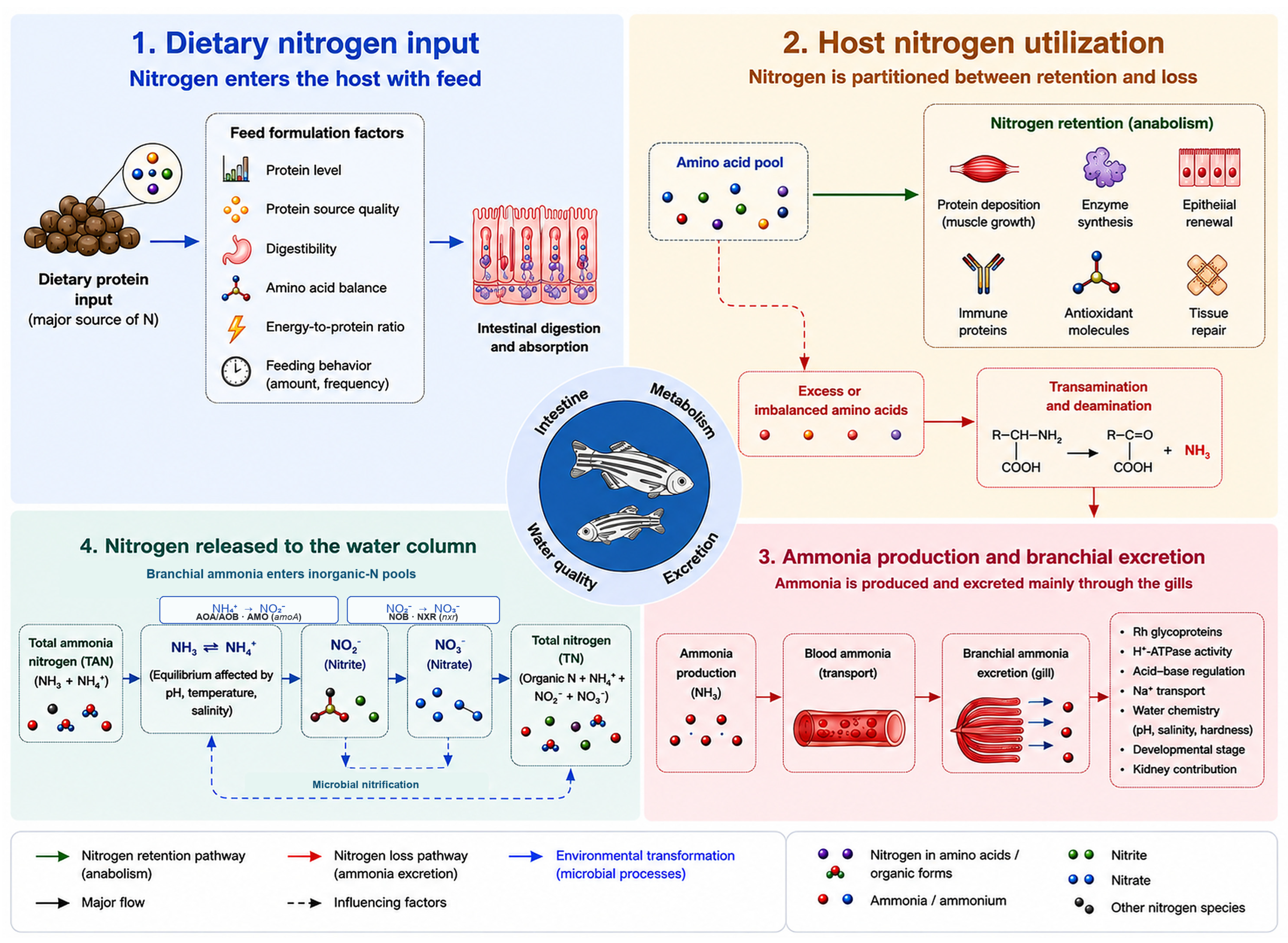
Branchial ammonia excretion is regulated by Rhesus (Rh) glycoproteins, acid–base transport, H+-ATPase activity, sodium transport, renal auxiliary excretion, developmental stage, and water physicochemistry conditions. These mechanisms have been described in fish ammonia physiology and experimental gill studies [12]. From the perspective of nitrogen flow, dietary nitrogen first enters the body through feeding, is then converted into available amino acids through digestion and absorption, and is subsequently allocated to different synthetic pathways according to the requirements for growth, immunity, and homeostatic maintenance. When nitrogen input is matched with the host utilization capacity, more nitrogen is retained in tissue proteins and functional proteins, and ammonia production is relatively reduced. Conversely, when protein intake exceeds retention capacity, or when stress, disease, and environmental challenges suppress anabolic metabolism, amino acid catabolism is enhanced and branchial ammonia excretion increases accordingly. Thus, branchial ammonia excretion represents a key link among dietary nitrogen input, host nitrogen utilization efficiency, and water ammonia nitrogen risk, providing an important theoretical basis for reducing nitrogen loading in intensive aquaculture through nutritional regulation. This host-centered pathway of ammonia nitrogen generation and excretion is summarized in Figure 1.
Figure 1.
Host-centered nitrogen flow from dietary protein to branchial ammonia excretion and microbial nitrification. Dietary nitrogen is partitioned between anabolic retention and amino acid catabolism. Catabolic ammonia is excreted mainly across the gills, enters the total ammonia nitrogen pool as NH3 and NH4+, and is transformed under oxic conditions by AOA, AOB, NOB, and comammox Nitrospira. Green arrows indicate retention, red arrows indicate ammonia production and excretion, blue arrows indicate microbial transformation, solid arrows indicate major flows, and dashed arrows indicate influencing processes.
4. Microbial Nitrogen Cycling in Aquaculture Water, Gut and Sediment
4.1. Ammonification and Nitrification
Once nitrogen leaves the host, microbial processes determine whether it is recycled, regenerated, retained, or removed. Heterotrophic bacteria and fungi depolymerize proteins and other organic nitrogen through extracellular proteases and peptidases; subsequent amino acid deamination releases NH4+. Under oxic conditions, nitrification converts NH4+ first to NO2− and then to NO3−. This can reduce acute ammonia exposure but creates oxidized nitrogen pools that require assimilation or further removal [8,33,34,35].
The first step of nitrification is mediated by archaea and bacteria that oxidize ammonia (AOA and AOB), which use ammonia monooxygenase (AMO, commonly tracked by amoA) and machinery for hydroxylamine oxidation. Bacteria that oxidize nitrite (NOB), including Nitrospira and Nitrobacter, use nitrite oxidoreductase (NXR, encoded by nxr genes) to convert NO2− to NO3−. Comammox Nitrospira can perform both steps. Gene abundance should be interpreted alongside measurements of nitrogen species, dissolved oxygen and substrate availability, and assays of process rates, because functional potential alone does not establish in situ activity [33,34,35,36,37].
Nitrification is often regarded as beneficial because it reduces ammonia accumulation, but it does not by itself remove nitrogen from the system. Instead, it transfers nitrogen from reduced to oxidized forms. If nitrate is not assimilated or converted to dinitrogen gas, nitrogen remains available for downstream recycling. Nitrogen management must therefore consider the entire transformation chain rather than TAN reduction alone.
4.2. Denitrification, DNRA, and Anammox
Denitrification, dissimilatory nitrate reduction to ammonium (DNRA), and anammox jointly determine the fate of NO3−, NO2−, and NH4+ in sediments and biofilms. Denitrification and anammox remove reactive nitrogen as N2, whereas DNRA retains nitrogen by regenerating NH4+.
Studies of freshwater aquaculture sediments, sea cage trout farms, and enriched lake sediments show that organic loading, redox status, electron donors, and trophic conditions regulate the balance between nitrogen retention and removal [38,39,40,41,42,43]. Sediment should therefore be treated as an active nitrogen reactor rather than an inert waste sink.
Under organic-rich and reducing conditions, disease-derived organic matter, fecal waste, and uneaten feed may favor ammonium regeneration. This possibility is relevant during disease outbreaks but remains insufficiently quantified in aquaculture infection models. The major microbial nitrogen transformations are summarized in Table 1.
Table 1.
Major microbial nitrogen transformation processes relevant to aquaculture nitrogen flow management.
4.3. Assimilation, Biofloc, and Engineered Nutrient Recovery
Microbes, algae, bioflocs, and extractive organisms can incorporate NH4+ and NO3− into biomass, redirecting dissolved inorganic nitrogen into recoverable or trophically useful forms. Biochar-assisted nitrifying bioflocs, nitrogen-removing strains, and biofloc particle size studies illustrate this potential [36,44,45], while microalgae, seaweeds, algal turf scrubbers, and IMTA provide additional recovery routes [37,46,47,48,49,50,51,52,53,54,55,56,57,58].
Assimilation is not equivalent to permanent removal. Microbial or algal biomass may be harvested, grazed, deposited in sediment, or remineralized; therefore, short-term nitrogen capture must be distinguished from long-term export. Likewise, gene abundance alone cannot establish process rates without nitrogen-species measurements, redox data, process assays, or isotope tracing.
Cross-study comparison is further constrained by production system and methodological heterogeneity. RAS and biofloc studies often quantify water column TAN and microbial genes under controlled conditions, whereas pond, sea cage, and IMTA studies incorporate sediment fluxes, spatial heterogeneity, or nutrient recovery. Freshwater and marine species also differ in ammonia transport, osmoregulation, feeding ecology, and microbiota. These differences, together with variable exposure durations and endpoints, limit direct extrapolation and can explain apparently inconsistent outcomes.
5. Pathogen Infection as a Disturbance to Host and Environmental Nitrogen Metabolism
5.1. Feed Intake, Nitrogen Retention, and Disease-Associated Nitrogen Loss
Pathogen infection may disturb nitrogen flow through reduced feed intake and altered nitrogen allocation. When feeding declines while maintenance, immune defense, and tissue repair demands rise, a smaller share of dietary nitrogen may be retained as biomass. However, most challenge studies do not measure residual feed, fecal nitrogen, water TAN, nitrogen retention, and pathogen load together [6].
At the farm scale, residual feed, mucus, epithelial shedding, fecal waste, and mortality may redirect nitrogen from host biomass toward microbial mineralization. This pathway remains plausible rather than demonstrated because direct measurements of infection-associated nitrogen redistribution are scarce.
5.2. Immune Metabolism and Amino Acid Reallocation During Infection
Omics studies across bacterial and viral infections show that pathogen challenge can alter arginine, glutamine, amino acid, lipid, and energy metabolism, as well as intestinal microbiota and oxidative responses [59,60,61,62,63,64,65,66]. These findings support metabolic reallocation during infection, but differences in species, pathogens, tissues, sampling times, and analytical platforms preclude a uniform quantitative estimate of nitrogen redistribution.
Amino acids serve both growth and defense, including immune mediators, antioxidant molecules, inflammatory responses, and tissue repair. Infection may therefore shift nitrogen from somatic growth toward defense and survival. Whether this shift consistently increases whole animal amino acid catabolism, reduces nitrogen retention, or elevates ammonia production remains to be tested with direct nitrogen flow measurements.
5.3. Mucosal Damage, Ammonia Excretion, and Organic Nitrogen Release
Gill and intestinal injury provide a potential bridge between infection, ammonia transport, barrier dysfunction, and nitrogen release. Viral gill diseases and bacterial infection alter branchial transporters, physiology, immunity, or bioenergetics, while denitrification genes may also contribute to Flavobacterium columnare virulence [67,68,69,70].
Because the gill is both an ammonia excretory organ and a mucosal barrier, infection-associated injury could impair ammonia transport and acid–base regulation. Yet, few studies jointly quantify pathogen load, Rh proteins, Na+/K+-ATPase, blood ammonia, excretion rate, and water TAN, so this mechanistic connection remains unresolved.
Disease outbreaks may also increase organic nitrogen inputs through mortality, necrotic tissue, mucus, epithelial shedding, residual feed, and fecal waste [39,41,71,72,73,74]. The full sequence from infection to organic nitrogen release, ammonification, DNRA and NH4+ regeneration has yet to be quantified within a single aquaculture model.
6. Interaction Between Ammonia and Pathogens: A Potential Feedback Loop Amplifying Health Risks
6.1. Ammonia Stress May Increase Pathogen Susceptibility
Ammonia stress may increase pathogen susceptibility by disrupting barrier integrity, oxidative balance, and immune homeostasis. In fish, ammonia exposure is associated with oxidative stress, inflammation, tissue injury, immune dysregulation, and behavioral alteration [11,75,76,77]. The gill and intestine are primary interfaces between the host and the aquatic environment; damage induced by ammonia to either tissue may weaken the first line of defense. Studies focused on the gills document physiological, biochemical, metabolic, inflammatory, and oxidative responses in juvenile fourfinger threadfin (Eleutheronema tetradactylum) and yellow catfish [76,77]. Ammonia exposure also impaired spleen and head kidney defenses in Wuchang bream (Megalobrama amblycephala) [78]. These findings establish ammonia as a physiological stressor, not merely a nitrogenous waste product or endpoint for water quality.
The capacity of ammonia to amplify risk may be more pronounced in combination with other stressors. Combined hypoxia and ammonia exposure exacerbated disturbances in glucose metabolism, oxidative stress, inflammation, and apoptosis in largemouth bass (Micropterus salmoides) [79]. Combined exposure to ammonia and infectious hematopoietic necrosis virus produced synergistic effects on immune function and intestinal health in rainbow trout [80]. These studies support biological interaction, but they do not demonstrate the complete feedback sequence proposed here.
6.2. Pathogen Infection May Aggravate Ammonia-Associated Stress
Pathogen infection may in turn aggravate ammonia-associated stress by disturbing feeding behavior, intestinal integrity, hepatic metabolism, nitrogen allocation, and branchial excretory function. During infection, nutrients and amino acids are increasingly redirected from growth toward immune defense, acute phase responses, tissue repair, and stress metabolism. This shift may reduce nitrogen utilization efficiency and increase amino acid catabolism, thereby enhancing endogenous ammonia production. At the same time, infection-induced anorexia, intestinal injury, and microbiota disturbance may alter the balance among dietary nitrogen input, nitrogen retention, fecal nitrogen release, and microbial nitrogen transformation.
The evidence is asymmetric. Ammonia exposure studies directly demonstrate oxidative, inflammatory, metabolic, and barrier injury, whereas evidence that infection changes ammonia excretion, organic nitrogen release, or sedimentary ammonium regeneration is largely indirect. Co-exposure studies support biological interaction [79,80,81], but they do not close the proposed feedback loop. Direct tests must measure feed intake, nitrogen retention, branchial transport, ammonia excretion, water TAN, microbial process rates, and pathogen outcomes in the same design.
6.3. Conceptual Loop Linking Nitrogen, Ammonia, and Pathogens
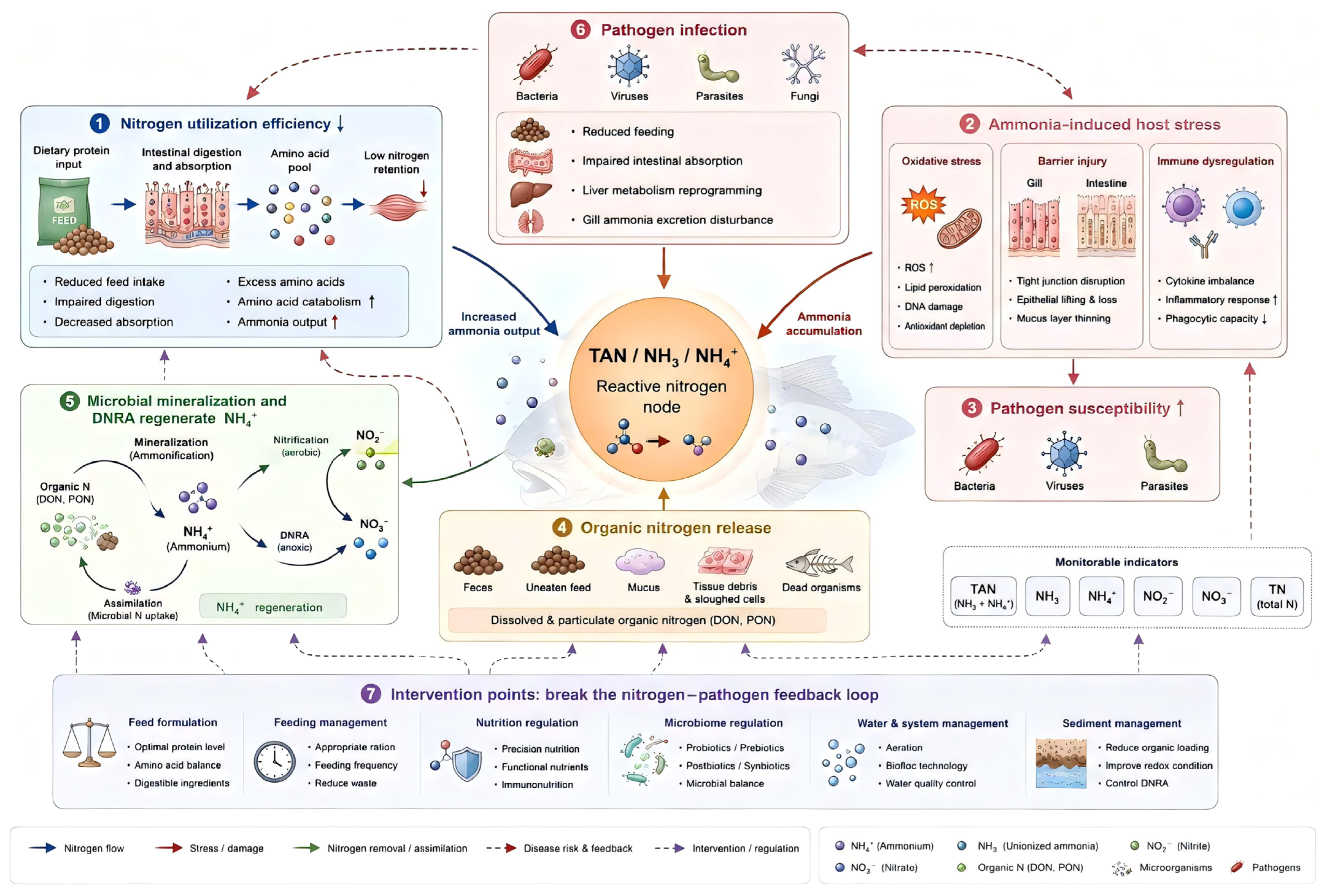
Based on the available evidence, the interaction between ammonia and pathogens can be conceptualized as a potential feedback loop linking nitrogen utilization, environmental ammonia accumulation, host stress responses, and disease risk (Figure 2). In this loop, low nitrogen utilization efficiency increases amino acid catabolism and ammonia production. Elevated ammonia emission then contributes to TAN accumulation in the culture environment, where the balance among mineralization, nitrification, assimilation, denitrification, sediment regeneration, and dissimilatory nitrate reduction to ammonium determines whether ammonia is removed, transformed, or regenerated. Once ammonia accumulates, it can induce oxidative stress, mucosal damage, inflammatory responses, and immune imbalance, thereby increasing pathogen susceptibility. Subsequent infection may further disrupt feeding, intestinal function, hepatic metabolism, microbiota structure, gill function, and organic nitrogen release, leading to further impairment of nitrogen homeostasis.
Figure 2.
Upward and downward arrows indicate increases and decreases, respectively. Evidence-based framework linking nitrogen utilization, ammonia-associated host stress, pathogen susceptibility, organic nitrogen release, microbial mineralization, and DNRA-mediated ammonium regeneration. Solid blue arrows indicate nitrogen flow, solid red arrows indicate stress or damage, solid green arrows indicate nitrogen removal or assimilation, dashed brown arrows indicate proposed disease feedback, and dashed purple arrows indicate intervention or regulation. Upward and downward arrows (↑ and ↓) indicate increases and decreases, respectively; arrowheads on connecting lines indicate the direction of flow or interaction. The lower panel identifies practical entry points in feed, nutrition, microbiome, water, and sediment management.
This feedback model remains conceptual because current studies have yet to demonstrate every causal step from feed nitrogen input to pathogen susceptibility and back to ammonia regeneration. Nevertheless, it is evidence-based and useful because it integrates processes that are usually studied separately. A rise in ammonia nitrogen may indicate excessive feed nitrogen input, poor nitrogen retention, enhanced tissue catabolism, organic matter mineralization, or an insufficient balance between nitrification and denitrification. At the same time, ammonia may damage host barriers and weaken disease resistance. Therefore, ammonia nitrogen should not be regarded merely as the endpoint of nitrogen metabolism. Instead, it represents a reactive node at which nutrition, physiology, microbiology, and pathology converge, and through which nitrogen imbalance may be amplified into broader health risks in intensive aquaculture systems. The evidence grade assigned to each major relationship in Figure 2 is summarized in Table 2, distinguishing directly measured relationships from indirect biological support and conceptual feedback connections.
Table 2.
Evidence grading across the proposed nitrogen and pathogen framework.
7. Nutritional Strategies for Regulating Nitrogen Flow and Breaking the Feedback
7.1. Precision Protein and Amino Acid Nutrition
Nutritional regulation should be evaluated by its capacity to reshape nitrogen flow rather than only by growth promotion. Precision protein nutrition aims to match digestible nitrogen supply with species, developmental stage, environment, health status, and production goals. Moderate protein reduction with essential amino acid supplementation, dietary lysine optimization, and tryptophan supplementation provide examples of strategies that can improve growth, metabolic status, digestibility, or nitrogen retention while avoiding unnecessary nitrogen input [20,21,22]. These approaches should be assessed using nitrogen intake, nitrogen retention, protein efficiency, ammonia excretion, and water TAN rather than growth alone.
7.2. Digestible Ingredients and Fermented Feeds
Improving protein digestibility and ingredient tolerance is another way to reduce nitrogen loss. Exogenous enzymes, processed soy ingredients, fermented soybean meal, fermented corn protein, fermentation with lactic acid bacteria, low-fishmeal fermented feeds, and other processed ingredients can improve digestibility, intestinal health, immunity, disease resilience, or feed utilization in selected systems [25,26,27,28,29,30,31]. Their effects should be interpreted cautiously because high replacement levels or unsuitable processing may induce intestinal inflammation or dysbiosis. A nitrogen flow-based evaluation should include fecal nitrogen, particulate nitrogen stability, dissolved nitrogen release, ammonia excretion, NO2−, NO3−, and total nitrogen.
7.3. Functional Feed Additives and Microecological Regulation
Functional nutrients and microbial modulators may preserve barrier integrity, stabilize the gut microbiota, improve immunometabolic coordination, and alleviate ammonia-related stress. N-carbamylglutamate increased ammonia tolerance in juvenile yellow catfish [82], and dietary β-glucan altered the gut microbiota and circulating metabolites while enhancing disease resistance in rainbow trout [83].
The observed effects depended on strain, dose, duration, and host species. For yellow catfish, dietary administration of Bacillus amyloliquefaciens at a concentration of 1 × 10⁶ colony-forming units (CFU) per gram of feed for four weeks led to improvements in growth performance, digestive enzyme activities, immune status, microbiota composition, and resistance to bacterial challenge [84]. Bacillus safensis NPUST1 at 106–107 CFU/g for 8 weeks improved growth, gut microbiota, innate immunity, and resistance to Streptococcus iniae in Nile tilapia [85]. Bacillus velezensis BV1704-Y at 1 × 10⁷ CFU/g for 28 days protected zebrafish (Danio rerio) against Aeromonas hydrophila [86]. Lactobacillus rhamnosus JCM1136 and Lactococcus lactis subsp. lactis JCM5805, administered individually or together at 1 × 10⁸ CFU/g for 6 weeks, altered growth, intestinal morphology, microbiota, immune responses, and resistance to Streptococcus agalactiae in Nile tilapia [87].
Not all additives improve every endpoint. In common carp, Saccharomyces cerevisiae, Pediococcus acidilactici, or a yeast cell wall prebiotic at 1 g/kg for 60 days altered intestinal morphology and microbiome composition but did not significantly improve growth performance [88]. Across the broader evidence base, probiotics, postbiotics, yeast-derived products, and strain-specific additives improved selected growth, digestibility, immune, disease, microbiota, or water quality outcomes [17,18,84,85,86,87,89,90,91,92,93,94,95,96,97,98,99,100,101,102,103,104,105]. These outcomes should not be interpreted as proof of reduced whole farm nitrogen discharge unless TAN, total nitrogen, sediment nitrogen, and complete nitrogen budgets are measured directly.
Broader candidates include polysaccharides, chitin, chitosan, chitooligosaccharides, probiotics, prebiotics, and synbiotics [106,107,108,109]. Germ-free and microbiota-oriented fish models can help distinguish direct nutritional effects from microbiota-mediated effects [110,111,112,113]. The evidence strength, practical readiness, and principal limitations of these strategies are summarized in Table 3.
Table 3.
Evidence strength, practical readiness, and principal limitations of nutritional and microecological nitrogen-management strategies.
7.4. Evaluation Indicators for Feedback Oriented Nutrition
A feedback-oriented nutritional strategy should be evaluated with both host and system indicators. Host indicators include feed intake, digestibility, nitrogen retention, whole body protein deposition, plasma ammonia, branchial transporter expression, antioxidant status, immune function, and pathogen resistance. System indicators include TAN, NH3, NH4+, NO2−, NO3−, total nitrogen, sludge nitrogen, sediment ammonium regeneration, nitrification and denitrification genes, and microbial community stability. Without this combined indicator set, a diet may appear beneficial for growth while still increasing downstream nitrogen instability.
7.5. Practical Implementation Under Commercial Conditions
Commercial implementation requires adapting integrated nitrogen management to the production system rather than applying a single prescription. Farms must coordinate feed formulation and feeding decisions with aeration, solids removal, biofilter capacity, carbon input, sediment management, and disease surveillance while accounting for rapid variation in stocking biomass, temperature, salinity, and microbial activity. Practical constraints include the cost and frequency of total ammonia nitrogen and nitrogen species monitoring, limited access to process rate measurements, uneven technical capacity across farms, and the need to avoid interventions that transfer nitrogen among pools without achieving removal. Stepwise adoption should therefore prioritize routine mass balance indicators, defined action thresholds, and locally validated combinations of nutritional, water, biofloc, and sediment management, followed by commercial scale trials that assess biological performance, nitrogen discharge, operational cost, and disease outcomes together.
8. Conclusions and Future Perspectives
This review reframes ammonia nitrogen as a reactive node that can be measured across feed input, host retention and excretion, microbial transformation, water quality, and disease risk. Evidence is strongest for dietary control of nitrogen retention, the toxicological effects of ammonia, and microbial conversion or removal of inorganic nitrogen. The new contribution is an evidence-graded framework that connects these established components while explicitly separating measured relationships from proposed pathogen-driven feedbacks.
The framework is not a validated universal model. Most component relationships were studied separately across species, production systems, exposure regimes, and analytical endpoints, and the structured narrative approach did not support a formal meta-analysis. Evidence remains indirect for the complete sequence from infection-driven metabolic reallocation to altered ammonia excretion, organic-nitrogen release, sedimentary ammonium regeneration, and renewed disease susceptibility.
Three experimental priorities would provide the most decisive tests. First, factorial diet × ammonia × pathogen studies should quantify full nitrogen budgets together with host and disease endpoints. Second, isotope tracing and process-rate measurements should link branchial and fecal nitrogen release to water and sediment microbial transformations. Third, longitudinal commercial-scale trials across RAS, ponds, biofloc, and IMTA should test whether promising interventions remain effective under variable stocking density, feed input, temperature, salinity, and microbial communities.
Until such studies are available, the reactive node concept should guide integrated measurement and hypothesis generation rather than be interpreted as a universal causal pathway. Its practical value lies in coordinating nutrition, water quality, microbial management, sediment processes, and disease surveillance around measurable nitrogen flows and explicitly defined evidence limits.
Author Contributions
Conceptualization, J.Y. and B.X.; investigation, J.Y. and G.C.; resources, B.X.; writing—original draft preparation, J.Y.; writing—review and editing, B.X., Y.S. and H.Y.; visualization, J.Y.; supervision, B.X.; project administration, Y.S.; funding acquisition, Y.S. and B.X. All authors have read and agreed to the published version of the manuscript.
Funding
This work was supported by the Special Fund Project for Promoting High-quality Development of Marine and Fishery Industry of Fujian Province (FJHYF-L-2025-19); the Postdoctoral Research Funding of Shandong University (1070524300002); and the Shandong Province Postdoctoral Innovation Project, SDCX-ZG-202502007.
Data Availability Statement
No data were created for this manuscript.
Acknowledgments
We would like to express our gratitude to all the individuals who aided in the completion of this review article.
Conflicts of Interest
The authors declare no conflicts of interest.
References
- Oliva-Teles, A. Nutrition and Health of Aquaculture Fish. J. Fish Dis. 2012, 35, 83–108. [Google Scholar] [CrossRef] [Scilit] [PubMed]
- Bostock, J.; McAndrew, B.; Richards, R.; Jauncey, K.; Telfer, T.; Lorenzen, K.; Little, D.; Ross, L.; Handisyde, N.; Gatward, I.; et al. Aquaculture: Global Status and Trends. Philos. Trans. R. Soc. Lond. B Biol. Sci. 2010, 365, 2897–2912. [Google Scholar] [CrossRef] [Scilit] [PubMed]
- Wang, A.; Ran, C.; Wang, Y.; Zhang, Z.; Ding, Q.; Yang, Y.; Olsen, R.E.; Ringø, E.; Bindelle, J.; Zhou, Z. Use of Probiotics in Aquaculture of China-A Review of the Past Decade. Fish Shellfish Immunol. 2019, 86, 734–755. [Google Scholar] [CrossRef] [Scilit] [PubMed]
- Mes, W.; Kersten, P.; Maas, R.M.; Eding, E.H.; Jetten, M.S.M.; Siepel, H.; Lücker, S.; Gorissen, M.; Van Kessel, M.A.H.J. Effects of Demand-Feeding and Dietary Protein Level on Nitrogen Metabolism and Symbiont Dinitrogen Gas Production of Common Carp (Cyprinus carpio L.). Front. Physiol. 2023, 14, 1111404. [Google Scholar] [CrossRef] [Scilit] [PubMed]
- Brunty, J.L.; Bucklin, R.A.; Davis, J.; Baird, C.D.; Nordstedt, R.A. The Influence of Feed Protein Intake on Tilapia Ammonia Production. Aquac. Eng. 1997, 16, 161–166. [Google Scholar] [CrossRef] [Scilit]
- Montoya, R.A.; Lawrence, A.L.; Grant, W.E.; Velaso, M. Simulation of Nitrogen Dynamics and Shrimp Growth in an Intensive Shrimp Culture System: Effects of Feed and Feeding Parameters. Ecol. Model. 1999, 122, 81–95. [Google Scholar] [CrossRef] [Scilit]
- Blatt, T.L.; Cardoso, A.J.; Watanabe, A.L.; Neto, C.C.; Hisano, H. Environmental Sustainability of Nile Tilapia Reared in Biofloc Technology (BFT) System: Evaluation of Carbon, Nitrogen, and Phosphorus Dynamics and Indicators of Sustainability. Sustainability 2025, 17, 5670. [Google Scholar] [CrossRef] [Scilit]
- Chen, N.; Wang, L.; Zhao, Z.; Zhu, M.; Li, Y. Impacts of Aquaculture on Nitrogen Cycling and Microbial Community Dynamics in Coastal Tidal Flats. Environ. Res. 2025, 270, 120973. [Google Scholar] [CrossRef] [Scilit] [PubMed]
- Mes, W.; Lücker, S.; Jetten, M.S.M.; Siepel, H.; Gorissen, M.; van Kessel, M.A.H.J. Gill-Associated Ammonia Oxidizers Are Widespread in Teleost Fish. Microbiol. Spectr. 2024, 12, e00295-24. [Google Scholar] [CrossRef] [Scilit] [PubMed]
- Edwards, T.M.; Puglis, H.J.; Kent, D.B.; Durán, J.L.; Bradshaw, L.M.; Farag, A.M. Ammonia and Aquatic Ecosystems: A Review of Global Sources, Biogeochemical Cycling, and Effects on Fish. Sci. Total Environ. 2024, 907, 167911. [Google Scholar] [CrossRef] [Scilit] [PubMed]
- Xu, Z.; Cao, J.; Qin, X.; Qiu, W.; Mei, J.; Xie, J. Toxic Effects on Bioaccumulation, Hematological Parameters, Oxidative Stress, Immune Responses and Tissue Structure in Fish Exposed to Ammonia Nitrogen: A Review. Animals 2021, 11, 3304. [Google Scholar] [CrossRef] [Scilit] [PubMed]
- Ip, Y.K.; Chew, S.F. Ammonia Production, Excretion, Toxicity, and Defense in Fish: A Review. Front. Physiol. 2010, 1, 134. [Google Scholar] [CrossRef] [Scilit] [PubMed]
- Zhang, L.; Xu, E.G.; Li, Y.; Liu, H.; Vidal-Dorsch, D.E.; Giesy, J.P. Ecological Risks Posed by Ammonia Nitrogen (AN) and Un-Ionized Ammonia(NH3) in Seven Major River Systems of China. Chemosphere 2018, 202, 136–144. [Google Scholar] [CrossRef] [Scilit] [PubMed]
- Pannard, A.; Souchu, P.; Chauvin, C.; Delabuis, M.; Gascuel-Odoux, C.; Jeppesen, E.; Le Moal, M.; Ménesguen, A.; Pinay, G.; Rabalais, N.N.; et al. Why Are There so Many Definitions of Eutrophication? Ecol. Monogr. 2024, 94, e1616. [Google Scholar] [CrossRef] [Scilit]
- Wurtsbaugh, W.A.; Paerl, H.W.; Dodds, W.K. Nutrients, Eutrophication and Harmful Algal Blooms along the Freshwater to Marine Continuum. WIREs Water 2019, 6, e1373. [Google Scholar] [CrossRef] [Scilit]
- Omoregie, A.I.; Silini, M.O.E.; Wong, L.S.; Rajasekar, A. Nitrogen Eutrophication in Chinese Aquatic Ecosystems: Drivers, Impacts, and Mitigation Strategies. Nitrogen 2025, 6, 92. [Google Scholar] [CrossRef] [Scilit]
- Nguyen Thi Truc, L.; Nguyen Thanh, T.; Tran Thi Hong, T.; Pham Van, D.; Tran Thi Tuyet, M.V.; Nguyen Duc Trong, N.; Mai Phuoc, C.; Dao Chau, N.; Pham Tan, Q. Effects of Feed Mixed with Lactic Acid Bacteria and Carbon, Nitrogen, Phosphorus Supplied to the Water on the Growth and Survival Rate of White Leg Shrimp Infected with Acute Hepatopancreatic Necrosis Disease. Biology 2021, 10, 280. [Google Scholar] [CrossRef] [Scilit] [PubMed]
- Mohammed, E.A.H.; Ahmed, A.E.M.; Kovács, B.; Pál, K. The Significance of Probiotics in Aquaculture: A Review of Research Trend and Latest Scientific Findings. Antibiotics 2025, 14, 242. [Google Scholar] [CrossRef] [Scilit] [PubMed]
- Qin, Q.; Cao, X.-F.; Dai, Y.-J.; Wang, L.-N.; Zhang, D.-D.; Jiang, G.-Z.; Liu, W.-B. Effects of Dietary Protein Levels on Growth, Digestive Enzyme Activities, Nitrogen Retention and TOR Signaling in Yellow Catfish. Fish Physiol. Biochem. 2019, 45, 1747–1757. [Google Scholar] [CrossRef] [Scilit] [PubMed]
- Novodworski, J.; Matos, É.J.A.; Gonçalves, R.M.; Bombardelli, R.A.; Meurer, F. Protein Level Reduction in Corn and Soybean Meal-Based Diets Supplemented with Essential Amino Acids During the Fattening Phase of Nile Tilapia. Ann. Anim. Sci. 2025, 25, 1565–1574. [Google Scholar] [CrossRef] [Scilit]
- Khalil, H.S.; Momoh, T.; Al-Kenawy, D.; Yossa, R.; Badreldin, A.M.; Roem, A.; Schrama, J.; Verdegem, M. Nitrogen Retention, Nutrient Digestibility and Growth Efficiency of Nile Tilapia (Oreochromis niloticus) Fed Dietary Lysine and Reared in Fertilized Ponds. Aquac. Nutr. 2021, 27, 2320–2332. [Google Scholar] [CrossRef] [Scilit]
- Chuphal, N.; Sardar, P.; Sahu, N.P.; Malik, M.A.; Shamna, N.; Varghese, T.; Krishnan, S.; Mohanta, K.N.; Bhuvaneshwaran, T.; Nirala, S.K. Feeding of Inland Ground Saline Water (IGSW) Reared GIFT Juveniles with Graded Levels of Dietary Tryptophan: Effects on Growth Performance, Physio-Biochemical Status, Metabolic Responses, and Expressions of IGF-1 and IGF-1R Genes. Anim. Feed Sci. Technol. 2025, 330, 116535. [Google Scholar] [CrossRef] [Scilit]
- Nuche-Pascual, M.T.; Lazo, J.P.; Ruiz-Cooley, R.I.; Herzka, S.Z. Amino Acid-Specific δ15N Trophic Enrichment Factors in Fish Fed with Formulated Diets Varying in Protein Quantity and Quality. Ecol. Evol. 2018, 8, 9192–9217. [Google Scholar] [CrossRef] [Scilit] [PubMed]
- Prakash, S.; Maas, R.M.; Yani, A.; Kokou, F.; Sæle, Ø.; Prabhu Philip, A.J.; Schrama, J.W. Nutrient Digestibility and Faecal Characteristics in Rainbow Trout, Oncorhynchus mykiss Reared at Different Salinities and Fed Diets with Varying Protein to Energy Ratios. Aquaculture 2025, 606, 742621. [Google Scholar] [CrossRef] [Scilit]
- Ai, Q.; Mai, K.; Zhang, W.; Xu, W.; Tan, B.; Zhang, C.; Li, H. Effects of Exogenous Enzymes (Phytase, Non-Starch Polysaccharide Enzyme) in Diets on Growth, Feed Utilization, Nitrogen and Phosphorus Excretion of Japanese Seabass, Lateolabrax japonicus. Comp. Biochem. Physiol. A Mol. Integr. Physiol. 2007, 147, 502–508. [Google Scholar] [CrossRef] [Scilit] [PubMed]
- Semla, J.L.; Butts, I.A.E.; Davis, D.A.; Oladipupo, A.A.; LaFrentz, B.R.; Bruce, T.J. Evaluation of Processed Soy Ingredients for Largemouth Bass (Micropterus nigricans) Fingerlings on Growth Performance, Intestinal Health, and Disease Susceptibility. Anim. Feed Sci. Technol. 2025, 327, 116432. [Google Scholar] [CrossRef] [Scilit]
- Wang, P.; Wang, S.; Zhu, C.; Sun, Y.; Yan, Q.; Yi, G. Monascus purpureus M-32 Fermented Soybean Meal Improves Growth Performance, Immunity, Intestinal Morphology, Disease Resistance, Intestinal Microbiota and Metabolome of Pacific White Shrimp (Litopenaeus vannamei). Anim. Nutr. 2024, 17, 283–296. [Google Scholar] [CrossRef] [Scilit] [PubMed]
- Kuo, Y.C.; Quan Tran, H.T.; Ho, T.H.; Bharadwaj, A.; Chu, Y.T.; Chen, T.Y.; Nan, F.H.; Lee, P.T. Effects of dietary corn-fermented protein as a sustainable ingredient on growth performance, immune response, and disease resilience in whiteleg shrimp (Litopenaeus vannamei). Fish Shellfish Immunol. 2026, 174, 111340. [Google Scholar] [CrossRef] [Scilit] [PubMed]
- Alberto Arbelaez Rojas, G.; Neves Oliveira dos Santos, N.; Stockhausen, L.; Pacheco Kozikowski, B.; Bender, M.; Delzivo, F.R.; Cipriani, L.A.; Skoronski, E.; Toledo, P.; Araneda, G.M.; et al. Improving Rainbow Trout(oncorhynchus mykiss) Juvenile Performance and Intestinal Condition through Lactic Acid Bacteria Feed Fermentation. Animals 2026, 16, 1482. [Google Scholar] [CrossRef] [Scilit] [PubMed]
- Cheng, Y.; Fan, L.; Liu, Y.; Su, K.; Xu, G. Integrated Commercial and Low-Fishmeal Fermented Feed Boosts Survival and Modulates Intestinal Microbiota in Pacific White Shrimp (Litopenaeus vannamei). Anim. Nutr. 2025, 22, 98–112. [Google Scholar] [CrossRef] [Scilit] [PubMed]
- Pang, A.; Peng, C.; Xie, R.; Wang, Z.; Tan, B.; Wang, T.; Zhang, W. Effects of Fermented Soybean Meal Substitution for Fish Meal on Intestinal Flora and Intestinal Health in Pearl Gentian Grouper. Front. Physiol. 2023, 14, 1194071. [Google Scholar] [CrossRef] [Scilit] [PubMed]
- García-Pérez, O.D.; Sanchez-Casas, R.M.; Moreno-Degollado, G.; Munguía, C.A.G.; Villarreal-Cavazos, D.A.; Gamboa-Delgado, J. Substitution of Fish Meal with Madagascar Cockroach (Gromphadorhina portentosa) Meal in Diets for Juvenile Nile Tilapia (Oreochromis niloticus): Effects on Growth, Nutrient Assimilation, and Nitrogen Turnover Rates. Fish Physiol. Biochem. 2022, 48, 1587–1597. [Google Scholar] [CrossRef] [Scilit] [PubMed]
- Older, C.E.; Griffin, M.J.; Ware, C.; Ott, B.D. Development of qPCR Assays for Bacterial Nitrification and Denitrification Genes in Catfish Aquaculture Ponds. Microbiol. Spectr. 2025, 13, e03088-24. [Google Scholar] [CrossRef] [Scilit] [PubMed]
- Wang, C.; Ju, J.; Zhang, H.; Liu, P.; Song, Z.; Hu, X.; Zheng, Q. Exploring the Variation of Bacterial Community and Nitrogen Transformation Functional Genes under Heavy Metal Pressure in Coastal Mariculture Patterns. J. Environ. Manag. 2022, 324, 116365. [Google Scholar] [CrossRef] [Scilit] [PubMed]
- Chunyi, K.; Wei, S.; Mingken, W.; Chunyu, X.; Changxiu, L. Diversity, community structure, and abundance of nirS-type denitrifying bacteria on suspended particulate matter in coastal high-altitude aquaculture pond water. Sci. Rep. 2024, 14, 5594. [Google Scholar] [CrossRef] [Scilit] [PubMed]
- Xu, W.; Zhang, D.; Su, H.; Xu, Y.; Hu, X.; Wen, G.; Cao, Y. Impact of Biochar Addition on Biofloc Nitrifying Bacteria and Inorganic Nitrogen Dynamics in an Intensive Aquaculture System of Shrimp. Microorganisms 2024, 12, 2581. [Google Scholar] [CrossRef] [Scilit] [PubMed] [PubMed Central]
- Mang, Q.; Gao, J.; Li, Q.; Sun, Y.; Xu, G.; Xu, P. Metagenomic Insight into the Effect of Probiotics on Nitrogen Cycle in the Coilia nasus Aquaculture Pond Water. Microorganisms 2024, 12, 627. [Google Scholar] [CrossRef] [Scilit] [PubMed]
- She, Y.; Qi, X.; Xin, X.; He, Y.; Wang, W.; Li, Z. Insights into microbial interactive mechanism regulating dissimilatory nitrate reduction processes in riparian freshwater aquaculture sediments. Environ. Res. 2023, 216, 114593. [Google Scholar] [CrossRef] [Scilit] [PubMed]
- Christensen, P.; Rysgaard, S.; Sloth, N.; Dalsgaard, T.; Schwærter, S. Sediment Mineralization, Nutrient Fluxes, Denitrification and Dissimilatory Nitrate Reduction to Ammonium in an Estuarine Fjord with Sea Cage Trout Farms. Aquat. Microb. Ecol. 2000, 21, 73–84. [Google Scholar] [CrossRef] [Scilit]
- Li, S.; Liao, Y.; Pang, Y.; Dong, X.; Strous, M.; Ji, G. Denitrification and dissimilatory nitrate reduction to ammonia in long-term lake sediment microcosms with iron(II). Sci. Total Environ. 2022, 807, 150835. [Google Scholar] [CrossRef] [Scilit] [PubMed]
- Yuan, H.; Cai, Y.; Wang, H.; Liu, E.; Zeng, Q. Impact of seasonal change on dissimilatory nitrate reduction to ammonium (DNRA) triggering the retention of nitrogen in lake. J. Environ. Manag. 2023, 341, 118050. [Google Scholar] [CrossRef] [Scilit] [PubMed]
- Zhang, D.; Li, M.; Yang, Y.; Yu, H.; Xiao, F.; Mao, C.; Huang, J.; Yu, Y.; Wang, Y.; Wu, B.; et al. Nitrite and Nitrate Reduction Drive Sediment Microbial Nitrogen Cycling in a Eutrophic Lake. Water Res. 2022, 220, 118637. [Google Scholar] [CrossRef] [Scilit] [PubMed]
- Jiang, X.; Liu, C.; Cai, J.; Hu, Y.; Shao, K.; Tang, X.; Gong, Y.; Yao, X.; Xu, Q.; Gao, G. Relationships between Environmental Factors and N-Cycling Microbes Reveal the Indirect Effect of Further Eutrophication on Denitrification and DNRA in Shallow Lakes. Water Res. 2023, 245, 120572. [Google Scholar] [CrossRef] [Scilit] [PubMed]
- Xie, M.; Liu, Y.; Wen, C.; Zhong, J.; Pang, H.; Cai, J.; Lu, Y.; Jian, J.; Huang, Y. Highly Efficient Nitrogen Removal by Stutzerimonas stutzeri Strain MJ20: Metabolic Pathways and Potential for Biofloc Systems and Low C/N Ratio Aquaculture Wastewater. Microorganisms 2026, 14, 975. [Google Scholar] [CrossRef] [Scilit] [PubMed]
- Ekasari, J.; Angela, D.; Waluyo, S.H.; Bachtiar, T.; Surawidjaja, E.H.; Bossier, P.; De Schryver, P. The Size of Biofloc Determines the Nutritional Composition and the Nitrogen Recovery by Aquaculture Animals. Aquaculture 2014, 426, 105–111. [Google Scholar] [CrossRef] [Scilit]
- Li, K.; Liu, Q.; Fang, F.; Luo, R.; Lu, Q.; Zhou, W.; Huo, S.; Cheng, P.; Liu, J.; Addy, M.; et al. Microalgae-based wastewater treatment for nutrients recovery: A review. Bioresour. Technol. 2019, 291, 121934. [Google Scholar] [CrossRef] [Scilit] [PubMed]
- Mohsenpour, S.F.; Hennige, S.; Willoughby, N.; Adeloye, A.; Gutierrez, T. Integrating Micro-Algae into Wastewater Treatment: A Review. Sci. Total Environ. 2021, 752, 142168. [Google Scholar] [CrossRef] [Scilit] [PubMed]
- Abdelfattah, A.; Ali, S.S.; Ramadan, H.; El-Aswar, E.I.; Eltawab, R.; Ho, S.H.; Elsamahy, T.; Li, S.; El-Sheekh, M.M.; Schagerl, M.; et al. Microalgae-based wastewater treatment: Mechanisms, challenges, recent advances, and future prospects. Environ. Sci. Ecotechnol. 2022, 13, 100205. [Google Scholar] [CrossRef] [Scilit] [PubMed] [PubMed Central]
- Kim, J.K.; Kraemer, G.P.; Yarish, C. Field Scale Evaluation of Seaweed Aquaculture as a Nutrient Bioextraction Strategy in Long Island Sound and the Bronx River Estuary. Aquaculture 2014, 433, 148–156. [Google Scholar] [CrossRef] [Scilit]
- Kim, J.; Kraemer, G.; Yarish, C. Use of Sugar Kelp Aquaculture in Long Island Sound and the Bronx River Estuary for Nutrient Extraction. Mar. Ecol. Prog. Ser. 2015, 531, 155–166. [Google Scholar] [CrossRef] [Scilit]
- Ray, N.E.; Terlizzi, D.E.; Kangas, P.C. Nitrogen and Phosphorus Removal by the Algal Turf Scrubber at an Oyster Aquaculture Facility. Ecol. Eng. 2015, 78, 27–32. [Google Scholar] [CrossRef] [Scilit]
- Biswas, G.; Kumar, P.; Ghoshal, T.K.; Kailasam, M.; De, D.; Bera, A.; Mandal, B.; Sukumaran, K.; Vijayan, K.K. Integrated multi-trophic aquaculture (IMTA) outperforms conventional polyculture with respect to environmental remediation, productivity and economic return in brackishwater ponds. Aquaculture 2020, 516, 734626. [Google Scholar] [CrossRef] [Scilit]
- Zhu, Y.; Wang, N.; Wu, Z.; Chen, S.; Luo, J.; Christakos, G.; Wu, J. The Role of Seaweed Cultivation in Integrated Multi-Trophic Aquaculture (IMTA): The Current Status and Challenges. Rev. Aquac. 2021, 17, e70042. [Google Scholar]
- Abreu, M.H.; Pereira, R.; Yarish, C.; Buschmann, A.H.; Sousa-Pinto, I. IMTA with Gracilaria vermiculophylla: Productivity and Nutrient Removal Performance of the Seaweed in a Land-Based Pilot Scale System. Aquaculture 2011, 312, 77–87. [Google Scholar] [CrossRef] [Scilit]
- Samocha, T.M.; Fricker, J.; Ali, A.M.; Shpigel, M.; Neori, A. Growth and Nutrient Uptake of the Macroalga Gracilaria tikvahiae Cultured with the Shrimp Litopenaeus vannamei in an Integrated Multi-Trophic Aquaculture (IMTA) System. Aquaculture 2015, 446, 263–271. [Google Scholar] [CrossRef] [Scilit]
- Batır, E.; Metin, Ö.; Yıldız, M.; Özel, O.T.; Fidan, D. Sustainable Land-Based IMTA: Holistic Management of Finfish, Mussel, and Macroalgae Interactions, Emphasizing Water Quality and Nutrient Dynamics. J. Environ. Manag. 2024, 372, 123286. [Google Scholar] [CrossRef] [Scilit] [PubMed]
- Wang, B.; Lan, C.Q. Biomass Production and Nitrogen and Phosphorus Removal by the Green Alga Neochloris oleoabundans in Simulated Wastewater and Secondary Municipal Wastewater Effluent. Bioresour. Technol. 2011, 102, 5639–5644. [Google Scholar] [CrossRef] [Scilit] [PubMed]
- Li, X.; Luo, G.; Tan, Z.; Liu, J.; Zhou, L.; Ma, L.; Yang, S.; Wang, L.; Wang, J.; Chen, Y. Growth characteristics of acclimated strain of Chlorella vulgaris under high concentrations of ammonia nitrogen and phosphorus. Int. J. Environ. Sci. Technol. 2022, 19, 10131–10142. [Google Scholar] [CrossRef] [Scilit]
- Dong, F.; Sun, Y.L.; Qian, Y.X.; Chen, Q.; He, J.L.; Wang, J.T.; Han, T.; Zhang, X.M.; Deng, Y.T. Integrated analysis of transcriptome and metabolome reveals the regulatory mechanism of largemouth bass (Micropterus salmoides) in response to Nocardia seriolae infection. Fish Shellfish Immunol. 2024, 145, 109322. [Google Scholar] [CrossRef] [Scilit] [PubMed]
- Zhang, L.; Wang, L.; Huang, J.; Jin, Z.; Guan, J.; Yu, H.; Zhang, M.; Yu, M.; Jiang, H.; Qiao, Z. Effects of Aeromonas hydrophila infection on the intestinal microbiota, transcriptome, and metabolomic of common carp (Cyprinus carpio). Fish Shellfish Immunol. 2023, 139, 108876. [Google Scholar] [CrossRef] [Scilit] [PubMed]
- Chen, F.; Ouyang, X.; Liao, Z.; Huang, T.; Tong, G.; Tan, H.; Zhou, M.; Lu, X.; Wei, X.; Yang, X.; et al. Comprehensive transcriptomic, proteomic, and intestinal microbiota analyses of largemouth bass (Micropterus salmoides) intestines reveal new insights into immune responses to Aeromonas hydrophila infection. Fish Shellfish Immunol. 2025, 156, 110057. [Google Scholar] [CrossRef] [Scilit] [PubMed]
- Xiong, N.X.; Mao, Z.W.; Ou, J.; Fan, L.F.; Chen, Y.; Luo, S.W.; Luo, K.K.; Wen, M.; Wang, S.; Hu, F.Z.; et al. Metabolite features and oxidative response in kidney of red crucian carp (Carassius auratus red var) after Aeromonas hydrophila challenge. Comp. Biochem. Physiol. C Toxicol. Pharmacol. 2022, 255, 109293. [Google Scholar] [CrossRef] [Scilit] [PubMed]
- Fu, X.; Guo, X.; Wu, S.; Lin, Q.; Liu, L.; Liang, H.; Niu, Y.; Li, N. Non-Targeted UHPLC-Q-TOF/MS-Based Metabolomics Reveals a Metabolic Shift from Glucose to Glutamine in CPB Cells during ISKNV Infection Cycle. Metabolites 2019, 9, 174. [Google Scholar] [CrossRef] [Scilit] [PubMed]
- Jaree, P.; Boonchuen, P.; Thawonsuwan, J.; Kondo, H.; Hirono, I.; Somboonwiwat, K. Transcriptome Profiling Reveals the Novel Immunometabolism-Related Genes against WSSV Infection from Fenneropenaeus merguiensis. Fish Shellfish Immunol. 2022, 120, 31–44. [Google Scholar] [CrossRef] [Scilit] [PubMed]
- Shen, W.; Zhao, S.; Lyu, S.; Zhang, M.; Guo, Q.; Lou, B.; Ma, W.; Zhan, J.; Liu, L.; Li, L. Integrating transcriptomics and metabolomics revealed pathogenic mechanism of Chinese soft-shell turtle (Trionyx sinensis) infected with Trionyx sinensis hemorrhagic syndrome virus (TSHSV). Dev. Comp. Immunol. 2025, 166, 105373. [Google Scholar] [CrossRef] [Scilit] [PubMed]
- Yuan, J.; Yu, Y.; Li, S.; Zhang, X.; Zhang, C.; Li, R.; Hu, J.; Si, S.; Zhang, C.; Xiang, J.; et al. Shrimp Shapes a Resistance Trait against Vibriosis by Memorizing the Colonization Resistance of Intestinal Microbiota. PLoS Pathog. 2024, 20, e1012321. [Google Scholar] [CrossRef] [Scilit] [PubMed]
- Zawisza, M.; Abdullah, M.; Marcinkowska, M.; Matras, M.; Rakus, K.; Adamek, M. Modulation of Sodium and Ammonia Transporters in the Context of Viral Gill Diseases in Common Carp (Cyprinus carpio). J. Fish Dis. 2025, 48, e14133. [Google Scholar] [CrossRef] [Scilit] [PubMed]
- Adamek, M.; Teitge, F.; Baumann, I.; Jung-Schroers, V.; El Rahman, S.A.; Paley, R.; Piackova, V.; Gela, D.; Kocour, M.; Rakers, S.; et al. Koi sleepy disease as a pathophysiological and immunological consequence of a branchial infection of common carp with carp edema virus. Virulence 2021, 12, 1855–1883. [Google Scholar] [CrossRef] [Scilit] [PubMed] [PubMed Central]
- Baldissera, M.D.; Souza, C.F.; Dias, J.B.; Da Silva, T.O.; Tavares, G.C.; Valladão, G.M.R.; da Silva, A.S.; Verdi, C.M.; Santos, R.C.V.; Vencato, M.; et al. Branchial bioenergetics dysfunction as a relevant pathophysiological mechanism in freshwater silver catfish (Rhamdia quelen) experimentally infected with Flavobacterium columnare. Microb. Pathog. 2020, 138, 103817. [Google Scholar] [CrossRef] [Scilit] [PubMed]
- Abdelhamed, H.; Nho, S.W.; Karsi, A.; Lawrence, M.L. The role of denitrification genes in anaerobic growth and virulence of Flavobacterium columnare. J. Appl. Microbiol. 2021, 130, 1062–1074. [Google Scholar] [CrossRef] [Scilit] [PubMed] [PubMed Central]
- Zhou, R.; Wang, Y.; Hilal, M.G.; Yu, Q.; Feng, T.; Li, H. Temporal Succession of Water Microbiomes and Resistomes during Carcass Decomposition in a Fish Model. J. Hazard. Mater. 2021, 403, 123795. [Google Scholar] [CrossRef] [Scilit] [PubMed]
- Schoenebeck, C.W.; Brown, M.L.; Chippss, S.R.; German, D.R. Nutrient and Algal Responses to Winterkilled Fish-Derived Nutrient Subsidies in Eutrophic Lakes. Lake Reserv. Manag. 2012, 28, 189–199. [Google Scholar] [CrossRef] [Scilit]
- Benbow, M.E.; Receveur, J.P.; Lamberti, G.A. Death and Decomposition in Aquatic Ecosystems. Front. Ecol. Evol. 2020, 8, 17. [Google Scholar] [CrossRef] [Scilit]
- Syropoulou, E.; Sipkema, D.; Smit, S.E.; Schrama, J.W.; Kokou, F. Aquaculture faecal waste generates different products during anaerobic digestion depending on nutrient composition. J. Environ. Manag. 2024, 370, 122826. [Google Scholar] [CrossRef] [Scilit] [PubMed]
- Xu, W.; Yu, J.; Xiao, Y.; Wang, G.; Li, X.; Li, D. A new quantitative analysis method for the fish behavior under ammonia nitrogen stress based on pruning strategy. Aquaculture 2025, 600, 742192. [Google Scholar] [CrossRef] [Scilit]
- Jin, J.-H.; Amenyogbe, E.; Yang, Y.; Wang, Z.-L.; Lu, Y.; Xie, R.-T.; Droepenu, E.K.; Huang, J.-S. Effects of Ammonia Nitrogen Stress on Physiological, Biochemical and Metabolic Levels of Gill Tissue in Juvenile Fourfinger Threadfin (Eleutheronema tetradactylum). Aquat. Toxicol. 2024, 274, 107049. [Google Scholar] [CrossRef] [Scilit] [PubMed]
- Xiao, L.; Chen, C.; Liang, Y.; Wu, K.; Wen, X. Ammonia-nitrogen stress affects immune regulation via TNFα in yellow catfish (Pelteobagrus fulvidraco). Aquaculture 2024, 583, 740593. [Google Scholar] [CrossRef] [Scilit]
- Guo, H.; Chen, S.; Ouyang, K.; Kuang, Y.; Yang, H.; Wang, Y.; Tang, R.; Zhang, X.; Li, D.; Li, L. Evaluation of Ammonia Nitrogen Exposure in Immune Defenses Present on Spleen and Head-Kidney of Wuchang Bream (Megalobrama amblycephala). Int. J. Mol. Sci. 2022, 23, 3129. [Google Scholar] [CrossRef] [Scilit] [PubMed]
- Zhao, L.; Cui, C.; Liu, Q.; Sun, J.; He, K.; Adam, A.A.; Luo, J.; Li, Z.; Wang, Y.; Yang, S. Combined Exposure to Hypoxia and Ammonia Aggravated Biological Effects on Glucose Metabolism, Oxidative Stress, Inflammation and Apoptosis in Largemouth Bass (Micropterus salmoides). Aquat. Toxicol. 2020, 224, 105514. [Google Scholar] [CrossRef] [Scilit] [PubMed]
- Wang, J.; Shan, C.; Wang, B.; Liu, X.; Hai, Q.; Liu, Z.; Kang, Y.; Li, J. The synergistic toxic effects of ammonia nitrogen and IHNV co-stress on the immune and intestinal health of rainbow trout. Fish Shellfish Immunol. 2026, 175, 111418. [Google Scholar] [CrossRef] [Scilit] [PubMed]
- Zhou, K.; Zhou, F.; Huang, J.; Yang, Q.; Jiang, S.; Qiu, L.; Yang, L.; Zhu, C.; Jiang, S. Characterization and expression analysis of a chitinase gene (PmChi-4) from black tiger shrimp (Penaeus monodon) under pathogen infection and ambient ammonia nitrogen stress. Fish Shellfish Immunol. 2017, 62, 31–40. [Google Scholar] [CrossRef] [Scilit] [PubMed]
- Feng, D.; Yang, Z.; Li, M. Dietary N-carbamylglutamate supplementation improves ammonia tolerance of juvenile yellow catfish Pelteobagrus fulvidraco. Front. Physiol. 2023, 14, 1191468. [Google Scholar] [CrossRef] [Scilit] [PubMed] [PubMed Central]
- Menanteau-Ledouble, S.; Skov, J.; Lukassen, M.B.; Rolle-Kampczyk, U.; Haange, S.-B.; Dalsgaard, I.; von Bergen, M.; Nielsen, J.L. Modulation of Gut Microbiota, Blood Metabolites, and Disease Resistance by Dietary beta-Glucan in Rainbow Trout (Oncorhynchus mykiss). Anim. Microbiome 2022, 4, 58. [Google Scholar] [CrossRef] [Scilit] [PubMed]
- Xue, M.; Wu, Y.; Hong, Y.; Meng, Y.; Xu, C.; Jiang, N.; Li, Y.; Liu, W.; Fan, Y.; Zhou, Y. Effects of Dietary Bacillus amyloliquefaciens on the Growth, Immune Responses, Intestinal Microbiota Composition and Disease Resistance of Yellow Catfish, Pelteobagrus fulvidraco. Front. Cell. Infect. Microbiol. 2022, 12, 1047351. [Google Scholar] [CrossRef] [Scilit] [PubMed]
- Wu, P.-S.; Liu, C.-H.; Hu, S.-Y. Probiotic Bacillus safensis NPUST1 Administration Improves Growth Performance, Gut Microbiota, and Innate Immunity against Streptococcus iniae in Nile Tilapia (Oreochromis niloticus). Microorganisms 2021, 9, 2494. [Google Scholar] [CrossRef] [Scilit] [PubMed]
- Qi, X.; Luo, F.; Zhang, Y.; Wang, G.; Ling, F. Exploring the Protective Role of Bacillus velezensis BV1704-Y in Zebrafish Health and Disease Resistance against Aeromonas hydrophila Infection. Fish Shellfish Immunol. 2024, 152, 109789. [Google Scholar] [CrossRef] [Scilit] [PubMed]
- Xia, Y.; Lu, M.; Chen, G.; Cao, J.; Gao, F.; Wang, M.; Liu, Z.; Zhang, D.; Zhu, H.; Yi, M. Effects of dietary Lactobacillus rhamnosus JCM1136 and Lactococcus lactis subsp. lactis JCM5805 on the growth, intestinal microbiota, morphology, immune response and disease resistance of juvenile Nile tilapia, Oreochromis niloticus. Fish Shellfish Immunol. 2018, 76, 368–379. [Google Scholar] [CrossRef] [Scilit] [PubMed]
- Mohammed, E.A.H.; Fehér, M.; Bársony, P.; Teye-Gaga, C.; Czeglédi, L.; Freytag, C.; Váradi, A.; Ahmed, A.E.M.; Pál, K. Growth Performance, Gut Integrity and Intestinal Microbiome Responses of Juvenile Common Carp (Cyprinus carpio L.) to Probiotic and Prebiotic Supplementation. Animals 2026, 16, 433. [Google Scholar] [CrossRef] [Scilit] [PubMed]
- Lee, J.-W.; Chiu, S.-T.; Wang, S.-T.; Liao, Y.-C.; Chang, H.-T.; Ballantyne, R.; Lin, J.-S.; Liu, C.-H. Dietary SYNSEA Probiotic Improves the Growth of White Shrimp, Litopenaeus vannamei, and Reduces the Risk of Vibrio Infection via Improving Immunity and Intestinal Microbiota of Shrimp. Fish Shellfish Immunol. 2022, 127, 482–491. [Google Scholar] [CrossRef] [Scilit] [PubMed]
- Pérez-Sánchez, T.; Mora-Sánchez, B.; Vargas, A.; Balcázar, J.L. Changes in Intestinal Microbiota and Disease Resistance following Dietary Postbiotic Supplementation in Rainbow Trout (Oncorhynchus mykiss). Microb. Pathog. 2020, 142, 104060. [Google Scholar] [CrossRef] [Scilit] [PubMed]
- Wang, X.; Zhu, L.; Du, Z.; Zheng, W.; Kong, X. Genomic and phenotypic analysis of probiotic properties of GABA-producing Enterococcus lactis A1 in Micropterus salmoides aquaculture. Microbiol. Res. 2025, 299, 128241. [Google Scholar] [CrossRef] [Scilit] [PubMed]
- Amoah, K.; Tan, B.; Zhang, S.; Chi, S.; Yang, Q.; Liu, H.; Yang, Y.; Zhang, H.; Dong, X. Host gut-derived Bacillus probiotics supplementation improves growth performance, serum and liver immunity, gut health, and resistive capacity against Vibrio harveyi infection in hybrid grouper (Epinephelus fuscoguttatus ♀ × Epinephelus lanceolatus ♂). Anim. Nutr. 2023, 14, 163–184. [Google Scholar] [CrossRef] [Scilit] [PubMed] [PubMed Central]
- Hou, T.; Tang, Z.; Wang, Z.; Li, C. Evaluation of the Potential Probiotic Bacillus subtilis Isolated from Darkbarbel Catfish (Pelteobagrus fulvidraco) on Growth Performance, Serum Immunity, and Disease Resistance of Aeromonas hydrophila. J. Fish Biol. 2025, 106, 114–124. [Google Scholar] [CrossRef] [Scilit] [PubMed]
- Kuebutornye, F.K.A.; Wang, Z.; Lu, Y.; Abarike, E.D.; Sakyi, M.E.; Li, Y.; Xie, C.X.; Hlordzi, V. Effects of Three Host-Associated Bacillus Species on Mucosal Immunity and Gut Health of Nile Tilapia, Oreochromis niloticus, and Its Resistance against Aeromonas hydrophila Infection. Fish Shellfish Immunol. 2020, 97, 83–95. [Google Scholar] [CrossRef] [Scilit] [PubMed]
- Yao, Y.Y.; Zhou, W.H.; Hu, J.; Yang, Y.L.; Li, M.; Xia, R.; Ran, C.; Zhang, Z.; Zhou, Z.G. Strain-specific effects of fish originated Bacillus velezensis on growth, gut health, and disease resistance of zebrafish. Fish Shellfish Immunol. 2025, 163, 110400. [Google Scholar] [CrossRef] [Scilit] [PubMed]
- Ge, X.; Pan, J.; Mo, K.; Chen, H.; Sun, J.; Huang, H.; Zhang, Y.; Mai, K.; Gu, H.; Hu, Y. The versatility of Bacillus tequilensis Bt-CO as an additive: Antagonizing pathogens, enhancing immunity, promoting intestinal health, and optimizing gut microbiota of tilapia. Anim. Nutr. 2025, 23, 502–515. [Google Scholar] [CrossRef] [Scilit] [PubMed] [PubMed Central]
- Yang, Y.; Liu, T.; Li, L.; Hao, M.; Li, J.; Li, L.; Liu, H.; Zhao, B.; Zhang, P. Effects of Dietary Application of the Probiotic Lactobacillus paracasei N1115 on Growth, Hepatic Antioxidant and Immune Biomarkers, and Intestinal Microbiota and Histology of Hybrid Sturgeon (Acipenser baerii ♀ × A. schrenckii ♂). Aquac. Nutr. 2025, 2025, 2463494. [Google Scholar] [CrossRef] [Scilit] [PubMed] [PubMed Central]
- Huang, K.C.; Lee, J.W.; Hu, Y.F.; Ballantyne, R.; Liu, C.H. Effects of Aspergillus-meal prebiotic diet on the growth performance, health status and gut microbiota of Asian seabass, Lates calcarifer. Fish Shellfish Immunol. 2023, 136, 108696. [Google Scholar] [CrossRef] [Scilit] [PubMed]
- Wanvimonsuk, S.; Somboonwiwat, K. Peroxiredoxin-4 Supplementation Modulates the Immune Response, Shapes the Intestinal Microbiome, and Enhances AHPND Resistance in Penaeus vannamei. Fish Shellfish Immunol. 2023, 139, 108915. [Google Scholar] [CrossRef] [Scilit] [PubMed]
- Chan, C.H.; Chen, L.H.; Chen, K.Y.; Chen, I.H.; Lee, K.T.; Lai, L.C.; Tsai, M.H.; Chuang, E.Y.; Lin, M.T.; Yan, T.R. Single-strain probiotics enhance growth, anti-pathogen immunity, and resistance to Nocardia seriolae in grey mullet (Mugil cephalus) via gut microbiota modulation. Anim. Microbiome 2024, 6, 67. [Google Scholar] [CrossRef] [Scilit] [PubMed] [PubMed Central]
- Lu, T.; Wang, C.; Guo, M.; Li, C.; Shao, Y. Effects of Dietary Vibrio sp. 33 on Growth, Innate Immunity, Gut Microbiota Profile and Disease Resistance against Vibrio splendidus of Juvenile Sea Cucumber Apostichopus japonicus. Dev. Comp. Immunol. 2024, 150, 105081. [Google Scholar] [CrossRef] [Scilit] [PubMed]
- Lee, C.; Kim, S.; Shin, J.; Kim, M.G.; Gunathilaka, B.E.; Kim, S.H.; Kim, J.E.; Ji, S.C.; Han, J.E.; Lee, K.J. Dietary supplementations of Bacillus probiotic improve digestibility, growth performance, innate immunity, and water ammonia level for Pacific white shrimp, Litopenaeus vannamei. Aquac. Int. 2021, 29, 2463–2475. [Google Scholar] [CrossRef] [Scilit]
- Hu, Y.; Yan, X.; Gao, F.; Xu, D.; Yang, Y.; Cheng, J.; Chen, S.; Cui, Z. Probiotic-driven microbiome remodeling is associated with coordinated immune and metabolic responses, improving growth and disease resistance in farmed tongue sole (Cynoglossus semilaevis). Curr. Res. Microb. Sci. 2026, 10, 100600. [Google Scholar] [CrossRef] [Scilit] [PubMed] [PubMed Central]
- Ji, Z.; Zhu, C.; Zhu, X.; Ban, S.; Yu, L.; Tian, J.; Dong, L.; Wen, H.; Lu, X.; Jiang, M. Dietary host-associated Bacillus subtilis supplementation improves intestinal microbiota, health and disease resistance in Chinese perch (Siniperca chuatsi). Anim. Nutr. 2023, 13, 197–205. [Google Scholar] [CrossRef] [Scilit] [PubMed] [PubMed Central]
- Guardiola, F.A.; Esteban, M.Á.; Angulo, C. Yarrowia lipolytica, Health Benefits for Animals. Appl. Microbiol. Biotechnol. 2021, 105, 7577–7592. [Google Scholar] [CrossRef] [Scilit] [PubMed]
- Mohan, K.; Ravichandran, S.; Muralisankar, T.; Uthayakumar, V.; Chandirasekar, R.; Seedevi, P.; Abirami, R.G.; Rajan, D.K. Application of marine-derived polysaccharides as immunostimulants in aquaculture: A review of current knowledge and further perspectives. Fish Shellfish Immunol. 2019, 86, 1177–1193. [Google Scholar] [CrossRef] [Scilit] [PubMed]
- Mohan, K.; Rajan, D.K.; Ganesan, A.R.; Divya, D.; Johansen, J.; Zhang, S. Chitin, Chitosan and Chitooligosaccharides as Potential Growth Promoters and Immunostimulants in Aquaculture: A Comprehensive Review. Int. J. Biol. Macromol. 2023, 251, 126285. [Google Scholar] [CrossRef] [Scilit] [PubMed]
- Ringø, E.; Van Doan, H.; Lee, S.H.; Soltani, M.; Hoseinifar, S.H.; Harikrishnan, R.; Song, S.K. Probiotics, Lactic Acid Bacteria and Bacilli: Interesting Supplementation for Aquaculture. J. Appl. Microbiol. 2020, 129, 116–136. [Google Scholar] [CrossRef] [Scilit] [PubMed]
- Vijayaram, S.; Razafindralambo, H.; Ghafarifarsani, H.; Sun, Y.Z.; Hoseinifar, S.H.; Van Doan, H. Synergetic response on herbal and probiotic applications: A review. Fish Physiol. Biochem. 2024, 50, 1315–1329. [Google Scholar] [CrossRef] [Scilit] [PubMed]
- Jia, P.P.; Junaid, M.; Wen, P.P.; Yang, Y.F.; Li, W.G.; Yang, X.G.; Pei, D.S. Role of germ-free animal models in understanding interactions of gut microbiota to host and environmental health: A special reference to zebrafish. Environ. Pollut. 2021, 279, 116925. [Google Scholar] [CrossRef] [Scilit] [PubMed]
- Guo, X.; Li, J.; Ran, C.; Wang, A.; Xie, M.; Xie, Y.; Ding, Q.; Zhang, Z.; Yang, Y.; Duan, M.; et al. Dietary nucleotides can directly stimulate the immunity of zebrafish independent of the intestinal microbiota. Fish Shellfish Immunol. 2019, 86, 1064–1071. [Google Scholar] [CrossRef] [Scilit] [PubMed]
- Xin, G.-Y.; Li, W.-G.; Suman, T.Y.; Jia, P.-P.; Ma, Y.-B.; Pei, D.-S. Gut Bacteria Vibrio sp. and Aeromonas sp. Trigger the Expression Levels of Proinflammatory Cytokine: First Evidence from the Germ-Free Zebrafish. Fish Shellfish Immunol. 2020, 106, 518–525. [Google Scholar] [CrossRef] [Scilit] [PubMed]
- Deng, Z.; Hou, K.; Valencak, T.G.; Luo, X.M.; Liu, J.; Wang, H. AI-2/LuxS Quorum Sensing System Promotes Biofilm Formation of Lactobacillus rhamnosus GG and Enhances the Resistance to Enterotoxigenic Escherichia coli in Germ-Free Zebrafish. Microbiol. Spectr. 2022, 10, e0061022. [Google Scholar] [CrossRef] [Scilit] [PubMed] [PubMed Central]

Disclaimer/Publisher’s Note: The statements, opinions and data contained in all publications are solely those of the individual author(s) and contributor(s) and not of MDPI and/or the editor(s). MDPI and/or the editor(s) disclaim responsibility for any injury to people or property resulting from any ideas, methods, instructions or products referred to in the content. |
© 2026 by the authors. Licensee MDPI, Basel, Switzerland. This article is an open access article distributed under the terms and conditions of the Creative Commons Attribution (CC BY) license.