


Abstract
This study evaluated the effects of applying fecal sludge-based co-compost (CC) integrated with chemical fertilizers on soil nutrient status, organic carbon (OC) storage, and economic returns in paddy soils. Ten integrated nutrient management (INM) treatments were tested, i.e., BRRI recommended dose of fertilizer (RDF), CC 5.0 t ha−1, RDF + CC 2.0 t ha−1, RDF + CC 1.5 t ha−1, RDF + CC 1.0 t ha−1, RDF + CC 0.5 t ha−1, 75% RDF + CC 2.0 t ha−1, 75% RDF + CC 1.5 t ha−1, 75% RDF + CC 1.0 t ha−1, and 75% RDF + CC 0.5 t ha−1. Two rice varieties were cultivated over two consecutive seasons—winter rice (boro) and monsoon rice (aman)—in the experimental field. Soil samples (0–15 cm) were collected before and after the seasons and fractionated into labile particulate organic matter (>53 µm) and stable mineral-associated organic matter (<53 µm). Bulk soils and CC were analyzed for OC, nitrogen (N), phosphorus (P), potassium (K), sulfur (S), and heavy metals, while the fractions were analyzed for OC and N. Across both seasons, 75% RDF combined with 2.0 t ha−1 or 1.5 t ha−1 of CC consistently showed the highest OC, total N, and soil C stock, with moderate P, K, and S levels. Sole RDF produced the lowest OC and N. Among fractions, stable OC was the highest in the 75% RDF + 2.0 t ha−1 CC treatment, statistically similar to 75% RDF + 1.5 t ha−1 CC, and the lowest under RDF alone. Economically, sole RDF yielded the highest profit, while full RDF + CC achieved competitive returns. Reduced RDF + CC treatments (75% RDF + 1.5 or 2.0 t ha−1 CC) offered slightly lower returns but improved soil sustainability indicators. Overall, applying 75% RDF + 1.5 t ha−1 CC provided the most cost-effective balance of nutrient enrichment, soil C stock, and profitability. This CC-based INM approach reduces chemical fertilizer dependency, enhances soil health, and promotes sustainable waste management, supporting environmentally resilient rice production.
1. Introduction
Integrated nutrient management (INM) has emerged as a sustainable approach to reduce the reliance on chemical fertilizers by combining them with organic amendments, ensuring soil health and long-term productivity without compromising soil quality [1,2]. Organic amendments have demonstrated a great potentiality to improve the soil carbon (C) pool, enhance microbial biomass, and boost overall soil health, which ultimately enhance crop yield when grown in low-fertility soils [3]. Long-term application of organic amendment in rice-based cropping system has been shown to improve the total, labile (easily available), and stable (sequester) organic C (OC) in soils [4,5]. Continuous rice monoculture without sustainable management and overreliance on inorganic fertilizers depletes soil organic matter (OM), reduces yields, and degrades soil structure by accelerating OM mineralization and reducing soil OC stocks [6,7]. Better farming practices are needed to boost long-term soil OC levels [8]. However, the efficacy of soil OC sequestration and nutrient release depends heavily on several factors, including type, quantity, and quality of the organic amendments, soil properties, cropping system, and environmental conditions [9,10]. Common organic manures include cow dung, compost, farmyard manure, crop residues, vermicompost, and various forms of urban waste. However, due to the decreasing availability of traditional organic manure, exploration of alternative sources is essential. One potential alternative is humanure, a compost derived from human fecal matter and urine. It is reported that co-composting that involves composting municipal solid waste and fecal sludge together can support agricultural crop growth and soil health [11,12]. In recent years, fecal matter has been successfully recycled and utilized as co-compost in crop cultivation across several countries [12,13,14,15,16,17], owing to its excellent bulking properties, high OC content, and rich supply of both micro- and macronutrients [12,18,19]. Moreover, human excreta contain valuable nutrients, with the estimated nutrient contribution of approximately 4.5 kg ha−1 of nitrogen (N), 0.6 kg ha−1 of phosphorus (P), and 1.2 kg ha−1 of potassium (K) [20], along with OM that benefits soil health. Co-composting has also been proven to enhance soil fertility and promote biological activity in plants [21]. Despite these promising findings, further research is still needed to work on the impact of co-compost on soil health particularly soil fertility and C storage in paddy ecosystems. Therefore, the present research was undertaken with the following objectives: (i) to evaluate the potential of fecal-based co-compost in enhancing soil major nutrients, (ii) to assess the alteration in total, labile, and stable C in paddy soils, and (iii) to analyze the economic returns from the integrated application of fecal sludge co-compost with chemical fertilizer over two consecutive rice-growing seasons.
2. Materials and Methods
2.1. Description of the Experimental Site
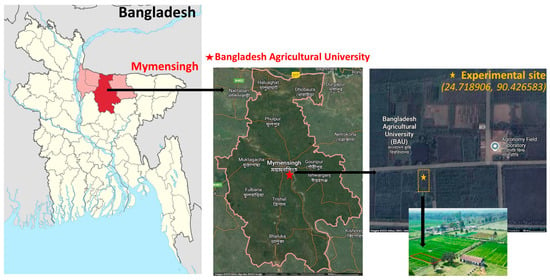
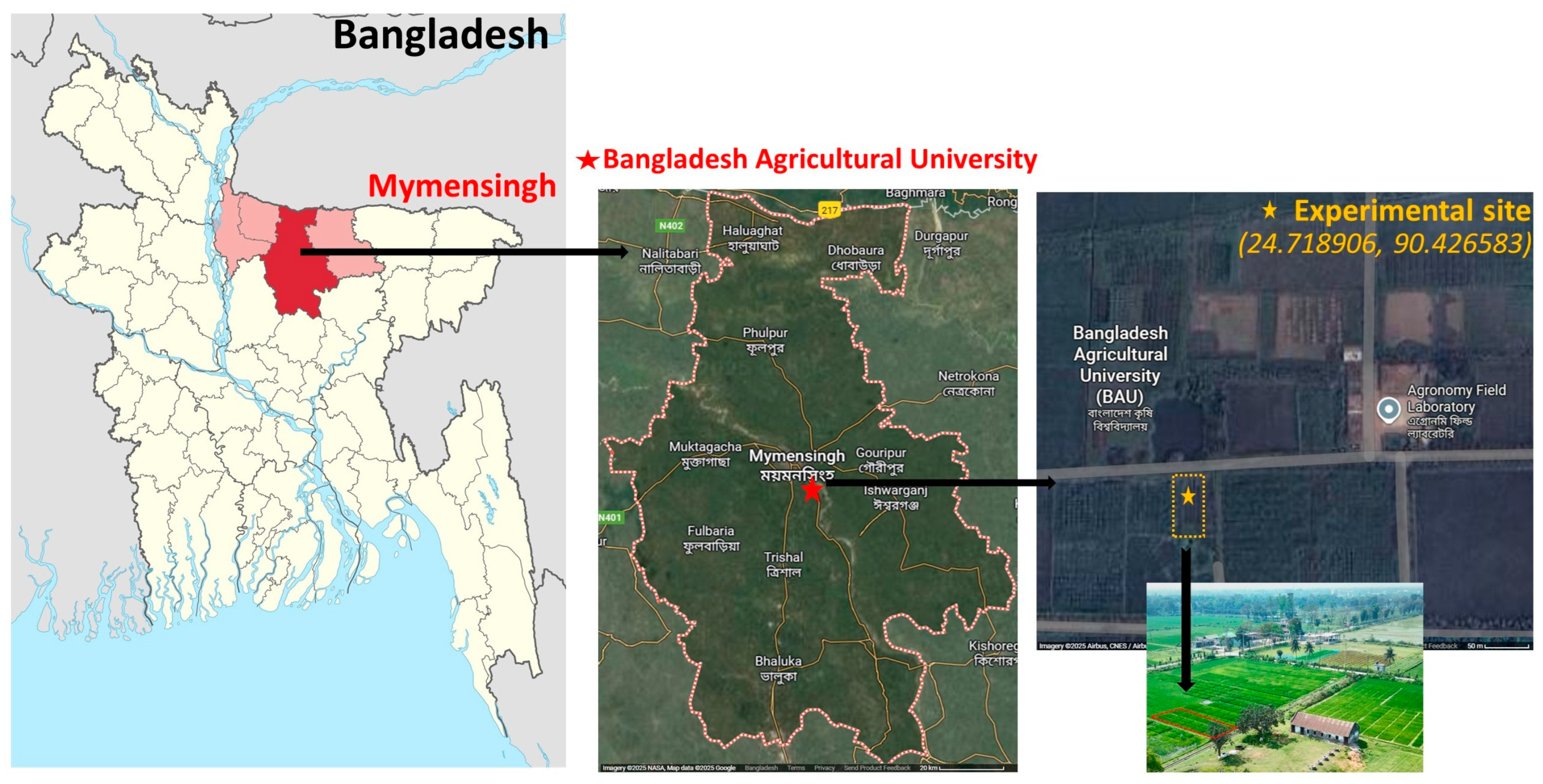
Soil samples were collected from Agronomy Field Laboratory, Department of Agronomy, Bangladesh Agricultural University, Mymensingh (90°42′65.83″ E and 24°71′89.06″ N) (Figure 1). The area belongs to the Agro-ecological Zone (AEZ)-9, Old Brahmaputra Floodplain. The selected fields are located under the sub-tropical climatic condition, which are characterized by wet (avg. rainfall: 122.2 mm) and warm (avg. temperature: 30.2 °C) summer (April–September: Kharif season) and dry (avg. rainfall: 22.3 mm) and cold (avg. temperature: 22.8 °C) winter (October–March: Rabi season).
Figure 1.
Location map of the study area.
2.2. Experimental Details
The experiment was composed of ten treatment combinations of chemical fertilizer and co–compost (CC) integration: (i) recommended dose of chemical fertilizer (RDF) (T1), (ii) CC 5.0 t ha−1 (T2), (iii) RDF + CC 2.0 t ha−1 (T3), (iv) RDF + CC 1.5 t ha−1 (T4), (v) RDF + CC 1.0 t ha−1 (T5), (vi) RDF + CC 0.5 t ha−1 (T6), (vii) 75% RDF + CC 2.0 t ha−1 (T7), (viii) 75% RDF + CC 1.5 t ha−1 (T8), (ix) 75% RDF + CC 1.0 t ha−1 (T9), and (x) 75% RDF + CC 0.5 t ha−1 (T10). These treatments were implemented across two rice seasons: winter rice (boro) and monsoon rice (aman). The experiment followed a randomized complete block design with three replications, using 5 m2 plots, spaced 1.0 m between blocks and 0.5 m between plots.
2.3. Crop Management
BRRI dhan89 and BRRI dhan49 varieties were cultivated following Bangladesh Rice Research Institute (BRRI) recommendation in boro and aman seasons, respectively, in the experimental field. For winter rice (boro), forty-day-old seedlings were transplanted on 13 January and harvested on 9 May, and for monsoon rice (aman), thirty-day-old seedlings were transplanted on 2 August and harvested at full maturity on 15 October. Co-compost was applied at the time of final land preparation (two weeks before transplanting) as per treatment and mixed thoroughly with the soil. For RDF, urea, triple super phosphate (TSP), muriate of potash (MoP), gypsum, and zinc sulfate (ZnSO4) were applied at the rate of 296, 161, 210, 124, and 12 kg ha−1 for boro rice. All the fertilizers except urea were applied as basal fertilizers one day before transplanting. Urea was applied in three equal splits at 10, 30, and 50 days after transplanting (DAT). For aman rice, 150, 98, 165, 113, and 12 kg ha−1 urea, TSP, MoP, gypsum, and ZnSO4 were applied. One-third of urea and all other fertilizers were applied during the final land preparation and the rest of urea was applied at 25 and 45 DAT. Gap filling was performed as necessary, and weeding was performed manually three times. Flood irrigation was used to maintain 6 cm of standing water early on to promote tillering and increased to 10–12 cm later to prevent late tillering. The field was drained 15 days before harvest to aid maturity. No significant pest or disease issues were observed, so no plant protection was needed. Further details on crop growth and yield data of second rice season can be found in Mahmud et al. [22].
2.4. Sample Collection and Preparation
The experimental field was divided into three blocks for replication, and then initial soil samples were collected from each block. Soil samples (0–15 cm) were collected randomly from 15 points of each block before land preparation and were bulked together to a composite sample per block as an initial/baseline soil sample. After harvesting the boro (1st crop) and aman (2nd crop) rice, soil samples (0–15 cm) were again collected randomly from 6 points of each plot and then were bulked together to a composite sample per plot separately, as the final soil sample. The samples were air-dried, ground, passed through 2 mm sieve, and then stored in airtight containers for further analysis. Prepared and ready-to-use co-compost was collected from NGO Forum for Public Health (founded in 1982, and a leading Bangladeshi non-profit improving public health for marginalized communities through water, sanitation, hygiene, health, environment, and climate resilience programs), Mymensingh, Bangladesh (https://www.ngof.org/implemented/project/details/135 (accessed on 10 September 2025)). NGO Forum produces co-compost under the Resilient, Inclusive and Innovative Cities in Bangladesh project, which has supported the development of a fecal sludge management system in Mymensingh City Corporation since 2018. The co-compost is produced by combining fecal sludge, collected by vacuum trucks from pit latrines and septic tanks, with organic solid waste collected from households, institutions, commercial establishments, and markets within the municipal area. Fecal sludge is discharged onto drying beds for at least 14 days, while collected solid waste is sorted to remove non-biodegradable materials. The dried fecal sludge is then mixed with the sorted organic waste at a 1:3 ratio (25% fecal sludge, 75% organic waste) and composted in enclosed chambers for a minimum of 40 days at 60–65 °C, followed by a 10–15-day maturation period. The final product is a safe co-compost suitable for agricultural use.
2.5. Physical Fractionation of Soil
Bulk soils only collected after the 2nd crop (aman rice) were physically fractionated based on the method developed by Cambardella and Elliott [23] with some modifications. Twenty grams of air-dried (2 mm) sub-samples were placed in 250 mL plastic bottles, and 70 mL of sodium hexametaphosphate was added at a concentration of 5.0 g L−1. The mixture was shaken for 15 h in a horizontal shaker (Model SK-L330-Pro; DLAB Scientific, Irvine, CA, USA) at 130 rpm. After this process, the entire content of the bottle was placed in a 53 μm sieve and washed with distilled water. The material retained on the sieve was defined as relatively labile, particulate OM (POM: >53 μm) and the material passed through the sieve was defined as stable, mineral-associated OM (MOM: <53 μm). All recovered fractions were oven dried at 40 °C for 72 h, hand ground to a fine powder, weighed, and stored in plastic vial for further analyses.
2.6. Sample Analysis
2.6.1. General Characterization of Bulk Soil and Co-Compost
Bulk soils were analyzed for pH, carbonate, texture, and bulk density. Soil pH was determined by a glass-electrode pH meter, as described by Jackson [24]. Carbonate and bicarbonate were analyzed through the titration method [25]. Soil texture determination was carried out by the hydrometer method as outlined by Bouyoucos et al. [26]. Bulk density was determined by the core method [27]. All laboratory extractions and analytical measurements of individual bulk soil and co-compost sample were performed in triplicate.
2.6.2. Organic Carbon and Nutrient Analyses
The OC and macro nutrient (N, P, K, and sulfur (S)) contents of co-compost and bulk soils were measured. The OC of soil was determined by the wet oxidation method as outlined by Walkley and Black [28]. For, co-compost, the OM content was first determined by the dry ashing method using a muffle furnace (Model JSMF-45TH; JS Research Inc., Gongju-si, Republic of Korea) at 550–600 °C for 24 h [29] and then converted to OC by multiplying by 0.54. Total N content of samples was determined by the micro-Kjeldahl method [30]. The contents of P, K, and S were determined according to Olsen [31], Warncke and Brown [32], and Combs et al. [33], respectively. The collected co-compost was also analyzed for heavy metals (Zn, cadmium (Cd), lead (Pb), nickel (Ni), chromium (Cr), and copper (Cu), followed by acid digestion, and then concentrations were measured using an atomic absorption spectrophotometric (AAS) method (Model AA-7000; Shimadzu, Kyoto, Japan), according to the modified procedure of Wang et al. [34]. For all analyses, reagent blanks and calibration standards were run at regular intervals to ensure instrument accuracy and stability. For AAS measurements of heavy metals, multi-point calibration curves were prepared using certified standard solutions, and instrument performance was verified with continuing calibration checks.
2.6.3. Carbon Stock Calculation
Soil C stock (Cs) was calculated following this formula:
where OC = the organic carbon content of the soil; bulk density = the mass of dry soil per unit volume; soil depth = the depth of the sampled soil layer; and 0.1 = the conversion factor to scale the calculation to t ha−1.
The seasonal change in soil C stock (ΔCs) was calculated as an indicator of soil OC sequestration potential under different combinations of chemical fertilizer and co-compost integration as follows:
Here, ΔCs = the relative change from the initial soil C stock; Cst1 = the initial soil C stock (t ha−1); and Cst2 = the final soil C stock after boro or aman season (t ha−1).
2.7. Economic Analysis
Economic analysis was performed to assess the profitability of using co-compost-based integrated nutrient management for boro and aman rice. Labor wages, fertilizers, co-compost, and other input costs and product prices were determined based on prevailing local rates (in Bangladeshi currency, BDT) and market prices at the time of study. Profitability was calculated using the benefit–cost ratio (BCR), defined as the ratio of gross return to total production cost, with values greater than 1 indicating economic viability.
2.8. Statistical Analysis
One-way analysis of variance (ANOVA) was performed to evaluate the effect of fecal sludge-based co-compost application on paddy soil nutrients and C storage. Treatment means were compared using the least significant difference test. Soil fractions of specific chemical fertilizers + co-compost combinations were compared using paired t-test. All the statistical analyses were performed in R (version 4.4.0).
3. Results
3.1. Basic Properties of Initial Soil and Co-Compost
Baseline soil samples showed no significant variation among blocks; therefore, the blocks were treated as a single pooled initial soil dataset (Table 1). Soil of the experimental field was slightly acidic (pH 6.81) with a silt loam texture (Table 1). Total carbon (C) represents the OC in the soil, as carbonate analysis indicated a negligible amount of inorganic C. The OC and total N, P, K and S contents of the bulk soil were 1.75%, 0.160%, 15.36 mg kg−1, 33.2 mg kg−1, and 23.27 mg kg−1, respectively (Table 1). The co-compost contained 14.38% OC and 2.07% total N contents, with a C:N ratio of 6.96. Phosphorus, K, and S contents were 7270 mg kg−1, 9180 mg kg−1, and 2450 mg kg−1, respectively. Overall, the nutritional status of the co-compost met the standards set by the Soil Resource Development Institute (SRDI), Bangladesh, in accordance with government regulations. All measured heavy metal levels were also within the permissible limits (Table 1).
Table 1.
General characteristics of initial soil sample and co-compost.
3.2. Soil Nutrient Dynamics Across Two Consecutive Rice Seasons After Co-Compost Use
3.2.1. First Season
The combined application of chemical fertilizer and co-compost significantly influenced bulk soil properties after the two rice seasons (Table 2, Supplementary Information (SI) Table S1). The OC and N contents ranged from 1.37 to 1.87% and 0.142 to 0.180%, respectively (Table 2). The highest OC (1.87%) and N (0.18%) were observed in plots receiving 75% RDF + CC 2.0 t ha−1 (T7), followed by T8 (75% RDF + CC 1.5 t ha−1), which recorded 1.86% OC and 0.174% N. In contrast, the lowest OC (1.37%) and N (0.142%) contents were observed from the plots treated with only 100% RDF (T1). Soil P, K, and S contents ranged from 13.09 to 14.29 mg kg−1, 27.7 to 35.1 mg kg−1, and 19.0 to 23.05 mg kg−1, respectively (Table 2). The highest P was observed in T1 while the lowest occurred in T8. Potassium was the highest in T7 and the lowest in T1 treatment. Sulfur peaked in T3 and was the lowest in T2.
Table 2.
Effect of chemical fertilizer and co-compost combinations on bulk soil properties after the two rice seasons.
Carbon stock varied between 27.65 and 37.95 t ha−1, with the maximum value observed in T7 soil and minimum in T1. Notably, across most macronutrients and C stock, T7 consistently exhibited the highest or second highest values.
3.2.2. Second Season
Significant treatment effects on soil properties were also found after the second (aman) season harvest (Table 2, Supplementary Information (SI) Table S1). The OC and N contents ranged from 1.30 to 1.93% and 0.150 to 0.180%, respectively. The T8 treatment exhibited the highest OC content (1.93%), which was statistically comparable to T7 (1.91%). The highest N was observed in T7 (0.180%), followed closely by T8 (0.176%). The lowest OC (1.30%) and N (0.15%) were again observed in T1.
Concentrations of P, K, and S ranged between 13.41 and 15.00 mg kg−1, 29.1 and 38.7 mg kg−1, and 20.25 and 23.20 mg kg−1, respectively. The highest P content was recorded in T1, while the lowest was observed in T10. Potassium was the highest in T3 and was the lowest in T2. Sulfur peaked in T5 and was the lowest in T2. Soil C stock varied from 26.30 to 38.99 t ha−1 and the highest values were recorded in T8 followed by T7, while the lowest in T1.
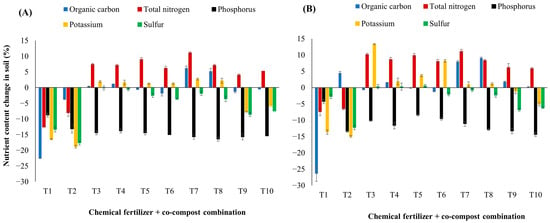
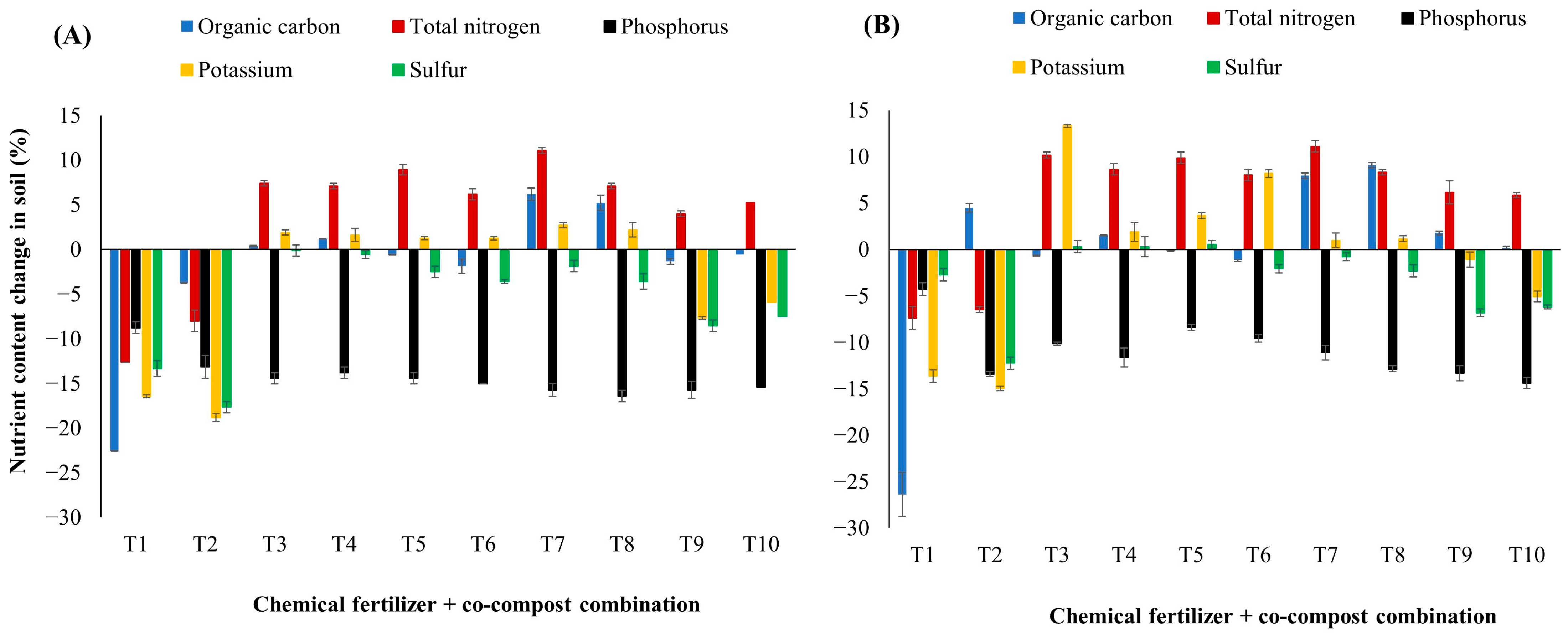
Nutrient responses compared to the initial soil status varied significantly among the treatments across both seasons (Figure 2, Supplementary Information (SI) Tables S2 and S3). Overall, application of chemical fertilizer combined with co-compost resulted in smaller nutrient losses or in some cases positive gains compared to the sole RDF application (T1). Change in OC significantly varied from −22.6 to 6.2% in the boro season and −26.4 to 9.1% in the aman season, while the values for N ranged between −12.7 and 11.1% and −7.4 and 11.1%, respectively. Sole RDF application resulted in the greatest OC and N depletion, whereas 75% RDF with 1.5–2 t ha−1 co-compost application (T7 and T8) markedly improved the OC and N contents. The consistent depletion of P was observed in all treatments during both seasons, ranging from −16.4 to −4.3%. Substantial reductions in both K and S were also observed under the sole application of RDF (K: −16.5 and −13.7%; S: −13.3 and −2.7% in boro and aman seasons, respectively). Sole co-compost application (T2) resulted in even greater losses of K (−18.9% and −15.0%) and S (−17.7% and −12.3%) in both seasons. In contrast, full RDF combined with co-compost at rates of 0.5–2 t ha−1 (T3–T6) resulted in slight-to-notable increases in K (1.3 to 13.3%), and minimal changes to S (−3.6 to 0.3%). Reduced RDF combined with co-compost rates of 1.5–2 t ha−1 application (T7–T8) showed slight K enrichment (1.0 to 2.7%), while lower co-compost rates (T9–T10) led to K depletion (−1.1 to −7.7%). A decrease in S content continued across all reduced RDF combined with co-compost rates of 0.5–2 t ha−1 application (−0.8 to −8.6%) in both seasons.
Figure 2.
Gain (+) or loss (−) of nutrients from initial bulk soil after cultivating rice with the application of chemical fertilizers and co-compost (CC) combination in the first ((A) boro) and second rice ((B) aman) seasons. Nutrient content change in soil (%) = (final nutrient content after boro or aman season—initial nutrient content)/initial nutrient content × 100. Vertical bar on column represents the standard deviation of three replications. T1 = BRRI recommended dose of fertilizer (RDF); T2 = CC 5.0 t ha−1; T3 = RDF + CC 2.0 t ha−1; T4 = RDF + CC 1.5 t ha−1; T5 = RDF + CC 1.0 t ha−1; T6 = RDF + CC 0.5 t ha−1; T7 = 75% RDF + CC 2.0 t ha−1; T8 = 75% RDF + CC 1.5 t ha−1; T9 = 75% RDF + CC 1.0 t ha−1; T10 = 75% RDF + CC 0.5 t ha−1.
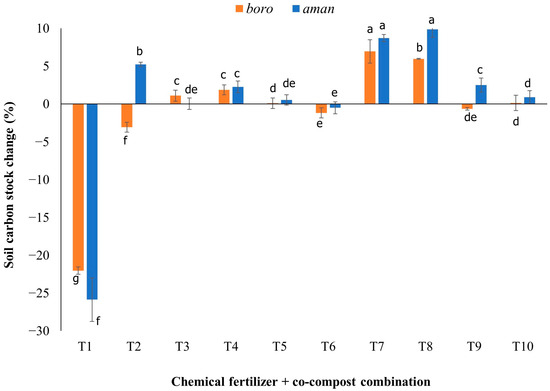
Changes in C stock varied significantly among the treatments in both seasons (Figure 3, Supplementary Information (SI) Tables S2 and S3). The greatest C stock losses occurred under T1 treatment in both boro (−22.0 t ha−1) and aman (−25.9 t ha−1) seasons. Minor C losses were also observed in T2 (−3.1 t ha−1), T6 (−1.2 t ha−1), and T9 (−0.6 t ha−1) during the boro and in T6 (−0.5 t ha−1) during the aman season. In contrast, T7 and T8 treatments consistently led to the highest C stock gains across both seasons, with 7–8.7 t ha−1 6–9.9 t ha−1, respectively. Moderate gains (0.1 to 2.5 t ha−1) were also observed under T2–T5, T9, and T10.
Figure 3.
Gain (+) or loss (−) of carbon stock from initial bulk soil after cultivating rice with the application of chemical fertilizers and co-compost combination in the first (boro) and second rice (aman) seasons. Vertical bar on column represents the standard deviation of three replications. Means with the same letters do not differ significantly. T1 = BRRI recommended dose of fertilizer (RDF); T2 = co-compost (CC) 5.0 t ha−1; T3 = RDF + CC 2.0 t ha−1; T4 = RDF + CC 1.5 t ha−1; T5 = RDF + CC 1.0 t ha−1; T6 = RDF + CC 0.5 t ha−1; T7 = 75% RDF + CC 2.0 t ha−1; T8 = 75% RDF + CC 1.5 t ha−1; T9 = 75% RDF + CC 1.0 t ha−1; T10 = 75% RDF + CC 0.5 t ha−1.
3.3. Soil Carbon Fractions After Co-Compost Use
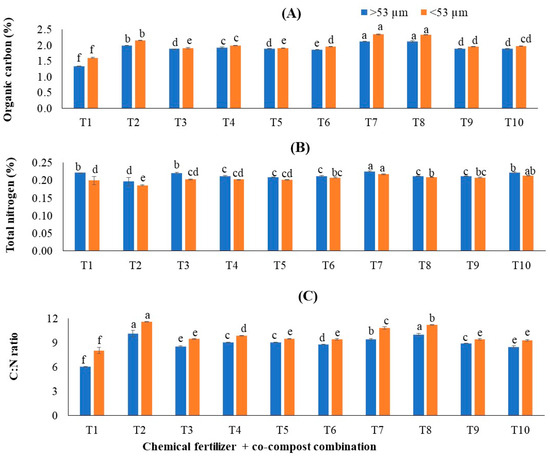
Integrated application of chemical fertilizer and co-compost significantly affected OC, N contents, and C:N ratios of soil fractions (<53 µm and >53 µm) after second rice season (Figure 4, Supplementary Information (SI) Table S4). Organic C content ranged from 1.33 to 2.12% in the >53 µm fraction and from 1.60 to 2.34% in the <53 µm fraction across treatments (Figure 4A). The highest OC contents in both fractions were observed in T7, which was statistically comparable to T8, while the lowest was found in T1. Across the treatments, the <53 µm fraction consistently contained higher OC than the >53 µm fraction (Figure 4B, Supplementary Information (SI) Table S4). The N content ranged from 0.197 to 0.225% in the >53 µm fraction and from 0.186 to 0.217% in the <53 µm fraction, generally following trends similar to OC with few exceptions. However, the differences between fractions were smaller for N compared to OC (Supplementary Information (SI) Table S4).
Figure 4.
Effect of application of chemical fertilizer and co-compost combinations on soil fractions (>53 µm and <53 µm) properties ((A) organic carbon (C), (B) total nitrogen (N), and (C) C:N ratio) after the second rice (aman) season. Vertical bar on the column represents the standard deviation of three replications. Means with the same letters do not differ significantly. T1 = BRRI recommended dose of fertilizer (RDF); T2 = co-compost (CC) 5.0 t ha−1; T3 = RDF + CC 2.0 t ha−1; T4 = RDF + CC 1.5 t ha−1; T5 = RDF + CC 1.0 t ha−1; T6 = RDF + CC 0.5 t ha−1; T7 = 75% RDF + CC 2.0 t ha−1; T8 = 75% RDF + CC 1.5 t ha−1; T9 = 75% RDF + CC 1.0 t ha−1; T10 = 75% RDF + CC 0.5 t ha−1.
The C:N ratio ranges from 6.0 to 11.6 over all the treatments for both fractions with the highest in T2 treatments and the lowest in T1 treated soils (Figure 4C). Considering the fractions, the <53 µm had significantly wider C:N ratio than the >53 µm fraction (Supplementary Information (SI) Table S4).
3.4. Economic Performance
A comparative economic analysis of chemical fertilizers and co-compost combinations was conducted for both rice seasons. Profitability was assessed based on total variable cost, grain yield increment over control, gross income, net benefit, and BCR (Table 3). Considering the input cost associated with chemical fertilizers and co-compost application, the highest total variable costs (BDT 163,225 to 179,225 ha−1) were incurred under sole co-compost application, while the lowest costs (BDT 118,126 to 141,257 ha−1) were associated with sole RDF application, which were comparable to the costs of 75% RDF + 0.5 t ha−1 co-compost (BDT 123,963 to 145,312 ha−1). Sole application of full RDF (T1) consistently demonstrated the highest profitability, with net benefits of BDT 125,043 ha−1 (BCR 1.89) in the boro season and BDT 113,574 ha−1 (BCR 1.96) in the aman season. In contrast, sole co-compost application (T2) was the least profitable, resulting in yield reductions of 38.5% and 49.8% (see Supplementary Information (SI) Table S5 for actual grain yield), and net losses of BDT −12,025 (BCR 0.93) and BDT −35,464 (BCR 0.78) in the boro and in aman seasons, respectively, due to the highest input costs and reduced gross income. Integrated fertilizers and co-compost treatments (T3 to T10) offered moderate profitability, with net benefits ranging from BDT 84,829 to 112,093 ha−1 in the boro season and BDT 78,217 to 110,304 ha−1 in the aman season. Overall, BCR values ranged from 1.59 to 1.78, indicating economic potential, especially for T3 to T5, as alternatives to exclusive chemical fertilizer use in rice fields. Considering grain yield increment, yield was increased relatively higher in the boro compared to the aman season with the highest increment observed in INM practices—T3 during both boro (6.2%) and aman (8.1%) seasons. Interestingly, T7 and T8 exhibited relatively low-to-moderate economic returns (BCR for T7, T8: 1.62, 1.62 (boro) and 1.59, 1.63 (aman), respectively) despite maintaining slightly reduced grain yield (0.0 to 8.1%) relative to the control.
Table 3.
Economic efficiency of application of different chemical fertilizer + co-compost combinations in boro and aman rice.
4. Discussion
4.1. Soil Nutrient Enhancement Through Co-Compost Application
The combined application of fertilizers with co-compost effectively enhanced soil nutrient levels in paddy soils. This aligns with earlier studies, showing that integrating chemical fertilizers with organic materials often stabilizes or increases soil OC and N compared with the sole application of RDF. The highest OC and N contents were recorded with 75% RDF + CC 2 t ha−1 (T7), followed closely by 75% RDF + CC 1.5 t ha−1 (T8). Indicating that co-compost can partially substitute for synthetic fertilizers without compromising soil quality [35,36]. Greater OC and N losses under sole RDF relative to integrate treatments highlight the limited capacity of mineral fertilizers to maintain soil OM in intensively cultivated rice systems. In contrast, co-compost addition likely reduced native soil C mineralization and promoted gradual N release, thereby mitigating annual nutrient losses and volatilization [37]. Similar effects have been reported by Wang et al. [38], who observed that compost addition enhanced microbial activity and N retention, preventing the rapid depletion typically associated with sole chemical fertilizer use.
Seasonal differences in OC and N dynamics between the boro and aman seasons were pronounced, reflecting variation in temperature, water management, crop growth, nutrient uptake, and microbial activity [39,40]. Cooler temperature, lower rainfall, and largely controlled irrigation favored C and N retention in the boro season, whereas warm and wet monsoon (aman) conditions enhanced mineralization rates, likely contributed to greater OC and N losses. Nevertheless, INM treatments (T7 and T8) consistently maintained higher OC and N than sole RDF across both seasons. Over the seasons, P concentrations declined across most treatments, indicating persistent negative P balances under continuous rice cultivation. Although sole RDF occasionally maintained higher residual P than some integrated treatments, this likely reflects reduced biological uptake rather than improved P availability. Under flooded conditions, P dynamics are strongly regulated by redox-driven processes, where periodic reduction and oxidation of iron compounds result in the immobilization of applied P through Fe-P complex formation [41]. While organic inputs often can temporarily increase P availability through mineralization and chelation [42], the relatively low P content of co-compost and repeated flooding–drying cycles likely limited its capacity to offset long-term P depletion. The reaction of K was more varied; some RDF + co-compost combinations maintained or slightly improved K levels compared to RDF alone. This trend aligns with previous report that OM reduces K fixation and enhances exchange capacity in rice soils [43]. Several treatments showed declines in S, but certain co-compost rates (like 1.5–2 t ha−1) helped keep S levels stable compared to plots using only RDF, supporting the role of organic amendments in contributing to soil S pools and promoting S mineralization over time [5].
4.2. Soil Carbon Fraction Dynamics and Carbon Storage Potential
A major outcome of this study was the significant boost in soil C stocks with some RDF + co-compost combinations, especially T7 (a 9.2% increase) and T8 (a 10.9% increase), which showed the greatest increases in C storage after two rice growing seasons. Comparable improvements in soil C stock under INM were noted by Ku et al. [44] after three rice seasons with integrated RDF and compost management. The enhancement of soil OC can be attributed to the synergistic effects between co-compost and fertilizers, which boost microbial activity and promote the stabilization of OC within soil aggregates [45,46]. Moreover, the soil structural enhancements from organic inputs foster soil aggregation, which in turn might protect OC from decomposition and support long-term soil C stock [47]. Additionally, the potential for C storage increased with higher co-compost applications, especially with T8 (75% RDF + CC 1.5 t ha−1) showing a 9.86% gain, likely due to slow co-compost decomposition and sustained C input under anaerobic paddy conditions that favor C storage [47]. Previous studies also indicate that organic amendments improve the microbial processing of C and help form protective organo-mineral complexes, thereby increasing C storage potential in clay- and silt- (finer soil fractions) rich paddy soils [48,49]. This trend was supported by the wider C:N ratio observed in the well-known MOM fractions (<53 µm) compared with the POM (>53 µm) fractions, and under RDF + co-compost application compared to fertilizer alone. The higher C:N ratio in finer fractions typically reflects slower decomposition and more stable C forms within mineral-associated fractions [35,50,51,52]. The differential responses between fractions, with greater OC enrichment in the finer (<53 µm) fractions, suggest that co-compost encourages the formation and accumulation of mineral-associated C, which tend to be relatively more stable and less prone to decomposition under flooded rice conditions [38,53]. This strongly indicates that co-compost not only adds OC directly but also have the potential to enhance the protection of OC via forming possible mineral-associated OM.
4.3. Economic Viability and Sustainability
From an economic perspective, integrated treatments combining with co-compost with a full dose of RDF (especially T3–T5) provided competitive profits with satisfactory BCRs. Although sole RDF application consistently yielded the highest short-term net profits, this outcome was largely driven by lower input costs, and may pose a greater risk to the environment and lead to resource depletion over time. In contrast, sole co-compost application was economically unviable due to high market costs and insufficient nutrient supply.
Treatments receiving reduced fertilizer rates combined with co-compost (particularly T7–T8) showed moderately lower profits compared to the full RDF-based treatments but provided substantial improvements in soil nutrient status, OC stocks, and stable C fractions. These results suggest that, although short-term economic gains may be reduced due to lower immediate nutrient supply from reduced fertilizer application, the INM offers long-term sustainability benefits by enhancing soil fertility and resilience [54,55,56]. The high total costs associated with exclusive co-compost use reflects current market constraints for waste-derived inputs; however, when co-compost is combined with RDF, the overall returns on investment improve, offering a practical pathway for farmers for reducing reliance on chemical fertilizer while improving soil health and C storage [36,57,58].
This study, however, was limited to two rice seasons. Longer trials would better capture the persistence of OC gains, C sequestration, and nutrient dynamics across different weather conditions. Furthermore, given the fecal sludge origin of the co-compost, future research should include the comprehensive monitoring of pathogen and parasite reduction, pharmaceutical residues, odor emissions, pest dynamics, and heavy metal accumulation to ensure product safety and support large scale adoption. While the present study focused on agronomic performances, addressing these boarder environmental and health considerations will be essential in future research for the sustainable integration of co-compost into rice-based production systems.
5. Conclusions
This study shows that mixing fecal sludge-based co-compost with reduced or full RDF can significantly enhance soil health and farm profits (particular for the full dose of RDF) in paddy systems over two rice seasons. Across treatments, co-compost consistently raised or stabilized soil OC, total N, and overall C storage compared to using only RDF while maintaining or improving macronutrient levels. The most pronounced improvements in soil occurred with 75% RDF + CC 1.5–2 t ha−1, indicating that co-composting can partially replace chemical inputs without losing soil quality. The dynamics of P, K, and S were more inconsistent. Several RDF + co-compost treatments kept or improved available K and S compared to RDF alone, while P levels tended to drop in some combinations due to mineral interactions and seasonal changes. Considering C pools, applying co-compost, especially 1.5–2 t ha−1 with 75% RDF, increases the OC content in relatively stable mineral-associated organic fractions, suggesting better stability under flooded conditions. Economically, the full dose of RDF + co-compost approaches particularly with moderate co-compost rates provided competitive profits; however, reduced RDF + co-compost provided relatively lower profit along with better soil sustainability indicators. Thus, application of co-compost at about 1.5 t ha−1 paired with 75% RDF could be preliminarily suggested for wetland paddy soils to improve waste management particularly in urban area and reduce environmental pollution, enhance long-term soil health and C storage, and secure moderate-to-marginal economic profitability. Future research should involve long-term trials at multiple sites, including assessments of greenhouse gas emissions and heavy metals.
Supplementary Materials
The following supporting information can be downloaded at: https://www.mdpi.com/article/10.3390/nitrogen7010010/s1, Table S1: Analysis of variance (mean square) of the data for soil properties; Table S2: Gain (+) or loss (-) of nutrients and change in carbon stock from initial bulk soil after cultivating rice with the application of chemical fertilizers and co-compost combination in the first (boro) and second rice (aman) seasons; Table S3: Analysis of variance (mean square) of the changes in soil properties; Table S4: Effect of application of chemical fertilizers and co-compost combination on the properties of soil fractions after second rice (aman) season; Table S5: Effect of application of chemical fertilizer + co-compost combinations on the yield of boro and aman rice.
Author Contributions
Conceptualization: S.Y. and M.P.A.; methodology: S.Y. and M.S.H.; software: S.Y., Z.S.B., M.M.R. and A.K.M.M.I.; validation: S.Y. and M.P.A.; formal analysis: S.Y.; investigation: S.Y., M.S.H., Z.S.B. and M.K.U.; resources: S.Y. and A.K.M.M.I.; data curation: S.Y. and M.K.U.; writing—original draft preparation: S.Y., M.S.H. and M.M.R.; writing—review and editing: S.C., M.P.A., M.M.R., T.S.H. and A.K.M.M.I.; visualization: S.Y., Z.S.B., M.K.U. and M.M.R.; supervision: S.Y., S.C. and M.P.A.; project administration: S.Y. and T.S.H.; funding acquisition: S.Y. All authors have read and agreed to the published version of the manuscript.
Funding
This research was funded by Ministry of Science and Technology, the Government of the People’s Republic of Bangladesh, grant number “SRG-241073”.
Institutional Review Board Statement
Not applicable.
Informed Consent Statement
Not applicable.
Data Availability Statement
The data presented in this study are available on request from the corresponding authors.
Acknowledgments
The authors express their gratitude to the Ministry of Science and Technology, the Government of the People’s Republic of Bangladesh for providing financial support for this study under the grant number SRG-241073. The authors also sincerely thank NGO Forum for Public Health, Mymensingh, Bangladesh for supplying the co-compost as well as the Bangladesh Agricultural University Research System (BAURES) for their logistic assistance. The authors also gratefully acknowledge the analytical support for heavy-metal determination using AAS provided by the Soil Resource Development Institute, Regional Laboratory, Jamalpur, Bangladesh.
Conflicts of Interest
The authors declare that they have no conflicts of interest. The funders had no role in the design of the study; in the collection, analyses, or interpretation of data; in the writing of the manuscript, or in the decision to publish the results.
References
- Bamboriya, J.S.; Purohit, H.S.; Naik, B.S.S.S.; Pramanick, B.; Bamboriya, S.D.; Bamboriya, S.D.; Doodhawal, K.; Sunda, S.L.; Medida, S.K.; Gaber, A.; et al. Monitoring the effect of integrated nutrient management practices on soil health in maize-based cropping system. Front. Sustain. Food Syst. 2023, 7, 2023. [Google Scholar] [CrossRef] [Scilit]
- Paramesh, V.; Kumar, P.; Bhagat, T.; Nath, A.J.; Manohara, K.K.; Das, B.; Desai, B.F.; Jha, P.K.; Prasad, P.V.V. Integrated Nutrient Management Enhances Yield, Improves Soil Quality, and Conserves Energy under the Lowland Rice–Rice Cropping System. Agronomy 2023, 13, 1557. [Google Scholar] [CrossRef] [Scilit]
- Abbas, A.; Naveed, M.; Khan, K.S.; Ashraf, M.; Siddiqui, M.H.; Abbas, N.; Mustafa, A.; Ali, L. The efficacy of organic amendments on maize productivity, soil properties and active fractions of soil carbon in organic-matter deficient soil. Span. J. Soil Sci. 2024, 14, 12814. [Google Scholar] [CrossRef] [Scilit]
- Biswakarma, N.; Pooniya, V.; Zhiipao, R.R.; Kumar, D.; Verma, A.K.; Shivay, Y.S.; Lama, A.; Choudhary, A.K.; Meena, M.C.; Bana, R.S.; et al. Five years integrated crop management in direct seeded rice–zero till wheat rotation of north-western India: Effects on soil carbon dynamics, crop yields, water productivity and economic profitability. Agric. Ecosyst. Environ. 2021, 318, 107492. [Google Scholar] [CrossRef] [Scilit]
- Das, B.; Pooniya, V.; Shivay, Y.S.; Zhiipao, R.R.; Biswakarma, N.; Kumar, D.; Saikia, N.; Kumar, A.; Govindasamy, P.; Barman, A.; et al. Twenty-one years’ impact of using organic amendments on the productivity of rice-wheat rotation and soil properties. Field Crop Res. 2024, 309, 109311. [Google Scholar] [CrossRef] [Scilit]
- Chakraborty, D.; Gupta, S.; Das, P. Influence of co-composting on soil fertility and crop yield. Soil Sci. Plant Nutr. 2020, 20, 1891–1903. [Google Scholar]
- Iqbal, A.; He, L.; Ali, I.; Ullah, S.; Khan, A.; Akhtar, K.; Wei, S.; Fahad, S.; Khan, R.; Jiang, L. Co-incorporation of manure and inorganic fertilizer improves leaf physiological traits, rice production and soil functionality in a paddy field. Sci. Rep. 2021, 11, 10048. [Google Scholar] [CrossRef] [Scilit] [PubMed]
- Just, C.; Armbruster, M.; Barkusky, D.; Baumecker, M.; Diepolder, M.; Döring, T.F.; Heigl, L.; Honermeier, B.; Jate, M.; Merbach, I.; et al. Soil organic carbon sequestration in agricultural long-term field experiments as derived from particulate and mineral-associated organic matter. Geoderma 2023, 434, 116472. [Google Scholar] [CrossRef] [Scilit]
- Hua, K.; Wang, D.; Guo, X.; Guo, Z. Carbon sequestration efficiency of organic amendments in a long-term experiment on a Vertisol in Huang-Huai-Hai Plain, China. PLoS ONE 2014, 9, e108594. [Google Scholar] [CrossRef] [Scilit]
- Yeasmin, S.; Assaduzzaman Kabir, M.S.; Anwar, M.P.; Islam, A.K.M.M.; Hoque, T.S. Influence of Organic Amendments on Soil Carbon Sequestration Potential of Paddy Soils under Two Irrigation Regimes. Sustainability 2022, 14, 12369. [Google Scholar] [CrossRef] [Scilit]
- Aktar, S.; Islam, M.S.; Hossain, M.S.; Akter, H.; Maula, S.; Hossain, S.S.F. Effects of municipal solid waste compost and fertilizers on the biomass production and yield of BRRI dhan50. Progress. Agriculture 2018, 29, 82–90. [Google Scholar] [CrossRef] [Scilit]
- Li, L.; Li, H.; Tong, L.; Lv, Y. Sustainable agriculture practices: Utilizing composted sludge fertilizer for improved crop yield and soil health. Agronomy 2024, 14, 756. [Google Scholar] [CrossRef] [Scilit]
- Bernstad, A.; la Cour Jansen, J. A life cycle approach to the management of household food waste—A Swedish full-scale case study. Waste Manag. 2011, 31, 1879–1896. [Google Scholar] [CrossRef] [Scilit] [PubMed]
- Akanda, M.M.; Islam, N.; Brook, R.M.; Kader, M.A.; Hossain, M.M. Residual effect of municipal solid waste compost and fertilizer on the performance of transplanted aman rice cv. BRRI dhan31 after Boro rice. Bangladesh J. Crop Sci. 2012, 22–23, 49–55. [Google Scholar] [CrossRef]
- Tilley, E.; Ulrich, L.; Luethi, C.; Reymond, P. Compendium of Sanitation Systems and Technologies, 2nd ed.; Sustainable Sanitation and Water Management (SSWM): Duebendorf, Switzerland, 2014. [Google Scholar]
- Cofie, O.; Nikiema, J.; Impraim, R.; Adamtey, N.; Paul, J.; Koné, D. Co-Composting of Solid Waste and Fecal Sludge for Nutrient and Organic Matter Recovery; Resource Recovery and Reuse Series 3; CGIAR Research Program on Water, Land and Ecosystems (WLE); International Water Management Institute (IWMI): Colombo, Sri Lanka, 2016; p. 47. [Google Scholar] [CrossRef] [Scilit]
- Häfner, F.; Monzon Diaz, O.R.; Tietjen, S.; Schröder, C.; Krause, A. Recycling fertilizers from human excreta exhibit high nitrogen fertilizer value and result in low uptake of pharmaceutical compounds. Front. Environ. Sci. 2023, 10, 1038175. [Google Scholar] [CrossRef] [Scilit]
- Schouw, N.L.; Danteravanich, S.; Mosbaek, H.; Tjell, J.C. Composition of human excreta: A case study from Southern Thailand. Sci. Total Environ. 2002, 286, 155–166. [Google Scholar] [CrossRef] [Scilit]
- Hargreaves, J.C.; Adl, M.S.; Warman, P.R. A review of the use of composted municipal solid waste in agriculture. Agric. Ecosyst. Environ. 2008, 123, 1–14. [Google Scholar] [CrossRef] [Scilit]
- Jahan, H.; Al-Muyeed, A. Fecal Sludge Management in Bangladesh. The Daily Observer. 11 June 2015. Available online: http://www.observerbd.com/2015/06/11/93460.php (accessed on 2 May 2024).
- Islam, A.K.M.S.; Rahman, M.A.; Roy, P.C.; Haque, M.M. Hybrid rice productivity as influenced by fecal sludge. Haya Saudi J. Life Sci. 2016, 1, 113–116. [Google Scholar] [CrossRef]
- Mahmud, N.B.; Anwar, M.P.; Yeasmin, S.; Sultana, N.; Ghosh, S.; Islam, A.K.M.M.; Jaman, M.S.B. Co-Composted fecal sludge based integrated nutrient management for sustainable aman rice production. J. Sci. Technol. Res. 2024, 6, 149–159. [Google Scholar] [CrossRef] [Scilit]
- Cambardella, C.; Elliott, E. Particulate Soil organic-matter changes across a grassland cultivation sequence. Soil Sci. Soc. Am. J. 1992, 56, 777–783. [Google Scholar] [CrossRef] [Scilit]
- Jackson, M.L. Soil Chemical Analysis; Prentice Hall, Inc.: Englewood Chiffs, NY, USA, 1962. [Google Scholar]
- Rowell, D.L. Soil Science: Methods and Applications, 1st ed.; Routledge: London, UK, 2014; p. 369. [Google Scholar] [CrossRef] [Scilit]
- Bouyoucos, G.J. Hydrometer Method Improved for Making Particle Size Analyses of Soils. Agron. J. 1962, 54, 464–465. [Google Scholar] [CrossRef] [Scilit]
- Blake, G.R.; Hartge, K.H. Bulk Density. In Methods of Soil Analysis, Part I Physical and Mineralogical Methods, 2nd ed.; Klute, A., Ed.; ASA-SSSA: Madison, WI, USA, 1986; pp. 363–375. [Google Scholar] [CrossRef] [Scilit]
- Walkley, A.; Black, I.A. An examination of Degtjareff method of determining soil organic matter and proposed modification of the method of the chromic acid titration method. Soil Sci. 1934, 37, 29–39. [Google Scholar] [CrossRef] [Scilit]
- Nelson, D.W.; Sommers, L.E. Total carbon, organic carbon, and organic matter. In Methods of Soil Analysis: Part 3 Chemical Methods 5; ASA-SSSA: Madison, WI, USA, 1996; pp. 961–1010. [Google Scholar] [CrossRef] [Scilit]
- Bremner, J.M. Total Nitrogen. In Methods of Soil Analysis: Part 2 Chemical and Microbiological Properties, 9.2; Norman, A.G., Ed.; American Society of Agronomy: Madison, WI, USA, 1965; pp. 1149–1178. [Google Scholar] [CrossRef] [Scilit]
- Olsen, S.R. Estimation of Available Phosphorus in Soils by Extraction with Sodium Bicarbonate (No. 939); US Department of Agriculture: Washington, DC, USA, 1954.
- Warncke, D.; Brown, J.R. Potassium and Other Basic Cations. In Recommended Chemical Soil Test Procedures for the North Central Region; NCR Publication No. 221; Brown, J.R., Ed.; Missouri Agricultural Experiment Station: Columbia, MO, USA, 1998; pp. 31–33. [Google Scholar]
- Combs, S.M.; Denning, J.L.; Frank, K.D. Sulfate-sulfur. Chapter 8. In Recommended Chemical Soil Test Procedures for the North Central Region; North Central Regional Research Publication 221 (Revised); Brown, J.R., Ed.; Missouri Agricultural Experiment Station SB 1001: Columbia, MO, USA, 1998; pp. 35–40. [Google Scholar]
- Wang, J.; Wang, X.; Li, G.; Ding, J.; Shen, Y.; Liu, D.; Cheng, H.; Zhang, Y.; Li, R. Speciation analysis method of heavy metals in organic fertilizers: A review. Sustainability 2022, 14, 16789. [Google Scholar] [CrossRef] [Scilit]
- Manga, M.; Evans, B.E.; Ngasala, T.M.; Camargo-Valero, M.A. Recycling of faecal sludge: Nitrogen, carbon and organic matter transformation during co-composting of faecal sludge with different bulking agents. Int. J. Environ. Res. Public Health 2022, 19, 10592. [Google Scholar] [CrossRef] [Scilit] [PubMed]
- Howe, J.A.; McDonald, M.D.; Burke, J.; Robertson, I.; Coker, H.; Gentry, T.J.; Lewis, K.L. Influence of fertilizer and manure inputs on soil health: A review. Soil Secur. 2024, 16, 100155. [Google Scholar] [CrossRef] [Scilit]
- Gil, C.; Tucker, K.; Victores, S.; Lin, Y.; Obreza, T.; Maltais-Landry, G. Nitrogen and carbon mineralization from organic amendments and fertilizers using incubations with sandy soils. Agriculture 2024, 14, 2009. [Google Scholar] [CrossRef] [Scilit]
- Wang, D.; Lin, J.Y.; Sayre, J.M.; Schmidt, R.; Fonte, S.J.; Rodrigues, J.L.M.; Scow, K.M. Compost amendment maintains soil structure and carbon storage by increasing available carbon and microbial biomass in agricultural soil—A six-year field study. Geoderma 2022, 427, 116117. [Google Scholar] [CrossRef] [Scilit]
- Mao, C.; Wang, Y.; Ran, J.; Wang, C.; Yang, Z.; Yang, Y. Effects of warming and precipitation change on soil nitrogen cycles: A meta-analysis. J. Plant Ecol. 2025, 18, rtaf051. [Google Scholar] [CrossRef] [Scilit]
- Song, J.; Wang, J.; Hou, Q.; Xing, Z.; Zhang, Z.; Du, S.; Liu, M. Short-term effects of irrigation and nitrogen management on paddy soil carbon pools under deep placement of basal fertilizer nitrogen. Sci. Rep. 2024, 14, 11329. [Google Scholar] [CrossRef] [Scilit]
- He, J.; He, J.; Li, H.; Yu, Y.; Qian, L.; Tang, L.; Zheng, Y.; Xiao, J. Continuous intercropping increases the depletion of soil available and non-labile phosphorus. Agronomy 2024, 14, 1121. [Google Scholar] [CrossRef] [Scilit]
- Khan, K.S.; Ali, M.M.; Naveed, M.; Rehmani, M.I.A.; Shafique, M.W.; Ali, H.M.; Abdelsalam, N.R.; Ghareeb, R.Y.; Feng, G. Co-application of organic amendments and inorganic P increase maize growth and soil carbon, phosphorus availability in calcareous soil. Front. Environ. Sci. 2022, 10, 949371. [Google Scholar] [CrossRef] [Scilit]
- Taiwo, A.A.; Adetunji, M.T.; Azeez, J.O.; Elemo, K.O. Kinetics of potassium release and fixation in some soils of Ogun State, Southwestern, Nigeria as influenced by organic manure. Int. J. Recycl. Org. Waste Agric. 2018, 7, 251–259. [Google Scholar] [CrossRef] [Scilit]
- Ku, H.H.; Ryu, J.H.; Bae, H.S.; Jeong, C.; Lee, S.E. Modeling a long-term effect of rice straw incorporation on SOC content and grain yield in rice field. Arch. Agron. Soil Sci. 2019, 65, 1941–1954. [Google Scholar] [CrossRef] [Scilit]
- Ren, L.; Yang, H.; Li, J.; Zhang, N.; Han, Y.; Zou, H.; Zhang, Y. Organic fertilizer enhances soil aggregate stability by altering greenhouse soil content of iron oxide and organic carbon. J. Integr. Agric. 2025, 24, 306–321. [Google Scholar] [CrossRef] [Scilit]
- Wang, W.; Jiang, Y.; Cai, S.; Li, Y.; Qu, J.; Sun, L. Synergistic Effects of Organic and Chemical Fertilizers on Microbial-Mediated Carbon Stabilization: Insights from Metagenomics and Spectroscopy. Agronomy 2025, 15, 1555. [Google Scholar] [CrossRef] [Scilit]
- Ma, S.; Cao, Y.; Lu, J.; Ren, T.; Cong, R.; Lu, Z.; Zhu, J.; Li, X. Response of soil aggregation and associated organic carbon to organic amendment and its controls: A global meta-analysis. Catena 2024, 237, 107774. [Google Scholar] [CrossRef] [Scilit]
- Ghosh, S.; Wilson, B.; Ghoshal, S.; Senapati, N.; Mandal, B. Organic amendments influence soil quality and carbon sequestration in the Indo-Gangetic plains of India. Agric. Ecosyst. Environ. 2012, 156, 134–141. [Google Scholar] [CrossRef] [Scilit]
- Bai, Z.; Fan, X.; Jin, X.; Zhao, Z.; Wu, Y.; Oenema, O.; Velthof, G.; Hu, C.; Ma, L. Relocate 10 billion livestock to reduce harmful nitrogen pollution exposure for 90% of China’s population. Nat. Food 2022, 3, 152. [Google Scholar] [CrossRef] [Scilit] [PubMed]
- Cofie, O.; Kone, D.; Rothenberger, S.; Moser, D.; Zubruegg, C. Co-composting of faecal sludge and organic solid waste for agriculture: Process dynamics. Water Res. 2009, 43, 4665–4675. [Google Scholar] [CrossRef] [Scilit] [PubMed]
- Amorim, H.C.; Hurtarte, L.C.; Souza, I.F.; Zinn, Y.L. C:N ratios of bulk soils and particle-size fractions: Global trends and major drivers. Geoderma 2022, 425, 116026. [Google Scholar] [CrossRef] [Scilit]
- Cui, J.; Zhu, R.; Wang, X.; Xu, X.; Ai, C.; He, P.; Liang, G.; Zhou, W.; Zhu, P. Effect of high soil C/N ratio and nitrogen limitation caused by the long-term combined organic-inorganic fertilization on the soil microbial community structure and its dominated SOC decomposition. J. Environ. Manag. 2022, 303, 114155. [Google Scholar] [CrossRef] [Scilit] [PubMed]
- Lehmann, J.; Kinyangi, J.; Solomon, D. Organic matter stabilization in soil microaggregates: Implications from spatial heterogeneity of organic carbon contents and carbon forms. Biogeochemistry 2007, 85, 45–57. [Google Scholar] [CrossRef] [Scilit]
- Zhai, L.; Wang, Z.; Zhai, Y.; Zhang, L.; Zheng, M.; Yao, H.; Lv, L.; Shen, H.; Zhang, J.; Yao, Y.; et al. Partial substitution of chemical fertilizer by organic fertilizer benefits grain yield, water use efficiency, and economic return of summer maize. Soil Till Res. 2022, 217, 105287. [Google Scholar] [CrossRef] [Scilit]
- Xu, W.; Yang, Q.; Liu, W.; Jiang, Y.; Guo, X.; Sun, R.; Luo, W.; Fang, M.; Wu, Z. Partial Organic Substitution Fertilization Improves Soil Fertility While Reducing N Mineralization in Rubber Plantations. Forests 2024, 15, 1521. [Google Scholar] [CrossRef] [Scilit]
- Chen, Q.; Xie, J.; Li, L.; Khan, K.S.; Wang, L.; Chang, L.; Du, C. Partial substitution of chemical fertilizer with organic fertilizer: A promising circular economy approach for improvement soil physical and chemical properties and sustainable crop yields. Front. Plant Sci. 2025, 16, 1565081. [Google Scholar] [CrossRef] [Scilit] [PubMed]
- Lu, Z.; Zhou, Y.; Li, Y.; Li, C.; Lu, M.; Sun, X.; Luo, Z.; Zhao, J.; Fan, M. Effects of partial substitution of chemical fertilizer with organic manure on the activity of enzyme and soil bacterial communities in the mountain red soil. Front. Microbiol. 2023, 14, 1234904. [Google Scholar] [CrossRef] [Scilit]
- Zheng, H.; Xu, Y.; Wang, M.; Qi, L.; Lian, Z.; Hu, L.; Hu, H.; Ma, B.; Lv, X. The Role of Fertilization on Soil Carbon Sequestration in Bibliometric Analysis. Agriculture 2024, 14, 1850. [Google Scholar] [CrossRef] [Scilit]

Disclaimer/Publisher’s Note: The statements, opinions and data contained in all publications are solely those of the individual author(s) and contributor(s) and not of MDPI and/or the editor(s). MDPI and/or the editor(s) disclaim responsibility for any injury to people or property resulting from any ideas, methods, instructions or products referred to in the content. |
© 2026 by the authors. Licensee MDPI, Basel, Switzerland. This article is an open access article distributed under the terms and conditions of the Creative Commons Attribution (CC BY) license.