Abstract
Sustainable nitrogen (N) management is critical for enhancing wheat production in the water-limited environment of China’s Loess Plateau. This study investigated the effects of four N rates (0, 120, 180, and 240 kg N ha−1) and two sowing methods, furrow sowing (FS) and drill sowing (DS), on wheat yield, grain quality, and water-use efficiency (WUE). Results indicated that N application significantly improved all metrics. The optimal N rate for yield was 180 kg N ha−1 (N180), producing yields equivalent to the higher 240 kg N ha−1 rate (N240). Compared to the N0 control, the N240 treatment under FS in 2022–23 increased grain yield by 25.4% and WUE by 11.9%, while under DS it increased yield by 23.6% and WUE by 11.1%. However, in the following year (2023–24), the greatest benefits under FS came from N180, which increased yield by 19.3% and WUE by 11.5% over the control. Higher N rates markedly elevated grain quality: N240 resulted in the highest steamed bread score and concentration of volatile compounds. Nitrogen application also intensified soil water use, particularly before anthesis. In 2022–23, the highest N240 reduced soil water at maturity by 16.6% (FS) and 15.9% (DS) and increased total water consumption by up to 7.8% compared to N0. Yield was strongly correlated with soil water depletion in the 0–200 cm layer during the reproductive period. While N240 optimized quality, the N180 rate combined with improved sowing methods (FS or DS) provided the best balance, drill sowing was crucial agronomic practice for enhancing nitrogen-use efficiency (NUE), achieving high yield, superior WUE, and acceptable quality. We therefore recommend an N rate of 180 kg ha−1 with improved sowing as a sustainable practice for dryland wheat production on the Loess Plateau.
1. Introduction
Wheat (Triticum aestivum L.) stands as one of the world’s most foundational crops, having played a pivotal role in the development of human societies and cultures [1]. Ensuring its continued productivity is therefore critical for global food security. This challenge is particularly acute in arid and semi-arid regions, where water scarcity is a primary constraint to agricultural production.
A prominent example is the Loess Plateau of China, a region characterized by limited and erratic precipitation. Annual rainfall in this area ranges from 200 to 750 mm, with a highly uneven distribution; approximately 60–70% of the total precipitation falls between July and September, outside the key growth stages of winter wheat [2]. Furthermore, the region’s deep groundwater tables (>50 m) and limited irrigation infrastructure mean that crops are predominantly rainfed, making stored soil water and in-season rainfall the sole water sources for agricultural production [2,3]. N fertilizer is an important source of nutrients during the growth of winter wheat and is essential for achieving high yield; quality elemental quantities have a significant impact on the yield and quality of winter wheat [2,3]. Second, by setting up rain shelters before sowing and forming different precipitation gradients, it is possible to study the changing patterns of crop-related indicators at different precipitation levels in fewer years [4,5]. Regulating water application through fertilizer in dryland winter wheat fields in order to investigate the influence of wheat water, nitrogen absorption and utilization, and yield potential can provide a theoretical basis for water and fertilizer management in dryland farmland. In addition, studying the impact of water and nitrogen input on environmental effects is sensible resource utilization when environmental protection is of great significance [6,7]. In dryland winter wheat, apart from water being the main limiting factor, nutrients are another important limiting factor [8]. Water insufficiency leads to physiological imbalances and stress effects in crops, such as leaf section aging, oxidative unhealthiness, and restricted metabolic activity. Initially, aging causes chlorophyll failure, and the decline in chlorophyll levels directly affects the photosynthetic ratio [9]. During water shortage, the natural crop process diminishes, canopy temperature increases, hastening growth and development, which in turn affects yield [10,11]. Nitrogen (N) application is a fundamental agronomic practice for enhancing winter wheat production. Adequate nitrogen fertilization increases soil nitrogen availability, supplying essential nutrients that promote the growth and development of aboveground plant parts [12,13]. This vigorous growth, however, comes with a hydrological cost; it accelerates plant transpiration and soil water depletion, thereby increasing total farmland water consumption [12,13]. This relationship between nitrogen and water use is not linear but follows a distinct threshold response. Research indicates that as the nitrogen application rate increases, total farmland water consumption initially rises but eventually stabilizes, while water-use efficiency (WUE)—the yield produced per unit of water used—follows a trend of initial increase followed by a decrease [14,15,16]. This pattern is critical in water-scarce environments, as it highlights a point of diminishing returns.
Furthermore, the effect of nitrogen on grain yield is parabolic. Insufficient nitrogen application limits photosynthetic capacity and tiller development, directly depressing yield [17,18]. Conversely, application beyond the crop’s optimal requirement can also lead to yield reductions. Excessive nitrogen often promotes rampant vegetative growth at the expense of reproductive investment, leading to an imbalance in nutrient partitioning where excess nitrogen remains in vegetative organs and the contribution of nitrogen to grain filling declines [17,19]. Different sowing methods have been developed and studied for wheat plantations, such as broadcasting, drill sowing, furrow sowing [20,21]. Discussing changes at the 1–5 cm scale is typical of China’s highly refined, labor-intensive, and small-plot research aimed at squeezing maximum yield from limited land. In large-scale mechanized farms in the West, adjustments might be in larger increments (e.g., from 15 cm to 30 cm). Enhancing row and plant spacing enhances ventilation and light penetration, promoting individual plant development and resolving individual and group contradictions [22,23]. Another innovative sowing method that is worth exploring is furrow sowing. In this method, seeds are planted on ridges or furrows, depending on environmental conditions. In dryland areas with limited water availability, such as Shanxi Province, sowing in furrows is often preferred because the furrows protect from wind erosion, collect rainwater, and conserve more moisture from rainfall and irrigation [24,25]. The conventional method involves sowing wheat using a driller at 3–5 cm plant spacing and 20 cm row spacing. There are some problems encountered in drill sowing, such as uneven seeding, resulting in seedlings crowded in the row and sparse between rows, long agricultural waste time, more soil moisture loss, and higher production costs caused by the separate application of fertilization, rotary tillage, sowing, and compaction [26,27]. This study focused on nitrogen application to examine variations in water utilization, dry matter content, nitrogen accretion and transport, and quality among various wheat clusters. The effects of nitrogen fertilizer levels on water utilization, material accumulation and transport, yield, and quality were analyzed, along with the impact of sowing methods and soil water utilization.
2. Materials and Methods
2.1. The Overview of the Experimental Site
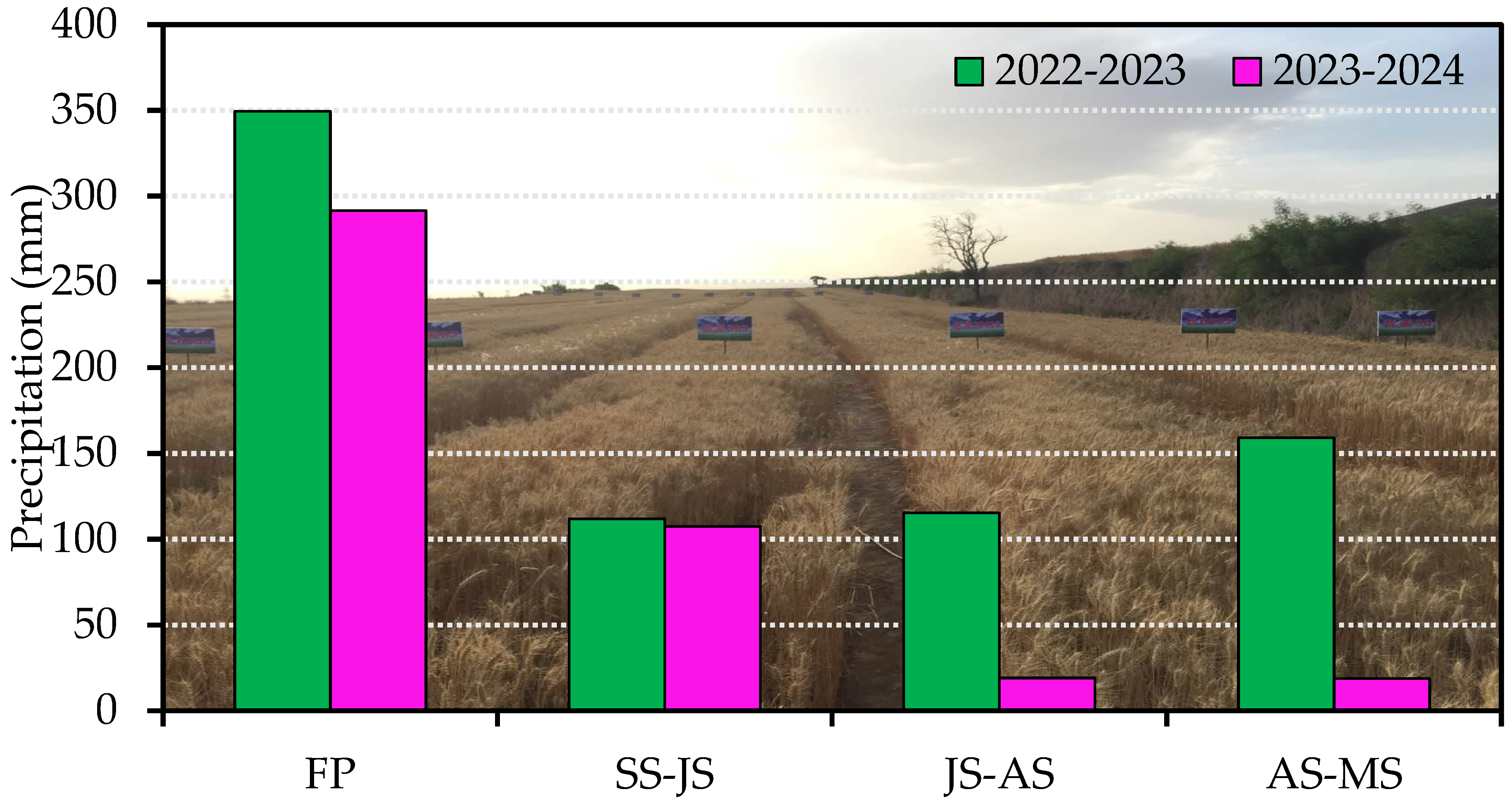
The experiment was conducted at the Taigu Experimental Base (37°42′ N, 112°53′ E) of Shanxi Agricultural University. The altitude is 791 m, the average annual sunshine hours are 2500 h, the spring temperature is higher than the autumn temperature, the summer is warm, hot, and rainy, and the winter is long and partially cold, with an average annual temperature difference of approximately 6 °C. The average annual precipitation is approximately 458 mm. The total precipitation during the growth period was 735.8 mm in 2022–2023 and 436.81 mm in 2023–2024 (Figure 1).
Figure 1.
The experiment site Wenxi, Shanxi Province from 2022 to 2024. Note: FP, fallow period; SS–JS: sowing stage to jointing stage; JS–AS: jointing stage to anthesis stage; AS–MS: anthesis stage to maturity.
2.2. Experimental Site and Design
A two-year field study was conducted during the 2022–2023 and 2023–2024 winter wheat growing seasons. The experimental variety used was Jinmai-92. The experiment was arranged in a two-factor split-plot design with three replications. The main plot factor was the sowing method, consisting of two treatments: FS: furrow sowing, DS: drill sowing. The subplot factor was the nitrogen (N) application rate, which included four levels: N0: 0 kg N ha−1, N120: 120 kg N ha−1, N180: 180 kg N ha−1, N240: 240 kg N ha−1. The whole nitrogen dose was applied as urea in a single basal practical application at sowing. While split use is standard agronomic practice to improve NUE in production environments, a single basal application was employed in this study for controlled experimental intention. This approach establishes a clear and consistent gradient of N availability from sowing, allowing for an unbiased assessment of genotype performance under defined nitrogen regimes without the confounding effects of top-dressing timing or environmental conditions during later applications. We acknowledge that this method may increase the risk of nitrogen losses via volatilization, leaching, or denitrification, particularly at higher application rates.
This resulted in a total of eight treatment combinations, each replicated three times (24 experimental plots in total). Each individual subplot measured 5 m in width and 5 m in length, with a total area of 25 m2. Fertilizers were applied to supply 120 kg N ha−1, 150 kg P2O5 ha−1, and 150 kg K2O ha−1. Nitrogen was supplied as urea, phosphorus as mono-ammonium phosphate (MAP), and potassium as muriate of potash (KCl). Nitrogen was applied according to treatment specifications as urea (46% N) entirely as a basal fertilizer before planting (Table 1) for soil basic fertility.
Table 1.
Soil basic fertility of 0–20 cm soil layer at Wenxi observational site.
2.3. Experimental Seasons and Crop Management
The field experiments were conducted over two serial growing seasons (2022–2023 and 2023–2024). Sowing dates were 28 September 2022, and 11 October 2023, with related harvest dates on 10 June 2023, and 1 June 2024. The variance in sowing dates between seasons was determined by optimal soil moisture conditions and followed local agronomic recommendations for winter wheat organization. Harvest temporal arrangement was based on physiological maturity, assessed when grain moisture content reached about 14–16%.
2.4. Water and Nutrient Management
To check uniform crop establishment across treatments, a supplementary irrigation of 60 mm was applied at both the overwintering and jointing stages in each growing season. No extra irrigation was provided thereafter. All nitrogen fertilizer was applied as a basal dressing at sowing in the form of urea. This individual application approach was deliberately selected to evaluate genotype action under high nitrogen input conditions without the confounding effects of split-application timing. While split nitrogen applications are often recommended to improve NUE, our experimental design aimed to create distinct nitrogen consequence curves under maximum accessible nitrogen status, consistent with methodologies used in comparative varietal screening studies. The potential for nitrogen losses through volatilization, leaching, and denitrification was acknowledged and monitored through periodic soil mineral nitrogen measurements.
2.5. Crop Protection
Weed control was achieved through pre-appearance application of tribenuron methyl at recommended rates. Pest and disease direction followed integrated pest management (IPM) guidelines for winter wheat in the region, with exploratory survey conducted bi-weekly and interventions applied only when economic thresholds were exceeded (FAO, 2019). These practices ensured protective covering against yield loss while minimizing treatment interference with experimental variables.
2.6. Soil Nitrate and Ammonium Nitrogen Analysis
During the flowering and ripening periods of the wheat crop, soil samples were collected from the 0–100 cm depth profile. This profile was divided into consecutive 20 cm layers (0–20, 20–40, 40–60, 60–80, and 80–100 cm). Samples from each layer were immediately sealed in individual self-sealing bags and stored at −20 °C until analysis. Extractions were made of 25 mL of 0.01 mol·L−1 CaCl2 solution, they were shaken for 30 min, then filtered. Then 5 mL samples of the test solution were taken, 0.2 mL of 1:9 H2SO4 solution was added for acidification, shaken well, and the soil moisture content simultaneously determined. The soil nitrate state was determined using a flow analysis method [28,29,30]. The total inorganic nitrogen content of the soil was the sum of the nitrogen and ammonium nitrogen contents.
2.7. Soil Water Content
Before sowing, overwintering, jointing, flowering and maturity, a 200 cm deep profile pit was dug respectively. The soil bulk density was determined by the ring knife method: proposed samples were taken at intervals of 20 cm from 0 to 200 cm in depth. Soil moisture content was determined by the drying method. The soil samples taken were weighed and then completely dried in an oven at 105 °C before being weighed again. The calculation formula is as follows:
In the formula, GSW represents the mass moisture content of the soil, SWS represents the soil water storage capacity, G2 is the mass (g) of the aluminum box and fresh soil sample, G1 is the mass (g) of the aluminum box and dry soil sample, G0 is the weight of the aluminum box (g), indicates the bulk density of the soil (g/cm3), and SD represents the depth of the soil (mm).
2.8. Yield and Its Components
Wheat with uniform growth was selected from each plot to determine the number of spikes. Twenty spikes were randomly selected from each plot, dried, the average number of grains per spike was calculated, and the 1000–grain weight was determined with three replicates.
2.9. Grain-Filling Dynamics
During the flowering stage, 200 wheat ears with consistent growth and blooming on the same day were selected from each plot and labelled. Sampling was performed every five days from the anthesis stage to the maturity stage, with 10 ears sampled from each treatment and three replicates. After manually removing the grains, they were blanched at 105 °C for 20 min, dried at 70 °C until a constant weight was reached, and weighed.
The grain dry weight data over time were used to model the grain-filling kinetics. The accumulation pattern was fitted to a three-parameter logistic growth function (Equation (3)), which is standard for characterizing sigmoidal biological growth phases due to its ability to estimate key physiological parameters. To quantitatively analyze the grain-filling dynamics, we employed the logistic growth model. This model is widely used in agronomy to describe sigmoidal growth patterns because it effectively captures the lag, linear, and maturation phases of dry matter accumulation, providing biologically interpretable parameters (e.g., Vmax, filling duration) that can be compared across genotypes or treatments.
where W(t) is the grain dry weight (mg) at time t (days after anthesis, DAA), A: the potential maximum grain weight (upper asymptote), a key yield component, B is a scaling constant related to the initial weight at anthesis, and C is the intrinsic growth rate (day−1). From these fitted parameters, the following biologically meaningful traits were derived:
W(t) = A/(1 + B exp(−C t)
| The time taken to reach the maximum filling rate | Tmax = (lnB)/C | (4) |
| Filling duration | T = (lnB + 4.59512)/C | (5) |
| The weight of grains reaching the maximum filling rate | Wmax = A/2 | (6) |
| Maximum filling rate | Vmax = C × Wmax × (1 − Wmax/A) | (7) |
| Average filling rate | Vmean = W/T | (8) |
| Active grain-filling period | D = 6/C | (9) |
The model was fitted for each replicate using nonlinear least-squares regression [R/SPSS/SAS, All statistical analyses were performed using R software (version 4.3.2; R Foundation for Statistical Computing, Vienna, Austria). Data were analyzed using SPSS Statistics (version 29.0; IBM Corp., Armonk, NY, USA). SAS software (version 9.4; SAS Institute Inc., Cary, NC, USA)]. The average parameter estimates for each treatment were compared using ANOVA, and differences were assessed with an LSD test at p < 0.05.
2.10. Nitrogen-Use Efficiency
The nitrogen accumulation and utilization are calculated using the following formula:
where TN (total nitrogen at maturity, kg·ha−1) is the nitrogen accumulation in the above-ground part at maturity, TNas (total nitrogen at flowering, kg·ha−1) is the nitrogen accumulation in the above-ground part at flowering, and GN (grain nitrogen content, kg·ha−1) is the nitrogen accumulation in the above-ground part of the grain at maturity.
Post-anthesis accumulated nitrogen (Npost, kg·ha−1) = TN − TNas;
Nitrogen harvest index (NHI, %) = GN/TN
Nitrogen-uptake efficiency (NUpE, %) = TN/Nitrogen supply (soil nitrogen + fertilizer nitrogen)
Nitrogen utilization efficiency (NUtE, kg·ha−1) = TDWgrain/TN
Nitrogen-use efficiency (NUE, kg·ha−1) = NUpE × NUtE
Agronomic nitrogen-use efficiency (AEN, kg·ha−1) = (yield with nitrogen fertilizer − yield without nitrogen fertilizer)/nitrogen application amount;
Nitrogen-recovery efficiency (REN, %) = (accumulated nitrogen of nitrogen application treatment − accumulated nitrogen of no nitrogen application)/nitrogen application amount;
2.11. Statistical Analyses
The test data were preliminary sorted and statistically analyzed using Excel 2021 and SPSS25 software Origin 2023 software. The structural equation model was constructed using Amos software (version 29.0.0; IBM Corp., Armonk, NY, USA), and ANOVA Duncan (p ≤ 0.05) conducted analysis of variance and multiple tests on the data. The least significant difference (LSD) method was used for significance tests, with a significance level of α = 0.05.
3. Results
3.1. Soil Water Consumption
Before and after anthesis and the proportion of total water consumption (Table 2). The interaction of the N rate had a highly significant effect on water consumption before and after anthesis, the proportion of total water consumption, and total water consumption. Compared with 2022–2023, there was a significant increase in water consumption and its proportion before anthesis, while there was a significant reduction in the water consumption and its proportion after anthesis. The total water consumption by N240 decreased, and the difference was significant. The increase in N was the water consumption before anthesis and the proportion of 2023–2024. The water consumption proportions of N180 and N240 were significantly higher than those of N120 and N0. The difference between N180 and N240 was significant, whereas that between N120 and N0 was not significant. The increase in N for the water consumption before anthesis, after anthesis, and total water consumption of N240 was significant, whereas the proportion of water consumption before anthesis decreased, and the difference between treatments was not significant. The temporal distribution of water use was also significantly altered by N application. For the N240 treatment, the proportion of SWC occurring before anthesis increased by 7.0 percentage points in 2022–2023 (from 67.3% to 74.4%), indicating a clear shift toward earlier water use.
Table 2.
Soil water consumption (SWC) and its temporal distribution in dryland wheat as influenced by nitrogen application rate across two growing seasons.
3.2. Soil Water Management in 0–200 cm Soil at Different Growth Stages
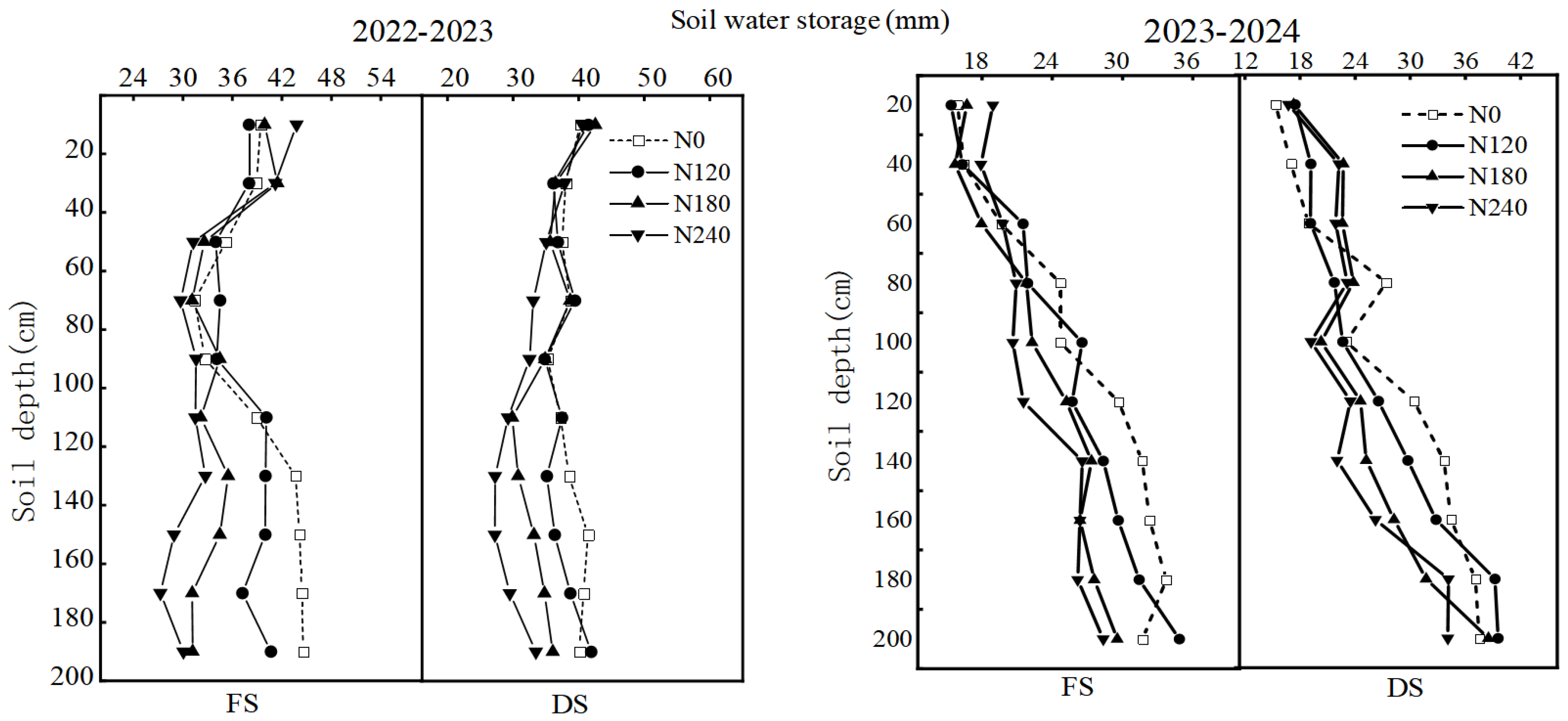
The total soil water storage in the 0–200 cm soil layer at each growth stage decreased as growth progressed, as shown in (Figure 2). Compared with FS, increasing nitrogen application reduced soil water management in the jointing to flowering stage of DS but increased it at the maturity stage when the nitrogen application rates were N120, N180, and N240. Increasing N240 reduced soil water storage in 0–200 cm soil at each growth stage of DS, and the difference was significant at the flowering stage between different treatments, but not at the maturity stage between N180 and N240 treatments. Increasing nitrogen application reduced soil water management in 0–200 cm soil at each growth stage; the difference was not significant between N0 and N120 treatments at the flowering stage, but was significant among different treatments at the maturity stage.
Figure 2.
N application rate on soil water storage in 0–200 cm soil layer of dryland wheat.
3.3. N Rate on Soil Water Management in 0–200 cm Soil Layers at Different Growth Stages
Nitrogen application significantly influenced soil water storage, with the effects varying by soil depth, growth stage, and sowing method. Under drill sowing (DS) in the jointing stage, increased N rates reduced soil water storage in the 0–120 cm profile, with statistically significant differences (p < 0.05) observed in the 40–100 cm layers (Table 3). This pattern of depletion extended to deeper layers as the season progressed. By anthesis, significant water reduction occurred in the 80–140 cm layer, indicating greater water extraction from the subsoil. At maturity, all N-fertilized treatments (N120, N180, N240) showed significantly lower soil water content in the 40–200 cm profile compared to the unfertilized control (N0). Notably, the highest N rate (N240) resulted in the most pronounced water depletion. Under furrow sowing (FS), a similar trend of nitrogen-induced water consumption was observed. At jointing, soil water in the 0–120 cm layer decreased significantly with increasing N rate, particularly in the 40–60 cm layer. While water storage in the 40–160 cm layer was lower at anthesis and maturity, the differences between the various N rates (N120, N180, N240) were not statistically significant. However, at maturity, significant differences among all treatments emerged in the deep soil layers (80–200 cm). N rates revealed that the high N application (N240) promoted significantly greater absorption of deep soil water (>100 cm) compared to the N120 treatment, particularly at the jointing and maturity stages. This indicates that excessive nitrogen fertilization stimulated root water uptake from deeper soil layers, leading to higher overall soil water consumption, especially before anthesis. While initial soil water at sowing did not differ, higher N rates consistently led to greater water extraction by maturity, particularly under FS. Specifically, the highest N rate (N240) significantly reduced soil water at maturity by 16.6% under FS and 15.9% under DS in 2022–23 compared to the N0 control.
Table 3.
N application rate on soil water management of 0–200 cm soil layer.
3.4. Water Intake in Each Growth Stage
The proportion of water consumption during these periods and total water consumption (Table 4). Compared with N180, N240 showed a significant increase in water consumption and proportion before flowering, while significantly reducing water consumption and proportion after flowering. The total water consumption, N0, decreased significantly. With increasing N, the water consumption and proportion before flowering of N180 increased, and the differences between the water consumption treatments were significant. The water consumption proportions of N180 and N240 were significantly higher than those of N0 and N120, the water consumption after flowering decreased significantly, and the water consumption proportion of N180 and N280 was significantly lower than that of N120 and N180. In 2022–2023, nitrogen application under deep sowing (DS) increased total water consumption (TWC) by 1.7% (N120), 6.3% (N180), and 11.2% (N240) relative to the N0 control. The highest N rate (N240) led to a significant increase in water consumption at maturity by 14.5% compared to the control under DS. In 2023–2024, TWC increased by 1.6% (N120), 4.7% (N180), and 7.6% (N240) under DS compared to N0, while under furrow sowing (FS) the highest N application (N240) resulted in a 7.8% increase in TWC.
Table 4.
N application rate on water consumption at different growth stages of dry wheat.
The change in soil water storage (ΔSWS) varied significantly across soil depths, growth periods, and nitrogen rates. No significant differences were observed between the furrow sowing (FS) and drill sowing (DS) methods when comparing the average ΔSWS across the entire growth period (Table 5). However, the temporal patterns of water extraction differed. During the sowing-to-bloom period, both FS and DS led to a significant reduction in soil water storage across all the measured soil layers (0–200 cm). From the bloom period to maturity, the average ΔSWS in each soil layer was significantly lower than that during the earlier period.
Table 5.
N application rate on water use in soil layers at different growth stages.
As the nitrogen rate increased from N0 to N180, ΔSWS (indicating water depletion) significantly increased in the middle to deep soil layers (40–100, 100–160, and 160–200 cm). The highest rate, N240, followed this trend but is discussed separately below. During bloom-to-maturity, for the N0, N120, and N180 treatments, a higher nitrogen application rate resulted in a decrease in ΔSWS in all soil layers (0–40 cm to 160–200 cm). This indicates that these plots, having consumed more water early in the season, had less available water to extract later. Consequently, when averaged over the entire growth period, the N120 treatment showed significantly greater total soil water depletion than the N180 and N240 treatments. N240 anomaly: the N240 treatment demonstrated a different pattern. This caused significantly high water depletion in the deep layers (40–200 cm) during the sowing-to-bloom period. This led to a situation where, overall, the average ΔSWS across the entire growth period increased with the nitrogen rate up to N180 in the 40–160 cm layer, with significant differences between the treatments. In the deepest layer (160–200 cm), the differences in total water depletion between the N120, N180, and N240 treatments were not significant.
3.5. Dry Matter Accumulation as Influenced by Sowing Method and Nitrogen Rate
The effects of the sowing method and nitrogen application on dry matter accumulation were significant and varied with the growth stage (Table 6). Drill sowing (DS) resulted in significantly lower dry matter content at the jointing stage than furrow sowing (FS). However, this pattern was reversed later in the season. At the anthesis stage, DS led to a significant increase in dry matter for the higher nitrogen treatments (N180 and N240). By maturity, the dry matter content under DS for the same N180 and N240 treatments was significantly lower than under FS. Increasing the nitrogen application rate generally promoted dry matter accumulation, but this effect was more pronounced under DS conditions. Under FS, the N240 treatment significantly increased dry matter accumulation at the jointing, anthesis, and maturity stages compared to lower N rates. Under DS, the dry matter accumulation at each growth stage increased significantly with increasing nitrogen application, showing a clear and consistent response to N fertilization.
Table 6.
N application rate on dry matter accumulation at different growth stages of dry land wheat.
3.6. Grain-Filling Characteristics
The logistic model provided an excellent fit to the grain dry matter accumulation data for all treatments, with mean coefficients of determination (R2).
The derived kinetic parameters revealed significant differences in the grain-filling process between irrigation regimes (Table 7). While the potential maximum grain weight (A) was reduced under drought stress, the model identified that the primary physiological limitation was on the rate of filling, not just its duration.
Table 7.
N application rate on grain-filling characteristics of dry land wheat.
The N0 and the grain-filling parameters showed no significant change (Table 7). Compared with the N0 treatment, the Tmax of the N120, N180, and N240 treatments increased by 7.5%, 16.7%, and 21.1%, respectively; T increased by 8.3%, 17.0%, and 22.5%, respectively; and FS increased by 8.3%, 16.9%, and 22.9%, respectively. Vmax decreased by 2.5%, 7.7%, and 13.9%, respectively, whereas Vmean decreased by 2.4%, 9.0%, and 15.3%, respectively. The Tmax of N120, N180, and N240 treatments increased by 8.4%, 16.5%, and 23.0%, respectively, while T increased by 7.1%, 12.6%, and 22.4%, respectively; DS increased by 6.1%, 11.2%, and 22.2%, respectively; Vmax decreased by 1.4%, 5.3%, and 11.5%, respectively; and Vmean decreased by 4.2%, 7.9%, and 13.9%, respectively.
3.7. Effects of Sowing Method and Nitrogen Application Rate on the Yield and Components
The grain yield of strong-gluten wheat was significantly influenced by variety and irrigation (Table 8). Comparing the different sowing methods, the responses of the yields and constituent elements of the two sowing methods to nitrogen were consistent. The water-use efficiency (WUE) yields under treatments N120, N180, and N240 were significantly reduced by 17.9%, 29.2%, and 36.7%, respectively. The number of grains per ear in the N120, N180, and N240 treatments decreased by 7.4%, 12.0%, and 19.1%, respectively. The 1000-grain weight of the N180 treatment increased by 3.8%, while the 1000-grain weights’ WUE of the N120, N180, and N240 treatments decreased by 12.7%, 8.9%, and 4.4% respectively. Although N120, N180, and N240 treatments maintained a relatively high 1000-grain weight, the WUE of the number of ears and grains per ear decreased significantly, resulting in a significant reduction in yield. Under the N240 treatment, the yields of FS and DS were 10.7% and 15.3% lower than those of N0, respectively. Especially in 2022–2024, the rainfall during the wheat season was only 85.9 mm, and under the N240 treatment, the yields of N180, and N240 were 10.7% and 15.3% lower than N0. The highest N rate (N240) increased yield by 25.4% and WUE by 11.9% compared to the N0 control. In the same year under DS, N240 increased yield by 23.6% and WUE by 11.1%. In 2023–2024, the optimal response shifted; under FS, the N180 treatment provided the greatest benefit, increasing yield by 19.3% and WUE by 11.5% over the control. Spike number was the yield component most responsive to N, increasing by up to 21.6% (FS, N240) in 2022–2023. Flat sowing consistently outperformed deep sowing, yielding 6.2% more on average across N treatments and years. The results demonstrate that moderate to high N application (N180–N240) combined with flat sowing maximizes yield and WUE in dryland wheat, though the optimal N rate can vary inter-annually.
Table 8.
Effects of sowing methods on yield components.
3.8. Soluble Carbohydrate Accumulation in Stem of Dry Land Wheat at Different Nodes
The structured interpretation of Table 9: N on soluble carbohydrate (WSC) dynamics in dryland wheat stems across different nodes. The accumulation at anthesis was higher in all nodes (peduncle, penultimate, other), especially in 2022–2023 (e.g., 286.95, 268.20 mg/g in other internodes). Pre-anthesis transport FS had significantly greater remobilization (45.42. 43.55 mg/g in peduncle). Post-anthesis transport FS showed superior WSC translocation to grains in 2023–2024 (231.19, 225.21 mg/g in other internodes). Mechanism: FS likely improves soil moisture retention, enhancing WSC synthesis and remobilization efficiency. Higher N180, N240 generally increased. Anthesis accumulation maximal at N240 (263.42 mg/g in penultimate internode, FS 2022–2023). Pre-anthesis transport N240 boosted remobilization (54.96 mg/g in penultimate internode, DS 2022–2023). Post-anthesis transport N240 significantly enhanced translocation in 2023–2024 (323.57 mg/g in other internode), FS. The exception was 2023–2024, N120 occasionally outperformed N180 (post-anthesis transport in peduncle), suggesting context-dependent N optimization. Node-specific patterns showed lower internodes with the highest WSC accumulation at anthesis of 310.84 mg/g, FS N180 2022–2023. Dominant contributor to post-anthesis transport 207.79–323.57 mg/g, FS 2023–2024.
Table 9.
N rate on soluble carbohydrate accumulation in stem of dry land wheat at different nodes.
3.9. Rubisco Activity in Flag Leaves
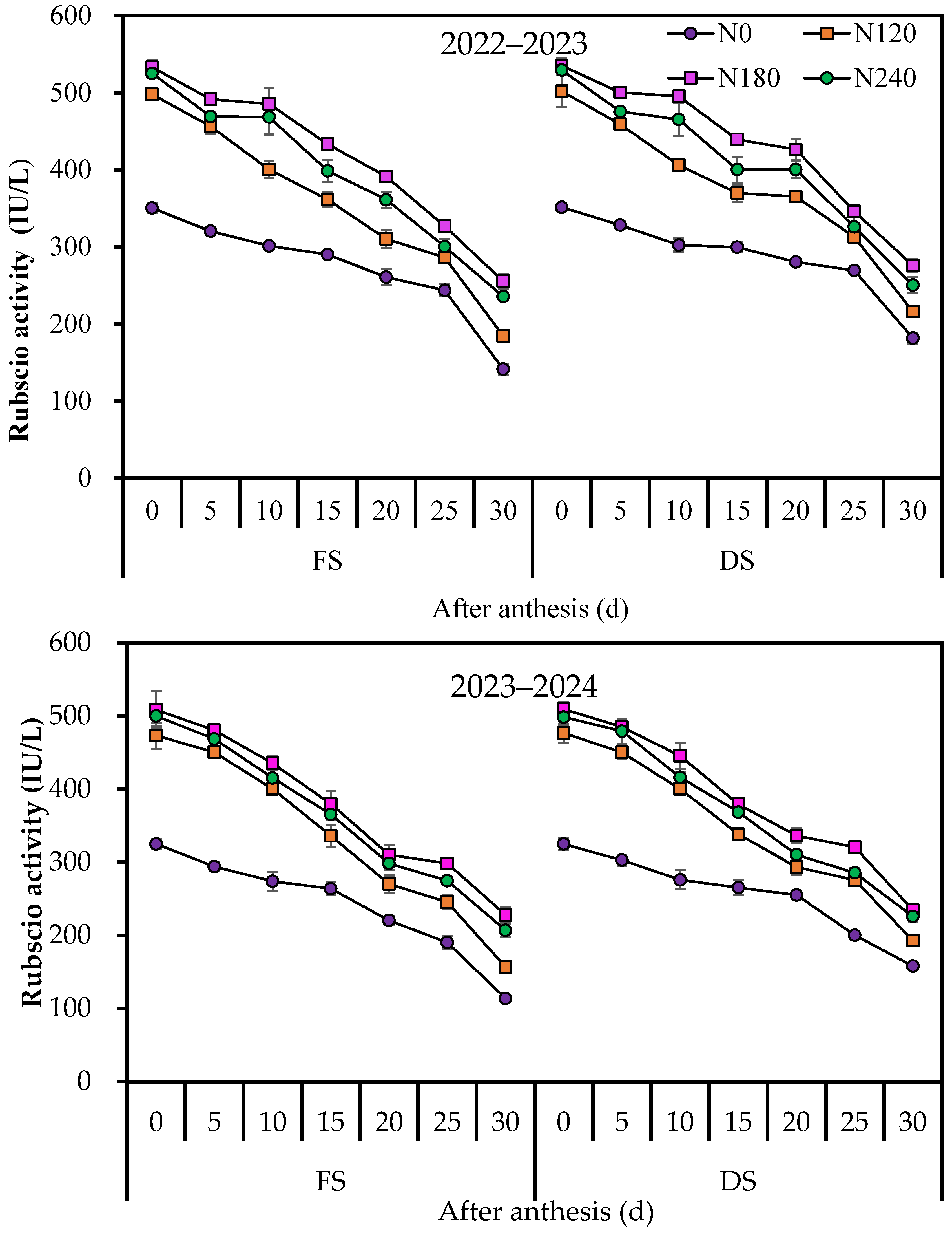
The Rubisco activity showed a decreasing trend as the grain-filling process progressed (Figure 3). From 0 to 15 d after anthesis, there was no significant difference in the Rubisco activity of the flag leaves of FS and DS. From 20 to 30 d after anthesis, the Rubisco activity of wheat sown with FS was significantly higher than that of wheat sown with DS. With the increase in N180, Rubisco activity in the wheat flag leaves showed a trend of first increasing and then decreasing.
Figure 3.
N rate on Rubisco activity of wheat flag leaves after anthesis. N0 (Violet): Baseline/zero-parameter condition. N120 (Orange): Moderate parameter increase. N180 (Pink): High parameter level → clear nonlinear shift. N240 (Green): Maximum parameter level → saturation or peak response.
3.10. Nitrogen-Use Efficiency
Across both years and nearly all N rates, the drill sowing (DS) method consistently resulted in higher values for AEN, REN, NUE, NUpE, and PFPN compared to FS. This is reflected in the significantly higher seasonal means for DS (Table 10). This indicates that the improved crop establishment and resource capture associated with DS translated into a more efficient acquisition and agronomic use of applied nitrogen. A clear and consistent trend was observed for both sowing methods: as the N application rate increased from N120 to N240, all efficiency indices (AEN, REN, NUE, NUpE, NUtE, PFPN) progressively and significantly declined. This pattern demonstrates the law of diminishing returns, where additional nitrogen inputs beyond an optimal level (appears to be N120–N180 in this study) yield progressively smaller gains in grain production per unit of N applied. The most pronounced drops were often seen at the highest rate (N240). The significant S × N interaction for all traits reveals that the sowing method modifies the crop’s response to nitrogen. Drill sowing not only produced higher efficiency at a given N rate but also mitigated the decline in efficiency at higher N levels. For instance, at N240, the AEN under DS (11.2 and 12.1 kg kg−1) was substantially higher than under FS (7.0 and 8.1 kg kg−1) in both years. This suggests that the improved growing conditions in DS allow the crop to utilize high N doses more effectively than in FS.
Table 10.
Effects of sowing method and nitrogen rate on NUE rated traits in wheat.
3.11. Correlation Analysis of Soil Moisture and Soluble Carbohydrates at Different Nodes of Dryland Wheat
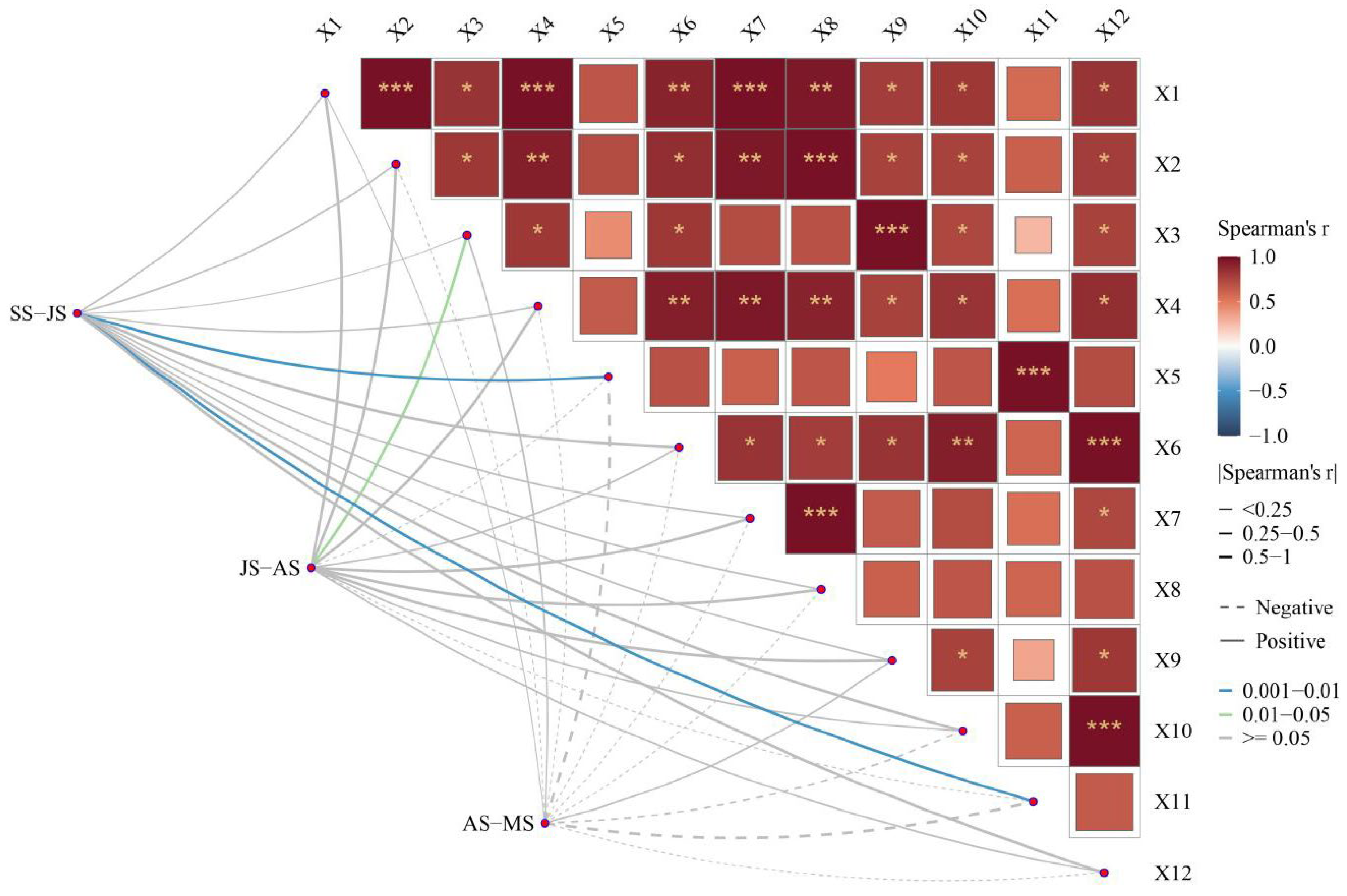
Correlation analysis of the accumulation and transport of water-soluble carbohydrates (WSC) at different nodes (Figure 4). Lower internodes, including sub-spike nodes, are strongly positively correlated with grain yield under drought stress because these nodes serve as major reservoirs for WSC (fructans, sucrose), which buffers grain filling when photosynthesis is impaired. Higher soil moisture pre-anthesis enhanced the WSC accumulation at these nodes. It contributes moderately to WSC storage, but its accumulation is less sensitive to soil moisture compared with lower internodes which accumulate minimal WSC and show weaker correlations with soil moisture. Residual WSC was retained after remobilization, with higher retention under drought conditions due to incomplete translocation. The penultimate second-node intermediate WSC retention was influenced by the post-anthesis soil moisture. Dry conditions accelerate remobilization from this node as the primary source of the sub-spike node of pre-anthesis WSC translocation. Soil moisture deficits increase remobilization efficiency to support early grain development. The second node from the top contributes less to pre-anthesis transport but becomes critical under severe drought conditions. Minor contributors to the transport capacity were largely unaffected by soil moisture, including the accumulation of soluble carbohydrates in the lower spike node at anthesis, soluble carbohydrate accumulation at anthesis of the second anthesis, and soluble carbohydrates in other nodes at anthesis. There is soluble carbohydrate accumulation at the mature stage of the sub-panicle node, soluble carbohydrate accumulation during maturity of the penultimate second node, soluble carbohydrate accumulation during maturity of the other nodes, and soluble carbohydrate transport capacity at the sub-spike node before anthesis.
Figure 4.
Correlation analysis between soil moisture and carbohydrate accumulation and transportation at different nodes of stem of dryland wheat. Note: ***, ** and * significant at p < 0.01 and p < 0.05, respectively; ns, not significant. Means within columns followed by different lower case letters are significantly different (p < 0.05, LSD test). X1: accumulation of soluble carbohydrates in lower spike nodes at anthesis; X2: soluble carbohydrate accumulation at anthesis of second anthesis; X3: soluble carbohydrates in other nodes at anthesis; X4: soluble carbohydrate accumulation at the mature stage of sub-panicle node; X5: soluble carbohydrate accumulation during maturity of penultimate second node; X6: soluble carbohydrate accumulation during maturity of other nodes; X7: soluble carbohydrate transport capacity at sub-spike node before anthesis; X8: soluble carbohydrate transport before anthesis in the second node from the top; X9: soluble carbohydrate transport capacity of remaining nodes before anthesis; X10: soluble carbohydrate transport after anthesis at nodes below the ear; X11: soluble carbohydrate transport after anthesis in the second anthesis; X12: soluble carbohydrate transport after anthesis.
4. Discussion
This study demonstrates that in the semi-arid Loess Plateau, achieving optimal wheat productivity is a complex function of nitrogen (N) management and sowing method, with the interaction primarily governed by soil water dynamics. Our core finding—that a moderate N rate of 180 kg ha−1 under furrow sowing (FS) provides the best balance of yield, water-use efficiency (WUE), and acceptable grain quality—can be mechanistically explained by the interplay between N-induced vegetative growth, reproductive allocation, and seasonal water partitioning.
4.1. Nitrogen Rate and the Yield–Quality–Water-Use Triad
The absence of a significant yield increase from N180 to N240, despite a clear improvement in grain quality (steamed bread score, volatile compounds) at the higher rate, presents a classic trade-off in dryland cropping. Sufficient N is critical for yield formation, primarily by increasing spike number, as observed here (up to 21.6% increase with N240). This aligns with literature confirming N’s role in promoting tiller and canopy establishment [31,32]. However, in water-limited environments, excessive N application can become counterproductive. Our data show that N240 significantly increased total water consumption (by up to 7.8%) and, critically, shifted the pattern of water use, increasing the proportion of soil water consumed before anthesis by 7.0 percentage points. This vigorous pre-anthesis growth under high N depletes soil moisture reserves, leaving inadequate water for the critical grain-filling period, potentially leading to kernel abortion or reduced weight [31,32]. A significant fundamental interaction between water and N use was observed. The treatments with high nitrogen input, which exhibited a decline in NUE, also point the direction towards higher WUE. This is agreeable with the established physiological trade-off where high nitrogen consumption under ample water supply enhances photosynthetic capacity and stomatal regulation, thereby improving the amount of biomass produced per unit of water transpired [33]. However, this gain in WUE often occurs at the expense of NUE, as the increased nitrogen uptake is not proportionally converted into harvestable output, leading to diminishing returns. This inverse relationship highlights a critical management trade-off: optimizing for the use efficiency of one resource (water) can negatively impact the efficiency of another (nitrogen) under non-limiting conditions. Future management strategies should therefore aim to identify the optimal N rate that balances both WUE and NUE for economic and environmental sustainability [34,35]. Consequently, while N240 supported superior individual plant health and quality parameters, the associated water cost prevented the realization of a higher grain yield compared to N180. This explains why N180, which supplied adequate N for spike formation without inducing excessive early-season water demand, consistently delivered high yields and the highest WUE.
4.2. Sowing Method Modulates Plant Response to Nitrogen and Water
The superior performance of furrow sowing (FS) over drill sowing (DS), yielding 6.2% more on average, can be attributed to its modification of the micro-environment and resource capture. FS enhances water harvesting and conservation in the seed zone, improving seedling establishment and early growth under erratic rainfall [35]. Our results further reveal that FS, particularly combined with N180, significantly boosted dry matter accumulation from overwintering to maturity. This is likely due to improved light interception and photosynthetic efficiency within the furrow canopy architecture, as supported by findings of higher photosynthetic rates in FS flag leaves [35,36]. The enhanced post-anthesis dry matter accumulation under FS is crucial, as grain filling in wheat relies heavily on current photosynthesis during this period. In contrast, DS, while potentially maximizing WUE in some contexts by restricting over-vigorous growth, ultimately limited the photosynthetic capacity and dry matter production potential of the crop, leading to lower overall yields [35,37].
4.3. Integrated Mechanism: Synchronizing Growth with Water Availability
The strong positive correlation between grain yield and soil water consumption in the 0–200 cm layer during the jointing-to-maturity period underscores the importance of timely water availability for reproductive success. An effective management system must ensure that water is not exhausted prematurely by excessive vegetative growth [38]. The FS-N180 combination achieved this synchrony. It provided sufficient N to establish a robust canopy and spike population, while the FS method conserved soil moisture. This allowed for a more balanced water use across the season, sustaining photosynthetic activity and dry matter translocation during the grain-filling period. This aligns with the adaptive strategy where crops in dry years conserve water early for use during late reproductive stages [33,39]. In contrast, the N240 treatment, especially under FS in a drier year, triggered early water use, depleting the profile and leading to a 16.6% reduction in soil water at maturity, which can jeopardize yield stability and long-term soil water balance.
The shift in optimal N rate between years (N240 in a wetter year vs. N180 in a drier year) highlights the critical interaction between N management and variable precipitation [40]. In years with more favorable early-season moisture, the crop can support the higher vegetative demand of N240 without severe pre-anthesis water stress, allowing the quality benefits to be realized. However, given the high frequency of drought and the imperative for sustainable water use on the Loess Plateau, recommending a static high-N strategy is risky [41,42]. The moderate N180 rate provides a more resilient approach, safeguarding yield and WUE across different rainfall patterns while still delivering acceptable grain quality.
The results demonstrate a clear and consistent advantage of drill sowing (DS) over farmer practice (FS) in terms of nitrogen (N)-use efficiency. Across both experimental years and nearly all N application rates, DS yielded significantly higher values for the agronomic efficiency of nitrogen (AEn), recovery efficiency (REn), nitrogen-use efficiency (NUE), nitrogen-uptake efficiency (NUpE), and partial factor productivity of nitrogen (PFPn). This superior performance can be attributed to the improved crop stand establishment, better root architecture, and more uniform resource distribution inherent to DS, which collectively enhance the crop’s ability to capture and utilize applied nitrogen [43]. The higher NUpE values under DS specifically confirm more effective scavenging of both fertilizer and soil nitrogen, translating directly into greater yield gains per unit of N applied (AEn, PFPn) and more efficient internal conversion to grain (NUE).
The recommended practice of FS with 180 kg N ha−1 succeeds by optimizing the physiological trade-offs in dryland wheat. It maximizes yield through enhanced spike number and post-anthesis dry matter accumulation, maximizes WUE by avoiding profligate early water use, and maintains a baseline grain quality, all within the context of limited and variable water resources. While this study clarifies the integrated effects on yield, WUE, and quality, the precise mechanisms governing nitrogen translocation, root–water uptake patterns, and carbon partitioning under these management practices warrant further investigation. Such research would strengthen the physiological basis for these agronomic recommendations.
5. Conclusions
Based on the findings of this two-year study, furrow sowing (FS) combined with a moderate nitrogen application rate of 180 kg N ha−1 (N180) is recommended as the optimal practice for sustainable wheat production on the Loess Plateau. This strategy achieves the most favorable trade-off among key agronomic objectives. While the higher N240 rate under FS enhanced grain quality, including steamed bread score and volatile compounds, it also induced excessive early-season water use, depleting soil moisture at maturity by over 15% and failing to produce a significant yield increase over N180. In contrast, the FS-N180 combination reliably supported high grain yield—increasing it by up to 19.3% over the control—by boosting spike number and dry matter accumulation while maintaining superior water-use efficiency (increased by up to 11.5%). Although drill sowing (DS) maximized WUE, it consistently resulted in lower yields and was a critical practice for maximizing NUE, effectively mitigating the yield and efficiency penalties associated with excessive nitrogen application. Therefore, for farmers in this arid region, the FS-N180 system provides the ideal balance, securing high productivity, efficient water use, and acceptable grain quality without the unsustainable water consumption associated with maximum nitrogen fertilization.
Author Contributions
Conceptualization, H.N., J.C. and P.Y.; methodology, M.S. and Z.S.; software, M.S. and Y.N.; validation, Y.R., L.L. and P.D.; formal analysis, M.S. and A.R.; investigation, J.C.; resources, P.Y.; data curation, H.N.; writing—original draft preparation, H.N.; writing—review and editing, M.S. and Y.N.; visualization, Y.R.; supervision, H.N.; project administration, M.S.; funding acquisition, H.N. All authors have read and agreed to the published version of the manuscript.
Funding
The authors are thankful to the Researchers Supporting China Agriculture Research System (No. CARS-03-01-24), National Natural Science Foundation of China (No. 32272216), Sub-project of National Key R&D program (No. 2021YFD1901102-2), and Key Laboratory of Crop Ecology and Water Efficient Utilization in Shanxi Province (201705D111007) for financial support of this study.
Data Availability Statement
The original contributions presented in this study are included in the article. Further inquiries can be directed to the corresponding author.
Acknowledgments
The authors are thankful to the China Agriculture Research System (no. CARS-03-01-24), National Natural Science Foundation of China (No. 32272216), Sub-project of National Key R&D program (No. 2021YFD1901102-2), and Key Laboratory of Crop Ecology and Water Efficient Utilization in Shanxi Province (201705D111007) for financial support of this study.
Conflicts of Interest
The authors declare no conflicts of interest.
References
- Noor, H.; Noor, F.; Gao, Z.; Alotaibi, M.; Seleiman, M.F. Effects of Water Use Efficiency Combined with Advancements in Nitrogen and Soil Water Management for Sustainable Agriculture in the Loess Plateau, China. Water 2025, 17, 2329. [Google Scholar] [CrossRef]
- Duan, J.; Shao, Y.; He, L. Optimizing nitrogen management to achieve high yield, high nitrogen efficiency and low nitrogen emission in winter wheat. Sci. Total Environ. 2019, 697, 134088. [Google Scholar] [CrossRef] [PubMed]
- Biradar, C.; Thenkabail, P.; Noojipady, P. A global map of rainfed cropland areas (GMRCA) at the end of last millennium using remote sensing. Int. J. Appl. Earth Obs. 2009, 11, 114–129. [Google Scholar] [CrossRef]
- Groos, C.; Robert, N.; Bervas, E. Genetic analysis of grain protein-content, grain yield and thousand-kernel weight in bread wheat. Theor. Appl. Genet. 2003, 106, 1032–1040. [Google Scholar] [CrossRef]
- Tosi, P.; Parker, M.; Gritsch, C. Trafficking of storage proteins in developing grain of wheat. J. Exp. Bot. 2009, 60, 979–991. [Google Scholar] [CrossRef]
- Kuipers, A.; Jacobsen, E.; Visser, R. Formation and deposition of amylose in the potato tuber affected by the reduction of granule-bound starch synthase gene expression. Plant Cell 1994, 6, 43–52. [Google Scholar] [CrossRef]
- Wang, D.; Li, F.; Cao, S. Genomic and functional genomics analyses of gluten proteins and prospect for simultaneous improvement of end-use and health-related traits in wheat. Theor. Appl. Genet. 2020, 133, 1521–1539. [Google Scholar] [CrossRef]
- Huang, L.; Wang, D.; Yao, L.; Li, X.; Wang, D.; Du, Q.; Guo, Y. Primary limitation on vegetation productivity shifts from precipitation in dry years to nitrogen in wet years in a degraded arid steppe of Inner Mongolia, northern China. J. Soils Sediments 2019, 19, 544–556. [Google Scholar] [CrossRef]
- Chada, S.; Asiedu, S.; Ofoe, R. An overview of plant morpho-physiology, biochemicals, and metabolic pathways under water stress. Hortic. Int. J. 2023, 7, 115–125. [Google Scholar] [CrossRef]
- Wang, X.; Qadir, M.; Rasul, F.; Yang, G.; Hu, Y. Response of Soil Water and Wheat Yield to Rainfall and Temperature Change on the Loess Plateau, China. Agronomy 2018, 8, 101. [Google Scholar] [CrossRef]
- Qu, B.; Noor, H.; Feng, Y.; Di, J.; Alotaibi, M.; Noor, F. Nitrogen uptake and water consumption for achieving high yield of winter wheat upon nitrogen addition at different doses. Sci. Rep. 2025, 15, 40047. [Google Scholar] [CrossRef] [PubMed]
- Amalia, Z.; Jeroen, L.; Stijn, S. Electronic nose systems to study shelf life and cultivar effect on tomato aroma profile. Sens. Actuators B Chem. 2004, 97, 324–333. [Google Scholar]
- Noor, H.; Ding, P.; Kausar, F.; Noor, F.; Wenbo, Z.; Sun, M.; Alhusnain, L. Morphological and physiological root traits and expression of the gene relationship with nitrogen uptake in wheat (Triticum aestivum L.). Turk. J. Agric. For. 2024, 48, 1034–1051. [Google Scholar] [CrossRef]
- Sliwinska, M.; Wisniewska, P.; Dymerski, T. Food analysis using artificial senses. J. Agric. Food Chem. 2014, 62, 1423–1448. [Google Scholar] [CrossRef]
- Garrido-Delgado, R.; Mercader-Trejo, F.; Sielemann, S. Direct classification of olive oils by using two types of ion mobility spectrometers. Anal. Chim. Acta 2011, 696, 108–115. [Google Scholar] [CrossRef]
- Garrido-Delgado, R.; Dobao-Prieto, M.M.; Arce, L.; Aguilar, J.; Cumplido, J.L.; Valcárcel, M. Ion mobility spectrometry versus classical physic-chemical analysis for assessing the shelf life of extra virgin olive oil according to container type and storage conditions. J. Agric. Food Chem. 2015, 63, 2179–2188. [Google Scholar] [CrossRef]
- Arroyo-Manzanares, N.; Martin-Gomez, A.; Jurado-Campos, N. Target vs. spectral fingerprint data analysis of Iberian ham samples for avoiding labeling fraud using headspace-gas chromatography-ion mobility spectrometry. Food Chem. 2018, 246, 65–73. [Google Scholar] [CrossRef]
- Valenzuela, H. Optimizing the Nitrogen Use Efficiency in Vegetable Crops. Nitrogen 2024, 5, 106–143. [Google Scholar] [CrossRef]
- Herrero, J.; Ramírez-Santos, A.; Díaz-Santos, E.; Torres-Cortés, G. Biofertilizers for Enhanced Nitrogen Use Efficiency: Mechanisms, Innovations, and Challenges. Nitrogen 2025, 6, 111. [Google Scholar] [CrossRef]
- Li, R.; Hou, X.; Jia, Z.; Ren, X. Effects on soil temperature, moisture, and maize yield of cultivation with ridge and furrow mulching in the rainfed area of the Loess Plateau, China. Agric. Water Manag. 2013, 116, 101–109. [Google Scholar] [CrossRef]
- Vlasov, Y.; Legin, A.; Rudnitskaya, A.; Di Natale, C.; D’AMico, A. Nonspecific sensor arrays (electronic tongue) for chemical analysis of liquids (IUPAC Technical Report). Pure Appl. Chem. 2005, 77, 1965–1983. [Google Scholar] [CrossRef]
- Xi, J.; Zha, Q.; Xu, D. Volatile compounds in Chinese steamed bread influenced by fermentation time, yeast level and steaming time. LWT-Food Sci. Technol. 2021, 141, 110861. [Google Scholar] [CrossRef]
- Riccardo, D.; Giampiero, S.; Dino, M. Wheat classification according to its origin by an implemented volatile organic compounds analysis. Food Chem. 2021, 341, 128217. [Google Scholar] [CrossRef] [PubMed]
- Senapati, N.; Semenov, M. Large genetic yield potential and genetic yield gap estimated for wheat in Europe. Glob. Food Secur. 2020, 24, 100340. [Google Scholar] [CrossRef]
- Ren, A.; Sun, M.; Xue, L. Spatio-temporal dynamics in soil water storage reveals Effect of nitrogen inputs on soil water consumption at different growth stages of winter wheat. Agric. Water Manag. 2019, 216, 379–389. [Google Scholar] [CrossRef]
- Mbuthia, L.; Acosta-Martinez, V.; DeBruyn, J. Long term tillage, cover crop, and fertilization Effect on microbial community structure, activity: Implications for soil quality. Soil. Biol. Biochem. 2015, 89, 24–34. [Google Scholar] [CrossRef]
- Qi, Y.; Ossowicki, A.; Yang, X. Effect of plastic mulch film residues on wheat rhizosphere and soil properties. J. Hazard. Mater. 2020, 387, 121711. [Google Scholar] [CrossRef]
- Rasmussen, I.; Thorup-Kristensen, K. Does earlier sowing of winter wheat improve root growth and N uptake. Field Crops Res. 2016, 196, 10–21. [Google Scholar] [CrossRef]
- Basso, B.; Fiorentino, C.; Cammarano, D. Analysis of rainfall distribution on spatial and temporal patterns of wheat yield in Mediterranean environment. Eur. J. Agron. 2012, 41, 52–65. [Google Scholar] [CrossRef]
- Cao, H.; Wang, Z.; He, G.; Dai, J. Tailoring NPK Fertilizer Rates to Precipitation for Dryland Winter Wheat in the Loess Plateau. Field Crops Res. 2017, 209, 88–95. [Google Scholar] [CrossRef]
- Miralles, C.; Le Gouis, J.; Ney, B. The challenge of improving nitrogen use efficiency in crop plants: Towards a more central role for genetic variability and quantitative genetics within integrated approaches. J. Exp. Bot. 2007, 58, 2369–2387. [Google Scholar] [CrossRef] [PubMed]
- Li, C.; Shi, Y.; Yu, Z.; Zhang, Y.; Zhang, Z. Optimizing nitrogen application strategies can improve grain yield by increasing dry matter translocation, promoting grain filling, and improving harvest indices. Front. Plant Sci. 2025, 16, 1565446. [Google Scholar] [CrossRef] [PubMed]
- Cossani, C.M.; Sadras, V.O. Water–nitrogen colimitation in grain crops. Adv. Agron. 2018, 149, 231–274. [Google Scholar]
- Zhang, X.; Wang, Y.; Sun, H.; Chen, S.; Shao, L. Optimizing the trade-off between water and nitrogen use efficiency in wheat and maize cropping systems. Field Crops Res. 2020, 248, 107712. [Google Scholar]
- Noor, H.; Noor, F. Responses of Photosynthetic Characteristics, and Agronomic Attributes to Sowing Methods of Winter Wheat. Russ. J. Plant Physiol. 2024, 71, 147. [Google Scholar] [CrossRef]
- Tian, Z.; Wang, F.; Dai, T. Characteristics of dry matter accumulation and translocation during the wheat genetic improvement and their relationship to grain yield. Sci. Agric. Sin. 2012, 45, 801–808. [Google Scholar]
- Luo, C.; Zhang, X.; Duan, H. Allometric relationship and yield formation in response to planting density under ridge-furrow plastic mulching in rainfed wheat. Field Crops Res. 2020, 251, 107785. [Google Scholar] [CrossRef]
- Yu, S.; Chen, Y.; Yu, S. Study on Dynamic Changes of Soil Water in Winter Wheat Field of Furrow Planting and Bed Planting. J. Soil. Water Conserv. 2005, 19, 133–137. [Google Scholar]
- Sang, X.; Wang, D.; Lin, X. Effects of tillage practices on water consumption characteristics and grain yield of winter wheat under different soil moisture conditions. Soil Tillage Res. 2016, 163, 185–194. [Google Scholar] [CrossRef]
- Zheng, C.Y.; Yu, S.H.I.; Dong, W.A.N.G. Effects of tillage practices on water consumption, water use efficiency and grain yield in wheat field. J. Integr. Agric. 2014, 13, 2378–2388. [Google Scholar] [CrossRef]
- Li, Y.; Chen, J.; Tian, L.; Shen, Z.; Amby, D.B.; Liu, F.; Gao, Q.; Wang, Y. Seedling-Stage Deficit Irrigation with Nitrogen Application in Three-Year Field Study Provides Guidance for Improving Maize Yield, Water and Nitrogen Use Efficiencies. Plants 2022, 11, 3007. [Google Scholar] [CrossRef]
- Hu, S.; Qiao, B.; Yang, Y.; Rees, R.M.; Huang, W.; Zou, J.; Yin, X. Optimizing nitrogen rates for synergistically achieving high yield and high nitrogen use efficiency with low environmental risks in wheat production—Evidences from a long-term experiment in the North China Plain. Eur. J. Agron. 2023, 142, 126681. [Google Scholar] [CrossRef]
- Karimi, E.; Azizi, M.; Ahmadi, M. The impact of planting method on nitrogen use efficiency and yield of wheat: A review. J. Plant Nutr. 2022, 45, 1023–1042. [Google Scholar]
Disclaimer/Publisher’s Note: The statements, opinions and data contained in all publications are solely those of the individual author(s) and contributor(s) and not of MDPI and/or the editor(s). MDPI and/or the editor(s) disclaim responsibility for any injury to people or property resulting from any ideas, methods, instructions or products referred to in the content. |
© 2026 by the authors. Licensee MDPI, Basel, Switzerland. This article is an open access article distributed under the terms and conditions of the Creative Commons Attribution (CC BY) license.