


Abstract
This paper addresses a class of multi-point initial value problems with impulses and proportional delays. The framework is based on the Atangana–Baleanu–Caputo (ABC) fractional derivative, which allows the model to incorporate hereditary memory effects absent in standard integer-order systems. Using suitable fixed-point arguments, conditions ensuring the existence and uniqueness of solutions are derived. The reliability and robustness of the obtained solutions is analyzed through the Hyers–Ulam (H-U) method and generalized H-U stability. To demonstrate the theoretical findings, a general numerical example model and a fractional-order housefly population model are considered that incorporate impulsive effects and delay terms reflecting real ecological feedback. Numerical simulations illustrate how variations in the fractional order and impulse intensity influence the dynamic behavior of the adult population. The results reveal that impulsive interventions can effectively regulate population oscillations, while the fractional order governs the rate of decay and long-term stability of the system.
1. Introduction
Fractional-order differential equations (FODEs) have attracted increasing attention over the past decades due to their enhanced ability to describe dynamical processes with memory, hereditary behavior, and long-range interactions—features that classical integer-order models are unable to capture accurately. Consequently, fractional calculus has become an essential analytical framework in diverse fields such as engineering, physics, biology, control theory, electrochemistry, and fluid mechanics [1,2,3,4].
Among the various fractional operators, Atangana and Baleanu introduced derivatives with nonlocal and non-singular Mittag–Leffler kernels in both the Riemann–Liouville and Caputo senses. In particular, the Atangana–Baleanu–Caputo (ABC) derivative has gained popularity due to its ability to incorporate fading memory effects while avoiding the singular kernels appearing in classical fractional operators [5,6,7]. Recently, in [8], the authors investigated the dynamics of a three-species prey–predator model in the framework of the ABC derivative. In [9], a modified ABC derivative was employed to analyze a breast cancer model.
Many real-world systems exhibit sudden, instantaneous changes that cannot be adequately described by purely continuous models. Such discontinuities naturally lead to impulsive differential equations, which have been widely used in population dynamics, biological processes, mechanical systems with impacts, and control mechanisms involving switching or rapid interventions [10,11]. Recently, the integration of impulsive effects within fractional-order dynamics has opened new directions for examining hybrid systems that simultaneously incorporate abrupt jumps and long-term memory [12,13]. The nonlocal, non-singular kernel of the ABC operator provides a particularly suitable mathematical structure for such analysis.
Despite this progress, the existing literature on impulsive ABC-type systems primarily focuses on classical or integral-type initial conditions [14,15]. In contrast, multi-point initial-value problems with proportional delays remain underdeveloped, even though they arise naturally in processes where the present state depends on distributed or scaled historical states—a scenario prevalent in biological models with developmental delays, physiological feedback, pantograph-type interactions, and memory-type constraints. Furthermore, numerical studies on numerical frameworks and proportional-delay fractional models have received increasing attention due to their long-time complexity [16,17,18]. These works motivate the need for more general analytical and numerical frameworks.
Most existing contributions on impulsive fractional differential equations have considered the Caputo or Riemann–Liouville operators and rely on classical initial or boundary conditions [13]. These works do not incorporate proportional delays or multi-point constraints, and their stability analysis are generally limited to traditional techniques. Moreover, stability results for impulsive systems involving the ABC operator are still scarce, particularly when proportional delays and nonlocal memory coexist. The present work extends this body of research by establishing existence, uniqueness, and H-U stability for a broader class of impulsive ABC-type fractional systems with multi-point initial conditions and proportional delays, thereby filling an evident gap in the literature and complementing the aforementioned studies.
Motivated by these observations and the need for advanced analytical tools, the present work examines a modified multi-point initial value problem for FODEs with impulses and proportional delays in the sense of the ABC derivative. The theoretical results are supported by numerical application to a fractional-order housefly population model, illustrating how impulses, proportional delays, and fractional memory jointly influence the system’s dynamics and long-term behavior.
Our proposed model is formulated as
where the following abbreviations are used:
- denotes the ABC fractional derivative of order with normalization ;
- is a given continuous nonlinearity;
- are weighting coefficients associated with a multi-point condition;
- denote interior nodes at which the solution is sampled;
- is an inhomogeneous term;
- are the impulse maps acting at .
The aim of this research is to establish sufficient conditions guaranteeing the existence, uniqueness, and stability of solutions to the proposed problem (1). To achieve this, we apply Krasnosel’skii’s fixed-point theorem (KFPT) to verify the existence of at least one solution and employ Banach’s contraction principle (BFPT) to guarantee its uniqueness under appropriate assumptions. The H-U stability concept is then applied to analyze the robustness of the obtained solutions with respect to small perturbations in the system. As a major application, we implement the proposed framework for a fractional housefly population model to explore how impulsive interventions and proportional delays influence adult population dynamics under fractional memory.
The manuscript is organized as follows: Section 2 reviews essential preliminaries and basic definitions. Section 3 introduces an auxiliary lemma that reformulates the model into an equivalent integral form. Section 4 establishes the main theoretical results concerning existence, uniqueness, and H-U stability. Section 5 presents a numerical illustration supported by a general numerical scheme and a fractional housefly model. Section 6 concludes the work with future research directions.
2. Preliminaries
This section outlines several essential concepts and supporting results that serve as the foundation for the subsequent theoretical analysis.
Definition 1
([5]). Let with , and let . The Atangana–Baleanu fractional derivative in the Caputo sense (ABC derivative) of order α is defined by
where defined by
which is the Mittag–Leffler function, which generalizes the exponential function and frequently appears in fractional calculus. The factor is a normalization constant introduced to ensure that the operator has the correct limiting behavior at the endpoints of the fractional order. In particular,
and the standard choice in the literature is
It can be observed that when , the above expression yields the original function , whereas for , it coincides with the classical mode.
Definition 2
([5]). The Atangana–Baleanu fractional integral (AB integral) of order associated with a function f is defined by
The normalization factor plays the same role as for the ABC derivative: it ensures that
thereby providing a consistent transition between the identity operator () and the classical Riemann integral ().
Theorem 1.
(Krasnosel’skii’s fixed-point theorem [19]). Let be a nonempty, closed, and convex subset of a Banach space . Assume that are two operators satisfying the following:
- for all ;
- is a contraction operator;
- is continuous and the set is relatively compact in .
Then, there exists at least one such that
3. Auxiliary Result
We define the space
equipped with the norm
Here, is a Banach space.
Lemma 1.
Let and assume that is a piecewise continuous function with left and right limits at the impulsive moments . Then, the function represents a solution of the modified problem
if ϑ satisfies the corresponding integral equations:
where is the ABC normalization constant.
Proof.
Assume that satisfies (4). Consider
Applying the ABC integral to both sides for , we obtain
Using the multi-point initial condition
we obtain
For , we have
The left-hand limit at is
Using the impulsive condition
we obtain
Substituting this into (9) for , we obtain
Proceeding inductively for all impulses , , yields the general formula
4. Main Results: Existence, Uniqueness and H-U Stability
This section is subdivided into two subsections. In Section 4.1, we derive the existence and uniqueness of the solution. In Section 4.2, we study the H-U stability of the proposed model.
4.1. Existence and Uniqueness of Solution
Define an operator by
and
We impose the following assumptions to ensure the existence and uniqueness of the solution:
- Let be piecewise continuous in t and continuous in the state variables. Assume that there are nonnegative constants and such that for all and all , the following Lipschitz-type inequality holds:
- For each impulsive index m, the impulse mapis continuous and there is , ensuring that ∀
- There is a constant , ensuring that ∀m and all
- Assume that there is function , ensuring that ∀ and allConsequently,
- To guarantee the contraction in the operator , we assume that the multi-point coefficients satisfy
Theorem 2.
Suppose that assumptions – are satisfied. Then, the impulsive multi-point initial value problem (1) admits a unique mild solution on , provided that
where
Proof.
Let
Assume that
Using assumption , for each and ,
and similarly,
Now, the operator is
Taking absolute values and applying assumptions –, we obtain
Define
Then,
Choosing ensures .
For and , we have
Using assumptions –, we have
Define the supremum norm
Then,
Hence, from (19), we obtain the following result:
Simplifying further, we obtain:
Similarly, for ,
Define
For clarity, we introduce the shorthand quantities
With this notation, the fixed-point constants in (23) can be written compactly as
So, we write
Now, if
then the operator is a contraction. Therefore, using Banach’s fixed-point theorem, the problem (1) admits a unique mild solution. □
Theorem 3.
Let the assumptions – be satisfied. Then, the impulsive delay problem (1) admits at least one mild solution on .
Proof.
We define the operators
and
Our goal is to establish that is a contraction mapping.
Let and . Using and ,
Similarly, for , we derive
Hence, if
then is a contraction.
Next, we need to prove that is completely continuous. Consequently, we need to show that (i) preserves the boundedness of sets, and (ii) the operator is equicontinuous.
- (i)
- Boundedness
Based on assumption , there are and
Case . Using the bound on ℓ,
Hence, for ,
Case . We have
Since the number of impulses k is finite and each , the right side is bounded above by
Therefore, for every and every ,
so maps bounded sets into a uniformly bounded set (indeed, the image is uniformly bounded by M).
- (ii)
- Equicontinuity
Let with . Then,
As , the right side of (28) tends to zero uniformly in . Similarly, this is the case for . Hence, is equi-continuous on .
Thus, maps bounded sets in to be uniformly bounded and equicontinuous on . Using the Arzelà–Ascoli theorem (when needed), the image of any bounded set under is relatively compact in .
The continuity follows using the dominated convergence theorem. Thus, is completely continuous.
Using KFPT, since is a contraction and is completely continuous, the operator has a fixed point. Hence, the problem admits at least one mild solution. □
4.2. Hyers–Ulam Stability Analysis
To study the robustness of solutions for problem (1), we consider the perturbed system
for and .
Definition 3.
Remark 1.
Using the mild solution representation and standard Lipschitz estimates, one obtains
where collects the Lipschitz contributions of ℓ and , and is a positive constant depending on , , and the kernel of the ABC derivative.
H-U stability follows once the contraction constant satisfies
which, for our problem, is equivalent to the pair of inequalities
where
Corollary 1.
Suppose that there is a non-decreasing function satisfying and Then, problem (1) is regarded as generalized H-U-S.
5. Application of Main Work
We divide this section into two subsections. In Section 5.1, we apply our main findings to a general numerical model to illustrate the applicability of the main results. In Section 5.2, we incorporate proportional delay terms, apply the impulsive conditions to a real-world housefly model and simulate the results.
5.1. General Illustrative Example Model
Example 1.
Consider the following multi-point initial-value impulsive problem incorporating fractional ABC derivatives with proportional delay:
Define the auxiliary functions:
For this particular problem, the following Lipschitz constants are computed:
We check the following uniqueness conditions:
where
with impulses and .
The substitute values (for ) are as follows:
5.2. Housefly Model
This subsection is devoted to extending the concept of impulsive conditions and proportional delays to a housefly model. The model in question is presented below:
All parameter values are summarized in Table 1.
Table 1.
Model parameters and their biological meaning.
We employ a MATLAB-based numerical scheme to simulate the dynamics of the housefly model (34). We used MATLAB-R2024a version of the software in the simulation. The MATLAB implementation employs a direct discretization of the Atangana–Baleanu derivative in the Caputo sense. The numerical scheme used here is derived from the integral representation of the ABC operator, which naturally leads to a fractional Euler-type convolution method with full memory. More precisely, for a step size h and grid points , the discrete solution is updated according to
where
and where the nonlinear right-hand side of the housefly model is
The proportional delays appearing in the model are incorporated numerically by the index mapping
and impulsive effects at the prescribed instants are implemented through
This scheme is a one-step method augmented with a history-dependent convolution term that accurately reproduces the memory effect of the ABC operator. This approach provides a consistent and stable numerical approximation tailored specifically to the nonlocal structure of the Atangana–Baleanu fractional derivative.
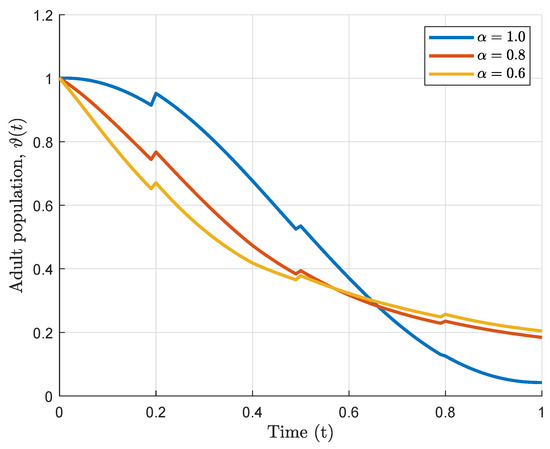
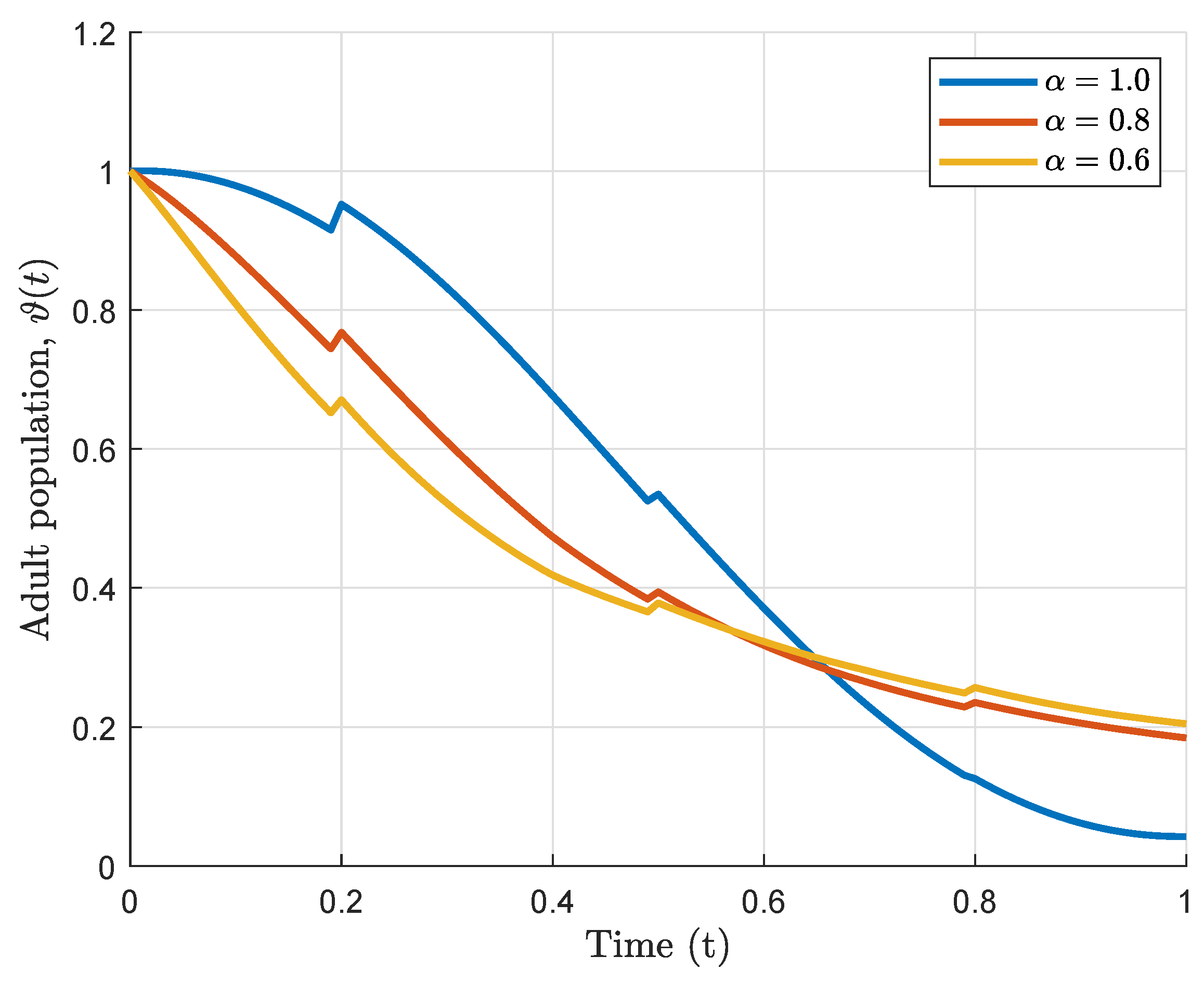
Below, we simulate the dynamics of the housefly model (34). Figure 1 illustrates the temporal evolution of the housefly population obtained from the impulsive ABC fractional model with proportional delay. The three curves correspond to fractional orders (blue), (red) and (yellow). The simulations use the same model parameters and the same impulsive instants for all cases.
Figure 1.
Dynamics of ABC fractional impulsive housefly model with proportional delays at various fractional orders.
We observe that all trajectories exhibit a monotone decrease in over time, with visible upward jumps at the impulsive times. These jumps represent instantaneous perturbations (for example, sudden environmental changes or control actions). Between impulses, the population decreases smoothly due to the combined effects of mortality and density-dependent reproduction encoded in the model. The integer-order case decays fastest, indicating a rapid response to the model dynamics and impulsive actions. As the fractional order is reduced to and , the decay becomes slower: lower values retain more memory of past states, producing a delayed reaction to both the continuous dynamics and the impulses. Thus, the ABC derivative’s nonlocal memory leads to more persistent population levels for smaller . The magnitudes of the instantaneous jumps are larger at early times and tend to diminish later on. This behavior reflects the damping influence of the fractional operator and the cumulative effect of past dynamics: impulses applied when the state is already low produce smaller absolute changes than those applied near the initial state. The proportional-delay argument slows the effective response of reproduction/maturation terms by introducing history scaled to the current time. Biologically, this models stage-dependent delays (for example, a developmental period that scales with the current timescale) and helps to explain the smoother transitions and increased persistence observed for fractional orders . From an applied perspective, the results indicate that systems with stronger memory effects (smaller ) are more resilient to impulsive perturbations in the short term and maintain higher population levels for longer. Conversely, models with closer to 1 react faster and reach lower population equilibria more quickly. This trade-off is important when designing control strategies (e.g., timing and intensity of interventions) for pest management.
Next, we present a comparison figure of the model with impulses and without impulses at each fractional order.
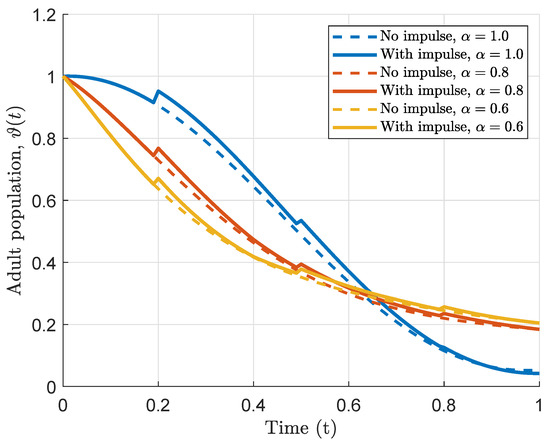
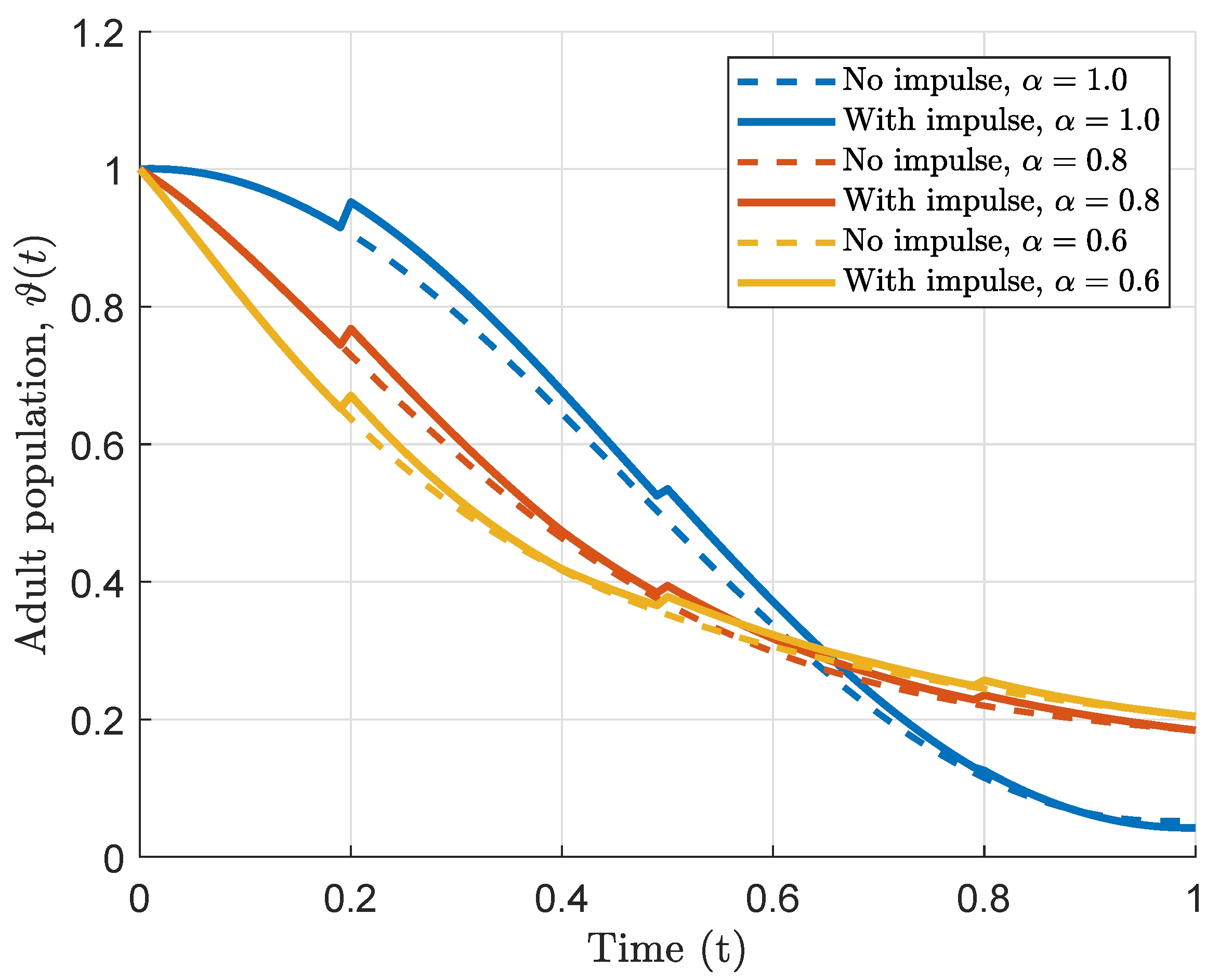
Figure 2 presents the time evolution of the population density in the impulsive ABC fractional housefly model with proportional delay. The numerical simulations are carried out for fractional orders and . For each fractional order, two trajectories are displayed: the solid curves correspond to the system with impulses, while the dashed curves represent the non-impulsive case. The impulsive instants are chosen as and .
Figure 2.
Housefly model: Comparison with and without impulses at each fractional order.
We observe that in all panels, the impulsive trajectories (solid) display small upward jumps at the impulsive instants, while the non-impulsive trajectories (dashed) evolve smoothly. These discontinuities represent sudden external perturbations or environmental interventions that momentarily increase the population density. Between impulses, the solutions continue to decay due to the intrinsic system dynamics governed by mortality and nonlinear growth terms.
As the fractional order decreases, the decay rate of becomes slower. The integer-order case decays most rapidly, indicating a fast loss of population memory. This confirms that smaller fractional orders induce stronger memory effects, causing the system to react more gradually to impulses and damping mechanisms.
6. Conclusions and Future Work
In this study, a new class of impulsive FODEs has been formulated and analyzed in the sense of the ABC derivative with proportional delay and multi-point initial conditions. By applying BFPT and KFPT, sufficient criteria ensuring the existence and uniqueness of solutions were obtained. In addition, the H-U stability of the proposed problem was investigated, confirming that small variations in the initial data produce proportionally bounded perturbations in the solution.
A numerical simulation was performed for a fractional housefly population model to demonstrate the theoretical results. The graphical outcomes show that impulsive actions cause sudden growth surges, whereas the memory effect introduced by the fractional operator regulates and smooths these fluctuations over time. The influence of the fractional order was evident: smaller values of produced slower decay and stronger persistence, highlighting the role of hereditary effects in population dynamics.
Future Work. Further research may focus on extending the current framework to impulsive systems with hybrid or state-dependent delays, stochastic influences, or time-varying impulses.
Author Contributions
Conceptualization, A.A. (Arshad Ali); Formal analysis, M.S.A., H.I., N.H. and A.A. (Alawia Adam); Funding acquisition, A.A. (Alawia Adam); Investigation, N.H. and A.A. (Alawia Adam); Methodology, M.S.A.; Project administration, K.A.; Software, H.I.; Writing—original draft, A.A. (Arshad Ali); Writing—review and editing, M.S.A., K.A., A.A.Q. and N.H. All authors have read and agreed to the published version of this manuscript.
Funding
The researchers would like to thank the Deanship of Graduate Studies and Scientific Research at Qassim University for providing financial support (QU-APC-2025).
Data Availability Statement
All data are included in this paper.
Conflicts of Interest
The authors declare that they have no conflicts of interest.
References
- Miller, K.S. Fractional Differential Equations. J. Fract. Calc. 1993, 3, 49–57. [Google Scholar]
- Podlubny, I. Fractional Differential Equations, Mathematics in Science and Engineering; Academic Press: New York, NY, USA, 1999. [Google Scholar]
- Miller, K.S.; Ross, B. An Introduction to the Fractional Calculus and Fractional Differential Equations; Wiley: New York, NY, USA, 1993. [Google Scholar]
- Kilbas, A.A.; Srivastava, H.M.; Trujillo, J.J. Theory and Applications of Fractional Differential Equations; North-Holland Mathematics Studies; Elsevier: Amsterdam, The Netherlands, 2006; Volume 204. [Google Scholar]
- Atangana, A.; Baleanu, D. New Fractional Derivatives with Nonlocal and Non-Singular Kernel: Theory and Application to Heat Transfer Model. Therm. Sci. 2016, 20, 763–769. [Google Scholar] [CrossRef] [Scilit]
- Atangana, A.; Koca, I. Chaos in a Simple Nonlinear System with Atangana–Baleanu Derivatives with Fractional Order. Chaos Solit. Fractals 2016, 89, 447–454. [Google Scholar] [CrossRef] [Scilit]
- Atangana, A. On the New Fractional Derivative and Application to Nonlinear Fisher’s Reaction–Diffusion Equation. Appl. Math. Comput. 2016, 273, 948–956. [Google Scholar] [CrossRef] [Scilit]
- Abdo, M.S.; Panchal, S.K.; Shah, K.; Abdeljawad, T. Existence Theory and Numerical Analysis of Three Species Prey–Predator Model Under Mittag–Leffler Power Law. Adv. Differ. Equ. 2020, 2020, 249. [Google Scholar] [CrossRef] [Scilit] [PubMed]
- Aldwoah, K.A.; Almalahi, M.A.; Hleili, M.; Alqarni, F.A.; Aly, E.S.; Shah, K. Analytical Study of a Modified-ABC Fractional Order Breast Cancer Model. J. Appl. Math. Comput. 2024, 70, 3685–3716. [Google Scholar] [CrossRef] [Scilit]
- Ahmad, B.; Alghanmi, M.; Nieto, J.J.; Alsaedi, A. On Impulsive Nonlocal Integro-Initial Value Problems Involving Multi-Order Caputo-Type Generalized Fractional Derivatives and Generalized Fractional Integrals. Adv. Differ. Equ. 2019, 2019, 247. [Google Scholar] [CrossRef] [Scilit]
- Guo, T.L. Nonlinear Impulsive Fractional Differential Equations in Banach Spaces. Topol. Methods Nonlinear Anal. 2013, 42, 221–232. [Google Scholar]
- Feckan, M.; Wang, J.R.; Zhou, Y. On the New Concept of Solutions and Existence Results for Impulsive Fractional Evolution Equations. Dyn. Partial Differ. Equ. 2011, 8, 345–361. [Google Scholar] [CrossRef] [Scilit]
- Tian, Y.; Bai, Z. Existence Results for the Three-Point Impulsive Boundary Value Problem Involving Fractional Differential Equations. Comput. Math. Appl. 2010, 59, 2601–2609. [Google Scholar] [CrossRef] [Scilit]
- Abdo, M.S.; Abdeljawad, T.; Shah, K.; Jarad, F. Study of Impulsive Problems Under Mittag–Leffler Power Law. Heliyon 2020, 6, e05109. [Google Scholar] [CrossRef] [Scilit] [PubMed]
- Shah, K.; Abdeljawad, T.; Ali, A.; Alqudah, M.A. Investigation of Integral Boundary Value Problem with Impulsive Behavior Involving Non-Singular Derivative. Fractals 2022, 30, 2240204. [Google Scholar] [CrossRef] [Scilit]
- Li, M.; Li, D.; Ming, J.; Hendy, A.S. Unconditional Convergence of Linearized TL1 Difference Methods for a Time-Fractional Coupled Nonlinear Schrödinger System. Numer. Math. Theory Methods Appl. 2025, 18, 1–30. [Google Scholar] [CrossRef] [Scilit]
- Li, D.; Zhang, C. Long Time Numerical Behaviors of Fractional Pantograph Equations. Math. Comput. Simul. 2020, 172, 244–257. [Google Scholar] [CrossRef] [Scilit]
- Ali, A.; Mahariq, I.; Shah, K.; Abdeljawad, T.; Al-Sheikh, B. Stability Analysis of Initial Value Problem of Pantograph-Type Implicit Fractional Differential Equations with Impulsive Conditions. Adv. Differ. Equ. 2021, 55. [Google Scholar] [CrossRef] [Scilit]
- Burton, T.A. A Fixed-Point Theorem of Krasnoselskii. Appl. Math. Lett. 1998, 11, 85–88. [Google Scholar] [CrossRef] [Scilit]
- Ruan, S. Delay Differential Equations in Single Species Dynamics. In Delay Differential Equations and Applications; Springer: Dordrecht, The Netherlands, 2006. [Google Scholar] [CrossRef] [Scilit]
- Shah, K.; Sher, M.; Sarwar, M.; Abdeljawad, T. Analysis of a Nonlinear Problem Involving Discrete and Proportional Delay with Application to Houseflies Model. AIMS Math. 2024, 9, 7321–7339. [Google Scholar] [CrossRef] [Scilit]

Disclaimer/Publisher’s Note: The statements, opinions and data contained in all publications are solely those of the individual author(s) and contributor(s) and not of MDPI and/or the editor(s). MDPI and/or the editor(s) disclaim responsibility for any injury to people or property resulting from any ideas, methods, instructions or products referred to in the content. |
© 2025 by the authors. Licensee MDPI, Basel, Switzerland. This article is an open access article distributed under the terms and conditions of the Creative Commons Attribution (CC BY) license (https://creativecommons.org/licenses/by/4.0/).