


Abstract
Understanding the evolution of pore and fracture structures (PFSs) in coal under mining-induced unloading is essential for the prevention and control of gas disasters in coal mines. In this study, coal specimens from the Dongqu Mine, Taiyuan, Shanxi, were subjected to online triaxial nuclear magnetic resonance (NMR) tests under constant axial compression and stepwise confining pressure unloading conditions. Based on the measured T2 spectra, the evolution of PFSs, permeability, and pore space complexity during unloading was investigated, and fractal theory was used to quantify the structural complexity of the pore system. The results show that large pores and fractures (LPFs) exhibit the most pronounced volume variation during unloading and are most sensitive to stress change. Small pores (SPs) contribute negligibly to permeability, whereas permeability is controlled primarily by medium pores (MPs) and LPFs. During unloading, neither SPs nor the overall pore system exhibits clear fractal characteristics, whereas MPs and LPFs display distinct fractal behavior. In addition, pore-volume evolution is inconsistent with fractal dimension variation, indicating that pore-volume change alone cannot adequately characterize PFS complexity. The complexity of the pore system is governed mainly by new pore generation, the expansion of existing pores and fractures, and the interaction between competing processes such as compaction and expansion.
1. Introduction
Gas–related accidents frequently occur during coal mining, posing a significant threat to operational safety [1]. Ahead of the working face, the coal mass is predominantly subjected to confining pressure relief during mining [2,3,4]. Mining–induced unloading leads to significant stress redistribution around underground excavations, thereby promoting fracture propagation, permeability evolution, and gas dynamic disasters in coal seams [5]. Similar unloading-induced instability and gas dynamic phenomena have also been reported in fractured and stratified rock masses in mining regions outside China [6]. Meanwhile, the pore and fracture structures (PFSs) within the coal mass provide the principal storage space for gas and the primary pathways for its migration [7]. As confining pressure is relieved, the PFSs undergoes continuous evolution, thereby altering gas migration behavior. Accordingly, elucidating the evolution of the PFSs in coal under confining pressure relief is essential for advancing the understanding of gas migration mechanisms and for the effective prevention of gas–related hazards.
A considerable body of research has focused on the mechanical behavior and flow characteristics of coal under unconfined or unloading conditions. Compared with conventional triaxial compression, coal subjected to unloading exhibits reduced load bearing capacity and a higher susceptibility to failure [8]. Existing studies indicate that both unloading paths and unloading rates exert significant control on the coupled mechanical and seepage responses of gas–bearing coal. Chen et al. [2,3] investigated the effects of different unloading paths through combined experimental and numerical approaches, providing insights relevant to overburden mining. Yin et al. [4] and Xue et al. [9] demonstrated that unloading rate markedly influences both the strength and permeability of coal. Using triaxial seepage apparatus, Jiang et al. [10,11] examined the deformation and gas seepage behavior of coal during unloading, revealing the coupling between stress evolution, damage development, and permeability variation. Zhou et al. [12] conducted creep seepage experiments on deep coal under unloading conditions and highlighted the role of time-dependent deformation in permeability evolution. In addition, Zhang et al. [8] reported that gas hydrate–bearing coal under unloading sustains lower stresses and fails more readily than under conventional triaxial loading. Wang et al. [13] showed that accelerated unloading intensifies coal damage and significantly affects permeability evolution ahead of the working face. To better replicate in situ mining conditions, Duan et al. [14] and Yang et al. [15] incorporated excavation and support effects into staged unloading tests, revealing the mechanical response and permeability evolution of coal under more realistic stress paths. Overall, previous studies have primarily addressed macroscopic mechanical behavior and permeability evolution under unloading conditions. However, the dynamic evolution mechanisms of PFSs during triaxial unloading remain insufficiently understood. In particular, the relationships among pore-scale evolution, permeability variation, and PFS complexity during unloading have not been systematically clarified. In addition, the fractal evolution characteristics of different pore systems and their controlling mechanisms under unloading conditions remain unclear.
To directly observe internal deformation in coal and to quantitatively characterize PFSs, a range of non-destructive or minimally destructive techniques has been developed to investigate the mechanical behavior of coal. Radiographic methods include scanning electron microscopy (SEM) [16], transmission electron microscopy (TEM) [17], small angle scattering (SAS) [18], and X-ray computed tomography (CT) [19]. Fluid intrusion techniques comprise high–pressure mercury intrusion (MIP) [20], low-temperature nitrogen adsorption, and low–pressure carbon dioxide adsorption [21]. In addition, acoustic emission (AE) [22,23] and ultrasonic testing [24] are widely used to monitor stress-induced damage in coal. Among these methods, SEM, TEM, and SAS are primarily employed to characterize PFS at or near the specimen surface. Nitrogen adsorption provides estimates of porosity and enables characterization of pore sizes in the range of 1.7 to 300 nm; however, it does not adequately capture larger pores and microcracks and is relatively time consuming. MIP requires the application of high pressures, which may alter or damage the internal pore and fracture structure, thereby introducing experimental uncertainty. In contrast, CT scanning enables three–dimensional reconstruction of pore and fracture networks with a spatial resolution on the order of micrometers. Despite its advantages, the high cost of CT limits its widespread application.
Compared with conventional methods, nuclear magnetic resonance (NMR) technology [25] offers significant advantages in the characterization of coal PFSs. As a rapid and non-destructive technique with a wide measurement range, it has been widely applied to determine key geometric and physical parameters, such as porosity and permeability [26]. Recent developments have enabled NMR systems to be coupled with triaxial loading apparatus, thereby allowing simultaneous measurement of PFSs and permeability under mechanical loading [27]. Using such systems, Zhou et al. [28] and Zhao et al. [27,29] investigated the evolution of PFSs in coal under triaxial compression, while Zhang et al. [30] extended this work to true triaxial conditions. Previous NMR–based studies have mainly focused on PFSs evolution under conventional triaxial compression conditions, whereas the dynamic evolution characteristics of coal PFSs during mining-induced unloading remain insufficiently understood. In particular, the evolution mechanisms of different pore scales and their relationships with structural complexity during unloading have not yet been systematically clarified.
NMR technology enables non-destructive and real-time characterization of coal PFSs evolution during unloading, making it particularly suitable for investigating the dynamic evolution of coal permeability-related PFSs under mining-induced unloading conditions. Therefore, an online triaxial NMR unloading experiment was conducted in this study to investigate the dynamic evolution of SPs, MPs, and LPFs during confining pressure unloading. Fractal theory was further introduced to quantitatively characterize the evolution of pore structural complexity under unloading conditions. Understanding unloading–induced pore and fracture evolution in coal is important for revealing the mechanisms of permeability enhancement, gas migration, and dynamic disaster development during mining. The results of this study provide theoretical support for the prevention and control of coal and gas outbursts under mining-induced unloading conditions.
2. Experiments and Methods
2.1. Experimental Preparation
According to previous studies on the coal seam of the Dongqu Coal Mine, the tested coal is classified as lean coal [31]. The proximate and ultimate analysis results and the chemical composition of the coal specimens are summarized in Table 1 and Table 2, respectively.
Table 1.
Proximate and ultimate analysis of coal specimens [31].
Table 2.
Chemical composition of coal specimens [31].
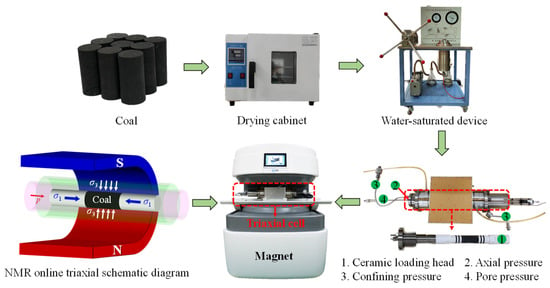
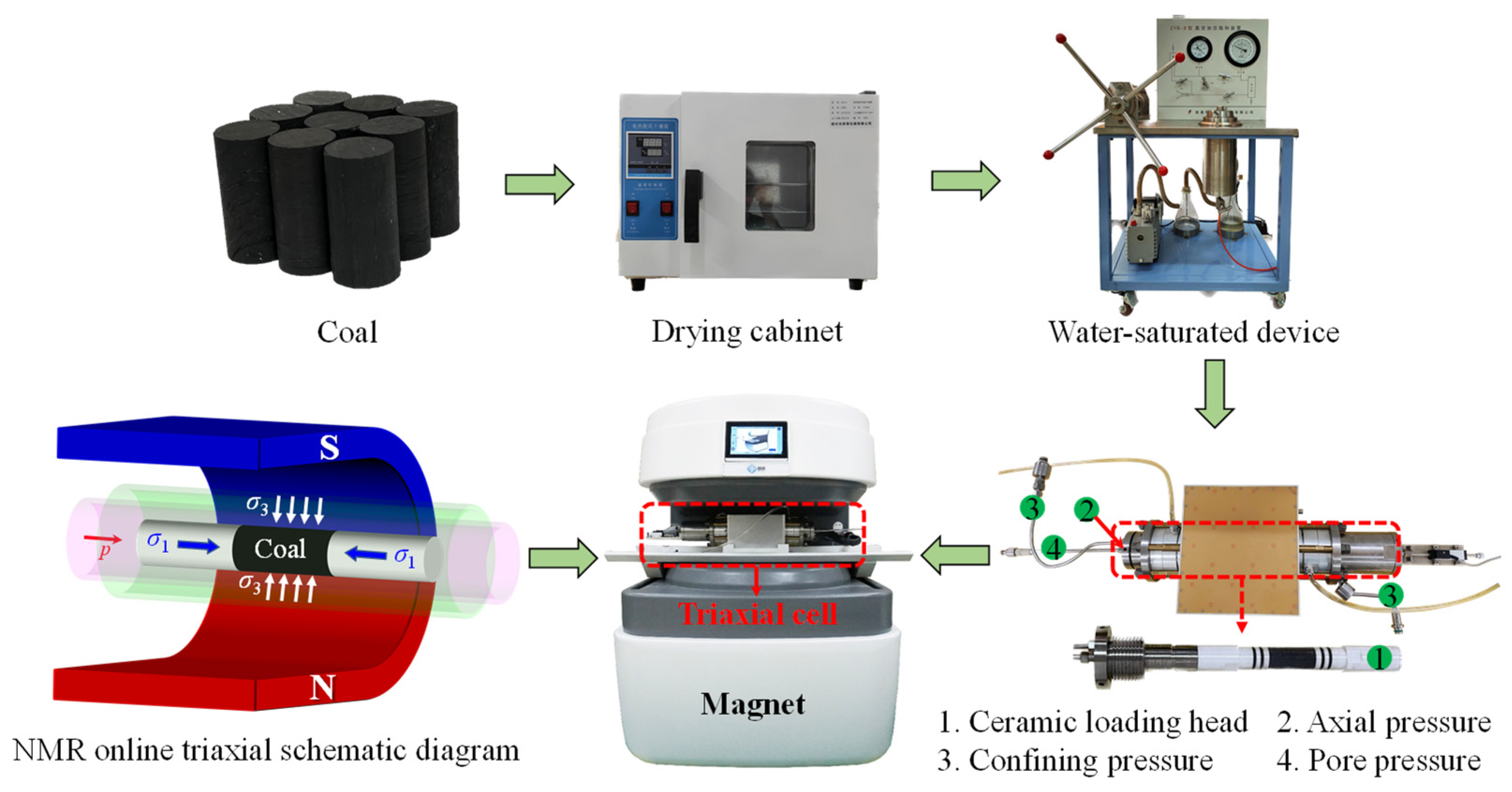
The coal specimens used in the NMR experiments were collected from the Dongqu Mine in Taiyuan, Shanxi Province, China, at a burial depth of 400 m, where the in situ stress is approximately 10 MPa. Large coal blocks retrieved from the mine were processed into cylindrical specimens with a diameter of 25 mm and a height of 50 mm. Prior to testing, all specimens were subjected to the same pretreatment procedure. First, the specimens were dried in an oven at 105 °C for 24 h. They were then vacuumed for 2 h, followed by water saturation for 24 h under a hydrostatic pressure of 15 MPa. Water saturation is necessary for NMR measurements because the NMR signal originates from hydrogen nuclei in the pore fluid. When the PFSs are fully saturated, the volume of the contained water corresponds to the pore–fracture volume, allowing the evolution of coal PFS to be characterized through T2 spectrum analysis.
The experiments were conducted using a MacroMR12–150H online triaxial NMR system (Figure 1), manufactured by Niumag (Suzhou, China).. The system consists of a triaxial loading device, a vacuum saturation system, and an NMR signal acquisition module. The maximum axial loading capacity and confining pressure are 60 MPa and 25 MPa, respectively. Detailed specifications of the experimental system can be found in Zhou et al. [28].
Figure 1.
Test specimens and experimental equipment.
2.2. Experimental Methods
During mining, the coal mass ahead of the working face undergoes significant stress redistribution. Under these conditions, the vertical stress imposed by the overburden remains relatively high, whereas the lateral confinement is gradually relieved as the working face advances. Therefore, the stress path adopted in this study, namely constant axial stress combined with stepwise confining pressure unloading, was used to simulate the mining–induced unloading process experienced by coal ahead of the working face.
Before performing the online NMR tests under unloading conditions, conventional triaxial compression tests were first carried out on coal specimens under different confining pressures to determine the constant axial stress used in the unloading tests. To avoid interference from water evaporation and confining fluid intrusion, the saturated specimens were sealed in thermoplastic sleeves and then placed in the triaxial chamber for testing. Based on the triaxial compression test results, the triaxial compressive strengths of the coal specimens are presented in Table 3. According to the Mohr Coulomb criterion, a 1 MPa change in confining pressure corresponds to an approximately 5 MPa change in axial stress, indicating that confining pressure unloading has a more pronounced effect on the coal matrix than axial loading. As shown in Table 1, the triaxial compressive strength of the coal specimen is 47.9 MPa at a confining pressure of 3 MPa. Considering that the pore pressure was maintained at 2 MPa during the unloading tests, the axial stress was set to 50 MPa so that specimen failure would occur near the final unloading stage, thereby allowing sufficient data to be acquired during the unloading process.
Table 3.
Triaxial compressive strengths of coal specimens under different confining pressures.
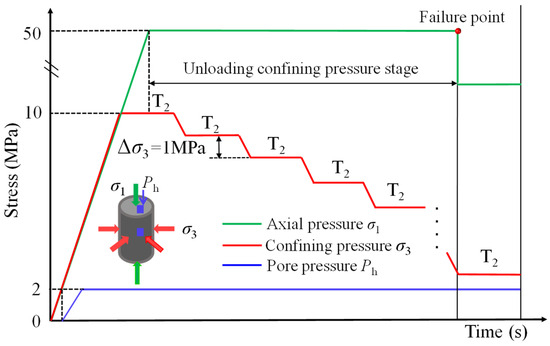
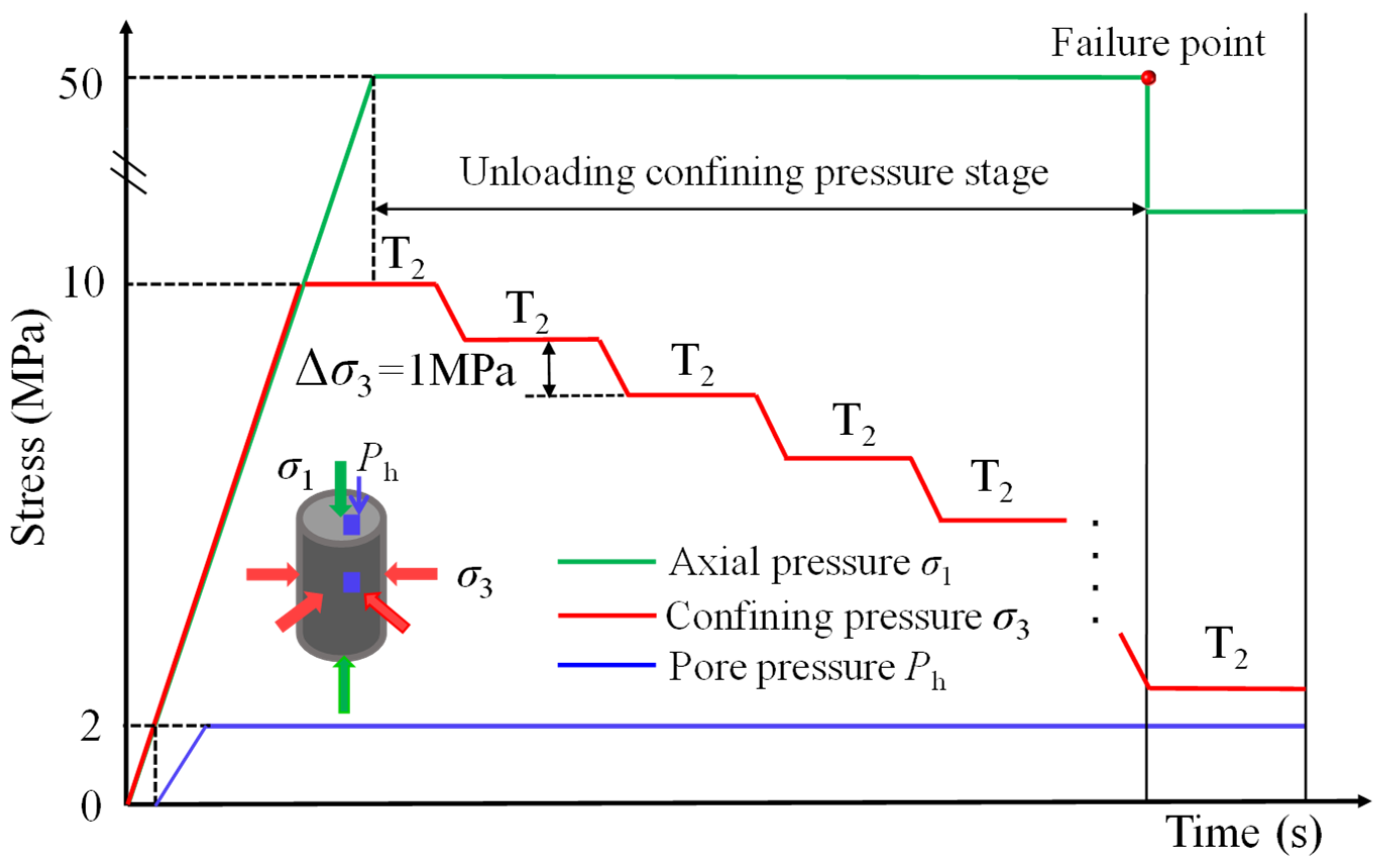
Three intact, water–saturated specimens were then selected, and their initial PFSs were characterized by NMR prior to testing. Online triaxial NMR tests were subsequently performed under confining pressure unloading conditions, and the basic physical properties of the specimens are listed in Table 2. Axial stress and confining pressure were first applied simultaneously at a rate of 2 MPa/min until a hydrostatic stress state of 10 MPa was reached, while a pore pressure of 2 MPa was imposed. After seepage stabilization, the confining pressure and pore pressure were kept constant, and the axial stress was increased to 50 MPa at 2 MPa/min. The axial stress was then maintained constant, and the confining pressure was unloaded stepwise. The T2 spectrum was measured after each 1 MPa reduction in confining pressure until specimen failure. It should be noted that time–dependent deformation and fluid redistribution may still occur during the NMR acquisition process, which could influence the measured pore–fracture response to some extent. The detailed stress path is shown in Figure 2.
Figure 2.
Schematic illustration of the stress path during confining pressure unloading.
2.3. Fundamentals of NMR and Fractal Theory
Under an external magnetic field, fluid relaxation in porous media is governed by three principal mechanisms, namely bulk relaxation, surface relaxation, and diffusion relaxation. In the present study, the pore fluid in the coal specimens is low viscosity water, and the NMR measurements were conducted under low-field and relatively uniform magnetic field conditions. In addition, the bulk relaxation time of water is significantly larger than the measured T2 relaxation time of coal pore fluids. Therefore, the contributions of bulk relaxation and diffusion relaxation are considered negligible, and the total relaxation behavior is assumed to be dominated primarily by surface relaxation [32]. Accordingly, the total relaxation time can be expressed as [33]:
where T2 is the transverse relaxation time; ρ2 is the surface relaxation rate; S is the pore surface area m2; V is the pore volume m3; Cs is the pore shape factor, with values of 2 for cylindrical pores and 3 for spherical pores; and r is the pore radius (nm).
Fractal theory has been widely used to characterize the geometric complexity and heterogeneity of PFSs in porous media [34]. Understanding the evolution of PFS heterogeneity in coal during confining pressure unloading is essential for elucidating gas migration within the coal mass during mining. The relationship between fractal dimension and cumulative pore–volume fraction is expressed as [35]:
where Vp is the cumulative pore-volume fraction; T2max is the maximum transverse relaxation time; and D is the fractal dimension.
By taking the logarithm of both sides of Equation (2), the following expression is obtained:
According to Equation (3), the fractal dimension D can be obtained by linearly fitting lg(Vp) versus lg(T2).
3. Results and Discussion
Due to the complexity and long duration of the online triaxial NMR unloading experiments, the number of tested specimens was limited. Nevertheless, the specimens exhibited similar initial pore–size distributions and consistent evolutionary trends during unloading, indicating good repeatability of the experimental observations.
3.1. Relationship Between PFSs and Permeability of Coal
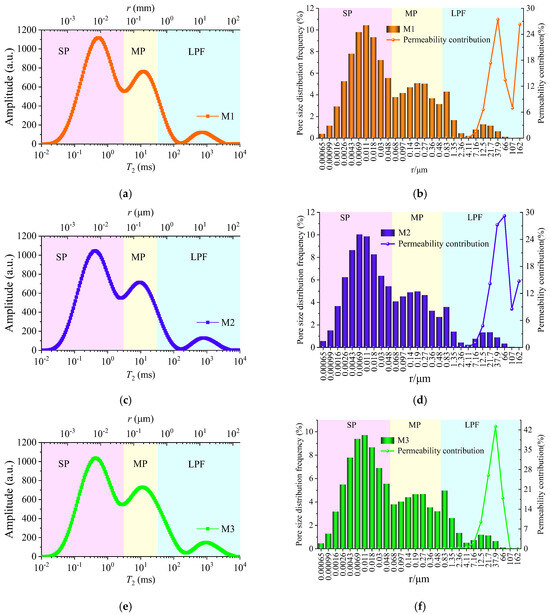
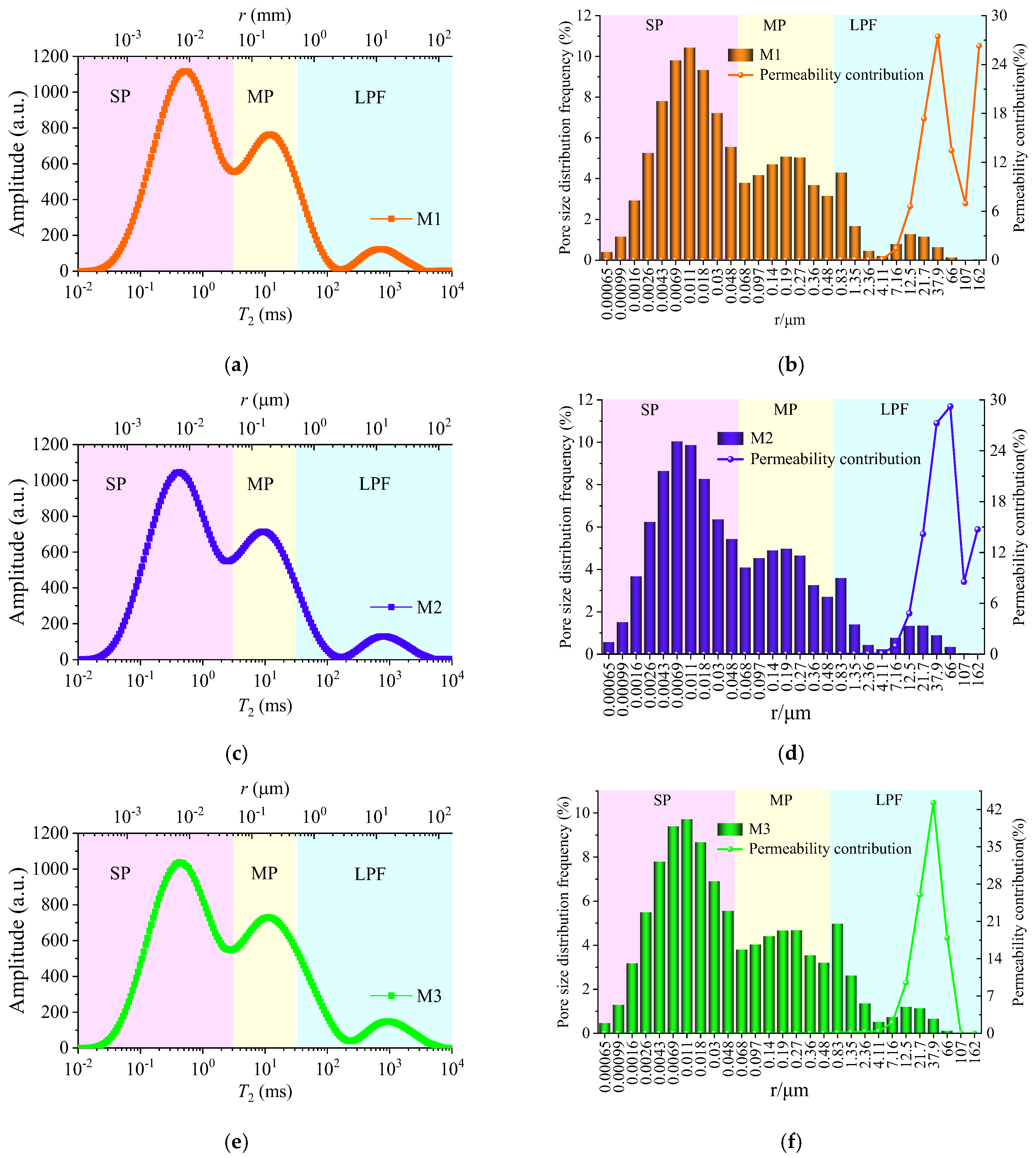
Assuming cylindrical pores, the pore shape factor in Equation (1) is set to 2. In this study, the surface relaxation rate (ρ2) was taken as 8.14 μm/s based on calibration results obtained from centrifugal experiments on coal specimens with similar properties. It should be noted that variations in ρ2 may influence the absolute pore–size conversion to some extent. However, the present study mainly focuses on the relative evolution characteristics of different pore–fracture structures during unloading, and therefore the comparative analysis of small pores (SPs), medium pores (MPs), and large pores and fractures (LPFs) remains reliable under the same conversion parameter. The transverse relaxation times on the x–axis of the T2 spectra for specimens M1, M2, and M3 can therefore be converted into pore sizes under saturated conditions. According to the Hodot pore classification method, coal pores can be divided into small pores (SPs, <10 nm), medium pores (MP, 10–100 nm), and large pores and fractures (LPF, >100 nm) [36]. Based on the relationship between pore radius and T2 relaxation time governed by surface relaxation, the corresponding T2 ranges of SPs, MPs, and LPFs were determined in this study. SPs mainly provide adsorption and storage space for gas, whereas MP and LPF are more closely related to seepage and permeability evolution during unloading. The T2 spectra and pore–size distributions of the three specimens are shown in Figure 3.
Figure 3.
T2 spectra and pore–size distributions of the coal specimens under initial saturated conditions. (a) T2 spectra of specimen M1; (b) pore–size distribution of specimen M1; (c) T2 spectra of specimen M2; (d) pore–size distribution of specimen M2; (e) T2 spectra of specimen M3; (f) pore–size distribution of specimen M3.
The T2 spectra of the saturated coal specimens M1, M2, and M3 exhibit three similarly distributed peaks, corresponding to SPs, MPs, and LPFs, respectively. As shown in Figure 3, the SPs peak has the highest signal intensity and the largest peak area, indicating that SPs are the dominant pore type in these coal specimens. The MP peak shows lower signal intensity and peak area than the SPs peak, but remains greater than those of the LPFs peak, suggesting that MPs are less developed than SPs but more developed than LPFs. In addition, the similar pore–size distributions of the three specimens under saturated conditions indicate relatively low heterogeneity among the specimens.
To evaluate the influence of different pore–size distributions on fluid seepage, the estimated seepage contributions of pores with different sizes were calculated based on the measured T2 spectra. According to Darcy’s law and Poiseuille’s law, the pores were idealized as capillary bundles with equivalent diameters. Thus, the estimated seepage contribution of a capillary with radius rm is given by [37]:
where km is the estimated seepage contribution of pores with radius rm; φm is the volume fraction of pores with radius rm; k is the permeability of the specimen; and N is the total number of capillaries with different pore diameters.
Based on Equation (4) and the T2 spectra of the coal specimens under initial saturated conditions, the distribution of estimated seepage contributions as a function of pore size was determined, as shown in Figure 3. It can be seen that the estimated seepage contribution of SPs is several orders of magnitude lower than those of MPs and LPFs. This indicates that the seepage behavior inferred from the pore structure characteristics of the coal specimens is governed predominantly by LPFs, whereas MPs mainly act as transitional seepage channels connecting smaller pores and larger fractures. Although the seepage contribution of MPs is lower than that of LPFs, MPs still play an important role in the evolution of seepage pathways during unloading.
It should be noted that the above analysis is based on simplified capillary assumptions derived from Darcy’s law and Poiseuille’s law. However, the actual pore–fracture network in coal is highly tortuous, anisotropic, and strongly controlled by fracture connectivity. Therefore, the calculated results mainly reflect the relative seepage contributions of different PFSs during unloading.
3.2. Analysis of PFSs Evolution in Coal Under Triaxial Unloading Conditions
The T2 peak area associated with a given pore–size range represents the volume of the corresponding PFSs. To quantitatively characterize the evolution of pore volume in different pore–size ranges during confining pressure unloading, a dimensionless coefficient is introduced and defined as follows [26]:
where Ssi, Smi, and Sli denote the T2 spectral peak areas corresponding to SP, MP, and LPF, respectively, at a confining pressure of σ3i; Ss0, Sm0, and Sl0 denote the corresponding T2 spectral peak areas under an axial stress of 50 MPa and a confining pressure of 10 MPa. Since the coal specimens were fully water–saturated, the T2 spectral peak area is proportional to the water–filled pore volume. Accordingly, Ps, Pm, and Pl are used to characterize the normalized relative volume variations in SPs, MPs, and LPFs, respectively.
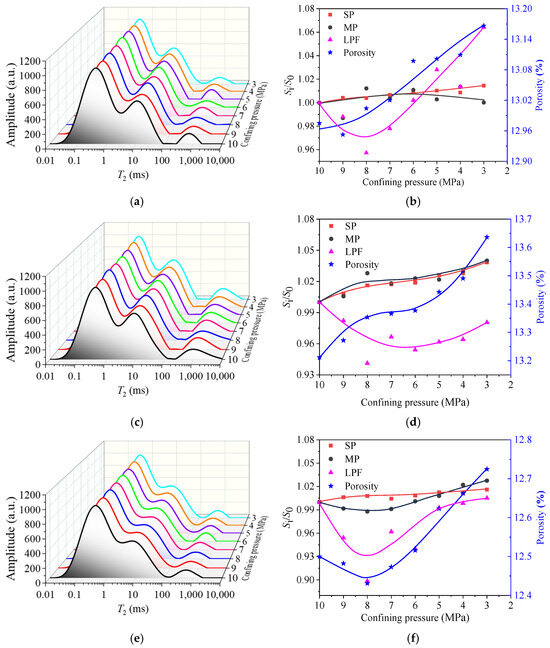
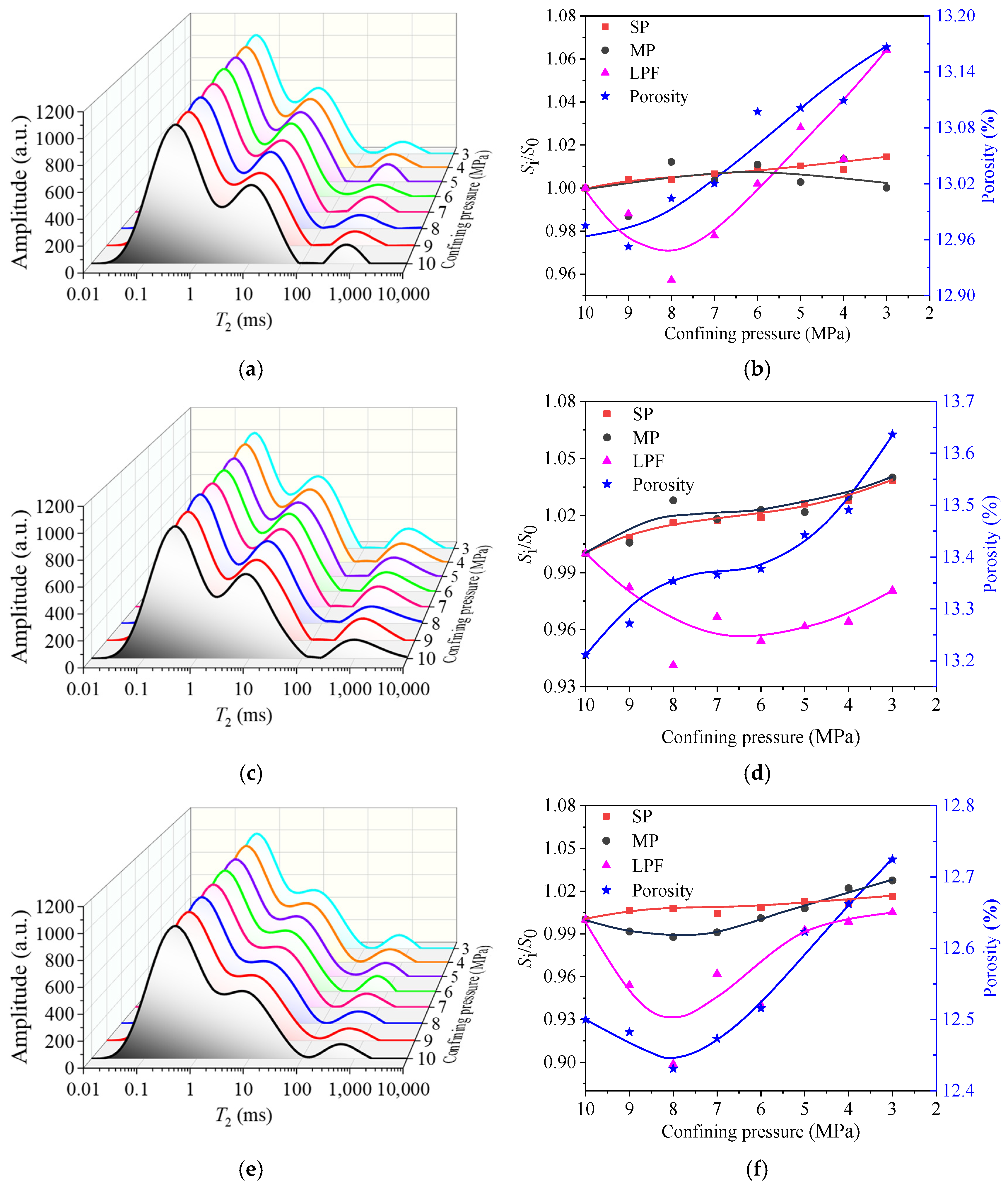
Figure 4a,c,e show the T2 spectra of the coal specimens under different confining pressure levels during triaxial unloading. Based on these spectra, the volume ratios of PFSs at different scales relative to those at a confining pressure of 10 MPa were calculated using Equations (5)–(7), and the corresponding variation curves are presented in Figure 4b,d,f.
Figure 4.
Evolution of the T2 spectrum, PFSs, and porosity of coal specimens during confining pressure unloading. (a) T2 spectrum evolution of specimen M1 during confining pressure unloading; (b) evolution of PFS and porosity of specimen M1 during confining pressure unloading; (c) T2 spectrum evolution of specimen M2 during confining pressure unloading; (d) evolution of PFS and porosity of specimen M2 during confining pressure unloading; (e) T2 spectrum evolution of specimen M3 during confining pressure unloading; (f) evolution of PFS and porosity of specimen M3 during confining pressure unloading.
Taking specimen M1 as an example, Figure 4a shows that the left peak of the T2 spectrum, corresponding to the SPs, maintains an essentially constant relaxation time during unloading. However, the signal intensity exhibits slight fluctuations with stress change, and the intensity at 3 MPa is higher than that at the initial unloading stage of 10 MPa. Although no clear trend is observed in the signal intensity, the peak area in the SPs increases continuously during unloading. The T2 spectral response in the MPs follows a similar trend, but the fluctuations in signal intensity are more pronounced. Meanwhile, both the peak position and the peak width shift toward longer relaxation times, indicating a gradual expansion of MPs into LPFs as the confining pressure is reduced to 3 MPa. In the LPFs, new signals appear within the relaxation time interval of 100 to 300 ms, which further confirms that MPs progressively evolve into LPF during unloading.
As shown in Figure 4b, the pore–volume ratio curves under confining pressure unloading indicate that, under constant axial stress, the volume of SPs fluctuates but shows an overall increasing trend. This suggests that the rate of SPs generation exceeds that of compaction. Possible reasons include the poor connectivity of SPs, which makes pore water more difficult to expel because of stronger capillary effects; the lower compressibility of SPs; the compression of some MPs into SPs during unloading; and possible overlap between the relaxation signals of SPs and residual film water. The volume of MPs exhibits a trend of initial decrease, subsequent fluctuating increase, and final decline during unloading. In the initial stage, some MPs are compressed into SPs and pore water is expelled, leading to a reduction in MP volume. When the confining pressure decreases below approximately 9 MPa, the MP volume begins to increase and, despite some fluctuations, shows an overall upward trend, indicating that MP generation exceeds compaction. These fluctuations are likely related to differences in pore compressibility and the non-uniform distribution of pore water, which affect the stability of the measured relaxation signals. The final decrease in MP volume may be attributed to specimen damage in the later unloading stage, during which some MPs evolve into LPFs. Compared with SPs and MPs, LPFs exhibit the most significant variation during unloading. In particular, when the confining pressure decreases below approximately 8 MPa, the LPF volume increases rapidly, indicating accelerated fracture propagation and enhanced pore connectivity. In addition, the pore water has not fully redistributed to a saturated state, which may also result in a lower measured MP volume. These results suggest that LPFs are the most sensitive PFSs to stress unloading and play a dominant role in permeability enhancement during unloading.
The variation in the volume ratio of LPFs is consistent with that of porosity, showing a trend of initial decrease followed by increase. During the initial unloading stage, the volume of LPFs decreases, indicating that the compaction rate exceeds the generation rate, and that some LPFs may be compressed into MPs. This initial decrease may also be related to non-equilibrium water redistribution under high axial stress, such that the relaxation signals of some LPFs may not be fully detected at the onset of unloading. When the confining pressure decreases to 8 MPa, the volume of LPFs increases rapidly. This indicates that MPs progressively evolve into LPFs and that the expansion of existing large pores and fractures becomes more continuous. The initial decrease in porosity is mainly controlled by the reduction in MP and LPF volumes. Thereafter, starting from 9 MPa, porosity shows an overall increasing trend under the combined effects of SPs, MPs, and LPFs.
Based on the experimental results of the three coal specimens, the pore and fracture structure of coal undergoes complex evolution during constant axial stress and confining pressure unloading. This process involves the generation of new pores, the compression of MPs and LPFs, the expansion and coalescence of PFSs, and the progressive interconnection of pores and fractures. Among the different pore types, LPFs exhibit the most pronounced volume change during unloading, indicating that they are the most sensitive to stress variation. Overall, the volume of SPs increases throughout the unloading process, reflecting both the continuous generation of new SPs and the relative resistance of existing SPs to compression. In contrast, the volume of LPFs decreases during the initial unloading stage and then increases once the confining pressure falls to 8 MPa. The initial decrease in LPF volume is attributed to continued pore compaction under high axial stress, which exceeds the rate of pore generation, as well as delayed water redistribution at the onset of unloading, which prevents some pores from reaching a fully saturated state. Because of specimen heterogeneity, the evolution of MP volume and porosity varies during unloading. The initial decrease in porosity is mainly controlled by the reduction in MP and LPF volumes, whereas the subsequent increase is governed by the combined effects of SPs, MPs, and LPFs.
It should be noted that the unloading–induced evolution of PFSs observed in laboratory–scale coal specimens may differ from the behavior of in situ coal–bearing rock masses. Under field conditions, tectonic discontinuities, depth–dependent stress redistribution, and elastic anisotropy may further influence fracture propagation, pore connectivity, and permeability evolution during mining–induced unloading. Similar conclusions regarding the influence of structural heterogeneity and stress redistribution on rock mass deformation have also been reported in previous geomechanical studies [38]. Therefore, the laboratory results obtained in this study mainly reflect the fundamental mechanisms of unloading–induced PFS evolution in coal, whereas the actual response of coal–bearing rock masses may exhibit stronger structural heterogeneity.
3.3. Analysis of Deformation Characteristics and Permeability of Coal Under Triaxial Unloading Conditions
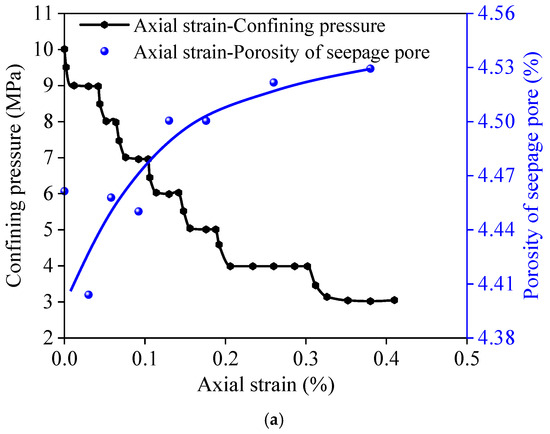
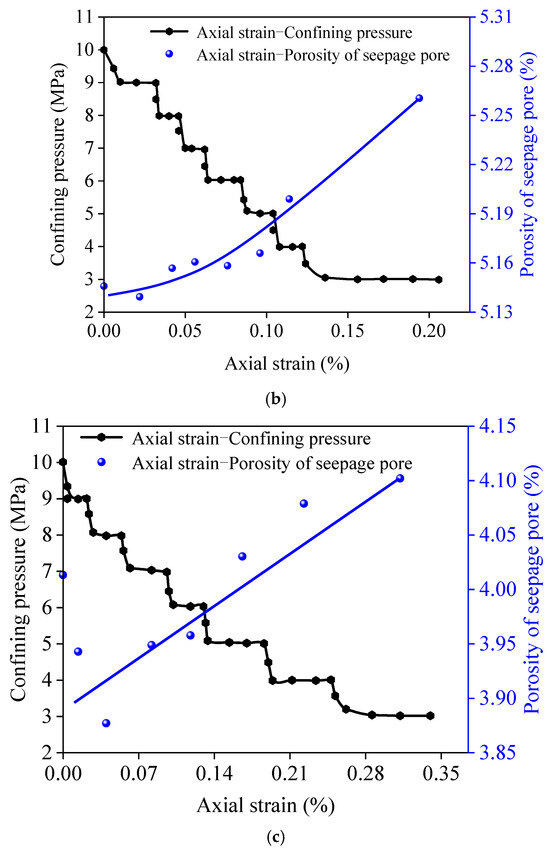
Based on the permeability contribution analysis in Section 3.1, SPs in coal exhibit poor connectivity, whereas MP and LPF dominate permeability. Accordingly, the evolution of coal permeability during confining pressure unloading can be analyzed through changes in seepage pore porosity. According to the pore classification described above, pores smaller than 0.1 μm mainly affect the gas adsorption characteristics of the coal matrix and are defined as adsorption pores. In contrast, MPs of 0.1 to 1 μm and LPFs larger than 1 μm mainly govern seepage behavior and are defined as seepage pores. The axial strain is taken as zero when the axial stress is 50 MPa and the confining pressure is 10 MPa. The axial strain of each coal specimen during confining pressure unloading and the corresponding variation in seepage pore porosity are shown in Figure 5.
Figure 5.
Variations in confining pressure, axial strain, and seepage pore porosity of coal specimens during confining pressure unloading. (a) Confining pressure, axial strain, and seepage pore porosity curves of specimen M1; (b) confining pressure, axial strain, and seepage pore porosity curves of specimen M2; (c) confining pressure, axial strain, and seepage pore porosity curves of specimen M3.
The confining pressure versus axial strain curves of all coal specimens exhibit a plateau at each confining pressure level. This is because, although neither axial stress nor confining pressure changes during T2 spectrum measurement, the specimens remain under rheological compression at high axial stress. As a result, axial strain continues to increase because of the time–dependent effect. As confining pressure is progressively unloaded, the shear strength along internal fracture surfaces decreases, thereby increasing the likelihood of shear slip. The slip–induced driving force promotes the opening and extension of pre-existing cracks, causing crack propagation to evolve from stable growth to unstable expansion. Consequently, the load–bearing capacity of the coal specimens decreases, and the axial strain rate increases. Although the seepage pore porosity decreases slightly during the initial unloading stage, it subsequently fluctuates and shows an overall increasing trend. The permeability correspondingly decreases first and then increases rapidly.
As shown in Figure 5a, the seepage pore porosity of specimen M1 increases from approximately 4.40% to 4.53%, corresponding to an overall increase of about 3.0% during unloading. When the confining pressure decreases to approximately 8 MPa, the seepage pore porosity begins to increase more noticeably, indicating that the development and expansion of seepage–related pore–fracture structures gradually become dominant. For specimen M2 shown in Figure 5b, the seepage pore porosity increases from approximately 5.14% to 5.26%, corresponding to an overall increase of about 2.3%. The increase becomes more pronounced during the later unloading stage, suggesting progressive enhancement of pore connectivity and seepage channel development. In specimen M3, shown in Figure 5c, the seepage pore porosity increases from approximately 3.89% to 4.11%, corresponding to an overall increase of about 5.7%, which is the largest increase among the three specimens. This indicates that the seepage–related pore–fracture structures in specimen M3 are more sensitive to confining pressure unloading. Although the absolute seepage pore–porosity variations differ among specimens because of coal heterogeneity, all three specimens exhibit an overall increasing trend during unloading.
The decreases in seepage pore volume and the corresponding reduction rates in specimens M1 and M3 were greater than those in specimen M2. Combined with the pore–evolution results in Figure 4, this suggests that, during the initial unloading stage, the volumes of MPs and LPFs in specimens M1 and M3 all decreased, whereas this feature was less evident in specimen M2. Although pore and fracture expansion began once unloading started under high axial stress, the expansion rate was initially low, and compaction still exceeded pore generation. With continued confining pressure unloading, the seepage pore volume gradually changed from decreasing to increasing. During this increase stage, specimen M1 exhibited two fluctuations, and the growth rate eventually slowed. This is because the volumes of MPs and LPFs fluctuated during continued unloading and began to decrease when the confining pressure reached 6 MPa. In specimen M2, the increase in seepage pore volume showed only one fluctuation before gradually stabilizing. At this stage, the growth rates of MPs and LPFs were both low and tended to level off, indicating that compaction and expansion had reached a dynamic equilibrium. For specimen M3, the increase in seepage pore volume also slowed in the later unloading stage because the growth rates of LPF decreased. Although greater unloading promotes the formation of new fractures, time is required for these fractures to become water–saturated. When fracture generation is too rapid, water replenishment cannot fully keep pace. As newly generated fractures may not immediately reach a fully saturated state, the corresponding NMR signal may partially underestimate the actual LPF volume during unloading.
It should be noted that the NMR experiments in this study were conducted under water–saturated conditions because NMR characterization relies on the hydrogen signal of the pore fluid. Therefore, the measured T2 spectra mainly reflect the geometric characteristics and evolution of coal PFSs rather than the actual methane occurrence state in gas–bearing coal seams. Although the migration mechanisms of water and methane are different, the evolution of pore connectivity and seepage–related pore structures during unloading still provides useful insight into the potential evolution of gas migration pathways under mining–induced unloading conditions.
3.4. Analysis of the Fractal Characteristics of PFSs in Coal Under Triaxial Unloading Conditions
The fitting intervals for SPs, MPs, LPFs, and the total pore system were determined according to the pore classification ranges established from the conversion relationship between T2 relaxation time and pore radius based on the surface relaxation mechanism. Specifically, the SP, MP, and LPF fitting ranges correspond to the pore–size intervals defined by the Hodot pore classification method, whereas the total pore system was fitted over the entire T2 spectrum range. To ensure comparability, the same fitting intervals were consistently applied to all specimens during unloading.
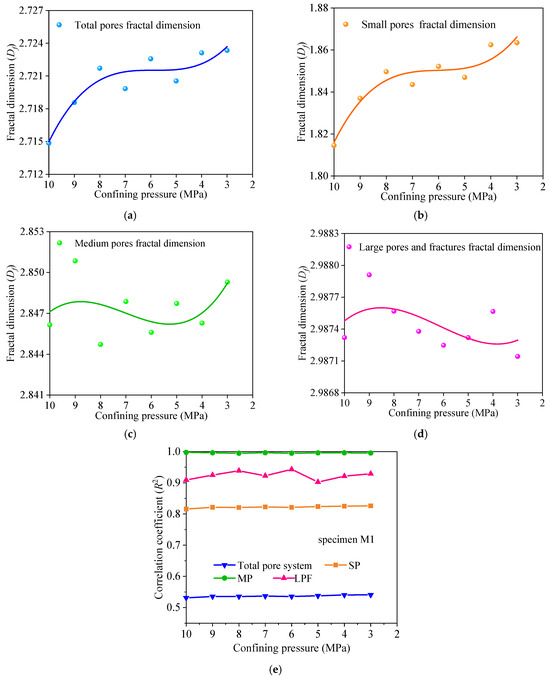
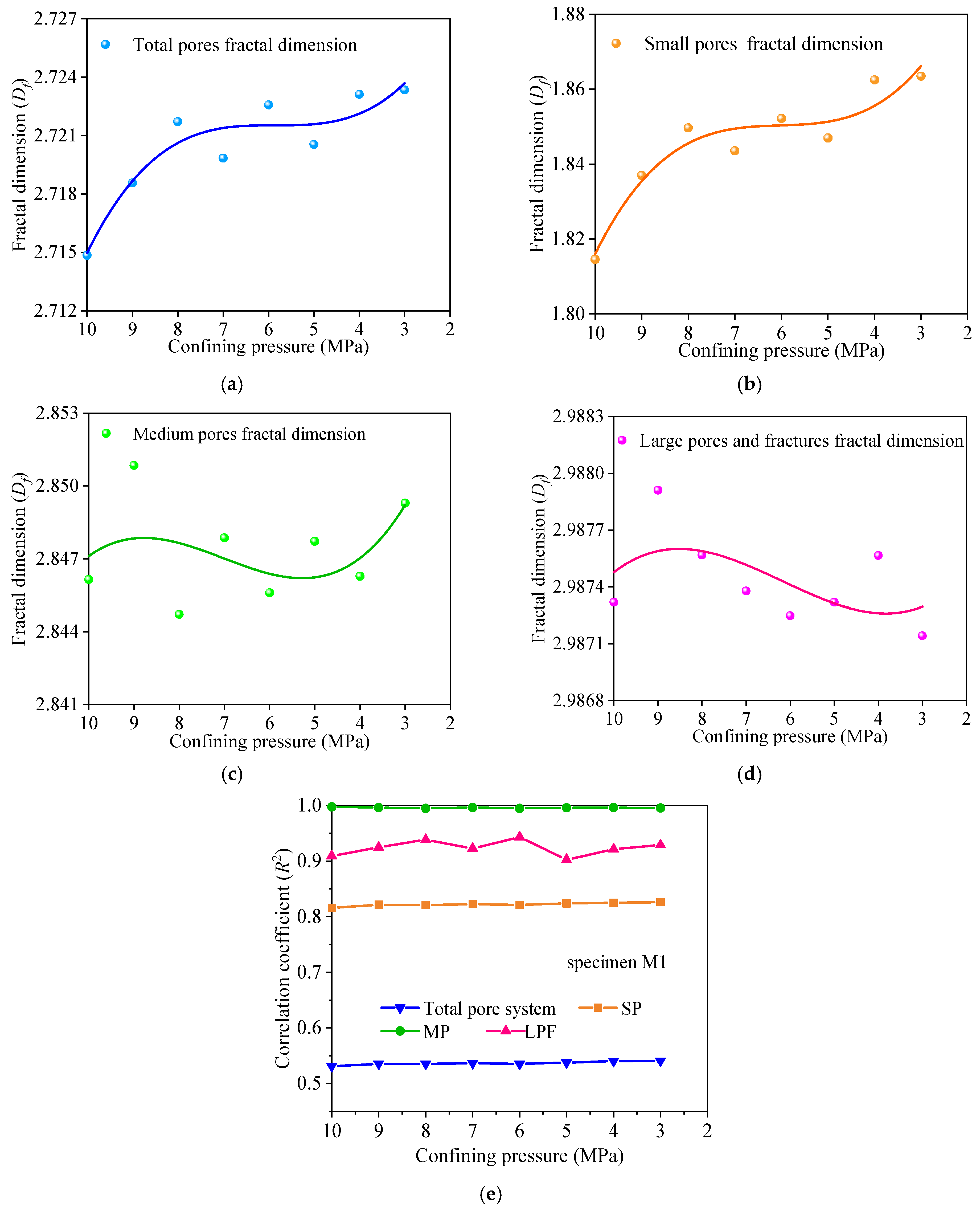
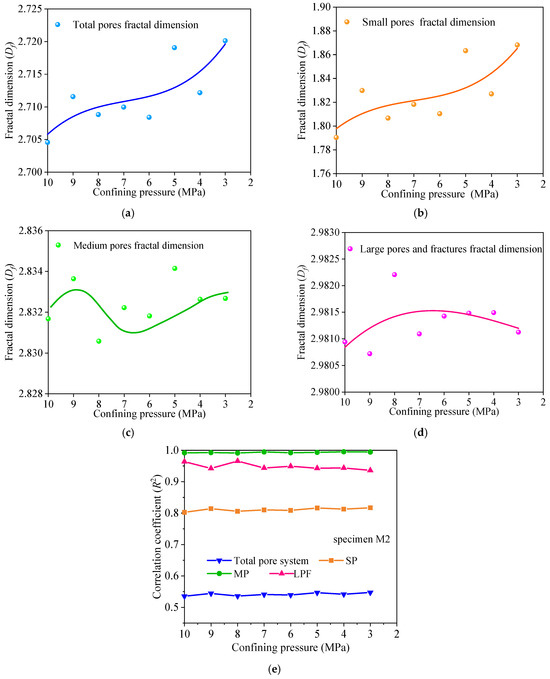
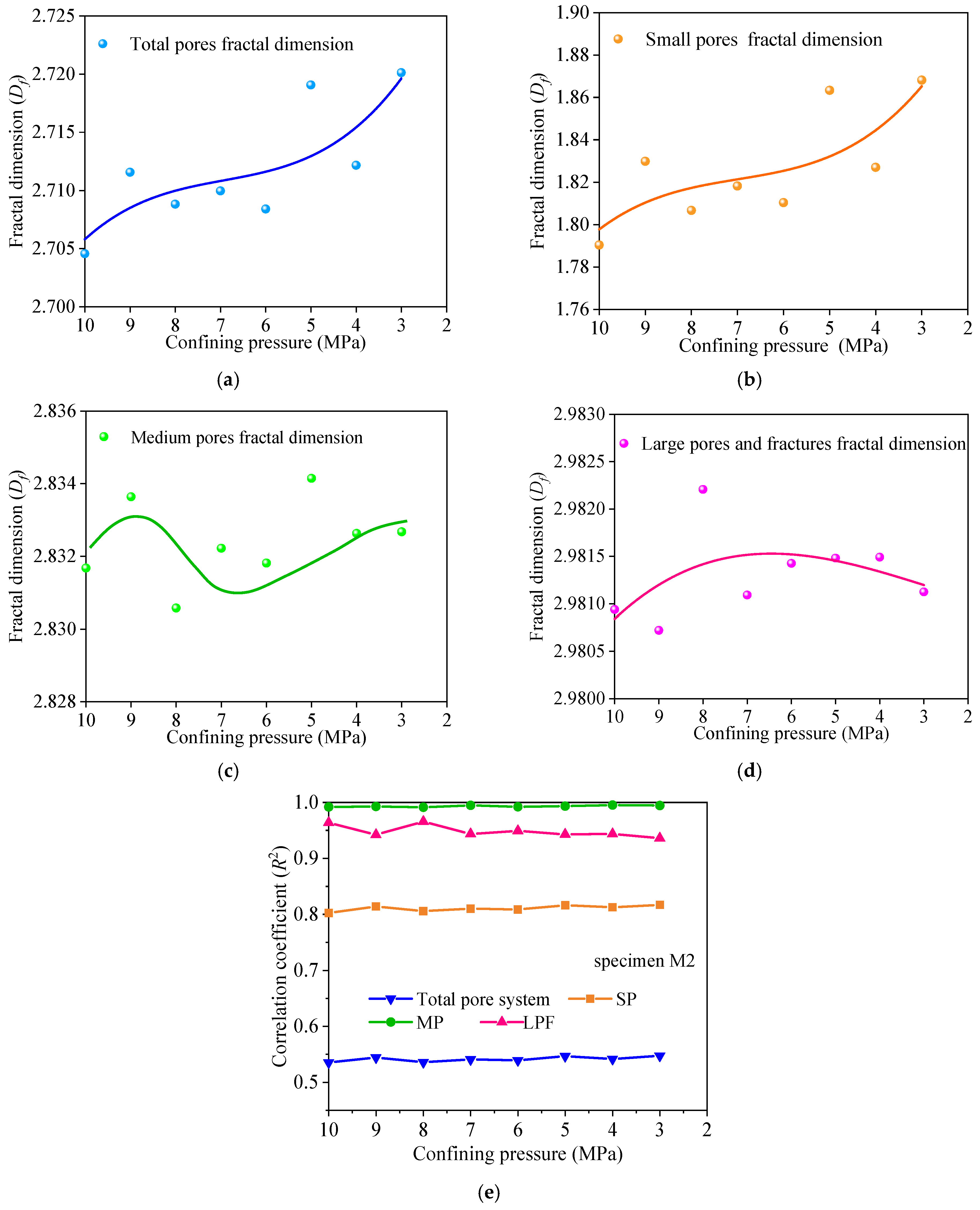
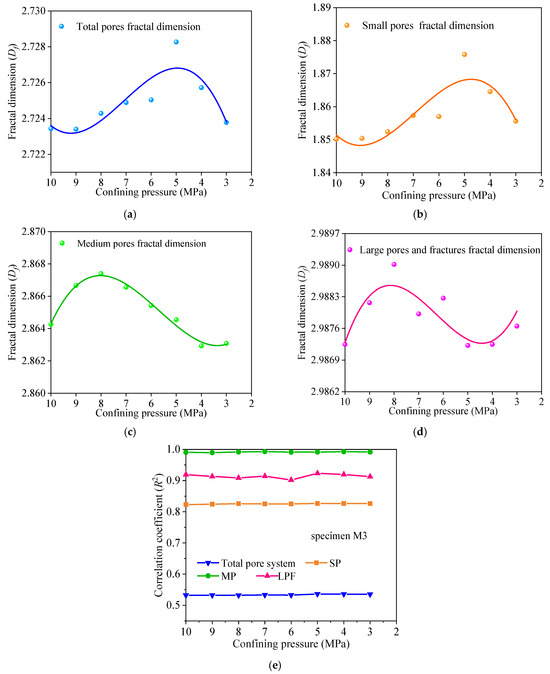
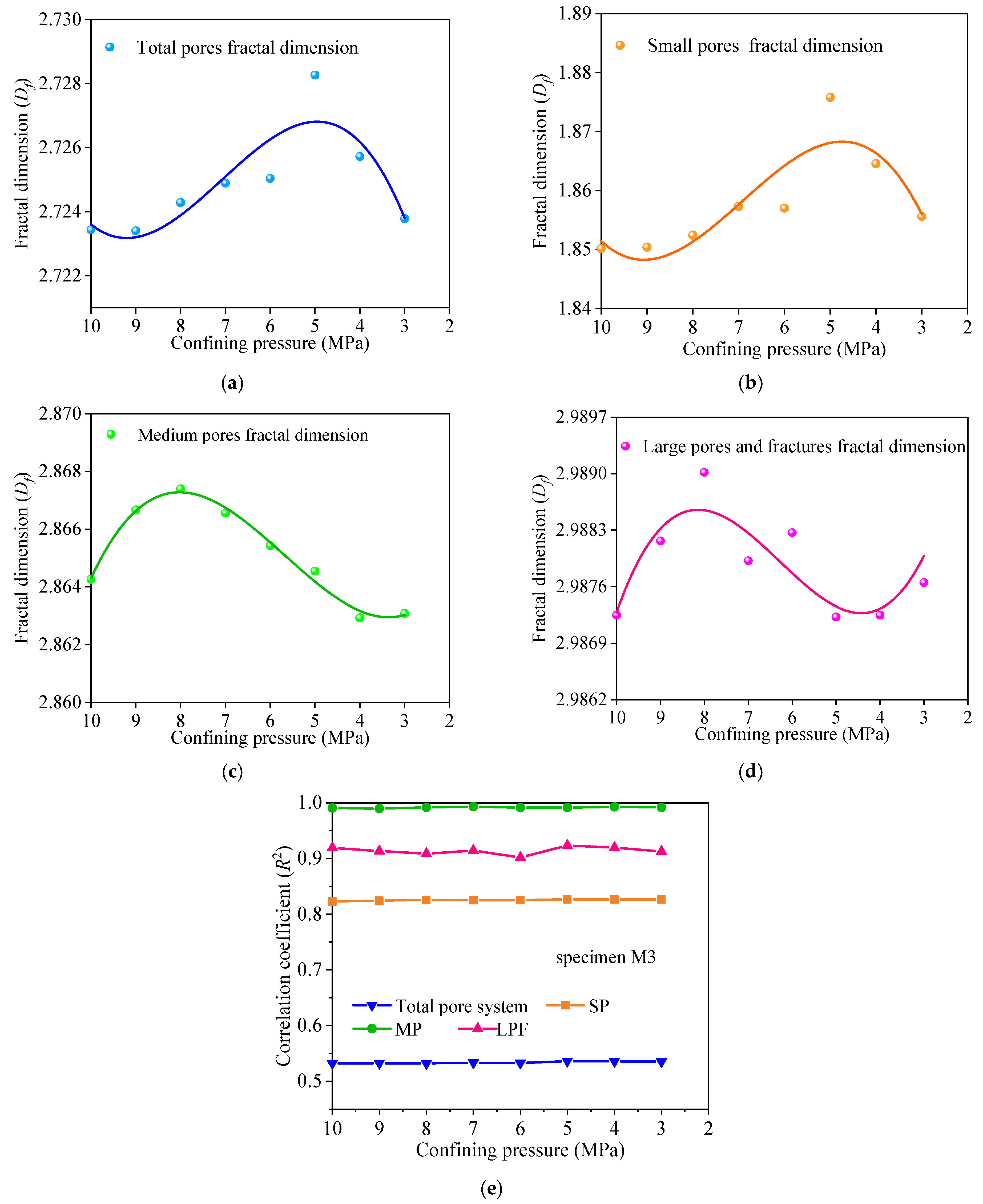
The fractal analysis results indicate that the fractal characteristics of different pore types in coal exhibit significant differences during confining pressure unloading. Specifically, the total pore system and SP do not exhibit clear fractal characteristics, whereas MPs and LPFs display evident fractal behavior under unloading conditions.
To investigate the complexity of PFSs evolution in coal during triaxial confining pressure unloading, the fractal dimensions of different pore types were determined from the NMR results using Equation (3). The fitted fractal dimension of the total pore system ranges from 2.71 to 2.73, which falls within the theoretical fractal interval of 2 < Df < 3. However, the corresponding correlation coefficient is only about 0.5, indicating poor fitting quality. Therefore, the overall pore system cannot be considered to exhibit clear fractal characteristics. The fitted fractal dimension of SPs ranges from 1.81 to 1.87, with correlation coefficients exceeding 0.8. Although the fitting quality is relatively high, the fractal dimension falls outside the theoretical fractal interval, indicating that SP do not exhibit fractal characteristics. By contrast, the fitted fractal dimension of MPs ranges from 2.84 to 2.86, with correlation coefficients greater than 0.99, indicating excellent fitting quality and clear fractal characteristics under unloading conditions. The fitted fractal dimension of LPFs ranges from 2.98 to 2.99, with correlation coefficients greater than 0.9, likewise demonstrating distinct fractal characteristics. These results show that, during confining pressure unloading, the coal pore system does not display clear fractal characteristics at the macroscopic scale or within the SP range, but exhibits distinct fractal behavior at the local scale within the MP and LPF ranges. These findings further confirm the distinct fractal behaviors of different pore types during unloading. As shown in Figure 6e, Figure 7e and Figure 8e, the correlation coefficients of the fractal fits consistently follow the order MPs > LPFs > SPs > total pore system throughout the confining pressure unloading process under constant axial stress, indicating that MPs exhibits the most pronounced fractal characteristics, while the total pore system shows the weakest fractal behavior due to the coexistence of pore structures with different scales and evolutionary mechanisms.
Figure 6.
Fractal dimensions of the total pore system and different pore types in specimen M1. (a) Total pore fractal dimension of specimen M1; (b) fractal dimension of SP in specimen M1; (c) fractal dimension of MP in specimen M1; (d) fractal dimension of LPF in specimen M1; (e) correlation coefficient of specimen M1.
Figure 7.
Fractal dimensions of the total pore system and different pore types in specimen M2. (a) Total pore fractal dimension of specimen M2; (b) fractal dimension of SP in specimen M2; (c) fractal dimension of MP in specimen M2; (d) fractal dimension of LPF in specimen M2; (e) correlation coefficient of specimen M2.
Figure 8.
Fractal dimensions of the total pore system and different pore types in specimen M3. (a) Total pore fractal dimension of specimen M3; (b) fractal dimension of SP in specimen M3; (c) fractal dimension of MP in specimen M3; (d) fractal dimension of LPF in specimen M3; (e) correlation coefficient of specimen M3.
Figure 6c, Figure 7c and Figure 8c show the variations in the fractal dimension of MP in specimens M1, M2, and M3, respectively, with confining pressure during unloading under constant axial stress. The three specimens exhibit the same overall trend, with the fractal dimension increasing in the initial unloading stage, then decreasing, and finally increasing again as confining pressure continues to be released. This trend reflects the combined effects of SP, MP, and LPF evolution during unloading. SPs progressively develop into MPs, whereas some LPFs may be compacted into MPs under triaxial unloading conditions. Therefore, the evolution of MPs is controlled by concurrent changes in SPs and LPFs. Combined with the previously discussed pore–volume evolution, the results indicate that some pore compaction still occurs during the initial unloading stage under relatively high confining pressure. At this stage, the compaction of LPFs and the development of SPs both contribute to an increase in MP volume. The competition between pore growth and compaction increases the complexity and heterogeneity of the MP structure, resulting in an increase in fractal dimension. With further unloading, the compaction effect gradually weakens, whereas pore expansion and development become dominant. As a result, the combined effect on MPs is reduced, the structural evolution becomes less complex, and the fractal dimension decreases. In the later unloading stage, the fractal dimension increases again because pore expansion accelerates, with many SPs developing into MPs and MPs further expanding into LPFs. The coexistence of primary MPs and secondary MPs formed by SP expansion increases structural complexity, leading to a renewed increase in fractal dimension.
Figure 6d, Figure 7d and Figure 8d show the variations in the fractal dimension of LPF in specimens M1, M2, and M3, respectively, with confining pressure during unloading under constant axial stress. Specimens M1 and M3 exhibit the same overall trend, with the fractal dimension increasing first, then decreasing, and finally increasing again. In specimen M2, the fractal dimension of LPFs increases initially and then decreases with continued unloading. During the initial unloading stage under high axial stress, the compaction rate of LPF exceeds the expansion rate, leading to a decrease in LPF volume. This compaction increases the spatial complexity of the LPF structure and thus causes the fractal dimension to increase. As confining pressure continues to decrease, pore development and expansion become dominant, and the volume of LPFs begins to increase. At the same time, local pores and fractures progressively expand and coalesce into larger fractures, which reduces structural complexity and leads to a decrease in fractal dimension. The late stage increases in fractal dimension observed in specimens M1 and M3 are likely related to rapid pore and fracture development during this stage. It should be noted that the fitted fractal dimensions of LPFs are very close to 3, ranging from 2.98 to 2.99. This suggests that the LPF system forms a highly complex, nearly space–filling network, reflecting strong connectivity and heterogeneity. At the same time, the fitting method, T2 spectral resolution, and signal noise may slightly overestimate the calculated Df. Nevertheless, the overall trends remain robust, highlighting the markedly higher structural complexity of LPFs compared with MPs and SPs. Because the newly formed LPFs cannot be replenished by water immediately, time is required for uniform saturation to be restored, which may increase the apparent heterogeneity of the structure and cause the fractal dimension to rise again.
The above analysis shows that the variation in pore–volume during confining pressure unloading is not necessarily consistent with that of fractal dimension. For example, in specimen M1, the MP volume increases after the confining pressure decreases below 9 MPa, whereas the corresponding fractal dimension decreases during the same unloading stage. This indicates that pore–volume growth does not necessarily correspond to increased structural complexity. This phenomenon may be related to pore expansion and coalescence, which reduce the heterogeneity of the pore structure. Therefore, pore–volume change alone cannot be used to characterize the complexity of the PFSs. An increase in pore volume does not necessarily indicate a more complex pore system. Rather, PFS complexity should be evaluated in terms of the mechanisms controlling pore–scale structural evolution. The complexity of the PFS is mainly governed by three factors. First, the generation of new pores increases the number of pore units and thus enhances structural complexity. Second, the expansion of existing pores and fractures increases pore size but does not change pore number, which may reduce structural complexity. Third, the simultaneous action of competing processes, such as pore compaction and pore expansion, can make the PFSs more complex. For example, in specimen M2, the volume of LPFs increases during the later unloading stage, whereas the corresponding fractal dimension decreases. This indicates that the increase in LPF volume is mainly caused by the expansion and coalescence of existing large pores and fractures rather than the generation of new heterogeneous pore units. Consequently, although the total pore volume increases, the structural heterogeneity and complexity of the LPF system decrease. These results further demonstrate that pore volume increase and fractal dimension evolution are not necessarily positively correlated during unloading.
Although the variations in fractal dimension during unloading are relatively small, the fractal dimension is constrained within a narrow theoretical range and is highly sensitive to changes in pore–fracture heterogeneity and structural organization. Therefore, even modest changes in Df may reflect meaningful evolution of pore connectivity and complexity. From the perspective of gas migration, changes in pore–fracture complexity may influence the development and connectivity of potential gas transport pathways during unloading. However, the present study focuses on pore–fracture structural evolution, and the quantitative relationship between fractal dimension variation and gas migration behavior requires further investigation.
4. Conclusions
In this study, multistage confining pressure unloading tests under constant axial stress were performed on coal specimens using an NMR loading system. Based on the measured T2 spectra, the evolution of PFSs, permeability, and fractal characteristics during unloading was investigated. The main conclusions are as follows:
- (1)
- The PFSs of coal evolved significantly during confining pressure unloading. LPFs dominate volumetric variation and porosity evolution, while SPs contribute minimally and MPs exhibit non-monotonic behavior. Porosity decreases initially and then increases with unloading. The evolution of LPFs indicates the formation of connected pore–fracture networks, critical for gas migration and potential outburst risk.
- (2)
- Permeability is primarily controlled by MPs and LPFs, while SPs have negligible contributions. Seepage pore porosity and inferred permeability both decrease initially and then increase with unloading. The initial decrease is attributed to stress–induced compaction and possible transient fluid redistribution within the pore–fracture system. The subsequent rapid increase in inferred permeability suggests enhanced connectivity of MPs and LPFs, which implies the progressive formation of dominant gas transport pathways under unloading conditions.
- (3)
- MPs and LPFs show clear fractal characteristics, whereas SPs and the bulk pore system do not. Fractal dimension evolution is not directly correlated with pore volume. Late–stage increase in LPFs may relate to delayed saturation of newly formed pores and fractures. PFS complexity is governed by coupled processes of pore generation, expansion, and structural reorganization rather than volumetric change alone.
Author Contributions
Conceptualization, S.X., W.J. and Z.C.; methodology, W.J. and Z.C.; software, S.Y. and C.H.; validation, S.X. and W.J.; formal analysis, S.Y. and Y.C.; investigation, S.X. and S.Y.; data curation, S.X.; writing—original draft preparation, S.X. and Y.C.; writing—review and editing, S.X. and Y.W.; visualization, Y.C. and Z.C.; supervision, S.X., S.Y. and Y.W.; funding acquisition, S.Y., S.X. and W.J. All authors have read and agreed to the published version of the manuscript.
Funding
This study was funded by the National Natural Science Foundation of China (52504102, 52574121, 52204110), S&T Innovation and Development Project of Information the Institution of the Ministry of Emergency Management (Project No. 2025506), Deep Earth Probe and Mineral Resources Exploration–National Science and Technology Major Project (2024ZD1003902), the Intergovernmental International Science and Technology Innovation Cooperation Key Special Project (2025YFE0109800), and European Commission Horizon Europe Marie Skłodowska–Curie Actions Staff Exchanges Project—LOC3G (101129729).
Data Availability Statement
Data is contained within the article.
Acknowledgments
The authors thank the editors and anonymous reviewers for their valuable and constructive suggestions.
Conflicts of Interest
The authors declare no conflicts of interest.
References
- Yang, G.; Song, D.Z.; Wang, M.; Qiu, L.M.; He, X.Q.; Khan, M.; Qian, S. New Insights into Dynamic Disaster Monitoring through Asynchronous Deformation Induced Coal-Gas Outburst Mechanism of Tectonic and Raw Coal Seams. Energy 2024, 295, 131063. [Google Scholar] [CrossRef] [Scilit]
- Chen, H.-D.; Cheng, Y.-P.; Zhou, H.-X.; Li, W. Damage and Permeability Development in Coal during Unloading. Rock Mech. Rock Eng. 2013, 46, 1377–1390. [Google Scholar] [CrossRef] [Scilit]
- Chen, H.D.; Cheng, Y.P.; Ren, T.X.; Zhou, H.X.; Liu, Q.Q. Permeability Distribution Characteristics of Protected Coal Seams during Unloading of the Coal Body. Int. J. Rock Mech. Min. Sci. 2014, 71, 105–116. [Google Scholar] [CrossRef] [Scilit]
- Yin, G.Z.; Jiang, C.B.; Wang, J.G.; Xu, J. Geomechanical and Flow Properties of Coal from Loading Axial Stress and Unloading Confining Pressure Tests. Int. J. Rock Mech. Min. Sci. 2015, 76, 155–161. [Google Scholar] [CrossRef] [Scilit]
- Liu, Y.B.; Cheng, J.L.; Meng, X.X.; Jiao, J.J.; Gao, Z.; Zhang, Y.Q. Gas Migration Channels and Efficient Gas Extraction Levels of Soft-Hard Alternate Coal Seam Composite Roof. Acta Geotech. 2024, 19, 4069–4090. [Google Scholar] [CrossRef] [Scilit]
- Demin, V.; Khalikova, E.; Rabatuly, M.; Amanzholov, Z.; Zhumabekova, A.; Syzdykbaeva, D.; Bakhmagambetova, G.; Yelzhanov, Y. Research into Mine Working Fastening Technology in the Zones of Increased Rock Pressure behind the Longwall Face to Ensure Safe Mining Operations. Min. Miner. Depos. 2024, 18, 27–36. [Google Scholar] [CrossRef] [Scilit]
- Xie, S.L.; Zhou, H.W.; Jia, W.H.; Gu, Y.S.; Cao, Y.P.; Liu, Z.L. Spatial Evolution of Pore and Fracture Structures in Coal under Unloading Confining Pressure: A Stratified Nuclear Magnetic Resonance Approach. Energy 2024, 289, 130083. [Google Scholar] [CrossRef] [Scilit]
- Zhang, B.Y.; Yu, Y.; Gao, X.; Wu, Q.; Zhang, Q. Stress-Strain Characteristics of Coal Mine Gas Hydrate-Coal Mixture under Confining Pressure Unloading. J. China Coal Soc. 2021, 46, 281–290. [Google Scholar] [CrossRef]
- Xue, Y.; Ranjith, P.G.; Gao, F.; Zhang, D.C.; Cheng, H.M.; Chong, Z.H.; Hou, P. Mechanical Behaviour and Permeability Evolution of Gas-Containing Coal from Unloading Confining Pressure Tests. J. Nat. Gas Sci. Eng. 2017, 40, 336–346. [Google Scholar] [CrossRef] [Scilit]
- Jiang, C.B.; Yin, G.Z.; Huang, Q.X.; Si, H.R. Experiment of Deformation Property and Gas Permeation of Containing-Gas Coal under Confining Pressure Unloading Process. J. China Coal Soc. 2011, 36, 802–807. [Google Scholar] [CrossRef]
- Jiang, C.B.; Huang, G.; Huang, Q.X. Experiment on Deformation Failure and Permeability Evolution Law of Gascontaining Coal under Multi-Stage Unloading Confining Pressure. J. China Coal Soc. 2011, 36, 2039–2042. [Google Scholar] [CrossRef]
- Zhou, H.W.; Wang, L.J.; Rong, T.L.; Zhang, L.; Ren, W.G.; Su, T. Creep-Based Permeability Evolution in Deep Coal under Unloading Confining Pressure. J. Nat. Gas Sci. Eng. 2019, 65, 185–196. [Google Scholar] [CrossRef] [Scilit]
- Wang, K.; Zhang, X.; Du, F.; Xin, C.; Wang, L. Coal Damage and Permeability Characteristics under Accelerated Unloading Confining Pressure. Geotech. Geol. Eng. 2020, 38, 561–572. [Google Scholar] [CrossRef] [Scilit]
- Duan, M.K.; Jiang, C.B.; Gan, Q.; Li, M.H.; Peng, K.; Zhang, W.Z. Experimental Investigation on the Permeability, Acoustic Emission and Energy Dissipation of Coal under Tiered Cyclic Unloading. J. Nat. Gas Sci. Eng. 2020, 73, 103054. [Google Scholar] [CrossRef] [Scilit]
- Yang, Y.; Jiang, C.B.; Guo, X.W.; Peng, S.J.; Zhao, J.J.; Yan, F.Z. Experimental Investigation on the Permeability and Damage Characteristics of Raw Coal under Tiered Cyclic Unloading and Loading Confining Pressure. Powder Technol. 2021, 389, 416–429. [Google Scholar] [CrossRef] [Scilit]
- Pan, J.N.; Wang, K.; Hou, Q.L.; Niu, Q.H.; Wang, H.C.; Ji, Z.M. Micro-Pores and Fractures of Coals Analysed by Field Emission Scanning Electron Microscopy and Fractal Theory. Fuel 2016, 164, 277–285. [Google Scholar] [CrossRef] [Scilit]
- Pan, J.N.; Wang, S.; Ju, Y.W.; Hou, Q.L.; Niu, Q.H.; Wang, K.; Li, M.; Shi, X.H. Quantitative Study of the Macromolecular Structures of Tectonically Deformed Coal Using High-Resolution Transmission Electron Microscopy. J. Nat. Gas Sci. Eng. 2015, 27, 1852–1862. [Google Scholar] [CrossRef] [Scilit]
- Xu, H.W. Probing Nanopore Structure and Confined Fluid Behavior in Shale Matrix: A Review on Small-Angle Neutron Scattering Studies. Int. J. Coal Geol. 2020, 217, 103325. [Google Scholar] [CrossRef] [Scilit]
- Ju, Y.; Xi, C.D.; Zhang, Y.; Mao, L.T.; Gao, F.; Xie, H.P. Laboratory In Situ CT Observation of the Evolution of 3D Fracture Networks in Coal Subjected to Confining Pressures and Axial Compressive Loads: A Novel Approach. Rock Mech. Rock Eng. 2018, 51, 3361–3375. [Google Scholar] [CrossRef] [Scilit]
- de Castro, A.R.; Agnaou, M.; Ahmadi-Senichault, A.; Omari, A. Numerical Porosimetry: Evaluation and Comparison of Yield Stress Fluids Method, Mercury Intrusion Porosimetry and Pore Network Modelling Approaches. Comput. Chem. Eng. 2020, 133, 106662. [Google Scholar] [CrossRef] [Scilit]
- Ni, G.H.; Li, S.; Rahman, S.; Xun, M.; Wang, H.; Xu, Y.H.; Xie, H.C. Effect of Nitric Acid on the Pore Structure and Fractal Characteristics of Coal Based on the Low-Temperature Nitrogen Adsorption Method. Powder Technol. 2020, 367, 506–516. [Google Scholar] [CrossRef] [Scilit]
- Lu, H.; Xia, C.C.; Xu, C.; Wang, C.L.; Zhao, H.C.; Maruvanchery, V.; Li, G. Precursory Characteristics of Coal-Rock Failure Using Acoustic Emission and Computed Tomography under Uniaxial Monotonic and Cyclic Compression. Measurement 2025, 247, 116844. [Google Scholar] [CrossRef] [Scilit]
- Ran, Q.C.; Zhao, W.T.; Liang, Y.P.; Ye, C.F.; Ning, Y.H. Deciphering Confining Pressure Effects on Coal Failure Mechanisms Using Acoustic Emission Approaches. Eng. Fract. Mech. 2025, 329, 111592. [Google Scholar] [CrossRef] [Scilit]
- Sabbag, N.; Uyanik, O. Prediction of Reinforced Concrete Strength by Ultrasonic Velocities. J. Appl. Geophys. 2017, 141, 13–23. [Google Scholar] [CrossRef] [Scilit]
- Liu, Z.L.; Guo, P.Y.; Chen, R.X.; Su, T.; Zhang, S.; Chen, B.C.; Song, L.; Zhou, H.W. Online Triaxial-NMR Monitoring of Pore-Fracture Reorganization and Creep Response in Coal under a Mining-Type Stress Path. Int. J. Rock Mech. Min. Sci. 2026, 201, 106462. [Google Scholar] [CrossRef] [Scilit]
- Xie, S.L.; Zhou, H.W.; Jia, W.H.; Cao, Y.P.; Hu, X.F.; Yue, H.N.; Zhang, L. Effects of Creep Deformation on the Spatial Evolution of Pore and Fracture Structures in Coal under Unloading Confining Pressure. Int. J. Rock Mech. Min. Sci. 2024, 174, 105658. [Google Scholar] [CrossRef] [Scilit]
- Wang, C.L.; Zhao, Y.; Ning, L.; Bi, J. Permeability Evolution of Coal Subjected to Triaxial Compression Based on In-Situ Nuclear Magnetic Resonance. Int. J. Rock Mech. Min. Sci. 2022, 159, 105213. [Google Scholar] [CrossRef] [Scilit]
- Zhou, H.W.; Liu, Z.L.; Zhong, J.C.; Chen, B.C.; Zhao, J.W.; Xue, D.J. NMRI Online Observation of Coal Fracture and Pore Structure Evolution under Confining Pressure and Axial Compressive Loads: A Novel Approach. Energy 2022, 261, 125297. [Google Scholar] [CrossRef] [Scilit]
- Zhao, Y.; Wang, C.L.; Ning, L.; Zhao, H.F.; Bi, J. Pore and Fracture Development in Coal under Stress Conditions Based on Nuclear Magnetic Resonance and Fractal Theory. Fuel 2022, 309, 122112. [Google Scholar] [CrossRef] [Scilit]
- Zhang, T.; Tang, M.; Yuan, L.; Liu, Z.G.; Ju, Y.W.; Xie, Z.Z. Dynamic Pore-Fracture Characteristic and Evolution Influenced by the Underground Mining Considering the in-Situ Stress. Energy 2024, 289, 130119. [Google Scholar] [CrossRef] [Scilit]
- Liu, Y.Z. Experimental and Mechanism Study on the Influenceof Electrochemical Action on the Gas Adsorption and Desorption Characteristics of Lean Coal. Master’s Thesis, Taiyuan University of Technology, Taiyuan, China, 2021. [Google Scholar]
- Zheng, S.J.; Yao, Y.B.; Liu, D.M.; Cai, Y.D.; Liu, Y. Nuclear Magnetic Resonance Surface Relaxivity of Coals. Int. J. Coal Geol. 2019, 205, 1–13. [Google Scholar] [CrossRef] [Scilit]
- Yao, Y.B.; Liu, D.M.; Che, Y.; Tang, D.Z.; Tang, S.H.; Huang, W.H. Petrophysical Characterization of Coals by Low-Field Nuclear Magnetic Resonance (NMR). Fuel 2010, 89, 1371–1380. [Google Scholar] [CrossRef] [Scilit]
- Zhang, J.J.; Wei, C.T.; Ju, W.; Qin, Z.Y.; Ji, Y.K.; Quan, F.K.; Hu, Y.B. Microscopic Distribution and Dynamic Variation of Water under Stress in Middle and High Rank Coal Samples. J. Nat. Gas Sci. Eng. 2020, 79, 103369. [Google Scholar] [CrossRef] [Scilit]
- Zhou, S.D.; Liu, D.M.; Cai, Y.D.; Yao, Y.B. Fractal Characterization of Pore-Fracture in Low-Rank Coals Using a Low-Field NMR Relaxation Method. Fuel 2016, 181, 218–226. [Google Scholar] [CrossRef] [Scilit]
- Hodot, B.B. Outburst of Coal and Coalbed Gas (Chinese Translation); China Coal Industry Press: Beijing, China, 1966; Volume 318. [Google Scholar]
- Djebbar, T.; Donaldson, E.C. Theory and Practice of Measuring Reservoir Rock and Fluid Transport Properties; Gulf Professional Publishing: Cambridge, MA, USA, 2012. [Google Scholar]
- Abdiev, A.R.; Wang, J.; Mambetova, R.S.; Abdiev, A.A.; Abdiev, A.S. Geomechanical Assessment of Stress-Strain Conditions in Structurally Heterogeneous Rock Masses of Kyrgyzstan. Eng. J. Satbayev Univ. 2025, 147, 31–39. [Google Scholar] [CrossRef] [Scilit]

Disclaimer/Publisher’s Note: The statements, opinions and data contained in all publications are solely those of the individual author(s) and contributor(s) and not of MDPI and/or the editor(s). MDPI and/or the editor(s) disclaim responsibility for any injury to people or property resulting from any ideas, methods, instructions or products referred to in the content. |
© 2026 by the authors. Licensee MDPI, Basel, Switzerland. This article is an open access article distributed under the terms and conditions of the Creative Commons Attribution (CC BY) license.