


Abstract
Generative Adversarial Networks (GANs) perform well on natural images but often fail in domains governed by strict geometric or symbolic constraints. This work focuses on convolutional GANs and studies how their inductive biases interact with two contrasting types of synthetic image data: fractal patterns, characterized by self-similarity and scale-invariant local structure, and Euclidean shapes, defined by simple geometric primitives and rigid global constraints. Using multiple convolutional GAN architectures (DCGAN, WGAN-GP, and SNGAN), two resolutions (64 × 64 and 128 × 128), and a suite of evaluation metrics, we compare adversarial training behavior on these datasets under tightly controlled conditions. Fractal datasets yield stable training dynamics and perceptually plausible generations, whereas Euclidean shape datasets consistently exhibit structural failure modes that persist under higher resolution, smoother shape representations, and architectural stabilization. Geometry-aware metrics reveal severe violations of global shape consistency in Euclidean outputs that are not reliably captured by standard perceptual or distributional measures such as FID, SSIM, or LPIPS. We argue that these findings reflect a fundamental inductive bias of convolutional generative models toward a locally rich, scale-repeating structure rather than globally constrained geometry. Rather than indicating that fractals are intrinsically easier to model, our results show that Euclidean geometry exposes limitations of adversarial generative learning that remain hidden under conventional evaluation. From this perspective, fractal datasets serve as informative diagnostic benchmarks for probing how adversarially trained convolutional generators handle scale-invariant structure versus globally constrained geometry, and our results highlight the need for domain-aware metrics and alternative architectural biases when applying generative models to structured or symbolic data.
1. Introduction
Generative modeling aims to learn probability distributions that enable faithful synthesis of new data samples. Among contemporary approaches, Generative Adversarial Networks (GANs) have achieved strong performance on visually rich domains, particularly natural images and textures [1,2,3,4,5]. Despite this success, GANs exhibit well-documented failure modes, including mode collapse, training instability, and poor generalization when the underlying data distribution is governed by strong global or symbolic constraints [6,7,8,9]. In practice, these limitations are especially salient for convolutional GANs, which remain the dominant architectural choice for image-based adversarial generative modeling and are therefore the focus of this study.
A recurring yet underexplored observation is that GANs struggle with simple geometric forms. Empirical studies and practitioner reports indicate that while GANs readily generate convincing textures, clouds, or foliage, they often fail to produce clean circles, straight lines, or globally consistent shapes with sharp boundaries [10,11,12]. This behavior appears counterintuitive: Euclidean shapes are symbolically simple and compactly parameterized, whereas textures and fractal-like patterns are visually intricate and analytically complex. This raises a central question: what notion of complexity do convolutional GANs actually learn? More specifically, how do they trade off between matching locally rich statistics and enforcing strict global geometric constraints, and which datasets most clearly expose the resulting failure modes?
Prior work on convolutional neural networks demonstrates a strong inductive bias toward local statistics and texture-like cues, often at the expense of global shape information [13,14]. This texture bias appears in both discriminative and generative settings, suggesting that convolutional architectures prioritize repeated local patterns over long-range geometric relationships. GAN generators, which synthesize images through cascades of local convolutional operations, may therefore align more naturally with distributions that exhibit a dense, scale-repeating structure. From this perspective, failures on geometrically simple but globally constrained datasets are not merely optimization artifacts, but manifestations of a deeper architectural mismatch between convolutional inductive bias and the structure of the target distribution.
Fractals provide a particularly informative testbed for examining this hypothesis. Fractal images are characterized by self-similarity across scales, high local structural density, and recursive construction [15,16,17]. Although they appear visually complex, their statistical properties are often homogeneous across spatial scales, making them amenable to convolutional representations. In contrast, Euclidean shapes concentrate probability mass on narrow manifolds defined by precise global constraints such as symmetry, topology, and boundary continuity. Even small violations of these constraints can produce outputs that are perceptually implausible despite low pixel-wise error.
In this work, we conduct a controlled empirical comparison between synthetic fractal image datasets and Euclidean geometric shape datasets to examine how convolutional GANs cope with these fundamentally different structural regimes. Using fully synthetic grayscale data allows us to control global structure, scale, and variability while eliminating confounding factors such as semantics, illumination, and background variation. We train multiple GAN architectures (DCGAN, WGAN-GP, and a spectrally normalized ResNet GAN, SNGAN) at two resolutions (64 × 64 and 128 × 128) under matched protocols and evaluate performance with pixel-wise, perceptual, and distributional metrics (MSE, SSIM, LPIPS, and FID). For Euclidean datasets, we additionally quantify geometric accuracy via the intersection-over-union (IoU) and Chamfer distance between generated and ground-truth shapes, averaged across repeated runs.
Our central hypothesis is that adversarial generative learning with convolutional architectures favors scale-rich local structure over global geometric constraint. Accordingly, we expect Euclidean shape distributions to expose the limitations of convolutional GANs that are less apparent in self-similar, fractal-like data. We show that even when standard perceptual and distributional metrics report comparable or modestly differing scores, geometry-aware evaluation and qualitative inspection reveal severe violations of global shape consistency for Euclidean targets.
From a fractal-geometry perspective, the synthetic fractal datasets used here provide controlled examples of self-similar and approximately scale-invariant structure, in contrast to Euclidean shape datasets that occupy low-dimensional manifolds defined by rigid global constraints. This distinction makes fractal data particularly informative for analyzing the inductive biases of convolutional generative models and suggests that concepts from fractal geometry can guide the design of benchmarks that explicitly probe scale-related inductive biases.
Contributions. This work makes three main contributions beyond prior observations of texture bias in discriminative CNNs [13,14]. First, we introduce a family of fully synthetic, structurally controlled benchmarks that explicitly contrast self-similar, scale-invariant fractal datasets with Euclidean shape datasets constrained by simple global geometry. Unlike natural-image benchmarks, these datasets decouple visual complexity from symbolic or geometric simplicity and allow us to control structure while eliminating semantic and photometric confounders. Second, we present a systematic empirical study of multiple convolutional GAN architectures under tightly matched training protocols, showing that Euclidean shape manifolds consistently elicit global structural failure modes—quantified via geometry-aware metrics—that are largely absent for fractal data. Third, we demonstrate that widely used perceptual and distributional metrics (SSIM, LPIPS, and FID) can report comparable scores for fractal and Euclidean datasets even when Euclidean outputs exhibit severe geometric violations, highlighting a gap between conventional evaluation and global structural validity. To our knowledge, analogous controlled comparisons have not been reported for adversarial generators, and no prior work has treated fractal datasets explicitly as diagnostic benchmarks for generative inductive bias rather than as objects of intrinsic interest.
The remainder of the paper is organized as follows. Section 2 describes the synthetic datasets, models, and evaluation metrics. Section 3 presents quantitative and qualitative results, including statistical analyses across repeated runs. Section 4 discusses the implications of these findings for inductive bias in generative modeling and the limitations of standard evaluation metrics. Section 5 concludes and outlines directions for future work.
2. Materials and Methods
2.1. Dataset Construction
To isolate the effect of structural complexity on generative adversarial learning, we employ fully synthetic image datasets composed of either fractal patterns or Euclidean geometric shapes. The use of synthetic data allows precise control over global structure, scale, and variability while eliminating semantic content, texture cues from natural images, and uncontrolled correlations present in real-world datasets.
This design choice ensures that observed differences in generative behavior can be attributed primarily to structural properties of the data rather than to semantic ambiguity, dataset bias, or uncontrolled nuisance factors.
All images are single-channel (grayscale), rendered on a black background, and normalized to the range [−1,1] prior to training. Datasets are generated independently at two spatial resolutions: 64 × 64 and 128 × 128 pixels. For each dataset and resolution, training and test splits are fixed and shared across all models and runs.
By holding data dimensionality, channel count, and normalization constant across all experiments, we further reduce the influence of low-level statistical differences that could confound comparisons between fractal and Euclidean regimes.
For each resolution and dataset variant, the total number of samples is fixed and identical across fractal and Euclidean datasets to ensure a fair comparison between structural regimes. Training and test sets are generated independently and kept fixed across all models and random seeds. Because all datasets are procedurally generated from continuous parameter spaces, they do not consist of a finite catalogue of reusable templates.
2.1.1. Fractal Datasets
The fractal datasets consist of grayscale images generated from iterative complex dynamical systems, including Mandelbrot- and Julia-type constructions. Each image is produced by sampling fractal parameters (e.g., complex plane coordinates, iteration depth, escape thresholds) from predefined ranges, ensuring diversity while preserving the defining properties of fractal structure.
Fractal parameters (e.g., complex plane coordinates, iteration depth, and escape thresholds) are sampled independently from predefined ranges, with simple constraints used only to exclude degenerate cases such as trivially uniform or fully saturated images.
Parameter ranges are chosen to avoid degenerate or trivial cases, ensuring that all samples exhibit nontrivial self-similar structure while maintaining sufficient variability across the dataset.
Fractal images exhibit:
- Strong self-similarity across spatial scales;
- High local structural density;
- Statistically homogeneous local patterns despite visually complex global appearance.
Two fractal datasets are used:
- Fractal_64 (64 × 64 resolution);
- Fractal_128 (128 × 128 resolution).
Although fractals are analytically complex, their local statistics are relatively stationary across space and scale, making them a useful contrast class for evaluating the inductive biases of convolutional generators.
Importantly, this stationarity implies that local patches sampled from different spatial locations or zoom levels exhibit comparable statistical structure, a property that aligns naturally with convolutional weight sharing and local receptive fields.
Beyond visual complexity, the fractal datasets exhibit canonical fractal properties such as approximate scale invariance and self-similarity across resolutions. Local image patches sampled at different zoom levels display comparable structural statistics, reflecting the recursive nature of the underlying dynamical systems. In contrast to Euclidean shape datasets, which occupy low-dimensional manifolds defined by strict global constraints, fractal images distribute structural complexity across scales. These properties make fractal datasets particularly informative for probing how convolutional architectures represent multi-scale structure.
As such, fractal datasets serve not as benchmarks of task difficulty, but as diagnostic tools for assessing how well convolutional generators exploit scale-repeating local structure under adversarial training.
2.1.2. Euclidean Shape Datasets
Euclidean datasets consist of images containing single geometric shapes rendered as foreground objects on a uniform black background. Shapes include circles, triangles, squares, rectangles, regular polygons, and star-shaped figures. Shape classes are sampled uniformly so that each Euclidean dataset contains an approximately equal number of instances per shape type, with size, rotation, and position sampled independently subject to the boundary constraints described above. Each shape is generated with randomized size, rotation, and position, subject to boundary constraints that allow partial truncation at image borders.
These randomizations ensure variability in pose and scale while preserving the defining global geometric constraints of each shape class.
We consider three Euclidean dataset variants, each designed to probe a different aspect of geometric structure:
- Binary shapes (euclid_binary):
Shapes are rendered as hard binary masks with sharp edges and uniform intensity. These datasets emphasize strict global constraints such as boundary continuity and shape topology.
This representation presents the most challenging case for convolutional generators, as even small local errors result in visually and geometrically invalid outputs.
- Signed-distance-field shapes (euclid_sdf):
Shapes are represented using smooth signed distance fields, resulting in soft boundaries and gradual intensity transitions. This representation reduces high-frequency edge artifacts while preserving global geometry.
SDF representations test whether smoothing local gradients improves the ability of adversarial training to capture global geometric structure without altering the underlying shape manifold.
- Anti-aliased shapes (euclid_aa):
Shapes are rendered with anti-aliasing, producing intermediate boundary smoothness between binary and SDF representations.
This representation provides an intermediate regime, allowing us to assess whether modest boundary smoothing alleviates geometric failure modes.
Each Euclidean dataset is generated at both resolutions:
- 64 × 64: euclid_binary_64, euclid_sdf_64, euclid_aa_64;
- 128 × 128: euclid_binary_128, euclid_sdf_128, euclid_aa_128.
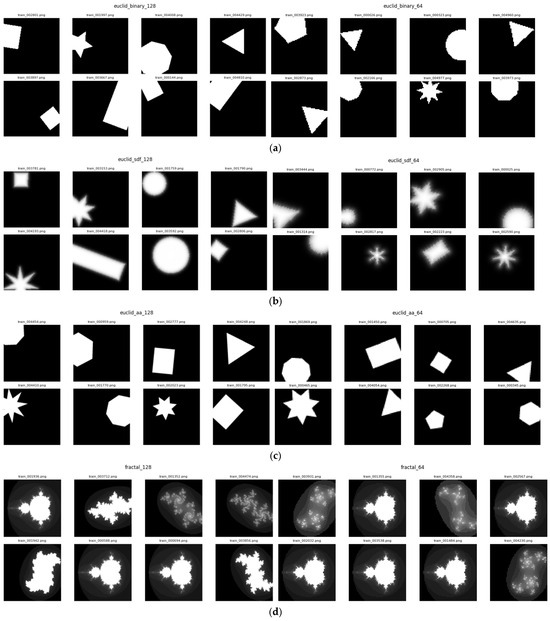
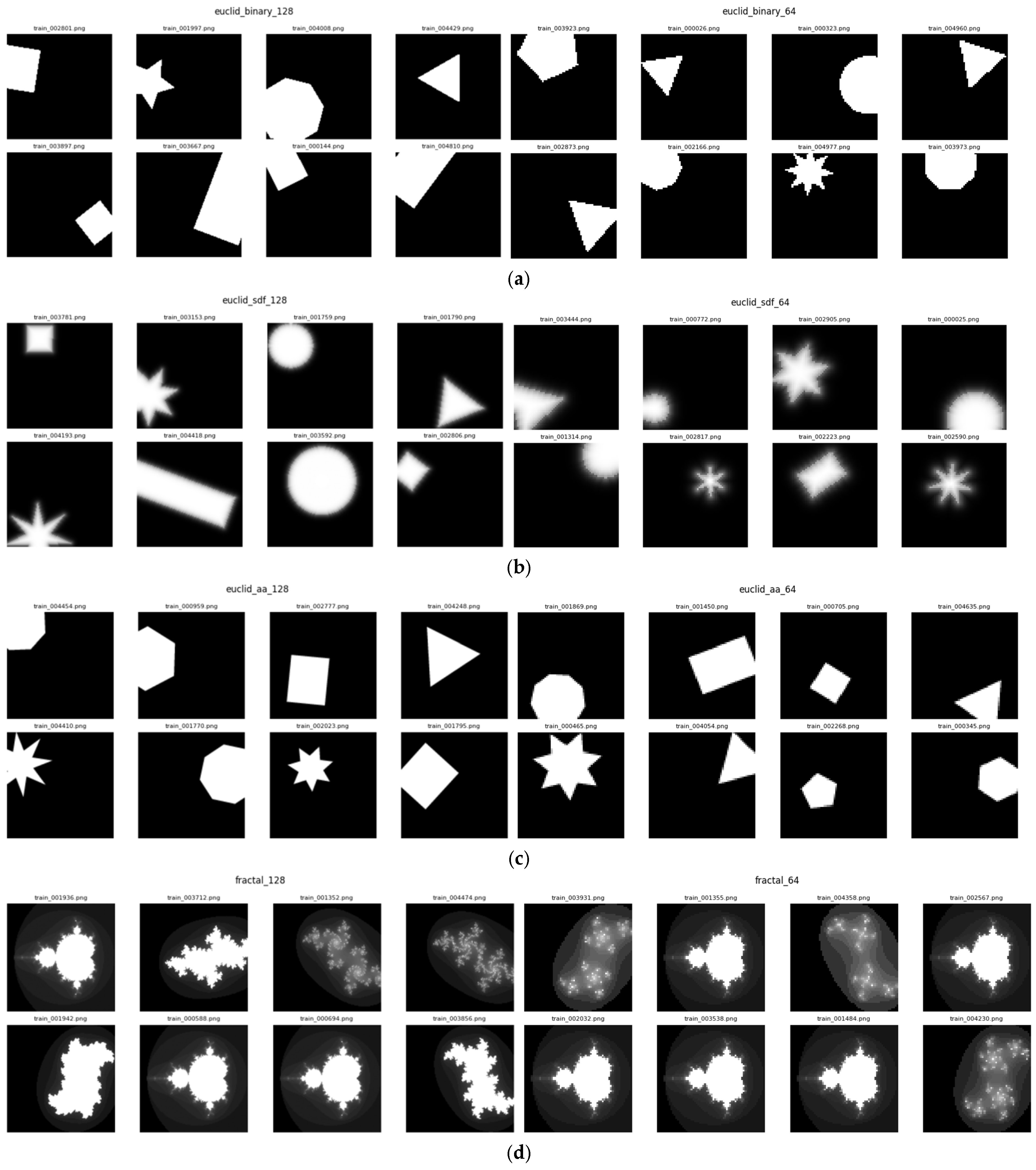
Across datasets, the number of samples, intensity normalization, and train/test splits are matched to ensure that observed differences in performance arise from structural properties rather than low-level statistics. Representative samples are shown in Figure 1.
Figure 1.
Representative samples from the synthetic datasets used in this study. (a) Euclidean binary shape datasets at 64 × 64 and 128 × 128 resolution, illustrating hard boundaries and strict global geometric constraints. (b) Euclidean signed-distance-field (SDF) datasets at 64 × 64 and 128 × 128 resolution, providing smooth boundary representations while preserving global geometry. (c) Euclidean anti-aliased (AA) datasets at 64 × 64 and 128 × 128 resolution, offering intermediate boundary smoothness. (d) Fractal datasets at 64 × 64 and 128 × 128 resolution, exhibiting self-similar and scale-repeating local structure. All images are grayscale, rendered on a black background, and normalized identically.
Crucially, all Euclidean datasets occupy low-dimensional manifolds defined by precise global constraints, making them a strong counterpoint to the scale-distributed structure of fractal images.
From an information-theoretic perspective, we emphasize that our use of “complexity” is conceptual rather than based on explicit Kolmogorov complexity estimates, which are not computable in practice. Instead, the contrast between fractal and Euclidean datasets can be understood in terms of (i) how structural information is distributed across scales and (ii) how tightly probability mass is concentrated on low-dimensional manifolds defined by global constraints. Fractal images distribute structural variation across many scales and exhibit broad-band power spectra with slowly decaying radial frequency profiles, whereas Euclidean shapes concentrate energy at a small number of spatial frequencies associated with sharp boundaries. Binary Euclidean images, in particular, have low pixel-intensity entropy but strong global constraints, while signed-distance and anti-aliased variants occupy an intermediate regime with smoother local gradients but unchanged global geometry. In the present work, we therefore treat entropy, algorithmic complexity, and spatial-frequency content as qualitative lenses for interpreting inductive bias rather than as primary quantitative evaluation metrics.
2.2. Generative Models
2.2.1. GAN Architectures
We evaluate three widely used convolutional GAN architectures, chosen to represent increasing levels of training stabilization and regularization.
These architectures span commonly adopted design choices in adversarial generative modeling and allow us to assess whether improved optimization stability alters structural failure modes.
- 1.
- DCGAN
A standard deep convolutional GAN with transposed convolutional generators and convolutional discriminators. Both networks use batch normalization and ReLU/LeakyReLU nonlinearities. DCGAN serves as a baseline model with minimal stabilization mechanisms.
Its simplicity makes it a useful reference point for identifying baseline failure behaviors.
- 2.
- WGAN-GP
A Wasserstein GAN with gradient penalty, using the same convolutional backbone as DCGAN but trained with the Wasserstein objective and a gradient norm penalty to enforce Lipschitz continuity. This model improves training stability and mitigates mode collapse.
WGAN-GP allows us to test whether improved gradient behavior translates into improved enforcement of global geometric constraints.
- 3.
- SNGAN
A spectral normalization GAN employing ResNet-style generator and discriminator architectures. Spectral normalization is applied to all convolutional and linear layers in the discriminator, and hinge loss is used for adversarial training. This model emphasizes controlled discriminator capacity and stable gradients.
SNGAN represents a stronger form of architectural regularization and is included to test whether such regularization fundamentally alters inductive bias rather than merely stabilizing training.
All generators map a 128-dimensional latent vector sampled from a standard normal distribution to a single-channel output image. Discriminators operate directly on grayscale images without auxiliary inputs. Architectures are adapted to the target resolution (64 × 64 or 128 × 128) but are otherwise kept consistent across datasets.
This consistency ensures that architectural differences do not confound comparisons across data regimes.
2.2.2. Training Protocol
All models are trained from random initialization using the Adam optimizer. Hyperparameters are fixed across datasets to ensure a fair comparison and avoid dataset-specific tuning.
No hyperparameter optimization is performed for individual datasets, as the goal is to expose systematic behavior rather than maximize per-dataset performance.
Training details are as follows:
- •
- Latent dimension: 128;
- •
- Batch size: 32;
- •
- Optimizer: Adam;
- •
- Learning rate: 2 × 10⁻⁴.
- •
- Adam betas:
- ○
- DCGAN: (0.5, 0.999);
- ○
- WGAN-GP and SNGAN: (0.0, 0.9).
Training duration depends on model and resolution:
- •
- 64 × 64 experiments: 50 epochs for all models;
- •
- 128 × 128 experiments:
- ○
- DCGAN: 50 epochs;
- ○
- WGAN-GP: 50 epochs;
- ○
- SNGAN: 25 epochs, due to substantially higher computational cost.
While training durations differ slightly for SNGAN at higher resolution, all models are trained long enough to reach stable qualitative behavior.
For every dataset–model combination, three independent training runs are performed using fixed random seeds {0, 1, 2}. These seeds control dataset shuffling, weight initialization, latent-code sampling, and the procedural generation of fractal and Euclidean parameters, allowing us to quantify training variability and perform statistical analysis across runs.
Repeated runs allow us to distinguish systematic structural failures from stochastic training artifacts.
Checkpointing and automatic resume functionality are used to ensure robustness against runtime interruptions.
2.3. Evaluation Metrics
We evaluate generative performance using complementary metrics capturing pixel-level accuracy, perceptual similarity, distributional alignment, and geometric correctness.
This multi-metric approach is essential because no single metric adequately captures both local visual fidelity and global structural validity.
2.3.1. Pixel-Wise Error
Mean squared error (MSE) is computed between generated samples and reference images. Although MSE favors smooth outputs and penalizes sharp boundaries, it provides a baseline measure of pixel-level agreement.
We include MSE primarily as a low-level reference metric rather than as an indicator of perceptual or structural quality.
2.3.2. Perceptual Similarity
We employ:
- Structural Similarity Index Measure (SSIM) to assess luminance, contrast, and structural coherence.
- Learned Perceptual Image Patch Similarity (LPIPS) using a VGG-based network to capture perceptual similarity in deep feature space.
Higher SSIM and lower LPIPS values indicate better perceptual quality.
These metrics emphasize local visual similarity and are commonly used in generative modeling, making them useful points of comparison despite their known limitations for structured data.
2.3.3. Distributional Similarity
The Fréchet Inception Distance (FID) is used to measure the similarity between real and generated image distributions in feature space. While FID is designed for natural images, we include it for completeness and discuss its limitations for synthetic and fractal data in Section 4.
In this work, FID is interpreted strictly as a relative, feature-based comparison under identical experimental conditions rather than as an absolute measure of generative quality. The main structural conclusions rely on geometry-aware evaluation for Euclidean datasets and qualitative consistency rather than on FID alone.
We explicitly caution against interpreting low FID scores as evidence of global structural correctness in geometrically constrained domains.
2.3.4. Geometry-Aware Metrics (Euclidean Datasets Only)
For Euclidean shape datasets, we additionally compute geometry-aware metrics on binarized shape masks:
- Intersection-over-union (IoU), measuring region overlap and global shape consistency.
- Chamfer distance, computed between shape boundaries to quantify contour accuracy.
- Topological consistency, quantified via connected component counts and Euler characteristic of the binarized masks, capturing fragmentation (spurious components) and spurious holes or merges. In this work, we use violations of these quantities together with low IoU and high Chamfer distance as a quantitative definition of “structural failure modes” for Euclidean datasets.
These metrics explicitly assess global geometric correctness, which is not captured by pixel-wise or perceptual measures.
They therefore serve as the primary indicators of success or failure for Euclidean shape generation in this study.
In contrast to physics-informed or FEM-guided approaches, which embed domain-specific constraints directly into the model or loss function, our geometry-aware metrics are purely diagnostic: they are designed to reveal structural failures under unconstrained adversarial training rather than to enforce physical validity.
Beyond IoU, Chamfer distance, and Euler characteristic, a number of spectral and topological metrics could be applied to structured generative tasks, such as Wasserstein distances on shape descriptor distributions or persistent homology-based summaries of topology. We view the geometry-aware metrics used here as a minimal, computationally simple subset that already reveals severe global failures, and we anticipate that more sophisticated spectral or topological distances would further strengthen the conclusions.
2.4. Experimental Design and Statistical Analysis
For each dataset–model–resolution combination, the results are aggregated across the three independent seeds. We report means and standard deviations and perform paired statistical tests to compare fractal and Euclidean conditions under identical training settings.
Statistical significance is assessed at α = 0.05, and effect sizes (Cohen’s d) and 95% confidence intervals are reported where appropriate.
This statistical framework allows us to quantify both central tendencies and variability, emphasizing robustness over isolated best-case results.
Because all datasets are procedurally generated from continuous parameter distributions, exact duplication of samples across train and test sets is extremely unlikely, and we generate train/test splits independently to avoid any inadvertent leakage. In addition, the use of randomized fractal parameters (e.g., plane coordinates, iteration depth) and shape parameters (e.g., size, pose, position) ensures that the training set does not consist of a finite catalogue of templates that could be trivially memorized. While our focus is on structural failure modes rather than diversity per se, we qualitatively verified that trained generators produce continuously varying outputs as latent codes are interpolated, which would not be expected under simple data memorization or masked mode collapse.
2.5. Implementation and Reproducibility
All experiments are implemented in PyTorch. 2.9.0 Dataset generation, training pipelines, evaluation scripts, and analysis code are fully automated and deterministic given a fixed random seed. The complete codebase will be released publicly to ensure reproducibility.
All reported figures and tables can be regenerated from the released codebase without manual intervention.
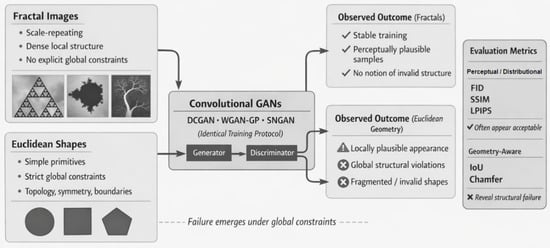
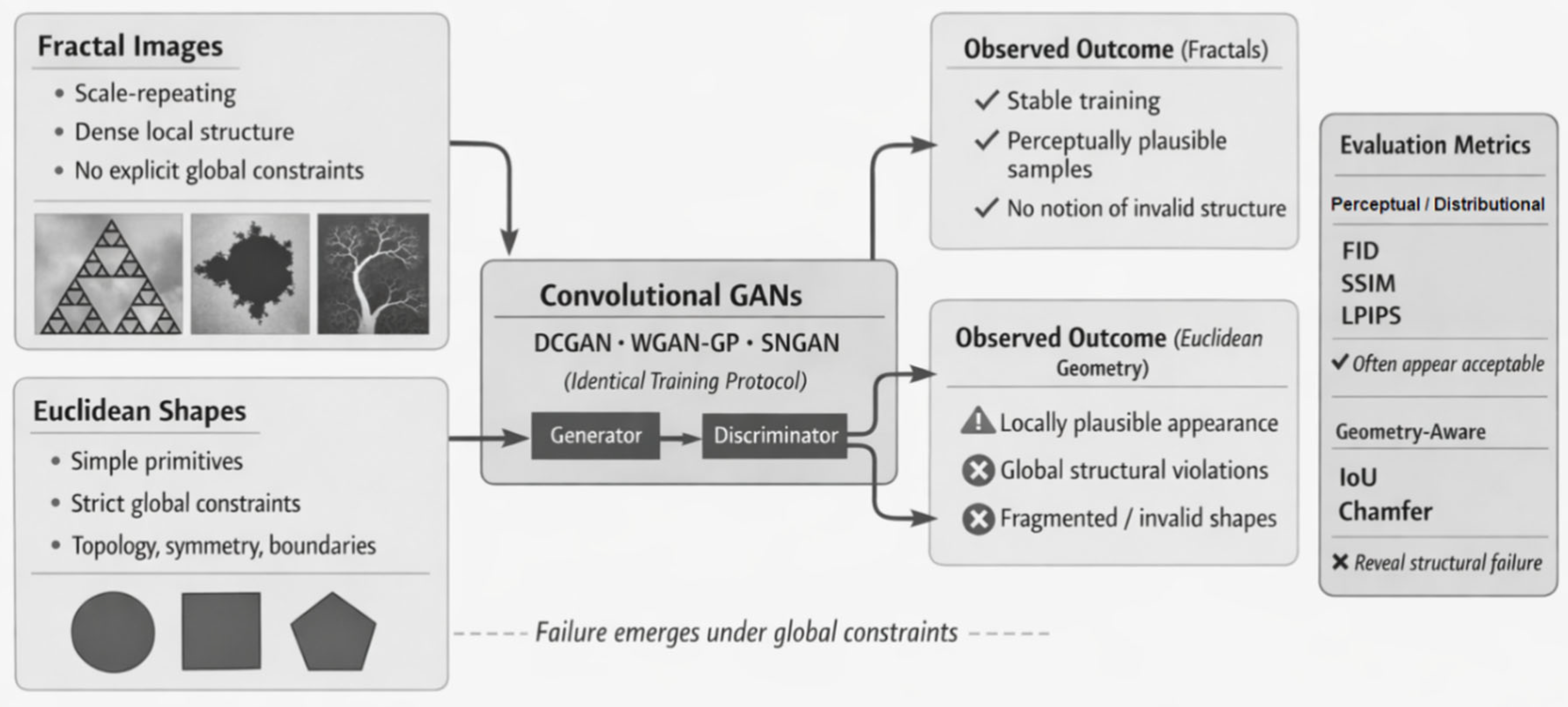
Figure 2 provides a conceptual overview of the study, illustrating the two data regimes considered, the shared GAN training pipeline, and the evaluation lenses used to analyze model behavior.
Figure 2.
Conceptual overview of the study. Fractal datasets and Euclidean geometric datasets are trained using identical convolutional GAN architectures and training protocols. Despite visual simplicity, Euclidean geometry exposes structural failure modes—violations of global shape constraints—that are not captured by standard perceptual or distributional metrics. Fractal data, characterized by dense local structure and scale repetition, do not trigger these failures. This contrast motivates a failure-mode-oriented analysis of inductive bias in adversarial generative models.
3. Results
3.1. Overview of Experimental Outcomes
This section presents quantitative results comparing the performance of convolutional GAN architectures on fractal datasets and Euclidean geometric datasets under tightly controlled experimental conditions. Experiments were conducted at two spatial resolutions, 64 × 64 and 128 × 128. At 64 × 64 resolution, DCGAN and WGAN-GP were evaluated, while at 128 × 128 resolution DCGAN, WGAN-GP, and spectral normalization GAN (SNGAN) were considered.
For each dataset–architecture–resolution combination, three independent training runs were performed using random seeds {0, 1, 2}. All reported values are aggregated across these runs, with 95% confidence intervals computed to quantify variability across seeds.
Model performance is evaluated using:
- Distributional metrics (Fréchet Inception Distance, FID),
- Perceptual similarity metrics (SSIM, LPIPS, where available),
- For Euclidean datasets only, geometry-aware metrics (intersection-over-union and symmetric Chamfer distance).
Fractal datasets are evaluated exclusively with perceptual and distributional metrics, as no unique global geometric ground truth exists for fractal images.
This evaluation setup allows us to directly compare how the same convolutional adversarial training procedures behave on structurally distinct data regimes and to distinguish discrepancies that arise at the level of global geometry from those that appear only in aggregate perceptual or distributional scores.
3.2. Perceptual and Distributional Performance at 64 × 64 Resolution
We first examine performance at 64 × 64 resolution using DCGAN and WGAN-GP. The results for fractal datasets, binary Euclidean datasets, and signed-distance-field (SDF) Euclidean datasets are summarized in Table 1.
Table 1.
Perceptual and distributional performance of DCGAN and WGAN-GP at 64 × 64 resolution on fractal, Euclidean binary, and Euclidean signed-distance-field (SDF) datasets. The results are reported as mean values across three random seeds with 95% confidence intervals. Metrics include the Fréchet Inception Distance (FID; lower is better) and mean squared error (MSE; lower is better). SSIM and LPIPS are not reported at this resolution.
At this resolution, fractal datasets consistently achieve substantially lower FID values and lower MSE than all Euclidean datasets across both architectures. This difference is pronounced despite the Euclidean datasets being visually simpler and composed of clean geometric primitives.
In contrast, both binary and SDF Euclidean datasets exhibit significantly higher FID values, indicating that GANs struggle to accurately capture their underlying data distributions. This difficulty arises even though the Euclidean images contain fewer high-frequency details than fractals.
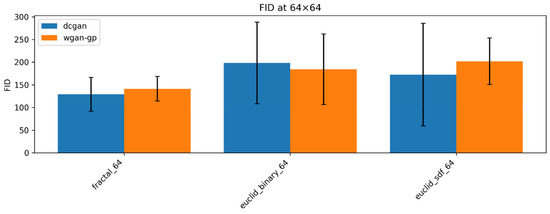
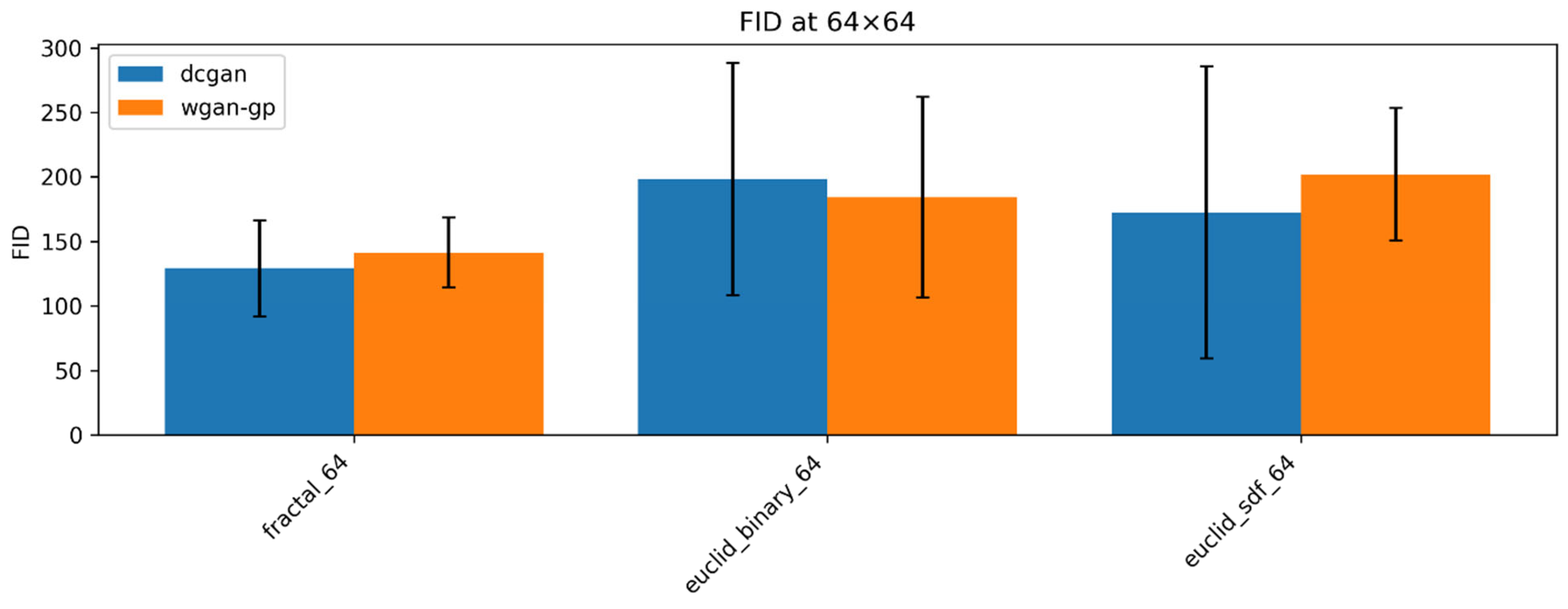
Figure 3 visualizes this effect using FID as a representative distributional metric. Across both DCGAN and WGAN-GP, fractal datasets are clearly separated from Euclidean datasets, demonstrating a consistent difference in distributional behavior under identical training conditions.
Figure 3.
Fréchet Inception Distance (FID) at 64 × 64 resolution for DCGAN and WGAN-GP across fractal, Euclidean binary, and Euclidean signed-distance-field datasets. Lower values indicate better distributional fidelity. Error bars denote 95% confidence intervals computed across three random seeds.
Taken together, these observations suggest that convolutional GANs more readily align with the scale-repeating, locally dense structure of fractal data than with the narrow, globally constrained manifolds underlying Euclidean shapes, even at relatively low spatial resolution.
3.3. Geometry-Aware Evaluation on Euclidean Datasets at 64 × 64
Perceptual and distributional metrics do not directly assess whether generated samples satisfy global geometric constraints. To address this limitation, Euclidean datasets are further evaluated using geometry-aware metrics computed on binarized outputs.
Table 2 reports the intersection-over-union (IoU) and symmetric Chamfer distance for Euclidean datasets at 64 × 64 resolution. Across both binary and SDF representations, IoU values remain uniformly low, while Chamfer distances are high and exhibit substantial variability.
Table 2.
Geometry-aware evaluation of Euclidean datasets at 64 × 64 resolution using intersection-over-union (IoU; higher is better) and symmetric Chamfer distance (lower is better). The results are averaged across three random seeds with 95% confidence intervals. Fractal datasets are excluded, as no geometric ground truth is defined for them.
These results indicate frequent violations of global shape structure, including fragmented boundaries, missing regions, and spurious artifacts. Importantly, these geometric failures are not reliably detected by perceptual similarity metrics alone, highlighting a disconnect between local visual plausibility and global structural correctness.
In other words, at 64 × 64 resolution, convolutional GANs can produce samples that appear locally reasonable yet remain far from the intended geometric manifolds when assessed with metrics explicitly sensitive to global shape. This gap foreshadows the central theme of our study: standard perceptual and distributional metrics can substantially under-report structural failure in geometrically constrained domains.
3.4. Perceptual and Distributional Performance at 128 × 128 Resolution
We next examine whether increased spatial resolution improves generative performance on Euclidean datasets. At 128 × 128 resolution, DCGAN, WGAN-GP, and SNGAN are evaluated on fractal datasets and three Euclidean representations: binary masks, signed distance fields, and anti-aliased shapes.
Perceptual and distributional results at this resolution are summarized in Table 3. Increasing resolution improves overall visual fidelity across all datasets, as reflected by modest improvements in FID, SSIM, and LPIPS.
Table 3.
Perceptual and distributional performance at 128 × 128 resolution for DCGAN, WGAN-GP, and spectral normalization GAN (SNGAN) across fractal and Euclidean datasets. Metrics include the Fréchet Inception Distance (FID; lower is better), Structural Similarity Index (SSIM; higher is better), Learned Perceptual Image Patch Similarity (LPIPS; lower is better), and mean squared error (MSE; lower is better). All values are reported as the mean ± 95% confidence interval over three random seeds.
However, the relative performance gap between fractal and Euclidean datasets persists. Fractal datasets continue to exhibit stable perceptual and distributional behavior across all three architectures. While SNGAN improves training stability and slightly reduces variance for Euclidean datasets, it does not eliminate the disparity in performance.
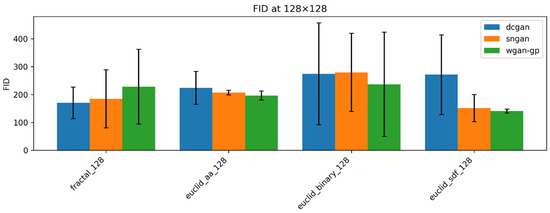
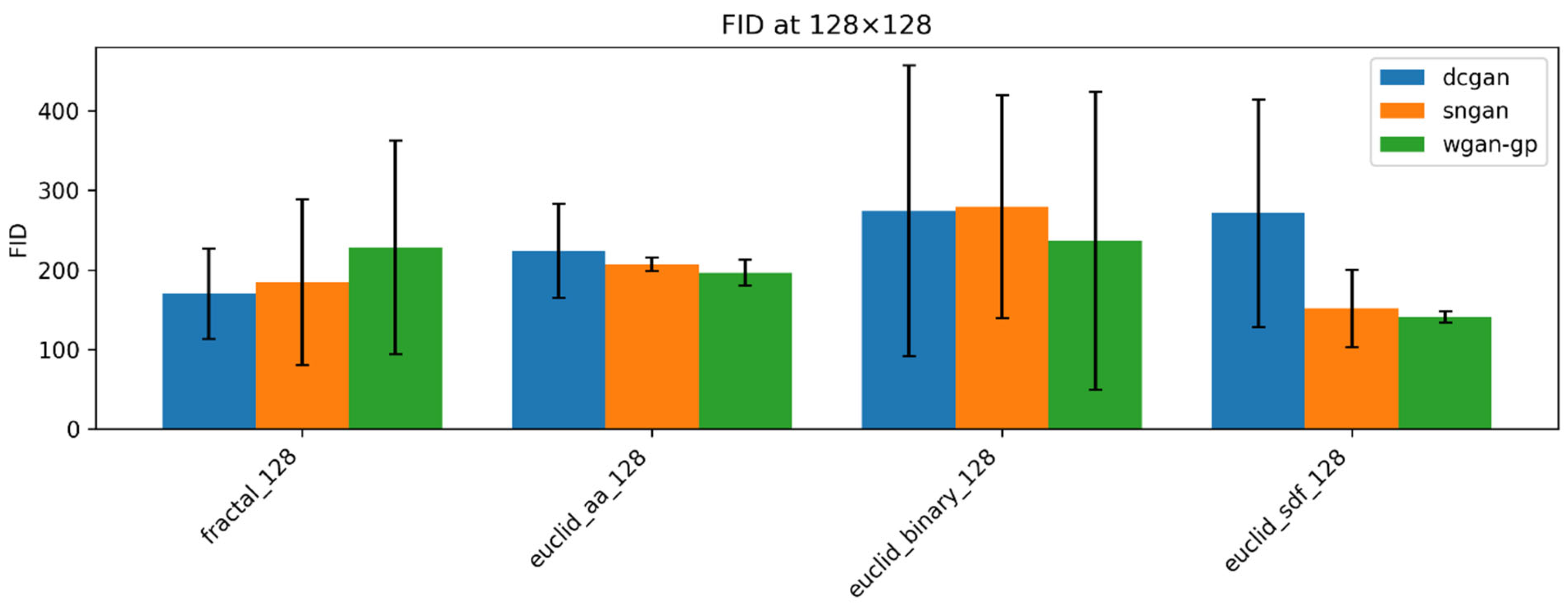
This trend is clearly illustrated in Figure 4, which provides a direct comparison of FID scores across fractal and Euclidean datasets under identical architectures and training protocols.
Figure 4.
Fréchet Inception Distance (FID) at 128 × 128 resolution for DCGAN, WGAN-GP, and spectral normalization GAN (SNGAN) across fractal and Euclidean datasets. Lower values indicate better distributional alignment with the training data. Error bars represent 95% confidence intervals across three random seeds.
To quantify the disconnect between perceptual/distributional metrics and geometric correctness, we compared FID and SSIM values with IoU and Chamfer distance for corresponding models and datasets. Across both resolutions and all architectures, we observed weak and sometimes inverse relationships: in several Euclidean conditions, lower (better) FID scores and higher SSIM scores do not coincide with a higher IoU or lower Chamfer distance. For example, at 128 × 128 resolution, the euclid_sdf_128 datasets achieve FID values that are comparable to or better than those of some euclid_binary_128 configurations (Table 3), yet their IoU values remain uniformly low and Chamfer distances high (Table 4). Similarly, across random seeds, we find that the seed with the best FID for a given Euclidean dataset does not systematically correspond to the best IoU or Chamfer score. These observations indicate that improvements in perceptual or feature-based metrics can occur alongside unchanged or even degraded global geometry.
Table 4.
Geometry-aware evaluation of Euclidean datasets at 128 × 128 resolution using intersection-over-union (IoU; higher is better) and symmetric Chamfer distance (lower is better) for DCGAN, WGAN-GP, and SNGAN. The results are averaged across three random seeds with 95% confidence intervals. Fractal datasets are excluded by design.
Notably, even the most stabilized architecture (SNGAN) fails to close the gap between fractal and Euclidean regimes, suggesting that improved optimization and regularization alone are insufficient to overcome the underlying mismatch between convolutional inductive bias and global Euclidean structure.
3.5. Geometry-Aware Evaluation on Euclidean Datasets at 128 × 128
Geometry-aware metrics at 128 × 128 resolution further clarify the limitations of GANs on Euclidean data. The results for binary, SDF, and anti-aliased Euclidean representations are reported in Table 4.
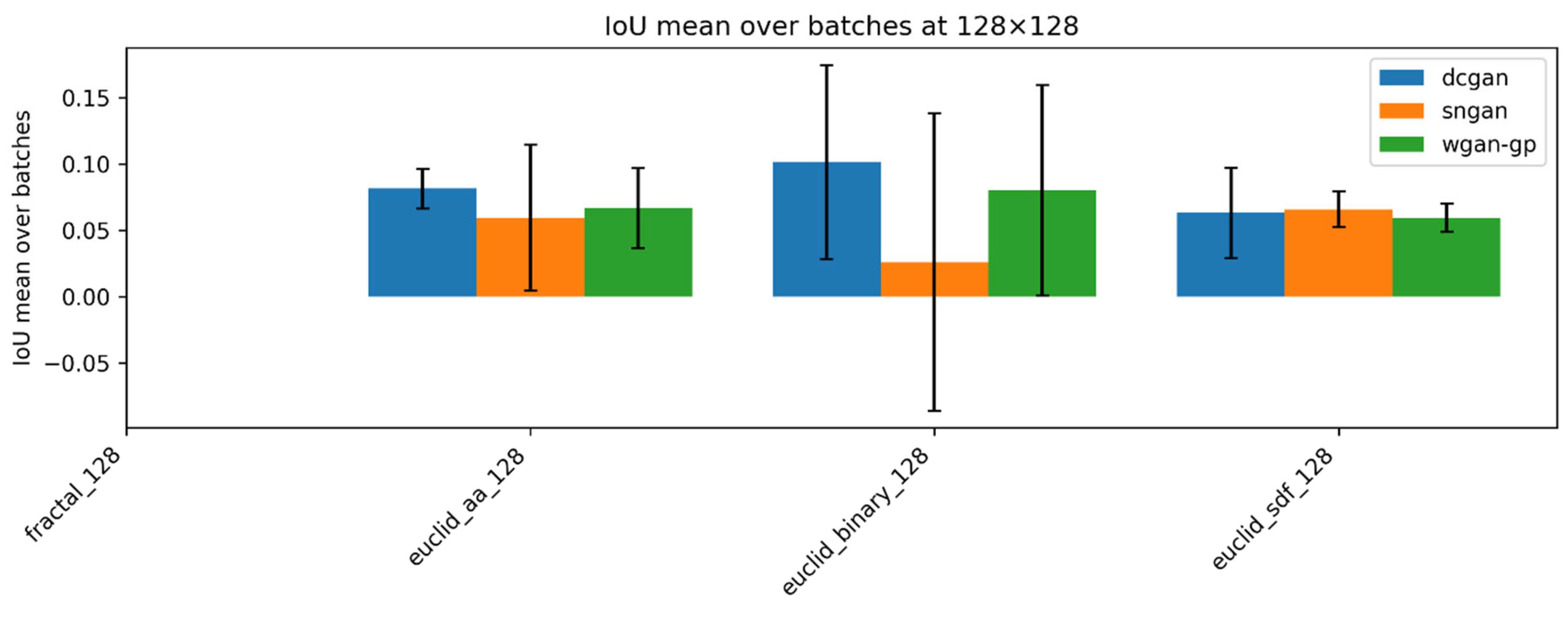
Smoother representations, such as SDFs and anti-aliased shapes, reduce boundary noise and slightly improve Chamfer distance in some cases. Nevertheless, IoU scores remain low across all architectures, indicating persistent violations of global shape consistency.
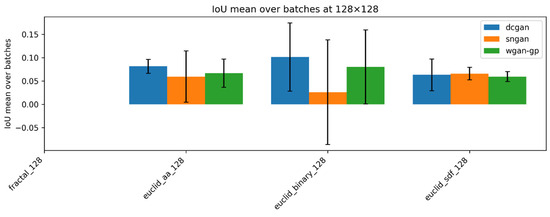
Figure 5 visualizes IoU performance at 128 × 128 resolution and highlights the limited impact of increased resolution and architectural stabilization on enforcing global geometric constraints.
Figure 5.
Intersection-over-union (IoU) at 128 × 128 resolution for Euclidean datasets across DCGAN, WGAN-GP, and SNGAN. Higher values indicate better global geometric consistency. Fractal datasets are excluded, as IoU is not defined for them. Error bars denote 95% confidence intervals across three random seeds.
The combination of low IoU and relatively modest Chamfer improvements across representations shows that while local boundary quality may improve with smoothing and higher resolution, the generators still fail to reliably capture the correct global topology and extent of the shapes. This reinforces the view that the core issue is not merely resolution or aliasing, but the inability of convolutional adversarial training to consistently enforce global geometric constraints.
3.6. Summary of Results
Across both resolutions and all evaluated architectures, a consistent pattern emerges: Euclidean geometric datasets expose structural failure modes in convolutional GANs that are not captured by standard perceptual or distributional metrics and are not observed in fractal data. While perceptual and distributional scores for fractal and Euclidean datasets are sometimes comparable, geometry-aware evaluation reveals persistent violations of global shape consistency in Euclidean generations. This mismatch persists across random seeds, with 95% confidence intervals for FID, SSIM, and LPIPS overlapping substantially between seeds even when IoU and Chamfer distance clearly indicate severe and stable structural failures for Euclidean data. Concretely, we refer to structural failure modes as samples that simultaneously exhibit low IoU with the ground-truth shape, large boundary errors (high Chamfer distance), and changes in Euler characteristic or connected component count relative to the target mask, indicating fragmentation or topological violations.
Increasing resolution and applying architectural stabilization techniques, such as spectral normalization, improve local visual fidelity and reduce training variance but do not resolve these structural failures. In contrast, fractal datasets yield stable training behavior and perceptually plausible generations without triggering analogous failure modes, despite their higher apparent visual complexity.
Taken together, these results suggest that differences between fractal and Euclidean datasets are not primarily reflected in aggregate perceptual scores, but rather in the presence or absence of global structural collapse. This distinction motivates a failure-mode-oriented interpretation of GAN performance, in which alignment with architectural inductive bias plays a more central role than symbolic or geometric simplicity.
In particular, our findings indicate that convolutional GANs are well aligned with distributions whose complexity is distributed across scales and captured by local statistics, but systematically misaligned with distributions that concentrate probability mass on narrow manifolds defined by strict global constraints. This structural perspective on the results sets the stage for the broader discussion in Section 4, where we reinterpret standard metrics and architectural choices through the lens of inductive bias and global geometric validity.
4. Discussion
Our experiments reveal a consistent pattern: fractal datasets and Euclidean geometric datasets differ less in overall perceptual difficulty than in the types of structural constraints they impose. Fractal images, though visually intricate, align well with the local, translation-equivariant inductive bias of convolutional GANs, while Euclidean shapes expose the difficulty these models have in enforcing precise global constraints.
Inductive bias and complexity. Rather than demonstrating that fractals are universally easier to model, our results show that Euclidean geometric datasets systematically trigger structural failure modes that are largely absent for fractal data. These failures persist across architectures, resolutions, and shape representations, indicating that learnability under adversarial training is governed more by alignment with architectural inductive bias than by symbolic simplicity. For convolutional GANs, “complexity” is therefore better understood in terms of how well a distribution matches their local-statistics bias than in terms of how compactly the data can be parameterized.
Local statistics vs. global structure. Convolutional networks favor locality and the reuse of spatial patterns, a bias often described as texture bias in discriminative models [13,14]. Our results show that an analogous effect appears in generative settings. Fractal images are dominated by dense local structure and approximate self-similarity across scales, properties that align naturally with hierarchical convolutional synthesis. Euclidean datasets, by contrast, lie on narrow manifolds defined by constraints on boundary continuity, topology, symmetry, and spatial relationships. These constraints are difficult to encode using purely local operations, leading to samples that are locally plausible yet globally invalid, as captured by low IoU and high Chamfer distance.
From this perspective, fractals act as stress tests for multi-scale representation rather than for global constraint satisfaction: they require models to reuse patterns across scales but do not require the coordination of distant regions to preserve rigid global geometry. Euclidean shapes, instead, directly probe the ability to maintain such global coherence.
Role of the discriminator. The observed behavior is a property of the adversarial system as a whole, but it is informative to consider the discriminator’s role. In all configurations studied here, discriminators are convolutional networks with local receptive fields and limited explicit global context. Their learning objective encourages them to distinguish real from generated images primarily on the basis of local patch statistics. Generators trained against such discriminators are therefore incentivized to match local texture-like cues rather than to enforce strict global geometry. From this perspective, the inductive bias we observe is shared between the generator and the discriminator and is amplified by the adversarial dynamics: the discriminator does not strongly penalize globally inconsistent shapes as long as local statistics remain plausible. Within the three convolutional GANs studied here (DCGAN, WGAN-GP, and SNGAN), we did not observe a systematic improvement in geometric accuracy with increased architectural depth or regularization: more stabilized models yield smoother and less noisy samples, but IoU and Chamfer distance for Euclidean datasets remain uniformly low.
Limitations of standard metrics. A key methodological insight is that widely used perceptual metrics (SSIM and LPIPS) and distributional metrics (FID) can obscure severe geometric errors. In our experiments, Euclidean samples with fragmented boundaries, missing regions, or incorrect topology can still receive moderate perceptual scores, illustrating that these metrics prioritize local patch similarity and feature statistics over global correctness. Geometry-aware metrics, in contrast, reveal the extent of structural failure. This suggests that evaluation protocols designed for natural images may be inadequate for structured or symbolic domains, and that domain-aware, geometry-sensitive metrics are essential when global validity matters.
Resolution, representation, and stabilization. Increasing image resolution, smoothing shape boundaries (via SDF or anti-aliasing), and employing stabilized architectures (WGAN-GP and SNGAN) all improve visual quality and reduce some artifacts but do not resolve the core geometric failures. These interventions act on surface characteristics—sharpness, aliasing, training stability—rather than on the underlying mismatch between convolutional architectures and globally constrained shapes. Consequently, they may make failures look less noisy while leaving global topology and geometry unreliable. Within the family of convolutional GANs we study (DCGAN, WGAN-GP, and SNGAN), we do not observe a monotonic relationship between architectural depth or nominal receptive-field size and geometry-aware metrics: models that achieve slightly better FID or sharper samples do not reliably achieve a higher IoU or lower Chamfer distance on Euclidean datasets.
In principle, spectral distances on shape descriptors and topological summaries based on persistent homology could be layered on top of our existing metrics to obtain an even more sensitive assessment of global structure; we leave such extensions to future work.
Implications for structured domains. These findings have direct consequences for applications where global structure, symbolic constraints, or geometric validity are critical, such as shape synthesis, CAD generation, scientific visualization, and symbolic image modeling. Off-the-shelf convolutional GANs, even when stabilized and tuned, are poorly suited to enforcing such constraints on their own. Progress in these domains will likely require architectures with stronger global inductive biases, such as coordinate-based models, neural fields, graph-structured generators, or hybrid symbolic–neural systems, potentially combined with constraint-aware objectives or differentiable simulators. Simply scaling up models or improving adversarial training is unlikely to fix failures rooted in architectural assumptions about locality and compositionality.
Related work in thermographic monitoring and dielectric characterization has shown that integrating physical models with learning architectures can significantly improve reliability in structured domains. For example, physics-guided and FEM-informed frameworks such as the one proposed in [18] integrate thermophysical constraints directly into data-driven models for complex permittivity estimation. Our approach is complementary: rather than enforcing physical constraints, we expose how unconstrained convolutional GANs behave when such constraints are absent. The proposed geometry-aware metrics can therefore be combined with physics-guided architectures in future work to jointly assess both physical and geometric validity.
Fractals as diagnostic benchmarks. Beyond serving as a comparison class, fractal datasets emerge as useful diagnostic tools for generative inductive bias. By decoupling visual complexity from global geometric constraints, they help to distinguish distributions that align with convolutional inductive bias from those that expose its limitations. Rather than treating fractals as pathological edge cases, our results suggest viewing them as principled benchmarks for probing how generative architectures handle scale-invariant, multi-scale structure. Systematically varying the degree of scale repetition and the strength of global constraints could yield families of tasks that map out where different generative models transition from stable behavior to structural failure.
In the present work, we deliberately restrict ourselves to fully synthetic data in order to precisely control structural properties and avoid confounding from semantics, illumination, and background clutter. Real-world multi-scale domains such as biomedical imaging and satellite or remote-sensing data represent important application targets, but they also introduce uncontrolled correlations that would complicate the attribution of failure modes to architectural inductive bias. Extending the proposed benchmarks and geometry-aware evaluation to such real datasets is therefore an important direction for future work and would complement the controlled analysis presented here.
Scope and limitations. Our conclusions are specific to convolutional GAN architectures trained with adversarial objectives on synthetic grayscale data. Other generative paradigms—such as diffusion models, autoregressive models, or coordinate-based neural representations—may exhibit different trade-offs and should be evaluated on similar fractal–Euclidean benchmarks.
We intentionally did not perform a broad architectural ablation over kernel sizes, receptive field configurations, or the inclusion of global self-attention layers. All models use standard convolutional backbones with receptive fields chosen to match the target resolution. This choice isolates the effect of data structure under commonly used architectures rather than optimizing performance for each dataset. We expect that architectures with explicit global receptive mechanisms or long-range attention could partially alleviate some structural failures, but they would also introduce new inductive biases that are beyond the scope of the present study. A systematic ablation over receptive field design and global-attention mechanisms on the same benchmarks is therefore an important direction for future work.
In this work we deliberately restrict attention to convolutional GANs, which remain a widely used class of generative models and exhibit a well-documented bias toward local texture statistics. Evaluating diffusion-based and autoregressive models on the same synthetic benchmarks would require substantially different training objectives and architectures and is therefore beyond the present scope. We view such cross-paradigm comparisons as an important direction for future work that can build directly on the proposed datasets and geometry-aware metrics.
Extending this analysis to higher-dimensional and multimodal structured data is another important direction for future work.
We also note that the present work does not address inverse problems such as dielectric characterization, complex permittivity estimation, or other regression-based physical surrogate modeling; our focus is strictly on image-level generative behavior and inductive bias in convolutional adversarial networks.
To our knowledge, similar controlled comparisons between locally rich and globally constrained synthetic datasets have not yet been performed for diffusion or autoregressive generative models. Existing reports on these paradigms focus mainly on natural images and do not directly isolate the role of structural constraints. A systematic cross-paradigm comparison on the proposed fractal–Euclidean benchmarks—covering GANs, diffusion models, and autoregressive generators—would therefore be a valuable next step but lies beyond the scope of the present study.
5. Conclusions
We studied how convolutional Generative Adversarial Networks behave on datasets with contrasting structural properties: self-similar, scale-invariant fractal images and Euclidean geometric shapes defined by simple global constraints. Using fully synthetic grayscale datasets, multiple GAN architectures, two resolutions, and repeated runs, we isolated the role of structural alignment between data and model inductive bias.
Our experiments show that Euclidean geometric data expose structural failure modes in convolutional GANs that are not captured by standard perceptual or distributional metrics and do not arise for fractal data. While GANs generate visually plausible fractal samples with stable training dynamics, they frequently violate global geometric constraints when modeling Euclidean shapes, producing outputs with fragmented boundaries, incorrect topology, or inconsistent structure. These failures persist under higher resolution, smoother shape representations, and stabilized adversarial objectives and appear systematically across architectures and seeds.
These findings support the view that adversarial generative learning with convolutional architectures is governed less by human notions of visual or symbolic simplicity than by alignment with local, scale-oriented inductive bias. Convolutional GANs are naturally suited to distributions with dense local structure and approximate scale repetition but are poorly equipped to enforce strict global constraints. This helps to explain why visually complex textures and fractal patterns can be easier for GANs to model than simple geometric forms.
More broadly, our results highlight limitations of commonly used evaluation practices in generative modeling: perceptual and feature-based metrics can obscure severe structural errors in domains where global correctness is essential, underscoring the need for geometry-aware and domain-specific criteria. They also motivate viewing fractal datasets as diagnostic tools for probing generative inductive bias. Future work could compare alternative generative paradigms on the same benchmarks and explore architectures with stronger global inductive biases—such as coordinate-based models, neural fields, or hybrid symbolic–neural systems—for applications where global coherence and validity are paramount.
Author Contributions
Conceptualization, C.G.B., F.N. and M.A.; methodology, C.G.B. and F.N.; software, C.G.B. and L.D.; validation, F.N., D.M. and V.N.; formal analysis, C.G.B. and M.A.; investigation, C.G.B., D.M. and O.R.; resources, F.N. and V.N.; data curation, O.R. and L.D.; writing—original draft preparation, C.G.B.; writing—review and editing, F.N., M.A. and D.V.; visualization, L.D. and D.M.; supervision, M.A. and F.N.; project administration, F.N.; funding acquisition, F.N. and V.N. All authors have read and agreed to the published version of the manuscript.
Funding
This research received no external funding.
Data Availability Statement
The data supporting the findings of this study are not publicly available. The computational programs were executed using Google Colab, and the associated datasets are stored in Google Drive. The data can be made available upon reasonable request from the corresponding author, D.M. (email: miriladiana@ub.ro).
Conflicts of Interest
The authors declare no conflicts of interest.
References
- Goodfellow, I.J.; Pouget-Abadie, J.; Mirza, M.; Xu, B.; Warde-Farley, D.; Ozair, S.; Courville, A.; Bengio, Y. Generative Adversarial Nets. In Proceedings of the 27th International Conference on Neural Information Processing Systems, Montreal, Canada, 9–13 December 2014; Volume 2, pp. 2672–2680. Available online: https://dl.acm.org/doi/10.5555/2969033.2969125 (accessed on 15 February 2026).
- Radford, A.; Metz, L.; Chintala, S. Unsupervised representation learning with deep convolutional generative adversarial networks. In Proceedings of the International Conference on Learning Representations (ICLR) Workshop, San Diego, CA, USA, 7–9 May 2015. [Google Scholar]
- Karras, T.; Aila, T.; Laine, S.; Lehtinen, J. Progressive growing of GANs for improved quality, stability, and variation. In Proceedings of the International Conference on Learning Representations (ICLR), Vancouver, BC, Canada, 30 April–3 May 2018. [Google Scholar]
- Karras, T.; Laine, S.; Aila, T. A style-based generator architecture for generative adversarial networks. In Proceedings of the IEEE/CVF Conference on Computer Vision and Pattern Recognition, Long Beach, CA, USA, 16–20 June 2019; pp. 4401–4410. [Google Scholar]
- Karras, T.; Laine, S.; Aittala, M.; Hellsten, J.; Lehtinen, J.; Aila, T. Analyzing and improving the image quality of StyleGAN. In Proceedings of the IEEE/CVF Conference on Computer Vision and Pattern Recognition, Virtual, 14–19 June 2020. [Google Scholar]
- Arjovsky, M.; Bottou, L. Towards principled methods for training generative adversarial networks. In Proceedings of the International Conference on Learning Representations (ICLR), Toulon, France, 24–26 April 2017; Available online: https://openreview.net/forum?id=Hk4_qw5xe (accessed on 20 December 2025).
- Arjovsky, M.; Chintala, S.; Bottou, L. Wasserstein generative adversarial networks. In Proceedings of the 34th International Conference on Machine Learning (ICML 2017), Sydney, Australia, 6–11 August 2017; Available online: http://proceedings.mlr.press/v70/arjovsky17a.html (accessed on 20 December 2025).
- Mescheder, L.; Geiger, A.; Nowozin, S. Which training methods for GANs do actually converge? In Proceedings of the 35th International Conference on Machine Learning (ICML 2018), Stockholm, Sweden, 10–15 July 2018; pp. 3478–3487. [Google Scholar]
- Lucic, M.; Kurach, K.; Michalski, M.; Gelly, S.; Bousquet, O. Are GANs created equal? A large-scale study. Adv. Neural Inf. Process. Syst. 2018, 31, 698–707. [Google Scholar]
- Odena, A.; Dumoulin, V.; Olah, C. Deconvolution and Checkerboard Artifacts. Distill, 1. 2016. Available online: http://distill.pub/2016/deconv-checkerboard (accessed on 15 February 2026).
- Santurkar, S.; Tsipras, D.; Ilyas, A.; Madry, A. How does batch normalization help optimization? In Proceedings of the Advances in Neural Information Processing Systems (NeurIPS 2018), Montréal, QC, Canada, 3–8 December 2018; Available online: https://papers.neurips.cc/paper/7515-how-does-batch-normalization-help-optimization.pdf (accessed on 15 February 2026).
- Bau, D.; Zhu, J.-Y.; Strobelt, H.; Zhou, B.; Tenenbaum, J.B.; Freeman, W.T.; Torralba, A. GAN Dissection: Visualizing and understanding generative adversarial networks. In Proceedings of the Seventh International Conference on Learning Representations (ICLR 2019), New Orleans, LA, USA, 6–9 May 2019; Available online: https://openreview.net/forum?id=Hyg_X2C5FX (accessed on 15 February 2026).
- Geirhos, R.; Rubisch, P.; Michaelis, C.; Bethge, M.; Wichmann, F.A.; Brendel, W. ImageNet-trained CNNs are biased towards texture; increasing shape bias improves accuracy and robustness. arXiv 2019, arXiv:1811.12231. [Google Scholar]
- Brendel, W.; Bethge, M. Approximating CNNs with Bag-of-Local-Features models works surprisingly well on ImageNet. arXiv 2019, arXiv:1904.00760. [Google Scholar]
- Mandelbrot, B. The Fractal Geometry of Nature; W.H. Freeman: New York, NY, USA, 1982. [Google Scholar]
- Falconer, K. Fractal Geometry: Mathematical Foundations and Applications; Wiley: Hoboken, NJ, USA, 2003. [Google Scholar]
- Peitgen, H.-O.; Jürgens, H.; Saupe, D. Chaos and Fractals; Springer: Berlin/Heidelberg, Germany, 2004. [Google Scholar]
- Pratticò, D.; Carlo, D.D.; Silipo, G.; Laganà, F. Hybrid FEM-AI Approach for Thermographic Monitoring of Biomedical Electronic Devices. Computers 2025, 14, 344. [Google Scholar] [CrossRef] [Scilit]

Disclaimer/Publisher’s Note: The statements, opinions and data contained in all publications are solely those of the individual author(s) and contributor(s) and not of MDPI and/or the editor(s). MDPI and/or the editor(s) disclaim responsibility for any injury to people or property resulting from any ideas, methods, instructions or products referred to in the content. |
© 2026 by the authors. Licensee MDPI, Basel, Switzerland. This article is an open access article distributed under the terms and conditions of the Creative Commons Attribution (CC BY) license.