

Article

Temperature-Dependent Pore Size Redistribution and Fractal Complexity in Low-Maturity Shale: Implications for In Situ Conversion


1
State Key Laboratory of Continental Shale Oil, Northeast Petroleum University, Daqing 163318, China
2
Key Laboratory for Enhanced Oil & Gas Recovery of the Ministry of Education, Northeast Petroleum University, Daqing 163318, China
3
Bohai Rim Energy Research Institute, Northeast Petroleum University, Qinhuangdao 066099, China
*
Authors to whom correspondence should be addressed.
Fractal Fract. 2026, 10(2), 132; https://doi.org/10.3390/fractalfract10020132
Submission received: 21 January 2026 / Revised: 14 February 2026 / Accepted: 20 February 2026 / Published: 22 February 2026

Abstract

Low-maturity shale is a prime target for in situ conversion (ICP), yet heating window selection remains largely empirical because pore evolution and hydrocarbon generation are rarely quantified in tandem. Nenjiang Formation shale from the Songliao Basin (TOC = 8.91%; Ro,max = 0.54%) was subjected to closed-system pyrolysis at 300–500 °C (20 °C h−1; 72 h per step). Released oil and gas and residual chloroform-extractable bitumen (“A”) were quantified, and pore evolution was characterized using 2D low-field NMR, SEM, micro-CT, and low-pressure N2 adsorption. Fractal dimensions (Ds and Dp) were derived from Frenkel–Halsey–Hill (FHH) fitting. Oil yield and bitumen “A” increased sharply above 350 °C and peaked at 375 °C, whereas gas generation accelerated above 400 °C and continued to increase to 500 °C. NMR indicates a temperature-dependent shift in retained hydrocarbons toward weaker confinement and higher mobility, with enhanced expulsion/mobility signals near 375 °C. At 375 °C, BJH pore volume and average pore diameter reached maxima (0.0675 cm3 g−1 and 15.36 nm), while Ds and Dp reached minima (2.343 and 2.444). The coincidence of peak oil expulsion with minimum fractal complexity suggests that FHH-based fractal indices provide a quantitative metric for comparing ICP heating windows in low-maturity shale.

1. Introduction

Low-maturity shale oil is widely regarded as an important supplemental resource amid the decline in conventional oil and gas supply [1,2,3,4]. In such shales, organic matter commonly remains at an early thermal evolution stage, and the conversion of kerogen to mobile hydrocarbons is insufficient; consequently, production capacity under natural conditions is typically limited [5,6,7]. Against this backdrop, the In situ Conversion Process (ICP) applies sustained heating to shale intervals to accelerate organic-matter cracking on engineering-relevant timescales, enabling hydrocarbon generation and reservoir responses to be evaluated under observable and controllable conditions [8,9,10]. From an engineering perspective, in situ conversion technologies (ICTs) for shale/oil shale can be broadly grouped into conduction-, convection-, and radiant-heating schemes, each exhibiting distinct heating efficiency, operational cost, and environmental constraints [11,12]. Across these ICTs, a recurring design objective is to create a sustained and controllable thermal regime that simultaneously promotes kerogen conversion and enhances pore–fracture connectivity for hydrocarbon flow [11].
A central challenge in ICP design is the selection of an appropriate heating-temperature window [13]. During heating, hydrocarbon generation, retention/expulsion behavior, and the structural evolution of the pore–fracture system occur concurrently, and their coupling governs both the storage space available for generated hydrocarbons and the pathways for migration [14,15,16,17]. Although pore structure is commonly described using Euclidean metrics such as porosity, mean pore size, and pore volume, these parameters are often insensitive to nonlinear changes in nanopore heterogeneity and network complexity that may emerge across thermal evolution stages [18,19,20,21]. Because nanopores constitute the dominant storage domain for hydrocarbons in low-maturity shales [22,23,24,25], more diagnostic quantitative descriptors are required.
Fractal analysis provides a complementary framework for quantifying pore heterogeneity and complexity in shale reservoirs [26,27,28,29]. Among commonly used adsorption-based approaches, the Frenkel–Halsey–Hill (FHH) model applied to low-pressure N2 adsorption can estimate fractal dimensions that are related to pore surface roughness and structural complexity, and model comparison studies have highlighted that different fractal formalisms may yield systematically different values depending on the probed pore size range and physical assumptions [30,31,32,33]. Recent lacustrine shale studies combining adsorption and mercury intrusion have further shown that fractal heterogeneity is strongly linked to geochemical/mineralogical controls, reinforcing the need to interpret fractal indices within a process-based pore evolution framework [34]. However, under ICP-relevant artificial heating conditions, quantitative linkages between the evolution of FHH-derived fractal parameters and hydrocarbon generation–expulsion behavior (e.g., oil yield peaks and enhanced expulsion intervals) remain insufficiently established, which constrains the use of fractal indices as a screening metric for heating-temperature windows [35].
Accordingly, we selected a representative low-maturity shale sample from the Nenjiang Formation in the Songliao Basin and conducted closed-system pyrolysis simulations with terminal temperatures of 300–500 °C. Expelled oil and gas were quantified, and retained hydrocarbons were constrained using chloroform-extractable bitumen (“A”) and group composition. Multiscale pore structure evolution was characterized by two-dimensional low-field NMR, SEM, micro-CT, and low-pressure N2 adsorption, and Ds and Dp were obtained from FHH fitting. By integrating temperature, hydrocarbon generation, pore structure evolution, and fractal characteristics, this work aims to elucidate pore-system responses across thermal evolution stages and to test whether key fractal responses correspond to generation–expulsion behaviors such as the oil yield peak, thereby providing a testable quantitative basis for selecting ICP heating-temperature windows in low-maturity shale.

2. Geological Setting

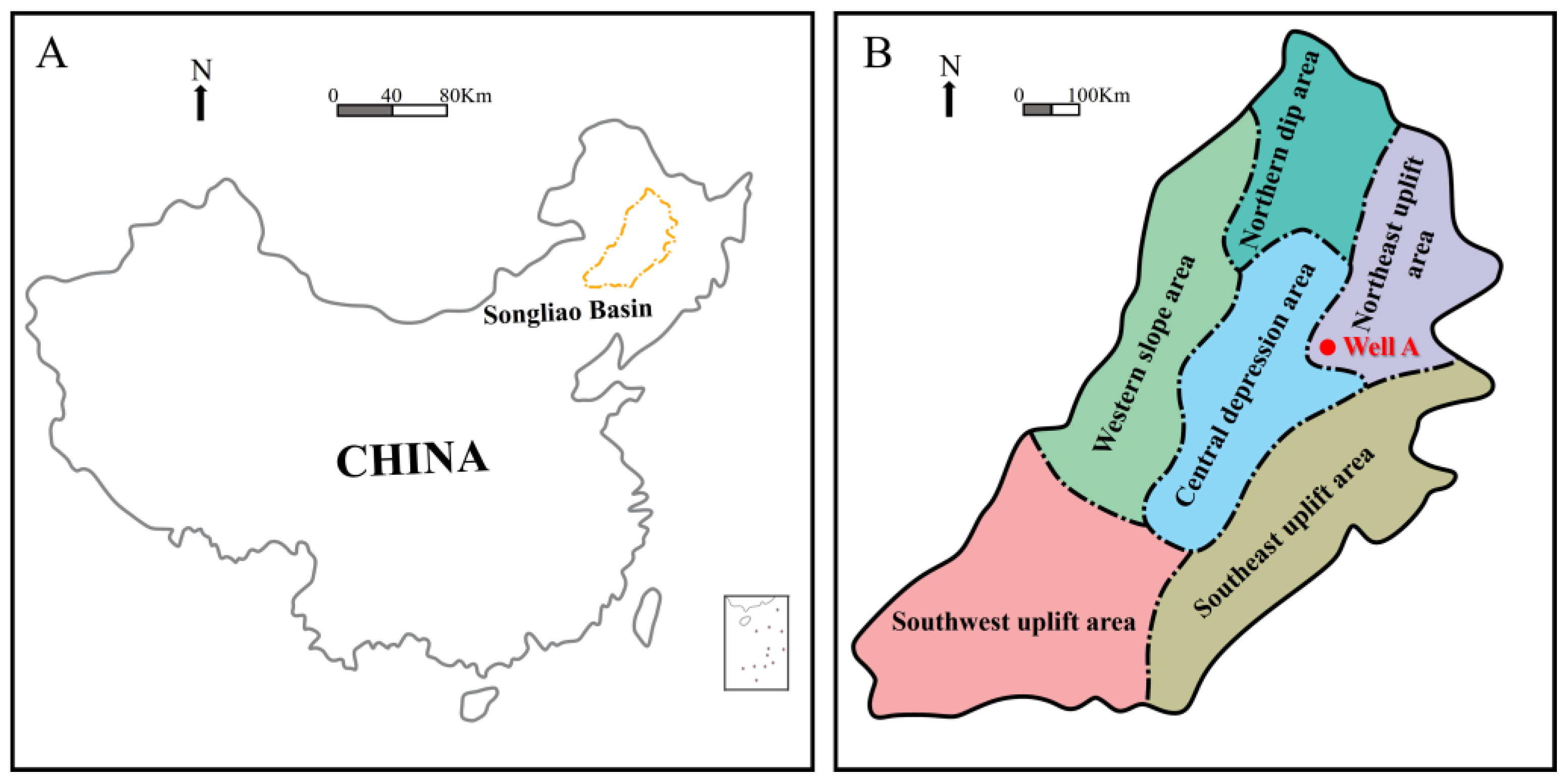
The Songliao Basin is located in northeast China [36,37], spanning Heilongjiang, Jilin, and Liaoning provinces, and covering an area of approximately 2.6 × 10⁵ km2. It is a large Meso–Cenozoic continental sedimentary basin characterized by a “faulted lower–sagged upper” tectonic architecture [38,39,40]. Basin development is closely tied to the tectonic regime of the western Pacific margin [41], and its evolution is commonly divided into three stages: a rifting stage, a post-rift depression stage, and a structural inversion stage. The depression stage, in particular, gave rise to major stratigraphic successions from the Denglouku Formation to the Nenjiang Formation. Structurally, the basin is subdivided into the northern plunge zone, central depression, northeast uplift, southeast uplift, southwest uplift, and western slope, among which the central depression represents the principal hydrocarbon accumulation province and the primary area of exploration and development (Figure 1) [42,43].
Within the depression succession, two regionally extensive, thick mudstone–shale depositional systems are developed, corresponding to the Cretaceous Qingshankou and Nenjiang formations [44,45,46]. The Nenjiang Formation shales are generally of low thermal maturity, with a Ro of approximately 0.35–0.78%. Dark shales in the first and second members (Nen1 and Nen2) are widely distributed and of substantial thickness, and the Nen2 member locally exceeds 160 m in the central depression. Multiple low-maturity shale-oil sweet spots have been identified in the northern Songliao Basin, among which the basal sweet-spot interval of the Nen2 member is the most laterally persistent and exhibits comparatively higher quality, with TOC generally >4% and commonly >5% in the central depression.
Figure 1. Geological setting of the study area (modified/compiled after [47]). (A) Location of the study area and regional geological map. (B) Location of well A.
Fractalfract 10 00132 g001

3. Materials and Methods

3.1. Sample Description

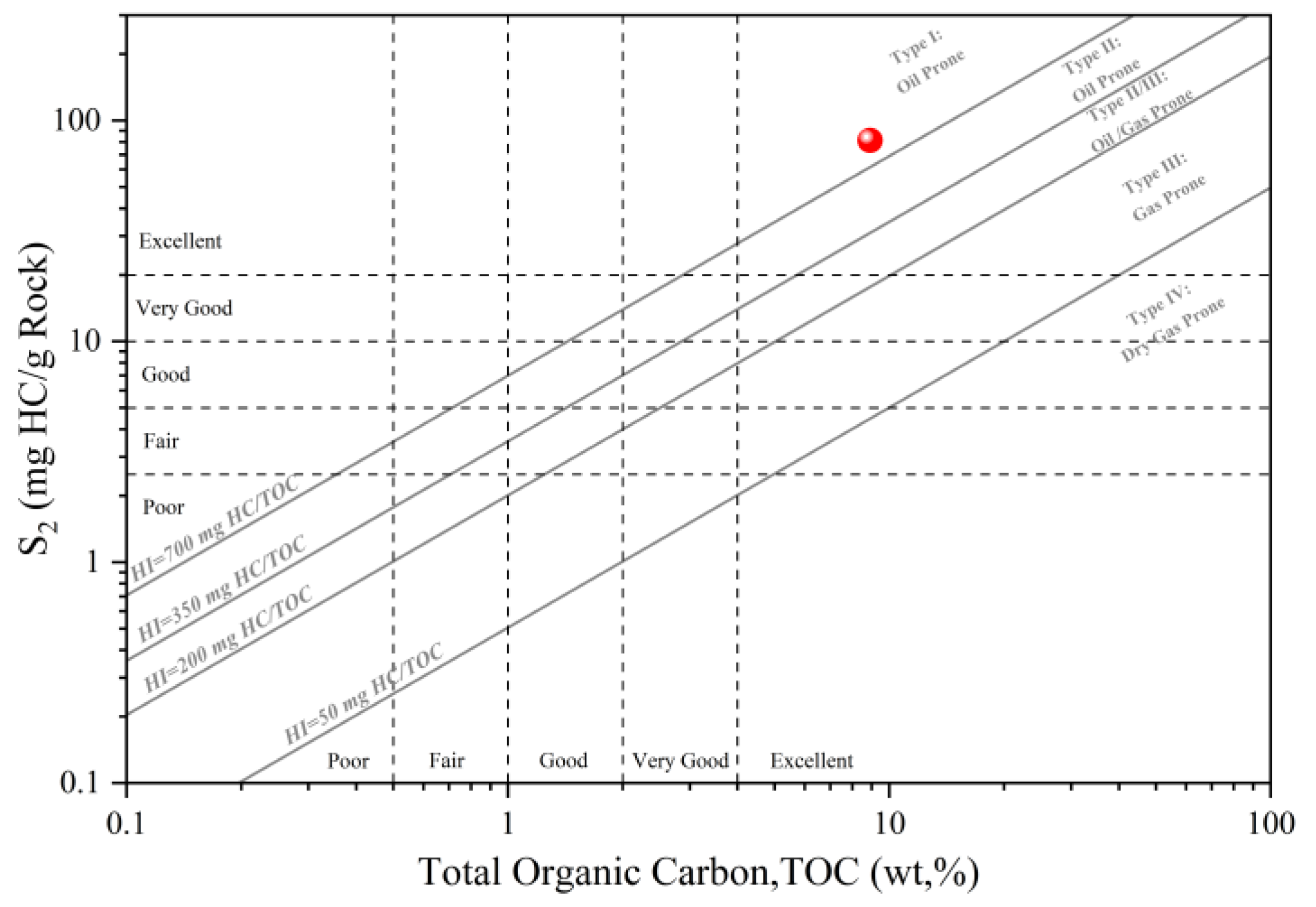
The studied shale is characterized by high organic-matter abundance (TOC = 8.91%) and low thermal maturity (Ro,max = 0.54%), indicating an immature to low-maturity stage with strong shale-oil generation potential (Table 1). Based on the TOC–S2 hydrocarbon-potential classification of Goodarzi et al. [48], the sample falls within the favorable oil-prone domain (TOC > 4% and S2 > 20 mg/g) and exhibits high hydrogen richness (HI = 913.58 mg HC/g TOC), consistent with Type I (Figure 2), oil-prone kerogen affinity (Table 2). Importantly, these properties are consistent with reported characteristics of the Nenjiang Formation low-maturity sweet-spot intervals: organic-rich Nenjiang member 1–2 shales commonly show TOC > 4% (and can extend to ~14%) and are widely regarded as promising targets for in situ conversion evaluation [49], while regional assessment of the basal Nenjiang Formation II interval indicates typical TOC values around ~5.5–9.0 wt.% and Ro predominantly ~0.3–0.9% [50], within which our sample (TOC = 8.91%; Ro,max = 0.54%) falls. Mineralogically, the sample is dominated by a quartz–feldspar–clay assemblage (quartz 50.0%, feldspar 17.4%, and clay minerals 22.5%) with minor carbonates and pyrite (Table 3), consistent with the mineral framework commonly reported for Nenjiang organic-rich shales [51]. Although this study uses a single core to minimize lithological variability and enable controlled mechanistic comparison across temperature steps, the geochemical and mineralogical characteristics demonstrate that the selected sample is representative of the targeted low-maturity Nenjiang Formation interval and is suitable for drawing broader implications relevant to ICP-oriented pore evolution and hydrocarbon generation/expulsion.

3.2. Thermal Simulation Experiments

Following previous studies [52,53,54], closed-system pyrolysis was conducted using RMN-III high-temperature, high-pressure hydrocarbon-generation simulation apparatus to reproduce the thermal evolution of low-maturity shale from oil generation to gas generation. Here, “high-pressure” refers to the pressure-bearing capacity of the sealed reactor to accommodate autogenous pressure generated during pyrolysis; no external confining pressure (i.e., no triaxial effective-stress control) was applied in this experimental setup. Approximately 65–70 g of shale fragments with a characteristic size of ~1 cm was loaded into the reactor. After sealing, the vessel was evacuated to remove air, thereby minimizing oxidation and maintaining a closed system [55]. As a result, pore pressure buildup can occur in the closed vessel, whereas the mechanical constraint imposed by in situ confining stress is not reproduced; therefore, thermally induced fracture opening observed in this work should be interpreted within this boundary condition. A heating rate of 20 °C/h was applied, and each target temperature was held for 72 h.
The simulation temperatures were set from 300 to 500 °C with 50 °C increments. In addition, an intermediate step at 375 °C was included to better resolve the rapid transition within the commonly reported peak oil generation/expulsion interval (~350–400 °C) under ICP-relevant pyrolysis conditions for low-maturity shales/oil shales. This intermediate point was therefore selected as a targeted refinement rather than an arbitrary addition, following the temperature-window evidence documented in previous thermal simulation studies. The potential influence of confining pressure on pore–fracture evolution and the applicability of our fractal results to in situ ICP conditions are discussed explicitly in the Discussion Section.

3.3. Quantification of Oil and Gas Products

After pyrolysis, gas volume was measured continuously using the water displacement method, and the produced gas was collected in evacuated sampling bags. Once the reactor pressure returned to atmospheric conditions, the shale oil was recovered using a ground glass-stoppered bottle. Residual oil retained in the solid residue was then extracted with trichloromethane (chloroform). After solvent evaporation, the extract was weighed to determine oil yield. The low-maturity shale solid residues were subsequently sealed in glass ampoules to prevent air oxidation and were used for subsequent reservoir characterization analyses.

3.4. Chloroform-Extractable Bitumen (“A”) and Group Composition

In accordance with SY/T 5118-2005 [56], soluble organic matter in the solid residues was extracted with chloroform using a multifunctional extractor (fat-extractor method). The content of chloroform-extractable bitumen (“A”) was then calculated to characterize the generation and retention level of soluble organic matter. Subsequently, following SY/T 5119-2016 [57], column chromatography was performed to determine the relative abundances of saturates, aromatics, resins (non-hydrocarbons), and asphaltenes, thereby constraining compositional evolution and the extent of cracking of soluble organic matter during pyrolysis.

3.5. 2D Nuclear Magnetic Resonance (NMR)

Following SY/T 6490-2014 [58], a benchtop MR Cores-XX NMR instrument (MR Cores, Houston, TX, USA) was used to characterize the content and occurrence distribution of retained oil in the pyrolyzed solid residues. The measurement conditions were as follows: resonance frequency, 11.854 MHz; magnet temperature, 35.00 ± 0.01 °C; echo spacing, 0.07 ms; waiting time, 1 s; number of echoes, 5000; and number of scans, 16.

3.6. Scanning Electron Microscopy (SEM)

A FEI Helios Nanolab 600i field-emission scanning electron microscopy/focused ion beam (FESEM/FIB) dual-beam system (FEI Company, Hillsboro, OR, USA) was used to observe the microstructure of the solid residues and the morphology of pores and microfractures (>0.1 μm) at different pyrolysis temperatures. Prior to imaging, samples were Ar-ion polished using a broad ion beam cross-section polisher and then carbon-coated under vacuum to enhance electrical conductivity. The specimens were loaded into the chamber, evacuated and degassed for 20 min, and imaged sequentially from low to high magnification.

3.7. Micro-Computed Tomography (Micro-CT)

A nanoVoxel-3502E X-ray micro-computed tomography (micro-CT) system (Sanying Precision Instruments Co., Ltd., Tianjin, China) was used to perform three-dimensional reconstruction and quantitative analysis of micrometer-scale pores and fractures in the solid residues. Cylindrical specimens (height, 5 cm; diameter, 2.5 cm) were scanned at a voxel resolution of 15.86 μm, allowing for identification of pores/fractures with apertures greater than 15.86 μm. The reconstructed volumes were used to characterize the three-dimensional morphology, size attributes, and spatial configuration of the pore–fracture network. Accordingly, the “porosity (%)” reported from micro-CT represents the resolution-limited (apparent) volumetric fraction of pores/fractures with apertures larger than the voxel size (>15.86 μm) within the reconstructed volume and does not include nano- to sub-micrometer pores below the CT detection limit.

3.8. Low-Pressure Gas Adsorption (N2)

Nanopore structure was characterized using an ASAP 2460 automated surface area and porosity analyzer (Micromeritics Instrument Corp., Norcross, GA, USA). Samples were crushed and sieved to obtain 3–5 g of powder < 180 μm (>80 mesh) and degassed under vacuum at 105 °C for 24 h to a final pressure of 1 × 10⁻³ Torr. Pore volume and pore size distribution (PSD) over 1.7–200 nm were derived from N2 desorption data using the BJH model. The BJH “total pore volume” is reported as a mass-normalized, N2-accessible nano-/mesopore volume (cm3/g) within the analyzed pore size range, and it is not directly equivalent to volumetric porosity derived from micro-CT.

3.9. Fractal Dimension Calculation

To quantitatively characterize multiscale pore structure reconstruction during pyrolysis from the perspective of “complexity–heterogeneity,” and to place pore evolution and hydrocarbon-generation evolution within a unified, comparable framework, fractal dimensions were adopted as the core indices [59,60]. Compared with single descriptors such as specific surface area, pore volume, and mean pore diameter, fractal dimensions capture pore surface roughness, geometric irregularity of pore throats, and the overall complexity of the pore network in an integrated manner [61,62] and thus provide a more interpretable and sensitive metric for assessing pore structure responses to pyrolysis.
Based on N2 adsorption isotherms, the Frenkel–Halsey–Hill (FHH) model was used to quantify the fractal characteristics of the pore system [63,64]. By describing the relationship between adsorbed gas volume and relative pressure, the FHH framework has been widely applied to characterize the roughness and complexity of pore surfaces in porous media [65,66]. The simplified logarithmic form of the FHH model is expressed as given in Equation (1) [67,68,69]:
ln V = ( D 3 ) ln [ ln ( P o P ) ] + C
where V is the adsorbed volume at equilibrium pressure P (cm3/g), P0 is the saturated vapor pressure, C is a constant, and D is the fractal dimension. By plotting ln(V) against ln[ln(P0/P)] and performing linear regression to obtain the slope K, the fractal dimension can be calculated accordingly as in Equation (2) [70,71].
D = K + 3
Given that adsorption mechanisms differ across relative pressure intervals, and following previous studies [64,72,73], the FHH plots were fitted in two segments using P/P0 = 0.5 as the boundary. The low-pressure regime (0–0.5) yields the surface fractal dimension (Ds), which characterizes pore wall roughness and geometric irregularity, whereas the high-pressure regime (0.5–1.0) yields the structural fractal dimension (Dp), which reflects the structural complexity and connectivity of the pore network. In principle, D ranges from 2 to 3: values approaching 3 indicate a rougher, more complex, and more heterogeneous pore system, whereas values closer to 2 suggest a comparatively regular and homogeneous structure [74,75,76].
To quantitatively track the evolution of pore structure complexity and heterogeneity during hydrocarbon generation from low-maturity shale pyrolysis, and to enable unified comparison and coupled analysis between pore evolution and hydrocarbon-generation behavior, fractal dimensions were adopted as the primary descriptors in this study. Relative to single metrics such as specific surface area, pore volume, and mean pore diameter, fractal dimensions provide an integrated measure of pore surface roughness, geometric irregularity of pore throats, and overall network complexity, thereby offering a more sensitive indicator of multiscale pore structure responses to pyrolysis.

4. Results

4.1. Yields of Expelled Oil and Expelled Gas

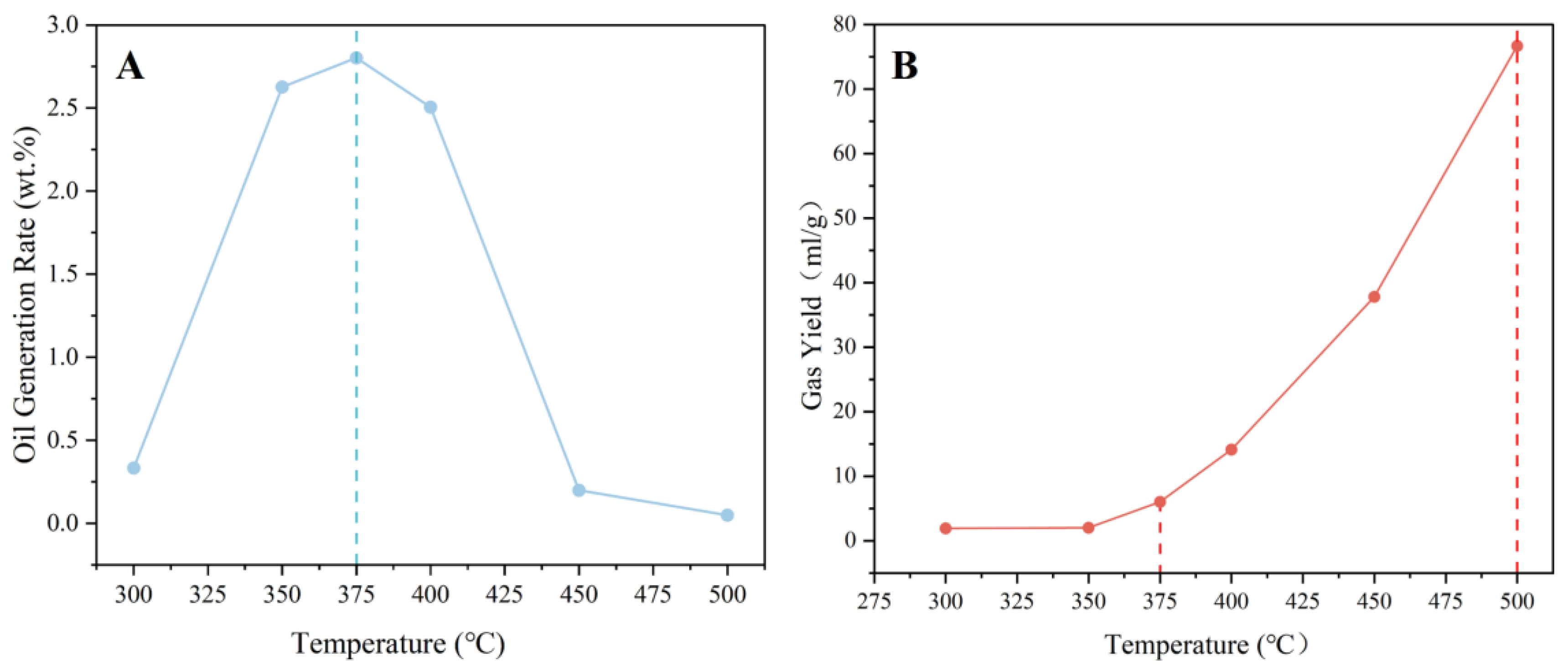
Figure 3 shows the yields of expelled oil and expelled gas over the pyrolysis temperature range of 300–500 °C. As illustrated in Figure 3A, the expelled oil yield increases with temperature initially and then decreases, exhibiting a clear unimodal trend. The oil yield rises sharply at 350 °C, reaches a maximum at 375 °C, and then declines rapidly by 450 °C, indicating that 350–400 °C represents the principal temperature interval over which low-maturity shale organic matter generates substantial quantities of liquid hydrocarbons during pyrolysis.
As shown in Figure 3B, gas yield increases monotonically with increasing temperature, reaching its maximum yield and generation rate at 500 °C. When temperature exceeds 400 °C, gas generation becomes pronounced, with a marked acceleration in the gas generation rate between 400 and 450 °C, indicating extensive cracking of organic matter to gaseous hydrocarbons at T > 400 °C [52,77,78]. Notably, under closed-system electrically conductive heating with a 72 h isothermal dwell, the shale oil expelled at 375 °C may undergo secondary cracking, thereby contributing additional hydrocarbon gas [79,80].

4.2. Distribution Characteristics of Retained Oil

To quantitatively characterize both the amount and occurrence state of retained hydrocarbons in the solid residues at different pyrolysis temperatures, soluble organic matter was extracted from the residues using chloroform. The content of chloroform-extractable bitumen (“A”) was used as a proxy for retained oil, and group composition analysis, together with two-dimensional low-field NMR (2D NMR), was employed to constrain the pore-scale occurrence state, confinement, and mobility of retained oil.

4.2.1. Temperature Response of Chloroform-Extractable Bitumen (“A”)

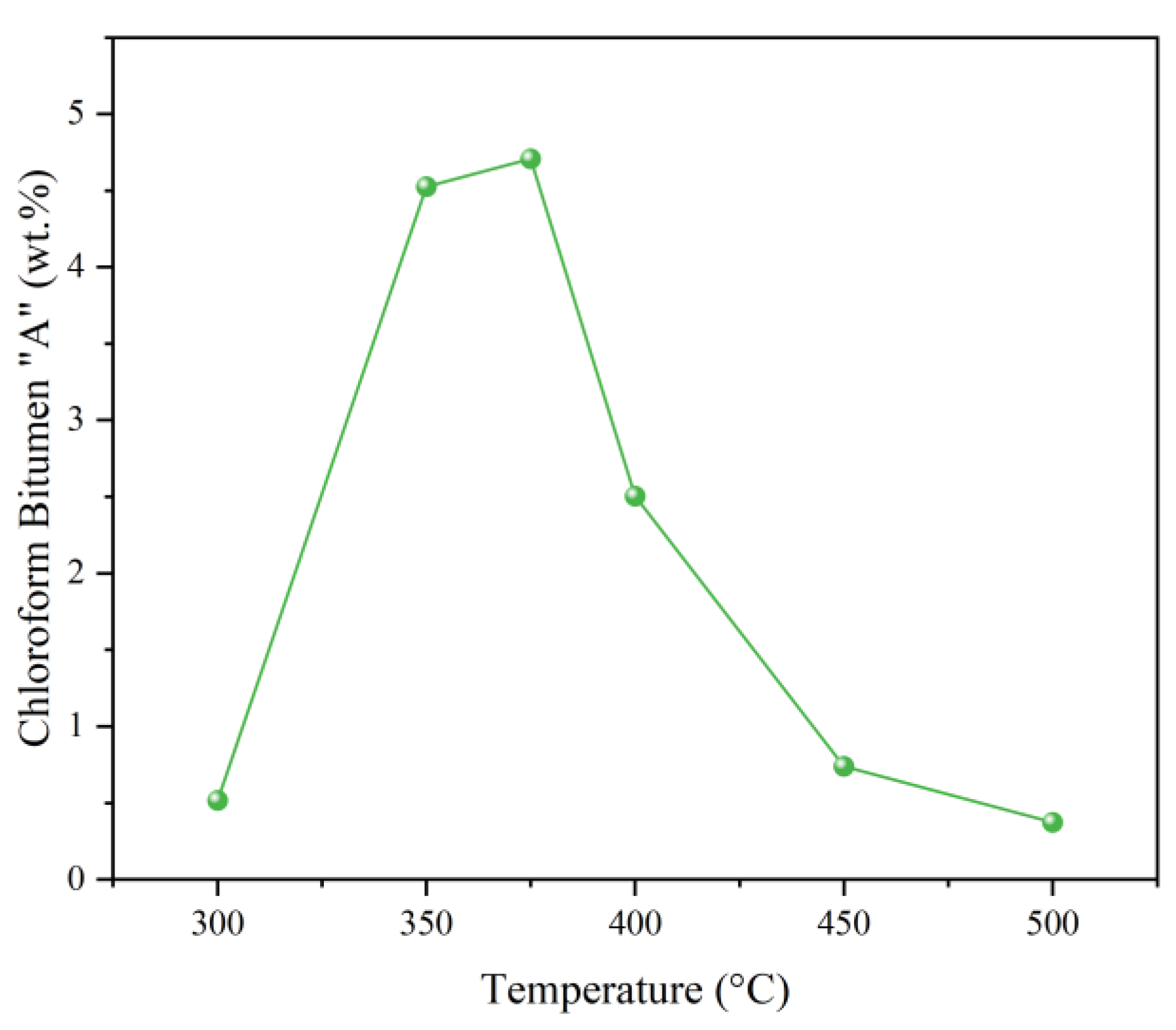
As shown in Figure 4, the content of chloroform-extractable bitumen (“A”) in the solid residues exhibits a pronounced stage-wise response to temperature, reaching a maximum at 375 °C, with the second-highest value at 350 °C. The overall trend is consistent with the unimodal pattern of expelled oil yield, indicating that 350–375 °C represents the primary interval for oil generation and retained oil accumulation. Notably, the bitumen “A” content at 400 °C is substantially lower than that at 350 °C, deviating from the distribution of expelled oil yield. This discrepancy likely reflects the combined effects of (i) a higher proportion of light components and thus greater fluidity of the oil generated at 400 °C, which facilitates expulsion and reduces retention within the residue, and (ii) a potentially lower total oil yield at 400 °C relative to 350 °C but with a higher expulsion efficiency, leading to a lower amount of oil retained in the solid residue.

4.2.2. Group Composition of Retained Oil and Implications for Mobility

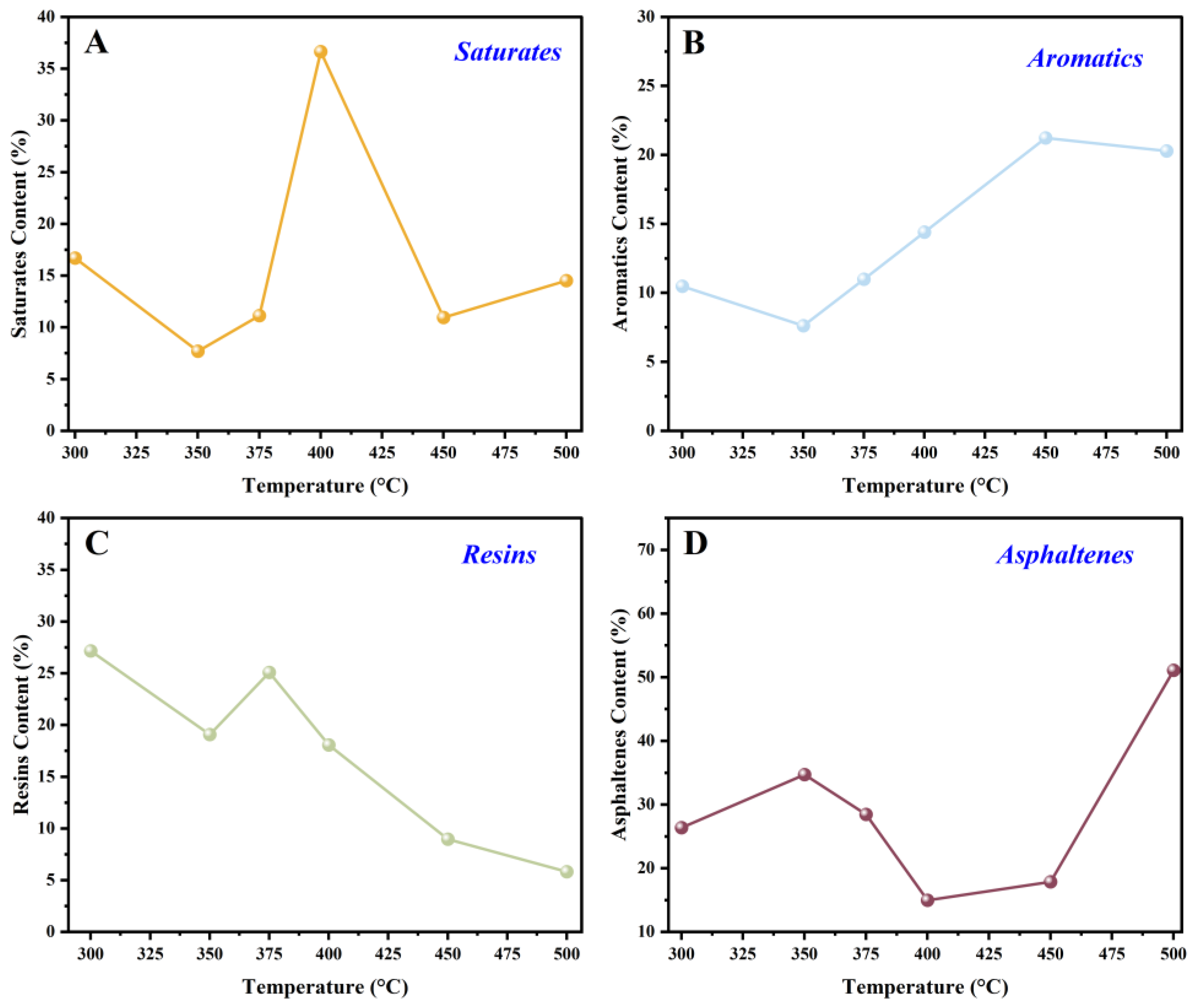
Figure 5 shows that the group composition of retained oil exhibits a systematic light–heavy differentiation with increasing temperature. At 350 °C, the retained oil contains the lowest proportions of saturates and aromatics, whereas resins (non-hydrocarbons) and asphaltenes are comparatively enriched, indicating that retained oil at this stage is dominated by heavy fractions with higher viscosity and limited mobility. Upon heating to 400 °C, the saturate fraction increases while asphaltenes decrease, suggesting enhanced mobility of the retained oil within the residues and a potential for secondary mobilization. Overall, resins show a decreasing trend at temperatures > 375 °C, whereas asphaltenes increase continuously at temperatures > 400 °C, reflecting progressive cracking of light components into gaseous hydrocarbons and the relative enrichment of heavy fractions at elevated temperatures. Taken together, the compositional evolution suggests that 350–400 °C is more favorable for generating mobile liquid hydrocarbons and achieving effective recovery.

4.2.3. 2D NMR Constraints on Confinement and Mobility of Retained Oil in Residues

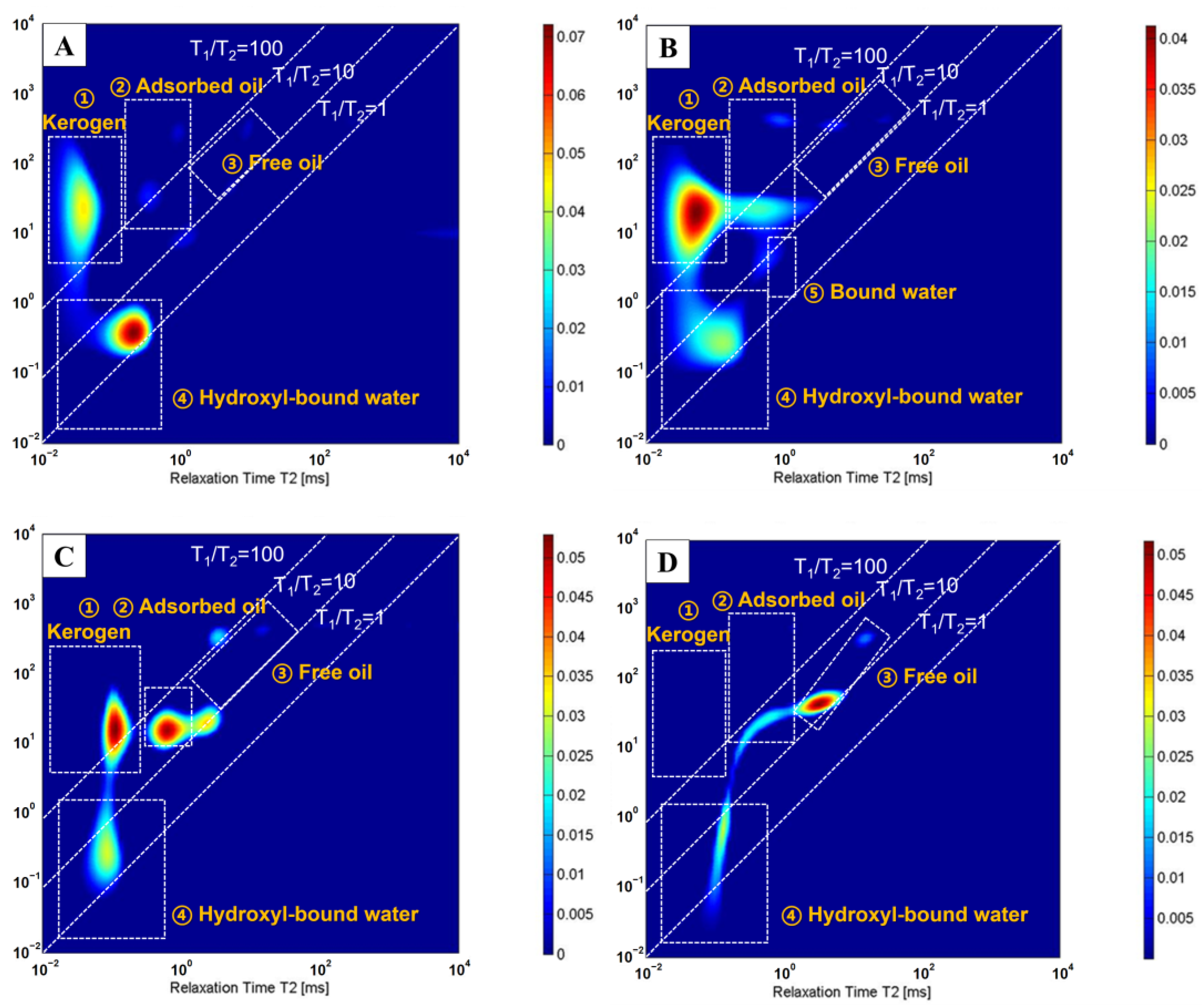
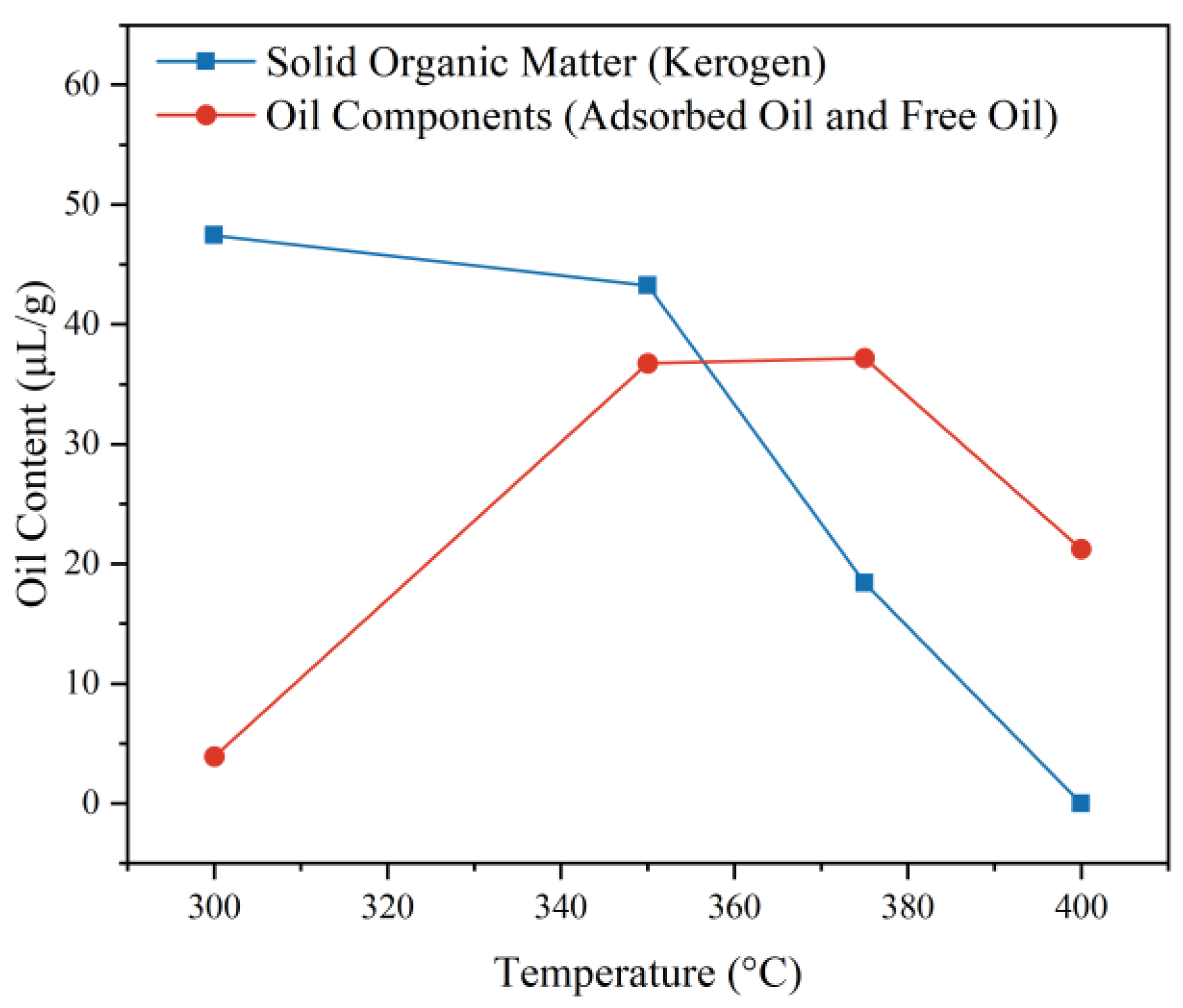
To further clarify the occurrence state of retained oil in the solid residues and its temperature-dependent response, two-dimensional low-field NMR (T1–T2) measurements were conducted on samples pyrolyzed at 300–400 °C (Figure 6). The retained oil associated with different occurrence states was then quantified based on spectral zoning (Figure 7). According to the characteristic NMR responses of fluids with different phases and degrees of confinement in the T1–T2 space [81,82], the spectra can be partitioned into regions corresponding to kerogen/heavy organic phases (strongly bound organic matter), adsorbed oil, free oil, hydroxyl/combined water, and bound water.
It should be emphasized that a rigorous mapping between T2 and pore geometric size requires calibration of key parameters, including surface relaxivity, wettability, and fluid properties (e.g., viscosity and composition). Moreover, compositional evolution of organic phases and changes in pore surface chemistry during pyrolysis can also modify relaxation behavior. Therefore, in the absence of system-specific calibration, variations in T2 are interpreted here primarily as relative indicators of confinement and mobility, rather than being used for direct quantitative inversion of pore size. This treatment ensures that the interpretation remains physically bounded and amenable to future calibration.
Quantitative results (Figure 7) show that the content of pore-hosted oil (i.e., adsorbed plus free oil) is lowest at 300 °C, increases markedly at 350 °C, reaches a maximum at 375 °C, and then decreases substantially at 400 °C. This pattern (Figure 6) is consistent with the temperature-dependent variation in chloroform-extractable bitumen (“A”), indicating that 2D NMR can effectively track the stage-wise evolution of total retained oil content in the solid residues. Changes in spectral morphology further suggest that oil-related signals are weak at 300 °C, whereas the proportion of strongly bound organic phases is relatively higher, implying limited generation of mobile oil. At 350 °C, adsorbed oil increases significantly, and the oil signal extends toward longer T2 values, reflecting reduced confinement and enhanced mobility of the generated oil. At 375 °C, both adsorbed and free oil increase markedly and the transition zone becomes more pronounced, manifesting as a “spectral domain shift” from more strongly confined to more weakly confined states, which indicates more active oil generation and pore-scale expulsion at this stage. By 400 °C, total retained oil decreases sharply, while the remaining signal is relatively biased toward weakly confined (free-oil) components, suggesting that most oil has been expelled and/or further cracked to gas and that the residual fraction is more likely preserved in a more mobile form within comparatively weakly constrained pore domains. Overall, retained oil accumulates most readily at 350–375 °C and peaks at 375 °C; with further heating to 400 °C, retained oil decreases substantially and expulsion becomes stronger, marking a transition from an “oil generation–retention accumulation” regime to an “enhanced expulsion–secondary cracking to gas” regime. These observations provide direct occurrence-state evidence for subsequent discussion of pore structure responses and fractal characteristics.

4.3. Evolution of Microstructural Features

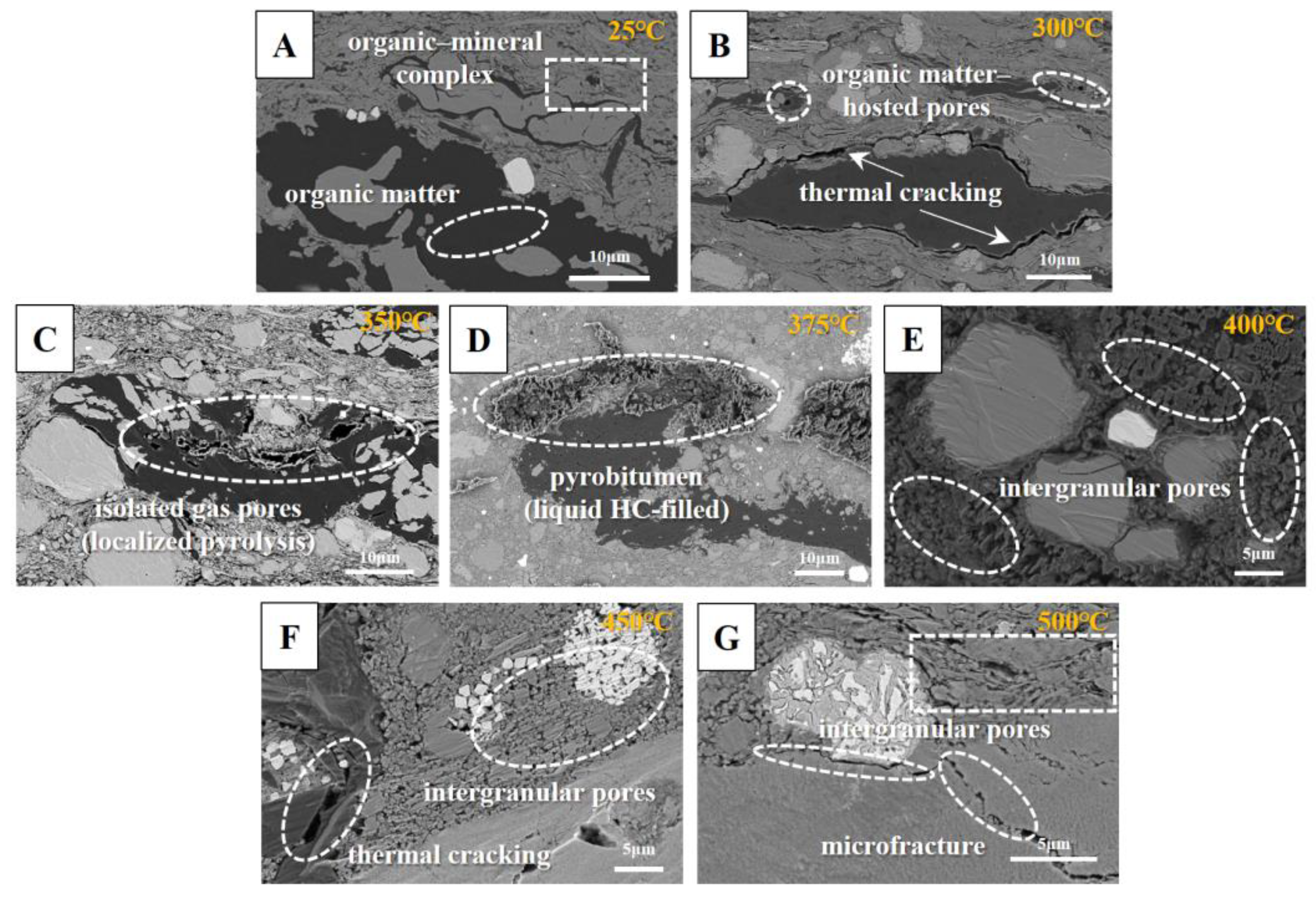
SEM observations indicate that the microstructure of the low-maturity shale evolves in a distinct stage-wise manner with increasing temperature (Figure 8). At 25 °C, abundant massive organic matter, dispersed organic particles, and organic matter–mineral aggregates are observed (Figure 8A). At 300 °C, the microstructure is dominated by incipient fractures induced by thermal stress; hydrocarbon generation from organic matter is not pronounced, and only a small number of subrounded hydrocarbon generation pores are locally observed within mineral–bitumen domains (Figure 8B). At 350 °C, rapid pyrolysis of organic matter produces irregular gas pores/hydrocarbon generation pores, and oil-phase retention is evident within pores; meanwhile, consumption of pore-filling organic matter partially liberates intergranular space (Figure 8C). Between 375 and 400 °C, oil generation and incipient coking proceed concurrently, with abundant oil phases on rock surfaces and within pores. Organic matter is transformed into spheroidal coke residues, and both clay-related interparticle pores and organic-associated interparticle pores become well developed (Figure 8D,E). At 450 °C, mineral–bitumen is largely pyrolyzed and converted to coke residue; pore-filling organic matter decreases substantially, intergranular pores increase markedly, and localized thermally induced cracking becomes apparent (Figure 8F). By 500 °C, organic matter undergoes further cracking and is largely depleted, leaving voids; microfractures and intergranular pores are prominently developed (Figure 8G). Accordingly, the pore system transitions from being dominated by “hydrocarbon generation pores with oil-phase filling” to one dominated by “cracking pores–intergranular pores–microfractures.”

4.4. Evolution of Micrometer-Scale Pore Structure from Micro-CT

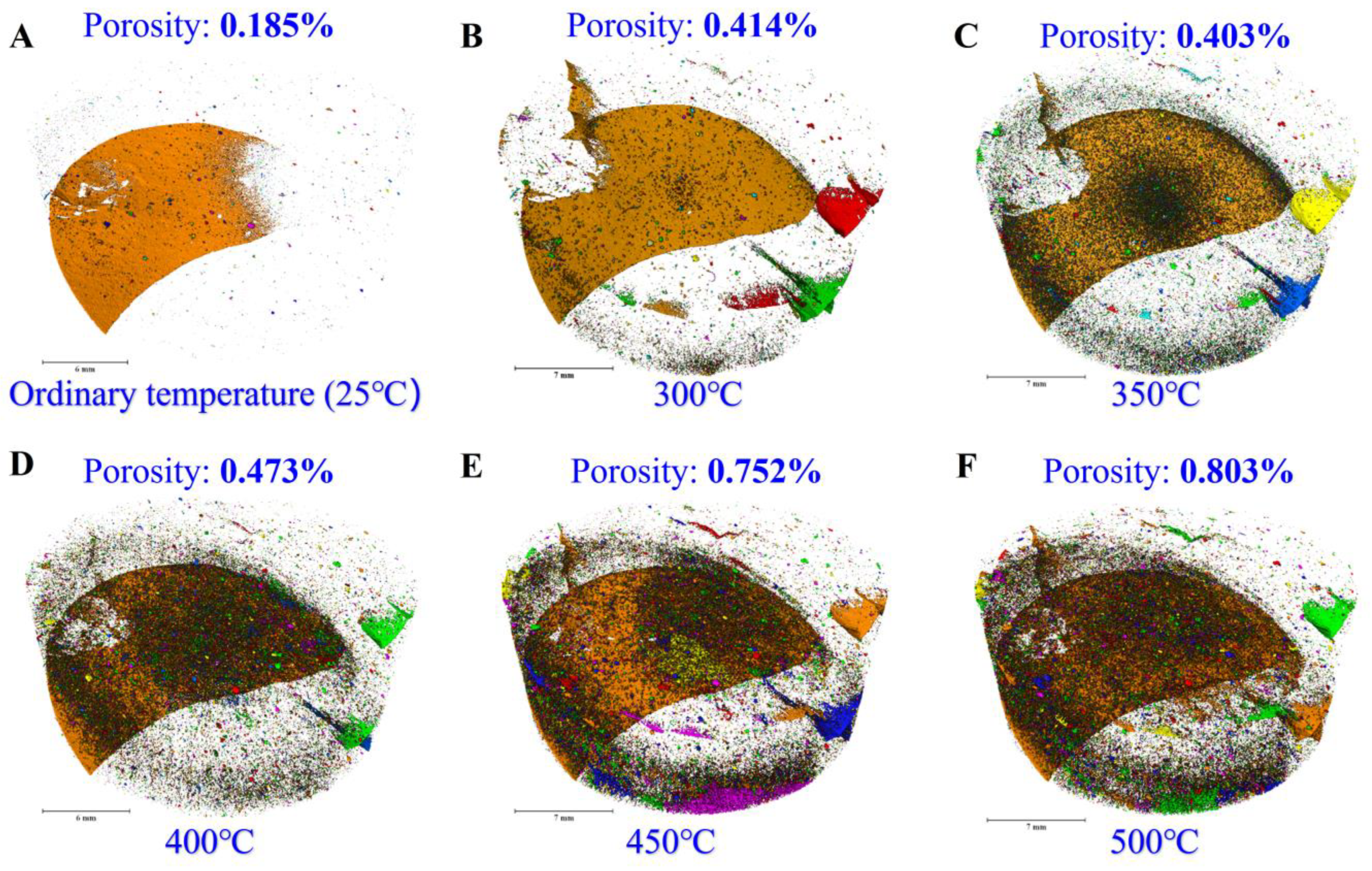
To evaluate the evolution of micrometer-scale pore structure with temperature, the same sample was analyzed at different pyrolysis temperatures. Table 4 summarizes the CT-derived pore parameters for the low-maturity shale at each temperature, and Figure 9 presents three-dimensional distributions of pores and fractures.
As indicated by Table 4, porosity increases by a factor of 2.23 from room temperature to 300 °C, and the mean pore radius rises to 49.60 μm; concurrently, the number of pore clusters increases markedly (Figure 9A,B). Relative to 300 °C, porosity decreases slightly at 350 °C and the mean pore radius decreases by 0.87 μm, whereas the number of pore clusters increases. SEM observations suggest substantial hydrocarbon generation at 350 °C, which likely promotes the formation of additional pore clusters; however, the generated shale oil may partially occupy and fill pore space, resulting in reduced porosity and mean pore radius. From 400 to 500 °C, porosity increases continuously, consistent with the progressive increase in pore cluster abundance with temperature (Figure 8C–F and Figure 9C–F). In addition, the number of connected pore–fracture clusters increases over 400–500 °C, indicating enhanced pore–fracture connectivity. Notably, the mean pore radius decreases at 500 °C relative to 450 °C, which may reflect local collapse of pores and fractures.

4.5. Evolution of Nanopore Structure During Pyrolysis of Low-Maturity Shale

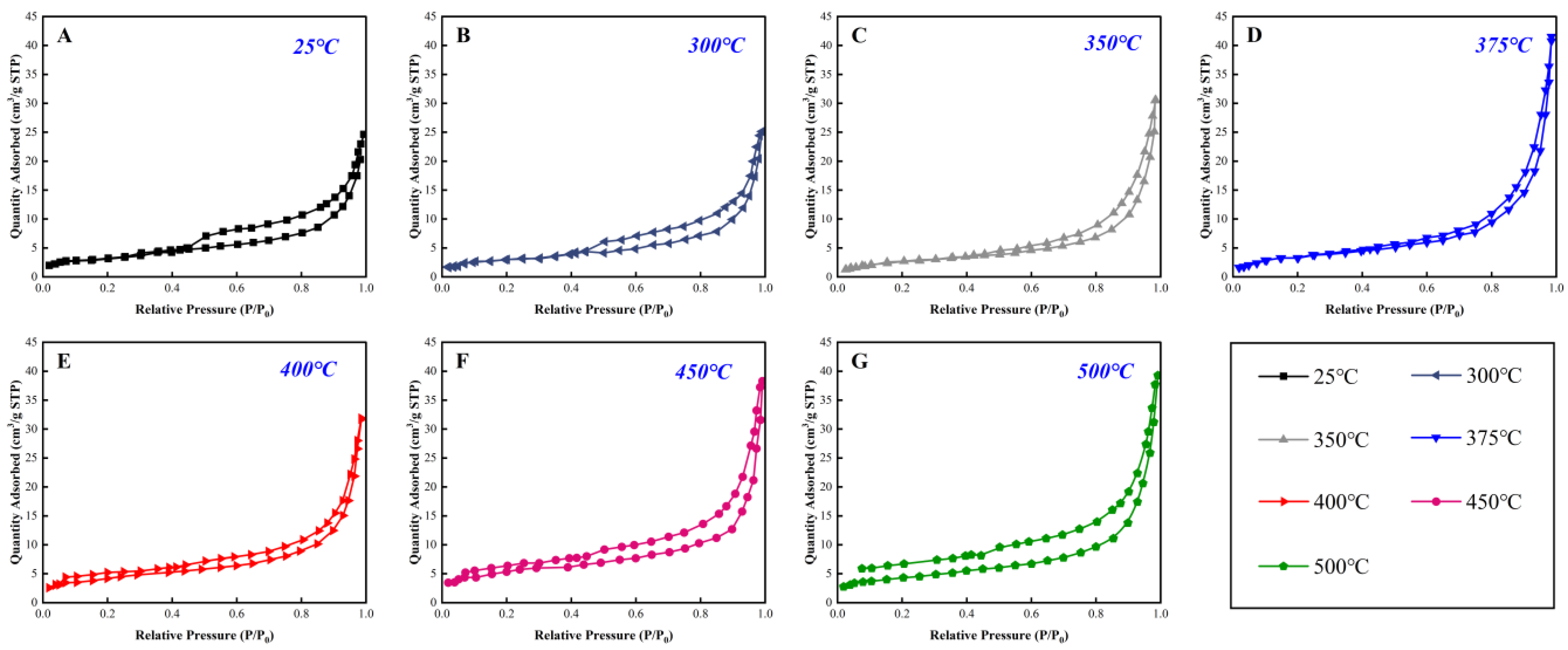
Using the selected sample as an example, low-temperature N2 adsorption/desorption isotherms at different pyrolysis temperatures were analyzed (Figure 10). According to the IUPAC classification [26,83], all isotherms are Type IV, indicating that the pore system is dominated by mesopores. In addition, the desorption branch lies above the adsorption branch, and pronounced adsorption hysteresis is observed for all temperatures. The morphology of the hysteresis loop provides diagnostic information on pore geometry [84,85] and the hysteresis loop types and corresponding pore shape interpretations for different temperature stages are summarized in Table 5.
At 25 °C and 300 °C, the desorption branch exhibits a distinct inflection near P/P0 ≈ 0.5, and the hysteresis loop is classified as H3, suggesting that the pore space is dominated by wedge-shaped pores [63]. With increasing pyrolysis temperature, the inflection becomes progressively less pronounced and the degree of hysteresis decreases. At 350–375 °C, the pore shape signature transitions from H3 to H4, yielding an intermediate H3–H4 loop, which is consistent with a mixed pore system dominated by wedge-shaped pores and slit-like pores between parallel plates. After entering the 400–500 °C interval, the inflection becomes more evident again and the pore geometry is characterized predominantly by narrow slit-shaped pores [86]. Meanwhile, the separation between the adsorption and desorption branches at P/P0 < 0.5 increases gradually, indicating further adjustment of pore morphology and connectivity at elevated temperatures.
In terms of adsorption capacity, N2 uptake differs markedly among temperature stages. Relative to room temperature, the adsorption capacity at 300 °C changes only slightly. When temperature exceeds 300 °C, N2 uptake increases rapidly and reaches a maximum at 375 °C, followed by a pronounced decrease between 375 and 400 °C and then a renewed, sustained increase at temperatures > 400 °C. The coupled evolution of adsorption–hysteresis behavior and adsorption capacity indicates that nanopore structure undergoes distinct stage-wise reconstruction during pyrolysis, with both pore shape types and the intensity of pore development dynamically adjusting with thermal evolution.
Overall, pore parameters exhibit a pronounced stage-wise response to increasing pyrolysis temperature (Table 5). The BET-specific surface area decreases initially and then increases, followed by a decline at higher temperatures, reaching a minimum at 350 °C (9.74 m2/g) and a maximum at 450 °C (20.07 m2/g). In contrast, the BJH total pore volume and mean pore diameter show broadly consistent trends that are opposite to those of surface area, characterized by an increase, a decrease, and a subsequent rebound. Total pore volume reaches its maximum at 375 °C (0.0675 cm3/g) and first decreases and then increases again over 375–500 °C (Table 5). Pore volume partitioning among different size ranges also varies substantially with temperature. From 0 to 375 °C, the volume fraction of pores < 10 nm decreases markedly (from 40.30% to 18.35%), whereas the fraction of 10–100 nm pores increases significantly (from 54.75% to 79.59%). From 375 to 500 °C, the <10 nm fraction increases and then decreases (rising to 22.06–24.95% at 400–450 °C and falling again to 18.13% at 500 °C), while the 10–100 nm fraction shows an overall opposite tendency. The >100 nm fraction remains low overall and fluctuates with temperature (Table 5). These results indicate that the coupled evolution of micropores and small pores is a primary control on the stage-wise variations in total pore volume and mean pore diameter.
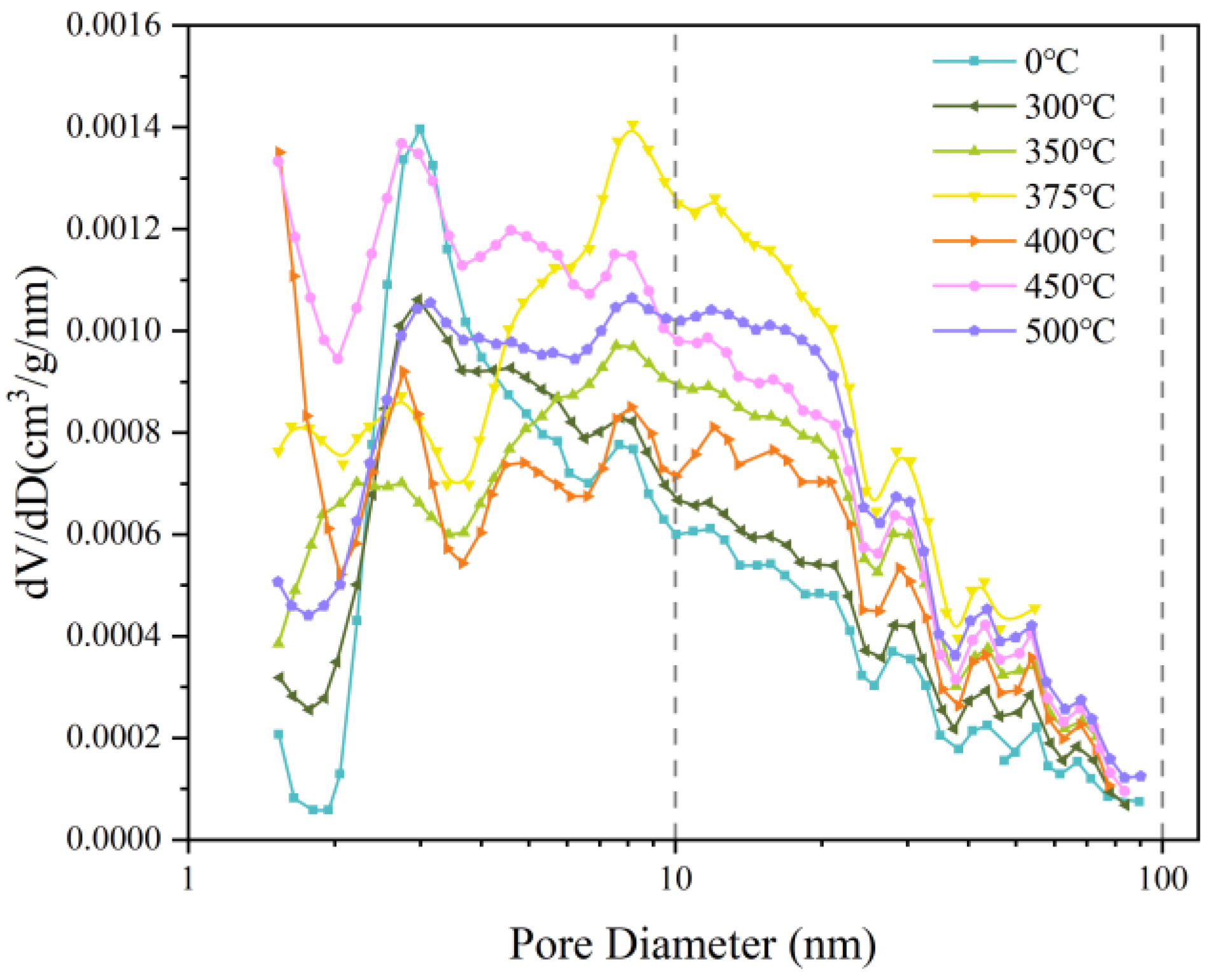
Pore size distributions provide a clearer view of how pore structure evolves with temperature during pyrolysis (Figure 11). As shown in Figure 11, the untreated sample exhibits a unimodal distribution with a dominant peak at ~3 nm. At 300 °C, pore abundance near this peak decreases markedly, whereas pores > 5 nm increase. During 300–375 °C, pores in the 5–30 nm range increase sharply; the modal peak shifts rightward to ~9 nm and the distribution broadens, leading to an increase in mean pore diameter and in the abundance of small pores, as well as enhanced pore connectivity. From 375 to 400 °C, pores of 5–30 nm decrease substantially; in contrast, micropores < 3 nm increase continuously, and the modal peak shifts leftward to ~1.7 nm. During 400–450 °C, the abundance of pores < 30 nm rebounds, and the distribution becomes bimodal with peaks at ~1.7 and ~2.9 nm. At temperatures > 450 °C, pores < 10 nm decrease, whereas pores > 10 nm increase to varying extents. Overall, across the investigated temperature range, pores < 30 nm exhibit the most pronounced variations.
The evolution of nanopore structure in low-maturity shale is closely coupled with shale oil and shale gas generation across different thermal evolution stages. According to Gao et al. [87], increasing thermal evolution indicates that temperatures near 375 °C correspond to an oil generation peak, during which organic matter pyrolysis produces abundant shale oil [88,89], whereas at T > 400 °C, the system enters a wet-gas stage and substantial gas generation begins [90]. In combination with Figure 11, the pronounced increase in small pores at 350–375 °C after chloroform extraction likely reflects pore space that accommodates newly generated shale oil. During 400–450 °C, the increase in micropores < 10 nm may correspond to gas-related pores formed during gas generation. From 450 to 500 °C, thermally induced expansion associated with further heating may promote local pore collapse, leading to a reduction in micropores < 10 nm, while some micropores may grow from larger small pores into mesopores. Overall, pores < 30 nm likely represent the principal storage domain for shale oil and gas during pyrolysis of low-maturity shale.

4.6. Fractal Evolution During Pyrolysis of Low-Maturity Shale

Thermal simulation results indicate that nanopore structure in the selected sample evolves in a complex manner with temperature, accompanied by pronounced pore heterogeneity. Fractal theory provides a quantitative means of characterizing pore system complexity and heterogeneity; in general, a higher fractal dimension (D) corresponds to a more complex pore surface/structure and stronger heterogeneity.
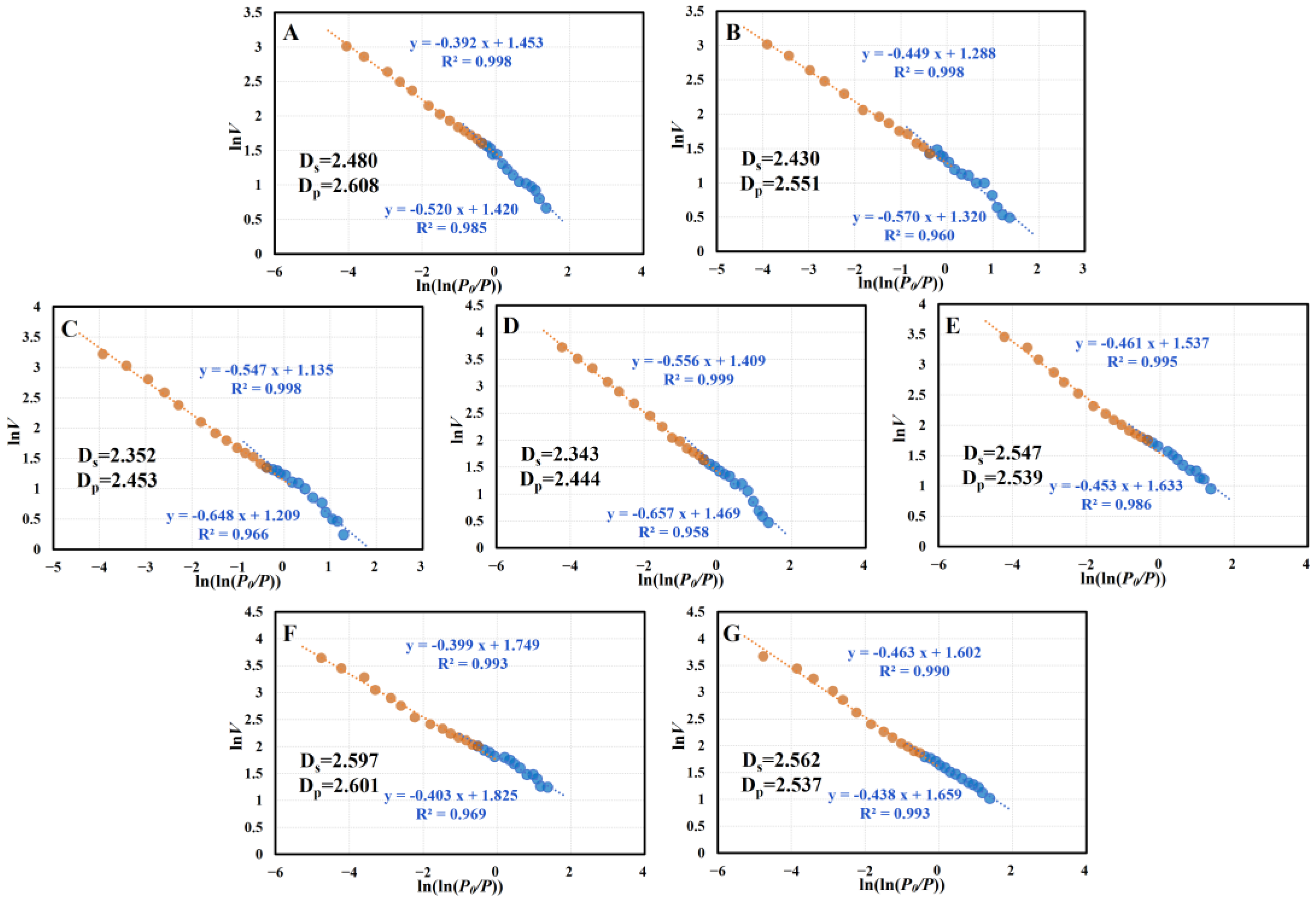
During low-temperature N2 adsorption, adsorption mechanisms vary across relative pressure intervals. When P/P0 < 0.5, adsorption is dominated by monolayer coverage on micropore surfaces, whereas when P/P0 > 0.5, the system enters a multilayer adsorption regime in which pore filling and capillary condensation become increasingly important. Reflecting these mechanistic differences, pore fractality can be described using a surface fractal dimension (Ds) for 0 < P/P0 < 0.5 and a structural fractal dimension (Dp) for 0.5 < P/P0 < 1 [67]. Tang et al. reported that when the adsorption layer number (n) falls within 1.0 ± 0.5 to 2.0 ± 0.5 (the monolayer coverage range), the derived fractal dimension more accurately captures pore surface heterogeneity [91]. Accordingly, data within 0 < P/P0 < 0.5 were used to compute Ds in this study. Based on Equation (1), double-logarithmic plots of ln(V) versus ln[ln(P0/P)] were constructed for both intervals, 0 < P/P0 < 0.5 and 0.5 < P/P0 < 1, and the corresponding fractal parameters were obtained from the fitted slopes (Figure 12).
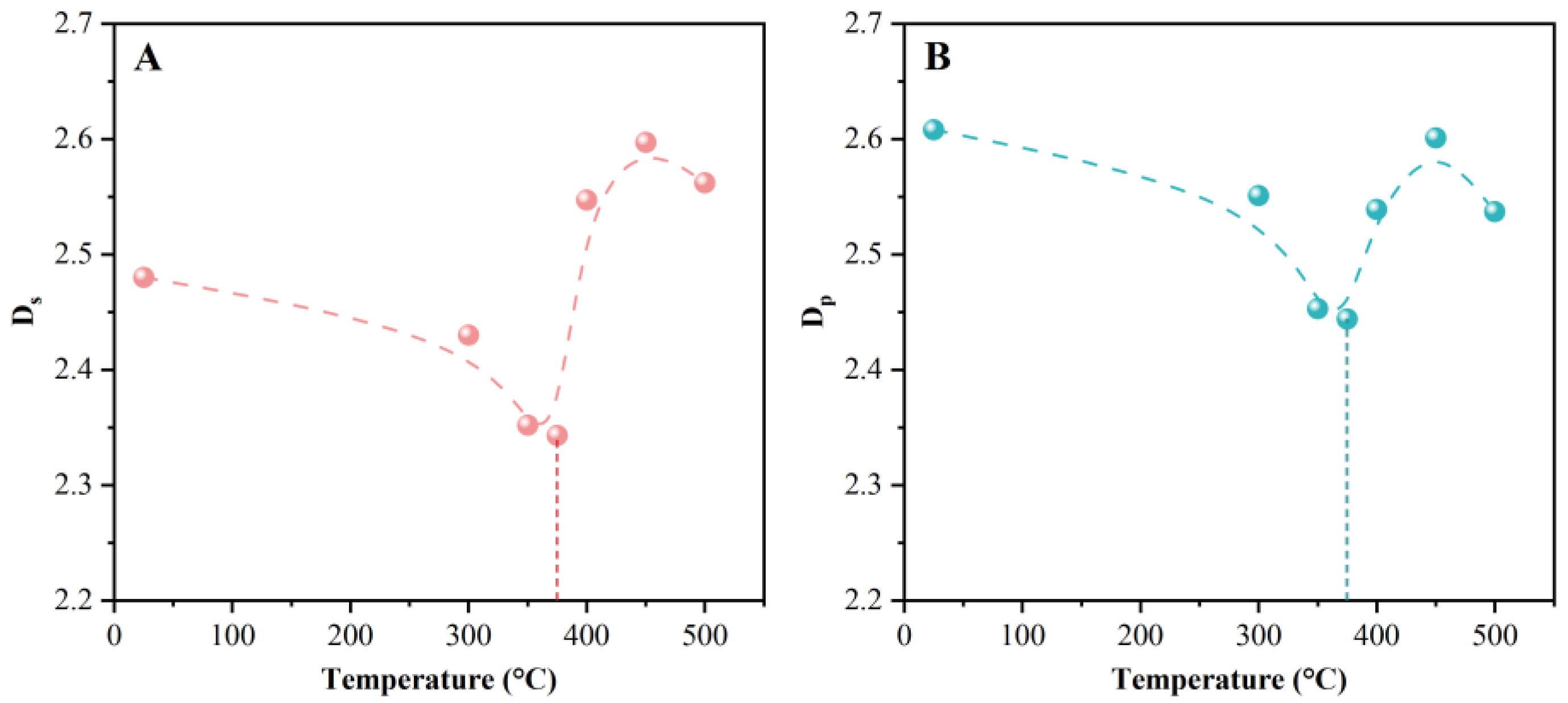
As shown in Figure 12, the double-logarithmic relationships at all temperatures exhibit good linearity, with fitted correlation coefficients (R2) exceeding 0.95, indicating that sample A displays pronounced surface and structure fractal behavior within the corresponding pressure intervals. As summarized in Table 6, both Ds and Dp decrease initially and then increase with increasing temperature, reaching minima at 375 °C (Ds = 2.343; Dp = 2.444). This pattern suggests that at 375 °C, the pore surfaces of sample A are comparatively smoother and the pore structure is more uniform, corresponding to the weakest pore heterogeneity. A relatively uniform pore architecture is generally more conducive to fluid migration and expulsion through the pore network and may therefore be regarded as a favorable pore structure condition for shale oil development.
When considered together with the pore structure parameters (Table 5), the pore system at 375 °C among the tested temperature points shows a coherent improvement in pore volume, pore size, and heterogeneity. Specifically, pore size distribution becomes more uniform, fractal dimensions reach relatively low values, and these structural features coincide with relatively high expelled oil yield and retained bitumen (“A”) content at the same temperature. This consistency implies that, under the experimental conditions of a closed system, a heating rate of 20 °C/h, and a 72 h isothermal dwell at each temperature step, a reduction in pore complexity may occur synchronously with enhanced oil migration/expulsion and thus can serve as a structural response indicator for identifying relatively favorable temperature intervals.
It should be noted that the present closed-system pyrolysis experiments did not account for formation-confining stress. Under confining pressure, thermal cracking may be inhibited and the threshold for oil expulsion may be delayed, potentially increasing the temperature required for substantial shale oil expulsion. Future work should therefore incorporate hydrocarbon generation–expulsion simulations under in situ temperature–pressure conditions to resolve the coupled effects of temperature and pressure on nanopore evolution and fractal parameters, thereby providing more robust experimental constraints for sweet-spot identification and optimization of development parameters.

5. Discussion

5.1. Linkage Between Hydrocarbon Generation and Pore Structure Response During Pyrolysis

During closed-system pyrolysis, hydrocarbon generation and pore structure evolution in low-maturity shale exhibit pronounced stage-wise coupling. Hydrocarbon generation reactions provide the driving force for pore development and fracture propagation, whereas pore size partitioning and pore-filling states directly regulate hydrocarbon storage and expulsion behavior. Accordingly, the coupled evolution of expelled oil/gas, retained bitumen (“A”), and multiscale pore parameters can be used to delineate thermal evolution stages and to interpret their associated structural responses.
In the primary oil-generation stage (350–375 °C), expelled oil yield increases rapidly and reaches a maximum at 375 °C, while bitumen (“A”) also peaks at 375 °C, indicating a concurrent process of generation, retention, and expulsion within this interval. Two-dimensional NMR shows hydrocarbon redistribution from smaller pores to larger pores, with enhanced expulsion near 375 °C. Consistent with these observations, low-temperature N2 adsorption indicates that the nanopore system attains a stage-wise optimum at 375 °C: BJH total pore volume and mean pore diameter reach maxima (0.0675 cm3 g−1 and 15.36 nm), and the pore size distribution shows pronounced development and broadening of the 5–30 nm range. SEM further reveals the development of hydrocarbon generation pores and the presence of oil-phase retention within pores. It should be noted that pore parameters need not increase monotonically during the oil peak stage; localized declines are consistent with pore space occupation by retained oil.
When temperature exceeds 400 °C, gas generation increases markedly and continues to rise toward the high-temperature end-member, while pore structure enters a stage of readjustment and reconstruction. Both bitumen (“A”) and expelled oil yield decrease, implying either enhanced oil mobility and expulsion and/or a reduction in total oil generation. Nanopore parameters show a transient decrease at 400 °C followed by renewed enhancement at higher temperatures, suggesting pore system redistribution driven jointly by fluid expulsion and framework reconfiguration. At the micrometer scale, SEM and micro-CT show a reduction in pore-filling organic matter, accompanied by intensified development of intergranular pores and thermally induced cracking. The pore network thus evolves from a system dominated by “hydrocarbon generation pores with pore-filling effects” toward one jointly controlled by “cracking pores–intergranular pores–microfractures.” Overall, the oil peak interval is characterized by the coupled enhancement of nanopore development and expulsion, whereas the high-temperature gas-generation stage is distinguished by reconstruction of the pore–fracture network. This stage-wise framework provides the basis for subsequent discussion of fractal responses and heating window selection.

5.2. Fractal Response to the Competitive Mechanism Between Pore Generation and Structural Modification During Pyrolysis

The evolution of pore structure in low-maturity shale under thermal stress can be interpreted as a stage-wise competition between “pore generation” and “structural modification/reconstruction,” and this response can be captured by the nonlinear behavior of fractal dimensions [92,93]. In the low-temperature interval of 300–375 °C, conversion of solid organic matter to liquid hydrocarbons dominates, and SEM reveals the development of bubble-like pores. Meanwhile, the pore system is characterized by an increased mesopore contribution and a tendency toward a more orderly pore network architecture, consistent with the decrease in the structural fractal dimension (Dp) (Figure 13). This interval therefore represents a pore development stage dominated by relatively “ordered growth” [94]. When the temperature exceeds 400 °C, gas generation intensifies and thermally induced fractures become more abundant. Concurrently, organic-matter coking renders micropore morphologies more irregular, increasing multiscale heterogeneity. As a result, fractal dimensions increase, indicating that the pore system enters a stage of “disordered reconstruction” [95]. Overall, the “decrease–increase” pattern of both Ds and Dp demonstrates that pore structure responses during thermal evolution are strongly stage-dependent rather than monotonic.

5.3. Implications of Fractal Dimensions for Optimizing ICP Heating-Temperature Windows

Fractal dimensions provide a quantitative descriptor linking pore structure heterogeneity to potential transport conditions and are well suited for structural comparison and stage division among the discrete temperature steps examined in this study. Under the closed-system conditions with a 72 h isothermal dwell at each temperature, the sample exhibits minima in Ds and Dp at 375 °C, coincident with a relatively high BJH total pore volume and mean pore diameter. This correspondence suggests that pore wall surfaces and the pore network become comparatively more regular near 375 °C, with lower structural complexity. In contrast, although higher temperature stages are accompanied by enhanced gas generation and reconstruction of the pore–fracture network, the increase in fractal dimensions indicates a trend toward a more complex pore network and potentially stronger structural heterogeneity.
From an engineering perspective, the utility of fractal dimensions is not to define an “absolute optimum” at a single temperature point but rather to provide an integrated metric that captures the evolution of both pore wall roughness and network complexity. Accordingly, the “low fractal” interval can be treated as a structural signal that constrains candidate heating windows and should be evaluated jointly with product yields, pore size spectra, and connectivity indicators. To improve applicability to subsurface and field scenarios, future work should conduct comparative experiments under representative temperature–pressure conditions and more realistic heating histories and cross-calibrate fractal dimensions against multiscale connectivity/flow characterization and coupled pyrolysis kinetics–migration models. Such efforts would advance fractal parameters from “discrete temperature-point descriptors” toward transferable structural criteria that are robust to process evolution and boundary conditions.

5.4. Effect of Confining Pressure/Applicability to In Situ ICP

We acknowledge that the present closed-system pyrolysis experiments were conducted without externally applied confining stress. Under true in situ ICP conditions, confining pressure may mechanically suppress fracture aperture growth and modify the magnitude and apparent threshold of pore–fracture reconstruction, particularly in the 400–500 °C interval. Meanwhile, increasing pore pressure and thermally induced damage may partially counteract this suppression by reducing effective stress. Therefore, our fractal results are interpreted as temperature-dependent trends under the current boundary conditions, and direct quantitative transfer to in situ ICP should be made with caution. Future work under controlled confining pressure will be valuable to further evaluate stress-dependent fractal evolution and pore–fracture development.

6. Conclusions

(1) A low-maturity shale sample from the Nenjiang Formation, Songliao Basin (TOC = 8.91%; Ro,max = 0.54%), was subjected to closed-system pyrolysis simulations over 300–500 °C (heating rate: 20 °C/h; isothermal dwell: 72 h at each temperature) to systematically characterize hydrocarbon-generation stages under artificial heating. The results show that expelled oil yield increases with temperature and reaches a maximum at 375 °C, followed by a decline with further heating, whereas gas generation accelerates markedly above 400 °C and continues to increase. These trends enable a comparative delineation of oil-dominated versus gas-dominated stages under the experimental scale and boundary conditions and provide a reference for establishing ICP temperature criteria under representative in situ temperature–pressure conditions.
(2) Multiscale pore structure evidence indicates a pronounced stage-wise pore response to pyrolysis that is tightly coupled with generation–expulsion behavior. Two-dimensional NMR suggests a shift in retained hydrocarbons toward weaker confinement and higher mobility, with enhanced expulsion/mobility signals near 375 °C. Low-pressure N2 adsorption shows that BJH total pore volume and mean pore diameter reach 0.0675 cm3/g and 15.36 nm at 375 °C, respectively, and then decrease substantially over 375–400 °C. SEM and micro-CT further reveal intensified reconstruction of the pore–fracture network and improved connectivity at higher temperatures; however, a reduction in mean pore size at the highest temperatures implies a potential risk of structural degradation. Collectively, under the tested temperature steps and boundary conditions, temperatures near 375 °C appear more favorable for oil migration and expulsion, whereas stages above 400 °C are dominated by structural reconstruction and increasing complexity.
(3) This study incorporates FHH-based fractal dimensions to establish an integrated quantitative framework linking hydrocarbon products, pore structure, and heterogeneity. Both Ds and Dp exhibit a nonlinear decrease–increase pattern with temperature, reaching relative minima at 375 °C (Ds = 2.343; Dp = 2.444), which coincide with the oil yield peak and the relatively optimal behavior of selected pore parameters. These results suggest that fractal dimensions can serve as comparative indicators for evaluating structural complexity and identifying candidate favorable intervals at the experimental scale. Nevertheless, because the present closed-system experiments do not incorporate formation-confining stress, and confining pressure may suppress cracking reactions and delay the oil expulsion threshold, the applicability and transferability of this criterion should be further tested under coupled temperature–pressure conditions.

Author Contributions

Conceptualization, Y.W., C.X. and C.H.; Methodology, Q.G. and X.S.; Software, Q.G.; Validation, Q.G.; Formal analysis, W.L. and Y.W.; Investigation, W.L.; Resources, C.X.; Data curation, X.S.; Writing—original draft, Q.G.; Writing—review and editing, X.S.; Visualization, C.H.; Supervision, Y.W. and W.L.; Project administration, W.L.; Funding acquisition, X.S. and C.X. All authors have read and agreed to the published version of the manuscript.

Funding

This research was funded by the National Natural Science Foundation of China (Grant No. 42172163), the Natural Science Foundation of Heilongjiang Province, China (Grant Nos. JJ2025XQ0189 and JJ2025XQ0088), and the National Science and Technology Major Project of the Ministry of Science and Technology of China (Grant No. 2025ZD1407602). The APC was funded by Xianda Sun and Chengwu Xu.

Data Availability Statement

The original contributions presented in this study are included in the article. Further inquiries can be directed to the corresponding author.

Acknowledgments

The authors acknowledge the use of experimental instruments provided by the State Key Laboratory of Continental Shale Oil, Northeast Petroleum University. The authors also thank the anonymous reviewers for their valuable comments.

Conflicts of Interest

The authors declare no conflicts of interest.

References

  1. Zhang, B.; Zhang, Z.; Ma, Z.; Zhu, G.; Zhao, P.; Guo, J.; Zhu, X.; Yan, G. Oil shale upgrading by gas-solid high density separation fluidized bed under secondary accumulation distribution. Fuel 2020, 262, 116468. [Google Scholar] [CrossRef]
  2. Zhai, Y.; Yang, T.; Liu, B.; Zhu, Y.; Wang, X. Enhancing oil shale pyrolysis through swelling Pretreatment: Mechanisms and product distribution. Fuel 2025, 399, 135637. [Google Scholar] [CrossRef]
  3. Crawford, P.M.; Biglarbigi, K.; Dammer, A.R.; Knaus, E. Advances in World Oil Shale Production Technologies. In Proceedings of the SPE Annual Technical Conference and Exhibition, Denver, CO, USA, 21–24 September 2008. [Google Scholar]
  4. Kang, Y.; Rao, Q.; Zhao, Q.; Wang, H. Exploration and development potential of the low-maturity continental shale gas in the Fuxin Basin. Nat. Gas Ind. B 2019, 6, 435–443. [Google Scholar] [CrossRef]
  5. Taheri-Shakib, J.; Kantzas, A. A comprehensive review of microwave application on the oil shale: Prospects for shale oil production. Fuel 2021, 305, 121519. [Google Scholar] [CrossRef]
  6. Yang, D.; Wang, L.; Zhao, Y.; Kang, Z. Investigating pilot test of oil shale pyrolysis and oil and gas upgrading by water vapor injection. J. Pet. Sci. Eng. 2021, 196, 108101. [Google Scholar] [CrossRef]
  7. Shu, Y.; Liu, B.; Zhang, H.; Zhou, A.; Zhang, S.; Shi, Z.; Hu, Z.; Wang, X. Process design and optimization on upgrading and utilization of ultra-high-quality oil shale by pyrolysis. Fuel 2025, 390, 134675. [Google Scholar] [CrossRef]
  8. Alpak, F.O.; Vink, J.C. Rapid and accurate simulation of the In-situ Conversion Process using upscaled dynamic models. J. Pet. Sci. Eng. 2018, 161, 636–656. [Google Scholar] [CrossRef]
  9. Zhao, W.; Hu, S.; Hou, L. Connotation and strategic role of in-situ conversion processing of shale oil underground in the onshore China. Pet. Explor. Dev. 2018, 45, 563–572. [Google Scholar] [CrossRef]
  10. Wenzhi, Z.; Guan, M.; Wei, L.; Congsheng, B.; Yongxin, L.; Xiaomei, W.; Ruina, X. Low-to-medium maturity lacustrine shale oil resource and in-situ conversion process technology: Recent advances and challenges. Adv. Geo-Energy Res. 2024, 12, 81–88. [Google Scholar] [CrossRef]
  11. Zafar, A.; Iqbal, M.; Sami, Y. A Technical Review of In Situ Conversion Technologies for Oil Shale. Pet. Res. 2026; in press. [Google Scholar] [CrossRef]
  12. Kang, Z.; Zhao, Y.; Yang, D. Review of oil shale in-situ conversion technology. Appl. Energy 2020, 269, 115121. [Google Scholar] [CrossRef]
  13. Wan, T.; Chen, S.; Wu, X.; Chen, G.; Zhang, X. An investigation on the pyrolysis of low-maturity organic shale by different high temperature fluids heating. Fuel 2024, 374, 132498. [Google Scholar] [CrossRef]
  14. Liu, J.; Bai, X.; Elsworth, D. Evolution of pore systems in low-maturity oil shales during thermal upgrading—Quantified by dynamic SEM and machine learning. Pet. Sci. 2024, 21, 1739–1750. [Google Scholar] [CrossRef]
  15. Jinmei, B.; Kun, Q.; Xiaojun, W.; Xiangji, D.; Yanfeng, H. Thermal cracking for upgrading medium-low maturity shale oil: Evolution of organic matter occurrence. Sci. Rep. 2025, 15, 43054. [Google Scholar] [CrossRef]
  16. Wang, H.; Niu, D.; Luan, Z.; Dang, H.; Pan, X.; Sun, P. Kinetic characteristics of secondary hydrocarbon generation from oil shale and coal at different maturation stages: Insights from open-system pyrolysis. Int. J. Coal Geol. 2025, 308, 104845. [Google Scholar] [CrossRef]
  17. Guan, Q.; Dong, D.; Zhang, H.; Sun, S.; Zhang, S.; Guo, W. Types of biogenic quartz and its coupling storage mechanism in organic-rich shales: A case study of the Upper Ordovician Wufeng Formation to Lower Silurian Longmaxi Formation in the Sichuan Basin, SW China. Pet. Explor. Dev. 2021, 48, 813–823. [Google Scholar] [CrossRef]
  18. Bai, X.; Li, J.; Liu, X.; Wang, R.; Ma, S.; Yang, F.; Li, X.; Liu, J. Evolution of the Anisotropic Thermophysical Performance for Low-Maturity Oil Shales at an Elevated Temperature and Its Implications for Restoring Oil Development. Energy Fuels 2024, 38, 15216–15224. [Google Scholar] [CrossRef]
  19. Wang, J.; Liu, D.; Shi, J.; Yang, C.; Liu, Y.; Wang, G.; Guo, H.; Liu, P.; Xiong, Y.; Peng, P. Evolution of mechanical properties of organic-rich shale during thermal maturation. Sci. Rep. 2024, 14, 24327. [Google Scholar] [CrossRef]
  20. Zapata, Y.; Sakhaee-Pour, A. Modeling adsorption–desorption hysteresis in shales: Acyclic pore model. Fuel 2016, 181, 557–565. [Google Scholar] [CrossRef]
  21. Guan, Q.; Lü, X.; Dong, D.; Cai, X. Origin and significance of organic-matter pores in Upper Ordovician Wufeng-Lower Silurian Longmaxi mudstones, Sichuan Basin. J. Pet. Sci. Eng. 2019, 176, 554–561. [Google Scholar] [CrossRef]
  22. He, W.; Meng, Q.; Lin, T.; Wang, R.; Liu, X.; Ma, S.; Li, X.; Yang, F.; Sun, G. Evolution features of in-situ permeability of low-maturity shale with the increasing temperature, Cretaceous Nenjiang Formation, northern Songliao Basin, NE China. Pet. Explor. Dev. 2022, 49, 516–529. [Google Scholar] [CrossRef]
  23. Zhang, H.; Jia, X.; Wu, J.; Zhang, Y.; Liu, X.; Xu, G. Impact of inherent minerals on isothermal pyrolysis of oil shale: Characteristics and kinetics. J. Anal. Appl. Pyrolysis 2025, 191, 107231. [Google Scholar] [CrossRef]
  24. Zhang, J.; Li, X.; Wei, Q.; Sun, K.; Zhang, G.; Wang, F. Characterization of Full-Sized Pore Structure and Fractal Characteristics of Marine–Continental Transitional Longtan Formation Shale of Sichuan Basin, South China. Energy Fuels 2017, 31, 10490–10504. [Google Scholar] [CrossRef]
  25. Zhang, J.; Li, X.; Wei, Q.; Gao, W.; Liang, W.; Wang, Z.; Wang, F. Quantitative characterization of pore-fracture system of organic-rich marine-continental shale reservoirs: A case study of the Upper Permian Longtan Formation, Southern Sichuan Basin, China. Fuel 2017, 200, 272–281. [Google Scholar] [CrossRef]
  26. Song, Z.; Abide, A.; Lyu, M.; Zhang, Y.; Jiang, F.; Liu, Z.; Zheng, W.; Wang, X. Quantitative analysis of nitrogen adsorption hysteresis loop and its indicative significance to pore structure characterization: A case study on the Upper Triassic Chang 7 Member, Ordos Basin. Oil Gas Geol. 2023, 44, 495–509. [Google Scholar] [CrossRef]
  27. Sahouli, B.; Blacher, S.; Brouers, F. Fractal Surface Analysis by Using Nitrogen Adsorption Data:  The Case of the Capillary Condensation Regime. Langmuir 1996, 12, 2872–2874. [Google Scholar] [CrossRef]
  28. Li, P.; Zhang, X.; Zhang, S. Structures and fractal characteristics of pores in low volatile bituminous deformed coals by low-temperature N2 adsorption after different solvents treatments. Fuel 2018, 224, 661–675. [Google Scholar] [CrossRef]
  29. Guan, Q.; Dong, D.; Deng, B.; Chen, C.; Li, C.; Jiao, K.; Ye, Y.; Liang, H.; Yue, H. Structure and Fractal Characteristics of Organic Matter Pores in Wufeng–Lower Longmaxi Formations in Southern Sichuan Basin, China. Fractal Fract. 2025, 9, 410. [Google Scholar] [CrossRef]
  30. Ramírez, A.; Sierra, L.; Mesa, M.; Restrepo, J. Simulation of nitrogen adsorption–desorption isotherms. Hysteresis as an effect of pore connectivity. Chem. Eng. Sci. 2005, 60, 4702–4708. [Google Scholar] [CrossRef]
  31. Zhang, S.; Tang, S.; Tang, D.; Huang, W.; Pan, Z. Determining fractal dimensions of coal pores by FHH model: Problems and effects. J. Nat. Gas Sci. Eng. 2014, 21, 929–939. [Google Scholar] [CrossRef]
  32. Zhan, H.; Li, X.; Hu, Z.; Duan, X.; Wu, W.; Guo, W.; Lin, W. Fractal Characteristics of Deep Shales in Southern China by Small-Angle Neutron Scattering and Low-Pressure Nitrogen Adsorption. Fractal Fract. 2022, 6, 484. [Google Scholar] [CrossRef]
  33. Liu, K.; Ostadhassan, M.; Jang, H.W.; Zakharova, N.V.; Shokouhimehr, M. Comparison of fractal dimensions from nitrogen adsorption data in shale via different models. RSC Adv. 2021, 11, 2298–2306. [Google Scholar] [CrossRef] [PubMed]
  34. Li, C.; Liu, X.; Meng, L.; Wang, J.; Gao, Y.; Sun, B.; Hua, Z. Fractal heterogeneity characteristics and influenced factors of lacustrine shale pore structure based on N2 adsorption and Mercury injection in the Paleogene Shahejie Formation, BohaiBay Basin, China. Pet. Res. 2026; in press. [Google Scholar] [CrossRef]
  35. Zhang, J.; Tang, Y.; He, D.; Sun, P.; Zou, X. Full-scale nanopore system and fractal characteristics of clay-rich lacustrine shale combining FE-SEM, nano-CT, gas adsorption and mercury intrusion porosimetry. Appl. Clay Sci. 2020, 196, 105758. [Google Scholar] [CrossRef]
  36. Zhi-qiang, F.; Cheng-zao, J.; Xi-nong, X.; Shun, Z.; Zi-hui, F.; Cross, T.A. Tectonostratigraphic units and stratigraphic sequences of the nonmarine Songliao basin, northeast China. Basin Res. 2010, 22, 79–95. [Google Scholar] [CrossRef]
  37. Zhou, Y.; Littke, R. Numerical simulation of the thermal maturation, oil generation and migration in the Songliao Basin, Northeastern China. Mar. Pet. Geol. 1999, 16, 771–792. [Google Scholar] [CrossRef]
  38. Wang, P.-J.; Mattern, F.; Didenko, N.A.; Zhu, D.-F.; Singer, B.; Sun, X.-M. Tectonics and cycle system of the Cretaceous Songliao Basin: An inverted active continental margin basin. Earth-Sci. Rev. 2016, 159, 82–102. [Google Scholar] [CrossRef]
  39. Deng, C.L.; He, H.Y.; Pan, Y.X.; Zhu, R.X. Chronology of the terrestrial Upper Cretaceous in the Songliao Basin, northeast Asia. Palaeogeogr. Palaeoclimatol. Palaeoecol. 2013, 385, 44–54. [Google Scholar] [CrossRef]
  40. Zhao, W.-Z.; Zou, C.-N.; Feng, Z.-Q.; Hu, S.-Y.; Zhang, Y.; Li, M.; Wang, Y.-H.; Yang, T.; Yang, H. Geological features and evaluation techniques of deep-seated volcanics gas reservoirs, Songliao Basin. Pet. Explor. Dev. 2008, 35, 129–142. [Google Scholar] [CrossRef]
  41. Yang, W.; Yongkang, L.; Ruiqi, G. Formation and Evolution of Nonmarine Petroleum in Songliao Basin, China1. AAPG Bull. 1985, 69, 1112–1122. [Google Scholar] [CrossRef]
  42. Wei, H.-H.; Liu, J.-L.; Meng, Q.-R. Structural and sedimentary evolution of the southern Songliao Basin, northeast China, and implications for hydrocarbon prospectivity. AAPG Bull. 2010, 94, 533–566. [Google Scholar] [CrossRef]
  43. Hou, H.-S.; Wang, C.-s.; Zhang, J.-D.; Ma, F.; Fu, W.; Wang, P.-J.; Huang, Y.-J.; Zou, C.-C.; Gao, Y.-F.; Gao, Y.; et al. Deep Continental Scientific Drilling Engineering Project in Songliao Basin: Progress in Earth Science research. China Geol. 2018, 1, 173–186. [Google Scholar] [CrossRef]
  44. Hu, W.; Cai, C.; Wu, Z.; Li, J. Structural style and its relation to hydrocarbon exploration in the Songliao basin, northeast China. Mar. Pet. Geol. 1998, 15, 41–55. [Google Scholar] [CrossRef]
  45. Zhang, W.; Li, Y.; Xu, T.; Cheng, H.; Zheng, Y.; Xiong, P. Long-term variations of CO2 trapped in different mechanisms in deep saline formations: A case study of the Songliao Basin, China. Int. J. Greenh. Gas Control 2009, 3, 161–180. [Google Scholar] [CrossRef]
  46. Shi, L.; Wang, Z.; Zhang, G.; Zhang, Y.; Xing, E. Distribution and formation of tight oil in Qijia area, Songliao Basin, NE China. Pet. Explor. Dev. 2015, 42, 48–55. [Google Scholar] [CrossRef]
  47. Wang, Z.-Y.; Qiao, J.-Q.; Luo, Q.-Y.; Wu, J.-P.; Lu, M.; Zhang, Y.; Spasennykh, M.; Lu, H.-L.; He, L. Climate forcing of variations in sedimentary environments and organic matter accumulation in the Qingshankou Formation, Songliao Basin (NE China): Evidence from organic petrology and geochemistry. Pet. Sci. 2026; in press. [Google Scholar] [CrossRef]
  48. Goodarzi, F.; Haeri-Ardakani, O.; Gentzis, T.; Pedersen, P.K. Organic petrology and geochemistry of Tournaisian-age Albert Formation oil shales, New Brunswick, Canada. Int. J. Coal Geol. 2019, 205, 43–57. [Google Scholar] [CrossRef]
  49. Fu, L.; Huo, Q.; Zeng, H. In-Situ Shale Oil Conversion Potential of the Nenjiang Formation Organic-Rich Shale With Low Maturity in Northern Songliao Basin. In Proceedings of the 30th International Meeting on Organic Geochemistry (IMOG 2021), Virtual, 12–17 September 2021; Volume 2021, pp. 1–2. [Google Scholar] [CrossRef]
  50. Hou, L.; Zhao, Z.; Luo, X.; Mi, J.; Pang, Z.; Zhang, L.; Lin, S. Evaluation of Recoverable Hydrocarbon Reserves and Area Selection Methods for In Situ Conversion of Shale. Energies 2024, 17, 2717. [Google Scholar] [CrossRef]
  51. Zhang, W.; Zhang, W.; Lin, S.; Ke, X.; Zhang, M.; He, T. Shale Oil Generation Conditions and Exploration Prospects of the Cretaceous Nenjiang Formation in the Changling Depression, Songliao Basin, China. Minerals 2024, 14, 942. [Google Scholar] [CrossRef]
  52. Dieckmann, V.; Schenk, H.J.; Horsfield, B.; Welte, D.H. Kinetics of petroleum generation and cracking by programmed-temperature closed-system pyrolysis of Toarcian Shales. Fuel 1998, 77, 23–31. [Google Scholar] [CrossRef]
  53. Schenk, H.J.; Horsfield, B. Kinetics of petroleum generation by programmed-temperature closed-versus open-system pyrolysis. Geochim. Cosmochim. Acta 1993, 57, 623–630. [Google Scholar] [CrossRef]
  54. Duan, Y.; Wu, B.; He, J.; Sun, T. Characterization of gases and solid residues from closed system pyrolysis of peat and coals at two heating rates. Fuel 2011, 90, 974–979. [Google Scholar] [CrossRef]
  55. Takahashi, K.U.; Suzuki, N. Semi-open and closed system pyrolysis of Paleogene coal for evaluating the timing of hydrocarbon gas expulsion. Int. J. Coal Geol. 2017, 178, 100–109. [Google Scholar] [CrossRef]
  56. SY/T 5118-2005; Determination of Bitumen from Rocks by Chloroform Extraction. Petroleum Industry Press: Beijing, China, 2005.
  57. SY/T 5119-2016; Analytical Method of Soluble Organic Matters in Rocks and Crude Oil Group Composition Column Chromatography. Petroleum Industry Press: Beijing, China, 2017.
  58. SY/T 6490-2014; Specification for Measurement of Rock NMR Parameter in Laboratory. Petroleum Industry Press: Beijing, China, 2015.
  59. Zhu, Y.; Liu, H.; Wang, T.; Wang, Y.; Liu, H. Evolution of pore structures and fractal characteristics of coal-based activated carbon in steam activation based on nitrogen adsorption method. Powder Technol. 2023, 424, 118522. [Google Scholar] [CrossRef]
  60. El Shafei, G.M.S.; Philip, C.A.; Moussa, N.A. Fractal analysis of hydroxyapatite from nitrogen isotherms. J. Colloid Interface Sci. 2004, 277, 410–416. [Google Scholar] [CrossRef]
  61. Ni, G.; Li, S.; Rahman, S.; Xun, M.; Wang, H.; Xu, Y.; Xie, H. Effect of nitric acid on the pore structure and fractal characteristics of coal based on the low-temperature nitrogen adsorption method. Powder Technol. 2020, 367, 506–516. [Google Scholar] [CrossRef]
  62. Han, W.; Zhou, G.; Gao, D.; Zhang, Z.; Wei, Z.; Wang, H.; Yang, H. Experimental analysis of the pore structure and fractal characteristics of different metamorphic coal based on mercury intrusion-nitrogen adsorption porosimetry. Powder Technol. 2020, 362, 386–398. [Google Scholar] [CrossRef]
  63. He, H.; Liu, P.; Xu, L.; Hao, S.; Qiu, X.; Shan, C.; Zhou, Y. Pore structure representations based on nitrogen adsorption experiments and an FHH fractal model: Case study of the block Z shales in the Ordos Basin, China. J. Pet. Sci. Eng. 2021, 203, 108661. [Google Scholar] [CrossRef]
  64. Feng, K.; Liu, G.; Zhang, Z.; Liu, H.; Lv, R.; Wang, X.; Chang, P.; Lin, J.; Barakos, G. Fractal Strategy for Improving Characterization of N2 Adsorption–Desorption in Mesopores. Fractal Fract. 2024, 8, 617. [Google Scholar] [CrossRef]
  65. Xu, S.; Yang, Z.; Wu, S.; Wang, L.; Wei, W.; Yang, F.; Cai, J. Fractal Analysis of Pore Structure Differences Between Shale and Sandstone Based on the Nitrogen Adsorption Method. Nat. Resour. Res. 2022, 31, 1759–1773. [Google Scholar] [CrossRef]
  66. Li, Z.; Liu, D.; Cai, Y.; Wang, Y.; Teng, J. Adsorption pore structure and its fractal characteristics of coals by N2 adsorption/desorption and FESEM image analyses. Fuel 2019, 257, 116031. [Google Scholar] [CrossRef]
  67. Yao, Y.; Liu, D.; Tang, D.; Tang, S.; Huang, W. Fractal characterization of adsorption-pores of coals from North China: An investigation on CH4 adsorption capacity of coals. Int. J. Coal Geol. 2008, 73, 27–42. [Google Scholar] [CrossRef]
  68. Xu, S.; Gou, Q.; Hao, F.; Zhang, B.; Shu, Z.; Lu, Y.; Wang, Y. Shale pore structure characteristics of the high and low productivity wells, Jiaoshiba shale gas field, Sichuan Basin, China: Dominated by lithofacies or preservation condition? Mar. Pet. Geol. 2020, 114, 104211. [Google Scholar] [CrossRef]
  69. Cao, T.; Song, Z.; Wang, S.; Xia, J. Characterization of pore structure and fractal dimension of Paleozoic shales from the northeastern Sichuan Basin, China. J. Nat. Gas Sci. Eng. 2016, 35, 882–895. [Google Scholar] [CrossRef]
  70. Liu, X.; Xiong, J.; Liang, L. Investigation of pore structure and fractal characteristics of organic-rich Yanchang formation shale in central China by nitrogen adsorption/desorption analysis. J. Nat. Gas Sci. Eng. 2015, 22, 62–72. [Google Scholar] [CrossRef]
  71. Ma, J.; Qi, H.; Wong, P.-Z. Experimental study of multilayer adsorption on fractal surfaces in porous media. Phys. Rev. E 1999, 59, 2049–2059. [Google Scholar] [CrossRef]
  72. Fu, H.; Tang, D.; Xu, T.; Xu, H.; Tao, S.; Li, S.; Yin, Z.; Chen, B.; Zhang, C.; Wang, L. Characteristics of pore structure and fractal dimension of low-rank coal: A case study of Lower Jurassic Xishanyao coal in the southern Junggar Basin, NW China. Fuel 2017, 193, 254–264. [Google Scholar] [CrossRef]
  73. Wang, Z.; Cheng, Y.; Zhang, K.; Hao, C.; Wang, L.; Li, W.; Hu, B. Characteristics of microscopic pore structure and fractal dimension of bituminous coal by cyclic gas adsorption/desorption: An experimental study. Fuel 2018, 232, 495–505. [Google Scholar] [CrossRef]
  74. Qi, H.; Ma, J.; Wong, P.-Z. Adsorption isotherms of fractal surfaces. Colloids Surf. A Physicochem. Eng. Asp. 2002, 206, 401–407. [Google Scholar] [CrossRef]
  75. Yu, S.; Bo, J.; Fengli, L.; Jiegang, L. Structure and fractal characteristic of micro- and meso-pores in low, middle-rank tectonic deformed coals by CO2 and N2 adsorption. Microporous Mesoporous Mater. 2017, 253, 191–202. [Google Scholar] [CrossRef]
  76. Qin, L.; Wang, P.; Lin, H.; Li, S.; Zhou, B.; Bai, Y.; Yan, D.; Ma, C. Quantitative characterization of the pore volume fractal dimensions for three kinds of liquid nitrogen frozen coal and its enlightenment to coalbed methane exploitation. Energy 2023, 263, 125741. [Google Scholar] [CrossRef]
  77. Lai, D.; Chen, Z.; Lin, L.; Zhang, Y.; Gao, S.; Xu, G. Secondary Cracking and Upgrading of Shale Oil from Pyrolyzing Oil Shale over Shale Ash. Energy Fuels 2015, 29, 2219–2226. [Google Scholar] [CrossRef]
  78. Liu, Q.; Liu, W.; Dai, J. Characterization of pyrolysates from maceral components of Tarim coals in closed system experiments and implications to natural gas generation. Org. Geochem. 2007, 38, 921–934. [Google Scholar] [CrossRef]
  79. Zhao, F.; Yang, Z.; Zhang, L.; Zhang, C.; Wang, T.; Zhang, H. The effect of temperature on pyrolysis products during oil shale thermal decomposition. Sci. Rep. 2025, 15, 26135. [Google Scholar] [CrossRef]
  80. Tang, Y.; Behar, F. Rate Constants of n-Alkanes Generation from Type II Kerogen in Open and Closed Pyrolysis Systems. Energy Fuels 1995, 9, 507–512. [Google Scholar] [CrossRef]
  81. Fleury, M.; Romero-Sarmiento, M. Characterization of shales using T1–T2 NMR maps. J. Pet. Sci. Eng. 2016, 137, 55–62. [Google Scholar] [CrossRef]
  82. Li, J.; Jiang, C.; Wang, M.; Lu, S.; Chen, Z.; Chen, G.; Li, J.; Li, Z.; Lu, S. Adsorbed and free hydrocarbons in unconventional shale reservoir: A new insight from NMR T1-T2 maps. Mar. Pet. Geol. 2020, 116, 104311. [Google Scholar] [CrossRef]
  83. Donohue, M.D.; Aranovich, G.L. Adsorption Hysteresis in Porous Solids. J. Colloid Interface Sci. 1998, 205, 121–130. [Google Scholar] [CrossRef]
  84. Sing, K. The use of nitrogen adsorption for the characterisation of porous materials. Colloids Surf. A Physicochem. Eng. Asp. 2001, 187–188, 3–9. [Google Scholar] [CrossRef]
  85. Hou, X.; Liu, S.; Zhu, Y.; Yang, Y. Experimental and theoretical investigation on sorption kinetics and hysteresis of nitrogen, methane, and carbon dioxide in coals. Fuel 2020, 268, 117349. [Google Scholar] [CrossRef]
  86. Labani, M.M.; Rezaee, R.; Saeedi, A.; Hinai, A.A. Evaluation of pore size spectrum of gas shale reservoirs using low pressure nitrogen adsorption, gas expansion and mercury porosimetry: A case study from the Perth and Canning Basins, Western Australia. J. Pet. Sci. Eng. 2013, 112, 7–16. [Google Scholar] [CrossRef]
  87. Gao, Y.; Zou, Y.-R.; Liang, T.; Peng, P. Jump in the structure of Type I kerogen revealed from pyrolysis and 13C DP MAS NMR. Org. Geochem. 2017, 112, 105–118. [Google Scholar] [CrossRef]
  88. Sweeney, J.J.; Burnham, A.K. Evaluation of a Simple Model of Vitrinite Reflectance Based on Chemical Kinetics1. AAPG Bull. 1990, 74, 1559–1570. [Google Scholar] [CrossRef]
  89. Prasad, M.; Mba, K.C.; Elizabeth McEvoy, T.; Batzle, M.L. Maturity and Impedance Analyses of Organic-Rich Shales. In Proceedings of the SPE Rocky Mountain Petroleum Technology Conference, Denver, CO, USA, 14–16 April 2009. [Google Scholar]
  90. Cai, Z.; Zhao, L.; Ma, J.; Zhang, F.; Geng, J. Evolution of the elastic properties of lacustrine organic shales under different thermal maturity conditions. Sci. China Earth Sci. 2025, 68, 781–802. [Google Scholar] [CrossRef]
  91. Tang, P.; Chew, N.Y.K.; Chan, H.-K.; Raper, J.A. Limitation of Determination of Surface Fractal Dimension Using N2 Adsorption Isotherms and Modified Frenkel−Halsey−Hill Theory. Langmuir 2003, 19, 2632–2638. [Google Scholar] [CrossRef]
  92. Hazra, B.; Wood, D.A.; Kumar, S.; Saha, S.; Dutta, S.; Kumari, P.; Singh, A.K. Fractal disposition, porosity characterization and relationships to thermal maturity for the Lower Permian Raniganj basin shales, India. J. Nat. Gas Sci. Eng. 2018, 59, 452–465. [Google Scholar] [CrossRef]
  93. Tang, L.; Song, Y.; Jiang, Z.; Jiang, S.; Li, Q. Pore Structure and Fractal Characteristics of Distinct Thermally Mature Shales. Energy Fuels 2019, 33, 5116–5128. [Google Scholar] [CrossRef]
  94. Wood, D.A. Complex interactions between coal maceral fractions, thermal maturity, reaction kinetics, fractal dimensions and pore-size distributions: Implications for gas storage. Int. J. Coal Geol. 2025, 305, 104788. [Google Scholar] [CrossRef]
  95. Tian, X.; Duan, X.; Sun, M.; Mohammadian, E.; Hu, Q.; Ostadhassan, M.; Liu, B.; Ke, Y.; Pan, Z. Evolution of fractal characteristics in shales with increasing thermal maturity: Evidence from neutron scattering, N2 physisorption, and FE-SEM imaging. Energy 2024, 298, 131342. [Google Scholar] [CrossRef]
Figure 2. Hydrocarbon generation potential classification diagram for the studied samples (The red markings indicate data points of the research samples).
Fractalfract 10 00132 g002
Figure 3. Variation in pyrolysis yields with temperature for the studied sample ((A), oil yield; (B), gas yield).
Fractalfract 10 00132 g003
Figure 4. Variation in chloroform-extractable bitumen (“A”) content in the solid residues with temperature.
Fractalfract 10 00132 g004
Figure 5. Variation in SARA fractions of retained oil with pyrolysis temperature (AD).
Fractalfract 10 00132 g005
Figure 6. Two-dimensional NMR (T1–T2) maps of retained oil distribution at different pyrolysis temperatures ((AD): 300, 350, 375, and 400 °C). Zonation criteria are as follows: T2 < 0.2 ms and T1/T2 < 100, hydroxyl/structural water; 0.2 ms < T2 < 1 ms and T1/T2 > 10, adsorbed oil; 0.2 ms < T2 < 1 ms and T1/T2 < 10, bound water; T2 > 1 ms and T1/T2 > 10, free oil; and T2 > 1 ms and T1/T2 < 10, movable water.
Fractalfract 10 00132 g006
Figure 7. Quantification of retained oil content based on 2D NMR characterization.
Fractalfract 10 00132 g007
Figure 8. SEM images showing the microstructure of low-maturity shale at different temperatures ((AG): 25, 300, 350, 375, 400, 450, and 500 °C).
Fractalfract 10 00132 g008
Figure 9. Three-dimensional distributions of pores and fractures at different temperatures ((AF): 25, 300, 350, 400, 450, and 500 °C). Each isolated color cluster represents an individual connected pore network.
Fractalfract 10 00132 g009
Figure 10. Low-pressure N2 adsorption isotherms of the studied sample at different pyrolysis temperatures ((AG): 25, 300, 350, 375, 400, 450, and 500 °C).
Fractalfract 10 00132 g010
Figure 11. Pore size distributions of low-maturity shale at different pyrolysis temperatures.
Fractalfract 10 00132 g011
Figure 12. Double-logarithmic plots of N2 adsorption volume (V) versus ln(P0/P) at different temperatures ((AG): 25, 300, 350, 375, 400, 450, and 500 °C).
Fractalfract 10 00132 g012
Figure 13. Temperature-dependent evolution of fractal dimensions ((A), Ds; (B), Dp).
Fractalfract 10 00132 g013
Table 1. Summary of vitrinite reflectance, maceral composition, and Rock-Eval pyrolysis parameters of the studied samples.
TOC
(%)
Ro,max
(%)
Maceral Composition (%)Elemental Analysis (%)
SapropeliniteExiniteVitriniteInertiniteType IndexCOH
8.910.5489.01.04.35.780.5870.17 6.30 8.35
Table 2. Depth and organic geochemical parameters of the study area.
Stratigraphic UnitDepth (m)Oil Content (%)Rock-Eval Pyrolysis Parameters
Tmax (°C)S1 (mg/g)S2 (mg/g)S3 (mg/g)HI (mg HC/g TOC)
Nenjiang Formation8807.074391.0381.406.93913.58
Table 3. Mineralogical composition of the studied samples.
Mineral Content (%)
QuartzK-feldsparPlagioclaseCalciteAnhydriteSideritePyriteClay minerals
50.03.813.64.90.00.54.722.5
Table 4. Summary of CT-derived pore parameters at different temperatures.
Temperature (°C)CT-Resolved Porosity (%)Mean Pore Radius (μm)Mean Coordination NumberMean Throat Radius (μm)
250.18533.715.7620.28
3000.41449.603.9233.24
3500.40338.732.1524.81
4000.47343.601.6626.39
4500.75250.151.6424.67
5000.80348.521.6024.55
Table 5. Summary of pore structure parameters of low-maturity shale at different pyrolysis temperatures.
Temperature (°C)N2 Adsorption (cm3/g)BET-Specific Surface Area (m2/g)BJH Total Pore Volume (cm3/g)Mean Pore Diameter (nm)Pore Volume Fraction by Pore Size Range (%)
<10 nm10–100 nm>100 nm
2524.4812.180.04099.0540.3054.754.95
30025.3110.470.042110.4134.0163.422.58
35031.569.740.048814.6621.0075.673.33
37541.7613.600.067515.3618.3579.592.06
40032.7115.220.050313.2622.0675.182.77
45038.6220.070.058912.3924.9571.823.23
50039.0014.920.061715.1718.1378.952.92
Table 6. Summary of fractal parameters of mudstone pores at different pyrolysis temperatures.
Temperature (°C)DsDp
252.4802.608
3002.4302.551
3502.3522.453
3752.3432.444
4002.5472.539
4502.5972.601
5002.5622.537
Disclaimer/Publisher’s Note: The statements, opinions and data contained in all publications are solely those of the individual author(s) and contributor(s) and not of MDPI and/or the editor(s). MDPI and/or the editor(s) disclaim responsibility for any injury to people or property resulting from any ideas, methods, instructions or products referred to in the content.