


Abstract
Smart cities increasingly rely on distributed sensing and edge intelligence to support urban planning, mobility management, environmental monitoring, and critical infrastructure operation. However, large-scale urban Internet-of-Things deployments are constrained by heterogeneous device capabilities, limited energy availability, variable communication conditions, and data-governance requirements. Federated learning offers a data-locality-preserving alternative to centralized model training, but conventional federated learning strategies often assume full, random, or fixed client participation, which can lead to unnecessary energy consumption, communication overhead, or client starvation in resource-constrained urban environments. This paper proposes an Energy- and Communication-Aware Federated Learning strategy, termed ECA-FL, for smart city sensing systems. The main novelty of the work lies in the joint use of residual device energy and communication conditions to guide adaptive client participation and local training effort, providing a tunable resource–performance trade-off rather than an accuracy-maximizing strategy alone. The framework is evaluated through a controlled simulation-based study using a synthetic multi-class urban sensing proxy task distributed across 100 federated clients under strongly non-IID conditions. Compared with full-participation FedAvg, ECA-FL reduces cumulative energy consumption by 82.9% and communication overhead by 64.7%, while maintaining a final accuracy of 0.8124 compared with 0.8319 for FedAvg-full. Compared with rigid fixed-participation strategies, ECA-FL avoids severe learning degradation by adapting participation dynamically instead of excluding clients according to a static rule. A sensitivity analysis further shows that the trade-off parameter controls the balance between learning performance and resource conservation, allowing the framework to be adjusted according to different deployment priorities. The results support the hypothesis that adaptive energy- and communication-aware participation can substantially reduce operational cost while preserving acceptable learning performance within the adopted simulation setting. The study provides practical design insights for sustainable, communication-conscious, and data-locality-preserving federated learning in smart city sensing infrastructures.
1. Introduction
Smart cities increasingly rely on large-scale sensing infrastructures and data-driven intelligence to support urban planning, mobility management, environmental monitoring, infrastructure management, and the operation of critical services. The proliferation of Internet-of-Things (IoT) devices across urban environments has enabled continuous data acquisition at unprecedented spatial and temporal resolutions, creating new opportunities for evidence-based urban decision making. However, this paradigm also introduces significant challenges related to data volume, communication scalability, energy consumption, and data governance, particularly in heterogeneous and resource-constrained urban deployments [1,2,3].
Traditional centralized machine learning approaches require raw data to be transferred from distributed sensing devices to a central server for model training. In smart city scenarios, this assumption is increasingly difficult to sustain due to limited network capacity, latency-sensitive services, device-level energy constraints, and regulatory or organizational restrictions on data sharing. Moreover, the energy cost associated with frequent data transmission can severely limit the operational lifetime of battery-powered urban sensors and edge devices, undermining the sustainability of smart city infrastructures [4,5].
Federated learning (FL) has emerged as a promising distributed learning paradigm for addressing several of these limitations by enabling collaborative model training without centralizing raw data. In FL, learning is performed locally at edge devices, and model updates rather than raw observations, are communicated to a coordinating server [6,7]. This data-locality-preserving property makes FL particularly appealing for smart city applications, where data are inherently distributed across heterogeneous urban actors and where privacy, governance, and trust considerations are important [8]. Nevertheless, standard FL does not by itself provide formal privacy guarantees unless it is combined with additional mechanisms such as differential privacy or secure aggregation.
Despite its potential, the deployment of FL in smart city environments remains challenging. Urban sensing systems are characterized by strong heterogeneity in device capabilities, communication conditions, data distributions, and energy availability. These factors can severely affect convergence behavior, learning stability, and overall system efficiency if they are not explicitly accounted for in the FL design [9,10]. In particular, communication overhead and cumulative energy consumption remain major bottlenecks when FL is executed over large-scale urban IoT networks with frequent training rounds.
Recent research has therefore emphasized the need for energy-aware, communication-efficient, and context-adaptive FL strategies tailored to edge-based and urban environments [11,12,13]. Adaptive client participation, communication-aware scheduling, and resource-aware training have been identified as key mechanisms to improve scalability and robustness while reducing operational cost. However, existing studies often focus either on algorithmic performance or on resource optimization in isolation, while the interaction between client participation, residual energy, communication cost, and learning performance remains insufficiently characterized in controlled smart city sensing scenarios.
In this paper, we investigate energy- and communication-aware FL for smart city sensing systems. The proposed Energy- and Communication-Aware Federated Learning (ECA-FL) strategy adapts client participation and local training effort according to device-level energy availability and communication conditions. Rather than assuming full participation or a fixed number of participating clients, ECA-FL dynamically selects resource-suitable clients while maintaining a minimum participation level to avoid excessive client starvation. The objective is not to maximize accuracy alone, but to characterize and improve the trade-off between learning performance, energy expenditure, communication overhead, and participation diversity under heterogeneous urban IoT conditions.
The evaluation is conducted through a controlled simulation-based study using a synthetic multi-class urban sensing proxy task distributed across 100 federated clients under strongly non-IID data partitions. This experimental design enables reproducible analysis of resource-aware FL behavior under controlled statistical and system heterogeneity. The study compares ECA-FL against full-participation FedAvg, random partial participation, fixed partial participation, and a resource-aware baseline. In addition, a sensitivity analysis is performed to examine how the energy-communication trade-off parameter and safety threshold influence accuracy, energy consumption, communication cost, and the number of active clients.
In this context, the study is guided by the following empirical hypothesis: under heterogeneous and resource-constrained smart city sensing conditions, adaptive client participation based on residual energy and communication conditions can substantially reduce cumulative energy consumption and communication overhead while preserving an acceptable level of learning performance when compared with full-participation, random-participation, fixed-participation, and resource-only federated learning baselines. This hypothesis is evaluated through controlled simulation, comparative benchmarking, and sensitivity analysis. The study does not aim to provide formal convergence guarantees or direct deployment validation, but rather to characterize the resource–performance trade-off enabled by adaptive energy- and communication-aware participation.
The main contributions of this work are summarized as follows:
- We formulate an energy- and communication-aware FL framework for smart city sensing systems, explicitly modeling local computation cost, communication cost, residual energy, and adaptive client participation as the basis for testing a controlled empirical resource–performance hypothesis.
- We propose ECA-FL, an adaptive client selection and local training strategy that jointly considers residual device energy and communication conditions to reduce operational cost under heterogeneous urban IoT settings.
- We provide a reproducible simulation-based evaluation using a synthetic urban sensing proxy task with 100 federated clients and strongly non-IID data partitions, explicitly comparing ECA-FL with full-participation FedAvg, random partial participation, fixed partial participation, and a resource-aware baseline to assess accuracy, energy consumption, communication overhead, and participation dynamics.
- We quantify the trade-off between learning performance and resource consumption, showing that ECA-FL substantially reduces cumulative energy consumption and communication overhead relative to full-participation FedAvg while maintaining acceptable learning performance.
- We conduct a sensitivity analysis of the main ECA-FL control parameters, demonstrating how the framework can be tuned according to different smart city deployment priorities, from aggressive energy conservation to higher learning performance.
The results provide practical insights for system designers, urban planners, and policymakers seeking to integrate distributed intelligence into next-generation smart city platforms in a sustainable, communication-conscious, and data-locality-preserving manner.
2. Related Work
2.1. Smart City Sensing and Urban Data Infrastructures
Smart city initiatives increasingly rely on pervasive sensing infrastructures to collect real-time data supporting urban planning, mobility optimization, environmental monitoring, infrastructure management, and public safety. Advances in urban Internet-of-Things (IoT) technologies have enabled large-scale deployments of heterogeneous sensors distributed across cities, generating continuous data streams with diverse spatial and temporal characteristics [1,3]. These sensing infrastructures form the backbone of urban intelligence systems, enabling data-driven decision-making and adaptive urban services.
Despite their potential, urban sensing systems pose significant challenges related to scalability, data management, communication load, and sustainability. The volume of data generated by dense sensor deployments can easily overwhelm communication networks and centralized processing infrastructures, particularly when low-latency responses are required [14]. Moreover, energy consumption remains a critical constraint, as many urban sensors and edge devices operate under strict power budgets, limiting their operational lifetime and increasing maintenance costs [4]. These challenges have motivated a shift toward distributed and edge-based intelligence in smart city architectures.
From this perspective, the smart city context differs from conventional cloud-based learning scenarios in two important ways. First, sensing data are spatially distributed and often non-independent and non-identically distributed (non-IID), because different urban zones may exhibit distinct mobility, environmental, or infrastructure patterns. Second, the devices collecting such data may differ substantially in battery level, communication quality, computational capability, and availability. These characteristics make urban sensing a particularly relevant application domain for resource-aware distributed learning.
2.2. Edge Intelligence for Smart Cities
Edge computing has emerged as a key enabling technology for smart cities, allowing data processing and analytics to be performed closer to data sources. By reducing reliance on centralized cloud infrastructures, edge intelligence can significantly lower communication latency, alleviate network congestion, and enhance system resilience [15,16]. In urban environments, edge-based approaches are particularly relevant for time-sensitive applications such as traffic control, environmental hazard detection, infrastructure monitoring, and emergency response.
Recent studies have explored the integration of machine learning models at the edge to support real-time urban analytics. However, deploying learning-based solutions across large-scale edge infrastructures introduces new challenges related to coordination, model consistency, resource heterogeneity, and energy-constrained operation [17]. Differences in computational capabilities, communication quality, and data availability across urban devices can lead to uneven performance and reduced learning efficiency. Addressing these issues requires distributed learning paradigms capable of adapting to the inherent heterogeneity of urban environments.
Edge intelligence therefore provides the operational substrate for smart city learning, but it does not by itself solve the problem of collaborative model training across distributed data owners and devices. Federated learning addresses this gap by allowing local model updates to be learned at the edge and aggregated centrally without transferring raw data. However, the practical efficiency of this process depends strongly on how clients are selected, how often they communicate, and how much local training they perform.
2.3. Federated Learning in Edge and IoT Environments
Federated learning has gained increasing attention as a distributed learning framework that enables collaborative model training without centralized data collection. In its canonical formulation, multiple clients train local models using their private data and periodically share model updates with a central aggregator [6]. This approach reduces direct raw-data exposure and can lower communication requirements compared with centralized data collection, making it well suited for bandwidth-constrained and data-governance-sensitive environments.
Foundational studies have established the main FL concepts, taxonomies, and application domains [8,11]. In edge and IoT systems, FL has been studied as a means to support scalable intelligence over distributed devices, but several challenges remain, including non-IID data, heterogeneous client resources, unreliable communication, and partial availability [10,18,19]. Convergence analyses of FedAvg under non-IID data have shown that statistical heterogeneity can slow convergence and affect the balance between local computation and communication frequency [20]. Related theoretical work on local SGD further highlights that client heterogeneity and local update strategies influence convergence behavior and should be considered when designing federated optimization protocols [21].
Several algorithmic strategies have been proposed to improve FL robustness under heterogeneous conditions. Control-variate methods, such as SCAFFOLD, address client drift caused by non-IID data [10]. Personalized FL methods adapt models to client-specific distributions, while adaptive aggregation and biased client selection strategies attempt to improve convergence or reduce participation cost. For example, client selection strategies such as Power-of-Choice show that selecting clients according to optimization-relevant criteria can affect convergence behavior, although such approaches do not necessarily account for energy and communication constraints in urban IoT deployments [22].
Recent thematic reviews have synthesized FL research in urban and IoT contexts, highlighting privacy, communication, reproducibility, deployment, and resource-management challenges [23,24]. However, many FL studies still prioritize algorithmic accuracy or convergence while treating system-level constraints such as residual energy, bandwidth variability, and client availability as secondary considerations. In large-scale urban sensing deployments, these constraints are not peripheral: they directly determine whether FL can be sustained over time without excessive network load or premature battery depletion.
2.4. Energy-Efficient and Communication-Aware Federated Learning
Energy efficiency and communication overhead have emerged as critical research directions in FL, particularly for resource-constrained edge and IoT environments. Communication-efficient techniques include update compression, sparsification, quantization, reduced communication frequency, partial participation, and adaptive scheduling [25,26]. These methods reduce the amount or frequency of exchanged information but may not explicitly account for device-level energy depletion or urban network heterogeneity.
Client selection has therefore become a central mechanism for improving FL efficiency. Nishio and Yonetani proposed FedCS, a client selection protocol for mobile edge computing that accounts for heterogeneous client resources and selects clients able to complete download, computation, and upload operations within a deadline [12]. This work is highly relevant because it demonstrated that resource-aware selection can improve practical FL efficiency. However, FedCS primarily focuses on deadline-aware mobile edge operation and does not explicitly target smart city sensing scenarios with residual-energy-aware participation, adaptive local epochs, and urban IoT sustainability considerations.
Other resource-aware FL approaches consider energy availability, processing capacity, wireless channel quality, or joint resource allocation. Recent studies have proposed resource-aware client selection mechanisms for IoT scenarios that consider energy, processing capacity, and network quality as decision criteria [27]. Additional recent work has explored energy-efficient client selection in AIoT settings, including designs that incorporate real-time energy availability and resource heterogeneity [28]. These contributions reinforce the need for FL protocols that move beyond random or fixed client participation. Nevertheless, many existing approaches either optimize resource selection without explicitly analyzing the learning-energy-communication trade-off in smart city sensing, or they evaluate client selection without a detailed sensitivity analysis of the parameters controlling resource aggressiveness.
Communication-aware FL has also been studied from the perspective of reducing transmitted model information. Recent communication-efficient methods, including federated multi-view clustering approaches, show that communication overhead can be reduced by exchanging compact representations or selected variables rather than full data or full model information [29]. Such methods are complementary to the present work: while they reduce the size of exchanged information, our focus is on adaptive participation and local training control under energy and communication constraints. Combining both directions is a promising avenue for future work.
In smart city scenarios, resource-aware FL must operate under dynamic conditions, where device availability, network quality, and energy levels vary over time and space. This motivates strategies that jointly consider residual energy, communication cost, and client participation rather than relying on full participation, random sampling, or rigid fixed-client schedules. The present work contributes to this direction by proposing and evaluating an Energy- and Communication-Aware Federated Learning strategy that dynamically adapts participation and local training effort under heterogeneous urban sensing conditions.
2.5. Positioning of the Present Work
Table 1 summarizes the positioning of the present work with respect to representative FL approaches relevant to smart city, edge, IoT, and resource-aware learning. The table highlights that existing methods have addressed important components of the problem, such as canonical FL, convergence under non-IID data, client drift correction, resource-aware selection, or communication efficiency. However, fewer studies jointly examine residual-energy-aware participation, communication-aware selection, adaptive local training, and sensitivity to resource-control parameters in a smart city sensing setting.
Table 1.
Comparison of representative federated learning approaches and positioning of the proposed ECA-FL framework.
Globally, this work builds upon prior FL, edge intelligence, and resource-aware client selection research, but differs in three aspects. First, it explicitly frames FL as a resource-constrained smart city sensing problem rather than a generic edge-learning task. Second, it jointly evaluates learning performance, cumulative energy consumption, communication overhead, and active-client dynamics. Third, it includes a sensitivity analysis showing how the proposed ECA-FL parameters control the trade-off between aggressive resource conservation and learning performance.
3. System Model and Problem Formulation
3.1. Smart City Sensing Architecture
We consider a smart city sensing system composed of a large number of distributed sensing and edge devices deployed across an urban area. These devices collect data related to urban phenomena such as mobility patterns, environmental conditions, and infrastructure status. The system follows a hierarchical architecture consisting of three main layers:
- Sensing layer, composed of low-power IoT devices that acquire raw data from the urban environment.
- Edge layer, where sensing devices or nearby edge nodes perform local data processing and model training.
- Coordination layer, implemented by a logical federated server responsible for aggregating model updates and coordinating the learning process.
Let
denote the set of edge devices participating in the federated learning process. Each device collects a local dataset
where denotes the number of samples available at device k. Due to spatial, temporal, and contextual variations in urban environments, the local datasets are generally non-independent and non-identically distributed (non-IID).
3.2. Learning Objective
The global learning objective is to minimize an empirical risk function defined over the union of all local datasets, without direct data sharing. Let denote the model parameter vector. The global optimization problem is given by:
where
represents the relative contribution of device k, and the local objective function is defined as:
with ℓ(·) denoting a loss function associated with the urban sensing task under consideration, which is instantiated in the experimental evaluation as a multi-class classification task.
This formulation corresponds to the standard federated learning objective, but its practical realization in smart city environments is constrained by device heterogeneity, communication limitations, and energy availability.
3.3. Federated Learning Procedure
The federated learning process proceeds in communication rounds indexed by . At each round:
- The coordination server broadcasts the current global model to a subset of selected devices .
- Each selected device performs local training for epochs using its local dataset, resulting in an updated model .
- The local updates are transmitted back to the server.
- The server aggregates the received updates to obtain the next global model.
The aggregation step follows a weighted averaging rule:
In contrast to classical federated learning, the composition of is adaptive and influenced by energy and communication constraints, as described in the following subsections.
3.4. Communication Model
Each participating device communicates with the server over a wireless urban network. Let and denote the available uplink bandwidth for device k, and let S represent the size (in bits) of a model update or global model transmission. A small signaling payload is also considered to account for the transmission of device-state information, such as residual energy and communication availability.
The communication latency for device k in round t is modeled as:
Due to network congestion, interference, and mobility effects in urban environments, the bandwidth available to each device may vary significantly across devices and over time. Devices experiencing poor communication conditions incur higher latency and energy costs, motivating selective participation strategies.
3.5. Energy Consumption Model
Energy efficiency is a central concern in smart city sensing systems. For each device k, the total energy consumption per communication round is modeled as the sum of local computation energy and communication energy:
3.5.1. Computation Energy
The computation energy required for local training is modeled as:
where
- is the effective energy coefficient of device k,
- is the number of CPU cycles required per data sample,
- is the round-dependent number of local training epochs assigned to device k.
This formulation captures the dependency of computation energy on device hardware characteristics, local dataset size, and the adaptive local training effort.
3.5.2. Communication Energy
The energy consumed during model transmission is given by:
where denotes the transmission power of device k and denotes the reception power associated with downloading the global model.
3.6. Energy- and Communication-Aware Client Participation Problem
Given the heterogeneity of urban devices, not all clients can or should participate in every federated learning round. The objective is to select a subset that balances learning performance with energy and communication constraints.
This leads to the following constrained optimization problem:
subject to:
- (minimum number of participants),
- for all
where denotes the residual energy available at device k at the beginning of round t.
This formulation highlights the trade-off between energy efficiency, communication latency, and learning robustness in smart city federated learning systems.
3.7. Discussion of the System Model and Problem Formulation
The proposed system model explicitly captures key characteristics of smart city environments, including device heterogeneity, non-IID data distributions, and energy constraints. By integrating these factors into the federated learning formulation, the model provides a foundation for designing adaptive energy- and communication-aware learning strategies suitable for large-scale urban deployments.
In the next section, we build upon this model to propose an energy- and communication-aware federated learning strategy tailored to smart city sensing systems.
4. Energy- and Communication-Aware Federated Learning Design
In this section, we develop energy-aware and communication-conscious federated learning strategies specifically tailored to heterogeneous smart city sensing environments. The objective is to improve system efficiency and robustness while maintaining an acceptable resource-performance trade-off for the global model.
4.1. Design Rationale
In large-scale urban infrastructures, indiscriminate participation of all available devices in every federated learning round can lead to excessive energy consumption, network congestion, and increased latency. These issues are exacerbated by the inherent heterogeneity of urban devices, which differ significantly in terms of computational capabilities, residual energy, and communication conditions.
Therefore, the federated learning design must:
- limit client participation to suitable devices in each round;
- adapt dynamically to urban context variations;
- balance energy efficiency with learning effectiveness.
Motivated by these requirements, we introduce adaptive client selection and communication-aware training mechanisms.
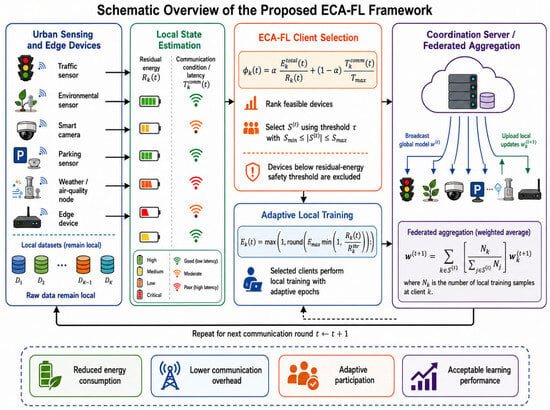
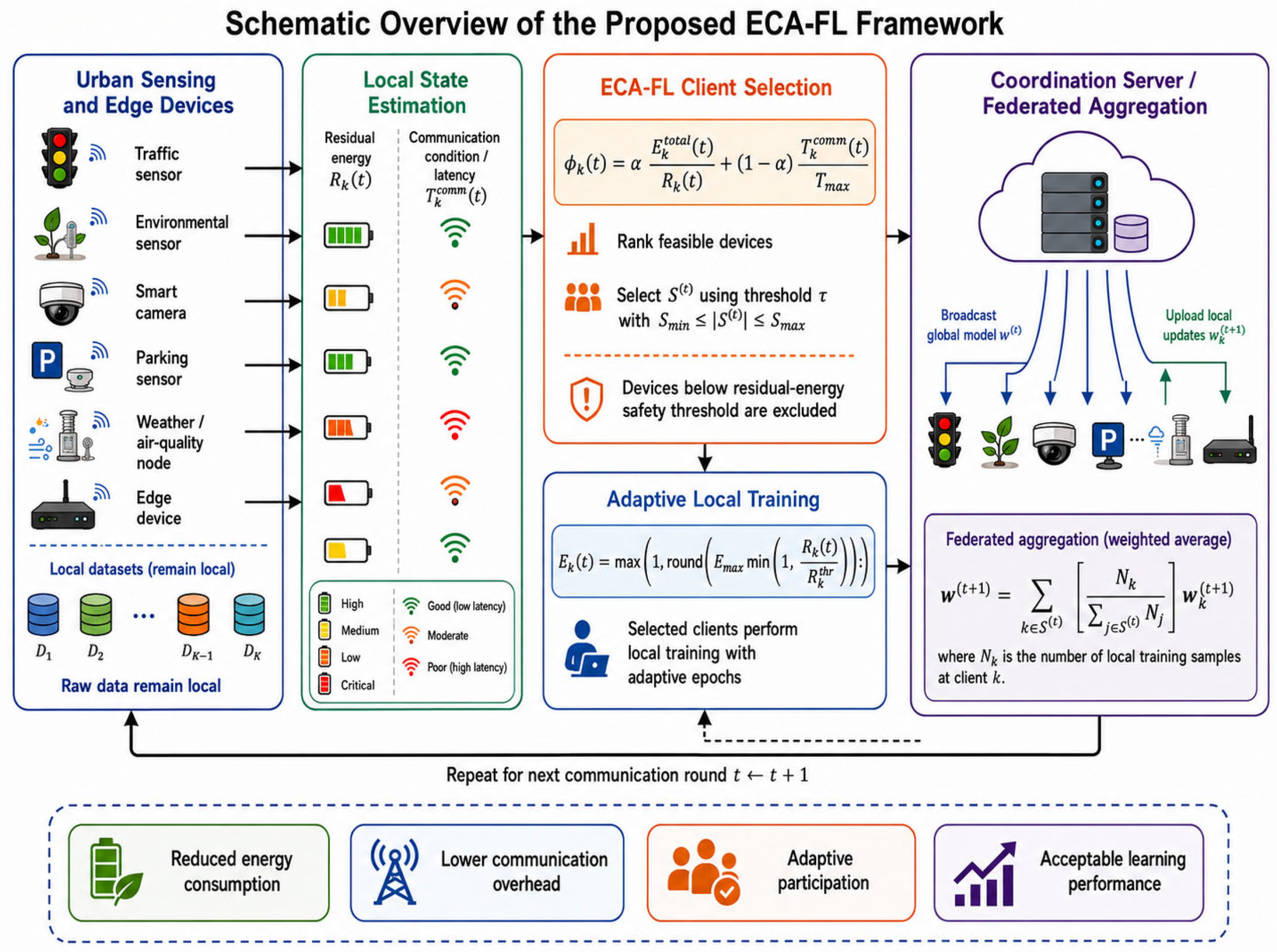
To clarify the operational flow of the proposed framework, Figure 1 provides a schematic overview of the ECA-FL process, from local state estimation at heterogeneous urban sensing devices to energy- and communication-aware client selection, adaptive local training, and federated aggregation at the coordination server.
Figure 1.
Schematic overview of the proposed Energy- and Communication-Aware Federated Learning (ECA-FL) framework for smart city sensing. Heterogeneous sensing and edge devices keep their raw data local while reporting device-state information, including residual energy and communication conditions. The ECA-FL selector ranks feasible devices using an energy- and communication-aware participation score, excludes devices below the residual-energy safety threshold, and selects the participating set subject to minimum and maximum participation bounds. Selected clients perform local training with adaptive epochs, and their updates are aggregated by the coordination server using weighted federated averaging. The process is repeated over communication rounds to reduce energy consumption and communication overhead while maintaining acceptable learning performance.
4.2. Energy- and Communication-Aware Client Selection
At the beginning of each communication round t, the coordinating server is assumed to have estimates of the expected energy consumption , residual energy , and communication latency for each device .
We define an energy- and communication-aware participation score for each device as:
where
- controls the trade-off between energy efficiency and communication latency;
- denotes the residual energy available at device k at the beginning of round t;
- represents the maximum allowable communication delay per round.
Using the residual energy in the denominator makes the score sensitive to the immediate energy condition of each device. Thus, clients with low remaining energy are penalized even if their nominal battery capacity is large.
Devices are ranked in ascending order of , and the participating set is selected as:
where is a predefined participation threshold. To avoid both excessive client starvation and excessive participation, the selected set is bounded by a minimum and maximum number of clients, and respectively. If fewer than devices satisfy the threshold, the best-ranked feasible devices are added until the minimum participation level is reached. If more than devices satisfy the threshold, only the devices with the lowest scores are selected.
This mechanism prioritizes energy-efficient and well-connected devices, thereby reducing the overall system cost per round.
4.3. Communication-Aware Local Training
In addition to client selection, the number of local training epochs executed by each selected device is adapted based on its residual energy level. Specifically, the number of local epochs for device k at round t is defined as:
for selected clients satisfying the minimum residual-energy requirement. Devices with residual energy below the safety threshold are excluded from participation before local training is assigned, where
- denotes the residual energy of device k;
- is a predefined residual-energy safety threshold;
- is the maximum number of local training epochs.
- denotes rounding to the nearest integer.
This adaptive mechanism reduces computational burden on energy-constrained devices, preventing premature failures and improving system stability. It also ensures that any selected client performs at least one local epoch, avoiding the transmission of model updates from clients that have not performed meaningful local training.
4.4. Aggregation with Partial Participation
Due to adaptive client selection, the set of participating devices may vary across communication rounds. To maintain statistical representativeness and learning stability, the server aggregates local updates using a weighted averaging rule over the active clients:
This aggregation strategy preserves the relative contribution of local datasets and remains compatible with standard federated learning frameworks.
4.5. Algorithm Summary
The complete Energy- and Communication-Aware Federated Learning (ECA-FL) procedure is summarized in Algorithm 1.
| Algorithm 1. Energy- and Communication-Aware Federated Learning for Smart City Sensing. |
|
4.6. Discussion of the Energy- and Communication-Aware Federated Learning Design
The proposed design explicitly incorporates energy and communication awareness into the federated learning process, making it particularly suitable for heterogeneous and dynamic urban environments. By prioritizing efficient and well-connected devices while adapting local training effort, the system reduces operational costs while allowing a tunable trade-off between resource savings and learning performance.
In the next section, we quantitatively evaluate the proposed ECA-FL strategy through simulation-based experiments under controlled heterogeneous urban sensing conditions, comparing it with conventional and resource-aware federated learning baselines.
5. Comparative Experimental Evaluation and Results
This section presents a simulation-based evaluation of the proposed Energy- and Communication-Aware Federated Learning (ECA-FL) strategy under heterogeneous smart city sensing conditions. The experimental protocol is first described in detail, including the dataset generation procedure, learning task, model architecture, federated partitioning strategy, system parameters, baselines, and evaluation metrics. The analysis then examines learning performance, adaptive client participation, communication overhead, energy consumption, and parameter sensitivity.
5.1. Experimental Setup and Evaluation Protocol
The evaluation was conducted using a controlled synthetic multi-class classification benchmark designed to act as an urban sensing proxy task. The purpose of this benchmark is not to reproduce a specific real-world city dataset, but to provide a reproducible and controlled setting in which the effects of statistical heterogeneity, device heterogeneity, energy constraints, and communication-aware client selection can be isolated. This choice is particularly useful for evaluating the behavior of resource-aware federated learning mechanisms before deployment on real urban sensing platforms.
The synthetic dataset contains 30,000 samples, 20 numerical features, and 5 classes. Class-dependent feature distributions are generated from Gaussian centroids with moderate overlap, and additional noise is introduced to avoid a trivially separable learning problem. The feature set includes both informative and noisy dimensions, with 70\% of the features generated as informative. The full dataset is standardized feature-wise before being divided into 24,000 training samples and 6000 test samples.
The federated system consists of clients. Training data are distributed across clients using a constrained Dirichlet non-IID partitioning strategy with concentration parameter . This produces strong statistical heterogeneity across clients while ensuring that each client has at least a minimum number of local samples. The same train-test split is used across all methods, and all results are reported as mean standard deviation over five independent runs.
The local learning model is a lightweight multilayer perceptron with an input layer of 20 features, two hidden layers of 64 neurons with ReLU activations, and an output layer with 5 classes. Local training uses stochastic gradient descent with a learning rate of 0.01, a batch size of 32, and a maximum of local epochs per communication round. The main experiments are run for 100 communication rounds.
The simulated system state includes heterogeneous bandwidth, transmission power, computation-energy coefficients, CPU-cycle requirements, and initial residual energy. The model payload size is set to bits per upload or download, and a small 512-bit device-state signaling payload is included per client and per round to account for residual-energy and communication-state reporting. Bandwidth values are sampled from a log-normal distribution, transmission powers and device-level computation parameters are sampled from uniform distributions, and initial residual energy is sampled from a heterogeneous device-energy range.
To make the simulation protocol fully reproducible and to clarify the source of system heterogeneity, Table 2 summarizes the main simulation parameters and distributions used to generate the device-level communication, computation, and energy states.
Table 2.
Main simulation parameters and distributions used to generate heterogeneous device, communication, and energy conditions. The parameter values define the controlled smart city sensing proxy environment used in the main experiments. Sensitivity analyses further vary the ECA-FL trade-off parameter and the residual-energy safety fraction.
The proposed ECA-FL method is compared with four baselines:
- FedAvg-full: full-participation federated averaging over all feasible clients in each round;
- Random-FL: random partial client participation with a maximum participation fraction of 20%;
- Fixed-FL: a fixed partial-participation baseline, included to illustrate the risk of client starvation under rigid participation policies;
- Resource-FL: a resource-aware baseline that selects clients according to residual energy but does not jointly account for communication latency in the same way as ECA-FL;
- ECA-FL: the proposed energy- and communication-aware strategy, using adaptive participation and adaptive local epochs.
The evaluation metrics include final test accuracy, cumulative energy consumption, cumulative communication cost, average number of active clients per round, mean number of local epochs among active clients, and the number of rounds required to reach 0.80 accuracy when the threshold is reached. The 0.80 threshold was selected as a practically informative convergence reference for the controlled benchmark, since it lies close to the final accuracy achieved by the most resource-constrained viable strategy while avoiding the saturation effects associated with overly easy classification tasks.
The evaluation protocol was designed to support internal validity rather than external deployment validation. Internal validity is strengthened by using the same train–test split, client partitioning procedure, model architecture, hyperparameters, random seeds, and system-heterogeneity generation process across all methods. This makes the comparison between ECA-FL and the baselines controlled and reproducible. External validity remains limited by the use of a synthetic urban sensing proxy task and simplified energy and communication models; these limitations are explicitly discussed in Section 6.5.
5.2. Learning Accuracy and Convergence Behavior
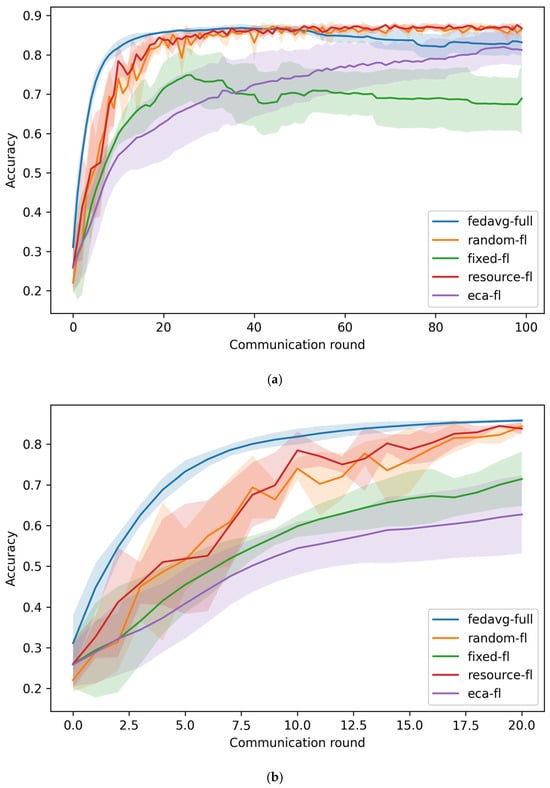
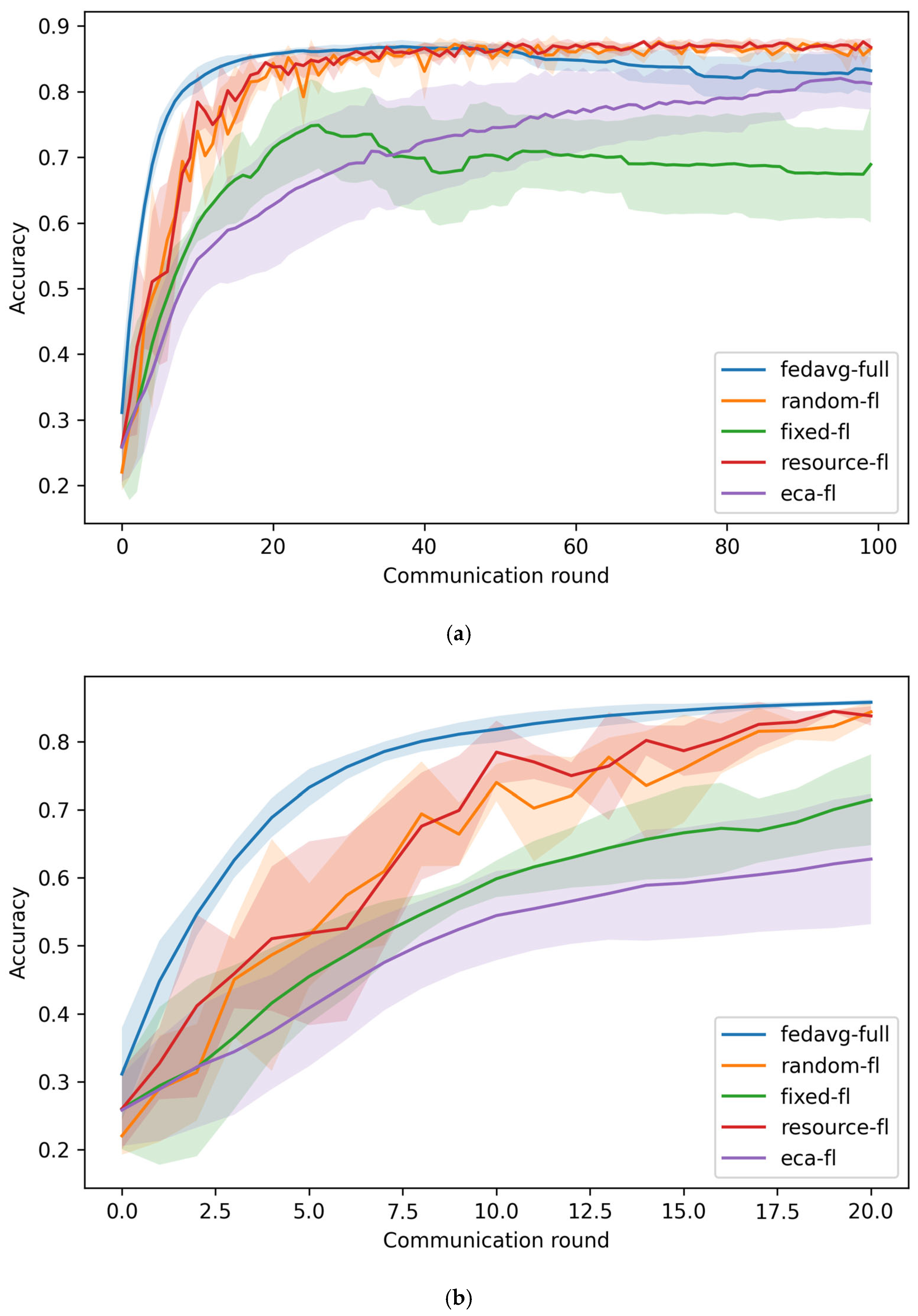
Figure 2 shows the evolution of global test accuracy over the communication rounds. The benchmark was designed to provide a non-trivial classification setting in which not all methods reach near-perfect accuracy. This makes it possible to evaluate the trade-off between learning performance, energy consumption, and communication cost more clearly.
Figure 2.
Global test accuracy versus communication rounds under strongly non-IID client data distributions (, Dirichlet ). (a) Accuracy over the full training horizon. (b) Details of the initial training phase. The benchmark avoids near-perfect accuracy saturation and highlights the trade-off between learning performance and resource-aware participation.
FedAvg-full reaches a final accuracy of , while Random-FL and Resource-FL achieve the highest final accuracies, and , respectively. The proposed ECA-FL reaches , which is slightly lower than FedAvg-full but remains within a comparable performance range. Fixed-FL obtains the lowest final accuracy, , confirming that rigid participation reduction can significantly harm learning performance.
These results show that ECA-FL should not be interpreted as an accuracy-maximizing strategy. Rather, its objective is to provide a favorable operating point for resource-constrained smart city sensing deployments. The moderate reduction in accuracy relative to Random-FL and Resource-FL is accompanied by much larger reductions in energy consumption and communication overhead, as analyzed in the following subsections.
5.3. Adaptive Client Participation Dynamics
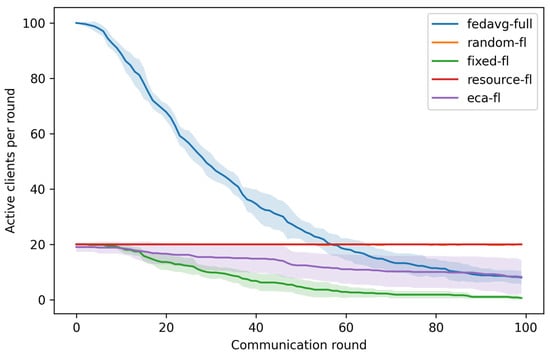
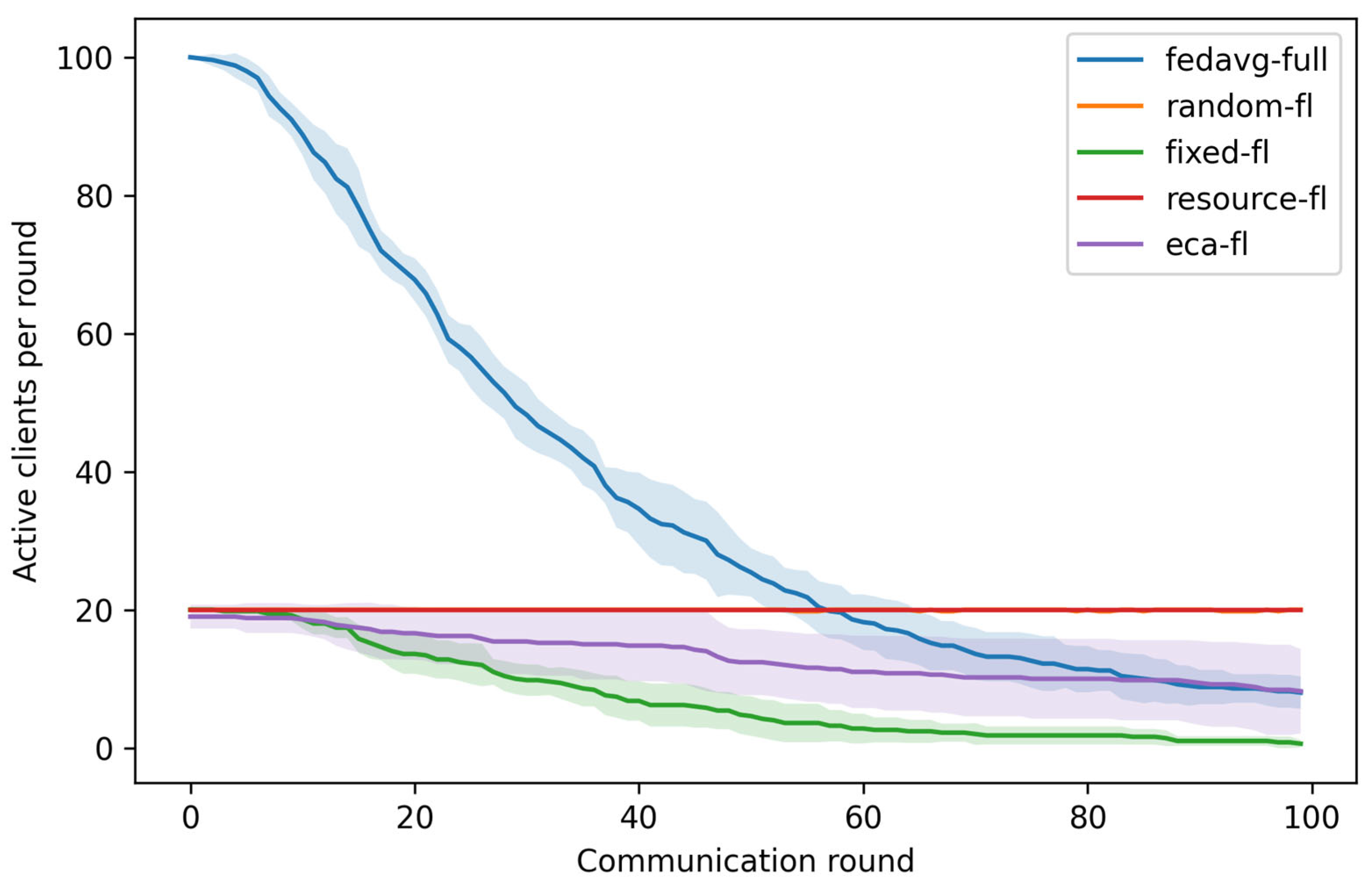
Figure 3 reports the average number of active clients per communication round. FedAvg-full initially involves all feasible clients but progressively decreases participation as device energy constraints become active. Random-FL maintains approximately 20 active clients per round because it uses a fixed maximum participation fraction. Resource-FL also maintains approximately 20 active clients per round, but selects them according to residual energy.
Figure 3.
Average number of active clients per communication round. FedAvg-full initially uses all feasible clients but progressively decreases participation as energy constraints become active. Random-FL and Resource-FL operate close to the 20-client partial-participation level throughout the training process; because their trajectories are very similar, the Random-FL curve largely overlaps with the Resource-FL curve in the plot. Fixed-FL suffers from progressive client starvation, whereas ECA-FL provides adaptive intermediate participation controlled by energy and communication conditions. Shaded areas represent one standard deviation over five independent runs.
Fixed-FL rapidly loses active clients as its rigid client subset becomes energy-depleted, reaching an average of only 7.29 active clients over all rounds and 0.6 active clients in the final round. This explains its poor learning performance and illustrates the risk of client starvation under static participation rules.
ECA-FL exhibits an adaptive participation profile. It uses an average of 13.28 active clients per round, below Random-FL and Resource-FL, but above the severely constrained Fixed-FL regime. This confirms that the proposed strategy does not simply minimize participation at all costs. Instead, it dynamically adjusts participation according to energy and communication conditions while preserving a minimum level of learning activity.
5.4. Communication Cost Analysis
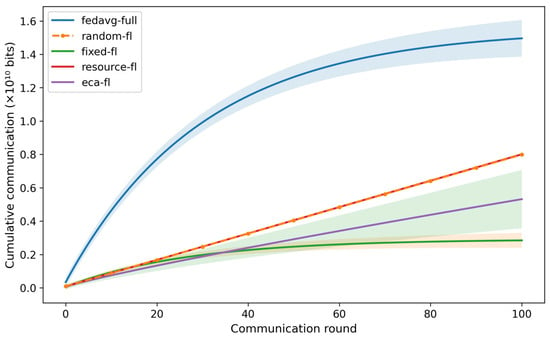
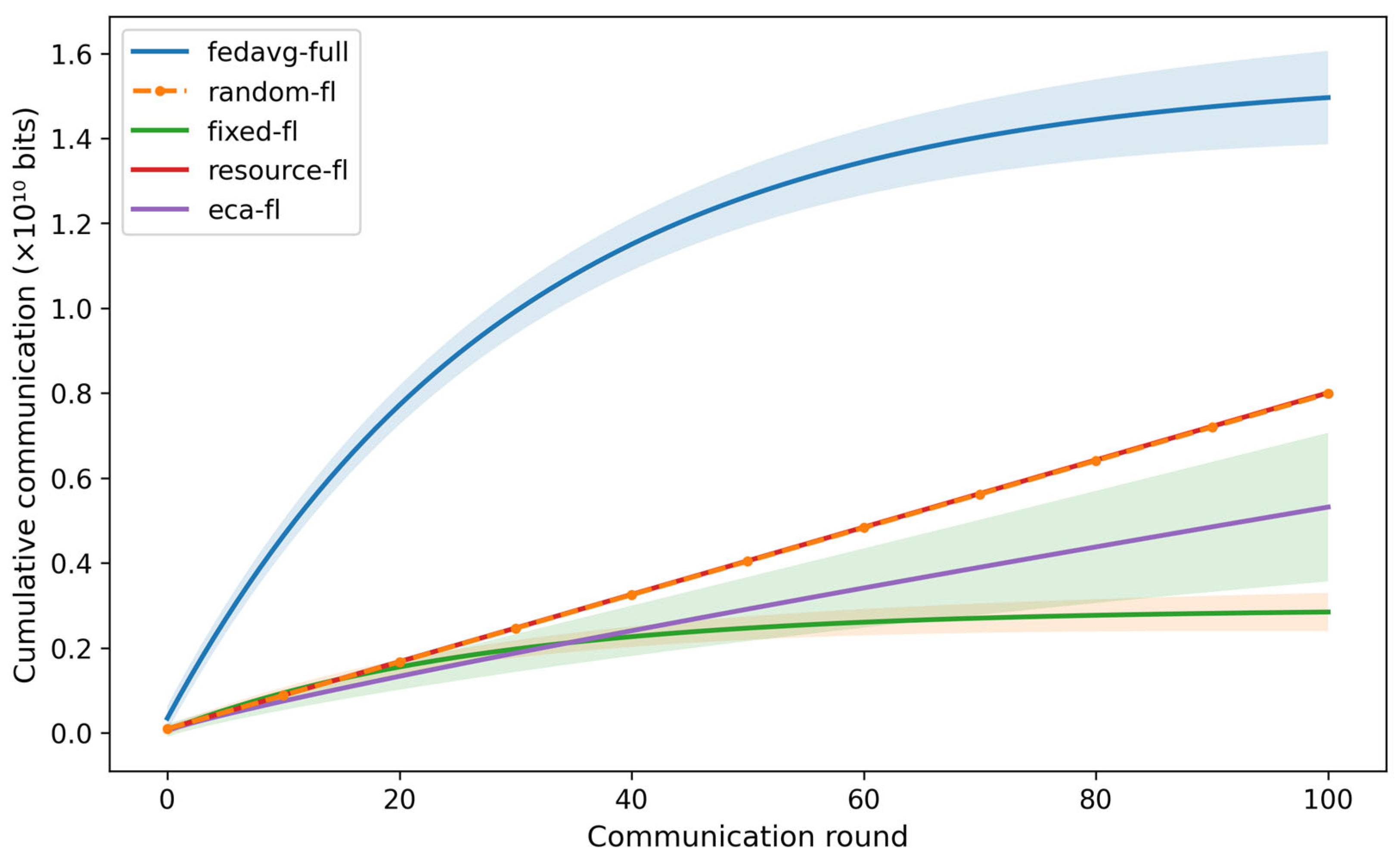
Figure 4 shows the cumulative communication cost over the training horizon. Communication cost includes downlink model transmission, uplink model update transmission, and a small device-state signaling payload used to report residual energy and communication availability.
Figure 4.
Cumulative communication cost as a function of communication rounds. FedAvg-full incurs the highest communication cost, while Fixed-FL achieves the lowest cost at the expense of severe client starvation and degraded learning performance. Random-FL and Resource-FL follow similar cumulative communication trajectories, and the Random-FL curve may partially overlap with the Resource-FL curve in the plot. ECA-FL reduces communication overhead substantially relative to FedAvg-full, Random-FL, and Resource-FL by adaptively reducing participation according to energy and communication conditions. Shaded areas represent one standard deviation over five independent runs.
FedAvg-full incurs the largest cumulative communication cost, reaching approximately bits. Random-FL and Resource-FL reduce this cost to approximately and bits, respectively, corresponding to reductions of about 46.8% relative to FedAvg-full. Fixed-FL achieves the lowest communication cost, bits, but does so by severely reducing participation and substantially degrading accuracy.
ECA-FL achieves a cumulative communication cost of bits, corresponding to a 64.7% reduction relative to FedAvg-full. Importantly, this reduction is achieved while maintaining considerably better accuracy than Fixed-FL. These results indicate that communication-aware participation can substantially reduce network load in smart city sensing systems, where communication resources are often shared by multiple urban services.
5.5. Energy Consumption and Sustainability
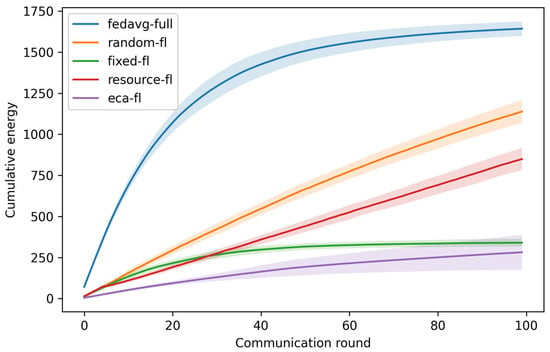
Figure 5 presents the cumulative energy consumption across communication rounds. FedAvg-full is the most energy-intensive method, reaching cumulative energy units. Random-FL reduces cumulative energy consumption to , while Resource-FL further reduces it to by prioritizing clients with favorable residual-energy conditions.
Figure 5.
Cumulative energy consumption over communication rounds. ECA-FL achieves substantial energy savings relative to FedAvg-full, Random-FL, and Resource-FL. Fixed-FL also reduces energy consumption but suffers from severe client starvation and reduced accuracy. Shaded areas represent one standard deviation over five independent runs.
ECA-FL achieves the strongest energy reduction among the non-degenerate methods, reaching cumulative energy units. This corresponds to an 82.9% reduction relative to FedAvg-full. Although Fixed-FL has a comparable low-energy profile, its final accuracy is much lower, indicating that aggressive static exclusion of clients is not a reliable solution for learning-oriented smart city sensing.
The energy results reinforce the central contribution of ECA-FL: the method provides an energy-efficient operating regime while avoiding the severe learning degradation observed under rigid fixed participation. In practical smart city deployments, such savings may translate into longer device lifetime, reduced maintenance frequency, and improved sustainability of distributed sensing infrastructures.
5.6. Adaptive Local Training Effort
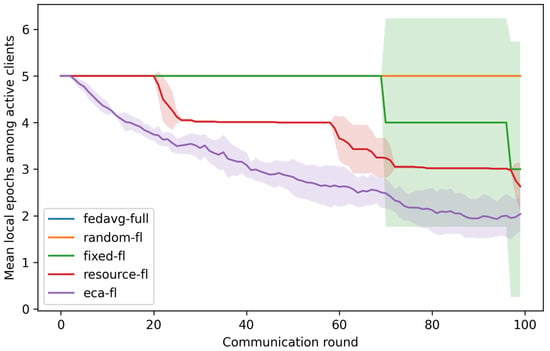
In addition to selecting clients adaptively, ECA-FL and Resource-FL adapt the number of local epochs according to residual energy availability. This mechanism prevents energy-constrained devices from being assigned the same local computation burden as high-energy devices. Across all rounds, Resource-FL uses an average of 3.88 local epochs among active clients, whereas ECA-FL uses an average of 3.02 local epochs. By contrast, FedAvg-full, Random-FL, and Fixed-FL use the maximum value of 5 local epochs whenever clients are active.
This adaptive local-training behavior contributes directly to the energy savings observed for ECA-FL. It also addresses the methodological concern that local training effort must be synchronized with the energy model: the computation-energy term depends on the actual round-dependent number of local epochs assigned to each selected client.
Figure 6 further examines the adaptive local training mechanism by reporting the mean number of local epochs assigned to active clients over the communication rounds. This analysis is important because the proposed framework reduces energy consumption not only through client selection, but also by adapting the computation effort assigned to each participating device.
Figure 6.
Mean number of local epochs among active clients. FedAvg-full, Random-FL, and Fixed-FL use the maximum number of local epochs whenever clients are active; as a result, their curves overlap for part of the training process, and the FedAvg-full curve is largely hidden in the plot. Resource-FL and ECA-FL adapt local training effort according to residual energy, leading to progressively lower average local epochs over the communication rounds. Shaded areas represent one standard deviation over five independent runs.
5.7. Sensitivity Analysis
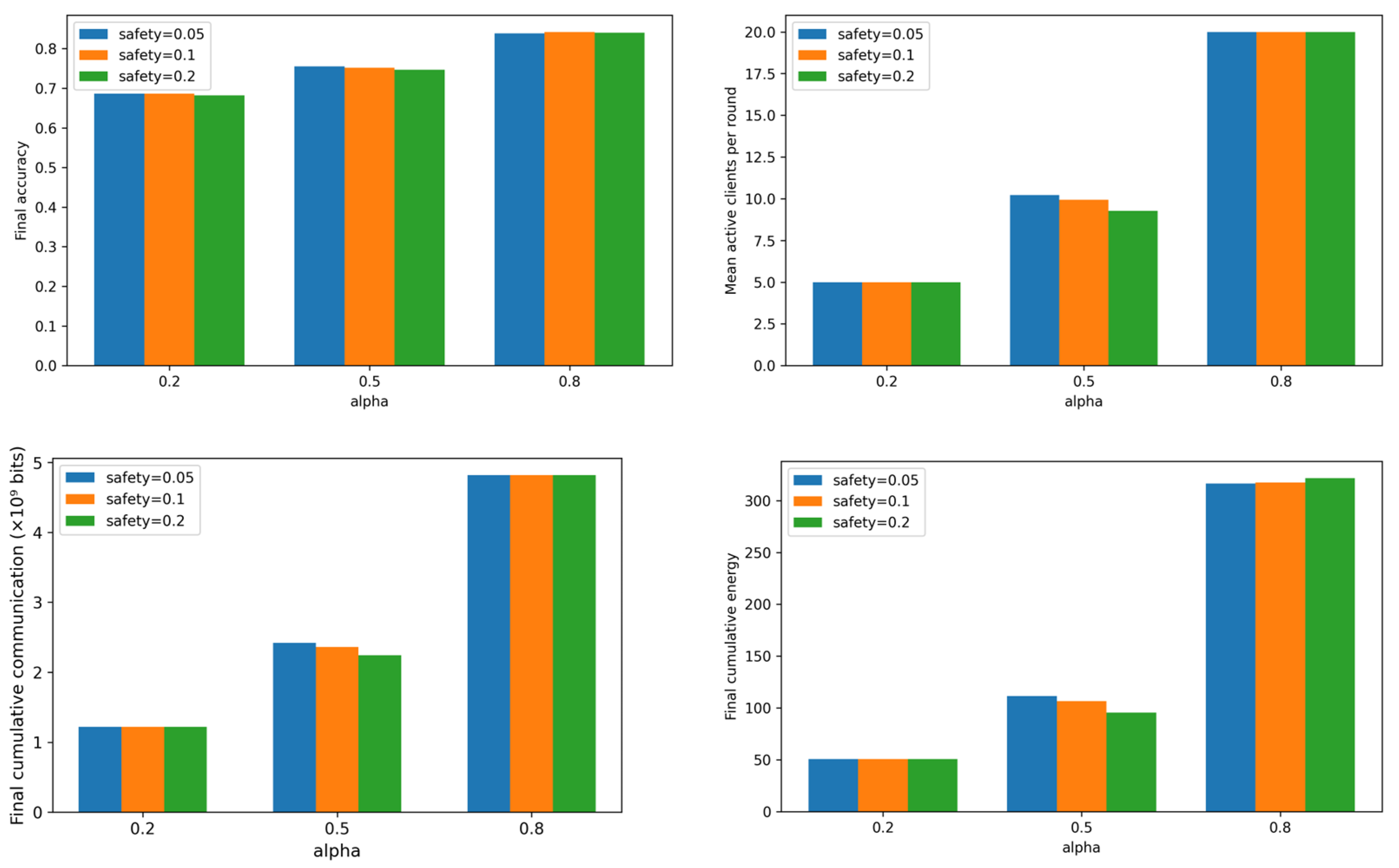
A sensitivity analysis was conducted to evaluate the effect of the ECA-FL trade-off parameter and residual-energy safety fraction on learning performance and resource consumption. The analysis considers and safety fractions of 0.05, 0.10, and 0.20 over three independent runs and 60 communication rounds.
The results show that strongly controls the resource-performance trade-off. When , ECA-FL behaves conservatively, selecting approximately 5 active clients per round. This leads to very low communication cost, approximately bits, and low cumulative energy consumption, around 50.6–50.8 energy units, but the final accuracy remains limited to approximately 0.68–0.69.
For , ECA-FL selects approximately 9–10 active clients per round, producing an intermediate operating point. Final accuracy increases to approximately 0.75, while cumulative energy and communication costs remain substantially lower than those associated with full 20-client participation.
For , ECA-FL becomes less restrictive and selects approximately 20 clients per round. This improves final accuracy to approximately 0.84, but increases cumulative energy consumption to around 316–322 energy units and communication cost to bits. These results confirm that ECA-FL can be tuned according to deployment priorities: lower values of favor stronger resource conservation, whereas higher values favor learning performance.
The safety fraction has a secondary but still relevant effect. Larger safety fractions tend to slightly reduce participation and energy use, particularly in intermediate regimes. However, the dominant control variable is , which determines how aggressively the method prioritizes energy and communication conditions in the participation score.
Figure 7 presents the sensitivity analysis of ECA-FL with respect to the trade-off parameter and the residual-energy safety fraction. This analysis evaluates how different parameter settings affect the balance between learning performance, cumulative energy consumption, communication overhead, and active-client participation.
Figure 7.
Sensitivity analysis of ECA-FL with respect to and residual-energy safety fraction. The results show the effect of these parameters on final accuracy, cumulative energy consumption, cumulative communication cost, and average number of active clients per round.
5.8. Summary of Quantitative Gains
Table 3 summarizes the final performance metrics for all evaluated methods. The results confirm that the highest final accuracy is obtained by Random-FL and Resource-FL. However, these methods use approximately 20 clients per round and incur substantially higher energy and communication costs than ECA-FL.
Table 3.
Comparison of federated learning strategies under strongly heterogeneous non-IID conditions (, Dirichlet ). Results are reported as the mean standard deviation over five independent runs. Avg. Active Clients denotes the average number of active clients across all communication rounds. ECA-FL achieves the strongest energy and communication savings among the non-degenerate methods, with a moderate accuracy trade-off relative to Random-FL and Resource-FL.
ECA-FL provides the strongest resource savings among the non-degenerate strategies. Compared with FedAvg-full, it reduces cumulative energy consumption by 82.9% and communication overhead by 64.7%, while maintaining a final accuracy of . Compared with Fixed-FL, ECA-FL achieves substantially better learning performance while still maintaining low energy and communication costs.
Overall, these results support the empirical hypothesis of the study within the controlled simulation setting. ECA-FL does not dominate all baselines in terms of final accuracy; Random-FL and Resource-FL achieve higher accuracy in this benchmark. However, ECA-FL provides a distinct operating point characterized by substantially lower energy consumption and communication overhead while maintaining acceptable accuracy. The contribution should therefore be interpreted as a tunable resource–performance trade-off, not as a universal accuracy-improving FL method.
6. Urban Implications and Discussion
The results presented in the previous sections highlight the relevance of energy-aware and communication-efficient federated learning as a practical enabler of scalable urban intelligence. Beyond algorithmic performance, the proposed ECA-FL framework provides insights with direct implications for the design, operation, and governance of smart city sensing infrastructures.
6.1. Implications for Scalable Smart City Sensing
Large-scale smart city deployments typically involve hundreds or thousands of heterogeneous sensing and edge devices distributed across urban areas. In such settings, centralized learning approaches are increasingly constrained by communication bottlenecks, energy limitations, and data governance requirements. The experimental results show that adaptive federated learning strategies can substantially reduce system-level costs while maintaining an acceptable level of learning performance.
In particular, the controlled reduction in client participation observed in ECA-FL suggests that full participation is often unnecessary to obtain useful learning performance under constrained operating conditions. This finding challenges common assumptions in smart city system design and indicates that selectively engaging devices based on contextual and resource-aware criteria can improve scalability with a tunable trade-off between resource savings and accuracy.
6.2. Energy Efficiency and Urban Sustainability
Energy consumption is a critical concern for smart city infrastructures, especially for battery-powered sensors and edge devices deployed in large numbers. The significant energy savings achieved by ECA-FL directly support sustainability objectives by extending device lifetime, reducing maintenance interventions, and lowering the overall operational footprint of urban sensing systems.
From an urban planning perspective, these improvements contribute to the long-term viability of smart city services, particularly in applications such as environmental monitoring, mobility analysis, and infrastructure health assessment, where continuous operation is required over extended periods. Energy-aware learning mechanisms therefore represent an important step toward more sustainable and resilient urban digital infrastructures.
6.3. Communication Efficiency and Shared Urban Networks
Urban communication networks are typically shared among multiple services, including public safety, transportation, and commercial applications. Excessive data transmission from learning-based systems can interfere with these services and degrade overall network performance.
The reduction in communication overhead achieved by ECA-FL shows that federated learning can be made more compatible with bandwidth-constrained and highly contended urban networks. By limiting unnecessary model updates and prioritizing well-connected devices, ECA-FL aligns learning activity with available network resources, supporting coexistence with other urban digital services.
6.4. Robustness Under Urban Heterogeneity
Urban environments are inherently heterogeneous, characterized by spatial variability, uneven data distributions, and fluctuating resource availability. The performance of ECA-FL under strongly non-IID conditions indicates that adaptive participation strategies can partially mitigate the negative effects of heterogeneity while reducing energy and communication costs.
This robustness is relevant for real-world smart city applications, where sensing quality and device capabilities may vary significantly across neighborhoods and contexts. However, the present results should be interpreted as simulation-based evidence of potential suitability rather than as direct deployment validation. Real-world deployment would require validation with physical devices, measured communication conditions, hardware-specific energy models, and operational constraints.
6.5. Limitations and Practical Considerations
While the proposed framework suggests promising results, several practical considerations must be acknowledged. First, the evaluation is based on simulation-based experiments, which, although designed to reflect heterogeneous urban conditions, cannot capture all aspects of real-world deployments. Second, the learning task is based on a controlled synthetic multi-class urban sensing proxy dataset rather than on a real city-scale sensing dataset. Therefore, the reported results should be interpreted as evidence of the behavior of the proposed resource-aware mechanism under controlled conditions, not as a direct performance guarantee for a specific smart city application. Third, the energy and communication models employed are simplified abstractions that may need refinement when applied to specific hardware platforms or network technologies.
Moreover, the coordination server is assumed to have access to reliable estimates of device-level resource states, which may require additional signaling or monitoring mechanisms in practice. Although a small signaling payload was included in the simulations, real deployments may introduce additional protocol, synchronization, security, or monitoring overheads. Addressing these aspects will be essential for transitioning from simulation to deployment.
Another limitation is that the present work does not implement formal privacy-enhancing mechanisms such as differential privacy, secure aggregation, or secure multi-party computation. The framework preserves data locality in the sense that raw data remain on the clients, but formal privacy guarantees would require additional mechanisms and a dedicated privacy-utility analysis. This is considered an important direction for future work.
From a validity perspective, the study therefore provides internally controlled comparative evidence rather than externally validated deployment evidence. The reported gains are valid under the assumptions of the synthetic benchmark, the adopted non-IID partitioning strategy, the simulated device heterogeneity, and the simplified energy and communication models. They should not be interpreted as formal convergence guarantees, formal privacy guarantees, or universal performance guarantees across all smart city sensing applications.
Nevertheless, the proposed framework is intentionally lightweight, facilitating its integration into existing smart city platforms without requiring specialized hardware or protocol modifications.
6.6. Positioning Within Smart City Governance
Beyond technical efficiency, energy-aware federated learning has implications for urban data governance and trust. By avoiding raw data transmission and enabling decentralized learning, federated approaches align well with privacy regulations and ethical considerations increasingly emphasized in smart city initiatives.
The proposed framework therefore supports not only efficient urban intelligence but also data-locality-preserving learning practices, reinforcing its relevance for policymakers and urban stakeholders. However, in governance-sensitive deployments, data locality should be complemented by formal privacy, security, auditing, and accountability mechanisms.
6.7. Summary
Globally, within the adopted controlled simulation setting, this work shows that incorporating energy and communication awareness into federated learning can provide a viable and effective resource–performance trade-off for smart city sensing systems. The proposed ECA-FL framework addresses key challenges related to scalability, sustainability, and robustness, offering actionable insights for the design of next-generation urban intelligence platforms. At the same time, the results should be interpreted within the scope of a controlled simulation-based evaluation and as evidence of a tunable resource-performance trade-off rather than as a universal accuracy improvement over all baselines.
7. Conclusions and Future Work
This paper investigated energy- and communication-aware federated learning for heterogeneous smart city sensing systems. The study addressed the challenge of sustaining distributed learning across urban Internet-of-Things devices that differ in residual energy, communication conditions, and local data distributions. The proposed Energy- and Communication-Aware Federated Learning strategy, ECA-FL, introduces adaptive client participation and adaptive local training effort based on the joint consideration of device-level energy availability and communication conditions.
The central contribution of this work is not a new federated optimization method for maximizing accuracy, but a resource-aware participation mechanism tailored to smart city sensing environments. In particular, ECA-FL provides a tunable operating point between learning performance, energy consumption, communication overhead, and client participation. This distinguishes the proposed approach from conventional full-participation FedAvg, random partial participation, rigid fixed participation, and resource-only selection strategies, since it explicitly combines residual-energy-aware selection, communication-aware scoring, adaptive local epochs, and parameter sensitivity analysis within a controlled smart city sensing scenario.
The empirical hypothesis guiding the study was that adaptive resource-aware participation can substantially reduce cumulative energy consumption and communication overhead while preserving acceptable learning performance under heterogeneous smart city sensing conditions. Within the adopted controlled simulation setting, this hypothesis was supported. ECA-FL reduced cumulative energy consumption by 82.9% and communication overhead by 64.7% compared with full-participation FedAvg, while maintaining a final accuracy of 0.8124 compared with 0.8319 for FedAvg-full. The results also indicate that ECA-FL avoids the severe learning degradation observed under rigid fixed participation, although it does not outperform all baselines in terms of final accuracy. In particular, Random-FL and Resource-FL achieved higher final accuracy in the benchmark, but at substantially higher energy and communication costs. Therefore, the contribution of ECA-FL should be interpreted as a tunable resource–performance trade-off rather than as a universal accuracy-improving federated learning method.
From a smart city perspective, the results suggest that efficient urban intelligence does not require all available devices to participate in every communication round. Selectively engaging devices according to residual energy and communication conditions can reduce operational cost, alleviate pressure on shared urban networks, and support more sustainable sensing infrastructures. This is particularly relevant for large-scale urban deployments where battery-powered sensors, edge devices, and wireless communication resources must be managed over long operational periods.
The findings should nevertheless be interpreted within the scope of the study. The evaluation was based on a controlled synthetic urban sensing proxy task, simulated device heterogeneity, and simplified energy and communication models. As such, the results provide internally controlled comparative evidence, but they do not constitute direct validation on a real-world smart city deployment, formal convergence guarantees, or formal privacy guarantees. The framework preserves data locality by keeping raw data on client devices, but additional privacy-enhancing mechanisms would be required to provide explicit privacy protection.
Future work will extend this research in four main directions. First, the framework will be evaluated using real urban sensing datasets and physical or emulated edge devices to assess its behavior under measured communication and energy conditions. Second, more detailed energy and communication models will be incorporated, including hardware-specific power profiles and 5G or beyond-5G network characteristics. Third, privacy-enhancing mechanisms such as secure aggregation and differential privacy will be integrated to complement the data-locality-preserving nature of federated learning. Finally, future extensions will examine trust, fairness, incentive mechanisms, and long-term client availability, which are essential for robust and accountable federated learning in operational smart city infrastructures.
Funding
This research received no external funding.
Institutional Review Board Statement
Not applicable.
Informed Consent Statement
Not applicable.
Data Availability Statement
The synthetic data-generation procedure, simulation scripts, configuration files, and aggregated results supporting the findings of this study are available from the corresponding author upon reasonable request. These materials include the dataset-generation settings, federated partitioning procedure, model architecture, hyperparameters, random seeds, and scripts required to reproduce the reported experiments.
Acknowledgments
During the preparation of this manuscript, the author used ChatGPT 5.2 in order to improve readability and language. The author have reviewed and edited the output and take full responsibility for the content of this publication.
Conflicts of Interest
The author declares no conflicts of interest.
References
- Batty, M.; Axhausen, K.W.; Giannotti, F.; Pozdnoukhov, A.; Bazzani, A.; Wachowicz, M.; Ouzounis, G.; Portugali, Y. Smart Cities of the Future. Eur. Phys. J. Spec. Top. 2012, 214, 481–518. [Google Scholar] [CrossRef] [Scilit]
- Gubbi, J.; Buyya, R.; Marusic, S.; Palaniswami, M. Internet of Things (IoT): A Vision, Architectural Elements, and Future Directions. Future Gener. Comput. Syst. 2013, 29, 1645–1660. [Google Scholar] [CrossRef] [Scilit]
- Hashem, I.A.T.; Chang, V.; Anuar, N.B.; Adewole, K.; Yaqoob, I.; Gani, A.; Ahmed, E.; Chiroma, H. The Role of Big Data in Smart City. Int. J. Inf. Manag. 2016, 36, 748–758. [Google Scholar] [CrossRef] [Scilit]
- Al-Fuqaha, A.; Guizani, M.; Mohammadi, M.; Aledhari, M.; Ayyash, M. Internet of Things: A Survey on Enabling Technologies, Protocols, and Applications. IEEE Commun. Surv. Tutor. 2015, 17, 2347–2376. [Google Scholar] [CrossRef] [Scilit]
- Bibri, S.E. Smart Sustainable Cities of the Future; The Urban Book Series; Springer International Publishing: Cham, Switzerland, 2018. [Google Scholar]
- Kairouz, P.; McMahan, H.B.; Avent, B.; Bellet, A.; Bennis, M.; Bhagoji, A.N.; Bonawitz, K.; Charles, Z.; Cormode, G.; Cummings, R.; et al. Advances and Open Problems in Federated Learning. Found. Trends Mach. Learn. 2021, 14, 1–210. [Google Scholar] [CrossRef] [Scilit]
- Lim, W.Y.B.; Luong, N.C.; Hoang, D.T.; Jiao, Y.; Liang, Y.-C.; Yang, Q.; Niyato, D.; Miao, C. Federated Learning in Mobile Edge Networks: A Comprehensive Survey. IEEE Commun. Surv. Tutor. 2020, 22, 2031–2063. [Google Scholar] [CrossRef] [Scilit]
- Li, T.; Sahu, A.K.; Talwalkar, A.; Smith, V. Federated Learning: Challenges, Methods, and Future Directions. IEEE Signal Process. Mag. 2020, 37, 50–60. [Google Scholar] [CrossRef] [Scilit]
- Li, Q.; Wen, Z.; Wu, Z.; Hu, S.; Wang, N.; Li, Y.; Liu, X.; He, B. A Survey on Federated Learning Systems: Vision, Hype and Reality for Data Privacy and Protection. IEEE Trans. Knowl. Data Eng. 2023, 35, 3347–3366. [Google Scholar] [CrossRef] [Scilit]
- Karimireddy, S.P.; Kale, S.; Mohri, M.; Reddi, S.; Stich, S.; Suresh, A.T. SCAFFOLD: Stochastic Controlled Averaging for Federated Learning. In Proceedings of the 37th International Conference on Machine Learning; JMLR.org: Norfolk, MA, USA, 2020; Volume 119, pp. 5132–5143. [Google Scholar]
- Yang, Q.; Liu, Y.; Chen, T.; Tong, Y. Federated Machine Learning: Concept and Applications. ACM Trans. Intell. Syst. Technol. 2019, 10, 1–19. [Google Scholar] [CrossRef] [Scilit]
- Nishio, T.; Yonetani, R. Client Selection for Federated Learning with Heterogeneous Resources in Mobile Edge. In Proceedings of the ICC 2019—2019 IEEE International Conference on Communications (ICC); IEEE: Piscataway, NJ, USA, 2019; pp. 1–7. [Google Scholar]
- Pandya, S.; Srivastava, G.; Jhaveri, R.; Babu, M.R.; Bhattacharya, S.; Maddikunta, P.K.R.; Mastorakis, S.; Piran, M.J.; Gadekallu, T.R. Federated Learning for Smart Cities: A Comprehensive Survey. Sustain. Energy Technol. Assess. 2023, 55, 102987. [Google Scholar] [CrossRef] [Scilit]
- Zanella, A.; Bui, N.; Castellani, A.; Vangelista, L.; Zorzi, M. Internet of Things for Smart Cities. IEEE Internet Things J. 2014, 1, 22–32. [Google Scholar] [CrossRef] [Scilit]
- Shi, W.; Cao, J.; Zhang, Q.; Li, Y.; Xu, L. Edge Computing: Vision and Challenges. IEEE Internet Things J. 2016, 3, 637–646. [Google Scholar] [CrossRef] [Scilit]
- Satyanarayanan, M. The Emergence of Edge Computing. Computer 2017, 50, 30–39. [Google Scholar] [CrossRef] [Scilit]
- Abbas, N.; Zhang, Y.; Taherkordi, A.; Skeie, T. Mobile Edge Computing: A Survey. IEEE Internet Things J. 2018, 5, 450–465. [Google Scholar] [CrossRef] [Scilit]
- Hoffpauir, K.; Simmons, J.; Schmidt, N.; Pittala, R.; Briggs, I.; Makani, S.; Jararweh, Y. A Survey on Edge Intelligence and Lightweight Machine Learning Support for Future Applications and Services. J. Data Inf. Qual. 2023, 15, 1–30. [Google Scholar] [CrossRef] [Scilit]
- Nguyen, T.-A.; Le, L.T.; Nguyen, T.D.; Bao, W.; Seneviratne, S.; Hong, C.S.; Tran, N.H. Federated PCA on Grassmann Manifold for IoT Anomaly Detection. IEEE/ACM Trans. Netw. 2024, 32, 4456–4471. [Google Scholar] [CrossRef] [Scilit]
- Li, X.; Huang, K.; Yang, W.; Wang, S.; Zhang, Z. On the Convergence of FedAvg on Non-IID Data. arXiv 2019, arXiv:1907.02189. [Google Scholar]
- Mishchenko, K. Tighter Theory for Local SGD on Identical and Heterogeneous Data. Available online: https://www.konstmish.com/publication/19_local_sgd/ (accessed on 18 May 2026).
- Cho, Y.J.; Wang, J.; Joshi, G. Client Selection in Federated Learning: Convergence Analysis and Power-of-Choice Selection Strategies. arXiv 2020, arXiv:2010.01243. [Google Scholar]
- Bhagoji, A.N.; Chakraborty, S.; Mittal, P.; Calo, S. Analyzing Federated Learning through an Adversarial Lens. In Proceedings of the 36th International Conference on Machine Learning; PMLR: Cambridge, MA, USA, 2019; pp. 634–643. [Google Scholar]
- Bagdasaryan, E.; Veit, A.; Hua, Y.; Estrin, D.; Shmatikov, V. How To Backdoor Federated Learning. In Proceedings of the Twenty Third International Conference on Artificial Intelligence and Statistics; PMLR: Cambridge, MA, USA, 2020; pp. 2938–2948. [Google Scholar]
- Huang, W.; Ye, M.; Shi, Z.; Wan, G.; Li, H.; Du, B.; Yang, Q. Federated Learning for Generalization, Robustness, Fairness: A Survey and Benchmark. IEEE Trans. Pattern Anal. Mach. Intell. 2024, 46, 9387–9406. [Google Scholar] [CrossRef] [Scilit] [PubMed]
- Blanchard, P.; El Mhamdi, E.M.; Guerraoui, R.; Stainer, J. Machine Learning with Adversaries: Byzantine Tolerant Gradient Descent. In Advances in Neural Information Processing Systems; Curran Associates, Inc.: Red Hook, NY, USA, 2017; Volume 30. [Google Scholar]
- Maciel, F.; De Souza, A.M.; Bittencourt, L.F.; Villas, L.A. Resource Aware Client Selection for Federated Learning in IoT Scenarios. In Proceedings of the 2023 19th International Conference on Distributed Computing in Smart Systems and the Internet of Things (DCOSS-IoT); IEEE: Piscataway, NJ, USA, 2023; pp. 1–8. [Google Scholar]
- Zhang, Y.; Luo, Y.; Yang, T.; Wu, X.; Hu, B. Eecs-Fl: Energy-Efficient Client Selection for Federated Learning in AIoT. EURASIP J. Wirel. Commun. Netw. 2025, 2025, 12. [Google Scholar] [CrossRef] [Scilit]
- Liu, J.; Liu, X.; Wang, S.; Wan, X.; Li, D.; Lu, K.; He, K. Communication-Efficient Federated Multi-View Clustering. IEEE Trans. Pattern Anal. Mach. Intell. 2026, 48, 17–32. [Google Scholar] [CrossRef] [Scilit] [PubMed]
- Li, T.; Sahu, A.K.; Zaheer, M.; Sanjabi, M.; Talwalkar, A.; Smith, V. Federated Optimization in Heterogeneous Networks. In Proceedings of Machine Learning and Systems; Association for Computing Machinery: New York, NY, USA, 2020. [Google Scholar]

Disclaimer/Publisher’s Note: The statements, opinions and data contained in all publications are solely those of the individual author(s) and contributor(s) and not of MDPI and/or the editor(s). MDPI and/or the editor(s) disclaim responsibility for any injury to people or property resulting from any ideas, methods, instructions or products referred to in the content. |
© 2026 by the author. Licensee MDPI, Basel, Switzerland. This article is an open access article distributed under the terms and conditions of the Creative Commons Attribution (CC BY) license.