


Abstract
Smart campuses employ advanced digital technologies and intelligent communication systems to enhance educational, operational, and living environments. This study investigates stakeholder perceptions of smart campus priorities in Saudi Arabia through a structured questionnaire administered to students and faculty. The study considered King Fahd University of Petroleum and Minerals (KFUPM) in Dhahran as a case study in this regard. The survey examined 22 smart campus aspects grouped into six domains: smart education, smart mobility, smart energy and waste management, smart buildings and work environment, smart safety and security, and smart open spaces. The results indicated strong consensus regarding the importance of all domains, with an overall mean rating of 4.3 out of 5.0 and Relative Importance Index (RII) values ranging from 0.77 to 0.91. The highest-ranked aspects included IoT-enabled cooling energy optimization, smart public transportation, smart lighting systems, smart workflow management, e-libraries, and fire prevention and detection systems, reflecting a pronounced emphasis on infrastructure quality, energy efficiency, and operational effectiveness. The findings suggest that smart campus development in Saudi Arabia should prioritize high-impact, user-valued initiatives that align with Vision 2030 objectives including digital transformation. Strategic early investments in smart buildings, energy management, and mobility systems can deliver measurable benefits in this regard. Further research is recommended to consider additional case studies in the Saudi context to ensure that smart campuses remain contextualized and responsive to user needs.
1. Introduction
A smart campus is an emerging concept that integrates advanced technologies with physical infrastructure in educational institutions to enhance services, support data-driven decision-making, and promote campus sustainability [1]. Recent literature emphasizes the need for higher education institutions to keep pace with technological progress and transition toward developing smart campuses, fostering a shift toward a more intelligent and interconnected educational system [2]. Smart campuses utilize modern technologies, such as IoT, AI, big data, and cloud computing, to enhance the overall experience of campus users, including students, staff, and visitors, across various domains within smart campus frameworks [3]. This includes smart education, smart mobility, smart energy and waste management, and smart operations and management [4]. Smart campuses could be seen as ecosystems where various subsystems share data and work in harmony [5,6]. This integrative approach maximizes benefits (for example, connecting academic scheduling and building occupancy data to mobility planning), but it increases complexity in governance and technical coordination.
The development of smart campuses in Saudi universities holds remarkable potential and is deeply aligned with the nation’s ongoing digital transformation goals outlined in Vision 2030. This transformation seeks to build innovative, interactive, and sustainable educational environments that integrate advanced technologies such as the Internet of Things (IoT), artificial intelligence (AI), big data analytics, and smart infrastructure management systems [7]. Over the coming years, Saudi universities are expected to evolve into highly connected ecosystems where data-driven decision-making supports academic excellence, operational efficiency, and environmental sustainability [8]. To achieve this, universities must prioritize capacity-building initiatives that enhance digital literacy among faculty, students, and administrators, while also fostering research and innovation in emerging smart campus technologies. Furthermore, continuous participatory development is needed to ensure the long-term success of smart campus initiatives across Saudi Arabia.
Despite the multiple benefits of smart campuses, the literature also highlights limitations and challenges. Common challenges include financial costs, technical difficulties, data privacy and security concerns, and the need for cultural change within institutions. This includes users’ acceptance and interaction as technologies alone cannot achieve smart campus goals. Thus, a participatory approach is needed to ensure stakeholder engagement in developing smart campus solutions [9,10]. Relevant feedback from intended users should be collected and analyzed to ensure effective and sustainable implementation of smart campus projects. Thus, this study aims to identify, assess, and prioritize the importance of the different smart campus components from users’ viewpoints, taking King Fahd University of Petroleum and Minerals (KFUPM) in Saudi Arabia as a case study.
2. Literature Review
Smart campus initiatives are driving substantial transformations in how universities function and how they fulfill their mission. This could make universities to function like living laboratories of innovation, where cutting-edge technology is integrated with daily campus life. This could also foster the concept of smart cities through the interaction between universities and their local communities [11]. Smart campus projects are consistently linked to sustainability goals including reducing carbon emissions through smarter energy use, promoting green transportation, conserving water, and enhancing biodiversity on campus [4,12]. Another common benefit is the improved quality of campus experience. Smart solutions make campus life more convenient, safer, and more engaging. For example, students can find information or services faster, benefit from novel learning methods, feel safer with smart surveillance and lighting, and even enjoy outdoor spaces in new ways [13].
Smart technologies could be applied in multiple domains of on-campus operations. This includes smart education; smart mobility; smart energy and waste management; smart buildings and work environment; smart safety and security systems; and smart open spaces. Smart education is a core component of smart campuses, which aims to transform teaching, learning, and student engagement through advanced technology and data-driven educational practices [14]. Smart education witnessed significant development following the COVID-19 pandemic and the rise of remote education and smart pedagogy [15]. The period of 2020–2025 witnessed unprecedented research efforts associated with the technological advancement in this regard. In the post-pandemic period, universities have continued to integrate technology into campus life, transforming both learning processes and campus management [16]. These smart technologies are transforming how knowledge is delivered and experienced on campuses. In this context, smart classrooms equipped with IoT, cloud computing, AI-supported educational tools, augmented reality (AR) and virtual reality (VR), and gamification applications could blend the digital and physical spaces and foster students’ engagement [17,18,19]. However, ensuring that faculty and staff have the required training is a main challenge in this regard.
Smart campus mobility is another main component of smart campuses. It aims to promote efficient and sustainable transport modes. Smart mobility solutions include real-time shuttle and bus tracking applications, which can significantly encourage students to use campus transit services [20]. They also include smart parking systems, where sensors are used to indicate available spaces, and bike-sharing or e-scooter programs. Real-time data on commuting patterns of campus users is collected, and big data analytics is used to inform mobility planning and improve the efficiency of the different available mobility options [10]. Walkability could also be enhanced through spatial data mining of IoT sensor data to analyze movement patterns across campus spaces. This facilitates understanding of which paths are heavily used so that planners can redesign parks, pathways, and plazas to better suit user behavior and needs [21].
Efficient management of resources including energy, water, and waste is also an important domain of smart campus projects. Smart energy and water management typically involves deploying IoT-enabled devices, like smart meters connected to Building Management Systems (BMS), to monitor and control consumption in real time. Data could be analyzed to identify consumption patterns and create simulation models that can predict demand under various scenarios and schedule the required preventive maintenance interventions. Such modeling is valuable for campus facility managers, as it allows them to test “what-if” scenarios such as construction of a new building or rescheduling classes [22]. In Saudi Arabia, this is particularly important to automate the use air conditioning, especially at peak times. Meanwhile, smart waste management uses technology to optimize waste collection and promote recycling [23]. This includes the use of “smart bins” equipped with sensors to measure fill levels. Furthermore, the system may also incorporate a waste classification algorithm to identify recyclable waste [24]. This technology may help future campuses to achieve “zero waste” goals.
Smart safety and security measures include access control using smart systems, IoT-integrated surveillance systems, and smart fire detection systems that can give detailed information about the location of a hazard and communicate with occupants if needed [25,26]. Recent developments of edge AI could improve the efficiency and reliability of these systems. University campuses often feature extensive open spaces, which makes smart outdoor spaces an important component of smart campus initiatives. A driving factor for developing such outdoor solutions has been the COVID-19 pandemic. During the pandemic, outdoor spaces became critical because of the lower risk of virus transmission in open air [27]. Smart outdoor spaces combine technology with environmental sustainability to create efficient, interactive and appealing campus landscapes. In this context, smart monitoring is used to enhance green infrastructure management and user experience. This includes sensor installation to monitor soil moisture, air quality, and even noise levels [21,28,29]. Smart outdoor spaces could also be interactive and educational using a variety of ideas such as smart gymnasiums and runways and virtual science exhibitions [30,31].
The different operations discussed above could be effectively managed using integrated systems to govern them in a coordinated way. This could also facilitate the development of frameworks and assessment models to measure and guide smart campus performance. For example, Imbar et al. [32] developed a model to measure smart campus maturity in Indonesian universities. The model was evaluated by experts and applied to several Indonesian universities. Questionnaire data showed the tool was effective for helping university leaders gauge their institutions’ smart campus maturity. Similarly, Silva-da-Nóbrega et al. [4] validated an integrative smart campus framework (spanning technology, education, environment, living, governance, etc.) by surveying users on the importance of each dimension. Their approach used an Importance–Performance Analysis (IPA) matrix to identify gaps between what users deem important and how the campus performs, effectively assessing which aspects users consider most critical relative to current performance. Polin et al. [6] employed the Delphi method to test and refine a framework designed to evaluate the robustness of a smart campus assessment model for use in universities. The framework comprised four domains and sixteen categories that were validated by international experts. These frameworks help universities to invest in smart campus initiatives and allocate resources more efficiently. However, they should be refined to reflect the need for context-specific evaluation tools considering users’ needs and willingness to use these technologies [33].
Previous research showed that focusing solely on technological features while neglecting the user experience has hindered effective smart campus development [4]. Frameworks like the Technology Acceptance Model (TAM) and Unified Theory of Acceptance and Use of Technology (UTAUT) emphasize that user perceptions, e.g., perceived usefulness and ease of use, drive technology adoption [34,35]. This means that if users find a smart campus technology valuable and user-friendly, they are more likely to embrace it. Similarly, socio-technical systems theory suggests that social and cultural dynamics critically shape the success of smart campus implementations [36]. This approach explicitly highlights multiple user-centric variables such as learning experience and security concerns to explain why certain features are valued and how they affect adoption. This justifies that what users deem important or a priority will influence their acceptance and sustained use of smart campus initiatives.
This shows that our understanding of smart campus development would be advanced when user preferences are connected to acceptance theories, digital transformation strategies, and sustainability principles. This user-centric approach moves the study beyond a simple ranking exercise and positions it as a substantive contribution to the academic debate on creating truly user-centric, successful smart campuses. This is particularly needed in Saudi Arabia, where universities are increasingly exploring the “smart campus” paradigm as part of a broader digital transformation in the country in general, including higher education. Many universities have established dedicated digital transformation units to lead these changes [37]. This is closely aligned with the national development agenda, Vision 2030, which emphasizes educational quality, innovation, and a robust digital infrastructure [7]. The government’s Digital Government Authority and related bodies are actively encouraging public institutions including universities to adopt these emerging technologies [38]. However, to achieve effective and sustainable implementation of smart campus initiatives, it is essential to gather and analyze feedback from the target users. Thus, this study aims to bridge this observed research gap through identifying, evaluating, and ranking the significance of various smart campus components from users’ perspectives, using KFUPM in Saudi Arabia as the case study. The study followed a structured process involving questionnaire design, sampling, and data analysis, as discussed in the following section.
3. Materials and Methods
KFUPM was selected as a case study in this research. KFUPM is a well-recognized university locally and internationally, known for its excellence in science, engineering, technology, and innovation. Since its establishment in 1963, the university has evolved from a specialized college of petroleum and minerals into a comprehensive institution that fosters cutting-edge research, entrepreneurship, and industry collaboration [39]. In recent years, KFUPM has taken significant strides to integrate smart technologies into its academic and operational frameworks, aligning with Saudi Arabia’s national digital transformation goals under Vision 2030. Furthermore, KFUPM’s research centers and innovation hubs focus on advancing fields such as artificial intelligence, smart cities, renewable energy, and cybersecurity, ensuring that graduates are equipped with the skills required for the future knowledge economy [40]. This aims to create a more interactive, efficient, and sustainable campus environment, supported by continuous planning and active user feedback. This study is consistent with these digital transformation plans as it aims to evaluate campus users’ preferences for prioritizing various smart campus aspects at KFUPM.
To achieve this aim, a structured questionnaire was designed and distributed to the students and faculty members in the examined case study. The questionnaire begins by collecting respondents’ demographic information, including gender, age, occupation, and self-assessed knowledge of smart campus technologies. The main section asks participants to indicate their level of agreement, using a five-point Likert scale, prioritizing 22 smart campus components across six key domains. These components cover both physical and digital technologies as follows:
- Smart education, which included the following fields: physical smart classroom technologies, virtual smart classroom technologies, and e-libraries.
- Smart mobility, which included the following fields: smart public transportation, smart car parking, smart collective transportation solutions, smart cycling, smart walkability, and smart wayfinding technologies.
- Smart energy and waste management, which included the following fields: smart energy metering and control, smart lighting systems, and smart waste collection systems.
- Smart buildings and work environment, which included the following fields: IOT for cooling energy optimization, management of indoor space occupancy, and smart workflow management.
- Smart safety and security systems, which included the following fields: physical and material security in buildings, physical and material security on streets, smart access control, and fire prevention and detection.
- Smart open spaces, which included the following fields: smart technology to maintain green areas, smart irrigation systems, and smart outdoor physical activities.
The questionnaire concludes with open-ended questions that allow respondents to provide additional suggestions, along with general questions related to smartphone usage, internet connectivity, and data privacy concerns, ensuring both quantitative and qualitative insights are captured for future planning. Before data collection, the questionnaire was reviewed by domain experts to ensure clarity, relevance, and representativeness of the items. As for sampling, the study population is KFUPM students and faculty members. KFUPM has a relatively small population of about 6000 students and 990 faculty members [41]. The initial sample size was calculated using the Cochran sample size formula presented in Equation (1) [42]:
where is the sample size, Z is the Z-score (1.96 at a confidence level of 95%), e is the margin of error (assumed as 10%), and p is the estimated proportion of the population (assumed as 0.7). Proportion value assumption was based on results from the pilot study indicating high agreement with smart campus technologies. This resulted in a sample size of 81 sampling units. Because the study populations were finite, a finite population correction (FPC) was applied to estimate the required sample size, n, for each group using Equation (2):
where N is the population size in each group. For faculty members (N = 990), the adjusted sample size was 75, while for students (N = 6000), the adjusted sample size was 80. This sample size was considered sufficient to achieve the desired confidence and precision while accounting for the expected level of agreement.
The questionnaire was prepared as a Google Form and sent to the entire KFUPM community using different communication methods such as emails and social media groups. Convenience sampling was also used to ensure that the required sample size was achieved including both faculty members and students. Collected data were analyzed using the Statistical Package for the Social Sciences (SPSS, Version 16.0). To evaluate the reliability of the questionnaire, Cronbach’s alpha (α) was calculated for each domain to determine internal consistency. Values of α greater than 0.70 were considered acceptable, indicating that the items within each domain consistently measured the same underlying construct. To assess the validity of the instrument, item–total correlation analyses were performed to identify items that did not contribute meaningfully to the internal consistency of their respective domains and could therefore be excluded. Furthermore, Pearson’s correlation coefficient (r) was used to verify the relationship between individual items and their corresponding domain averages. Strong, positive, and statistically significant correlations (α ≤ 0.05) indicated that the items effectively measured the intended construct.
The importance of each smart campus aspect was rated using a five-point Likert scale ranging from “strongly disagree” to “strongly agree” in response to the statement “I believe that implementation of the following smart campus technologies should be a priority at KFUPM’s future plans”. The Relative Importance Index (RII) was applied to quantify and rank the perceived importance of each aspect, allowing for comparative assessment across respondents. The RII for each item i was calculated using Equation (3):
where wi is the weight assigned by each respondent, A is the highest possible weight, and N is the total number of respondents. The resulting RII values, ranging between 0 and 1, were used to establish the relative priority of each smart campus indicator. Data clustering analysis using K-means refinement was used to classify respondents into clusters based on their attitude towards the examined smart campus domains. To explore differences in perceptions among demographic groups, regression analysis, an independent-sample t-test, and one-way ANOVA test were performed. When significant differences were detected (α ≤ 0.05), post hoc comparisons using the Scheffé test was applied to identify specific group differences. Finally, correlation analysis was performed to explore relationships among categorical demographic variables and the smart campus aspects. Contingency coefficients were computed for nominal-by-nominal associations to determine the strength and direction of relationships between the categorical variables of the sample.
RIIi = ∑ wi/(A × N)
4. Results and Discussion
4.1. Sample Characteristics
Table 1 presents the demographic characteristics of the sample. The participants were evenly divided between faculty members and students. In terms of gender and age distribution, the majority of participants were male (77%) and about half of them (48%) were under 30 years old. The small number of female participants reflects the limited representation of female faculty members at the case study location during the time of the research. Almost all respondents (88%) reported living on campus, reflecting the predominantly residential nature of the university community. In terms of knowledge level in the smart campus field, 34% of participants indicated a high level of knowledge, 48% reported an average level, and 18% identified as having a low level. This indicates a moderate to high familiarity with smart campus concepts among respondents. All respondents indicated that they have smart phones, while 77% of them indicated that they have an outdoor internet connection.
Table 1.
Sample characteristics.
4.2. Reliability and Validity Analysis
The reliability of the questionnaire was assessed using Cronbach’s alpha (α) to evaluate internal consistency among the examined 22 smart campus aspects. The obtained value of α = 0.83 indicates a high level of reliability, suggesting that the items consistently measure the same underlying construct. Therefore, the scale can be considered statistically reliable for assessing respondents’ perceptions of smart campus aspects. As for questionnaire validity, the Pearson correlation analysis showed predominantly moderate to strong positive relationships among the questionnaire domains, with all correlations significant at the 0.01 significance level (Table 2). This indicates that each domain contributes significantly to the overall construct, which means that when a participant rates a specific domain highly, their overall perception of the smart campus would also be high.
Table 2.
Questionnaire validity analysis using Spearman correlation.
4.3. Prioritization of Smart Campus Aspects
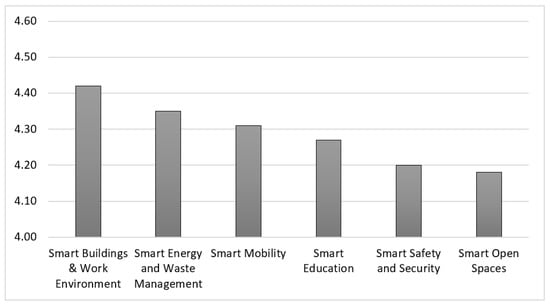
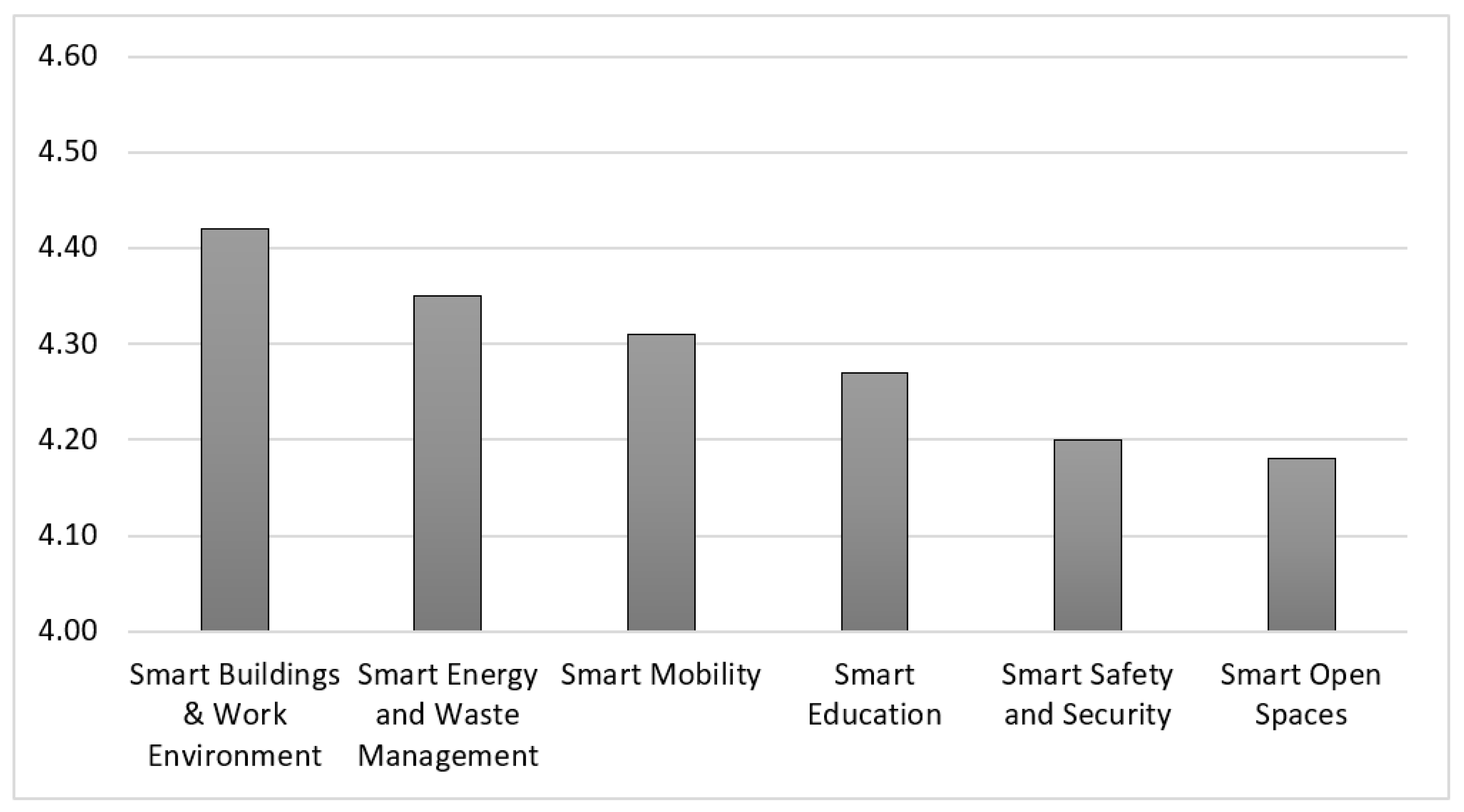
Responses have been analyzed to prioritize the investigated smart campus aspects using RII. Results are listed in Figure 1 and Table 3. In general, all the surveyed smart campus aspects seem to be attractive to the respondents as they received an overall average agreement level of 4.3 out of 5 and RII scores equal or higher than 0.77. Data clustering analysis using K-means produced a two-cluster solution based on respondents’ evaluations of the six smart campus domains. Cluster 1, which included the majority of respondents (n = 97), exhibited consistently high mean scores across all domains, with values ranging from 4.5 to 4.7. This cluster represents users who show strong overall support for smart campus initiatives and perceive high importance across educational, mobility, energy, building, safety, and open-space dimensions. In contrast, Cluster 2 (n = 58) demonstrated comparatively lower, though still positive, mean scores (ranging from 3.5 to 4.0), indicating a group of users with moderate or selective support for smart campus development. The distance between the final cluster centers (2.006) suggests adequate separation between the two groups, confirming the distinctiveness of their overall perception patterns. The two-cluster solution highlights a dominant group of highly supportive users alongside a sizable segment with more cautious or differentiated expectations, highlighting the importance of tailored smart campus strategies that address varying levels of user enthusiasm and perceived value.
Figure 1.
Respondents’ agreement level (out of 5) on the importance of the different investigated smart campus domains.
Table 3.
Respondents’ agreement level (out of 5) on the importance of the different investigated smart campus aspects, and the rank of each aspect within its domain.
On a detailed level, Smart Buildings and Work Environment ranked first (RII = 0.88), followed by Smart Energy and Waste Management (RII = 0.87), highlighting the priority of infrastructure quality and sustainability issues. This prioritization indicates that users favor technologies that deliver immediate, tangible benefits to daily campus life, particularly those enhancing comfort, efficiency, and environmental performance. Similar patterns have been reported in international smart campus studies, where stakeholders consistently prioritize these aspects over experimental or novelty-driven technologies [36,43]. Smart Mobility was ranked third (RII = 0.86), highlighting its relevance in large, spatially distributed campuses where daily movement significantly shapes user experience. This was followed by Smart Education (0.85). Smart Safety and Security and Smart Open Spaces shared the fifth rank but remained important as their RII was 0.84.
Table 3 shows agreement among respondents regarding the importance of the investigated 22 smart campus aspects. Within each domain, aspects related to technological infrastructure and operational efficiency emerged as top priorities. The aspects that were ranked highest within each domain are as follows:
- Smart Education: e-libraries (RII = 0.89).
- Smart Mobility: Smart public transportation (RII = 0.90).
- Smart Energy and Waste Management: Smart lighting systems (RII = 0.90).
- Smart Buildings and Work Environment: IoT for cooling energy optimization (RII = 0.91).
- Smart Safety and Security: Fire prevention and detection (RII = 0.89).
- Smart Open Spaces: Smart irrigation systems (RII = 0.88).
The least-ranked three aspects were smart access control (RII = 0.77) under the Smart Safety and Security domain, smart technology to maintain green areas (RII = 0.78) under the Smart Open Spaces domain, and virtual smart classroom technologies under the Smart Education domain (RII = 0.80). Their relatively lower prioritization suggests that respondents may perceive these aspects as less important or immediately impactful. The observed relatively low ranking of virtual smart classroom technologies indicates lower interest among respondents in this technology compared to the physical smart classrooms (RII = 0.89), which ranked fourth. This preference for smart physical classrooms may stem from users’ past experiences with virtual learning during the COVID-19 period, when online education was the only available mode. As reported in previous studies [44], extended reliance on virtual environments revealed several challenges, including limited face-to-face interaction with peers and instructors, difficulties in teaching practical subjects, and excessive screen time. These factors may have contributed to respondents’ comparatively lower prioritization of virtual classroom technologies and preference towards blended learning models that preserve interpersonal interaction while leveraging digital tools.
4.4. Differences Between the Sample Groups
A multiple linear regression analysis was conducted to examine whether occupational role (faculty vs. student) predicts respondents’ overall agreement level on the importance of smart campus technologies. The results indicated that the model was not statistically significant (F = 0.147, p = 0.701), explaining only 0.1% of the variance in the dependent variable (R2 = 0.001). Occupational role did not emerge as a significant predictor of overall smart campus perception (β = 0.031, t = 0.38, p = 0.701), indicating that faculty and students held largely similar overall views regarding the importance of smart campus domains. An independent-sample t-test was also conducted to examine whether significant differences exist between faculty and student perceptions across the six smart campus domains (Table 4). The results showed that, for most domains, there were no statistically significant differences between the two groups at α ≤ 0.05, indicating general agreement in how faculty and students prioritized smart campus aspects. The only significant difference appeared in Domain 2, Smart Mobility (t = −2.96, p = 0.00), where students rated this domain higher than faculty (4.45 compared to 4.17, respectively). This suggests that students place greater importance on mobility-related services and digital transportation systems, possibly reflecting their more frequent daily use of campus mobility solutions.
Table 4.
Independent-samples t-test results comparing faculty and student perceptions of the importance of the different smart campus domains.
A closer examination of the Smart Mobility domain revealed statistically significant differences between faculty and students in three key aspects: smart public transportation, smart walkability, and smart wayfinding technologies. Students rated these three aspects higher than faculty members, indicating that they place greater value on efficient and technology-enabled mobility solutions. This difference likely reflects students’ heavier reliance on campus public transportation systems and navigation tools for daily movement between facilities. Smart public transportation could reduce uncertainty and wait times associated with campus buses, thereby encouraging more people to use them [45]. This is particularly important for students, due to its direct influence on punctuality, accessibility, and overall campus livability. Additionally, given that many students attend classes overnight, further investigation is needed to examine how smart mobility can improve night-time perceived safety, for example by integrating ride-hailing services or on-demand shuttles for late hours. Faculty members, by contrast, may have more fixed schedules and less frequent need for such public services. In all cases, application of smart mobility technologies have important implications as mobility-focused initiatives are likely to improve satisfaction, predictability, and efficiency in transportation [45].
Regarding the differences among the various age groups, a one-way ANOVA was conducted to compare their perceptions across the smart campus domains. The results showed that at a significance level of α ≤ 0.05, there were no statistically significant differences among the age groups, as all p-values exceeded α. This indicates a high level of agreement across generations regarding the importance of smart campus aspects, reflecting a common awareness and acceptance of digital transformation efforts within the university community. One exception in this regard is smart mobility, where some differences were observed among the different age groups. As presented in Table 5, the results showed that perceptions of smart mobility differ across age groups, with younger respondents generally expressing more positive views. For smart public transportation, participants under 30 years reported significantly higher agreement than those aged 30–50 years (mean difference = 0.36, p = 0.03) and those over 50 years (mean difference = 0.54, p = 0.02), while no significant difference was found between the two older age groups (p = 0.65). A similar pattern was observed for smart walkability, where respondents under 30 years rated it significantly higher than those aged 30–50 years (mean difference = 0.54, p = 0.01); however, differences involving respondents over 50 years were not statistically significant (p > 0.05). Overall, these findings indicate that younger individuals tend to have more favorable perceptions of smart mobility initiatives, whereas perceptions among middle-aged and older respondents are largely comparable. This is consistent with established technology adoption research, which indicates that younger users, often described as digital natives, are more receptive to mobile technologies and real-time information services [46].
Table 5.
Scheffé post hoc analysis of smart mobility (domain 2) across the different age groups.
4.5. Data Privacy Concerns
In the final section of the questionnaire, respondents were invited to share their concerns and suggestions for improving the KFUPM campus as a smart campus. A total of 55% of participants expressed concerns about data privacy when using smart applications, particularly regarding location sharing. Some participants stated, “I don’t want my location to be known at all times” and “Smart applications sometimes track more information than necessary, creating risks of misuse, data leaks, or unauthorized access.” These concerns highlight that data privacy and cybersecurity represent significant challenges in smart campus implementation and must be carefully addressed to ensure users’ comfort, trust, and safety [47]. The rest of the respondents (45%) were less concerned. This could be related to their trust in the university’s secure IT infrastructure, suggesting that institutional credibility can mitigate privacy concerns. For example, one respondent stated “I would be concerned if it was an open network, but for the university’s network, I think it will be alright.”
Correlation analysis was performed to find out if data privacy concern is related to the sample characteristics, namely gender, occupation (faculty or student), age group, and knowledge level about smart technologies. Contingency coefficients were computed for nominal-by-nominal associations to determine the strength of the relationship between users’ privacy concern and their characteristics mentioned above. As presented in Table 6, results of the contingency coefficient analysis showed that there were no statistically significant associations between respondents’ demographic variables and their responses on data privacy concern considering a significance level of α ≤ 0.05. The contingency coefficient values for gender, occupational role, age group, and knowledge level about smart technologies all reflect weak relationships, suggesting that respondents’ concerns about data privacy were generally consistent across different demographic and knowledge-based groups. To mitigate this, some best practices identified in the literature may be observed, including data privacy models and clear explanations of how data are stored and used [48]. Additionally, a phased implementation strategy, beginning with low-risk applications such as energy monitoring, can further support trust-building by demonstrating benefits while minimizing perceived risks related to data privacy.
Table 6.
Nominal-by-nominal correlation between users’ occupational role and their concern about data privacy using contingency coefficients.
4.6. Future Opportunities and Suggestions
The Saudi context considered in this study adds a distinctive dimension, particularly through strong alignment with national development strategies and centralized support for digital transformation. Smart campus initiatives in this regard can be realized as micro-level analogs of a broader national smart city programs, linking institutional innovation with broader development goals and social responsibility. The study’s results strongly align with the strategic objectives of Saudi Arabia’s Vision 2030, particularly its focus on digital transformation, educational modernization, and environmental sustainability [7]. This alignment creates opportunities for accelerated implementation, provided that user concerns, especially around privacy and inclusivity, are adequately addressed. The prioritization of smart buildings, energy management, and mobility reflects national ambitions to improve infrastructure efficiency, reduce environmental impact, and enhance quality of life. In addition, the emphasis on smart mobility supports quality of life objectives by improving accessibility and economic growth in the Saudi cities. Respondents also proposed several suggestions to enhance smart campus development, including
- Educating and training users on the effective and responsible use of smart technologies.
- Implementing smart technologies initially in low-privacy areas to build user confidence before extending to more sensitive applications.
- Promoting smart technology initiatives through incentives and awareness programs for students and staff.
5. Conclusions
The past few years have seen significant progress in both the development and implementation of smart campus initiatives. The benefits of these initiatives are being progressively realized in terms of sustainability, operational efficiency, and enriched educational experiences, though not without challenges. By critically analyzing current opportunities and challenges in a given urban context, stakeholders can make informed decisions to establish sustainable and human-centric environments that are based on users’ needs and values. The development of smart campuses in Saudi Arabian universities holds significant promise and is closely tied to the nation’s digital transformation plans. The next few years will likely witness Saudi campuses increasingly transforming into intelligent ecosystems, which requires national action plans to support continued investment, capacity-building, and stakeholders’ collaboration in this regard. This study aimed to evaluate the preferences of campus users at KFUPM regarding the prioritization of various smart campus aspects. A structured questionnaire was distributed to students and faculty, covering 22 aspects across six domains: smart education, smart mobility, smart energy and waste management, smart buildings and work environment, smart safety and security systems, and smart open spaces. Data were analyzed to arrive at stakeholder-driven prioritization evidence from Saudi universities.
Results showed a strong overall agreement on the importance of all the investigated smart campus aspects, with an average rating of 4.3 out of 5.0 and RII that ranges between 0.77 and 0.91. Data clustering analysis highlighted a dominant group of highly supportive users alongside a sizable segment with more cautious or differentiated expectations, highlighting the importance of tailored smart campus strategies that address varying levels of user enthusiasm and perceived value. The domain of Smart Buildings and Work Environment was ranked highest (RII = 0.88), followed by Smart Energy and Waste Management (RII = 0.87), emphasizing respondents’ prioritization of infrastructure quality and sustainability aspects. Within each domain, the top-priority aspects identified were as follows: e-libraries (RII = 0.89) in Smart Education, smart public transportation (RII = 0.90) in Smart Mobility, smart lighting systems (RII = 0.90) in Smart Energy and Waste Management, IoT for cooling energy optimization (RII = 0.91) in Smart Buildings and Work Environment, fire prevention and detection systems (RII = 0.89) in Smart Safety and Security, and smart irrigation systems (RII = 0.88) in Smart Open Spaces.
Statistical analyses showed general agreement between faculty and students in this regard, except for Smart Mobility, which was significantly rated higher by students, reflecting their greater reliance on campus transportation and more dynamic movement patterns. Age was also found to influence perceptions of smart mobility, where younger respondents expressed significantly stronger support for app-based and data-driven mobility solutions. Finally, 55% of respondents raised concerns about data privacy and cybersecurity, particularly regarding location tracking, emphasizing the need for robust data protection policy in smart campus projects. Results of the contingency coefficient analysis showed that there were no statistically significant associations between respondents’ demographic variables, namely gender, occupational role, age group, and knowledge level about smart technologies, and their responses on data privacy concern, suggesting that these concerns were generally consistent across the different groups of respondents.
The presented methodology and developed tool could be implemented in additional case studies to share experience about the impact of context-specific factors such as cultural and climatic factors. There is also a need for longitudinal research examining the overall impact of smart campus technologies on institutional performance such as graduation rates, research output, and cost savings.
Author Contributions
Conceptualization, O.S.A. and O.E.A.-M.; methodology, O.S.A. and O.E.A.-M.; formal analysis, O.S.A.; investigation, O.S.A.; resources, O.E.A.-M.; writing—original draft preparation, O.S.A.; writing—review and editing, O.S.A. All authors have read and agreed to the published version of the manuscript.
Funding
This study was funded by King Fahd University of Petroleum and Minerals (KFUPM).
Institutional Review Board Statement
The Institutional Review Board (IRB) at King Fahd University of Petroleum & Minerals (KFUPM) has determined that this study is exempt from IRB review under the category of educational re-search/survey exemption (ref. IRB-KFUPM-2025-028).
Informed Consent Statement
Informed consent for participation was obtained from all subjects involved in the study.
Data Availability Statement
The data presented in this study are available upon request from the corresponding author.
Acknowledgments
The authors acknowledge KFUPM Fund and KFUPM Deanship of Research for financial support.
Conflicts of Interest
The authors declare no conflicts of interest.
References
- Min-Allah, N.; Saleh Alrashed, S. Smart campus—A sketch. Sustain. Cities Soc. 2020, 59, 102231. [Google Scholar] [CrossRef] [Scilit] [PubMed]
- Wang, X.; Cai, Q.; Li, D.; Hong, L.; Ma, Z.; Zhu, W.; Qian, L.; Sun, J.; Fan, Z.; Xie, C. From concept to reality: The practical implementation of a laboratory-based smart water campus model. Sustainability 2025, 17, 221. [Google Scholar] [CrossRef] [Scilit]
- Musa, M.; Ismail, M.N.; Fudzee, M.F.M. A survey on smart campus implementation in Malaysia. Int. J. Inform. Vis. 2021, 5, 51–56. [Google Scholar] [CrossRef] [Scilit]
- Silva-da-Nóbrega, P.I.; Chim-Miki, A.F.; Castillo-Palacio, M. A Smart Campus Framework: Challenges and Opportunities for Education Based on the Sustainable Development Goals. Sustainability 2022, 14, 9640. [Google Scholar] [CrossRef] [Scilit]
- Pérez, F.; Berná-Martínez, J.V.; Lorenzo-Fonseca, I. Modeling and implementing smart universities: An IT conceptual framework. Sustainability 2021, 13, 3397. [Google Scholar] [CrossRef] [Scilit]
- Polin, K.; Yigitcanlar, T.; Limb, M.; Washington, T.L. Smart campus performance assessment: Framework consolidation and validation through a Delphi study. Buildings 2024, 14, 4057. [Google Scholar] [CrossRef] [Scilit]
- Saudi Vision 2030. National Transformation Program. 2025. Available online: https://www.vision2030.gov.sa/en/explore/programs/national-transformation-program (accessed on 28 December 2025).
- Alenezi, M.; Akour, M. Digital Transformation Blueprint in Higher Education: A Case Study of PSU. Sustainability 2023, 15, 8204. [Google Scholar] [CrossRef] [Scilit]
- Ceccarini, C.; Mirri, S.; Prandi, C. Designing interfaces to display sensor data: A case study in the human-building interaction field targeting a university community. Sensors 2022, 22, 3361. [Google Scholar] [CrossRef] [Scilit]
- Cruz-Rodríguez, J.; Luque-Sendra, A.; de las Heras García de Vinuesa, A.; Zamora-Polo, F. Analysis of interurban mobility in university students: Motivation and ecological impact. Int. J. Environ. Res. Public Health 2020, 17, 9348. [Google Scholar] [CrossRef] [Scilit]
- Omotayo, T.; Awuzie, B.; Ajayi, S.; Moghayedi, A.; Oyeyipo, O. A systems thinking model for transitioning smart campuses to cities. Front. Built Environ. 2021, 7, 755424. [Google Scholar] [CrossRef] [Scilit]
- Adenle, Y.A.; Chan, E.H.W.; Sun, Y.; Chau, C.K. Assessing the relative importance of sustainability indicators for smart campuses: A case of higher education institutions in Nigeria. Environ. Sustain. Indic. 2021, 9, 100092. [Google Scholar] [CrossRef] [Scilit]
- Martins, P.; Lopes, S.I.; Rosado da Cruz, A.M.; Curado, A. Towards a smart & sustainable campus: An application-oriented architecture to streamline digitization and strengthen sustainability in academia. Sustainability 2021, 13, 3189. [Google Scholar] [CrossRef] [Scilit]
- Mazutti, J.; Brandli, L.; Salvia, A.L.; Gomes, B.M.F.; Damke, L.I.; da Rocha, V.T.; dos Santos Rabello, R. Smart and learning campus as living lab to foster education for sustainable development: An experience with air quality monitoring. Int. J. Sustain. High. Educ. 2020, 21, 1311–1330. [Google Scholar] [CrossRef] [Scilit]
- Asfour, O.S.; Alkharoubi, A.M. Challenges and Opportunities in Online Education in Architecture: Lessons Learned for Post-Pandemic Education. Ain Shams Eng. J. 2023, 14, 102131. [Google Scholar] [CrossRef] [Scilit]
- Khan, M.A.; Rehman, A.; Shah, A.A.; Abbas, S.; Alharbi, M.; Ahmad, M.; Ahmad, M.; Ghazal, T.M. Navigating the future of higher education in Saudi Arabia: Implementing AI, machine learning, and big data for sustainable university development. Discov. Sustain. 2025, 6, 495. [Google Scholar] [CrossRef] [Scilit]
- Bellaj, M.; Bendahmane, A.; Younes, A.; Boudra, S.; Ennakra, M. A systematic review of smart campus technologies to improve students’ educational experiences. In Proceedings of the 2024 Mediterranean Smart Cities Conference (MSCC), Martil-Tetuan, Morocco, 2–4 May 2024; pp. 1–7. [Google Scholar] [CrossRef] [Scilit]
- Chen, S.; Li, Q.; Wang, T. Smart Campus and Student Learning Engagement. Int. J. Inf. Commun. Technol. Educ. (IJICTE) 2024, 20, 1–22. [Google Scholar] [CrossRef] [Scilit]
- Vidal-Balea, A.; Blanco-Novoa, O.; Picallo-Guembe, I.; Celaya-Echarri, M.; Fraga-Lamas, P.; Lopez-Iturri, P.; Azpilicueta, L.; Falcone, F.; Fernández-Caramés, T.M. Analysis, design and practical validation of an augmented reality teaching system based on Microsoft HoloLens 2 and edge computing. Eng. Proc. 2020, 2, 52. [Google Scholar] [CrossRef] [Scilit]
- Khamis, N.; Li, K.K.K. User experience evaluation for a bus tracking app in a smart campus initiative. Bull. Electr. Eng. Inform. 2021, 10, 2254–2262. [Google Scholar] [CrossRef] [Scilit]
- Koszewski, K.; Olszewski, R.; Pałka, P.; Walczak, R.; Korpas, P.; Dąbrowska-Żółtak, K.; Wyszomirski, M.; Czeranowska-Panufnik, O.; Manujło, A.; Szczepankowska-Bednarek, U.; et al. Utilizing IoT sensors and spatial data mining for analysis of urban space actors’ behavior in university campus space design. Sensors 2025, 25, 1393. [Google Scholar] [CrossRef] [Scilit]
- Bandória, L.H.T.; Cortes, B.; Almeida, M.C. Statistical characterization of electricity use profile: Leveraging data analytics for stochastic simulation in a smart campus. Energy Build. 2024, 324, 114934. [Google Scholar] [CrossRef] [Scilit]
- Gasperina, L.; Mazutti, J.; Brandli, L.; dos Santos Rabello, R. Smart practices in HEIs and the contribution to the SDGs: Implementation in Brazilian university. Int. J. Sustain. High. Educ. 2022, 23, 356–378. [Google Scholar] [CrossRef] [Scilit]
- Longo, E.; Sahin, F.A.; Redondi, A.E.C.; Bolzan, P.; Bianchini, M.; Maffei, S. A 5G-enabled smart waste management system for university campus. Sensors 2021, 21, 8278. [Google Scholar] [CrossRef] [Scilit] [PubMed]
- Acosta, K.P.; Palaoag, T.D. Design of a gender responsive smart campus surveillance with IoT integration and stakeholders’ adaptability. Proc. Eng. Sci. 2024, 6, 1465–1472. [Google Scholar] [CrossRef] [Scilit]
- Reddy, P.D.K.; Margala, M.; Shankar, S.S.; Chakrabarti, P. Early fire danger monitoring system in smart cities using optimization-based deep learning techniques with artificial intelligence. J. Reliab. Intell. Environ. 2024, 10, 197–210. [Google Scholar] [CrossRef] [Scilit]
- Al-Khawaja, S.; Asfour, O.S. The Impact of COVID-19 on the Importance and Use of Public Parks in Saudi Arabia. Ain Shams Eng. J. 2024, 15, 102286. [Google Scholar] [CrossRef] [Scilit]
- Fortes, S.; Hidalgo-Triana, N.; Sánchez-la-Chica, J.-M.; García-Ceballos, M.-L.; Cantizani-Estepa, J.; Pérez-Latorre, A.-V.; Baena, E.; Pineda, A.; Barrios-Corpa, J.; García-Marín, A. Smart Tree: An architectural, greening and ICT multidisciplinary approach to smart campus environments. Sensors 2021, 21, 7202. [Google Scholar] [CrossRef] [Scilit]
- García, L.; Parra, L.; Jimenez, J.M.; Lloret, J.; Lorenz, P. IoT-Based Smart Irrigation Systems: An Overview on the Recent Trends on Sensors and IoT Systems for Irrigation in Precision Agriculture. Sensors 2020, 20, 1042. [Google Scholar] [CrossRef] [Scilit]
- Hu, X.; Li, J. Research on the integrated solution of physical education based on smart campus. Adv. Physiol. Educ. 2024, 48, 378–384. [Google Scholar] [CrossRef] [Scilit]
- Xie, X.; Zheng, L.; Wang, R.; Gou, Z. Visitors’ experience of using smart facilities in urban parks: A study in Shenzhen. J. Outdoor Recreat. Tour. 2024, 46, 100759. [Google Scholar] [CrossRef] [Scilit]
- Imbar, R.V.; Supangkat, S.H.; Langi, A.Z.R.; Arman, A.A. Development of an instrument to measure smart campus levels in Indonesian institutions of higher education. Glob. J. Eng. Educ. 2022, 24, 95–104. [Google Scholar]
- Elshapasy, R.A.; Mohamed, S.F. A framework transformation of a traditional campus into a bio-tech smart-digital campus. Int. J. Environ. Impacts 2024, 7, 269–275. [Google Scholar] [CrossRef] [Scilit]
- Wei, B.; Zhuo, Y.; Zeng, H.; Hong, H.; Liu, H. Determinants of university students’ attitudes towards smart devices in the smart campus environment. Humanit. Soc. Sci. Commun. 2025, 12, 1543. [Google Scholar] [CrossRef] [Scilit]
- Sneesl, R.; Jusoh, Y.Y.; Jabar, M.A.; Abdullah, S.; Bukar, U.A. Factors Affecting the Adoption of IoT-Based Smart Campus: An Investigation Using Analytical Hierarchical Process (AHP). Sustainability 2022, 14, 8359. [Google Scholar] [CrossRef] [Scilit]
- Elbertsen, M.; Kok, H.; Salimi, N. Designing the future smart campus: Integrating key elements to enhance user experience. J. Sci. Technol. Policy Manag. 2025, 16, 117–137. [Google Scholar] [CrossRef] [Scilit]
- KAU. Digital Transformation Center. 2025. Available online: https://kau.edu.sa/en/page/digital-transformation-center (accessed on 8 November 2025).
- DGA (Digital Government Authority in Saudi Arabia). Authority Programs. 2025. Available online: https://dga.gov.sa/en/listing-programmes (accessed on 8 November 2025).
- KFUPM. KFUPM’s History. 2025. Available online: https://www.kfupm.edu.sa/about-us/our-story/history (accessed on 13 November 2025).
- KFUPM. Advancing Knowledge Through Purposeful Research. 2025. Available online: https://www.kfupm.edu.sa/research/our-research/our-research-centers (accessed on 13 November 2025).
- QS Top Universities. About KFUPM. 2025. Available online: https://www.topuniversities.com/universities/kfupm#p2-university-information (accessed on 18 December 2025).
- Standard Insights. Sample Size Calculator. Available online: https://standard-insights.com/tools/sample-size-calculator/ (accessed on 27 December 2025).
- Tomás-Miquel, J.V.; Capó-Vicedo, J.; Capó, J.; Mataix Domínguez, A. Beyond technology in the transition to smart campuses: The importance for policy-makers of the university community’s perception. Innov. Eur. J. Soc. Sci. Res. 2023, 36, 361–380. [Google Scholar] [CrossRef] [Scilit]
- Stecuła, K.; Wolniak, R. Advantages and Disadvantages of E-Learning Innovations during COVID-19 Pandemic in Higher Education in Poland. J. Open Innov. Technol. Mark. Complex. 2022, 8, 159. [Google Scholar] [CrossRef] [Scilit]
- Mat Tahir, M.S.; Yi, K.W.; Mohtar, S.; Ikram, R.R.R.; Othman, Z. Smart Mobility on Campus: A Real-Time GPS Bus Tracking System With Cloud Integration. Int. J. Res. Innov. Soc. Sci. 2025, 9, 17–33. [Google Scholar] [CrossRef] [Scilit]
- Bag, S.; Aich, P.; Islam, M.A. Behavioral intention of “digital natives” toward adapting the online education system in higher education. J. Appl. Res. High. Educ. 2022, 14, 16–40. [Google Scholar] [CrossRef] [Scilit]
- Domínguez-Bolaño, T.; Barral, V.; Escudero, C.J.; García-Naya, J.A. An IoT system for a smart campus: Challenges and solutions illustrated over several real-world use cases. Internet Things 2024, 25, 101099. [Google Scholar] [CrossRef] [Scilit]
- Razi, Q.; Piyush, R.; Chakrabarti, A.; Singh, A.; Hassija, V.; Chalapathi, G.S.S. Enhancing Data Privacy: A Comprehensive Survey of Privacy-Enabling Technologies. IEEE Access 2025, 13, 40354–40385. [Google Scholar] [CrossRef] [Scilit]

Disclaimer/Publisher’s Note: The statements, opinions and data contained in all publications are solely those of the individual author(s) and contributor(s) and not of MDPI and/or the editor(s). MDPI and/or the editor(s) disclaim responsibility for any injury to people or property resulting from any ideas, methods, instructions or products referred to in the content. |
© 2026 by the authors. Licensee MDPI, Basel, Switzerland. This article is an open access article distributed under the terms and conditions of the Creative Commons Attribution (CC BY) license.