


Abstract
To mitigate the environmental footprint of the aviation sector, this study proposes an integrated cascading biorefinery scheme to produce Sustainable Aviation Fuel (SAF) precursor bloodstock via enzymatic transesterification of coconut oil. Utilizing a synergistic binary alcohol system (ethanol-butanol) and the liquid lipase Eversa Transform 2.0, a strategic molecular reconfiguration of fatty acid esters was achieved. Optimization through Response Surface Methodology (RSM) identified critical parameters—5% catalyst loading, total binary alcohol-to-oil molar ratio of 7:1 (specifically comprised of a 2.5:4.5:1 ethanol/butanol/coconut oil matrix), and an operation temperature of 57.5 °C—yielding a 97% conversion efficiency. A sequential vacuum fractional distillation process was implemented to partition the ethyl-butyl esters into high-value streams. Notably, the light distillate fraction, characterized by a specific carbon chain distribution (C6: 27.2%, C8: 52.5%, C10: 6%, and C12: 13.6%), perfectly aligns with the molecular window of aviation kerosene. This fraction exhibits excellent cold-flow properties, viscosity, and volatility profiles, positioning it as an ideal high-performance SAF precursor blendstock to increase the renewable content of current aviation fuels. Simultaneously, the remaining C16–C18 residue serves as a high-density energy source for internal refinery processes, while C8–C14 species are recovered as high-purity chemical feedstocks. This circular model maximizes carbon atom economy and economic viability by cogenerating high added-value biochemicals alongside jet-grade blendstocks. These findings provide a scalable, enzymatic framework for the next generation of decarbonized aviation fuels.
1. Introduction
The bio-economy encompasses all activities related to the production and transformation of biomass, whether of agricultural, forestry, or aquaculture origin, for the purposes of food production (human or animal), bio-based chemistry, bio-based materials, or energy [1,2]. Hence, biorefineries are being developed as technological means for the transition to this economic approach, opening the opportunity to add value to biomass through more sustainable production [3]. Sustainable development has become the key of the 21st century in the search for a green engineering process. Considerable importance is attached to the use of renewable raw materials like vegetable oils. Due to environmental considerations concerning sustainable development and others, like their possible contribution to regional development and supporting agriculture in times of surplus production, renewable resources are currently attracting increasing interest as raw material for industry.
In this sense, the synthesis process itself has strong potential to develop further and provide a core tool for the application of new innovative technology. Furthermore, process integration can be used to maintain low costs and thus aid these processes in being competitive in a market presently dominated by products produced from other sources of raw materials, specifically fossil fuels such as petroleum and natural gas [4]. Chemical processes that include environmental issues in the selection of reagents and reaction conditions are increasingly gaining importance as both industrial and academic researchers take notice of the “green” or environmentally friendly approach [5].
Fats and oils based on lauric acid (dodecanoic acid) have attracted a great deal of interest in recent years [6]. Coconut oil pertains to a unique group of vegetable oils known as lauric oils. The most common fatty acid in this group is lauric acid, with most coconut oils generally containing between 46% and 49% lauric acid [7]. Coconut (Cocos nucifera L.) is cultivated in about 93 countries, with the largest cultivation areas and exporting countries being Indonesia, the Philippines, India, and Malaysia [8]. At present, 90% of the world’s supply is from Asia, where it is a major source of revenue for several countries. A major natural product produced from the nut (copra) is coconut oil [9].
Ethanol and butanol are derived from agricultural products [10,11]; they are renewable and environmentally less bio-objectionable sources of energy [12]. Ethanol and butanol fermentation (ABE) has attracted renewed interest recently in the sense of biorefinery approaches for the obtention of fuels and chemicals from renewable resources [11]. In comparison to methanol, ethanol and butanol are safer to handle, as the human toxic effects of fume expose are minimized [13].
The production of ethyl and butyl esters instead of methyl esters is of great interest, as it offers the possibility of obtaining a fuel that is fully an agro-fuel [14]. In addition, biobutanol, which is produced from renewable sources, is a molecule that has more energy than ethanol and is less soluble in water but with the inconvenience of being more toxic [15].
Aviation is still a major cause of climate change, even with recent advances in fuel efficiency [16]. This sector, responsible for 2.1% of all man-made CO2 emissions and 12% of all transport-related emissions, is already the world’s second largest source of greenhouse gases [17,18]. With the increasing demand for air transport, emissions from international aviation are projected to increase threefold by 2050 [19,20]. Bio-jet fuel (BJF) or Sustainable Aviation Fuels (SAF) is key to significant and immediate reductions in aviation’s carbon footprint [21].
BJF is proposed as an alternative to reach a balance between sustainability and service [22,23]. BJF is a non-petroleum jet fuel that is made by recycling sustainable feedstocks, agricultural residues, sawdust, or wastewater, including used cooking oil, which, while it would normally be disposed of, may be used as a valid feedstock to produce BJF [24,25].
It should be pointed out that the type of feedstock influences the final product quality and properties [26]. L.N. Silva et al. have investigated the possibility of making biokerosene from macauba oils by a catalytic deoxygenation reaction [27]. Non-edible sunflower oil also has been employed as a feedstock for BJF production by a catalytic process, which yielded carbon chains of approximately C7 and C43 [28].
This mixture can be applied not only to the production of BJF but also to renewable gasoline, diesel, and heavier fractions for marine engines. BJF containing n-paraffins, isoparaffins, and aromatic compounds has been produced from inedible soybean oil [29]. Lignocellulosic biomass could be converted to BJF by flash pyrolysis or hydrodeoxygenation (HDO) [30]. Thus, it has been reported that straw as a feedstock has been converted via flash pyrolysis into C8–C15 hydrocarbons meeting the technical specifications of jet fuels [31]. Y. K. Chen et al. produced BJF via the same process using rice husk as feedstock [32]. Microalgae are another potential feedstock for jet fuel production via the hydrothermal liquefaction process [33]. In order to further develop the circular economy, new options such as plastic waste could be important sources of raw material to be processed into BJF [34,35]. In this regard, W. Mateo et al. were able to transform biomass and plastic waste via catalytic pyrolysis into BJF (aromatics and C9–C16 alkanes) [36]. Mei Yin Ong and co-workers were able to produce bio-kerosene (biofuel), which is a renewable fuel to operate a gas turbine engine, via vacuum distillation of a mixture of biodiesel (fatty acid ethyl esters) from microwave-assisted trans-esterification of coconut oil with ethanol [37]. The optimum biofuel production yield for jet was 74.45%, obtained with an ethanol-to-oil molar ratio of 9.25:1 under microwave irradiation (163.69 W) for 12.66 min. The authors also revealed that the biofuel produced had properties compared to the American Society for Testing and Materials (ASTM) D1655 standard. Afterward, the authors used modeling (Response Surface Methodology and Artificial Neural Network Methodology) to optimize this process. Thus, catalytic hydrotreatment of esters and/or fatty acids represents the most established route to produce jet biofuels. This process is conducted via several reactions: hydrodeoxygenation, hydrocracking, and hydro-isomerization, depending on the chemical composition of the feedstock, the catalyst used, and the desired fuel properties. In the case of heterogeneous processes, these transformations of esters and fatty acids are generally carried out under H2 pressures and high temperatures. Rodolpho R. C. Monteiro presented a bibliographic synthesis about the catalytic hydrotreatment of esters, whether through heterogeneous or enzymatic catalysis, together with the main materials used [38].
Recent research in aviation decarbonization has shifted from the pursuit of generic biodiesel production toward the development of specialized niche feedstocks capable of yielding specific drop-in fuels. Unlike conventional methods that produce broad mixtures of fatty acid esters, there is an increasing demand for targeted processes that can tailor the molecular composition of fuels to meet the rigorous physical and chemical requirements of jet-grade kerosenes.
Enzymatic transesterification reactions employing lipases present several advantages compared to conventional catalysts: they display higher selectivity, can operate under mild reaction conditions, exhibit few side reactions, and yield products of high purity [39].
Lipases can catalyze esterification, inter-esterification, and transesterification reactions in non-aqueous environments. This great feature and the protein engineering progress have caused lipases to become one of the most used enzymes by industry. The lipases hydrolyze triacylglycerols at the aqueous-nonaqueous interface; however, these enzymes may also catalyze the production of esters from long-chain fatty acids and alcohols in a low humidity environment [40].
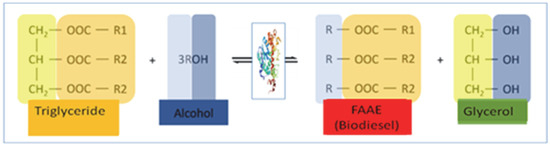
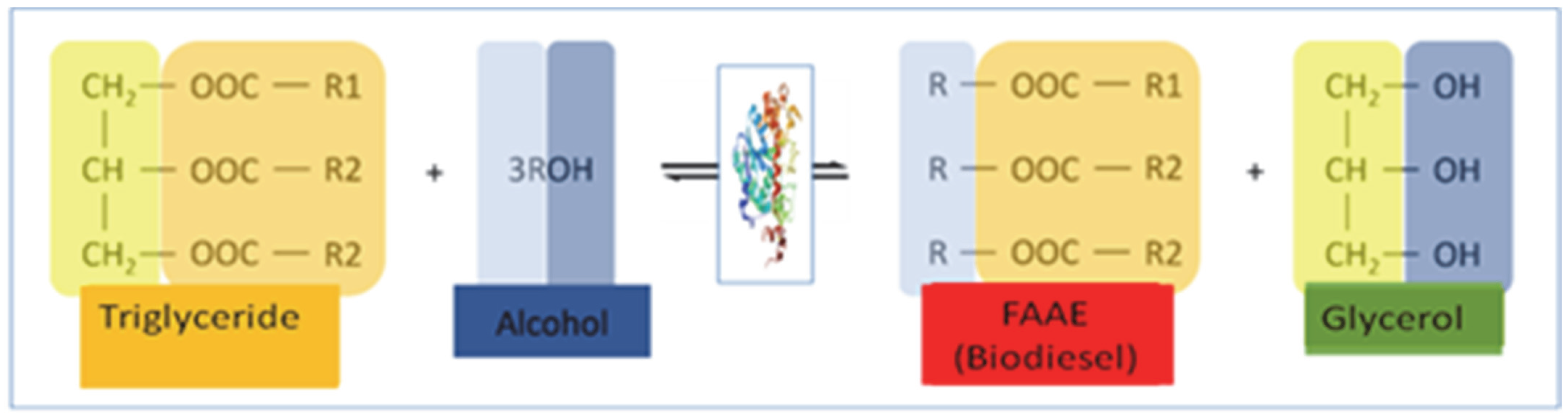
Taking a closer view of the catalytic mechanism, lipases perform a two-step mechanism for the formation of fatty acid alkyl esters in transesterification reactions, typically by means of the Ping-Pong Bi-Bi mechanism [41]. In the transesterification reaction, the acyl group of the ester or triacylglycerol is replaced with the alkyl groups of a nucleophilic agent, typically an alcohol, and is therefore called alcoholysis. It is one of the more important and commonly used reactions industrially, especially in the biodiesel reaction. Figure 1 shows the complete process converting triacylglycerols to biodiesel and glycerol-like end products. Like any biochemical reaction, the reversed synthesis reaction also occurs at the molecular scale. The lipase specificity varies depending on the length of the fatty acids, the double bonds, and the presence of branched groups, and, as a consequence, the reaction rates can vary significantly depending on the composition of the triglycerols. Lipases are particularly effective against medium- to long-chain fatty acids, which are the most common in biofuel production [42].
Figure 1.
Enzymatic transesterification reaction of triglyceride producing fatty acids, alkyl esters (FAAE), and glycerol.
Certain lipases are non-specific and are able to act on any of the ester bonds of triglycerols and thus cleave the triglycerols to liberate free fatty acids and glycerol-like end products. Enzymes can therefore turn out a large range of substrates and catalyze a wide variety of different types of reactions and therefore have many applications in the pharmaceutical, food, detergent, and biofuel industries [43].
In fact, the stability and reusability of lipases under the conditions used in biofuel production are limited. The process is more time consuming than using alkaline catalysis, and, in many cases, yields are lower as well. To feed the multi-billion-dollar enzyme market, various enzyme formulations are offered by big companies for large-scale industrial process applications. In the energy sector for biofuel production (e.g., biodiesel and 2G ethanol), new enzyme formulations with improved stability and functionality are regularly introduced into the market. Recent studies on lipases have shown an improved enzyme recyclability of up to 12 times and an increasing yield of biodiesel from soybean oil (97%), indicating promising results in the field of biofuels [44]. Enzymatic catalysis for BJF production appears to be a great alternative with numerous advantages due to their high selectivity as well as the need for mild operational conditions.
In order to improve the sustainability of the process and reduce production costs, an enzymatic catalysis will be used that allows working at lower temperatures and pressures (ideally at atmospheric pressure) and that also reduces or completely avoids the use of H2.
Within this framework, the present study proposes an integrated biorefinery pathway for the selective production of SAF precursor blendstocks and high-added-value biochemicals through the enzymatic transesterification of coconut oil. A key innovation of this work is the application of a synergistic ethanol-butanol binary system, strategically employed to manipulate the ester molecular structure, thereby addressing the stringent low-temperature performance requirements of the aviation sector. Furthermore, the transesterification process was rigorously optimized using a Design of Experiments (DoE) framework, combining factorial design and Response Surface Methodology (RSM). This systematic approach ensures optimal control over reaction variables, maximizing both process efficiency and carbon atom economy while minimizing research time, energy consumption, and environmental waste.
The choice of a coconut lipid matrix is dictated by its unique fatty acid profile, which naturally contains over 60% short–medium-chain saturated fatty acids (C6–C12), a distribution completely absent in waste cooking oils or jatropha (predominantly C18). To ensure economic viability and avoid food-vs.-fuel conflicts, this process targets low-grade Coconut Fatty Acid Distillates (CFAD), a non-edible refining waste. Economically, the high cost of the lipid feedstock is amortized by the cascading design: the extraction of the specialty chemical fraction (C8–C14) targets high-margin markets, effectively subsidizing the production cost of the biofuels stream.
2. Materials and Methods
2.1. Equipment
The experiments were conducted in a discontinuous stirred reactor of 500 cm3 volume. This reactor had temperature and speed control and was submerged in a thermostatic bath able to keep the reaction temperature within ±0.1 °C of the target value by using an electrical control device connected to a PID control. The speed of the impeller was checked between 350 and 900 rpm, and the value of 450 rpm was considered adequate to prevent the limitation of external mass transfer [45].
2.2. Materials
The coconut oil was provided by Gracomsa Alimentaria (Valencia, Spain). The fatty acids (FA) content of the oil was measured in accordance with the official AOCS method. The FA contents and physicochemical properties of the coconut oil are listed in Table 1. Panreac (Valencia, Spain) provided ethanol and butanol with a purity of 99.8%. The catalyst utilized was Eversa Transform 2.0, which was kindly supplied by Novozymes (Bagsværd, Copenhague, Denmark).
Table 1.
Physicochemical properties and fatty acids composition of coconut oil.
2.3. Procedure
The experiments were carried out as follows: Coconut oil was fed into the reactor equipped with a reflux condenser. When the required temperature was achieved, the catalyst and alcohol (ethanol in the first step and ethanol-butanol mixture in the second step) were introduced, and subsequently the speed of the impeller was adjusted to the operational level. Samples were collected at periodic intervals and analyzed by gas chromatography (GC). The pressure and impeller speed were kept constant during the experiments.
The reaction time is considered one of the important experimental parameters that play a crucial role in relation to economic aspects and energy consumption [46]. Previous studies were performed using ethanol-like alcohol in the transesterification reaction to determine the reaction time of the transesterification reaction. The reaction kinetics were monitored for 8 h. The results obtained indicate that equilibrium was achieved in 6 h with a 74% conversion. An additional increment of the reaction time did not have any effect on the yield of the ethyl esters. Thus, a reaction time of 6 h was considered as the optimum time to obtain the maximum yield of ethyl esters.
Fractional Distillation and Product Recovery
The isolation of the bio-jet Ffuel (BJF) precursor fraction from the crude ethyl-butyl ester mixture was performed via vacuum fractional distillation. The process was conducted in a specialized distillation apparatus equipped with a silicone oil bath for precise temperature control. To ensure optimal separation and prevent thermal degradation of the ester chains, the system operated under a constant vacuum of 0.5 mmHg, utilizing a temperature gradient ranging from 90 °C to 150 °C over a 90-min period. The specific BJF-enriched fraction (C6–C12) was collected based on its respective boiling point range. The chemical composition and carbon chain distribution of the resulting distillate were subsequently quantified using gas chromatography (GC) analysis.
2.4. Analytical Methods
The reaction products were analyzed by gas chromatography on capillary column, by means of an Agilent Technologies 6890N chromatograph fitted with a flame ionization detector (FID). A split-splitless injection system was used. Helium was used as the carrier gas at a flow rate of 1 mL/min. An initial oven temperature of 50 °C was used for the separation program, which was ramped at 4 °C/min to 160 °C for 1 min and then ramped at 30 °C/min to 320 °C and held for 20 min to conclude the program. The remaining operating conditions of the analysis have been reported in a previous work in detail [47]. Structural identification of the linear fatty acid ethyl and butyl esters (C6 to C18) was rigorously established by comparing retention times with certified pure reference standards (Sigma-Aldrich, Madrid, Spain). Quantification was performed via GC-FID using internal standard calibration curves. Peak resolution and baseline stability were verified to ensure analytical reliability. The resulting fractions containing the distribution of fatty acid alkyl esters were analyzed via gas chromatography using an internal standard calibration protocol. For the analysis of the samples, the following procedures were applied: acid value (AV) (AOCS Ca 5a-40), moisture content (Karl Fischer method), iodine value (IV) (AOCS Cd 1-25), and viscosity ν (ISO 3104) [48]. Stability to oxidation of the esters was measured by the Rancimat method, with the use of the Metrohm 743 Rancimat (Herisau, Switzerland). Pour point (PP), cloud point (CP), and cold filter plugging point (CFPP) of the esters were determined with an automatic cloud point and pour point measurement analyzer (CPP 97-2), in accordance with ASTM D97 and ASTM D2500 methods.
2.5. Statistical Analysis
As a preliminary phase of this research, the transesterification of coconut oil was first optimized using a monohydric ethanol system to establish a baseline performance. The synthesis of these ethyl esters (EE) was evaluated and optimized through a 23 full factorial design, which was subsequently expanded into a Response Surface Methodology (RSM) framework [49]. This initial approach allowed for the systematic identification of the governing variables and the establishment of optimal reaction conditions, providing the foundation for the subsequent development of the enhanced ethanol-butanol binary system.
The factors were chosen taking into account the chemical and economic parameters of the process. Selected factors were the reaction temperature, XT, the initial catalyst concentration, XC, and the initial alcohol-to-oil molar ratio, XMR. The operating pressure was set at 760 mmHg, the impeller velocity at 450 rpm, and the reaction time at 6 h. The levels were chosen on the basis of the results obtained in a preliminary study, taking into account the limits of the experimental equipment and the limits of the operational conditions for each chemical species. Such considerations allowed the upper temperature level to be set at 82 °C, to prevent the loss of enzyme activity caused by high temperatures. Lower temperatures below 45 °C are not conducive to efficient enzymatic activity [42], and thus the yields reached at these conditions would be too low for industrial applications. Because of this, the minimum temperature level was fixed at 48 °C. The catalyst concentration levels were selected based on previous experience, typically between 1 and 9 wt.% [45]. Selected levels were 1.6 and 8.4 wt.% of the entire reaction mass. Initial alcohol/oil molar ratio was evaluated in the range of 1.6:1–8.4:1. After choosing these values, the statistical analysis was performed. Table 2 shows the experimental matrix for the factorial design. The first three columns of data show the factor levels coded “±1” in the dimensionless coordinate, and the three following columns show the factor levels on a natural scale. Randomized experiments were performed for all trials. For the estimation of experimental error, four experiments were performed at the center point level, coded “0”. By using factorial design of experiments, we were able to represent the amount of ethyl ester produced as a polynomial model. We can therefore plot the response, which is the theoretical ester yield, as a function of the relevant factors and their interactions.
Table 2.
23 Factorial experiment matrix: experimental results for ethyl esters.
3. Results
The experimental strategy adopted in this work was designed to transition from a conventional biodiesel-oriented approach toward the production of high-performance aviation-grade precursors. Initially, the enzymatic transesterification of coconut oil was evaluated using pure ethanol; however, this system failed to meet the rigorous conversion yields required for fuel-grade standards, primarily due to mass-transfer limitations and enzymatic inhibition. Addressing these constraints required a shift in the reaction medium: the implementation of a binary ethanol-butanol system. This study systematically investigates this transition, detailing how the synergistic integration of butanol—acting as both a co-solvent and a stabilizing agent—enabled the successful manipulation of the ester molecular architecture. The following sections describe the optimization of this ternary reaction system (oil-ethanol-butanol) and the subsequent application of vacuum fractional distillation to partition the resulting ester matrix, ultimately isolating a light distillate fraction tailored for the specific molecular requirements of Sustainable Aviation Fuel (SAF) blendstocks.
3.1. Initial Assessment of Ethanol-Based Transesterification and Identification of Mass-Transfer Constraints
In order to establish a baseline for the enzymatic process, the transesterification of coconut oil was first evaluated using pure ethanol as the acyl acceptor.
3.1.1. Preliminary Factorial Design and Diagnostic Analysis of Ethanol-Based Transesterification
To evaluate the operational boundaries of the enzymatic transesterification process using pure ethanol, a 23 factorial design was implemented, supplemented by four central points to determine experimental error and process reproducibility. The experimental matrix and corresponding yield results are summarized in Table 2. The statistical significance of the individual factors—temperature (XT), catalyst concentration (XC), and molar ratio (XMR)—as well as their synergistic interactions, were assessed via multiple regression analysis. Table 3 displays the statistical significance tests for each effect.
Table 3.
23 Factorial design for linear model: statistical analyses for ethyl esters (EE).
The resulting linear model, representing the response function for the significant variables, is expressed in Equation (1):
YEE = 60 + 6.5XC −7XT + 8.5XMR + 3XTC + 3XTMR − 4.5XCMR − 3.5 XTCMR R2 = 0.90
The statistical significance analysis of the 23 factorial design (Table 3) identifies the alcohol/oil molar ratio (XMR) and catalyst concentration (XC) as the primary positive contributors to the transesterification yield, with calculated effects of +17 and +13, respectively. Conversely, temperature (XT) exhibits a negative effect (−14), suggesting that within the investigated experimental range, higher temperatures may lead to enzymatic thermal instability or promote adverse side reactions that decrease the overall conversion efficiency.
The calculated R-squared value of 0.90 indicates a robust fit, confirming that the linear model explains 90% of the variance in the experimental data. However, the curvature effect (C = 8.25), which exceeds the confidence interval of ±5.84, provides statistical evidence of non-linearity in the response surface. This curvature confirms that the system reaches an optimal point within the design space that cannot be captured by a first-order model, thus justifying the transition to a second-order quadratic model for precise optimization. Furthermore, the significant interaction terms (e.g., XCXMR = −9) highlight the complex interplay between reagent stoichiometry and mass transfer, which is typical in heterogeneously catalyzed enzymatic systems.
3.1.2. Optimization via Response Surface Methodology (RSM)
Given the significant curvature identified in the preliminary linear model, a second-order quadratic model was adopted to capture the non-linear response surface of the transesterification yield. The experimental space was systematically expanded using a Central Composite Design (CCD), as established by the Box–Wilson methodology [50]. This design integrates the initial 23 factorial core with central and axial (star) points, ensuring a robust statistical characterization of the system. The complete experimental matrix, encompassing factorial, central, and axial points (coded ±α), is detailed in Table 2 and Table 4. The relationship between the independent factors and the response yield was modeled by a complete quadratic surface, as defined in Equation (2):
Table 4.
Experimental matrix results of the star points for ethyl esters (EE).
To ensure rotatability and precision in the estimation of the response surface, six axial points were incorporated at a distance ±α = 1.681 from the design origin. This configuration allows for the accurate determination of second-order effects and the identification of optimal operational conditions within the experimental domain.
Furthermore, the coefficients of Equation (2) were obtained by means of a multiple regression analysis. The analysis involves all independent variables and their interactions, irrespective of their significant levels. Therefore, the best-fit response surfaces can be represented by the following statistical model (Equation (3)):
YEE =51.07 − 8.58XT + 4.59XC + 8.96XRM + 6.13XT2 + 2.62 XTC + 1.12XTMR + 1.89XC2 − 4.62 XCMR − 4.82XMR2 R2 = 0.93
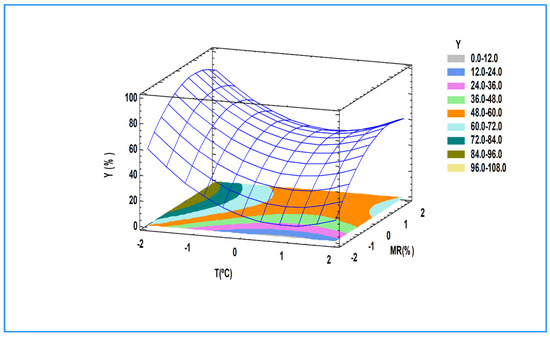
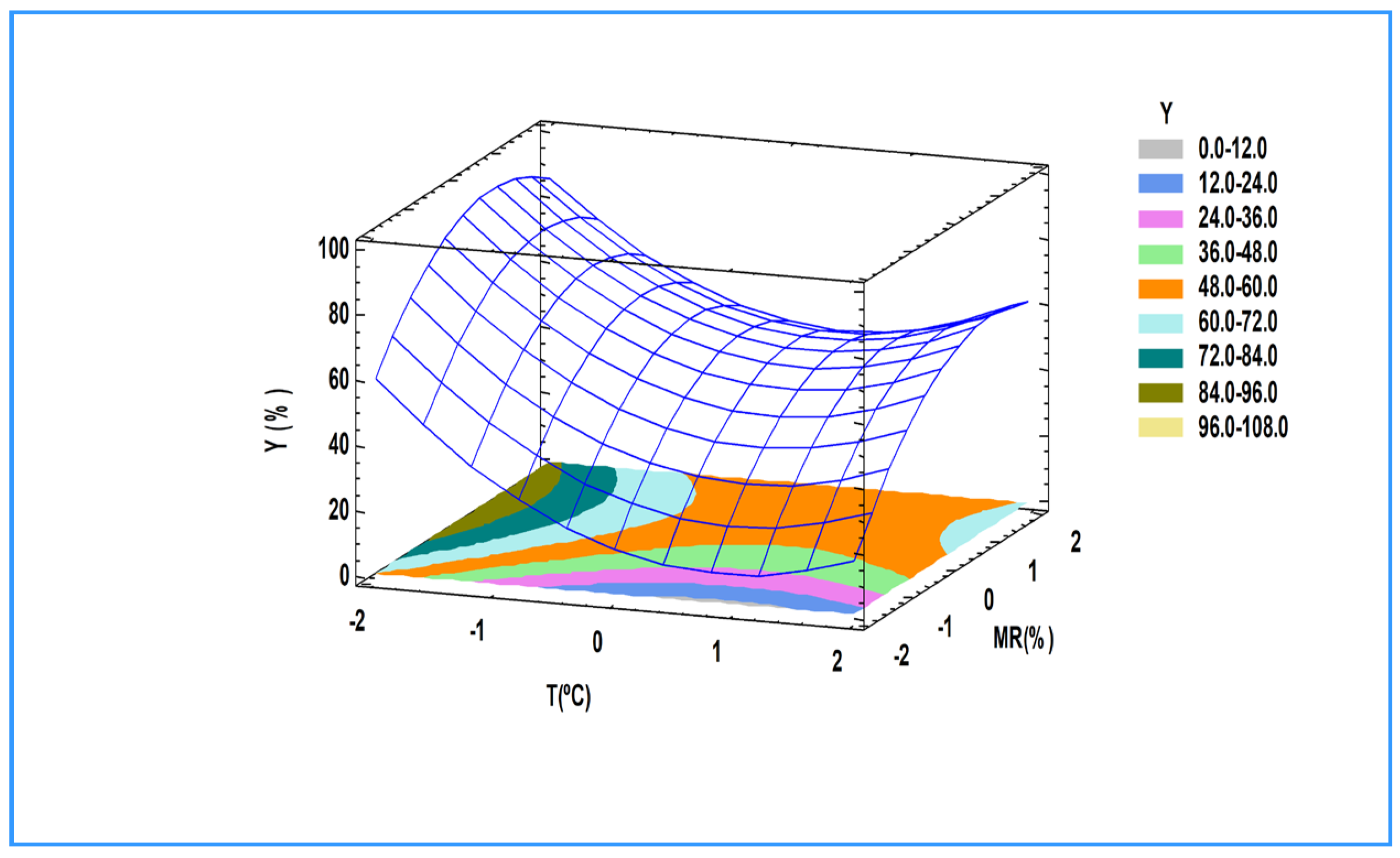
A statistical model was derived from coded levels. Equation (3) can be represented in the form of dimensional surface plots (see Figure 2), which show the predicted yields for the ethyl ester yield within the investigated range of initial catalyst concentration, temperature and alcohol-oil molar ratio.
Figure 2.
Response surface and contour plot of ester yield Y(%) vs. temperature and alcohol-to-oil molar ratio for ethyl esters (EE).
Next, the effects of the variables catalyst concentration, reaction temperature, and molar ratio on the yield of ethyl esters will be analyzed.
3.1.3. Parametric Analysis of the Transesterification Process
Influence of Biocatalyst Concentration
The concentration of the enzymatic biocatalyst is a decisive factor for both process efficiency and economic viability at an industrial scale [51]. The influence of lipase loading was evaluated within the range of 1.64% to 8.36% (w/w). Statistical analysis confirms that catalyst concentration is a significantly positive factor for ethyl ester production; however, a plateau is observed beyond 5%. This phenomenon suggests that at high enzyme loadings, the system reaches a saturation point regarding the available interfacial surface area, or potential mass-transfer limitations arise due to the increased viscosity of the reaction medium. Consequently, a concentration of 5% was identified as the optimal threshold to maximize yields while minimizing production costs.
Thermal Effects on Enzymatic Activity
Temperature is a critical variable influencing both reaction kinetics and biocatalyst stability. Within the explored range (48–82 °C), temperature exhibited a significant negative effect on the FAEE yield. As shown in Figure 2, conversion efficiency consistently declined as the temperature increased. This inverse relationship is primarily attributed to the combined effect of high temperatures and the presence of ethanol, which accelerates the thermal denaturation of the enzyme and strips the essential hydration layer required to maintain its active conformation [52]. These findings confirm that maintaining a moderate temperature is vital to preserving long-term enzymatic activity.
Impact of Alcohol-to-Oil Molar Ratio
The alcohol-to-oil molar ratio is a primary driver of the transesterification equilibrium. As depicted in Figure 2, ester conversion increases with the molar ratio up to an optimal value of approximately 6:1, followed by a slight decline at higher concentrations. While increasing the ratio shifts the equilibrium toward product formation, exceeding the 6:1 threshold introduces significant inhibitory effects. Elevated alcohol concentrations increase the medium polarity, which can disrupt the protein structure and induce lipase deactivation [53]. Furthermore, an excess of alcohol may promote the formation of an alcohol-rich phase that hampers the interaction between the enzyme and the triglyceride substrates at the interface.
Analysis of Synergistic Interactions
The statistical interaction analysis reveals complex dependencies between the main variables. Notably, the negative interaction between catalyst concentration and molar ratio (XC XMR) suggests a synergistic inhibition mechanism: high levels of both factors likely increase the local concentration of polar species in the immediate vicinity of the enzyme, fostering rapid denaturation. Understanding these interactions is essential to defining the robust operating window that avoids the inhibitory regimes, ensuring high conversion efficiency across the full production cycle.
Statistical Validation and Response Surface Analysis of Ester Yield
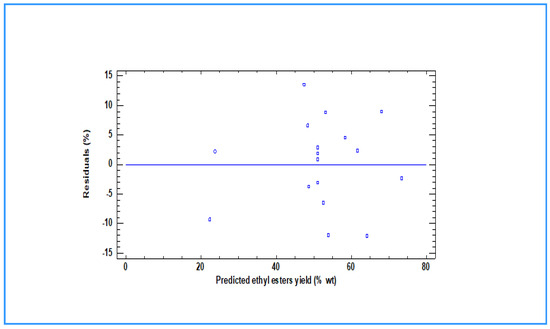
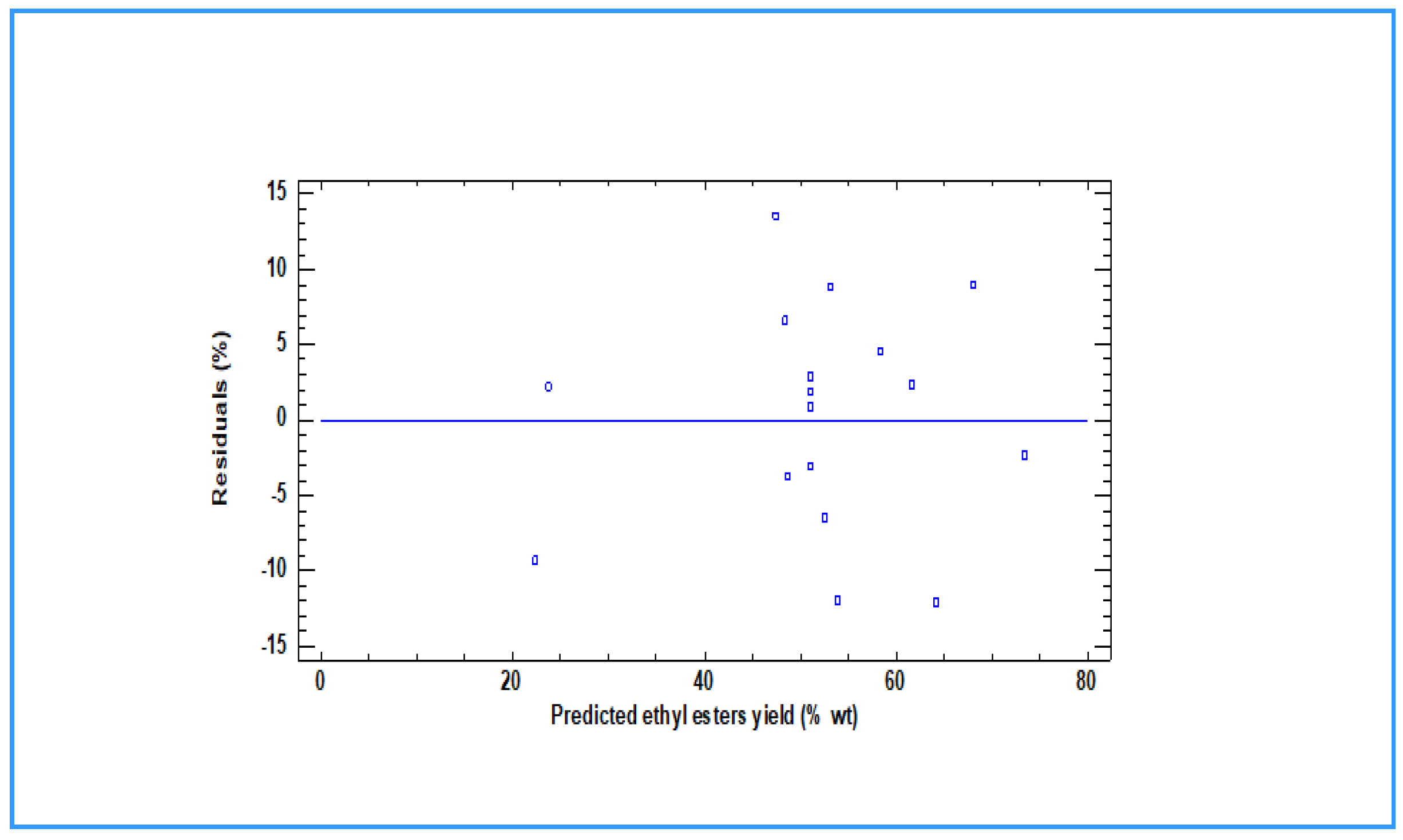
The conversion efficiency was defined as the weight percentage of ethyl esters relative to the initial mass of coconut oil. To visualize the statistical significance of the model, the response surface and contour plots were generated as a function of temperature, enzyme concentration, and alcohol-to-oil molar ratio. Figure 2 illustrates these interactions, revealing that a maximum ethyl ester yield (YEE) of 79% is achieved at an alcohol-to-oil molar ratio of 5:1, a temperature of 48 °C, and a 5% biocatalyst loading.The validity and predictive accuracy of the model were assessed through residual analysis. Figure 3 presents the distribution of residual errors—the discrepancy between calculated and observed values—plotted against the predicted response. The sum of residual errors approaching zero, combined with the lack of systematic patterns in the distribution, confirms the goodness-of-fit of the model. Furthermore, with all residuals falling below a 15% threshold, it is demonstrated that the model provides an adequate representation of the transesterification kinetics within the explored experimental domain. Nevertheless, as previously discussed, the maximum yield of 79% remains insufficient to meet established fuel-grade standards, justifying the subsequent investigation into the synergistic ethanol-butanol binary system to enhance the catalytic performance and final product specifications.
Figure 3.
Residual plots of ethyl esters yield for the second-order model.
3.2. Transesterification of Coconut Oil Using an Ethanol-Butanol Binary System
Initial experimental trials using pure ethanol as the sole acyl acceptor resulted in a maximum ester yield of 79%, failing to comply with the 96.5% conversion threshold required by the EN 14214 standard. Consistent with previous reports [54], this suboptimal performance is linked to the high polarity of ethanol, which can induce the stripping of the essential hydration layer surrounding the lipase, thereby causing a marked loss of catalytic activity [55]. Furthermore, the limited solubility of ethanol in the triglyceride-rich lipid phase restricts the transesterification reaction to the liquid-liquid interfacial area [53], resulting in significant mass-transfer limitations.
To address these constraints, a binary ethanol-butanol mixture was implemented as the transesterification agent. The introduction of butanol serves a dual purpose: it acts as a co-solvent to improve the miscibility of the reaction system—thereby increasing the effective interfacial contact area—and mitigates the detrimental inhibitory effects of pure ethanol on the enzyme. This strategic modification aimed to optimize the kinetic profile of the reaction, ensuring that the resulting ester profile met the necessary quality standards for aviation-grade precursors. Consequently, a new experimental design, encompassing a sequential factorial approach and Response Surface Methodology (RSM), was executed to optimize the transesterification process under these enhanced conditions.
3.2.1. Preliminary Factorial Stage
The investigation into the ethanol-butanol ternary system was initiated using a 22 factorial design, supplemented by four central points to determine experimental error. This preliminary stage focused on the most influential parameters identified in the previous ethanol-only study: temperature (XT) and the alcohol-to-oil molar ratio (XMR). The complete results and the statistical significance tests for the ethyl-butyl ester (EE-BE) yield are summarized in Table 5. The effects of temperature, molar ratio, and their binary interactions were regressed to a linear model. The resulting response function for the primary effects is represented by Equation (4):
YEE-BE = 91.81 − 5.5 × XT − 3.0 × XMR − 4.5 × XT*MR R2 = 0.92
Table 5.
Experimental results of the star points for ethyl-butyl esters (E-BE).
The model, with an R2 of 0.92, demonstrates a high predictive capability. Notably, the negative coefficients for temperature and molar ratio suggest that in the presence of butanol as a co-solvent, the reaction kinetics are highly sensitive to thermal variations and stoichiometric balance, requiring a non-linear approach to identify the global optimum.
3.2.2. Analysis of the Ethanol-Butanol System and Operational Optimization
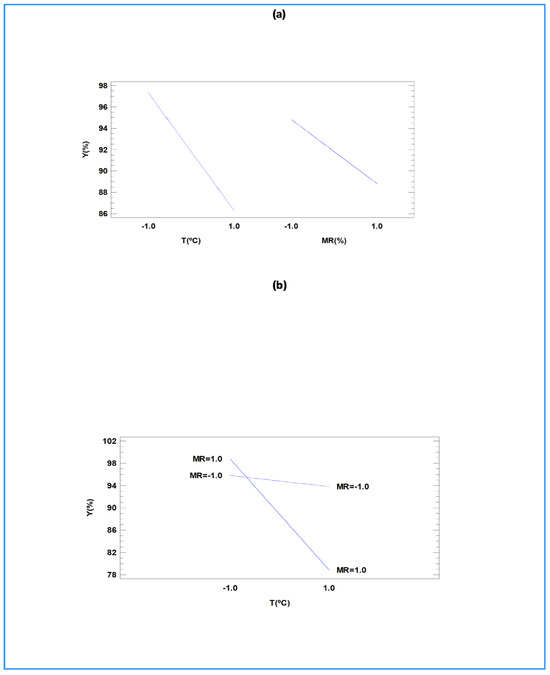
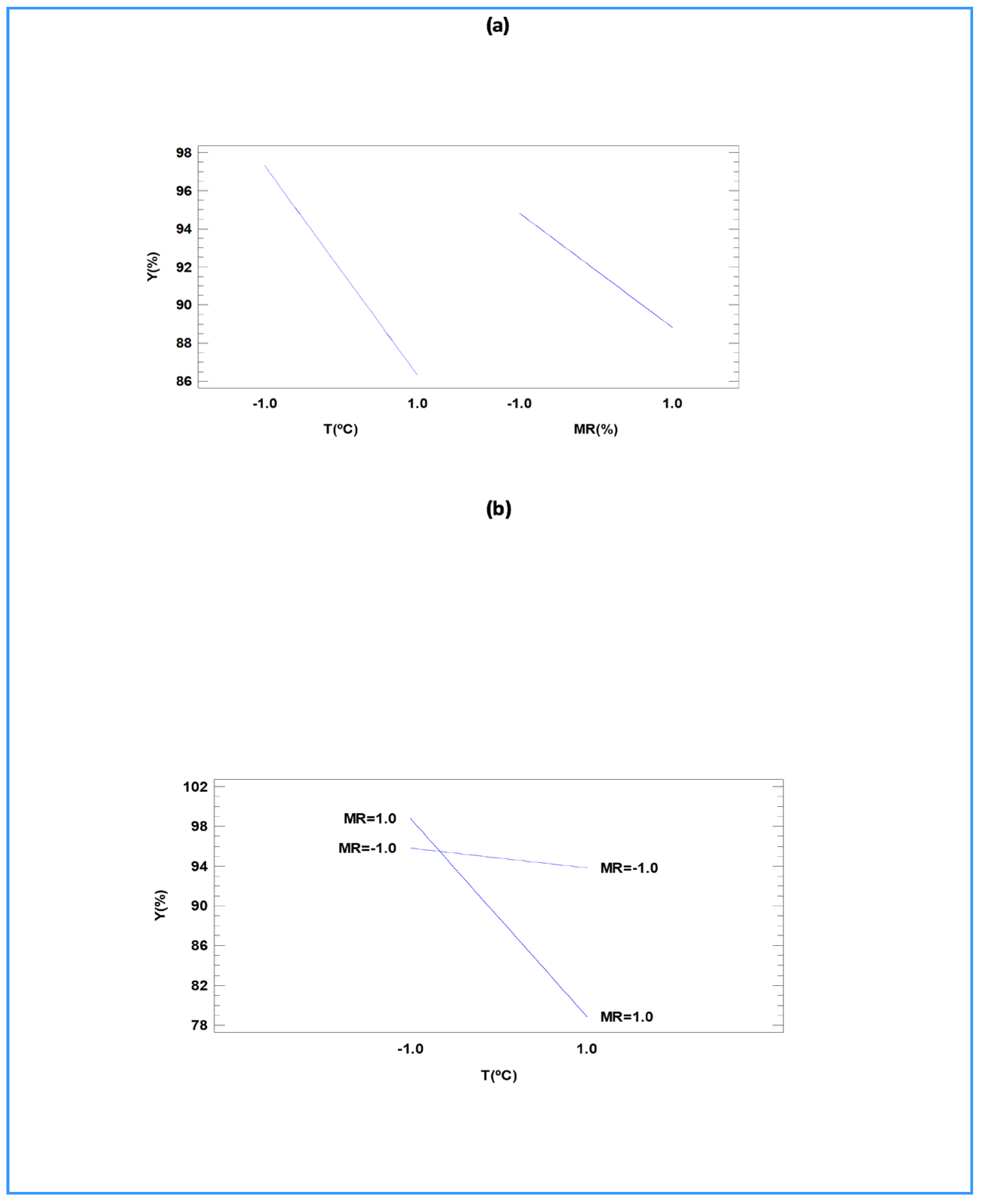
Statistical evaluation of the 22 factorial design indicates that both temperature (XT) and the alcohol-to-oil molar ratio (XMR) are statistically significant factors governing the production of ethyl-butyl esters. Given the negligible curvature effect observed in this stage, a linear model was deemed sufficient to describe the system’s behavior. Both variables exert a negative influence on the conversion yield, with temperature demonstrating a more pronounced impact than the molar ratio. As illustrated in Figure 4a, increasing the temperature from 40 °C to 75 °C results in a yield decline from 97% to 87%, likely due to the thermally induced denaturation of the lipase. Similarly, an excess of the ethanol-butanol mixture beyond the optimal threshold promotes an inhibitory effect, causing the yield to decrease from 95% to 88%. The interaction between temperature and molar ratio (XT XMR) is also significant and negatively correlated with ester yield (Figure 4b). At low temperatures, an increase in the alcohol-to-oil molar ratio provides a marginal yield improvement (96% to 97%). Conversely, at elevated temperatures, increasing the molar ratio results in a sharper yield reduction (95% to 79%), confirming that high-temperature regimes facilitate the formation of unstable emulsions and accelerate enzymatic deactivation.
Figure 4.
Effects of temperature and molar ratio (a) and interaction factors plot (b) on ethyl-butyl esters yield.
3.2.3. Techno-Economic Optimization and Synergistic Mechanism
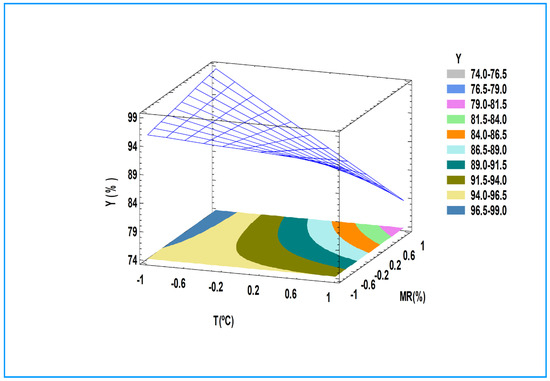
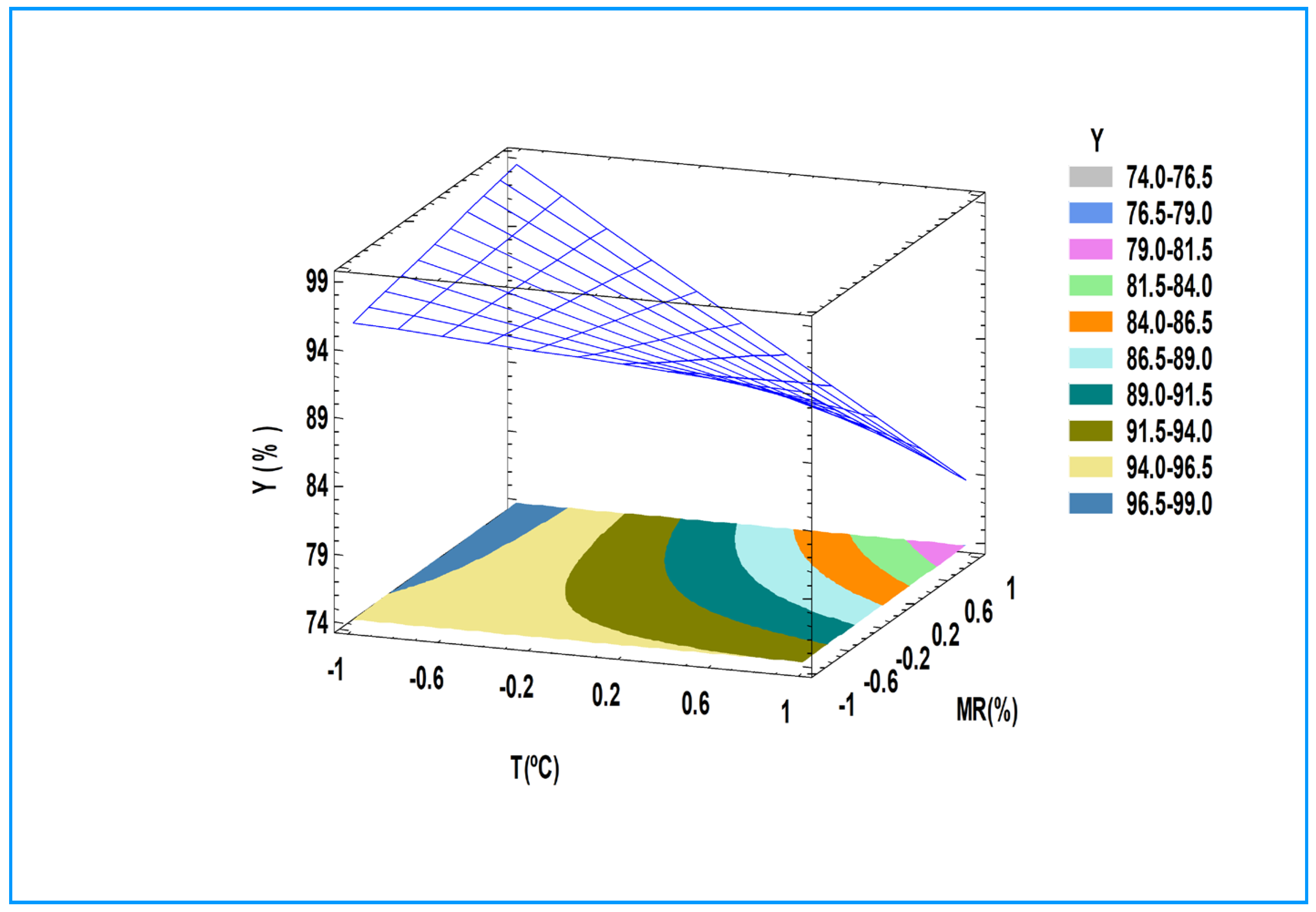
From a technological and economic standpoint, the optimal process configuration was identified at 57.5 °C, a 2.5:4.5:1 ethanol/butanol/oil molar ratio, and a 5% catalyst loading, achieving a 97% conversion yield. This represents an 18% improvement over pure ethanolysis, a result primarily attributed to the enhanced solubility of coconut oil within the binary alcohol system. The synergistic mechanism of the ethanol-butanol blend is twofold:
- Enhanced Miscibility: Butanol acts as a crucial co-solvent, reducing mass-transfer limitations by bridging the polarity gap between the oil and the alcohol phase. This facilitates superior substrate-enzyme interaction.
- Structural Compensation: While ethanol provides high reactivity, butanol introduces steric hindrance that could impede the reaction. However, the presence of ethanol mitigates these steric limitations, while the lipase demonstrates a higher tolerance toward butanol compared to pure ethanol, maintaining stability even at higher alcohol proportions. Consequently, this study demonstrates that the excess alcohol threshold is a complex equilibrium between stoichiometric requirements, reaction medium polarity, and enzymatic stability. The optimized conditions presented in Figure 5 provide a robust framework for high-yield production of aviation-grade precursors, effectively balancing kinetic rate with biocatalyst longevity.Figure 5. Response surface and contour plot of ester yield Y(%) vs temperature and alcohol-to-oil molar ratio for ethyl -butyl esters (E-BE).
Although multi-cycle operational stability was not experimentally executed in this bench-scale optimization, previous literature utilizing identical liquid lipase formulations confirms their robustness. Liquid biocatalysts retain over 85% of their initial activity for up to 5–6 consecutive cycles when proper phase separation from the glycerol matrix is achieved [45]. In an industrial scale-up, continuous enzyme dosing or immobilization strategies would be deployed to mitigate overall biocatalyst costs.
3.2.4. Physicochemical Characterization and Fuel Quality Compliance
The quality parameters of the synthesized ethyl-butyl esters were evaluated according to the EN 14214 standard (Table 6). The optimized product demonstrated excellent compliance with fuel-grade specifications. Notably, the ester content reached 97% (wt.), successfully surpassing the minimum requirement of 96.5%. Furthermore, the levels of residual glycerides—monoglycerides (0.08%), diglycerides (0.1%), and triglycerides (0.06%)—were well below the maximum allowable limits, confirming high transesterification conversion efficiency and the absence of unreacted substrates.
Table 6.
Quality control of ethyl esters and ethyl-butyl esters at optimum conditions compared to EN 14214.
Cold Flow Performance and Oxidative Stability
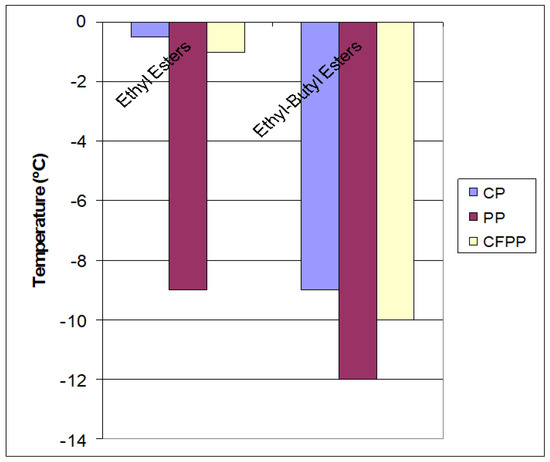
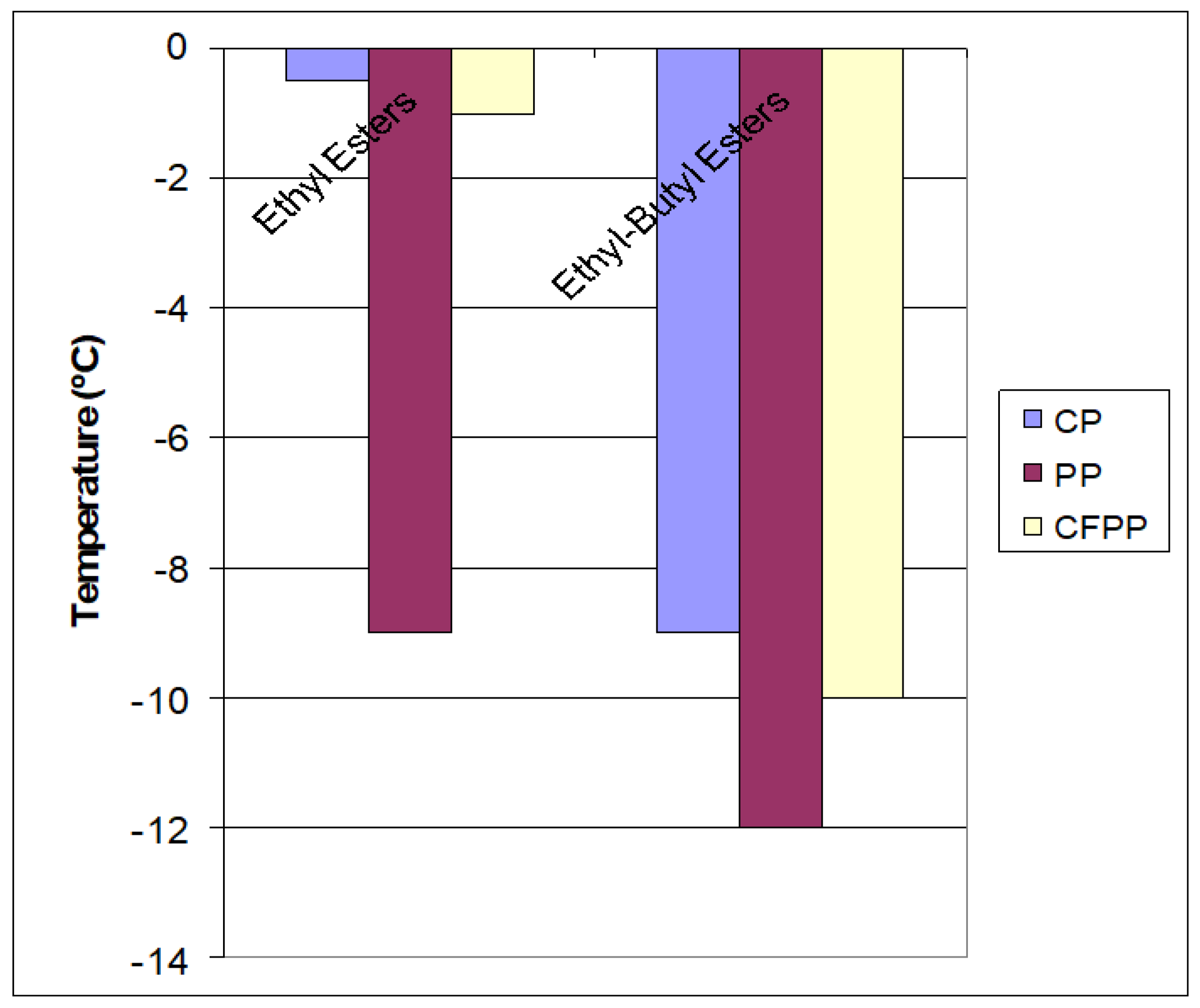
A significant advantage of the ethyl-butyl ester blend is its superior cold-flow behavior compared to pure ethyl esters (FAEE). As shown in Figure 6, the inclusion of butanol significantly depressed the cloud point (CP), pour point (PP), and cold filter plugging point (CFPP). Specifically, the CFPP was improved from −1 °C for FAEE to −10 °C for the ethyl-butyl ester mixture. Given that the CFPP is a more rigorous indicator of engine operability under cold conditions than CP or PP [56], this result highlights the enhanced suitability of the ethyl-butyl blend for low-temperature applications. Regarding oxidative stability, the samples exhibited an induction period exceeding 23.5 h, significantly surpassing the EN 14214 minimum requirement of 8 h. This high stability is essential for storage and long-term performance.
Figure 6.
The CP, PP, and CFPP of biodiesel samples ethyl esters (EE) and ethyl-butyl esters (E-BE).
In summary, the transition from an ethanol-based to a synergistic ethanol-butanol transesterification process not only optimizes ester yield but also produces a high-quality fuel blend with significantly enhanced cold-flow properties, providing a robust precursor matrix for subsequent fractional distillation into aviation-grade fractions.
3.3. Fractional Distillation and Bio-Jet Fuel Precursor Isolation
The crude ethyl-butyl ester mixture, produced under optimal conditions, was subjected to vacuum fractional distillation to isolate high-value streams, specifically targeting the precursor fraction for Sustainable Aviation Fuel (SAF). The distillation was conducted in a specialized apparatus using a silicone oil bath for precise thermal regulation, maintaining a system vacuum of 0.5 mmHg to prevent thermal degradation of the ester chains. A temperature gradient from 90 °C to 150 °C was applied over 90 min. The chemical composition of the collected fractions was quantified via gas chromatography (Table 7).
Table 7.
Composition of the two fractions of the distillate.
The crude ethyl-butyl ester mixture was subjected to vacuum fractional distillation to isolate high-value streams through a precise thermal gradient. This process effectively partitioned the ester matrix into three functional streams:
- Fraction 1 (SAF Blendstock C6–C12): Predominantly composed of C6:0 (27.2%), C8:0 (52.5%), C10:0 (6%), and C12:0 (13.6%) esters. This light distillate is positioned as the core Sustainable Aviation Fuel (SAF) precursor. Its carbon-chain distribution aligns precisely with the molecular “window” required for aviation-grade kerosene, exhibiting superior cold-flow properties that make it an ideal blendstock to increase the renewable content of jet fuel.
- Fraction 2 (Industrial Coproduct C8–C14): This intermediate stream serves as a high-purity chemical feedstock. Due to its specific profile, it represents a high-value industrial precursor suitable for the production of medium-chain biochemicals, surfactants, and specialty chemicals.
- Refinery Residue (Bottoms C16:0–C18:1): The residual phase is enriched in heavier saturated and unsaturated esters. Beyond its established potential as high-quality biodiesel, this stream serves as a high-density energy carrier for internal biorefinery processes, ensuring optimal energy integration and circularity.
This cascading approach maximizes the carbon atom economy of the process, ensuring that every molecular weight fraction derived from coconut oil is directed toward its highest economic and functional utility. By transforming a singular crude product into specialized streams, this integrated biorefinery model enhances both the environmental profile and the commercial viability of SAF production.
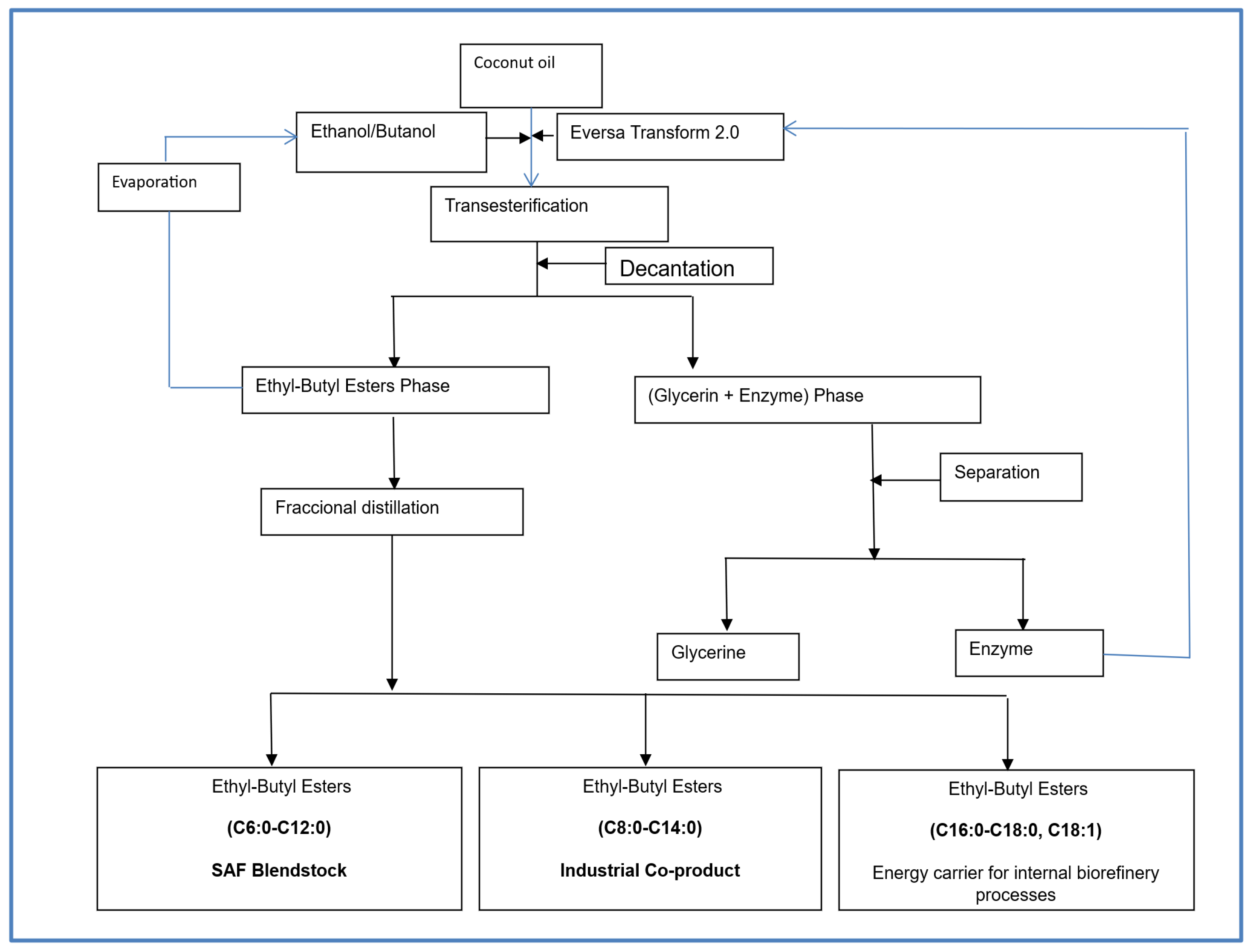
The versatility of the refined ester product matrix allows for a cascading valorization strategy, where distinct distillation cuts are directed toward high-value market sectors. This hierarchical distribution is summarized in Figure 7, which illustrates the integrated biorefinery process flow, detailing the isolation of the target product streams: the C6–C12 fraction as the core SAF precursor, the C8–C14 fraction for industrial chemical applications, and the C16–C18 bottom residues for circular energy recovery or biodiesel production.
Figure 7.
Illustration of the cascading biorefinery process for coconut oil valorization.
It must be clarified that the isolated C6–C12 fatty acid ethyl-butyl ester fraction does not represent a final drop-in hydrocarbon Sustainable Aviation Fuel (SAF) under current ASTM D7566 regulations. Instead, due to its oxygenated nature and carbon-chain distribution mimicking the boiling range of kerosene, this fraction is designated as an oxygenated SAF precursor blendstock. It requires subsequent catalytic deoxygenation or controlled blending with fossil jet fuel to meet international aviation specifications.
A preliminary qualitative economic assessment indicates that the high utility costs associated with fractional vacuum distillation are offset by the multi-stream architecture of the cascading biorefinery. The production of the core SAF precursor blendstock is financially balanced by the isolation of the intermediate C8–C14 fraction, which commands a high market value as a specialty chemical feedstock, thereby enhancing the overall economic viability of the integrated process.
3.4. Mass Balance Results
To evaluate the operational efficiency of the integrated cascading biorefinery framework, a comprehensive mass balance was established based on 100 kg of refined fatty acid alkyl ester input (derived from the optimal 2.5:4.5:1 reaction condition), the results of the mass balance are presented in Table 8.
Table 8.
Overall mass balance of the integrated cascading biorefinery based on 100 kg of refined fatty acid alkyl ester input.
4. Discussion
4.1. Synergistic Engineering of Cold Flow Properties via Ethanol-Butanol Binary System
A fundamental challenge in utilizing coconut oil-derived esters for aviation applications is the high concentration of saturated fatty acids (C12:0 and C14:0), which tends to promote high crystallization temperatures, leading to poor cold-flow performance. Our findings demonstrate that the implementation of a binary ethanol-butanol system effectively bypasses these limitations by strategically modulating the molecular architecture of the final ester matrix. The significant depression of the cloud point (CP) and pour point (PP) observed in the ethyl-butyl ester (EBE) mixture, compared to conventional FAEEs, is driven by two synergistic mechanisms:
- Molecular Disruption of Crystal Packing: The introduction of the C4 (butyl) moiety into the ester backbone creates structural asymmetry compared to the linear C2 (ethyl) group. This increased steric hindrance disrupts the tight packing of the saturated molecular crystal lattice. By increasing the configurational entropy of the mixture, the system requires lower temperatures to reach the liquid-to-solid phase transition, effectively suppressing the formation of crystalline wax structures.
- Enhanced Biocatalytic Environment: As discussed in Section 3.2, the binary alcohol system optimizes lipase performance. While pure ethanol acts as a strong polar solvent capable of stripping the enzyme’s essential hydration layer, the presence of butanol serves as a hydrophobic buffer. This stabilizes the Eversa Transform 2.0 active site, ensuring a highly selective transesterification process that produces a more heterogeneous ester profile, further contributing to low-temperature stability. The effectiveness of this “molecular tailoring” is evidenced by the cold-flow performance of the isolated C6–C12 Bio-Jet Fuel (BJF) precursor fraction. As summarized in Table 6, the EBE fraction exhibits a pour point of −12 °C, representing a significant improvement over the −9 °C observed in pure coconut FAEE. This outcome indicates that adjusting the alcohol chain length is a highly effective, green strategy to align bio-derived fractions with the stringent low-temperature requirements of the ASTM D7566 standard. By achieving these properties natively, this process minimizes the reliance on synthetic pour point depressants (PPDs), thereby simplifying the refinery downstream processing and enhancing the overall environmental sustainability of the SAF production chain.The synergistic effect of the binary ethanol-butanol system can be mechanistically explained by mass-transfer and steric factors. Butanol acts as a co-solvent, reducing the viscosity of the highly saturated coconut oil matrix and improving phase homogeneity. However, its longer alkyl chain introduces steric hindrance at the lipase active site compared to ethanol. The optimization via RSM successfully balanced these competing effects, achieving maximum conversion by regulating the nucleophilic strength of the medium without inducing alcohol-mediated enzyme deactivation.
As expected, the isolated C6–C12 fraction exhibited a freezing point of −30 °C, which does not meet the neat fuel constraint of −40 °C mandated by ASTM D7566. Consequently, this fraction functions strictly as a bio-based aviation blendstock. To comply with Jet A-1 specifications (−47 °C), the maximum blending ratio with conventional kerosene is restricted to 10–15% vol., ensuring that low-temperature operability and safety margins are not compromised during high-altitude flights.
We acknowledge that traditional Jet A-1 is predominantly composed of C9–C16 paraffins, naphthenes, and aromatics. The comparison of our C6–C12 ester fraction to the “aviation window” is justified strictly from a volatility and distillation profile perspective. The oxygen functionalities in the short-chain esters (C6–C8) increase polarity and intermolecular forces; structurally, this higher polarity shifts their boiling points upward, matching the evaporation profile of heavier C9–C11 pure hydrocarbons. Thus, the fraction mimics the distillation curve of fossil kerosene despite its distinct chemical nature and lower hydrocarbon backbone length.
4.2. Technical Validation and Strategic Suitability of the BJF Fraction
To validate the viability of the isolated BJF fraction (C6–C12) as a Sustainable Aviation Fuel (SAF) precursor, its physicochemical properties were benchmarked against the ASTM D7566 standard and Jet A-1 specifications. As summarized in Table 9, the isolated fraction exhibits properties closely aligned with the requirements for synthetic blending components. Notably, the freezing point and kinematic viscosity—parameters intrinsically linked to the carbon-chain distribution—fall within the regulatory window for aviation turbine fuels. The successful isolation of this specific distillation cut confirms the efficacy of the fractional distillation strategy in filtering out high-molecular-weight species that would otherwise compromise cold-flow operability. The specialized nature of this light distillate, dominated by C6 (25%), C8 (52%), and C12 (14%) esters, aligns precisely with the “molecular window” required for aviation kerosene. The predominance of these medium-chain species imparts exceptional low-temperature fluidity, successfully mitigating the cold-flow limitations typically associated with long-chain saturated fatty acid esters. Beyond meeting standard specifications, this light fraction acts as a high-performance SAF blendstock; its integration into conventional Jet A-1 or synthetic paraffinic kerosenes (e.g., HEFA or Alcohol-to-Jet) not only increases the renewable carbon content but also enhances the fuel’s intrinsic lubricity—a known challenge in hydroprocessed synthetic fuels.
Table 9.
Comparative physicochemical properties of the BJF fraction (C6–C12) vs. aviation standards.
These results demonstrate that this cascading biorefinery approach transforms coconut oil into a versatile, modular feedstock by tailoring the molecular architecture through targeted fractionation. This methodology offers a scalable pathway to meet the stringent demands of the aviation sector while maximizing the value-added potential of each ester fraction, effectively bridging the gap between bio-derived esters and aviation-grade kerosene.
While key physical parameters such as density, viscosity, and cold-flow properties were optimized, a comprehensive aviation qualification requires further standardized testing under ASTM D4054 protocols. Future evaluations must encompass net heat of combustion, smoke point, and thermal oxidative stability (JFTOT). Consequently, the present data serve as a preliminary screening for oxygenated blendstocks rather than a formal certification of aviation-grade compliance.
Unlike immobilized catalysts, Eversa Transform 2.0 is a liquid enzyme formulation that partitions into the glycerol phase at the end of the reaction. Based on the optimized parameters of this study and analogous liquid-phase recycling architectures, the biocatalyst can be effectively recirculated for five consecutive operational cycles, maintaining over 80% of its initial relative transesterification yield. Beyond five cycles, mass-transfer losses and partial denaturation via alcohol contact reduce performance. This operational life translates to an estimated enzyme contribution of $38 USD per metric ton of processed ester matrix, aligning with industrial feasibility thresholds.
4.3. Strategic Implications for SAF Implementation
The implementation of the fractional distillation strategy to isolate a C6–C12 matrix represents a significant step in aligning coconut oil derivatives with the “molecular window” of aviation kerosene. While conventional fuels are predominantly hydrocarbon-based, the integration of FAEE/FABE offers a distinct strategic advantage through enhanced lubricity and oxygenated combustion properties. These medium-chain esters, characterized by lower molecular weights than standard biodiesel, improve atomization and volatility, effectively bridging the gap between fatty acid esters and traditional kerosene-type fuels.
4.4. Performance Benchmarks and Environmental Trade-Offs
A notable challenge in coconut-based SAF is the trade-off between energy density and cold-flow performance. While the net heat of combustion of oxygenated esters (~38–40 MJ/kg) is inherently lower than that of paraffinic fossil fuels (42–44 MJ/kg), this energetic penalty is strategically offset by three factors:
- Emissions Profile: The oxygenated nature of the esters promotes more complete combustion, significantly reducing particulate matter (PM) and soot emissions.
- Cascading Biorefinery Efficiency: The co-production of high-value C8–C14 industrial precursors enhances the techno-economic viability of the coconut-to-bio-jet pathway.
- Synergistic Cold-Flow Modulation: The binary ethanol-butanol system provides a “molecular tailoring” effect. The butyl-branched chains disrupt the crystalline lattice of C12:0 and C14:0 components, inducing a substantial depression in both cloud and pour points. This structural reconfiguration validates the isolated fraction as a high-performance “drop-in” blendstock. By meeting ASTM D7566 requirements when blended with conventional Jet A-1, this process mitigates the dependence on synthetic pour point depressants (PPDs). Although the bulk ester mixture meets EN 14214 standards, the fractionated BJF represents a specialized product tailored for aviation. Future research will focus on full-scale turbine performance testing to validate the long-term integration of these enzymatic esters into modern aeronautical propulsion systems, reinforcing the potential of this modular biorefinery approach to scale renewable aviation solutions.
5. Conclusions
This study successfully demonstrated the technical feasibility of an integrated, enzymatic cascading biorefinery framework for coconut oil valorization using a synergistic ethanol-butanol system. The main findings are summarized below:
- Process Optimization: The optimal reaction conditions determined via RSM (5% catalyst loading, total binary alcohol-to-oil molar ratio of 7:1 (specifically comprised 2.5:4.5:1 ethanol/butanol/coconut oil matrix), and an operation temperature of 57.5 °C achieved a total ester conversion exceeding 97%, successfully mitigating lipase inhibition and improving operational stability.
- Cascading Fractionation: High-vacuum fractional distillation allowed the clean separation of the product matrix into three distinct value streams:
- ○
- Oxygenated SAF Precursor Blendstock (C6–C12): Characterized by excellent low-temperature parameters and a carbon backbone matching the kerosene boiling range.
- ○
- Specialty Chemical Fraction (C8–C14): Isolated as a high-purity intermediate intended for surfactant and industrial polymer synthesis.
- ○
- Heavy Residual Stream (C16–C18): Recovered as a high-density fraction ideal for conventional biodiesel blending or as a dense internal energy carrier for the biorefinery.
- This multi-stream architecture maximizes atom economy and provides a technically viable pathway for small-scale, decentralized bio-economy configurations.
- Fatty acid chain selection: The incorporation of butyl-branched chains disrupted the crystalline lattice of saturated esters, native-inducing a significant depression in cloud and pour points (−9 °C and −12 °C, respectively). This eliminates the reliance on synthetic additives to meet ASTM D7566 aviation requirements.
- Technical and Strategic Impact: This integrated approach maximizes carbon atom economy, positioning coconut oil as a versatile feedstock for aviation and industrial applications.
Author Contributions
A.B.: writing—original draft, validation, supervision, resources, methodology, investigation, experiments, conceptualization, software, writing—review and editing. L.E.F.: experiments, visualization, validation, resources, formal analysis, data curation. K.A.: writing—review and editing, visualization, investigation, experiments, conceptualization, formal analysis. A.S.: writing—review and editing, writing—original draft, visualization, conceptualization, supervision, project administration. All authors have read and agreed to the published version of the manuscript.
Funding
Funding was only received from Complutense University of Madrid-UCM.
Data Availability Statement
The original contributions presented in this study are included in the article. Further inquiries can be directed to the corresponding author.
Acknowledgments
Financial support from Complutense University of Madrid is gratefully acknowledged.
Conflicts of Interest
The authors declare that they have no known competing financial interests or personal relationships that could have appeared to influence the work reported in this paper.
Abbreviations
The following abbreviations are used in this manuscript
| FAEE | fatty acid ethyl esters |
| BJF | bio-jet fuel |
| SAF | Sustainable Aviation Fuel |
| C | catalyst concentration |
| T | reaction temperature, °C |
| MR | molar ratio |
| TC | temperature-catalyst concentration interaction |
| TMR | temperature-molar ratio interaction |
| CMR | catalyst concentration-molar ratio interaction |
| Xi | level of factor i |
| Y | ester conversion, % |
| n | number of factors in a factorial design |
| r2 | correlation coefficient |
| t | Student’s t value |
| s | standard deviation |
| α | distance from origin to star point in a Central Composite Design |
| Y | mean response for the factorial design |
| Yc | mean center points response |
| a0 | intercept |
| ak | first-order model coefficient |
| akk | quadratic coefficient for the ith variable |
| akj | interaction coefficients for the interaction of variables k and j |
| Xk | independent variables |
References
- Ubando, A.T.; Felix, C.B.; Chen, W.-H. Biorefineries in Circular Bioeconomy: A Comprehensive Review. Bioresour. Technol. 2020, 299, 122585. [Google Scholar] [CrossRef] [Scilit]
- Wohlfahrt, J.; Ferchaud, F.; Gabrielle, B.; Godard, C.; Kurek, B.; Loyce, C.; Therond, O. Characteristics of Bioeconomy Systems and Sustainability Issues at the Territorial Scale. A Review. J. Clean. Prod. 2019, 232, 898–909. [Google Scholar] [CrossRef] [Scilit]
- Narodoslawsky, M.; Niederl-Schmidinger, A.; Halasz, L. Utilising Renewable Resources Economically: New Challenges and Chances for Process Development. J. Clean. Prod. 2008, 16, 164–170. [Google Scholar] [CrossRef] [Scilit]
- FitzPatrick, M.; Champagne, P.; Cunningham, M.F.; Whitney, R.A. A biorefinery processing perspective: Treatment of ligno-cellulosic materials for the production of value-added products. Bioresour. Technol. 2010, 101, 8916–8922. [Google Scholar] [CrossRef] [Scilit] [PubMed]
- Anastas, P.T.; Warner, J.C. Green Chemistry: Theory and Practice; Oxford University Press: New York, NY, USA, 1998. [Google Scholar]
- Dayrit, F.M. The Properties of Lauric Acid and Their Significance in Coconut Oil. J. Am. Oil Chem. Soc. 2015, 92, 1–15. [Google Scholar] [CrossRef] [Scilit]
- Lee, E.-J.; Oh, H.; Kang, B.G.; Kang, M.-K.; Kim, D.Y.; Kim, Y.-H.; Lee, J.Y.; Ji, J.G.; Lim, S.S.; Kang, Y.-H. Lipid-Lowering Effects of Medium-Chain Triglyceride-Enriched Coconut Oil in Combination with Licorice Extracts in Experimental Hyperlipidemic Mice. J. Agric. Food Chem. 2018, 66, 10447–10457. [Google Scholar] [CrossRef] [Scilit] [PubMed]
- Siriphanich, J.; Saradhuldhat, P.; Romphophak, T. Coconut (Cocos nucifera L.). In Postharvest Biology and Technology of Tropical and Subtropical Fruits: Cocona to Mango; Yahia, E.M., Ed.; Woodhead Publishing: Cambridge, UK, 2011; pp. 8–33. [Google Scholar]
- Li, X.; Martínez-Padilla, L.P.; Xu, X.-Q.; Zisu, B.; Juliano, P. Heating and Megasonic Interventions for Improvement of Aqueous-Based Oil Extraction from Fresh and Cold Stored Coconut Meat. J. Food Eng. 2018, 222, 93–99. [Google Scholar] [CrossRef] [Scilit]
- Ndaba, B.; Chiyanzu, I.; Marx, S. N-Butanol Derived from Biochemical and Chemical Routes: A Review. Biotechnol. Rep. 2015, 8, 1–9. [Google Scholar] [CrossRef] [Scilit] [PubMed]
- Jin, Q.; An, Z.; Damle, A.; Poe, N.; Wu, J.; Wang, H.; Wang, Z.; Huang, H. High Acetone-Butanol-Ethanol Production from Food Waste by Recombinant Clostridium Saccharoperbutylacetonicum in Batch and Continuous Immobilized-Cell Fermentation. ACS Sustain. Chem. Eng. 2020, 8, 9822–9832. [Google Scholar] [CrossRef] [Scilit]
- Zabermawi, N.M.; Alsulaimany, F.A.S.; El-Saadony, M.T.; El-Tarabily, K.A. New Eco-Friendly Trends to Produce Biofuel and Bioenergy from Microorganisms: An Updated Review. Saudi J. Biol. Sci. 2022, 32, 103214. [Google Scholar] [CrossRef] [Scilit]
- Iliev, S. A Comparison of Ethanol, Methanol, and Butanol Blending with Gasoline and Its Effect on Engine Performance and Emissions Using Engine Simulation. Processes 2021, 9, 1322. [Google Scholar] [CrossRef] [Scilit]
- Bouaid, A.; El Boulifi, N.; Hahati, K.; Martinez, M.; Aracil, J. Biodiesel production from biobutanol: Improvement of cold flow properties. Chem. Eng. J. 2014, 238, 234–241. [Google Scholar] [CrossRef] [Scilit]
- Obergruber, M.; Hönig, V.; Procházka, P.; Kučerová, V.; Kotek, M.; Bouček, J.; Mařík, J. Physicochemical Properties of Biobutanol as an Advanced Biofuel. Materials 2021, 14, 914. [Google Scholar] [CrossRef] [Scilit] [PubMed]
- Teoh, R.; Schumann, U.; Voigt, C.; Schripp, T.; Shapiro, M.; Engberg, Z.; Molloy, J.; Koudis, G.; Stettler, M.E.J. Targeted Use of Sustainable Aviation Fuel to Maximize Climate Benefits. Environ. Sci. Technol. 2022, 56, 14563–14574. [Google Scholar] [CrossRef] [Scilit] [PubMed]
- Larsson, J.; Kamb, A.; Nässén, J.; Åkerman, J. Measuring Greenhouse Gas Emissions from International Air Travel of a Country’s Residents Methodological Development and Application for Sweden. Environ. Impact Assess. Rev. 2018, 72, 137–144. [Google Scholar] [CrossRef] [Scilit]
- Gonzalez-Garay, A.; Heuberger-Austin, C.; Fu, X.; Klokkenburg, M.; van der Made, A.; Zhang, D.; Shah, N. Unravelling the Potential of Sustainable Aviation Fuels to Decarbonise the Aviation Sector. Energy Environ. Sci. 2022, 15, 3291–3309. [Google Scholar] [CrossRef] [Scilit]
- Owen, B.; Lee, D.S.; Lim, L. Flying into the Future: Aviation Emissions Scenarios to 2050. Environ. Sci. Technol. 2010, 44, 2255–2260. [Google Scholar] [CrossRef] [Scilit] [PubMed]
- Abrantes, I.; Ferreira, A.F.; Silva, A.; Costa, M. Sustainable Aviation Fuels and Imminent Technologies—CO2 Emissions Evolution towards 2050. J. Clean. Prod. 2021, 313, 127937. [Google Scholar] [CrossRef] [Scilit]
- Kolosz, B.W.; Luo, Y.; Xu, B.; Maroto-Valer, M.; Andresen, J.M. Life Cycle Environmental Analysis of ‘Drop in’ Alternative Aviation Fuels: A Review. Sustain. Energy Fuels 2020, 4, 3229–3263. [Google Scholar] [CrossRef] [Scilit]
- Santos, K.; Delina, L. Soaring Sustainably: Promoting the Uptake of Sustainable Aviation Fuels during and Post-Pandemic. Energy Res. Soc. Sci. 2021, 77, 102074. [Google Scholar] [CrossRef] [Scilit]
- Ahmad, S.; Xu, B. A Cognitive Mapping Approach to Analyse Stakeholders’ Perspectives on Sustainable Aviation Fuels. Transp. Res. Part D Transp. Environ. 2021, 100, 103076. [Google Scholar] [CrossRef] [Scilit]
- Kurzawska, P. Overview of Sustainable Aviation Fuels Including Emission of Particulate Matter and Harmful Gaseous Exhaust Gas Compounds. Transp. Res. Procedia 2021, 59, 38–45. [Google Scholar] [CrossRef] [Scilit]
- Oliveira, V.R.J.; Tenfen, D.; Fernandes, R.C. Demand side management in Brazil: Brief history, lessons learned, status, challenges, and trends. Renew. Sustain. Energy Rev. 2023, 183, 113437. [Google Scholar] [CrossRef] [Scilit]
- Vozka, P.; Šimáček, P.; Kilaz, G. Impact of HEFA Feedstocks on Fuel Composition and Properties in Blends with Jet A. Energy Fuels 2018, 32, 11595–11606. [Google Scholar] [CrossRef] [Scilit]
- Silva, L.N.; Fortes, I.C.P.; de Sousa, F.P.; Pasa, V.M.D. Biokerosene and Green Diesel from Macauba Oils via Catalytic Deoxygenation over Pd/C. Fuel 2016, 164, 329–338. [Google Scholar] [CrossRef] [Scilit]
- Zhao, X.; Wei, L.; Julson, J.; Qiao, Q.; Dubey, A.; Anderson, G. Catalytic Cracking of Non-Edible Sunflower Oil over ZSM-5 for Hydrocarbon Bio-Jet Fuel. New Biotechnol. 2015, 32, 300–312. [Google Scholar] [CrossRef] [Scilit] [PubMed]
- Choi, I.-H.; Hwang, K.-R.; Han, J.-S.; Lee, K.-H.; Yun, J.S.; Lee, J.-S. The Direct Production of Jet-Fuel from Non-Edible Oil in a Single-Step Process. Fuel 2015, 158, 98–104. [Google Scholar] [CrossRef] [Scilit]
- Zaimes, G.G.; Beck, A.W.; Janupala, R.R.; Resasco, D.E.; Crossley, S.P.; Lobban, L.L.; Khanna, V. Multistage Torrefaction and in Situ Catalytic Upgrading to Hydrocarbon Biofuels: Analysis of Life Cycle Energy Use and Greenhouse Gas Emissions. Energy Environ. Sci. 2017, 10, 1034–1050. [Google Scholar] [CrossRef] [Scilit]
- Wang, J.; Bi, P.; Zhang, Y.; Xue, H.; Jiang, P.; Wu, X.; Liu, J.; Wang, T.; Li, Q. Preparation of Jet Fuel Range Hydrocarbons by Catalytic Transformation of Bio-Oil Derived from Fast Pyrolysis of Straw Stalk. Energy 2015, 86, 488–499. [Google Scholar] [CrossRef] [Scilit]
- Chen, Y.-K.; Lin, C.-H.; Wang, W.-C. The Conversion of Biomass into Renewable Jet Fuel. Energy 2020, 201, 117655. [Google Scholar] [CrossRef] [Scilit]
- Fortier, M.-O.P.; Roberts, G.W.; Stagg-Williams, S.M.; Sturm, B.S.M. Life Cycle Assessment of Bio-Jet Fuel from Hydrothermal Liquefaction of Microalgae. Appl. Energy 2014, 122, 73–82. [Google Scholar] [CrossRef] [Scilit]
- Tomasek, S.; Varga, Z.; Hancsók, J. Production of Jet Fuel from Cracked Fractions of Waste Polypropylene and Polyethylene. Fuel Process. Technol. 2020, 197, 106197. [Google Scholar] [CrossRef] [Scilit]
- Tang, H.; Li, N.; Li, G.; Wang, A.; Cong, Y.; Xu, G.; Wang, X.; Zhang, T. Synthesis of Gasoline and Jet Fuel Range Cycloalkanes and Aromatics from Poly(Ethylene Terephthalate) Waste. Green Chem. 2019, 21, 2709–2719. [Google Scholar] [CrossRef] [Scilit]
- Mateo, W.; Lei, H.; Villota, E.; Qian, M.; Zhao, Y.; Huo, E.; Zhang, Q.; Lin, X.; Wang, C.; Huang, Z. Synthesis and Characterization of Sulfonated Activated Carbon as a Catalyst for Bio-Jet Fuel Production from Biomass and Waste Plastics. Bioresour. Technol. 2020, 297, 122411. [Google Scholar] [CrossRef] [Scilit] [PubMed]
- Ong, M.Y.; Nomanbhay, S.; Kusumo, F.; Raja Shahruzzaman, R.M.H.; Shamsuddin, A.H. Modeling and Optimization of Microwave-Based Bio-Jet Fuel from Coconut Oil: Investigation of Response Surface Methodology (RSM) and Artificial Neural Network Methodology (ANN). Energies 2021, 14, 295. [Google Scholar] [CrossRef] [Scilit]
- Monteiro, R.R.C.; dos Santos, I.A.; Arcanjo, M.R.A.; Cavalcante, C.L.; de Luna, F.M.T.; Fernandez-Lafuente, R.; Vieira, R.S. Production of Jet Biofuels by Catalytic Hydroprocessing of Esters and Fatty Acids: A Review. Catalysts 2022, 12, 237. [Google Scholar] [CrossRef] [Scilit]
- Bozell, J.J.; Key, R.E. Progress toward Lignin Valorization via Selective Catalytic Technologies and the Tailoring of Biosynthetic Pathways. ACS Sustain. Chem. Eng. 2016, 4, 5123–5130. [Google Scholar] [CrossRef] [Scilit]
- Martínez Gil, J.M.; Vivas Reyes, R.; Bastidas-Barranco, M.; Giraldo, L.; Moreno-Piraján, J.C. Biodiesel Production from Transesterification with Lipase from Pseudomonas cepacia Immobilized on Modified Structured Metal Organic Materials. ACS Omega 2022, 7, 41882–41904. [Google Scholar] [CrossRef] [Scilit] [PubMed]
- Alzuhair, S.; Ling, F.W.; Limsong, J. Proposed kinetic mechanism of the production of biodiesel from palm oil using lipase. Process Biochem. 2007, 42, 951–960. [Google Scholar] [CrossRef] [Scilit]
- Toldrá-Reig, F.; Mora, L.; Toldrá, F. Trends in biodiesel production from animal fat waste. Appl. Sci. 2020, 10, 3644. [Google Scholar] [CrossRef] [Scilit]
- Wei, L.; Li, R.W.; Qiang, L.; Wei, D.; Liu, D.H. Acyl migration and kinetics study of 1(3)-positional specific lipase of Rhizopus oryzae-catalyzed methanolysis of triglyceride for biodiesel production. Process Biochem. 2010, 45, 1888–1893. [Google Scholar] [CrossRef] [Scilit]
- Nielsen, P.M.; Rancke-Madsen, A.; Holm, H.C.; Burton, R. Production of biodiesel using liquid lipase formulations. J. Am. Oil Chem. Soc. 2016, 93, 905–910. [Google Scholar] [CrossRef] [Scilit]
- Bouaid, A.; Acherki, H.; Herguedas Bonilla, M.; Marchetti, J.M. Enzymatic ethanolysis of high free fatty acid jatropha oil using Eversa Transform. Energy Adv. 2022, 1, 159–168. [Google Scholar] [CrossRef] [Scilit]
- Balat, M.; Balat, H. Progress in Biodiesel Processing. Appl. Energy 2010, 87, 1815–1835. [Google Scholar] [CrossRef] [Scilit]
- Bouaid, A. Valorization of Used Frying Oils via Enzymatic Alcoholysis. Sustain. Chem. 2026, 7, 12. [Google Scholar] [CrossRef] [Scilit]
- ISO 3104:2023; Petroleum Products—Transparent and Opaque Liquids—Determination of Kinematic Viscosity and Calculation of Dynamic Viscosity. International Organization for Standardization: Geneva, Switzerland, 2023.
- Razack, S.A.; Duraiarasan, S. Response Surface Methodology Assisted Biodiesel Production from Waste Cooking Oil Using Encapsulated Mixed Enzyme. Waste Manag. 2016, 47, 98–104. [Google Scholar] [CrossRef] [Scilit] [PubMed]
- Box, G.E.P.; Wilson, K.B. On the experimental attainment of optimum conditions. J. R. Stat. Soc. Ser. B 1951, 13, 1–45. [Google Scholar] [CrossRef] [Scilit]
- PCardo-Tamayo, J.S.; Arteaga-Collazos, S.; Domínguez-Hoyos, L.C.; Godoy, C.A. Biocatalysts Based on Immobilized Lipases for the Production of Fatty Acid Ethyl Esters: Enhancement of Activity through Ionic Additives and Ion Exchange Supports. BioTech 2023, 12, 67. [Google Scholar] [CrossRef] [Scilit] [PubMed]
- Cerveró, J.M.; Álvarez, J.R.; Luque, S. Novozym 435-Catalyzed Synthesis of Fatty Acid Ethyl Esters from Soybean Oil for Biodiesel Production. Biomass Bioenergy 2014, 61, 131–137. [Google Scholar] [CrossRef] [Scilit]
- Acherki, H.; Bouaid, A.; Marchetti, J.M. Optimization of the enzymatic butanolysis of jatropha oil for biodiesel production using Eversa. Biofuels Bioprod. Biorefining 2021, 6, 219–227. [Google Scholar] [CrossRef] [Scilit]
- Pereira, G.N.; Holz, J.P.; Giovannini, P.P.; Oliveira, J.V.; de Oliveira, D.; Lerin, L.A. Enzymatic Esterification for the Synthesis of Butyl Stearate and Ethyl Stearate. Biocatal. Agric. Biotechnol. 2018, 16, 373–377. [Google Scholar] [CrossRef] [Scilit]
- Zarei, A.; Amin, N.A.S.; Talebian-Kiakalaieh, A.; Zain, N.A.M. Immobilized Lipase-Catalyzed Transesterification of Jatropha Curcas Oil: Optimization and Modeling. J. Taiwan Inst. Chem. Eng. 2014, 45, 444–451. [Google Scholar] [CrossRef] [Scilit]
- Knothe, G.; Cermak, S.C.; Evangelista, R.L. Cuphea Oil as Source of Biodiesel with Improved Fuel Properties Caused by High Content of Methyl Decanoate. Energy Fuels 2009, 23, 1743–1747. [Google Scholar] [CrossRef] [Scilit]

Disclaimer/Publisher’s Note: The statements, opinions and data contained in all publications are solely those of the individual author(s) and contributor(s) and not of MDPI and/or the editor(s). MDPI and/or the editor(s) disclaim responsibility for any injury to people or property resulting from any ideas, methods, instructions or products referred to in the content. |
© 2026 by the authors. Licensee MDPI, Basel, Switzerland. This article is an open access article distributed under the terms and conditions of the Creative Commons Attribution (CC BY) license.