


Abstract
Youth soccer performance is influenced by multiple factors, including age, body size, and physical capacities, but the relative contribution of these variables to aerobic and explosive performance remains unclear. Understanding these relationships can improve the interpretation of field tests and support individualized training prescription. This study was designed to examine the association of age category, body mass, and height with physical performance in youth soccer players by jointly considering aerobic and explosive capacities, in order to support the interpretation of field tests within training prescription. Forty-five male players (15 U16, 15 U17, 15 U19) from the same club were assessed across two standardised on-field testing sessions, including the 45–15 test (estimated maximal aerobic speed, MAS) and vertical jump tests (squat jump, SJ; countermovement jump, CMJ; countermovement jump with free arms, CMJ_FH). Performance variables (SJ, CMJ, CMJ_FH, MAS) were treated as outcomes, while category, body mass, and height were included as predictors. A multivariate analysis was performed, followed by univariate analyses for each indicator. Results showed a significant multivariate effect of age category on overall performance (p < 0.001; η2p = 0.482), whereas height and body mass were not significant (p > 0.05). In univariate analyses, age category was associated with all variables: SJ (p = 0.005; adj. R2 = 0.160), CMJ (p < 0.001; adj. R2 = 0.287), CMJ_FH (p = 0.004; adj. R2 = 0.173), and MAS (p < 0.001; adj. R2 = 0.352). Performance increased progressively from U16 to U17 to U19, with larger between-category differences in aerobic capacity. In conclusion, age category was more strongly associated with the performance profile than height and body mass when considered jointly; these findings should be interpreted in light of the observational design and the lack of biological maturation measures.
1. Introduction
In youth soccer, physical conditioning is a key component that should neither be underestimated nor neglected, as it contributes not only to performance enhancement but also to building the foundations for the athlete’s future development [1,2].
During this phase, it is essential to implement age-appropriate training, including coordination-based exercises, technical skill development, and low-to-moderate intensity strength and speed work with progressive overload, aimed at developing motor abilities without compromising growth and health [3,4]. Marked inter-individual differences in development exist among players of the same chronological age, and coaches should account for these differences when planning training programmes [5]. Chronological age, defined as the time elapsed since birth and commonly used as the primary criterion for age-group categorisation (e.g., year-of-birth competition structures), does not necessarily reflect biological maturity or functional development. Precisely because of these developmental differences, in recent years the concept of bio-banding has gained increasing importance in youth soccer [6]. This approach involves grouping young athletes according to their level of biological maturation rather than their chronological age [7,8]. Its aim is to reduce the physical advantages of early-maturing athletes and the disadvantages of late-maturing ones, thereby promoting more equitable development, a more accurate assessment of potential, and better individualization of training loads [9,10]. In this context, it is particularly important to distinguish between performance related to training and performance related to growth and biological maturation processes [11]. Biological maturation influences hormonal profiles, neuromuscular development, recovery capacity, and tolerance to exercise; therefore, athletes of the same chronological age may respond differently to identical training stimuli. Practitioners should carefully observe athletes’ responses, as inadequate individualization of training according to maturation status may increase the risk of non-functional overreaching and, ultimately, overtraining [12].
Soccer, like other invasion sports, alternates high- and low-intensity actions and requires the simultaneous expression of multiple physical qualities, including strength, speed, endurance, and agility [13]. Therefore, the development of these components is essential, and training should be organised in a specific and progressive manner, considering players’ physiological characteristics and stage of development [14]. In youth populations, training load tolerance and adaptation are strongly influenced by growth and maturation processes. During childhood and the prepubertal period, load tolerance is primarily qualitative, with an emphasis on skill acquisition and motor control, while internal load must be carefully managed to ensure efficient execution of motor tasks [10]. As players progress through adolescence, increases in strength, neuromuscular capacity, and metabolic development allow for a gradual transition toward more quantitative training loads, approaching adult performance capacities [15]. It is well established that aerobic performance relative to body mass shows limited differences between youth and adults, whereas anaerobic power and capacity are considerably lower in children and adolescents due to developmental factors [16,17]. These age-related differences highlight the importance of considering biological development when interpreting physical performance in youth athletes. Power output during maximal efforts is strongly correlated with the mass of the muscles involved and thus reflects growth-related development [18]. Growth-related changes also affect strength, which is associated with improved performance in tasks requiring high power output [19]. Studies show that jump ability increases with greater muscle mass and strength in both males and females [20,21,22]. Unlike other fitness qualities such as strength and power, when VO2max is expressed relative to body mass it tends to remain stable across growth, without substantial changes [23].
In recent years, the physical, technical, and tactical demands of soccer have increased, leading to progressively higher performance requirements across all competitive levels. This evolution has direct implications for player development, particularly in youth categories, where training must support both performance enhancement and long-term athletic development. Consequently, physical conditioning plays a central role in optimizing performance, preventing injuries, and promoting harmonious development in young athletes [24]. Within this context, monitoring physical abilities through sport-specific tests has become essential to evaluate athletes’ fitness status and to guide training prescription [25,26]. Furthermore, the analysis of physical performance parameters allows practitioners to identify age- and maturation-related differences among players, supporting more individualised and developmentally appropriate training strategies [27].
Despite the widespread use of field tests to monitor physical qualities in youth soccer, the interpretation of results in daily practice is often challenging: athletes within the same age category may display markedly different performance levels due to anthropometric and maturation-related differences [28]. Height and body mass are often considered in talent identification and selection processes, sometimes being implicitly used as indicators of performance potential. However, these characteristics are strongly influenced by growth and maturation processes and do not necessarily reflect actual physical capacities or the ability to adapt to training [29,30,31]. Without an analysis jointly considering age, height, and body mass, there is a risk of attributing to “trainable” deficits what is partly due to individual characteristics or different phases of growth, potentially leading to errors in load prescription and talent evaluation.
This study examined the association of age category, body mass, and height with aerobic and explosive performance in youth soccer players. A multivariate approach was used to evaluate the overall performance profile and then each test separately, in order to clarify which factors were most strongly associated with performance and to support the interpretation of common field tests in training settings.
2. Materials and Methods
2.1. Participants
Forty-five youth soccer players from the same academy in the province of Naples, competing at regional level, participated in the study. Players belonged to three age categories: U16 (n = 15), U17 (n = 15), and U19 (n = 15). All athletes were regularly involved in structured competitive soccer and followed the club’s standard training programme during the competitive season, representing a sub-elite developmental level within their respective age categories. Sample size was determined by practical constraints and athlete availability during the data collection period; therefore, a convenience sample was used. No a priori sample size calculation was performed, as the study was exploratory in nature and aimed at providing preliminary evidence within a real-world applied setting.
Inclusion criteria required at least five years of sport experience; athletes with a history of muscle, tendon, or bone injuries in the 12 months preceding the study were excluded. The experimental procedures, potential risks, and benefits were explained to parents/guardians prior to participation; written informed consent was obtained from parents or legal guardians, and all participants provided written informed assent/consent before taking part. The study was conducted within the research project “Psychophysical perception and body awareness in school and sport contexts through observational and non-invasive tools”, approved by the Ethics Committee of Pegaso University (Prot./E 004726, 15 July 2025).
2.2. Study Design
All participants followed the same weekly training schedule to minimise heterogeneity due to between-group differences in programming. Players completed three weekly training sessions in addition to one official match during the competitive period. A familiarisation session was conducted 5–7 days before testing to standardise execution procedures, explain the protocols, and reduce potential learning effects.
Both testing sessions were conducted in an applied setting immediately after the team’s regular technical–tactical training session and scheduled at the end of the weekly microcycle (i.e., close to the competitive match), reflecting the practical and ecological conditions under which academy staff typically monitor players.
The study employed an observational, non-interventional design; therefore, analyses were descriptive and associational in nature. Consequently, the findings do not permit causal inference regarding the effects of the training programme, nor do they allow estimation of within-player changes attributable to training over time.
Training sessions were organised into consecutive phases (warm-up, main phase, and cool-down) aimed at developing soccer-specific technical skills and progressively improving performance through a structured approach [32,33]. The warm-up phase (~15 min) focused on physical and cognitive preparation through joint mobility exercises, dynamic stretching, and ball drills (e.g., rondos and technical circuits) designed to stimulate concentration, ball control, passing accuracy, and motor coordination.
The main phase (~40 min) included technical–tactical drills and conditioned games with progressive increases in difficulty and intensity. This phase also incorporated conditioned matches with specific objectives (e.g., maintaining possession for a target number of consecutive passes or achieving task-related advantages) to promote transfer to match-like situations and enhance tactical understandings and decision-making. Finally, a cool-down phase (~10 min) consisting of light running, static stretching, and muscle relaxation exercises was performed to facilitate recovery.
2.3. Assessment Procedures
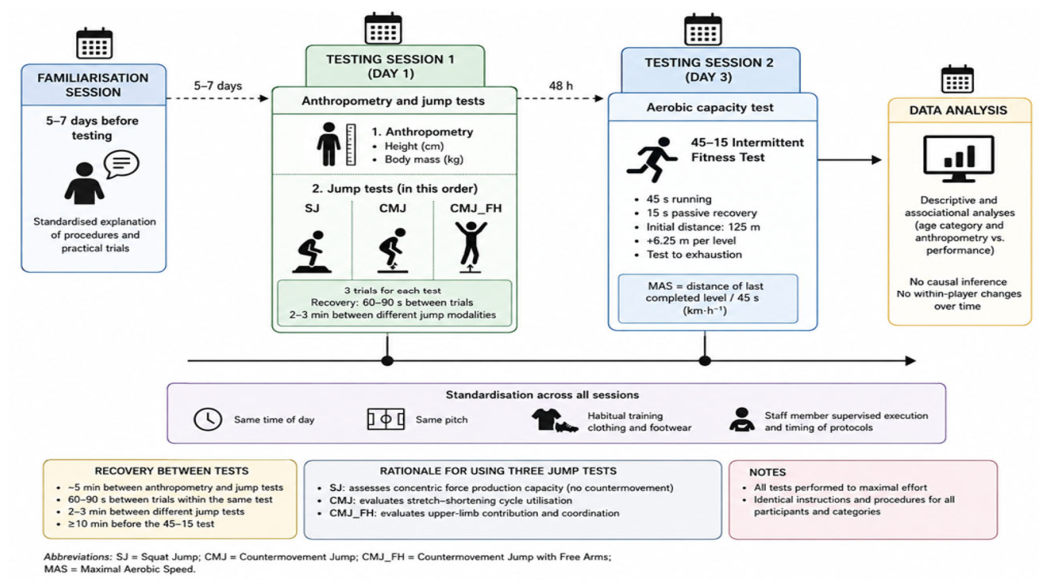
Tests were performed on the same pitch and at the same time of day for all participants, who wore their habitual training clothing and footwear. All assessments were conducted in the post-training period following the team’s regular technical–tactical session, with staff supervision employed to monitor protocol timing, recovery intervals, and exercise progression. Testing was divided into two sessions separated by 48 h to minimise residual fatigue and ensure adequate recovery between neuromuscular and aerobic assessments. During the first session, anthropometric characteristics (height and body mass) and vertical jump performance were assessed, whereas the 45–15 intermittent fitness test was administered during the second session. This sequence was selected because vertical jump performance is highly sensitive to acute neuromuscular fatigue; therefore, jump assessments were prioritised early within the post-training testing window. A passive recovery period of ~5 min was allowed between the end of training and the beginning of anthropometric and jump assessments. In addition, ~60–90 s of recovery was provided between jump attempts and 2–3 min between different jump modalities. Before the 45–15 test, participants were allowed at least 10 min of passive recovery. Standardised warm-ups were completed before each testing session to ensure consistent readiness across participants.
Aerobic capacity was assessed using the 45–15 intermittent incremental test performed to exhaustion [34,35]. The protocol consisted of 45 s of running interspersed with 15 s of passive recovery on a course delimited by cones along a curvilinear trajectory. The initial distance was 125 m and increased by 6.25 m at each stage while running duration remained constant. The test ended when the participant failed to complete the required distance within the prescribed time on two consecutive occasions. The last completed stage was used to estimate maximal aerobic speed (MAS), calculated as the ratio between the distance covered and running time (45 s), expressed in km·h−1. The 45–15 test has demonstrated acceptable validity and reliability for assessing intermittent aerobic fitness in team-sport athletes [36]. Audio pacing signals were delivered using a prerecorded track played through portable loudspeakers positioned along the field.
Lower-limb explosive strength was assessed using the squat jump (SJ), countermovement jump (CMJ), and countermovement jump with free arms (CMJ_FH) [37,38]. The inclusion of these three jump modalities allowed the assessment of distinct neuromuscular components of explosive performance. Specifically, the SJ primarily reflects concentric force production capacity, the CMJ evaluates stretch–shortening cycle utilisation, and the CMJ_FH additionally incorporates upper-limb coordination and arm-swing contribution during explosive actions.
Jump performance was measured using an Optojump optoelectronic system (Microgate Srl, Bolzano, Italy), which records flight time (t) and estimates jump height (h). Jump height was calculated according to the equation: h = (g · t2)/8, where g = 9.81 m·s−2. Before testing, athletes completed a standardised warm-up lasting approximately 10–15 min. Maximal effort was required for all trials. For the SJ, participants started from a static position with knees flexed at approximately 90°, hands on hips, and no countermovement. The position was maintained for ~2–3 s before take-off to minimise elastic contribution. For the CMJ, participants began from an upright stance and performed a rapid countermovement to approximately 90° knee flexion immediately followed by a maximal vertical jump, with hands maintained on hips throughout the movement. The CMJ_FH was performed similarly to the CMJ, although arm swing was permitted. For each jump modality, athletes completed three trials.
The study design and assessment timeline are shown in Figure 1.
Figure 1.
Study design and assessment timeline.
2.4. Statistical Analysis
Data are reported as mean ± standard deviation (SD). Normality was assessed using the Shapiro–Wilk test. A multivariate general linear model (GLM) was used to examine whether age category, height, and body mass were associated with the combined performance profile (SJ, CMJ, CMJ_FH, and MAS). Age category was entered as a fixed factor, whereas height and body mass were included as covariates. Multivariate significance was assessed using Wilks’ lambda. When the multivariate model was significant, univariate analyses were performed for each performance variable. Effect sizes are reported as partial eta squared (η2p), and adjusted R2 is reported for the univariate models. Statistical significance was set at p < 0.05. Analyses were performed using JASP (version 0.95.4.0).
3. Results
Descriptive statistics are reported in Table 1.
Table 1.
Descriptive statistics of performance variables by category.
Data indicate that players in higher categories show, on average, better performance in both jump tests and the aerobic test compared with players in lower categories. Standard deviations suggest moderate within-group variability, indicating reasonably homogeneous performance within each category. Inspection of the mean values shows a general tendency for performance to increase with age category. In the jump tests, the mean squat jump values were 36.42 cm in U19, 36.13 cm in U17, and 32.55 cm in U16, with lower values in the youngest group. A similar pattern was observed for the countermovement jump, with means of 37.49 cm in U19, 37.11 cm in U17, and 31.37 cm in U16. In the arm-swing countermovement jump, mean values were higher in the older categories (42.88 cm in U19 and 42.03 cm in U17) than in the youngest category (37.65 cm in U16). The same pattern was observed for MAS, with mean values of 18.68 in U19, 17.62 in U17, and 16.37 in U16.
To evaluate the influence of age category (U19, U17, U16) and anthropometric characteristics (height and body mass) on physical performance, a multivariate analysis was first conducted by simultaneously considering all performance variables (SJ, CMJ, CMJ_FH, MAS). Results are reported in Table 2.
Table 2.
Multivariate analysis results.
Results indicate that neither height nor body mass significantly influenced overall performance (p > 0.05). In contrast, age category showed a highly significant multivariate effect (p < 0.001), with a moderate-to-large effect size (η2p = 0.482), indicating that age category explained a meaningful proportion of the observed variability in physical performance within the fitted model.
Because the multivariate effect of age category was significant, each performance outcome was subsequently examined separately, and the results are presented in Table 3.
Table 3.
Univariate analysis results for performance variables.
After the multivariate analysis, univariate models indicated that age category was significantly associated with all performance variables considered. Specifically, significant between-group differences were observed in both jump tests (SJ, CMJ, and CMJ_FH) and the aerobic test, with moderate-to-large effect sizes. Overall, players in younger categories (U16 and U17) showed lower performance than U19 players, whereas height and body mass were not significant.
Subsequently, a post hoc multiple-comparison test with Bonferroni correction was performed to compare age categories, as shown in Table 4. Results showed that U19 players had significantly higher values than U16 players across all performance indicators (p < 0.05). When comparing U19 and U17, significant differences emerged for MAS (p < 0.05) but not for jump performance (SJ, CMJ, and CMJ_FH). U17 players showed significantly higher values than U16 players for both jump performance and MAS (p < 0.05). Overall, U16 players performed worse than the other groups, with the largest gap observed in MAS. Comparisons are based on observed means; the significance level was set at p < 0.05.
Table 4.
Post hoc multiple comparisons (Bonferroni) between categories for each performance variable.
4. Discussion
Findings from this study indicate that age category (U16, U17, U19) is the variable most strongly associated with the overall set of performance outcomes, showing significant associations with both explosive components (SJ, CMJ, CMJ_FH) and aerobic capacity (MAS). The observed multivariate effect suggests that between-category differences translate into an overall higher performance profile in older categories, with a progressive pattern from U16 to U19.
From a developmental perspective, this trend is consistent with expectations in youth soccer, where increasing chronological age is generally associated with biological maturation processes, neuromuscular development, and accumulated training exposure. However, chronological age does not directly reflect biological maturity, and players within the same category may differ substantially in their maturation status. Such inter-individual variability may contribute to differences in neuromuscular and aerobic performance, meaning that part of the observed category effect may be related to unmeasured maturational differences rather than age category alone. Higher body mass and running velocity in older players may also increase mechanical demands during locomotor tasks. In particular, the combined increase in mass and speed results in greater momentum, which may potentially increase the mechanical demands during deceleration and change-in-direction tasks, and could partially contribute to observed performance differences in the results.
With regard to jump performance, higher values in older categories may reflect a combination of developmental and training-related factors, potentially including increases in muscle cross-sectional area, improved motor-unit recruitment and synchronisation, greater tendon stiffness, and enhanced utilisation of the stretch–shortening cycle (SSC), particularly relevant for CMJ and CMJ_FH [39,40,41]. Differences observed in SJ further suggest that maximal strength expression and neuromuscular activation capacity may also play a role beyond elastic contributions [42]. Moreover, consistently higher CMJ_FH values compared with CMJ across all categories highlight the contribution of inter-segmental coordination and arm swing, which are likely influenced by both maturation and sport-specific experience.
Aerobic performance, expressed as MAS derived from the 45–15 test, increased significantly across categories, with a stronger effect compared with jump variables. This may reflect differences in the ability to sustain high-intensity intermittent running and exercise tolerance, as well as potential differences in running economy, and enhanced exercise tolerance associated with age and training exposure [43,44,45]. In addition, greater familiarity with field-based maximal tests may also have contributed to performance differences [46]. The absence of significant associations for height and body mass when category was included in the model suggests that age category accounted for a larger proportion of the observed performance variability in this sample. Moreover, height and body mass do not distinguish between fat and lean mass, segment lengths, or neuromuscular/technical factors that influence jump mechanics and stretch–shortening cycle utilisation; therefore, their ability to explain inter-individual differences in jump height is inherently limited in youth populations [47,48]. Higher jump performance in older categories may reflect developmental and training-related factors, although these mechanisms cannot be confirmed due to the cross-sectional design and lack of direct maturation and body composition measures. Importantly, the absence of direct maturation assessment (e.g., maturity offset or years from PHV, i.e., peak height velocity—the period of maximal growth rate in stature during adolescence) limits the ability to disentangle the relative contributions of chronological age and biological maturation. Therefore, the observed differences should be interpreted as a combined effect of age-related development, unmeasured maturation variability, and training exposure. From an applied perspective, these findings support the use of periodic monitoring of aerobic and explosive qualities in youth soccer, interpreted within the context of both chronological age and, when possible, biological maturation status. Performance differences within age categories likely reflect both training and developmental variability; therefore, individualised training approaches remain essential, particularly during transitions between youth categories. Field-based assessments of MAS and vertical jump performance can provide useful profiling information for training orientation and injury risk monitoring during periods of rapid growth.
Beyond confirming the expected age-category gradient, the present study adds to the literature by examining aerobic and explosive performance within a single multivariate framework. This approach allows the overall performance profile to be evaluated while simultaneously considering age category, height, and body mass, showing that category was more strongly associated with performance than basic anthropometric characteristics in this sample. From an applied perspective, these findings may help practitioners interpret common field tests within a broader developmental context. Several limitations should be acknowledged. The sample was drawn from a single club without a priori sample size calculation, limiting generalisability and statistical power. The absence of direct maturation assessment represents a key limitation, as biological maturation is a major determinant of youth physical performance. In particular, we did not estimate each player’s maturity timing (e.g., years from PHV), which prevented stratifying or adjusting analyses by distance from PHV and may have contributed to within-category variability and between-category differences. Although anthropometric variables were included as practical proxies, they do not fully capture maturation status. Furthermore, all measurements were collected within a single testing period and were conducted immediately post-training, which, despite standardisation, does not fully exclude the influence of acute fatigue or test-order effects. This is particularly relevant for vertical jump tests, where residual neuromuscular fatigue after the technical–tactical session may have underestimated explosive performance and increased measurement noise, potentially attenuating true between-category differences. Additional contextual variables such as training load, playing position, and match exposure were not available, and field-based tests may not fully replicate laboratory-based physiological measures. Regarding the neuromuscular assessment, Optojump provides jump height estimates derived from flight time; therefore, systematic differences in take-off and landing technique (e.g., greater plantarflexion at take-off and/or landing with increased knee/hip flexion) may artificially lengthen or shorten flight time and introduce measurement bias in absolute jump-height values. Although identical instructions were provided across participants, these device- and technique-related sources of error should be considered when interpreting small between-group differences. Similarly, MAS derived from the 45–15 test is an estimate based on the last completed stage under external audio pacing and is influenced by motivation, pacing compliance, and intermittent running efficiency; it should not be interpreted as a direct measure of maximal oxygen uptake or laboratory-based threshold parameters. Finally, relative age effects were not examined and may have influenced between-player variability. Future research should adopt longitudinal, multi-club designs including direct maturation assessment and external/internal load monitoring to better clarify the independent and combined effects of biological maturation, chronological age, and training exposure on physical performance development in youth soccer. In particular, the integration of validated maturity offset models, such as those proposed by Moore et al. [49], may provide a practical and non-invasive approach to estimate PHV timing in applied settings, thereby strengthening the interpretation of growth-related changes in athletic performance.
5. Conclusions
In this study of youth soccer players, age category was the variable most strongly associated with the performance profile, with progressive differences from U16 to U19, particularly for MAS. In contrast, height and body mass were not significantly associated with performance once category was considered. These findings support the use of periodic monitoring of jump tests and MAS in youth soccer, while interpreting results in light of both age category and, when possible, biological maturation. Because of the cross-sectional design, single-club sample, post-training testing, and absence of maturation measures, the findings should be interpreted with caution. Future studies should include longitudinal designs and direct indicators of biological development.
Author Contributions
Conceptualization, G.R. and R.A.R.; methodology, G.G.; software, M.T.; validation, R.C., G.D.L. and R.A.R.; formal analysis, G.G.; investigation, M.T.; resources, R.C.; data curation, M.T.; writing—original draft preparation, G.G.; writing—review and editing, G.D.L.; visualization, R.A.R.; supervision, G.R. All authors have read and agreed to the published version of the manuscript.
Funding
This research received no external funding.
Institutional Review Board Statement
The present study is part of the research project entitled ‘Psychophysical perception and body awareness in school and sports contexts through observational and non-invasive tools’, approved by the Ethics Committee of Pegaso University (Prot./E004726, dated 15 July 2025).
Informed Consent Statement
Informed consent was obtained from the parents or guardians of all child participants in the study. Each parent or guardian was assured of the anonymity of their child and was provided with complete and transparent information about the content, purpose, and procedures of the research in a clear and understandable manner. Participation was entirely voluntary, and no child was forced to take part.
Data Availability Statement
All data generated or analysed during this study have been included within the manuscript.
Conflicts of Interest
The authors declare no conflicts of interest.
References
- Esposito, G.; Raiola, G. Monitoring the performance and technique consolidation in youth football players. Trends Sport Sci. 2020, 27, 93–100. [Google Scholar] [CrossRef] [Scilit]
- Aliberti, S.; D’Elia, F.; Giardullo, G.; Raiola, G. Agonism and performance in adolescent football players in informal physical education settings. Front. Sports Act. Living 2025, 7, 1511719. [Google Scholar] [CrossRef] [Scilit] [PubMed]
- Sannicandro, I.; Agostino, S.; Abate Daga, M.; Veglio, F.; Abate Daga, F. Developing the Physical Performance in Youth Soccer: Short-Term Effect of Dynamic–Ecological versus Traditional Training Approach for Sub-Elite U13 Players—An Ecological Exploratory Cluster Randomised Trial. J. Funct. Morphol. Kinesiol. 2024, 9, 83. [Google Scholar] [CrossRef] [Scilit] [PubMed]
- Burton, A.M.; Cowburn, I.; Thompson, F.; Eisenmann, J.C.; Nicholson, B.; Till, K. Associations between motor competence and physical activity, physical fitness and psychosocial characteristics in adolescents: A systematic review and meta-analysis. Sports Med. 2023, 53, 2191–2256. [Google Scholar] [CrossRef] [Scilit] [PubMed]
- Hermassi, S.; Konukman, F.; Al-Marri, S.S.; Hayes, L.D.; Bartels, T.; Schwesig, R. Associations between biological maturation, physical performance, postural control, and mathematical achievement in youth soccer players. PLoS ONE 2024, 19, e0298301. [Google Scholar] [CrossRef] [Scilit] [PubMed]
- Salter, J.; Forsdyke, D.; Arenas, L.; Dawson, Z.; King, M.; Myhill, N.; Robinson, J.; Towlson, C.; Springham, M.; Walsh, L.; et al. Differences in physical and technical performance characteristics between 11v11 chronological and bio-banded soccer match-play format in male youth soccer. J. Sci. Med. Sport 2026, 29, 296–307. [Google Scholar] [CrossRef] [Scilit] [PubMed]
- Abbott, W.; Williams, S.; Brickley, G.; Smeeton, N.J. Effects of Bio-Banding upon Physical and Technical Performance during Soccer Competition: A Preliminary Analysis. Sports 2019, 7, 193. [Google Scholar] [CrossRef] [Scilit] [PubMed]
- Towlson, C.; Watson, D.J.; Cumming, S.; Salter, J.; Toner, J. Soccer academy practitioners’ perceptions and application of bio-banding. PLoS ONE 2023, 18, e0274079. [Google Scholar] [CrossRef] [Scilit] [PubMed]
- Malina, R.M.; Kozieł, S.M. Validation of maturity offset in a longitudinal sample of Polish girls. J. Sports Sci. 2014, 32, 1374–1382. [Google Scholar] [CrossRef] [Scilit] [PubMed]
- Malina, R.M.; Rogol, A.D.; Cumming, S.P.; Coelho e Silva, M.J.; Figueiredo, A.J. Biological maturation of youth athletes: Assessment and implications. Br. J. Sports Med. 2015, 49, 852–859. [Google Scholar] [CrossRef] [Scilit] [PubMed]
- Stølen, T.; Chamari, K.; Castagna, C.; Wisløff, U. Physiology of soccer: An update. Sports Med. 2005, 35, 501–536. [Google Scholar] [CrossRef] [Scilit] [PubMed]
- Wenger, M.; Csapo, R. The relative age effect and the relationship between biological maturity and athletic performance in Austrian elite youth soccer players. Front. Sports Act. Living 2025, 7, 1583880. [Google Scholar] [CrossRef] [Scilit] [PubMed]
- Ribeiro, J.; Afonso, J.; Camões, M.; Sarmento, H.; Sá, M.; Lima, R.; Oliveira, R.; Clemente, F.M. Methodological characteristics, physiological and physical effects, and future directions for combined training in soccer: A systematic review. Healthcare 2021, 9, 1075. [Google Scholar] [CrossRef] [Scilit] [PubMed]
- Reilly, T.; Bangsbo, J.; Franks, A. Anthropometric and physiological predispositions for elite soccer. J. Sports Sci. 2000, 18, 669–683. [Google Scholar] [CrossRef] [Scilit] [PubMed]
- D’Isanto, T.; Di Domenico, F.; Sannicandro, I.; D’Elia, F. Improvement of qualitative and quantitative aspects of the sports performance of young players through high-intensity interval training. Phys. Educ. Theory Methodol. 2022, 22, 70–76. [Google Scholar] [CrossRef] [Scilit]
- Pastore, F.; Di Domenico, F.; Viscione, I.; D’Elia, F. Assessment of aerobic resistance in the young soccer player. J. Phys. Educ. Sport 2019, 19, 1953–1958. [Google Scholar] [CrossRef]
- Esposito, G.; Ceruso, R.; D’Isanto, T. Evaluation of some quantitative aspects in the young soccer players training process during puberty. J. Phys. Educ. Sport 2019, 19, 1777–1783. [Google Scholar] [CrossRef]
- Nowak, M.N.M.; Szymanek-Pilarczyk, M.; Stolarczyk, A.; Oleksy, Ł.; Muracki, J.; Wąsik, J. Normative and limit values of speed, endurance and power tests results of young football players. Front. Physiol. 2025, 15, 1502694. [Google Scholar] [CrossRef] [Scilit] [PubMed]
- Benítez-Sillero, J.D.D.; Martínez-Aranda, L.M.; Sanz-Matesanz, M.; Domínguez-Escribano, M. Determining Factors of Psychological Performance and Differences among Age Categories in Youth Football Players. Sustainability 2021, 13, 7713. [Google Scholar] [CrossRef] [Scilit]
- Saldanha, J.G.; Santos, F.; Ihle, A.; Mâncio, R.; Sousa, H.; Sarmento, H.; Gouveia, É.R. The Predictive Value of Jump Height in Athletic Performance of Youth and Senior Soccer Players. Sports 2026, 14, 58. [Google Scholar] [CrossRef] [Scilit] [PubMed]
- Gerodimos, V.; Manou, V.; Ioakimidis, P.; Perkos, S.; Kellis, S. Vertical jumping ability in elite young soccer players. J. Hum. Mov. Stud. 2006, 51, 89–101. [Google Scholar]
- Petridis, L.; Utczás, K.; Tróznai, Z.; Kalabiska, I.; Pálinkás, G.; Szabó, T. Vertical jump performance in Hungarian male elite junior soccer players. Res. Q. Exerc. Sport 2019, 90, 251–257. [Google Scholar] [CrossRef] [Scilit] [PubMed]
- Calandro, A.; Esposito, G.; Altavilla, G. Intermittent training and improvement of anthropometric parameters and aerobic capacity in youth football. J. Hum. Sport Exerc. 2020, 15, 599–608. [Google Scholar] [CrossRef] [Scilit]
- D’Elia, F. External loading in football to discriminate the different performance model. J. Phys. Educ. Sport 2023, 23, 1050–1055. [Google Scholar] [CrossRef]
- Esposito, G.; Ceruso, R.; Valentini, M.; D’Isanto, T. The use of enabling tests to provide a qualitative measurement of the sport skill level of small soccer players. J. Hum. Sport Exerc. 2019, 14, S592–S601. [Google Scholar] [CrossRef] [Scilit]
- Hall, E.C.R.; John, G.; Ahmetov, I.I. Testing in Football: A Narrative Review. Sports 2024, 12, 307. [Google Scholar] [CrossRef] [Scilit] [PubMed]
- Cameron, B.; Steele, J.; Bridgeman, L. The reliability and validity of different methods for measuring countermovement jump height. Int. J. Strength Cond. 2025, 5, 1–12. [Google Scholar] [CrossRef] [Scilit]
- Sweeney, L.; Lundberg, T.R. Relative age and biological maturity-related selection biases in male youth soccer across different competitive levels within a national association. Sci. Med. Footb. 2025, 9, 328–336. [Google Scholar] [CrossRef] [Scilit] [PubMed]
- Nikolaidis, P.T. Age-related differences in countermovement vertical jump in soccer players 8–31 years old: The role of fat-free mass. Am. J. Sports Sci. Med. 2014, 2, 60–64. [Google Scholar] [CrossRef] [Scilit]
- Leão, C.; Silva, A.F.; Badicu, G.; Clemente, F.M.; Carvutto, R.; Greco, G.; Cataldi, S.; Fischetti, F. Body Composition Interactions with Physical Fitness: A Cross-Sectional Study in Youth Soccer Players. Int. J. Environ. Res. Public Health 2022, 19, 3598. [Google Scholar] [CrossRef] [Scilit] [PubMed]
- Toselli, S.; Latini, D.; Grigoletto, A.; Mauro, M. Longitudinal Variations of Body Characteristics in Italian Elite Adolescent Football Players: An Observational Study. Appl. Sci. 2025, 15, 1541. [Google Scholar] [CrossRef] [Scilit]
- D’Isanto, T.; Di Domenico, F.; Aliberti, S.; D’Elia, F.; Raiola, G. The effectiveness of constraints-led training on skill development in football. Int. J. Hum. Mov. Sports Sci. 2021, 9, 1344–1351. [Google Scholar] [CrossRef] [Scilit]
- Esposito, G.; Ceruso, R.; D’Elia, F. The importance of a technical-coordinative work with psychokinetic elements in the youth sectors of soccer academies. J. Phys. Educ. Sport 2019, 19, 1843–1851. [Google Scholar] [CrossRef] [Scilit] [PubMed]
- Castagna, C.; Iellamo, F.; Impellizzeri, F.M.; Manzi, V. Validity and reliability of the 45–15 test for aerobic fitness in young soccer players. Int. J. Sports Physiol. Perform. 2013, 8, 123–129. [Google Scholar] [CrossRef] [Scilit]
- Selmi, M.A.; Ceylan, H.I.; Hammami, R.; Haj Sassi, R.; González-Fernández, F.T.; Morgans, R.; Bragazzi, N.L. Repeated-sprint sets test: A new method for evaluating and forecasting fitness in elite young male soccer players. Sci. Rep. 2024, 14, 8542. [Google Scholar] [CrossRef] [Scilit] [PubMed]
- Buchheit, M. The 30-15 intermittent fitness test: Accuracy for individualizing interval training of young intermittent sport players. J. Strength Cond. Res. 2008, 22, 365–374. [Google Scholar] [CrossRef] [Scilit] [PubMed]
- Rago, V.; Brito, J.; Figueiredo, P.; Carvalho, T.; Fernandes, T.; Fonseca, P.; Rebelo, A. Countermovement jump analysis using different portable devices: Implications for field testing. Sports 2018, 6, 91. [Google Scholar] [CrossRef] [Scilit] [PubMed]
- Ruf, L.; Altmann, S.; Müller, K.; Rehborn, A.; Schindler, F.; Woll, A.; Härtel, S. Concurrent validity of countermovement and squat jump height assessed with a contact mat and force platform in professional soccer players. Front. Sports Act. Living 2024, 6, 1437230. [Google Scholar] [CrossRef] [Scilit] [PubMed]
- Donegan, M.L.; Eustace, S.; Morris, R.; Penny, R.; Tallis, J. The effects of soccer specific exercise on countermovement jump performance in elite youth soccer players. Children 2022, 9, 1861. [Google Scholar] [CrossRef] [Scilit] [PubMed]
- Stafylidis, A.; Michailidis, Y.; Mandroukas, A.; Metaxas, I.; Chatzinikolaou, K.; Stafylidis, C.; Papadopoulou, S.D.; Metaxas, T.I. Validity and Reliability of the MyJump 2 Application for Measuring Vertical Jump in Youth Soccer Players Across Age Groups. Appl. Sci. 2025, 15, 6253. [Google Scholar] [CrossRef] [Scilit]
- Jiménez-Reyes, P.; Samozino, P.; García-Ramos, A.; Cuadrado-Peñafiel, V.; Brughelli, M.; Morin, J.B. Relationship between vertical and horizontal force–velocity–power profiles in various sports and levels of practice. PeerJ 2018, 6, e5937. [Google Scholar] [CrossRef] [Scilit] [PubMed]
- Jiménez-Reyes, P.; Samozino, P.; Brughelli, M.; Morin, J.B. Effectiveness of an individualized training based on force–velocity profiling during jumping. Front. Physiol. 2017, 7, 677. [Google Scholar] [CrossRef] [Scilit] [PubMed]
- Quan, Y.; Zhao, Y.; Wang, X.; Xu, Q. Higher final speed in 30–15 intermittent fitness tests correlates with soccer’s locomotor demands, not heart rate responses in small-sided soccer games. Sci. Rep. 2024, 14, 10970. [Google Scholar] [CrossRef] [Scilit] [PubMed]
- Fernández-Jávega, G.; Javaloyes, A.; Moya-Ramón, M.; Peña-González, I. Influence of Biological Maturation on Training Load and Physical Performance Adaptations After a Running-Based HIIT Program in Youth Football. Appl. Sci. 2025, 15, 6974. [Google Scholar] [CrossRef] [Scilit]
- Buchheit, M.; Laursen, P.B. High-intensity interval training, solutions to the programming puzzle: Part I—Cardiopulmonary emphasis. Sports Med. 2013, 43, 313–338. [Google Scholar] [CrossRef] [Scilit] [PubMed]
- Abate Daga, F.; Sannicandro, I.; Tanturli, A.; Agostino, S. Youth Soccer Development After a Forced Training Interruption: A Retrospective Analysis of Prepubertal Players. Sports 2025, 13, 435. [Google Scholar] [CrossRef] [Scilit] [PubMed]
- Konarski, J.M.; Skrzypczak, M.; Freitas, D.; Malina, R.M. Influence of body size and skeletal maturity status on strength and motor performances of soccer players 9–16 years. Sci. Rep. 2024, 14, 4768. [Google Scholar] [CrossRef] [Scilit] [PubMed]
- Retzepis, N.-O.; Avloniti, A.; Kokkotis, C.; Stampoulis, T.; Balampanos, D.; Gkachtsou, A.; Aggelakis, P.; Kelaraki, D.; Protopapa, M.; Pantazis, D.; et al. The Effect of Peak Height Velocity on Strength and Power Development of Young Athletes: A Scoping Review. J. Funct. Morphol. Kinesiol. 2025, 10, 168. [Google Scholar] [CrossRef] [Scilit] [PubMed]
- Moore, S.A.; Brasher, P.M.A.; Macdonald, H.; Nettlefold, L.; Baxter-Jones, A.D.G.; Cameron, N.; McKay, H.A. Enhancing a maturity prediction model that uses anthropometric variables. Med. Sci. Sports Exerc. 2015, 47, 1755–1764. [Google Scholar] [CrossRef] [Scilit] [PubMed]

Disclaimer/Publisher’s Note: The statements, opinions and data contained in all publications are solely those of the individual author(s) and contributor(s) and not of MDPI and/or the editor(s). MDPI and/or the editor(s) disclaim responsibility for any injury to people or property resulting from any ideas, methods, instructions or products referred to in the content. |
© 2026 by the authors. Licensee MDPI, Basel, Switzerland. This article is an open access article distributed under the terms and conditions of the Creative Commons Attribution (CC BY) license.