


Abstract
TiO2/activated carbon (TiO2/AC) was coated on mesh using the dip-coating method employing polyvinyl pyrrolidone (PVP) as a copolymer via a simple mixing method. The obtained catalyst was used to treat real wastewater from a building discharge with a horizontal photoreactor with a continuous flow system. The synthesis of 20%wt TiO2/AC-coated mesh was performed with a fixed TiO2:AC ratio of 1:0.05 wt/wt, as confirmed by employing various characterization techniques, which resulted in a composite TiO2/AC characterized by XRD, FE-SEM, and EDS, confirming the uniform distribution of TiO2/AC nanoparticles coated on mesh substrates. The influence of vital parameters on the best conditions of the photoreactor design, including flow rate (8.0 L/min), light intensity position (5.0 cm), and the number of mesh layers (20 mesh layers), was systematically examined during photocatalytic oxidation. The treatment efficiency of domestic building wastewater was evaluated using a TiO2/AC coated on mesh under visible light irradiation for 120 min. The recirculating batch photoreactor was operated at a continuous flow rate of 8.0 L/min, corresponding to a total treated wastewater volume of 960 L. In real wastewater treatment, the optimized TiO2/AC-coated mesh exhibited the highest activity, achieving approximately 68% BOD removal and 65% COD removal. This study indicates that TiO2/AC-coated mesh can be a good candidate for building wastewater treatment systems using photocatalytic activity under visible light irradiation. However, the TiO2/AC coating exhibited limited reusability, with BOD degradation decreasing to 53% after three cycles. Future work must develop a more stable binder to improve its durability and reusability.
1. Introduction
Titanium dioxide (TiO2) has long been widely used as a photocatalyst for environmental applications, such as the degradation of organic pollutants, especially for wastewater treatment. TiO2 is also used in wastewater treatment applications due to its extensive characteristics, such as being relatively inexpensive, safe, chemically stable, and effective under solar irradiation in an ambient atmospheric environment, as well as having high photocatalytic activity [1,2]. Nevertheless, there are some drawbacks to the use of TiO2 in powder form during photocatalytic processes, such as the difficulty in fully separating it from aqueous solution [3], the ease with which it agglomerates [4], the fact that it is active only in the UV light region (<388 nm) [5], the easy charge recombination [6], and the difficulty of recycling the material [7]. To overcome these drawbacks, several approaches have been proposed with various methods such as the synthesis of new photocatalysts based on other metal oxides [8,9], doping or co-doping of TiO2 [10,11], and immobilization of TiO2 on various substrates and suitable support nanocomposites [12,13]. Several support nanomaterials for TiO2 have been investigated, such as silica [14], zeolite [15], carbon nanotube [16], and activated carbons [17]. Among these materials, activated carbons (ACs) provide good support materials for TiO2 particles, mainly due to their high surface areas and robust and stable structures and compositions [18]. Additionally, the synergistic effect between the AC and TiO2 particles enhances photocatalytic degradation of the target pollutants onto the AC, followed by interphase transfer to the TiO2 phase, which can take place, thereby promoting a complete photodegradation process [19]. In general, AC loaded with TiO2 (TiO2/AC) has recently become more popular for increasing the lifetime of e−/h+ pairs and the absorption wavelength in the visible light region [20]. The nanocomposite oxide exhibits a reduction in the e−/h+ recombination rate due to better charge separation between electrons and holes after the excitation of valence electrons to the conduction band when absorbing the visible light irradiation [21]. At present, TiO2/AC is used as a photocatalyst and for environmental wastewater treatment. TiO2/AC coated on a substrate is a simple method used to enhance the photocatalytic performance of TiO2, due to the high surface area and abundance of hydroxyl groups (OH) [22]. The promoted hydroxyl radicals (•OH) behave as oxidizing agents that can destroy organic pollutants [23]. Several reports have shown that TiO2/AC catalysts had higher photocatalytic degradation performance than that of pure TiO2, which led to a positive effect on the photocatalytic reaction [24,25]. There have also been studies stating that carbon doped on TiO2 was successfully employed in a photocatalytic process for enhancing the efficiency of aromatic hydrocarbon degradation.
A promising new method to prepare a TiO2/AC photocatalyst coated on a substrate is the dip-coating method. Dip coating is a facile technique that has been extensively explored for the fabrication of nanofibers for numerous potential applications toward environmental sustainability [26]. This technique has many advantages, such as the simplicity of the method, the low cost, no pollutants from combustion, and its effectiveness in preparing the TiO2 particles for coating on various substrates [27]. The synthesis of TiO2/AC composites in polymer solution usually follows a simple mixing method because it is easy to control the composition, does not require complicated equipment, and is inexpensive. The optimal crystal sizes and structures, as well as the phase compositions of TiO2 nanoparticles, can be obtained by this method. Previous research reported that AC dispersed in the prepared solution into the substrate and can form a thin film coating [28]. The quality of the coating depends on several factors, such as the solution viscosity, immersion time, pull-up speed, copolymer concentration, and the interaction between the dispersion and substrate [29]. In a later study, PVP was widely applied as a copolymer for the synthesis of composites for a cost-efficient and environmentally friendly direct blending method [30]. For these reasons, PVP was used as a copolymer in the dip coating with TiO2/AC coated on mesh. TiO2 and AC nanoparticles can be easily mixed and dipped into the mesh substrate using polyvinyl pyrrolidone (PVP) as a copolymer using a dip coater. It can be seen that with the use of these techniques, nanoparticles can be directly embedded into various substances. Furthermore, the preparation of a TiO2/AC filter using dip coating has not been frequently reported. Thus, this research aims to improve the photocatalytic performance of TiO2/AC-coated mesh produced using the dip-coating technique and applied for the photodegradation of building wastewater using a new photoreactor design [31]. For the application of real wastewater treatment, photocatalytic oxidation is considered a promising option for the degradation of wastewater, mainly due to several advantages, such as the ease of design and operation and its low cost [32,33]. Wastewater discharged from buildings results in a substantial increase in organic-containing wastewater effluents, and the discharge of wastewater gives rise to negative effects on human health and the environment [34,35]. Therefore, it is of great importance to remove toxic organic compounds from wastewater. The design and concepts of photoreactors vary based on the working time, photocatalyst morphology, and liquid volume. According to our previous work [36,37], the TiO2 photocatalysts on a mesh surface using the dip-coating method have been proven to be a promising real wastewater treatment improvement by photocatalytic oxidation using a reactor.
For these reasons, the present work also focuses on enhancing the photocatalytic performance of TiO2/AC. The application of the photocatalytic removal of pollutants with a TiO2 photocatalyst in a catalytic mesh in a new horizontal photoreactor design was investigated under visible light irradiation. The innovation of this work is the highlighting of their novel approach to building upon existing research, such as new designs, reusability, environmentally friendly materials, and low-cost solutions. Thus, this study selected TiO2/AC to study the performance of photocatalysts under visible light irradiation in the new photoreactor design for a scale-up. The efficiency of the TiO2/AC-coated mesh was studied under the best conditions in order to investigate its performance in the application of real treatment of wastewater discharged from buildings. Moreover, this work showed the preparation of a simple TiO2 photocatalyst suitable for upscaling to real building wastewater treatment. The developed photoreactor was investigated for the performance of removal of organic pollutants from real wastewater, especially from point sources, with a simple operation. TiO2/AC photocatalyst was prepared with a simple method, and PVP was used as a copolymer for dip coating the mesh using the dip-coating method. The structures and photocatalytic properties of the composite material were investigated with various techniques such as X-ray diffraction (XRD), field emission scanning electron microscope (FE-SEM), and energy dispersive X-ray spectroscopy (EDS). Finally, the performance of TiO2/AC photocatalytic-coated mesh was evaluated in comparison with the commonly studied photocatalyst pure TiO2 by calculation of biochemical oxygen demand (BOD) and chemical oxygen demand (COD) removal efficiency. The novelty of this work is primarily demonstrated through the innovative design of the integrated photoreactor for photocatalytic oxidation, which utilizes the TiO2/AC catalyst applied to real wastewater from building discharges and validated against specific wastewater treatment standards for building effluents in Thailand.
2. Methodology
2.1. Materials
All chemicals used were of analytical grade. TiO2 nanoparticles (titanium (IV) oxide, Merck, Darmstadt, Germany), with anatase powder, 99.8% purity, were used as the photocatalyst throughout the study. AC for this work was prepared from the hydrochar. PVP (Mw 150,000 g/mol) employed as a polymer solution for the dip-coating process was purchased from Sigma-Aldrich (St. Louis, MO, USA). Ethanol was obtained from Sigma-Aldrich. The filter mesh in this work is made of 10-micron stainless steel woven wire, 1250 mesh, with a 1-inch diameter and 24-inch length.
2.2. Preparation of Activated Carbon
AC was prepared from the hydrochar prior to the hydrothermal carbonization (HTC) process [35]. Spent coffee grounds were dried at 105 °C overnight and sieved to obtain a particle size range of 0.5 to 1.0 mm in diameter. The hydrochar was prepared through hydrothermal carbonization using a Teflon-equipped hydrothermal autoclave at 220 °C under autogenous pressure (1.5–6 MPa) with a constant holding time of 300 min. The resulting solid product (hydrochar) was filtered using a vacuum filter and dried at 105 °C for 24 h in order to remove moisture. To develop the catalyst surface area, hydrochar was mixed with K2CO3 with the hydrochar: K2CO3 ratio of 1:2. Then, the solid was transferred and heated in the tubular furnace at 800 °C for 1 h. Finally, the activated carbon from hydrochar was obtained.
2.3. Preparation of TiO2/AC-Coated Mesh by Dip Coating
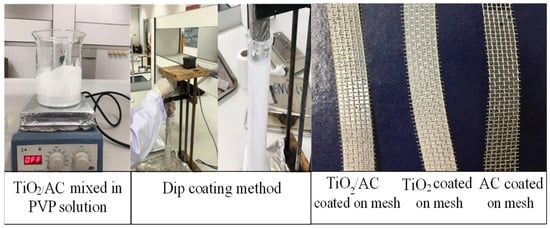
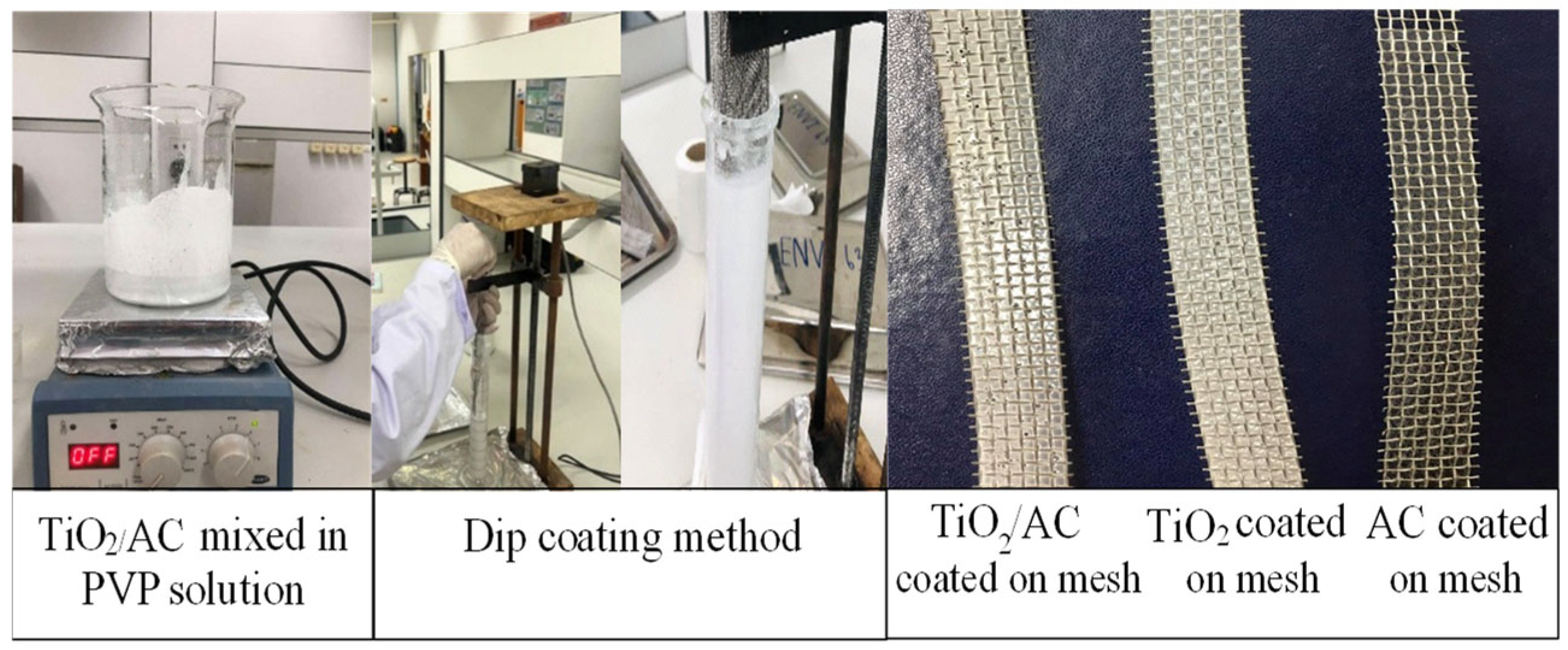
In the dip-coating process, the polymer solution contained TiO2, AC, ethanol, and PVP. The ratio of TiO2:AC was fixed from the optimal catalyst loading at 1:0.05 wt/wt, and 20%wt TiO2/AC was fixed to be coated on the mesh based on the report in the previous work [36]. PVP (10%wt/v) 10.0 g was added into 100 mL of ethanol for the polymer dip-coating solution, while AC 0.048 g and TiO2 0.952 g were added into 100 mL of the PVP solution. The catalysts in the solution had been sonicated for 1 h at room temperature. TiO2/AC nanoparticles were coated on the mesh with PVP binders by dipping using an automatic coating machine. A draw speed of the dip coating of 10 cm/min for three cycles was used, as illustrated in Figure 1. After the drying process at 105 °C in the air, the TiO2/AC-coated mesh using the dip-coating method was obtained. For the performance evaluation of the wastewater treatment, the number of TiO2/AC mesh layers in the photoreactor was investigated. Moreover, it is important to study the optimal loading amount of catalyst coated on the mesh in order to enhance the photocatalytic efficiency.
Figure 1.
TiO2/AC coated on mesh by dip-coating method.
2.4. Materials Characterization
After obtaining the TiO2/AC coating on mesh, its chemical and physical properties were examined to confirm the successful preparation of the nanocatalyst. Crystalline characterization was performed using XRD (Bruker D8 Discover, Bruker AXS GmbH, Karlsruhe, Germany) with copper radiation (Cu Kα, λ = 1.54 Å). Surface morphology of the prepared electrodes was analyzed by a FE-SEM (JSM-7610F, JEOL Ltd., Tokyo, Japan), operated under high vacuum (~10−8 bar). The FE-SEM was equipped with EDS, which was used to determine the bulk elemental composition and confirm the presence of Ti, O, and C by carbon percentage in the TiO2/AC-coated mesh.
2.5. Design of the Photoreactor
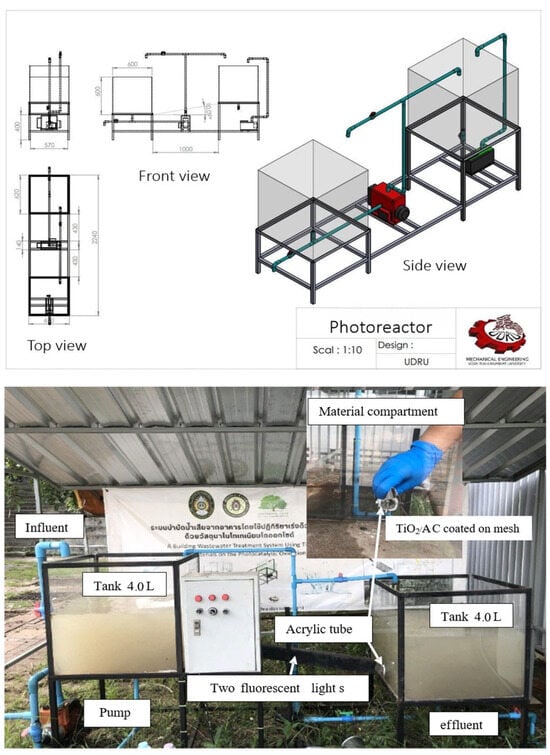
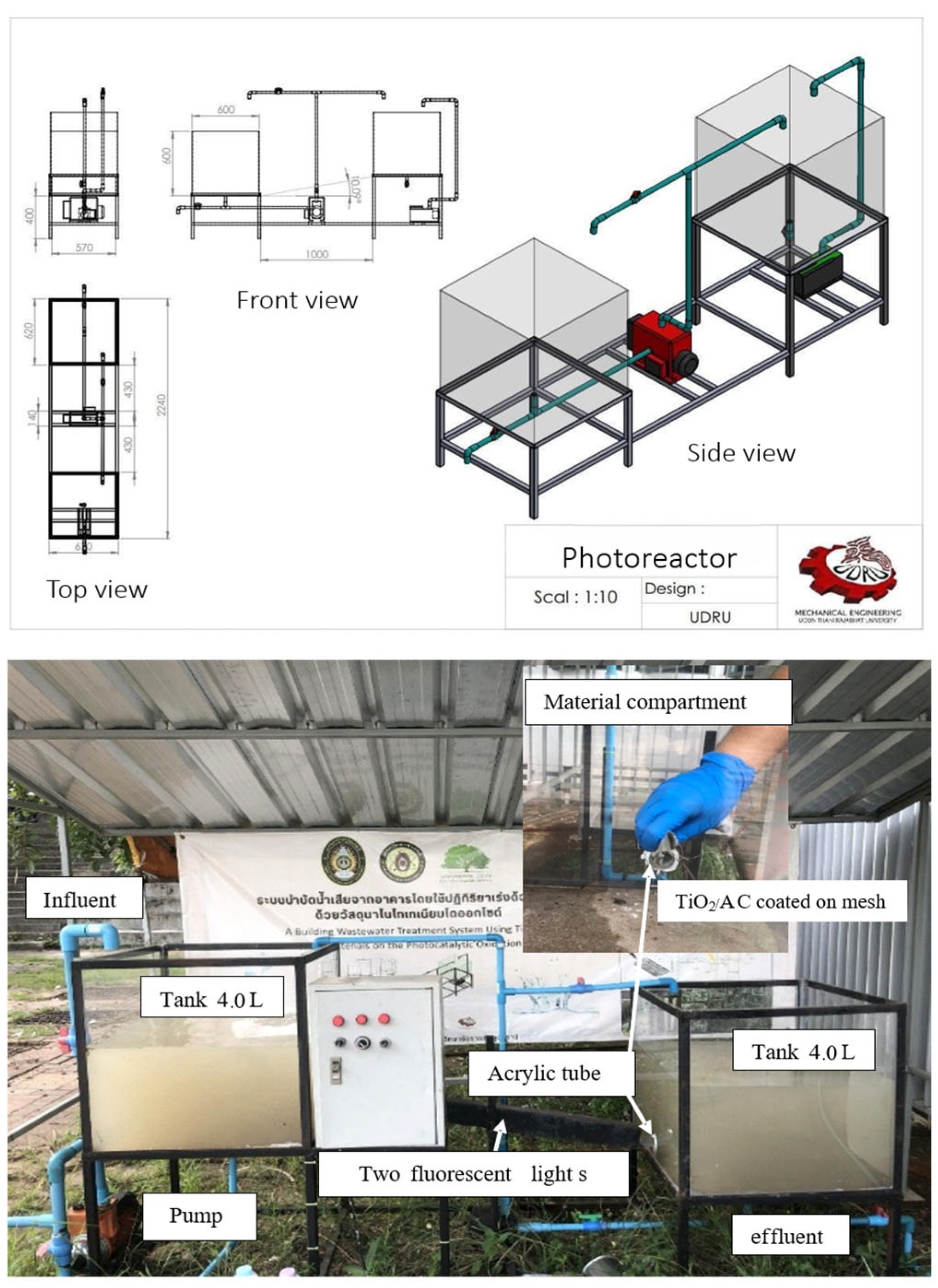
A photoreactor consists of one transparent acrylic tube irradiated with two visible light sources from the exterior, as illustrated in Figure 2. For the light source experiment, two 36 W fluorescent light bulbs (72 W, 4000 lux) were turned on to start the photocatalytic wastewater treatment. The treated wastewater flows through the tubes, thus being exposed to the external irradiation. For efficient treatment, TiO2/AC-coated mesh is inserted into the acrylic tube. The photocatalytic reactor is composed of two slop tanks (8 L) connected in parallel by means of a pump in the photoreactor. However, the low photocatalytic efficiency of photocatalysis under visible light indicated a limit to its application in the real wastewater system. To improve the wastewater treatment application of photocatalysis, the efficiency, stable photocatalyst materials, and light source are important parameters to be considered when designing the photoreactor. Moreover, the flow rate (8.0, 10.0, 12.0 L/min), light intensity position in the photocatalytic setup (spaced by 5.0, 10.0, and 15.0 cm), and the number of TiO2/AC-coated mesh layers (10, 15, and 20 mesh layers) have a significant influence on the overall pollutant removal efficiency. The intensity of the light source must also be considered in order to overcome the scattering induced by the working environment.
Figure 2.
Design of a horizontal photoreactor for real wastewater building treatment.
The photoreactors are designed using a simple design and are easy to use for recovery and reuse of the catalyst, which is essential. According to our previous work [37], a nanocatalyst-coated mesh produced using the dip-coating method has been proven to be a promising candidate in the development of wastewater treatment on the photocatalytic process. Thus, the present work focuses on the application of a new photoreactor design and uses the activated carbon composite coating as an interesting, alternative, energy-efficient, and sustainable route for the preparation of TiO2/AC catalytic material. In addition, the reaction conditions, such as flow rate, BOD removal rate, and COD removal rate, also affect the photocatalytic efficiency. Understandably, the activity of the catalysts depends on their surface area, as it is the main factor to increase the efficiency of their properties in wastewater treatment.
2.6. Domestic Building Wastewater Treatment
Real wastewater is untreated liquid effluent discharged from residential or office buildings into sewer networks and natural resources. It is a complex, fluctuating mixture of water, solids, organic and inorganic pollutants that requires treatment to meet environmental standards before disposal. The TiO2/AC-coated mesh obtained by dip coating was installed in a horizontal photoreactor with a continuous flow rate of 8.0 L/min for 120 min. A recirculating batch photoreactor was operated under visible light; a total of 960 L of wastewater would be treated. The TiO2/AC catalyst-coated surface faces the excitation source. Placement of the light source irradiation can be either outside or inside the reactor, and it can be carried out by two lamps placed in the side walls of the reactor. Real wastewater used in this study was collected from a domestic building discharge, which consisted of a mixture of organic matter, nutrients, suspended solids, and microorganisms. The organic matter, which is primarily treated by the TiO2/AC catalyst, was evaluated in terms of degradation efficiency using BOD and COD. Generally, the parameters required for treated effluent standards for buildings of the Pollution Control Department (PCD) in Thailand are reported by pH, SS, TDS, O&G, TKN, and BOD. To monitor the permissible limit of COD in wastewater discharged to public water sources according to standards in Thailand, COD was also measured and reported. The concentration of real wastewater treatment present at any time is expressed in terms of BOD and COD. The degradation rate of real wastewater in the system was calculated using Equations (1) and (2):
where BOD0 is the initial BOD concentration, and BODt is the BOD concentration of real wastewater at illumination time t, while COD0 is the initial COD concentration, and CODt is the COD concentration of real wastewater at illumination time t. The reusability of the sample was evaluated by testing its ability to degrade pollutants from wastewater effluent. After that, the sample was washed with distilled water and dried at 100 °C in a hot air oven. The experiment was repeated with the same sample three additional times.
BOD removal efficiency (%) = (BOD0 − BODt∕BOD0) × 100%
COD removal efficiency (%) = (COD0 − CODt∕COD0) × 100%
3. Results
3.1. Characterization of TiO2/AC
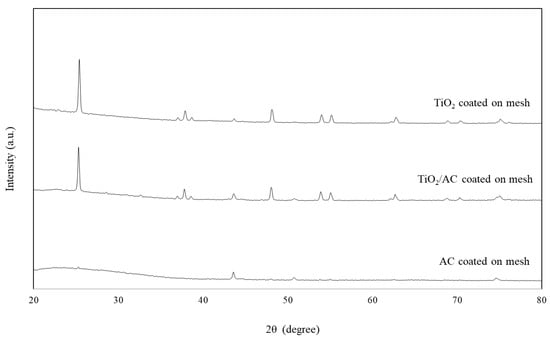
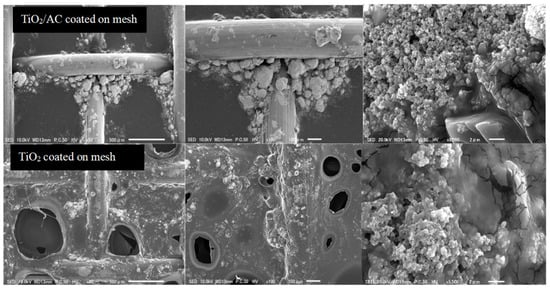
The XRD patterns of the obtained materials were investigated by an XRD analyzer, and they compellingly demonstrate the performance of TiO2/AC-coated mesh compared to pristine TiO2 and pure AC-coated mesh. The XRD patterns of TiO2 exhibit peaks at 2θ values of 25.35, 37.70, 47.98, 53.76, 54.99, 62.57, 68.59, and 70.20 that correspond to the (1 0 1), (0 0 4), (2 0 0), (1 05), (2 1 1), (2 0 4), (1 1 6), and (2 2 0) planes, respectively, corresponding to the anatase phase according to JCPDS (21–1272) [38], as illustrated in Figure 3. For the TiO2/AC sample, the XRD patterns are the same as TiO2, and the highest peak of TiO2/AC is at a 2θ value of 25.35, indexed as the (101) plane. This could be the origin that confirms that the TiO2 and activated carbon atoms are coated on the mesh. However, the peak intensity gradually decreased with an increasing amount of AC; thus, it may be the presence of AC that affects the composite formation [39]. For the AC sample, the peaks at 2θ values of 26.5 and 42.4 correspond to JCPDS No. 00–056-0159 [40]. These results indicate that TiO2/AC is observed and coated on the surface of the mesh, as detected by XRD. In addition, the TiO2/AC nanoparticle coating on the mesh was confirmed by the SEM image seen in Figure 4. The results show that the TiO2/AC particles coated the mesh during the dip coating.
Figure 3.
The XRD patterns of TiO2, TiO2/AC, and AC coated on mesh.
Figure 4.
FE-SEM of TiO2/AC coated on mesh compared with TiO2 coated on mesh without AC.
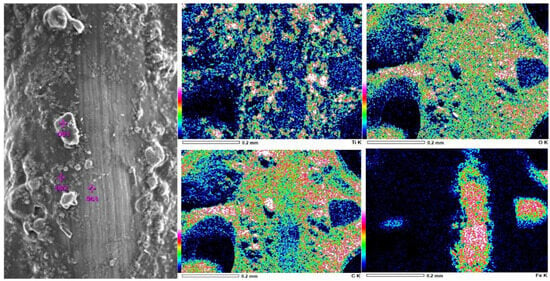
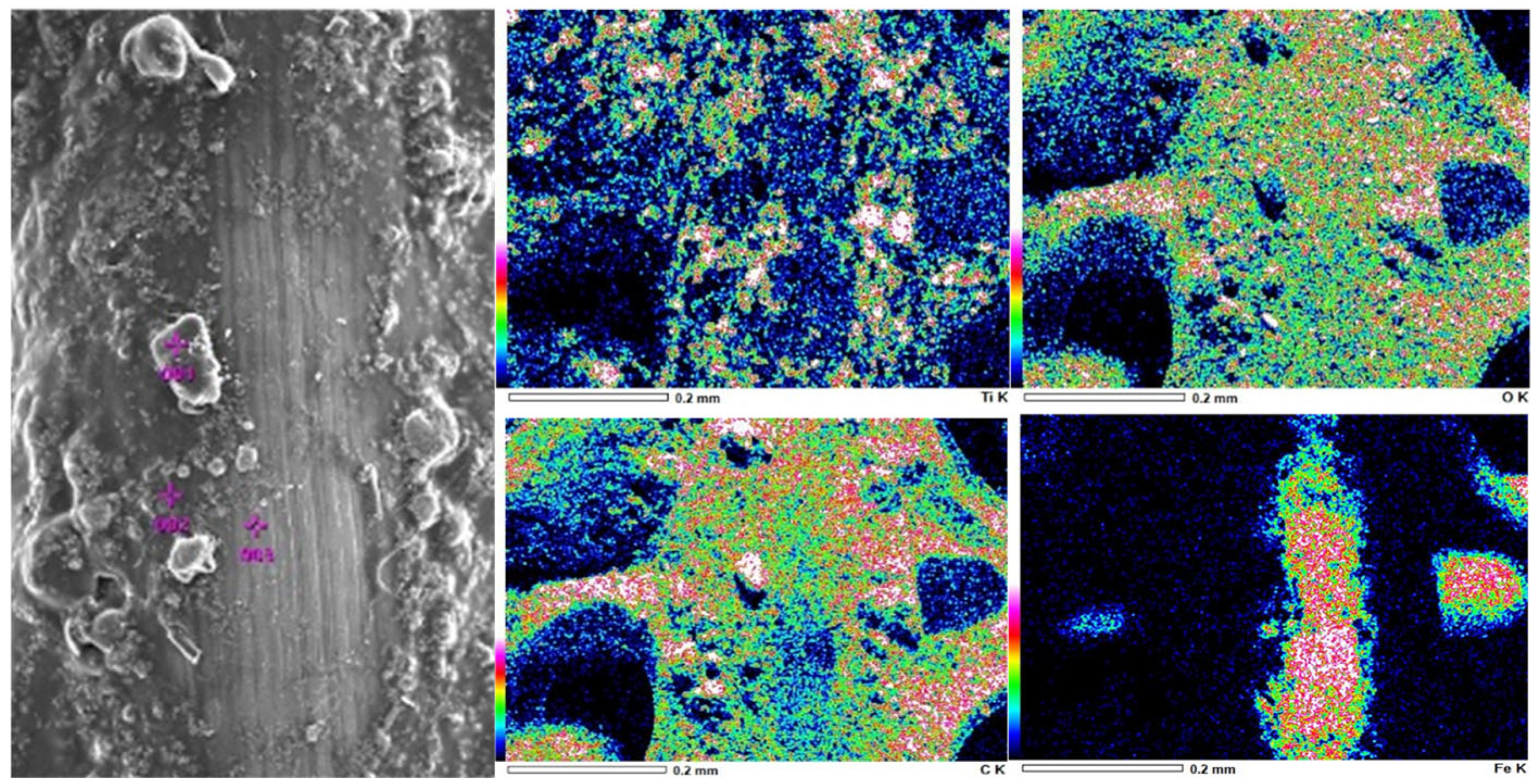
As illustrated in Figure 4, both the TiO2/AC and pure TiO2 particles exhibit an aggregated structure with notable heterogeneity. However, the TiO2/AC coating adheres far more effectively to the mesh, ensuring greater stability and durability. Notably, the TiO2/AC-coated mesh achieved a more uniform particle dispersion and a smaller average particle size, outperforming the pristine TiO2 coating in both aspects. Specifically, FE-SEM analysis revealed that the TiO2/AC-coated mesh had an average particle size of just 21.5 nm, in contrast to 28.5 nm for the pristine TiO2. Furthermore, EDS mapping from FE-SEM images (Figure 5) confirmed the presence of TiO2/AC, which was well coated on the mesh. The EDS spectra of Ti, C, and O elements validated the effectiveness of the dip-coating process. These findings strongly support the conclusion that TiO2/AC coating delivers significant advantages in terms of adherence, uniformity, and nanoscale control, making it the superior choice for mesh applications.
Figure 5.
FE-SEM and EDS mapping images of Ti, O, and C.
3.2. Photocatalytic Reactor Performance Factor
3.2.1. Flow Rate
By fixing TiO2:AC with 1:0.05 wt/wt, the effects of the different flow rates of 8.0, 10.0, and 12.0 L/min on the BOD removal efficiency using TiO2/AC-coated mesh were studied. It was found that the TiO2/AC-coated mesh can prevent some substances in the wastewater from inhibiting the photocatalytic efficiency. The mesh material in the reactor can intercept large particles and prevent high turbidity from negatively impacting wastewater photocatalytic efficiency. Therefore, in the practical application, photocatalytic biodegradation can be utilized to accomplish this objective by designing a photocatalytic reactor utilizing TiO2/activated carbon catalyst coated on mesh. As a result, the BOD removal efficiency of real wastewater treatment increased to 60% with a minimized flow rate of 8.0 L/min quickly after conducting the photocatalytic oxidation for 120 min under visible light irradiation, as illustrated in Table 1. Compared with the flow rate of 10.0 and 12.0 L/min, the BOD removal efficiency of TiO2/AC coated on mesh is much slower, at 57% and 55%, respectively.
Table 1.
BOD removal efficiency of TiO2/AC coated on mesh in the photoreactor with different flow rate ratios.
To implement photocatalytic wastewater treatment technology, it is necessary to optimize the horizontal photoreactor in a continuous flow system. It can be identified that an increase in the liquid flow rate enhances the turbulence in the reactor and leads to greater contact between the particle surface and the liquid phase. In previous research, the different flow rates were also compared in relation to the photocatalytic reaction rate, and it was found that the lowest limit of the pump provided a good performance of wastewater treatment on the photocatalyst, allowing it to react with excess photogenerated electrons, thereby reducing the recombination of electrons and holes [41,42]. Additionally, the minimization of the flow rate affects the photocatalytic oxidation of the TiO2/AC-coated mesh for the suitable new design photoreactor aggregates; thus, it is necessary to control the appropriate flow rate in order to improve the photocatalytic performance, as the different flow rates result in differences in the photocatalytic performance in the wastewater treatment process. Consequently, it is very important to design a photoreactor that can maintain the optimal flow rate of the reaction solution, and large photocatalytic reactors with long reaction times need to be designed to ensure a constant flow rate for the photocatalytic reaction of TiO2/AC coated on mesh. The optimal flow rate in the photoreactor should be the lowest, as it must balance degradation time with the TiO2/AC catalyst. Many researchers reported that lower flow rates often raise degradation efficiency because they increase the residence time required for pollutant molecules to interact with the catalyst. The photocatalytic degradation with a low flow rate showed a slightly higher BOD degradation rate than that of the fast flow rate. Comparing the flow rates in the range 8.0, 10.0, and 12.0 L/min, all three had good degradation efficiency, with almost complete degradation within 120 min. Therefore, the lowest flow rate conditions are suitable for the degradation of these organic pollutants in wastewater. However, the limit of the adjustment flow rate in this work is 8.0 L/min. Although the BOD degradation performed at the flow rate of 8.0 L/min was more than 60%, the BOD concentration was also measured at 25 ± 0.38 mg/L, which exceeds the limits (<20 mg/L) of the water quality standards in Thailand. Therefore, the other factors in the design of the photoreactor were studied in the next step.
3.2.2. Light Intensity Position
By fixing TiO2:AC with 1:0.05 wt/wt, the light intensity position in the photocatalytic setup was studied in the space range of 5.0, 10.0, and 15.0 cm, as illustrated in Table 2. For the fluorescence light experiment, two 36 W fluorescent light bulbs (total 72 W, 4000 lux) were turned on to start the photocatalytic wastewater treatment. The light intensity position between the reactor tube and the light bulb was 5.0 cm, and the BOD removal efficiency of wastewater treatment increased to 60% quickly after conducting the photocatalytic oxidation process for 120 min. As compared with the light intensity position, which was 10.0 and 15.0 cm, the BOD removal efficiency of wastewater performance on TiO2/AC-coated mesh proceeded much more slowly. This was due to the light intensity. The BOD removal efficiency of TiO2/AC-coated mesh with a light intensity position of 10.0 cm was 55%, and the TiO2/AC-coated mesh with a light intensity position of 15.0 cm was 51% under visible light irradiation when the photocatalytic process was proceeding for 120 min. The total exposure of visible light irradiation on the photocatalytic filters did not efficiently activate the photocatalytic degradation, resulting in low photocatalytic degradation efficiency.
Table 2.
BOD removal of real wastewater using TiO2/AC coated on mesh in the photoreactor with different light intensity distances.
The visible irradiation intensity affected the photocatalytic rate; increasing the visible irradiation intensity effectively increased the photocatalytic rate. The underlying factor is that heightened irradiation intensity invigorates a larger number of photons, thereby enhancing the interaction between the photocatalyst and the photons, leading to an increased generation of electron–hole pairs. Nevertheless, elevating the visible irradiation intensity further within the optimal spectrum becomes unfeasible due to the saturation of the generated electron–hole pairs, as well as the high irradiation intensity hastening the recombination of these pairs, in line with the findings of Xiang et al. [43]. This phenomenon could ultimately diminish photocatalytic efficiency. Consequently, it is crucial to manage the intensity of light radiation for peak performance. This implies that elevated light intensity can result in decreased energy efficiency from visible light irradiation. Simultaneously, excessively strong light intensity may generate additional heat, significantly impacting the longevity of the visible light. Thus, the findings demonstrated a connection between light intensity and photocatalytic kinetics, confirming that the rate of photocatalysis increased linearly with light intensity in lower ranges, while relying on light intensity at higher levels.
Apart from the experimentally developed TiO2/AC-coated mesh in the photoreactor mentioned above, the performance of the photocatalytic removal of pollutants with a TiO2/AC photocatalyst was investigated with a fluorescent radiation emitter (visible light irradiation). Although pristine TiO2 has limited activity under visible light irradiation because of its wide bandgap (~3.2 eV), the addition of AC can improve the photocatalytic performance of the TiO2/AC composite. AC enhances the adsorption of organic pollutants and increases their concentration near the photocatalytic active sites. In addition, AC acts as an electron acceptor (electron sink), which promotes charge separation and suppresses electron–hole recombination, leading to the formation of reactive oxygen species such as superoxide and hydroxyl radicals. As a result, the TiO2/AC composite shows improved wastewater degradation under fluorescent light irradiation. Thus, this work is focused on the potential of the TiO2/AC photocatalyst under visible light irradiation for scaling up and shows the potential of TiO2/AC-coated mesh as a simple photocatalyst suitable for scale-up. Therefore, the novelty of this reactor lies in a robust, yet simple and inexpensive device that offers simple operation and non-conflicting scale-up.
3.2.3. Loading Number of TiO2/AC-Coated Mesh Layers
The optimal conditions of flow rate and light intensity position of the photoreactor were obtained, and the influence of the number of mesh layers influence of photocatalytic oxidation on the BOD removal efficiency of TiO2/AC was next studied, as illustrated in Table 3. By fixing TiO2:AC with 1:0.05 wt/wt, the BOD removal efficiency of wastewater treatment increased to 63% when increasing the number of TiO2/AC-coated mesh layers to 15 layers after conducting the photocatalytic process for 120 min, and further increased to 68% when increasing the number of TiO2/AC-coated mesh layers to 20 layers under visible light irradiation. Compared with TiO2/AC-coated mesh with 10 mesh layers, the BOD removal efficiency of wastewater performance on photocatalytic proceeded much more slowly (60%). Thus, the amount of photocatalyst must be experimentally determined, depending on the number of layers of TiO2/AC-coated mesh and the working conditions of the photoreactor. However, the limit of the number of TiO2/AC-coated mesh layers included inside the photoreactor tube in this work is 20 layers.
Table 3.
BOD removal of real wastewater using TiO2/AC coated on mesh in the photo reactor with different number of meshes loading.
The reaction rate increases with an increase in photocatalyst amount, due to absorption of more photons by the photocatalyst, larger scattering of light by the dispersion, and larger adsorption of organic compounds on the photocatalyst, whereas too large an amount of photocatalyst can cause a decrease in the reaction rate in terms of excess particles, which mask part of the photosensitive surface, decreasing the penetration depth of light. The optimal amount of photocatalyst is the maximum amount of photocatalyst in which all the particles and all the exposed surfaces are totally illuminated once the photocatalyst loading directly affects the photocatalytic reaction rate. Many previous studies reported that the photocatalytic reaction rate is positively correlated with the photocatalyst dosage. However, as the photocatalyst dosage reaches the optimal value, the photocatalytic reaction rate cannot be further enhanced by continuing to increase the photocatalyst dosage [44,45]. Understandably, the photocatalytic efficiency depends on the number of photocatalysts irradiated by the effective wavelengths. An increase in irradiated photocatalysts can excite the photocatalysts and result in a faster photocatalytic reaction rate [46]. This study revealed that an overabundant increase in the quantity of photocatalyst resulted in a reduction in the reaction speed. This phenomenon might arise from the excessive addition of the catalyst, which alters the penetration depth of visible light, leading to fewer photocatalysts being exposed to the effective wavelength. It was also determined that the configurations of the photocatalysts and the total amount of photocatalysts receiving irradiation significantly influence the rate of the photocatalytic reaction. Therefore, in the design of a photoreactor, it is necessary to select the optimal number of mesh loading forms in the reactor, so as to maximize the effective loading amount of photocatalysts and promote the improvement of photocatalytic efficiency.
3.3. TiO2/AC Photocatalyst Performance of the Wastewater Treatment Process
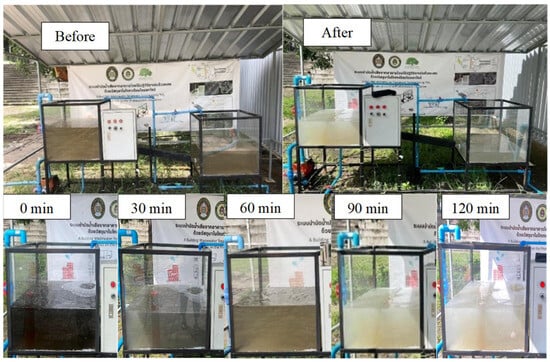
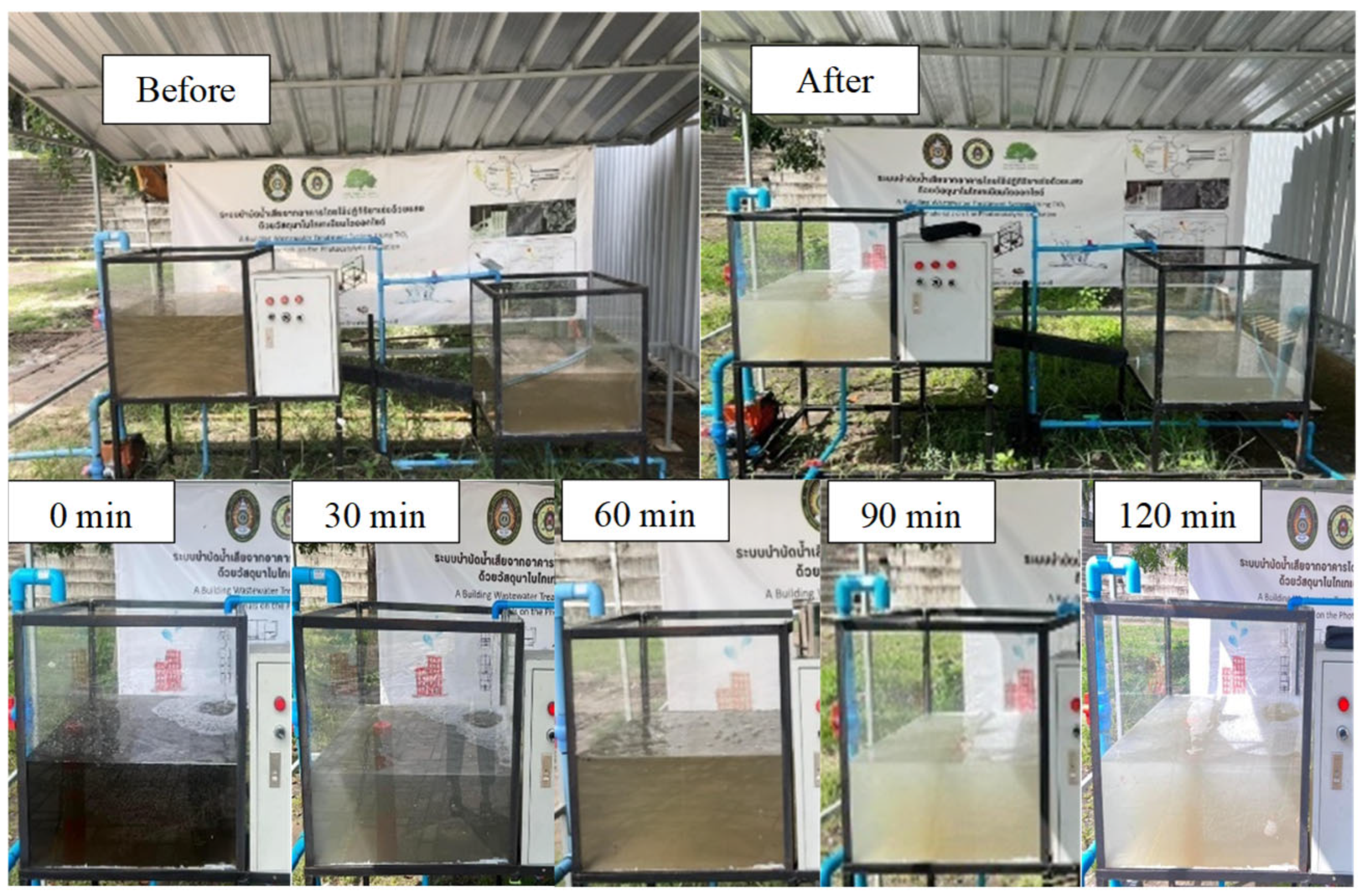
To study the performance of photocatalytic activity for wastewater treatment of building discharge, TiO2/AC-coated mesh, AC-coated mesh, and TiO2-coated mesh were selected. Pristine mesh without a catalyst was used as a reference for comparison. The obtained TiO2/AC, coated on mesh by dip coating, was installed in a horizontal photoreactor with a continuous flow system. The two 36 W fluorescent light bulbs (4000 lux) were turned on to start the photocatalytic wastewater treatment process. The concentration of real wastewater treatment under visible light irradiation from 0 to 120 min was expressed in terms of BOD removal percentage and COD removal percentage, as illustrated in Figure 6.
Figure 6.
Wastewater treatment on a building site using TiO2/AC coated on mesh in a photoreactor.
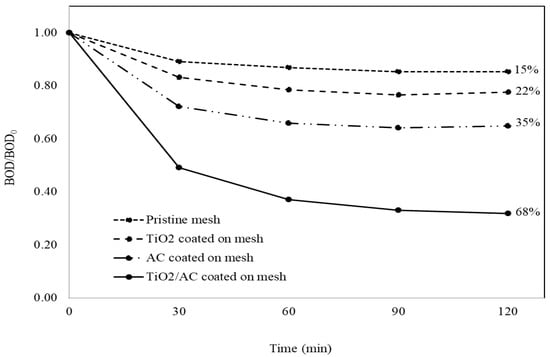
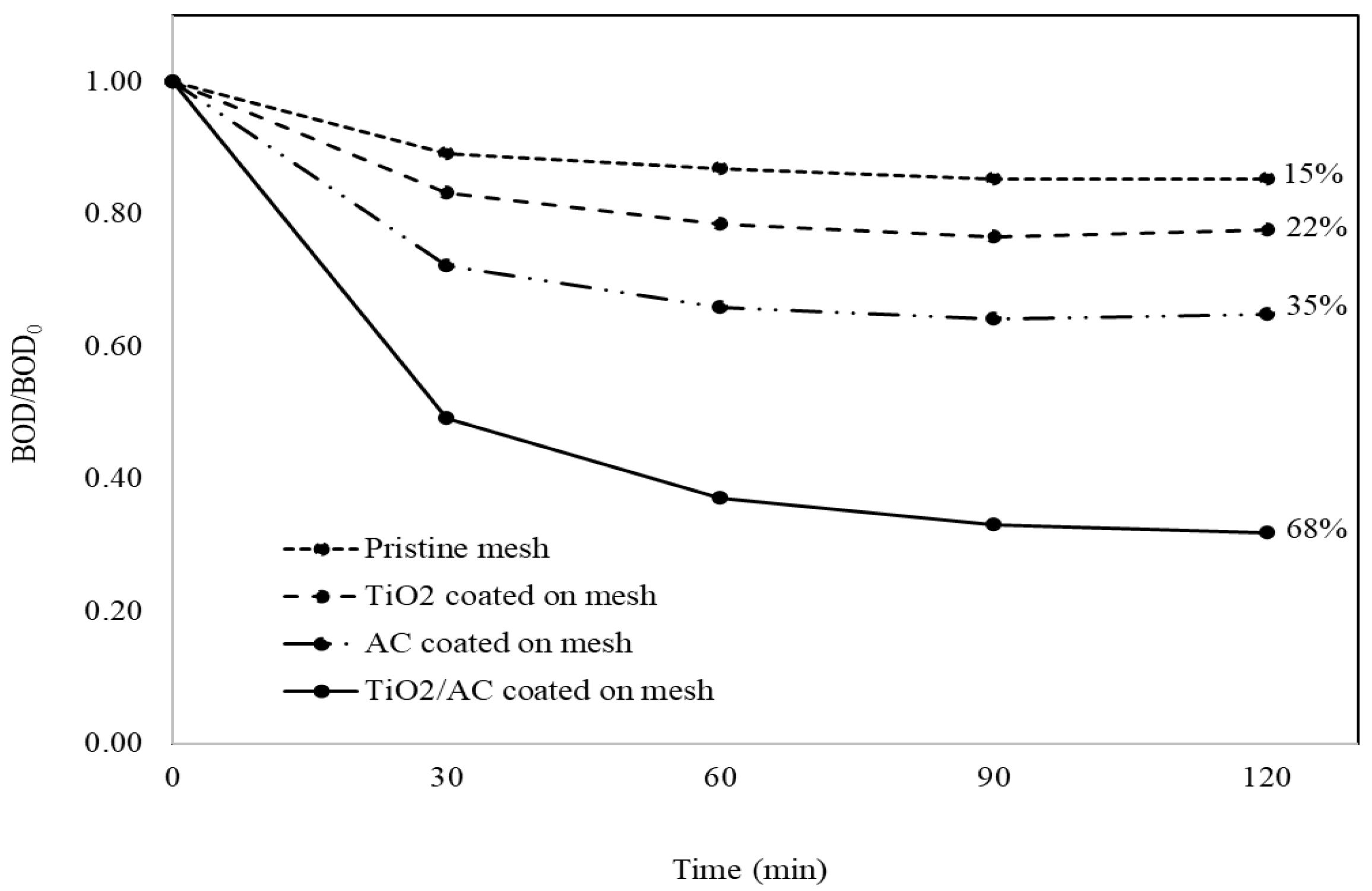
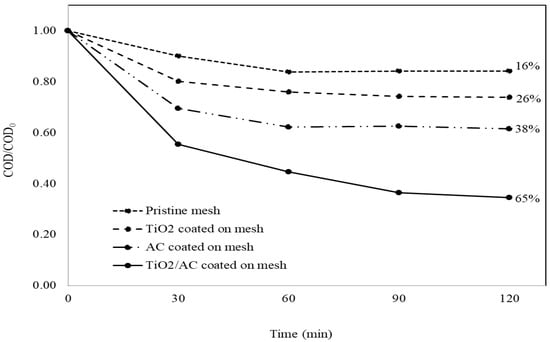
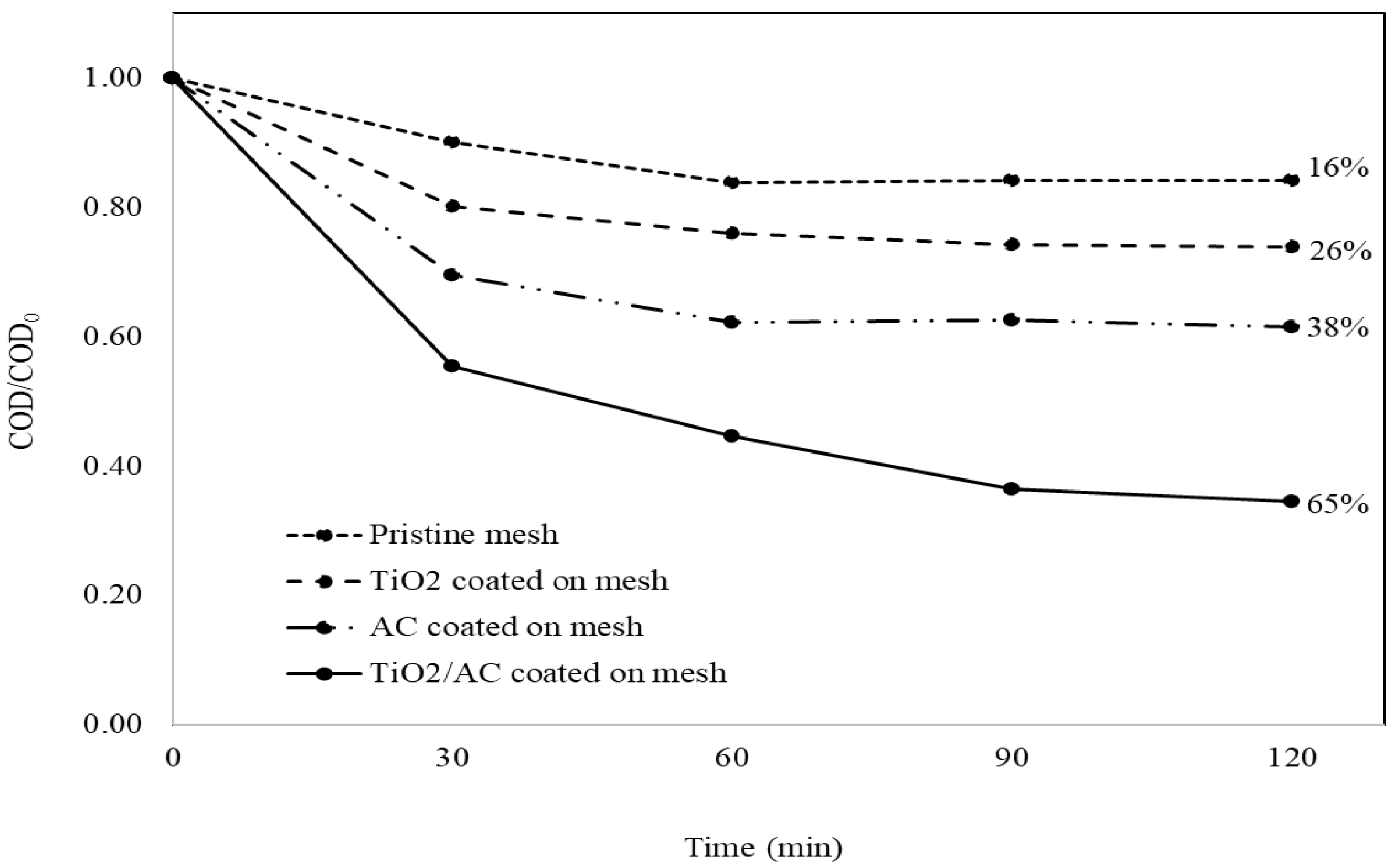
Under visible light irradiation, the performance of the BOD treatment of TiO2/AC-coated mesh was the highest when compared with other samples. The performance of BOD treatment by TiO2/AC-coated mesh (68%) was higher than that of AC-coated mesh (35%), TiO2-coated mesh (22%), and pristine mesh (15%), respectively, as illustrated in Figure 7. For the performance of the COD treatment, the removal efficiency followed the same trend. The performance of COD treatment by TiO2/AC-coated mesh (65%) was higher than that of AC-coated mesh (38%), TiO2-coated mesh (26%), and pristine mesh (16%), respectively, as illustrated in Figure 8. It was clearly shown that TiO2 in the presence of AC produced a synergistic effect of the composite and led to an increase in photocatalytic performance. This result agrees with previous research [37]. Mathana et al. reported the comparison of real wastewater treatment in the reactor, showing that the photocatalytic activity of TiO2/AC composites (35%) was higher than that of TiO2 (12%) under visible light irradiation. When loaded with carbon material support, it can enhance the photocatalytic activity of TiO2. This is because carbon material increases the adsorption of organic pollutants on TiO2/AC, leading to a high organic concentration around TiO2. While AC has no photocatalytic activity, the system exhibits synergism in which the adsorbed organic molecules on AC are transferred to TiO2, where they are degraded.
Figure 7.
BOD removal efficiency with different catalysts coated on mesh under visible light irradiation.
Figure 8.
COD removal efficiency with different catalysts coated on mesh under visible light irradiation.
Furthermore, the synergistic effect of adsorption by AC and TiO2 particulates can have beneficial consequences in the photodegradation of organic pollutants in aqueous media. These results can confirm that AC is a good material support and can absorb some organic pollutants. The dramatically increased surface area of TiO2/AC composites material enhanced the photocatalytic degradation, especially in terms of the adsorption ability. Thus, TiO2/AC-coated mesh can be used for the application in wastewater treatment. Significantly, TiO2/AC-coated mesh showed the best performance for BOD treatment (68% within 120 min), while COD also showed better photocatalytic degradation (65% within 120 min) than that of TiO2-coated mesh and AC-coated mesh, as illustrated in Table 4.
Table 4.
BOD and COD removal efficiency of real wastewater from building discharged using TiO2/AC coated on mesh in the photoreactor under visible light irradiation in 120 min.
Alternatively, the destruction of pollutants can be directed by using photocatalytic processes and photolysis of reactive compounds. In recent years, applying visible light irradiation for real wastewater treatment has been widely studied [47,48]. Fluorescent or LED lamps are often used for photocatalysis with novel photocatalysts that operate under visible light irradiation, such as TiO2 modified with activated carbon composite materials. A fluorescent light was selected as the visible light source for this study because it is non-hazardous, inexpensive, and can be adapted to utilize sunlight, enabling further practical applications. In addition, the performance of the wastewater treatment rate in real wastewater from building discharge by the photoreactor was determined by water quality standard parameters, as illustrated in Table 5. In the wastewater treatment process, both chemical and biological analyses are commonly used to study the performance of wastewater treatment. As a result, all parameters did not exceed the limits of the water quality standards in Thailand. The average pH was in the standard range of pH 5.0–9.0. The removal efficiency of suspended solids (SSs) was 62%, while that of total dissolved solids (TDSs) was 61%. For the parameter of oil and grease (O&G), the removal efficiency was 64%, and the removal efficiency of Total Kjeldahl Nitrogen (TKN) was 63%. For BOD and COD, the removal efficiency was 68% and 65%, respectively.
Table 5.
The physicochemical properties of real domestic building effluent on photocatalytic treatment by TiO2/AC coated on mesh under visible light irradiation in 120 min.
Although the photocatalytic oxidation for wastewater treatment targets the removal of soluble organic matter that is difficult to treat, all parameters of wastewater treatment efficiency could be determined to be more than 60% after this process. This is because the combination of photocatalytic mechanisms with wastewater treatment processes revealed that photocatalysts were involved in the adsorption and photocatalytic activity treatment, which is in agreement with Hernández-Zanoletty et al. [49]. However, the low photocatalytic efficiency of photocatalysis under visible light and the amount of catalyst dosage in the photoreactor limit its application in a real wastewater treatment system. To promote the industrial application of photocatalysis, efficient and stable photocatalysts with optimal photoreactor performance are thus essential. Obviously, when comparing the present work with other reported studies in the literature with a similar photocatalyst applied for real wastewater treatment, as illustrated in Table 6, TiO2/AC-coated mesh in this work had a higher removal efficiency of wastewater treatment and achieved it in a much shorter time. These results indicate that, in addition to a higher removal efficiency of treatment of wastewater from building discharge, TiO2/AC also exhibited a faster rate in removing organic pollutants from water when compared with pristine TiO2 or AC. In the practical application, photocatalytic biodegradation can be utilized to accomplish this objective. TiO2/AC-coated mesh can prevent some substances in the wastewater from inhibiting the photocatalytic efficiency. Additionally, a mesh structure within the reactor can capture larger particles and prevent elevated turbidity from harming the photocatalytic performance of wastewater. Likewise, sulfate and chloride ions in the wastewater must be processed prior to entering the photoreactor, as these ions can negatively influence photocatalytic activity.
Table 6.
Comparison between the present work and the reported works in the literature with a similar photocatalyst applied for real wastewater treatment in the different design photoreactors.
Apart from a higher removal efficiency and faster removal rate, TiO2/AC-coated mesh also has good reusability. After three cycles, the BOD removal efficiency of wastewater by TiO2/AC decreased by 15%, from 68% in the first cycle to 53% in the third cycle. Thus, photocatalyst recovery is a major advantage for the photocatalytic wastewater treatment application. It is necessary to design the reusability of the photocatalyst within the photoreactor. In this work, a photoreactor where TiO2/AC coated on a mesh photocatalyst can be recovered and reused was designed. The experiment also showed that the degradation rate of organic pollutants from wastewater building discharge can still be higher than 53% under visible light irradiation after three cycles, indicating that the TiO2/AC composite photocatalyst has good recyclability. Moreover, the dip-coating method can also have a favorable recovery effect. The reactor uses TiO2/AC as a photocatalyst, which not only enhances the multiphase photodegradation of organic compounds but also realizes the recovery of the photocatalyst by coating it on mesh. After the reaction, the TiO2/AC catalysts are still coated on the mesh, and finally, the catalyst is reused. Regarding the stability of PVP, the assessment of potential TiO2 leaching was studied in terms of TiO2/AC coated on mesh recyclability. After three cycles, the BOD removal efficiency of wastewater by TiO2/AC decreased by 15%, from 68% in the first cycle to 53% in the third cycle, indicating a loss of stability of the PVP effect. Although the results of the TiO2/AC-coated mesh also have good reusability, the PVP copolymer is not stable. Thus, the limit of using the TiO2/AC photocatalyst recovery is not over the third cycle, which is necessary to improve further research work.
3.4. Mechanism of Photocatalytic Wastewater Treatment
The redox reaction is described by Equations (3)–(7). The photogenerated charge transfer to the surface is expedited due to the shorter distance in nanomaterials, resulting in enhanced photocatalytic reaction processes. The application of nano-photocatalysts provides a promising real wastewater treatment for this issue. When the size of photocatalytic materials is at the level of the nanoscale, the specific surface area of the photocatalyst is significantly increased, allowing for a greater number of exposed active sites. When a photon (hv ≥ Eg) has energy greater than that of the band gap, it can excite an electron (e−) in the valence band (VB) of the photocatalyst, in accordance with Equation (3), which agrees with Boonwan et al. [52] and Wang et al. [53]. The electron will move through the band gap (Eg) to the conduction band (CB), forming a hole in the VB, thus forming an electron–hole pair. The electrons moving to the conduction band will form superoxide radicals (·O2−) with dissolved oxygen in water, as seen in Equation (4), while the holes will react with hydroxyl ions or water molecules to form hydroxyl radicals (·OH), illustrated in Equation (6). The electron–hole pairs, ·O2−, and ·OH mentioned above all have extremely strong oxidation ability, which can break the chemical bonds of most harmful substances in wastewater, and the degraded pollutants are converted into H2O and CO2, according to Equation (7), which agrees with Mei et al. [54].
TiO2/AC + hν → e− + h+
e− + O2 → ·O2−
e− + H2O → ·OH + H+
h+ + H2O → ·OH
Pollutants + (·OH, h+, e− or O2·−) → degradation products (CO2, H2O)
From the photocatalytic mechanism, the reactive oxygen species were confirmed by electrochemical (EC) detectors, which are highly sensitive for measuring hydroxy radical and superoxide anion. In the photocatalytic activity of TiO2/AC, the ·OH radicals are generally identified as the predominant reactive species responsible for oxidation, rather than the O2−. While both are generated, the porous structure of AC enhances the production of ·OH radicals. The role of AC in improving the photocatalytic reactivity of TiO2 under visible light irradiation can be explained as follows: (i) TiO2/AC has a larger specific surface area compared with TiO2, which can adsorb more organic pollutants in wastewater, and (ii) AC in the photocatalyst composite inhibits the recombination of photogenerated electrons and holes, thus improving the photocatalytic activity. Obviously, AC has been corrected to an electron acceptor that promotes charge separation by acting as an electron sink, while also enhancing photocatalytic performance through adsorption and enrichment of organic pollutants near active sites, which is in agreement with Parvathiraja et al. [55]. Therefore, TiO2/AC-coated mesh can be more changeable and removable than TiO2 after applications of wastewater treatment in the photoreactor. Moreover, TiO2/AC-coated mesh material has various advantages, such as a high specific area, and may also prevent the agglomeration of nanoparticles, as previously reported [36,56]. In addition, TiO2/AC-coated mesh is a good material form for applications of photocatalytic wastewater treatment. TiO2/AC-coated mesh forms can remove organic pollutants, dust mites, and ultrafine particles in wastewater, while carbon as a nanofiber can adsorb odors and toxic gases, which is in agreement with Pal et al. [57] and Leelert et al. [58]. It should be noted that the photodegradation of wastewater using a TiO2/AC-coated mesh in the photoreactor can be explained as follows: (i) upon visible light irradiation, TiO2 generates electron–hole pairs; (ii) the photogenerated electrons in the conduction band of TiO2 react with dissolved oxygen to form superoxide radicals (·O2−), while the holes (h+) oxidize adsorbed water or hydroxyl groups to produce hydroxyl radicals (·OH); and (iii) these reactive oxygen species then oxidize and degrade organic pollutants in wastewater. Meanwhile, AC functions as an electron acceptor, promoting charge separation and suppressing electron–hole recombination. It also enhances the adsorption and concentration of organic pollutants near the photocatalytic active sites, thereby improving the overall degradation performance of the TiO2/AC composite under visible light irradiation.
4. Conclusions
TiO2/AC was prepared by a simple mixing method and coated on mesh with the dip-coating technique using PVP as a copolymer. The obtained TiO2/AC-coated mesh was used to remove wastewater building discharge with a continuous flow photoreactor (a device that uses light to drive chemical reactions). The optimal conditions of the photoreactor, such as flow rate (8.0 L/min), the position between the light source and catalyst tube (spaced by 5.0 cm), and the amount of mesh in a photoreactor (20 mesh layers), were obtained. The results showed high efficiency with BOD removal efficiency at 68% and COD removal efficiency at 65%. TiO2/AC-coated mesh showed the highest activity and achieved higher BOD and COD removal compared to pristine TiO2-coated mesh and AC-coated mesh. This study indicates that TiO2/AC-coated mesh can be a good candidate for water purification containing emergent (previously unregulated) contaminants. However, this work has a limitation in the reusability of the TiO2/AC coating, possibly due to degradation of the PVP binder. Therefore, future work should focus on developing a more stable binder to improve the durability and reusability of the coating system. In this work, the design of a horizontal photoreactor with a continuous flow system was also investigated as a model to optimize the parameters for real wastewater treatment. The light intensity and the amount of catalyst coated on the mesh were significantly different compared to other reactions, as they are activated by absorption of visible light irradiation. For this reason, the distribution of visible light radiation (the way light spreads in the reactor) must be an integral part of the photoreactor design. The effectiveness of pollutant degradation largely depends on light intensity. However, photocatalytic wastewater treatment technology is not widely used because the cost of the domestic wastewater treatment system is high. Scaling up is often hindered by issues such as mass transfer limitation, difficulty in mixing chemicals efficiently, radiation transfer limitation, and light source heat dissipation. Thus, it is important to study the optimal photoreactor for the treatment of real wastewater from domestic building discharge.
Author Contributions
A.B.: Writing—original draft, Methodology, Software, Data curation, Conceptualization. R.K.: Writing—review and editing, Methodology, Investigation. A.L.: Formal analysis, Validation, Supervision. S.S.: Writing—review and editing, Formal analysis, Supervision. M.W.: Writing—original draft, Methodology, Data curation, Conceptualization, Project administration. All authors have read and agreed to the published version of the manuscript.
Funding
The financial support from the funding of Research and Development Institute, Udon Thani Rajabhat University.
Data Availability Statement
Data will be made available on request.
Acknowledgments
The authors gratefully acknowledge the financial support from the Research and Development Institute, Udon Thani Rajabhat University. This work was also supported by Tottori University of Environmental Studies for FE-SEM, XRD, and EDS measurements.
Conflicts of Interest
The authors declare no conflicts of interest.
References
- Jiang, J.; Gao, F.; Wang, S.; Tang, X.; Lu, M.; Wang, J.; Yi, H. Advances in photo-catalytic oxidation of NH3 over modified TiO2 catalysts: Reaction pathways, improvement strategy and promotion mechanism. J. Environ. Chem. Eng. 2023, 11, 110602. [Google Scholar] [CrossRef] [Scilit]
- Thind, S.S.; Paul, M.; Hayden, J.B.; Joshi, A.; Goodlett, D.; McIndoe, J.S. A highly efficient photocatalytic system for environmental applications based on TiO2 nanomaterials. Ind. Chem. Mater. 2023, 1, 431–442. [Google Scholar] [CrossRef] [Scilit]
- Abdu, M.; Tibebu, S.; Babaee, S.; Worku, A.; Msagati, T.A.M.; Nure, J.F. Optimization of photocatalytic degradation of Eriochrome Black T from aqueous solution using TiO2-biochar composite. Results Eng. 2025, 25, 104036. [Google Scholar] [CrossRef] [Scilit]
- Chen, J.; Liu, J.; Liu, X.; Gao, W.; Zhang, J.; Zhong, F. Degradation of toluene in surface dielectric barrier discharge (SDBD) reactor with mesh electrode: Synergistic effect of UV and TiO2 deposited on electrode. Chemosphere 2022, 288, 132664. [Google Scholar] [CrossRef] [Scilit] [PubMed]
- Moreno, R.; Moles, S.; Ormad, M.P.; Mosteo, R.; Monzón, A. Modeling TiO2/UV–vis bacterial inactivation: Useful tools for reactor optimization and design. Catal. Today 2024, 430, 114520. [Google Scholar] [CrossRef] [Scilit]
- Carro, R.S.; Cerezo, M.N.G.; García, M.F.; Kubacka, A. Inverse-type CoOx-TiO2 catalysts for the energy-efficient thermo-photo valorization of CO2. J. Clean. Prod. 2023, 429, 139542. [Google Scholar] [CrossRef] [Scilit]
- Chang, C.; Li, Z.; Rad, S.; Gan, L.; Dai, J.; Shahab, A. Preparation and application of nano TiO2 filmcoated recycled low-iron crushed glass in a novel packed-bed photocatalytic reactor for efficient removal of biodegradable contaminants. Environ. Technol. Innov. 2024, 33, 103541. [Google Scholar] [CrossRef] [Scilit]
- Permporn, D.; Wantala, K.; Khemthong, P.; Phanthasri, J.; Neramittagapong, S.; Wongaree, M.; Khunphonoi, R. Insight into the photocatalytic reduction of hexavalent chromium using photodeposited metal nanoparticle-TiO2 photocatalysis. Environ. Sci. Pollut. Res. 2023, 30, 90328–90340. [Google Scholar] [CrossRef] [Scilit]
- Da Silva, M.A.R.; Gil, J.C.; Torres, J.A.; Silva, G.T.S.T.; Filho, J.B.G.; Victória, H.F.V.; Krambrock, K.; Teixeira, I.F.; Ribeiro, C. Investigating the metal−TiO2 influence for highly selective photocatalytic oxidation of methane to methanol. ACS Appl. Mater. Interfaces 2024, 16, 41973–41985. [Google Scholar] [CrossRef] [Scilit] [PubMed]
- Zhang, X.; Zhao, B.; Wu, N. Active sites and structure regulation of non-radical pathways in N-doped graphene-activated persulfate. Catal. Commun. 2024, 187, 106910. [Google Scholar] [CrossRef] [Scilit]
- Mishra, S.R.; Panigrahi, B.; Gadore, V.; Sarkar, N.; Ahmaruzzaman, M. Enhanced photocatalytic performance of CuS/O, N-CNT composite for solar-driven organic contaminant degradation. Sci. Rep. 2024, 14, 18022. [Google Scholar] [CrossRef] [Scilit] [PubMed]
- Zerjav, G.; Say, Z.; Zavašnik, J.; Finšgar, M.; Langhammer, C.; Pintar, A. Photo, thermal and photothermal activity of TiO2 supported Pt catalysts for plasmon-driven environmental applications. J. Environ. Chem. Eng. 2023, 11, 110209. [Google Scholar] [CrossRef] [Scilit]
- Theodorakopoulos, G.V.; Arfanis, M.K.; Stepišnik Perdih, T.; Malamis, S.; Iatrou, D.; Romanos, G.E.; Falaras, P. Innovative Photocatalytic Reactor for Sustainable Industrial Water Decontamination: Utilizing 3D-Printed Components and Silica-Titania Trilayer Coatings. Environments 2024, 11, 156. [Google Scholar] [CrossRef] [Scilit]
- Hoang, N.T.T.; Tran, A.T.K.; Le, T.A.; Nguyen, D.D. Enhancing efficiency and photocatalytic activity of TiO2-SiO2 by combination of glycerol for MO degradation in continuous reactor under solar irradiation. J. Environ. Chem. Eng. 2021, 9, 105789. [Google Scholar] [CrossRef] [Scilit]
- Kusworo, T.D.; Aryanti, N.; Inamullah, A.M.A.; Astuti, D.A.P.; Utomo, D.P. Advanced photocatalytic membrane GO-NiFe@SiO2/PVDF for efficient decontamination of synthetic dyes in batik wastewater with superior antifouling features. J. Water Process Eng. 2024, 66, 105953. [Google Scholar] [CrossRef] [Scilit]
- Alsaiari, M. Biomass-derived active carbon (AC) modified TiO2 photocatalyst for efficient photocatalytic reduction of chromium (VI) under visible light. Arab. J. Chem. 2021, 14, 103258. [Google Scholar] [CrossRef] [Scilit]
- Adaikalapandi, S.; Thangadurai, T.D.; Sivakumar, S.; Manjubaashini, N. Decoration of 2H-MoS2 on the surfaces of activated carbon derived from bamboo stem biomass waste: A regenerative novel architecture for effective degradation of methylene blue under natural light. Colloids Surf. A Physicochem. Eng. Asp. 2024, 684, 133039. [Google Scholar] [CrossRef] [Scilit]
- Silva, V.; Louros, V.L.; Silva, C.P.; Tacão, M.; Otero, M.; Calisto, V.; Lima, D.L.D. A solar flow photo-reactor for antibiotic removal from aquaculture effluents using TiO2/Carbon quantum dots. Chemosphere 2024, 348, 140723. [Google Scholar] [CrossRef] [Scilit] [PubMed]
- Hassan, M.J.U.; Ali, A.; Din, G.M.U.; Manzoor, I.; Ajmal, M.; Alsuhybani, M.; Mnif, W.; Algarni, Z.; Hassan, S.U.; Iqbal, M. Bismuth molybdate nanoparticles modified graphene oxide: A novel nanocomposite for photocatalytic removal of organic dyes. Mater. Sci. Eng. B 2024, 309, 117659. [Google Scholar] [CrossRef] [Scilit]
- Joseph, A.; Yelekar, G.R.; Vijayanandan, A. Efficiency of titanium dioxide-reduced graphene oxide in carbamazepine removal: A comparative study of adsorption, photocatalysis, and ultrafiltration techniques. Appl. Catal. O Open 2024, 193, 206967. [Google Scholar] [CrossRef] [Scilit]
- Juabrum, S.; Nijpanich, S.; Chanlek, N.; Kidkhunthod, P.; Poo-arporn, Y.; Nakajima, H.; Rujirawat, S.; Yimnirun, R.; Nanan, S.; Pinitsoontorn, S.; et al. Magnetically separable TiO2/SnO2/Fe3O4-based nanocomposite photocatalyst for organic dye removal under low-power ultraviolet-visible light irradiation. J. Water Process Eng. 2024, 66, 105883. [Google Scholar] [CrossRef] [Scilit]
- Pajouhan, Y.; Sabbaghi, S.; Rasouli, K.; Rasouli, J.; Dastyar, W.; Andiroglu, E. Enhanced photocatalytic degradation of tetracycline using α-Fe2O3@TiO2- impregnated Mxene photocatalyst: Mechanism and optimization of process via RSM and ANN. Process Saf. Environ. Prot. 2024, 190, 1149–1163. [Google Scholar] [CrossRef] [Scilit]
- Liu, Y.; Shan, M.; Du, L.; Sun, W.; Wu, D.; Bi, Q.; Wang, H.; Liu, Y. Robust TiO2/ACuS@TiO2 composites loaded on Ti mesh with outstanding stability and photothermal effects for the enhanced photo-degradation of organic pollutions in a flowing device. Appl. Surf. Sci. 2023, 623, 157006. [Google Scholar] [CrossRef] [Scilit]
- Sharma, K.; Sonu, S.; Sudhaik, A.; Ahamad, T.; Kaya, S.; Thakur, S.; Le, Q.V.; Nguyen, V.H.; Singh, A.; Nguyen, L.H.; et al. Mechanistic insights into the reaction pathway for efficient cationic dye photocatalytic degradation and the importance of the enhanced charge isolation over dual Z-scheme CeO2/BiOCl/Ag2WO4 photocatalyst. J. Water Process Eng. 2024, 66, 105918. [Google Scholar] [CrossRef] [Scilit]
- Xu, Z.; Wu, J.; Lovely, B.; Li, Y.; Ponder, M.; Waterman, K.; Kim, Y.T.; Shuai, D.; Yin, Y.; Huang, H. Visible light-activated dye-sensitized TiO2 antibacterial film: A novel strategy for enhancing food safety and quality. J. Hazard. Mater. 2024, 480, 136296. [Google Scholar] [CrossRef] [Scilit] [PubMed]
- Monteserín, C.; Blanco, M.; Juarros, A.; Goitandia, A.M.; Zarrabe, H.; Azpitarte, I.; Aranzabe, E.; Pavón, I.E.; Granados, S.N.; Berruti, I.; et al. Solar-assisted stainless-steel TiO2-based coatings for water disinfection and decontamination. Catal. Today 2024, 434, 114673. [Google Scholar] [CrossRef] [Scilit]
- Capp, S.C.; Sawtell, D.A.G.; Banks, C.E.; Kelly, P.J.; Allah, Z.A. The effect of TiO2 coatings on the formation of ozone and nitrogen oxides in non-thermal atmospheric pressure plasma. J. Environ. Chem. Eng. 2021, 9, 106046. [Google Scholar] [CrossRef] [Scilit]
- Wang, Y.; Zhang, Y.; Ma, Y.; Liu, J.; Zhang, R.; Zhao, J. Preparation and application of chitosan/nano-TiO2/daisy essential oil composite films in the preservation of Actinidia arguta. Food Chem. X 2025, 26, 102303. [Google Scholar] [CrossRef] [Scilit] [PubMed]
- Peñafiel, R.; Flores, N.E.T.; Mayacela, C.M.R.; Lema, F.R.C.; Pérez, L. Electrocoagulation Coupled with TiO2 Photocatalysis: An advanced strategy for treating leachates from the degradation of green waste and domestic WWTP biosolids in biocells. Processes 2025, 13, 1746. [Google Scholar] [CrossRef] [Scilit]
- Bairagi, H.; Vashishth, P.; Narang, R.; Shukla, S.K.; Mangla, B. Experimental and computational studies of a novel metal oxide nanoparticle/conducting polymer Nanocomposite (TiO2/PVP) as a corrosion inhibitor on low-carbon steel in diprotic acidic medium. Ind. Eng. Chem. Res. 2023, 62, 10982–11000. [Google Scholar] [CrossRef] [Scilit]
- Alkharabsheh, S.; McMichael, S.; Singhal, A.; Rioja-Cabanillas, A.; Zamora, P.; Monsalvo, V.; Rogalla, F.; Byrne, J.A.; Ibáñez, P.F. Bench-scale photoelectrocatalytic reactor utilizing rGO-TiO2 photoanodes for the degradation of contaminants of emerging concern in water. Process Saf. Environ. Prot. 2024, 182, 833–844. [Google Scholar] [CrossRef] [Scilit]
- Ribeiro, E.; Plantard, G.; Cornet, J.F.; Gros, F.; Caliot, C.; Goetz, V. AC/TiO2 granular photocatalysts optical properties: Material composition effect on the radiative transfer in a photoreactor. Int. J. Therm. Sci. 2023, 187, 108151. [Google Scholar] [CrossRef] [Scilit]
- Wang, S.; Fu, X.; Wang, J.; Yan, M.; Xu, M.; Xu, C. Photocatalytic degradation of rhodamine B over Z-scheme photocatalyst BiFeO3/3DOM-TiO2-x in a fixed-bed reactor. Mater. Sci. Semicond. Process. 2024, 173, 108108. [Google Scholar] [CrossRef] [Scilit]
- Enesca, A. The influence of photocatalytic reactors design and operating parameters on the wastewater organic pollutants removal—A mini-review. Catalysts 2021, 11, 556. [Google Scholar] [CrossRef] [Scilit]
- Liu, X.; Lu, J.; Fu, M.; Zheng, H.; Chen, Q. Activated carbon induced hydrothermal carbonization for the treatment of cotton pulp black liquor. J. Water Process Eng. 2022, 47, 102733. [Google Scholar] [CrossRef] [Scilit]
- Wongaree, M.; Bootwong, A.; Choo-in, S.; Sato, S. Photocatalytic reactor design and its application in real wastewater treatment using TiO2 coated on the stainless-steel mesh. Environ. Sci. Pollut. Res. 2022, 29, 46293–46305. [Google Scholar] [CrossRef] [Scilit] [PubMed]
- Wongaree, M.; Bootwong, A.; Lubphoo, Y.; Khunphonoi, R. Evaluation of wastewater treatment using CNT/TiO2 coating on a glass slide by a dip-coating method. J. Desalin. Water Treat. 2022, 245, 217–225. [Google Scholar] [CrossRef] [Scilit]
- Jyothilakshmi, S.; Lee, Y.S.; Aravindan, V. Subtractive synthesis of anatase TiO2 nanostructures for sustained Li-storage in faradaic and non-faradaic assemblies. J. Power Sources 2025, 652, 237543. [Google Scholar] [CrossRef] [Scilit]
- Chobchun, M.; Jutakridsada, P.; Thiamsinsangwon, P.; Kasemsiri, P.; Kamwilaisak, K.; Chindaprasirt, P. Characterization of TiO2-activated carbon onto adsorption and photocatalytic properties and its application. J. Met. Mater. Miner. 2020, 30, 30–38. [Google Scholar] [CrossRef] [Scilit]
- Navaneethan, D.; Krishna, S.K.; Elumalai, D.; Radhakrishnan, S.; Kavitha, K. Activated carbon derived from wood-decaying fungi and their excellent electrochemical performance of organic electrolyte-based coin-cell device. Diam. Relat. Mater. 2025, 157, 112480. [Google Scholar] [CrossRef] [Scilit]
- Li, Q.; Jiang, X.; Lian, Y. The efficient photocatalytic degradation of organic pollutants on the MnFe2O4/BGA composite under visible light. Nanomaterials 2021, 11, 1276. [Google Scholar] [CrossRef] [Scilit] [PubMed]
- Pradhan, S.R.; Lisovytskiy, D.; Colmenares, J.C. Flow photomicroreactor coated with monometal containing TiO2 using sonication: A versatile tool for visible light oxidation. Catal. Commun. 2022, 162, 106375. [Google Scholar] [CrossRef] [Scilit]
- Xiang, D.; Wang, Z.; Xu, J.; Shen, H.; Zhang, X.; Liu, N. Defective TiO2/MIL-88B(Fe) photocatalyst for tetracycline degradation: Characterization and augmented photocatalytic efficiency. Catalysts 2024, 14, 528. [Google Scholar] [CrossRef] [Scilit]
- Kominami, H.; Tanimoto, K.; Tanaka, A. Continuous production of aminobenzenes by hydrogenation of nitrobenzenes over a TiO2 photocatalyst in a spiral flow reactor. Appl. Catal. A Gen. 2025, 701, 120325. [Google Scholar] [CrossRef] [Scilit]
- Sandua, X.; Rivero, P.J.; Calvopiña, J.; Palacio, J.F.; Rodríguez, R. Visible light activation of gold nanoparticles embedded into titanium dioxide surface in electrospun polymeric coatings. Coatings 2024, 14, 151. [Google Scholar] [CrossRef] [Scilit]
- Bodzek, M.; Konieczny, K.; Mydlak, A.K. Nano-photocatalysis in water and wastewater treatment. Desalin. Water Treat. 2021, 243, 51–74. [Google Scholar] [CrossRef] [Scilit]
- Kumar, M.; Surolia, P.K.; Mishra, S.; Guru, K.; Sethia, G.; Bhatt, H.B.; Chakinala, A.G.; Prasad, G. Sustainable sunlight and UV-driven photocatalytic degradation of methylene blue by employing cellulose/GO/TiO2-Bi composite material. Arab. J. Sci. Eng. 2025, 50, 6429–6442. [Google Scholar] [CrossRef] [Scilit]
- Sidaraviciute, R.; Kavaliunas, V.; Puodziukynas, L.; Guobiene, A.; Martuzevicius, D.; Andrulevicius, M. Enhancement of photocatalytic pollutant decomposition efficiency of surface mounted TiO2 via lithographic surface patterning. Environ. Technol. Innov. 2020, 19, 100983. [Google Scholar] [CrossRef] [Scilit]
- Hernandez-Zanoletty, A.; Cabezuelo, O.; París-Reche, A.; Oller, I.; Polo-López, M.I.; Agüera, A.; Plaza, P.; Marín, M.L.; Boscá, F.; Malato, S. Assessment of new immobilized photocatalysts based on TiO2 for wastewater decontamination. J. Environ. Chem. Eng. 2023, 11, 111291. [Google Scholar] [CrossRef] [Scilit]
- Chawraba, K.; Medlej, H.; Zendehdel, M.; Tavakoli, F.; Hamieh, M.; Toufaily, J.; Lalevee, J.; Hamieh, T. High removal capacity of organic pollutants by Metal-Doped TiO2: Adsorption kinetics, isotherms, and regeneration studies under visible LED light. Chem. Afr. 2025, 8, 1143–1158. [Google Scholar] [CrossRef] [Scilit]
- Zia, A.; Akhter, P.; Nazir, A.; Hussain, M.; Park, Y.K. Synergistic effect of metal-doped TiO2/AC for efficient visible light driven cationic dye degradation. Sep. Purif. Technol. 2025, 361, 131402. [Google Scholar] [CrossRef] [Scilit]
- Boonwan, C.; Rojviroon, T.; Rojviroon, O.; Rajendran, R.; Paramasivam, S.; Chinnasamy, R.; Ansar, S.; Boonyuen, S.; Songprakorp, R. Micro-nano bubbles in action: AC/TiO2 hybrid photocatalysts for efficient organic pollutant degradation and antibacterial activity. Biocatal. Agric. Biotechnol. 2024, 61, 103400. [Google Scholar] [CrossRef] [Scilit]
- Wang, D.; Tian, H.; Zhu, J.; Lu, Z.; He, Z.; Song, S. Enhanced photocatalytic degradation of toluene on surface C- and CN-modified TiO2 microspheres. Appl. Surf. Sci. 2024, 673, 160862. [Google Scholar] [CrossRef] [Scilit]
- Mei, J.; Gao, X.; Zou, J.; Pang, F. Research on photocatalytic wastewater treatment reactors: Design, optimization, and evaluation criteria. Catalysts 2023, 13, 974. [Google Scholar] [CrossRef] [Scilit]
- Parvathiraja, C.; Katheria, S.; Siddiqui, M.R.; Wabaidur, S.M.; Islam, M.A.; Lai, W. Activated carbon-loaded titanium dioxide nanoparticles and their photocatalytic and antibacterial investigations. Catalysts 2022, 12, 834. [Google Scholar] [CrossRef] [Scilit]
- Grao, M.; Ratova MAmorim, C.C.; Marcelino, R.B.P.; Kelly, P. Crystalline TiO2 supported on stainless steel mesh deposited in a one step process via pulsed DC magnetron sputtering for wastewater treatment applications. J. Mater. Res. Technol. 2020, 9, 5761–5773. [Google Scholar] [CrossRef] [Scilit]
- Pal, K.; Kumar, D.; Gupta, A.; Neelratan, P.P.; Purohit, L.P.; Singh, A.; Singh, V.; Lee, S.; Mishraf, Y.K.; Kaushikg, A.; et al. Nanocarbons decorated TiO2 as advanced nanocomposite fabric for photocatalytic degradation of methylene blue dye and ciprofloxacin. Diam. Relat. Mater. 2024, 148, 111435. [Google Scholar] [CrossRef] [Scilit]
- Leelert, Y.; Nasorn, W.; Rojviroon, T.; Sirivithayapakorn, S.; Rajendran, R.; Muangmora, R.; Akechatree, N.; Wongwichian, S.; Shanmugam, P.; Ragavendrand, C.; et al. Synergistic effects of micronanobubbles and AC/Ag-TiO2 nanocomposites in photocatalytic process. Biocatal. Agric. Biotechnol. 2024, 57, 103096. [Google Scholar] [CrossRef] [Scilit]

Disclaimer/Publisher’s Note: The statements, opinions and data contained in all publications are solely those of the individual author(s) and contributor(s) and not of MDPI and/or the editor(s). MDPI and/or the editor(s) disclaim responsibility for any injury to people or property resulting from any ideas, methods, instructions or products referred to in the content. |
© 2026 by the authors. Licensee MDPI, Basel, Switzerland. This article is an open access article distributed under the terms and conditions of the Creative Commons Attribution (CC BY) license.