


Abstract
Maize lodging is a major constraint on grain yield, biomass production, silage quality, and mechanical harvesting efficiency. It arises from interactions among environmental conditions, crop management and plant-dependent traits. In maize, stalk lodging commonly results from failure of lower internodes, where bending forces, senescence, and structural weakness converge. Although lodging resistance has traditionally been associated with traits such as plant architecture and stalk anatomy, cell wall properties are increasingly recognized as important determinants of stalk mechanical strength. Maize stalk biomass consists largely of lignified secondary cell walls composed mainly of cellulose, hemicelluloses and lignin, with smaller proportions of pectins and proteins. Together, these components form an integrated mechanical network that provides tensile strength, stiffness, compression resistance, and cross-linking between cell wall domains. This review summarizes the effects of lodging on maize production, describes maize cell wall composition and architecture, and examines the contribution of cell wall traits to stalk lodging resistance. Available evidence indicates that bulk polymer contents alone do not consistently explain resistance, highlighting the importance of lignin composition, polymer organization, hydroxycinnamate-mediated interactions, and tissue-specific cell wall deposition. Integrating cell wall biology with biomechanics, environmental responses, genomics, and breeding may improve lodging resistance while accounting for potential trade-offs with biomass utilization and stress adaptation.
1. Introduction
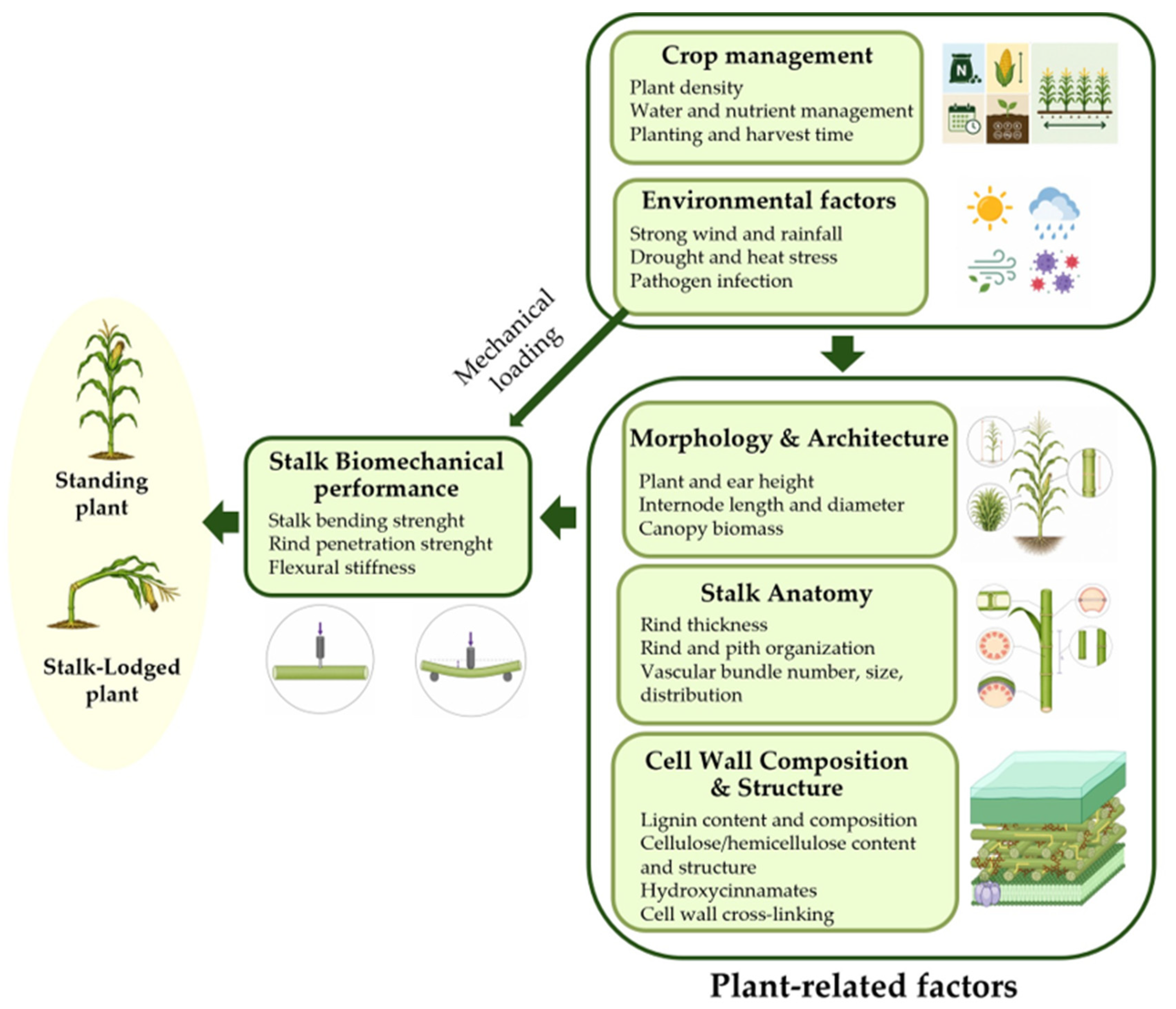
Maize (Zea mays L.) is one of the most important cereal crops worldwide, providing grain, feed, silage, bioenergy feedstock, and industrial biomass [1]. Maintaining an upright canopy until harvest is essential for preserving yield potential and ensuring efficient mechanical harvesting. Lodging, defined as the permanent displacement of plants from their vertical orientation, remains a major constraint on maize production because it can reduce grain yield, impair biomass quality, and hinder harvesting operations [2,3,4,5]. In maize, lodging may result either from loss of root–soil anchorage or from structural failure of the stalk; the present review focuses on the latter. Stalk lodging occurs when bending moments generated by external forces and plant weight exceed the bending strength of the stalk [4,6]. Its occurrence reflects interactions among environmental conditions, crop management, plant architecture, developmental stage, and the structural and material properties of the stalk (Figure 1) [5,6,7,8].
Figure 1.
Interacting factors influencing maize stalk lodging. Stalk lodging arises from interactions among plant morphology and architecture, stalk anatomy, cell wall composition and architecture, and stalk biomechanical performance. Morphological, anatomical, and cell wall traits collectively contribute to the load-bearing capacity of the stalk, whereas biomechanical performance can be characterized using stalk bending strength, flexural stiffness, and rind penetration resistance. External factors such as environmental conditions and crop management further modify plant-related factors and the likelihood of mechanical failure. Arrows indicate the possible relationship between external and plant-related factors, and their effect on biomechanical properties of the stalk in stalk lodging. The examples shown are not exhaustive. Cell wall model was based on Loix et al. [9].
Stalk lodging resistance is therefore a multiscale trait. At the whole-plant and organ levels, plant height, ear height, internode length, basal stalk diameter, and the distribution of mass above the basal internodes determine the mechanical loads acting on the stalk [4,10,11]. At the tissue level, cross-sectional geometry, rind thickness, tissue density, and the number and spatial distribution of vascular bundles and sclerenchyma govern bending stiffness, stress distribution, and failure behavior [10,12,13]. At the cell-wall level, polymer composition, organization, and interactions determine the material properties of supporting tissues [8,14,15,16]. Lodging resistance thus emerges from the balance between the loads imposed on the plant and the capacity of the stalk to withstand bending and fracture, rather than from any single morphological, anatomical, or biochemical trait [6,15,17].
Although the morphological and biomechanical determinants of stalk strength have been extensively studied, the contribution of the cell wall remains incompletely resolved. Stalk architecture can be more predictive of bending strength than bulk chemical composition [18], whereas relationships between total cellulose, hemicellulose, or lignin contents and lodging resistance are often inconsistent [8]. Nevertheless, specific cell wall features, including lignin monomer composition, hydroxycinnamate abundance and cross-linking patterns, and polymer organization, can contribute substantially to genotypic variation in stalk strength and lodging resistance [16,19]. These findings indicate that cell wall traits should be interpreted within the anatomical and biomechanical context of the stalk rather than considered in isolation.
Accordingly, this review summarizes the agronomic impact of stalk lodging in maize, describes the composition and organization of maize stalk cell walls, evaluates how cell wall traits interact with stalk geometry and tissue anatomy to determine mechanical performance, and examines environmental regulation, phenotyping approaches, and opportunities for genetic improvement. This review aims to identify potential targets for improving lodging resistance while considering possible trade-offs with yield, biomass utilization, and stress adaptation.
2. Stalk Lodging Impact on Maize Production
Lodging in maize is commonly classified as root lodging or stalk lodging [13,20]. Root lodging occurs when the root–soil anchorage system fails and the plant rotates from its upright position, whereas stalk lodging involves permanent buckling, creasing, or breakage of the stalk, generally at or below the ear-bearing node. Stalk failure occurs most frequently in basal internodes, particularly between the second and fifth internodes above the soil surface, where wind- and gravity-induced bending moments are high and mechanical strength may decline during late development and after physiological maturity [20]. These two forms of lodging should be distinguished because they involve different failure mechanisms and require different phenotyping approaches.
The agronomic consequences of stalk lodging depend strongly on its timing, severity, and failure mode. A worldwide estimate of lodging-induced yield losses is not currently available. Nevertheless, a synthesis of published maize studies reported annual yield losses ranging from 2 to 43% across environments and conditions [21]. Lodging also causes substantial losses in other cereal crops with reported yield reductions of 12–61% in wheat and up to 80% under extreme conditions across cereal crops [21,22]. These figures represent context-dependent reported ranges rather than uniform global averages. Lodging around silking or during grain filling can alter canopy organization, reduce net assimilation and kernel set, and, when the stalk breaks, interrupt further grain filling above the point of failure [20,23]. After physiological maturity, its main consequences are increased ear and grain losses, reduced harvesting speed, and lower mechanical harvesting efficiency. Under naturally lodged field conditions, ear loss was reported to increase by approximately 0.12–0.15 percentage points for each one-percentage-point increase in lodging incidence, while harvesting speed decreased progressively as lodging increased [24].
Stalk lodging is particularly relevant in intensive maize systems because increasing planting density, although central to yield improvement, can increase competition for light and resources, reduce dry-matter accumulation and mechanical strength in basal internodes, and raise lodging risk [25,26]. Nevertheless, responses depend strongly on genotype. In a two-year field experiment, a modern hybrid combined higher yield with a lower lodging rate at high planting density than an older hybrid, owing to more favorable plant architecture, greater stalk bending strength, and higher dry weight per unit internode length [25]. Nitrogen effects are also nonlinear: appropriate nitrogen supply may support internode development, whereas excessive nitrogen can increase canopy load and reduce stalk stability [27]. In dense maize stands, an intermediate nitrogen rate improved basal internode strength and reduced lodging relative to a higher rate, with only a limited yield penalty [26]. Genotype, density, and nutrient management must therefore be optimized jointly.
From a mechanical perspective, stalk lodging occurs when the bending moment generated by wind, plant weight, and the position of the center of mass exceeds the local bending strength of the stalk. Plant and ear height, leaf area, and above-ground biomass influence the imposed load, whereas stalk cross-sectional geometry, tissue organization, and material properties determine structural resistance [4,11]. Resistance should not be described simply as a compromise between rigidity and flexibility: flexural stiffness determines the extent of deformation under load, whereas bending strength determines the maximum load that the stalk can withstand before failure [28].
Because natural lodging depends on unpredictable environmental events, mechanical and morphological measurements are widely used as indirect indicators. These include stalk bending strength, rind penetration resistance, flexural stiffness, rind thickness, stalk diameter, and section modulus (Figure 1). However, the measurements are not interchangeable. Stalk bending strength has shown the strongest association with naturally occurring lodging incidence among several commonly used predictors, whereas rind penetration resistance evaluates a more localized property of the rind [29]. Similarly, section modulus provides a strong geometry-based predictor of bending strength and can be estimated from stalk diameter and rind thickness [18]. No single measurement fully represents lodging susceptibility; robust evaluation therefore requires integrating whole-plant loading, stalk geometry, tissue anatomy, mechanical performance, and cell-wall traits [16,18].
Stalk lodging should consequently be understood as the structural failure of a hierarchical biological composite. Stalk geometry and tissue distribution determine how loads are distributed, whereas cell wall composition and organization contribute to the material properties of the supporting tissues [15]. Cell wall traits are therefore important mechanistic contributors to lodging resistance, but they must be interpreted within the broader architectural and biomechanical context of the stalk [16,18,19].
3. The Maize Stalk Cell Wall: Composition and Architecture
3.1. Cell Wall Domains and Maize Lignocellulosic Biomass
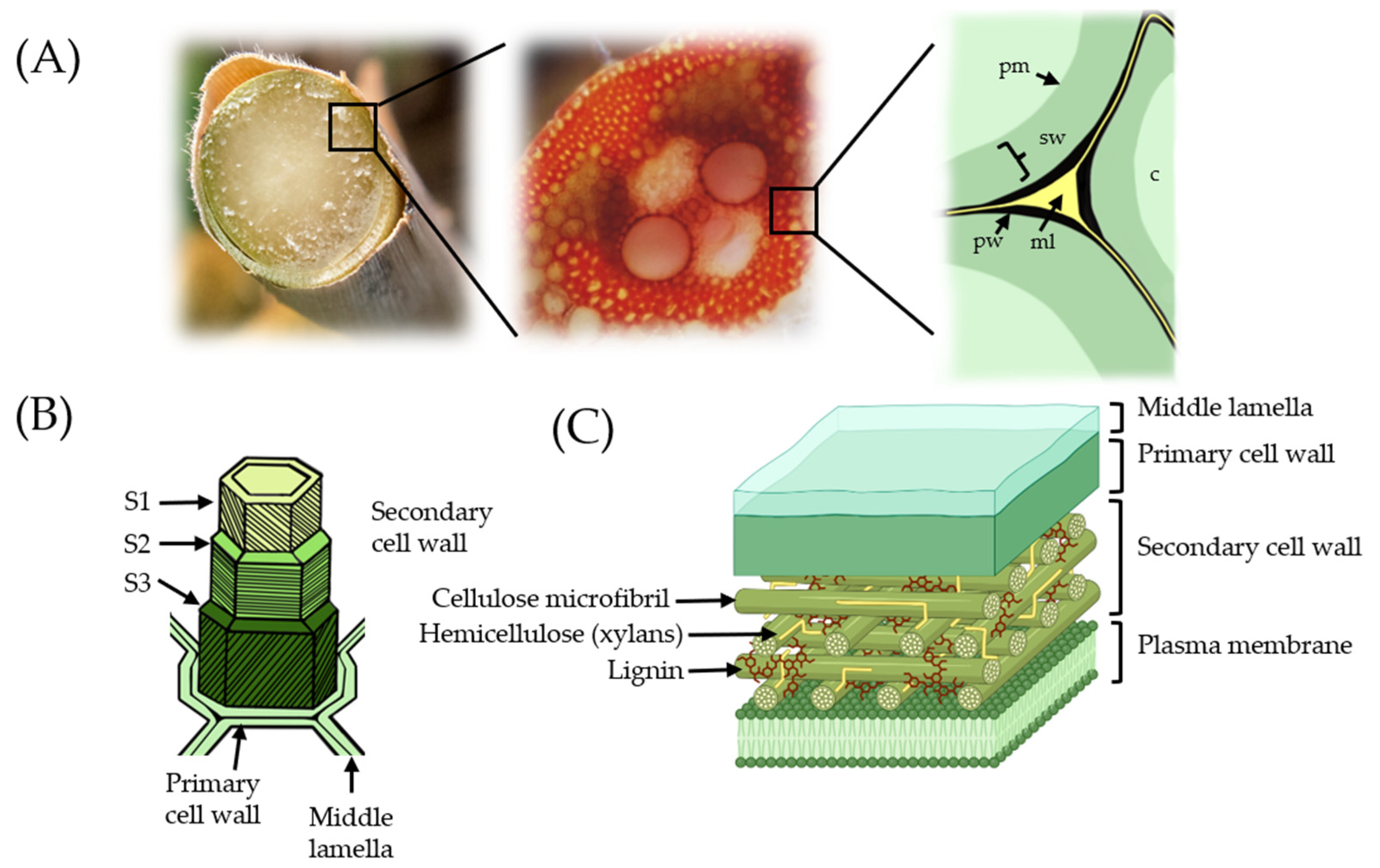
Plant cell walls are dynamic extracellular composites whose composition and architecture vary with genotype, cell and tissue identity, developmental stage, and environmental conditions [30,31,32]. Three major wall domains can be distinguished: the middle lamella, primary cell wall, and secondary cell wall (Figure 2A–C). The pectin-rich middle lamella mediates adhesion between adjacent cells. Primary cell walls are deposited during cell growth and combine extensibility with sufficient mechanical strength. In grasses such as maize, these type II primary cell walls contain cellulose microfibrils embedded in a matrix dominated by glucuronoarabinoxylans, together with mixed-linkage glucans and smaller amounts of pectins, xyloglucans, hydroxycinnamates, proteins, and cell wall-modifying enzymes [30,31,32].
Figure 2.
(A) Cross section of a maize stalk followed by its microscopic images. The boxed area in the left-hand image indicates the stalk rind shown at higher magnification on the right. Schematic representation of cell components where (c) cytoplasm, (ml) middle lamella, (pm) plasma membrane, (pw) primary cell wall and (sw) secondary cell wall are shown. (B) Schematic representation of secondary cell wall layers (S1–S3) (based on Carpita et al. [33]). (C) Schematic representation of the structure of a secondary cell wall highlighting major components and their interactions (based on Loix et al. [9]).
Secondary cell walls are deposited inside the primary wall after cell expansion has largely ceased (Figure 2B). They are enriched in cellulose, xylans, and lignin and provide mechanical reinforcement and reduced permeability (Figure 2C) [34,35]. In mature maize stalks, secondary cell wall deposition is particularly prominent in xylem, sclerenchyma, vascular bundle-associated fibers, and other supporting tissues. These lignified cell walls account for a substantial proportion of maize stalk lignocellulosic biomass.
The following sections therefore describe cellulose, hemicelluloses, lignin, hydroxycinnamates, and other cell wall components relevant to stalk structure.
3.2. Cellulose: The Main Load-Bearing Scaffold
Cellulose is a linear homopolymer of β-(1→4)-linked D-glucose residues with a degree of polymerization of approximately 10,000 [34]. Eighteen to twenty-four parallel glucan chains associate through hydrogen bonding and van der Waals interactions to form microfibrils with high tensile strength and stiffness [31,36]. Cellulose is synthesized at the plasma membrane by rosette-shaped cellulose synthase complexes containing catalytic CESA proteins [31].
Cellulose microfibrils form the principal tensile scaffold of the wall, but their mechanical contribution depends not only on cellulose abundance. Cellulose microfibrils are typically deposited in different orientations, contributing to the characteristic layered shape of the secondary cell wall (Figure 2B). The conformation of the polymer backbone and the lack of branching allow cellulose to adopt a plain configuration. This structural characteristic, in conjunction with the ability of β-(1,4)-glucan chains to form intra- and intermolecular bonds, renders cellulose a highly stable crystalline biopolymer. Interspersed in the crystalline cellulose are amorphous or non-crystalline regions, highly susceptible to interaction with matrix polysaccharides [34,36]. Crystallinity, degree of polymerization, microfibril orientation, microfibril angle, and interactions with matrix polymers influence cell wall anisotropy, stiffness, and fracture behavior [37]. Consequently, total cellulose content provides an incomplete indication of stalk mechanical performance as its organization within the wall network must also be considered.
3.3. Hemicelluloses: The Main Matrix Polysaccharides
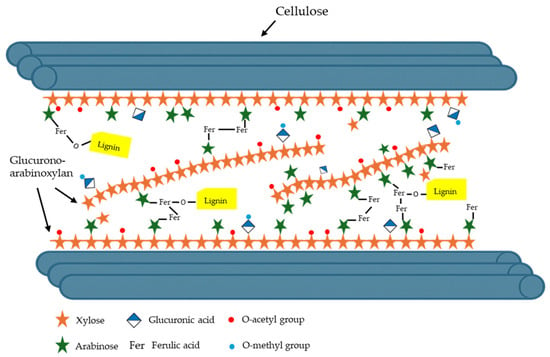
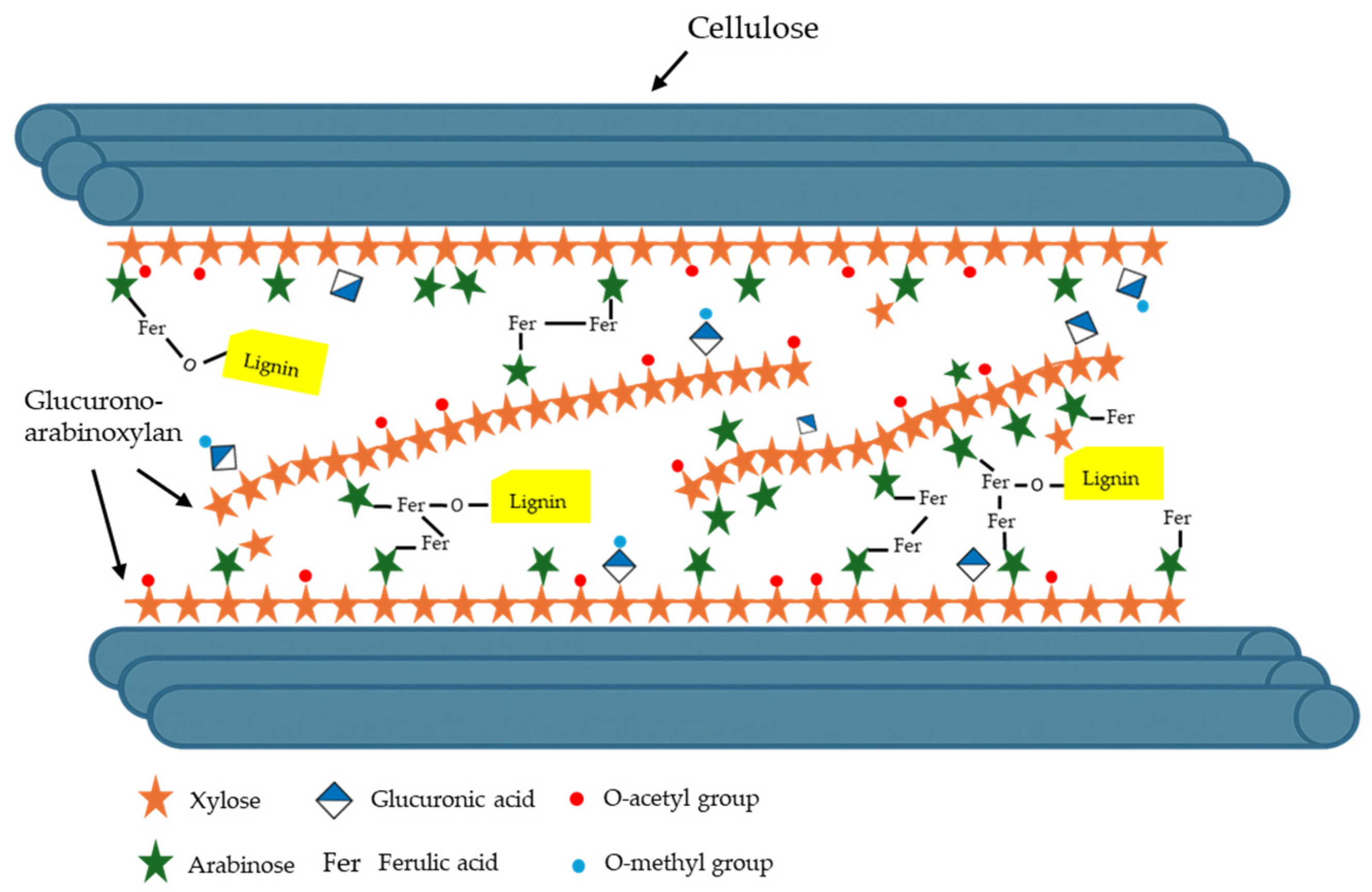
Xylans are the dominant hemicelluloses in maize cell walls. Depending on the decoration of the backbone, xylans can be categorized as glucuronoxylans, arabinoxylans and glucuronoarabinoxylans, the most common hemicellulose in grass CWs [38]. Grass glucuronoarabinoxylans contain a β-(1→4)-linked xylosyl backbone substituted principally by α-L-arabinofuranosyl residues and, to a lesser extent, by α-D-glucuronosyl or 4-O-methyl-glucuronosyl residues. The xylan backbone may also be acetylated, while some arabinose residues are esterified with hydroxycinnamates (Figure 3) [38,39,40].
Figure 3.
Simplified representation of cell wall architecture in maize stalk tissues. Cellulose microfibrils are shown in association with glucuronoarabinoxylan chains composed of a partially acetylated xylan backbone substituted with arabinose and (methyl) glucuronic acid residues. Ferulic acid (Fer), esterified to arabinose residues, may undergo oxidative coupling to form diferulate bridges between glucuronoarabinoxylan chains and participate in covalent associations with lignin. The diagram represents selected cell wall components and their potential associations; specific chemical bonds between components are not depicted. The representation is not drawn to scale. Based on Tryphona et al. [40] and Rudjito et al. [41].
Xylan biosynthesis occurs in the Golgi apparatus. Members of the GT43 and GT47 families participate in backbone synthesis, whereas GT61 and GT8 glycosyltransferases contribute to arabinosylation and glucuronosylation, respectively. Additional enzymes introduce acetyl and phenolic decorations [31].
Grass xylans are structurally heterogeneous. Tryfona et al. [40] distinguished evenly arabinosylated xylan, glucuronoarabinoxylan with clustered glucuronic acid substitutions, and highly substituted glucuronoarabinoxylan. They proposed that regularly substituted xylans may adopt conformations compatible with cellulose binding, whereas more complex and highly substituted xylans may occupy matrix regions and interact with other cell wall components [40]. These suggested specializations provide a useful framework for understanding how xylan substitution and feruloylation may influence wall cohesion, but their direct effects on maize stalk mechanics remain to be demonstrated.
3.4. Lignin: Stiffness, Hydrophobicity, and Compression Resistance
Lignin is a heterogeneous phenolic polymer deposited predominantly in secondary cell walls. Its principal H, G, and S subunits derive from p-coumaryl, coniferyl, and sinapyl alcohols, respectively. Grass lignins also contain distinctive components and modifications, including p-coumarate, ferulate, and tricin [42,43,44].
Monolignol biosynthesis occurs through the phenylpropanoid pathway. In grasses, both phenylalanine- and tyrosine-derived routes can contribute to monolignol production through the activity of phenylalanine/tyrosine ammonia-lyases [44,45]. After export to the apoplast, monolignols are oxidized by laccases and peroxidases and undergo radical coupling. Lignin therefore does not possess a uniform, templated sequence but forms a heterogeneous network whose properties depend on monomer composition, interunit linkages, spatial deposition, and associations with polysaccharides [42,43,44].
Lignification increases cell wall stiffness and compression resistance, reduces permeability, and contributes to the mechanical and biological durability of vascular and supporting tissues.
3.5. Hydroxycinnamates and Lignin–Carbohydrate Linkages
Grass cell walls contain two major hydroxycinnamic acids: ferulic acid and p-coumaric acid. Ferulate is commonly esterified to the O-5 position of arabinose residues in arabinoxylans. Oxidative coupling produces diferulates and higher oligomers that can cross-link adjacent arabinoxylan chains [46,47]. Ferulates can also participate in covalent associations between arabinoxylans and lignin, thereby contributing to lignin–carbohydrate complexes and cell wall reinforcement (Figure 3) [46,47].
By contrast, p-coumarate is mainly attached to the γ-hydroxyl groups of lignin side chains, particularly those of S units, and is not generally considered a major polysaccharide cross-linker [48,49]. It may participate in radical-transfer reactions during lignification, although this role should be presented as a proposed mechanism. Ferulate and p-coumarate should therefore be treated separately because their cell wall attachments and probable structural functions differ substantially.
3.6. Pectins and Other Cell Wall Components
Although pectins are less abundant in grass walls than in many eudicot primary walls, they remain important for cell adhesion, cell wall porosity, hydration, ionic properties, growth regulation, cell wall-integrity sensing, and defense. The principal pectic domains are homogalacturonan, rhamnogalacturonan I, and rhamnogalacturonan II, while xylogalacturonan may occur as a more limited domain [50,51].
Xyloglucans are relatively minor hemicelluloses in maize, whereas mixed-linkage glucans can represent an important and developmentally regulated component of grass primary walls and may also occur in mature tissues. They should therefore not be classified indiscriminately as minor polymers [32,40]. Structural glycoproteins, cell wall-modifying enzymes, inorganic ions, and other low-abundance components may additionally influence wall assembly and mechanical behavior, although their specific contribution to maize stalk lodging remains insufficiently characterized.
4. The Cell Wall as a Key Player in Stalk Lodging
4.1. From Stalk Architecture to Cell Wall Mechanics
Stalk lodging resistance is influenced by traits operating at different organizational levels. At the whole-plant level, plant and ear height, internode length, stalk diameter, and above-ground biomass affect the mechanical loads imposed on the stalk. At the tissue level, rind thickness, vascular bundle distribution, sclerenchyma development, and the relative proportions of rind and pith contribute to stalk strength. These characteristics interact with cell wall composition and organization, which determine the mechanical properties of individual tissues (Figure 1) [18,52,53].
The rind has a particularly important mechanical role because its peripheral position increases its contribution to stalk flexural rigidity. Lodging-resistant maize lines may exhibit thicker sclerenchymatous tissues, a larger vascular area, and more extensive lignification in peripheral tissues [53]. Nevertheless, anatomical and compositional traits should not be considered independently, since stalk mechanical performance emerges from their integration with cross-sectional geometry and whole-plant loading.
4.2. Lignin and Lodging Resistance: Content vs. Composition
The structural functions of lignin described above [43] provide a basis for examining its contribution to lodging resistance. Increased lignin accumulation has frequently been associated with greater lodging resistance in cereals, particularly in rice and wheat [54,55]. In maize, however, the relationship is more variable and appears to depend on genotype, tissue localization, developmental stage, and the mechanical property evaluated.
Sekhon et al. [29] reported a negative association between lignin content and field lodging incidence, although stalk bending strength was a stronger predictor of lodging resistance. Guo et al. [53] found no significant differences in total lignin content between resistant and susceptible maize lines, but observed greater lignification in specific supporting tissues of resistant genotypes. Similarly, Manga-Robles et al. [16] showed that differences in stalk strength and lodging susceptibility could not be explained solely by total lignin content.
Beyond total content, monomer composition is relevant because it influences the types of interunit linkages: G units can form β-5 and 5-5 linkages because they retain a free C5 position, whereas S-rich lignins generally contain a larger proportion of β-O-4 ether linkages [43,56]. However, these structural differences do not imply a universal relationship between the S/G ratio and stalk mechanical strength. Manga-Robles et al. [16] identified H-lignin abundance as a positive predictor of rind penetration strength. López-Malvar et al. [19] also associated lower S/G ratios with greater rind penetration resistance, although this study did not find significant differences in field lodging among the evaluated lines. These results therefore indicate associations with particular mechanical traits rather than demonstrating a general causal relationship with lodging resistance.
4.3. Cellulose, Hemicelluloses, and Polymer Interactions
Cellulose microfibrils provide the main tensile scaffold of the secondary wall. Their mechanical contribution depends not only on cellulose content but also on degree of polymerization, crystallinity, microfibril orientation, microfibril angle, and interactions with matrix polymers [31,37]. In maize, Sekhon et al. [29] found that cellulose content was negatively associated with field lodging incidence, whereas López-Malvar et al. [19] reported that higher cellulose to hemicellulose ratios resulted in greater rind puncture resistance. By contrast, Manga-Robles et al. [16] found that the bulk contents of cellulose and hemicelluloses did not adequately explain variation in stalk strength and lodging susceptibility. These results suggest that cellulose abundance may contribute to mechanical performance but should not be considered an isolated predictor.
Grass xylans provide an important connection between cellulose, lignin, and hydroxycinnamates. Their substitution, acetylation, conformation, and feruloylation pattern influence their interactions with other wall polymers. Tryfona et al. [40] identified structurally distinct xylan populations in grass culms and proposed that regularly substituted xylans may adopt conformations compatible with cellulose binding, whereas more highly or differently substituted xylans may occupy matrix regions and interact with lignin. This model provides a valuable mechanistic hypothesis, but the proposed interactions and their consequences for maize stalk mechanics have not yet been demonstrated directly. Xylan substitution patterns, acetylation, and feruloylation should therefore be presented as candidate determinants requiring experimental validation against stalk strength and stalk lodging.
4.4. Hydroxycinnamate Cross-Linking and Stalk Strength
Ferulic acid and p-coumaric acid are the main hydroxycinnamates in grass cell walls. Ferulic acid is esterified to arabinose residues of grass arabinoxylans and can undergo oxidative coupling to produce diferulates and higher oligomers. Ferulates can also participate in covalent associations between arabinoxylans and lignin, potentially contributing to cell wall cohesion [46,47].
Nevertheless, the relationship between hydroxycinnamate abundance and stalk mechanical properties is not straightforward. Manga-Robles et al. [16] identified ester-bound ferulic acid as a positive predictor of field lodging resistance, whereas total and individual diferulates showed negative associations. Similarly, López-Malvar et al. [19] found lower concentrations of several diferulates and p-coumarate in maize lines with greater rind penetration resistance. Total ferulate concentration should therefore not be interpreted directly as a measure of cross-linking density, and a greater abundance of diferulates does not necessarily imply increased stalk strength.
These findings suggest that the mechanical contribution of hydroxycinnamates may depend on the type, localization, and distribution of the linkages formed rather than solely on their total concentration. Gesteiro et al. [57] identified genomic regions associated with ferulate- and p-coumarate-related traits and showed that these compounds could potentially be modified through genomic selection. However, that study did not directly evaluate stalk strength or lodging resistance. Further research is therefore required to determine whether genetic modification of hydroxycinnamate profiles can improve lodging resistance without negatively affecting other agronomic or biomass-related characteristics.
4.5. Genotypic Variation in Cell Wall Traits and Stalk Lodging Resistance
Genotypic variation in maize stalk lodging resistance is associated with differences in stalk architecture, tissue organization and cell wall traits. Comparisons among maize inbred lines suggest that variations in mechanical performance can be attributed to differences in lignin composition and hydroxycinnamate profiles and are not necessarily explained by total cell wall polymer contents alone [16,19]. Associations between lignin composition, hydroxycinnamate profiles and rind puncture resistance have also been reported, alongside relationships with polysaccharide content [19]. The spatial distribution of lignified supporting tissues is also important, as different genotypes may exhibit variations in tissue lignification despite no significant differences in total lignin content [53]. These findings emphasize the importance of interpreting biochemical variation in the anatomical context of each genotype.
Differences among genotypes in a particular mechanical trait do not necessarily correspond to detectable differences in field lodging under the conditions tested. For instance, López-Malvar et al. [19] reported significant differences among maize inbred lines in rind puncture resistance, whereas field stalk lodging did not differ significantly. Consequently, cell wall traits identified in individual genetic backgrounds should be evaluated across broader germplasm and multiple environments before being adopted as general selection criteria. Stalk bending strength has shown a strong association with field lodging incidence across multiple environments [29]. Integrating biochemical profiling with bending strength measurements and field lodging assessments may therefore help identify genotypes with consistently improved resistance.
5. Environmental Regulation and Cell Wall Plasticity
Stalk lodging resistance is strongly influenced by environmental and management conditions. Wind, rain, drought, high planting density, nutrient regime, and pathogen infection can affect stalk development, cell wall structure and deposition, senescence, and mechanical properties [4,8,58]. Drought is particularly relevant because it affects growth, carbon allocation, and cell wall remodeling. A comparison of two maize inbreds with contrasting lodging resistance showed that drought induced different cell wall responses in B73 and EA2024, raising the possibility of a genotype-dependent trade-off between lodging resistance and drought adaptation [58,59].
In these two inbreds, the results suggest that a highly reinforced cell wall may improve lodging resistance but constrain the remodeling and plasticity required for drought acclimation, whereas a more plastic cell wall may facilitate stress adaptation but provide less mechanical reinforcement [58,59]. However, this possible trade-off has not yet been evaluated across a broader range of maize germplasm. Cell wall remodeling also occurs under heat stress [60], although its consequences for stalk mechanical strength remain unclear. Therefore, lodging resistance should be evaluated under realistic field conditions and combinations of environmental stresses rather than under optimal conditions alone.
Mineral nutrition can influence the composition and deposition of cell walls, which has consequences for the mechanical properties of stems. In rapeseed grown at a high planting density and with an excessive nitrogen supply, compared to an adequate supply, the accumulation of lignin, cellulose and hemicellulose was reduced, as were the expression of genes involved in secondary cell wall biosynthesis. These changes were associated with weaker stems and increased lodging [61]. In soybean intercropped with maize, potassium application increased the activity of enzymes involved in lignin biosynthesis, including phenylalanine ammonia-lyase and cinnamyl alcohol dehydrogenase. This was accompanied by improvements in stem diameter and lodging resistance index [62]. Evidence from maize also links nutrient management to changes in cell wall composition. A two-year field experiment showed that potassium fertilisation combined with straw return increased stem cellulose and lignin content, as well as lignin-related enzyme activity, alongside an increase in the lodging resistance index [63]. These findings suggest that nutrient effects on stalk stability involve changes in cell wall polymer accumulation as well as stem morphology. However, improvements in mechanical traits or lodging resistance indices must be distinguished from reductions in observed field lodging. Therefore, nutrient management should be evaluated in relation to soil fertility, crop management and genotype, rather than assuming that increasing the supply of fertiliser necessarily strengthens the stalk.
6. Phenotyping and Genetic Improvement
Improving stalk lodging resistance requires phenotyping strategies that integrate structural and biochemical determinants of stalk strength. Rind penetration resistance is useful and widely used, but it should be complemented with bending strength, flexural stiffness, stalk geometry, rind thickness, vascular bundle traits, and cell wall composition [16,18,29,64]. Recent genomic prediction studies indicate that biomechanical traits such as bending strength and flexural stiffness may support selection for improved lodging resistance, particularly when multi-environment data are incorporated [65]. In maize, integrated transcriptomic and metabolomic analyses are also beginning to identify candidate genes, metabolites, and pathways associated with lodging resistance [66]. These candidates nevertheless require functional validation before they can be considered breeding targets. Comparative evidence from soybean QTL analyses illustrates how biochemical and physical stem traits can be combined to identify genomic regions associated with lodging resistance, although the specific results cannot be directly transferred to maize [67].
Candidate cell wall-related traits for improving lodging resistance include lignin biosynthesis, cellulose synthesis, xylan backbone synthesis, arabinoxylan substitution, hydroxycinnamate metabolism, peroxidase and laccase activity, secondary cell wall transcriptional regulation and hormone/stress-responsive cell wall remodeling [16,57,58,66,68]. Evidence supporting these pathways ranges from direct associations with stalk strength or lodging-related traits to mechanistic hypotheses based on their roles in cell wall characteristics. Therefore, their causal contribution to maize lodging resistance remains to be established in many cases. Because cell wall composition influences several maize traits, including rind penetration resistance, internode morphology, plant height, and biomass yield, breeding strategies and gene editing should aim to optimize cell wall architecture rather than simply increasing lignin or cellulose content [16,19,29].
7. Future Perspectives
Future research on maize lodging resistance should move from descriptive correlations toward mechanistic and predictive models integrating stalk architecture, tissue anatomy, cell wall chemistry, biomechanics, and environmental plasticity. A major priority is to determine which cell wall features contribute mechanistically or are only indirectly associated with lodging resistance [16,18].
First, lodging phenotyping should be standardized across environments and developmental stages. Natural lodging scores remain essential but are strongly influenced by weather, disease, planting density, and harvest timing. They should therefore be complemented with controlled measurements of rind penetration resistance, bending strength, flexural stiffness, stalk geometry, rind thickness, section modulus, and internode-specific failure. These measurements describe related but non-equivalent mechanical properties and should be interpreted accordingly [13,18,28,29].
Second, future studies should move beyond bulk cell wall composition. Maize stalk tissues differ markedly in wall thickness, lignification, polymer composition, and mechanical function. Raman and FTIR imaging, X-ray micro-CT, solid-state NMR, immunolabelling, and spatial metabolomics could help relate tissue-specific cell wall features to failure zones [69,70,71,72,73]. Greater attention should also be paid to polymer architecture, including cellulose crystallinity and orientation, lignin composition and spatial deposition, arabinoxylan substitution, acetylation and feruloylation, and hydroxycinnamate-mediated linkages [37,40,41,43].
Third, lodging resistance should be evaluated under realistic combinations of planting density, nutrient supply, drought, heat, pathogen pressure, and harvest timing. The contrasting drought responses of two maize genotypes with different lodging resistance suggest that mechanical reinforcement and cell wall plasticity may represent partly competing, genotype-dependent strategies, although this possibility must be assessed across broader maize germplasm [58,59].
Finally, breeding should integrate genomics, biomechanics, and cell wall biology. In the coming years, the use of artificial intelligence will help us integrate all this information to develop improved crops more quickly and efficiently [74]. Mechanical and biochemical phenotypes may support genomic prediction, while transcriptomic and metabolomic analyses can help prioritize candidate pathways [64,65,66]. The genetic variability of maize hydroxycinnamate profiles is promising in this context, although their direct contribution to stalk strength and field lodging remains to be demonstrated [57]. Candidate genes should therefore be functionally validated, considering possible effects on yield, digestibility, disease resistance, and environmental resilience.
8. Conclusions
Stalk lodging in maize is a complex agronomic problem that results from interactions among environment, crop management, plant architecture, stalk anatomy, and cell wall properties. The cell wall is central to this process because it determines the mechanical properties of the tissues that support the stalk. Cellulose provides tensile strength, lignin contributes stiffness and compression resistance, arabinoxylans organize cell wall architecture, and hydroxycinnamates such as ferulic acid generate cross-links that reinforce cell wall cohesion. However, lodging resistance depends less on the abundance of any single polymer than on the integrated architecture of the cell wall, including lignin monomer composition, cellulose crystallinity, xylan decoration, ferulate-mediated cross-linkages, and tissue-specific polymer deposition. Future progress will require multiscale phenotyping, spatial cell wall analysis, stress-aware breeding, and genomic tools that optimize stalk strength and lodging resistance without compromising yield, digestibility, or environmental resilience.
Author Contributions
A.M.-R. Writing—original draft preparation; writing—review and editing, visualization. P.C.-J. Writing—review and editing; visualization. P.G.-A. Writing—review and editing; supervision; project administration; funding acquisition. A.E. Conceptualization; writing—original draft preparation; writing—review and editing; supervision; visualization; funding acquisition. All authors have read and agreed to the published version of the manuscript.
Funding
This work was funded by the Spanish Ministry of Science, Innovation and Universities (PID2021-124942OB-I00), State Agency for Innovation and Europe Union. A.M.-R. was financed with a PhD contract from the Consejería de Educación de Castilla y León and the Fondo Social Europeo (ORDEN EDU/601/2020, 7 July). P.C.-J. was financed with a PhD contract from Universidad de León (Programa Propio de Investigación de la Universidad de León 2025).
Data Availability Statement
No new data were created or analyzed in this review study. Data sharing does not apply to this article.
Acknowledgments
During the preparation of this manuscript, the authors used ChatGPT (GPT-5; OpenAI, accessed September 2026), including its integrated image-generation capability, for English-language refinement, revision of selected figure captions and labels, and assistance in designing and generating schematic graphical elements. The authors have reviewed and edited all outputs and take full responsibility for the content of this publication.
Conflicts of Interest
The authors declare no conflicts of interest.
References
- Erenstein, O.; Jaleta, M.; Sonder, K.; Mottaleb, K.; Prasanna, B.M. Global maize production, consumption and trade: Trends and R&D implications. Food Secur. 2022, 14, 1295–1319. [Google Scholar] [CrossRef] [Scilit]
- Pinthus, M.J. Lodging in wheat, barley, and oats: The phenomenon, its causes, and preventive measures. Adv. Agron. 1973, 25, 209–263. [Google Scholar] [CrossRef] [Scilit]
- Zuber, M.S.; Kang, M.S. Corn lodging slowed by sturdier stalks. Crops Soils 1978, 30, 13–15. [Google Scholar]
- Stubbs, C.J.; Oduntan, Y.A.; Keep, T.R.; Noble, S.D.; Robertson, D.J. The effect of plant weight on estimations of stalk lodging resistance. Plant Methods 2020, 16, 128. [Google Scholar] [CrossRef] [Scilit] [PubMed]
- Ishfaq, S.; Ding, Y.; Liang, X.; Guo, W. Advancing lodging resistance in maize: Integrating genetic, hormonal, and agronomic insights for sustainable crop productivity. Plant Stress 2025, 15, 100777. [Google Scholar] [CrossRef] [Scilit]
- Rehman, M.; Luo, D.; Mubeen, S.; Pan, J.; Cao, S.; Saeed, W.; Chen, P. Progress in agronomic crops lodging resistance and prevention: A review. J. Agron. Crop Sci. 2024, 210, e12785. [Google Scholar] [CrossRef] [Scilit]
- Shah, L.; Yahya, M.; Shah, S.M.A.; Nadeem, M.; Ali, A.; Ali, A.; Wang, J.; Riaz, M.W.; Rehman, S.; Wu, W.; et al. Improving lodging resistance: Using wheat and rice as classical examples. Int. J. Mol. Sci. 2019, 20, 4211. [Google Scholar] [CrossRef] [Scilit] [PubMed]
- Mengistie, E.; McDonald, A.G. Effect of cell wall compositions on lodging resistance of cereal crops: Review. J. Agric. Sci. 2023, 161, 794–807. [Google Scholar] [CrossRef] [Scilit]
- Loix, C.; Huybrechts, M.; Vangronsveld, J.; Gielen, M.; Keunen, E.; Cuypers, A. Reciprocal interactions between cadmium-induced cell wall responses and oxidative stress in plants. Front. Plant Sci. 2017, 8, 1867. [Google Scholar] [CrossRef] [Scilit] [PubMed]
- Oduntan, Y.A.; Stubbs, C.J.; Robertson, D.J. High throughput phenotyping of cross-sectional morphology to assess stalk lodging resistance. Plant Methods 2022, 18, 1. [Google Scholar] [CrossRef] [Scilit] [PubMed]
- Stubbs, C.J.; Kunduru, B.; Bokros, N.; Verges, C.; Porter, J.; Cook, D.D.; deBolt, S.; McMahan, C.; Sekhon, R.S.; Robertson, D.J. Moving toward short stature maize: The effect of plant height on maize stalk lodging resistance. Field Crops Res. 2023, 300, 109008. [Google Scholar] [CrossRef] [Scilit]
- Gomez, F.E.; Muliana, A.H.; Rooney, W.L. Predicting stem strength in diverse bioenergy sorghum genotypes. Crop Sci. 2018, 58, 739–751. [Google Scholar] [CrossRef] [Scilit]
- Erndwein, L.; Cook, D.D.; Robertson, D.J.; Sparks, E.E. Field-based mechanical phenotyping of cereal crops to assess lodging resistance. Appl. Plant Sci. 2020, 8, e11382. [Google Scholar] [CrossRef] [Scilit] [PubMed]
- Bidhendi, A.J.; Geitmann, A. Relating the mechanics of the primary plant cell wall to morphogenesis. J. Exp. Bot. 2016, 67, 449–461. [Google Scholar] [CrossRef] [Scilit] [PubMed]
- Gangwar, T.; Heuschele, D.J.; Annor, G.; Fok, A.; Smith, K.P.; Schillinger, D. Multiscale characterization and micromechanical modeling of crop stem materials. Biomech. Model. Mechanobiol. 2021, 20, 69–91. [Google Scholar] [CrossRef] [Scilit] [PubMed]
- Manga-Robles, A.; Santiago, R.; Malvar, R.A.; Moreno-González, V.; Fornalé, S.; López, I.; Centeno, M.L.; Acebes, J.L.; Álvarez, J.M.; Caparrós-Ruiz, D.; et al. Elucidating compositional factors of maize cell walls contributing to stalk strength and lodging resistance. Plant Sci. 2021, 307, 110882. [Google Scholar] [CrossRef] [Scilit] [PubMed]
- Gangwar, T.; Susko, A.Q.; Baranova, S.; Guala, M.; Smith, K.P.; Heuschele, D.J. Multi-scale modelling predicts plant stem bending behaviour in response to wind to inform lodging resistance. R. Soc. Open Sci. 2023, 10, 221410. [Google Scholar] [CrossRef] [Scilit] [PubMed]
- Robertson, D.J.; Brenton, Z.W.; Kresovich, S.; Cook, D.D. Maize lodging resistance: Stalk architecture is a stronger predictor of stalk bending strength than chemical composition. Biosyst. Eng. 2022, 219, 124–134. [Google Scholar] [CrossRef] [Scilit]
- López-Malvar, A.; Santiago, R.; Souto, X.C.; Barros-Rios, J.; Gómez, L.D.; Malvar, R.A. Cell wall composition impacts structural characteristics of the stems and thereby the biomass yield. J. Agric. Food Chem. 2022, 70, 3136–3141. [Google Scholar] [CrossRef] [Scilit] [PubMed]
- Xue, J.; Ming, B.; Xie, R.; Wang, K.; Hou, P.; Li, S. Evaluation of maize lodging resistance based on the critical wind speed of stalk breaking during the late growth stage. Plant Methods 2020, 16, 148. [Google Scholar] [CrossRef] [Scilit] [PubMed]
- Kunduru, B.; Kumar, R.; Brar, M.S.; Stubbs, C.J.; Tabaracci, K.; Bokros, N.; Bridges, W.C.; Cook, D.D.; DeBolt, S.; McMahan, C.S.; et al. Unveiling the phenotypic landscape of stalk lodging resistance in diverse maize hybrids. Field Crops Res. 2023, 304, 109168. [Google Scholar] [CrossRef] [Scilit]
- Niu, Y.; Chen, T.; Zhao, C.; Zhou, M. Lodging prevention in cereals: Morphological, biochemical, anatomical traits and their molecular mechanisms, management and breeding strategies. Field Crops Res. 2022, 289, 108733. [Google Scholar] [CrossRef] [Scilit]
- Minami, M.; Ujihara, A. Effects of lodging on dry matter production, grain yield and nutritional composition at different growth stages in maize (Zea mays L.). Jpn. J. Crop Sci. 1991, 60, 107–115. [Google Scholar] [CrossRef] [Scilit]
- Xue, J.; Li, L.; Xie, R.; Wang, K.; Hou, P.; Ming, B.; Zhang, W.-X.; Zhang, G.-Q.; Gao, S.; Bai, S.-J.; et al. Effect of lodging on maize grain losing and harvest efficiency in mechanical grain harvest. Acta Agron. Sin. 2018, 44, 1774–1781. [Google Scholar] [CrossRef] [Scilit]
- Cui, J.; Cui, Z.; Lu, Y.; Lv, X.; Cao, Q.; Hou, Y.; Yang, X.; Gu, Y. Maize grain yield enhancement in modern hybrids associated with greater stalk lodging resistance at a high planting density: A case study in northeast China. Sci. Rep. 2022, 12, 14647. [Google Scholar] [CrossRef] [Scilit] [PubMed]
- Liu, F.; Zhou, F.; Wang, X.; Zhang, X.; Guo, Z.; Liu, Q.; Wei, G.; Lan, T.; Feng, D.; Kong, F.; et al. Optimizing nitrogen management enhances stalk lodging resistance and grain yield in dense planting maize by improving canopy light distribution. Eur. J. Agron. 2023, 148, 126871. [Google Scholar] [CrossRef] [Scilit]
- Khan, A.; Ahmad, A.; Ali, W.; Hussain, S.; Ajayo, B.S.; Raza, M.A.; Kamran, M.; Te, X.; al Amin, N.; Ali, S.; et al. Optimization of plant density and nitrogen regimes to mitigate lodging risk in wheat. Agron. J. 2020, 112, 2535–2551. [Google Scholar] [CrossRef] [Scilit]
- Robertson, D.J.; Lee, S.Y.; Julias, M.; Cook, D.D. Maize stalk lodging: Flexural stiffness predicts strength. Crop Sci. 2016, 56, 1711–1718. [Google Scholar] [CrossRef] [Scilit]
- Sekhon, R.S.; Joyner, C.N.; Ackerman, A.J.; McMahan, C.S.; Cook, D.D.; Robertson, D.J. Stalk bending strength is strongly associated with maize stalk lodging incidence across multiple environments. Field Crops Res. 2020, 249, 107737. [Google Scholar] [CrossRef] [Scilit]
- Carpita, N.C.; Defernez, M.; Findlay, K.; Wells, B.; Shoue, D.A.; Catchpole, G.; Wilson, R.H.; McCann, M.C. Cell wall architecture of the elongating maize coleoptile. Plant Physiol. 2001, 127, 551–565. [Google Scholar] [CrossRef] [Scilit]
- Delmer, D.; Dixon, R.A.; Keegstra, K.; Mohnen, D. The plant cell wall-dynamic, strong, and adaptable-is a natural shapeshifter. Plant Cell 2024, 36, 1257–1311. [Google Scholar] [CrossRef] [Scilit] [PubMed]
- Fuertes-Rabanal, M.; Rebaque, D.; Largo-Gosens, A.; Encina, A.; Mélida, H. Cell walls: A comparative view of the composition of cell surfaces of plants, algae, and microorganisms. J. Exp. Bot. 2025, 76, 2614–2645. [Google Scholar] [CrossRef] [Scilit] [PubMed]
- Carpita, N.C.; Ralph, J.; McCann, M.C. The cell wall. In Biochemistry & Molecular Biology of Plants, 2nd ed.; Buchanan, B., Gruissem, W., Jones, R., Eds.; American Society of Plant Physiologists: Rockville, MD, USA, 2015; pp. 45–110. [Google Scholar]
- Zhong, R.; Cui, D.; Ye, Z.H. Secondary cell wall biosynthesis. New Phytol. 2019, 221, 1703–1723. [Google Scholar] [CrossRef] [Scilit] [PubMed]
- Kumar, M.; Campbell, L.; Turner, S. Secondary cell walls: Biosynthesis and manipulation. J. Exp. Bot. 2016, 67, 515–531. [Google Scholar] [CrossRef] [Scilit] [PubMed]
- Somerville, C. Cellulose synthesis in higher plants. Annu. Rev. Cell Dev. Biol. 2006, 22, 53–78. [Google Scholar] [CrossRef] [Scilit] [PubMed]
- Rongpipi, S.; Ye, D.; Gomez, E.D.; Gomez, E.W. Progress and opportunities in the characterization of cellulose: An important regulator of cell wall growth and mechanics. Front. Plant Sci. 2019, 9, 1894. [Google Scholar] [CrossRef] [Scilit] [PubMed]
- Scheller, H.V.; Ulvskov, P. Hemicelluloses. Annu. Rev. Plant Biol. 2010, 61, 263–289. [Google Scholar] [CrossRef] [Scilit] [PubMed]
- Pauly, M.; Gille, S.; Liu, L.; Mansoori, N.; de Souza, A.; Schultink, A.; Xiong, G. Hemicellulose biosynthesis. Planta 2013, 238, 627–642. [Google Scholar] [CrossRef] [Scilit] [PubMed]
- Tryfona, T.; Bourdon, M.; Delgado Marques, R.; Busse-Wicher, M.; Vilaplana, F.; Stott, K.; Dupree, P. Grass xylan structural variation suggests functional specialization and distinctive interaction with cellulose and lignin. Plant J. 2023, 113, 1004–1020. [Google Scholar] [CrossRef] [Scilit] [PubMed]
- Rudjito, R.C.; Jiménez-Quero, A.; Hamzaoui, M.; Kohnen, S.; Vilaplana, F. Tuning the molar mass and substitution pattern of complex xylans from corn fibre using subcritical water extraction. Green Chem. 2020, 22, 8337–8352. [Google Scholar] [CrossRef] [Scilit]
- Boerjan, W.; Ralph, J.; Baucher, M. Lignin biosynthesis. Annu. Rev. Plant Biol. 2003, 54, 519–546. [Google Scholar] [CrossRef] [Scilit] [PubMed]
- Ralph, J.; Lapierre, C.; Boerjan, W. Lignin structure and its engineering. Curr. Opin. Biotechnol. 2019, 56, 240–249. [Google Scholar] [CrossRef] [Scilit] [PubMed]
- Peracchi, L.M.; Panahabadi, R.; Barros-Rios, J.; Bartley, L.E.; Sanguinet, K.A. Grass lignin: Biosynthesis, biological roles, and industrial applications. Front. Plant Sci. 2024, 15, 1343097. [Google Scholar] [CrossRef] [Scilit] [PubMed]
- Barros, J.; Serrani-Yarce, J.C.; Chen, F.; Baxter, D.; Venables, B.J.; Dixon, R.A. Role of bifunctional ammonia-lyase in grass cell wall biosynthesis. Nat. Plants 2016, 2, 16050. [Google Scholar] [CrossRef] [Scilit] [PubMed]
- Hatfield, R.D.; Rancour, D.M.; Marita, J.M. Grass cell walls: A story of cross-linking. Front. Plant Sci. 2017, 7, 2056. [Google Scholar] [CrossRef] [Scilit] [PubMed]
- Fry, S.C.; Willis, S.C.; Paterson, A.E. Intraprotoplasmic and wall-localised formation of arabinoxylan-bound diferulates and larger ferulate coupling-products in maize cell-suspension cultures. Planta 2000, 211, 679–692. [Google Scholar] [CrossRef] [Scilit] [PubMed]
- del Río, J.C.; Rencoret, J.; Marques, G.; Gutiérrez, A.; Ibarra, D.; Santos, J.I.; Jiménez-Barbero, J.; Zhang, L.; Martínez, A.T. Highly acylated (acetylated and/or p-coumaroylated) native lignins from diverse herbaceous plants. J. Agric. Food Chem. 2008, 56, 9525–9534. [Google Scholar] [CrossRef] [Scilit] [PubMed]
- Karlen, S.D.; Zhang, C.; Peck, M.L.; Smith, R.A.; Padmakshan, D.; Helmich, K.E.; Free, H.C.A.; Lee, S.; Smith, B.G.; Lu, F.; et al. Monolignol ferulate conjugates are naturally incorporated into plant lignins. Sci. Adv. 2016, 2, e1600393. [Google Scholar] [CrossRef] [Scilit] [PubMed]
- Ridley, B.L.; O’Neill, M.A.; Mohnen, D. Pectins: Structure, biosynthesis, and oligogalacturonide-related signaling. Phytochemistry 2001, 57, 929–967. [Google Scholar] [CrossRef] [Scilit] [PubMed]
- Du, J.; Anderson, C.T.; Xiao, C. Dynamics of pectic homogalacturonan in cellular morphogenesis and adhesion, wall integrity sensing and plant development. Nat. Plants 2022, 8, 332–340. [Google Scholar] [CrossRef] [Scilit] [PubMed]
- Berry, P.M.; Sterling, M.; Spink, J.H.; Baker, C.J.; Sylvester-Bradley, R.; Mooney, S.J.; Tams, A.R.; Ennos, A. Understanding and reducing lodging in cereals. Adv. Agron. 2004, 84, 215–269. [Google Scholar] [CrossRef] [Scilit]
- Guo, Y.; Hu, Y.; Chen, H.; Yan, P.; Du, Q.; Wang, Y.; Wang, H.; Wang, Z.; Kang, D.; Li, W.-X. Identification of traits and genes associated with lodging resistance in maize. Crop J. 2021, 9, 1408–1417. [Google Scholar] [CrossRef] [Scilit]
- Gui, M.Y.; Wang, D.; Xiao, H.H.; Tu, M.; Li, F.; Li, W.C.; Ji, S.D.; Wang, T.X.; Li, J.Y. Studies of the relationship between rice stem composition and lodging resistance. J. Agric. Sci. 2018, 156, 387–395. [Google Scholar] [CrossRef] [Scilit]
- Dong, X.C.; Qian, T.F.; Chu, J.P.; Zhang, X.; Liu, Y.J.; Dai, X.L.; He, M.P. Late sowing enhances lodging resistance of wheat plants by improving the biosynthesis and accumulation of lignin and cellulose. J. Integr. Agric. 2023, 22, 1351–1365. [Google Scholar] [CrossRef] [Scilit]
- Dixon, R.A.; Puente-Urbina, A.; Beckham, G.T.; Román-Leshkov, Y. Enabling lignin valorization through integrated advances in plant biology and biorefining. Annu. Rev. Plant Biol. 2024, 75, 239–263. [Google Scholar] [CrossRef] [Scilit] [PubMed]
- Gesteiro, N.; Malvar, R.A.; Butrón, A.; Holland, J.B.; Souto, X.C.; López-Malvar, A.; Santiago, R. Genome-wide association study and genomic predictions for hydroxycinnamate concentrations in maize stover. J. Agric. Food Chem. 2025, 73, 2289–2298. [Google Scholar] [CrossRef] [Scilit] [PubMed]
- Calderone, S.; Mauri, N.; Manga-Robles, A.; Fornalé, S.; García-Mir, L.; Centeno, M.L.; Sánchez-Retuerta, C.; Ursache, R.; Acebes, J.L.; Campos, N.; et al. Diverging cell wall strategies for drought adaptation in two maize inbreds with contrasting lodging resistance. Plant Cell Environ. 2024, 47, 1747–1768. [Google Scholar] [CrossRef] [Scilit] [PubMed]
- Arce, R.C.; Muñoz-Blanxer, A.; Sánchez-Retuerta, C.; Mauri, N.; Caparrós-Ruiz, D. Unravelling distinct proteome changes in two maize inbreds with contrasting stalk-lodging resistance upon drought. Front. Plant Sci. 2026, 17, 1830066. [Google Scholar] [CrossRef] [Scilit] [PubMed]
- Lu, C.; Li, W.; Feng, X.; Chen, J.; Hu, S.; Tan, Y.; Wu, L. The dynamic remodeling of plant cell wall in response to heat stress. Genes 2025, 16, 628. [Google Scholar] [CrossRef] [Scilit] [PubMed]
- Li, Z.; Gao, G.; Xu, L.; Wang, Z.; Wang, C.; Yang, T.; Kuai, J.; Wang, B.; Xu, Z.; Zhao, J.; et al. Reducing nitrogen application at high planting density enhances secondary cell wall formation and decreases stem lodging in rapeseed. Eur. J. Agron. 2024, 156, 127162. [Google Scholar] [CrossRef] [Scilit]
- Gu, Y.; Guo, D.; Li, C.; Zheng, C.; Li, X.; He, F.; Tang, Q.; Yu, J.; Ren, H. Optimising potassium levels improved the lodging resistance index and soybean yield in maize-soybean intercropping by enhanced stem diameter and lignin synthesis enzyme activity. J. Agron. Crop Sci. 2025, 211, e70036. [Google Scholar] [CrossRef] [Scilit]
- Wang, X.; Liu, J.; Liu, S.; Zhao, Y.; Ren, H.; Gu, Y. Interactions of Potassium Fertilization and Straw Return in Modulating Maize Yield and Lodging Resistance. Plants 2025, 14, 3665. [Google Scholar] [CrossRef] [Scilit] [PubMed]
- Kunduru, B.; Bokros, N.T.; Tabaracci, K.; Kumar, R.; Brar, M.S.; Stubbs, C.J.; Oduntan, Y.; DeKold, J.; Bishop, R.; Woomer, J.; et al. High-density phenotype data of intermediate phenotypes associated with stalk lodging resistance in maize. Sci. Data 2025, 12, 1721. [Google Scholar] [CrossRef] [Scilit] [PubMed]
- e Silva, C.M.; Kunduru, B.; Bokros, N.; Tabaracci, K.; Oduntan, Y.; Brar, M.S.; Kumar, R.; Stubbs, C.J.; Nardino, M.; McMahan, C.S.; et al. Genomic prediction of stalk lodging resistance and the associated intermediate phenotypes in maize using whole-genome resequence and multi-environmental data. Plant Genome 2025, 18, e70125. [Google Scholar] [CrossRef] [Scilit] [PubMed]
- Xue, C.; Wu, H.; Zhang, X.; Sun, F.; Zhang, S.; Yu, Z.; Dong, Q.; Liu, Y.; Zhang, H.; Ma, Q.; et al. Integrated transcriptomic and metabolomic analyses implicate key genes and metabolic pathways in maize lodging resistance. Agriculture 2025, 15, 2416. [Google Scholar] [CrossRef] [Scilit]
- Zhao, W.; Zeng, D.; Zhao, C.; Han, D.; Li, S.; Wen, M.; Liang, X.; Zhang, X.; Liu, Z.; Ali, S.; et al. Identification of QTLs and key genes enhancing lodging resistance in soybean through chemical and physical trait analysis. Plants 2024, 13, 3470. [Google Scholar] [CrossRef] [Scilit] [PubMed]
- Kumar, R.; Gyawali, A.; Morrison, D.G.; Saski, C.A.; Robertson, D.J.; Cook, D.D.; Tharayil, N.; Schaefer, R.J.; Beissinger, T.M.; Sekhon, R.S. Genetic architecture of maize rind strength revealed by the analysis of divergently selected populations. Plant Cell Physiol. 2021, 62, 1199–1214. [Google Scholar] [CrossRef] [Scilit] [PubMed]
- Gierlinger, N.; Keplinger, T.; Harrington, M. Imaging of plant cell walls by confocal Raman microscopy. Nat. Protoc. 2012, 7, 1694–1708. [Google Scholar] [CrossRef] [Scilit] [PubMed]
- Du, J.; Zhang, Y.; Guo, X.; Ma, L.; Shao, M.; Pan, X.; Zhao, C. Micron-scale phenotyping quantification and three-dimensional microstructure reconstruction of vascular bundles within maize stalks based on micro-CT scanning. Funct. Plant Biol. 2017, 44, 10–22. [Google Scholar] [CrossRef] [Scilit] [PubMed]
- Rydahl, M.G.; Hansen, A.R.; Kračun, S.K.; Mravec, J. Report on the current inventory of the toolbox for plant cell wall analysis: Proteinaceous and small molecular probes. Front. Plant Sci. 2018, 9, 581. [Google Scholar] [CrossRef] [Scilit] [PubMed]
- Kang, X.; Kirui, A.; Widanage, M.C.D.; Mentink-Vigier, F.; Cosgrove, D.J.; Wang, T. Lignin-polysaccharide interactions in plant secondary cell walls revealed by solid-state NMR. Nat. Commun. 2019, 10, 347. [Google Scholar] [CrossRef] [Scilit] [PubMed]
- Myers, R.J., Jr.; Tretter, Z.M.; Daffron, A.G.; Fritschi, E.X.; Santos, W.T.; Foster, M.L.; Klotz, M.; Stafford, K.M.; Kasch, C.; Taylor, T.J.; et al. Spatially resolved plant metabolomics. Metabolites 2025, 15, 539. [Google Scholar] [CrossRef] [Scilit] [PubMed]
- Khan, M.H.U.; Wang, S.; Wang, J.; Ahmar, S.; Saeed, S.; Khan, S.U.; Xu, X.; Chen, H.; Bhat, J.A.; Feng, X. Applications of artificial intelligence in climate-resilient smart-crop breeding. Int. J. Mol. Sci. 2022, 23, 11156. [Google Scholar] [CrossRef] [Scilit] [PubMed]
Disclaimer/Publisher’s Note: The statements, opinions and data contained in all publications are solely those of the individual author(s) and contributor(s) and not of MDPI and/or the editor(s). MDPI and/or the editor(s) disclaim responsibility for any injury to people or property resulting from any ideas, methods, instructions or products referred to in the content. |
© 2026 by the authors. Licensee MDPI, Basel, Switzerland. This article is an open access article distributed under the terms and conditions of the Creative Commons Attribution (CC BY) license.