


Abstract
This study investigates the oxygen exchange kinetics between O2 and Ga-doped La2SrFe2O7−δ, focusing on the role of gallium substitution in modifying the surface exchange properties of materials. Two compositions, undoped La2SrFe2O7−δ and Ga-doped La2SrFe1.8Ga0.2O7−δ, were synthesised via conventional solid-state reaction. The phase composition and microstructure of the resulting powders were analysed using X-ray powder diffraction (XRPD), scanning electron microscopy (SEM), Brunauer–Emmett–Teller (BET) surface area analysis, and laser scattering techniques. Oxygen surface exchange kinetics between the oxides and O2 was studied using the 18O/16O isotope exchange pulsed method across a temperature range of 400–900 °C under a He/16O2 gas carrier mixture (19 vol. % O2). The results reveal that both Ga doping and temperature significantly influence the exchange mechanism and rate-determining step, demonstrating tunable catalytic activity in oxygen reduction reactions relevant to solid oxide fuel cell (SOFC) cathodes.
1. Introduction
The development of solid-oxide fuel cells (SOFCs) and oxygen-permeable membranes operating in the intermediate temperature range (600–800 °C) requires novel electrode materials that combine high electrochemical efficiency, structural stability, and environmental safety [1,2,3,4,5]. Traditional cobalt-containing cathodes, such as La1−xSrxCo1−yFeyO3−δ (LSCF), Ba1−xSrxCo1−yFeyO3−δ (BSCF), and Sm0.5Sr0.5CoO3−δ (SSC), exhibit excellent catalytic activity but suffer from critical drawbacks, including significant thermal expansion mismatch with common electrolytes, cobalt evaporation at elevated temperatures, and poor long-term chemical stability [6,7,8]. These limitations have spurred the search for cobalt-free alternatives capable of delivering comparable electrochemical performance without such drawbacks [9,10,11,12].
Among promising candidates, Ruddlesden–Popper (RP) oxides with the general formula An+1BnO3n+1 have gained particular attention [13,14,15]. Their unique layered structure comprises alternating perovskite blocks (ABO3)n and rock-salt layers (AO) that ensure high structural stability, enhanced oxygen mobility due to oxygen vacancies and interstitial oxygen, and catalytic activity associated with mixed-valence transition metals [15,16,17]. These properties make RP oxides attractive for applications as SOFC cathodes, oxygen-permeable membranes, and catalysts [17,18,19,20].
Iron-containing RP phases, such as Sr2FeO4−δ (n = 1), Sr3Fe2O7−δ (n = 2), and Sr4Fe3O10−δ (n = 3), have attracted significant research interest due to their tunable functional properties via cation substitution and oxygen non-stoichiometry control under varying oxygen partial pressures [21,22,23,24,25,26,27]. Recent studies on related systems, such as Sr3−xLaxFe2−yCoyO7−δ and Sr3−xLaxFe2−yNiyO7−δ, have demonstrated high oxygen permeability at temperatures below 900 °C, attributed to anisotropic structures and oxygen vacancy networks, which indicates the applicability of the materials for oxygen separation and partial oxidation processes [28,29,30,31]. Moreover, RP-based cathodes exhibit competitive polarisation resistance at intermediate temperatures, making the oxides promising cobalt-free alternatives for SOFCs [32,33].
Within this context, La2SrFe2O7−δ, a derivative of Sr3Fe2O7−δ with partial strontium substitution by lanthanum, stands out as a particularly promising candidate. Lanthanum incorporation enhances structural stability over a wide range of oxygen partial pressures, improves thermodynamic stability, and allows precise control over oxygen vacancy concentration [34,35,36,37,38,39]. The material’s functionality is closely linked to its crystal structure and defect chemistry: oxygen vacancies in perovskite layers facilitate oxygen transport, while mixed Fe3+/Fe4+ valence states enhance electronic conductivity and catalytic activity [40,41,42]. Additionally, La2SrFe2O7−δ exhibits robust structural stability across temperatures and oxygen partial pressures, a critical requirement for long-term SOFC operation [35,39].
Partial substitution of iron with gallium in La2SrFe2O7−δ (yielding La2Sr(Fe1−xGax)2O7−δ) further optimises its functional properties, enhancing compatibility with widely used solid-oxide electrolytes. Prior investigations [39] demonstrate that Fe3+ → Ga3+ substitution reduces the coefficient of thermal expansion (TEC) from ~12.5 · 10−6 K−1 for undoped La2SrFe2O7−δ to ~11.2 · 10−6 K−1 at x = 0.2 for La2SrFe1.8Ga0.2O7−δ, mitigating thermal stress at electrode/electrolyte interfaces during operation (600–800 °C). Furthermore, Ga-doping aligns the cation composition of the electrode with high-conductivity electrolytes like La0.8Sr0.2Ga0.8Mg0.2O3−δ (LSGM), reducing the risk of secondary phase formation such as LaSrGaO4 or SrFeO3−δ at the interface, which can otherwise degrade electrochemical performance [43].
Despite these advantages, the oxygen surface exchange kinetics of Ga-doped La2Sr(Fe1−xGax)2O7−δ materials remains poorly understood, particularly in the temperature range of 600–800 °C, which is a critical for intermediate-temperature SOFCs (IT-SOFCs), where high ionic conductivity, chemical and mechanical compatibility, and cost efficiency are of paramount importance. Key kinetic characteristics governing the oxygen surface exchange between the cathode material and the gas phase, such as the oxygen surface exchange coefficient (k), the interaction mechanism between O2 and La2Sr(Fe1−xGax)2O7−δ, and the corresponding rate-determining steps of the oxygen exchange process, remain underexplored, hindering optimization of electrode compositions for IT-SOFCs.
In this work, we investigate two RP-based materials: undoped La2SrFe2O7−δ and its Ga-doped counterpart, La2SrFe1.8Ga0.2O7−δ. Our primary objective is to determine the oxygen surface exchange mechanism between the gas phase and the oxides, and to assess the impact of gallium doping on oxygen interfacial exchange kinetics.
2. Materials and Methods
Powders of La2SrFe2O7−δ and La2SrFe1.8Ga0.2O7−δ were prepared using a conventional solid-state reaction method. Stoichiometric amounts of La2O3 (99.999%), SrCO3 (99.99%), Fe2O3 (99.5%), and Ga2O3 (99.999%) precursor powders were thoroughly mixed in a zirconia-lined jar using 5 mm zirconia milling balls. The milling process was conducted in isopropanol at 300 rpm for 2 h using a planetary ball mill (model Retsch PM 100, Retsch GmbH, Haan, Germany). The resulting powder mixture was initially calcined at 1000 °C for 5 h in a muffle furnace (model SNOL 6.7/1300, SNOL, Utena, Lithuania), followed by re-milling under identical conditions to ensure homogeneity. Subsequently, the powder was subjected to a second calcination at 1450 °C for 5 h in a muffle furnace (model LHT 02/18, Nabertherm GmbH, Lilienthal, Germany). To ensure consistent granulometric composition and microstructural uniformity, the as-calcined powders were further processed through a sequence of re-milling (under the same conditions), followed by a final calcination at 1450 °C for 10 h, and a final homogenization step via planetary ball milling.
X-ray diffraction (XRD) analysis was conducted on a diffractometer (model D/MAX-2200, Rigaku Corporation, Akishima, Tokyo, Japan), equipped with a CuKα radiation source (λ = 1.5406 Å), to determine the phase composition of the synthesised powders. Measurements were performed in ambient air across a 2θ range of 10–90 °.
The specific surface area of the powder samples was measured using an analyser (model Sorbi N 4.1, META, Novosibirsk, Russia) via the Brunauer–Emmett–Teller (BET) technique. The BET method involves evaluating the material’s surface area through nitrogen adsorption measurements conducted under constant temperature conditions.
Particle size distribution analysis of powdered materials was performed via laser light scattering device (model Mastersizer 2000, Malvern Instruments, Worcestershire, UK).
The microstructural features of the powders were investigated using a scanning electron microscope (model EM8000, KYKY Technology, Beijing, China), which was coupled with an energy-dispersive X-ray (EDX) detector system (model INCA Energy 350/X-max 80, Oxford Instruments, Abingdon, UK).
The pulsed isotope exchange (PIE) method was employed to determine the mechanism of the oxygen surface exchange process over the La2Sr(Fe1−xGax)2O7−δ (x = 0, 0.2) oxides interacting with gaseous oxygen. The PIE measurements were conducted isothermally, across a temperature range from 300 to 900 °C, using a continuous flow of a He/16O2 gas carrier mixture (19 vol. % O2) at flow rates of 2, 3, and 4 L/h. Ultra-high-purity gases were employed: helium with 99.9999 vol. % purity, and oxygen with 99.999 vol. % purity. To remove surface-adsorbed species, such as water and residual gases, prior to the isotopic measurements, the powdered samples underwent a thermal pre-treatment. The samples were heated at 50 °C/h to 900 °C under a carrier gas flow of 1 L/h, then held isothermally at 900 °C for 1 h. Following this, the samples were cooled at a rate of 100 °C/h to the initial PIE experimental temperature. During the PIE experiments, isotopic pulses were introduced using a N2/18O2 gas mixture (19 vol. % O2). The nitrogen carrier gas exhibited a purity of 99.9999 vol. %, while the 18O2 tracer had a purity of 99.999 vol. % and an isotopic enrichment of 86.8 at. %. This enrichment level was achieved by blending 18O2 gas (97 at. % 18O) with natural-abundance 16O2 (natural isotope composition) to generate an oxygen isotope mixture with non-binomial isotope distribution, which is required for the precise analysis of the exchange kinetics. For further methodological details regarding the PIE procedure, see references [44,45].
3. Results
3.1. Sample Characterisation
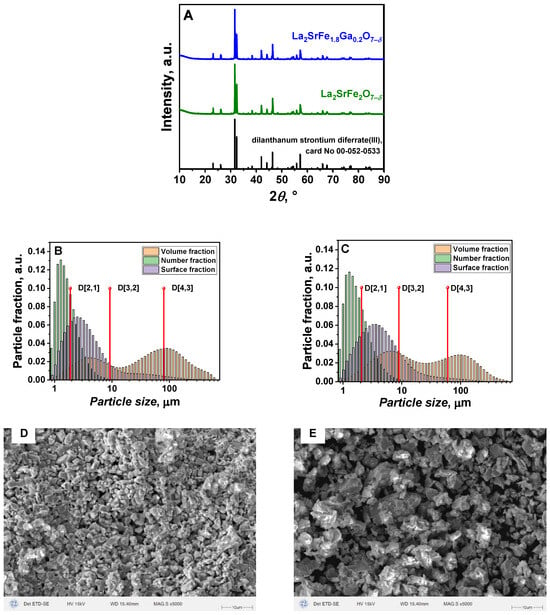
The crystallographic and morphological properties of the synthesised La2SrFe2O7−δ and La2SrFe1.8Ga0.2O7−δ powders were investigated using X-ray diffraction (XRD), laser diffraction, and scanning electron microscopy (SEM) methods. The results are summarised in Figure 1.
Figure 1.
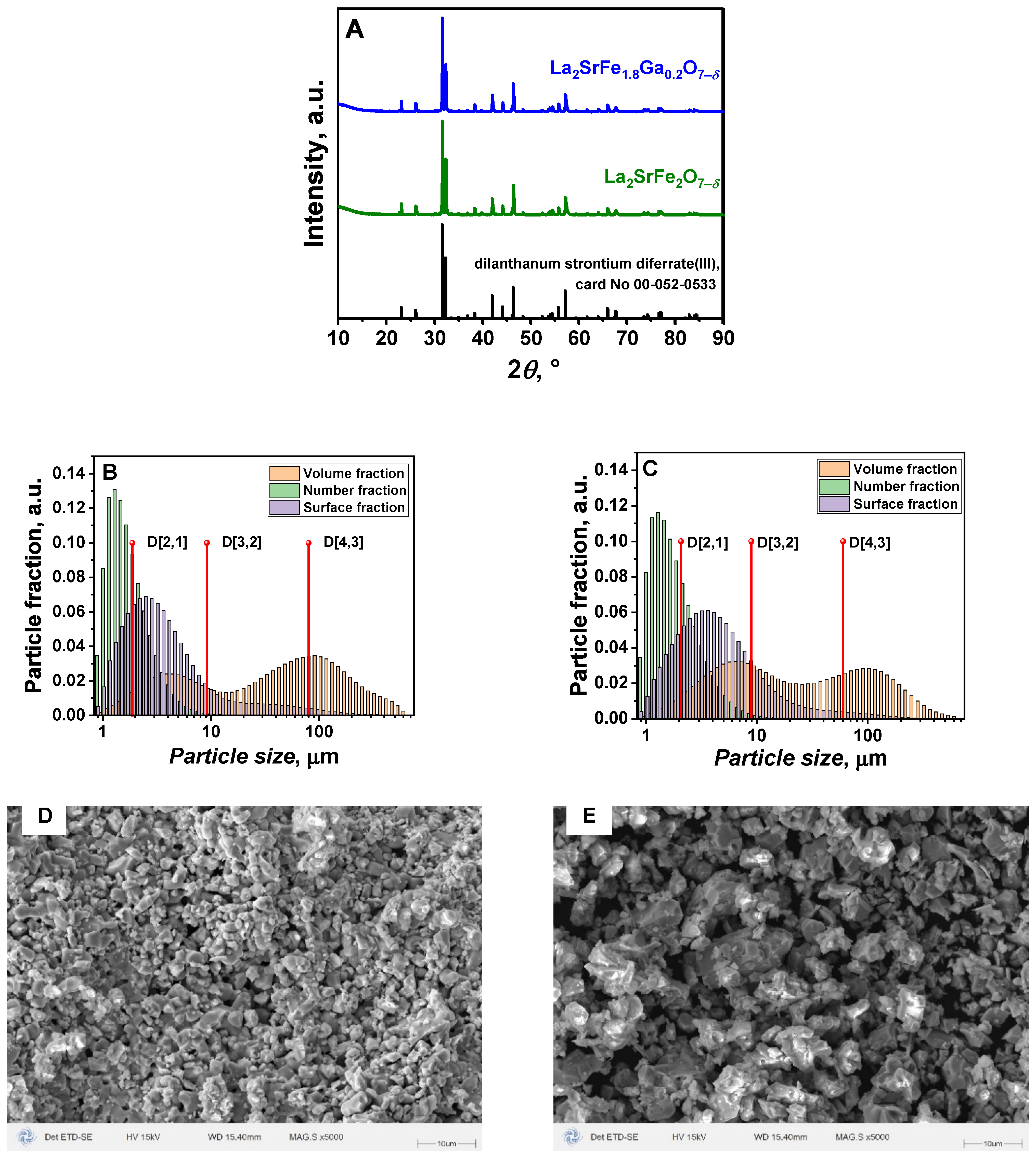
(A) XRD profiles of as-synthesised La2SrFe2O7−δ and La2SrFe1.8Ga0.2O7−δ powders collected under ambient conditions; differential particle size distribution functions for (B) La2SrFe2O7−δ and (C) La2SrFe1.8Ga0.2O7−δ; SEM-images of (D) La2SrFe2O7−δ and (E) La2SrFe1.8Ga0.2O7−δ samples.
XRD measurements (Figure 1A) confirmed the formation of the layered Ruddlesden–Popper (RP) phase in the investigated oxides. The analysis of XRD data using the Whole-Pattern Profile Fitting (WPPF) method revealed that both La2SrFe2O7−δ and La2SrFe1.8Ga0.2O7−δ samples crystallise in a tetragonal lattice system (sp. gr. I4/mmm). The lattice parameters were refined as follows: a = b = 3.9085(3) Å, c = 20.4716(4) Å for the undoped La2SrFe2O7 phase; and a = b = 3.9083(3) Å, c = 20.4600(3) Å for the Ga-doped La2SrFe1.8Ga0.2O7−δ oxide, respectively. The parameters are in excellent agreement with previously reported values for La2SrFe2O7−δ and La2SrFe1.8Ga0.2O7−δ oxide powders from prior investigations [39], as well as with the findings of Sharma et al. [37] and Gurusinghe et al. [38] for the based La2SrFe2O7−δ composition.
Figure 1B,C display the particle size distribution (PSD) of La2SrFe2O7−δ and La2SrFe1.8Ga0.2O7−δ powders, expressed in volumetric, surface-area, and number-based distributions. Both oxides exhibit PSDs of comparable shape, as illustrated in the figures. The mean particle diameters, represented by D[2,1], D[3,2], and D[4,3], were measured as 1.883 µm, 9.2 µm, and 79.98 µm for La2SrFe2O7−δ, and 2.072 µm, 8.937 µm, and 60.206 µm for La2SrFe1.8Ga0.2O7−δ, respectively. The closely aligned D[3,2] values for both oxides suggest similarities in their specific surface areas, a conclusion corroborated by BET measurements, which yielded specific surface areas of 0.37 ± 0.03 and 0.28 ± 0.03 m2/g for La2SrFe2O7−δ and La2SrFe1.8Ga0.2O7−δ, respectively. These results were used further in PIE studies, to obtain area-specified values of oxygen surface exchange rates.
Secondary-electron scanning electron microscopy images of the La2SrFe2O7−δ and La2SrFe1.8Ga0.2O7−δ powder particles are presented in Figure 1D,E. Both powders consist predominantly of irregularly shaped, fragment-like particles. While the majority of particles are small in size, the Ga-containing sample exhibits a notable presence of larger particles within its bulk, a finding that is consistent with the laser scattering analysis results.
3.2. Oxygen Heterogeneous Exchange
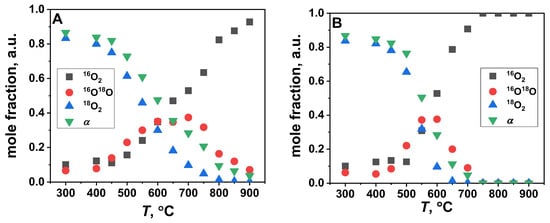
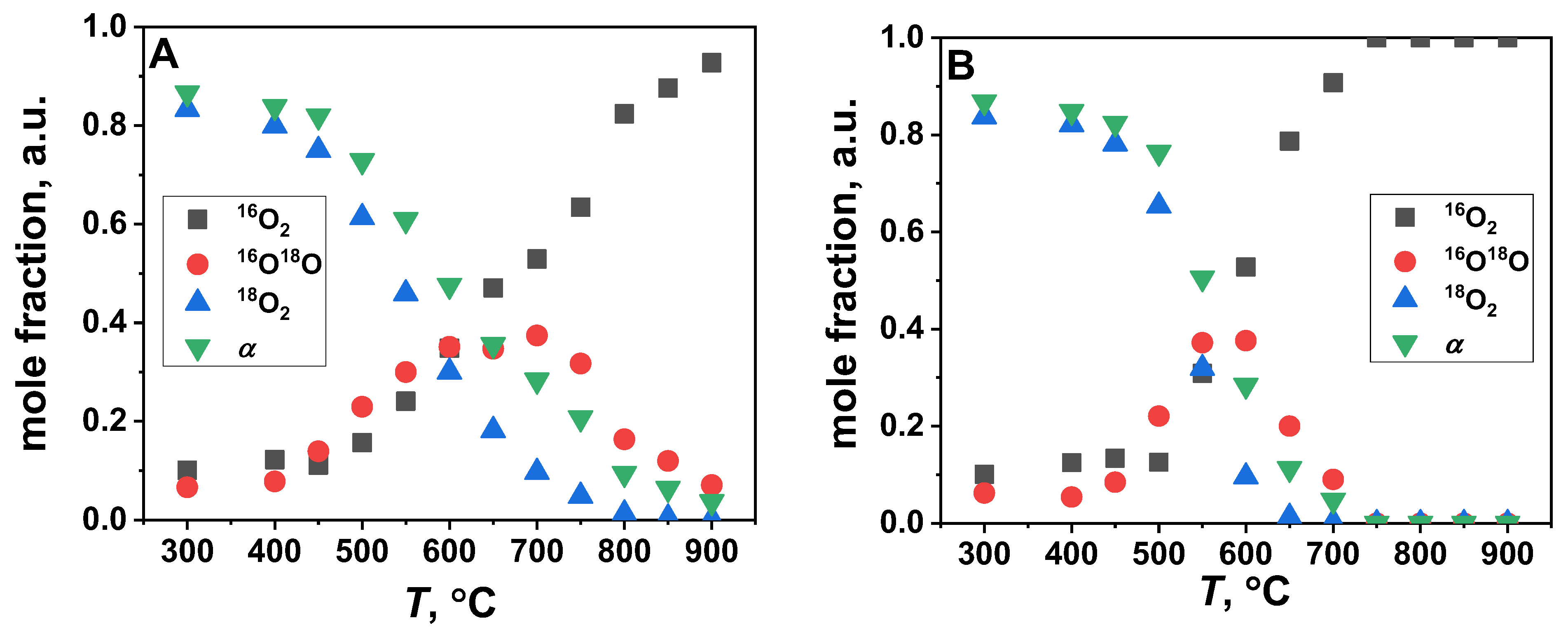
The as-calculated temperature dependencies of oxygen isotopologue mole fractions (x16O16O, x16O18O, and x18O18O) and mean 18O mole fraction (α = ½ x16O18O + x18O18O) in a pulse after its interaction with La2SrFe2O7−δ and La2SrFe1.8Ga0.2O7−δ are presented in Figure 2. Both oxides demonstrate the beginning of exchange at 400 °C, which is justified by an increase in x16O18O and a decrease in α compared to the values at lower temperatures. The total consumption of 18O in the pulse is achieved at 750 °C for La2SrFe1.8Ga0.2O7−δ, while in the case of La2SrFe2O7−δ, the consumption was not achieved in the whole studied temperature range. This indicates that absolute surface exchange activity of La2SrFe1.8Ga0.2O7−δ is higher than that of La2SrFe2O7−δ. The lower and upper limits of the kinetic activity revealed for the samples restrict the precise analysis of the exchange kinetics between O2 and the oxides to the temperature ranges of 400–900 °C for La2SrFe2O7−δ and 400–700 °C for La2SrFe1.8Ga0.2O7−δ, respectively.
Figure 2.
Temperature dependencies of oxygen isotopologue mole fractions and α for (A) La2SrFe2O7−δ and (B) La2SrFe1.8Ga0.2O7−δ, calculated from the results of PIE measurements at the gas-carried flow of 4 L/h and 1 mL of N2/18O2 pulse.
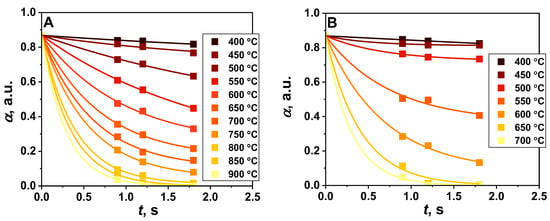
In order to obtain a quantitative estimation of the oxygen surface exchange rate, it is necessary to analyse the dependence of α on the time of pulse interaction with the oxides, which is equal to the residence time of the pulse. Figure 3 presents the time dependencies of α for La2SrFe2O7−δ and La2SrFe1.8Ga0.2O7−δ, respectively. According to the figure, the kinetic profiles of α exhibit typical behaviour governed by exponential law. This suggests the absence of kinetic inequality of bulk oxygen atoms in the oxides, as well as the absence of bulk diffusion limitations, which often appear in kinetic profiles of α in the form of secondary exponential terms [46,47,48,49]. Thus, to estimate kinetic parameters of oxygen surface exchange it is possible to use the exponential kinetic model (1) to describe the time dependencies of α [50,51]:
where t is time of interaction, rH is oxygen heterogeneous exchange rate (surface exchange rate) representing the number of oxygen atoms exchanging between O2 and the solid per unit surface and unit time [mole · m−2 · s−1]; λ is the ratio between number of oxygen atoms from the pulse in the packed bed microreactor and the number of exchangeable oxygen atoms in the oxide, calculated as ; α0 and α∞ are the mean 18O fractions in the pulse before the exchange and under isotope equilibrium conditions; Ng is the number of oxygen atoms in pulse [mol.]; S is the total surface area of the oxide [m2]. The results of the fitting are presented in Figure 3A,B with solid lines and show a good agreement between the experimental data and the model of exponential kinetics.
Figure 3.
Time dependencies of mean 18O mole fraction in a pulse (α) for (A) La2SrFe2O7−δ and (B) La2SrFe1.8Ga0.2O7−δ, calculated from the results of PIE measurements at the gas-carrier flows of 2, 3, and 4 L/h, at 1 mL of N2/18O2 pulse; points—experimental data, solid lines—the model of exponential kinetics.
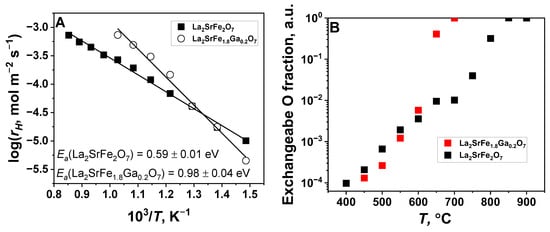
Figure 4A demonstrates the Arrhenius plot of rH for La2SrFe2O7−δ and La2SrFe1.8Ga0.2O7−δ, respectively. According to the figure, the effect of Ga doping on oxygen heterogeneous exchange is complex and depends on the temperature range. The values of rH for La2SrFe1.8Ga0.2O7−δ are higher than those for La2SrFe2O7 at temperatures ≥ 550 °C, which suggests that Ga doping increases rH in the high-temperature range. Conversely, at temperatures < 550 °C the values of rH for La2SrFe1.8Ga0.2O7−δ are comparable to or lower than those for La2SrFe2O7−δ, indicating a decrease in rH with Ga doping. The apparent activation energy of oxygen heterogeneous exchange increases with the Ga doping level: the value of Ea for La2SrFe1.8Ga0.2O7−δ is 1.66 times higher than that for La2SrFe2O7−δ.
Figure 4.
(A) Arrhenius plot of rH and (B) temperature dependencies of xexch. for La2SrFe2O7−δ and La2SrFe1.8Ga0.2O7−δ, respectively.
In general, the effect of Ga doping on the apparent activation energy (Ea) can be associated with two factors: the first is a change in the local and overall defect structure of the surface and/or bulk of the oxides; the second is a change in the exchange mechanism, including rate-determining steps. The latter factor is discussed in detail in Section 3.3.
To estimate the influence of the former factor, it is necessary to consider the general defect structure of layered ferrites. Prior studies [35,41] have systematically analysed the defect structure of La-doped Sr3Fe2O7−δ, demonstrating that its defect equilibria are governed by three key reactions, which may be expressed as Equations (2)–(4). The authors [41] found that the increasing La3+ content shifts the equilibrium of reaction (2) to the right, while simultaneously driving reactions (3) and (4) toward the left; a phenomenon attributed to the elevated concentration of Fe3+. Our results suggest that the Ga doping may exhibit the same effect as La doping. Since tetravalent Ga4+ does not exist under the experimental conditions employed, Ga cations cannot directly participate in the disproportionation reactions (3) and (4). Instead, the addition of Ga3+ induces a leftward shift in the equilibrium of these reactions via local charge-compensation effects. Consequently, the equilibrium of reaction (2) is driven to the right, effectively suppressing oxygen vacancy formation and increasing the binding strength of lattice oxygen. Regarding surface exchange at the gas–solid interface, the effect of Ga on the oxygen binding energies may increase Ea because of the higher binding energies of oxygen atoms in the outermost oxide layers. The Ga doping effect is discussed further in Section 3.3.
where and are oxygen vacancies in different structural positions of crystal lattice, with an effective charge of +2; and are structural oxygen atoms in the positions having effective zero-charge; is a Fe4+ cation having effective zero-charge, is a Fe3+ cation, and is a Fe2+; and are the rate constants of forward and backward mass-transfer reactions.
While the Ga doping unambiguously increases the values of Ea, its effect on rH values is more complex. To explain it, we need to consider the nature of rH measured by isotope exchange methods. In contrast to various relaxation-based techniques, isothermal isotope exchange is carried out under isotope equilibrium/stationary conditions, which provide equilibrium values of exchange rates [44,50,52]. As discussed in [52] a general reaction rate (R) for a reversible process, expressed as the difference between the rates of the forward and backward reactions for the process (), under equilibrium conditions is equal to zero, producing equal equilibrium rates of surface exchange rate . Considering reactions (2)–(4), under our conditions, the relationship between rH and the parameters is expressed as , where C is the equilibrium concentration of the respective defects. Taking into account that the exchange reaction occurs in the adsorption layer between the gas phase and the oxygen atoms in the near-surface layers of the oxide, the equilibrium concentrations of the defects can, in general, be related to surface, bulk, or both types of defects, depending on the bulk diffusion limitations of the material. Thus, Ga doping may lead to both an increase and a decrease in rH depending on its effect on the defect concentrations.
To determine the key factors responsible for the observed effect of Ga doping on rH, the estimation of the relative fraction of exchangeable oxygen in the oxides was carried out using equation , where and represents λ at the conditions when all oxygen atoms in the sample (NO) are considered to be exchangeable, and λexp. corresponds to λ obtained from the results of experimental data fitting.
Figure 4B shows the temperature dependencies of xexch. for La2SrFe2O7−δ and La2SrFe1.8Ga0.2O7−δ, respectively. The values of xexch. increase with temperature for both oxides reaching the maximum at 850 and 700 °C for La2SrFe2O7−δ and La2SrFe1.8Ga0.2O7−δ. At temperatures below 600 °C, the values are lower than 1%, suggesting that only oxygen atoms in near-surface layers of oxides are involved in the exchange process. The increase of temperature leads to a drastic increase in exchangeable oxygen fraction that indicates a growth in the accessibility of bulk oxygen for exchange.
The Ga introduction controversially affects the values of xexch.. At temperatures < 650 °C the values of xexch. for La2SrFe2O7−δ are higher than that for La2SrFe1.8Ga0.2O7−δ, while the opposite trend is observed in high-temperature regions. A clear direct correlation is observed between rH and xexch., justifying that the key factor responsible for the impact of Ga on rH is . Thus, at lower temperatures, Ga doping reduces the number of exchangeable oxygen atoms, due to the effect of Ga on the activation barriers of oxygen vacancy formation. As temperature increases, more oxygen atoms from the oxides becomes exchangeable, while the total number of oxygen atoms in the oxide decreases due to the exothermic reaction (2). In this case, the effect of Ga on the activation barrier blocks the release of oxygen, which in turn results in a higher xexch. for La2SrFe1.8Ga0.2O7−δ compared to La2SrFe2O7−δ. Similar behaviour was observed in our previous study [45] on Ce- and Y-doped BaFeO3−δ, where the increase in Ce doping level resulted in the increase of rH due to the increase of oxygen content in the oxide.
3.3. Oxygen Surface Exchange Mechanism
To obtain comprehensive information on the effect of Ga doping on the oxygen surface exchange mechanism between the gas phase and oxides, the detailed analysis of the experimental data was performed within the model of three exchange types, independently proposed by Muzykantov et al. and Klier et al. in papers [53,54]. The model is a particular case of recently proposed general statistical theory of ideal isotope exchange (exchange without isotope effects) [49]. In terms of the theory, the isotope exchange process for any exchange participant (component) of an arbitrary system is the dynamic process of the change in the distribution function of the isotopes within the participant. The change corresponds to a discrete set of atom-transfer quasireactions, describing the transition between a distribution function of the given participant in the given time moment and other types of isotope distributions possible for the system. The quasireactions are classified as types and subtypes of exchange. The type of exchange shows the number of atoms transferred between exchange participants of different chemical composition during the act of quasireaction. The subtypes of exchange indicate the particular type of “product” distribution function within the given type of exchange.
The model of three exchange types considers the exchange in two-component systems of O2–oxide, where the oxide is presented by one sort of one-atomic oxygen species. In this system, the three types of exchange are possible, presented by only one subtype each: r0-type, representing the isotope redistribution between oxygen molecules without contributing of structural oxygen to the redistribution; r1-type, corresponding to the isotope redistribution between O2 and the oxide, with the contribution of one oxygen atom of the oxide to the redistribution; and r2-type, representing the isotope redistribution between O2 and the oxide, with the participation of two oxygen atoms from the oxide. In terms of general statistical theory of ideal isotope exchange, these types are described by three distinct atom-transfer quasireactions, expressed with Equations (5)–(7):
where A2 denotes an arbitrary distribution function of 18O and 16O in O2. Its elements are the probabilities of finding the three combinations of oxygen isotopes in O2, i.e., 16O16O, 16O18O, and 18O18O, equal to the respective mole fractions. 2A, A + AS, and 2AS are the three types of oxygen isotope distribution. Type 2A represents a binomial distribution, indicating that the probability of finding the three combinations of oxygen isotopes depends only on the mean fraction of 18O in O2 (α). Type A + AS denotes a Poisson binomial distribution, indicating that the probability of finding the three combinations of oxygen isotopes depends on both the mean fractions of 18O in O2 and in the oxide (αS). Type 2AS represents a binomial distribution in which the probability of finding the three combinations of oxygen isotopes is determined by the mean fraction of 18O in the oxide. The r0, r1, and r2 are the rates of the quasireactions that, in the particular case of the model of three exchange types, are also equal to the rates of the three types of exchange.
The rate of oxygen heterogeneous exchange rH is directly connected with the rates of the three exchange types by Equation (8), and the sum of the rates rtot (9) corresponds to the total rate of isotope exchange in system, equal to the mean rate of oxygen dissociative adsorption.
rtot = r0 + r1 + r2.
An equation, describing the kinetics of surface exchange within the model of three exchange types is written as (10):
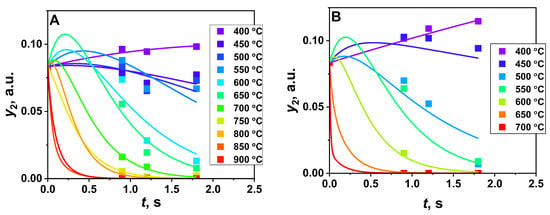
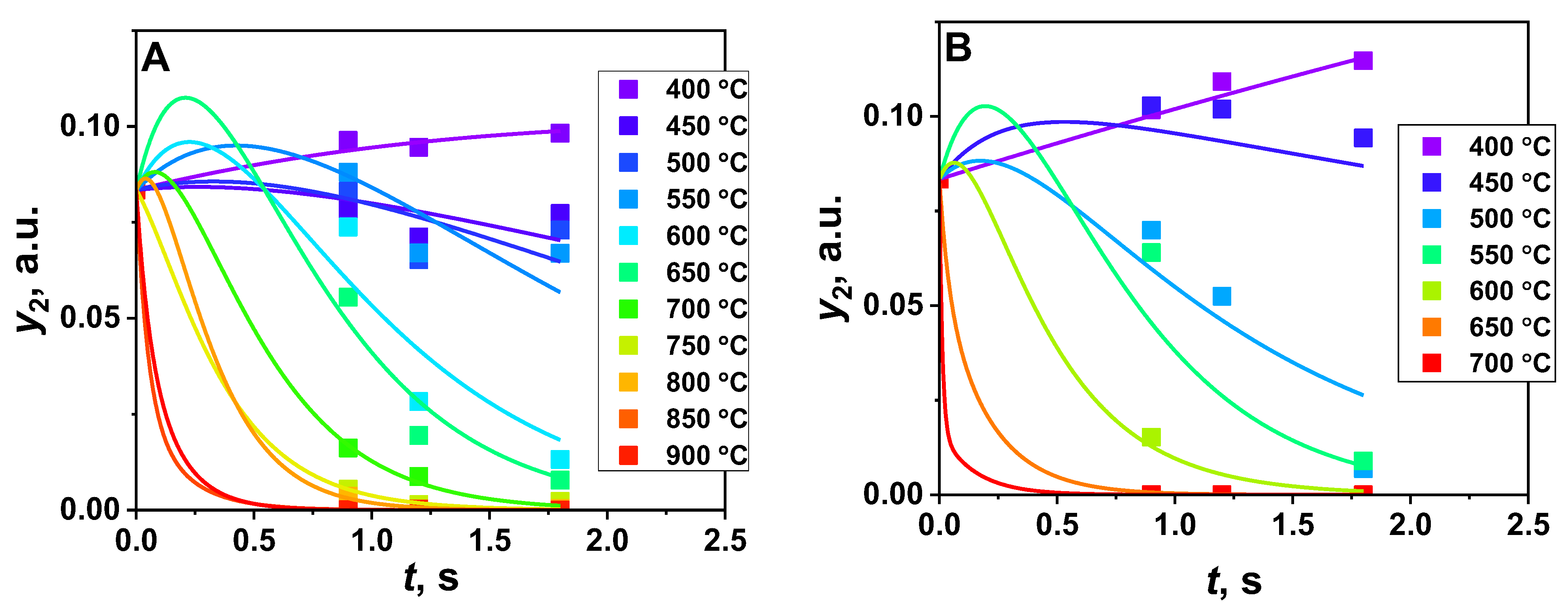
where y2 is an isotope variable for 18O2, showing the difference between the mole fraction of 18O2 in O2 at a given moment of time, and the fraction governed by the binomial distribution function at a given moment of time, written as Equation (11); is the value of the variable at t = 0.
Figure 5 presents the time dependencies of y2 calculated from the experimental data by Equation (11), and fitted with Equation (10), with the refinement of r2 and rtot as fitting parameters. The figure demonstrates acceptable agreement between the data and the model of three exchange types.
Figure 5.
Time dependencies of y2-variable (A) La2SrFe2O7−δ and (B) La2SrFe1.8Ga0.2O7−δ, calculated from the results of PIE measurements at the gas-carried flows of 2, 3, and 4 L/h, at 1 mL of N2/18O2 pulse; points—experimental data, solid lines—the model of three exchange types by Equation (10).
To determine the mechanism of isotope exchange between O2 and the oxides using the model of the three exchange types, it is necessary to consider the probabilities of exchange by the types, calculated as , where ri is the rate of ith exchange type. According to studies [49,55,56], the probabilities are determined by the number of exchange steps, and the ratios between the rates of elementary steps for the mechanism. So far, several mechanisms were discussed in literature to describe isotope exchange between O2 and complex oxides:
- A two-step model [55] suggests that the mechanism of oxygen surface exchange is composed of two subsequent steps: oxygen dissociative adsorption, corresponding to isotope exchange between O2 and oxygen adsorbed atoms, Oa; and oxygen incorporation, corresponding to oxygen isotope exchange between oxygen adsorbed atoms and structural oxygen, OS. This model governs exchange probabilities by the ratio In terms of oxygen mass-transfer reactions, the steps can be expressed with Equations (12) and (13), respectively.
- A statistical mechanism [56] considers the presence of kinetic inequality of adsorption and/or incorporation centres in the oxides, which creates multiple, parallel dissociative adsorption and incorporation steps with distinct rates. This model governs the exchange probabilities by the ratio Pih > 1.
- A mechanism with partial kinetic inequality of active centres [44,55] governs exchange probabilities by the ratio Pih < 1. The mechanism suggests the presence of a single dissociative adsorption step producing two oxygen adsorbed atoms with different incorporation capabilities, as well as the mechanism with multiple adsorption steps, but fast surface diffusion of adsorbed atoms, which allows recombination of adsorbed atoms with distinct activities within one molecule.
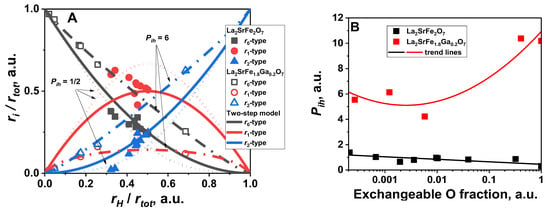
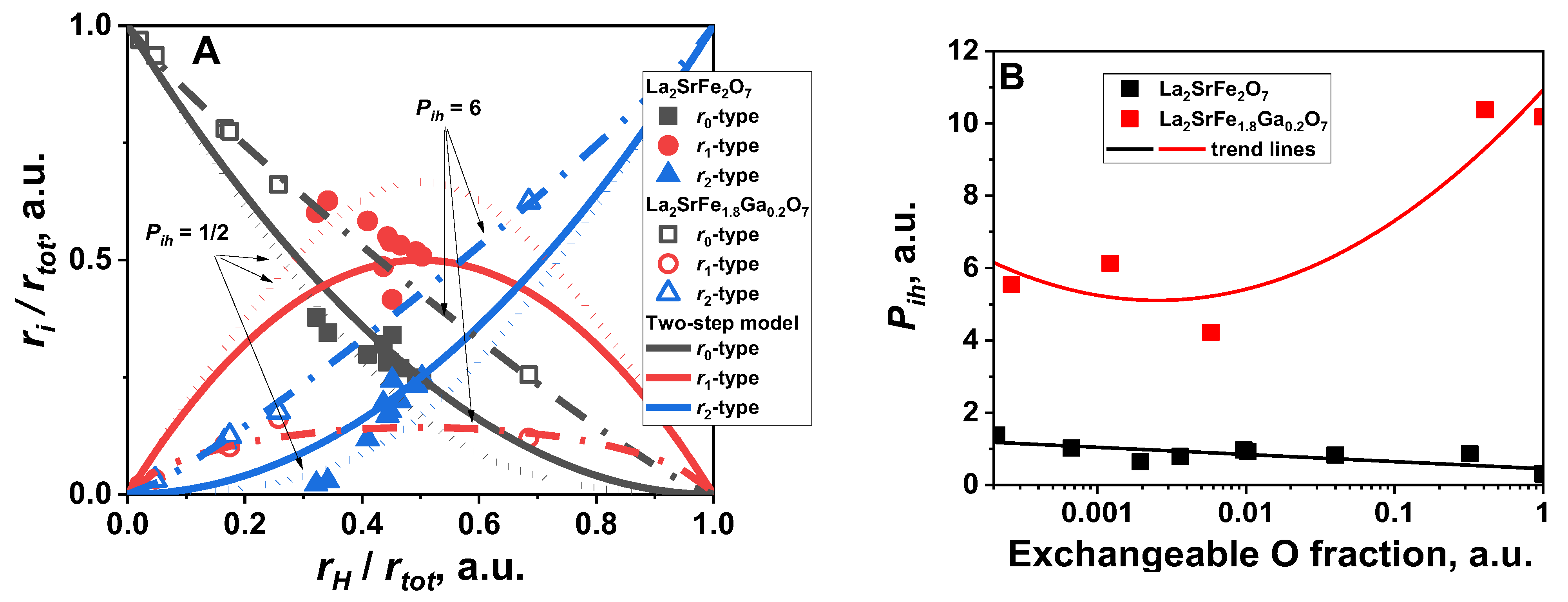
Figure 6A demonstrates a probability of exchange diagram, showing the dependence of χi on the mean probability of surface exchange () for our data, in comparison with the theoretically calculated values predicted by Pih for the above discussed mechanisms. The figure shows that for La2SrFe2O7−δ the values of χ0, χ1, and χ2 are closely aligned with the two-step model at the majority of values. The decrease in leads to shifting the values of χ0, χ1, and χ2 to the mechanism with partial kinetic inequality (Pih < 1). This suggests the slight change of the surface exchange mechanism. In the case of La2SrFe1.8Ga0.2O7−δ, in all studied temperature ranges, oxygen surface exchange follows the statistical mechanism (Pih > 1), which indicates that Ga-doping splits the two-step model into multiple parallel two-step pathways having different rates of oxygen dissociative adsorption and incorporation. This suggests that the addition of Ga either modifies the kinetic activity of some of the existing adsorption centres or creates additional adsorption centres on the oxide surface having different kinetic activity towards the oxygen surface exchange reaction.
Figure 6.
(A) Probability of exchange diagram in coordinates with points denoting χ0, χ1, and χ2 determined from experimental data using Equation (10), and lines representing theoretically calculated χ0, χ1, and χ2 from the two-step model (solid lines), the statistical mechanism (dash-dot lines), and the partial inequality mechanism (dot lines); (B) the dependence of Pih on xexch.
The observed influence of Ga doping on the exchange mechanism may be explained from the same position as the effect of xexch. on rH. As discussed in Section 3.2 the oxygen/consumption release for the oxides is strongly connected with the change of oxidation state of Fe cations from +3 to +4 by Equation (2). Since Ga3+/Ga4+ transition is not possible, the outermost oxygen atoms bound to Fe and Ga atoms may exhibit different kinetic activity, which splits the two-step model into at least several parallel exchange pathways having different rates of oxygen dissociative adsorption and incorporation in different points of the oxide surface.
The effect of temperature on the exchange mechanism is likely to be connected with xexch.. To illustrate this let us consider the dependence of Pih on xexch. presented in Figure 6B. According to the figure, the increase in xexch. leads to a slight decrease in Pih for La2SrFe2O7−δ. This is in contradiction to the majority of perovskite-like oxides, exhibiting two-step mechanism of exchange [45,57,58]. However, the mechanisms of isotope exchange between O2 and Ruddlesden–Popper oxides can be significantly more complex due to their layered structure. In particular, the study of oxygen surface on ceramic La2NiO4 [56] reveals Pih > 1, which the authors explained by the distribution of active centres associated with pathways of oxygen migration within the crystal lattice. The study on powder La2NiO4 [44,57] with PIE, in contrast, shows the applicability of the two-step model, while the study of La3Ni2O7−δ and La4Ni3O10−δ [44] demonstrate the mechanism with Pih = 0, associated with the presence of the two sorts of incorporation sites in the oxide, namely oxygen vacancies and oxygen interstitials, exhibiting drastically different kinetic activity. Our PIE results on La2SrFe2O7−δ appear to be in between the discussed studies for layer nickelates and close to La3Ni2O7−δ. This suggests that the layered structure of La2SrFe2O7−δ may influence the exchange mechanism. In that case, in the low-temperature region where xexch. is low, the different activation barriers of vacancy formation, associated with different structural layers of the crystal lattice, create kinetic inequality of adsorption/incorporation centres and lead to Pih > 1. The increase in temperature leads to an increase in xexch., which, in turn, unevenly increases the accessibility of oxygen atoms in the different layers of the oxide, effectively increasing the rate of oxygen incorporation only for specific pathways. This leads to decreasing Pih to values below 1, similarly to La3Ni2O7−δ, where one of oxygen incorporation pathways was immeasurably faster than others.
In the case of La2SrFe1.8Ga0.2O7−δ the decrease in Pih with xexch. was also observed at xexch. < 0.01, suggesting the same effect of the layered crystal structure on the reaction mechanism in this region as for La2SrFe2O7−δ. However, the further increase in xexch. results in drastic increase in Pih. This observation may be associated with the combined structural and doping effect on the mechanism: the effect of layered structure increases the rate of specific incorporation pathways, while Ga doping increases activation barriers for oxygen adsorption and/or incorporation due to the impossibility of Ga3+/Ga4+ transition, compared to Fe3+/Fe4+. As xexch. increases, more oxygen from the bulk becomes accessible for exchange at the centres of different kinetic activity connected with Fe and Ga cations. This results in further splitting of the reaction pathways to low- (Ga-related) and highly- (Fe-related) active, and leads to the increase in Pih.
It should be noted that the proposed interpretation of the obtained reaction mechanisms and results is only based on the exchange kinetics and on similarities in structural and kinetic features between layered nickelates and the oxides under study. The finer aspects of the revealed exchange mechanism require additional studies with application of XPS, EXAFS, DFT, NMR, and other techniques to obtain detailed information on the structural–kinetic relationships for these oxides.
To conclude this section, let us analyse the effect of Ga doping on the rates of the elementary steps of the exchange process. Due to the fact that the exchange mechanism for both La2SrFe2O7−δ and La2SrFe1.8Ga0.2O7−δ has a complex, multistep nature, the exact calculation of the rates for all elementary steps is impossible on the basis of only three independent parameters provided by the model of three exchange types. However, it is possible to estimate the effect of Ga doping on the mean rates of oxygen dissociative adsorption (<rads>=rtot) and incorporation (<rinc>=(<rads > ∙rH)/((<rads > −rH)) across all exchange pathways.
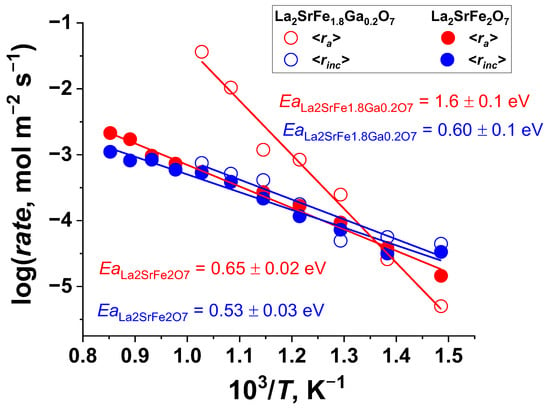
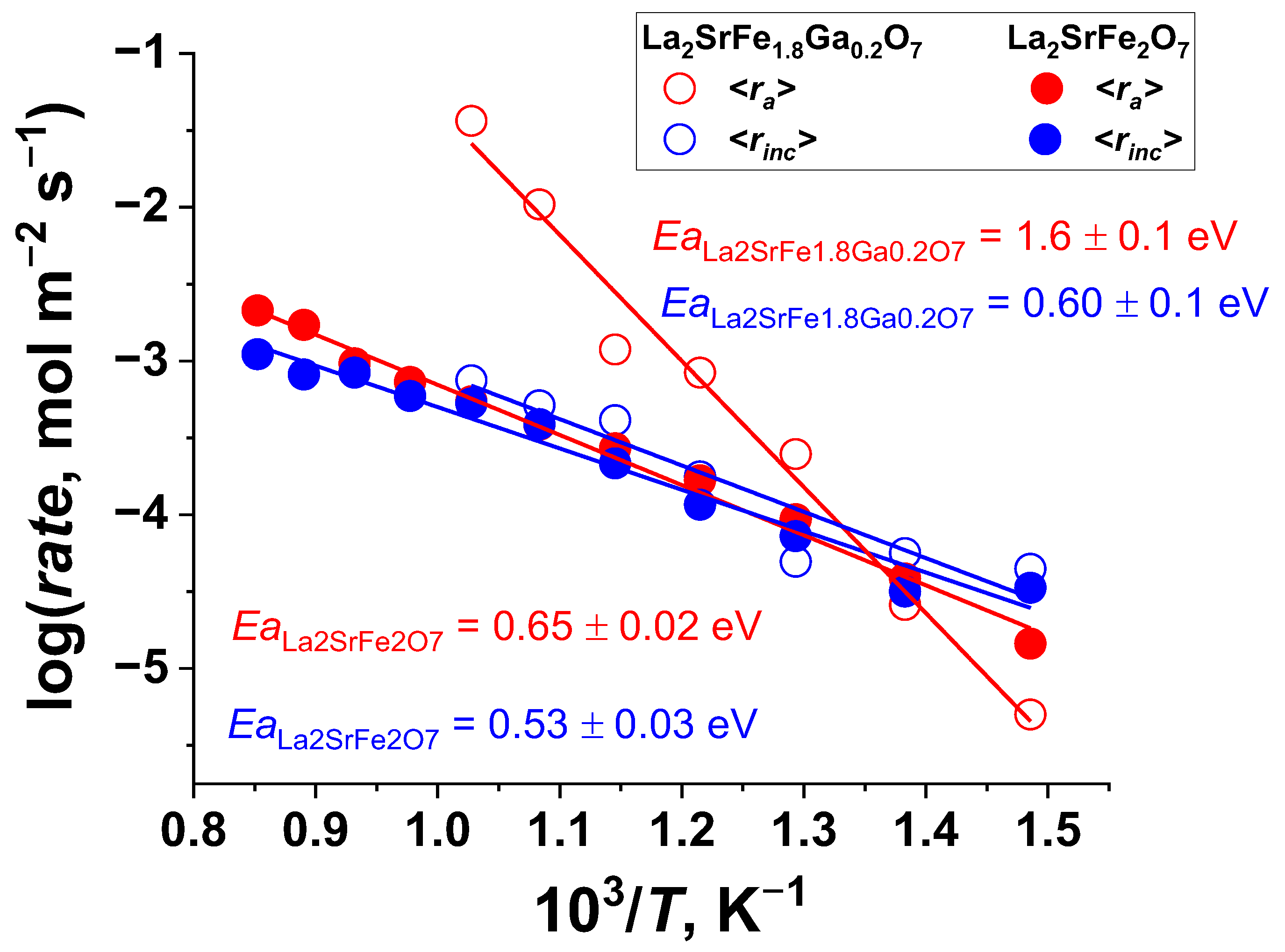
Figure 7 presents the Arrhenius plots of the mean rates of oxygen dissociative adsorption, <rads>, and incorporation, <rinc>, for La2SrFe2O7−δ and La2SrFe1.8Ga0.2O7−δ, respectively. The figure demonstrates that the increase in Ga content significantly affects oxygen dissociative adsorption rather than oxygen incorporation, and consequently the overall rate-determining process of exchange. The mean rates <rads> and <rinc> have comparable values for undoped La2SrFe2O7−δ, suggesting competition between the steps of adsorption and incorporation. Conversely, the rates for La2SrFe1.8Ga0.2O7−δ demonstrate the different rate-determining process at different temperature regions: at T below 500 °C oxygen dissociative adsorption is the rate-determining process, while at higher temperatures oxygen incorporation determines the oxygen surface exchange. The observed change in the rate-determining step of exchange for La2SrFe1.8Ga0.2O7−δ is likely to be partially responsible for the existence of low- and high-temperature regions in the temperature dependencies of rH discussed in Section 3.2, where the rate of surface exchange for La2SrFe1.8Ga0.2O7−δ is the low-temperature region, and is higher in the high-temperature region than that for La2SrFe2O7−δ.
Figure 7.
Arrhenius plot of <rads> and <rinc> for La2SrFe2O7−δ and La2SrFe1.8Ga0.2O7−δ, respectively.
The observed impact of Ga doping on the rate-determining process of the exchange can be explained by its different effect on the <rads> and <rinc>. According to the figure, an increase in Ga content results in a slight increase in both <rinc> and the apparent activation energy of oxygen incorporation, while a pronounced drastic increase in the apparent activation energy and the values of <rads> with Ga content is observed in the case of oxygen dissociative adsorption. In Section 3.2, it was discussed that the impact of Fe substitution by Ga on oxygen surface exchange rH and its apparent activation energy may be associated with a change in the thermodynamic parameters of reactions (2)–(4) induced by Ga doping, namely the increase in activations barriers of oxygen vacancies formation, which changes both Ea and the relative fraction of exchangeable oxygen in the oxides. In relation to <rinc>, the explanation proposed in Section 3.2 can be responsible for the observed slight increase in both the values of <rinc> and its activation energy.
It is clear that, in contrast to acceptor doping, which has been extensively studied in literature, the substitution of Fe3+ with Ga3+ cations does not produce excessive vacancies, which can facilitate oxygen incorporation. The impossibility of the Ga3+/Ga4+ transition indicates that Ga cannot participate directly in oxygen incorporation, which is strongly associated with the oxidation of Me3+ to Me4+, but only effects <rinc> by means of the shift in the overall thermodynamic potentials for reactions (2)–(4) and, as a consequence, in the concentration of structural oxygen and its binding energies. The results showed marked agreement with the results of pressure relaxation studies of the oxides reported [39], where the authors showed that under non-equilibrium conditions close to vacuum (10−3 ≤ pO2(atm) ≤ 3 · 10−2), the chemical surface exchange coefficient of the oxides is almost independent on Ga content. The values reported in paper [39] for the apparent activation energies of electrode polarization resistance, measured by EIS, for La2SrFe2O7−δ and La2SrFe1.8Ga0.2O7−δ were 1.17 ± 0.09 and 1.15 ± 0.03 eV, while the apparent activation energies of the oxygen surface exchange coefficient measured by oxygen pressure relaxation at 0.017 atm were 0.71 ± 0.07 and 0.77 ± 0.09 eV, respectively. Both reported results demonstrate agreement with the determined effect of Ga doping on the apparent activation energy of oxygen incorporation, which may indicate that the oxygen incorporation process is mainly determined by the bulk properties of materials rather than surface properties.
Conversely to the effect of Ga doping on the mean rates and apparent activation energy of oxygen incorporation, the effect on the values of oxygen dissociative adsorption is much more significant. The possible explanation for this may be associated with two factors: an uneven distribution of Ga across the oxide, or the direct participation of Ga cations in the adsorption reaction, but by a different mechanism of the adsorption step. The first factor suggests that the concentration of Ga in the near-surface layers of the oxide is higher than that in the bulk layers, which results in the more pronounced effect of Ga on the binding energies of chemisorbed oxygen than the bulk oxygen. The justification of this factor requires additional studies with XPS and DFT methods.
The second factor suggests that oxygen dissociative adsorption may occur by different mechanisms. Indeed, while oxygen incorporation is strongly associated with the transition of Me3+ to Me4+ and requires free oxygen vacancies, oxygen dissociative adsorption may, in general, occur on metal cations as active centres, including Ga3+ and Ga2+; the charge state of chemisorbed oxygen may also be different from the bulk oxygen [59]. The participation of Ga cations as an active centre of oxygen dissociative adsorption, with a different mechanism from the step, may drastically shift the activation energy of the overall dissociative adsorption reaction.
Nevertheless, both of these factors are in agreement with the revealed statistical mechanism of oxygen surface exchange for La2SrFe1.8Ga0.2O7−δ, but require additional XPS, EXAFS and DFT studies, which may motivate further research on Ga-doped layered ferrites.
Overall, the presented results show that Ga doping of layered ferrites can be a valuable tool for the selective modification of surface exchange mechanisms and the rate-determining step, with no or insignificant changes in the defect structure and bulk properties of the material. In this case, the co-doping of the oxides with Ga and other cations may be considered to be a promising method for fine tuning the catalytic properties of the materials towards oxygen mass-transfer between O2 and the oxides, to achieve desirable reaction kinetics.
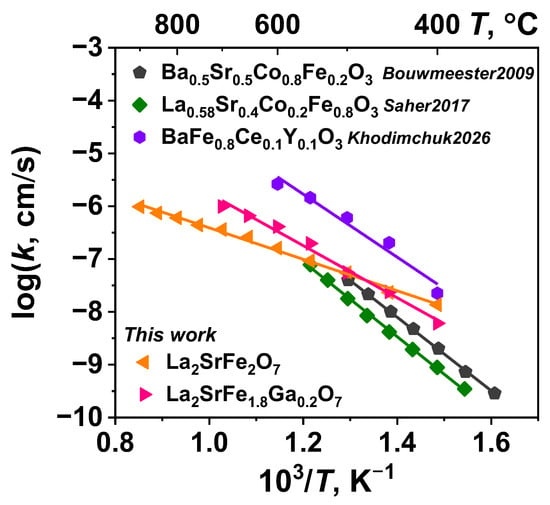
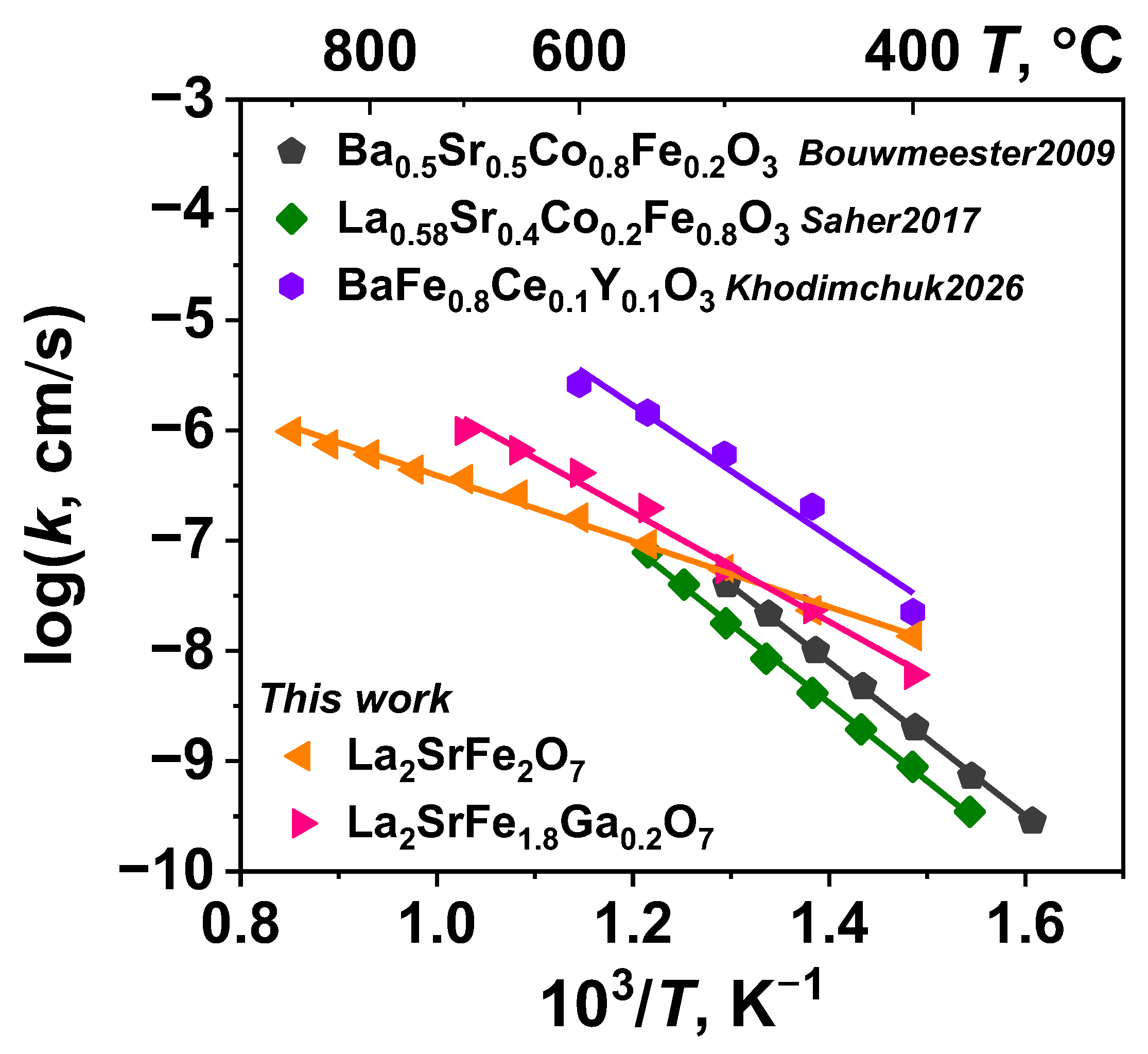
To demonstrate the high catalytic activity of the materials investigated in this study, the oxygen surface exchange coefficients (k, cm · s−1) for La2SrFe2O7−δ and La2SrFe1.8Ga0.2O7−δ were calculated from the measured rH values by Equation (14) and compared with literature data for well-known iron-based mixed-conducting electrode materials measured at pO2 = 0.21 atm using the PIE method [45,57,58]. The k values as a function of reciprocal temperature are presented in Figure 8.
where Mr is a molecular mass of an oxide; 𝛿 is the oxygen nonstoichiometry in an oxide; NA is the Avogadro constant; and ρ is a sample crystallographic density.
Figure 8.
Temperature dependencies of k for La2SrFe2O7−δ and La2SrFe1.8Ga0.2O7−δ in comparison with existing literature data for a various mixed conducting oxide at pO2 = 0.21 atm [45,57,58].
As depicted in Figure 8, the oxygen surface exchange kinetics of layered ferrites are competitive with, and in select cases exceed, those of the benchmark cathode materials Ba0.5Sr0.5Co0.8Fe0.2O3 (BSCF) [57] and La0.58Sr0.4Co0.2Fe0.8O3 (LSCF) [58]. This finding underscores the considerable promise of layered ferrites as viable alternatives for SOFC/IT-SOFC cathodes. Nevertheless, when evaluated against the state-of-the-art triple-conducting BaFe0.8Ce0.1Y0.1O3−δ cathode [45], the layered ferrites display lower oxygen exchange rates, with the k being approximately one order of magnitude smaller. Future research directions include the rational design of layered ferrite structures, optimization of synthesis protocols, and surface modification strategies, all of which may substantially improve their oxygen exchange capabilities and broaden their utility in electrochemical devices.
4. Conclusions
This study presents the first comprehensive analysis of oxygen surface exchange kinetics between O2 and Ga-doped La2SrFe2O7−δ using the pulsed isotope exchange technique under ambient oxygen partial pressures. The key results of the study are formulated as:
- Both La2SrFe2O7−δ and La2SrFe1.8Ga0.2O7−δ powders exhibit oxygen surface exchange in the temperature range 400–900 °C under He/O2 (19 vol. % O2) flow.
- Ga doping has complex impacts on the rates of oxygen surface exchange (rH) between O2 and La2SrFe2O7−δ, with rH for La2SrFe1.8Ga0.2O7−δ lower than that for La2SrFe2O7 at temperatures below 550 °C, and the values of rH for La2SrFe1.8Ga0.2O7−δ were higher than those for La2SrFe2O7−δ at temperatures higher than 550 °C. The results were explained by the effect of Ga doping on the defect structure and oxygen content of the materials.
- The correlation between the values of rH and the relative fraction of exchangeable oxygen (xexch.) was found for both materials, suggesting a connection between the defect structure of the materials and the surface exchange kinetics.
- The mechanism of oxygen surface exchange between O2 and Ga-doped La2SrFe2O7−δ was found to depend on temperature and Ga content: in the low-temperature region for undoped La2SrFe2O7−δ, the mechanism comprises two subsequent steps, oxygen dissociative adsorption and incorporation. The increase in temperature leads to the splitting of the oxygen incorporation step into the two kinetically distinguishable steps with different rates, which may be associated with the complex layered structure of the oxide containing oxygen atoms in different inequivalent positions.
- The increase in Ga content leads to the splitting of the two-step mechanism into multiple parallel two-step pathways exhibiting different rates of oxygen dissociative adsorption and incorporation. The origin of the splitting is unclear but may be related to the different redox behaviour of Ga3+ and Fe3+ cations in the oxides, resulting in the existence of chemisorbed oxygen atoms with different binding energies. However, further studies with the application of XPS, EXAFS, and DFT techniques are required to obtain precise information about the nature of the splitting.
- The rate-determining exchange process was found to change with the Ga doping level: for undoped La2SrFe2O7−δ, there was competition between oxygen dissociative adsorption and incorporation in the entire temperature region. In the case of La2SrFe1.8Ga0.2O7−δ, the rate-determining process is temperature-dependent: at temperatures below 500 °C, the process is oxygen dissociative adsorption, and at temperatures higher than 500 °C, the process relates to oxygen incorporation.
Author Contributions
E.V.G.: Methodology, Resources. A.V.K.: Writing—original draft, Writing—review & editing, Investigation, Formal analysis, Validation, Methodology. D.M.Z.: Writing—original draft, Writing—review & editing, Investigation, Data curation, Visualization, Validation, Methodology. N.M.P.: Writing—review & editing, Conceptualization. D.A.O.: Conceptualization, Supervision, Methodology, Project administration. All authors have read and agreed to the published version of the manuscript.
Funding
The study was funded by a grant of Russian Science Foundation No. 24-19-00040, https://rscf.ru/project/24-19-00040/ (accessed on 27 September 2026).
Data Availability Statement
Data will be made available on request.
Acknowledgments
Authors are grateful to T.A. Kuznetsova, N.O. Makarova, and A.V. Tkachuk for their contributions to the research work. The facilities of the Shared Access Center “Composition of Compounds” and Unique Scientific Setup “Isotopic Exchange” of IHTE UB RAS were used.
Conflicts of Interest
We confirm that the work described has not been published before and that it is not under consideration for publication anywhere else. The authors declare that there is no conflict of interest that could inappropriately influence the submitted work. The publisher will not be held legally responsible should there be any claims for compensation.
References
- Yinzhuo, J.; Xiushi, L.; Hui, F. Recent advances in cathode materials for solid oxide fuel cell. Ceram. Int. 2025, 51, 13697–13712. [Google Scholar] [CrossRef] [Scilit]
- Yang, Y.; Lei, J.; Huang, X.; Liao, Z.; Liu, Y.; Tu, Z. Recent Development in Reversible Solid Oxide Fuel Cells: Theory, Integration and Prospective. ChemElectroChem 2024, 11, e202300593. [Google Scholar] [CrossRef] [Scilit]
- Yousaf, M.; Lu, Y.; Akbar, M.; Lei, L.; Jing, S.; Tao, Y. Advances in solid oxide fuel cell technologies: Lowering the operating temperatures through material innovations. Mater. Today Energy 2024, 44, 101633. [Google Scholar] [CrossRef] [Scilit]
- Riaz, A.; Kreka, K.; Stangl, A.; Buzi, F.; Panisset, S.; Baiutti, F.; Rapenne, L.; Jiménez, C.; Jauffres, D.; Mermoux, M.; et al. Enhanced performance of reversible solid oxide cells using high-surface-area nanostructured thin-film oxygen electrodes. J. Power Sources 2025, 650, 237492. [Google Scholar] [CrossRef] [Scilit]
- Casadio, S.; Gondolini, A.; Mercadelli, E.; Sanson, A. Advances and prospects in manufacturing of ceramic oxygen and hydrogen separation membranes. Renew. Sustain. Energy Rev. 2024, 200, 114600. [Google Scholar] [CrossRef] [Scilit]
- Nisar, J.; Kaur, G.; Giddey, S.; Bhargava, S.; Jones, L. Cathode Materials for Intermediate Temperature Solid Oxide Fuel Cells. Fuels 2024, 5, 805–824. [Google Scholar] [CrossRef] [Scilit]
- Mehdi, A.M.; Hussain, A.; Song, R.H.; Lim, T.-H. Improving the durability of cobaltite cathode of solid oxide fuel cells—A review. RSC Adv. 2023, 13, 25029–25053. [Google Scholar] [CrossRef] [Scilit]
- Jafari, M.; Farsani, F.Y.; Grimm, F. Calcium (Ca) substitution for strontium (Sr) in La0.58Sr0.4Co0.2Fe0.8O3−δ: Stability and electrochemical performance in IT-SOFC cathodes. Electrochim. Acta 2025, 518, 145662. [Google Scholar] [CrossRef] [Scilit]
- Chew, T.L.; Lingam, V.S. Recent advances in perovskite cathode materials for solid oxide fuel cells (SOFC). Chem. Eng. J. Adv. 2026, 26, 101166. [Google Scholar] [CrossRef] [Scilit]
- Hashim, S.S.; Liang, F.; Zhou, W.; Sunarso, J. Cobalt-Free Perovskite Cathodes for Solid Oxide Fuel Cells. ChemElectroChem 2019, 6, 3549–3569. [Google Scholar] [CrossRef] [Scilit]
- Akkurt, S.; Sindiraç, C.; Özmen Egesoy, T.; Erğen, E. A review on new cobalt-free cathode materials for reversible solid oxide fuel cells. J. Met. Mater. Min. 2023, 33, 1654. [Google Scholar] [CrossRef] [Scilit]
- Eremeev, N.F.; Bespalko, Y.N.; Mikhailenko, M.A.; Korobeynikov, M.V.; Sadykov, V.A. Radiation-thermal sintering of oxide and composite materials for hydrogen energy by electron beam: A review. Electrochem. Mater. Technol. 2025, 4, 20254062. [Google Scholar] [CrossRef] [Scilit]
- Yi, Y.; Liu, Y.; Ran, R.; Yang, G. Ruddlesden–Popper perovskite oxides as emerging air electrodes for protonic ceramic cells. J. Mater. Chem. A 2026, 14, 15582–15601. [Google Scholar] [CrossRef] [Scilit]
- Zhang, Y.; Sahoo, M.P.K.; Liang, Y.; Tang, G. Structural Dimensionality Dependence of the Band Gap in An+1BnX3n+1 Ruddlesden–Popper Perovskites: A Global Picture. J. Phys. Chem. Lett. 2022, 13, 9632–9641. [Google Scholar] [CrossRef] [Scilit]
- Yatoo, M.A.; Skinner, S.J. Ruddlesden–Popper phase materials for solid oxide fuel cell cathodes: A short review. Mater. Today Proc. 2022, 56, 3747–3754. [Google Scholar] [CrossRef] [Scilit]
- Lee, D.; Lee, H.N. Controlling Oxygen Mobility in Ruddlesden–Popper Oxides. Materials 2017, 10, 368. [Google Scholar] [CrossRef] [Scilit]
- Sadykov, V.; Sadovskaya, E.; Eremeev, N.; Kolchugin, A. Novel materials based on Ruddlesden–Popper phases for solid oxide fuel cells and oxygen separation membranes: Fundamentals of oxygen transport. Chim. Techno Acta 2025, 12, 12304. [Google Scholar] [CrossRef] [Scilit]
- Ding, P.; Li, W.; Zhao, H.; Wu, C. Review on Ruddlesden–Popper perovskites as cathode for solid oxide fuel cells. J. Phys. Mater. 2021, 4, 022002. [Google Scholar] [CrossRef] [Scilit]
- Peng, S.; Lei, S.; Wen, S.; Xue, J.; Wang, H. A Ruddlesden–Popper oxide as a carbon dioxide tolerant cathode for solid oxide fuel cells that operate at intermediate temperatures. Chin. J. Chem. Eng. 2023, 56, 25–32. [Google Scholar] [CrossRef] [Scilit]
- Huan, D.; Zhang, L.; Zhu, K.; Li, X. Oxygen vacancy-engineered cobalt-free Ruddlesden-Popper cathode with excellent CO2 tolerance for solid oxide fuel cells. J. Power Sources 2021, 497, 229872. [Google Scholar] [CrossRef] [Scilit]
- Gómez-Toledo, M.; Amador, U.; Arroyo-de Dompablo, M.E. Dimensionality and Compositional Effects on Sr-Fe-Based Ruddlesden-Popper Oxides for Oxygen Catalysis. Chem. Mater. 2026, 38, 3572–3580. [Google Scholar] [CrossRef] [Scilit]
- Adler, P.; Schröder, L.; Teske, K.; Reehuis, M.; Hoser, A.; Merz, P.; Schnelle, W.; Felser, C.; Jansen, M. Oxygen deficiency in Sr2FeO4−x: Electrochemical control and impact on magnetic properties. Phys. Chem. Chem. Phys. 2022, 24, 17028–17041. [Google Scholar] [CrossRef] [Scilit]
- Zhou, Y.; Zhou, Z.; Sun, J.; Liu, L.; Luo, F.; Xu, G.; Cao, X.E.; Xu, M. Ruddlesden-Popper-type perovskite Sr3Fe2O7−δ for enhanced thermochemical energy storage. EcoMat 2023, 5, e12347. [Google Scholar] [CrossRef] [Scilit]
- Ota, T.; Kizaki, H.; Morikawa, Y. Mechanistic Analysis of Oxygen Vacancy Formation and Ionic Transport in Sr3Fe2O7−δ. J. Phys. Chem. C 2018, 122, 4172–4181. [Google Scholar] [CrossRef] [Scilit]
- Matvejeff, M.; Lehtimäki, M.; Hirasa, A.; Huang, Y.-H.; Yamauchi, H.; Karppinen, M. New Water-Containing Phase Derived from the Sr3Fe2O7–δ Phase of the Ruddlesden−Popper Structure. Chem. Mater. 2005, 17, 2775–2779. [Google Scholar] [CrossRef] [Scilit]
- Jarvis, A.; Berry, F.J.; Marco, J.F.; Slater, P.R. Introduction of Sulfate to Stabilize the n = 3 Ruddlesden-Popper System Sr4Fe3O10−δ, as a Potential SOFC Cathode. ECS Trans. 2019, 91, 1467. [Google Scholar] [CrossRef] [Scilit]
- Jarvis, A.; Berry, F.; Marco, J.; Sanchez-Arenillas, M.; Cibin, G.; Clemens, O.; Slater, P. Synthesis and characterisation of Sr4Fe3−xCrxO10−δ: Stabilisation of n = 3 Ruddlesden-Popper phases through Cr doping. J. Solid State Chem. 2020, 287, 121372. [Google Scholar] [CrossRef] [Scilit]
- Prado, F.; Armstrong, T.; Caneiro, A.; Manthiram, A. Structural Stability and Oxygen Permeation Properties of Sr3−xLaxFe2−yCoyO7−δ (0 ⩽ x ⩽ 0.3 and 0 ⩽ y ⩽ 1.0). J. Electrochem. Soc. 2001, 148, J7–J14. [Google Scholar] [CrossRef] [Scilit]
- Lee, K.T.; Bierschenk, D.M.; Manthiram, A. Sr3−xLaxFe2−yCoyO7−δ (0.3 ⩽ x ⩽ 0.6 and 0 ⩽ y ⩽ 0.6) Intergrowth Oxide Cathodes for Intermediate Temperature Solid Oxide Fuel Cells. J. Electrochem. Soc. 2006, 153, A1255–A1260. [Google Scholar] [CrossRef] [Scilit]
- Mogni, L.; Prado, F.; Caneiro, A.; Manthiram, A. High temperature properties of the n = 2 Ruddlesden–Popper phases (La,Sr)3(Fe,Ni)2O7−δ. Solid State Ion. 2006, 177, 1807–1810. [Google Scholar] [CrossRef] [Scilit]
- Ma, T.; Xia, T.; Li, Q.; Huo, L.; Zhao, H. Boosting electrocatalytic performance of Ruddlesden-Popper type Fe-based cathode catalysts by La and Ni co-doping for solid oxide fuel cells. Int. J. Hydrogen Energy 2022, 47, 22963–22971. [Google Scholar] [CrossRef] [Scilit]
- Huan, D.; Zhang, L.; Zhu, K.; Li, X.; Peng, R.; Ding, D.; Xia, C. Improving Ruddlesden-Popper electrocatalysts through interstitial fluorination-driven rearrangements of local coordination environment. Sustain. Mater. Technol. 2023, 38, e00754. [Google Scholar] [CrossRef] [Scilit]
- Peng, L.; Li, Q.; Sun, L.; Zhao, H. An Effective Strategy to Enhance the Electrocatalytic Activity of Ruddlesden–Popper Oxides Sr3Fe2O7−δ Electrodes for Solid Oxide Fuel Cells. Catalysts 2021, 11, 1400. [Google Scholar] [CrossRef] [Scilit]
- Ma, T.; Xia, T.; Li, Q.; Sun, L. Highly electrocatalytic activity Ruddlesden−Popper type electrode materials for solid oxide fuel cells. J. Eur. Ceram. Soc. 2022, 42, 490–498. [Google Scholar] [CrossRef] [Scilit]
- Ling, Y.; Wang, F.; Okamoto, Y.; Nakamura, T.; Amezawa, K. Oxygen nonstoichiometry and thermodynamic quantities in the Ruddlesden–Popper oxides LaxSr3−xFe2O7−δ. Solid State Ion. 2016, 288, 298–302. [Google Scholar] [CrossRef] [Scilit]
- Adler, P. Electronic State, Magnetism, and Electrical Transport Behavior of Sr3−xAxFe2O7 (x ≤ 0.4, A = Ba, La). J. Solid State Chem. 1997, 130, 129–139. [Google Scholar] [CrossRef] [Scilit]
- Sharma, I.B.; Singh, D. Preparation and study of structural, electrical and magnetic properties of La2SrFe2O7 and La2SrMn2O7. Proc. Indian Acad. Sci. (Chem. Sci.) 1995, 107, 189–196. [Google Scholar] [CrossRef] [Scilit]
- Gurusinghe, N.N.; de la Figuera, J.; Marco, J.F.; Thomas, M.F.; Berry, F.J.; Greaves, C. Synthesis and characterisation of the n = 2 Ruddlesden–Popper phases Ln2Sr(Ba)Fe2O7 (Ln = La, Nd, Eu). Mater. Res. Bull. 2013, 48, 3537–3544. [Google Scholar] [CrossRef] [Scilit]
- Antonova, E.; Gordeev, E.; Khodimchuk, A.; Tsvinkinberg, V.; Kholina, A.; Osinkin, D. New Layered Ruddlesden−Popper Oxides La2Sr(Fe,Ga)2O7 for Solid Oxide Cells. Inorganics 2026, 14, 169. [Google Scholar] [CrossRef] [Scilit]
- Kagomiya, I.; Jimbo, K.; Kakimoto, K.; Nakayama, M.; Masson, O. Oxygen vacancy formation and the ion migration mechanism in layered perovskite (Sr,La)3Fe2O7−δ. Phys. Chem. Chem. Phys. 2014, 16, 10875–10882. [Google Scholar] [CrossRef] [Scilit]
- Ling, Y.; Wang, F.; Okamoto, Y.; Nakamura, T.; Amezawa, K. Oxygen Nonstoichiometry and Thermodynamic Explanation of Large Oxygen-Deficient Ruddlesden–Popper Oxides LaxSr3−xFe2O7−δ. J. Am. Ceram. Soc. 2016, 99, 3792–3801. [Google Scholar] [CrossRef] [Scilit]
- Sharma, I.B.; Singh, D.; Magotra, S.K. Effect of substitution of magnetic rare earths for La on the structure, electric transport and magnetic properties of La2SrFe2O7. J. Alloys Compd. 1998, 269, 13–16. [Google Scholar] [CrossRef] [Scilit]
- Gordeev, E.V.; Khodimchuk, A.V.; Belyakov, S.A.; Antonova, E.P.; Osinkin, D.A. Solid oxide electrochemical cell with a unique chemical design: Same cation composition of anode, cathode and electrolyte. J. Power Sources 2025, 655, 237907. [Google Scholar] [CrossRef] [Scilit]
- Zakharov, D.M.; Gilev, A.R.; Khodimchuk, A.V.; Sukhanov, K.S.; Kiselev, E.A.; Korona, D.V.; Denisova, T.A.; Cherepanov, V.A.; Osinkin, D.A. Oxygen and Hydrogen Mass-Transfer Between O2, H2O and Lan+1NinO3n+1 (n = 1, 2, 3): 16O/18O Isotope Exchange and Electrochemical Impedance Spectroscopy Study. ACS Catal. 2025, 15, 12025–12047. [Google Scholar] [CrossRef] [Scilit]
- Khodimchuk, A.; Zakharov, D.; Gordeev, E.; Svishch, I.; Porotnikova, N.; Koryakov, A.; Shalamova, A.; Suntsov, A. Oxygen exchange kinetics of BaFeO3−δ modified with Ce and/or Y: Oxygen isotope exchange and pressure relaxation. Appl. Surf. Sci. 2026, 717, 164823. [Google Scholar] [CrossRef] [Scilit]
- Muzykantov, V.S.; Evald, G.; Von Lewis, G. Nature of an oxygen heterogeneity on a chromic oxide surface studied by an isotopic exchange method. Kinet. Catal. 1974, 15, 1335–1339. [Google Scholar]
- Klier, K.; Kucera, E. Theory of exchange reactions between fluids and solids with tracer diffusion in the solid. J. Phys. Chem. Solids 1966, 27, 1087–1095. [Google Scholar] [CrossRef] [Scilit]
- Ezin, A.N.; Tsidilkovski, V.I.; Kurumchin, E.K. Isotopic exchange and diffusion of oxygen in oxides with different bulk and subsurface diffusivities. Solid State Ion. 1996, 84, 105–112. [Google Scholar] [CrossRef] [Scilit]
- Zakharov, D.M. Catalytically activated isotope exchange in multicomponent systems gas–solid: Statistical theory and its application on example of proton-conducting oxides. J. Catal. 2026, 454, 116582. [Google Scholar] [CrossRef] [Scilit]
- Odzaki, A. Isotopic Studies of Heterogeneous Catalysis. J. Chem. Educ. 1979, 56, A41. [Google Scholar] [CrossRef] [Scilit]
- McKay, H.A.C. Kinetics of exchange reactions. Nature 1938, 142, 997–998. [Google Scholar] [CrossRef] [Scilit]
- Maier, J. On the correlation of macroscopic and microscopic rate constants in solid state chemistry. Solid State Ion. 1998, 112, 197–228. [Google Scholar] [CrossRef] [Scilit]
- Boreskov, G.K.; Muzykantov, V.S. Investigation of oxide-type oxidation catalysts by reactions of oxygen isotopic exchange. Ann. N. Y. Acad. Sci. 1973, 213, 137–170. [Google Scholar] [CrossRef] [Scilit]
- Klier, K.; Novakova, J.; Jiru, P. Exchange reactions of oxygen between oxygen molecules and solid oxides. J. Catal. 1963, 2, 479–484. [Google Scholar] [CrossRef] [Scilit]
- Den Otter, M.W.; Boukamp, B.A.; Bouwmeester, H.J.M. Theory of oxygen isotope exchange. Solid State Ion. 2001, 139, 89–94. [Google Scholar] [CrossRef] [Scilit]
- Ananyev, M.V.; Tropin, E.S.; Eremin, V.A.; Farlenkov, A.S.; Smirnov, A.S.; Kolchugin, A.A.; Porotnikova, N.M.; Khodimchuk, A.V.; Berenov, A.V.; Kurumchin, E.K. Oxygen isotope exchange in La2NiO4±δ. Phys. Chem. Chem. Phys. 2016, 18, 9102–9111. [Google Scholar] [CrossRef] [Scilit]
- Bouwmeester, H.J.M.; Song, C.; Zhu, J.; Yi, J.; Annaland, M.v.S.; Boukamp, B.A. A Novel Pulse Isotopic Exchange Technique for Rapid Determination of the Oxygen Surface Exchange Rate of Oxide Ion Conductors. Phys. Chem. Chem. Phys. 2009, 11, 9640. [Google Scholar] [CrossRef] [Scilit]
- Saher, S.; Naqash, S.; Boukamp, B.A.; Hu, B.; Xia, C.; Bouwmeester, H.J.M. Influence of ionic conductivity of the nano-particulate coating phase on oxygen surface exchange of La0.58Sr0.4Co0.2Fe0.8O3−δ. J. Mater. Chem. A 2017, 5, 4991–4999. [Google Scholar] [CrossRef] [Scilit]
- Fleig, J.; Merkle, R.; Maier, J. The p(O2) dependence of oxygen surface coverage and exchange current density of mixed conducting oxide electrodes: Model considerations. Phys. Chem. Chem. Phys. 2007, 9, 2713. [Google Scholar] [CrossRef] [Scilit]
Disclaimer/Publisher’s Note: The statements, opinions and data contained in all publications are solely those of the individual author(s) and contributor(s) and not of MDPI and/or the editor(s). MDPI and/or the editor(s) disclaim responsibility for any injury to people or property resulting from any ideas, methods, instructions or products referred to in the content. |
© 2026 by the authors. Licensee MDPI, Basel, Switzerland. This article is an open access article distributed under the terms and conditions of the Creative Commons Attribution (CC BY) license.