


Abstract
Heavy metal contamination poses a major threat to soil quality and agricultural sustainability, particularly in Mediterranean regions affected by both anthropogenic activities and naturally metal-rich parent materials. This study evaluated the potential of iron oxide nanomaterials (Fe3O4) as a soil amendment for reducing heavy metal mobility in three agricultural soils from Western Macedonia, Greece, representing contamination from (i) lignite-fired power plant emissions, (ii) mining activities, and (iii) geogenic enrichment associated with ultramafic (ophiolitic) parent material. Fe3O4 nanomaterials were applied at rates of 0.5 and 1.0% (w/w), followed by a 45-day laboratory incubation alongside untreated controls. The application of Fe3O4 nanomaterials modified selected soil physicochemical properties, with the strongest response observed in the acidic mining soil, where soil pH increased from 5.80 ± 0.08 to 6.02 ± 0.07 and cation exchange capacity increased by approximately 10%, indicating more favorable conditions for metal retention. Changes in metal mobility and fractionation, assessed using calcium chloride (CaCl2) and diethylenetriaminepentaacetic acid (DTPA) extractions and the Community Bureau of Reference (BCR) sequential extraction procedure, showed a marked reduction in the most readily extractable metal fractions, although the magnitude of the response varied according to soil properties, initial metal mobility, and geochemical distribution. The strongest immobilization response was observed in the mining soil, where the 1.0% rate reduced CaCl2-extractable Cu, Zn, Cd and Pb by approximately 50, 40, 47 and 68% relative to the untreated control, whereas the changes in the geogenic soil were small. Metals lost from the exchangeable and acid-soluble fraction were recovered mainly in the reducible fraction, indicating redistribution among soil fractions rather than removal from the soil. Overall, Fe3O4 nanomaterials effectively immobilized potentially toxic metals under the conditions examined, although their efficiency depended on soil properties, contamination source, initial metal mobility, and geochemical distribution. These findings indicate that remediation performance cannot be predicted solely from pseudo-total metal concentrations and highlight the need to adapt Fe3O4 application strategies to site-specific soil characteristics and contaminant fractionation. As these results derive from a 45-day laboratory incubation, longer-term and field-scale evaluation is required before wider agricultural application can be recommended.
1. Introduction
Soil pollution has emerged as one of the most critical environmental challenges of the twenty-first century, representing a silent yet widespread threat to ecosystems, agricultural sustainability, and human well-being [1]. Despite its global significance, soil pollution remains largely unmonitored and insufficiently regulated in many ecosystems [2], while, unlike more visible forms of environmental degradation such as air and water pollution, it often grows and worsens unnoticed, delaying its detection and effective management [1]. Rapid urbanization, industrialization, mining activities, intensive agricultural practices, and the conversion of natural ecosystems into agricultural and urban areas have substantially accelerated the accumulation of contaminants in soils worldwide [2]. Soil pollution occurs when harmful substances, including chemicals, heavy metals, and various wastes, accumulate in the soil, altering its physicochemical properties and impairing its capacity to sustain crop productivity and ecosystem functions [3]. As a result, soil contamination threatens environmental sustainability by degrading soil quality, disrupting ecosystem functioning, and posing significant risks to human health and quality of life [4].
Heavy metal contamination has become one of the most critical environmental challenges affecting agricultural soils worldwide due to the persistence, non-biodegradability, and long-term accumulation of these contaminants in terrestrial ecosystems [5,6]. Heavy metals originate from both natural (geogenic) processes, including the weathering of metal-rich parent materials and volcanic activity, and anthropogenic sources such as mining, metallurgical industries, fossil fuel combustion, industrial effluents, wastewater irrigation, agrochemical application, and urban activities, all of which contribute to their continuous accumulation in agricultural soils [7,8,9]. Once introduced into soils, heavy metals undergo complex physicochemical processes, including adsorption, desorption, precipitation, dissolution, complexation and changes in valence state, the last of which can markedly alter their physicochemical behaviour and environmental fate, while their mobility and bioavailability are strongly controlled by soil properties such as pH, organic matter content, clay mineralogy, cation exchange capacity, and mineralogical composition [10]. Consequently, the environmental and ecological risks associated with heavy metals depend not only on their total concentrations but also on their chemical speciation and distribution among different geochemical fractions, which ultimately determine their mobility, phytoavailability, and transport to groundwater [8,11]. Excessive accumulation of heavy metals degrades soil fertility and ecosystem functioning, inhibits plant growth and physiological processes, reduces crop productivity, and facilitates their transfer into the food chain, thereby posing significant risks to food safety and human health, including neurological disorders, kidney damage, carcinogenic effects, and other chronic diseases [5,12].
Because heavy metals are non-biodegradable and persist in soils for long periods, effective remediation strategies are required to minimize their mobility, bioavailability, and associated environmental risks [11]. Soil remediation technologies are broadly classified into in situ and ex situ approaches according to whether treatment is performed directly at the contaminated site or after excavation of the polluted soil [13]. Conventional remediation techniques include soil washing, vitrification, electrokinetic treatment, phytoremediation, stabilization/solidification, excavation, and landfilling, each differing in terms of remediation efficiency, cost, treatment duration, and field applicability [13,14]. However, many of these technologies are constrained by high operational costs, disturbance of soil structure, generation of secondary pollution, or limited suitability for large-scale agricultural soils [15,16]. Consequently, in situ immobilization has emerged as one of the most promising remediation strategies because it rapidly reduces metal toxicity and bioavailability while preserving soil structure, making it a cost-effective and comparatively non-destructive alternative for contaminated soils [17,18]. Immobilization is achieved through the incorporation of reactive amendments that modify soil physicochemical properties and promote adsorption, ion exchange, surface complexation, precipitation, and redox reactions, thereby transforming metals into more stable and less bioavailable forms [14,18]. Nevertheless, the efficiency of immobilization depends on both soil characteristics and the properties of the applied amendment, highlighting the need to develop remediation materials that are more efficient, environmentally friendly, cost-effective, readily implementable in the field, and suitable for long-term applications [11,19].
In recent years, nanotechnology has emerged as a promising approach for the remediation of heavy metal-contaminated soils and the mitigation of metal-induced stress in crops [12,18]. Compared with conventional materials, nanomaterials are characterized by their small particle size, high specific surface area, elevated surface activity, and abundance of reactive sites, which can enhance their interactions with metal ions and allow effective treatment at comparatively low application rates [20,21]. These properties enable nanoparticles to reduce metal mobility and bioavailability through mechanisms such as adsorption, ion exchange, surface complexation, precipitation, chelation, and redox transformation [12,20]. This interest forms part of a wider effort to develop high-capacity adsorbents for environmental decontamination, including biomass-derived porous carbons [22], biopolymer-based materials [23] and modified synthetic polymers [24], in which surface functionality, porosity and specific surface area consistently govern sorption performance.
In addition to directly immobilizing contaminants, nanoparticles may reduce metal uptake by plants and alleviate metal-induced toxicity by improving nutrient acquisition, photosynthetic performance, and antioxidant defence mechanisms [25,26]. Various nanomaterials, including nano-hydroxyapatite, nano-zeolites, carbon-based nanomaterials, silica and metal-oxide nanoparticles, have therefore been investigated as amendments for contaminated soils [20,27]. Nevertheless, their environmental application requires careful evaluation because nanoparticle behaviour is concentration- and condition-dependent, while aggregation, oxidation, persistence in soil, phytotoxicity, and adverse effects on soil organisms may limit their effectiveness and environmental safety [20,27,28]. Among the available nanomaterials, iron oxide nanoparticles have attracted particular interest because they combine high sorption capacity with reactive surfaces and magnetic properties that may facilitate their recovery following contaminant binding [21].
Among the nanomaterials investigated for soil remediation, magnetite nanoparticles (Fe3O4 NPs) have attracted considerable attention because of their high specific surface area, strong affinity for metal ions, redox activity, functionalizable surface, and magnetic responsiveness [29,30]. These properties enable Fe3O4-based materials to interact with potentially toxic elements through electrostatic attraction, surface adsorption, ion exchange, complexation, precipitation, coprecipitation, and redox transformations, thereby reducing their mobility and bioavailability in contaminated soils [15,31]. The reactivity of iron oxide nanoparticles also depends on the synthesis route, which controls crystallinity, particle size and specific surface area [32]. Their magnetic behaviour enables contaminant-loaded particles to be separated from the treated matrix using an external magnetic field, facilitating adsorbent recovery and the physical removal of bound metals [19,33]. Magnetic separation was not attempted in the present study, which addresses immobilization within the soil matrix rather than metal removal.
Experimental studies have demonstrated that Fe3O4-based materials can immobilize or remove Cd, Pb, As, Zn, and Ni from contaminated soils, while their incorporation into nanocellulose, biochar, hydrogels, and polymeric matrices can improve particle stability, metal-binding capacity, and recoverability [15,17,19,31]. In agricultural systems, Fe3O4 NPs may also alleviate metal-induced stress by limiting metal uptake or translocation and improving nutrient acquisition, photosynthetic performance, antioxidant activity, and plant growth [12,34]. Nevertheless, unmodified Fe3O4 NPs may undergo aggregation, oxidation, structural instability and incomplete separation from the soil matrix, while their remediation efficiency is influenced by soil properties, contaminant speciation, particle coating, application rate, ageing, and magnetic-separation conditions [15,17,35]. Moreover, most available evidence derives from short-term laboratory, incubation, or greenhouse experiments, leaving uncertainties regarding the long-term transformation, ecotoxicological effects, persistence, and field-scale efficiency of Fe3O4 NPs in agricultural soils [35].
Despite the considerable progress achieved in the development of Fe3O4-based nanomaterials for the remediation of heavy metal-contaminated soils, several important knowledge gaps remain. Most previous studies have evaluated the performance of Fe3O4 nanoparticles under relatively simplified experimental conditions, commonly focusing on a single soil type, individual contaminants, or specific remediation endpoints. Consequently, the influence of contrasting soil properties and contamination origins on the remediation efficiency of Fe3O4 nanoparticles remains insufficiently understood.
Moreover, although reductions in metal bioavailability have frequently been reported, comparatively fewer studies have simultaneously investigated changes in metal bioavailability together with geochemical fractionation, which are essential for elucidating the mechanisms responsible for long-term metal stabilization and for predicting the environmental sustainability of remediation strategies. A comprehensive evaluation integrating these complementary approaches is therefore required to better understand the interactions between engineered nanoparticles, soil properties, and heavy metal behaviour.
The novelty of the present study therefore lies in three elements: three soils with fundamentally different contamination origins are treated under one identical protocol, so that differences in behaviour reflect soil and contaminant properties rather than differences between studies; four metals of contrasting geochemical affinity are followed simultaneously in each soil; and mobility and geochemical partitioning are measured on the same experimental units, so that a reduction in extractability can be traced to the fraction into which the metal has moved.
In this context, the present study investigated the effectiveness of Fe3O4 nanoparticles for the immobilization of Cu, Zn, Cd and Pb in three agricultural soils representing distinct contamination scenarios, namely industrial, mining-affected and geogenically enriched soils. Changes in heavy metal mobility were assessed using CaCl2- and DTPA-extractable fractions, while the redistribution of metals among operationally defined geochemical fractions was evaluated using the modified BCR sequential extraction procedure. Furthermore, the study examined the influence of nanoparticle application rate on metal stabilization across soils with contrasting physicochemical characteristics, aiming to provide mechanistic insight into the role of soil properties in determining the remediation efficiency of Fe3O4 nanoparticles and to support their sustainable application in agricultural soil remediation.
2. Materials and Methods
2.1. Soil Sampling and Site Selection
Three agricultural soils with contrasting physicochemical characteristics and different contamination origins were collected from agricultural fields in Western Macedonia, Northern Greece [36]. The selected soils represented three common contamination scenarios encountered in Mediterranean environments: (i) anthropogenic contamination associated with industrial emissions, (ii) mining-derived contamination, and (iii) geogenic enrichment resulting from ultramafic parent material.
Soil 1 was collected from an agricultural field located near the Agios Dimitrios Lignite Power Plant, Kozani, Greece (40°23′14″ N, 21°55′22″ E), where prolonged atmospheric deposition of fly ash and industrial emissions has contributed to elevated trace metal concentrations. Soil 2 was sampled from an agricultural area adjacent to former mining activities in the Kozani–Asbestos region (40°11′45″ N, 21°40′12″ E). The soil was characterized by acidic conditions, coarse texture and increased Cu and Cd concentrations associated with historical mining activities and acid mine drainage. Soil 3 was collected from an agricultural field developed on ultramafic (ophiolitic) parent material near Mount Vourinos, Greece (40°09′55″ N, 21°38′03″ E), representing soils naturally enriched in trace elements due to their geological origin.
Composite surface soil samples (0–20 cm) were collected from each site using a stainless-steel auger. Each composite sample consisted of multiple subsamples collected within an area of approximately 1 m2. The soils were transported to the Soil Science Laboratory, Aristotle University of Thessaloniki, air-dried at room temperature, gently disaggregated, and passed through a 2 mm stainless-steel sieve prior to physicochemical characterization and incubation experiments [37].
2.2. Fe3O4 Nanoparticle Application
Commercial magnetite (Fe3O4) nanoparticles (Sigma-Aldrich, St. Louis, MO, USA), with an average particle size of 30–50 nm, a specific surface area of 65 m2 g−1 and a nominal purity above 98% (manufacturer’s specifications), were used as the soil amendment in this study and applied as supplied. No independent characterization by XRD, TEM/SEM, BET or zeta-potential measurement was performed, and the nanoparticles were not recovered and re-examined after incubation; the mechanistic interpretation in Section 3.4 is therefore based on changes in metal extractability and fractionation rather than on direct evidence of surface speciation. Three treatments were established for each soil: an untreated control (0%) and Fe3O4 nanoparticle application rates of 0.5 and 1.0% (w/w, dry weight basis) [38]. The selected application rates were chosen to evaluate the effect of increasing nanoparticle dosage on heavy metal immobilization [39].
Approximately 200 g of air-dried soil was placed in polyethylene containers, and the appropriate amount of Fe3O4 nanoparticles was thoroughly mixed with each sample to ensure homogeneous distribution. Soil moisture was adjusted to 60% of the water-holding capacity using deionized water [40] and maintained throughout the 45-day incubation period by periodic weighing and replenishment with deionized water when necessary. The incubation was conducted under controlled laboratory conditions at 22 ± 2 °C. Each soil × Fe3O4 combination was prepared as three separate incubation containers, amended, wetted, maintained and sampled independently; n = 3 therefore refers to independent experimental units, which derive from one composite field sample per soil. The untreated controls (0% Fe3O4) were maintained under the same conditions and for the same 45-day period as the amended treatments.
2.3. Laboratory Analyses
Soil samples were air-dried, ground, and passed through a 2 mm sieve prior to physicochemical characterization. Soil pH and electrical conductivity (EC) were determined in a 1:1 (w/v) soil-to-deionized water suspension [41] using a BASIC 20+ pH meter and a BASIC 30+ conductivity meter (Crison Instruments SA, Barcelona, Spain), respectively. Particle-size distribution was determined by the Bouyoucos hydrometer method, while soil organic matter (SOM) content was determined using the modified Walkley–Black wet oxidation method [42]. Calcium carbonate (CaCO3) content was determined using a calcimeter, whereas cation exchange capacity (CEC) was determined by the ammonium acetate saturation method at pH 7 [43].
Pseudo-total concentrations of Cu, Zn, Cd, and Pb were determined by aqua regia digestion according to ISO 11466 [44]. Briefly, 1.0 g of air-dried soil was digested with 9 mL of concentrated HCl and 3 mL of concentrated HNO3 (3:1, v/v) at 140 °C for 4.5 h. After cooling, 4 mL of 5% (v/v) HNO3 was added, and the digests were filtered and quantitatively transferred to volumetric flasks prior to instrumental determination [45].
To evaluate metal solubility and availability, single-extraction procedures with calcium chloride (CaCl2) and diethylenetriaminepentaacetic acid (DTPA) were applied. The water-soluble concentrations of Cu, Zn, Cd, and Pb were determined by extraction with 0.01 M CaCl2 [46]. Briefly, 10 g of air-dried soil was mixed with 20 mL of 0.01 M CaCl2 solution (1:2, w/v), shaken for 2 h at room temperature, centrifuged at 4000 rpm for 15 min, and subsequently filtered through 0.45 μm membrane filters prior to elemental determination. The available concentrations of the examined metals were determined using the DTPA extraction method of Lindsay and Norvell [47]. Specifically, 10 g of air-dried and <2 mm sieved soil were extracted with 20 mL of a solution containing 0.005 M DTPA, 0.01 M CaCl2, and 0.1 M triethanolamine (TEA), adjusted to pH 7.3. The suspensions were shaken for 2 h at room temperature and subsequently filtered through Whatman No. 42 filter paper prior to elemental determination [48]. Throughout this manuscript, the CaCl2- and DTPA-extractable concentrations, together with the exchangeable and acid-soluble BCR fraction, are used as operational measures of the labile metal pool, that is, the reservoir of metal held within the soil in weakly bound, readily exchangeable forms and therefore available for release to the soil solution.
The geochemical fractionation of Cu, Zn, Cd, and Pb was assessed using the modified Community Bureau of Reference (BCR) sequential extraction procedure. The method separated the metals into four operationally defined fractions. The exchangeable and acid-soluble fraction (F1), comprising weakly bound, exchangeable and carbonate-associated metals, was extracted with 0.11 M acetic acid; this term is used for F1 throughout the manuscript. The reducible fraction (F2) was extracted with hydroxylamine hydrochloride (NH2OH·HCl), representing metals mainly associated with Fe and Mn oxides and hydroxides. The oxidizable fraction (F3) was obtained by oxidation with H2O2 followed by extraction with ammonium acetate, targeting metals predominantly associated with organic matter and sulfides. The residual fraction (F4) was calculated as the difference between the pseudo-total concentration of each metal and the sum of the concentrations determined in the first three fractions [37,49].
Following filtration, Cu, Zn, Cd, and Pb concentrations in all extracts were determined by atomic absorption spectrometry (AAS), using flame atomic absorption spectrometry (FAAS) or graphite furnace atomic absorption spectrometry (GFAAS), depending on the concentration levels of each metal (Shimadzu Corporation, Kyoto, Japan). Analytical quality assurance and quality control (QA/QC) were performed according to the extraction procedure. The accuracy of pseudo-total metal determination was evaluated using the certified reference material NIST SRM 2711a (Montana II Soil, NIST, Gaithersburg, MD, USA), whereas the accuracy of the modified BCR sequential extraction procedure was assessed using the certified reference material BCR-701. For the single-extraction procedures (CaCl2 and DTPA), analytical accuracy was evaluated using replicate analyses and spiked samples. All determinations were performed in triplicate, and recoveries of the certified elements were within acceptable limits.
2.4. Statistical Analysis
Statistical analyses were performed using IBM SPSS Statistics, version 26.0 (IBM Corp., Armonk, NY, USA), while Microsoft Office Excel was used for data organization, descriptive statistical calculations, and graphical presentation of the results. Data are presented as mean values ± standard deviation (SD) of three independent experimental units (n = 3). Differences among the three soils were evaluated separately for each variable, and separately for each Fe3O4 application rate, using one-way analysis of variance (ANOVA). Homogeneity of variances was assessed using Levene’s test. When significant differences were detected, multiple comparisons among means were performed using Tukey’s honestly significant difference (HSD) post hoc test. Differences were considered statistically significant at p < 0.05. The magnitude of each change is additionally reported as the percentage difference from the untreated control of the same soil.
A crossed two-factor model was not used, because the two variables differ in status. The Fe3O4 application rate was assigned and replicated, whereas each soil is represented by a single composite sample from one field, so that soil identity is confounded with site and the three replicates are replicates of the incubation unit rather than of the site. A soil main effect or a soil × rate interaction would therefore be tested at a level of replication below that at which the inference is drawn. Baseline concentrations also differ among soils by one to two orders of magnitude, so that variance homogeneity is not met across the full design, and an interaction on an absolute scale would largely restate these differing baselines. Differences between the 0.5 and 1.0% treatments are accordingly reported as observed numerical trends and not as tested contrasts. A formal test of the interaction would require several independently sampled sites per soil type (Section 3.5).
3. Results and Discussion
3.1. Initial Physicochemical Properties and Heavy Metal Concentrations of Soils
The initial physicochemical properties and pseudo-total concentrations of Cu, Zn, Cd, and Pb in the three examined soils are presented in Table 1. The selected soils exhibited markedly different physicochemical characteristics. Soil 2 was acidic (pH 5.80 ± 0.08) and was characterized by the lowest organic matter (0.90 ± 0.06%), CaCO3 (0.10 ± 0.01%), clay content (15.0 ± 0.9%), and CEC (11.50 ± 0.42 cmolc kg−1). In contrast, Soil 3 exhibited an alkaline reaction (pH 7.90 ± 0.04) and the highest organic matter, CaCO3, clay content, and CEC values. Soil 1 showed intermediate physicochemical characteristics, with a slightly alkaline pH (7.60 ± 0.05) and a CEC of 24.20 ± 0.85 cmolc kg−1. Electrical conductivity also varied considerably among the examined soils, with the highest value recorded in Soil 2 (1161.0 ± 17.3 μS cm−1), followed by Soil 3 (740.3 ± 11.6 μS cm−1) and Soil 1 (521.0 ± 8.2 μS cm−1).
Table 1.
Initial physicochemical properties, particle-size distribution, and pseudo-total concentrations of Cu, Zn, Cd, and Pb in the three examined soils. Values represent mean ± standard deviation (n = 3). Pseudo-total metal concentrations were determined following aqua regia digestion. EC: electrical conductivity; OM: organic matter; CEC: cation exchange capacity.
Regarding pseudo-total heavy metal concentrations, Soil 2 exhibited the highest Cu and Cd concentrations (185.5 ± 6.8 and 4.21 ± 0.18 mg kg−1, respectively), whereas Soil 1 presented the highest Zn (210.8 ± 8.5 mg kg−1) and Pb (165.4 ± 5.9 mg kg−1) concentrations. Soil 3 showed comparatively lower metal concentrations, particularly for Zn, Cd, and Pb. The contrasting physicochemical properties of the examined soils are expected to considerably influence metal behavior. Kicińska et al. [50] demonstrated that soil acidification significantly increased metal mobility, following the order Cd > Zn > Pb, and emphasized the important role of pH, CEC, carbonate content, Fe and Mn oxides, and clay minerals in controlling metal behavior in soils. Similarly, Chu et al. [51] reported that carbonate minerals played an important role in the distribution of Cd, Cu, Pb, and Zn in calcareous soils, with approximately 25% of Cd and Pb and 15% of Cu and Zn associated with carbonate fractions. Therefore, the marked differences in pH, CaCO3 content, clay content, and CEC among the three soils may result in substantially different metal mobility and geochemical partitioning, which are further evaluated in Section 3.2.
3.2. Initial Metal Fractionation and Environmental Mobility
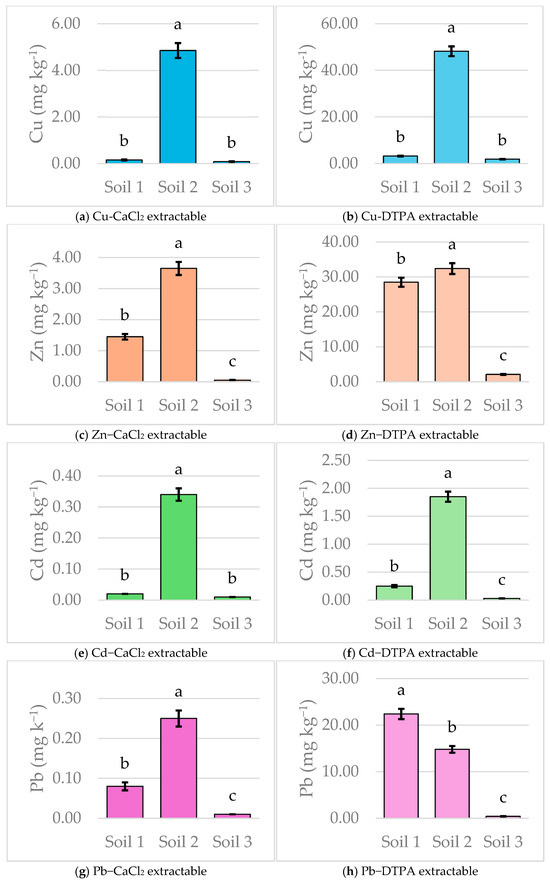
The initial CaCl2- and DTPA-extractable concentrations of Cu, Zn, Cd, and Pb differed significantly among the three examined soils (Figure 1), reflecting their contrasting physicochemical characteristics. Soil 2 generally exhibited the highest extractable concentrations, particularly for Cu and Cd. CaCl2-extractable Cu reached 4.85 ± 0.32 mg kg−1 in Soil 2, compared with 0.15 ± 0.02 and 0.08 ± 0.01 mg kg−1 in Soils 1 and 3, respectively, while DTPA-extractable Cu followed the same pattern, reaching 48.20 ± 2.10 mg kg−1 in Soil 2. Similarly, both CaCl2- and DTPA-extractable Cd concentrations were significantly higher in Soil 2 than in the other soils. This behavior is consistent with the acidic reaction and the lower CEC, clay, and carbonate contents of Soil 2, which may favor the occurrence of these metals in more mobile and potentially available forms. Kaninga et al. [52] similarly reported that Cd was the most available metal in unamended soils affected by mine tailings and observed a stronger decrease in extractable metals following liming in initially acidic than in approximately neutral soils, emphasizing the importance of soil pH in controlling metal availability.
Figure 1.
Initial CaCl2- and DTPA-extractable concentrations of Cu, Zn, Cd and Pb in the three experimental soils. Values are means ± standard deviation (n = 3). Different lowercase letters within each panel indicate significant differences among soils according to one-way ANOVA followed by Tukey’s HSD test (p < 0.05). Values reported as <0.01 mg kg−1 are displayed at the analytical reporting threshold for visualization.
Zn exhibited a somewhat different pattern. Although Soil 2 presented the highest CaCl2- and DTPA-extractable Zn concentrations (3.65 ± 0.21 and 32.40 ± 1.55 mg kg−1, respectively), a considerable DTPA-extractable Zn concentration was also recorded in Soil 1 (28.50 ± 1.30 mg kg−1). In contrast, Pb showed a distinct behavior, with the highest DTPA-extractable concentration observed in Soil 1 (22.40 ± 1.10 mg kg−1), followed by Soil 2 (14.80 ± 0.72 mg kg−1), whereas Soil 3 exhibited markedly lower extractability. Campillo-Cora et al. [53] also demonstrated a metal-dependent extraction behavior in soils of different parent materials, reporting correlations among Zn fractions, whereas Cu and Pb exhibited a different response and considerably lower proportions extracted by mild extractants such as CaCl2. Thus, metal extractability did not directly follow the corresponding pseudo-total concentrations, indicating that metal mobility was strongly dependent on both soil characteristics and metal-specific behavior.
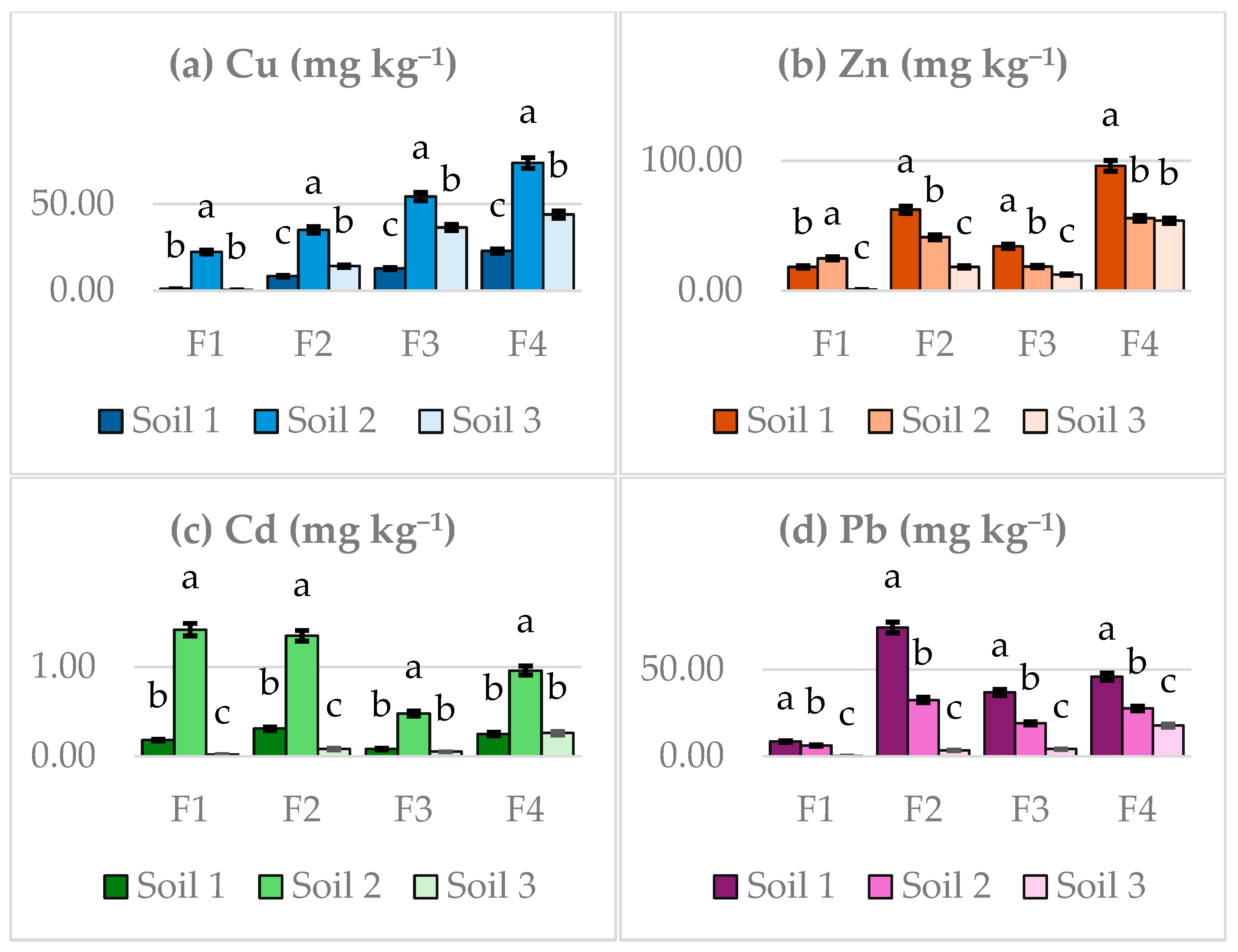
BCR fractionation confirmed the markedly different geochemical behavior of the examined metals among soils (Figure 2). In Soil 2, Cu occurred predominantly in the reducible (F2), oxidizable (F3), and residual (F4) fractions, although its exchangeable and acid-soluble fraction (F1) was significantly higher than in Soils 1 and 3. A comparatively high F1 concentration was also observed for Zn in Soil 2, consistent with its higher CaCl2-extractable concentration. Burachevskaya et al. [54] similarly showed that contamination increased the contribution of Cu and Zn to weakly bound fractions and reported an important role of organic matter and sesquioxides in the retention of anthropogenic Cu, whereas Zn retention was more closely associated with non-silicate Fe and Mn compounds. The authors also observed appreciable increases in exchangeable Cu and Zn following contamination, supporting the importance of contamination status in modifying their geochemical distribution.
Figure 2.
Initial distribution of Cu, Zn, Cd and Pb among the BCR fractions in the three experimental soils. F1, exchangeable and acid-soluble; F2, reducible; F3, oxidizable; F4, residual fraction calculated as pseudo-total − (F1 + F2 + F3). Values are means ± standard deviation (n = 3). Different lowercase letters within each BCR fraction indicate significant differences among soils according to one-way ANOVA followed by Tukey’s HSD test (p < 0.05).
The most pronounced labile distribution was observed for Cd, with F1 and F2 concentrations in Soil 2 reaching 1.42 ± 0.07 and 1.35 ± 0.06 mg kg−1, respectively. In contrast, Pb was predominantly associated with the reducible fraction, particularly in Soil 1, where F2 reached 74.20 ± 3.10 mg kg−1. Chu et al. [51] likewise reported substantial lability of anthropogenic Cd, Cu, Pb, and Zn in a mining- and smelting-affected calcareous soil, with more than half of these metals occurring in labile fractions. They further identified a particularly important contribution of carbonate-associated forms for Cd and Pb in calcareous soils. The limited contribution of Pb to F1, despite its high pseudo-total concentration in Soil 1, further indicates that pseudo-total metal concentrations alone do not adequately reflect metal mobility.
Interestingly, the fractionation pattern observed in the present study differs from that reported for less heavily impacted agricultural soils. Jiao et al. [55] found that Pb, Cu, and Zn in agricultural watershed soils were predominantly associated with the residual fraction (63.39–86.36%), despite total concentrations exceeding background levels. This contrast further indicates that metal fractionation cannot be inferred solely from total concentrations, but reflects differences in contamination source, soil properties, and the geochemical association of individual metals. Indeed, Jiao et al. [55] emphasized that total metal concentrations may show only a weak relationship with environmental or biological effects because metals occur in forms with different biogeochemical behavior depending on soil properties.
Overall, the combined CaCl2, DTPA, and BCR results indicated greater initial metal mobility in Soil 2, particularly for Cu and Cd, whereas Soil 3 generally exhibited the lowest extractable metal concentrations. Soil 1 showed a metal-dependent behavior, characterized by considerable potentially available Zn and a predominant association of Pb with the reducible fraction. These contrasting initial mobility and fractionation patterns provide the necessary baseline for evaluating the subsequent effect of Fe3O4 nanoparticle application on metal immobilization.
3.3. Effect of Fe3O4 Nanoparticles on Soil Physicochemical Properties
The application of Fe3O4 nanoparticles resulted in relatively limited changes in most soil physicochemical properties, although the magnitude of the response varied among the three soils (Table 2). The most pronounced numerical changes were observed in Soil 2, where pH increased from the initial value of 5.80 ± 0.08 to 5.91 ± 0.06 and 6.02 ± 0.07 following the application of 0.5 and 1.0% Fe3O4, respectively. In comparison, only minor changes in pH were observed in Soils 1 and 3, which maintained their slightly alkaline to alkaline reaction. This differential response suggests that the effect of Fe3O4 on soil reaction was more pronounced in the initially acidic soil, whereas the higher carbonate content of Soils 1 and particularly Soil 3 may have contributed to their greater buffering capacity. Suazo-Hernández et al. [56] emphasized that the effects of metal and metal oxide engineered nanoparticles on soil chemical properties, including pH, depend strongly on the initial soil properties as well as nanoparticle type, concentration, dose, and exposure duration. In contrast, Baragaño et al. [57] observed no changes in soil pH following magnetite nanoparticle application at rates ranging from 0.2 to 5%, which the authors reported for an initially alkaline soil with a pH of approximately 8.2. This contrasting response further supports the importance of the initial soil matrix in determining the effect of Fe3O4 nanoparticles on soil reaction. The initial physicochemical characteristics of the three soils support this interpretation, as Soil 2 contained substantially less CaCO3 and had a considerably lower CEC than the other soils.
Table 2.
Physicochemical properties and particle-size distribution of the three experimental soils following Fe3O4 nanoparticle application at 0.5 and 1.0% (w/w). Values are expressed as mean ± standard deviation (n = 3). Different lowercase letters within the same Fe3O4 application rate and parameter indicate significant differences among soils according to one-way ANOVA followed by Tukey’s HSD test (p < 0.05). EC: electrical conductivity; CEC: cation exchange capacity.
Electrical conductivity showed a consistent numerical increase with increasing Fe3O4 application rate in all three soils, with the greatest relative change observed in Soil 2. EC increased from an initial value of 1161.0 ± 17.3 μS cm−1 to 1249.0 ± 17.7 and 1335.0 ± 18.7 μS cm−1 at 0.5 and 1.0% Fe3O4, respectively. Smaller increases were recorded in Soil 1 (535.0–547.7 μS cm−1) and Soil 3 (758.3–776.7 μS cm−1) compared with their corresponding initial values. A similar dose-related increase in EC was reported by Baragaño et al. [57], who observed an increase from approximately 0.27 dS m−1 in the initial soil to 0.31 dS m−1 at 0.2% magnetite and 0.58 dS m−1 at the highest application rate of 5%. Conversely, Tang et al. [31] reported a significant decrease in soil EC with increasing application rates of Fe3O4-loaded mulberry stem biochar, which they attributed to increased pH and enhanced adsorption and precipitation of soluble cations. Although the latter amendment differs from the bare Fe3O4 nanoparticles used in the present study, the contrasting EC response indicates that changes in soluble-ion dynamics may depend not only on Fe3O4 itself but also on amendment composition and soil conditions.
CEC followed a similar numerical increasing trend, reaching 25.40 ± 0.82, 12.65 ± 0.41, and 39.65 ± 0.98 cmolc kg−1 in Soils 1, 2, and 3, respectively, at the highest Fe3O4 application rate. The relative numerical increase was more evident in Soil 2, indicating that the response to Fe3O4 addition was dependent on the initial characteristics of the soil matrix. This observation is consistent with the broader evidence reviewed by Suazo-Hernández et al. [56], who reported that metal and metal oxide nanoparticles can modify soil CEC, EC, pH, and organic matter, although the magnitude and direction of these changes vary according to soil properties and nanoparticle characteristics.
In contrast, organic matter and CaCO3 contents remained relatively stable following Fe3O4 application, with only minor numerical variations compared with their initial values. Similarly, sand, silt, and clay contents showed negligible changes at both application rates, and the contrasting particle-size distribution of the three soils was maintained. The limited response of these properties, compared with pH, EC, and CEC, indicates that Fe3O4 application primarily affected dynamic chemical characteristics rather than the basic composition of the soil matrix. Overall, the stronger response of the acidic, low-CEC Soil 2 indicates that the effects of Fe3O4 nanoparticles were strongly dependent on the initial soil characteristics. These changes are particularly relevant to subsequent metal behavior, since the adsorption efficiency of magnetite is controlled by both adsorbent properties and reaction-medium conditions. Ajmal et al. [58] demonstrated that magnetite particle size strongly affected Pb and Cd adsorption and desorption and identified electrostatic attraction and surface precipitation as potential adsorption pathways, while metal desorption was considerably greater under acidic conditions. Therefore, the physicochemical changes observed following Fe3O4 application may contribute to the subsequent changes in metal mobility and fractionation examined in the following section.
3.4. Effect of Fe3O4 Nanoparticles on Metal Mobility and Fractionation
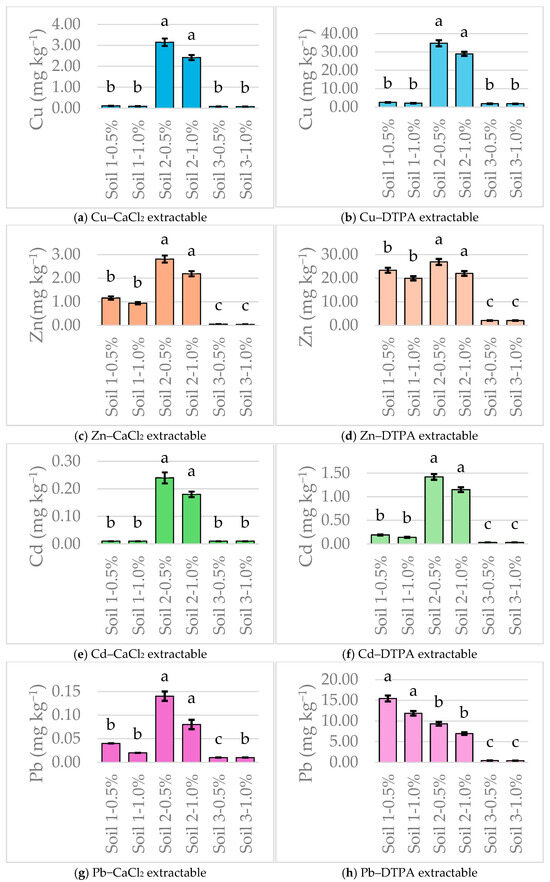
The application of Fe3O4 nanoparticles decreased the CaCl2- and DTPA-extractable concentrations of Cu, Zn, Cd, and Pb, although the magnitude of the response differed considerably among the three soils (Figure 3). In general, lower extractable concentrations were recorded at the 1.0% application rate than at 0.5%. This numerical trend was consistent in Soils 1 and 2, whereas in Soil 3 the difference between the two rates was comparable to the corresponding standard deviations. As stated in Section 2.4, these comparisons between rates are reported as observed trends and not as tested contrasts. However, the extent of this response was strongly associated with the initial mobility of the metals and the physicochemical characteristics of each soil. This soil-dependent behavior is consistent with the findings of Caballero-Mejía et al. [59], who reported substantial removal of Cd, Cu, Pb, and Zn from contaminated mine soils following magnetite nanoparticle application combined with magnetic separation, and attributed this effect to their high adsorption capacity and interaction with soil particles. Interestingly, these authors found only limited additional improvement when the magnetite dose was increased from 25 to 50 g kg−1, indicating that the response to increasing nanoparticle dosage is not necessarily proportional under all soil conditions.
Figure 3.
CaCl2- and DTPA-extractable concentrations of Cu, Zn, Cd, and Pb in the three experimental soils following Fe3O4 nanoparticle application at 0.5 and 1.0% (w/w). Values are means ± standard deviation (n = 3). Different lowercase letters within the same Fe3O4 application rate and panel indicate significant differences among soils according to one-way ANOVA followed by Tukey’s HSD test (p < 0.05); the letters compare soils at a given rate and do not compare application rates. The corresponding untreated controls (0% Fe3O4) are shown in Figure 1.
The most pronounced response was observed in Soil 2, which had previously been characterized by the highest initial mobility of Cu and Cd and generally high extractability of Zn. Following Fe3O4 application, CaCl2-extractable Cu decreased from 4.85 ± 0.32 mg kg−1 in the untreated control to 3.15 ± 0.18 and 2.42 ± 0.12 mg kg−1 at 0.5 and 1.0%, respectively, corresponding to reductions of approximately 35 and 50%, while DTPA-extractable Cu declined from 48.20 ± 2.10 to 34.70 ± 1.65 and 28.92 ± 1.10 mg kg−1, reductions of approximately 28 and 40%. The largest relative reduction in this soil was recorded for CaCl2-extractable Pb, at approximately 68%. Similar dose-related decreases were recorded for Zn and Cd. The comparatively strong response of Soil 2 is particularly relevant considering its acidic initial reaction, very low carbonate content, low clay content, and low CEC. Moreover, the increase in pH observed after Fe3O4 application in this soil may have further favored metal retention. Bayer et al. [60] demonstrated that the adsorption of Cu2+ and Cd2+ by magnetite nanoparticles is influenced by both surface charge and magnetite redox state, with Cd adsorption increasing markedly as pH increased. Thus, the pronounced immobilization observed in Soil 2 may reflect the combined effect of the initially large mobile metal reservoir and the reactive surface properties introduced by Fe3O4.
A different pattern was observed in Soil 1, where the response was more metal-dependent. While Cu and Cd were initially much less mobile than in Soil 2, Pb showed the highest initial DTPA-extractable concentration among the three soils. Fe3O4 application substantially reduced this potentially available Pb reservoir, from 22.40 ± 1.10 mg kg−1 in the untreated control to 15.45 ± 0.72 and 11.87 ± 0.55 mg kg−1 at 0.5 and 1.0%, respectively, reductions of approximately 31 and 47%. This behavior agrees with the strong affinity of magnetite for Pb reported by Ajmal et al. [58]. In their competitive adsorption experiments, Pb exhibited greater affinity for magnetite than Cd, while electrostatic attraction and surface precipitation were identified as potential retention mechanisms. The response of Soil 1 therefore further demonstrates that Fe3O4 efficiency cannot be interpreted solely from overall soil properties, but also depends on the specific geochemical behavior of each metal.
In contrast, Soil 3 showed the weakest overall response to Fe3O4 application. CaCl2- and DTPA-extractable concentrations were already very low before treatment, particularly for Cd and Pb, and only limited additional decreases were observed after nanoparticle addition, in most cases comparable to the analytical variability of the determinations. This soil was characterized by alkaline conditions and the highest CaCO3, clay, organic matter, and CEC values, suggesting that a substantial proportion of the metals was already retained within comparatively stable soil fractions before Fe3O4 application. Consequently, the smaller response of Soil 3 should not be interpreted as poor performance of Fe3O4, but rather as a consequence of the limited initial labile pool available for further immobilization. The contrasting behavior of the three soils therefore indicates that the remediation potential of Fe3O4 is greatest where metal mobility is initially elevated.
The results of Mounier et al. [61] provide an important complementary perspective on this interpretation. In a multimetal-contaminated soil amended with 1% nanomagnetite, the authors observed reduced leaching of the examined trace elements, except As, but at the same time reported enhanced Cd and Cu phytoextraction by Helianthus annuus. This apparent contrast indicates that a reduction in dissolved or chemically extractable metal fractions does not necessarily translate directly into reduced plant uptake and emphasizes that mobility, leaching, and biological availability represent related but distinct aspects of metal behavior in soil.
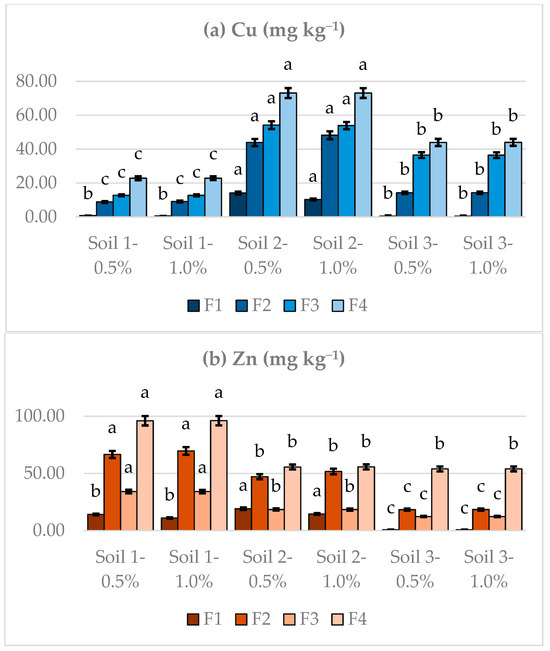
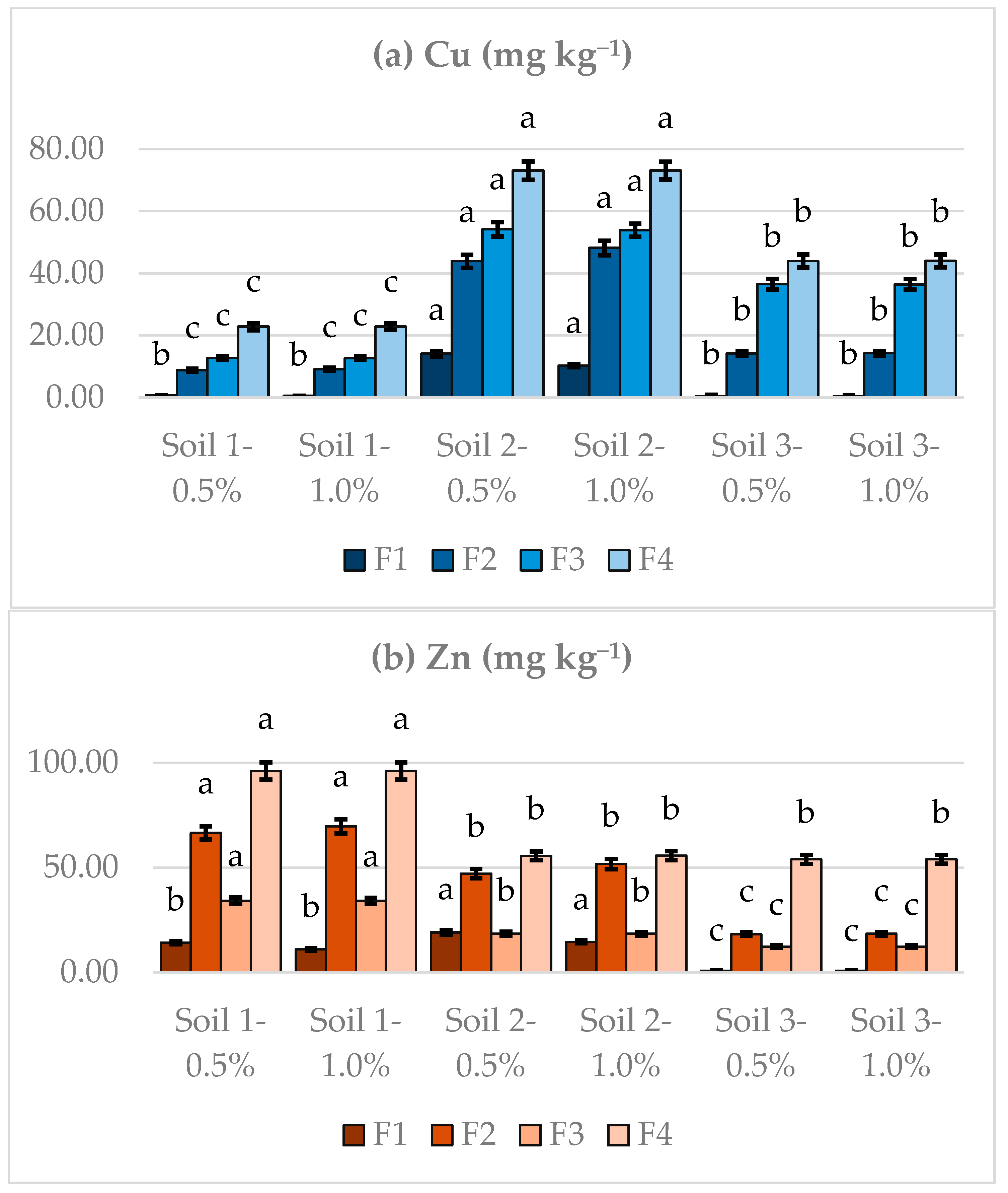
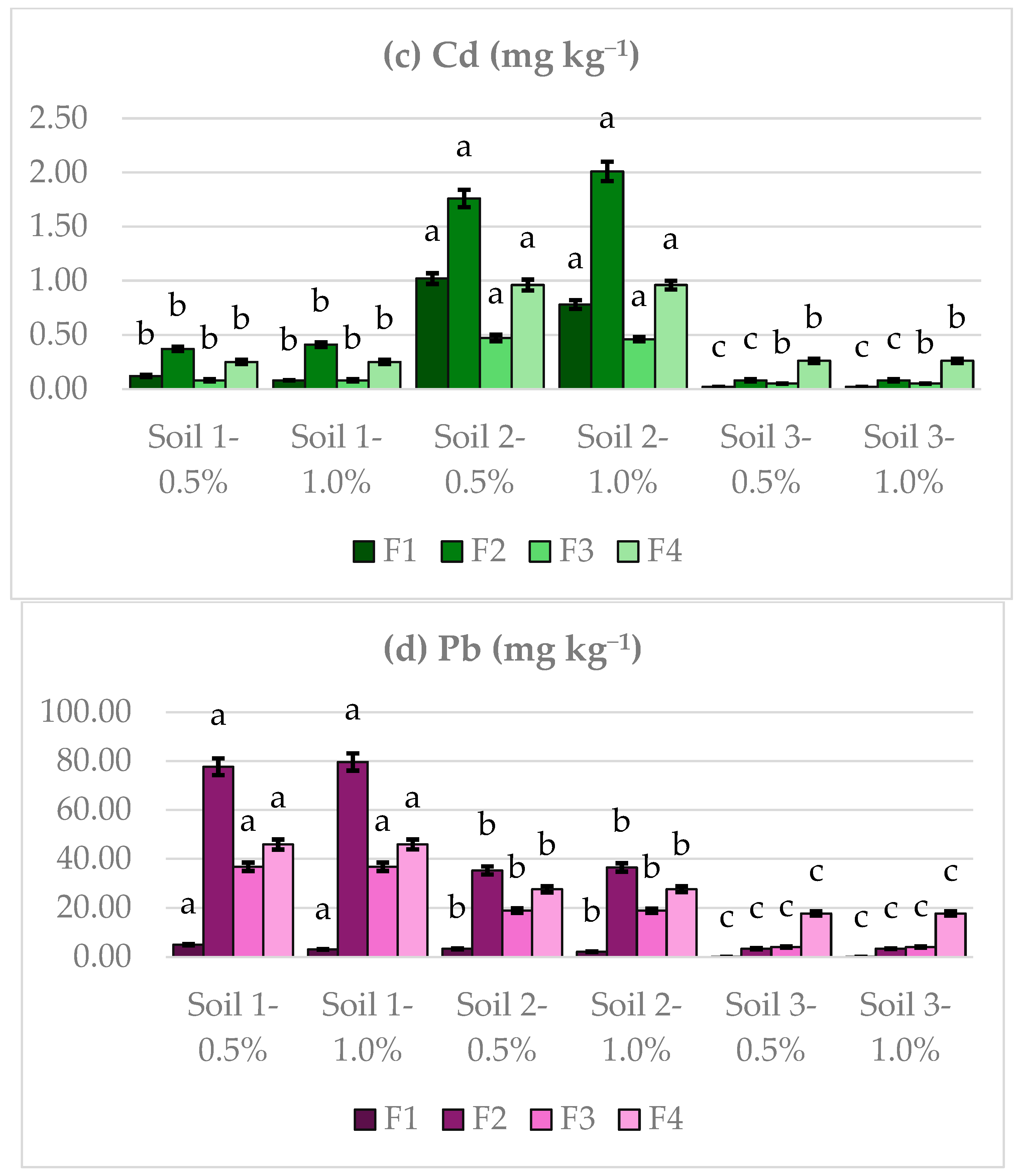
The BCR fractionation results provide further evidence that the decrease in CaCl2- and DTPA-extractability was associated with a redistribution of metals among geochemical fractions (Figure 4). The clearest changes again occurred in Soil 2, where the initially larger labile pools provided greater scope for redistribution. For Cu, F1 decreased from 22.40 mg kg−1 in the untreated control to 14.12 and 10.30 mg kg−1 at 0.5 and 1.0% Fe3O4, respectively, corresponding to reductions of approximately 37 and 54%, whereas F2 increased from 35.10 to 43.90 and 48.20 mg kg−1; F3 and F4 remained comparatively stable. In all soils and at both rates, the decrease in F1 was closely matched by the increase in F2, while F3 and F4 varied little relative to their standard deviations. Cd showed a similar pattern, while Zn and Pb also exhibited decreases in F1 accompanied mainly by numerical increases in F2. Therefore, Fe3O4 treatment primarily affected the more reactive metal fractions, shifting a portion of the exchangeable and acid-soluble fraction towards forms associated with the reducible fraction rather than causing extensive redistribution into the oxidizable or residual fractions.
Figure 4.
Distribution of Cu, Zn, Cd, and Pb among the BCR fractions in the three experimental soils following Fe3O4 nanoparticle application at 0.5 and 1.0% (w/w). F1, exchangeable and acid-soluble; F2, reducible; F3, oxidizable; F4, residual fraction calculated as pseudo-total − (F1 + F2 + F3). Values are means ± standard deviation (n = 3). Different lowercase letters within the same Fe3O4 application rate and BCR fraction indicate significant differences among soils according to one-way ANOVA followed by Tukey’s HSD test (p < 0.05); the letters compare soils at a given rate and do not compare application rates. The corresponding untreated controls (0% Fe3O4) are shown in Figure 2.
A comparable decrease in readily mobile forms was reported by Tang et al. [31], who found that Fe3O4-loaded biochar promoted the transformation of exchangeable heavy metals into more stable organic-bound and residual forms. Although the amendment used in their study differed from the bare Fe3O4 nanoparticles applied here, both studies demonstrate a shift away from readily mobile metal forms. The specific redistribution pathway, however, differed: in the present study, the decline in F1 was associated predominantly with an increase in F2, whereas Tang et al. [31] reported greater stabilization in organic-bound and residual forms. This difference suggests that the final partitioning of immobilized metals is influenced by both amendment composition and the geochemical characteristics of the soil.
The available evidence constrains, but does not fully separate, the possible pathways. A dominant role for pH-induced precipitation appears unlikely: pH changed appreciably only in Soil 2 (5.80 ± 0.08 to 6.02 ± 0.07 at 1.0%), yet clear reductions also occurred in Soil 1, where pH changed by 0.05 units, while Soil 3 responded least despite having the highest pH. An increase of 0.22 pH units is also small relative to the intervals over which hydrolysis and carbonate precipitation of these metals become important. A contribution of the pH change in Soil 2 is nevertheless plausible and cannot be excluded here, since that soil combined the largest labile pool, the lowest buffering capacity and the largest pH shift; a pH-matched liming treatment without added Fe3O4 would be required to separate the two effects.
The fractionation data argue against a discrete precipitated phase: F3 and F4 changed little, while the metal lost from F1 was recovered largely in F2 (in Soil 2, a decrease of 12.10 mg kg−1 in Cu F1 at 1.0% against an increase of 13.10 mg kg−1 in F2). This is consistent with retention at the surfaces of the added iron oxide through electrostatic attraction, surface complexation and surface precipitation, rather than with the formation of carbonate or sulfide phases. Direct confirmation would require spectroscopic evidence, which was not obtained here, and this interpretation is therefore presented as the most parsimonious reading of the fractionation data rather than as a demonstrated pathway.
The effects reported here represent immobilization and not removal. Pseudo-total concentrations were unaffected by treatment and the sum F1 + F2 + F3 + F4 remained essentially constant; what changed was the distribution of each metal among geochemical fractions, and therefore its extractability, not the quantity present. Magnetic separation, which would constitute removal, was not attempted: the soils were sampled and extracted without any attempt at magnetic recovery. References to magnetic recoverability in this manuscript therefore describe a property reported in the cited literature, not a result of this study.
Overall, the combined CaCl2, DTPA, and BCR results demonstrate that the effectiveness of Fe3O4 nanoparticles was strongly soil-dependent. The greatest immobilization response occurred in the acidic, low-CEC Soil 2, where the initial labile metal reservoir was largest, whereas substantially smaller changes occurred in the alkaline, carbonate- and clay-rich Soil 3, where metal mobility was already limited. Soil 1 showed an intermediate and more metal-specific response, particularly with respect to Pb. The accompanying decrease in F1 and redistribution mainly towards F2 further indicate that Fe3O4 application altered not only metal extractability but also their geochemical partitioning. Collectively, these findings demonstrate that Fe3O4 remediation efficiency is controlled by the interaction between initial metal mobility, metal-specific affinity, nanoparticle properties, and the physicochemical characteristics of the soil matrix.
These results also indicate why a uniform application rate would be inefficient. In Soil 3, raising the rate from 0.5 to 1.0% produced little further change because the labile pool was already small, whereas the same increment in Soil 2 was accompanied by further appreciable reductions. What distinguished the two was not the pseudo-total concentration, which was intermediate in Soil 3 for Cu, but the size of the initially labile pool, indexed by F1 and by the CaCl2-extractable concentration. This suggests that application rates should be set on the labile fraction rather than on total contamination, and that a screening extraction before treatment would identify where Fe3O4 addition is likely to be effective. A quantitative dose–response model would require a wider range of soils and more application rates than the present design provides.
3.5. Limitations
The experiment was a 45-day laboratory incubation of 200 g soil units at constant temperature and moisture. This isolates the chemical interaction between amendment and soil, but excludes the wetting and drying cycles, root activity, leaching and temperature variation that would act in the field, and 45 days is short relative to the timescale over which the stability of immobilized metals must be demonstrated. The data show that redistribution from F1 to F2 occurs, but not whether it persists or partially reverses, particularly if the soil later acidifies or becomes reducing. Longer incubations with sequential sampling, and a field trial, are the most important extensions of this work.
Each soil is represented by one composite sample from one field. This allows the three soils to be compared under identical conditions, but it also means that soil type is confounded with site and that the study cannot formally test whether the response to Fe3O4 differs between soils. The differences described in Section 3.4 are therefore reported as observed contrasts between three specific soils, not as an estimated soil × rate interaction. Testing such an interaction would require several independently sampled sites per contamination scenario and a wider range of application rates.
The fate of the nanoparticles was not followed. Aggregation and partial oxidation of magnetite to maghemite or goethite are well documented under soil conditions and would alter binding capacity over time, but neither the particle size distribution nor the mineralogy of the added material was determined after incubation, and Fe release to the soil solution was not measured.
No biological endpoints were assessed. Effects on soil microorganisms, soil fauna and plants were outside the scope of this study, and the rates used (0.5 and 1.0% w/w) are higher than would be realistic at field scale. A reduction in chemical extractability is not by itself evidence of reduced biological risk: Mounier et al. [61] found reduced leaching alongside increased phytoextraction by Helianthus annuus. Ecotoxicological screening and a plant uptake trial are therefore prerequisites for any application recommendation. For this reason Fe3O4 amendment is not described here as a demonstrated environmentally sustainable technology; the claims made are restricted to the immobilization behaviour observed under laboratory conditions.
Finally, two practical questions were outside the scope of this study. No cost analysis was performed, and the rates used here would be expensive at field scale, so whether Fe3O4 amendment is competitive with established options such as liming, phosphate addition or biochar cannot be judged from these data. Nor is it established that nanoscale material is required: Ajmal et al. [58] showed that magnetite particle size strongly influences Pb and Cd adsorption and desorption, and micro-scale magnetite is considerably cheaper to produce and handle. A direct comparison of nano- and micro-scale magnetite at equal mass loading, together with a cost–benefit assessment against conventional amendments, is therefore a necessary step before field use can be recommended.
4. Conclusions
The present study demonstrates that the effectiveness of Fe3O4 nanoparticles for heavy metal immobilization is strongly governed by the physicochemical and geochemical characteristics of the treated soil. The contrasting responses of the three examined soils showed that remediation performance cannot be predicted solely from pseudo-total metal concentrations, but is closely related to the initial mobility and fractionation of the contaminants. The greatest response was observed in the acidic mining-affected soil, where the initially larger labile metal reservoirs provided greater potential for interaction with the reactive Fe3O4 surfaces. In contrast, the geogenically enriched soil exhibited only marginal changes, reflecting the low initial mobility and stronger retention of metals within the soil matrix.
The combined use of CaCl2 and DTPA extractions with BCR sequential fractionation provided complementary evidence of the immobilization process. Fe3O4 application reduced the more readily extractable metal fractions and promoted a redistribution away from the exchangeable and acid-soluble fraction, predominantly towards the reducible fraction. These findings indicate that Fe3O4 nanoparticles can modify both the environmental mobility and the geochemical partitioning of potentially toxic metals, while the magnitude and pathway of stabilization remain soil- and metal-dependent.
Overall, Fe3O4 nanoparticles show potential as an amendment for the in situ management of metal-contaminated agricultural soils, particularly where contaminants occur in relatively mobile forms. The process documented here is immobilization, that is a reduction in chemical extractability and a redistribution among geochemical fractions, and not removal of metals from the soil. This potential is chemical rather than demonstrated in practice: the cost of the treatment relative to conventional amendments was not assessed, and whether comparable immobilization could be obtained with cheaper micro-scale magnetite remains to be tested. Nevertheless, the marked differences observed among soils emphasize that application rates and remediation strategies should be adapted to site-specific soil properties and contaminant fractionation rather than applied uniformly. As set out in Section 3.5, further studies under longer incubation periods and field conditions, based on a design with independent site-level replication and including the assessment of nanoparticle persistence, biological effects, and the long-term stability of immobilized metals, are required before broader agricultural application can be recommended.
Author Contributions
Conceptualization, E.E.G., R.V., and N.T.; methodology, E.E.G., R.V., T.M., A.S. and N.T.; software, E.E.G., R.V., T.M., and A.S.; validation, E.E.G., R.V., T.M., and A.S.; formal analysis, E.E.G., R.V., T.M., and A.S.; investigation, E.E.G., R.V., T.M., and A.S.; resources, E.E.G.; data curation, E.E.G., R.V., T.M., and A.S.; writing—original draft preparation, E.E.G., and R.V.; writing—review and editing, E.E.G., R.V., T.M., and A.S.; visualization, E.E.G., R.V., T.M., and A.S.; supervision, E.E.G.; project administration, E.E.G. and N.T.; funding acquisition, E.E.G. and N.T. All authors have read and agreed to the published version of the manuscript.
Funding
This research received no external funding.
Institutional Review Board Statement
Not applicable.
Informed Consent Statement
Not applicable.
Data Availability Statement
The original contributions presented in this study are included in the article. Further inquiries can be directed to the corresponding authors.
Conflicts of Interest
The authors declare no conflicts of interest.
References
- Çelik, A.A.; Balcioglu, Y.S.; Altindag, E. Soil pollution and population health: A multi-regional analysis of contamination patterns, disease burden, and intervention outcomes. Soc. Sci. Humanit. Open 2026, 14, 103235. [Google Scholar] [CrossRef] [Scilit]
- Ghosh, S.; Deb, D.; Deb, S.; Chakraborty, S.; Daripa, A.; Karmakar, K.; Rahman, F.H. Impact of land uses on soil pollution in a part of eastern Indian Terai region. Environ. Monit. Assess. 2026, 198, 688. [Google Scholar] [CrossRef] [Scilit] [PubMed]
- Tokbergenova, A.; Skorintseva, I.; Ryskeldiyeva, A.; Kaliyeva, D.; Salmurzauly, R.; Mussagaliyeva, A. Assessment of anthropogenic disturbances of landscapes: West Kazakhstan region. Sustainability 2025, 17, 573. [Google Scholar] [CrossRef] [Scilit]
- Gao, L.; Gopalakrishnan, G.; Wang, Z.M.; Li, Y.H.; Zhang, Y.Y. Characteristics, source apportionment, and health risk assessment of heavy metal pollution in soil of Jiangmen, China. Sci. Rep. 2025, 15, 31578. [Google Scholar] [CrossRef] [Scilit] [PubMed]
- Wu, K.; Li, Y.; Peng, P.; Li, Y.; Peng, S.; Lu, P.; Zhang, D.; Zhou, S. Elevated chromium levels and potential health risks among six heavy metals in agricultural soils of China. Environ. Res. 2025, 287, 123106. [Google Scholar] [CrossRef] [Scilit] [PubMed]
- Peirovi-Minaee, R.; Alami, A.; Moghaddam, A.; Zarei, A.; Javanbakht, S. Heavy metals in irrigation water, soil pollution of vineyards and human health risk assessment. Discov. Sustain. 2026, 7, 423. [Google Scholar] [CrossRef] [Scilit]
- Xu, X.; Augustyniak, M.; Chakrabarty, D.; Chowdhury, A.; Gunasekaran, S. Bioremediation of heavy metal contamination: Recent developments and future directions. Sci. Rep. 2026, 16, 19330. [Google Scholar] [CrossRef] [Scilit] [PubMed]
- Lin, P.-H.; Fan, J.-S.; Chen, C.-L.; Tran, Q.T.P.; Lin, C.-Y. Manganese oxide-coated oyster shell for heavy metal immobilization in contaminated soils. Sustain. Environ. Res. 2026, 36, 1. [Google Scholar] [CrossRef] [Scilit]
- Golia, E.E.; Bethanis, J.; Xagoraris, C.; Tziourrou, P. Potentially toxic elements in urban and peri-urban soils—A critical meta-analysis of their sources, availability, interactions, and spatial distribution. J. Ecol. Eng. 2024, 25, 335–350. [Google Scholar] [CrossRef] [Scilit] [PubMed]
- Ligate, F.J.; Ntarisa, A.V. A review of heavy metals research in Tanzania (2000–2024). Discov. Environ. 2026, 4, 210. [Google Scholar] [CrossRef] [Scilit]
- Kamdem, M.M.; Koumassadouno, J.F.; Kalissa, A.O.; Diallo, A.; Baldé, A.B.; Otomo, P.V. Using CaCl2 and EDTA extraction methods to predict the bioavailability of heavy metals after biochar application in three soils differing in initial pH. Discov. Environ. 2026, 4, 279. [Google Scholar] [CrossRef] [Scilit]
- Shah, S.A.; Aslam, S. Nanoparticle-mediated mitigation of heavy metal stress in plants: A comprehensive review. J. Nanopart. Res. 2025, 27, 324. [Google Scholar] [CrossRef] [Scilit]
- Liao, X.; Li, Y.; Miranda-Avilés, R.; Zha, X.; Hernández Anguiano, J.H.; Moncada Sánchez, C.D.; Puy-Alquiza, M.J.; Piña González, V.; Rueda Garzon, L.F. In situ remediation and ex situ treatment practices of arsenic-contaminated soil: An overview on recent advances. J. Hazard. Mater. Adv. 2022, 8, 100157. [Google Scholar] [CrossRef] [Scilit]
- Komaei, A.; Molaei, M.A. Effect of partial replacement of volcanic ash with slag on the performance of sustainable alkali-activated materials for lead-contaminated soil remediation. Sci. Rep. 2026, 16, 6380. [Google Scholar] [CrossRef] [Scilit] [PubMed]
- Li, D.; Li, Z.; Wei, X.; Hu, T.; Deng, J.; Zhang, M.; Xu, H.J.; Li, W.; Wang, J.; Li, Y.; et al. Efficient removal of lead from polluted paddy soil by one-pot synthesized nano-Fe3O4 incorporated stable lignin hydrogel. Chem. Eng. J. 2024, 496, 154196. [Google Scholar] [CrossRef] [Scilit]
- Sánchez-Castro, I.; Molina, L.; Prieto-Fernández, M.Á.; Segura, A. Past, present and future trends in the remediation of heavy-metal contaminated soil: Remediation techniques applied in real soil-contamination events. Heliyon 2023, 9, e16692. [Google Scholar] [CrossRef] [Scilit] [PubMed]
- Gol-Soltani, M.; Ghasemi-Fasaei, R.; Ronaghi, A.; Zarei, M.; Zeinali, S.; Haderlein, S.B. Efficient immobilization of heavy metals using newly synthesized magnetic nanoparticles and some bacteria in a multi-metal contaminated soil. Environ. Sci. Pollut. Res. 2024, 31, 39602–39624. [Google Scholar] [CrossRef] [Scilit] [PubMed]
- Liu, F.; Su, Y.; Ma, C.; Xie, P.; Zhao, J.; Zhang, H. Remediation of Pb-contaminated soil using a novel magnetic nanomaterial immobilization agent. Bull. Environ. Contam. Toxicol. 2022, 108, 315–323. [Google Scholar] [CrossRef] [Scilit] [PubMed]
- Chen, X.; Zhang, F.; Huang, Y.; Guan, Q.; Yu, J.; Zhang, J.; Wang, A.; Liu, Y.; Cui, X.; Liu, X.; et al. Sustainable remediation of cadmium-contaminated soils: Capture by Fe3O4/polyaniline nanocomposites and removal by magnetic separation. Pedosphere 2025, 35, 809–819. [Google Scholar] [CrossRef] [Scilit]
- Liu, R.; Lal, R. Potentials of engineered nanoparticles as fertilizers for increasing agronomic productions. Sci. Total Environ. 2015, 514, 131–139. [Google Scholar] [CrossRef] [Scilit] [PubMed]
- Singh, A.; Chaudhary, S.; Dehiya, B.S. Fast removal of heavy metals from water and soil samples using magnetic Fe3O4 nanoparticles. Environ. Sci. Pollut. Res. 2021, 28, 3942–3952. [Google Scholar] [CrossRef] [Scilit] [PubMed]
- Hassan, H.M.A.; Alhumaimess, M.S.; Alsohaimi, I.H.; Al-Furhud, S.F.; Alqadami, A.A.; Aldawsari, A.M. Synthesis of polymer functionalized spent coffee-based porous carbon for efficient dye adsorption. Biomass Bioenergy 2025, 203, 108275. [Google Scholar] [CrossRef] [Scilit]
- Hassan, H.M.; Alhumaimess, M.S.; Alsohaimi, I.H.; Aljaddua, H.I.; Alqadami, A.A.; Aldawsari, A.M. High-efficiency methylene blue removal using a novel thiadiazole-functionalized chitosan–Noria composite: Synthesis, characterization, and adsorption mechanism. Int. J. Biol. Macromol. 2025, 149482. [Google Scholar] [CrossRef] [Scilit] [PubMed]
- Hassan, H.M.A.; Alhumaimess, M.S.; Alsohaimi, I.H.; Alrashidi, A.N.; Alqadami, A.A.; El-Sayed, M.Y. A new 4-vinylpyridine-modified polymer for clean water: PVP-g-HEMA as an efficient bromate adsorbent. Surf. Interfaces 2025, 74, 107733. [Google Scholar] [CrossRef] [Scilit]
- Lu, T.; Wang, X.; Cui, X.; Li, J.; Xu, J.; Xu, P.; Wan, J. Physiological and metabolomic analyses reveal that Fe3O4 nanoparticles ameliorate cadmium and arsenic toxicity in Panax notoginseng. Environ. Pollut. 2023, 337, 122578. [Google Scholar] [CrossRef] [Scilit] [PubMed]
- Zhou, X.; El-Sappah, A.H.; Khaskhoussi, A.; Huang, Q.; Atif, A.M.; Elhamid, M.A.A.; Ihtisham, M.; El-Maati, M.F.A.; Soaud, S.A.; Tahri, W. Nanoparticles: A promising tool against environmental stress in plants. Front. Plant Sci. 2025, 15, 1509047. [Google Scholar] [CrossRef] [Scilit] [PubMed]
- Wu, H.; Jiang, X.; Tong, J.; Wang, J.; Shi, J. Effects of Fe3O4 nanoparticles and nano hydroxyapatite on Pb and Cd stressed rice (Oryza sativa L.) seedling. Chemosphere 2023, 329, 138686. [Google Scholar] [CrossRef] [Scilit] [PubMed]
- Shahrashoub, M.; Bakhtiari, S. The efficiency of activated carbon/magnetite nanoparticles composites in copper removal: Industrial waste recovery, green synthesis, characterization, and adsorption-desorption studies. Microporous Mesoporous Mater. 2021, 311, 110692. [Google Scholar] [CrossRef] [Scilit]
- Khan, F.S.A.; Mubarak, N.M.; Khalid, M.; Walvekar, R.; Abdullah, E.C.; Mazari, S.A.; Nizamuddin, S.; Karri, R.R. Magnetic nanoadsorbents’ potential route for heavy metals removal—A review. Environ. Sci. Pollut. Res. 2020, 27, 24342–24356. [Google Scholar] [CrossRef] [Scilit] [PubMed]
- Iqbal, Y.; Ma, W.; Li, X.; Fu, S.; Shahzad, A.; Ahmad, I.; Wang, Y.; Adil, M.; Abohashrh, M. A brief outlook on the preparation and magnetic properties of iron oxide nanoparticles for water remediation. Water Air Soil Pollut. 2025, 236, 687. [Google Scholar] [CrossRef] [Scilit]
- Tang, Z.; Liang, M.; Ding, Y.; Liu, C.; Zhang, Q.; Wang, D.; Zhang, X. Fe3O4/mulberry stem biochar as a potential amendment for highly arsenic-contaminated paddy soil remediation. Toxics 2024, 12, 765. [Google Scholar] [CrossRef] [Scilit] [PubMed]
- Fouad, D.E.; Zhang, C.; Bi, C.; Abou-Elyazed, A.S.; Helal, W.M.K.; Chand, K.; Hegazy, M. Enhanced properties of low crystalline α-Fe2O3 nanoparticles synthesized via mechanical-ultrasonic activated precipitation as a green alternative to the conventional route: A comparative study. J. Mol. Liq. 2020, 318, 113964. [Google Scholar] [CrossRef] [Scilit]
- Liu, Y.; Huang, J.; Xu, H.; Zhang, Y.; Hu, T.; Chen, W.; Hu, H.; Wu, J.; Li, Y.; Jiang, G. A magnetic macro-porous biochar sphere as vehicle for the activation and removal of heavy metals from contaminated agricultural soil. Chem. Eng. J. 2020, 390, 124638. [Google Scholar] [CrossRef] [Scilit]
- Aslam, A.; Noreen, Z.; Rashid, M.; Aslam, M.; Hussain, T.; Younas, A.; Fiaz, S.; Attia, K.A.; Mohammed, A.A. Understanding the role of magnetic (Fe3O4) nanoparticle to mitigate cadmium stress in radish (Raphanus sativus L.). Bot. Stud. 2024, 65, 20. [Google Scholar] [CrossRef] [Scilit] [PubMed]
- Amo-Duodu, G.; Gani, O.; Lithi, U.; Vadiveloo, A.; Mobarakpour, S.; Tetteh, E.K.; Bahri, P.A.; Moheimani, N.R.; Ennaceri, H. Fe3O4-based nano-fertilizers for simultaneous nutrient supply and remediation of contaminated soils. J. Environ. Manag. 2026, 411, 130148. [Google Scholar] [CrossRef] [Scilit] [PubMed]
- Petaloti, C.; Triantafyllou, A.; Kouimtzis, T.; Samara, C. Trace elements in atmospheric particulate matter over a coal-burning power production area of Western Macedonia, Greece. Chemosphere 2006, 65, 2233–2243. [Google Scholar] [CrossRef] [Scilit] [PubMed]
- Alexiadis, D.; Golia, E.E.; Vogia, R.; Navarro-Pedreño, J. LDPE, PP, and PET microplastics’ influence on Cd and Cu behavior in diverse soils. Environments 2026, 13, 180. [Google Scholar] [CrossRef] [Scilit]
- Mounier, L.; Pedrot, M.; Bouhnik-Le-Coz, M.; Cabello-Hurtado, F. Impact of iron oxide nanoparticles on a lead-polluted water–soil–plant system under alternating periods of water stress. Environ. Sci. Adv. 2023, 2, 767–779. [Google Scholar] [CrossRef] [Scilit]
- Tang, M.; Lv, Z.; Wang, J.; Guo, J.; Zhao, Y.; Duan, H.; Siddique, K.H.M.; Zhou, L.; Mao, H. Iron-based nanomaterials enhance rice growth and limit grain arsenic accumulation via iron plaque formation and rhizosphere modulation. Environ. Sci. Technol. 2026, 60, 10263–10273. [Google Scholar] [CrossRef] [Scilit] [PubMed]
- Chen, W.; Huo, X.; Su, Y.; Wang, D. Low soil moisture suppresses microbial thermal compensatory response under drought and rewetting. Soil Ecol. Lett. 2026, 8, 260434. [Google Scholar] [CrossRef] [Scilit]
- Williams, S. (Ed.) Official Methods of Analysis, 14th ed.; Association of Official Analytical Chemists: Arlington, VA, USA, 1984. [Google Scholar]
- Papadimou, S.G.; Kantzou, O.-D.; Chartodiplomenou, M.-A.; Golia, E.E. Urban soil pollution by heavy metals: Effect of the lockdown during the period of COVID-19 on pollutant levels over a five-year study. Soil Syst. 2023, 7, 28. [Google Scholar] [CrossRef] [Scilit]
- Aslanidis, P.-S.C.; Golia, E.E. Urban sustainability at risk due to soil pollution by heavy metals—Case study: Volos, Greece. Land 2022, 11, 1016. [Google Scholar] [CrossRef] [Scilit]
- ISO/DIS 11466; Environment Soil Quality. ISO Standards Compendium: Geneva, Switzerland, 1994.
- Papadimou, S.G.; Barbayiannis, N.; Golia, E.E. Preliminary investigation of the use of Silybum marianum (L.) Gaertn. as a Cd accumulator in contaminated Mediterranean soils: The relationships among cadmium (Cd) soil fractions and plant Cd content. Euro-Mediterr. J. Environ. Integr. 2024, 9, 405–417. [Google Scholar] [CrossRef] [Scilit]
- Houba, V.J.G.; Temminghoff, E.J.M.; Gaikhorst, G.A.; van Vark, W. Soil analysis procedures using 0.01 M calcium chloride as extraction reagent. Commun. Soil Sci. Plant Anal. 2000, 31, 1299–1396. [Google Scholar] [CrossRef] [Scilit]
- Lindsay, W.L.; Norvell, W.A. Development of a DTPA soil test for zinc, iron, manganese, and copper. Soil Sci. Soc. Am. J. 1978, 42, 421–428. [Google Scholar] [CrossRef] [Scilit]
- Alexiadis, D.; Golia, E.E.; Vogia, R.; Liava, V.; Pérez-Gimeno, A. Microplastics in Mediterranean agricultural soils: Effects on soil properties, metal accumulation in plants, and implications for sustainable agroecosystems. Sustainability 2026, 18, 2777. [Google Scholar] [CrossRef] [Scilit]
- Golia, E.E.; Aslanidis, P.-S.C.; Papadimou, S.G.; Kantzou, O.-D.; Chartodiplomenou, M.-A.; Lakiotis, K.; Androudi, M.; Tsiropoulos, N.G. Assessment of remediation of soils, moderately contaminated by potentially toxic metals, using different forms of carbon (charcoal, biochar, activated carbon): Impacts on contamination, metals availability and soil indices. Sustain. Chem. Pharm. 2022, 28, 100724. [Google Scholar] [CrossRef] [Scilit]
- Kicińska, A.; Pomykała, R.; Izquierdo-Diaz, M. Changes in soil pH and mobility of heavy metals in contaminated soils. Eur. J. Soil Sci. 2022, 73, e13203. [Google Scholar] [CrossRef] [Scilit]
- Chu, Z.; Lin, C.; Yang, K.; Cheng, H.; Gu, X.; Wang, B.; Wu, L.; Ma, J. Lability, bioaccessibility, and ecological and health risks of anthropogenic toxic heavy metals in the arid calcareous soil around a nonferrous metal smelting area. Chemosphere 2022, 307, 136200. [Google Scholar] [CrossRef] [Scilit] [PubMed]
- Kaninga, B.; Chishala, B.H.; Maseka, K.K.; Sakala, G.M.; Young, S.D.; Lark, R.M.; Tye, A.; Hamilton, E.M.; Gardner, A.; Watts, M.J. Do soil amendments used to improve agricultural productivity have consequences for soils contaminated with heavy metals? Heliyon 2020, 6, e05502. [Google Scholar] [CrossRef] [Scilit] [PubMed]
- Campillo-Cora, C.; Rodríguez-González, L.; Arias-Estévez, M.; Fernández-Calviño, D.; Soto-Gómez, D. Influence of soil properties and initial concentration on the fractionation of nickel, zinc, copper and lead in soils derived from different parent materials. Agronomy 2021, 11, 301. [Google Scholar] [CrossRef] [Scilit]
- Burachevskaya, M.; Minkina, T.; Bauer, T.; Mandzhieva, S.; Gülser, C.; Kızılkaya, R.; Sushkova, S.; Rajput, V. Assessment of extraction methods for studying the fractional composition of Cu and Zn in uncontaminated and contaminated soils. Eurasian J. Soil Sci. 2020, 9, 231–241. [Google Scholar] [CrossRef] [Scilit]
- Jiao, W.; Niu, Y.; Zhou, J.; Zhang, H.; Song, H.; Li, K. Source apportionment of bioavailable trace metals in soil based on chemical fractionation and its environmental implications. Environ. Sci. Pollut. Res. 2022, 29, 17062–17071. [Google Scholar] [CrossRef] [Scilit] [PubMed]
- Suazo-Hernández, J.; Arancibia-Miranda, N.; Mlih, R.; Cáceres-Jensen, L.; Bolan, N.; Mora, M.d.l.L. Impact on some soil physical and chemical properties caused by metal and metallic oxide engineered nanoparticles: A review. Nanomaterials 2023, 13, 572. [Google Scholar] [CrossRef] [Scilit] [PubMed]
- Baragaño, D.; Alonso, J.; Gallego, J.R.; Lobo, M.C.; Gil-Díaz, M. Magnetite nanoparticles for the remediation of soils co-contaminated with As and PAHs. Chem. Eng. J. 2020, 399, 125809. [Google Scholar] [CrossRef] [Scilit]
- Ajmal, Z.; Usman, M.; Anastopoulos, I.; Qadeer, A.; Zhu, R.; Wakeel, A.; Dong, R. Use of nano-/micro-magnetite for abatement of cadmium and lead contamination. J. Environ. Manag. 2020, 264, 110477. [Google Scholar] [CrossRef] [Scilit] [PubMed]
- Caballero-Mejía, B.; Moliner, A.; Escolástico, C.; Hontoria, C.; Mariscal-Sancho, I.; Pérez-Esteban, J. Use of magnetite nanoparticles and magnetic separation for the removal of metal(loid)s from contaminated mine soils. J. Hazard. Mater. 2025, 486, 137081. [Google Scholar] [CrossRef] [Scilit] [PubMed]
- Bayer, T.; Wei, R.; Kappler, A.; Byrne, J.M. Cu(II) and Cd(II) removal efficiency of microbially redox-activated magnetite nanoparticles. ACS Earth Space Chem. 2023, 7, 1837–1847. [Google Scholar] [CrossRef] [Scilit] [PubMed]
- Mounier, L.; Pédrot, M.; Bouhnik-Le-Coz, M.; Cabello-Hurtado, F. Iron oxide nanoparticles improving multimetal phytoextraction in Helianthus annuus. Chemosphere 2024, 353, 141534. [Google Scholar] [CrossRef] [Scilit] [PubMed]

Disclaimer/Publisher’s Note: The statements, opinions and data contained in all publications are solely those of the individual author(s) and contributor(s) and not of MDPI and/or the editor(s). MDPI and/or the editor(s) disclaim responsibility for any injury to people or property resulting from any ideas, methods, instructions or products referred to in the content. |
© 2026 by the authors. Licensee MDPI, Basel, Switzerland. This article is an open access article distributed under the terms and conditions of the Creative Commons Attribution (CC BY) license.