


Abstract
Existing BIM (Building Information Modeling) validation mechanisms, namely geometric clash detection and attribute completeness checking of individual objects (MVD, IDS), do not cover a significant category of informational incompleteness: situations in which the properties of interdependent entities become fully defined only as a result of their mutual presence in the model. This article introduces the new concept of ontosaturation as a new mechanism of formal ontology that formalizes this phenomenon. Ontosaturation describes the relationship between existentially independent entities whose certain properties remain undetermined (unsaturated) in isolation and acquire values only after the attributes of related objects are taken into account. The article proposes a formal definition of ontosaturation and the supporting concepts needed to apply it in practice. These include the saturant (an entity that completes the properties of another), the saturation cluster (a group of mutually saturating entities), and the saturation index, a metric enabling a quantitative assessment of the relational completeness of a BIM model at the level of a single entity (s(e)) and the entire model (S(M)). The concept of a saturation profile was also introduced, complementary to the Level of Information Need (LOIN) in accordance with the ISO 19650 series of standards, defining minimum saturation thresholds for successive phases of the project lifecycle. The mechanism was demonstrated using the example of an installation penetration through a fire separation wall, modeled in Autodesk Revit 2025, showing that collision detection and attribute validation fail to detect four unsaturated properties critical to fire safety and structural integrity, which ontosaturation identifies. The proposed approach constitutes a third layer of BIM model validation, alongside the geometric and attribute layers, addressing the relational completeness of information between interdependent objects.
1. Introduction
1.1. Research Problem
Building Information Modeling (BIM) has become a widely used paradigm for the digital representation of building objects throughout their entire lifecycle [1]. The fundamental premise of BIM is that a semantically rich digital model can serve as a common source of information for all participants in the investment process, from architects, through structural engineers and mechanical, electrical, and plumbing (MEP) designers, to property managers [2]. In practice, however, despite significant advances in interoperability standards (Industry Foundation Classes—IFC 4.3) and Information Delivery Specification (IDS 1.0), the information quality of BIM models frequently remains insufficient for carrying out tasks in later stages of the process, leading to coordination errors, costly rework, and schedule delays [3,4,5]. Historically, the most widely adopted mechanism for detecting errors in multi-disciplinary BIM models has been clash detection, i.e., the automated identification of spatial conflicts between building components [6]. More recently, attribute-level validation based on IDS has introduced an additional layer of data requirements checking, complementing geometric analysis with informational verification. Tools such as Autodesk Navisworks or Solibri Model Checker analyze geometric intersections of elements from federated models and flag instances where objects occupy the same space (geometric or hard clashes), violate minimum distances (functional or “soft” clashes), or generate scheduling conflicts (process conflicts) [7]. Although this process effectively reduces geometric conflicts in the pre-construction phase, it operates almost exclusively on the geometric representation of elements and does not assess the semantic or informational completeness of the objects in question [8]. It should be acknowledged that BIM quality assurance has evolved significantly over the past decade into a multi-layered system. Beyond geometric clash detection, current practice employs rule-based validation (e.g., Solibri rule sets), attribute completeness checking based on Model View Definition (MVD) and the recently released IDS 1.0 specification, integrated coordination platforms, and emerging machine learning and AI-based approaches for conflict classification and prioritization. The reliability of each of these layers depends on whether the underlying model is semantically rich and correctly structured. The present article does not claim that BIM validation is limited to geometry; rather, it argues that even when all the aforementioned layers are applied, a specific category of informational incompleteness remains unaddressed, one that concerns not the attributes of individual objects, but the mutual determination of properties between interdependent entities.
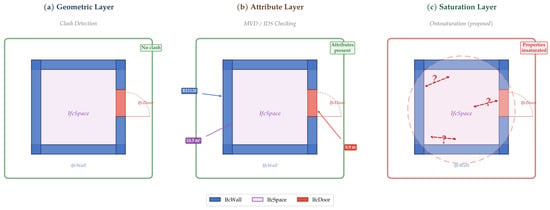
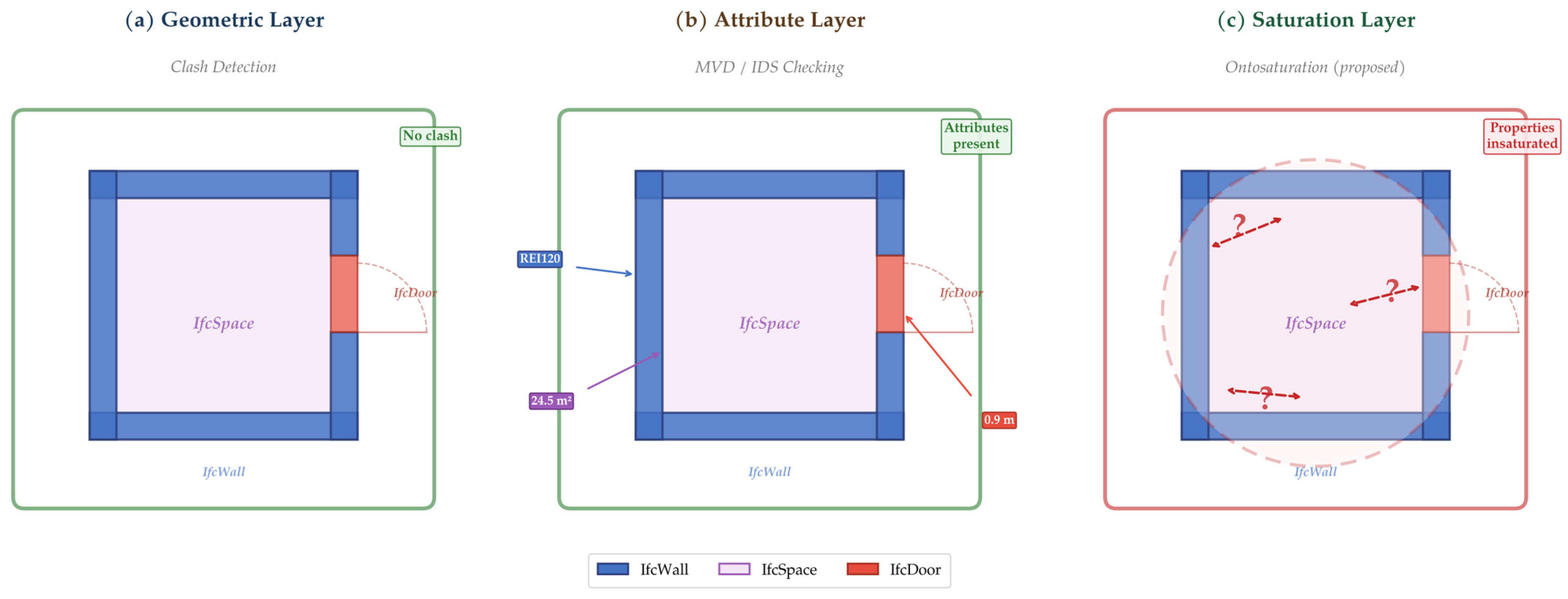
This observation points to a specific, still unresolved gap within the otherwise maturing landscape of BIM quality control. For example, a typical design scenario involves a room (IfcSpace) bounded by four walls (IfcWall) with a door (IfcDoor) in one of them. In a BIM model, each of these elements exists as a separate object with its own attributes. The simplest collision detection will verify that the walls do not intersect and will not report any conflict, since the geometry is correct (Figure 1a). A second, more sophisticated validation approach, based on MVD [9] or IDS [10], will check whether each object has the required attributes, e.g., a wall has a fire resistance class assigned (FireRating = REI120: meaning it is a fire-separation wall that, in the event of a fire, will not collapse, will not allow fire to pass through, and will not overheat on the safe side for a minimum of 2 h, providing time for evacuation and firefighting operations), the room has a calculated area (24.5 m2), and the doors have a specified width (0.9 m). Such validation will be successful (Figure 1b). Meanwhile, from an informational perspective, the model may remain deeply incomplete. None of the existing validation mechanisms will check whether a room bounded by REI120-rated walls has been identified as a fire compartment, because this property does not stem from the room itself or the wall itself, but from their mutual relationship. No mechanism will verify whether a 0.9 m wide door meets accessibility requirements for people with disabilities in the context of this specific room, because the room’s accessibility class remains undefined until the properties of the doors leading into it are taken into account. No mechanism can assess whether a room’s acoustic class is defined, as it depends on the acoustic parameters of the surrounding walls, which in turn only obtain their full insulation specifications once it is known which rooms they separate (Figure 1c).
Figure 1.
Three layers of BIM model validation: geometric clash detection (a), attribute-level MVD/IDS checking (b), and the proposed ontosaturation mechanism (c). Source: own elaboration.
In other words, there is a category of properties that do not belong to any single object but are updated only in the presence of other objects. A wall in isolation has a fire resistance class, but whether it constitutes a fire zone boundary is a property that requires the simultaneous presence of a room. A room in isolation may have a defined area, but its acoustic class, accessibility class, or zone status remain undefined without knowledge of the properties of the walls and doors that enclose it. A door has a width, but whether it provides the required accessibility depends on the function of the room to which it leads. Therefore, this problem is systemic in nature. The IFC standard, an open data schema for BIM developed by buildingSMART, defines relationships between building elements primarily as structural relationships, namely aggregation (IfcRelAggregates), spatial containment (IfcRelContainedInSpatialStructure), typing (IfcRelDefinesByType), or spatial boundaries (IfcRelSpaceBoundary) [11]. These relationships describe what is related to what, but they do not express the fact that the properties of one object become fully defined only in the presence of another object. IFC models structural dependencies, but it does not model the mutual enrichment of entities with information. It should be noted that the IFC schema does provide a semantic grouping mechanism in the form of IfcZone (IFC 2 × 3/IFC4) and IfcSpatialZone (introduced in IFC 4.3), which allow the assignment of spaces and elements to functional groups such as fire compartments, HVAC zones, or lighting zones. These entities can serve as a basis for rule-based reasoning systems, enabling, for example, the identification of all spaces belonging to a given fire compartment and the subsequent verification of the fire-resistance properties of their bounding elements. However, IfcZone and IfcSpatialZone describe which entities belong together, not how their properties depend on one another. They express a grouping relation but not a saturation relation: the fact that a wall and a room are assigned to the same fire zone does not, in itself, trigger the determination of the room’s fire compartment status based on the wall’s fire rating, or vice versa. In the framework proposed in this article, IfcZone and IfcSpatialZone could serve as a structural precondition for identifying potential saturation clusters, entities assigned to the same zone are natural candidates for mutual property saturation. However, the ontosaturation mechanism itself operates at a different level: it formalizes the conditions under which the properties of these grouped entities become mutually determined, which is a step that zone assignment alone does not provide.
Existing approaches to BIM model validation, based on MVD [9], IDS [10], or Solibri-type validation rules [8], verify the presence of required properties in individual objects but treat each object in isolation. For example, they check whether a wall has the FireRating attribute, but they do not check whether the value of this attribute has been interpreted in the context of the associated room. Validation is therefore rather limited because it concerns individual entities rather than being relational, i.e., it does not verify whether co-occurring entities have mutually completed their properties.
In summary, current BIM model validation tools and mechanisms detect two categories of problems: geometric clashes (clash detection) and attribute deficiencies in isolated objects (MVD/IDS checking). However, there is no formal mechanism that would detect a third category, namely informational incompleteness resulting from the lack of mutual saturation of properties between interdependent entities. It is precisely this gap that this article addresses, proposing the new concept of ontosaturation as a new mechanism of formal ontology in BIM.
1.2. Research Gap
Previous research on BIM model validation has focused on two distinct approaches. The first, geometric, developed collision detection methods, ranging from simple detection of intersections between solids, through soft collision analysis taking buffer zones into account, to the application of machine learning algorithms for classifying and prioritizing detected conflicts [6,12]. The second trend, the informational one, focused on verifying the presence and correctness of attributes in individual IFC objects, utilizing Model View Definition (MVD) mechanisms, Information Delivery Specification (IDS) [13], and other semantic rules [14]. Both approaches share a common methodological premise: validation treats every entity in the model as an autonomous unit. Collision detection checks pairs of objects for geometric intersections but does not analyze their mutual informational influence. Attribute checking verifies whether a given object possesses the required properties but does not examine whether the values of these properties have been updated in response to the presence of other objects in the model. In other words, existing approaches assume that the informational completeness of the model is the sum of the completeness of individual objects.
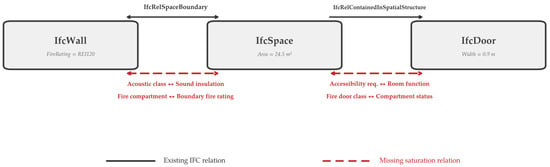
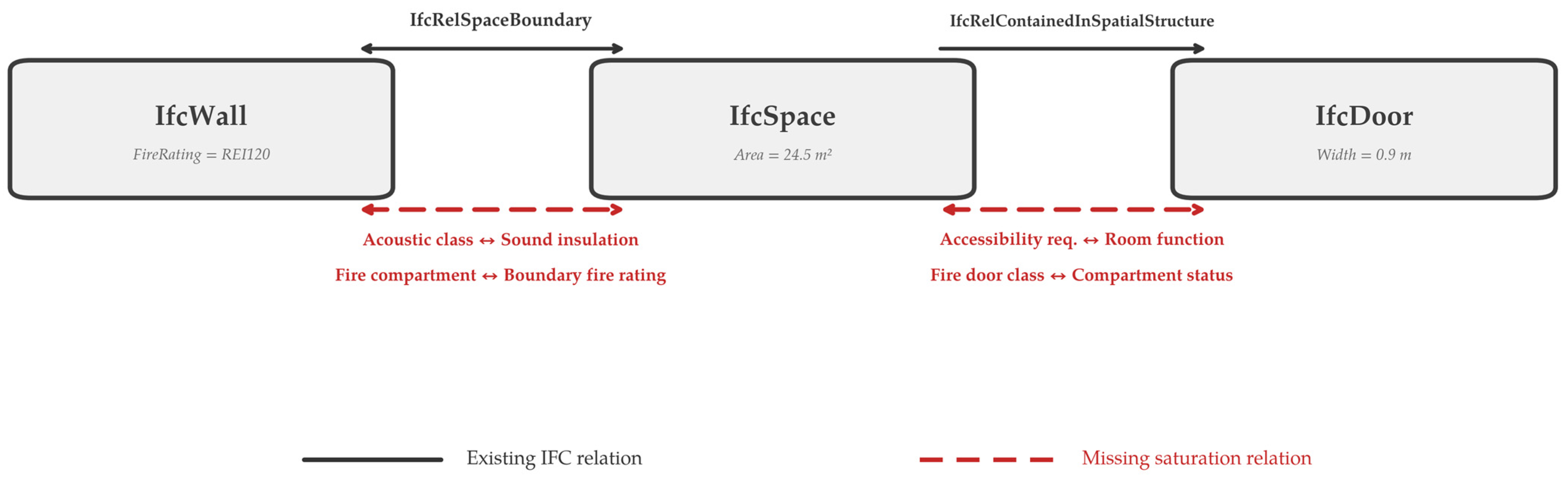
This assumption is false. As shown in Section 1.1, there is a category of properties that cannot be fully defined at the level of a single object because their value is updated exclusively in the context of relationships with other objects. A room’s acoustic class depends on the properties of the surrounding walls. The status of a fire zone results from the relationship between the space and its boundaries. Door accessibility requirements are determined by the function of the room to which they lead. None of these properties can be detected by the aforementioned validation, whether geometric or attribute-based. A review of the literature indicates that this problem has not yet been identified as a separate ontological category. In formal ontologies used in building engineering, such as ifcOWL, BOT (Building Topology Ontology), or LBD (Linked Building Data), relationships between entities are modeled as structural, topological, or classificatory links [15]. None of these ontologies introduces a mechanism describing the mutual sharing of properties between related entities. The IfcRelSpaceBoundary relationship describes that a wall borders a room, and the IfcRelContainedInSpatialStructure relationship assigns a door to a given space, but neither of them expresses the fact that the properties of both related objects become fully defined only in relation to one another. Figure 2 illustrates this gap using the example of three IFC entities. Existing structural relationships (solid lines) are marked above the objects, while missing saturation relationships (dashed lines) are shown below. The acoustic class of a room (IfcSpace) and the sound insulation of a wall (IfcWall) saturate each other because neither of these properties is fully defined without the other. Similarly, a room’s fire zone status depends on the fire resistance class of the surrounding walls, and the fire door class (IfcDoor) is determined by the fire zone status of the room to which it leads. Door accessibility requirements, in turn, are determined by the room’s function. None of these informational relationships are currently modeled in the IFC schema or detected by existing validation mechanisms.
Figure 2.
Existing IFC relations and proposed missing saturation relations between IfcWall, IfcSpace, and IfcDoor. Source: own elaboration.
A natural question arises as to whether the phenomenon described above could be addressed by extending the existing IDS mechanism rather than by introducing a new ontological concept. IDS 1.0, released by buildingSMART in 2024, provides a powerful and flexible framework for specifying information requirements at the level of individual entities: it can verify whether a given object possesses a required property, of a required type, with a value within a permissible range [13]. However, IDS operates on a fundamentally entity-centric basis, each specification targets one entity class at a time and does not express conditions that span two or more entities simultaneously. Ontosaturation, by contrast, describes a relational structure: a situation in which the property of entity A cannot be assigned a definite value until the property of entity B is known, and vice versa. This is not a matter of adding more properties to an IDS checklist, but of introducing a new category of validation that IDS, by design, does not model, namely, the mutual determination of properties across entity boundaries. The ontosaturation mechanism is therefore proposed not as a replacement for IDS, but as a complementary layer that could, in future implementations, take the form of a relational extension to the IDS (see Section 5.1). Thus, the research gap can be formulated as follows: in the current state of knowledge, there is a lack of an ontological mechanism that would formalize the phenomenon of mutual property updating between co-occurring entities in the BIM model and enable its automatic verification. This article fills this gap by proposing a new mechanism (and thus a new concept) of ontosaturation.
1.3. Research Objectives and Contributions
The aim of this article is to introduce and formalize the new concept of ontosaturation as a new mechanism of formal ontology in the context of BIM. The article posits that existing BIM model validation mechanisms namely, geometric collision detection [6] and checking the attribute completeness of individual objects (MVD [9], IDS [10]) do not cover a significant category of informational incompleteness resulting from the lack of mutual saturation of properties between interdependent entities in the model.
In particular, the article pursues four research objectives. First, it identifies and describes the gap between existing BIM validation mechanisms and the actual information needs of the design process namely, that the properties of certain objects become fully defined only in the context of their relationships with other objects, which no current mechanism formalizes or verifies. Second, it introduces a formal definition of ontosaturation along with a conceptual framework, comprising an unsaturated property, a saturation relation, a saturant, a saturation cluster, and a saturation index, both at the level of a single entity and the entire model. Third, it proposes the concept of a saturation profile as a tool complementary to the Level of Information Need (LOIN), enabling the definition of minimum (or desired) saturation thresholds for individual phases of the project lifecycle. Fourth, it demonstrates the application of the proposed mechanism using the example of an installation penetration through a fire-separation wall, a multi-disciplinary coordination scenario in which three entities (wall, opening, installation) mutually saturate their properties.
The contribution of this article is primarily theoretical and conceptual. Ontosaturation is a proposal for a new ontological mechanism that occupies a distinct position within the taxonomy of formal mechanisms and lies between ontological independence and existential dependence in the Husserlian sense [16]. The article does not propose a tool-based implementation, but provides the formal foundations upon which such an implementation could be built, e.g., in the form of an extension of existing validation mechanisms (MVD, IDS) or as a new verification layer in BIM model management tools.
2. Theoretical Background
2.1. Ontological Dependence vs. Ontosaturation
The concept of ontological dependence has a long tradition in formal philosophy. Its origins date back to Edmund Husserl’s Third Logical Investigation, in which he introduced the concept of foundation (German: Fundierung) as a formal relation between parts of a whole [16]. In Husserl’s view, entity a is grounded in entity b if and only if a cannot, by its very nature (due to its generic nature), exist without the existence of b. A classic example is color, which cannot exist without a medium, i.e., the surface of an object. Husserl distinguished between a one-sided dependence (color depends on the surface, but not vice versa) and a mutual dependence, as in the case of hue, saturation, and brightness, which co-constitute a specific instance of color and cannot exist separately. This theory was developed and formalized by Peter Simons in his seminal work on mereology and ontology [17]. Simons identified several types of ontological dependence: existential dependence (an entity cannot exist without another entity), essential dependence (an entity would not be what it is if another entity did not exist), and generic dependence (an entity requires the existence of some entity of a given kind, not necessarily a specific instance). Simons also demonstrated that ontological dependency is a fundamental tool for analyzing the integrity of wholes, as it allows one to distinguish aggregates (whose parts are independent) from integral wholes (whose parts are interdependent).
In the context of ontologies used in computer science, the concept of ontological dependency has been adopted by upper-level ontology systems, in particular by DOLCE (Descriptive Ontology for Linguistic and Cognitive Engineering) [18] and BFO (Basic Formal Ontology) [19]. In DOLCE, a distinction is made between independent entities (substantial endurants, e.g., physical objects) and dependent entities (qualities, roles, states), where dependence is defined as the inability to exist without a carrier. In BFO, the category of specifically dependent continuants includes entities such as qualities, dispositions, and roles, which necessarily inhere in an independent carrier. A common feature of all the approaches mentioned is that ontological dependence is an existential relation, i.e., it concerns the conditions of the existence of entities. A dependent entity cannot exist without the entity on which it depends. This is a strong and binary condition: either the entity exists (because its foundation exists), or it does not exist (because the foundation is absent).
Ontosaturation, as proposed in this article, encompasses a different category of phenomena. The question is not whether an entity can exist without another entity, but whether an entity can be fully defined without another entity. For example, a wall (IfcWall) in a BIM model exists independently of a room (IfcSpace), meaning it has geometry, material, and a fire resistance class. A room exists independently of a wall because it has a name, area, and function. Neither of these entities is existentially dependent on the other in the sense of Husserl or Simons. However, certain properties of both entities namely, the room’s acoustic class, fire zone status, and the wall’s sound insulation in the context of the spaces they separate remain undefined until both entities are considered together. This difference can be formulated as follows. Ontological dependence states: a cannot exist without b. Ontosaturation, in turn, states: a exists without b, but property P of entity a does not have a definite value without b. This is a relation weaker than existential dependence (since the entity exists independently), but stronger than mere association (since it is not an optional connection, but a necessary indeterminacy of properties). Ontosaturation thus introduces a new category between independence and ontological dependence, namely the category of property indeterminacy, in which entities exist autonomously, but their full specification requires mutual presence.
2.2. IFC as an Applied Ontology
In the construction sector, the IFC (Industry Foundation Classes) standard, developed by the buildingSMART organization, constitutes an applied domain ontology that is, a formal specification of concepts, relationships, and constraints describing building objects [11]. The IFC schema, expressed in the EXPRESS language, defines over 900 entities and implements several ontological mechanisms: taxonomy (inheritance hierarchy, e.g., IfcWall -> IfcBuildingElement -> IfcElement), partonomy (relationships IfcRelAggregates and IfcRelContainedInSpatialStructure), identification (GlobalId), and typing (IfcRelDefinesByType). Relationships between elements and spaces are modeled by IfcRelSpaceBoundary (space boundary), IfcRelVoidsElement (void), and IfcRelFillsElement (fill). Additionally, IfcZone and IfcSpatialZone (IFC 4.3) enable semantic grouping of spaces into functional zones (e.g., fire compartments, thermal zones), providing a structuring mechanism that could facilitate the identification of saturation clusters, as discussed in Section 1.1. All these relationships are structural in nature, meaning they describe what is related to what, but none of them expresses the influence that the related entities exert on each other’s properties. Object properties (IfcPropertySet) are assigned to individual entities via IfcRelDefinesByProperties because there is no mechanism for defining properties whose value is conditioned by the attributes of another object [20].
Attempts to enrich the semantics of IFC have been made through the translation of the schema into the Web Ontology Language (OWL), resulting in the ifcOWL ontology, which enables the application of inference rules [21]. However, ifcOWL is a faithful representation of the EXPRESS structure; that is, it replicates the structural relationships of IFC without introducing new ontological categories. Similarly, the BOT [15] simplifies the topological representation of a building but does not go beyond structural relationships. IFC, as an applied ontology, thus offers a rich set of tools for modeling structure, classification, and geometry, but lacks a mechanism for expressing the mutual saturation of properties between related entities. Ontosaturation, as proposed in this article, fills this gap by introducing a layer of saturation relations superimposed on the existing IFC relation structure.
2.3. Property Completeness Problem
The property completeness problem in BIM models has so far been analyzed mainly from the perspective of meeting data exchange requirements. The MVD mechanism allows defining which entities, attributes, and relationships must be present in the IFC model for a given use case, e.g., architectural-structural coordination or energy analysis [9]. A newer approach is the Information Delivery Specification (IDS), which enables the definition of information requirements in XML format independently of the software [13]. Both mechanisms verify completeness at the level of a single object: they check whether a given entity possesses the required attribute of a specific type and value within the permissible range. This entity-centric design is not a deficiency of IDS, it reflects the specification’s intended scope. IDS was designed to ensure that individual objects carry the data required for a given exchange scenario, and it does so effectively. The limitation identified in this article is of a different kind: it concerns properties whose values are not merely missing but are structurally undeterminable without reference to related entities. Such inter-entity conditions fall outside the expressive scope of IDS 1.0, although future versions of the specification might incorporate relational requirements. In the terminology proposed in this article, it can be said that MVD and IDS check conditions of simple completeness, i.e., the completeness of properties in isolation from the relational context of the object.
None of the existing approaches formalizes the problem of relational completeness, i.e., a situation in which a property of object A becomes fully defined only in the presence of object B, and vice versa. Research on semantic validation rules, including work using rules for reasoning on IFC models [21], do allow for the formulation of conditional rules (e.g., “if a room has an office function, then the surrounding walls must have sound insulation ≥ 45 dB”), but these rules must be defined manually for each case and do not follow from any general ontological mechanism. There is a lack of a formal concept describing the very structure of property interdependence that is, a concept that would allow for the automatic identification of pairs of entities whose properties require mutual saturation, regardless of the specific domain and specific rules [20]. The concept of ontosaturation, formalized in Section 3, fills this gap by defining the conditions under which the properties of entities are unsaturated, as well as a metric for assessing the degree of saturation of the model as a whole.
3. The Ontosaturation Framework
3.1. Formal Definition
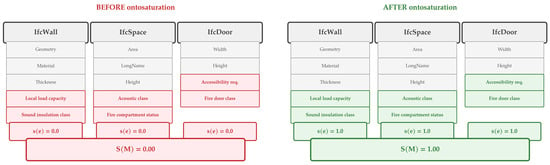
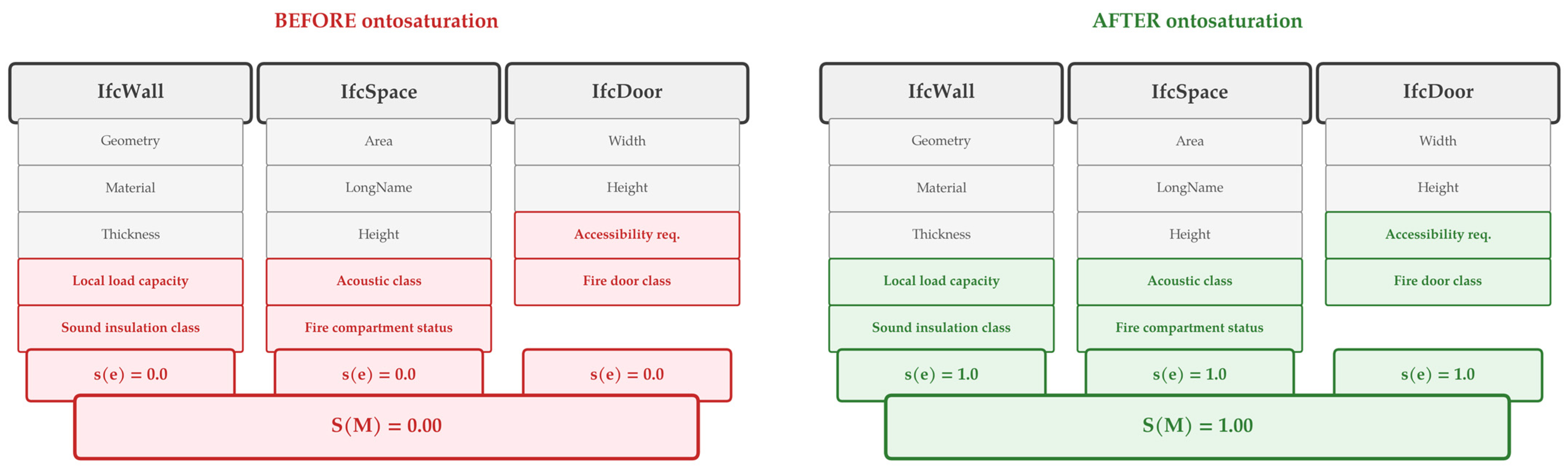
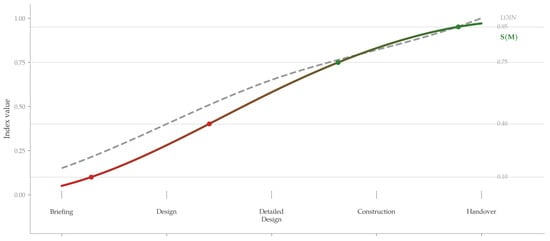
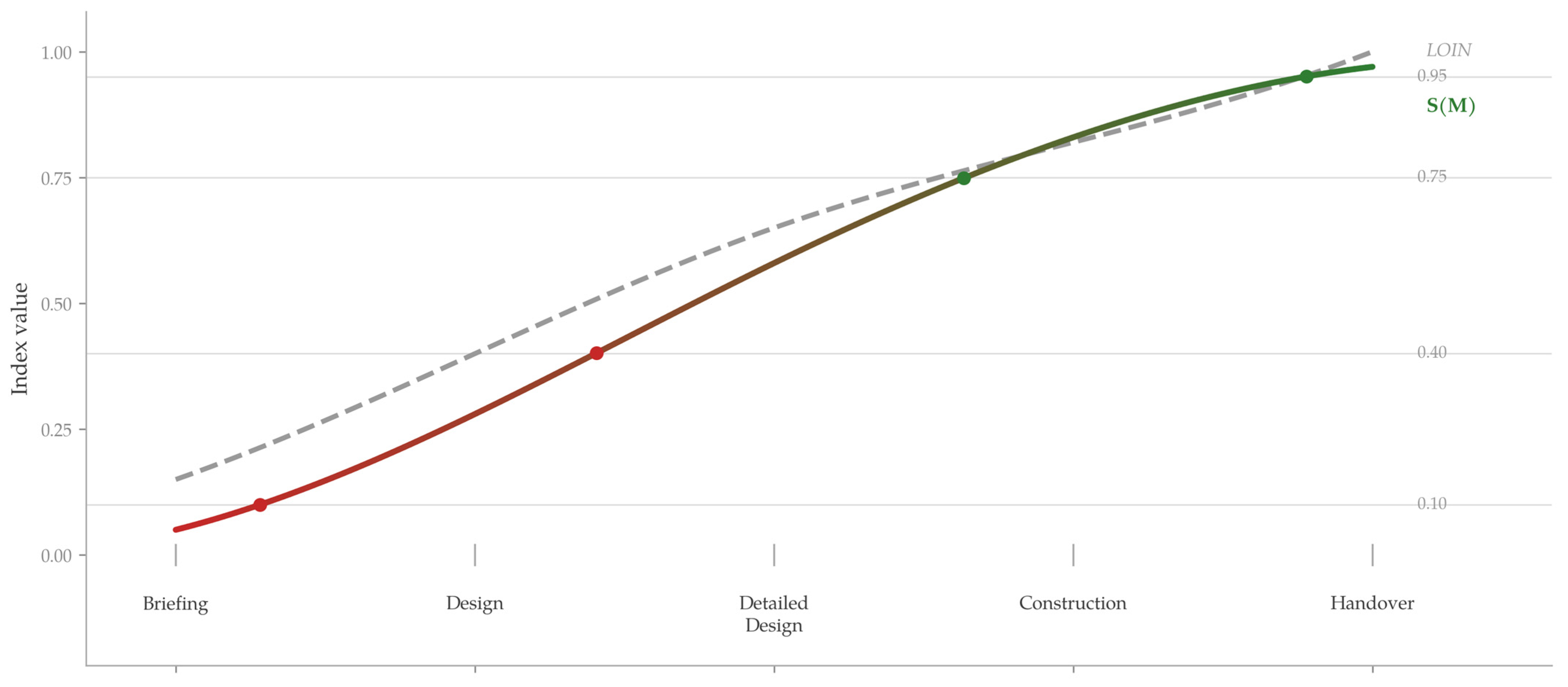
The framework is structured as a sequence of eight formal definitions, progressing from individual properties (Definitions 1–4) through entity-level aggregation (Definitions 5–7) to the model-level metric (Definition 8). Figure 3 and Figure 4 illustrate the application of the resulting indices and profiles, respectively. This subsection introduces a formal definition of ontosaturation and related concepts: the saturant, the unsaturated property, and the saturation relation.
Figure 3.
Saturation index calculation for the room boundary cluster: individual entity indices s(e) and global model index S(M) before and after ontosaturation. Source: own elaboration.
Figure 4.
Theoretical saturation profile S(M) across project lifecycle phases compared to the LOIN fulfillment. Source: own elaboration.
Let E denote the set of entities in a BIM model, and let P(e) denote the set of properties assigned to entity e ∈ E. Each property p ∈ P(e) can take a value from a specified domain D(p) or remain undefined, which we denote by the symbol ⊥. An undefined property is one that formally exists in the entity’s specification (it is required by the schema or usage scenario), but whose value cannot be determined based on the entity e alone, in isolation from the other entities in the model.
Definition 1 (Unsaturated property).
A property p ∈ P(e) of an entity e is unsaturated with respect to an entity f ∈ E, where e ≠ f, if and only if all three of the following conditions are satisfied: (1) the value of p is undefined (p = ⊥) in isolation from f; (2) there exists a property q ∈ P(f) such that knowing the value of q is a necessary condition for determining the value of p; (3) e is not a part of f and f is not a part of e (the relation is not partonomic), and e is not a subtype of f and f is not a subtype of e (the relation is not taxonomic).
Condition (3) distinguishes ontosaturation from property inheritance mechanisms (where a subtype inherits the properties of a supertype) and from aggregation (where the property of the whole follows from the properties of the parts). Ontosaturation occurs exclusively between entities that are ontologically independent in the existential sense that is, each exists autonomously but whose properties require the mutual presence of the other for full specification.
Definition 2 (Saturation Relation).
A pair of entities (e, f) is in a saturation relation, denoted Sat(e, f), if and only if there exists at least one property p ∈ P(e) that is unsaturated with respect to f and at least one property q ∈ P(f) that is unsaturated with respect to e. The saturation relation is by definition symmetric: if Sat(e, f), then Sat(f, e).
The symmetry of the saturation relation is a constitutive feature of ontosaturation and distinguishes it from ordinary informational dependence. It is not that one entity provides information to another (which would be an asymmetric relation), but rather that both entities mutually saturate each other’s properties. The acoustic class of a room depends on the sound insulation of the wall, and the required sound insulation of the wall depends on the function of the room; that is, both properties saturate each other simultaneously.
Definition 3 (Saturant).
An entity f is a saturant of an entity e if there exists at least one property p ∈ P(e) that is saturated with respect to f. An entity may have multiple saturants, in which case the full saturation of its properties requires the presence of all required saturants.
Definition 4 (Ontosaturation).
Ontosaturation is a process in which the unsaturated properties of entities in a saturation relation acquire specific values as a result of the mutual consideration of the attributes of the saturants. Formally, for a pair of entities (e, f) such that Sat(e, f), ontosaturation is a function: σ: P⊥ (e) × P(f) → D(p), which, based on the value of the property q ∈ P(f), determines the value of the previously unsaturated property p ∈ P(e), and symmetrically: σ: P(f)⊥ × P(e) → D(q).
Definition 5 (Saturation Cluster).
A saturation cluster K ⊆ E is a maximal set of entities mutually connected by saturation relations, such that for every pair of entities e, f ∈ K there exists a path of saturation relations connecting e to f. A saturation cluster corresponds to a connected component of a graph in which the vertices are entities and the edges are saturation relations.
An example of a saturation cluster is the triplet {IfcWall, IfcSpace, IfcDoor} from Section 1: the wall is a saturant of the space (acoustic class, zone status), the room is a saturant of the wall (required insulation resulting from the function of separated spaces), the room is a saturant of the door (accessibility requirements resulting from the room’s function), and the door is a saturant of the room (accessibility class determined by the door’s parameters). All three entities form a single cluster in which the unsaturated properties can only be fully determined after considering the entire cluster as a whole.
It is worth emphasizing what ontosaturation is not. It is not a partonomic relation, since a room is not a part of a wall, nor vice versa. It is not a taxonomic relation, since a wall is not a subtype of a room. It is not an ontological dependency in Husserl’s sense, since the wall exists without the room, and the room without the wall. It is not contextualization, because it is not about a change in perspective on the same entity, but about the mutual complementation of the properties of different entities. Ontosaturation therefore fills a space between full ontological independence and existential dependence. It describes a situation in which entities exist on their own, but require each other’s presence for their properties to be fully specified.
3.2. Saturation States and Saturation Index
Based on the formal definitions from Section 3.1, it is possible to assign a unique saturation state to each entity in the BIM model and then calculate an aggregated metric at the level of the entire model.
Definition 6 (Saturation state of an entity).
Let e ∈ E be an entity, P(e) the set of its properties, and P⊥(e) ⊆ P(e) a subset of unsaturated properties. The entity e is in one of three states:
- Fully saturated: P⊥(e) = Ø where all properties have definite values; none requires saturation by a saturant.
- Partially saturated: 0 < |P⊥(e)| < |Preq(e)| where the entity is associated with some of the required saturants; some properties have been saturated, but at least one remains unsaturated. The symbol Preq(e) denotes the subset of properties requiring saturation in a given usage scenario.
- Unsaturated: P⊥(e) = Preq(e) where none of the properties requiring saturation have been saturated; the entity is not associated with any of its required saturants, or associations exist but have not been used to update properties.
These states are not static, as they change as design work progresses. In the conceptual phase, most entities are unsaturated, which is natural and acceptable. In the detailed design phase, at least partial saturation is expected. In the as-built phase, full saturation of all entities in the model is required.
Definition 7 (Entity Saturation Index).
For an entity e, the saturation index is defined as:
where |P⊥(e)| is the number of unsaturated properties, and |Preq(e)| is the number of properties requiring saturation. The index takes values in the range [0, 1], where s(e) = 1 denotes full saturation, and s(e) = 0 denotes full unsaturation. For entities that do not have properties requiring saturation (Preq(e) = Ø), the index is by definition equal to 1; the entity does not participate in saturation relations and is treated as saturated.
s(e) = 1 − |P⊥(e)|/|Preq(e)|
Definition 8 (Model Saturation Index).
For a model M = {e1, e2,..., eₙ}, the global saturation index is defined as the weighted average of the indices of the individual entities:
where wᵢ = |Preq(eᵢ)| is the entity’s weight, equal to the number of its properties requiring saturation. This weight ensures that entities with a greater number of unsaturated properties have a proportionally greater influence on the global index. A model in which no entity participates in saturation relations yields S(M) = 1. A model in which all properties requiring saturation remain undefined yields S(M) = 0.
S(M) = ∑i wi · s(ei)/∑i wi
Figure 3 illustrates the application of the saturation index using the example of the cluster {IfcWall, IfcSpace, IfcDoor} from Section 1. Each entity has autonomous properties (defined independently, e.g., geometry, material) and properties requiring saturation. The diagram shows the values of s(e) for each entity before saturation (unsaturated state, values close to 0) and after saturation (saturated state, values equal to 1), along with the resulting global index S(M).
The model saturation index has direct practical application. It can serve as a criterion for model acceptance at various stages of the design process analogous to existing LOIN requirements, but in an informational rather than geometric dimension. A minimum saturation threshold could be defined in documents such as the BIM Execution Plan (BEP), e.g., S(M) ≥ 0.3 for the conceptual phase, S(M) ≥ 0.7 for the detailed design, S(M) ≥ 0.95 for the as-built model.
3.3. Saturation Profiles Across Design Phases
The model saturation index is not a static value because it changes as the design process progresses. In the early phases of a project, the BIM model contains entities with a low level of detail, a small number of defined properties, and a limited network of relationships between objects. As the project matures, the model is gradually enriched as new entities (e.g., MEP components) are added, existing entities gain additional attributes, and the relationships between them become increasingly dense. This process naturally leads to an increase in the saturation index, i.e., from values close to zero in the conceptual phase to values close to one in the as-built phase.
However, the increase in saturation is neither linear nor uniform. Certain saturation clusters become saturated early on; for example, relationships between rooms and walls regarding function and fire resistance class can be determined as early as the construction design phase. Other clusters saturate late; for example, relationships between service openings and fire stops require multi-disciplinary coordination and are typically resolved only during the construction drawing phase or on-site. Still others may never reach full saturation in the design model, but only in the as-built model, once the actual parameters of the installed elements are known.
This observation leads to the concept of a saturation profile, i.e., a characteristic curve describing the expected trend of the S(M) index as a function of the project’s lifecycle phases. In accordance with the ISO 19650 series of standards [22] and EN 17412-1 [23], information requirements for a BIM model are defined through the concept of LOIN (deliberately referred to in the text as LOIN, in accordance with terminology commonly used in BIM literature, although EN 17412-1 [23] recommends using the full name), which defines the required scope of geometric, alphanumerical, and documentation information for each object at a given data exchange stage. LOIN is a single-object-oriented concept as it defines what information a given entity should possess at a given information exchange point. The saturation profile supplements LOIN with a relational dimension, i.e., it defines to what extent the properties of interdependent entities should be mutually saturated at a given stage.
A saturation profile can be defined as a set of minimum thresholds assigned to successive information exchange points:
- Concept: S(M) ≥ 0.1. Most entities are unsaturated. Only basic saturation relationships are acceptable, e.g., assigning rooms to functional zones.
- Construction design: S(M) ≥ 0.4. Clusters related to fire protection and acoustics should be partially saturated. Entities have defined types and basic properties requiring saturation.
- Construction drawing: S(M) ≥ 0.75. Most saturation clusters should be saturated. Only properties dependent on actual product parameters remain.
- As-built model: S(M) ≥ 0.95. Full or near-full saturation is required. All relational properties should be determined based on as-built data.
Figure 4 presents a theoretical saturation profile in relation to the phases of the project lifecycle, comparing it with the LOIN concept. While LOIN describes the required scope of information at the level of a single object at a given exchange point, the saturation profile describes the degree of mutual saturation of properties between interdependent entities. These are complementary dimensions because a model can meet LOIN requirements (each object possesses the required geometric and alphanumeric attributes) while simultaneously having a low saturation index (undetermined relational properties), which corresponds to the situation described in Section 1.1.
The saturation profile can be incorporated into BIM process documentation, e.g., as part of the BEP or Exchange Information Requirements (EIR) in accordance with ISO 19650, i.e., alongside existing LOIN requirements. Model validation at each stage would then include not only checking attribute completeness (MVD/IDS) and geometric correctness (clash detection), but also verifying whether the model’s saturation index meets the required threshold for a given exchange point.
4. Application: Penetration Through Fire-Rated Wall
4.1. Case Description
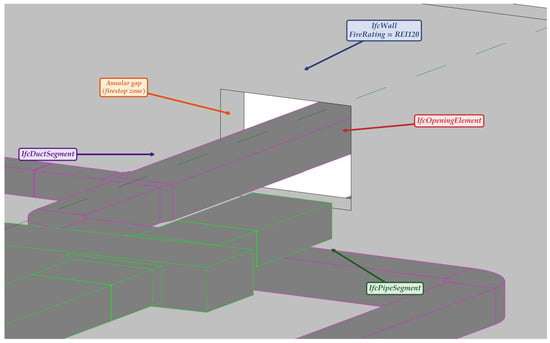
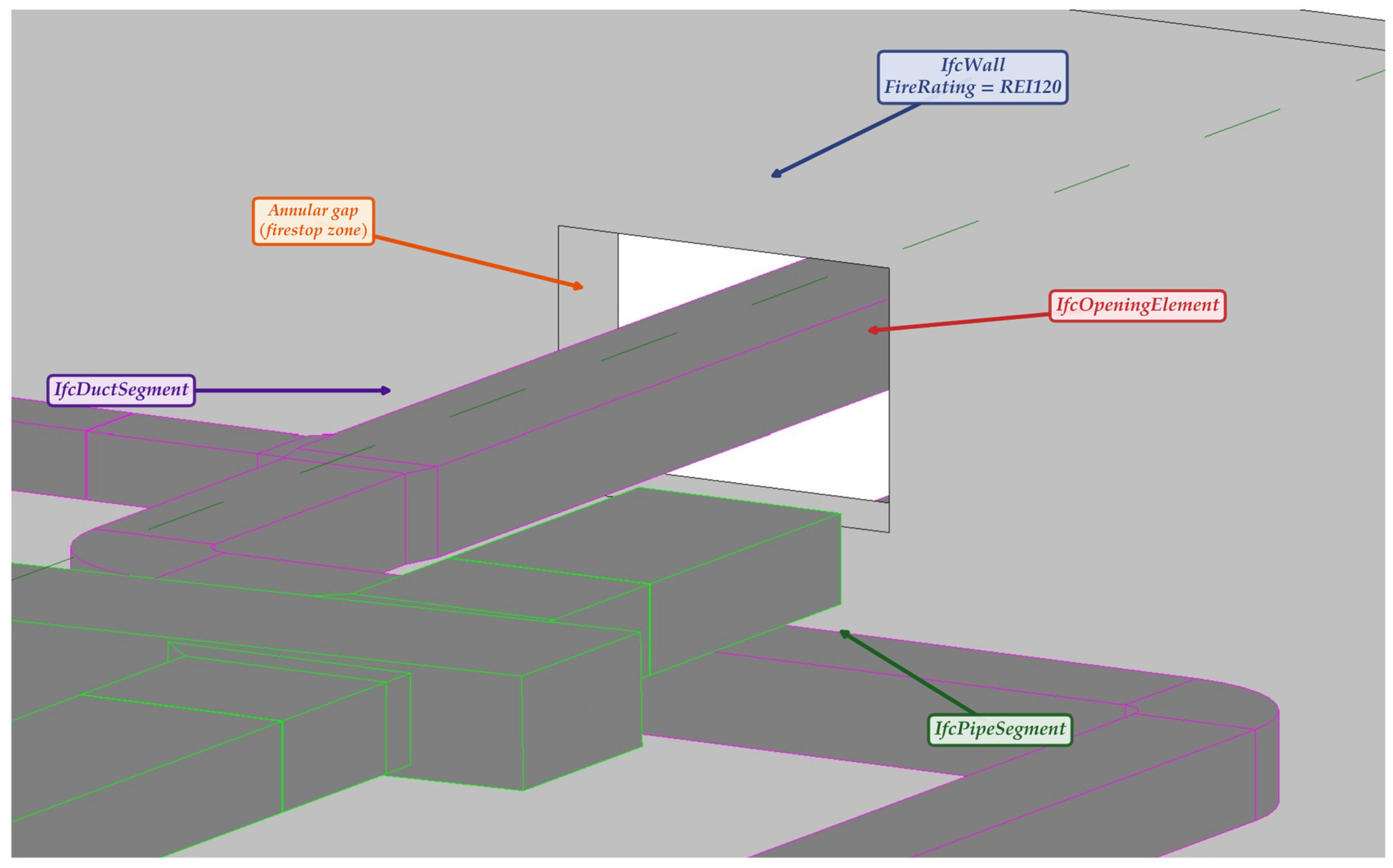
To demonstrate the ontosaturation mechanism using a specific engineering example, a scenario involving installation penetration through a fire-rated wall was selected as one of the most common cases of multi-disciplinary coordination in construction projects. This scenario involves three separate entities, each belonging to a different design discipline, and their properties require mutual coordination. The demonstration model was created in Autodesk Revit 2025 based on an MEP design. Figure 5 shows a 3D view of the analyzed model section with IFC entity markings.
Figure 5.
3D BIM model of an MEP duct penetration through a fire-rated reinforced concrete wall, modeled in Autodesk Revit 2025. Source: own elaboration.
The model identifies the entities involved in the saturation cluster. The first entity is a fire separation wall (IfcWall), which is a 250 mm thick reinforced concrete partition with an assigned fire resistance rating of FireRating = REI120. The wall serves as the boundary of the fire zone and has defined intrinsic properties: geometry, material (reinforced concrete), thickness, and global fire resistance rating. The properties requiring saturation, however, are local load-bearing capacity at the penetration point (dependent on the dimensions of the opening and the loads carried by the wall) and the fire resistance class in the opening zone (dependent on the type and class of the penetration used). The second object is the installation opening (IfcOpeningElement), i.e., a rectangular cutout in the wall, linked to it via the IfcRelVoidsElement relationship. The opening has autonomous properties: dimensions (width and height) and location within the wall. The property requiring saturation is the fire resistance class of the penetration (Firestop class), which cannot be determined without knowing what element passes through the opening and what fire resistance class the partition must maintain. The third entity is a ventilation duct (IfcDuctSegment) passing through the opening in the wall. The duct has autonomous properties: cross-sectional dimensions, material, and affiliation with the ventilation system. The property requiring saturation is the seal specification at the fire barrier penetration (Seal specification), which depends on the wall’s fire resistance class, the opening’s dimensions, and the duct type.
Between the duct and the edge of the opening there is an annular gap, the space where the firestop is actually installed. It is precisely this zone that is the physical location of ontosaturation: its properties (type of firestop, fire resistance class, material specification) do not belong to any of the three entities individually, but are determined solely by the combined consideration of all three elements together.
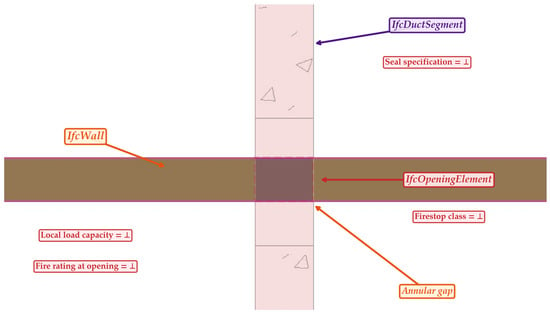
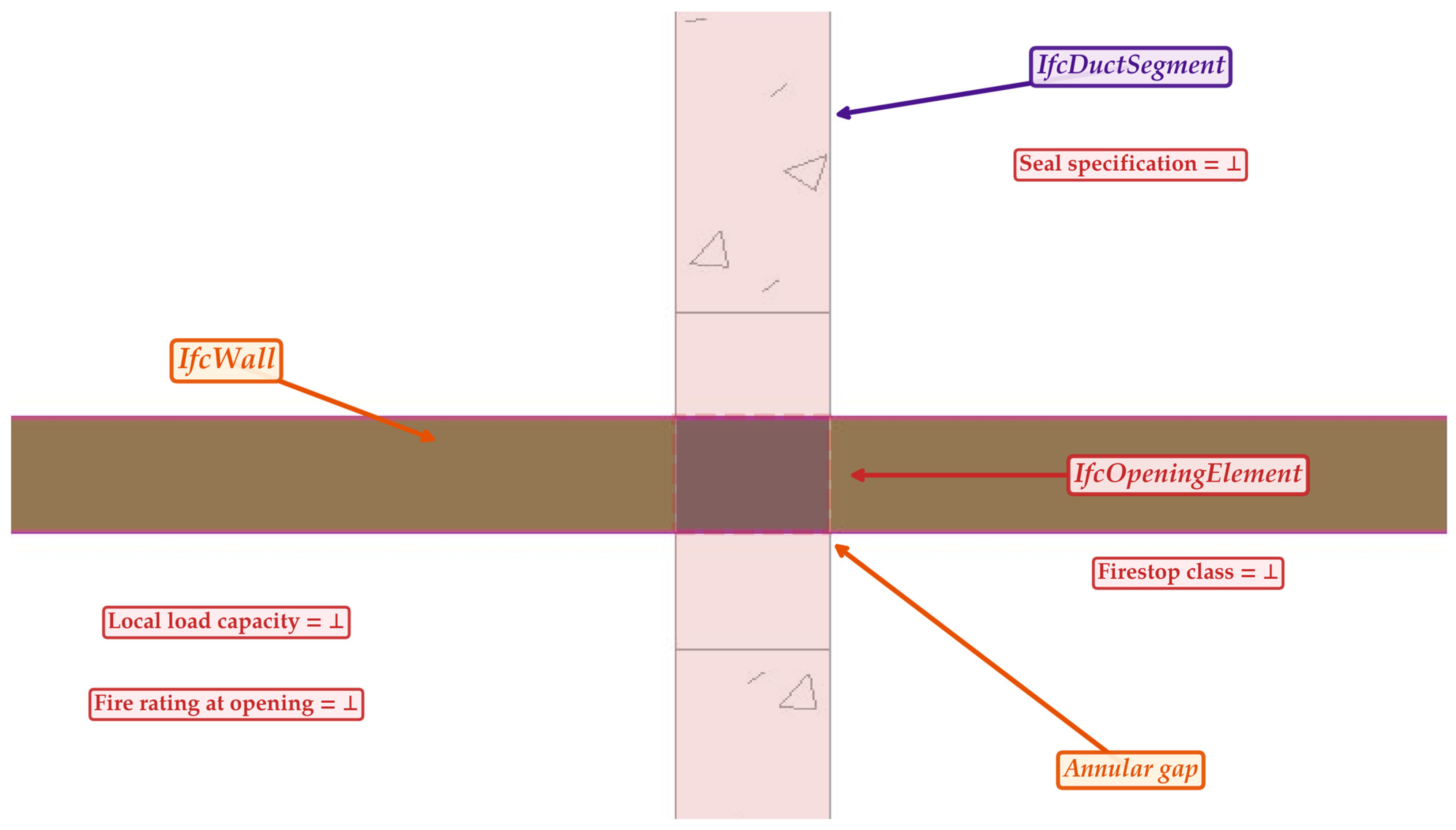
From the perspective of clash detection, the analyzed model fragment is geometrically correct: as shown in Figure 5 and Figure 6, the opening has been explicitly modeled in the wall via the IfcRelVoidsElement relationship, and the duct passes through the opening without intersecting the wall geometry. Since no two solids occupy the same space, no hard clash is generated. This can be verified visually in the cross-section (Figure 6), where a clear annular gap separates the duct from the wall edges on all sides. From the perspective of attribute validation (MVD/IDS), the model also meets standard requirements. Specifically, the wall (IfcWall) carries the attributes FireRating = REI120, material = reinforced concrete, and thickness = 250 mm in its property set. The opening (IfcOpeningElement) has defined dimensions (width and height). The duct (IfcDuctSegment) has a defined cross-section, material, and system affiliation. A typical IDS for these entity classes, defined as is standard practice, as a list of required attributes per object class, would confirm the presence of all required properties and return a positive validation result. The critical point is that the four properties identified as unsaturated in Section 4.2 (local load-bearing capacity, fire resistance class in the opening zone, firestop class, and seal specification) are not attributes of individual entities and are therefore not included in standard IDSs. They are emergent, relational properties that arise only from the mutual consideration of all three entities, precisely the category that ontosaturation is designed to detect.
Figure 6.
Cross-section of an MEP duct penetration through a fire-rated reinforced concrete wall, modeled in Autodesk Revit 2025. Source: own elaboration.
4.2. Saturation Analysis
In the first step, the properties requiring saturation (Preq) were identified for each entity in the cluster. The wall (IfcWall) has two such properties: local load-bearing capacity at the penetration point and fire resistance class in the opening zone. The opening (IfcOpeningElement) has one: the fire resistance class of the penetration. The duct (IfcDuctSegment) has one: the sealing specification at the penetration through the partition. In total, the cluster contains four properties requiring saturation.
In the second step, the saturation relationships were defined. The wall is a saturant of the opening, and the fire resistance class of the opening’s penetration depends on the fire resistance class of the wall in which it is located. The opening is a saturant of the wall, and the local load-bearing capacity of the wall at the penetration point depends on the dimensions of the opening. The duct is a saturant of the opening, and the type of penetration depends on the material and dimensions of the element passing through the opening. The opening and the wall are saturants of the duct, as the sealing specification depends on the fire resistance class of the partition and the dimensions of the gap. All three entities are interconnected by saturation relationships and form a coherent saturation cluster.
Figure 6 shows a cross-section of the analyzed intersection, highlighting the unsaturated properties prior to ontosaturation. Each of the three entities is in an unsaturated state, meaning that none of the properties requiring saturation have a defined value. The symbols ⊥ next to individual properties indicate indeterminacy: Local load capacity = ⊥ (local load-bearing capacity of the wall unknown), Fire rating at opening = ⊥ (fire rating of the wall in the opening zone undefined), Firestop class = ⊥ (firestop class undefined), Seal specification = ⊥ (seal specification of the duct unknown). Thus, the saturation indices of individual objects are s(Wall) = 0.0, s(Opening) = 0.0, s(Duct) = 0.0. The global saturation index of the model is S(M) = 0.00.
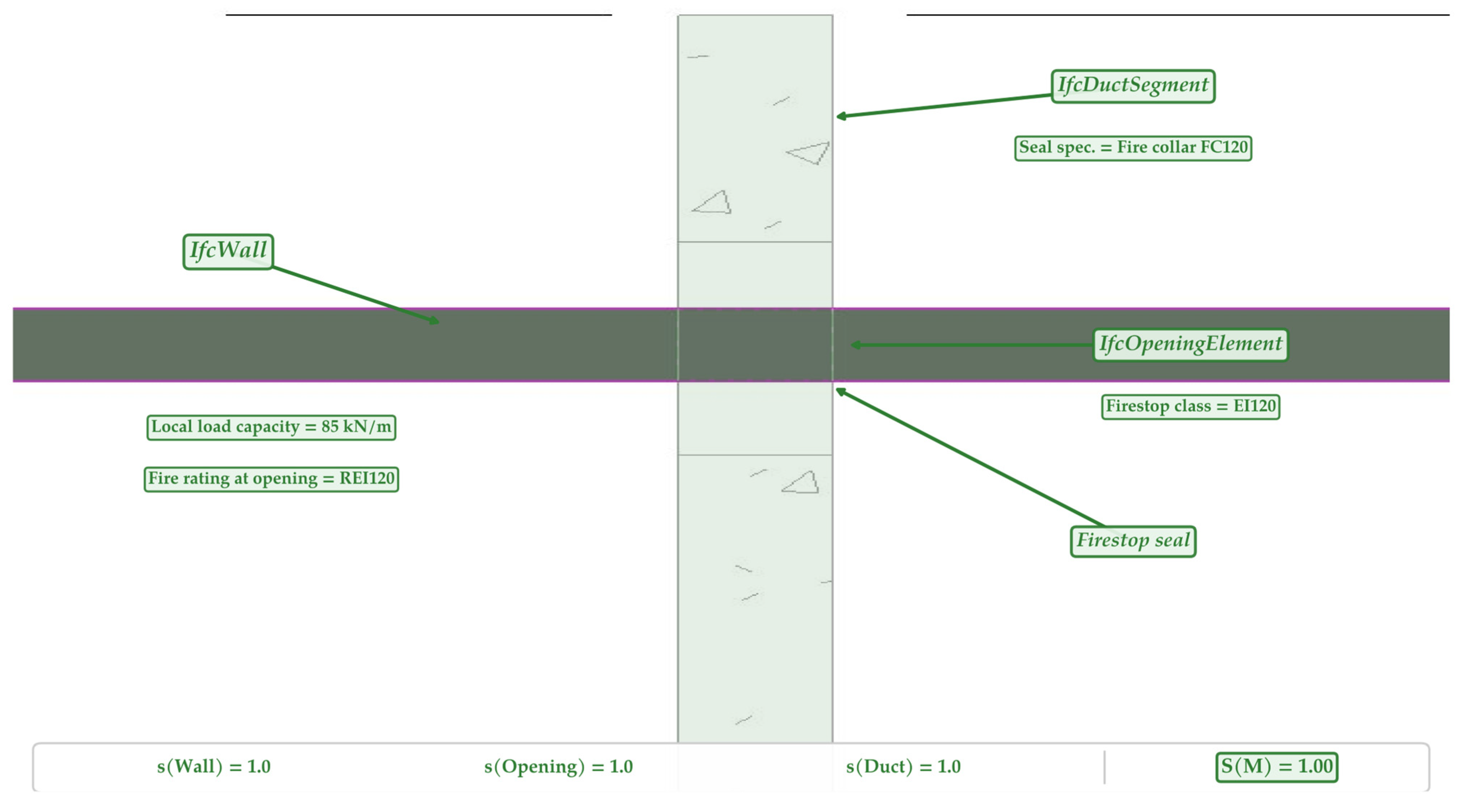
In the third step, the titular ontosaturation, i.e., the process of mutual saturation of properties was performed. Based on the wall’s fire resistance class (REI120) and the dimensions of the opening and duct, it was determined that the penetration through the partition requires an EI120-class fire stop (Fire stop class = EI120, i.e., airtight and insulating for 120 min). This results in the specification for sealing the duct, namely a Fire collar FC120, which provides fire protection for 120 min (Seal specification = Fire collar FC120). The fire resistance class of the wall in the opening area was confirmed as REI120, provided that a fire stop of the required class is used (Fire rating at opening = REI120). The local load-bearing capacity of the wall at the penetration point was determined based on the dimensions of the opening relative to the wall cross-section (Local load capacity = 85 kN/m, illustrative value for demonstration purposes).
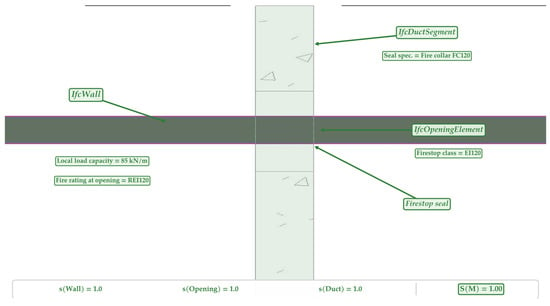
Figure 7 shows the same cross-section after ontosaturation. All properties requiring saturation now have specific values because the ⊥ symbols have been replaced with concrete parameters. The colors applied to the elements have changed from red (unsaturated) to green (saturated). The saturation indices are s(Wall) = 1.0, s(Opening) = 1.0, s(Duct) = 1.0. The global saturation index of the model has increased to S(M) = 1.00, which indicates full saturation of the cluster.
Figure 7.
Saturation analysis of the MEP penetration after ontosaturation. All properties saturated with determined values. Source: own elaboration.
It is worth noting that none of the four saturated properties could be determined at the level of a single entity. The local load-bearing capacity of the wall required knowledge of the opening dimensions. The class of the penetration required knowledge of the wall’s fire resistance class and the type of duct. The sealing specification required knowledge of the penetration class, which in turn required knowledge of the wall class. These properties form a network of interdependencies in which the value of each is conditioned by the values of the others, which is the essence of the ontosaturation mechanism.
4.3. Comparison with Conventional Validation
This subsection compares the results of the ontosaturation analysis with the results that would be obtained by conventional BIM model validation mechanisms applied to the same installation penetration scenario.
Clash detection performed on the analyzed section of the model would not reveal any conflict. The ventilation duct does not intersect the wall because it passes through the modeled opening while maintaining a gap on both sides. There is no hard collision (no intersection of solids), no soft collision (the gap between the duct and the edge of the opening is greater than zero), and no process collision (the schedule was not analyzed). From the perspective of a tool such as Autodesk Navisworks or Solibri Model Checker, the model is correct. At the same time, four properties critical to fire safety and structural integrity remain undefined because collision detection cannot identify them, as it operates solely on geometry.
Attribute validation based on the MVD or IDS mechanism would verify whether each of the three objects possesses the required attributes. The wall has a defined FireRating (REI120), material, and thickness. The opening has dimensions. The duct has a diameter and system affiliation. If the requirements specification (e.g., IDS) were defined in accordance with typical practice, as a list of required attributes for individual object classes, the validation would be successful. The problem is that properties requiring saturation (local load-bearing capacity, culvert class, sealing specification) are not typically included in MVD or IDSs, as they are not attributes of individual objects but rather emergent properties that arise only in the relationship between objects.
Semantic validation based on SWRL or SPARQL rules could theoretically detect missing properties if the appropriate rules were defined beforehand. For example, a rule such as “if IfcDuctSegment passes through IfcWall with FireRating ≠ null, then IfcOpeningElement must have the attribute FirestopClass ≠ null” would detect the absence of a firestop class. However, such rules must be formulated manually, separately for each scenario and each pair of entities. They do not stem from any general mechanism, as they are ad hoc fixes for a problem whose root cause is structural.
The proposed ontosaturation mechanism offers a different approach. Instead of defining rules for specific cases, it introduces a general mechanism that identifies entities whose properties require mutual saturation. The saturation cluster {IfcWall, IfcOpeningElement, IfcDuctSegment} is automatically recognized based on existing IFC structural relationships (IfcRelVoidsElement, IfcRelContainedInSpatialStructure) and the definitions of the saturated properties. An ontosaturation-based validation system does not need to know the specific rule for service penetrations, as it suffices for it to recognize that a given entity has properties whose value is undefined in isolation from its saturants.
Table 1 compares the capabilities of three validation approaches with respect to the analyzed scenario:
Table 1.
Comparison of conventional validation mechanisms and ontosaturation for the MEP penetration scenario. Source: own elaboration.
This comparison illustrates the complementarity of ontosaturation relative to existing mechanisms. Clash detection, MVD/IDS validation, and ontosaturation do not compete with one another but address different layers of model completeness. Clash detection verifies geometric correctness, MVD/IDS verifies attribute completeness, and ontosaturation verifies relational completeness. Only the combined application of all three layers provides a complete picture of the informational quality of the BIM model.
5. Discussion
5.1. Implications for BIM Validation Tools
The ontosaturation mechanism, although presented in this article at a conceptual level, has direct implications for the development of BIM model validation tools. The saturation index S(M) could be implemented as an additional verification layer in existing model quality management tools, such as Solibri Model Checker, SimpleBIM, or dedicated IFC validators. Implementation would require two components: (1) a database of saturation rules defining which properties of which entities require saturation by which saturants, and (2) an algorithm for traversing the IFC relationship graph, identifying saturation clusters and calculating the indices s(e) and S(M). The first component could take the form of an extension to the IDS (Information Delivery Specification) [13] incorporating relational information requirements, while the second could be implemented using existing tools for graph analysis of IFC models, such as ifcOpenShell or libraries based on ifcOWL [20]. It is worth noting that a similar approach based on multi-criteria analysis of BIM object properties to optimize the model has been successfully applied in the context of identifying overloaded components in BIM libraries [24], which confirms the feasibility of automatic analysis of relational properties in large models.
The saturation profile proposed in Section 3.3 could be incorporated into BIM process documentation as part of the BEP or EIR in accordance with ISO 19650 [22]. Minimum saturation thresholds for individual information exchange points would complement existing requirements regarding the Level of Information Need in accordance with EN 17412-1 [23], adding a relational dimension to the currently used atomic validation. In the long term, ontosaturation could be incorporated into future versions of the IFC schema as a new relationship type (IfcRelSaturation) explicitly modeling saturation relationships between entities, which would enable native support for this mechanism by BIM software without the need for external validators. In this context, the ongoing development of IFC 5 is particularly relevant. Unlike the monolithic structure of IFC 4.x, IFC 5 introduces a modular, component-based architecture in which a clearly separated Core module defines domain-neutral concepts, such as object identity, spatial structure, and extensibility, while domain-specific features are developed as independent extensions. This modular design philosophy is inherently more accommodating of new relationship types than the current schema. A saturation relationship could be defined as a dedicated extension module, without modifying the Core, and composed with existing entity definitions through the component system. Furthermore, IFC 5 adopts JSON serialization and a layered composition model in which different authors can contribute additional properties to existing entities (e.g., adding a FireRating layer to a wall defined by another discipline). This compositional approach aligns naturally with the ontosaturation concept, where properties of one entity are completed by information originating from another entity or discipline. It should be noted, however, that IFC 5 is currently in an early alpha stage (the Core Project Plan was submitted for Standards Committee review in 2025), and its final schema has not yet been published. The considerations above are therefore prospective.
5.2. Limitations
The proposed ontosaturation mechanism has several significant limitations that must be taken into account when interpreting and potentially implementing it. First, the presented formalization assumes that saturation relations are symmetric, as both entities mutually saturate each other’s properties. In practice, there may be asymmetric cases where the property of entity A depends on entity B, but not vice versa. The current definition does not fully cover such cases, although they can be modeled as a degenerate case of ontosaturation with one-sided saturation. Second, the saturation index S(M) treats all properties requiring saturation as equivalent, and the absence of a fire-resistance class carries the same weight as the absence of a sealing specification. In reality, some saturated properties are critical for safety (e.g., fire resistance class), while others are informational in nature (e.g., the precise value of local load-bearing capacity). Introducing priorities or criticality weights for individual saturated properties is a natural direction for extending the model, but it goes beyond the scope of this article.
Third, the empirical demonstration was limited to a single scenario (a utility penetration through a fire separation wall) involving three entities. Although this scenario is representative of multi-disciplinary coordination problems, the mechanism has not been tested on large BIM models containing hundreds of saturation clusters, where challenges related to computational scalability and in particular to the identification of clusters in dense IFC relationship graphs may arise. Fourth, ontosaturation requires prior definition of which properties of a given object class require saturation and by which saturants. This definition is domain-specific because it differs for service penetrations, fire zone boundaries, and acoustic relations. This article does not propose a complete taxonomy of saturation relations for all fields of civil engineering, but only a formal mechanism and an example of its application. Developing a comprehensive database of saturation rules would require extensive collaboration with domain experts and constitutes a separate research task.
5.3. Future Work
The immediate focus of further research is the development of a prototype tool implementing saturation validation on IFC models. The prototype could be implemented as a script in the ifcOpenShell environment, taking an IFC file and a database of saturation rules (in JSON format or as an extension of the IDSs) as input, and generating a report with saturation indices for individual entities and clusters as well as the global index S(M) as output. Empirical validation on real BIM models, covering various building types, design phases, and levels of detail, would allow for verifying the mechanism’s scalability, identifying typical patterns of saturation clusters, and calibrating the minimum thresholds proposed in the saturation profile. It would be particularly valuable to compare ontosaturation results with the results of traditional coordination reviews conducted by BIM teams to assess what percentage of errors detected manually by coordinators can be identified automatically using the saturation index.
The second direction involves extending the taxonomy of saturation relationships to fields other than fire protection. Natural candidates include building acoustics (wall insulation room sound rating), energy efficiency (partition parameters energy demand of zones), accessibility (door and circulation parameters accessibility class of rooms), and structural safety (loads—load-bearing capacity of elements in the context of adjacent loads). Each of these fields generates its own saturation clusters, the formalization of which would require collaboration with industry experts. In the long term, it would be valuable to explore the possibility of automatically discovering saturation relationships using machine learning methods an algorithm could analyze large sets of BIM models and identify recurring patterns of co-occurrence of undefined properties, indicating potential saturation relationships without the need to define them manually.
6. Conclusions
This article introduced the concept of ontosaturation as a new mechanism of formal ontology in the context of building information modeling. Ontosaturation occupies a distinct position in the taxonomy of ontological mechanisms, between ontological independence and existential dependence, describing a situation in which entities exist autonomously, yet certain properties of theirs remain undefined without the mutual presence of other entities. The main results of the article can be summarized in the following points. First, a gap was identified in existing BIM model validation mechanisms, as collision detection verifies geometric correctness, MVD/IDS validation verifies attribute completeness, but no mechanism verifies relational completeness, i.e., the mutual saturation of properties between interdependent objects. Second, a formal conceptual framework was proposed, encompassing: a saturated property, a saturation relation, a saturant, a saturation cluster, the entity saturation index s(e), and the global model saturation index S(M). Third, the concept of a saturation profile was introduced as a complementary tool to the LOIN in accordance with ISO 19650 and EN 17412-1, enabling the definition of minimum saturation thresholds for individual phases of the project lifecycle. Fourth, the application of the ontosaturation mechanism was demonstrated using the example of installation penetration through a fire separation wall, showing that ontosaturation identifies four unsaturated properties critical to fire safety and structural integrity that are not detected by conventional validation mechanisms.
Ontosaturation proposes a shift in perspective in the approach to BIM model quality from atomic validation (is each object individually complete?) to relational validation (have co-occurring objects mutually saturated their properties?) The saturation index S(M) provides a single, interpretable metric of this completeness, scalable from the level of a single entity to the level of the entire model. The saturation profile offers a framework for integrating this metric into existing building information management processes, alongside geometric and attribute requirements. Further research should include the implementation of a prototype validation tool, empirical verification on real BIM models, and the extension of the taxonomy of saturation relations to fields beyond fire safety, particularly building acoustics, energy efficiency, and accessibility. In the long term, ontosaturation could be included in future versions of the IFC schema as a new type of relationship, enabling native support for relational validation by BIM software.
Funding
This research received no external funding.
Data Availability Statement
Open research data is available in the Warsaw University of Technology Knowledge Base: https://doi.org/10.71724/r31n-v553.
Acknowledgments
The author would like to thank the reviewers for their feedback, insightful comments, and assistance in improving the article.
Conflicts of Interest
The author declares no conflicts of interest.
References
- Borkowski, A.S. A Literature Review of BIM Definitions: Narrow and Broad Views. Technologies 2023, 11, 176. [Google Scholar] [CrossRef] [Scilit]
- Sacks, R.; Eastman, C.; Lee, G.; Teicholz, P. BIM Handbook: A Guide to Building Information Modeling for Owners, Designers, Engineers, Contractors, and Facility Managers, 3rd ed.; John Wiley & Sons: Hoboken, NJ, USA, 2018; ISBN 978-1-119-28753-7. [Google Scholar]
- Solihin, W.; Eastman, C.; Lee, Y.-C. Toward Robust and Quantifiable Automated IFC Quality Validation. Adv. Eng. Inform. 2015, 29, 739–756. [Google Scholar] [CrossRef] [Scilit]
- Tsay, G.S.; Staub-French, S.; Poirier, E.; Zadeh, P.; Pottinger, R. BIM for FM: Understanding Information Quality Issues in Terms of Compliance with Owner’s Building Information Modeling Requirements. Front. Built Environ. 2023, 9, 1117066. [Google Scholar] [CrossRef] [Scilit]
- Valinejadshoubi, M.; Moselhi, O.; Iordanova, I.; Valdivieso, F.; Shakibabarough, A.; Bagchi, A. The Development of an Automated System for a Quality Evaluation of Engineering BIM Models: A Case Study. Appl. Sci. 2024, 14, 3244. [Google Scholar] [CrossRef] [Scilit]
- Mehrbod, S.; Staub-French, S.; Mahyar, N.; Tory, M. Characterizing Interactions with BIM Tools and Artifacts in Building Design Coordination Meetings. Autom. Constr. 2019, 98, 195–213. [Google Scholar] [CrossRef] [Scilit]
- Eastman, C.; Lee, J.-M.; Jeong, Y.-S.; Lee, J.-K. Automatic Rule-Based Checking of Building Designs. Autom. Constr. 2009, 18, 1011–1033. [Google Scholar] [CrossRef] [Scilit]
- Lee, Y.-C.; Eastman, C.M.; Solihin, W.; See, R. Modularized Rule-Based Validation of a BIM Model Pertaining to Model Views. Autom. Constr. 2016, 63, 1–11. [Google Scholar] [CrossRef] [Scilit]
- Lee, Y.-C.; Eastman, C.M.; Solihin, W. The Mechanism and Challenges of Validating a Building Information Model Regarding Data Exchange Standards. Autom. Constr. 2019, 100, 118–128. [Google Scholar] [CrossRef] [Scilit]
- buildingSMART International. Information Delivery Specification (IDS); buildingSMART International: Lucerne, Switzerland, 2024; Available online: https://technical.buildingsmart.org/projects/information-delivery-specification-ids/ (accessed on 12 December 2025).
- buildingSMART International. IFC 4.3.2.0 Documentation; buildingSMART International: Lucerne, Switzerland, 2023; Available online: https://standards.buildingsmart.org/IFC/RELEASE/IFC4_3/ (accessed on 22 December 2025).
- Borkowski, A.S.; Kubrat, A. A Conceptual AI-Based Framework for Clash Triage in Building Information Modeling (BIM): Towards Automated Prioritization in Complex Construction Projects. Buildings 2026, 16, 690. [Google Scholar] [CrossRef] [Scilit]
- Kładź, M.; Borkowski, A.S. IDS Standard and bSDD Service as Tools for Automating Information Exchange and Verification in Projects Implemented in the BIM Methodology. Buildings 2025, 15, 378. [Google Scholar] [CrossRef] [Scilit]
- Zhang, C.; Beetz, J.; Weise, M. Model View Checking: Automated Validation for IFC Building Models. In eWork and eBusiness in Architecture, Engineering and Construction, Proceedings of the 10th European Conference on Product and Process Modelling; CRC Press: London, UK, 2014; pp. 123–128. [Google Scholar]
- Rasmussen, M.H.; Lefrançois, M.; Schneider, G.F.; Pauwels, P. BOT: The Building Topology Ontology of the W3C Linked Building Data Group. Semant. Web 2021, 12, 143–161. [Google Scholar] [CrossRef] [Scilit]
- Husserl, E. Logical Investigations, Volume 2; Findlay, J.N., Translator; Routledge: London, UK, 2001; ISBN 978-0-415-24189-8. [Google Scholar]
- Simons, P. Parts: A Study in Ontology; Clarendon Press: Oxford, UK, 1987; ISBN 978-0-19-924146-0. [Google Scholar]
- Masolo, C.; Borgo, S.; Gangemi, A.; Guarino, N.; Oltramari, A. WonderWeb Deliverable D18: Ontology Library (Final); Laboratory for Applied Ontology, ISTC-CNR: Trento, Italy, 2003. [Google Scholar]
- Arp, R.; Smith, B.; Spear, A.D. Building Ontologies with Basic Formal Ontology; MIT Press: Cambridge, MA, USA, 2015; ISBN 978-0-262-52781-1. [Google Scholar]
- Pauwels, P.; Terkaj, W. EXPRESS to OWL for the Construction Industry: Towards a Recommendable and Usable ifcOWL Ontology. Autom. Constr. 2016, 63, 100–133. [Google Scholar] [CrossRef] [Scilit]
- Beetz, J.; van Leeuwen, J.; de Vries, B. IfcOWL: A Case of Transforming EXPRESS Schemas into Ontologies. Artif. Intell. Eng. Des. Anal. Manuf. 2009, 23, 89–101. [Google Scholar] [CrossRef] [Scilit]
- ISO 19650-1:2018; Organization and Digitization of Information About Buildings and Civil Engineering Works, Including Building Information Modeling (BIM)—Information Management Using Building Information Modeling—Part 1: Concepts and Principles. International Organization for Standardization: Geneva, Switzerland, 2018.
- EN 17412-1:2020; Building Information Modeling—Level of Information Need—Part 1: Concepts and Principles. European Committee for Standardization: Brussels, Belgium, 2020.
- Borkowski, A.S. Automated Identification of Heavy BIM Library Components: A Multi-Criteria Analysis Tool for Model Optimization. Smart Cities 2026, 9, 22. [Google Scholar] [CrossRef] [Scilit]

Disclaimer/Publisher’s Note: The statements, opinions and data contained in all publications are solely those of the individual author(s) and contributor(s) and not of MDPI and/or the editor(s). MDPI and/or the editor(s) disclaim responsibility for any injury to people or property resulting from any ideas, methods, instructions or products referred to in the content. |
© 2026 by the author. Licensee MDPI, Basel, Switzerland. This article is an open access article distributed under the terms and conditions of the Creative Commons Attribution (CC BY) license.