


Next Issue
Volume 10, June
Previous Issue
Volume 10, February


Designs, Volume 10, Issue 2 (April 2026) – 21 articles
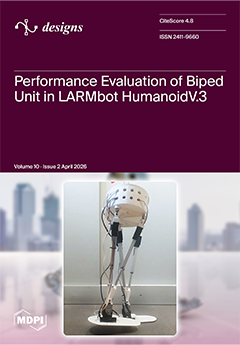
Cover Story (view full-size image): The LARMbot humanoid is designed as a low-cost and user-oriented robot that is 80 cm tall and 3 kg in weight for payloads up to 6 Kg, with a cost of less than 3000 euro. It is characterized by three main mechanical subsystems, namely the locomotor, manipulator, and torso with direct motion control. Design peculiarities consist in parallel architecture mechanisms that take inspiration from the musculoskeletal systems of human anatomy and functionality. The biped and manipulator units feature a modular architecture with tripod leg mechanisms. The LARM humanoid was developed from an early concept in 2001, followed by CAD elaboration in 2006, with construction of a waist–trunk-based design in 2012, and achieving the first prototype in 2016. The current LARMbot humanoid is an improved version of the 2023 prototype. View this paper
  • Issues are regarded as officially published after their release is announced to the table of contents alert mailing list.
  • You may sign up for e-mail alerts to receive table of contents of newly released issues.
  • PDF is the official format for papers published in both, html and pdf forms. To view the papers in pdf format, click on the "PDF Full-text" link, and use the free Adobe Reader to open them.
Order results
Result details
Section
Select all
Export citation of selected articles as:
24 pages, 6320 KB  
Article
Crashworthiness Optimization of Composite/Metal Hybrid Tubes with Triggering Holes
by Yan Ma, Zehui Huang, Hongbin Tang, Jianjiao Deng, Jingchun Wang, Shibin Wang, Zhiguo Zhang and Zhenjiang Wu
Designs 2026, 10(2), 44; https://doi.org/10.3390/designs10020044 - 10 Apr 2026
Viewed by 602
Abstract
Due to high specific energy absorption, composite/metal hybrid multi-cell thin-walled tubes hold significant potential in the field of automotive passive safety. However, the material coupling effect enhancing SEA often elevated the initial peak crushing force, reducing crushing force efficiency and compromising occupant protection. [...] Read more.
Due to high specific energy absorption, composite/metal hybrid multi-cell thin-walled tubes hold significant potential in the field of automotive passive safety. However, the material coupling effect enhancing SEA often elevated the initial peak crushing force, reducing crushing force efficiency and compromising occupant protection. To balance SEA and CFE, trigger holes were introduced as an induced deformation mechanism for hybrid tubes to reduce IPCF while preserving SEA, with the optimized perforated configuration yielding higher CFE than the non-perforated counterpart. A high-fidelity finite element model of the hybrid tube was developed and experimentally validated, and the influences of induced structural parameters on SEA and CFE were investigated. Given the strong nonlinear coupling between trigger parameters and crashworthiness, a multilayer perceptron surrogate model was constructed using 200 optimal Latin hypercube sampling samples (20 for validation). A Q-learning enhanced particle swarm optimization (QL-PSO) algorithm was adopted for optimization, with reinforcement learning dynamically adjusting PSO parameters to balance global exploration and local exploitation. Finite element simulations validated that the proposed method achieved a favorable SEA-CFE trade-off, with SEA and CFE improved by 12.02% and 16.39% respectively, outperforming reported configurations. Compared with standard PSO, QL-PSO exhibited superior search efficiency and inverse mapping accuracy, with 22% higher optimization efficiency and full compliance with inverse design performance targets. This study provided valuable guidance for the design of thin-walled energy-absorbing structures in multi-material vehicle bodies. Full article
(This article belongs to the Section Vehicle Engineering Design)
Show Figures

Figure 1

35 pages, 12654 KB  
Article
An Integrated BIM–NLP Framework for Design-Informed Automated Construction Schedule Generation
by Mahmoud Donia, Emad Elbeltagi, Ahmed Elhakeem and Hossam Wefki
Designs 2026, 10(2), 43; https://doi.org/10.3390/designs10020043 - 7 Apr 2026
Viewed by 1149
Abstract
Artificial intelligence has attracted increasing attention in the construction industry; however, automated time scheduling remains limited in practical applications. Schedule development remains manual, requiring planners to analyze project documents, define activities, estimate durations, and identify relationships based on logical sequence. This process primarily [...] Read more.
Artificial intelligence has attracted increasing attention in the construction industry; however, automated time scheduling remains limited in practical applications. Schedule development remains manual, requiring planners to analyze project documents, define activities, estimate durations, and identify relationships based on logical sequence. This process primarily depends on individual experience and skills, making it both time-consuming and prone to human error. From an engineering design perspective, delayed or inconsistent schedule development weakens design-to-construction feedback, limiting the ability to evaluate constructability and time implications of alternative design decisions during early-stage planning. This study proposes an integrated BIM–Natural Language Processing (NLP) framework to automate activity identification, duration estimation, and logical sequencing for construction scheduling. The framework extracts project data from Revit, organizes it into a bill of quantities format, and then generates an activity list, each activity with a unique ID. Using Sentence-BERT (SBERT) embeddings, the framework estimates activity durations based on semantic similarity. The same semantic process is combined with rule-based reasoning to identify logical relationships, including sequences, supported by an Excel-based reference dictionary that includes logical relationships, productivity, and ID structure. Finally, the framework incorporates a crashing module that proportionally adjusts the duration of activities on the longest path to target the project’s completion time without violating relationships. The proposed framework was validated using real construction project data and produced reliable results. By producing a tool-ready schedule directly from design-model information, the proposed workflow enables earlier schedule feedback loops and supports design-informed planning by allowing designers and planners to assess the time consequences of model-driven scope changes. The results demonstrate that integrating BIM and NLP can transform conventional schedules into faster, more consistent processes, thereby supporting the construction industry. Full article
Show Figures

Figure 1

24 pages, 7253 KB  
Article
On the Design of Smooth Curvature Tunable Paths for Safe Motion of Autonomous Vehicles
by Gianfranco Parlangeli
Designs 2026, 10(2), 42; https://doi.org/10.3390/designs10020042 - 7 Apr 2026
Viewed by 365
Abstract
Navigation is an essential ability for autonomous systems, and efficient motion planning for mobile robots is a central topic for autonomous vehicle design and service robotics. Most path-planning algorithms produce reference paths with sharp or discontinuous turns, inducing several drawbacks during mission execution, [...] Read more.
Navigation is an essential ability for autonomous systems, and efficient motion planning for mobile robots is a central topic for autonomous vehicle design and service robotics. Most path-planning algorithms produce reference paths with sharp or discontinuous turns, inducing several drawbacks during mission execution, such as unexpected inertial stress and strain on the mechanical structure, passenger discomfort, and unsafe and unpredictable deviation of the real trajectory with respect to the reference planned one. Oppositely, smooth and feasible trajectories are often desired in real-time navigation for nonholonomic mobile robots where the surrounding environment can have a dynamic and complex shape with obstacles. In this paper, we propose a novel technique for the generation of smooth, collision-free, and near time-optimal paths for nonholonomic mobile robots. The proposed method exploits the features of a set of tunable bump functions, with the goal of pursuing smooth reference curves with tunable features (such as curvature, or jerk) yet seeking a reasonable length minimality, thus combining the advantages of the two most adopted techniques, namely Bezier interpolation and Dubins curves. After a thorough description of the analytical methods, the paper is primarily concerned with the design and tuning methods of the path-planning algorithm. Both a graphical method and numerical investigations and examples are performed to fully exploit the algorithm potentialities and to show the efficiency of the proposed strategy. Full article
Show Figures

Figure 1

23 pages, 1896 KB  
Article
Research on Green Flexible Job Shop Rescheduling with Urgent Order Insertion and Multi-Speed Machines: A Model and an Improved MOEA/D Algorithm
by Tao Yang and Hanning Chen
Designs 2026, 10(2), 41; https://doi.org/10.3390/designs10020041 - 3 Apr 2026
Viewed by 537
Abstract
This paper investigates a tri-objective green flexible job shop rescheduling problem under urgent order insertion and multi-speed machining conditions, where makespan, total energy consumption, and total tool wear are jointly optimized. First, an event-driven freezing mechanism is introduced, in which completed and ongoing [...] Read more.
This paper investigates a tri-objective green flexible job shop rescheduling problem under urgent order insertion and multi-speed machining conditions, where makespan, total energy consumption, and total tool wear are jointly optimized. First, an event-driven freezing mechanism is introduced, in which completed and ongoing operations are fixed, while only the rescheduling window composed of waiting operations and urgent-order operations is re-optimized. On this basis, two rescheduling strategies, namely complete rescheduling and deferred rescheduling, are designed and compared. Second, to improve the solution capability in complex dynamic environments, an improved multi-objective evolutionary algorithm based on decomposition (IMOEA/D) with a three-layer encoding scheme is proposed. The algorithm incorporates hybrid initialization, tabu-guided crossover, simulated annealing mutation, and critical-path-based variable neighborhood search. Experimental results show that the proposed method performs well in energy consumption optimization and tool wear control, while effectively improving the diversity and distribution quality of the Pareto solution set. Further analysis indicates that deferred rescheduling generally outperforms complete rescheduling, while the original-orders-first and urgents-first strategies exhibit different strengths in convergence, solution quality, and objective optimization. The proposed study provides an effective modeling and optimization framework for multi-objective green rescheduling problems and offers theoretical support for production scheduling decisions that need to balance production efficiency, energy saving, and tool-related cost control in practical manufacturing systems. Full article
(This article belongs to the Topic Distributed Optimization for Control, 2nd Edition)
Show Figures

Figure 1

29 pages, 1851 KB  
Systematic Review
Technological Trends in Lean Construction for Engineering Design Improvement and Productivity in Civil Engineering Projects: A Systematic Literature Review
by Luis Mayo-Alvarez, Jorge Córdova-Maraví, Diego García-Gómez and Iván Paredes-Julca
Designs 2026, 10(2), 40; https://doi.org/10.3390/designs10020040 - 1 Apr 2026
Viewed by 1173
Abstract
Lean Construction has become a key strategy for improving productivity, reducing waste, and increasing efficiency in civil engineering projects. In parallel, advances in digital technologies have transformed the way engineering design and project planning processes are conceived and managed. However, there remains a [...] Read more.
Lean Construction has become a key strategy for improving productivity, reducing waste, and increasing efficiency in civil engineering projects. In parallel, advances in digital technologies have transformed the way engineering design and project planning processes are conceived and managed. However, there remains a limited systematic understanding of how emerging technologies support engineering design practices and influence the implementation and performance of Lean Construction in diverse civil engineering scenarios. This study presents a systematic literature review of 70 peer-reviewed articles published between 2019 and 2025, following the PRISMA 2020 guidelines. The selected studies were examined using a structured classification framework consisting of three analytical categories: Technologies and Tools, Construction Methods and Sustainability, and Production Philosophies and Management. From an engineering design perspective, this framework allows the identification of technological trends, design-support tools, and management strategies that influence the planning, modeling, and optimization of construction processes. The results show that digital technologies, such as Building Information Modeling (BIM), automation systems, Artificial Intelligence, and Industry 4.0 tools, play a significant role in supporting engineering design activities by improving project visualization, coordination, and decision-making during the design and planning stages. These technologies contribute to more integrated design processes aligned with Lean Construction principles. At the same time, the analysis reveals that the adoption of Lean Construction technologies varies depending on project characteristics, levels of digital maturity, and regional industry conditions. The main barriers identified in the literature include interoperability limitations, insufficient workforce training, and organizational resistance to technological change. Overall, the review provides a structured synthesis of recent research trends and highlights the technological and managerial factors that influence the successful integration of Lean Construction with engineering design practices in civil engineering. The findings contribute to bridging the gap between technological innovation, design methodologies, and Lean Construction implementation, offering insights for both researchers and practitioners seeking to improve efficiency, sustainability, and design performance in construction projects. Full article
Show Figures

Figure 1

23 pages, 4551 KB  
Article
Simulation-Driven Screening and Machine Learning Surrogate Modelling of Water Pipeline Start-Up and Filling Operations for Engineering Design Support
by Aiken H. Ortega-Heredia, Oscar E. Coronado-Hernández and Vicente S. Fuertes-Miquel
Designs 2026, 10(2), 39; https://doi.org/10.3390/designs10020039 - 1 Apr 2026
Cited by 1 | Viewed by 674
Abstract
Filling operations in pressurised pipeline systems can trap air pockets, generating hazardous transient overpressures that threaten structural integrity and operational reliability. Evaluating these events using conventional hydraulic models can be computationally intensive, limiting design-space exploration of operational scenarios. This study presents a simulation-driven [...] Read more.
Filling operations in pressurised pipeline systems can trap air pockets, generating hazardous transient overpressures that threaten structural integrity and operational reliability. Evaluating these events using conventional hydraulic models can be computationally intensive, limiting design-space exploration of operational scenarios. This study presents a simulation-driven design-screening framework based on Monte Carlo simulation to evaluate and predict peak absolute pressures during pipeline start-up and filling operations. A total of 2000 transient scenarios were generated for a representative 1100 m pipeline system by varying key geometric and operational parameters, including diameter, friction factor, column lengths, slopes, and reservoir elevation. Twenty-eight machine learning regression models were trained to develop a physics-informed surrogate model capable of rapidly predicting pressure peaks within the defined parameter domain. The trilayered neural network achieved the highest predictive accuracy, with robust validation (RMSE = 10.95 m, R2 = 0.99) and test performance (RMSE = 9.78 m, R2 = 0.99). Screening results showed that nominal pressure thresholds of 61.18 m and 407.89 m were exceeded in 97.53% and 4.89% of the retained peak-forming scenarios (n = 1746), respectively. The proposed framework provides an efficient and reproducible surrogate-based design-screening approach for transient overpressure risk within the evaluated hydraulic domain. Full article
Show Figures

Figure 1

26 pages, 1036 KB  
Article
Translating Design Language into Fabricated Form: A Style-Oriented Framework for Desktop Additive Manufacturing of Twentieth-Century Interiors
by Antreas Kantaros, George Sakellaropoulos, Theodore Ganetsos and Nikolaos Laskaris
Designs 2026, 10(2), 38; https://doi.org/10.3390/designs10020038 - 1 Apr 2026
Viewed by 762
Abstract
Digital fabrication technologies increasingly enable designers and researchers to reinterpret historical design languages through contemporary production methods. Within this context, desktop 3D printing offers an accessible yet constrained medium for translating stylistically rich interior design objects into tangible form. This study examines how [...] Read more.
Digital fabrication technologies increasingly enable designers and researchers to reinterpret historical design languages through contemporary production methods. Within this context, desktop 3D printing offers an accessible yet constrained medium for translating stylistically rich interior design objects into tangible form. This study examines how distinct twentieth-century interior design movements—Art Deco, Bauhaus, and Mid-century Modern—are mediated through desktop additive manufacturing, focusing on the preservation of formal identity rather than manufacturing performance. Representative interior objects were digitally reconstructed from archival and reference material and fabricated under standardized desktop 3D printing conditions. The investigation adopts a style-oriented evaluation framework that examines silhouette continuity, characteristic geometric features, ornamental legibility, and structural–stylistic coherence. To support comparative interpretation, a Style Preservation Index (SPI) is introduced as a structured design evaluation tool that makes stylistic assessment explicit and repeatable without reducing it to purely geometric metrics. The results demonstrate that stylistic legibility is preserved to differing degrees depending on the formal vocabulary of each design movement, with minimal and geometrically rational styles exhibiting higher compatibility with layer-based fabrication than ornamentally dense or materially expressive designs. Rather than framing these differences as technological limitations, the study interprets them as insights into how design languages interact with fabrication constraints. By positioning desktop additive manufacturing as a medium of design translation rather than replication, this work contributes a reproducible framework for design research, heritage interpretation, and education, offering a structured approach for exploring how historical styles can be re-engaged through contemporary digital fabrication. Full article
Show Figures

Figure 1

44 pages, 4569 KB  
Article
LSTM-Based Fast Prediction of Seismic Response and Fragility for Bridge Pile-Group Foundations: A Data-Driven Design Approach
by Zhenfeng Han, Deming She and Jun Liu
Designs 2026, 10(2), 37; https://doi.org/10.3390/designs10020037 - 23 Mar 2026
Cited by 1 | Viewed by 833
Abstract
Rapid and accurate prediction of seismic response and fragility for bridge pile-group foundations (PGFs) is crucial for assessing seismic resilience. However, the high computational cost of traditional high-fidelity nonlinear analysis limits the application of probabilistic seismic risk analysis. To address this, an integrated [...] Read more.
Rapid and accurate prediction of seismic response and fragility for bridge pile-group foundations (PGFs) is crucial for assessing seismic resilience. However, the high computational cost of traditional high-fidelity nonlinear analysis limits the application of probabilistic seismic risk analysis. To address this, an integrated deep learning framework is proposed that employs a unidirectional, multi-layer LSTM network for end-to-end prediction of structural responses directly from ground motions. The proposed model features two innovations. First, its multi-output capability enables simultaneous prediction of complete response time histories and peak values for key engineering demand parameters—bending moment, curvature, and pile cap displacement. Second, the network incorporates sliding time windows and residual connections to capture complex nonlinear soil–structure interaction. These predictions are integrated into a probabilistic seismic demand model to generate fragility curves. The framework is validated using a high-fidelity OpenSees model of a real bridge PGF subjected to 1000 ground motions. Results demonstrate the model’s excellent predictive accuracy: for peak bending moment, the mean predicted-to-actual ratio ranges from 0.97 to 1.03, with standard deviation below 0.12; the derived fragility curves show excellent agreement with benchmarks, achieving an average R2 of 0.985 across four damage states. More importantly, the framework reduces the time for a complete fragility assessment (200 incremental dynamic analyses) from approximately 12 h to about 1 s—a 40,000× speed-up—making data-driven rapid and large-scale seismic risk assessment a reality. The proposed framework provides engineers with a practical design tool for rapidly evaluating alternative foundation configurations and informing seismic design decisions, thereby integrating advanced data-driven methods directly into the engineering design workflow. Full article
(This article belongs to the Special Issue Intelligent Infrastructure and Construction in Civil Engineering)
Show Figures

Figure 1

20 pages, 5041 KB  
Article
The Design Process in the Development of an Online Interface for Personalized Footwear
by Margarida Graça, Nuno Martins and Miguel Terroso
Designs 2026, 10(2), 36; https://doi.org/10.3390/designs10020036 - 19 Mar 2026
Viewed by 684
Abstract
This study is part of the FAIST research project—Agile, Intelligent, Sustainable and Technological Factory, coordinated by the Footwear Technology Centre of Portugal (CTCP), which aims to develop an innovative production process through the creation of a sustainable footwear model fully adapted to the [...] Read more.
This study is part of the FAIST research project—Agile, Intelligent, Sustainable and Technological Factory, coordinated by the Footwear Technology Centre of Portugal (CTCP), which aims to develop an innovative production process through the creation of a sustainable footwear model fully adapted to the user’s foot anatomy and personalized according to individual aesthetic preferences. Within this context, the need emerged to design an online platform with an interface capable of effectively addressing user needs throughout all stages of the personalization process, from the foot scanning to the aesthetic personalization of the model, while ensuring an efficient, intuitive, and pleasant navigation experience. Thus, this work aims to demonstrate how the design process of a footwear personalization platform, across its different phases, can contribute to the revitalization of the Portuguese footwear industry, as well as to describe its effectiveness, with the goal of being potentially adapted and implemented in similar contexts. The adopted methodology was based on the principles of Design Thinking, an approach centered on user needs. The development of the platform involved the creation of personas, the definition of the information architecture, the development of wireframes and workflows, and the execution of usability tests using the System Usability Scale (SUS). The results demonstrate a high success rate, validating the proposed solution with users and confirming the suitability of the applied methodologies. Full article
Show Figures

Figure 1

20 pages, 12597 KB  
Article
Performance Evaluation of Biped Unit in LARMbot HumanoidV.3
by Alexandra Leonova, Matteo Russo, Cuauhtemoc Morales-Cruz and Marco Ceccarelli
Designs 2026, 10(2), 35; https://doi.org/10.3390/designs10020035 - 18 Mar 2026
Viewed by 529
Abstract
This paper presents the mechanical design and experimental evaluation of the biped unit of LARMbot V.3—a compact low-cost humanoid robot for educational and research purposes. The biped unit features a modular architecture with a parallel leg mechanism for bipedal locomotion. The mechanical configuration [...] Read more.
This paper presents the mechanical design and experimental evaluation of the biped unit of LARMbot V.3—a compact low-cost humanoid robot for educational and research purposes. The biped unit features a modular architecture with a parallel leg mechanism for bipedal locomotion. The mechanical configuration of the unit is introduced, highlighting improvements on previous versions in terms of compactness and operating efficiency. A functional prototype is developed and described with detailed specifications of its actuation and transmission systems. To evaluate the performance of the proposed design, experimental tests were conducted both in-air and on-ground, demonstrating the robot’s ability to perform repeatable walking cycles. The results confirm the feasibility of the design and its potential as a platform for further developments in humanoid locomotion. Full article
Show Figures

Figure 1

25 pages, 2748 KB  
Article
Development and Modeling of an Advanced Power Supply System for Electrostatic Precipitators to Improve Environmental Efficiency
by Askar Abdykadyrov, Amandyk Tuleshov, Nurzhigit Smailov, Zhandos Dosbayev, Sunggat Marxuly, Yerlan Sarsenbayev, Beket Muratbekuly and Nurlan Kystaubayev
Designs 2026, 10(2), 34; https://doi.org/10.3390/designs10020034 - 17 Mar 2026
Cited by 1 | Viewed by 653
Abstract
This study presents the engineering design and system-level modeling of a high-frequency power supply architecture for electrostatic precipitators intended to improve particulate removal efficiency and operational stability. Atmospheric air pollution by fine particulate matter (PM2.5) remains one of the most critical challenges in [...] Read more.
This study presents the engineering design and system-level modeling of a high-frequency power supply architecture for electrostatic precipitators intended to improve particulate removal efficiency and operational stability. Atmospheric air pollution by fine particulate matter (PM2.5) remains one of the most critical challenges in environmental protection and public health. Although electrostatic precipitators (ESPs) are widely used for industrial gas cleaning, the efficiency and stability of conventional 50 Hz power supplies are limited under conditions of strongly nonlinear corona discharge and high-resistivity dust. This paper presents the development and investigation of an advanced high-frequency power supply system for electrostatic precipitators based on a coupled electrical–electrophysical mathematical model. The work follows an engineering design methodology that integrates converter topology selection, electrophysical modeling of corona discharge, and control-oriented system optimization. The proposed model provides a unified description of electric field formation, space charge accumulation, ion transport, and particle motion in the corona discharge region. The simulation results show that in the operating voltage range of 10–100 kV, the electric field strength reaches (2–5)·106 V/m, the ion concentration stabilizes in the range of 1013–1015 m−3, and the particle drift velocity increases from approximately 0.05 to 0.3 m/s, leading to an increase in collection efficiency from about 55% to 93%. It is demonstrated that the proposed system ensures stable output voltage regulation within ±2.5–5% even under strongly nonlinear load conditions. The use of an LC output filter (C = 1–10 nF, L = 10–100 mH) reduces the voltage ripple from about 14% to 1.4–4.8% and significantly improves the transient response. In addition, adaptive adjustment of the pulse repetition frequency in the range of 10–200 kHz makes it possible to reduce energy consumption by 12–18% while simultaneously increasing the collection efficiency by 8–15%. The obtained results confirm that the proposed high-frequency power supply architecture provides a physically well-founded and energy-efficient solution for improving the environmental performance and operational stability of electrostatic precipitators. Full article
(This article belongs to the Section Energy System Design)
Show Figures

Figure 1

31 pages, 13082 KB  
Article
Design and Evaluation of Chaos-Based Excitation Strategies for Brushless DC Motor Drives: A Multi-Domain Framework for Application-Specific Selection
by Asad Shafique, Georgii Kolev, Oleg Bayazitov, Varvara Sheptunova and Ekaterina Kopets
Designs 2026, 10(2), 33; https://doi.org/10.3390/designs10020033 - 17 Mar 2026
Viewed by 567
Abstract
This paper presents the design and multi-domain evaluation of three chaos-based excitation strategies for brushless DC (BLDC) motor drives implemented using Chua circuit-generated deterministic chaotic signals injected at three distinct control points: the PWM duty cycle, the commutation sequence, and the current feedback [...] Read more.
This paper presents the design and multi-domain evaluation of three chaos-based excitation strategies for brushless DC (BLDC) motor drives implemented using Chua circuit-generated deterministic chaotic signals injected at three distinct control points: the PWM duty cycle, the commutation sequence, and the current feedback loop. A systematic design methodology is established for each injection architecture, including signal normalization, amplitude parameterization, and injection point characterization, evaluated across the electromagnetic, thermal, mechanical, and acoustic domains through MATLAB (R2024a) simulation and physical test stand validation. PWM injection produces controlled spectral dispersion with 5–7% speed reduction and a 10–15 dB SNR decrease, making it the recommended design choice for acoustic signature masking in stealth UAV applications. Commutation injection achieves severe system destabilization with speed reduction exceeding 56% and SNR losses greater than 30 dB, establishing it as a design tool for accelerated stress testing and fault emulation. Current feedback injection delivers a balanced excitation profile with 12–20% efficiency loss and 16–30% SNR reduction, making it suitable as a design method for online parameter identification and adaptive control development. This study establishes the first multi-domain comparative design framework for application-specific selection of chaos excitation strategies in BLDC drives, supported by nonparametric statistical validation and experimental acoustic confirmation, providing drive engineers with quantitative selection criteria across four physical domains. Full article
(This article belongs to the Section Electrical Engineering Design)
Show Figures

Figure 1

18 pages, 1319 KB  
Article
Load Allocation Optimization in Aircraft Electrical Power System
by Oğuz Kağan Keleş and Mustafa Bağrıyanık
Designs 2026, 10(2), 32; https://doi.org/10.3390/designs10020032 - 17 Mar 2026
Viewed by 641
Abstract
Electrical power systems have taken on a significant role in aviation, becoming critical to solution plans driven by environmental concerns. Therefore, concepts focusing on energy efficiency and increased dependence on electrical power have gained great popularity. As electrical energy begins to replace traditional [...] Read more.
Electrical power systems have taken on a significant role in aviation, becoming critical to solution plans driven by environmental concerns. Therefore, concepts focusing on energy efficiency and increased dependence on electrical power have gained great popularity. As electrical energy begins to replace traditional hydraulic, mechanical, and pneumatic systems in conventional aircraft, improvements in system design have become inevitable. Optimization studies are conducted to achieve weight reduction, a crucial design parameter for aircraft electrical power systems. A noteworthy target for these efforts is power cables, given their substantial contribution to the overall weight of the system. Reducing the weight of cables between distribution units and loads is related to the Load Allocation Problem (LAP). The solution to the LAP, which involves determining which loads should be powered by which distribution units, results in a significant decrease in cable weight. In this study, a method named Electrical Power System Planning Strategy (E2P2S) was developed to solve the LAP for aircraft electrical power systems, aiming for weight reduction under certain constraints. The developed method was tested using CPLEX 22.1.0 software, and a case study was conducted using the F-16 platform as a reference. The results demonstrate that the impact of weight on aircraft electrical power systems is substantially affected by the optimization, highlighting the importance of this work for future aircraft concepts that will increasingly rely on electrical energy. Full article
(This article belongs to the Section Vehicle Engineering Design)
Show Figures

Figure 1

23 pages, 2347 KB  
Article
Tolerance Analysis and Experimental Validation of ROMI—A High-Precision Linear Delta Robot for Microsurgery
by Xiaoyu Huang, Jiazhe Tang, Elizabeth Rendon-Morales and Rodrigo Aviles-Espinosa
Designs 2026, 10(2), 31; https://doi.org/10.3390/designs10020031 - 11 Mar 2026
Viewed by 681
Abstract
In this paper we present the design of a tolerance analysis-based closed-loop system and a compensation framework applied to high-precision linear Delta robots. It considers the modelling of static and dynamic errors propagation arising from the structural tolerances and the end-effector’s positioning. This [...] Read more.
In this paper we present the design of a tolerance analysis-based closed-loop system and a compensation framework applied to high-precision linear Delta robots. It considers the modelling of static and dynamic errors propagation arising from the structural tolerances and the end-effector’s positioning. This approach is combined with a closed-loop control system implemented using high-resolution optical encoders. The model is applied to the ROMI robot, a high-precision experimental Delta robot designed for microsurgical applications. Our simulation results reveal a theoretical home position error (the centre of the robot’s platform) of 1.9 mm, which is effectively compensated through kinematic calibration and a tolerance analysis-based closed-loop system. The proposed framework is evaluated experimentally through proof-of-concept experiments mimicking a microsurgical resection task conducted on a human peripheral nerve sample. The results from executing micrometre scale parallelogram and circular trajectories showed error reduction rates of 92.3% and 51.2% respectively, after five trajectory iterations. These findings confirm that manufacturing-induced errors can be consistently compensated using the proposed methodology, thus eliminating the need for ultra-high-precision machined components. This work establishes a practical and scalable pathway for designing more affordable high-precision robotic systems suitable for microsurgical and other high-precision applications. Full article
Show Figures

Graphical abstract

24 pages, 6373 KB  
Article
Augmented Reality-Based Training System Using Multimodal Language Model for Context-Aware Guidance and Activity Recognition in Complex Machine Operations
by Waseem Ahmed and Qingjin Peng
Designs 2026, 10(2), 30; https://doi.org/10.3390/designs10020030 - 5 Mar 2026
Viewed by 1031
Abstract
Augmented Reality (AR) and Large Language Models (LLMs) have made significant advances across many fields, opening new possibilities, particularly in complex machine operations. In complex operations, non-expert users often struggle to perform high-precision tasks and require constant supervision to execute tasks correctly. This [...] Read more.
Augmented Reality (AR) and Large Language Models (LLMs) have made significant advances across many fields, opening new possibilities, particularly in complex machine operations. In complex operations, non-expert users often struggle to perform high-precision tasks and require constant supervision to execute tasks correctly. This paper proposes a novel AR-MLLM-based training system that integrates AR, multimodal large language models (MLLMs), and prompt engineering to interpret real-time machine feedback and user activity. It converts extensive technical text into structured, step-by-step commands. The system uses a prompt structure developed through an iterative design method and refined across multiple machine operation scenarios, enabling ChatGPT to generate task-specific contextual digital overlays directly on the physical machines. A case study with participants was conducted to assess the effectiveness and usability of the AR-MLLM system in Coordinate Measuring Machine (CMM) operation training. The experimental results demonstrate high accuracy in task recognition and feature measurement activity. The data further show reduced time and user workload during task execution with the proposed AR-MLLM system. The proposed system not only provides real-time guidance and enhances efficiency in CMM operation training but also demonstrates the potential of the AR-MLLM design framework for broader industrial applications. Full article
Show Figures

Figure 1

23 pages, 6111 KB  
Article
Design–Engineering Synergy in Healthcare: Developing a Human-Centered Self-Injection System for Infertility Treatment
by Seoyeon Kim, Yoonjung Jang, Heejin Kim, Junhyung Kim, Sungbeen Lee, HyunJune Yim and Dokshin Lim
Designs 2026, 10(2), 29; https://doi.org/10.3390/designs10020029 - 4 Mar 2026
Viewed by 858
Abstract
Infertility treatment often requires patients to self-administer hormonal injections, creating significant physical, logistical, and psychological burdens. While medical technologies have improved pharmacological efficacy and safety, design aspects addressing usability, portability, and emotional distress remain underexplored. This study presents Blloom, a compact self-injection device [...] Read more.
Infertility treatment often requires patients to self-administer hormonal injections, creating significant physical, logistical, and psychological burdens. While medical technologies have improved pharmacological efficacy and safety, design aspects addressing usability, portability, and emotional distress remain underexplored. This study presents Blloom, a compact self-injection device that integrates ergonomic, thermal, and emotional considerations designed through an interdisciplinary design-thinking framework. This study identified critical user needs related to self-injection anxiety, medication refrigeration, and treatment-related stigma through in-depth, multi-method qualitative design research. The resulting prototype is characterized by one-handed operation, concealed needle delivery, and built-in passive cooling (2–8 °C for up to 8 h). Formative evaluations with patients and clinicians confirmed its improved usability, emotional comfort, and contextual compatibility. At this prototypical stage, medication- and container-specific compatibility, as well as long-term reliability, require further bench testing and clinical validation. Process analysis further revealed how designer–engineer collaboration evolved from empathic exploration to implementation-driven convergence. The findings demonstrate how human-centered design can mitigate the multidimensional burdens of infertility treatment and provide a replicable framework for interdisciplinary innovation in self-managed healthcare devices. Full article
(This article belongs to the Section Bioengineering Design)
Show Figures

Figure 1

27 pages, 1349 KB  
Article
HCVEA: Personalized Residential Layout Generation via an Improved Conditional Variational Autoencoder with Reinforcement Learning
by Hongting He, Zunyue Liu and Fei Xiao
Designs 2026, 10(2), 28; https://doi.org/10.3390/designs10020028 - 2 Mar 2026
Viewed by 738
Abstract
With the growing demand for personalized design, residential layout generation has become a key research area in architecture and artificial intelligence. This paper presents a novel method for generating personalized layouts using an improved Conditional Variational Autoencoder (HCVEA). This method introduces conditional variables [...] Read more.
With the growing demand for personalized design, residential layout generation has become a key research area in architecture and artificial intelligence. This paper presents a novel method for generating personalized layouts using an improved Conditional Variational Autoencoder (HCVEA). This method introduces conditional variables to control key features such as room count, functional zoning, and spatial distribution, while enhancing the latent space structure to improve both diversity and controllability. By incorporating user preferences as conditional inputs and integrating reinforcement learning with the autoencoder-based architecture, the layout generation process is optimized for more accurate and efficient results. A novel Connectionist Temporal Classification Attention (CTC-Attention) decoder is introduced to improve contextual semantic understanding. The Asynchronous Advantage Actor–Critic (A3C) reinforcement learning algorithm is employed to enhance training efficiency. Experimental results averaged over three independent runs show that HCVEA achieves an FZMR of 90.7% and an RAR of 92.3% with low standard deviation, outperforming baseline models. It also maintains a constraint compliance rate of 88.6% and adaptability to different room configurations. Full article
Show Figures

Figure 1

30 pages, 5706 KB  
Article
Dynamic Simulation and Characteristic Analysis of a Two-Stage Hydrogen Pressure-Reducing Valve
by Huaxing Zhai, Shuxun Li, Yu Zhang, Wei Li and Lingxia Yang
Designs 2026, 10(2), 27; https://doi.org/10.3390/designs10020027 - 1 Mar 2026
Viewed by 731
Abstract
As a critical component of the hydrogen supply system for fuel cells in hydrogen-powered unmanned aerial vehicles (UAVs), the dynamic performance of the two-stage hydrogen pressure-reducing valve (PRV) directly influences the stability and safety of the fuel cell system. To address the insufficient [...] Read more.
As a critical component of the hydrogen supply system for fuel cells in hydrogen-powered unmanned aerial vehicles (UAVs), the dynamic performance of the two-stage hydrogen pressure-reducing valve (PRV) directly influences the stability and safety of the fuel cell system. To address the insufficient output pressure control accuracy of existing hydrogen PRVs under a 70 MPa inlet pressure, this study designs a compact, fast-response, and high-precision two-stage hydrogen PRV. The flow coefficients of the valve orifices at each stage are obtained through Computational Fluid Dynamics (CFD) simulations, based on which a multi-physics coupled system dynamics model of the two-stage hydrogen PRV is derived. Using this multi-physics coupled dynamics model, a dynamic characteristic simulation model is established in MATLAB/Simulink. Numerical simulations performed with this model reveal the influence of different structural parameters on the dynamic characteristics of the first-stage and second-stage PRVs. The results provide theoretical and methodological references for the structural design and efficient optimization of two-stage hydrogen PRVs under high-pressure differential conditions, offering important guidance for improving the safety and stability of fuel cell hydrogen supply systems. Full article
Show Figures

Figure 1

20 pages, 5409 KB  
Article
Active Interception for Multi-Target Encirclement by Heterogeneous UAVs: An LSTM-Enhanced Independent PPO Algorithm
by Yuxin Song and Hanning Chen
Designs 2026, 10(2), 26; https://doi.org/10.3390/designs10020026 - 28 Feb 2026
Viewed by 793
Abstract
In recent years, multi-UAV systems have demonstrated broad applications in both security and civilian domains, where cooperative encirclement has emerged as a key research focus. However, existing work predominantly addresses single-target scenarios with homogeneous UAVs using passive tracking strategies, which are inadequate for [...] Read more.
In recent years, multi-UAV systems have demonstrated broad applications in both security and civilian domains, where cooperative encirclement has emerged as a key research focus. However, existing work predominantly addresses single-target scenarios with homogeneous UAVs using passive tracking strategies, which are inadequate for handling highly maneuverable targets. To overcome these limitations, this paper proposes an active interception decision framework integrating LSTM networks with an off-policy independent actor–critic framework employing a PPO-style clipped surrogate objective, referred to as LIPPO. It aims to address the complex problem of heterogeneous UAV swarms encircling multiple continuously learning targets. The framework employs an LSTM module for real-time trajectory prediction and uses the predicted future positions as interception points, shifting the paradigm from passive tracking to proactive interception. At the decision level, LIPPO adopts a hybrid architecture where each UAV acts as an independent learner, while a shared experience pool enables efficient knowledge transfer across the swarm. Comprehensive simulations demonstrate LIPPO’s superiority. In complex scenarios, it achieves an encirclement success rate up to 10 percentage points higher than non-predictive baselines and reduces energy consumption by nearly 28% compared to centralized training multi-agent reinforcement learning algorithms. These results confirm that LIPPO’s active interception is both effective and efficient. Full article
(This article belongs to the Collection Editorial Board Members’ Collection Series: Drone Design)
Show Figures

Figure 1

7 pages, 167 KB  
Editorial
Progress in Resilience Design: Innovative Approaches for Civil Infrastructure from Maintenance Aspect
by Li-Jia Peng, Zhuo Yang, Tian-Le Jin and Xu-Yang Cao
Designs 2026, 10(2), 25; https://doi.org/10.3390/designs10020025 - 27 Feb 2026
Viewed by 599
Abstract
At present, global climate change is intensifying and extreme natural disasters are frequent [...] Full article
3 pages, 125 KB  
Editorial
Studies in Advanced and Selective Manufacturing Technologies
by Muhannad Ahmed Obeidi
Designs 2026, 10(2), 24; https://doi.org/10.3390/designs10020024 - 24 Feb 2026
Viewed by 388
Abstract
Advanced manufacturing technologies are increasingly shaping how engineering systems are designed, optimised, and realised [...] Full article
(This article belongs to the Special Issue Studies in Advanced and Selective Manufacturing Technologies)
Previous Issue
Next Issue
Back to TopTop
