


Abstract
Chain breakage in dual-chain scraper conveyors poses significant risks to the safe and efficient operation of coal mines. To address the challenges of harsh underground environments and the lack of effective synchronization monitoring, this paper presents the design and implementation of an intelligent monitoring system for conveyor integrity. The system integrates non-contact Hall-effect sensors with a custom-designed intrinsically safe data acquisition unit. A systematic algorithmic framework is designed, comprising an adaptive threshold and plateau seeking (ATPS) module and an adaptive clustering-based identification (ACCI) module, to enable high-accuracy automatic identification of chain elements. Furthermore, a novel synchronization evaluation design based on event correlation and statistical features is introduced to quantify inter-chain timing deviations. This leads to the construction of a Chain Synchronization Index (CSI) for desynchronization anomaly detection. Field experiments conducted under representative operating conditions, including normal operation and controlled single-chain disconnection scenarios, demonstrate that the proposed design achieves a chain element recognition accuracy of 98.2%. Under normal conditions, the CSI remains consistently high, while breakage faults are sensitively detected. The proposed system provides a practical engineering solution for synchronization-aware condition monitoring and anomaly warning of scraper conveyor chains in underground coal mines.
1. Introduction
The scraper conveyor is an indispensable piece of equipment in modern mechanized coal mining operations [1]. Its primary task is to transport coal from the working face to the transfer point, working in conjunction with the shearer and hydraulic supports to form a comprehensive, automated coal extraction system. As the core components responsible for coal transportation, the chain links and scrapers are subject to various types of wear [2], fatigue [3], and accidental damage [4] during operation in the highly demanding and complex underground environment [5]. Particularly, factors such as the impact from falling coal and gangue, or jamming, can easily cause chain link breakage, which poses a serious threat to both productivity and safety [6].
Scraper conveyors commonly employ a dual-chain drive. If a single chain breaks and the system does not stop promptly, the remaining chain will operate under overload conditions [7]. Should both chains fail, repair and replacement become significantly more challenging, causing severe disruption to coal mining continuity and increasing production downtime losses [8]. Therefore, it is of great significance to monitor the condition of scraper conveyor chains in real time [9]. In particular, detecting early-stage desynchronization anomalies—often regarded as potential precursors of single-chain integrity degradation—can support timely protective actions such as inspection scheduling or controlled shutdown [10], thereby reducing maintenance time, lowering safety risks, and improving production continuity.
Currently, various techniques are employed for scraper conveyor chain status monitoring, including vibration signal analysis [11], Ultra-Wideband (UWB) positioning [12], machine vision recognition [13], and magnetic induction techniques, often utilizing Hall-effect sensors [14]. However, deploying these methods effectively in the harsh underground mining environment remains a significant challenge [15]. High levels of dust and humidity, strong acoustic noise, and complex electromagnetic conditions can severely degrade signal quality [16] and disrupt data transmission, thereby impacting the accuracy and reliability of monitoring systems [17]. Furthermore, practical limitations such as spatial constraints, difficulties in installation and maintenance [18], and the considerable cost associated with large-scale deployment [19] often hinder the widespread adoption of advanced monitoring technologies.
Beyond these general operational challenges, a critical engineering gap persists in current monitoring strategies [20,21]. Most existing methods focus on the overall status of individual chains or the detection of complete, catastrophic failures, with limited research specifically targeting the real-time analysis of dual-chain synchronism [22,23]. Detecting subtle anomalies in the synchronous operation between the two chains is crucial, as it can provide early warning of potential single-chain breakage before the chain fully separates. Moreover, existing off-the-shelf sensor solutions often fail to meet the stringent intrinsically safe requirements of underground coal mines without a specialized system integration design. Therefore, developing a comprehensive monitoring system that is specifically sensitive to dual-chain desynchronization and capable of operating reliably amidst strong underground interference [24] represents a critical unmet need in scraper conveyor integrity management.
Addressing the need for a robust engineering solution, this paper presents the design and implementation of a novel monitoring system using non-invasive Hall-effect sensors. The core contribution of this work lies in the integrated system design, which includes: (1) a custom-designed intrinsically safe signal acquisition architecture tailored for hazardous environments; (2) an adaptive signal processing pipeline (ATPS and ACCI algorithms) capable of identifying key chain components despite signal drift; and (3) a quantitative synchronization evaluation model. This systematic design allows for the detection of subtle deviations in synchronicity, providing a more sensitive means for early fault warning and robust integrity assessment of scraper conveyors. However, confirmed complete chain breakage events are relatively rare and difficult to capture safely in real mining operations, which motivates the development of synchronization-aware monitoring metrics that can be validated using representative desynchronization anomaly data and progressively refined through long-term field deployment.
2. System Design and Methodology
2.1. System Architecture and Hardware Design
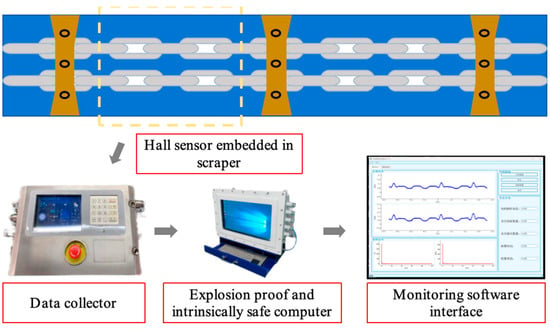
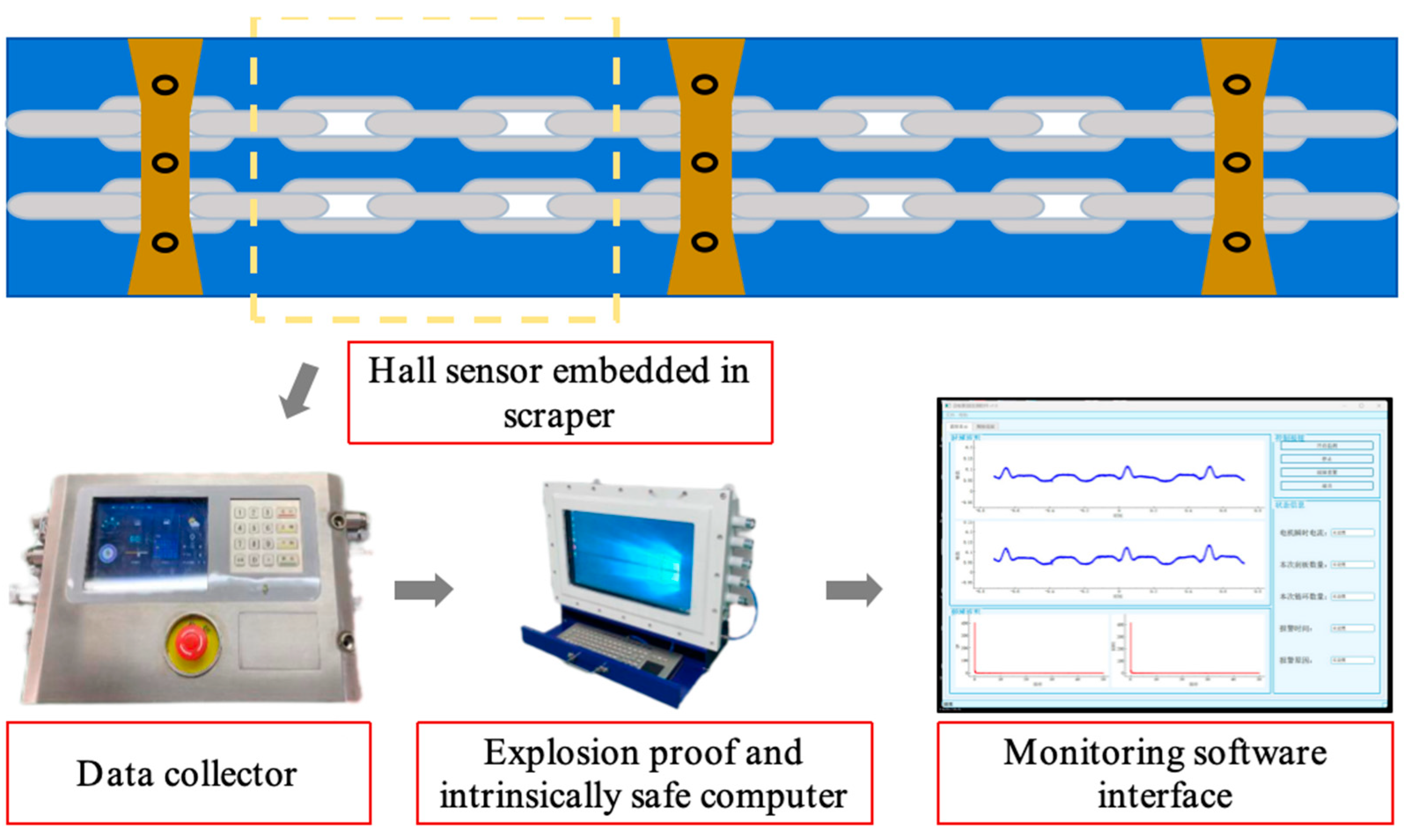
The chain breakage monitoring system proposed in this study is designed specifically for the scraper conveyor in underground coal mines. The system architecture, illustrated in Figure 1, comprises embedded Hall-effect sensors, a custom-designed intrinsically safe data acquisition unit, an intrinsically safe and flameproof computer, and monitoring analysis software. The software is a self-developed monitoring program (Version 1.0). The Hall-effect sensor is embedded within the scraper’s insert board, installed beneath the conveyor chain and scraper. This installation maximizes sensitivity to the magnetic field variations caused by passing chain links and scrapers, while the non-contact measurement principle avoids interfering with normal conveyor operation. As the horizontally or vertically oriented chain links and scrapers pass by the sensors, they each generate distinctive changes in magnetic flux density. These variations are captured by the sensors as analog voltage signals, which are transmitted via cable to the intrinsically safe data acquisition unit. The data acquisition unit can both locally store the collected signals on an SD card and transmit the data via Ethernet to the flameproof computer for further processing. The monitoring and analysis software for the scraper chain runs on the flameproof computer, implementing the chain link/scraper identification algorithms and synchronization assessment algorithms proposed in this paper.
Figure 1.
System architecture and workflow of the scraper conveyor monitoring system.
A critical aspect of the hardware design is the signal conditioning. Although Hall-effect sensors are capable of detecting magnetic field fluctuations, they lack integrated signal conditioning capabilities, such as on-board analog filtering or amplification circuitry [25]. As a result, the output signal is prone to high-frequency noise and baseline drift [26], which may obscure critical features necessary for distinguishing chain components. To address the hazardous and harsh underground conditions associated with coal mining applications, we designed and implemented an intrinsically safe data acquisition unit based on an STM32 microcontroller, designed for use in potentially explosive underground environments. In this system, the data acquisition unit performs signal preprocessing—including bandpass filtering and Fourier transform—on the collected Hall-effect sensor voltage signals . The processed data are then stored locally on an SD card and simultaneously transmitted via RS485 and RJ45 communication interfaces to an intrinsically safe and flameproof industrial computer (upper-level host). The core recognition and monitoring algorithms are subsequently executed on the industrial computer. The host software provides essential functionalities, including real-time status display, data visualization, historical trend analysis, and alarm generation for anomalies or potential faults.
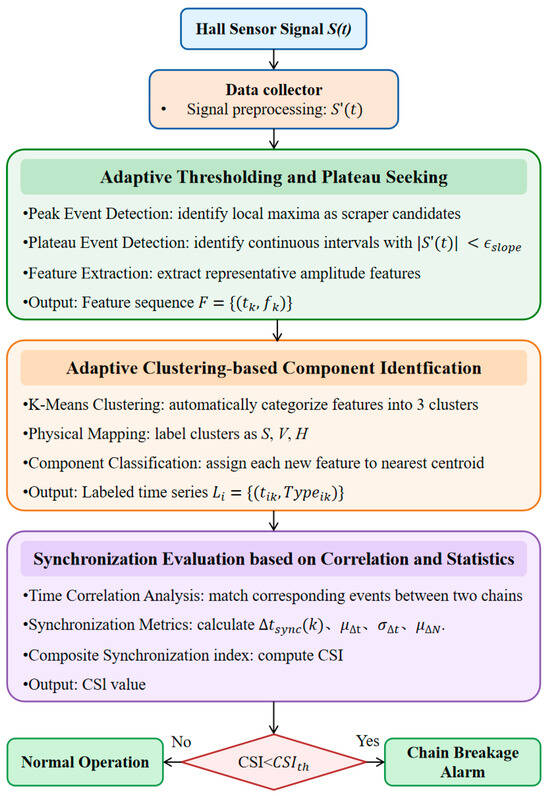
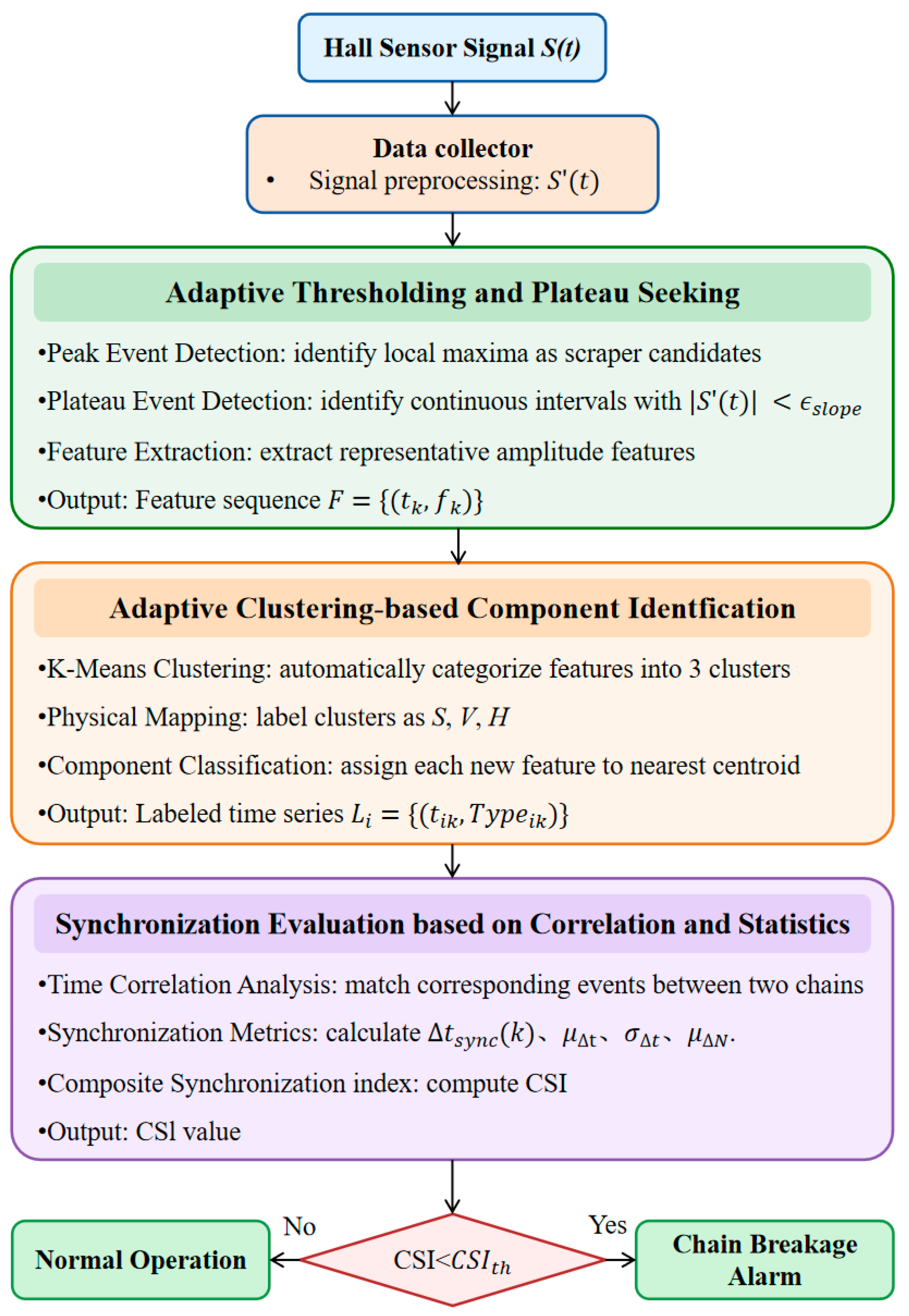
Figure 2 illustrates the flowchart of the proposed algorithm designed specifically for detecting scraper chain desynchronization. The diagram details the sequence of processing steps, beginning with the input from the Hall-effect sensor and progressing through initial signal preprocessing. Subsequently, key features are extracted using the Adaptive Thresholding and Plateau Seeking (ATPS) algorithm, followed by component identification via the Adaptive Clustering-based Component Identification Algorithm (ACCI). The core of the detection logic lies in the Synchronization Evaluation (SE) model, which quantifies the degree of synchronicity between the two chains. Based on this assessment, the algorithm determines if critical desynchronization (indicative of a potential or actual chain failure) is present, ultimately leading to a decision. Section 2.2, Section 2.3 and Section 2.4 will respectively elaborate on the principles of the ATPS, ACCI, and SE algorithm modules.
Figure 2.
Flowchart of the proposed algorithm for detecting scraper chain desynchronization. Different colored blocks indicate major functional modules, including signal preprocessing, adaptive thresholding and feature extraction, component identification, and synchronization evaluation.
2.2. Algorithmic Framework for Feature Extraction
When the scraper conveyor’s chain links and scrapers pass by the Hall-effect sensor, they generate varying magnetic field intensities. These signal variations provide the basis for component identification. Due to the complexity of signals collected by the Hall-effect sensor under actual working conditions, especially considering the three components—scraper (S), vertical link (V), and horizontal link (H)—which present distinctly different waveform characteristics, it is challenging for traditional single-peak detection algorithms to accurately and consistently identify all components. Typically, the scraper generates the highest and sharpest positive peak, the vertical link shows as a secondary plateau, and the horizontal link corresponds to the lowest signal plateau. To overcome these limitations, we propose an ATPS feature extraction algorithm. This algorithm directly identifies signal segments corresponding to the three event types and extracts a representative amplitude feature for adaptive clustering. The algorithm comprises two core tasks: peak event detection and plateau event detection.
For peak events, which mainly correspond to scrapers, a standard peak searching method is applied. On signal S′(t), all local maxima satisfying a minimum peak height and minimum peak separation are identified. Since scraper events generally produce the highest amplitude signals, these identified peaks are considered potential scraper candidates. For each identified peak event, the peak amplitude is extracted as the feature value . This feature value, along with those from plateau events, is passed to the ACCI algorithm for final classification.
For plateau events (primarily corresponding to vertical (V) and horizontal (H) links), the algorithm focuses on the local stationarity of the signal. The first derivative of the signal S′(t) is calculated as follows:
where is the sampling time interval. The algorithm then searches for continuous time segments in S′(t) that satisfy a low derivative magnitude condition. Specifically, it identifies all maximum continuous intervals that satisfy:
where is a predefined positive threshold close to zero, characterizing the degree to which the signal approaches flatness. Furthermore, the algorithm filters these intervals, selecting only those whose duration exceeds a predefined minimum plateau length . These intervals are confirmed as stable plateau segments. For each identified stable plateau segment, the average amplitude μplatform of the signal within it is calculated:
where is the number of sample points within the plateau segment. This calculated is used as the feature value for that plateau event. The ATPS algorithm does not distinguish between V and H plateaus at this stage; instead, it outputs all identified plateau events along with their feature values .
Finally, the ATPS algorithm integrates all identified scraper events and plateau events in chronological order, forming a unified event feature sequence . Here, is the event timestamp (time of the peak or midpoint of the plateau), and is the corresponding feature value. This sequence is input into the next stage’s ACCI algorithm. By directly utilizing peak attributes and derivative-based plateau stability criteria, the ATPS algorithm achieves targeted and efficient feature extraction for events with different morphologies, providing a reliable basis for subsequent adaptive classification.
To improve robustness against noise, the ATPS pipeline integrates multiple constraints rather than relying on raw numerical differentiation alone. Prior to derivative computation, the Hall sensor signals are band-pass filtered and normalized to suppress high-frequency noise and low-frequency drift. In addition, derivative-based candidate segments are further screened using joint amplitude, slope, and minimum duration constraints. Random noise typically produces short-lived, irregular fluctuations that fail to satisfy these combined criteria and are therefore excluded from valid peak or plateau detection.
2.3. Design of Adaptive Clustering-Based Component Identification
Although the ATPS algorithm efficiently extracts the feature values for each component, the extracted features may drift gradually over time due to sensor aging, chain wear, or changes in operating conditions. To address this, we further employ the ACCI, which provides final classification of the ATPS output feature sequence [18,19]. The key advantage of ACCI is its unsupervised learning capability, allowing dynamic adaptation to feature variations without reliance on fixed thresholds, thus ensuring long-term robustness of the identification system.
ACCI receives the feature value sequence output from ATPS. By applying the K-Means clustering algorithm, it automatically categorizes the feature values into three clusters corresponding to scraper (S), vertical (V), and horizontal (H) components. To initialize, three feature values within an initial fixed time window are randomly selected as the initial cluster centroids (, , ). The algorithm then performs iterative steps until convergence.
In each iteration (i + 1), each feature is assigned to the cluster whose centroid from the previous iteration (i) is nearest, based on the minimum squared Euclidean distance. This assignment step defines the updated cluster memberships as shown in Formula (4):
After all feature values are assigned to clusters in iteration (i + 1), the centroid for each cluster is recalculated as the mean of all feature values assigned to that cluster. This centroid update step is shown in Formula (5).
Once the clustering process converges, the cluster centroids are effectively stabilized. We then label these clusters based on the expected physical characteristics of the components. Considering the typical vertical arrangement and dimensions within the conveyor, the scraper (S) component generally produces the highest peak amplitude feature values, followed by the vertical chain link (V), and lastly the horizontal chain link (H). This establishes an expected relationship between the magnitudes of the converged centroids: . This step allows mapping the numerically derived clusters to their physical counterparts.
Subsequently, for any new feature value output by the ATPS algorithm, its corresponding component type is identified by assigning it to the cluster whose converged centroid is nearest. This classification is based on the minimum absolute difference. The classification rule is:
This means:
If | − | is the minimum, the component is classified as Scraper (S).
If | − | is the minimum, the component is classified as Vertical chain link (V).
If | − | is the minimum, the component is classified as Horizontal chain link (H).
The final output of the ACCI algorithm for each sensor i (where i = 1, 2 represents the two sensors used) is a labeled time series, denoted as Li. This sequence pairs each feature identification event with its timestamp and the determined component type, as shown in Formula (7):
where is the timestamp of the identified feature from sensor i, and {H, V, S} is the corresponding identified component type (Horizontal link, Vertical link, or Scraper) determined by the minimum distance rule described above.
2.4. Synchronization Evaluation Model Design
The scraper conveyor is driven by symmetric dual chains. If a single scraper chain breaks, it will cause a significant difference in the synchronization between the two chains. We established a Synchronization Evaluation (SE) Model based on Event Correlation and Statistical Features to detect whether the components of the two chains of the scraper conveyor maintain symmetry [20,21]. When a significant synchronization difference occurs between the two chains, we consider it a potential chain breakage event. The SE model utilizes the labeled time series and generated by the ACCI method to calculate the synchronization of the two scraper chains.
First, we select suitable reference events from the labeled time series and . Since the detected scraper signal peaks are typically the largest and occur at a lower frequency, we use the scraper (S) events as reliable reference points. The timestamps corresponding to the scraper events are extracted from and , forming time series and . Next, time correlation analysis is performed based on the time series and to match corresponding scraper events between the two chains. For each event in , the algorithm searches for the temporally closest event in . A match is considered successful only if the absolute time difference is less than a predefined maximum time window . Only successfully matched pairs are considered for subsequent synchronization analysis; unmatched events are currently disregarded in these calculations. Based on these matched scraper event pairs, synchronization features are calculated.
For each pair of matched scraper times (using a single index k after matching), the instantaneous time deviation is calculated as shown in Formula (8):
represents the time difference between the detection of the corresponding scraper event by the sensors on the two chains. The mean and standard deviation of the entire time deviation sequence are calculated to evaluate the overall synchronization and its stability, as shown in Formulas (9) and (10):
Ideally, the mean time deviation should be close to 0. The standard deviation of the time deviation represents the stability of synchronization; a smaller value indicates better stability of the scraper conveyor’s operation.
Furthermore, for the time interval between each matched scraper event pair (k) and the next pair (k + 1), the total number of identified horizontal links (H) and vertical links (V) is counted for each chain: and . The consistency of the chain link counts can be represented by the mean of the link count differences . The mean link count difference is calculated as shown in Formula (11). Ideally, this value should also be 0.
To reduce false alarms caused by environmental noise or other specific factors and enhance the accuracy of chain breakage monitoring, we propose a Composite Synchronization Index (CSI) based on the aforementioned synchronization features. This index serves as the criterion for determining a detected chain break. Its calculation is shown in Formula (12):
The weighting coefficients , , and in Formula (12) were selected based on the physical significance and relative operational reliability of the corresponding synchronization features, rather than purely data-driven optimization under unconstrained laboratory assumptions.
Among these metrics, the standard deviation of the time deviation reflects the stability of inter-chain synchronization over time and is less sensitive to occasional disturbances or isolated mismatches. It therefore serves as a robust indicator of persistent desynchronization and was assigned a relatively higher weight.
The mean time deviation captures systematic phase offsets between the two chains, while the mean link count difference reflects cumulative structural inconsistency over successive scraper intervals. These two metrics provide complementary information but may be more sensitive to transient fluctuations caused by operational variability.
To balance sensitivity and robustness under realistic operating conditions, a normalized weighting scheme was adopted, with and . This physically informed weighting strategy was found to provide stable discrimination between synchronized and desynchronized states under the controlled validation conditions considered in this study.
3. System Validation and Results Analysis
3.1. Data Acquisition and Validation Setup
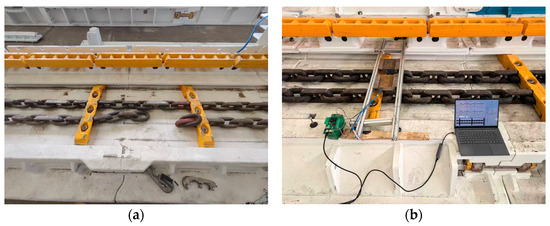
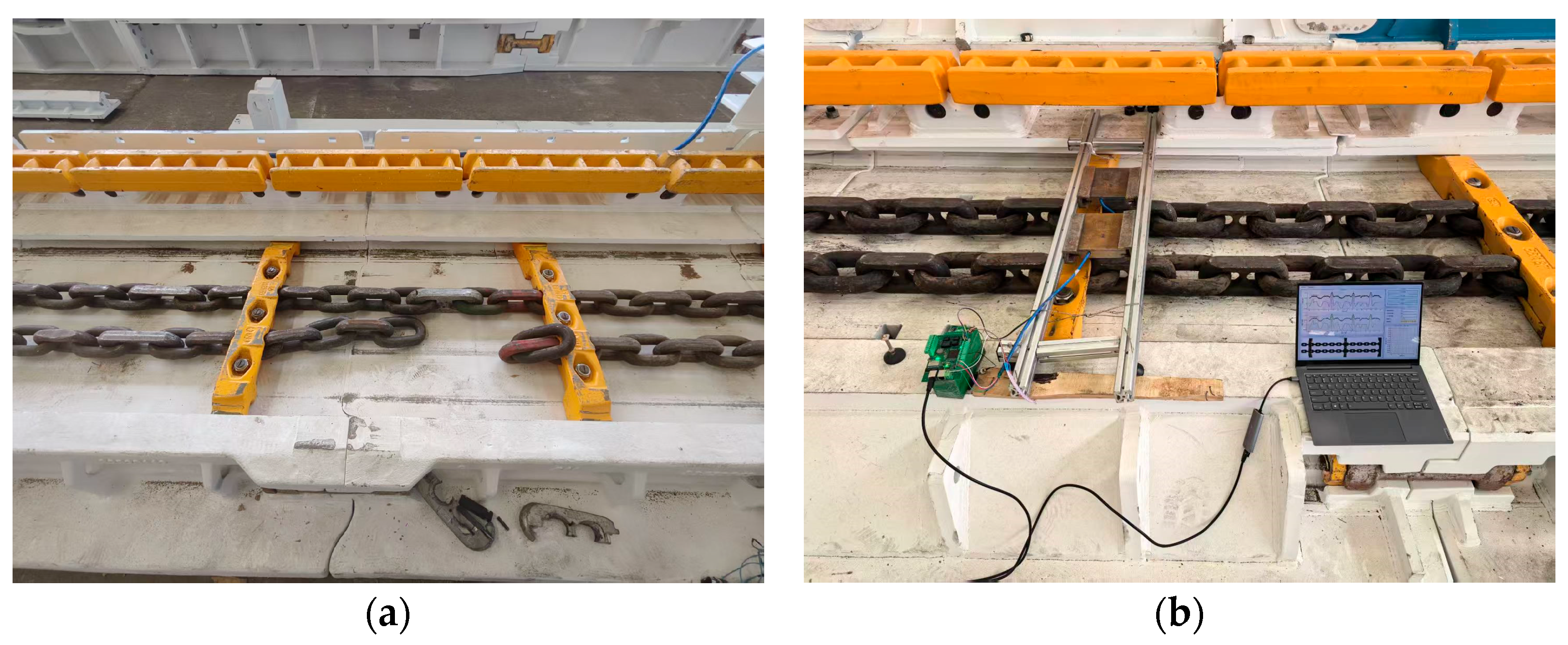
The system design was validated using an industrial experimental platform established at a coal mine site in Shanxi Province, China, as depicted in Figure 3. The physical installation of the sensor system on the scraper conveyor structure is shown in Figure 3a. Hall-effect sensors were embedded within the scraper flights to detect passing chain links. The analog signals were captured by the custom-designed intrinsically safe data acquisition unit, shown in Figure 3b, which is based on an STM32 microcontroller and operates at a sampling frequency of 200 Hz. This unit performed initial on-board pre-processing before transmitting the data to the explosion-proof industrial computer for further analysis. The core ATPS, ACCI, and SE algorithms were implemented in Python 3.12.12 on the host system.
Figure 3.
Field experimental setup for system validation. (a) View of the scraper conveyor structure with sensors embedded within the scraper flights; (b) The custom-designed intrinsically safe data acquisition unit connected to the host computer for real-time signal collection.
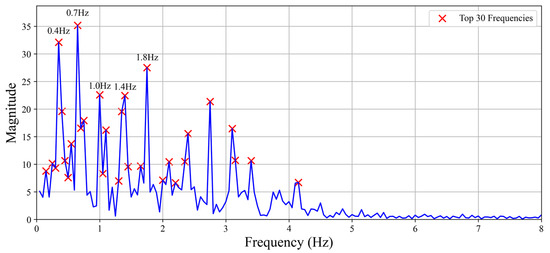
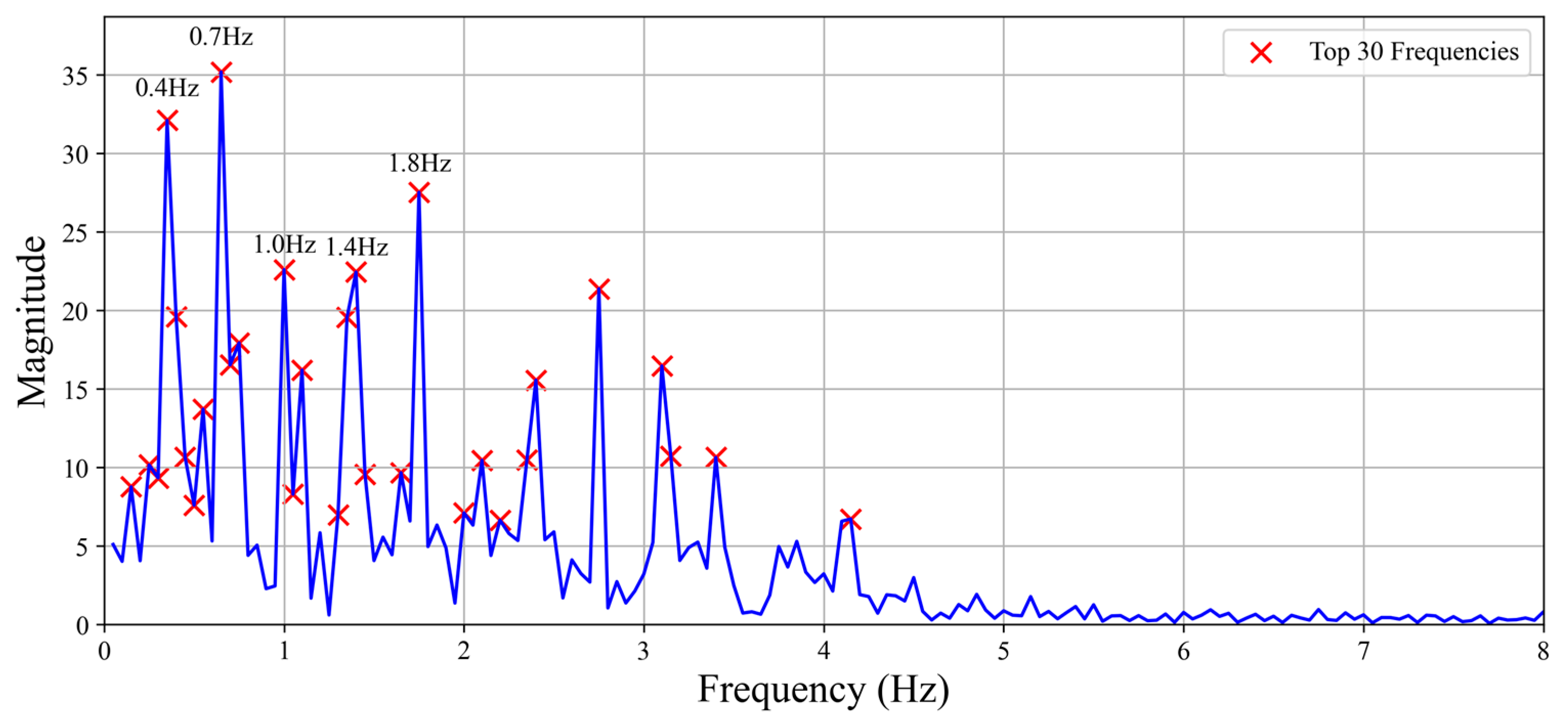
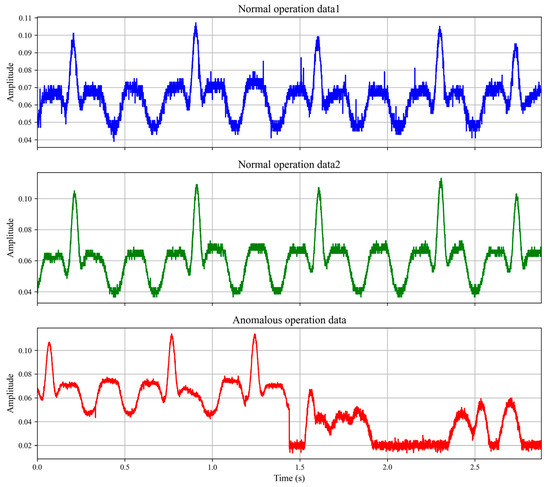
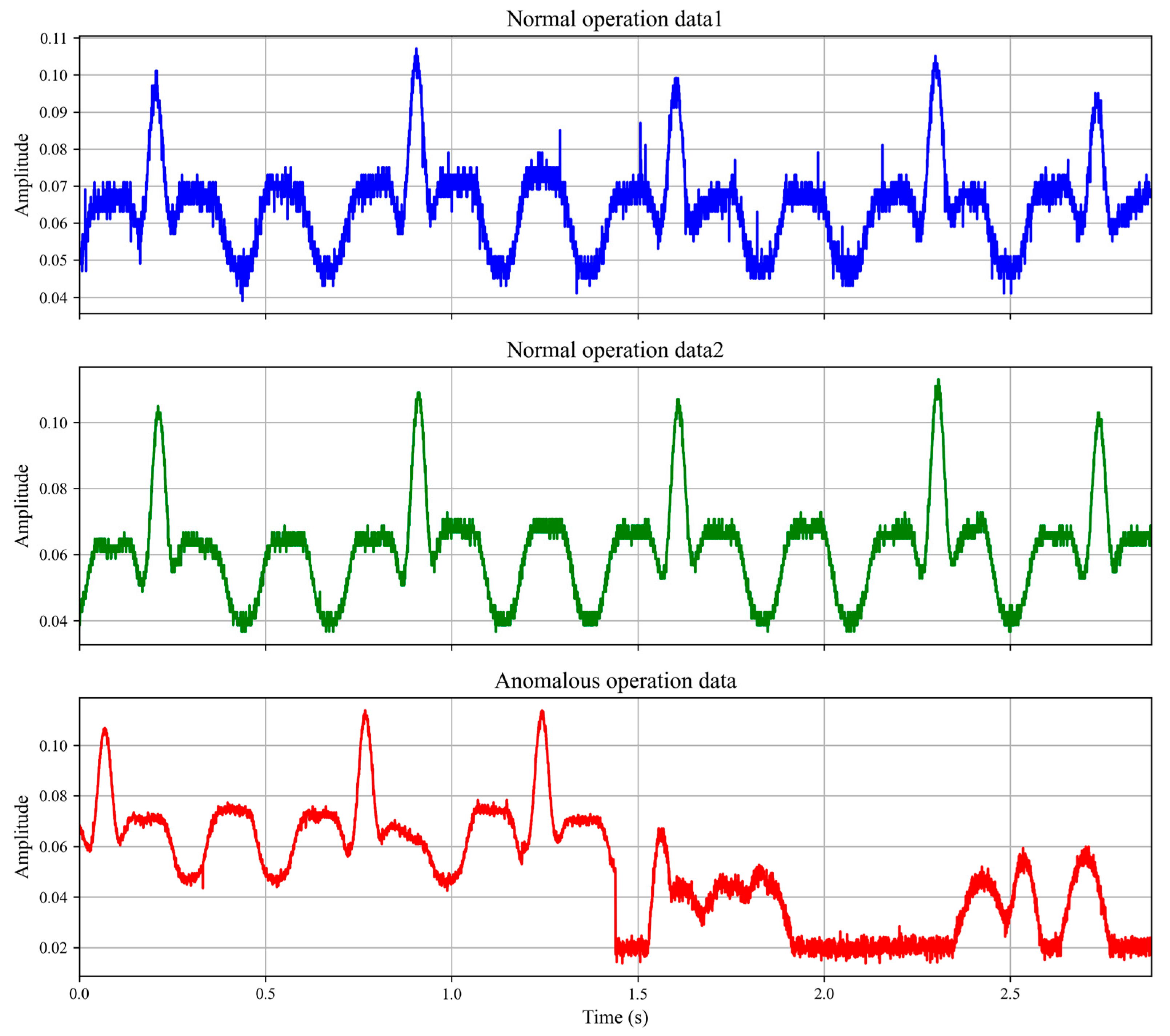
To understand the frequency characteristics inherent in the signals, Figure 4 displays the frequency spectrum computed from a representative signal segment during normal operation. This spectral analysis helps in confirming the relevant frequency bands for filtering and feature extraction. To provide a visual representation of the acquired data, Figure 5 presents typical segments of the pre-processed Hall-effect sensor signals. The top two panels illustrate the waveforms characteristic of normal operation, while the bottom panel displays a signal captured during an anomalous event, showcasing noticeable differences in pattern or amplitude.
Figure 4.
Frequency spectrum of a representative pre-processed Hall-effect sensor signal segment during normal operation.
Figure 5.
Representative examples of Hall-effect sensor signals during normal and anomalous operation.
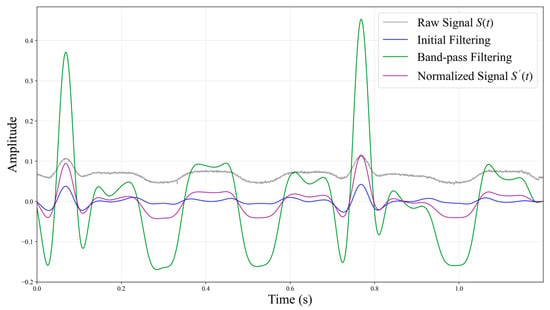
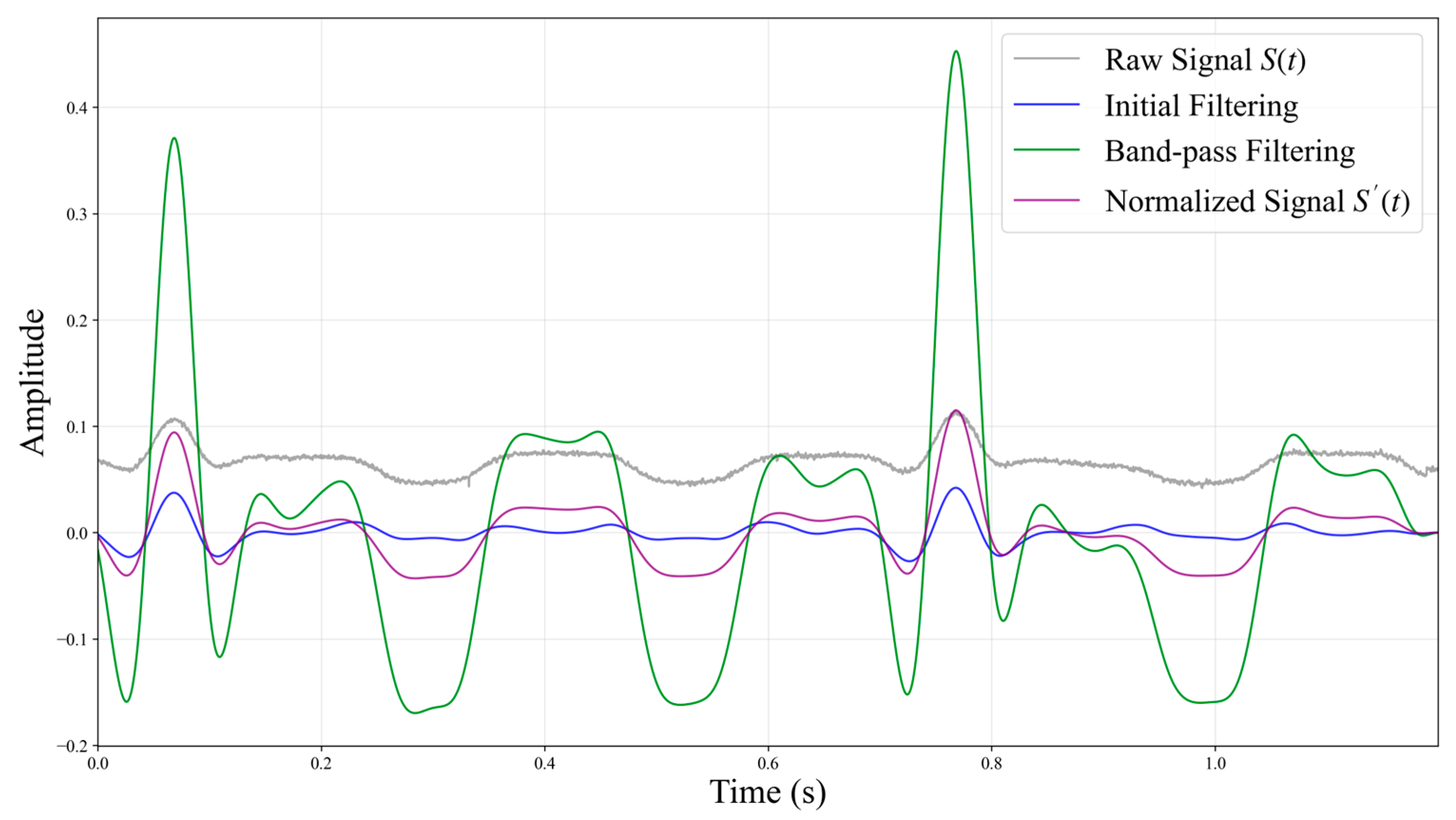
To prepare the raw sensor data for reliable feature extraction, onboard signal pre-processing is performed by the intrinsically safe data acquisition unit. Figure 6 illustrates the effectiveness of this process, comparing the raw Hall-effect sensor signal (gray trace), characterized by noise and baseline fluctuations, with the signals after initial filtering (blue), band-pass filtering (green), and normalization (purple). The pre-processing steps clearly enhance the relevant signal features while suppressing noise, yielding a cleaner signal suitable for the subsequent analysis stages.
Figure 6.
Comparison of the raw Hall-effect sensor signal and the signal after onboard pre-processing by the data acquisition unit.
Two primary datasets were collected and utilized for this study:
Normal Operation Dataset: Comprising 120 data segments, each 3 s long, recorded while the scraper conveyor operated under typical heavy-load conditions. This dataset was used to initialize and adaptively update the ACCI cluster centroids, evaluate identification accuracy, and establish a baseline for normal synchronization behavior.
Anomalous Operation Dataset: Consisting of 30 data segments, each approximately 3 s long, exhibiting characteristics consistent with chain desynchronization or incipient fault conditions (e.g., significant timing deviations, inconsistent link counts between chains). These segments represent critical periods where potential chain integrity issues manifest. This dataset was specifically used to evaluate the fault detection capability of the proposed SE model and the CSI metric.
The anomalous dataset was generated through controlled engineering experiments to ensure precise fault emulation. Specifically, the connector of a one-sided chain link was intentionally removed to simulate a single-chain disconnection failure while the conveyor operated under no-load conditions. This setup produces a reproducible and severe desynchronization state between the dual chains, which is representative of critical integrity anomalies and suitable for validating synchronization-aware detection methods. While the absence of material load distinguishes these experiments from standard operations, they provide a controlled environment to isolate desynchronization behavior and rigorously evaluate the sensitivity of the proposed CSI-based framework.
3.2. Performance Evaluation of Component Identification
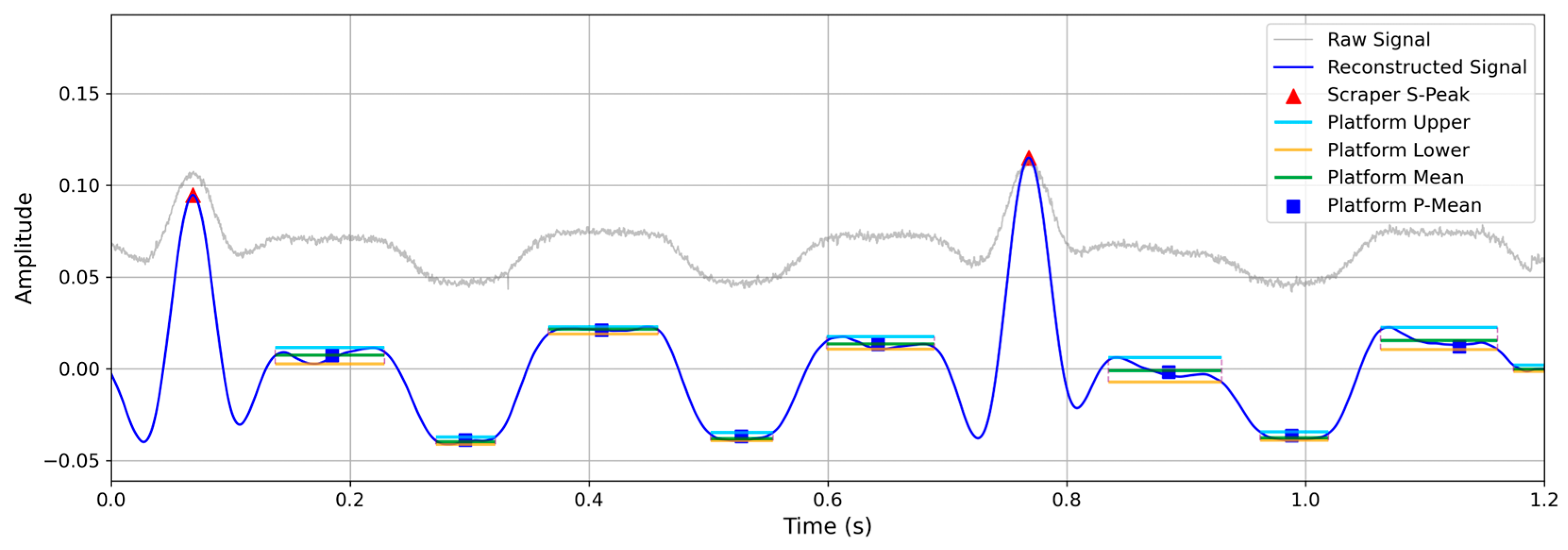
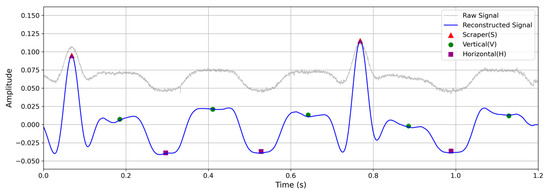
This section evaluates the identification accuracy of the combined ATPS feature extraction algorithm and ACCI adaptive clustering identification algorithm for the three component types: scraper (S), vertical link (V), and horizontal link (H). First, the ATPS algorithm was applied to process the collected normal operation signals from the scraper conveyor. Figure 7 illustrates the feature extraction effect of the ATPS algorithm on a typical signal segment. The red curve represents sensor 1 signal, and the blue curve represents sensor 2 signal. The algorithm successfully identifies the high-amplitude peaks corresponding to scrapers (labeled S Peak) and the plateau regions corresponding to vertical and horizontal links (labeled V Plateau, H Plateau), extracting the respective feature amplitudes or , which constitute the feature values .
Figure 7.
Schematic diagram of ATPS feature extraction.
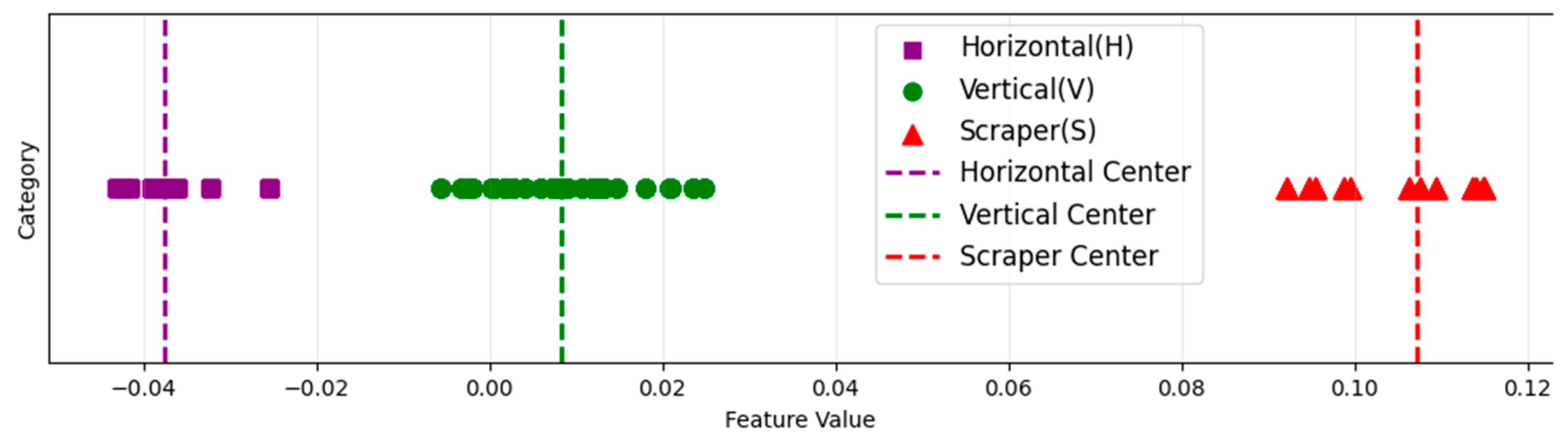
Next, the feature values extracted from all normal datasets were input into the ACCI algorithm. The algorithm utilizes K-Means for unsupervised clustering, automatically partitioning the feature values into three clusters. Figure 8 shows the feature value distribution and clustering result for one channel during the initial training phase, using the first 10 s of data. It is clearly visible that the feature values naturally form three distinct groups based on amplitude, and the K-Means algorithm effectively determines the cluster centroids , , and , corresponding to scrapers, vertical links, and horizontal links, respectively.
Figure 8.
Distribution of feature values and initial clustering centroids.
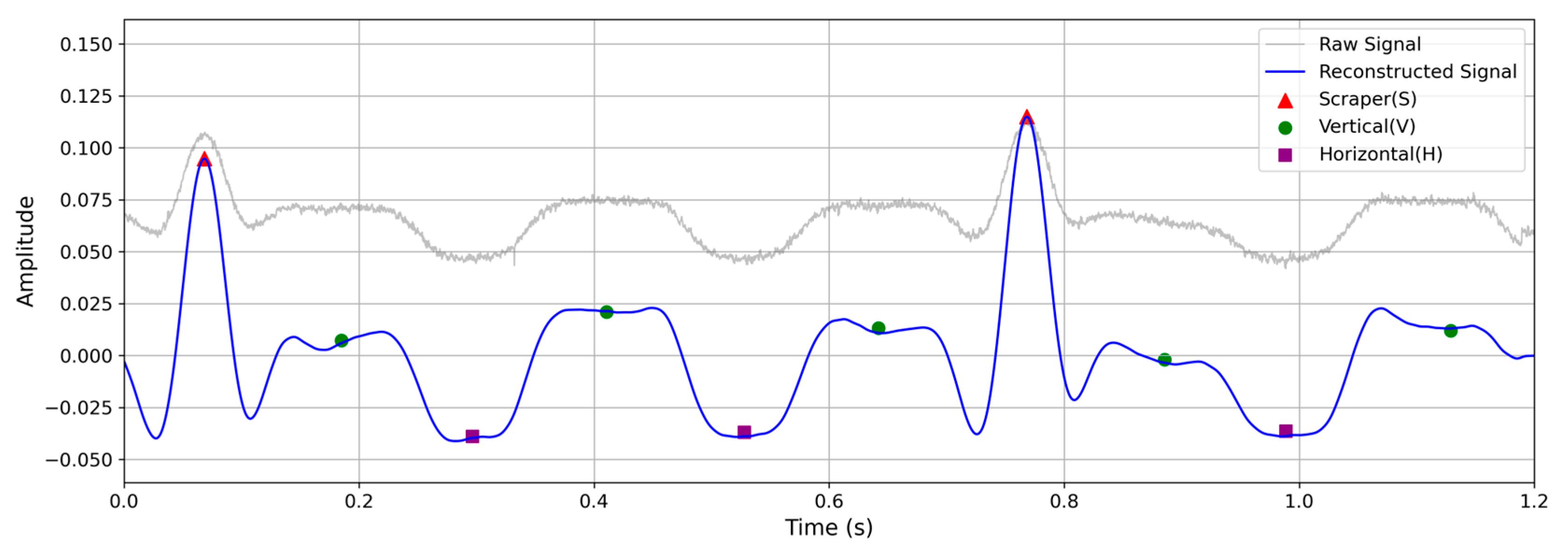
Building upon the feature extraction shown in Figure 7 and the clustering principles illustrated in Figure 8, Figure 9 visualizes the final component identification results achieved by applying the trained ACCI model to the extracted features. Specifically, this figure overlays the identified component identity labels S, V, and H, representing Scraper, Vertical Link, and Horizontal Link, respectively, directly onto the corresponding signal features. These features are the peaks and plateaus previously identified in Figure 6. This demonstrates how the cascaded ATPS and ACCI algorithms work together to interpret the signal and successfully assign the correct component identity to each relevant feature detected in the sensor data.
Figure 9.
Visualization of component identification results on signal waveforms.
To quantitatively evaluate the identification performance of this combined method, 60 sets of scraper conveyor operation data were selected, and segments of 30 s lengths from each were manually labeled. The labeling process was based on signal waveform morphology and the known physical structure of the chain (following an S-H-V-H-V-H-S sequence pattern). The annotated results served as the ground truth. Subsequently, the identification results obtained from the cascaded ATPS and ACCI algorithms were compared element-wise against the ground truth, and several evaluation metrics were calculated, including Accuracy, Precision, Recall, and F1-Score.
The specific performance evaluation results are summarized in Table 1. Analyzing the data in Table 1 reveals that the proposed ATPS+ACCI chain link identification method demonstrates high recognition accuracy for all three component types (scraper, vertical link, horizontal link). The overall identification accuracy reaches 98.2%, and the Precision, Recall, and F1-Score for each category are all above 97%. These results strongly indicate that the method can accurately distinguish different chain components from complex Hall-effect sensor signals, providing a solid data foundation for subsequent dual-chain synchronization evaluation and reliable chain breakage detection.
Table 1.
Chain Link Identification Performance Evaluation Results.
3.3. Evaluation of Dual-Chain Synchronization Design
This section evaluates the SE model’s ability to quantify dual-chain synchronization and detect anomalies using the CSI. The complete ATPS-ACCI-SE pipeline was applied to both the Normal Operation and Anomalous Operation datasets. For CSI calculation (Formula (12)), weights were set as , , . The expected time difference offset was set to 0, and the reference time scale was set to 0.8 s, corresponding to the average scraper passage period observed during heavy-load operation.
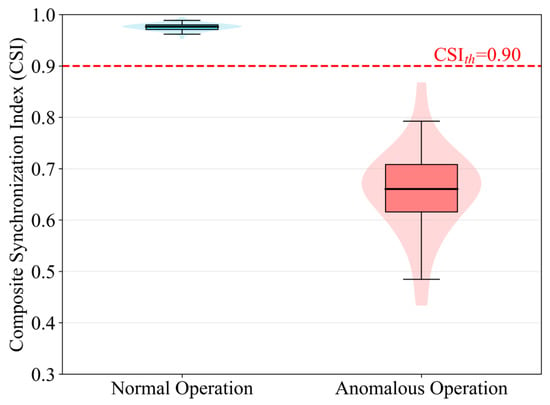
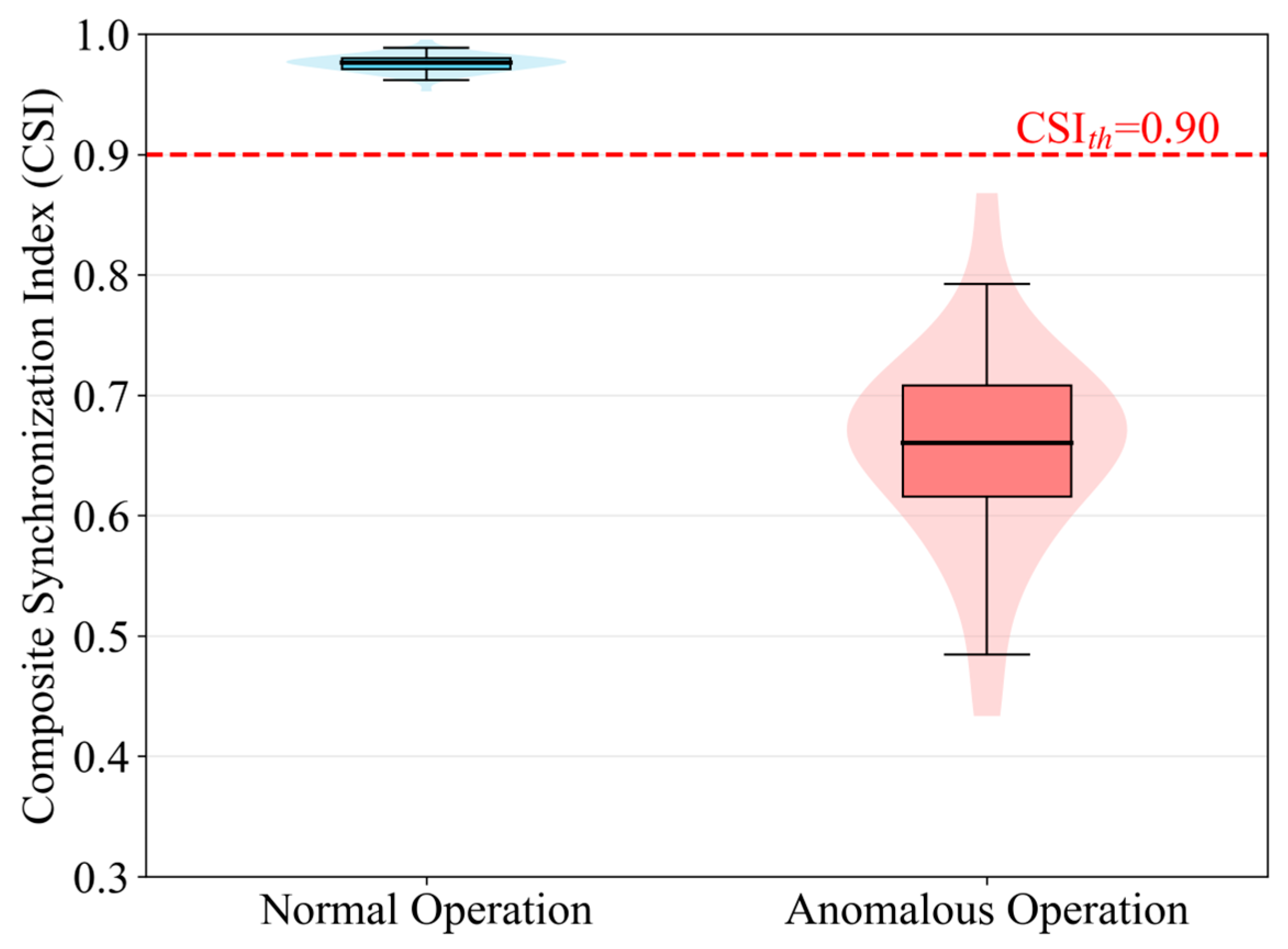
The CSI values were calculated for all segments in both datasets. Key intermediate metrics under normal conditions showed an average absolute time deviation , a standard deviation < 25 ms, and a mean absolute link count difference < 0.1, indicating highly synchronized and stable operation. Figure 10 presents a direct comparison of the CSI value distributions and summary statistics obtained from the Normal and Anomalous Operation datasets using violin plots.
Figure 10.
Comparison of CSl Distributions. Blue and red regions correspond to the Normal Operation and Anomalous Operation datasets, respectively.
As clearly illustrated in Figure 10, there is a distinct separation between the CSI values from the two datasets. The violin plot for normal operation shows the CSI values are tightly clustered in a high range, predominantly between 0.95 and 1.00, with the median value (indicated within the plot) at approximately 0.975. The narrow shape of this plot confirms the high degree of synchronization and low variance maintained during normal function. Conversely, the violin plot for the anomalous operation dataset shows significantly lower CSI values, with a much wider distribution primarily centered below 0.7.
Based on the CSI distribution under normal operation, the alarm threshold was determined using a segment-level calibration–verification protocol to ensure statistical robustness. Specifically, 80% of the normal-operation segments were used as a calibration set to estimate the baseline CSI distribution, while the remaining 20% of the normal data, together with all anomalous segments, were used exclusively for verification.
The threshold was defined as the lower 5th percentile of the calibrated normal CSI distribution, providing a conservative margin that minimizes missed alarms while maintaining clear separation between synchronized and desynchronized states under the tested conditions. Importantly, anomalous data were not used in the threshold calibration process, thereby avoiding bias toward fault-specific patterns.
Using this protocol, the selected threshold effectively distinguishes the tightly clustered high CSI values observed during normal operation from the significantly lower values characteristic of the anomalous segments. Notably, all 30 anomalous segments yielded CSI values well below this threshold, visually confirming the effectiveness of the CSI metric and the chosen calibration strategy in detecting conditions representative of potential chain faults.
This demonstrates the proposed method’s effectiveness:
The ATPS+ACCI algorithms provide accurate component identification necessary for synchronization analysis. The SE model and the CSI metric provide a quantitative measure of dual-chain synchronization, effectively separating normal and anomalous states. Under normal conditions, the CSI remains consistently high (avg. 0.975). During anomalous conditions representative of potential chain faults, the CSI drops significantly below the alarm threshold (CSI < 0.90), enabling sensitive detection.
4. Discussion
This study successfully designed, implemented, and validated an intelligent monitoring system for dual-chain breakage in scraper conveyors based on Hall-effect sensors and synchronization analysis. The core objective was to address the challenge of real-time, reliable monitoring of scraper conveyor chain integrity in harsh coal mine environments, particularly by enabling early chain breakage fault warning through the analysis of dual-chain synchronicity. The experimental results strongly support the effectiveness and practicality of the proposed method.
Firstly, the combination of the ATPS feature extraction algorithm and the ACCI adaptive clustering identification algorithm achieved high-precision recognition of the three chain components, including the scraper, vertical link, and horizontal link, with an overall accuracy reaching 98.2%. This is crucial, as accurate component identification forms the foundation for subsequent synchronization analysis. The ATPS algorithm integrates peak searching and derivative-based plateau seeking strategies to effectively overcome the limitations of traditional single-peak detection methods in distinguishing signals with varying morphologies.
The key innovation of this research lies in the proposed SE model and the composite Chain Synchronization Index (CSI). Unlike many existing methods that focus on single-chain status monitoring or catastrophic failure detection, the SE model explicitly quantifies the synchronous relationship between the dual chains, encompassing time deviation, operational stability, and link count consistency. Experiments demonstrated that under normal operating conditions, the CSI value remains stable at a high level close to 1 with minimal standard deviation, clearly establishing a reliable health baseline. This direct quantification of synchronicity enables the system to sensitively capture subtle desynchronization phenomena potentially occurring in the early stages of single-chain breakage, such as relative delays or chain link sequence disorders caused by chain slippage or partial fracture. By setting a reasonable alarm threshold, the model can effectively distinguish between normal operational fluctuations and significant synchronicity degradation indicative of potential chain breakage risks. This facilitates early warning, providing valuable time for preventive maintenance and avoiding more severe accidents like dual-chain failure.
Compared to other monitoring techniques mentioned in the introduction, the Hall magnetic sensing technology employed in this study demonstrates unique advantages in the coal mine environment. Unlike machine vision, which is susceptible to dust and water mist, and vibration analysis, prone to noise interference, magnetic sensing offers superior environmental robustness. The non-contact measurement principle avoids interference with normal conveyor operation. Furthermore, the designed intrinsically safe data acquisition unit and explosion-proof industrial computer ensure the system’s safe applicability in underground coal mine environments.
Despite the positive results, some limitations warrant discussion. Firstly, while this study utilized real operational data exhibiting anomalous characteristics consistent with desynchronization, the dataset representing actual complete chain breakage events was limited. This limitation arises from the rarity and safety implications of capturing such data during production. The anomalous data successfully represented phenomena like significant timing deviations and inconsistent link counts, but actual failure modes can be diverse and might include features not fully captured in the available dataset. Future work necessitates capturing and analyzing data from confirmed chain breakage incidents in production environments to further validate and refine the model’s generalization capability across various failure scenarios. Secondly, the system’s performance might be influenced by factors such as the specific scraper conveyor model, chain material, and operating speed, which can alter magnetic field characteristics. While ACCI offers adaptability, recalibration or model fine-tuning might be necessary for significantly different equipment. Thirdly, the CSI calculation depends on several parameters and the alarm threshold setting. Optimal selection may require adjustment based on specific application needs and tolerance for false alarms versus missed detections.
Sensor failure and chain desynchronization produce fundamentally different signal characteristics. In the event of Hall-effect sensor failure (e.g., power loss, saturation, or communication interruption), the acquired signal typically degenerates into a constant or invalid waveform, preventing the ATPS algorithm from extracting meaningful peak or plateau events. Such cases can be directly identified through signal integrity checks and treated as sensor faults rather than mechanical anomalies. In contrast, chain desynchronization produces irregular but valid event sequences with distorted timing relationships between the two channels, which is captured by the CSI metric. Therefore, the proposed framework inherently distinguishes sensor failure from actual desynchronization based on event availability and temporal consistency.
In practical mining environments, sporadic metallic debris may generate local magnetic disturbances. However, such disturbances typically appear as isolated, non-periodic signal fluctuations that do not conform to the characteristic peak–plateau patterns or the fixed S–H–V sequence of scraper conveyor chains. The proposed ATPS algorithm requires both amplitude and temporal stability criteria to identify valid events, effectively suppressing spurious responses. Furthermore, the synchronization evaluation relies on consistent event correspondence between the dual chains; random debris-induced disturbances are unlikely to produce coherent anomalies across both channels. As a result, the combined feature extraction and CSI-based evaluation provides inherent robustness against metallic debris interference.
While confirmed catastrophic chain breakage events during production are rare and difficult to capture safely, this study validates the proposed system using controlled single-chain disconnection experiments as a reproducible proxy for severe desynchronization. Future work will focus on long-term in situ data collection under loaded conditions to further evaluate generalization across diverse operational scenarios.
5. Conclusions
This paper presented a synchronization-aware monitoring system for dual-chain scraper conveyors based on magnetic sensing and intrinsically safe system design. By integrating adaptive signal processing with a composite Chain Synchronization Index, the system enables reliable detection of desynchronization anomalies under harsh underground conditions, providing practical support for condition monitoring and maintenance decision-making in coal mines.
The experimental validation confirms that the proposed ATPS-ACCI algorithms effectively process magnetic signals in complex environments, achieving a component recognition accuracy of 98.2%. Furthermore, the newly introduced Chain Synchronization Index successfully quantifies the operational symmetry of the dual chains, providing a sensitive metric that remains consistently high during normal operation and drops significantly during anomalous desynchronization events. The system’s non-invasive nature and intrinsically safe hardware design make it a practical solution for deployment in hazardous mining conditions. The current validation focuses on representative yet controlled experimental scenarios designed to isolate synchronization-related anomalies, which provides a solid basis for assessing system sensitivity while acknowledging the inherent complexity of fully loaded and long-term industrial operation.
Future research directions will focus on conducting long-term industrial field trials to collect more operational data, especially from naturally occurring chain breakage incidents, for comprehensive reliability evaluation. We also plan to investigate the variation patterns of magnetic signals across different conveyor models and wear states to enhance model universality. Additionally, we will explore data fusion by integrating this method with other monitoring techniques, such as motor current or vibration signals, to build a more comprehensive health assessment system. Finally, further optimizing algorithm efficiency for edge computing and investigating machine learning approaches to automatically learn complex fault patterns will be pursued to advance the level of intelligent and safe production in coal mines.
Author Contributions
Conceptualization, J.L. (Jiacheng Li), X.Z., H.T. and H.L. (Hao Li); methodology, J.L. (Jiacheng Li) and X.Z.; software, J.L. (Jiacheng Li) and X.Z.; validation, J.L. (Jiacheng Li), X.Z., H.T. and J.Z.; formal analysis, J.L. (Jiacheng Li) and X.Z.; investigation, J.L. (Jiacheng Li) and X.Z.; resources, H.L. (Hao Li) and J.L. (Jiacheng Li); data curation, J.L. (Jiacheng Li) and X.Z.; writing—original draft preparation, J.L. (Jiacheng Li) and X.Z.; writing—review and editing, X.Z., H.T., H.L. (Hao Li), H.L. (Haoting Liu) and J.L. (Junyuan Li); visualization, J.L. (Junyuan Li) and X.Z.; supervision, H.L. (Hao Li) and H.L. (Haoting Liu); project administration, H.L. (Hao Li) and H.L. (Haoting Liu); funding acquisition, H.L. (Hao Li). All authors have read and agreed to the published version of the manuscript.
Funding
This research was funded by the Innovation and Entrepreneurship Fund of Tiandi Science & Technology Co., Ltd. under grants 2024-TD-ZD014-01, 2025-TD-ZY003, and 2025-TD-QZ024.
Data Availability Statement
The data presented in this study are available on request from the corresponding author due to commercial confidentiality.
Conflicts of Interest
Authors Jiacheng Li, Xishuo Zhu, Han Tian, Junsheng Zhang and Hao Li were employed by the company Tiandi Science and Technology Co., Ltd. Author Junyuan Li was employed by the company Ningxia Tiandi Benniu Industrial Group Co., Ltd. The remaining author declares that the research was conducted in the absence of any commercial or financial relationships that could be construed as a potential conflict of interest. The authors declare that this study received funding from Innovation and Entrepreneurship Fund of Tiandi Science & Technology Co., Ltd. The funder was not involved in the study design, collection, analysis, interpretation of data, the writing of this article or the decision to submit it for publication.
References
- Wang, G.F.; Ren, H.W.; Zhao, G.R.; Zhang, D.S.; Wen, Z.G.; Meng, L.Y.; Gong, S.X. Research and practice of intelligent coal mine technology systems in China. Int. J. Coal Sci. Technol. 2022, 9, 24. [Google Scholar] [CrossRef] [Scilit]
- Lu, Z.X.; Li, L.Y.; Zhang, C.W.; Zhao, S.F.; Gong, L.X. Fault Feature Extraction Based on Variational Modal Decomposition and Lifting Wavelet Transform: Application in Gear of Mine Scraper Conveyor Gearbox. Machines 2024, 12, 871. [Google Scholar] [CrossRef] [Scilit]
- Jiang, S.B.; Lv, J.W.; Zeng, Q.L.; Zhang, Q.; Zhang, Y.Q.; Qu, W.; Cui, J.X. Dynamic characteristics of scraper conveyor chain drive system under the impact condition of lump coal. PLoS ONE 2024, 19, e0299044. [Google Scholar] [CrossRef] [Scilit]
- Zhang, Q.; Gu, J.Y.; Liu, J.M.; Tian, Y. Temperature effect on the impact characteristics of mine ring chain under different working conditions. Strength Mater. 2021, 53, 189–197. [Google Scholar] [CrossRef] [Scilit]
- Wang, H.J.; Zhang, Q.; Xie, F. Dynamic tension test and intelligent coordinated control system of a heavy scraper conveyor. IET Sci. Meas. Technol. 2017, 11, 871–877. [Google Scholar] [CrossRef] [Scilit]
- Bai, H.L.; Liu, J.Y.; Wang, J.G.; Zhang, P.; Bu, K.K. Health Status Assessment of a Scraper Conveyor Mechanical System. Highlights Sci. Eng. Technol. 2025, 127, 79–91. [Google Scholar] [CrossRef] [Scilit]
- Zhang, Q.; Zhang, J.X.; Zong, T.C.; Jin, Z.S.; Han, Y.; Yang, K.; Zhang, B.; Fu, R.H. Characterization and autonomous control method of abnormal working conditions of super-long flexible suspended solid backfilling scraper conveyor. J. China Coal Soc. 2024, 49, 2141–2151. [Google Scholar]
- Xie, C.X.; Liu, Z.X.; Xie, M. Dynamic response analysis of scraper conveyor under the condition of chain broken. J. Vibroeng. 2023, 25, 1053–1067. [Google Scholar] [CrossRef] [Scilit]
- Jiang, S.B.; Huang, S.; Mao, Q.H.; Zeng, Q.L.; Gao, K.D.; Lv, J.W. Dynamic Properties of Chain Drive in a Scraper Conveyor under Various Working Conditions. Machines 2022, 10, 579. [Google Scholar] [CrossRef] [Scilit]
- Meng, G.Y.; Li, G.P.; WO, L.; Wang, A.M. Intelligent key technologies of complete heavy scraper conveyor equipment. Coal Sci. Technol. 2014, 9, 57–60. [Google Scholar]
- Jiang, S.B.; Ren, W.J.; Mao, Q.H.; Zeng, Q.L.; Yu, P.F.; Gao, K.D.; Wang, L. Dynamic analysis of the scraper conveyor under abnormal operating conditions based on the vibration and speed characteristics. Shock Vib. 2021, 2021, 8887744. [Google Scholar] [CrossRef] [Scilit]
- Hua, Y.L.; Zhu, Z.C.; Zhou, G.B.; Shen, G. Chain state monitoring for a heavy scraper conveyor using UWB-based extended Kalman filter technique with range constraint selection method. IEEE Trans. Instrum. Meas. 2021, 71, 4001409. [Google Scholar] [CrossRef] [Scilit]
- Wang, Y.; Guo, W.; Zhao, S.F.; Xue, B.Q.; Zhang, W.G.; Xing, Z.Z. A big coal block alarm detection method for scraper conveyor based on YOLO-BS. Sensors 2022, 22, 9052. [Google Scholar] [CrossRef] [Scilit] [PubMed]
- Xu, L.H.; Gao, J.; Ye, Z.; Lai, Y.H. Online monitoring system of face scraper based on image processing and magnetic flaw detection technology. Coal Sci. Technol. 2023, 51, 390–395. [Google Scholar]
- Mao, J.; Yang, Z.Y.; Lu, J.N. Research on signal analysis and diagnosis of chain drive system of the scraper conveyor guided by artificial intelligence algorithm. Optik 2022, 271, 170149. [Google Scholar] [CrossRef] [Scilit]
- Yan, X.D.; Zhou, G.B.; Zhou, P.; Wang, W.; Han, L.F.; He, Z.Z. A Power Allocation Method for Wireless Sensor Networks Based on Data Priority: A Case Study of Scraper Chain Tension Monitoring Network. IEEE Trans. Instrum. Meas. 2023, 72, 5504311. [Google Scholar] [CrossRef] [Scilit]
- Wang, W.B.; Guo, S.; Zhao, S.F.; Lu, Z.X.; Xing, Z.Z.; Jing, Z.L.; Wei, Z.; Wang, Y. Intelligent fault diagnosis method based on VMD-Hilbert spectrum and ShuffleNet-V2: Application to the gears in a mine scraper conveyor gearbox. Sensors 2023, 23, 4951. [Google Scholar] [CrossRef] [Scilit] [PubMed]
- Ding, H.; Liu, Y.C.; Liu, J.C. Volumetric tooth wear measurement of scraper conveyor sprocket using shape from focus-based method. Appl. Sci. 2019, 9, 1084. [Google Scholar] [CrossRef] [Scilit]
- Zhao, S.; Wang, P.; Li, S. Study on the Fault Diagnosis Method of Scraper Conveyor Gear under Time-Varying Load Condition. Appl. Sci. 2020, 10, 5053. [Google Scholar] [CrossRef] [Scilit]
- Wang, D.G.; Zhang, J.; Zhu, Z.C.; Shen, G.; Li, X. Crack initiation characteristics of ring chain of heavy-duty scraper conveyor under time-varying loads. Adv. Mech. Eng. 2019, 11, 1687814019880366. [Google Scholar] [CrossRef] [Scilit]
- Xia, R.; Li, B.; Wang, X.W.; Yang, Z.J.; Liu, L.P. Screening the Main Factors Affecting the Wear of the Scraper Conveyor Chute Using the Plackett–Burman Method. Math. Probl. Eng. 2019, 1204091. [Google Scholar] [CrossRef] [Scilit]
- Yang, X.; Su, L.; Cheng, Y.J.; Wang, B.; Zhao, Y.; Yang, X.W.; Zhao, C.L.; Cao, X.H.; Zhao, J.B. Health status identification of scraper conveyer based on fusion of multiple graph structure information. Coal Sci. Technol. 2024, 52, 171–181. [Google Scholar]
- Li, J.X.; Liang, S.W. Friction and wear of the middle trough in scraper conveyors. Ind. Lubr. Tribol. 2018, 70, 1072–1077. [Google Scholar] [CrossRef] [Scilit]
- Kanthavel, R.; Indra Priyadharshini, S.; Sudha, D.; Sundara Velrani, K.; Dhaya, R. Multi-hoped cooperative communication-based wireless underground sensor network design. Int. J. Commun. Syst. 2022, 35, e5174. [Google Scholar] [CrossRef] [Scilit]
- Meng, B.C.; Zhuang, Z.Z.; Ma, J.H.; Zhao, S.H. Research on the Detection Method for Feeding Metallic Foreign Objects in Coal Mine Crushers Based on Reflective Pulsed Eddy Current Testing. Appl. Sci. 2024, 14, 11704. [Google Scholar] [CrossRef] [Scilit]
- Liang, Y.T.; Liu, Y.J.; Lu, C.J.; Cui, D.W.; Yang, J.H.; Zhou, R. Research on Intelligent Monitoring and Protection Equipment of Vital Signs of Underground Personnel in Coal Mines: Review. Sensors 2025, 25, 63. [Google Scholar] [CrossRef] [Scilit]

Disclaimer/Publisher’s Note: The statements, opinions and data contained in all publications are solely those of the individual author(s) and contributor(s) and not of MDPI and/or the editor(s). MDPI and/or the editor(s) disclaim responsibility for any injury to people or property resulting from any ideas, methods, instructions or products referred to in the content. |
© 2026 by the authors. Licensee MDPI, Basel, Switzerland. This article is an open access article distributed under the terms and conditions of the Creative Commons Attribution (CC BY) license.