


Abstract
This comprehensive review investigates how biomimetic mechanisms inform engineered systems that adapt to the user and environment during use, marking a shift from aesthetic imitation to functional compliance. By synthesizing a curated evidence base of 52 key studies, this work identifies four investigation domains: (i) biomorphic structures, (ii) compliant material systems, (iii) computational modelling via AI and digital twins, and (iv) integrated ergonomic-sustainability evaluations. Our analysis reveals a technical continuum dominated by Passive Compliance (59.6%), while identifying significant translational bottlenecks in closed-loop adaptive verification. To address these gaps, the study introduces a functional taxonomy and the Nautilus Model as a maturity framework for iterative, knowledge-preserving design. Furthermore, a set of benchmark tasks (e.g., 100 Hz adaptation, 500,000-cycle durability) is established to support the validation of future co-evolutionary, eco-centric products. This synthesis establishes a new research agenda that integrates biological self-organization with rigorous ergonomic verification.
1. Introduction
Ergonomics emerged as a design discipline aimed at adjusting tools and work settings to human physical and cognitive characteristics. Early development relied primarily on anthropometric surveys and standardized postural recommendations, forming a stable methodological foundation based on fixed averages and static reference postures [1,2,3,4,5]. However, these traditional approaches often fail to capture the dynamic variability of real human movement. In contrast, biological systems operate through gradual adjustment and constant feedback, responding to shifting demands rather than remaining tied to pre-defined configurations [6,7,8,9,10]. Biomimicry offers a path toward addressing this limitation by examining how organisms achieve stability and resilience through mechanical compliance. While early biomimetic design often focused on aesthetic resemblance to natural forms, a “biological turn” in engineering has shifted focus toward functional abstraction, the study of how nature distributes loads and regulates stiffness [11,12,13]. Beyond aesthetic imitation, functional biomimicry leverages universal power laws governing biological form and the inherent efficiency of structures such as honeycombs to achieve superior mechanical performance [14,15]. Despite the proliferation of bio-inspired concepts, a significant disconnect remains in the literature: studies frequently report biological analogies without providing comparable evidence on how ergonomic compliance is operationalized and validated [16,17].
1.1. Motivation and Research Questions
The present review is motivated by the need to bridge the gap between biomimetic inspiration and ergonomic verification. While the adoption of Digital Human Modelling (DHM) and Human Digital Twins (HDTs) has advanced predictive ergonomics [18,19,20,21,22,23], a structured synthesis of how biomimetic materials and mechanisms (e.g., auxetics, soft robotics) contribute to measurable “living ergonomics” is currently missing. To address this, we conduct a comprehensive synthesis of 52 key studies to identify how ‘biomimetic compliance’ is defined and evaluated across interaction modalities.
The present synthesis is guided by three primary objectives: (i) to identify the functional biomimetic strategies, Passive, Active, or Hybrid, most frequently coupled with ergonomic intent; (ii) to map the maturity of these designs onto a recursive, knowledge-preserving framework; and (iii) to evaluate the reporting patterns and heterogeneities that currently impede the comparability of ergonomic outcomes.
1.2. Interpretive Framework: The Nautilus Model
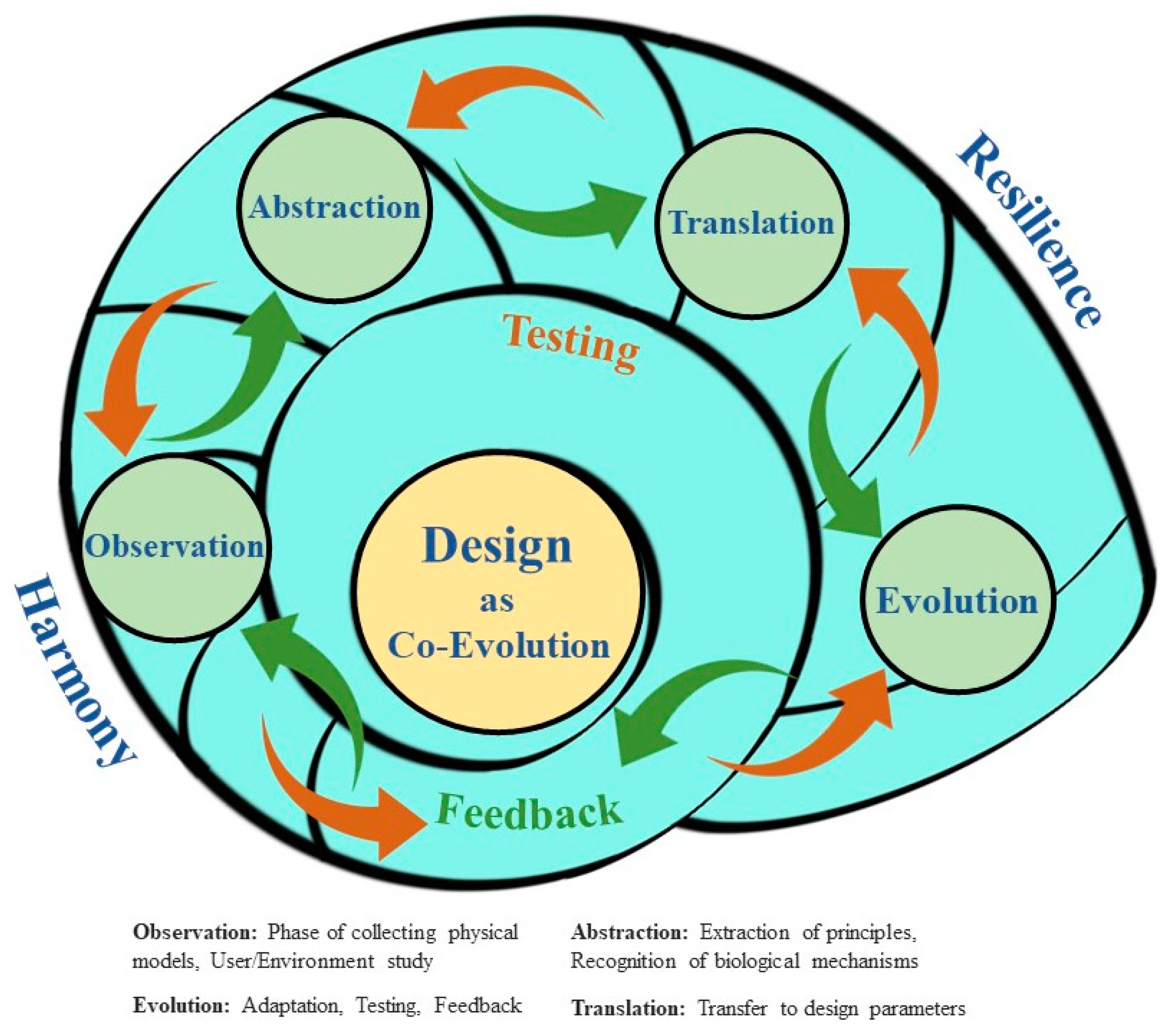
To structure the synthesis of diverse literature, this study introduces the Nautilus Model of Adaptive Design. Using the logarithmic growth of Nautilus Pompilius as a geometric reference, the model associates each “chamber” with a recursive design cycle: Observation, Abstraction, Translation, and Evolution. Unlike linear design models (e.g., Double Diamond), the Nautilus framework assumes that validated design knowledge remains embedded in later iterations, reflecting computational workflows where datasets and simulations guide continuous co-evolution [14,24,25,26,27,28,29]. In this review, the model serves strictly as a recursive maturity framework to categorize the maturity of compliance mechanisms identified in the 52 studies.
1.3. Roadmap of the Study
The remainder of this study is organized as follows: Section 2 outlines the selection criteria and quality appraisal of the evidence base. Section 3 presents the Results, organized into four thematic clusters. Section 4 provides a comprehensive Discussion, formalizing an adaptive ergonomic optimization function, while Section 5 proposes benchmark tasks to guide future research.
2. Literature Curation and Interpretive Approach
This review employs a structured synthesis approach to identify and evaluate the convergence of biomimetic principles and ergonomic design. Rather than a purely descriptive summary, the curation process is designed to be transparent and reproducible, forming the evidence base for the proposed taxonomy and the Nautilus maturity framework.
2.1. Search Strategy and Information Sources
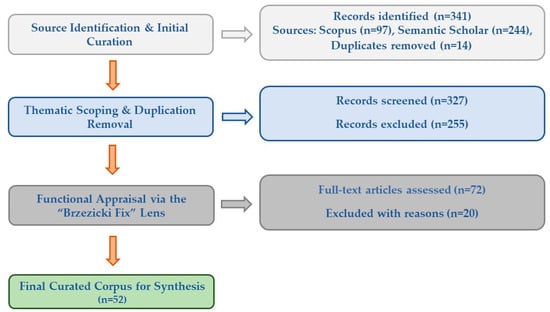
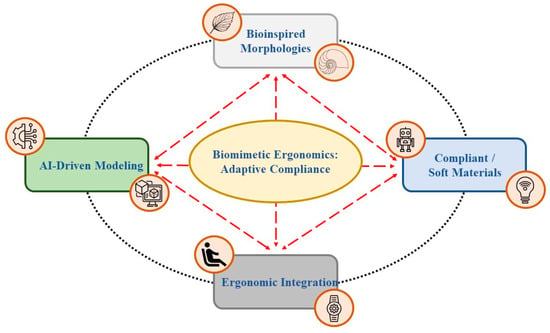
Rather than claiming exhaustiveness, this narrative review adopts a functional-first curation logic to identify key intersections between biomimetic mechanisms and ergonomic performance. The workflow, illustrated in Figure 1, represents a targeted refinement of the literature where the evidence base was filtered through a conceptual lens, the “Brzezicki Fix”. This lens serves not as a rigid eligibility protocol, but as an interpretative filter to distinguish between metaphorical nature-inspiration and measurable ergonomic compliance.
Figure 1.
Literature curation workflow. Transition from the initial pool (n = 341) to the final functional corpus (n = 52) via the “Brzezicki Fix” lens.
2.2. Curation Principles: A Functional Lens for Biomimetic Selection
To ensure the technical integrity of the synthesis, the curation process prioritized studies reporting quantifiable ergonomic indicators, such as pressure distribution or kinematic data, as detailed in Table 1. This functional lens ensures that the synthesis focuses on evidence-based implementations rather than aesthetic styling. During this interpretive stage, candidate works that lacked explicit simulation or user data were set aside or filtered out to maintain a high-resolution evidence base of 52 key studies.
Table 1.
Curation principles for the functional evidence base.
2.3. Evidence Curation and Technical Integrity
To ensure the synthesis is grounded in functional performance rather than metaphorical inspiration, the evidence base was subjected to a technical appraisal. This curation prioritized the selection of studies that provided explicit reporting of measurable ergonomic indicators, such as quantitative data on pressure distribution, muscle effort, or kinematic analysis. Conversely, studies lacking such evidence were filtered out to ensure that the functional validation of biomimetic mechanisms remained central to the review. Furthermore, work restricted to purely conceptual models or aesthetic biomimetic approaches was set aside to maintain the technical integrity of the framework. Brief conference abstracts or technical reports lacking sufficient documentation were also omitted to ensure the reliability of the synthesized benchmarks.
2.4. Synthesis Framework and Structural Logic
To ensure the synthesis is grounded in reliable engineering evidence, each study was subjected to a technical appraisal focusing on methodological clarity and the relevance of ergonomic endpoints. Data were analyzed across four key dimensions: (i) the biological analogue, (ii) the compliance mechanism (Passive, Active, or Hybrid), (iii) reported ergonomic outcomes, and (iv) computational toolsets. This structured approach supported an empirical mapping of the landscape via bibliometric analysis (VOSviewer 1.6.19 [31]), identifying four dominant thematic clusters that organize the findings in the following sections:
- Cluster I: Biomorphic Adaptation (Morphological/Passive)
- Cluster II: Compliant Materials (Material/Passive)
- Cluster III: AI-Driven Modelling (Active/HDT-based)
- Cluster IV: Ergonomic Integration (Hybrid/Eco-centric)
Finally, to evaluate the progression of the field, each implementation was mapped onto the Nautilus Model of Maturity. This mapping provides an audit trail that links theoretical abstraction with measurable ergonomic verification.
3. Results
3.1. Synthesis of the Biomimetic Ergonomic Landscape
The structured curation of the literature resulted in a primary evidence base of 52 studies that satisfy rigorous criteria for functional biomimetic mechanisms and measurable ergonomic outcomes. This section synthesizes these findings, categorizing the identified mechanisms and evaluation practices to provide a high-resolution map of how biomimetic principles inform ergonomic design.
Analysis of this curated corpus reveals a technical continuum dominated by Passive Compliance strategies, which represent 59.6% of the cases. These implementations primarily leverage biomorphic geometries and hierarchical material patterning to achieve intrinsic load distribution without the need for active intervention. In contrast, Active Compliance systems, defined by real-time sensing and robotic actuation, account for 30.8% () of the literature, while emerging Hybrid Compliance architectures, where morphological intelligence is augmented by sparse control, represent 9.6% () of the synthesized evidence.
3.2. Mapping the Evidence Base
To provide a comprehensive overview of the current research landscape, the curated evidence base is categorized according to biological analogues, ergonomic domains, and compliance strategies. This systematic mapping allows for a granular analysis of how specific bio-inspired principles, ranging from auxetic microstructures to peristaltic morphologies, are translated into functional product attributes. Table 2 is presented here not as a comparative database, but as a mapping aid to visualize how current research translates biological principles into specific maturity phases within the Nautilus framework. Furthermore, by applying the Nautilus Model of Maturity, each study is assigned to a specific design phase, from initial observation to closed-loop evolutionary optimization. This classification, detailed in Table 2, highlights the uneven distribution of research efforts and identifies the transition points where material compliance meets computational intelligence.
Table 2.
Systematic characterization and maturity mapping of the curated evidence base (n = 52).
3.3. Synthesis of Thematic Clusters
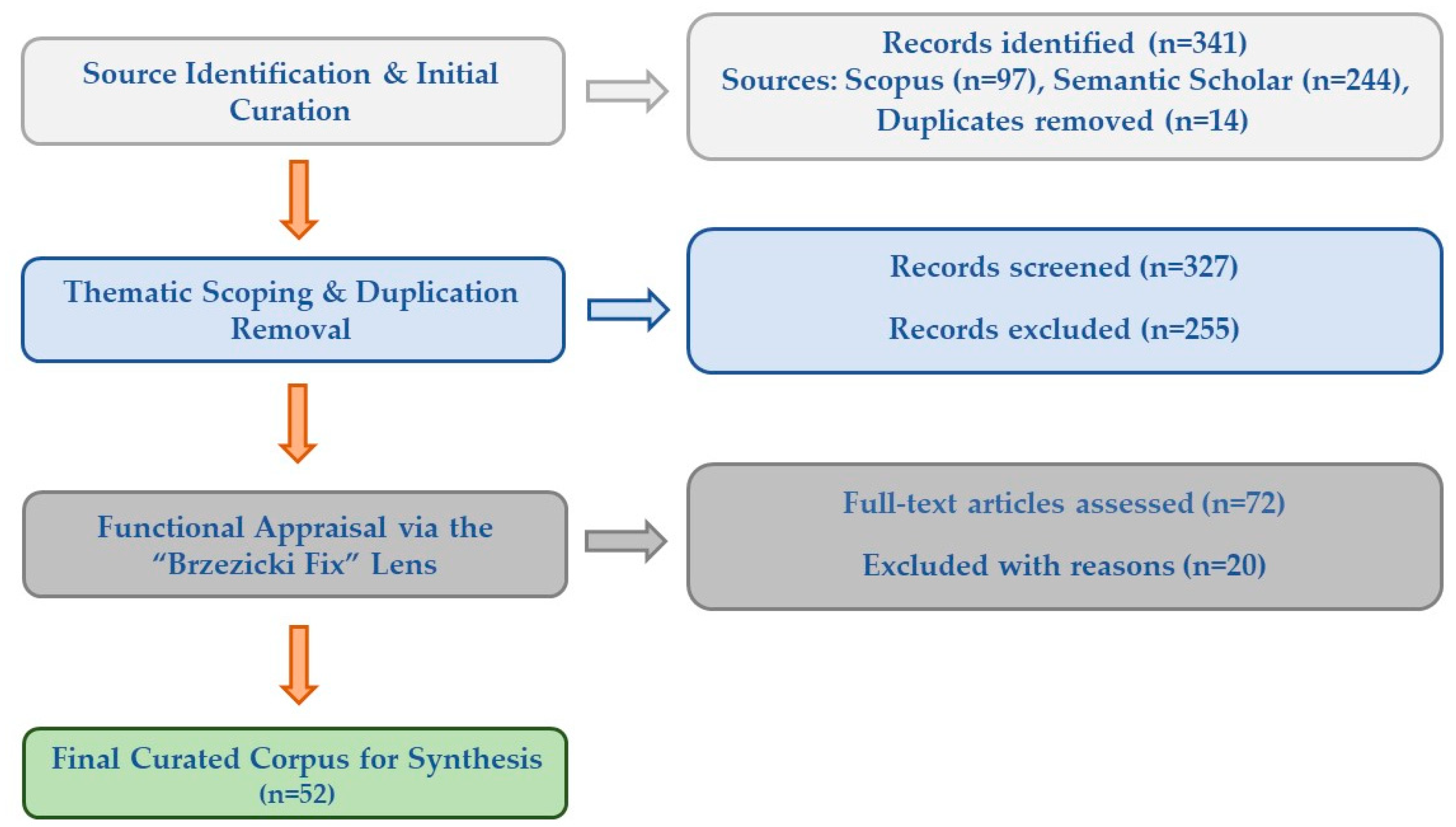
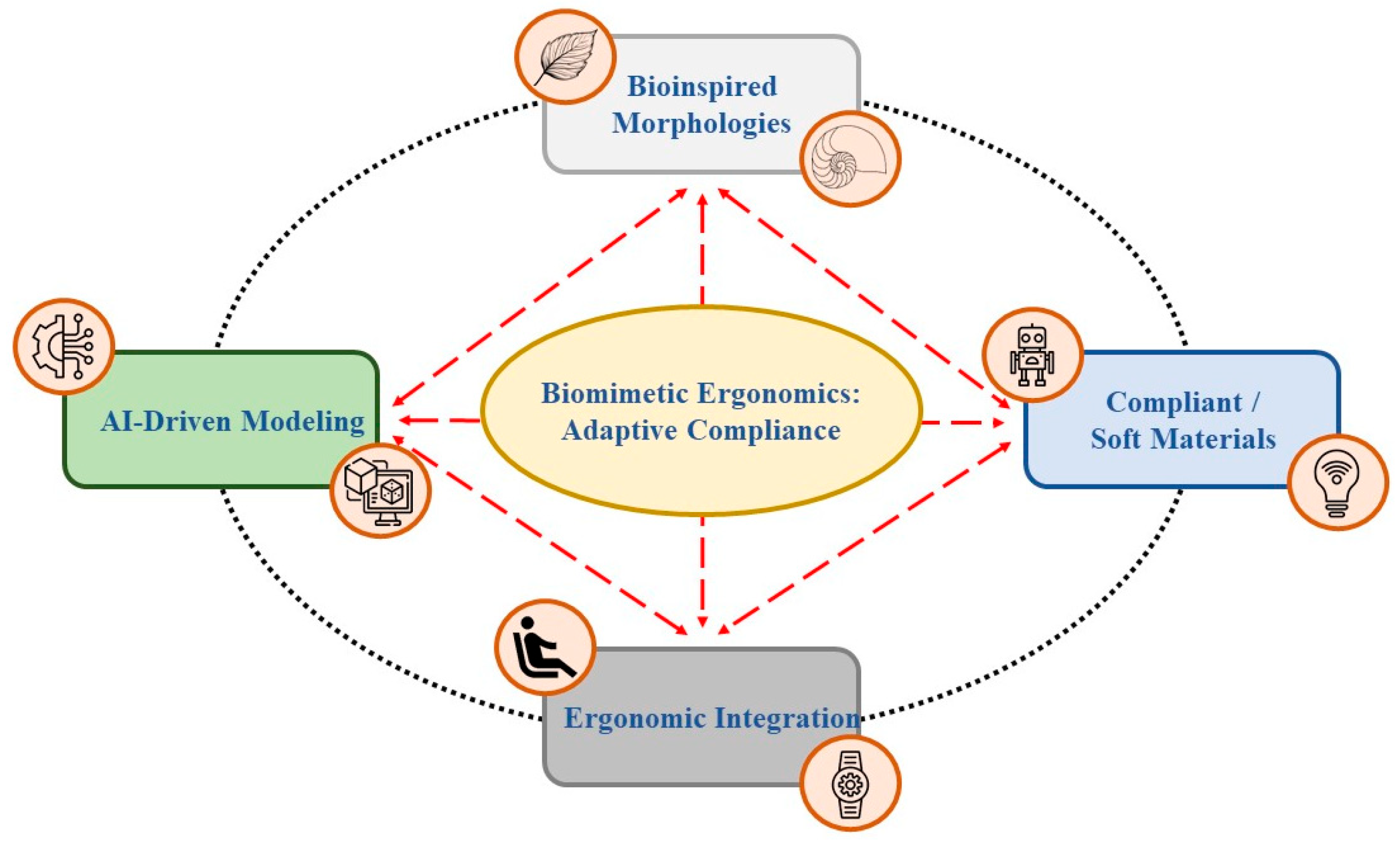
The synthesis of current research identifies four coherent investigation domains that define the state-of-the-art in biomimetic ergonomics. These clusters represent consistent patterns in how biological adaptability is translated into engineered ergonomic functions (Figure 2):
Figure 2.
Taxonomy of biomimetic compliance domains mapping morphological intelligence to adaptive functions. Color-coding denotes the four thematic clusters; red dashed vectors signify bidirectional functional data exchange; the dotted perimeter indicates systemic integration within a co-evolutionary design ecosystem.
3.3.1. Cluster I: Biomorphic Adaptation and Morphological Intelligence
This cluster focuses on the translation of biological growth laws and structural motifs into load-bearing geometries. A significant subgroup of studies investigates auxetic metamaterials for pressure redistribution and impact mitigation [46,51,52]. These mechanisms exploit the negative Poisson’s ratio to achieve a conformal fit in footwear and protective equipment. Furthermore, studies on the logarithmic spiral and elephant trunk dynamics [28,29,72] demonstrate how geometric self-similarity supports adaptive grasping across various scales.
3.3.2. Cluster II: Compliant Materials and Integrated Sensing
Studies in this cluster utilize soft substrates to mediate the human-artifact interface. Key contributions involve flexible micro-pressure sensors inspired by biological arrangements, such as Spider Slit Sensilla [32,33,34]. The use of bacterial nanocellulose and hydrogel networks [35,36] highlights the transition toward materials with tissue-like viscoelastic behavior, allowing for controlled deformation and improved thermal and tactile adaptation [37].
3.3.3. Cluster III: AI-Driven Modeling and Digital Human Twins
This cluster represents the transition toward “living ergonomics” through computational simulation. Studies utilize Digital Human Modeling (DHM) and Human Digital Twins (HDTs) to predict ergonomic responses prior to physical construction [18,22,23]. The integration of Deep Learning and reinforcement learning enables the continuous adjustment of soft robotic control policies based on user feedback [43,69].
3.3.4. Cluster IV: Ergonomic Integration and Systemic Ethics
The final cluster links technical implementation with real-world evaluation. Studies here explicitly connect biomimetic mechanisms with sustainability indicators and circular economy principles [12,58,62]. These works emphasize that adaptive design must maintain ecological resonance, balancing immediate user comfort with long-term resource efficiency [66,67].
3.4. Analysis of Research Maturity and Evolutionary Gaps
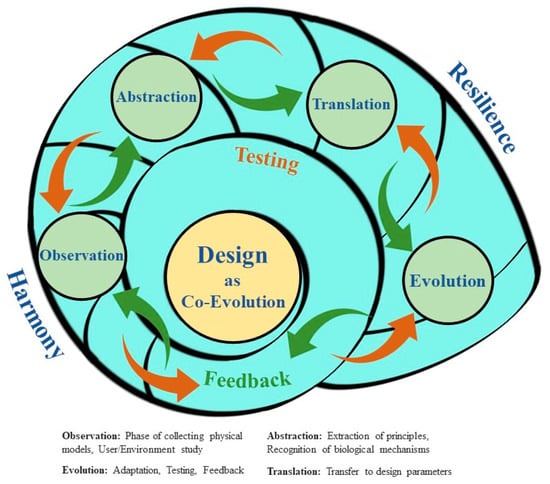
To evaluate the current state of progress, each implementation within the curated evidence base was analyzed through the lens of the Nautilus model (Figure 3), assigning studies to specific maturity phases based on the technical criteria and data types outlined in Table 3. This mapping (detailed in Table 2) reveals that the majority of current research, 59.6% (), occupies the Translation phase, primarily focusing on the initial geometric or material implementation of biomimetic principles. Only a significant subset of recent work (19.2%), has successfully progressed to the Evolution phase, demonstrating the transition toward fully integrated systems characterized by closed-loop learning and multimodal sensing.
Figure 3.
Nautilus Model of Adaptive Design maturity framework. Logarithmic spiral geometry illustrates knowledge-preserving iteration; overlapping chambers signify the integration of validated data into subsequent cycles. Orange and green vectors denote recursive feedback loops within the Observation-Abstraction-Translation-Evolution sequence.
Table 3.
Mapping the biomimetic design process: Data types, analytical methods, and knowledge outcomes across the Nautilus Model phases.
3.5. Characterization of Evaluation Practices and Critical Reporting Gaps
The synthesis of the 52 included studies reveals significant heterogeneity in measurement practices. Ergonomic outcomes are predominantly substantiated through pressure distribution metrics () and load symmetry indices () [4,56], typically measured via seat or plantar pressure maps. From a computational perspective, Finite Element Analysis (FEA) is the standard tool for passive systems, while Reinforcement Learning (RL) dominates active systems [39]. These analytical artifacts, along with their respective verification methods and software toolsets, are systematically categorized in Table 4. A critical reporting omission identified in 40% of the studies is the lack of long-term durability data and energy efficiency metrics. Most ergonomic validations are limited to short-term static tasks, leaving a gap in understanding the performance of biomimetic compliance under dynamic fatigue conditions.
Table 4.
Analytical Artifacts and Verification Practices Identified Across Reviewed Studies.
4. Discussion
The synthesis of the 52 reviewed studies establishes biomimetic compliance not as a mere aesthetic choice, but as a technical continuum ranging from material intelligence to AI-driven co-evolution. This section interprets the findings through the lens of the Nautilus Model, formalizes the adaptive ergonomic objective, and addresses the ethical imperatives of “living” design systems.
4.1. Passive Compliance: The Structural Backbone of Resilience
The evidence from the corpus confirms that morphology-based compliance remains the baseline for ergonomic resilience. As demonstrated in studies involving auxetic metamaterials (Dong & Hu [46], Tahir et al. [51], Zhang et al. [47]), geometric intelligence allows for “designed-in” performance. While the reviewed cases primarily focus on immediate pressure relief, external evidence suggest that the transition from soft to stiff auxetic metamaterials could address the durability gaps identified in this synthesis [59,74].
In terms of mechanical integrity, biomimetic lattices exhibit superior shear-force redistribution and more homogeneous deformation compared to conventional foams [34,55]. These findings are further contextualized by advancements in hydrogel–elastomer hybrids and high-thermal-conductivity elastomers [75,76], which explain the latent potential for the multi-stimuli integration observed in advanced prototypes.
Furthermore, passive systems align naturally with circular economy principles through mono-material construction [42,66,71]. However, a critical limitation remains: static geometry cannot account for inter-individual variability or long-term creep, necessitating the transition toward active and hybrid architectures (Table 5).
Table 5.
Theoretical constructs underpinning biomimetic compliance and their functional implications for Passive, Active, and Hybrid systems.
4.2. Formalizing Adaptive Ergonomics: The Objective
A core contribution of this review is the formalization of ergonomic adaptation into a multi-objective optimization framework. Based on the patterns observed in Cluster III (AI-driven modeling), we define the Adaptive Ergonomic Fitness as:
where
- x: design/control vector (geometry, materials, actuation, gains),
- : normalized objectives for Comfort, Adaptivity, Sustainability, and Ecological resonance,
- are dynamic weighting coefficients that may be updated from feedback,
- : penalty for violating safety/comfort bounds,
- : penalty severity.
Representative safety and comfort bounds are drawn from standards and review work on static working postures and human-seat interaction [2,3,55,56,85].
Comfort is typically instantiated via pressure-based metrics. A widely used index of postural load balance is the Asymmetry Index (AsI):
where and are time-windowed mean pressures over the left and right seating halves. Lower AsI indicates improved symmetry [4,55]. AsI is commonly interpreted alongside spatial dispersion indices (e.g., standard deviation of pressure distribution) and posture criteria from standards such as ISO 9241-210 and ISO 11226 [2,3,4,5,85].
Let denote user state (anthropometry, posture, physiology), the environmental context (temperature, task, energy constraints), and the morphological/mechanical response (compliance, deformation, stiffness). We instantiate:
- Comfort : e.g., , where is spatial pressure dispersion from pressure maps. Denotes min–max (or robust) scaling to [4,55].
- Adaptivity : responsiveness and stability (e.g., normalized range of adjustment , inverse response time )
- Sustainability : inverse lifecycle/energy burden (e.g., normalized energy or carbon footprint; material circularity proxies) [84].
- Ecological Resonance : compatibility with repairability, recyclability, and minimized externalities under the given context [86].
Normalization (per study) maps each raw metric :
Safety and ergonomic limits-joint angles, contact pressures, thermal comfort, are encoded via constraint functions and aggregated into the penalty:
This formulation is compatible with evolutionary multi-objective solvers and reinforcement-learning-based controllers, as demonstrated in classical work on genetic algorithms and more recent applications to ergonomic simulation, high-performance control and sustainable AI optimization [69,78,79,87,88]. Contact pressure thresholds and posture bounds are derived from ergonomic standards and empirical studies [2,3,4,5,85].
Dynamic adaptation arises through time-varying weights , which can be updated according to multiplicative updates or Bayesian schemes based on reinforcement signals (e.g., improvement in comfort or energy use) [87,88,89]. The formalization of the function aligns with established evolutionary computation frameworks, utilizing hybrid genetic algorithms and fuzzy logic to manage the high-dimensional search spaces of ergonomic configurations [87,90]. In a reinforcement learning formulation, the instantaneous reward is:
and policies are learned to maximize expected cumulative reward under changing user and environmental states [87,88,89]. This formalization provides a common language for comparing adaptive seating, soft wearables and intelligent interfaces, which otherwise appear heterogeneous.
4.3. Hybrid Compliance and the Paradigm of Morphological Computation
The most promising trajectory identified in this synthesis is the emergence of Hybrid Compliance, where the control burden is strategically shared between the physical morphology and the digital algorithm (e.g., [40,61,72]).
By delegating high-frequency stabilization to compliant substrates, such as auxetic lattices, the central AI controller is liberated to handle only low-frequency, high-level adjustments. This principle of “Morphological Computation” leads to measurable reductions in energy consumption and control complexity compared to purely robotic systems [8,61,63,91]. Within these hybrid schemes, hierarchical self-organizing control systems enable artifacts to maintain their functional identity under varying loads, effectively distributing the computational burden across the material-software interface [92,93].
4.4. The Ethical Imperative: From Human-Centric to Triadic Ethics
The transition from human-centric to eco-centric systems represents a fundamental shift in design responsibility, moving toward what we define as Triadic Ethics. In this framework, ergonomic quality is no longer restricted to user comfort; it must maintain a dynamic balance between Human safety, Biological resilience (Biomimicry), and Environmental sufficiency (Circular Economy). As systems gain autonomy through Reinforcement Learning (RL) [84,94], these ethical constraints, such as carbon budgets and musculoskeletal safety, must be encoded as ‘hard penalties’ within the optimization function. This integration ensures that the sensory implications of soft robotic interactions maintain user trust while aligning with planetary boundaries, as operationalized in the adaptive framework (Table 6) [95].
Table 6.
Ethical and eco-centric principles in adaptive ergonomics and their operationalization via computational constraints and multi-objective optimization.
4.5. Critical Gaps and the ‘Grand Challenges’ for Future Research
Despite technical advances, the synthesis identifies three ‘Grand Challenges’ that define the future research agenda for biomimetic ergonomics. First, there is a pervasive Metric Fragmentation; the lack of standardized, cross-disciplinary definitions for ‘Comfort’ and “Adaptivity” currently hinders robust meta-analysis. Second, a significant Longevity Gap exists, as only a fraction of current studies report durability data beyond 100,000 cycles, leaving the long-term performance of bio-inspired materials uncertain. Finally, future investigations must prioritize Ablation Studies to clearly disentangle the performance benefits of material morphology (Passive) from those of the algorithmic controller (Active). Addressing these gaps is essential for moving from experimental prototypes to reliable, eco-centric ergonomic products.
4.6. Toward Co-Evolutionary Design Ecosystems
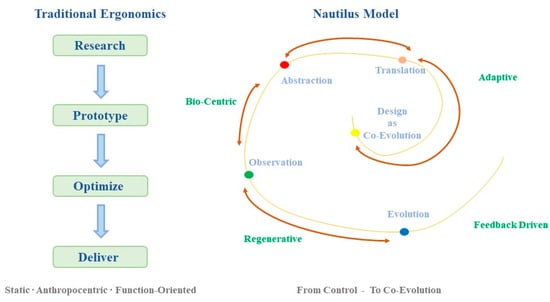
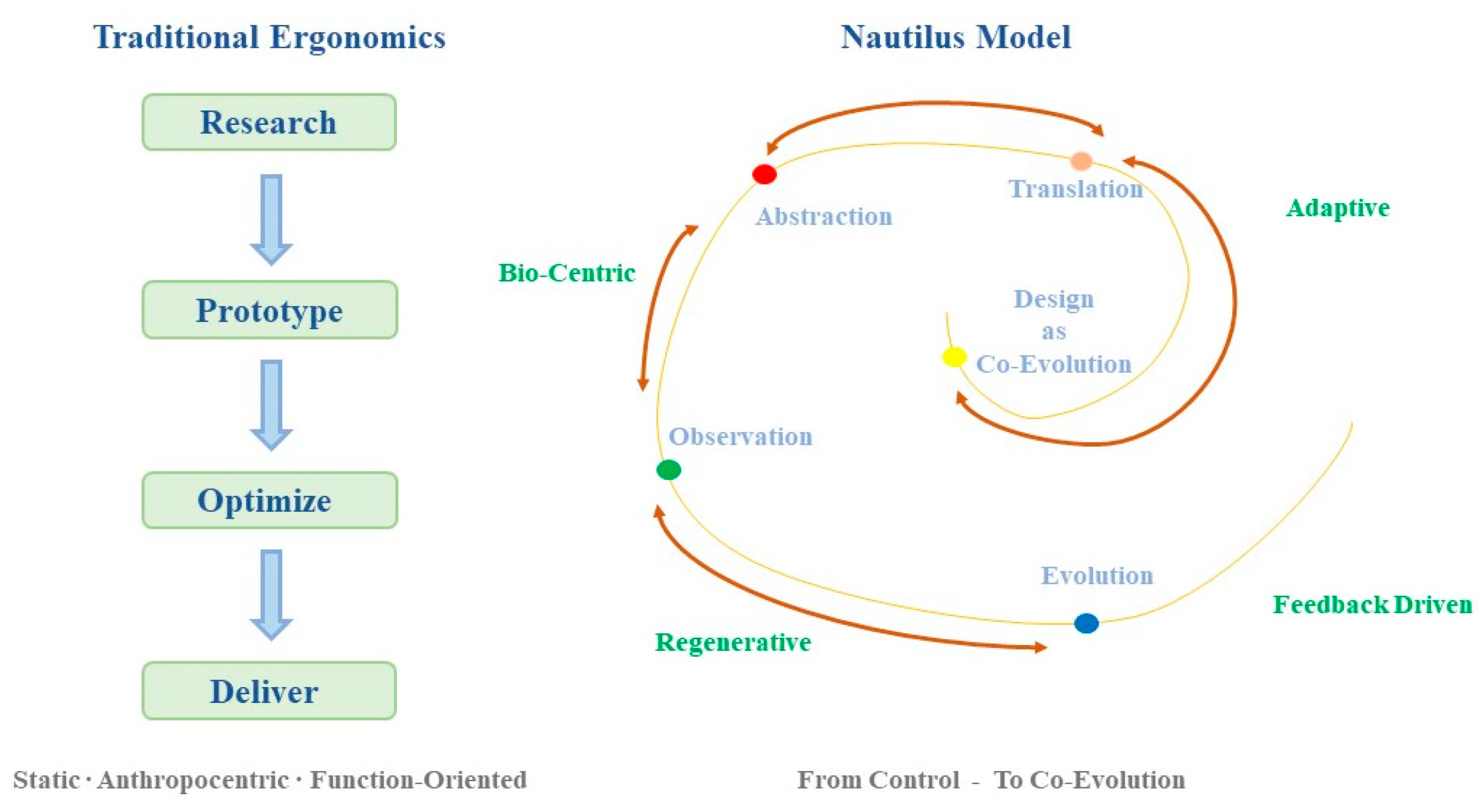
The findings suggest that the future of ergonomics lies in co-evolutionary ecosystems. As illustrated in Figure 4, the Nautilus Model moves beyond the linear “Double Diamond” approach, treating artifacts as living participants in an adaptive loop.
Figure 4.
Conceptual comparison between traditional ergonomic design models and the Nautilus Model of adaptive co-evolution.
In this framework, the designer becomes a curator of evolutionary processes, ensuring that the artifact’s “fitness” remains aligned with both human well-being and planetary boundaries.
5. Conclusions and Outlook
This synthesis establishes that biomimetic ergonomics is transitioning from static imitation toward integrated, co-adaptive systems. However, the identified reporting gaps and technical heterogeneities necessitate a unified research agenda. To bridge the gap between laboratory prototypes and real-world implementation, we propose three Grand Challenges as evidence-informed benchmarks. These tasks are not presented as validated industry standards, but as methodological proposals derived from recurring limitations observed in the curated corpus. This narrative review does not aim at exhaustive coverage, but at conceptual consolidation and the setting of a strategic research agenda for the field.
5.1. Challenge 1: Real-Time, Multi-Axial Load Compensation
Biological motion involves the concurrent processing of shear, compression, and torsion at high temporal frequencies. To achieve true functional compliance, future active and hybrid systems must demonstrate stable control performance at sampling frequencies exceeding 100 Hz, depending on the computational bandwidth of the integrated controllers. This benchmark requires closed-loop architectures capable of integrating multimodal feedback, such as EMG, pressure mapping, and IMU data, to achieve a demonstrable reduction in cumulative joint loads compared to non-adaptive baselines. While several reviewed exosuits address uniaxial loading, the transition to real-time multi-axial compensation remains a primary frontier for the field.
5.2. Challenge 2: Multi-Stimuli Integration and Synthetic Skins
Adaptive responses in nature often emerge from the concurrent processing of thermal, mechanical, and tactile stimuli. A key challenge for future ergonomic interfaces is the integration of at least three independent response pathways: thermal regulation, pressure-triggered stiffness adjustment, and tactile texture modulation. Although hydrogel-based electronic skins show latent potential, no system in the reviewed corpus achieves full real-time integration. Progress requires computational frameworks that can arbitrate competing demands under strict energy and resource constraints, moving toward ‘synthetic skins’ that truly emulate biological sensing.
5.3. Challenge 3: Longitudinal Reliability and Hierarchical Protection
The issue of long-term reliability is perhaps the most significant bottleneck identified in this review. To ensure operational viability, hybrid compliant systems must demonstrate endurance over at least 500,000 cycles under representative loading scenarios. We propose that this can be achieved through Hierarchical Compliance, where passive biomorphic architectures (inspired by bone or shell structures) shield active components from basal loads. This strategy reduces strain accumulation and failure rates, ensuring that biomimetic products can survive the rigors of sustained ergonomic use rather than remaining laboratory curiosities.
5.4. Conclusions
This review demonstrates that biomimetic ergonomics has evolved into an interdisciplinary domain where morphology, computation, and ethics converge. The evidence indicates that while the field is currently dominated by Passive Compliance, the future lies in Hybrid architectures that combine morphological intelligence with closed-loop feedback.
The primary contribution of this work is the consolidation of this landscape through the Passive/Active Taxonomy, the Nautilus Maturity Model, and the definition of Measurable Benchmarks (100 Hz adaptation and 500,000-cycle durability). These elements delineate a research agenda where ergonomic products are no longer static tools, but partners in a Regenerative Design Ecology. The forthcoming generation of ergonomic systems will not merely comply with the human body; they will co-evolve with users and environments, maintaining a dynamic equilibrium between human well-being and planetary boundaries.
Author Contributions
Conceptualization, N.G.; methodology, N.G. and V.A.; validation, N.G. and V.A.; formal analysis, N.G.; investigation, N.G. and E.S.; resources, J.T.; data curation, N.G.; writing—original draft preparation, N.G. and J.T.; writing—review and editing, N.G. and V.A.; visualization, N.G.; supervision, G.P. and G.A.P.; project administration, G.A.P. All authors have read and agreed to the published version of the manuscript.
Funding
This research received no external funding.
Institutional Review Board Statement
Ethical review and approval were waived for this study because no human or animal subjects were involved. The work is limited to mechanical and computational modelling, in accordance with the institutional guidelines of the University of West Attica.
Informed Consent Statement
Not applicable. No human subjects were involved in the study.
Data Availability Statement
No new data were created or analyzed in this study. All data supporting the findings of this synthesis are derived from the published literature cited within the manuscript. The evidence audit trail, literature curation frameworks, and the per-study maturity coding matrix used to develop the taxonomy and benchmarks are integrated in full within the main text and tables (see Table 2, Table 3 and Table 4).
Acknowledgments
The authors would like to express their gratitude to the Department of Industrial Design and Production Engineering, University of West Attica, for providing access to the laboratory facilities used during the development of the conceptual models and illustrations presented in this work. During the preparation of this manuscript, the authors employed ChatGPT (GPT-5, OpenAI, 2025) for structural editing, and Zotero (v6.0) for reference management and citation formatting. It is asserted that all content and references have been thoroughly reviewed, verified and edited by the authors, who accept full responsibility for the integrity and accuracy of the final publication.
Conflicts of Interest
The authors declare no conflicts of interest. The funders had no role in the design of the study; in the collection, analyses, or interpretation of data; in the writing of the manuscript; or in the decision to publish the results.
Abbreviations
The following abbreviations are used in this manuscript:
| AsI | Asymmetry Index |
| AI | Artificial Intelligence |
| GA | Genetic Algorithm |
| DT | Digital Twin |
| HDT | Human Digital Twin |
| DHM | Digital Human Modelling |
| LCA | Life Cycle Assessment |
| FEA | Finite Element Analysis |
| RL | Reinforcement Learning |
| IMU | Inertial Measurement Unit |
| IRB | Institutional Review Board |
| SD | Standard Deviation |
| CI | Confidence Interval |
References
- Dianat, I.; Molenbroek, J.M.F.; Castellucci, H.I. A Review of the Methodology and Applications of Anthropometry in Ergonomics and Product Design. Ergonomics 2018, 61, 1696–1720. [Google Scholar] [CrossRef] [Scilit]
- Delleman, N.J.; Boocock, M.G.; Kapitaniak, B.; Schaefer, P.; Schaub, K. ISO/FDIS 11226: Evaluation of Static Working Postures. In Proceedings of the Human Factors and Ergonomics Society Annual Meeting, Santa Monica, CA, USA, 30 July–4 August 2000; Volume 44, pp. 6-442–6-443. [Google Scholar] [CrossRef] [Scilit]
- Delleman, N.J.; Dul, J. Evaluation of Static Working Postures. In Handbook of Standards and Guidelines in Human Factors and Ergonomics, 2nd ed.; Karwowski, W., Ed.; CRC Press: Boca Raton, FL, USA, 2021. [Google Scholar] [CrossRef] [Scilit]
- Jarumethitanont, W.; Manupibul, U.; Tanthuwapathom, R.; Prasertsukdee, S.; Limroongreungrat, W.; Charoensuk, W. Development of Low-Cost Pressure Mapping Device to Evaluate Force Distribution for Seat Cushion Modification. Sci. Rep. 2024, 14, 21954. [Google Scholar] [CrossRef] [Scilit]
- ISO 11226:2000; Ergonomics—Evaluation of Static Working Postures. ISO: Geneva, Switzerland, 2000.
- Kauffman, S.A. The Origins of Order: Self-Organization and Selection in Evolution; Oxford University Press: New York, NY, USA, 1993. [Google Scholar] [CrossRef] [Scilit]
- Turing, A.M. The Chemical Basis of Morphogenesis. Philos. Trans. R. Soc. B Biol. Sci. 1952, 237, 37–72. [Google Scholar] [CrossRef] [Scilit]
- Pfeifer, R.; Bongard, J.C. How the Body Shapes the Way We Think: A New View on Intelligence; MIT Press: Cambridge, MA, USA, 2006. [Google Scholar] [CrossRef] [Scilit]
- Bateson, G. Steps to an Ecology of Mind; University of Chicago Press: Chicago, IL, USA, 1972. [Google Scholar]
- Maturana, H.R.; Varela, F.J. Autopoiesis and Cognition: The Realization of the Living; D. Reidel Publishing Company: Dordrecht, The Netherlands, 1980; Volume 42. [Google Scholar] [CrossRef] [Scilit]
- Benyus, J.M. Biomimicry: Innovation Inspired by Nature; William Morrow & Co: New York, NY, USA, 1997. [Google Scholar]
- Ilieva, L.; Ursano, I.; Traista, L.; Hoffmann, B.; Dahy, H. Biomimicry as a Sustainable Design Methodology—Introducing the ‘Biomimicry for Sustainability’ Framework. Biomimetics 2022, 7, 37. [Google Scholar] [CrossRef] [Scilit] [PubMed]
- Fisch, M.R. The Nature of Biomimicry. Sci. Technol. Hum. Values 2017, 42, 795–821. [Google Scholar] [CrossRef] [Scilit]
- Evans, A.R.; Pollock, T.I.; Cleuren, S.G.C.; Parker, W.M.G.; Richards, H.L.; Garland, K.L.S.; Fitzgerald, E.M.G.; Wilson, T.E.; Hocking, D.P.; Adams, J.W. A Universal Power Law for Modelling the Growth and Form of Teeth, Claws, Horns, Thorns, Beaks, and Shells. BMC Biol. 2021, 19, 58. [Google Scholar] [CrossRef] [Scilit] [PubMed]
- Zhang, Q.; Yang, X.; Li, P.; Huang, G.; Feng, S.; Shen, C.; Han, B.; Zhang, X.; Jin, F.; Xu, F.; et al. Bioinspired Engineering of Honeycomb Structure-Using Nature to Inspire Human Innovation. Prog. Mater. Sci. 2015, 74, 332–400. [Google Scholar] [CrossRef] [Scilit]
- Eid, M.A.H.; Al-Abdallah, G.M. Sustainable Development through Biomimicry: Enhancing Circular Economy Practices for Environmental Sustainability. Sustain. Dev. 2024, 32, 6045–6056. [Google Scholar] [CrossRef] [Scilit]
- Dicks, H. The Philosophy of Biomimicry. Philos. Technol. 2016, 29, 223–243. [Google Scholar] [CrossRef] [Scilit]
- da Silva, A.G.; Mendes Gomes, M.V.; Winkler, I. Virtual Reality and Digital Human Modeling for Ergonomic Assessment in Industrial Product Development: A Patent and Literature Review. Appl. Sci. 2022, 12, 1084. [Google Scholar] [CrossRef] [Scilit]
- Dahibhate, G.; Shinde, R.; Sakle, N. The Use of Digital Human Modeling in Ergonomic Design and Product Development. J. Inst. Eng. India Ser. C 2023, 104, 1133–1138. [Google Scholar] [CrossRef] [Scilit]
- Lasota, A.M.; Hankiewicz, K. Digital Human Modeling in Improving the Ergonomics of Industrial Workplace—A Methodological Framework. Manag. Prod. Eng. Rev. 2024, 15, 182–192. [Google Scholar] [CrossRef] [Scilit]
- Pascual, H.; Bruin, X.M.; Alonso, A.; Cerdà, J. A Systematic Review on Human Modeling: Digging into Human Digital Twin Implementations. arXiv 2023, arXiv:2302.03593. [Google Scholar] [CrossRef] [Scilit]
- Tudor, B.H.; Shargo, R.; Gray, G.M.; Fierstein, J.L.; Kuo, F.H.; Burton, R.; Johnson, J.T.; Scully, B.B.; Asante-Korang, A.; Rehman, M.A.; et al. A Scoping Review of Human Digital Twins in Healthcare Applications and Usage Patterns. npj Digit. Med. 2025, 8, 587. [Google Scholar] [CrossRef] [Scilit]
- He, Q.; Li, L.; Li, D.; Peng, T.; Zhang, X.; Cai, Y.; Zhang, X.; Tang, R. From Digital Human Modeling to Human Digital Twin: Framework and Perspectives in Human Factors. Chin. J. Mech. Eng. 2024, 37, 9. [Google Scholar] [CrossRef] [Scilit]
- Guven, J.; Manrique, G. Conformal Mechanics of Planar Curves; Springer: Cham, Switzerland, 2019. [Google Scholar]
- Selbach-Allen, M.; Williams, C.; Boaler, J. What Would the Nautilus Say? Unleashing Creativity in Mathematics! J. Humanist. Math. 2020, 10, 391–414. [Google Scholar] [CrossRef] [Scilit]
- Aldridge, A. Refined Methods for Estimating Spirals and Spiral Deviations. Palaeontol. Electron. 2020, 23, a21. [Google Scholar] [CrossRef] [Scilit]
- Wiese, R.; Harrington, K.; Hartmann, K.; Hethke, M.; Von Rintelen, T.; Zhang, H.; Zhang, L.; Riedel, F. Can Fractal Dimensions Objectivize Gastropod Shell Morphometrics? A Case Study from Lake Lugu (SW China). Ecol. Evol. 2022, 12, e8622. [Google Scholar] [CrossRef] [Scilit] [PubMed]
- Wang, Z.; Freris, N.M.; Wei, X. SpiRobs: Logarithmic Spiral-Shaped Robots for Versatile Grasping across Scales. Device 2025, 3, 100646. [Google Scholar] [CrossRef] [Scilit]
- Huang, H.; Wang, H.; Fang, C.; Yan, M.; Xu, R.; Zhang, Y.; Wang, Z.; Ying, F.; Liu, J.; Laschi, C.; et al. Grasping by Spiraling: Reproducing Elephant Movements with Rigid-Soft Robot Synergy. npj Robot. 2025, 3, 18. [Google Scholar] [CrossRef] [Scilit]
- Xiao, C.; Seong, D. Research on the Application of Biomimetic Design in Art and Design. Biomimetics 2025, 10, 541. [Google Scholar] [CrossRef] [Scilit]
- van Eck, N.J.; Waltman, L. Software Survey: VOSviewer, a Computer Program for Bibliometric Mapping. Scientometrics 2009, 84, 523–538. [Google Scholar] [CrossRef] [Scilit]
- Pan, D.; Hu, J.; Wang, B.; Xia, X.; Cheng, Y.; Wang, C.-H.; Lu, Y. Biomimetic Wearable Sensors: Emerging Combination of Intelligence and Electronics. Adv. Sci. 2023, 11, 2304127. [Google Scholar] [CrossRef] [Scilit]
- Hu, J.; Dun, G.; Geng, X.; Chen, J.; Wu, X.; Ren, T.-L. Recent Progress in Flexible Micro-Pressure Sensors for Wearable Health Monitoring. Nanoscale Adv. 2023, 5, 3131–3145. [Google Scholar] [CrossRef] [Scilit] [PubMed]
- Li, Y.; Xue, Q.; Zhang, Z.; Bian, Y.; Jin, B.; Yang, F. Pressure Sensors With Ultrahigh Sensitivity Inspired by Spider Slit Sensilla. IEEE Sens. J. 2023, 23, 11729–11737. [Google Scholar] [CrossRef] [Scilit]
- Tao, K.; Yu, J.; Zhang, J.; Bao, A.; Hu, H.; Ye, T.; Ding, Q.; Wang, Y.; Lin, H.; Wu, J.; et al. Deep-Learning Enabled Active Biomimetic Multifunctional Hydrogel Electronic Skin. ACS Nano 2023, 17, 13731–13745. [Google Scholar] [CrossRef] [Scilit] [PubMed]
- Roberts, E.L.; Abdollahi, S.; Oustadi, F.; Stephens, E.D.; Badv, M. c Applications. ACS Mater. Au 2023, 3, 418–441. [Google Scholar] [CrossRef] [Scilit]
- Dhiman, R.; Lai, A.K.M.; Dolez, P.I. Exploring the Tactile and Thermal Behaviour of Rose Petals for Bio-Inspired Material Design. Colloids Surf. B Biointerfaces 2025, 256, 114321. [Google Scholar] [CrossRef] [Scilit] [PubMed]
- Imani, M.; Le Guen, M.J.; Bedggood, N.; Betteridge, C.; Gauss, C.; Barbier, M. Biomimetic Shading Systems: Integrating Motorised and Moisture-Responsive Actuation for Adaptive Façades. Biomimetics 2025, 10, 42. [Google Scholar] [CrossRef] [Scilit]
- Nguyen, C.C.; Thai, M.T.; Hoang, T.T.; Davies, J.; Phan, P.T.; Zhu, K.; Wu, L.; Brodie, M.A.; Tsai, D.; Ha, Q.P.; et al. Development of a Soft Robotic Catheter for Vascular Intervention Surgery. Sens. Actuators Phys. 2023, 357, 114380. [Google Scholar] [CrossRef] [Scilit]
- Karipoth, P.; Christou, A.; Pullanchiyodan, A.; Dahiya, R. Bioinspired Inchworm-and Earthworm-like Soft Robots with Intrinsic Strain Sensing. Adv. Intell. Syst. 2022, 4, 2100092. [Google Scholar] [CrossRef] [Scilit]
- Ahmed, F.; Waqas, M.; Jawed, B.; Soomro, A.M.; Kumar, S.; Hina, A.; Khan, U.; Kim, K.H.; Choi, K.H. Decade of Bio-Inspired Soft Robots: A Review. Smart Mater. Struct. 2022, 31, 073002. [Google Scholar] [CrossRef] [Scilit]
- Bardi, E.; Gandolla, M.; Braghin, F.; Resta, F.; Pedrocchi, A.L.; Ambrosini, E. Upper Limb Soft Robotic Wearable Devices: A Systematic Review. J. NeuroEng. Rehabil. 2022, 19, 87. [Google Scholar] [CrossRef] [Scilit] [PubMed]
- Zeng, C.; Yang, C.; Chen, Z. Bio-Inspired Robotic Impedance Adaptation for Human-Robot Collaborative Tasks. Sci. China Inf. Sci. 2020, 63, 170201. [Google Scholar] [CrossRef] [Scilit]
- Justus, K.B.; Hellebrekers, T.; Lewis, D.D.; Wood, A.; Ingham, C.; Majidi, C.; LeDuc, P.R.; Tan, C. A Biosensing Soft Robot: Autonomous Parsing of Chemical Signals through Integrated Organic and Inorganic Interfaces. Sci. Robot. 2019, 4, eaax0765. [Google Scholar] [CrossRef] [Scilit]
- Jing, H.; Xu, L.; Wang, X.; Liu, Y.; Hao, J. A Phase-Change Gel Based Pressure Sensor with Tunable Sensitivity for Artificial Tactile Feedback Systems. J. Mater. Chem. A 2021, 9, 19914–19921. [Google Scholar] [CrossRef] [Scilit]
- Dong, S.; Hu, H. Sensors Based on Auxetic Materials and Structures: A Review. Materials 2023, 16, 3603. [Google Scholar] [CrossRef] [Scilit] [PubMed]
- Zhang, Y.; Jiang, W.Z.; Jiang, W.; Zhang, X.Y.; Dong, J.; Xie, Y.M.; Evans, K.E.; Ren, X. Recent Advances of Auxetic Metamaterials in Smart Materials and Structural Systems. Adv. Funct. Mater. 2025, 35, 2421746. [Google Scholar] [CrossRef] [Scilit]
- Mohamad Razali, N.F.; Mohd Sahar, N.; Islam, M.S.; Alawad, M.A.; Islam, M.T. Recent Developments of Auxetic Metamaterials. Adv. Phys. X 2025, 10, 2548208. [Google Scholar] [CrossRef] [Scilit]
- Kang, M.; Pyo, S. Auxetic Mechanical Metamaterials for Resistive Tactile Sensors: A Review. Adv. Phys. X 2025, 10, 2572830. [Google Scholar] [CrossRef] [Scilit]
- Lvov, V.A.; Senatov, F.S.; Veveris, A.A.; Skrybykina, V.A.; Díaz Lantada, A. Auxetic Metamaterials for Biomedical Devices: Current Situation, Main Challenges, and Research Trends. Materials 2022, 15, 1439. [Google Scholar] [CrossRef] [Scilit] [PubMed]
- Tahir, D.; Zhang, M.; Hu, H. Auxetic Materials for Personal Protection: A Review. Phys. Status Solidi B 2022, 259, 2200324. [Google Scholar] [CrossRef] [Scilit]
- Zhang, J.; Lu, S.; Yang, Y.; Liu, Y.; Guo, Y.; Wang, H. Efficacy of Auxetic Lattice Structured Shoe Sole in Advancing Footwear Comfort—From the Perspective of Plantar Pressure and Contact Area. Front. Public Health 2024, 12, 1412518. [Google Scholar] [CrossRef] [Scilit]
- Chen, T.; Tian, M.; Wang, X. A Novel Porous Structural Design of the Orthotic Insole for Diabetic Foot. In Proceedings of the 2021 International Conference on Computer, Control and Robotics (ICCCR), Shanghai, China, 8–10 January 2021; pp. 188–192. [Google Scholar] [CrossRef] [Scilit]
- Arzehgar, A.; Nia, R.G.N.N.; Hoseinkhani, M.; Masoumi, F.; Sayyed-Hosseinian, S.-H.; Eslami, S. An Overview of Plantar Pressure Distribution Measurements and Its Applications in Health and Medicine. Gait Posture 2025, 117, 235–244. [Google Scholar] [CrossRef] [Scilit]
- Nguyen, M.T.; Hirao, A. Finite Element Modeling of Human–Seat Interaction and the Integration of 3D-Printed Foam in Enhancing Sitting Comfort: A Systematic Review. Appl. Sci. 2025, 15, 10193. [Google Scholar] [CrossRef] [Scilit]
- Alawneh, O.; Zhong, X.; Faieghi, R.; Xi, F. Finite Element Methods for Modeling the Pressure Distribution in Human Body–Seat Interactions: A Systematic Review. Appl. Sci. 2022, 12, 6160. [Google Scholar] [CrossRef] [Scilit]
- Protasenko, O.; Ivashura, A.; Yermolenko, O.; Ponomarenko, Y. Safe and Productive Digital Workplace: Eco-Ergonomic Principles of Organisation. Innov. Sustain. 2025, 5, 83–91. [Google Scholar] [CrossRef] [Scilit]
- Mouhib, H.; Amar, S.; Elrhanimi, S.; El Abbadi, L. A Comprehensive Review of Human Factors and Ergonomics in Industry 5.0. In Proceedings of the 3rd International Conference on Advanced Technology and Humanity (ICATH 2025), Casablanca, Morocco, 3 November 2025; p. 61. [Google Scholar] [CrossRef] [Scilit]
- Li, X.; Peng, W.; Wu, W.; Xiong, J.; Lu, Y. Auxetic Mechanical Metamaterials: From Soft to Stiff. Int. J. Extreme Manuf. 2023, 5, 042003. [Google Scholar] [CrossRef] [Scilit]
- Li, F.; Han, S.; Lee, C.-H.; Feng, S.; Jiang, Z.; Sun, Z. A New Era in Human Factors Engineering: A Survey of the Applications and Prospects of Large Multimodal Models. Int. J. Hum. Comput. Interact. 2025, 41, 11867–11880. [Google Scholar] [CrossRef] [Scilit]
- Sá, A.A.; Viana, D.M. Design and Biomimicry: A Review of Interconnections and Creative Potentials. Biomimetics 2023, 8, 61. [Google Scholar] [CrossRef] [Scilit] [PubMed]
- Metwally, W.M. Biomimicry and Green Architecture: Nature-Inspired Innovations for Sustainable Buildings. Sustainability 2025, 17, 7223. [Google Scholar] [CrossRef] [Scilit]
- Wei, X.; Wang, Y.; Liu, Y.; Ji, K.; Li, K.; Wang, J.; Gu, Z. Biomimetic Design Strategies for Biomedical Applications. Matter 2024, 7, 826–854. [Google Scholar] [CrossRef] [Scilit]
- McMahon, M.; Erolin, C. Biomimicry–Medical Design Concepts Inspired by Nature. J. Vis. Commun. Med. 2024, 47, 27–38. [Google Scholar] [CrossRef] [Scilit]
- Gebeshuber, I.C. Editorial Board Members’ Collection Series: Biomimetic Design, Constructions and Devices in Times of Change I. Biomimetics 2024, 9, 412. [Google Scholar] [CrossRef] [Scilit] [PubMed]
- Silva, F.H.Y.D.; Perera, B.A.K.S.; Atapattu, A.M.D.S.; Wijewickrama, M.K.C.S. Adaptability of Biomimicry Applications in Improving the Sustainability in the Construction Industry. Environ. Dev. 2025, 55, 101197. [Google Scholar] [CrossRef] [Scilit]
- Kenny, V.; Bapat, S.; Smith, P.; La Scala, J.; Malshe, A.P. Bioinspired Designs for Lightweighting, a Critical Review for Manufacturing. Biomimetics 2025, 10, 150. [Google Scholar] [CrossRef] [Scilit]
- Yigci, D.; Ahmadpour, A.; Tasoglu, S. AI-Based Metamaterial Design for Wearables. Adv. Sens. Res. 2024, 3, 2300109. [Google Scholar] [CrossRef] [Scilit]
- Alevizos, V.; Gerolimos, N.; Leligkou, E.A.; Hompis, G.; Priniotakis, G.; Papakostas, G.A. Sustainable Swarm Intelligence: Assessing Carbon-Aware Optimization in High-Performance AI Systems. Technologies 2025, 13, 12. [Google Scholar] [CrossRef] [Scilit]
- Han, X.; Gong, C.; Yang, Q.; Zheng, K.; Wang, Z.; Zhang, W. Biomimetic Nano-Drug Delivery System: An Emerging Platform for Promoting Tumor Treatment. Int. J. Nanomed. 2024, 19, 571–608. [Google Scholar] [CrossRef] [Scilit] [PubMed]
- Sengul, M.; Tasdemir, H.A.; Tamer, A. Real-World Applications of Auxetic Structures in Engineering: A Review. Structures 2025, 80, 109673. [Google Scholar] [CrossRef] [Scilit]
- Boafo, G.F.; Biswal, D.K. Advances in Functional Metamaterials: Bridging Mechanical, Acoustic Innovations with Multifunctionality and Adaptive Responses. Results Eng. 2025, 28, 101894. [Google Scholar] [CrossRef] [Scilit]
- ISO 9241-210:2019; Ergonomics of Human-System Interaction–Part 210: Human-Centred Design for Interactive Systems. ISO: Geneva, Switzerland, 2019.
- Vincent, J.F.V.; Bogatyreva, O.; Bogatyrev, N.; Bowyer, A.; Pahl, A.-K. Biomimetics: Its Practice and Theory. J. R. Soc. Interface 2006, 3, 471–482. [Google Scholar] [CrossRef] [Scilit]
- Duncan, O.; Shepherd, T.; Moroney, C.; Foster, L.; Venkatraman, P.D.; Winwood, K.; Allen, T.; Alderson, A. Review of Auxetic Materials for Sports Applications: Expanding Options in Comfort and Protection. Appl. Sci. 2018, 8, 941. [Google Scholar] [CrossRef] [Scilit]
- Yuk, H.; Zhang, T.; Parada, G.A.; Liu, X.; Zhao, X. Skin-Inspired Hydrogel–Elastomer Hybrids with Robust Interfaces and Functional Microstructures. Nat. Commun. 2016, 7, 12028. [Google Scholar] [CrossRef] [Scilit]
- Bartlett, M.D.; Kazem, N.; Powell-Palm, M.J.; Huang, X.; Sun, W.; Malen, J.A.; Majidi, C. High Thermal Conductivity in Soft Elastomers with Elongated Liquid Metal Inclusions. Proc. Natl. Acad. Sci. USA 2017, 114, 2143–2148. [Google Scholar] [CrossRef] [Scilit]
- Darwin, C. On the Origin of Species by Means of Natural Selection, or the Preservation of Favoured Races in the Struggle for Life; John Murray: London, UK, 1859. [Google Scholar] [CrossRef] [Scilit]
- Holland, J.H. Adaptation in Natural and Artificial Systems: An Introductory Analysis with Applications to Biology, Control, and Artificial Intelligence; University of Michigan Press: Ann Arbor, MI, USA, 1975. [Google Scholar] [CrossRef] [Scilit]
- Goldberg, D.E. Genetic Algorithms in Search, Optimization, and Machine Learning; Addison-Wesley: Reading, MA, USA, 1989. [Google Scholar] [CrossRef] [Scilit]
- Dennett, D.C. Darwin’s Dangerous Idea: Evolution and the Meanings of Life; Simon & Schuster: New York, NY, USA, 1995. [Google Scholar] [CrossRef] [Scilit]
- Kier, W.M.; Smith, K.K. Tongues, tentacles and trunks: The biomechanics of movement in muscular-hydrostats. Zool. J. Linn. Soc. 1985, 83, 307–339. [Google Scholar] [CrossRef] [Scilit]
- Kier, W.M. The Diversity of Hydrostatic Skeletons. J. Exp. Biol. 2012, 215, 1247–1257. [Google Scholar] [CrossRef] [Scilit] [PubMed]
- Tao, F.; Cheng, J.; Qi, Q.; Zhang, M.; Zhang, H.; Sui, F. Digital Twin-Driven Product Design, Manufacturing and Service with Big Data. Int. J. Adv. Manuf. Technol. 2017, 94, 3563–3576. [Google Scholar] [CrossRef] [Scilit]
- Bocken, N.M.P.; de Pauw, I.; Bakker, C.A.; van der Grinten, B. Product Design and Business Model Strategies for a Circular Economy. J. Ind. Prod. Eng. 2016, 33, 308–320. [Google Scholar] [CrossRef] [Scilit]
- Kiskira, K.; Kalkanis, K.; Coelho, F.; Plakantonaki, S.; D’onofrio, C.; Psomopoulos, C.S.; Priniotakis, G.; Ioannidis, G.C. Life Cycle Assessment of Organic Solar Cells: Structure, Analytical Framework, and Future Product Concepts. Electronics 2025, 14, 2426. [Google Scholar] [CrossRef] [Scilit]
- Bäck, T.; Fogel, D.; Michalewicz, Z. Hybrid GA–RL Optimization in Ergonomic Simulation. Des. Sci. 2023, 9, e17. [Google Scholar] [CrossRef] [Scilit]
- Kaufmann, E.; Bauersfeld, L.; Loquercio, A.; Müller, M.; Koltun, V.; Scaramuzza, D. Champion-Level Drone Racing Using Deep Reinforcement Learning. Nature 2023, 620, 982–987. [Google Scholar] [CrossRef] [Scilit] [PubMed]
- Bonabeau, E.; Dorigo, M.; Theraulaz, G. Swarm Intelligence: From Natural to Artificial Systems; Oxford University Press: New York, NY, USA, 1999. [Google Scholar] [CrossRef] [Scilit]
- Berlianty, I.; Soejanto, I.; Titisariwati, I.; Putra, F.E.A.; Utami, W.T.; Insani, M.K. A Hybrid Genetic Algorithm and Fuzzy Logic Approach to Ergonomic Design of Workstations in Metal Casting Operations. J. Optimasi Sist. Ind. 2024, 17, 403–420. [Google Scholar] [CrossRef] [Scilit]
- Laschi, C.; Cianchetti, M.; Mazzolai, B.; Margheri, L.; Follador, M.; Dario, P. Soft Robot Arm Inspired by the Octopus. Adv. Robot. 2012, 26, 709–727. [Google Scholar] [CrossRef] [Scilit]
- Cianchetti, M.; Calisti, M.; Margheri, L.; Kuba, M.J.; Laschi, C. Bioinspired Locomotion and Grasping in Water: The Soft Eight-Arm OCTOPUS Robot. Bioinspir. Biomim. 2015, 10, 035003. [Google Scholar] [CrossRef] [Scilit] [PubMed]
- Arena, P.; Fortuna, L.; Frasca, M.; Sicurella, G. An Adaptive, Self-Organizing Dynamical System for Hierarchical Control of Bio-Inspired Locomotion. IEEE Trans. Syst. Man Cybern. B 2004, 34, 1823–1837. [Google Scholar] [CrossRef] [Scilit]
- Jonas, H. The Imperative of Responsibility: In Search of an Ethics for the Technological Age; University of Chicago Press: Chicago, IL, USA, 1984. [Google Scholar] [CrossRef] [Scilit]
- Arnold, T.; Scheutz, M. The Tactile Ethics of Soft Robotics: Designing Wisely for Human–Robot Interaction. Soft Robot. 2017, 4, 81–87. [Google Scholar] [CrossRef] [Scilit]
- Stevens, L.; Bidwell, D.; Fehler, M.; Singhal, A. The Art and Science of Biomimicry—Abstracting Design Principles from Nature. In Transdisciplinarity; Rezaei, N., Ed.; Integrated Science; Springer Nature: Cham, Switzerland, 2022; Volume 5, pp. 649–687. [Google Scholar] [CrossRef] [Scilit]
- Rosina, E.; Mattioli, F. More-Than-Human-Centered-Design and Self-Narration as Catalysts for Fostering Sustainable Learning Ecosystems. Interact. Des. Archit. 2025, 64, 141–168. [Google Scholar] [CrossRef] [Scilit]
- Nicenboim, I.; Oogjes, D.; Biggs, H.; Nam, S. Decentering Through Design: Bridging Posthuman Theory with More-than-Human Design Practices. Hum. Comput. Interact. 2025, 40, 195–220. [Google Scholar] [CrossRef] [Scilit]

Disclaimer/Publisher’s Note: The statements, opinions and data contained in all publications are solely those of the individual author(s) and contributor(s) and not of MDPI and/or the editor(s). MDPI and/or the editor(s) disclaim responsibility for any injury to people or property resulting from any ideas, methods, instructions or products referred to in the content. |
© 2026 by the authors. Licensee MDPI, Basel, Switzerland. This article is an open access article distributed under the terms and conditions of the Creative Commons Attribution (CC BY) license.