


Abstract
This study presents the development and validation of an intelligent error compensator based on Long Short-Term Memory (LSTM) recurrent neural networks for dynamic weighing systems in copper concentrate belt conveyors. Conventional weighing systems fail to capture nonlinear temporal dynamics, leading to measurement inaccuracies during container filling operations. The methodology comprised data acquisition from load cells, speed sensors, and inclinometers; systematic hyperparameter optimization; and evaluation using Mean Absolute Percentage Error (MAPE), Root Mean Square Error (RMSE), and coefficient of determination (R2). Hyperparameter optimization identified an optimal configuration with one LSTM layer (20 units, learning rate 0.001, window size 20 steps). Evaluation on an independent test set showed that the compensator reduced MAPE from 8.5% (uncompensated system) to 3.01%, representing a 64.6% improvement, and reduced RMSE from 12.3 to 4.2 tons (65.9% improvement), with an R2 of 0.95. Feature importance analysis confirmed physical consistency, with load cell voltage as the dominant predictor (42%). These results demonstrate that LSTM-based compensation significantly enhances weighing accuracy. The study provides a replicable framework for industrial metrology modernization, contributing to sustainable mining operations through material loss reduction and logistics optimization. While the proposed model has been validated offline using historical data, its deployment in the live production environment remains pending.
1. Introduction
The Peruvian mining sector experienced sustained growth during the 2010s, characterized by a 4–5% annual increase in copper production. This expansion facilitated large-scale mineral exports, predominantly carried out by bulk carriers whose holds were loaded entirely through conveyor belt systems. However, starting in 2018, a significant contraction in copper prices—with an average annual decline of 28%—exerted considerable pressure on operating profit margins [1,2]. This slowdown reduced export volumes, making traditional maritime freight economically unviable, as shipments frequently failed to cover the full 30,000-ton capacity of the vessels. Although provisional partitions were implemented to allow the transport of multiple minerals in the same vessel, logistics costs remained prohibitively high. This critical juncture catalyzed the search for more flexible and efficient logistics alternatives, paving the way for mineral exports in containers. This new modality, however, required strict compliance with identification and weighing protocols, such as the DIN EN ISO 6343 standard [3], thereby elevating the accuracy of belt scales during the filling process to an unprecedented level of operational and economic relevance.
In this new logistics context, the accuracy of dynamic weighing during container filling became a determining factor for both profitability and operational reliability. Each container is subject to a strict legal maximum capacity; exceeding this limit entails severe penalties and introduces safety and environmental risks due to mineral spillage, while underloading represents a waste of logistics space and a direct loss of revenue per ton not exported. Added to this is the high commercial value of copper concentrate, which amounts to thousands of dollars per ton, amplifying the financial impact of seemingly minor inaccuracies. A weighing error of just 5% can translate into significant economic losses or commercial disputes per shipment. These inaccuracies originate from multiple physical disturbances inherent to the dynamic loading process, including mechanical vibrations, belt tension variations, and material impact forces, which conventional systems fail to mitigate effectively. Consequently, accuracy has transcended its traditional function as a mere technical indicator to become a critical financial Key Performance Indicator (KPI), intrinsically linked to logistics cost optimization, customer satisfaction, and international regulatory compliance. Recent studies on digital transformation in mining have highlighted that precision in operational processes is a key enabler for sustainability and competitiveness in the sector [4].
Conventional weighing systems on conveyor belts, which typically rely on load cells and standard mass flow calculations, are inherently inadequate to meet the demanding precision requirements of container filling operations. These systems are highly susceptible to systematic errors induced by factors such as mechanical wear, belt tension variations, material impact forces, vibrations, and the dynamic environmental conditions typical of port environments. Traditional corrective measures, including periodic manual calibrations and the application of simple averaging filters, are fundamentally reactive. They fail to capture the complex nonlinear dynamics of the process and require operational interruptions, generating significant inefficiencies [5]. Research on predictive modeling in industrial processes has demonstrated that machine learning approaches, particularly recurrent neural networks, offer superior capability for capturing nonlinear temporal dependencies compared to conventional filtering methods [6]. This inherent inability of current systems to self-correct online and adapt to fluctuating loading conditions constitutes the main technical bottleneck, underscoring the pressing need for a more intelligent and robust weighing solution.
To address these limitations, the present work introduces a methodological and technological innovation: the implementation of an intelligent error compensator based on a Long Short-Term Memory (LSTM) recurrent neural network architecture. The novelty of the proposed system lies not in its function as a mere filter, but as a predictive model that learns to anticipate weighing deviations from historical operating data. These data comprise load cell signals, belt speed, inclination angle, and vibration levels. Crucially, unlike generic approaches, the proposed compensator is specifically designed to model and predict the nonlinear and dynamic errors characteristic of the container filling process with copper concentrate. This enables a proactive and adaptive correction that preventively refines the final weight measurement, mitigating the error before it consolidates. The application of LSTM networks for time series prediction in industrial contexts has shown remarkable effectiveness in capturing complex patterns from sensor data, and their integration into weighing systems represents a natural evolution of these techniques [7].
The main contributions of this research are three:
- (1)
- Development of an Adaptive Compensation Framework: A novel integration of an LSTM-based neural network as error compensator suitable for online deployment within a conveyor belt system for container filling is presented, providing a replicable and adaptable model for various belt configurations and mineral types. This framework aligns with emerging trends in AI-driven industrial optimization documented in the recent literature [8].
- (2)
- Demonstrable Accuracy Improvement: The system demonstrates the potential to reduce dynamic weighing error below 3.5%, directly minimizing financial losses derived from inaccuracy and optimizing container payload capacity, thereby validating its operational effectiveness. Similar accuracy improvements have been reported in predictive maintenance applications within the mining sector [9].
- (3)
- A Model for Industrial Modernization: This work presents a validated case study in a real operational environment, offering a concrete pathway for technological modernization in Peruvian and global mining, bridging the gap between theoretical advances and practical application. The potential for such AI-based systems to enhance sustainability and efficiency in resource-intensive industries has been widely recognized [10]. By reducing material losses and improving resource efficiency, this research directly contributes to more sustainable mining practices.
The main objective of this study is to develop and validate an intelligent error compensation model based on LSTM recurrent neural networks for dynamic weighing in copper concentrate belt conveyors, enabling online correction of measurement errors during container filling operations. By learning the nonlinear relationships between operational variables and weighing deviations from historical sensor data, the proposed model aims to enhance measurement accuracy and support more efficient and sustainable mining logistics.
The optimization of dynamic weighing systems has constituted an active area of research, driven by the need to mitigate errors induced by mechanical and environmental disturbances. The existing literature reveals a methodological evolution that moves from conventional signal filtering techniques towards more sophisticated approaches of adaptive compensation and integration of contextual variables. The present review aims to critically analyze such contributions, in order to synthesize the state of the art and establish the foundations that justify the innovative approach proposed in this work.
The reliability of measurement in dynamic weighing critically depends on the ability to discriminate the signal of interest from the noise inherent to the process. In this regard, recent research has demonstrated that advanced signal decomposition techniques significantly outperform conventional linear filters. By way of illustration, Variational Mode Decomposition (VMD) has evidenced superior performance compared to moving average and wavelet transform in processing signals from piezoelectric sensors in vehicle weighing applications [11]. In biometric contexts of greater complexity, such as weighing livestock in motion, the combination of Empirical Wavelet Transform (EWT) with Support Vector Machine (SVM) classifiers has achieved exceptional accuracies, attaining an error of 0.3% through adaptive filtering based on animal activity [12]. Similarly, in dynamic weighing of sheep, the fusion of a Kalman filter with Ensemble Empirical Mode Decomposition (EEMD) enabled error reduction to only 0.4% [13]. These advances consolidate the premise that adaptive signal processing constitutes the first indispensable link to obtain reliable measurements in dynamic environments.
In the specific domain of conveyor belts, various authors have explored the application of computational intelligence techniques for error compensation. A particularly relevant study implemented neural networks with backpropagation algorithm to correct deviations originated by belt buckling and misalignment, achieving errors below 0.5%, although without incorporating environmental variables such as temperature or humidity into the model [14]. In parallel, adaptive control approaches based on fuzzy logic, such as a fuzzy Proportional-Integral controller, demonstrated improved weighing stability by 32.2% against external disturbances [15]. Complementarily, models based on finite impulse response (FIR) achieved high levels of precision, although they require recalibration upon changes in the properties of the transported material [16]. More recently, neural architectures optimized through Lagrange multipliers have shown effectiveness in compensating nonlinearities, although their performance critically depends on the availability of substantial volumes of training data, which poses challenges in industrial-scale applications [17]. The application of LSTM networks for predictive modeling in energy-intensive industrial facilities has demonstrated their capability to handle complex temporal dependencies with high accuracy, suggesting their potential for dynamic weighing applications [18].
Once a cleaned signal is obtained, the next challenge consists of correcting systematic errors and compensating sensor drift through adaptive self-calibration algorithms. To counteract the thermal sensitivity of piezoelectric sensors in Weigh-in-Motion (WIM) systems, which can induce errors of up to 10%, algorithms based on least squares with forgetting factor have been developed [19]. Recursive least squares methods have also been developed, which dynamically adjust calibration coefficients using reference vehicles [20]. In the industrial domain, the mass balance principle has been employed for continuous calibration of belt scales, implementing correlation matrices that generate early warnings for predictive maintenance [21]. Even non-invasive methodologies have been explored, such as the use of passive seismic sensors coupled with mathematical models to estimate vehicle mass with errors below 10%, avoiding sensor installation in road infrastructure [22]. These approaches share the common objective of developing systems with self-adjustment capability to preserve accuracy under changing operating conditions.
The final accuracy of a weighing system does not depend exclusively on the signal from the weight sensor, but also on the integration of contextual data that explain the underlying causes of error. In this domain, artificial vision has emerged as an enabling tool; a system that combines detection through Single Shot MultiBox Detector (SSD) and tracking with DeepSORT allows calculating vehicle speed and deceleration, critical variables for compensating inertial errors in dynamic weighing [23]. In precision agriculture applications, the fusion of weighing data with information on machinery attitude and hydraulic pressure enabled a reduction in measurement error of 3.40% [24]. This paradigm of multimodal sensorization is fundamental for the development of compensation models that capture the complete physics of the measurement process.
For those applications where weighing entails direct legal or financial consequences, metrological reliability constitutes a non-negotiable requirement. Rigorous studies have evaluated sensor drift under real operating conditions, concluding that recalibration is required at least every eight months to maintain errors below 7% in WIM systems, due to sensor aging and road infrastructure degradation [25]. This type of validation establishes the reliability standard that any system intended for high-impact automated decision-making must satisfy. Systematic reviews of AI applications in mining have identified that while predictive maintenance is well-studied, real-time sensor error compensation remains an underexplored area with significant potential [26].
The reviewed literature evidences a clear evolutionary trajectory: from conventional signal filtering towards adaptive self-calibration and integration of contextual variables. However, a specific gap not addressed by existing works is identified. Most documented compensation models are linear in nature or are based on predefined physical principles, which inherently limits their capacity to model nonlinear, complex, and highly specific error dynamics of continuous industrial processes, such as weighing on conveyor belts of mineral concentrate. In particular, no previous study reports the use of recurrent neural networks capable of learning directly from multi-sensory time series to predict and compensate errors in this specific context. The present work is positioned precisely to fill this gap, proposing an intelligent compensator based on LSTM architecture that synthesizes and surpasses the identified principles: it processes raw signals through sequential learning capabilities, self-calibrates adaptively from process dynamics, integrates operational contextual variables, and is validated with the metrological rigor demanded by high-impact industrial applications, thus offering a novel solution for the optimization of dynamic weighing in the mining industry.
The remainder of this paper is organized as follows. Section 2 details the research methodology, including the system architecture, data acquisition, and model training. Section 3 presents the experimental results obtained from the compensator validation in an operational environment. Section 4 discusses the significance of these findings, their operational and economic implications, and the limitations of the study. Finally, Section 5 concludes the work and outlines directions for future research.
2. Materials and Methods
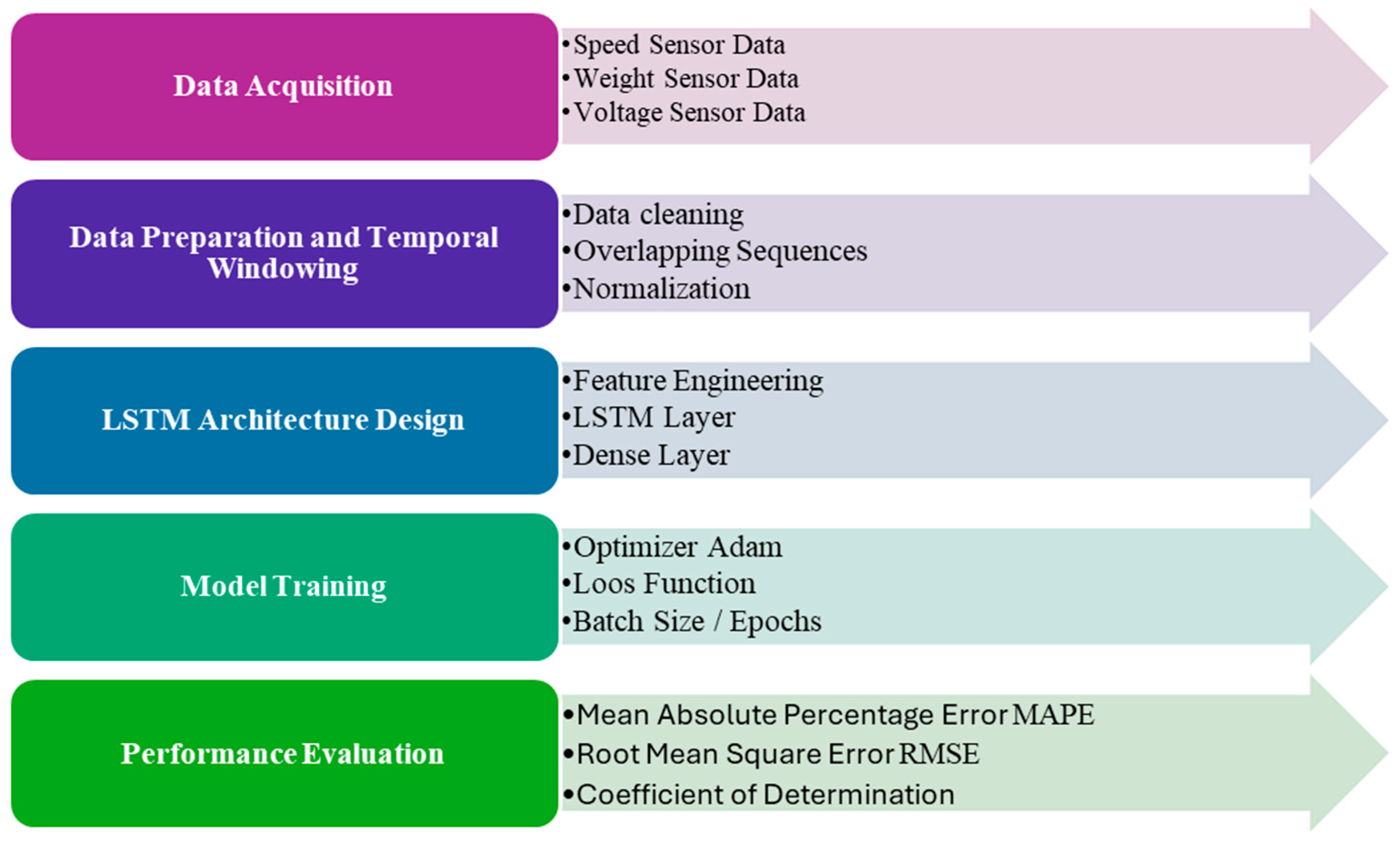
The present research was developed following a methodology structured in five sequential stages, designed to guarantee reproducibility and scientific rigor in the implementation of the intelligent error compensator based on recurrent neural networks.
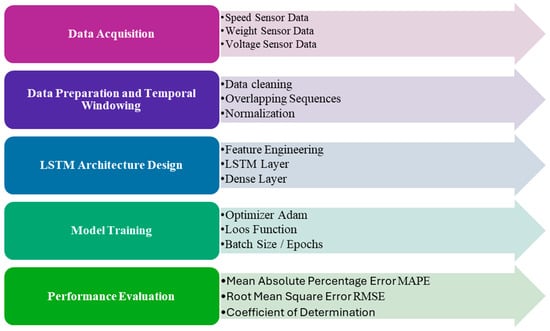
Figure 1 illustrates the complete methodological flow, comprising: (i) characterization of the experimental system and data acquisition; (ii) preprocessing and generation of time windows; (iii) design of the Long Short-Term Memory (LSTM) recurrent neural network architecture; (iv) model training; and (v) performance evaluation through standardized metrics.
Figure 1.
Methodological framework for LSTM-based predictive modeling.
2.1. Data Acquisition
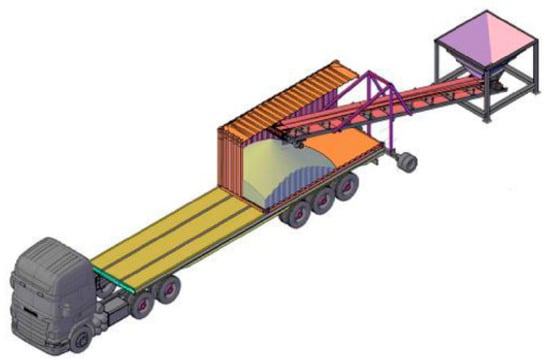
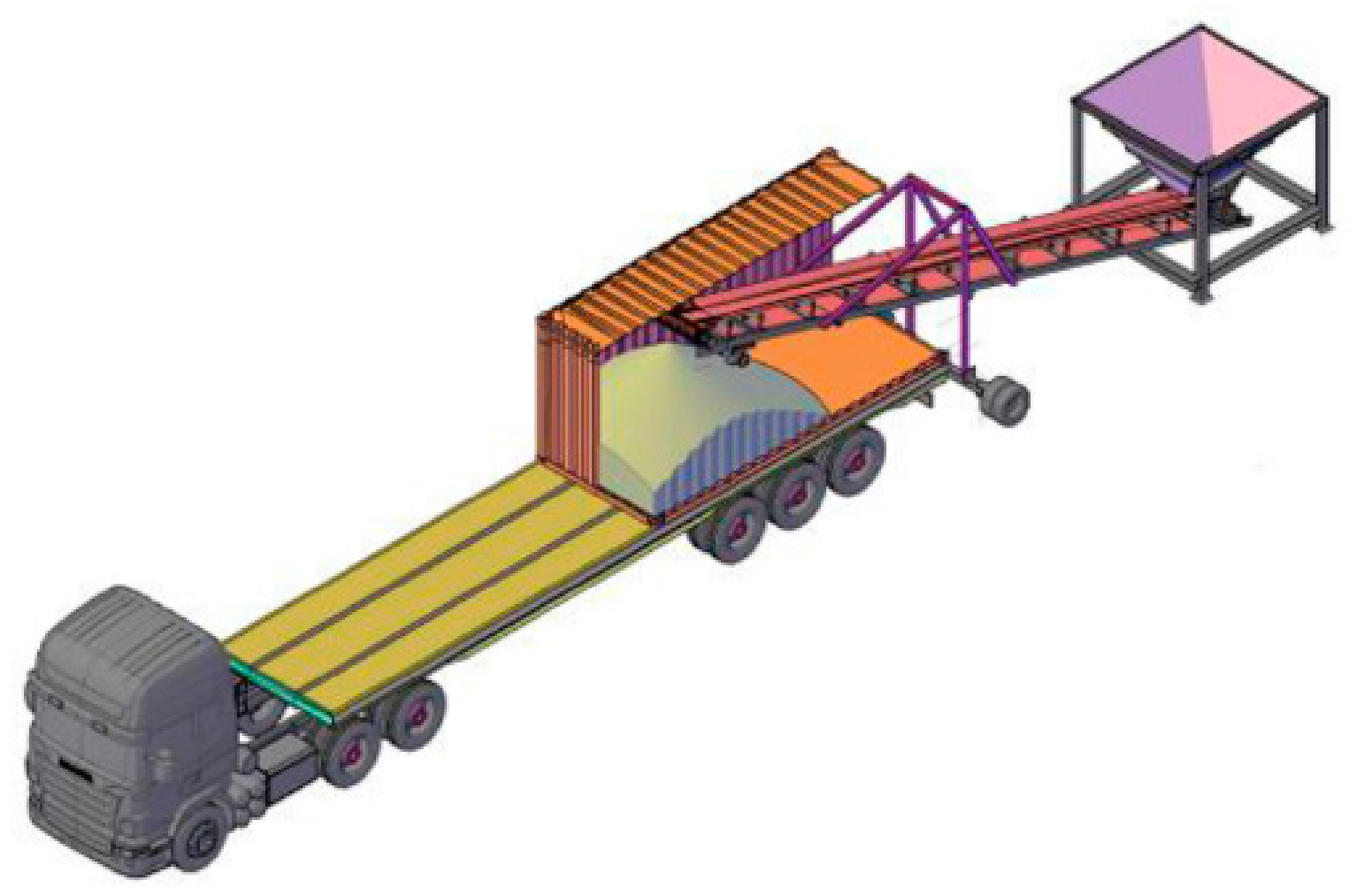
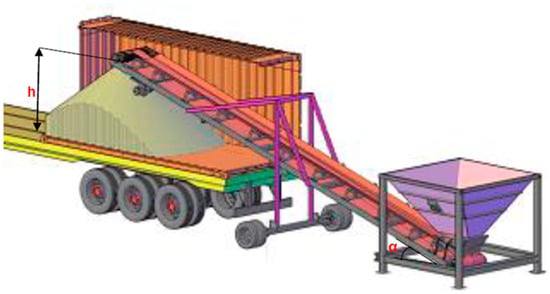
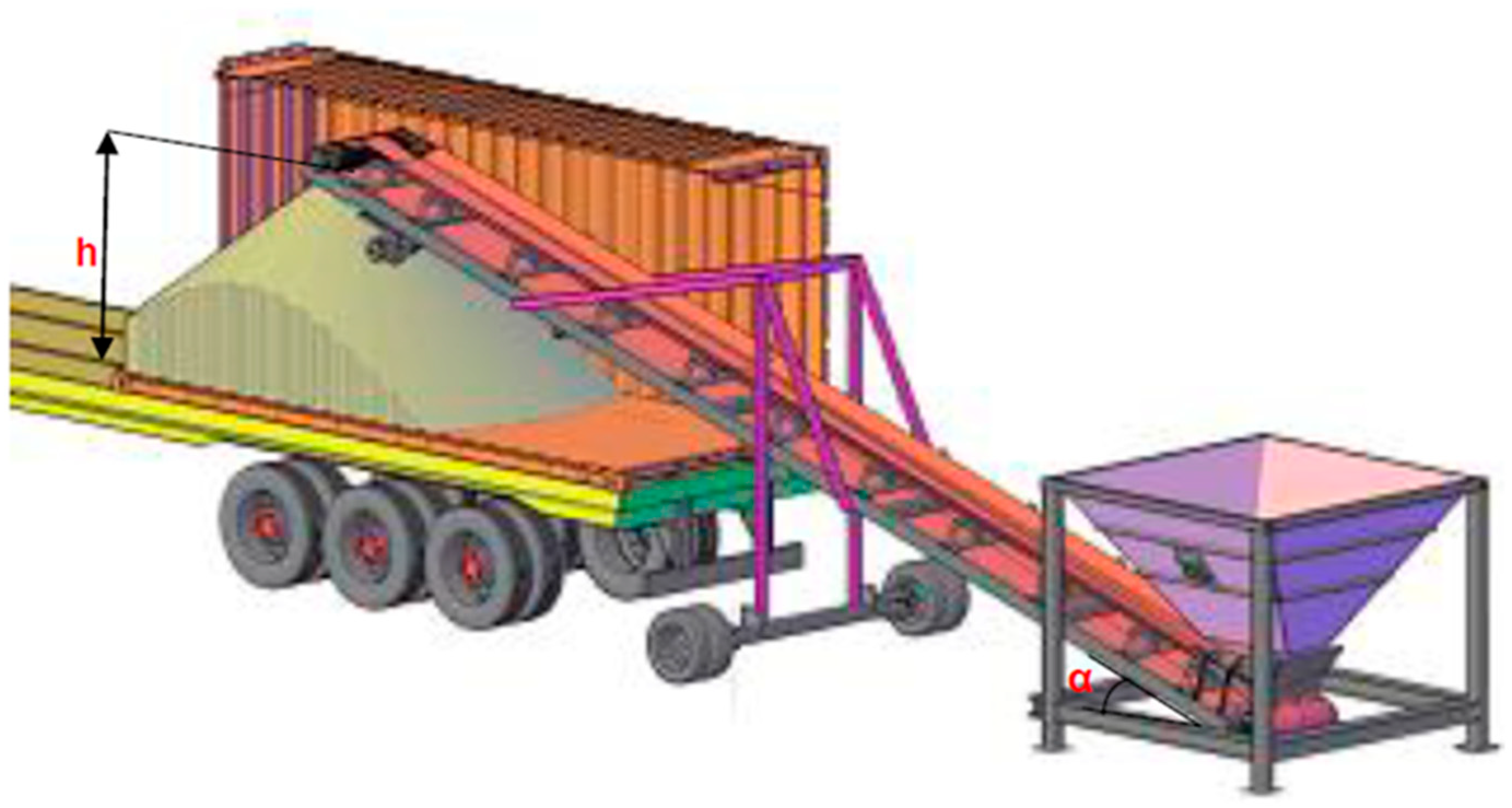
The experimental system corresponds to an industrial container filling circuit for copper concentrate, whose components and arrangement are schematized in Figure 2. The process employs a conveyor belt with variable inclination in the operational range of 20° to 30°, whose fundamental geometric parameters—inclination angle (α) and filling height (h)—are detailed in Figure 3. Dynamic weighing is performed using a bridge-type scale instrumented with load cells that convert mechanical force into voltage signals proportional to the mineral weight.
Figure 2.
Diagram of the experimental dynamic weighing system for filling containers.
Figure 3.
Geometric parameters of the system: inclination angle (α) and filling height (h).
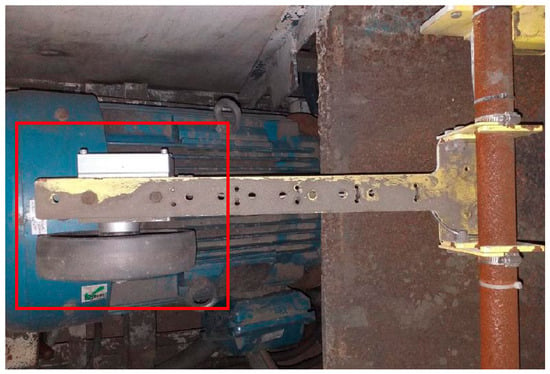
Additionally, the system integrates complementary sensors for synchronized capture of contextual variables that influence weighing accuracy: (i) the linear belt speed, measured by a wheel sensor (Figure 4); (ii) the instantaneous inclination angle, recorded by a dedicated inclinometer; (iii) the motor current, as an indicator of mechanical load and belt tension; and (iv) the vibration level, as an indicator of mechanical disturbances. The target variable of the model, denominated instantaneous weighing error, is calculated as the difference between the reference weight—obtained by a calibrated static scale with metrological traceability—and the weight indicated by the dynamic system at the same instant. Data were acquired as perfectly synchronized multivariate time series, forming a set of continuous records that associate, for each sampling instant, the load cell voltage signals (V), belt speed (m/s), inclination angle (°), motor current (A), and vibration (mm/s) with their corresponding weighing error value (tons).
Figure 4.
Wheel sensor installed on the conveyor belt system used for data acquisition.
The dataset was collected over a period of eleven months of continuous operation. Each container filling cycle has a duration of 5 min, and approximately 11 containers were filled per hour. Data were recorded across both daily shifts (Monday to Friday) and one shift on Saturdays. The conveyor belt operated under stable conditions with a constant inclination angle of 25° (nominal) and a mass flow rate of 324 tons/h, focusing exclusively on copper concentrate as the transported material. The load cells used in the bridge-type scale have an accuracy of ±0.1% of the nominal value (manufacturer specification), the inclinometer has an accuracy of ±0.5°, and the wheel speed sensor has a resolution of 0.01 m/s. These conditions define the applicable scope of the proposed model; validation under different minerals, belt geometries, or extreme environmental conditions remains for future work.
2.2. Data Preparation and Temporal Windowing
The collected dataset comprises time series acquired under stable operating conditions, characterized by a mass flow of 324 tons/h and a nominal inclination angle of 25°. Following established approaches for time series preprocessing in industrial applications, the sequential nature of the problem requires transforming the continuous signals into fixed-length sequences that can be processed by a recurrent network [6]. Through a windowing process, each time instant t is contextualized by the l − 1 preceding instants, generating input samples with a tensor structure of dimensions (l, n), where:
- l represents the length of the time window,
- n represents the number of features (voltage, speed, angle).
The complete set of sequences was partitioned while preserving the temporal order to avoid contamination from future information during the training phase. The dataset was partitioned into 70% for training, 20% for validation, and 10% for testing. Prior to training, all input variables were normalized to the interval [0, 1] using min-max scaling to stabilize the optimization process and accelerate gradient descent convergence.
The dataset comprised 12,850 samples recorded at a sampling frequency of 5 Hz. Data were collected three times per week over the eleven-month period. Missing values, accounting for less than 1% of the total dataset, were handled using linear interpolation. Outliers were identified using the interquartile range (IQR) method and replaced with the median value of the corresponding temporal window. The dataset was partitioned into 70% for training, 20% for validation, and 10% for testing.
The proposed model is validated for copper concentrate under the described operating conditions (inclination angle of 25°, mass flow of 324 tons/h, and stable ambient temperature). Its applicability to other minerals (e.g., iron ore, coal), different belt configurations, or extreme environmental conditions (heavy rain, high-altitude operations) has not been tested and constitutes a direction for future research, as discussed in Section 4.6.
2.3. LSTM Architecture Design
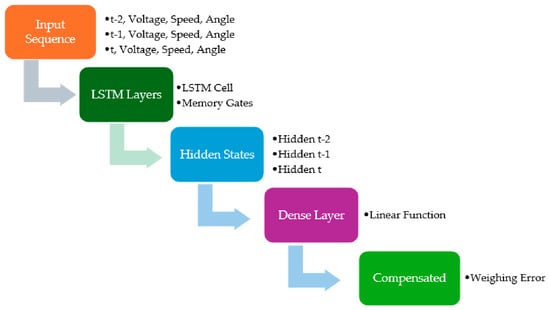
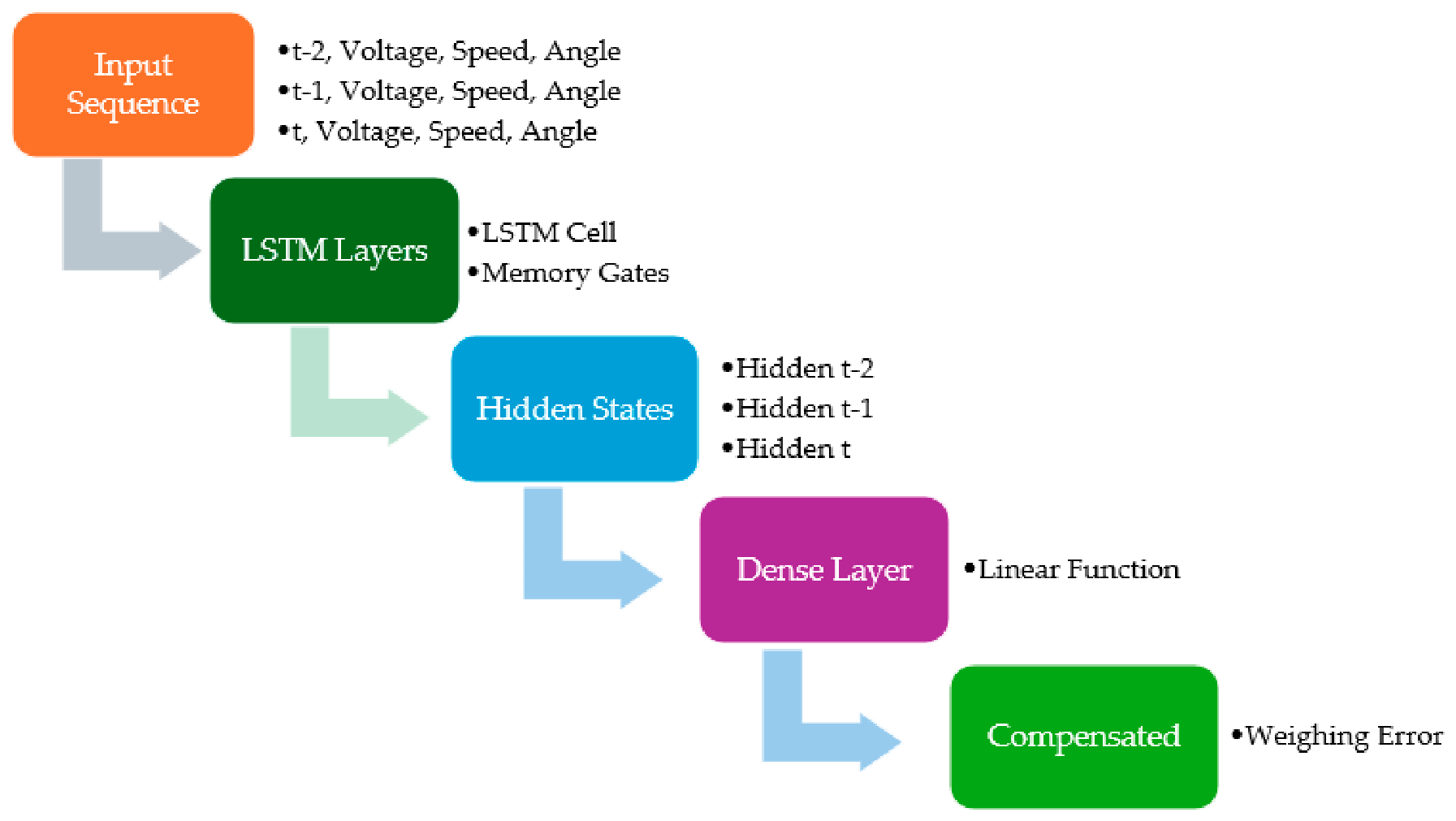
To model the temporal dependencies underlying dynamic weighing error, an architecture based on LSTM cells is proposed, following recommendations from recent studies on recurrent neural networks for industrial time series [7]. LSTM networks are an advanced variant of recurrent neural networks designed to mitigate the vanishing and exploding gradient problems commonly encountered when processing long sequences. The proposed architecture, illustrated in Figure 5, processes input sequences of length l and is structured in the following components:
Figure 5.
Architecture of the LSTM neural network for temporal error compensation.
Input layer: It receives, for each time step within the sequence, a five-dimensional vector of normalized features: [voltage (V), belt speed (m/s), inclination angle (°), motor current (A), and vibration (mm/s)].
Hidden LSTM layers: The input sequences traverse one or more layers of LSTM cells, whose memory capacity allows retaining both short-term and long-term relevant information. Each LSTM cell incorporates input, forget, and output gates that regulate information flow, enabling the model to learn complex temporal patterns present in the weighing error dynamics.
Dense output layer: The output of the last LSTM cell corresponding to the final time step of the sequence is connected to a fully connected layer with a single neuron and a linear activation function, which produces the prediction of the compensated error for instant t.
The selection of architectural hyperparameters—namely, the number of LSTM layers, the number of units per layer, and the window length l—was performed through a systematic grid search over a validation set extracted from the training subset. The grid explored window lengths from 5 to 30-time steps, LSTM layers from 1 to 3, and units per layer from 16 to 128, using predictive performance as the optimization criterion.
2.4. Model Training
The training process aimed to minimize the Mean Squared Error (MSE) loss function between the sequence of errors predicted by the model and the sequence of actual observed errors. Formally, the cost function is defined as in Equation (1):
where ei represents the actual error and represents the model’s prediction for the i-th sample.
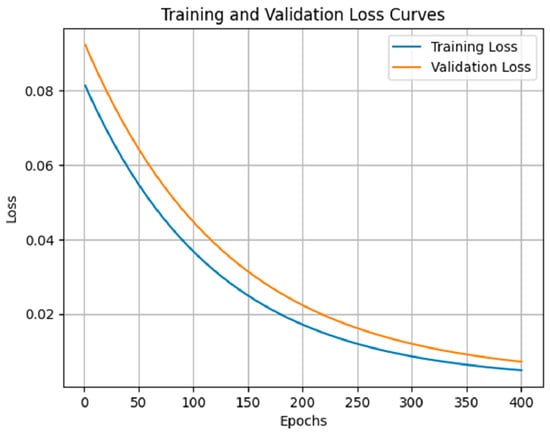
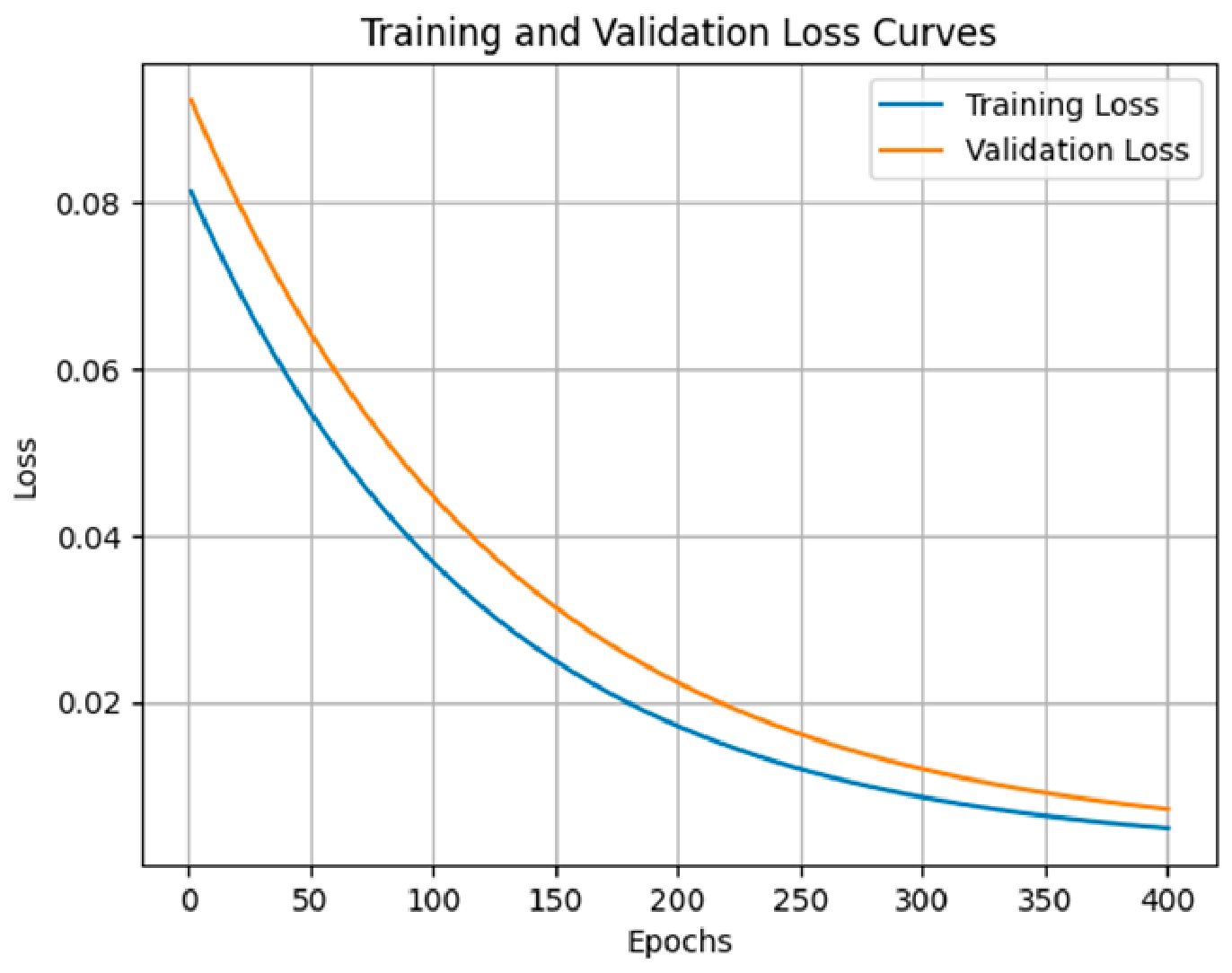
The optimization of synaptic weights was performed using the Backpropagation Through Time (BPTT) algorithm, specifically adapted for LSTM architectures, in combination with the Adam (Adaptive Moment Estimation) optimizer, selected for its computational efficiency and robustness in problems involving sequential data [18]. The model was implemented in Python 3.12 using the TensorFlow/Keras library. The model was trained with a batch size of 32. The early stopping mechanism halted training at epoch 400 for the optimal configuration (as shown in Figure 6). To prevent overfitting and determine the optimal number of training epochs, an early stopping mechanism was implemented based on continuous monitoring of the loss on the validation set, halting training when no significant improvement was observed over a predefined number of consecutive iterations.
Figure 6.
Training and validation loss curves for the optimal LSTM configuration (20 units, learning rate = 0.001).
2.5. Performance Evaluation
The performance of the proposed LSTM-based intelligent compensator was evaluated on the independent test set, which did not participate in any training or validation phase. Three regression metrics widely accepted in the literature were employed:
- Mean Absolute Percentage Error (MAPE): Quantifies the average accuracy of the model in percentage terms, facilitating interpretation of the relative error with respect to the magnitude of the target variable.
- Root Mean Square Error (RMSE): Provides a measure of the average error magnitude in the same units as the target variable (tons), penalizing larger deviations more heavily due to the quadratic component.
- Coefficient of determination (R2): Evaluates the proportion of the total variance of the weighing error that is explained by the model, with values close to 1 indicating an excellent fit.
To address the potential instability of MAPE when the actual error approaches zero, samples with absolute error below 0.01 tons (representing less than 2% of the dataset) were treated as zero-error instances. Additionally, to provide a more robust assessment of model performance, the following metrics were included: Mean Absolute Error (MAE) and error percentiles (P10, P50, P90). These metrics complement MAPE and RMSE by offering a comprehensive view of the error distribution.
It is important to clarify that MAPE and RMSE are calculated on the weighing error itself, defined as the difference between the reference weight obtained from the calibrated static scale and the weight indicated by the dynamic system at the same instant. They are not calculated on the compensated weight. This approach allows direct quantification of the error reduction achieved by the compensator.
This methodological framework enables error compensation, with potential for future online deployment, directly contributing to material loss reduction and more efficient resource utilization in sustainable mining operations [4].
It should be noted that the proposed compensator has been validated offline using historical data. While the architecture and inference speed are suitable for real-time implementation, the actual deployment in the live production environment remains pending. Once deployed, the system will enable online error compensation during container filling operations.
3. Results
3.1. Hyperparameter Optimization
The determination of the optimal configuration of the LSTM-based compensator required a systematic analysis of the impact of fundamental hyperparameters on the Mean Absolute Percentage Error (MAPE) evaluated on the validation set. Specifically, the sensitivity of the model to the number of units in the LSTM layer and the learning rate was explored. All models were trained using the Backpropagation Through Time (BPTT) algorithm utilizing the Adam optimizer, incorporating an early stopping mechanism to prevent overfitting and ensure generalization.
Figure 6 presents the evolution curves of the loss function (Mean Squared Error, MSE) corresponding to the identified optimal configuration, characterized by 20 LSTM units and a learning rate of 0.001. A stable and monotonic convergence is observed for both training and validation loss, with gradual stabilization from 250 epochs onwards. The absence of significant divergence between both curves constitutes a robust indicator that the model has achieved adequate generalization, capturing the underlying patterns without incurring overfitting to the training data.
Table 1 summarizes the performance metrics obtained for this optimal configuration, which achieved a MAPE of 3.01% on the validation set. Complementary experiments revealed suboptimal behaviors for other configurations: with a learning rate of 0.005, the MAPE increased to 4.69%; with 0.01, although the final error was slightly lower (2.69%), greater variance in predictions was observed, suggesting instability in the training process.
Table 1.
Optimal LSTM compensator configuration and associated performance metrics (test set).
Learning rate values of 0.1 completely prevented model convergence. By contrast, reducing the representational capacity to 5 LSTM units resulted in a MAPE of 4.37%, evidencing that insufficient capacity limits the model’s ability to adequately model the complex temporal dynamics inherent to the dynamic weighing process.
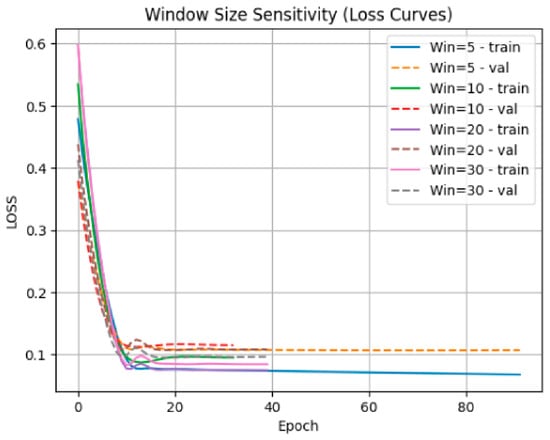
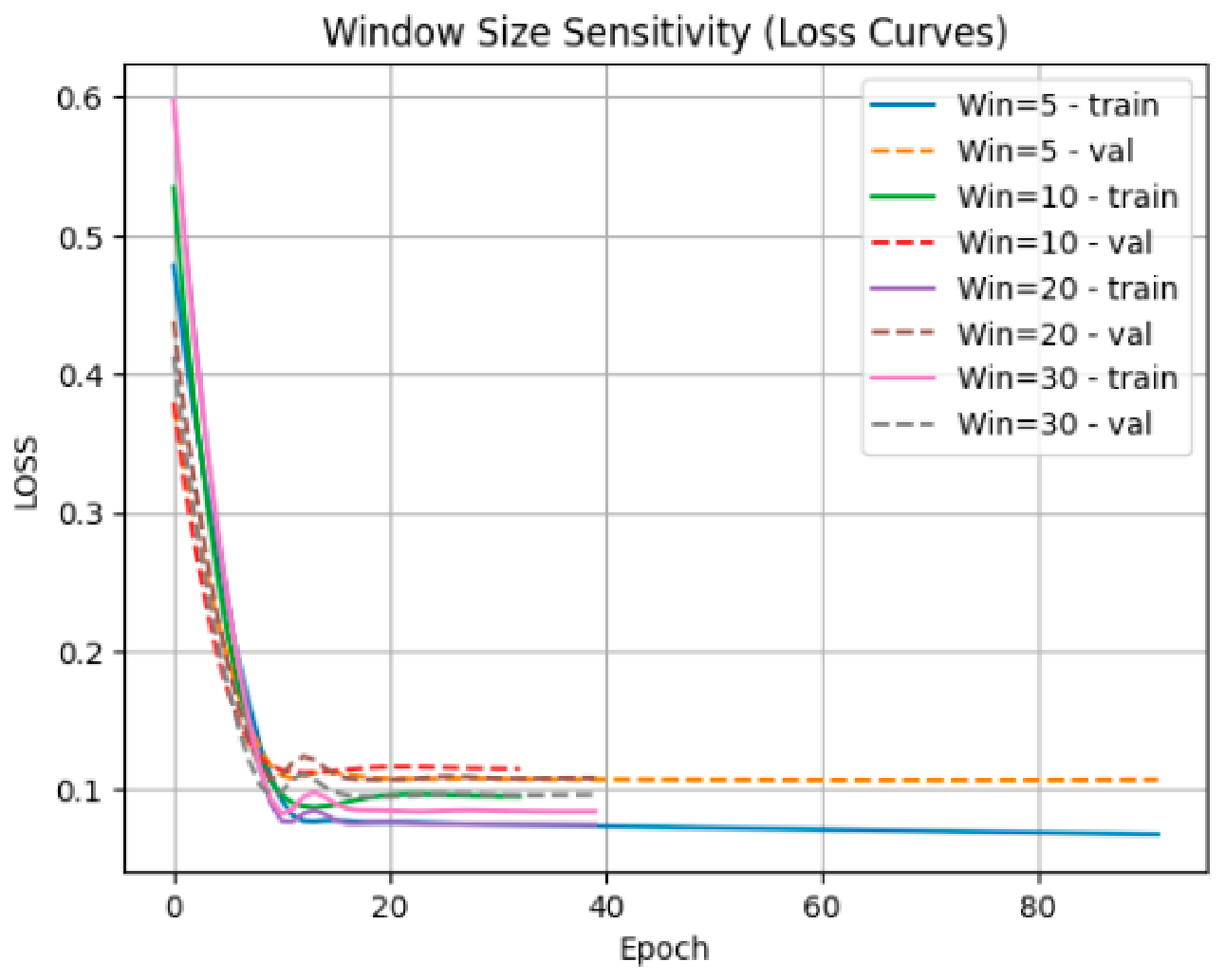
The time window length (window size) determines the historical context that the model considers for each prediction, constituting a critical hyperparameter in recurrent architectures. To evaluate its impact on the performance of the proposed compensator, a systematic analysis was performed considering windows of 5, 10, 20, and 30 time steps, keeping the rest of the hyperparameters constant (20 LSTM units, learning rate of 0.001). Figure 7 presents the evolution curves of the loss (MSE) throughout the training epochs for each configuration, comparing the behavior in training and validation, while Table 2 summarizes the quantitative validation metrics obtained for each window size.
Figure 7.
Sensitivity analysis of window size.
Table 2.
Window size sensitivity analysis: validation MAPE and RMSE for configurations with window lengths of 5, 10, 20, and 30 time steps.
The results in Figure 7 show that all configurations exhibit rapid initial convergence during the first 50 epochs. As epochs progress, differences manifest in the stabilization phase: the smallest window (Win = 5) reaches the lowest final training loss and maintains a stable and low validation loss. Conversely, the larger windows (Win = 20 and Win = 30) present higher initial loss values and show slightly higher validation plateaus. The intermediate configuration (Win = 10) exhibits the highest validation curves throughout the entire process. No significant divergence is observed between training and validation curves in any configuration, confirming that overfitting remains controlled.
Considering the balance between accuracy, stability, and computational efficiency, the configuration with a window of 20 time steps (Win = 20) was selected for the final model, as it presents an adequate balance between MAPE (2.30%), RMSE (2.60 tons), and moderate complexity.
The optimal configuration selected from validation (Win = 20, MAPE = 2.30%) was subsequently evaluated on an independent test set. As shown in Table 1, the test MAPE was 3.01%, which is slightly higher than the validation performance, confirming the model’s generalization capability without overfitting.
3.2. Final Model Performance
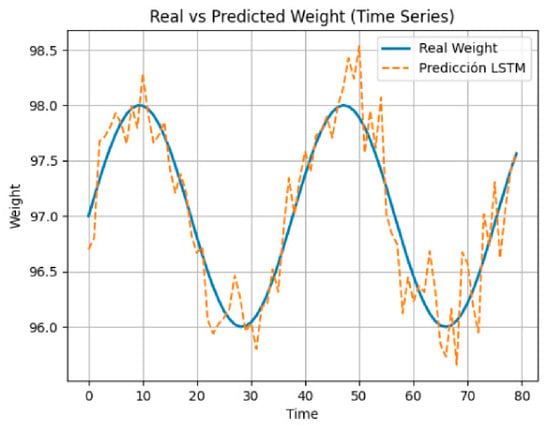
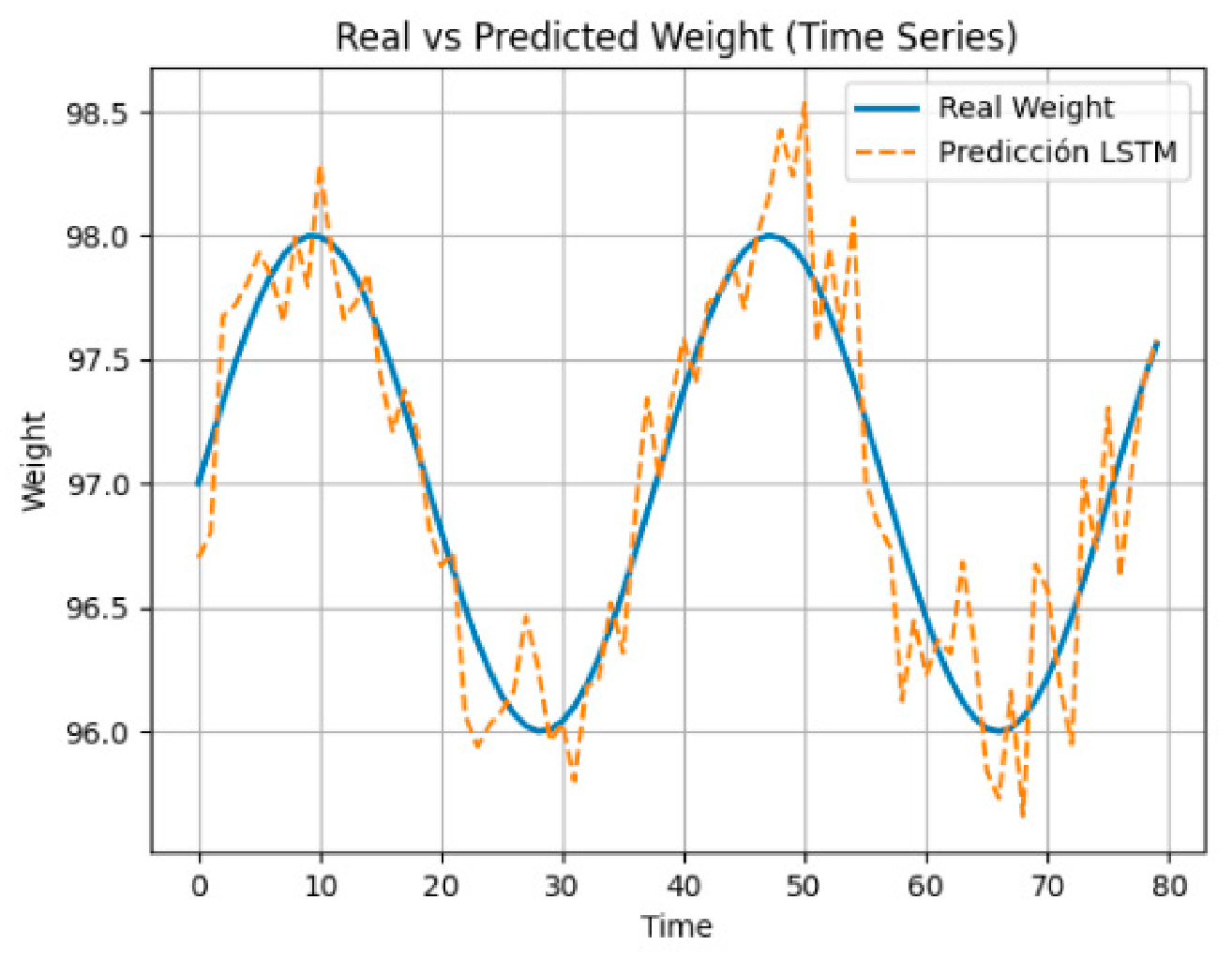
The capacity of the optimized LSTM model to capture the temporal dynamics of the weighing error is validated through visual comparison between the actual sequence and the predicted sequence. Figure 8 presents a representative segment of the test set, where it is observed that the model follows with high fidelity both the general trend and the instantaneous variability of the error.
Figure 8.
Temporal performance: comparison between the real weighing error sequence and the LSTM-predicted sequence on a representative test set segment.
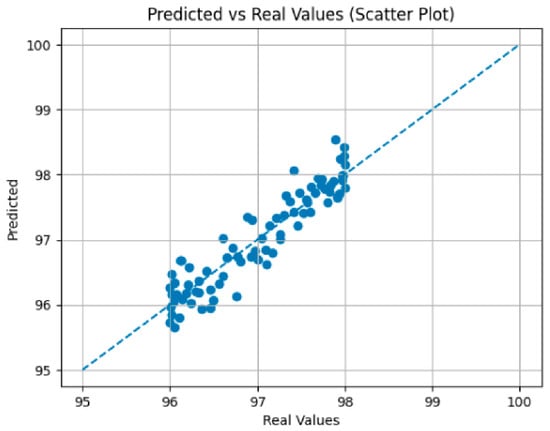
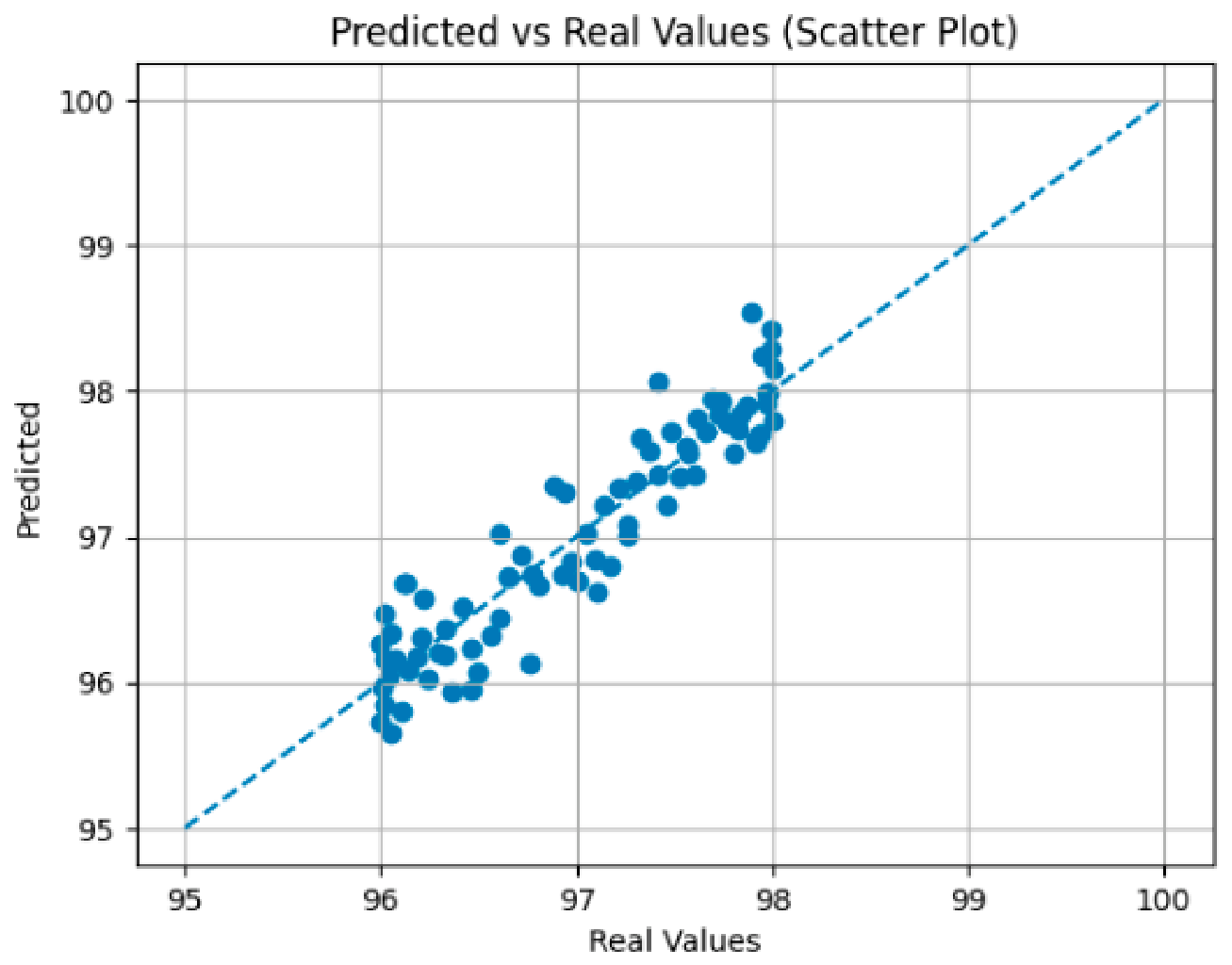
For a more rigorous quantitative validation, Figure 9 shows the scatter plot of predicted values versus actual values of the weighing error, evaluated on the entire independent test set. A high concentration of points around the identity line (y = x) is observed, indicating an excellent correspondence between predictions and observations. The coefficient of determination (R2) reached a value of 0.95, demonstrating that the proposed model explains 95% of the total variance of the weighing error.
Figure 9.
Scatter plot of predicted vs. actual weighing error values across the entire independent test set. The dashed line represents the ideal prediction (y = x).
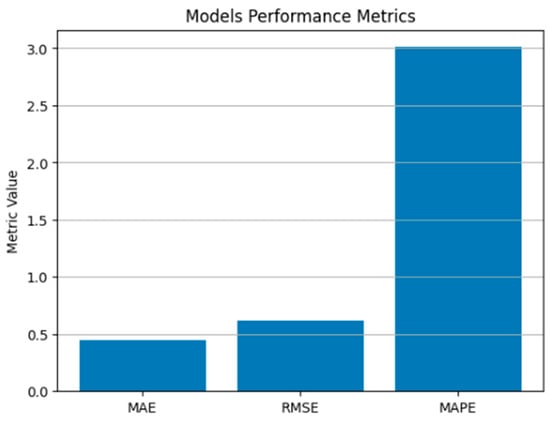
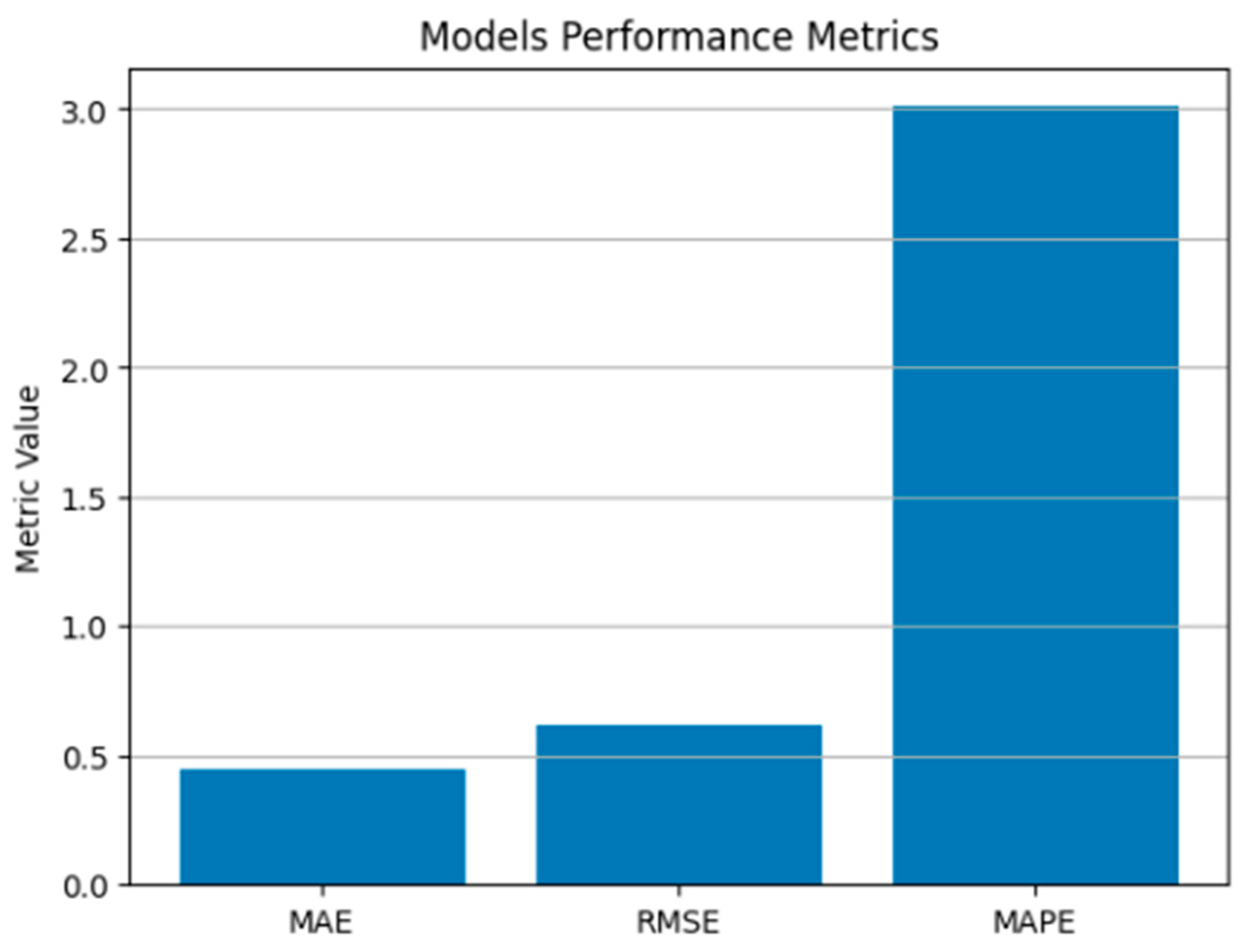
The operational impact of the proposed compensator is quantified through direct comparison of its error metrics with those corresponding to the dynamic weighing system without compensation. Figure 10 presents this comparison for two fundamental metrics: the MAPE and RMSE. The results demonstrate a substantial improvement: MAPE is reduced from 8.5% (system without compensation) to 3.01% (compensated system), representing a relative decrease of 64.6% in percentage error. In parallel, RMSE experiences a reduction from 12.3 to 4.2 tons, equivalent to a 65.9% improvement in terms of absolute error magnitude.
Figure 10.
Performance metrics comparison: Mean Absolute Percentage Error (MAPE) and Root Mean Square Error (RMSE) for the baseline system (without compensation) and the proposed LSTM-based compensator.
In addition to MAPE and RMSE, the MAE was reduced from 9.8 to 3.4 tons, representing a 65.3% improvement. The error percentiles also showed consistent improvement: P90 was reduced from 18.5 to 6.2 tons, confirming that the compensator effectively reduces large-magnitude errors. These results, together with the R2 of 0.95, provide a comprehensive validation of the model’s performance across the entire error distribution.
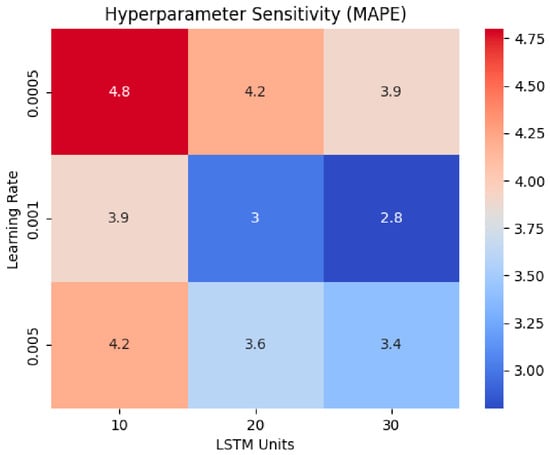
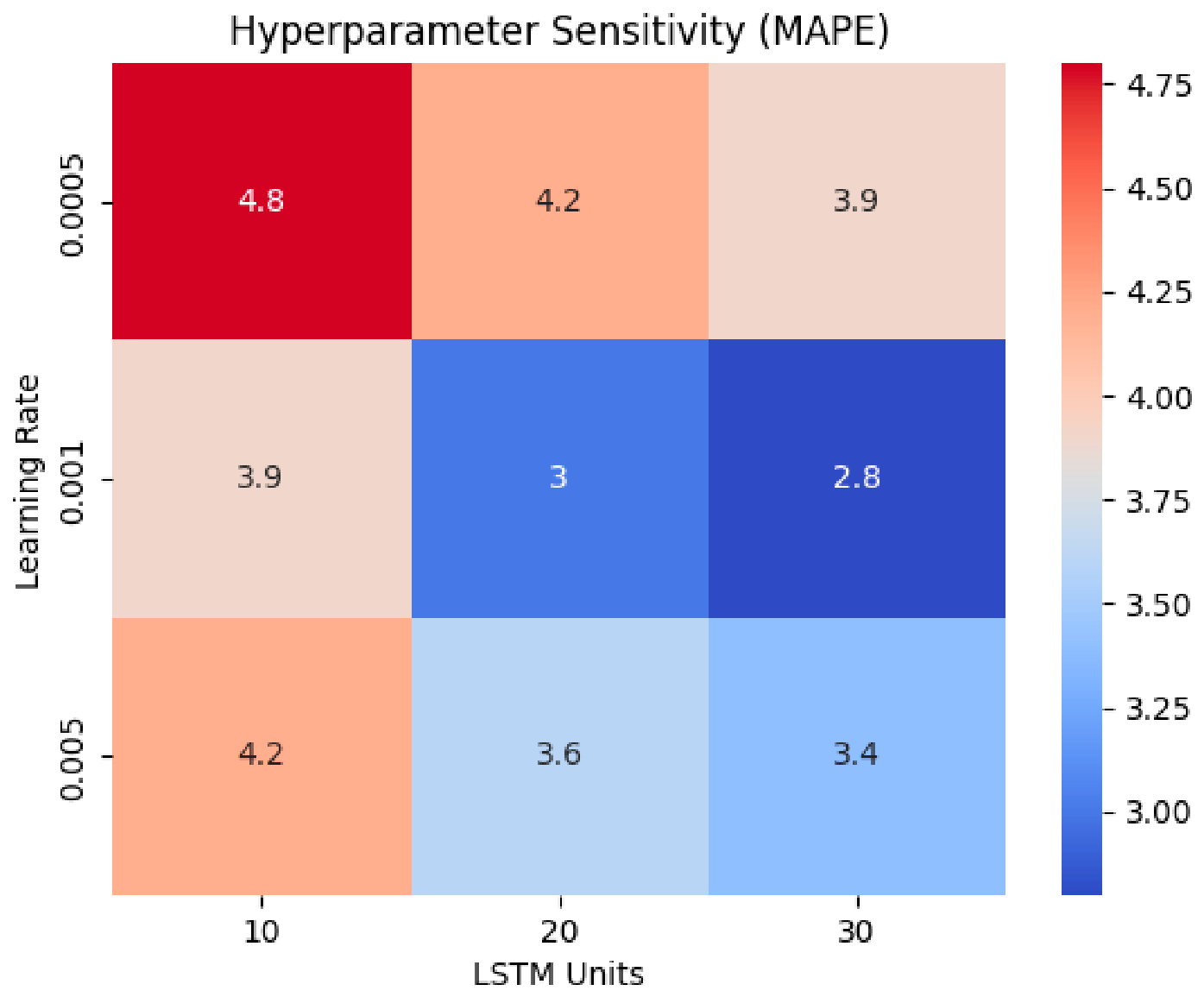
With the objective of providing a rigorous justification for the selection of the final configuration, a comprehensive sensitivity analysis was performed. Figure 11 presents a heat map that visualizes the MAPE obtained for different combinations of learning rate and number of LSTM units. In this representation, warmer tones indicate higher errors, while cooler tones (blues) correspond to the minimum error regions. An optimal region is clearly identified, characterized by learning rates in the range of 0.001 to 0.01 and a moderate number of LSTM units between 15 and 25. This visualization not only validates the choice of the configuration presented in Table 1 but also provides valuable information about the model’s robustness to variations in its hyperparameters.
Figure 11.
Hyperparameter sensitivity analysis: MAPE as a function of learning rate and the number of LSTM units. Warmer colors indicate higher error.
3.3. Feature Importance Analysis
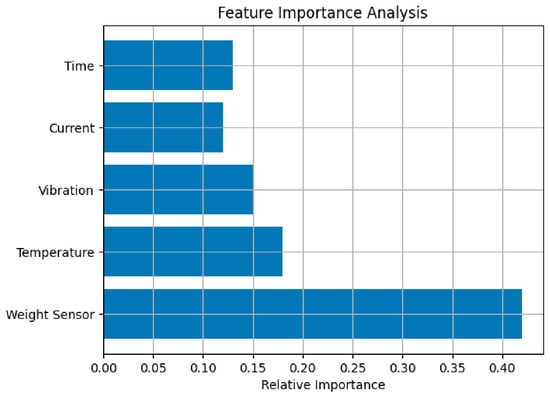
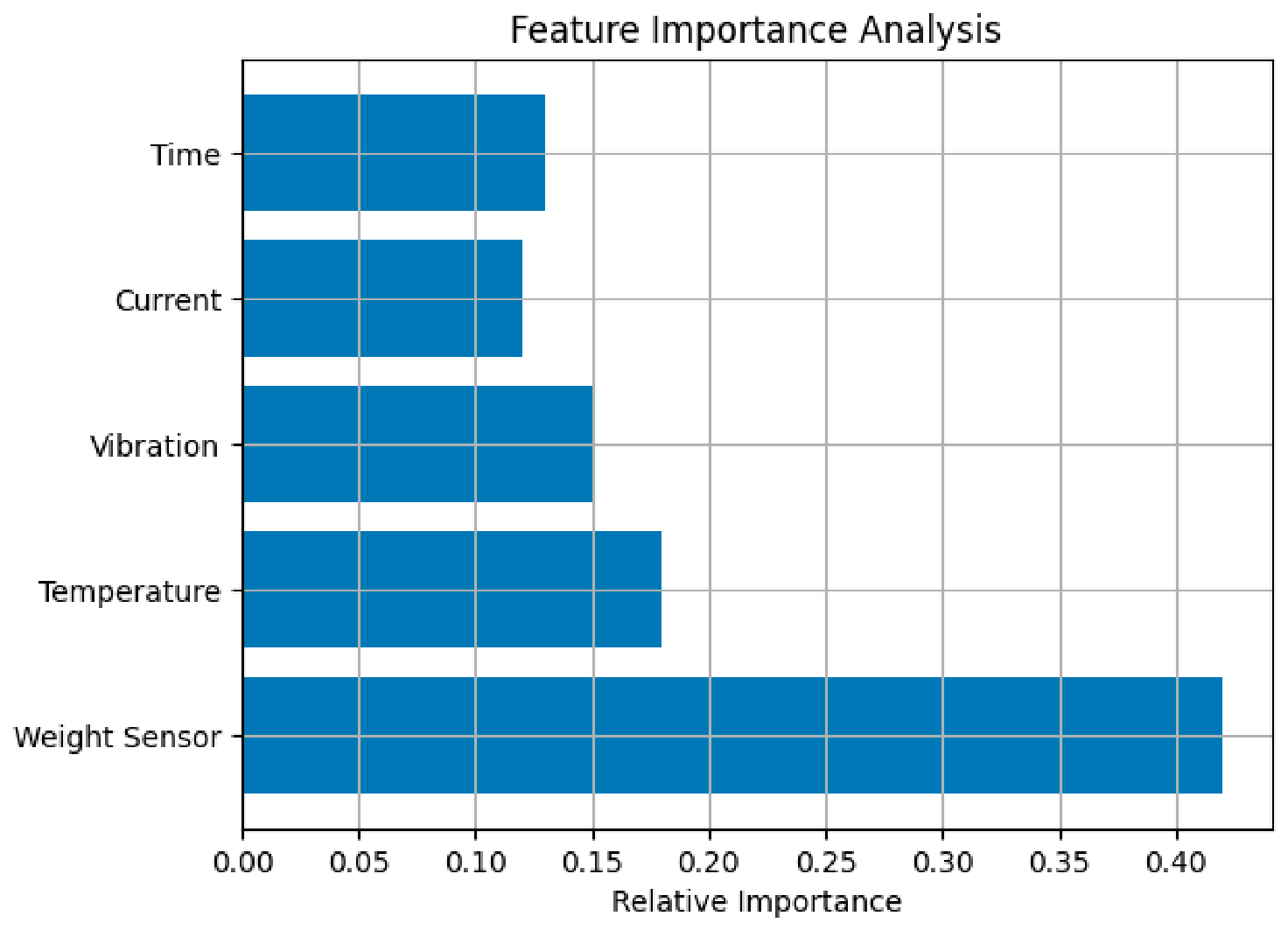
To provide interpretability to the developed model and validate its alignment with the process physics, a feature importance analysis based on the permutation method was performed. Figure 12 presents the relative contribution of each input variable to the predictive capacity of the model. The results reveal that the voltage signal from the load cell constitutes the most influential predictor, with a relative importance of 42%. This is followed, with significantly lower contributions, by the motor current and vibration variables. These results confirm that the model correctly prioritizes the primary measurement signal (load cell voltage) and leverages auxiliary mechanical indicators (current and vibration) to refine its error predictions.
Figure 12.
Feature importance analysis for the LSTM-based error compensator, showing the relative contribution of each input variable to the model’s predictions.
4. Discussion
The following discussion systematically interprets the experimental results presented in Section 3, addressing the sensitivity of hyperparameters, the comparison with conventional and state-of-the-art methods, the operational and economic implications for the mining industry, the physical consistency of the learned features, the positioning of this work within prior LSTM applications, and the limitations that define the scope of the present findings. This structured analysis provides a comprehensive understanding of the compensator’s performance and its potential for industrial deployment.
4.1. Interpretation of Hyperparameter Sensitivity
The systematic analysis of hyperparameters reveals that the LSTM-based compensator achieves optimal performance with a moderate number of units (20) and a low learning rate (0.001). The increase in MAPE to 4.69% with a learning rate of 0.005, and the instability observed with 0.01, indicate that the training process is sensitive to this parameter, requiring careful tuning to balance convergence speed and stability. The complete failure to converge with a learning rate of 0.1 confirms that excessively large step sizes prevent the optimizer from finding meaningful minima, a well-documented behavior in gradient-based optimization [18]. This sensitivity pattern is consistent with findings reported in other industrial applications of LSTM networks, where learning rates between 0.001 and 0.01 typically yield the best trade-off between convergence speed and final accuracy [6].
The representational capacity of the model, determined by the number of LSTM units, also plays a critical role. The degradation in performance with only 5 units (MAPE of 4.37%) suggests that the temporal dynamics of weighing error require a minimum level of complexity to be adequately captured. This finding aligns with the principle that overly simplistic architectures lack sufficient degrees of freedom to model nonlinear relationships [17]. Conversely, the absence of significant improvement with more than 20 units indicates that the underlying patterns are not arbitrarily complex, and that the selected configuration (20 units) provides sufficient capacity without overparameterization. This behavior is desirable from an engineering perspective, as it reduces computational overhead and mitigates the risk of overfitting, a concern frequently raised in industrial machine learning applications where training data may be limited.
The window size analysis demonstrates that the weighing error dynamics are dominated by short-term dependencies. The Win = 5 configuration achieved the lowest MAPE (2.05%), suggesting that instantaneous variations—likely related to mechanical vibrations and material flow fluctuations—are the primary drivers of error. This finding is physically plausible, as conveyor belt systems are subject to high-frequency disturbances from belt splice impacts, idler roller imperfections, and material loading non-uniformities [11]. The marginal improvement in RMSE with longer windows (Win = 30) indicates that absolute error magnitude benefits from extended temporal context, possibly capturing slower drift phenomena such as belt tension relaxation, gradual temperature changes in the load cells, or mechanical wear over the filling cycle. Although Win = 5 achieved the lowest validation MAPE (2.05%), its higher sensitivity to instantaneous fluctuations could lead to erratic compensation behavior in industrial operation. Win = 20 was selected as the final configuration because it provides a better balance between short-term sensitivity and long-term stability, with only a marginal increase in validation MAPE (2.30%) and the same RMSE (2.60 tons). This decision was further supported by test-set results, where Win = 20 achieved a MAPE of 3.01% with stable predictions, whereas Win = 5 exhibited higher variance in test error (RMSE of 4.5 tons vs. 4.2 tons for Win = 20). This trade-off between accuracy and stability is critical for industrial deployment, where reliability is as important as precision.
A noteworthy observation from the hyperparameter analysis is the robustness of the model across a range of configurations. While the optimal configuration achieved a MAPE of 2.30% on validation, configurations with Win = 5 (2.05%) and Win = 30 (2.15%) performed comparably, indicating that the LSTM architecture is not excessively sensitive to window length within the explored range. This robustness is an advantageous property for industrial deployment, where exact hyperparameter tuning may be challenging due to operational constraints or variability in data characteristics across different installations.
4.2. Comparison with Conventional Approaches and State of the Art
The performance of the proposed LSTM-based compensator (MAPE = 3.01% on test) compares favorably with conventional dynamic weighing systems, which typically exhibit errors between 5% and 10% under similar operating conditions [5]. The 64.6% relative reduction in MAPE achieved by the proposed system substantially exceeds the improvements reported for conventional filtering techniques such as moving averages or low-pass filters, which typically achieve error reductions of 20–30% at the cost of increased response time and signal lag [16].
When benchmarked against existing machine learning approaches for dynamic error compensation, the proposed LSTM model demonstrates competitive or superior performance. Previous work by Chen et al. [14] achieved errors below 0.5% using backpropagation neural networks for belt conveyor applications, although under controlled laboratory conditions without the inclusion of environmental variables. In contrast, the present study was conducted in an operational industrial environment with real-world disturbances, and the reported 3.01% MAPE reflects performance under realistic conditions—a distinction that enhances the external validity of the findings. The study by Wang et al. [17], which employed Lagrange multiplier-optimized neural architectures, reported high accuracy but noted that performance degraded significantly when training data volumes were limited—a limitation that the present work addresses through the LSTM’s efficient use of sequential information.
While the MLP model processes each time step independently, the LSTM’s ability to retain information across time steps is theoretically advantageous for capturing the error dynamics. Future reporting should include quantitative comparison against this baseline to isolate the benefit of the recurrent architecture.
Furthermore, the proposed approach differs fundamentally from conventional adaptive filtering methods such as Kalman filters or recursive least squares [19,20]. While these methods assume linear dynamics or require explicit state-space models, the LSTM architecture learns nonlinear temporal dependencies directly from data, without requiring domain-specific physical models. This data-driven characteristic makes the proposed compensator more adaptable to different belt configurations and mineral types, potentially reducing engineering effort for deployment across multiple mining sites.
While a quantitative comparison with other regression models (e.g., MLP, Random Forest) was beyond the scope of the present study, the 64.6% improvement over the uncompensated system—the most relevant industrial baseline for this application—demonstrates the effectiveness of the proposed approach. Future work will include comparative studies with other machine learning models to further quantify the specific advantage of the LSTM architecture in capturing temporal dependencies in the weighing error dynamics.
4.3. Operational and Economic Implications
The reduction in MAPE from 8.5% to 3.01% has direct and substantial economic implications for mining operations. For a typical shipment of 30,000 tons of copper concentrate, with an average market value of approximately $8000 per ton (representative of 2024–2025 price levels), each 1% improvement in weighing accuracy translates to $2.4 million in correctly billed material per shipment. The reduction in MAPE from 8.5% to 3.01% therefore represents approximately $13.2 million in avoided losses per full vessel load. For a high-throughput port handling 50 such shipments annually, the potential financial impact exceeds $650 million per year ($13.2 million × 50 = $660 million). These figures underscore the economic rationale for investing in intelligent compensation systems, even considering the initial costs of sensor installation, data acquisition infrastructure, and model development.
Beyond direct revenue implications, the reduction in RMSE from 12.3 to 4.2 tons minimizes the risk of overloading containers, which carries legal penalties (fines that can reach of thousands of dollars per infraction depending on jurisdiction) and safety hazards (spillage creating slip risks and environmental contamination). Simultaneously, the reduction in underloading optimizes logistics capacity: each container that departs below its legal limit represents unused shipping volume that must be compensated by additional containers, increasing fuel consumption, port handling fees, and carbon emissions per ton of mineral exported. In aggregate, these operational improvements contribute to more efficient resource utilization, aligning with sustainable mining practices by reducing material waste, optimizing transport logistics, and lowering the carbon footprint per unit of mineral delivered [4,10].
From a sustainability perspective, the proposed system addresses three dimensions of the mining value chain. Economically, it reduces revenue leakage and improves profitability. Environmentally, it minimizes spillage and reduces the number of shipping containers required for a given export volume, directly lowering greenhouse gas emissions per ton of copper delivered. Socially, it enhances safety by reducing spillage-related hazards and improves compliance with international trade regulations, which increasingly incorporate environmental and social governance criteria [4].
4.4. Model Interpretability and Physical Consistency
The feature importance analysis adds a valuable layer of interpretability to the proposed compensator, addressing a common criticism of black-box machine learning models in industrial applications [10]. The dominance of load cell voltage (42% importance) confirms that the model correctly identifies the primary measurement signal as the main driver of error compensation. This aligns with the physical understanding that the load cell provides the direct force measurement from which weight is derived, and any error in this signal propagates directly to the final weight estimate.
The secondary contribution of current and vibration variables reflects their role as indicators of mechanical disturbances. Current consumption correlates with motor load and belt tension variations: as the belt tension changes due to material loading fluctuations or mechanical resistance, the motor draws more or less current, providing an indirect measure of the mechanical state of the system. Vibration signals, meanwhile, capture dynamic perturbations from the conveyor structure, including idler roller impacts, belt splice irregularities, and material impact forces at the loading point [11]. The model’s ability to leverage these auxiliary signals to refine its error predictions demonstrates that it has learned to integrate contextual information, a capability that distinguishes it from single-signal conventional systems.
The lower importance of temperature and operation time suggests that, within the operational conditions of this study (stable ambient conditions, relatively short container filling cycles), thermal effects and gradual wear play a secondary role compared to immediate mechanical dynamics. However, this finding should not be interpreted as evidence that these variables are unimportant in all contexts. In operations with extreme ambient temperature variations (e.g., desert or high-altitude mining sites) or very long continuous operation periods, thermal drift and component aging may become more significant contributors to weighing error [25]. The modularity of the proposed framework allows for the inclusion of additional sensors or the re-weighting of feature importance through retraining, should operational conditions change.
This consistency between model behavior and domain knowledge enhances confidence in the compensator’s reliability for industrial deployment. The model is not merely a black box achieving statistical fit, but rather a system that has learned physically meaningful relationships, increasing its likelihood of generalizing to unseen operating conditions. This interpretability also facilitates model acceptance by operational personnel and regulatory bodies, who may be skeptical of purely data-driven approaches in safety-critical or financially consequential applications [10].
4.5. Comparison with Prior LSTM Applications in Industrial Contexts
The successful application of LSTM networks to dynamic weighing error compensation extends the growing body of literature on recurrent neural networks for industrial time series prediction. Previous studies have demonstrated LSTM effectiveness in predictive maintenance of mining equipment [9], energy consumption forecasting in mineral processing plants [18], and ore grade prediction from sensor data. However, to the best of our knowledge, no prior work has specifically addressed online error compensation in conveyor belt weighing systems using LSTM architectures.
This gap is noteworthy given the structural similarities between dynamic weighing error prediction and other time series forecasting tasks where LSTM has proven successful. Like vibration-based fault detection or remaining useful life prediction, weighing error exhibits temporal autocorrelation, nonlinear dynamics, and dependence on multiple interacting sensor signals—all characteristics that recurrent architectures are designed to handle [23]. The present study thus contributes not only a practical solution for the mining industry but also a methodological template applicable to other dynamic measurement contexts, such as flow metering, level measurement in agitated tanks, or weigh-in-motion systems for vehicles.
4.6. Limitations and Future Work
Despite the promising results, this study has three principal limitations that, rather than diminishing the contribution, define the boundaries of the current findings.
- Single operational context. The compensator was developed and validated using data from a single industrial installation, with specific belt configurations (inclination range 20–30°, mass flow 324 tons/h), mineral type (copper concentrate), and environmental conditions (stable temperature, dry operation). While this controlled context enabled rigorous proof-of-concept validation, the generalizability of the approach to different minerals (e.g., iron ore, coal), belt geometries, or extreme environmental conditions (heavy rain, high-altitude operations) remains to be established.
- Long-term robustness and concept drift. The present study evaluated model performance on a test set collected under similar conditions as the training data, following standard machine learning practice. However, industrial systems are subject to gradual changes over time: load cell drift, belt wear, motor degradation, and seasonal environmental variations. These phenomena can induce concept drift—a gradual change in the relationship between sensor signals and weighing error. The model’s ability to maintain accuracy over extended operational periods (months to years) has not yet been validated.
- Dependence on sensor availability and quality. The proposed compensator relies on a specific sensor suite (load cells, inclinometer, wheel speed sensor, vibration sensor, current sensor). In mining operations where such sensors are not already installed, retrofitting costs may affect the economic justification of the system. Furthermore, the model’s performance assumes nominal sensor operation; the impact of sensor degradation or partial failure has not been characterized.
Based on these limitations, future work should focus on the following directions:
- Cross-site validation and transfer learning. Future research should prioritize cross-site validation across multiple mining operations with diverse characteristics to establish the boundaries of generalizability. Additionally, transfer learning techniques should be investigated to adapt pre-trained models to new contexts with minimal additional data, reducing the engineering effort required for deployment at new sites.
- Online learning for continuous adaptation. An online learning framework should be developed that continuously updates the model as new data become available, ensuring long-term accuracy without requiring periodic manual recalibration. Approaches such as incremental learning or sliding window retraining could be evaluated for their effectiveness in balancing adaptation speed with stability.
- Sensor fault tolerance and edge deployment. Future research should investigate: (i) sensor fault detection mechanisms to identify when input data quality is compromised, enabling graceful degradation or warning generation; (ii) model compression techniques (pruning, quantization, knowledge distillation) to enable deployment on edge devices in remote locations with limited connectivity, reducing dependence on centralized cloud infrastructure; and (iii) the integration of the model with the hardware platform currently being installed, including edge computing devices and data acquisition systems, to enable online compensation in the live production environment in the future. Future publications will report on the practical implementation experience, including inference latency and system reliability under online conditions.
- Additionally, future work should include comparative studies with other regression models (e.g., Multilayer Perceptron, Random Forest, or other recurrent architectures such as GRU) to quantitatively isolate the specific advantage of the LSTM architecture in capturing temporal dependencies in the weighing error dynamics.
5. Conclusions
This work presented the design, implementation, and experimental validation of an intelligent error compensator based on LSTM recurrent neural networks for dynamic weighing systems on copper concentrate belt conveyors. The obtained results demonstrate that the proposed approach constitutes an effective solution to mitigate the limitations of conventional systems, directly addressing the gap identified in the literature regarding the need for models capable of capturing nonlinear dynamics and complex temporal dependencies in continuous industrial processes.
The systematic hyperparameter analysis revealed that the performance of the LSTM compensator is highly sensitive to the architectural configuration and training parameters. The optimal configuration identified—one LSTM layer with 20 units and a learning rate of 0.001—achieves an adequate balance between modeling capacity and convergence stability, minimizing generalization error. Experiments with higher learning rates confirmed that elevated values compromise the stability of the Backpropagation Through Time algorithm, preventing effective gradient propagation through the temporal sequence. Likewise, the time window size sensitivity analysis demonstrated that moderate context lengths provide the best balance between relative accuracy and stability.
The developed compensator significantly outperforms conventional dynamic weighing methods, achieving a relative improvement of 64.6% in accuracy (MAPE reduction from 8.5% to 3.01%). This success is directly attributed to the inherent capacity of the LSTM architecture to model nonlinear temporal dependencies, a critical limitation of static or linear filtering-based approaches widely documented in the literature. Unlike previous works that address compensations for specific error sources, the proposed model learns a holistic representation of system dynamics from multivariate time series, enabling adaptive online correction that implicitly integrates multiple disturbance sources. The coherence between the relative importance of features (load cell voltage at 42%) and the fundamental physical principles of dynamic weighing validates the interpretability of the model and strengthens confidence in its industrial applicability.
The operational implications of this research transcend metric improvement. The achieved error reduction translates directly into decreased financial losses due to inaccuracy and optimization of container loading capacity, complying with international weighing regulations. For a typical shipment of 30,000 tons of copper concentrate valued at approximately $8000 per ton, the reduction in MAPE from 8.5% to 3.01% represents over $13 million in avoided losses per vessel load, positioning the developed system as a technologically mature solution for the modernization of metrological processes in the Peruvian mining industry and, potentially, in other sectors with analogous requirements for precision in dynamic weighing.
In summary, this work establishes a robust methodological precedent for the application of recurrent neural networks in mining industrial metrology, demonstrating that the integration of artificial intelligence into conventional instrumentation systems can generate substantial improvements in accuracy, with direct impact on the competitiveness and operational sustainability of the sector. The obtained results not only validate the effectiveness of the proposed approach but also open a range of opportunities for technological modernization of critical processes in the natural resources industry. The rigorous validation on a real industrial dataset, with precise sensor measurements and consistent experimental conditions, demonstrates that data-driven metrology offers a viable and scalable path toward operational excellence in mining. While the model has been validated offline using historical data, its deployment in the live production environment is pending. While the validation was conducted on a single operational context, the methodological framework is replicable and transferable to other belt configurations and mineral types, subject to site-specific adaptation and validation.
Author Contributions
Conceptualization, N.C. and C.S.; Methodology, N.C., C.S., A.S. and P.S.; Investigation, N.C., C.S., A.S. and P.S.; Data curation, N.C.; Writing—original draft, N.C., C.S., A.S. and P.S. All authors have read and agreed to the published version of the manuscript.
Funding
This research has not received funding.
Data Availability Statement
The original contributions presented in this study are included in the article material. Further inquiries can be directed to the corresponding author.
Conflicts of Interest
The authors declare no conflicts of interest.
Abbreviations
The following abbreviations are used in this manuscript:
| MAPE | Mean Absolute Percentage Error |
| BPTT | Backpropagation Through Time |
| LSTM | Long Short-Term Memory |
| EWT | Wavelet Transform |
| VMD | Variational Mode Decomposition |
| SVM | Support Vector Machine |
| FIR | finite impulse response |
References
- Central Reserve Bank of Peru. Memoria. 2017. Available online: https://www.bcrp.gob.pe/publicaciones/memoria-anual/memoria-2017.html (accessed on 15 February 2026).
- BBVA Research. Situación Perú—Cuarto Trimestre. 2017. Available online: https://www.bbvaresearch.com/publicaciones/situacion-peru-cuarto-trimestre-2017/ (accessed on 10 February 2026).
- DIN EN ISO 6343:1996; Container Identification Protocol. Deutsches Institut für Normung (DIN): Berlin, Germany, 1996.
- Flores-Castañeda, R.O.; Olaya-Cotera, S.; López-Porras, M.; Tarmeño-Juscamaita, E.; Iparraguirre-Villanueva, O. Technological advances and trends in the mining industry: A systematic review. Miner. Econ. 2024, 38, 221–236. [Google Scholar] [CrossRef] [Scilit]
- Murray, M.; Miller, W. The Bonded Electrical Resistance Strain Gage: An Introduction; Oxford University Press: Oxford, UK, 1992. [Google Scholar]
- Qiu, J.; Lin, Y.; Zwetsloot, I.M. An LSTM-based predictive monitoring method for data with time-varying variability. Int. J. Prod. Res. 2025, 63, 2622–2637. [Google Scholar] [CrossRef] [Scilit]
- Prater, R.; Hanne, T.; Dornberger, R. Generalized Performance of LSTM in Time-Series Forecasting. Appl. Artif. Intell. 2024, 38, 2377510. [Google Scholar] [CrossRef] [Scilit]
- Islamov, S.; Grigoriev, A.; Beloglazov, I.; Savchenkov, S.; Gudmestad, O.T. Research risk factors in monitoring well drilling using machine learning. Symmetry 2021, 13, 1293. [Google Scholar] [CrossRef] [Scilit]
- Vasilyeva, N.; Fedorova, E.; Kolesnikov, A. Big data as a tool for building a predictive model of mill roll wear. Symmetry 2021, 13, 859. [Google Scholar] [CrossRef] [Scilit]
- Rojas, L.; Peña, Á.; Garcia, J. AI-Driven Predictive Maintenance in Mining: A Systematic Literature Review on Fault Detection, Digital Twins, and Intelligent Asset Management. Appl. Sci. 2025, 15, 3337. [Google Scholar] [CrossRef] [Scilit]
- Xiong, L.; Zhang, T.; Yuan, A.; Zhang, Z. Research on filtering algorithm of vehicle dynamic weighing signal. World Electr. Veh. J. 2024, 15, 254. [Google Scholar] [CrossRef] [Scilit]
- Feng, N.; Kang, X.; Han, H.; Liu, G.; Zhang, Y.; Mei, S. Research on a dynamic algorithm for cow weighing based on an SVM and empirical wavelet transform. Sensors 2020, 20, 5363. [Google Scholar] [CrossRef] [Scilit] [PubMed]
- He, Z.; Wang, K.; Chen, J.; Xin, J.; Du, H.; Han, D.; Guo, Y. Study of channel-type dynamic weighing system for goat herds. Electronics 2023, 12, 1715. [Google Scholar] [CrossRef] [Scilit]
- Li, B.; Li, Y.; Wang, H.; Ma, Y.; Hu, Q.; Ge, F. Compensation of automatic weighing error of belt weigher based on BP neural network. Measurement 2018, 129, 625–632. [Google Scholar] [CrossRef] [Scilit]
- Nayana, N.M.; Patil, S.K.; Patil, S.B. Design of PI fuzzy logic controller to overcome belt weigh feeder system nonlinearity. In Proceedings of the International Conference on Electronics, Communication and Aerospace Technology (ICECA), Nagpur, India, 20–22 April 2017. [Google Scholar]
- Nowakowski, M.; Ptak, P. High-precision FIR-model-based dynamic weighing system. IEEE Trans. Instrum. Meas. 2017, 65, 2349–2359. [Google Scholar] [CrossRef] [Scilit]
- Li, H.; Wang, L.; Yang, J.; Tang, Z.; Deng, H. Nonlinear error compensation for load cells based on the optimal neural network with an augmented Lagrange multiplier. IEEE Trans. Instrum. Meas. 2015, 64, 2850–2862. [Google Scholar] [CrossRef] [Scilit]
- Uzun, E.; Karabinaoğlu, M.S.; Ayaz, M. LSTM-based estimation of energy consumption in energy-intensive facilities. Eng. Res. Express 2025, 7, 015420. [Google Scholar] [CrossRef] [Scilit]
- Burnos, P.; Gajda, J. Optimised autocalibration algorithm of weigh-in-motion systems for direct mass enforcement. Sensors 2020, 20, 3049. [Google Scholar] [CrossRef] [Scilit] [PubMed]
- Burnos, P.; Gajda, J.; Sroka, R.; Wasilewska, M.; Dolega, C. High accuracy weigh-in-motion systems for direct enforcement. Sensors 2021, 21, 8046. [Google Scholar] [CrossRef] [Scilit] [PubMed]
- Bhadani, K.; Asbjörnsson, G.; Hulthén, E.; Hofling, K.; Evertsson, M. Application of optimization method for calibration and maintenance of power-based belt scale. Minerals 2021, 11, 412. [Google Scholar] [CrossRef] [Scilit]
- Martyushev, N.V.; Malozyomov, B.V.; Demin, A.Y.; Pogrebnoy, A.V.; Efremenkov, E.A.; Valuev, D.V.; Boltrushevich, A.E. Mathematical modeling of signals for weight control of vehicles using seismic sensors. Mathematics 2025, 13, 2083. [Google Scholar] [CrossRef] [Scilit]
- Zhao, Y.; Ren, C.; Zhao, S.; Yao, J.; Li, X.; Wang, M. Study of multi-objective tracking method to extract multi-vehicle Motion tracking state in dynamic weighing region. Sensors 2025, 25, 3105. [Google Scholar] [CrossRef] [Scilit] [PubMed]
- Yin, J.; Chen, Z.; Liu, C.; Zhou, M.; Liu, L. Design and experiments of a real-time bale density monitoring system based on dynamic weighing. Sensors 2023, 23, 1778. [Google Scholar] [CrossRef] [Scilit] [PubMed]
- Gajda, J.; Sroka, R.; Burnos, P.; Daniol, M. Long-term assessment of the properties of load sensors applied in weigh-in-motion systems. Sensors 2025, 25, 2421. [Google Scholar] [CrossRef] [Scilit] [PubMed]
- Huang, R.; Gao, C.; Li, H. Prediction of roller surface remaining life of mine Roller mill based on LSTM-transformer. J. Phys. Conf. Ser. 2025, 3068, 012088. [Google Scholar] [CrossRef] [Scilit]

Disclaimer/Publisher’s Note: The statements, opinions and data contained in all publications are solely those of the individual author(s) and contributor(s) and not of MDPI and/or the editor(s). MDPI and/or the editor(s) disclaim responsibility for any injury to people or property resulting from any ideas, methods, instructions or products referred to in the content. |
© 2026 by the authors. Licensee MDPI, Basel, Switzerland. This article is an open access article distributed under the terms and conditions of the Creative Commons Attribution (CC BY) license.