


Abstract
Motivated by the altermagnet order reported for CrSb and evidence of electron correlations in this compound, we address the role of dynamical Coulomb interactions on its hexagonal Dirac fermion regime. We find that a Dirac-to-Fermi liquid crossover develops near half-filling upon increasing electron correlations and identify strong spin selectivity when the system is at the physical electron count. The selectivity is manifested in the formation of spin-resolved Hubbard bands, with clear local moments in the majority spin sector. These features lead to a strong renormalization of the electronic structure while reducing the spin-splitting. We also report on the electronic changes induced by site-diagonal disorder, revealing the nature of the reshaped Dirac and Hubbard lineshapes at low and high energies, respectively. Our results provide a basis to understand the implications of altermaganetism on the current-voltage characteristic of normal and disordered CrSb.
1. Introduction
CrSb belongs to a class of compounds with transition metals of different groups, which are known for their structural, electronic, magnetic and critical behaviors [1]. CrSb crystallizes in the hexagonal NiAs-type crystal structure ( space group) [2], a structure that is common among several transition-metal pnictides [3]. In this lattice, chromium atoms occupy octahedral coordination sites surrounded by antimony atoms, producing a highly ordered arrangement that influences the compound’s physical properties. The structural stability of the NiAs-type phase results from the hybridization between the Cr- orbitals and Sb- orbitals [4], which governs the bonding characteristics and electronic band structure of the material. One of the most notable properties of CrSb is its magnetic ordering. CrSb exhibits antiferromagnetic behavior [5], meaning that neighboring chromium magnetic moments align in opposite directions, resulting in no net macroscopic magnetization under equilibrium conditions. The antiferromagnetic ordering temperature (Néel temperature) of CrSb is relatively high, typically around 700 K [5,6]. This unusually high Néel temperature for an antiferromagnetic compound makes CrSb particularly interesting for fundamental research into magnetic exchange interactions [7,8] in transition-metal pnictides. The strong magnetic coupling originates from exchange interactions between Cr atoms mediated by the surrounding Sb atoms, and these interactions are sensitive to lattice symmetry, electronic correlation and configuration [4]. Interestingly, CrSb has recently attracted attention as a candidate altermagnetic material [7,8,9,10], a newly identified class of magnetic order that combines features of ferromagnets and antiferromagnets [11,12]. In altermagnets, the magnetic moments on different atomic sublattices are arranged in an antiparallel configuration similar to antiferromagnets, resulting in zero net magnetization, but the crystal symmetry allows for spin-split in the electronic bands of CrSb [13,14,15,16,17] and analogs similar to those found in normal ferromagnets. In the case of CrSb, Cr sites possess alternating magnetic moments along the c-axis [18], originating from partially filled orbitals, and their ordering produces a symmetry-driven spin polarization of the electronic band structure without macroscopic magnetization. This unusual magnetic state leads to pronounced spin-dependent transport phenomena [7,8,19], such as anisotropic magnetoresistance and nonlinear Hall responses [20,21]. Because of these properties, CrSb and related altermagnetic compounds are considered to be promising platforms for magnonic and spintronics applications [19], where fast spin dynamics and robustness against external magnetic fields are desirable. Importantly, as shown here, the study of CrSb may open new opportunities for setting spin-polarized currents in correlated and disordered quantum materials.
From an electronic and transport perspective, CrSb displays properties that place it between metallic, Dirac and Weyl-semimetallic regimes [7,8,18,22], depending on stoichiometry, crystal quality, and external conditions such as temperature or strain [4,22]. The electronic structure is dominated by Cr states near the Fermi level, while antimony contributes mainly through its orbitals, leading to significant Cr-Sb hybridization [4]. This hybridization plays a key role in determining the band structure and magnetic exchange interactions. Experimental studies and theoretical calculations have shown that the electronic structure of CrSb can exhibit narrow bands and electron correlation effects [4,17,22], which are characteristic features of many transition-metal compounds. These electronic properties make CrSb a useful model system for studying the interplay between magnetism and electronic transport. In recent years, CrSb has also attracted interest in the context of spintronics devices [23] because its altermagnet nature offers a stray-field-free platform for the next generation of spintronic materials [24] that can potentially operate at high frequencies [25]. Furthermore, advances in thin film deposition techniques, such as molecular beam epitaxy and sputtering, have enabled the growth of high-quality CrSb layers with controlled crystallographic orientation. These developments allow to explore the integration of CrSb into magnetic multilayers, where its robust antiferromagnetic order and high Néel temperature may be exploited for magnetic sensing and quantum logic nano-device technologies [26].
Before delving into the correlated electronic structure of CrSb altermagnet, we shall mention here that ab initio density functional theory plus U (DFT+U) studies [4,22] as well as tight-binding modeling combined with random phase approximation (RPA) and self-consistent Hartree-Fock calculations [17] were performed in recent years for CrSb, in view of describing the electronic state of the magnetically ordered phase, with spin-polarized electron bands. Moreover, a perusal of extant DFT+U studies [4,22], which explicitly take into account the effect of electron-electron interactions on a Hartree [27] level in the Cr- shell, reveals that the on-site Coulomb interaction U for CrSb could reach values up to 8.0 eV [22]. However, in spite of these theoretical studies, the dynamical quantum nature of the altermagnetic electronic state of CrSb has been largely unexplored. Motivated thereby, in this work, we explore the emergence of lower Hubbard bands (LHB) [4] responsible for the formation of local magnetic moments [10] in the correlated Dirac regime of CrSb [22].
2. Theory, Results and Discussion
In order to study the role played by electronic correlations [4,10,17,22] in the g-wave altermagnetic state of CrSb, we describe our system using an effective model [17,22] derived for the Cr atoms within the hexagonal lattice structure. Thus, based on Ref. [17], the minimal model of CrSb in the absence of the spin-orbit coupling (SOC) has the form
where,
with and being defined as
Here, is a identity matrix, are the Pauli matrixes, is the chemical potential, is a parameter that denotes the different sources of spin splitting [13,14,15,16,17], including the magnetic exchange field in CrSb [22], and are the hopping elements for the Cr ions. Without loss of generality here we set these four hopping terms to be equal to 0.3333, which gives an one-particle bandwidth of two for the square lattice. The above is the relevant one-particle input to plus dynamical mean-field theory (+DMFT) [28], which generates a renormalized electronic state due to dynamical electron-electron correlation and disorder effects. Local Mott–Hubbard interactions are contained in [28]. Here, the indices i run over one of the two sublattice [17] sites, and U is the two-particle interaction, responsible for the correlated many-particle electronic reconstruction of the effective minimal model CrSb [17], as shown below.
Within the one-band +DMFT formalism, the one-particle Green’s functions for an electron with spin, , at a given sublattice are given by
where with , and . Similar to our earlier studies, here, we use the iterated perturbation theory (IPT) as the impurity solver to DMFT [29]. The detailed formulation of this algebraic DMFT solver for correlated electron systems has been introduced in the context of correlated materials with different charge, orbital and spin degrees of freedom and used to study the evolution of the one-particle spectra of different correlated electron systems, including the disordered Hubbard model [30] and the extended periodic Anderson model with incorporation of inter-band Coulomb correlations [29], so we do not repeat the equations here. We shall notice, however, that this interpolative ansatz is based on second-order perturbation theory, which self-consistently takes into account on equal footing all dynamical scattering processes arising from the Coulomb interaction. Finally, we shall notice here that, in the Hubbard model () the one-particle Green’s functions of each spin are coupled via which acts as a spin- and momentum-dependent hybridization term. On general grounds, our formalism can be seen as an extended version of the periodic Anderson model [28], where the two spin-channels at each sublattice are dispersive and proximitized by spin and k-dependent hopping integrals. As shown below, the combination of minimal model inputs introduced in Ref. [17] with many-body effects [28] are the seeds to understand the electronic reconstruction induced by the on-site Coulomb interaction U and the disorder potential in CrSb.
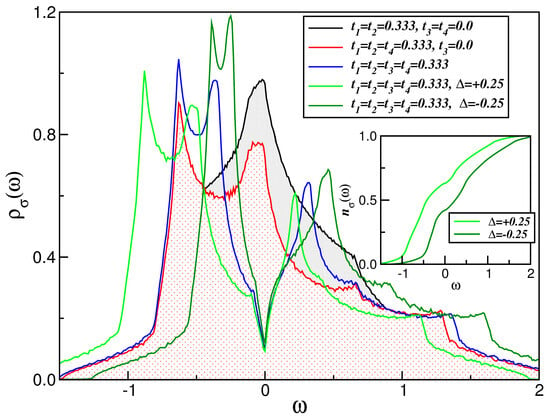
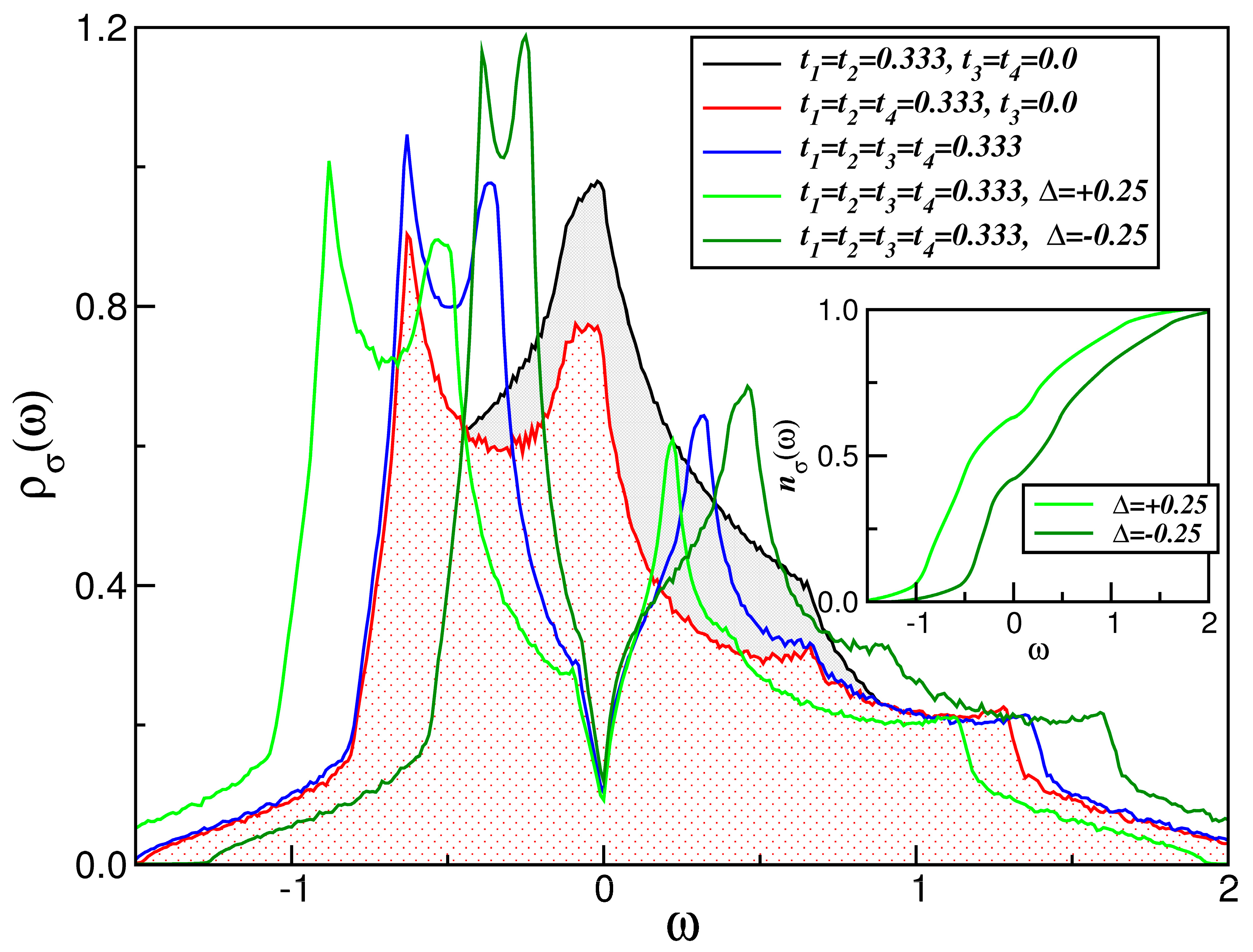
Let us now discuss our and +DMFT results. However, before delving into these results, we shall mention here that, based on the minimal model introduced in Ref. [17], each of the two magnetic sublattices of CrSb carry finite local spin polarization of opposite sign such that the total net magnetization is zero, as expected for an altermagnetic system. However, since the results presented below refer only to a sublattice rather than the complete lattice. The spin splitting of the electronic states and sublattice magnetization is not expected to describe the vanishing spin moment of the altermagnetic state but the correlated electronic reconstruction of the spin-split band structure [17] at each sublattice. With this in mind, in Figure 1 we show the evolution of the density of states (DOS) computed using the hopping parameters considered in the within the free electron limit. Several features are noteworthy in this limit. Due to the structure of , the unperturbed DOS shows strong particle-hole asymmetry with the valence band below the Fermi level being more populated as compared to the conduction band above . From the spin-resolved or the total DOS, we obtain a total band filling , which would correspond to a nearly half-filled band system. Also interesting in the bare DOS of Figure 1 is the emergent V-like pseudogap, a characteristic akin of Dirac-like fermions [22]. This result is consistent with the viewpoint that the physics of the Dirac cones is governed by a single hopping integral [22], which in the case of the minimal for CrSb [17] is the term. Notably, the emergence of a V-shaped pseudogap implies that captures the most relevant fingerprints of the hexagonal [2,22] lattice structure of CrSb, and gives support to our choice for the hopping parameters. Also interesting in this figure is the splitting of the bare DOS obtained at finite . As seen, the majority (spin-↑) band obtained for is pushed to higher binding energies, while the minority (spin-↓) one is transferred to energies close to . At and finite we obtain , , and a splitting of the centre of gravity of the bare DOS of 0.67. The latter been consistent with values reported in Refs. [13,14,15,16]. Finally, also interesting in our result at a finite is the narrowing of minority DOS below as compared with the majority one, which as a result enhances the van Hove-like peaks at 0.38 and 0.24 binding energies in .
Figure 1.
Evolution of the density of states (DOS) as a function of the hopping parameters computed using the minimal tight-binding modelling [17] for CrSb altermagnet. Particular features to be seen is the V-shaped pseudogap characteristic of Dirac-like fermions obtained for and the spin-splitting of the unperturbed DOS at finite , as shown in the inset for the energy dependence of the spin-split band filling.
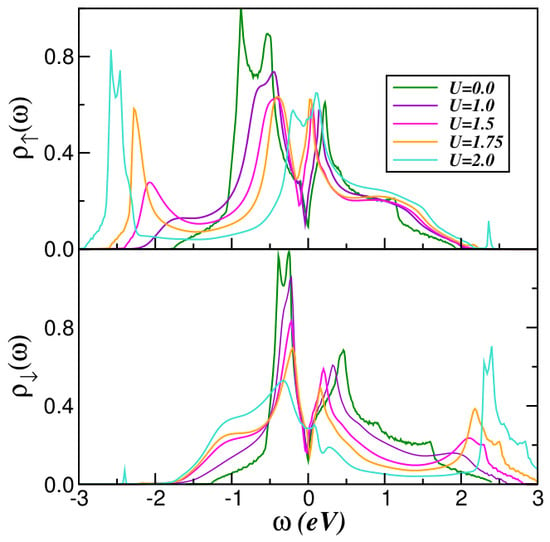
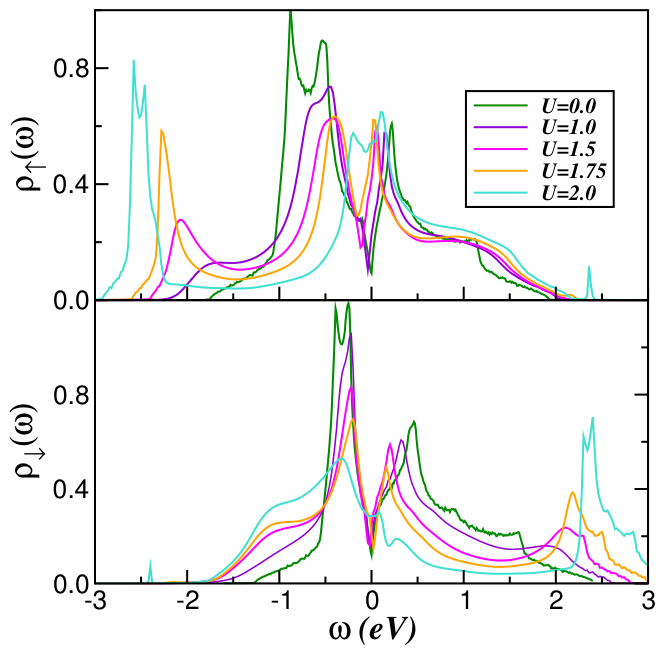
We now turn our attention to the influence of the on-site Coulomb interaction U [4,17,22] on the effective one-band Hubbard model for CrSb altermagnet, treated within the DMFT approximation [28]. Despite existing spectroscopy, magnetic and transport data for CrSb, the generic appearance of novel electronic states and the instabilities or not of such states to magnetic anisotropy with different spin textures in CrSb and analogs highlights the importance of this question. The main goal of this study is to build upon the strengths of a Green’s function formalism to analyze the impact of increasing the on-site U. With these caveats, in Figure 2 we display the changes in the local spectral functions with increasing the on-site Coulomb interaction U and fixed . As seen, our results in the two panels of Figure 2 correctly reproduce the expected behavior for the correlated spectral functions within the DMFT approximation. Particularly interesting are the emergent lower (LHB, responsible for the formation of localized moments [10]) and upper (UHB) Hubbard bands at high energies as well as the narrowing of the Dirac-like V-shaped pseudogap with increasing U. The latter is the counterpart of the Kondo-quasiparticle resonances [28] in non-Dirac fermion systems. Moreover, as a consequence of particle-hole asymmetry and the interplay between sizable U and , the pinning of the correlated spectral function to its bare value at [28] obtained for the one-band Hubbard model breaks down for the majority spin channel of CrSb, in spite of the fact that its self-energy imaginary part displays an asymmetric -dependence characteristic of a correlated Fermi liquid metal [28]. Also, interesting in Figure 2 is the pinning of the correlated DOS to its bare value, which is nearly preserved in the minority spin channel. Finally, consistent with earlier studies on correlated electron systems, many-body effects renormalizes the correlated DOS, leading to spectral weight transfer, and, more importantly, the emergence of a spin-selective crossover from a Dirac to a Fermi liquid metal at . Taken together and similar to Ref. [22], our present results reveal that distinct classes of nontrivial quasiparticles can be stabilized with an increasing U or the ratio [22], and future studies of CrSb under tensile strain [22] are called for to corroborate our prediction.
Figure 2.
Evolution of the spin-resolved spectral functions of CrSb with increasing the on-site Coulomb interaction U and fixed , showing clearly visible spin-selective changes at the one-particle level. Important features to see are the narrow lower and upper Hubbard bands at high energies, in and , respectively, the changes in the nearly linear V-like Dirac fermion DOS near the Fermi level and its suppression at .
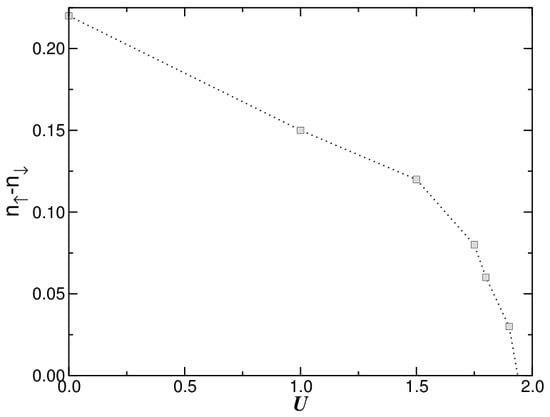
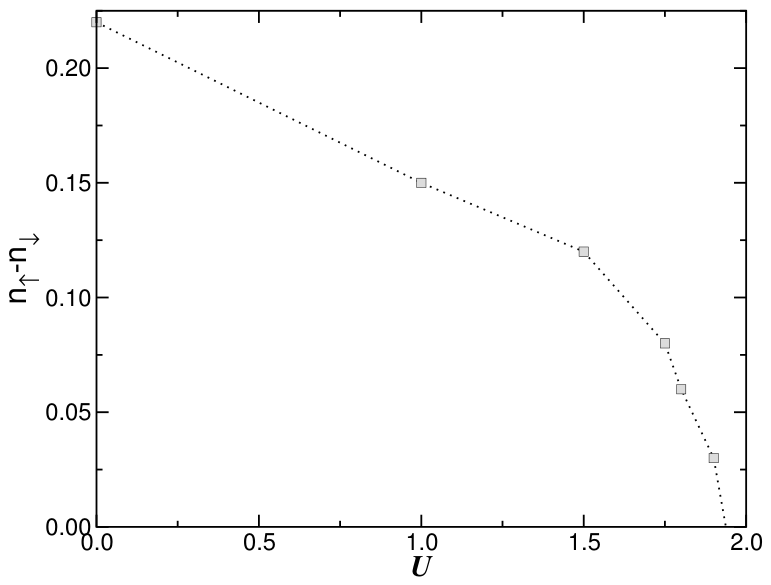
To provide additional insights on the role played by electron correlations [4,17,22] in CrSb altermagnet, in Figure 3, we show the U dependence of the magnetization computed using the spin-resolved +DMFT spectral functions of Figure 2. Starting at the magnetization decreases nearly linearly up to , meaning that there is a constant transfer of spectral weight from the majority to the minority spin channel. Above , the nearly linear reduction in spin polarization goes to a quadratic form until M reaches a zero value at : Although of different origin, this behavior turns out to be similar to that reported in Ref. [31]. We shall notice here, however, that our results in Figure 3 should not be interpreted as a direct identification of the Cr- moments computed using the local spin density approximation plus SOC (LSDA+SOC) in Ref. [22], since our minimal modeling does not take into account the full spin-polarized Cr- manifold of CrSb. Interesting as well in Figure 3 is the fact that, different from the weakly correlated regime, the magnetization at appears to be dominated by the nonlinear dynamical nature of the crossover region between the Dirac and the Fermi liquid metal, as shown in Figure 2. This, in turn, suggests that the loss of magnetization and the smooth equalization of spin populations in CrSb. We emphasize, however, that the magnetic moment shown in Figure 3 should not be seen as a direct quantitative estimate of the full local Cr moment measured experimentally [32], but it shall be taken as a fingerprint of magnetic polarization obtained within our minimal sublattice description. Hence, its experimental relevance lies mainly in predicting the suppression of magnetic polarization, rather than in the absolute magnitude of the calculated moment as reported, for example, in Ref. [22], meaning that a direct theory-experiment comparison requires a realistic consideration of all the orbital degrees of freedom, a problem that is left to future studies.
Figure 3.
U dependence on the magnetization obtained using our many-particle +DMFT results for CrSb sublattice. Notice the loss of magnetization, indicating a smooth equalization of the spin-↑ and spin-↓ occupations.
Motivated by Ref. [16] reporting the potential influence of defects, for systems containing Cr vacancies or excess Sb atoms, we provide microscopic insights on the electronic reconstruction induced by site diagonal disorder [30] within the Dirac fermion regime obtained for in Figure 2. Here, we treat the correlated plus disordered (Mott–Anderson) problem of CrSb within the IPT plus coherent potential approximation (CPA). The latter allows for an exact treatment of site diagonal disorder within DMFT [30]. This combined many-particle treatment has already been used to describe the electronic state of doped Mott insulators, which were found to be in good accordance with experimental observations. Generally speaking, our scheme is an extension of that applied to the disordered Hubbard model [30], where the effect of site-diagonal disorder is modeled by incorporating a disorder term in . Similar to Refs. [30,33,34], we consider binary alloy distributions for disorder; therefore, the disorder potential is specified by the probability distribution , meaning that, upon the incorporation of different sources of disorder, a fraction, x, of sites have an additional local potential for an electron hopping onto that site. In other words, the Cr- carriers of CrSb experience different local environments in the course of their hopping, and the physical object which accounts for this effect within DMFT is the CPA [30,35]. The combined (Mott–Anderson) problem, i.e., the situation where electron correlations plus disorder simultaneously affect the one-particle response, is treated within DMFT by a proper combination of the IPT self-energy with the CPA one [30].
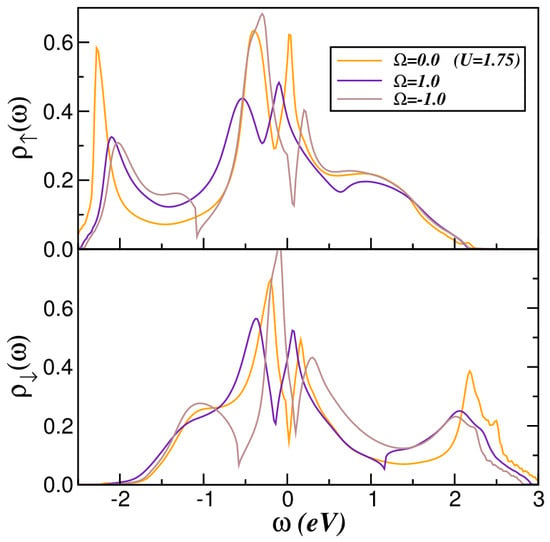
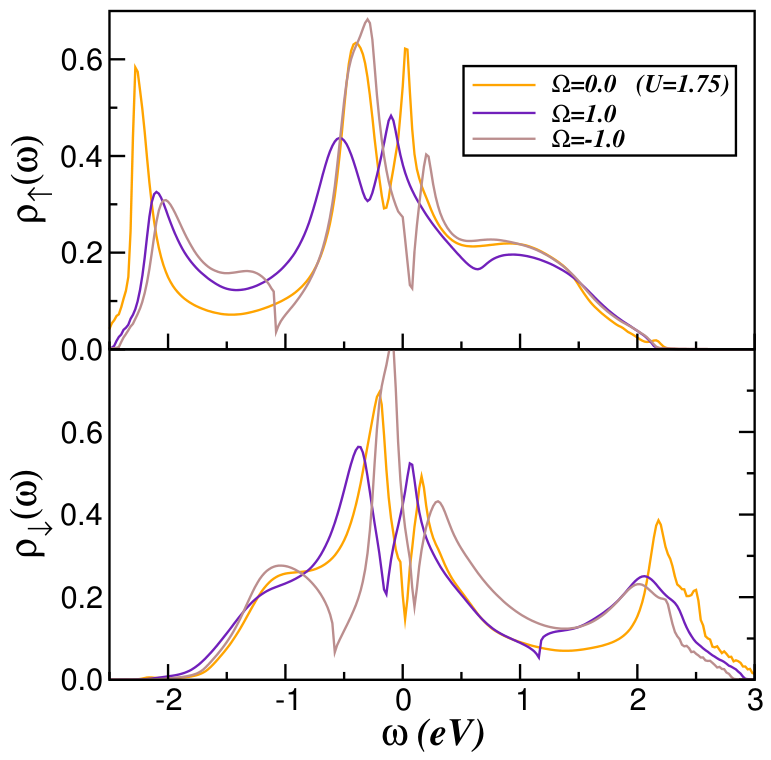
Let us now investigate how the correlated Dirac regime [22] of CrSb is reshaped upon consideration of disorder [16]. In Figure 4 we show the evolution of the correlated Dirac metal upon considering the effect of site-diagonal disorder. As seen, at finite we observe the appearance of narrow shoulders whose intensities and widths are sensitive to the sign of the disorder potential . This emergent electronic state is also characterized by the clearly visible changes of the Dirac-like pseudogap obtained in the clean ( eV) limit. To gain additional insights into the Dirac-Anderson electron phase, which emerges in disordered CrSb, in Figure 4 we show DMFT results obtained using negative and positive values for the disorder potential . As seen, by switching the disorder polarity, a large transfer of spectral weight is manifested in the correlated Dirac spectra, a fingerprint of correlated systems under external perturbations. Also interesting in Figure 4 is the change in the spin texture, which could be probed in future studies on disordered CrSb [16] and analogs. Taken together, these findings suggest that the spin-splitting that originates from the minimal sublattice model [17] is robust against disorder effects induced by defects or compositional variations.
Figure 4.
Illustration of the spin-selective electronic structure reconstruction induced by site-diagonal disorder in CrSb, obtained using fixed and values. Notice the large energy transfer of spectral weight induced by changing the sign of the disorder potential and the robustness of the spin-splitting against disorder. The DOS for the disorder-free CrSb is shown or comparison.
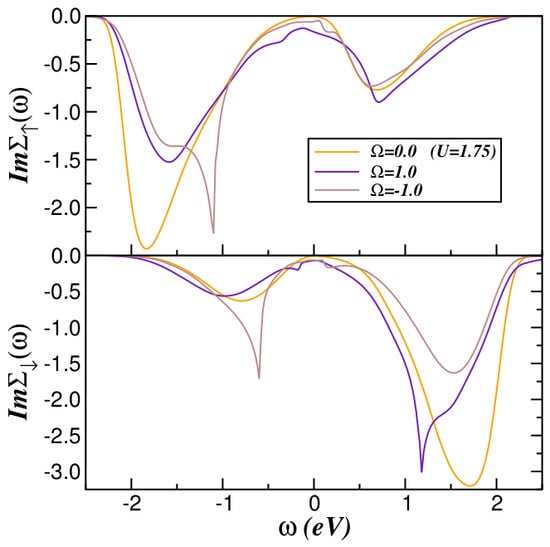
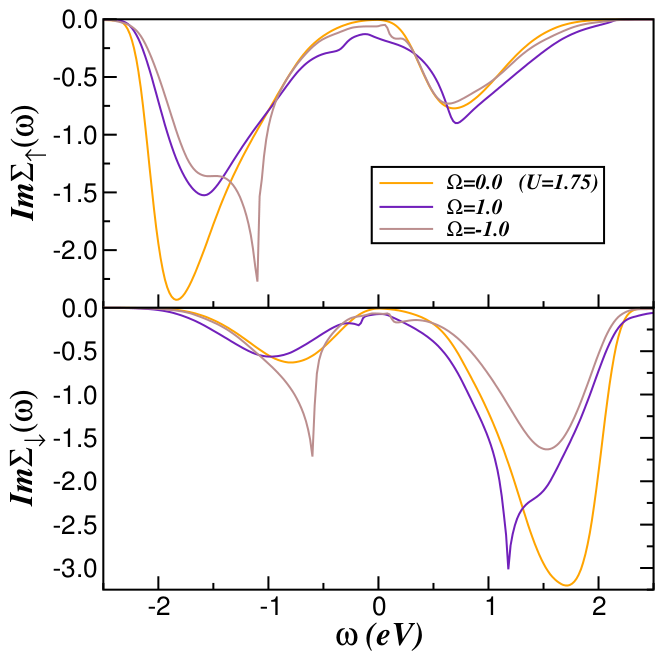
It is of interest to note that the correlated DOS obtained for the one-band Hubbard model treated within DMFT shows a split band structure with LHB and UHB at high energies [28]. Similar behaviour is also captured by CPA, inducing finite dome-like structures in the disordered DOS at different energies (see Figure 4) as a result of repeated scatterings between the correlated electrons and the local disorder. In analogy to the Hubbard bands, we dubbed these energy-dependent dome-like structures below (top panel) and above (lower panel) in Figure 4 as Anderson bands. Our results in Figure 4, thus, show the importance of treating the effect of disorder, which leads to incoherent resonant scattering processes contained in the disordered self-energy. With this caveat, we turn our attention to Figure 5, which shows the evolution of the spin-resolved self-energy imaginary parts for the same parameters used in Figure 4. The most salient features to be seen in Figure 5 are the anisotropic changes in the self-energies’ imaginary parts, where the emergent Dirac–Anderson state is characterized by the presence of incoherent many-particle electronic excitation within the low-energy window where nearly vanishes in the disorder-free regime. As is apparent from the spin-resolved self-energies, sizable disorder effects manifest themselves at different energies as pole structures, unveiling the dynamical nature of the scattering processes induced by site-diagonal disorder. Interestingly, the frequency dependence of the self-energy imaginary parts we derive for disordered CrSb shows similarities akin to that found for the Hubbard model, where the self-energy imaginary part diverges when entering in the Mott localized electronic state. Although arising from different many-particle scattering process [36], this behavior is clearly manifested in the in Figure 5. Hence, the Anderson satellites shown in Figure 4 can be seen as an analytically continued version of the Hubbard bands in Mott insulators, where electron localization is linked to poles in .
Figure 5.
Evolution of the spin-resolved self-energy imaginary parts of the disordered metallic phase of CrSb obtained using fixed and values. Notice the particle-hole asymmetry of and the sharp poles responsible for the emergence of the Anderson pseudoband gap at the valence bands for , as shown in Figure 4. for the disorder-free limit is shown for comparison.
For the sake of completeness, we shall mention here the recent study by Park et al. [37], which provides a systematic comparison between DFT, DFT+U, and DFT+DMFT calculations, showing how static and dynamical electronic correlations modify the momentum-dependent spin-splitting of an altermagnet close to Mottness. In particular, focusing on NiS2, this earlier study reveals that, beyond the correlation-induced enhancement of the local magnetic moment obtained with DFT+U, dynamical correlations generate additional electronic reconstruction and an asymmetry between the lifetimes of the spin-resolved quasiparticles, meaning that the altermagnetic electronic structure cannot be totally understood within a static mean-field picture. In this regard, our results in Figure 2 are closely related to this emerging picture, since it shows the evolution of the spin-split electronic structure by many-body electronic interactions. Additionally, our work extends the correlated problem of metallic altermagnet CrSb by considering the effect of site-diagonal disorder. Thus, whereas Ref. [37] focuses primarily on the evolution of correlation-induced quasiparticle renormalization, spin-splitting, and spin-dependent lifetimes in NiS2 near the Mott transition, our minimal model approach shows how electronic correlations together with disorder reconstruct the correlated states and modify the spin-resolved electronic response of CrSb. Our study and Ref. [37] are in this sense complementary: While the NiS2 results establish that dynamical many-body effects can reshape the quasiparticle band structure of an altermagnet, the present analysis explores how these correlation effects interplay with disorder in a metallic spin-split environment. Taken together, our and Ref. [37] results emphasize that theories of altermagnetic materials should go beyond conventional band theory that account not only for crystal and magnetic symmetry and electron-phonon effects [38] but also for dynamical electronic correlations.
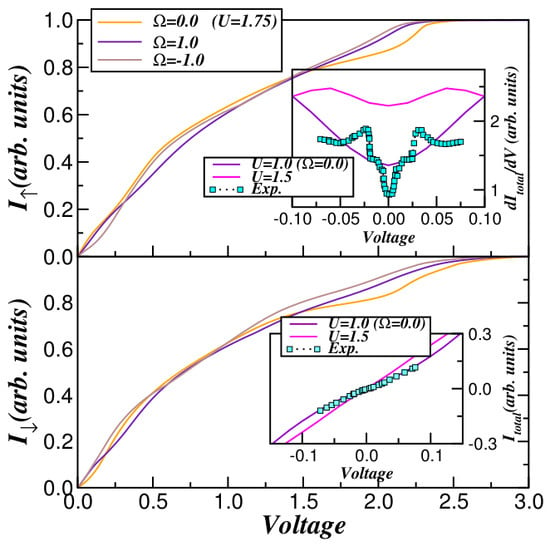
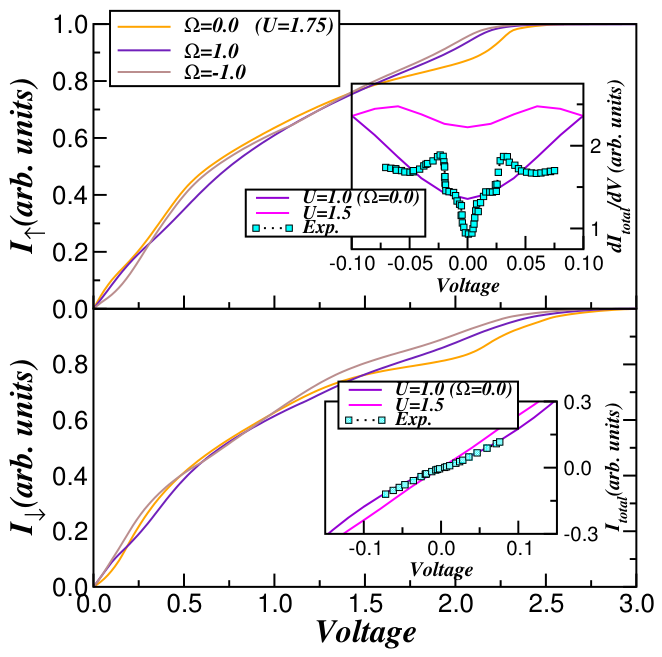
In view of understanding the implications of the correlated and correlated plus disorder metallic states, in Figure 6, we display current-voltage characteristic curves, computed using the spin-resolved DOS for the U (inset) and (main panels) values considered, respectively, in Figure 2 and Figure 4. As already pointed out in Ref. [39], within the wideband limit of the left (L) and right (R) electrodes, the current formula for a tunneling experiment reads [40]
In this relation, with being the coupling strength between electrode and the central region [41]; and is the Fermi function of the electrode . For simplicity we assume a symmetric voltage drop, , and the wideband limit with constant DOS for the leads. Although experimental data exists [42], these assumptions allow for a microscopic description of the spin-polarized characteristic that could emerge in future studies of CrSb and analogs. Motivated thereby, in the main panel of Figure 6 we display the characteristic curves computed using the spin-resolved DOS for the three values considered in Figure 4, showing qualitative small changes at finite as compared to the disorder-free regime. Interesting in this main panel is the nonlinear current-voltage behavior [43] and the crossing points at different voltages which result as an effect caused by the particle-hole asymmetry at the one-particle level and strong dynamical transfer of spectral weight obtained, respectively, in Figure 2 and Figure 4. Importantly, our results in Figure 6 are expected to open new opportunities for understanding the emergent spin-polarized currents in quantum correlated material systems. Finally, as a proof-of-concept in the inset of the lower panel of Figure 6 we display a theory-experiment comparison between the +DMFT results for disorder-free CrSb and the total characteristic curve obtained by numerally integrating the differential resistance taken from Ref. [42], showing qualitative good agreement between experiment and theory result obtained for . Interestingly, our results in Figure 6 indicate that the experimental In-CrSb junction exhibits a unipolar (or symmetric) [44,45] resistance state, which might be relevant for future studies on volatile and non-volatile devices based on CrSb resistors for future neuromorphic computing [46].
Figure 6.
Main panels: Evolution of the current-voltage curves of CrSb obtained using the spin-resolved DOS for and the three values of the disorder potential considered in Figure 4. Notice the qualitative differences between the spin-polarized currents. The lower inset shows a theory-experiment comparison of the total current obtained for disorder-free CrSb and characteristic computed by numerically integrating the differential resistance taken from Ref. [42]. Notice the good qualitative agreement between the result and the experimental curve. The corresponding theory-experimental results are shown in the upper inset.
3. Conclusions
In summary, we have studied the spin-dependent electron correlations in a minimal one-band Hubbard model for CrSb. We find strong spin selectivity at half filling, a result that is encoded in a correlated Dirac liquid which evolves to a Fermi liquid metal with increasing the on-site Coulomb interaction U. At the physical electron count, we show that the spin selectivity is smoothly suppressed across the Dirac-to-Fermion phase crossover, leading to the formation of an electronic state with zero sublattice magnetization. We also show that disorder contributes to the strong renormalization of the electronic structure, inducing the formation of Anderson satellites at high energies. Finally, we use our many-particle framework to explore the changes in the spin-resolved current-voltage characteristic, relevant to understanding the effect of disorder in spin-polarized currents of quantum materials. Given the importance of both the electronic structure and electron correlations to altermagnets [37,47,48,49,50], our results provide a basis to understand the stability of the spin-splitting against correlation plus disorder effects [16]. More generally, our work enriches the microscopic physics that is crucial to describe spin-polarized current-voltage characteristic of material systems.
Funding
This research is supported by CNPq (Grant. No. 303359/2024-2). Acknowledgment is also made to FINEP (Project No. 0167/25) as well as to The Leibniz Institute for Solid State and Materials Research Dresden for hospitality in the earlier stages of this work.
Data Availability Statement
Data available upon request from the author.
Acknowledgments
Acknowledgment is made to CNPq, FINEP and CAPES.
Conflicts of Interest
The author declares no conflict of interest.
References
- Hamad, M.K.; Maswadeh, Y.; Martinez-Teran, E.; El-Gendy, A.A.; Ziq, K.A. Structural, magnetic, and critical behavior of CrTe1−xSbx Alloys. Eur. Phys. J. B 2021, 136, 516. [Google Scholar] [CrossRef] [Scilit]
- Willis, B. Crystal structure and antiferromagnetism of CrSb. Acta Crystallogr. 1953, 6, 425–426. [Google Scholar] [CrossRef] [Scilit]
- Polesya, S.; Kuhn, G.; Benea, D.; Mankovsky, S. Electronic structure and magnetic properties of chromium chalcogenides and pnictides with NiAs Structure. Z. Anorg. Allg. Chem. 2013, 639, 2826–2835. [Google Scholar] [CrossRef] [Scilit]
- Li, C.; Hu, M.; Zhang, J.; Berntsen, M.H.; Scali, F.; Phuyal, D.; Lin, C.; Chen, W.; Chang, J.; Clark, O.J.; et al. Extreme strain controlled correlated metal-insulator transition in the altermagnet CrSb. arXiv 2025, arXiv:2512.07683. [Google Scholar]
- Snow, A.I. Neutron diffraction investigation of the atomic magnetic moment orientation in the antiferromagnetic compound CrSb. Phys. Rev. 1952, 85, 365. [Google Scholar] [CrossRef] [Scilit]
- Takei, W.J.; Cox, D.E.; Shirane, G. Magnetic structures in the MnSb-CrSb system. Phys. Rev. 1963, 129, 2008. [Google Scholar] [CrossRef] [Scilit]
- Thadathi, S.N.; Schwarze, B.V.; Ansari, J.; Kotte, T.; Luther, S.; Uhlarz, M.; Gonzalez-Hernandez, R.; Šmejkal, L.; Speliotis, T.; Žáčková, M.; et al. Fermi-surface studies of altermagnetic CrSb from Shubnikov-de Haas oscillations. arXiv 2026, arXiv:2602.24033. [Google Scholar]
- Thadathil, S.N.; Müller, C.; Firouzmandi, R.; Farin, L.; Goswami, S.; Badura, A.; Manuel, P.; Orlandi, F.; Ritzinger, P.; Petříček, V.; et al. Electrical and thermal magnetotransport in altermagnetic CrSb. arXiv 2026, arXiv:2603.25820. [Google Scholar]
- Ding, J.; Jiang, Z.; Chen, X.; Tao, Z.; Liu, Z.; Li, T.; Liu, J.; Sun, J.; Cheng, J.; Liu, J.; et al. Large band splitting in g-wave altermagnet CrSb. Phys. Rev. Lett. 2024, 133, 206401. [Google Scholar] [CrossRef] [Scilit] [PubMed]
- Song, J.; Mu, C.; Zhu, S.; Wu, W.; Long, Y.; Luo, J.; Li, Z. Perfect compensation of the magnetic sublattices in altermagnet CrSb. Phys. Rev. Mater. 2026, 10, 014412. [Google Scholar] [CrossRef] [Scilit]
- Mazin, I.; The PRX Editors. Altermagnetism—A new punch line of fundamental magnetism. Phys. Rev. X 2022, 12, 040002. [Google Scholar] [CrossRef] [Scilit]
- Song, C.; Bai, H.; Zhou, Z.; Han, L.; Reichlova, H.; Dil, J.D.; Liu, J.; Chen, X.; Pan, F. Altermagnets as a new class of functional materials. Nat. Rev. Mater. 2025, 10, 473–485. [Google Scholar] [CrossRef] [Scilit]
- Reimers, S.; Odenbreit, L.; Šmejkal, L.; Strocov, V.N.; Constantinou, P.; Hellenes, A.B.; Ubiergo, R.J.; Campos, W.H.; Bharadwaj, V.K.; Chakraborty, A.; et al. Direct observation of altermagnetic band splitting in CrSb thin films. Nat. Commun. 2024, 15, 2116. [Google Scholar] [CrossRef] [Scilit] [PubMed]
- Yang, G.; Li, Z.; Yang, S.; Li, J.; Zheng, H.; Zhu, W.; Pan, Z.; Xu, Y.; Cao, S.; Zhao, W.; et al. Three-dimensional mapping of the altermagnetic spin splitting in CrSb. Nat. Commun. 2025, 16, 1442. [Google Scholar] [CrossRef] [Scilit] [PubMed]
- Li, C.; Hu, M.; Li, Z.; Wang, Y.; Chen, W.; Thiagarajan, B.; Leandersson, M.; Polley, C.; Kim, T.; Liu, H.; et al. Topological Weyl altermagnetism in CrSb. Commun. Phys. 2025, 8, 311. [Google Scholar] [CrossRef] [Scilit]
- Lu, W.; Feng, S.; Wang, Y.; Chen, D.; Lin, Z.; Liang, X.; Liu, S.; Feng, W.; Yamagami, K.; Liu, J.; et al. Signature of topological surface bands in altermagnetic Weyl semimetal CrSb. Nano Lett. 2025, 25, 7343–7350. [Google Scholar] [CrossRef] [Scilit] [PubMed]
- Roig, M.; Kreisel, A.; Yu, Y.; Andersen, B.M.; Agterberg, D.F. Minimal models for altermagnetism. Phys. Rev. B 2024, 110, 144412. [Google Scholar] [CrossRef] [Scilit]
- Long, M.; Weinberger, T.I.; Wu, Z.; Hansen, M.F.; Tao, R.; Shrestha, M.; Graf, D.; Skourski, Y.; Grosche, F.M.; Eaton, A.G. 3D bulk-resolved g-wave magnetic order parameter symmetry in the metallic altermagnet CrSb. arXiv 2026, arXiv:2601.14526. [Google Scholar]
- Paul, S.; Ikeda, A.; Mattoni, G.; Yonezawa, S.; Sow, C. Thermodynamic and transport properties of high-quality single crystals of the altermagnet CrSb. Phys. Rev. Mater. 2026, 10, 063402. [Google Scholar] [CrossRef] [Scilit]
- Urata, T.; Hattori, W.; Ikuta, H. High mobility charge transport in a multicarrier altermagnet CrSb. Phys. Rev. Mater. 2024, 8, 084412. [Google Scholar] [CrossRef] [Scilit]
- Peng, X.; Wang, Y.; Zhang, S.; Zhou, Y.; Sun, Y.; Su, Y.; Wu, C.; Zhou, T.; Liu, L.; Wang, H.; et al. Scaling behavior of magnetoresistance and Hall resistivity in the altermagnet CrSb. Phys. Rev. B 2025, 111, 144402. [Google Scholar] [CrossRef] [Scilit]
- Giri, S.; Ganguli, N. Strain as a topological selector in altermagnetic CrSb. arXiv 2026, arXiv:2601.15916. [Google Scholar]
- Marfoua, B.; Amirabbasi, M.; Ekholm, M. Altermagnetism of ultrathin CrSb slabs. Phys. Rev. B 2026, 113, 214439. [Google Scholar] [CrossRef] [Scilit]
- Li, K.; Hu, Y.; Li, Y.; Xu, R.; Li, H.; Liu, K.; Liu, C.; Zhuang, J.; Ang, Y.S.; Wang, J.; et al. Two-dimensional altermagnetism in epitaxial CrSb ultrathin films. arXiv 2025, arXiv:2510.12344. [Google Scholar]
- Terashima, T.; Hattori, Y.; Graf, D.; Urata, T.; Yoshioka, T.; Hattori, W.; Ikuta, H.; Ikeda, H. Altermagnetic spin-split Fermi surfaces in CrSb revealed by quantum oscillation measurements. arXiv 2026, arXiv:2601.19105. [Google Scholar]
- Zhang, L.; Ni, G.; He, J.; Gao, G. Above room temperature multiferroic tunnel junction with the altermagnetic metal CrSb. Phys. Rev. B 2025, 112, 064401. [Google Scholar] [CrossRef] [Scilit]
- Carta, A.; Timrov, I.; Mlkvik, P.; Hampel, A.; Ederer, C. Explicit demonstration of the equivalence between DFT+U and the Hartree-Fock limit of DFT+DMFT. Phys. Rev. Res. 2025, 7, 013289. [Google Scholar] [CrossRef] [Scilit]
- Georges, A.; Kotliar, G.; Krauth, W.; Rozenberg, M.J. Dynamical mean-field theory of strongly correlated fermion systems and the limit of infinite dimensions. Rev. Mod. Phys. 1996, 68, 13. [Google Scholar] [CrossRef] [Scilit]
- Craco, L. Quantum orbital entanglement: A view from the extended periodic Anderson model. Phys. Rev. B 2008, 77, 125122. [Google Scholar] [CrossRef] [Scilit]
- Laad, M.S.; Craco, L.; Müller-Hartmann, E. Effect of strong correlations and static diagonal disorder in the d = ∞ Hubbard model. Phys. Rev. B 2001, 64, 195114. [Google Scholar] [CrossRef] [Scilit][Green Version]
- Woodgate, C.D.; Menai, N.; Ernst, A.; Staunton, J.B. Loss of altermagnetic order and smooth restoration of Kramers’ spin degeneracy with increasing temperature in CrSb and MnTe. arXiv 2026, arXiv:2603.15035. [Google Scholar]
- Takei, W.J.; Cox, D.E.; Shirane, G. Magnetic structures in CrTe-CrSb solid solutions. J. App. Phys. 1966, 37, 973–974. [Google Scholar] [CrossRef] [Scilit]
- Byczuk, K.; Ulmke, M.; Vollhardt, D. Ferromagnetism and metal-insulator transition in the disordered Hubbard model. Phys. Rev. Lett. 2003, 90, 196403. [Google Scholar] [CrossRef] [Scilit] [PubMed]
- Terletska, H.; Ekuma, C.E.; Moore, C.; Tam, K.-M.; Moreno, J.; Jarrell, M. Study of off-diagonal disorder using the typical medium dynamical cluster approximation. Phys. Rev. B 2014, 90, 094208. [Google Scholar] [CrossRef] [Scilit]
- Korotin, A.; Pchelkina, Z.V.; Skorikov, N.A.; Kurmaev, E.Z.; Anisimov, V.I. The coherent potential approximation for strongly correlated systems: Electronic structure and magnetic properties of NiO-ZnO solid solutions. J. Phys. Condens. Matter 2014, 26, 115501. [Google Scholar] [CrossRef] [Scilit] [PubMed]
- Vlaming, R.; Vollhardt, D. Controlled mean-field theory for disordered electronic systems: Single-particle properties. Phys. Rev. B 1992, 45, 4637. [Google Scholar] [CrossRef] [Scilit] [PubMed]
- Park, I.; Birol, T.; Georges, A.; Fernandes, R.M. Impact of strong electronic correlations on altermagnets: The case of NiS2. Phys. Rev. Mater. 2026, 10, 054415. [Google Scholar] [CrossRef] [Scilit]
- Consiglio, A.; Unzelmann, M.; Panaccione, G.; Di Sante, D. Chiral phonons coupled to spin-split bands in altermagnetic CrSb and MnTe. arXiv 2026, arXiv:2607.04802. [Google Scholar]
- Craco, L.; Carara, S.S.; de Arruda, A.S.; de Arruda, P.H.Z.; Leoni, S. Tunable analog and nearly digital responses in hole-doped LiNbO2 memristors. Solid State Commun. 2025, 401, 115911. [Google Scholar] [CrossRef] [Scilit]
- Meir, Y.; Wingreen, N.S. Landauer formula for the current through an interacting electron region. Phys. Rev. Lett. 1992, 68, 2512. [Google Scholar] [CrossRef] [Scilit] [PubMed]
- Bao, X.-X.; Wang, X.-F. Effects of long-range dispersive interaction on the electron transport in short single strands of guanine bases. Int. J. Quantum Chem. 2023, 1, e27251. [Google Scholar] [CrossRef] [Scilit]
- Esin, V.D.; Kazmin, D.Y.; Barash, Y.S.; Timonina, A.V.; Kolesnikov, N.N.; Deviatov, E.V. Josephson diode and spin-valve effects on the surface of altermagnet CrSb. JETP Lett. 2025, 123, 556–565. [Google Scholar] [CrossRef] [Scilit]
- Yan, P.; Si, M.; Liu, Y.; Ren, Y.; Ding, Q.; Jiang, W.; Fan, Y.; Jiang, W. Large internal stress induced nonlinear current-voltage behavior in nanodiamond strengthened ZnO ceramics. Nat. Commun. 2024, 15, 9812. [Google Scholar] [CrossRef] [Scilit] [PubMed]
- Waser, R.; Aono, M. Nanoionics-based resistive switching memories. Nat. Mater. 2007, 6, 833–840. [Google Scholar] [CrossRef] [Scilit] [PubMed]
- Chen, A.; Fu, Y.; Yang, G.; Liu, N.; Zhao, X.; Zhang, Z.; Tao, L.; Wan, H.; Rao, Y.; Duan, J.; et al. The Co-improvement of selectivity and uniformity on NbOx-based selector by Al-doping. IEEE Electron Device Lett. 2022, 43, 870–873. [Google Scholar] [CrossRef] [Scilit]
- Ran, Y.; Pei, Y.; Zhou, Z.; Wang, H.; Sun, Y.; Wang, Z.; Hao, M.; Zhao, J.; Chen, J.; Yan, X. A review of Mott insulator in memristors: The materials, characteristics, applications for future computing systems and neuromorphic computing. Nano Res. 2023, 16, 1165–1182. [Google Scholar] [CrossRef] [Scilit]
- Jeschke, H.O.; Shimizu, M.; Mazin, I.I. CuAg(SO4)2: A doubly strongly correlated altermagnetic three-dimensional analog of the parent compounds of high-Tc cuprates. Phys. Rev. B 2024, 109, L220412. [Google Scholar] [CrossRef] [Scilit]
- Li, J.; Liu, J.; Yang, X.; Tang, H.-K. Enhancement of d-wave pairing in strongly correlated altermagnet. arXiv 2025, arXiv:2505.12342. [Google Scholar]
- Ouyang, Z.; Guo, P.-J.; He, R.-Q.; Lu, Z.-Y. Strongly correlated altermagnet CaCrO3. arXiv 2025, arXiv:2507.14081. [Google Scholar]
- Peces, A.B.; Merino, J. Altermagnetism in an interacting model of kagome materials. Phys. Rev. B 2026, 113, 165143. [Google Scholar] [CrossRef] [Scilit]
Disclaimer/Publisher’s Note: The statements, opinions and data contained in all publications are solely those of the individual author(s) and contributor(s) and not of MDPI and/or the editor(s). MDPI and/or the editor(s) disclaim responsibility for any injury to people or property resulting from any ideas, methods, instructions or products referred to in the content. |
© 2026 by the author. Licensee MDPI, Basel, Switzerland. This article is an open access article distributed under the terms and conditions of the Creative Commons Attribution (CC BY) license.