


Abstract
Alcichthys elongatus is the only species in the genus, and this work is the first to provide a comprehensive mitogenome analysis of this species. The A. elongatus mitogenome was 16,712 bp long, with biased A + T content (52.33%), and featured thirteen protein-coding genes (PCGs), twenty-two tRNAs, two rRNAs, and the control region (D-loop). The H strand encoded twenty-eight genes (twelve PCGs, fourteen tRNA, and two rRNA) and the control region, whereas the L strand encoded the remaining nine genes (ND6 and eight tRNA). Except for COXI, which started with GTG, all PCG sequences started with ATG and ended with TAA (ND4L, ND5, COXI, ATP8) or TAG (ND1, ND6) termination codons, with some (ND2, ND3, ND4, COXII, COXIII, ATP6, Cytb) having an incomplete termination codon. Except for tRNA-serine-1 (trnS), the majority of the tRNAs exhibited characteristic cloverleaf secondary structures. Based on 13 PCGs, phylogenetic analysis placed A. elongatus in the same clade as Icelus spatula. This genomic data will be useful for species identification, phylogenetic analysis, and population genetics.
Keywords:
Alcichthys elongatus; Perciformes; Cottidae; mitochondrial genome; phylogenetic analysis; ray-finned fish; marine sculpin Key Contribution:
This study presents a comprehensive investigation of the mitochondrial genome of A. elongatus, providing publicly accessible genetic data for future research pertaining to fish species.
1. Introduction
The Cottidae (Cottiodei, Perciformes), which has 275 known species in 70 genera, is one of the most diversified fish families found across the globe [1]. Initially, fishes of this family were grouped into a phylogenetic diagram based on morphological data, but this approach was ineffective since the species share so many similar morphological characters. Subsequently, internal and external morphological characters were combined to solve taxonomic difficulties [2]. Additionally, phylogenetic relationships were conducted using molecular markers (mitochondrial or nuclear genes) [3], although many questions about the relationships between genera and species still persist.
Within Cottidae, Elongated sculpin Alcichthys elongatus (Steindachner, 1881) belongs to the monospecific genus Alcichthys and is distributed in the northwestern Pacific Ocean including the Sea of Okhotsk and Japan [4,5,6]. A. elongatus is a marine, demersal, and low boreal fish that dwells on rocky reefs at depths of up to 253 m [6,7,8]. Few studies on the molecular features of A. elongatus have been published. A complete mitochondrial or nuclear genome sequence has not yet been published; only a few gene sequences are available in the National Center for Biotechnology Information (NCBI) GenBank, including COI, Cytb, rRNA (12S and 16S), and tRNA-Val genes of the mitochondrial genome and recombination activating protein 1 (RAG1) gene of the nuclear genome, and these genes were used for evolutionary and phylogenetic studies [3,9]. With the progress in genetic studies of biodiversity and systematics, the determination of how fish evolved by studying their complete mitochondrial genomes has developed quickly [10]. Mitochondrial genome analysis can often help us understand adaptive divergence and speciation [11].
The objective of this study was to generate the complete mitogenome of A. elongatus and to characterize its genomic features to advance the construction of a phylogenetic tree. The complete mitochondrial genomic data of A. elongatus will be a valuable genomic resource for future studies on resolving the phylogenetic relationship and evolutionary history of the family Cottidae.
2. Materials and Methods
2.1. Sample Collection and DNA Isolation
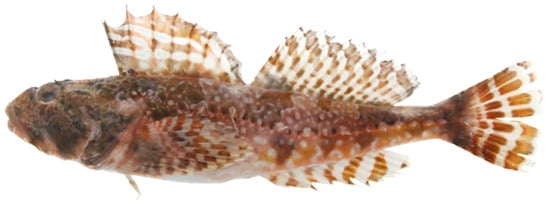
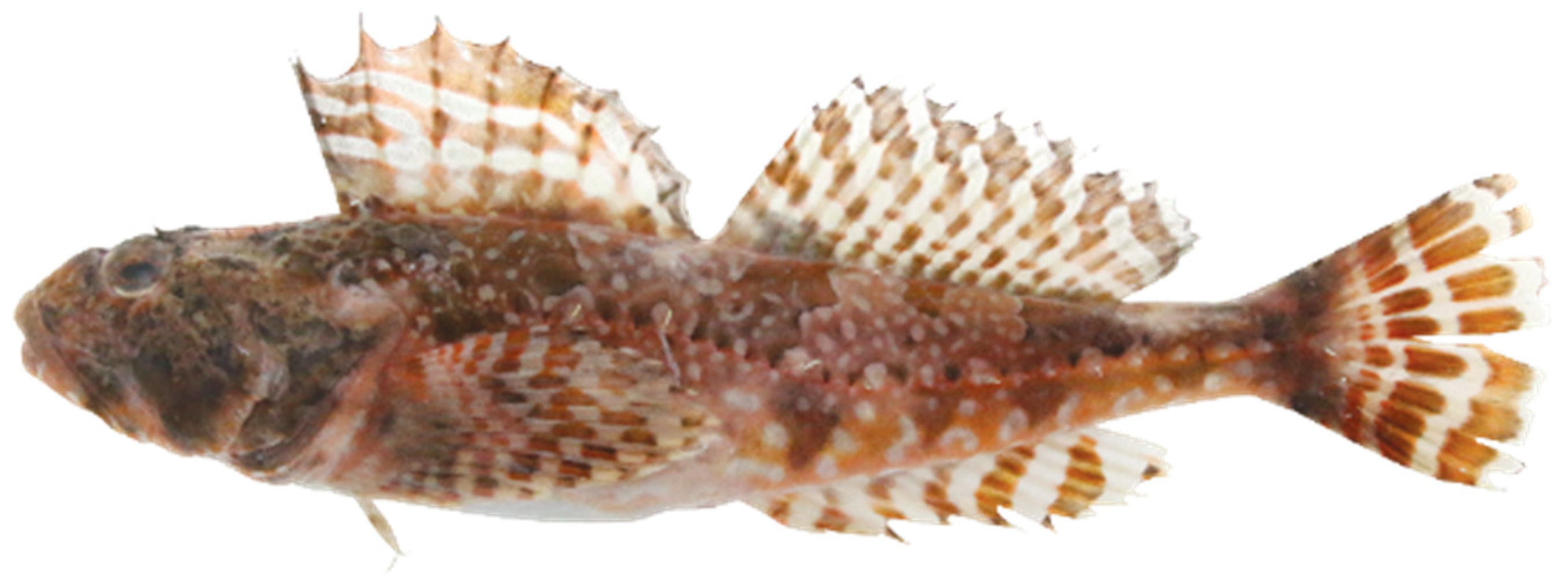
A. elongatus fish samples were collected from the coastal waters of the East Sea (Pohang, South Korea; 36°6′43.5″ N, 129°26′32.4″ E) and deposited at the Department of Marine Biology, Pukyong National University, Busan, South Korea (Prof. Jin-Koo Kim, taengko@pknu.ac.kr) under voucher number PKU-50558 (Figure 1). Muscle tissues were used for total genomic DNA extraction according to the DNeasy Blood and Tissue Kit’s (Qiagen, Germany) instructions. The quality (concentration) of extracted DNA was determined by a NanoDrop D1000 spectrophotometer (Thermo Fisher Scientific, Waltham, MA, USA) and preserved at −4 °C for further analysis.
Figure 1.
Alcichthys elongatus (Photo by Jin-Koo Kim), a marine ray-finned fish captured from the East Sea (coast of Pohang, South Korea). The body has a creamy-brown color with dorsal spines (9–10), dorsal soft rays (14–17), and anal soft rays (13–16).
2.2. Whole Genome Sequencing
The Illumina Platform (Illumina Inc., San Diego, CA, USA) was used to sequence the genome of A. elongatus. The Macrogen Company (Daejeon, South Korea) took part in the library preparation and sequencing procedures. The TrueSeq® Nano DNA Kit (San Diego, CA, USA) was used to produce the DNA libraries in accordance with the manufacturer’s instructions, and the Illumina HiSeq 2500 (Illumina) was used for paired-end, 150 bp mode of sequencing. To achieve clean reads, raw data first passed quality control before moving on to subsequent processing. Trimmomatic [12] was used to remove adapter sequences and low-quality reads (phred quality score (%) Q20 = over 20 and Q30 = over 30) in order to reduce biases in analysis. In the A. elongatus library, 144,607,336 total raw reads (GC = 42.05%, Q20 = 96.82%, and Q30 = 92.82%) and 120,226,836 total filtered reads (GC = 41.54%, Q20 = 99.18%, and Q30 = 97.13%) were generated. The trimmed reads were randomly sampled in order to assemble the mitochondrial genome. In this case, only sampled reads were used for de novo assembly. The quality of the generated sequencing reads was assessed using FastQC v0.11.5 (Babraham Institute, Bioinformatics) [13]. The high-quality reads of the mitochondrial genome were de novo assembled using several k-mers [14] and the SPAdes v3.13.0 software [15]. After the complete genome was assembled, BLAST analysis was carried out to identify contig containing mitogenome sequences in the NCBI database.
2.3. Mitogenome Assembly and Annotation
The contig was annotated using the MitoFish (http://mitofish.aori.u-tokyo.ac.jp/, accessed on 1 July 2023) [16] and MITOS (http://mitos.bioinf.uni-leipzig.de/index.py, accessed on 1 July 2023) [17] pipeline with genetic code 2 (Vertebrates code). Predicted open reading frames (ORFs) were manually examined, and the final annotations were verified using ORFfinder (https://www.ncbi.nlm.nih.gov/orffinder/, accessed on 1 July 2023). By using a BLAST homology search in the NCBI database, protein-coding genes (PCGs) were manually verified against previously reported mitogenomes of Cottidae members [18]. Transfer RNAs (tRNAs) were identified using tRNAscan-SE v2.0 (http://lowelab.ucsc.edu/tRNAscan-SE/, accessed on 1 July 2023) with default parameters (Genetic code: Vertebrate Mito) [19], and tRNA secondary structure was predicted and confirmed using ARWEN [20]. The assembled contig was analyzed for identification by querying BlastN [21] and comparing the sizes with previously published Cottidae mitogenomes. A physical map of the mitogenome of A. elongatus (NCBI GenBank accession number: OR288162.1) was generated using OGDRAW v.1.3.1 (https://chlorobox.mpimp-golm.mpg.de/OGDraw.html, accessed on 1 July 2023) [22]. The nucleotide compositions of mitogenomes were calculated in MEGA11 v.11.2.8 [23]. Codon usage of PCGs was determined using Sequence Manipulation Suite (SMS) tool (http://www.bioinformatics.org/sms2/codon_usage.html, accessed on 1 July 2023) with genetic code 2 [24]. The composition of the skew analysis was calculated using formulae: AT-skew = (A − T)/(A + T) and GC-skew = (G − C)/(G + C) [25]. The intergenic spacers between the genes and the overlapping regions were calculated manually.
2.4. Phylogenetic Tree Construction
A total of 31 mitogenomes belonging to the Order Perciformes were chosen (Table 1) for phylogenetic tree study within Family Cottidae. Among these, A. elongatus (in this study) and other 28 mitogenomes were from Family Cottidae, which served as the in-group, while mitogenomes from the Scorpaenidae (Scorpaena neglecta (ON109388.1)) and Stichaeidae family (Chirolophis wui (OP388414)), were utilized as the outgroups for performing phylogenetic tree construction. The selected sequences used in this study were downloaded from the NCBI database. The phylogenetic analysis used a series of concatenated nucleotide sequences from 13 PCG datasets. These datasets were arranged in the specific order of nad1, nad2, cox1, cox2, atp8, atp6, cox3, nad3, nad4L, nad4, nad5, nad6, and cytb. The process of multiple sequence alignment was executed in the MEGA11, using the ClustalW algorithm [26]. Subsequently, a phylogenetic tree was generated utilizing the maximum likelihood (ML) method [27]. ML analysis was performed using default parameters in the Tamura-Nei model with 1000 bootstrap replications [23].
Table 1.
Nucleotide composition of the complete mitogenomes from members of Order Perciformes.
3. Results and Discussion
3.1. Genome Size and Organization
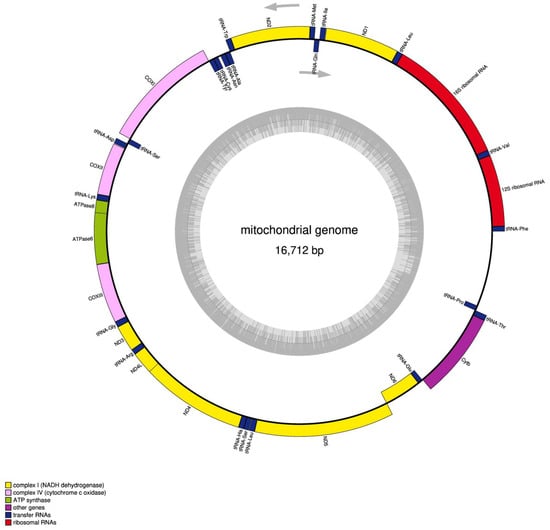
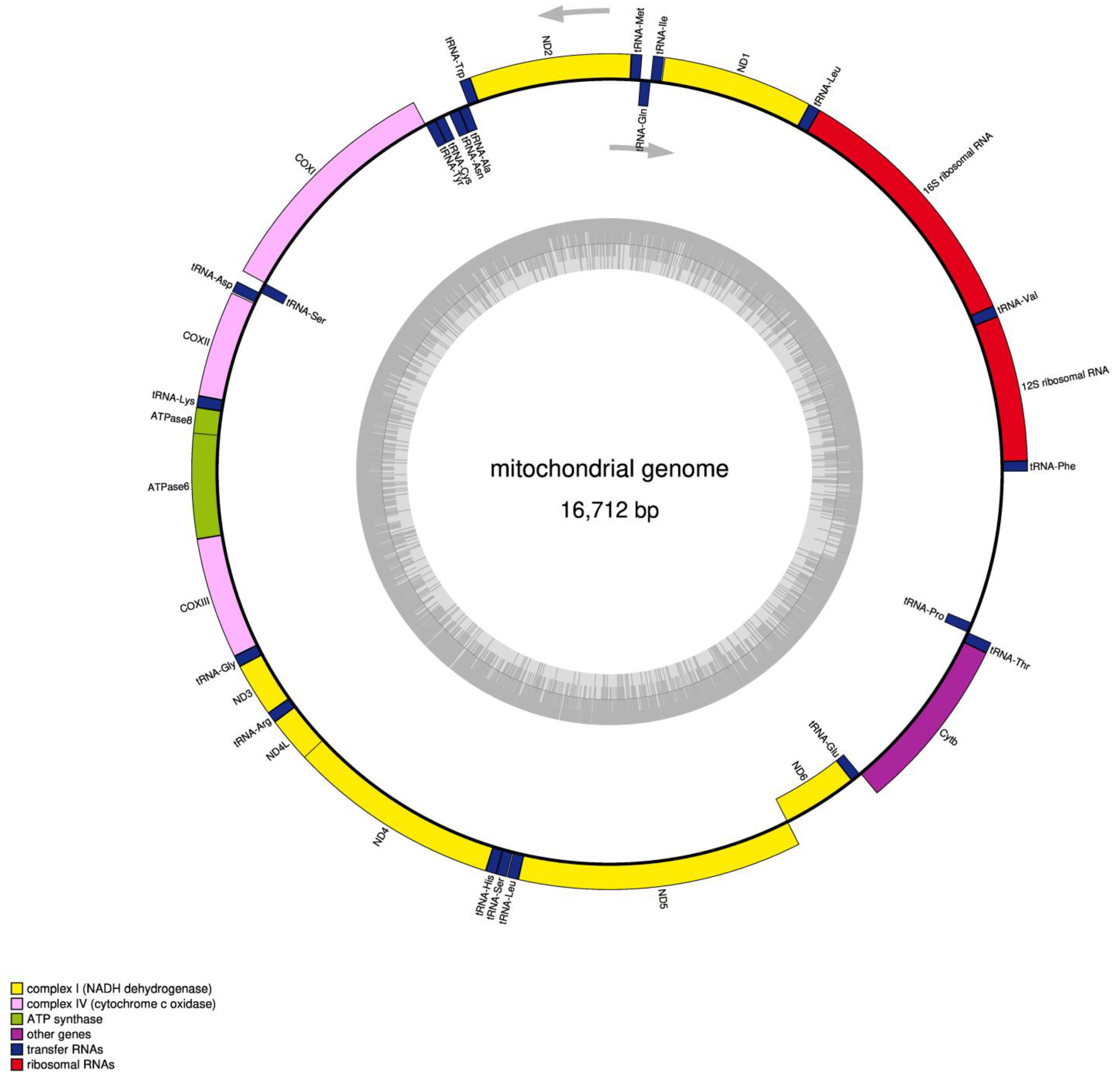
The mitogenome of A. elongatus was assembled into a circular DNA molecule measuring 16,712 bp in length (GenBank: OR288162; Figure 2, Table 2). This length falls within the range of other mitogenomes belonging to the Family Cottidae, which vary from 16,369 bp (Porocottus allisi, NC_057484) [28] to 18,374 bp (Clinocottus analis, NC_013828) (Table 1). The analysis of the complete mitogenome sequence of A. elongatus by nucleotide BLAST indicated high sequence similarities with closely related species, namely Icelus spatula NC_027587 (89.63%) [37], Gymnocanthus intermedius NC_034650.1 (89.08%), G. herzensteini NC_034651 (89.37%), G. tricuspis NC_045927 (89.24%) [36], Enophrys diceraus NC_022147 (88.70%) [34], and E. bison NC_066929 (87.82%). The mitochondrial genome of A. elongatus comprised two rRNA genes, thirteen PCGs, twenty-two tRNA genes, and a D-loop region. The heavy strand (H-strand) contained fourteen tRNA, twelve PCGs, two rRNA genes, and the D-loop, whereas the light strand (L-strand) had eight tRNA and one PCG (ND6) (Table 2). These features of A. elongatus were identical to those of other Cottidae mitogenomes [28,34,36,37] and could be regarded as effective markers for authentication at the genus and species level.
Figure 2.
The circular mitogenome of A. elongatus. The direction of the arrow denotes the orientation of the genes, and the various colors denote the grouping of functional genes along with their abbreviations.
Table 2.
Sequence characteristics of A. elongatus mitogenome.
The nucleotide compositions of A, T, G, and C were determined to be 26.43%, 25.90%, 17.48%, and 30.14%, respectively. These findings indicate a biased A + T composition of 52.33%, which is consistent with the nucleotide composition seen in other members of Family Cottidae, as shown in Table 1. The observed positive AT-skew (0.0101) in this research is consistent with the other fish species that were used. This skew indicates a higher abundance of adenine (A) nucleotides compared with thymine (T) nucleotides.
3.2. Protein Coding Genes
The PCG region constituted 68.38% of the A. elongatus mitogenome, covering a length of 11,428 bp. The ND5 gene was longest among the PCGs, covering a total of 1839 bp. On the other hand, the ATP8 gene was the shortest PCG, consisting of just 168 bp. Each PCG was started by a standard ATG codon, with the exception of COXI, which was started by a GTG codon (Table 2). Previous studies have shown comparable findings in other species of Perciformes [28,29,30,31,32,33,34,35,36,37,38,39,40,41,42]. In the mitogenome of A. elongatus, we observed that four of the thirteen PCGs (ND4L, ND5, COXI, ATP8) used a standard TAA termination codon, which is commonly observed in the mitogenomes of Order Perciformes [28,29,30,31,32,33,34,35,36,37,38,39,40,41,42,43,44,45]. On the other hand, ND1 and ND6 genes terminated with the codon TAG, ND2, COXIII, and ATP6 genes ended with the codon TA, and ND3, ND4, COXII, and Cytb genes terminated with a single T (Table 2). The incomplete termination codons may be completed to TAA by RNA processing by the addition of a poly-A tail [44].
The genome of A. elongatus encodes a total of 3800 amino acids within its PCGs (Table 3). The amino acid composition of the PCGs in A. elongatus revealed that leucine (17.45%), alanine (9.47%), and threonine (7.97%) were the most frequently occurring amino acids. On the other hand, glutamate/glutamine (2.63%), aspartate (1.92%), and cysteine (0.63%) were the least abundant amino acids (Table 3). Similar codon usage patterns were noticed in other members of the Family Cottidae [28,29,30,31,32,33,34,35,36,37,38,39,40,41].
Table 3.
Codon usage in the mitochondrial PCGs of A. elongatus.
3.3. Transfer RNA and Ribosomal RNA Genes
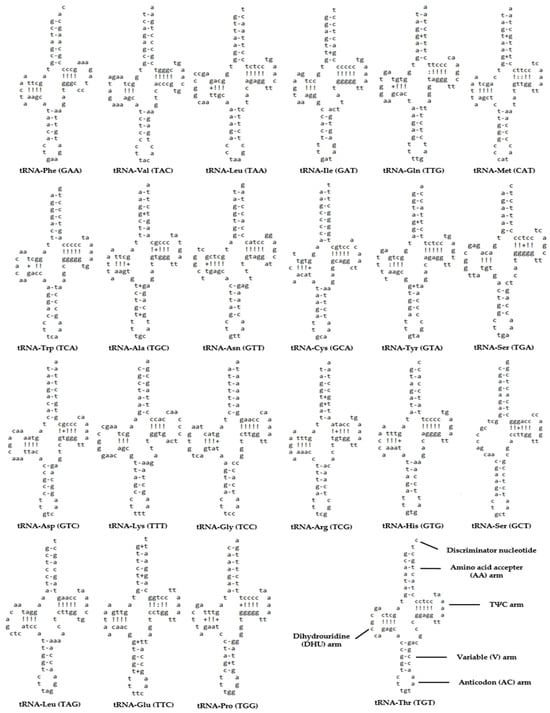
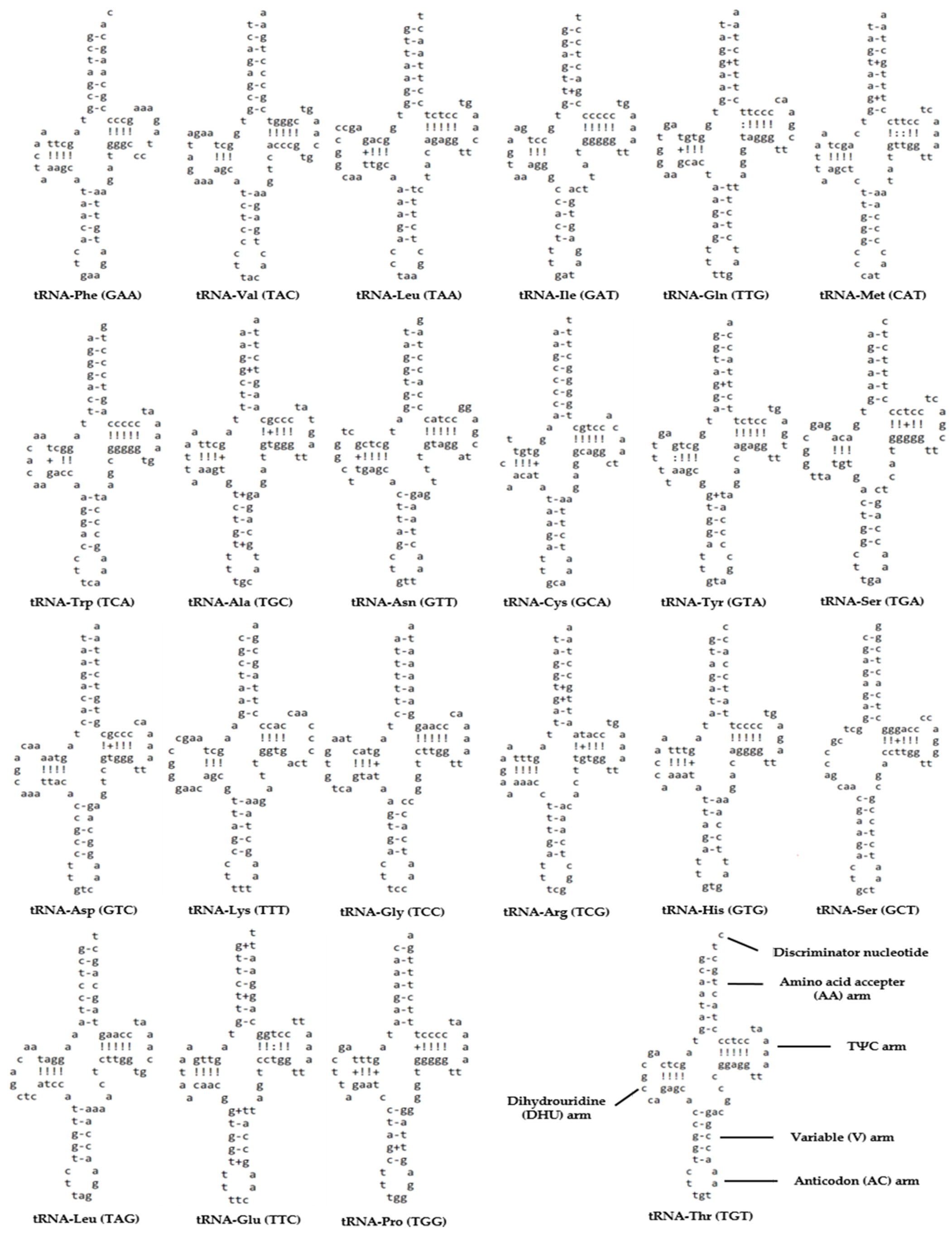
The current study found a total of 22 tRNA in the mitogenome of A. elongatus. These tRNAs exhibited a characteristic complement structure, with lengths ranging from 66 bp for trnC to 74 bp for trnL and trnK (Table 2). Among these tRNAs, leucine (TAA, TAG) and serine (TGA, GCT) were represented by two tRNA forms each, while the other amino acids had a single tRNA gene. The cumulative length of all tRNA was determined to be 1554 bp, accounting for about 9.30% of the whole mitogenome. A total of fourteen tRNA genes were identified on the H strand, whereas the remaining tRNA genes were found on the L strand. All tRNAs fold into typical cloverleaf secondary structures with the exception of the serine tRNA (trnS, (GCT)), which lacks the dihydrouridine (DHU) arm (Figure 3). The DHU arm of this tRNA was a large loop instead of the conserved stem and loop structure. In the typical secondary structure of the tRNA genes, it was noted that seventeen (tRNA: Leu (TAA), Ile, Gln, Met, Trp, Ala, Asn, Cys, Tyr, Ser (TGA), Asp, Gly, Arg, His, Ser (GCT), Glu, Pro) showed the presence of at least one G-T mismatch, which formed a weak bond. Three T-T mismatches were noticed, with two found in the amino acid (AA) arm of the tRNA (Gln, Met), and one in the TΨC arm of tRNA-Glu (Figure 3). The presence of the mismatched base pairs seen in tRNA sequences may be corrected by the RNA-editing process, which has been extensively studied in vertebrate mitogenomes [45]. Overall, the secondary structure of the tRNA in A. elongatus exhibited the normal Watson–Crick pairing seen in vertebrate mitogenomes [46].
Figure 3.
Predicted secondary structure for 22 tRNA genes in the mitogenome of A. elongatus. Watson–Crick and GT bonds are illustrated as “-” and “+”, respectively.
The mitochondrial genome of A. elongatus contains two rRNA genes, namely 12S rRNA (943 bp) and 16S rRNA (1694 bp), (Table 2). The combined size of 2637 bp corresponds to about 15.78% of the whole mitogenome. Both of these genes are encoded on the H strand. The 12S rRNA and 16S rRNA genes are separated by the tRNA-Val gene, and these genes are situated between the tRNA-Phe and tRNA-Leu (TAA) genes. The above-mentioned characteristics were consistent with the typical perciform mitogenomes [28,29,30,31,32,33,34,35,36,37,38,39,40,41,42].
3.4. Overlapping and Intergenic Spacer Regions
There were six gene boundaries where 1–10 bp of overlapping bases occurred between adjacent genes. The longest overlapping region between ATP8 and ATP6 was 10 bp (Table 2), which has been reported in many other perciform mitogenomes [34]. Moreover, A. elongatus mitogenome intergenic spacers occurred across nine locations and ranged from 1 to 38 bp, a total of 61 bp; the longest intergenic spacer region (38 bp) was between tRNA-Asn and tRNA-Cys (Table 2).
3.5. Phylogenetic Relationship
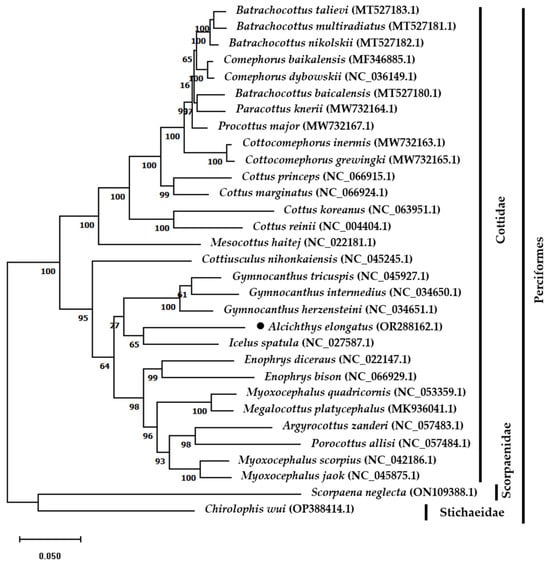
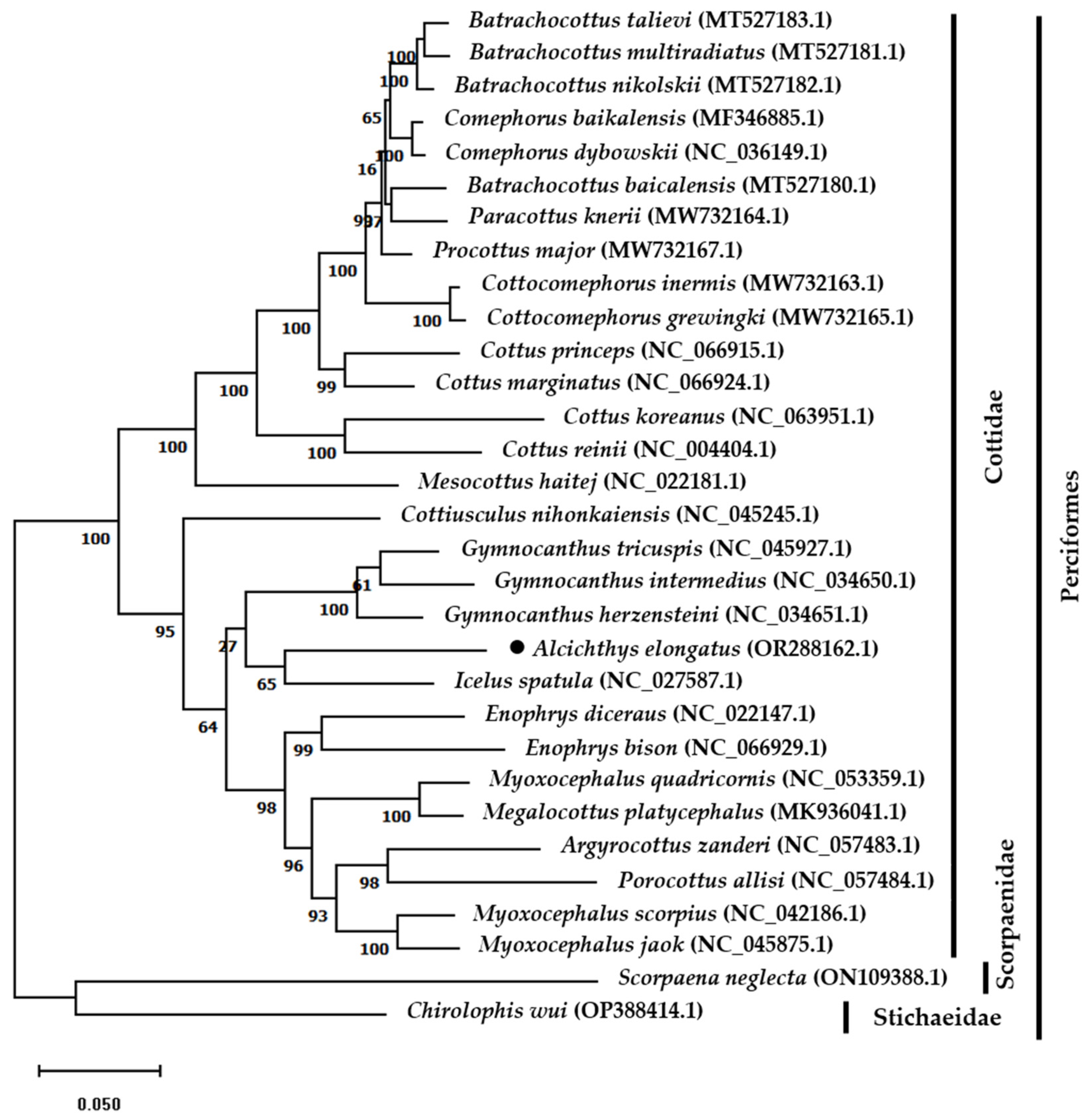
To better understand the phylogenetic relationships within the Family Cottidae, a maximum likelihood approach was used. A dataset of 32 species was utilized, whereby the concatenated nucleic acid sequences of 13 PCGs were analyzed to construct the phylogenetic tree (Figure 4). In previous studies, the determination of phylogenetic relationships was based on the analysis of partial mitogenome sequences, mostly focusing on COX1 or 16S rRNA genes [3,9]. The mitogenome of A. elongatus in this study clustered with I. spatula (NC_027587) (Figure 1). A phylogenetic analysis based on selected cottid species showed two main clades, with nine genera grouped together in one clade (Cottiusculus, Gymnocanthus, Alcichthys, Icelus, Enophrys, Myoxocephalus, Megalocottus, Argyrocottus, Porocottus) and seven genera grouped together in the other clade (Mesocottus, Cottus, Cottocomephorus, Procottus, Paracottus, Batrachocottus, Comephorus). Recent phylogenetic studies based on mitochondrial PCGs [40] and complete genomes [28,38] of cottid species found a similar topology. In order to enhance an understanding of the evolutionary relationships among species within the Perciformes order, it is necessary to examine the mitogenomes of more species within this taxonomic group.
Figure 4.
Maximum-likelihood (ML) tree constructed for a total of 29 species belonging to the Family Cottidae, with one representative from each of the Scorpaenidae and Stichaeidae. This phylogeny was constructed using the concatenated nucleotide sequences of 13 PCGs. The numbers on the branches represent ML bootstrap percentages (1000 replicates). For published sequences, NCBI GenBank accession numbers are included following the species name. This study analyzed Alcichthys elongatus.
4. Conclusions
The present study reports the complete mitogenome of A. elongatus, which includes 37 distinct mitochondrial genes that occur in fishes. The organizational structure of the mitogenome in A. elongatus closely resembled that of other members of the Family Cottidae. The sequenced mitogenome dataset from this work is a useful resource for future phylogenetic and evolutionary research. PCGs seem to better represent the evolution of a complete mitochondrial genome than rRNA genes. Therefore, it is necessary to perform phylogenetic reconstruction using PCGs in a greater number of species within the Family Cottidae to achieve a complete understanding of the evolution of this group.
Author Contributions
Conceptualization, M.P.P., J.-O.K. and G.-D.K.; methodology, M.P.P. and J.-O.K.; software, J.-O.K., Y.-J.L., Y.B.S. and J.-K.K.; validation, J.-O.K., J.-K.K., S.-I.K. and G.-D.K.; formal analysis, M.P.P., J.-O.K., S.H.Y. and Y.-J.L.; investigation, S.H.Y., Y.B.S., J.-K.K. and S.-I.K.; resources, J.-K.K. and G.-D.K.; data curation, M.P.P. and Y.B.S.; writing—original draft preparation, M.P.P.; writing—review and editing, J.-O.K., S.H.Y., Y.-J.L., Y.B.S., J.-K.K., S.-I.K. and G.-D.K.; visualization, M.P.P., Y.-J.L. and Y.B.S.; supervision, J.-K.K. and G.-D.K.; project administration, J.-O.K.; funding acquisition, G.-D.K. All authors have read and agreed to the published version of the manuscript.
Funding
This research was supported by the Korea Institute of Marine Science & Technology Promotion (KIMST) funded by the Ministry of Oceans and Fisheries, Korea (Project No. 20220252 and 20220572).
Institutional Review Board Statement
The sample used for this study was a dead body of fish and as per the animal experimental ethics in the Republic of Korea (Standard operating guideline; IACUC—Institutional Animal Care and Use Committee, Book no. 11-1543061-000457-01, effective from Dec. 2020), it does not need any approval from an Ethics Committee.
Informed Consent Statement
Not applicable.
Data Availability Statement
The complete mitochondrial genome sequence of A. elongatus and related data were deposited to the NCBI GenBank (https://www.ncbi.nlm.nih.gov/, accessed on 17 July 2023 and 4 August 2023). The complete mitogenome sequence data are available under GenBank number OR288162.1 and related data including BioProject, BioSample, and Sequence Read Archive (SRA) are available under numbers PRJNA1002095, SAMN36832317, and SRR25514326, respectively.
Acknowledgments
This research was conducted using the fish specimen provided by the Marine Fish Resources Bank of Korea (MFRBK) and Pukyong National University (PKNU).
Conflicts of Interest
The authors declare no conflict of interest.
References
- Mecklenburg, C.W.; Mecklenburg, T.A.; Thorsteinson, L.K. Fishes of Alaska; American Fisheries Society: Bethesda, MD, USA, 2002; p. 1037. [Google Scholar]
- Jackson, K.L. Contributions to the Systematics of Cottoid Fishes (Teleostei: Scorpaeniformes). Ph.D. Thesis, Department of Biological Sciences, University of Alberta, Edmonton, AB, Canada, 2003; p. 16. [Google Scholar]
- Knope, M.L. Phylogenetics of the marine sculpins (Teleostei: Cottidae) of the North American Pacific coast. Mol. Phylo. Evol. 2013, 66, 341–349. [Google Scholar] [CrossRef] [Scilit] [PubMed]
- Im, S.-O. Feeding Relationship and Trophic Partitioning of Demersal Fish Assemblage in the Coastal Waters of East Sea. Ph.D. Thesis, Pukyong National University, Busan, Republic of Korea, 2019; p. 15. [Google Scholar]
- Shinohara, G.; Nakae, M.; Ueda, Y.; Kojima, S.; Matsuura, K. Annotated checklist of deep-sea fishes of the Sea of Japan. Natl. Mus. Nat. Sci. Monogr. 2014, 44, 225–291. [Google Scholar]
- Panchenko, V.V.; Pushchina, O.I.; Antonenko, D.V.; Solomatov, S.F.; Kalchugin, P.V. Distribution and some traits of biology of the elongated sculpin Alcichthys elongatus in the north-western part of the Sea of Japan. J. Ichthyol. 2011, 51, 217–226. [Google Scholar] [CrossRef] [Scilit]
- Nakabo, T. Fishes of Japan with Pictorial Keys to the Species; English Edition I; Tokai University Press: Tokyo, Japan, 2002; p. v-866. [Google Scholar]
- Froese, R.; Pauly, D. FishBase. Alcichthys elongatus (Steindachner, 1881). World Register of Marine Species. Available online: https://www.marinespecies.org/aphia.php?p=taxdetails&id=279545 (accessed on 3 August 2023).
- Radchenko, O.A.; Moreva, I.N.; Petrovskaya, A.V. The subfamily Myoxocephalinae of cottid fishes (Cottidae): Genetic divergence and phylogenetic relationships. J. Fish Biol. 2021, 99, 1857–1868. [Google Scholar] [CrossRef] [Scilit]
- Avise, J.C.; Arnold, J.; Ball, R.M.; Bermingham, E.; Lamb, T.; Neigel, J.E.; Reeb, C.A.; Saunders, N.C. Intraspecific phylogeography: The mitochondrial DNA bridge between population genetics and systematics. Annu. Rev. Ecol. Syst. 1987, 18, 489–522. [Google Scholar] [CrossRef]
- Crampton-Platt, A.; Yu, D.W.; Zhou, X.; Vogler, A.P. Mitochondrial metagenomics: Letting the genes out of the bottle. GigaScience 2016, 5, s13742-016-0120-y. [Google Scholar] [CrossRef] [Scilit]
- Bolger, A.M.; Lohse, M.; Usadel, B. Trimmomatic: A flexible trimmer for Illumina sequence data. Bioinformatics 2014, 30, 2114–2120. [Google Scholar] [CrossRef] [Scilit]
- Andrews, S. FastQC: A Quality Control Tool for High Throughput Sequence Data; Babraham Institute: Cambridge, UK, 2010. [Google Scholar]
- Chikhi, R.; Medvedev, P. Informed and automated k-mer size selection for genome assembly. Bioinformatics 2014, 30, 31–37. [Google Scholar] [CrossRef] [Scilit]
- Bankevich, A.; Nurk, S.; Antipov, D.; Gurevich, A.A.; Dvorkin, M.; Kulikov, A.S.; Lesin, V.M.; Nikolenko, S.I.; Pham, S.; Prjibelski, A.D. SPAdes: A new genome assembly algorithm and its applications to single-cell sequencing. J. Comput. Biol. 2012, 19, 455–477. [Google Scholar] [CrossRef] [Scilit]
- Zhu, T.; Sato, Y.; Sado, T.; Miya, M.; Iwasaki, W. MitoFish, MitoAnnotator, and MiFish pipeline: Updates in 10 years. Mol. Biol. Evol. 2023, 40, msad035. [Google Scholar] [CrossRef] [Scilit]
- Bernt, M.; Donath, A.; Jühling, F.; Externbrink, F.; Florentz, C.; Fritzsch, G.; Pütz, J.; Middendorf, M.; Stadler, P.F. MITOS: Improved de novo metazoan mitochondrial genome annotation. Mol. Phylo. Evol. 2013, 69, 313–319. [Google Scholar] [CrossRef] [Scilit] [PubMed]
- Gish, W.; States, D.J. Identification of protein coding regions by database similarity search. Nat. Genet. 1993, 3, 266–272. [Google Scholar] [CrossRef] [Scilit] [PubMed]
- Lowe, T.M.; Chan, P.P. tRNAscan-SE online and contextual analysis of transfer RNA genes. Nucleic Acids Res. 2016, 44, W54–W57. [Google Scholar] [CrossRef] [Scilit] [PubMed]
- Laslett, D.; Canbäck, B. ARWEN: A program to detect tRNA genes in metazoan mitochondrial nucleotide sequences. Bioinformatics 2008, 24, 172–175. [Google Scholar] [CrossRef] [Scilit] [PubMed]
- Altschul, S.F.; Madden, T.L.; Schäffer, A.A.; Zhang, J.; Zhang, Z.; Miller, W.; Lipman, D.J. Gapped BLAST and PSI-BLAST: A new generation of protein database search programs. Nucleic Acids Res. 1997, 25, 3389–3402. [Google Scholar] [CrossRef] [Scilit]
- Greiner, S.; Lehwark, P.; Bock, R. OrganellarGenomeDRAW (OGDRAW) version 1.3. 1: Expanded toolkit for the graphical visualization of organellar genomes. Nucleic Acids Res. 2019, 47, W59–W64. [Google Scholar] [CrossRef] [Scilit]
- Tamura, K.; Stecher, G.; Kumar, S. MEGA11: Molecular evolutionary genetics analysis version 11. Mol. Biol. Evol. 2021, 38, 3022–3027. [Google Scholar] [CrossRef] [Scilit]
- Stothard, P. The sequence manipulation suite: JavaScript programs for analyzing and formatting protein and DNA sequences. Biotechniques 2000, 28, 1102–1104. [Google Scholar] [CrossRef] [Scilit]
- Perna, N.T.; Kocher, T.D. Patterns of nucleotide composition at fourfold degenerate sites of animal mitochondrial genomes. J. Mol. Evol. 1995, 41, 353–358. [Google Scholar] [CrossRef] [Scilit]
- Thompson, J.D.; Gibson, T.J.; Higgins, D.G. Multiple sequence alignment using ClustalW and ClustalX. Curr. Protoc. Bioinform. 2003, 1, 2–3. [Google Scholar] [CrossRef] [Scilit]
- Felsenstein, J. Evolutionary trees from DNA sequences: A maximum likelihood approach. J. Mol. Evol. 1981, 17, 368–376. [Google Scholar] [CrossRef] [Scilit] [PubMed]
- Balakirev, E.S.; Kravchenko, A.Y.; Semenchenko, A.A. Genetic evidence for a mixed composition of the genus Myoxocephalus (Cottoidei: Cottidae) necessitates generic realignment. Genes 2020, 11, 1071. [Google Scholar] [CrossRef] [Scilit] [PubMed]
- Teterina, V.; Bogdanov, B.; Kirilchik, S. Complete mitochondrial genomes and phylogenetic analysis of four Baikal endemic Batrachocottus species (Scorpaeniformes: Cottoidei). Mitochondrial DNA Part B Resour. 2022, 7, 123–124. [Google Scholar] [CrossRef] [Scilit] [PubMed]
- Sandel, M.W.; Aguilar, A.; Fast, K.; O’Brien, S.; Lapidus, A.; Allison, D.B.; Teterina, V.; Kirilchik, S. Complete mitochondrial genomes of Baikal oilfishes (Perciformes: Cottoidei), earth’s deepest-swimming freshwater fishes. Mitochondrial DNA Part B Resour. 2017, 2, 773–775. [Google Scholar] [CrossRef] [Scilit]
- Yang, L.; Zhu, K.; Fang, J.; Liu, L.; Lü, Z. Characterization of the complete mitochondrial genome of Cottiusculus nihonkaiensis (Scorpaeniformes, Cottidae) and phylogenetic studies of Scorpaeniformes. Mitochondrial DNA Part B Resour. 2021, 6, 358–360. [Google Scholar] [CrossRef] [Scilit]
- Mugue, N.; Barmintseva, A.; Etingova, A.; Didorenko, S.; Selifanova, M.; Mugue, L.; Popov, A.; Bulakhov, A.; Kupchinskiy, A. Complete mitochondrial genomes of representatives of two endemic sculpin families (Perciformes: Cottoidei) from Baikal–the world’s largest and deepest lake. Mitochondrial DNA Part B Resour. 2021, 6, 3190–3192. [Google Scholar] [CrossRef] [Scilit]
- Miya, M.; Takeshima, H.; Endo, H.; Ishiguro, N.B.; Inoue, J.G.; Mukai, T.; Satoh, T.P.; Yamaguchi, M.; Kawaguchi, A.; Mabuchi, K.; et al. Major patterns of higher teleostean phylogenies: A new perspective based on 100 complete mitochondrial DNA sequences. Mol. Phylo. Evol. 2003, 26, 121–138. [Google Scholar] [CrossRef] [Scilit]
- Li, A.; Munehara, H. Complete mitochondrial genome of the Antlered sculpin Enophrys diceraus (Scorpaeniformes, Cottidae). Mitochondrial DNA Part B Resour. 2015, 26, 125–126. [Google Scholar] [CrossRef] [Scilit]
- Yi, C.H.; Kwun, H.J.; Song, Y.S.; Kim, Y.K.; Kim, W.; Kim, I.H. Complete mitochondrial genome of Gymnocanthus intermedius and Gymnocanthus herzensteini (Scorpaeniformes: Cottidae). Mitochondrial DNA Part B Resour. 2019, 4, 2660–2661. [Google Scholar] [CrossRef] [Scilit]
- Song, P.; Zhang, N.; Feng, J.; Li, Y.; Lin, L. The complete mitochondrial genome of the Arctic staghorn sculpin Gymnocanthus tricuspis (Scorpaeniformes: Cottidae). Mitochondrial DNA Part B Resour. 2019, 4, 1400–1401. [Google Scholar] [CrossRef] [Scilit]
- Swanburg, T.; Horne, J.B.; Baillie, S.; King, S.D.; McBride, M.C.; Mackley, M.P.; Paterson, I.G.; Bradbury, I.R.; Bentzen, P. Complete mitochondrial genomes for Icelus spatula, Aspidophoroides olrikii and Leptoclinus maculatus: Pan-Arctic marine fishes from Canadian waters. Mitochondrial DNA Part A 2016, 27, 2982–2983. [Google Scholar] [CrossRef] [Scilit] [PubMed]
- Balakirev, E.S.; Kravchenko, A.Y.; Cherepkova, E.V.; Saveliev, P.A.; Semenchenko, A.A.; Ayala, F.J. Complete mitochondrial genome of the Belligerent sculpin Megalocottus platycephalus (Cottoidei: Cottidae). Mitochondrial DNA Part B Resour. 2019, 4, 2980–2981. [Google Scholar] [CrossRef] [Scilit] [PubMed]
- Balakirev, E.S.; Kravchenko, A.Y.; Cherepkova, E.V.; Saveliev, P.A.; Semenchenko, A.A.; Ayala, F.J. Complete mitochondrial genome of the plain sculpin Myoxocephalus jaok (Cottoidei: Cottidae). Mitochondrial DNA Part B Resour. 2020, 5, 1295–1296. [Google Scholar] [CrossRef] [Scilit]
- Kim, B.M.; Kihm, J.H.; Park, T.Y.S. The complete mitochondrial genome of the fourhorn sculpin Triglopsis quadricornis (Perciformes, Cottidae) from Sirius Passet, North Greenland. Ocean Polar Res. 2021, 43, 371–374. [Google Scholar] [CrossRef]
- Li, Y.; Song, P.; Feng, J.; Zhang, N.; Zhang, R.; Lin, L. Complete mitochondrial genome sequence and phylogenetic analysis of Myoxocephalus scorpius (Linnaeus, 1758). Mitochondrial DNA Part B Resour. 2019, 4, 862–863. [Google Scholar] [CrossRef] [Scilit]
- Patil, M.P.; Kim, J.O.; Seo, Y.B.; Shin, J.; Yang, J.Y.; Kim, G.D. Complete mitochondrial genome of scorpionfish Scorpaena neglecta (Actinopterygii). Mitochondrial DNA Part B Resour. 2022, 7, 1375–1376. [Google Scholar] [CrossRef] [Scilit]
- Lee, Y.S.; Patil, M.P.; Kim, J.-O.; Lee, Y.J.; Seo, Y.B.; Kim, J.K.; Mahale, K.R.; Kim, G.-D. Complete Mitochondrial Genome and Phylogenetic Position of Chirolophis wui (Perciformes: Stichaeidae). Fishes 2023, 8, 165. [Google Scholar] [CrossRef] [Scilit]
- Satoh, T.P.; Miya, M.; Mabuchi, K.; Nishida, M. Structure and variation of the mitochondrial genome of fishes. BMC Genom. 2016, 17, 719. [Google Scholar] [CrossRef] [Scilit]
- Janke, A.; Pääbo, S. Editing of a tRNA anticodon in marsupial mitochondria changes its codon recognition. Nucleic Acids Res. 1993, 21, 1523–1525. [Google Scholar] [CrossRef] [Scilit]
- Boore, J.L. Animal mitochondrial genomes. Nucleic Acids Res. 1999, 27, 1767–1780. [Google Scholar] [CrossRef] [Scilit]

Disclaimer/Publisher’s Note: The statements, opinions and data contained in all publications are solely those of the individual author(s) and contributor(s) and not of MDPI and/or the editor(s). MDPI and/or the editor(s) disclaim responsibility for any injury to people or property resulting from any ideas, methods, instructions or products referred to in the content. |
© 2023 by the authors. Licensee MDPI, Basel, Switzerland. This article is an open access article distributed under the terms and conditions of the Creative Commons Attribution (CC BY) license (https://creativecommons.org/licenses/by/4.0/).