


Abstract
Common carp (Cyprinus carpio) fry were fed diets containing defatted Hermetia illucens (HI) larvae meal at three inclusion levels to investigate its effects on the nutriphysiological status, focusing on protein and fat digestibility (in vitro and in vivo), growth performance parameters, diet utilization, somatic indices, and GIT histomorphology. The HI meal was included at 0%, 2%, 4%, and 6%. A total of 240 carp fry were randomly divided into four groups, six replicates each (10 fish/tank), and the growth trials lasted 60 days. The dietary inclusion of HI meal up to 6% in carp feed did not significantly affect growth performance, feed utilization, or homeostasis. In vitro protein digestibility exceeded 97% across all treatments with pepsin, indicating efficient hydrolysis. However, the highest crude protein digestibility coefficients were recorded in all treatment groups, which differed significantly from the control group (90.5%). Also, villus width and crypt depth did not differ significantly; however, other parameters, such as villus height and area, showed some significant variations across the treatment groups. No adverse effects were observed on liver condition, structure, or function, reinforcing the safety of HI up to 6% in carp diets. In conclusion, this study demonstrates that HI can be incorporated as a functional, health-promoting ingredient in the diets of common carp fry.
Key Contribution:
This study demonstrates the nutriphysiological effects of low dietary inclusion of Hermetia illucens meal in common carp, highlighting its potential as a sustainable and functional alternative protein source without compromising fish growth and physiological performance. The findings provide insights into sustainable aquafeed formulation strategies for omnivorous fish species.
1. Introduction
Aquaculture has experienced significant growth in recent decades, driven by the increasing global demand for seafood and the need to alleviate pressure on wild fish stocks [1,2]. This expansion has stimulated the exploration of alternative and more accessible feed ingredients that meet the dual objectives of improving production efficiency and promoting environmental sustainability [3]. The quest for substitutes to conventional fishmeal and fish oil—often sourced from unsustainable origins, has intensified, with researchers focusing on plant-based proteins, insect meals, and microalgae as promising alternatives [4,5,6,7,8,9,10].
Among omnivorous fish, the common carp (Cyprinus carpio) is a widely used model species in aquaculture research. Due to its omnivorous diet and high adaptability, this species is particularly suited for examining the efficacy of novel feed ingredients and their impact on growth performance, nutrient utilization, and environmental sustainability [11,12]. In addition, common carp is economically and culturally significant, particularly in Poland, where it is the primary aquaculture species and the European Union’s largest producer [1]. Therefore, the development of innovative strategies to improve production efficiency and product quality, while ensuring sustainability, is of paramount importance.
Among the most promising alternative feed ingredients is the black soldier fly (Hermetia illucens). The larvae of this species offer high crude protein and fat content, combined with a short life cycle and low environmental requirements, allowing for efficient mass production [13]. The environmental sustainability of insect biomass production, with its low water, space, and energy demands, further supports its potential in aquaculture [14,15]. In addition to its nutritional benefits, black soldier fly larvae are rich in bioactive compounds such as chitin, lauric acid, and antimicrobial peptides (AMPs) [16,17,18,19,20]. Lauric acid and AMPs possess antimicrobial properties, particularly against Gram-positive bacteria, and are effective against fungi, bacteria, parasites, and viruses [21]. AMPs are also known to enhance host-specific immune responses and angiogenesis, thus promoting wound healing [22]. Importantly, the use of AMPs derived from insects may reduce the need for antibiotics in aquaculture, which is crucial for preventing antibiotic resistance, a persistent issue in large-scale operations [23].
While many studies have explored Hermetia illucens meal as a fishmeal substitute in species such as tilapia (Oreochromis niloticus), catfish (Clarias gariepinus), Siberian sturgeon (Acipenser baerii), sea bream (Sparus aurata), rainbow trout (Oncorhynchus mykiss), Atlantic salmon (Salmo salar), and common carp (Cyprinus carpio), these investigations have generally focused on moderate to high dietary inclusion levels, often exceeding 10% of the diet or involving substantial replacement of conventional protein sources [24,25,26,27,28,29,30,31]. In common carp, Dogan and Turan [32] reported improved weight gain, specific growth rate, protein efficiency ratio, and feed conversion ratio when HI meal was included at levels exceeding 10% of the diet. Similarly, Jahan et al. [33] demonstrated that complete replacement of fishmeal with HI meal supported growth and performance in common carp fry. Abayati et al. [31] observed improved growth indicators at dietary inclusion levels above 10%, while Zhou et al. [34] reported that HI meal could be incorporated at levels up to 14% without adverse effects on growth performance. Likewise, Xu et al. [35] found that HI pulp could be included at levels below 13% in juvenile mirror carp diets without negatively affecting growth performance or intestinal health. Furthermore, Li et al. [36] demonstrated that dietary defatted HI meal influenced growth performance, digestive and antioxidant enzyme activities, and the histological structure of the intestine and hepatopancreas in juvenile Jian carp. Collectively, these studies indicate that HI-derived ingredients can be successfully incorporated into carp diets at moderate to high inclusion levels. Consistent with these findings, recent meta-analyses have reported generally neutral to positive effects of insect-derived ingredients on growth performance, feed utilization, and health-related parameters in fish, although responses vary according to species, insect source, and dietary inclusion level [10]. In contrast, relatively little attention has been paid to low dietary inclusion levels intended to exploit the functional properties of insect-derived bioactive compounds rather than their contribution as a major protein source. In the present study, low inclusion refers to dietary supplementation levels of 2–6% HI meal, which are considerably lower than those typically evaluated in aquaculture feeding trials.
Common carp naturally consume a wide range of food sources, including insects, especially in earthen pond farming systems common in Poland, which may benefit from incorporating insect biomass into their diets. So far, most research on bioactive compounds in common carp diets has focused on plant-derived additives, including Persian hogweed, orange peels, apple peels, ginger extract, turmeric, jujube fruit extract, and white-mutton mushroom powder [37,38,39,40,41,42,43]. These ingredients are rich in compounds such as polyphenols, flavonoids, and terpenoids, which have been associated with improvements in immune responses, antioxidant status, and, in some cases, growth performance [11,44,45]. In contrast, insect-derived ingredients such as Hermetia illucens provide a different spectrum of bioactive compounds, including chitin, antimicrobial peptides, and medium-chain fatty acids, particularly lauric acid [46,47,48,49]. Although their mechanisms of action differ, both plant- and insect-derived additives are considered functional feed ingredients because they may influence physiological processes beyond basic nutritional requirements.
Most existing studies on the use of insects in aquaculture focus on their application to maximize growth performance and improve the profitability and sustainability of production by increasing the inclusion of insect-derived materials in various fish [30,33,36,50,51,52,53,54,55]. However, a few studies delve into the mechanisms by which insect inclusion impacts fish physiology and nutriphysiological status, particularly in omnivorous species like common carp. While insects such as Hermetia illucens larvae are well accepted by a range of fish species, including Acipenser baerii [30] and Cyprinus carpio [56], the full implications of their inclusion, particularly at low doses as bioactive compounds rather than as primary protein sources, remain underexplored. Recent research has demonstrated that using black soldier fly (HI) meal as an alternative to fishmeal in carp diets can positively influence growth performance and fish health, reducing hepatopancreas lipid content and serum cholesterol and enhancing antioxidant status [33,57].
The interest in low-dose Hermetia illucens supplementation is based not only on its nutritional value but also on the presence of bioactive compounds, including chitin, antimicrobial peptides, and medium-chain fatty acids such as lauric acid, which may influence gut health, nutrient utilization, and host physiological responses. Similar functional effects have been reported in other animal production systems, including poultry, where low-dose insect meal supplementation has been associated with improved gut microbial balance and immune responses [58,59]. Furthermore, evaluating low dietary inclusion levels is of particular practical relevance for common carp production. As common carp can efficiently utilize a wide variety of conventional protein sources and is generally produced as a cost-sensitive aquaculture species, the economic feasibility of incorporating HI meal at high dietary levels may be limited. Therefore, investigating whether low levels of HI meal can exert beneficial nutriphysiological effects may provide a more commercially realistic strategy for its application in common carp feeds.
Hence, this present study aims to investigate the effects of defatted Hermetia illucens (HI) larvae meal on the nutriphysiological status of common carp fry, focusing on protein and fat digestibility (in vitro and in vivo), growth performance indicators, diet utilization, environmental sustainability, somatic indices, and GIT histomorphology. The selected HI meal inclusion levels (2%, 4%, and 6%) were chosen to represent practical supplementation rates for commercial common carp feeds while maintaining diet balance and allowing evaluation of the potential functional effects of HI meal at economically feasible inclusion levels. The hypothesis assumed that including defatted HI would positively influence the growth performance and diet utilization parameters. Additionally, it will not negatively alter the somatic indices and GIT histomorphology while promoting environmental sustainability on a large scale.
2. Materials and Methods
2.1. Ethics Statement
All animal handling procedures, experimental protocols, and methods were conducted in accordance with Directive 2010/63/EU of the European Parliament and of the Council of 22 September 2010 on the protection of animals used for scientific purposes, the Polish Act of 15 January 2015 on the protection of animals used for scientific purposes (Dz.U.2015 poz. 266), and the good practice recommendations of the National Ethics Committee for Animal Experiments and the Local Ethics Committee for Animal Experiments at Poznań University of Life Sciences (https://www.gov.pl/web/nauka/dobre-praktyki) (accessed on 9 July 2026). All personnel involved in animal care and experimental procedures received both theoretical and practical training in animal welfare, handling, and experimental techniques through the Polish Laboratory Animal Science Association (PolLASA). All procedures were performed in compliance with these guidelines, and every effort was made to minimize animal suffering throughout the study.
2.2. Diet Preparation and Feed Formulation
Defatted Hermetia illucens (HI) meal was obtained from a commercial supplier (HiProMine S.A., Robakowo, Poland) and stored at 4 °C until diet preparation. Prior to diet formulation, the chemical composition of the HI meal was analyzed. The protein content of the HI meal was estimated based on its amino acid composition, and the protein conversion factor (Kp) was calculated according to the equation proposed by Janssen et al. [60] and Rawski et al. [30]:
where
- 468.9 g is the sum of amino acids in 1000 g of HI dry matter;
- 538.1 g is the total protein content in 1000 g of HI calculated on an N × 6.25 basis;
- 6.25 is the traditionally used Kp;
- 5.44 is the Kp calculated for HI.
Diets were prepared by extrusion processing with a twin-screw warm extruder at the Experimental Station of Feed Production Technology and Aquaculture in Muchocin (Poznan University of Life Sciences). All ingredients were ground with Skiold A/S Type SK2500 Disk Mill (Skiold A/S, Sæby, Denmark) and sieved for particle uniformity below 1 mm. The processing conditions were as follows: 90 °C cylinder temperature in the zone of increasing pressure, 110 °C cylinder temperature in the zone of high pressure, 120 °C head temperature, 52 rpm screw speed, and 3 mm nozzle diameter. In post-production, fish oil was added by vacuum coating (Rollermac BA 15 FR at. Pomati Group S.R.L, Codogno, Italy).
The analysis of the dry matter, crude protein, crude fat, crude fiber, calcium, and phosphorus content as well as the amino acid profile was performed in the Laboratory of the Department of Animal Nutrition of Poznan University of Life Sciences. The feed samples were analyzed according to the AOAC methodology for dry matter (934.01), crude protein (976.05), ether extract (920.39), crude ash (920.153), and crude fiber (985.29). Nitrogen-free extract content also was calculated [61].
2.3. Feed Physical Properties
All feed analyses were conducted at 21 °C under controlled air humidity (<60%) (Toyotomi, YD-C312, Nagoya, Japan). The expansion ratio (ER) was determined as the ratio of pellet diameter to the diameter of the extrusion die opening. Measurements were performed on 20 pellets from each production batch using an electronic caliper (Yato, YT-7201, Shanghai, China) with a precision of 0.01 mm. The expansion ratio was calculated according to a method previously described in the literature [62] and applied in studies evaluating extruded pellets containing Hermetia illucens meal as well as other animal-derived feed ingredients [63,64]:
Pellet bulk density (PD) was determined using a modified method described by Irungu et al. (2018) [64]. Three randomly collected 100 mL feed samples were weighed using a precision balance (RADWAG PS 06.R2), and bulk density was expressed as g/dm3 according to the following formula:
2.4. In Vitro Digestibility Assays—Pepsin and Trypsin
In vitro protein digestibility was determined using a pepsin-based enzymatic digestion following PN-ISO 6655:2000 (Polish Committee for Standardization, 2000). Feed samples were ground and passed through a 1 mm sieve. Approximately 1–1.5 g of sample was weighed into a 600 mL beaker. Then, 0.3 g of porcine pepsin (0.7 FIP-U/mg; Merck, Darmstadt, Germany) was added, followed by 450 mL of deionized water. The pH was adjusted by adding 3.40 mL of 35–38% HCl, and the mixture was stirred thoroughly. The beakers were covered with watch glasses and incubated at 41 °C for 48 h. Samples were gently mixed after 24 h to ensure uniform digestion. After incubation, the digested residues were filtered, rinsed with deionized water, and dried at room temperature. Residues were analyzed for nitrogen content using the Kjeldahl method. Total crude protein was determined separately. Indigestible protein was defined as the residual fraction after enzymatic hydrolysis, and digestible protein was calculated as the difference between total and indigestible protein.
In vitro protein digestibility was also assessed using a single-enzyme trypsin assay following Lazo et al. [65] with modifications. Feed samples were ground and sieved through a 500 μm mesh. A sample equivalent to 312.5 mg of crude protein was weighed into a flask and suspended in 50 mL of distilled water. Samples were equilibrated at room temperature (22–25 °C) for 60 min. The pH was adjusted to 7.6 using a dilute buffer system to simulate intestinal conditions. Subsequently, 5 mL of trypsin solution (1.5 mg/mL; porcine pancreas, Type IX-S, Sigma-Aldrich, St. Louis, MO, USA; T0303) was added, maintaining a consistent enzyme-to-substrate ratio across treatments. The reaction mixture was incubated at 37 °C for 10 min. Enzymatic activity was terminated by filtration, and residues were washed with deionized water. The residues were dried at room temperature and analyzed for nitrogen content using the Kjeldahl method. Total crude protein was analyzed separately, and indigestible protein was defined as the residual fraction after enzymatic hydrolysis. Digestible protein was calculated as total protein minus indigestible protein.
2.5. Animal Experiments
2.5.1. Animal Husbandry, Growth and In Vivo Digestibility Trials
All procedures aimed to show the nutriphysiological bioactivity of HI were performed according to the experimental design described as control variant (CON)—diet without the addition of defatted HI; experimental variant 1 (H2)—diet with the inclusion of 2% defatted HI; experimental variant 2 (H4)—diet with the inclusion of 4% defatted HI; and experimental variant 3 (H6)—diet with the inclusion of 6% defatted HI.
The place and conditions in which the growth trials were performed as well as the course of both experiments were the same. Fish were kept in an experimental recirculation aquaculture system in the Laboratory of Inland Fisheries and Aquaculture at Poznan University of Life Sciences. There were 24 growth tanks, each with 60 dm3 net capacity. Stable environmental conditions (water temperature 23 °C, photoperiod 14 h of light and 10 h of darkness) were maintained. After a 14-day-long acclimatization period, a total of 240 common carp fry, with an average weight of 10 g, were randomly divided into four groups, with six replicates each (10 fish per tank), and the growth trials lasted 60 days. Diets were administered to the fish according to their body weight (3% of their body weight per day) and willingness to eat. They were also weighed every 10 days to adjust the dose of diet (days 1, 10, 20, 30, 40, 50, 60).
During the entire experimental period (for all three tests), the average daily water temperature was 23.0 °C. The dissolved oxygen level remained above 80% saturation, while the ammonia concentration was maintained below 0.01 mg/dm3. Water conductivity ranged between 700 and 750 µS/cm throughout the experiment. The following growth performance and dietary utilization parameters were calculated: final body weight (FBW), body weight gain (BWG), specific growth rate (SGR), percent body weight gain (PWG), feed intake (FI), feed conversion ratio (FCR), the protein efficiency ratio (PER), and survival rate (SR).
The formulas used are given below.
FBW (g) = fish biomass in the tank (g)/number of fish in the tank
BWG (g) = final body weight (g) − initial body weight (g)
SGR (%/day) = (ln final body weight − ln initial body weight)/number of feeding days) × 100
PWG (%) = (final body weight (g) − initial body weight (g)/initial body weight (g)) × 100
FI (g) = applied feed (g) − uneaten feed (g)
FCR = feed intake (g)/body weight gain (g)
PER = (body weight gain (g)/(feed intake (g) × protein level in the diet (%))
SR (%) = (final number of live fish/initial number of live fish) × 100
The digestibility tests were performed using 240 fish randomly distributed to 16 cylindrical fiberglass tanks (60 dm3 of fish living space and 18 dm3 for feces sedimentation). 15 fish/tank and 4 tanks/treatment were used to determine the apparent digestibility coefficients of dietary nutrients. Metabolic tanks were used as per the design of Allan et al. [66] with modifications.
The tanks were equipped at the conical bottom with a separation sieve and a two-valve separation and drainage system. The digestibility test lasted 30 days, which included 15 days of adaptation and 15 days of sampling. Animals were fed the same diets used in the growth performance trials with the addition of 0.3% titanium dioxide (TiO2) as a digestibility marker. Using automatic belt feeders, the diet was provided at 1% fish weight per day for 6 h (from 9:00 to 15:00). After feeding, the residues of uneaten feed were removed by siphoning with the bottom valves. The accumulated feces were obtained by opening the bottom separation system and collecting feces for filtration on cellulose filters.
The material obtained was frozen at −20 °C for further analysis. The fecal collection was conducted 3 times per day at 08:00, 18:00, and 23:00. The coefficients of nutrient digestibility of crude protein and crude fat in common carp were calculated relative to the proportion of TiO2 (dietary marker) to determine the nutrient content in diet or feces [67]. The following equation was used according to the modified formula described by [68].
Digestibility of nutrient = 1 − ((TiO2 (g/kg) in the diet/TiO2 (g/kg) in the feces) × (nutrient (g/kg) in the feces/nutrient (g/kg) in the diet)).
2.5.2. Histomorphology Analysis
At the end of each experiment (day 60), two fish from each tank were euthanized by immersion in an overdose of MS-222 (500 mg/L) and subsequently dissected. Immediately after euthanasia, approximately 2 cm sections of the proximal intestine and samples of the hepatopancreas were collected for histological analysis and fixed in Bouin’s solution. The length of the gastrointestinal tract was also measured.
Individual intestinal segments were rinsed with 0.9% saline solution and fixed in 4% formalin buffered with CaCO3. The samples were subsequently dehydrated, cleared, infiltrated with paraffin using a tissue processor (Thermo Shandon, Runcorn, UK), and embedded in paraffin blocks with a paraffin embedding system (Medite, Burgdorf, Germany).
Paraffin blocks were sectioned into 10 μm-thick slices using a rotary microtome (Thermo Shandon, Runcorn, UK). The sections were mounted on microscope slides coated with a mixture of chicken egg white and glycerin, then deparaffinized, rehydrated, and stained using the Periodic acid–Schiff (PAS) technique with Schiff reagent for intestinal morphometric analysis. Morphometric measurements, including villus height, villus width, and muscular layer thickness, were performed using a Nikon Ci-L microscope equipped with a Nikon DS-Fi3 camera (Nikon Corporation, Tokyo, Japan) and NIS-Elements software (Nikon Instruments Inc., Melville, NY, USA, version 5.42.06).
The height of the villi was measured for 10 randomly selected villi samples on the cross-section of a specimen. For each fish, measurements from 10 randomly selected villi were averaged and used for subsequent statistical analysis. The length was measured from the top of the villus to its base. The width of the villus was measured at the mid-point of its length. The surface area of the villi was calculated based on the formula proposed by Sakamoto et al. [69].
where
(2π) × (VW/2) × (VH),
VW = villus width;
VH = villus height.
Histological examination of the hepatopancreas samples was performed based on the paraffin method and hematoxylin and eosin staining.
After preparing the slides, 10 images per sample of the liver were used for the analysis of qualitative and quantitative data. Prior to histological evaluation, all samples were assigned double-blind codes to conceal treatment identity. Histological assessment was performed on coded slides, and neither the observer conducting the microscopic evaluation nor the individual responsible for the statistical analyses was aware of the treatment allocation until all assessments had been completed. This procedure was implemented to minimize observer bias. A semiquantitative scoring system was used to evaluate the severity of histopathological changes in the hepatopancreas of common carp in the case of the presence of vacuoles in hepatocytes and characteristic fat vacuolizations, the number of congestions, necrosis, and fibrosis. The protocol provided by Peebua et al. [70], with some modifications, was used.
Histopathological alterations were evaluated using a five-point scoring system (0–4), where 0 indicated no histological changes; 1, slight alterations affecting < 25% of the examined fields; 2, mild alterations affecting < 50% of the fields; 3, moderate alterations affecting < 75% of the fields; and 4, severe alterations affecting > 75% of the examined fields. All histological procedures were carried out at the Department of Animal Physiology and Zoophysiotherapy, Bydgoszcz University of Science and Technology.
2.5.3. Blood Sampling and Biochemical Analyses
Blood was collected post- mortem from the pericardial sac and stored at 4 °C for 3 h. The clotted samples were centrifuged for 15 min at 3000× g at 4 °C to separate the serum. Biochemical assays were conducted using a blood chemistry autoanalyzer (MINDRAY BS-120) and reference reagents from Stamar® (Dąbrowa Górnicza, Poland). The following biochemical parameters were assayed: urea, total protein (TP), albumin (ALB), globulin (GLOB), triglycerides (TG), cholesterol (CHOL), high-density lipoprotein (HDL), low-density lipoprotein (LDL), aspartate aminotransferase (AST), alanine aminotransferase (ALT), alkaline phosphatase (ALP), calcium (Ca), phosphorus (P).
2.5.4. In Vitro Digestibility of Dietary Protein
In vitro protein digestibility was performed as a single enzyme test with the use of trypsin (porcine pancreatic type IX trypsin, 13,000–20,000 BAEE/mg protein). After grinding material was sifted through a sieve with a mesh of 500 μm. The amount of analyzed material corresponded to 312.5 mg of crude protein. Then 50 mL of distilled water was added to the material, and the sample stood at room temperature for 60 min. Then the samples were flooded with 5 mL of enzyme solution I (1.5 mg of enzyme/mL) and incubated in a water bath (37 °C) for 10 min. There were three replications for each sample.
2.6. Statistical Analysis
Statistical analyses were performed using JMP Pro 18.0.2 (785088) software. Prior to analysis, data were tested for normality using the Shapiro–Wilk test and for homogeneity of variances using Levene’s test. As the assumptions of normality and homoscedasticity were met, no data transformation was required. Significant differences among treatments were evaluated using one-way analysis of variance (ANOVA). When significant treatment effects were detected (p ≤ 0.05), pairwise comparisons were performed using the two-sided Tukey’s honestly significant difference (HSD) test with a family-wise significance level of α = 0.05.
3. Results
3.1. Fish Meal and Hermetia illucens (HI) Meal Composition, Experimental Feed Characteristics
The chemical compositions of HI and FM are presented in Table 1. HI exhibited lower levels of protein (54.29%), fat (12.05%), and crude ash (11.31%) compared to FM (65.47%, 16.30%, and 15.79%, respectively). However, HI had notably higher crude fiber (10.05%) and nitrogen-free extract (12.30%) than FM (0.90% and 1.54%, respectively). The amino acid profiles of HI and FM demonstrated similarities in the concentrations of serine, histidine, threonine, proline, isoleucine, lysine, and phenylalanine. However, HI was characterized by higher levels of aspartic acid, alanine, tyrosine, valine, and leucine, alongside lower levels of glutamic acid, glycine, and arginine relative to FM.
Feed production for all treatments was successfully conducted using the extrusion method. The composition, proximate analysis, and amino acid profiles of all experimental diets are detailed in Table 2 and Table 3. The dry matter (DM; 91.11–92.61%), crude protein (35.45–36.82%), crude fat (6.65–7.13%), and crude ash (6.49–6.67%) contents were consistent and comparable across the treatments.
Table 1.
Nutritive value and amino acid profile of fish meal (FM) and Hermetia illucens (HI) meal used in the experimental feeds.
Table 2.
Feed compositions of experimental diets (%).
Table 3.
Proximate chemical analysis and amino acid profile of experimental diets.
The addition of HI meal significantly influenced the physical properties of the pellets (Table 4). Pellet length increased in H2 (0.45 mm), H4 (0.49 mm), and H6 (0.49 mm) compared to the CON (0.37 mm), with H4 and H6 having the longest pellets (0.49 mm). Pellet diameter was highest in H4 (0.15 mm), while the other treatments remained similar to the control. Pellet density decreased by HI addition, with H4 showing the lowest value (283.35 g/dm3), indicating a significant reduction compared to CON (374.75 g/dm3). The length-to-width ratio was highest in H6 (3.79) and H2 (3.56).
Table 4.
Physical properties of experimental feeds containing HI meal.
3.2. Growth Performance, Feed Utilization and Nutrient Digestibility
No fish mortality or symptoms of illness were observed throughout the trial across all treatments, resulting in a 100% survival rate for the entire experimental period (Table 5). BW, BWG, SGR, and PWG were comparable among the experimental groups. No statistically significant differences were identified in these parameters between the control and experimental groups containing HI meal (p = 0.2147, 0.1771, 0.1288, 0.1280) respectively. Furthermore, FI, PER and FCR did not differ significantly among the treatments (p = 0.2690, 0.0775, 0.2402) respectively.
Table 5.
Growth performance and feed utilization of common carp fed experimental diets containing HI meal.
The in vitro protein digestibility using pepsin and trypsin revealed that crude protein digestibility was over 97% across all treatments with pepsin, indicating efficient hydrolysis. However, trypsin digestibility varied, with CON showing the highest value (25.92%) compared to H2 (20.79%), H4 (20.42%), and H6 (22.35%).
The in vivo digestibility analysis of fat and protein revealed statistically significant differences in crude protein digestibility (p ≤ 0.001) and crude fat digestibility (p = 0.0025) across the treatment groups (Table 6). The highest crude protein digestibility coefficients were recorded in all treatment groups containing HI meal (92.6, 92.5, and 92.5%) respectively, which differed significantly from the control group (90.5%). In contrast, for crude fat digestibility, the highest value was observed in the H2 treatment group (96.4%), followed by (96.0%), H6 (95.9%), and the control group (95.6%).
Table 6.
In vivo apparent nutrient digestibility coefficients (%) in common carp fed experimental diets containing HI meal.
3.3. Gastrointestinal Histomorphology and Histology of the Liver
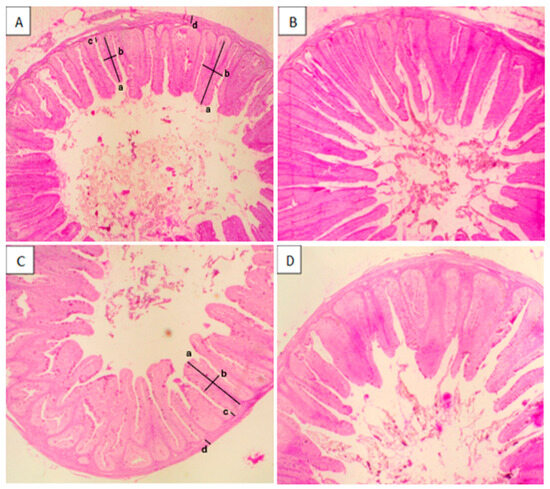
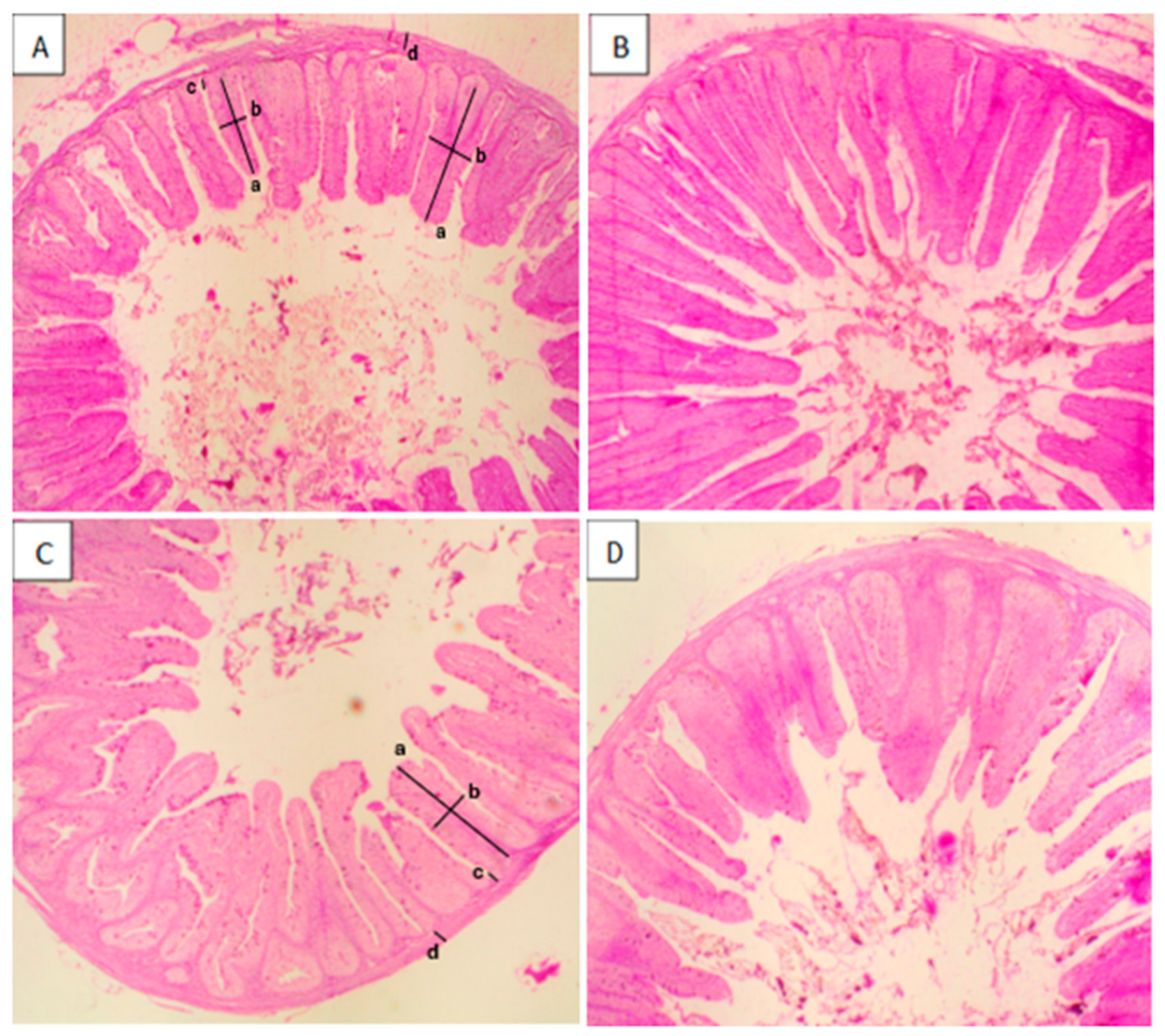
Significant increases (p = 0.0013) in villus height were observed for the H2, H4, and H6 treatments compared to the control (CON) group (493.65 µm), with the highest values in H4 (543.14 µm) and H2 (541.13 µm). Villus width did not show significant differences across groups (p = 0.1078), with values ranging from 130.43 µm in H2 to 142.40 µm in H4. Crypt depth also did not differ significantly (p = 0.1742), with values ranging from 52.13 µm in H6 to 55.98 µm in H2. The villus area was significantly increased (p = 0.0163) in the H4 group (245,671 µm2) compared to the control (216,107 µm2), with H2 (222,512 µm2) showing an intermediate value. The WHWW ratio was highest (p = 0.0248) in the H2 group (4.41) compared to CON (3.85). Muscular layer thickness was significantly different (p = 0.0034), with the lowest value in H6 (49.06 µm) and the highest in CON (55.43 µm). The WHMT ratio was highest (p = 0.0220) in H6 (10.92) compared to CON (9.27). All the results are presented in Table 7 and visualized in Figure 1.
Table 7.
Intestinal histomorphology assessment in common carp fed experimental diets containing HI meal.
Figure 1.
Histomorphology of the small intestine; PAS stain; magnification ×40; (A,B)—group 1; (C,D)—group 2; a = villi height; b = villi width; c = crypt depth; d = muscular thickness.
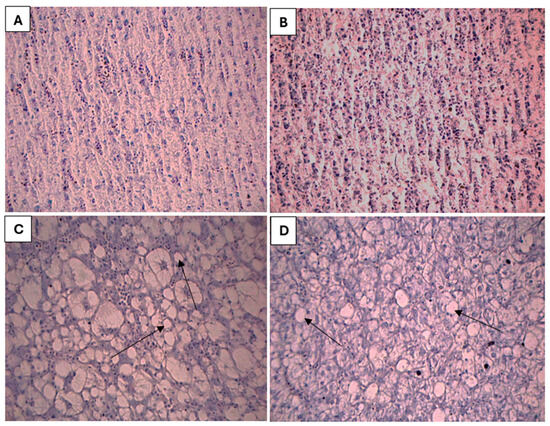
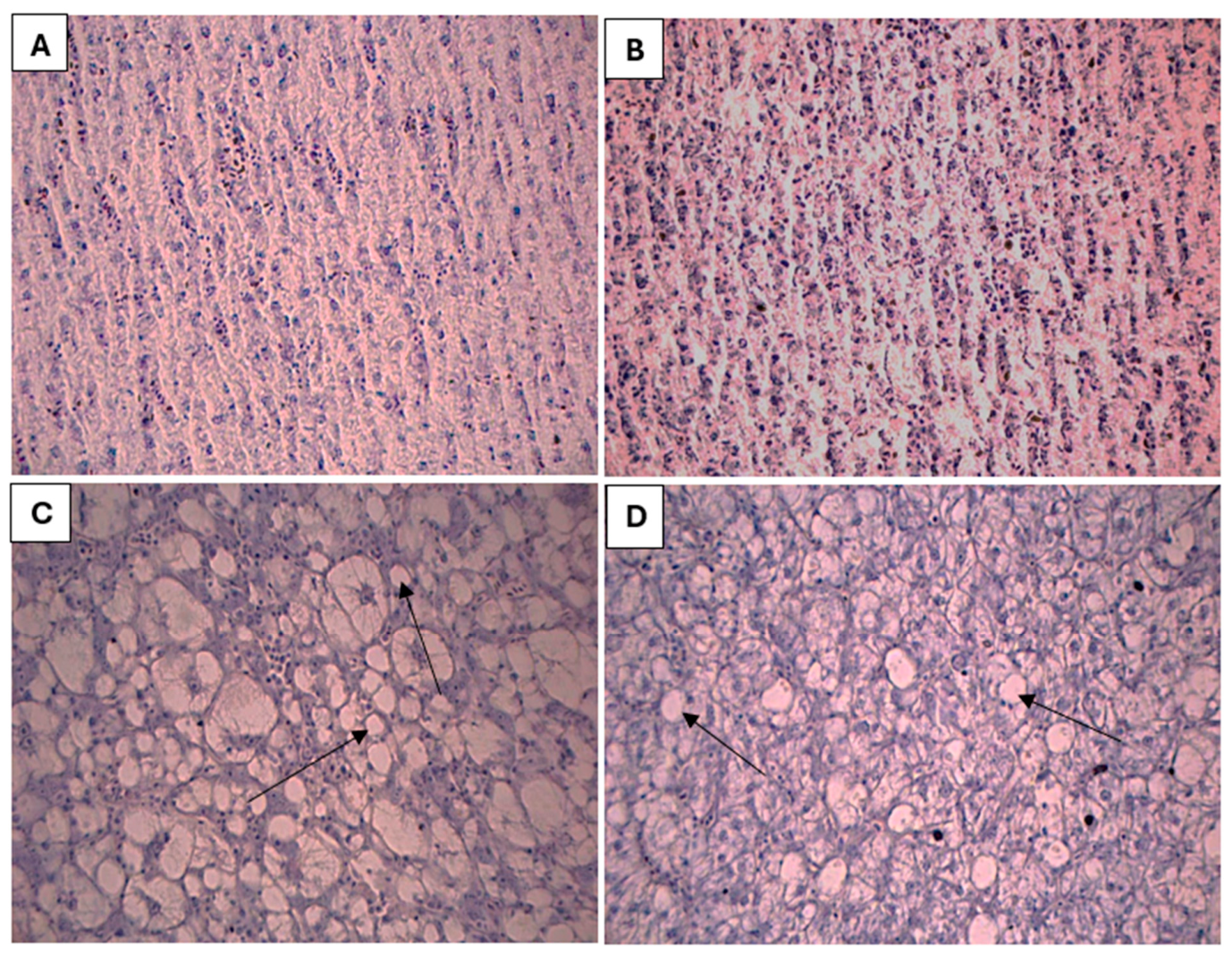
Histological analysis (Table 8, Figure 2) showed no signs of liver congestion, necrosis, hepatocyte vacuolization, or fibrosis in any of the experimental groups. Fat vacuolization did not differ significantly (p = 0.9107), with the highest value observed in H2 (1.08) and the lowest in CON (0.67). Parenchymal eclipse also showed no significant differences (p = 0.9729), with values ranging from 1.50 in H4 to 1.83 in H2.
Table 8.
Histological assessment of liver tissues in common carp fed experimental diets containing HI meal.
Figure 2.
Microscopic images of the liver of common carp; HE; 400×; (A)—parenchymal eclipse (group 1); (B)—parenchymal eclipse (group 2); (C)—fat vacuolization (group 1, arrows); (D)—fat vacuolization (group 2, arrows).
3.4. Blood Parameters
HI caused no statistically significant differences among the treatments in all studied serum biochemical parameters measured (p > 0.05) (Table 9). The average values varied: from 19.39 to 21.09 mg/dL in urea, 3.13 to 3.27 g/dL in total protein (TP), 1.26 to 1.33 g/dL in albumin (ALB) concentrations, 1.82 to 1.99 g/dL in globulin (GLOB), 559.67 to 627.08 mg/dL in triglyceride (TG) levels, 168.08 to 175.75 mg/dL in cholesterol (CHOL), 24.88 to 27.13 mg/dL in high-density lipoprotein (HDL), 15.25 to 16.75 mg/dL in low-density lipoprotein (LDL) concentrations, 104.26 to 112.13 U/L in aspartate aminotransferase (AST), 9.58 to 11.04 U/L in alanine aminotransferase (ALT), and 37.92 to 50.50 U/L in alkaline phosphatase (ALP) activity. Calcium (Ca) levels were between 12.07 and 12.62 mg/dL, and phosphorus (P) ranged from 10.45 to 10.90 mg/dL.
Table 9.
Hematological assessment in common carp fed experimental diets containing HI meal.
4. Discussion
Including insect-derived ingredients in aquaculture diets has gained significant attention due to their potential to enhance feed quality, support fish health, and contribute to sustainable aquaculture practices in Atlantic salmon (Salmo salar), sea trout (Salmo trutta m. trutta), African catfish (Clarias gariepinus), striped catfish (Pangasianodon hypophthalmus), zebrafish (Danio rerio), Siberian sturgeon (Acipenser baerii), seabass (Lateolabrax japonicus), rainbow trout (Oncorhynchus mykiss), gilthead sea bream (Sparus aurata) farming for either production and/or conservation purposes [23,30,50,51,54,72,73,74,75,76,77,78,79,80]. Despite this growing interest, there is limited research on the application of Hermetia illucens (HI) meal as a functional ingredient in common carp nutrition, particularly regarding its effects on pellet quality, nutrient utilization, and fish growth performance.
In our study, the inclusion of HI meal significantly influenced the physical characteristics of the pellets, notably increasing pellet length and length-to-width ratio while reducing pellet density. These changes suggest that HI meal alters the binding and expansion behavior during extrusion, likely due to its higher fat content and distinct structural properties, as supported by Rawski et al. [30] and Jia et al. [81]. Although pellet diameter showed a significant increase only in the treatment with 4% of HI meal, the overall reduction in density with higher HI inclusion is consistent with previous observations where insect meals promoted greater pore formation, leading to lower bulk density and potential changes in sinking behavior. From a feed technology standpoint, these findings underscore an often-overlooked aspect of insect meal inclusion—its impact on physical pellet quality—which has implications for feed handling, water stability, and system cleanliness, particularly in recirculating aquaculture [82]. Importantly, despite these physical modifications, no negative effects on feed intake or fish growth performance were observed, indicating that the pellets maintained functional integrity within the feeding window.
There were no significant differences in growth performance, feed utilization, or survival rate between the control and HI meal-containing groups (p > 0.05). Although positive effects on growth performance were expected, no significant improvements were observed at the tested levels of HI meal inclusion. All groups exhibited similar body weight gain, specific growth rate, and feed intake, suggesting that HI meal can be incorporated into the diet without negatively affecting these parameters. The feed was well accepted by the fish, consistent with observations from feeding trials conducted by Rawski et al. [30]. However, this contrasts with the findings of Caimi et al. [77], where lower feed acceptance was reported. The feed conversion ratio and protein efficiency ratio values remained consistent across all treatments, indicating similar feed utilization efficiency. The 100% survival rate further emphasizes the safety of HI meal inclusion in the diets of carp fry. These results demonstrate that the inclusion of up to 6% HI meal does not compromise the overall health or performance of the fish.
We obtained a high-quality HI meal, confirming its suitability as an ingredient in fish feed. However, while it is possible to incorporate HI meal into carp diets, its role should not be perceived as a direct protein replacement. Given that common carp is an omnivorous species, HI meal is better positioned as a functional feed material rather than an alternative protein source that has been portrayed by many previous feeding trials involving common carp [34,36,83]. The commonly used N × 6.25 protein conversion method for estimating protein content in insect meals has been noted to potentially overestimate values due to the presence of chitin, as reported by Finke et al. [84] and Gasco et al. [3]. In the present study, the calculated Kp value was used to improve the estimation of protein content in Hermetia illucens meal. Nevertheless, chitin-bound nitrogen may still influence crude protein determination and, consequently, protein-related indices such as apparent protein digestibility and protein efficiency ratio. However, because the same analytical approach was applied consistently across all dietary treatments, the comparative interpretation of the results remains valid. Moreover, these analytical considerations do not diminish the practical applicability of H. illucens meal as a sustainable ingredient in aquafeeds.
Beyond its nutritional contribution, HI meal positively influenced in vivo nutrient digestibility. This effect may be attributed to morphological improvements in the intestinal lining, such as increased villus height and absorptive area, which enhance nutrient uptake. In particular, the villus area in the treatment with 4% of HI meal (245,671 µm2) was significantly higher than the control (216,107 µm2), coinciding with the highest recorded crude protein digestibility (92.5%) in the treatment with 4% of HI meal, implying that morphological adaptations may directly support improved digestion and assimilation of dietary protein. The villus elongation relative to width and muscular thickness (WHWW and WHMT) were also significantly higher in HI-fed fish, suggesting enhanced intestinal adaptation for nutrient absorption. The in vivo protein and fat digestibility coefficients were significantly higher in the HI-fed groups despite lower in vitro digestibility with trypsin, suggesting that the enhanced gut morphology may have compensated for enzymatic limitations. This may have facilitated better substrate-enzyme interactions or possibly stimulated the secretion of endogenous digestive enzymes. In vitro digestibility assays indicate protein susceptibility to enzymatic hydrolysis but do not fully replicate in vivo digestive complexity. The higher pepsin relative to trypsin digestibility likely reflects enzyme-specific activity in gastric versus intestinal phases, whereas in vivo digestibility integrates hydrolysis, absorption, gastrointestinal transit, and dietary interactions. As digestive enzyme activities were not assessed, the mechanisms remain speculative. Digestibility responses were not linear with increasing HI inclusion, likely due to the low inclusion levels tested, where HI meal functioned primarily as a source of bioactive compounds rather than a major nutrient source. Overall, the effects likely reflect complex physiological interactions rather than a direct dose-dependent response. Furthermore, no adverse effects were observed on liver condition, structure, or function, which reinforces the safety of HI meals up to 6% in common carp diets. The absence of pathological alterations in hepatic tissues indicates that HI meal did not impose detectable physiological stress on the liver and supports its safe incorporation into common carp diets at the tested inclusion levels. Although HI contains chitin, which is largely indigestible, its low inclusion in the diet may act as an immunostimulant. Chitin has been shown to enhance gut barrier function through modulation of gut-associated lymphoid tissue (GALT), supporting local immune responses without causing adverse morphological changes [85,86]. This is consistent with our findings, where no inflammation, crypt atrophy, or liver histopathology was observed in any treatment. Additionally, the inclusion of HI meal up to 6% in common carp diets did not significantly affect serum urea, total protein, albumin, globulin, lipid fractions, or mineral concentrations, suggesting that the experimental diets maintained normal metabolic and physiological status. The unchanged activities of AST, ALT, and ALP further indicate that HI meal did not induce detectable hepatic stress or tissue damage, supporting its apparent safety as a protein ingredient in carp nutrition. These findings are consistent with previous reports showing that insect-based feed ingredients can be incorporated into carp diets without adverse effects on blood biochemical indices when inclusion levels are appropriate [31,34,87]. Our result, therefore, confirmed that HI may be used in the common carp diet without any physiological adverse effects.
The bioactive compounds in HI meal, including antimicrobial peptides (AMPs) and medium-chain fatty acids such as lauric acid, together with its chitin prebiotic properties, likely contributed to maintaining intestinal and hepatic homeostasis [88]. These components exhibit antimicrobial and antioxidant properties, contributing to gut health and potentially reducing the need for conventional antibiotics in aquaculture [3,46,89] as it is known to modulate oxidative stress in cellular and animal models [90]. However, no analyses of gut microbiota composition, digestive enzyme activity, immune parameters, or antioxidant biomarkers were conducted in the present study. Therefore, any functional interpretations related to these pathways remain hypothetical and should be confirmed in further studies for full mode of action description. Accordingly, the observed improvements in growth, morphology, and digestibility should be interpreted strictly as physiological responses, while the underlying mechanisms require further verification using microbiome, immunological, and molecular approaches. Additionally, the present findings should be interpreted within the scope of the experimental design. The study evaluated only low dietary inclusion levels of HI meal (2–6%) over a 60-day feeding period in common carp fry; therefore, the results should not be extrapolated to higher inclusion levels, longer-term feeding, or other fish species or developmental stages.
The role of insects in aquafeeds extends beyond mere feed replacement; they represent an innovative, functional, and health-promoting group of feed materials. By integrating insect meals into aquaculture nutrition, we move toward environmentally friendly practices that support fish welfare while enhancing production sustainability. As the industry continues to explore alternative protein sources, HI meal stands as a promising candidate for the future of aquafeed innovation.
5. Conclusions
The dietary inclusion of defatted HI meal up to 6% did not adversely affect growth performance, survival, feed utilization, or pellet quality in common carp. No negative effects were observed on liver structure or condition, while in vivo nutrient digestibility was modulated. Overall, HI meal showed potential as a functional ingredient that may support intestinal health in common carp fry. Under the conditions of this study, dietary inclusion of 2–6% HI meal can be considered suitable for use in common carp diets without compromising growth performance or basic physiological status.
Author Contributions
J.M.—Conceptualization, Methodology, the diets preparation, growth trial, Writing—review and editing, Z.M.—Data analysis, Writing—review and editing, M.R.—Conceptualization, Methodology, carried out the experiment with fish, Writing—review and editing, P.S.—Carried out the experiment with fish, Sample collection, P.R.—Histological analysis, A.D.—Histological analysis, M.S.—Sample collection, Histological analysis, Writing—review and editing. All authors have read and agreed to the published version of the manuscript.
Funding
This work was supported by a research project PRELUDIUM-20, No. 2021/41/N/NZ9/00198 from the National Science Centre in Poland, and by the statutory funding No. 506.511.04.00 of the Faculty of Veterinary Medicine and Animal Science, Poznan University of Life Sciences, Poland.
Institutional Review Board Statement
All animal handling, protocols, and methods complied with the recommendations of Directive 2010/63/EU of the European Parliament and the Council of 22 September 2010 on the protection of animals used for scientific purposes, the Polish law of 15 January 2015 on the protection of animals used for scientific purposes (Dz.U.2015 poz. 266), and the good practices and recommendations of the National Ethics Committee for Animal Experiments and Local Ethics Committee for Animal Experiments of Poznan University of Life Sciences (https://www.gov.pl/web/nauka/dobre-praktyki) (accessed on 9 July 2026). All the personnel involved and in contact with the animals were theoretically and practically trained on animal care, welfare, and experimental procedures by the Polish Laboratory Animal Science Association (PolLASA). All procedures and experiments complied with the guidelines, and all efforts were made to minimize the suffering of the animals. According to the Act on the Protection of Animals Used for Scientific or Educational Purposes in Poland adopted on 15 January 2015 and according to earlier regulations, euthanasia of animals for dissection and tissue sampling does not require approval of the ethical committee.
Data Availability Statement
Data will be made available on request.
Acknowledgments
The authors would like to thank Krzysztof Florczyk and Jan Banaszak (Experimental Station of Feed Production Technology and Aquaculture in Muchocin, Poznan University of Life Sciences) for their technical support in experimental feed preparation, and Natalia Homska for project management, and Joanna Kowalska (Laboratory of Inland Fisheries and Aquaculture, Department of Zoology, Poznan University of Life Sciences) for their technical support during the growth trial.
Conflicts of Interest
The authors declare that they have no known competing financial interests or personal relationships that could have appeared to influence the work reported in this paper.
References
- FAO. The State of World Fisheries and Aquaculture 2024; FAO: Rome, Italy, 2024. [Google Scholar] [CrossRef] [Scilit]
- Naylor, R.L.; Hardy, R.W.; Buschmann, A.H.; Bush, S.R.; Cao, L.; Klinger, D.H.; Little, D.C.; Lubchenco, J.; Shumway, S.E.; Troell, M. A 20-year retrospective review of global aquaculture. Nature 2021, 591, 551–563. [Google Scholar] [CrossRef] [Scilit]
- Gasco, L.; Finke, M.; van Huis, A. Can diets containing insects promote animal health? J. Insects Food Feed 2018, 4, 1–4. [Google Scholar] [CrossRef] [Scilit]
- Hussain, S.M.; Bano, A.A.; Ali, S.; Rizwan, M.; Adrees, M.; Zahoor, A.F.; Sarker, P.K.; Hussain, M.; Arsalan, M.Z.-U.; Yong, J.W.H.; et al. Substitution of fishmeal: Highlights of potential plant protein sources for aquaculture sustainability. Heliyon 2024, 10, e26573. [Google Scholar] [CrossRef] [Scilit] [PubMed]
- Qian, Y.; Limbu, S.M.; Qiao, F.; Luo, Y.; Chen, L.; Zhang, M.; Du, Z. Seeking the best alternatives: A systematic review and meta-analysis on replacing fishmeal with plant protein sources in carnivorous fish species. Rev. Aquac. 2024, 16, 1099–1126. [Google Scholar] [CrossRef] [Scilit]
- Mugwanya, M.; Dawood, M.A.O.; Kimera, F.; Sewilam, H. Replacement of fish meal with fermented plant proteins in the aquafeed industry: A systematic review and meta-analysis. Rev. Aquac. 2023, 15, 62–88. [Google Scholar] [CrossRef] [Scilit]
- Ahmad, A.; Hassan, S.W.; Banat, F. An overview of microalgae biomass as a sustainable aquaculture feed ingredient: Food security and circular economy. Bioengineered 2022, 13, 9521–9547. [Google Scholar] [CrossRef] [Scilit] [PubMed]
- Ma, M.; Hu, Q. Microalgae as feed sources and feed additives for sustainable aquaculture: Prospects and challenges. Rev. Aquac. 2024, 16, 818–835. [Google Scholar] [CrossRef] [Scilit]
- Sarker, P.K.; Kapuscinski, A.R.; McKuin, B.; Fitzgerald, D.S.; Nash, H.M.; Greenwood, C. Microalgae-blend tilapia feed eliminates fishmeal and fish oil, improves growth, and is cost viable. Sci. Rep. 2020, 10, 19328. [Google Scholar] [CrossRef] [Scilit] [PubMed]
- Gougbedji, A.; Detilleux, J.; Lalèyè, P.; Francis, F.; Caparros Megido, R. Can Insect Meal Replace Fishmeal? A Meta-Analysis of the Effects of Black Soldier Fly on Fish Growth Performances and Nutritional Values. Animals 2022, 12, 1700. [Google Scholar] [CrossRef] [Scilit] [PubMed]
- Kuebutornye, F.K.A.; Roy, K.; Folorunso, E.A.; Mraz, J. Plant-based feed additives in Cyprinus carpio aquaculture. Rev. Aquac. 2024, 16, 309–336. [Google Scholar] [CrossRef] [Scilit]
- Liu, W.; Wang, X.; Chen, L. Optimizing Feed Formulations for Enhanced Growth and Environmental Sustainability in Common Carp Aquaculture. Int. J. Aquac. 2024, 14, 249–256. [Google Scholar] [CrossRef] [Scilit]
- Sogari, G.; Amato, M.; Biasato, I.; Chiesa, S.; Gasco, L. The Potential Role of Insects as Feed: A Multi-Perspective Review. Animals 2019, 9, 119. [Google Scholar] [CrossRef] [Scilit] [PubMed]
- Tariq, M.R.; Liu, S.; Wang, F.; Wang, H.; Mo, Q.; Zhuang, Z.; Zheng, C.; Liang, Y.; Liu, Y.; Rehman, K.U.; et al. Black Soldier Fly: A Keystone Species for the Future of Sustainable Waste Management and Nutritional Resource Development: A Review. Insects 2025, 16, 750. [Google Scholar] [CrossRef] [Scilit] [PubMed]
- Mohan, K.; Rajan, D.K.; Muralisankar, T.; Ganesan, A.R.; Sathishkumar, P.; Revathi, N. Use of black soldier fly (Hermetia illucens L.) larvae meal in aquafeeds for a sustainable aquaculture industry: A review of past and future needs. Aquaculture 2022, 553, 738095. [Google Scholar] [CrossRef] [Scilit]
- Oteri, M.; Di Rosa, A.R.; Lo Presti, V.; Giarratana, F.; Toscano, G.; Chiofalo, B. Black Soldier Fly Larvae Meal as Alternative to Fish Meal for Aquaculture Feed. Sustainability 2021, 13, 5447. [Google Scholar] [CrossRef] [Scilit]
- Xia, J.; Ge, C.; Yao, H. Antimicrobial Peptides from Black Soldier Fly (Hermetia illucens) as Potential Antimicrobial Factors Representing an Alternative to Antibiotics in Livestock Farming. Animals 2021, 11, 1937. [Google Scholar] [CrossRef] [Scilit] [PubMed]
- Van Moll, L.; De Smet, J.; Paas, A.; Tegtmeier, D.; Vilcinskas, A.; Cos, P.; Van Campenhout, L. In Vitro Evaluation of Antimicrobial Peptides from the Black Soldier Fly (Hermetia illucens) against a Selection of Human Pathogens. Microbiol. Spectr. 2022, 10, e0166421. [Google Scholar] [CrossRef] [Scilit] [PubMed]
- Pimchan, T.; Hamzeh, A.; Siringan, P.; Thumanu, K.; Hanboonsong, Y.; Yongsawatdigul, J. Antibacterial peptides from black soldier fly (Hermetia illucens) larvae: Mode of action and characterization. Sci. Rep. 2024, 14, 26469. [Google Scholar] [CrossRef] [Scilit] [PubMed]
- Sibinga, N.A.; Lee, M.T.; Buchon, N.; Johnson, E.L.; Selvaraj, V.; Marquis, H. Do antimicrobial peptide levels alter performance of insect-based aquaculture feeds—A study using genetic models of insect immune activation. J. Insects Food Feed 2023, 9, 919–934. [Google Scholar] [CrossRef] [Scilit]
- Lieberman, S.; Enig, M.G.; Preuss, H.G. A Review of Monolaurin and Lauric Acid: Natural Virucidal and Bactericidal Agents. Altern. Complement. Ther. 2006, 12, 310–314. [Google Scholar] [CrossRef] [Scilit]
- Józefiak, A.; Engberg, R. Insect proteins as a potential source of antimicrobial peptides in livestock production. A review. J. Anim. Feed Sci. 2017, 26, 87–99. [Google Scholar] [CrossRef] [Scilit]
- Radhakrishnan, G.; Liland, N.S.; Koch, M.W.; Lock, E.-J.; Philip, A.J.P.; Belghit, I. Evaluation of black soldier fly larvae meal as a functional feed ingredient in Atlantic salmon (Salmo salar) under farm-like conditions. Front. Aquac. 2023, 2, 1239402. [Google Scholar] [CrossRef] [Scilit]
- Vodounnou, J.V.; Iko, R.; Okou, G.; Kpogue, D.; Ahouansou Montcho, S.; Micha, J.-C. Complete substitution of fish meal with black soldier flies Hermetia illucens (L. 1758) larvae meal at varying incorporation rates for feeding Oreochromis niloticus raised in captivity. Aquac. Sci. Manag. 2025, 2, 1. [Google Scholar] [CrossRef] [Scilit]
- Adeoye, A.A.; Akegbejo-Samsons, Y.; Fawole, F.J.; Davies, S.J. Preliminary assessment of black soldier fly (Hermetia illucens) larval meal in the diet of African catfish (Clarias gariepinus): Impact on growth, body index, and hematological parameters. J. World Aquac. Soc. 2020, 51, 1024–1033. [Google Scholar] [CrossRef] [Scilit]
- Weththasinghe, P.; Lagos, L.; Cortés, M.; Hansen, J.Ø.; Øverland, M. Dietary Inclusion of Black Soldier Fly (Hermetia illucens) Larvae Meal and Paste Improved Gut Health but Had Minor Effects on Skin Mucus Proteome and Immune Response in Atlantic Salmon (Salmo salar). Front. Immunol. 2021, 12, 599530. [Google Scholar] [CrossRef] [Scilit] [PubMed]
- Elia, A.C.; Capucchio, M.T.; Caldaroni, B.; Magara, G.; Dörr, A.J.M.; Biasato, I.; Biasibetti, E.; Righetti, M.; Pastorino, P.; Prearo, M.; et al. Influence of Hermetia illucens meal dietary inclusion on the histological traits, gut mucin composition and the oxidative stress biomarkers in rainbow trout (Oncorhynchus mykiss). Aquaculture 2018, 496, 50–57. [Google Scholar] [CrossRef] [Scilit]
- Busti, S.; Bonaldo, A.; Candela, M.; Scicchitano, D.; Trapella, G.; Brambilla, F.; Guidou, C.; Trespeuch, C.; Sirri, F.; Dondi, F.; et al. Hermetia illucens larvae meal as an alternative protein source in practical diets for gilthead sea bream (Sparus aurata): A study on growth, plasma biochemistry and gut microbiota. Aquaculture 2024, 578, 740093. [Google Scholar] [CrossRef] [Scilit]
- Dîrvariu, L.; Barbacariu, C.-A.; Burducea, M.; Dumitru, G.; Todirascu-Ciornea, E.; Șerban, D.A.; Rîmbu, C.M.; Horhogea, C.E.; Lazăr, M.; Simeanu, D. Dose-Dependent Effects of Black Soldier Fly Larvae Meal on Growth and Health of Common Carp. Life 2026, 16, 595. [Google Scholar] [CrossRef] [Scilit] [PubMed]
- Rawski, M.; Mazurkiewicz, J.; Kierończyk, B.; Józefiak, D. Black Soldier Fly Full-Fat Larvae Meal as an Alternative to Fish Meal and Fish Oil in Siberian Sturgeon Nutrition: The Effects on Physical Properties of the Feed, Animal Growth Performance, and Feed Acceptance and Utilization. Animals 2020, 10, 2119. [Google Scholar] [CrossRef] [Scilit] [PubMed]
- Abayati, A.I.; Attee, R.S.; Al-Khshali, M.S. Effect of Replacing Animal Protein Concentrate with Black Soldier Fly (Hermetia illucens) Larvae Meal in Growth Performance and Some Blood Parameters of Common Carp (Cyprinus carpio L.). IOP Conf. Ser. Earth Environ. Sci. 2025, 1487, 012165. [Google Scholar] [CrossRef] [Scilit]
- Dogan, H.; Turan, F. The Usage of Black Soldier Fly (Hermetia illucens) Larvae Meal as Alternatıve Protein Source in Carp Diets (Cyprinus carpio). Acta Aquat. Turc. 2021, 17, 508–514. [Google Scholar] [CrossRef] [Scilit]
- Jahan, R.; Tipu, M.M.H.; Haque, M.M.; Salam, M.A. Black soldier fly (Hermetia illucens) larvae meal as a fish meal replacement in diets for 1 nursing common carp (Cyprinus carpio) fry. agriRxiv 2021. [Google Scholar] [CrossRef] [Scilit]
- Zhou, J.S.; Liu, S.S.; Ji, H.; Yu, H.B. Effect of replacing dietary fish meal with black soldier fly larvae meal on growth and fatty acid composition of Jian carp (Cyprinus carpio var. Jian). Aquac. Nutr. 2018, 24, 424–433. [Google Scholar] [CrossRef] [Scilit]
- Xu, X.; Ji, H.; Yu, H.; Zhou, J. Influence of dietary black soldier fly (Hermetia illucens Linnaeus) pulp on growth performance, antioxidant capacity and intestinal health of juvenile mirror carp (Cyprinus carpio var. specularis). Aquac. Nutr. 2020, 26, 432–443. [Google Scholar] [CrossRef] [Scilit]
- Li, S.; Ji, H.; Zhang, B.; Zhou, J.; Yu, H. Defatted black soldier fly (Hermetia illucens) larvae meal in diets for juvenile Jian carp (Cyprinus carpio var. Jian): Growth performance, antioxidant enzyme activities, digestive enzyme activities, intestine and hepatopancreas histological structure. Aquaculture 2017, 477, 62–70. [Google Scholar] [CrossRef] [Scilit]
- Hoseinifar, S.H.; Zoheiri, F.; Lazado, C.C. Dietary phytoimmunostimulant Persian hogweed (Heracleum persicum) has more remarkable impacts on skin mucus than on serum in common carp (Cyprinus carpio). Fish Shellfish Immunol. 2016, 59, 77–82. [Google Scholar] [CrossRef] [Scilit] [PubMed]
- Hosseini, S.M.; Hoseinifar, S.H.; Mazandarani, M.; Paknejad, H.; Van Doan, H.; El-Haroun, E.R. The potential benefits of orange peels derived pectin on serum and skin mucus immune parameters, antioxidant defence and growth performance in common carp (Cyprinus carpio). Fish Shellfish Immunol. 2020, 103, 17–22. [Google Scholar] [CrossRef] [Scilit] [PubMed]
- Hoseinifar, S.H.; Khodadadian Zou, H.; Van Doan, H.; Harikrishnan, R.; Yousefi, M.; Paknejad, H.; Ahmadifar, E. Can dietary jujube (Ziziphus jujuba Mill.) fruit extract alter cutaneous mucosal immunity, immune related genes expression in skin and growth performance of common carp (Cyprinus carpio)? Fish Shellfish Immunol. 2019, 94, 705–710. [Google Scholar] [CrossRef] [Scilit] [PubMed]
- Mohammadi, G.; Rashidian, G.; Hoseinifar, S.H.; Naserabad, S.S.; Van Doan, H. Ginger (Zingiber officinale) extract affects growth performance, body composition, haematology, serum and mucosal immune parameters in common carp (Cyprinus carpio). Fish Shellfish Immunol. 2020, 99, 267–273. [Google Scholar] [CrossRef] [Scilit] [PubMed]
- Hoseinifar, S.H.; Khodadadian Zou, H.; Paknejad, H.; Hajimoradloo, A.; Van Doan, H. Effects of dietary white-button mushroom powder on mucosal immunity, antioxidant defence, and growth of common carp (Cyprinus carpio). Aquaculture 2019, 501, 448–454. [Google Scholar] [CrossRef] [Scilit]
- Hoseinifar, S.H.; Jahazi, M.A.; Mohseni, R.; Yousefi, M.; Bayani, M.; Mazandarani, M.; Van Doan, H.; El-Haroun, E.R. Dietary apple peel-derived pectin improved growth performance, antioxidant enzymes and immune response in common carp, Cyprinus carpio (Linnaeus, 1758). Aquaculture 2021, 535, 736311. [Google Scholar] [CrossRef] [Scilit]
- Giri, S.S.; Sukumaran, V.; Park, S.C. Effects of bioactive substance from turmeric on growth, skin mucosal immunity and antioxidant factors in common carp, Cyprinus carpio. Fish Shellfish Immunol. 2019, 92, 612–620. [Google Scholar] [CrossRef] [Scilit] [PubMed]
- Ghafarifarsani, H.; Hoseinifar, S.H.; Adorian, T.J.; Goulart Ferrigolo, F.R.; Raissy, M.; Van Doan, H. The effects of combined inclusion of Malvae sylvestris, Origanum vulgare, and Allium hirtifolium boiss for common carp (Cyprinus carpio) diet: Growth performance, antioxidant defense, and immunological parameters. Fish Shellfish Immunol. 2021, 119, 670–677. [Google Scholar] [CrossRef] [Scilit] [PubMed]
- Feher, M.; Fauszt, P.; Tolnai, E.; Fidler, G.; Pesti-Asboth, G.; Stagel, A.; Szucs, I.; Biro, S.; Remenyik, J.; Paholcsek, M.; et al. Effects of phytonutrient-supplemented diets on the intestinal microbiota of Cyprinus carpio. PLoS ONE 2021, 16, e0248537. [Google Scholar] [CrossRef] [Scilit] [PubMed]
- Veldkamp, T.; Dong, L.; Paul, A.; Govers, C. Bioactive properties of insect products for monogastric animals—A review. J. Insects Food Feed 2022, 8, 1027–1040. [Google Scholar] [CrossRef] [Scilit]
- Borrelli, L.; Varriale, L.; Dipineto, L.; Pace, A.; Menna, L.F.; Fioretti, A. Insect Derived Lauric Acid as Promising Alternative Strategy to Antibiotics in the Antimicrobial Resistance Scenario. Front. Microbiol. 2021, 12, 620798. [Google Scholar] [CrossRef] [Scilit] [PubMed]
- Rimoldi, S.; Ceccotti, C.; Brambilla, F.; Faccenda, F.; Antonini, M.; Terova, G. Potential of shrimp waste meal and insect exuviae as sustainable sources of chitin for fish feeds. Aquaculture 2023, 567, 739256. [Google Scholar] [CrossRef] [Scilit]
- Koutsos, E.; Modica, B.; Freel, T. Immunomodulatory potential of black soldier fly larvae: Applications beyond nutrition in animal feeding programs. Transl. Anim. Sci. 2022, 6, txac084. [Google Scholar] [CrossRef] [Scilit] [PubMed]
- Zarantoniello, M.; Randazzo, B.; Truzzi, C.; Giorgini, E.; Marcellucci, C.; Vargas-Abúndez, J.A.; Zimbelli, A.; Annibaldi, A.; Parisi, G.; Tulli, F.; et al. A six-months study on Black Soldier Fly (Hermetia illucens) based diets in zebrafish. Sci. Rep. 2019, 9, 8598. [Google Scholar] [CrossRef] [Scilit] [PubMed]
- Rawski, M.; Mazurkiewicz, J.; Kierończyk, B.; Józefiak, D. Black Soldier Fly Full-Fat Larvae Meal Is More Profitable Than Fish Meal and Fish Oil in Siberian Sturgeon Farming: The Effects on Aquaculture Sustainability, Economy and Fish GIT Development. Animals 2021, 11, 604. [Google Scholar] [CrossRef] [Scilit] [PubMed]
- Piccolo, G.; Iaconisi, V.; Marono, S.; Gasco, L.; Loponte, R.; Nizza, S.; Bovera, F.; Parisi, G. Effect of Tenebrio molitor larvae meal on growth performance, in vivo nutrients digestibility, somatic and marketable indexes of gilthead sea bream (Sparus aurata). Anim. Feed Sci. Technol. 2017, 226, 12–20. [Google Scholar] [CrossRef] [Scilit]
- Henry, M.; Gasco, L.; Piccolo, G.; Fountoulaki, E. Review on the use of insects in the diet of farmed fish: Past and future. Anim. Feed Sci. Technol. 2015, 203, 1–22. [Google Scholar] [CrossRef] [Scilit]
- Belghit, I.; Waagbø, R.; Lock, E.-J.; Liland, N.S. Insect-based diets high in lauric acid reduce liver lipids in freshwater Atlantic salmon. Aquac. Nutr. 2019, 25, 343–357. [Google Scholar] [CrossRef] [Scilit]
- Goda, A.M.A.; El-Haroun, E.; Nazmi, H.; Van Doan, H.; Aboseif, A.M.; Taha, M.K.S.; Shabana, N.A. Black soldier fly oil-based diets enriched in lauric acid enhance growth, hematological indices, and fatty acid profiles of Nile tilapia, Oreochromis niloticus fry. Aquac. Rep. 2024, 37, 102269. [Google Scholar] [CrossRef] [Scilit]
- Rawski, M.; Józefiak, D.; Nogales-Merida, S.; Józefiak, A.; Kierończyk, B.; Benzertiha, A.; Talibov, S.; Dudek, K.; Gobbi, P.; Noak, M.; et al. The preliminary study on live insects’ acceptance in common carp (Cyprinus carpio). In Proceedings of the XV Conference of Young Researchers Physiology and Biochemistry in Animal Nutrition 2018, Warsaw, Poland, 26–28 September 2018. [Google Scholar]
- Li, S.; Ji, H.; Zhang, B.; Tian, J.; Zhou, J.; Yu, H. Influence of black soldier fly (Hermetia illucens) larvae oil on growth performance, body composition, tissue fatty acid composition and lipid deposition in juvenile Jian carp (Cyprinus carpio var. Jian). Aquaculture 2016, 465, 43–52. [Google Scholar] [CrossRef] [Scilit]
- Sypniewski, J.; Kierończyk, B.; Benzertiha, A.; Mikołajczak, Z.; Pruszyńska-Oszmałek, E.; Kołodziejski, P.; Sassek, M.; Rawski, M.; Czekała, W.; Józefiak, D. Replacement of soybean oil by Hermetia illucens fat in turkey nutrition: Effect on performance, digestibility, microbial community, immune and physiological status and final product quality. Br. Poult. Sci. 2020, 61, 294–302. [Google Scholar] [CrossRef] [Scilit] [PubMed]
- Benzertiha, A.; Kierończyk, B.; Kołodziejski, P.; Pruszyńska–Oszmałek, E.; Rawski, M.; Józefiak, D.; Józefiak, A. Tenebrio molitor and Zophobas morio full-fat meals as functional feed additives affect broiler chickens’ growth performance and immune system traits. Poult. Sci. 2020, 99, 196–206. [Google Scholar] [CrossRef] [Scilit] [PubMed]
- Janssen, R.H.; Vincken, J.-P.; van den Broek, L.A.M.; Fogliano, V.; Lakemond, C.M.M. Nitrogen-to-Protein Conversion Factors for Three Edible Insects: Tenebrio molitor, Alphitobius diaperinus, and Hermetia illucens. J. Agric. Food Chem. 2017, 65, 2275–2278. [Google Scholar] [CrossRef] [Scilit] [PubMed]
- Latimer, G.W. (Ed.) Official Methods of Analysis of AOAC International; Oxford University Press: Oxford, UK, 2023. [Google Scholar] [CrossRef] [Scilit]
- Khater, E.G.; Bahnasawy, A.H.; Ali, S.A. Physical and Mechanical Properties of Fish Feed Pellets. J. Food Process. Technol. 2014, 5, 10. [Google Scholar] [CrossRef]
- Das, S.; Bhowmik, M.; Samanta, G.; Sarkar, S. Toxicopathologic effects of autoclaved dhaincha (Sesbania aculeata) seed-meal in broiler chicks. Indian J. Anim. Sci. 1993, 63, 329–333. [Google Scholar]
- Irungu, F.G.; Mutungi, C.M.; Faraj, A.K.; Affognon, H.; Kibet, N.; Tanga, C.; Ekesi, S.; Nakimbugwe, D.; Fiaboe, K. Physico-chemical properties of extruded aquafeed pellets containing black soldier fly (Hermetia illucens) larvae and adult cricket (Acheta domesticus) meals. J. Insects Food Feed 2018, 4, 19–30. [Google Scholar] [CrossRef] [Scilit]
- Lazo, J.P.; Romaire, R.P.; Reigh, R.C. Evaluation of Three In Vitro Enzyme Assays for Estimating Protein Digestibility in the Pacific White Shrimp Penaeus vannamei. J. World Aquac. Soc. 1998, 29, 441–450. [Google Scholar] [CrossRef] [Scilit]
- Allan, G.L.; Rowland, S.J.; Parkinson, S.; Stone, D.A.J.; Jantrarotai, W. Nutrient digestibility for juvenile silver perch Bidyanus bidyanus: Development of methods. Aquaculture 1999, 170, 131–145. [Google Scholar] [CrossRef] [Scilit]
- Kaczmarek, S.A.; Hejdysz, M.; Kubis, M.; Kasprowicz-Potocka, M.; Rutkowski, A. The nutritional value of yellow lupin (Lupinus luteus L.) for broilers. Anim. Feed Sci. Technol. 2016, 222, 43–53. [Google Scholar] [CrossRef] [Scilit]
- Kierończyk, B.; Sypniewski, J.; Rawski, M.; Czekała, W.; Świątkiewicz, S.; Józefiak, D. From Waste to Sustainable Feed Material: The Effect of Hermetia illucens Oil on the Growth Performance, Nutrient Digestibility, and Gastrointestinal Tract Morphometry of Broiler Chickens. Ann. Anim. Sci. 2020, 20, 157–177. [Google Scholar] [CrossRef] [Scilit]
- Sakamoto, K.; Hirose, H.; Onizuka, A.; Hayashi, M.; Futamura, N.; Kawamura, Y.; Ezaki, T. Quantitative Study of Changes in Intestinal Morphology and Mucus Gel on Total Parenteral Nutrition in Rats. J. Surg. Res. 2000, 94, 99–106. [Google Scholar] [CrossRef] [Scilit] [PubMed]
- Peebua, P.; Kruatrachue, M.; Pokethitiyook, P.; Kosiyachinda, P. Histological Effects of Contaminated Sediments in Mae Klong River Tributaries, Thailand, on Nile tilapia, Oreochromis niloticus. ScienceAsia 2006, 32, 143. [Google Scholar] [CrossRef]
- Skrzypczak, P.; Mazurkiewicz, J.; Rawski, M.; Mashood, Z. The live fossil and nutritional novelty—The effects of insect meal on growth performance, feed utilisation, fish development and trophic environmental sustainability in Atlantic sturgeon (Acipenser oxyrhynchus) juveniles production. J. Anim. Feed Sci. 2026, 35, e13. [Google Scholar] [CrossRef] [Scilit]
- Mikołajczak, Z.; Mazurkiewicz, J.; Rawski, M.; Kierończyk, B.; Józefiak, A.; Świątkiewicz, S.; Józefiak, D. Black Soldier Fly Full-Fat Meal in Atlantic Salmon Nutrition—Part B: Effects on Growth Performance, Feed Utilization, Selected Nutriphysiological Traits and Production Sustainability in Pre-Smolts. Ann. Anim. Sci. 2023, 23, 239–251. [Google Scholar] [CrossRef] [Scilit]
- Mikołajczak, Z.; Rawski, M.; Mazurkiewicz, J.; Kierończyk, B.; Józefiak, D. The Effect of Hydrolyzed Insect Meals in Sea Trout Fingerling (Salmo trutta m. trutta) Diets on Growth Performance, Microbiota and Biochemical Blood Parameters. Animals 2020, 10, 1031. [Google Scholar] [CrossRef] [Scilit] [PubMed]
- Fawole, F.J.; Adeoye, A.A.; Tiamiyu, L.O.; Ajala, K.I.; Obadara, S.O.; Ganiyu, I.O. Substituting fishmeal with Hermetia illucens in the diets of African catfish (Clarias gariepinus): Effects on growth, nutrient utilization, haemato-physiological response, and oxidative stress biomarker. Aquaculture 2020, 518, 734849. [Google Scholar] [CrossRef] [Scilit]
- Sudha, C.; Ahilan, B.; Felix, N.; Uma, A.; Prabu, E. Effects of dietary protein substitution of fishmeal with black soldier fly larval meal on growth and physiological responses of juvenile striped catfish, Pangasianodon hypophthalmus. Aquac. Res. 2022, 53, 2204–2217. [Google Scholar] [CrossRef] [Scilit]
- Józefiak, A.; Nogales-Mérida, S.; Rawski, M.; Kierończyk, B.; Mazurkiewicz, J. Effects of insect diets on the gastrointestinal tract health and growth performance of Siberian sturgeon (Acipenser baerii Brandt, 1869). BMC Vet. Res. 2019, 15, 348. [Google Scholar] [CrossRef] [Scilit] [PubMed]
- Caimi, C.; Renna, M.; Lussiana, C.; Bonaldo, A.; Gariglio, M.; Meneguz, M.; Dabbou, S.; Schiavone, A.; Gai, F.; Elia, A.C.; et al. First insights on Black Soldier Fly (Hermetia illucens L.) larvae meal dietary administration in Siberian sturgeon (Acipenser baerii Brandt) juveniles. Aquaculture 2020, 515, 734539. [Google Scholar] [CrossRef] [Scilit]
- Zarantoniello, M.; Randazzo, B.; Nozzi, V.; Truzzi, C.; Giorgini, E.; Cardinaletti, G.; Freddi, L.; Ratti, S.; Girolametti, F.; Osimani, A.; et al. Physiological responses of Siberian sturgeon (Acipenser baerii) juveniles fed on full-fat insect-based diet in an aquaponic system. Sci. Rep. 2021, 11, 1057. [Google Scholar] [CrossRef] [Scilit] [PubMed]
- Wang, G.; Peng, K.; Hu, J.; Yi, C.; Chen, X.; Wu, H.; Huang, Y. Evaluation of defatted black soldier fly (Hermetia illucens L.) larvae meal as an alternative protein ingredient for juvenile Japanese seabass (Lateolabrax japonicus) diets. Aquaculture 2019, 507, 144–154. [Google Scholar] [CrossRef] [Scilit]
- Carvalho, M.; Torrecillas, S.; Montero, D.; Sanmartín, A.; Fontanillas, R.; Farías, A.; Moutou, K.; Velásquez, J.H.; Izquierdo, M. Insect and single-cell protein meals as replacers of fish meal in low fish meal and fish oil diets for gilthead sea bream (Sparus aurata) juveniles. Aquaculture 2023, 566, 739215. [Google Scholar] [CrossRef] [Scilit]
- Jia, F.; Wang, J.; Chen, Y.; Zhang, X.; Wang, Q.; Chen, D.; Zhang, C. Effect of oil contents on gluten network during the extrusion processing. Czech J. Food Sci. 2019, 37, 226–231. [Google Scholar] [CrossRef] [Scilit]
- Yavuzcan Yildiz, H.; Robaina, L.; Pirhonen, J.; Mente, E.; Domínguez, D.; Parisi, G. Fish Welfare in Aquaponic Systems: Its Relation to Water Quality with an Emphasis on Feed and Faeces—A Review. Water 2017, 9, 13. [Google Scholar] [CrossRef] [Scilit]
- Gebremichael, A.; Hancz, C.; Kucska, B. Effects of Partial and Total Replacement of Fishmeal with Insect Meals in Common Carp and African Catfish (Clarias gariepinus) Feeds. Ph.D. Thesis, Magyar Agrár-és Élettudományi Egyetem, Gödöllő, Hungary, 2024. [Google Scholar] [CrossRef] [Scilit]
- Finke, M.D. Estimate of chitin in raw whole insects. Zoo Biol. 2007, 26, 105–115. [Google Scholar] [CrossRef] [Scilit] [PubMed]
- Stull, V.J.; Weir, T.L. Chitin and omega-3 fatty acids in edible insects have underexplored benefits for the gut microbiome and human health. Nat. Food 2023, 4, 283–287. [Google Scholar] [CrossRef] [Scilit] [PubMed]
- Anusha, S.; Negi, P.S. Edible insects and gut health. In Nutrition and Functional Foods in Boosting Digestion, Metabolism and Immune Health; Elsevier: Amsterdam, The Netherlands, 2022; pp. 523–539. [Google Scholar] [CrossRef] [Scilit]
- Mohammed Joda, H.; Kazim Hamza, A. Effects of Dietary Insect Powder Supplementation on Hematological Parameters of Common Carp (Cyprinus carpio) Fry. ASEAN J. Sci. Technol. Rep. 2025, 28, e260795. [Google Scholar] [CrossRef] [Scilit]
- Rawski, M.; Mazurkiewicz, J.; Mikołajczak, Z.; Kierończyk, B.; Skrzypczak, P.; Szymkowiak, P.; Józefiak, D. Black Soldier Fly Meal as a Gastrointestinal Tract Microbiota Remodelling Factor: A New Natural and Sustainable Source of Prebiotic Substances for Fish? Aquac. Res. 2025, 2025, 8852384. [Google Scholar] [CrossRef] [Scilit]
- Mashood, Z.; Rawski, M.; Kierończyk, B.; Skrzypczak, P.; Mazurkiewicz, J. Evaluation of the application and environmental sustainability of alternative feed materials in sturgeon nutrition. A review. J. Anim. Feed Sci. 2025, 34, 3–19. [Google Scholar] [CrossRef] [Scilit]
- D’Antonio, V.; Serafini, M.; Battista, N. Dietary Modulation of Oxidative Stress From Edible Insects: A Mini-Review. Front. Nutr. 2021, 8, 642551. [Google Scholar] [CrossRef] [Scilit] [PubMed]

Disclaimer/Publisher’s Note: The statements, opinions and data contained in all publications are solely those of the individual author(s) and contributor(s) and not of MDPI and/or the editor(s). MDPI and/or the editor(s) disclaim responsibility for any injury to people or property resulting from any ideas, methods, instructions or products referred to in the content. |
© 2026 by the authors. Licensee MDPI, Basel, Switzerland. This article is an open access article distributed under the terms and conditions of the Creative Commons Attribution (CC BY) license.