


Abstract
The sea cucumber Apostichopus japonicus is of great economic value and is mainly cultivated in China. The application of formulated feeds has been widely used in massive sea cucumber aquaculture in recent years. With the attempt to investigate and evaluate the potential of mulberry leaf powder (MLP) as a dietary supplement for sea cucumber aquaculture (especially in winter), a 45-day feeding trail was carried out in winter in this study. Growth performance, digestive and redox-related enzyme activities, and the microbiota of intestinal contents were determined and compared between a basic diet and diets with different MLP-administration levels. The results showed that (1) MLP supplementation has a positive effect on the growth performance of sea cucumber; (2) increased activities of protease and lipase were observed in sea cucumber fed with MLP diets; (3) increased redox-related enzyme activities were observed in sea cucumber fed with 2% MLP diets; and (4) MLP supplementation has a regulatory effect on the diversity and relative abundance of microbiota in the intestinal contents of sea cucumber. The optimal dose of dietary MLP for growing sea cucumbers in winter was 2% dry weight. All data observed in this study will provide new clues for developing formulated feeds for massive sea cucumber aquaculture.
Keywords:
mulberry leaf powder; Apostichopus japonicus; growth; enzyme activity; intestinal microbiota Key Contribution:
This study is the first to confirm that dietary mulberry leaf powder supplementation improves the growth performance of Apostichopus japonicus via jointly modulating digestive enzyme activities, antioxidant status, and intestinal microbial composition.
1. Introduction
The sea cucumber Apostichopus japonicus (Holothuroidea, Echinodermata) is an economically important marine species with high nutritional and medicinal value [1]. With the annual increase in market demand, the aquaculture scale of sea cucumber has been expanded from 250,356 ha (year of 2022) to 289,059 ha (year of 2023) in China, and the annual production also has been increased from 248,508 tons (year of 2022) to 292,045 tons (year of 2023), with an annual average production growing rate of 17.52% [2]. Traditionally, sea cucumber is farmed on the ocean floor and mainly feeds on natural food (such as protozoa, diatoms, and the detritus of plants); however, this traditional farming method relying on natural food is increasingly insufficient to meet the current requirements for the intensive sea cucumber aquaculture practice, especially in high-seawater-temperature season (summer) and low-seawater-temperature season (winter) [3]. It was acknowledged that sea cucumbers may cease growth and enter into an aestivation state in summer [4]. In winter, the growth of sea cucumbers may also be hindered by the scarcity of natural food and low-temperature-induced feeding activity depression [5]. Therefore, the negative growth of farmed sea cucumber relying on natural food during the low-temperature period (winter) has also been a bottleneck problem that has prevented the development of the sea cucumber industry in recent years [6]. During the last decade, the research and application of formulated feeds mainly focused on growth performance promotion, digestion improvement, and the oxidation homeostasis stabilization of sea cucumber. For instance, Song et al. [7] clarified that dietary phosphorus supplementation may enhance the growth, feed utilization, proximate composition, and oxidation resistance capability of sea cucumber. Xu et al. [8] indicated that dietary zinc supplementation may improve the growth performance, digestive enzyme activities, and antioxidant status in the sea cucumber. Chen et al. [9] found that a significantly high specific growth rate can be obtained in farmed sea cucumbers at dietary supplementation levels of 10–15% biofloc. In addition, several studies revealed that moderate dietary supplementation of a single amino acid (such as lysine and methionine) or mixed amino acids (named ‘NutriMix’, a compound blend of arginine, lysine, and methionine) may obtain the obvious effects of growth promotion and intestinal digestibility improvement [10,11,12]. However, the development of suitable formulated diets or dietary supplements for solving low-temperature-induced growth depression in sea cucumber is still lacking.
Mulberry leaves (MLs) contain a variety of proteins, amino acids, vitamins, and mineral elements, which have high nutritional value and are suitable for food and feed [13]. Besides their food properties, the pharmacological effects of MLs were first recorded in Shennong’s Classic of Materia Medica [14]. It has been documented that the main bioactive substances in MLs include 1-deoxynojirimycin (DNJ), total flavonoids, mulberry polysaccharides, total polyphenols, alkaloids, and chlorogenic acid [13]. In recent years, MLs have become a unique food supplementation resource applied in the cultivation of economic terrestrial animals and amphibians. For instance, Liu et al. [15] indicated that MLs (<12%) are effective feed additives to improve meat quality and the chemical composition of muscle without negatively affecting growth performance in pigs. It was also reported that MLs may promote intestinal health by directly enhancing anti-oxidative capacity and indirectly modulating gut microbiota and short-chain fatty acid (SCFA) production in pigs [16]. In addition, it has been demonstrated that dietary ML supplementation may markedly increase body weight, weight gain rate, specific growth rate, and feed intake in Chinese giant salamander (Andrias davidianus) [17]. However, research on the effects of MLs and ML-derived products as dietary supplements for aquatic animal cultivation is still relatively rare to date.
Aiming to investigate and evaluate the potential of mulberry leaf powder (MLP) as a dietary supplement for sea cucumber aquaculture (especially in winter), a 45-day feeding trial was carried out in winter (December 2024 to January 2025) in this study. Growth performance, digestive and redox-related enzyme activities, and microbiota of intestinal contents were determined and compared between a basic diet and diets with different MLP-administration levels. The findings of this study will further enrich dietary supplements for sea cucumber aquaculture and provide new clues for developing suitably formulated feeds to meet the requirements for massive aquaculture of this animal.
2. Materials and Methods
2.1. Animals and Maintenance
Healthy small juvenile sea cucumber specimens with an average wet body weight of 0.89 ± 0.21 g were collected from a farm in Lvshun (Dalian, China). Before experimentation, all specimens were maintained for one week in 1000 L circulating seawater tanks in the laboratory under regulator management conditions: seawater temperature 13–15 °C, salinity 28–32 PSU (practical salinity units), pH 7.8–8.2, dissolved oxygen more than 7 mg/L, a natural light cycle, feed with sea mud, and a water change cycle of two days.
2.2. Diet Ingredients
One basic diet (the NC group) and two experimental diets (MLP-2 and MLP-4) were used in this study. The ingredients of all three diets are listed in Table 1. The primary protein sources of all diets were kelp powder (Binzhou Meiyue Feed Technology Co., Ltd., Binzhou, China), soybean meal [Sinograin Oils Corporation (Tangshan) Co., Ltd., Tangshan, China], and wheat flour (Shandong Luqing Flour Co., Ltd., Dezhou, China). The primary lipid sources of all diets were rapeseed oil (Oil and Foodstuffs Corporation Co., Ltd., Zhangjiagan, China) and soy lecithin (Binzhou Meiyue Feed Technology Co., Ltd., Binzhou, China). The microcrystalline cellulose (Huzhou Linghu Xinwang Chemical Co., Ltd., Huzhou, China) in the basic diet was partly replaced by 2% (MLP-2) or 4% (MLP-4) MLP (Shaanxi Snowtech Biotechnology Co., Ltd., Xian, China).
Table 1.
Ingredients of diets used in this study.
For each diet, the primary ingredients were well mixed to the given proportions (Table 1) with 30% distilled water, stirred, and extruded by a grinder (DES-TS1280, Jinan Dingrun Machinery Equipment Co., Ltd., Jinan, China) into cylindrical pellets. After that, the feed pellets, sized 2 mm × 5 mm, were placed on a drying tray and dried at a temperature of 50 °C. Lastly, they were cooled, packaged, and stored in the refrigerator at a temperature of −20 °C. Prior to feeding, the feed pellets were ground into powder and sieved through an 80-mesh screen for feeding.
3. Experimental Design and Sampling
A 45 d experiment was conducted after a 36 h starvation period at the Key Laboratory of Mariculture & Stock Enhancement in North China’s Sea, Ministry of Agriculture and Rural Affairs, Dalian Ocean University (from December 2024 to January 2025). The experimental group setting is shown in Table 1. A total of 180 healthy sea cucumber individuals with an average initial body weight of 0.89 ± 0.21 g were randomly divided among 9 tanks (length × width × height = 30 cm × 30 cm × 20 cm) of 20 individuals each (three biological replicates for each group). The management conditions included freshly filtered seawater (FSW) with a natural seawater temperature (with a fluctuation range of 7.5–13.5 °C during the whole trial), a salinity of 28–32 PSU, a pH of 7.8–8.2, continuous aeration (dissolved oxygen concentration > 7.00 mg/L), natural light cycle and light intensity, and a half water change each day.
During the experiment, sea cucumber individuals in each group were fed every day at 5% body weight. Uneaten feed and feces were siphoned before feed application and separated from each other gently. At the end of the experiment, feed supply was stopped 24 h before harvesting. All sea cucumbers were harvested and weighed individually for the calculation of the survival rate (SR), final body weight (FBW), weight gain rate (WGR), and specific growth rate (SGR) using the following formula:
where Ni, Nf, Wi, Wf, and T are the initial number, final number, initial average weight, final average weight of the sea cucumber in each tank, and days of experiment, respectively.
SR (%) = Nf/Ni × 100
FBW (g) = Wf
WGR (%) = (Wf − Wi)/Wi × 100
SGR (%) = (LnWf − LnWi)/T × 100
All individuals from each group were sampled and dissected to collect the digestive tracts in an ice bath. The collected digestive tracts were pooled individually, flash-frozen in liquid nitrogen, and stored at −80 °C for subsequent analyses of enzyme activity. The intestinal contents were collected using a sterile pipette and transferred into a sterile 1.5 mL tube, followed by centrifugation (5000 r/min, 4 °C, 1 min); the supernatant was discarded. The pellet was then snap-frozen in liquid nitrogen and stored at −80 °C for subsequent analysis of microbiota.
3.1. Digestive Enzyme Activity Analysis
The intestine was homogenized using a glass homogenizer in ice-cold physiological saline solution (0.9% NaCl). Then, the homogenates were centrifuged (4000 r/min, 4 °C, 10 min), and supernatants were transferred to clean centrifuge vials for the determination of digestive enzyme activities. The digestive enzyme activities were determined using commercial kits (Nanjing Jiancheng Institute, Nanjing, China) for intestinal protease (Catalog No.: A080-2-2), cellulase (CL; Catalog No.: A138-1-1), lipase (LPS; Catalog No.: A054-2-1), and α-amylase (AMS; Catalog No.: C016-1-1). The activity of each enzyme was calculated using the following formula:
where Cstandard is the concentration of the standard; T is the reaction time; Vtotal is the total volume of the reaction mixture; Vsample is the volume of the sample added to the reaction; Cpr is the protein concentration of the tissue homogenate; Csubstrate is the concentration of the substrate solution; Vsubstrate is the volume of substrate solution added; Vextraction is the total volume of extraction buffer; W: fresh weight of the tissue.
Protease (U·mgprot−1) = (Aassay − Ablank)/(Astandard − Ablank) × Cstandard/T × (Vtotal/Vsample)/Cpr
CL (U·mgprot−1) = (Aassay − Acontrol)/(Astandard − Ablank) × Cstandard/(Vsample/Vextraction) × W/T
LPS (U·mgprot−1) = (A1 − A2)/AS × Cstandard × (Vtotal/Vsample)/T/Cpr
AMS (U·mgprot−1) = (Ablank − Aassay)/Ablank × (Cstandard × Vsubstrate)/10 × 30/T/(Vsample × Cpr)
3.2. Redox-Related Enzyme Analysis
The intestinal homogenate was mixed well on ice after being mixed 1:9 with phosphate-buffered solution (PBS). The upper liquid was carefully removed after centrifugation (4000 r/min, 4 °C, 10 min). The protein content was assessed according to the Coomassie blue staining method [18]. Redox-related enzyme activities were determined using commercial kits (Nanjing Jiancheng Institute, Nanjing, China) of lsozyme (LZM; Catalog No.: A050-1-1), total nitric oxide synthase (T-NOS; Catalog No.: A012-1-2), acid phosphatase (ACP; Catalog No.: A060-1-1), and alkaline phosphatase (AKP; Catalog No.: A059-1-1). The activity of each enzyme was calculated using the following formula:
where Cstandard is the concentration of the standard solution; N is the dilution factor of the sample prior to assay; ε is the molar extinction coefficient; Vtotal is the total volume of the reaction mixture; Vsample is the volume of the sample added to the reaction; d is the light path length; T is the reaction time; Cpr is the protein concentration of the tissue homogenate; ms is the amount of phenol in the standard tube; mstandard is the mass of phenol in the standard tube.
LZM (U·mgprot−1) =△Tassay/△Tstandard × Cstandard × N
T-NOS (U·mgprot−1) = (Aassay − Ablank)/ε × Vtotal/Vsample × 1/(d × T)/Cpr
ACP (U·gprot−1) = (Aassay − Ablank) × mstandard/(Cpr × Vsample)
AKP (King unit·gprot−1) = (Aassay/Astandard) × ms/(Cpr × Vsample)
3.3. Microbiota Analysis
Three individuals were randomly selected from each group (n = 3). The intestinal contents of each individual from each group were carefully scraped and sampled and then quickly sent to Novogene Technology Co., Ltd. (Tianjing, China) for microbiota analysis. DNA was extracted using the Stool DNA extraction kit (Catalog No.: DP328) using the method of Shen et al. [19]. The V4 region of 16S rRNA was amplified by PCR using amplification primers (515F: 5′-GTGCCAGCMGCCGCGGTAA-3′; 806R: 5′-GGACTACHVGGGTWTCTAAT-3′), followed by mixing and purification of PCR products. Libraries were constructed using the NEBNext Ultra II DNA Library Prep Kit (Catalog No.: E7645B), quantified by Qubit and Q-PCR, and then sequenced using the NovaSeq 6000 platform. Paired-end reads were assigned to samples based on their unique barcode and truncated by cutting off the barcode and primer sequence. Paired-end reads were merged using FLASH (V1.2.11, http://ccb.jhu.edu/software/FLASH/, accessed on 6 June 2025) [20], a very fast and accurate analysis tool, which was designed to merge paired-end reads when at least some of the reads overlap the read generated from the opposite end of the same DNA fragment, and the splicing sequences were called raw tags. Quality filtering on the raw tags was performed using the fastp (Version 0.23.1) software to obtain high-quality Clean Tags [21]. The tags were compared with the reference database (Silva database (16S/18S), https://www.arb-silva.de/, accessed on 6 June 2025; Unite Database (ITS), https://unite.ut.ee/, accessed on 6 June 2025) using the algorithm UCHIME (http://www.drive5.com/usearch/manual/uchime_algo.html, accessed on 6 June 2025) to detect chimera sequences, and then the chimera sequences were removed [22]. The effective tags were finally obtained.
3.4. Statistical Analysis
All data are expressed as means ± standard deviation (Mean ± S.D.). Data were analyzed using one-way ANOVA followed by Duncan’s multiple comparison test in SPSS version 27.0 (IBM Corp., Armonk, NY, USA) to determine significant differences among different treatment groups. Beta diversity analyses [principal coordinate analysis (PCoA) and PERMANOVA test] were completed using the NovoMagic (https://magic-plus.novogene.com, accessed on 22 June 2026). Significant differences were considered at p < 0.05.
4. Results
4.1. The Impact of MLP Supplementation on the Growth Performance of Sea Cucumber
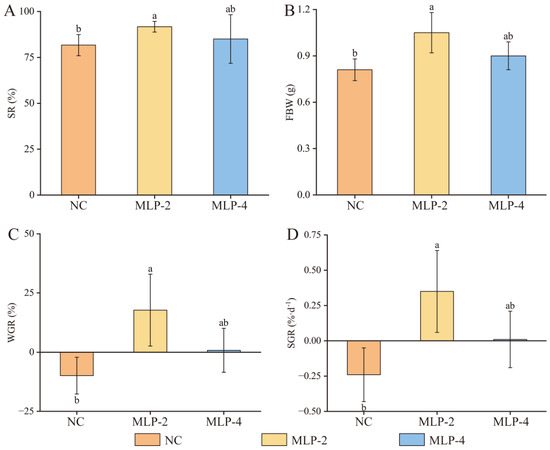
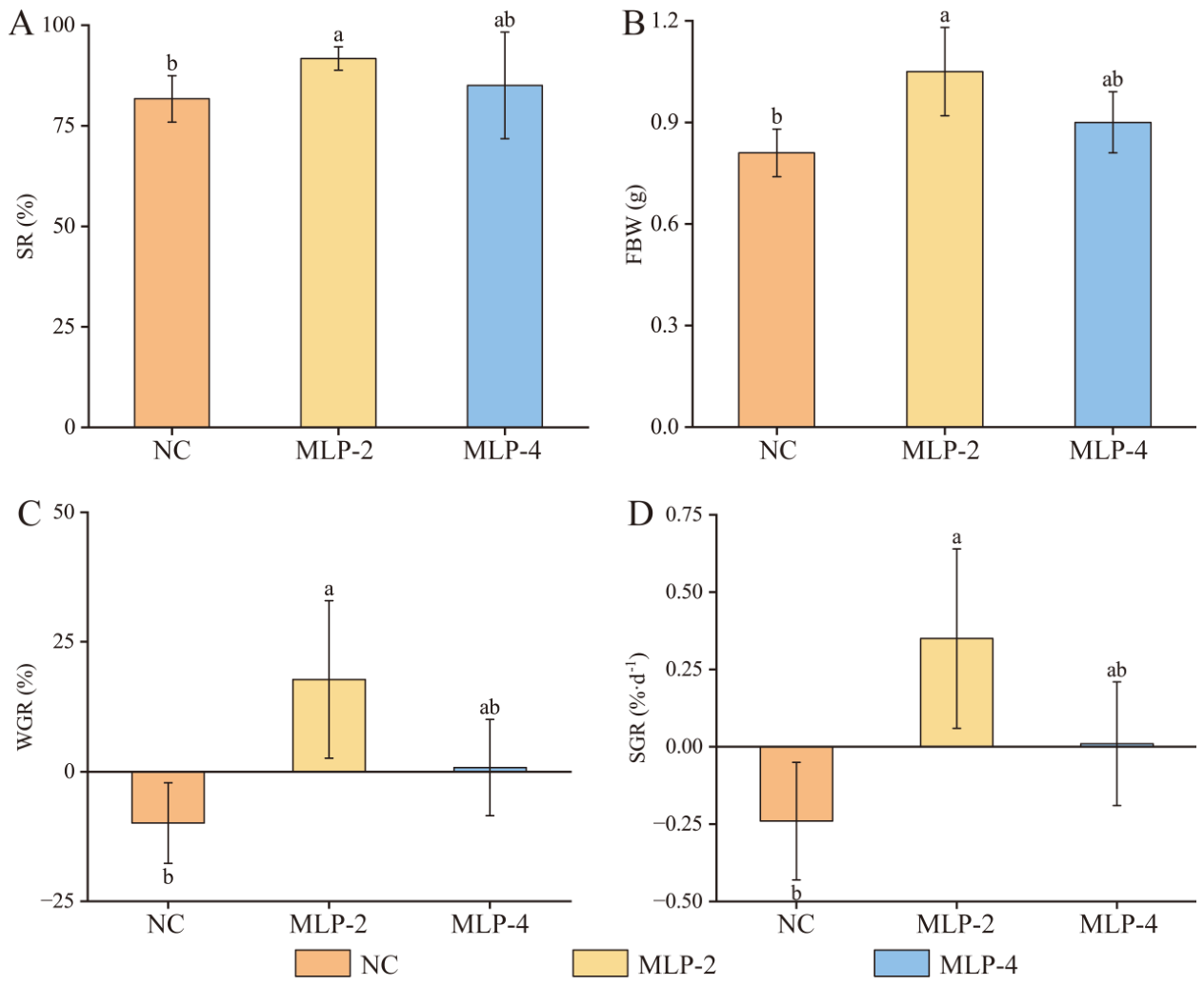
In general, MLP supplementation has a positive effect on the growth performance of sea cucumber. As shown in the results, the SRs of the MLP-2 and MLP-4 groups were 91.67% ± 2.89% and 85.00% ± 13.23%, which were 12.24% (MLP-2 group) and 4.08% (MLP-4 group) higher than that of the NC group (Figure 1A). The FBWs of the MLP-2 and MLP-4 groups were also higher than that of the NC group (Figure 1B). The WGRs of the MLP-2 and MLP-4 groups were 17.75% ± 15.18% and 0.80% ± 9.28%, which were 27.06% (MLP-2 group) and 10.71% (MLP-4 group) higher than that of the NC group (Figure 1C). Compared with the NC group, the SGRs of the MLP-2 and MLP-4 groups were slightly increased (0.59% and 0.25%) (Figure 1D). Sea cucumbers fed with the MLP-2 diet exhibited better growth performance than those fed with the MLP-4 diet, with their values increasing by 6.67% (average SR), 16.67% (average FBW), 16.95% (average WGR), and 0.34% (average SGR).
Figure 1.
The impact of mulberry leaf powder (MLP) supplementation on the growth performance of Apostichopus japonicus. (A) The impact of MLP supplementation on the average survival rate (SR) of sea cucumber. (B) The impact of MLP supplementation on the average final body weight (FBW) of sea cucumber. (C) The impact of MLP supplementation on the weight growth rate (WGR) of sea cucumber. (D) The impact of MLP supplementation on the specific growth rate (SGR) of sea cucumber. NC: the basic diet group; MLP-2: the 2% MLP supplementation diet group; MLP-4: the 4% MLP supplementation diet group. Data are presented as mean ± SD (n = 3). Different lowercase letters indicate significant differences between different groups (p < 0.05).
4.2. The Impact of MLP Supplementation on the Intestinal Digestive and Redox-Related Enzyme Activities of Sea Cucumber
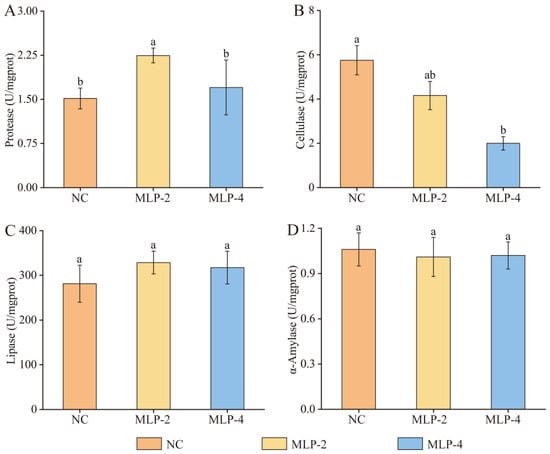
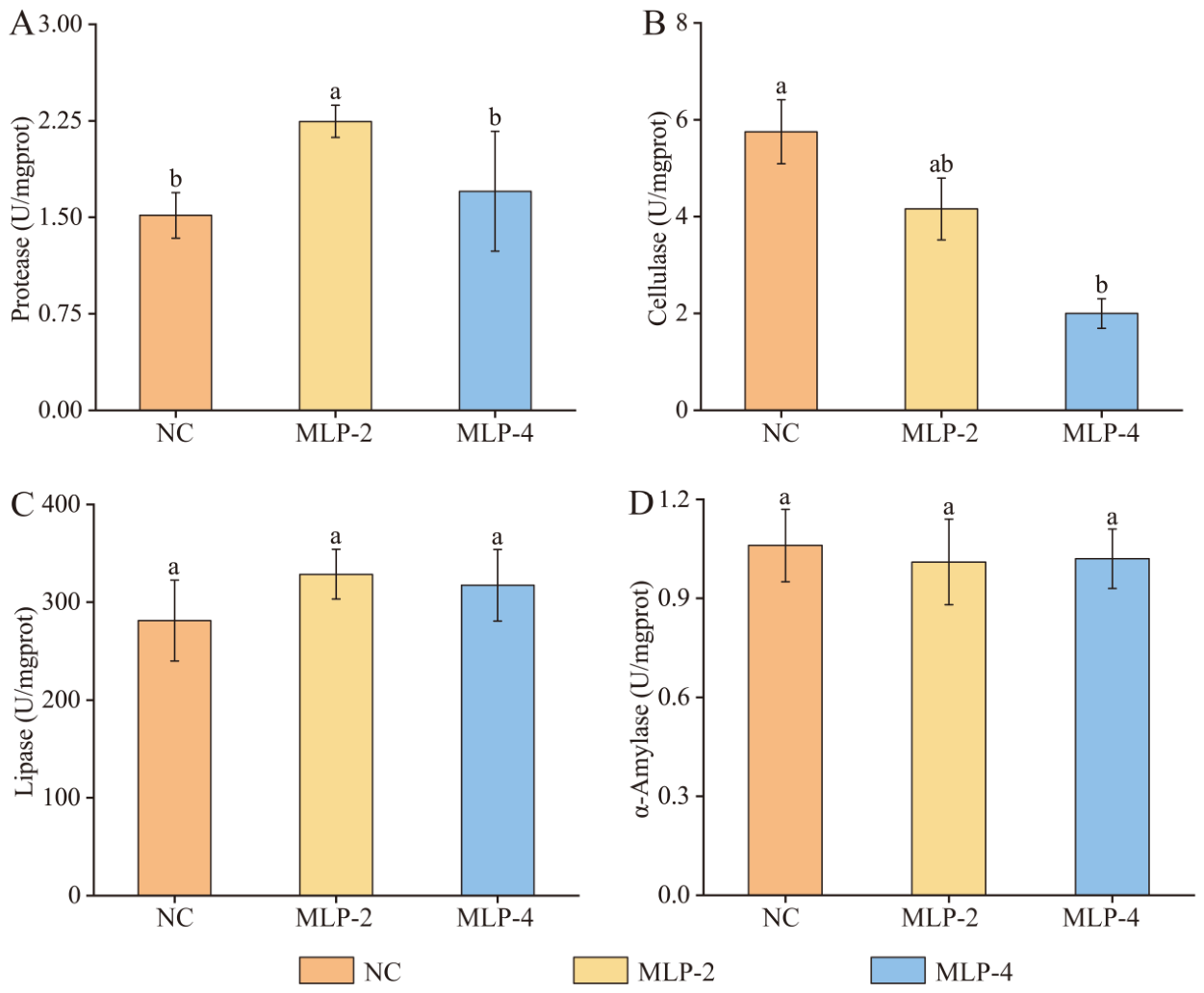
In terms of intestinal digestive enzyme activity, sea cucumbers fed with MLP-2 and MLP-4 diets generally exhibited an increasing trend in protease and lipase activities and a decreasing trend in cellulase and α-amylase activities. Specifically, the lipase activities of the MLP-2 and MLP-4 groups were 328.55 ± 25.43 U/mgprot and 317.32 ± 36.63 U/mgprot, which were higher than that of the NC group (Figure 2C). The protease activities of the MLP-2 and MLP-4 groups were 2.25 ± 0.13 U/mgprot and 1.70 ± 0.47 U/mgprot, which were increased by 48.18% and 12.36% compared with the NC group (Figure 2A). Compared with the NC group, the cellulase and α-amylase activities of the MLP-2 group were 4.16 ± 0.64 U/mgprot and 1.01 ± 0.13 U/mgprot, which were lower than those of the NC group; in the MLP-4 group, intestinal cellulase and α-amylase activities were 2.00 ± 0.31 U/mgprot and 1.02 ± 0.09 U/mgprot, which were also lower than those of the NC group (Figure 2B,D). In general, the examined intestinal digestive enzyme activities of the MLP-2 group were higher than those of the MLP-4 group except for α-amylase.
Figure 2.
The impact of mulberry leaf powder (MLP) supplementation on the digestive enzyme activities of Apostichopus japonicus. (A) The impact of MLP supplementation on the protease activity of sea cucumber. (B) The impact of MLP supplementation on the cellulase activity of sea cucumber. (C) The impact of MLP supplementation on the lipase activity of sea cucumber. (D) The impact of MLP supplementation on the α-amylase activity of sea cucumber. NC: the basic diet group; MLP-2: the 2% MLP supplementation diet group; MLP-4: the 4% MLP supplementation diet group. Data are presented as mean ± SD (n = 3). Different lowercase letters indicate significant differences between different groups (p < 0.05).
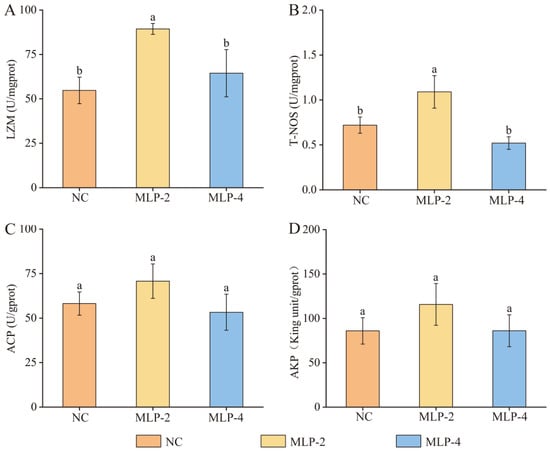
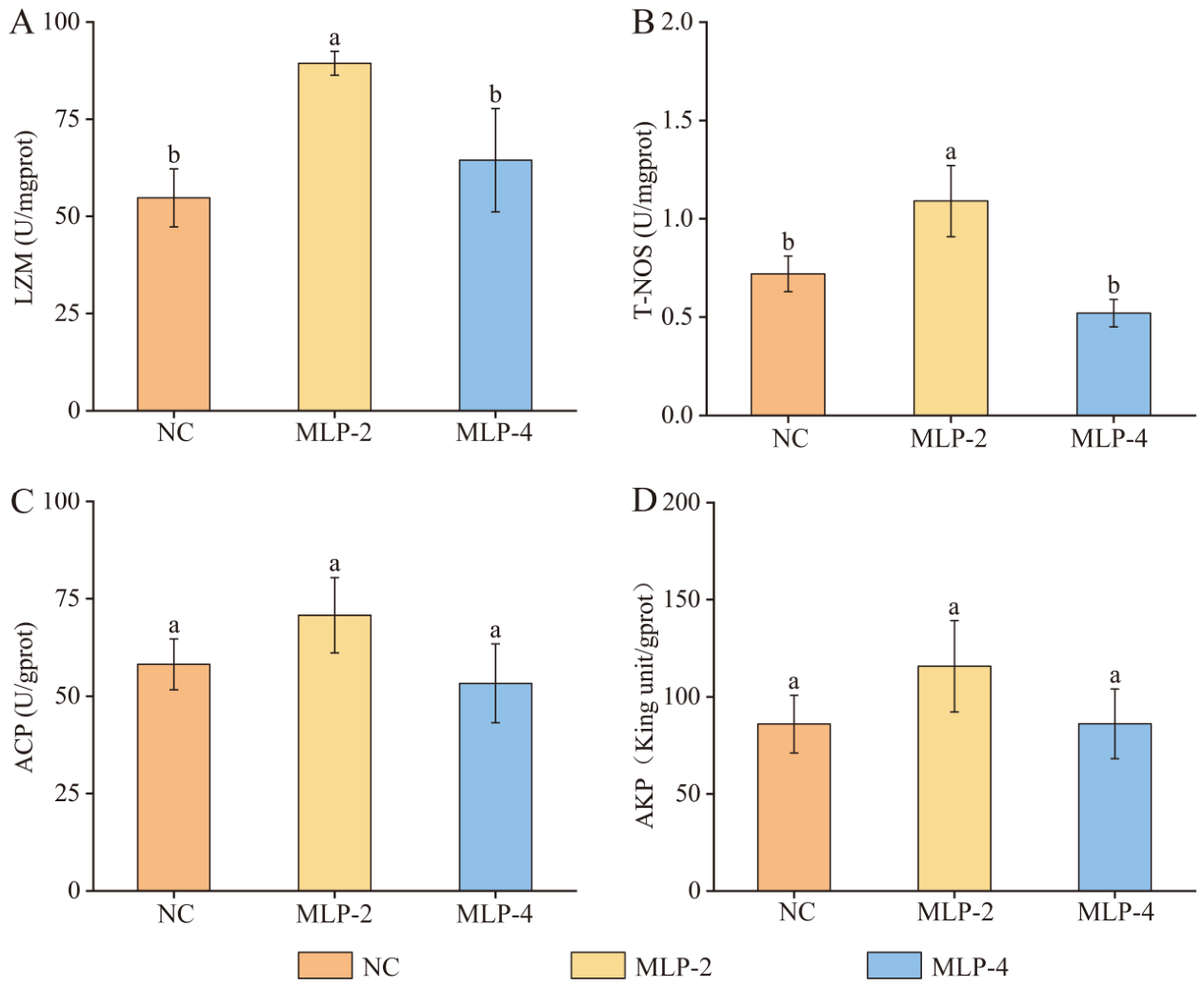
In terms of redox-related enzymes, the activity responses of sea cucumbers fed with the MLP-2 and MLP-4 diets exhibited different alteration trends compared with the NC group. Specifically, the intestinal LZM activities of the MLP-2 and MLP-4 groups were 89.37 ± 3.06 U/mgprot and 64.41 ± 13.28 U/mgprot, which were increased by 63.29% and 17.68%, respectively, compared with the NC group (Figure 3A). The intestinal T-NOS activities of sea cucumbers in the MLP-2 and MLP-4 groups were 1.09 ± 0.18 U/mgprot and 0.52 ± 0.07 U/mgprot, respectively. The MLP-2 group showed an increased T-NOS activity of 51.69%, while the MLP-4 group exhibited a decreased T-NOS activity of 27.47% compared to that of the NC group (Figure 3B). The intestinal ACP activities of the MLP-2 and MLP-4 groups were 70.75 ± 9.68 U/gprot and 53.29 ± 10.13 U/gprot. The MLP-2 group showed an increased ACP activity of 21.63%, while the MLP-4 group exhibited a decreased ACP activity of 8.38% compared to that of the NC group (Figure 3C). The intestinal AKP activities of the MLP-2 and MLP-4 groups were 115.76 ± 23.54 King unit/gprot and 86.12 ± 17.94 King unit/gprot, which were increased by 34.65% and 0.17%, respectively, compared with that of the NC group (Figure 3D). In general, the intestinal activities of all examined redox-related enzymes of the MLP-2 group were higher than those of the MLP-4 group.
Figure 3.
The impact of mulberry leaf powder (MLP) supplementation on the redox-related enzyme activities of Apostichopus japonicus. (A) The impact of MLP supplementation on the lysozyme (LZM) activity of sea cucumber. (B) The impact of MLP supplementation on the total nitric oxide synthase (T-NOS) activity of sea cucumber. (C) The impact of MLP supplementation on the acid phosphatase (ACP) activity of sea cucumber. (D) The impact of MLP supplementation on the alkaline phosphatase (AKP) activity of sea cucumber. NC: the basic diet group; MLP-2: the 2% MLP supplementation diet group; MLP-4: the 4% MLP supplementation diet group. Data are presented as mean ± SD (n = 3). Different lowercase letters indicate significant differences between different groups (p < 0.05).
4.3. The Impact of MLP Supplementation on the Microbiota of the Intestinal Contents of Sea Cucumber
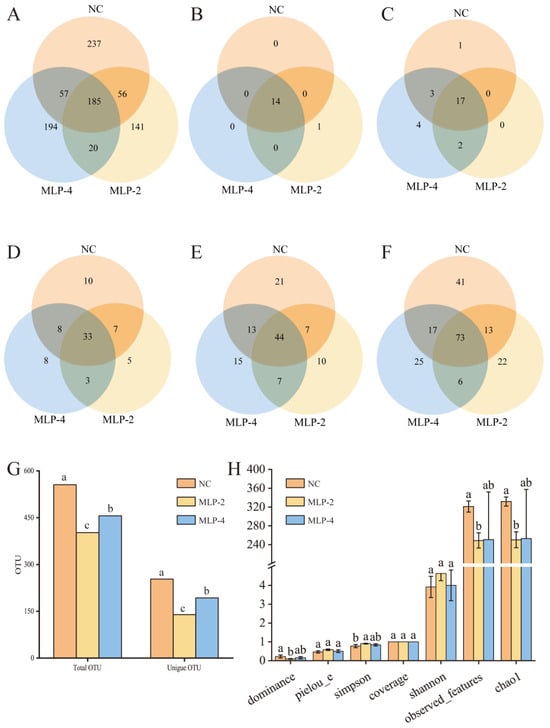
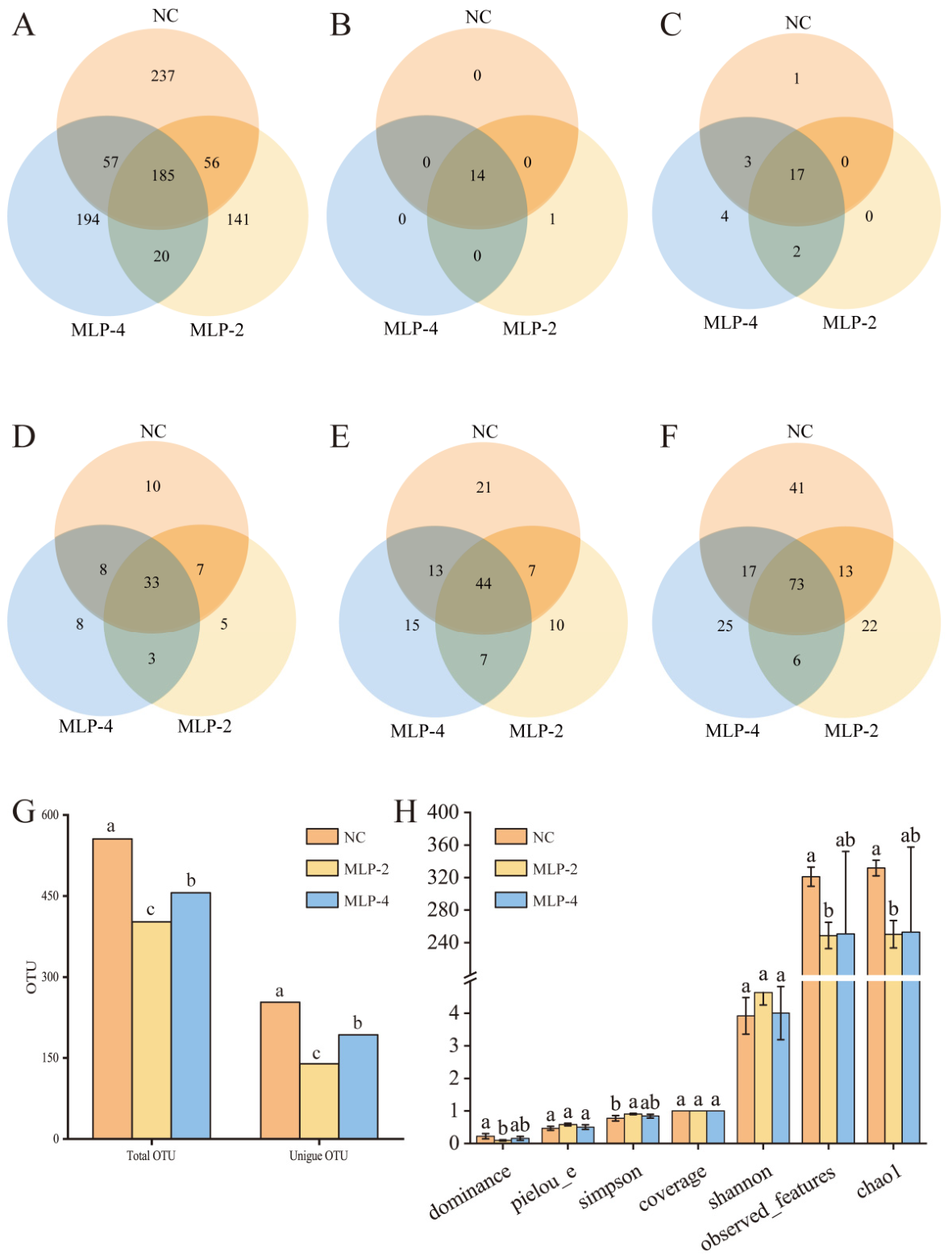
Sequencing data showed that a total of 61,238–120,778, 52,910–67,363, and 57,828–81,927 optimized sequences (average length: 253 bp) were obtained in the NC, MLP-2, and MLP-4 groups, respectively (Table 2). In general, MLP supplementation exhibited a negative effect on the intestinal microbiota diversity of sea cucumber. Specifically, the optimized sequences of the MLP-2 and MLP-4 groups were reduced by 36.67% (MLP-2 group) and 36.07% (MLP-4 group), respectively, compared with that of the NC group. A total of 556 OTUs were subsequently identified and classified into 14 phyla, 21 classes, 58 orders, 85 families, and 144 genera in the NC group. The total number of OTUs was 402 in the MLP-2 group, which can be classified into 15 phyla, 19 classes, 48 orders, 68 families, and 114 genera, and the total number of OTUs was 456 in the MLP-4 group, which can be classified into 14 phyla, 26 classes, 52 orders, 79 families, and 121 genera (Figure 4A–F). In addition, the unique OTUs of the MLP-2 (141) and MLP-4 groups (194) were reduced by 40.51% and 18.14% compared with the NC group (237) (Figure 4G). The dominance index in the MLP-2 group was significantly lower than that in the NC group. The MLP-4 group exhibited a slightly higher dominance index than the MLP-2 group and a slightly lower one than the NC group, but no statistically significant differences were observed. Similarly, the Simpson index of the MLP-2 group was significantly higher than that of the NC group. The MLP-4 group had a slightly higher Simpson index than that of the NC group and a slightly lower one than that of the MLP-2 group, but no significant differences were observed. No significant differences in the Pielou, coverage, Shannon, observed_species, and Chao1 indices were detected among any of the groups (Figure 4H).
Table 2.
Sequencing summary of intestinal microbiota analysis.
Figure 4.
The impact of mulberry leaf powder (MLP) supplementation on the intestinal microbiota diversity of Apostichopus japonicus. (A) The impact of MLP supplementation on the intestinal microbiota amplicon sequence variants of sea cucumber. (B) The impact of MLP supplementation on the intestinal microbiota of sea cucumber at the phylum level. (C) The impact of MLP supplementation on the intestinal microbiota of sea cucumber at the class level. (D) The impact of MLP supplementation on the intestinal microbiota of sea cucumber at the order level. (E) The impact of MLP supplementation on the intestinal microbiota of sea cucumber at the family level. (F) The impact of MLP supplementation on the intestinal microbiota of sea cucumber at the genus level. (G) The impact of MLP supplementation on the intestinal microbiota operational taxonomic units of sea cucumber. (H) The impact of MLP supplementation on the intestinal microbiota alpha-diversity indices of sea cucumber. NC: the basic diet group; MLP-2: the 2% MLP supplementation diet group; MLP-4: the 4% MLP supplementation diet group. Data are presented as mean ± SD (n = 3). Different lowercase letters indicate significant differences between different groups (p < 0.05).
The results of the PERMANOVA test, based on Bray–Curtis, Jaccard, and Weighted UniFrac, revealed the differences in the intestinal microbial community structure of sea cucumbers among the NC, MLP-2, and MLP-4 groups. Significant intergroup differences were observed in terms of species abundance (Bray–Curtis Dissimilarity; R2 = 0.561; F = 3.841; p = 0.007) and species presence or absence (Jaccard Index; R2 = 0.412; F = 2.103; p = 0.005), whereas no significant intergroup differences were observed in community phylogenetic structure based on the weighted evolutionary distance (Weighted UniFrac; R2 = 0.226; F = 0.875; p = 0.436) (Table 3). These findings indicate that dietary MLP treatments may alter the species composition and relative abundance of intestinal microbes in sea cucumber to some extent rather than change the phylogenetic relatedness of the microbial community.
Table 3.
The impact of mulberry leaf powder (MLP) supplementation on the intestinal microbial community structure of sea cucumber according to the PERMANOVA test.
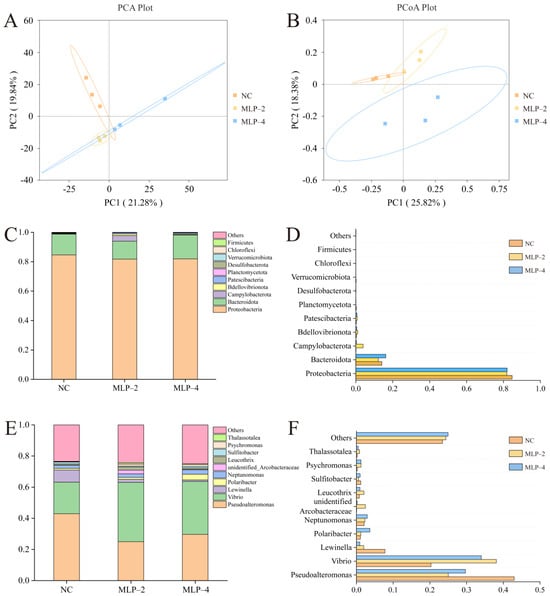
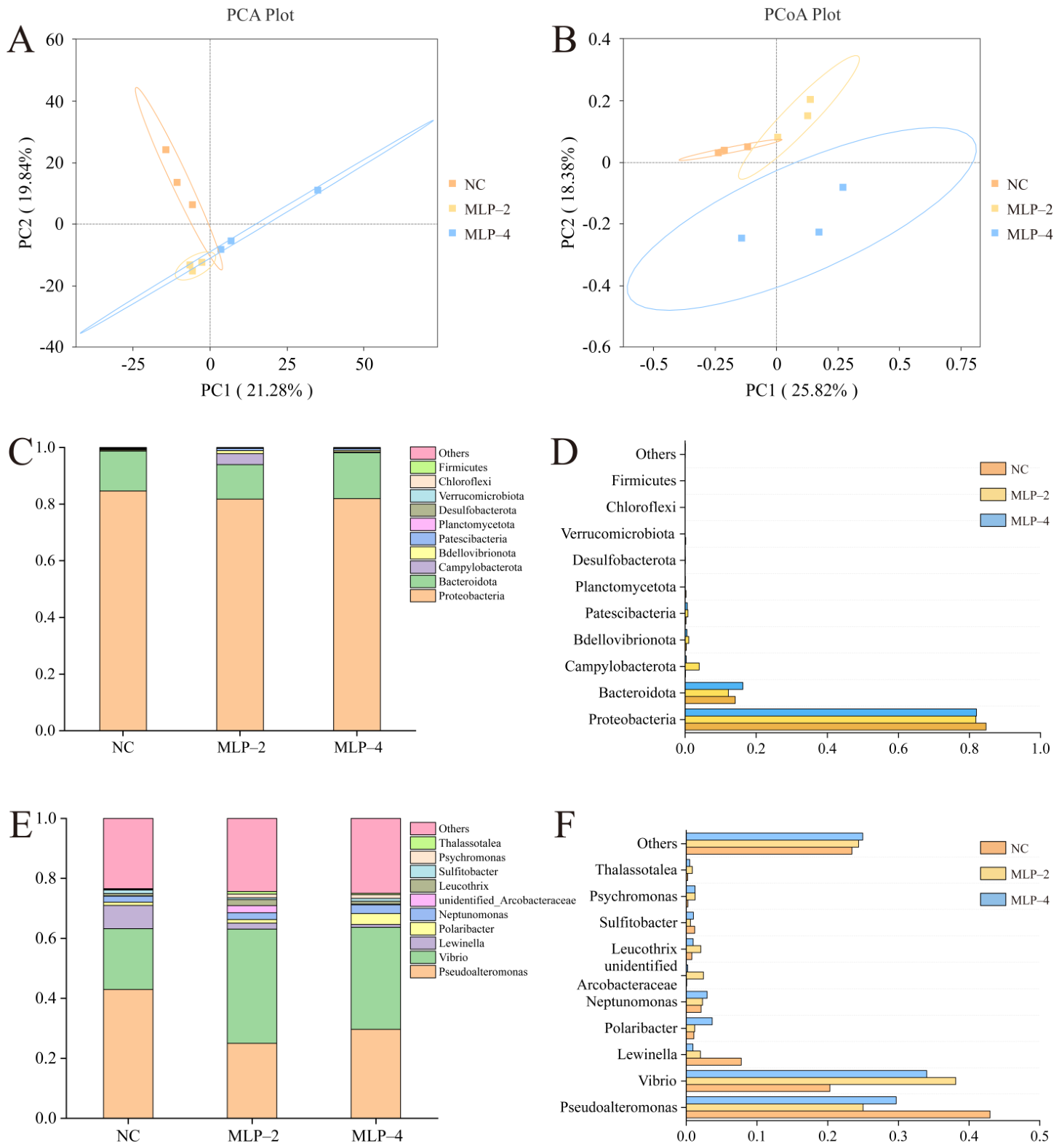
In terms of bacterial composition, PCA and PCoA revealed that the bacterial communities of the NC, MLP-2, and MLP-4 groups formed three different clusters, indicating that MLP supplementation may alter intestinal bacterial composition (Figure 5A,B). The dominant phyla were Proteobacteria (accounting for above 80.00%) and Bacteroidota (accounting for 12.16–16.22%), whereas phyla with relative abundance less than 1.5% were Bdellovibrionota, Patescibacteria, Planctomycetota, Desulfobacterota, Verrucomicrobiota, Chloroflexi, and Firmicutes (Figure 5C,D). The relative abundance of Proteobacteria from high to low was as follows: NC > MLP-4 > MLP-2. The relative abundance of Bacteroidota from high to low was as follows: MLP-4 > NC > MLP-2. Significant upregulation in the relative abundance of Campylobacterota was observed in the MLP-2 group compared with both the NC and the MLP-4 group (Figure 5C,D).
Figure 5.
The impact of mulberry leaf powder (MLP) supplementation on the intestinal microbiota composition of Apostichopus japonicus. (A) The impact of MLP supplementation on the intestinal microbiota principal component analysis (PCA) based on the feature sequence level of sea cucumber. (B) The impact of MLP supplementation on the intestinal microbiota principal coordinate analysis (PCoA) based on the Unweighted Unifrac distance of sea cucumber. (C) The impact of MLP supplementation on the relative abundance of the intestinal microbiota of sea cucumber at the phylum level. (D) The impact of MLP supplementation on the relative abundance of the intestinal microbiota of sea cucumber at the phylum level. (E) The impact of MLP supplementation on the relative abundance of intestinal microbiota of sea cucumber at the genus level. (F) The impact of MLP supplementation on the relative abundance of intestinal microbiota of sea cucumber at the genus level. NC: the basic diet group; MLP-2: the 2% MLP supplementation diet group; MLP-4: the 4% MLP supplementation diet group.
At the genus level, Pseudoalteromonas was the most dominant, with relative abundance from high to low as follows: NC > MLP-4 > MLP-2 (Figure 5E,F). The second most dominant genus was Vibrio, with relative abundance from high to low as follows: MLP-2 > MLP-4 > NC (Figure 5E,F). In addition, the relative abundance of the genus Lewinella of the NC group was significantly higher than that of either MLP-2 or MLP-4. The relative abundance of the genus Polaribacter was significantly higher in the MLP-4 group than that in either the NC or the MLP-2 group. The relative abundance of Psychromonas was significantly higher in both the MLP-2 and MLP-4 groups compared to that of the NC group. The percentage of unidentified_Arcobacteraceae was the highest in the MLP-2 group among all examined experimental groups, while it is less than 0.3% in the NC and MLP-4 groups (Figure 5E,F). The relative abundance of the genera clustered into “Others” accounts for 23–25% in each group without an obvious difference between different groups (Figure 5E,F).
5. Discussion
Aquaculture output is largely dependent upon the supply and quality of aquaculture feed. In the sea cucumber aquaculture industry, formulated feed is regarded as one of the keys to solving and improving the problem of negative growth of these animals during the low-temperature period. In this study, we focused on illustrating the effects of MLP on the growth performance of sea cucumbers cultivated in winter (low-temperature period) and the underlying mechanism of this effect.
The growth-promoting effects of mulberry leaves or MLP have been reported in various animals including pigs (Sus scrofa), chickens (Gallus gallus), and farmed Nile tilapia juveniles (Oreochromis niloticus) [23,24]. Consistent with the above investigations, obvious enhancement effects of MLP supplementation on the growth and body weight gain of sea cucumber were obtained in this study. Moreover, it should be noted that the dose of MLP supplementation varies for different animals. For instance, the optimal addition dosages of MLP for gaining significant growth improvement were 8%, 1%, and 2% for pigs, chicken, and sea cucumbers (this study), respectively. Therefore, it can be concluded that MLP supplementation has a positive effect on the growth performance of various farmed animals, and the growth promotion dosage of MLP addition is species-specific.
Good digestive capacities of the intestines are the basis for animals to achieve good growth performance [25]. It has been reported that the activities of digestive enzymes (protease, amylase, lipase, and cellulase) may enhance growth performance by promoting the digestion and absorption of nutrients in fish [26,27]. Reduction in the activities of digestive enzymes (protease, lipase, and amylase) could induce growth stunting or repression in farmed milk fish (Chanos chanos) [28]. As for sea cucumbers, it has been reported that dietary methionine [29], amino acid mixture [12], or hydrolyzed soybean meal [30] may elevate the activities of protease and lipase. In addition, Amenyogbe et al. indicated that increased protease activity may elevate the utilization efficiency of feed protein, and elevated lipase activity may enable exogenous lipids to serve as an energy source, reserving more proteins to support growth [31]. Similarly, in this study, increased protease and lipase activities were observed, indicating that MLP supplementation may have a positive effect on the growth of sea cucumber by altering the utilization efficiencies of proteins and lipids. Interestingly, a decreasing trend in cellulase and α-amylase activities was observed in the intestines of sea cucumbers fed with MLP supplementation diets in this study. This observation is different from other investigations, which reported that increased cellulase and α-amylase activities may promote growth in aquatic animals [26,27,30]. A possible explanation for this phenomenon may be the attenuated digestion of polysaccharides (cellulose and starch in this study) induced by the elevated ingestion and utilization of proteins in the feed of sea cucumbers. Naturally, this hypothesis needs further justification. Moreover, it is worth noting that digestive enzymes respond differently to various feed additives, which supports the hypothesis that sea cucumbers have a certain degree of flexibility in digesting and utilizing different diets [7,30,32,33].
It has been proposed by Hamre [34] that the activity of many digestive enzymes could be affected by endogenous redox status. Li et al. [35] reported that suitable addition of dietary vitamin E (165.2–187.2 mg/kg diet) may elevate the activities of both AKP and ACP, which stimulate the digestion capability of lipids and carbohydrates in growing sea cucumbers. Similarly, increased activities of both AKP and ACP were observed in sea cucumbers fed with a 2% MLP supplementation diet (MLP-2) in this study, indicating that 2% MLP supplementation may promote the digestion of nutrients by increasing phosphatase activity, thus contributing to the growth performance of these animals. Therefore, it can be concluded that suitable MLP supplementation may indirectly stimulate the growth of sea cucumbers by enhancing endogenous redox homeostasis regulation capability.
Besides affecting intestinal digestive capability and redox stability, feed may also affect the growth and health of cultivated animals by altering the intestinal microbiota [36]. It is accepted that the higher the diversity and richness of the intestinal microbes, the stronger the pathogen resistance capability of the animals [37,38]. In this study, the total OTUs of both the MLP-2 (2% MLP supplementation) and MLP-4 groups (4% MLP supplementation) were all less than that of the NC group, indicating a reduction in intestinal microbe diversity. This observation seems to be inconsistent with our common knowledge. The significantly increased LZM and NOS activities in sea cucumbers fed with the 2% MLP diet (MLP-2 group) and the slightly increased LZM activity in sea cucumbers fed with the 4% MLP diet (MLP-4 group) may explain this paradox to some extent. The activities of both LZM and NOS are typical indices reflecting the innate immunity level of organisms, especially aquatic invertebrates [39,40]. The higher the LZM and NOS activities, the stronger the organisms’ defense against pathogen invasion [41,42,43]. Therefore, we assume that the enhanced antibacterial enzyme activity induced by MLP supplementation may kill some pathogenic bacteria, thus leading to a reduction in intestinal microbe diversity. In addition, it has been reported that suitable MLP supplementation (2%) has no detrimental effect on the intestinal microorganisms of piglets, but a high dosage of MLP supplementation (6%) may contribute to the proliferation of hazardous bacteria [44]. Similarly, dietary butyric acid supplementation may also remarkably promote the growth of sea cucumbers by decreasing the total number of intestinal OUTs [45]. Interestingly, it is agreed that effective innate immunity usually maintains or stabilizes a healthy, diverse microbiome rather than decimating it into lower diversity [46]. Therefore, further detailed investigation must be carried out to elucidate the mechanism underlying the contradictory phenomenon found in both this study and dietary butyric acid supplementation. Combined with the results obtained from this study, we assume that the extent to which MLP supplementation affects intestinal microbiota may vary among different animals. In terms of bacterial composition, significant upregulation in the relative abundance of Campylobacterota was observed in the MLP-2 group in this study. The phylum Campylobacterota is a recently proposed bacterial phylum capable of providing various nutrients for the chemosynthetic ecosystem [47]. In addition, it has been reported that the intestinal Campylobacterota abundance of sea cucumbers exhibiting superior growth performance is higher than that of sea cucumbers with inferior growth performance [5]. Therefore, we assume that the 2% MLP diet (MLP-2 group) may enhance the nutrition of sea cucumbers by increasing the relative abundance of Campylobacterota, thus promoting the growth of the animals. Moreover, an obvious reduction in the relative abundance (more than 30%) of the genus Pseudoalteromonas was also observed in sea cucumbers fed with MLP in this study. The Pseudoalteromonas species are common bacterial species in various marine environments [48]. Several investigations have documented that some Pseudoalteromonas species can serve as inducers [49] or inhibitors [50] of larval settlement in marine animals. It is worth noting that one Pseudoalteromonas species (P. aliena) has been demonstrated as one of the pathogenic bacteria for oysters [51]. Pseudoalteromonas species may cause disease in marine animals, and thus we assume that MLP supplementation may contribute to the health of sea cucumber by reducing hazardous intestinal Pseudoalteromonas species. Naturally, this hypothesis needs further justification. Moreover, upregulated relative abundance of the genus Vibrio was also detected in sea cucumbers fed with MLP in this study. This observation is in conflict with our common knowledge that the genus Vibrio is the major pool of pathogenic bacteria for both marine animals and human beings, posing a great threat to global health [52]. However, it should be kept in mind that the outbreak of disease or mortality induced by pathogenic Vibrio not only depends on the relative abundance of the bacteria but also on host factors (especially genetics, endogenous redox level, immunity status, and life stage) [53]. Combined with the above data that MLP supplementation may enhance redox stability and the innate immunity of sea cucumbers, we therefore hypothesize that MLP supplementation-induced enhancement of innate immunity may compensate for the harmful effects driven by the elevation in the relative abundance of Vibrio species. However, there is another possibility, namely, that the Vibrio species, with its increased relative abundance, may not affect the health of sea cucumbers or have no association with sea cucumber diseases. This hypothesis still needs further systematic and detailed investigation.
6. Conclusions
In summary, all data obtained in this study demonstrate that MLP supplementation in the diet may promote the growth of sea cucumbers cultivated in winter by stimulating digestive capacity, endogenous redox stability, antibacterial ability, and intestinal health. The optimal dose of dietary MLP for growing sea cucumbers in winter was 2% dry weight.
Author Contributions
Y.D.: Sample Collection, Data Analysis, Software, and Writing. J.X.: Data Acquisition, Data Analysis, and Writing. M.X.: Data Acquisition and Analysis. J.L.: Data Acquisition. B.Z.: Data Acquisition. W.X.: Data Acquisition. Y.Z.: Conceptualization, Methodology, Data Analysis, Writing, and Supervision. Y.C.: Conceptualization, Methodology, Data Analysis, Writing, and Supervision. All authors have read and agreed to the published version of the manuscript.
Funding
The study was supported by the National Natural Science Foundation of China (No. 32273117 and No. 32072977).
Institutional Review Board Statement
This study was conducted in accordance with the Chinese Guidelines for Animal Welfare and Experimental Protocols, and approved by the Ethics Committee of Dalian Ocean University (Approval code: No. DLOU20250015; Approval date: 29 October 2025).
Data Availability Statement
All sequence data were deposited in the National Center for Biotechnology Information (NCBI) Short Read Archive (SRA) Sequence Database (Accession Number: PRJNA1364783).
Conflicts of Interest
The authors have no relevant financial or non-financial interests to disclose.
References
- Huang, X.; Wang, H.; Ding, P.; Yang, Y.; Ding, J.; Zhao, C. Dietary allicin improves behavior, regulates intestinal microbial colonies, and improves behavioral resistance to handling stresses in the sea cucumber Apostichopus japonicus at high temperature. Aquac. Int. 2025, 33, 48. [Google Scholar] [CrossRef] [Scilit]
- Ministry of Agriculture and Rural Affairs of the People’s Republic of China. China Fishery Statistical Yearbook 2024; China Agriculture Press: Beijing, China, 2024.
- Sun, H.; Liang, M.; Yan, J.; Chen, B. Nutrient requirements and growth of the sea cucumber Apostichopus japonicus. In Presented at the Workshop on Advances in Sea Cucumber Aquaculture and Management, Dalian, China, 14–18 October 2003; Lovatelli, A., Conand, C., Purcell, S., Uthicke, S., Hamel, J.-F., Mercier, A., Eds.; FAO Fisheries Technical Paper No. 463; FAO: Rome, Italy, 2004; pp. 287–296. [Google Scholar]
- Ding, P.; Yu, Y.; Qiao, Y.; Wang, X.; Ding, J.; Chang, Y.; Zhao, C. Effects of dietary Bacillus on foraging behavior, food consumption, digestive enzyme activity, and defecation outputs of the sea cucumber Apostichopus japonicus at low temperature: New insights into overwintering management. Aquaculture 2023, 568, 739327. [Google Scholar] [CrossRef] [Scilit]
- Kang, Y.H.; Yang, B.T.; Hu, R.; Zhang, P.; Gu, M.; Cong, W. Gut microbiota and metabolites may play a crucial role in sea cucumber Apostichopus japonicus aestivation. Microorganisms 2023, 11, 416. [Google Scholar] [CrossRef] [Scilit] [PubMed]
- Yang, H.; Hamel, J.F.; Mercier, A. The Sea Cucumber Apostichopus japonicus: History, Biology and Aquaculture; Academic Press: Cambridge, MA, USA, 2015. [Google Scholar]
- Song, Z.; Li, P.; Hu, S.; Liu, C.; Hao, T.; Han, X. Influence of dietary phosphorus on the growth, feed utilization, proximate composition, intestinal enzymes, and oxidation resistance of sea cucumber Apostichopus japonicus. Aquac. Nutr. 2023, 2023, 2266191. [Google Scholar] [CrossRef] [Scilit] [PubMed]
- Xu, Y.; Gao, Q.; Dong, S.; Hou, Z.; Mei, Y.; Li, X.; Dong, K.; Li, Z. Effects of dietary zinc on growth performance, digestive enzyme activities, antioxidant status, and immune responses of sea cucumber Apostichopus japonicus. Biol. Trace Elem. Res. 2024, 202, 1767–1775. [Google Scholar] [CrossRef] [Scilit] [PubMed]
- Chen, J.; Ren, Y.; Wang, G.; Xia, B.; Li, Y. Dietary supplementation of biofloc influences growth performance, physiological stress, antioxidant status and immune response of juvenile sea cucumber Apostichopus japonicus (Selenka). Fish Shellfish Immunol. 2018, 72, 143–152. [Google Scholar] [CrossRef] [Scilit] [PubMed]
- Zhang, E.; Dong, S.; Wang, F.; Tian, X.; Gao, Q. Effects of L-tryptophan on the growth, intestinal enzyme activities and non-specific immune response of sea cucumber (Apostichopus japonicus Selenka) exposed to crowding stress. Fish Shellfish Immunol. 2018, 75, 158–163. [Google Scholar] [CrossRef] [Scilit] [PubMed]
- Zeng, F.; Rabbi, M.H.; Hu, Y.; Li, Z.; Ren, X.; Han, Y.; Ren, T. Synergistic effects of dietary selenomethionine and vitamin C on the immunity, antioxidant status, and intestinal microbiota in sea cucumber (Apostichopus japonicus). Biol. Trace Elem. Res. 2021, 199, 3905–3917. [Google Scholar] [CrossRef] [Scilit] [PubMed]
- Wu, J.; Lv, C.; Lv, X.; Liu, Y.; Zhang, W.; Yang, D.; Zhao, J. Effects of the amino acid mixture ‘NutriMix’ on growth performance, non-specific immunity and intestinal health in sea cucumber (Apostichopus japonicus). Comp. Immunol. Rep. 2025, 8, 200217. [Google Scholar] [CrossRef] [Scilit]
- Ma, G.; Chai, X.; Hou, G.; Zhao, F.; Meng, Q. Phytochemistry, bioactivities and future prospects of mulberry leaves: A review. Food Chem. 2022, 372, 131335. [Google Scholar] [CrossRef] [Scilit] [PubMed]
- Zhang, Y.; Miao, R.; Ma, K.; Zhang, Y.; Fang, X.; Wei, J.; Yin, R.; Zhao, J.; Tian, J. Effects and mechanistic role of mulberry leaves in treating diabetes and its complications. Am. J. Chin. Med. 2023, 51, 1711–1749. [Google Scholar] [CrossRef] [Scilit] [PubMed]
- Liu, Y.; Li, Y.; Peng, Y.; He, J.; Xiao, D.; Chen, C.; Li, F.; Huang, R.; Yin, Y. Dietary mulberry leaf powder affects growth performance, carcass traits and meat quality in finishing pigs. J. Anim. Physiol. Anim. Nutr. 2019, 103, 1934–1945. [Google Scholar] [CrossRef] [Scilit] [PubMed]
- Yan, H.; Yan, S.; Li, Z.; Zhang, T.; He, J.; Yu, B.; Yu, J.; Luo, J.; Wu, A.; Pu, J.; et al. Mulberry leaf benefits the intestinal epithelial barrier via direct anti-oxidation and indirect modulation of microbiota in pigs. Phytomedicine 2024, 135, 156217. [Google Scholar] [CrossRef] [Scilit] [PubMed]
- Li, Z.; Chen, X.; Chen, Y.; Li, W.; Feng, Q.; Zhang, H.; Huang, X.; Luo, L. Effects of dietary mulberry leaf extract on the growth, gastrointestinal and hepatic functions of Chinese giant salamander (Andrias davidianus). Aquac. Res. 2020, 51, 2613–2623. [Google Scholar] [CrossRef] [Scilit]
- Goldring, J.P.D. Measuring protein concentration with absorbance, Lowry, Bradford Coomassie Blue, or the Smith bicinchoninic acid assay before electrophoresis. Methods Mol. Biol. 2019, 1855, 31–39. [Google Scholar] [CrossRef] [Scilit] [PubMed]
- Shen, X.; Yang, Z.; Wang, Q.; Chen, X.; Zhu, Q.; Liu, Z.; Patel, N.; Liu, X.; Mo, X. Lactobacillus plantarum L168 improves hyperoxia-induced pulmonary inflammation and hypoalveolarization in a rat model of bronchopulmonary dysplasia. npj Biofilms Microbiomes 2024, 10, 32. [Google Scholar] [CrossRef] [Scilit] [PubMed]
- Magoc, T.; Salzberg, S.L. FLASH: Fast length adjustment of short reads to improve genome assemblies. Bioinformatics 2011, 27, 2957–2963. [Google Scholar] [CrossRef] [Scilit] [PubMed]
- Bokulich, N.A.; Subramanian, S.; Faith, J.J.; Gevers, D.; Gordon, J.I.; Knight, R.; Mills, D.A.; Caporaso, J.G. Quality-filtering vastly improves diversity estimates from Illumina amplicon sequencing. Nat. Methods 2012, 10, 57–59. [Google Scholar] [CrossRef] [Scilit] [PubMed]
- Edgar, R.C.; Haas, B.J.; Clemente, J.C.; Quince, C.; Knight, R. UCHIME improves sensitivity and speed of chimera detection. Bioinformatics 2011, 27, 2194–2200. [Google Scholar] [CrossRef] [Scilit] [PubMed]
- Geng, B.; Gao, J.; Cheng, H.; Guo, G.; Wang, Z. Effects of dietary mulberry leaves on growth, production performance, gut microbiota, and immunological parameters in poultry and livestock: A systematic review and meta-analysis. Anim. Biosci. 2024, 37, 1065–1076. [Google Scholar] [CrossRef] [Scilit] [PubMed]
- Miao, L.; Charles, O.; Lin, Y.; Gong, Y.; Zhu, W.; Wang, L.; Fu, J.; Zhang, Z.; Dong, Z. Interactive effects of mulberry leaf meal and bamboo charcoal additive on growth performance, anti-oxidant capacity, and disease resistance of genetically improved farmed tilapia (GIFT) juvenile (Oreochromis niloticus). Aquac. Rep. 2020, 18, 100483. [Google Scholar] [CrossRef] [Scilit]
- Zhou, Y.; Jiang, W.D.; Zhang, J.X.; Feng, L.; Wu, P.; Liu, Y.; Jiang, J.; Kuang, S.-Y.; Tang, L.; Peng, Y.; et al. Cinnamaldehyde improves the growth performance and digestion and absorption capacity in grass carp (Ctenopharyngodon idella). Fish Physiol. Biochem. 2020, 46, 1589–1601. [Google Scholar] [CrossRef] [Scilit] [PubMed]
- Mitra, G.; Mukhopadhyay, P.K.; Ayyappan, S. Modulation of digestive enzyme activities during ontogeny of Labeo rohita larvae fed ascorbic acid enriched zooplankton. Comp. Biochem. Physiol. Part A Mol. Integr. Physiol. 2008, 149, 341–350. [Google Scholar] [CrossRef] [Scilit] [PubMed]
- Chen, G.; Feng, L.; Kuang, S.; Liu, Y.; Jiang, J.; Hu, K.; Jiang, W.; Li, S.; Tang, L.; Zhou, X. Effect of dietary arginine on growth, intestinal enzyme activities and gene expression in muscle, hepatopancreas and intestine of juvenile Jian carp (Cyprinus carpio var. Jian). Br. J. Nutr. 2012, 108, 195–207. [Google Scholar] [CrossRef] [Scilit] [PubMed]
- Lingam, S.S.; Sawant, P.B.; Chadha, N.K.; Prasad, K.P.; Muralidhar, A.P.; Syamala, K.; Xavier, K.A.M. Duration of stunting impacts compensatory growth and carcass quality of farmed milkfish, Chanos chanos (Forsskal, 1775) under field conditions. Sci. Rep. 2019, 9, 16747. [Google Scholar] [CrossRef] [Scilit] [PubMed]
- Li, B.S.; Han, X.J.; Wang, J.Y.; Song, Z.D.; Sun, Y.Z.; Wang, S.X.; Huang, B.S. Optimal dietary methionine requirement for juvenile sea cucumber Apostichopus japonicus Selenka. Aquac. Res. 2021, 52, 1348–1358. [Google Scholar] [CrossRef] [Scilit]
- Song, Z.; Li, P.; Wang, J.; Huang, B.; Li, B.; Wang, S.; Zhang, Y.; Gong, X.; Li, X.; Tan, Q. Effects of seaweed replacement by hydrolyzed soybean meal on growth, metabolism, oxidation resistance and body composition of sea cucumber Apostichopus japonicus. Aquaculture 2016, 463, 135–144. [Google Scholar] [CrossRef] [Scilit]
- Amenyogbe, E.; Droepenu, E.K.; Ayisi, C.L.; Boamah, G.A.; Duker, R.Q.; Abarike, E.D.; Huang, J.-S. Impact of probiotics, prebiotics, and synbiotics on digestive enzymes, oxidative stress, and antioxidant defense in fish farming: Current insights and future perspectives. Front. Mar. Sci. 2024, 11, 1368436. [Google Scholar] [CrossRef] [Scilit]
- Liao, M.L.; Ren, T.J.; Chen, W.; Han, Y.-Z.; Liu, C.-M.; Jiang, Z.-Q.; Wang, F.-Q. Effects of dietary lipid level on growth performance, body composition and digestive enzymes activity of juvenile sea cucumber Apostichopus japonicus. Aquac. Res. 2015, 48, 92–101. [Google Scholar] [CrossRef] [Scilit]
- Wen, B.; Gao, Q.F.; Dong, S.L.; Hou, Y.; Yu, H. Utilization of different macroalgae by sea cucumber Apostichopus japonicus revealed by carbon stable isotope analysis. Aquac. Environ. Interact. 2016, 8, 171–178. [Google Scholar] [CrossRef] [Scilit]
- Hamre, K. Metabolism, interactions, requirements and functions of vitamin E in fish. Aquac. Nutr. 2011, 17, 98–115. [Google Scholar] [CrossRef] [Scilit]
- Li, B.; Wang, L.; Wang, J.; Sun, Y.; Wang, S.; Jiang, L.; Huang, B. Requirement of vitamin E of growing sea cucumber Apostichopus japonicus Selenka. Aquac. Res. 2020, 51, 1284–1292. [Google Scholar] [CrossRef] [Scilit]
- Wang, C.; Shi, C.; Zhang, Y.; Song, D.; Lu, Z.; Wang, Y. Microbiota in fermented feed and swine gut. Appl. Microbiol. Biotechnol. 2018, 102, 2941–2948. [Google Scholar] [CrossRef] [Scilit] [PubMed]
- Lin, H.V.; Frassetto, A.; Kowalik, E.J.; Nawrocki, A.R.; Lu, M.M.; Kosinski, J.R.; Hubert, J.A.; Szeto, D.; Yao, X.; Forrest, G.; et al. Butyrate and propionate protect against diet-induced obesity and regulate gut hormones via free fatty acid receptor 3-independent mechanisms. PLoS ONE 2012, 7, e35240. [Google Scholar] [CrossRef] [Scilit] [PubMed]
- Wang, H.Y.; Xu, R.Y.; Zhang, H.; Su, Y.; Zhu, W. Swine gut microbiota and its interaction with host nutrient metabolism. Anim. Nutr. 2020, 6, 410–420. [Google Scholar] [CrossRef] [Scilit] [PubMed]
- Ragland, S.A.; Criss, A.K. From bacterial killing to immune modulation: Recent insights into the functions of lysozyme. PLoS Pathog. 2017, 13, e1006512. [Google Scholar] [CrossRef] [Scilit] [PubMed]
- Locascio, A.; Annona, G.; Caccavale, F.; D’aniello, S.; Agnisola, C.; Palumbo, A. Nitric oxide function and nitric oxide synthase evolution in aquatic chordates. Int. J. Mol. Sci. 2023, 24, 11182. [Google Scholar] [CrossRef] [Scilit] [PubMed]
- Long, Y.; Lin, S.; Zhu, J.; Pang, X.; Fang, Z.; Lin, Y.; Che, L.; Xu, S.; Li, J.; Huang, Y.; et al. Effects of dietary lysozyme levels on growth performance, intestinal morphology, non-specific immunity and mRNA expression in weanling piglets. Anim. Sci. J. 2016, 87, 411–418. [Google Scholar] [CrossRef] [Scilit] [PubMed]
- Ayiku, S.; Shen, J.F.; Tan, B.P.; Dong, X.-H.; Liu, H.-Y. Effects of dietary yeast culture on shrimp growth, immune response, intestinal health and disease resistance against Vibrio harveyi. Fish Shellfish Immunol. 2020, 102, 286–295. [Google Scholar] [CrossRef] [Scilit] [PubMed]
- El-Deep, M.H.; Amber, K.A.; Eid, Y.Z.; Alrashood, S.T.; Khan, H.A.; Sakr, M.S.; Dawood, M.A.O. The influence of dietary chicken egg lysozyme on the growth performance, blood health, and resistance against Escherichia coli in the growing rabbits’ cecum. Front. Vet. Sci. 2020, 7, 579576. [Google Scholar] [CrossRef] [Scilit] [PubMed]
- Ma, J.; Wang, J.; Jin, X.; Liu, S.; Tang, S.; Zhang, Z.; Long, S.; Piao, X. Effect of dietary supplemented with mulberry leaf powder on growth performance, serum metabolites, antioxidant property and intestinal health of weaned piglets. Antioxidants 2023, 12, 307. [Google Scholar] [CrossRef] [Scilit] [PubMed]
- Liu, L.; Wei, C.; Li, Y.; Wang, M.; Mao, Y.; Tian, X. A Comparative Study on Effects of Three Butyric Acid-Producing Additives on the Growth Performance, Non-specific Immunity, and Intestinal Microbiota of the Sea Cucumber Apostichopus japonicus. Aquac. Nutr. 2024, 1, 6973951. [Google Scholar] [CrossRef] [Scilit] [PubMed]
- Liu, B.; Zhou, W.; Wang, H.; Li, C.; Wang, L.; Li, Y.; Wang, J. Bacillus baekryungensis MS1 regulates the growth, non-specific immune parameters and gut microbiota of the sea cucumber Apostichopus japonicus. Fish Shellfish Immunol. 2020, 102, 133–139. [Google Scholar] [CrossRef] [Scilit] [PubMed]
- Yan, X.; Sun, Q.; Xu, K.; Zhuo, J.; Sun, Y.; Qian, G.; Zhang, X.; Sun, L. Deep-sea cold seep Campylobacterota: Diversity, growth, metabolic characteristics, and nutrient production. Microorganisms 2025, 13, 1028. [Google Scholar] [CrossRef] [Scilit] [PubMed]
- Bernbom, N.; Ng, Y.Y.; Kjelleberg, S.; Harder, T.; Gram, L. Marine bacteria from Danish coastal waters show antifouling activity against the marine fouling bacterium Pseudoalteromonas sp. strain S91 and zoospores of the green alga Ulva australis independent of bactericidal activity. Appl. Environ. Microbiol. 2011, 77, 8557–8567. [Google Scholar] [CrossRef] [Scilit] [PubMed]
- Yang, J.L.; Shen, P.J.; Liang, X.; Li, Y.-F.; Bao, W.-Y.; Li, J.-L. Larval settlement and metamorphosis of the mussel Mytilus coruscus in response to monospecific bacterial biofilms. Biofouling 2013, 29, 247–259. [Google Scholar] [CrossRef] [Scilit] [PubMed]
- Egan, S.; James, S.; Kjelleberg, S. Identification and characterization of a putative transcriptional regulator controlling the expression of fouling inhibitors in Pseudoalteromonas tunicata. Appl. Environ. Microbiol. 2022, 68, 372–378. [Google Scholar] [CrossRef] [Scilit] [PubMed]
- Mu, S.; Sun, J.; Gao, L.; Li, Y.; Wang, Z.; Chang, R.; Jiang, J.; Wang, L.; Wang, L.; Song, L. Isolation, identification, and pathogenicity of Pseudoalteromonas aliena associated with oyster disease outbreaks in summer. Microbiol. Spectr. 2025, 13, e0017325. [Google Scholar] [CrossRef] [Scilit] [PubMed]
- Doni, L.; Taviani, E.; Bosi, E.; Pruzzo, C.; Martinez-Urtaza, J.; Vezzulli, L. Milestones in Vibrio Science and their Contributions to Microbiology and Global Health. Ann. Glob. Health 2025, 91, 23. [Google Scholar] [CrossRef] [Scilit] [PubMed]
- Destoumieux-Garzón, D.; Canesi, L.; Oyanedel, D.; Travers, M.; Charrière, G.M.; Pruzzo, C.; Vezzulli, L. Vibrio-bivalve interactions in health and disease. Environ. Microbiol. 2020, 22, 4323–4341. [Google Scholar] [CrossRef] [Scilit] [PubMed]

Disclaimer/Publisher’s Note: The statements, opinions and data contained in all publications are solely those of the individual author(s) and contributor(s) and not of MDPI and/or the editor(s). MDPI and/or the editor(s) disclaim responsibility for any injury to people or property resulting from any ideas, methods, instructions or products referred to in the content. |
© 2026 by the authors. Licensee MDPI, Basel, Switzerland. This article is an open access article distributed under the terms and conditions of the Creative Commons Attribution (CC BY) license.