Review

Life History Traits of Dolphinfish (Coryphaena spp.) and Their Implications for Sustainable Fishery Management in Mexico


by
Emigdio Marín-Enríquez
1,
Víctor H. Cruz-Escalona
2,
Felipe Amezcua
3,*,
Eugenio Alberto Aragón-Noriega
4,*,
Víctor Núñez-Flores
5,
Mauricio Salas-Maldonado
6,
Francisco J. Urcádiz-Cázares
7 and
Jesús L. Pérez-Burgos
4
1
Centro de Investigaciones Biológicas del Noroeste, S.C. Politécnico Nacional 195 Col. Playa Palo de Santa Rita, La Paz CP 23095, Mexico
2
Instituto Politécnico Nacional/Centro Interdisciplinario de Ciencias Marinas, Av. Instituto Politécnico Nacional s/n, Col. Playa Palo de Santa Rita, La Paz CP 23096, Mexico
3
Instituto de Ciencias del Mar y Limnología, Universidad Nacional Autónoma de México, Capt. Joel Montes Camarena s/n, Mazatlán CP 82040, Mexico
4
Unidad Guaymas del Centro de Investigaciones Biológicas del Noroeste, Km 2.35 Camino al Tular, Col. Estero de Bacochibampo, Guaymas CP 85454, Mexico
5
Facultad de Ciencias del Mar, Universidad Autónoma de Sinaloa, Paseo Claussen s/n Col. Los Pinos, Mazatlán CP 82000, Mexico
6
Instituto Mexicano de Pesca y Acuacultura Sustentable (IMIPAS), Centro Regional de Investigación en Acuacultura y Pesca de Manzanillo, Playa ventanas s/n, Carretera Manzanillo a Campos, Manzanillo CP 28200, Mexico
7
División de Estudios de Posgrado e Investigación y Departamento de Ciencias Básicas, Tecnológico Nacional de México (TecNM), Instituto Tecnológico de La Paz, Forjadores 4720 Col. Tecnológico, La Paz CP 23080, Mexico
*
Authors to whom correspondence should be addressed.
Fishes 2026, 11(7), 401; https://doi.org/10.3390/fishes11070401 (registering DOI)
Submission received: 4 June 2026 / Revised: 26 June 2026 / Accepted: 2 July 2026 / Published: 6 July 2026
(This article belongs to the Section Fishery Economics, Policy, and Management)

Abstract

Dolphinfish are highly valued pelagic fish for both commercial and recreational fisheries. In Mexico, the species is reserved exclusively for sportfishing within 50 nautical miles of the coastline, making the country unique in enforcing such a rule. This regulation has generated a prolonged conflict between the commercial and artisanal sector, which seeks to amend the sustainable fishery law, and the sportfishing sector, which argues that permitting commercial harvest would significantly reduce availability for recreational fleets. The dispute has reached senior political levels, with members of Congress lobbied by both sides. Our objectives were to: (1) review dolphinfish life history traits and compare them with those of finfish legally harvested in Mexico; (2) identify knowledge gaps in the species’ biological information; and (3) provide recommendations for policymakers. Results show that dolphinfish display faster growth, earlier maturity, and greater dispersal capacity than most legally harvested teleost fish in Mexico. These traits suggest lower vulnerability to overfishing relative to other commercial species. As an initial step, we propose establishing a pilot program allowing limited legal harvest exclusively for artisanal coastal fisheries, generating data to support future assessments of population health in Mexican waters to inform adaptive, transparent, and evidence-based management decisions.
Key Contribution: Dolphinfish is one of the most sustainable fish in the Pacific Ocean. We propose management strategies for a pilot dolphinfish artisanal catch program in Mexico.

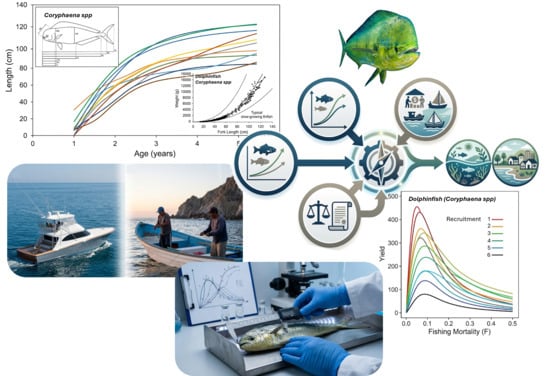
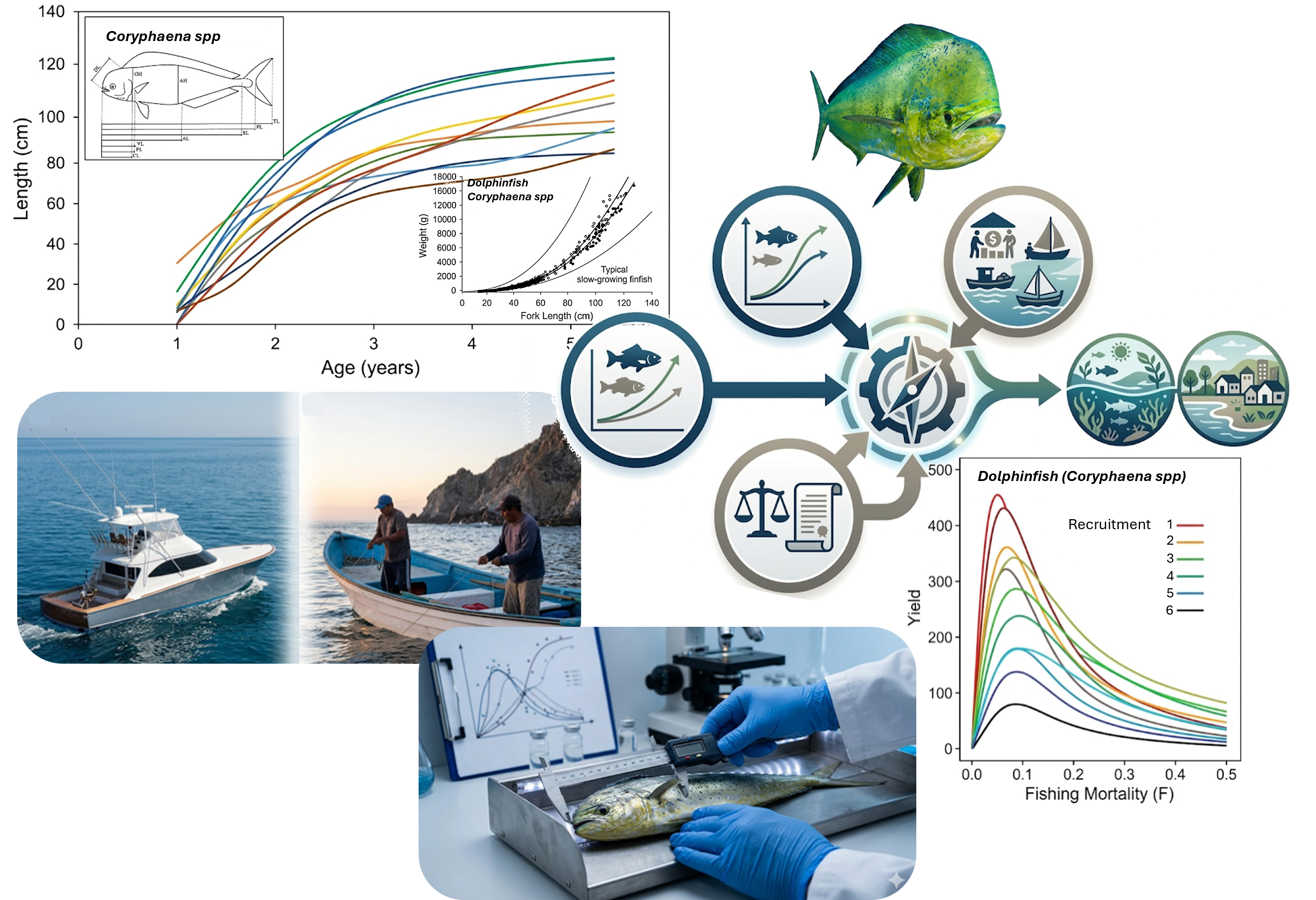
Graphical Abstract

1. Introduction

Fish of the family Coryphanidae, commonly known as dolphinfish, are highly mobile pelagic fish that inhabit all the tropical oceans of the world, from 40° S to 40° N [1]. The family has only one genus (Coryphaena) and two species, the Common Dolphinfish (Coryphaena hippurus) and the Pompano Dolphin (Coryphaena equiselis). These fish are highly prized for both human consumption and as trophies in sportfishing, and thus they are targeted by commercial and sport fleets throughout the world [2].
In Mexico, the dolphinfish (hereafter both species) is reserved for sportfishing under article 68 of the General Law of Sustainable Fisheries and Aquaculture (GLSFA), which states that “The species known as marlin, sailfish, swordfish, tarpon, roosterfish and dolphinfish, and all of their biological variants, are destined exclusively for recreational-sport fishing within 50 nm from the coastline” [3]. However, there is an important point to consider: the fact that the recreational fishing reserve does not apply beyond the 50-mile limit does not automatically imply that any vessel is authorized to catch dolphinfish. The corresponding fishing permit or authorization must be in place, and there must be no specific regulation restricting the harvest of this species by the fleet or within the fishery in question. Mexico is unique in its regulatory approach that totally prohibits dolphinfish commercial fishing in nearshore waters. Dolphinfish are legally harvested by commercial fleets off Spain [4], Costa Rica [5], Brazil [6], Panama [7], Venezuela [8], Colombia [9], Ecuador [10], United States of America [11] and Peru [10].
Off Mexico in the Pacific, substantial quantities of dolphinfish are presumed to be landed as incidental catch by commercial fleets (artisanal and industrial) targeting sharks and tunas, mainly in the Gulfs of California and Tehuantepec, and off Jalisco and Colima [2]; for example, in a single collection center for the artisanal fleet off Jalisco, a total of 12,640 t were collected between 2001 and 2013 [12], although key aspects of the sampling design, such as sampling frequency and the number of vessels included, were not reported [12], which limits the conclusions based on systematic samplings. The apparent high landings, combined with the facts that dolphinfish is a highly migratory complex, is a shared resource between countries, and is legally harvested both to the north and to the south of Mexico, has fueled a conflict between the artisanal-commercial sector, which demands the modification of article 68 to allow the legal harvesting of sailfish and dolphinfish and the recreational-sport sector, which opposes the modification [13,14].
Currently, the Mexican Institute of Research in Sustainable Fisheries and Aquaculture (IMIPAS) is responsible for issuing the technical opinions in fishery regulations, and the National Commission of Aquaculture and Fisheries (CONAPESCA) is responsible for fishery administration, inspection, and surveillance. In 2020, congressman Ricardo Velázquez Meza requested a technical opinion from the general director of IMIPAS, regarding the various requests for modification of article 68 to allow the legal harvesting of dolphinfish [15].
In 2023, leaders of diverse commercial fishery associations of at least four Mexican states (Sinaloa, Nayarit, Jalisco, and Colima) attended a meeting with the federal authorities to request the modification of the article [16]. During the same year, sport fishers in Cabo San Lucas, Baja California Sur, manifested their disagreement with the modification of the article, stating that “dolphinfish is a highly important species for the sport fishing industry, and allowing the legal harvesting of dolphinfish would greatly and directly affect more than 25,000 families in the region” [17]. Additionally, congressman Luis Armando Díaz stated in August 2024 that “Allowing the commercial fishing of dolphinfish lacks scientific and biological basis, and it jeopardizes the sustainability of the species, as well as the employments and economy that rely on sportfishing” [18]. For context, official fishery statistics [19] indicate that 61,156 small-scale fishers operate in northwestern Mexico alone. Assuming that each registered fisher represents a different household, this would provide an upper-bound estimate of more than 60,000 families directly dependent on small-scale fisheries in this region. However, this estimate should be interpreted with caution, as multiple members of the same household (e.g., father and son) may be registered independently, potentially resulting in an overestimation of the actual number of households. Nevertheless, these figures highlight that the potential social implications of dolphinfish management extend far beyond the recreational fishing sector and involve a substantially larger number of livelihoods associated with small-scale fisheries. In summary, there is an ongoing conflict between two important fishery sectors regarding the legal harvesting of dolphinfish in marine waters off Mexico, a conflict that has escalated to high political levels, and only one scientific study has been published on the topic, conducted in Nayarit, which did not produce conclusive results. The mentioned article is that of González-Huerta [20], who concluded that, “… for the state of Nayarit, the available information is not sufficient to formulate a precise opinion about the viability to commercially harvest dolphinfish”. The article, although it provides interesting points of view, is in our opinion of very local scope, given the highly migratory nature of the dolphinfish.
There are species that, given their population dynamics and life history characteristics, are prone to being overexploited. According to Lloret et al. [21], a species’ vulnerability to overexploitation increases if it has a slow growth rate, a restricted geographic range, a low fecundity, a high size-at-first maturity, and is longer lived. Our work aims to address the ongoing dispute from a comparative perspective, comparing the life history traits of dolphinfish with those of other fish species legally harvested in Mexico, and to evaluate published population dynamics parameters for dolphinfish in order to propose a potential set of fishery management measures in the event that legal harvest of dolphinfish becomes authorized. Specifically, we aim to (1) present a review of the published works on dolphinfish life history traits, (2) compare the dolphinfish population parameters (growth rate, fecundity, size-at-maturity, longevity, dispersion) to those of other fish species legally harvested in Mexico, (3) to identify the gaps in the state of the art of dolphinfish ecology and fisheries in waters off Mexico, and (4) to issue a series of recommendations to the Mexican authorities (IMIPAS and CONAPESCA) to provide them with a series of recommendations that could potentially support decision-making processes aimed at addressing the conflict between the two fishery sectors in Mexico. While biological attributes might suggest scope for sustainable exploitation, the decision to maintain the sportfishing monopoly may reflect other political or socioeconomic priorities. Here we synthesize the available life history evidence and contrast it with the current policy position, assessing implications for the artisanal fishery sector and propose an implementable pathway for reform with a precautionary pilot-program approach and implementing scientific monitoring aiming to perform adaptive management that should be updated with the latest catch data, thus ensuring a sustainable approach for the management of the dolphinfish catches.

2. Search Strategy

We performed a thorough review of the published literature on dolphinfish age/growth, reproductive biology/fecundity, and dispersion/migrations. We used the Google Scholar® database; for published works in countries other than Mexico, where dolphinfish are legally harvested, we used different combinations of keywords that included Coryphaena, and different life history traits, such as Coryphaena + reproduction, Coryphaena + age + growth and dolphinfish + maturity to name a few. We then used the same combination of words but included + Mexico, to extract the published words of dolphinfish on waters off Mexico. A complete list of the used keywords is detailed in the Supplementary Table S1. We focused primarily on the contributions that: (1) analyzed data from waters off Mexico and the Eastern Pacific Ocean (Figure 1) and (2) were published in peer-reviewed international journals. We included the gray literature works when no peer-reviewed works were available. The gray literature was limited to postgraduate theses from official academic institutions (identified through .edu.mx websites) and documents published by government agencies (identified through .gob.mx websites). Additionally, we reviewed the 2023 version of Mexico’s National Fishery Letter (NFL, from hereafter; [22]), the official fishery document issued by the IMIPAS, and the GLSFA (specifically Article 68 and other relevant articles) to assess which species of teleost fishes are legal to harvest in Mexico. In the NFL, we used four criteria for the selection of species: (1) that the harvested animals were fish (e.g., we excluded different groups, such as mollusks and crustaceans), (2) that the fish were teleost (we excluded sharks, due to the large differences in life history characteristics when compared to teleost fish), (3) that the animals were caught by the artisanal/coastal fishing fleets and (4) that the fish species were harvested on the Pacific Ocean off Mexico. Using the third criterion, we excluded tunas, which are mainly caught by high, distant sea fisheries. Tunas were excluded from this study because, as we show later in this manuscript, we consider that dolphinfish harvesting by the artisanal fleet is plausible, whereas tunas are predominantly caught by distant-water industrial fleets, which display a far greater fishing power. We compared the life history characteristics and population dynamic parameters of dolphinfish to those of other common fish species legally harvested by artisanal fleets in marine waters off Mexico. This comparison was used to evaluate which of the two sides of the conflict (sport/recreational vs. artisanal/commercial) the evidence supports: do the life history characteristics of dolphinfish, when compared to other legally harvested species in Mexico, allow the development of a sustainable dolphinfish fishery in Mexican waters? To have a visual tool for comparing life history characteristics, we plotted the Von Bertalanffy growth model (VBGM) of dolphinfish and other legal species that were extracted in the review and denoted the mean age-at-first maturity of each species. We used the VBGM to quantify individual growth:
L t = L 1 e k t t 0
where Lt is the length at a given age t, t is the age in units of time (usually years), and L, k, and t0 are the parameters of the model. For each species, we constructed the VBGM curves using the average values of the parameters found in the literature.
We argue that, for our contribution, the most interesting parameters are k and L; if t is in years, k is the growth rate in years−1, which describes the rate at which the mean maximum length (L or asymptotic length) is approached. Thus, a higher value of k implies a faster-growing species.

3. Remarkable Findings

3.1. Teleost Fish in the National Fishery Letter (NFL)

The NFL lists four species of teleost fish that are legal to harvest in the Pacific coast of Mexico: the Bullseye Puffer fish (Sphoeroides annulatus), the Gulf Corvina (Cynoscion othonopterus), the Pacific Sierra (Scomberomorus sierra), the Barred Sand Bass (Paralabrax nebulifer), as well as four groups (or families) of fish: the snappers (Lutjanidae), mullets (Mugilidae), snooks (Centropomidae), and tunas (Scombridae).

3.2. Age and Growth

Reported growth parameters for the studied species and comparable populations are summarized in Table 1. Dolphinfish (Coryphaena hippurus) exhibits rapid growth, with high k values and relatively short longevity across the Eastern Pacific, Western Pacific, and Atlantic populations [2,23,24,25,26,27]. In contrast, Bullseye Puffer (Sphoeroides annulatus), Gulf Corvina (Cynoscion othonopterus), Pacific Sierra (Scomberomorus sierra), Barred Sand Bass (Paralabrax nebulifer), snappers (Lutjanus spp.), mullets (Mugil spp.), and snooks (Centropomus spp.) generally display lower growth coefficients and greater longevity, although substantial interspecific and regional variability has been reported [28,29,30,31,32,33,34,35,36,37,38,39,40,41].
For S. annulatus, the only available age and growth information for Mexican waters comes from the work of Villegas-Reyes [28]. Similarly, published estimates for the remaining species reveal differences among regions and methodologies, but overall fall within the ranges presented in Table 1 [29,30,31,32,33,34,35,36,37,38,39,40,41]. These studies provide a useful framework for comparing the growth dynamics and life history strategies of Dolphinfish to other fish species that are legal to harvest in Mexico.

3.3. Reproductive Biology and Fecundity

Published estimates of size-at-first maturity (L50), age-at-first maturity, and fecundity for the studied species and related populations are summarized in Table 2. Considerable geographic variability has been reported for dolphinfish (C. hippurus), particularly in L50 and fecundity estimates among populations from the Gulf of California, Gulf of Tehuantepec, and the central Mexican Pacific [2,12,43].
Dolphinfish (C. hippurus) is characterized by very early maturation, reaching sexual maturity within the first year of life, consistent with its rapid growth, short lifespan, and opportunistic life history strategy [2,12,43]. For Bullseye Puffer (S. annulatus), available studies suggest that sexual maturity is reached at approximately three years of age, although additional research is needed to obtain more robust estimates of age-at-first maturity [28,44,45]. Gulf Corvina (C. othonopterus) reaches maturity relatively early, at approximately two years of age, despite differences in L50 estimates among studies [29,46]. Similar ages-at-maturity have been reported for Pacific red snapper (L. peru) and yellowfin snook (C. robalito), whereas Pacific Sierra (S. sierra), Yellow Snappers (L. argentiventris), Flathead Mullet (M. cephalus), common mullet (M. curema), and black snook (C. nigrescens) generally mature at older ages [31,37,40,47,48,49,50,51,52,53,54].
Reported fecundity values span several orders of magnitude among species, reflecting substantial differences in reproductive strategies (Table 2). High fecundity has been documented for dolphinfish, Gulf Corvina, Pacific Sierra, mullets, and snooks [2,12,29,43,47,50,54]. No published information on size-at-first maturity or fecundity was found for the Barred Sand Bass (P. nebulifer) during our literature review.
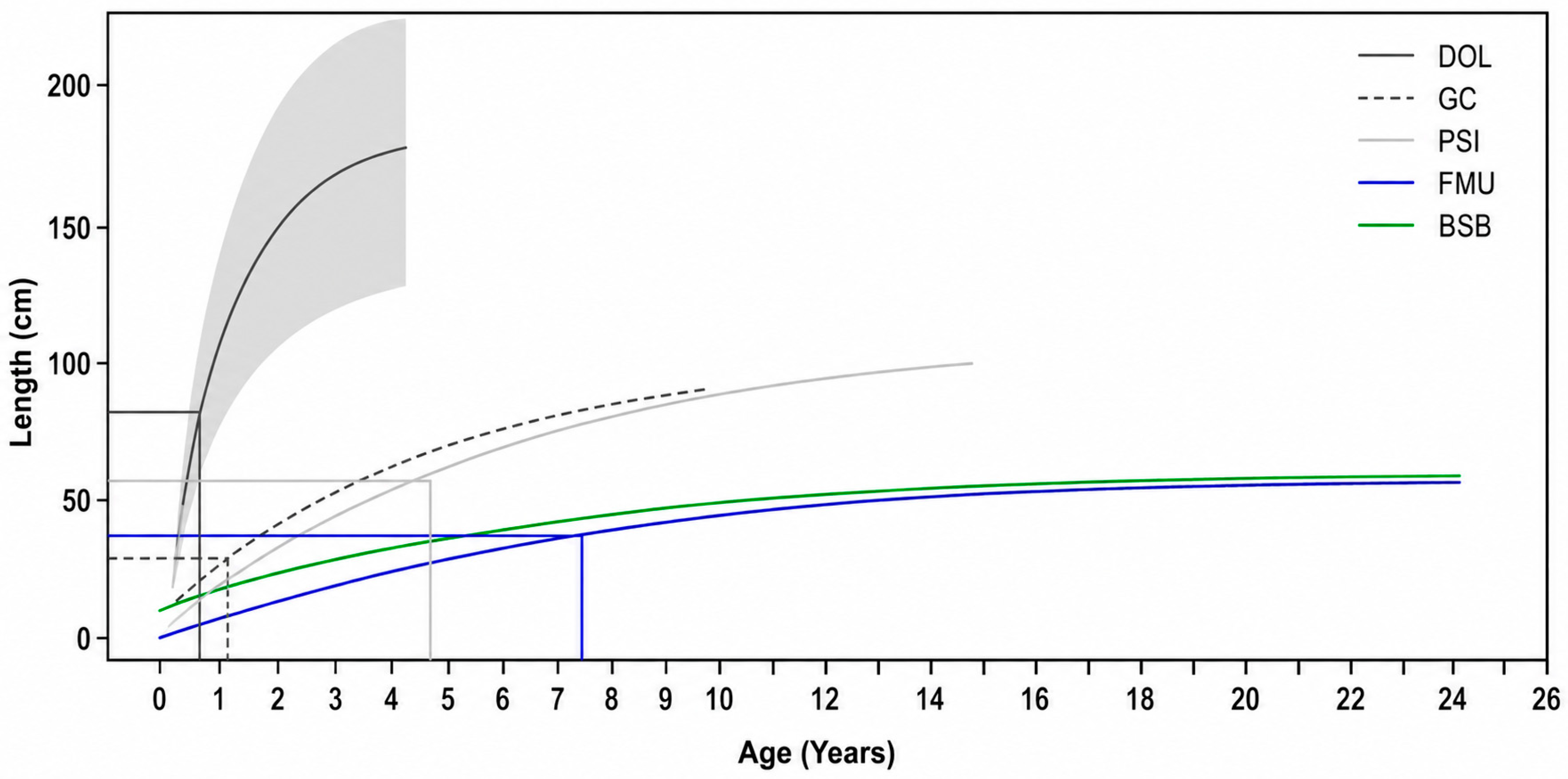
Figure 2 shows the mean growth curves of dolphinfish and of other species. The curves were created by computing the average (simple arithmetic mean) of the VBGM found in the literature. The growth rate of dolphinfish is noticeably higher than any other species, and dolphinfish also reach their sexual maturity at earlier ages. Please note that a potential bias might be induced by differences in sample sizes, which were not considered in the computation. The summary of the review for age, growth and size-at-first maturity of dolphinfish and the remaining species is presented in Table 1 and Table 2.

3.4. Genetics, Dispersion and Migrations

Using mitochondrial DNA (mtDNA) to evaluate potential genetic differences in dolphinfish individuals caught off Sonora, Baja California, Sinaloa, and Chiapas, on the Pacific coast off Mexico [55], concluded that the differences in haplotype are randomly distributed between the sampling sites, suggesting that dolphinfish can be considered a single genetic population, which is evidenced by a continuous genetic flow in dolphinfish individuals caught in the Pacific Ocean off Mexico. Additionally, Ref. [56] assessed genetic variations in microsatellite loci of dolphinfish caught within the Gulf of California and reported that the dolphinfish population that enters the Gulf is panmictic (e.g., no genetic differences were found).
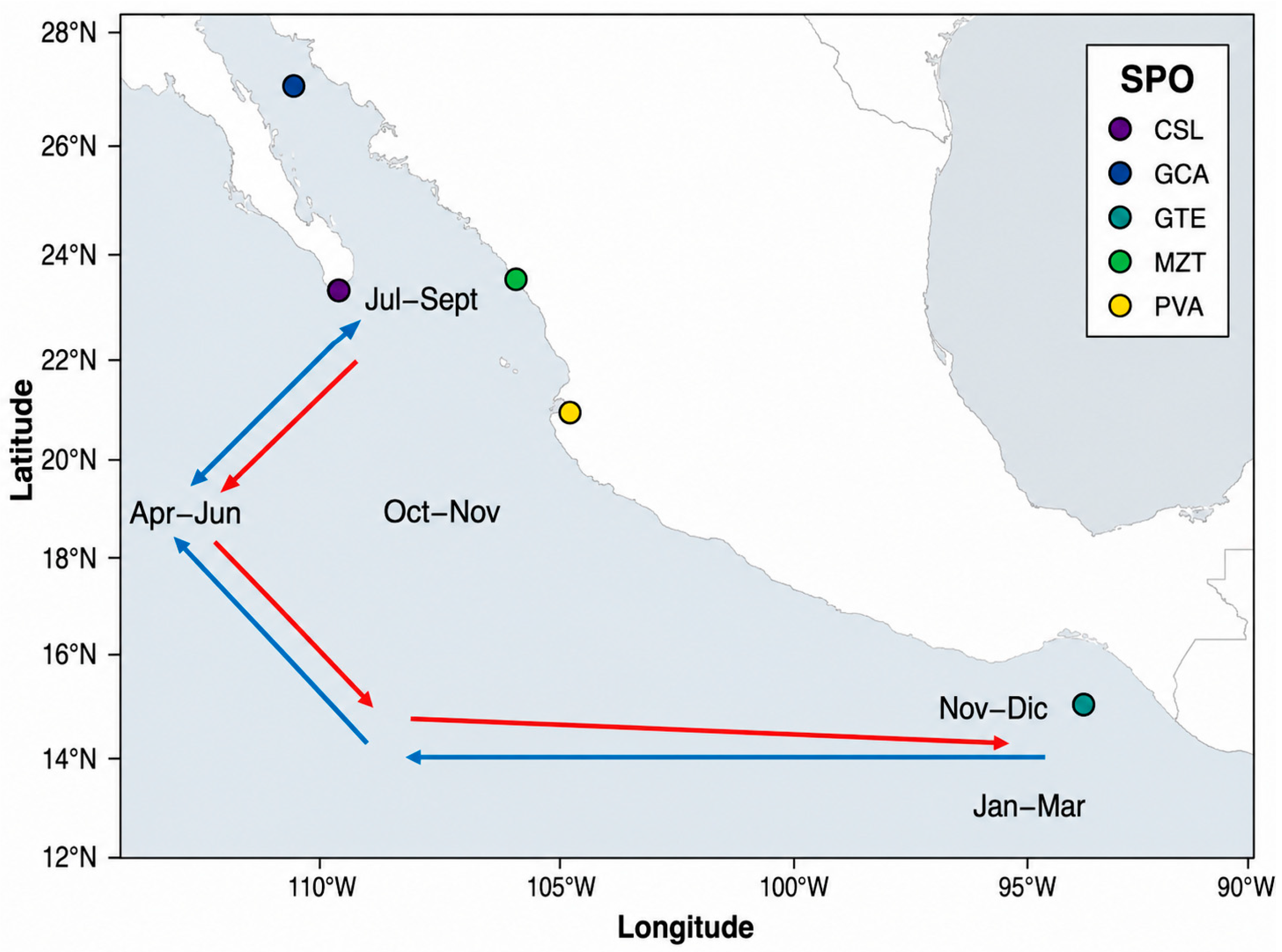
Using species distribution models, Ref. [57] suggested that in the Pacific Ocean off Mexico, dolphinfish perform a migratory cycle that is as follows: during the first month of the year, dolphinfish inhabit mainly in waters off southwestern Mexico, and as the warm water masses of the equator propagate to the north, dolphinfish moves to the northwest to a zone in the open ocean, avoiding the Eastern Pacific Warm Pool, a zone where high temperatures (>27.5 °C) are found throughout the year. Then, dolphinfish migrate to the entrance of the Gulf of California and to the west coast of the Baja California Peninsula (BCP), and follow the opposite route during November and December, when cold water masses of northern origin propagate to the south (Figure 1).
A more recent study [58], based on mitochondrial genes and DNA microsatellite loci from dolphinfish samples collected in Baja California, Chiapas, Ecuador, and Peru, revealed differences in genetic structure at the species’ distributional extremes (Baja California and Peru). Despite this, high genetic variability between these distant locations suggests substantial connectivity, supporting the hypothesis that dolphinfish occurring off Mexico undertake migratory movements and may be considered a single genetic population.
Using single-nucleotide polymorphisms (SNPs), Ref. [59] demonstrated genetic differences between dolphinfish populations at the extremes of their ranges (Perú and northern Mexico), and the dolphinfish that occupies waters off Mexico appears to form a single population, which agrees with the results of [57,58]: dolphinfish in the Pacific Ocean off Mexico is a single population that performs migrations following spatial-temporal changes in Sea Surface Temperature.
No genetics, site fidelity or dispersion studies regarding the Bullseye Puffer (S. annulatus) migrations were found in our review.
It is expected that Gulf Corvina (C. othonopterus) individuals are less capable of performing long-range migrations (when compared to dolphinfish individuals) because their habitat is restricted to the upper Gulf of California [60]. Indeed, the authors of Ref. [61] suggested that the nursery habitat of the Gulf Corvina is restricted to the influence zone of the Colorado River Estuary, in the upper Gulf of California, and the decrease in freshwater inflow into the estuary, a result of a series of dam constructions upstream, is at least partially responsible for a decrease in commercial landings of the Gulf Corvina. The authors of Ref. [62] stated that corvinas perform spawning migrations within the upper Gulf to the estuary of the Colorado River. This results in massive aggregations of spawning fish, which are harvested by local artisanal fishers.
Regarding the Pacific Sierra (S. sierra), Ref. [63] analyzed genetic (mtDNA) samples obtained from the Eastern Pacific Ocean, in four localities in Mexico (Sinaloa, Michoacán, Oaxaca, and Chiapas) and off the coast of Peru. One of the main conclusions of the study is that within the Pacific coast of Mexico, there are at least two Sierra populations: one in the north (Sinaloa) and one in the central-south (Oaxaca and Chiapas).
There are only a few published works on the dispersion and migrations of the Barred Sand Bass (P. nebulifer), and none in the Pacific Ocean off Mexico. The authors of [64] used data from over 8000 sand bass that were tagged in Southern California, USA, between 1960 and 1990, and reported that most individuals displayed high fidelity to both spawning and non-spawning areas. This suggests that this species has a limited migration capacity, with a mean displacement between 13 km (±8 km) and 17 km (±15 km) for individuals tagged in spawning and non-spawning areas, respectively.
Patterson et al. [65] analyzed microsatellite loci of the sand bass of samples obtained across the species’ distribution, from Southern California, USA, to the tip of the BCP. Their results suggest a genetic structure in the bass population, although a high degree of error in the computed statistics points towards a single genetic population across its distribution range. The authors of [65] concluded that a plausible cause of this interesting result is the relatively long duration of larval stage of the sand bass (21–37 days), suggesting that, although adult sand bass are not capable of performing long-distance migrations, the spread of the larvae can result in genetic mixing in populations that are separated by considerable distances.
For the Yellow Snapper (L. argentiventris), Ref. [66] analyzed otoliths and performed surveys in different mangrove forests and rocky reefs; their results suggested that juvenile snappers inhabit coastal/mangrove habitats, and subadults migrate to nearby rocky reefs. One of the most interesting findings of [66] is that the number of snappers that disperse from the mangroves to the rocky reefs decreases exponentially when the distance between the mangroves and the reefs increases, which indicates that Yellow Snappers have limited dispersion capacity. TinHan et al. [67] used acoustic monitoring to assess site fidelity of snappers around a rocky island in the Gulf of California; snappers were detected around the island approximately 50% of the days after they were tagged, suggesting a medium-to-high site fidelity. In a more recent study, Reguera-Rouzaud et al. [68] used genetic markers to assess the potential connectivity between larvae and adult Yellow Snappers collected between the BCP and Mexico’s mainland (Sinaloa). The results of [68] are contrasting: on one hand, no significant genetic differences between zones were observed, and on the other hand, the results also support the possibility of a metapopulation of the Yellow Snapper in the Gulf of California, suggesting again that Yellow Snapper dispersion is limited, when compared to dolphinfish.
Ibáñez et al. [69] analyzed differences in the shape of the scales of Yellow (L. argentiventris), Spotted (L. guttatus), and Pacific Red (L. peru) snappers caught off Jalisco (Puerto Vallarta), Colima (Manzanillo), and Michoacán (Caleta de Campos), in the CMP. The results of [69] showed that although samples were collected in neighboring states, the three snapper species form two different populations: one off Puerto Vallarta and Manzanillo, and the other off Caleta de Campos.
As for the Pacific Sierra (S. sierra), a northern (Sinaloa, Colima) and southern (Oaxaca, Chiapas) population structure was observed for the Flathead Mullet (M. cephalus) [70], who used mtDNA and the cytochrome c oxidase subunit I (COI) to assess the philopatry of such mullet species in the southern and central Mexican Pacific. Also, for the CMP, Ref. [71] used otolith chemistry to assess the dispersion and migrations of the Common Mullet (M. curema) in the estuary of the Balsas River, in the Pacific Ocean off Mexico. The evidence presented [71] suggested that Common Mullet individuals present some degree of site fidelity to the estuary, although some estuary–open sea movements appear to be possible. Also suggested that the otolith-chemistry approach used in the study was not sufficient to detect movements of Common Mullet individuals between [71].
All the snook species (Centropomus spp.) are anadromous fish; that is, all snook adults spawn in the open sea, and all species show a strong dependence on freshwater bodies [72]. There is little or no published information on the dispersion and migrations of snooks, at least for the Eastern Pacific Ocean off Mexico.
Muhlia-Melo et al. [72] suggested that the dispersion of several species of adult snook are restricted by their dependence to the existence of estuaries, which supports the genetic differences found between individuals of three snook species (C. viridis, C. medius, and C. robalito) by [73], who pointed out that one plausible cause of the observed genetic structure was the lack of estuaries between the southern (Guerrero-Oaxaca) and the northern (Sonora, Sinaloa, and Nayarit) parts of their study area. This finding highlights the apparent low dispersion ability of the different snook species.
Table 2. Reproduction indexes of dolphinfish and other legally harvested species in coastal Mexican fisheries.
Family/SpeciesL50 (cm)A L50 (yr)Fecundity (No. of Oocytes; * Mean, + Range)Region/CountryCitation
Coryphanidae
Coryphaena hippurus80--279,383 *Southern Gulf of California, Mexico[43]
Coryphaena hippurus50--466,410 *Gulf of Tehuantepec, Mexico[2]
Coryphaena hippurus90--3,944,000 *Mexican Central Pacific[12]
Tetradontidae
Sphoeroides annulatus26.5–27.4~3 --Southern Gulf of California, Mexico[44]
Sphoeroides annulatus25.4~3--Southeastern Gulf of California, Mexico[45]
Sciaenidae
Cynoscion othonopterus *26.75–29.5~2684,293 *Northern Gulf of California, Mexico[29]
Cynoscion othonopterus *48–50 ~2--Northern Gulf of California, Mexico[46]
Scombridae
Scomberomorus sierra44.33--Southern Gulf of California, Mexico[31]
Scomberomorus sierra54.33.8416,483–4,354,860 +Central Mexican Pacific[47]
Serranidae
Paralabrax nebulifer----------
Lutjanidae
Lutjanus guttatus305–6--Mexican Central Pacific[74]
Lutjanus argentiventris32.63–4 --Southern Gulf of California[48]
Mugilidae
Mugil cepahlus34–35 4.6–51,477,026–1,747,736 +Mexican Central Pacific[50]
Mugil curema26.7–28.7 ~8 --Southern Gulf of California, Mexico[51]
Mugil curema18.26–22.08 5–6 --Southern Gulf of California, Mexico[51]
Centropomidae
Centropomus nigrescens59–76.4 6–9--Mexican Central Pacific[40]
Centropomus robalito18–22 2–3539,524–696,581 +Mexican Central Pacific[54]
* Mean, + range, it is included in the table header.

4. Discussion

4.1. Knowledge Gaps in Dolphinfish Ecology, Fisheries, and Life History Characteristics

Perhaps the main knowledge gap in our findings is the lack of a dolphinfish stock assessment in the Northeastern Pacific Ocean (>−140° W, >6° N). The Inter-American Tropical Tuna Commission (IATTC), at its 101st meeting (held in August 2023 and entitled “Research for the management of dolphinfish (dorado)”), stated that: “ The members and cooperative members of the IATTC shall collect and submit to the IATTC biological, catch and interaction data, as well as fishing effort data relating to Dolphinfish from their fishing fleets whose catch of this species constitutes more than 5% of their entire annual catch”, and that “The IATTC scientific advisory committee should consider and recommend the Commission as appropriate, the creation of a voluntary group to identify the information available on the Dolphinfish (Coryphaena hippurus) resource in the various fisheries of interest to the IATTC. It should also identify information gaps that must be solved to know the status of this resource, either as target or bycatch, and possibly recommend management measures” [75]. We believe that this highlights the necessity of obtaining reliable and consistent data on the dolphinfish fishery (landings, sizes, sex ratio) in Mexican waters, because, to our knowledge, there is no systematic sampling (or databases) of dolphinfish landings, perhaps given the illegal nature of such activities.
Another important knowledge gap relates to the potential ecosystem consequences of dolphinfish exploitation. While diet and feeding ecology studies of billfishes have been conducted in the Mexican Pacific, the extent to which changes in dolphinfish abundance could generate indirect trophic or cascading effects within pelagic food webs remains poorly understood. This issue is particularly relevant because billfishes support economically important recreational fisheries throughout the region. Future research integrating ecosystem-based approaches would help clarify these relationships and reduce uncertainty regarding the ecological role of dolphinfish and its potential influence on valuable billfish populations.

4.2. Comparison of Dolphinfish Life History Characteristics Against Teleost Fish in the NFL

The results of our contribution suggest that dolphinfish has a faster growth rate, an earlier size-at-first maturity, a higher dispersion capacity and a lesser longevity than all of the teleost fish listed in the NFL. The NFL allows the harvesting of species that belong to families known for their slow growth rates and late size-at-first maturity, such as the Serranidae [76] and Lutjanidae [77] families. Moreover, the NFL also includes a fish species that is both endemic and that is harvested during its massive spawning aggregation (the Gulf Corvina, C. othonopterus), two undesirable characteristics of species that are designed for commercial fishing.
We also consider it important to state that our contribution compares the life history characteristics of dolphinfish to those of other teleost fish. However, in Mexico, there is also a commercial fishery for sharks [78], a taxonomic group that, with a few exceptions, has life history characteristics that are far from ideal for exploitation (see for example [79]), and that are apex predators of the pelagic realm. Thus, contrary to the statements made by some of Mexico’s congressmen and by members of the sportfishing community, all the scientific and biological evidence suggests that dolphinfish is one of the most sustainable fish to harvest, especially when compared to other species that are legally harvested in both coastal and oceanic waters of the Pacific Ocean off Mexico. We thus believe that the decision to maintain dolphinfish for the sport/recreational sector is based on arguments that are of a nature other than biological.

4.3. Dolphinfish Abundance in the Pacific Ocean off Mexico

As stated before, Mexico is the only country where dolphinfish is reserved exclusively for sportfishing. For the Eastern Pacific Ocean, most of the dolphinfish landings are carried out by the Peruvian artisanal fleet, which is currently the largest dolphinfish fleet in the world [10]. Unfortunately, there is no stock assessment of the dolphinfish population off Mexico; however, Roa-Ureta et al. [10] performed an assessment for the Peruvian fishery, and their results demonstrate that, even though the Peruvian dolphinfish fishery is the largest of the world, the dolphinfish landings off Ecuador, Perú and Northern Chile remain well under the estimated Maximum Sustainable Yield (MSY), suggesting that the Peruvian dolphinfish fishery is sustainable. Thus, although there is no stock assessment in waters off Mexico, there is no reason to believe that the dolphinfish stock off Mexico is overfished or declining. Moreover, both Ref. [10] and Ref. [75] acknowledge the lack of reliable data for the correct stock assessment of some dolphinfish stocks, which highlights the necessity of obtaining scientific-quality data in the Mexican dolphinfish landings, where the data is scarce and probably biased as a result of the illegal nature of the artisanal landings.

4.4. Dolphinfish in the Context of Sportfishing in the Pacific Ocean off Mexico

There are several important sportfishing localities on the Pacific coast of Mexico. Perhaps the most important location is Cabo San Lucas (Baja California Sur), alongside Mazatlán (Sinaloa), Manzanillo (Colima), Puerto Vallarta (Jalisco), and Ixtapa (Guerrero). All these locations host significant fishing tournaments and generate important revenues from sportfishing activities.
The most important tournament is the “Bisbees black & blue”, held annually in Cabo San Lucas [80]. The “international sailfish tournament” in Manzanillo is another important event, having been held for nearly 70 years [81].
One of the main concerns of the sportfishing community in Mazatlán and Baja California Sur is that “…dolphinfish serves as prey for different billfish species, such as blue marlin (Makaira nigricans)” (pers. comm of sport fishers). However, diet studies of blue marlin showed that dolphinfish is not an important prey for blue marlin, neither off Cabo San Lucas [82] nor off Mazatlán [82]. Additionally, the results of Arizmendi-Rodríguez et al. [83] suggest that dolphinfish is not an important prey of sailfish (Istiophorus platypterus) off Mazatlán, either. Available diet studies suggest that dolphinfish is not among the dominant prey items of billfish in the mentioned regions. However, as stated before, broader ecosystem-level effects remain poorly understood, and future ecosystem-based analyses would be valuable before large-scale expansion of any directed fishery.

4.5. Evidence of Dolphinfish Stock Health

A decrease in the size or weight of a harvested species is a proxy of overexploitation, especially when the mean size decreases below the L50 value (or its equivalent in weight). Carrasco-Aguila et al. [84] found a positive slope in the linear regression of dolphinfish weights in individuals obtained from 1990 to 2014 in Manzanillo, with mean values between 13 and 15 kg. The authors of [84] also reported that the mean (~12 kg) weight of dolphinfish sampled in sportfishing in tournaments off Puerto Vallarta remained nearly constant from 1986 to 2015.
The L50 value of dolphinfish estimated by [43] is around 80 cm, and the mean weight associated with 80 cm is ~5 kg [43]. The observed mean weights of Manzanillo and Puerto Vallarta (~12–15 kg) are nearly three times higher than the weight at first maturity (~5 kg), which strongly suggests that the dolphinfish population in the Pacific Ocean off Mexico is in good condition.

4.6. Further Fishing Aspects Regarding Sustainability

Besides the biological aspects of a species, other factors must be considered when a potential fishery is going to start operating. Perhaps the two most important operational aspects of a prospective fishery are the fishing effort and the total capture quota. The Gulf Corvina (C. othonoptherus) fishery is one of Mexico’s most successful fishery management programs, primarily managed through quotas [85]. It is important to leverage this experience in the quota-based fishery management and apply it to dolphinfish. We argue that, at least in the first developing phase of the fishery, dolphinfish should only be targeted by the artisanal Mexican fishery. According to [86], the artisanal fishery operates with boats that are generally ≤10 m in total length. Regarding fishing capacity, the small-scale fishery off Jalisco, Mexico, operates with longlines with 200–500 hooks [12]. As stated before, unfortunately, there is no estimation for the dolphinfish stock in the Eastern Pacific Ocean, but the study of [10] for the dolphinfish commercial fishery—the world’s most important dolphinfish fishery—suggested that the maximum yearly dolphinfish catch off Peru and Ecuador in the 2004–2020 period was ~100,000 t. Unfortunately, in Mexico, an important challenge is that the current prohibition of commercial dolphinfish landings has likely contributed to chronic underreporting of catches. As a result, reliable estimates of total removals, fishing effort, and spatial patterns of exploitation are largely unavailable. This situation creates a management paradox: the absence of data is often used to justify maintaining the current regulatory framework, yet that same framework limits the generation of the information required for formal stock assessments.
Therefore, improving monitoring and reporting systems should be considered a priority regardless of future management decisions concerning commercial utilization. Importantly, we are not proposing the immediate implementation of a harvest quota, as the information necessary to support such a measure is currently lacking. Instead, we propose the development of a regulated pilot program designed to generate fishery-dependent and biological data, including catch, effort, size composition, and spatial distribution of landings. Such a program would provide the baseline information required to conduct future stock assessments and support science-based management decisions for dolphinfish in Mexican waters.
Time closures are also an important aspect of sustainable fishery management. Off northwestern Mexico, dolphinfish reproductive activity is higher during the summer months [43]. For the Gulf of Tehuantepec, two reproductive peaks exist: one during May–July and a second, more extensive peak, during November–January [2]. Therefore, an approach that uses spatial and temporal closures in different months for the respective zones of high dolphinfish abundance should be adopted.

5. Conclusions

All the documented evidence suggests that dolphinfish is one of the most sustainable species in the Pacific Ocean off Mexico. Thus, we conclude that a sustainable, regulated and artisanal dolphinfish fishery off Mexico is possible.
Available life history traits indicate that dolphinfish exhibits lower biological vulnerability than several species currently exploited by Mexican fisheries. Nevertheless, the lack of reliable fishery statistics precludes the establishment of biologically justified harvest limits at present. Therefore, a regulated pilot fishery coupled with comprehensive monitoring should be prioritized to generate the information required for future stock assessments and evidence-based management. An 80 cm MLS and seasonal closures can be implemented immediately through CONAPESCA administrative norms—no legislative change required.
A tripartite technical committee (comprising government, artisanal fishers, and sportfishing sector) would provide low-cost adaptive governance that is replicable for other highly migratory species in the Eastern Pacific.

6. Recommendations to Policy Makers

We argue that a sustainable and commercial artisanal dolphinfish fishery is achievable. However, a set of rules must be established for the artisanal fishers interested in the legal harvesting of dolphinfish. A mandatory, continuous scientific monitoring program should be established. This program would enable detection and correction of management deficiencies arising from spurious or insufficient data. Moreover, after reviewing the current biological knowledge, we propose the following rules to ensure the sustainable harvesting of dolphinfish:
(1)
Fishing Gear Restrictions:
(a)
Gillnets, purse seines, trawlers (both bottom and pelagic), and large longlines should not be permitted in the artisanal dolphinfish fishery. According to [12], the artisanal fleet off Jalisco employs longlines with 200–500 hooks. We suggest the use of pelagic longlines with fewer than 500 hooks.
(b)
Harvesting should be conducted using hand-baited lines, trolling with either artificial lures or natural bait, and small artisanal longlines (fewer than 500 hooks). All fishing must be carried out using relatively small boats (≤10 m) powered by low-horsepower outboards (less than 100 hp), such as pangas.
(2)
Establishment and Supervision of Fishery Data Logs:
(a)
Each fisher will be responsible for recording biological and fishery data related to their landings. The log should include at least the following information: start and finish times of the fishing day/operation, size and weight of the catch, date and time of capture, type of fishing gear used, number of hooks, sex of the catch, approximate location (i.e., longitude and latitude coordinates).
(b)
Failure to adhere to any of these regulations will result in the cancelation of the fishing permit for the boat and/or crew responsible for the violation. The duration of the ban will be determined by the appropriate authorities (e.g., CONAPESCA).
(3)
Capture Quota:
No specific harvest quota is proposed at this stage. Instead, future harvest levels should be established within an adaptive management framework and periodically revised and/or modified as biological and fishery-dependent information becomes available through the pilot program. These data could subsequently be incorporated into data-limited assessment models, such as CMSY [86], to support science-based estimates of sustainable harvest levels.
(4)
Minimum Legal Capture Size (MLS):
We propose a conservative minimum legal capture size (MLS) of 80 cm for both sexes. This measure will ensure that most retained dolphinfish are sexually mature, regardless of the capture area (refer to the “Fecundity and Reproduction” section for more details).
(5)
Temporal Closure of Landings.
We suggest implementing a temporal closure for dolphinfish landings as follows:
(a)
In northwestern Mexico, we recommend closing fishing for two months during the boreal summer (e.g., September and October) due to increased reproductive activity during this period [43].
(b)
For the Gulf of Tehuantepec, there are two reproductive peaks: one from May to July and another from November to January [2]. Since the latter is more intense, we propose closing dolphinfish harvesting from November through January.
(6)
Advisory and Technical Committees:
For effective resource management, we recommend the establishment of an advisory committee and a technical committee. This structure should include technical staff from relevant departments (e.g., CONAPESCA and IMIPAS), academics from universities and research centers, as well as stakeholders from the fishing industry. We strongly suggest that the necessary budget be granted to CONAPESCA and IMIPAS to ensure the correct and continuous monitoring of the fishery (e.g., dockside monitoring, electronic logbooks, etc.).
The recommendations presented herein should be regarded as general management considerations rather than a comprehensive management plan. The development of detailed governance structures, enforcement mechanisms, monitoring budgets, stakeholder responsibilities, and implementation timelines will require dedicated consultation among fishers, managers, scientists, and regulatory agencies. Such processes fall beyond the scope of the present review but represent essential steps toward the development of an effective management framework for dolphinfish in Mexico.
Nevertheless, the present work represents an important first step toward the development of a science-based management framework for dolphinfish in Mexico. By synthesizing the available biological and ecological information, identifying critical knowledge gaps, and highlighting key research and monitoring priorities, our findings provide a scientific foundation for future stock assessments, ecosystem evaluations, and evidence-based management decisions regarding this resource.

Supplementary Materials

The following supporting information can be downloaded at: https://www.mdpi.com/article/10.3390/fishes11070401/s1, Table S1: List of total keywords used in the search strategy using the Google Scholar® database.

Author Contributions

Conceptualization, E.M.-E., V.H.C.-E., E.A.A.-N. and F.A.; methodology, E.M.-E., V.N.-F., F.A. and E.A.A.-N.; software, E.M.-E., J.L.P.-B. and M.S.-M.; validation, E.M.-E., E.A.A.-N., F.J.U.-C., M.S.-M. and F.A.; formal analysis, E.M.-E., E.A.A.-N., V.H.C.-E. and F.J.U.-C.; investigation, E.M.-E., F.A., M.S.-M., V.N.-F., J.L.P.-B. and V.H.C.-E.; resources, E.M.-E., F.A. and V.H.C.-E.; data curation, E.M.-E., F.J.U.-C. and V.N.-F.; writing—original draft preparation, E.M.-E., E.A.A.-N., V.H.C.-E., F.A. and M.S.-M.; writing—review and editing, E.M.-E., V.N.-F., F.J.U.-C., M.S.-M. and V.N.-F.; visualization, E.M.-E. and F.J.U.-C.; supervision, E.A.A.-N., V.H.C.-E., F.A. and M.S.-M.; project administration, E.M.-E. All authors have read and agreed to the published version of the manuscript.

Funding

This research received no external funding.

Institutional Review Board Statement

Not applicable.

Data Availability Statement

Dataset available upon request from the authors.

Acknowledgments

E.M.-E. is grateful to SECIHTI for support through the program “investigadoras e investigadores por México”. E.M.-E., V.H.C.-E., F.A., E.A.A.-N. and F.J.U.-C. are members of SECIHTI’S “Sistema Nacional de Investigadoras e Investigadores”. The valuable comments and suggestions of three anonymous reviewers are also acknowledged, as well as Edgar Alcántara-Razo, from CIBNOR-Guaymas Applied Ecology and Fisheries Lab., for improving the figures. The Institute of Marine Sciences and Limnology of the National Autonomous University of Mexico (Instituto de Ciencias del Mar y Limnología, UNAM) supported this research and covered the processing charges for this article.

Conflicts of Interest

The authors declare no conflicts of interest.

Abbreviations

The following abbreviations are used in this manuscript:
BCPBaja California Peninsula
CONAPESCANational Commission of Aquaculture and Fisheries
CMPCentral Mexican Pacific
DOFOfficial Journal of the Federation
FAOFood and Agriculture Organization
FLFork Length
GLSFAGeneral Law of Sustainable Fisheries and Aquaculture
IATTCInter-American Tropical Tuna Commission
IMIPASMexican Institute of Research in Sustainable Fisheries and Aquaculture
MLSMinimum Legal Capture Size
NFLNational Fishery Letter
TLTotal Length
VBGMVon Bertalanffy Growth Model

References

  1. Palko, B.J.; Beardsley, G.L.; Richards, W.J. Synopsis on the Biological Data of Dolphin-Fishes, Coryphaena hippurus Linnaeus and Coryphaena equiselis Linnaeus; NOAA Technical Report NMFS Circular 443; U.S. Department of Commerce: Washington, DC, USA, 1982; 28p.
  2. Alejo-Plata, C.; Díaz-Jaimes, P.; Salgado-Ugarte, I.H. Sex ratios, size at sexual maturity, and spawning seasonality of dolphinfish (Coryphaena hippurus) captured in the Gulf of Tehuantepec, Mexico. Fish. Res. 2011, 110, 207–216. [Google Scholar] [CrossRef]
  3. Diario Oficial de la Federación (DOF). MODIFICACIÓN a la Norma Oficial Mexicana NOM-017-PESC-1994, Para Regular las Actividades de Pesca Deportivo-Recreativa en las Aguas de Jurisdicción Federal de los Estados Unidos Mexicanos, Publicada el 9 de Mayo de 1995. Ley General de Pesca y Acuacultura Sustentables (Publicado el 24 de julio de 2007, Última Modificación 01/04/2024). Available online: https://www.diputados.gob.mx/LeyesBiblio/pdf/LGPAS.pdf (accessed on 19 September 2025).
  4. Lleonart, J.; Morales-Nin, B.; Massutí, E.; Deudero, S.; Reñones, O. Population dynamics and fishery of dolphinfish (Coryphaena hippurus) in the western Mediterranean. Sci. Mar. 1999, 63, 447–467. [Google Scholar] [CrossRef]
  5. Herrera-Ulloa, A.; Villalobos-Chacón, L.; Palacios-Villegas, J.; Víquez-Portuguéz, R.; Oro-Marcos, G. Coastal fisheries of Costa Rica. In Coastal Fisheries of Latin America and the Caribbean; FAO Fisheries and Aquaculture Technical Paper No. 544; Salas, S., Chuenpagdee, R., Charles, A., Seijo, J.C., Eds.; FAO: Rome, Italy, 2011; pp. 137–153. [Google Scholar]
  6. Nóbrega, M.F.; Kinas, P.G.; Lessa, R.; Ferrandis, E. Spatial and temporal variation in artisanal catches of dolphinfish Coryphaena hippurus off north-eastern Brazil. J. Fish Biol. 2015, 86, 785–804. [Google Scholar] [CrossRef] [PubMed]
  7. Guzmán, H.M.; Díaz-Ferguson, E.; Vega, A.J.; Robles, Y.A. Assessment of the dolphinfish Coryphaena hippurus (Perciformes: Coryphaenidae) fishery in Pacific Panama. Rev. Biol. Trop. 2015, 63, 705–716. [Google Scholar] [PubMed]
  8. Arocha, F.; Gutiérrez, X.; Evaristo, E. Revised and updated catches of the common dolphinfish (Coryphaena hippurus) from Venezuelan fisheries. Collect. Vol. Sci. Pap. ICCAT 2021, 77, 1–4. [Google Scholar]
  9. Martínez-Arias, A.; González-Salcedo, L.O.; Benavides-Martínez, I.F.; Josephraj-Selvaraj, J. Satellite and historical data, and statistical modeling to predict potential fishing zones for dolphinfish, Coryphaena hippurus (Perciformes: Coryphaenidae) in Colombian Pacific. Rev. Biol. Trop. 2022, 70, 576–588. Available online: https://www.scielo.sa.cr/pdf/rbt/v70n1/0034-7744-rbt-70-01-576.pdf (accessed on 26 June 2026).
  10. Roa-Ureta, R.H.; Amancio, G.R.; Abanto, P.M.; Izquierdo, I.G.; Norza-Sior, A.A.; Elías, E.; Peralta, M. Stock Assessment of the Dolphinfish (Coryphaena hippurus) in the South-East Pacific Ocean; Scientific Advisory Committee Document SAC-13-INF-O; Inter-American Tropical Tuna Commission (IATTC): La Jolla, CA, USA, 2022; 40p. [Google Scholar]
  11. Damiano, M.D.; Karnauskas, M.; Merten, W. Spatiotemporal dynamics of dolphinfish (Coryphaena hippurus) in the western Atlantic Ocean. Fish. Bull. 2024, 122, 26–43. [Google Scholar] [CrossRef]
  12. Espino-Barr, E.; García-Boa, A.; Puente-Gómez, M.; Cabral-Solís, E.G. El dorado en la pesca ribereña. In La Pesca Deportiva en Bahía Banderas; Cifuentes-Lemus, J.L., Chaves-Dagostino, R.M., Bravo-Olivas, M.L., Raymundo-Huízar, A.R., Eds.; Universidad de Guadalajara: Guadalajara, Mexico, 2018; pp. 155–193. Available online: https://www.researchgate.net/profile/Rosa-Chavez-Dagostino/publication/329191680_La_Pesca_deportiva_en_la_Bahia_de_Banderas/links/5bfc110e299bf10737f8c002/La-Pesca-deportiva-en-la-Bahia-de-Banderas.pdf (accessed on 12 March 2026).
  13. Macías-Zamora, R. Modelación Espacio-Temporal de la Pesquería del Pez Vela (Istiophorus platypterus) en el Pacífico Mexicano. Ph.D. Thesis, Universidad Nacional Autónoma de México, Mexico City, Mexico, 2002. [Google Scholar]
  14. Salas-Maldonado, M. Estructura de Edad, Crecimiento Individual y Mortalidad del Pez Vela (Istiophorus platypterus) del Pacífico Central Mexicano. Master’s Thesis, Universidad de Colima, Colima, Mexico, 2012. [Google Scholar]
  15. Senado de la República Mexicana. Available online: https://infosen.senado.gob.mx/sgsp/gaceta/64/2/2020-03-18-1/assets/documentos/PA_Morena_Sen_Ricardo_Vazquez_Morena_Pez_Dorado.pdf (accessed on 8 April 2026).
  16. Periódico El Debate. Available online: https://www.debate.com.mx/agro/Pescadores-piden-modificar-Articulo-68-para-permitir-captura-comercial-del-pez-dorado-20230708-0046.html (accessed on 8 April 2026).
  17. Periódico Tribuna. Available online: https://tribunademexico.com/pesca-comercial-dorado-25-mil-familias/ (accessed on 8 April 2026).
  18. Organización Editorial Mexicana. Available online: https://oem.com.mx/elsudcaliforniano/local/rechazan-liberacion-del-pez-dorado-para-pesca-comercial-13391167 (accessed on 8 April 2026).
  19. Comisión Nacional de Acuacultura y Pesca. Available online: https://sidof.segob.gob.mx/notas/docFuente/5609194 (accessed on 26 June 2026).
  20. González-Huerta, C.A.; Hernández-Rivera, A.H.; Botello-Navarrete, A.; Bolaños-Rangel, K.L.; Benítez-Tadeo, A.E.; Zavala-Leal, O.I. ¿Podría realizarse la pesca comercial del dorado? Acta Pesq. 2023, 9, 67–71. [Google Scholar] [CrossRef]
  21. Lloret, J.; Biton-Porsmoguer, S.; Carreño, A.; Di Franco, A.; Sahyoun, R.; Melia, P.; Claudet, J.; Séve, C.; Ligas, A.; Belharet, M.; et al. Recreational and small-scale fisheries may pose a threat to vulnerable species in coastal and offshore waters of the western Mediterranean. ICES J. Mar. Sci. 2020, 77, 2255–2264. [Google Scholar] [CrossRef]
  22. Instituto Mexicano de Pesca y Acuacultura Sustentables. Available online: https://www.gob.mx/imipas/acciones-y-programas/carta-nacional-pesquera-51204 (accessed on 7 April 2026).
  23. Solano-Fernández, M.; Montoya, J.A.; Gallardo-Cabello, M.; Espino-Barr, E. Age and growth of the dolphinfish Coryphaena hippurus in the coast of Oaxaca and Chiapas, Mexico. Rev. Biol. Mar. Oceanogr. 2015, 50, 491–505. [Google Scholar] [CrossRef]
  24. López-Martínez, J.; Arzola-Sotelo, E.; Cabanilla-Carpio, C.; Nevárez-Martínez, M.O.; Pérez-Burgos, J.L. Interannual variability in dolphinfish Coryphaena hippurus Linnaeus, 1758 growth in the central-southeastern Pacific Ocean. Reg. Stud. Mar. Sci. 2024, 76, 103590. [Google Scholar] [CrossRef]
  25. Lessa, R.; Santana, M. Growth of the dolphinfish Coryphaena hippurus from north-eastern Brazil with an appraisal of the efficacy of scales and otoliths for ageing. J. Fish Biol. 2016, 89, 977–989. [Google Scholar] [CrossRef] [PubMed]
  26. Furukawa, S.; Ohshimo, S.; Tomoe, S.; Shiraishi, T.; Nakatsuka, N.; Kawabe, R. Age, growth, and reproductive characteristics of dolphinfish Coryphaena hippurus in the waters off west Kyushu, northern East China Sea. Fish. Sci. 2012, 78, 1153–1162. [Google Scholar] [CrossRef]
  27. Schwenke, K.L.; Buckel, J.A. Age, growth, and reproduction of dolphinfish (Coryphaena hippurus) caught off the coast of North Carolina. Fish. Bull. 2008, 106, 82–92. [Google Scholar]
  28. Villegas-Reyes, F. Estimación de la Edad y Crecimiento en el Botete Diana Sphoeroides annulatus (Jenyns, 1842) en las Costas de Sinaloa. Master’s Thesis, Universidad Autónoma de Sinaloa, Facultad de Ciencias del Mar, Mazatlán, Mexico, 2024. [Google Scholar]
  29. Gherard, K.E.; Erisman, B.E.; Aburto-Oropeza, O.; Rowell, K.; Allen, L.G. Growth, development, and reproduction in gulf corvina (Cynoscion othonopterus). Bull. South. Calif. Acad. Sci. 2013, 112, 1–18. [Google Scholar] [CrossRef]
  30. Aragón-Noriega, E.A. Modeling the individual growth of the Gulf corvina, Cynoscion othonopterus (Pisces: Sciaenidae), using a multi-model approach. Cienc. Mar. 2014, 40, 149–161. [Google Scholar] [CrossRef]
  31. Aguirre-Villaseñor, H.; Morales-Bojórquez, E.; Morán-Angulo, R.E.; Madrid-Vera, J.; Valdez-Pineda, M.C. Biological indicators for the Pacific sierra (Scomberomorus sierra) fishery in the southern Gulf of California, Mexico. Cienc. Mar. 2006, 32, 471–484. [Google Scholar] [CrossRef][Green Version]
  32. Nava-Ortega, R.A.; Espino-Barr, E.; Gallardo-Cabello, M.; García-Boa, A.; Puente-Gómez, M.; Cabral-Solís, E.G. Growth analysis of the Pacific sierra Scomberomorus sierra in Colima, México. Rev. Biol. Mar. Oceanogr. 2012, 47, 273–281. [Google Scholar] [CrossRef]
  33. Soto-Fexas, M.A. Edad y Crecimiento del Verdillo, Paralabrax nebulifer en el Golfo de Ulloa, BCS, México. Master’s Thesis, Instituto Politécnico Nacional, Centro Interdisciplinario de Ciencias Marinas, La Paz, Mexico, 2024. [Google Scholar]
  34. Love, M.S.; Brooks, A.; Busatto, D.; Stephens, J.; Gregory, P.A. Aspects of the life histories of the kelp bass, Paralabrax clathratus, and barred sand bass, Paralabrax nebulifer, from the southern California Bight. Fish. Bull. 1996, 94, 472–481. [Google Scholar]
  35. Walker, K.M.; Penttila, K.M.; Jarvis-Mason, E.T.; Valle, C.F. Validated age and growth of barred sand bass within the Southern California Bight. Calif. Fish Wildl. 2020, 106, 205–220. [Google Scholar] [CrossRef]
  36. Amezcua, F.; Soto-Ávila, C.; Green-Ruiz, Y. Age, growth, and mortality of the spotted rose snapper Lutjanus guttatus from the southeastern Gulf of California. Fish. Res. 2006, 77, 293–300. [Google Scholar] [CrossRef]
  37. García-Contreras, O.E.; Quiñonez-Velázquez, C.; Morán-Angulo, R.E.; Valdez-Pineda, M.C. Age, growth, and age structure of amarillo snapper off the coast of Mazatlán, Sinaloa, Mexico. N. Am. J. Fish. Manag. 2009, 29, 223–230. [Google Scholar] [CrossRef]
  38. Ibáñez-Aguirre, A.L.; Gallardo-Cabello, M. Age determination of the grey mullet Mugil cephalus L. and the white mullet Mugil curema V. (Pisces: Mugilidae) in Tamahuila Lagoon, Veracruz. Cienc. Mar. 1996, 22, 329–345. [Google Scholar] [CrossRef]
  39. Espino-Barr, E.; Gallardo-Cabello, M.; García-Boa, A.; Puente-Gómez, M. Growth analysis of Mugil cephalus (Percoidei: Mugilidae) in Mexican Central Pacific. Glob. J. Fish Aquac. 2015, 3, 238–246. [Google Scholar]
  40. Espino-Barr, E.; Gallardo-Cabello, M.; Puente-Gómez, M.; García-Boa, A. Growth and reproduction of the robalo Centropomus nigrescens (Teleostei: Centropomidae) in Manzanillo Bay, Mexican Central Pacific. Int. J. Sci. Res. 2017, 6, 529–534. [Google Scholar]
  41. Montoya-Ponce, C.O.; Santamaría-Miranda, A.; Trigueros-Salmerón, J.A.; Apún-Molina, J.P.; Valenzuela-Orduño, F.G.; Lugo-Gamboa, R.R. Bioeconomic analysis of snook Centropomus viridis, C. nigrescens, and C. medius for the development of mariculture in northern Sinaloa. Fishes 2024, 9, 39. [Google Scholar] [CrossRef]
  42. Pauly, D.; Munro, J.L. Once more on the comparison of growth in fishes and invertebrates. Fishbyte 1984, 2, 21. [Google Scholar]
  43. Zúñiga-Flores, M.S.; Ortega-García, S.; Rodríguez-Jaramillo, M.C.; López-Martínez, J. Reproductive dynamics of the common dolphinfish Coryphaena hippurus in the southern Gulf of California. Mar. Biol. Res. 2011, 7, 677–689. [Google Scholar] [CrossRef]
  44. Valdez-Pineda, M.C.; Morán-Angulo, R.E.; Voltolina, D.; Castillo-Vargas-Machuca, S. Population structure and reproductive aspects of puffer fish Sphoeroides annulatus (Jenyns, 1842) (Osteichthyes: Tetraodontidae), landed in Teacapán, Sinaloa, Mexico. Lat. Am. J. Aquat. Res. 2014, 42, 121–126. [Google Scholar] [CrossRef]
  45. Salas-Singh, C.; Morales-Bojórquez, E.; Aguirre-Villaseñor, H. Reproductive biology of the bullseye puffer Sphoeroides annulatus: Gonadosomatic index and its suitability for estimating length at maturity. J. Fish Biol. 2022, 101, 1119–1133. [Google Scholar] [CrossRef] [PubMed]
  46. Mendívil-Mendoza, J.E.; Aragón-Noriega, E.A.; Arreóla-Lizárraga, J.A.; Rodríguez-Domínguez, G.; Castillo-Vargas-Machuca, S.; Ortega-Lizárraga, G.G. Sustainability fishery indicator for Gulf corvina Cynoscion othonopterus in the Upper Gulf of California. Rev. Biol. Mar. Oceanogr. 2018, 53, 119–130. [Google Scholar] [CrossRef]
  47. Espino-Barr, E.; Gallardo-Cabello, M.; Nava-Ortega, R.A.; Puente-Gómez, M.; García-Boa, A. Reproduction of Scomberomorus sierra (Percoidei: Scombridae) in the Central Mexican Pacific coast. Av. Investig. Agropec. 2017, 21, 47–63. [Google Scholar]
  48. Piñón, A.; Amezcua, F.; Duncan, N. Reproductive cycle of female yellow snapper Lutjanus argentiventris (Pisces, Actinopterygii, Lutjanidae) in the SW Gulf of California: Gonadic stages, spawning seasonality and length at sexual maturity. J. Appl. Ichthyol. 2009, 25, 18–25. [Google Scholar] [CrossRef]
  49. Gallardo-Cabello, M.; Sarabia-Méndez, M.; Espino-Barr, E.; Anislado-Tolentino, V. Biological aspects of Lutjanus peru in Bufadero Bay, Michoacán, México: Growth, reproduction and condition factors. Rev. Biol. Mar. Oceanogr. 2010, 45, 205–215. [Google Scholar] [CrossRef]
  50. Espino-Barr, E.; Gallardo-Cabello, M.; Puente-Gómez, M.; García-Boa, A. Reproduction of Mugil cephalus (Percoidei: Mugilidae) off the Central Mexican Pacific Coast. Fish. Aquacult. J. 2016, 7, 180. [Google Scholar]
  51. Vélez-Arellano, N.; Sánchez-Cárdenas, R.; Salcido-Guevara, L.A.; Ramírez-Pérez, J.S.; Soberano-Palomares, I.M. Gonadal development, sex ratio, and length at sexual maturity of white mullet Mugil curema (Actinopterygii: Mugilidae) inhabiting southeastern Gulf of California. Lat. Am. J. Aquat. Res. 2022, 50, 417–429. [Google Scholar] [CrossRef]
  52. Salgado-Cruz, L.; Quiñónez-Velazquez, C.; García-Domínguez, F.A.; Pérez-Quiñónez, C.I.; Aguilar-Camacho, V. Reproductive aspects of Mugil curema (Perciformes: Mugilidae) in two areas of Baja California Sur, México. Rev. Biol. Mar. Oceanogr. 2021, 56, 50–65. [Google Scholar] [CrossRef]
  53. Gallardo-Cabello, M.; Cabral-Solís, E.; Espino-Barr, E.; Ibáñez-Aguirre, A.L. Growth analysis of white mullet Mugil curema (Valenciennes, 1836) (Pisces: Mugilidae) in the Cuyutlán Lagoon, Colima, México. Hidrobiológica 2005, 15, 321–325. [Google Scholar]
  54. Espino-Barr, E.; Gallardo-Cabello, M.; Puente-Gómez, M.; García-Boa, A.; Salas-Maldonado, M. Reproduction of the yellowfin snook Centropomus robalito (Teleostei: Centropomidae) in Cuyutlán Lagoon, Mexican Central Pacific. Cienc. Pesq. 2019, 27, 17–25. [Google Scholar]
  55. Díaz-Jaimes, P.; Uribe-Alcocer, M.; Ortega-García, S.; Durand, J. Spatial and temporal mitochondrial DNA genetic homogeneity of dolphinfish populations (Coryphaena hippurus) in the eastern central Pacific. Fish. Res. 2006, 80, 333–338. [Google Scholar] [CrossRef]
  56. Tripp-Valdéz, M.A.; García de León, F.J.; Ortega-García, S.; Lluch-Cota, D.; López-Martínez, J.; Cruz, P. Population genetic structure of dolphinfish (Coryphaena hippurus) in the Gulf of California, using microsatellite loci. Fish. Res. 2010, 105, 172–177. [Google Scholar] [CrossRef]
  57. Marín-Enríquez, E.; Seoane, J.; Muhlia-Melo, A. Environmental modeling of occurrence of dolphinfish (Coryphaena spp.) in the Pacific Ocean off Mexico reveals seasonality in abundance, hot spots and migration patterns. Fish. Oceanogr. 2018, 27, 28–40. [Google Scholar] [CrossRef]
  58. Ochoa-Zavala, M.; Díaz-Jaimes, P.; Ortega-García, S.; Galván-Magaña, F. Genetic divergence at species boundaries of the dolphinfish (Coryphaena hippurus) in the Tropical Eastern Pacific. PeerJ 2022, 10, e14389. [Google Scholar] [CrossRef] [PubMed]
  59. Mar-Silva, A.F.; Díaz-Jaimes, P.; Ochoa-Zavala, M.; Ortega-García, S.; Sotil, G.; Alegre, A.; Escarabay, T.; Elías, E.; Carvajal-Rodríguez, J.M. A genomic approach for the identification of population management units for the dolphinfish (Coryphaena hippurus) in the eastern Pacific. Front. Mar. Sci. 2024, 10, 1294509. [Google Scholar] [CrossRef]
  60. Arce-Valdés, L.R.; Abadía-Cardoso, A.; Arteaga, M.C.; Peñaranda-González, L.V.; Ruíz-Campos, G.; Enríquez-Paredes, L.M. No effects of fishery collapse on the genetic diversity of the Gulf of California corvina, Cynoscion othonopterus (Perciformes: Sciaenidae). Fish. Res. 2023, 261, 106608. [Google Scholar] [CrossRef]
  61. Rowell, K.; Flessa, K.W.; Dettman, D.L.; Román, M. The importance of Colorado River flow to nursery habitats of the Gulf corvina (Cynoscion othonopterus). Can. J. Fish. Aquat. Sci. 2005, 62, 2874–2885. [Google Scholar] [CrossRef]
  62. Erisman, B.; Aburto-Oropeza, O.; González-Abraham, C.; Mascareñas-Osorio, I.; Moreno-Báez, M.; Hastings, P.A. Spatio-temporal dynamics of a fish spawning aggregation and its fishery in the Gulf of California. Sci. Rep. 2012, 2, 284. [Google Scholar] [CrossRef] [PubMed]
  63. Domínguez-López, M.; Uribe-Alcocer, M.; Díaz-Jaimes, P. Phylogeography and historical demography of the Pacific sierra mackerel (Scomberomorus sierra) in the Eastern Pacific. BMC Genet. 2010, 11, 34. [Google Scholar] [CrossRef] [PubMed]
  64. Jarvis, E.T.; Linardic, C.; Valle, C.F. Spawning-related movements of barred sand bass, Paralabrax nebulifer, in Southern California: Interpretations from two decades of historical tag and recapture data. Bull. South. Calif. Acad. Sci. 2010, 109, 123–143. [Google Scholar] [CrossRef][Green Version]
  65. Patterson, C.N.; Chabot, C.L.; Robertson, J.M.; Cota-Nieto, J.J.; Erisman, B.; Allen, L.G. The genetic diversity and population structure of barred sand bass, Paralabrax nebulifer: A historically important fisheries species off southern and Baja California. CalCOFI Rep. 2015, 56, 1–13. [Google Scholar]
  66. Aburto-Oropeza, A.; Domínguez-Guerrero, I.; Cota-Nieto, J.; Plomozo-Lugo, T. Recruitment and ontogenetic habitat shifts of the yellow snapper (Lutjanus argentiventris) in the Gulf of California. Mar. Biol. 2009, 156, 2461–2472. [Google Scholar] [CrossRef] [PubMed]
  67. TinHan, T.; Erisman, B.; Aburto-Oropeza, O.; Weaver, A.; Vázquez-Arce, D.; Lowe, C.G. Residency and seasonal movements in Lutjanus argentiventris and Mycteroperca rosacea at Los Islotes Reserve, Gulf of California. Mar. Ecol. Prog. Ser. 2014, 501, 191–206. [Google Scholar] [CrossRef]
  68. Reguera-Rouzaud, N.; Díaz-Viloria, N.; Sánchez-Velasco, L.; Flores-Morales, A.L.; Parés-Sierra, A.; Aburto-Oropeza, O.; Munguía-Vega, A. Yellow snapper (Lutjanus argentiventris) connectivity in the Southern Gulf of California. Mar. Biodiv. 2020, 50, 54. [Google Scholar] [CrossRef]
  69. Ibáñez, A.L.; Espino-Barr, E.; Gallardo-Cabello, M. Population connectivity among geographic variants within the Lutjanidae (Pisces) of the Mexican Pacific coast through fish scale shape recognition. Sci. Mar. 2012, 76, 667–675. [Google Scholar] [CrossRef]
  70. Colín, A.; Hernández-Pérez, Z.; Guevara-Chumacero, L.M.; Castañeda-Rico, S.; Serrato-Díaz, A.; Ibáñez, A.L. Are striped mullet (Mugil cephalus) philopatric? Mar. Biol. 2020, 167, 10. [Google Scholar] [CrossRef]
  71. Avigliano, E.; Ibáñez, A.; Fabré, N.; Callicó-Fortunato, R.; Méndez, A.; Pisionero, J.; Volpedo, A.V. Unravelling the complex habitat use of the white mullet, Mugil curema, in several coastal environments from Neotropical Pacific and Atlantic waters. Aquat. Conserv. 2021, 31, 789–801. [Google Scholar] [CrossRef]
  72. Muhlia-Melo, A.; Arvizu-Martínez, J.; Rodríguez-Romero, J.; Guerrero-Tortolero, D.; Gutiérrez-Sánchez, F.J.; Muhlia-Almazán, A. Sinopsis de Información Biológica, Pesquera y Acuacultural Acerca de los Robalos del Género Centropomus en México; Programa de Evaluación de Recursos Naturales del Centro de Investigaciones Biológicas del Noreste: La Paz, Mexico, 1995. [Google Scholar]
  73. Díaz-Jaimes, P.; Sandoval-Castellanos, E.; Uribe-Alcocer, M. Comparative population structure of three snook species (Teleostei: Centropomidae) from the eastern central Pacific. Ichthyol. Res. 2007, 54, 380–387. [Google Scholar] [CrossRef]
  74. Lucano-Ramírez, G.; Ruíz-Ramírez, S.; Rojo-Vázquez, J.A.; Lara-Mendoza, R.E.; Aguilar-Betancourt, C.M.; González-Sansón, G. Reproduction of Lutjanus guttatus (Perciformes: Lutjanidae) captured in the Mexican Central Pacific. Lat. Am. J. Aquat. Res. 2023, 51, 503–520. [Google Scholar] [CrossRef]
  75. Inter-American Tropical Tuna Commission (IATTC). 101th Meeting of the Scientific Committee, “Research for the Management of Dolphinfish (Dorado)”, Victoria, BC, Canada, 7–11 August 2023; IATTC: La Jolla, CA, USA, 2023. [Google Scholar]
  76. Heemstra, P.C.; Anderson, W.D.; Lobel, P.S. Groupers (seabasses, creolefish, coney, hinds, hamlets, anthiines, and soapfishes). In The Living Marine Resources of the Western Central Atlantic; FAO Species Identification Guide for Fishery Purposes; Carpenter, K.E., Ed.; FAO: Rome, Italy, 1995; Volume 2, pp. 1308–1369. [Google Scholar]
  77. Piddocke, T.B.; Butler, G.L.; Butcher, P.A.; Purcell, S.W.; Bucher, D.J.; Christidis, L. Age validation in the Lutjanidae: A review. Fish. Res. 2015, 167, 48–63. [Google Scholar] [CrossRef]
  78. Sosa-Nishizaki, O.; García-Rodríguez, O.; Moreales-Portillo, C.D.; Pérez-Jiménez, J.C.; Rodríguez- Medrano, M.C.; Bizarro, J.J.; Castillo-Géniz, J.L. Fisheries interactions and the challenges of both target and non-targeted take on shark conservation in the Mexican Pacific. In Advance in Marine Biology: Sharks in Mexico, Research and Conservation Part B; Larson, S., Lowry, D., Eds.; Primera Ed. Academic Press: London, UK, 2020; Volume 85, pp. 39–69. [Google Scholar]
  79. Castro, J. The Sharks of North America; Oxford University Press: Oxford, UK, 2011; 613p. [Google Scholar]
  80. The Bisbees. Available online: https://www.bisbees.com/Tournament (accessed on 8 April 2026).
  81. Torneo Internacional de Pez Vela. Available online: https://visitmanzanillo.mx/torneo-internacional-de-pez-vela (accessed on 8 April 2026).
  82. Abitia-Cárdenas, L.; Arizmendi-Rodríguez, D.; Gudiño-Gonzáles, N.; Galván-Magaña, F. Feeding of blue marlin Makaira mazara off Mazatlán, Sinaloa, México. Lat. Am. J. Aquat. Res. 2010, 38, 281–285. [Google Scholar] [CrossRef]
  83. Arizmendi-Rodríguez, D.; Abitia-Cárdenas, L.A.; Galván-Magaña, F.; Trejo-Escamilla, I. Food habits of sailfish Istiophorus platypterus off Mazatlán, Sinaloa, México. Bull. Mar. Sci. 2006, 79, 777–791. [Google Scholar]
  84. Carrasco-Águila, M.A.; Macías-Zamora, R.; Salas-Maldonado, M.; Miranda-Carrillo, O.; Bartoleño-Sánchez, A. Recurso dorado (Coryphaena hippurus) en torneos de pesca deportiva en dos puertos del Pacífico Centro Mexicano. In Memorias del VII Foro Científico de Pesca Ribereña, Mazatlán, Sinaloa, Mexico, 26–28 August 2014; Espino-Barr, E., Gaspar-Dillanes, M.T., Huidobro-Campos, L., Carrasco-Águila, M.A., Miranda-Carrillo, O., Eds.; SAGARPA: Mexico City, Mexico, 2010; pp. 156–158. [Google Scholar]
  85. Licon-González, H.A.; Sanjurjo Rivera, E.; Olivares Bañuelos, N.C.; Vázquez Vera, W.L.; Ortiz Rodríguez, R. Experiencias de manejo participativo en la pesquería de curvina golfina en el alto golfo de California. Región Soc. 2023, 35, e1678. [Google Scholar] [CrossRef] [PubMed]
  86. Andraka, S.; Mug, M.; Hall, M.; Pons, M.; Pacheco, L.; Parrales, M.; Rendón, L.; Parga, M.L.; Mituhasi, T.; Segura, A.; et al. Circle hooks: Developing better fishing practices in the artisanal longline fisheries of the Eastern Pacific Ocean. Biol. Conserv. 2013, 160, 214–223. [Google Scholar] [CrossRef]
Figure 1. Study area in Mexico. Named features are Cabo San Lucas (CSL), Gulf of California (GCA), Gulf of Tehuantepec (GTE), Mazatlán (MZT) and Puerto Vallarta (PVA). Arrows depict the proposed dolphinfish migration scheme. Blue arrows indicate movements from January through September, and red arrows from September through December.
Fishes 11 00401 g001
Figure 2. Mean growth curves of the VBGM for dolphinfish (Coryphaena hippurus) (DOL), the Gulf Corvina (Cynoscion othonopterus) (GC), the Pacific Sierra (Scomberomorus sierra) (PSI), the Flathead Mullet (Mugil cephalus) (FMU) and the Barred Sand Bass (Paralabrax nebulifer) (BSB). Horizontal lines depict the mean L50 values, and the vertical lines depict the mean age when the species reach their mean L50 (e.g., age-at-first maturity). The shaded gray polygon depicts the 95% confidence intervals of the mean VBGM curve for dolphinfish.
Fishes 11 00401 g002
Table 1. Individual growth parameters of the VBGM for dolphinfish and other legally harvested species in coastal Mexican fisheries. The growth performance index (Phi′) is calculated in this study following the method of Pauly and Munro [42], as it was not reported in the original sources. Please note that the presented Phi′ values are rough estimations, because sizes are included as reported in the literature, and some bias (e.g., TL vs. FL) might occur.
Family/SpeciesK (yr−1)L (cm)Phi’Longevity (yr)Region/CountryCitation
Coryphanidae
Coryphaena
hippurus
0.8741264.143.44Gulf of Tehuantepec, Mexico[2]
12314.734Gulf of Tehuantepec, Mexico[23]
1.3168.84.572.6–3.58Pacific Ocean off Peru[24]
0.83(m)–1.03(f)104.9(m)–93.8(f)3.96(m)
3.96(f)
--East China Sea[26]
1.08129.94.26--NW Atlantic Ocean, USA[27]
Tetradontidae
Sphoeroides annulatus0.15(f)–0.27(m)37.8(m)–49.3(f)2.56(f)
2.59(m)
>8SE Gulf of California, Mexico[28]
Sciaenidae
Cynoscion othonopterus0.255100.63.41~8Upper Gulf of California, Mexico[29]
0.129–0.23083.7–117.52.96–3.50--Upper Gulf of California, Mexico[30]
Scombridae
Scomberomorus sierra0.15108.33.21--Southern Gulf of California, Mexico[31]
Scomberomorus sierra0.20299.543.3015Mexican Central Pacific[32]
Serranidae
Paralabrax nebulifer0.08662.5424Southern California, USA[34]
Paralabrax nebulifer0.08–0.1602.46–2.5619–24Southern California, USA[35]
Paralabrax nebulifer0.26452.72--Southwestern Gulf of California, Mexico[33]
Lutjanidae
Lutjanus guttatus0.1366.192.7611Southern Gulf of California, Mexico[36]
Lutjanus argentiventris0.09773.52.7217Southern Gulf of California, Mexico[37]
Mugilidae
Mugil cepahlus0.099–0.21543.8–64.22.28–2.95--Veracruz, Gulf of Mexico, Mexico[38]
Mugil cepahlus0.115602.6223.5Mexican Central Pacific[39]
Mugil curema0.14–0.21337.8–46.12.30–2.66--Veracruz, Gulf of Mexico, Mexico[38]
Centropomidae
Centropomus nigrescens0.14103.53.1821Mexican Central Pacific[40]
Centropomus nigrescens0.1681.903.03--Central Gulf of California, Mexico[41]
Centropomus viridis0.3277.703.29--Central Gulf of California, Mexico[41]
Centropomus medius0.4452.503.08--Central Gulf of California, Mexico[41]
Disclaimer/Publisher’s Note: The statements, opinions and data contained in all publications are solely those of the individual author(s) and contributor(s) and not of MDPI and/or the editor(s). MDPI and/or the editor(s) disclaim responsibility for any injury to people or property resulting from any ideas, methods, instructions or products referred to in the content.