


Abstract
The present study investigated the association between single-nucleotide polymorphisms (SNPs) and resistance to Micropterus salmoides rhabdovirus (MSRV) in largemouth bass. Candidate SNPs were first screened from transcriptome sequencing data and subsequently validated, resulting in 37SNP sites with good PCR amplification performance. Genotyping was performed using high-resolution melting (HRM) analysis, and associations between SNP loci and MSRV resistance were assessed using the chi-square test. Transcriptome analysis further elucidated immune-related pathways activated in response to MSRV infection. Among the tested loci, after Bonferroni correction, four SNPs remained highly significant (p < 0.001) and three became suggestive (p < 0.05). These markers provide valuable resources for marker-assisted selection in largemouth bass breeding programs and contribute to the development of disease-resistant strains.
Key Contribution:
This study is the first to screen and validate SNP markers associated with resistance to MSRV (Micropterus salmoides rhabdovirus) in largemouth bass. A total of seven SNP loci were identified as significantly associated with MSRV resistance (one at p < 0.05 and six at p < 0.01), which were annotated to five immune-related genes (C7b, COL1A1a, EDN3b, DMBT1, and TRAF6). These findings provide functional molecular markers and a genetic basis for marker-assisted selection (MAS) in breeding MSRV-resistant strains of largemouth bass.
1. Introduction
The largemouth bass (Micropterus salmoides), also known as the California bass, was introduced into China (initially to Taiwan and Guangdong provinces) in the late 1970s to early 1980s. With the subsequent development of reliable artificial propagation techniques, its culture rapidly expanded across multiple provinces. China has now become a leading global producer of this species, with annual production exceeding 800,000 tonnes. Major farming regions are concentrated in provinces such as Guangdong, Zhejiang, and Jiangsu [1]. Largemouth bass is characterized by several traits advantageous for aquaculture, including high environmental tolerance, fast growth rate, and a certain level of disease resistance. These attributes have solidified its status as one of China’s most economically important freshwater aquaculture species, often referred to as the “fifth major farmed fish”. Despite its inherent resistance, frequent disease outbreaks—caused by various pathogens including bacteria, viruses, and parasites—pose a major constraint to sustainable cultivation under intensive culture conditions [2]. Among viral pathogens, iridoviruses and rhabdoviruses are highly pathogenic. Micropterus salmoides rhabdovirus (MSRV) is recognized as one of the most serious threats to farmed largemouth bass [3,4,5]. Ensuring the sustainable development of largemouth bass aquaculture requires effective disease prevention and control. To date, research on antiviral strategies has largely focused on pharmaceuticals, vaccines, and immunostimulants. In contrast, selective breeding for genetic resistance to viral diseases remains a relatively underexplored approach in this species.
Single-nucleotide polymorphisms (SNPs) are commonly used genetic markers that play an important role in genetic, diagnostic, and disease research in both animals and plants. In aquaculture, SNPs are widely used to study key economic traits such as growth performance [6], sex determination [7], adaptation to environmental stress [8], and disease resistance [9,10]. As an economically important freshwater species, the largemouth bass has also been the subject of SNP-based studies, with markers developed for traits such as sex differentiation [11], feeding habit domestication [12], and growth [13]. However, despite these advances, SNP markers associated with resistance to MSRV have not yet been identified. This lack of markers constrains marker-assisted selection (MAS) for developing MSRV-resistant strains, highlighting the need for targeted research in this area. High mortality rates caused by MSRV have caused significant losses to the largemouth bass farming industry [14]. However, current strategies against MSRV mainly rely on drugs and vaccines. The former poses risks of drug residues and environmental pollution [15], while the latter suffers from high costs and difficulties in vaccine administration [16], making them difficult to apply on a large scale in commercial production. Therefore, screening for molecular markers for disease resistance and breeding resistant strains has become a more sustainable approach [17].
In this study, SNP loci derived from transcriptome sequencing [18] were genotyped using high-resolution melting (HRM) analysis, and their association with MSRV resistance was assessed in resistant and susceptible largemouth bass groups. The aim of this study was to identify reliable SNP markers associated with disease resistance, providing a basis for subsequent resistance gene mapping and the development of virus-resistant strains through MAS.
2. Materials and Methods
2.1. Experimental Design and Sample Collection
Healthy largemouth bass fry of the ‘Zhejiang Bass No. 1’ strain, with a mean body length of 3.96 ± 0.47 cm and body weight of 0.83 ± 0.21 g, were obtained from Huzhou Huwang Aquatic Seed Industry Co., Ltd. (Huzhou, China). Prior to the experiment, the fish were acclimated for seven days in aerated freshwater at 22–25 °C. Following acclimation, individuals showing no visible signs of damage or disease and with uniform size were selected for the challenge trial.
A total of 600 fish were randomly allocated into an experimental group (n = 300) and a control group (n = 300). For the viral challenge, fish in the experimental group were immersed in a waterborne suspension of MSRV at a concentration of 3.05 × 10⁴ copies·mL−1.The challenge dose (3.05 × 10⁴ copies/mL) was determined as the 7-day LC50 in a pre-experiment. The control group was treated identically but exposed to phosphate-buffered saline (PBS) instead of the virus. After a 30 min exposure, all tanks were restored with aerated freshwater to a total volume of 120 L [19]. Throughout the experiment, water temperature and pH were maintained at 22–24 °C and 6.8–8.0, respectively. Dissolved oxygen was kept at 5.7 mg·L−1 through continuous aeration. The fish were fed a standard diet, and approximately one-third of the tank water was replaced every two weeks. During the 7-day observation period, the cumulative mortality of the challenged group was 35% (105 out of 300), while no mortality was observed in the control group. Early mortality (susceptible group) was defined as fish that died within 72 h post-infection (hpi), showing typical moribund symptoms (e.g., slow swimming at the water surface, spiraling movement). Late survival (resistant group) was defined as fish that survived until 7 days post-infection (dpi) without clinical signs. Fish that died between 72 hpi and 7 dpi (intermediate phenotypes) were excluded from the analysis to enhance phenotypic contrast and statistical power. Caudal fin clips were collected from 30 individuals per group and preserved in anhydrous ethanol for DNA extraction.
2.2. Genomic DNA Extraction and Quality Control
Genomic DNA was extracted from caudal fin tissue using the TIANamp Genomic DNA Kit (TIANGEN, Beijing, China). DNA integrity was verified by 1% agarose gel electrophoresis, and concentration was measured with a NanoDrop 2000 spectrophotometer (Thermo Fisher Scientific, Waltham, MA, USA). All qualified samples were normalized to a working concentration of 30 ng/μL and stored at −20 °C.
2.3. In Silico Screening of Candidate SNPs
Candidate SNPs were called from largemouth bass RNA-seq data using the GATK pipeline (version 4.1.4.0) [20] with the reference genome assembly GCF_014851395.1 (Micropterus salmoides). Variant calling was performed using Haplotype Caller, and variants were filtered using standard GATK hard filtering parameters. The screening was prioritized for SNPs located within differentially expressed genes (DEGs) that are associated with immune response [18].
2.4. SNP Primer Development and Validation
Primers for SNP genotyping were designed using Primer Premier 5 software (Premier Biosoft, Palo Alto, CA, USA) and synthesized commercially by GenScript Biotech (Nanjing, China). Their specificity was validated via PCR using six randomly selected DNA samples, followed by electrophoresis on 2% agarose gels. Only primers that produced a single, discrete amplification band were selected for subsequent use.
2.5. Genotyping and Validation via HRM Analysis
Genotyping of all samples was carried out using high-resolution melting (HRM) analysis on a LightCycler 96 system (Roche Diagnostics, Mannheim, Germany). To confirm the accuracy of the HRM-derived genotypes, representative PCR amplicons were sent for Sanger sequencing (performed by Sangon Biotech, Shanghai, China).
2.6. Analysis of Polymorphism Information Content
After genotyping, allele and genotype frequencies were calculated for each SNP locus. Subsequently, genetic diversity parameters—including observed heterozygosity (Ho), expected heterozygosity (He), effective allele number (Ne), and Hardy–Weinberg equilibrium (HWE)—were analyzed with PopGene 32 [21] and SPSS 25 (IBM Corp., Armonk, NY, USA). These parameters were calculated separately for the resistant and susceptible groups. Polymorphism information content (PIC) was categorized as low (PIC < 0.25), moderate (0.25 ≤ PIC ≤ 0.50), or high (PIC > 0.50) according to Botstein et al. [22]. Finally, associations between SNP markers and disease resistance traits were evaluated using chi-square tests. To account for multiple comparisons, the Bonferroni correction was applied. The corrected significance threshold was set at α’ = 0.05/35 ≈ 0.00143. p < 0.00143 was considered highly significant, p between 0.00143 and 0.05 was considered suggestive, and p > 0.05 was considered not significant. Results before and after correction are reported.
2.7. Ethics Statement
All experimental procedures were carried out in accordance with the Chinese Guideline for Laboratory Animal Care and Use and approved by the Animal Ethics Review Committee of Huzhou Normal University (Approval No. HUZU-20220503, Huzhou, China).
3. Results
3.1. Screening of SNP Loci for Association Analysis
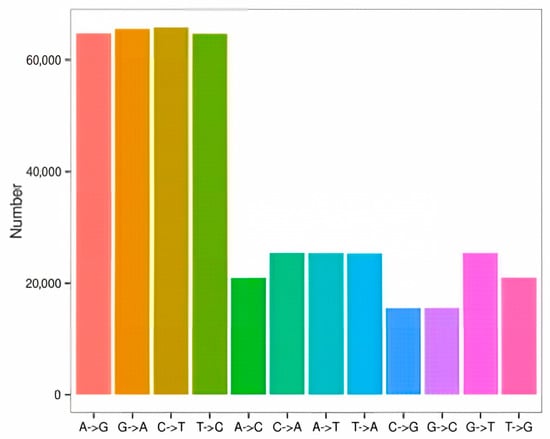
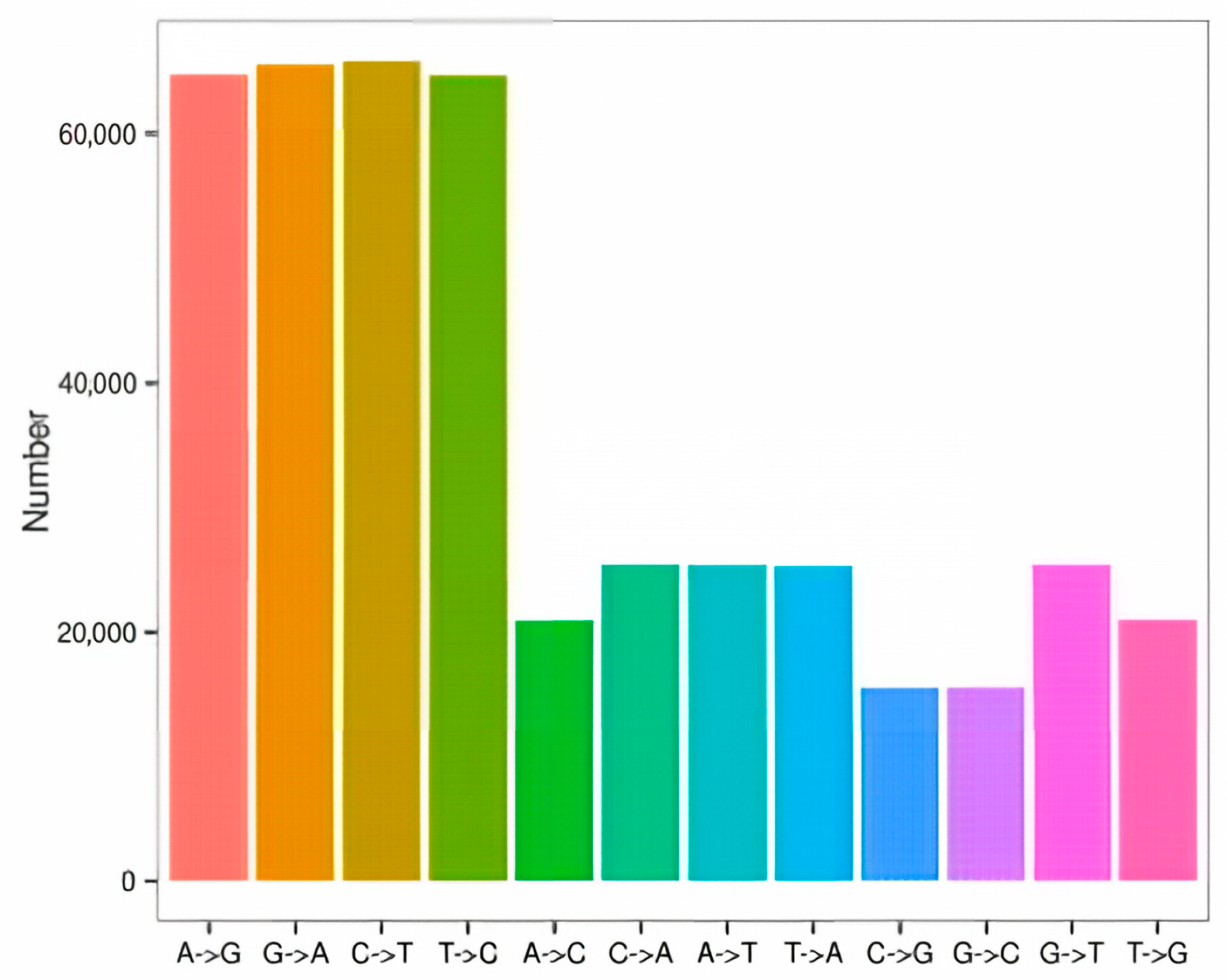
Transcriptome sequencing identified SNPs representing all transitions (A ↔ G, C ↔ T) and transversions (A ↔ C, A ↔ T, C ↔ G, G ↔ T) type (Figure 1). Transition mutations were the most frequent, with C→T being the predominant type (65,767 occurrences). In contrast, the transversion G → C was the least common (15,545 occurrences). Overall, transitions accounted for 59.87% of all SNPs, while transversions represented 40.13%.
Figure 1.
SNP type statistics. Distribution of 12SNP types identified from transcriptome sequencing. The y-axis indicates the number of SNPs. Transition mutations (A ↔ G, C ↔ T) are shown in blue, and transversion mutations (A ↔ C, A ↔ T, C ↔ G, G ↔ T) in red. C → T was the most frequent (65,767), and G → C the least (15,545).
Candidate SNPs were first called from the transcriptome data. Following this, 148 genes were selected from 15,768 differentially expressed genes based on three criteria: annotation in GO immune-related terms (e.g., immune system process, response to stimulus, cytokine activity), annotation in KEGG immune-related pathways (e.g., RIG-I-like receptor signaling pathway, Toll-like receptor signaling pathway, NOD-like receptor signaling pathway, Cytokine-cytokine receptor interaction, ECM-receptor interaction, PPAR signaling pathway), and an expression threshold of FPKM ≥ 20. From these 148 genes, 1870 SNP sites were identified. Subsequent preliminary screening yielded 53 high-priority candidate SNPs for further analysis.
3.2. Development of SNP Genotyping Primers
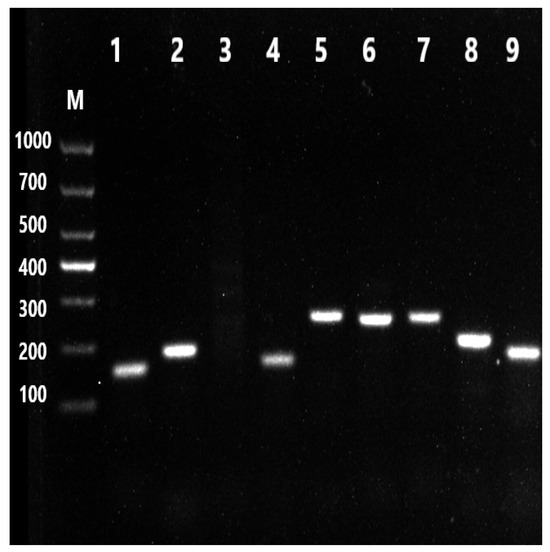
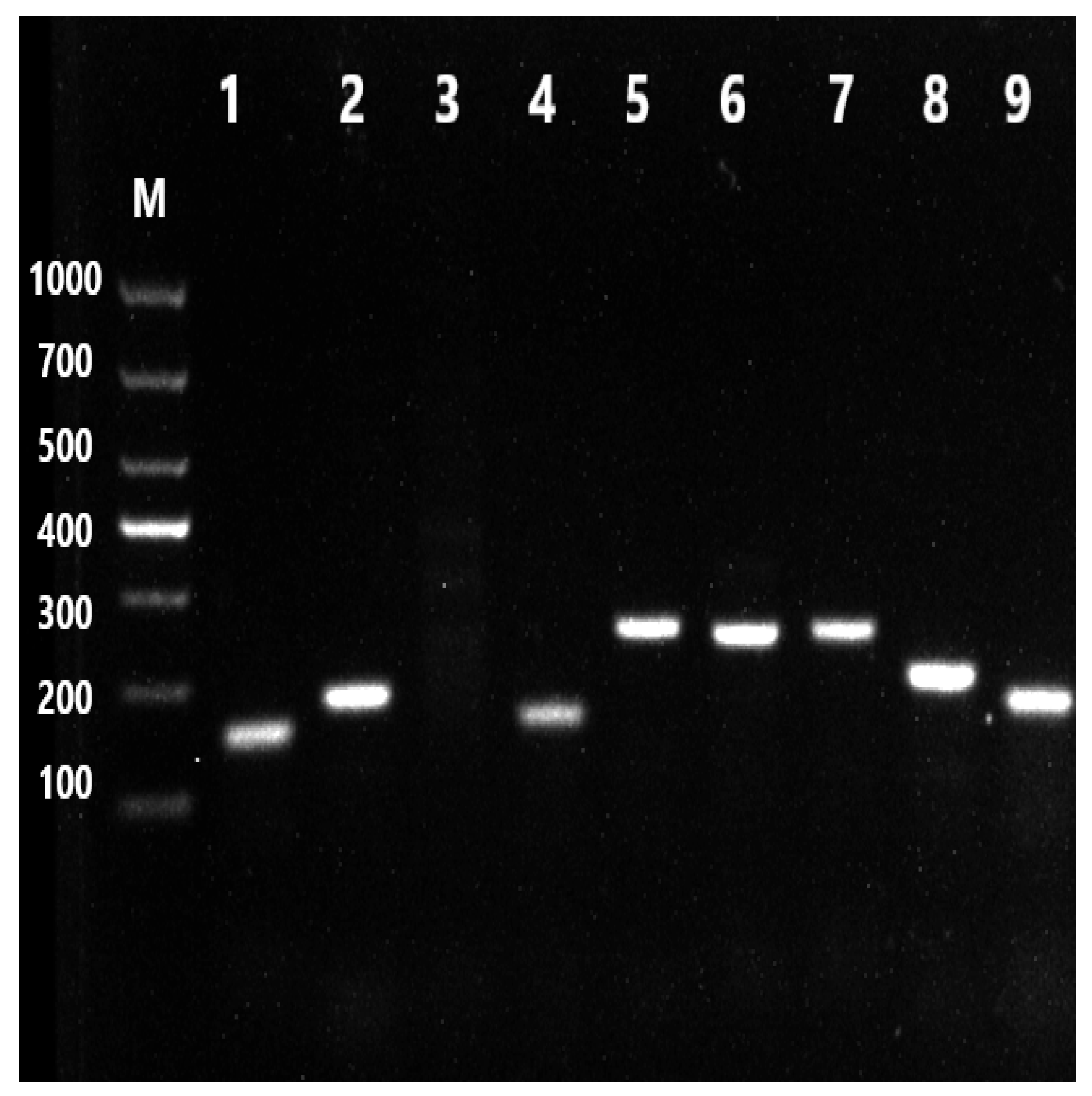
Primers flanking the 53 candidate SNP sites were designed using Primer Premier 5. Successful amplification was confirmed by 2% agarose gel electrophoresis (representative results shown in Figure 2). Based on this validation, 37 primer pairs meeting all screening criteria were selected for genotyping by HRM analysis (Table 1).
Figure 2.
Selection of primers by 2% agarose gel electrophoresis (Part). Representative gel image showing amplification products of candidate SNP primers. M, DNA marker; lanes 1–9, representative primer pairs. Lane 3 shows no amplification product due to primer design failure. The primer screening criteria were as follows: (i) a single, discrete band of the expected size (100–300 bp); (ii) no primer-dimer or non-specific amplification; (iii) consistent amplification across at least six DNA templates. Based on these criteria, 37 primer pairs were successfully validated and selected for further genotyping by HRM analysis.
Table 1.
Primers designed for SNP genotyping by HRM analysis.
3.3. SNP Genotyping and Validation via HRM Analysis
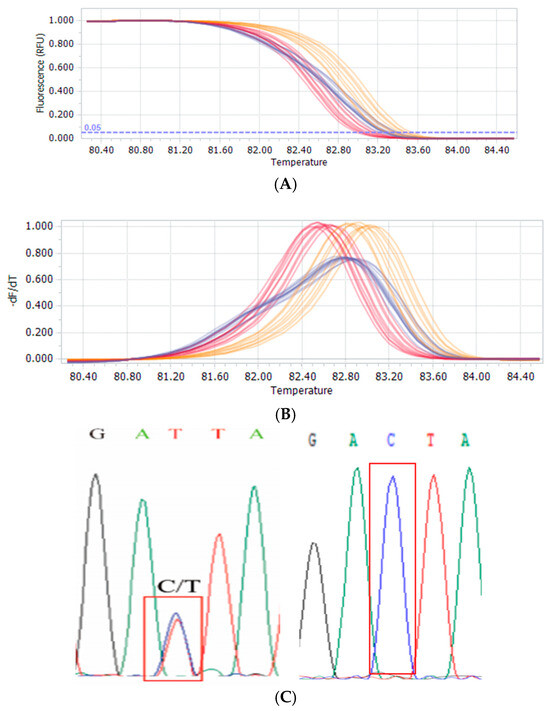
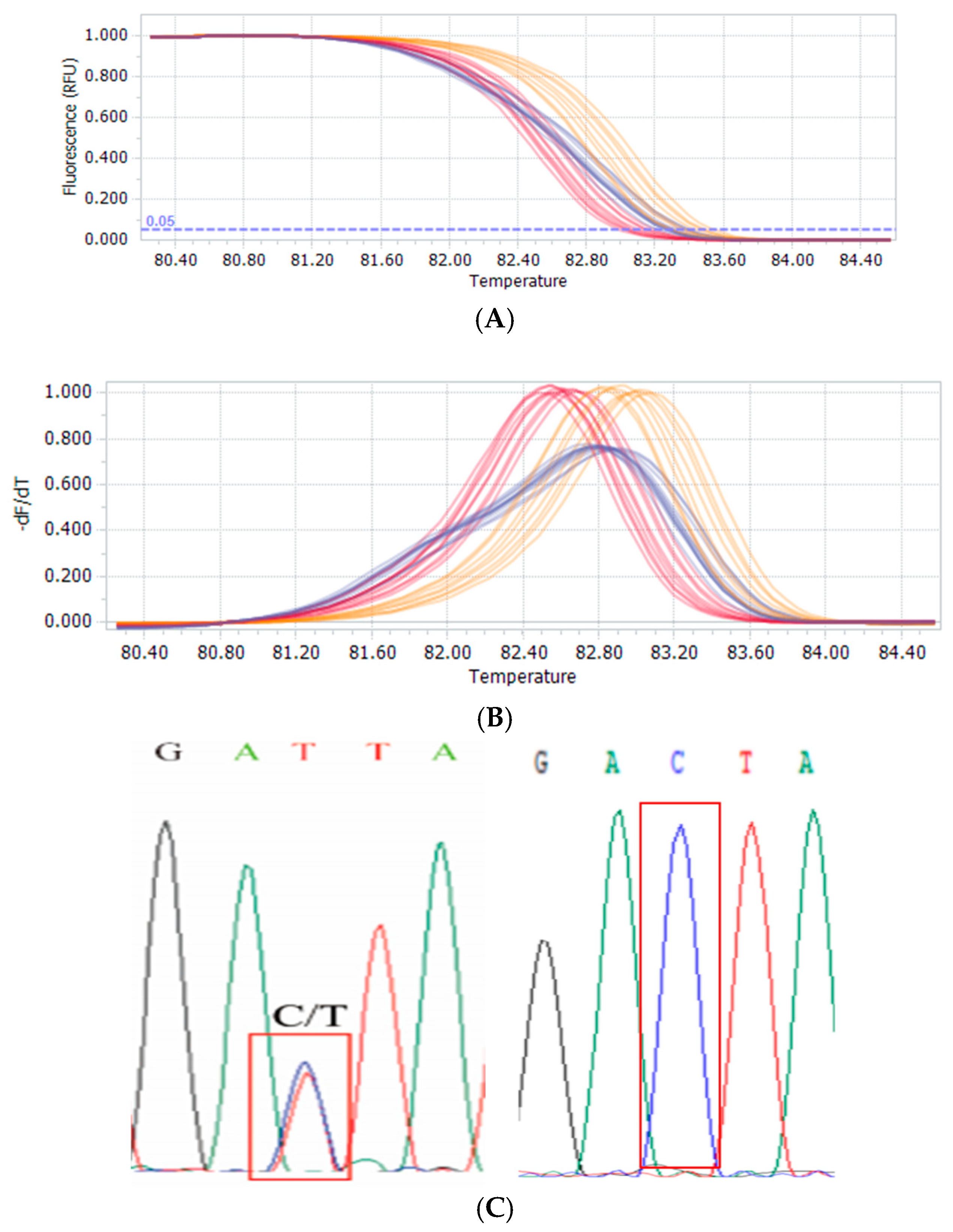
HRM-based genotyping was performed for all 37SNP loci across 60 DNA samples (30 resistant and 30 susceptible). Of these, 35 loci were successfully genotyped. Representative HRM profiles with corresponding Sanger sequencing validation are shown in Figure 3 (e.g., SNP18, where genotypes CC, CT, and TT are indicated by yellow, blue, and red curves, respectively). The high concordance between sequencing and HRM results confirms the reliability and applicability of the genotyping approach.
Figure 3.
(A) Normalized melting curves; (B) Normalized melting peaks; (C) Sanger sequencing chromatograms. HRM curves distinguish three genotypes: CC (yellow), CT (blue), and TT (red). The high concordance between HRM and sequencing results confirms the reliability of the genotyping approach. In panel (C), the boxed ‘C’ indicates the reference nucleotide flanking the SNP site, which serves as a positional marker for sequence validation.
3.4. Genetic Diversity and Polymorphism Analysis of SNP Markers
Genetic diversity analysis of the 35 successfully genotyped SNPs in the resistant group yielded the following average parameters: effective allele Ne = 1.6518, observed Ho = 0.3317, and expected He = 0.3779. Based on PIC, the loci were categorized into low (PIC < 0.25; 10 loci), moderate (0.25 ≤ PIC ≤ 0.50; 25 loci), and high (PIC > 0.50; 0 loci) polymorphism classes. HWE testing revealed that three loci (SNP25, SNP42, and SNP47) exhibited highly significant deviations (p < 0.01). All remaining loci were in HWE (p ≥ 0.05). The complete dataset for genetic parameters and HWE tests is provided in Table 2.
Table 2.
Genetic Information of SNPs in the MSRV-Resistant Group of Micropterus salmoides.
Genetic analysis of the susceptible group revealed the following mean parameters: effective allele Ne = 1.6526, observed Ho = 0.3548, and expected He = 0.3865. Based on PIC, the 35 loci were classified as having low (n = 7, PIC < 0.25) or moderate (n = 28, 0.25 ≤ PIC < 0.50) polymorphism, with no loci in the high-polymorphism category (PIC > 0.50). Regarding HWE, SNP42 deviated significantly from HWE (p < 0.05), and SNPs 23 and 25 showed highly significant deviations (p < 0.01). All other loci were in HWE (Table 3).
Table 3.
Genetic Information of SNPs in the MSRV-Susceptible Group of Micropterus salmoides.
3.5. Marker-Trait Association Analysis for MSRV Resistance
Among SNPs conforming to HWE, association analysis identified multiple loci significantly associated with MSRV resistance. Using SPSS 25.0 and the chi-square test, we assessed the correlations of genotype and allele frequencies with MSRV resistance. The genotype frequencies at five loci (SNP1, 2, 4, 19, and 37) differed significantly between the resistant and susceptible groups (p < 0.05). An additional nine loci (SNP7, 15, 16, 17, 18, 24, 27, 36, and 46) exhibited highly significant differences in genotype distribution (p < 0.01) (Table 4). Analysis of allele frequencies identified significant differences at SNP1 and SNP15 (p < 0.05), and highly significant differences at seven loci: SNP4, 16, 17, 18, 24, 27, and 46 (p < 0.01).
Table 4.
Genotype and Allele Distribution Frequencies of Each SNP Locus in Susceptible and Resistant Groups.
Among these highly significant loci, six (SNP16, 17, 18, 24, 27, and 46) showed clear genotype–phenotype associations: resistance was associated with the TT genotype (SNP 16, 17, 27), CT genotype (SNP18), GG genotype (SNP24), and AA genotype (SNP46). Conversely, susceptibility was associated with the CC genotype (SNPs 16, 17, 18, 46) and the AA genotype (SNP27).
After Bonferroni correction (α′ = 0.00143), four loci (SNP16, SNP17, SNP27, and SNP46) remained highly significant (all p < 0.001). Three loci (SNP1, SNP18, SNP24) became suggestive (p between 0.00143 and 0.05). The remaining loci did not reach the corrected significance level.
To quantify the strength of association, odds ratios (OR) with 95% confidence intervals (CI) were calculated for the resistance-associated alleles (using the susceptible group as reference). For example, SNP46 (A allele) showed the strongest association (OR = 44.0, 95% CI: 11.53–167.92, p < 0.0001). Other OR values are provided in Table 5. Based on the transcriptome data, COL1A1a was significantly upregulated in the resistant group according to our differential expression criteria, while C7b, EDN3b, DMBT1, and TRAF6 showed no significant differential expression between the two groups.
Table 5.
Odds ratios (OR) and 95% confidence intervals (CI) for the association of SNP alleles with MSRV resistance (susceptible group as reference).
4. Discussion
HRM analysis has proven effective for SNP genotyping in aquatic species. For instance, it achieved 75% success in typing the NLRC3 gene in Ichthyophthirius multifiliis-infected grass carp (Ctenopharyngodon idella) [23] and successfully validated trait-associated markers in Japanese sea cucumber, with a 76.92% genotyping rate and identification of resistance-linked genotypes [24]. In the present study, MSRV-infected largemouth bass were classified as susceptible or resistant. We applied HRM to genotype 37 transcriptome-derived candidate SNPs, successfully genotyping 35 loci with a 94.59% success rate, which further confirms the efficiency and reliability of this method.
This study investigated the genetic basis of MSRV resistance in largemouth bass through population genetic and association analyses. He and PIC are key diversity indices, with higher values indicating greater genetic variation [25]. The mean PIC values were 0.2943 and 0.3028 in the resistant and susceptible groups, respectively, indicating moderate polymorphism across all loci. No locus was highly polymorphic (PIC > 0.50), which aligns with the expected level of variability for the SNP panel [26]. Interestingly, more loci in the resistant group conformed to HWE than in the susceptible group, a pattern potentially reflecting stronger selection pressures such as environmental adaptation in the resistant population [27]. Deviations from the Hardy–Weinberg equilibrium are widely recognized as indicators of evolutionary forces such as selection, inbreeding, and genetic drift. In a long-term study of Atlantic cod, Karlsson and Mork [28] observed significant heterozygote deficiencies and temporal allele frequency shifts at a microsatellite locus, attributing these patterns to natural selection rather than demography alone. Similarly, whole-genome resequencing of Australian blacklip abalone revealed that approximately 25,000 SNP loci shifted in frequency across a single generation following herpesvirus outbreak, demonstrating that extreme disease pressure can drive rapid evolutionary change in marine populations [29]. In aquaculture, marker-assisted selection in tilapia has successfully identified resistance-associated microsatellites linked to antimicrobial peptide genes, with resistant strains showing more stable HWE distributions [30]. Collectively, these findings support the interpretation that the greater number of loci conforming to HWE in the resistant group of the present study reflects ongoing selective pressure imposed by MSRV infection. Association analysis under HWE conditions identified several SNP loci significantly associated with the MSRV-susceptible phenotype. Genotype and allele frequencies differed significantly at SNP 1 (p < 0.05) and with high significance at SNPs 16, 17, 18, 24, 27, and 46 (p < 0.01). Six genotypes were significantly more frequent in the resistant group, suggesting a positive effect on resistance. Conversely, two genotypes were overrepresented in susceptible fish, indicating a negative effect on disease outcome. These functionally annotated, resistance-associated markers provide a valuable resource for MAS. Their application in breeding programs is expected to significantly accelerate the development of MSRV-resistant largemouth bass strains, enhancing sustainable aquaculture production. Based on the observed odds ratios (e.g., OR = 24.0 for SNP16) and allele frequency differences, incorporating these four robustly associated SNPs into MAS could achieve a meaningful genetic gain for MSRV resistance, comparable to gains reported in similar aquaculture selection studies.
The SNP 1 locus was located in the C7b gene, which encodes a critical component of the complement system, suggesting its involvement in immune defense mechanisms [31,32]. The complement system serves as a cornerstone of innate immunity, providing defense against pathogens, activating humoral responses, and modulating inflammation and anti-tumor activity [33,34]. In teleost fish, complement activation occurs via the classical, alternative, and lectin pathways, leading to assembly of the membrane attack complex (MAC) that lyses invading microbes. Complement component 7 (C7) is essential for MAC formation and functions in cell lysis, host defense, and inflammation [35]. Supporting its role in acute-phase immunity, Aeromonas hydrophila infection in Russian sturgeon (Acipenser gueldenstaedtii) induced transient upregulation of C7 in immune-relevant tissues [36]. A parallel immune mechanism was reported in yellow croaker, where transcriptomic analysis following Vibrio alginolyticus challenge revealed marked induction of complement-related genes (including C1qbp, C1QL2, and C7), highlighting the pivotal role of innate immunity in early anti-bacterial defense [37]. Collectively, these studies indicate that complement activation, and particularly C7 function, constitutes a conserved and vital element of the fish immune response. It is plausible that the SNP located in C7b may alter complement activation efficiency by affecting C7 expression or protein structure, though this hypothesis requires direct experimental validation.
In this study, association analysis identified SNPs 16, 17, and 18 within the COL1A1a gene, which encodes the major fibrillar collagen of the extracellular matrix (ECM). Transcriptomic data further revealed that COL1A1a was upregulated in MSRV-resistant fish. As a primary ECM component, altered expression of collagen I may influence immune cell infiltration and tissue integrity, thereby affecting disease outcomes [38]. Its role in damage response is context-dependent: it can promote vascular repair [39], yet may be downregulated during certain infections [40]. Conversely, in injury models like those in medaka (Oryzias latipes) and zebrafish (Danio rerio), collagen genes are induced and have been shown to support tissue regeneration and attenuate inflammation [41]. Collectively, these findings suggest that COL1A1a upregulation in resistant largemouth bass may enhance disease resistance by supporting tissue repair and exerting anti-inflammatory effects, although the precise mechanisms require further investigation.
Based on functional annotation, the significantly associated SNPs were mapped to genes involved in critical immune and cellular stress-response pathways. SNP27 resides in a DMBT1-family gene, initially identified as a tumor suppressor and later implicated in innate immunity, inflammation, and lipid metabolism [42,43]. DMBT1 regulates inflammatory responses and tissue homeostasis, contributing to pathologies such as acute respiratory distress syndrome [44] and osteoarthritis via the p38/MAPK-PPARα axis [42]. SNP24 is located within the EDN3b gene, which encodes a ligand for the EDN3 receptor. Its expression in multiple tissues (e.g., intestine, kidney, brain) supports a role in paracrine/endocrine signaling [45], while its downregulation is linked to reduced cancer cell migration and invasion [46]. SNP46 was annotated to the TRAF6 gene, a central adaptor in Toll-like receptor signaling and a key mediator of fish antimicrobial defense. Upon immune challenge, TRAF6 activates IRF5 to initiate innate responses and upregulates its own expression [47,48,49,50].
The identification of these favorable resistant genotypes (e.g., TT at SNPs 16, 17, 27; CT at SNP18; GG at SNP24; AA at SNP46) provides candidate markers for marker-assisted selection (MAS) in largemouth bass breeding. Given the high odds ratios observed in this study (e.g., OR = 44.0 for SNP46), incorporating these markers into MAS programs could accelerate the development of MSRV-resistant strains. Further validation in independent populations is warranted before practical application.
We acknowledge that multiple comparison correction (Bonferroni) reduced the number of statistically significant SNPs from seven to four. The three suggestive SNPs (SNP1, SNP18, SNP24) should be interpreted with caution and require validation in independent populations. The four robustly associated SNPs (SNP16, SNP17, SNP27, SNP46) are promising candidates for marker-assisted selection, but their effects should be confirmed in larger cohorts and different genetic backgrounds. Because all individuals belong to a single, well-defined breeding population (‘Zhejiang Bass No. 1’) with a shared selection history, we believe the risk of confounding by population stratification is minimal. However, we did not perform a formal stratification assessment. We also note that the genotyping sample size (30 per group) is relatively limited, and validation in larger independent populations is necessary to confirm these findings.
5. Conclusions
This study aimed to identify SNP markers associated with MSRV resistance in largemouth bass. We genotyped 37 candidate loci, of which 35 yielded reliable genotypes, and performed comprehensive analyses including association tests, genetic diversity assessment, and HWE validation. Our integrated analysis identified four SNP loci (SNP16, SNP17, SNP27, SNP46) that remained significant after Bonferroni correction, and three suggestive loci (SNP1, SNP18, SNP24). These SNPs were annotated to five genes (C7b, COL1A1a, EDN3b, DMBT1, and TRAF6). Functional annotation suggested that C7b and COL1A1a are involved in anti-pathogen immunity, while EDN3b, DMBT1, and TRAF6 may function in inflammatory regulation and cellular stress responses. These findings provide functional candidate targets for marker-assisted selection and establish a genetic foundation for breeding MSRV-resistant largemouth bass, thereby supporting sustainable disease management strategies in aquaculture.
Author Contributions
Conceptualization, J.Z.; methodology, W.W. and J.Z.; formal analysis, W.W. and D.Q.; investigation, W.W., D.Q., Z.Z., X.S. and G.L.; data curation, W.W.; writing—original draft preparation, W.W.; writing—review and editing, D.Q., Z.Z., X.S., G.L. and J.Z.; supervision, J.Z.; funding acquisition, J.Z. All authors have read and agreed to the published version of the manuscript.
Funding
This research was funded by the Molecular-Assisted Breeding for Polygenic Disease Resistance in Largemouth Bass Research Program, grant number 2021C02069-2-02.
Institutional Review Board Statement
The animal study protocol was approved by the Animal Ethics Review Committee of Huzhou Normal University (protocol code: HUZU-20220503; approval date: 3 May 2022).
Informed Consent Statement
Not applicable.
Data Availability Statement
The data that support the findings of this study are available from the corresponding author upon reasonable request.
Acknowledgments
The authors thank Huzhou Huwang Aquatic Seed Industry Co., Ltd., for providing the largemouth bass of the ‘Zhejiang Bass No. 1’ strain.
Conflicts of Interest
The authors declare no conflicts of interest.
References
- Ministry of Agriculture and Rural Affairs, Bureau of Fisheries. 2023 China Fishery Statistical Yearbook; China Agriculture Press: Beijing, China, 2023; p. 33. [Google Scholar]
- Yang, S.; Zhao, J.; An, N.; Li, D.C.; Huang, M.M.; Fei, H. Updates on infectious diseases of largemouth bass: A major review. Fish Shellfish. Immunol. 2024, 154, 109976. [Google Scholar] [CrossRef] [Scilit] [PubMed]
- Wu, Y.J.; Yi, S.F.; Cheng, Y.; Yang, S.; Fei, H. A concise review on advancement of Micropterus salmoides rhabdovirus (MSRV): Current status and challenges. Aquac. Rep. 2023, 30, 101551. [Google Scholar] [CrossRef] [Scilit]
- Zhao, L.; Zhong, Y.; Luo, M.; Zheng, G.; Huang, J.; Wang, G.; Geng, Y.; Qian, X. Largemouth bass ranavirus: Current status and research progression. Aquac. Rep. 2023, 32, 10170. [Google Scholar] [CrossRef] [Scilit]
- Qin, Y.; Zhang, P.; Zhang, M.; Guo, W.; Deng, S.; Liu, H.; Yao, L. Isolation and identification of a new strain Micropterus salmoides rhabdovirus (MSRV) from largemouth bass Micropterus salmoides in China. Aquaculture 2023, 572, 739538. [Google Scholar] [CrossRef] [Scilit]
- Cui, W.; Su, F.; Liu, S.; Zhang, L.; Yang, H.; Rasoamananto, I.; Lavitra, T.; Sun, L. Identification of candidate genes and SNPs associated with growth traits by genome-wide association study (GWAS) in sea cucumber (Apostichopus japonicus). Aquaculture 2025, 605, 742512. [Google Scholar] [CrossRef] [Scilit]
- Wang, L.; Sun, F.; Yang, Z.; Lee, M.; Yeo, S.; Wong, J.; Wen, Y.; Yue, G.H. Mapping the genetic basis for sex determination and growth in hybrid tilapia (Oreochromis mossambicus x O. niloticus). Aquaculture 2024, 593, 741310. [Google Scholar]
- Si, M.-R.; Li, Y.-D.; Jiang, S.-G.; Yang, Q.-B.; Jiang, S.; Yang, L.-S.; Huang, J.-H.; Chen, X.; Zhou, F.-L. Identification of multifunctionality of the PmE74 gene and development of SNPs associated with low salt tolerance in Penaeus monodon. Fish Shellfish. Immunol. 2022, 128, 7–18. [Google Scholar] [CrossRef] [Scilit] [PubMed]
- Delpuech, E.; Vandeputte, M.; Morvezen, R.; Bestin, A.; Besson, M.; Brunier, J.; Bajek, A.; Imarazene, B.; François, Y.; Bouchez, O.; et al. Whole-genome sequencing identifies interferon-induced protein IFI6/IFI27-like as a strong candidate gene for VNN resistance in European sea bass. Genet. Sel. Evol. 2023, 55, 30. [Google Scholar] [CrossRef] [Scilit]
- Li, Y.; Chi, Y.; Yan, X.; Hu, Y.; Li, Z.; Jia, L.; Chen, S. A QTL associated with vibriosis resistance highlights the significant role of jam2a gene in tongue sole (Cynoglossus semilaevis). Aquaculture 2025, 597, 741930. [Google Scholar] [CrossRef] [Scilit]
- Sun, C.; Dong, J.; Sun, C.; Hu, J.; Tian, Y.; Gu, Z.; Ye, X. Transcriptome characteristics analysis of the male and female gonads of largemouth bass (Micropterus salmoides). Genom. Appl. Biol. 2022, 41, 946–959. [Google Scholar]
- Shao, J.Q.; Du, J.X.; Lei, C.X.; Li, S.J.; Dong, C.J.; Zhang, M.; Li, X. Development of genes and SNP markers related to food domestication based on largemouth bass transcriptome. J. Fish. Sci. China 2022, 29, 421–434. [Google Scholar]
- Ding, M.; Tao, Y.; Hua, J.; Dong, Y.; Lu, S.; Qiang, J.; He, J. Genome-wide association study reveals growth-related SNPs and candidate genes in largemouth bass (Micropterus salmoides) adapted to hypertonic environments. Int. J. Mol. Sci. 2025, 26, 1834. [Google Scholar] [CrossRef] [Scilit] [PubMed]
- Wang, Z.W. Study on the Mechanism of Inflammation Induced by Micropterus salmoides Rhabdovirus and Its Antiviral Drugs. Ph.D. Thesis, Huazhong Agricultural University, Wuhan, China, 2023. [Google Scholar]
- Zeng, R.B.; Liu, S.; Zhang, Y.J.; Li, C.; Yu, Y.Z.; Li, Y.P.; Xiao, Y.C.; Liu, X.Q. Screening of Chinese herb medicine against Micropterus salmoides rhabdovirus and their antiviral effects. Jiangsu Agric. Sci. 2021, 49, 155–159. [Google Scholar]
- Wang, Z.L.; Wang, B.; Lu, Y.S.; Wu, Z.H. Development Status and Trend Analysis in Aquaculture Vaccines. Biotechnol. Bull. 2015, 31, 55–59. [Google Scholar]
- Das, S.; Sahoo, P.K. Markers for selection of disease resistance in fish: A review. Aquac. Int. 2014, 22, 1793–1812. [Google Scholar] [CrossRef] [Scilit]
- Qiao, D.; Lei, N.; Zhu, J.; Wang, Y.; Zhou, L. Transcriptome analysis of liver anti-MSRV responses in juvenile largemouth bass (Micropterus salmoides). South China Fish. Sci. 2024, 20, 164–176. [Google Scholar]
- Ma, D.; Deng, G.; Bai, J.; Li, S.; Yu, L.; Quan, Y.; Yang, X.; Jiang, X.; Zhu, Z.; Ye, X. A strain of Siniperca chuatsi rhabdovirus causes high mortality among cultured largemouth bass in South China. J. Aquat. Anim. Health 2013, 25, 197–204. [Google Scholar] [CrossRef] [Scilit] [PubMed]
- McKenna, A.; Hanna, M.; Banks, E.; Sivachenko, A.; Cibulskis, K.; Kernytsky, A.; Garimella, K.; Altshuler, D.; Gabriel, S.; Daly, M.; et al. The genome analysis toolkit: A MapReduce framework for analyzing next-generation DNA sequencing data. Genome Res. 2010, 20, 1297–1303. [Google Scholar] [CrossRef] [Scilit] [PubMed]
- Yeh, F.C.; Yang, R.C.; Boyle, T. POPGENE, Version 1.31; University of Alberta: Edmonton, AB, Canada, 1999. [Google Scholar]
- Botstein, D.; White, R.L.; Skolnick, M.; Davis, R.W. Construction of a genetic linkage map in man using restriction fragment length polymorphisms. Am. J. Hum. Genet. 1980, 32, 314–331. [Google Scholar] [PubMed]
- Zhou, F.; Zhan, Q.; Ding, Z.; Su, L.; Fan, J.; Cui, L.; Chen, N.; Wang, W.; Liu, H. A NLRC3-like gene from blunt snout bream (Megalobrama amblycephala): Molecular characterization, expression and association with resistance to Aeromonas hydrophila infection. Fish Shellfish. Immunol. 2017, 63, 213–219. [Google Scholar] [CrossRef] [Scilit] [PubMed]
- Liu, A.R.; Liao, M.J.; Li, B.; Wang, Y.G.; Rong, X.J.; Zhang, Z.; Fan, R.Y.; Chen, G.P. Validation of SNPs associated with important economic traits of sea cucumber (Apostichopus japonicus). Prog. Fish. Sci. 2019, 40, 101–109. [Google Scholar]
- Silva, N.M.L.; Ianella, P.; Yamagishi, M.E.B.; Rocha, J.L.; Teixeira, A.K.; Farias, F.G.; Guerrelhas, A.C.; Caetano, A.R. Development and validation of a low-density SNP panel for paternity and kinship analysis and evaluation of genetic variability and structure of commercial Pacific white shrimp (Litopenaeus vannamei) populations from Brazil. Aquaculture 2022, 560, 738540. [Google Scholar] [CrossRef] [Scilit]
- Hubert, S.; Bussey, J.T.; Higgins, B.; Curtis, B.A.; Bowman, S. Development of single nucleotide polymorphism markers for Atlantic cod (Gadus morhua) using expressed sequences. Aquaculture 2009, 296, 7–14. [Google Scholar] [CrossRef] [Scilit]
- Liu, J.; Yu, Y.; Li, F.; Zhang, X.; Xiang, J. A new ALF from Litopenaeus vannamei and its SNPs related to WSSV resistance. Chin. J. Oceanol. Limnol. 2014, 32, 1232–1247. [Google Scholar] [CrossRef] [Scilit]
- Karlsson, S.; Mork, J. Deviation from Hardy–Weinberg equilibrium, and temporal instability in allele frequencies at microsatellite loci in a local population of Atlantic cod. ICES J. Mar. Sci. 2005, 62, 1588–1596. [Google Scholar] [CrossRef] [Scilit]
- Holland, O.J.; Toomey, M.; Ahrens, C.; Hoffmann, A.A.; Croft, L.J.; Sherman, C.D.H.; Miller, A.D. Whole genome resequencing reveals signatures of rapid selection in a virus-affected commercial fishery. Mol. Ecol. 2022, 31, 3658–3671. [Google Scholar] [CrossRef] [Scilit] [PubMed]
- Chen, C.-C.; Huang, C.-W.; Lin, C.-Y.; Ho, C.-H.; Pham, H.N.; Hsu, T.-H.; Lin, T.-T.; Chen, R.-H.; Yang, S.-D.; Chang, C.-I.; et al. Development of Disease-Resistance-Associated Microsatellite DNA Markers for Selective Breeding of Tilapia (Oreochromis spp.) Farmed in Taiwan. Genes 2022, 13, 99. [Google Scholar] [CrossRef] [Scilit]
- Wang, F.H. The Study on the Evolution of MACPF Gene Superfamily in Fish. Ph.D. Thesis, University of Electronic Science and Technology of China, Chengdu, China, 2023. [Google Scholar]
- Zhao, X.Z. The multigene family of complement and its genetic polymorphism. Nat. J. 1987, 3, 171–175. [Google Scholar] [CrossRef] [Scilit]
- Ricklin, D.; Hajishengallis, G.; Yang, K.; Lambris, J.D. Complement: A key system for immune surveillance and homeostasis. Nat. Immunol. 2010, 11, 785–797. [Google Scholar] [CrossRef] [Scilit] [PubMed]
- Orrapin, S.; Moonmuang, S.; Udomruk, S.; Yongpitakwattana, P.; Pruksakorn, D.; Chaiyawat, P. Unlocking the tumor-immune microenvironment in osteosarcoma: Insights into the immune landscape and mechanisms. Front. Immunol. 2024, 15, 1394284. [Google Scholar] [CrossRef] [Scilit] [PubMed]
- Nakao, M.; Tsujikura, M.; Ichiki, S.; Vo, T.K.; Somamoto, T. The complement system in teleost fish: Progress of post-homolog-hunting researches. Dev. Comp. Immunol. 2011, 35, 1296–1308. [Google Scholar] [CrossRef] [Scilit] [PubMed]
- Sun, M.-J.; Chen, Y.-D.; Gao, J.; Jiang, Y.-L.; Zhang, X.; She, D.-Y.; Xu, S.-J.; Hu, M.; Zhao, A.-Y.; Sha, Z.-X. Cloning and expression analysis of the complement component C7 in Russian sturgeon (Acipenser gueldenstaedti). Acta Hydrobiol. Sin. 2019, 43, 763–770. [Google Scholar]
- Cheng, A.-Y.; Wang, Y.-Y.; Weng, H.-S.; Chen, X.-H.; Zhang, W.-N. Transcriptome analysis revealed the immune response of large yellow croaker (Larimichthys crocea) in early stage of Vibrio alginolyticus infection. Acta Hydrobiol. Sin. 2022, 46, 1845–1854. [Google Scholar]
- Liu, W. SIX1 Inhibits Anti-Tumor Immune Response Through TGF-β Mediated Regulation of Collagens. Ph.D. Thesis, Peking Union Medical College, Beijing, China, 2021. [Google Scholar]
- Li, H.; Liu, D.; Li, K.; Wang, Y.; Zhang, G.; Qi, L.; Xie, K. Pancreatic Stellate Cells and the Interleukin Family: Linking Fibrosis and Immunity to Pancreatic Ductal Adenocarcinoma (Review). Mol. Med. Rep. 2024, 30, 30. [Google Scholar] [CrossRef] [Scilit]
- Feng, Y.; Wang, J.; Fan, W.; Geng, Y.; Huang, X.; Ouyang, P.; Chen, D.; Guo, H.; Deng, H.; Lai, W.; et al. Integrated bioinformatics identifies key mediators in cytokine storm and tissue remodeling during Vibrio mimicus infection in yellow catfish (Pelteobagrus fulvidraco). Front. Immunol. 2023, 14, 1172849. [Google Scholar] [CrossRef] [Scilit] [PubMed]
- Lu, H.H.; Zhou, X.Y.; Zhang, Z.W. Study on effect of collagen type I on tissue regeneration and anti-inflammation in zebrafish model. Chin. J. Mod. Appl. Pharm. 2022, 39, 1182–1186. [Google Scholar]
- Dou, T.X. The Effect and Mechanisms of Glycoprotein DMBT1 on Chondrocyte Function in Knee Osteoarthritis by Regulating Lipid Metabolism. Ph.D. Thesis, China Medical University, Shenyang, China, 2023. [Google Scholar]
- Mollenhauer, J.; Wiemann, S.; Scheurlen, W.; Korn, B.; Hayashi, Y.; Wilgenbus, K.K.; von Deimling, A.; Poustka, A. DMBT1, a new member of the SRCR superfamily, on chromosome 10q25.3-26.1 is deleted in malignant brain tumours. Nat. Genet. 1997, 17, 32–39. [Google Scholar] [PubMed]
- Zhang, Y.F. Expression of Deleted in Malignant Brain Tumors 1 Protein in Acute Respiratory Distress Syndrome Rats Caused by Sepsis. Master’s Thesis, North China University of Science and Technology, Tangshan, China, 2022. [Google Scholar]
- Tian, J.; Huang, C.Z.; Tu, Y.T. Endothelin family and their receptors in malignant melanoma. Int. J. Dermatol. Venereol. 2006, 32, 251–253. [Google Scholar]
- Li, H.; Ji, F.X.; Xu, X.N.; Ma, J.H.; Shen, C.F.; Li, J.Z.; Wang, L.J. miR-645 targets EDN3 to regulate proliferation, migration and invasion of hepatocellular carcinoma cells. Chin. J. Gerontol. 2021, 41, 2817–2822. [Google Scholar]
- Wei, J.; Zang, S.; Xu, M.; Zheng, Q.; Chen, X.; Qin, Q. TRAF6 is a critical factor in fish immune response to virus infection. Fish Shellfish. Immunol. 2017, 60, 6–12. [Google Scholar] [CrossRef] [Scilit] [PubMed]
- Zhao, H.T.; Chen, Y.; Wang, Z.G.; Zhang, Q.Q.; Yu, H.Y. Molecular characterization, expression profiles, and immunostimulation responses of TRAF6 and TAK1 in Japanese flounder (Paralichthys olivaceus). J. Ocean. Univ. China 2019, 18, 165–176. [Google Scholar] [CrossRef] [Scilit]
- Liu, X.T.; Wang, N.N.; Wu, R.X.; Li, C.; Cao, M. Identification and analysis of tumor necrosis factor receptor-associated factors (TRAF) and their expression pattern in Sebastes schlegelii after Edwardsiella piscicida infection. Oceanol. Limnol. Sin. 2024, 55, 232–242. [Google Scholar]
- Li, Y.; Mao, Y.; Yu, N.; Xu, X.; Li, M.; Jiang, Z.; Wu, C.; Xu, K.; Chang, K.; Wang, S.; et al. Grass carp (Ctenopharyngodon idella) TRAF6 up-regulates IFN1 expression by activating IRF5. Dev. Comp. Immunol. 2020, 102, 103475. [Google Scholar] [PubMed]

Disclaimer/Publisher’s Note: The statements, opinions and data contained in all publications are solely those of the individual author(s) and contributor(s) and not of MDPI and/or the editor(s). MDPI and/or the editor(s) disclaim responsibility for any injury to people or property resulting from any ideas, methods, instructions or products referred to in the content. |
© 2026 by the authors. Licensee MDPI, Basel, Switzerland. This article is an open access article distributed under the terms and conditions of the Creative Commons Attribution (CC BY) license.