


Abstract
In this study, the effects of different feeds provided during the initial feeding period of Trichogaster lalius (dwarf gourami) larvae on larval survival were evaluated. Larvae reared under laboratory conditions were assigned to four dietary treatments (EY: boiled chicken egg yolk, RO: live rotifers, IN: infusoria, SP: live Spirulina) during days 3–5 post hatching, after which all groups were enriched with live Artemia on days 5–10. A total of 4800 larvae were distributed across 16 treatment groups. On day 10, larval abundance and total length (mm) were recorded, and survival percentages were subsequently calculated. The pooled survival rates at the end of the experiment were 95.50 ± 4.05 for EY, 95.50 ± 2.53 for RO, 58.58 ± 8.88 for IN, and 77.25 ± 10.23 for SP. Statistical analysis revealed no significant differences in survival between the EY and RO groups (p > 0.05). In contrast, significant differences were observed between the IN group and the SP group, as well as between IN and the remaining treatment groups (p < 0.05). Moreover, no significant differences in total length were detected among the 16 groups at the end of the experiment (p > 0.303). Overall, the findings suggest that, under the present experimental conditions, larval survival of T. lalius was higher in the egg yolk and rotifer feeding treatments than in the infusoria and live Spirulina groups.
Key Contribution:
Optimising the initial feeding strategy to maximise larval survival while accounting for the cost and operational complexity associated with live feed production. Our results provide actionable evidence that boiled egg yolk performs comparably to rotifers in terms of survival under the conditions tested, suggesting a potentially low-cost and readily accessible alternative for early larval rearing. In addition, the manuscript reports observations on the use of live Spirulina as a starter feed—an approach that has rarely been evaluated in ornamental larviculture—and discusses its potential benefits and limitations.
1. Introduction
The early feeding of fish larvae is of critical importance in aquaculture, particularly during the larval stage. As the digestive system begins to develop, digestive enzymes also start to mature. The stomach and intestines, which are essential digestive organs, are activated and begin to develop upon the first feeding. Consequently, the composition and particle size of the initial diet determine how the digestive system will adapt to this developmental stage. In addition, the nutritional quality of the initial feeding has a direct impact on larval survival and growth performance [1]. Inadequate or inappropriate initial feeding may cause metabolic stress, energy deficits, and stunted growth. For these reasons, in commercial fish production, it is necessary to tailor larval initial feeding protocols to achieve high economic efficiency through optimal outcomes.
In larval feeding, particularly in species with slower digestive system development, live feeds are generally preferred as the initial diet [1]. Among live feeds, rotifers and Artemia are the most commonly used; however, other taxa such as copepods and cladocerans are also widely employed [2,3,4].
The selection of live feed at this stage is therefore a key consideration. The use of live feeds offers several advantages. Live feeds stimulate the feeding reflex of larvae that are consuming their first meals. Furthermore, by supporting the establishment of enzymatic and amino acid profiles within the larvae, live feeds facilitate faster digestion and absorption [5]. As a result, larvae reared under controlled conditions typically show improved growth and higher survival rates. Conversely, the production of live feeds can be costly. For commercial operations seeking to maximise profitability, the cost associated with live feed production is a critical factor. Accordingly, research into alternative feed sources that are less expensive, sustainable, and capable of delivering balanced nutrition has become increasingly important as a potential substitute for live feeds [6,7]. At present, rising feed costs, sustainability-related requirements, and shifts in feed composition have further intensified interest in alternative feed resources in aquaculture [7].
Experimental studies reported in the literature examining the feeding of fish larvae with different diets indicate that alternative feeds, whether provided alone or combined with live feeds, can markedly influence larval survival rates [6,7,8]. Despite these recent findings, live feed production remains relevant, because alternative diets often fail to achieve the performance levels expected [9]. The development of microdiets for fish larvae requires more than identifying appropriate nutrient combinations; it also involves the ontogenetic development of the digestive system, direct or indirect activation of digestive enzymes, and the digestibility of various diet components [10]. Comparative studies evaluating the effectiveness of different live feed types remain limited. Therefore, the present study investigates the effects of different live feed types and their combinations on the survival performance of Trichogaster lalius (dwarf gourami) larvae.
T. lalius (dwarf gourami) is a small, visually striking freshwater fish native to South Asia. It has considerable economic importance as both a food fish and an ornamental species, and it is classified commercially as “high value” in the aquarium trade [11]. The development of suitable breeding and rearing techniques for this species is therefore critical for meeting market demand. In intensive commercial production systems, T. lalius larvae are typically fed live feeds—most commonly rotifers and Artemia—during the initial feeding period. In the present study, we assessed not only rotifers and Artemia, but also alternative feed sources, including boiled chicken egg yolk, live Arthrospira (Spirulina) platensis, and Paramecium-based infusoria, both individually and in combination. The study specifically examines the relationships between these feeding treatments and the survival rates of T. lalius larvae.
2. Materials and Methods
2.1. Larval Rearing
From a commercial operation, 20 pairs of adult dwarf gourami aged one year were purchased. After a three-week acclimation period, the broodstock were considered ready for spawning. During acclimation, males and females were maintained in separate tanks. Each broodstock tank had the following dimensions: length 100 cm, width 50 cm, and height 40 cm, with a water depth of 35 cm. Water temperature was maintained at 26–27 °C and pH at 7.0–7.5. Once the experimental setup was established, 10 pairs of broodstock were transferred simultaneously into the spawning tanks. The spawning tanks measured 40 cm (length) × 20 cm (width) × 35 cm (height), with a water depth of 30 cm. Each spawning tank received one male–female pair at the same time.
Initially, four pairs spawned eggs on the same day. One day after spawning, the females were removed from the spawning tanks, while the males remained to care for the eggs. Hatching occurred 24–30 h post spawning. The day of hatching was designated as day 1. At 1 DAH (Days After Hatching), the larvae were suspended near the water surface and were largely immobile, exhibiting minimal movement and an unopened mouth. At day 2, the larvae remained just below the water surface, displaying increased activity duration compared with day 1 DAH; however, their mouths remained closed. At day 3, the larvae began brief free swimming, and their mouths opened. All larvae that hatched within 3 DAH were collected and removed from the production tanks on day 3.
From each production tank, 1800–2600 larvae were collected. Overall, approximately 8800 larvae were obtained from the four spawning pairs that spawned on the same day. On day 3 after hatching, all 8800 larvae from the four synchronously spawning pairs were pooled into a single tank and thoroughly mixed. Subsequent experimental groups were then formed using larvae randomly sampled from this mixed tank. At the beginning of the experiment, the mean total length (TL) of the larvae was measured. The day 3 larval TL was 1531 ± 73.44 µm (1.53 mm).
2.2. Experimental Setup
In this study, four alternative feeds were evaluated for the initial feeding of dwarf gourami (Trichogaster lalius) larvae prior to their transition to Artemia. The tested feeds were: (1) boiled chicken egg yolk (EY), (2) live rotifer (Brachionus plicatilis) (RO), (3) Paramecium spp.-based infusoria (IN), and (4) live Spirulina (Arthrospira platensis) (SP). Since rotifers are the most commonly used live feed in larval rearing of this species under standard conditions, the rotifer group (RO) was designated as the control group in the present study. For each feed type, four experimental groups were established. As shown in Table 1, group 1 larvae were fed the designated feed for 3 days, followed by a transition to Artemia on day 4. Group 2 larvae transitioned to Artemia on day 5, group 3 on day 6, and group 4 underwent a gradual transition to Artemia. In group 5, feeding with Artemia began concurrently with the alternative feed on day 5, and Artemia became the sole feed from day 6 onward. Each group included three replicates.
Table 1.
Experimental groups (16 groups) and feeding protocols applied in each group. Three replicates were conducted for each experimental group.
The experiments were terminated on day 10 post hatching. The experimental design is described in Table 1. In commercial hatchery production, it is known that these larvae can readily consume Artemia beginning on the 4th, 5th, or 6th day after hatching. Therefore, in the present study, the feeding protocol was designed to determine whether differences exist among these transition days.
A total of 16 experimental groups were established, and each group consisted of three replicates. Transparent plastic tanks measuring 25 cm in length, 15 cm in width, and 12 cm in height were used for each replicate. Each tank contained 3 L of water (water depth: 8 cm; 25 × 15 × 8 cm). A total of 100 larvae were stocked per replicate tank. Across all 16 groups, 4800 larvae were used. During the first two days post hatching, larvae were not fed. Beginning on day 3, the feeding protocols described in Table 1 were implemented.
In the experimental groups, water temperature was 27.0 ± 0.5 °C. The pH ranged from 6.96 to 7.21, and dissolved oxygen (DO) ranged from 6.53 to 7.17 mg/L.
Egg Yolk (EY)
Chicken egg yolk was boiled in water. One boiled egg yolk was dissolved in 500 mL of drinking water and subsequently filtered. This solution (500 mL) was stored in a 6 °C refrigerator. For the tanks receiving egg yolk, each tank was dosed with 100 mL per day as a single daily feed.
Rotifer (RO), (=Control Group)
Rotifers (Brachionus plicatilis) were obtained from a commercial hatchery that rears marine fish larvae. The rotifers were cultured using ultranano-concentrated algae and were stocked at 1000 individuals per mL, with a total prepared volume of 10 L. Rotifers delivered to the laboratory were not fed for 3 days prior to use. For each replicate tank, rotifers were provided at a daily rate of 6–7 rotifers per mL as a single daily feed.
Infusoria (IN)
Infusoria were produced by placing the inoculum into five-liter clear plastic bottles with their lids removed, using water taken from the main tanks where cultures were maintained. After adding chopped banana peels to this water, the bottles were positioned to receive direct sunlight. Three days after setup, samples from the Paramecium spp. culture tank were added to the prepared culture media. The cultures were maintained at room temperature (22–24 °C) for four weeks without aeration. All microscopic organisms that proliferated in this medium were identified as infusoria. The microfauna derived from a Paramecium-dominated population was used as food for dwarf mullet larvae. From this culture, 0.5 L was added to each replicate tank daily. Because the infusoria-containing water was added in this manner, 0.5 L of water was removed from each tank receiving infusoria prior to feeding. For the remaining groups, no water exchange was performed.
Spirulina (SP)
In the experiments, Arthrospira (Spirulina) platensis strain NIES-39 was used. The strain was obtained from the Culture Collection at the National Institute for Environmental Studies and was originally isolated from Lake Chad. Spirulina was cultured in Zarrouk medium. Each group was fed daily with 100 mL of live Spirulina. The concentration of Spirulina in each feeding was 22,000 organisms per mL. As with the other feeds, Spirulina was provided as a single daily meal.
Artemia
Artemia (Artemia spp.) eggs were purchased as a commercial product (INVE Aquaculture, Belgium). Artemia cysts were hatched at 27 ± 0.5 °C and salinity of approximately 30‰. For each tank, 6–8 Artemia individuals per mL were provided as a single daily feeding. All experiments across groups were terminated on day 10. At the end of the trial, larvae were counted, and total length as well as live weight were measured. Survival rates among groups were then compared.
Nutrient composition differences among diets
In this study, the nutrient composition of the feeds used to rear larvae also differed. A 100 g portion of boiled chicken egg contains 15.5 kcal of energy, 12.6 g of protein, 10–10.5 g of lipid, 0.56–1.1 g of carbohydrate, and 50–52% dry matter [12]. The protein content of rotifers is 47–55%, lipid 14–2%, carbohydrate 5–15%, and dry matter content is 8–10% [13]. Although values vary by strain, Arthrospira platensis generally contains 50–70% protein, 3–10% lipids, and 10–20% carbohydrates (by dry weight) [14]. The energy content ranges from 290 to 390 kcal per 100 g. In addition, because of the high proportion of highly digestible polysaccharides (84%) present in the cell wall rather than cellulose, which is specific to the species, all nutrients—particularly protein—are highly digestible [15]. The nutritional composition of Artemia consists of 46–52% protein, 18–20% lipid, 5–15% carbohydrate, and 6–11% dry matter (INVE Aquaculture Inc., Dendermonde, Belgium).
2.3. Statistical Analyses
First, to determine whether statistically significant differences existed among groups receiving the same feed type (e.g., EY1, EY2, EY3, EY4), a Kruskal–Wallis analysis was performed. This test was conducted separately for each feed group. If the Kruskal–Wallis test showed a significant difference, subsequent pairwise comparisons were carried out using the Dunn test. To identify which specific pairs of groups differed significantly in terms of their means across all possible comparisons, Tukey’s HSD test was applied.
- •
- Overall mean:
- •
- Overall SD (example):
3. Results
All experiments fed larvae exclusively with Artemia from day 6 onward. On day 10, the experiments were terminated, and larval counts were performed to determine survival rates. The end-of-experiment survival data for the four egg yolk-based early-feeding groups are presented in Table 2.
Table 2.
End-of-experiment survival rate means observed across all groups and the combined mean for the corresponding feeding groups.
Based on these data, larval survival did not differ significantly between EY1 (egg yolk provided only on day 3, followed by a switch to Artemia) and EY2, EY3, and EY4 (egg yolk provided on days 3–5 before switching to Artemia) (p > 0.05). Moreover, within-group comparisons among these egg yolk treatments revealed no significant differences. The Kruskal–Wallis test produced a p-value of approximately 0.76, indicating no statistically significant differences among the four groups (p > 0.05).
The survival rates (mean ± SD) were 94.33% ± 1.63 (EY1), 91.00% ± 4.58 (EY2), 94.66% ± 4.16 (EY3), and 96.33% ± 2.36 (EY4). The combined mean survival rate for the egg yolk (EY) groups was 95.50% ± 4.05.
Rotifer groups (RO1–RO4) were assessed for survival percentages. A Kruskal–Wallis test was used to evaluate differences among these groups, resulting in with and (range 0.75–0.80). Since , there was no statistically significant difference among the rotifer groups. Survival ranged from 94.33% ± 2.52 to 96.33% ± 1.15. The combined mean survival for RO1–RO4 was 95.50% ± 2.53.
For infusoria-fed groups (IN1–IN4), survival percentages were similarly evaluated. The Kruskal–Wallis test produced with , indicating no statistically significant difference among the four infusoria groups. Survival ranged from 55.00% ± 9.00 to 61.00% ± 5.00. The combined mean survival for IN1–IN4 was 58.58% ± 8.88.
Spirulina-fed groups (first-feeding Spirulina protocol; SP groups) were compared using the Kruskal–Wallis test. The test yielded with . Because , there was no evidence that the Spirulina groups differed significantly. Survival in these groups ranged from 72.66% ± 12.02 to 84.00% ± 2.00, with a combined mean survival of 77.25% ± 10.23.
Overall, in this study dwarf gourami larvae were reared under four dietary treatments, each applied across four feeding protocols (with 100 larvae stocked per replicate tank at the start). On day 10, larvae were counted and the survival percentages are presented in Table 3. Across the four main feed types, the highest survival (approximately 91–96%) occurred in the egg yolk (EY) and rotifer (RO) groups, with a combined mean survival of 95.50%. The spirulina-fed group showed the next highest survival, ranging from 72% to 84%, with a combined mean of 77.25% ± 10.23. The lowest survival was observed in the infusoria groups, at 55% to 61%.
Table 3.
Final larval size (mean total length in mm ± standard deviation [SD]) at day 10, presented by experimental group.
Based on the survival data among the four main feeding groups, there was no significant difference in survival percentages between the egg yolk (EY) and rotifer (RO) groups (). However, differences were detected among the other treatments. In particular, statistically significant differences were found among the groups outside EY and RO (overall ), with especially large differences between the IN and SP groups and between the EY and RO groups.
On day 3 after hatching, the average total body length of the larvae was 1.53 ± 0.73 mm. These larvae were distributed homogeneously across all groups.
At the end of the experiment (day 10), mean total body length was measured separately for each group. The lowest mean length was 3.39 ± 0.26 mm in EY1, and the highest was 4.45 ± 0.41 mm in RO1.
To test whether mean total body length differed among the groups at day 10, a Kruskal–Wallis test was performed. The test statistic was with , and the asymptotic p-value was . Since (with ), there was no statistically significant difference in mean total body length among the EY, RO, IN, and SP groups.
4. Discussion
In this study, four different feed types for the initial feeding of dwarf gourami larvae (egg yolk, rotifer, infusoria, and spirulina) were tested in four distinct combinations with Artemia. Within each feed type, there were no significant differences in larval survival percentages among the subgroups (e.g., EY1, EY2, EY3, EY4) (p > 0.05). The same pattern was observed for the rotifer, infusoria, and spirulina groups: RO1–RO4 showed no significant differences in survival (p > 0.05); IN1–IN4 showed no significant differences; and SP1–SP4 also showed no significant differences.
Currently, professional producers predominantly prefer using rotifers for larval feeding in the commercial cultivation of this species, and successful results have been achieved with this method. Therefore, the rotifer group (RO) was adopted as the control group in the present study. By comparing the results obtained from the RO group, which is known to yield high survival rates in larval feeding, with those of the other experimental groups, it is possible to gain insight into the relative efficacy of the alternative feeds. Accordingly, a survival rate of approximately 95.50% was recorded in the RO group, which is considered a remarkably high and acceptable rate. When the other groups were compared with this control group, the EY group exhibited a survival rate similar to that of the control group (95.50%), whereas the IN and SP groups yielded lower survival rates than the RO group. Based on these results, it is evident that only the EY group achieved a survival rate comparable to that of the RO group.
However, differences emerged among the combined means of the four main feed groups. The combined survival mean for the EY and RO groups was high (about 95.50%), whereas survival averaged approximately 77.25% in the Spirulina groups and about 58.58% in the Infusoria groups. The lowest survival was observed in the infusoria-fed groups.
Overall, the survival results for the EY and RO groups are highly favorable for aquaculture, while survival in the Spirulina- and Infusoria-fed groups was comparatively lower. The reduced survival observed in the infusoria groups is thought to be mainly due to an insufficient daily amount of food provided. Therefore, increasing the amount of infusoria used in the initial feeding is expected to improve survival rates. Future studies should address this limitation and monitor the outcomes. Potential follow-up experiments include: (1) increasing the daily infusoria supply to identify an optimal dose; (2) standardizing feed distribution and renewal rates; (3) performing more detailed time series assessments of the effects of high infusoria and spirulina combinations on survival; and (4) examining the correlation between survival and growth (length/weight) to better understand performance.
These results indicate that the initial feeding stage plays a crucial role in dwarf gourami cultivation: EY and RO support a successful start, whereas alternative feeds (SP, IN) may yield lower performance. Future work should therefore focus on identifying high-efficiency starter diets and developing protocols that optimize survival.
Larvae were terminated at 10 days of age, and growth was assessed by measuring total length (mm) on day 10. Based on these measurements, there was no statistically significant difference in mean total length among the groups at the end of the experiment (p = 0.303). Thus, over the first 10 days, the starter feeds EY, RO, IN, and SP did not show different effects on growth.
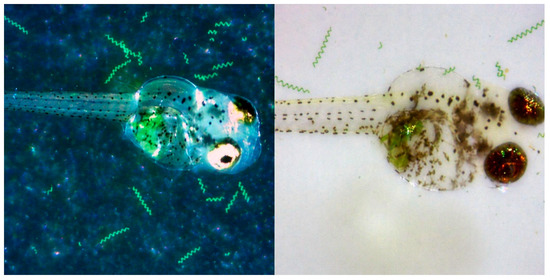
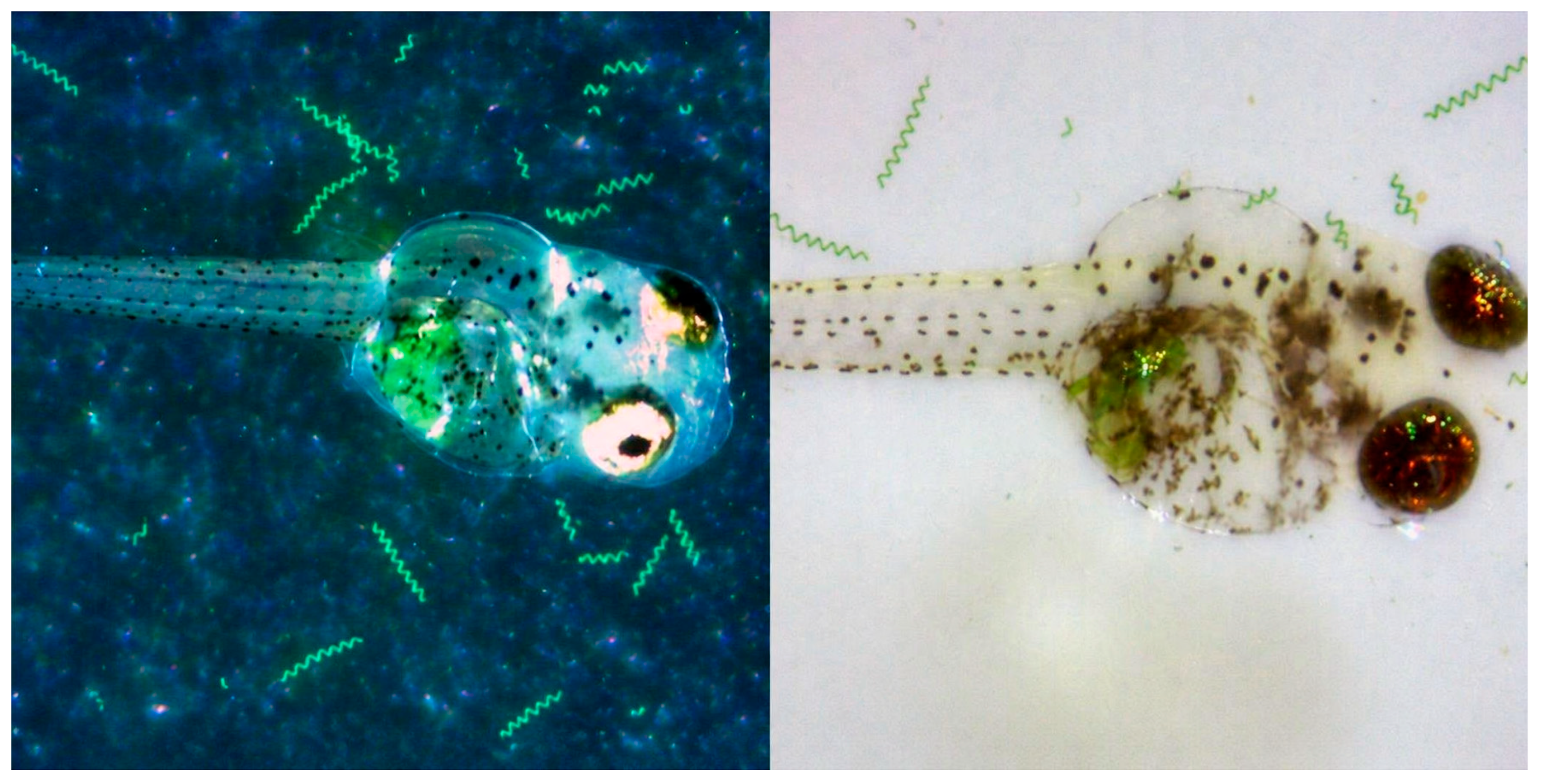
Live Spirulina is not commonly used in larval feeding. In this study, live spirulina was tested as part of the initial feeding for dwarf gourami larvae. Spirulina is a highly nutritious microalga, and although many fish larvae cannot directly consume whole microalgal organisms, we observed that dwarf gourami larvae were able to ingest live spirulina from the day their mouths opened (Figure 1). This finding is valuable and suggests that live spirulina may be feasible as a starter feed in this species.
Figure 1.
Trichogaster lalius larvae fed with Spirulina (4 days after hatching). The green coloration in the gut indicates active ingestion of Spirulina.
When spirulina was used together with Artemia, survival rates ranged from 72.66% to 84% in dwarf gourami larvae. Since this supports survival in the species where it has been tested for the first time, it suggests potential for future studies and may inspire broader applications. Overall, these findings contribute to the literature by documenting a novel aspect of larval nutrition in dwarf gourami.
In fish culture—especially during the larval stage—live feeds and feeding regimens are essential for hatchery success [2,16]. Live feeds used for larval rearing are typically dominated by rotifers and Artemia, but the use of other organisms (e.g., copepods, cladocerans, and additional species) is increasingly being explored as supplementary or alternative options [2,3,4]. However, live feeds such as rotifers and Artemia are costly and require additional personnel, labor, and facility space, making their production and use more complex and expensive [16]. For this reason, efforts in fish culture aim to develop alternative live feed types and expand the use of new feeds in production [16].
In this study, the above concept was applied to develop a practical feeding setup. Because dwarf gourami larvae have mouths too small to consume Artemia immediately after hatching, four different feeds were tested as starter diets before transitioning larvae to Artemia feeding. The first option was boiled egg yolk. Although this is not a live feed, it is a traditional feeding method used for early larval stages in carp (Cyprinus carpio) and African catfish (Clarias gariepinus) [17]. One study examined growth performance, survival, and economic profitability of Clarias gariepinus larvae fed with freeze-dried and different forms of chicken egg yolk (freeze-dried chicken egg yolk, quail egg yolk, guinea fowl egg yolk, and turkey egg yolk) [17]. In that trial, Artemia (T0) served as the control, and the other groups were fed with chicken egg yolk (T1), quail egg yolk (T2), guinea fowl egg yolk (T3), and turkey egg yolk (T4). The trial lasted 12 days, and larvae were fed five times daily. At the end of the trial, there was no statistically significant difference in larval survival between the Artemia (T0), quail egg yolk (T2), and turkey egg yolk (T4) groups (p > 0.05) [17].
In our study, the egg yolk (EY) groups exhibited very high survival rates (about 95.50%). The data also suggest that Artemia supplementation may promote faster growth, but its higher cost could reduce overall economic efficiency compared with alternative egg yolk–based diets [17]. Cost calculations are especially important in large-scale larval production.
Raising poultry eggs—and using the egg components for fish larval diets—has been widely applied in aquaculture, particularly for species whose larvae are too small to efficiently consume common live feeds. Egg yolk powder has been used as a larval feed ingredient for many fish species, including Clarias gariepinus and Poecilia reticulata (guppy) [18,19]. Egg yolk is considered nutritionally beneficial and has been associated with high larval survival rates [20]. Chicken egg yolk contains approximately 33% total lipids and 16% crude protein, along with vitamins and minerals [20]. It is also rich in fat-soluble vitamins (A, D, E) and omega-3 fatty acids [21]. In addition, egg yolk can support larval muscle growth and contribute to immune function [22]. Although nutritional quality can vary depending on the egg source and feeding method [20], prior studies consistently suggest that egg yolk can be effective for fish larvae [17,18,19,20].
In this study, boiled chicken egg yolk (EY group) showed high efficiency as a starter feed for dwarf gourami larvae, providing a healthy and low-cost alternative. Its ubiquitous availability and the fact that it does not require additional labor, specialized personnel, or production space to prepare make it a practical option for dwarf gourami and other similar fish species. A further advantage is the high survival observed in the egg yolk-fed groups (EY1–EY4), where survival remained above 95%.
A key practical consideration is water quality. Egg yolk can rapidly deteriorate water conditions due to its organic load. Therefore, when egg yolk is used, the feed must be properly filtered and overdosing must be avoided. Tanks should be monitored closely, and if any signs of water-quality decline appear, a controlled water-exchange protocol should be implemented. When provided in appropriate amounts and at suitable times, water quality can be maintained within healthy ranges.
Another feed type evaluated in this study was rotifer (Brachionus plicatilis). Rotifers are widely used as live feeds for the first feeding of larvae with mouth openings too small to ingest Artemia [23]. They are especially common in mass production systems for marine fish larvae, and rotifer-fed larvae often show high survival rates [24,25,26]. Consistent with this, in the present study the rotifer-fed groups (RO1–RO4) also exhibited high larval survival (>95%).
Rotifers themselves do not present major biological disadvantages; however, rotifer culture can be costly and labor-intensive. Rotifer production typically requires live microalgae cultures (e.g., Nannochloropsis sp., Dunaliella sp., Tetraselmis sp.) or concentrated algae as feed [27]. Because this process also demands labor, personnel, and production space, rotifers are generally a relatively expensive live feed. Nevertheless, as observed here, rotifers can positively affect larval survival.
Paramecium spp., along with other unicellular organisms, can also be used as an initial feed for fish larvae and is commonly replaced by Artemia at later stages [2,5]. This strategy has been used traditionally by many producers. For example, a study testing different live feed types and their combinations on the performance of pike-perch larvae (Sander lucioperca) evaluated survival rate, total length, body width, body mass, and malformation rate [28]. In that experiment, from day 0 (start of exogenous feeding) to day 10, larvae were fed combinations including marine rotifer Brachionus plicatilis, freshwater rotifer Brachionus calyciflorus, and the ciliate Paramecium bursaria. The reported results indicated that feeding with B. plicatilis, B. calyciflorus, and P. bursaria produced high survival rates of about 80% and supported more homogeneous growth, including a 50% increase in total length and a 20% increase in body width.
In our study, the initial feeding of dwarf gourami larvae used a microalgae-like microbe community known as infusoria, dominated by Paramecium sp. Infusoria feeding is a widely used traditional method for the first feeding of fish larvae [29]. Infusoria consist of single-celled microorganisms from multiple groups (including ciliates, protists, amoebae, rotifers, euglenoids, etc.). Their small size (25–300 μm) and soft bodies, together with high nutritional value, make them well suited as an early-stage feed for fish larvae [30,31].
Infusoria are naturally present in water bodies where fish farming occurs; however, in most aquaculture settings their natural abundance is insufficient to support larval feeding. Therefore, infusoria are commonly cultured separately. They can be cultured using a variety of substrates such as banana peels, lettuce, cabbage, and rice husk [30,32]. In the infusoria culture applied in this study, banana peels were used as the substrate.
In the groups receiving infusoria as the first feeding (IN1, IN2, IN3, IN4), day 10 survival of dwarf gourami larvae ranged from 55% to 61%, which was lower than survival observed in the other feeding groups. Among the four infusoria-fed groups, the lowest survival was recorded, and this is believed to be related to the relatively low daily provision of infusoria, which may not have adequately met larval nutritional demands.
A study on newly hatched platy (Xiphophorus maculatus) fry fed exclusively on infusoria showed that infusoria-fed larvae had markedly better survival and growth compared with larvae deprived of live feed [33]. This work emphasizes the role of infusoria culture as a cost-effective and sustainable live feed for improving platy fry production. Our results are consistent with the same conclusion for dwarf gourami larvae, with the important caveat that the daily quantity supplied must be sufficient; insufficient infusoria availability can lead to reduced survival.
Spirulina is a blue-green filamentous alga that contains essential fatty acids such as palmitic acid, linolenic acid, and linoleic acid, as well as a high protein content (60–70%), vitamins, and minerals. For these reasons, it is widely used as a feed resource for fish larvae [34,35,36,37]. In addition, Spirulina is increasingly attracting attention because it contains bioactive compounds with antioxidant activities [38,39,40].
In fish farming, the use of antibiotics to control disease is a major constraint. As a result, probiotic and live-organism-based strategies have gained much more interest as potential alternatives. For example, one study used Spirulina (Arthrospira platensis) as a growth promoter and immune booster in Nile tilapia (Oreochromis niloticus) [22]. In that experiment, fish were fed Spirulina-enriched diets at different inclusion levels for 12 weeks, after which they were challenged with the pathogenic bacterium Aeromonas hydrophila. The study reported improved physiological parameters in fish fed Spirulina, and mortality from A. hydrophila infection decreased as dietary Spirulina levels increased [22]. These findings highlight Spirulina supplementation as a promising antibiotic alternative for disease prevention in tilapia aquaculture [22]. Beyond growth promotion, Spirulina is also effective for supporting the immune system, reinforcing its role as a nutritious feed ingredient.
Because of its importance, live Spirulina was tested as a first feed for the initial feeding of dwarf gourami larvae in this study. It is well known that many fish species cannot directly consume live microalgae. However, in this study, the dwarf gourami larvae were observed to feed on live Spirulina (Arthrospira platensis) from the very first day they started feeding (Figure 1). Spawning-day larvae opened their mouths three days post hatching and were fed with Spirulina, with survival rates in the SP1, SP2, SP3, and SP4 groups ranging from 72% to 84%. In fact, these survival rates are acceptable for fish farming. By contrast, groups fed with egg yolk (EY1, EY2, EY3, and EY4) and rotifers (RO1, RO2, RO3, and RO4) achieved survival rates above 95%. The lower survival in the Spirulina-fed groups is not attributed to inferior nutritional quality of Spirulina per se, but to the comparatively lower dry matter intake by the larvae. The culture had a dry biomass density of about 0.4 g/L, and 100 mL of daily feed contributed 0.04 g of dry Spirulina biomass. Considering that an egg yolk weighs about 25 g with ~50% water content [41], the daily dry matter intake from egg yolk in the EY groups is approximately 2.5 g. However, if the immune benefits of Spirulina hold, live Spirulina could be used as the first feed for dwarf gourami larvae. On the other hand, Spirulina production is costly.
When listing the acquisition costs of the feeds used in this trial, Spirulina could be the second most expensive feed after rotifers. From this perspective, infusoria and chicken egg yolk are cheaper and easier to obtain. Consequently, all four feed types tested in this study could be used as initial feeds for the dwarf gourami larval culture. However, if cost and labor calculations are prioritized, we would recommend using chicken egg yolk (EY group) first. This is because, based on the larval survival averages, the highest survival rates were observed in the groups fed with chicken egg yolk (EY groups) and those fed with rotifers (RO groups). Moreover, the cost of egg yolk is substantially lower than the cost of rotifer production, making EY a more economical option among these two groups.
Authors should discuss the results and how they can be interpreted from the perspective of previous studies and the working hypotheses. The findings and their implications should be discussed in the broadest context possible. Future research directions may also be highlighted.
Despite all this, differences in larval survival rates may not only be related to feeding protocols, but also to nutrient composition, digestibility, particle size, and natural differences in feeding behavior. For example, the high and consistent survival rates (~95.50%) in the EY and RO groups may also indicate that these feeds better meet the larva’s early nutritional and energy needs [2,16]. The high survival rates observed in larvae fed with rotifers may also be related to the small size of rotifers, the ease with which larvae can consume this food, and its high nutritional content [23]. On the other hand, rotifer is a live feed with a high digestibility rate. It has been explained above that one possible reason for the low survival rates in the infusoria group might be the larva’s daily infusoria consumption. Therefore, it is possible that another factor affecting larval survival rates in other groups with low survival rates, such as the IN group, may be related to the amount of the respective feed type consumed by the larva. In this study, it is very important to determine whether Spirulina can be consumed by larvae. However, the relatively low survival rates (~77.25%) in the SP group may be related to the larva’s net dry matter intake, as well as to its direct nutritional value. Spirulina is an organism with a high water content (80–90%) [14,15]. Therefore, since 80–90% of the Spirulina consumed by the larva is water, this daily feed intake may not have been sufficient to meet the larva’s nutritional needs. Due to these results, differences in larval survival rates in this species may depend not only on feed type, but also on other factors such as nutrient content, digestibility, and feed consumption rate. If future research can be conducted that takes these factors into account, the effects of these mechanisms can be more clearly revealed.
5. Conclusions
In this study, the effects of different initial diets (boiled egg yolk, live rotifer, infusoria, and live Spirulina) on the survival performance of Dwarf Gourami (Trichogaster lalius) larvae were evaluated both before and after transition to Artemia. At the end of the experiment, the highest survival rates were observed in the groups fed with egg yolk and rotifer. Therefore, the use of these two feeds in the initial feeding of T. lalius larvae and similar species may yield effective results.
On the other hand, Spirulina also showed potential as a suitable initial feed. Consequently, it was concluded that, particularly in the cultivation of ornamental fish such as gourami, accessible alternatives like egg yolk can provide comparable performance to rotifers when considering cost and operational workload. Moreover, microalgae-based live feeds such as Spirulina could be further evaluated in future studies using more detailed protocols.
Author Contributions
Conceptualization: İ.Ç. and P.Ç. Methodology: İ.Ç. and P.Ç. Procurement of Spirulina algae: T.G. Investigation: İ.Ç. and P.Ç. Formal analysis: İ.Ç. and P.Ç. Writing—original draft preparation: İ.Ç. and P.Ç. Writing—review and editing: İ.Ç., P.Ç. and T.G. All authors have read and agreed to the published version of the manuscript.
Funding
No funding was received for this manuscript.
Institutional Review Board Statement
The study was approved by the Çanakkale Onsekiz Mart University Local Ethics Committee for Aquatic Vertebrate Animal Experiments on 5 November 2025, under approval number 2025-03-02.
Informed Consent Statement
Not applicable.
Data Availability Statement
The data will be shared by the author with interested parties upon reasonable request.
Conflicts of Interest
The authors declare no conflicts of interest. The funders had no role in the design of the study; in the collection, analyses, or interpretation of data; in the writing of the manuscript; or in the decision to publish the results.
Abbreviations
| DAH | Days After Hatching |
| DO | Dissolved oxygen |
| EY | Egg yolk/Boiled chicken egg yolk |
| RO | Rotifer/Brachionus plicatilis |
| IN | Infusoria/Paramecium spp.-based infusoria |
| SP | Spirulina/Arthrospira (Spirulina) platensis |
| TL | Total length |
| SD | Standard deviation |
| df | Degree of freedom |
| H | Kruskal–Wallis H statistic |
| α | Significance level |
| μ_all | Overall mean |
| Tukey HSD | Tukey Honestly Significant Difference test |
References
- Melaku, S.; Geremew, A.; Getahun, A.; Mengestou, S.; Belay, A. Challenges and prospects of using live feed substitutes for larval fish. Fish. Aquat. Sci. 2024, 27, 475–487. [Google Scholar] [CrossRef] [Scilit]
- Dhont, J.; Dierckens, K.; Støttrup, J.G.; Stappen, G.; Wille, M.; Sorgeloos, P. Rotifers, Artemia and copepods as live feeds for fish larvae in aquaculture. In Advances in Aquaculture Hatchery Technology; Allan, G., Burnell, G., Eds.; Elsevier: Amsterdam, The Netherlands, 2013; pp. 157–202. [Google Scholar] [CrossRef] [Scilit]
- Rasdi, N.W.; Qin, J.G. Improvement of copepod nutritional quality as live food for aquaculture: A review. Aquac. Res. 2016, 47, 1–20. [Google Scholar] [CrossRef] [Scilit]
- Rasdi, N.W.; Arshad, N.; Ikhwanuddin, M.; Hagiwara, A.; Yusoff, F.M.; Azani, A. A review on the improvement of cladocera (Moina) nutrition as live food for aquaculture: Using valuable plankton fisheries resources. J. Environ. Biol. 2020, 41, 1239–1248. [Google Scholar] [CrossRef] [Scilit]
- Pan, Y.J.; Dahms, H.U.; Hwang, J.S.; Souissi, S. Recent trends in live feeds for marine larviculture: A mini review. Front. Mar. Sci. 2022, 9, 864165. [Google Scholar] [CrossRef] [Scilit]
- Gasco, L.; Gai, F.; Maricchiolo, G.; Genovese, L.; Ragonese, S.; Bottari, T.; Caruso, G. Feeds for the aquaculture sector: Current situation and alternative sources. In Edible Insects in Sustainable Food Systems; Springer: Berlin/Heidelberg, Germany, 2018; pp. 63–103. [Google Scholar] [CrossRef] [Scilit]
- Mente, E. Insects: An alternative for fish and human nutrition. Public Health Toxicol. 2022, 2, A27. [Google Scholar] [CrossRef] [Scilit]
- Karaçuha, A.; Aral, O. Effects of feeding with aquarium fish food and some live foods on growth in fry guppies (Poecilia reticulata Peters, 1859). J. Fish. Sci. 2011, 5, 26–34. [Google Scholar] [CrossRef] [Scilit]
- Drossou, A.; Ueberschär, B.; Rosenthal, H.; Herzig, K.-H. Ontogenetic development of the proteolytic digestion activities in larvae of Oreochromis niloticus fed with different diets. Aquaculture 2006, 256, 479–488. [Google Scholar] [CrossRef] [Scilit]
- Kolkovski, S. Digestive enzymes in fish larvae and juveniles—Implications and applications to formulated diets. Aquaculture 2001, 200, 181–201. [Google Scholar] [CrossRef] [Scilit]
- Sathiskumar, A.; Saha, D.; Karnatak, G.; Chakrabarti, A.; Molla, S.; Samanta, S.; Das, B.K.; Roy, M.N.; Taron, A. Opportunities and Potential of Small Indigenous Fish Species in the East Kolkata Wetlands, India. In Proceedings of the International Water Management Institute (IWMI), Colombo, Sri Lanka, 22 December 2025. [Google Scholar]
- USDA. Nutritional Contents of Cooked Boiled Egg Versus Cooked Chicken. 2020. Available online: http://fdc.nal.usda.gov (accessed on 5 January 2026).
- Demir, O.; Diken, G. Effects of Commercial Enrichment Products on Chemical Constitutions of Rotifer Brachionus plicatilis (O.F. Muller 1786). J. Anim. Vet. Adv. 2011, 10, 3328–3333. [Google Scholar] [CrossRef] [Scilit]
- De Oliveira, T.T.B.; dos Reis, I.M.; de Souza, M.B.; da Silva Bispo, E.; Maciel, L.F.; Druzian, J.I.; Tavares, P.P.L.G.; de Oliveira Cerqueira, A.; Morte, E.S.B.; Glória, M.B.A. Microencapsulation of Spirulina sp. LEB-18 and its incorporation in chocolate milk: Properties and functional potential. LWT 2021, 148, 111674. [Google Scholar] [CrossRef] [Scilit]
- Koli, D.K.; Rudra, S.G.; Bhowmik, A.; Pabbi, S. Nutritional, functional, textural and sensory evaluation of Spirulina enriched green pasta: A potential dietary and health supplement. Foods 2022, 11, 979. [Google Scholar] [CrossRef] [Scilit] [PubMed]
- Conceição, L.E.; Yúfera, M.; Makridis, P.; Morais, S.; Dinis, M.T. Live feeds for early stages of fish rearing. Aquac. Res. 2010, 41, 613–640. [Google Scholar] [CrossRef] [Scilit]
- Vodounnou, J.V.; Mama, D.; Akonde, G.; Iko, R.; Théophile, G.; Djissou, A.; Niass, F.; Micha, J.C. Larval production of Clarias gariepinus (Burchell, 1822) fed with freeze-dried chicken egg yolk, quail egg yolk, guinea fowl egg yolk, and turkey egg yolk: Growth performance, survival rate and economic profitability. Aquac. Sci. Manag. 2025, 2, 12. [Google Scholar] [CrossRef] [Scilit]
- Ajiboye, A.O.; Oyebode, O.A. Impacts of egg diets on the culture of Clarias gariepinus fry in indoor hatchery. Afr. Sci. 2022, 23, 234–239. [Google Scholar]
- Perera, G.C.; Bhujel, R.C.; Salin, K.; Nguyen, L.T.; Sermwatanakul, A.; Lin, O.E. Effect of the varying inclusion levels of the egg yolk powder on growth, stress tolerance, and pigmentation of guppy (Poecilia reticulata). J. Appl. Aquac. 2023, 35, 788–803. [Google Scholar] [CrossRef] [Scilit]
- Zhang, R.; Yao, F.; Ning, Z. Characterization of four thermogelled egg yolk varieties based on moisture and protein content. Poult. Sci. 2023, 102, 102499. [Google Scholar] [CrossRef] [Scilit]
- Anton, M. Composition and structure of hen egg yolk. In Bioactive Egg Compounds; Springer: Berlin/Heidelberg, Germany, 2007; pp. 1–6. [Google Scholar]
- Abeyrathne, E.D.N.S.; Nam, K.C.; Huang, X.; Ahn, D.U. Egg yolk lipids: Separation, characterization, and utilization. Food Sci. Biotechnol. 2022, 31, 1243–1256. [Google Scholar] [CrossRef] [Scilit]
- Asnur, A.N.; Djawad, M.I.; Azis, H.Y.; Saputra, A.; Hakim, M.A.; Hadi, K.G.; Nengsi, N.A. Effectiveness of Brachionus plicatilis natural feed utilization on the growth of milkfish larvae Chanos chanos (Forskall, 1775) with Internet of Things (IoT) based water quality monitoring system. BIO Web Conf. 2025, 185, 08005. [Google Scholar] [CrossRef]
- Faleiro, F.; Narciso, L. Brachionus vs Artemia duel: Optimizing first feeding of Upogebia pusilla (Decapoda: Thalassinidea) larvae. Aquaculture 2009, 295, 205–208. [Google Scholar] [CrossRef] [Scilit]
- Divya, S.P.; Kumar, T.T.A.; Rajasekaran, R.; Balasubramanian, T. Larval rearing of clownfish using Brachionus plicatilis rotifer as starter food. Sci. Asia 2011, 37, 179–185. [Google Scholar] [CrossRef]
- Yanes-Roca, C.; Mráz, J.; Born-Torrijos, A.; Holzer, A.S.; Imentai, A.; Policar, T. Introduction of rotifers (Brachionus plicatilis) during pikeperch first feeding. Aquaculture 2018, 497, 260–268. [Google Scholar] [CrossRef] [Scilit]
- Dinesh, R.; Nandhakumar, S.; Anand, C.; Kumar, J.; Padmavathy, P. Comparative analysis of Nannochloropsis oculata, Dunaliella salina, and Tetraselmis gracilis as feed sources for rotifer, Brachionus plicatilis: Effects on population dynamics, biochemical composition, and fatty acid profile. J. Appl. Phycol. 2025, 37, 1029–1039. [Google Scholar] [CrossRef] [Scilit]
- Lahnsteiner, F.; Lahnsteiner, E.; Duenser, A. Suitability of different live feed for first feeding of freshwater fish larvae. Aquac. J. 2023, 3, 107–120. [Google Scholar] [CrossRef] [Scilit]
- Lone, I.M.; Kumar, T.R. Comparative study of live (Infusoria) and commercial feed on the growth and survival rate of common carp (Cyprinus carpio). Indian J. Nat. Sci. 2022, 13, 44838–44846. [Google Scholar] [CrossRef]
- Mendes, C.; Chambel, J.; Lopes, J.; Calado, R.; Maranhão, P. Effect of different diets on growth of the ciliate protozoan Euplotes sp. Frontiers in Marine Science 2016. In Proceedings of the IMMR|International Meeting on Marine Research 2016, Peniche, Portugal, 14–15 July 2016. [Google Scholar] [CrossRef] [Scilit]
- Das, P.; Mandal, S.C.; Bhagabati, S.K.; Akhtar, M.S.; Singh, S.K. Important live food organisms and their role in aquaculture. Front. Aquac. 2012, 5, 69–86. [Google Scholar] [CrossRef]
- Toi, H.T.; Ngan, P.T.T.; Tap, T.D.; Nam, T.N.H. Effect of different types of vegetable on the population growth of Infusoria. Egypt. J. Aquat. Biol. Fish. 2025, 29, 625–635. [Google Scholar] [CrossRef] [Scilit]
- Ruchitha, D.; Chari, T.J. A study on culturing of Infusoria and analysing its growth performance on guppies (Poecilia reticulata). Adv. Int. J. Res. 2025, 6. Available online: https://www.aijfr.com (accessed on 6 May 2026).
- Lu, J.; Yoshizaki, G.; Sakai, K.; Takeuchi, T. Acceptability of raw Spirulina platensis by larval tilapia Oreochromis niloticus. Fish. Sci. 2002, 68, 51–58. [Google Scholar] [CrossRef] [Scilit]
- Lu, J.; Takeuchi, T. Spawning and egg quality of tilapia Oreochromis niloticus fed solely on raw Spirulina throughout three generations. Aquaculture 2004, 234, 625–640. [Google Scholar] [CrossRef] [Scilit]
- Palmegiano, G.B.; Agradi, E.; Forneris, G.; Gai, F.; Gasco, L.; Rigamonti, E.; Sicuro, B.; Zoccarato, I. Spirulina as a nutrient source in diets for growing sturgeon (Acipenser baeri). Aquac. Res. 2005, 36, 188–195. [Google Scholar] [CrossRef] [Scilit]
- Palmegiano, G.B.; Gai, F.; Daprà, F.; Gasco, L.; Pazzaglia, M.; Peiretti, P.G. Effects of Spirulina and plant oil on the growth and lipid traits of white sturgeon (Acipenser transmontanus) fingerlings. Aquac. Res. 2008, 39, 587–595. [Google Scholar] [CrossRef] [Scilit]
- Cohen, Z.; Vonshak, A. Fatty acid composition of Spirulina and Spirulina-like cyanobacteria in relation to their chemotaxonomy. Phytochemistry 1991, 30, 205–206. [Google Scholar] [CrossRef] [Scilit]
- Madhava, C.; Bhat, V.B.; Kiranmai, G.; Reddy, M.N.; Reddanna, P.; Madyastha, K.M. Selective inhibition of cyclooxygenase-2 by C-phycocyanin, a biliprotein from Spirulina platensis. Biochem. Biophys. Res. Commun. 2000, 277, 599–603. [Google Scholar] [CrossRef] [Scilit]
- Wang, L.; Pan, B.; Sheng, J.; Xu, J.; Hu, Q. Antioxidant activity of Spirulina platensis extracts by supercritical carbon dioxide extraction. Food Chem. 2007, 105, 36–41. [Google Scholar] [CrossRef] [Scilit]
- Wang, R.; Ma, Y.; Ma, Z.; Du, Q.; Zhao, Y.; Chi, Y. Changes in gelation, aggregation and intermolecular forces in frozen-thawed egg yolks during freezing. Food Hydrocoll. 2020, 108, 105947. [Google Scholar] [CrossRef] [Scilit]

Disclaimer/Publisher’s Note: The statements, opinions and data contained in all publications are solely those of the individual author(s) and contributor(s) and not of MDPI and/or the editor(s). MDPI and/or the editor(s) disclaim responsibility for any injury to people or property resulting from any ideas, methods, instructions or products referred to in the content. |
© 2026 by the authors. Licensee MDPI, Basel, Switzerland. This article is an open access article distributed under the terms and conditions of the Creative Commons Attribution (CC BY) license.