


Abstract
The paper starts by questioning the highly influential but extremely misleading characterizations of Plato and Hegel by Bertrand Russell and Karl Popper. It is argued that mathematical assumptions concerning the ancient problem of the incommensurability of continuous and discrete quantities underlie the ways in which Russell and Popper portray the metaphysics of Plato and Hegel—Popper explicitly, and Russell implicitly, presupposing a particular response to this problem by broadening the concept of number to include irrational numbers. Recent work on Plato, however, suggests a different strategy for responding to this ancient conundrum, one that involves a mediated “duality” of the continuous and discrete that Hegel would later generalize to a duality of determinate and indeterminate aspects of cognition more generally. This Platonic alternative had originated with the Pythagorean natural philosopher Philolaus of Croton and would later be expressed in modern mathematics in a non-Cartesian way of applying numerical metrics to geometric figures in disciplines such as projective geometry. Such an alternative approach to both quantitative and conceptual incommensurability, I claim, had influenced Plato’s later conception of philosophical method that would be adopted by Hegel via the intermediary of Leibniz, the first modern “idealist”. Understanding the actual mathematics modeling philosophical concepts for Plato and Hegel becomes crucial for understanding the philosophical claims of modern idealism.
Keywords:
idealism; Plato; Pythagoreanism; Leibniz; Hegel; Russell; Popper; incommensurability; philosophical method 1. Introduction
For many educated, non-specialist readers of the history of philosophy, their impressions of the philosophies of Plato and, from more recent times, Hegel, are likely to have been shaped by two vastly influential works that have remained in print since their publication at the close of the Second World War: Bertrand Russell’s History of Western Philosophy and Karl Popper’s The Open Society and its Enemies. According to both accounts, Hegel had taken key philosophical ideas from Plato about the nature of ultimate reality, and these had become expressed in the twentieth century in disastrous conceptions of political life. Modern forms of totalitarianism on both the right and left were taken as expressions of a holistic philosophy traceable back through Hegel to Plato, a philosophy that, in contrast to liberalism’s valuing of the individual, sacrificed the individual to the collective.
For Russell, Plato had been the dominant influence on all subsequent European philosophy [1] (p. 108) and his theory of the transcendent realm of Ideas—blending the otherworldliness of the Pythagoreans, the eternal and timeless conception of reality of Parmenides, and Heraclitus’s view of sensory experience as an unstable flux [1] (p. 109)—predisposed him to authoritarian politics over democracy. For Popper, Plato had aimed to “escape the Heraclitean flux, manifested in social revolution and historical decay” and believed “that this can be done by establishing a state which is so perfect that it does not participate in the general trend of historical development”. The actual state must most closely resemble the “perfect, or best, or ‘ideal’ state; an ideal state which is not a mere phantasm, nor a dream, nor an ‘idea in our mind’, but which is … more real than all those decaying societies which are in flux” [2] (p. 23). Such a state was a totality taken to be more real than those transient individuals populating it.
Russell had taken Hegel’s distinguishing move as that of integrating the “purely logical process of the dialectic” with the structure of time in such a way that his own equivalent of Plato’s Idea of the state would be conceived as realized through history1. But despite this temporalization, logic in the form of dialectical logic, immanent in the method of Socratic questioning as portrayed in Plato’s dialogues, was the foundation of Hegel’s basically Platonic metaphysics, the anti-individualistic consequences of which Russell had rebelled against in his early years [3] (Intro.).
Russell characterized Hegel’s holism in various ways. The notion of an “organized” whole invokes reality (and by extension, the state) as a type of organism, with the individual considered as perhaps equivalent to a cell, a part whose significance does not extend beyond the functional role played in the service of the whole2. Later, however, Russell would employ a different image of the Hegelian universe as resembling a “jelly” [4] (p. 17) or a “pot of treacle” [4] (p. 39), more treacle-like in that, unlike a jelly, it “could not really be cut up into parts” [4] (p. 17). On this latter analogy, the individual is clearly more radically devalued than on the model of the cell as part of an organism, as while an individual cell may have an extremely limited form of existence within the life of the organism, there is simply nothing, no fleeting part of the indivisible mass of jelly so conceived, to play any role at all. The individual is an illusion.
The distinction between jelly and cell aligns with the ancient mathematical distinction between continuous magnitudes (measurable lines, areas, volumes) and discrete multitudes (counting numbers) and hence the disciplines of geometry and arithmetic. However, while both Russell and Popper recognized the depth of the role played by mathematics in Plato’s philosophy, only Popper would raise the question of the significance for Plato’s metaphysics of the discovery of the incommensurability of continuous and discrete quantities made by earlier Pythagorean mathematicians. In raising the relevance of this issue for Plato, Popper joins the ranks of various other recent Plato interpreters, but Popper, I will argue, attributes to Plato the wrong resolution to this problem by associating Plato’s purported response with an approach seen as extending from Eudoxus of Cnidus in Plato’s time to Richard Dedekind in the nineteenth century. In this Eudoxus-to-Dedekind narrative, the concept of number is enlarged from the natural or “counting” numbers to include the irrational numbers, establishing an isomorphic equivalence between the points on a continuum and the set of “real” numbers3. The normativity of this traditionally accepted response to the problem of incommensurability underlying Descartes’s famous application of algebra to geometry in the seventeenth century was accepted by both Popper and Russell and predisposed them to affirm the irreducible presence of individuals (qua numerable points) within the geometrically conceived social wholes to which they belong.
This essay aims to shed light on these issues by considering the philosophies of Plato and Hegel from the perspective of their alternatives to the conventional resolution of the continuous–discrete dichotomy, an alternative that gets applied in their philosophizing and that can be recognized in the resistance to “arithmeticism” found in some modern mathematical disciplines such as projective geometry, vector calculus and topology.
In the following, I start in Section 2 by exploring the mathematics of what Russell attributes to Hegel as his jelly-like “Absolute”, tracing its Platonic origins to a technique invented by Plato’s associate Theaetetus for establishing the incommensurability of certain pairs of line-lengths, while in Section 3, the broader mathematical context within which Plato revised his earlier theory of Ideas is introduced, a context in which, contra Popper, Plato had adopted ideas from the earlier Pythagorean natural philosopher, Philolaus of Croton. Based on this, in Section 4, the role of the musical proportions in Philolaus’s “harmonic” mediation of continuous and discrete magnitudes is examined—a role that would orient Plato’s conception of space in the direction of modern projective geometry, this link being later seized upon by Leibniz. In Section 5, it is suggested that the philosophical path from the later Plato to Hegel is through Leibniz’s monadological idealism, in which he looked to a geometrical “science of perspective” for modelling the “monadic” thinking subject’s relation to the world. So conceived, Leibniz’s idealism would give expression to an atypical conception of the individual and their relation to the rest of existence that undercuts the alternatives as conceived by Russell and Popper.
2. The Mathematics of Hegel’s Purported Jelly-like Absolute
Russell’s image of an indivisible point-less jelly provides a clue as to an often-unnoticed mathematical dimension of Hegel’s philosophy. In History of Western Philosophy, Russell appeals to the mystical origins of Hegel’s conception of the whole of existence: “From his early interest in mysticism he retained a belief in the unreality of separateness: the world, in his view, was not a collection of hard units, whether atoms or souls, each completely self-subsistent. The apparent self-subsistence of finite things appeared to him to be an illusion; nothing, he held, is ultimately and completely real except the whole” [1], (p. 662)4. One can indeed point to the way Hegel sometimes attempts to give expression to a type of mystical experience of existence conceived as something like Parmenides’s “one” in which “every form of determinacy, what is individual or singular … is not at all” [5] (p. 60). The idea of such an experience is conveyed in a diagram, the “triangle of triangles,” as in Figure 1 below5, found among papers from around 1800 in which Hegel described his earliest metaphysical system.
Figure 1.
Hegel’s “Triangle of Triangles” (adapted from [6] (p. 17)).
In a later attempt to capture the structure of his system, Hegel would refer to a “circle of circles, each of which is a necessary moment, so that the system of its particular elements constitutes the whole idea” [8] (§15). One advantage of the earlier triangle of triangles, however, is that it is easily presented in a two-dimensional design in which the equilateral triangle is divided into three similar smaller ones, which can themselves be further divided indefinitely in an overall figuration that is self-similar in having parts similar to the whole. Moreover, such a type of iterated pattern can be found in tiling designs on the floors of medieval cathedrals [9].
The intent of such tiling designs had clearly been to induce in a viewer a sense of the infinite by having their gaze, as it were, absorbed into these seemingly infinitely repeating structures as if consciousness is travelling through an infinite series of gates. Indeed, around this time Hegel had clearly shared in the mystical interests of associates such as Friedrich W. Schelling and Franz von Baader [10] (pp. 4–6). It is known, however, that this was a time during which he had also become intensely interested in Euclidean geometry, especially as interpreted by the neo-Platonist and neo-Pythagorean Proclus [11]. In line with this, it has been argued that the diagram for him was more about “rational construction and geometrical logic” [6] (p. 139) than mystical experience6. Indeed, there are significant geometrical issues raised by the idea of a reiterated division of Hegel’s figure, issues studied in the twentieth century in relation to the “Sierpińksi triangle” (or “Sierpińksi gasket”), a self-similar diagram studied in relation to the phenomenon of fractals [14] (pp. 56–57) and a variant of the type of pattern displayed in Figure 2. The link for Hegel, I suggest, is to be found in a particular type of geometric proof that had been discovered around the time of Plato and that a growing number of interpreters (e.g., refs. [15,16,17]) have argued to be central for Plato’s theory of Ideas, especially as expressed in his later dialogues. This method was known as anthyphairesis or the method of continued geometric subtraction.
Figure 2.
Tiling pattern as found in Medieval cathedrals.
This form of proof, it is claimed, is alluded to in Plato’s dialogue, Theaetetus, in which the young Theaetetus is described as generalizing a diagrammatic proof used by his teacher, Theodorus, meant to show the irrationality of the square roots of non-square numbers from 3 to 17 [18] (147d and editor’s note 2)7. In the course of the discussion, Socrates urges the young Theaetetus “to imitate your answer about the powers. There you brought together the many powers within a single form; now I want you in the same way to give one single account of the many branches of knowledge” [18] (148d). Here, Socrates’s urging the young mathematician to apply his generalizing of Theodorus’s proof at a philosophical level suggests a type of conceptual analogue to the strictly mathematical anthyphairetic proof, and advocates of this interpretation argue that this newly modelled dialectical method can be found employed in later dialogues such as the Sophist and Statesman ([17] (Sections 6 and 7)). Recently, Vojtěch Kolman [19] has used similar arguments for the model of anthyphairesis in Hegel’s philosophy, specifically in relation to his conception of infinity. Two aspects of this approach need to be understood: the links to numerical algorithms for finding rational approximations for irrational numbers, and the conception of infinity presupposed by such self-similar diagrams.
Anthyphairesis is a geometric version of an arithmetical method known as the “Euclidean algorithm” that seeks to find for two non-relative primes their greatest common divisor (GCD) [20] (Bk VII, Prop. 2). For two such integers, a and b, with a > b, b is to be subtracted a sufficient number of times (q1) from a until either nothing remains or the remainder r1 is less than b. In the latter case, the process is repeated, starting by subtracting r1 from b. The process stops when the remainder becomes zero, the final subtrahend being the GCD. However, in Elements Book X [20] (Bk X Prop. 2), a book standardly attributed to Theaetetus, a geometric analogue of this technique is described, in which pairs of line-lengths rather than numbers are subject to the same procedure. Unlike numbers, such pairs may, of course, be incommensurable, and in such cases the process will not terminate [21] (pp. 43–44); [19] (pp. 262–263). The non-terminability of the operation becomes obvious if the subtraction sequence is periodic, with the finite sequence of subtractions repeating in an endless loop.
Kolman illustrates the periodicity of the anthyphairetic proof with a diagram involving a regular pentagon in which all diagonals have been constructed to form a pentagram or pentangle, a five-pointed star as represented in Figure 3 below [19] (pp. 262–264), a figure known to have had a special significance for the Pythagoreans. Here, the periodicity of the operation can be discerned by the fact that the intersecting diagonals of the regular pentagon ABCDE construct another similar regular pentagon FGHIJ within the former8.
Figure 3.
A regular pentagon with constructed diagonals forming a pentagram or pentangle (five-pointed star).
Clearly, the relevant feature of the pentagon so divided by its diagonals is its self-similarity and it is this feature that Kolman invokes for its appropriateness as an image for Hegel’s concept of infinity: “[I]t would be reasonable to replace the recommended picture of Hegel—the circle as a symbol of closed and completed infinity … with the more subtle figure of a pentagon with the inscribed diagonals. These circumscribe the smaller pentagon with its own diagonals, and so on, ad infinitum, visualizing—within the limits, i.e., sides of the circumscribed pentagon—the reason why the anthyphairetic expansion cannot end” [19] (p. 263).
In the eighteenth century, the procedure of “continued fractions”, developed for the solution of quadratic equations, would represent an extension of the Euclidean algorithm into the domain of arithmetical irrational quantities corresponding to the ratios of line-lengths in Greece [22] (chs, 1–3). As with the geometrical process of anthyphairesis, the continued decimal fractions of irrational solutions to quadratic equations are infinite and periodic. Calculating the solution to a certain finite number of decimal places would, of course, provide finite rational approximations to some irrational “quadratic” number while in the Greek world, algorithms such as the “method of side and diagonal”, learnt from the Mesopotamian mathematicians, had played a similar role [23] (pp. 29–30); [24] (pp. 104–105). There is an important distinction, however, between the modern and ancient conceptions of such techniques.
The modern technique of continued fractions is understood as producing a sequence of terms that converge on a limit. In the arithmetical case, analogous to the ratio of the side and diagonal of a pentagon, this would be the number . For the Greeks, however, there were simply no such numbers upon which converging pairs of rational numbers could converge. If we think of a self-similar diagram such as Hegel’s triangle of triangles (Figure 1 and Figure 2) or the regular pentagon with diagonals (Figure 3), we should not think of these figures as existing in a metrical two-dimensional space of the type found in Descartes’s analytic geometry (the “real plane”, ℝ2). Rather, the space should be conceived such that any underlying “metric” is not intrinsic to the space, but generated from the relatively conceived relations among objects existing within it—an approach to space advocated in the seventeenth century by Leibniz. In the nineteenth century, a form of geometry would be developed—to be called “projective geometry”—with such a non-intrinsic metric.
This alternative to Cartesian geometry will play a crucial role as a model for our alternative conception of the metaphysics of Plato and Hegel, with a key linking role played by Leibniz. Let us, for the moment, simply note, however, that without an intrinsic numerical metric, the parts of the diagrams that are “similar” to the whole will strictly be conceived not simply as similar but, in a sense, as identical to the whole9. As with Hegel’s circle of circles, for each subsidiary figure, “the system of its particular elements constitutes the whole idea” [8] (§15). Such a metaphysical space is, I suggest, that alluded to by Russell’s off-handed metaphor of the jelly.
For advocates of the view of Plato’s late philosophical method as modelled on the anthyphairetic form of mathematical proof, Plato’s late “dialectic” would generate a similarly non-terminating sequence of ever more adequate pairs of descriptions of the entity being enquired into [17]. For example, in the dialogue Sophist, a series of increasingly specific descriptions of the sophist’s characteristic expertise, terminating in that of the “hunting” of a certain type of young man, is meant to serve as a helpful empirically presentable imagistic approximation to the purely intelligible Idea of the sophist. “Theaetetus, it seems that this sort of expertise belongs to appropriation, taking possession, hunting, animal-hunting, hunting on land, human hunting, hunting by persuasion, hunting privately, and money-earning. It’s the hunting of rich, prominent young men” [25] (223a–b). That such descriptions never achieve a final definitive form shows that no determinate sophist filling such a description—or any other finite thing—could perfectly instantiate their “Idea”. In this sense, Ideas transcend the actual world and the finite descriptions used about it, just as ratios of incommensurable lines transcend ratios of natural numbers. Nevertheless, there will always be better or worse worldly approximations of these Ideas, just as there are better or worse numerical approximations of unspecifiable geometric ratios, approximations arrived at by a distinct method10.
3. The Mathematical Infrastructure of Plato’s Changing Theory of Ideas
Both Russell and Popper stress the importance of mathematics for Plato, Russell chastising modern Platonists “with few exceptions” for their ignorance of mathematics, “in spite of the immense importance that Plato attached to arithmetic and geometry, and the immense influence that they had on his philosophy” [1] (p. 131). However, in contrast to Popper, Russell does not allude to the role of the problem of quantitative incommensurability for Plato.
While mathematically inflected readings of Plato are far from universally accepted11, they extend back to the old Academy, and in particular to Aristotle’s own characterization of Plato’s so-called “unwritten doctrines” [26] (Bk 1, ch 6)12. More recently, since the late 19th century, numerous mathematically oriented readings of Plato’s philosophy have been adopted in relation to both his actual dialogues, e.g., refs. [27,28,29], his “unwritten doctrines” [30,31], or some combination of both [32,33]. Among such interpreters, a number, such as Hans Joachim Krämer [30] and J. N. Findlay [32,34] have strongly aligned such views of Plato with those of Hegel. But the accounts of Plato’s response to the problem of incommensurability in general contradict the interpretation given by Popper.
Popper first introduces the theme of the importance of incommensurability for Plato in a long footnote to The Open Society and Its Enemies, and then develops these thoughts in an addendum added in 1957, with the following list of claims:
(1) the discovery of the irrationality of the square root of two which led to the breakdown of the Pythagorean programme of reducing geometry and cosmology (and presumably all knowledge) to arithmetic, produced a crisis in Greek mathematics; (2) Euclid’s Elements are (sic) not a textbook of geometry, but rather the final attempt of the Platonic School to resolve this crisis by reconstructing the whole of mathematics and cosmology on a geometrical basis, in order to deal with the problem of irrationality systematically rather than ad hoc, thus inverting the Pythagorean programme of arithmetization; (3) it was Plato who first conceived the programme later carried out by Euclid: it was Plato who first recognized the need for a reconstruction; who chose geometry as the new basis, and the geometrical method of proportion as the new method; who drew up the programme for a geometrization of mathematics, including arithmetic, astronomy, and cosmology; and who became the founder of the geometrical picture of the world, and thereby also the founder of modern science—of the science of Copernicus, Galileo, Kepler, and Newton [2] (p. 190).
Two aspects of Popper’s account need noting. First, Plato’s alleged geometrization is presumably held to be the source of his anti-individualism, as geometry was typically seen in Greece as determining its objects in a top-down manner. Starting with the idea of three-dimensional space, a plane is conceived as a section of that space, a line, as the intersection of two planes, and a point, the intersection of two lines. This is thus the opposite of the situation within arithmetic in which numbers had typically been first conceived as collections of a fundamental unit, the monad. Next, with the idea of Plato’s purported geometrization of arithmetic, Popper seems to attribute to Plato the role others have attributed to Eudoxus of Cnidus, a member of Plato’s early Academy. But Eudoxus’s geometricization of arithmetic achieved through the “theory of proportions” reported in Euclid’s Elements Book V, is typically discussed as having set the stage for the later re-arithmetization of geometry in early modernity, when the idea of irrational numbers had become required for the solution of algebraic equations in a form of mathematics inherited more from Arab and Indian rather than Greek sources. In early modern European thought, the addition of such irrationals to the rationals would eventually allow the idea of the “real” numbers, such that irrational numbers having been added to the set of rational numbers (numbers expressible in finite ratios) formed a set of “reals” that could be mapped isomorphically onto the points of a continuum extending from to . An early and limited form of this idea had been exploited in the coordinate or “analytic” geometry of Descartes, which eventually led to the re-arithmetization of geometry. From this point of view, Eudoxus is commonly regarded as having anticipated Richard Dedekind’s arithmetical approach to the formalization of the real numbers in the late nineteenth century with his famous “cut” [35]13.
I suggest, however, that, contra Popper, this familiar trajectory was not the one anticipated by Plato. Rather, Plato’s solution to the incommensurability problem had pointed to a quite different form of “algebraic geometry” than that conceived by Descartes and leading to the arithmetical reductions of geometry of Dedekind and Russell. This would be manifested in the movement not only of projective geometry but also of other nineteenth-century extensions of geometry, such as vector calculus [39] and topology [40]. Rather than reducible to arithmetic, these disciplines are often thought to reflect a complementarity or “duality” of the continuous and the discrete, an approach having roots in Plato’s late work in which he had called upon the mathematics of Philolaus of Croton, a Pythagorean natural philosopher and rough contemporary of Socrates [41].
On this alternative account, Plato’s solution to the problem of incommensurability was not to anticipate the modern idea of expanding the concept of number to ultimately include the irrationals within the set of “real” numbers. Rather, he had aimed to mediate the opposition between continuous magnitudes and discrete multitudes in the way suggested by Philolaus’s mysterious idea of some type of “mixture” of arithmetical and geometrical quantities, but in a way such that the difference would nevertheless be maintained. On this reading, arithmetic and geometry would form what, since its appearance in projective geometry, has been called a “duality”.
4. The Harmonic Modelling of the World of Philolaus of Croton
In the book, On Nature14, Philolaus describes “the whole world and everything in it” as “fitted together or harmonized [harmozein] out of unlimited things (apeiron) and limiting ones (perainonton)” [42] (p. 155)15. This harmonized duality, Philolaus says later, is only required by things that are not “similar [omoiai] and of the same race [omophyloi]” [42] (p. 159)—that is, in the realm of quantities, things that are incommensurable16. Moreover, “harmonization” here is not simply a metaphor but indicates the intrinsic role of musical theory in Philolaus’s broader mathematics. In later dialogues such as Parmenides [43], Philebus [44], and in particular Timaeus [45], Plato would adopt Philolaus’s harmonic “mixture” of the principles of the unlimited and the limit, in the Timaeus in particular, bringing it to bear on the structure of the cosmos17.
Aristotle is our earliest source of information on the views of Pythagorean mathematicians and the influence they exerted on Plato. In Metaphysics Book I, ch. 5, he describes the Pythagoreans as having believed that the principles of mathematics “were the principles of all things” and that of these principles “numbers are by nature the first” [26] (985b25-27). The early Pythagoreans had thought of the natural numbers as amounts of the “one” or “monas” (monad), a view going back to Thales. Aristotle describes Plato as modelling his Ideas on number so understood, in the sense that many objects of the same kind would stand to their informing Idea in the way that different numbers stood to the monad constituting them. However, this simple concept of number seems to have been reconsidered sometime during the 5th century as part of the response to the discovery of incommensurability among line lengths, such as that between the side and diagonal of a square. Aristotle expresses this later turn taken by Pythagorean number theory when he goes on to add that “the elements of number are the even and the odd, and of these the former is unlimited, and the latter limited, and the 1 proceeds from both of these (for it is both even and odd)” [26] (986a 16–20)18.
In the Lectures on the History of Philosophy, Hegel gives a clear account of this development. Following Aristotle, he first notes that numbers for the Pythagoreans were the “being of things”, and that “the organization of the universe [was] a system of numbers and their proportions [von Zahlen und Verhältnessen von Zahlen]” [5] (p. 38). This had originally constituted the one-to-many model in which “each thing is one, and things are this one through participation in it and imitation of it” [5] (p. 40). Nevertheless, this one, he goes on, is “the dry, abstract one” while things, being also “particular [besondere]” and “concrete”, are yet more determinate [noch weit mehr bestimmt] than the one” [5] (p. 40), translation modified). This means that while the two or duality considered in the arithmetical sense follows the one as an arithmetical sum, in the new way of thinking, dualities of actual things must nevertheless be presupposed by the one if that one is to capture the determinacy possessed by the actual things that numbers typically count. It is now in relation to this mutual dependence between the monas and the dyas that he introduces (without mentioning Philolaus) the Philolaic distinction between unlimited (apeiron) and limited (peras).
This paradoxical relation between the monas and the dyas in Pythagorean thought implies that both must be thought of as already subsumed or contained within the next number, the trias. “What is determined by three is the whole. Triplicity is equal to itself and is also unequally divisible, it has inequality within itself, there is contrast and distinction within it. [It] can be divided into one and two, and the trias is then the totality of this which is [inwardly] distinct” [5] (p. 42). With respect to the “one” and “two” contained within the triad, Hegel is using these numbers as representatives of numbers that typically function within different calculative contexts. The one is associated with the operations of addition and subtraction, which grow out of the simple function of counting that progresses by ones, but the two, is the first even number in the sense of a number divisible into two equal parts—the feature that for the Pythagoreans distinguished evens from odds—and so two and the subsequent even numbers become associated with the processes of division and its inverse, multiplication. In this way, the triad comes to replace the simple monad as the essentially primordial number, such that, as noted by Aristotle, the one is now seen to “proceed from” it19. The very concept of number had shifted from a simple unit accounting for some determinate grouping of individuals to something more complex in being functionally defined according to their roles in specific computational contexts.
As can be discerned from Aristotle’s presentation, Philolaus’s opposition between the two quantitative “genera” is replicated within each of the divided “species” themselves, the continuous–discrete opposition appearing within the domain of numbers separating the even (“geometrical”) numbers and the odd (arithmetical) ones20. In fact, Philolaus’s anomalous division of quantity is clearly expressed by Hegel in his own treatment of the incommensurability of discrete and continuous quantities in The Science of Logic where he notes that “What is overlooked in the ordinary representations of continuous and discrete magnitude is that each of these magnitudes has both moments in it, continuity as well as discreteness, and that the distinction between them depends solely on which of the two is the posited determinateness and which is only implicit” [50] (p. 166). Plato’s use of “mixture” misleadingly suggests a mixture of substances, but this does not make any sense of this resolution. Hegel’s differentiation of an opposition in which what is posited on one side is implicit on the other and vice versa suggests more a difference in perspective or point of view, a matter of “two different points of view of looking at the same object”, as described by Michael Atyiah in relation the concept of duality in modern mathematics (quoted in [51] (p. 7)). Thus, in projective geometry, discrete points and continuous lines form a duality in playing equivalent roles in its incidence constructions: in the projective plane, any point can be determined as the point of intersection of two lines and any line is determined by any two points though which it passes and, inversely, any two lines determine a point and any two points determine a line21. Adopting Hegelian terminology, a particular figure might be “posited” either as a quadrangle (defined as a relation among four discrete points on the plane) or a quadrilateral (defined as a plane figure formed by four intersecting lines). This type of duality has the implication that for every theorem expressed as a determinate relation among lines, an equivalent theorem will exist for the same set of relations among points. Moreover, projective geometry would in the nineteenth century itself become divided into opposing ways, stressing either a “synthetic” or geometric (e.g., in the work of Michel Chasles) or an “analytic” or algebraic approach (e.g., in the work of Julius Plücker).
Projective geometry had its nineteenth-century start with the work of two French military engineers active in the French Revolution, Gaspard Monge and Lazare Carnot, Hegel certainly having been aware of the work of the latter and possessing the book in which he introduced the fundamental features of what would become projective geometry [52] (p. 673)22. This non-Cartesian form of modern geometry had an earlier but non-enduring expression in the seventeenth century with the work of Girard Desargues and his followers, Blaise Pascale and Philippe de la Hire, and that had been to a degree anticipated in the astronomical work of Johannes Kepler. Desargues had attempted to develop a geometry adequate to the forms of perspectival representation developed in the Renaissance and Pascal’s work in particular had inspired Leibniz to conceive of a form of a new “science of perspective” [53] with a distinctive “analysis situs” [54]—a rival form of analytic geometry to Descartes’s that would give expression his own relativistic conception of space that he opposed to Newton’s absolute conception based on Descartes’s real-number metrication of space23.
In one of the theorems of seventeenth-century projective geometry we see the same combination of mathematics and mystical experience noted in Hegel’s triangle of triangles and the Pythagorean pentangle—this is the “mystical hexagram” found in Pascal’s theorem [55] (ch. 5.6). Pascal’s theorem is relatively straightforward to state but it has complex implications within the sphere of projective geometry. For any conic section, such as an ellipse in Figure 4 below, for any six points on the conic chosen randomly (A, B, C, A′, B′, C′), if the points are joined in a pattern such that A is joined to B′ and C′, B is joined to A′ and C′, and C is joined to A′ and B′, the three points (D, E, F) at which those six lines intersect are collinear (that is, lie on a single line)24.
Figure 4.
From Pascal’s Theorem.
The distinct pattern of joins among the six points on the conic produces a hexagon, the diagonals of which describe an irregular “hexagram” resembling the six-pointed “Star of David” (Figure 5), as can be recognized more easily in the regularized version as in Figure 6.
Figure 5.
Pascal’s hexagram as diagonals of the hexagon ABCC′B′A′ (drawn in red).
Figure 6.
Pascal’s hexagram regularized as the star of David (when the conic section is a circle and the six points are equally spaced).
Clearly, there are historical mystical associations of the figure now known as the Jewish “Star of David.” but also found throughout Medieval Christianity and other religions25. However, whatever the particular features invoked in relation to such mystical connotations, it should be noted that, like the regular pentagon as in Figure 3, this figure has diagonals of the regular hexagon ABCC′B′A′ intersecting in such a way as to form a second hexagon inside the first. These two so-divided regular polygons thus invite a sense of endless “fractal” absorption into the configuration as one’s consciousness seems to travel through an infinite sequence of similar gates. From a mathematical point of view, this corresponds to the anthyphairetic proof of the incommensurability of the sides and diagonals of the regular hexagon26. Without this ratio of numbers, however—with the plane of the figure understood as non-metrical—we are freed from the sense of any ultimate terminus.
That the plane of projective geometry was non-metrical or “pointless” would be insisted upon in the mid-nineteenth century by Karl von Staudt, who emphasized projective geometry’s essentially “synthetic” aspect [55] (ch. 11), [56]27. Nevertheless, without the invariance of fixed distances and angles of Euclidean geometry, projective geometry requires some alternate “invariant” and here von Staudt appealed to the invariance provided by a double ratio that Desargues in the seventeenth century had described as an “involution of four collinear points” and that is preserved in the process of “central projection” as in Figure 7 below.
Figure 7.
Three sets of colinear points ([A,B,C,D], [A1,B1,C1,D1], [A2,B2,C2,D2]) subject to the invariance of the cross-ratio.
In Figure 7 a “pencil” of four rays radiating from point P1 is sectioned by a line creating a range of points on that line, A, B, C, and D. For such a range of points, the “cross-ratio” is calculated as AB:BC:: AD:DC, and this double ratio will be preserved among the equivalent range of points formed on any other line sectioning those rays, such as the points A1, B1, C1, and D1, regardless of the angle of the sectioning line. Moreover, for any other pencil of four rays, such as originating from point P2 passing through the points A, B, C, and D, the points created by a further sectioning line, such as the range A’2, B2, C2, and D2, will maintain the same cross-ratio. Thus, AB:BC :: AD:DC = A1B1:B1C1 :: A1D1:D1C1 = A2B2:B2C2 :: A2D2:D2C2.
When Desargues’s involution is considered arithmetically with a metric provided by Cartesian coordinates, the fraction is deemed as equal to some constant k, but von Staudt argued that in the case of a particular value of k, the value −128, the double-ratio can be seen as holding independently of any underlying metric. This can be shown by a construction of that double-ratio by “purely geometrical” means, such as within the “complete quadrilateral.”29 This particular cross-ratio for which = −1, a tetrad that would later be called the harmonic cross-ratio, the term “harmonic” being first used in this relation by la Hire in the seventeenth century. “The elimination of Euclidean metric elements marked the ‘coming of age’ of projective geometry” [56] (p. 54).
Projective geometry is standardly seen as having its ancient roots in the study of conic sections by Apollonius of Perga [57], who lived about a century after Plato, later to be extended and developed by Pappus of Alexandria [58]. Apollonius had constructed the modern harmonic cross-ratio in a configuration involving tangents to a conic section issuing from some point [57] (bk. 3, prop. 37). He did not use the term “harmonic” nor any other reference to music, but the “harmonic” and other Pythagorean means are discussed by Pappus [58] (vol. II, B) giving a clue to the earlier source. In fact, the geometric harmonic cross-ratio can be easily seen to be a generalization from a numerically determined double ratio holding among four numbers coinciding with the basic musical consonants as described by Philolaus.
Sometime during the fifth century BCE in Greece, experiments involving the comparison of the pitches of notes emitted from vibrating strings of variable length had established the three basic Pythagorean musical intervals described by Philolaus and, after him, Plato’s friend Archytas of Tarentum: the octave, the fourth and the fifth [42] (pp. 164–167 and 246–247)30. Of these the most fundamental was the octave (diapason), the sequence of octaves being associated with the numbers of an ascending “geometrical” sequence of numbers, 1, 2, 4, 8, ….31 Each three consecutive terms of such a sequence forms a triad with the middle or “geometric mean” of the other two, as equal to the square root of their product, (Mg (a, b) = √a·b)32.
In the modern “twelve-tone equal temperament” scale, introduced around the end of the sixteenth century, the consonant notes within the octaval interval would be constructed from the twelve semitones that are determined by reflecting the geometric sequence of the octaves within the interval of the octave itself (1, 2), producing a sequence of twelve steps increasing geometrically according to the exponent 1: 12√2. However, without irrational numbers, the Greeks had looked to dividing the octave by ratios of natural numbers, it being found that for an octave represented as the interval (1, 2), the fifth (diapente) divided the interval at the value 3:2 and the fourth (diatessaron) at 2:3 [42] (pp. 164–165)33. Dividing a geometric interval in this way meant that the fourth was the inverse of the fifth. In short, while the ideal consonant interval relation between octaves was established on a geometric principle, within the octave, the pair of inversely opposed concords was determined arithmetically, this whole structure giving a “mixture” of otherwise “incommensurable” measures.
A presentation of such a “mixture” was the “musical” tetrad or “tetraktys” in which the geometrically related octaval extremes of 1 and 2 were divided by the pair of harmonic and arithmetic means arranged as an inverted double ratio, 1:1:: 3:2 = 4:3:: 2:1, often represented more simply in their whole number equivalents as 6:9 = 8:1234. This musical tetraktys is clearly a numerical representation of the geometric harmonic cross-ratio for four collinear points A, B, C, D, ( = ) as = and = = = 35.
A reference to this structure is found in the pseudo-Platonic dialogue Epinomis36, where it is described as “granted to the human race by the blessed choir of the Muses … [that] has bestowed upon us the use of concord and symmetry to promote play in the form of rhythm and harmony” [59] (991b)37, while in Plato’s Timaeus, this tetraktys would come to represent the space of the cosmos qua realization of the ideal perfect bond holding the parts of the cosmos together [45] (35a–36b), which was itself a geometric double ratio a:b::c:d (31a–32b). Hegel was certainly aware of these developments. In his Lectures on the History of Philosophy he refers to the “tetras or the tetraktys … the active ‘four’”, as the Pythagoreans’ “most celebrated number” [5] (p. 44), discussing it in relation to both theories of space and music, and he emphasizes the role of the tetraktys in his account of Plato’s Timaeus despite the obscurity of its sources [5] (pp. 213–214).
It should come as no surprise that the musical tetraktys itself provides an anthyphairetic proof of the irrationality of the geometric mean of the octaval interval (the irrationality of √2) when represented geometrically as in Figure 8 below. Philolaus had been aware that the interval between forth and the fifth was itself a tone within the scale [42] (pp. 164–165) and when that gap is divided in the same way as the octave itself, that is, by taking its harmonic and arithmetic means, the process of double division loops infinitely, in modern terms approaching the “limit” of √2 and, indeed, providing a simple algorithm for computing rational approximations of that number.
Figure 8.
The musical tetrad showing an anthyphairetic pattern of iterated dual division.
It would seem, then, that for Plato and Hegel such “musical” relations were significant in ways well beyond their application in music. Their most fundamental significance was in relation to what are termed “locus problems” in geometry, finding ways to apply numbers to geometric figures without relying on an underlying “absolute” metric, and allowing the generation of a metric within which geometric objects could, in turn, be measured. Certainly, the harmonic link did not testify to any literal “music of the spheres” for Hegel, which he describes as a “grand image (Vorstellung) produced by the fanciful imagination, devoid of any genuine interest for us” [5] (p. 49)38. It is significant in this regard that Plato, while he employs the musical tetrad in the Timaeus, never actually refers to the specifically musical origins of this structure.
5. Conclusions: The Return of Late-Platonic Philosophy as Leibniz’s Idealism, Modelled on Projective Geometry
We have been concerned with the way that the relation between discrete and continuous quantities had been conceived within the Pythagorean-influenced approach of Plato in his later, post-Parmenides dialogues—an approach setting him on an alternative path to scientific modernity to that standardly found in the Western philosophico–scientific tradition of which Dedekind and Russell might be thought of as modern representatives par excellence. It has been suggested that this alternative tradition emerging in projective geometry can be understood as an offspring of Philolaus’s response to incommensurability in the fifth century BCE, to be taken up and generalized to a conceptual level in the late work of Plato. In the modern period, the metaphysical systems of idealists such as Leibniz and Hegel would be heirs to this approach, mediating what would otherwise be regarded as incommensurable concepts of the subjective and the objective, or mind and world.
The modern philosophical mainstream is often thought of as commencing with Descartes’s answer to a relatively new question that had arisen concerning how to represent ourselves as “thinking things”. Descartes’s answer would invoke a new type of “subjective substance”—a conscious mind—as distinct from the body. Alternatives to Descartes’s substance “dualism” would include well-known monisms of either the familiar materialist, immaterialist (Berkeleyan), or “dual-aspect” kinds. Berkeley’s reduction of matter to “ideas”, subjectively conceived as ultimately located in the mind of God, is often misleadingly referred to as “idealism”, a term he never used and that had been first used in relation to the alignment of Leibniz’s philosophy with that of Plato [60] (intro. and ch. 1). In contrast to the various interpretations of the metaphysics of substance, Leibniz had introduced a rival representation of the cognitive human individual elaborated in terms of the representational and appetitive capacities of a geometrically conceived point-like monad, representing its world from a unique point of view.
Leibniz’s Platonic “monadology” is easily obscured by his somewhat misleading reference to each monad as a “simple substance,” but they are clearly not the “hard units, whether atoms or souls”—that Russell described Hegel as disavowing. Conceived in that way, monads would be conceived as they had been by the early Pythagoreans—that is, entirely “arithmetically” as units for countable things with measurable, determinate locations and extensions39. Rather, in Leibniz they are interpreted on the rival geometric framework as “extensionless” points in space, locatable in relation to their perspectival representations of the world: “And just as the same town when seen from different sides will seem quite different, and is as it were multiplied perspectivally, the same thing happens here: because of the infinite multitude of simple substances it is as if there were as many different universes; but they are all perspectives on the same one, according to the different point of view of each monad” [62] (ch. 19, para. 57). Leibniz had used a similar form of words almost five decades earlier in his “Discourse on Metaphysics” ([62] (ch 1, sect. 9)), clearly drawing upon his knowledge of features of Desargues’s projective geometry via his familiarity with the works of Philippe de la Hire and, especially, Blaise Pascal [55] (ch. 5) acquired during his stay in Paris from 1672–1677, the period of his mathematical maturation [63] when he conceived his projects of Scientia Perspectiva [53] and Analysis Situs [54].
Regarded from his alternative geometric perspective, a monad is not in space but rather is conceived as an origin for the construction of perspectival space within which such space-occupying and countable “substances” are represented. How, then, are we to conceive of the relations of such a monad to the substances represented by it? There can be no causal interactive processes explaining the effects of worldly substances on the monad or its effects on worldly substances, and here Leibniz famously appealed to a “pre-established harmony” to explain the observed correlations. It is rare for contemporary commentators to consider this as a possible link to Platonic theory, but in the first decades of the twentieth century in Germany, in a context within which the discipline of “phenomenology” was being developed in close relation to contemporary mathematics, Dietrich Mahnke, a student of no lesser figures than David Hilbert and Edmund Husserl, would treat Leibniz’s account of perceptual cognition in the style of a Husserlian intentional relations linking intentional subjects to their objects [64,65]40. Moreover, Mahnke would locate Leibniz centrally within a “great line of mathematical mysticism that begins with the Pythagoreans and Plato, is continued by Plotinus and Proclus […] and since Nicholas of Cusa runs through all of German philosophy, via Kelper, Tschirnhaus, Lambert, Maimon, Novalis, Krause, Bolzano, and others, up to Cohen, Nartorp, and Husserl” [65] (p. 444). Using the models of projective geometry and other non-unilaterally arithmetizable forms of algebraic geometry, we may be able to appreciate some aspects of a path that Leibniz might have seen as opening for his Platonic idealist alternative to standard “substance-based” conception of human existence, an alternative that would be developed by later idealists such as Kant, Fichte and Hegel and, in the twentieth century, those sympathetic to idealism such as Husserl, Hans-Georg Gadamer, and John McDowell41. In relation to all such approaches, however, it is important to keep the basic features of Leibniz’s geometric model in mind.
For planar projective geometry itself, a diagram such as Figure 7, showing the preservation of the cross-ratio across different projections, is to be properly understood as “uninterpreted”: it is simply an abstract two-dimensional diagram setting out relationships among points on intersecting lines correlated by the invariant cross-ratio. In terms of the axiomatization of such an approach, as David Hilbert pointed out, the meanings of points, lines and planes derive entirely from the axioms in which they are contained and should not be understood “intuitively”. In words attributed to him that may be apocryphal, one might just as well speak of “tables, chairs, and beer mugs”. Considered from an opposing synthetic interpretation, however, such formal structures derive their meanings from their applications within three-dimensional space, as seen in their application to Renaissance forms of perspectival representation, for example.
When the space of Figure 7 is read three-dimensionally, the opposed origins of pencils of rays, P1 and P2, may thus be taken as representing the points of view of the two differently located viewers, as represented in Raphael’s The School of Athens in Figure 9 below. Here, the red lines represent the sightlines of figures A and B directed onto figure C. In turn, the blue lines represent “parallel” lines (corresponding to parallel rows of tile below and the alignment of the tops of columns above) converging on the “vanishing point” (in fact, they converge on a copy of the Timaeus held in Plato’s hand!). These are correlated with an implicit viewpoint not represented in the painting—that of the painter of the picture or its viewer. This means that the pencils of rays involved in perspectival projection can, in a three-dimensional setting, themselves be regarded in terms of a duality of subjective and objective42.
Figure 9.
Multiple viewpoints onto another point of view (red lines) and “parallels” converging to the infinite vanishing point (blue lines).
In the philosophical position based on the model of his geometric insights, Leibniz would try to invoke something of such a broader “science of perspective” to bring his logic and epistemology together in a conception of the correctable perspectival dimension of perceptual knowledge [53]. In Figure 7, Person A, for example, is able to see what Person C both can and cannot see and so can understand how C’s actual worldly location partitions their world into parts that are available to them and parts that are hidden. To recognize this in another is to presuppose that one’s own perspective on the world is similarly both limited and correctable, just as person A is able to grasp that the limitations of his own perspective on his surroundings may be corrected from the perspective of person B. Such self-reflexivity implies the familiar image of a “Jacob’s ladder”, a conception of an iterated hierarchy of increasingly general self-correcting perspectives as realized in Leibniz’s “principle of sufficient reason” [62] (ch. 1, sect. 3).
Immanuel Kant, in his Critique of Pure Reason [71], had objected to Leibniz’s potential extension of the progressive de-perspectivalizing generalization to the idea of a “God’s-eye point of view” of things “in themselves”. The objectivity of such an ascent, which essentially finite human beings are capable of, must be limited to a knowledge considered as the totality of consistent judgments about “appearances” rather than the things in themselves knowable only to a transcendent God. Later German idealists would reject the metaphysical scepticism implied by Kant’s view, and here the points at infinity of Leibniz’s model of projective geometry might offer a slightly different sense of what a “God’s eye view” might mean.
The ambiguity of converging and diverging rays in three-dimensional representations provides a type of “point at infinity” representable to a subject within that space, that could nevertheless be understood as a possible “point of view”. Such a point of view would, however, be a source, not of the central projections of projective space but of the orthogonal or parallel projections of three-dimensional Euclidean (or, more correctly, affine) space. We may read this spirit of the duality of the projective and the intrinsically metrical in the comments of Felix Klein on projective geometry concerning the duality of the “mechanical and optical properties of space”. Here, the former find “their mathematical expression in the free mobility of solid bodies [and] the latter in the grouping of the straight lines that run through space” such that “no one will doubt that mechanical and optical experiences work together” [72] (p. 570)43. Klein’s duality, I suggest, marks the key difference in the Idealist’s sense of such duality from the substantial “dualism” of Descartes and much conventional modern philosophy.
From a Leibnizian perspective, idealism conceives the human individual not as a subjective substance (mind) problematically joined to an objective one (body), but rather as a primitive “mixture” of incommensurable but mediatable subjective and objective aspects or points of view. As a fundamental feature of the world of such a monadic subject includes the points of view of other subjects, from this basis would develop the idea of the formation of the human subject within those iterable processes of “intersubjective recognition” (Anerkennung) that would be developed within the philosophies of idealists from the classical period such as Fichte and Hegel [60] (pp. 112–115 and 148–150). Various twentieth-century versions of such an intersubjectively based idealism (Husserl, Gadamer, McDowell, and so on, as suggested above) would keep this alternative “geometric” construal of subjectivity alive. In such approaches, an individual’s capacity to be free requires that they themselves recognize others as free and understood in this way, idealism becomes a philosophy concerning the emergence of free individuals within the world, rather than their submersion within its “jelly-like” continuity. In contrast to the construals of both Russell and Popper, on this interpretation Hegel would even start to be read as a “philosopher of freedom” [74] (Intro.)44.
Funding
This research received no external funding.
Institutional Review Board Statement
This study did not require ethical approval.
Informed Consent Statement
Not applicable.
Data Availability Statement
All new data are contained in the article.
Conflicts of Interest
The author declares no conflicts of interest.
Notes
| 1 | Russell sees this happening despite retaining the idea that the ultimate reality is timeless, with time “merely an illusion generated by the inability to see the Whole” [1] (p. 665). A similarly conceived “historicist” theme linking time and logic is a prominent feature of Popper’s treatment of Hegel’s idealism. |
| 2 | A similar organic metaphor is a feature of Popper’s treatment of Hegel’s idealism, e.g., ref. [2] (p. 246). |
| 3 | This enlargement, of course, also presupposed the incorporation of zero and negative numbers, not recognized as numbers by the Greeks. |
| 4 | Although Russell continues in this passage to discuss Hegel’s conception of the organized whole, this passage seems more compatible with the jelly-like view. |
| 5 | This diagram was supposedly meant to give expression to his earliest metaphysical system (Schneider [6]; Harris [7], (ch. 4.2)). |
| 6 | Schneider’s interpretation coheres with other interpretations of Hegel’s outlook during this period, such as those of Lukács [12] (pp. 121–123) and Harris [7] (p. 184). A letter to Schelling in November 1800 [13] (pp. 63–64) suggests this shift in interest to more systematic philosophical concerns. This does not, of course, preclude the idea that they could have continued to have significance as religious or mystical representations (Vorstellungen). Nothing in Hegel would preclude such interests as coexisting, as they are not competing. The medium for religious expression is imagistic (Vorstellungen), and that of philosophy is conceptual. |
| 7 | Alluding to “square roots” here is somewhat anachronistic. Plato is translated as saying that Theodorus had shown that the “powers of three square feet and five square feet are not commensurable in length with the power of one square foot” [18] (147d, emphasis added). What is alluded to here is that the lengths of the sides of squares with areas three square feet and five square feet are not commensurate with the length of the side of a square of one square foot, that is, with the length, one foot. What is at issue here are primarily relations among continuous geometric quantities, not numbers per se. |
| 8 | The symmetry of ABCDE establishes certain equalities among the constituent line-lengths formed by the intersecting diagonals, such that subtracting the side ED (which equals EF) from the diagonal EC leaves the remainder FC, while subtracting FC from the CG (which equals both CD and ED) leaves the remainder FG. But the fact that FG is the side of the smaller pentagon and FC is equal to its diagonal FH, shows that this sequence of subtractions will repeat periodically and so indefinitely, proving the incommensurability of the original side and diagonal. The actual ratio of the side of the pentagon to its diagonal is the famous “golden ratio”, now designated by φ (phi) and having the value . |
| 9 | In projective geometry, this coheres with the idea of what in Euclidean geometry would be understood as different figures, such as a circle and an ellipse, being understood as “projectively” equivalent. |
| 10 | On this model, late Plato presents an alternative to both the standard “Platonism” of two incommensurable worlds and Aristotle’s hylomorphism in which transcendent Ideas are brought into the world as the essences of finite things. |
| 11 | The singularly literary approach of Plato’s main nineteenth-century editor, Friedrich Schleiermacher, is still common among current Plato interpreters. |
| 12 | Here, however, a word is needed in relation to what is meant by “mathematics” in Pythagorean culture as well as in Plato’s purported appropriation of it. The science of “arithmetiki” is not equivalent to our common-sense notion of “arithmetic”, with its focus upon the computational operations carried out upon numbers, a practice the Greeks called “logistiki”. Arithmetiki seems to have been directed to more theoretical concerns that would now be known as number theory. |
| 13 | See, for example, Stein [36] and Nikolic [37]. Nikolic gives an extensive list of those who have advocated the link between Eudoxus and Dedekind. Indeed, Dedekind had described being inspired by Eudoxus’s solution, but Stein [36] (Section 4) shows that additional assumptions are needed to get the Dedekind interpretation of Eudoxus. It is far from clear that what is recorded in Elements Book V Def. 4 is not also compatible with the response to incommensurability found in Philolaus. For a recent case mounted against the Dedekind interpretation of Eudoxus, see [38]. |
| 14 | The book was said to have been purchased by Plato from the relatives of Philolaus [42] (p. 153). |
| 15 | Hegel was aware of the existence of Philolaus as a follower of Pythagoras [5] (p. 37), but while certainly aware of the distinction between the limit and the unlimited, he does not attribute it directly to Philolaus. |
| 16 | While for the Pythagoreans, the things of the world were literally numbers, for Plato, things were to be thought of as “mixtures” of incommensurable factors analogous to the incommensurability of discrete and continuous quantities. Hegel notes that Plato’s expression “mixture” is “for us … indefinite and imprecise” [5] (p. 209). |
| 17 | Among the numerous recent attempts to reconstruct Hegel’s post-Parmenides dialogues in ways that respond to Plato’s self-criticism as set out in the Parmenides, see [46,47], and [32]. |
| 18 | Aristotle himself does not follow this later Pythagorean path, as he would divide quantity into the two incommensurable kinds of discrete and continuous, and prohibit proofs that involved crossing between such kinds [48] (75a38–39). |
| 19 | Such an internally divided unity would be later reflected in the “triune” God of early Christianity, which had absorbed Pythagorean ideas from the neo-Platonists. |
| 20 | Heath discusses the way that such “figured numbers” as square, triangular and oblong numbers—that is, numbers represented geometrically by two-dimensional arrays of pebbles as used in Pythagorean calculations [49] (vol. I, 75–84). |
| 21 | While in Euclidean geometry two parallel lines do not determine any point, in projective geometry they do, as parallel lines are considered to meet at a “point at infinity”. In the early nineteenth century, this feature of duality would be deemed central to projective geometry by Joseph Diez Gergonne. Historians of this modern conception of mathematical duality point to its origins in geometry in Platonic times, especially in the work of Theaetetus on regular polygons and the regular polyhedra (the “Platonic Solids”), dealt with in Euclid’s Elements Book XIII [20] (vol. 3). |
| 22 | This was a German translation of De la Corrélation des Figures de Géométrie of 1801, a forerunner to Carnot‘s more well-known Géométrie de Position of 1803, in which he introduced the “principle of correlation” linking perspectival equivalences. On more on Hegel’s relation to Carnot see [10] (pp. 6–8 and 92–94). |
| 23 | Carnot had conceived his Géométrie de Position as an “analysis situs” inspired by Leibniz. |
| 24 | I am indebted to one of the referees of this paper for pointing out serious confusions in my original presentation of Pascal’s mystic hexagram. |
| 25 | The term “hexagrammum mysticum” had apparently been Pascal’s, and the reasons for this intensely religious individual finding the diagram “mystical” have been debated [55] (ch. 5.6.3). |
| 26 | Here, the ratio of side to diagonal is 1:√3. |
| 27 | In the twentieth century, a similar idea would be introduced with the idea of “pointless” topology in the discipline of algebraic topology in which the idea of a set of points in space is replaced by a partially ordered relation of “open sets” meeting certain conditions. |
| 28 | The minus sign of this value enters when the line segments are considered as directed magnitudes (essentially vectors). In the cross-ratio above, the segment DC is running in the direction opposite to all the others, and so is responsible for the negative value of the cross-ratio. |
| 29 | A quadrilateral is “complete” when its two pairs of opposing points are joined by diagonals. |
| 30 | Hegel alludes to these discoveries in discussing the Pythagoreans (Hegel [5], p. 47), but repeats the common mistake that the harmonic relations had been established on the comparison of the comparative tensions of differently weighted strings rather than comparative string lengths. |
| 31 | The exponent of this sequence (1:2) corresponds to the sequence of frequencies of the tones, although the Greeks had no means of measuring the latter. |
| 32 | Of course, the Greeks would not have expressed the relation this way. Rather, they would have said that the area of a square built on a line of length equal to the middle term equals that of a rectangle built from line-lengths equal to the extreme terms. |
| 33 | In the next generation, this would be expressed more clearly by Plato’s contemporary Archytas of Tarentum [42] (pp. 246–247). |
| 34 | Hegel expresses the Pythagorean tetrad in this form (Hegel [5], p. 47). |
| 35 | I am here treating the geometric distances as undirected to coincide with the lack of negative numbers in Greek arithmetic. |
| 36 | This is thought to have been written after Plato’s death as a type of appendix to his final work, the Laws, by the editor of that work, Philip of Opus. There is no reason to believe that it does not reflect Plato’s views at that time. |
| 37 | In the Epinomis the author writes “what people who look into these matters and understand them find divine and miraculous is how nature as a whole molds sorts and kinds according to each proportion, with reference to the power that is always based on the double and the power opposite to this [the half]” [59] (990e–991a)—that is, the two inversely related geometric sequences of numbers. However, “the sequence that gives the mean of the double involves both the mean that exceeds the smaller and is exceeded by the larger by an equal amount and the mean that exceeds one of the extremes by the same fraction of that extreme as the fraction of the other extreme by which it is exceeded by that extreme” [59] (991a), that is, by the arithmetical and harmonic means respectively as described by Archytas [42] (pp. 246–247). |
| 38 | In his discussion of the Pythagoreans in the Lectures on the History of Philosophy, Hegel directly transitions to Pythagorean music theory from the discussion of space [5] (pp. 46–47). |
| 39 | In his “New System” of 1695 [61] Leibniz had worked his way towards the notion of a monad in terms of a reworking of his earlier use of the idea of substantial forms as “metaphysical points” in which the primordial indivisible unity of such forms allows them to be subject to rational rather than mechanical laws. Like mathematical points, such metaphysical points are indivisible, but unlike indivisible mathematical points, which are only “modalities”, metaphysical ones are both “indivisible and real”. These are the “true unities” without which there would be “no multiplicities”. |
| 40 | One exception to this modern silence on this possible meaning of Leibniz’s “harmonie” has been G. Menéndez Torrellas, who raises, but dismisses, such earlier appeals to Pythagorean music theory [66]. However, his dismissal is based on an exclusive reading of the musical tetraktys as a theory of musical harmony. Leibniz had indeed entered into the debate over music in an historical context within which Philolaus’s tetraktys as an adequate theory of musical intonation had been left well behind. This criticism, however, misses the relevance of the original musical tetraktys for projective geometry entirely. |
| 41 | On Husserl’s relation to idealism understood in terms of the intersubjective conditions of intentional subjectivity, see, for example, ref. [67] (sect. 3), ref. [68] (p. 15). Later, Gadamer would stress the role of linguistically mediated intersubjective structures in the constitution of the interpretive horizon of cognitive subjects [69] (part III) while McDowell would construe Hegel as advocating a fundamental “equipoise” between the subjective and objective in which neither side could be reduced to the other [70] (p. 36). |
| 42 | Again, I am grateful to one of the referees of this paper for pointing out unclarities in the original description of this image. |
| 43 | In his “Erlangen Program” [73], Klein had provided group-theoretic definitions for projective, affine, and Euclidean geometries, defining “a geometry” in terms of “a set S and a group G of permutations of S as the totality of properties of the subsets of S that are invariant under the permutations of G” [55] (p. 54). |
| 44 | I am grateful for the comments and suggestions provided by the referees in relation to the original version of this paper. |
References
- Russell, B. History of Western Philosophy; Routledge: London, UK, 2004. [Google Scholar] [CrossRef] [Scilit]
- Popper, K. The Open Society and Its Enemies, with a Preface by Vaclav Havel; Routledge: London, UK, 2002. [Google Scholar] [CrossRef] [Scilit]
- Redding, P. Analytic Philosophy and the Return of Hegelian Thought; Cambridge University Press: Cambridge, UK, 2007. [Google Scholar] [CrossRef] [Scilit]
- Russell, B. Portraits from Memory and Other Essays; Allen and Unwin: London, UK, 1956. [Google Scholar]
- Hegel, G.W.F. Lectures on the History of Philosophy, 1825–1826, Volume II: Greek Philosophy; Brown, R.F., Ed.; Clarendon Press: Oxford, UK, 2006. [Google Scholar]
- Schneider, H. Anfänge der Systementwicklung Hegels in Jena. Hegel–Studien 1975, 10, 133–171. [Google Scholar]
- Harris, H. Hegel’s Development: Night Thoughts (Jena 1801–1806); Oxford University Press: Oxford, UK, 1983. [Google Scholar] [CrossRef] [Scilit]
- Hegel, G.W.F. The Encyclopedia Logic: Part 1 of the Encyclopedia of Philosophical Sciences with the Zusätze; Geraets, T.F.; Suchting, W.A.; Harris, H.S., Translators; Hackett Publishing Co.: Indianapolis, IN, USA, 1991. [Google Scholar]
- Conversano, E.; Lalli, T. Sierpiński triangles in stone, on medieval floors in Rome. Aplimat 2011, 4, 113–122. [Google Scholar]
- Redding, P. Conceptual Harmonies: The Origins and Relevance of Hegel’s Logic; University of Chicago Press: Chicago, IL, USA, 2023. [Google Scholar]
- Paterson, A.L.T. Hegel’s Early Geometry. Hegel-Studien 2005, 39/40, 61–124. Available online: https://www.jstor.org/stable/26589847 (accessed on 16 December 2025).
- Lukács, G. The Young Hegel; Livingstone, R., Translator; Merlin: London, UK, 1975. [Google Scholar]
- Butler, C.; Seiler, C. (Eds.) Hegel: The Letters; Indiana University Press: Bloomington, IN, USA, 1984. [Google Scholar]
- Mandelbrot, B.B. Fractals: Form, Chance, and Dimension; W. H. Freeman: San Francisco, CA, USA, 1977. [Google Scholar] [CrossRef] [Scilit]
- Toth, I. Platon et L’irrationnel Mathématique, Préface de Romano Romani; Editions de L’éclat: Paris, France, 2011. [Google Scholar]
- Chiurazzi, G. Incommensurability and Definition in Plato’s Theaetetus. Epoche 2013, 18, 44–57. [Google Scholar] [CrossRef] [Scilit]
- Negrepontis, S. The Anthyphairetic Revolutions of the Platonic Ideas. In Revolutions and Continuity in Greek Mathematics; Sialaros, M., Ed.; Walter de Gruyter: Berlin, Germany, 2018; pp. 335–381. [Google Scholar]
- Plato. Theaetetus. In Complete Works; Cooper, J.M., Ed.; Hackett: Indianapolis, IN, USA, 1997; pp. 157–234. [Google Scholar]
- Kolman, V. Hegel’s “Bad Infinity” as a Logical Problem. Hegel Bull. 2016, 37, 258–280. [Google Scholar] [CrossRef] [Scilit]
- Euclid. The Thirteen Books of Euclid’s Elements, Three Volumes; Heath, T.L., Ed.; Dover: New York, NY, USA, 1956. [Google Scholar]
- Stillwell, J. Mathematics and Its History. A Concise Edition; Springer: Cham, Switzerland, 2020. [Google Scholar] [CrossRef] [Scilit]
- Olds, C.D. Continued Fractions; The Mathematical Association of America: Washington, DC, USA, 1963. [Google Scholar]
- Theon of Smyrna. Mathematics Useful for Understanding Plato; Toulis, C., Ed.; Lawlor, R.; Lawlor, D., Translators; Wizards Bookshelf: San Diego, CA, USA, 1979. [Google Scholar]
- Zellini, P. The Mathematics of the Gods and the Algorithms of Men: A Cultural History; Carnell, S.; Segre, E., Translators; Allen Lane: London, UK, 2020. [Google Scholar]
- Plato. Sophist. In Complete Works; Cooper, J.M., Ed.; Hackett: Indianapolis, IN, USA, 1997; pp. 235–293. [Google Scholar]
- Aristotle. Metaphysics. In The Complete Works of Aristotle, Volume 2: The Revised Oxford Translation; Barnes, J., Ed.; Oxford University Press: Oxford, UK, 1984; pp. 1552–1728. Available online: https://www.jstor.org/stable/j.ctt6wq12z (accessed on 16 December 2025).
- Taylor, A.E. Forms and Numbers: A Study in Platonic Metaphysics (I). Mind 1927, 35, 419–440. [Google Scholar] [CrossRef] [Scilit]
- Taylor, A.E. Forms and Numbers: A Study in Platonic Metaphysics (II). Mind 1927, 39, 12–33. [Google Scholar] [CrossRef] [Scilit]
- Robin, L. Platon; Presses Universitaires de France: Paris, France, 1935. [Google Scholar]
- Krämer, H.-J. Plato and the Foundation of Metaphysics: A Work on the Theory of the Principles and Unwritten Doctrines of Plato with a Collection of the Fundamental Documents; Catan, J.R., Ed. and Translator; State University of New York Press: Albany, GA, USA, 1990. [Google Scholar]
- Nikulin, D. (Ed.) The Other Plato: The Tübingen Interpretation of Plato’s Inner-Academic Teachings; State University of New York Press: Albany, GA, USA, 2012. [Google Scholar]
- Findlay, J.N. Plato: The Written and Unwritten Doctrines; Routledge: London, UK, 1974. [Google Scholar]
- Sayre, K. Plato’s Late Ontology—A Riddle Resolved. With a New Introduction and the Essay “Excess and Deficiency at Statesman 283C–285C”; Parmenides Publishing Co.: Las Vegas, NV, USA, 2005. [Google Scholar]
- Findlay, J.N. Hegelianism and Platonism. In Hegel and the History of Philosophy; O’Malley, J.J., Algozin, K.W., Weiss, F.G., Eds.; Martinus Nijhoff: The Hague, The Netherlands, 1974; pp. 62–76. [Google Scholar]
- Dedekind, R. Essays on the Theory of Numbers; Dover Publications: New York, NY, USA, 1963. [Google Scholar]
- Stein, H. Eudoxos and Dedekind: On the Ancient Greek Theory of Ratios and its Relation to Modern Mathematics. Synthese 1990, 84, 163–211. Available online: https://www.jstor.org/stable/20116816 (accessed on 16 December 2025). [CrossRef] [Scilit]
- Nikolic, M. The Relation Between Eudoxus’s Theory of Proportions and Dedekind’s Theory of Cuts. In For Dirk Struik. Scientific, Historical and Political Essays in Honor of Dirk J. Struik; Cohen, R.S., Stachel, J.J., Wartofsky, M.W., Eds.; D. Reidel: Dordrecht, The Netherlands, 1974; pp. 225–243. [Google Scholar]
- Błaszczyk, P. Eudoxos versus Dedekind. Filoz. Nauk. 2007, 2, 95–113. [Google Scholar]
- Crowe, M.J. A History of Vector Analysis: The Evolution of a Vectorial System; Dover Books: New York, NY, USA, 2015. [Google Scholar]
- James, I.M. Combinatorial Topology Versus Point-set Topology. In Handbook of the History of General Topology, Volume 3; Aull, C.E., Lowen, R., Eds.; Kluwer: Dordrecht, The Netherlands, 2001; pp. 809–834. [Google Scholar]
- Huffman, C.A. Philolaus of Croton, Pythagorean and Presocratic: A Commentary on the Fragments and Testimonia with Interpretive Essays; Cambridge University Press: Cambridge, UK, 1993. [Google Scholar] [CrossRef] [Scilit]
- Laks, A., Most, G.W., Eds. and Translators; Early Greek Philosophy, Volume IV: Western Greek Thinkers, Part 1; Harvard University Press: Cambridge, MA, USA, 2016. [Google Scholar]
- Plato. Parmenides. In Complete Works; Cooper, J.M., Ed.; Hackett: Indianapolis, IN, USA, 1997; pp. 359–397. [Google Scholar]
- Plato. Philebus. In Complete Works; Cooper, J.M., Ed.; Hackett: Indianapolis, IN, USA, 1997; pp. 398–456. [Google Scholar]
- Plato. Timaeus. In Complete Works; Cooper, J.M., Ed.; Hackett: Indianapolis, IN, USA, 1997; pp. 1224–1291. [Google Scholar]
- Gill, M.L. Philosophos: Plato’s Missing Dialogue; Oxford University Press: Oxford, UK, 2012. [Google Scholar] [CrossRef] [Scilit]
- Kahn, C.H. Plato and the Post-Socratic Dialogue: The Return to the Philosophy of Nature; Cambridge University Press: Cambridge, UK, 2013. [Google Scholar] [CrossRef] [Scilit]
- Aristotle. Posterior Analytics. In The Complete Works of Aristotle, Volume 1: The Revised Oxford Translation; Barnes, J., Ed.; Oxford University Press: Oxford, UK, 1984; pp. 114–166. [Google Scholar] [CrossRef] [Scilit]
- Heath, T.L. A History of Greek Mathematics, in Two Volumes; Clarendon Press: Oxford, UK, 1921. [Google Scholar]
- Hegel, G.W.F. The Science of Logic; di Giovanni, G., Ed. and Translator; Cambridge University Press: Cambridge, UK, 2010. [Google Scholar] [CrossRef] [Scilit]
- Krömer, R.; Haffner, E. (Eds.) Duality in 19th and 20th Century Mathematical Thinking; Birkhäuser: Cham, Switzerland, 2024. [Google Scholar] [CrossRef] [Scilit]
- Mense, A. Hegel’s Library: The Works on Mathematics, Mechanics, Optics and Chemistry. In Hegel and Newtonianism; Perry, M.J., Ed.; Kluwer: Dordrecht, The Netherlands, 1993; pp. 669–709. [Google Scholar]
- Debuiche, V.; Brancato, M. Scientia Perspectiva. Leibniz and geometric perspective. Hist. Math. 2023, 63, 47–69. [Google Scholar] [CrossRef] [Scilit]
- De Risi, V. Analysis Situs, the Foundations of Mathematics, and a Geometry of Space. In The Oxford Handbook of Leibniz; Antognazza, M.R., Ed.; Oxford University Press: Oxford, UK, 2018; pp. 247–258. [Google Scholar] [CrossRef] [Scilit]
- Del Centina, A.; Gimigliano, A. From Here to Infinity: Tracing the Origen and Development of Projective Geometry; Springer: Cham, Switzerland, 2025. [Google Scholar] [CrossRef] [Scilit]
- Schnitzer, A. The Cinderella Career of Projective Geometry. Math. Intell. 1991, 13, 50–55. [Google Scholar] [CrossRef] [Scilit]
- Apollonius of Perga. Conics: Books I–IV; Taliaferro, R.C.; Fried, M.N., Translators; Green Lion Press: Santa Fe, NM, USA, 2023. [Google Scholar]
- Jones, A. Pappus of Alexandria Book 7 of The Collection. In Two Parts; Jones, A., Ed.; Springer: New York, NY, USA, 1986. [Google Scholar]
- Plato. Epinomis. In Complete Works; Cooper, J.M., Ed.; Hackett: Indianapolis, IN, USA, 1997; pp. 1617–1633. [Google Scholar]
- Redding, P. Continental Idealism: Leibniz to Nietzsche; Routledge: Abingdon, UK, 2009. [Google Scholar] [CrossRef] [Scilit]
- Leibniz, G.W. Leibniz’s ‘New System’ and Associated Contemporary Texts; Woolhouse, R.S., Francks, R., Eds. and Translators; Clarendon Press: Oxford, UK, 1997. [Google Scholar] [CrossRef] [Scilit]
- Leibniz, G.W. Philosophical Texts; Woolhouse, R.S., Francks, R., Eds. and Translators; Oxford University Press: Oxford, UK, 1998. [Google Scholar]
- Hofmann, J.E. Leibniz in Paris 1672–1676: His Growth to Mathematical Maturity; Cambridge University Press: Cambridge, UK, 1974. [Google Scholar]
- Mahnke, D. Eine Neue Monadologie; Verlag von Reuther & Reichard: Berlin, Germany, 1917. [Google Scholar]
- Mahnke, D. Leibnizens Synthese von Universalmathematik und Individualmethaphysik. Jahrb. Philos. Phänomenologische Forsch. 1925, 7, 305–612. [Google Scholar]
- Menéndez Torrellas, G. Mathematik und Harmonie. Über den vermuteten Pythagoreismus von Leibniz. Stud. Leibnitiana 1999, 31, 34–54. [Google Scholar]
- Mensch, J. Monadology and Intersubjectivity. In Husserl and Leibniz: Metaphysics, Monadology and Phenomenology; Apostolescu, I., Shafiei, M., Eds.; Springer: Cham, Switzerland, 2025; pp. 53–66. [Google Scholar] [CrossRef] [Scilit]
- Moran, D. Husserl’s Idealism Revisited. In The Palgrave Handbook of German Idealism and Phenomenology; Coe, C.D., Ed.; Springer: Cham, Switzerland, 2021; pp. 15–40. [Google Scholar] [CrossRef] [Scilit]
- Gadamer, H.-G. Truth and Method, 2nd ed.; Weinsheimer, J., Translator; D. G. Marshall Continuum Books: London, UK, 2004. [Google Scholar]
- McDowell, J.H. The Apperceptive I and the Empirical Self: Towards a Heterodox Reading of ‘Lordship and Bondage’. In Hegel: New Directions; Deligiorgi, K., Ed.; Acumen: Slough, UK, 2006; pp. 33–48. [Google Scholar] [CrossRef] [Scilit]
- Kant, I. Critique of Pure Reason; Guyer, P.; Wood, A.W., Translators; Cambridge University Press: Cambridge, UK, 1998. [Google Scholar] [CrossRef] [Scilit]
- Klein, F. Zur Nicht-Euklidische Geometrie. Math. Ann. 1890, 37, 544–572. [Google Scholar] [CrossRef] [Scilit]
- Rowe, D.E. Felix Kelin: The Erlangen Program; Birkhäuser: Cham, Switzerland, 2025. [Google Scholar]
- Vieweg, K. Hegel: The Philosopher of Freedom; Kottman, S., Translator; Stanford University Press: Stanford, CA, USA, 2024. [Google Scholar]
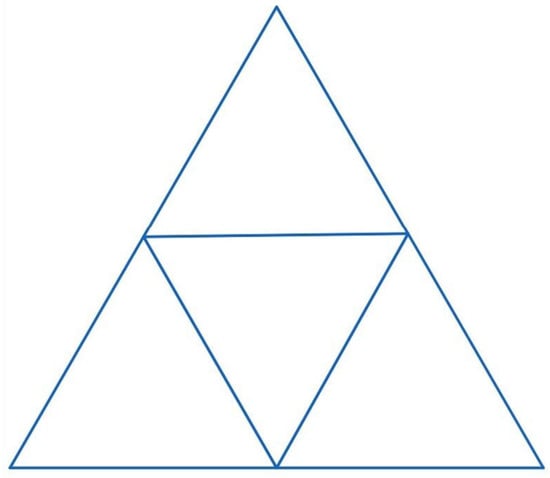
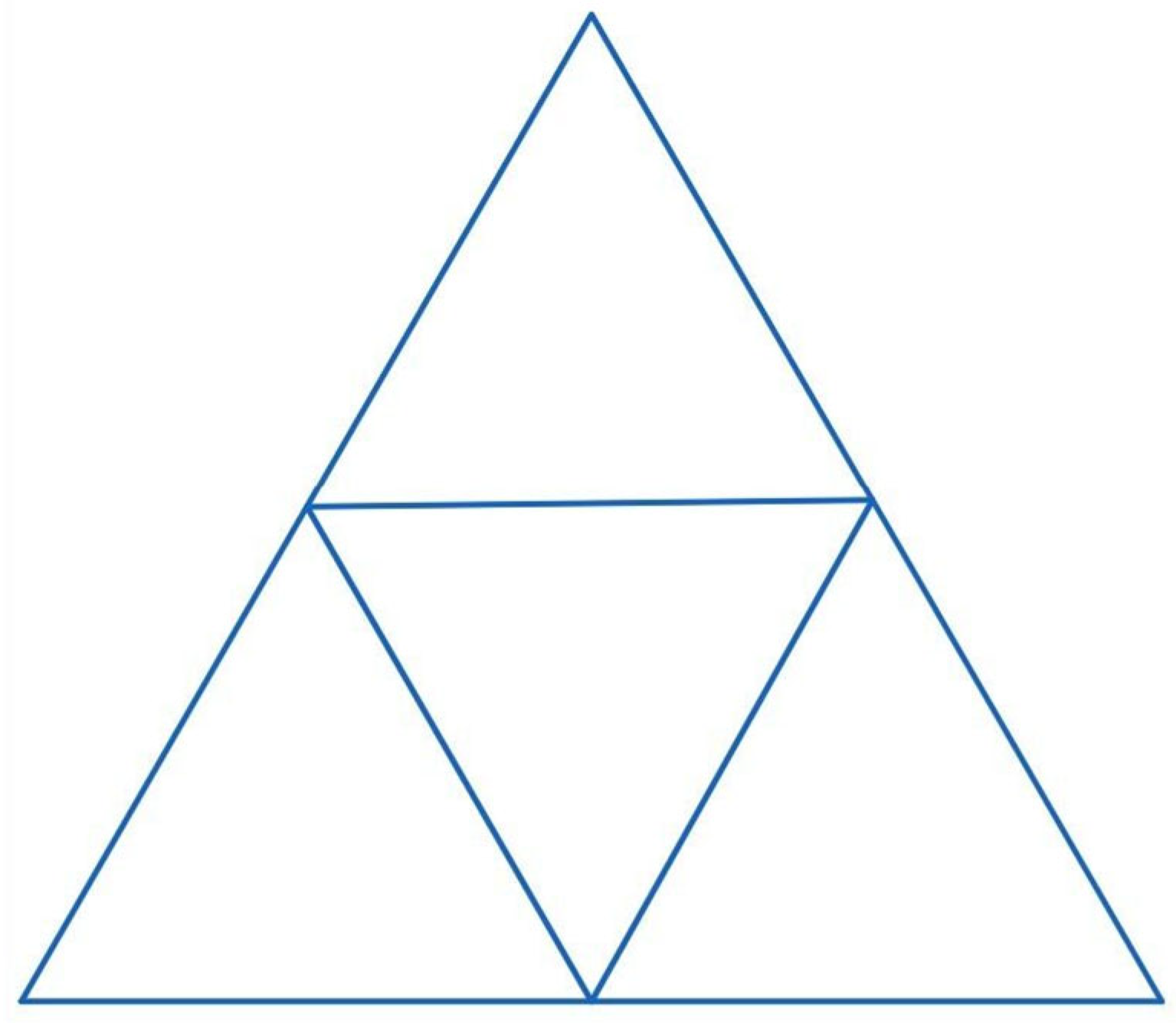
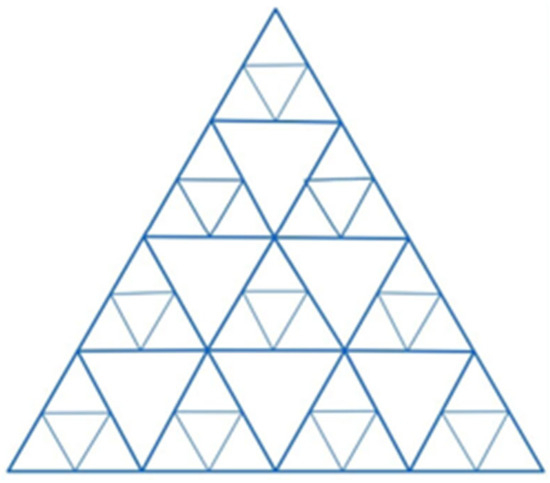
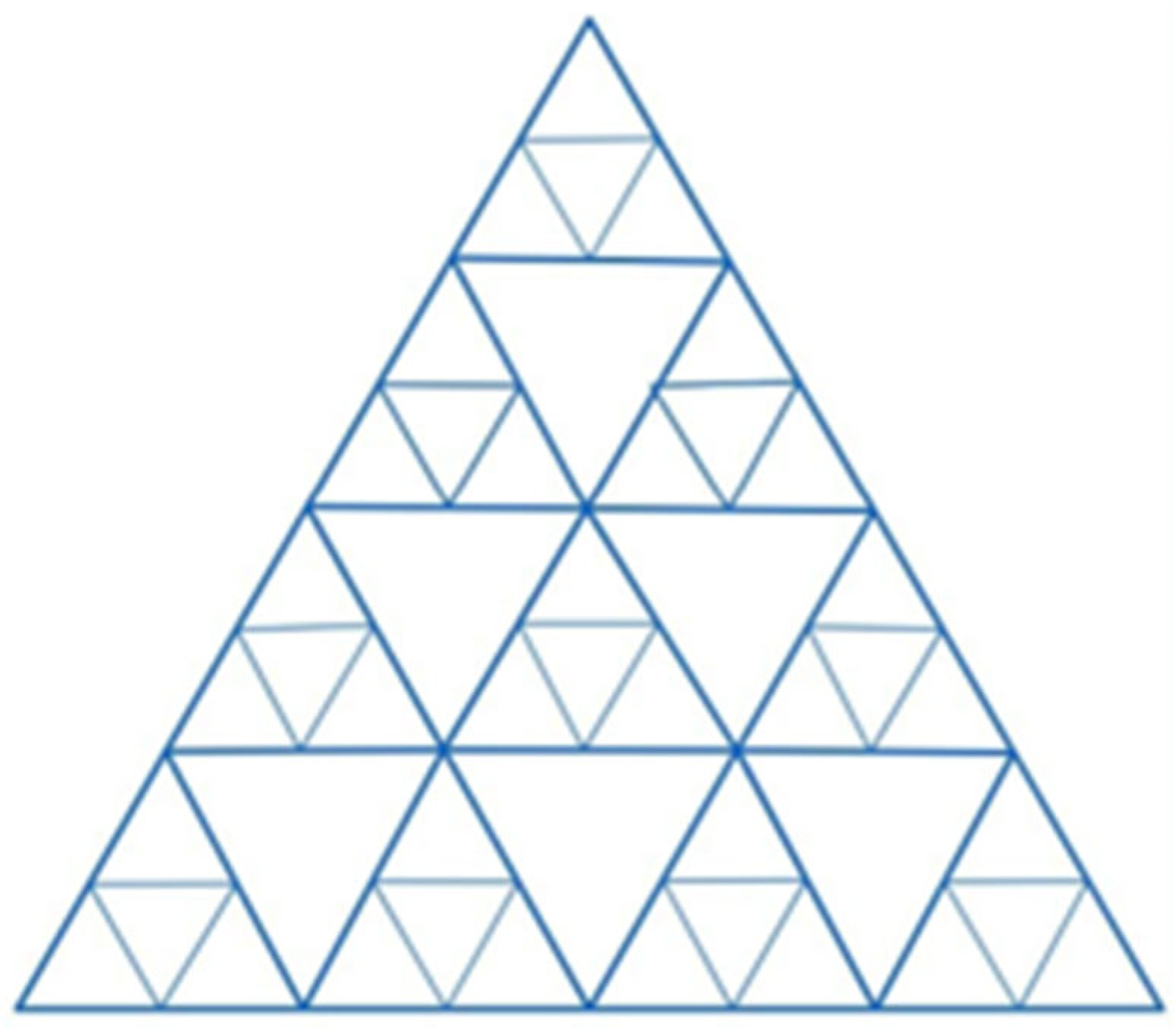
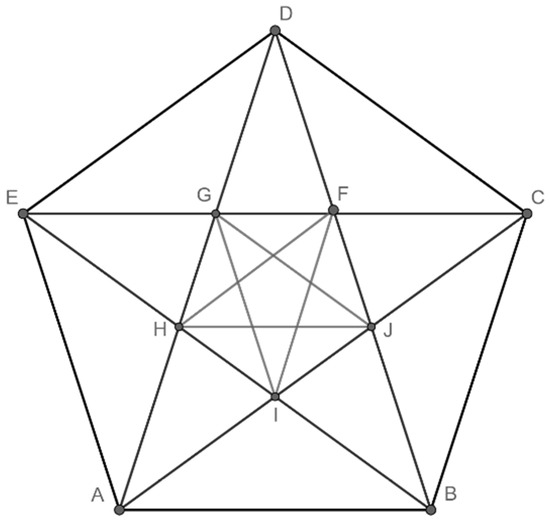
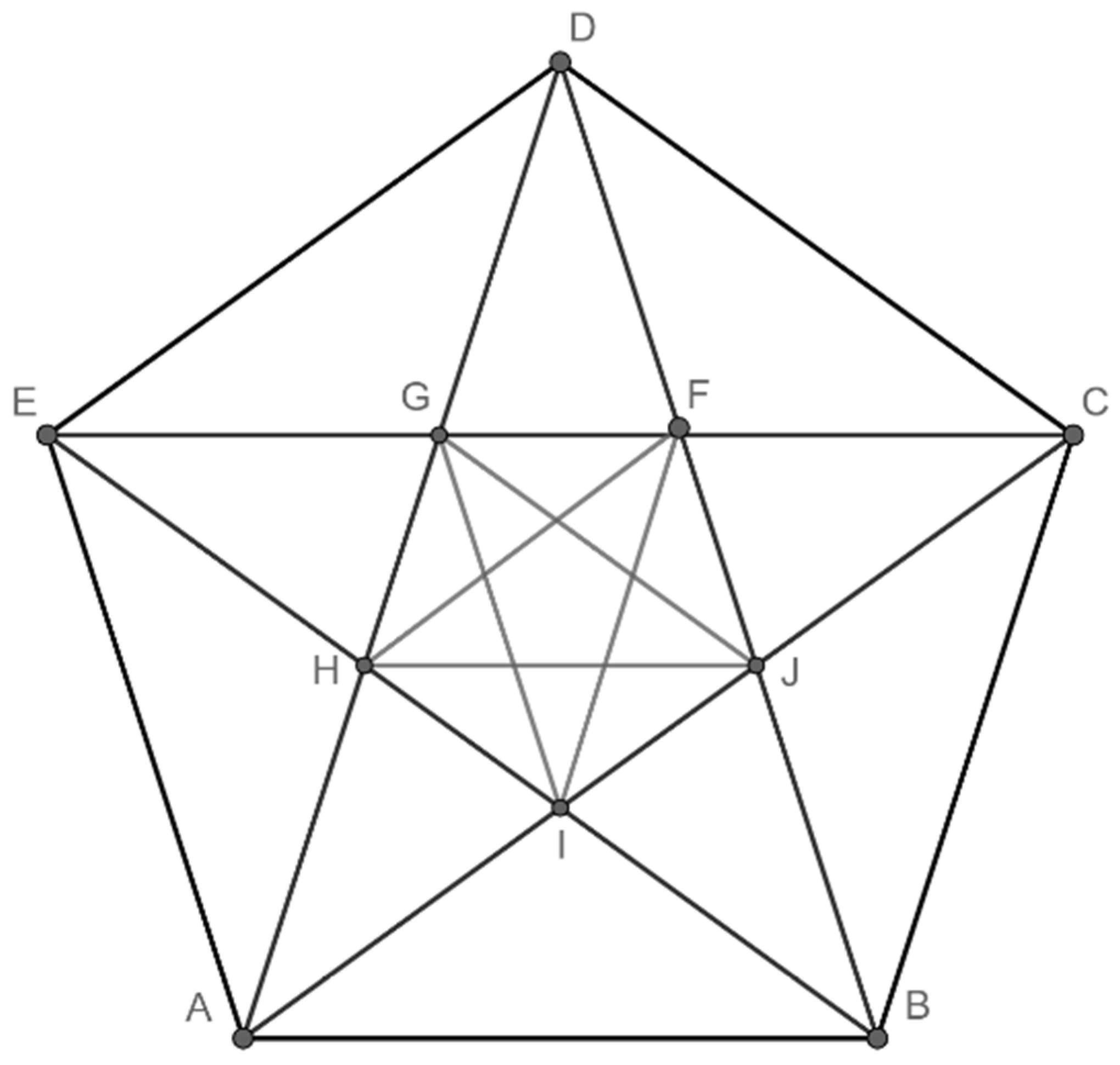
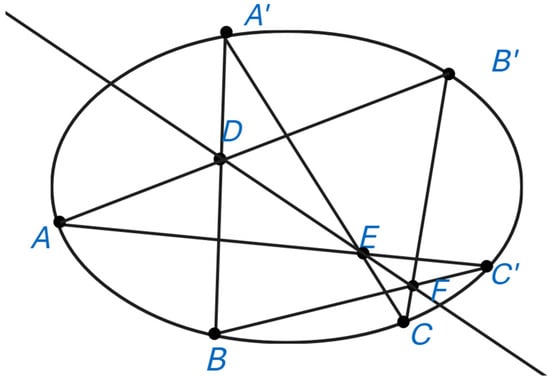
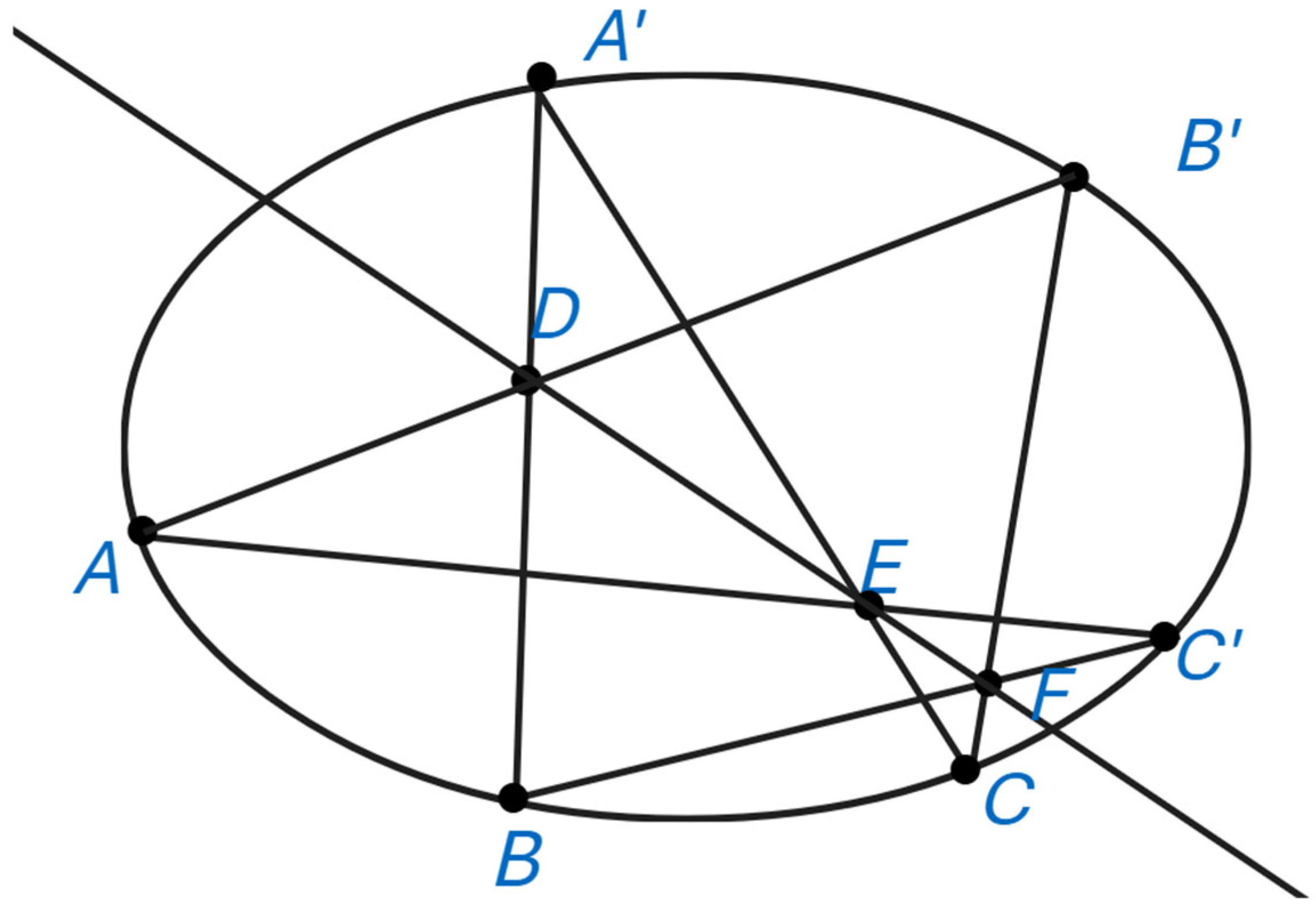
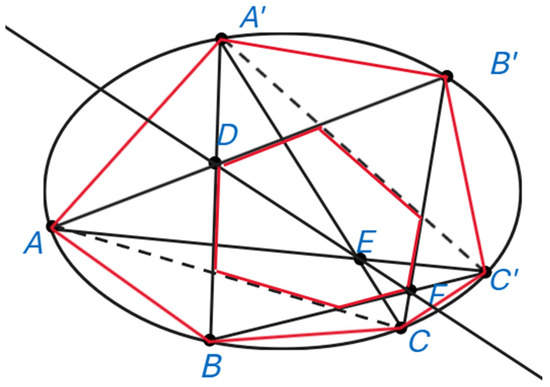
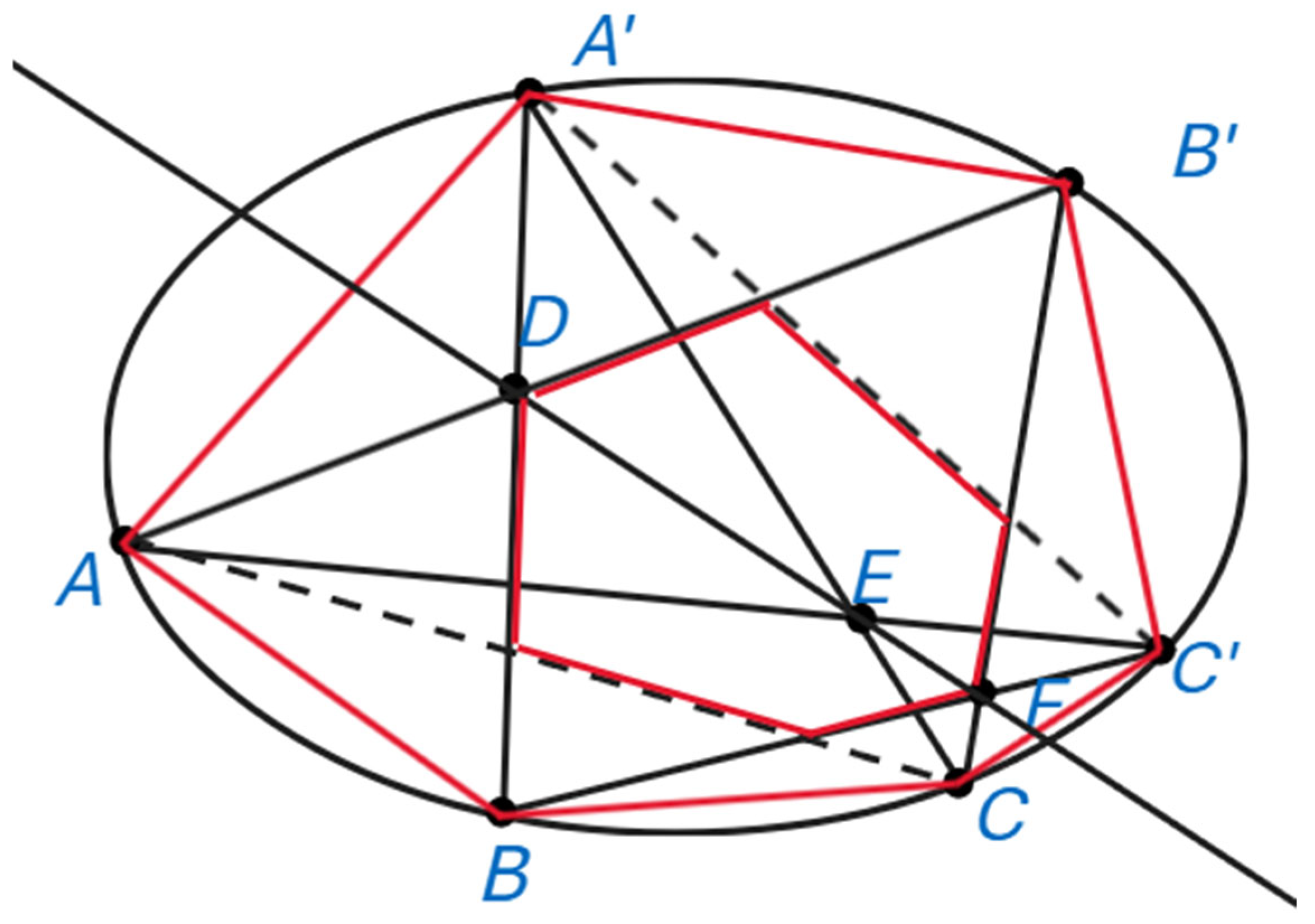
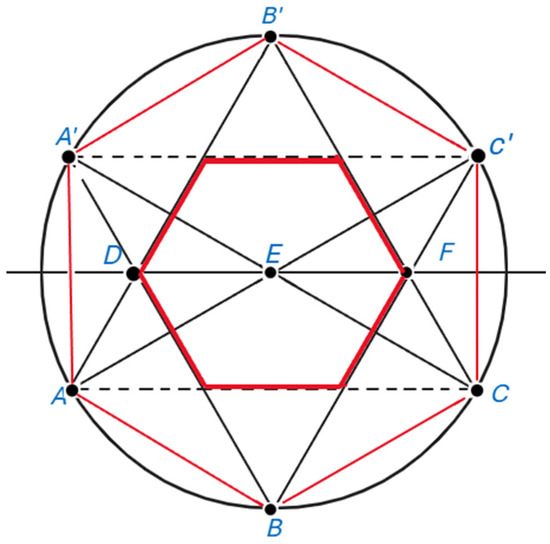
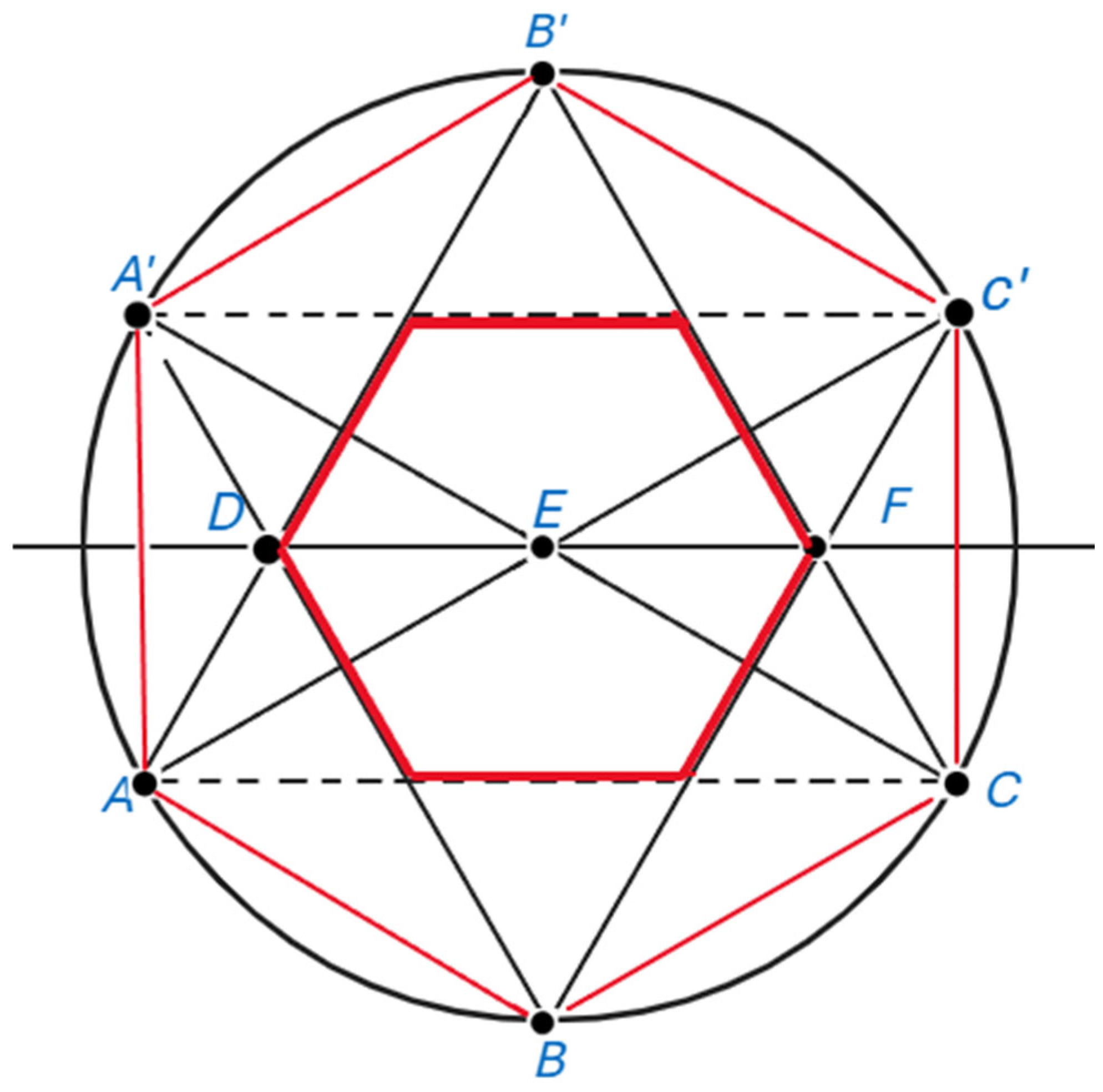
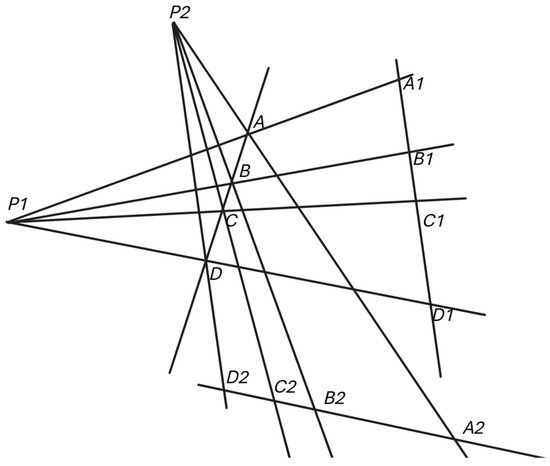
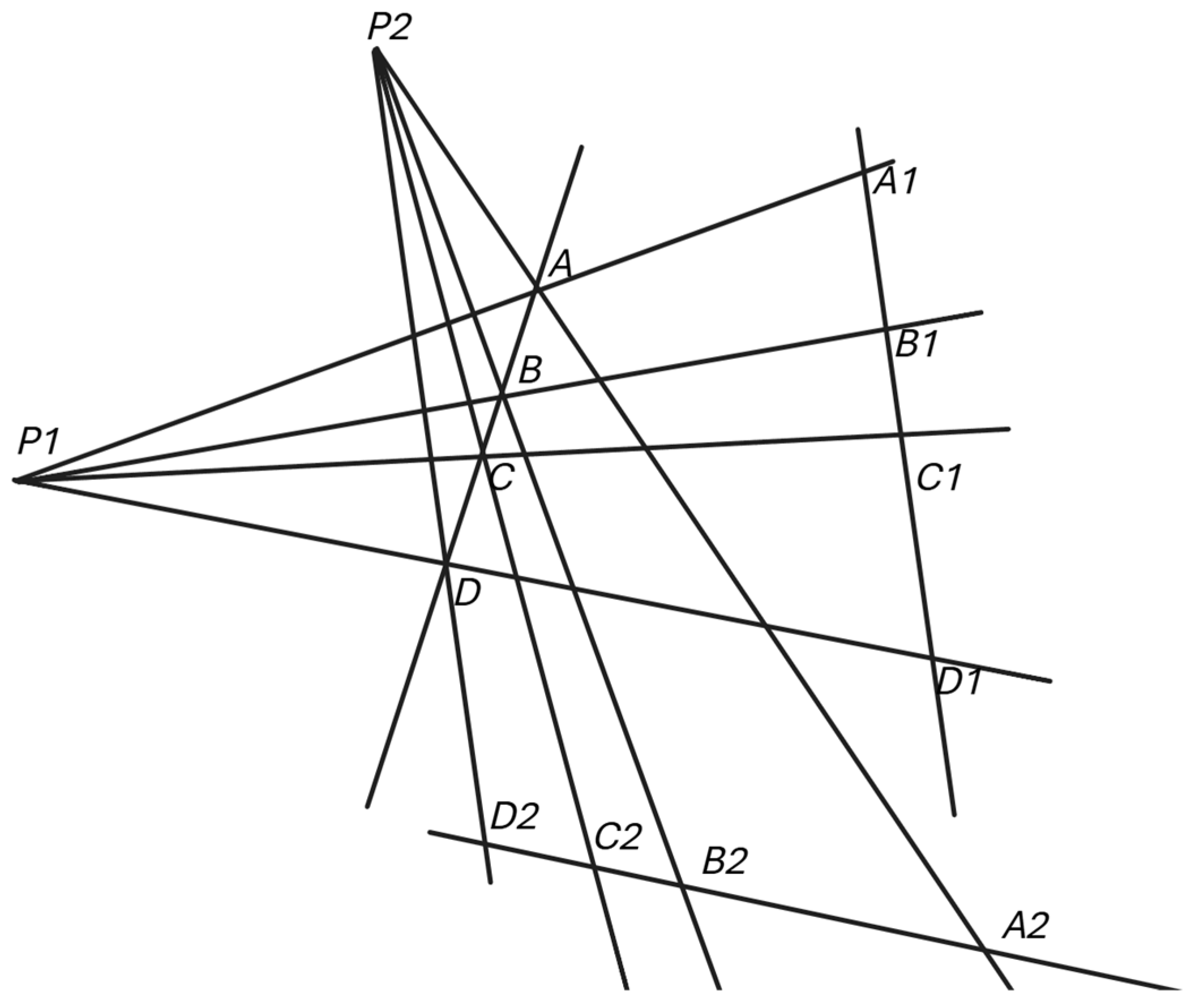
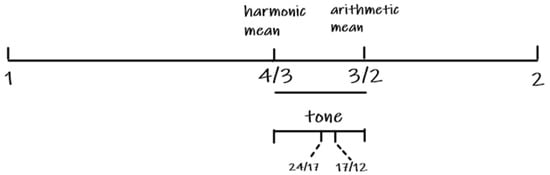
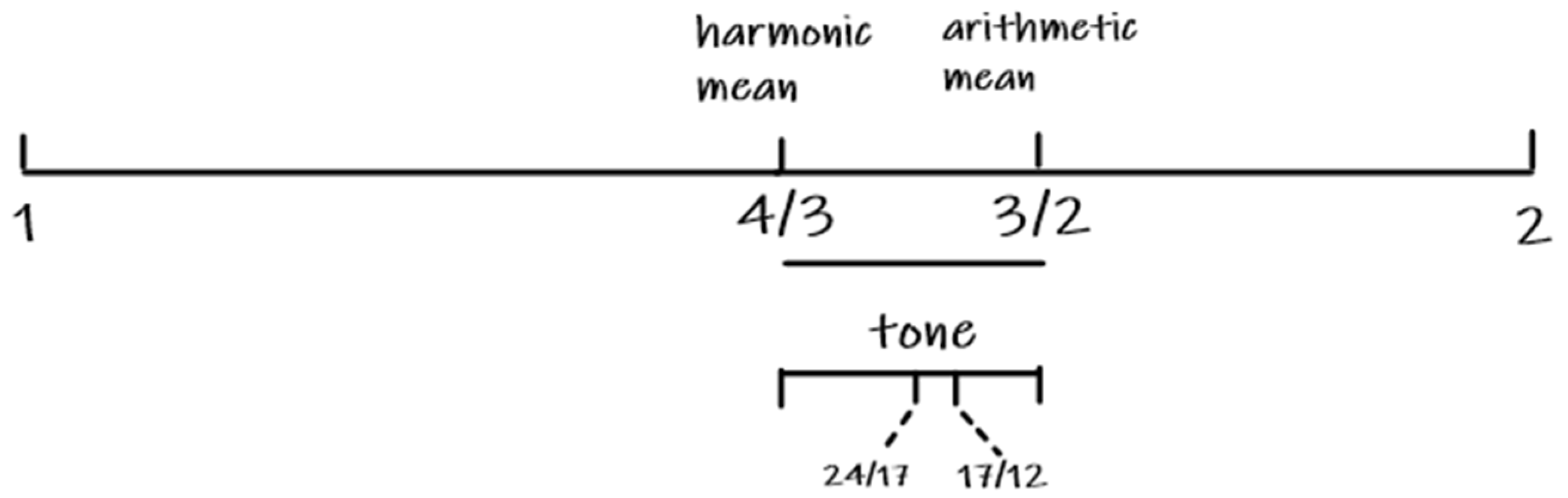
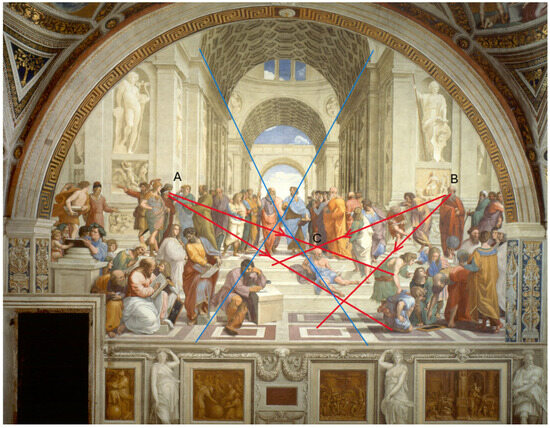
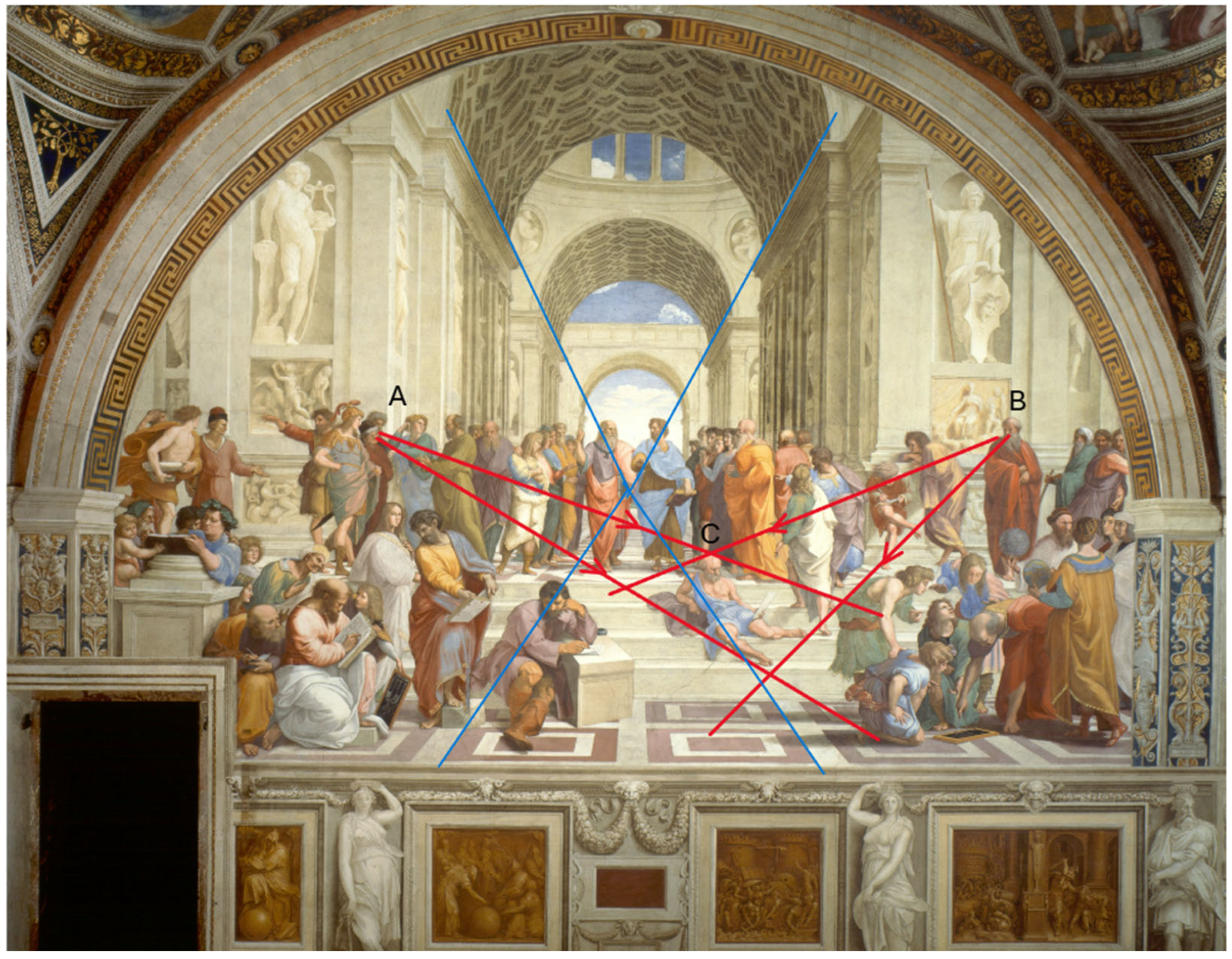
Disclaimer/Publisher’s Note: The statements, opinions and data contained in all publications are solely those of the individual author(s) and contributor(s) and not of MDPI and/or the editor(s). MDPI and/or the editor(s) disclaim responsibility for any injury to people or property resulting from any ideas, methods, instructions or products referred to in the content. |
© 2026 by the author. Licensee MDPI, Basel, Switzerland. This article is an open access article distributed under the terms and conditions of the Creative Commons Attribution (CC BY) license.