


Abstract
Epistemology remains tacitly anthropocentric: it treats knowledge as something produced and validated through human cognitive capacities such as understanding, intuition, and transparent justification. Yet contemporary science and artificial intelligence increasingly depend on non-human systems that generate mathematically valid results, empirically successful models, and operationally reliable inferences that no human can fully survey or interpret. This article develops xenoepistemics, a structural theory of non-anthropocentric knowledge. The central claim is that epistemic evaluation must be reformulated in terms of system-level properties—reliability, robustness, counterfactual sensitivity, and domain transfer—rather than mentalistic notions such as belief or understanding. I offer (i) a definition of xenoepistemic systems as systems that track structure in a target domain without requiring human-style semantic access; (ii) a minimal account of epistemic agency without minds that avoids trivialization; and (iii) a non-circular trust framework that distinguishes empirical success from epistemic legitimacy using independent validation regimes. This paper addresses a reflexive worry—that a human-authored theory cannot dethrone human epistemology—by separating standpoint from object: xenoepistemics is articulated by humans but is not about human cognition. I discuss the pragmatic value of xenoepistemic knowledge production, the limits of independent verification for opaque systems, domain-relative thresholds for xenoepistemic authority, and the problem of constitutionally human-inaccessible knowledge. Finally, I diagnose and formalize the Marcusian regress paradox: recurrent goalpost-shifting, whereby every machine competence is reclassified as irrelevant once achieved. Xenoepistemics reframes this debate by treating non-human knowledge as a present reality requiring new norms, not as a future curiosity.
1. Introduction: Knowledge After Anthropocentrism
Epistemology was built around a human prototype: a knower who believes propositions, provides reasons, and (ideally) understands what warrants assent. This human-centered picture is increasingly misaligned with contemporary knowledge production. Automated theorem provers yield proofs that are formally correct but not surveyable by typical human agents. Contemporary machine learning pipelines support scientific inference and decision-making through models whose internal representations are opaque, distributed, and non-intuitive [1,2]. In physics, chemistry, and astronomy, computational systems produce reliable inferences even when direct intervention, manipulation, or mechanistic interpretation is limited.
The philosophical literature offers a useful historical precedent: Churchland and Churchland’s Stalking the Wild Epistemic Engine [3] already pressed the idea of treating human cognition itself as a kind of natural machine—an information-processing system whose epistemic standing should be evaluated by its functional performance. Xenoepistemics extends and radicalizes this move: rather than using machine-like criteria to understand the human knower, it applies structural criteria directly to non-human systems, without requiring their reduction to human cognitive templates.
This paper develops xenoepistemics: the study and normative evaluation of non-human forms of knowledge. The aim is not to anthropomorphize machines; it is to replace anthropocentrism with a structural account of epistemic success and epistemic legitimacy. The proposal is deliberately ambitious but disciplined: it introduces minimal formal definitions and decision-relevant criteria, and it anchors philosophical claims in recurrent patterns across mathematics and science.
- The paper’s main contributions are as follows:
- 1.
- A definition of xenoepistemic systems and a structural characterization of xenoepistemic success.
- 2.
- A non-trivial notion of epistemic agency without minds (avoiding “everything is an epistemic agent”).
- 3.
- A non-circular trust framework for opaque systems (distinguishing works from warrants trust), including an account of the limits of the expert-checking chain for inscrutable systems.
- 4.
- A domain-relative analysis of xenoepistemic possibility, including the pragmatic value of xenoepistemic knowledge and the problem of constitutionally human-inaccessible knowledge.
- 5.
- A diagnosis and formalization of the Marcusian regress paradox as an obstacle to rational appraisal of AI competence.
- Core claims (to be defended).
For clarity and evaluability, the argument is organized around four claims that can be separately challenged:
- C1.
- Non-anthropocentric legitimacy: epistemic legitimacy can be defined and assessed at the level of non-human systems without appeal to human-style understanding or belief.
- C2.
- Structural sufficiency: In high-stakes domains, the correct evaluative target is a vector of structural properties (reliability, robustness, counterfactual sensitivity, transfer) grounded in independent validation regimes.
- C3.
- Agency without minds: a non-trivial notion of epistemic agency is available without consciousness or intentionality, provided the system satisfies autonomy, generalization, and counterfactual responsiveness.
- C4.
- Practice shift: Contemporary mathematics and simulation-based science already instantiate xenoepistemic regimes: epistemic authority is increasingly distributed across proof/validation ecologies rather than residing in individual human cognition.
- Roadmap.
Section 2 locates the proposal within adjacent epistemological programs (reliabilism, naturalized epistemology, simulation-based science, and interpretability debates). Section 3 introduces core definitions. Section 4 proposes minimal epistemic agency conditions. Section 5 develops a non-circular trust framework and addresses the chain-of-expertise problem for inscrutable systems. Section 6 clarifies embodiment: xenoepistemics is de-anthropomorphized, not disembodied. Section 7 anchors the framework in automated mathematics and computational science, includes a worked contrast between anthropocentric and xenoepistemic validation, introduces a taxonomy of research modes, and discusses domain-relative thresholds. Section 8 addresses domain-relative xenoepistemic possibility and the pragmatic value of xenoepistemic knowledge. Section 9 formalizes the Marcusian regress. Section 10 addresses the main objections including epistemic responsibility, the relation to XAI, and the self-knowledge requirement. Section 11 and Section 12 conclude with implications and a summary of the resulting research agenda.
2. Background and Motivation
2.1. From Human Reasons to Structural Properties
Classical epistemology privileges transparency: to know is to be able (in principle) to give reasons that can be understood by other human knowers. But many high-performing systems in AI and computational science deliver outputs that are stable and accurate without being human-interpretable. This tension is a defining feature of computational and simulation-based science, where in silico models function as epistemic engines even when their internal dynamics are only partially accessible to human understanding [4,5]. This produces a familiar dilemma: either deny epistemic status to such outputs (because they lack understanding) or expand epistemic criteria beyond understanding [6].
Xenoepistemics chooses the second route but avoids a simplistic move: it does not reduce epistemology to “whatever works.” Instead, it distinguishes the following:
- Epistemic success: Achieving accurate, stable tracking of relevant structure.
- Epistemic legitimacy: Meeting norms of warranted trust under independent validation.
2.2. Is Xenoepistemics an Existing Field? Justifying a New Term
Xenoepistemics is not an established field in the technical sense. There is currently no stable research community, canonical definition, or shared methodological framework operating under this label in philosophy, artificial intelligence, or science studies. While several adjacent fields of the literature partially overlap with the concerns addressed here—including philosophy of artificial intelligence, social epistemology, naturalized epistemology, explainable AI, and posthuman epistemologies—none provide a unified account of non-human knowledge production with explicit normative criteria independent of human cognition.
Existing terminologies systematically fall short. “AI epistemology” and “machine epistemology” typically retain a human-centered perspective, focusing on how humans should interpret or supervise algorithmic outputs. “Hybrid intelligence” and “human-in-the-loop” frameworks presuppose the continued epistemic authority of human cognition. By contrast, posthuman or non-human epistemologies often emphasize political or ethical dimensions while lacking formal criteria for epistemic legitimacy.
The neologism xenoepistemics is therefore introduced to designate a specific conceptual gap: the need for a theory of knowledge produced by systems whose epistemic success does not depend on human understanding, intuition, or semantic access. The prefix “xeno-” (from xenos, foreign or non-native) is used in a strictly technical sense, denoting epistemic processes that are structurally alien to human cognition rather than speculative or fictional forms of intelligence. This proposal is compatible with an informational framing of epistemic systems: non-human agents can be understood as information-transforming and structure-tracking devices whose epistemic standing is determined by constraint, validation, and robustness rather than by semantic transparency [7].
Xenoepistemics thus names a domain of inquiry that is already empirically instantiated but theoretically underdescribed. The novelty of the proposal lies not in rebranding existing positions but in making explicit a shift that contemporary scientific and computational practice has already forced: from anthropocentric epistemology to structural evaluation of non-human epistemic systems.
2.3. Relation to Existing Views
Xenoepistemics is compatible with reliabilist intuitions but not reducible to classical reliabilism [8]. The novelty is not merely to privilege reliability; it is to de-center the human knower as the default epistemic agent and to treat non-human systems as first-class objects of epistemic evaluation, with norms tailored to their structural properties.
Likewise, xenoepistemics is adjacent to naturalized epistemology but is not simply “epistemology as psychology” [9]; it is epistemology as systems analysis of knowledge-producing assemblages, including computational and scientific infrastructures, while preserving explicitly normative criteria for epistemic legitimacy.
2.4. Related Work and Conceptual Neighbors
Xenoepistemics intersects multiple fields of the literature but cannot be reduced to any single one. To make the novelty claim falsifiable, Table 1 distinguishes xenoepistemics from its closest conceptual neighbors. The key difference is the relocation of epistemic evaluation from human cognitive access to system-level structural properties under independent validation regimes [4,5,10,11,12].
Table 1.
Conceptual neighbors of xenoepistemics.
Remark 1.
The claim is not that prior work is mistaken, but that contemporary research practice has created a new class of epistemic objects: systems that can generate, stabilize, and validate successful outputs without requiring human-level semantic access. This shift is visible both in simulation-driven scientific methodology and in the opacity/interpretability debates surrounding contemporary machine learning [4,5,10,11].
- Unifying constraint.
Across these neighboring programs, xenoepistemics imposes a single unifying constraint: epistemic legitimacy must be assessable at the system level by stable structural criteria (reliability, robustness, counterfactual sensitivity, and transfer) under independent validation regimes, even when human semantic access is limited or unavailable.
- Normative inevitability.
Xenoepistemics is not introduced here as a merely optional “extension” of epistemology. It becomes methodologically unavoidable whenever the production and stabilization of successful scientific or mathematical outputs outstrip human surveyability and semantic access. In such regimes, insisting that epistemic legitimacy requires human-understandable justification does not merely raise standards; it changes the subject by excluding epistemic engines that are already integral to contemporary knowledge production. The minimal alternative is to relocate normative assessment from the standpoint of the human knower to system-level criteria that remain applicable under scale, opacity, and distributed agency.
3. Core Definitions: Xenoepistemic Systems and Success
I introduce minimal formalisms to make the proposal evaluable without forcing a full axiomatization.
- Terminological convention.
Throughout this paper, the expression epistemic legitimacy is used as the general normative notion. The qualifier xenoepistemic is introduced only when contrast with human-centered epistemic evaluation is at issue. This convention is intended to emphasize that the proposed norms are not domain-specific curiosities but rather general criteria applicable to any knowledge-producing system once anthropocentric assumptions are relaxed.
3.1. Preliminaries
Let
- D be a domain (mathematical, physical, chemical, astronomical, etc.).
- denote the target structure in that domain (truth conditions, invariants, causal structure, lawful regularities).
- S be a system (algorithm, model, pipeline, hybrid socio-technical assemblage).
- be the outputs of S (predictions, proofs, classifications, discovered laws, etc.).
Definition 1 (Structural Tracking).
A system S tracks structure in domain D if there exists a mapping Φ from inputs in D to outputs , such that preserves (up to tolerated error) domain-relevant invariants of under appropriate perturbations.
Definition 2 (Xenoepistemic System).
A system S is xenoepistemic in domain D if
- 1.
- S structurally tracks (as above), and
- 2.
- epistemic evaluation of S cannot be exhausted by human-style cognitive access (e.g., semantic transparency, intuitive surveyability, or human-understandable justification).
Definition 3 (Xenoepistemic Success).
S achieves xenoepistemic success in D if it meets domain-appropriate thresholds on
- 1.
- Reliability : stable performance on relevant tasks,
- 2.
- Robustness : stability under perturbations and distribution shifts,
- 3.
- Counterfactual sensitivity : output variation aligns with plausible counterfactual changes in , and
- 4.
- Transfer : generalization beyond the narrow regime of training or calibration.
3.2. Why These Criteria? Minimal Closure Under Scale and Opacity
The quartet is not ad hoc. It is a minimal set of system-level constraints that remains stable under (i) increasing model complexity, (ii) distribution shift, and (iii) limited semantic access. Reliability alone is insufficient because high performance can be fragile (hence robustness). Robustness without counterfactual sensitivity permits spurious stability (e.g., invariance to the wrong perturbations). Counterfactual sensitivity without transfer permits overfitting to a narrow intervention regime. Transfer without robustness collapses under shift. Together, these criteria form a minimal “closure” of epistemic assessment under scale: each one repairs a predictable failure mode of the others when systems become opaque, distributed, and non-surveyable.
A note on measurability is warranted here, in response to the worry that Definitions 6 and 7 introduce spurious precision: that such quantities may not be measurable in practice, or that a formalizable method of measuring them will systematically omit what cannot be easily quantified. This worry has real force. The response is twofold. First, the framework does not presuppose that R, , C, and T are always measurable with precision; rather, it demands that these are the correct targets of epistemic assessment, even when their measurement is approximate, domain-dependent, or only partially achieved. An economist who acknowledges that some goods have inestimable value is not thereby committed to assigning them zero value; similarly, a xenoepistemic framework that acknowledges partial measurability is not committed to treating unmeasured dimensions as if they do not exist. Second, each criterion corresponds to a class of practically realized test procedures: out-of-distribution benchmarks (reliability), stress tests and adversarial probes (robustness), intervention studies and ablation analyses (counterfactual sensitivity), and cross-domain performance evaluation (transfer). These are not idealized abstractions; they are already standard components of rigorous AI evaluation. The formal definitions give a normative anchor; the measurement practices give operational content.
This does not claim that exhausts epistemic virtues. It claims only that any adequate normative framework for xenoepistemic systems must at least control these four failure modes if it is to distinguish genuine structure-tracking from accidental success.
3.3. Why “Understanding” Is Not a Necessary Condition
The thesis knowledge without understanding is not a dismissal of understanding. It is a claim about necessity:
Proposition 1 (Non-Necessity of Human Understanding).
If there exist xenoepistemic systems that reliably and robustly track under independent validation while remaining non-surveyable by human agents, then human-understandable justification is not a necessary condition for epistemic success in D.
This proposition is modest: it does not claim that understanding is never valuable; it claims only that epistemic evaluation must permit success without it.
4. Epistemic Agency Without Minds
A central danger is trivialization: if “epistemic agency” is defined too weakly, then thermometers, rulers, and lookup tables become epistemic agents. Xenoepistemics therefore requires a non-trivial minimal agency criterion.
Definition 4 (Minimal Epistemic Agency).
A system S is a minimal epistemic agent in D if it satisfies all of the following:
- 1.
- Autonomous updating: S can revise internal states or models in response to new evidence.
- 2.
- Non-trivial generalization: S can succeed outside the exact set of previously encountered instances.
- 3.
- Counterfactual responsiveness: Under relevant interventions or perturbations, S exhibits systematic sensitivity aligned with rather than spurious cues.
Remark 2.
This definition does not require consciousness, intentionality, or phenomenology. It is de-mentalized but not behaviorally vacuous.
Remark 3.
Minimal epistemic agency is role-relative and task-indexed: it attributes agency to a system only with respect to a domain D and an updating–generalization–counterfactual profile that cannot be reduced to a fixed-input instrument. This blocks trivial artifacts (e.g., thermometers, lookup tables) without reintroducing mentalistic criteria.
Remark 4.
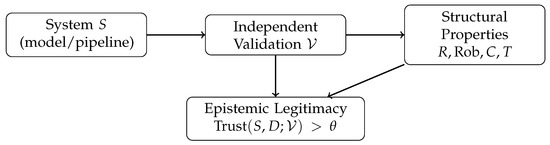
Figure 1 illustrates how xenoepistemic legitimacy emerges from structural performance under independent validation, rather than from human-accessible semantic justification.
Figure 1.
Xenoepistemic evaluation pipeline: legitimacy is grounded in independent validation regimes and structural properties, not in human-style semantic access.
Why Hybrid Human–AI Models Are Not Sufficient
Much contemporary work on artificial intelligence adopts hybrid frameworks in which humans remain “in the loop” as supervisors, validators, or ultimate epistemic authorities. While such models are appropriate for many practical applications, they are conceptually insufficient for analyzing epistemic regimes in which non-human systems exhibit autonomy, generalization, and counterfactual sensitivity beyond human cognitive capacities.
Hybrid frameworks presuppose that human understanding remains the final criterion of epistemic legitimacy. This assumption fails in multiple domains already discussed in this paper, including automated mathematics, large-scale simulation science, and causal discovery from observational data. In these contexts, human intervention is often procedural rather than epistemic: humans configure systems and validation protocols, but they do not supply the justificatory content that underwrites epistemic success.
Xenoepistemics therefore treats hybrid human–AI systems as a special case rather than the default model of knowledge production. Its primary object is epistemic autonomy: situations in which a system can generate, stabilize, and validate knowledge claims without requiring human cognitive participation at the level of representation or inference. Recognizing this autonomy is necessary not to diminish the human role, but rather to correctly characterize where epistemic authority is actually located in contemporary research practices.
5. Norms for Trust Without Circularity
A reviewer will press the following worry: “You trust opaque systems because they work; you know they work because you trust them.” This concern is sharpened by the fact that opacity is not accidental but often structural in contemporary machine learning and socio-technical inference pipelines [10,11,12]. Xenoepistemics avoids this circularity by requiring independent validation regimes. Figure 1 summarizes the resulting evaluation logic: legitimacy is not inferred from interpretability but from performance under independent validation, together with structural diagnostics that probe robustness, counterfactual sensitivity, and transfer.
5.1. Independent Validation Regimes
Definition 5 (Independence Condition).
A validation regime for system S in domain D is independent if performance evidence does not depend on assumptions that are themselves outputs of S (or its closely coupled proxies).
5.2. Degrees of Independence
In practice, independence is rarely all-or-nothing. Large epistemic pipelines couple data, model choice, and evaluation procedures in ways that can partially “leak” assumptions from system outputs back into validation. Xenoepistemics therefore treats the Independence Condition as a limit ideal and introduces degrees of independence as an explicit normative variable.
Definition 6 (Independence Degree).
Let be a validation regime for S in domain D. The independence degree measures the extent to which evidential support for S avoids reliance on assumptions, labels, or proxies generated by S (or tightly coupled surrogates). Higher values correspond to greater separation of evidential sources from the system under test.
Remark 5.
This graded notion strengthens normativity: it allows epistemic appraisal even when perfect independence is unattainable, while still penalizing validation architectures that are self-confirming by construction.
- Examples and definitions.
Independent checks include the following:
- Out-of-distribution evaluation,
- Adversarial or stress testing,
- Cross-laboratory replication (for scientific pipelines),
- Ablation and causal probing (for learned representations), and
- Prediction of novel phenomena later confirmed by measurements.
5.3. Trust Function
A purely additive score is useful but incomplete: it ignores whether the evidence base is independent and whether performance is stable under epistemically relevant shifts. I therefore model trust as a validation-indexed quantity.
Definition 7 (Validation-indexed trust).
Let be a validation regime satisfying the Independence Condition. Define
where is an independence indicator (1 only if is independent in the technical sense), and is an uncertainty/instability penalty capturing calibration error, distribution shift sensitivity, and brittleness under stress tests. The weights are domain- and stakes-dependent, and fixes the penalty strength.
Remark 6.
This formulation makes explicit what reviewers routinely demand: (i) independence is non-negotiable ( collapses trust), and (ii) success under nominal benchmarks is insufficient if uncertainty and shift-instability remain high.
In computer-assisted mathematics, the “independence indicator” I is often realized concretely by proof-checker separation: the system that proposes proof steps (human or LLM-guided search) is distinct from the proof assistant’s kernel; that is, the small trusted core of the checker that mechanically verifies whether each step follows the formal rules of the system. This provides a paradigmatic implementation of independence by architecture.
Remark 7.
This makes normativity operational (structural) rather than semantic: what matters is how the system behaves under disciplined tests, not whether humans can narrate its internal reasons.
5.4. Failure Modes: When Structural Success Misleads
Xenoepistemic evaluation must explicitly address the standard pathologies of opaque systems. The most important are as follows:
- Spurious structure tracking: Apparent success driven by shortcuts or confounders rather than .
- Shift fragility: Performance collapse under distribution shift, instrumentation change, or regime change.
- Goodhart-style collapse: Optimization for proxies of that decouple from under pressure.
- Validation leakage: Subtle dependence of on S via shared data pipelines, tuning feedback, or proxy reuse.
The Independence Condition blocks the last failure mode by design. The others are addressed by the penalty term and by requiring counterfactual probes and stress tests as first-class epistemic norms rather than optional engineering checks.
5.5. The Chain-of-Expertise Problem for Inscrutable Systems
A deeper challenge for independent validation concerns the chain of expertise: in the human case, epistemic trust terminates in a community of practitioners who check each other, and crucially, it requires less epistemic competence to check a result than to produce it. This asymmetry allows non-experts (“the folk”) to check expert checkers, and expert checkers to check domain experts, forming a trust chain that is ultimately anchored in surveyable outputs. What happens when this chain encounters AI systems whose outputs are not surveyable?
The problem is sharpest in theoretical contexts. Suppose an AI program produces a claimed proof of Goldbach’s conjecture that depends on a lemma, asserting that if a property holds for all primes below some large N, it holds for all primes. How do we assess whether the system is tracking a genuine mathematical truth rather than systematically treating high-probability claims as proven? If all AI systems used in number theory share a training provenance or architectural tendency to over-generalize from large finite samples, the usual checking procedure—one expert system verifying another—may merely propagate a correlated error.
Xenoepistemics addresses this in three ways. First, the architecture of independence: the validation kernel should be structurally and developmentally distinct from the system under evaluation. In formal mathematics, this is realized by proof-checker separation (e.g., Lean or Coq verifying steps proposed by an LLM or human). The checker is not merely another AI system of the same family; it operates on a formally specified, human-audited kernel—that is, the minimal trusted component implementing the proof system’s inference rules and mechanically checking derivations against them—whose correctness does not depend on the proposing system. This is analogous to the surveyability asymmetry in the human case: even if a human cannot follow all the steps of an AI-proposed proof, a proof assistant can verify each step against a fixed formal grammar, and the grammar itself is surveyable.
Second, calibration against known cases: before extending trust to genuinely novel outputs, a xenoepistemic validation regime should require that the system succeed on a comprehensive set of problems whose solutions are independently established. This provides a prior track record that is not subject to the same systematic bias concerns as a single novel output.
Third, and most importantly, domain-relative surveyability: the depth at which the trust chain must terminate in surveyable human judgment is domain-dependent. In formal mathematics with proof checkers, the trust chain terminates in the formal specification of the checking kernel—a much smaller, surveyable artifact than the proof itself. In empirical domains, the chain terminates in experimental measurements and replication results. The chain does not need to trace back all the way to individual human comprehension of every inference step; it needs to terminate in an architecturally independent and humanly auditable anchor. Xenoepistemics requires specifying what that anchor is for each domain, not eliminating the human role in the chain, but localizing it at the point where audit is genuinely feasible.
6. Embodiment: De-Anthropomorphized, Not Disembodied
The proposal is not disembodied in the strong sense. It rejects phenomenological embodiment as a requirement for knowing, but it affirms physical and causal embeddedness. This is compatible with extended-cognition approaches that treat cognitive and epistemic functions as distributed across agents, artifacts, and environments, while still insisting that epistemic legitimacy depends on causal embeddedness and disciplined validation rather than on human-accessible understanding [13].
Definition 8 (Causal Embeddedness).
A system S is causally embedded in D if its inputs are generated by processes in and its outputs can be checked or constrained by interventions, measurements, or empirical consequences in (directly or indirectly).
Remark 8.
Xenoepistemics is compatible with “knowledge by simulation” and “inference without access” (e.g., astronomy), but it does not collapse into abstract platonism because epistemic legitimacy still depends on causal embeddedness and independent validation.
7. Domain Anchors: Mathematics and Inhuman Science
This section shows how the framework applies across domains without turning into a mere list of examples. The point is structural recurrence. In each domain, the same evaluative variables recur: reliability and robustness under perturbation, counterfactual sensitivity to relevant structure, and transfer beyond the calibration regime.
7.1. A Worked Contrast: Anthropocentric vs. Xenoepistemic Validation
To make the proposed shift concrete, consider the same epistemic task evaluated under two different normative frameworks. The task is predicting protein folding structures from amino acid sequences—a domain in which AI systems have recently achieved results that substantially outperform human expert methods.
Under the anthropocentric view, epistemic legitimacy for a predicted structure requires the following: (1) a human-intelligible mechanistic account of why the sequence folds as it does (e.g., reference to known hydrophobic interactions, secondary structure formation rules, and thermodynamic principles); (2) derivability from a theoretical framework that a trained biochemist can survey and critique; and (3) validation by a community of domain experts who can follow and assess the justificatory chain. In this view, a system that produces highly accurate predictions without providing a mechanistic narrative is producing instruments rather than knowledge. It generates useful outputs, but it does not know why they are correct.
Under the xenoepistemic view, epistemic legitimacy is assessed structurally and independently of human intelligibility: (1) Reliability: The system achieves stable, high accuracy on held-out structures across organism types and sequence families. (2) Robustness: Performance is stable under point mutations, domain deletions, and homology-reduced subsets, indicating that success does not depend on memorization of training examples. (3) Counterfactual sensitivity: When structurally important residues are ablated, predicted structures change in ways that align with known folding determinants, showing that the system is tracking genuine structural dependencies rather than surface correlates. (4) Transfer: The system generalizes to entirely novel folds not represented in training data, including orphan proteins and de novo designed sequences. These four criteria are assessed under an independent validation regime: benchmark datasets held back from training, blind prediction challenges, and cross-laboratory experimental confirmation.
The key difference is not merely that the xenoepistemic view is more permissive. It is that it identifies a different evaluative object: not the internal reasoning of the system, but the structural relationship between the system’s input–output profile and the target domain. Under the xenoepistemic framework, the legitimacy question becomes the following: Does independent validation confirm that the system is tracking the actual determinants of protein structure, as opposed to spurious correlates? Experimental mutagenesis studies that confirm predicted structural effects, and blind predictions of novel structures later confirmed by X-ray crystallography, provide exactly the kind of domain-anchored, independent confirmation that grounds xenoepistemic trust.
The anthropocentric view would classify such a system as occupying the “Instrument-assisted science” row of Table 2: the system is a useful tool, but epistemic authority remains with the human biochemist who interprets its outputs. The xenoepistemic view reclassifies it, at minimum, as “Automated AI pipelines” (proto-xenoepistemic) once cross-domain transfer and counterfactual sensitivity are established under independent validation—and as “Self-learning AI” (xenoepistemic) in domains where the system discovers structural determinants not previously known to human researchers.
Table 2.
Taxonomy of epistemic research modes.
7.2. Automated Mathematics: Proof Without Surveyability
Automated theorem proving introduces a distinctive xenoepistemic tension: validity can be formally guaranteed, while human comprehension fails. Here, epistemic success often outruns human epistemic access. Xenoepistemics recommends separating the following:
- formal validity (machine-checkable correctness),
- human intelligibility (optional but valuable), and
- epistemic legitimacy (trust grounded in independent verification, e.g., proof checkers, redundancy).
7.2.1. A Minimal Worked Distinction: Validity, Surveyability, Intelligibility
Automated mathematics makes visible a three-way distinction that xenoepistemics generalizes. First, validity concerns formal correctness (e.g., derivability within a proof system). Second, surveyability concerns whether finite human agents can feasibly check or follow the proof steps. Third, intelligibility concerns whether the proof yields a graspable explanatory route—for example, by connecting to known lemmas, strategies, or conceptual schemas.
Xenoepistemics does not collapse these notions. It allows cases in which validity is secured without surveyability or intelligibility, while preserving epistemic legitimacy via independent validation (e.g., redundant proof checkers, proof translation into multiple formalisms, or cross-verification by distinct automated systems). This is a paradigm instance of normativity without semantic transparency.
7.2.2. The New Mathematics Era: Proof Ecology and Computer-Assisted Practice
Recent mathematical practice increasingly operates in a mixed regime in which proofs are not merely written but engineered across interacting layers: conjecture generation, formal verification, library reuse, translation between informal and formal languages, and machine-assisted exploration of large combinatorial spaces. In this setting, epistemic assessment shifts from evaluating a single human-authored proof to evaluating an entire proof ecology: a coupled assemblage of human mathematicians, proof assistants, automated provers, curated libraries, and (increasingly) large language models used for search, compression, and heuristic guidance [14,15]1.
- A concrete micro-case: Erdős-style workflows with LLM assistance and formal verification.
A useful “stress test” of xenoepistemics is to track a full epistemic pipeline end-to-end in a setting where (i) a human produces an argument, (ii) an AI system supplies a missing technical component, and (iii) a proof assistant stabilizes the result under a mechanically checkable regime. Recent reports around work on specific Erdős problems precisely illustrate this emerging workflow: a human argument depends on a technical identity; an LLM supplies a proof of the identity quickly; a human then refactors it into a more elementary form; and a Lean formalization subsequently locks in the final statement under independent machine checking, with explicit safeguards against model failure modes (e.g., “AI exploits”).
From the standpoint of xenoepistemics, the philosophical moral is not that the LLM “understands” number theory, but that epistemic legitimacy is increasingly produced by a validation ecology: redundant checking, refactoring robustness (proof translated into different forms), and a final mechanically verified endpoint. This is exactly the situation in which legitimacy must be defined structurally (Section 3, Section 4 and Section 5): the epistemic unit is not a single mind, but a coupled system whose outputs are stabilized by independent verification regimes.
Xenoepistemics predicts that legitimacy in this regime will be determined less by classical notions of surveyable justification and more by (i) redundancy across independent checkers, (ii) robustness under formal refactoring (e.g., translation into different foundations or proof languages), and (iii) transfer of strategies across domains via library-mediated reuse. This is not an argument that current language models constitute AGI; it is an argument that their integration into mathematical workflows is already reorganizing what counts as reliably produced, shareable, and extendable mathematical knowledge.
In this view, the salient question becomes the following: Which validation architectures make computer-assisted mathematics epistemically legitimate under opacity and scale? The answer is precisely the trust framework developed in Section 5, applied to the special case where validity can be mechanically checked but intelligibility is optional and unevenly distributed across the human–machine assemblage.
7.3. Physics: Causal Discovery Without Full Intervention
In many physical regimes, controlled interventions are limited. Yet causal discovery and representation learning aim to recover structure from constraints, invariances, and observational patterns [16,17]. Xenoepistemics treats such pipelines as candidates for minimal epistemic agency when they satisfy counterfactual responsiveness through principled perturbation and invariance tests.
7.4. Chemistry: Knowledge by Simulation
Computational chemistry often yields robust predictions about molecular behavior while mechanistic interpretation remains partial. Xenoepistemics frames this as a paradigmatic case of operational knowledge: epistemic legitimacy depends on cross-validation with experiments, sensitivity analyses, and reproducibility, not on intuitive narratives [4,5].
7.5. Astronomy: Inference Without Access
Astronomy exemplifies knowledge without manipulation: we infer from signals at a distance. Here, xenoepistemic legitimacy depends on convergent constraints (multiple instruments, models, and prediction-confirmation cycles), rather than human-style explanatory transparency.
7.6. A Taxonomy of Epistemic Research Modes
To clarify the scope of xenoepistemics, Table 2 presents a taxonomy of epistemic research modes ranging from traditional human-centered inquiry to fully autonomous non-human systems. The classification is based on epistemic agency, degree of human involvement, and the locus of epistemic authority.
The decisive threshold separating hybrid from xenoepistemic systems is not intelligence level but epistemic autonomy: a system becomes xenoepistemic when human cognition is no longer required to generate, stabilize, or validate its epistemic outputs. In terms of Table 2, this threshold falls between “Human-in-the-loop AI” and “Automated AI pipelines”: the former preserves human cognitive authority at the level of epistemic warrant, while the latter relegates human involvement to procedural oversight. The fully xenoepistemic rows (“Self-learning AI” and beyond) describe regimes where even procedural oversight is indirect or absent, and epistemic legitimacy must be secured entirely by independent validation architecture.
8. Domain-Relative Xenoepistemic Possibility and Pragmatic Value
8.1. Domain Dependence of Xenoepistemic Possibility
The possibility and degree of xenoepistemic knowledge is not uniform across domains. Three factors modulate it: (1) the extent to which the target structure can be probed by formal or experimental interventions independent of human interpretive judgment; (2) the degree to which success criteria can be operationalized without reference to human phenomenology or cultural meaning; and (3) the availability of independent validation regimes that do not require human comprehension of internal system representations.
In these dimensions, domains form a rough spectrum. At the strong xenoepistemic end, formal mathematics is the clearest case: proof validity is checkable by formal systems whose specifications are themselves surveyable; success criteria are formal and not phenomenologically indexed; and independent validation is achievable through proof-checker separation. Computational physics and chemistry occupy an intermediate position: success criteria are experimentally anchored, and independent validation is achievable through cross-laboratory replication and predictive confirmation of novel phenomena, but some interpretive judgment remains at the level of experimental design and measurement theory.
At the weak xenoepistemic end stand domains where the target structure is itself constituted by human meaning, interpretation, and social practice. In the social sciences and humanities—where the object of study is human cultural life, individual psychology, and collective meaning-making—the success criteria for knowledge claims are ineliminably bound up with human judgment, interpretation, and lived experience. A system that produces statistically reliable outputs about human behavior need not thereby be tracking the epistemic structure of those behaviors in a sense relevant to social-scientific understanding. This does not mean that xenoepistemic outputs in these domains have no value; it means that their epistemic status is substantially hybrid, requiring human interpretive mediation at the level of what counts as success.
The key distinction is between first-order and interpretive domains. In first-order domains (mathematics, physics, chemistry), success criteria are anchored in mind-independent structures that can be probed formally or experimentally. In interpretive domains (parts of sociology, anthropology, literary study), the target structure is partly constituted by human meaning-giving practices, and evaluation cannot be fully disentangled from the standpoint of participants. Xenoepistemics has the strongest application in first-order domains and progressively weaker but non-trivial application as interpretive complexity increases.
- A sharper boundary criterion.
The practical boundary for strong xenoepistemic legitimacy can now be stated more explicitly. A domain admits strong xenoepistemic authority only when three conditions are jointly met: (i) the target structure is sufficiently mind-independent or formally specifiable; (ii) success conditions can be stated without essential appeal to participant interpretation; and (iii) independent validation can terminate in a humanly auditable anchor (e.g., a proof kernel, experimental measurement, or reproducible intervention). Where any of these conditions fail, xenoepistemic authority becomes correspondingly weaker and more hybrid. On this criterion, formal mathematics is the strongest case; physics and chemistry are strong but empirically mediated cases; much of the social sciences is mixed; and the humanities are typically weak cases because interpretive success is itself partly constituted by human meaning.
8.2. Constitutionally Human-Inaccessible Knowledge
A particularly interesting limiting case arises when knowledge produced by non-human systems is not merely currently inaccessible to human understanding, but constitutionally inaccessible—that is, inaccessible in principle, not merely in practice due to cognitive limitations. Large language models, for instance, are known to form internal representations of patterns in human language, social behavior, and psychology that are distributed across billions of parameters and are not reducible to human-legible rules. As these systems interact with broader and more diverse human populations, they may develop what could be called structural maps of human behavioral tendencies, linguistic regularities, and social dynamics—maps that function reliably in prediction and interaction without being expressible in human-understandable propositions.
This raises a distinctive question: is such constitutionally inaccessible knowledge epistemically legitimate? Xenoepistemics gives a conditional answer. It is epistemically legitimate if and only if (i) it meets the structural success criteria (R, , C, T) under independent validation, and (ii) there exists some humanly auditable Independence Condition—even if humans cannot inspect the representations themselves. The requirement is not that humans understand the knowledge, but that humans can design and interpret validation regimes that confirm whether the system is tracking a genuine structure rather than artifacts of its training distribution.
The limits of constitutionally inaccessible knowledge are also important. A system whose outputs about human psychology cannot be validated by any independent regime accessible to human assessment occupies a genuinely problematic epistemic position: it may be producing outputs, but whether those outputs constitute knowledge cannot be assessed. This is not a categorical disqualification; it is a normative demand that xenoepistemic frameworks identify where the audit terminates and require that it terminate somewhere humanly accessible, even if not humanly comprehensible at the level of representation.
- Knowledge about humans without human access.
This limiting case is especially important because it concerns not a remote physical structure but the human social and psychological structure itself. My claim is not that such system-internal regularities should be denied epistemic status simply because humans cannot reconstruct them from the inside. Rather, the claim is conditional: they count as xenoepistemically legitimate only when their consequences can be independently audited in humanly accessible ways. If no such audit is possible, then the output may still have operational usefulness, but it should not be treated as established knowledge about human beings. This preserves both the possibility of genuinely alien knowledge of human systems and the normative requirement that legitimacy not float free of audit.
8.3. The Pragmatic Value of Xenoepistemic Knowledge
Why should anyone care about xenoepistemic knowledge? While epistemological value is not reducible to pragmatic utility, the question of practical value is legitimate, especially in the context of research priorities and institutional trust. Several distinct sources of pragmatic value are identifiable.
Acceleration of inquiry. The most immediate value of xenoepistemic knowledge production is the acceleration of inquiry in domains where human cognitive capacity is the limiting factor. In drug discovery, computational chemistry, genomics, materials science, and mathematical problem solving, xenoepistemic systems currently generate candidate solutions, hypotheses, and structural discoveries at speeds and scales inaccessible to unaided human cognition. Even in cases where the full epistemic content of a system’s outputs remains opaque, the discovery of novel drug candidates by AlphaFold-class systems, or the machine-assisted proof of combinatorial results, produces verifiable scientific progress: downstream hypotheses are generated, experiments are designed, and results are confirmed by independent methods. The system’s opacity is not a barrier to the pragmatic yield of its outputs.
Hypothesis generation under opacity. Xenoepistemic systems can legitimately serve as hypothesis generators even when their outputs remain opaque. A drug candidate identified by a xenoepistemic system is a hypothesis about biological activity; the subsequent clinical and experimental pipeline provides the independent validation that turns a hypothesis into confirmed knowledge. This is analogous to the historical role of creative conjectures in science: Ramanujan’s unproven identities had pragmatic value as hypotheses that could be independently verified, even before the means of proof were available. Xenoepistemic systems occupy a similar role at scale.
Detection of structure invisible to humans. In some domains, xenoepistemic systems are not merely faster or more scalable than humans; they detect patterns and structures that are genuinely invisible to human cognition due to its limitations in processing high-dimensional, non-intuitive data. This generates knowledge about the world that could not have been produced by any human-centered approach. Its pragmatic value lies not in accelerating existing research programs, but in opening new ones.
Limits: knowledge without pragmatic value. The pragmatic value argument has limits. Knowledge that remains entirely opaque to human validation and that generates no downstream confirmable consequences—that is, knowledge that terminates the audit chain before any humanly accessible anchor—would have no pragmatic value and could not be assessed for epistemic legitimacy under the xenoepistemic framework. Such outputs should be classified as putative knowledge claims requiring further epistemic infrastructure, not as established knowledge. This is the boundary condition: xenoepistemics does not license uncritical acceptance of any opaque output as knowledge; it demands that the audit chain, however distributed, must terminate in a point of human-accessible assessment.
9. The Marcusian Regress Paradox
Debates about machine intelligence often exhibit a self-renewing cycle: once a system achieves competence X, critics reinterpret success as irrelevant and shift to a new requirement Y. This is not merely sociological; it distorts epistemic evaluation.
Definition 9 (Marcusian Regress Paradox).
Let be a sequence of competence criteria over time and let S be a system. The Marcusian regress paradox occurs when:
- 1.
- S is claimed to be inadequate because it lacks ;
- 2.
- upon achieving , evaluators reclassify as non-decisive and replace it with ;
- 3.
- the cycle is structured such that “failure” is always one step ahead and cannot be falsified by demonstrated competence.
Remark 9.
The paradox undermines rational progress in evaluating non-human systems. Xenoepistemics counters it by specifying stable structural criteria (reliability, robustness, counterfactual sensitivity, transfer) that cannot be dismissed by rhetorical goalpost shifts.
10. Objections and Replies
10.1. “This Is Just Reliabilism”
Reply: Xenoepistemics is not merely a reliability-first view; it reconfigures the default subject of epistemology [8]. The object is not primarily the human believer but the knowledge-producing system—including hybrid socio-technical pipelines—evaluated by structural norms. The de-centering of the human knower is not a modification of reliabilism; it is a shift in the default epistemic ontology.
10.2. “Opacity Blocks Normativity”
Reply: Normativity is not eliminated; it is relocated. Xenoepistemics replaces semantic justification with independent validation regimes and structural properties. Opacity is not irrationality. The relevant question is whether the system behaves in epistemically responsible ways under disciplined testing.
10.3. Reliability and Epistemic Responsibility
The distinction between reliability and epistemic responsibility deserves explicit treatment. Reliability (R in the framework) is a statistical property: a system is reliable in domain D if its outputs stably track over repeated episodes across relevant conditions. It is assessed by performance metrics over a reference distribution of inputs and conditions. Epistemic responsibility, by contrast, is a normative property of the overall evaluation and deployment architecture: it concerns whether the system’s outputs are produced, validated, and acted upon in ways that respect the structural norms required for epistemic legitimacy.
Crucially, a system can be locally reliable without the broader practice of deploying and trusting it being epistemically responsible. A highly reliable protein structure predictor may be deployed without adequate robustness checks in a novel organism family, in which case its use is epistemically irresponsible even if its performance statistics are good. Epistemic responsibility, on the xenoepistemic framework, is therefore a property of the validation architecture and deployment context, not of the system alone. It requires that (i) validation regimes are genuinely independent and cover the conditions of deployment; (ii) failure modes are characterized and communicated; (iii) the domain boundaries of legitimate application are specified; and (iv) mechanisms exist for detecting and flagging distributional shift and output degradation. This is a structural norm, not a mentalistic one, and it is fully compatible with the de-anthropomorphized framework of xenoepistemics.
10.4. “A Human-Authored Theory Cannot Dethrone Human Epistemology” (Reflexive Worry)
Reply: Standpoint is not object. Physics is articulated by humans but is not about human physiology. Likewise, xenoepistemics is necessarily formulated from a human standpoint, but it is not therefore about human cognition. It is a theory of structural knowledge produced by non-human systems.
10.5. “Disembodied Knowledge Is Not Knowledge”
Reply: Xenoepistemics is not disembodied in the strong sense. It rejects phenomenology as a requirement but maintains causal embeddedness and empirical constraint. Mathematical xenoepistemics may approach formal disembodiment; scientific xenoepistemics cannot.
10.6. Xenoepistemics vs. XAI: Is the Guiding Question Novel?
The guiding question of Section 11—“How should we evaluate knowledge produced unlike us?”—may seem to overlap with the goals of explainable AI (XAI) as characterized in Table 1. The distinction is philosophically important. XAI’s primary question is: how can humans understand model decisions? This question presupposes that opacity is a defect to be remedied by interpretability techniques, and that epistemic legitimacy is constituted (in part) by human comprehensibility of the system’s reasoning. The goal is to bring non-human epistemic products back within the scope of human cognitive access.
Xenoepistemics’ guiding question is orthogonal: it asks how to evaluate knowledge produced by systems whose opacity cannot or need not be fully remedied, without presupposing that evaluation requires comprehensibility. This is not merely a difference in emphasis; it is a difference in what counts as the epistemic end state. For XAI, the end state is a sufficiently interpretable system or explanation. For xenoepistemics, the end state is structural legitimacy under independent validation, irrespective of whether the system is or becomes interpretable. XAI treats opacity as the problem; xenoepistemics treats opacity as an epistemic condition to be norm-governed—one that calls for different evaluation criteria rather than remediation toward human legibility.
Put differently, XAI aims to move systems from the lower rows of Table 2 (xenoepistemic) toward the upper rows (anthropocentric or hybrid). Xenoepistemics provides the normative framework for assessing systems that remain in the lower rows, and for identifying which validation architectures are adequate for them. The two projects are complementary, not competing: XAI addresses interpretability where it is achievable and desirable; xenoepistemics addresses legitimacy in regimes where interpretability is not the final criterion.
10.7. Do Xenoepistemic Systems Need to Understand Xenoepistemics?
A final objection asks whether xenoepistemic systems need to understand and account for the theory of xenoepistemic knowledge in order to act responsibly in their roles as knowledge producers. The worry is related to the value alignment problem [18]: if a non-human system is operating as an epistemic agent without understanding the norms that govern its reliability, robustness, and validation requirements, there is a risk that its optimization processes will undermine those norms—the analog of the paperclip maximizer pursuing its objective function at the expense of everything else.
Xenoepistemics replies at two levels. At the system design level, the answer is no: a xenoepistemic system does not need to understand the theory of xenoepistemics in order to satisfy its criteria. A Lean proof checker does not need to understand the philosophy of mathematical knowledge; it needs to correctly implement the kernel. An autonomous causal discovery system does not need to understand reliabilism; it needs to respond appropriately to interventional probes. The epistemic norms are externally enforced by the validation architecture, not internally represented by the system. This is by design: the whole point of structural normativity is that it does not require the system to have semantic access to its own epistemic standing.
At the governance level, however, the answer is more nuanced. The humans and institutions that design, deploy, and oversee xenoepistemic systems must understand the norms under which those systems operate. This is where epistemic responsibility, as discussed in Section 10 (subsection on reliability and responsibility), becomes governance-relevant. The value alignment problem does not disappear by fiat; it is addressed by ensuring that the validation architecture itself embeds the relevant norms and that oversight mechanisms detect and respond to deviations. Xenoepistemics provides the normative vocabulary for this governance function; it does not make it unnecessary.
- Why the paperclip objection does not disappear.
The paperclip-style objection is therefore not answered by claiming that successful systems are “really” epistemic rather than goal-directed. It is answered only by ensuring that epistemic success remains constrained by validation architectures whose targets are not reducible to a single unbounded optimization proxy. In practical terms, this means that xenoepistemic systems should not be trusted merely because they optimize well; they should be trusted only when optimization is embedded within externally audited stopping conditions, domain restrictions, robustness checks, and override mechanisms. The alignment problem is thus not external to xenoepistemics; it is one of the conditions under which xenoepistemic legitimacy can or cannot be sustained.
11. Discussion: Implications for Epistemology and AI
Xenoepistemics reframes the philosophical problem from “Can machines think like us?” to “How should we evaluate knowledge produced unlike us?” This shift has practical consequences:
- Epistemic humility: Audit human and machine outputs symmetrically; neither is privileged by default.
- Research design: Prioritize independent validation regimes and counterfactual probes as epistemic norms.
- Ethics and governance: Move from romantic hierarchies (human specialness) to accountable evaluation of systems that increasingly mediate scientific and social knowledge, linking epistemic norms (auditability, robustness, independence) to governance and regulatory requirements [18].
- Science acceleration without AGI.
A central upshot of xenoepistemics is that revolutionary epistemic change does not require general intelligence. It requires reliable division of epistemic labor across heterogeneous components: heuristic generation, search, literature compression, symbolic manipulation, and independent validation. Recent cross-domain case studies of frontier language models document precisely this pattern: expert-guided LLM interactions can produce concrete, verifiable research steps (including new mathematical results carefully checked by human authors), accelerate deep literature searches, and propose experimentally testable hypotheses, while remaining error-prone and in need of disciplined validation architectures [19]. In the present framework, this is exactly what xenoepistemic legitimacy predicts: not “machine minds”, but new validation ecologies that reallocate where epistemic authority is actually located.
- Scope and non-replacement claim.
Xenoepistemics does not aim to replace or downgrade human epistemology. Rather, it generalizes epistemic evaluation to regimes in which human cognition is no longer the sole or dominant locus of epistemic authority. Where human-understandable reasons remain available and effective, they remain epistemically valuable. The claim defended here is strictly conditional: when epistemic production exceeds human surveyability, legitimacy must be assessed by structural and validation-based criteria that remain applicable under scale, opacity, and distributed agency.
- Research agenda.
Xenoepistemics opens a tractable research program:
- 1.
- Independence auditing: Formal tests for whether a validation regime is genuinely independent of a system’s own outputs.
- 2.
- Counterfactual probes: Methods for diagnosing when apparent success is driven by spurious cues rather than domain structure.
- 3.
- Degrees of epistemic autonomy: Principled metrics for when a pipeline crosses from hybrid supervision to xenoepistemic agency.
- 4.
- Proof-ecology legitimacy: Norms for large-scale computer-assisted mathematics under library dependence and uneven intelligibility.
- 5.
- Governance as epistemic design: Mapping robustness, auditability, and validation independence onto regulatory and institutional requirements.
- 6.
- Domain-relative xenoepistemic norms: Developing tailored validation architectures for different knowledge domains, specifying the audit anchor appropriate to each.
- 7.
- Constitutionally inaccessible knowledge: Formal characterization of epistemic regimes in which system outputs track a genuine structure but are not expressible in human-legible form, and the governance implications of such regimes.
12. Conclusions
This paper introduced xenoepistemics as a structural, non-anthropocentric framework for evaluating knowledge produced by non-human systems. It provided core definitions of xenoepistemic systems and success, a minimal account of epistemic agency without minds, and a non-circular trust framework grounded in independent validation regimes. It clarified embodiment: xenoepistemics is de-anthropomorphized, not disembodied. It introduced a worked contrast between anthropocentric and xenoepistemic validation in the domain of protein structure prediction, and a domain-relative analysis of xenoepistemic possibility ranging from formal mathematics (strongest claim) to interpretive humanities (weakest claim). It addressed the pragmatic value of xenoepistemic knowledge, the chain-of-expertise problem for inscrutable systems, the distinction between reliability and epistemic responsibility, the difference between xenoepistemics and XAI, and the question of whether xenoepistemic systems must themselves understand epistemic norms. Finally, it formalized the Marcusian regress paradox as a recurrent distortion in debates about machine competence.
Remark 10.
Xenoepistemics can be succinctly defined as the study and normative evaluation of knowledge produced by non-human systems whose epistemic success does not depend on human understanding or cognitive participation.
- Closure of the core claims.
Claims C1–C4 are jointly supported as follows: C1 by relocating legitimacy from mentalistic access to validation-indexed structural criteria; C2 by defining xenoepistemic success as a robustness-sensitive vector assessed under independent regimes; C3 by providing a non-trivial agency criterion that excludes trivial instruments while avoiding consciousness requirements; and C4 by showing that contemporary proof ecologies and simulation-based sciences already operate under these norms, as illustrated by the worked contrast in Section 7.
The broader conclusion is not that human understanding is worthless, but that it is no longer a necessary gatekeeper for epistemic legitimacy in regimes where epistemic production exceeds human surveyability. The normative task is therefore to design and evaluate validation architectures that make xenoepistemic success epistemically legitimate: architectures that secure robustness under shift, counterfactual sensitivity to real structure, and transfer across domains, under independence constraints that can be audited rather than merely presumed. Epistemology must expand from a theory of human knowing to a theory of knowledge under scale—including knowledge produced by systems that are not us.
Funding
This research was funded by MINECO grant number PID2023-148336NB-100 (PALGAIT project).
Institutional Review Board Statement
Not applicable.
Informed Consent Statement
Not applicable.
Data Availability Statement
No new data were created or analyzed in this study.
Acknowledgments
The author thanks the Editors-in-Chief of Philosophies and MDPI for their trust and for encouraging innovative and fresh approaches to contemporary philosophical debates. The author is grateful to the two anonymous reviewers whose detailed and challenging comments substantially improved the scope, precision, and argumentation of this paper.
Conflicts of Interest
The author declares no conflicts of interest.
Note
| 1 | For an influential articulation of this shift from proof-as-text to proof-as-workflow in contemporary practice, see Terence Tao’s public writings and lectures on computer-assisted and “experimental” mathematics, formal verification, and the changing ecology of proof production. |
References
- Schmidhuber, J. Deep Learning in Neural Networks: An Overview. Neural Netw. 2015, 61, 85–117. [Google Scholar] [CrossRef] [Scilit] [PubMed]
- Bender, E.M.; Gebru, T.; McMillan-Major, A.; Shmitchell, S. On the Dangers of Stochastic Parrots: Can Language Models Be Too Big? In Proceedings of the 2021 ACM Conference on Fairness, Accountability, and Transparency (FAccT ’21), Virtual, 3–10 March 2021; pp. 610–623. [Google Scholar]
- Churchland, P.S.; Churchland, P.M. Stalking the Wild Epistemic Engine. Noûs 1983, 17, 5–18. [Google Scholar] [CrossRef] [Scilit]
- Humphreys, P. Extending Ourselves: Computational Science, Empiricism, and Scientific Method; Oxford University Press: Oxford, UK, 2004. [Google Scholar]
- Winsberg, E. Science in the Age of Computer Simulation; University of Chicago Press: Chicago, IL, USA, 2010. [Google Scholar]
- van Fraassen, B.C. The Scientific Image; Oxford University Press: Oxford, UK, 1980. [Google Scholar]
- Floridi, L. The Philosophy of Information; Oxford University Press: Oxford, UK, 2011. [Google Scholar]
- Goldman, A.I. What Is Justified Belief? In Justification and Knowledge; Pappas, G.S., Ed.; Reidel: Dordrecht, The Netherlands, 1979; pp. 1–23. [Google Scholar]
- Quine, W.V.O. Epistemology Naturalized. In Ontological Relativity and Other Essays; Columbia University Press: New York, NY, USA, 1969; pp. 69–90. [Google Scholar]
- Burrell, J. How the Machine “Thinks”: Understanding Opacity in Machine Learning Algorithms. Big Data Soc. 2016, 3, 1–12. [Google Scholar] [CrossRef] [Scilit]
- Lipton, Z.C. The Mythos of Model Interpretability. Queue 2018, 16, 31–57. [Google Scholar] [CrossRef] [Scilit]
- Doshi-Velez, F.; Kim, B. Towards A Rigorous Science of Interpretable Machine Learning. arXiv 2017, arXiv:1702.08608. [Google Scholar] [CrossRef] [Scilit]
- Clark, A. Supersizing the Mind: Embodiment, Action, and Cognitive Extension; Oxford University Press: Oxford, UK, 2008. [Google Scholar]
- Tao, T. Machine-Assisted Proof. What’s New (Blog). 2024. Available online: https://terrytao.wordpress.com/tag/machine-assisted-proof/ (accessed on 30 January 2026).
- Tao, T. A Proof of Concept Tool to Verify Estimates. What’s New (Blog). 1 May 2025. Available online: https://terrytao.wordpress.com/2025/05/01/a-proof-of-concept-tool-to-verify-estimates/ (accessed on 30 January 2026).
- Pearl, J. Causality: Models, Reasoning, and Inference, 2nd ed.; Cambridge University Press: Cambridge, UK, 2009. [Google Scholar]
- Schölkopf, B.; Locatello, F.; Bauer, S.; Ke, N.R.; Kalchbrenner, N.; Goyal, A.; Bengio, Y. Toward Causal Representation Learning. Proc. IEEE 2021, 109, 612–634. [Google Scholar] [CrossRef] [Scilit]
- Bryson, J.J. The Artificial Intelligence of the Ethics of Artificial Intelligence: An Introductory Overview for Law and Regulation. In The Oxford Handbook of Ethics of AI; Dubber, M.D., Pasquale, F., Das, S., Eds.; Oxford University Press: Oxford, UK, 2019; pp. 1–24. [Google Scholar]
- Bubeck, S.; Coester, C.; Eldan, R.; Gowers, T.; Lee, Y.T.; Lupsasca, A.; Sawhney, M.; Scherrer, R.; Sellke, M.; Spears, B.K.; et al. Early Science Acceleration Experiments with GPT-5. Technical Report. 20 November 2025. Available online: https://cdn.openai.com/pdf/4a25f921-e4e0-479a-9b38-5367b47e8fd0/early-science-acceleration-experiments-with-gpt-5.pdf (accessed on 30 January 2026).

Disclaimer/Publisher’s Note: The statements, opinions and data contained in all publications are solely those of the individual author(s) and contributor(s) and not of MDPI and/or the editor(s). MDPI and/or the editor(s) disclaim responsibility for any injury to people or property resulting from any ideas, methods, instructions or products referred to in the content. |
© 2026 by the author. Licensee MDPI, Basel, Switzerland. This article is an open access article distributed under the terms and conditions of the Creative Commons Attribution (CC BY) license.