


Abstract
We characterize semantically quantified subjects, type (et,t), in English and show that the Boolean closure of the generalized existential and universal quantifiers is exactly the conservative ones. We prove that all subjects are expressible as Boolean functions of Montagovian individuals and that all mathematically extend to objects, type (eet,et). But quantified objects also include many functions that are not subject extensions, contrary to usual textbook assumptions. This is because two-place predicates (P2s) have more structure than one-place ones (P1s), so quantified objects have more to vary with/depend on. For example, we illustrate how lexical P2s in English can force their models to be infinite; P1s provably cannot.
1. Introduction
Section 2 defines and illustrates extensional subject quantifiers, the primary type discussed by logicians and linguists [1,2,3,4,5]. We exhibit many subtypes of subject Determiners, including discontinuous and vague ones not widely treated in the literature, and we prove the Subjects are Boolean theorem. Section 3 is a brief interlude showing that Boole [6] intended his algebra to model “operations of the mind”—a striking anticipation of Chomsky [7]. Section 4 extends quantified subjects, type (et,t), to objects, type (eet,et), and exhibits several, including nominal and predicate anaphors that provably are not subject extensions, contrary to Heim & Kratzer [2]. They build on the increase in logical structure induced by lexical P2s [8]. Section 5 notes some non-compositional quantifiers, which treat the subject–object pair as a unit excluding the P2. Throughout, English interpretation is surface-based—hat you see is what you get, per Cooper [9] and the spirit of Direct Compositionally [10,11].
2. Subject Quantifiers
The most widely used quantifier types in the mathematical literature are the existential and universal ones, as in (1) and (2). What makes them so special?
| (1) | a. | Some students daydream in class | b. | x(ST(x) & DD(x)) |
| (2) | a. | All students daydream in class | b. | x(ST(x) DD(x)) |
As interpretations of (1a) and (2a) and (1b) and (2b) are not compositional: Some/All students is a meaningful constituent in English but corresponds to nothing in the translations. And the variable x has no correspondent in English. A syntactically enriched logic, e.g., Montague [12,13,14] and Lewis [15], may remedy these defects.
Following them, daydream in class is of type (e,t), a P1. Given a model with domain E, it is semantically interpreted as a function from E into the set {0,1} of truth values, noted [E 2], writing 2 for {0,1}. In general, here, [A B] is the set of functions from A into B. Elements of [E 2] will be called properties (of individuals), represented also as subsets of E. A subset X of E and the function FX, which holds of just the elements of X, are used interchangeably for properties. P(E), the set of subsets of E, is the set of properties over E.
We interpret the subject some/all students as generalized quantifiers (GQs), type ((e,t),t). They map properties to truth values, elements of [P(E) 2], equivalently [[E 2] 2]. And as student is of type (e,t), the quantifiers some and all are of type ((e,t),(e,t),t))—elements of [P(E) [P(E) 2]], here noted DetE, Determiners (over E). They map properties to GQs. Expressions like some/all students will be called DPs (Det Phrases).
(1a) and (2a) are compositionally interpreted as (3a,b)—each complex constituent, noted in bold, is interpreted as a function of the interpretations of its immediate constituents. The interpretation of lexical items is stipulatedquite generally for logical constants like some and all and model by model (domain by domain) for non-logical ones.
| (3) | a. | (some student)(daydream) | b. | (all student)(daydream) |
In (3a,b) student and daydream are arbitrary subsets of E. But some and all are not arbitrary elements of DetE. They are explicitly defined, per (4):
| (4) | a. | some(A)(B) = 1 iff AB | b. | all(A)(B) = 1 iff A B |
2.1. Generalized Existential Determiners
Each quantifier (Determiner) in (4) represents a class of Dets: the value of some at a pair A,B of sets is decided by a single set, AB, the intersection of A with B. Its natural class is given by the invariance condition in Definition 1.
| Definition 1. A function D from P(E) into [P(E)2] is intersective iff for all A,B,X,YE, | |
| if AB = XY, then D(A)(B) = D(X)(Y) | |
Intersective functions are invariant in value when a pair A,B of arguments is replaced by any X,Y with the same intersection, a very strong condition. We use INTE for the set of intersective functions over E, often omitting the subscript.
some ignores the elements of AB; it only has to know that AB is not empty, |AB| > 0. So, a special (but dominant) case of intersective functions are ones whose values just depend on the cardinality of the intersection of their arguments:
| Some cardinal Dets | |||
| a. | no(A)(B) = 1 iff |AB| = 0 | ||
| b. | (more than n)(A)(B) = 1 iff |AB] > n (analogously for less than/exactly/at most n) | ||
| c. | (strictly between n and m)(A)(B) = 1 iff n < |A B| < m | ||
| d. | (finitely many(A)(B) = 1 iff AB is finite (= every one-to-one F [AB AB] is onto). | ||
| Definition 2. A DetE function D is cardinal iff for all A,B,X,YE, D(A)(B) = D(X)(Y) if |AB| = |XY| |
Recall that two sets have the same cardinality iff, there is a one to one function from one onto the other. Writing CARDE for the set of cardinal Det functions over E, we have:
Theorem 1.
For all domains E, CARDEINTE.
| Pf: | Let D cardinal. Assume A∩B = X∩Y. Then |A∩B| = |X∩Y| so, DAB = DXY, proving intersectivity. |
Definition 2 allows us to see that a variety of vague Dets are cardinal:
| (5) | About ten, nearly/approximately/roughly 50, many, many more than ten, few, almost/ |
| practically no, hardly any, several, more than a few |
We are hard put to specify the precise range of cardinalities allowed by Dets such as about twenty. But we find good agreement that
| (6) | If the number of socks in my drawer is the same as the number of sparrows on my |
| clothesline, then About 20 socks are in my drawer and About 20 sparrows are on my | |
| clothesline have the same truth value (both true, both false). |
So, the interpretation of About 20 sparrows depends on the cardinality of the set of sparrows even if we cannot specify the exact number. We can still make precise claims using imprecise Dets. Further, cardinal Dets generalize to binary ones:
| (7) | a. | [More/fewer students than teachers] attended the lecture |
| b. | The same number of students as teachers attended the lecture | |
| c. | Exactly as many students as teachers attended the lecture |
The comparatives would include less than, not more than, between five and ten more than, and some vague ones: many more than, about ten more than, nearly twice as many as, not nearly as many as…. A representative definition is:
| (8) | (more…than…)(A,A’)(B) = 1 iff |AB| > |A’B| |
Such binary Dets are intersective in that they yield the same value at any B’, which has the same intersection with both A and A’ as B does. Paperno & Keenan [16] note that 34 of the 36 languages in their study presented such comparative Dets. A further generalization of cardinal Dets is given by How many?
| (9) | How many students passed the exam? |
Intuitively How many? is cardinal. It asks us to identify the cardinality of AB. But the question (9) is not itself true or false, so How many? cannot be modeled as a map from pairs of sets to truth values. But question–answer pairs are true or false. The values of X in (10) may be true answers to their questions:
| (10) | a. | <How many students passed the exam?, X>, for X = Just 3, Not one, About 5 |
| b. | How many more men than women were drafted? About 20, Just ten |
So, we might define an interrogative Det as cardinal if its true answers are cardinal Dets, a line of thought for another paper. Here we just note that (1) How many? is conservative (see Definition 12) in that How many As are Bs? and How many As are As that are Bs? request the same information, and (2) interrogative Dets highlight that in deciding whether a Det is cardinal (intersective, conservative), what counts is whether DAB and DXY are the same, not what their specific semantic values are. They need not be truth values.
The intersective Dets so far considered have all been cardinal. Here are some that are not. None are both declarative (non-interrogative) and lexical (syntactically underived).
2.2. Intersective Non-Cardinal Dets
Exception Dets Consider the GQ no student but Ted in (11):
| (11) | a. | No student but Ted daydreams in class |
| b. | Def: For A,B E and E, (no…but )(A)(B) = 1 iff AB = {} |
So, (no…but Ted)(student)(daydream) = 1 iff student daydream = {Ted}, the correct truth conditions. Moreover, no but Ted is intersective, as seen from the righthand side of the iff in (11b), its value is determined by AB. And this function is not cardinal. To know if it holds of a pair A,B just knowing the cardinality of AB does not suffice, we must know that its unique member is Ted, not, e.g., Ben.
Peters and Westerståhl [17] provide a much more general analysis of exception phrases but do not treat no…but Ted as a constituent. Citing Garcia-Alvarez [18], they note that some Dets besides no (and every/all) take exception phrases, e.g., most, many. But as they note, many don’t: *several/*some/*six students but Ted. The co-occurrence restrictions between the Exception Phrase (but Ted) and the prenominal Det argue against their (lack of) constituency, as acknowledged in their semantics, which requires that from a property set denoted by Det + N we be able to recover the Det and the N denotations. In general, this is not possible, different Det+N pairs may denote the same property set, e.g., for A = {a,b,c,d}, (exactly 2)(A) = (exactly half the)(A).
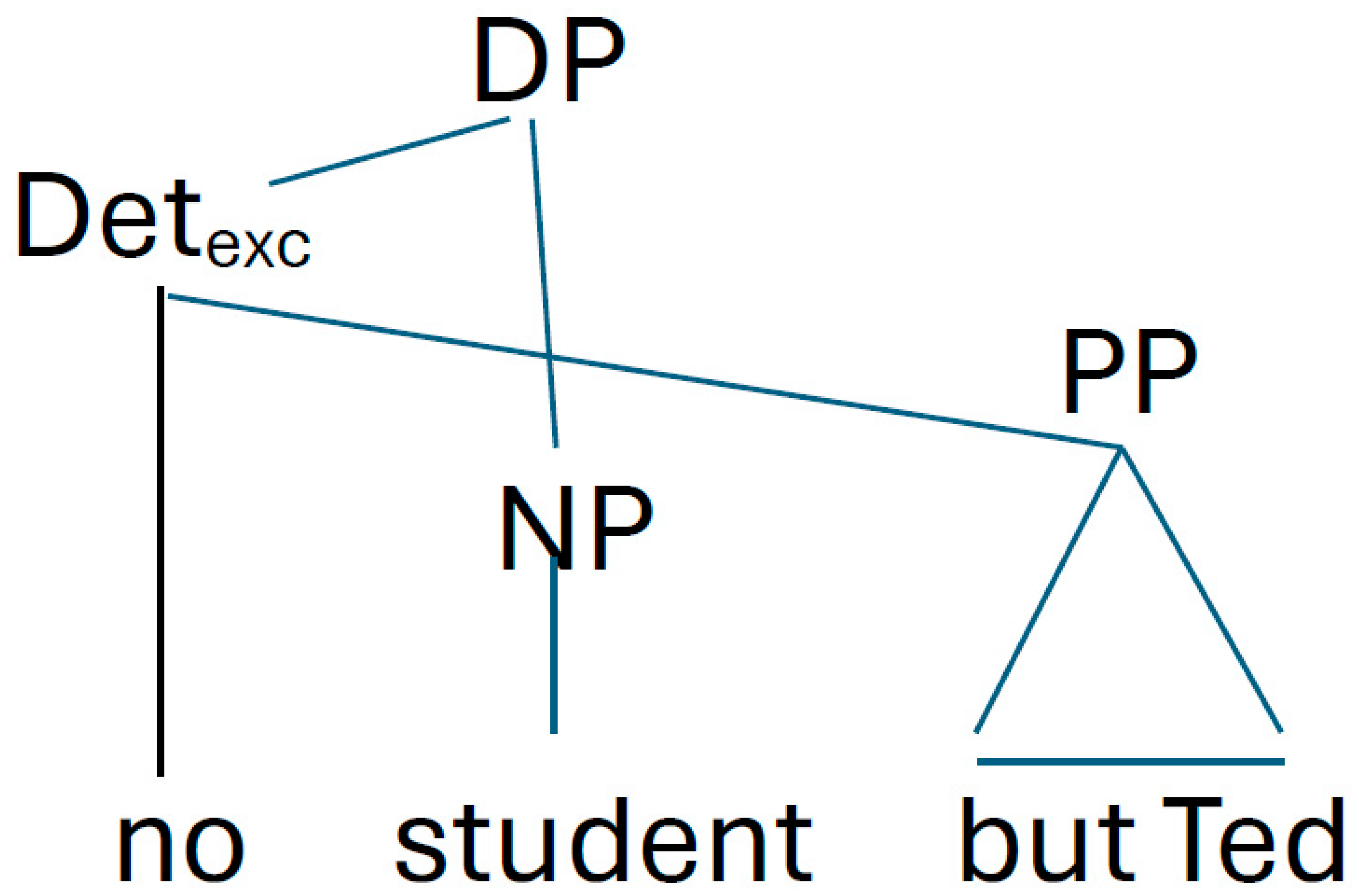
In (12), the Detexc no but Ted is a constituent and a sister of the NP student. The DP itself has two daughters and is interpreted by Function Application, just as if but Ted was adjacent to no, but the word order on our analysis is exactly that of natural English. Many Dets we discuss later are similarly discontinuous.
The Det no…but Ted not only fails to be cardinal, but it also fails to have a more general logicality condition permutation invariance (PI). A permutation of a set E is a bijection in [E E]:
| Definition 3. A Det D is permutation invariant iff for allPerm(E), all A,BE, DAB = | |
| D(A,B). | |
For K E, K = iff (K) = , any Perm(E). So, some(A)(B) = 1 iff AB iff (AB) , iff (A)(B) , iff some(A)(B) = 1, so some is PI. But no…but Ted is not PI, since for A = {Ted}, B = and (Ted) = Ben ( Ted), (no but Ted)(A)(B) = 1 and (no but Ted)(A)(B) = 0. (In general, Boolean operations are PI: (A) = ((A)), (AB) = (A)(B), etc.).
Standard logical constants, e.g., some and all, are PI. So quantificational expressions like no but Ted differ logically from standard ones.
| Comparative Adjectival Dets | ||
| Consider adjectives, which semantically map properties to properties. We define: | ||
Definition 4.
A function F from P(E) to P(E) isabsolute iff for all AE, F(A) = AF(E)
So bald and female are absolute: the female lawyers are the lawyers who are female individuals (but tall lawyers, while lawyers, may fail to be tall individuals, so tall is not absolute). Now, consider the Det in (13a) built from adjectival comparison:
| (13) | a. | More male than female students were drafted |
| b. | |male(student) drafted| > |female(student) drafted| | |
| c. | |male(E) student drafted| > |female(E) student drafted| |
Now, if XY = student drafted, it can replace it in (13c), showing more male than female to be intersective. But the value of (13a) is not determined by the mere number of students drafted. That might be the same as the number of teachers fired, but the distribution of male and female teachers fired can differ from that of male and female students drafted.
The comparative adjectival dets extend to interrogative ones: How many more male than female students were drafted? A more general interrogative Det is Which n? in (14).
It asks us to identify student pass exam, so pre-theoretically, it is interrogative and intersective, but not cardinal.
| (14) | Which (n) students passed the exam? Which (n) students are students that passed? |
- Boolean Compounds
We form complex intersective Dets by combining them, iteratively, with the Boolean connectives (both)…and, (either)…or, not, and neither…nor in appropriate ways.
| (15) | a. | At least five and not more than ten students (will get scholarships next year) |
| b. | Neither fewer than five nor more than ten students… | |
| c. | Either just a few or else more than a hundred students… | |
| d. | Neither which nor how many students objected was known |
The following interpretation of the Det in (15a) is illustrative:
| (16) | (at least 5 (more than 10))(A)(B) [(at least 5)(A) ((more than 10)(A))](B) | ||
| (at least 5)(A)(B) (more than 10)(A)(B) | |||
| = 1 iff |AB| 5 and |AB| 10 | |||
Clearly, if AB = XY, then A,B can be replaced by X,Y in the last line above preserving truth.
So, Boolean compounds of cardinal (intersective) Dets are cardinal (intersective).
We end this section by noting that the syntactic diversity of generalized existential Dets, which we have defined semantically, are syntactically natural in that they all license DPs in Existential There contexts: Boolean compounds (17a), comparatives (17b,f), interrogatives (17c,d,f), and exceptives (17e).
| (17) | a. | There were at least five but not more than ten students at the lecture |
| b. | There were (no) more dogs than cats in the yard | |
| c. | How many students were there at the game? | |
| d. | Just which students were there at the party anyway? | |
| e. | There was no student but John in the building at the time | |
| f. | How many more students than teachers were there at the lecture? |
2.3. Generalized Universal Determiners
Universal quantifiers are less varied than existential ones, though English is rich in lexical ones: each, every, all (and any as in Any American knows that and whatever as in Help yourself to whatever beer is in the fridge). These differ some both syntactically and pragmatically. First, here are three equivalent definitions of the universal quantifier all:
| (18) | all(A)(B) = 1 iff A B, iff A B = , iff |A B| = 0 |
A is a subset of B iff its intersection with the set of non-Bs is empty. That is, |AB| = 0. Note that AB is (A B), where B is just the set of things in E not in B. This is the intuition that generalizes to (19):
| (19) | All but two students got an A on the exam |
| Def 5: | a. | (all but n)(A)(B) = 1 iff |A B| = n | Note: all = all but 0 |
| b. | (all but finitely many)(A)(B) = 1 iff A B is finite. | ||
Cardinal variants in the exceptive position are easy to model: all but at most n, all but 2 or 3, all but about 5, etc. Generalizing:
| Def 6: A Det D is co-intersective (CO-INTE) iff for all A,B,X,Y E, DAB = DXY if AB = XY |
The reader can check that all and all but n are co-intersective.
We often read “All As are Bs” conditionally as “For all individuals x, if A(x) then (B(x))”. By definition Boolean AB is AB. And we show (Appendix A [2]):
Theorem 2.
A Det D is co-intersective iff for all A,B,X,YE, D(A)(B) = D(E)(AB)
Further, the universal Dets so far considered are cardinality-dependent, here called co-cardinal. Like the cardinal Dets, they have vague members (20).
| Def 7: | A Det D is co-cardinal iff for all A,B,X,Y E, DAB = DXY if |AB| = |XY| |
| (20) | Almost every, nearly all, all but a few, just about all, practically all, all but the oldest |
There are universals that are not co-cardinal. Once again, we find exceptives. Note (21c).
| (21) | a. | Every student but Ted got an A on the exam |
| b. | (every…but Ted)(A)(B) = 1 iff AB = {Ted} | |
| c. | (All but the oldest)(children)(were admitted free) |
And again, comparable to the intersective Dets, Boolean compounds of co-intersective. Dets are themselves co-intersective:
| (22) | a. | [[Not all] students] like poetry |
| b. | [[all or almost all] students] prefer plays to poetry |
But many other ways of building complex intersective Dets do not seem to apply productively to the co-intersective ones. E.g., we find no comparative ones analogous to more…than…, and wh-interrogatives seem more limited: ?Who all did you meet there? (see [19]).
2.4. Relations Between Generalized Existential and Universal Quantifiers
The existential Dets (INT) and the universal ones (CO-INT) seem meaningful in different ways. Indeed, INTE and CO-INTE are almost disjoint, all E:
| Def 8: | 1 is that Det given by: 1(A)(B) = 1, all A,B E. Dually, 0(A)(B) = 0, all A,B. |
| Fact | a. | 1 and 0 are each both intersective and co-intersective, so {1,0} INTECO-INTE. |
| b. | 1 and 0 are the only constant functions in [P(E) [P(E) 2]]. |
Theorem 3.
INTCO-INT = {1, 0}
Pf: Let D INTCO-INT and, leading to a contradiction, assume D is non-constant. Say DAB = 1 and DXY = 0. Now since AB = AB AB and D is int, D(AB)(AB) = 1. And since D is co-int, for any subset Z, DZZ = D(AB)(AB) = 1 as Z Z = (AB)(AB). So, D(XY)(XY) = 1 = DXY, as D is int., contradicting that DXY = 0. Thus D = 1 or D = 0.
On the other hand, INTE and CO-INTE are closely related in two non-trivial ways: (1) They are Booleanly isomorphic; each is isomorphic to their range(!), [P(E) 2]. And (2) they are duals, as are the specific Dets some and all, a relation inherited from the truth functions or and and (later).
First, the isomorphism. The Boolean structure on quantifiers is inherited pointwise from that of {0,1}. We spell this out because pointwise lifting is a common, almost automatic, definitional technique in mathematics, but it is not widely used in linguistics.
| Def 9: | Pointwise Lifting Let B a set and R a binary relation on B. Then, for any set A, R |
| extends pointwise to [A B] by setting fRg iff for all aA, f(a)Rg(a). |
So which pairs of functions f,g stand in the relation R is decided by whether the “points” f(a),g(a) stand in the relation in B. All notions defined purely in terms of the elements of B extend to [A B] pointwise. E.g., if R is transitive in B: xRy and yRz xRz, all x,y,z B, it follows that R is transitive in the function set: for all f,g,h [A B], fRg and gRh fRh. And if the Boolean axioms hold in B, then they hold pointwise in [A B]. The Boolean axioms do hold in 2 = {0,1}, so they hold in [E 2], i.e., P(E), [P(E) 2], and [P(E)[P(E) 2]].
A major instance of such lifting is that of the Boolean if-then relation on 2, which we write as instead of . Logically, “if P then Q” is false if P is true and Q is false. It is true in all other cases. In terms of truth values x,y, we have x y iff [(x = 1 and y = 1) or (x = 0, and y = 0 or 1)]. This relation lifts pointwise to properties, [E {0,1}]. fat(cat) cat, as for all b, (fat cat)(b) cat(b), i.e., if (fat cat)(b) = 1 then cat(b) = 1. Equivalently, the fat cats are a subset of the cats, so restricted to sets is just the subset relation. When lifting to GQs, we have: at least 3 cats at least two cats, since if at least 3 cats have a property p, then at least two cats have p. Lifting again, we infer at least 3 at least 2.
The rest of the Boolean structure on 2 also lifts pointwise to properties, GQs and Dets. E.g., for all truth values x, 0 x 1, so the “0 property” is that property that maps all b to 0, and the unit property all b to 1. And for a property p, p is that property that maps any b in E to (p(b)), that is, the complement of the truth value that p maps b to. Similarly, not(every poet) maps daydream to not[(every poet)(daydream)]. And (every) maps poet to (every poet). Similarly, and and or lift pointwise: (laugh cry)(b) = (laugh(b) cry(b)), etc. We often use lifted expressions without realizing it, in contrast to type lifting in categorial grammar [20], which requires some insight.
2.5. A Boolean “Lift”
some and all generalize Boolean or and and, respectively. Imagine a model in which Mary, Sue, and Dan are the only poets. Then, Some poet smiled has the same truth value as Mary, Sue or Dan smiled. So, some poet is semantically a disjunction of individuals, which are defined as follows:
| Def 10: | For all b E, all p [E 2], Ib(p) = p(b). Ib is called the individual generated by b. |
Individuals are what Montague (1970) [12] represents as P.Pj (intensional notation omitted), where ‘j’ is an individual constant, type e, and ‘P’ is of type (e,t). So, Mary smiled = Im(smile) = smile(m), as is traditional.
And Mary or Sue or Dan = ImIs Id, or more succinctly, {Im,Is,Id}. And by pointwise some poet = {Ib:poet(b) = 1}, which maps a property q to 1 iff Ib(q) = 1 for some b such that poet(b) = 1. We note that {Ib:p(b) = 1} is commonly written (p(b) = 1Ib).
Similarly, all is just and, written big: Mary, Sue and Dan denotes Im Is Id, or more succinctly, {Im,Is,Id}. Then, all poet = {Ib: poet(b) = 1}, or poet(b) = 1Ib. And (all p)(q) =p(b) = 1Ib)(q) = {Ib(q):p(b) = 1} = 1 iff for all b such that p(b) = 1, Ib(q) = 1, which just says p q when properties are treated as subsets of E.
To answer our earlier rhetorical question, some and all are special in that they are Boolean quantifiers: some is generalized or, and all is a generalized and. or differs from some in that or only allows finitely many arguments, which we must identify. some imposes no such bounds. Some odd number is prime cannot be written out as 1 is prime or 3 is prime or … as no English sentence is infinite in length. But the utility of some is that we may not care, or be able, to list the objects it quantifies over. Some students objected allows us to make a claim without knowing which, or how many, students objected. So, some is arbitrary disjunction, written with “upper case” . Similarly, we write all as . In sum:
| Def 11: | For K a set of generalized quantifiers, K is that GQ which maps a property p to 1 |
| iff for some kK, k(p) = 1, and (K)(p) =1 iff for each kK, k(p) = 1. |
Now, INTE and CO-INTE, the existential and universal classes over E, are Booleanly isomorphic (Appendix A [3]). Moreover, some and all are isomorphic images of each other.
| Theorem 4 | a: | INTE, a subset of [P(E) [P(E) 2]], is isomorphic () to [P(E) 2] |
| b: | CO-INTE, a subset of [P(E) [P(E) 2]], [P(E) 2] |
| Pf | (a): | The map h sending each intersective D to D(E) is an isomorphism. So, |
| h(some) = some(E), i.e., some(individual) and h(all) = all(E) = all(individual). | ||
| (b): | The map k from CO-INTE into [P(E) 2], sending D to D(E), is also an | |
| isomorphism. NB: D(E) here is not the same as D(E) in (a), as now D is co-int. |
| Corollary: | INTE CO-INTE. k−1h is an isomorphism from INTE to CO-INTE. |
But a direct isomorphism is more informative: Define g:INTE CO-INTE by: g(D) = Dd, D dual, where Dd =def (D), and (D)(A)(B) =def D(A)(B). Thus, Some A is a B corresponds to It is not the case that some A is not a B, that is, Every A is a B. So, somed = all and alld = some. The duality map shows INTE to be isomorphic to CO-INTE.
Theorem 4 tells us just how strong the (co-)intersective conditions are. Recall that |[AB]| = |B||A|. So, for |E| = n, P(E), i.e., [E 2] has cardinality 2n so |GQE| = |[P(E) 2]| = . By the isomorphism, this is the cardinality of INTE and of CO-INTE, so their union has twice that many members less the two, 1 and 0, counted twice: 2. So, in a model with |E| = 2, there are 252 = 30 quantifiers that are either intersective or co-intersective. But the number of logical possibilities is |[P(E) [P(E) 2]]| = = 216 = 65,536.
Thus, if all English Dets were (co)intersective hardly any of the logical possibilities would be expressible. But there are further expressible quantifiers (still built from INTCO-INT).
Consider the extension of INTCO-INT that results from adding in their Boolean compounds. We have seen that Boolean compounds of intersective functions are intersective, and analogously for the co-intersective ones. But compounds of intersective with co-intersective functions often yield functions that lie in neither class. some but not all (= only SOME) is a case in point:
| (23) | (some but not all)(A)(B) = 1 iff AB and AB |
Choose A = {a,b} and B = {b,d}. Here, AB = {b} and (23) is true. But choosing A = {b} and B = {b,d}, (23) is false, but AB has not changed, so some but not all is not intersective. Similarly, AB = {a}. Choosing A = {a}, we have AB = {a} but AB is empty, so (23) is false. So, some but not all is not co-intersective.
So, including Boolean compounds of INT with CO-INT functions enlarges the class of expressible Dets. But by how much? In general, a proper subset X of a Boolean algebra (BA) B may fail to be closed under the Boolean operations , , . That is, applying these operations to elements or subsets of X may yield elements not in X. E.g., INTECO-INTE is not Booleanly closed, as it contains some and not all but not some not all. The complete Boolean closure of X defines the set that results from X by iteratively adding in Boolean compounds starting with those in X. Formally, given a complete BA B (‘complete’ = for all K B, K and K exist), we define:
| (24) | Let X B, with B a complete BA. Then, BC(X), the complete Boolean closure of X isdef |
| nBCn(X), the union of the BCn(X), where the sets BCn(X) are defined by: |
| a. BC0(X) = X and b. for all n, BCn+1(X) = BCn(X) {D:D BCn(X)} {K:K BCn(X)}. |
So, an object BC(X) iff for some n, BCn(X). So, can be built from the original set X by n applications of Boolean functions. And we have, standardly:
| Theorem 5: | BC(X) is a complete Boolean subalgebra of B as above. No proper subset of |
| BC(X) includes X and is closed under , , . And BC(X) is finite if X is. |
So, when closing INTCO-INT, what new functions have we added, and are they denotable? Of course, we get ones like some but not all, formed explicitly by using the standard expressions of Boolean operators and/but, or, not, neither-nor, including vague ones:
| (25) | a. | At least a couple but far from all |
| b. | Either hardly any or else almost all | |
| c. | Not nearly all but more than a few or exactly ten |
But what is surprising is that the interpretations of many Dets lie in the Boolean closure of INTECO-INTE even though simple expressions which directly denote them are not built as Boolean compounds. We show this by showing that they are conservative and proving that the Boolean closure of INTCO-INT is exactly the set of conservative functions.
| Def 12: | A Det function D is conservative iff for all A,B,B’ E, DAB = DAB’ if AB = AB’. |
| We write CONS (or CONSE) for the set of conservative Dets (over E). |
This definition is equivalent to the usual one: DAB = DA(AB), since AB = A(AB). We used the above format to heighten the similarity with the definitions of (co)intersective. Both definitions make it clear that DAB is invariant under replacements of B by any B’ that has the same intersection with A as B does.
Recall that conservativity is a property that Dets quite generally have. Bayırlı [21] overviews the non-conservative cases. The most systematic, Westerståhl [22] and Ahn and Sauerland [23], still satisfy weak-Cons = “Cons on either argument”. Zuber and Keenan [24] show that weak-Cons does not weaken Cons by much. E.g., for |E| = 2, there are 216 = 65,536 Det functions, 512 of which are Cons and 1020 of which are weak-Cons. Returning to classical conservativity, we show (Appendix A [4]):
Lemma.
For all E, CONSE is closed under,and.
Theorem 6.
(Keenan 1993 [25]): For all E, BC(INTE CO-INTE) = CONSE
Thus, to show that a Det lies in the Boolean closure of the functions in INTECO-INTE, it suffices to show that it is conservative. (Basically, we show that each atom of CONSE is the of an atom of INTE with an atom of CO-INTE, and any element of CONSE is the least upper bound (lub) of its atoms, and the Boolean closure is closed under arbitrary lubs).
2.6. New Conservative Dets
Which functions lie in the Boolean closure? Trivially, the existential and universal determiners do, as we started with them. Boolean compounds (of Boolean compounds,…) that are in are in, as we explicitly added them. But we find many non-obvious new Dets in the closure, several of which are discontinuous. In the definitions below, D is an arbitrary conservative Det.
- Inclusion Dets
| (26) | Every student/Several students including Zelda signed the petition. |
Definition 13.
For all bE, (D…including Ib)(A)(B) = 1 iff D(A)(B) = 1 and bAB
Clearly (D…including Ib) is conservative if D is. Inclusion and exception phrases seem like “duals”, but they differ. every…but Zelda is co-intersective, but every…including Zelda is not. (Let A = B = {Zelda} and X = Y = . Then AB = XY, but Every A including Zelda is a B is true, but Every X including Zelda is a Y is not, so every…including Zelda is not co-intersective.)
Also, inclusion phrases have a much wider distribution than exception phrases: several students including Rosa is fine, but *several students but Rosa is ungrammatical.
- Proportionality Dets
This subcategory of Det is very productive, containing complex fractions and percentage phrases. But it also includes basic items like half, which was present in a majority of the 36 languages (data not available in all) in Keenan & Paperno [26] /Paperno & Keenan [16]. Below are some examples. n out of m and the discontinuous not one…in ten seem specific to Proportionality Dets.
| (27) | a. | Most poets daydream a lot; |
| b. | At least half of/more than two thirds of American teenagers are overweight; | |
| c. | More/less than/exactly/almost 80 per cent of young voters are liberal; | |
| d. | More than a third but less than half of college ball players are exploited; | |
| e. | Seven out of ten sailors smoke Players; | |
| f. | Not one linguist in ten can conjugate verbs in Sumerian. |
Semantically, whether a proportionality Det holds of a pair A,B depends on the proportion of As that are Bs, which only makes sense in ordinary English if A is finite.
| Definition 14. | D is proportional iff for all A,B,X,Y DAB = DXY if |AB|/|A| = |XY|/|X| |
| (A,X) |
Proportional Ds are conservative since |AB|/|A| = |A(AB)|/|A|. But not all proportional Ds are (co-)intersective. Let A = B = {a} and X = {a,b} and Y = {a}. Then AB = XY but |AB|/|A| = 1 and |XY|/|X| = 1/2. So exactly 1/2 is proportional but not intersective (or co-intersective). But non-obviously, it is in the Boolean closure of INTCO-INT, since it is conservative. Think of it (roughly) as: {n of the 2n:n {0,1,2,…}}, i.e., exactly one of the two or two of the four or …, which gives correct results for finite E. It assumes that n of the m is conservative, which it is (but not cardinal or even intersective):
Definition 15.
For all n,m, (exactly n of the m)(A)(B) = 1 iff |A| = m and |AB| = n
The numerical expressions within proportionality Dets accept modifiers we have seen with (co-)cardinal ones: about/nearly a third, all but (nearly) a half, etc.
Exactly half and infinitely many other proportionality Dets are not definable in First-Order Logic (FOL) (see Barwise & Cooper [1]). Also, proportionality extends to two-place Dets:
| (28) | a. | Proportionally more men than women get drafted; |
| b. | A greater percentage of teachers than (of) students attended the lecture. |
- Definite Dets
As Barwise and Cooper [1] point out, such Dets generally denote principal filters generated by (a subproperty of) the noun property. They differ from all in imposing a condition on this property. E.g.:
| (29) | a. | (the m)(A)(B) = 1 iff AB and |A| = m | (thesg = the one); |
| b. | (John’s m)(A)(B) = 1 iff |A{b:has(b)(john)=1}| = m and A{b:has(b)(john)=1} B. | ||
See Peters and Westerståhl [27] and Barker [28] for extensive work on possessives.
- Partitive Dets
These include those in (30), which are cons, as |AB| = |A(AB)|. They fail to be (co-)intersective or proportional due to the stipulation that |A| = m.
| (30) | a. | More/less than/about n of the m, between n and n’ of the m, How many of the m?; |
| b. | All/almost all of the m, all but n of the m; | |
| c. | More/less than n of the m, half/ten per cent of the m, most but not all of the m. |
| (31) | (D of the m)(A)(B) = 1 iff D(A)(B) = 1 and |A| = m |
Partitive formation is productive but does not iterate: *five of the n’ of the n of the m. The m in these partitives can be replaced by these/those m, my/your m, or John’s m.
- Unary Comparative Dets (discontinuous)
These are comparative Dets, as in (32), which differ from comparatives of the More As than Bs sort as in example (13), which compares the conservativity domains (the restriction, or the “A” argument in Det(A)(B)). Here, the A argument is fixed, and the comparison takes place in the B argument, the predicate property.
| (32) | a. | More students than attended my lecture took the exam |
| b. | Not as many students as attended my lecture took the exam |
| Definition 16. For all properties A,B,C | |
| a. | (more…than C)(A)(B) = 1 iff |AB| > |AC| |
| b. | (as many…as C)(A)(B) = 1 iff |AB| |AC| |
Conservativity holds: if more than C students took the exam, then more than C students are students who took the exam, and conversely. And these examples can be enriched to include two/about five more … than C, How many more … than C?. In support of this discontinuity, note that *students than/as attended my lecture are neither grammatical nor meaningful. And there are co-occurrence restrictions between the prenominal and postnominal parts of the Dets: than co-occurs with more/less but not as, which as many requires. Bhatt & Pancheva [29], working with different comparatives, invoke comparable arguments supporting discontinuity.
On our analysis, the than-clause may occur to the right of the N students or to the right of the main P1. The two trees have identical hierarchical structure, differing only in linear order of terminal nodes. (Semantic interpretation only reads the hierarchical structure).
| (33) | a. | 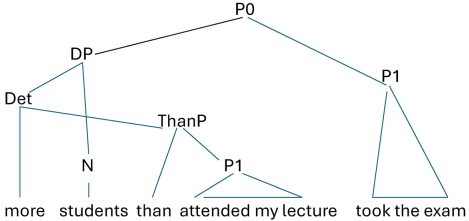 |
| b. | 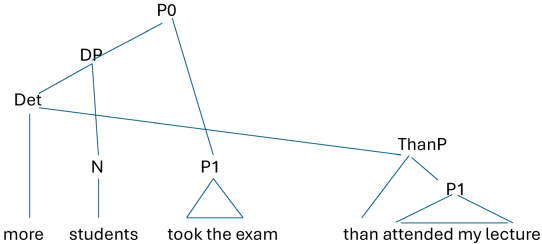 |
- Generalized Ordinal Dets
Here, we are concerned with Dets like those in (34):
| (34) | a. | The first/second village we visited the village we visited first/second; | |
| b. | The next/last/second to last/most recent village we visited | ||
| the village we visited next/last/second to last/most recently. | |||
Again, prenominal and postnominal material forms a semantic unit, as indicated in our paraphrases. And conservativity holds: if the we visited second village was wealthy, then the we visited second village was a village that was wealthy, and conversely. Similarly:
| (35) | a. | The first man to cross the finish line wins the race; | |
| b. | The only/The one Angeleno to win the lotto twice retired early | ||
| (‘only/one Angeleno’ not a constituent of (35b); *Angeleno to win the lotto twice); | |||
| c. | An easy theorem to state but a difficult one to prove a theorem (which is) easy to | ||
| state but difficult to prove. | |||
- Same/Different
Prenominal same/different and postnominal complements form a semantic unit:
| (36) | a. | A different book from the one the teacher wrote is now assigned reading; |
| b. | The same students as came early left late. |
Again, the N+postnominal material within the subject is not a grammatical or meaningful unit: *man to cross the finish line, *book from the one the teacher wrote, and *students as came early. Note that the as clause in (36b) is not a simple relative clause. The students who came early left late just means that the set of students who came early is a subset of the set of those who left late, whereas (36b) says the two sets are the same.
Same…as and different…from (to in British English) have logical status—they are permutation invariant and mean “equals” and “not equals”, and lack “real world” content like ordinary adjectives, e.g., blue, tall, etc. The postnominal from/as property satisfies an argument requirement of same/different. Used without this property, we obtain a deictic/context dependent reading:
| (37) | a. | Bill didn’t suggest that idea, a different student did. |
| b. | One of the editors rejected your paper, and the same one rejected mine. |
This deictic/anaphoric alternation shows up cross-linguistically with classical anaphors. Keenan [30] notes the cases in (38) in English (Irish dialects, thanks to James McClosky, pc), and (39) in Japanese:
| (38) | Watch out. Himself is in a bad mood today. |
This could be said by one employee to another arriving late for work. Subject himself refers to the prominent male in context, e.g., the boss, reminiscent perhaps of terms like His Highness or His Holiness. Note that, contrary to the Binding Theory, (38) is not ungrammatical. It is just that subject himself is interpreted deictically, not anaphorically. This case is not isolated. In Japanese, jibun can be naturally interpreted as an anaphor in (39a), but occurs as a subject in (39b) with only a deictic interpretation:
| (39) | a. | Hanako-ga | jibun-o | utagatte-iru | |
| Hanako-nom self/speaker-acc doubts | |||||
| Hanako doubts herself/Speaker; | |||||
| b. | Jibun-ga | Hanako-o | utagatte-iru | ||
| speaker-nom Hanako-acc doubts | |||||
| Speaker (*herself) doubts Hanako. | |||||
Note the deictic/anaphoric shift here. We conclude with one further distinctive property of (co-)intersective Dets.
- Dets have Essentially two arguments
We have seen, theorem 4, that INT and CO-INT Dets are Booleanly isomorphic to one-place ones, or as we shall say, they are sortally reducible:
Definition 17.
D in [P(E)[P(E)2]] is sortally reducible iff there is a boolean function h in two variables such that for all A,BE, DAB = D(E)(h(A,B)).
Existential D reduce via , as DAB = D(E)(AB) and universal D via , as DAB = D(E)(AB), see Appendix A [2]. Note that (A B) = (AB), (think: p q iff p q).
Theorem 7
(Keenan 2000 [31]). For D CONS, D is sortally reducible iff D INTCO-INT.
So, Most poets daydream has no logical paraphrase of the form “For all individuals x, ”, where is a Boolean compound of poet(x) and daydream(x). We have already seen the easy right-to-left direction. There are 16 two-place Boolean functions. Our proof shows that if a conservative D reduces via one of them then D is int or co-int.
3. Summary + Boolean Interlude
From 1.5.11.5.7, the Boolean Closure of the Existential and Universal Dets have yielded many Dets whose most natural expressions are not formed overtly with and/but, or, not, neither…nor. This supports the psycholinguistic intent of Boole’s work [6], which was to study “properties of mind”. The title of that work is not “Algebraic Investigations” but rather The Laws of Thought. Its opening sentence is
And how modern his justification of this goal is (Laws p. 27)!“The design of the following treatise is to investigate the fundamental laws of those operations of the mind by which reasoning is performed;”
“Nor could we easily conceive, that the unnumbered tongues and dialects of the earth should have preserved through a long succession of ages so much that is common and universal, were we not assured of the existence of some deep foundation of their agreement in the laws of the mind itself.”
Modulo style, this last could have been written today instead of 170 years ago. It anticipates, strikingly, the Universal Grammar perspective in contemporary generative grammar. Compare Chomsky ([7]:4):
“More intriguing, to me at least, is the possibility that by studying language we may discover abstract principles that govern its structure and use, principles that are universal by biological necessity and not mere historical accident, that derive from mental characteristics of the species”.
Our current understanding of Boolean structure is orders of magnitude advanced over Boole’s fledging but prescient initiatives. And its relation to language structure goes far beyond what was available in Boole’s time thanks to the explosion of linguistic work since Chomsky [32]. Three observations that support this link are (1) syntactic ubiquity, (2) Boolean creation of constituents, and (3) the SB Theorem below.
Regarding syntactic ubiquity, the Boolean operators and/but, or, not, and neither-nor combine with expressions in most categories to form complex expressions in that category. And their application iterates not both p and either q or r or else neither p nor q nor r… Few expressions have this syntactic ubiquity. Why have linguists not marveled more at this fact? And we have only treated Dets, DPs, P1s (and implicitly P0s (Sentences)). But we also find Boolean compounds among APs (an attractive but not very well-built house), AdvPs (He works slowly but not carefully), PPs (over the hill but not through the woods or under the bridge), even just Prepositions: He lives neither in nor near London. And shortly, we note P2s, that is, transitive verb phrases: He neither praised nor criticized every teacher).
Boolean operators can force constituency. The bracketing [most [male [doctor]]] reflects its natural constituency. But in (40a), coordination forces most male to be a constituent, along with all female. Comparable claims hold for (40b).
| (40) | a. | Most male and all female doctors support single payer health care; |
| b. | Jill gave [flowers to Danny] and [cookies to Sally]. |
Note that the mild unnaturalness in (40a,b) is at most syntactic. Even on first hearing these constructions do not pose significant comprehension problems.
| Theorem 8. | Subjects are Boolean (SB): For all E, all subjects (maps from P(E) 2) are | |||
| Boolean functions (possibly infinitary) of individuals. | ||||
| Proof. | ||||
| Step 1: | Let H [P(E) 2]. For each p P(E), define hp [P(E) 2] by: hp(q) = 1 iff q = p. | |||
| So hp holds just of p, and for all q, ({hp:H(p) = 1})(q) = 1 iff for one such hp, hp(q) = 1, | ||||
| which is so iff H(q) = 1. So, any GQ H is a Boolean function, , of a set of “atomic” GQs. | ||||
| Step 2: | Each hp is a Boolean function of individuals. The intuition: the student property is | |||
| uniquely the property that is possessed by every student and by no non-student: | ||||
| a. all(p) = {Ib: Ib(p) = 1}. So, all(p)(q) = 1 iff p q, and | ||||
| b. no non-p = { Ib: Ib(p) = 1}, so (no non-p)(q) = 1 iff ({ Ib: Ib(p) = 1})(q) = 1, iff | ||||
| (p q) , iff p q = , iff q p = iff q p. Thus, | ||||
| [(all(p) no non-p)](q) = 1 iff (all(p)(q) = 1 (no non-p))(q) = 1, iff p q and q p, | ||||
| iff q = p, whence (all(p) no non-p) = hp. | ||||
| Thus, H = H(p)=1hp = H(p)=1(p(b)=1Ib p(b)=0Ib) | ||||
Theorem 8 is a streamlined revision [33] of the Justification Theorem in Keenan & Faltz [34], where P1s were functions taking property sets as arguments. Here, the theorem highlights a major difference between subject and object quantifiers.
| (41) | Massively many denotable objects are not Boolean functions of individuals. |
4. Object Quantifiers
All subject GQs above extend, preserving meaning, to object quantifiers—that is, functions mapping P(EE) into P(E)—as illustrated syntactically in (42) and defined semantically in Definition 18:
| (42) | a. | Ned distrusts most but not all third-party candidates; |
| b. | Not as many students as teachers read more plays than poems; | |
| c. | One professor interviewed every candidate but Ben. |
We interpret P2s as subsets R of EE, equivalently functions in [E [E 2]]. For a,b E, we write aRb and (a,b) R indifferently. To minimize notation, when R is a binary relation and a E, we write Ra for {b|aRb}. (b.aRb is not minimal). So Ra is the set of objects b that a stands in the relation R to, i.e., bRa iff (a,b) R, iff aRb.
A subject quantifier F extends to an object quantifier Facc as follows:
| Definition 18. For F[P(E)2], we define Facc[P(EE)P(E)] by: Facc(R) = {a:F(Ra) = 1} |
Facc is called the accusative extension of F. So (every student)acc maps likes to the set of a such that (every student) holds of likesa, i.e., the set of people that a likes. Thus, Jon likes every student is true iff (every student) holds of the set of individuals Jon likes, as desired.
For a subject quantifier F, the value Facc assigns to a binary relation R is determined by the values that F assigns to the subsets of E, i.e., Ra. So F doesn’t say anything new here; it just uses what it knows how to say in more contexts. Note, too, that F and Facc are functions with disjoint domains, so their union is a function, which we’ll write simply as F.
So subject quantifiers also function as object quantifiers, mapping P2s to P1s, but comprise only a miniscule portion of them. Recalling that |[A B]| = |B||A| and setting |E| = n, we compute the number of subject GQs, |[P(E) 2]|, to be . But for object GQs, [P(EE) P(E)], it is 2n raised to the power . So in a two-element E, there are 24 = 16 subject functions but 232 4 thousand million object ones! The domain of object functions, P2s, has more structure than that of subject functions, P1s, so their values have more they can vary with. We see shortly how the P1-P2 gap shows up semantically. First, we note conservativity with object quantifiers:
| (43) | For D a conservative (subject) Det, B E and R EE, D(B)acc(R) = D(B)acc(R(EB)). |
Here, R(EB) is just the set of pairs (a,b) in R in which the second coordinate b is in B. Similarly, R(AE) is R with its first arguments limited to As. And we observe, without proof and omitting the subscript on D’(B)acc:
Theorem 9.
Iterated Conservativity: For D,D’ cons, D(A)(D’(B)(R)) = D(A)(D’(B)(R(AB))).
We will see shortly that uniquely object Dets are also conservative, as are several inherently binary Dets that map binary relations to truth values in one step, rather than mapping the relation first to a property and then the property to a truth value. But first we countenance:
An objection? We have treated some student as a function taking properties (unary relations) as arguments. Now we allow it to take binary relations as arguments. Are we not treating it inconsistently or ambiguously? No! We are just extending the function, adding more elements to its domain and saying what values it assigns to these new elements. The values the function assigns to its old arguments remain unchanged. So some student never assigns more than one value to an argument.
It is worth emphasizing that, by their nature, functions assign values that vary, sometimes systematically, with their arguments. Consider a rounding off function Rnd that maps decimal numbers n.m to the nearest whole number:
| (44) | Rnd(n.m) = n if m < 5, and = n+1 otherwise. |
So Rnd(3.4) = 3, but Rnd(3.6) = 4. Sometimes Rnd adds a little to its argument, sometimes it subtracts a little. But it is not ambiguous depending on whether it adds or subtracts. Its action is conditioned by its argument (the phoneme principle). Rnd never assigns one argument more than one value. Similarly, some student maps subsets of E to truth values and subsets of EE to subsets of E, and in general, it maps Pn+1’s to Pn’s, sets of n+1-tuples to sets of n-tuples [4]. DPs are argument satisfiers.
Observe too that meaning differences between subject functions are inherited by their accusative extensions:
Theorem 10.
For F, G subject quantifiers, if FG then FaccGacc
| Pf: | For A E, let F(A) G(A), say F(A) = 1 and G(A) = 0. Set R = EA. | |
| Then Facc(R) = E Gacc(R) = , so Facc Gacc. | ||
So each subject quantifier F determines a unique object quantifier, Facc. But these Facc are a miniscule subset of the full set of object quantifiers. And many (?all) of the new functions are denotable by object DPs. To show, this we provide an invariance condition that accusative extensions of subject quantifiers satisfy and then exhibit denotable object quantifiers that fail that condition.
| (45) | Accusative Extensions Condition (AEC) | |
| For F [P(EE) P(E)], F satisfies the AEC iff for all R,S P(EE) | ||
| and all a,b E, if Ra = Sb then a F(R) iff b F(S). | ||
| Fact: | For all subject functions F, Facc satisfies the AEC. |
So if Ted admires exactly the individuals that Ann distrusts, then Ted admires most city employees iff Ann distrusts most city employees. We turn now to objects that fail the AEC.
4.1. Scope Ambiguities
The most natural readings of transitive sentences like (46a) are the subject-wide scope (SWS) ones [35,36]. Here, the object DP is interpreted compositionally in its accusative extension (46b). We treat the subject-narrow scope (SNS) reading, often less available than SWS, as a case of function composition (FC) of the subject interpretation with the P2 one, as in (46c).
| (46) | a. | Some editor read every manuscript; |
| b. | (some editor)(every manuscriptacc(read))—Subject-wide scope (SWS); | |
| c. | ((some editor)(read))(every manuscript)—Subject-narrow scope (SNS). |
The SNS reading violates compositionality, as the P2+DP constituent, read every manuscript is not assigned a semantic interpretation, though we do interpret all expressions in situ, as opposed to Quantifier Raising, which changes the structure of the expression we are interpreting.
As is usual, we have been interpreting English expressions by Function Application, FA. But occasionally FC, , is natural, sometimes prompted by “generous” uses of Boolean operators. For example, “Right Node Raising” cases as in Rosa bought and Ben cooked the turkey or even Neither did Rosa buy nor did Ben cook the turkey prompt the same use of FC as in (46c).
FG is a function whose domain (Dom) is that of G, whose range (Ran) is that of F, and whose action is given by (FG)(x) = F(G(x)), natural when Ran(G) Dom(F). In (46c), (some editor)(read) makes sense as Ran(read) = [E 2] = Dom(some editor) and maps E, the domain of read, into 2, the range of (some editor). Thus, (some editor)(read) [E 2], and by FA, every manuscript applies, with some editor in its scope, yielding the SNS reading.
Function composition is basically a storage mechanism. F seeks an argument but only finds G, which will provide F with one once it finds its own. So F holds G in store. When G gets an argument, it applies yielding an argument for F, which can then apply.
Overall, the ad hoc interpretation by FC provides a direct way of interpreting (some) expressions that do not stand in a function—argument relation. And it respects linear order, contrary to Quantifier Raising. If we have to change the structure of expressions to interpret them, why do not we just speak that way? How did our language evolve to deceive us? It violates Einstein’s dictum: Raffiniert ist der Herrgott aber boshaft ist er nicht. “Subtle is the lord but malicious he is not”. We turn now to object quantifiers.
4.2. Accusative Anaphors
Reflexives map binary to unary relations but fail the AEC. If John admires just Sam, Sue, Ben, John, and Jill, and these are just the people that Bill distrusts, then John admires himself is true, and Bill distrusts himself is false. So self, the object function denoted by himself/herself, fails the AEC.
| (47) | self(R) = {a:aRa}. |
Fact: For all E with |E| > 1, all F [P(E) 2], Facc self.
That self is not a Boolean function of individuals is in a sense ironic, as self is a permutation invariant “individual”, and individuals are very “boolean”—they are just the functions from P(E) into 2 that respect Boolean structure, i.e., homomorphisms.
| (48) | a. | John came early and left late John came early and John left late; |
| b. | Mel either laughed or cried Either Mel laughed or Mel cried; | |
| c. | Dana didn’t laugh at my joke It is not the case that Dana laughed at my joke. |
So Mel maps a disjunction of P1s to the disjunction of what it maps each disjunct to, and analogously for conjunction and negation. And at the level of P2s, self also commutes with the Boolean operators. Expression (49) illustrates with or; and and not behave similarly, though (not criticize) herself and not(criticize herself) are pronounced the same.
| (49) | Mel either praised or criticized herself Mel either praised herself or criticized herself. |
Reflexives combine syntactically with non-reflexives forming DPs, in effect complex accusative anaphors, that quite generally fail the AEC. Here are four types:
| (50) | a. | Dan criticized both himself and some student/himself and two other students; |
| b. | Pat nominated herself and no one else/neither herself nor any other senior; | |
| c. | One of the managers criticized every/no manager but himself; | |
| d. | Fortunately, Jeb managed to hire a couple of assistants more able than himself. |
In (50a), himself and some student fails the AEC. In the second, two other students is anaphoric to himself and means two students other than himself. In (50b), the anaphor herself is the antecedent of no one else (Deb nominated Bob and no one else entails Deb nominated no one but Bob; it does not entail that she nominated no one but herself). In (50c), we use a reflexive Det, every…but self, and in (50d), the complex object DP is non-locally bound. We analyze it as ((two…more able than himself)(assistants), similar to (every…but himself)(manager) in (50c).
| (51) | a. | (every…but self)(p)(R)(a) = (every…but Ia)(p)(R)(a) | |
| = 1 iff p{a} Ra | |||
| b. | (two…more able than self)(p)(R)(a) = 1 iff |(more able than Ia)(p) Ra| 2 | ||
The AAC below is an invariance condition that distinguishes accusative anaphors from accusative extensions, which decide whether to put an object a in the set they associate with R just by checking the set Ra, without knowing what object a is or whether a itself is in Ra or not. But anaphors must know and make their decision accordingly.
| Accusative Anaphor Condition (AAC) | |
| For F [P(EE) P(E)], F is an accusative anaphor iff for | |
| all a E, all R,S EE, if Ra = Sa then a F(R) iff a F(S) |
| Definition 19. | F [P(EE) P(E)] is a proper accusative anaphor iff F satisfies the AAC |
| and for some E, F fails the AEC. |
The object DPs in (50a–d) are proper accusative anaphors. But the Facc are not. They satisfy the AAC but never fail the AEC.
The anaphors cited above are anaphoric due to the presence of -self forms. In addition, other and else have anaphoric uses (but are sometimes interpreted deictically).
| (52) | a. | Every/Some/No worker at the meeting criticized every other worker at the meeting; |
| b. | Everyone/no one in our class criticized everyone else in our class; | |
| c. | No student at the lecture criticized anyone else/any other student at the lecture; | |
| d. | One of the students was helping some other student when I came in. |
Every other worker (at the meeting) satisfies our test for being a proper accusative anaphor because if Ted criticized just the people he admires, then he criticized every other worker iff he admires every other worker, even though every other worker can be interpreted deictically (e.g., Ted may not have criticized Ben but he did criticize every other worker). We turn now to a second way of skirting the AEC.
4.3. Predicate Anaphors
Predicate anaphors are expressions whose interpretations vary with the P2 itself. In (53b), more poems than Ben is a predicate anaphor, as defined in Def 20.
| (53) | a. | Mary memorized more poems than Ben read |
| [((more…than Ben)(read))(poem)](memorize))(Mary) = 1 iff | ||
| |memorizemary poem| > |readBen poem| | ||
| b. | Mary memorized more poems than Ben | |
| ([(more…than Ben)(poem)](memorize))(Mary) = 1 iff | ||
| |memorizemary poem| > |memorizeBen poem| |
| Definition 20. | For F [P(EE) P(E)], F is a predicate anaphor iff for all a,b E, all R EE, |
| if Ra = Rb then a F(R) iff b F(R). |
If Mary read exactly what Dan read, then Mary read more poems than Ben iff Dan read more poems than Ben. Similarly, the same poems as Ann is a predicate anaphor in Dan read the same poems as Ann.
Neither nominal nor predicate anaphors occur naturally as P1 arguments (“subjects”).
| (54) | a. | *Himself/*Every student but himself criticized every student; | |
| b.1 | (Not) As many students as John knows know Bill; | ||
| b.2 | *(Not) As many students as John(,) know Bill | (intended: same meaning as (b.1)). | |
An object quantifier may be a nominal and predicate anaphor simultaneously:
| (55) | a. | Kiran has written more poems than anyone else from India; |
| b. | Rob solved at least as many problems as any other student; | |
| c. | Jeb answered more/fewer questions than anyone else/any other student; | |
| d. | Sue made at most as many mistakes as anyone else. |
For example, (55a) entails that Kiran is from India, and (55b) that Rob is a student. Both nominal and predicate anaphors are compositional in that they combine with P2s to form P1s and denote functions from P2 interpretations to P1 ones.
4.4. Syntactic Richness Semantic Richness
Object GQs are syntactically richer in structure than subject ones as they include all the subject ones and many others: himself, neither himself nor any other student, and the same questions, as well as ones built with distinctively object Dets, such as no…but herself, two…more able than himself, and more than anyone else, as many…as any other student. This increased richness arises because P2s are logically richer than P1s, so functions taking them as arguments have more to depend on. (And we have not even considered complex P2s: neither praise effusively nor criticize harshly, believe…to be clever (all the students in the class), and prevent…from signing the petition).
But just how is the increased logical expressivity of P2s manifested? One way to see this is to recall that whether an arbitrary sentence in a first-order language is valid, true in all models, is not decidable: no algorithm applied to an arbitrary sentence in FOL says Yea! if it is valid and Nay! if it is not. But:
Theorem 11.
(Boolos and Jeffrey 1989:Ch 25 [8]) Validity is decidable in a first-order language all of whose non-logical predicates are one-place (‘=‘ is allowed). Add a single non-logical P2 and undecidability returns.
The theorem is based on the central observation that any monadic first-order sentence that is false in some interpretation is false in one with a finite domain, whose cardinality is upper-bounded as a function of the number of P1s and variables occurring in So, is true in all models (valid) iff its negation is false in all these finitely many finite models. It is the finite search space that yields decidability.
But, of interest to us, is that once a first-order language has even one two (or greater)-place predicate symbol, we can make up simple sentences that are false in all finite models but true in some infinite ones, so validity cannot be checked just by checking finitely many cases. Stated differently, two place predicates can force their models to be infinite, whereas one-place ones cannot. An example, in everyday English:
| (56) | a. | Everyone likes someone; |
| b. | No two people like the same person; | |
| c. | There is someone that nobody likes. |
These three sentences (when conjoined) use a single P2, like, and only first-order quantification. They do not have a finite model.
Proof.
Suppose they have a model with |E| = n. By (56a), each of these n people likes someone, and by (56b), the people they like are all different, so there are at least n of them. But by (58c), one person isn’t liked by anyone, so there must be at least n+1 people in the model, contradicting the assumption that |E| = n. And (56) has an infinite model: let E be , the set of natural numbers, and let like be the P2 “is one less than”, noted L. So nLm iff m = n+1. Thus, 0L1, 1L2, … and in general nLn+1. Note nL0 is false for all n , so (56c) holds in this infinite model, as do (56a,b). For another example, see Appendix A [5].
So, Pn’s with n > 1, enrich expressive power beyond what is possible with just P1s (and =). Note that (56b) uses an object quantifier that is not a subject extension. But (56a,b,c) are ordinary English sentences, not technical mathematical ones. In particular (56b), the one-to-oneness condition, only involves comparing pairs of objects. Expressions (56a,c) by themselves have a two-element model: x and y both like y and no one else likes anyone else. It is (56b), which compares pairs, that forces infinite models. And isolating relevant pairs cannot be done with just P1s.
Another simple indicator of P2 over P1 expressivity is (57):
| (57) | If |E| = n, the number of P1s over E, is |P(E)| = 2n. The number of P2s, is |P(EE)| = . |
So, for an E with just 5 elements, there are 25 = 32 P1s and 225 32,000,000 P2s! So, naively, we can say much more with binary than unary predicates.
5. Beyond Compositionality: Relational Determiners
We end with a less systematic class of Dets that seem to interpret the two arguments of a P2 jointly as a function taking the P2 denotation directly as argument. Keenan [37] shows that several of these cannot be paraphrased by ones that apply subject and object functions successively to obtain a truth value.
Different-Different
| (58) | a. | Different people like different things; |
| b. | Different students answered different questions (on the exam) | |
| (the questions that different students answered differed/were not the same); | ||
| c. | People from different countries have different tastes in food. |
In Paperno & Keenan [16], 33 of the 36 languages they report on presented Diff-Diff type constructions (data lacking on the others). Taking (58b) as representative, its weakest truth conditions seem to be that, for all distinct students x,y, the set of questions x answered is not identical to the set that y answered. A formal interpretation of (58b) is given by (59), to which we should add that there are at least two a,a’ satisfying the righthand side.
| (59) | (Diff-Diff)(A,B)(R) = 1 iff for all a a’ A, Ra B Ra’ B |
| Fact | : Diff-Diff is conservative: (Diff-Diff)(A,B)(R) = (Diff-Diff)(A,B)(R AxB). |
By the conservativity of Diff-Diff in (58b), the answer relation can be limited to the pairs (a,b) in which astudent and bquestion. Diff-Diff forms a semantic unit with the subject–object pair, which then maps the P2 denotation to 0 or 1. So, answered different questions in (58b) is not assigned an interpretation, and Diff-Diff is not compositional. Nor does it present a scope ambiguity, as neither argument is within the scope of the other. But Diff-Diff is conservative, so it shares a basic formal property with the Dets studied above. Also, both subject and object in (58b) can occur independently, as in (60a,b), but their combined meaning in (58b) is not merely the application of each of their independent meanings.
| (60) | a. | Different students laughed; |
| b. | John answered different questions (on the exam). |
In (60a), different students mainly has a context dependent interpretation, which we call deicticthe students differ from some set recoverable from context of utterance—or (60a) might (weakly) be interpreted as “Some students laughed”. In (60b), a deictic or a multiple-questions reading is natural. But in (58b), the natural reading is not a deictic one or the “some students answered some questions” one, but rather is our much stronger onethe questions different students answered differed. So, Diff-Diff imposes a weak one-to-oneness condition on the binary relation.
Further, (61) is logically equivalent to the negation of (58b), so it also cannot be reduced to a pair of functions, one within the scope of the other [37].
| (61) | No two students answered (exactly) the same questions (on the exam). |
The weak one-to-oneness condition in (58b) becomes, in strong preference, strictly one-to-one when the subject and object are singular:
| (62) | Each student answered a different question (on the exam). |
This sentence seems to imply that each student answered just one question, and no two answered the same one. Note that John answered a different question only has the deictic reading. So, a different question instantiates an anaphora shift, whereby an object DP has one (often deictic) reading with a singular individual denoting subject and has a clause-internal anaphoric reading with syntactically richer subjects, such as Different students or Each student. Same is similar:
| (63) | a. | John answered the same two questions; |
| b. | John and Bill answered the same two questions; | |
| c. | John answered the same two questions and so did Bill. |
Here, (63a) has only a deictic reading, whereas (63b) has, most naturally, a sentence-internal binding of same, though the pointwise deictic reading in (63c) is available.
A comparable example obtains with same anteceded by a relativized subject, as in (64). The anaphoric reading in (64) is natural, and replacing the two students with singular the student forces a deictic reading.
| (64) | I interviewed the two students who missed exactly the same questions. |
Given our earlier parallels between different and same, we might wonder if there is not a Det Same-Same comparable to Diff-Diff. An immediate attempt in (66a) is “delicate”, requiring two independent deictic references. But a richer context like (66b) provides an argument for Same-Same, rendering the complex Det acceptable:
| (65) | a. | ?The same students answered the same questions; |
| b. | Every year the same people fall for the same scams. |
In (65b), Same-Same takes year as argument and compares the set of (People, Scam) pairs in one year to those of another. Further, Same and Different may interact to form ternary (n-ary) relational Dets:
| (66) | Different witnesses gave the same description of the assailant to different reporters. |
We might assert (66) to support the reliability of eyewitness testimony. A rough semantic interpretation of (66) is given by (67):
| (67) | DSD(W)(D)(R)(gave) = 1 iff if (w,d,r) and (w’,d’,r’) gave and w w’ and r r’ then d = d’. |
We do not pursue these quantifiers here (see [38]), but (66) is well-formed, and the ternary relational quantifiers, like the simpler Diff-Diff, are scopeless and conservative: In interpreting (66), gave is restricted to the set of triples in WitnessDescriptionReporter.
We conclude with the observation that the readings with Diff-Diff type quantifiers are facilitated by the repetition of the Dets. Another well-cited case with repeated Dets which queries over sets of pairs, possibly structured, is:
| (68) | a. | Which students answered which questions on the exam? |
| b. | (Which-Which)(student, question)(ask). |
Two less noted cases are <n…a n+1st…>, as in One clown asks another/Five clowns ask a sixth “Why is your nose so red?”. Here, the object is understood to differ from the subject, e.g., the sixth clown is different from any of the subject five.
Another is else-else anaphora, as in (69) and (70). (I simplify the presentation by assuming that different names denote different individuals).
| (69) | a. | Sarah criticized Ben but no one else criticized anyone else; |
| b. | “ but no one else did; | |
| c. | “ but she didn’t criticize anyone else. |
Expression (69a) implies that criticize = {<Sarah, Ben>}. Expression (69b) does not rule out that Mel criticized Tim, though it does rule out that Mel criticized Ben. Also (69c) allows that Mel criticized Tim but rules out that Sarah did. So, (69a) is not equivalent to the conjunction of (69b) and (69c), as it rules out that Mel criticized Tim. So, in (69a), it seems that <no one else, anyone else> is acting directly on the binary relation criticize, not its arguments separately. Similarly in:
| (70) | a. | Sarah didn’t criticize Ben but everyone else criticized everyone else. |
| b. | “ “ but everyone else did. | |
| c. | “ “ but Sarah criticized everyone else. |
Here, (70a) puts <Mel, Tim> in the criticize relation. But (70b) does not, though it does add <Mel, Ben>. And (70c) adds <Sarah, Tim> but not <Mel, Tim>, so again, (70a) is not the conjunction of (70b) and (70c), and <everyone else, everyone else> seems to be functioning as a binary anaphor, acting directly on the set of pairs criticize.
Overall, we conclude that object DPs and Dets are syntactically and semantically richer than subject ones, and that there are some Det and DP pairs that straddle the P2 boundary. Both observations support the expressive richness of two-place predicates in English, a category seriously ignored in much linguistic semantics.
Funding
This research received no external funding.
Institutional Review Board Statement
Not applicable.
Informed Consent Statement
Not applicable.
Data Availability Statement
Data is contained within the article.
Conflicts of Interest
The author declares no conflict of interest.
Appendix A
| [1] Def 1 A (linguistic) tree (unlabeled) is a triple (N, D, <), where | |||||
| 1. N is a finite non-empty set, whose elements are called nodes, | |||||
| 2. D is a binary relation on N, called dominates, which satisfies (1.- 4.) here: | |||||
| 1. D is transitive: xDy and yDz xDz; | |||||
| 2. D is irreflexive: for all nodes x, (xDx); | |||||
| 3. (Root Node) There is a node r such that for all nodes x r, rDx; | |||||
| 4. (Ramify) for all nodes x,y,z if x y and xDz and yDz then (xDy or yDx), | |||||
| i.e., if neither x nor y dominate the other then they dominate nothing in common. | |||||
| 3. < is a strict linear order, precedes, of the terminal nodes (ones dominating no nodes), | |||||
| i.e., < is transitive, irreflexive, and total: for all terminal x,y x = y or x < y or y < x. | |||||
| Def: A linearly partitioned tree is a linguistic tree that satisfies 4 below: | |||||
| 4. If nodes x,y are independent ((xDy) and (yDx)), then every terminal node | |||||
| x dominates precedes every terminal node y dominates, or vice versa. | |||||
| The trees graphed in (12) and (33a,b) are not linearly partitioned. | |||||
| [2] We show that D is co-intersective iff for all A,B E, DAB = D(E)(AB). | |||||
| a. | Let D be co-intersective. | ||||
| Then, for A,B arbitrary subsets of E, E (AB) = E (A B) = (A B) = | |||||
| A B = A B = AB, so D(A)(B) = D(E)(AB) by the co-intersectivity of D. | |||||
| b. | Let DAB = D(E)(AB), all subsets A,B of E. Show D is co-intersective. Let A,B,X,Y be arbitrary subsets of E. Assume A B = X Y. We show DAB = DXY. From the assumption, (A B) = ( XY) so A B = X Y, so AB = XY, that is, AB = XY, whence D(E)(AB) = D(E)(XY) so DAB = DXY by the assumption on E. | ||||
| [3] Theorem 4 | a: | INTE, a subset of [P(E) [P(E) 2]], is isomorphic () to [P(E) 2] | |||
| b: | CO-INTE, a subset of [P(E) [P(E) 2]], [P(E) 2] | ||||
| Pf (a): The map h sending each intersective D to D(E) is an isomorphism. | |||||
| So h(some) = some(individual) (and h(all) = all(individual)). | |||||
| 1. h(D) = (D)(E) = (D(E)) by pointwise , = (h(D)) so h preserves . | |||||
| 2. Let K a subset of INTE. Show h(K) = {h(D):D K} | |||||
| h(K) = (K)(E) = {D(E):D K} = {h(D):D K}, so h preserves | |||||
| 3. h is one-to-one: let DAB D’AB. Then h(D)(AB) = D(E)(AB) = DAB D’AB = | |||||
| h(D’)(AB) | |||||
| 4. h is onto: Let F [P(E) 2]. Define intersective DF by: DF(A)(B) = F(AB) | |||||
| Then h(DF)(A) = DF(E)(A) = F(EA) = F(A), so h(DF) = F. | |||||
| (b): The map k from CO-INTE into [P(E) 2] sending D to D(E) is also an | |||||
| isomorphism. NB: D(E) here is not the same as D(E) in (a), as now D is co-int. | |||||
| [4] Lemma: For all E, CONSE is closed under , and . | |||||
| a. | Let D be cons. We show D is cons: (D)(A)(B) = (D(A))(B) = (DAB) = D(A)(AB) | ||||
| = … = (D)(A)(AB). | |||||
| b. | Let K CONSE. We show K is cons. (K)(A)(B) = …= {D(A)(B):D K} = | ||||
| ({D(A)(AB):D K} = … = (K)(A)(AB). | |||||
| (Closure under follows from duality, as K = {D:DK}). | |||||
| Theorem 6. For all E, BC(INTECO-INTE) = CONSE | |||||
| A. Let E be given. We show subset left to right. Let D in BC0(INTECO-INTE). | |||||
| a. | case 1: D INT. Suppose AB = AB’. Then, DAB = DAB’ since D is int. | ||||
| b. | case 2: DCO-INT. Suppose AB = AB’. Then, AB = A(AB) = A(AB’) = AB’, | ||||
| so DAB = DAB’ since D is co-int. | |||||
| c. | Let D BCn(INTECO-INTE) be conservative. Show D in BCn+1(INTECO-INTE) | ||||
| is cons. (D)AB = (DA)B = (DAB) = DAAB = …= (D)AAB. Similarly, | |||||
| (K)AB = ({D:DK})AB = {DAB:DK = {DAAB:DK} =… = (K)(A)A(B) | |||||
| B. For the right-to-left direction, we show that BC(INTECO-INTE) contains the atoms of | |||||
| CONSE, hence any element of CONSE, as they are the joins of their atoms. The atoms | |||||
| of CONSE are the DA,B defined by DA,B(X)(Y) = 1 iff X = A and XY = B, all B A E. | |||||
| Each atom DA,B = DBDA/B, where DBXY =def1 iff B = XY and DA/BXY = 1 iff XY = AB. | |||||
| See Keenan [25] for the computation of this equality. As DB and DA/B are | |||||
| intersective and co-intersective, respectively, this shows that the atoms of CONSE are | |||||
| in BC(INTECO-INTE), so all conservative D are in the Boolean closure, as each such | |||||
| D = {d:d an atom and dD}. | |||||
| [5] Another example of a sentence false in all finite models but true in some infinite ones is | |||||
| a read out of the conditions defining a dense linear order: | |||||
| a. There are at least two individuals (non-triviality); | |||||
| b. If one person likes a second who likes a third then the first likes the third (transitivity); | |||||
| c. Of any two different people, at least one likes the other (linearity); | |||||
| d. No one likes himself (irreflexivity); | |||||
| e. If one person likes a second then there is a third who also likes the second and is | |||||
| liked by the first (density). | |||||
The first four conditions have a two-element model, but the density condition forces any model for all to be infinite. This condition does not mention (in)finitude or cardinality.
References
- Barwise, J.; Cooper, R. Generalized quantifiers and natural language. Linguist. Philos. 1981, 4, 159–219. [Google Scholar] [CrossRef] [Scilit]
- Heim, I.; Kratzer, A. Semantics in Generative Grammar; Blackwell: Oxford, UK, 1998. [Google Scholar]
- Keenan, E.L.; Stavi, J. A semantic characterization of natural language determiners. Linguist. Philos. 1986, 9, 253–326. [Google Scholar] [CrossRef] [Scilit]
- Keenan, E.L.; Westerståhl, D. Generalized quantifiers in linguistics and logic. In The Handbook of Language and Logic; Elsevier: Amsterdam, The Netherlands, 1997; pp. 837–893. [Google Scholar]
- van Benthem, J. Questions about quantifiers. J. Symb. Log. 1984, 49, 443–466. [Google Scholar] [CrossRef] [Scilit]
- Boole, G. An Investigation of the Laws of Thought (On Which are Founded the Mathematical Theories of Logic and Probabilities); Reprint; The Open Court Pub. Co.: Chicago, IL, USA, 1854. [Google Scholar]
- Chomsky, N. Reflections on Language; Pantheon: Rome, Italy, 1975. [Google Scholar]
- Boolos, G.; Jeffrey, R.C. Computability and Logic, 3rd ed.; Oxford University Press: Oxford, UK, 1989. [Google Scholar]
- Cooper, R. Binding in wholewheat Syntax (*unenriched with inaudibilia). In The Nature of Semantic Representation; Jacobsen, P., Pullum, G., Eds.; Reidel Pub. Co.: Dordrecht, The Netherlands, 1982. [Google Scholar]
- Barker, C.; Jacobson, P. (Eds.) Direct Compositionality; Oxford University Press: Oxford, UK, 2007. [Google Scholar]
- Jacobson, P. Compositional Semantics; Oxford University Press: Oxford, UK, 2014. [Google Scholar]
- Montague, R. English as a Formal Language; Reprinted in R. Thomason 1974; PhilPapers: London, ON, Canada, 1970; pp. 188–222. [Google Scholar]
- Montague, R. The Proper Treatment of Quantification in Ordinary English; Reprinted in R. Thomason 1974; Springer: Dordrecht, The Netherlands, 1973; pp. 221–242. [Google Scholar]
- Thomason, R.H. Formal Philosophy: Selected Papers of Richard Montague; Yale University Press: New Haven, CT, USA; London, UK, 1974. [Google Scholar]
- Lewis, D. General Semantics. Synthese 1970, 22, 18–67. [Google Scholar] [CrossRef] [Scilit]
- Paperno, D.; Keenan, E.L. Handbook of Quantifiers in Natural Language: Vol. 2; Springer: Berlin/Heidelberg, Germany, 2017. [Google Scholar]
- Peters, S.; Westerståhl, D. The semantics of exceptives. Linguist. Philos. 2022, 46, 197–235. [Google Scholar] [CrossRef] [Scilit]
- Álvarez, G. Quantification in exceptive NPs. In Proceedings of the XXII West Coast Conference in Formal Linguistics, San Diego, CA, USA, 21–23 March 2003; Garding, G., Tsujimura, M., Eds.; Cascadilla Press: Somerville, MA, USA, 2003; pp. 207–216. [Google Scholar]
- McCloskey, J. Quantifier float and wh-movement in an Irish English. Linguist. Inq. 2000, 31, 57–84. [Google Scholar] [CrossRef] [Scilit]
- Morrill, G. Categorial Grammar; Oxford University Press: Oxford, UK, 2011. [Google Scholar]
- Bayırlı, İ. Proportionality and conservativity: The view from Turkish. Glossa A J. Gen. Linguist. 2022, 7, 1–40. [Google Scholar] [CrossRef] [Scilit]
- Westerståhl, D. Logical constants in quantifier languages. Linguist. Philos. 1985, 8, 387–413. [Google Scholar] [CrossRef] [Scilit]
- Ahn, D.; Sauerland, U. Measure constructions with relative measures: Towards a syntax of non-conservative construals. Linguist. Rev. 2017, 34, 215–248. [Google Scholar] [CrossRef] [Scilit]
- Zuber, R.; Keenan, E.L. A note on conservativity. J. Semant. 2019, 36, 573–582. [Google Scholar] [CrossRef] [Scilit]
- Keenan, E.L. Natural Language, Sortal Reducibility and Generalized Quantifiers. J. Symb. Log. 1993, 58, 314–325. [Google Scholar] [CrossRef] [Scilit]
- Keenan, E.L.; Paperno, D. Handbook of Quantifiers in Natural Language; Springer: Berlin/Heidelberg, Germany, 2012. [Google Scholar]
- Peters, S.; Westerståhl, D. Quantifiers in Language and Logic; Oxford University Press: Oxford, UK, 2006. [Google Scholar]
- Barker, C. Possessive Descriptions. In Possessives and Beyond: Semantics and Syntax; CSLI Publications: Stanford, CA, USA.
- Bhatt, R.; Pancheva, R. Degree Quantifiers, Position of Merger Effects with their Restrictors, and Conservativity; Barker & Jacobson: Frankfurt, Germany, 2007; pp. 306–336. [Google Scholar]
- Keenan, E.L. Semantic Case Theory. In Semantics and Contextual Expression; Bartsch, R., van Benthem, J., van Emde Boas, P., Eds.; Foris: Dordrecht, The Netherlands, 1989; pp. 33–57. [Google Scholar]
- Keenan, E.L. Quantification in English is Inherently Sortal. Hist. Philos. Log. 2000, 20, 251–265. [Google Scholar] [CrossRef] [Scilit]
- Chomsky, N. Syntactic Structures; Mouton & Co.: The Hague, The Netherlands, 1957. [Google Scholar]
- Keenan, E.L. Eliminating the Universe; World Scientific: London, UK, 2018. [Google Scholar]
- Keenan, E.L.; Faltz, L. Boolean Semantics for Natural Language; Reidel: Dordrecht, The Netherlands, 1985. [Google Scholar]
- Steedman, M. Taking Scope; MIT Press: Cambridge, MA, USA, 2012. [Google Scholar]
- Keenan, E.L. In situ interpretation without type mismatches. J. Semant. 2015, 32, 87–106. [Google Scholar]
- Keenan, E.L. Beyond the Frege Boundary. Linguist. Philos. 1992, 15, 199–281. [Google Scholar] [CrossRef] [Scilit]
- Keenan, E.L. Unreducible n-ary quantifiers in natural language. In Generalized Quantifiers; Gärdenfors, P., Ed.; Reidel: Dordrecht, The Netherlands, 1987. [Google Scholar]
Disclaimer/Publisher’s Note: The statements, opinions and data contained in all publications are solely those of the individual author(s) and contributor(s) and not of MDPI and/or the editor(s). MDPI and/or the editor(s) disclaim responsibility for any injury to people or property resulting from any ideas, methods, instructions or products referred to in the content. |
© 2026 by the author. Licensee MDPI, Basel, Switzerland. This article is an open access article distributed under the terms and conditions of the Creative Commons Attribution (CC BY) license.