


You are currently viewing a new version of our website. To view the old version click .

Tomography, Volume 9, Issue 1

February 2023 - 36 articles

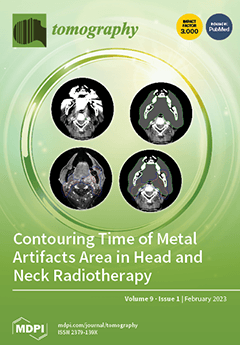
Cover Story: The impacts of metal artifacts (MAs) on the contouring workload for head and neck radiotherapy have not yet been clarified. Therefore, we evaluated the relationship between the contouring time of the MA area and MAs on head and neck radiotherapy treatment planning. The contouring time of MAs showed moderate positive correlations with the MA volume and the number of CT images containing MAs. Interobserver reliability of the extracted MAs volume and contouring time were excellent and poor, respectively. From our results, it was suggested that the contouring time of MA areas is related to individual commitment rather than clinical experience. Therefore, the development of software combining metal artifact reduction methods with automatic contouring methods is necessary for reducing interobserver variability and contouring workload. View this paper
  • Issues are regarded as officially published after their release is announced to the table of contents alert mailing list .
  • You may sign up for email alerts to receive table of contents of newly released issues.
  • PDF is the official format for papers published in both, html and pdf forms. To view the papers in pdf format, click on the "PDF Full-text" link, and use the free Adobe Reader to open them.

Articles (36)

  • Article
  • Open Access
3 Citations
4,766 Views
10 Pages

29 December 2022

This study aimed to optimize velocity-selective magnetic resonance angiography (VS-MRA) protocols for whole-neck angiography and demonstrate its feasibility in healthy subjects with comparisons to clinical 3D time-of-flight (TOF) angiography. To help...

  • Article
  • Open Access
7 Citations
4,403 Views
10 Pages

Stereotactic Microwave Ablation of Hepatocellular Carcinoma: The Impact of Tumor Size and Minimal Ablative Margin on Therapeutic Success

  • Antonia-Maria Pausch,
  • Tamam Ghali,
  • Tobias Wertheimer,
  • Florian Zeman,
  • Karolina Mueller,
  • Michael Christian Doppler,
  • Ingo Einspieler,
  • Lukas Philipp Beyer,
  • Stephan Schleder and
  • Christian Stroszczynski
  • + 1 author

26 December 2022

Background: Microwave ablation (MWA) has gained relevance in the treatment of hepatic malignancies and especially in hepatocellular carcinoma (HCC), and it is an important alternative to surgery. The purpose of the study was to evaluate whether the m...

  • Article
  • Open Access
2 Citations
2,578 Views
14 Pages

Myocardial Contractility Pattern Characterization in Radiation-Induced Cardiotoxicity Using Magnetic Resonance Imaging: A Pilot Study with ContractiX

  • El-Sayed H. Ibrahim,
  • Antonio Sosa,
  • Sherry-Ann Brown,
  • Dayeong An,
  • Slade Klawikowski,
  • John Baker and
  • Carmen Bergom

22 December 2022

Radiation therapy (RT) plays an integral role in treating thoracic cancers, despite the risk of radiation-induced cardiotoxicity. We hypothesize that our newly developed magnetic resonance imaging (MRI)-based contractility index (ContractiX) is a sen...

  • Article
  • Open Access
3 Citations
3,534 Views
11 Pages

22 December 2022

(1) Background: This study investigates the early evaluation value of magnetic resonance imaging (MRI) and multidetector computed tomography (MDCT) in diagnosing the recurrence of bladder cancer (BC) after trans-urethral resection (TUR) alone or comb...

  • Article
  • Open Access
4,773 Views
13 Pages

Reduction in Radiation Exposure in Minimally Invasive Pedicle Screw Placement Using a Tubular Retractor: A Pilot Study

  • Takeshi Oki,
  • Alan Kawarai Lefor,
  • Kentaro Nakamura,
  • Takahiro Higashi and
  • Isao Oki

20 December 2022

Background and Objectives: Percutaneous pedicle screw (PPS) placement is a minimally invasive spinal procedure that has been rapidly adopted over the last decade. However, PPS placement has elicited fear of increased radiation exposure from some surg...

  • Article
  • Open Access
7 Citations
4,602 Views
11 Pages

20 December 2022

The prediction of an occult invasive component in ductal carcinoma in situ (DCIS) before surgery is of clinical importance because the treatment strategies are different between pure DCIS without invasive component and upgraded DCIS. We demonstrated...

of 4

Get Alerted

Add your email address to receive forthcoming issues of this journal.

XFacebookLinkedIn
Tomography - ISSN 2379-139X